~/sacred-texts/philae-birth-house-mammisi-inscriptions
The Divine Birth of Horus at Philae: Come and See Your Son
- Date
- Carved under Ptolemy VIII Euergetes II (170–116 BC) on the walls of the birth house of the Isis temple at Philae
- Found
- Birth house (mammisi) of the temple of Isis, Philae; the temple was moved to Agilkia island near Aswan in 1972–1980 and stands there today
- Language
- Egyptian · Hieroglyphic
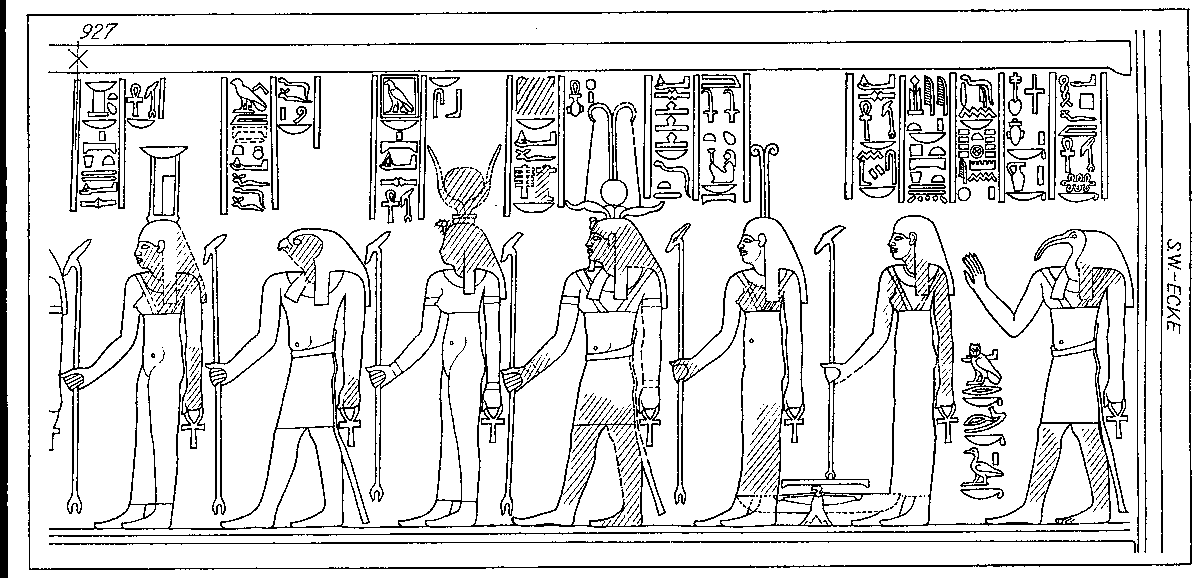
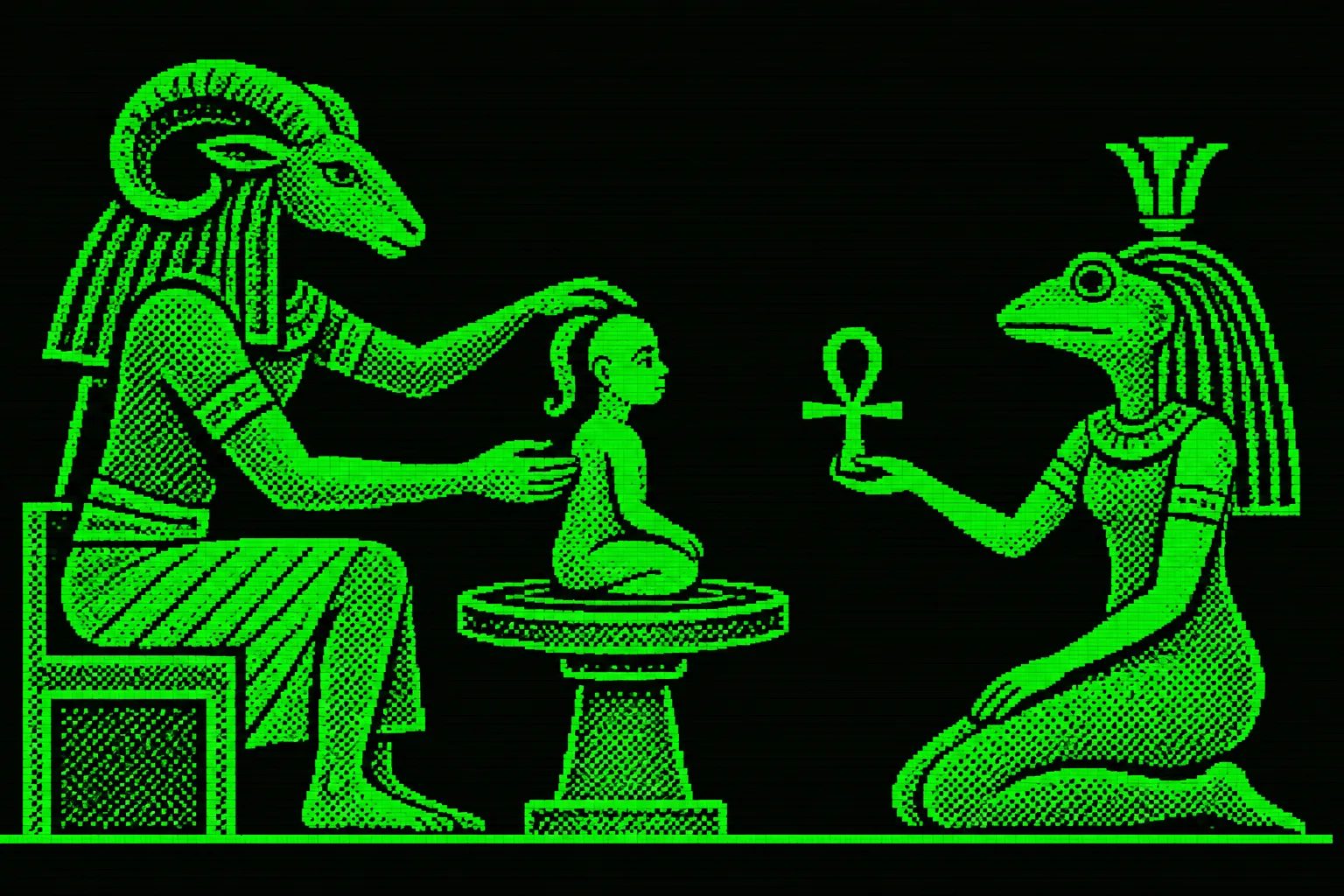
Ptolemy VIII gives Isis a field twelve schoeni in length along the water. Then the gods make her son. Amun-Ra sits with Isis on the bed and orders Khnum to his wheel. Khnum answers: I fashion Horus as the god who appears in glory; your limbs are the limbs of a god. Khnum and Heqet lead Isis to the birthplace, and fourteen gods follow with gifts.
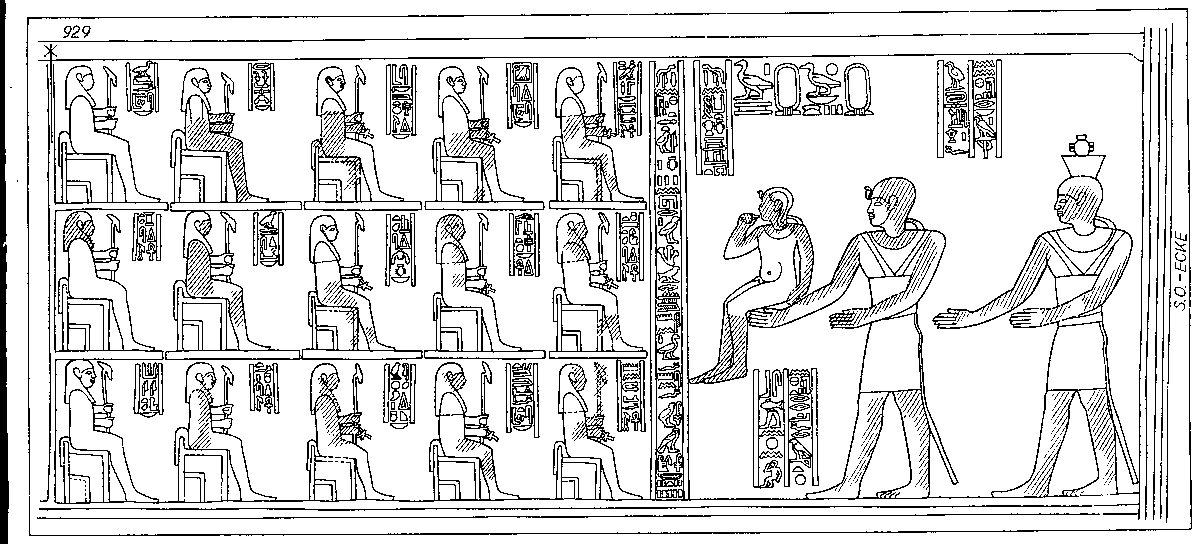
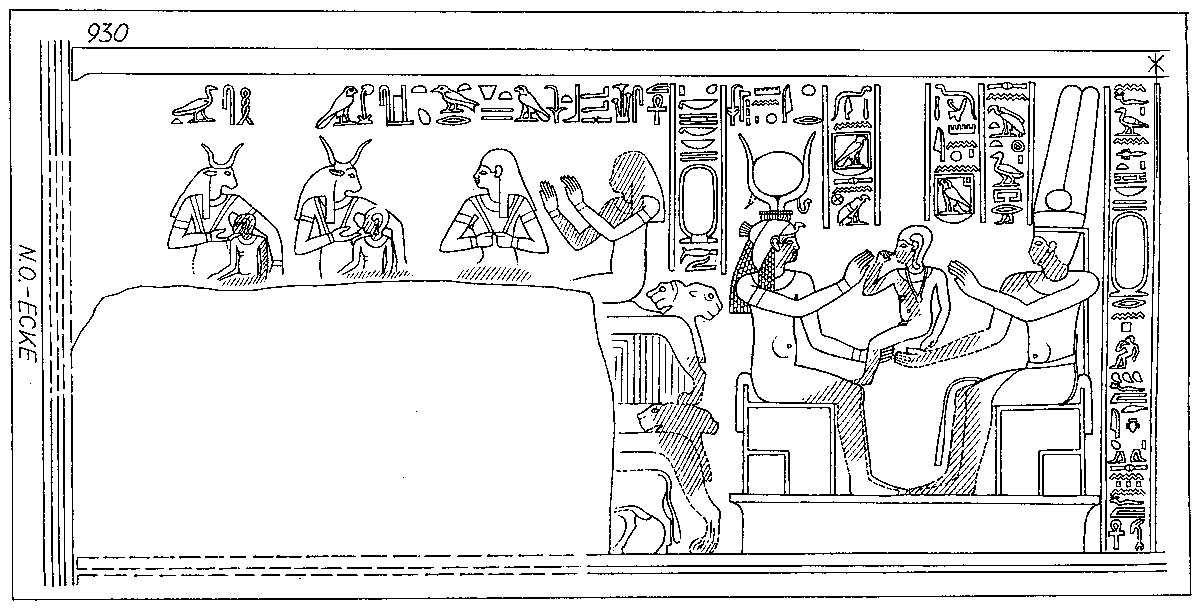
Thoth, lord of Hermopolis, calls the father: Amun-Ra, come and see your son: beautiful is the one you hold in your heart. The Ennead lifts the child’s face to Amun: for Amun receives his son and establishes him as king over the Nine Bows. Hathor hands Amun the child; two cows give milk.
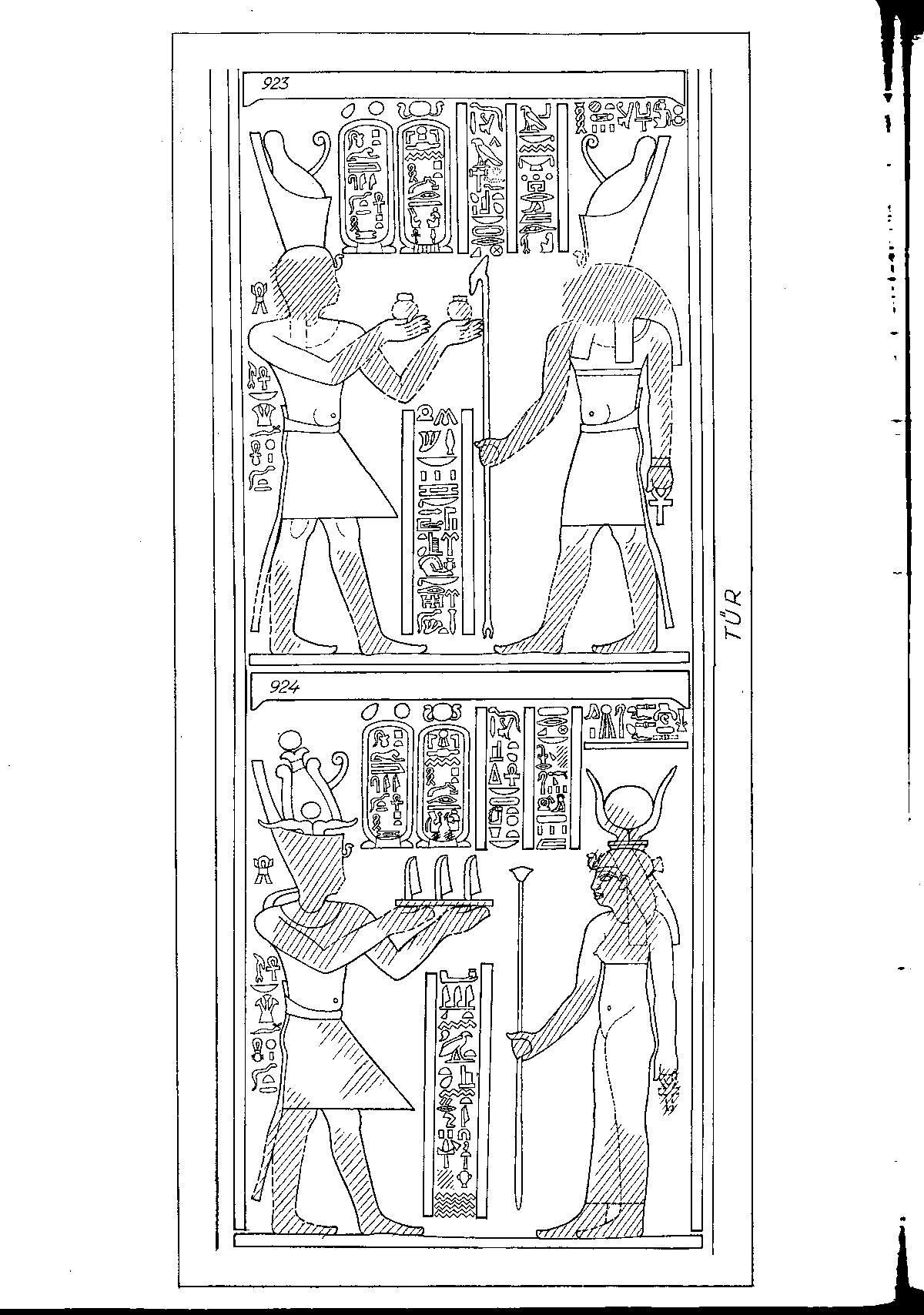
Ptolemy VIII gives Isis a field of twelve schoeni
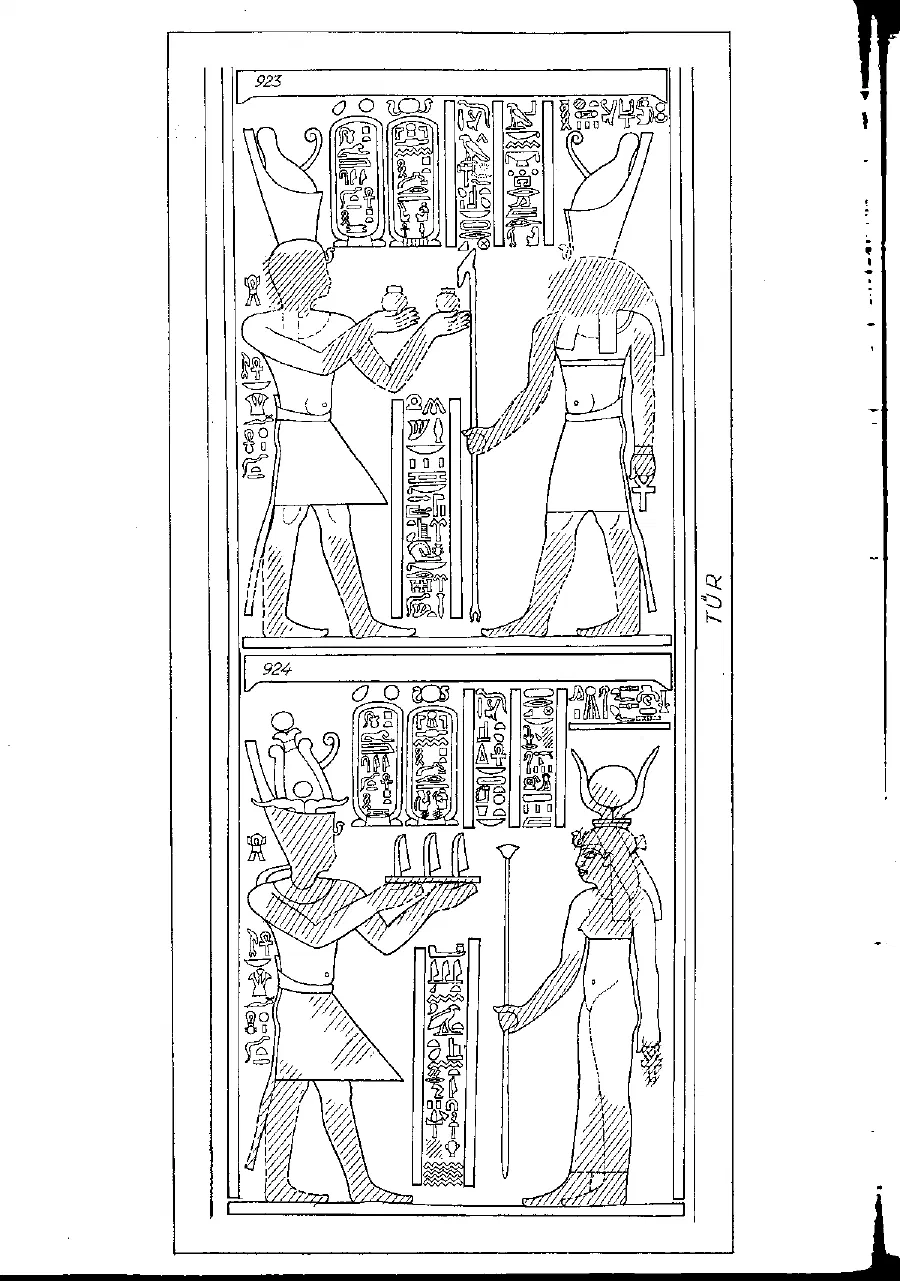
Page 95. The scene as drawn on the wall, facing p. 95 of the edition. Drawing by Otto Baum, in Junker and Winter, Das Geburtshaus des Tempels der Isis in Philä (1965)The hatched figures were hacked off the wall on purpose. After Justinian closed the temple of Isis around 537, Christians made it a church and chiselled out the gods and kings, mostly sparing the hieroglyphs. - 1p. 95, l. 10
ḥnk śḫ.t n mw.t-f Jś.t
Presenting a field to his mother Isis,
- 2p. 95, l. 11
n.t jtrw mḏ śn wnmj jꜣbj ḥr mw
twelve schoeni in length along the water, on the west bank and the east.
Note · Line 2
The schoenus was a measure of distance. The stretch of the Nile south of Philae known as the Twelve Schoeni supplied offerings for Isis. - 3p. 95, l. 12
njśwt bjt jwꜥw …
King of Upper and Lower Egypt, heir …
- 4p. 95, l. 13
sꜣ Rꜥ Pt …
Son of Ra, Ptolemy …
- 5p. 95, l. 14
sꜣ ꜥnḫ wꜣś nb ḥꜣ-f mj Rꜥ ḏ.t
May all protection, life and dominion surround him as they surround Ra, forever.
- 6p. 95, l. 15
ḏd mdw n | Jś.t dj(.t) ꜥnḫ nb(.t) jꜣ.t wꜥb.t
Words spoken by Isis, giver of life, lady of the Abaton,
Note · Line 6
The Abaton, the “Pure Mound,” was a sanctuary on the neighboring island of Bigeh where Osiris was believed to lie buried. - 7p. 95, l. 16
ḥnw.t nb(.t) Jrk nb(.t) rśj.w ḥḳꜣ(.t) mḥtj.w
sovereign lady, mistress of Philae, lady of the southerners and ruler of the northerners,
- 8p. 95, l. 17
ḥbj jnw m nmt.t jꜣḥw ḥḳꜣ.t śfśf nw.t(n) śn-ś
who gathers tribute from wherever sunlight falls, the ruler who makes offerings to her brother.
Note · Line 8
Her brother is Osiris, who is also her husband. Isis and Amun-Ra on the bed
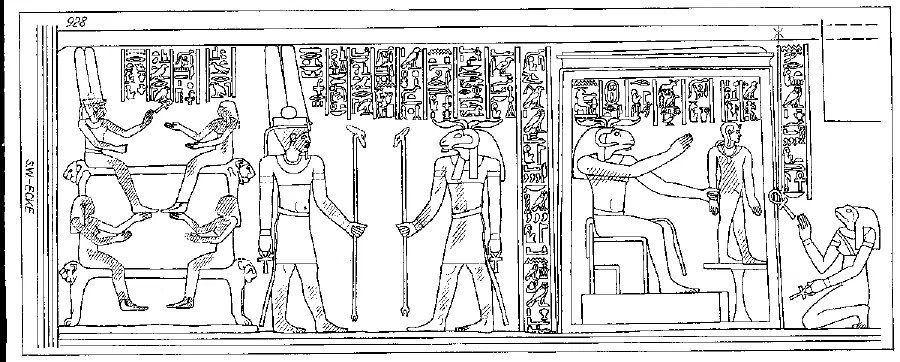
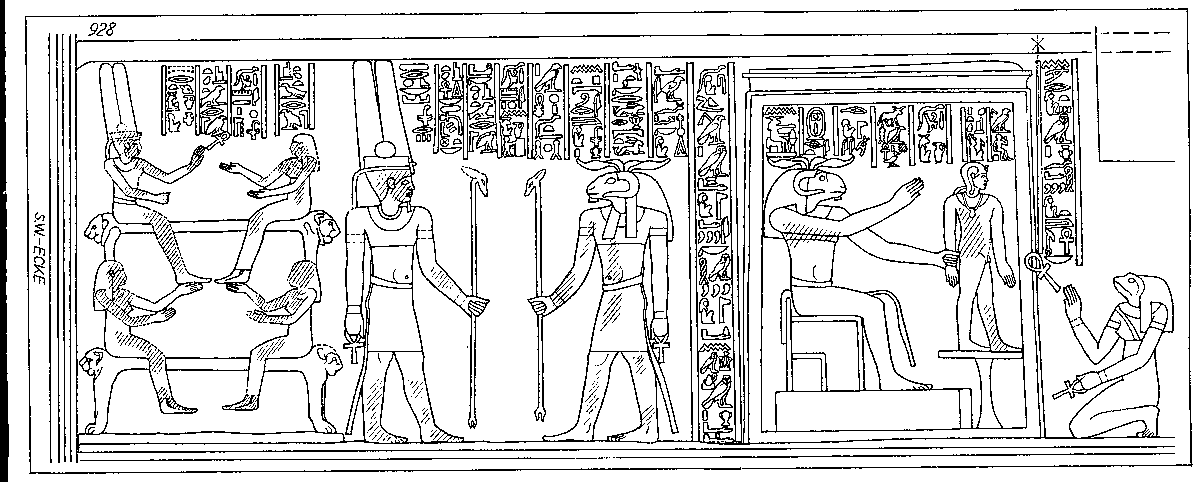
Page 97. The scene as drawn on the wall, facing p. 97 of the edition. Drawing by Otto Baum, in Junker and Winter, Das Geburtshaus des Tempels der Isis in Philä (1965) - 9p. 97, l. 1
Js.t wr.t mw.t nṯr
Isis the Great, mother of the god.
- 10p. 97, l. 2
ḏd mdw n | Jmn-Rꜥ njśwt nṯr.w
Words spoken by Amun-Ra, king of the gods:
- 11p. 97, l. 3
Js.t wr.t mw.t nṯr
O Isis the Great, mother of the god,
- 12p. 97, l. 4
… r fnd-ṯ ḫnm ib-ṯ (?)
… to your nose; gladden your heart.
Amun-Ra orders Khnum to fashion the child
- 13p. 97, l. 5
ḏd mdw n Jmn-Rꜥ n Ḫnmw
Words spoken by Amun-Ra to Khnum:
- 14p. 97, l. 6
ḳd-k Js.t wr.t mw.t nṯr
Fashion Isis the Great, mother of the god.
Note · Line 14
Khnum is the divine potter. In this birth scene he shapes the living Horus on his wheel. - 15p. 97, l. 7
Js.t dj(.t) ꜥnḫ nb(.t) jꜣ.t wꜥb.t
Isis, giver of life, lady of the Abaton,
- 16p. 97, l. 8
nb(.t) Jrḳ nb(.t) ḫꜣś.wt rśj.wt
lady of Philae, lady of the foreign lands to the south.
- 17p. 97, l. 9
ḏd mdw n | Ḫnmw (bꜣ?) nḫp sꜣ ꜥnḫ
Words spoken by Khnum, the ba who shapes the living son on his wheel
Note · Line 17
A ba is a form in which a god can be present and act. The word also echoes the Egyptian word for a ram, Khnum’s sacred animal. - 18p. 97, l. 10
jrj nṯr mrjj prj-ꜥꜣ
and makes the god whom Pharaoh loves:
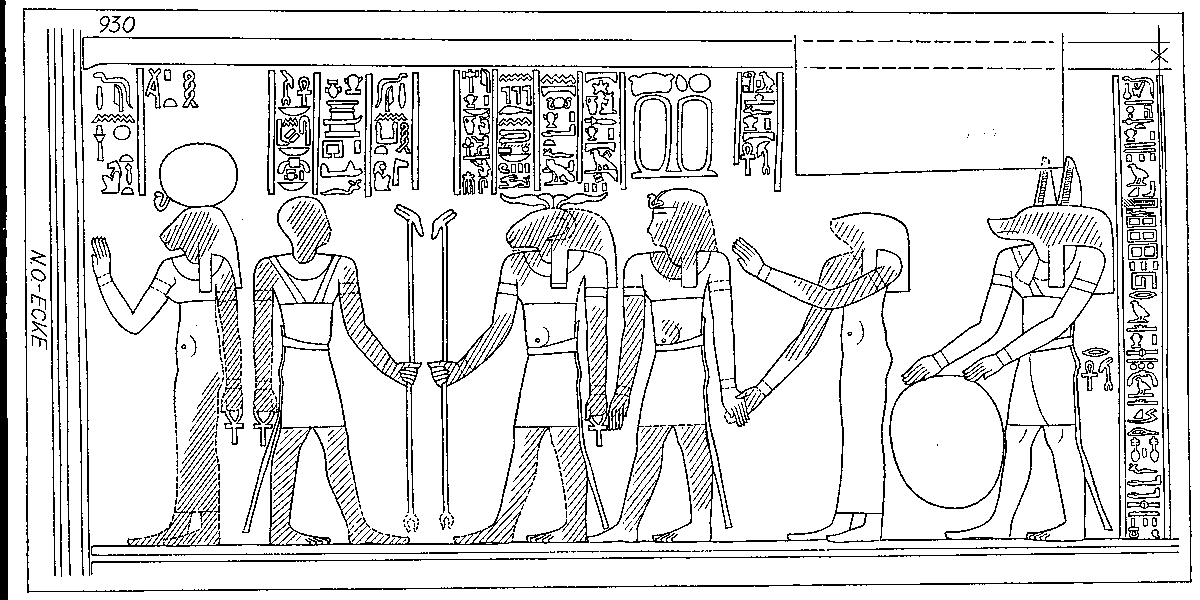
- 19p. 97, l. 11
jrj.t-n-j⁴ ḏś-j
What I myself have made.
- 20p. 97, l. 12
ḳmꜣ-j Ḥrw m ḫꜥj
I fashion Horus as the god who appears in glory;
- 21p. 97, l. 13
?jw ꜥ.wt-k m ḥꜥ.w-nṯr
your limbs are the limbs of a god.
- 22p. 97, l. 14
dj-n-j ḥnw ḥr (so?) wḏꜣ m (so?) ꜥ.wj (-j)
With my two arms I have added growth to health.
- 23p. 97, l. 15
jw (?)-f nfr-k
May he have your beauty.
- 24p. 97, l. 16
dj-j ꜥḥꜥw-k r wnn ḥr.t wnn p.t
I grant you a lifetime as long as the heavens endure, as long as the sky endures,
- 25p. 97, l. 17
jw-k (so) m njśwt ḥr [ś.t] Ḥrw
with you as king on the throne of Horus.
- 26p. 97, l. 18
mj Rꜥ ḏ.t nḥḥ
like Ra, for ever and ever.
Note · Line 26
The Egyptian names two kinds of eternity: time that endures and time that renews itself. - 27p. 97, l. 19
Ḥrw pꜣ ḫrd sꜣ Js.t Wśjr
Horus the Child, son of Isis and Osiris.
Note · Line 27
Harpocrates is the Greek form of “Horus the Child.” Thoth announces the birth to Isis
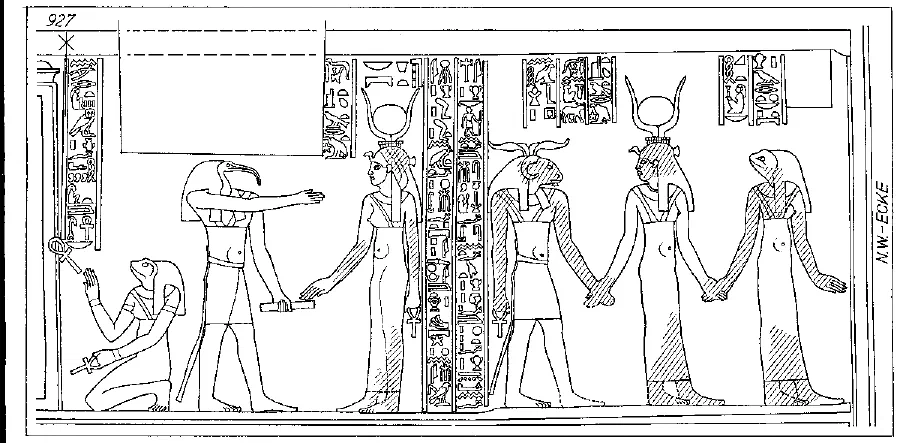
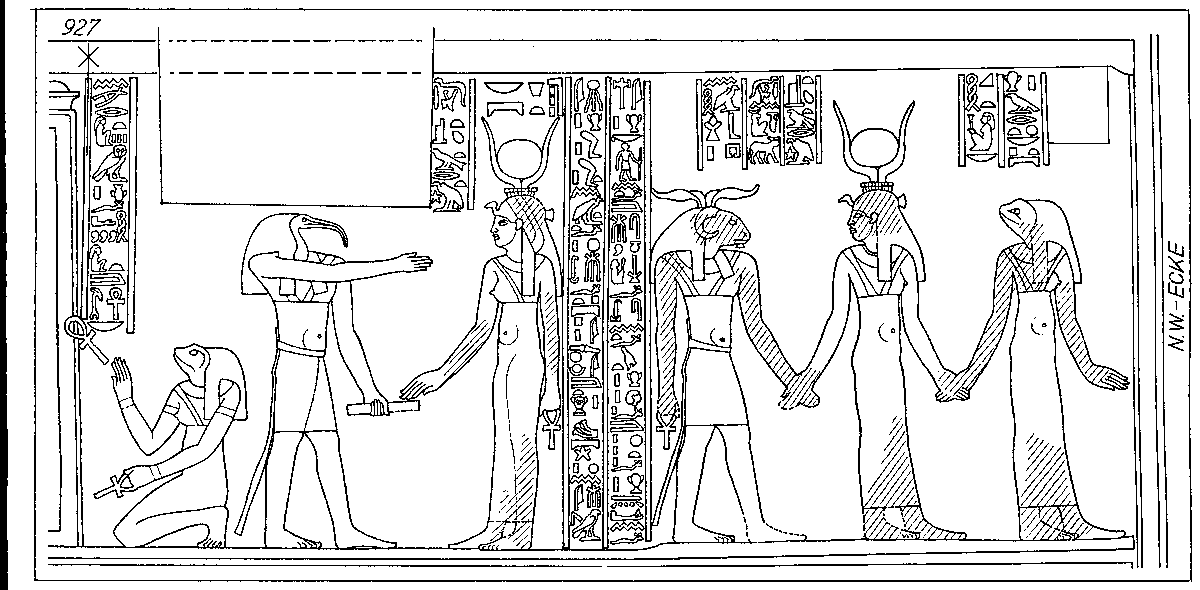
Page 99. The scene as drawn on the wall, facing p. 99 of the edition. Drawing by Otto Baum, in Junker and Winter, Das Geburtshaus des Tempels der Isis in Philä (1965) - 28p. 99, l. 1
ḏd mdw n | ꜣs.t wr.t mw.t nṯr
Words spoken by Isis the Great, the god’s mother,
- 29p. 99, l. 2
nb(.t) p.t ḥnw.t nṯr.w
lady of the sky, sovereign of the gods:
- 30p. 99, l. 3
… n mrw.t-ṯ(?) m jb-f
… your love in his heart,
- 31p. 99, l. 4
ḥꜥ.w-ṯ(?) m ꜥnḫ wꜣs nb
your limbs endowed with all life and dominion.
Hymn on the day Horus is born
- 32p. 99, l. 5
nḏ ḥr-k wr(?) ntf m šmsj-n-f sn.t-f
Hail to you, prince! He is the one who has made his sister give birth,
- 33p. 99, l. 6
smn n-f ḥḏ.t ḥr tp-f
who secures for him the White Crown upon his head
- 34p. 99, l. 7
m jḫ.t-f ḥr tꜣ
as his possession on earth.
Note · Line 34
The crown belongs to the newborn Horus. The White Crown marks him as king of Upper Egypt. - 35p. 99, l. 8
dj(.w) n-f ꜣḫw ḥr mn.tj n mw.t-f
Radiance is granted him on his mother’s thighs
- 36p. 99, l. 9
hrw msj.tw-f
on the day he is born.
- 37p. 99, l. 10
p.t j … š j(w?) jtn jꜥḥ m … grḥ(?)
The sky … the sun disk and the moon … at night
- 38p. 99, l. 11
hrw n msj Ḥrw
on the day Horus is born.
Khnum and Heqet lead Isis to the birthplace
- 39p. 99, l. 12
ꜣs.t wr.t mw.t nṯr
Isis the Great, the god’s mother.
- 40p. 99, l. 13
ḏd mdw n | Ḫnmw
Words spoken by Khnum,
- 41p. 99, l. 14
bꜣ(?)¹ n prj(?) nḫp
the ba of the potter’s house.
- 42p. 99, l. 15
Ḥḳ.t nb(.t) Ḥr-wr nb(.t) p.t
Heqet, lady of Herwer, lady of the sky.
Note · Line 42
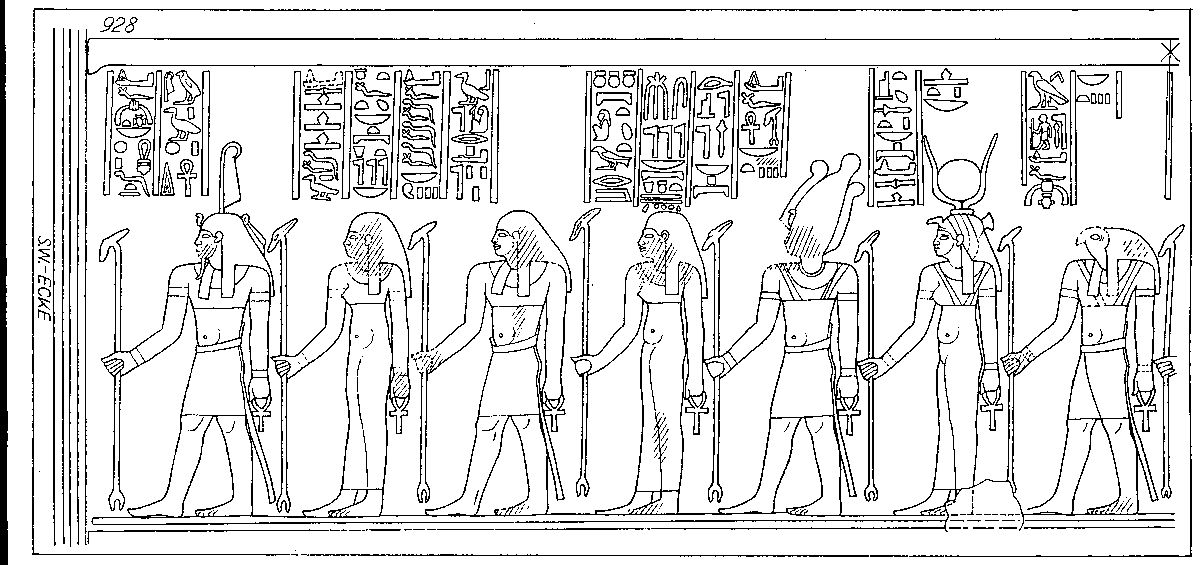
Heqet is the frog goddess who presides over childbirth. The gods walk in procession to the birthplace of the child Horus
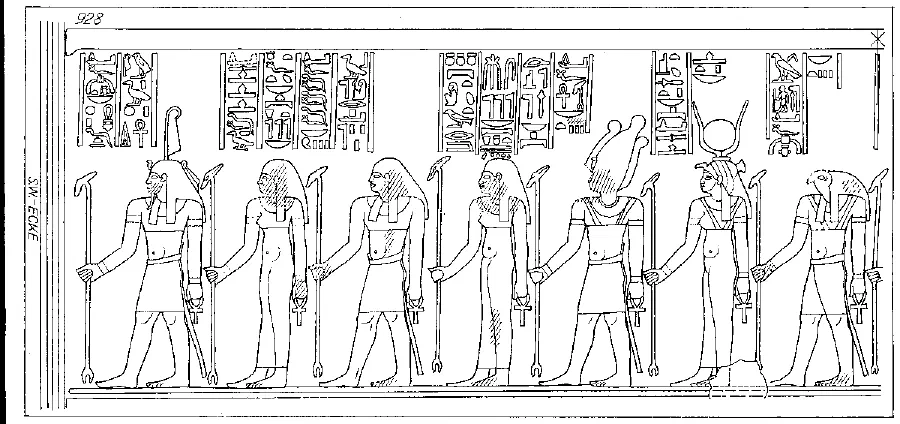
Page 101. The scene as drawn on the wall, facing p. 101 of the edition. Drawing by Otto Baum, in Junker and Winter, Das Geburtshaus des Tempels der Isis in Philä (1965) - 43p. 101, l. 1
Šw sꜣ Rꜥ dj ꜥnḫ
Shu, son of Ra, giver of life:
- 44p. 101, l. 2
dj-f jw.t-jb nb(.t) mj Rꜥ ḏ.t
may he grant every joy, like Ra, forever.
- 45p. 101, l. 3
Tfn.t nb.t p.t ḥnw.t nṯr.w nb.w
Tefnut, lady of the sky, sovereign of all the gods:
- 46p. 101, l. 4
dj-s ḥtp.w ḏfꜣ.w
may she grant offerings and provisions.
- 47p. 101, l. 5
Gb rpꜥ.t nṯr.w
Geb, hereditary prince of the gods:
- 48p. 101, l. 6
dj-f ḏfꜣ.w nb.w
may he grant provisions of every kind.
- 49p. 101, l. 7
Nw.t wr.t ms(.t) nṯr.w
Nut the Great, who gave birth to the gods,
- 50p. 101, l. 8
nb(.t) p.t ḥnw.t tꜣ.wj
lady of the sky, sovereign of the Two Lands.
Note · Line 50
The Two Lands are Upper and Lower Egypt. - 51p. 101, l. 9
Wsjr nṯr ꜥꜣ nb p.t
Osiris, the great god, lord of the sky:
- 52p. 101, l. 10
dj-f ꜥnḫ wꜣs nb
may he grant all life and dominion.
- 53p. 101, l. 11
Js.t ꜥꜣ.t nb(.t) p.t
Isis the Great, lady of the sky:
- 54p. 101, l. 12
dj-s ḥtp.w nb.w
may she grant every offering.
- 55p. 101, l. 13
Ḥrw-wr nṯr ꜥꜣ
Horus the Elder, the great god,
- 56p. 101, l. 14
dj-f jw.t-jb nb.t
May he grant every joy.
Note · Line 56
The birth house was a sanctuary where the birth of the divine child was celebrated. 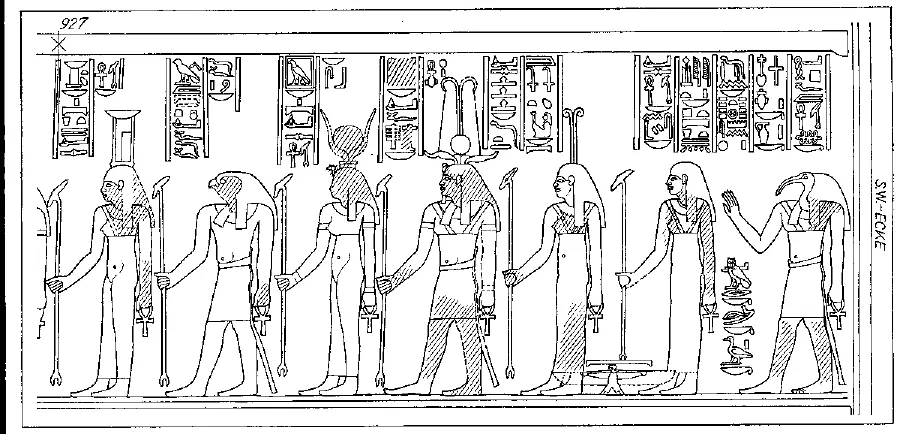
Page 103. The scene as drawn on the wall, facing p. 103 of the edition. Drawing by Otto Baum, in Junker and Winter, Das Geburtshaus des Tempels der Isis in Philä (1965) - 57p. 103, l. 1
Nb.t-ḥw.t nb(.t) p.t ḥnw.t tꜣ.wj
Nephthys, lady of heaven, mistress of the Two Lands:
- 58p. 103, l. 2
dj-s ꜥnḫ wꜣs nb
may she grant all life and dominion.
- 59p. 103, l. 3
Ḥrw m ḥrj(?) tꜣ(?) pn(?)
Horus as head of this land:
- 60p. 103, l. 4
dj-f ḏfꜣ(.w) nb(.w)
may he grant food of every kind.
- 61p. 103, l. 5
Ḥw.t-Ḥrw nb(.t) p.t
Hathor, lady of heaven:
- 62p. 103, l. 6
dj-s ꜥnḫ wꜣs nb snb (nb)
may she grant all life and dominion, and perfect health.
- 63p. 103, l. 7
…
[gap in the text]
- 64p. 103, l. 8
dj-f ḏd … nb mj Rꜥ
May he grant stability and all … like Ra.
- 65p. 103, l. 9
Tnn.t (sic) nb(.t) p.t
Tenenet, lady of heaven:
- 66p. 103, l. 10
dj-s ḥtp.w nb.w ḏ.t
may she grant every offering for ever.
- 67p. 103, l. 11
Jwnj.t nb(.t) p.t ḥnw.t tꜣ.wj
Iunit, lady of heaven, mistress of the Two Lands:
- 68p. 103, l. 12
dj-s ꜥnḫ wꜣs nb snb nb
may she grant all life and dominion, and perfect health.
- 69p. 103, l. 13
ḏd mdw jn nb Ḫmnw
Words spoken by the lord of Hermopolis:
Note · Line 69
The speaker is Thoth, the god of Hermopolis. - 70p. 103, l. 14
Jmn-Rꜥ mj r-k mꜣꜣ-k sꜣ-k nfr jmj jb-k
Amun-Ra, come and see your son: beautiful is the one you hold in your heart.
- 71p. 103, l. 15
ẖnm-k ḥꜥ.w-f m ꜥnḫ wꜣs sꜣ nb (so)?³
Endow his limbs with all life, dominion and protection.
Khnum leads the king to the birthplace
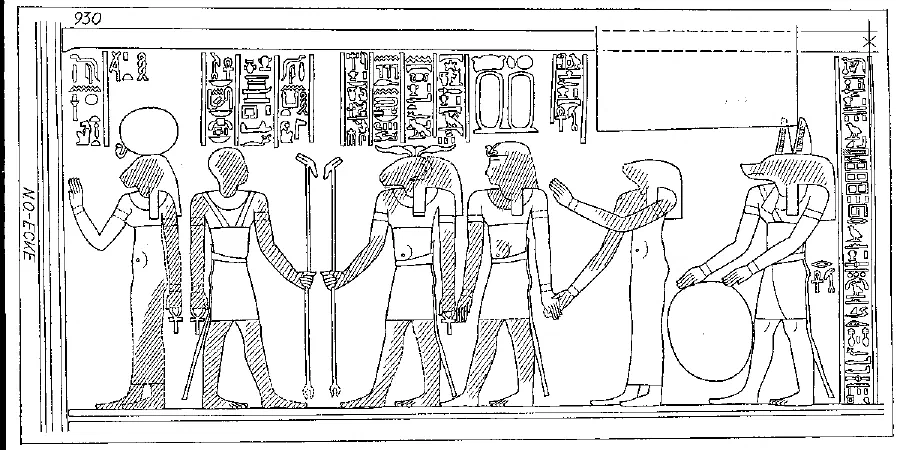
Page 105. The scene as drawn on the wall, facing p. 105 of the edition. Drawing by Otto Baum, in Junker and Winter, Das Geburtshaus des Tempels der Isis in Philä (1965) - 72p. 105, l. 1
ḏd mdw jn | Sḫm.t ꜥꜣ.t mrr.t Ptḥ
Words spoken by Sekhmet the Great, whom Ptah loves.
- 73p. 105, l. 2
ḏd mdw jn | Ḥkꜣw(tj) ḥrj-jb ꜥḥ(?)²
Words spoken by the god of magic who dwells in the palace.
- 74p. 105, l. 3
dj-f ꜥnḫ wꜣs nb šnb nb ꜣw.t-jb nb.t
May he grant all life and dominion, perfect health and every gladness of heart.
- 75p. 105, l. 4
nḏ ḥr-k Ḫnmw nḫp rmṯ(?) msj n nṯr.w
Hail to you, Khnum, who shaped humankind at the wheel and brought the gods to birth,
- 76p. 105, l. 5
jrj nt.t nb.t
who made all that is,
- 77p. 105, l. 6
wn p.t-Rꜥ(?) ḥr ḏr.t-f(?) (m) mšrw(?)
on whose hand the sky of Ra rests at dusk,
- 78p. 105, l. 7
Ḫnmw ꜥꜣ ḥrj nṯr.w
Khnum the Great, who is above the gods!
- 79p. 105, l. 8
njśwt bjt … sꜣ Rꜥ …
King of Upper and Lower Egypt …, son of Ra …
Note · Line 79
The spaces for the king’s names were left blank. - 80p. 105, l. 9
nṯr pw ḥtp-f ḥr ꜥnḫ wꜣs
He is a god, content with life and dominion.
- 81p. 105, l. 10
r ꜥnḫ wꜣs
For life and dominion.
- 82p. 105, l. 11
ḏd mdw n | psḏ.t ꜥꜣ.t ḥr tꜣ.w (m? ḳꜣb)
Words spoken to the Great Ennead on earth, in its midst:
Note · Line 82
An ennead is a company of nine gods. - 83p. 105, l. 12
ḳꜣb-f(?) (prj-f?) … ḥrw ḥr-s
He doubles …, pleased with it.
- 84p. 105, l. 13
tꜣ ꜣw mꜣꜣ (so) nfrw-f
The whole earth sees his beauty.
- 85p. 105, l. 14
ꜥ.wj-śn ḥr-f
Their two hands are upon him.
The Ennead presents the child king to Amun
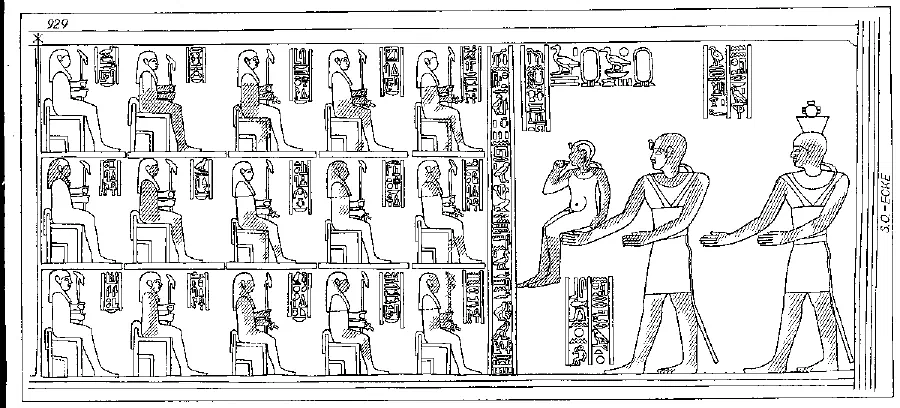
Page 107. The scene as drawn on the wall, facing p. 107 of the edition. Drawing by Otto Baum, in Junker and Winter, Das Geburtshaus des Tempels der Isis in Philä (1965) - 86p. 107, l. 1
bs nḥn in psḏ.t
The Ennead bringing in the child
Note · Line 86
Its name means “the Nine.” - 87p. 107, l. 2
r rdj.t-f r nṯr (?)
to make him a god;
- 88p. 107, l. 3
wṯs (ṯsj?) ḥr-f in psḏ.t r nb nṯr(.w)
the Ennead lifting his face toward the lord of the gods.
- 89p. 107, l. 4
ḏd mdw in | Ḥkꜣw(tj) ḥrj-jb ꜥḥ (?)³
Words spoken by the god of magic, who dwells in the palace:
- 90p. 107, l. 5
sꜣ mrj … sꜣ Rꜥ nb ḫꜥ.w …
The beloved son …, Son of Ra, lord of crowns …
- 91p. 107, l. 6
ḏd mdw in psḏ.t ꜥꜣ.t
Words spoken by the Great Ennead:
- 92p. 107, l. 7
iw ib-n ḥrw wr
Our heart is glad indeed,
- 93p. 107, l. 8
šsp Jmn sꜣ-f
for Amun receives his son
- 94p. 107, l. 9
smn-f šw m njswt pḏ.t (?) psḏ.t
and establishes him as king over the Nine Bows.
Note · Line 94
The Nine Bows stand for the enemy peoples over whom the Egyptian king claims dominion. - 95p. 107, l. 10
Mnṯw dj-f ꜥnḫ wꜣs
May Montu grant life and dominion.
- 96p. 107, l. 11
Jtmw dj-f snb nb
May Atum grant full health.
- 97p. 107, l. 12
Šw sꜣ Rꜥ dj-f ḳn nb
May Shu, son of Ra, grant all strength.
- 98p. 107, l. 13
Tfn.t dj-s ꜥnḫ wꜣs
May Tefnut grant life and dominion.
- 99p. 107, l. 14
Ḥkꜣw(tj?) nb
The god of magic, the lord.
- 100p. 107, l. 15
Nw.t dj-s ꜥnḫ wꜣs
May Nut grant life and dominion.
- 101p. 107, l. 16
Wsjr nb Ḏdw dj ꜥnḫ
Osiris, lord of Busiris, giver of life.
- 102p. 107, l. 17
Js.t dj-s ꜣw.t-ib nb.t
May Isis grant every joy.
- 103p. 107, l. 18
… dj-s … nb
… may she grant every …
- 104p. 107, l. 19
Nb.t-ḥw.t dj-s ꜥnḫ wꜣs
May Nephthys grant life and dominion.
- 105p. 107, l. 20
Rꜥ-Ḥrw ꜣḫtj nṯr ꜥꜣ nb p.t dj-f ꜥnḫ wꜣs
May Ra-Horakhty, the great god, lord of the sky, grant life and dominion.
- 106p. 107, l. 21
Ḥw.t-Ḥrw dj-s snb nb
May Hathor grant full health.
- 107p. 107, l. 22
Sbk m Ḏd.t dj wꜣs nb
May Sobek in Mendes grant all dominion.
- 108p. 107, l. 23
Tnn(.t) dj-s ꜣw.t(-ib) nb.t
May Tenenet grant every joy.
- 109p. 107, l. 24
Gb dj-f snb nb
May Geb grant full health.
Isis on the bed; Hathor of Bigeh and Amun-Ra hold the child
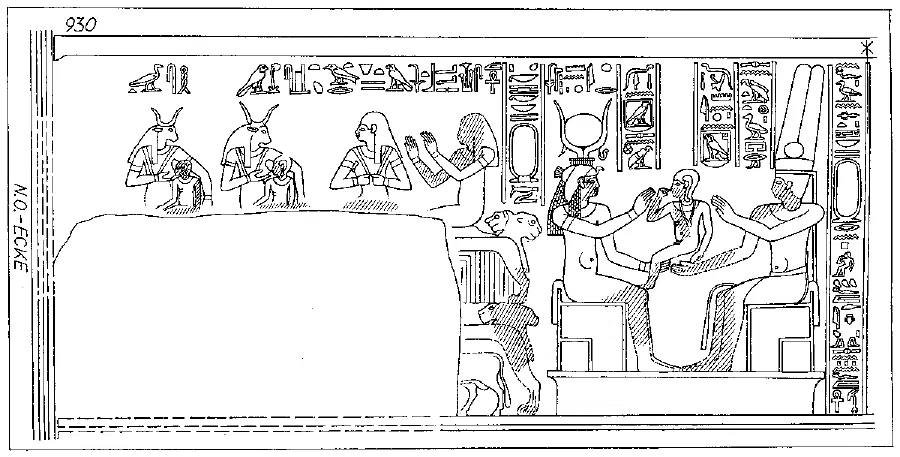
Page 109. The scene as drawn on the wall, facing p. 109 of the edition. Drawing by Otto Baum, in Junker and Winter, Das Geburtshaus des Tempels der Isis in Philä (1965) - 110p. 109, l. 1
Js.t wr.t ḥnw.t tꜣ.wj Ḥrw
Isis the Great, mistress of the Two Lands of Horus.
- 111p. 109, l. 2
Nḫb.t ꜥ.wj-s ḥꜣ-s m ꜥnḫ
Nekhbet, her two arms behind her in life.
Note · Line 111
Nekhbet is the vulture goddess. Her outspread wings are pictured as protecting arms. - 112p. 109, l. 3
sḫꜣ.t Ḥrw
The cow Sekhathor.
- 113p. 109, l. 4
ḥsꜣ.t
The cow Hesat.
- 114p. 109, l. 5
ḏd mdw jn Ḥw.t-Ḥrw nb(.t) Snm.t
Words spoken by Hathor, lady of Bigeh,
Note · Line 114
Bigeh is an island beside Philae. - 115p. 109, l. 6
ḫr Jmn-Rꜥ njśwt nṯr.w
to Amun-Ra, king of the gods:
- 116p. 109, l. 7
sꜣ-k mrj-k nb tꜣ.wj … šd.w
Your son whom you love, Lord of the Two Lands, …, the Savior.
Note · Line 116
The space for the king’s name was left blank here and in Amun-Ra’s speech below. - 117p. 109, l. 8
ḏd mdw n Jmn-Rꜥ n Ḥw.t-Ḥrw nb(.t) Snm.t
Words spoken by Amun-Ra to Hathor, Lady of Bigeh:
- 118p. 109, l. 9
sꜣ prj-n-f sꜣ n ḫ.t-j mrj(-j) nb tꜣ.wj …
The son who came forth, the son of my body whom I love, Lord of the Two Lands, …
- 119p. 109, l. 10
rnp ḥꜥ.w-f m jrṯ.t sꜣ(?)²
His flesh is young through milk and protection;
- 120p. 109, l. 11
prj-ꜥḳ-śn n-f m ꜥnḫ wꜣś
they flow forth and enter him as life and dominion.