~/sacred-texts/philae-temple-inscriptions
Philae Birth House Inscriptions: Born with the Cobras on His Head
- Date
- Carved under Ptolemy VIII Euergetes II (145–116 BC) on the walls of Chamber III of the birth house of the Isis temple at Philae
- Found
- Philae, at the First Cataract of the Nile; the temple was moved block by block to the island of Agilkia in the 1970s and stands there today
- Language
- Egyptian · Hieroglyphic
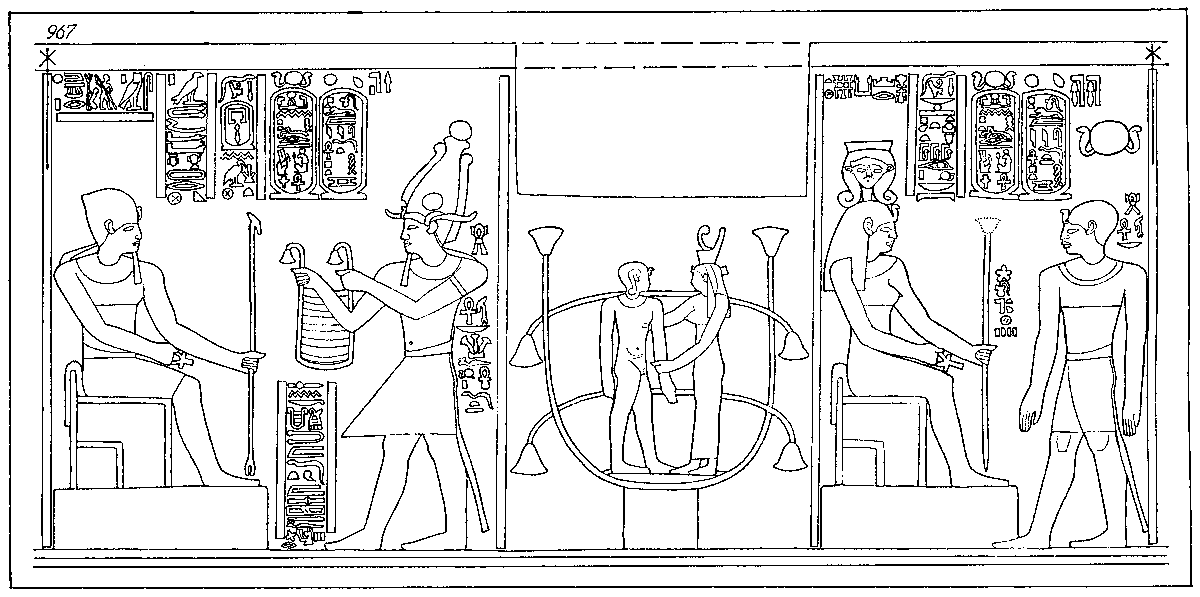
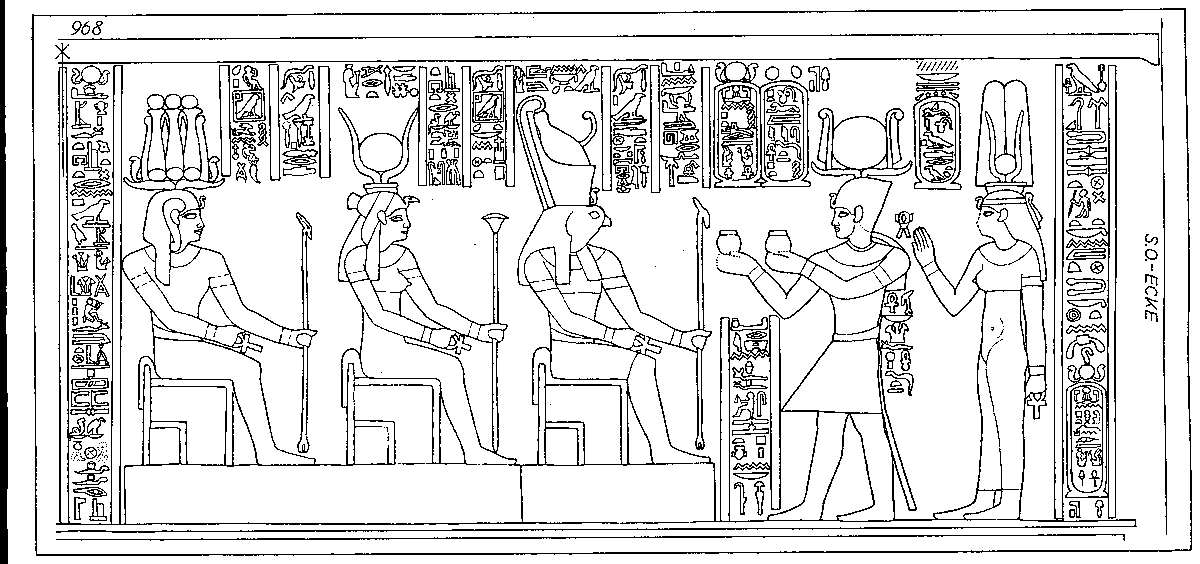
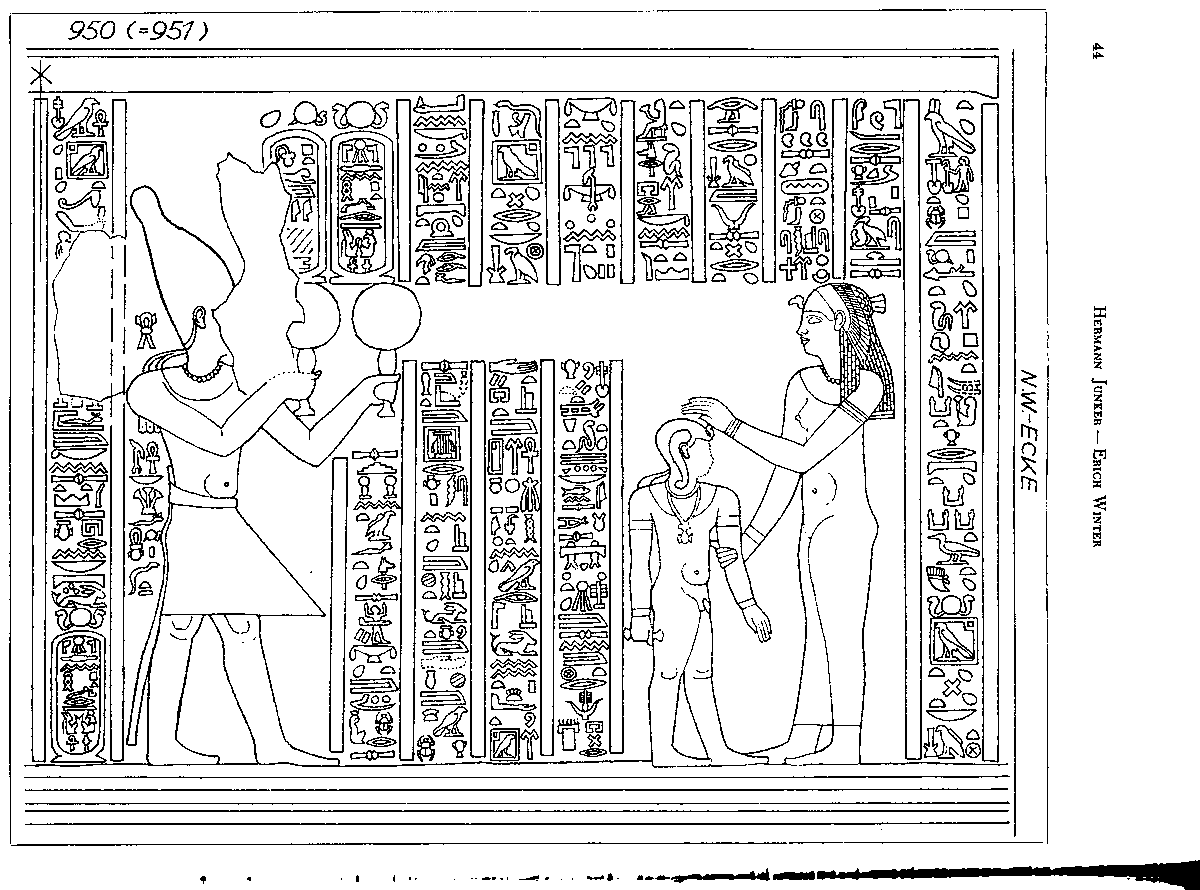
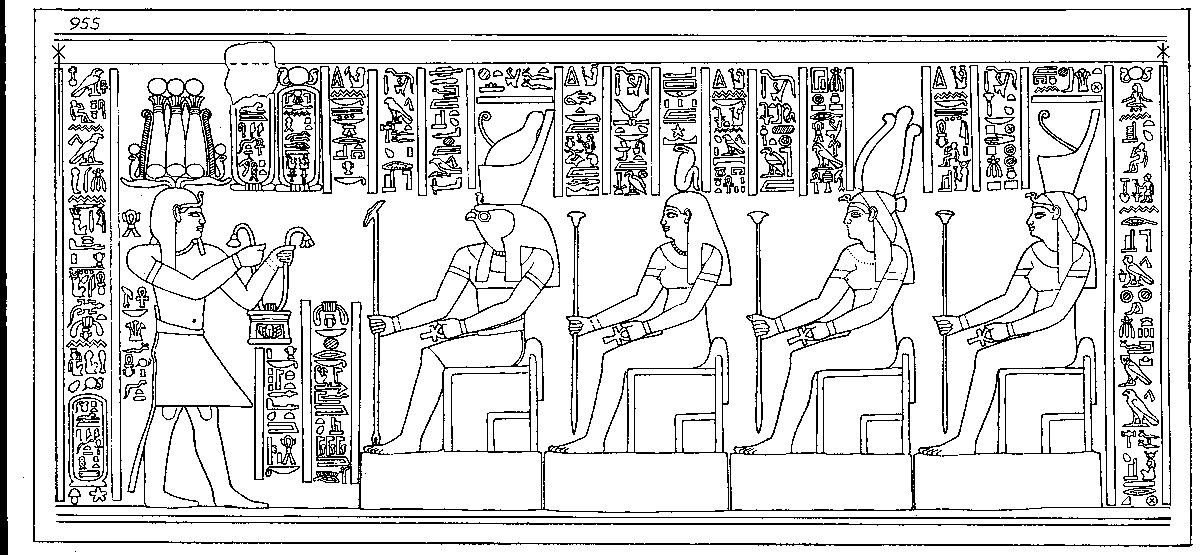
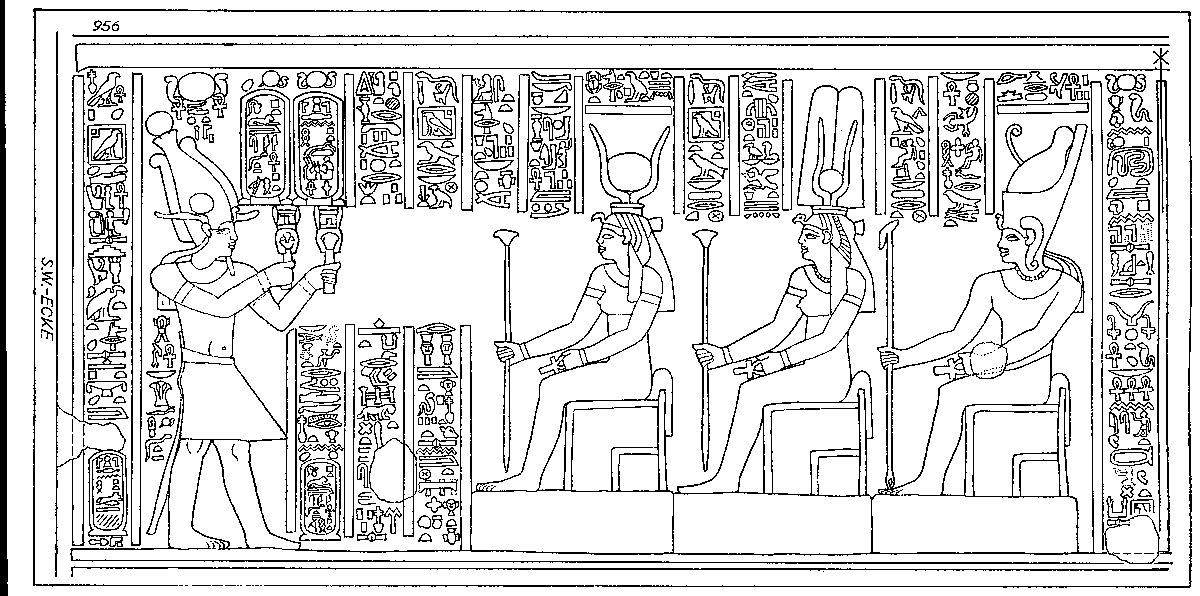
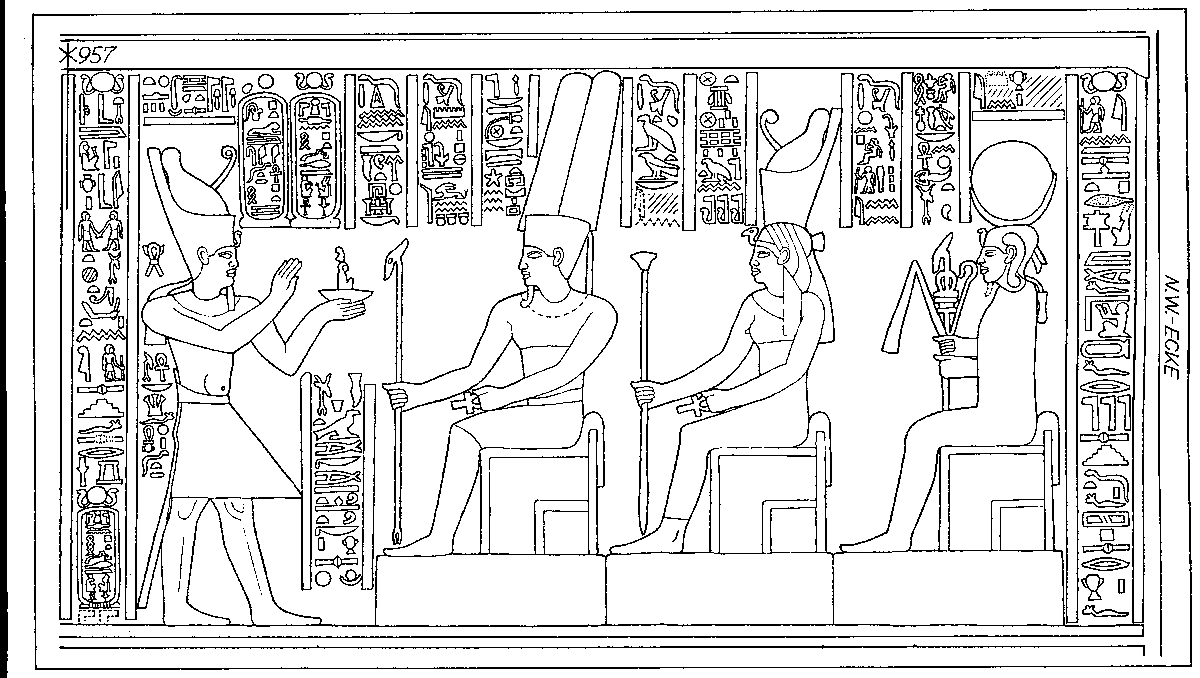
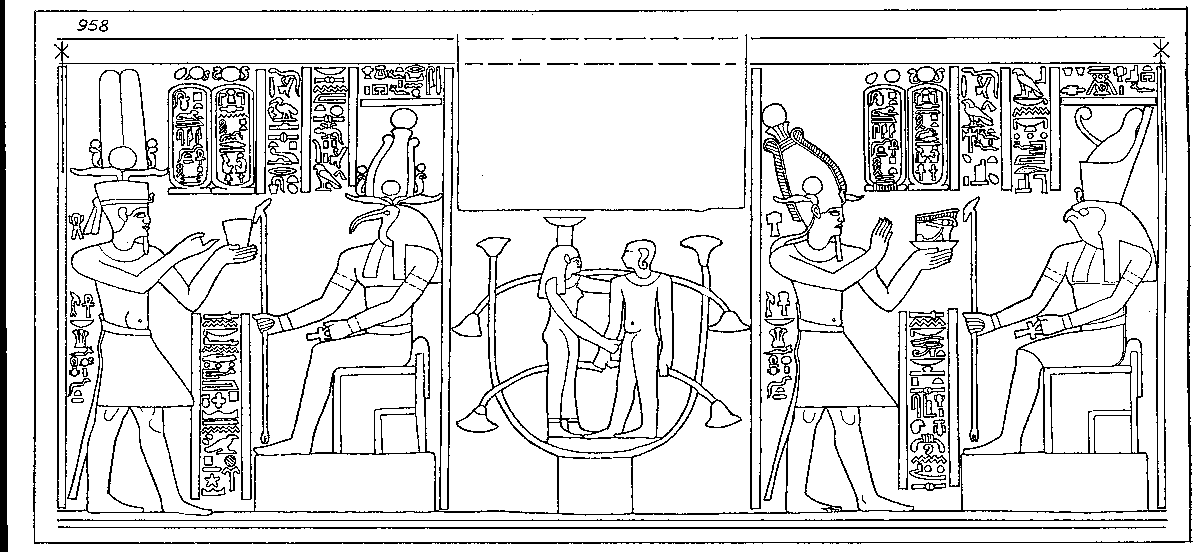
Ptolemy VIII goes from god to god with a gift for each: the two crowns for Osiris, a Heh figure for Khnum, myrrh for Ptah, mirrors and sistra for Hathor, a love potion for Min, a field for Osiris. The king speaks first; the god answers with a grant: I give you all lands beneath your throne.
The gods are named by what they do. Sekhmet is the Living One, who devours all that is. Tefnut is she who burns Apep for her father Ra. Hathor is lady of drunkenness, who loves jubilation, lady of song and dance, sovereign of leaping. Queen Cleopatra tells the king: My beloved brother, put your trust in Isis.
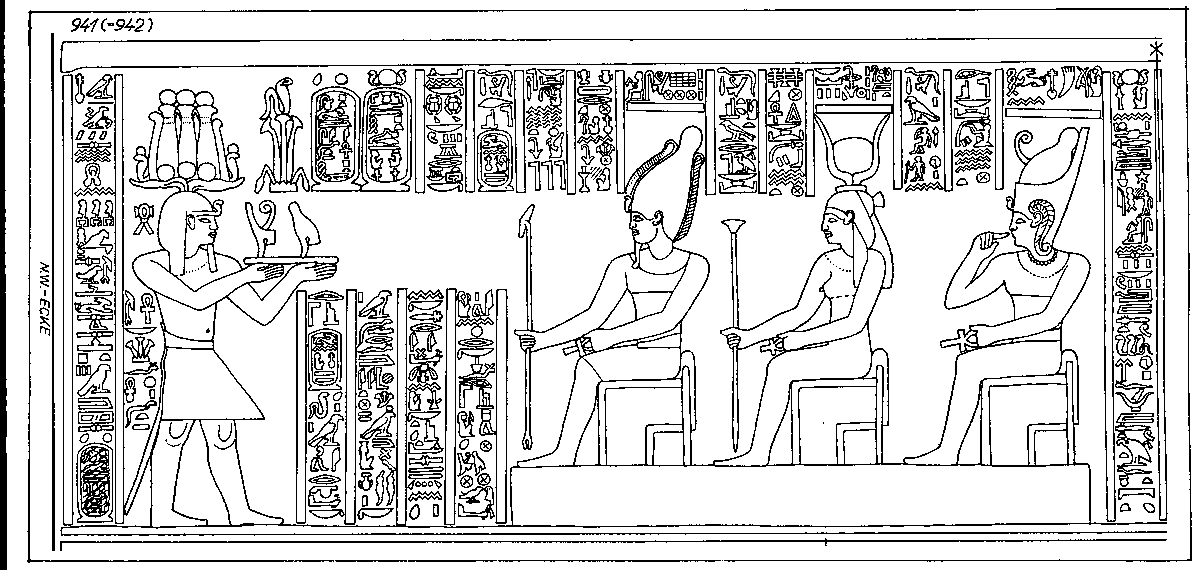
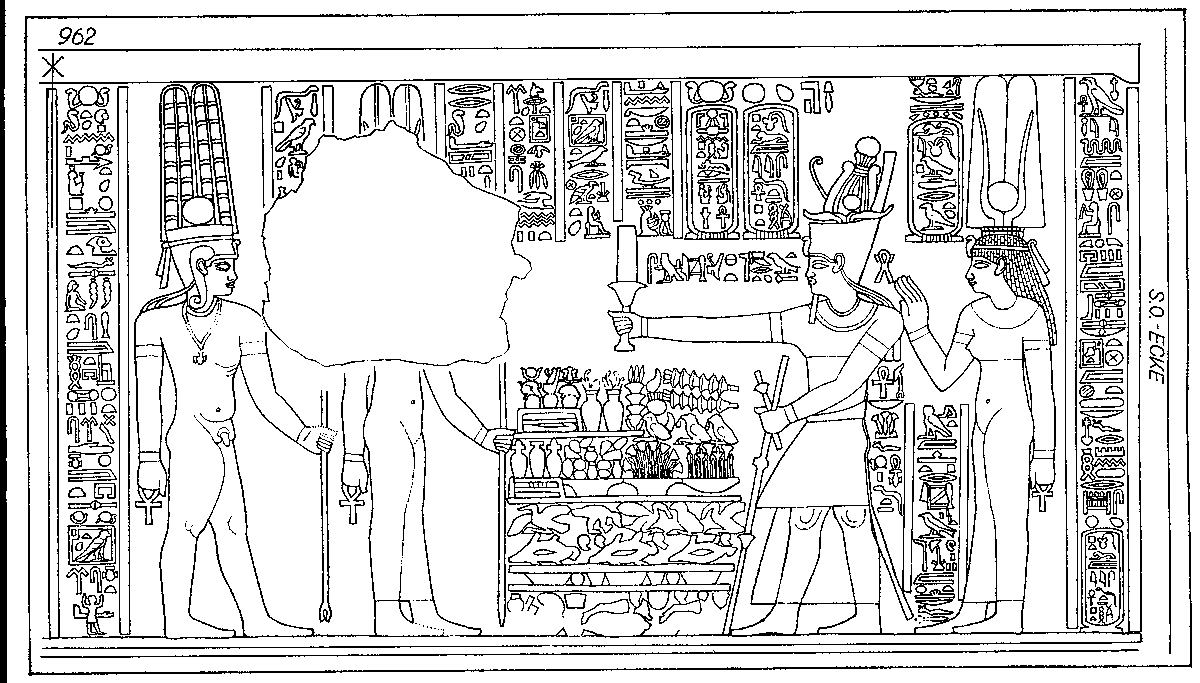
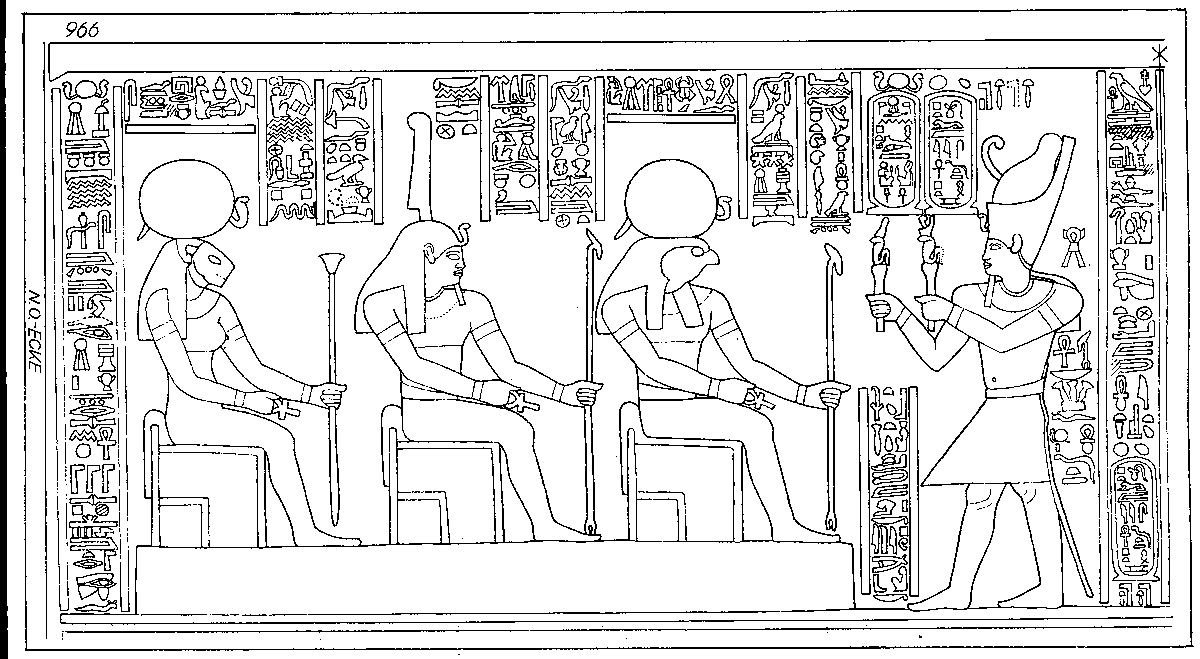
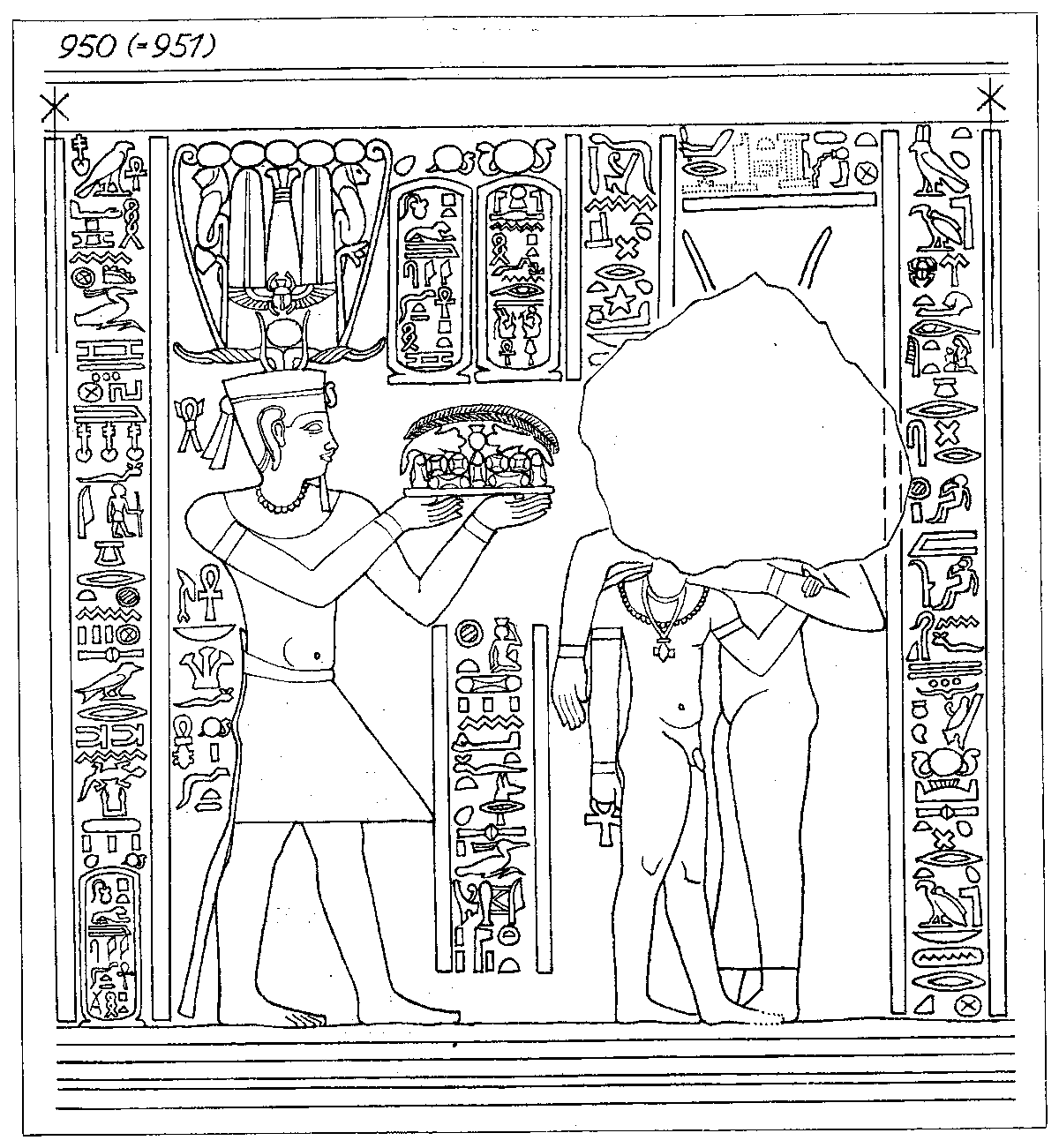
Ptolemy VIII gives Osiris the two crowns
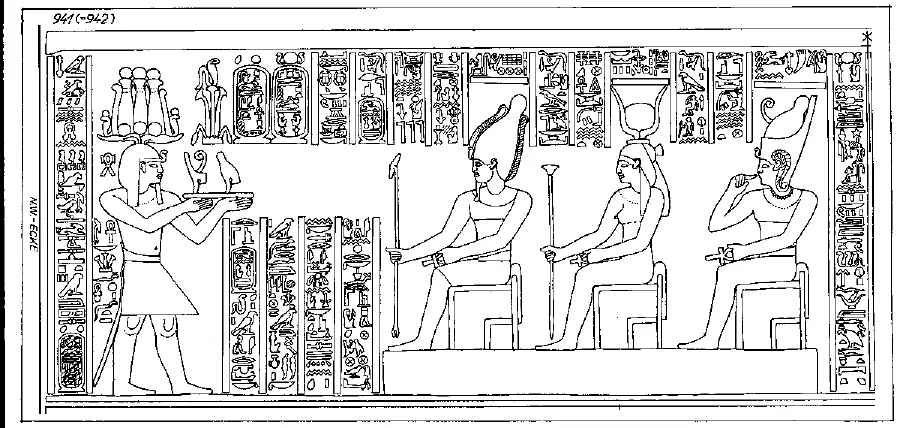
Page 23. The scene as drawn on the wall, facing p. 23 of the edition. Drawing by Otto Baum, in Junker and Winter, Das Geburtshaus des Tempels der Isis in Philä (1965)The hatched figures were hacked off the wall on purpose. After Justinian closed the temple of Isis around 537, Christians made it a church and chiselled out the gods and kings, mostly sparing the hieroglyphs. - 1p. 23, l. 1
j-j ḥr-k jt(-j) Wsjr
I come to you, my father Osiris.
- 2p. 23, l. 2
jnj-j n-k(?) šmꜥ mḥw
I bring you the crowns of Upper and Lower Egypt,
- 3p. 23, l. 3
ḫtm? n-k ḫrj.t(?)
that you may put an end to calamity.
- 4p. 23, l. 4
ꜥw jb n sn.t-k ꜥIs.t
Your sister Isis is glad of heart;
- 5p. 23, l. 5
dj-s tꜣ.wj n sꜣ(-k?) Ḥrw
she gives the Two Lands to your son Horus.
Note · Line 5
The Two Lands are Upper and Lower Egypt, united under one ruler. - 6p. 23, l. 6
ḏd r-f m ꜣḫbjt
She says to him in Chemmis:
Note · Line 6
Chemmis is the hidden place in the Delta marshes where Isis reared Horus. - 7p. 23, l. 7
Rꜥ-Ḥrw ꜣḫtj m wḥm
O Ra-Horakhty come again,
Note · Line 7
Ra-Horakhty is the sun god Ra as Horus of the Two Horizons. - 8p. 23, l. 8
nḏm jb-k Wsjr Wnn nfrw mꜣꜥ ḫrw
let your heart rejoice, Osiris Wennefer, the vindicated!
Note · Line 8
Wennefer, “the Perfect One,” is a name of Osiris. “Vindicated” declares that judgment has gone in his favor. - 9p. 23, l. 9
sꜣ-k Ḥrw jj r nḏ.t-k
Your son Horus comes to your defense.
- 10p. 23, l. 10
njśwt bjt jwꜥ n nṯr.wj prj.wj śtp n Ptḥ jrj mꜣꜥ.t Rꜥ šḫm ꜥnḫ Jmn
King of Upper and Lower Egypt, heir of the two Manifest Gods, chosen by Ptah, who upholds the Maat of Ra, living image of Amun;
Note · Line 10
The two Manifest Gods are the king’s parents, Ptolemy V and Cleopatra I, worshipped as a royal pair. - 11p. 23, l. 11
sꜣ Rꜥ Ptwrmjś ꜥnḫ ḏ.t mrj Ptḥ
Son of Ra, Ptolemy, living forever, beloved of Ptah.
Note · Line 11
The king is Ptolemy VIII Euergetes II. - 12p. 23, l. 12
ḏd mdw n | Wsjr Wnn nfrw mꜣꜥ ḫrw
Words spoken by Osiris Wennefer, the vindicated:
- 13p. 23, l. 13
nṯr ꜥꜣ nb jꜣ.t wꜥb.t
The great god, lord of the Abaton,
Note · Line 13
The Abaton was the sacred burial ground of Osiris on the island of Bigeh, beside Philae. - 14p. 23, l. 14
njśwt nṯr.w ḥrj-jb ꜥJrk
king of the gods, who dwells in Philae,
- 15p. 23, l. 15
ḥḳꜣ nfr n šmꜥw mḥw
fair ruler of Upper and Lower Egypt,
- 16p. 23, l. 16
šḫm šps n śp.wt njw.wt
august power of the provinces and cities.
- 17p. 23, l. 17
dj-j n-k tꜣ.w nb.w ḫr nś.t-k
I give you all lands beneath your throne.
- 18p. 23, l. 18
ḏd mdw n | ꜥIs.t wr.t mw.t nṯr
Words spoken by Isis the Great, mother of the god,
- 19p. 23, l. 19
nb(.t) ꜥJrk dj(.t) ꜥnḫ nb(.t) jꜣ.t wꜥb.t
lady of Philae, giver of life, lady of the Abaton,
- 20p. 23, l. 20
nb(.t) ḫꜣś.wt rśj.wt ḥḳꜣ.t m …
lady of the southern foreign lands, ruler in …
- 21p. 23, l. 21
ḏd mdw n | Ḥrw (pꜣ) ḫrd ꜥꜣ wr tpj n Wsjr
Words spoken by Harpocrates, mighty indeed, firstborn of Osiris,
Note · Line 21
Harpocrates is Horus in his childhood. - 22p. 23, l. 22
nb jꜣ.t wꜥb.t
lord of the Abaton,
- 23p. 23, l. 23
ḫwn nfr bnr mr.wt
the beautiful child, sweet to love.
- 24p. 23, l. 24
(ꜥnḫ) | nṯr nfr śmꜣwj śnṯ n gś.w-prj(.w)
Long live the good god who renews the ground plans of the temples,
Note · Line 24
“The good god” is a title of the king, named here as Ptolemy VIII. - 25p. 23, l. 25
jwḥ(?) (wn.t) wꜣśj
who clears away what had fallen into ruin,
- 26p. 23, l. 26
grg wn(.t) śj (śbj)
who founds anew what had ceased to be,
- 27p. 23, l. 27
śḥtp nṯr.w m jḫ.t(??)
who gladdens the gods with offerings:
- 28p. 23, l. 28
sꜣ Rꜥ Ptwrmjś ꜥnḫ ḏ.t
the son of Ra, Ptolemy, who lives forever.
- 29p. 23, l. 29
njśwt bjt | šḫm n Rꜥ
King of Upper and Lower Egypt, power of Ra,
- 30p. 23, l. 30
jwꜥw mnḫ prj m jt(-f) Gb
worthy heir, sprung from his father Geb,
- 31p. 23, l. 31
jḥj šps n ḥm.w nb.w
august Ihy of all the temples,
Note · Line 31
Ihy is a child god of music, often shown shaking a ritual rattle. - 32p. 23, l. 32
prj m ḥ.t jꜥr.wt m tp-f
who came from the womb with the royal cobras on his head,
Note · Line 32
The rearing cobras are emblems of divine protection and royal power. - 33p. 23, l. 33
wp(j) ḥḏ.t m ḥ.t mw.t-f Nw.t
who wore the White Crown even in the womb of his mother Nut.
Note · Line 33
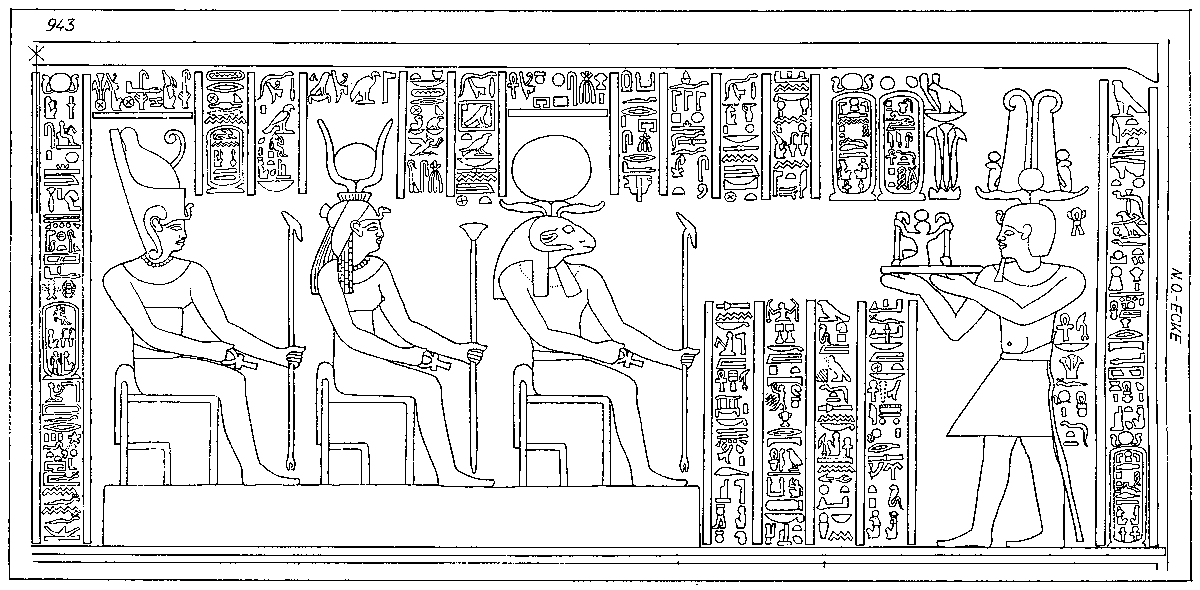
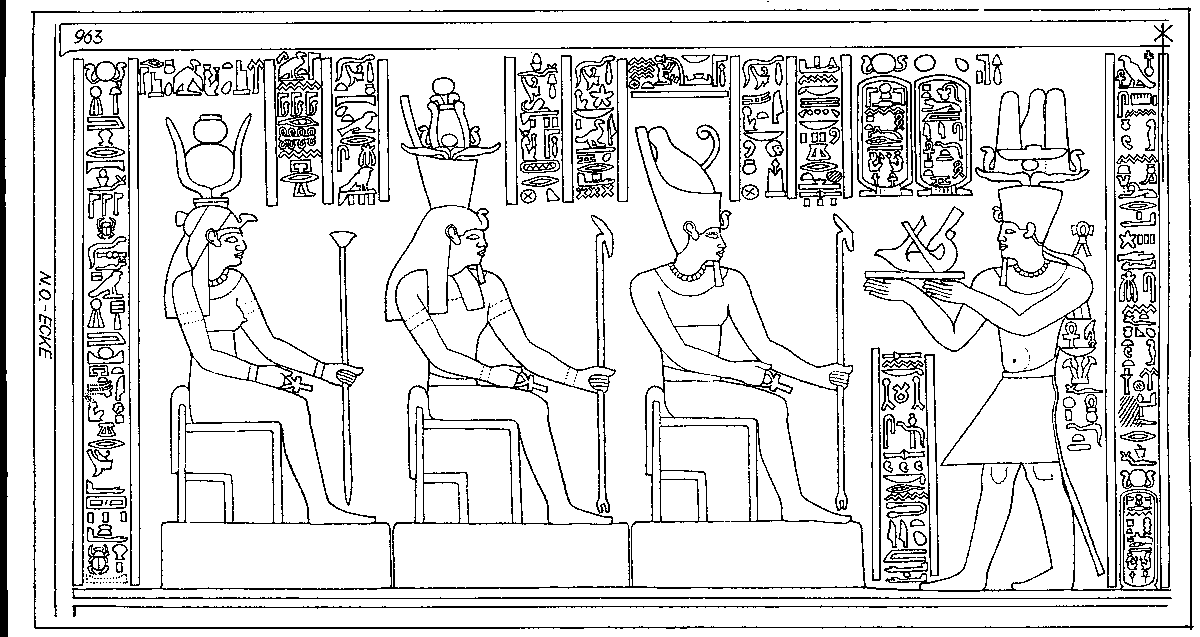
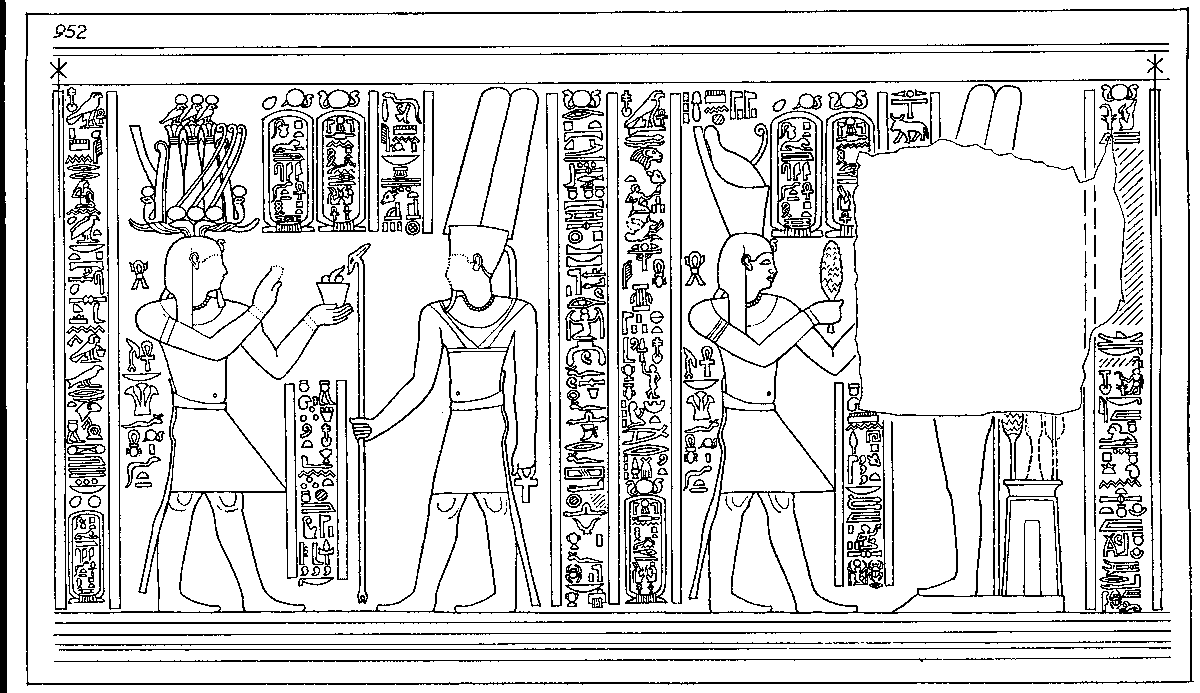
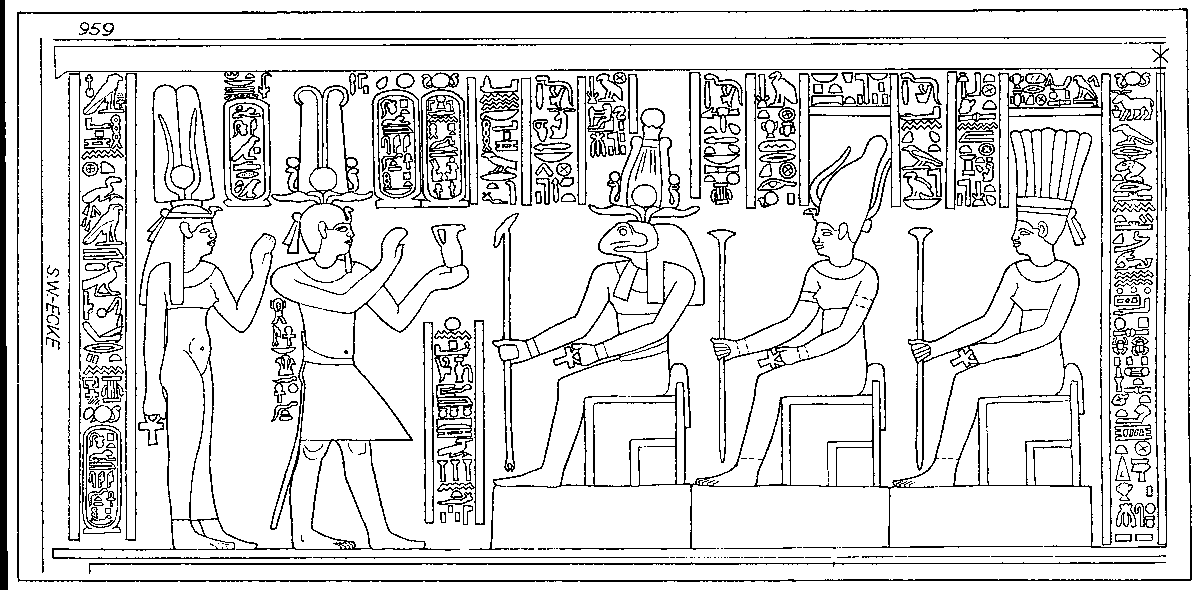
The White Crown is the crown of Upper Egypt. Ptolemy VIII gives Khnum a Heh figure
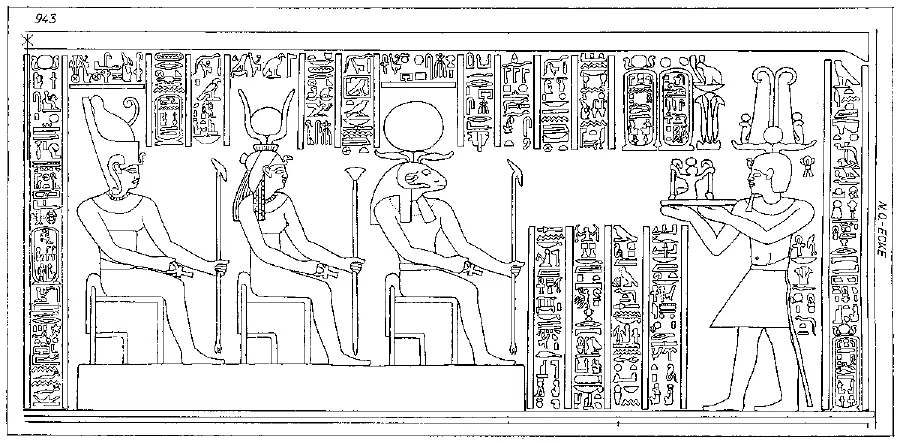
Page 25. The scene as drawn on the wall, facing p. 25 of the edition. Drawing by Otto Baum, in Junker and Winter, Das Geburtshaus des Tempels der Isis in Philä (1965) - 34p. 25, l. 1
mn n-k (ḥḥ?) m ꜥnḫ ḏd wꜣs
Receive Heh as life, stability and dominion,
Note · Line 34
Heh personifies a million years, a span that stands for boundless time. - 35p. 25, l. 2
ḥbj(?)-k tꜣ.wj n sꜣ Wsjr
that you may set the Two Lands celebrating for the son of Osiris.
- 36p. 25, l. 3
jnj-j n-k ḥḥ ḏdj-k m p.t
I bring you Heh that you may endure in the sky.
- 37p. 25, l. 4
twꜣ-f n(?) ḥr.t mj Šw
He holds the sky aloft like Shu
Note · Line 37
Shu, god of the air, holds the sky goddess Nut above the earth god Geb. - 38p. 25, l. 5
sḳꜣ-f(?) rn-k ḥr (so?) s.t(?) Ḥrw
and exalts your name on the throne of Horus
- 39p. 25, l. 6
… tp(? ḫpr?) m km(?) ḏ.t
… for all eternity.
- 40p. 25, l. 7
mn n-k wꜣs ꜥnḫ …
Receive dominion and life …
- 41p. 25, l. 8
nḫt mj(?) nb-n?
strength like that of our lord.
- 42p. 25, l. 9
dj-f sḫm-k (so) m jḫ.t(?) nb.t
May he grant you power in all things.
- 43p. 25, l. 10
ꜥnḫ ꜥꜣ(?) n Jmn-Rꜥ
The long life of Amun-Ra
- 44p. 25, l. 11
jrjj(?) sḫpr(?) m tp-k rꜥ nb
is inscribed upon your head each day.
- 45p. 25, l. 12
njswt bjt jwꜥw n nṯr.wj prj.wj …
King of Upper and Lower Egypt, heir of the two Manifest Gods …
Note · Line 45
The Manifest Gods were Ptolemy V and Cleopatra I, the parents of Ptolemy VIII, the king named here. - 46p. 25, l. 13
sꜣ Rꜥ Ptwrmjs ꜥnḫ ḏ.t mrj Ptḥ
Son of Ra, Ptolemy, living forever, beloved of Ptah.
- 47p. 25, l. 14
ḏd mdw n | Ḫnmw-Rꜥ nb Snm.t
Words spoken by Khnum-Ra, lord of Bigeh,
Note · Line 47
Bigeh was a sacred island beside Philae. - 48p. 25, l. 15
jt nṯr.w ḫpr ḏs-f
father of the gods, who came into being of himself,
- 49p. 25, l. 16
sḫꜣ-tw kꜣ (rn)-f r prj-ms
whose name is remembered at the birth house,
Note · Line 49
The birth house was the temple where the birth of the divine child Horus was celebrated. - 50p. 25, l. 17
rdj ṯꜣw n ꜥnḫ ḥr msḫn
who gives the breath of life at the place of birth:
- 51p. 25, l. 18
dj-j n-k ꜥḥꜥw n Rꜥ njswj.t n Jtmw
“I give you the lifetime of Ra and the kingship of Atum.”
Note · Line 51
Khnum-Ra addresses the king. - 52p. 25, l. 19
ḏd mdw n | Ḥw.t-Ḥrw wr.t nb(.t) Snm.t
Words spoken by Hathor the Great, lady of Bigeh,
- 53p. 25, l. 20
ḥnw.t nb(.t) Jrk nb.tj rḫj.t
sovereign lady, mistress of Philae, queen of the people,
- 54p. 25, l. 21
msj ḥḳꜣ mw.t nṯr n Ḥrw nb
who bore the ruler, divine mother of the Golden Falcon.
Note · Line 54
The Golden Falcon is Horus. - 55p. 25, l. 22
ḏd mdw n | Ḥrw pꜣ ḫrd sꜣ Js.t
Words spoken by Horus the Child, son of Isis,
- 56p. 25, l. 23
nb Jrk jwꜥw mnḫ n Wnn nfrw mꜣꜥ ḫrw
lord of Philae, worthy heir of Wennefer, the vindicated,
Note · Line 56
Wennefer is Osiris, the father of Horus. - 57p. 25, l. 24
njswt šmꜥw bjtj mḥw
king of Upper Egypt, king of Lower Egypt.
- 58p. 25, l. 25
njswt bjt | sḫm šps ḫpr m ḥꜣ.t
King of Upper and Lower Egypt, august power who came into being in the beginning,
- 59p. 25, l. 26
wꜣḏ(?) tꜣ.wj ḥḳꜣ psḏ.t
who makes the Two Lands flourish, ruler of the Ennead,
Note · Line 59
The Ennead is the company of nine gods. - 60p. 25, l. 27
šꜣꜥ ḫpr ḥnꜥ Ḫmnj.w
who first came into being with the Eight of Hermopolis,
Note · Line 60
The Eight, four pairs of gods, embodied the conditions that prevailed before creation. - 61p. 25, l. 28
jmn rn-f r nṯr.w
whose name is hidden from the gods.
Note · Line 61
“Hidden” echoes the Egyptian name of Amun. - 62p. 25, l. 29
n rḫ-tw bw prj-n-f jm
No one knows the place from which he came forth.
- 63p. 25, l. 30
Nṯr jtn n bꜣḳ.t
The god, the sun disk of Egypt,
- 64p. 25, l. 31
ḥḏ (so) mrw.t-f ꜣḫ.t
whose rays light up the horizon,
- 65p. 25, l. 32
wbn ḥr tꜣ mj Rꜥ m ḥr.t
who shines on earth like Ra in the sky,
- 66p. 25, l. 33
ꜥšꜣ ḫꜥ.w mj sꜣ Js.t
manifold in splendor like the son of Isis,
- 67p. 25, l. 34
njswt bjt jwꜥw nṯr.wj prj.wj …
King of Upper and Lower Egypt, heir of the two Manifest Gods …
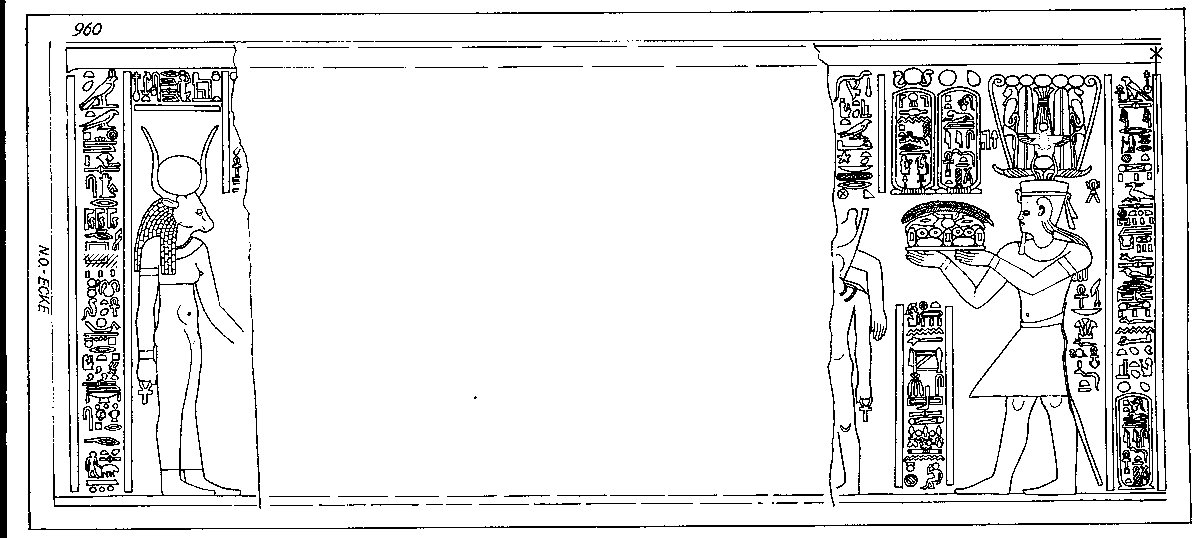
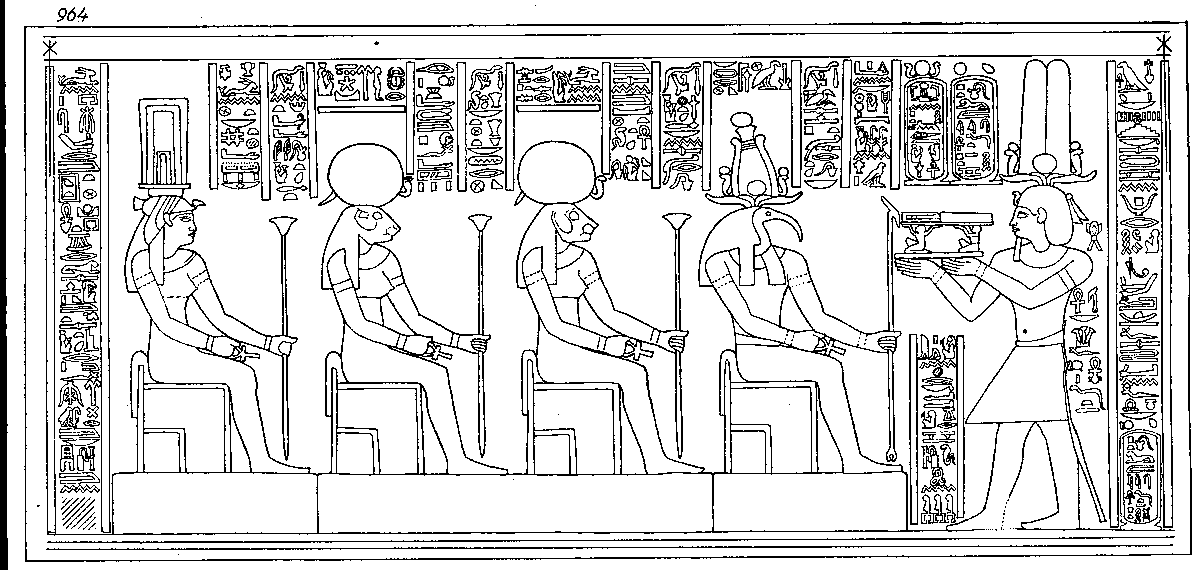
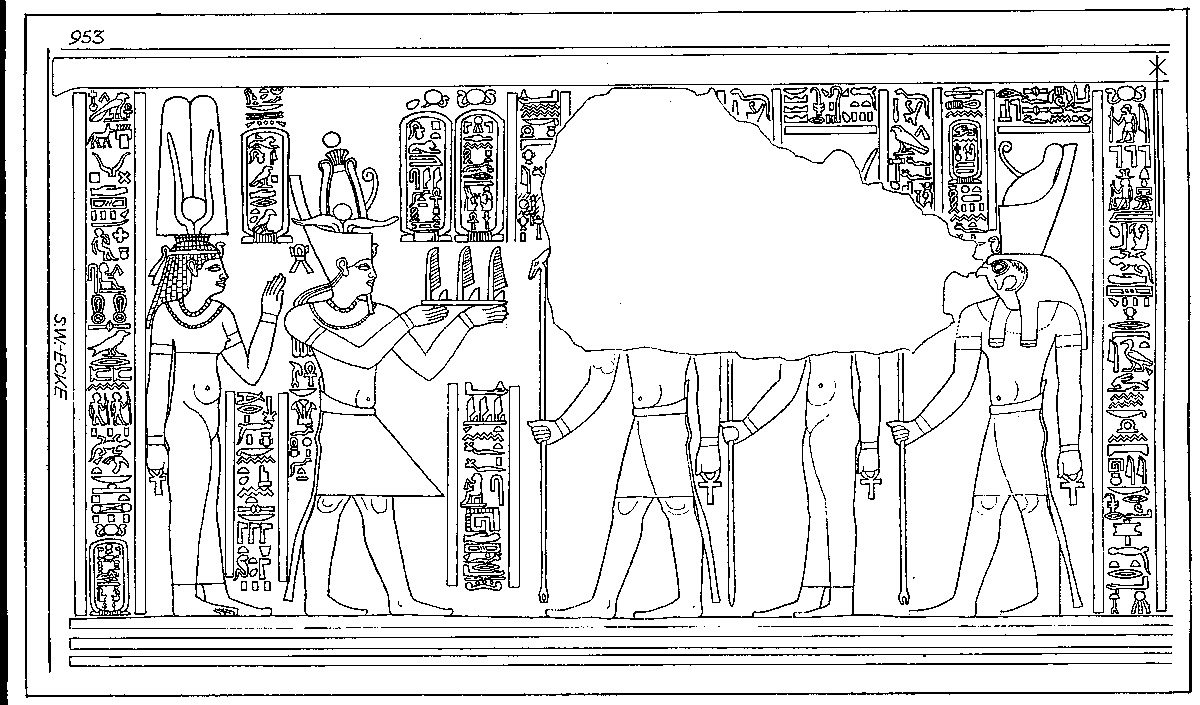
Left part of a scene ending with a cow-headed goddess
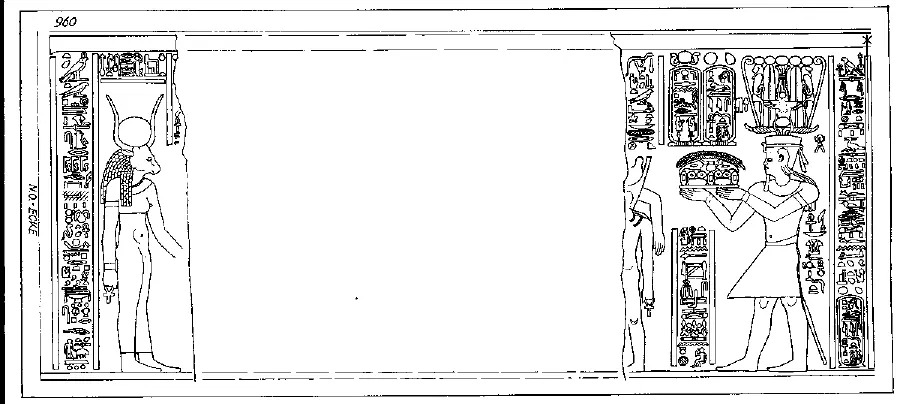
Page 27. The scene as drawn on the wall, facing p. 27 of the edition. Drawing by Otto Baum, in Junker and Winter, Das Geburtshaus des Tempels der Isis in Philä (1965) - 68p. 27, l. 1
… n.t ns.t-f r gs-s m šnḫ nfr
… of his throne at her side as a good foster father.
- 69p. 27, l. 2
bjk.t wr.t ḫpr m ḥꜣ.t
Great Falcon Goddess, who came into being in the beginning,
- 70p. 27, l. 3
ṯnj šj r nṯr.w nṯr.wt
who rose above gods and goddesses,
- 71p. 27, l. 4
rśj ḥw.wt (?) … dmꜣ.t (? tmꜣ.t) rꜥ nb (so?)
who keeps watch over the temples … wing each day,
- 72p. 27, l. 5
ꜥnḫ.t ḥw(w.t) tꜣ pn
the Living One, who guards this earth.
- 73p. 27, l. 6
rpj.t wr.t ḥꜥ.w-s m nb
Great princess, whose limbs are of gold,
- 74p. 27, l. 7
ḥrj.t-tp-s jr.t-s ḫsbd mꜣꜥ
whose hair and eye are of true lapis lazuli.
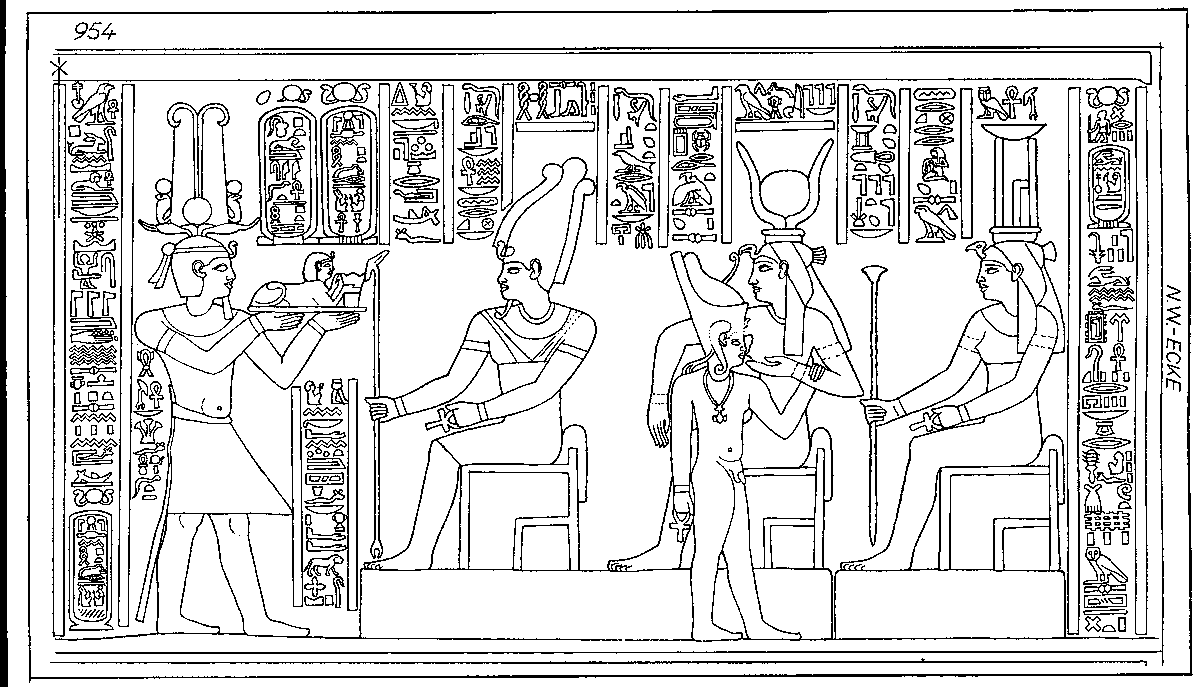
Ptolemy VIII gives a food offering to Isis suckling the young Horus
- 75p. 27, l. 8
fꜣj jḫ.t n ꜥꜣb.t
Presenting food for a great offering,
- 76p. 27, l. 9
ms šps.w n nḫn
bringing precious things for the child.
Note · Line 76
The child honored in the birth house is Horus, the son of Isis and Osiris. - 77p. 27, l. 10
njśwt bjt jwꜥw n nṯr.wj prj.wj …
King of Upper and Lower Egypt, heir of the two Manifest Gods …
Note · Line 77
“Manifest” means that they appeared on earth as gods. - 78p. 27, l. 11
sꜣ Rꜥ Ptwrmjs … pꜣ nṯr mnḫ
Son of Ra, Ptolemy … the Beneficent God.
Note · Line 78
This is Ptolemy VIII. “Beneficent” means “doing good,” the sense of his Greek title Euergetes. - 79p. 27, l. 12
sꜣ ꜥnḫ wꜣs nb ḥꜣ-f mj Rꜥ ḏ.t
May all protection, life and dominion surround him as they surround Ra, forever.
- 80p. 27, l. 13
ḏd mdw n | Js.t wr.t mw.t nṯr
Words spoken to Isis the Great, mother of the god,
- 81p. 27, l. 14
nb(.t) Jrk …
lady of Philae …
- 82p. 27, l. 15
ꜥnḫ | nṯr nfr śr ḥrj jḫ.t
Long live the good god, the prince in charge of provisions,
- 83p. 27, l. 16
bꜥḥ sḫm.w m kꜣ.w-f
who floods the temples with his food,
- 84p. 27, l. 17
śwr pšš.wt-f n mw.t-f Js.t
who increases his offering portions for his mother Isis:
- 85p. 27, l. 18
sꜣ Rꜥ Ptwrmjs ꜥnḫ ḏ.t mrj Ptḥ
the Son of Ra, Ptolemy, ever living, beloved of Ptah.
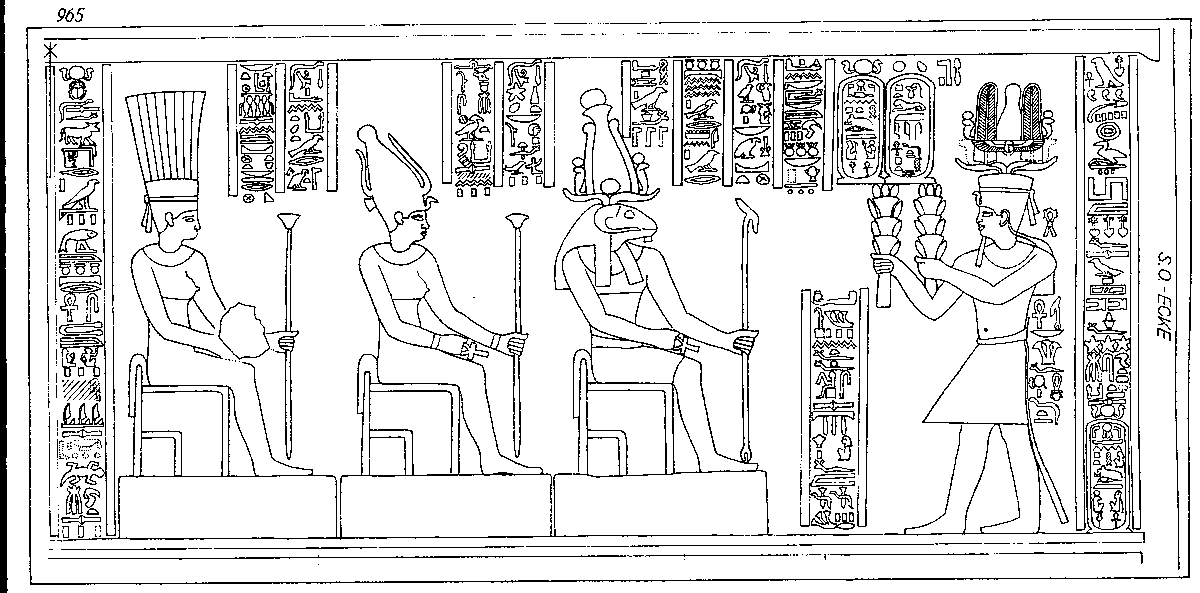
Ptolemy VIII gives Ptah myrrh
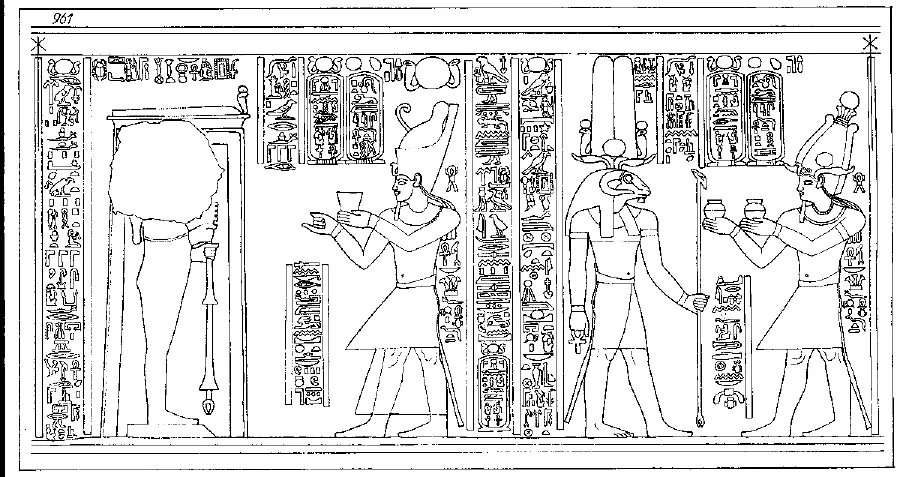
Page 29. The scene as drawn on the wall, facing p. 29 of the edition. Drawing by Otto Baum, in Junker and Winter, Das Geburtshaus des Tempels der Isis in Philä (1965) - 86p. 29, l. 1
mn n-k ꜥntjw prj m Pwn.t
Take for yourself the myrrh that comes from Punt
Note · Line 86
Punt was a region from which Egyptians obtained fragrant resins. Here the king presents myrrh to Ptah-Tatenen. - 87p. 29, l. 2
jḫ.t nb.t n(.t) Tꜣ-nṯr
and all the things of the god’s land.
- 88p. 29, l. 3
njśwt bjt jwꜥw n nṯr.wj prj.wj …
King of Upper and Lower Egypt, heir of the two Manifest Gods …
- 89p. 29, l. 4
sꜣ Rꜥ Ptwrmjs … pꜣ mnḫ nṯr sꜣ ꜥnḫ wꜣś nb ḥꜣ-f mj Rꜥ ḏ.t
Son of Ra, Ptolemy … the Beneficent God. May all protection, life and dominion surround him as they surround Ra, forever.
- 90p. 29, l. 5
ḏd mdw n | Ptḥ-Tnn wr jt nṯr.w
Words spoken to Ptah-Tatenen the Great, father of the gods,
Note · Line 90
Ptah, the creator god of Memphis, is here joined with Tatenen, the primeval earth rising from the waters. - 91p. 29, l. 6
jrj rśj jnb-f nb ꜥnḫ-tꜣ.wj
He Who Is South of His Wall, lord of Ankhtawy,
Note · Line 91
“He Who Is South of His Wall” is a traditional title of Ptah. Ankhtawy, “Life of the Two Lands,” is a sacred name associated with Memphis and its burial grounds. - 92p. 29, l. 7
nṯr ꜥꜣ wr (?) šꜣꜥ ḫpr
the great god, the Great One, the first to come into being.
- 93p. 29, l. 8
njśwt bjt | jrj św m ḥḥw
King of Upper and Lower Egypt, who makes himself into millions,
Note · Line 93
Here the royal title belongs to Ptah-Tatenen: the one creator takes countless forms. - 94p. 29, l. 9
jt jt.w mw.t mw.wt
father of fathers, mother of mothers,
- 95p. 29, l. 10
Ptḥ-Tnn jt nṯr.w
Ptah-Tatenen, father of the gods,
- 96p. 29, l. 11
śḫꜣ-tw rn-f r prj-msj
whose name is invoked for the birth house
- 97p. 29, l. 12
ḥr ꜥnḫ wꜣś n sꜣ Wśjr nṯr ꜥꜣ prj m Jś.t
with the words “Life and dominion for the son of Osiris, the great god who came forth from Isis!”
- 98p. 29, l. 13
ꜥnḫ | nṯr nfr pḥr tꜣ.wj
Long live the good god who circles the Two Lands,
- 99p. 29, l. 14
ꜥšꜣ nmt.t m Tꜣ-nṯr
whose steps are many in the god’s land,
- 100p. 29, l. 15
jnj jḫ.t r ḥnꜥ-śn²
who brings the treasures in their keeping,
- 101p. 29, l. 16
m śštꜣ nb n Pwn.t
all the secret things of Punt:
- 102p. 29, l. 17
njśwt bjt jwꜥw n nṯr.wj prj.wj …
the King of Upper and Lower Egypt, heir of the two Manifest Gods …
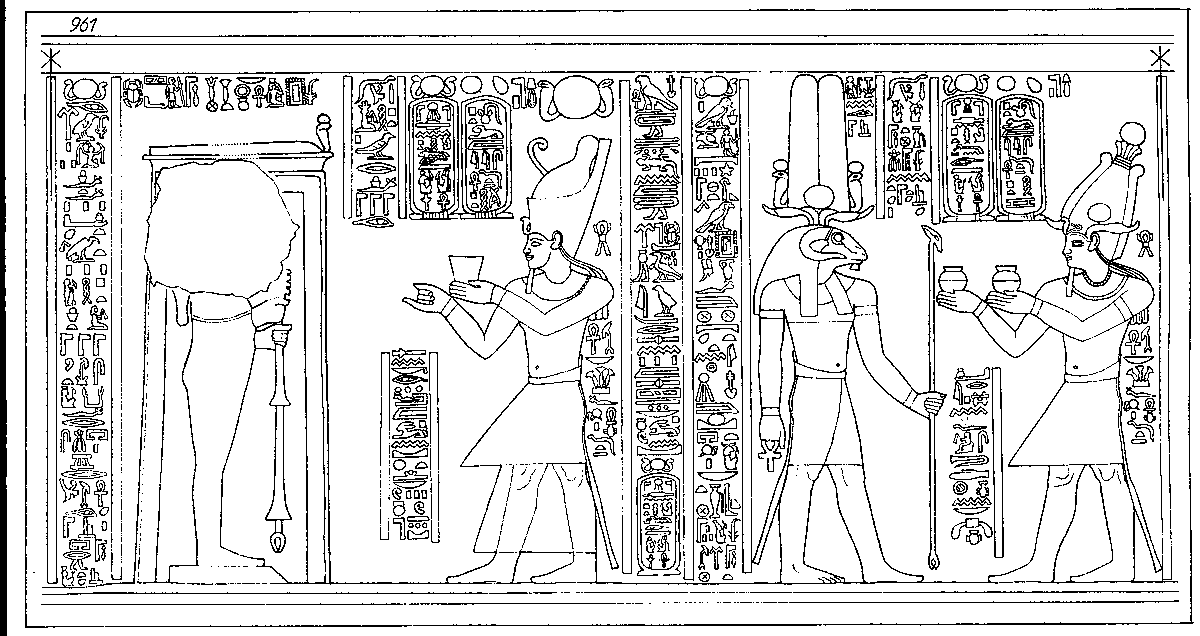
Ptolemy VIII gives Khnum wine
- 103p. 29, l. 18
ḥnk jrp n jt-f šps
Presenting wine to his august father
Note · Line 103
The king makes the offering; the father he honors here is Khnum. - 104p. 29, l. 19
wdn tḫ n nb ꜣw.t jb
and offering strong drink to the lord of joy.
- 105p. 29, l. 20
njśwt bjt jwꜥw n nṯr.wj prj.wj …
King of Upper and Lower Egypt, heir of the two Manifest Gods …
Note · Line 105
The two are Ptolemy V and Cleopatra I, parents of the king named here, Ptolemy VIII. - 106p. 29, l. 21
sꜣ Rꜥ Ptwrmjs … pꜣ mnḫ nṯr sꜣ ꜥnḫ wꜣś nb ḥꜣ-f mj Rꜥ ḏ.t
Son of Ra, Ptolemy …, the Beneficent God. May all protection, life and dominion surround him as they surround Ra forever.
- 107p. 29, l. 22
ḏd mdw n | Ḫnmw nb Ḳbḥw nṯr ꜥꜣ njśwt nṯr.w
Words spoken by Khnum, lord of Elephantine, great god, king of the gods,
- 108p. 29, l. 23
msj n Jś.t nṯr.t sꜣ śmśw n Wśjr
born of Isis the goddess, eldest son of Osiris.
- 109p. 29, l. 24
njśwt bjt | bꜣ wr šfj.t ḥrj nṯr.w
King of Upper and Lower Egypt, the ba of great majesty who stands above the gods,
Note · Line 109
A ba is a being’s power to take form and act. The word also echoes an Egyptian word for Khnum’s animal, the ram. - 110p. 29, l. 25
ḥḳꜣ pśḏ.t bjk nṯrj nfr ḥr
ruler of the Ennead, divine falcon, fair of face,
- 111p. 29, l. 26
ḫnm śwtj-f m nn.t
whose twin plumes meet the sky,
Note · Line 111
The plumes are the two tall feathers of his crown. - 112p. 29, l. 27
jtn nfr wbn m ꜣḫ.t
the beautiful sun disk rising on the horizon:
- 113p. 29, l. 28
Ḫnmw-Rꜥ nb Ḳbḥw
Khnum-Ra, lord of Elephantine,
- 114p. 29, l. 29
njśwt nṯr.w nṯr ꜥꜣ m wꜣś.t
king of the gods, great god in Thebes.
Ptolemy VIII gives Isis a great offering
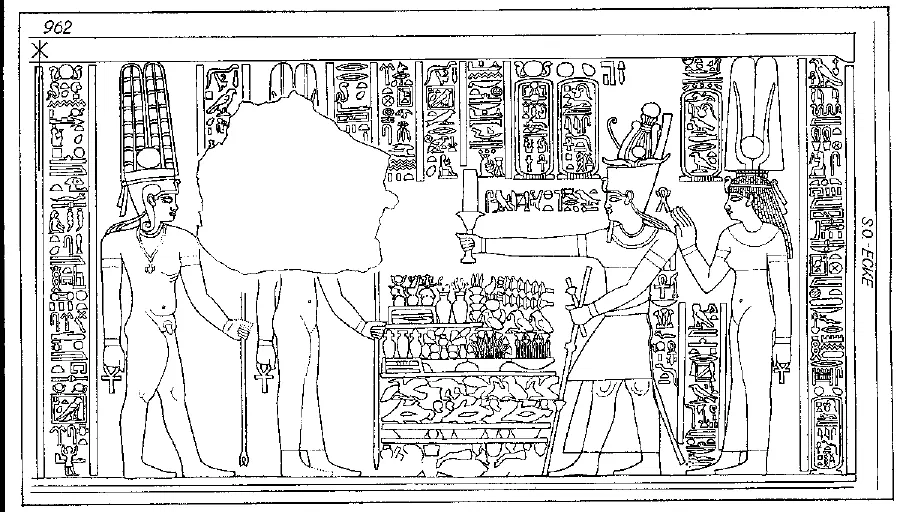
Page 31. The scene as drawn on the wall, facing p. 31 of the edition. Drawing by Otto Baum, in Junker and Winter, Das Geburtshaus des Tempels der Isis in Philä (1965) - 115p. 31, l. 1
šmꜥ ꜥb.t n pśḏ.t ḏr.t wr.t ꜥꜣ.t(?)
Presenting an offering to the Ennead of the very great Djeret.
- 116p. 31, l. 2
njśwt bjt jwꜥw n …
King of Upper and Lower Egypt, heir of …
- 117p. 31, l. 3
sꜣ Rꜥ Pt … pꜣ nṯr mnḫ sꜣ ꜥnḫ wꜣś nb ḥꜣ-f mj Rꜥ ḏ.t
Son of Ra, Ptolemy …, the Beneficent God. May all protection, life and dominion surround him as they surround Ra forever.
- 118p. 31, l. 4
ḥm.t-f ḥḳꜣ.t nb.t tꜣ.wj Kl …
His wife, the ruler, lady of the Two Lands, Cleopatra …
Note · Line 118
The queen is Cleopatra III. - 119p. 31, l. 5
mj.t m ḥtp r ꜥb.t wr.t
Come in peace to the great offering:
- 120p. 31, l. 6
ḏbꜥ.w ḥꜣ.w m jḫ.t nb.t-f² ꜥꜣ.t(?)
every great thing he has, in tens of thousands and in thousands.
- 121p. 31, l. 7
ḏd mdw | Ḥw.t-Ḥrw wr.t (nb.t) Śnm.t
Words spoken by Hathor the Great, lady of Bigeh,
- 122p. 31, l. 8
šps.t wśr.t m ḥw.t ḫnt³
the noble one, mighty in Philae,
- 123p. 31, l. 9
ꜣḫ.t mś(ś.t) wnn.t Rnn.t ꜥšꜣ(.t) …
the field that brings forth all that is, Renenet, rich in …
Note · Line 123
Renenet is a goddess of nourishment and the harvest. - 124p. 31, l. 10
dj-j n-k jḫ.t nb(.t) dj p.t
I give you everything the sky gives,
- 125p. 31, l. 11
ḳmꜣ tꜣ jnj ḥꜥpj
the earth creates and the Nile brings.
- 126p. 31, l. 12
ḏd mdw n | Ḥrw pꜣ ḫrd sꜣ …
Words spoken by Horus the Child, son of …
- 127p. 31, l. 13
njśwt bjt | tpj.t n Rꜥ
King of Upper and Lower Egypt: the uraeus of Ra,
Note · Line 127
The uraeus is the rearing cobra on the sun god’s brow. Here she is Hathor. - 128p. 31, l. 14
wꜥtj.t ḫpr m ḥꜣ.t-f
the Sole One who sprang from his brow.
- 129p. 31, l. 15
śnḏm ḥm.t-ś m ś.t wꜣḥ jḫ.t
Her Majesty settles where the offerings are laid.
- 130p. 31, l. 16
wḥm-ś tḫ.t m prj-ś rꜥ nb
Each day she renews the drunken revel in her house:
Note · Line 130
Drinking in Hathor’s temple was an act of worship. - 131p. 31, l. 17
Ḥw.t-Ḥrw jb-ś m ḥꜥj
Hathor, her heart full of joy.
- 132p. 31, l. 18
ꜥnḫ | nṯr nfr wꜣḏ n jtr.tj
Long live the good god who makes the two shrines flourish.
Note · Line 132
The shrines of Upper and Lower Egypt together stand for all the temples of the land. - 133p. 31, l. 19
šps ḥm.w m šps.w
who enriches the temples with riches,
- 134p. 31, l. 20
śḥb ḥw.t ḫnt m jḫ.t nb.t nfr.t
who makes Philae festive with every good thing,
- 135p. 31, l. 21
wꜣḥ mn (= jtmnj.t) r wḏḥw-ś
who adds daily offerings to her altar,
- 136p. 31, l. 22
sꜣ Rꜥ Pt …
son of Ra, Ptolemy …
Ptolemy VIII gives Atum clothing
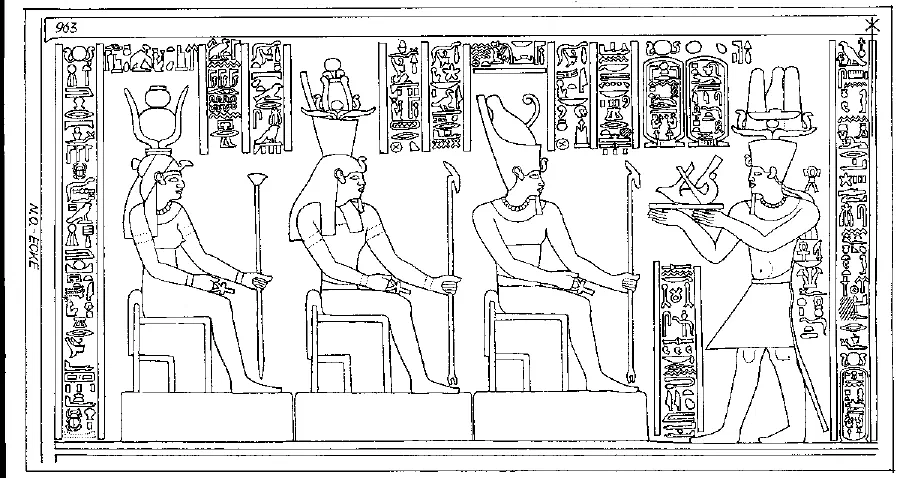
Page 33. The scene as drawn on the wall, facing p. 33 of the edition. Drawing by Otto Baum, in Junker and Winter, Das Geburtshaus des Tempels der Isis in Philä (1965) - 137p. 33, l. 1
mn n-k mnḫ.t šḏ ḥꜥ.w-k
Take this garment for yourself, that it may brighten your limbs,
Note · Line 137
The king presents the god with a garment for his cult statue. - 138p. 33, l. 2
jrj-n Tꜣj.t m ꜥ.wj(-s?)
which Tayet made with her two hands.
Note · Line 138
Tayet is the goddess of weaving. - 139p. 33, l. 3
njśwt bjt jwꜥw …
King of Upper and Lower Egypt, heir …
- 140p. 33, l. 4
sꜣ Rꜥ Pt … pꜣ nṯr mnḫ
son of Ra, Ptolemy …, the Beneficent God.
- 141p. 33, l. 5
sꜣ ꜥnḫ wꜣś nb ḥꜣ-f mj Rꜥ ḏ.t
May all protection, life and dominion surround him as they surround Ra, forever.
- 142p. 33, l. 6
ḏd mdw n | Jtmw nb tp(j?) Jwnw
Words spoken by Atum, lord, foremost in Heliopolis,
- 143p. 33, l. 7
nṯr ꜥꜣ nb jꜣ.t wꜥb.t
the great god, lord of the Abaton:
- 144p. 33, l. 8
dj-j n-k tꜣ.w nb.w ḥr jḫ.t-śn
I give you all lands with all they hold.
Note · Line 144
Atum addresses the king. - 145p. 33, l. 9
ḏd mdw n | Gb nb sṯꜣ.w
Words spoken by Geb, lord of the earth,
- 146p. 33, l. 10
rpꜥ.t nṯr.w jt mnḫ n nṯr.w
hereditary prince of the gods, beneficent father of the gods,
- 147p. 33, l. 11
nṯr ꜥꜣ nb Jrḳ
the great god, lord of Philae.
- 148p. 33, l. 12
ḏd mdw n | Nw.t wr.t mś(.t) nṯr.w
Words spoken by Nut the Great, who bore the gods,
- 149p. 33, l. 13
mw.t nṯr n nṯr.w nṯr.wt
divine mother of gods and goddesses,
- 150p. 33, l. 14
jr(r.t) sꜣ n prj m Jś.t
who shelters him who came forth from Isis
Note · Line 150
Horus is the child of Isis and Osiris. The birth house celebrates his birth. - 151p. 33, l. 15
mk(.t) n sꜣ Wśjr
and guards the son of Osiris.
- 152p. 33, l. 16
njśwt bjt | wbn m ḥr.t
King of Upper and Lower Egypt, who rises in the sky,
- 153p. 33, l. 17
jt nṯr.w ḫpr ḏś-f
father of the gods, who came into being of himself,
- 154p. 33, l. 18
Ḥrw ꜣḫtj psḏ m ꜣḫ.t
Horus of the Two Horizons, who shines on the horizon,
- 155p. 33, l. 19
Jtmw tp(sic) ḥr sḫm.tj
Atum, whose head bears the Double Crown,
Note · Line 155
The Double Crown joins the white crown of Upper Egypt and the red crown of Lower Egypt. - 156p. 33, l. 20
ꜥšꜣ ḫꜥ.w ḥr tꜣ
whose radiant appearances on earth are many.
- 157p. 33, l. 21
ꜥnḫ | nṯr nfr śmn n …
May the good god live, the very likeness of …
- 158p. 33, l. 22
šsp ꜥnḫ(?)(n) rpꜥ.t nṯr.w
the living image of the hereditary prince of the gods,
- 159p. 33, l. 23
šsp mśj n Tfn.t (so)
the image born to Tefnut,
- 160p. 33, l. 24
twt sḫm nḏ-f(?) r jt-f
perfect in might when he defends his father,
- 161p. 33, l. 25
njśwt bjt jwꜥw n …
King of Upper and Lower Egypt, heir to …
Ptolemy VIII gives Thoth a scribe’s palette
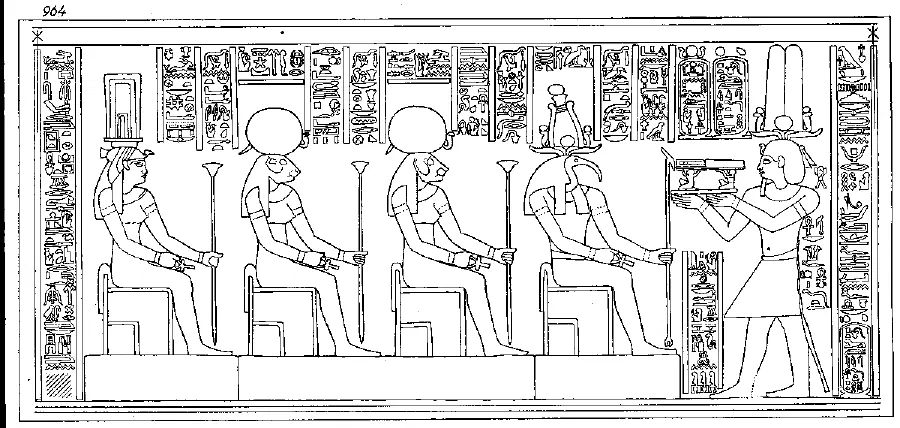
Page 35. The scene as drawn on the wall, facing p. 35 of the edition. Drawing by Otto Baum, in Junker and Winter, Das Geburtshaus des Tempels der Isis in Philä (1965) - 162p. 35, l. 1
jj-n-j ḥr-k
I have come to you.
- 163p. 35, l. 2
ꜥ.wj-j ḥr gštj
My two hands hold the palette,
Note · Line 163
A scribe’s palette held ink and writing reeds. - 164p. 35, l. 3
sš-k śnḏ n gś.w-prj.w
so that you may draw the ground plan of the temples.
- 165p. 35, l. 4
njśwt bjt jwꜥw …
King of Upper and Lower Egypt, heir of …
Note · Line 165
His parents, Ptolemy V and Cleopatra I, were worshipped as the Manifest Gods. - 166p. 35, l. 5
sꜣ Rꜥ Pt … sꜣ ꜥnḫ wꜣś nb ḥꜣ-f mj Rꜥ ḏ.t
Son of Ra, Ptolemy … May all protection, life and dominion surround him as they surround Ra, forever.
- 167p. 35, l. 6
ḏd mdw n | Ḏḥwtj śḥtp Nśr.t
Words spoken by Thoth, who soothes the fiery serpent,
- 168p. 35, l. 7
nb Śnm.t nṯr ꜥꜣ nb ’Jrk
lord of Bigeh, great god, lord of Philae:
- 169p. 35, l. 8
dj-j n-k ꜥḥꜥ.w n (so) Rꜥ (m) p.t
I give you the lifetime of Ra in the sky
- 170p. 35, l. 9
njśwj.t n Ḥrw ḥr (tꜣ)
and the kingship of Horus on earth.
- 171p. 35, l. 10
ḏd mdw n | Śḫm.t ꜥꜣ.t
Words spoken by Sekhmet the Great,
- 172p. 35, l. 11
nb(.t) nśr m Śnm.t
lady of the flame in Bigeh,
- 173p. 35, l. 12
ꜥnḫ.t wnm wnn(.t)
the Living One, who devours all that is.
- 174p. 35, l. 13
Ḏḥwtj ḥnꜥ-ś r śḥtp-ś
Thoth is with her to soothe her.
- 175p. 35, l. 14
ḏd mdw n | Bꜣś.t.t nb(.t) Bꜣś.t
Words spoken by Bastet, lady of Bubastis,
- 176p. 35, l. 15
ḥnw.t nb(.t) ’Jrk
sovereign lady, mistress of Philae,
- 177p. 35, l. 16
jr.t Rꜥ ḫꜥj.t m tp-f
Eye of Ra, who shines on his brow,
Note · Line 177
The Eye is a goddess who guards the sun god in the form of the upright cobra on his brow. - 178p. 35, l. 17
ꜥšꜣ ḫpr.w m Tꜣ-nṯr
whose forms are many in the god’s land.
- 179p. 35, l. 18
ḏd mdw n | Nḥm.t-ꜥwꜣj ꜥꜣ.t
Words spoken by Nehmetawy the Great,
Note · Line 179
Her name means “she who rescues the robbed.” - 180p. 35, l. 19
ḥrj.t jb Wnw nb(.t) tḫ.t
who dwells in Hermopolis, lady of drunkenness,
- 181p. 35, l. 20
ꜥšꜣ ḥb.w
whose festivals are many.
- 182p. 35, l. 21
wnn prj-mśj ḏśr m ḥw.t ḥnt
The birth house stands sacred at Philae,
- 183p. 35, l. 22
mj ꜣḫ.t ḥrj nb-ś
like the horizon bearing its lord.
Note · Line 183
The lord of the horizon is the sun god. - 184p. 35, l. 23
Ḏḥwtj ḥtp m ḫnt-ś
Thoth rests within it,
- 185p. 35, l. 24
’Jś.t r gś-f m Śšꜣ.t wr.t
with Isis at his side as Seshat the Great.
Note · Line 185
Seshat is the goddess of writing and of the measurements used to lay out a temple. - 186p. 35, l. 25
św m nb sš gštj? m …
He is lord of the writing kit and the palette in …
- 187p. 35, l. 26
ꜥnḫ | nṯr nfr sꜣ nb Ḫmnw
Long live the good god, son of the lord of Hermopolis,
- 188p. 35, l. 27
ꜥr gštj n wp-rḥ.wj
who brings a palette to the judge of the Two Companions,
Note · Line 188
The Two Companions are Horus and Seth. Thoth judges their dispute over the kingship. - 189p. 35, l. 28
tj.t ḏśr prj jm-f
sacred image sprung from him,
- 190p. 35, l. 29
śpḥr n-f šn nb
to whom the whole circle of the earth is granted in writing,
- 191p. 35, l. 30
sꜣ Rꜥ Pt …
Son of Ra, Ptolemy …
Ptolemy VIII gives Khnum flowers
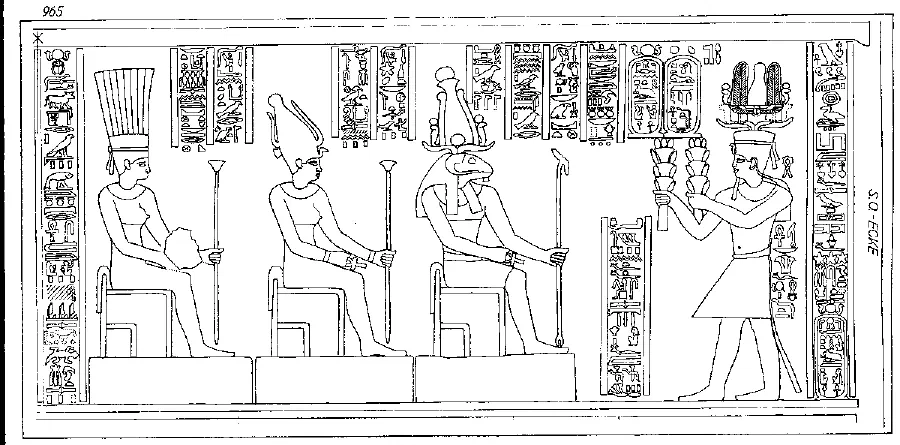
Page 37. The scene as drawn on the wall, facing p. 37 of the edition. Drawing by Otto Baum, in Junker and Winter, Das Geburtshaus des Tempels der Isis in Philä (1965) - 192p. 37, l. 1
ḥnk rnpw.t n jt-f šps
Presenting flowers to his august father.
- 193p. 37, l. 2
sṯḥn ḥr-f m wꜣḍwꜣḍ
To brighten his face with green.
- 194p. 37, l. 3
njśwt bjt jwꜥw …
King of Upper and Lower Egypt, heir …
- 195p. 37, l. 4
sꜣ Rꜥ Pt … pꜣ nṯr mnḫ sꜣ ꜥnḫ wꜣś nb ḥꜣ-f mj Rꜥ ḏ.t
Son of Ra, Ptolemy …, the Beneficent God. May all protection, life and dominion surround him as they surround Ra, forever.
Note · Line 195
“Beneficent God” is his royal cult title. - 196p. 37, l. 5
ḏd mdw n | Ḫnmw-Rꜥ nb Śnm.t
Words spoken by Khnum-Ra, lord of Bigeh,
Note · Line 196
Khnum speaks to the king. - 197p. 37, l. 6
nw.w wr jmn wr
the great primeval ocean, the great Hidden One,
- 198p. 37, l. 7
ḥꜥpj wr jt nṯr.w
the great Nile, father of the gods:
- 199p. 37, l. 8
dj-j n-k prj nb m ꜣḫ.t rd nb ḥr tꜣ
“I give you all that springs from the soil, all that grows on earth.”
- 200p. 37, l. 9
ḏd mdw n | Śpd.t nb(.t) tp-rnp.t
Words spoken by Sothis, lady of the new year,
Note · Line 200
Sothis is Sirius. Its first appearance before dawn after a season out of sight heralded the Nile flood and marked the traditional beginning of the Egyptian year. - 201p. 37, l. 10
ḥśf ꜥb n ḳn rnp.t
who wards off evil. There is no year of want;
- 202p. 37, l. 11
mśj ꜣḫ.t kꜣ.w-ś (so)
the field bears its food.
- 203p. 37, l. 12
ḏd mdw n | ꜥnḳ.t wr.t
Words spoken by Anuket the Great,
- 204p. 37, l. 13
mw.t nṯr nb(.t) ꜣbw ḫnt Śnm.t
mother of the god, lady of Elephantine, foremost in Bigeh,
- 205p. 37, l. 14
ḥnw.t nb(.t) ꜣJrk
sovereign lady, mistress of Philae.
- 206p. 37, l. 15
njśwt bjt | ḫpr ḏś-f bꜣ jmn
King of Upper and Lower Egypt, who came into being of himself, the hidden ba,
- 207p. 37, l. 16
jrj nṯr.w bs m nw.w
who made the gods and came forth from the primeval ocean
- 208p. 37, l. 17
r śꜥnḫ tm.w
to give life to humankind,
- 209p. 37, l. 18
ś(wꜣḍ?) śḫ.t ?ś nb … ? … ꜥšꜣ ꜣḫ.t mś.w-ś
who makes the field green … every … who makes the soil rich in what it bears.
- 210p. 37, l. 19
ꜥnḫ | nṯr nfr ḥꜥpj (n) km.t
Long live the good god, the Nile of Egypt,
- 211p. 37, l. 20
bꜥḥ tꜣ-mrj m nfrw-f
who floods Egypt with his beauty,
- 212p. 37, l. 21
śwr pḏś.wt jt nṯr.w
who multiplies the offerings of the father of the gods,
- 213p. 37, l. 22
mśj ꜣḫ.t kꜣ.w-ś
so that the field bears its food—
- 214p. 37, l. 23
njśwt bjt jwꜥw …
the King of Upper and Lower Egypt, heir …
Ptolemy VIII gives Ra-Horakhty the two uraeus cobras
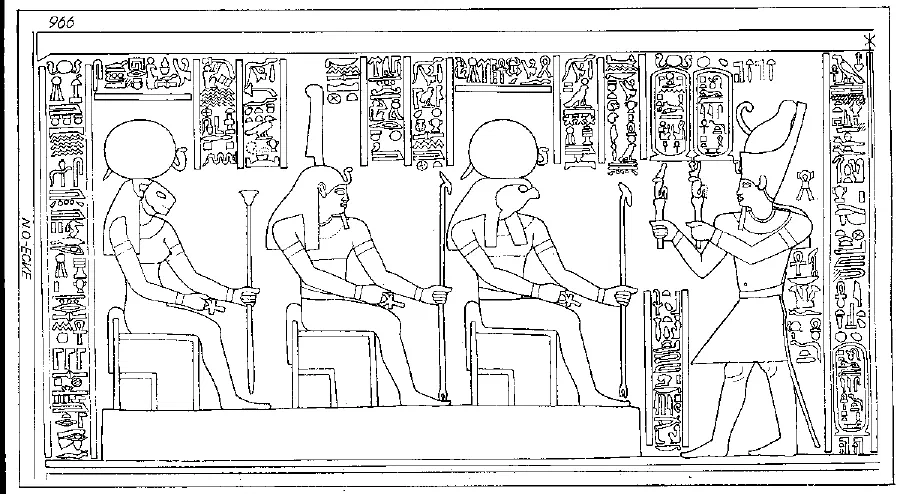
Page 39. The scene as drawn on the wall, facing p. 39 of the edition. Drawing by Otto Baum, in Junker and Winter, Das Geburtshaus des Tempels der Isis in Philä (1965) - 215p. 39, l. 1
Nḫb.t Wꜣḏ.t ḫꜥj.tj m ḥꜣ.t-k
Nekhbet and Wadjet shine on your brow:
Note · Line 215
Nekhbet, the vulture goddess of Upper Egypt, and Wadjet, the cobra goddess of Lower Egypt, both take the form of rearing cobras on the king’s brow to protect him. - 216p. 39, l. 2
jꜥr.tj? pw mrj ḥm-k (so)
they are the two uraei whom Your Majesty loves.
- 217p. 39, l. 3
njśwt bjt jwꜥw n nṯr.wj prj.wj …
King of Upper and Lower Egypt, heir of the two Manifest Gods …
Note · Line 217
The pair are Ptolemy VIII’s parents, Ptolemy V and Cleopatra I. - 218p. 39, l. 4
sꜣ Rꜥ Pt … pꜣ nṯr mnḫ (so)
Son of Ra, Ptolemy …, the Beneficent God.
- 219p. 39, l. 5
sꜣ ꜥnḫ wꜣś nb ḥꜣ-f mj Rꜥ ḏ.t
May all protection, life and dominion surround him as they surround Ra, forever.
- 220p. 39, l. 6
ḏd mdw n | Rꜥ-Ḥrw ꜣḫtj ḥrj nṯr.w
Words spoken by Ra-Horakhty, who is above the gods,
- 221p. 39, l. 7
pśḏ m ḥr.t šnj-n-f tꜣ
who shines in the sky after circling the earth.
- 222p. 39, l. 8
ꜥnḫ nṯr.w m wbn-f
The gods live by his rising.
- 223p. 39, l. 9
dj-j n-k śḫm.tj (n) ḥr tp-k
I give you the Double Crown to wear on your head,
- 224p. 39, l. 10
mj Ḥrw ꜥꜣ tꜣ.wj
as I give it to great Horus of the Two Lands.
- 225p. 39, l. 11
ḏd mdw n | Šw sꜣ Rꜥ ḥrj-jb Śnm.t
Words spoken by Shu, son of Ra, who dwells on Bigeh,
- 226p. 39, l. 12
nṯr ꜥꜣ jj m Tꜣ-stj
the great god who came from Nubia
- 227p. 39, l. 13
jnj-f jr.t Rꜥ n-f m Kns.t
and brought the Eye of Ra back to him from Kenset.
Note · Line 227
Kenset is a region in Nubia. - 228p. 39, l. 14
ḏd mdw n | Tfn.t sꜣ.t (Rꜥ)
Words spoken by Tefnut, daughter of Ra,
- 229p. 39, l. 15
ḥrj.t-jb (so) jꜣ.t wꜥb.t
who dwells on the Pure Mound,
Note · Line 229
The Pure Mound is the Abaton, the sanctuary on Bigeh revered as the burial place of Osiris. - 230p. 39, l. 16
wbd ꜥꜣpp n jt-ś Rꜥ
who burns Apep for her father Ra.
Note · Line 230
Apep is the serpent who attacks Ra on his nightly journey. - 231p. 39, l. 17
ḥrw jb-f n mꜣꜣ-f (?) śj
His heart rejoices at the sight of her.
- 232p. 39, l. 18
njśwt bjt | wbn m nw.w
The King of Upper and Lower Egypt, who rose from the primeval waters
- 233p. 39, l. 19
śḥḏ tꜣ.wj m jḥ.tj (-f)
and lights the Two Lands with his two eyes,
- 234p. 39, l. 20
pśḏ ḥr tꜣ r śꜥnḫ nṯr.w
who shines on earth to give life to the gods,
- 235p. 39, l. 21
śḫpr rmṯ m nṯrj.t-f
who brought humankind into being from his eye.
Note · Line 235
In an Egyptian creation story, people are born from the sun god’s tears. - 236p. 39, l. 22
ꜥnḫ | nṯr nfr ḥtp (?) ḥr ś.t jt-f
Long live the good god, seated on his father’s throne,
- 237p. 39, l. 23
ḥḳꜣ …? … ḥr bꜣḳ.t
the ruler … over Egypt,
- 238p. 39, l. 24
ḫꜥj m … mj sꜣ (?)² ꜣŚ.t
who appears in splendour as … like the son of Isis,
Note · Line 238
The son of Isis is Horus, who succeeded his father Osiris as king. - 239p. 39, l. 25
sꜣ Rꜥ Pt … nṯr.wj mnḫ.wj
Son of Ra, Ptolemy … the two Beneficent Gods.
Note · Line 239
“Beneficent Gods” is a title of the royal cult, known in Greek as Euergetai, “Benefactors.” Ptolemy VIII gives the Pharaoh of Bigeh a broad collar
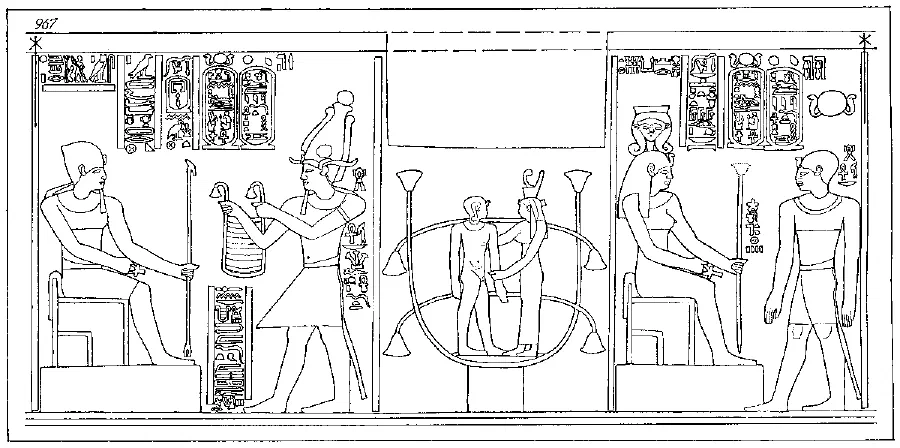
Page 41. The scene as drawn on the wall, facing p. 41 of the edition. Drawing by Otto Baum, in Junker and Winter, Das Geburtshaus des Tempels der Isis in Philä (1965) - 240p. 41, l. 1
mn n-k wsḫ(?) ꜥpr m ḏ.t-f
Receive the broad collar, complete in every part,
- 241p. 41, l. 2
m šstꜣ-f wr psḏ.t
in its sacred form as the Great One of the Ennead.
Note · Line 241
The collar is offered as a form of their chief. - 242p. 41, l. 3
njśwt bjt jwꜥw n nṯr.wj prj.wj …
King of Upper and Lower Egypt, heir of the two Manifest Gods …
- 243p. 41, l. 4
sꜣ Rꜥ Pt … pꜣ nṯr mnḫ
Son of Ra, Ptolemy … the Beneficent God.
- 244p. 41, l. 5
sꜣ ꜥnḫ wꜣś nb ḥꜣ-f mj Rꜥ ḏ.t
May all protection, life and dominion surround him as they surround Ra, forever.
- 245p. 41, l. 6
ḏd mdw n | Prj-ꜥꜣ n Śnm.t
Words spoken by the Pharaoh of Bigeh,
- 246p. 41, l. 7
Ḥrw ṯmꜣ-ꜥ ḫrj-jb ꜣJrk
Horus, strong of arm, who dwells on Philae,
- 247p. 41, l. 8
śmꜣ śbj m ḫr.t hrw
who kills the rebel day after day.
Ptolemy VIII worships the Lady of Hetepet
- 248p. 41, l. 9
dwꜣ nṯr.t sp fdw
Praising the goddess four times.
- 249p. 41, l. 10
njśwt bjt jwꜥw …
King of Upper and Lower Egypt, heir …
- 250p. 41, l. 11
sꜣ Rꜥ Pt … nṯr.wj mnḫ.wj sꜣ ꜥnḫ wꜣś nb
Son of Ra, Ptolemy … the two Beneficent Gods. All protection, life and dominion.
- 251p. 41, l. 12
ḏd mdw n | Nb(.t) Ḥtp.t³ ḥnw.t nṯr.w nṯr.wt
Words spoken by the Lady of Hetepet, mistress of gods and goddesses,
Note · Line 251
The Lady of Hetepet is the goddess Nebethetepet, identified with Hathor. - 252p. 41, l. 13
jr.t Rꜥ nb(.t) p.t ḫrj(.t)-jb ꜣJrk
Eye of Ra, lady of heaven, who dwells on Philae.
Ptolemy VIII gives Horus of Edfu wine
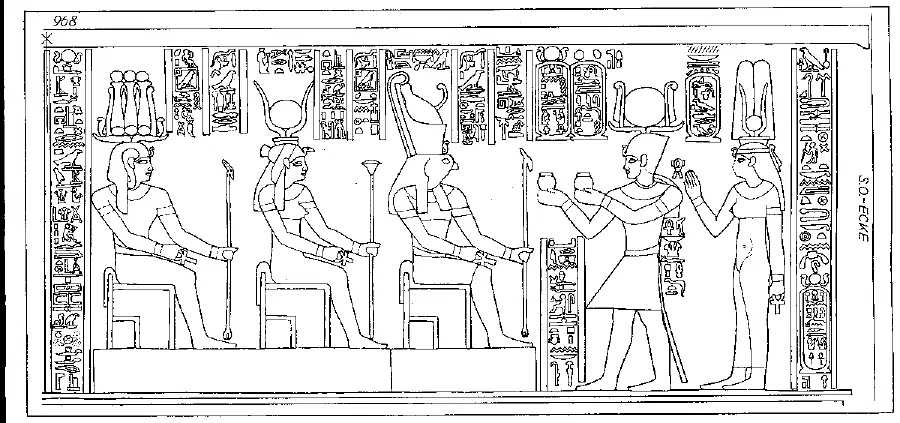
Page 43. The scene as drawn on the wall, facing p. 43 of the edition. Drawing by Otto Baum, in Junker and Winter, Das Geburtshaus des Tempels der Isis in Philä (1965) - 253p. 43, l. 1
ḥnk jrp n jt-f šps
Offering wine to his august father,
Note · Line 253
The king offers the wine; the god who receives it is his father in the rite. - 254p. 43, l. 2
sḥtp jb n nb tpj rnp.t (?)
to gladden the heart of the lord of the year’s first day.
- 255p. 43, l. 3
njśwt bjt jwꜥw …
King of Upper and Lower Egypt, heir …
Note · Line 255
Ptolemy VIII’s throne name calls him heir to the Manifest Gods, his parents Ptolemy V and Cleopatra I. - 256p. 43, l. 4
sꜣ Rꜥ Pt … pꜣ nṯr mnḫ sꜣ ꜥnḫ wꜣś nb ḥꜣ-f mj Rꜥ ḏ.t
Son of Ra, Ptolemy … the excellent god. May protection, life and dominion all surround him as they surround Ra forever.
- 257p. 43, l. 5
… (.t) nb (.t) tꜣ.wj Kl …
… Lady of the Two Lands, Cleopatra …
- 258p. 43, l. 6
ḏd mdw n | Ḥrw Bḥd.tj nṯr ꜥꜣ nb p.t
Words spoken by Horus of Edfu, the great god, lord of the sky,
- 259p. 43, l. 7
sꜣb šw.t prj (m) ꜣḫ.t
of many-colored plumage, who comes forth from the horizon,
- 260p. 43, l. 8
bjk n nb prj m Wśjr
falcon of the Golden One, who came forth from Osiris:
Note · Line 260
The Golden One is a title of Hathor. - 261p. 43, l. 9
dj-j n-k ḥꜥj (?ḥꜥw.t) m ḥr.t hrw
I give you joy day after day,
- 262p. 43, l. 10
nn ḥbj (?) …
without ever diminishing …
- 263p. 43, l. 11
ḏd mdw n | Ḥw.t-Ḥrw nb (.t) Jwn.t
Words spoken by Hathor, lady of Dendera,
- 264p. 43, l. 12
ḥrj.t¹ ś.t wr.t nb.tj rḫj.t
who sits on the great throne, queen of the people,
- 265p. 43, l. 13
mś (.t) ḥḳꜣ nb (.t) tḫ (.t) ꜥꜣ mrw.t
who bore the ruler, lady of drunkenness, great in love.
- 266p. 43, l. 14
ḏd mdw n | Ḥrw smꜣ tꜣ.wj pꜣ ḫrd
Words spoken by Horus, uniter of the Two Lands, the child,
- 267p. 43, l. 15
sꜣ Ḥw.t-Ḥrw ḥwn nfr bnr mrw (.t)
son of Hathor, fair youth, sweet in love.
- 268p. 43, l. 16
njśwt bjt | ḫꜥj ḥr wṯs-f ḫnt ś.t wr.t
The King of Upper and Lower Egypt, who rises in glory on his throne, foremost in the great seat
- 269p. 43, l. 17
n pꜣ wṯs ḥḏ.t … ḏbꜣ? ḫftj.w-f m Ḏbꜣ
where the White Crown was raised of old … who punishes his foes at Edfu,
Note · Line 269
The word for punishing echoes Djeba, an Egyptian name for Edfu. - 270p. 43, l. 18
… pšš.tj-ś (?) nb.tj (?) … jt-f Wśjr
… both halves of the land … his father Osiris.
- 271p. 43, l. 19
ꜥnḫ | nṯr nfr ḥḳꜣ m Dśdś
Long live the good god, ruler in Bahariya Oasis,
- 272p. 43, l. 20
?śr wr ?ḫnt Knm.t
the great prince who presides over Kharga Oasis,
- 273p. 43, l. 21
…
[gap in the text]
- 274p. 43, l. 22
njśwt bjt jwꜥw … pꜣ nṯr mnḫ
King of Upper and Lower Egypt, heir … the excellent god.
Ptolemy VIII gives Hathor two mirrors
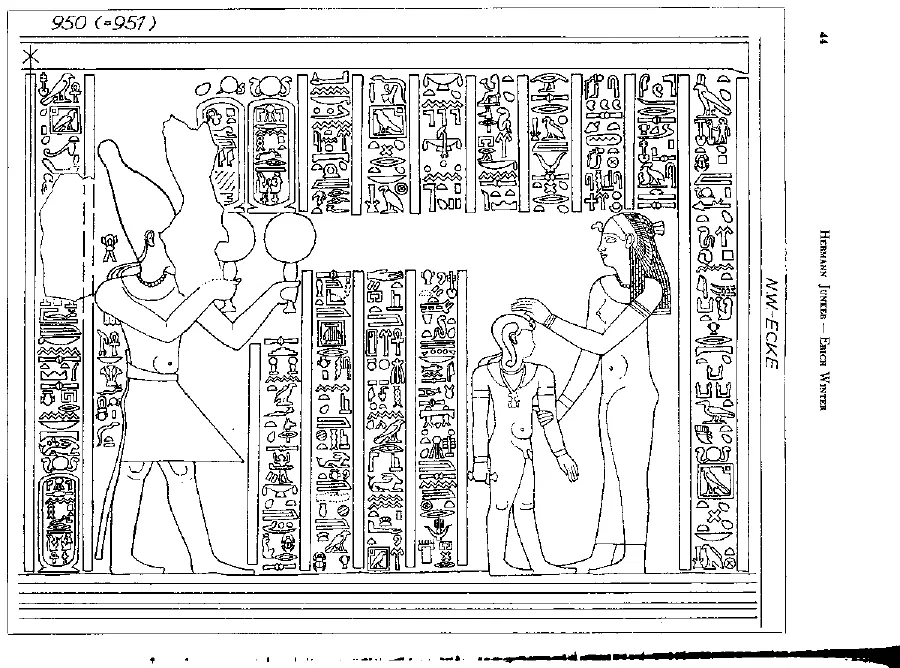
Page 45. The scene as drawn on the wall, facing p. 45 of the edition. Drawing by Otto Baum, in Junker and Winter, Das Geburtshaus des Tempels der Isis in Philä (1965) - 275p. 45, l. 1
nfr-wj ḥr-t tmꜣ.t ḥnw.t tꜣ.wj
How beautiful is your face, Mother, mistress of the Two Lands,
- 276p. 45, l. 2
nb(.t) jnšj mrj-s ṯḥn
lady of scarlet linen, who loves what gleams!
- 277p. 45, l. 3
psḏ-t m Snm.t
You shine on Bigeh
- 278p. 45, l. 4
r ḫnm prj-wr
to take up residence in the Per-wer shrine.
Note · Line 278
Per-wer means “Great House,” the name of the traditional shrine of Upper Egypt. - 279p. 45, l. 5
šsp-t s.t-t n(?) ꜥnḫ m ḥw.t msḫn
May you take your seat of life in the birth house,
- 280p. 45, l. 6
?wꜣḥj.t n Ḥrw sꜣ Wsjr
the dwelling of Horus, son of Osiris.
- 281p. 45, l. 7
wnn-t ḫꜥj.tj m Ḥw.t-Ḥrw
You shine forth as Hathor,
- 282p. 45, l. 8
sḏm ḥm(.t)-t m ḥw.t-ḥnt
and Your Majesty settles at Philae.
- 283p. 45, l. 9
r sḏm jb n ꜣs.t m s.t wꜣḥ jḫ.t
to gladden the heart of Isis where the offerings are laid.
- 284p. 45, l. 10
wn jb-t m tḫ.t m ḫꜥj Ḥrw ḥr tꜣ
Your heart is merry with drink when Horus shines forth on earth.
- 285p. 45, l. 11
sꜥr wn.tj-ḥr n mw.t-f Wsr.t
Raising the two mirrors to his mother Wosret,
Note · Line 285
Wosret, “the Mighty One,” is Hathor’s name here. - 286p. 45, l. 12
sḫꜥj nb m mꜣꜣ ḫprw-s
gladdening the Golden One with the sight of her own form.
- 287p. 45, l. 13
njšwt bjt jwꜥw n …
King of Upper and Lower Egypt, heir of …
- 288p. 45, l. 14
sꜣ Rꜥ Pt …
son of Ra, Ptolemy …
Note · Line 288
His title names him heir to his parents, Ptolemy V and Cleopatra I, worshipped together as the Manifest Gods. - 289p. 45, l. 15
sꜣ ꜥnḫ wꜣs nb ḥꜣ-f mj Rꜥ ḏ.t
May all protection, life and dominion surround him as they surround Ra, forever.
- 290p. 45, l. 16
ḏd mdw n | Ḥw.t-Ḥrw wr.t nb(.t) Snm.t
Words spoken by Hathor the Great, Lady of Bigeh,
- 291p. 45, l. 17
nb n nṯr.w ḏꜥm n nṯr.wt
gold of the gods, electrum of the goddesses,
Note · Line 291
Electrum is an alloy of gold and silver. - 292p. 45, l. 18
šps.t wsr(.t) pr(.t) m Kns.t
the august one, the mighty one who came forth from Nubia.
- 293p. 45, l. 19
špr-s r Snm.t m Wps.t wr.t
She reached Bigeh as Wepeset the Great.
Note · Line 293
Wepeset is the goddess in her fiery form. Her arrival from Nubia is the homecoming of the wandering Eye of Ra. - 294p. 45, l. 20
wꜥb-s ḥꜥ.w-s ḫnt jꜣ.t wꜥb.t
She purified her limbs on the Pure Mound
- 295p. 45, l. 21
sḏm-s jm rꜥ nb
and there she dwells day after day.
- 296p. 45, l. 22
Šw ḥnꜥ-s ḥr ḳmꜣ nfrw-s
Shu is with her, fashioning her beauty;
- 297p. 45, l. 23
Ḏḥwtj sḥtp sj
Thoth soothes her.
- 298p. 45, l. 24
dj-j n-k mꜣꜣ n jtn m p.t
“I give you what the sun disk sees in the sky
Note · Line 298
Hathor now addresses the king. - 299p. 45, l. 25
šnw n jḫ.tj-f
and all that his two eyes encompass.”
- 300p. 45, l. 26
ꜥnḫ | nṯr nfr sꜣ Ḥw.t-Ḥrw
Long live the good god, son of Hathor,
- 301p. 45, l. 27
tj.t ḏsr.t …
sacred image of …
- 302p. 45, l. 28
… prj m Kns.t
… who came forth from Nubia,
- 303p. 45, l. 29
sḥrj jb n nb(.t) Pwn.t
who gladdens the heart of the Lady of Punt,
- 304p. 45, l. 30
njšwt bjt jwꜥw …
King of Upper and Lower Egypt, heir …
- 305p. 45, l. 31
bjk.t šmsw.t ḫpr(.t) m Rꜥ
Falcon goddess, eldest daughter, sprung from Ra,
- 306p. 45, l. 32
wꜥ.t m tp n Jtmw
sole one upon the brow of Atum,
Note · Line 306
The goddess appears here as the upright cobra that guards the sun god’s brow. - 307p. 45, l. 33
kꜣ.t ḥrj.t kꜣ.w
the ka who stands above the kas,
Note · Line 307
A ka is the life force of a person or a god. - 308p. 45, l. 34
wr.t(?) ḏr.t njšwt bjt
the Great One, the kite, Queen of Upper and Lower Egypt,
- 309p. 45, l. 35
Ḥw.t-Ḥrw wr.t nb(.t) Snm.t
Hathor the Great, Lady of Bigeh.
Ptolemy VIII gives food to Isis suckling Horus
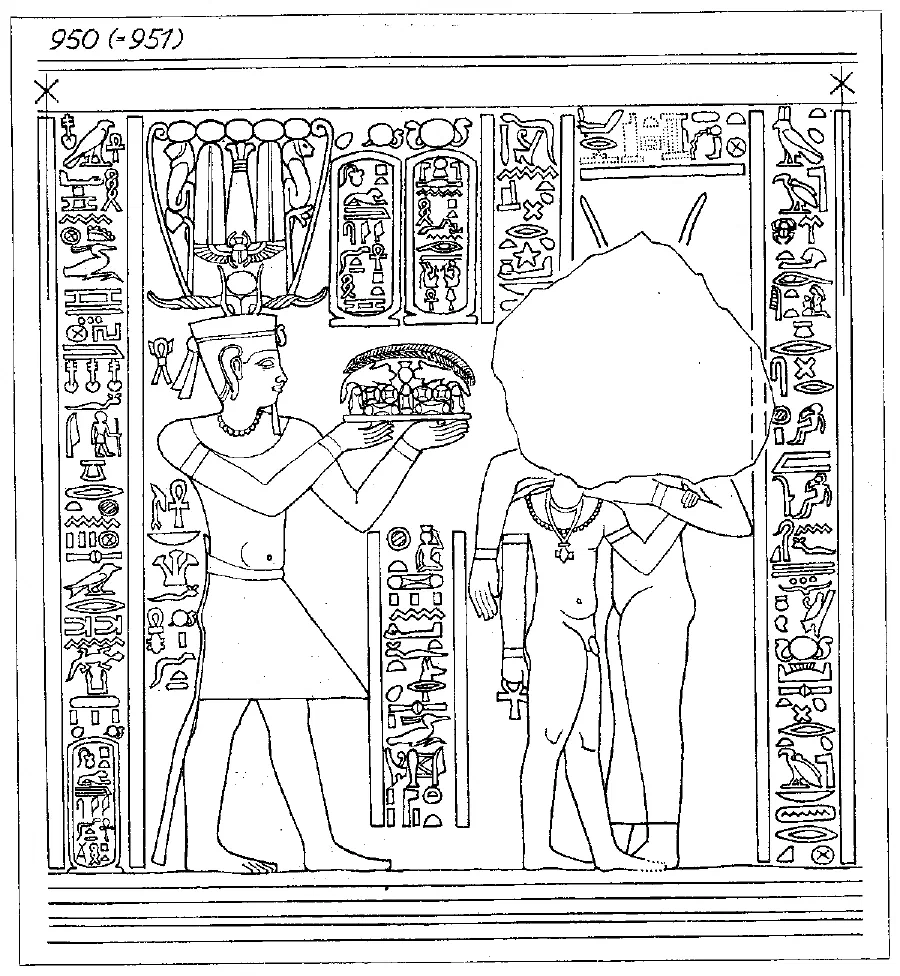
Page 47. The scene as drawn on the wall, facing p. 47 of the edition. Drawing by Otto Baum, in Junker and Winter, Das Geburtshaus des Tempels der Isis in Philä (1965) - 310p. 47, l. 1
fꜣj jḫ.t n mw.t-f Wsr.t
Lifting food to his mother Wosret,
- 311p. 47, l. 2
sbꜥḥ ꜥb.t n psḏ.t
making the feast overflow for the Ennead.
- 312p. 47, l. 3
njswt bjt jwꜥw …
King of Upper and Lower Egypt, heir …
- 313p. 47, l. 4
sꜣ Rꜥ Pt … sꜣ ꜥnḫ wꜣs nb ḥꜣ-f mj Rꜥ ḏ.t
Son of Ra, Ptolemy … May protection and all life and dominion surround him as they surround Ra forever.
Note · Line 313
“Son of Ra” names the sun god as the king’s father. - 314p. 47, l. 5
ḏd mdw n | Js.t wr.t mw.t nṯr nb(.t) J(rk)
Words to be spoken to Isis the Great, the god’s mother, Lady of Philae,
- 315p. 47, l. 6
ḏsr-s s.t ḫnt tꜣ.t wꜥb.t
who hallows the throne within the Abaton.
Note · Line 315
The Abaton, the “inaccessible place,” was the sanctuary of Osiris on Bigeh, the island beside Philae. - 316p. 47, l. 7
ꜥnḫ | nṯr nfr ḥꜥpj n Km.t
Long live the good god, Egypt’s Nile in flood,
- 317p. 47, l. 8
bꜥḥ tꜣ-mrj m nfrw-f
who floods Egypt with his beauty,
- 318p. 47, l. 9
sr ḥr jḫ.t n njw.wt
the prince who holds the offerings of the cities,
- 319p. 47, l. 10
swr pšš.wt n ꜥšꜣ kꜣ.w
who increases the portions of those rich in food,
- 320p. 47, l. 11
sꜣ Rꜥ Pt …
the Son of Ra, Ptolemy …
- 321p. 47, l. 12
bjk.t mw.t nṯr ḫpr m ḥꜣ.t
The falcon goddess, the god’s mother, who came into being in the beginning,
- 322p. 47, l. 13
jrj jṯj.t ḥr swr(?) ḥj m rnp
who nursed the child and raised him to be a young man,
Note · Line 322
The child is Horus, son of Isis and heir to the throne of his father Osiris. - 323p. 47, l. 14
ḥḳꜣ-n-f tꜣ.wj dmd-n-f sḫm.tj
so that he came to rule the Two Lands and joined the two crowns:
Note · Line 323
The white crown of Upper Egypt and the red crown of Lower Egypt together form the Double Crown. - 324p. 47, l. 15
njswt bjt Js.t wr.t mw.t nṯr nb(.t) Jrk
Queen of Upper and Lower Egypt, Isis the Great, the god’s mother, Lady of Philae.
Ptolemy VIII brings Min the love potion
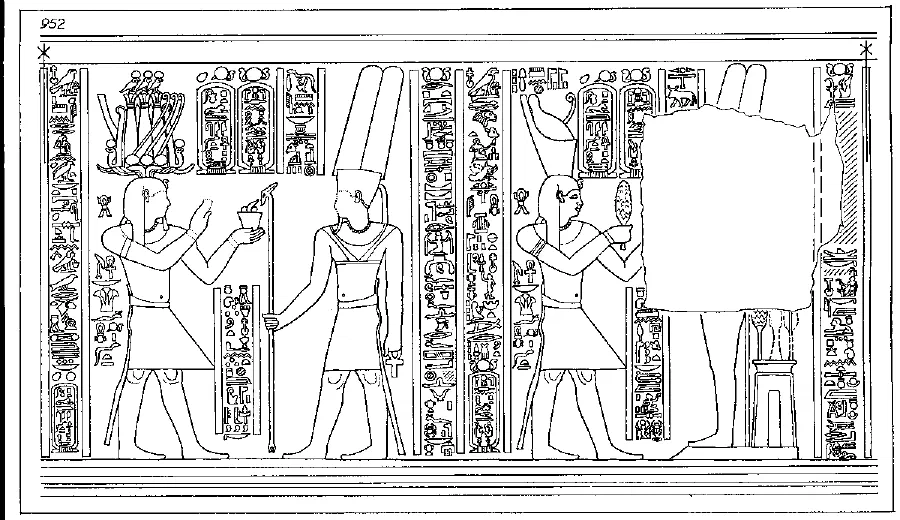
Page 49. The scene as drawn on the wall, facing p. 49 of the edition. Drawing by Otto Baum, in Junker and Winter, Das Geburtshaus des Tempels der Isis in Philä (1965) - 325p. 49, l. 1
(mn) n-k mnhp ḫnt ḥꜥ.w nṯr
Receive the love potion for the god’s limbs,
Note · Line 325
The king presents the potion to Min, a god of male sexual potency. - 326p. 49, l. 2
nb tm.w ḫpr ḥḥ
lord of humankind, who brought millions into being.
- 327p. 49, l. 3
njśwt bjt jwꜥw …
King of Upper and Lower Egypt, heir …
- 328p. 49, l. 4
sꜣ Rꜥ Pt … nṯr.wj (sic) mnḫ sꜣ ꜥnḫ wꜣś nb ḥꜣ-f mj Rꜥ ḏ.t
Son of Ra, Ptolemy … the two beneficent gods. May protection and all life and dominion surround him as they surround Ra forever.
Note · Line 328
“The two beneficent gods” is a royal cult title honoring king and queen together. - 329p. 49, l. 5
Mnw kꜣ (nḫt) …
Min, the strong bull, …
- 330p. 49, l. 6
ꜥnḫ | nṯr nfr ꜥꜣ šfj.t ḫnt pꜥ.t rḫj.t
Long live the good god, great in majesty, foremost among nobles and commoners,
- 331p. 49, l. 7
mj Mnw ḫnt pśḏ.t
as Min is foremost among the Ennead,
- 332p. 49, l. 8
nfr jbꜣ.w ḫrj-jb ḥm.wt
graceful in the dance among the women,
- 333p. 49, l. 9
mrj.tj ꜥpr ḥkr.w
the beloved one, decked in jewels,
- 334p. 49, l. 10
njśwt bjt jwꜥw …
King of Upper and Lower Egypt, heir …
- 335p. 49, l. 11
njśwt bjt | njśwt m … jm-k …
King of Upper and Lower Egypt, king among … in you …
- 336p. 49, l. 12
śmśw jw-k m nb tꜣ pn
Eldest one, you are lord of this land.
- 337p. 49, l. 13
ḫꜥj-k m (so) ꜣJśdn (so)
You rise in glory as Isden,
Note · Line 337
Isden is a name of Thoth, who acts in the sun god’s place. - 338p. 49, l. 14
m ḏbꜣ n (so) jtn (oder Rꜥ)
as deputy to the sun disk,
- 339p. 49, l. 15
tm rdj.t šw tꜣ m nb
lest the earth be left without a lord.
Ptolemy VIII burns incense before Amun
- 340p. 49, l. 16
jnj-j n-k śnṯr smꜣ² ḫr ꜥnṯjw
I bring you incense mingled with myrrh,
- 341p. 49, l. 17
ḫnm-nṯr ꜣb ḥꜥ.w-k
the god’s fragrance, which your limbs crave.
- 342p. 49, l. 18
njśwt bjt jwꜥw …
King of Upper and Lower Egypt, heir …
- 343p. 49, l. 19
sꜣ Rꜥ Pt … sꜣ ꜥnḫ wꜣś nb ḥꜣ-f mj Rꜥ ḏ.t
Son of Ra, Ptolemy … May all protection, life and dominion surround him as they surround Ra, forever.
- 344p. 49, l. 20
ḏd mdw n | ꜣJmn-Rꜥ nb nś.t tꜣ.wj ḫnt jp.t-ś.wt
Words spoken by Amun-Ra, lord of the throne of the Two Lands, foremost in Karnak.
Note · Line 344
Karnak was Amun-Ra’s great sanctuary at Thebes. - 345p. 49, l. 21
ꜥnḫ | nṯr nfr sꜣ ꜣJmn rr n Mw.t nb(.t) p.t
Long live the good god, son of Amun, reared by Mut, lady of heaven,
- 346p. 49, l. 22
śwḥ.t (so) śbḳ(.t) n bꜣ wr šfj.t
choice egg of the ba, great in majesty,
Note · Line 346
The egg is an image of divine descent. - 347p. 49, l. 23
ḥbj jnw m tꜣ nb
who gathers tribute from every land,
- 348p. 49, l. 24
sꜣ Rꜥ Pt …
son of Ra, Ptolemy …
- 349p. 49, l. 25
njśwt bjt | jrj p.t ḳmꜣ tꜣ
King of Upper and Lower Egypt, who made the sky and fashioned the earth,
- 350p. 49, l. 26
bsj nw.w ḫpr ḏw.w
who brought forth the primeval waters and made the mountains rise.
- 351p. 49, l. 27
nṯr wꜥ(.tj) jrj ḥḥ
Sole god, maker of millions,
- 352p. 49, l. 28
ꜥw-f wsḫ-f nn ḏrw-f
his length and breadth are without limit.
- 353p. 49, l. 29
šꜣꜥ ḫ(pr) nn wpw ḥr-f
He was the first to come into being, with none beside him;
- 354p. 49, l. 30
ḫpr nṯr nb ḫr sꜣ
every god came into being after him.
Ptolemy VIII gives Osiris a field
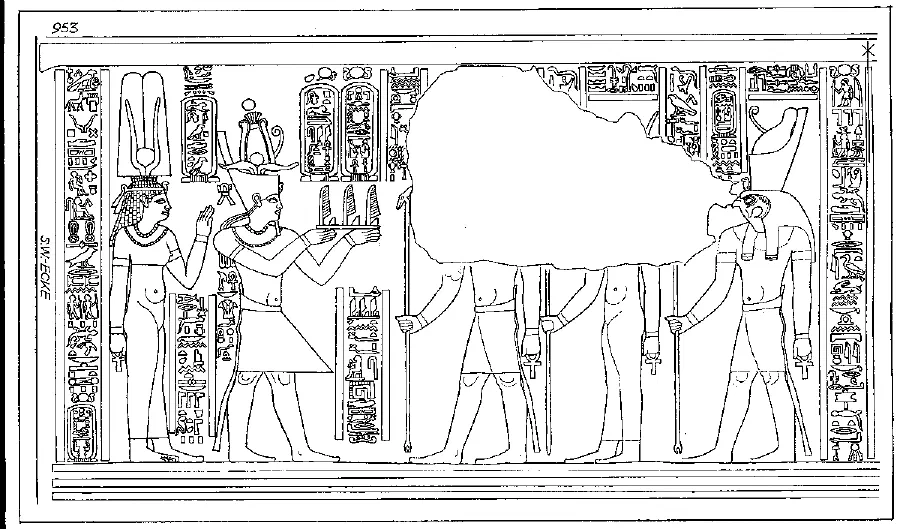
Page 51. The scene as drawn on the wall, facing p. 51 of the edition. Drawing by Otto Baum, in Junker and Winter, Das Geburtshaus des Tempels der Isis in Philä (1965) - 355p. 51, l. 1
ḥnk (so) sḫ.t n jt·f šps
Presenting a field to his noble father,
- 356p. 51, l. 2
swšḫ tꜣš·f r-ꜥ Tꜣ-stj
extending his boundary as far as Nubia.
- 357p. 51, l. 3
njswt bjt jwꜥw …
King of Upper and Lower Egypt, heir of the Manifest Gods …
- 358p. 51, l. 4
sꜣ Rꜥ Pt … sꜣ ꜥnḫ wꜣš nb ḥꜣ·f mj Rꜥ ḏ.t
Son of Ra, Ptolemy … May all protection, life and dominion surround him as they surround Ra, forever.
- 359p. 51, l. 5
ḥm.t·f ḥḳꜣ.t nb(.t) tꜣ.wj (Kl …)
His wife, the sovereign, lady of the Two Lands, Cleopatra …
- 360p. 51, l. 6
sn(-j) mrj mḥ jb·k n Js.t
My beloved brother, put your trust in Isis.
Note · Line 360
The queen addresses her husband as “brother,” a term of intimacy in royal marriage. - 361p. 51, l. 7
nts nb(.t) nṯr.w ḥnw.t nṯr.wt
She is the lady of the gods, the sovereign of the goddesses.
- 362p. 51, l. 8
dj(-j) n·k šnw n p.t ḥr jf(dw)
I give you the circuit of heaven to its four ends,
- 363p. 51, l. 9
… (tꜣ?) ḥr nḏ(b·f)
… the earth in its full extent.
- 364p. 51, l. 10
ḏd mdw n | … (Js.t) … nb(.t) ḫꜣs.wt rsj.wt ḥḳꜣ.t mḥtj.w
Words spoken by … Isis … lady of the southern foreign lands, ruler of the northerners.
- 365p. 51, l. 11
ḏd mdw n | Ḥrw nḏ.tj jt·f sꜣ Js.t …
Words spoken by Horus, avenger of his father, son of Isis …
Note · Line 365
Horus avenges his father Osiris, whom Seth killed. - 366p. 51, l. 12
jwꜥw mnḫ n Wnn nfrw mꜣꜥ ḫrw
worthy heir of Onnophris, the vindicated,
Note · Line 366
Onnophris, “the one who is ever in good condition,” is a name of Osiris. “Vindicated” declares that judgment was given in his favor. - 367p. 51, l. 13
wꜣḥ jḫ.t n jt·f Wsjr
who lays offerings before his father Osiris
- 368p. 51, l. 14
šfšf nw n kꜣ·f rꜥ nb
and gives gifts to his ka each day.
- 369p. 51, l. 15
ꜥnḫ | nṯr nfr tꜣtj sꜣb wp tꜣš.w
Long live the good god, vizier and judge, who settles boundaries,
- 370p. 51, l. 16
ḥwn šps jtr.tj
the youth who provides for the two shrines,
Note · Line 370
The paired shrines represent Upper and Lower Egypt. - 371p. 51, l. 17
swr pšš.wt n sr sr.w
who increases the portions for the prince of princes,
- 372p. 51, l. 18
ꜥšꜣ ꜣḫ.t nb ḥtp.w
rich in fields, lord of offerings,
- 373p. 51, l. 19
njswt bjt jwꜥw …
King of Upper and Lower Egypt, heir …
- 374p. 51, l. 20
njswt bjt | sr nṯr.w jtj mnḫ prj m Gb
King of Upper and Lower Egypt, prince of the gods, worthy sovereign sprung from Geb,
Note · Line 374
These titles belong to Osiris. Geb, the earth god, is his father. - 375p. 51, l. 21
ꜥšꜣ tꜣš.w ḥr sꜣt.w³
whose domains on earth are many.
- 376p. 51, l. 22
wnn n·k šnw p.t
Yours is the circuit of the sky;
- 377p. 51, l. 23
ḥjn·k rsj r-ꜥ ṯꜣw
your southern border reaches as far as the wind,
- 378p. 51, l. 24
mḥtj r-ꜥ wbnw
your northern as far as the sunrise.
Ptolemy VIII gives Osiris myrrh
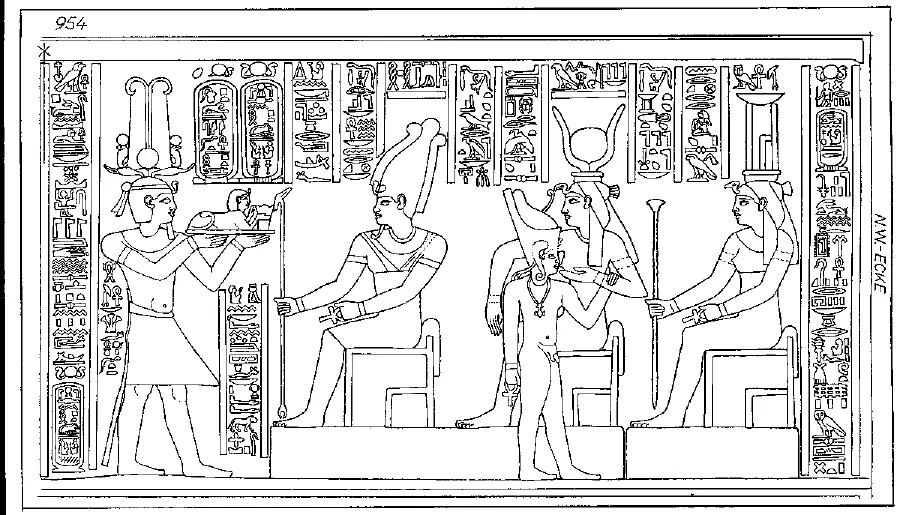
Page 53. The scene as drawn on the wall, facing p. 53 of the edition. Drawing by Otto Baum, in Junker and Winter, Das Geburtshaus des Tempels der Isis in Philä (1965) - 379p. 53, l. 1
jn-j n-k ꜥntjw m šꜥ-f nb
I bring you myrrh with all its sha,
- 380p. 53, l. 2
ḥr ꜥ.wj mꜣj ḥḳꜣ Pwn.t
on the two arms of the lion, ruler of Punt.
Note · Line 380
The lion is the king bearing the offering. Punt, southeast of Egypt, was a source of fragrant resins. - 381p. 53, l. 3
njśwt bjt jwꜥw n …
King of Upper and Lower Egypt, heir of …
Note · Line 381
The title names the king’s parents, Ptolemy V and Cleopatra I, as the Manifest Gods. - 382p. 53, l. 4
sꜣ Rꜥ Pt … sꜣ ꜥnḫ wꜣś nb ḥꜣ-f mj Rꜥ ḏ.t
Son of Ra, Ptolemy … May all protection, life and dominion surround him as they surround Ra forever.
- 383p. 53, l. 5
ḏd mdw n | Wśjr nb ꜥnḫ nb Jꜣk
Words spoken by Osiris, lord of life, lord of Philae,
Note · Line 383
Here “life” is the life-giving water of the Nile flood. Osiris answers the king’s offering with a gift of his own. - 384p. 53, l. 6
nb ḥḥ sbj rnp.wt
lord of eternity, who passes the years:
- 385p. 53, l. 7
dj-j n-k Tꜣ-nṯr ḥr prj jm-f
I give you the God’s Land with what springs from it.
Note · Line 385
The God’s Land is Punt here. - 386p. 53, l. 8
ḏd mdw n | Jś.t wr.t mw.t nṯr
Words spoken by Isis the Great, mother of the god,
- 387p. 53, l. 9
nb(.t) prj-mśj ꜥšꜣ(.t) rn(.w) nṯrj(.t) (so) ḫpr.w
lady of the birth house, many in names, divine in her forms,
- 388p. 53, l. 10
jr(r.t) mk.t-ś (n) sꜣ-ś Ḥrw
who gives her protection to her son Horus
- 389p. 53, l. 11
śtp sꜣ-f r (so) nṯr.w nb.w
and shields him above all the gods.
- 390p. 53, l. 12
ḏd mdw n | Nb.t-ḥw.t mnḫ.t nṯr.w
Words spoken by Nephthys, the excellent one among the gods,
- 391p. 53, l. 13
śn.t nṯr nb(.t) Jꜣk
sister of the god, lady of Philae,
- 392p. 53, l. 14
rr sꜣ-ś Ḥrw m ꜥnḫ-wꜣś
who reared her son Horus on life and dominion.
Note · Line 392
“Life and dominion” is the milk Nephthys gives Horus as his nursing mother. - 393p. 53, l. 15
ꜥnḫ | nṯr nfr ḥḳꜣ Pwn.t
Long live the good god, ruler of Punt,
- 394p. 53, l. 16
šsp-ꜥnḫ n nb Tꜣ-nṯr
living image of the lord of the God’s Land,
- 395p. 53, l. 17
śḫꜥj nṯr.w m jḏ.t
who gladdens the gods with fragrance
- 396p. 53, l. 18
śḥtp jb-śn m prj jm(-śn)
and soothes their hearts with what comes forth from them,
Note · Line 396
Fragrant resins were said to flow from the gods’ bodies. In offering myrrh, the king gives the gods back something of their own. - 397p. 53, l. 19
njśwt bjt jwꜥw …
the King of Upper and Lower Egypt, heir …
- 398p. 53, l. 20
njśwt bjt | Wr(?) wr.w Wnn nfrw mꜣꜥ ḫrw
King of Upper and Lower Egypt, great one among the great, Wennefer, true of voice,
Note · Line 398
“True of voice” means that his cause has been judged just. - 399p. 53, l. 21
njśwt nṯr.w wnn-f nṯrj m ḥḳꜣ ꜥnḫ.w
king of the gods, divine as ruler of the living.
- 400p. 53, l. 22
rꜣ.w-prj.w nb.w ḥr śḫm.w-f
All temples house his images;
- 401p. 53, l. 23
ꜥpr-tw śp.wt m śštꜣ(-f)
the provinces are furnished with his secret form.
Ptolemy VIII gives Horus an amulet
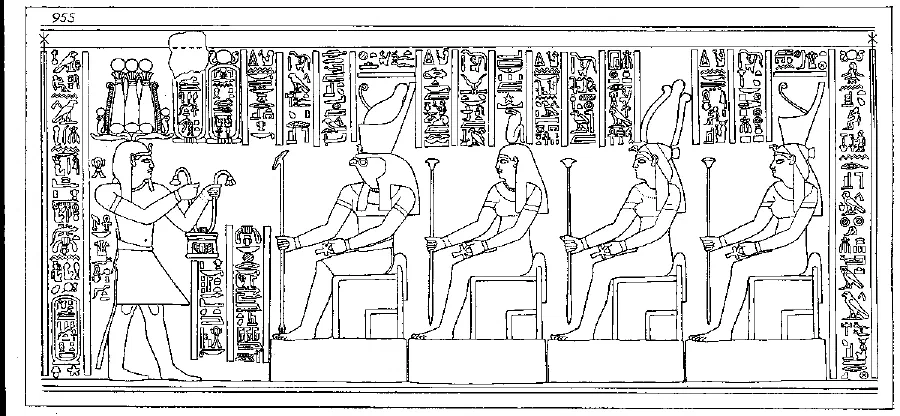
Page 55. The scene as drawn on the wall, facing p. 55 of the edition. Drawing by Otto Baum, in Junker and Winter, Das Geburtshaus des Tempels der Isis in Philä (1965) - 402p. 55, l. 1
ꜣw.t-jb nb(.t) ḫr-k nṯr wꜥ prj m Jꜣ.t
All joy is yours, sole god who came forth from Isis.
- 403p. 55, l. 2
nṯr.w nṯr.wt m rš ḥr-k
The gods and goddesses keep watch over you;
- 404p. 55, l. 3
psḏ.t ꜥꜣ.t m sꜣ-k
the Great Ennead guards you.
- 405p. 55, l. 4
njšwt bjt jwꜥw …
King of Upper and Lower Egypt, heir of …
Note · Line 405
His parents, Ptolemy V and Cleopatra I, were worshipped together as the Manifest Gods. - 406p. 55, l. 5
sꜣ Rꜥ Pt … sꜣ ꜥnḫ wꜣš nb ḥꜣ-f mj Rꜥ ḏ.t
son of Ra, Ptolemy … May all protection, life and good fortune surround him as they surround Ra forever.
- 407p. 55, l. 6
ḏd mdw n | Ḥrw nḏtj jt-f sꜣ Wsjr
Words spoken by Horus the Avenger of His Father, son of Osiris,
Note · Line 407
Horus avenged his father Osiris against Seth, who had killed him. Here Horus speaks to the king. - 408p. 55, l. 7
jwꜥw mnḫ prj m Jꜣ.t
the worthy heir who came forth from Isis,
- 409p. 55, l. 8
ꜥḥm ḏsr jḫ.t n jt-f
the falcon who presents offerings to his father:
- 410p. 55, l. 9
dj-j n-k tꜣ.w nb.w ḫr š.t ḫr-k
“I give you all lands under your command.”
- 411p. 55, l. 10
ḏd mdw n | Wps.t nb(.t) nbj m Snm.t
Words spoken by Wepeset, mistress of flame on Bigeh,
- 412p. 55, l. 11
ꜥšꜣ(.t) ḥb.w m Tꜣ-nṯr
rich in festivals in the God’s Land:
- 413p. 55, l. 12
dj-j šnd.t-k m jb pꜥ.t
“I set fear of you in the heart of the people
- 414p. 55, l. 13
šfj.t-k m ẖt ḫꜣs.(w)t
and awe of you deep within the foreign lands.”
- 415p. 55, l. 14
ḏd mdw n | Nḫb.t ḥḏ.t Nḫn
Words spoken by Nekhbet, the White One of Nekhen,
Note · Line 415
Nekhbet is the vulture goddess of Upper Egypt. Her title evokes its white crown. - 416p. 55, l. 15
mw.t nṯr m ḥw.t msḫn
the god’s mother in the birth house,
- 417p. 55, l. 16
jr(r.t) sꜣ n Ḥrw m ꜥnḫ-ḏd-wꜣš
who guards Horus with life, stability and well-being:
- 418p. 55, l. 17
dj-j n-k njšwj.t n sꜣ(-j) Ḥrw
“I give you the kingship of my son Horus
- 419p. 55, l. 18
ḫrj ns.t ḫnt (so) ꜥnḫ.w
as heir to the throne at the head of the living.”
- 420p. 55, l. 19
ḏd mdw n | Wꜣḏ.t nb(.t) P Dp
Words spoken by Wadjet, lady of Pe and Dep,
Note · Line 420
Pe and Dep were the twin towns of Buto in the Nile Delta. Wadjet, the cobra goddess, protected Lower Egypt. - 421p. 55, l. 20
msḫn.t m ḫnw ꜣḫbjt
birth goddess in the heart of Chemmis:
- 422p. 55, l. 21
dj-j n-k tꜣ.wj mj sꜣ Jꜣ.t
“I give you the Two Lands as I give them to the son of Isis.”
- 423p. 55, l. 22
ꜥnḫ | nṯr nfr snn n Ḥrw
Long live the good god, the likeness of Horus,
- 424p. 55, l. 23
mštjw n ꜣ-mꜣꜥ-ḫrw
the image of the Victorious One,
- 425p. 55, l. 24
ḫꜥj ḥr tꜣ mj sꜣ Jꜣ.t
who rises in glory on earth like the son of Isis,
- 426p. 55, l. 25
ꜥšꜣ ꜣw.t-jb n ḥm-f
who makes the joy of His Majesty’s heart abound,
- 427p. 55, l. 26
sꜣ Rꜥ Pt … nṯr mnḫ
son of Ra, Ptolemy …, the worthy god.
- 428p. 55, l. 27
njšwt bjt | msj n Jꜣ.t
King of Upper and Lower Egypt, born of Isis,
- 429p. 55, l. 28
sꜣ šmsw n Wsjr
eldest son of Osiris,
- 430p. 55, l. 29
bꜣ ḫꜣḫ msḫꜥ prj m ꜣḫ.t
the ba, swift to be born, who comes forth from the horizon,
- 431p. 55, l. 30
Ḥrw nḏtj jt-f sꜣ Jꜣ.t nb.t Jrk
Horus the Avenger of His Father, son of Isis, lady of Philae.
Ptolemy VIII gives Hathor two sistra
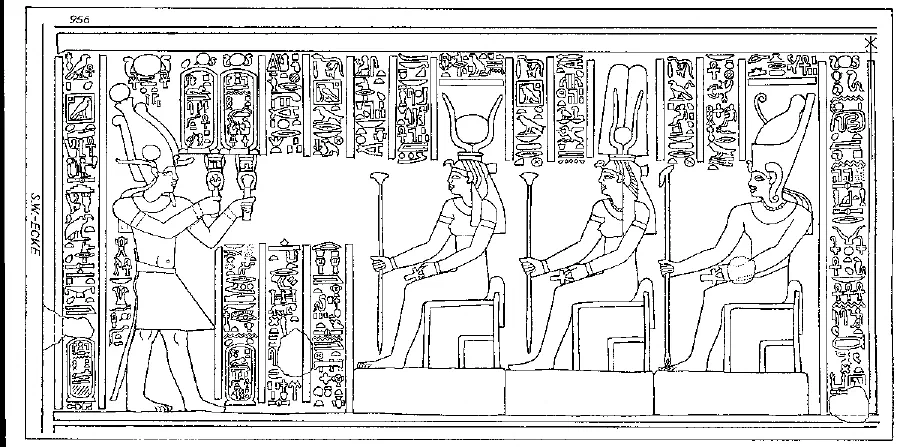
Page 57. The scene as drawn on the wall, facing p. 57 of the edition. Drawing by Otto Baum, in Junker and Winter, Das Geburtshaus des Tempels der Isis in Philä (1965) - 432p. 57, l. 1
jrj(-j) sšš.tj m ḥr-t nfr
I shake the two sistra before your beautiful face.
Note · Line 432
Sistra are ritual rattles. The player is addressing a goddess. - 433p. 57, l. 2
ḥnw.t nṯr.wt ḫnt Snm.t
Sovereign of the goddesses, foremost in Bigeh,
- 434p. 57, l. 3
ṯḥn ḥr-t wnf jb-t
may your face shine and your heart be glad,
- 435p. 57, l. 4
ḥtp kꜣ-t rwj ḳnd (-t?)
may your ka be content and your anger pass.
- 436p. 57, l. 5
twt(?) Wr.t … m nfrw-s
You are the Great One … in her beauty,
- 437p. 57, l. 6
… nb(.t) mrw.t(?) wꜣḏ(.wj?) jb-t r mꜣꜣ
… Lady of Love, how your heart rejoices at the sight!
- 438p. 57, l. 7
dgj ḥr-t nfr n sꜣ Rꜥ Pt …
May your fair face look upon the Son of Ra, Ptolemy …
- 439p. 57, l. 8
njśwt bjt jwꜥw …
King of Upper and Lower Egypt, heir …
Note · Line 439
The king’s full title names him heir to the Manifest Gods, his deified parents. - 440p. 57, l. 9
sꜣ Rꜥ Pt … sꜣ ꜥnḫ wꜣś nb ḥꜣ-f mj Rꜥ ḏ.t
Son of Ra, Ptolemy … May all protection, life and dominion surround him as they surround Ra forever.
- 441p. 57, l. 10
Bḥd.tj nṯr ꜥꜣ
He of Behdet, the great god.
Note · Line 441
“He of Behdet” is Horus of Edfu, often shown as a winged sun disk. - 442p. 57, l. 11
ḏd mdw n | Ḥw.t-Ḥrw wr.t nb(.t) Snm.t
Words spoken by Hathor the Great, Lady of Bigeh,
- 443p. 57, l. 12
šps.t wsr.t ḥnw.t nṯr.w
the august one, the mighty one, sovereign of the gods,
- 444p. 57, l. 13
nb(.t) tḫ.t mr(r.t) ḥknw nb(.t) ḥsj.t ḥbj ḥnw.t tbnw
lady of drunkenness, who loves jubilation, lady of song and dance, sovereign of leaping.
- 445p. 57, l. 14
ꜥnḫ nṯr.w n mꜣꜣ ḫpr.w-t
The gods live by the sight of your forms.
- 446p. 57, l. 15
Wsr.t pw ḫnt (sic) ḥnw.t tꜣ.wj
She is Wosret, the foremost, sovereign of the Two Lands.
Note · Line 446
Wosret means “the Mighty One,” here a name for Hathor. - 447p. 57, l. 16
dj-j n-k ḥsw.t ḫr ṯꜣj.w
I give you favor among men
Note · Line 447
Hathor is speaking to the king. - 448p. 57, l. 17
mrw.t ḫr ḥm.wt
and love among women.
- 449p. 57, l. 18
ḏd mdw n | Ḥw.t-Ḥrw wr.t nb(.t) ꜣJrk
Words spoken by Hathor the Great, Lady of Philae,
- 450p. 57, l. 19
ꜥꜣ(.t) mrw.t ḫnt psḏ.t
greatly beloved, foremost among the Ennead,
- 451p. 57, l. 20
nb.tj rḫj.t ḥnw.t tꜣ.wj
queen of the people, sovereign of the Two Lands.
- 452p. 57, l. 21
ḏd mdw n | Ḥrw pꜣ ḫrd sꜣ ꜣJs.t
Words spoken by Horus the Child, son of Isis,
- 453p. 57, l. 22
nb ꜣJrk nb ꜥnḫ śrḳ ḥtj.t
lord of Philae, lord of life, who gives breath to the throat,
- 454p. 57, l. 23
ḥwn nfr wr mrw.t
the fair youth, greatly beloved,
- 455p. 57, l. 24
jrj ḫr(.t) n ꜥnḫ.w
who provides food for the living.
- 456p. 57, l. 25
ꜥnḫ | nṯr nfr sꜣ Ḥw.t-Ḥrw
Long live the good god, son of Hathor,
- 457p. 57, l. 26
šsp-ꜥnḫ n jḥj-wꜥb
the living likeness of the sacred musician,
Note · Line 457
The musician is Ihy, Hathor’s young son, who plays the sistrum, a ritual rattle. - 458p. 57, l. 27
śꜥr sšš.t n mw.t-f Wsr.t
who raises the sistrum to his mother Wosret,
- 459p. 57, l. 28
śḥtp Nb m (mrr.t-s?)
who gladdens the Golden One with what she loves,
- 460p. 57, l. 29
(njśwt bjt) jwꜥw … nṯr mnḫ
King of Upper and Lower Egypt, heir …, the excellent god.
- 461p. 57, l. 30
njśwt bjt | ḥrj(.t)-tp n Rꜥ
King of Upper and Lower Egypt, diadem of Ra,
- 462p. 57, l. 31
Mḥn.t m tp n nṯr.w
the coiled serpent on the head of the gods,
Note · Line 462
The serpent is the protective cobra worn at the brow. - 463p. 57, l. 32
śnḏm ḥm.t-s r wp hrw nn
Her Majesty takes her seat to open this day.
- 464p. 57, l. 33
ꜥnḫ.t nb(.t) ꜥnḫ.w
The Living One, lady of the living,
- 465p. 57, l. 34
njś-tw rn[-s] dwꜣ-tw kꜣ-s
whose name is invoked and whose ka is revered.
- 466p. 57, l. 35
Ḥw.t-Ḥrw …
Hathor …
Ptolemy VIII gives Amun a figure of Maat
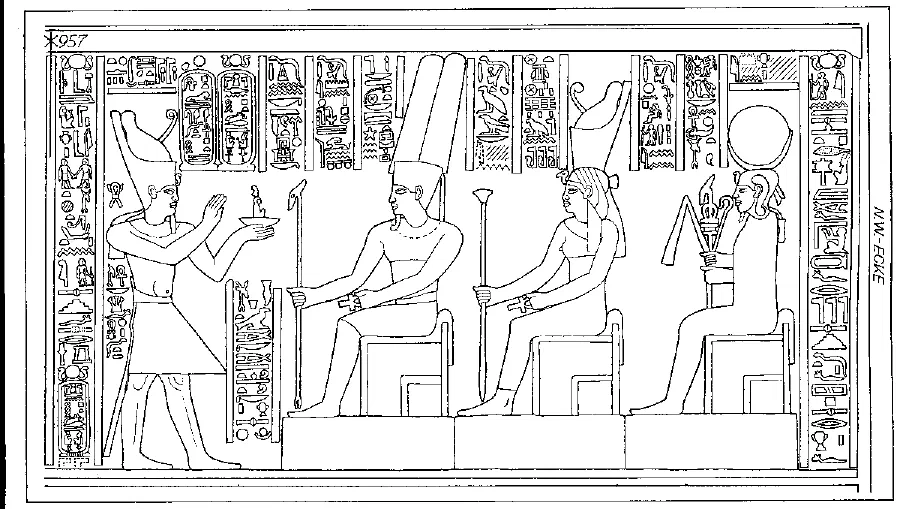
Page 59. The scene as drawn on the wall, facing p. 59 of the edition. Drawing by Otto Baum, in Junker and Winter, Das Geburtshaus des Tempels der Isis in Philä (1965) - 467p. 59, l. 1
mr.t(?)¹ wr.t mr(r.t)-k
The great throat that you love,
Note · Line 467
The Egyptian word for “throat” here echoes the word for “love.” - 468p. 59, l. 2
mrj-s ṯw ḥtp-k ḥr-s rꜥ nb
she loves you, and you delight in her every day.
- 469p. 59, l. 3
njśwt bjt jwꜥw …
King of Upper and Lower Egypt, heir of …
- 470p. 59, l. 4
sꜣ Rꜥ Pt …
Son of Ra, Ptolemy …
- 471p. 59, l. 5
nṯr.wj mnḫ.wj mrj mꜣꜥ.t śmn jḫ.t
The two Beneficent Gods, who love Truth and set things in order.
- 472p. 59, l. 6
sꜣ ꜥnḫ wꜣś nb ḥꜣ-f mj Rꜥ ḏ.t
May all protection, life and dominion surround him as they surround Ra forever.
- 473p. 59, l. 7
ḏd mdw n | Jmn-Rꜥ njśwt nṯr.w
Words spoken by Amun-Ra, king of the gods,
- 474p. 59, l. 8
pꜣw.tj tꜣ.wj ḳmꜣ wnn.t
primeval god of the Two Lands, who fashioned what is,
- 475p. 59, l. 9
nṯr ꜥꜣ nb jꜣ.t wꜥb.t nb p.t tꜣ dꜣ.t mw ḏw.w
great god, lord of the Abaton, lord of sky and earth, of the underworld, the waters and the mountains.
Note · Line 475
The Abaton, the “Pure Mound” on the island of Bigeh near Philae, was revered as the burial place of Osiris. - 476p. 59, l. 10
ḏd mdw | dj-n-j n-k mꜣꜥ.t rwḏ.tj m ḥꜣw-k
Words spoken: “I have given you Truth, flourishing in your reign.”
Note · Line 476
Truth is Maat, both the right order of the world and the goddess who embodies it. - 477p. 59, l. 11
ḏd mdw n | Mw.t wr.t nb.t j(šrw?)
Words spoken by Mut the Great, lady of Isheru,
Note · Line 477
Isheru is the sacred lake at Mut’s temple in Karnak. - 478p. 59, l. 12
ḫnt njw.wt śp.wt mw.t nṯr n nṯr.w nṯr.wt
foremost in the cities and provinces, divine mother of the gods and goddesses.
- 479p. 59, l. 13
ḏd mdw n | Ḫnsw pꜣ ḫrd ꜥꜣ wr tpj (so) Jmn(?)
Words spoken by Khonsu the Child, the very great firstborn of Amun,
- 480p. 59, l. 14
ḥwn nfr bnr mrw.t
fair youth, sweet of love,
- 481p. 59, l. 15
nb ꜥnḫ śrḳ ḥtj.t jmn(?) ḥr …
lord of life, who gives breath to the throat, whose face is hidden …
- 482p. 59, l. 16
njśwt bjt | wbn (so) m jb nṯr
King of Upper and Lower Egypt, who rises from the god’s heart,
- 483p. 59, l. 17
śnśn Wꜣś.t
who joins himself to Thebes,
- 484p. 59, l. 18
tj.t ḏśr.t n śr mꜣꜥ.t
sacred image of the prince of Truth.
- 485p. 59, l. 19
śꜥr-f śj(?) r ḥft-ḥr(??) śḫm
He raises her up before the Mighty One.
Note · Line 485
The king presents an image of Maat to Amun-Ra. - 486p. 59, l. 20
njśwt bjt jwꜥw ……
King of Upper and Lower Egypt, heir of …
- 487p. 59, l. 21
njśwt bjt | śr n mꜣꜥ.t
King of Upper and Lower Egypt, prince of Truth,
- 488p. 59, l. 22
śḥtp jrj-ṯꜣw m mrr-f
who gladdens the maker of breath with what he loves,
- 489p. 59, l. 23
jmn rn-f r nṯr.w
whose name is hidden from the gods,
Note · Line 489
The word for “hidden” echoes the name of Amun, the Hidden One. - 490p. 59, l. 24
śꜥr ḏ.t-f šps r ḥr-f
whose august body is raised before his face.
Ptolemy VIII gives Horus, avenger of his father, the sacred Eye
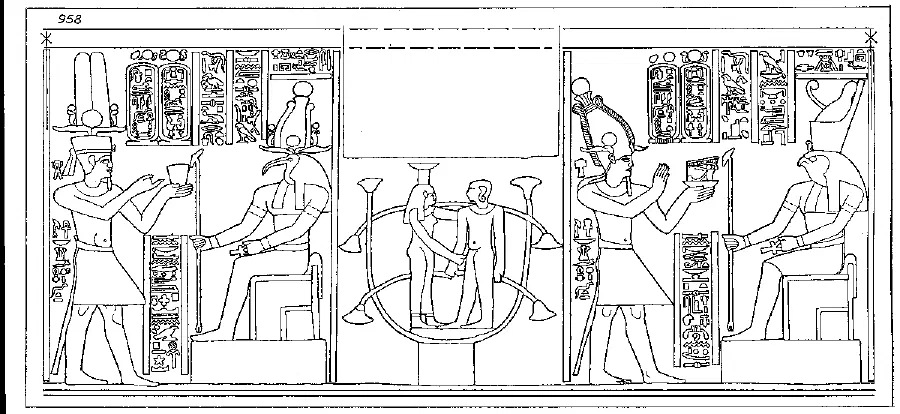
Page 61. The scene as drawn on the wall, facing p. 61 of the edition. Drawing by Otto Baum, in Junker and Winter, Das Geburtshaus des Tempels der Isis in Philä (1965) - 491p. 61, l. 1
mn n-k wḏꜣ.t-k (so)
Receive your Eye made whole,
Note · Line 491
The restored eye of Horus, called the wedjat, is a sign of wholeness and healing. - 492p. 61, l. 2
ḥtp-š ḥr ś.t-š
that it may rest in its place.
- 493p. 61, l. 3
jb-k ꜣw n mꜣꜣ-š
so that your heart may rejoice at the sight of him.
- 494p. 61, l. 4
njśwt bjt jwꜥw …
King of Upper and Lower Egypt, heir of …
- 495p. 61, l. 5
sꜣ Rꜥ Pt … sꜣ ꜥnḫ wꜣś nb ḥꜣ-f mj Rꜥ ḏ.t
Son of Ra, Ptolemy … May all protection, life and dominion surround him as they surround Ra, forever.
- 496p. 61, l. 6
ḏd mdw n | Ḥrw nḏtj jt-f sꜣ Jś.t
Words spoken by Horus, avenger of his father, son of Isis,
Note · Line 496
Horus avenged his father Osiris, whom Seth had killed. - 497p. 61, l. 7
bjk n nb prj m Wśjr
falcon of gold who came forth from Osiris,
- 498p. 61, l. 8
jwꜥ tꜣ.wj ḏmḏ ḥr ś.t-f
who inherited the Two Lands as one upon his throne.
Ptolemy VIII gives Thoth a jar of myrrh
- 499p. 61, l. 9
mn n-k ꜥntjw prj m Pwn.t
Take for yourself the myrrh that comes from Punt,
- 500p. 61, l. 10
mnwr (so) ḫpr m Tꜣ-nṯr
the frankincense that sprang up in the Land of the God.
Note · Line 500
The Land of the God is a name for Punt, a source of fragrant resins on the Red Sea trade routes. - 501p. 61, l. 11
njśwt bjt jwꜥw …
King of Upper and Lower Egypt, heir of …
- 502p. 61, l. 12
sꜣ Rꜥ Pt … sꜣ ꜥnḫ wꜣś nb ḥꜣ-f mj Rꜥ ḏ.t
Son of Ra, Ptolemy … May all protection, life and dominion surround him as they surround Ra, forever.
- 503p. 61, l. 13
ḏd mdw n | Ḏḥwtj śḥtp Nsr.t
Words spoken by Thoth, who calms the fiery serpent,
- 504p. 61, l. 14
nb Śnm.t śꜥšꜣ rnp.wt n Ḥrw ḥr nś.t jt-f
lord of Bigeh, who multiplies the years of Horus on his father’s throne,
- 505p. 61, l. 15
rḏj n-f mꜣꜥ ḫrw
who grants him vindication.
Note · Line 505
Horus and Seth disputed the throne of Osiris before the gods. To be vindicated was to have one’s claim declared just. Ptolemy VIII gives Khnum a jug of cool water
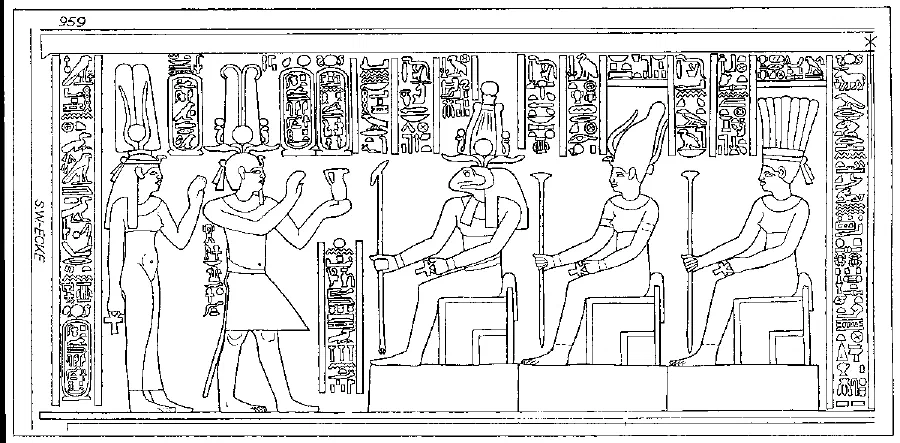
Page 63. The scene as drawn on the wall, facing p. 63 of the edition. Drawing by Otto Baum, in Junker and Winter, Das Geburtshaus des Tempels der Isis in Philä (1965) - 506p. 63, l. 1
ḥnp ḳbḥw n prj m nwnw
Offering cool water to him who came forth from Nun,
Note · Line 506
Nun is the primeval ocean from which the world emerged. - 507p. 63, l. 2
bꜥḥ ḥꜣw.wt n jt nṯr.w
and flooding the offering tables of the father of the gods.
- 508p. 63, l. 3
njśwt bjt jwꜥw n …
King of Upper and Lower Egypt, heir of …
- 509p. 63, l. 4
sꜣ Rꜥ Pt … pꜣ nṯr mnḫ sꜣ ꜥnḫ wꜣś nb ḥꜣ-f mj Rꜥ ḏ.t
Son of Ra, Ptolemy …, the excellent god. May all protection, life and dominion surround him as they surround Ra, forever.
- 510p. 63, l. 5
ḥm.t njśwt nb(.t) tꜣ.wj Krjwꜣpꜣdrꜣ.t
The king’s wife, lady of the Two Lands, Cleopatra.
- 511p. 63, l. 6
ḏd mdw n | Ḫnmw ꜥꜣ nb Sḫḫ (?)
Words spoken by Khnum the Great, lord of Sekhekh,
- 512p. 63, l. 7
nṯr ꜥꜣ ḫnt (?) Śnm.t
great god, foremost in Bigeh,
- 513p. 63, l. 8
nḥp rmṯ mśj nṯr.w
who shaped humankind on his potter’s wheel and brought forth the gods:
- 514p. 63, l. 9
dj-j n-k ḥꜥpj wr r tr-f
I give you the Nile flood, high in its season.
Note · Line 514
The god promises the king the annual rise of the Nile that watered Egypt’s fields. - 515p. 63, l. 10
ḏd mdw n | Śṯj.t ꜥꜣ.t nb(.t) Sḫḫ (?)
Words spoken by Satis the Great, lady of Sekhekh,
- 516p. 63, l. 11
ḫnt Śnm.t ḥrj(.t)-jb ’Jrḳ
foremost in Bigeh, dwelling on Philae,
- 517p. 63, l. 12
jr.t Rꜥ nb(.t) p.t ḥnw.t nṯr.w nb.w
Eye of Ra, lady of the sky, mistress of all the gods.
- 518p. 63, l. 13
ḏd mdw n | ꜥnḳ.t wr.t mw.t nṯr
Words spoken by Anukis the Great, mother of the god,
- 519p. 63, l. 14
nb(.t) ꜣbw ḫnt Śnm.t
lady of Elephantine, foremost in Bigeh,
- 520p. 63, l. 15
Nb.t-ḥw.t śn.t nṯr ḥrj(.t)-jb ’Jrḳ
Nephthys, sister of the god, dwelling on Philae,
Note · Line 520
Here Anukis takes the name of Nephthys, the sister of Osiris. - 521p. 63, l. 16
ḥwj sꜣ-ś Ḥrw
who protects her son Horus.
- 522p. 63, l. 17
ꜥnḫ | nṯr nfr ḥꜥpj n Km.t
Long live the good god, the Nile flood of Egypt,
- 523p. 63, l. 18
bꜥḥ jdb.w Ḥrw m ḏfꜣ(.w)
who floods the riverbanks of Horus with food,
Note · Line 523
The riverbanks of Horus are Egypt, the land on either side of the Nile. - 524p. 63, l. 19
tj.t ḏśr.t n ḫntj prj …
sacred image of him who presides over the House …,
- 525p. 63, l. 20
sꜣ Rꜥ Pt …
Son of Ra, Ptolemy …
- 526p. 63, l. 21
njśwt bjt | bꜣ wr šfj.t
King of Upper and Lower Egypt, the ba, great in majesty,
Note · Line 526
A god’s ba is his power to take form and make his presence felt. - 527p. 63, l. 22
jrj nt(.t) ḳmꜣ wnn.t
who made what is and created what exists,
- 528p. 63, l. 23
šꜣꜥ ḫpr sḫpr ḫpr.w
the first to come into being, who gave being to what has come to be.
- 529p. 63, l. 24
sḫm špś (so?) ḫnt (?) Ḥꜣ.t-śp.wt
The august power who presides over Elephantine,
- 530p. 63, l. 25
dj ṯꜣw ḥr msḫn
who gives breath at the place of birth.