~/sacred-texts/temple-of-isis-at-philae-the-birth-house
Augustus at the Philae Birth House: I Unveil the Face of This Goddess
- Date
- Carved under Ptolemy VIII (145–116 BC), Ptolemy XII (80–51 BC) and Augustus (30 BC–AD 14) on the east colonnade and east outer wall of the birth house of the Isis temple at Philae
- Found
- Philae, at the First Cataract of the Nile. The temple was taken apart and rebuilt on Agilkia Island near Aswan in 1972–1980, where it stands today.
- Language
- Egyptian · Hieroglyphic
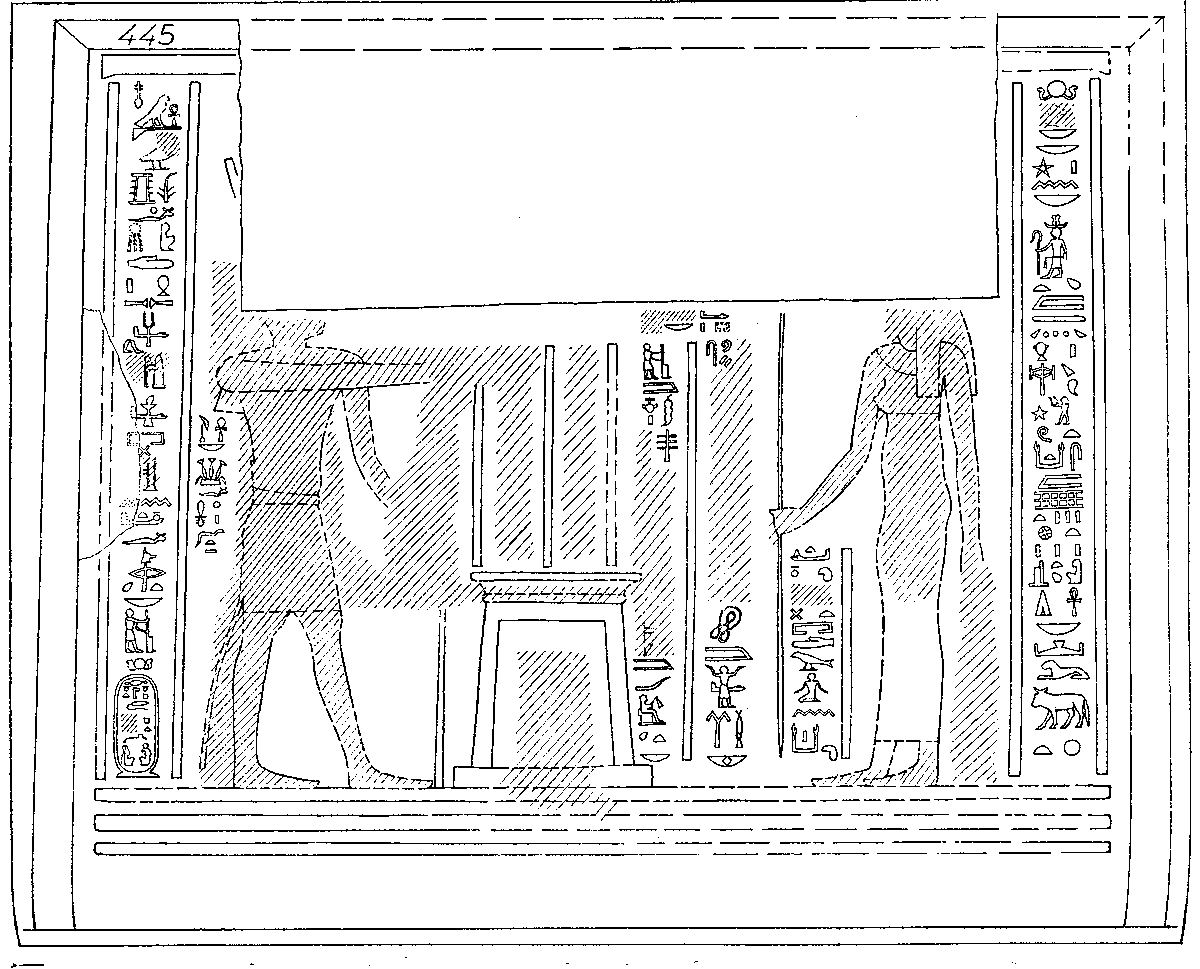
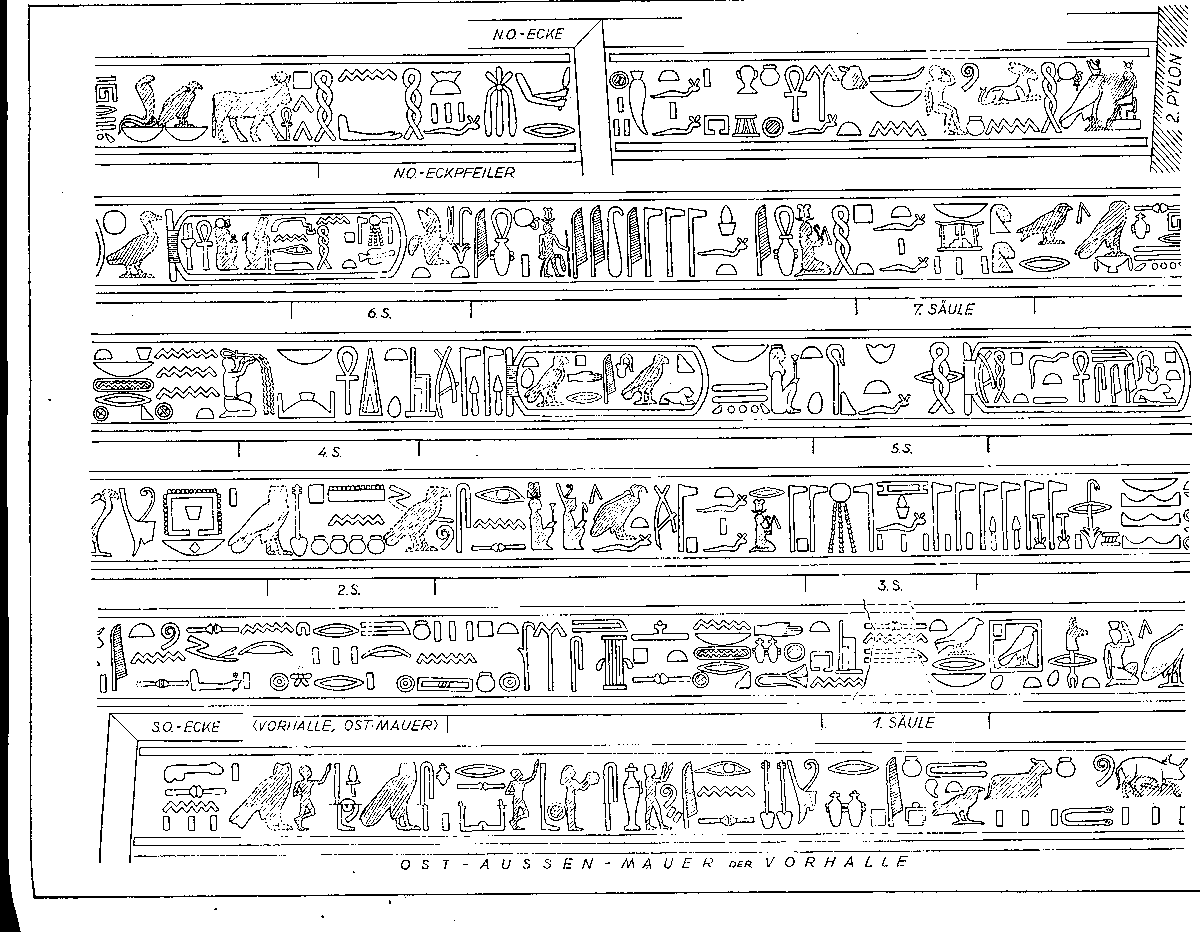
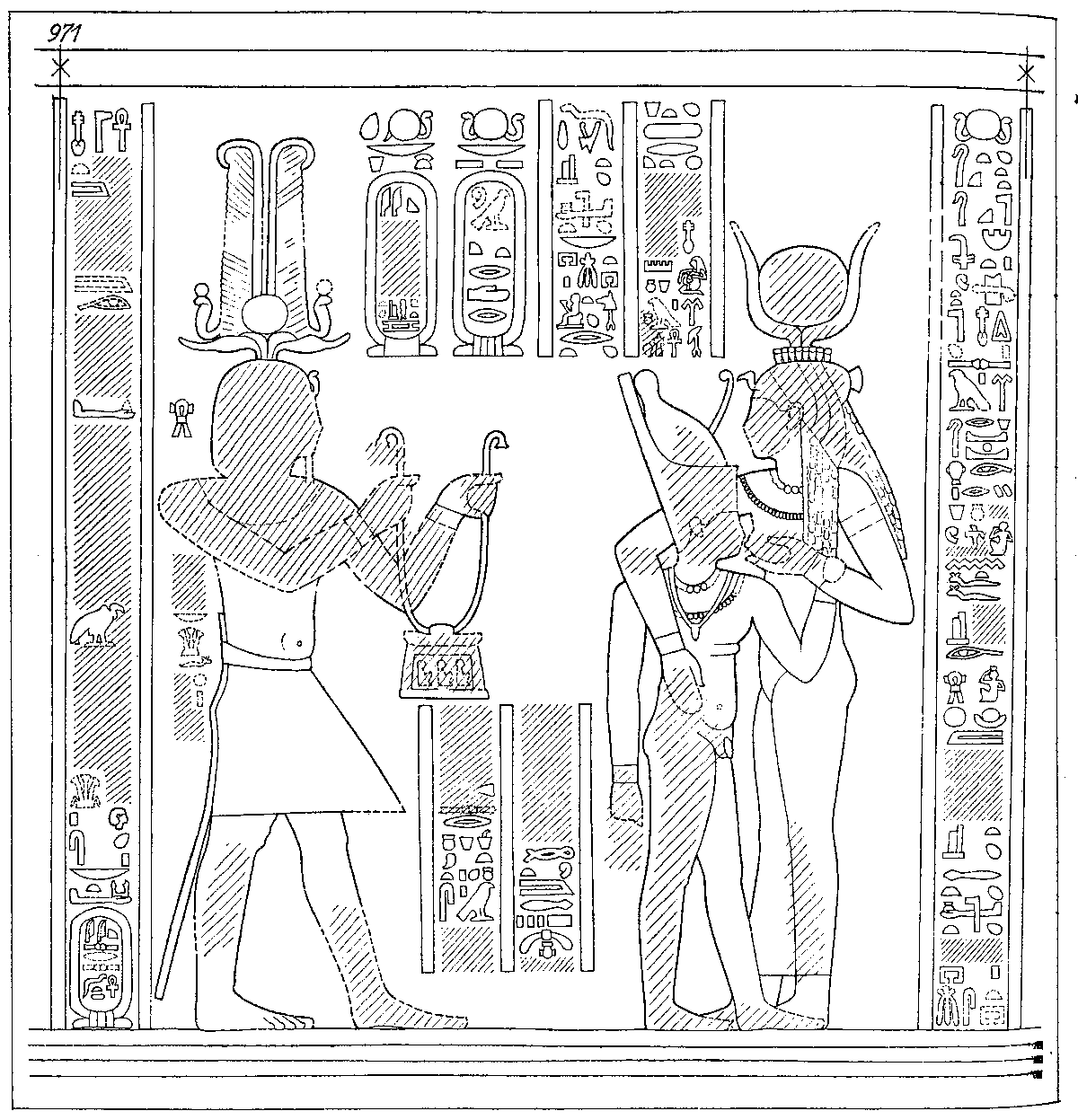
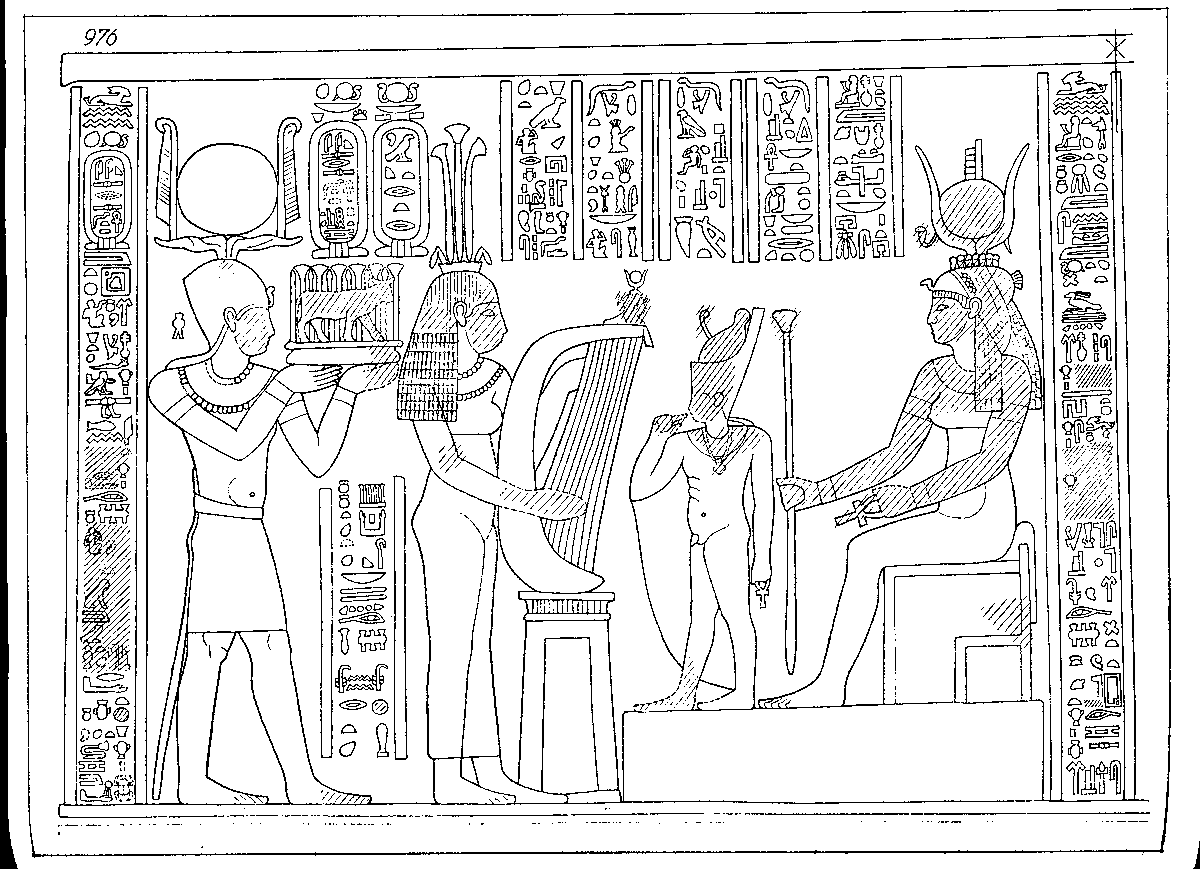
Nekhbet and Wadjet crown Ptolemy XII; Wadjet says I stretch out both my hands to your head with the Red Crown. The columns praise Isis: The Lady of Slaughter cuts her rebels to pieces, and Ptolemy VIII’s frieze records Hathor’s feast of slaughtered cattle, wine and dance.
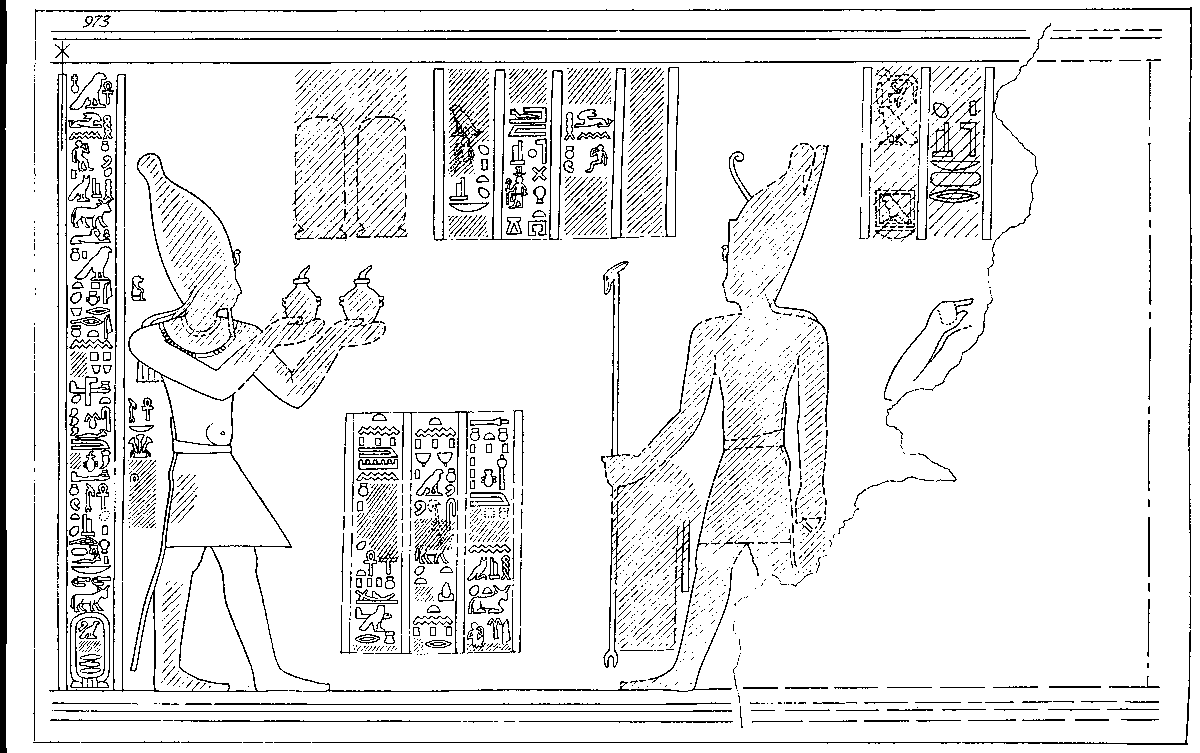
Then Augustus enters as pharaoh, greeted Welcome, welcome in peace, Son of Ra, Caesar, who lives forever! He gives Osiris fields, Isis wine, the nursing Hathor beer and two child Horuses milk. Harpocrates answers: I give you drunkenness day after day. Last, he opens the shrine to the kneeling people: I unveil the face of this goddess.
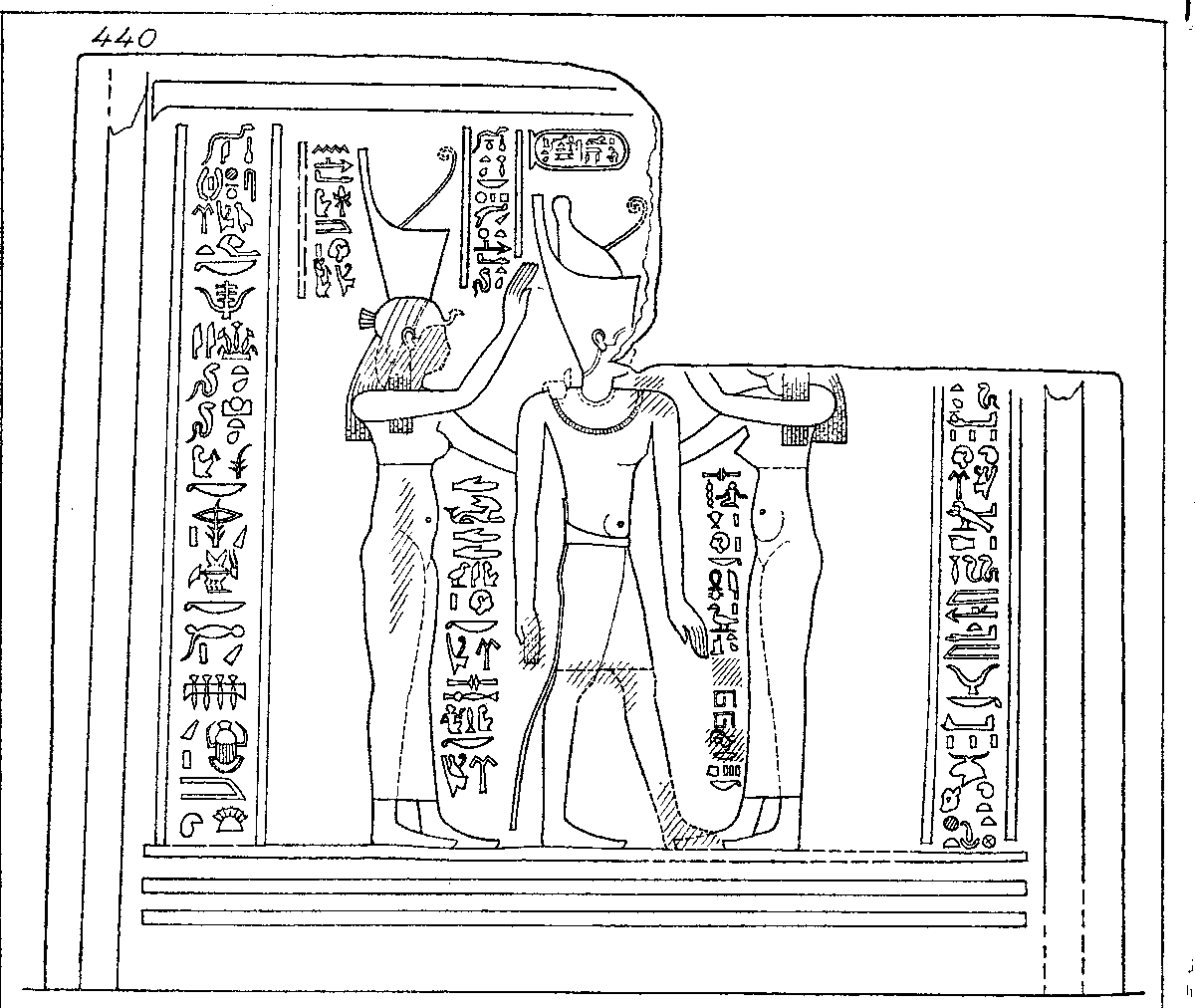
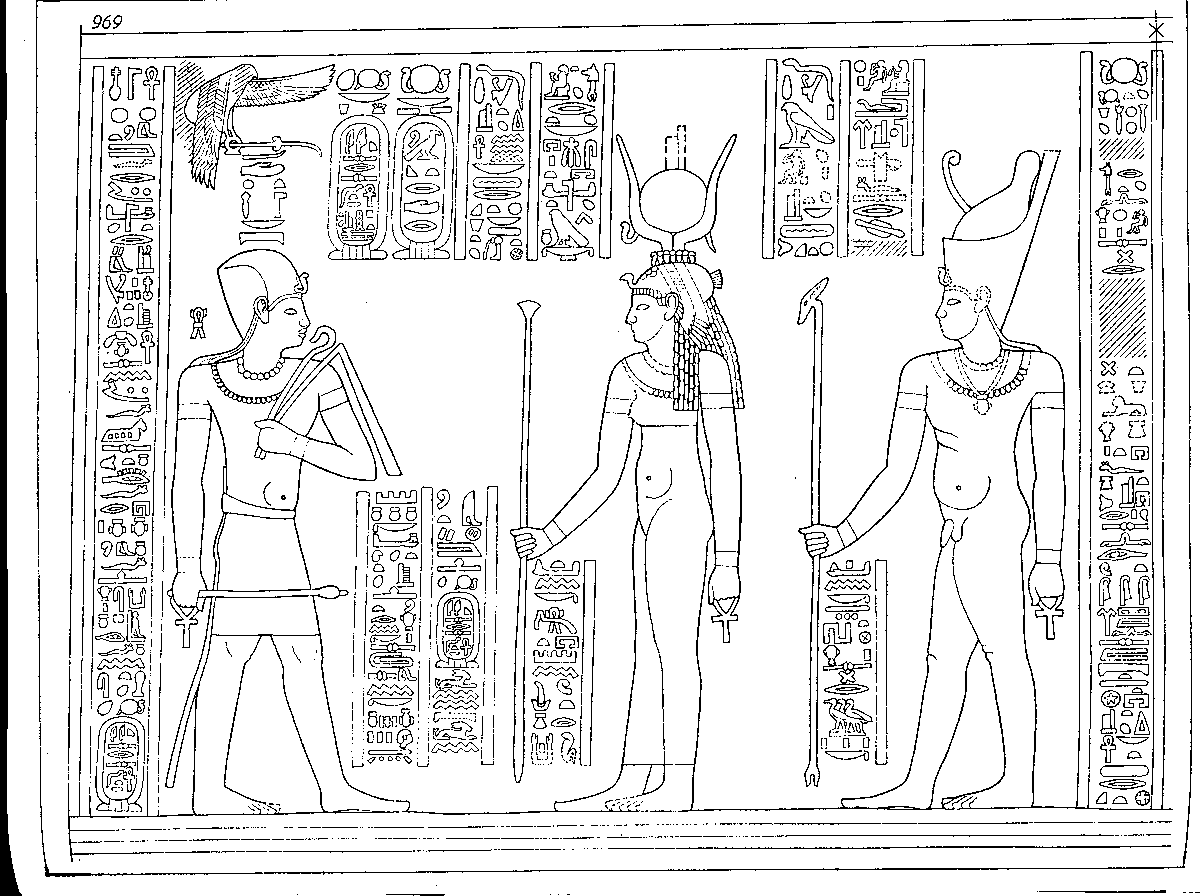
Nekhbet and Wadjet crown Ptolemy XII
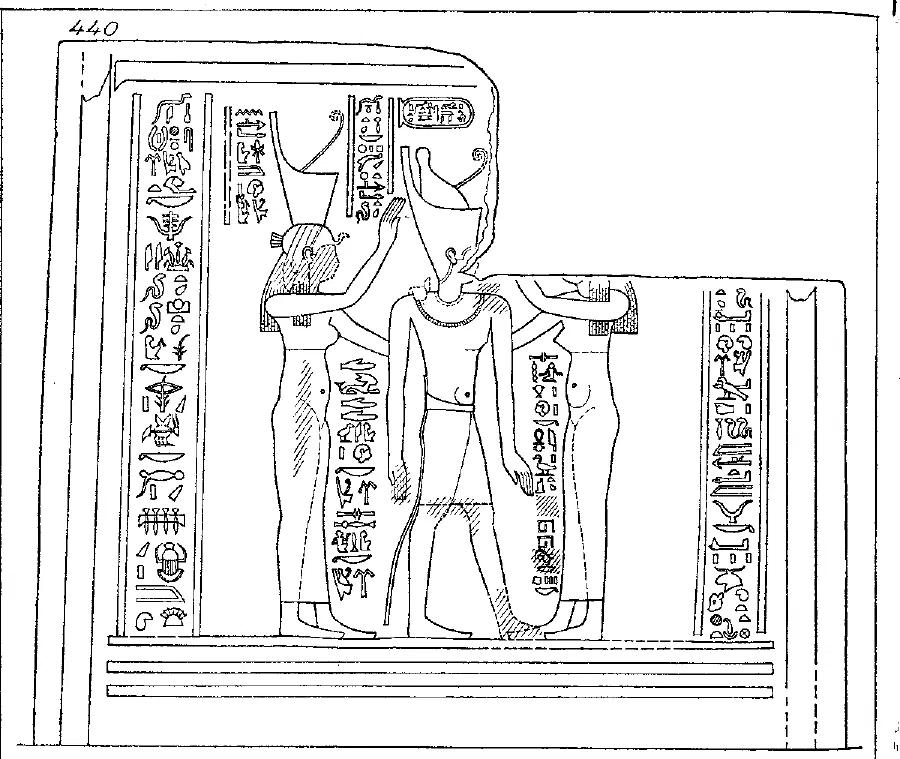
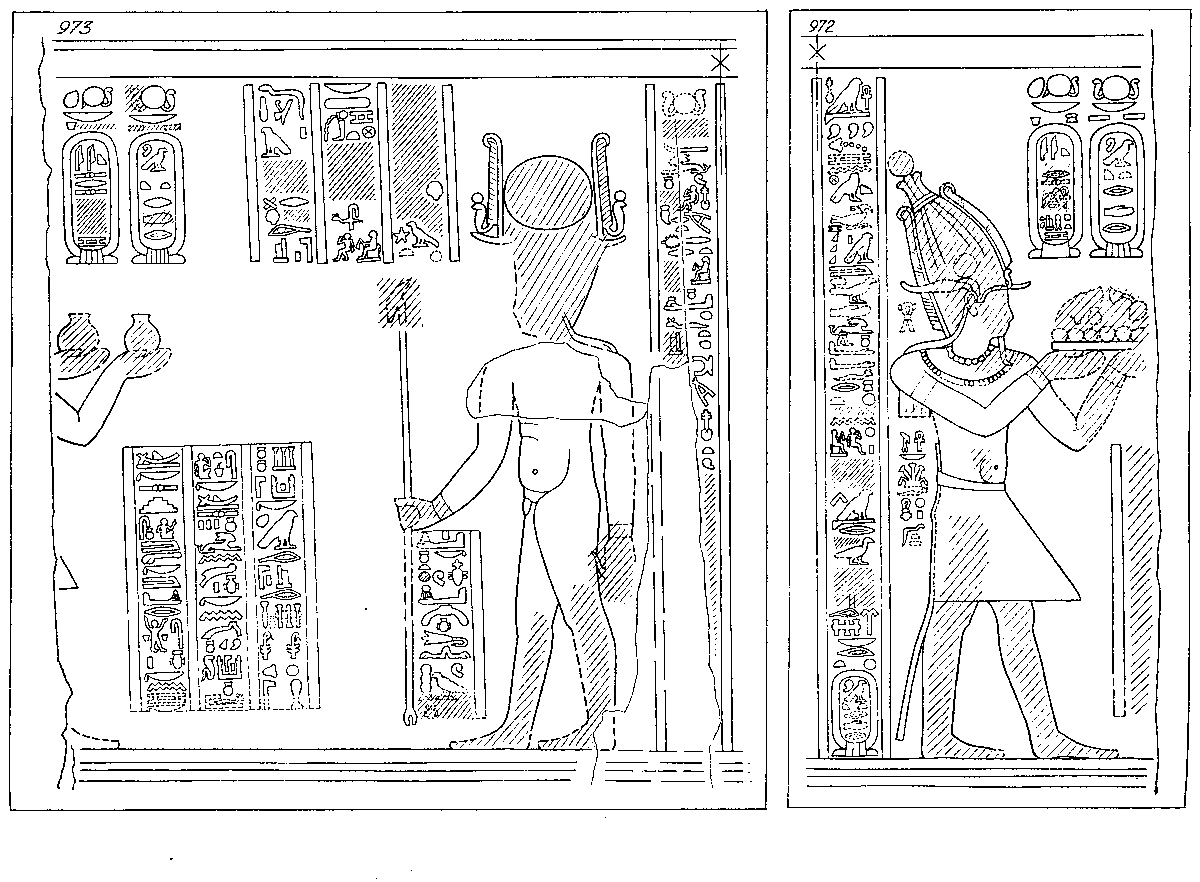
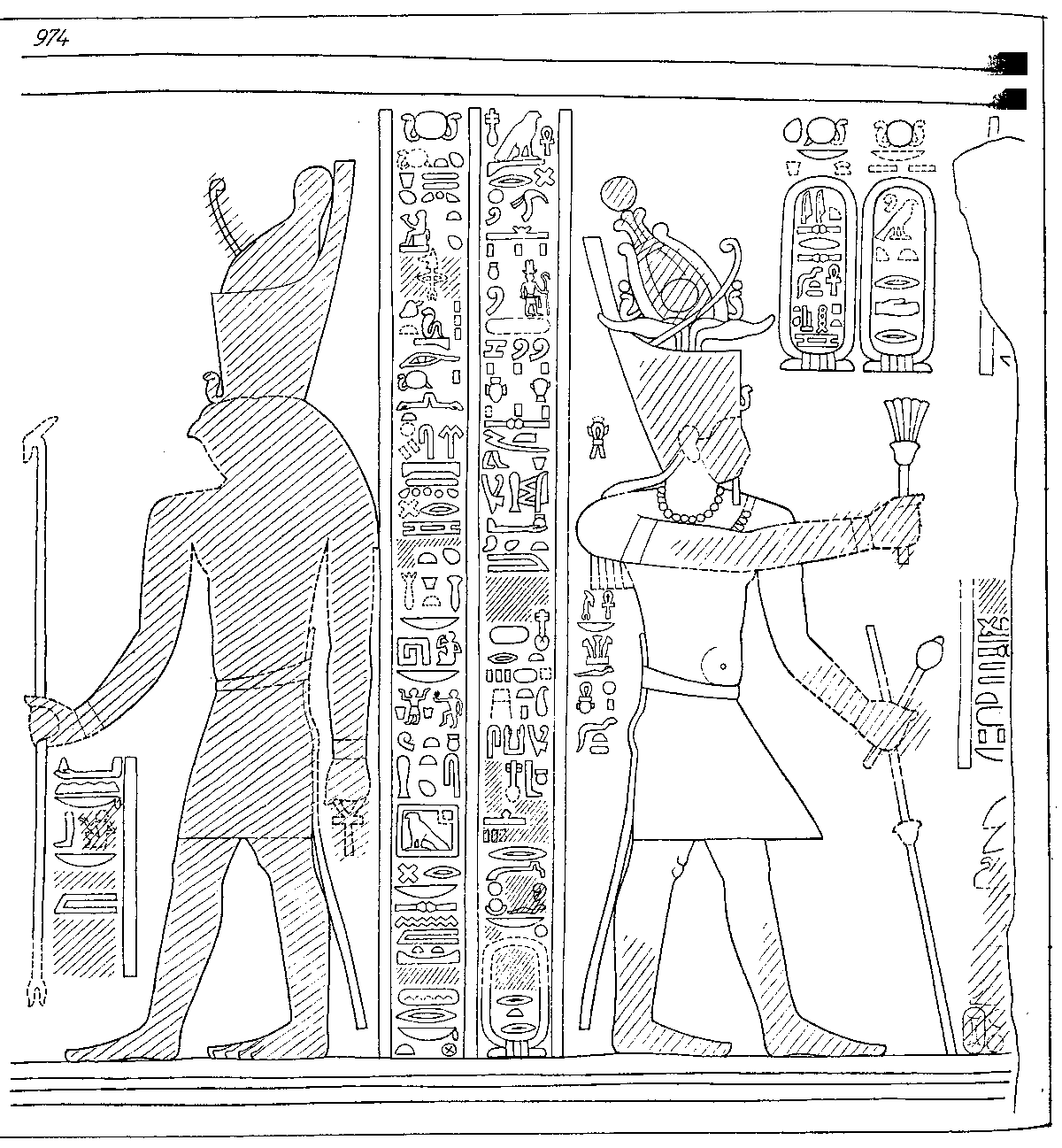
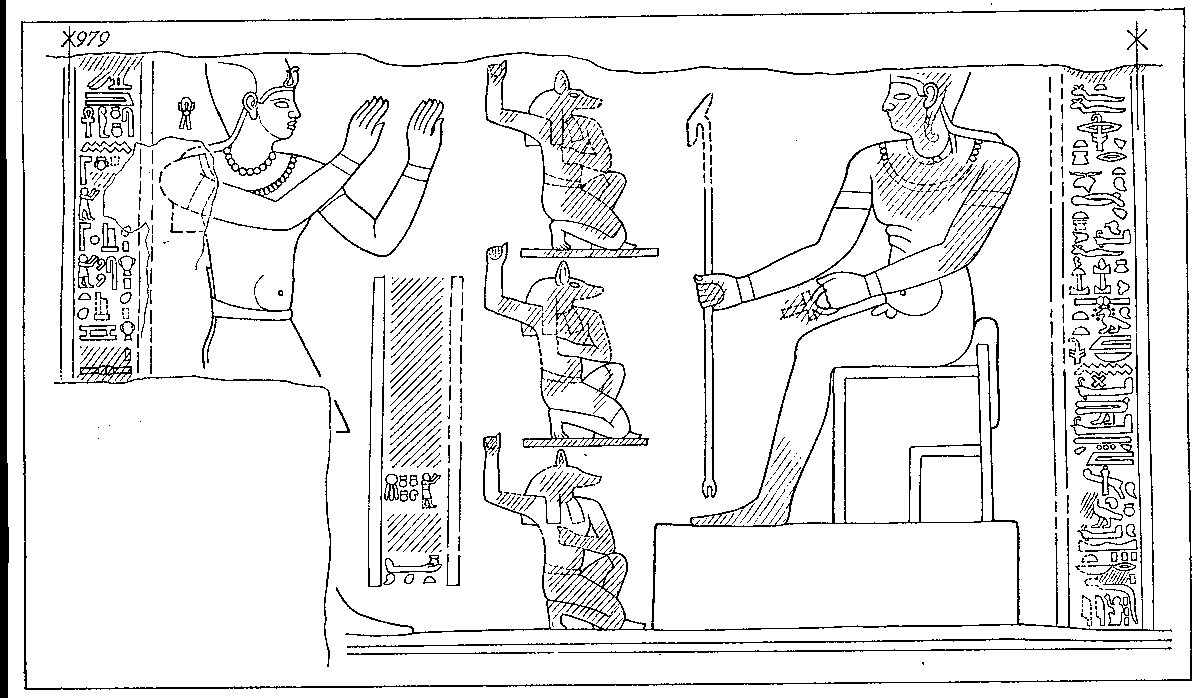
Page 233. The scene as drawn on the wall, facing p. 233 of the edition. Drawing by Otto Baum, in Junker and Winter, Das Geburtshaus des Tempels der Isis in Philä (1965)The hatched figures were hacked off the wall on purpose. After Justinian closed the temple of Isis around 537, Christians made it a church and chiselled out the gods and kings, mostly sparing the hieroglyphs. - 1p. 233, l. 1
… Ptwrmjs …
… Ptolemy …
Note · Line 1
The king is Ptolemy XII. - 2p. 233, l. 2
šnḏm-j ḥr tp-k mj sꜣ ꜣs.t
I settle on your head as on the head of Isis’s son.
Note · Line 2
Isis’s son is Horus. The goddess takes her place on the king’s brow as a rearing cobra, ready to defend him. - 3p. 233, l. 3
(wḏ-j?)¹ ḥḥ(-j) (r?) ḳwj(?)-k²
I spit my fiery breath at your foes.
- 4p. 233, l. 4
ḏd mdw n | Wꜣḏ.t nb(.t) P Dp
Words spoken by Wadjet, lady of Pe and Dep,
Note · Line 4
Pe and Dep were the twin towns of Buto, Wadjet’s place of worship in the Nile Delta. - 5p. 233, l. 5
wꜥ.t n wꜥw jꜣbj.t m tp n Jtmw
the Only One of the Only One, she who is on the left side of Atum’s head:
- 6p. 233, l. 6
dwn(-j) ḏr.tj-j r tp-k m n.t
I stretch out both my hands to your head with the Red Crown
- 7p. 233, l. 7
sḫkr-j ḥm-k m sḫm.tj
and adorn Your Majesty with the Double Crown.
Note · Line 7
The Double Crown joins the White Crown of Upper Egypt to the Red Crown of Lower Egypt. - 8p. 233, l. 8
… t ḥnk-n tp-k m sḫm.tj
… we bestow the Double Crown on your head.
- 9p. 233, l. 9
ꜥmm-j wꜣḏ.tj m wꜥ.t m wp.t-k
I grasp the two crowns as one on the crown of your head,
- 10p. 233, l. 10
dꜣj-n šfj.t-k ḫnt ḫtmn
and we spread awe of you throughout the world.
- 11p. 233, l. 11
ḏd mdw j | sḫn-j ḥḏ.t n.t m ḥꜣ.t-k
Recitation: I set the White Crown and the Red Crown on your brow
- 12p. 233, l. 12
ẖnm(-j) ḥꜥj.t ꜥḫ.t
and join the two royal cobras,
- 13p. 233, l. 13
nswj-k ršj bjtj-k mḥ.tj
that you may rule the south as king of Upper Egypt and the north as king of Lower Egypt,
- 14p. 233, l. 14
tḥn tꜣ m bꜥj-k
and the earth may shine as you shine forth.
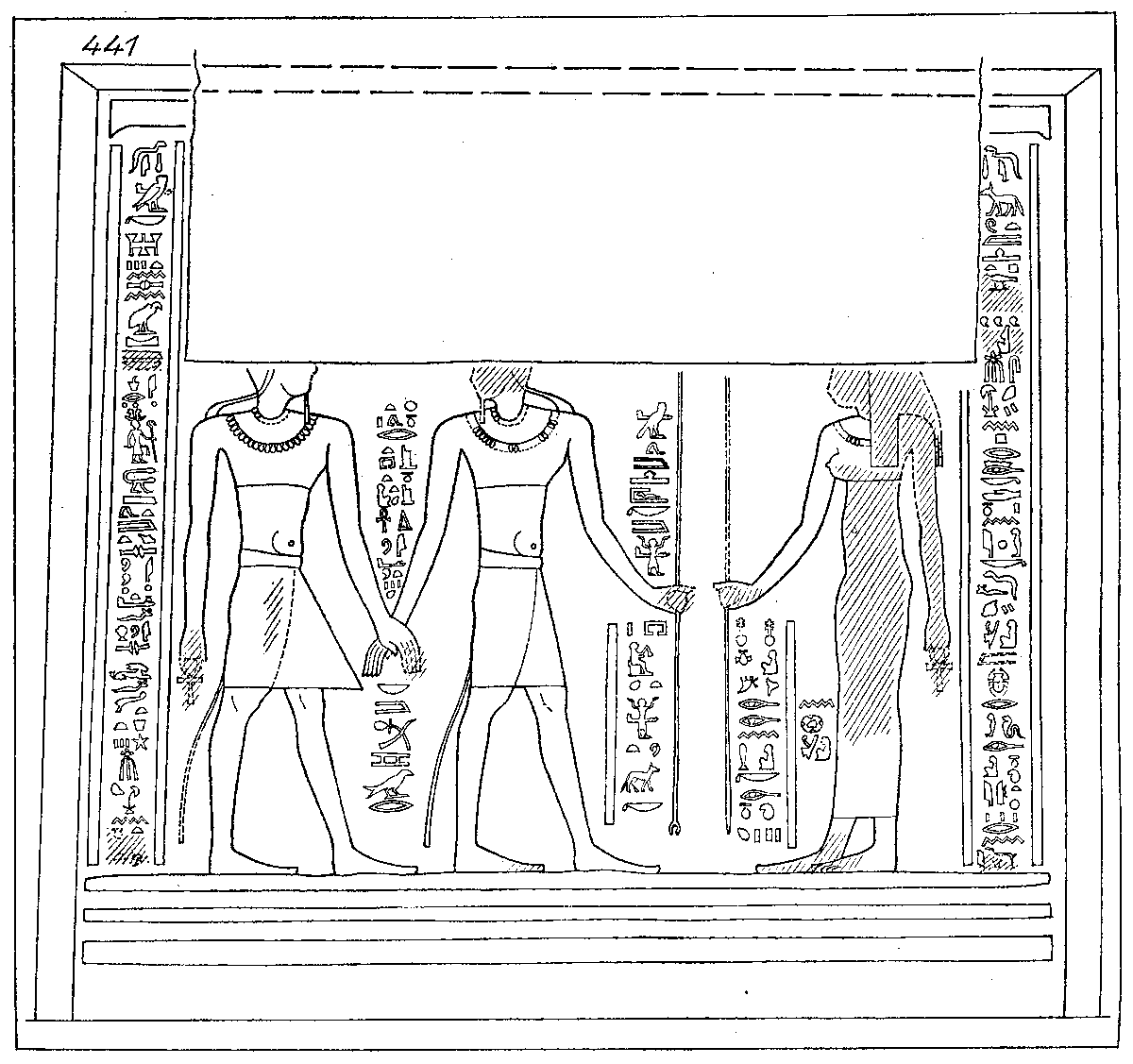
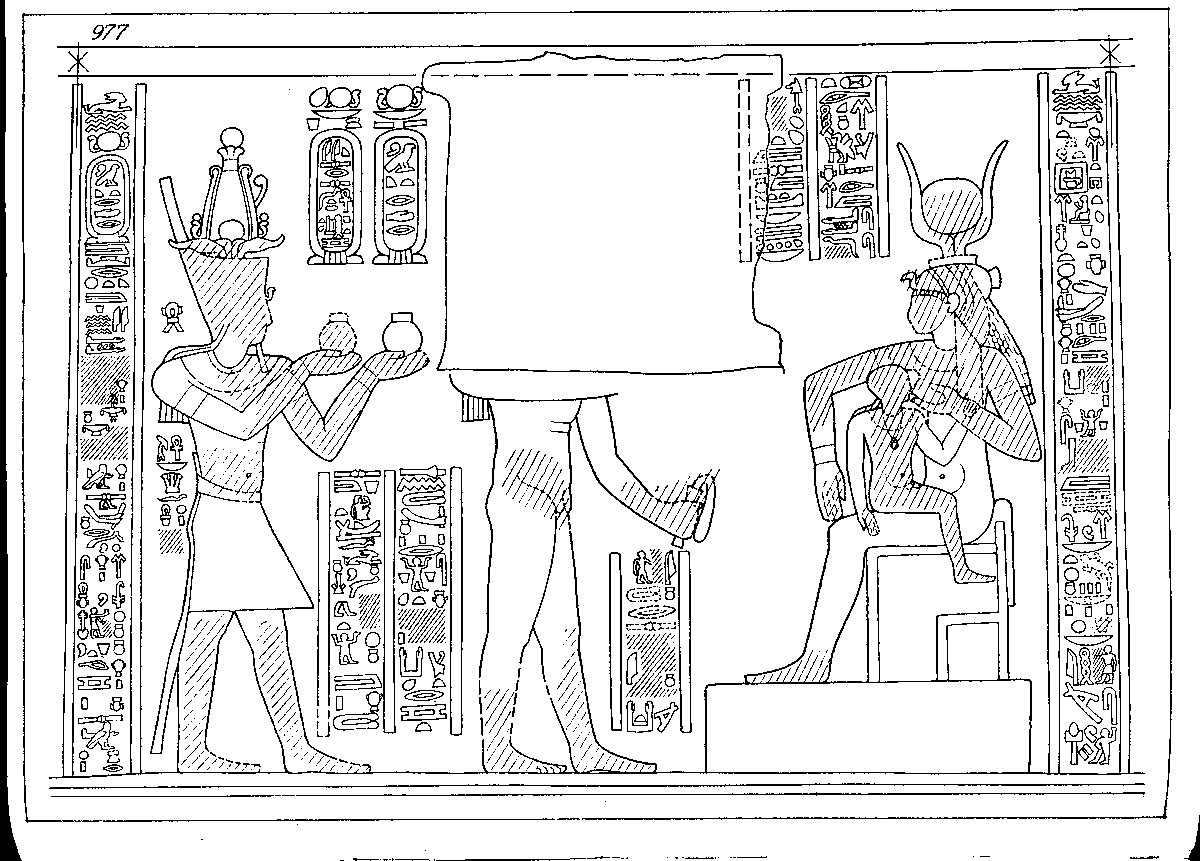
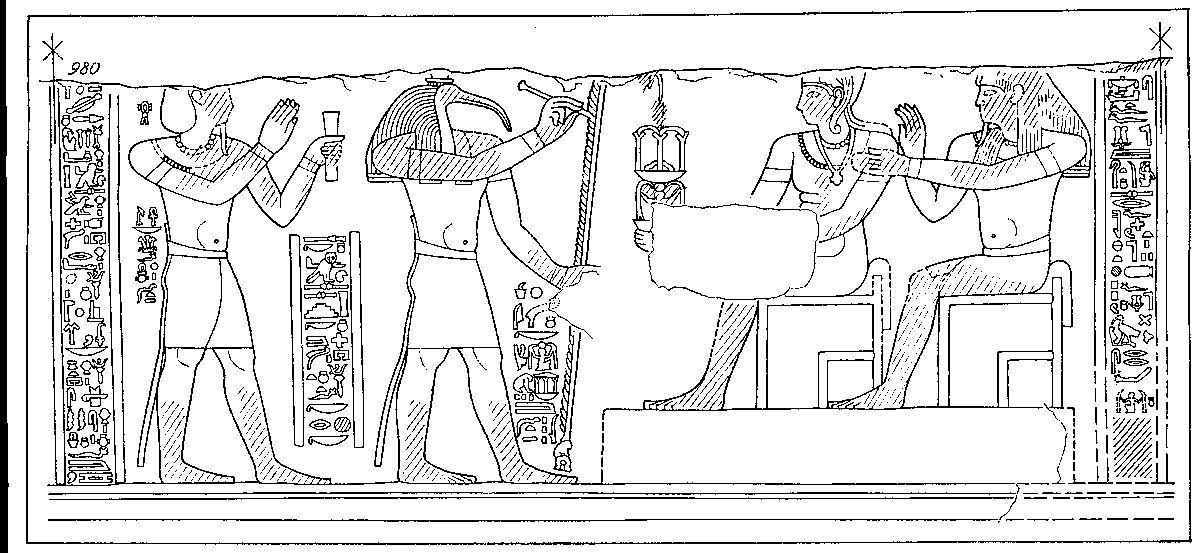
A god leads Ptolemy XII to Isis
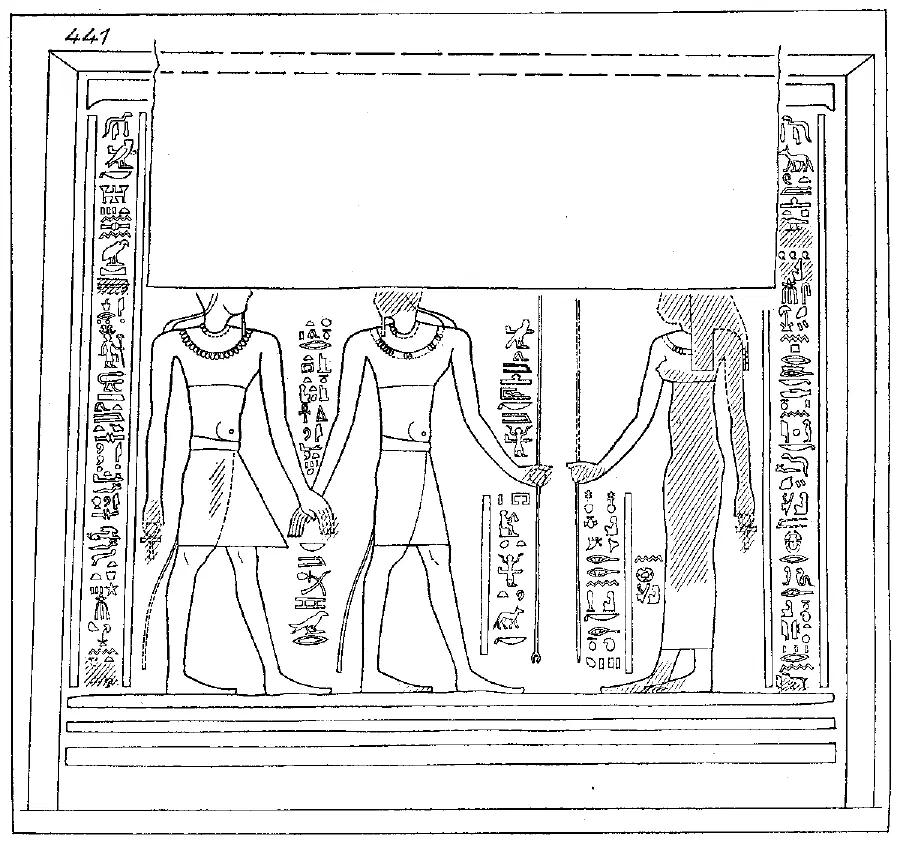
Page 235. The scene as drawn on the wall, facing p. 235 of the edition. Drawing by Otto Baum, in Junker and Winter, Das Geburtshaus des Tempels der Isis in Philä (1965) - 15p. 235, l. 1
mj m ḥtp ꜥḳ-k m ḥꜥj
Come in peace; enter in joy.
- 16p. 235, l. 2
prj šps.t ḥꜥj.tj (n) jj-k
The house of the August One rejoices at your coming.
Note · Line 16
The August One is Isis; her house is the temple. - 17p. 235, l. 3
ḫnd-j r s.t n.t Js.t dj(.t) ꜥnḫ
I step toward the seat of Isis, giver of life,
- 18p. 235, l. 4
jw ꜥ.wt-j nb.wt m ꜥbw wr
with every limb of my body perfectly pure.
- 19p. 235, l. 5
nfr-wj jb-j ḏr mꜣꜣ-n(-j) ḥm-k
How glad my heart is now that I have seen Your Majesty!
Note · Line 19
The deity is speaking to the king. - 20p. 235, l. 6
jrj-n-k jrw n Km.t n-j¹
You have performed the rites of Egypt for me.
- 21p. 235, l. 7
ḏd mdw j | mk wꜣ.wt n(.t) Snm.t m ḥb(?) jbr²
Words to be spoken: Look, the roads of Bigeh are in festival …
Note · Line 21
Bigeh is the island beside Philae. - 22p. 235, l. 8
jtj jtj gs.t (so) m ḫnt-s
The king strides swiftly along the road.
- 23p. 235, l. 9
jw-f mꜣꜣ mw.t-f
He sees his mother,
Note · Line 23
The king takes the part of Horus, the son of Isis. - 24p. 235, l. 10
jw ḥr-s wnf
and her face lights up with joy.
- 25p. 235, l. 11
ḥnw.t nṯr.w mšḥꜣ n ...
The mistress of the gods rejoices at …
- 26p. 235, l. 12
ḏd mdw j | jj.tj m ḥtp ...
Words to be spoken: You have come in peace, …
- 27p. 235, l. 13
mšḥꜣ-j n ptr-k
I rejoice to see you.
- 28p. 235, l. 14
šsp-n-j (so) jrw-k
I have received your rites
- 29p. 235, l. 15
tfn-n-j m ḫpr.w-k
and delighted in your many forms.
- 30p. 235, l. 16
jrj-j n-k js.t(?) r nbḏ(?)
I muster a retinue for you against the Evil One.
Ptolemy XII beholds Isis (scene destroyed)
- 31p. 235, l. 17
ꜥnḫ | nṯr nfr ꜥḳ s.t nḫt(?) r špr ḥm.w nb.tj rḫj.t
Long live the good god who enters the sacred place, strong to reach the shrines of the queen of the people,
Note · Line 31
“The good god” is a title of the living king. - 32p. 235, l. 18
ḫf ḥnw.t nṯr.wt
who beholds the mistress of the goddesses
- 33p. 235, l. 19
ꜥ.wj-f m ꜥbw
with both hands pure,
- 34p. 235, l. 20
nb dgj njśwt bjt nb tꜣ.wj jwꜥw n pꜣ nṯr nṯj nḥm ...
lord of sight, King of Upper and Lower Egypt, lord of the Two Lands, heir of the god who saves …
Note · Line 34
The royal title identifies Ptolemy XII. - 35p. 235, l. 21
njśwt bjt | jtj.t n(.t) Tꜣ-mrj
Ruler of Upper and Lower Egypt, queen of Egypt.
- 36p. 235, l. 22
gs.w-prj.w grg.w n ...⁴ -s ntś ... twt-s
The temples are furnished for her … She herself … her image.
- 37p. 235, l. 23
Js.t dj(.t) ꜥnḫ nb(.t) Jrk
Isis, giver of life, lady of Philae,
- 38p. 235, l. 24
šps.t wsr.t ḥnw.t m jꜣ.t wꜥb.t
noble one, mighty one, mistress on the Pure Mound.
Note · Line 38
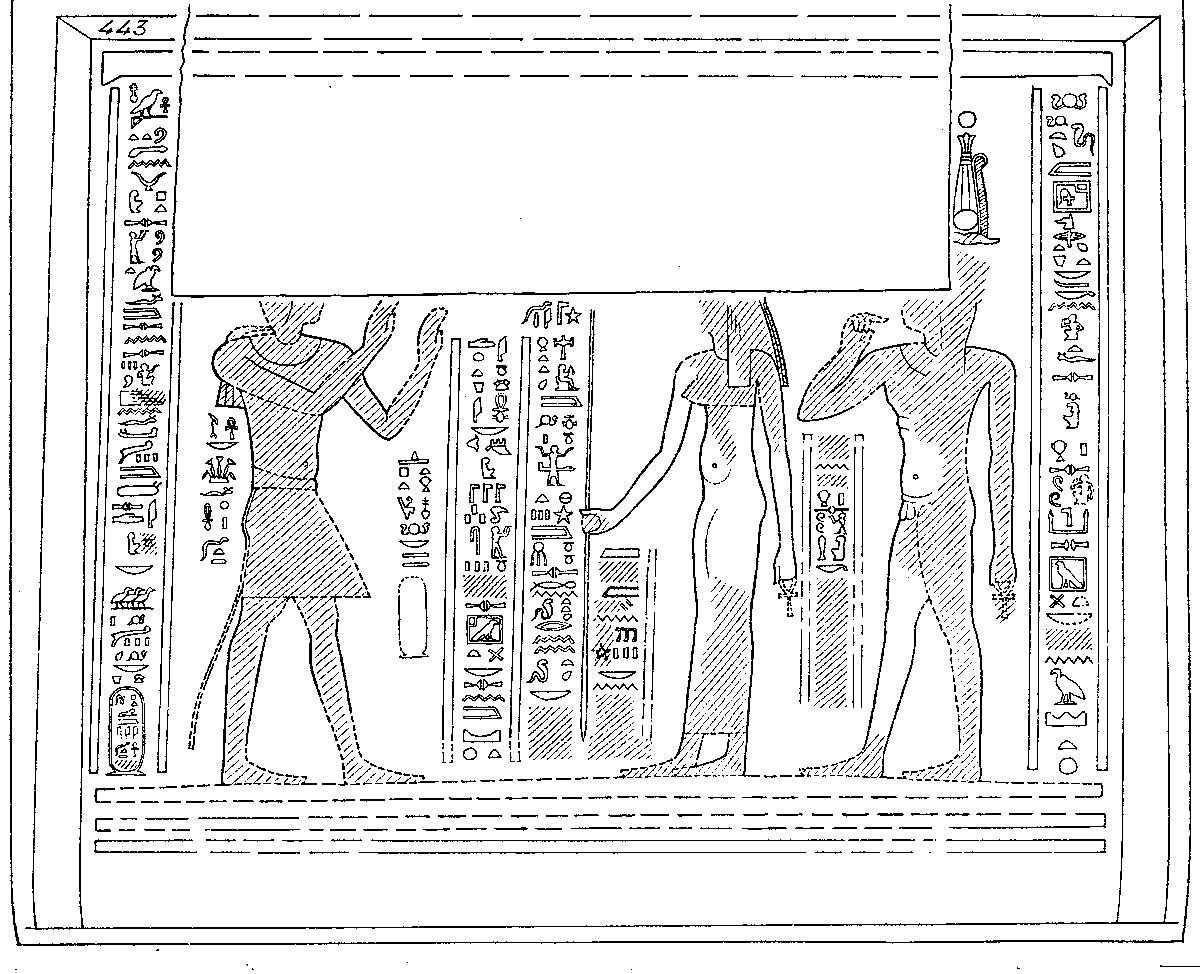
The Pure Mound is the Abaton on Bigeh, revered as the burial place of Osiris. Ptolemy XII praises Hathor
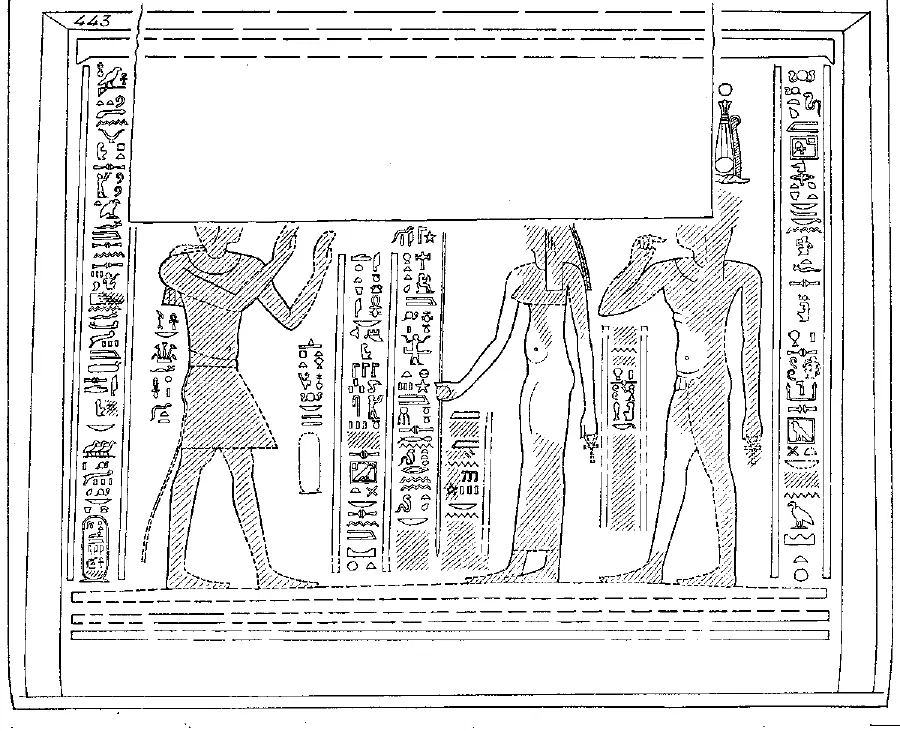
Page 237. The scene as drawn on the wall, facing p. 237 of the edition. Drawing by Otto Baum, in Junker and Winter, Das Geburtshaus des Tempels der Isis in Philä (1965) - 39p. 237, l. 1
dwꜣ nṯr ḏd mdw j
Praising the god. Words to be spoken:
- 40p. 237, l. 2
nḏ ḥr-ṯ šps.t m jb n Rꜥ
Hail to you, noble one in the heart of Ra!
- 41p. 237, l. 3
ḥꜥj psḏ.t m wbn-s
The Ennead rejoices when she rises.
Note · Line 41
The Ennead is the company of nine gods. - 42p. 237, l. 4
mḥn.jt rnn.t nb(.t) …
Coiled cobra, Renenutet, lady of …
Note · Line 42
Renenutet is a goddess of nourishment. The rearing cobra, or uraeus, is an emblem of divine protection worn on the brow. - 43p. 237, l. 5
… nt(.t?) ḫꜥj(.tj?) mj nb (r) ḏr
… who shines like the Lord of All.
- 44p. 237, l. 6
nṯr.w rmṯ dwꜣ-sn … s
Gods and mortals praise … her …
- 45p. 237, l. 7
Ḥw.t-Ḥrw wr.t nb(.t) Snm.t
Hathor the Great, lady of Bigeh,
- 46p. 237, l. 8
ḥtp ḥr-ṯ nfr n njśwt bjt nb tꜣ.wj NN
let your beautiful face rest upon the King of Upper and Lower Egypt, lord of the Two Lands, NN.
Note · Line 46
NN stands for the king’s name. - 47p. 237, l. 9
(sꜣ) ꜥnḫ wꜣś nb ḥꜣ-f mj Rꜥ ḏ.t
May all protection, life and dominion be at his back, as at Ra’s, forever.
- 48p. 237, l. 10
… ṯḥn(??) nṯr.w nb.w n …
… all the gods shine for …
- 49p. 237, l. 11
… n … ḥr śwꜣš ḥm-k …
… for … in praise of Your Majesty …
- 50p. 237, l. 12
ꜥnḫ | nṯr nfr wṯṯ n Wpw(.tj?)¹
Long live the good god, begotten by the Messenger,
- 51p. 237, l. 13
śwꜣš mw.t-f m śnś.w-f
who praises his mother with his songs.
- 52p. 237, l. 14
śjꜣ-n-f ꜥ.w² m śn Jśdn (so)
He has mastered the writings, following the example of Isden,
Note · Line 52
Isden is a name of Thoth, the god of writing. - 53p. 237, l. 15
nb bꜣ.w-Rꜥ sꜣ Rꜥ nb ḫꜥ.w Pt …
lord of the sacred writings, son of Ra, lord of crowns, Ptolemy …
- 54p. 237, l. 16
njśwt bjt | Rꜥ j.t m ḥw.t nśr
King of Upper and Lower Egypt. The sun goddess in the Chamber of Flame,
- 55p. 237, l. 17
wśr.t ḥnw.t nb(.t) ḥknw
mighty one, sovereign lady, mistress of jubilation:
- 56p. 237, l. 18
jt-s Rꜥ ḥr śwꜣš kꜣ-s
her father Ra praises her ka.
Note · Line 56
The ka is the life force of a god or a person. - 57p. 237, l. 19
Ḥw.t-Ḥrw wr.t nb(.t) (Ś)nm.t
Hathor the Great, Lady of Bigeh.
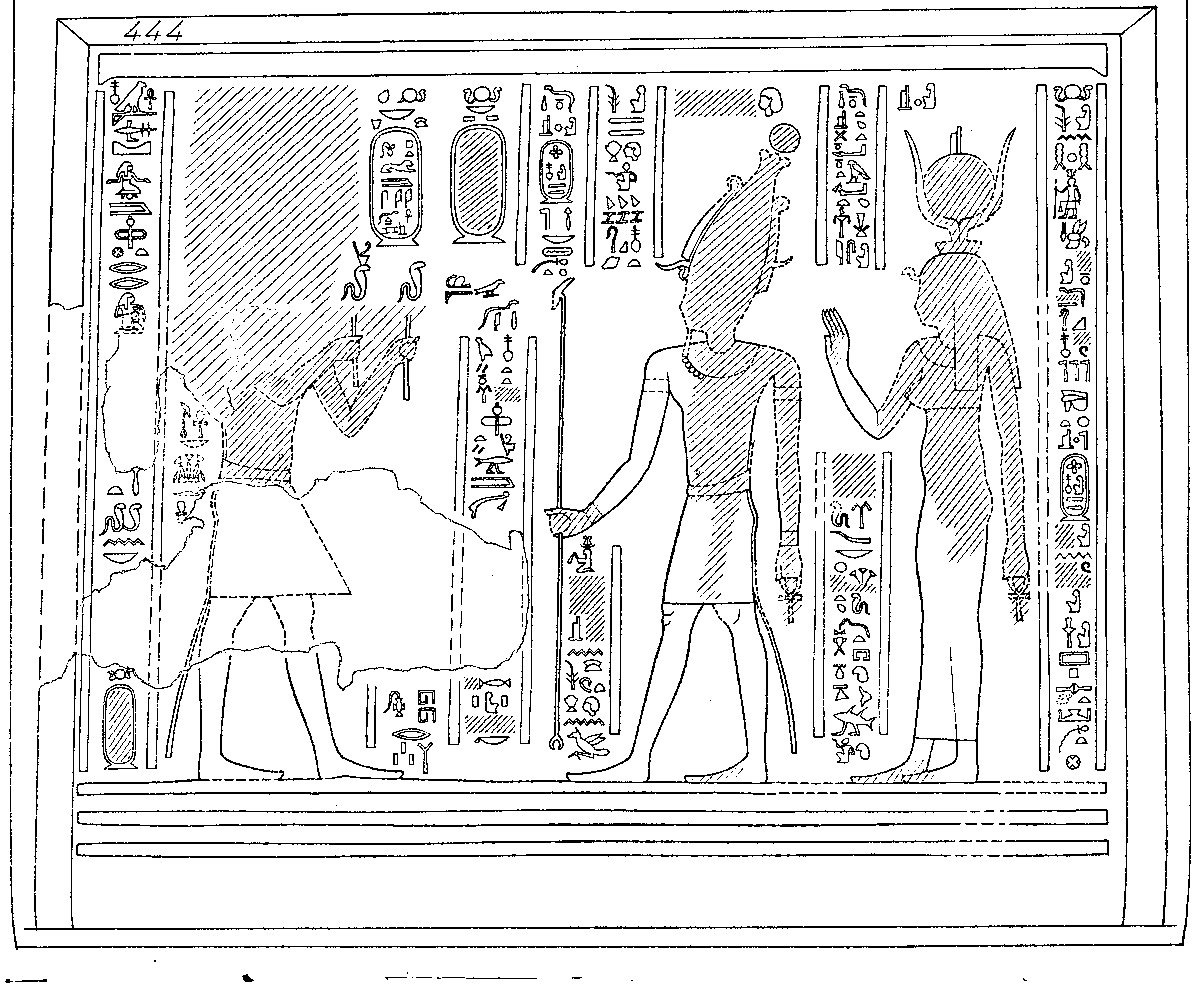
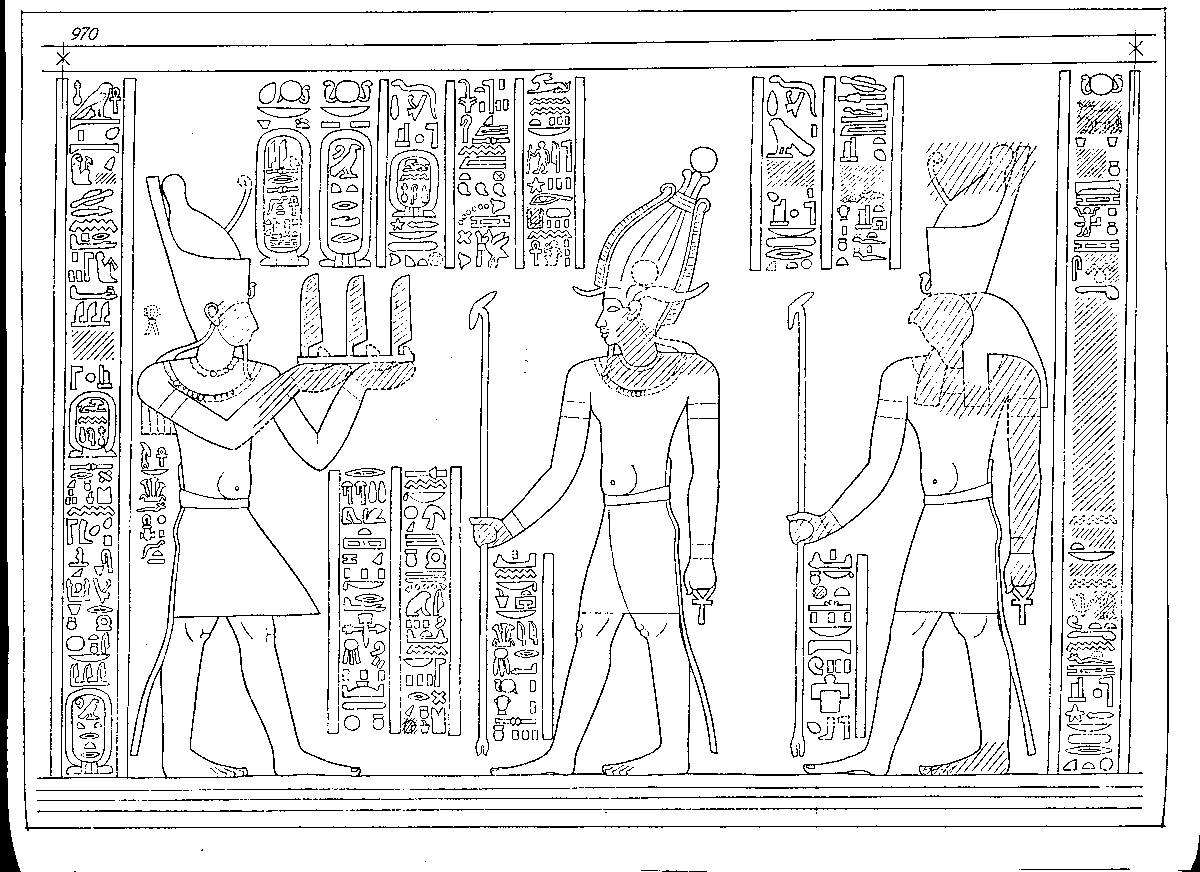
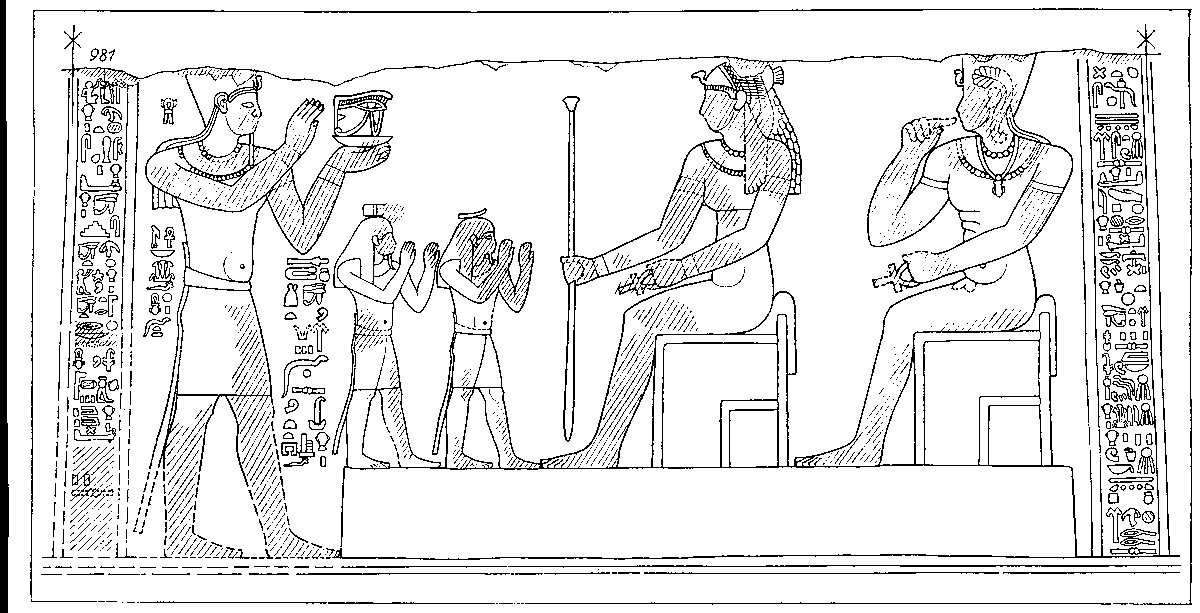
Ptolemy XII gives Osiris the two royal cobras
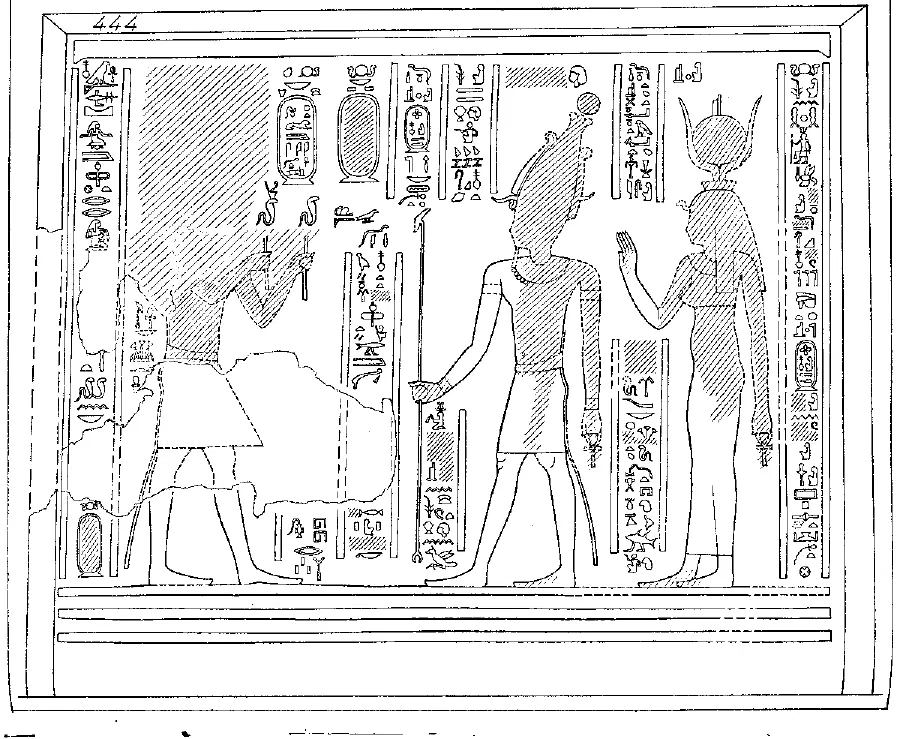
Page 239. The scene as drawn on the wall, facing p. 239 of the edition. Drawing by Otto Baum, in Junker and Winter, Das Geburtshaus des Tempels der Isis in Philä (1965) - 58p. 239, l. 1
… wr(.tj) ḥkꜣ.w ḏd mdw j
… the two Great Enchantresses. Words to recite: O
Note · Line 58
The two crowns of Egypt are addressed as goddesses of magic. - 59p. 239, l. 2
nfr ḥḏ.t(?) tn … m ḥḏ.t nḫn
how fair is this White Crown … as the White Crown of Nekhen,
Note · Line 59
Nekhen, also called Hierakonpolis, was an ancient royal center of Upper Egypt. - 60p. 239, l. 3
n.t bsj m Dp
and the Red Crown that comes forth from Dep.
Note · Line 60
Dep was a sanctuary town at Buto in Lower Egypt. - 61p. 239, l. 4
… k … (wḏ?) ḥḥ r sbj.w
… you … spit flame at the rebels.
- 62p. 239, l. 5
njśwt bjt nb tꜣ.wj …
King of Upper and Lower Egypt, lord of the Two Lands …
- 63p. 239, l. 6
sꜣ Rꜥ nb ḫꜥ.w Pt. …
son of Ra, lord of crowns, Ptolemy …
- 64p. 239, l. 7
(sꜣ) ꜥnḫ wꜣś nb ḥꜣ-f mj (Rꜥ ḏ.t)
May protection, life and all dominion surround him as they surround Ra forever.
- 65p. 239, l. 8
ḏd mdw n | Wśjr Wnn nfrw mꜣꜥ ḫrw
Words spoken by Osiris Wennefer, vindicated,
Note · Line 65
Wennefer is a name of Osiris. “Vindicated” declares that judgment has gone in his favor. - 66p. 239, l. 9
nṯr ꜥꜣ nb jꜣ.t wꜥb.t
the great god, lord of the Pure Mound,
- 67p. 239, l. 10
njśw.t tꜣ.wj ḫrj-tp jdb.w
king of the Two Lands, commander of the riverbanks,
- 68p. 239, l. 11
ḥḳꜣ nfr ḫnt …
good ruler at the head of …
- 69p. 239, l. 12
ṯnj(-j) … ś.t … n njśw.t
I raise … to the throne … of the king,
- 70p. 239, l. 13
ḫꜥj.tj ḥr-tp n rḫj.t
as you shine forth above the people.
- 71p. 239, l. 14
ḏd mdw n | Jś.t wr.t mw.t n.t Ḥrw
Words spoken by Isis the Great, mother of Horus,
- 72p. 239, l. 15
ḥwj.t ḥwj śn-ś Wśjr
the guardian who guards her brother Osiris:
- 73p. 239, l. 16
… m ꜥb nb(.t) ꜣḫbjt(?)
… together with the Lady of Chemmis.
Note · Line 73
Chemmis is the marsh refuge where Isis raised Horus. - 74p. 239, l. 17
śtp-sꜣ n-k ḥr bs-k
May protection be yours in your sacred form.
- 75p. 239, l. 18
ꜥnḫ | nṯr nfr bḥ n ḥḏ.t nḫn²
Long live the good god, born of the White One of Nekhen,
Note · Line 75
The White One is Nekhbet, the vulture goddess of Upper Egypt, identified with its White Crown. - 76p. 239, l. 19
rr …
reared …
- 77p. 239, l. 20
… Wꜣḏ.tj n nb …
… the two royal cobras to the lord of …
Note · Line 77
The rearing cobras on the royal brow embody divine protection. - 78p. 239, l. 21
njśwt bjt …
King of Upper and Lower Egypt …
- 79p. 239, l. 22
njśwt bjt | njśw.t n nḥḥ
King of Upper and Lower Egypt, King of Upper Egypt through all the ages,
Note · Line 79
The first word for eternity evokes time that renews itself; the next evokes time that endures. - 80p. 239, l. 23
jtj bj.tj n ḏ.t
sovereign, King of Lower Egypt for all eternity,
- 81p. 239, l. 24
ḥḳꜣ nfr . ? . nṯr.w Bꜣḳ.t
the good ruler … of the gods of Egypt,
- 82p. 239, l. 25
Wśjr Wnn nfrw mꜣꜥ ḫrw …
Osiris Wennefer, vindicated …
Note · Line 82
Wennefer, “he who remains perfect,” is a name of Osiris. “Vindicated” recalls the gods’ judgment in his favor against Seth. - 83p. 239, l. 26
śḫm šps ḫnt jꜣ.t wꜥb.t
noble power who presides over the Pure Mound.
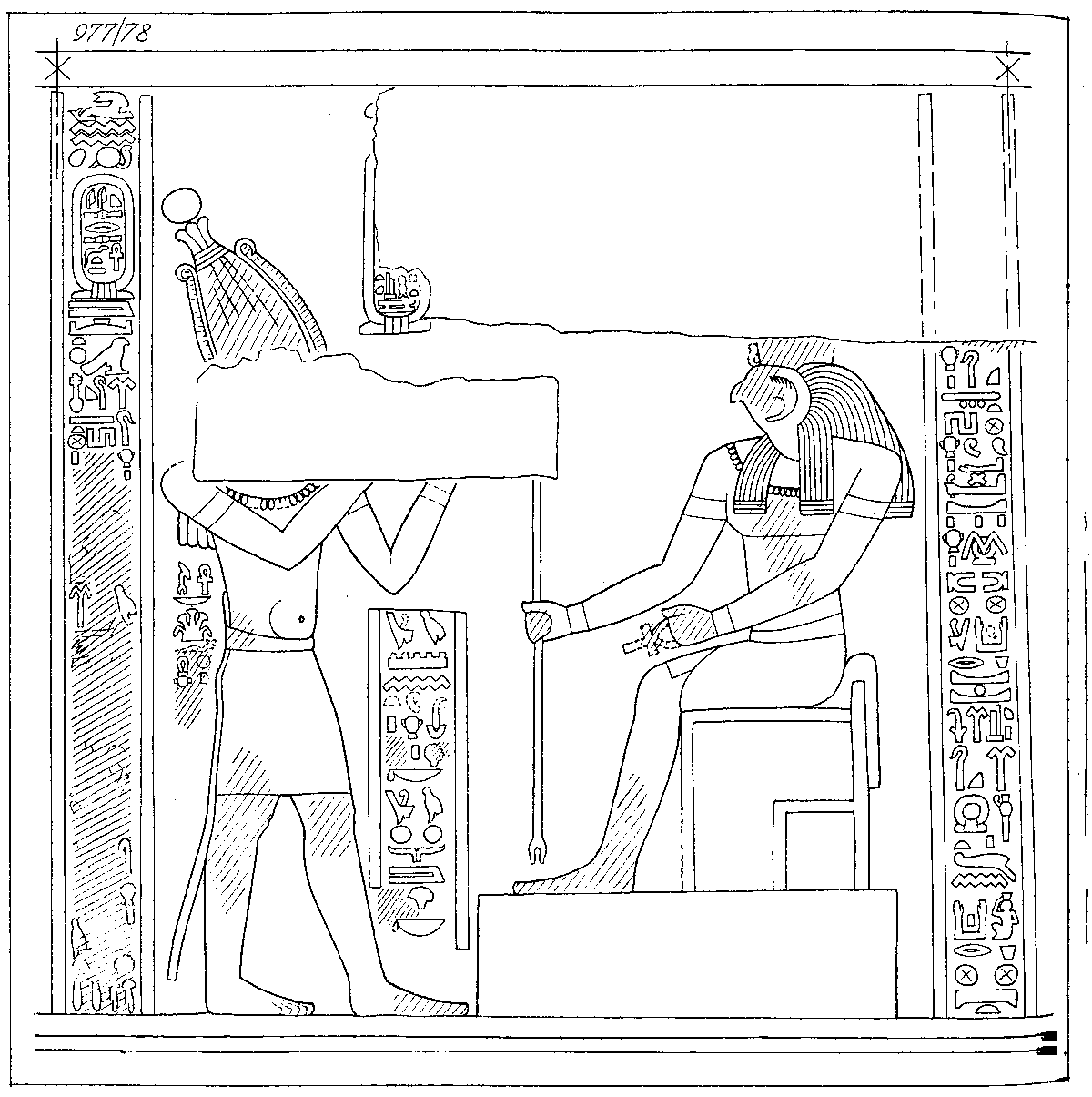
Ptolemy XII hands Isis the finished temple
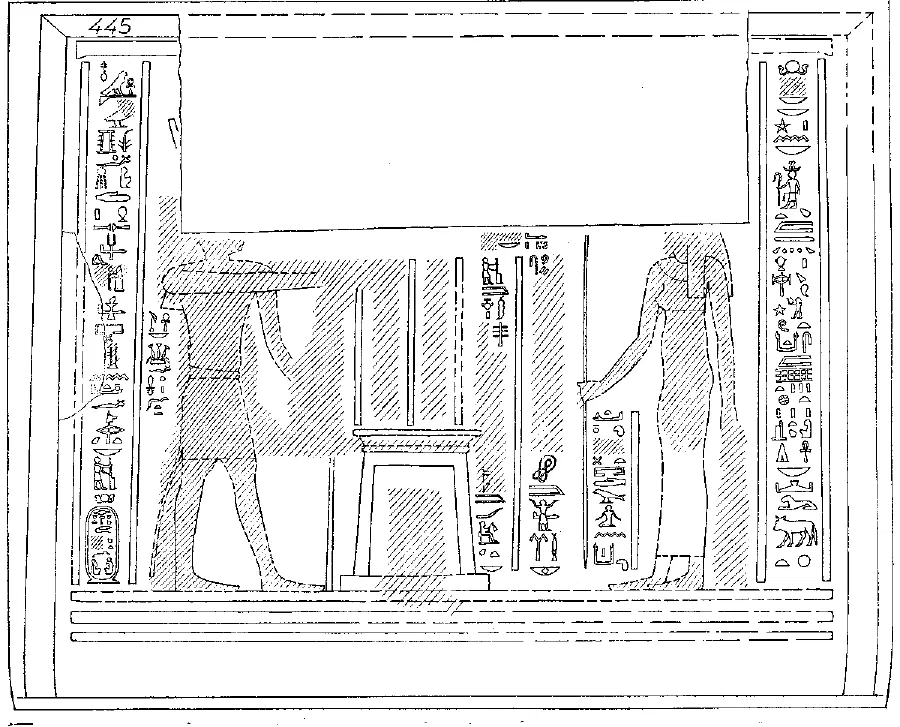
Page 241. The scene as drawn on the wall, facing p. 241 of the edition. Drawing by Otto Baum, in Junker and Winter, Das Geburtshaus des Tempels der Isis in Philä (1965) - 84p. 241, l. 1
rdj.t prj (n) nb(-f) (ḏd mdw)
Presenting the house to its lord. Words to be spoken:
Note · Line 84
The house is the sanctuary. The heading names the rite: the king formally hands the sanctuary over to its divine owner. - 85p. 241, l. 2
(nfr).wj šw¹ … šntj m ḥꜥ(.wt)
How beautiful it is … founded in jubilation,
- 86p. 241, l. 3
ḥts m ḥb ḥwsj m nḏm-jb
finished in festivity, built in gladness of heart,
- 87p. 241, l. 4
ḏd … m-ꜥb šps.t nb(.t?) …
enduring … with the august lady, mistress of …
- 88p. 241, l. 5
(sꜣ) ꜥnḫ wꜣs nb ḥꜣ-f mj Rꜥ ḏ.t
May protection, life and all dominion surround him as they surround Ra, forever.
- 89p. 241, l. 6
dj-j n-k (s.t?) wr.t twr(.tj) n kꜣ-k
I give you the great seat, made pure for your ka.
- 90p. 241, l. 7
ꜥnḫ | nṯr nfr sꜣ (so) rsj jnb-f
Long live the good god, son of Him Who Is South of His Wall,
Note · Line 90
His divine father here is Ptah, patron of craftsmen, whose title refers to his sanctuary at Memphis. - 91p. 241, l. 8
jḫ ḏr.t ḥr sꜥḥꜥ mnw² …
sure of hand as he raises a monument …
- 92p. 241, l. 9
nḫp prj-wr n mw.t-f wsr.t
who built the Great Shrine for his mother, the Mighty One,
Note · Line 92
The Great Shrine is the traditional sanctuary of Upper Egypt. - 93p. 241, l. 10
nb ḥwsj njswt bjt jwꜥw n pꜣ nṯr ntj nḥm …
lord of building, King of Upper and Lower Egypt, heir of the god who saves …
Note · Line 93
“Heir of the god who saves” opens the throne name of Ptolemy XII. - 94p. 241, l. 11
njswt bjt | … nb nb(.t) šn.w.t
King of Upper and Lower Egypt … lord, Lady of Egypt,
- 95p. 241, l. 12
jtj.t m tꜣ ḥr nḏb-f
queen over the whole earth,
- 96p. 241, l. 13
dwꜣ-tw kꜣ-s m spꜣ.wt njw.wt
whose ka is praised in the provinces and towns,
- 97p. 241, l. 14
Js.t dj(.t) ꜥnḫ nb(.t) Jrk
Isis, giver of life, Lady of Philae.
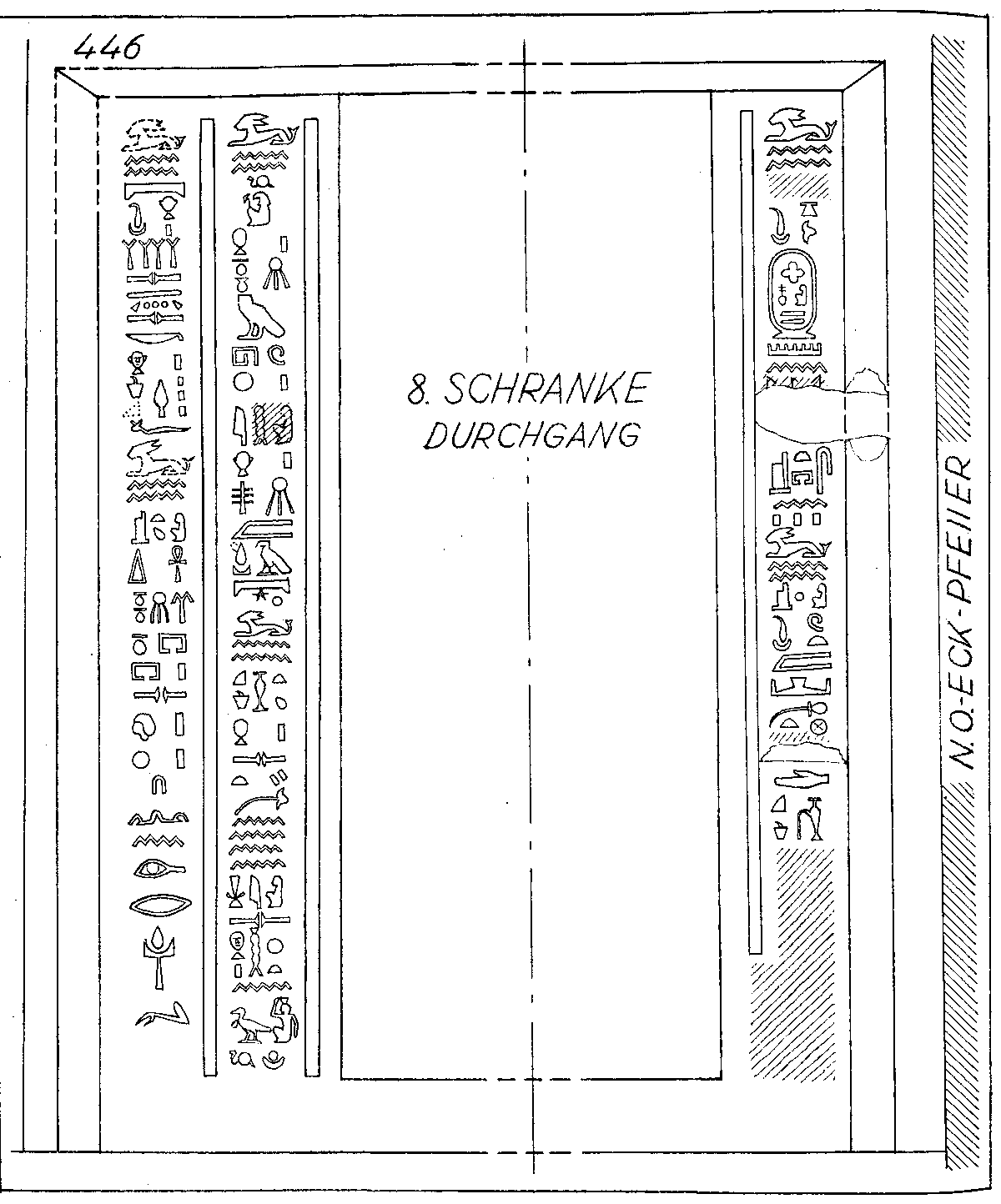
North gate of the east side: as long as the sky stands, Isis and Osiris endure
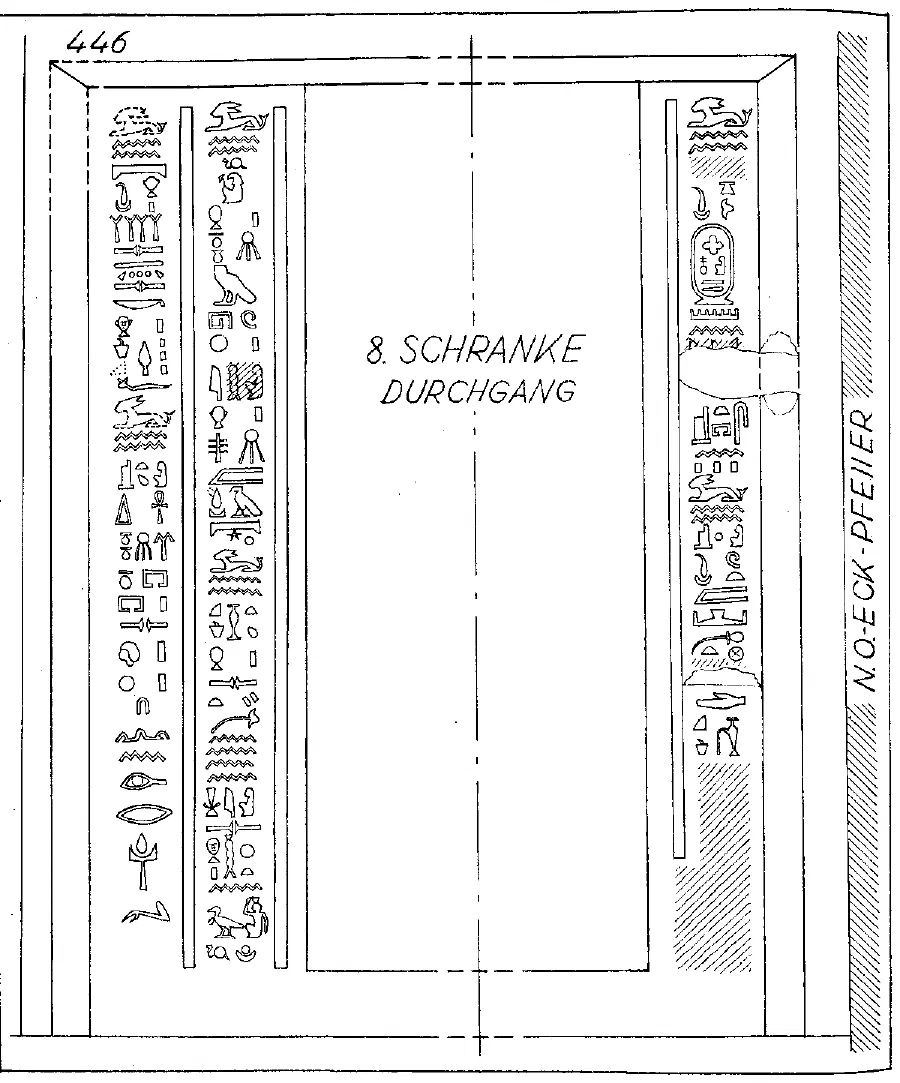
Page 243. The scene as drawn on the wall, facing p. 243 of the edition. Drawing by Otto Baum, in Junker and Winter, Das Geburtshaus des Tempels der Isis in Philä (1965) - 98p. 243, l. 1
wnn p.t mn(.tj) ḥr sḫn.wt-s (fdw)
As long as the sky stands firm on its four pillars
- 99p. 243, l. 2
tꜣ sk(?)¹ ḥr bꜣḳ.w-f²
and the earth rests on its foundations,
- 100p. 243, l. 3
wnn ꜣs.t dj(.t) ꜥnḫ wbn m ḫnw prj-s
Isis, giver of life, will rise from within her house
- 101p. 243, l. 4
tp šw mḏ nn trj jb
every tenth day, without fail.
Note · Line 101
Every ten days the image of Isis was taken from Philae to the burial place of Osiris to make offerings. - 102p. 243, l. 5
wnn Rꜥ ḥr wbn m hrw
As long as Ra rises by day
- 103p. 243, l. 6
jꜥḥ (so) ḥr pšḏ m ḏꜣw
and the moon shines by night,
- 104p. 243, l. 7
wnn Ḳbḥ.w.t ḥr štj mw n sn-s
Qebehut will pour water for her brother
Note · Line 104
Qebehut is the goddess of the cool water poured in offering. Here she is Isis, and her brother is Osiris. - 105p. 243, l. 8
ḥr wꜣḥ jḫ.t n bꜣ-f rꜣ nb
and lay out offerings for his ba every day.
Note · Line 105
The ba is the power of a god or a dead person to move about and make their presence felt. - 106p. 243, l. 9
wnn … mn ḥr Wnn nfrw mꜣꜥ ḫrw
As long as … abides with Wennefer, vindicated,
- 107p. 243, l. 10
mn⁴ … s.t-sn
and … abide in their place,
- 108p. 243, l. 11
wnn Wsjr mn m jꜣ.t wꜥb.t
Osiris will abide on the Pure Mound.
- 109p. 243, l. 12
(ḥr?) šsp ḳbḥ.w …
receiving the libations …
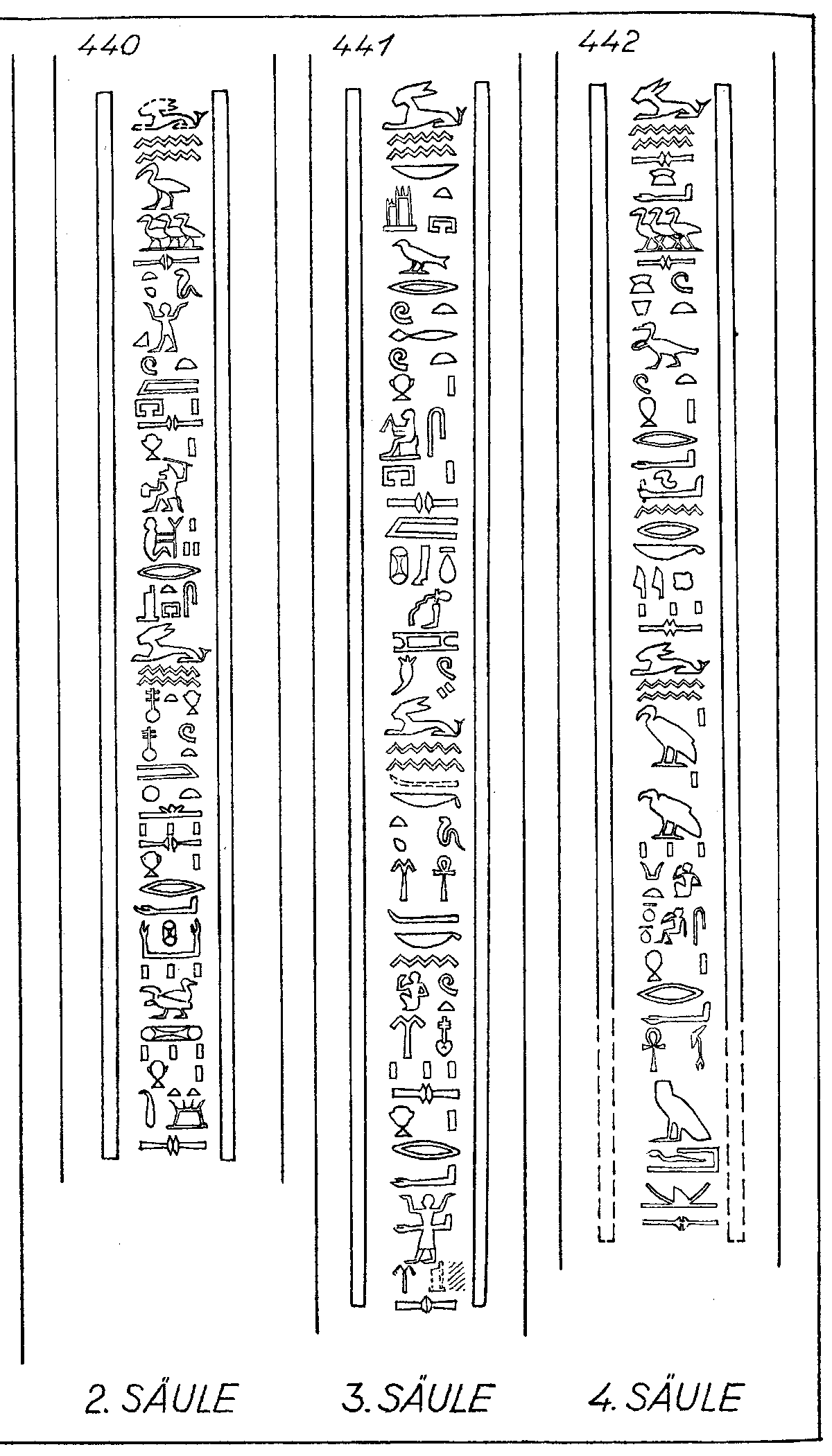
The seven columns of the east colonnade: the names of Isis
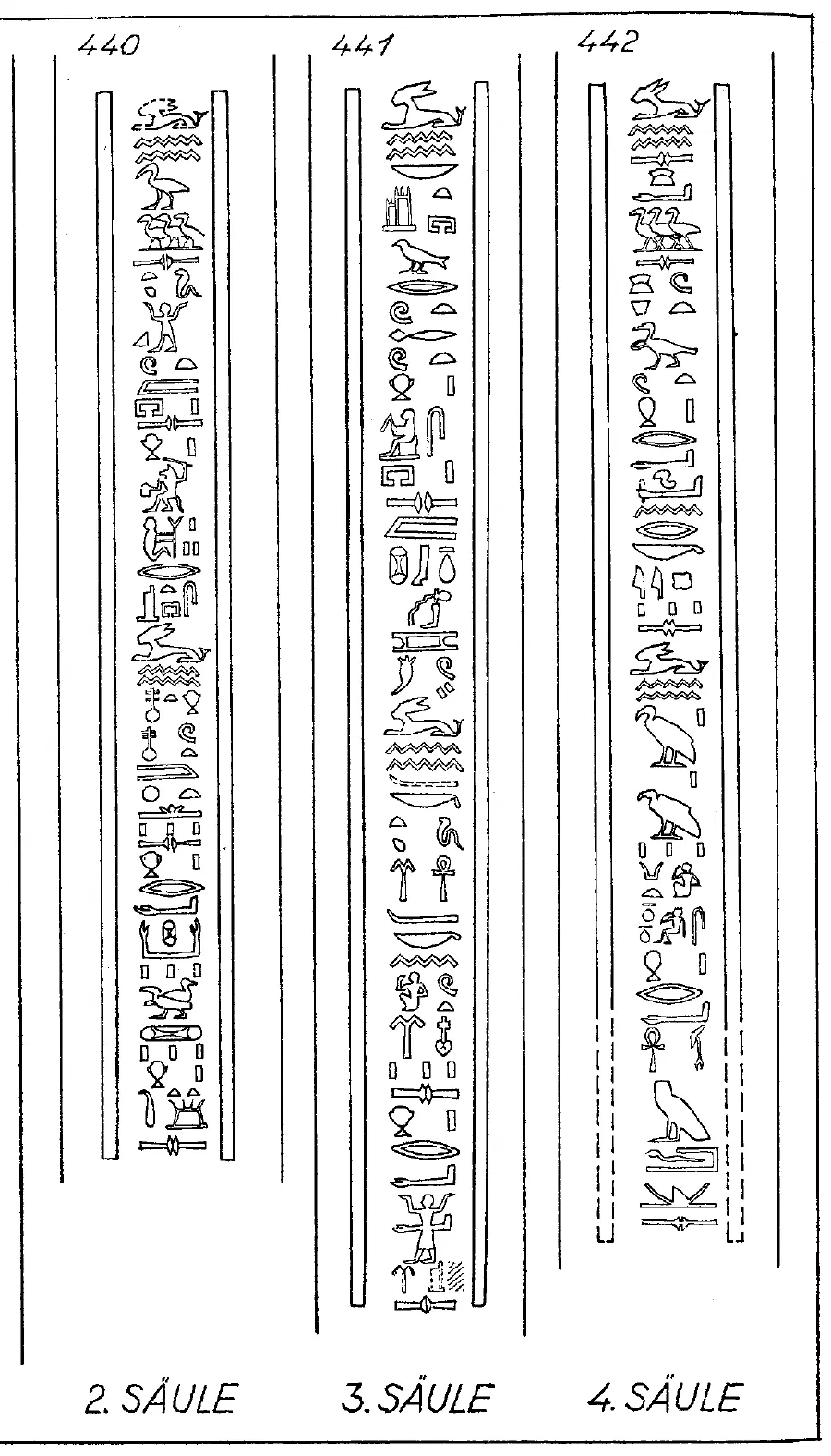
Page 245. The scene as drawn on the wall, facing p. 245 of the edition. Drawing by Otto Baum, in Junker and Winter, Das Geburtshaus des Tempels der Isis in Philä (1965) - 110p. 245, l. 1
wnn šps.t ḥr ḥwj(.t) ḥw.t-nṯr-s
The August One guards her temple,
Note · Line 110
The names that follow are titles of Isis. - 111p. 245, l. 2
ḥr sḫrj ḫwj.t r ḫwj.t-s
warding off evil from her chamber.
- 112p. 245, l. 3
wnn štj.t m s.t mr(r.t) jb-s
The Shetyt shrine stands in the place her heart loves,
Note · Line 112
Shetyt means “the hidden place,” a name for a sanctuary. - 113p. 245, l. 4
ḥr sḏfꜣ ḥw.t-nṯr-s m jḫ.t-s
provisioning her temple with her treasures.
- 114p. 245, l. 5
wnn Gm-bꜣ.w-s ḳꜣ.tj m prj-s
She Whose Power Is Felt stands high in her house,
- 115p. 245, l. 6
ḥr sḫrj sbj.w r s.t-s
driving rebels from her seat.
- 116p. 245, l. 7
wnn nfr.t-ḥr nfr.tj m jḫ.t-s
The Fair of Face is fair in what is hers,
- 117p. 245, l. 8
ḥr rḏj(.t) kꜣ.w ḏfꜣ.w² ḥr ḫ.t-s
setting food and provisions on her offering table.
- 118p. 245, l. 9
wnn nb(.t) prj-wr wr.tj ꜥꜣ.tj
The Lady of the Great Shrine is great and mighty,
- 119p. 245, l. 10
ḥr šps prj-s m jḫ.t(nb.t?) wꜥb.t bnr.t
enriching her house with all that is pure and sweet.
- 120p. 245, l. 11
wnn Ḥkn.t-m-ꜥnḫ ḥkn.tj m nfrw-s
She Who Rejoices in Life rejoices in her beauty,
- 121p. 245, l. 12
ḥr rḏj(.t) ḥꜥꜥw.t m s.t-s
bringing joy to her seat.
- 122p. 245, l. 13
wnn Sḫꜥj-bꜣ.w-s ḫꜥj.tj bꜣ.tj
She Who Makes Her Power Shine Forth shines forth in power,
- 123p. 245, l. 14
ḥr rḏj(.t) nrw n rḫw.w-s
striking terror into her foes.
- 124p. 245, l. 15
wnn mw.t mw.wt sḏj.tj nn(?)-s
The Mother of Mothers nurses her child,
- 125p. 245, l. 16
ḥr rḏj(.t) ꜥnḫ-wꜣs m⁴ prj jm-s
giving milk, the flow from her own body.
Note · Line 125
The name for milk here means “life and dominion”: the child receives both at his mother’s breast. 
Page 247. The scene as drawn on the wall, facing p. 247 of the edition. Drawing by Otto Baum, in Junker and Winter, Das Geburtshaus des Tempels der Isis in Philä (1965) - 126p. 247, l. 1
wnn nb(.t) šꜥ.t ḥr šꜥd sbj.w-s
The Lady of Slaughter cuts her rebels to pieces,
- 127p. 247, l. 2
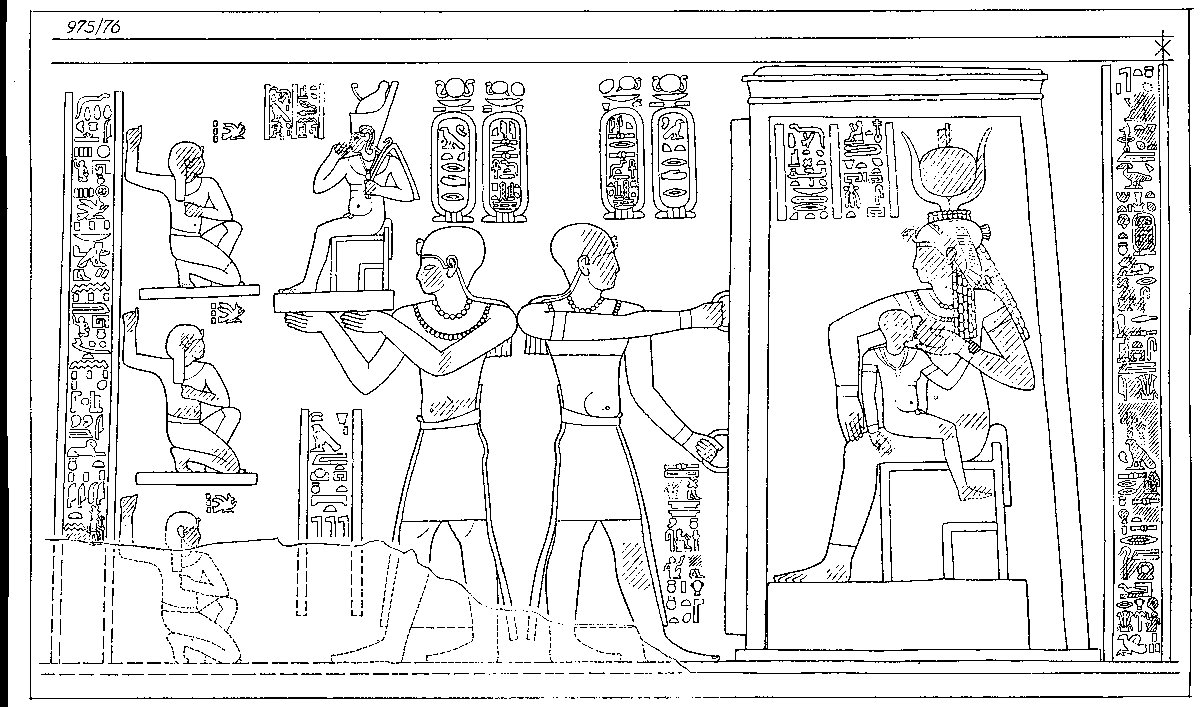
ḥr rdj(.t) šnd-s n sbj.w n njw.wt-s
putting the fear of her into those who rebel against her cities.
- 128p. 247, l. 3
wnn ꜥšꜣ(.t) jwn …
She of Many Colors …
- 129p. 247, l. 4
… ḥw.t-nṯr-s m . ? . bṯnw.w-s(?)
… her temple with … her rebels.
- 130p. 247, l. 5
wnn ḥrj.t-tp m ḥꜣ.t jt-s
The Diadem on her father’s brow
Note · Line 130
The goddess appears as the cobra rearing on the sun god’s brow, ready to spit fire in his defense. - 131p. 247, l. 6
ḥr wbd …² m nbj.t n(.t) jr.tj(?)³-s
burns … with the flame of her two eyes.
- 132p. 247, l. 7
wnn ḫsbd⁴ … m … m šmj.t-s⁵
She of Lapis Blue … in … in her sanctuary,
- 133p. 247, l. 8
ḥr ḫsf ḫftj.w(?) ḫr ḥm-s⁶
repelling the foes before Her Majesty.
- 134p. 247, l. 9
wnn ṯḥn.t ṯḥn.tj m ḥr-s
The Shining One shines with the light of her face,
- 135p. 247, l. 10
ḥr … wp.t-f
as she … the crown of his head.
- 136p. 247, l. 11
wnn mfkꜣ.t mꜣw.tj n mꜣw.t
The Turquoise One is made new once more,
- 137p. 247, l. 12
ḥr(?) sḫrj(?) …
warding off …
The king before Anukis (unfinished scene)
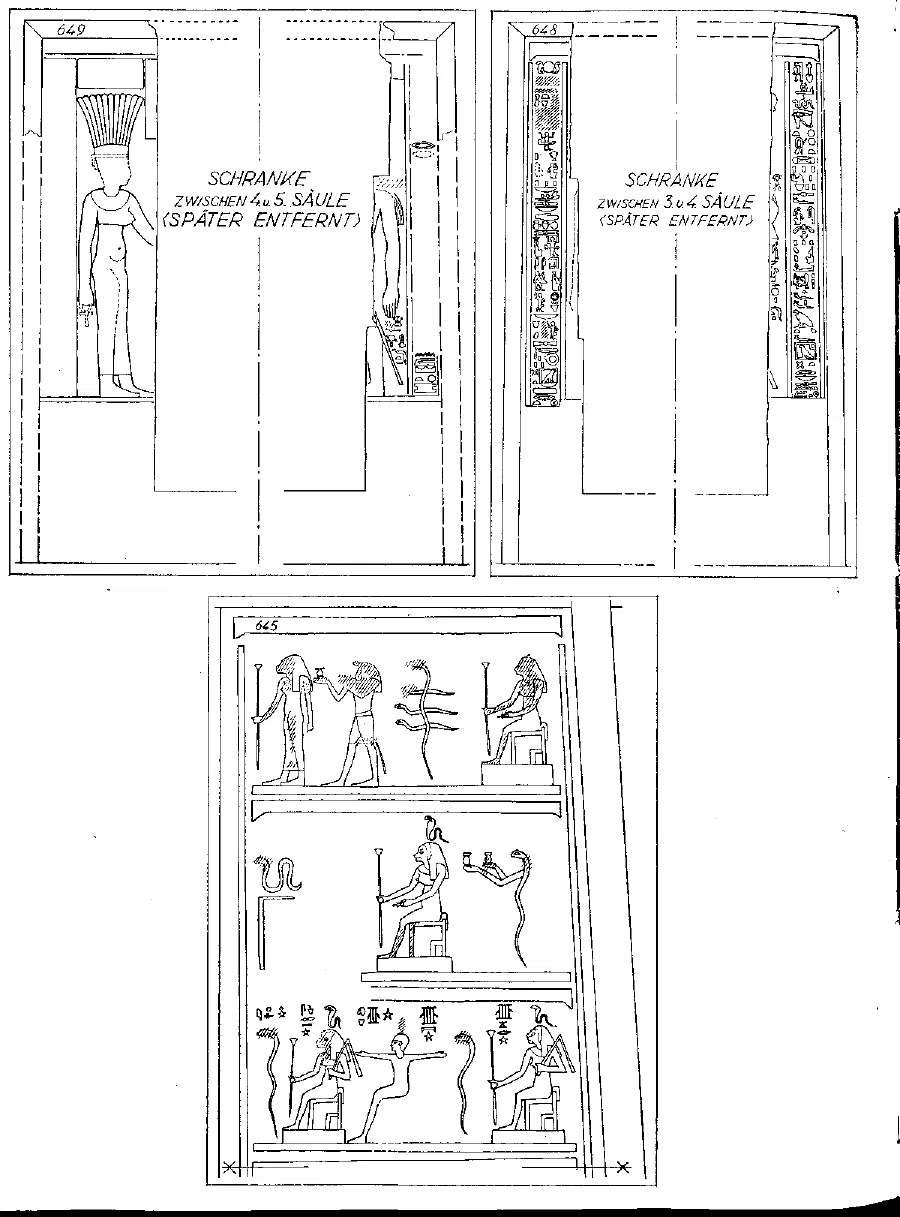
Page 249. The scene as drawn on the wall, facing p. 249 of the edition. Drawing by Otto Baum, in Junker and Winter, Das Geburtshaus des Tempels der Isis in Philä (1965) - 138p. 249, l. 1
… ḥꜣ-f mj Rꜥ ḏ.t
May … be around him as around Ra, forever.
- 139p. 249, l. 2
… rr¹ … (Š) nm.t
… Bigeh.
Note · Line 139
Bigeh, the island beside Philae, was revered as a burial place of Osiris. The king gives Hathor food
- 140p. 249, l. 3
ꜥnḫ | nṯr nfr ꜥḥꜥw Bꜣḳ.t
Long live the good god, guardian of Egypt,
- 141p. 249, l. 4
šsm jḫ.t (sic) psḏ.t
who brings food to the Ennead,
- 142p. 249, l. 5
šfšf ꜣw (so) sꜣ Wsjr
who makes offerings to the son of Osiris,
Note · Line 142
The son is Horus. - 143p. 249, l. 6
ḫrp ꜥb.t jt-f mw.t-f
who presents a food offering to his father and his mother,
- 144p. 249, l. 7
Ḥw.t-Ḥrw wr.t nb(.t) Šnm.t
Hathor the Great, Lady of Bigeh.
- 145p. 249, l. 8
njšwt bjt | …
King of Upper and Lower Egypt, …
- 146p. 249, l. 9
ḥꜥj ḥr nb (n) mꜣꜣ-s
Every face beams at the sight of her,
- 147p. 249, l. 10
nb(.t) tḫ.t mr(r.t) ḥꜥꜥw.t
Lady of Drunkenness, who loves rejoicing,
Note · Line 147
Drinking, music and dancing were part of Hathor’s festivals. - 148p. 249, l. 11
nb.t hj ḥnw.t ḥs.t ḥb.t (so)
Lady of shouts of joy, Mistress of song and dance,
- 149p. 249, l. 12
nb(.t) jbꜣ ḥnw.t ṯs mꜣḥ.w
Lady of the dance, Mistress of garland weaving,
- 150p. 249, l. 13
Ḥw.t-Ḥrw wr.t nb(.t) Jꜣḳ
Hathor the Great, Lady of Philae.
North pillar: goddesses of the night hours, incense for Imhotep, and Ptolemy VIII’s dedication to Hathor
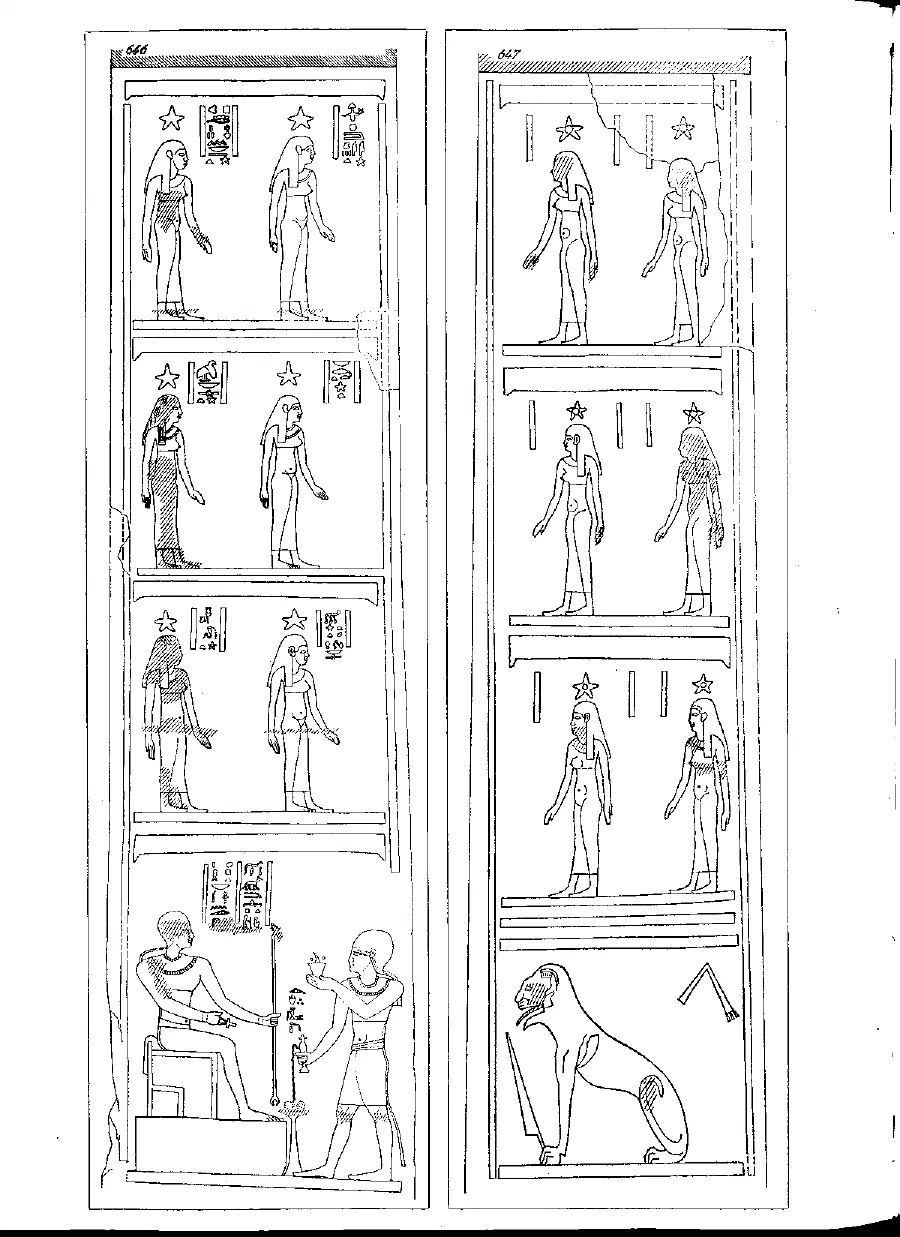
Page 253. The scene as drawn on the wall, facing p. 253 of the edition. Drawing by Otto Baum, in Junker and Winter, Das Geburtshaus des Tempels der Isis in Philä (1965) - 151p. 253, l. 1
ḫsf(.t) ḫmj.w
She who drives back enemies.
- 152p. 253, l. 2
ptr(.t) nfrw n nb.s (so)
She who beholds her lord’s beauty.
- 153p. 253, l. 3
nb(.t) šnd
Lady of fear.
- 154p. 253, l. 4
mk(.t) nb.s
She who guards her lord.
- 155p. 253, l. 5
ḥrj.t-tp ꜥḥꜣ(.tj) ḥr nb.s²
The Diadem, who fights for her lord.
Note · Line 155
The diadem bears a cobra at the king’s brow. The cobra was a goddess who spat fire at his enemies. - 156p. 253, l. 6
mr(.t) nsr
She whose flame sears.
- 157p. 253, l. 7
jrj(.t) snṯr ḳbḥ ḏd mdw
Burning incense and pouring a libation while reciting.
- 158p. 253, l. 8
ḏd mdw j | Jj-m-ḥtp wr
Words to be spoken: O Imhotep the Great,
Note · Line 158
Imhotep, an architect in life, was later worshipped as a god of healing and a son of Ptah. - 159p. 253, l. 9
sꜣ Ptḥ nb ꜥnḫ ḳmꜣ(?) n …
son of Ptah, lord of life, fashioned by …
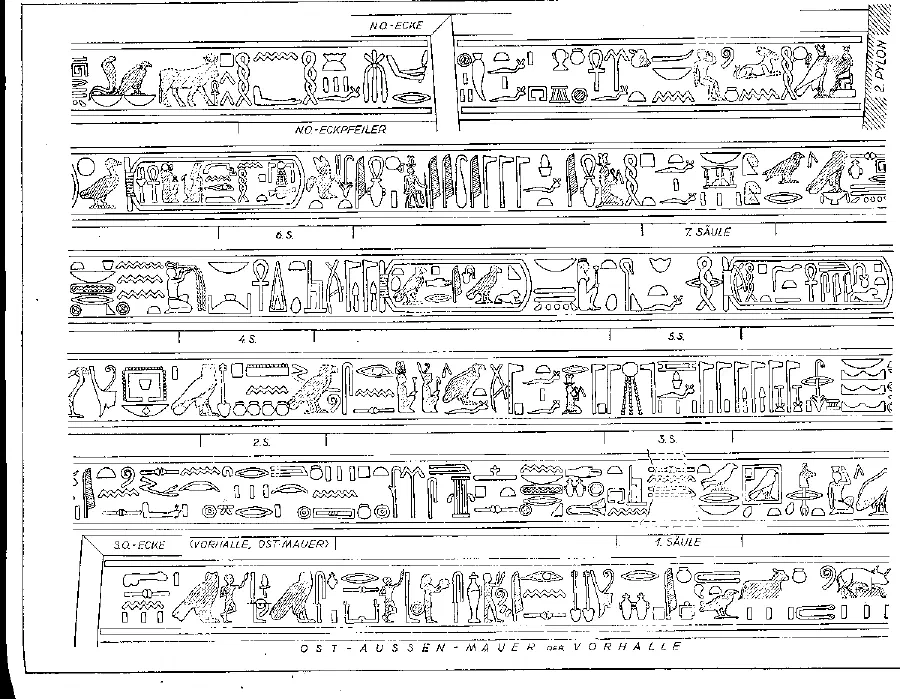
Page 255. The scene as drawn on the wall, facing p. 255 of the edition. Drawing by Otto Baum, in Junker and Winter, Das Geburtshaus des Tempels der Isis in Philä (1965) - 160p. 255, l. 1
Js.t (dj.t ꜥnḫ)¹ Ḥrw ḥwn ḥkn-tw m ꜥnḫ-f
Isis, who gives life to Horus the Youth, in whose life people rejoice,
Note · Line 160
“Horus the Youth” opens the king’s Horus name, which presents him as the god who inherits his father’s throne. - 161p. 255, l. 2
ḥr ns.t jt-f bnr sp(w)
on his father’s throne, sweet in his ways,
- 162p. 255, l. 3
ḏsr mšꜥ-f ḥnꜥ Ḥp ꜥnḫ
glorious in his radiance, together with the living Apis.
Note · Line 162
Apis was the sacred bull of Memphis, worshipped as a living manifestation of Ptah. - 163p. 255, l. 4
nb.tj sḥrj tꜣ.wj
Two Ladies: He who gladdens the Two Lands.
Note · Line 163
The Two Ladies are Nekhbet, the vulture goddess of Upper Egypt, and Wadjet, the cobra goddess of Lower Egypt. Together they protect the king. - 164p. 255, l. 5
Ḥrw nb wr pḥtj
Golden Horus: Great in strength.
- 165p. 255, l. 6
nb ḥb.w-sd mj jt-f Ptḥ Tnn jt nṯr.w
Lord of Sed festivals like his father Ptah-Tatenen, father of the gods,
Note · Line 165
The Sed festival was a royal jubilee that renewed the king’s power to rule. - 166p. 255, l. 7
jtj mj Rꜥ njśwt bjt jwꜥw n nṯr.wj prj.wj stp n Ptḥ jrj mꜣꜥ.t Rꜥ śḫm ꜥnḫ ꜣJmn
sovereign like Ra, King of Upper and Lower Egypt, heir of the two Manifest Gods, chosen of Ptah, who upholds the order of Ra, living image of Amun,
Note · Line 166
The two Manifest Gods were the king’s parents, Ptolemy V and Cleopatra I. The order he upholds is maat: the right order of the world. - 167p. 255, l. 8
sꜣ Rꜥ Ptwrmjś ꜥnḫ ḏ.t mrj Ptḥ
Son of Ra, Ptolemy, ever living, beloved of Ptah,
- 168p. 255, l. 9
ḥnꜥ ḥm.t-f ḥḳꜣ.t nb(.t) tꜣ.wj
together with his wife, the ruler, Lady of the Two Lands,
- 169p. 255, l. 10
Krwꜣjpdrꜣ.t nṯr.wj mnḫ.wj
Cleopatra, the two Benefactor Gods,
Note · Line 169
Cleopatra III shared the title “Benefactor Gods” with Ptolemy VIII. It names the royal pair. - 170p. 255, l. 11
mrj Js.t dj(.t) ꜥnḫ nb(.t) jꜣ.t wꜥb.t
beloved of Isis, giver of life, Lady of the Abaton,
Note · Line 170
The Abaton was the “pure mound” on Bigeh, near Philae, revered as a burial place of Osiris. - 171p. 255, l. 12
ḥnw.t nb(.t) ꜣJrk nb(.t) ḫꜣs.wt rsj.wt
sovereign lady, Lady of Philae, Lady of the southern lands,
- 172p. 255, l. 13
nṯr.wj sn.wj nṯr.wj mnḫ.wj nṯr.wj mrj jt
and of the two Sibling Gods, the two Benefactor Gods, the two Father-loving Gods,
Note · Line 172
These are the titles under which earlier Ptolemaic rulers were worshipped. - 173p. 255, l. 14
nṯr.wj prj.wj pꜣ nṯr r ṯnj jt-f pꜣ nṯr mrj mw.t-f²
the two Manifest Gods, the god Eupator and the god Philometor.
Note · Line 173
Eupator means “of noble father”; Philometor means “mother-loving.” - 174p. 255, l. 15
jrj n-s smꜣw mnw pn nfr m wsḫ.t ḥb
He renewed this fine monument for her in the festival court,
- 175p. 255, l. 16
n mw.t-f wsr.t
for his mother, the Mighty One,
- 176p. 255, l. 17
Ḥw.t-Ḥrw wr.t nb(.t) Snm(.t)
Hathor the Great, Lady of Bigeh:
- 177p. 255, l. 18
s.t n(.t) tḫ.t n nb(.t) ꜣJrk
a seat of drunkenness for the Lady of Philae.
Note · Line 177
Drunkenness was part of the celebration of Hathor; the wine, song and dancing that follow belong to her worship. - 178p. 255, l. 19
ḥtp-s m ẖnt-s m tr (so) pn
She rests within it at this time:
- 179p. 255, l. 20
ḫmt-nw nj šmw św rꜣ ḫmt rꜣ mḏ-dj n jbd
the third month of summer, the twelfth day of the month.
Note · Line 179
The date is given in fractions: a third and a fifteenth of a thirty-day month make twelve days. - 180p. 255, l. 21
smꜣ-tw n-s jwꜣ.w wnḏw.w
Iwa cattle and wendu cattle are slaughtered for her,
- 181p. 255, l. 22
ttf n-s jrp mḥw nfr nfr⁴
and the finest wine of Lower Egypt is poured for her.
- 182p. 255, l. 23
jrj n-s jrw ḥs.t ḥb(.t)
For her they cheer and sing and dance,
- 183p. 255, l. 24
r sḳꜣ(?) jb-s m jbꜣ.w m bꜣḥ-sn
to lift her heart with dances in their presence.
Augustus with sceptre and mace before Isis
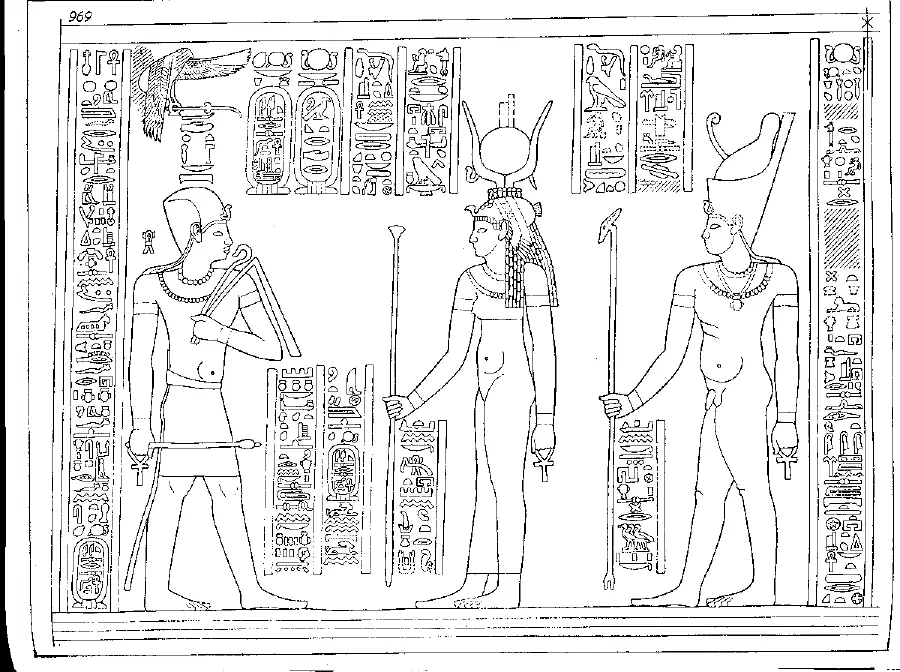
Page 257. The scene as drawn on the wall, facing p. 257 of the edition. Drawing by Otto Baum, in Junker and Winter, Das Geburtshaus des Tempels der Isis in Philä (1965) - 184p. 257, l. 1
jj.tj (sp śn) m ḥtp sꜣ Rꜥ Kjsrs ꜥnḫ ḏ.t
Welcome, welcome in peace, Son of Ra, Caesar, who lives forever!
Note · Line 184
The Caesar addressed here is Augustus, hailed as king of Egypt. - 185p. 257, l. 2
wnn p.t wn mnw-k
As long as the sky endures, your monuments endure.
- 186p. 257, l. 3
mw.t-k ̉Js.t ḥtp.tj ḥr jrj(.t)-n-k
Your mother Isis is pleased with what you have done;
- 187p. 257, l. 4
śpḥr-ś n-k jb.w n tpj.w-tꜣ
she turns the hearts of those on earth toward you.
- 188p. 257, l. 5
njśwt bjt nb tꜣ.wj ꜣwtḳrdr
King of Upper and Lower Egypt, Lord of the Two Lands, Autokrator,
Note · Line 188
Autokrator is the Greek title corresponding to the Roman title Imperator. - 189p. 257, l. 6
sꜣ Rꜥ nb ḫꜥ.w Kjsrs ꜥnḫ ḏ.t mrj Ptḥ ̉Js.t sꜣ
Son of Ra, Lord of Crowns, Caesar, who lives forever, beloved of Ptah and Isis. Protection.
- 190p. 257, l. 7
Bḥd.tj nṯr ꜥꜣ nb p.t
He of Behdet, the great god, Lord of the Sky.
Note · Line 190
“He of Behdet” is Horus of Edfu, often shown as a winged sun disk. - 191p. 257, l. 8
ḏd mdw n | ̉Js.t dj(.t) ꜥnḫ nb(.t) ̉Jrḳ
Words spoken by Isis, giver of life, Lady of Philae,
- 192p. 257, l. 9
ḥnw.t nb(.t) jꜣ.t wꜥb.t
sovereign lady, Lady of the Abaton,
- 193p. 257, l. 10
špś.t wśr.t nb(.t) prj-mśj.t
the August One, the Mighty One, Lady of the Birth House,
Note · Line 193
The birth house was the sanctuary where the birth of the divine child was celebrated. - 194p. 257, l. 11
mw.t nṯr bjk n nb
mother of the god, the Falcon of Gold:
- 195p. 257, l. 12
dj-j n-k śtp-sꜣ.t (sic) mn.tj (sic) ḥr kꜣ-k
“I give you the palace, abiding with your ka.”
Note · Line 195
Isis gives the temple to the king as a palace. His ka is his enduring life force. - 196p. 257, l. 13
ḏd mdw n | Ḥrw-pꜣ-ḫrd sꜣ ̉Js.t nb(.t) ̉Jrḳ
Words spoken by Harpocrates, son of Isis, Lady of Philae,
Note · Line 196
Harpocrates is the Greek form of the Egyptian name “Horus the Child.” - 197p. 257, l. 14
ḫ špś prj m Wśjr
the noble child who came forth from Osiris,
- 198p. 257, l. 15
wṯt-f św r jwꜥw (mnḫ?)
who begot him to be a worthy heir.
- 199p. 257, l. 16
dj-j n-k Tꜣ-mrj ḥr śwr bꜣ.w-k
I give you Egypt as it exalts your might.
Note · Line 199
A deity addresses the king. - 200p. 257, l. 17
ꜥnḫ | nṯr nfr bꜣḥ-gś.t-f r mꜣꜣ mw.t nṯr
Long live the good god! He runs swiftly to see the god’s mother,
- 201p. 257, l. 18
r wṯs nfrw n ̉Js.t dj(.t) ꜥnḫ
to exalt the beauty of Isis, giver of life.
- 202p. 257, l. 19
ꜣw-jb-ś n mꜣꜣ-f
Her heart rejoices at the sight of him;
- 203p. 257, l. 20
ḥntš-ś n (p)tr-f hrw jb(-ś) n jw-f
she delights in seeing him, and her heart is content at his coming.
- 204p. 257, l. 21
ḥtp kꜣ-ś ḥr mnw pn jrj-n-f n ḥm.t-ś sꜣ Rꜥ Kjsrs ꜥnḫ ḏ.t
Her ka is pleased with this monument made for Her Majesty by the Son of Ra, Caesar, who lives forever.
Note · Line 204
“Her Majesty” is Isis herself. - 205p. 257, l. 22
njśwt bjt | Rꜥj.t ḥnw.t tꜣ.wj
King of Upper and Lower Egypt, sun goddess, mistress of the Two Lands,
Note · Line 205
The Two Lands are Upper Egypt, the southern Nile valley, and Lower Egypt, the northern delta. - 206p. 257, l. 23
… wśr.t nn ḥr ḫ.w-ś
… mighty one without equal,
- 207p. 257, l. 24
wr.t … .t ḫꜥj nb ḥr nś.t-f ḥr ś.t rꜣ-ś
great in … . At her word the king shines forth upon his throne.
- 208p. 257, l. 25
n jrj-tw śḫr.w m ḥm-ś m p.t tꜣ dꜣ.t
No plans are laid without her in heaven, on earth or in the underworld:
- 209p. 257, l. 26
̉Js.t dj(.t) ꜥnḫ nb.t ̉Jrḳ
Isis, giver of life, lady of Philae.
Augustus gives Osiris a field
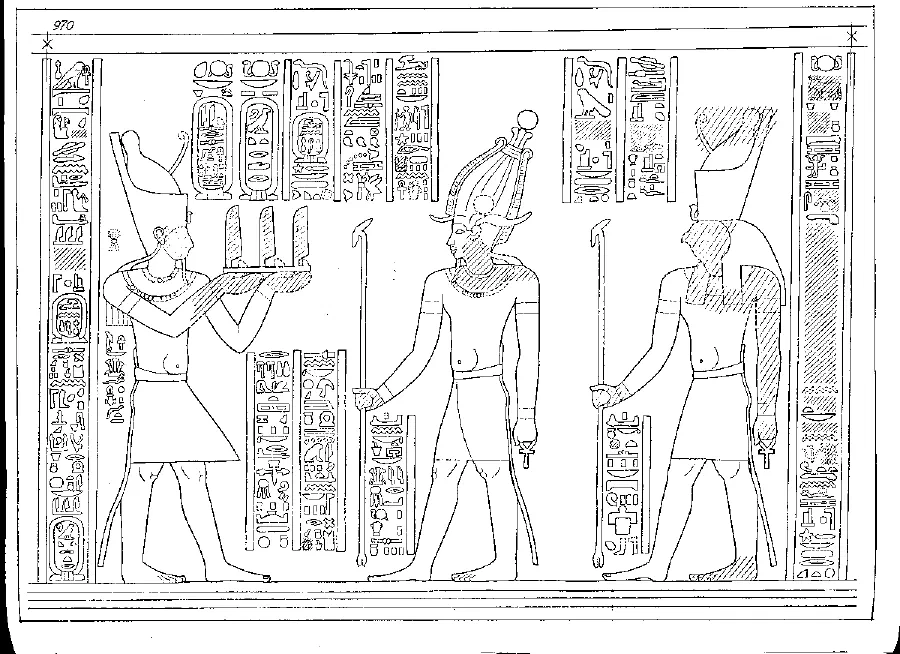
Page 259. The scene as drawn on the wall, facing p. 259 of the edition. Drawing by Otto Baum, in Junker and Winter, Das Geburtshaus des Tempels der Isis in Philä (1965) - 210p. 259, l. 1
mn n-k ꜣḥ.t m šnw n tꜣ.wj r ḥfn.w
Take for yourself the fields within the bounds of the Two Lands, by the hundred thousand.
Note · Line 210
The king presents a field to the god. In the words of the offering, that field takes in all the farmland of Egypt. - 211p. 259, l. 2
ḏj(so?)-n nṯr.w nb.w
All the gods have granted
- 212p. 259, l. 3
wr ḥnb.t-k r ḥp.tj
that your farmland be as vast as the world
- 213p. 259, l. 4
pḥ tꜣš.w-k r-ꜥ šwt.t jtn
and your borders reach as far as the rays of the sun disk.
- 214p. 259, l. 5
njśwt bjt nb tꜣ.wj ꜣwtḳrdr
King of Upper and Lower Egypt, lord of the Two Lands, Autokrator,
Note · Line 214
Here the emperor bears the titles of a pharaoh. - 215p. 259, l. 6
sꜣ Rꜥ nb ḫꜥ.w Ḳjsrs …
Son of Ra, lord of crowns, Caesar …
- 216p. 259, l. 7
sꜣ ꜥnḫ wꜣś nb ḥꜣ-f mj Rꜥ ḏ.t
May all protection, life and dominion surround him as they surround Ra, forever.
- 217p. 259, l. 8
ḏd mdw n | Wśjr Wnn nfrw mꜣꜥ ḫrw nṯr ꜥꜣ nb ꜣJrk
Words spoken by Osiris Wennefer, vindicated, the great god, lord of Philae,
Note · Line 217
Wennefer, “he who endures in perfection,” is a name of Osiris. He is called vindicated because judgment went in his favor against Seth, his killer. - 218p. 259, l. 9
njśwt nṯr.w ḥḳꜣ m Śnm.t
king of the gods, ruler on Bigeh,
- 219p. 259, l. 10
ḥꜥpj wr ḳmꜣ wnn.t nb(.t)
the great Nile flood, who fashioned all that exists,
- 220p. 259, l. 11
śr nṯr.w jrj kꜣ.w n ꜥnḫ.w
prince of the gods, who makes food for the living:
- 221p. 259, l. 12
dj-j n-k bw nb ḫꜥj Rꜥ ḥr-śn
“I give you every place over which Ra shines forth.”
- 222p. 259, l. 13
ḏd mdw n | Ḥrw … sꜣ Wśjr nb ꜣJrk
Words spoken by Horus …, son of Osiris, lord of Philae,
- 223p. 259, l. 14
jwꜥw mnḫ prj m ꜣJś.t
worthy heir, sprung from Isis,
- 224p. 259, l. 15
… ḥr ś.t n.t jt-f
… on his father’s throne:
- 225p. 259, l. 16
dj-j n-k jḫ.t nb.t ḥrj(.t) śꜣ Gb
“I give you all that lies upon the back of Geb.”
Note · Line 225
Geb is the earth god; the ground itself is his back. - 226p. 259, l. 17
ꜥnḫ | nṯr nfr sꜣ ḥrj-jdb
Long live the good god, son of the One upon the Riverbank,
Note · Line 226
The One upon the Riverbank is Shu, god of the air. - 227p. 259, l. 18
jwꜥw mnḫ n rpꜥ.t nṯr.w
worthy heir of the hereditary prince of the gods,
Note · Line 227
“Hereditary prince of the gods” is a title of Geb. - 228p. 259, l. 19
ḥnk śḫ.t (n jt-f) Wśjr Wnn nfrw mꜣꜥ ḫrw
who presents the field to his father Osiris Wennefer, vindicated.
- 229p. 259, l. 20
śwr ḥnb.wt n sꜣ Gb
who enlarges the fields for Geb’s son,
- 230p. 259, l. 21
śwśḫ tꜣš n kꜣ-f r-ꜥ šnw n jtn
who extends the borders for his ka as far as the sun disk’s circuit,
- 231p. 259, l. 22
nb śḫ.t ꜣwtḳrtr
lord of the field, Autokrator.
- 232p. 259, l. 23
njśwt bjt | Kꜣ … nwnw
King of Upper and Lower Egypt: the bull … the primeval ocean,
- 233p. 259, l. 24
ḥꜥpj ś …
the Nile flood …
- 234p. 259, l. 25
… n … nb … (wp.t rnp.t?) wṯṯ(w) n jt-f(?) mrj
… of … lord … the opening of the year, begotten by his beloved father,
- 235p. 259, l. 26
Wśjr nṯr ꜥꜣ nb ꜣJrk
Osiris, the great god, lord of Philae.
Augustus gives Isis a breast amulet
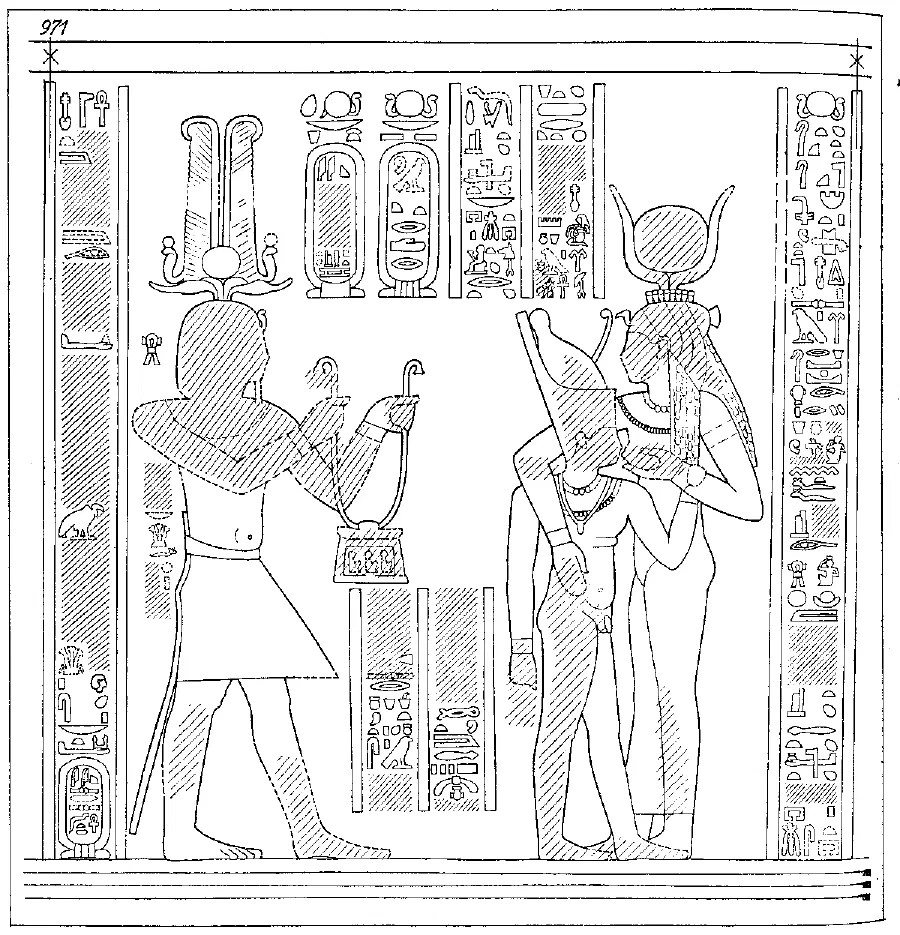
Page 261. The scene as drawn on the wall, facing p. 261 of the edition. Drawing by Otto Baum, in Junker and Winter, Das Geburtshaus des Tempels der Isis in Philä (1965) - 236p. 261, l. 1
… mḫ.t m ꜥꜣ.wt
… inlaid with precious stones,
- 237p. 261, l. 2
ꜣw.t-jb …
the amulet …
Note · Line 237
The amulet’s Egyptian name also means “joy of heart.” - 238p. 261, l. 3
ṯs(?) šj r bꜥn.t n sꜣ-t Ḥrw š …
Tie it around the neck of your son Horus …
- 239p. 261, l. 4
njśwt bjt nb tꜣ.wj ꜣwtḳrdr
King of Upper and Lower Egypt, lord of the Two Lands, Autokrator.
- 240p. 261, l. 5
sꜣ Rꜥ nb ḫꜥ.w Ḳj(srs) …
Son of Ra, lord of crowns, Caesar …
- 241p. 261, l. 6
sꜣ (ꜥnḫ wꜣś) nb ḥꜣ-f (mj) Rꜥ (ḏ.t)
May all protection, life and dominion surround him as they surround Ra, forever.
- 242p. 261, l. 7
ḏd mdw n | Ꜣś.t mw.t nṯr nb(.t) prj-mśj.t
Words spoken by Isis, the god’s mother, lady of the birth house,
- 243p. 261, l. 8
šps.t wśr.t ḥnw.t Ꜣrḳ … nfr …
the august one, the mighty one, mistress of Philae, … beautiful …
- 244p. 261, l. 9
mnꜥ … Ḥrw m … ꜥnḫ wꜣś
who nursed … Horus with … life and dominion.
- 245p. 261, l. 10
ꜥnḫ | nṯr nfr …
Long live the good god …
- 246p. 261, l. 11
… mkj(?) … ḥꜣ sꜣ-ś
… protecting … behind her son,
- 247p. 261, l. 12
nb mk.t Ḳjsrs ꜥnḫ ḏ.t
lord of protection, Caesar, who lives forever.
- 248p. 261, l. 13
njśwt bjt | ḥḳꜣ.t sꜣ.t ḥḳꜣ ḥm.t njśwt
King of Upper and Lower Egypt: the ruler, daughter of the ruler, wife of the king,
- 249p. 261, l. 14
wtt(.t) nṯr nfr dj(.t) sꜣ-ś Ḥrw m ḥḳꜣ r-ꜥ nḥḥ
who bore the good god and sets her son Horus to rule for all time,
- 250p. 261, l. 15
ḥr jrj.t ꜥn(?) … ḥwj.t(?)¹ n jt-f Wśjr
as she acts again … for the protection of his father Osiris,
- 251p. 261, l. 16
jrj(.t) sꜣ-f rꜥ nb m …
who guards him every day with …
- 252p. 261, l. 17
Ꜣś.t ꜥꜣ.t mw.t nṯr (nb.t?) prj-mśj.t
Isis the Great, the god’s mother, lady of the birth house.
Augustus gives a food offering to the child god
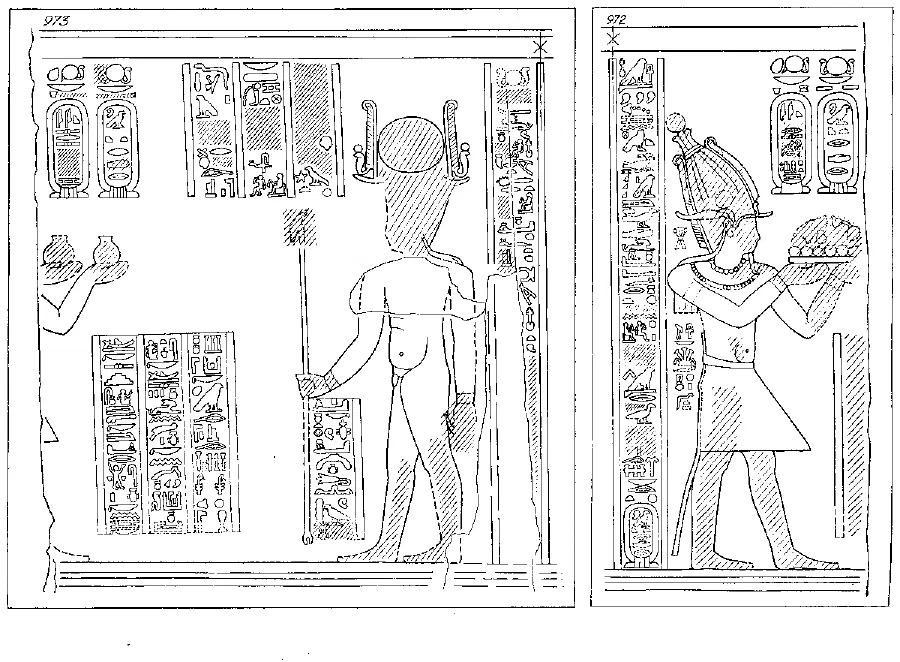
Page 263. The scene as drawn on the wall, facing p. 263 of the edition. Drawing by Otto Baum, in Junker and Winter, Das Geburtshaus des Tempels der Isis in Philä (1965) - 253p. 263, l. 1
njśwt bjt nb tꜣ.wj ꜣwtḳrdr
King of Upper and Lower Egypt, lord of the Two Lands, Autokrator.
- 254p. 263, l. 2
sꜣ Rꜥ nb ḫꜥ.w Ḳj(s)rs …
Son of Ra, lord of crowns, Caesar …
- 255p. 263, l. 3
sꜣ ꜥnḫ wꜣś nb ḥꜣ-f mj Rꜥ ḏ.t
May all protection, life and dominion surround him as they surround Ra, forever.
- 256p. 263, l. 4
ꜥnḫ | nṯr nfr ḥꜥpj n Km.t
Long live the good god, the Nile flood of Egypt,
- 257p. 263, l. 5
bꜥḥ tꜣb.w-Ḥrw m ḏfꜣ
who floods the lands of Horus with food,
- 258p. 263, l. 6
dwn ꜥ.wj-f ḥr jḥ.t n ḥ šps
who stretches out both arms with offerings for the noble child,
- 259p. 263, l. 7
… (jnj?) nṯr r ḏfꜣ.w(?) … m jr.t-Ḥrw
… who brings the god to his food … with the Eye of Horus,
Note · Line 259
The Eye of Horus, injured and made whole again in myth, is a ritual name for an offering. Here the Eye takes the form of wine. - 260p. 263, l. 8
nb jrj(.t) jḥ.t ꜣwtḳrdr
the lord of offerings, Autokrator.
Augustus gives Harpocrates wine
- 261p. 263, l. 9
šꜣ n kꜣ-k Ḥrw sꜣ Wśjr
Wine for your ka, Horus, son of Osiris:
Note · Line 261
Offerings of food and drink sustain it. - 262p. 263, l. 10
jr.t Ḥrw wꜣḏ.t nn ḫr ḥm(-k)
this green Eye of Horus is before Your Majesty.
- 263p. 263, l. 11
śdb-k jm-śn wnf jb-k
May you drink of them and your heart rejoice;
- 264p. 263, l. 12
nwḥ kꜣ-k m (so) prj jm-k
may your ka drink of what came forth from you.
- 265p. 263, l. 13
śꜥr-j śn m bꜣḥ-k m ḥr.t hrw
I present them to you as your daily fare,
- 266p. 263, l. 14
r śḫꜥꜥ jb-k m (so) (mrr.t-k)
to gladden your heart with what you love.
- 267p. 263, l. 15
njśwt bjt nb tꜣ.wj ꜣwtḳrdr
King of Upper and Lower Egypt, Lord of the Two Lands, Autokrator,
- 268p. 263, l. 16
sꜣ Rꜥ nb (ḫ)ꜥ.w Ḳjsrs …
Son of Ra, Lord of Crowns, Caesar …
- 269p. 263, l. 17
ḏd mdw n | Ḥrw pꜣ (ḫrd ꜥꜣ) wr tpj (n) Wśjr
Words spoken by Horus the Child, the very great, firstborn of Osiris,
- 270p. 263, l. 18
nb jꜣ.t wꜥb.t … śfj šps …
lord of the Abaton, … noble child …
- 271p. 263, l. 19
… tp(?) … dwꜣj.t(?)
… head … dawn …
- 272p. 263, l. 20
dj-j n-k tḫ.t ḥr.t hrw
I give you drunkenness day after day,
Note · Line 272
Horus now answers the king’s gift of wine. - 273p. 263, l. 21
ꜣw.t-jb nn ḥwrw-jb²
gladness of heart without heartache.
- 274p. 263, l. 22
njśwt bjt | … ḥwn nfr bnr mrw.t
King of Upper and Lower Egypt, … fair youth, sweet in love,
- 275p. 263, l. 23
ḫrd šps n mw.t-f ỉś.t
noble child of his mother Isis,
- 276p. 263, l. 24
pḥꜣ(-jb) mrj (hrw)³ nfr …
light of heart, who loves a festive day …
Augustus gives milk to two child Horuses
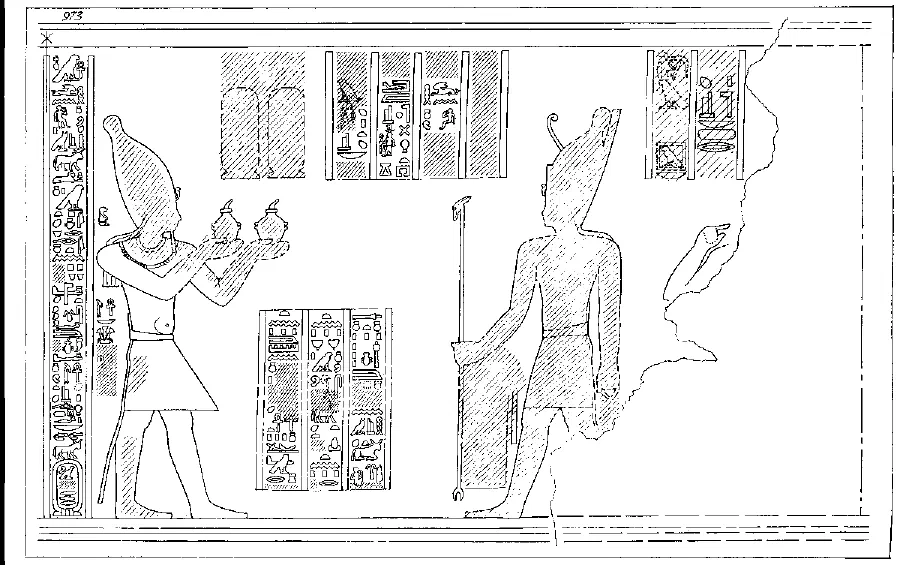
Page 265. The scene as drawn on the wall, facing p. 265 of the edition. Drawing by Otto Baum, in Junker and Winter, Das Geburtshaus des Tempels der Isis in Philä (1965) - 277p. 265, l. 1
mn n-ṯn ḥḏw m np(ḥw) n ḥsꜣ.t
Take for yourselves the milk from the udder of the Hesat cow,
Note · Line 277
The offering is now milk. The king addresses the child Horus in two forms, as the son of Isis and as the son of Hathor. - 278p. 265, l. 2
jmḥ (so)²-ṯn mnḏ.wj n šḫꜣ.t-Ḥrw
and drink from the two breasts of the Sekhathor cow.
- 279p. 265, l. 3
ḏj-ṯn rꜣ-ṯn m mn(ḳ n.t mw.t) Mnw
Put your mouths to the milk of Min’s mother
- 280p. 265, l. 4
ꜥnḫ-ṯn jm m ḥr.t (hrw)
and live on it day after day.
- 281p. 265, l. 5
sꜣ ꜥnḫ wꜣs nb ḥꜣ(-f) mj (Rꜥ ḏ.t)
May all protection, life and dominion surround him as they surround Ra forever.
- 282p. 265, l. 6
(ḏd mdw n) | Ḥrw (pꜣ) ḫrd sꜣ ꜣs.t
Words spoken by Horus the Child, son of Isis,
- 283p. 265, l. 7
nb … prj m Wsjr
lord of …, who came forth from Osiris,
- 284p. 265, l. 8
jtj wr ḥr ns.t … ḥwn …
great king on the throne … youth …
- 285p. 265, l. 9
ḏd mdw n | Ḥrw (pꜣ ḫrd? sꜣ?) Ḥw.t-Ḥrw
Words spoken by Horus the Child, son of Hathor,
- 286p. 265, l. 10
nb … sꜣ Wsjr nb ꜣrk
lord of …, son of Osiris, lord of Philae.
- 287p. 265, l. 11
ꜥnḫ | nṯr nfr ḥwn sꜣ ḥsꜣ.t
Long live the good god, the youth, son of the Hesat cow,
- 288p. 265, l. 12
šsp-ꜥnḫ n Ḥrw jp.t(-jb?)
living image of the Horus of the goddess Ipet-ib.
- 289p. 265, l. 13
rḏj jrṯ.t n pꜥpꜥ (n) mw.t nṯr
He who gives milk to the child the god’s mother bore,
- 290p. 265, l. 14
srwḏ ḥꜥ.w-f m bnr
who makes his limbs grow strong with the sweet milk,
- 291p. 265, l. 15
ḥnk ꜥnḫ-wꜣs n sꜣ ꜣs.t ḥr jrj(.t) ḫr.t-f
who offers milk to the son of Isis and so sustains him:
Note · Line 291
The milk that nourishes the infant Horus is called first “the sweet one,” then “life and dominion.” - 292p. 265, l. 16
nb mnmn.t ꜣw(tḳ)rḏr
the lord of the herds, Autokrator.
A falcon-headed god and Hathor (scene mostly destroyed)
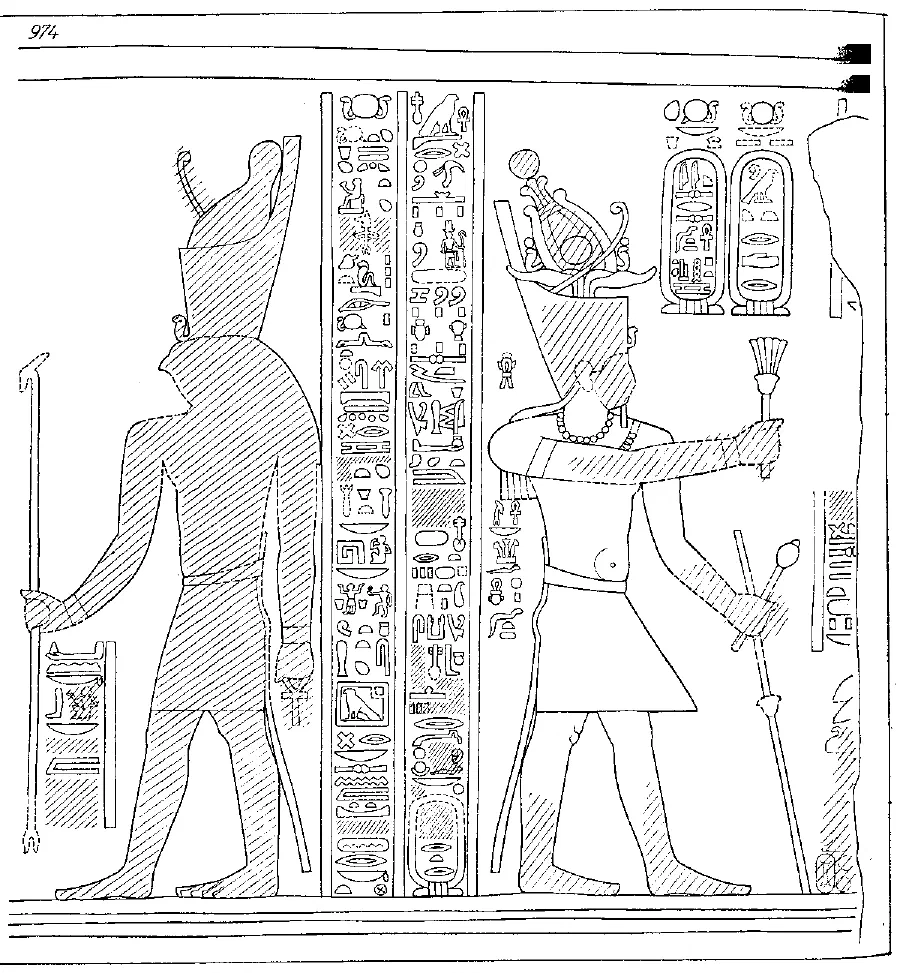
Page 267. The scene as drawn on the wall, facing p. 267 of the edition. Drawing by Otto Baum, in Junker and Winter, Das Geburtshaus des Tempels der Isis in Philä (1965) - 293p. 267, l. 1
ḏj-j n-k bw-nb … m …
I give you all people … in …
- 294p. 267, l. 2
njśwt bjt | Rꜥj.t ḥnw.t tꜣ.wj
King of Upper and Lower Egypt, Raet, mistress of the Two Lands,
Note · Line 294
Raet is the sun goddess, the female counterpart of Ra. Here Hathor bears her name and the title of king. - 295p. 267, l. 3
šps.t wśr(.t) ḫnt nṯr.wt
august and mighty, foremost among the goddesses,
- 296p. 267, l. 4
jr.t Rꜥ jwtj.t śn-nw.t-ś m p.t tꜣ
Eye of Ra, without equal in heaven or on earth,
- 297p. 267, l. 5
?wr(.t) mrw.t ḥnw.t tꜣ.wj
great in love, mistress of the Two Lands,
- 298p. 267, l. 6
nb(.t) hj nb(.t) ḥꜥꜥ jḥj-tw n ḥm.t-ś
lady of jubilation, lady of shouts of joy, for whose majesty music is made,
- 299p. 267, l. 7
Ḥw.t-Ḥrw wr(.t) nb(.t) Śnm.t … ꜣJrk
Hathor the Great, lady of Bigeh, … of Philae.
Augustus gives his mother a food offering
- 300p. 267, l. 8
… jm-ś(?) … (jḫ).t nb.t
… in it … all things.
- 301p. 267, l. 9
njśwt bjt nb tꜣ.wj ꜣwtḳrdr
King of Upper and Lower Egypt, lord of the Two Lands, Autokrator,
- 302p. 267, l. 10
śꜣ Rꜥ nb ḫꜥ.w Ḳjsrs …
son of Ra, lord of crowns, Caesar …
- 303p. 267, l. 11
śꜣ ꜥnḫ wꜣś nb ḥꜣ-f mj Rꜥ ḏ.t
May all protection, life and dominion surround him as they surround Ra, forever.
- 304p. 267, l. 12
ꜥnḫ | nṯr nfr wr ꜣḫ.t
Long live the good god, great in splendor,
- 305p. 267, l. 13
jtj n w.w ḥrj.w jb
sovereign of the central districts,
- 306p. 267, l. 14
śmꜣꜥ ꜥb.t n mw.t-f m (jḫ.t nb.t) nfr.t
who presents his mother with an offering of every good thing,
- 307p. 267, l. 15
drp ṯ.t n kꜣ-ś m (so) bw nfr
who sets good things on the altar for her ka,
- 308p. 267, l. 16
(dj?) ḥtp.w r nw-f(?) rꜥ nb
who gives offerings at his appointed hour every day:
- 309p. 267, l. 17
nb jḫ(.t) (ꜣwtḳ)rtr
the lord of offerings, Autokrator.
Augustus gives Isis wine
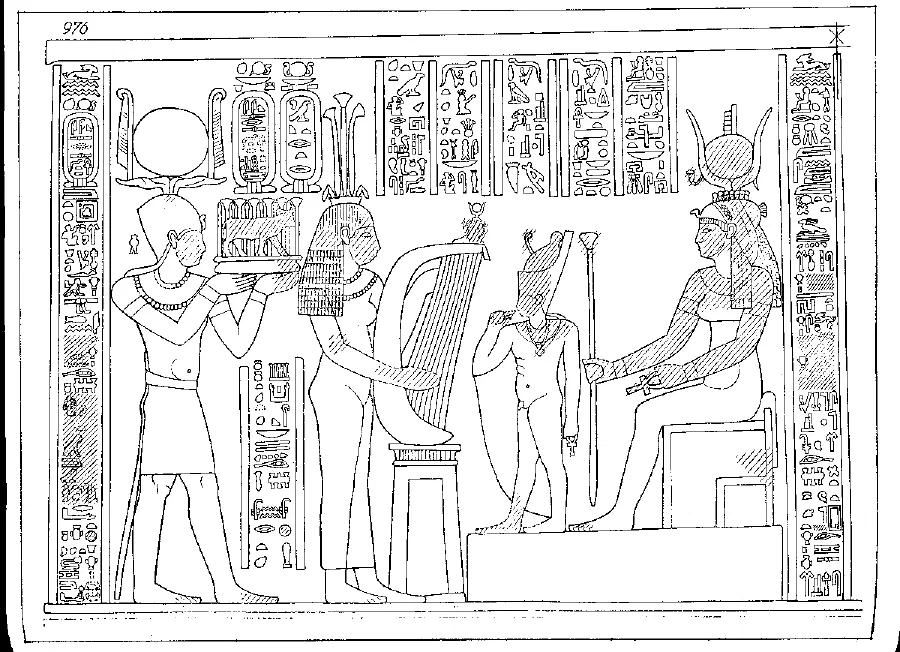
Page 269. The scene as drawn on the wall, facing p. 269 of the edition. Drawing by Otto Baum, in Junker and Winter, Das Geburtshaus des Tempels der Isis in Philä (1965) - 310p. 269, l. 1
šꜣ n kꜣ-t ḥḳꜣ.t nb(.t) tꜣ.wj
Wine for your ka, O sovereign, lady of the Two Lands;
- 311p. 269, l. 2
jr.t-Ḥrw wꜣḏ.t nn ḥr ḥm.t-t
this green Eye of Horus is for Your Majesty.
Note · Line 311
The wine is offered as the Eye of Horus. The eye, injured and made whole again, was an image of wholeness restored. - 312p. 269, l. 3
njśwt bjt nb tꜣ.wj ꜣwtḳrtr
King of Upper and Lower Egypt, lord of the Two Lands, Autokrator,
- 313p. 269, l. 4
sꜣ Rꜥ nb ḫꜥ.w Kjsrs ... sꜣ
son of Ra, lord of crowns, Caesar … Protection.
- 314p. 269, l. 5
ḏd mdw n | Mr.t mḥw ḥnw.t ḥtj.t
Words spoken by Meret of Lower Egypt, mistress of the throat,
Note · Line 314
Meret personifies the singing that accompanies temple rites. - 315p. 269, l. 6
nb(.t) ḥś.t ḥnw.t tjꜣ²
lady of singing, mistress of song.
- 316p. 269, l. 7
ḥrw-jb nṯr.w nṯr.wt ḥr nḏb ḏd.w-ś
The gods and goddesses rejoice when they hear her words.
- 317p. 269, l. 8
ḏd mdw n | Ḥrw pꜣ ḫrd sꜣ Jś.t sꜣ Wśjr bnr mrw.t
Words spoken by Horus the Child, son of Isis, son of Osiris, sweet in love.
- 318p. 269, l. 9
ḏd mdw n | Jś.t dj(.t) ꜥnḫ nb.t jꜣ.t wꜥb.t
Words spoken by Isis, giver of life, lady of the Pure Mound.
Note · Line 318
Its Greek name was the Abaton, the place not to be entered. - 319p. 269, l. 10
ḥnw.t nb(.t) Jrḳ špś(.t) nfr(.t)
Sovereign, lady of Philae, august and beautiful,
Note · Line 319
The goddess addressed here is Isis. - 320p. 269, l. 11
ḥnw.t m Ḫnt-ḥn-nfr
sovereign in Lower Nubia,
- 321p. 269, l. 12
mw.t nṯr nb(.t) prj-mśj.t
mother of the god, lady of the birth house.
- 322p. 269, l. 13
wnn sꜣ Rꜥ Kjsrs ꜥnḫ ḏ.t m ḥw.t-ḥnt
The son of Ra, Caesar, who lives forever, is in Philae
Note · Line 322
Caesar appears here in the Egyptian king’s ritual role, serving the goddess. - 323p. 269, l. 14
m wdpw nfr n ḥnw.t-f
as his sovereign’s good cupbearer,
- 324p. 269, l. 15
ḥr ms jn(m).t (n mw.t-f?)
bringing wine to his mother,
- 325p. 269, l. 16
ḥr rḏj(.t) jr.t-Ḥrw ...
giving the Eye of Horus …
Note · Line 325
The eye that Horus lost and regained was an emblem of wholeness restored. A gift presented to a god could itself be called the Eye of Horus. - 326p. 269, l. 17
(św) ...
He is …
- 327p. 269, l. 18
(ḥr?) rḏj(.t) tḫ n ḥnw.t-f
giving his sovereign an intoxicating draught,
- 328p. 269, l. 19
ḥr wḏn ḫpr(.t) m ḥr.t hrw
offering what comes into being for the needs of the day.
- 329p. 269, l. 20
wnn špś.t wśr.t wbn.tj m Śnm.t
The august one, the mighty one, shines on Bigeh
- 330p. 269, l. 21
m Rꜥj.t wr.t bꜥḥ(.t) tꜣ.wj m nfrw-ś
as the great sun goddess who floods the Two Lands with her beauty,
- 331p. 269, l. 22
ḥr ... Tꜣ-mrj ḥr śwnf ...
… Egypt and gladdening …
- 332p. 269, l. 23
ḥr(?) ... n śn-ś Wśjr
… for her brother Osiris.
- 333p. 269, l. 24
śj m jr.t-Ḥrw wr.t ḫꜥj.tj ḫnt ḥw.t-nṯr
She is the great Eye of Horus, appearing in glory within the temple,
- 334p. 269, l. 25
ḥr jrj(.t) mr(r.t) jb-ś m ś.t jb(b.t)-ś
doing what her heart loves in the place she loves.
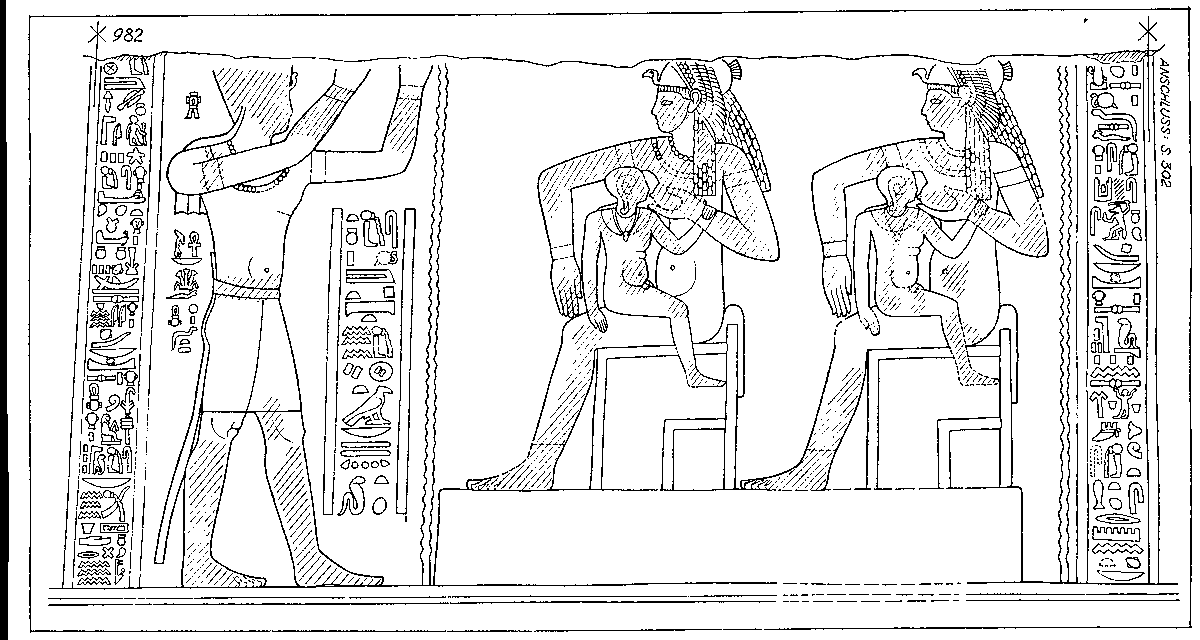
Augustus gives the nursing Hathor beer
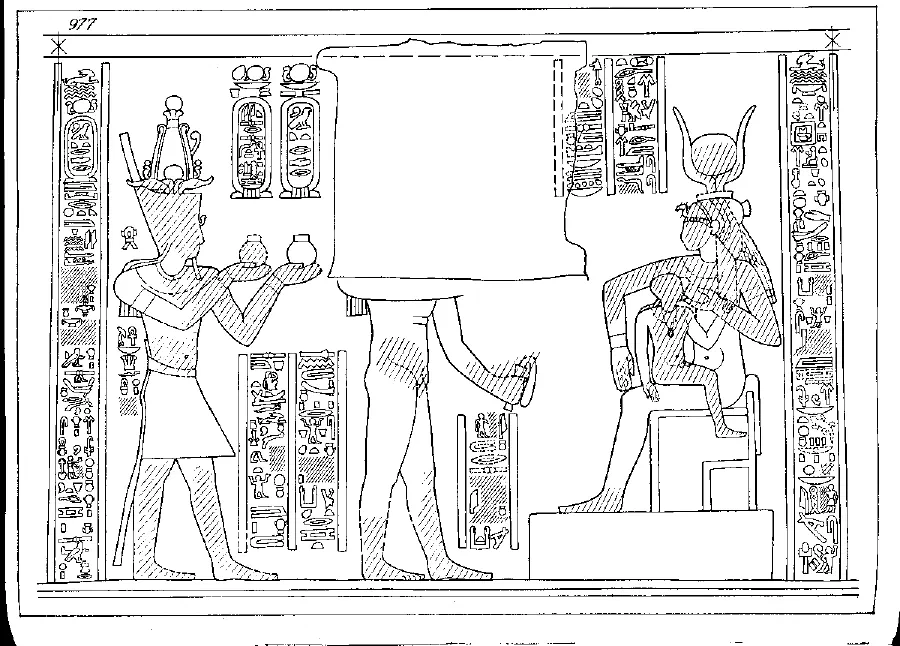
Page 271. The scene as drawn on the wall, facing p. 271 of the edition. Drawing by Otto Baum, in Junker and Winter, Das Geburtshaus des Tempels der Isis in Philä (1965) - 335p. 271, l. 1
mn n-ṯ ḏsr r šḥꜥꜥ jb-ṯ
Take the Glorious One for yourself, to gladden your heart;
Note · Line 335
The Glorious One is the beer the king offers Isis. - 336p. 271, l. 2
… n kꜣ-ṯ r mr(r.t)-ṯ
… for your ka, as you desire.
- 337p. 271, l. 3
šꜥm-ṯ jm-f wnf … šn(?)
Drink of it, that … brother may rejoice.
- 338p. 271, l. 4
… ḥn m ḥr-ṯ
… making music before you.
- 339p. 271, l. 5
njśwt bjt nb tꜣ.wj ꜣwtḳrdr
King of Upper and Lower Egypt, lord of the Two Lands, Autokrator,
- 340p. 271, l. 6
sꜣ Rꜥ nb ḫꜥ.w Ḳjsrs …
son of Ra, lord of crowns, Caesar …
- 341p. 271, l. 7
sꜣ ꜥnḫ wꜣs nb ḥꜣ-f mj Rꜥ (ḏ.t)
May all protection, life and dominion surround him as they surround Ra forever.
- 342p. 271, l. 8
jḥj-j n-ṯ r ś …
I play for you to gladden …
- 343p. 271, l. 9
… mr(r.t) kꜣ-ṯ
… what your ka loves.
- 344p. 271, l. 10
… wśr.t m Śnm.t nb(.t) tꜣ.wj nb(.t) t
… mighty one on Bigeh, lady of the Two Lands, lady of bread,
- 345p. 271, l. 11
jrj(.t) ḥḳ.t m ḳmꜣ-n jb-ś
who brews beer from what her heart conceived,
- 346p. 271, l. 12
m jrj(.t) m ꜥ.wj-ś ḏ(ś)-ś
from what she made with her own two hands.
- 347p. 271, l. 13
wnn njśwt bjt ꜣwtḳrdr m Jrḳ
The King of Upper and Lower Egypt, Autokrator, is in Philae,
- 348p. 271, l. 14
m tꜥj ꜥ.wj … ḥr … n nb …
with both hands washed … as he … for the Golden One …
- 349p. 271, l. 15
ḥr ms ḏsr r nw-f m ḥr-ś
bringing the Glorious before her face at its appointed time.
Note · Line 349
“The Glorious” is the beer offered to the goddess. - 350p. 271, l. 16
św mj ḥnw nfr n ḥnw.t-f
He is like his lady’s fine musician,
- 351p. 271, l. 17
ḥr jrj(.t) mr(r.t) jb-ś m ḥr.t hrw
doing day after day what her heart loves.
- 352p. 271, l. 18
wnn nb ḫꜥj.tj m ḥw.t-wtt
The Golden One shines forth in the birth house
Note · Line 352
The Golden One is a title of Hathor. - 353p. 271, l. 19
m šps.t nfr(.t) ḥnw.t tḫ(.t)
as the noble one, the beautiful one, sovereign of drunkenness,
- 354p. 271, l. 20
ḥr šsp ḏsr ḥr jrj(.t) mr(r.t) kꜣ(-ś)
receiving the Glorious and doing what her ka loves,
Note · Line 354
Offerings are made to it. - 355p. 271, l. 21
ḥr šḥꜥꜥ … m mr(r.t)-ś
gladdening … with what she loves.
- 356p. 271, l. 22
śj m nb(.t) tḫ(.t) ꜥšꜣ(.t) ḥb.w
She is the lady of drunkenness, rich in festivals,
- 357p. 271, l. 23
… nb(.t) jḥj mrj-ś jbꜣ
… the lady of music. She loves the dance.
Augustus gives Horus the two crowns
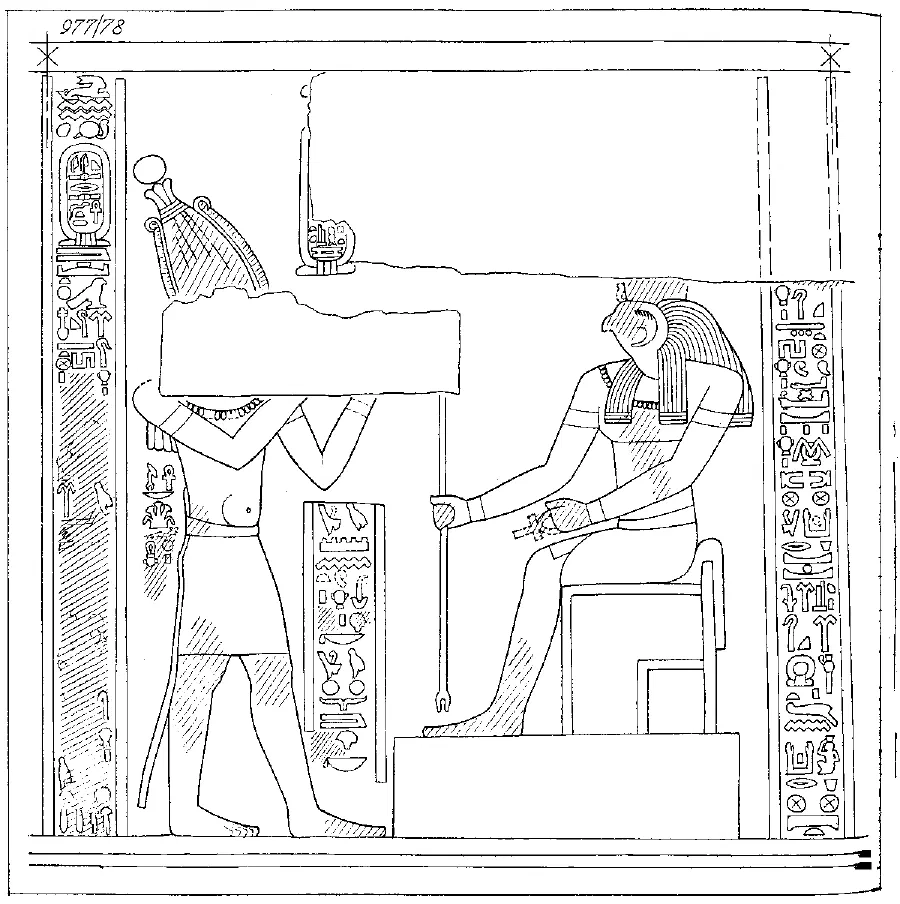
Page 273. The scene as drawn on the wall, facing p. 273 of the edition. Drawing by Otto Baum, in Junker and Winter, Das Geburtshaus des Tempels der Isis in Philä (1965) - 358p. 273, l. 1
ḥḏ.t dšr.t mn.tj ḥr tp-k
The White Crown and the Red Crown rest on your head;
Note · Line 358
The White Crown belongs to Upper Egypt in the south, the Red Crown to Lower Egypt in the north. - 359p. 273, l. 2
šmꜥ mḥ dmḏ m ḥꜣ.t-k
the southern crown and the northern crown are joined at your brow.
- 360p. 273, l. 3
… mrj Ptḥ ꜣJs.t
… beloved of Ptah and Isis.
Note · Line 360
The ruler is the Roman emperor Augustus, named here as a pharaoh. - 361p. 273, l. 4
(sꜣ) ꜥnḫ wꜣs nb ḥꜣ-f mj Rꜥ (ḏ.t)
May protection and all life and dominion surround him as they surround Ra, forever.
- 362p. 273, l. 5
wnn sꜣ Rꜥ Kjsrs ꜥnḫ ḏ.t m jꜣ.t Ḥrw
The son of Ra, Caesar, living forever, holds the office of Horus
Note · Line 362
The reigning pharaoh holds the kingship of Horus. - 363p. 273, l. 6
m ḥḳꜣ nfr ḥḳꜣ Tꜣ-mrj
as a good ruler ruling Egypt,
- 364p. 273, l. 7
ḥr … ḥḏ.t m …
… the White Crown in …
- 365p. 273, l. 8
św … ḫp.tj¹
He is … the two crowns.
- 366p. 273, l. 9
(wnn Ḥrw?) … ḥr ḥḳꜣ Tꜣ-mrj
Horus … rules Egypt,
- 367p. 273, l. 10
ḥr wꜥf ḫꜣs.wt
subduing the foreign lands,
- 368p. 273, l. 11
ḥr dmḏ pšs.tj n kꜣ-f r-ꜥ nḥḥ
uniting the two halves of the realm for his ka for all time.
- 369p. 273, l. 12
św m sꜣ ꜣJs.t ḥḳꜣ m šnw
He is the son of Isis, ruler of the whole circle of the earth.
- 370p. 273, l. 13
wḏ.t-n kꜣ-f r-ꜥ nn.t
What his ka has decreed reaches the sky.
Augustus gives the wṯṯ to the nursing goddess
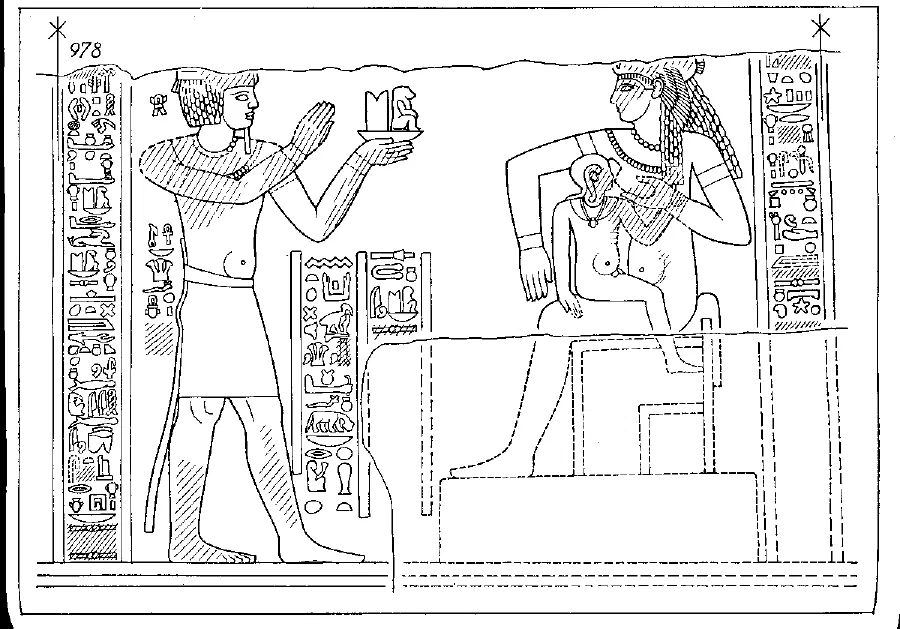
Page 275. The scene as drawn on the wall, facing p. 275 of the edition. Drawing by Otto Baum, in Junker and Winter, Das Geburtshaus des Tempels der Isis in Philä (1965) - 371p. 275, l. 1
mn n-ṯ wṯṯ¹ r s …
Take the wṯṯ for yourself, to …
Note · Line 371
The goddess is being addressed directly as the offering is presented. - 372p. 275, l. 2
… n kꜣ-ṯ
… for your ka.
- 373p. 275, l. 3
Ḏḥwtj wr ?wꜣḥ-f ḥꜣ-f
Thoth the Great abides behind him.
- 374p. 275, l. 4
dr-n-f ḳnd nb ḥr ḥm.t-ṯ
He has driven all anger from Your Majesty.
- 375p. 275, l. 5
sꜣ ꜥnḫ wꜣs nb ḥꜣ-f mj Rꜥ (ḏ.t)
May protection and all life and dominion surround him as they surround Ra, forever.
- 376p. 275, l. 6
(wnn njśwt bjt o. ä.) … m … ḥpt ꜣḫ.t n mw.t-f
The King of Upper and Lower Egypt … as … takes hold of what is glorious for his mother,
- 377p. 275, l. 7
ḥr ḥnk wṯṯ ḥr rdj(.t) wnš(b)⁴
offering the wṯṯ and giving the wnšb,
- 378p. 275, l. 8
ḥr śḥtp wr.t m-ḫt ḳnd
soothing the Great One after her anger.
- 379p. 275, l. 9
św sꜣ n mḥj mḥ wḏꜣ.t r ś.t-ś
He is the son of the Filler, who fills the Eye of Horus in its place
Note · Line 379
The Filler is Thoth. The waxing moon is the wounded Eye of Horus filling out again until it is whole. - 380p. 275, l. 10
ḥr ḥrw-jb nb(.t?) s … s
and gladdens the heart of the Lady …
- 381p. 275, l. 11
… (ḥḳꜣ.t?) ḥnw.t nṯr.w nb.w
… the sovereign, mistress of all the gods.
- 382p. 275, l. 12
ḥr … ḥr śḥḏ tꜣ pn
She … and lights this land,
- 383p. 275, l. 13
wḏj⁶ śšp m(-ḫt) śnk.t …
shedding light after darkness …
Augustus praises Harpocrates
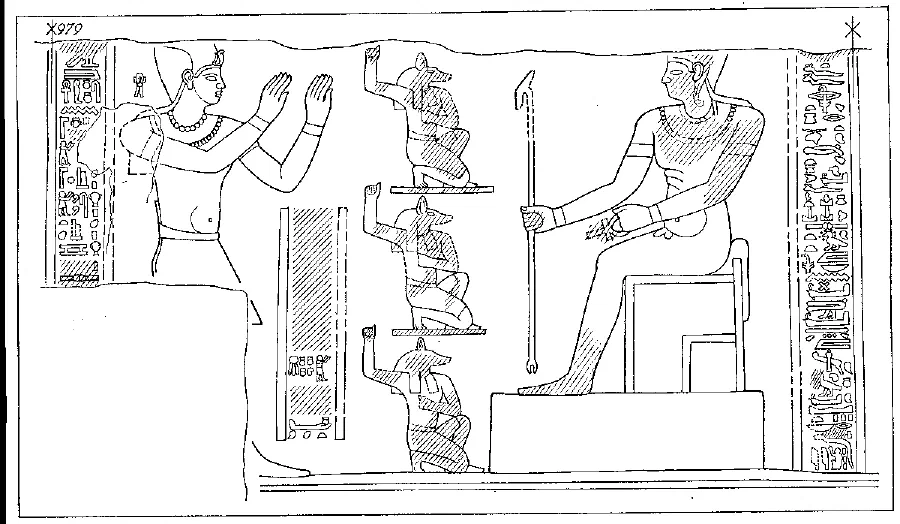
Page 277. The scene as drawn on the wall, facing p. 277 of the edition. Drawing by Otto Baum, in Junker and Winter, Das Geburtshaus des Tempels der Isis in Philä (1965) - 384p. 277, l. 1
… dwꜣ n-k wbn … mw.t-f
… praise to you as you rise … his mother.
- 385p. 277, l. 2
(wnn) … Ḥrw m snn ꜥnḫ n Jp-jb
The king … is in the place of Horus as a living likeness of the Discerning One,
Note · Line 385
The Discerning One is Thoth, god of wisdom and writing. - 386p. 277, l. 3
… dwꜣ sꜣ Wsjr
… praising the son of Osiris,
- 387p. 277, l. 4
ḥr šwꜣš sꜣ Js.t ḥr mr …
acclaiming the son of Isis and loving …
Note · Line 387
The son praised by both his parents’ names is Horus. - 388p. 277, l. 5
(wnn Ḥrw) … jt-f
Horus … is on his father’s throne.
- 389p. 277, l. 6
rsj ḥr šfj.t-f mḥ.tj ḥr nrw-f
The south stands in awe of him, the north in dread of him;
- 390p. 277, l. 7
jmn.t jꜣb.t ḥr sdꜣdꜣ-f
west and east tremble before him.
- 391p. 277, l. 8
šw m nb nḫt jtṯ tꜣ m wḏ.t-f
He is the lord of might, who conquered the land by his command.
- 392p. 277, l. 9
bꜣk-n-f ḫꜣs.wt nb.wt r (n)ḏ.t
He made all foreign lands his subjects.
Augustus gives Harpocrates the deed of succession
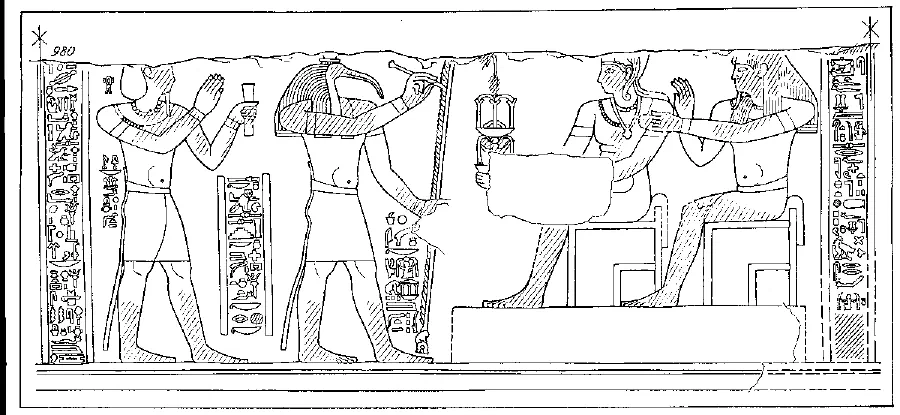
Page 279. The scene as drawn on the wall, facing p. 279 of the edition. Drawing by Otto Baum, in Junker and Winter, Das Geburtshaus des Tempels der Isis in Philä (1965) - 393p. 279, l. 1
mn n-k mkš
Receive the deed of succession.
Note · Line 393
The deed confirms the son’s right to inherit the throne. - 394p. 279, l. 2
šꜥr-j n-k jmj.t-prj
I bring you the will.
- 395p. 279, l. 3
jꜣw.t n.t jt-k ḫr-k
Your father’s office is yours.
- 396p. 279, l. 4
sꜣ ꜥnḫ wꜣš nb ḥꜣ-f mj Rꜥ ḏ.t
May all protection, life and good fortune surround him as they surround Ra forever.
- 397p. 279, l. 5
(n)ḥḥ-j n-k ḥḥ(.w) n ḥb.w-sd
I allot you millions of Sed festivals,
- 398p. 279, l. 6
ḥfn.w m rnp.wt ḏ.t
hundreds of thousands of years, forever.
- 399p. 279, l. 7
(wnn ... ḥr) ś.t(-f)
The king … sits on his throne
- 400p. 279, l. 8
m jwꜥw mnḫ n ꜥm-tꜣ.wj
as worthy heir to him whose mind grasps the Two Lands,
Note · Line 400
The title names Thoth. - 401p. 279, l. 9
ḥr ḥnk mkš ḥr ꜥmm jmj.t-prj
presenting the deed of succession and grasping the will,
- 402p. 279, l. 10
ḥr rdj(.t) jꜣw.t n sꜣ Wśjr
granting the office to the son of Osiris.
- 403p. 279, l. 11
św m nb jꜣw.t ḥr nś.t wṯṯ św
He is lord of the office, on the throne of the one who begot him,
- 404p. 279, l. 12
ḥr śnḏm jb n jt-f m mr(r.t)-f
gladdening his father’s heart with what he loves.
- 405p. 279, l. 13
(wnn) ... nbj św jt-f Tnn m ḥḳꜣ
… His father Tenen fashioned him as a ruler.
- 406p. 279, l. 14
ṯnj-f św r tr-f jmj.wtj pśḏ.t
When his time came, he raised him up among the Ennead.
- 407p. 279, l. 15
ḫpr rn-f pw n Tnn
That is how he came by his name of Tenen.
Note · Line 407
The Egyptian word for “raised” echoes the name Tenen: the act of raising the son gives him his father’s name. - 408p. 279, l. 16
Ḏḥwtj wr śšḫr ḥḥ(w) n (ḥb.w-sd) ...
Thoth the Great records millions of Sed festivals …
Augustus gives the goddess the wedjat-eye
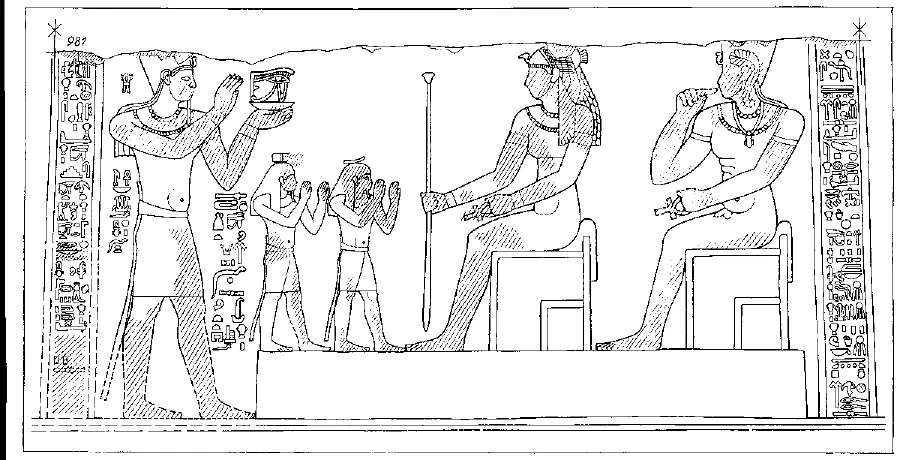
Page 281. The scene as drawn on the wall, facing p. 281 of the edition. Drawing by Otto Baum, in Junker and Winter, Das Geburtshaus des Tempels der Isis in Philä (1965) - 409p. 281, l. 1
mn n-ṯ wḏꜣ.t ꜥpr.tj m dbḥ.w(-ś)
Take for yourself the wedjat-eye, complete in all its parts.
Note · Line 409
The wedjat is the eye of Horus, injured in his struggle with Seth and made whole again. Its name means “the sound one.” - 410p. 281, l. 2
ḏ.t-ś mn.tj ḥr ś.t-f²
Its pupil rests in its place.
- 411p. 281, l. 3
sꜣ ꜥnḫ wꜣś nb ḥꜣ-f mj Rꜥ ḏ.t
May all protection, life and dominion surround him as they surround Ra, forever.
- 412p. 281, l. 4
(wnn) ... m wꜥb(?) jḫ.t
… serves as priest of the sacred eye,
- 413p. 281, l. 5
ḥr šms ḥm.t-ś ḥr ḥnk wḏꜣ.t
attending Her Majesty and presenting the wedjat-eye,
- 414p. 281, l. 6
ḥr śꜥr jḫ.t ḥr twꜣ³ nṯr(.t) ḥr nb(.t)-ś
bringing the sacred eye and lifting the divine eye to its mistress.
- 415p. 281, l. 7
św mj ḥśb-jnw ḥr gśgś ... s ...
He is like the Reckoner of Tribute, setting … in order …
Note · Line 415
The Reckoner is Thoth, the god of reckoning, who restored the eye of Horus. - 416p. 281, l. 8
(wnn) ... wr.t śḥḏ tꜣ.wj m śtw.t-ś
… the Great One who lights the Two Lands with her rays,
- 417p. 281, l. 9
ḥr rḏj(.t) śšp ḥr ḫśr kkw
giving light and driving back the dark,
- 418p. 281, l. 10
ḥr bḏ bꜣḳ.t m nfrw-ś
lighting up Egypt with her beauty.
- 419p. 281, l. 11
śj m nb(.t) ḥḏḏw.t ḥr ḥꜣj ḥr.w
She is the Lady of Radiance, brightening faces,
- 420p. 281, l. 12
wbg tꜣ pn m jḫ.tj-ś
lighting this land with her two eyes.
Note · Line 420
The two divine eyes are the sun and the moon. Augustus pours water before two nursing goddesses
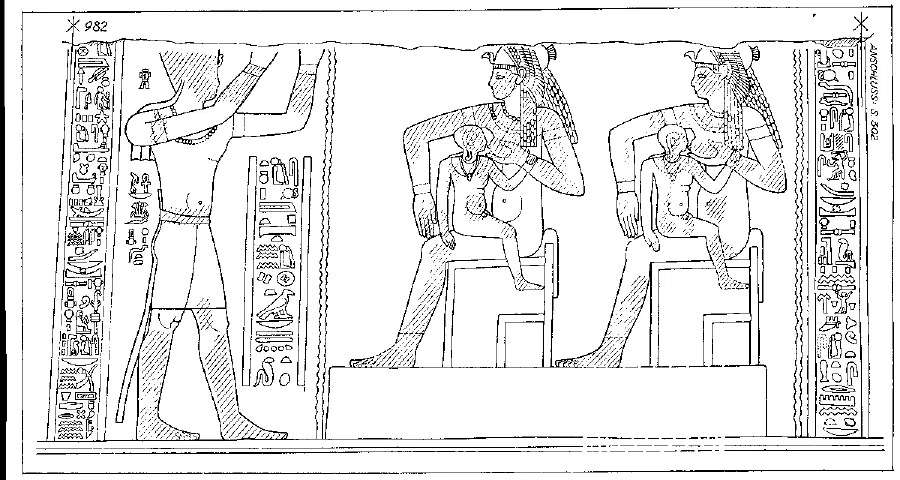
Page 283. The scene as drawn on the wall, facing p. 283 of the edition. Drawing by Otto Baum, in Junker and Winter, Das Geburtshaus des Tempels der Isis in Philä (1965) - 421p. 283, l. 1
śwꜥb ṯn (?) Rꜥ m p.t
Ra in the sky purifies you.
- 422p. 283, l. 2
wꜥb (sp śn) tꜣ nb.t tꜣ.wj
Pure, pure, O Lady of the Two Lands!
- 423p. 283, l. 3
(wnn) … (tꜣ.t) wꜥb.t m jwꜥw mnḫ n śr nṯr.w
… in the Abaton as worthy heir to the Prince of the Gods,
Note · Line 423
Entry was restricted. - 424p. 283, l. 4
ḥr śwꜥb mw.t-f ḥr dr šnn jm-s
purifying his mother and driving out the grief within her,
- 425p. 283, l. 5
ḥr jṯj ꜥb nb ḏw ḥr-s
washing away every foul stain on her.
- 426p. 283, l. 6
św mj Ḏd-šps ḥr śwꜥb nṯr.w nṯr.wt
He is like the sacred Djed pillar, purifying the gods and goddesses,
Note · Line 426
The Djed, a pillar with crossbars at the top, is an emblem of stability associated with Osiris. - 427p. 283, l. 7
nb ꜥbw šꜣꜥ-n-f twr
lord of cleansing, the first to cleanse.
- 428p. 283, l. 8
(wnn) … (ś)wḏꜣ sꜣ-s
… keeps her son safe and sound.
- 429p. 283, l. 9
Rꜥ ḏś-f ḥr śwꜥb kꜣ-s
Ra himself purifies her ka;
- 430p. 283, l. 10
śḥrj-n-f ꜥb nb ḏw ḥr-s
he has removed every foul stain from her.
- 431p. 283, l. 11
nṯr.w nṯr.wt n-s m ḥꜥꜥ
The gods and goddesses rejoice for her sake
- 432p. 283, l. 12
ḏr śwꜥb-tw ḥm.t-s r mn.t nb.t
when Her Majesty is cleansed of every illness.
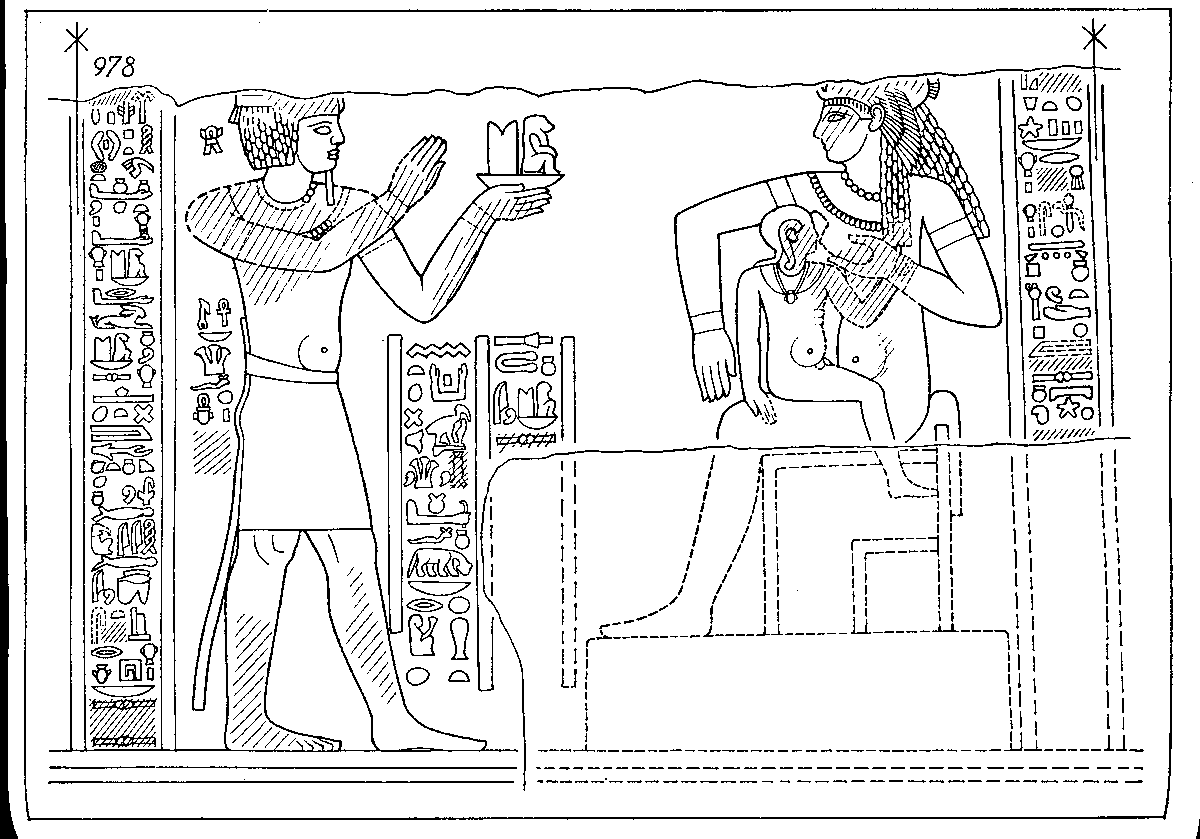
Augustus opens the shrine of the nursing Isis and shows Harpocrates to the rejoicing people
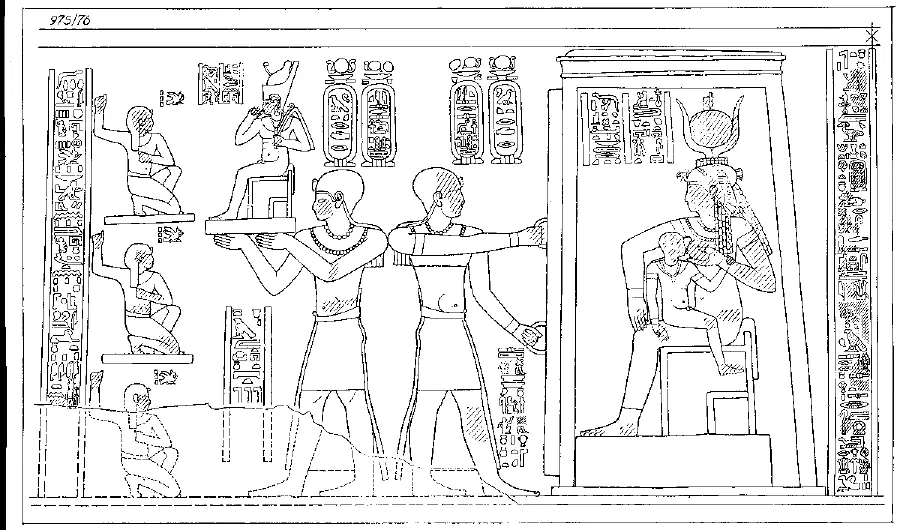
Page 285. The scene as drawn on the wall, facing p. 285 of the edition. Drawing by Otto Baum, in Junker and Winter, Das Geburtshaus des Tempels der Isis in Philä (1965) - 433p. 285, l. 1
ḫꜥj Ḥrw m ꜣḫ.t n.t p.t
Horus rises in splendor from the horizon of heaven;
- 434p. 285, l. 2
nṯr.w …
the gods …
- 435p. 285, l. 3
njśwt bjt nb tꜣ.wj ꜣwtḳrdr
King of Upper and Lower Egypt, Lord of the Two Lands, Autokrator.
Note · Line 435
Here the Roman emperor bears the titles of an Egyptian king. - 436p. 285, l. 4
sꜣ Rꜥ nb ḫꜥ.w Ḳjsrs …
Son of Ra, Lord of Crowns, Caesar …
- 437p. 285, l. 5
ḏd mdw n | Ḥrw pꜣ ḫrd sꜣ ꜥIś.t
Words spoken by Horus the Child, son of Isis,
- 438p. 285, l. 6
jwꜥw mnḫ n Wśjr
worthy heir to Osiris.
- 439p. 285, l. 7
rḫj.t
The people.
Note · Line 439
The Egyptian word for the people, rekhyt, is written with a lapwing. In temple art, lapwings with raised arms stand for the people in worship. - 440p. 285, l. 8
ḏd mdw jgr (sp fdw) hnw (sp fdw)
Words to recite: Be still! (Four times.) Rejoice! (Four times.)
- 441p. 285, l. 9
rḫj.t nb.t mj.n m hnw
All you people, come rejoicing
- 442p. 285, l. 10
mꜣꜣ-ṯn sꜣ Wśjr jw-f m nb-ṯn
that you may see the son of Osiris as your lord,
- 443p. 285, l. 11
jtj-ṯn …
your king …
- 444p. 285, l. 12
sš-j ꜥꜣ.wj n sḫm šps
I open the double doors of the august image.
Note · Line 444
The word for the sacred image also means “power”: the image embodies the goddess’s power. - 445p. 285, l. 13
(wn?)-j ḥr n nṯr.t tn
I unveil the face of this goddess.
- 446p. 285, l. 14
ḏd mdw n | ꜥIś.t wr.t mw.t nṯr nb(.t) ꜥIrk
Words spoken by Isis the Great, mother of the god, lady of Philae,
- 447p. 285, l. 15
šps.t nfr.t ḥnw.t prj-msj.t
noble and beautiful, mistress of the birth house.
- 448p. 285, l. 16
nṯr.t tn šps.t wsḫ.t ḥnw.t m tꜣ²
This goddess, noble and mighty, sovereign on earth,
- 449p. 285, l. 17
ḥm.t sn.t tpj.t n(.t) Wnn nfrw mꜣꜥ ḫrw
wife and foremost sister of Wennefer, the vindicated one.
Note · Line 449
As one vindicated before the divine tribunal, he bears the title “true of voice.” - 450p. 285, l. 18
jwr-s ḥm³ trj-s ś.t-s m ꜣḫbjt(?)
She conceived and took her place in Chemmis,
- 451p. 285, l. 19
… ḥr … Ḥrw-s(?)
… her Horus,
- 452p. 285, l. 20
rr-n-s ḥr (mn.tj?)-s r ḥḳꜣ m šnw
whom she reared on her thighs to rule the whole circle of the earth,
- 453p. 285, l. 21
prj r ḥr-tp ḥꜣ m rḫj.t
who comes forth to watch over the people.