~/sacred-texts/birth-house-of-the-temple-of-isis-at-philae
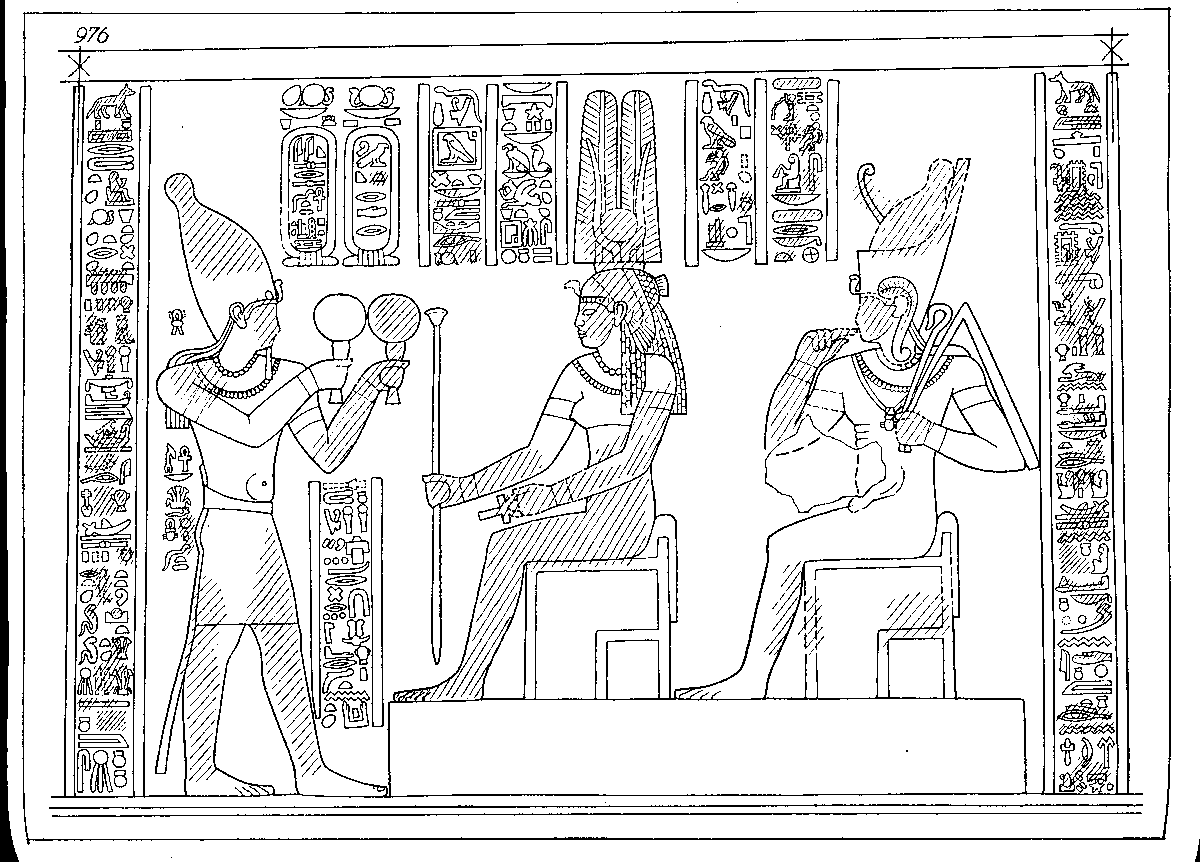
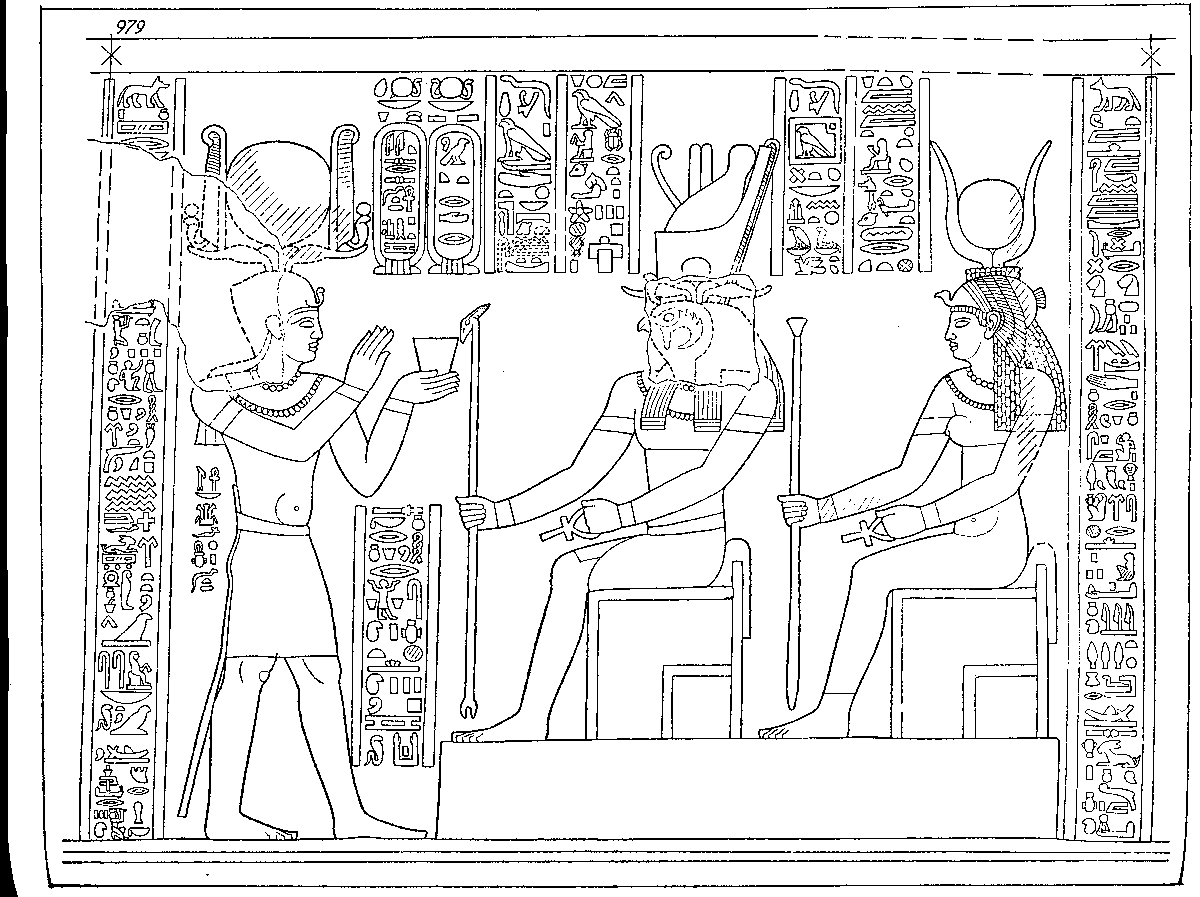
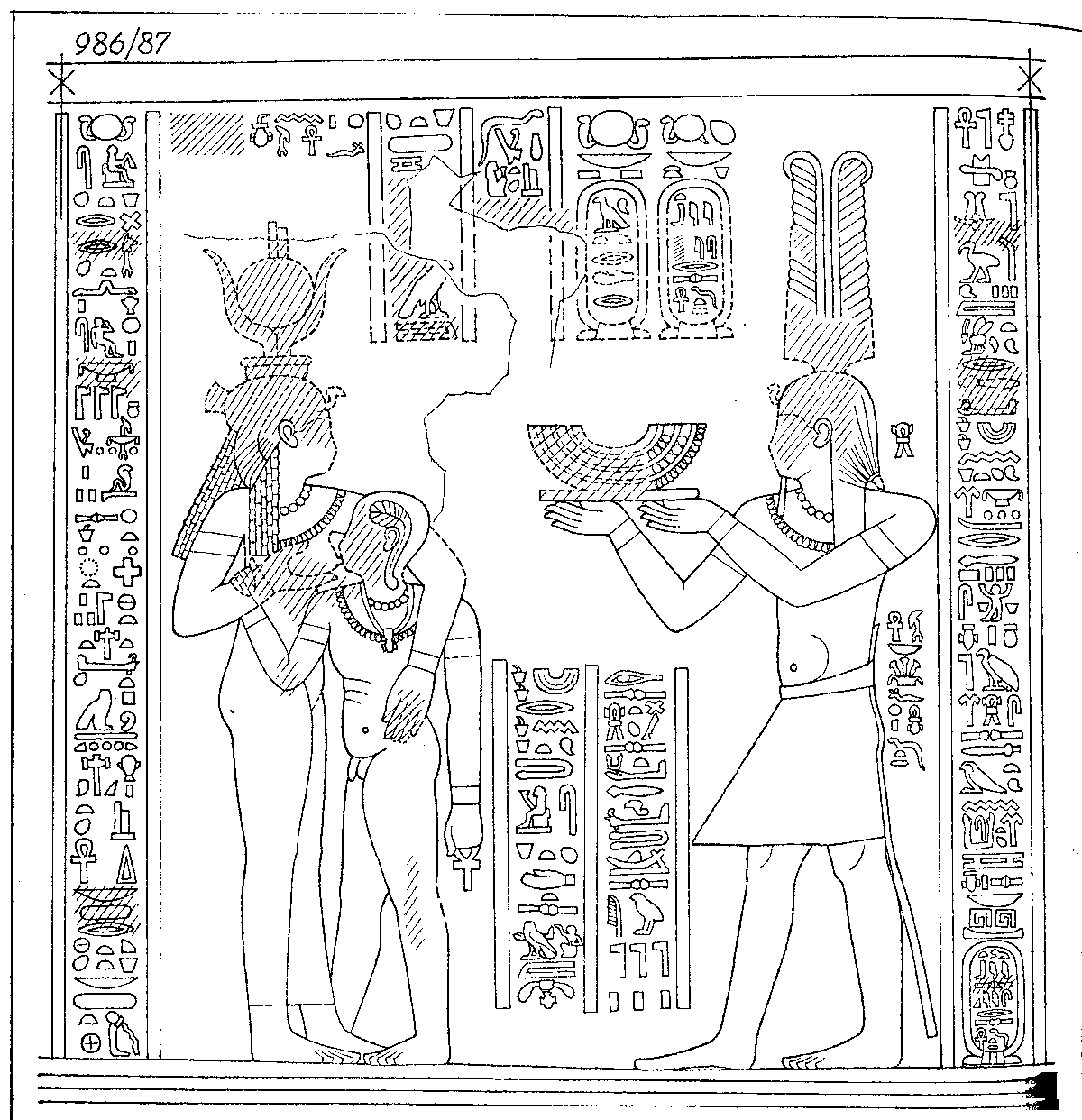
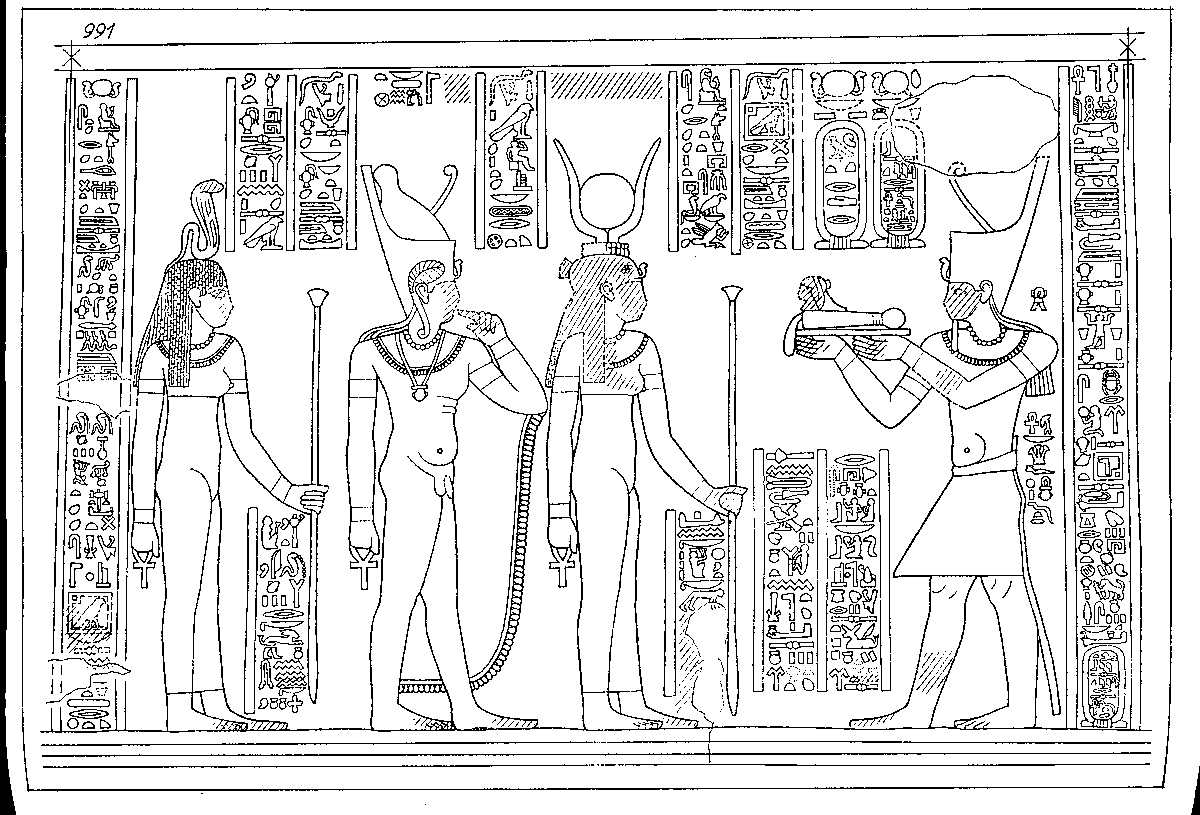
Philae Birth House, Augustus and Tiberius: Seth’s Two Testicles
- Date
- Carved under Augustus (30 BC–AD 14) and Tiberius (AD 14–37) on the outer walls of the birth house of the Isis temple at Philae
- Found
- Carved on the birth house of the Isis temple on Philae island, south of Aswan; the whole temple was moved stone by stone to nearby Agilkia island in 1972–80, where it stands today
- Language
- Egyptian · Hieroglyphic
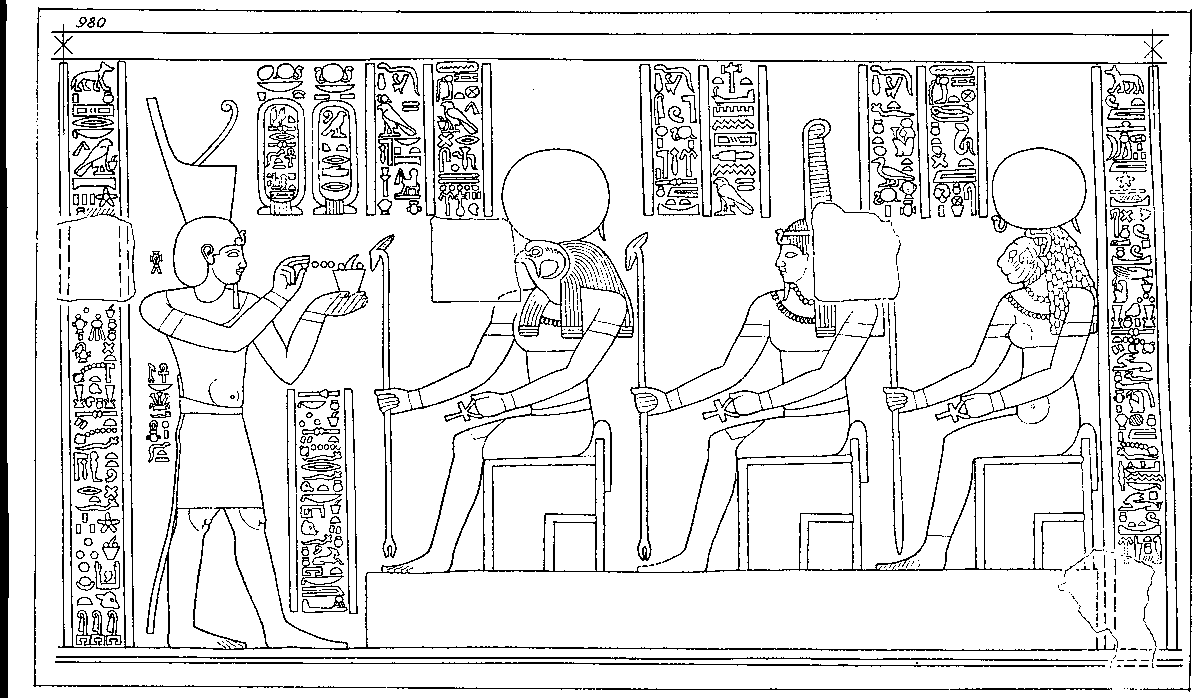
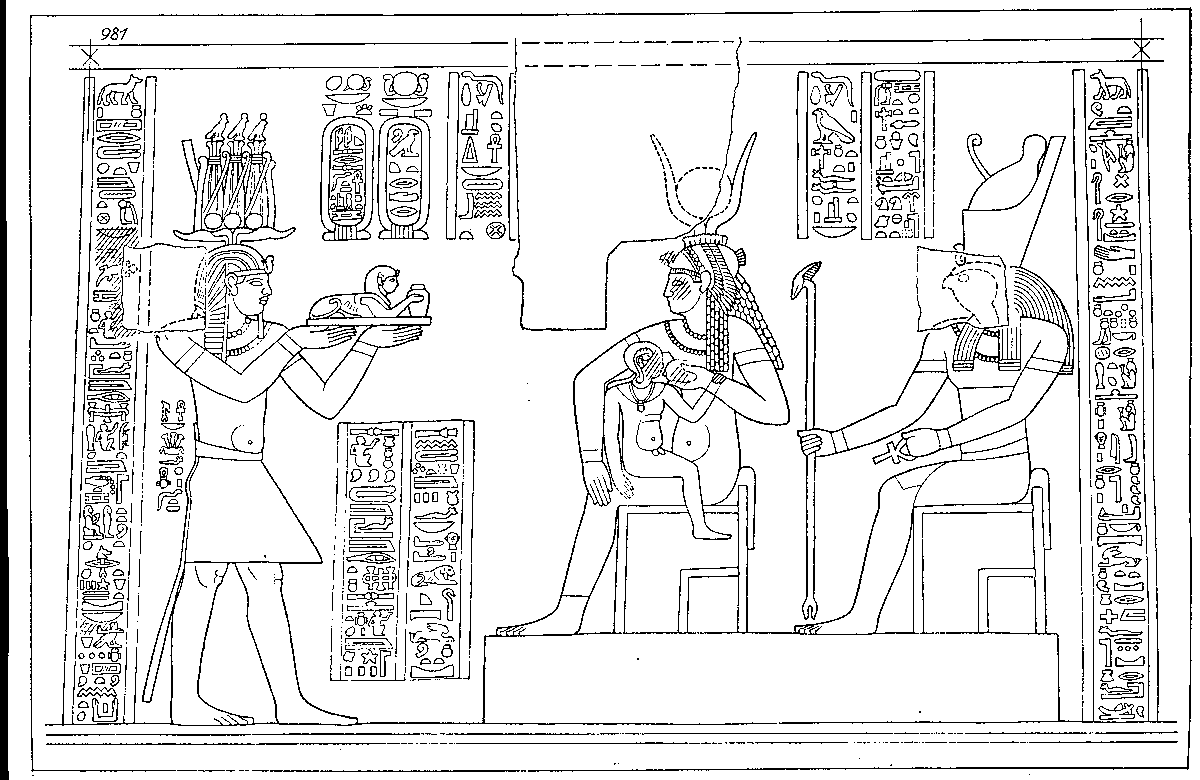
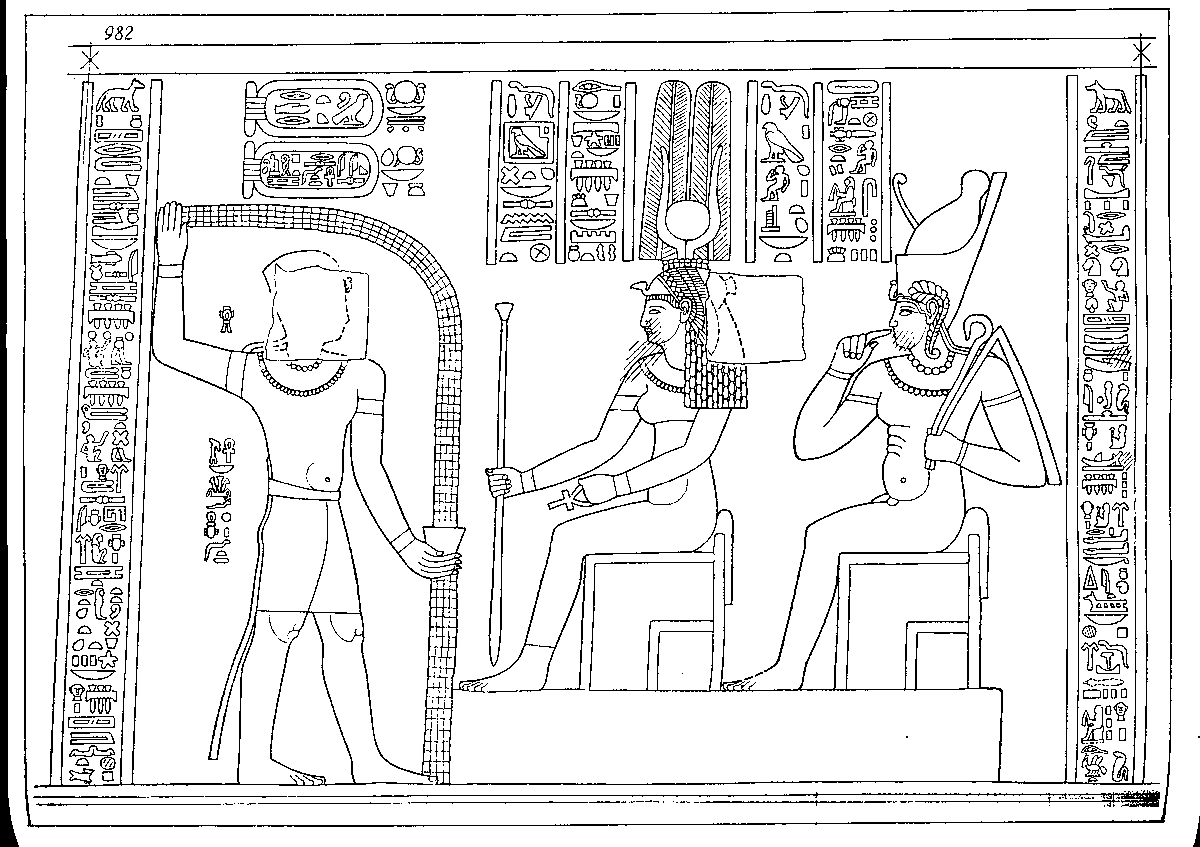
On the outer walls of the birth house, Augustus and Tiberius stand as pharaoh before the gods of Philae. Each scene is an exchange: the king speaks and hands over mirrors, myrrh, milk, crowns or Nile water, and the god answers and pays him back with Punt, the oases or Egypt itself. Isis settles in the house and brings her son into the world.
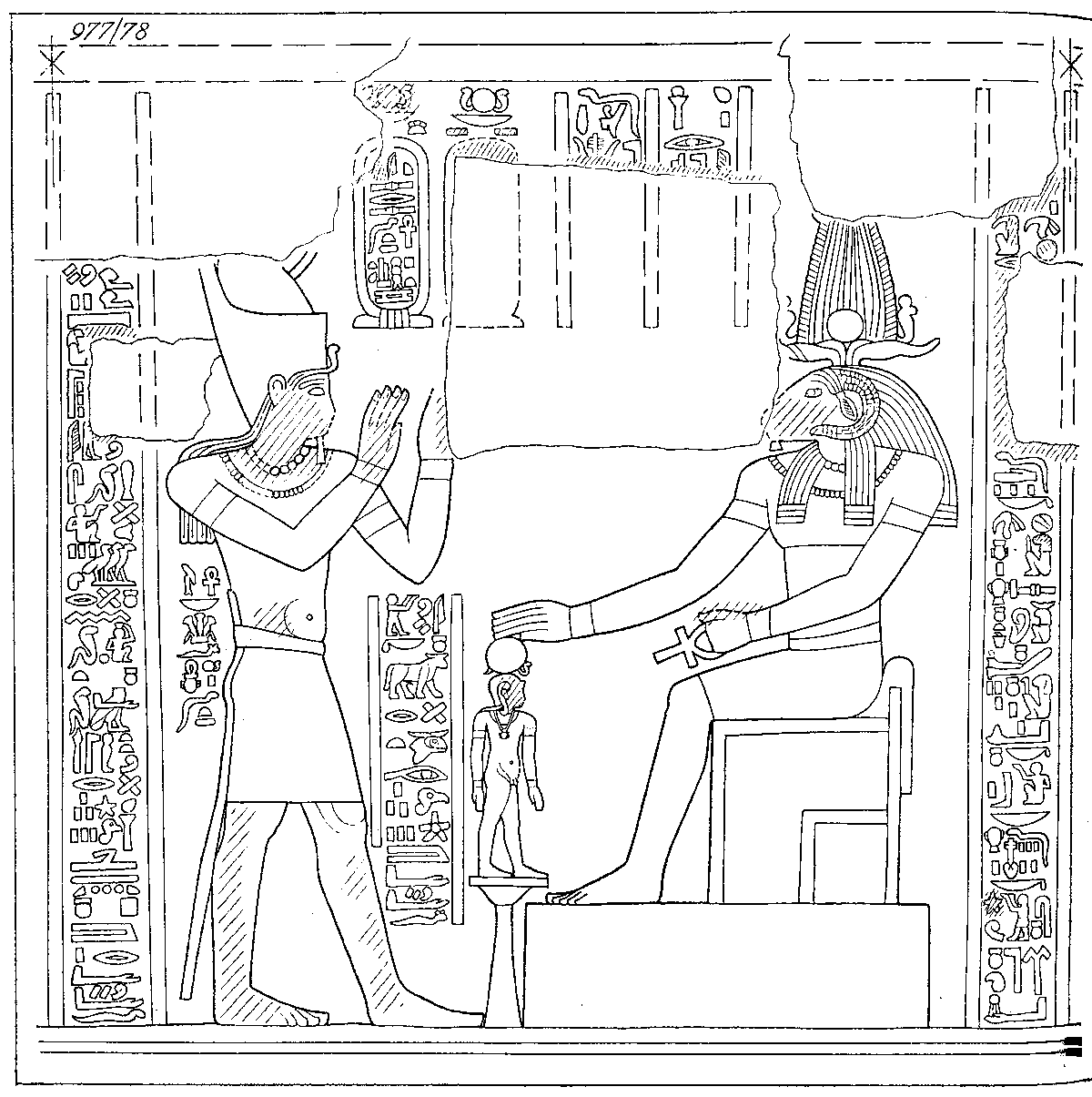
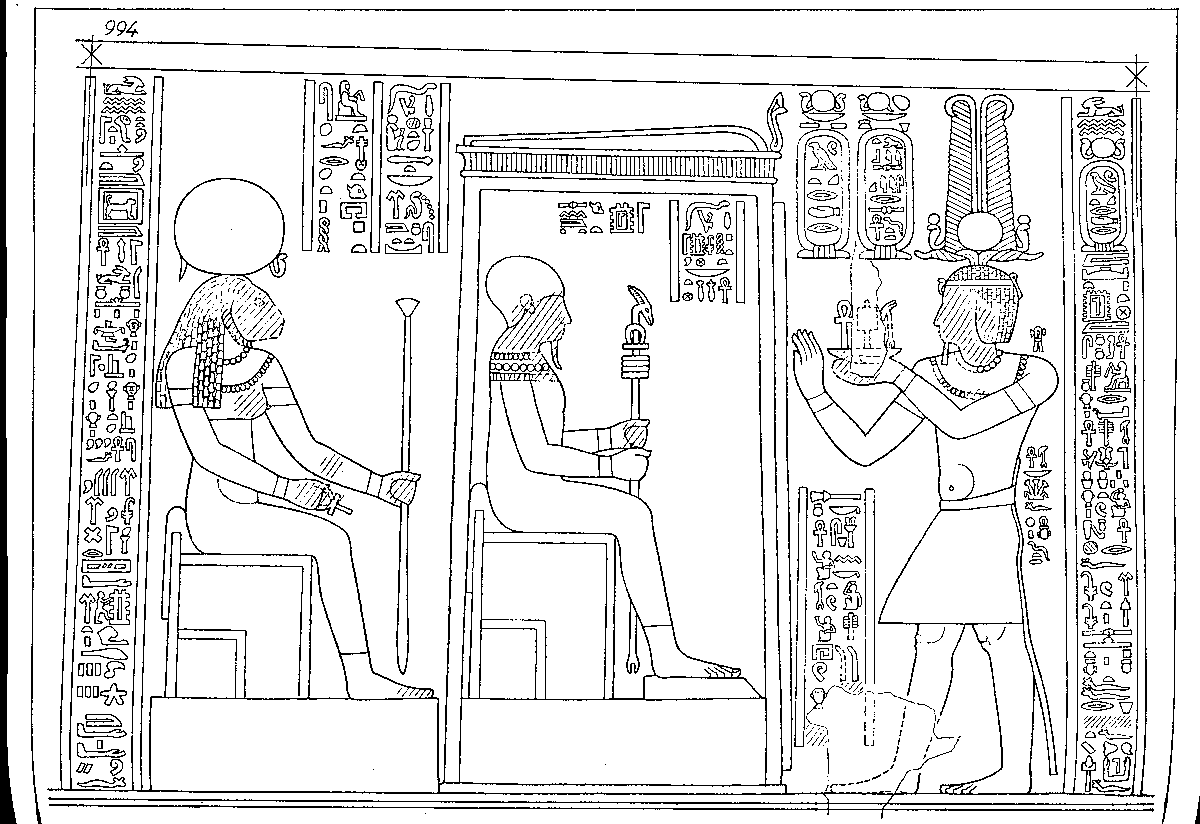
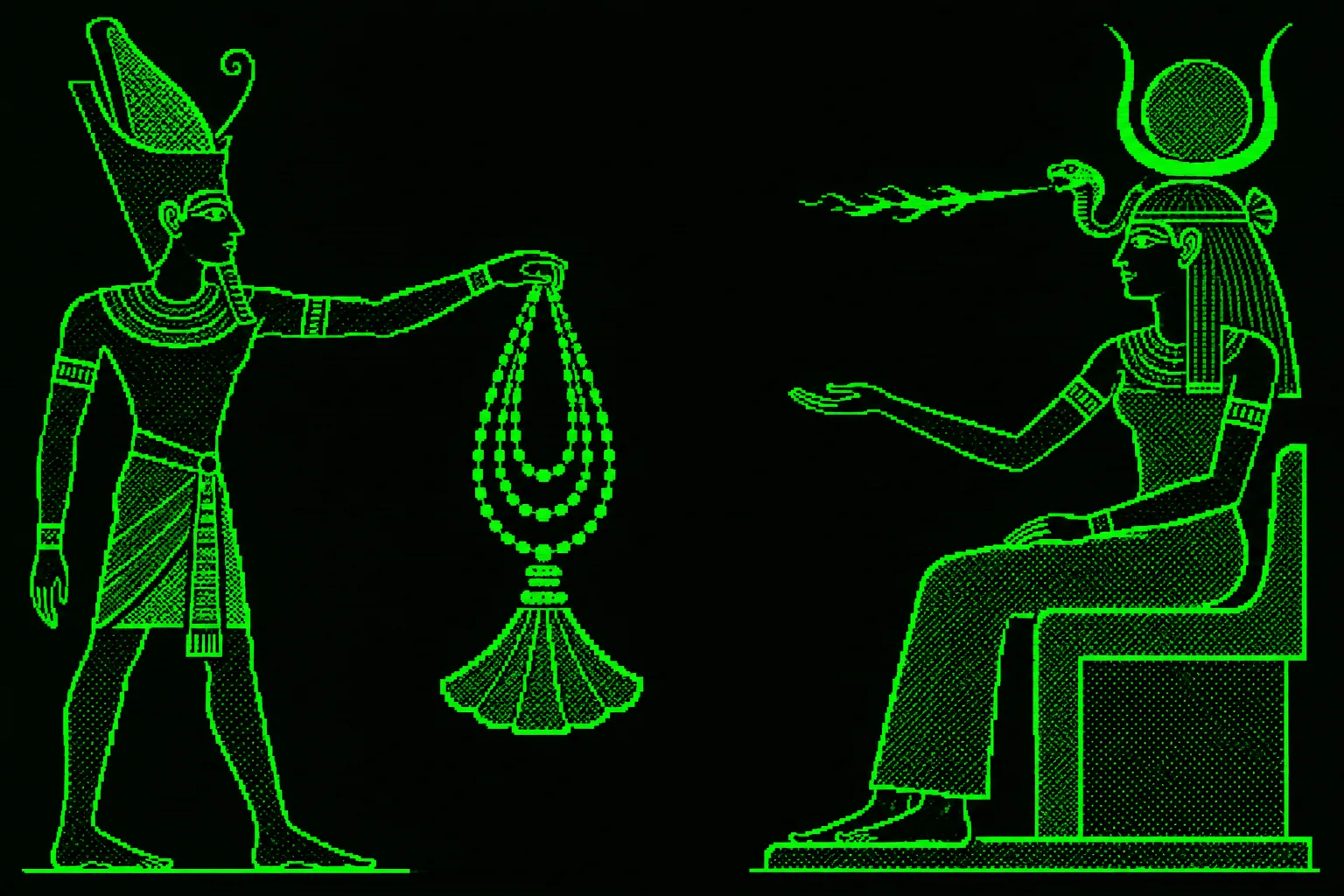
Tiberius gives Hathor the menat necklace as the two testicles of your brother’s enemy, and the people sing Osiris is whole. He slaughters four gazelles for Isis as her brother’s enemies. Ptah shapes the child on the potter’s wheel, and Amun opens his eyes on a dark earth: they lit up the Two Lands.
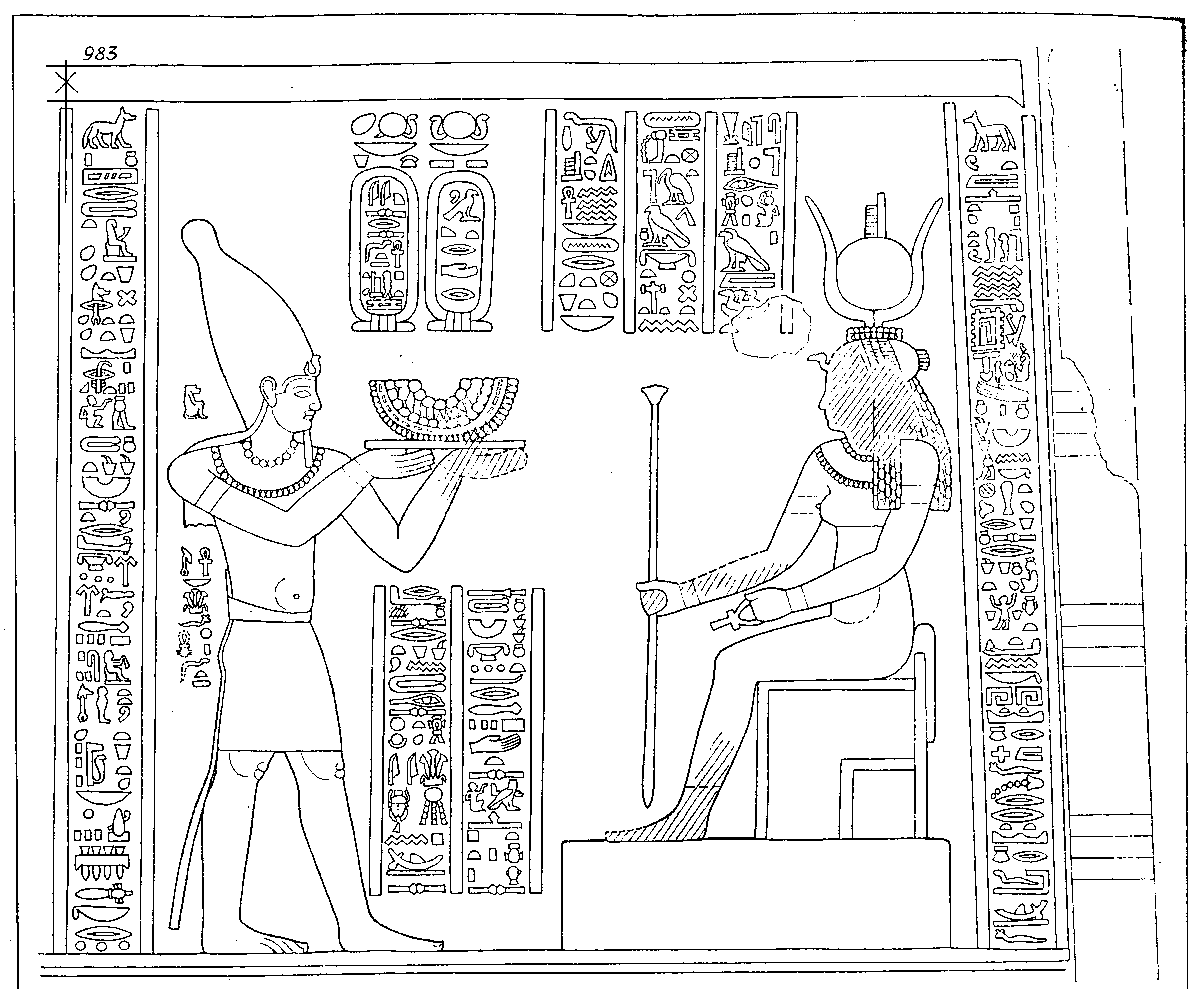
Augustus gives Hathor two mirrors of gold and silver
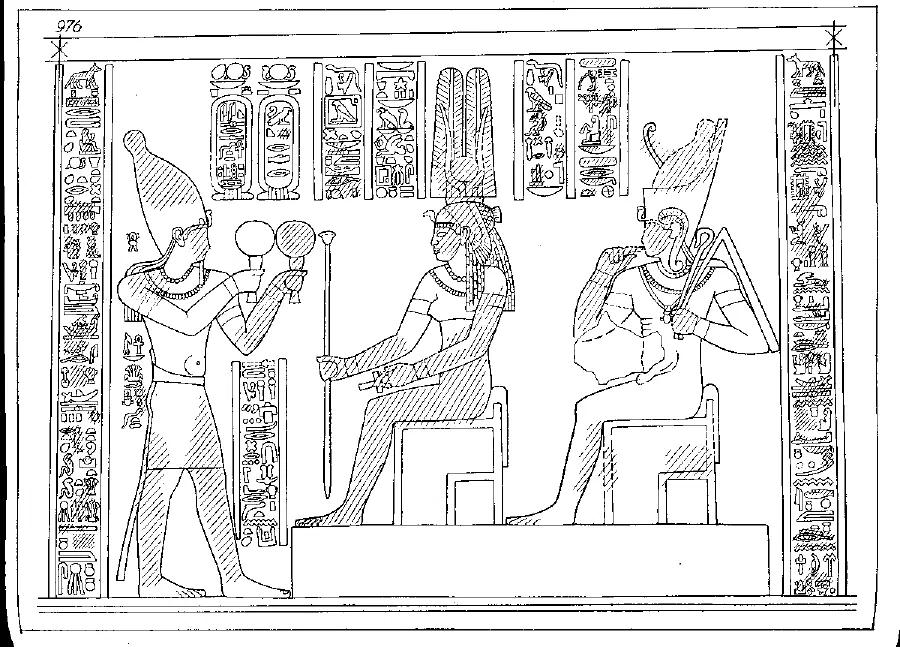
Page 287. The scene as drawn on the wall, facing p. 287 of the edition. Drawing by Otto Baum, in Junker and Winter, Das Geburtshaus des Tempels der Isis in Philä (1965)The hatched figures were hacked off the wall on purpose. After Justinian closed the temple of Isis around 537, Christians made it a church and chiselled out the gods and kings, mostly sparing the hieroglyphs. - 1p. 287, l. 1
mn n-ṯ wn.tj-ḥr (? ꜥnḫ.wj) n sꜣ.wj ḥnꜥ ꜥrḳwr
Receive the two mirrors of gold and silver.
- 2p. 287, l. 2
Ṯnn ḥr ꜥrḳ n kꜣ-ṯ
Tatenen is fashioning them for your ka.
Note · Line 2
Tatenen is a creator god. The ka is the vital presence of the goddess to whom the mirrors are offered. - 3p. 287, l. 3
njśwt bjt nb tꜣ.wj ꜣwtḳrdr
King of Upper and Lower Egypt, lord of the Two Lands, Autokrator,
Note · Line 3
Autokrator is the Greek imperial title. Here the Roman emperor bears the titles of an Egyptian king. - 4p. 287, l. 4
sꜣ Rꜥ nb ḫꜥ.w Ḳjsrs …
son of Ra, lord of crowns, Caesar …
- 5p. 287, l. 5
sꜣ ꜥnḫ wꜣś nb ḥꜣ-f mj Rꜥ ḏ.t
May all protection, life and dominion surround him as they surround Ra, forever.
- 6p. 287, l. 6
ḏd mdw n | Ḥw.t-Ḥrw wr.t nb(.t) Śnm.t
Words spoken by Hathor the Great, lady of Bigeh,
- 7p. 287, l. 7
jr.t Rꜥ nb(.t) p.t ḥnw.t nṯr.w nb.w
Eye of Ra, lady of the sky, mistress of all the gods,
- 8p. 287, l. 8
nb.tj rḫj.t ḥnw.t ḥw.t-mśḫn
queen of the people, mistress of the birth house.
- 9p. 287, l. 9
ḏd mdw n | Ḥrw pꜣ ḫrd sꜣ (ꜣŚ.t)
Words spoken by Horus the Child, son of Isis,
- 10p. 287, l. 10
ꜥꜣ wr tpj n Wśjr nb jꜣ.t wꜥb.t
the very great one, firstborn of Osiris, lord of the Abaton,
Note · Line 10
The Abaton was the sacred burial ground of Osiris on Bigeh, the island beside Philae. - 11p. 287, l. 11
śfj šps nb ꜣJrk
august child, lord of Philae.
- 12p. 287, l. 12
jj-n-j ḫr-ṯ šps.t ḥnw.t Rꜥj.t wr.t ṯḥn(.t) ḥr.w
I have come to you, noble lady, sovereign, great sun goddess who makes faces shine.
- 13p. 287, l. 13
jnj-j (n-ṯ) wn.tj-ḥr (? ꜥnḫ.wj) m (so) nbj n (so) Skr¹
I bring you the two mirrors, the work of Sokar,
Note · Line 13
Sokar is invoked here as a divine craftsman. - 14p. 287, l. 14
r mꜣꜣ ḥr (-ṯ) nfr jm-śn
that you may see your beautiful face in them.
- 15p. 287, l. 15
twt r-ṯ² ꜣḫtj.t ḫꜥj.t
You are indeed the goddess of the horizon, she who rises in glory.
- 16p. 287, l. 16
ḥꜣj tꜣ (p)n m wbn-ś
At her rising this land grows bright.
- 17p. 287, l. 17
jj.tj m ḥtp sꜣ Rśj-jnb-f
Welcome, son of Him Who Is South of His Wall,
Note · Line 17
“He Who Is South of His Wall” is a title of Ptah, the god of Memphis. - 18p. 287, l. 18
mw nṯrj n smꜣ-mꜣꜥ.t (?)³
divine semen of Sema-Maat.
- 19p. 287, l. 19
… wn.tj-ḥr wnn(.t) ḥr ꜥ.wj-k
… the two mirrors resting on your hands.
- 20p. 287, l. 20
dgj-j ḥr-j jm-śn …
I see my face in them …
Note · Line 20
The mirrors are an offering. The speaker looks into them, then promises a gift in return. - 21p. 287, l. 21
dj-j n-k mꜣꜣ-n jtn m (hrw)
I give you what the sun disk has seen by day
- 22p. 287, l. 22
dgj-n jꜥḥ m ḏꜣw
and what the moon has beheld by night.
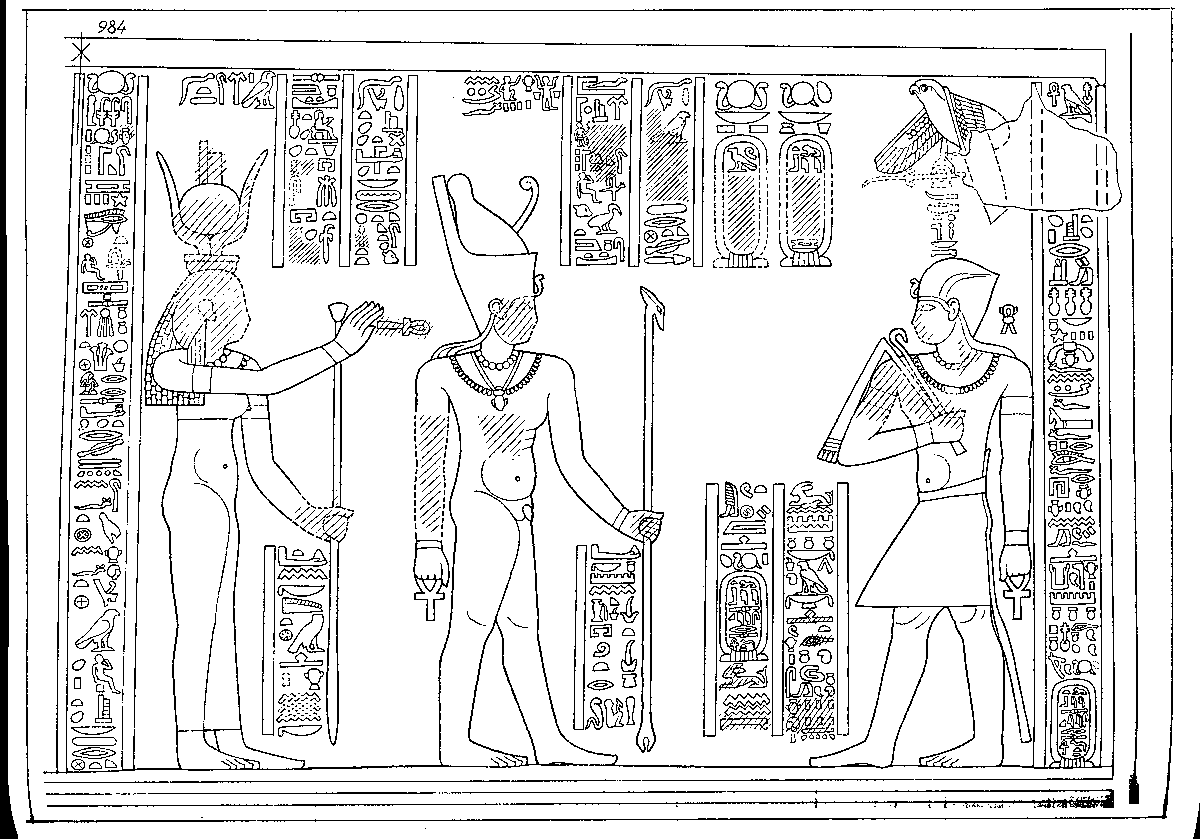
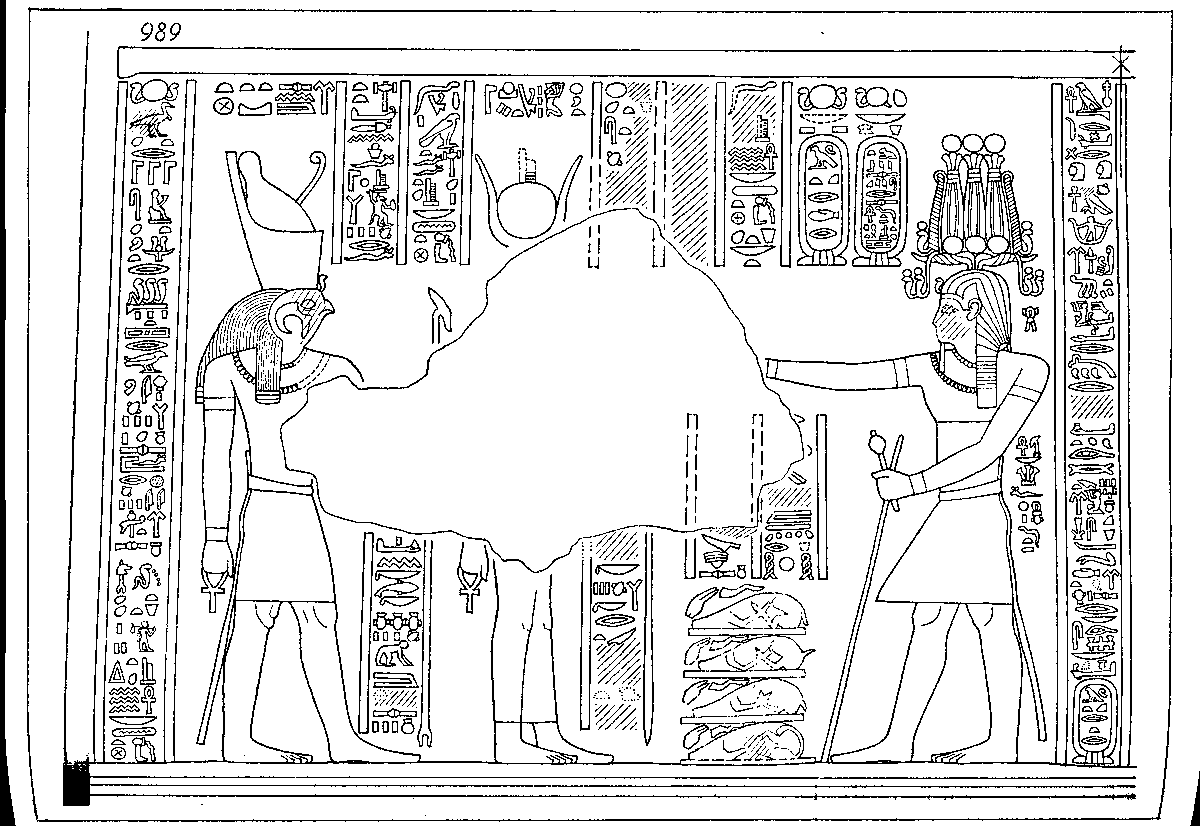
Augustus gives Osiris the wreath of victory
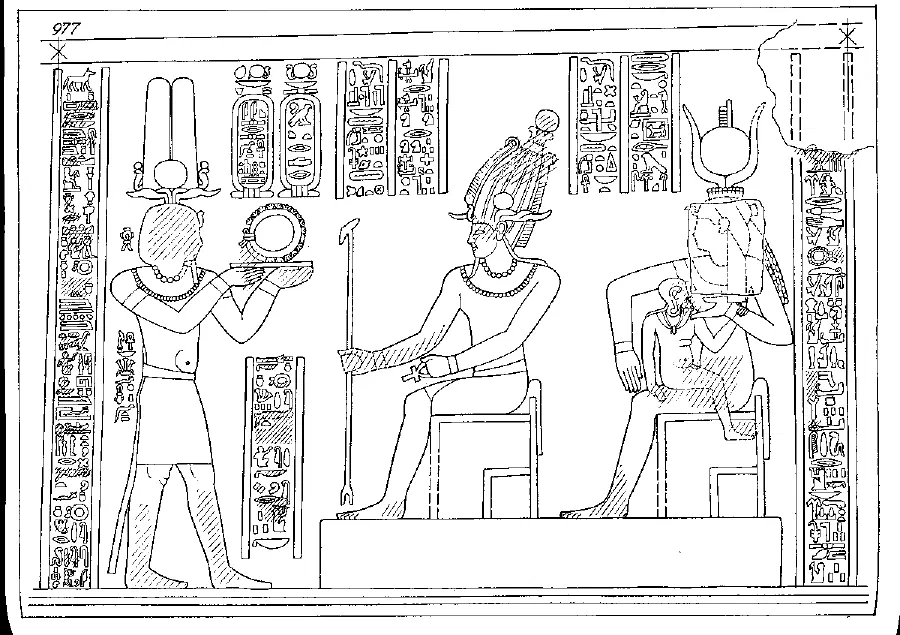
Page 289. The scene as drawn on the wall, facing p. 289 of the edition. Drawing by Otto Baum, in Junker and Winter, Das Geburtshaus des Tempels der Isis in Philä (1965) - 23p. 289, l. 1
mn n-k mꜣḥ n mꜣꜥ-ḫrw
Take for yourself the wreath of victory,
Note · Line 23
The wreath marks Osiris’s victory in his dispute with Seth: he was not only victorious but declared to be in the right. - 24p. 289, l. 2
mḥ … mꜣꜥ-ḫrw-k šwj(?) r ḫftj.w-k
woven … that you may be victorious, a wreath against your enemies.
- 25p. 289, l. 3
njśwt bjt nb tꜣ.wj ꜣwtḳrdr
King of Upper and Lower Egypt, Lord of the Two Lands, Autokrator,
Note · Line 25
Here it takes its place alongside the Egyptian titles of kingship. - 26p. 289, l. 4
sꜣ Rꜥ nb ḫꜥ.w Ḳjsrs …
Son of Ra, Lord of Crowns, Caesar …
- 27p. 289, l. 5
sꜣ ꜥnḫ wꜣś nb ḥꜣ-f mj Rꜥ ḏ.t
May protection and all life and dominion surround him as they surround Ra, forever.
- 28p. 289, l. 6
ḏd mdw n | Wśjr nṯr ꜥꜣ nb jꜣ.t wꜥb.t
Words spoken by Osiris, the great god, lord of the Abaton,
- 29p. 289, l. 7
njśwt nṯr.w ḫnt ꜣJrḳ
king of the gods, who presides over Philae,
- 30p. 289, l. 8
wśr r wśr.w pḥtj r pḥtj.w
mightier than the mighty, stronger than the strong,
- 31p. 289, l. 9
nḏ.tj jmj.wtj pśḏ.t
protector among the Nine.
Note · Line 31
The Nine, or Ennead, are a company of gods that includes Osiris and Isis. - 32p. 289, l. 10
ḏd mdw n | ꜣJś.t wr.t mw.t nṯr
Words spoken by Isis the Great, the god’s mother,
- 33p. 289, l. 11
nb.t jꜣ.t wꜥb.t dj(.t) ꜥnḫ nb.t ꜣJrḳ
lady of the Abaton, giver of life, lady of Philae,
- 34p. 289, l. 12
špś.t wśr(.t) ḫnt ḥw.t-nmj.t
the noble one, the mighty one, who presides over the bedchamber,
Note · Line 34
The bedchamber here is the birth house, where the birth of Horus was celebrated. - 35p. 289, l. 13
jrj(.t) sꜣ-ś Ḥrw m ḥḳꜣ
who bore her son Horus as ruler.
- 36p. 289, l. 14
jj-n-j ḫr-k ḥḳꜣ m Śnm.t
I have come to you, O ruler on Bigeh,
Note · Line 36
The king now addresses Osiris as he presents the wreath. - 37p. 289, l. 15
śḫm špś ḥrj-jb Tꜣ-wr
august power dwelling in the Thinite nome.
Note · Line 37
The Thinite nome was the district of Upper Egypt that included Abydos, a chief place of worship of Osiris. - 38p. 289, l. 16
jnj-j n-k mꜣḥ n … m tꜣ m …
I bring you the wreath of … on earth in …
- 39p. 289, l. 17
śḫkr-j ḥn(n)-k m prj jm-k
I adorn your head with what came forth from you.
- 40p. 289, l. 18
twt nṯr ꜥꜣ wr mḥ-tw n-f mꜣḥ n mꜣꜥ-ḫrw
You are the god of surpassing greatness, for whom the wreath of victory was woven
- 41p. 289, l. 19
ḏr śmꜣꜥ-ḫrw-k r ḫftj.w-k
when you were declared victorious over your enemies.
- 42p. 289, l. 20
(jj.tj m ḥtp) … jḳr² ḏbꜥ.w m kꜣ.t-f r mnḫ
Welcome, …, deft of finger, whose work is flawless.
Note · Line 42
Osiris now answers the king. - 43p. 289, l. 21
šsp-n-j mꜣḥ mḥ-n-j św ḥr ḏnn.t-j
I have taken the wreath and wound it about my head.
- 44p. 289, l. 22
śḫm ḥm-j jm-f (r?) ḥwj(.t) śbj.w
With it my majesty has the power to strike down rebels.
- 45p. 289, l. 23
dj-j mꜣꜥ-ḫrw-k r ḫftj.w-k nb.w
I grant you victory over all your enemies.
- 46p. 289, l. 24
m bꜣḥ ḏꜣḏꜣ.t³ śḏmj.w
before the divine council, the Hearers.
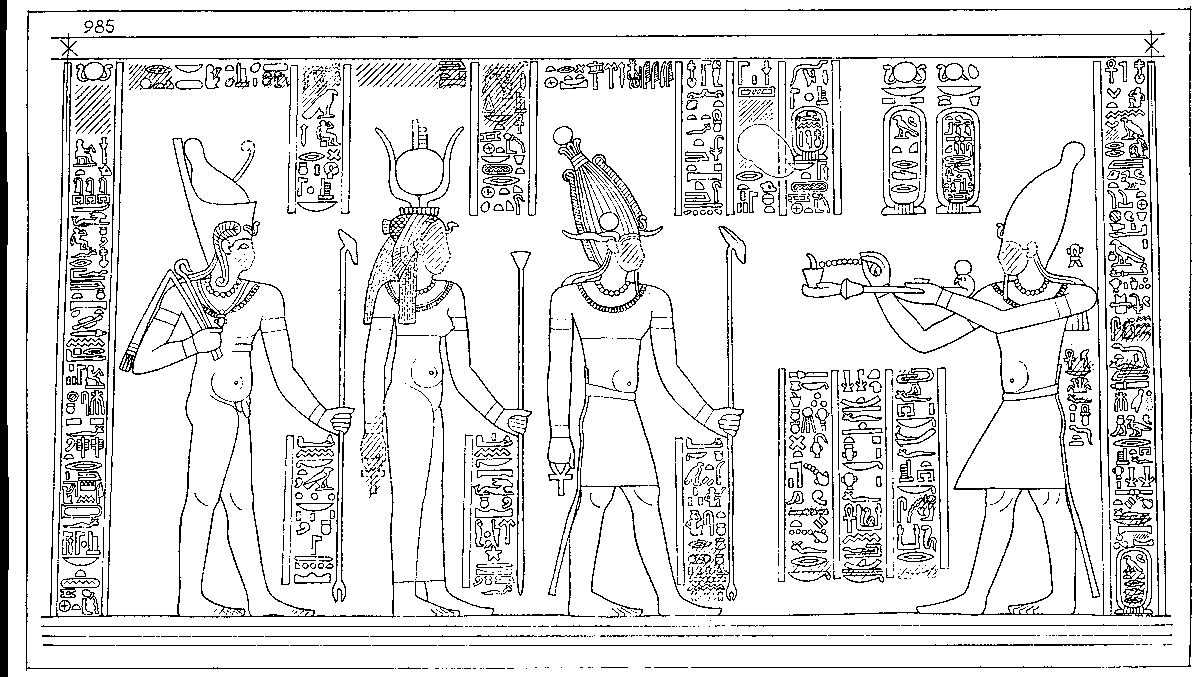
Augustus worships Khnum
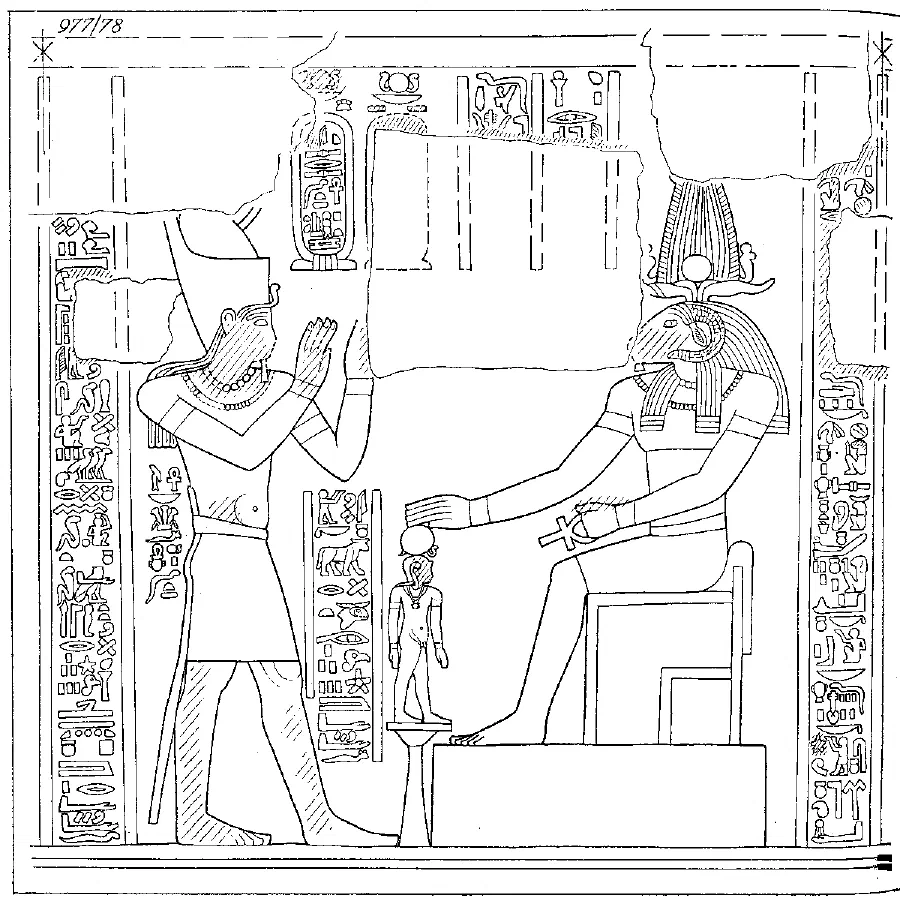
Page 291. The scene as drawn on the wall, facing p. 291 of the edition. Drawing by Otto Baum, in Junker and Winter, Das Geburtshaus des Tempels der Isis in Philä (1965) - 47p. 291, l. 1
jꜣw n-k bꜣ wr šfj.t
Hail to you, Ba, who inspire such awe,
Note · Line 47
A ba is the power of a god or a person to take form and act in the world. - 48p. 291, l. 2
jrj rmṯ nṯr.w m ꜥ.wj-f
who made humankind and the gods with his own two hands.
- 49p. 291, l. 3
njšwt bjt nb tꜣ.wj …
King of Upper and Lower Egypt, lord of the Two Lands, …
- 50p. 291, l. 4
sꜣ Rꜥ nb ḫꜥ.w Kjsrs …
Son of Ra, lord of crowns, Caesar …
Note · Line 50
The king is the Roman emperor Augustus, named here with the titles of a pharaoh. - 51p. 291, l. 5
(sꜣ) ꜥnḫ wꜣs nb ḥꜣ-f mj Rꜥ ḏ.t
May protection and all life and dominion surround him as they surround Ra, forever.
- 52p. 291, l. 6
ḏd mdw n | Ḫnmw … nḫp sꜣ Wsjr j …
Words spoken to Khnum, … who shaped the son of Osiris on his wheel. O …
Note · Line 52
Khnum is the divine potter. The child he shapes here is Horus, son of Isis and Osiris. - 53p. 291, l. 7
(jj-n-j ḫr-k) … ḥꜣ.t 2? ḥrj … nṯr.w
I have come to you, … the two foreparts, chief … gods.
- 54p. 291, l. 8
dwꜣ-j ḥm-k šwr-j bꜣ.w-k
I praise your majesty and extol your might
- 55p. 291, l. 9
n wr(.t?) n(.t) kꜣ.t-k nt(.t) m-ꜥ-k
for the greatness of your work, which comes from your hand.
- 56p. 291, l. 10
twt nṯr ꜥꜣ wr nḫp nṯr.w rmṯ
You are the god of surpassing greatness, who shaped gods and humankind on his wheel
- 57p. 291, l. 11
grg tꜣ pn m rꜣ-ꜥ.wj-f
and founded this earth with his own two hands.
- 58p. 291, l. 12
(jj.tj m ḥtp) … Ḏḥwtj ꜣḫ rꜣ …
Welcome in peace, … of Thoth, whose mouth speaks with power …
Note · Line 58
Khnum now greets the king. Thoth is the god of writing and eloquence. - 59p. 291, l. 13
… ḏd.w(t)-k ꜣḫ jb-j ḥr-s
… your words; my heart rejoices in them.
- 60p. 291, l. 14
ndb-j ḏšr.w n(?)-j
I hear the praises offered to me.
- 61p. 291, l. 15
ḏj-j n-k bw nb ḥr ḏd nfrw-k
I give you all people: they speak of your goodness
- 62p. 291, l. 16
dwꜣ-sn n-k nṯr m ḥr.t hrw
and praise the god for your sake day after day.
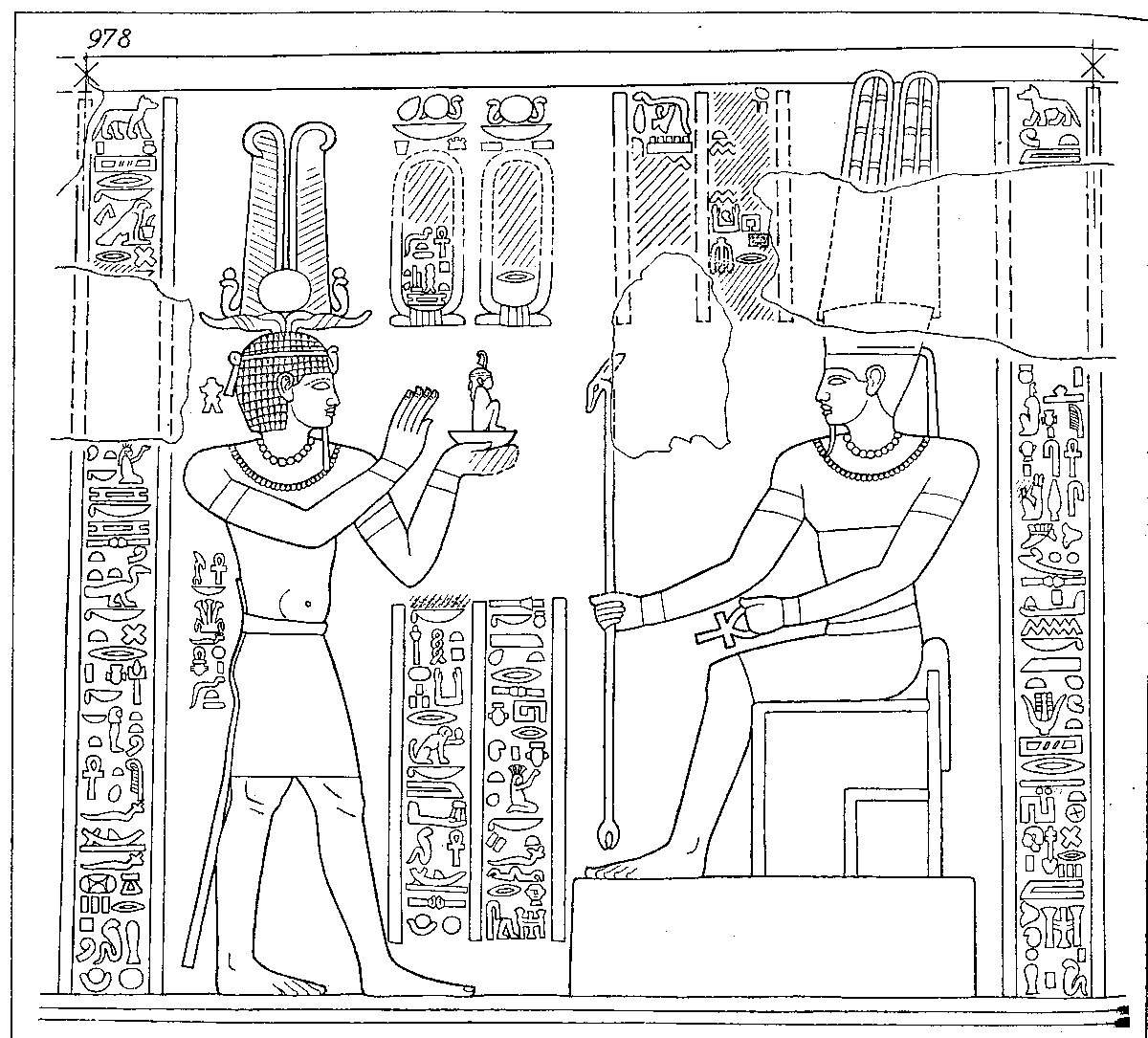
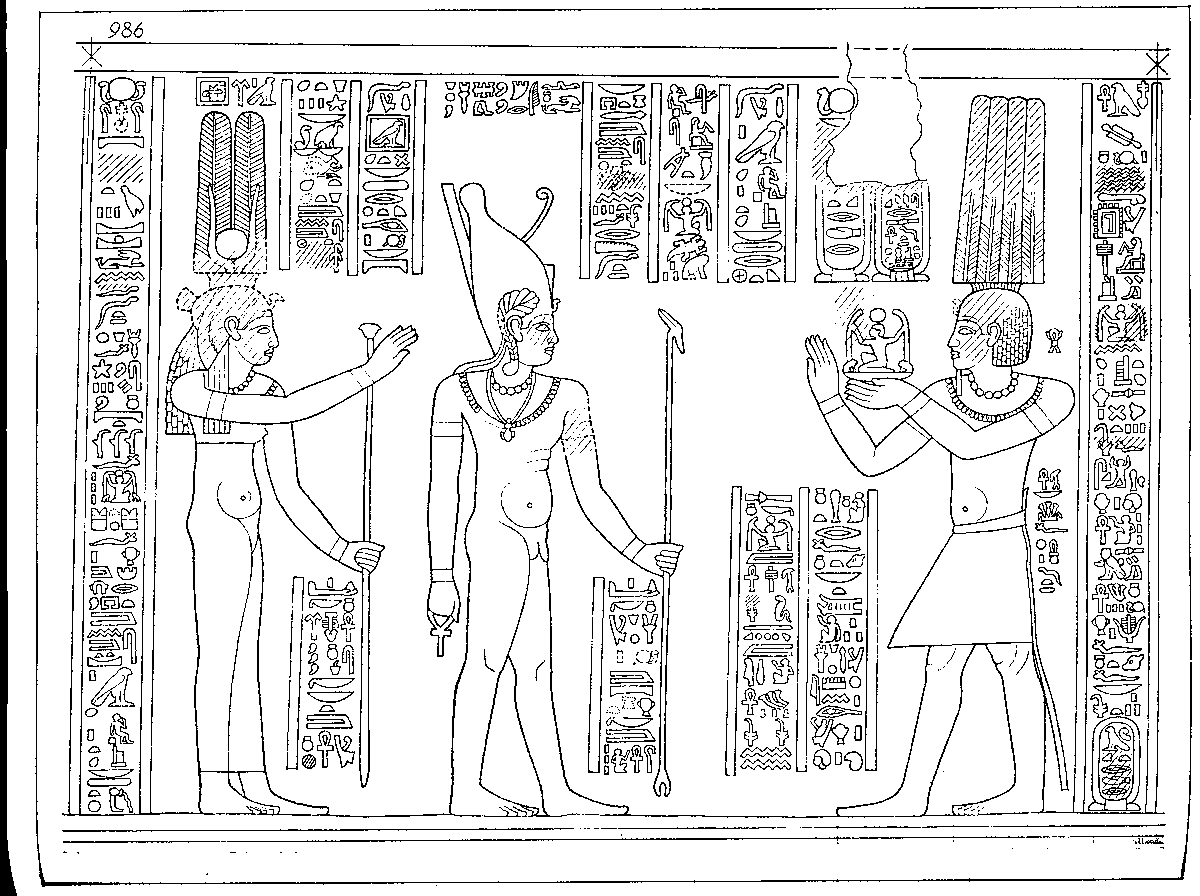
Augustus gives Amun the figure of Maat
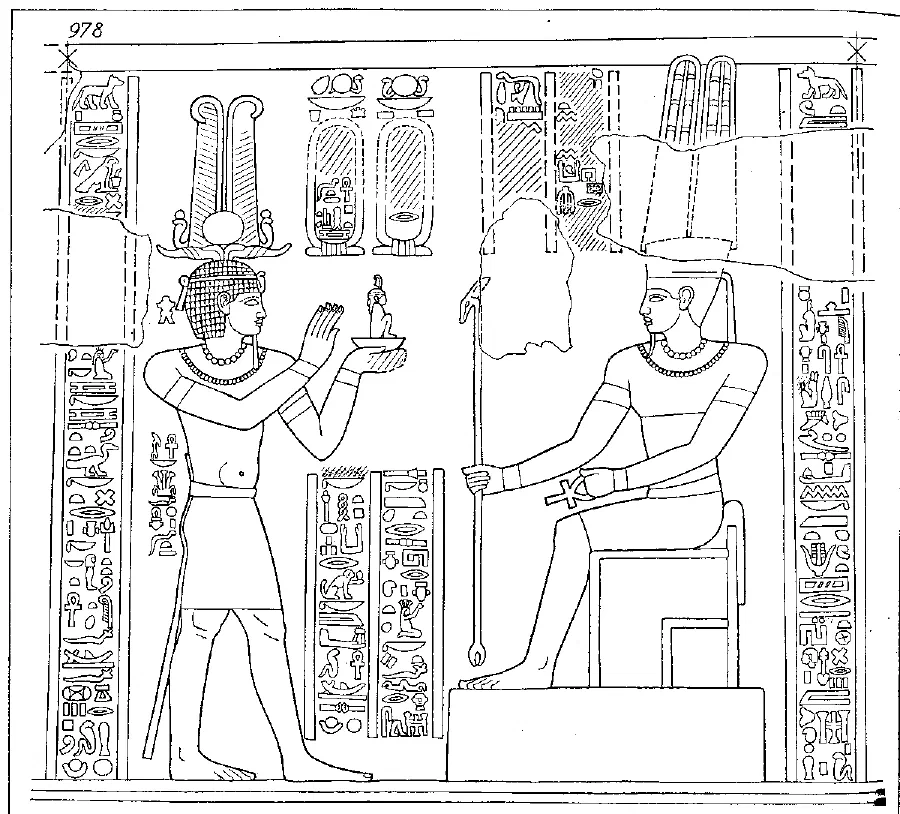
Page 293. The scene as drawn on the wall, facing p. 293 of the edition. Drawing by Otto Baum, in Junker and Winter, Das Geburtshaus des Tempels der Isis in Philä (1965) - 63p. 293, l. 1
mn n-k mꜣꜥ.t r šḥrj jb-k
Receive Maat to gladden your heart,
Note · Line 63
Maat is both right order and the goddess who embodies it. The king presents her to the god as an offering. - 64p. 293, l. 2
mr.t-k tf n ḫrj-š (n?)¹-k
that Meret of yours who never leaves your side.
Note · Line 64
Meret, a goddess of song, is identified here with Maat. Her name echoes the Egyptian word for “beloved.” - 65p. 293, l. 3
tpḥ.t-wḏj(.t)-kꜣ.w r-ḫft-ḥr-k m ḥr.t hrw
The gullet is before you day after day,
Note · Line 65
“Gullet” is a name for Maat: as the throat lets food pass, so Maat sustains the god. - 66p. 293, l. 4
ꜥnḫ-k jm-š rꜥ nb
that you may live on her every day.
- 67p. 293, l. 5
njšwt bjt nb tꜣ.wj … r
King of Upper and Lower Egypt, lord of the Two Lands, …r,
Note · Line 67
Only the end of the Greek imperial title Autokrator survives here. - 68p. 293, l. 6
sꜣ Rꜥ nb ḫꜥ.w …
Son of Ra, lord of crowns, …
- 69p. 293, l. 7
sꜣ ꜥnḫ wꜣš nb ḥꜣ-f mj Rꜥ ḏ.t
May protection and all life and dominion surround him as they surround Ra, forever.
- 70p. 293, l. 8
ḏd mdw n | Jmn …
Words spoken to Amun …
- 71p. 293, l. 9
… n kꜣ-f … prj-msj(?) r …
… for his ka … the birth house, to …
Note · Line 71
The birth house is the sanctuary where the divine child’s birth was celebrated. - 72p. 293, l. 10
jj-n-j ḫr-k bjk(?) wr nb …
I have come to you, great falcon, lord of …
- 73p. 293, l. 11
… mr.t-k mr(r.t)-k mrj-š tw
… your Meret, whom you love and who loves you,
- 74p. 293, l. 12
sꜣ.t-k wr.t ꜣb(b.t) jb-k
your great daughter, whom your heart desires.
- 75p. 293, l. 13
twt nb mꜣꜥ.t ꜥnḫ-f jm-f (sic)²
You are the lord of Maat, who lives on her.
- 76p. 293, l. 14
ḫr.t ḥm-k pw rꜥ nb
She is Your Majesty’s daily food.
Note · Line 76
The king presents Maat, the goddess who embodies truth and right order, as an offering to the god. - 77p. 293, l. 15
jj.tj m (ḥtp) …
Welcome! …
- 78p. 293, l. 16
… n-j mꜣꜥ.t ḥtp jb-j ḥr-š
I … Maat, and in her my heart finds peace.
- 79p. 293, l. 17
ꜥnḫ-j jm-š ḏr mꜣꜣ-š
I live by her when I see her.
- 80p. 293, l. 18
dj-j n-k mꜣꜥ.t ḫnm.tj ḥr Tꜣ-mrj
I give you Maat, bound to Egypt.
- 81p. 293, l. 19
tp-nfr wr m rk ḥm-k
Prosperity is great in Your Majesty’s reign.
Augustus gives Horus of Edfu a bowl of grape juice
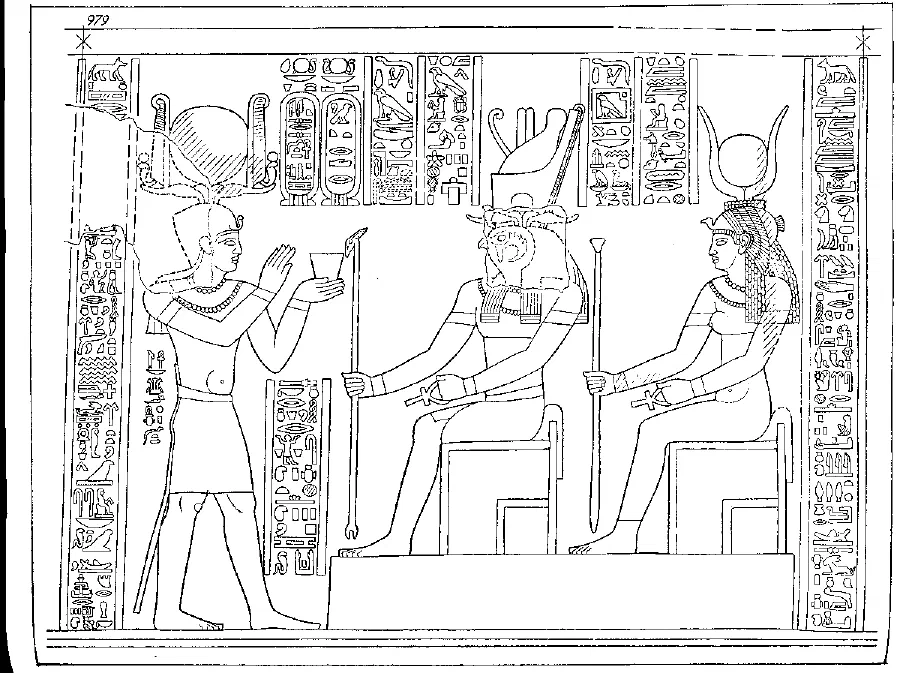
Page 295. The scene as drawn on the wall, facing p. 295 of the edition. Drawing by Otto Baum, in Junker and Winter, Das Geburtshaus des Tempels der Isis in Philä (1965) - 82p. 295, l. 1
mn n-k ḥrw-ꜥ r sḫꜥ ib-k
Take the grape juice to gladden your heart.
Note · Line 82
The king now offers Horus a drink. - 83p. 295, l. 2
tḫ.t-k pw mr(r.t) kꜣ-k
It is your sustenance, which your ka loves.
Note · Line 83
Offerings sustain it. - 84p. 295, l. 3
njśwt bjt nb tꜣ.wj ꜣwtḳrdr
King of Upper and Lower Egypt, lord of the Two Lands, Autokrator,
Note · Line 84
Here the Roman emperor Augustus bears the titles of a pharaoh. - 85p. 295, l. 4
sꜣ Rꜥ nb ḫꜥ.w Kjsrs …
Son of Ra, lord of crowns, Caesar …
- 86p. 295, l. 5
(sꜣ) ꜥnḫ wꜣś nb ḥꜣ-f mj Rꜥ ḏ.t
May all protection, life and dominion surround him as they surround Ra, forever.
- 87p. 295, l. 6
ḏd mdw n | Ḥrw Bḥd.tj nṯr ꜥꜣ nb p.t ḫnt Śnm.t
Words spoken by Horus of Edfu, the great god, lord of the sky, foremost on Bigeh,
Note · Line 87
Bigeh is an island beside Philae. - 88p. 295, l. 7
ꜥḥm šps ḫpr ḫnt ḥꜣ.t
the august falcon who came into being in the beginning;
- 89p. 295, l. 8
nṯr.w ḫpr ḥr sꜣ
after him the gods came into being.
- 90p. 295, l. 9
ḏd mdw n | Ḥw.t-Ḥrw wr.t nb(.t) Jwn.t
Words spoken by Hathor the Great, lady of Dendera,
- 91p. 295, l. 10
nb.tj rḫj.t ḥnw.t m (Ś)nm.t
queen of the people, sovereign on Bigeh,
- 92p. 295, l. 11
šps.t wśr.t ḫnt Jrk
august and mighty, foremost on Philae.
- 93p. 295, l. 12
jj-n-j ḥr-k … btnw.w-f
I have come to you, … his enemies.
- 94p. 295, l. 13
jnj-j n-k ḥrw-ꜥ bnr m dp.t-f
I bring you grape juice, sweet to the taste;
- 95p. 295, l. 14
mw jm(j)-f m wnš
the juice within it comes from grapes.
- 96p. 295, l. 15
twt šnb.tj šps sḫb šnb.t-k jm-f
You are the noble falcon; it refreshes your throat
Note · Line 96
The Egyptian word for the falcon here echoes the word for “throat.” - 97p. 295, l. 16
ḏr sḫm ḥm-k r ḫftj.w-k
when Your Majesty prevails over your enemies.
- 98p. 295, l. 17
jj.tj m ḥtp ḥḳꜣ m Knm.t
Welcome, ruler in Kharga Oasis,
Note · Line 98
The god answers the king. Kharga and Bahariya were wine-producing oases in Egypt’s Western Desert. - 99p. 295, l. 18
ḳnr wr pḥtj ḥbj jnw m Ḏsḏs
hero of great strength, bearer of gifts from Bahariya Oasis.
- 100p. 295, l. 19
šsp-n-j ḥrw-ꜥ śm-j jm-f
I have received the grape juice and I drink of it.
- 101p. 295, l. 20
bnr-f ḥr jb-j m sḫr.w-j
In my rites it is sweet to my heart.
- 102p. 295, l. 21
dj-j n-k sḫ.t-jmꜣw ḥr prj jm-ś
I give you the oases with what they yield,
- 103p. 295, l. 22
ḥr wnf jb-k m ḥr.t hrw
gladdening your heart day after day.
Augustus burns incense before Ra-Horakhty
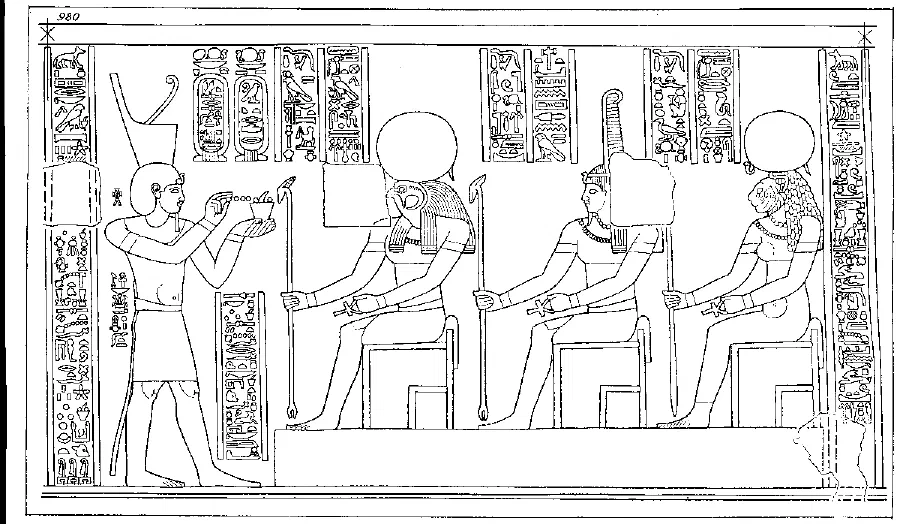
Page 297. The scene as drawn on the wall, facing p. 297 of the edition. Drawing by Otto Baum, in Junker and Winter, Das Geburtshaus des Tempels der Isis in Philä (1965) - 104p. 297, l. 1
mn n-k snṯr sṯj-f r fnḏ-k
Take the incense; may its fragrance reach your nose.
- 105p. 297, l. 2
bḥd-n-f jwnn-k m ḥr.t hrw
It has perfumed your chamber day after day.
- 106p. 297, l. 3
njśwt bjt nb tꜣ.wj ꜣwtḳrdr
King of Upper and Lower Egypt, lord of the Two Lands, Autokrator,
Note · Line 106
Here the Roman emperor Augustus bears the titles of an Egyptian king. - 107p. 297, l. 4
sꜣ Rꜥ nb ḫꜥ.w Ḳjsrs …
son of Ra, lord of crowns, Caesar …
- 108p. 297, l. 5
sꜣ ꜥnḫ wꜣś nb ḥꜣ-f mj Rꜥ ḏ.t
May all protection, life and dominion surround him as they surround Ra, forever.
- 109p. 297, l. 6
ḏd mdw n | Rꜥ-Ḥrw-ꜣḫ.tj nṯr ꜥꜣ nb p.t
Words spoken by Ra-Horakhty, the great god, lord of the sky,
Note · Line 109
Ra-Horakhty unites the sun god Ra with Horus of the Two Horizons, the horizons of sunrise and sunset. - 110p. 297, l. 7
śḫm šps ḥrj-jb jꜣ.t wꜥb.t
the august power who dwells at the Abaton,
Note · Line 110
The Abaton, the “Pure Mound,” was a sanctuary on Bigeh, the island beside Philae where Osiris was said to lie buried. - 111p. 297, l. 8
bꜣ (? bjk?) wr śḥḏ tꜣ.wj m nfrw-f
the great ba who lights the Two Lands with his beauty.
- 112p. 297, l. 9
ḏd mdw n | Šw sꜣ Rꜥ
Words spoken by Shu, son of Ra,
- 113p. 297, l. 10
nṯr ꜥꜣ m Śnm.t
the great god on Bigeh,
- 114p. 297, l. 11
nḏ.tj mnḫ n Ḥrw-ꜣḫ.tj
the stalwart defender of Horakhty.
- 115p. 297, l. 12
ḏd mdw n | Tfn.t sꜣ.t Rꜥ ḥrj(.t)-jb jꜣ.t wꜥb.t
Words spoken by Tefnut, daughter of Ra, who dwells at the Abaton,
- 116p. 297, l. 13
mḥnj.t wr.t m tp n jt-s
the great cobra coiled on her father’s head.
Note · Line 116
Tefnut takes the form of the uraeus, the cobra that rears up on Ra’s brow to protect him. - 117p. 297, l. 14
jj-n-j ḫr-k bꜣ (? bjk?) ḥrj nṯr.w
I have come to you, O ba who presides over the gods.
Note · Line 117
The king addresses Ra-Horakhty as he offers him incense. - 118p. 297, l. 15
… snṯr wbn ḥr sḏ.t
… incense gleaming on the flame,
- 119p. 297, l. 16
sṯj-nṯr śnśn-n-k sṯj-f
the god’s own scent, whose fragrance you have breathed in.
- 120p. 297, l. 17
twt nṯr ꜥꜣ wr jt nṯr.w
You are the supremely great god, father of the gods,
- 121p. 297, l. 18
snṯr kꜣ-f rꜥ nb ḫnt gś.w-prj.w
whose ka is censed each day in the temples.
- 122p. 297, l. 19
jj.tj m ḥtp ḥbj jnw m Tꜣ-nṯr
Welcome in peace, you who gather tribute from the Land of the God,
Note · Line 122
The god now welcomes the king. The Land of the God is a name for the distant region from which precious incense came. - 123p. 297, l. 20
ḥḳꜣ wr n Kbn
great ruler of Byblos.
- 124p. 297, l. 21
šsp-j snṯr śnśn-n-j sṯj-f
I receive the incense; I have breathed in its fragrance.
- 125p. 297, l. 22
wnf jb-j ḥr ẖnmw-f nḏm
My heart rejoices in its sweet smell.
- 126p. 297, l. 23
dj-j n-k Pwn.t m ḳd …
I give you Punt in its form …
Note · Line 126
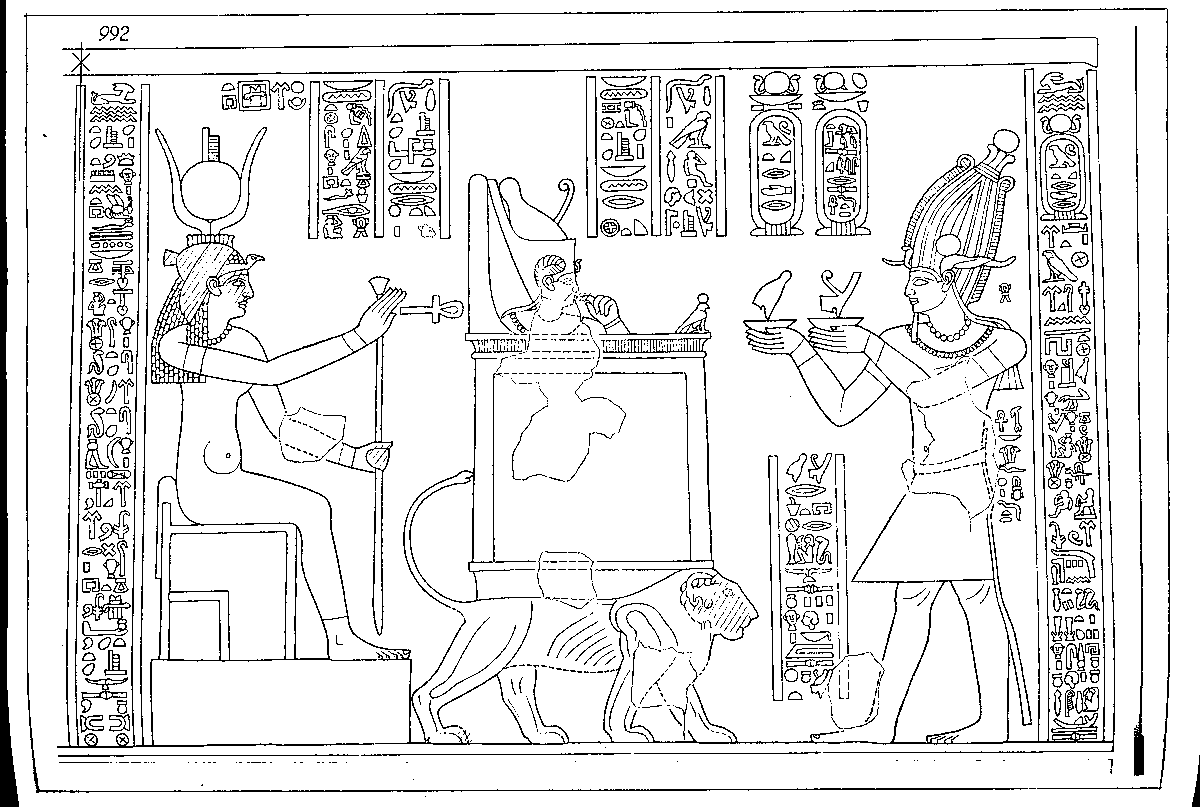
Punt was a source of the aromatic resins the Egyptians burned as incense. In return for the king’s offering, the god gives him the land that yields it. Augustus gives Isis myrrh
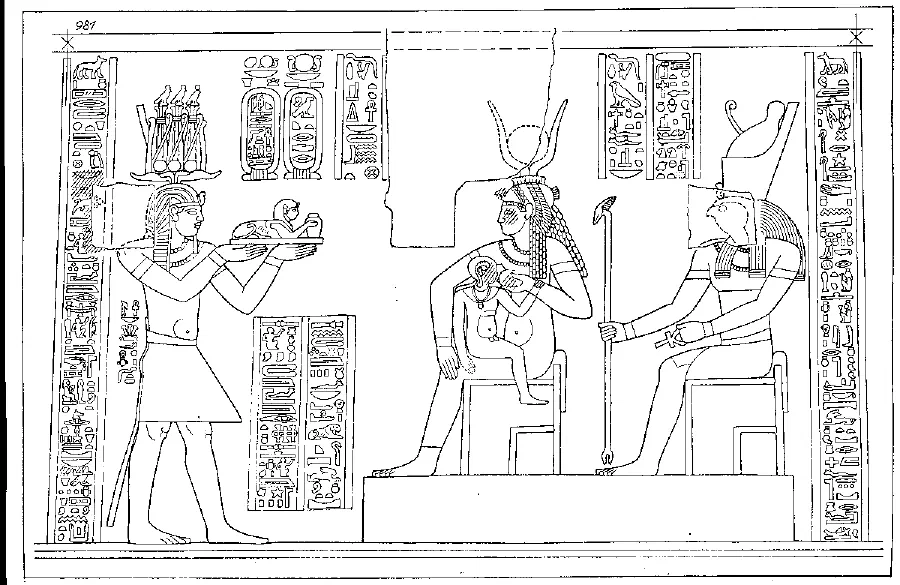
Page 299. The scene as drawn on the wall, facing p. 299 of the edition. Drawing by Otto Baum, in Junker and Winter, Das Geburtshaus des Tempels der Isis in Philä (1965) - 127p. 299, l. 1
mn n-k ꜥntjw m rd-f¹ nb
Take for yourself the myrrh with all its growth,
- 128p. 299, l. 2
ḥr ꜥ.wj mꜣj ḥḳꜣ Pwn.t
borne on both arms of the lion, ruler of Punt.
- 129p. 299, l. 3
śgnn-j ḥꜥ.w-ṯ m pr(.t) m jr.t Ḥrw tn
I anoint your limbs with what came forth from this Eye of Horus.
Note · Line 129
The words now address a goddess. The Eye of Horus, injured and made whole again, was a common name for a sacred offering. - 130p. 299, l. 4
śḥtp-j jb-ṯ m rḏw-nṯr
I soothe your heart with the fluid from the god’s body.
- 131p. 299, l. 5
njśwt bjt nb tꜣ.wj ꜣwtḳrdr
King of Upper and Lower Egypt, lord of the Two Lands, Autokrator,
- 132p. 299, l. 6
sꜣ Rꜥ nb ḫꜥ.w Kjsrs …
son of Ra, lord of crowns, Caesar …
- 133p. 299, l. 7
(sꜣ) ꜥnḫ wꜣś nb ḥꜣ-f mj Rꜥ ḏ.t
May all protection, life and dominion surround him as they surround Ra, forever.
- 134p. 299, l. 8
ḏd mdw n | ꜣJs.t dj(.t) ꜥnḫ nb(.t) jꜣ.t wꜥb.t …
Words spoken by Isis, giver of life, lady of the Abaton …
- 135p. 299, l. 9
ḏd mdw n | Ḥrw nḏ.tj jt-f
Words spoken by Horus, avenger of his father.
Note · Line 135
His father is Osiris, whom Seth killed. - 136p. 299, l. 10
sꜣ ꜣJs.t nb jꜣ.t wꜥb.t
Son of Isis, lord of the Abaton,
- 137p. 299, l. 11
nḏ.tj mnḫ n jt-f Wśjr
valiant defender of his father Osiris,
- 138p. 299, l. 12
ṯḳr pḥtj m ḫnt pśḏ.t
mighty in strength among the Ennead.
Note · Line 138
The Ennead is the company of nine gods. - 139p. 299, l. 13
jj-n-j ḫr-ṯ ḥnw.t m jꜣ.t wꜥb.t
I have come to you, sovereign lady in the Abaton,
- 140p. 299, l. 14
nb(.t? ꜣJrk?) ꜥšꜣ(.t) mrw.t(?)
Lady of Philae, rich in love.
- 141p. 299, l. 15
(jnj)-j n-ṯ ꜥntjw prj m jr.t Ḥrw
I bring you myrrh that came forth from the Eye of Horus.
Note · Line 141
In offering rites, a gift could be identified with the Eye of Horus, lost in his struggle with Seth and made whole again. - 142p. 299, l. 16
šmś-j ḥm.t-ṯ m jḏ.t-nṯr
I serve Your Majesty with the god’s fragrance.
- 143p. 299, l. 17
twt špś.t wśr.t ḥnw.t tꜣ.wj-nṯr.w
You are the august one, the mighty one, sovereign lady of the two lands of the gods,
- 144p. 299, l. 18
nb(.t) mšꜥ(-jb.w?) šꜥ-tw-f n kꜣ-ṯ
lady of myrrh, which was first made for your ka.
- 145p. 299, l. 19
jj.tj m ḥtp sꜣ-j mrj-j
Welcome in peace, my beloved son,
Note · Line 145
The goddess answers her son. - 146p. 299, l. 20
ḥḳꜣ wr ḥḳꜣ Tꜣ-nṯr
great ruler who rules the Land of the God.
- 147p. 299, l. 21
šsp-n-j ꜥntjw jnj-n-k ḫr ḥm.t-j
I have received the myrrh you brought before My Majesty;
- 148p. 299, l. 22
ḥtp jb-j ḥr jbr n ḥꜥ.w-nṯr
my heart is content with the balm of the god’s limbs.
- 149p. 299, l. 23
dj-j n-k Pwn.t ḥr jmj-f (sic)
I give you Punt with what it holds,
Note · Line 149
Egyptians associated it with the region they called the Land of the God. - 150p. 299, l. 24
Tꜣ-nṯr ḥr prj jm-f
the Land of the God with what springs from it.
Augustus scatters bright treasures before Hathor
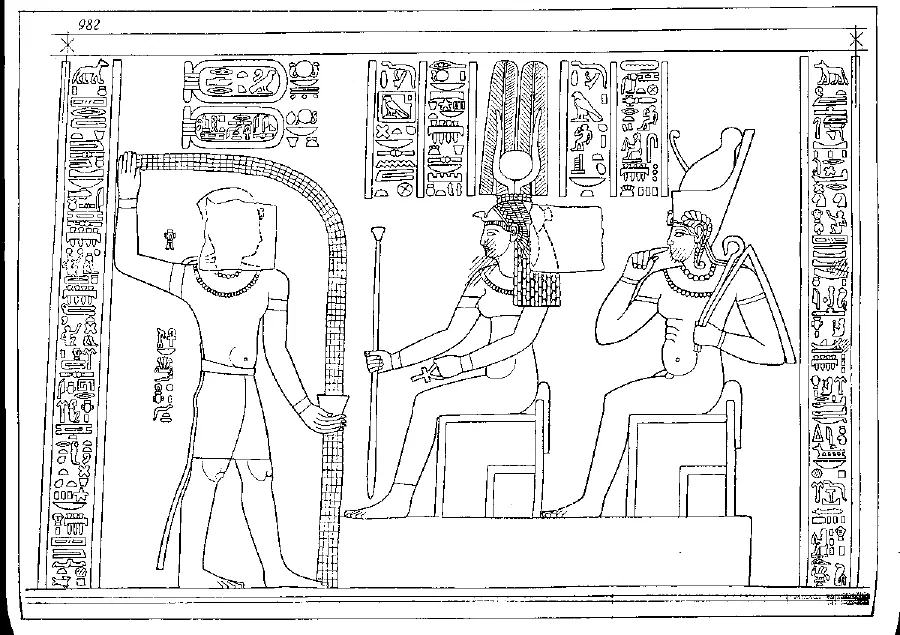
Page 301. The scene as drawn on the wall, facing p. 301 of the edition. Drawing by Otto Baum, in Junker and Winter, Das Geburtshaus des Tempels der Isis in Philä (1965) - 151p. 301, l. 1
njśwt bjt nb tꜣ.wj ꜣwtḳrdr
King of Upper and Lower Egypt, Lord of the Two Lands, Autokrator,
- 152p. 301, l. 2
sꜣ Rꜥ nb ḫꜥ.w Kjsrs …
Son of Ra, Lord of Crowns, Caesar …
- 153p. 301, l. 3
sꜣ ꜥnḫ wꜣś nb ḥꜣ-f mj Rꜥ ḏ.t
May all protection, life and dominion surround him as they surround Ra, forever.
- 154p. 301, l. 4
ḏd mdw n | Ḥw.t-Ḥrw wr.t nb(.t) Śnm.t
Words spoken by Hathor the Great, Lady of Bigeh,
- 155p. 301, l. 5
jr.t Rꜥ nb(.t) p.t ḥnw.t nṯr.w nb.w
Eye of Ra, Lady of Heaven, sovereign lady of all the gods,
Note · Line 155
As the Eye of Ra, Hathor embodies the sun god’s power to protect and to destroy. - 156p. 301, l. 6
ṯḥn(.t) ḫꜥ śḥb mꜣꜣ.tj
radiant when she appears, who gladdens both eyes.
- 157p. 301, l. 7
ḏd mdw n | Ḥrw (pꜣ) ḫrd sꜣ ꜣŚ.t nb.t (sic) jꜣ.t wꜥb.t
Words spoken by Horus the Child, son of Isis, Lady of the Abaton,
- 158p. 301, l. 8
ḫrd šps ṯḥn ḫꜥ.w
august child, radiant whenever he appears:
- 159p. 301, l. 9
jj-n-j ḫr-ṯ ḥnw.t m Śnm.t
I have come to you, sovereign lady on Bigeh,
- 160p. 301, l. 10
nb(.t) jnśj mrj-ś ṯḥn(.t?)
lady of red linen, who loves bright treasures.
- 161p. 301, l. 11
jnj-j n-ṯ ṯḥn(.t) ṯṯf-j m ḥr-ṯ
I bring you bright treasures and scatter them before you.
- 162p. 301, l. 12
śḥrj-j jb-ṯ m mr(r.t)-ṯ
I gladden your heart with what you love.
- 163p. 301, l. 13
twt r-ṯ wr.t ḥnw.t nṯr.w nb.w
You are indeed the Great One, sovereign lady of all the gods,
- 164p. 301, l. 14
ṯḥn(.t) ḥr ḥm ḥpt (= špt)
radiant of face, free of sorrow.
- 165p. 301, l. 15
jj.tj m ḥtp ḥḳꜣ m ṯn.w
Welcome in peace, ruler in the mountains along the river!
Note · Line 165
Hathor answers Horus. - 166p. 301, l. 16
ṯnr wr pḥtj ḥrj-tp šṯꜣ.w
Hero of great strength, overseer of the quarries.
- 167p. 301, l. 17
šsp-n-j jrw-k ḥtp jb-j jm(-f)
I have accepted your rite; my heart is content with it.
- 168p. 301, l. 18
ṯḥn ḥr-j m rꜣ-ꜥ.wj-k
My face shines at your handiwork.
- 169p. 301, l. 19
ḏj-j n-k bjꜣ.t nb.t ḫpr m ṯn
I give you every treasure that forms in the hills along the Nile,
- 170p. 301, l. 20
ꜥꜣ.wt šps.wt ḥr jrj(.t) kꜣ.t-k
precious stones with which to do your work.
Augustus gives Isis a collar of gold and gems
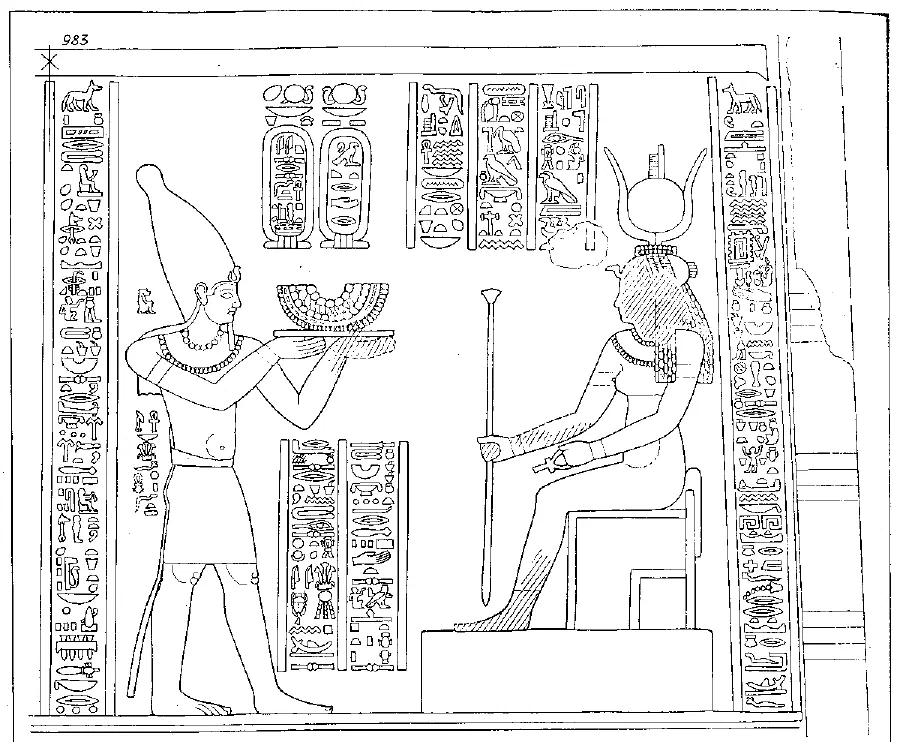
Page 303. The scene as drawn on the wall, facing p. 303 of the edition. Drawing by Otto Baum, in Junker and Winter, Das Geburtshaus des Tempels der Isis in Philä (1965) - 171p. 303, l. 1
mn n-ṯ bb.t¹ n.t nb ḥnꜥ ꜥꜣ.wt
Take for yourself the collar of gold and gems.
- 172p. 303, l. 2
šsp-ṯ śj m-ꜥ-j ḥtp jb-ṯ ḥr-ś
Receive it from my hand; let your heart delight in it.
- 173p. 303, l. 3
rḏj n-ṯ śj r bꜥn.t-ṯ
Put it around your neck.
- 174p. 303, l. 4
jrj-ś sꜣ-ṯ rꜥ nb ḫꜥj tꜣ pn jm-ś
It protects you every day, and through it this land shines.
- 175p. 303, l. 5
njśwt bjt nb tꜣ.wj ꜣwtḳrdr
King of Upper and Lower Egypt, lord of the Two Lands, Autokrator,
Note · Line 175
Here the Roman emperor bears the traditional titles of a pharaoh. - 176p. 303, l. 6
sꜣ Rꜥ nb ḫꜥ.w Ḳjsrs …
son of Ra, lord of crowns, Caesar …
- 177p. 303, l. 7
sꜣ ꜥnḫ wꜣś nb ḥꜣ-f mj Rꜥ ḏ.t
May all protection, life and dominion surround him as they surround Ra, forever.
- 178p. 303, l. 8
ḏd mdw n | ꜣŚ.t dj(.t) ꜥnḫ nb(.t) Jrḳ
Words to be spoken to Isis, giver of life, lady of Philae,
Note · Line 178
The king addresses Isis as he presents the collar. - 179p. 303, l. 9
ḥnw.t nb(.t) jꜣ.t wꜥb.t
sovereign, lady of the Abaton,
- 180p. 303, l. 10
mw.t nṯr n(.t) bjk (n) nb
divine mother of the Golden Falcon,
Note · Line 180
The Golden Falcon is Horus, son of Isis and Osiris. - 181p. 303, l. 11
nḏtj.t wr.t n(.t) śn-ś Wśjr
great protectress of her brother Osiris,
- 182p. 303, l. 12
jrj(.t) sꜣ sꜣ-f Ḥrw m mḫ …
who keeps his son Horus safe in the nest …
- 183p. 303, l. 13
jj-n-j ḫr-ṯ špś.t ḥnw.t wr.t
I have come to you, noble lady, great sovereign,
- 184p. 303, l. 14
wśr.t ḥnw.t ḫꜣś.wt rśj.wt
mighty one, sovereign of the foreign lands to the south.
- 185p. 303, l. 15
jnj-j n-ṯ bb.t śtr.tj m nb
I bring you a collar hammered out of gold,
- 186p. 303, l. 16
mḥ.tj m ꜥꜣ.wt špś.wt
inlaid with precious stones.
- 187p. 303, l. 17
twt wśr.t ḥnw.t nṯr.w nṯr.wt
You are the mighty one, sovereign of gods and goddesses,
- 188p. 303, l. 18
nb(.t) wḏꜣ.w tḥn(.t) ḥkr.w
lady of amulets, radiant in your jewels.
- 189p. 303, l. 19
jj.tj m ḥtp sꜣ twt-ḥꜣ.t²
Welcome, son of Ptah,
Note · Line 189
Isis answers the king, calling him the son of the god of craftsmen. - 190p. 303, l. 20
mw nṯrj n smꜣ-mꜣꜥ.t³
divine semen of Sema-Maat.
- 191p. 303, l. 21
šsp-n-j (so) bb(.t?) jnj-n-k ḫr ḥm.t(-j)
I have accepted the collar you brought before My Majesty.
- 192p. 303, l. 22
rḏj-n(-j) św (śj?) r bꜥn.t-j ḥꜥꜥ jb-j
I have put it around my neck; my heart rejoices.
- 193p. 303, l. 23
dj-j n-k Ḥḥ ḥr jmj-f
I give you the land of Heh with what it holds,
- 194p. 303, l. 24
Tḟrr.t ḥr prj jm-f
and the Land of Lapis Lazuli with what it yields.
Nekhbet guards the Horus falcon in the marsh
- 195p. 303, l. 25
Nḫb.t ḥḏ.t Nḫn
Nekhbet, the White One of Nekhen.
Note · Line 195
Nekhen is Hierakonpolis in Upper Egypt. Nekhbet, the vulture goddess, was the protector of Upper Egypt. - 196p. 303, l. 26
jrj(-j?) sꜣ n Ḥrw m ḥw.t-wtt
I guard Horus in the birth house.
Upper border inscription: Augustus hands the birth house over to Isis

Page 305. The scene as drawn on the wall, facing p. 305 of the edition. Drawing by Otto Baum, in Junker and Winter, Das Geburtshaus des Tempels der Isis in Philä (1965) - 197p. 305, l. 1
hrw pn nfr² rꜣ mḏ-dj n sn.nw n ꜣḫ.t
This fair day, the second day of the second month of the Inundation,
Note · Line 197
The month was called Paophi. The Inundation, named for the annual Nile flood, was the first season of the Egyptian year. - 198p. 305, l. 2
ḥb ꜥꜣ n tꜣ (r) ḏr-f
is the great feast of the whole land,
- 199p. 305, l. 3
hrw pf swḏ⁴ prj n nb-f
that day when the temple is handed over to its lord.
- 200p. 305, l. 4
ꜣJs.t wr.t mw.t nṯr nb(.t) prj-msj.t
Isis the Great, mother of the god, lady of the birth house,
- 201p. 305, l. 5
šps.t wsr.t ḥnw.t ꜣJrḳ
noble and mighty, mistress of Philae,
- 202p. 305, l. 6
ḥḳꜣ.t mnḫ.t ḫnt tꜣ.t wꜥb.t
the worthy ruler who presides over the Abaton,
Note · Line 202
The Abaton, or “Inaccessible Place,” was the sanctuary of Osiris on the neighboring island of Bigeh. - 203p. 305, l. 7
Rꜥ.t wr.t m jfd n nn.t
the great sun goddess in the four quarters of heaven,
- 204p. 305, l. 8
ḥm.t njswt tpj.t n ḥm n njswt bjt Wsjr
first royal wife of His Majesty Osiris, King of Upper and Lower Egypt,
- 205p. 305, l. 9
mw.t njswt n Ḥrw kꜣ nḫt
royal mother of Horus, the mighty bull.
- 206p. 305, l. 10
p.t m ḥb tꜣ m mfkꜣ.t … m ṯḥn
Heaven keeps festival, earth rejoices, … shines;
Note · Line 206
The word for earth’s gladness also means “turquoise.” - 207p. 305, l. 11
nṯr.w m hj nṯr.wt m hnw
the gods shout for joy, the goddesses cry out in praise,
- 208p. 305, l. 12
ḥnm.m.t m ꜣw.t-jb mꜣꜣ-s mnw pn nfr
and the sun folk are glad at heart when Isis sees this fair monument
Note · Line 208
The “sun folk” are humankind, joining the gods in celebration. - 209p. 305, l. 13
jrrw n-s njswt bjt nb tꜣ.wj ꜣwtḳrdr sꜣ Rꜥ (nb ḫꜥ.w) Kjsrs ꜥnḫ ḏ.t mrj Ptḥ ꜣJs.t
made for her by the King of Upper and Lower Egypt, lord of the Two Lands, Autokrator, son of Ra, lord of crowns, Caesar, who lives forever, beloved of Ptah and Isis.
Note · Line 209
This Caesar is Augustus. - 210p. 305, l. 14
gmj-n-s ḥw.t-wṯt ꜣḫ.tj m kꜣ.t-f mnḫ.tj m jrw nb
She found the birth house splendid in its workmanship, excellent in every detail.
- 211p. 305, l. 15
snḏm ḥm.t-s m ḫnt-f m ḥb Rnn.t
Her Majesty settles within it at the feast of Renenutet
Note · Line 211
Renenutet was a cobra goddess of nourishment and the harvest. - 212p. 305, l. 16
ḥr dj sꜣ-s r tꜣ m ḳꜣb-f
and in its midst brings her son into the world.
- 213p. 305, l. 17
jsw ḥr-f m ḥḥ.w n ḥb.w-sd ḥfn.w m rnp.wt
The king’s reward for this is millions of Sed festivals and hundreds of thousands of years
Note · Line 213
At the Sed festival the king ritually renewed his powers, traditionally for the first time after thirty years on the throne. - 214p. 305, l. 18
ḥr s.t Ḥrw ḫnt ꜥnḫ.w ḏ.t
on the throne of Horus, forever at the head of the living.
Tiberius stands before Horus the Child
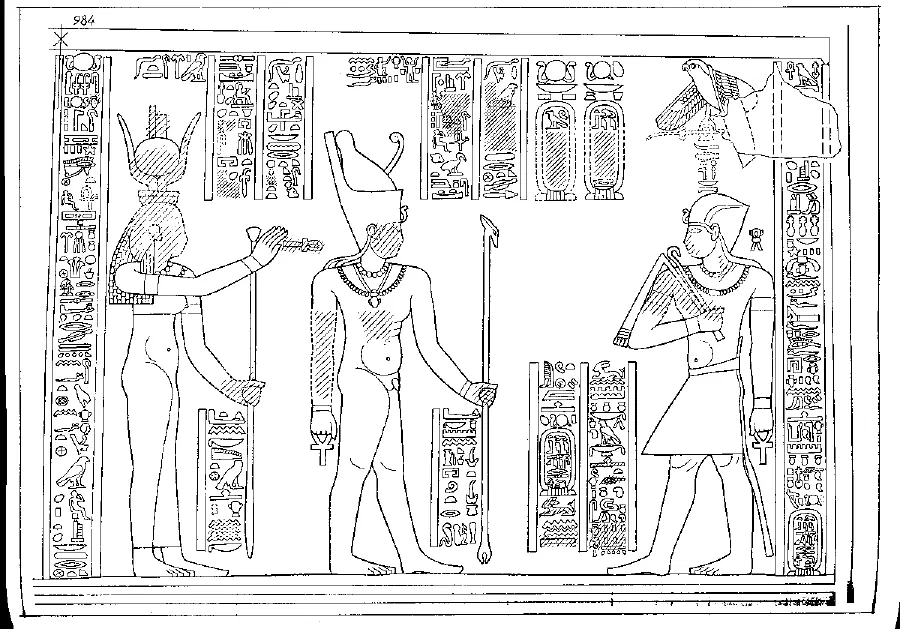
Page 307. The scene as drawn on the wall, facing p. 307 of the edition. Drawing by Otto Baum, in Junker and Winter, Das Geburtshaus des Tempels der Isis in Philä (1965) - 215p. 307, l. 1
jj.tj (sp śn) m ḥtp sꜣ Rꜥ Tbrjs Kjsrs ꜥnḫ ḏ.t
You have come, you have come in peace, son of Ra, Tiberius Caesar, who lives forever!
- 216p. 307, l. 2
wnn p.t wnn mnw-k
As long as heaven stands, your monument will stand.
- 217p. 307, l. 3
bjk nb ḥtp ḥr jrj(.t)-n-k
The Golden Falcon is pleased with what you have made;
- 218p. 307, l. 4
śpḥr-f n-k jb.w tpj.w-tꜣ
he turns the hearts of those on earth toward you.
- 219p. 307, l. 5
njśwt bjt nb tꜣ.wj jw(tḳrdr)
King of Upper and Lower Egypt, lord of the Two Lands, Autokrator,
- 220p. 307, l. 6
sꜣ Rꜥ nb ḫꜥ.w Tbrj(s) … sꜣ
son of Ra, lord of crowns, Tiberius … Protection.
- 221p. 307, l. 7
Bḥd.tj nṯr ꜥꜣ nb p.t
He of Edfu, the great god, lord of heaven.
Note · Line 221
“He of Edfu” is Horus, often shown as a winged sun disk. - 222p. 307, l. 8
ḏd mdw n | Ḥrw … ’Jrk
Words spoken by Horus … Philae,
- 223p. 307, l. 9
jwꜥw mnḫ prj m Wśjr … jḥj (? nṯr ꜥꜣ?) … ḥḳꜣ ḫnt nṯr.w
worthy heir sprung from Osiris, … Ihy, the great god, … ruler foremost among the gods,
Note · Line 223
Ihy is a child god associated with music. - 224p. 307, l. 10
śfj jḳr ḫnt Śnm.t
the excellent child who presides over Bigeh:
- 225p. 307, l. 11
ḥꜥꜥ ḥr.w n mꜣꜣ-f
faces light up at the sight of him.
- 226p. 307, l. 12
dj-j n-k mnḳb(.t) mn.tj ḥr ḥm-k
I give you the palace; it abides with Your Majesty.
- 227p. 307, l. 13
ḏd mdw n | ’Jś.t wr.t mw.t nṯr nb(.t) ’Jrk
Words spoken by Isis the Great, mother of the god, lady of Philae,
- 228p. 307, l. 14
ḥḳꜣ.t ꜥꜣ.t (? mnḫ.t?) ḫnt Śnm.t
great sovereign at the head of Biga,
Note · Line 228
Biga is the island beside Philae. - 229p. 307, l. 15
šps.t nfr(.t) ḥnw.t prj-msj.t
noble and beautiful, mistress of the birth house,
- 230p. 307, l. 16
ḥwj(.t) sꜣ(-ś) Ḥrw m ḥḳꜣ ḏ.t
who guards her son Horus as ruler of eternity:
- 231p. 307, l. 17
dj-j n-k Km.t ḥtp(.tj) ḥr mw-k
I give you Egypt, loyal to you.
Note · Line 231
Isis addresses the king. To be “on your water” is to owe you allegiance. - 232p. 307, l. 18
ꜥnḫ | nṯr nfr … sꜣ ’Jś.t
Long live the good god … the son of Isis,
Note · Line 232
“The good god” is a title of the king. - 233p. 307, l. 19
r wṯs nfrw n nb nṯr.w
to extol the goodness of the lord of the gods.
- 234p. 307, l. 20
jw jb-f n mꜣꜣ-f ḥnṯś-f n ptr-f
His heart rejoices at the sight of him; he exults when he sees him.
Note · Line 234
It is Horus the Child who rejoices to see the king. - 235p. 307, l. 21
hrw jb-f n jw-f ḥtp kꜣ-f ḥr mnw pn nfr
His heart is glad at his coming; his ka delights in this fine monument
- 236p. 307, l. 22
jrj n-f sꜣ-f mrj-f sꜣ Rꜥ Tbrjs …
that his beloved son made for him, the Son of Ra, Tiberius …
- 237p. 307, l. 23
njśwt bjt | snn n(so) Rꜥ ḥḳꜣ nṯr.w mrj nṯr.w bꜣḳ.t
King of Upper and Lower Egypt, image of Ra, ruler of the gods, beloved of the gods of Egypt,
Note · Line 237
Here the royal titles belong to Horus himself. - 238p. 307, l. 24
śfj šps wbn m ꜣḫbjt
the noble child who rose radiant in Chemmis,
Note · Line 238
Chemmis was the marshland refuge in the Nile Delta where Isis raised Horus in hiding. - 239p. 307, l. 25
rr św mw.t-f r jwꜥw tꜣ.wj
whom his mother reared to be heir to the Two Lands.
- 240p. 307, l. 26
ḥḳꜣ-n-f šmꜥw ḫrj-tp-n-f mḥw
He has ruled the South and commanded the North:
- 241p. 307, l. 27
Ḥrw pꜣ ḫrd sꜣ ’Jś.t nb ’Jrk
Horus the Child, son of Isis, lord of Philae.
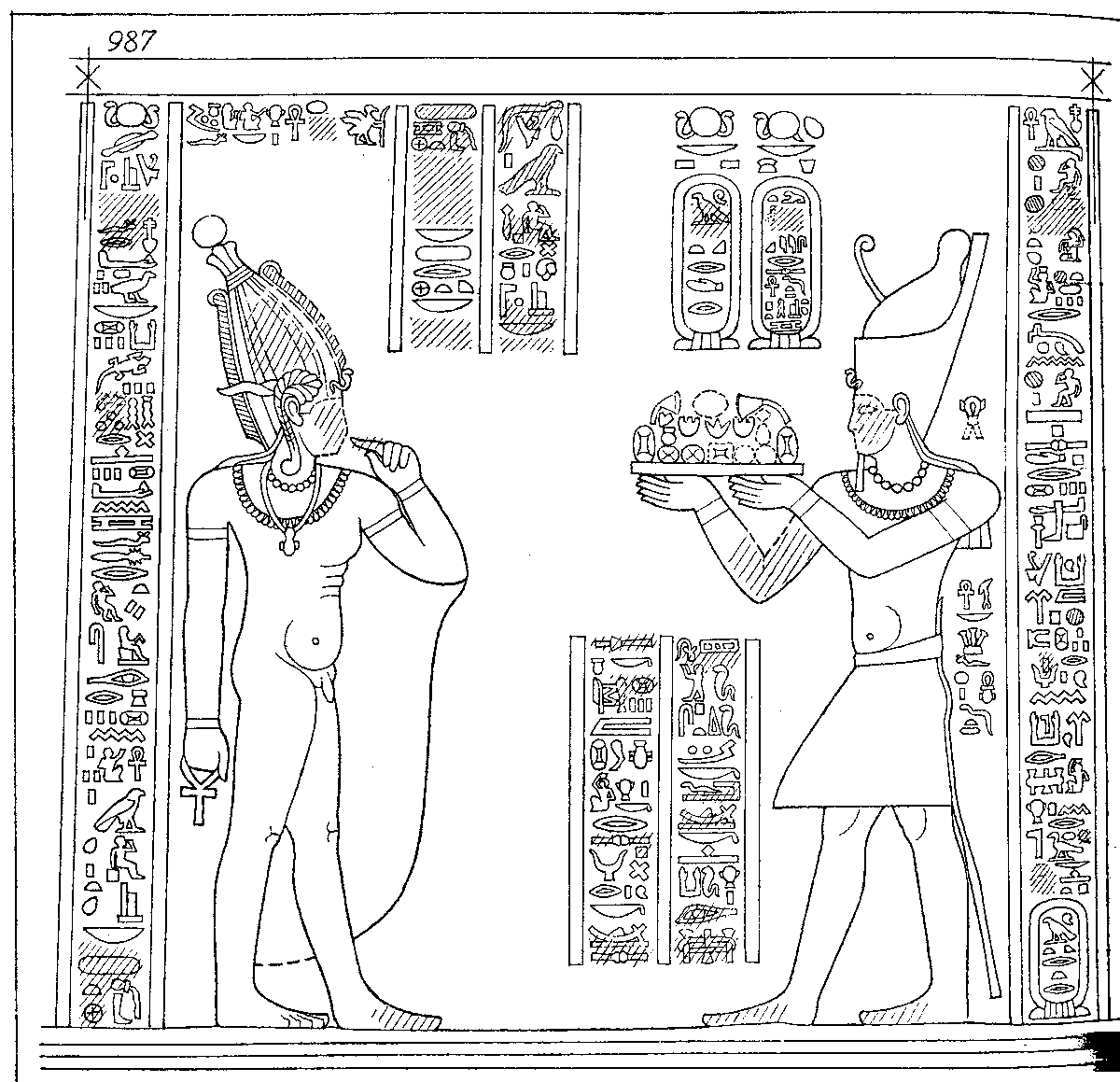
Tiberius burns incense before Osiris
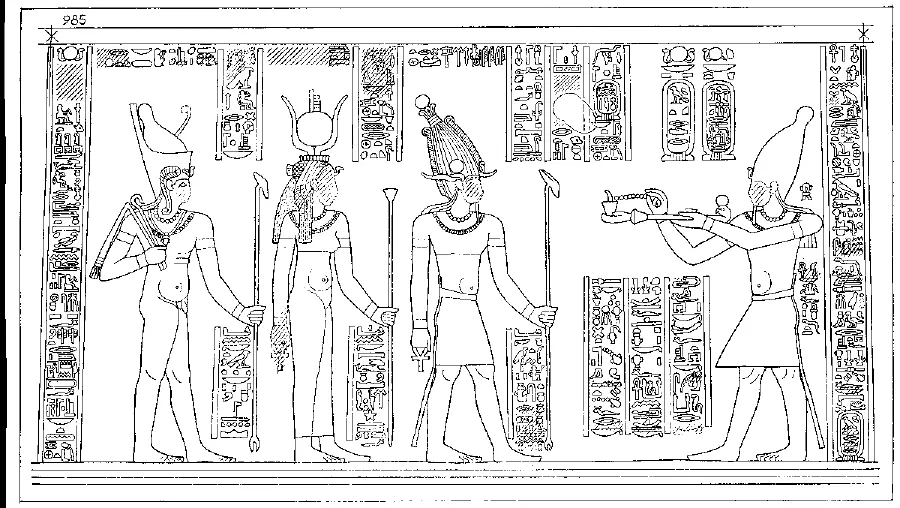
Page 309. The scene as drawn on the wall, facing p. 309 of the edition. Drawing by Otto Baum, in Junker and Winter, Das Geburtshaus des Tempels der Isis in Philä (1965) - 242p. 309, l. 1
mn n-k snṯr wbn ḥr sḏ.t
Receive the incense that shines upon the flame,
Note · Line 242
The king speaks as he offers incense. - 243p. 309, l. 2
sṯj-nṯr jw sṯj-f r-k
the scent of the god, its scent drifting toward you.
- 244p. 309, l. 3
šnšn-k jm-f ḥtp jb-k ḥr-f
May you breathe it in; may your heart delight in it.
- 245p. 309, l. 4
ꜥnḫ kꜣ-k n prj jm-k
May your ka live on what came forth from you.
Note · Line 245
The incense resin was understood to have issued from the god’s own body. - 246p. 309, l. 5
pḥr-f prj-k ḏsr-f s.t-k
May it pass through your house and hallow your seat;
- 247p. 309, l. 6
sẖꜥb-f kꜣ-k r ḏw
may it cleanse your ka of evil.
- 248p. 309, l. 7
njswt bjt nb tꜣ.wj ꜣwtḳrdr
King of Upper and Lower Egypt, lord of the Two Lands, Autokrator,
- 249p. 309, l. 8
sꜣ Rꜥ nb ḫꜥ.w Tbrjs …
Son of Ra, lord of crowns, Tiberius …
- 250p. 309, l. 9
sꜣ ꜥnḫ wꜣs nb ḥꜣ-f mj Rꜥ ḏ.t
May all protection, life and dominion surround him as they surround Ra, forever.
- 251p. 309, l. 10
ḏd mdw n | Wsjr Wnn nfrw mꜣꜥ ḫrw
Words spoken by Osiris Wennefer, the vindicated one,
Note · Line 251
Wennefer is a name of Osiris. He is called vindicated because judgment was given in his favor against Seth. - 252p. 309, l. 11
nṯr ꜥꜣ nb jꜣ.t wꜥb.t sḫm š(ps) (nb ꜣJrk)
the great god, lord of the Abaton, noble power, lord of Philae,
Note · Line 252
Access was forbidden to all but the officiating priests. - 253p. 309, l. 12
(ḥḳꜣ)¹ (w)r ḫnt psḏ.t sꜥḥ(?) nfr jw.tj mj.tj-f
great ruler at the head of the Ennead, beautiful mummy without equal,
- 254p. 309, l. 13
njswt m p.t ḥḳꜣ m tꜣ jtj ꜥꜣ m Tꜣ-wr
king in heaven, ruler on earth, great sovereign in the district of Abydos:
- 255p. 309, l. 14
dj-j n-k Ḳmꜣ.tjw dns ḥr jnw-sn
I give you the Qematyu, laden with their gifts.
- 256p. 309, l. 15
ḏd mdw n | ꜣJs.t dj(.t) ꜥnḫ nb.t jꜣ.t wꜥb.t
Words spoken by Isis, giver of life, lady of the Abaton,
- 257p. 309, l. 16
ḥnw.t nb(.t) ꜣJrk ḥḳꜣ.t m p.t …
sovereign lady, mistress of Philae, ruler in heaven …
- 258p. 309, l. 17
dj-j n-k Pwn(.t) m ḳd-f
I give you Punt in its entirety,
Note · Line 258
Isis promises its riches to the king. - 259p. 309, l. 18
Tꜣ-nṯr m nw(?)³-f
and God’s Land with its fragrance.
- 260p. 309, l. 19
ḏd mdw n | Ḥrw pꜣ ḫrd ꜥꜣ wr tpj n Wsjr
Words spoken by Harpocrates, the very great one, firstborn of Osiris,
Note · Line 260
Harpocrates is Horus the Child. - 261p. 309, l. 20
nb jꜣ.t wꜥb.t sꜣ ꜣJs.t nb ꜣJrk
lord of the Abaton, son of Isis, lord of Philae:
- 262p. 309, l. 21
dj-j n-k sṯf.w nb.w nj.w Tꜣ-nṯr
I give you all the incense of God’s Land.
- 263p. 309, l. 22
ꜥnḫ | nṯr nfr šdj n šꜣ.t
Long live the good god, suckled by the vulture goddess,
- 264p. 309, l. 23
rr m ḫnt Bwgm
reared in the heart of Bugem,
- 265p. 309, l. 24
ḥfꜣ ꜥ-n-Ḥrw ḥr snṯr wṯṯ sw
who grasps the arm of Horus and censes the one who begot him,
Note · Line 265
The “arm of Horus” is a censer shaped like an outstretched arm. - 266p. 309, l. 25
sẖꜥb ḏ.t-f m ḥms šmꜥj
who purifies his body with incense from Upper Egypt,
- 267p. 309, l. 26
jnj bꜣ-f r s.t-f
who brings his ba to its seat
Note · Line 267
A god’s ba was the aspect of him that could travel and return to dwell in his image. - 268p. 309, l. 27
ḥr šnšn sṯj-f nb Pwn(.t) ꜣwtḳrdr
as he breathes in his fragrance—the lord of Punt, Autokrator.
Note · Line 268
Autokrator, a Greek imperial title, serves here as a royal name for the Roman emperor. - 269p. 309, l. 28
njswt bjt | … sḫm šps ḫnt gs.w-prj.w
King of Upper and Lower Egypt, …, the august power in the temples,
- 270p. 309, l. 29
ḥwn nfr prj m Nw.t
the fair youth who came forth from Nut,
Note · Line 270
Nut is the sky goddess, mother of Osiris. - 271p. 309, l. 30
jwꜥw mnḫ n rpꜥ.t nṯr.w
the worthy heir of the prince of the gods,
- 272p. 309, l. 31
msḫn-f ḏd r gs ꜣJmn-rn-f
whose cradle stands firm beside him whose name is hidden:
- 273p. 309, l. 32
Wsjr nṯr ꜥꜣ nb jꜣ.t wꜥb.t
Osiris, the great god, lord of the Abaton.
Tiberius gives Horus the Child the heh sign of a million years
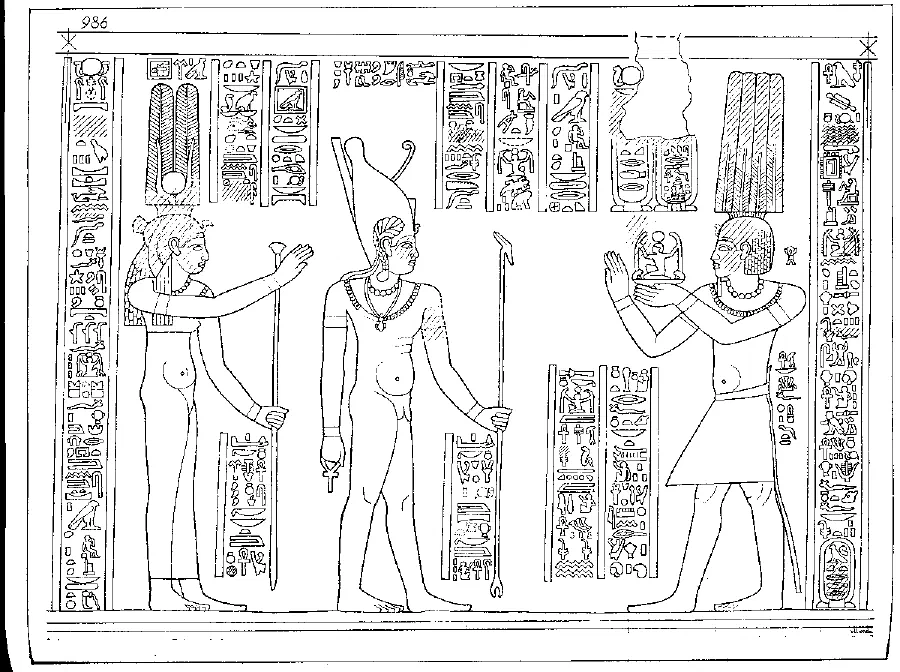
Page 311. The scene as drawn on the wall, facing p. 311 of the edition. Drawing by Otto Baum, in Junker and Winter, Das Geburtshaus des Tempels der Isis in Philä (1965) - 274p. 311, l. 1
mn n-k ḥḥ m ꜥnḫ ḏd wꜣs
Receive the heh as life, stability and dominion,
Note · Line 274
The heh is an offering whose name means “a million”: the gift is a vast span of years. - 275p. 311, l. 2
nśwj-k tꜣ m mꜣꜥ ḫrw
that you may rule the land in triumph.
- 276p. 311, l. 3
ꜥnḫ nn n ḥm n Rꜥ r fnḏ nb tm.w
This bouquet of the Majesty of Ra is for the nose of the lord of all humankind,
Note · Line 276
The Egyptian word for “bouquet” also means “life”: to breathe in its fragrance is to receive life. - 277p. 311, l. 4
ꜥḥꜥw ꜥꜣ n Jmn-Rꜥ ır¹ sḫm.tj ḥr tp-k
and with it the long life of Amun-Ra, with the Double Crown upon your head.
Note · Line 277
The Double Crown joins the crowns of Upper and Lower Egypt. - 278p. 311, l. 5
njśwt bjt nb (tꜣ.wj) (ꜣw)tḳrdr
King of Upper and Lower Egypt, lord of the Two Lands, Autokrator,
- 279p. 311, l. 6
(sꜣ Rꜥ nb ḫꜥ.w Tbrjs) …
son of Ra, lord of crowns, Tiberius …
- 280p. 311, l. 7
sꜣ ꜥnḫ wꜣs nb ḥꜣ-f mj Rꜥ ḏ.t
May all protection, life and dominion surround him as they surround Ra, forever.
- 281p. 311, l. 8
ḏd mdw n | Ḥrw pꜣ ḫrd sꜣ ỉs.t nb ỉrḳ
Words spoken by Harpocrates, son of Isis, lord of Philae,
- 282p. 311, l. 9
ḫfj šps bnr mrw.t
noble child, sweet in love,
- 283p. 311, l. 10
nb ḥḥ ꜥšꜣ ḥfn.w
lord of millions, rich in hundreds of thousands,
- 284p. 311, l. 11
nb ns.t ꜥꜣ.t m Snm.t
lord of the great throne on Bigeh.
- 285p. 311, l. 12
(ꜣw.t?) nśwj.t-f r km ḏ.t
His reign lasts to the very end of eternity.
- 286p. 311, l. 13
n wn ḏrw ꜥḥꜥw-f
His lifetime has no end.
- 287p. 311, l. 14
dj-j n-k ꜥḥꜥw n Rꜥ m p.t
I give you the lifetime of Ra in the sky,
- 288p. 311, l. 15
ḥr ns.t-k m ḥḳꜣ ꜥnḫ.w
on your throne as ruler of the living.
- 289p. 311, l. 16
ḏd mdw n | Ḥw.t-Ḥrw wr.t nb(.t) Jrḳ
Words spoken by Hathor the Great, Lady of Philae,
- 290p. 311, l. 17
jr.t Rꜥ nb(.t) p.t ḥnw.t nṯr.w nb.w
Eye of Ra, Lady of the Sky, mistress of all the gods,
- 291p. 311, l. 18
nb.tj rḫj.t ḥnw.t m Snm.t
queen of the people, sovereign lady on Bigeh,
- 292p. 311, l. 19
ḥwj(.t sꜣ-s) Ḥrw m ḥw.t-wtt
who guards her son Horus in the birth house:
- 293p. 311, l. 20
dj-j n-k ꜥnḫ smꜣ m snb ḥꜥ.w-k nb tm n ꜥnḫ
I give you life joined with health, every limb of yours whole for life.
- 294p. 311, l. 21
ꜥnḫ | nṯr nfr jwꜥw n Rꜥ mw nṯrj n Ḏd-šps
Long live the good god, heir of Ra, divine semen of the august djed pillar,
Note · Line 294
The djed pillar, an emblem of stability, was identified with the backbone of Osiris. - 295p. 311, l. 22
wṯs ḥḥ n sꜣ Js.t ḥr śwr nśwj.t-f
who holds aloft the sign for a million for the son of Isis, magnifying his kingship,
Note · Line 295
The sign stands for a million years: the king offers the god a reign beyond counting. - 296p. 311, l. 23
(ḥr) śḳꜣ ḥm-f ḥr tp ꜥnḫ.w
exalting his majesty above the living,
- 297p. 311, l. 24
ms ꜥnḫ-n-Rꜥ ḥr ḫnm fnḏ-f
who presents the bouquet of Ra and holds it to his nose,
Note · Line 297
The god breathes in the fragrance of what the king offers him. - 298p. 311, l. 25
nb nśwj.t ꜣwtḳrdr
lord of kingship, Autokrator.
- 299p. 311, l. 26
njśwt bjt | ḥḳꜣ nfr(?) ḥḳꜣ p.t
King of Upper and Lower Egypt, the fair ruler who rules the sky,
- 300p. 311, l. 27
… nśwj.t nḥḥ wnn(?)-f ḏ.t
… kingship for all eternity; he shall endure forever.
- 301p. 311, l. 28
ꜥḥꜥw-f sbꜣ.w nj.w p.t rnp.wt-f ḥḥ.w
His lifetime is that of the stars of the sky; his years number in the millions.
- 302p. 311, l. 29
ḥn.tj-f ḥr ḥmr-f m Snm.t
He spends eternity on his throne on Bigeh:
- 303p. 311, l. 30
Ḥrw pꜣ ḫrd sꜣ Js.t nb jꜣ.t wꜥb.t
Harpocrates, son of Isis, lord of the Abaton.
Tiberius gives Isis a collar of gold and gems
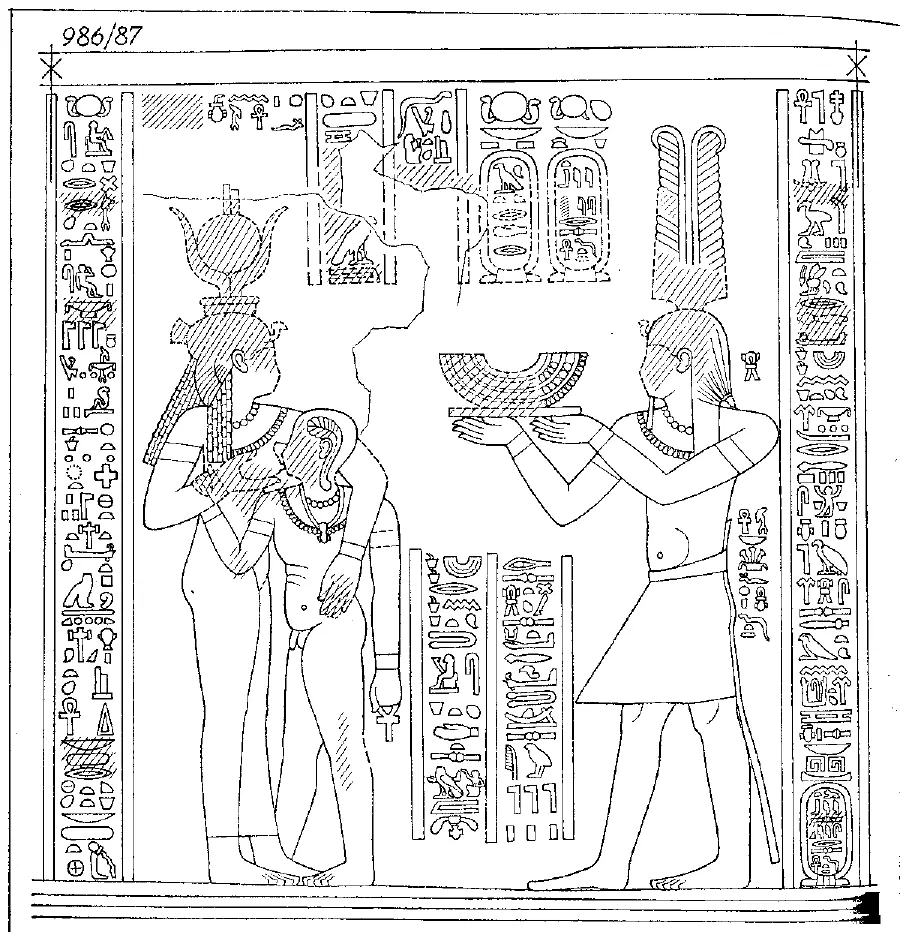
Page 313. The scene as drawn on the wall, facing p. 313 of the edition. Drawing by Otto Baum, in Junker and Winter, Das Geburtshaus des Tempels der Isis in Philä (1965) - 304p. 313, l. 1
bb(.t)¹ r bꜥn.t-ṯ šps.t ḥnw.t
May the collar rest at your throat, noble one, sovereign lady.
- 305p. 313, l. 2
šsp-ṯ sj m-ꜥ-j m ꜣw.t-jb
Receive it from my hand with joy.
- 306p. 313, l. 3
jrj-s sꜣ-ṯ wḥm-s mk.t-ṯ
It guards you and renews your protection.
- 307p. 313, l. 4
ꜥꜣ nrw-ṯ jm-s r nṯr.w
With it you inspire greater awe than the gods themselves.
- 308p. 313, l. 5
njswt bjt nb tꜣ.wj ꜣwtḳrdr
King of Upper and Lower Egypt, Lord of the Two Lands, Autokrator,
- 309p. 313, l. 6
sꜣ Rꜥ nb ḫꜥ.w Tbrjs …
Son of Ra, Lord of Crowns, Tiberius …
- 310p. 313, l. 7
sꜣ ꜥnḫ wꜣs nb ḥꜣ-f mj Rꜥ ḏ.t
May all protection, life and dominion surround him as they surround Ra, forever.
- 311p. 313, l. 8
ḏd mdw n | Js.t … ḥnw.t jꜣ.t (wꜥb.t?)
Words spoken by Isis, … mistress of the Abaton,
- 312p. 313, l. 9
… Ḥrw m hrw(?)-f m (so?) ꜥnḫ-wꜣs
… Horus on his day with milk.
Note · Line 312
The ritual name for milk here is “life and dominion,” two blessings just invoked for the king. - 313p. 313, l. 10
ꜥnḫ | nṯr nfr wtṯ n Tnn jḳr² ḏbꜥ.w m kꜣ.t-f r mnḫ (so)
Long live the good god, begotten of Tenen, whose deft fingers bring his work to perfection,
- 314p. 313, l. 11
ḥnk bb(.t) n ḥnw.t-f m nb ḥnꜥ ꜥꜣ.wt
who offers his mistress a collar of gold and precious stones,
- 315p. 313, l. 12
sḫꜥꜥ jb n mw.t nṯr m sꜣ-s
who gladdens the heart of the god’s mother with her amulet.
Note · Line 315
The word for “amulet” also means “protection”: the collar is a safeguard she can wear. - 316p. 313, l. 13
sḥkr šnb.t n kꜣ-s m mr(r.t) jb-s
who adorns the neck of her ka with what her heart loves,
Note · Line 316
It can receive adornments as well as food and drink. - 317p. 313, l. 14
nb Ḥḥ Tbrjs Kjsrs ꜥnḫ ḏ.t
lord of Heh, Tiberius Caesar, who lives forever.
- 318p. 313, l. 15
njswt bjt | šps(.t) ḥnw.t wr(.t) wsr.t nn ḫr ḥw-s
King of Upper and Lower Egypt: the august one, the sovereign lady, great and mighty, whom none can match,
Note · Line 318
Here the royal title introduces the praises of Isis. - 319p. 313, l. 16
nb n nṯr.w ḏꜥm n nṯr.wt
gold of the gods, electrum of the goddesses,
Note · Line 319
Electrum is an alloy of gold and silver. - 320p. 313, l. 17
ḫsbḏ jmj psḏ.t
lapis lazuli among the Ennead.
- 321p. 313, l. 18
nḏtj.t pw m tꜣ ḥr nḏb-f
She is the protectress the whole world over,
- 322p. 313, l. 19
Js.t dj(.t) ꜥnḫ nb(.t) Jrk
Isis, giver of life, lady of Philae,
- 323p. 313, l. 20
ḥnw.t nb(.t) jꜣ.t wꜥb.t
sovereign lady, mistress of the Abaton.
Tiberius gives Horus the Child food offerings
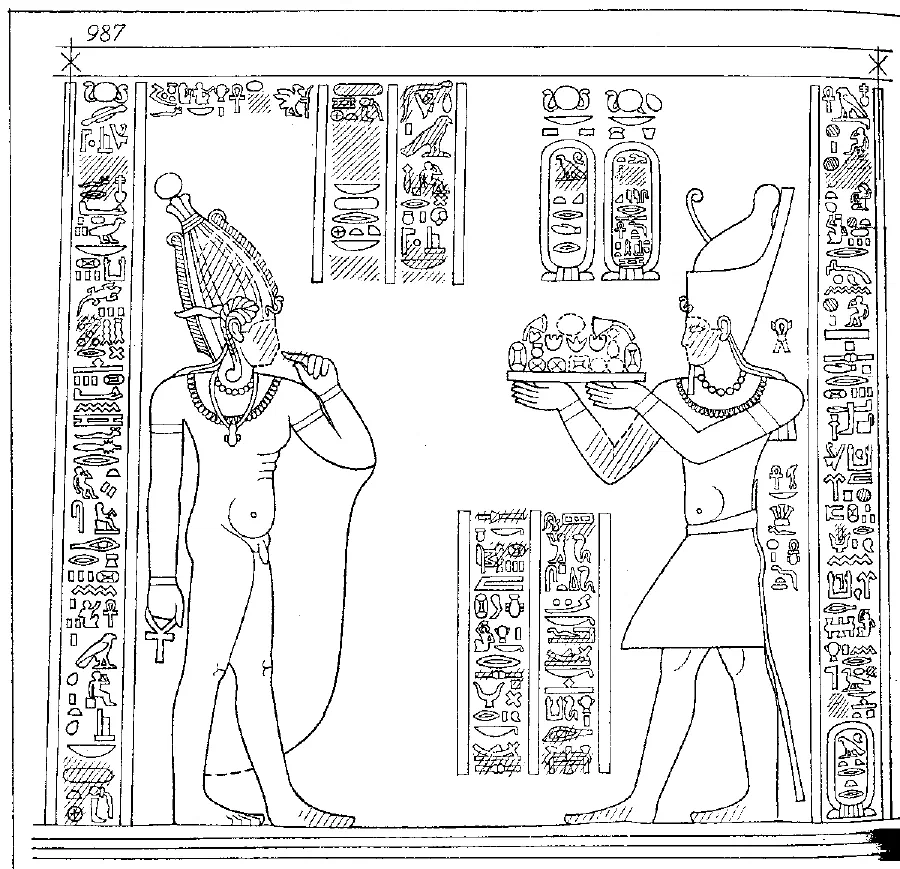
Page 315. The scene as drawn on the wall, facing p. 315 of the edition. Drawing by Otto Baum, in Junker and Winter, Das Geburtshaus des Tempels der Isis in Philä (1965) - 324p. 315, l. 1
mn n-k ꜥb.t m jḫ.t(?) nb.t(?)¹
Take for yourself the offering of all things;
- 325p. 315, l. 2
fꜣj ḥr-k r-š wp rꜣ-k jm-š
lift your face to it and open your mouth with it.
- 326p. 315, l. 3
wꜣš-k špd-k
May you rejoice and be glad.
- 327p. 315, l. 4
mꜣꜣ-k prj jm-k ḥtp kꜣ-k ḥr jr.t-Ḥrw
May you look on what came forth from you; may your ka be content with the Eye of Horus.
Note · Line 327
In ritual, the offering is called the Eye of Horus: like the god’s injured eye made whole again, it embodies the restoration of what was lost. - 328p. 315, l. 5
njśwt bjt nb tꜣ.wj ꜣwtḳrdr
King of Upper and Lower Egypt, lord of the Two Lands, Autokrator,
Note · Line 328
Autokrator, a Greek title for the emperor, serves here as Tiberius’s Egyptian throne name. - 329p. 315, l. 6
sꜣ Rꜥ nb ḫꜥ.w Tbr(jś) …
son of Ra, lord of crowns, Tiberius …
- 330p. 315, l. 7
sꜣ ꜥnḫ wꜣś nb ḥꜣ-f mj Rꜥ ḏ.t
May all protection, life and dominion surround him as they surround Ra, forever.
- 331p. 315, l. 8
ḏd mdw n | Ḥrw pꜣ ḫrd ꜥꜣ wr tpj n Wśjr
Words to be spoken to Harpocrates, the very great one, firstborn of Osiris,
- 332p. 315, l. 9
nb jꜣ.t wꜥb.t … nb Jrk
lord of the Abaton, … lord of Philae,
- 333p. 315, l. 10
nb … ḳmꜣ … ꜥnḫ ḥr nb n mꜣꜣ-f
lord of …, who created …, at whose sight every face lives.
- 334p. 315, l. 11
ꜥnḫ | nṯr nfr ḥj n …⁴
Long live the good god, the child of …,
- 335p. 315, l. 12
fꜣj jḫ.t r nw-f n ḥj špś
who brings food in due season to the noble child,
- 336p. 315, l. 13
drp ꜥbꜣ n kꜣ-f m gś-pḫꜣ
who sets offering loaves on the altar for his ka,
- 337p. 315, l. 14
wp rꜣ n kꜣ-f m jr.t-Ḥrw
who opens the mouth of his ka with the Eye of Horus,
- 338p. 315, l. 15
fꜣj ḥr n nṯr r ḏfꜣ-f … nb ḥtp ꜣwtḳrdr
who lifts the god’s face to his food, … lord of offerings, Autokrator.
- 339p. 315, l. 16
njśwt bjt | jwꜥw n Wśjr
King of Upper and Lower Egypt: the heir of Osiris,
- 340p. 315, l. 17
… nfr dj ḏfꜣ.w nb kꜣ.w
the good … who gives food, lord of nourishment,
- 341p. 315, l. 18
ꜥšꜣ wꜣḫj.t wr ḥtp.w dj n mrj-f
rich in harvests, great in offerings, who gives them to whomever he pleases,
- 342p. 315, l. 19
ḫrd špś jrj ḫr.t n ꜥnḫ.w
the noble child who prepares food for the living,
- 343p. 315, l. 20
Ḥrw pꜣ ḫrd sꜣ Jś.t nb jꜣ.t wꜥb.t
Harpocrates, son of Isis, lord of the Abaton.
Tiberius gives Horus, avenger of his father, a bowl of grape juice
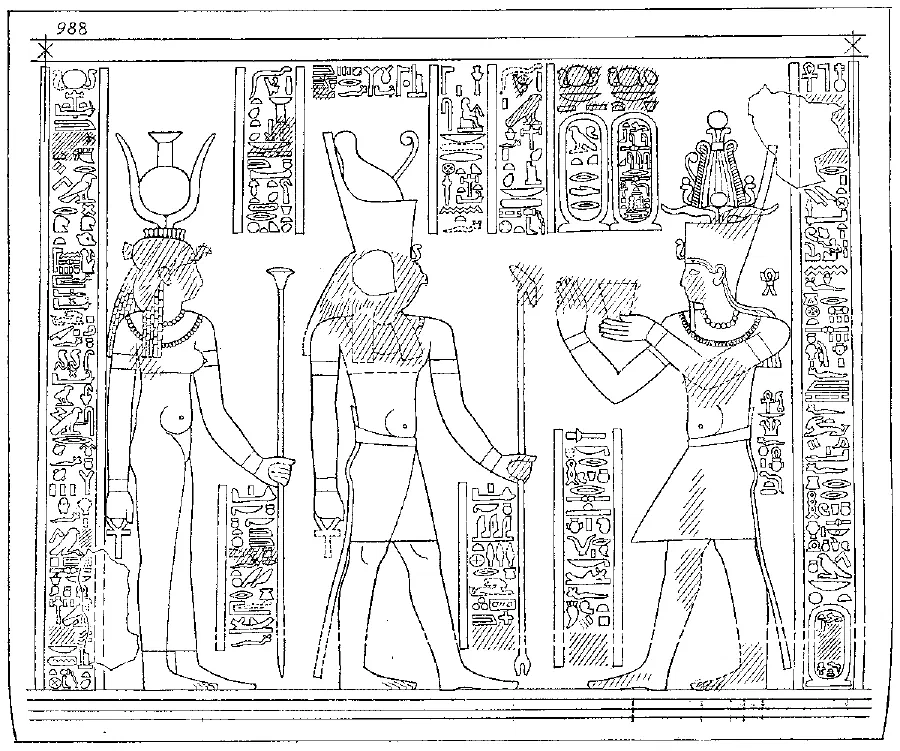
Page 317. The scene as drawn on the wall, facing p. 317 of the edition. Drawing by Otto Baum, in Junker and Winter, Das Geburtshaus des Tempels der Isis in Philä (1965) - 344p. 317, l. 1
mn n-k ḥrw-ꜥ r sḥtp jb-k
Take for yourself the juice of the grape to gladden your heart;
- 345p. 317, l. 2
wp rꜣ-k jm-f bnr.wj dp(.t-f)
open your mouth with it. How sweet it tastes!
- 346p. 317, l. 3
njśwt bjt nb tꜣ.wj ꜣwtḳrdr
King of Upper and Lower Egypt, lord of the Two Lands, Autokrator,
- 347p. 317, l. 4
sꜣ Rꜥ nb ḫꜥ.w Tbrjs …
son of Ra, lord of crowns, Tiberius …
- 348p. 317, l. 5
sꜣ ꜥnḫ wꜣś nb ḥꜣ-f mj Rꜥ ḏ.t
May all protection, life and dominion surround him as they surround Ra, forever.
- 349p. 317, l. 6
ḏd mdw n | Ḥrw nḏtj jt-f sꜣ ꜣŚ.t
Words spoken by Horus, avenger of his father, son of Isis,
Note · Line 349
Horus is called Harendotes in this role: he defends his father Osiris and avenges his murder. - 350p. 317, l. 7
nb jꜣ.t wꜥb.t sḫm šps nb ꜣJrk
lord of the Abaton, august power, lord of Philae,
Note · Line 350
The Abaton, called the Pure Mound in Egyptian, was a sacred burial place of Osiris on the island of Bigeh, near Philae. - 351p. 317, l. 8
nḏtj mnḫ n jt-f Wśjr
worthy protector of his father Osiris,
- 352p. 317, l. 9
dr śbj.w r-f m Śnm.t
who drives off those who rebel against him on Bigeh:
- 353p. 317, l. 10
dj-j n-k śḫ.t-jmꜣw ḥr wnš jm(-ś)
“I give you the oases with the grapes that grow there.”
Note · Line 353
Horus addresses the king. The western oases were known for their vineyards. - 354p. 317, l. 11
ḏd mdw n | Nb.t-ḥw.t śn.t nṯr nb(.t) Śnm.t
Words spoken by Nephthys, the god’s sister, lady of Bigeh,
Note · Line 354
The god whose sister she is here is Osiris. - 355p. 317, l. 12
ḥḳꜣ.t mnḫ.t ḥnw.t ꜣJrk
able ruler, mistress of Philae:
- 356p. 317, l. 13
dj-j n-k Knm.t ḥr jmj-f (sic)
“I give you Kharga Oasis with all it holds,
- 357p. 317, l. 14
Dśdś ḥr prj jm-f
and Bahariya Oasis with all it yields.”
- 358p. 317, l. 15
ꜥnḫ | nṯr nfr … (w)r n Dśdś
Long live the good god, … the great one of Bahariya Oasis,
- 359p. 317, l. 16
ḫrp wḥꜣ.tjw n jt-f ḥr jḫ.t-śn
who leads the people of the oases to his father with their gifts,
- 360p. 317, l. 17
ḥr śmś jb-f m mr(r.t)-f
gladdening his father’s heart with what he loves,
- 361p. 317, l. 18
dwn ꜥ-f ḥr ḥrw-ꜥ
who stretches out his hand with grape juice,
- 362p. 317, l. 19
ḥr śḫb šnb.t n šnb.tj
gladdening the falcon’s throat,
Note · Line 362
The Egyptian words for “throat” and “falcon” here sound almost alike. They meet again in the title “falcon, lord of the throat.” - 363p. 317, l. 20
nb jḫ.t Tbr(js Ḳjsrs) ꜥnḫ ḏ.t
lord of offerings, Tiberius Caesar, who lives forever.
- 364p. 317, l. 21
njśwt bjt | nḏtj m …
King of Upper and Lower Egypt, protector in …
- 365p. 317, l. 22
ḏr.tj wr pḥtj ḫnt sꜣw-n-śn³ prj-ꜥ pw
the falcon of great might, foremost among his fellow gods. Strong is his arm.
- 366p. 317, l. 23
wnp-n-f tkk św
He has pierced the one who attacks him;
- 367p. 317, l. 24
śmꜣr-n-f śbj.w ḥr jt-f
he has struck down those who rebel against his father.
- 368p. 317, l. 25
šnb.tj šps nb šnb.t
The august falcon, lord of the throat,
- 369p. 317, l. 26
Ḥrw nḏtj jt-f (sꜣ) ꜣŚ.t nb jꜣ.t wꜥb.t
Horus, avenger of his father, son of Isis, lord of the Abaton.
Tiberius gives Horus the Child milk
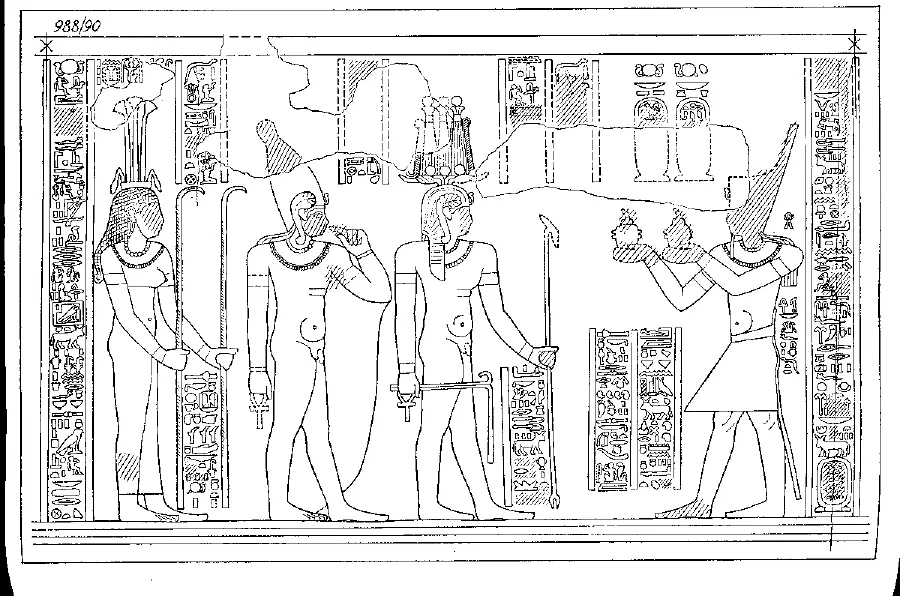
Page 319. The scene as drawn on the wall, facing p. 319 of the edition. Drawing by Otto Baum, in Junker and Winter, Das Geburtshaus des Tempels der Isis in Philä (1965) - 370p. 319, l. 1
mn n-k ḥḏw r śrwḏ ḥꜥ.w-k
Take the white milk to make your limbs thrive,
- 371p. 319, l. 2
bnr śk wꜥb r ꜥb
the sweet milk, free of evil.
- 372p. 319, l. 3
śꜥm-k m prj m nḫꜣw n ḥsꜣ.t
Drink what flows from the udders of Hesat;
Note · Line 372
Hesat is a divine cow whose milk nourishes the young god. - 373p. 319, l. 4
ḏrj-k rꜣ-k m mnḏ?¹ (n mw.t-k?)
put your mouth to your mother’s breast.
- 374p. 319, l. 5
njśwt bjt nb tꜣ.wj ꜣw(tḳrdr)
King of Upper and Lower Egypt, lord of the Two Lands, Autokrator,
- 375p. 319, l. 6
sꜣ Rꜥ nb ḫꜥ.w Tbrj(s) …
son of Ra, lord of crowns, Tiberius …
- 376p. 319, l. 7
sꜣ ꜥnḫ wꜣś nb ḥꜣ-f mj Rꜥ ḏ.t
May protection and all life and dominion surround him as they surround Ra, forever.
- 377p. 319, l. 8
ḏd mdw n | Ḥrw (pꜣ ḫrd?) … m Wśjr śfj š(ps) …
Words spoken by Horus the Child, … from Osiris, the noble infant …
Note · Line 377
Horus the Child, also called Harpocrates, is the son of Isis and Osiris. - 378p. 319, l. 9
dj-j n-k jḏḥw ḥr mnmn.wt ḥr …
I give you the Delta marshes with their herds, with …
- 379p. 319, l. 10
… (nb jꜣ.t) wꜥb.t sꜣ …
… lord of the Abaton, son …
- 380p. 319, l. 11
ḏd mdw n | Mr.t mḥj.t nb(.t) Śnm.t
Words spoken by Meret of Lower Egypt, lady of Bigeh,
Note · Line 380
Meret is a goddess of ritual music. - 381p. 319, l. 12
ḥnw.t … sꜣ(?) … ḥḥ n ḥb.w-śd
mistress … son … a million jubilees.
Note · Line 381
At his jubilee, or Sed festival, the king ritually renewed his strength to rule. - 382p. 319, l. 13
mn n-k ḥb.w-śd ḥfꜥ n-k rnp.wt
Take the jubilees, grasp the years,
- 383p. 319, l. 14
šsp n-k nśwj.t n.t Rꜥ
receive the kingship of Ra.
- 384p. 319, l. 15
(ꜥnḫ | nṯr nfr) … nb wp.w ꜥšꜣ mnmn.wt
Long live the good god, … lord of milk cows, rich in herds,
- 385p. 319, l. 16
ḫnt … n ḫtm(?)
at the head of … of the world,
- 386p. 319, l. 17
rḏj jrṯ.t n ḫrd šps(?)
who gives milk to the noble child,
- 387p. 319, l. 18
śꜥnḫ ḏ.t-f m bnr
who gives life to his body with the sweet milk,
- 388p. 319, l. 19
jrj ḫr.t-f rꜥ nb m …
who prepares his food each day from …
- 389p. 319, l. 20
nb ḥm.wt ꜣwtḳrdr
lord of cows, Autokrator.
- 390p. 319, l. 21
njśwt bjt | śfj prj m(?) … jt-f Wśjr
King of Upper and Lower Egypt, the infant who came forth from … his father Osiris,
- 391p. 319, l. 22
ḥwn nfr mrj nṯr.w
the fair young boy whom the gods love.
- 392p. 319, l. 23
dmd nṯr.wt r rr-f
The goddesses have gathered to nurse him;
- 393p. 319, l. 24
nb.wt Ḥw.t-Ḥrw nn ḥr rdj.t n-f mnḏ.w-śn
these cows of Hathor give him their breasts:
- 394p. 319, l. 25
Ḥrw pꜣ ḫrd sꜣ ꜥIś.t nb ꜥIrḳ
Horus the Child, son of Isis, lord of Philae.
Tiberius gives Hathor the menat, the two testicles of Seth
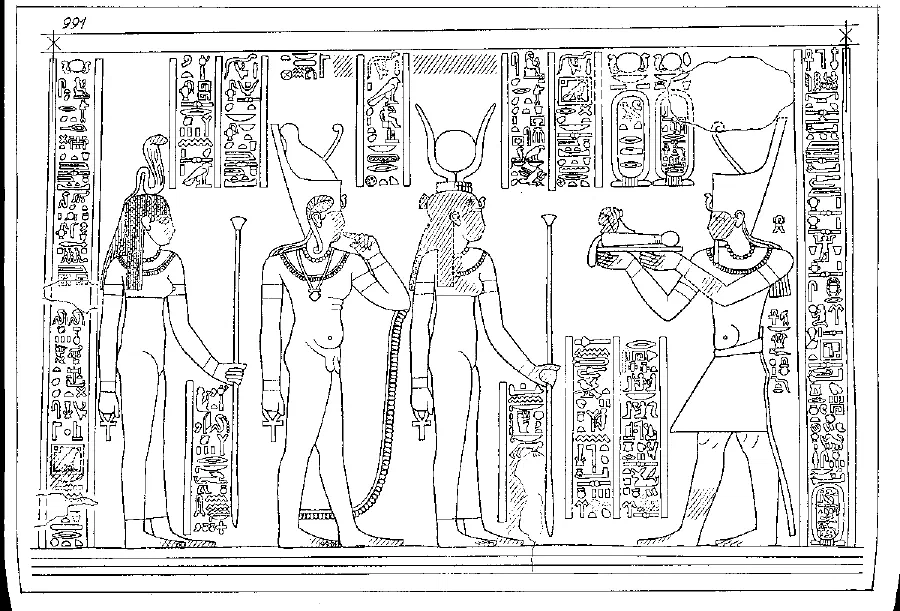
Page 321. The scene as drawn on the wall, facing p. 321 of the edition. Drawing by Otto Baum, in Junker and Winter, Das Geburtshaus des Tempels der Isis in Philä (1965) - 395p. 321, l. 1
mn n-k mnj.t mꜣw.tj n.t sbj n sn-ṯ
Take the menat, the two testicles of your brother’s enemy.
Note · Line 395
The menat was a beaded necklace with a counterweight, shaken in Hathor’s worship. The king offers it to her as the testicles of Seth, who killed Osiris. - 396p. 321, l. 2
ḥnk-j sn m ḥr-ṯ r sḫrj jb-ṯ
I offer them before your face to gladden your heart.
- 397p. 321, l. 3
bw nb nḥm¹ ḏd
All the people make music and sing:
- 398p. 321, l. 4
Wsir wḏꜣ ḥr.wj n Stš pꜣ ntj (?)² m …
“Osiris is whole, but it is Seth’s two testicles that are in …”
- 399p. 321, l. 5
njśwt bjt nb tꜣ.wj ꜣwtḳrdr
King of Upper and Lower Egypt, lord of the Two Lands, Autokrator,
- 400p. 321, l. 6
sꜣ Rꜥ nb ḫꜥ.w (Tbrjs) …
son of Ra, lord of crowns, Tiberius …
- 401p. 321, l. 7
sꜣ ꜥnḫ wꜣs nb ḥꜣ-f mj Rꜥ ḏ.t
May protection and all life and dominion surround him as they surround Ra, forever.
- 402p. 321, l. 8
ḏd mdw n | Ḥw.t-Ḥrw wr.t nb(.t) Snm.t
Words spoken by Hathor the Great, lady of Bigeh,
- 403p. 321, l. 9
ḥnw.t Jꜣḳ šps.t wsr.t ḥnw.t prj-msj.t
mistress of Philae, noble one, mighty one, mistress of the birth house,
- 404p. 321, l. 10
nb.tj rḫj.t …
queen of the people …
- 405p. 321, l. 11
dj-j n-k ḫftj.w-k ḫr …
I give you your enemies as they fall …
- 406p. 321, l. 12
ḏd mdw n | Ḥrw pꜣ ḫrd sꜣ Jś.t nb Jꜣḳ
Words spoken by Horus the Child, son of Isis, lord of Philae,
Note · Line 406
Horus the Child is also known by his Greek name, Harpocrates. His birth was celebrated in the birth house at Philae. - 407p. 321, l. 13
(sꜣ Wsir) nb jꜣ.t wꜥb.t
son of Osiris, lord of the Abaton.
- 408p. 321, l. 14
ḏd mdw n | Wpś.t nb(.t) nbj.t ḥnw.t m Snm.t
Words spoken by Wepeset, lady of the flame, sovereign on Bigeh,
- 409p. 321, l. 15
wḏj ḥḥ-ś r sbj.w n sꜣ-ś Ḥrw
who sends her fiery breath against the foes of her son Horus:
- 410p. 321, l. 16
wḏj-j nsr.t r sbj.w r-k
I send flame against those who rise against you.
- 411p. 321, l. 17
wnj mw-k n wnn-f
Your adversary is no more.
- 412p. 321, l. 18
ꜥnḫ | nṯr nfr jḥj n nb
Long live the good god, musician of the Golden One,
Note · Line 412
The Golden One is Hathor, whose son Ihy makes music for her. - 413p. 321, l. 19
śḥtp mw.t-f m mr(r.t)-ś
who delights his mother with what she loves,
- 414p. 321, l. 20
ḥnk mnj.t m ḥr-ś ḥr sḫꜥꜥ jb-ś
who presents the menat before her face and gladdens her heart,
Note · Line 414
It could be held in the hand and shaken to make music for Hathor. - 415p. 321, l. 21
sḫpr nḥm m ḥr-ś ḫnt ḥw.t-nṯr-ś
who raises a cry of joy before her in her temple,
- 416p. 321, l. 22
nḫm ḥr.wj n wḥj-sp-f ḥr ḥsꜣ-šnꜥ jm-sn
who robs the one who failed of both his testicles and draws his strength from them,
Note · Line 416
The one who failed is Seth, who lost his testicles in his struggle with Horus. - 417p. 321, l. 23
nb ḳn Tbrjs Ḳjsrs ꜥnḫ ḏ.t
lord of might, Tiberius Caesar, who lives forever.
- 418p. 321, l. 24
njśwt bjt | šps.t wsr.t jr.t-Ḥrw wr.t
King of Upper and Lower Egypt, the August One, the Mighty One, the great Eye of Horus,
Note · Line 418
Hathor herself bears the title of king here. - 419p. 321, l. 25
ḥnw.t m Snm.t ḥrj.t-tp n(.t) Rꜥ
sovereign on Bigeh, the cobra on Ra’s brow,
- 420p. 321, l. 26
wbd ꜥꜣpp m ḥḥ(-ś)
who burns Apep with her fiery breath,
Note · Line 420
Apep is the serpent who threatens the sun god on his nightly passage through the underworld. - 421p. 321, l. 27
Nsr.t nsr smꜣj.w nbd
the fiery serpent who sets the Evil One’s allies on fire,
- 422p. 321, l. 28
nḏtj.t wr.t n(.t) sn-ś Wsir
great protectress of her brother Osiris,
- 423p. 321, l. 29
Ḥw.t-Ḥrw nb(.t) Sn(m.t) ḥnw.t Jꜣḳ
Hathor, lady of Bigeh, sovereign of Philae.
Tiberius offers Isis four slaughtered gazelles
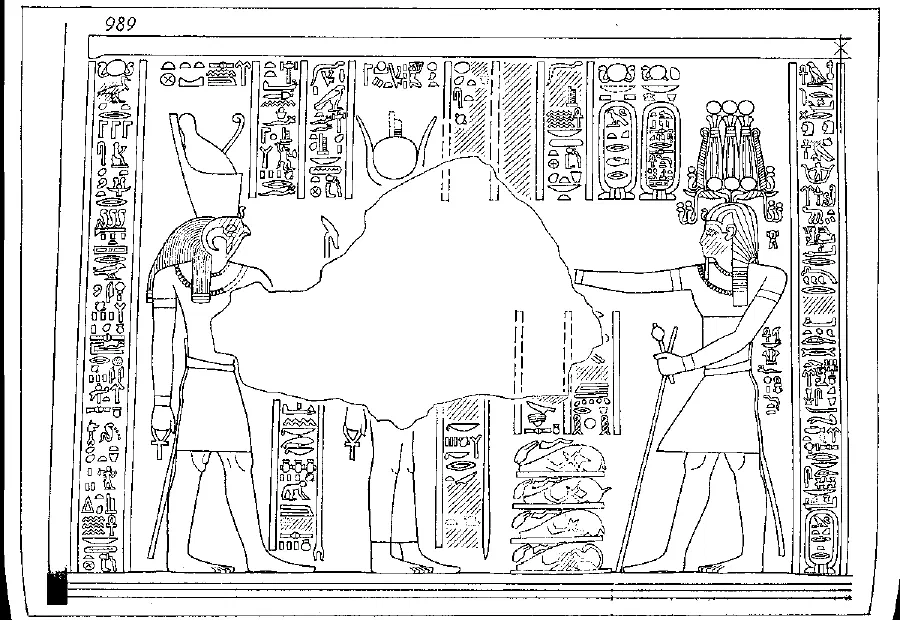
Page 323. The scene as drawn on the wall, facing p. 323 of the edition. Drawing by Otto Baum, in Junker and Winter, Das Geburtshaus des Tempels der Isis in Philä (1965) - 424p. 323, l. 1
… šꜥ.t-šn(?) … m tꜣ r-ꜥ nḥḥ
… their destruction … on earth forever.
- 425p. 323, l. 2
njswt bjt nb tꜣ.wj ꜣwtḳrdr
King of Upper and Lower Egypt, lord of the Two Lands, Autokrator,
- 426p. 323, l. 3
sꜣ Rꜥ nb ḫꜥ.w Tbrjs …
son of Ra, lord of crowns, Tiberius …
- 427p. 323, l. 4
sꜣ ꜥnḫ wꜣs nb ḥꜣ-f mj Rꜥ ḏ.t
May all protection, life and dominion surround him as they surround Ra forever.
- 428p. 323, l. 5
ḏd (mdw n) | Js.t (dj.t) ꜥnḫ nb(.t) jꜣ.t wꜥb.t
Words spoken by Isis, giver of life, lady of the Abaton,
- 429p. 323, l. 6
ḥnw.t nb.t … ḥnw.t …
sovereign, lady of …, sovereign …
- 430p. 323, l. 7
… ḫftj.w n ꜣḫ.tj
… the enemies of the One of the Horizon.
- 431p. 323, l. 8
(dj-j n-)k sbj.w-k r nm.t(?) … ḫnt …
I give you your rebels for the place of execution … within …
- 432p. 323, l. 9
ḏd mdw n | Ḥrw nḏ.tj jt-f sꜣ Js.t
Words spoken by Horus the Avenger of His Father, son of Isis,
- 433p. 323, l. 10
nb jꜣ.t wꜥb.t nḏ.tj mnḫ n jt-f Wsjr
lord of the Abaton, stalwart defender of his father Osiris,
- 434p. 323, l. 11
sḫrj sbj.w r-f m Snm.t
who strikes down those who rebel against him on Bigeh:
- 435p. 323, l. 12
dj-j n-k ḥꜣk.w-jb.w ḫr m … -šn
I give you the rebels, falling on their …
- 436p. 323, l. 13
ꜥnḫ | nṯr nfr ṯnr wr pḥtj
Long live the good god, the hero of great strength,
- 437p. 323, l. 14
mr kꜣs m ꜣbw.t nbḏ
the fetter that bites into the images of the Evil One,
Note · Line 437
The images stand for an enemy: to bind them in ritual is to bind the enemy himself. - 438p. 323, l. 15
ḥwj-ꜥ r štp.t r … mw.t-f
who reaches out his arm toward the cuts of meat to … his mother,
- 439p. 323, l. 16
jrj ꜥḏ.t m ḫftj.w n sn-s
who slaughters the enemies of her brother,
Note · Line 439
Her brother is Osiris, the husband of Isis and father of Horus. - 440p. 323, l. 17
kꜣḥ ḏr.t-f m ḥr-s r sḫb jr.t-Ḥrw
who stretches out his hand before her to gladden the Eye of Horus,
Note · Line 440
The eye that Horus lost and recovered was a sign of wholeness and a name for the offering that restored it. - 441p. 323, l. 18
nb ḳn ꜣwtḳrtr
lord of valor, Autokrator.
- 442p. 323, l. 19
njswt bjt | bꜣ.t r nṯr.w
King of Upper and Lower Egypt, the ba who surpasses the gods,
Note · Line 442
Here Isis bears the king’s title. - 443p. 323, l. 20
šps.t ṯnj.tj r nṯr.wt
the august one, exalted above the goddesses,
- 444p. 323, l. 21
dšr(.t) ḥr r sbj.w n sꜣ-s
red of face against those who rebel against her son.
- 445p. 323, l. 22
prj ḫrj.t m wḏ.t-n-s
Ruin goes forth at her command.
- 446p. 323, l. 23
Nsr.t wsr.t ḥnw.t šmꜣj
The flame-serpent, the mighty one, mistress of the wandering demons,
- 447p. 323, l. 24
Js.t dj(.t) ꜥnḫ nb(.t) jꜣ.t wꜥb.t
Isis, giver of life, lady of the Abaton.
Tiberius gives Horus the Child the two crowns
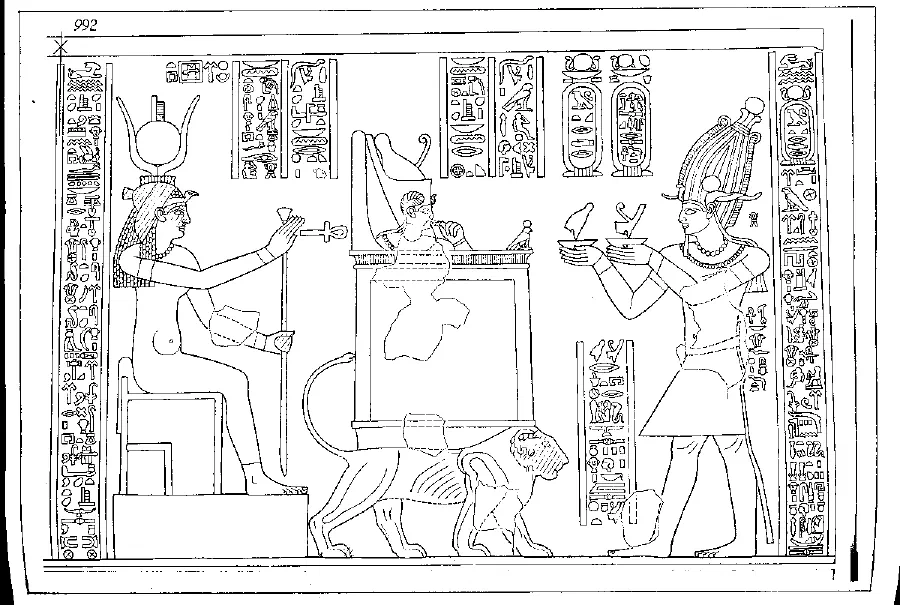
Page 325. The scene as drawn on the wall, facing p. 325 of the edition. Drawing by Otto Baum, in Junker and Winter, Das Geburtshaus des Tempels der Isis in Philä (1965) - 448p. 325, l. 1
šmꜥ(?) mḥ(?) r bw ḥr¹ ḥm-k
The crowns of Upper and Lower Egypt come to where Your Majesty is;
- 449p. 325, l. 2
dmd-šn ḥr tp-k m sḫm.tj
they unite on your head as the Double Crown.
Note · Line 449
The tall white crown of Upper Egypt and the red crown of Lower Egypt fit together to form a single crown. - 450p. 325, l. 3
njswt bjt nb tꜣ.wj ꜣwtḳrdr
King of Upper and Lower Egypt, lord of the Two Lands, Autokrator,
- 451p. 325, l. 4
sꜣ Rꜥ nb ḫꜥ.w Tbrjs …
son of Ra, lord of crowns, Tiberius …
- 452p. 325, l. 5
sꜣ ꜥnḫ wꜣs nb ḥꜣ-f mj Rꜥ ḏ.t
May all protection, life and dominion surround him as they surround Ra, forever.
- 453p. 325, l. 6
ḏd mdw n | Ḥrw pꜣ ḫrd ꜥꜣ wr tpj n Wsjr
Words spoken by Horus the Child, great indeed, firstborn of Osiris,
- 454p. 325, l. 7
nb jꜣ.t wꜥb.t sꜣ Js.t nb Jrk
lord of the Abaton, son of Isis, lord of Philae.
- 455p. 325, l. 8
ḏd mdw n | Js.t mw.t nṯr nb(.t) Jrk ḫnt (sic) nb(.t) jꜣ.t wꜥb.t
Words spoken by Isis, mother of the god, lady of Philae, foremost one, lady of the Abaton,
- 456p. 325, l. 9
dj sꜣ-s Ḥrw ḥr ns.t jt-f
who set her son Horus on his father’s throne
- 457p. 325, l. 10
jrj(.t) sꜣ-f rꜥ nb m ḥw.t-wtt
and protects him every day in the birth house.
- 458p. 325, l. 11
wnn njswt bjt ꜣwtḳrdr m jꜣ.t-Ḥrw
The King of Upper and Lower Egypt, Autokrator, stands in the place of Horus
- 459p. 325, l. 12
m ḥḳꜣ nfr n Tꜣ-mrj
as the good ruler of Egypt,
- 460p. 325, l. 13
ḥr wṯs šmꜥ(?) ḥr rnmj mḥ(?)
bearing the crown of Upper Egypt, crowned with the crown of Lower Egypt,
- 461p. 325, l. 14
ḥr ḳꜣwt šmꜥ.w mḥw n sḫj šps
bringing Upper and Lower Egypt to the august child.
- 462p. 325, l. 15
sw m jmj-rꜣ ḥm.w nṯr n wḏ.tj sn.tj
He is overseer of the priests of the two sister crowns;
- 463p. 325, l. 16
ḥr sḫkr ḥnn n ꜥꜣ-mꜣꜥ-ḫrw jm-s (sic)
with the crown he adorns the head of the great victor.
- 464p. 325, l. 17
wnn sꜣ Js.t ḫꜥj ḥr mn-ḫj.t-f
The son of Isis appears in glory on his throne,
- 465p. 325, l. 18
tꜣ(.wj) nb smꜣ ḥr smꜣ.t-f
the Two Lands united in their entirety upon his seat.
- 466p. 325, l. 19
ḥr ḥḳꜣ šmꜥ.s m-ꜥb mḥw.s
ruling her south together with her north,
- 467p. 325, l. 20
ḥr ḥbj jnw m nḏb-f
gathering tribute from the whole world.
- 468p. 325, l. 21
sw m ḥḳꜣ wr ḥr ns.t wtt sw
He is the great ruler on the throne of the one who begot him;
- 469p. 325, l. 22
mw.t-f Js.t dmd-s n-f pšš.tj
his mother Isis has joined the two halves for him.
Note · Line 469
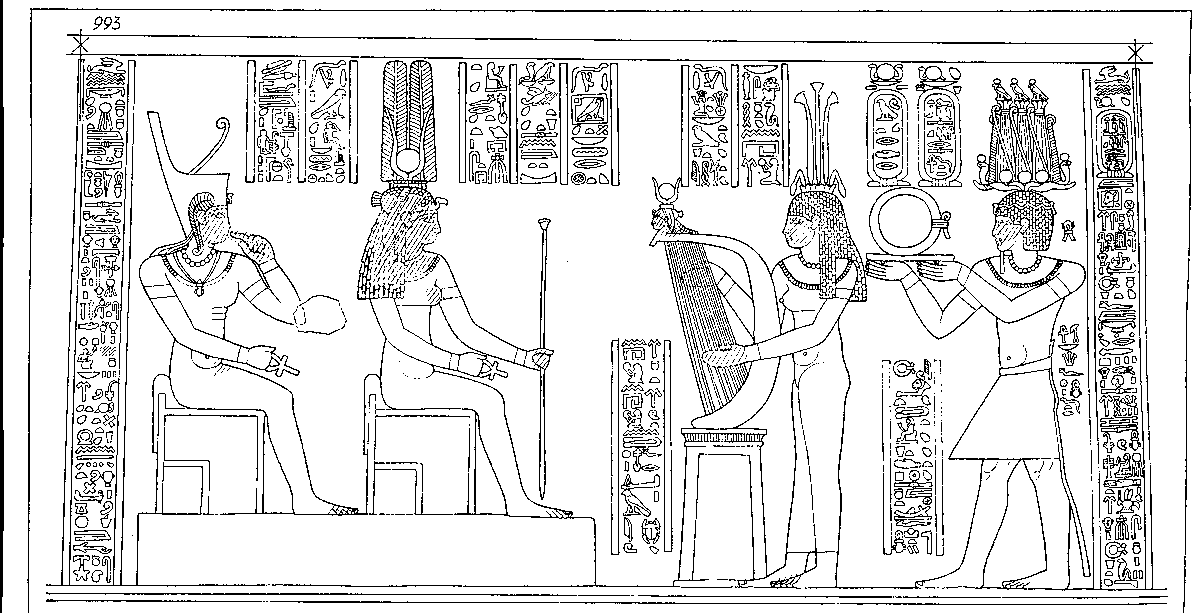
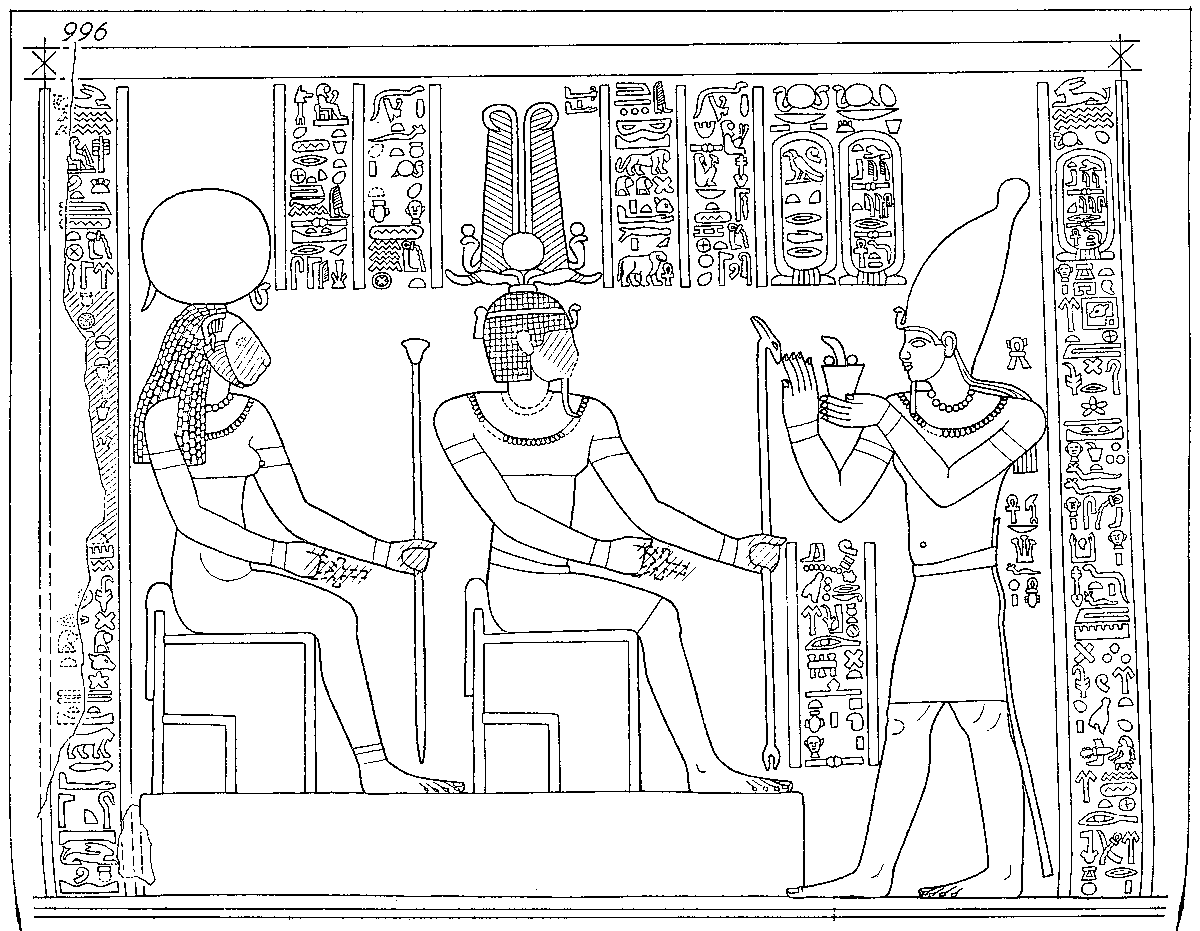
The two halves are Upper and Lower Egypt. Tiberius gives Hathor a wreath of gold and precious stones
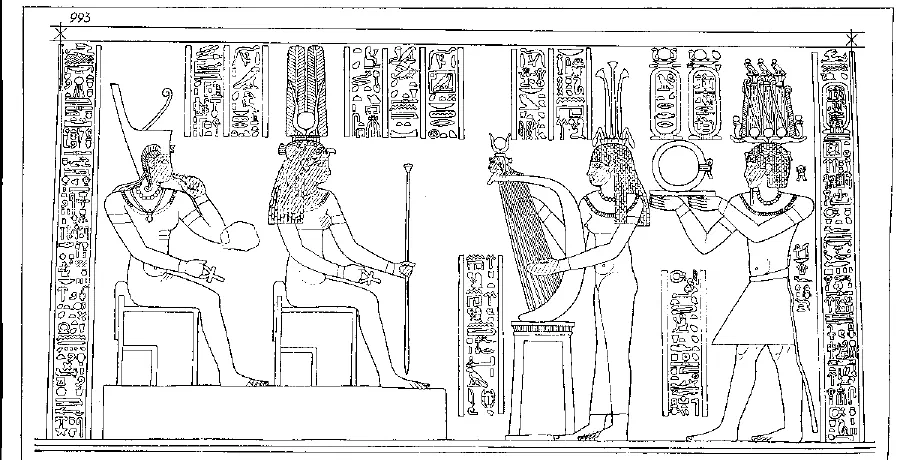
Page 327. The scene as drawn on the wall, facing p. 327 of the edition. Drawing by Otto Baum, in Junker and Winter, Das Geburtshaus des Tempels der Isis in Philä (1965) - 470p. 327, l. 1
mꜣḥ r ḥꜣ.t-ṯ šps.t ḥnw.t
A wreath for your brow, O noble one, O mistress,
- 471p. 327, l. 2
sšp-ṯ Snm.t jm-f mj ꜣḫ.tj
that with it you may light up Bigeh like Him of the Horizon.
Note · Line 471
Him of the Horizon is the sun god. - 472p. 327, l. 3
njśwt bjt nb tꜣ.wj ꜣwtḳrdr
King of Upper and Lower Egypt, lord of the Two Lands, Autokrator,
Note · Line 472
Autokrator, a Greek title of the Roman emperor, takes the place of a pharaoh’s throne name. - 473p. 327, l. 4
sꜣ Rꜥ nb ḫꜥ.w Tbrjs …
son of Ra, lord of crowns, Tiberius …
- 474p. 327, l. 5
sꜣ ꜥnḫ wꜣś nb ḥꜣ-f mj Rꜥ ḏ.t
May all protection, life and dominion surround him as they surround Ra, forever.
- 475p. 327, l. 6
ḏd mdw n | Mr.t mḥw nb(.t) šnb.t
Words spoken by Meret of Lower Egypt, lady of the throat,
Note · Line 475
Meret personifies the music of temple worship. - 476p. 327, l. 7
ḥnw.t ḥtj.t nb(.t) ḥs.t ḥnw.t nhm
mistress of the windpipe, lady of song, mistress of rejoicing:
- 477p. 327, l. 8
nhm-j n-ṯ nhm-tw n-ṯ
I rejoice for you; for you they rejoice
- 478p. 327, l. 9
hrw nfr rḏj Ḥrw r tꜣ
on the fair day when Horus was brought into the world.
- 479p. 327, l. 10
ḏd mdw n | Ḥw.t-Ḥrw wr.t nb(.t) Jrḳ
Words spoken by Hathor the Great, lady of Philae,
- 480p. 327, l. 11
nb.tj rḫj.t ḥnw.t Snm.t
queen of the people, mistress of Bigeh,
- 481p. 327, l. 12
šps.t nfr.t ḫnt prj-msj.t
the noble and beautiful one who presides over the birth house.
- 482p. 327, l. 13
ḏd mdw n | Ḥrw pꜣ ḫrd sꜣ Js.t
Words spoken by Horus the Child, son of Isis,
- 483p. 327, l. 14
nb Jrḳ jwꜥw mnḫ prj m Wsjr
lord of Philae, worthy heir sprung from Osiris,
- 484p. 327, l. 15
sꜣ šmsw ḥḳꜣ psḏ.t
eldest son, ruler of the Ennead.
- 485p. 327, l. 16
wnn sꜣ Rꜥ Tbrjs … m ḥw.t-ḫnt
The son of Ra, Tiberius …, is in Philae
- 486p. 327, l. 17
m snn ꜥnḫ n rsj-jnb-f
as the living likeness of Him Who Is South of His Wall,
Note · Line 486
This is Ptah, the god of craftsmen at Memphis. - 487p. 327, l. 18
ḥr nbj(.t) mꜣḥ n ḥnw.t-f m nb ḥnꜥ ꜥꜣ.wt
fashioning for his mistress a wreath of gold and precious stones
- 488p. 327, l. 19
ḥr mḥ tp-s m wꜣḥ mr(r.t)-s
and winding about her head the garland she loves.
- 489p. 327, l. 20
św mj Ḏd-šps ꜣḫ-ḏr.t m kꜣ.t-f
He is like the noble Djed pillar, deft of hand in his work,
Note · Line 489
The djed, a pillar with four crossbars, is an emblem of stability sacred to Ptah and Osiris. - 490p. 327, l. 21
ḥr mśj(.t) mꜣḥ n ḥnw.t nṯr.wt
bringing forth a wreath for the mistress of the goddesses.
- 491p. 327, l. 22
wnn nb wbn.tj m Snm.t
The Golden One shines in Bigeh
- 492p. 327, l. 23
mj ḳd-s wnn m ḥr.t
just as she shines in the sky,
- 493p. 327, l. 24
ḥr śtj(.t) śtw.t ḥr śḥḏ(.t) tꜣ.wj
casting her rays, lighting the Two Lands,
- 494p. 327, l. 25
ḥr wd(.t) sšp . ? . n pꜥ.t nb
sending light … to all humankind.
- 495p. 327, l. 26
śj m Rꜥj.t wr.t ḥnw.t šnw n tꜣ
She is the great sun goddess, mistress of the whole circle of the earth.
- 496p. 327, l. 27
ḥr wd(.t) wbg m-ḫt śnk.t
sending forth light after darkness.
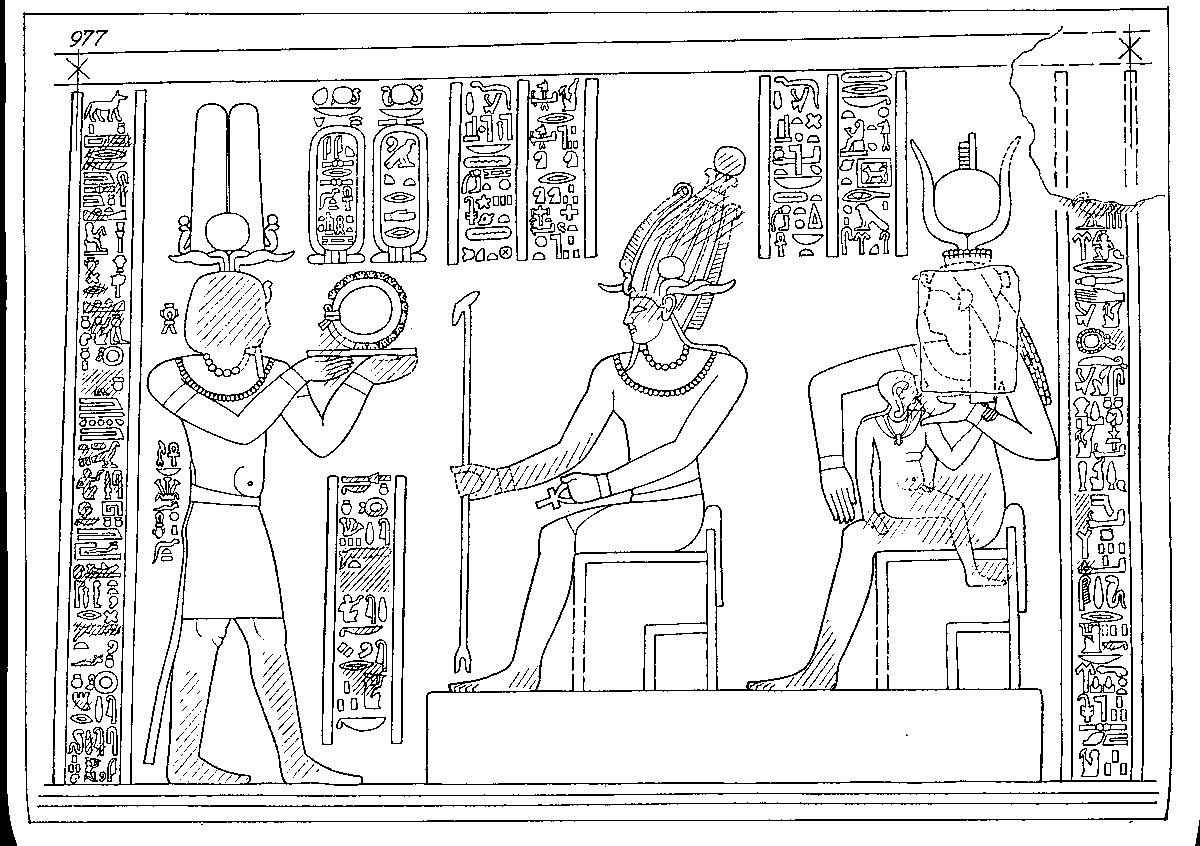
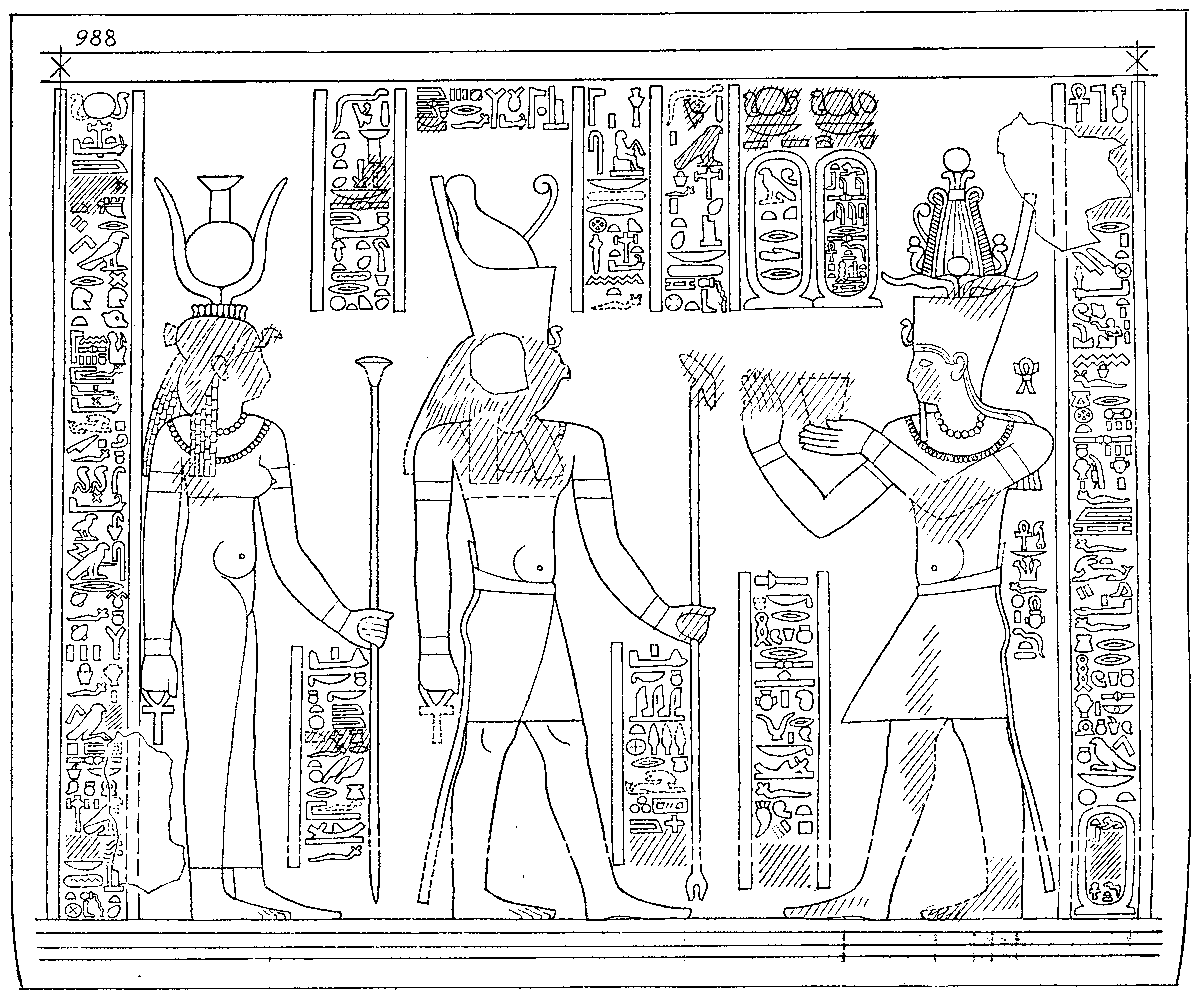
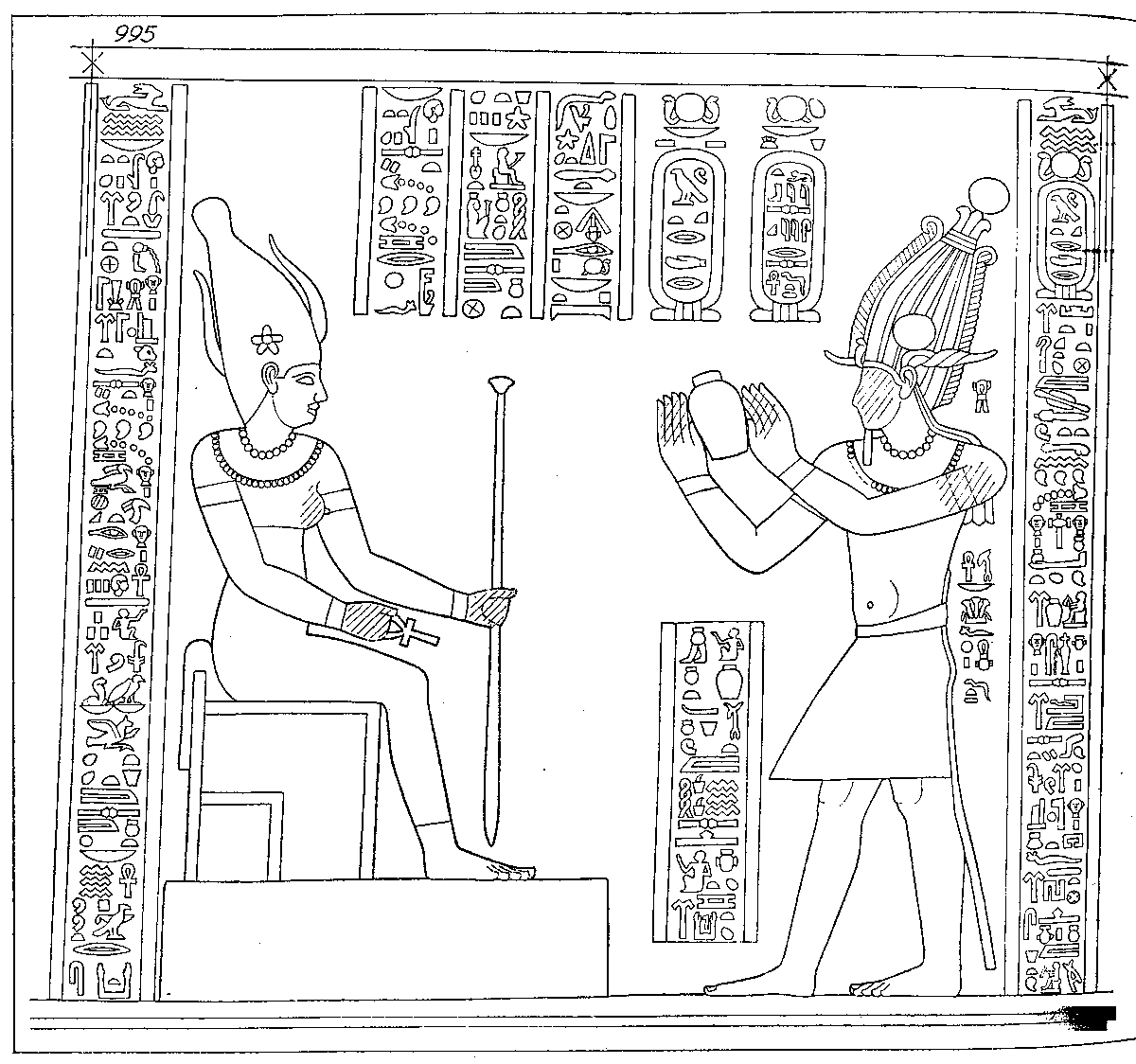
Tiberius gives Ptah the signs of life, stability and dominion
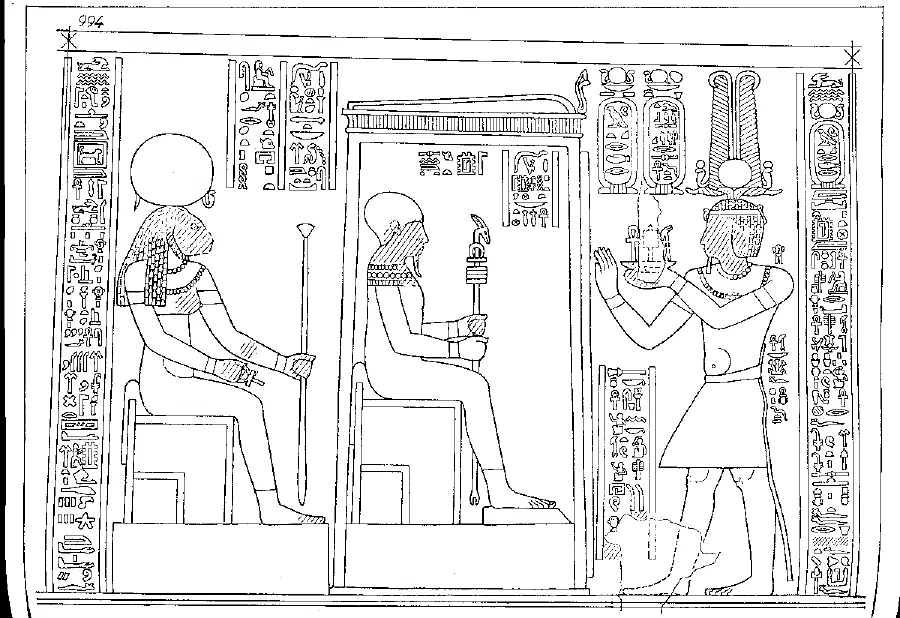
Page 329. The scene as drawn on the wall, facing p. 329 of the edition. Drawing by Otto Baum, in Junker and Winter, Das Geburtshaus des Tempels der Isis in Philä (1965) - 497p. 329, l. 1
mn n-k ꜥnḫ sꜥḥꜥ-j n-k wꜣs
Take life for yourself; I set dominion upright for you
Note · Line 497
These gifts have visible forms: the ankh is the sign of life, the was-sceptre stands for dominion, and the djed-pillar for stability. - 498p. 329, l. 2
twꜣ-j ḏd ḥrw ḥr (-k) . ? .
and hold stability aloft before your face …
- 499p. 329, l. 3
njśwt bjt nb tꜣ.wj ꜣwtḳrdr
King of Upper and Lower Egypt, Lord of the Two Lands, Autokrator,
- 500p. 329, l. 4
sꜣ Rꜥ nb ḫꜥ.w Tbrjs …
Son of Ra, Lord of Crowns, Tiberius …
- 501p. 329, l. 5
sꜣ ꜥnḫ wꜣs nb ḥꜣ-f mj Rꜥ ḏ.t
May all protection, life and dominion surround him as they surround Ra, forever.
- 502p. 329, l. 6
ḏd mdw n | Ptḥ rśj jnb-f nb ꜥnḫ-tꜣ.wj
Words spoken by Ptah, south of his wall, lord of Memphis,
Note · Line 502
“South of his wall” is an ancient title of Ptah at Memphis. - 503p. 329, l. 7
nṯr nṯrj ḫnt Śnm.t
the divine god, foremost on Bigeh.
- 504p. 329, l. 8
ḏd mdw n | Sḫm.t ꜥꜣ.t nb(.t) nsr.t m Śnm.t
Words spoken by Sekhmet the Great, mistress of the flame on Bigeh,
- 505p. 329, l. 9
šps.t nfr.t ḫnt prj-Ptḥ
the august and beautiful one, foremost in the House of Ptah.
- 506p. 329, l. 10
wnn njśwt bjt ꜣwtḳrdr m jꜣ.t nṯrj.t
The King of Upper and Lower Egypt, Autokrator, stands on the sacred mound
- 507p. 329, l. 11
m snn ꜥnḫ n Ḏd-šps
as the living likeness of the august Djed,
Note · Line 507
Here the djed-pillar represents Ptah himself. - 508p. 329, l. 12
ḥr rdj.t ꜥnḫ ḏd wꜣs n Ṭnn jt jt.w
giving life, stability and dominion to Tenen, father of fathers,
Note · Line 508
Tenen is an earth god identified with Ptah. - 509p. 329, l. 13
ḥr twꜣ tj.t n ꜥnḫ ḫr-f
holding up the sign of life before him.
- 510p. 329, l. 14
św m njśwt mnḫ śḥtp jb n jt-f
He is the worthy king who gladdens his father’s heart,
- 511p. 329, l. 15
rdj … jbj kꜣ-f
who gives …, whom his ka loves.
- 512p. 329, l. 16
wnn twt-ḥꜣ.t¹ ḥtp m ḥw.t-nmj.t²
Ptah rests in the bedchamber
Note · Line 512
The bedchamber is the temple’s birth house, where the birth of the divine child is celebrated. - 513p. 329, l. 17
m nṯr ꜥꜣ ꜥnḫ ḳmꜣ wnn.t
as the great living god who fashioned what is,
- 514p. 329, l. 18
ḥr nbj(.t) sꜣ Wśjr ḥr nḫp sꜣ Ꜣś.t
fashioning the son of Osiris, shaping the son of Isis on the potter’s wheel,
Note · Line 514
The two phrases name the same child: Horus, son of Osiris and Isis. - 515p. 329, l. 19
ḥr sꜥnḫ ḥꜥ.w-f m ḏbꜥ.w-f
bringing the child’s limbs to life with his fingers.
- 516p. 329, l. 20
św m nḫp wr šꜣꜥ ḳd m ḥꜣ.t
He is the great potter who began his shaping in the beginning,
- 517p. 329, l. 21
jrj rmṯ nṯr.w m ꜥ.wj-f
who made humankind and the gods with his two hands.
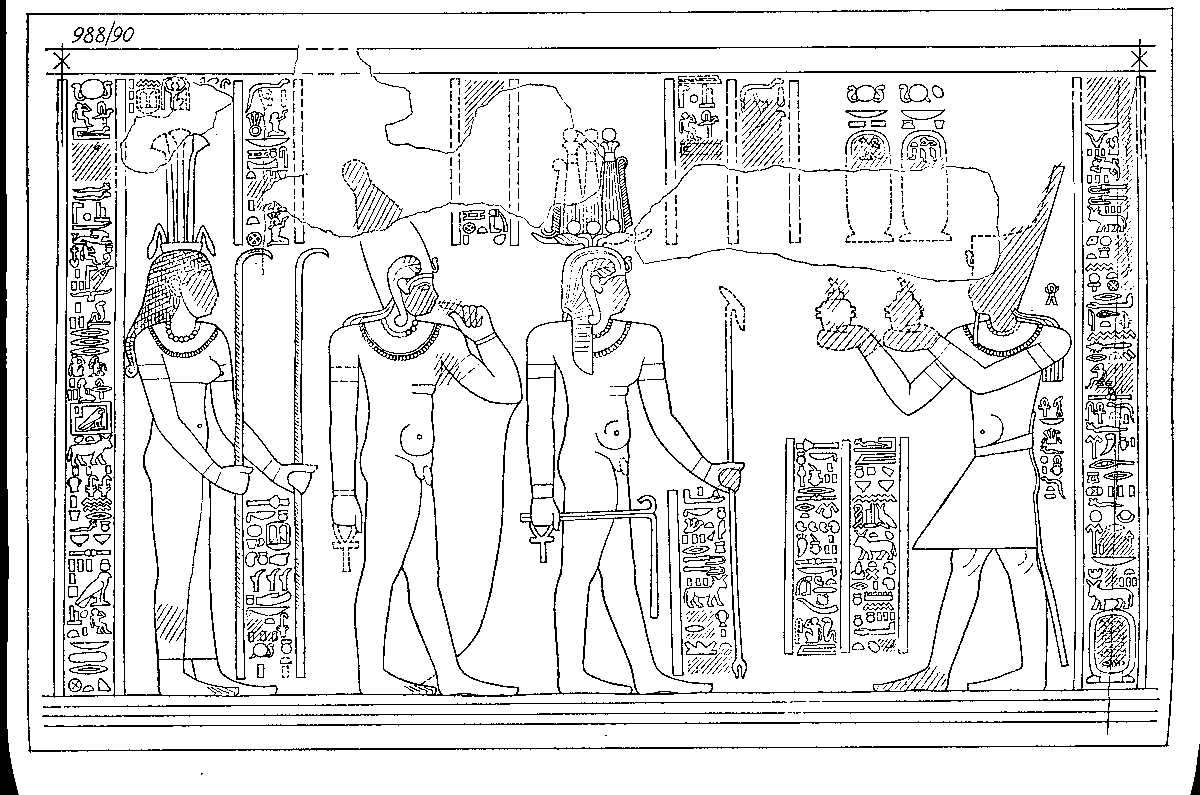
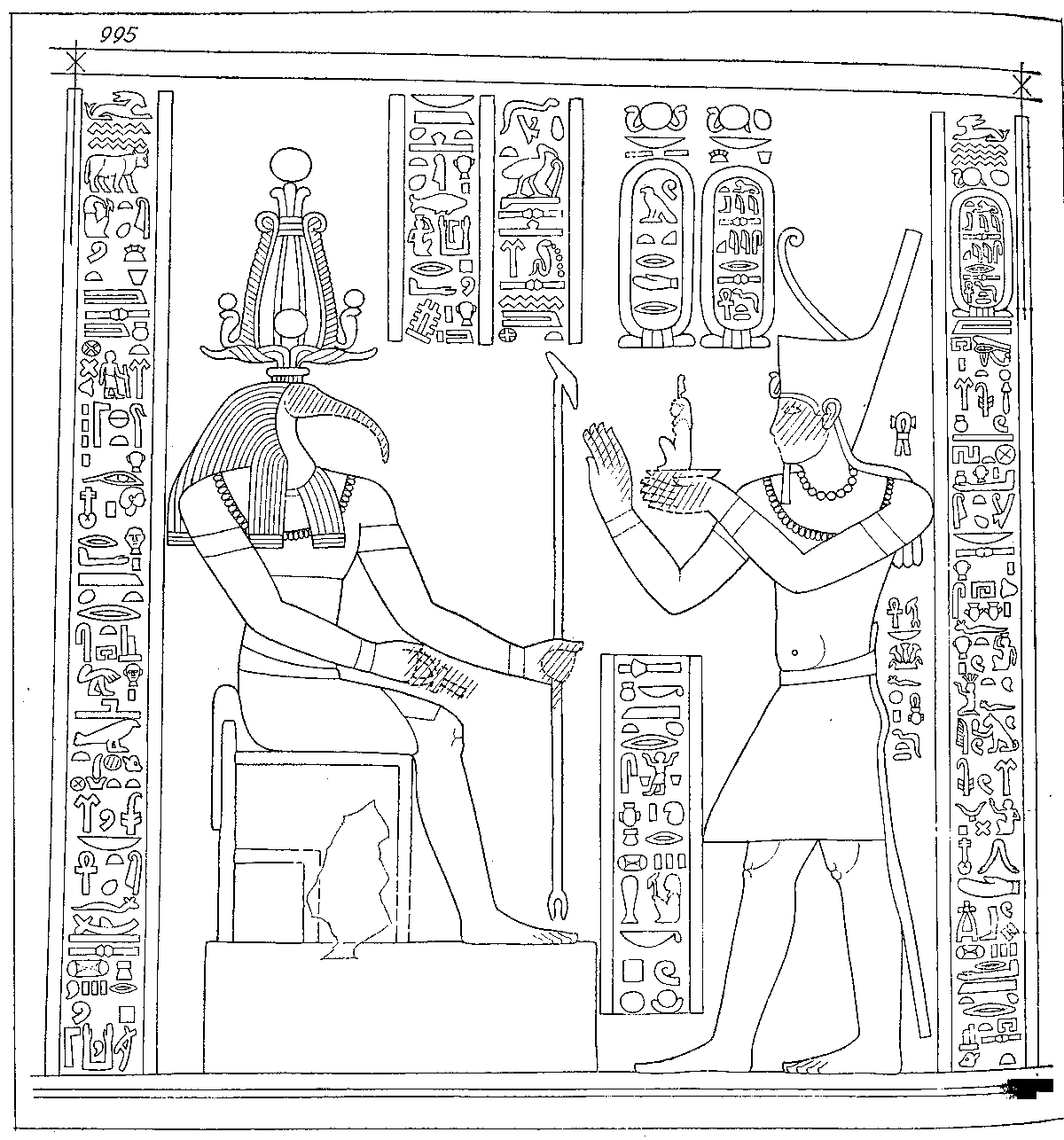
Tiberius gives Thoth the figure of Maat
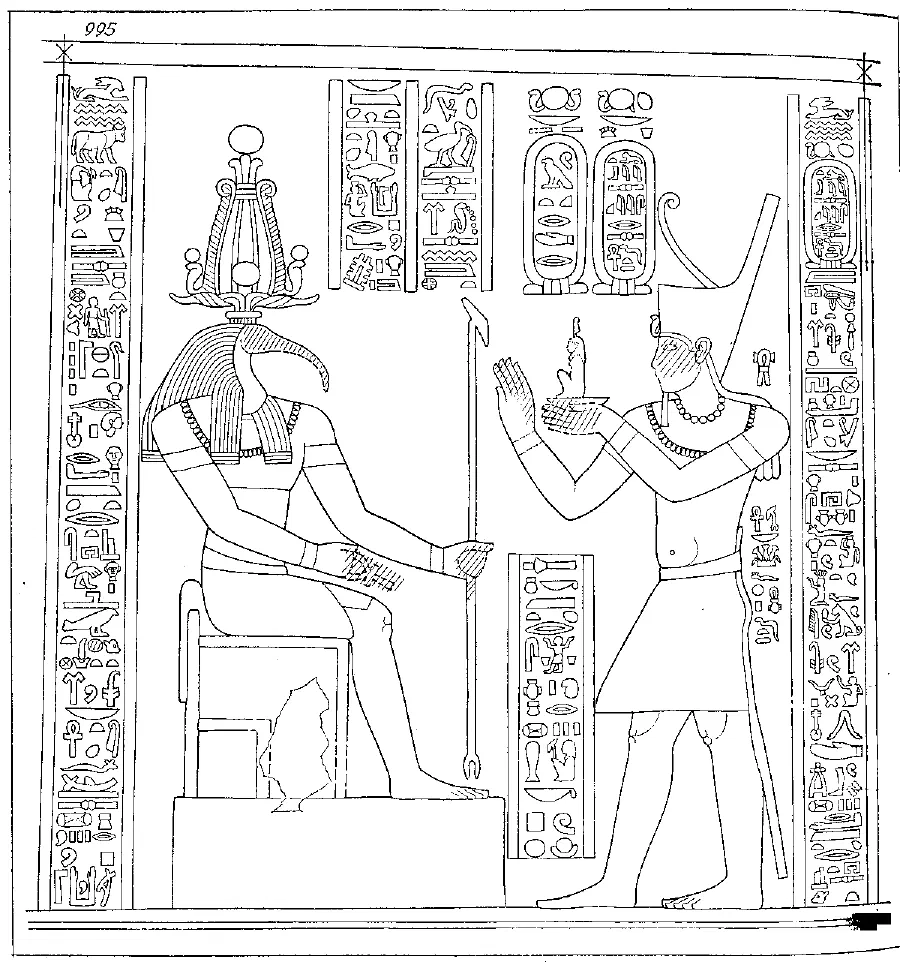
Page 331. The scene as drawn on the wall, facing p. 331 of the edition. Drawing by Otto Baum, in Junker and Winter, Das Geburtshaus des Tempels der Isis in Philä (1965) - 518p. 331, l. 1
mn n-k mꜣꜥ.t r šḥꜥꜥ jb-k
Take Maat for yourself to gladden your heart.
Note · Line 518
The king offers her image to the god. - 519p. 331, l. 2
ḫr.t ḥm-k pw rꜥ nb
She is Your Majesty’s food each day.
- 520p. 331, l. 3
njśwt bjt nb tꜣ.wj ꜣwtḳrdr
King of Upper and Lower Egypt, Lord of the Two Lands, Autokrator,
- 521p. 331, l. 4
sꜣ Rꜥ nb ḫꜥ.w Tbrjs ...
Son of Ra, Lord of Crowns, Tiberius …
- 522p. 331, l. 5
sꜣ ꜥnḫ wꜣś nb ḥꜣ-f mj Rꜥ ḏ.t
May all protection, life and dominion surround him as they surround Ra, forever.
- 523p. 331, l. 6
ḏd mdw n | Ḏḥwtj šḥtp Nsr.t m Śnm.t
Words spoken by Thoth, who delights the Fiery Serpent on Bigeh,
- 524p. 331, l. 7
nb mꜣꜥ.t ḥtp ḥr mꜣꜥ.t
lord of truth, who delights in truth.
- 525p. 331, l. 8
bw.t kꜣ-f pw rḏj.t ḥr gś¹
His ka abhors taking sides.
- 526p. 331, l. 9
wnn sꜣ Rꜥ Tbrjs ... m prj-wḏꜣ.t
The Son of Ra, Tiberius …, is in the House of Wholeness
Note · Line 526
The Roman emperor Tiberius appears here as pharaoh, with the royal title “Son of Ra.” - 527p. 331, l. 10
m njśwt mnḫ n Tꜣ-mrj
as the worthy king of Egypt,
- 528p. 331, l. 11
ḥr ḥnk mꜣꜥ.t n nb-s ḥr śḥrj jb-f
offering Maat to her lord, gladdening his heart,
Note · Line 528
In this rite the king offers the god a small image of her. - 529p. 331, l. 12
ḥr twꜣ mr.t-f r ḫft-ḥr-f
holding his Meret aloft before him.
- 530p. 331, l. 13
św m wḏw nfr nn šsp ḏbꜣ.w³
He is the good judge who takes no bribes,
- 531p. 331, l. 14
rḏj mꜣꜥ.t r ś.t-s ḫnt
who restores Maat to her first place.
- 532p. 331, l. 15
wnn nb mꜣꜥ.t ḫꜥj m Śnm.t
The lord of Maat appears in glory on Bigeh
- 533p. 331, l. 16
m śr wr ḥḳꜣ pśḏ.t
as a great prince and ruler of the Ennead,
- 534p. 331, l. 17
ḥr jrj(.t) tp-nfr ḥr rḏj(.t) mꜣꜥ.t r ś.t-s
doing what is right, setting Maat in her place,
- 535p. 331, l. 18
ḥr rwj(.t) grg ḫnt ḫtm
banishing falsehood from the world.
- 536p. 331, l. 19
św m nb mꜣꜥ.t ꜥnḫ-f jm-s
He is the lord of Maat and lives on her;
- 537p. 331, l. 20
ḫr.t-f pw mr(rw) kꜣ-f
she is his food, what his ka loves.
Tiberius gives Sothis a nemset jar of cool water
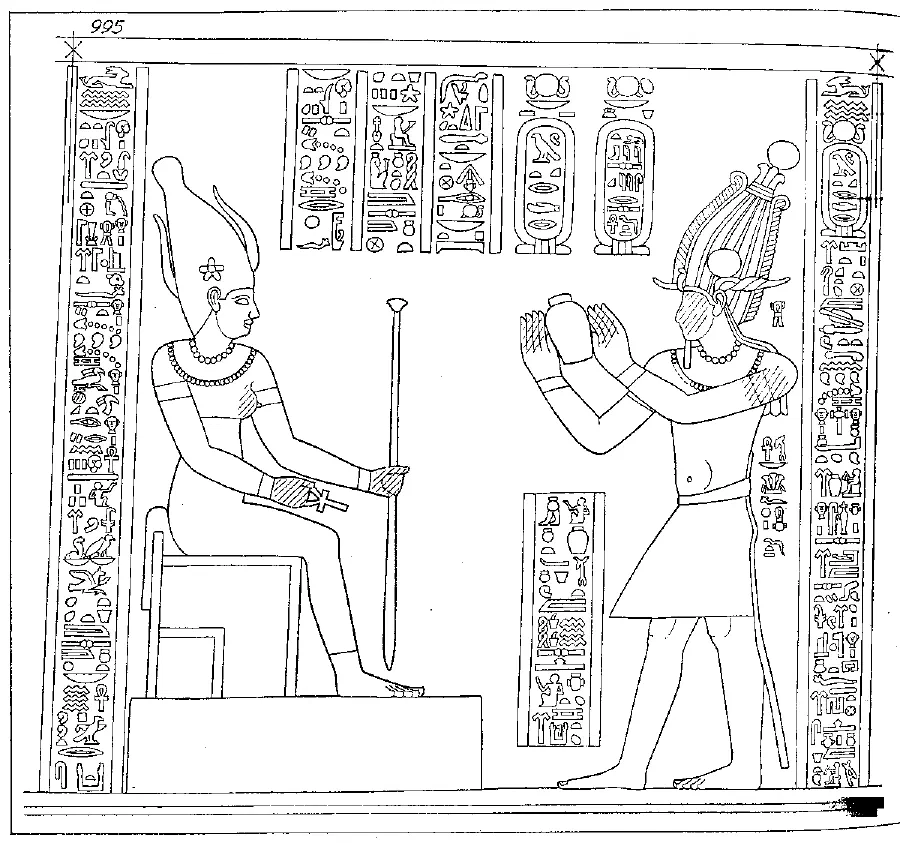
Page 333. The scene as drawn on the wall, facing p. 333 of the edition. Drawing by Otto Baum, in Junker and Winter, Das Geburtshaus des Tempels der Isis in Philä (1965) - 538p. 333, l. 1
jnj-j n-ṯ nmś.t ḥnꜥ.tj m ḳbb.t
I bring you the nemset jar filled with cool water;
Note · Line 538
The king now addresses the goddess. A nemset jar held water for ritual pouring. - 539p. 333, l. 2
śḥtp-j jb-ṯ m mr(r.t) kꜣ-ṯ
I satisfy your heart with what your ka loves.
- 540p. 333, l. 3
njśwt bjt nb tꜣ.wj ꜣwtḳrdr
King of Upper and Lower Egypt, lord of the Two Lands, Autokrator,
- 541p. 333, l. 4
sꜣ Rꜥ nb ḫꜥ.w Tbrjs …
Son of Ra, lord of crowns, Tiberius …
- 542p. 333, l. 5
sꜣ ꜥnḫ wꜣś nb ḥꜣ-f mj Rꜥ ḏ.t
May all protection, life and dominion surround him as they surround Ra, forever.
- 543p. 333, l. 6
ḏd mdw n | Śpd.t ꜥꜣ.t nb(.t) Sḫḫ
Words spoken by Sothis the Great, lady of Sekhekh,
Note · Line 543
Sothis is the star Sirius personified. Her return to the dawn sky heralded the Nile flood and the new year. - 544p. 333, l. 7
jr.t Rꜥ nb(.t) p.t ḥnw.t nṯr.w nb.w
Eye of Ra, lady of the sky, mistress of all the gods,
- 545p. 333, l. 8
špś(.t) nfr.t ḥnw.t m Śnm.t
the noble and beautiful one, mistress on Bigeh,
- 546p. 333, l. 9
nb(.t) tp-rnp.t štj ḥꜥpj r tr-f
lady of the New Year, who pours forth the Nile in its season.
- 547p. 333, l. 10
wnn njśwt bjt ꜣwtḳrdr m jꜣ.t ḥḳꜣ.t
The King of Upper and Lower Egypt, Autokrator, is on the Mound of the Sovereign Lady
- 548p. 333, l. 11
m jwꜥw mnḫ wtt n ḥꜥpj
as the worthy heir begotten by the Nile,
Note · Line 548
The Nile in flood is itself a god, Hapy. - 549p. 333, l. 12
ḥr nḏ-ḥr n mw.t-f m nmś.t špś.t
paying homage to his mother with the splendid nemset jar,
- 550p. 333, l. 13
ḥr śḳbb jb-s m prj m štj
cooling her heart with what flows from the leg.
Note · Line 550
The leg is that of Osiris. In the tradition of Bigeh, the waters of the flood flowed from it. - 551p. 333, l. 14
św m sꜣ Wśjr ḥr nś.t-f m Tꜣ-mrj
He is the son of Osiris, on his throne in Egypt,
- 552p. 333, l. 15
śḥtp jb n ḥnw.t-f m špśj³ mr(rw-s)
satisfying his mistress’s heart with the jar she loves.
- 553p. 333, l. 16
wnn nb(.t) tp-rnp.t mn.tj m jꜣ.t wꜥb.t
The lady of the New Year abides on the Pure Mound,
Note · Line 553
The Pure Mound is the Abaton, the burial sanctuary of Osiris on Bigeh. - 554p. 333, l. 17
ḥr sꜣ śn(-s) Wśjr m ḫnt-f
guarding her brother Osiris there,
- 555p. 333, l. 18
ḥr štj ḥꜥpj ḥr bꜥḥ ꜣḫ.t
pouring forth the Nile and flooding the fields.
- 556p. 333, l. 19
ḥr jrj(.t) ꜥnḫ n tpj.w-tꜣ
giving life to those who dwell on earth.
- 557p. 333, l. 20
śj m nb.tj rḫj.t ḥnw.t m Śnm.t
She is queen of the people, mistress on Bigeh.
- 558p. 333, l. 21
nb.t-ꜥnḫ pw kꜣ-tw r kꜣ-s⁴
“Lady of Life” is the name by which she is called.
Tiberius burns incense before Arensnuphis
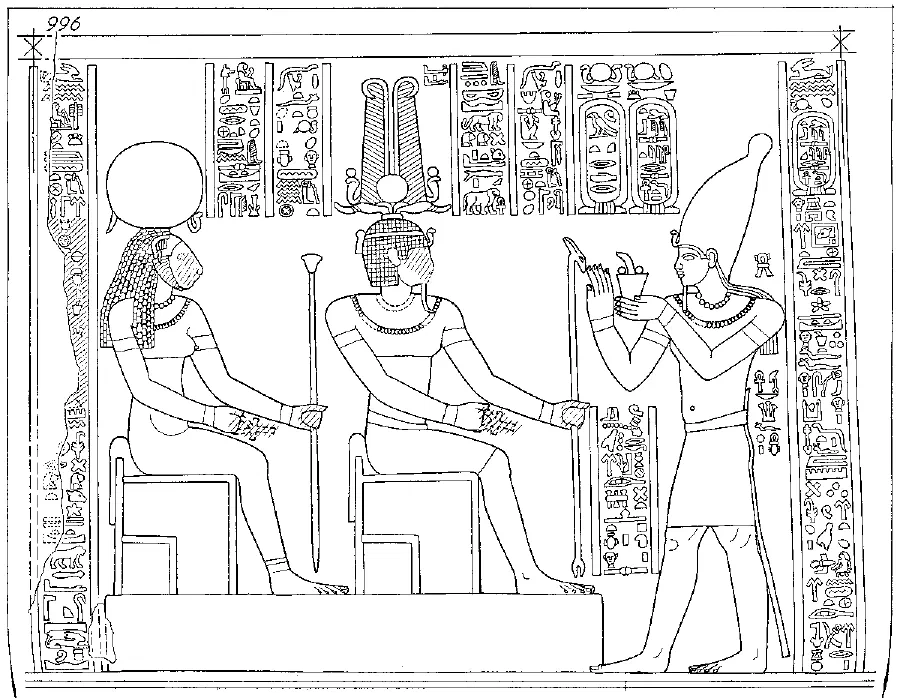
Page 335. The scene as drawn on the wall, facing p. 335 of the edition. Drawing by Otto Baum, in Junker and Winter, Das Geburtshaus des Tempels der Isis in Philä (1965) - 559p. 335, l. 1
jw štj ḥḏ¹ r-k m Nḫb
The scent of incense comes to you from Elkab,
- 560p. 335, l. 2
jr.t-Ḥrw wr.t ḥtp jb-k ḥr-s
the great Eye of Horus, in which your heart delights.
Note · Line 560
The incense is offered as the Eye of Horus. The eye, injured in Horus’s struggle with Seth and made whole again, was a sign of wholeness restored. - 561p. 335, l. 3
njswt bjt nb tꜣ.wj ꜣwtḳrdr
King of Upper and Lower Egypt, lord of the Two Lands, Autokrator,
Note · Line 561
Autokrator, the Greek title for the emperor, takes the place of a pharaoh’s throne name here. - 562p. 335, l. 4
sꜣ Rꜥ nb ḫꜥ.w Tbrjs …
son of Ra, lord of crowns, Tiberius …
- 563p. 335, l. 5
sꜣ ꜥnḫ wꜣs nb ḥꜣ-f mj Rꜥ
May all protection, life and dominion surround him as they surround Ra.
- 564p. 335, l. 6
ḏd mdw n | ꜣrjḥmsjnfr nṯr ꜥꜣ nb jꜣ.t wꜥb.t
Words spoken by Arensnuphis, the great god, lord of the Abaton,
Note · Line 564
The Abaton, the “inaccessible place,” was the sanctuary on Bigeh revered as the burial place of Osiris. - 565p. 335, l. 7
Šw sꜣ Rꜥ jj m Tꜣ-stj
Shu, son of Ra, who came from Nubia,
- 566p. 335, l. 8
mꜣj wr pḥtj ḫnt ꜥ mḥ.tj
a lion of great strength in the north,
- 567p. 335, l. 9
bꜣ ꜥnḫ nḫt-ꜥ
the living ba, strong of arm.
- 568p. 335, l. 10
ḏd mdw n | Tfn.t sꜣ.t Rꜥ ḥrj(.t)-jb jꜣ.t wꜥb.t
Words spoken by Tefnut, daughter of Ra, who dwells in the Abaton,
- 569p. 335, l. 11
šps.t wsḫ.t ḥnw.t ꜣJrk
the noble one, the mighty one, mistress of Philae,
- 570p. 335, l. 12
jj(.t) m Kns.t ḥnꜥ sn-s
who came from Kenset with her brother.
Note · Line 570
Kenset is a region of Nubia. Tefnut’s brother is Shu, here identified with Arensnuphis. - 571p. 335, l. 13
wnn sꜣ Rꜥ Tbrjs … ḥr ns.t-f
The son of Ra, Tiberius …, sits on his throne
- 572p. 335, l. 14
m ḥw.t-ḫnt m njswt wr ḥḳꜣ Tꜣ-nṯr
at Philae as great king and ruler of the Land of the God,
- 573p. 335, l. 15
ḥr snṯr jt-f ḥr swꜥb kꜣ-f
censing his father, purifying his ka,
Note · Line 573
The king serves the god as a son serves his father. - 574p. 335, l. 16
ḥr nfr² ḏ.t-f m mnwr
refreshing his body with incense.
- 575p. 335, l. 17
sw m sꜣ ḥḏ.t bḫ m Nḫn
He is the son of the White One, born in Hierakonpolis,
Note · Line 575
The White One is Nekhbet, the vulture goddess of Elkab, across the Nile from Hierakonpolis. - 576p. 335, l. 18
jrj snṯr ꜥb m ḥr.t hrw
who offers incense and purifies day after day.
- 577p. 335, l. 19
wnn Ḏd-šps ḫꜥj m jꜣ.t wꜥb.t
The sacred djed-pillar shines forth in the Abaton
- 578p. 335, l. 20
m nṯr ꜥꜣ … ḥr … snṯr … mn(wr?)
as a great god … while … incense … incense.
- 579p. 335, l. 21
sw (m) wr pḥtj ḫnt Tꜣ-nṯr
He is mighty in the Land of the God,
- 580p. 335, l. 22
mꜣj ꜥꜣ ḥḳꜣ Pwn(.t)
the great lion, ruler of Punt.
Tiberius worships Amun-Ra
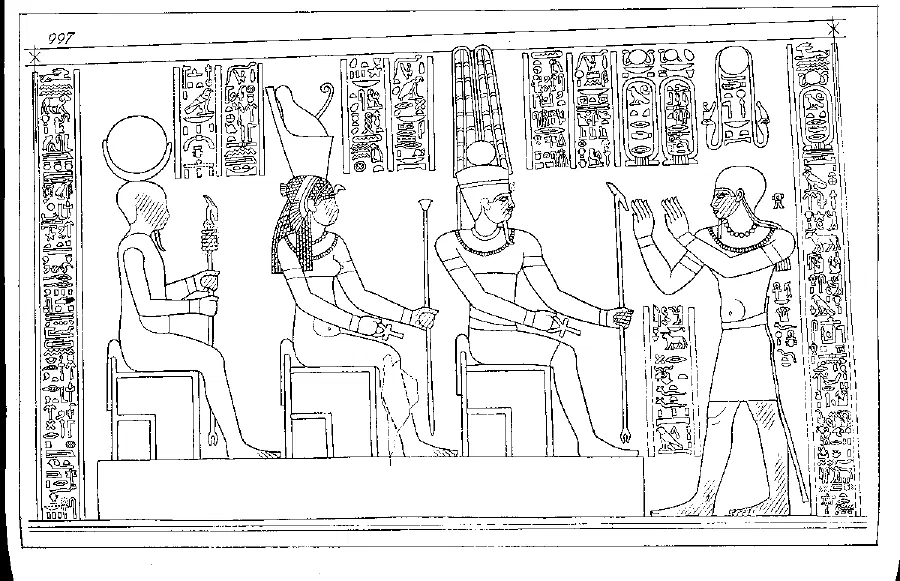
Page 337. The scene as drawn on the wall, facing p. 337 of the edition. Drawing by Otto Baum, in Junker and Winter, Das Geburtshaus des Tempels der Isis in Philä (1965) - 581p. 337, l. 1
jꜣw n-k bꜣ wr šfj.t
Praise to you, O ba of great majesty,
Note · Line 581
The Egyptian word for “ram” also sounds like “ba,” so the praise calls the ram to mind as well. - 582p. 337, l. 2
jt jt.w ḥrj nṯr.w
father of fathers, who stand above the gods!
- 583p. 337, l. 3
njśwt bjt nb tꜣ.wj ꜣwtḳrdr
King of Upper and Lower Egypt, lord of the Two Lands, Autokrator,
- 584p. 337, l. 4
sꜣ Rꜥ nb ḫꜥ.w Tbrjs …
son of Ra, lord of crowns, Tiberius …
- 585p. 337, l. 5
sꜣ ꜥnḫ wꜣś nb ḥꜣ-f mj Rꜥ ḏ.t
May all protection, life and dominion surround him as they surround Ra, forever.
- 586p. 337, l. 6
Bḥd.tj nṯr ꜥꜣ nb p.t
He of Edfu, the great god, lord of the sky.
- 587p. 337, l. 7
ḏd mdw n | Jmn-Rꜥ nb nś.t tꜣ.wj ḫnt jp.t-ś.wt
Words spoken by Amun-Ra, lord of the throne of the Two Lands, foremost in Karnak,
Note · Line 587
The Two Lands are Upper and Lower Egypt. - 588p. 337, l. 8
śḫm špś ḥrj-jb jꜣ.t wꜥb.t
noble power in the heart of the Abaton,
- 589p. 337, l. 9
śḫꜣ-tw kꜣ-f (so) m prj-mśj(.t)
whose ka is remembered in the birth house,
Note · Line 589
The birth house at Philae celebrated the birth of Horus to Isis. - 590p. 337, l. 10
rdj ṯꜣw ḥr mśḫn(.t)
who gives breath at the place of birth.
- 591p. 337, l. 11
ḏd mdw n | Mw.t wr.t nb(.t) Jšrw
Words spoken by Mut the Great, lady of Isheru,
Note · Line 591
Isheru is the sacred lake at Mut’s temple in Karnak. - 592p. 337, l. 12
jr.t Rꜥ nb(.t) p.t ḥnw.t nṯr.w nb.w
Eye of Ra, lady of the sky, mistress of all the gods,
Note · Line 592
As the Eye of Ra, Mut embodies the sun god’s power to act and protect. - 593p. 337, l. 13
špś.t nfr.t ḥnw.t jꜣ.t wꜥb.t
the noble and beautiful one, mistress of the Abaton.
- 594p. 337, l. 14
ḏd mdw n | Ḫnśw m Wꜣś.t
Words spoken by Khonsu in Thebes,
- 595p. 337, l. 15
nṯr ꜥꜣ ḫnt Śnm.t
the great god, foremost in Bigeh,
- 596p. 337, l. 16
nfr-ḥtp Ḥrw nb (so) ꜣw.t-jb (sic)
Neferhotep, Horus, lord of joy.
Note · Line 596
Neferhotep is a name of Khonsu; here the moon god is also called Horus. - 597p. 337, l. 17
wnn njśwt bjt ꜣwtḳrdr m jꜣ.t Ḥrw
The King of Upper and Lower Egypt, Autokrator, stands in the place of Horus
Note · Line 597
The emperor appears in the Egyptian king’s traditional role as Horus. - 598p. 337, l. 18
m njśwt mnḫ ḥr dwꜣ bꜣ jmn
as an excellent king, praising the hidden ba,
Note · Line 598
“Hidden” echoes the name Amun, “the Hidden One.” - 599p. 337, l. 19
ḥr śwꜣš bjk ḥr śḥtp kꜣ-f
extolling the falcon, gladdening his ka,
- 600p. 337, l. 20
ḥr pśg rꜣ-f m ḏśr.w nj.w ḥm-f
making his mouth spit forth the glories of His Majesty.
- 601p. 337, l. 21
św m wꜥb-tḥj ꜣḫ rꜣ wḏꜣ jb
He is the wab-tehi priest, potent of speech and sound of heart,
Note · Line 601
The king takes the priest’s part in the festival recitation. - 602p. 337, l. 22
njś ḥb.w m ṯꜣw n ḏrf
calling out the festival verses with the words of the scroll.
- 603p. 337, l. 23
wnn bꜣ jmn ḥr bsj m nwnw
The hidden ba was emerging from the primeval waters
- 604p. 337, l. 24
jw tꜣ jḥ m swj³
while the earth lay wrapped in darkness.
- 605p. 337, l. 25
ptḥ-n-f jḥ.tj-f śšp-śn tꜣ.wj
He opened his two eyes, and they lit up the Two Lands;
- 606p. 337, l. 26
prj dbnj m wnm.t-f jꜣb.t-f
the two that circle came forth as his right eye and his left.
Note · Line 606
The right eye is the sun, the left the moon. - 607p. 337, l. 27
św m nṯr ꜥꜣ wr ḫpr m ḥꜣ.t
He is the surpassingly great god who came into being in the beginning.
- 608p. 337, l. 28
ṯꜣw m rꜣ-f śꜥnḫ ḥr nb
The breath from his mouth gives life to every face.
Tiberius brings Isis two bouquets of flowers
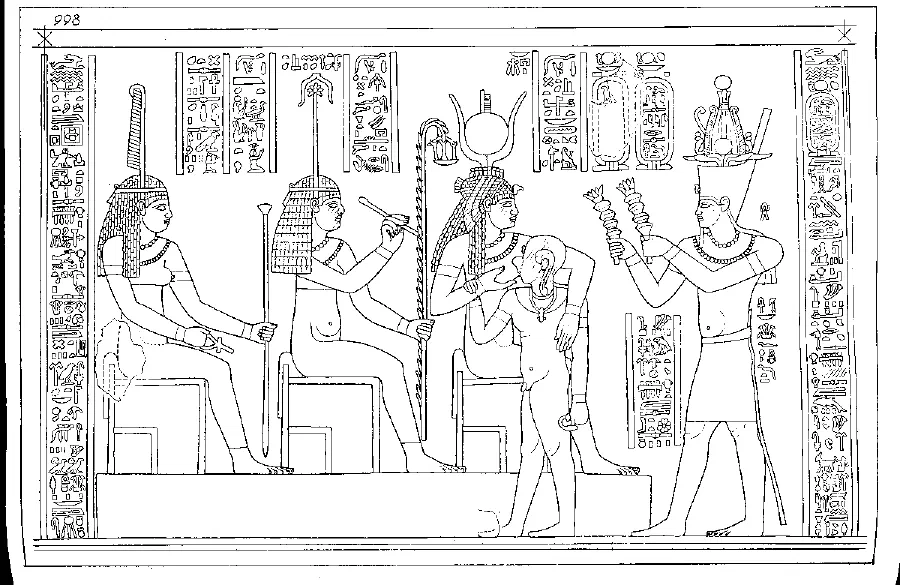
Page 339. The scene as drawn on the wall, facing p. 339 of the edition. Drawing by Otto Baum, in Junker and Winter, Das Geburtshaus des Tempels der Isis in Philä (1965) - 609p. 339, l. 1
rnp.w nn bsj m ꜣḫ.t
These blossoms that sprang from the field—
Note · Line 609
The king presents flowers to Isis. - 610p. 339, l. 2
ṯḥn ḥr-ṯ m šbt.t-šn
may your face light up at their bouquet.
- 611p. 339, l. 3
njśwt bjt nb tꜣ.wj ꜣ(wtḳrdr)¹
King of Upper and Lower Egypt, lord of the Two Lands, Autokrator,
- 612p. 339, l. 4
sꜣ Rꜥ nb ḫꜥ.w Tbrjs …
son of Ra, lord of crowns, Tiberius …
- 613p. 339, l. 5
sꜣ ꜥnḫ wꜣś nb ḥꜣ-f mj Rꜥ ḏ.t
May protection and all life and dominion surround him as they surround Ra, forever.
- 614p. 339, l. 6
ḏd mdw n | ꜣJś.t wr.t mw.t nṯr nb(.t) ꜣJrḳ
Words spoken by Isis the Great, mother of the god, lady of Philae,
- 615p. 339, l. 7
šps.t wśr.t nb(.t) prj-msj(.t)
the noble and mighty one, lady of the birth house.
- 616p. 339, l. 8
ḏd mdw n | Śšꜣ.t wr.t śfḫ(.t)-ꜥb.wj
Words spoken by Seshat the Great, who has laid aside the two horns,
Note · Line 616
Seshat is the goddess of writing and record keeping. The two horns recall the curved emblem she wears above her head. - 617p. 339, l. 9
ḥnw.t prj-mḏꜣ.t śpḫr(.t) nśwj.t ꜥꜣ.t n sꜣ ꜣJś.t
mistress of the House of Books, who records a long reign for the son of Isis.
Note · Line 617
The son of Isis is Horus. Seshat records the years allotted to him as king. - 618p. 339, l. 10
ḏd mdw n | Mꜣꜥ.t sꜣ.t Rꜥ
Words spoken by Maat, daughter of Ra,
- 619p. 339, l. 11
ḫnm(.t) ꜣJmn mr.t-f (?) wr.t śꜥnḫ(.t) nṯr.w
companion of Amun, his great Meret, who gives life to the gods,
Note · Line 619
Here Maat takes her role. - 620p. 339, l. 12
śmꜣꜥ-ḫrw sꜣ-ś Ḥrw r ḫftj.w-f
who vindicates her son Horus against his enemies.
Note · Line 620
The victory is also a verdict: Horus is declared to be in the right. - 621p. 339, l. 13
wnn sꜣ Rꜥ Tbrjs … m jꜣ.t wḏḥ
The son of Ra, Tiberius …, is at the Mound of the Child
Note · Line 621
At Philae the Roman emperor Tiberius appears as pharaoh, with the royal title “son of Ra.” - 622p. 339, l. 14
m jwꜥw mnḫ n rpꜥ.t nṯr.w
as the worthy heir of the prince of the gods,
Note · Line 622
The prince is Geb, the earth god, from whom the kingship descends. - 623p. 339, l. 15
ḥr ḥnk rnp.w n mw.t-f Wśr.t
offering flowers to his mother Wosret
- 624p. 339, l. 16
ḥr śṯḥn ḥr-ś m ḥꜣ.w (?) tḏḥw
and making her face shine with the marsh plants of the Delta.
- 625p. 339, l. 17
św m śꜥḥ nfr ḥrj-tp m tḏḥw
He is the good noble, chief in the Delta,
- 626p. 339, l. 18
mḥ prj n ḥnw.t-f m wꜣḏ(.w) ḥnꜥ šn(.w)
who fills the house of his mistress with green plants and trees.
- 627p. 339, l. 19
wnn mw.t nṯr ḫꜥj.tj m ḥw.t-wṯt
The god’s mother appears in glory in the birth house,
- 628p. 339, l. 20
ḏm.t pw ꜣb(b.t) jb-ś
the dwelling her heart desires.
- 629p. 339, l. 21
ḥr ṯḥn śtw.t ḥr bꜥḥ ꜣḫ.t
She makes the rays of light shine and floods the farmland,
- 630p. 339, l. 22
ḥr śwꜣḥ tp.w-ś m šbt.wt
making her fields green with flowers.
- 631p. 339, l. 23
śj m nṯr.t nb(.t) ꜣḫ.t
She is the goddess, mistress of the fields,
- 632p. 339, l. 24
ḥḳꜣ(.t) wꜣḏwꜣḏ ꜣḫꜣḫ šn.w nb.w m wbn-ś
ruler of all that is green. At her rising every tree blooms.