~/sacred-texts/philae-birth-house-mammisi-inscriptions
Philae Birth House Gate: Take the Testicles of Seth
- Date
- Carved under Ptolemy VI (180–145 BC), Ptolemy XII (80–51 BC) and Augustus (30 BC–AD 14) on the birth house of the Isis temple at Philae and on the gate that leads to it
- Found
- Philae, at the First Cataract of the Nile; the temple was moved stone by stone to the island of Agilkia near Aswan in 1972–1980, where the reliefs still stand
- Language
- Egyptian (Ptolemaic hieroglyphic) · Hieroglyphic
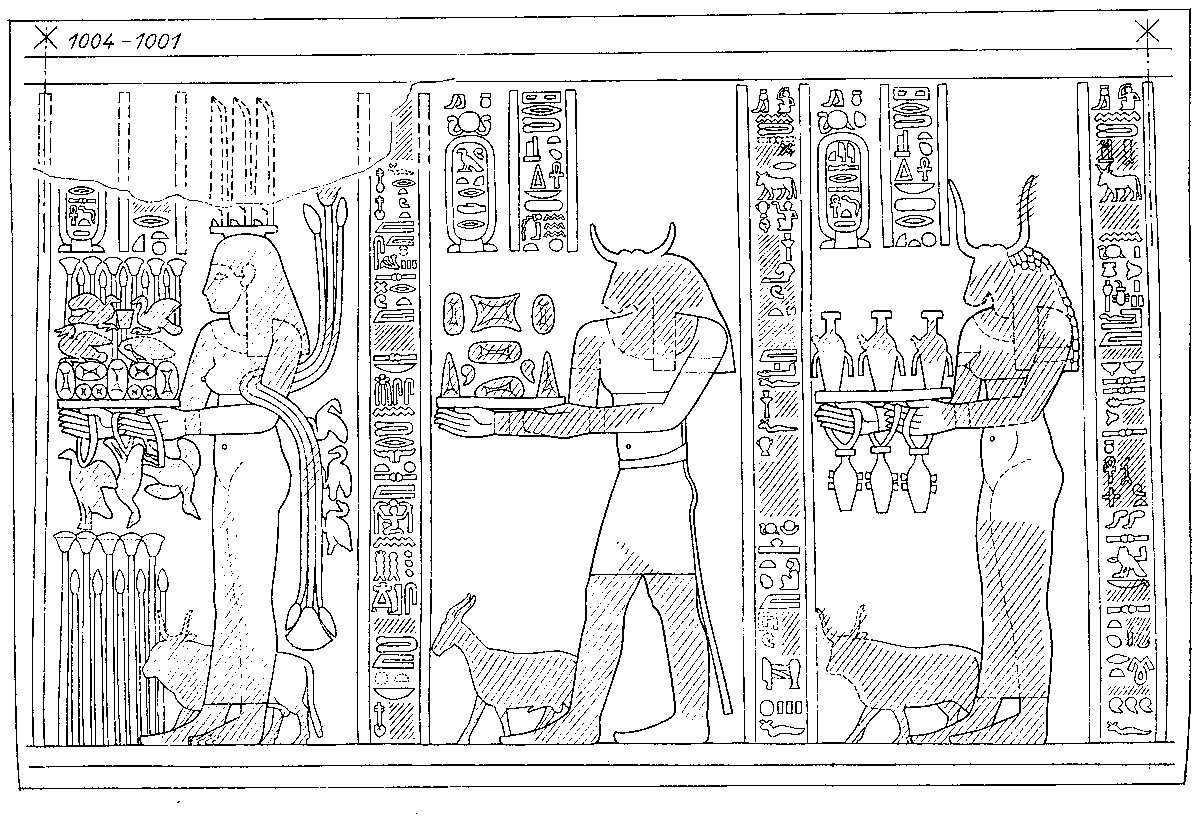
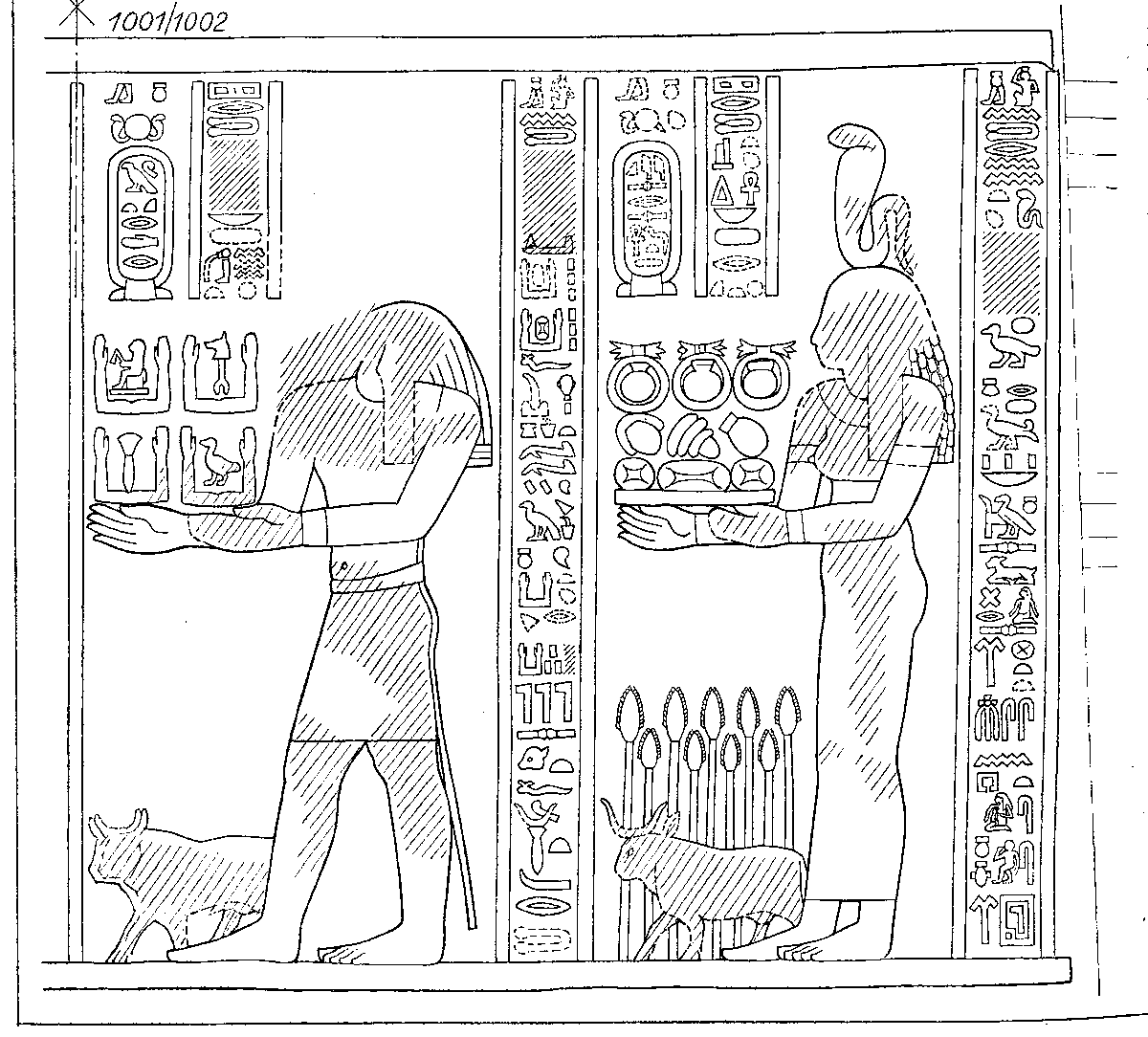
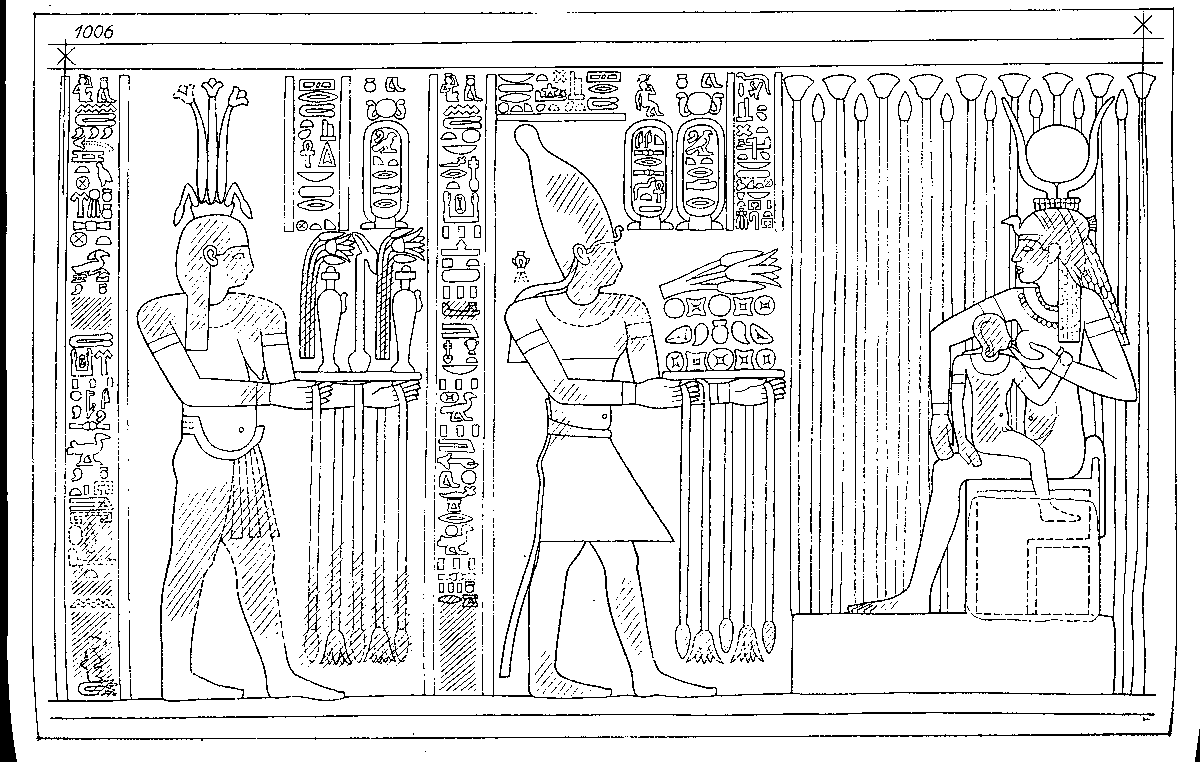
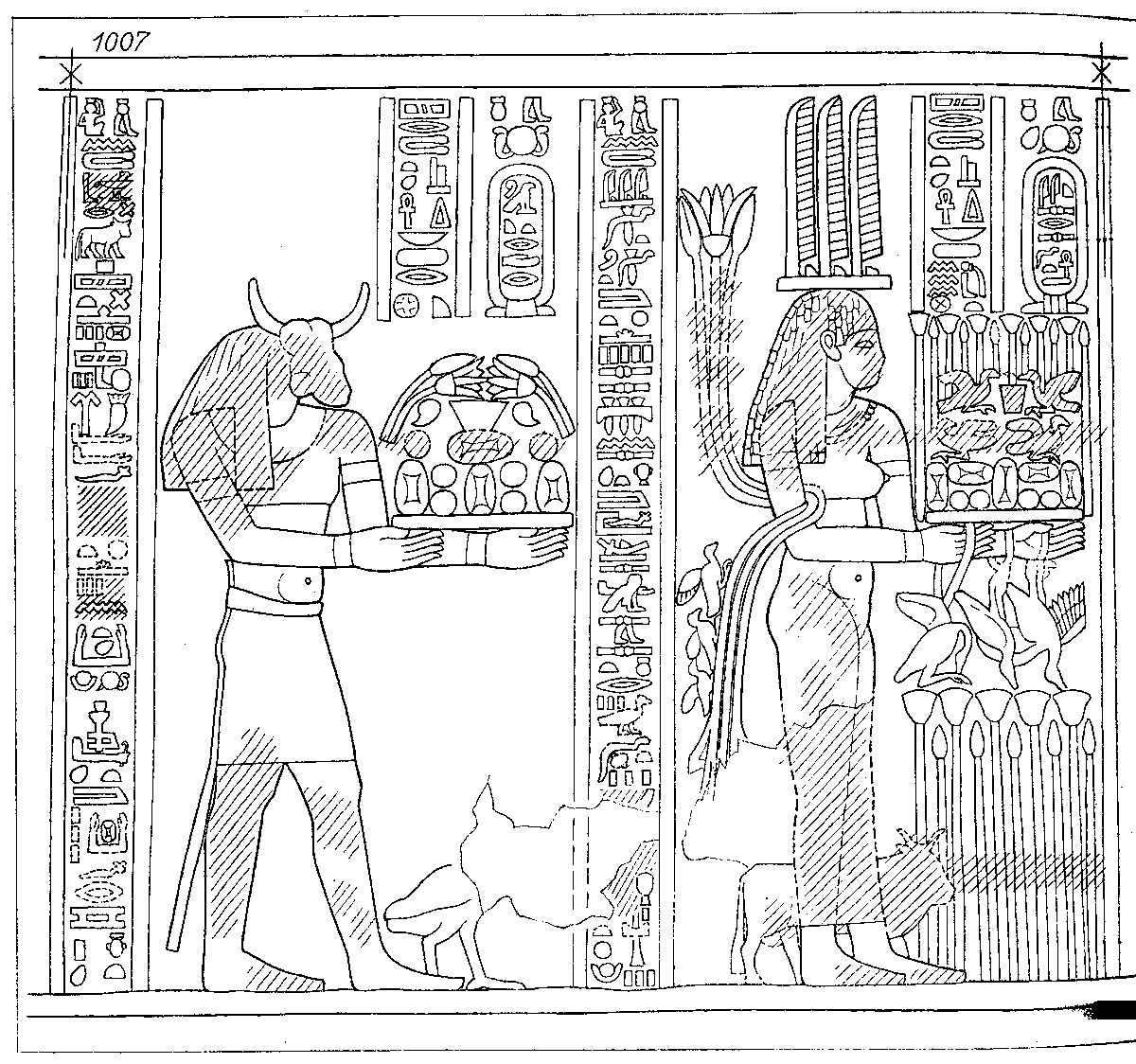
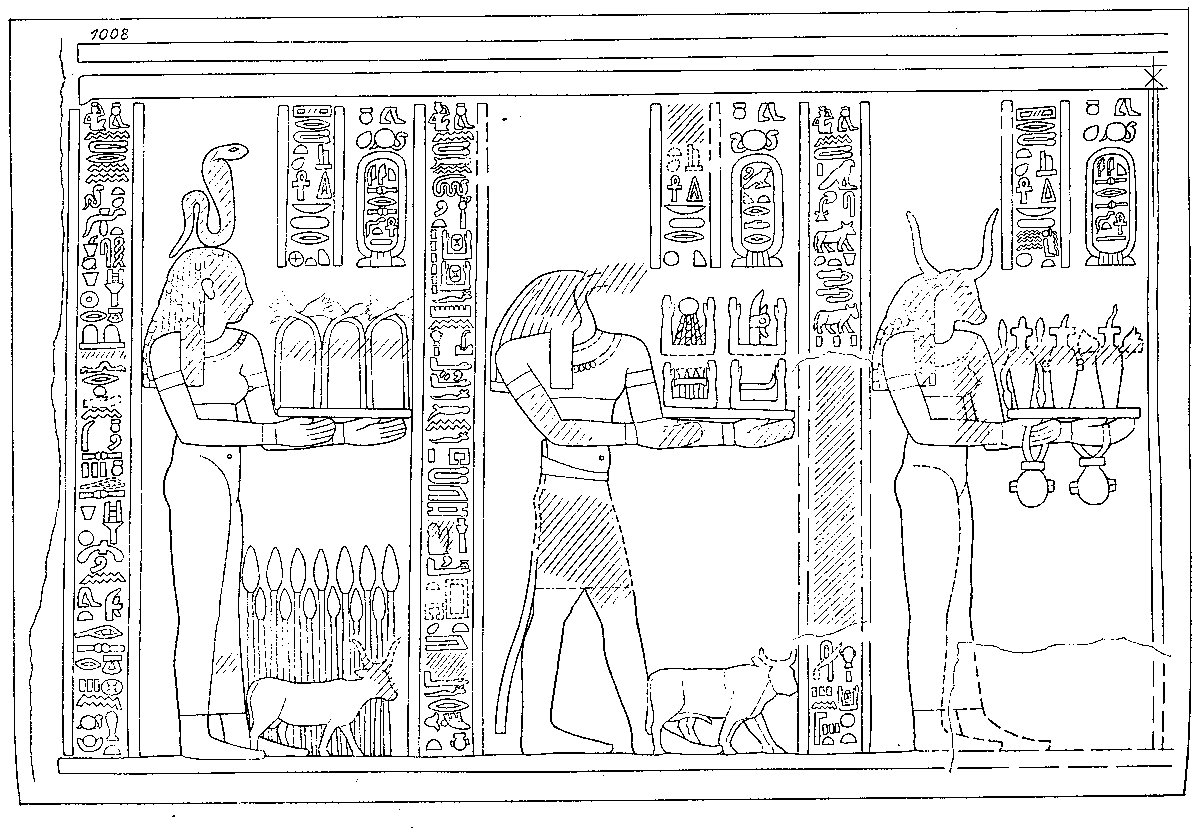
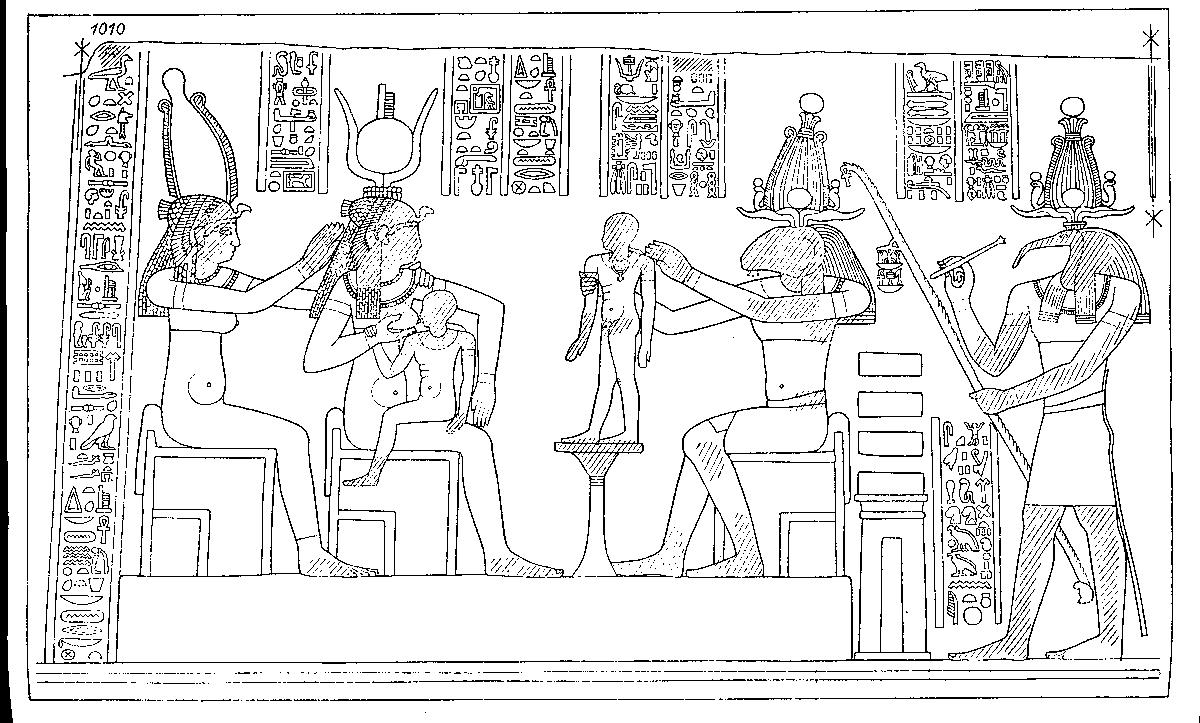
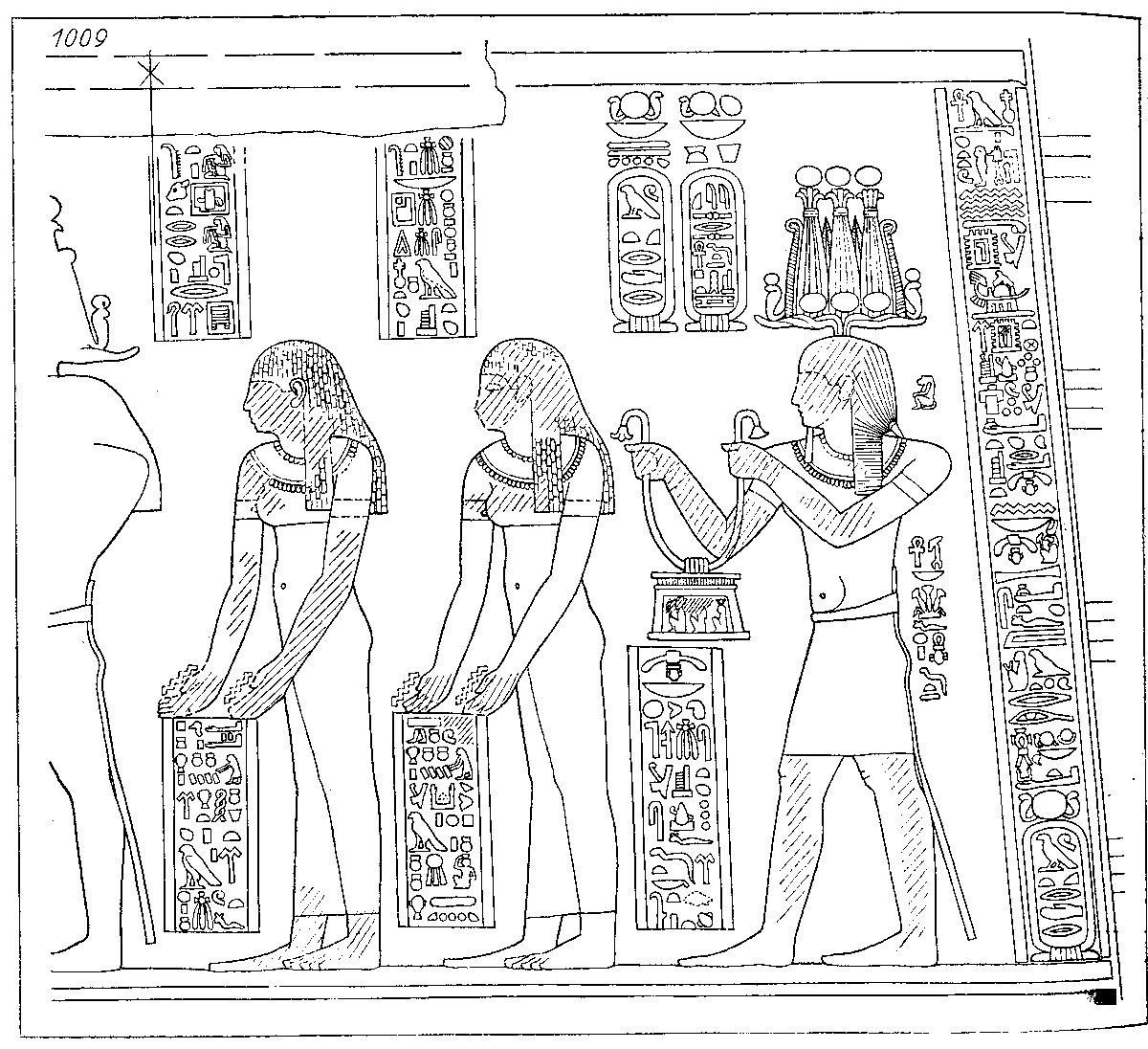
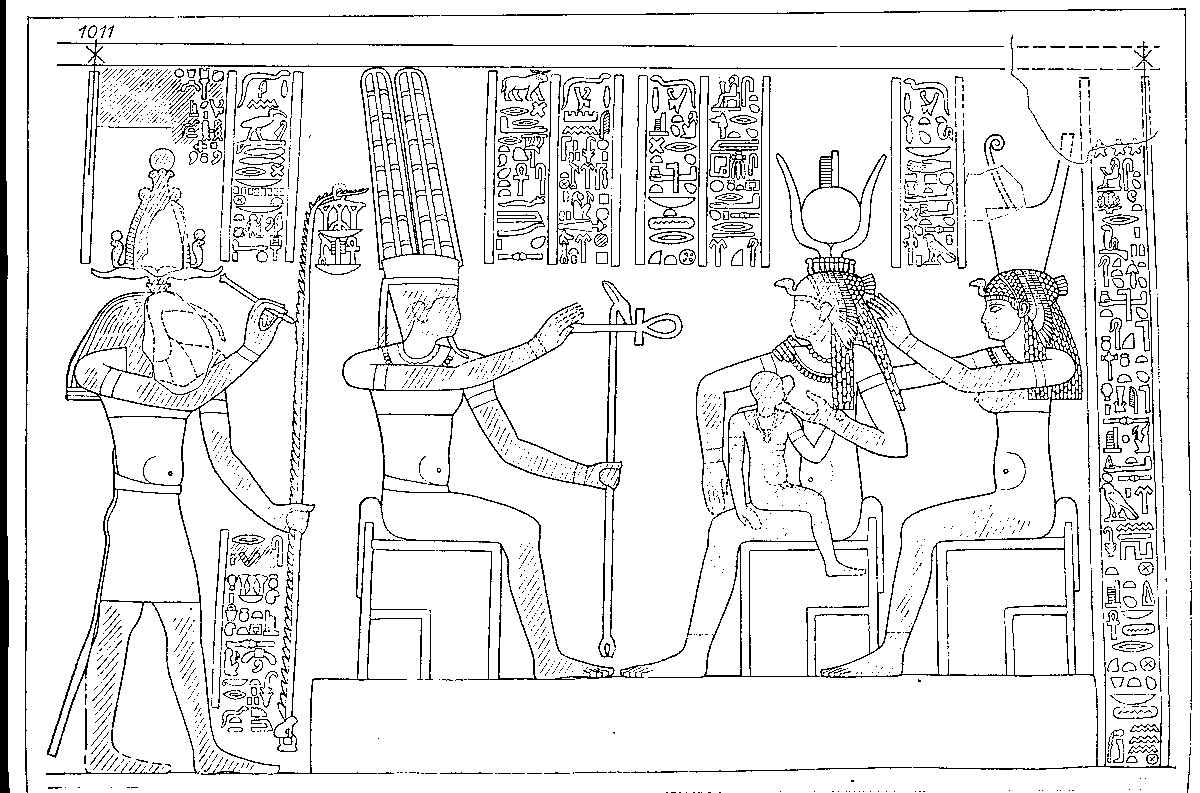
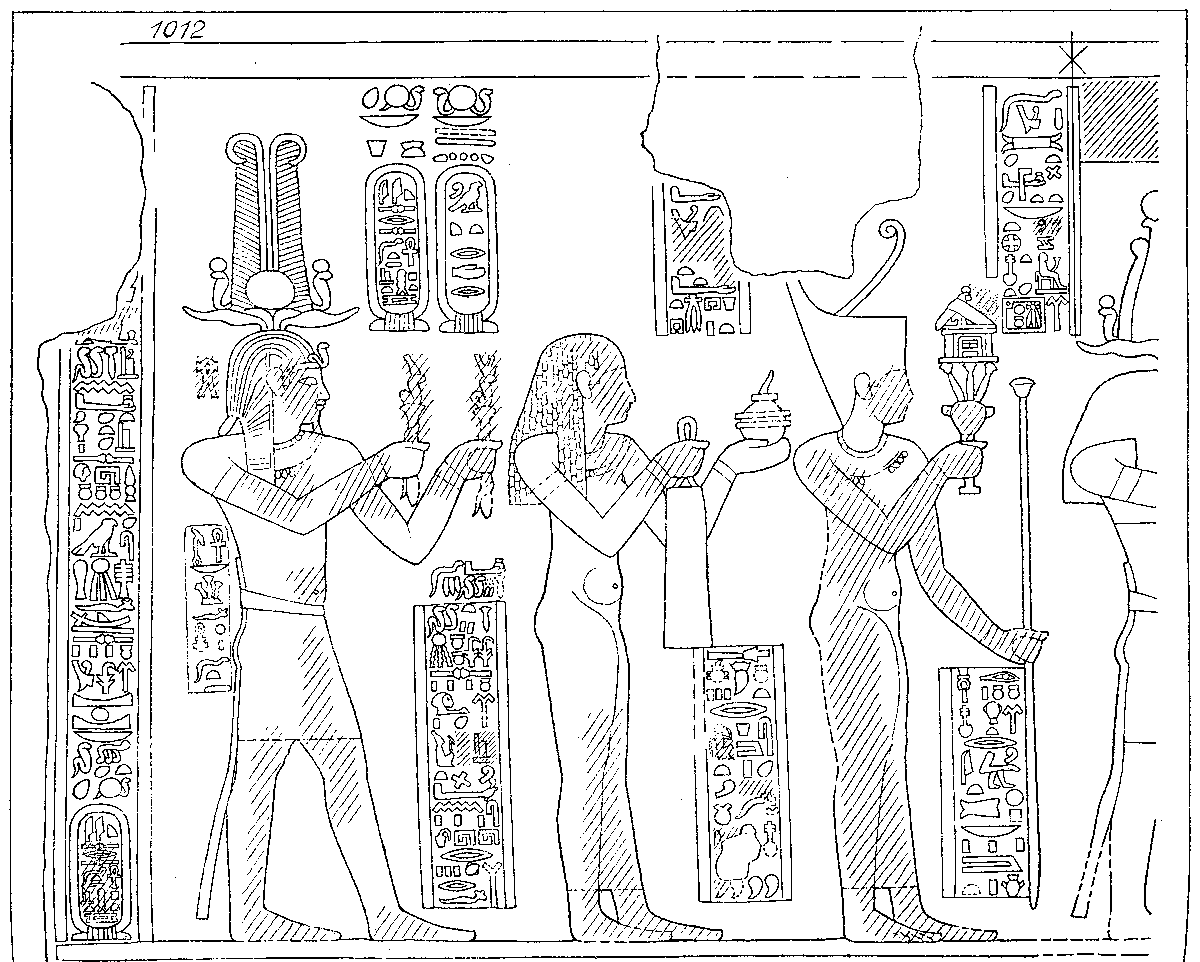
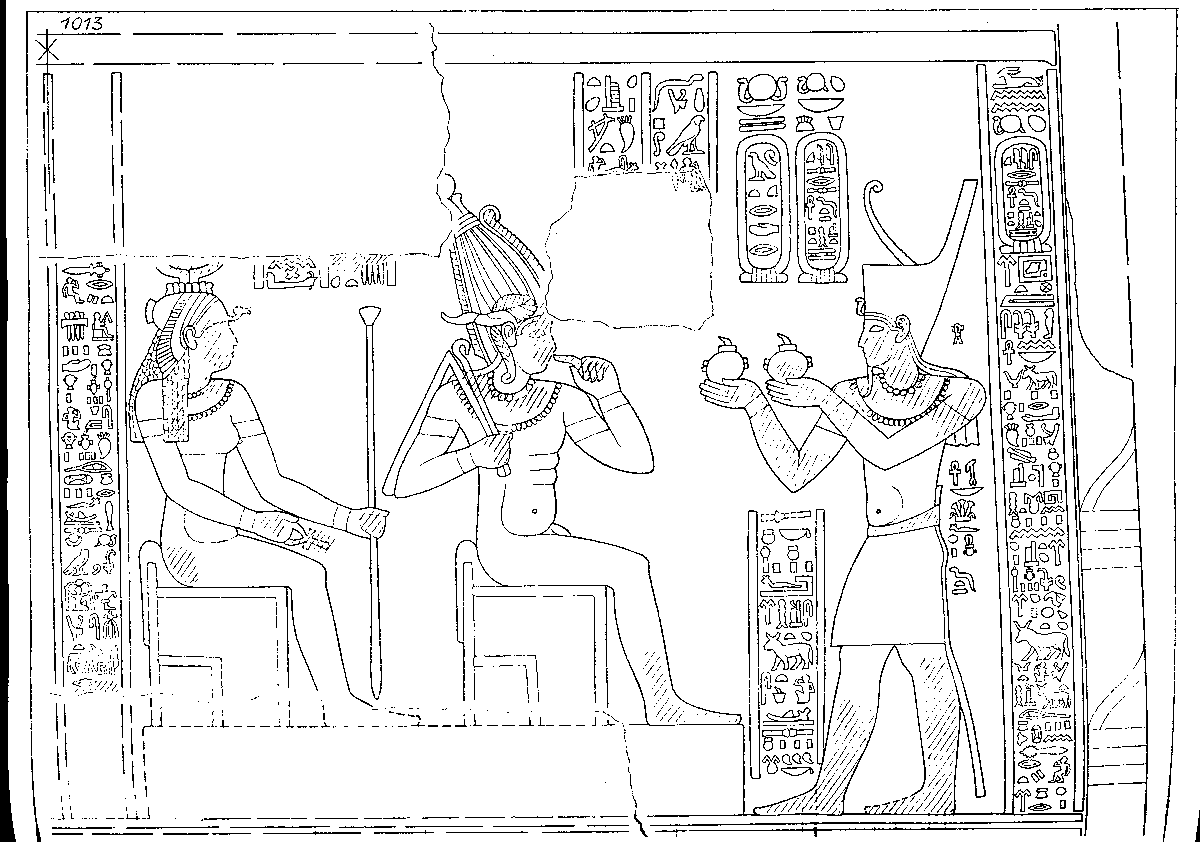
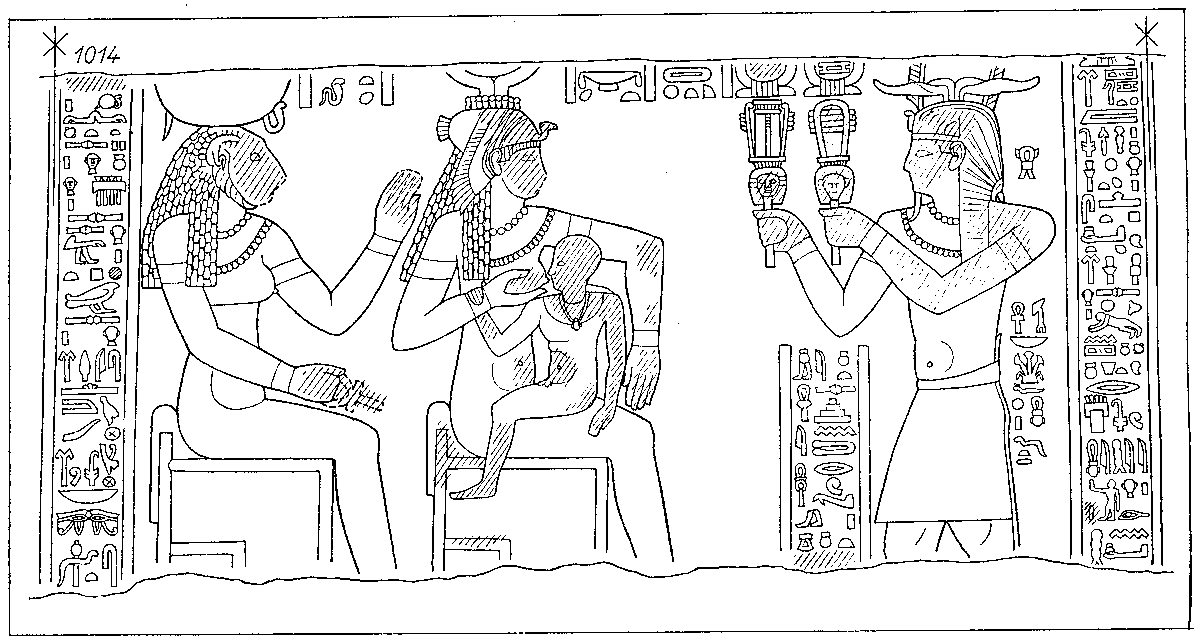
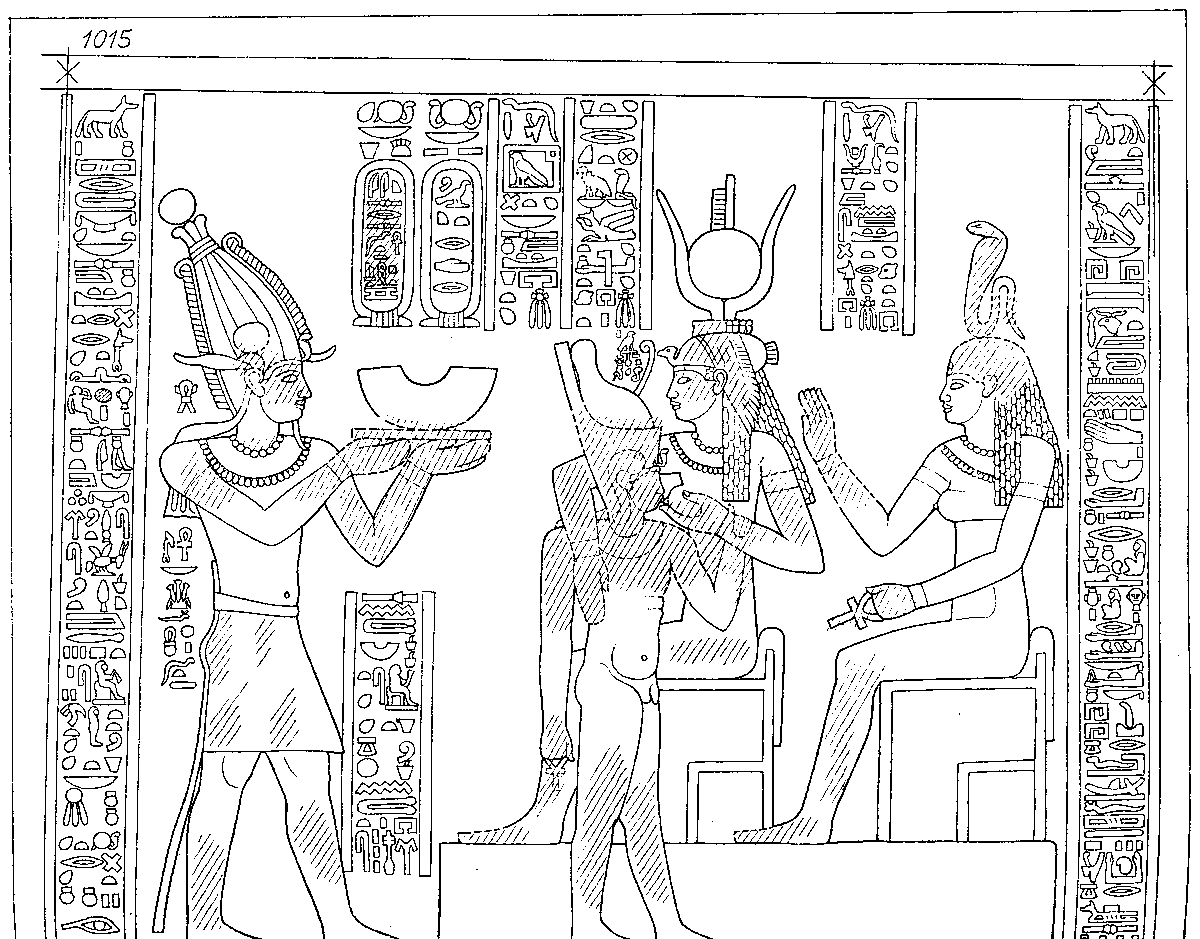
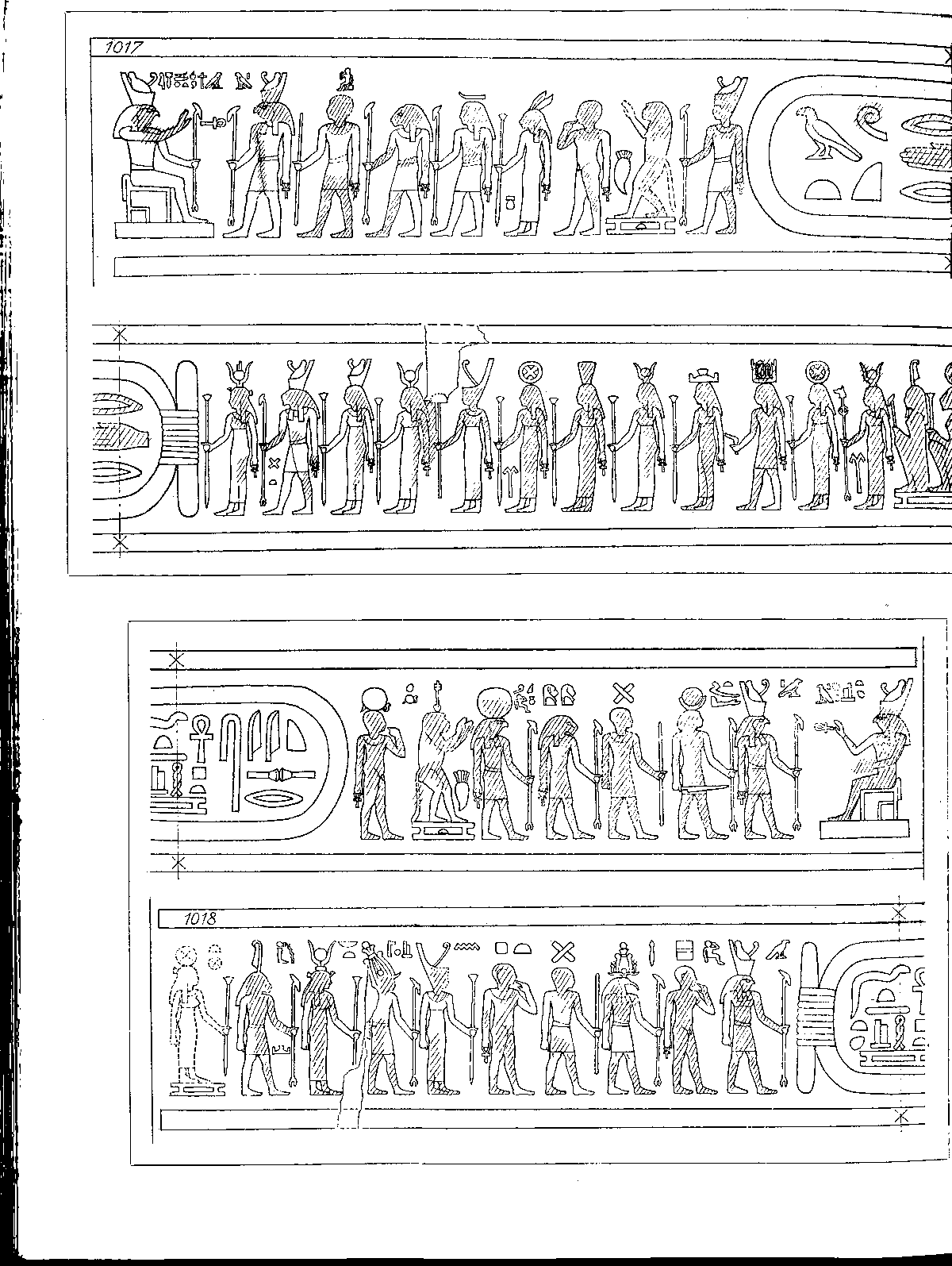
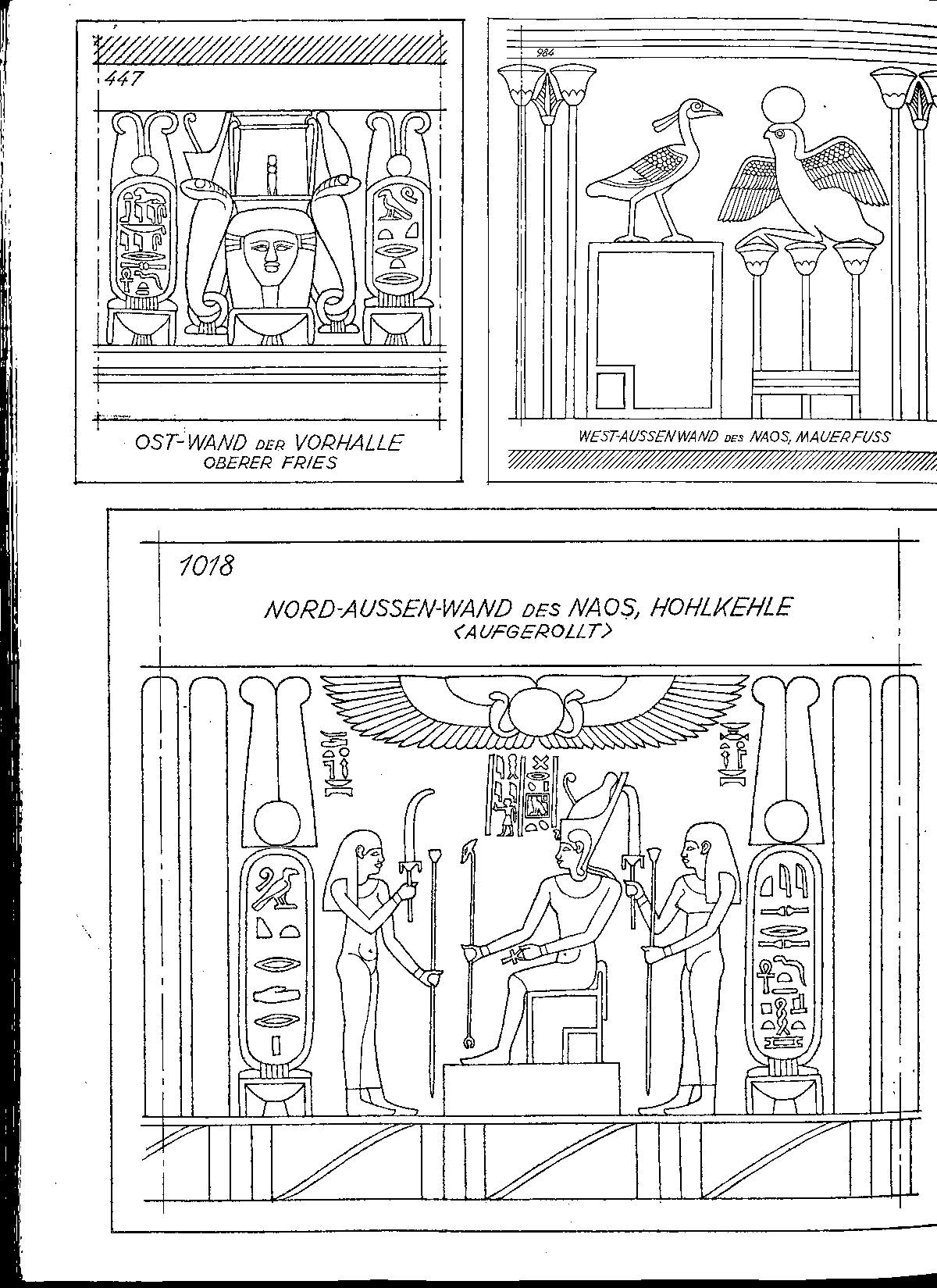
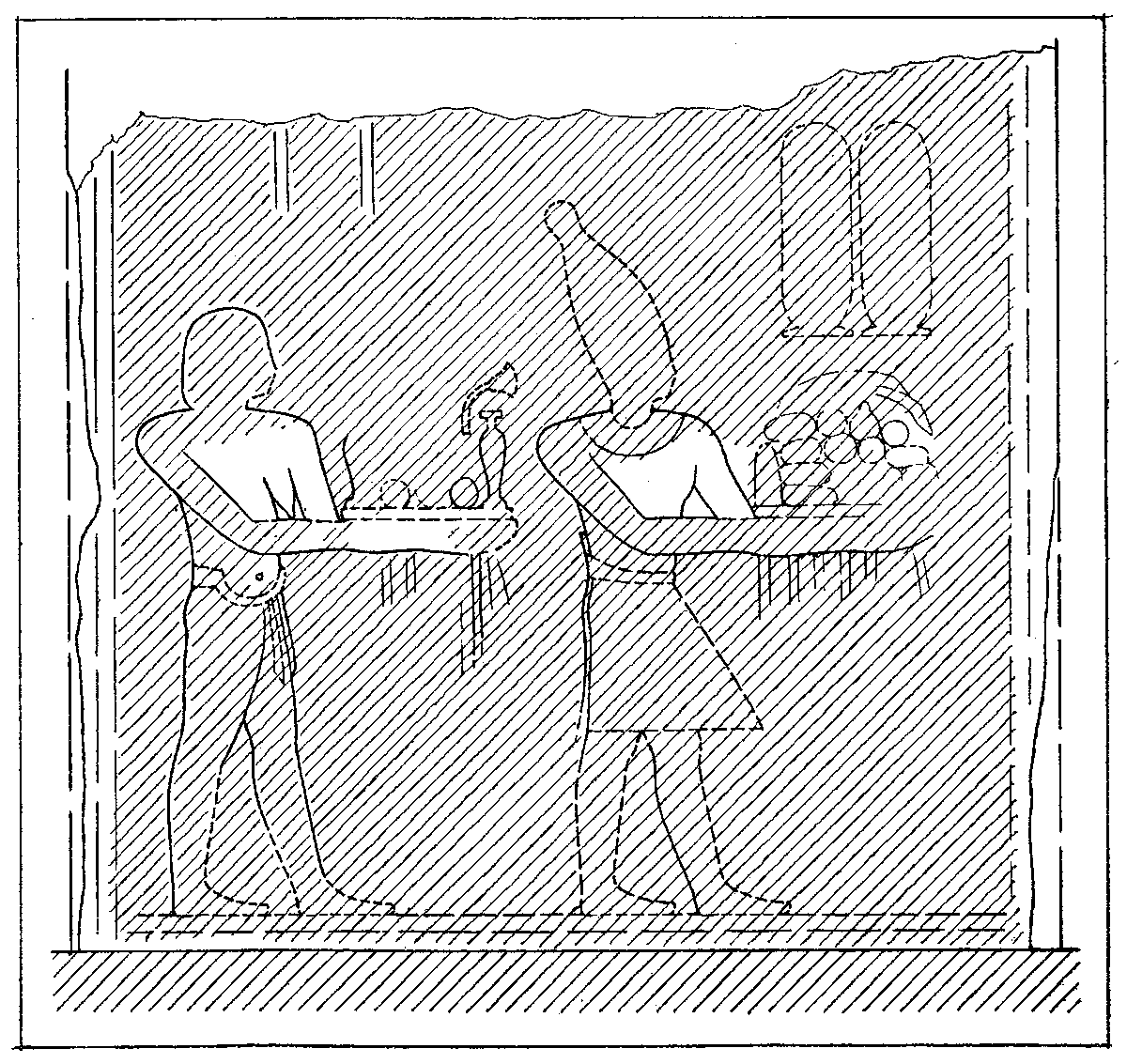
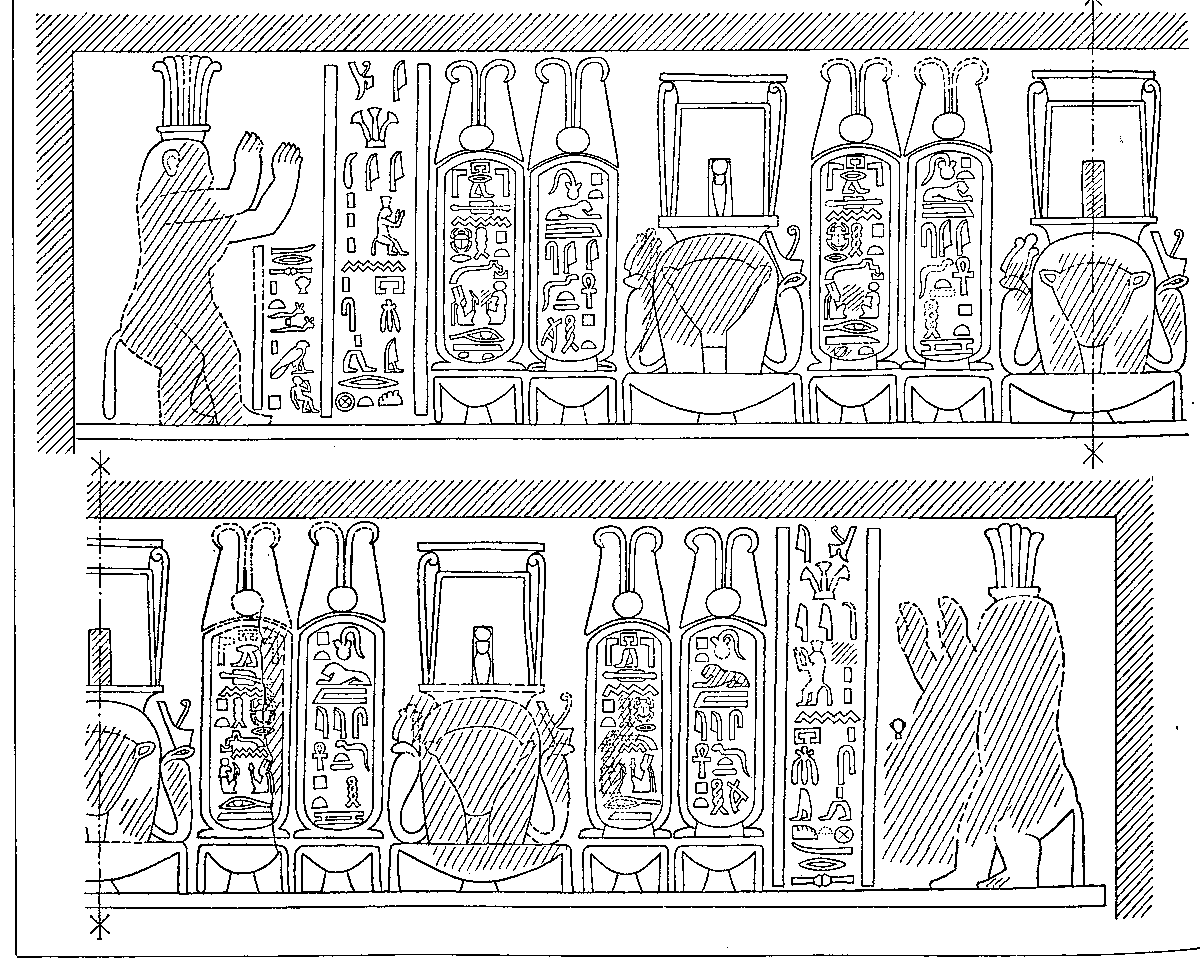
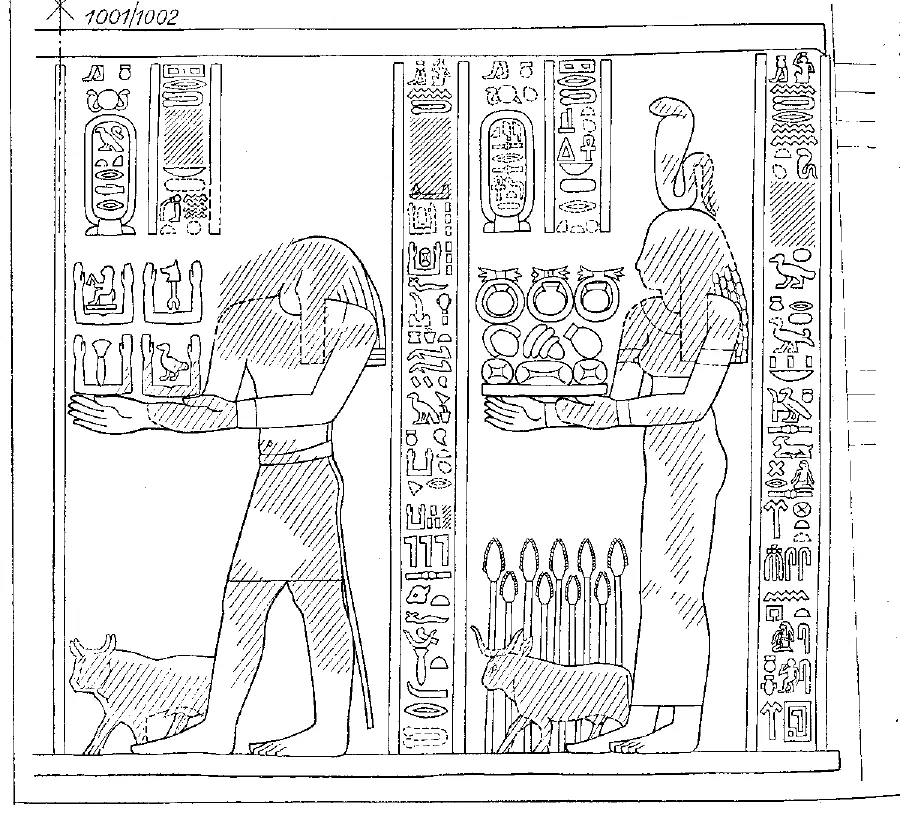
On the walls of the birth house Augustus leads a procession to Isis as she suckles Horus: Nile gods, field goddesses, bulls, cows and the serpent gods Nehebkau, Mehen and Renenutet. Of Renenutet the text says: She conceives in your city and gives birth in your house. Augustus hands over a gold amulet, two uraei, milk, mirrors, myrrh and a potter’s wheel, and Khnum answers: On it I fashion children for you, sons and daughters.
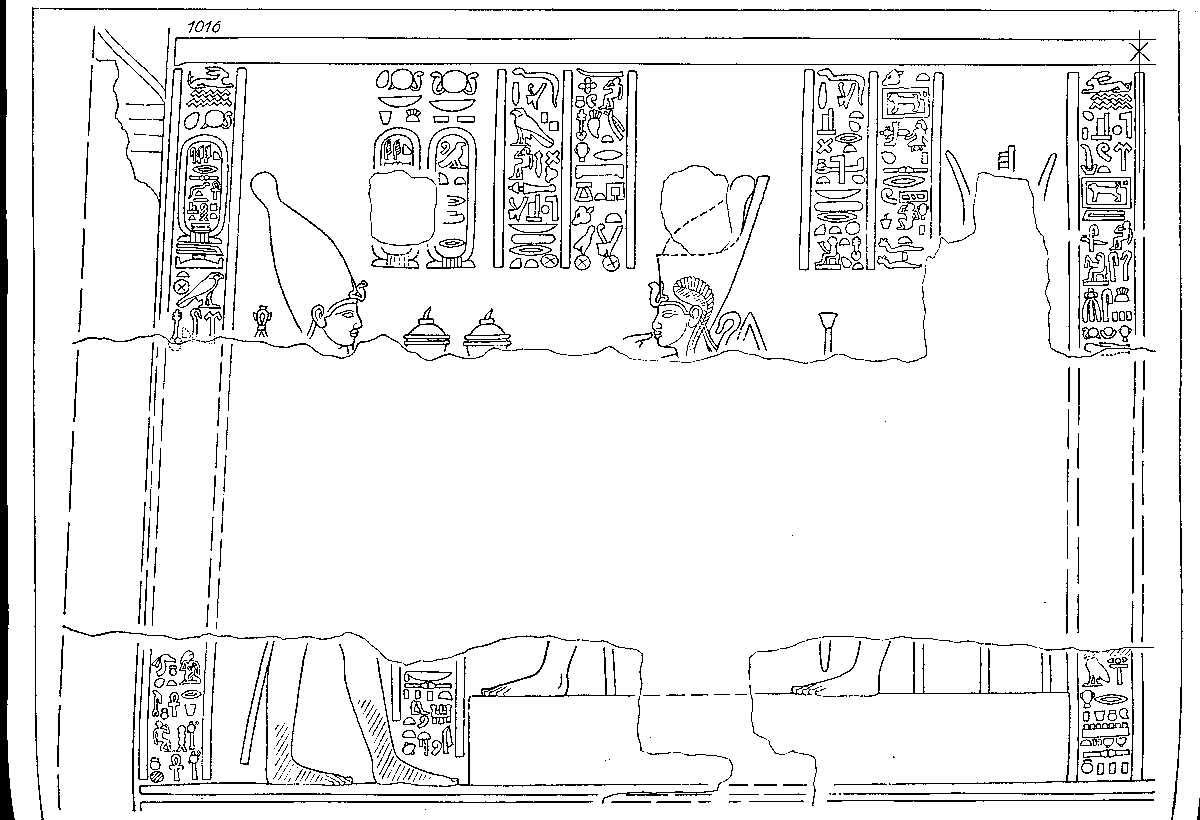
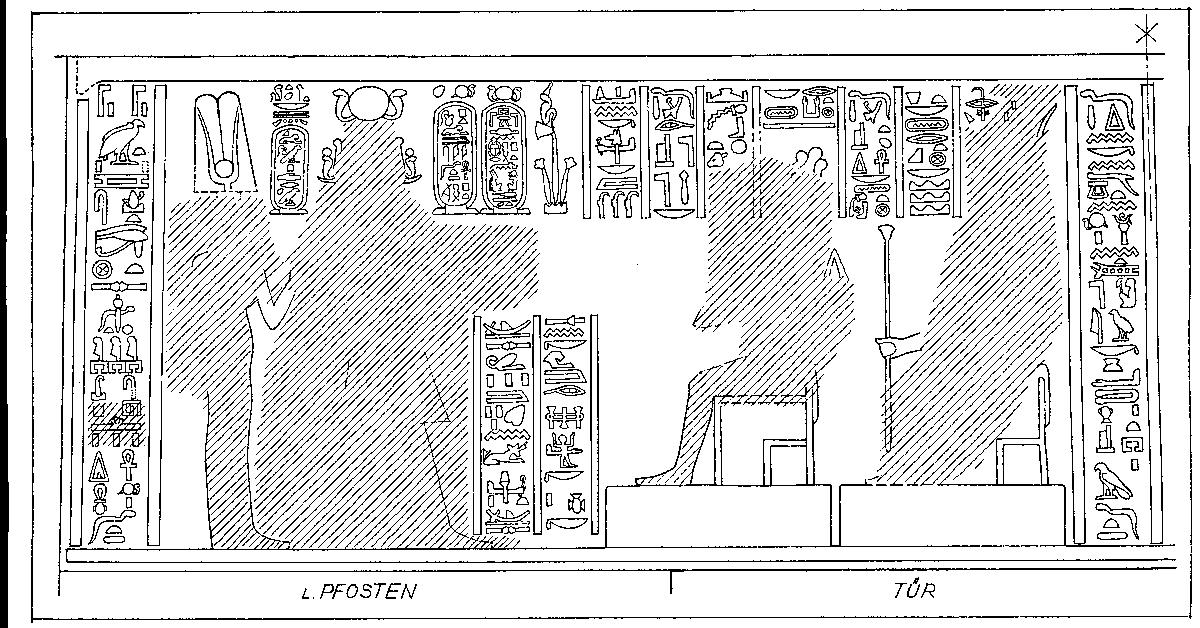
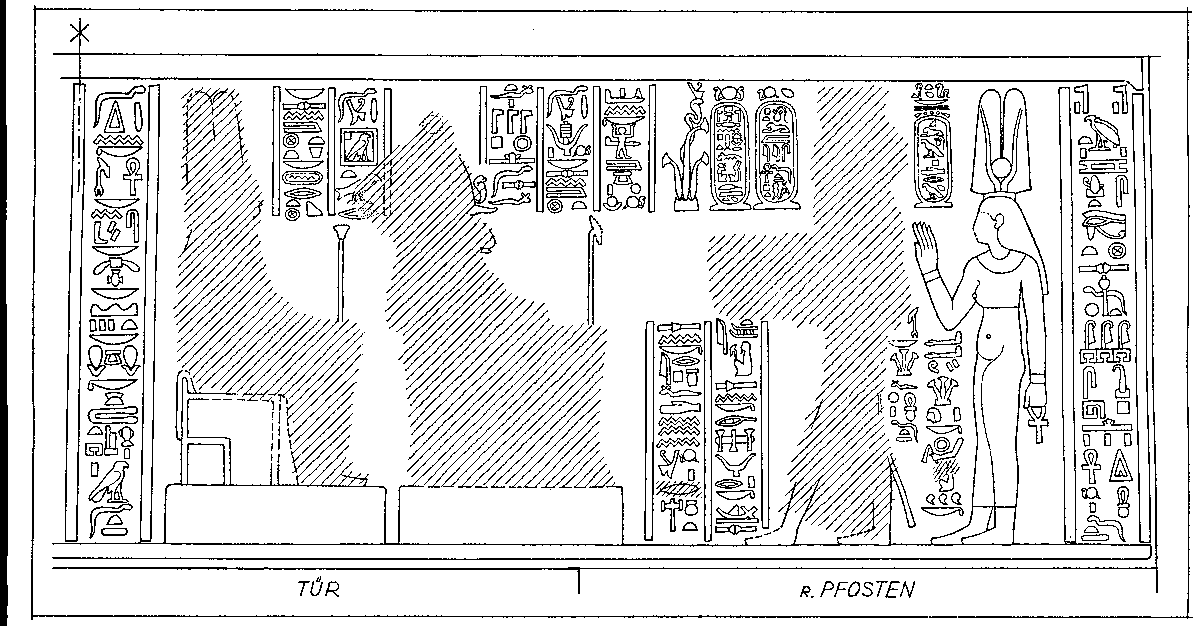
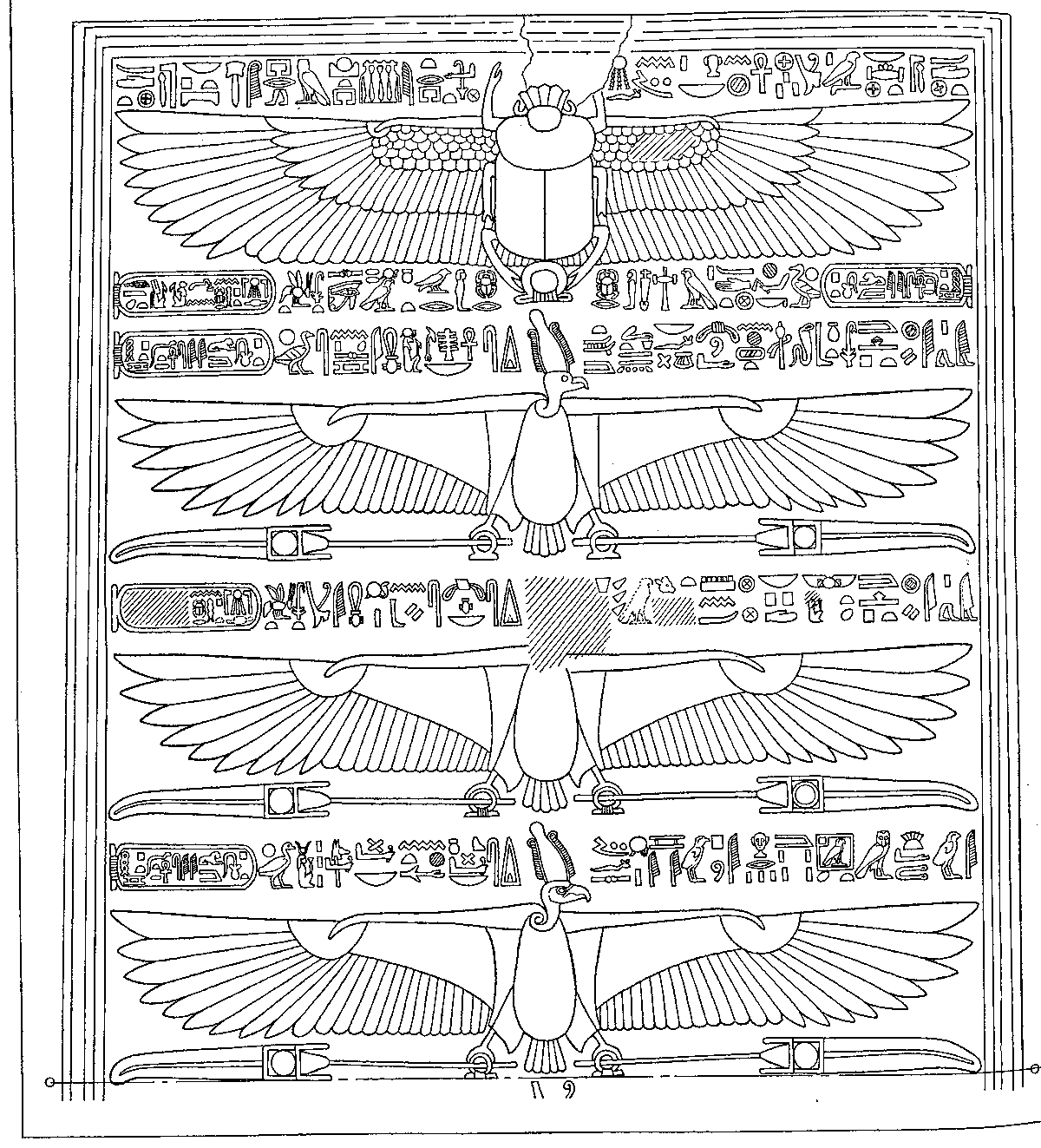
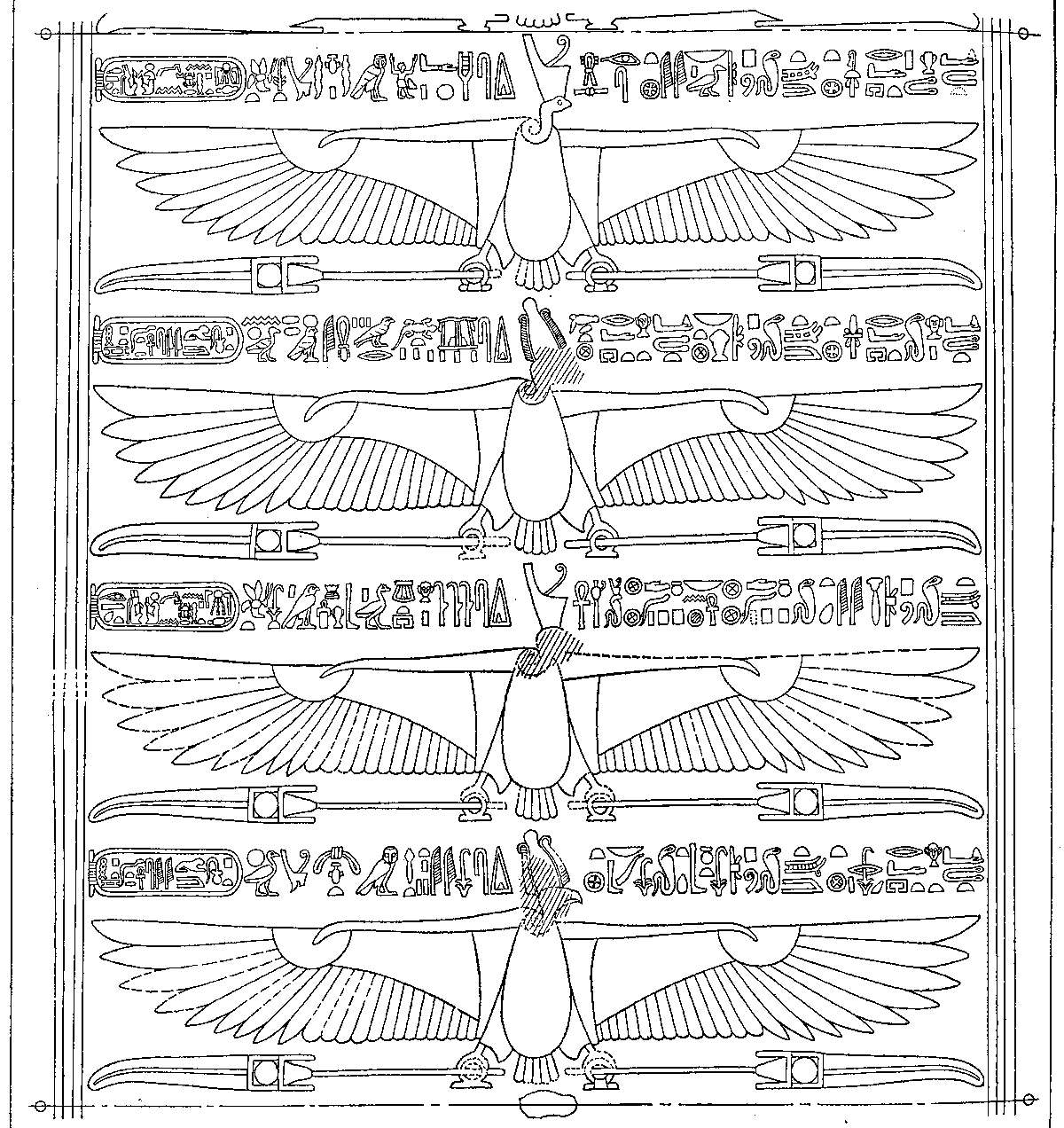
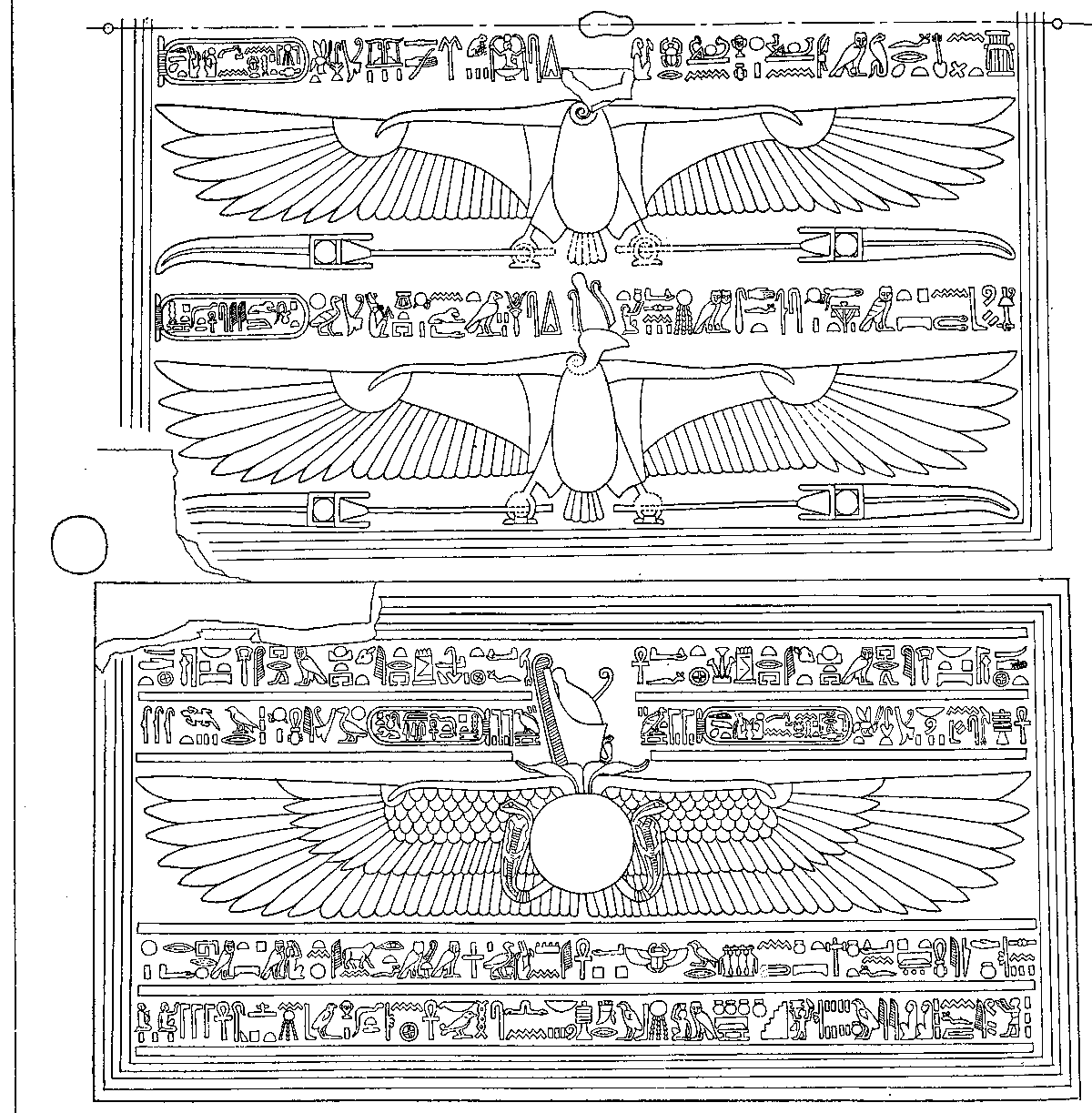
In the gate of the first pylon Ptolemy VI offers meat to Osiris: and take the last part as the testicles of Seth. Bes gods dance, and the ceiling calls on the vulture Nekhbet and the cobra Wadjet to guard the king.
Augustus brings nursing Isis the field goddess, the bull, the cow and the serpent gods
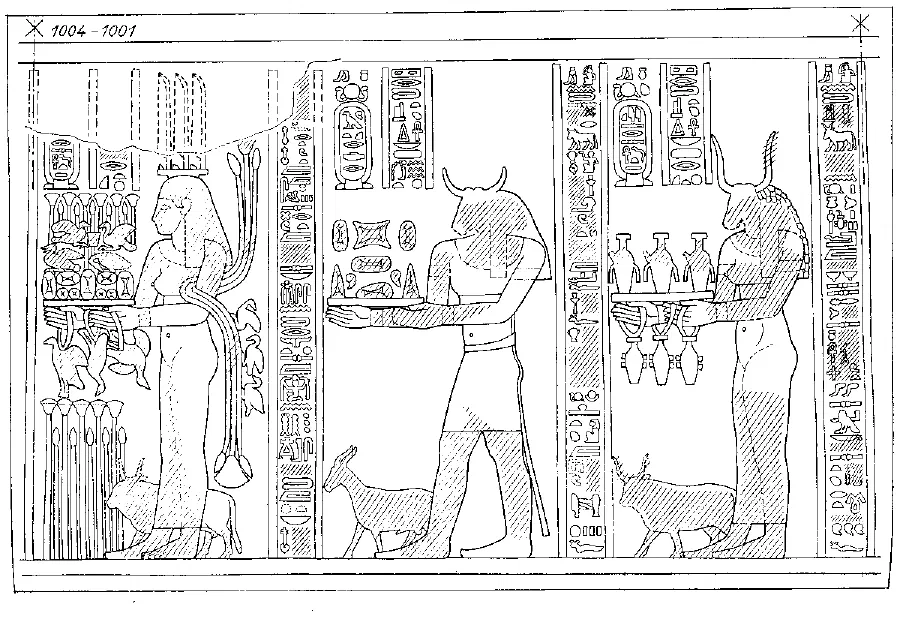
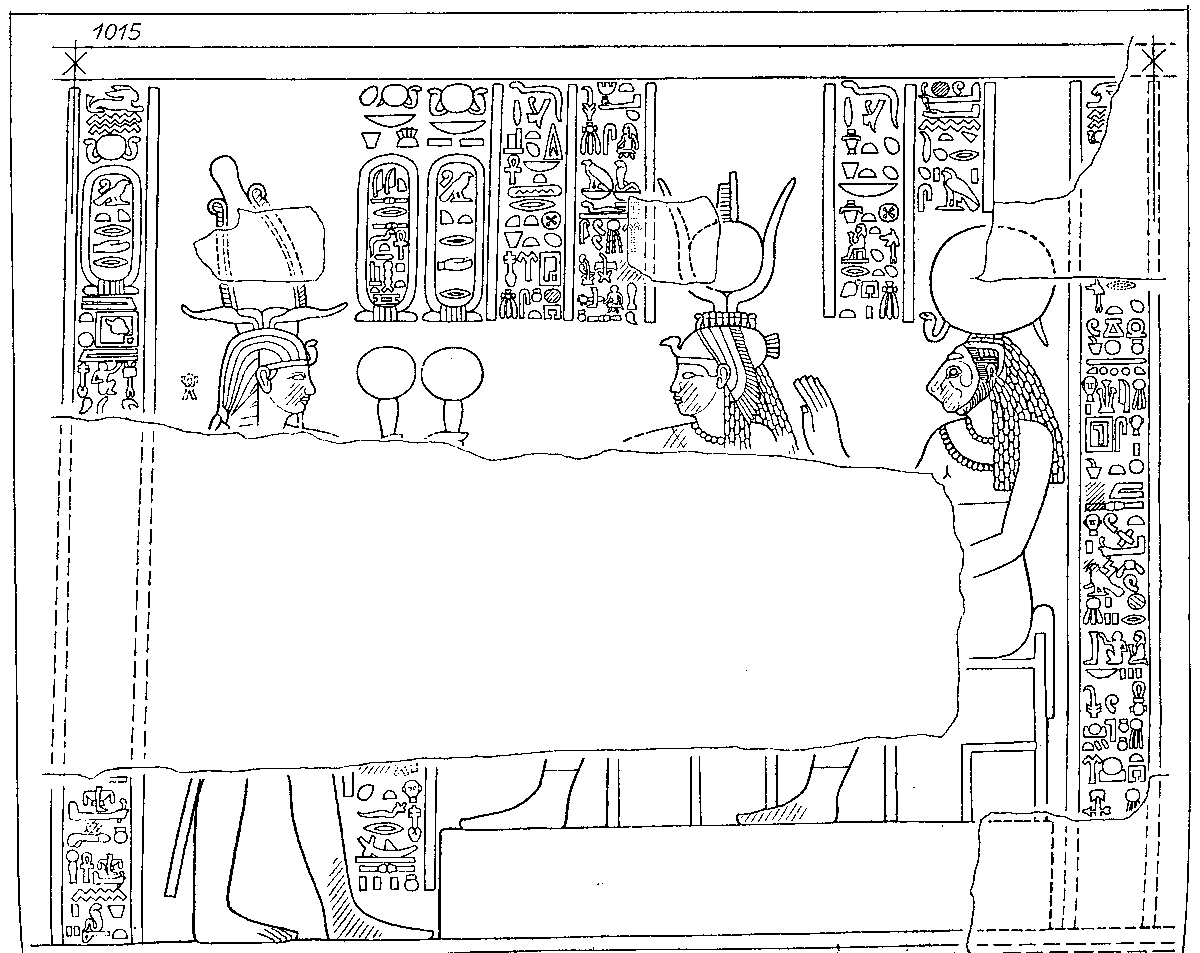
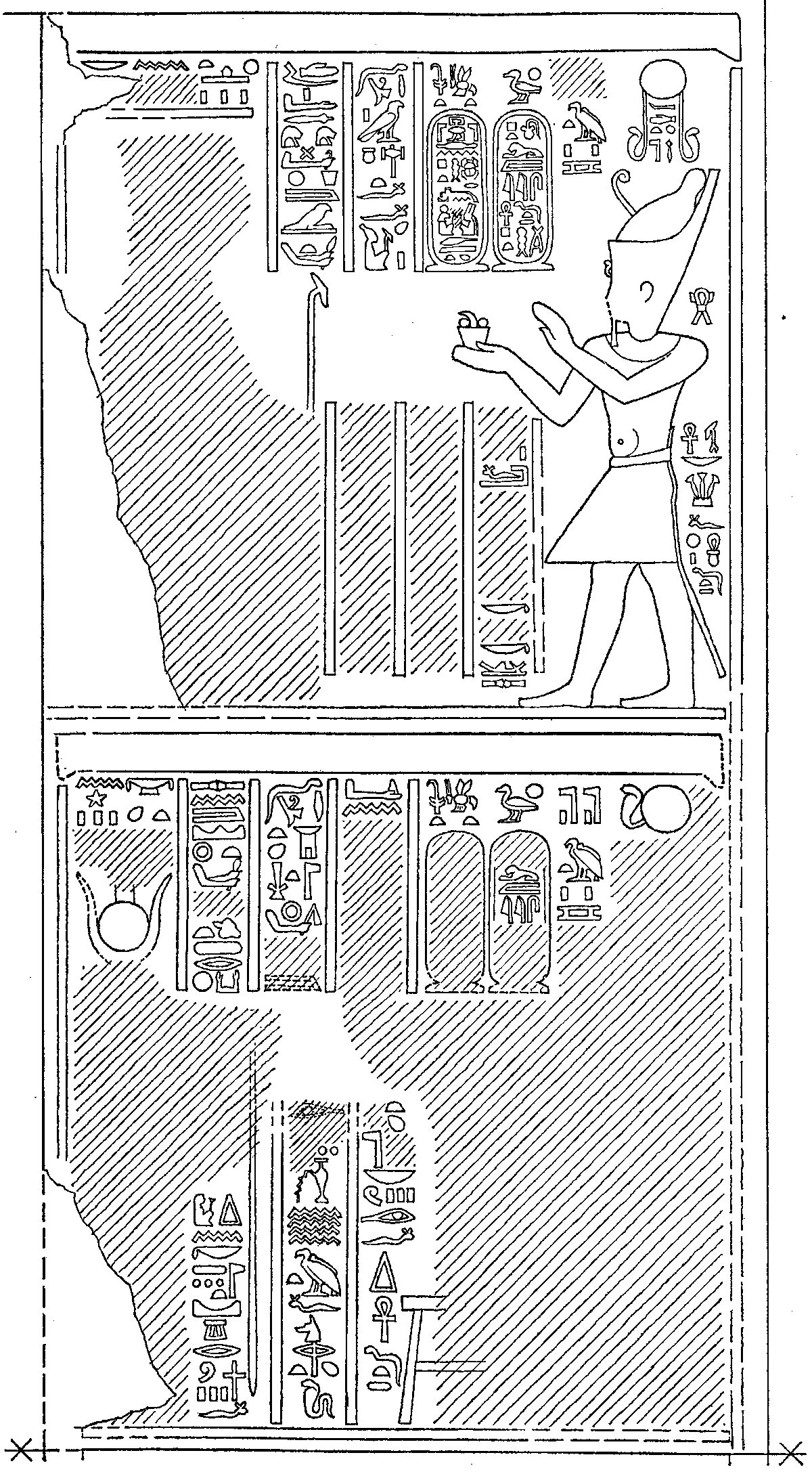
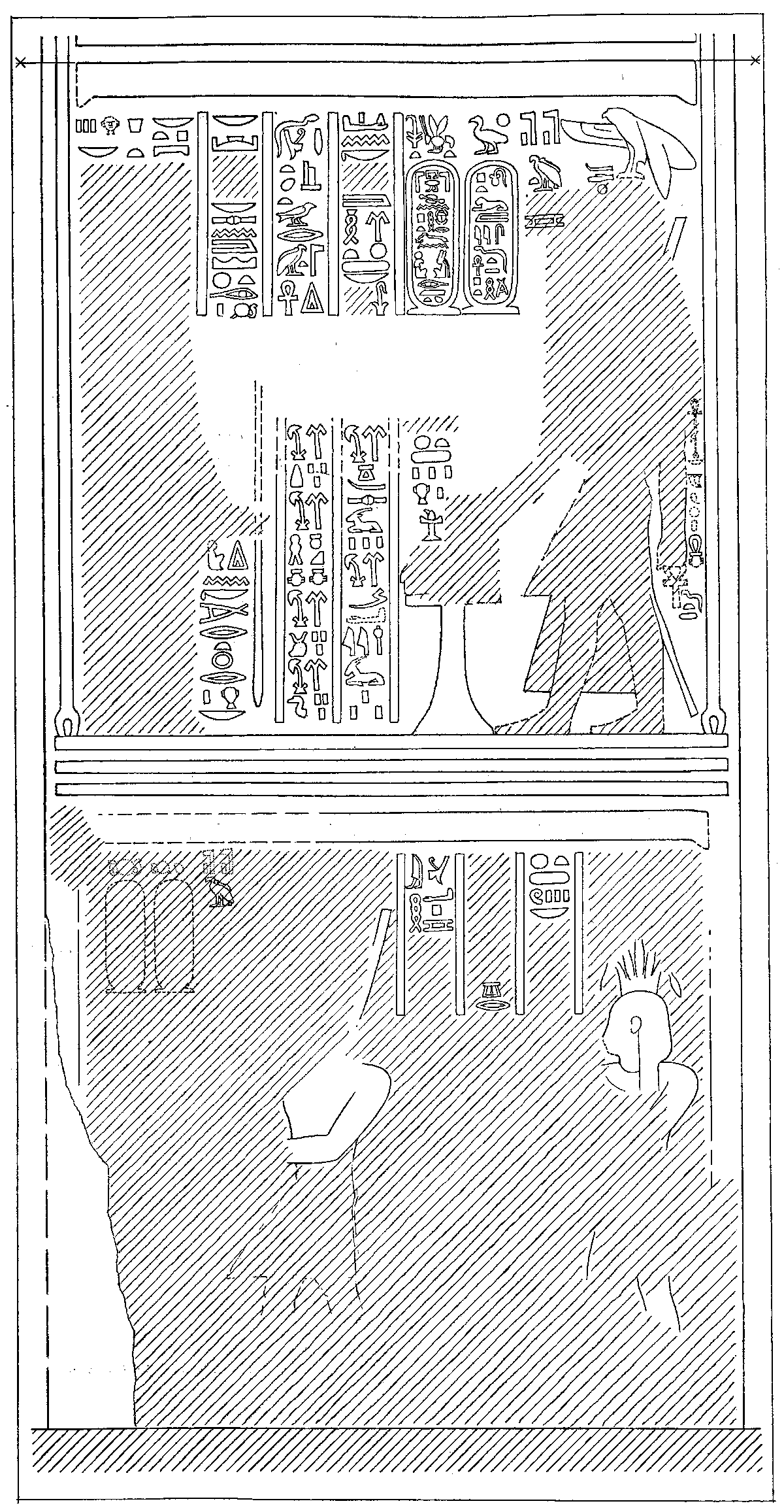
Page 367. The scene as drawn on the wall, facing p. 367 of the edition. Drawing by Otto Baum, in Junker and Winter, Das Geburtshaus des Tempels der Isis in Philä (1965)The hatched figures were hacked off the wall on purpose. After Justinian closed the temple of Isis around 537, Christians made it a church and chiselled out the gods and kings, mostly sparing the hieroglyphs. - 1p. 367, l. 1
(j.n sꜣ Rꜥ Kjs)rs ꜥnḫ ḏ.t (ḫr-ṯ)
The Son of Ra, Caesar, who lives forever, has come to you,
- 2p. 367, l. 2
(ꜣs.t dj.t ꜥnḫ) … ꜣrk
O Isis, giver of life, … of Philae.
- 3p. 367, l. 3
(jnj-f n-ṯ sḫ.t) nfr.t nfr.tj m šm.w-s
He brings you the fair field, fair with her herbs,
- 4p. 367, l. 4
wr.tj m …-s nb
rich in all her …
- 5p. 367, l. 5
msj-s n-ṯ dmdj.t-s m ḥḥ n wꜣḥj.t
At term she bears you grain a millionfold
- 6p. 367, l. 6
ḏbꜣ-s …-ṯ m jḫ.t nb.t nfr.t. ? .
and furnishes your … with every good thing.
- 7p. 367, l. 7
jj-n njswt bjt ꜣwtḳrdr ḫr-ṯ
The King of Upper and Lower Egypt, Autokrator, has come to you,
- 8p. 367, l. 8
ꜣs.t dj(.t) ꜥnḫ nb(.t) jꜣ.t wꜥb.t
O Isis, giver of life, lady of the Abaton.
- 9p. 367, l. 9
jnj-f n-ṯ š(mꜣ)-wr¹
He brings you the Shema-wer,
Note · Line 9
The Shema-wer is Buchis, the sacred bull of Hermonthis, modern Armant. - 10p. 367, l. 10
ḫrj-tp ꜥbꜣ ḥꜣ.t (wdḥw)²
chief of the altar, foremost at the offering table.
- 11p. 367, l. 11
(ꜣw?)³ m ꜥ-f ꜥḥꜥ(?)-f ḥr … rꜥ nb
The gift is on his arm; he stands at … every day.
- 12p. 367, l. 12
ḥtp-ṯ m hrw⁴ ꜥb.wt-f
You are content on the day of his offerings.
- 13p. 367, l. 13
jj-n sꜣ Rꜥ Kjsrs ꜥnḫ ḏ.t ḫr-ṯ
The Son of Ra, Caesar, who lives forever, has come to you,
- 14p. 367, l. 14
ꜣs.t dj(.t) ꜥnḫ nb(.t) ꜣrk
O Isis, giver of life, lady of Philae.
- 15p. 367, l. 15
jnj-f n-ṯ ḥsꜣ.t⁵ (mw.t)⁶ n Rꜥ
He brings you the Hesat cow, mother of Ra,
- 16p. 367, l. 16
ḥr ḥḏ.w prj m (npḥw?)-s
bearing the white milk that came from her udder.
- 17p. 367, l. 17
šsr-s n(-ṯ?) ꜥnḫ-wꜣs jmj.wtj mn.tj-s
For you she milks the life and dominion between her hind legs.
Note · Line 17
“Life and dominion” is a name for the milk: to drink it is to receive both gifts. - 18p. 367, l. 18
mkj(?) … s⁷ … rwḏ ḥꜥ.w-f
She protects … … his limbs grow strong.
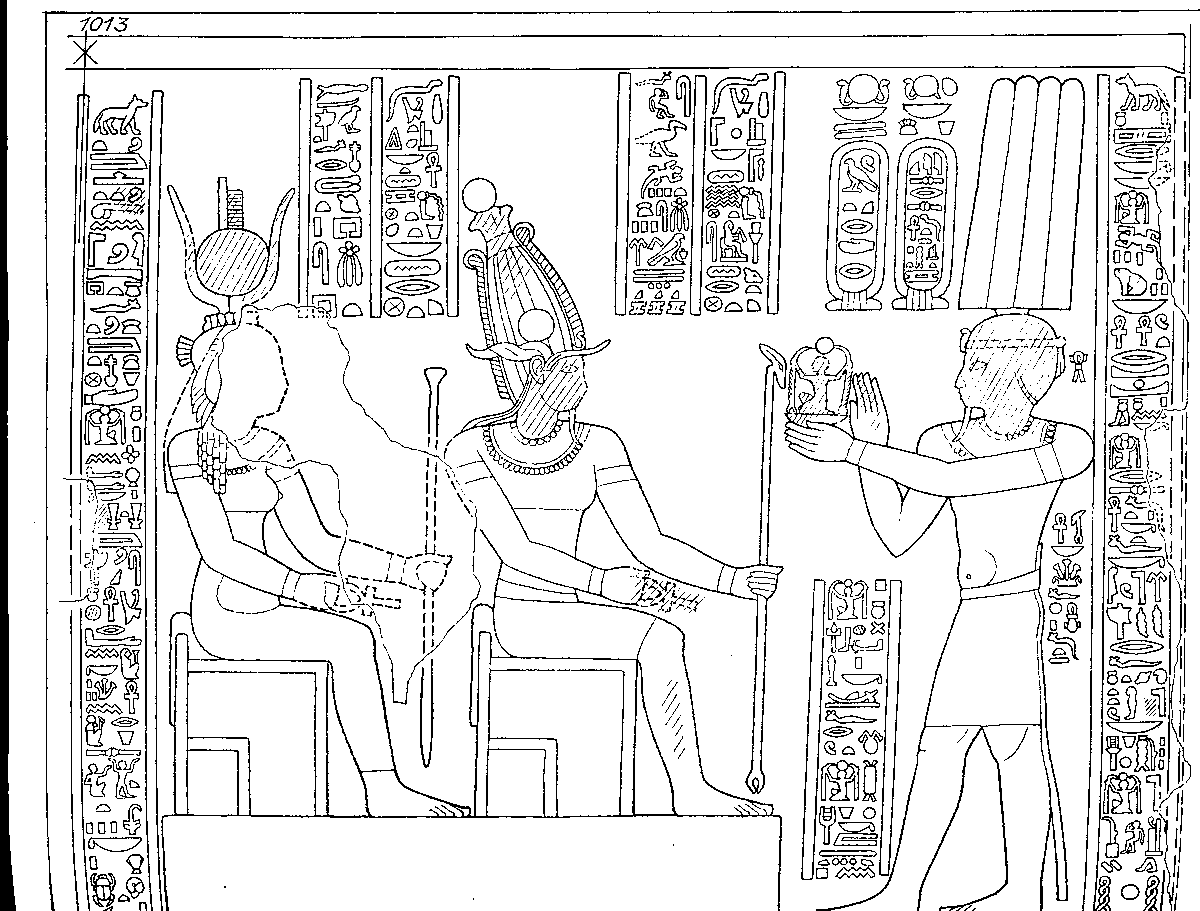
Page 369. The scene as drawn on the wall, facing p. 369 of the edition. Drawing by Otto Baum, in Junker and Winter, Das Geburtshaus des Tempels der Isis in Philä (1965) - 19p. 369, l. 1
jj-n njswt bjt ꜣwtḳrdr ḥr-ṯ
The King of Upper and Lower Egypt, Autokrator, has come to you,
- 20p. 369, l. 2
(ꜣJs.t dj.t ꜥnḫ) nb(.t) jꜣ.t wꜥb.t
O Isis, giver of life, lady of the Abaton.
- 21p. 369, l. 3
jnj-f n-ṯ (nḥb-kꜣ)² dj kꜣ.w
He brings you Nehebkau, giver of food.
Note · Line 21
The king presents Nehebkau, a serpent god. In the god’s name one hears both ka, the vital power of a being, and kau, the food that sustains it. - 22p. 369, l. 4
kꜣ.w-f mn ḥr gꜣb.tj-f
His food rests on his two arms.
- 23p. 369, l. 5
nḥb-n-f kꜣ-ṯ ḥnꜥ kꜣ.w nṯr.w
He has ennobled your ka along with the kas of the gods;
- 24p. 369, l. 6
sḫnt-f jꜥw.t-ṯ ḥnꜥ-ṯ(?)
he raises your office, and you with it.
- 25p. 369, l. 7
jj-n sꜣ Rꜥ Ḳjsrs ꜥnḫ ḏ.t ḥr-ṯ
The Son of Ra, Caesar, who lives forever, has come to you,
Note · Line 25
The Caesar named here is Augustus, who appears in the temple rites as king of Egypt. - 26p. 369, l. 8
ꜣJs.t dj(.t) ꜥnḫ nb(.t) ꜣJrk
O Isis, giver of life, Lady of Philae.
- 27p. 369, l. 9
jnj-f n-ṯ rnn.t … ḏfꜣ.w
He brings you Renenutet, … provisions,
Note · Line 27
Renenutet is the goddess of the harvest and a divine nurse. Her name echoes the verb for nursing her child. - 28p. 369, l. 10
ḥr ḏfꜣ.w nb.w ḳmꜣ-n-s
with all the provisions she has brought forth.
- 29p. 369, l. 11
jwr-s m njw.t-ṯ msj-s m prj-ṯ
She conceives in your city and gives birth in your house;
- 30p. 369, l. 12
rnn-s nn(so?)-s m ḥw.t-nṯr(-ṯ)⁷
she nurses her child in your temple.
Augustus leads the procession of offerings to nursing Isis
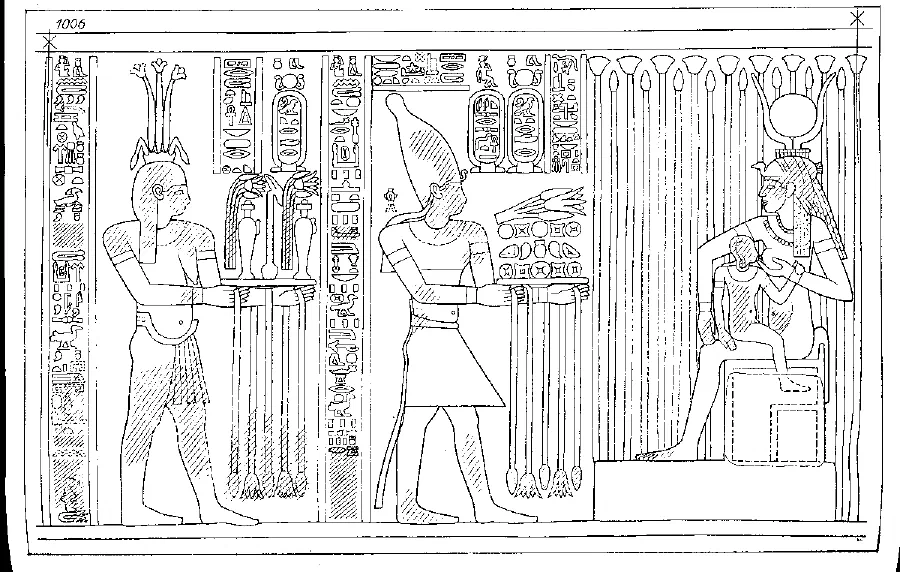
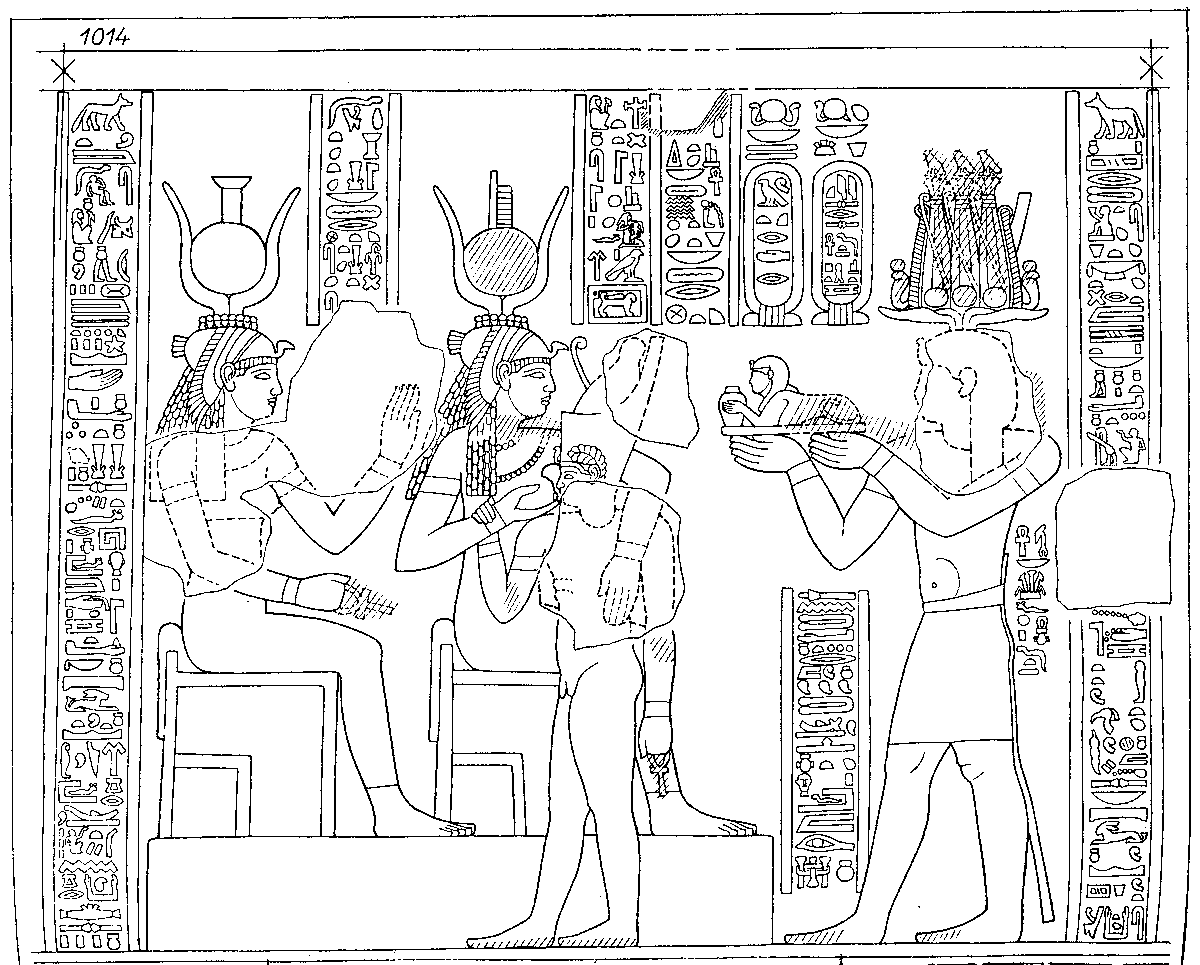
Page 371. The scene as drawn on the wall, facing p. 371 of the edition. Drawing by Otto Baum, in Junker and Winter, Das Geburtshaus des Tempels der Isis in Philä (1965) - 31p. 371, l. 1
ḏd mdw n | Jš.t wr.t mw.t nṯr
Words to be spoken to Isis the Great, mother of the god,
- 32p. 371, l. 2
nb(.t) Jrḳ ḥnw.t nb(.t) prj-msj.t
Lady of Philae, sovereign lady, mistress of the birth house.
Note · Line 32
The birth house is the sanctuary where the birth of Horus, son of Isis, was celebrated. - 33p. 371, l. 3
jj-n njśwt bjt ꜣwtḳrdr
The King of Upper and Lower Egypt, Autokrator,
Note · Line 33
Autokrator is a Greek imperial title meaning one who rules in his own right. - 34p. 371, l. 4
sꜣ Rꜥ Ḳjsrs ꜥnḫ ḏ.t ḫr-ṯ
the Son of Ra, Caesar, who lives forever, has come to you,
- 35p. 371, l. 5
Jš.t wr.t mw.t nṯr nb(.t) Jrḳ
O Isis the Great, mother of the god, Lady of Philae.
- 36p. 371, l. 6
jnj-f n-ṯ ḫt.t nb.t nfr.t
He brings you every good thing:
- 37p. 371, l. 7
kꜣ.w ḥtp.w ḥnk m ḥr-ṯ nfr
food and offerings presented before your beautiful face.
- 38p. 371, l. 8
nb.w ḏfꜣ.w m ḫt-f ḥr ḏfꜣ.w-šn
The lords of provisions follow him, bearing their provisions
- 39p. 371, l. 9
ḫr.t …¹
and sustenance …
- 40p. 371, l. 10
jj-n njśwt bjt ꜣwtḳrdr ḫr-ṯ
The King of Upper and Lower Egypt, Autokrator, has come to you,
- 41p. 371, l. 11
Jš.t dj(.t) ꜥnḫ nb(.t) Jrḳ
O Isis, giver of life, Lady of Philae.
- 42p. 371, l. 12
jnj-f n-ṯ ḥꜥpj šmꜥj wbn m Sḫḫ(?)
He brings you Hapy of Upper Egypt, who rises in Sekhekh.
Note · Line 42
Hapy is the Nile flood personified. The water that covers the fields each year is what fills the offering table. - 43p. 371, l. 13
bꜥḥ-n-f …-ṯ m kꜣ.w r tr-f
He has flooded your … with food in his season;
- 44p. 371, l. 14
sḏfꜣ-n-f prj-ṯ m prj-ḫrw(?)
he has stocked your house with invocation offerings.
Note · Line 44
An invocation offering is a gift of food or drink made available to its recipient by reciting an offering formula. - 45p. 371, l. 15
… n … ṯ(?)⁴
… for … you.
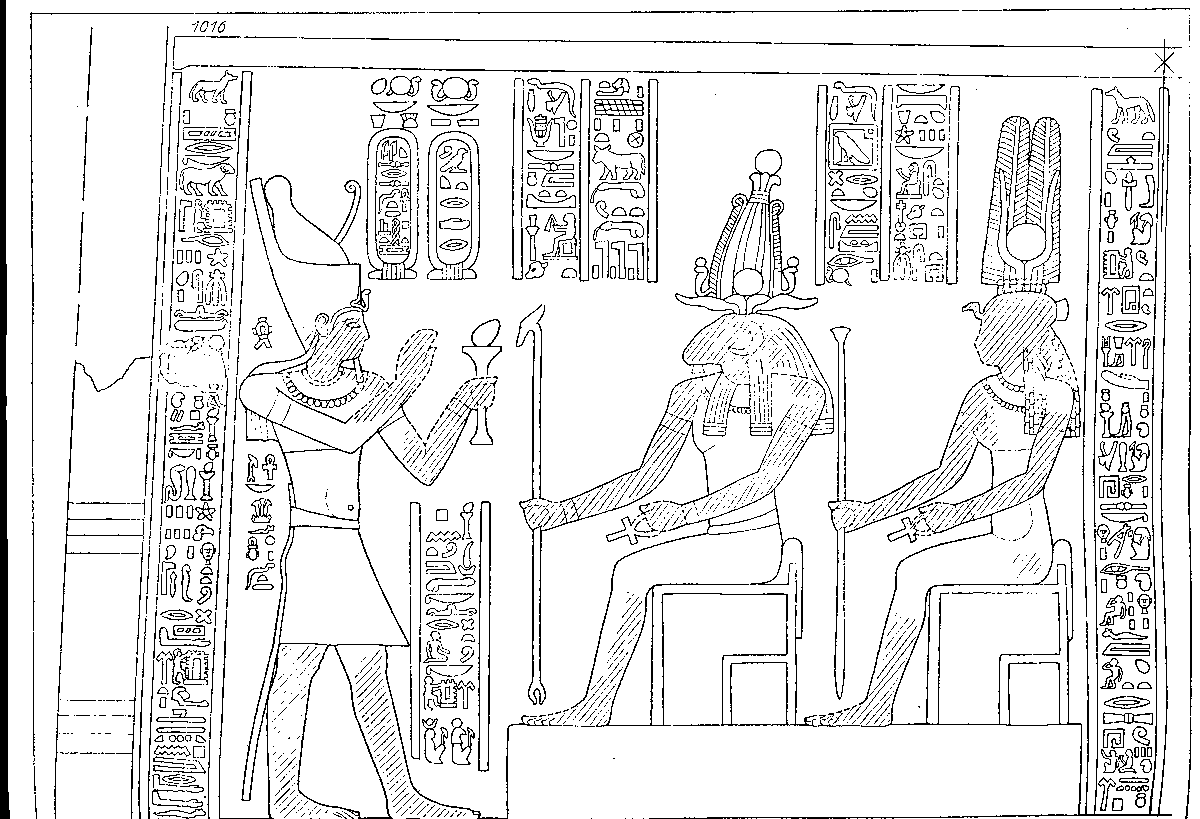
Augustus brings nursing Isis the field goddess, the bull, the cow and the serpent gods
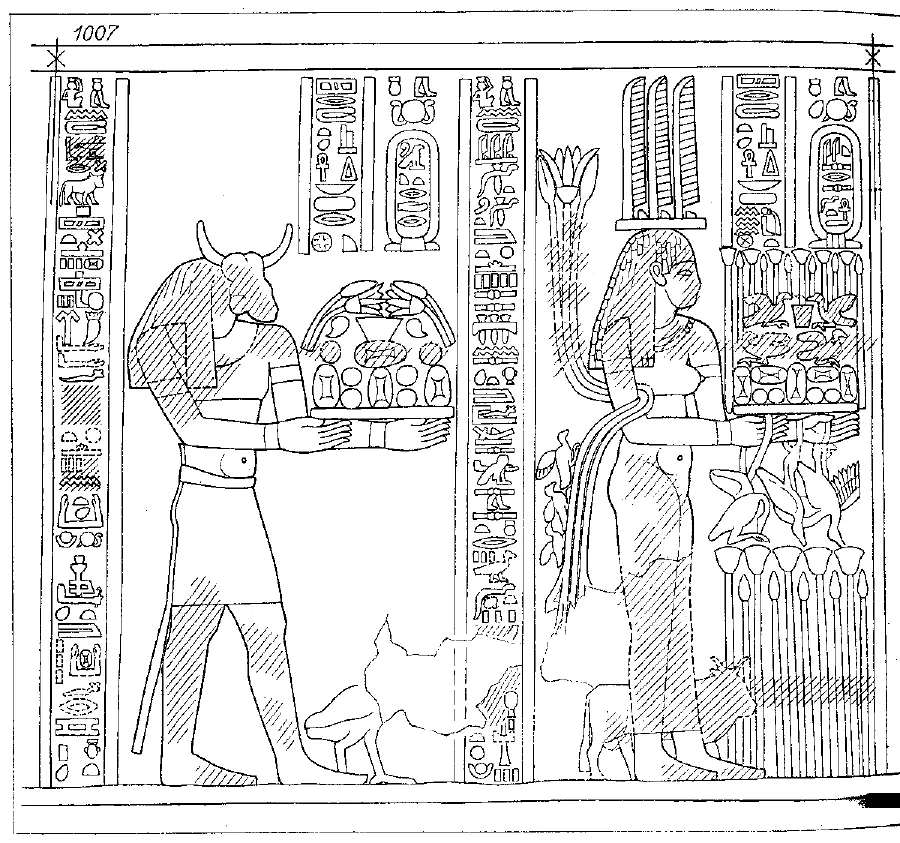
Page 373. The scene as drawn on the wall, facing p. 373 of the edition. Drawing by Otto Baum, in Junker and Winter, Das Geburtshaus des Tempels der Isis in Philä (1965) - 46p. 373, l. 1
jj-n sꜣ Rꜥ Kjsrs ꜥnḫ ḏ.t ḥr-ṯ
The Son of Ra, Caesar, who lives forever, has come to you,
- 47p. 373, l. 2
ꜣJ́s.t dj(.t) ꜥnḫ nb(.t) jꜣ.t wꜥb.t
O Isis, giver of life, Lady of the Abaton.
Note · Line 47
The Abaton was the sacred burial place of Osiris on the island of Bigeh, beside Philae. - 48p. 373, l. 3
jnj-f n-ṯ sḫ.t wꜣḏ.t wꜣḏ.tj m jḫ.t-s¹
He brings you the green field, green with her crops.
- 49p. 373, l. 4
sṯḥn-n-s ḥr-ṯ m pr(r.t) jm-s
She has made your face shine with what springs from her.
- 50p. 373, l. 5
ms-s n-ṯ rꜣ.w ḏdꜣ.w
She bears you fat geese.
- 51p. 373, l. 6
… ḥr ḫꜣw.wt(so?)-ṯ rꜥ nb
… on your altars every day.
- 52p. 373, l. 7
jj-n njswt bjt ꜣwtḳrdr ḥr-ṯ
The King of Upper and Lower Egypt, Autokrator, has come to you,
Note · Line 52
He is called Caesar below. - 53p. 373, l. 8
ꜣJ́s.t dj(.t) ꜥnḫ nb(.t) ꜣJrk
O Isis, giver of life, Lady of Philae.
- 54p. 373, l. 9
jnj-f n-ṯ ꜣgb-wr pšš³ ḥtp.w
He brings you the bull Ageb-wer, who portions out the offerings,
- 55p. 373, l. 10
šb.w bnr.w m ꜥ.wj-f
with sweet foods on his arms.
- 56p. 373, l. 11
… jḫ.t n kꜣ-ṯ rꜥ nb
… offerings for your ka every day.
Note · Line 56
The ka is the life force that offerings nourish. The Egyptian word for “provisions” in the next line echoes its name. - 57p. 373, l. 12
sḫm-ṯ m kꜣ.w-f r mr(r.t) jb-ṯ
May you command as much of his provisions as your heart desires.
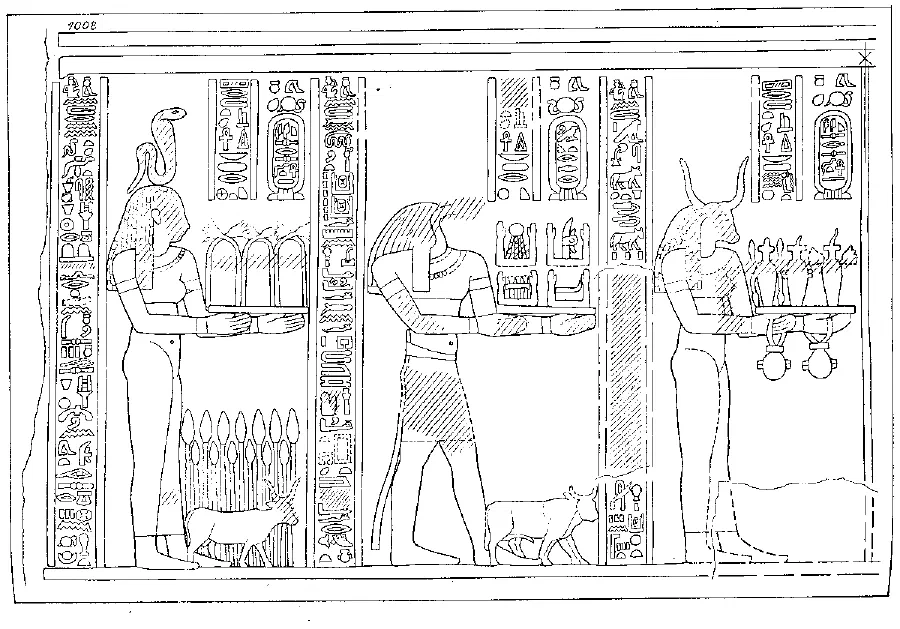
Page 375. The scene as drawn on the wall, facing p. 375 of the edition. Drawing by Otto Baum, in Junker and Winter, Das Geburtshaus des Tempels der Isis in Philä (1965) - 58p. 375, l. 1
jj-n sꜣ Rꜥ Kjsrs ꜥnḫ ḏ.t ḥr-t
The Son of Ra, Caesar, who lives forever, has come to you,
- 59p. 375, l. 2
Js.t ḏj(.t) ꜥnḫ nb(.t) jꜣ.t wꜥb.t
O Isis, giver of life, Lady of the Abaton.
- 60p. 375, l. 3
jnj-f n-t šḥꜣ.t-Ḥrw ḥnw.t mnmn.wt
He brings you the cow Sekhathor, mistress of the herds.
- 61p. 375, l. 4
…¹ ḥr ššm kꜣ.w n psḏ.t-t
… as she brings provisions to your Ennead.
Note · Line 61
An Ennead is a company of nine gods. - 62p. 375, l. 5
jj-n njśwt bjt ꜣwtḳrdr (ḥr-t)
The King of Upper and Lower Egypt, Autokrator, has come to you,
- 63p. 375, l. 6
Js.t ḏj(.t) ꜥnḫ nb(.t) Jrḳ
O Isis, giver of life, Lady of Philae.
- 64p. 375, l. 7
jnj-f n-t mḥn³ wḏꜥ⁴ kꜣ.w
He brings you the serpent god Mehen, who allots provisions.
- 65p. 375, l. 8
kꜣ.w-f mn ḥr ꜥ.wj-f
His provisions rest on his arms.
- 66p. 375, l. 9
mḥ-n-f prj-t m mr(r.t) śḫm-t
He has filled your house with what your power loves.
- 67p. 375, l. 10
ḥnk-f ḥw.t-t m (rꜣ-ꜥ.wj?)-f r ḏr jb-t
He endows your temple with the work of his hands, to your heart’s content.
- 68p. 375, l. 11
jj-n sꜣ Rꜥ Kjsrs ꜥnḫ ḏ.t ḥr-t
The Son of Ra, Caesar, who lives forever, has come to you,
- 69p. 375, l. 12
Js.t ḏj(.t) ꜥnḫ nb(.t) Jrḳ
O Isis, giver of life, Lady of Philae.
- 70p. 375, l. 13
jnj-f n-t rnn.t wꜣḏ.t ḥśb(.t) ꜥḥꜥw
He brings you Renenet, the flourishing one, who reckons the span of life,
Note · Line 70
Renenet is a goddess of the harvest and of the fortune allotted to each person. - 71p. 375, l. 14
ḥr šnw.wt … n rḫ(-tw) ṯnw-śn
with granaries … whose number no one knows.
- 72p. 375, l. 15
jrj-ś ꜥḥꜥw ꜣw n šmś.w-t
She grants your follower a long life;
Note · Line 72
“Your follower” is the king in his devotion to Isis. - 73p. 375, l. 16
jrj-ś ḫr.t n ḥm(.t)-t rꜥ nb
she provides for Your Majesty every day.
Augustus gives nursing Isis a breast ornament for Horus
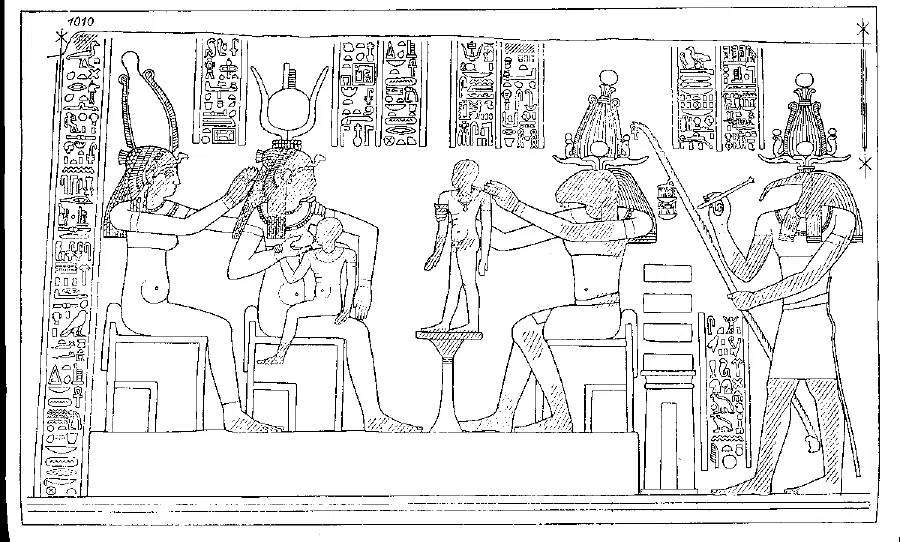
Page 377. The scene as drawn on the wall, facing p. 377 of the edition. Drawing by Otto Baum, in Junker and Winter, Das Geburtshaus des Tempels der Isis in Philä (1965) - 74p. 377, l. 1
(ḏd mdw n) | Jś.t dỉ(.t) ꜥnḫ nb.t ỉꜣ.t wꜥb.t ḫnw.t nb.t Jrk
Words spoken by Isis, giver of life, Lady of the Abaton, sovereign lady, Lady of Philae,
- 75p. 377, l. 2
(šps.t)¹ nfr.t ḫnt ḥw.t-wṯt
the august one, the beautiful one who presides over the House of Begetting,
- 76p. 377, l. 3
ḥm.t njśwt wṯt nṯr nfr
the king’s wife who bore the good god.
- 77p. 377, l. 4
(ḏd mdw n) | Nḫb.t ḥḏ.t Nḫn
Words spoken by Nekhbet, the White One of Nekhen,
Note · Line 77
Nekhbet is the vulture goddess of Upper Egypt. Her title evokes its White Crown. - 78p. 377, l. 5
sꜣ mw.t nṯr ḥnꜥ sꜣ-s m ḥw.t-nmj.t
who shelters the god’s mother and her son in the bedchamber.
- 79p. 377, l. 6
… sꜣ.t (Rꜥ) wr.t wśr.t nn ḫr ḥ.w-s
… daughter of Ra, great and mighty, who has no equal,
- 80p. 377, l. 7
ḥm.t njśwt tpj.t n(.t) śn-s Wśỉr
first royal wife of her brother Osiris.
- 81p. 377, l. 8
śꜥꜣ(.t) snn-f m śp.wt
who exalts his likeness throughout the nomes
Note · Line 81
Nomes were the provinces of Egypt. - 82p. 377, l. 9
rdj(.t) sꜣ-s Ḥrw ḥr nś.t ỉt-f
and set her son Horus on his father’s throne:
Note · Line 82
Horus succeeds his father Osiris as king. - 83p. 377, l. 10
Jś.t dj(.t) ꜥnḫ nb(.t) ỉꜣ.t wꜥb.t ḫnw.t nb(.t) Jrk
Isis, giver of life, lady of the Abaton, sovereign lady, mistress of Philae.
- 84p. 377, l. 11
(ḏd mdw n) | Ḫnmw-Rꜥ nb Śnm.t
Words spoken to Khnum-Ra, lord of Bigeh,
- 85p. 377, l. 12
ḳd rmṯ mśj nṯr.w
who shaped humankind and brought the gods to birth,
- 86p. 377, l. 13
… n.t mw.t-f
… of his mother,
- 87p. 377, l. 14
ḥr śmn kꜣ-f tp tꜣ r-ꜥ nḥḥ
making his ka endure on earth forever.
Note · Line 87
Khnum sustains the ka of Horus, the vital power that lives in him. - 88p. 377, l. 15
(ḏd mdw in) | Ḏḥwtj ꜥꜣ ꜥꜣ nb Ḫmnw
Words spoken by Thoth, twice great, lord of Hermopolis,
- 89p. 377, l. 16
nb sš ḥrj-tp mḏꜣ.wt
lord of writing, chief of the books,
- 90p. 377, l. 17
(śpḫr)² gn.wt n sꜣ Wśỉr m ḥḥ n ḥb(.w)-śd
who records for the son of Osiris annals filled with a million Sed festivals,
Note · Line 90
The Sed festival renewed a king’s power to rule. - 91p. 377, l. 18
ṯnj šꜣ.w-f ḥr tp mśḫn(.t)-f
who exalts his destiny on his very birth brick:
Note · Line 91
Egyptian women gave birth on bricks. It is there, at birth, that Thoth ordains Horus’s royal destiny. - 92p. 377, l. 19
śkꜣ-j njśwj.t n ḥm-k m pḥ.tj wr.t
I lengthen Your Majesty’s reign with great might.
- 93p. 377, l. 20
rnp.wt-k rnp.wt n ỉtn
May your years be the years of the sun disk.
The birth goddesses greet Horus; Augustus offers the Joy amulet
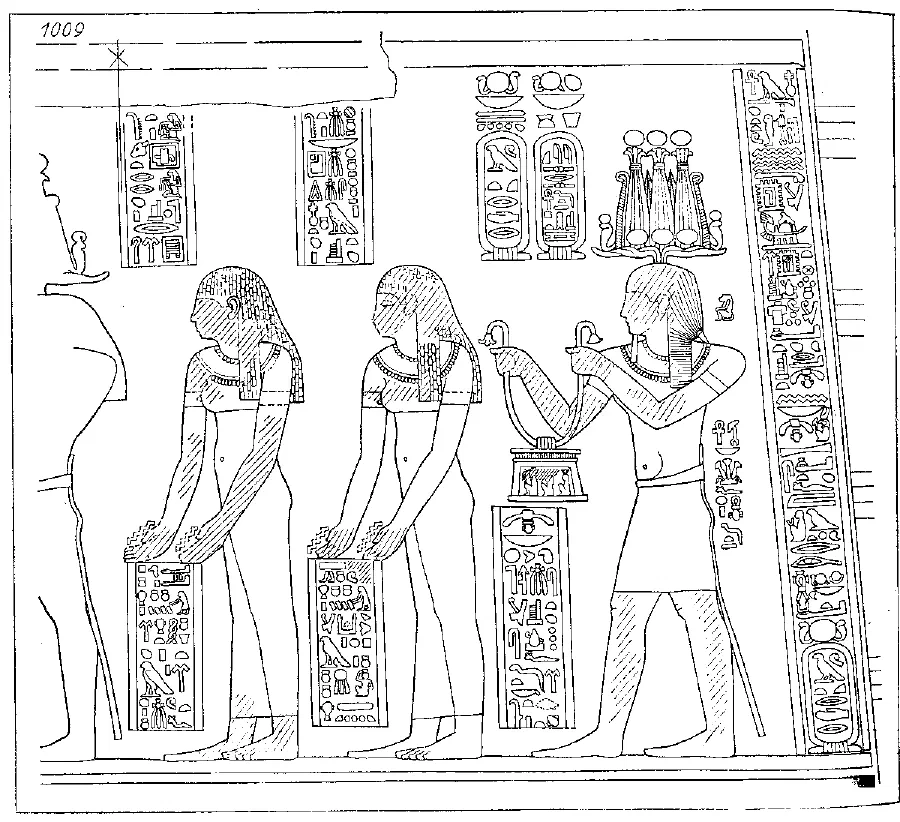
Page 379. The scene as drawn on the wall, facing p. 379 of the edition. Drawing by Otto Baum, in Junker and Winter, Das Geburtshaus des Tempels der Isis in Philä (1965) - 94p. 379, l. 1
… rnp.t(?) rr.t ḫnt ḥw.t-wṯt
… the young nurse Reret in the House of Begetting,
Note · Line 94
The House of Begetting is the birth house, where the temple celebrated the birth of Horus. - 95p. 379, l. 2
rr sꜣ Wsjr r ḥḳꜣ m sṯḥ
who reared the son of Osiris to rule upon the throne:
- 96p. 379, l. 3
pgꜣ ꜥ.wj(-j) ḥr njnj m ḥr-ṯ
I spread my arms to welcome you
- 97p. 379, l. 4
ḥnꜥ sꜣ-ṯ Ḥrw m hrw n msj-tw-f
and your son Horus on the day he is born.
- 98p. 379, l. 5
… rnp.t(?) msḫn(.t) nb(.t) ḥw.t-msḫn(.t)
… the young birth goddess Meskhenet, lady of the birth house,
- 99p. 379, l. 6
ḏj(.t) msḫn nfr n Ḥrw sꜣ Js.t
who gives Horus, son of Isis, a fair resting place:
Note · Line 99
Meskhenet’s name echoes the word for the place where the newborn rests. - 100p. 379, l. 7
mꜣꜥ(?)⁴-n(-j) … ḥr njnj n kꜣ-ṯ
I have come … to greet your ka
- 101p. 379, l. 8
ḥnꜥ Ḥrw hrw pn wbn-f ḥr tꜣ
and Horus on this day when he rises radiant upon the earth.
- 102p. 379, l. 9
njśwt bjt nb tꜣ.wj ꜣwtḳrdr
King of Upper and Lower Egypt, lord of the Two Lands, Autokrator,
Note · Line 102
Here Augustus bears the titles of an Egyptian king. - 103p. 379, l. 10
sꜣ Rꜥ nb ḫꜥ.w Kjsrs ꜥnḫ ḏ.t mrj Ptḥ Js.t
son of Ra, lord of crowns, Caesar, who lives forever, beloved of Ptah and Isis.
- 104p. 379, l. 11
sꜣ ꜥnḫ wꜣś nb ḥꜣ-f mj Rꜥ ḏ.t
May protection, life and all dominion surround him as they surround Ra, forever.
- 105p. 379, l. 12
ꜣw(.t)-jb nb(.t) ḫr-k nṯr wꜥ(.tj) msj-n Js.t
“Every Joy” is yours, sole god whom Isis bore.
Note · Line 105
“Every Joy” is an amulet offered to Horus. - 106p. 379, l. 13
śwḏꜣ-f ḏ.t-k m rnp.t ḳn(?)⁶
It keeps your body safe in the year of distress.
- 107p. 379, l. 14
ꜥnḫ | nṯr nfr sꜣ twt-ḥꜣ.t
Long live the good god, son of Ptah,
Note · Line 107
The “good god” is the king, who presents the amulet. - 108p. 379, l. 15
mw nṯrj n Skr m Nṯrj⁸
the divine semen of Sokar in the sanctuary,
- 109p. 379, l. 16
ṯsj (wṯs?) wḏꜣw n śꜣ.wj n mw.t-f Js.t
who bears a gold amulet to his mother Isis
- 110p. 379, l. 17
rḏj ꜣw(.t)-jb n nb ꜣw(.t)-jb
and gives Joy to the lord of joy.
- 111p. 379, l. 18
ṯs mw.t-f m jrj(.t)-šnb.t
and fastens it on his mother as a breast ornament,
- 112p. 379, l. 19
r jrj(.t) sꜣ-f rꜥ nb nb mk.t njśwt bjt ꜣwtḳrdr
so that its protection may hold day after day—the lord of protection, King of Upper and Lower Egypt, Autokrator.
Augustus gives nursing Isis the two uraei for Horus
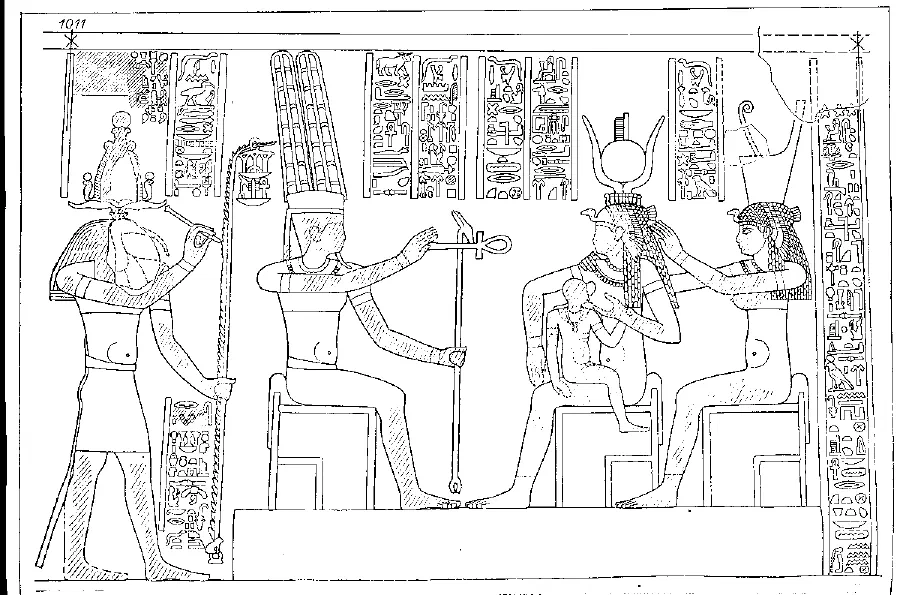
Page 381. The scene as drawn on the wall, facing p. 381 of the edition. Drawing by Otto Baum, in Junker and Winter, Das Geburtshaus des Tempels der Isis in Philä (1965) - 113p. 381, l. 1
ḏd mdw n | ꜣs.t wr.t mw.t nṯr nb.t ꜣJrk
Words spoken by Isis the Great, the god’s mother, Lady of Philae,
- 114p. 381, l. 2
šps.t wsḫ.t m ḥw.t-msḫn.t
the august one, mighty in the birth house,
- 115p. 381, l. 3
rdj(.t) sꜣ-s r tꜣ m ḥḳꜣ
who brought her son into the world as ruler.
- 116p. 381, l. 4
ḏd mdw n | Wꜣḏ.t nb(.t) P Dp
Words spoken by Wadjet, Lady of Pe and Dep,
Note · Line 116
Pe and Dep were the two towns that made up Buto, Wadjet’s cult center in the Nile Delta. - 117p. 381, l. 5
mk(k).t mw.t nṯr ḥw(w.t) sꜣ-s Ḥrw
who guards the god’s mother and shields her son Horus.
- 118p. 381, l. 6
… nṯr.w šps.t ṯnj.t r nṯr.wt
… of the gods, the august one, exalted above the goddesses,
- 119p. 381, l. 7
ḥḳꜣ.t mnḫ.t mw.t nṯr n(.t) ḥḳꜣ
the excellent ruler, the ruler’s divine mother,
- 120p. 381, l. 8
nḏtj.t ḥr šn-s Wsjr
defender of her brother Osiris,
- 121p. 381, l. 9
rdj.t sꜣ-s Ḥrw m njswt n Tꜣ-mrj
who made her son Horus king of Egypt:
- 122p. 381, l. 10
ꜣs.t dj(.t) ꜥnḫ nb(.t) ꜣJrk ḥnw.t nb(.t) jꜣ.t wꜥb.t
Isis, giver of life, Lady of Philae, sovereign lady, Lady of the Abaton.
Note · Line 122
Entry was restricted. - 123p. 381, l. 11
ḏd mdw n | ꜣJmn-Rꜥ njswt nṯr.w
Words spoken by Amun-Ra, king of the gods,
- 124p. 381, l. 12
nṯr ꜥꜣ m Wꜣs.t pꜣw.tj tpj ḫpr m ḥꜣ.t
the great god in Thebes, the primeval one, the first, who came into being in the beginning,
- 125p. 381, l. 13
bꜣ wr rdj ṯꜣw r fnd
the great ba who gives breath to the nose,
Note · Line 125
A god’s ba is the form in which his power is present and active. - 126p. 381, l. 14
sꜥnḫ sꜣ.t-f m-ꜥb sꜣ-s
who gives life to his daughter and to her son with her.
- 127p. 381, l. 15
ḏd mdw jn | Ḏḥwtj ꜥꜣ ꜥꜣ wr nb Ḫmnw
Words spoken by Thoth, twice great and mighty, Lord of Hermopolis,
- 128p. 381, l. 16
nb jꜣw.t ḥsb ꜥḥꜥw
lord of old age, who reckons the span of life,
- 129p. 381, l. 17
ḥsb ꜥḥꜥw ꜣw n sꜣ ꜣs.t
who reckons a long span of life for the son of Isis.
- 130p. 381, l. 18
nḥḥ ḏ.t pw wnn-f
He shall endure for ever and ever.
Note · Line 130
The two words for eternity evoke time that renews itself and time that endures without change. - 131p. 381, l. 19
spḥr-j n-k ḥb(.w)-sd ḥr s.t n.t jt-k
I record for you the Sed festivals on your father’s throne;
Note · Line 131
The Sed festival was a royal jubilee that renewed the king’s power to rule. - 132p. 381, l. 20
sꜣw-j njswj.t-k r km ḏ.t
I extend your kingship to the very end of eternity.
Neith plays the sistrum; Augustus offers the two fire-breathing uraei
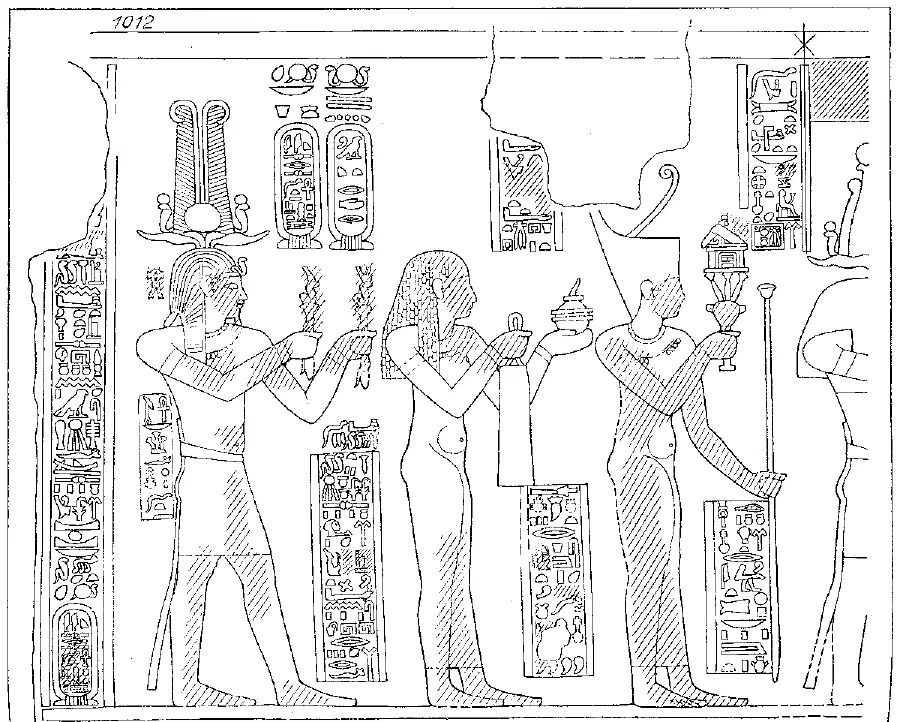
Page 383. The scene as drawn on the wall, facing p. 383 of the edition. Drawing by Otto Baum, in Junker and Winter, Das Geburtshaus des Tempels der Isis in Philä (1965) - 133p. 383, l. 1
ḏd mdw n | N.t wr.t mw.t nṯr nb(.t) ...¹
Words spoken by Neith the Great, the god’s mother, Lady of …,
- 134p. 383, l. 2
šps.t nfr.t m ḥw.t-msḫn(.t)
the august one, beautiful in the birth house.
- 135p. 383, l. 3
jrj-n-j sšš.t m ḥr-ṯ nfr
I have played the sistrum before your beautiful face;
Note · Line 135
The sistrum was a ritual rattle whose sound was meant to soothe the goddess. - 136p. 383, l. 4
rwj-j špt nb m jb-ṯ
I drive all anger from your heart.
- 137p. 383, l. 5
... n ... t (mk.t?)
… of … protection,
- 138p. 383, l. 6
ḥnw.t prj-msj.t
mistress of the birth house.
- 139p. 383, l. 7
mn n-ṯ bnr r śm sꜣ-ṯ
Take the sweet milk for your son to drink,
- 140p. 383, l. 8
nw(d.t) nfr.t ... ḥꜥ.w(-f)
and the fine swaddling cloth … his limbs.
- 141p. 383, l. 9
njśwt bjt nb tꜣ.wj ꜣwtḳrdr
King of Upper and Lower Egypt, Lord of the Two Lands, Autokrator,
Note · Line 141
Autokrator and Caesar are Roman titles used here as the royal names of Augustus. - 142p. 383, l. 10
sꜣ Rꜥ nb ḫꜥ.w Kjsrs ꜥnḫ ḏ.t mrj Ptḥ ꜣs.t
Son of Ra, Lord of Crowns, Caesar, who lives forever, beloved of Ptah and Isis.
- 143p. 383, l. 11
sꜣ ꜥnḫ wꜣs nb ḥꜣ-f mj Rꜥ ḏ.t
May protection and all life and dominion surround him as they surround Ra forever.
- 144p. 383, l. 12
ḥnk wꜣḏ.tj ḏd mdw
Offering the two uraei. Words to be spoken:
Note · Line 144
A uraeus is the rearing cobra worn on the royal brow. Its fiery breath protects the wearer. - 145p. 383, l. 13
wꜣḏ.tj nn wbn-śn m ḥꜣ.t sꜣ Wśjr
These two uraei shine on the brow of Osiris’s son;
- 146p. 383, l. 14
wḏj-śn ḥḥ r śbj.w r-f
they breathe fire on those who rebel against him.
- 147p. 383, l. 15
... ṯsj wꜣḏ.tj n mw.t-f ꜣs.t
… who bears the two uraei to his mother Isis
- 148p. 383, l. 16
ḥr śḫkr ḥn (so) n sꜣ-ś Ḥrw
and adorns the head of her son Horus.
- 149p. 383, l. 17
psḏ ḥm-f jm-śn m njśwt n nḥḥ
His Majesty shines in them as king for all eternity,
- 150p. 383, l. 18
nb ḥrj.t-tp sꜣ Rꜥ Kjsrs ...
lord of the brow-serpent, Son of Ra, Caesar …
Augustus gives Horus the Child milk
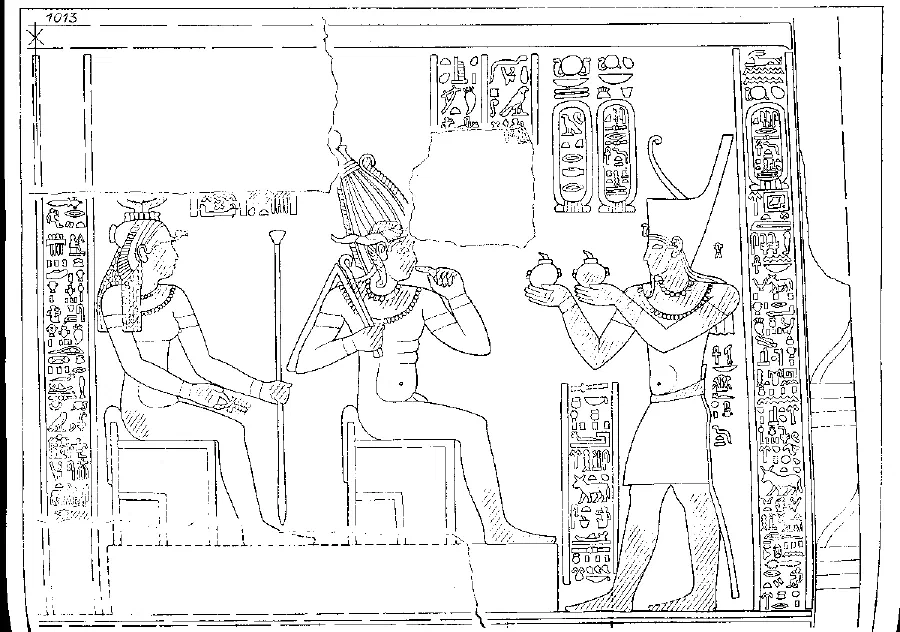
Page 385. The scene as drawn on the wall, facing p. 385 of the edition. Drawing by Otto Baum, in Junker and Winter, Das Geburtshaus des Tempels der Isis in Philä (1965) - 151p. 385, l. 1
mn n-k ḥḏw prj m ḥsꜣ.t
Take for yourself the white milk that flows from the Hesat cow;
Note · Line 151
Hesat is the divine milk cow. The offering is called both “the white” and “the sweet.” - 152p. 385, l. 2
sḏb jm-šn² rwḏ ḥꜥ.w-k
drink of it, that your limbs may grow strong.
- 153p. 385, l. 3
njśwt bjt nb tꜣ.wj ꜣwtkrdr
King of Upper and Lower Egypt, Lord of the Two Lands, Autokrator,
- 154p. 385, l. 4
sꜣ Rꜥ nb ḫꜥ.w Kjsrs …
Son of Ra, Lord of Crowns, Caesar …
- 155p. 385, l. 5
sꜣ ꜥnḫ wꜣś nb ḥꜣ-f mj Rꜥ ḏ.t
May protection and all life and dominion surround him as they surround Ra forever.
- 156p. 385, l. 6
ḏd mdw n | Ḥrw pꜣ ḫrd ꜥꜣ wr (tpj n Wsjr) …
Words spoken by Horus the Child, the very great one, firstborn of Osiris …
- 157p. 385, l. 7
sꜣ ꜣs.t bnr mrw.t šfj …
son of Isis, sweet in love, the child …
- 158p. 385, l. 8
… ṯḥn.t(??) … nḫt …
… the shining one … strong …
- 159p. 385, l. 9
wnn sꜣ Rꜥ Kjsrs … m ḥw.t-ḫnt
The Son of Ra, Caesar … is in Philae
- 160p. 385, l. 10
m snn ꜥnḫ n nb wp
as the living image of the lord of milk cows,
- 161p. 385, l. 11
ḥr rḏj(.t) bnr n jwꜥw n Wsjr
offering the sweet milk to the heir of Osiris
- 162p. 385, l. 12
ḥr ḥtm ḥnw.w n sꜣ ꜣs.t m ḥḏw⁵
and filling the jars of Isis’s son with the white milk.
- 163p. 385, l. 13
św m sꜣ jḥ.t šḏj n ḥsꜣ.t
He is the son of the Ihet cow, reared by the Hesat cow;
Note · Line 163
Ihet is the heavenly cow, identified with Hathor. Here the king claims kinship with the cow goddesses as he brings milk to Horus. - 164p. 385, l. 14
jrj ḫr.t n ḫrd m ḫr.t hrw⁵
he prepares the child’s food, his daily fare.
- 165p. 385, l. 15
(wnn) … ḫrd šps ṯḥn ḫꜥw
… the noble child, radiant in his crowns,
- 166p. 385, l. 16
ḥr šsp ḥḏw ḥr śꜥm bnr
receives the white milk and drinks the sweet,
- 167p. 385, l. 17
ḥr jrj(.t) ḫr.t ḥm-f jm-s rꜥ nb
and with it prepares food for His Majesty every day.
- 168p. 385, l. 18
św m nb ḥḥ⁶ msj n jḥ.t⁶ (wr.t) …
He is lord of eternity, born of the great Ihet cow …
Augustus gives nursing Isis the rattle and the sistrum
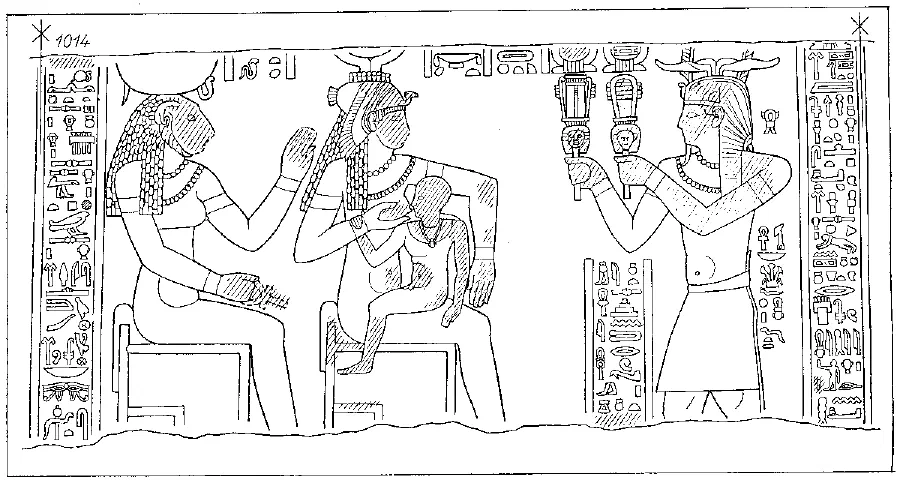
Page 387. The scene as drawn on the wall, facing p. 387 of the edition. Drawing by Otto Baum, in Junker and Winter, Das Geburtshaus des Tempels der Isis in Philä (1965) - 169p. 387, l. 1
jnj-j n-ṯ sšš.t¹ sjꜥr-j n-ṯ sḫm¹
I bring you the rattle; I raise the sistrum to you.
Note · Line 169
The two instruments are offered to soothe the goddess with their sound. - 170p. 387, l. 2
rwj-j ḳnd …
I drive away wrath …
- 171p. 387, l. 3
sꜣ ꜥnḫ wꜣs nb ḥꜣ-f mj Rꜥ ḏ.t
May protection and all life and dominion surround him as they surround Ra, forever.
- 172p. 387, l. 4
… ꜥJrḳ … nb
… Philae … of the Golden One.
Note · Line 172
The Golden One is a name of Hathor. - 173p. 387, l. 5
(wnn) … m š-ḥḳꜣ
… is at the Lake of the Ruler
Note · Line 173
The king in this scene is the Roman emperor Augustus. - 174p. 387, l. 6
m njswt mnḫ tpj n Sḫm.t
as an excellent king, foremost of Sekhmet,
- 175p. 387, l. 7
ḥr sḥtp mw.t-f m sšš.t sḫm
soothing his mother with rattle and sistrum,
Note · Line 175
These are two kinds of sacred rattle, shaken to soothe the goddess. - 176p. 387, l. 8
ḥr sḫr nšn n ḥnw.t-f r rw.t
driving his lady’s fury out.
- 177p. 387, l. 9
šw mj ꜥJḥj ḥr jrj(.t) ḥnk(.t) …
He is like Ihy as he makes an offering …
Note · Line 177
Ihy is Hathor’s child, the god who plays the sistrum. - 178p. 387, l. 10
(wnn ꜥJs.t … jr.t) Rꜥ twtj.t sn.nw(.t)-s
Isis …, the Eye of Ra, who has no equal,
Note · Line 178
The Eye of Ra is the sun god’s power embodied in a goddess. Her fury can threaten the very land she protects. - 179p. 387, l. 11
ḥr ṯḥn ḥr-s ḥr srwj špt-s
makes her face shine, dispels her anger
- 180p. 387, l. 12
ḥr sjmꜣ šmꜥ.w m-ꜥb mḥw
and joins Upper Egypt to Lower Egypt.
- 181p. 387, l. 13
sj m nb(.t) …³ sḥḏ.t …
She is the lady of …, who lights up …
Augustus gives Horus the Child milk
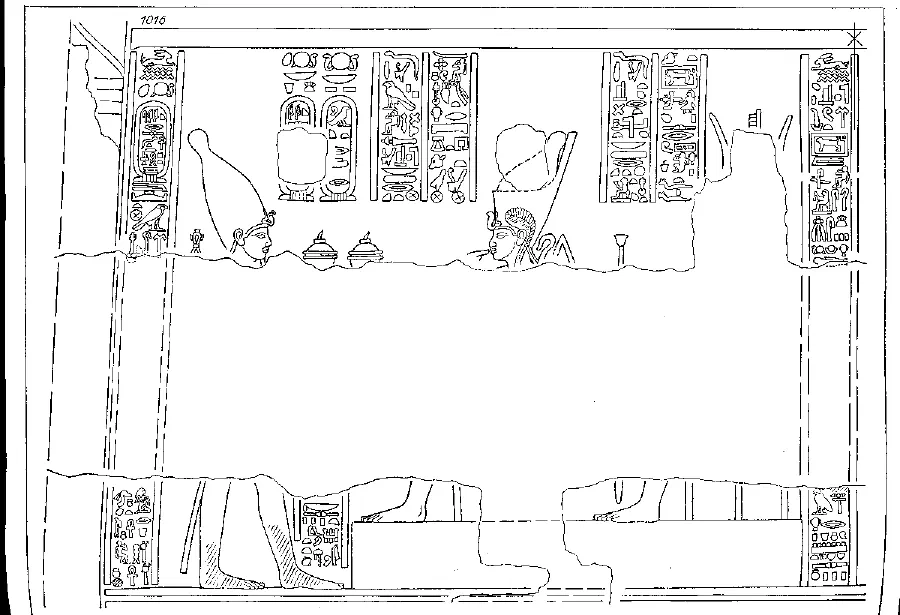
Page 389. The scene as drawn on the wall, facing p. 389 of the edition. Drawing by Otto Baum, in Junker and Winter, Das Geburtshaus des Tempels der Isis in Philä (1965) - 182p. 389, l. 1
… -k ś(t) ḥrj.tj r šw.t(?)²
… drink it, for it is free of harm.
- 183p. 389, l. 2
njśwt bjt nb tꜣ.wj ꜣwtḳrdr
King of Upper and Lower Egypt, lord of the Two Lands, Autokrator,
- 184p. 389, l. 3
sꜣ Rꜥ nb ḫꜥ.w Ḳjs(rs) … sꜣ …
son of Ra, lord of crowns, Caesar … Protection …
- 185p. 389, l. 4
ḏd mdw n | Ḥrw pꜣ ḫrd
Words spoken by Horus the Child,
- 186p. 389, l. 5
ꜥꜣ wr tpj n Wśjr nb ꜣJrk
the very great one, firstborn of Osiris, lord of Philae,
- 187p. 389, l. 6
ḥwn nfr bnr mrw.t
the handsome youth whose love is sweet,
- 188p. 389, l. 7
ḥrj ns.t ḫnt šmꜥ.w mḥw
heir to the throne, foremost in Upper and Lower Egypt.
- 189p. 389, l. 8
ḏd mdw n | ꜣJś.t wr.t mw.t nṯr
Words spoken by Isis the Great, mother of the god,
- 190p. 389, l. 9
nb(.t) ꜣJrk šps.t nfr.t ḫnt ḥw.t-nmj.t
lady of Philae, noble and beautiful, foremost in the bedchamber,
Note · Line 190
The bedchamber is the temple’s birth house, where the birth of Horus was celebrated. - 191p. 389, l. 10
bḥ sꜣ-s r wšb ḥr jt-f
who bore her son to act on his father’s behalf.
- 192p. 389, l. 11
wnn sꜣ Rꜥ Ḳjsrs …
The son of Ra, Caesar …
- 193p. 389, l. 12
m jꜣ.t Ḥrw m ḥḳꜣ nfr …
holds the place of Horus as a good ruler …
- 194p. 389, l. 13
(św m) … rnn n ꜣḥ.t
He is …, nursed by the Akhet cow,
Note · Line 194
The Akhet cow is Hathor in the form of a nursing cow. - 195p. 389, l. 14
rdj ꜥnḫ-wꜣś n wḍḥ wḏ ꜥnḫ³
giving milk to the child who decrees life.
Note · Line 195
The name for milk here means “life and dominion”: the child receives life and grants it in turn. - 196p. 389, l. 15
wnn sꜣ Wśjr mn m ḥw.t-nmj.t
The son of Osiris rests in the bedchamber
- 197p. 389, l. 16
m śj šps ḥḳꜣ msḫꜥ rꜥ nb
as a noble child and ruler of the radiance, day after day,
- 198p. 389, l. 17
ḥr šsp … mw.wt⁴ Mnw ḥr rdj(.t) n-f mnḏ.wj-sn
receiving … The mothers of Min give him both their breasts.
Augustus gives Isis two mirrors
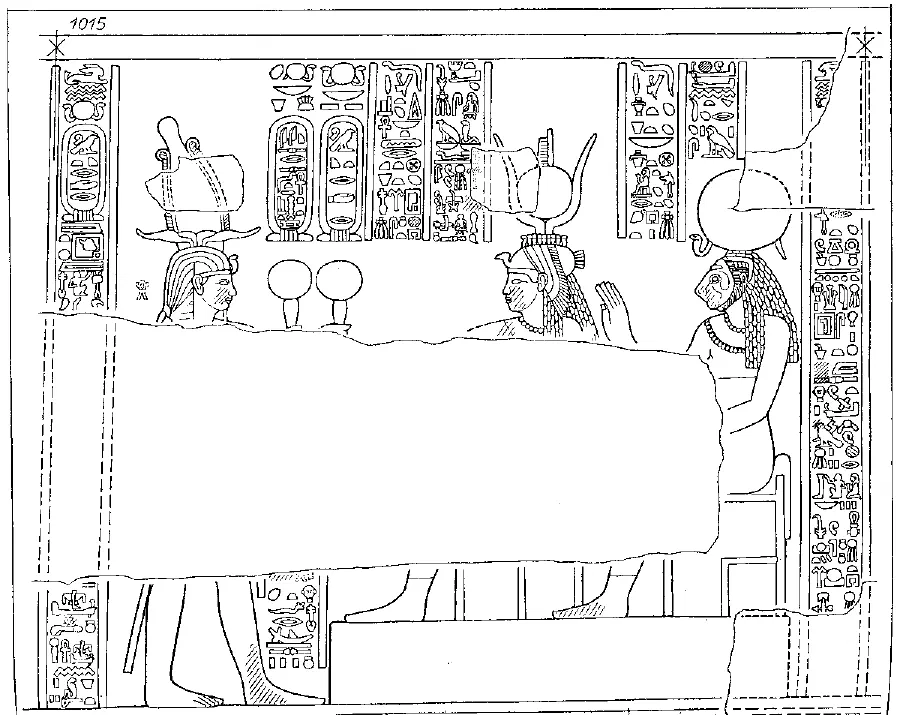
Page 391. The scene as drawn on the wall, facing p. 391 of the edition. Drawing by Otto Baum, in Junker and Winter, Das Geburtshaus des Tempels der Isis in Philä (1965) - 199p. 391, l. 1
… (gmḥ) ḥr-t nfr jm-šn
… behold your beautiful face in them.
- 200p. 391, l. 2
njśwt bjt nb tꜣ.wj ꜣwtḳrdr
King of Upper and Lower Egypt, lord of the Two Lands, Autokrator,
- 201p. 391, l. 3
sꜣ Rꜥ nb ḫꜥ.w Ḳjsrs … sꜣ …
Son of Ra, lord of crowns, Caesar … Protection …
Note · Line 201
Caesar here is Augustus, the Roman emperor, named as a pharaoh. - 202p. 391, l. 4
ḏd mdw n | ’Jś.t dj(.t) ꜥnḫ nb.t ’Jrk
Words spoken by Isis, giver of life, lady of Philae,
- 203p. 391, l. 5
ḥnw.t nfr.t m ḥw.t-mśḫn.t
the fair sovereign in the birth house,
- 204p. 391, l. 6
ḥm.t njśwt mw.t mś(.t) nb.tj
the king’s wife, the mother who bore him of the Two Ladies.
Note · Line 204
The Two Ladies are Nekhbet the vulture and Wadjet the cobra, protectors of Upper and Lower Egypt. The child bears a royal title that invokes them both. - 205p. 391, l. 7
prj šw m wḥ
Light broke forth in the night
- 206p. 391, l. 8
(ḏr?) bḥ-n-ś ḥm-f
when she bore His Majesty.
- 207p. 391, l. 9
ḏd mdw n | Bꜣś.t.t ḥnw.t nb(.t) Bꜣś.t
Words spoken by Bastet, the sovereign, lady of Bubastis,
- 208p. 391, l. 10
špś.t wśr.t ḫnt prj-mśj(.t)
the august and mighty one who presides over the birth house,
- 209p. 391, l. 11
ḥwj(.t) ꜥnt ḥnꜥ sꜣ-ś Ḥrw
who shelters Anat and her son Horus.
Note · Line 209
Anat, a goddess of Levantine origin, appears here in the role usually held by Isis as mother of Horus. - 210p. 391, l. 12
wnn njśwt bjt ꜣwtḳrdr m ḥw.t-ḫnt
The king of Upper and Lower Egypt, Autokrator, is in Philae
Note · Line 210
Here it stands in a royal cartouche as one of Augustus’s Egyptian throne names. - 211p. 391, l. 13
m ḥmww nfr rḫ³ ḏbꜥ.w …
as a fine craftsman with knowing fingers …
- 212p. 391, l. 14
… nbj n …⁴
… fashioned by …
- 213p. 391, l. 15
nbj ꜥnḫ n ḥnw.t nṯr.wt
who fashioned a mirror for the sovereign of the goddesses.
Note · Line 213
The Egyptian word for “mirror,” ankh, also means “life.” - 214p. 391, l. 16
wnn Rꜥ(j.t) … wśr.t
The sun goddess is … the mighty one
- 215p. 391, l. 17
wbg(.t) šnw n tꜣ
who lights the whole circle of the earth,
- 216p. 391, l. 18
ḥr ḫꜥj(.t) ḥw.t-nṯr-ś ḥr bḏ jmj(.t)-ś
making her temple shine, lighting all that is within it,
- 217p. 391, l. 19
ḥr wḏ(.t) mrw.t ḥr bw nb
sending light to everyone.
- 218p. 391, l. 20
śj mj ꜣḫ.tj wbn m ꜣḫ.t štw.t …
She is like the Horizon-Dweller rising on the horizon, rays …
Note · Line 218
The Horizon-Dweller is the sun god. Augustus gives Osiris the figure of Heh
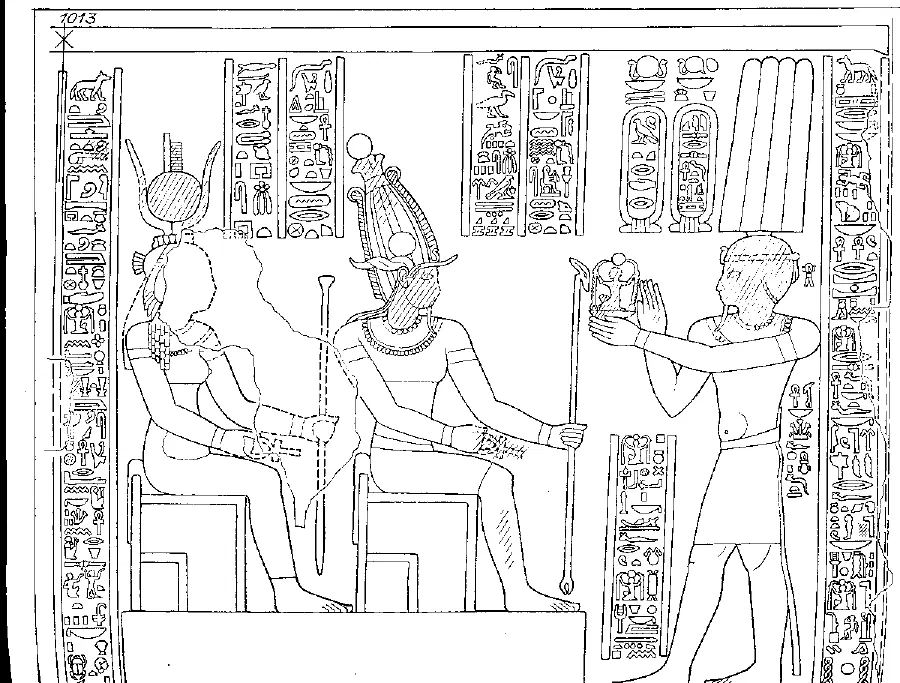
Page 393. The scene as drawn on the wall, facing p. 393 of the edition. Drawing by Otto Baum, in Junker and Winter, Das Geburtshaus des Tempels der Isis in Philä (1965) - 219p. 393, l. 1
ḥḥ pn ꜥbḫ ḥm-k im-f
This Heh—may Your Majesty be one with him;
Note · Line 219
Heh is a million given divine form. To be one with him is to share in the vast span of life wished for in the next line. - 220p. 393, l. 2
rwḏ ḥḥ n ꜥḥꜥw-k m tꜣ pn
may your life endure a million years on this earth.
- 221p. 393, l. 3
njśwt bjt nb tꜣ.wj ꜣwtḳrdr
King of Upper and Lower Egypt, lord of the Two Lands, Autokrator,
- 222p. 393, l. 4
sꜣ Rꜥ nb ḫꜥ.w Ḳjsrs …
son of Ra, lord of crowns, Caesar …
- 223p. 393, l. 5
sꜣ ꜥnḫ wꜣś nb ḥꜣ-f mj Rꜥ ḏ.t
May all protection, life and dominion surround him as they surround Ra, forever.
- 224p. 393, l. 6
ḏd mdw n | Wśjr nṯr ꜥꜣ nb jꜣ.t wꜥb.t
Words spoken by Osiris, the great god, lord of the Abaton,
Note · Line 224
The Abaton, the “inaccessible place,” was the sacred burial ground of Osiris on the island of Bigeh, beside Philae. - 225p. 393, l. 7
śḫm špś ḫnt Jrlḳ
the august power who presides over Philae,
- 226p. 393, l. 8
śfj jḳr ꜥšꜣ mśḫꜥ
the glorious child, rich in radiance,
- 227p. 393, l. 9
bjk m tꜣ.wj jdb.w
the falcon in the Two Lands and on their shores.
- 228p. 393, l. 10
ḏd mdw n | Jś.t dj(.t) ꜥnḫ nb.t jꜣ.t wꜥb.t
Words spoken by Isis, giver of life, lady of the Abaton,
- 229p. 393, l. 11
ḥnw.t nb(.t) Jrlḳ
the sovereign, lady of Philae,
- 230p. 393, l. 12
mḥj.t nfr.t ḫnt prj-msj.t
the sweet north wind before the birth house.
- 231p. 393, l. 13
jj-n-j ḫr-k nb ḥḥ(.w)
I have come to you, lord of millions,
- 232p. 393, l. 14
ꜥšꜣ ḥfn.w nb ꜥnḫ ꜥnḫ r nḥḥ
rich in hundreds of thousands, lord of life, living forever.
- 233p. 393, l. 15
jnj-n-j n-k ḥḥ . ? . r śꜥnḫ ḏ.t-k
I have brought you Heh to give life to your body.
Note · Line 233
The king holds out his image. - 234p. 393, l. 16
jt-k Šw m ṯꜣw nḏm r fnḏ-k
May your father Shu come as a sweet breeze to your nostrils.
Note · Line 234
Shu is the god of air. - 235p. 393, l. 17
twt nṯr (ꜥꜣ) nb ꜥḥꜥw wꜣḥ rnp.wt
You are the great god, lord of the span of life, who adds year to year,
- 236p. 393, l. 18
Ḥḥ rnp ṯsj nḥḥ
young Heh, who holds eternity aloft.
- 237p. 393, l. 19
jj.tj m ḥtp wṯṯ n Šw
Welcome in peace, you whom Shu begot,
Note · Line 237
The god now answers the king. - 238p. 393, l. 20
ḥrj-nś.t-f ḫꜥj m Ḥꜥj-nfr
heir to his throne, who shine forth in Memphis.
- 239p. 393, l. 21
šsp-n-j ḥḥ wn ḥr ꜥ.wj-k
I have received the figure of Heh that rests on your two hands.
- 240p. 393, l. 22
śnśn(-j) m śwḥ n ꜥnḫ
I breathe in the breath of life.
- 241p. 393, l. 23
rdj-j n-k ꜥnḫ n Rꜥ
I give you the bouquet of Ra;
Note · Line 241
The Egyptian word for “bouquet” is also the word for “life.” The gift is at once a bunch of flowers and the life of Ra. - 242p. 393, l. 24
śḳꜣ-j njśwj.t-k ḥr-tp tꜣ
I prolong your reign on earth.
Augustus gives nursing Isis myrrh
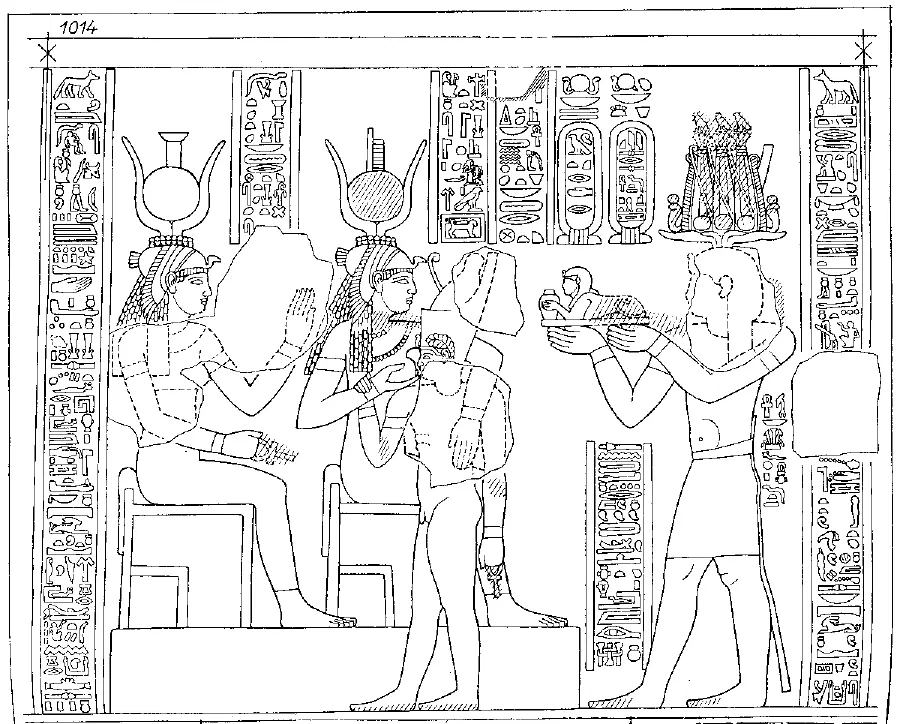
Page 395. The scene as drawn on the wall, facing p. 395 of the edition. Drawing by Otto Baum, in Junker and Winter, Das Geburtshaus des Tempels der Isis in Philä (1965) - 243p. 395, l. 1
mn n-ṯ ꜥnṯjw r gš ḥꜥ.w-ṯ jm-f
Take the myrrh for yourself and anoint your limbs with it.
Note · Line 243
Here the king turns to Isis with a new offering. - 244p. 395, l. 2
ḥtp jb-ṯ ḥr prj m jr.t-Ḥrw
May your heart delight in what came forth from the Eye of Horus.
Note · Line 244
The myrrh is said to come from the eye that Horus lost and had restored. The healed eye was a sign of wholeness. - 245p. 395, l. 3
njśwt bjt nb tꜣ.wj ꜣwtḳrtr
King of Upper and Lower Egypt, lord of the Two Lands, Autokrator,
Note · Line 245
Here it belongs to Augustus, named as an Egyptian king. - 246p. 395, l. 4
sꜣ Rꜥ nb ḫꜥ.w Ḳjsrs …
son of Ra, lord of crowns, Caesar …
- 247p. 395, l. 5
(sꜣ) ꜥnḫ wꜣś nb ḥꜣ-f mj Rꜥ ḏ.t
May all protection, life and dominion surround him as they surround Ra, forever.
- 248p. 395, l. 6
(ḏd) mdw (n) | ꜣs.t dj(.t) ꜥnḫ nb(.t) tꜣ.t wꜥb.t
Words spoken by Isis, giver of life, lady of the Abaton,
- 249p. 395, l. 7
ḥnw.t nb(.t) Jꜣk
sovereign lady, mistress of Philae,
- 250p. 395, l. 8
nḏ.tj.t wr.t n(.t) śn-s Wśjr
great protectress of her brother Osiris,
- 251p. 395, l. 9
rnn sꜣ-f Ḥrw m ḥw.t-nmj.t
who nurses his son Horus in the bedchamber.
- 252p. 395, l. 10
ḏd mdw n | Nb.t-ḥw.t śn.t nṯr nb(.t) Jꜣk
Words spoken by Nephthys, the god’s sister, lady of Philae,
- 253p. 395, l. 11
ḥwj(.t) śn.t-s wr.t (ḥnꜥ sꜣ?)-s
who guards her elder sister and her sister’s son.
- 254p. 395, l. 12
jj-n-j ḫr-ṯ šps.t ḥnw.t
I have come to you, august one, sovereign lady,
- 255p. 395, l. 13
nb wr.t m śp.t nb.t
great Golden One in every province.
- 256p. 395, l. 14
jnj-n-j n-ṯ ꜥnṯjw
I have brought you myrrh;
- 257p. 395, l. 15
šśm-j … (śṯj?) jd.t nṯr
I offer … the scent of the god’s perfume.
- 258p. 395, l. 16
twt ꜣḫ.t nḏm ḫnmw-s
You are the radiant one whose scent is sweet,
- 259p. 395, l. 17
nb(.t) Pwn.t šꜥ(?)-tw n kꜣ-s
lady of Punt, for whose ka it is prepared.
Note · Line 259
Punt was a source of myrrh. - 260p. 395, l. 18
jj.tj m ḥtp śḏ.tj n Šsm.w
Welcome in peace, child of Shesmu.
Note · Line 260
Isis welcomes the king as a child of Shesmu, the god who makes the oils and ointments used in worship. - 261p. 395, l. 19
ḥbj jnw m tꜣ.w-nṯr
who gathers gifts from the god’s lands.
- 262p. 395, l. 20
šsp-n-j ꜥnṯjw śnśn-n-j śṯj-f
I have received the myrrh and breathed in its scent.
- 263p. 395, l. 21
ḥrw jb-j ḥr prj m jd.t nṯr²
My heart delights in what comes forth from the god’s fragrance.
- 264p. 395, l. 22
dj-j n-k Pwn.t m ḳd-f (sic) ḥr prj jm-f (sic)
I give you all of Punt with what it yields,
- 265p. 395, l. 23
ḳmꜣ.tjw n kꜣ-k ḥr gꜣw.t-śn³
and, for your ka, the people of the incense land bearing their gifts.
Augustus gives Khnum a potter’s wheel
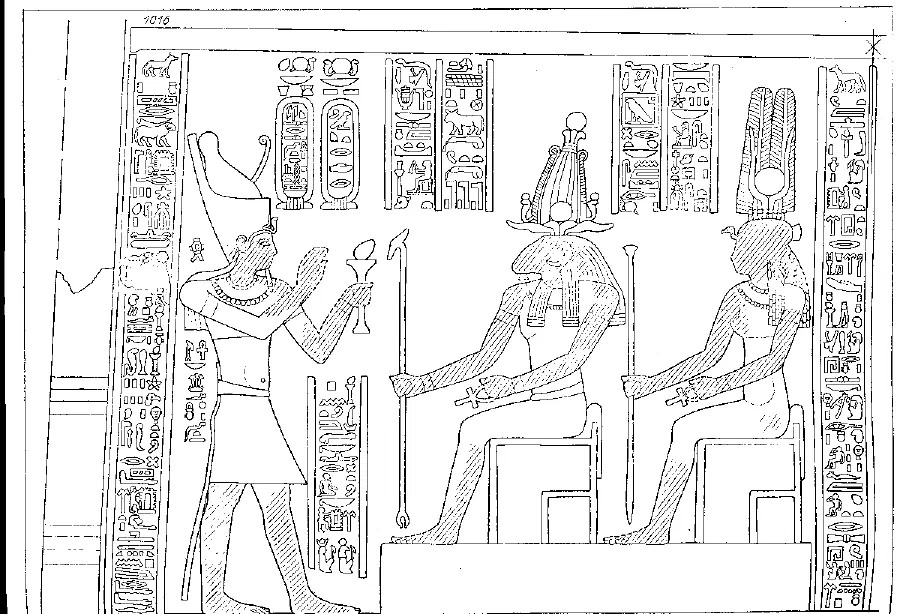
Page 397. The scene as drawn on the wall, facing p. 397 of the edition. Drawing by Otto Baum, in Junker and Winter, Das Geburtshaus des Tempels der Isis in Philä (1965) - 266p. 397, l. 1
nḥp pn mn m bꜣḥ-k
This potter’s wheel stands firm before you.
- 267p. 397, l. 2
n wrḏ-k m ḳd rꜥ nb
Day after day you shape without tiring.
- 268p. 397, l. 3
njśwt bjt nb tꜣ.wj ꜣwtḳrdr
King of Upper and Lower Egypt, Lord of the Two Lands, Autokrator,
Note · Line 268
The Roman emperor Augustus appears here as pharaoh. - 269p. 397, l. 4
sꜣ Rꜥ nb ḫꜥ.w Ḳjsrs …
Son of Ra, Lord of Crowns, Caesar …
- 270p. 397, l. 5
sꜣ ꜥnḫ wꜣś nb ḥꜣ-f mj Rꜥ ḏ.t
All protection, life and dominion surround him as they surround Ra, forever.
- 271p. 397, l. 6
ḏd mdw n | Ḫnmw-Rꜥ nb Śnm.t
Words spoken by Khnum-Ra, lord of Bigeh,
Note · Line 271
Bigeh is an island beside Philae. - 272p. 397, l. 7
sḫm šps ḫnt ḥꜣ.t-śp.wt
the august power, foremost in the First of the Nomes,
Note · Line 272
A nome was a province. Elephantine, a center of Khnum’s worship, stood in the first nome of Upper Egypt. - 273p. 397, l. 8
kꜣ wṯṯ nṯr.w
the bull who begot the gods.
- 274p. 397, l. 9
ḏd mdw n | Ḥw.t-Ḥrw wr.t nb(.t) Śnm.t
Words spoken by Hathor the Great, lady of Bigeh,
- 275p. 397, l. 10
jr.t Rꜥ nb(.t) p.t ḥnw.t nṯr.w nb.w
Eye of Ra, lady of the sky, mistress of all the gods,
Note · Line 275
As the Eye of Ra, Hathor embodies the sun god’s power to act and protect. - 276p. 397, l. 11
šps.t nfr.t ḫnt prj-msj.t
the noble and beautiful one who presides over the birth house.
- 277p. 397, l. 12
jj-n-j ḫr-k bꜣ ḳd.w
I have come to you, O Ba, O shaper,
Note · Line 277
The king addresses Khnum. A ba is a form in which a god makes his power present; the word also echoes the Egyptian for “ram,” Khnum’s animal. - 278p. 397, l. 13
jrj nṯr.w msj sꜣ nn sn …
who made the gods and brought forth the son, without equal …
- 279p. 397, l. 14
jnj(-n-j) n-k nḥp pfj mrj jb-k
I have brought you that potter’s wheel your heart loves,
- 280p. 397, l. 15
nḥp ḥm-k nṯr.w rmṯ ḥr-f
so that Your Majesty may shape gods and people on it.
- 281p. 397, l. 16
twt nṯr ꜥꜣ wr šꜣꜥ ḳd m ḥꜣ.t
You are the very great god who began to shape in the beginning,
- 282p. 397, l. 17
grg tꜣ pn m rꜣ-ꜥ.wj-f
who furnished this earth with the work of his hands.
- 283p. 397, l. 18
jj.tj m ḥtp sꜣ ꜣbj jb-j
Welcome, son whom my heart desires,
Note · Line 283
Khnum now answers the king. - 284p. 397, l. 19
ḳd-tw m ḥw.t-f³ r ꜥḥꜥ m ḥḳꜣ
fashioned in his chamber to stand as ruler.
- 285p. 397, l. 20
šsp-n-j nḥp jnj-n-k n ḥm-j
I have received the potter’s wheel you brought to My Majesty.
- 286p. 397, l. 21
hrw jb-j śk ḥr mr(r)-j
My heart is glad indeed at what I love.
- 287p. 397, l. 22
jrj-j n-k ḫrd.w(?) ḥr-f m sꜣ sꜣ.t
On it I fashion children for you, sons and daughters,
- 288p. 397, l. 23
r ṯs ḥnw-k m tꜣ pn
to carry on your line on this earth.
Augustus gives nursing Hathor a gold collar
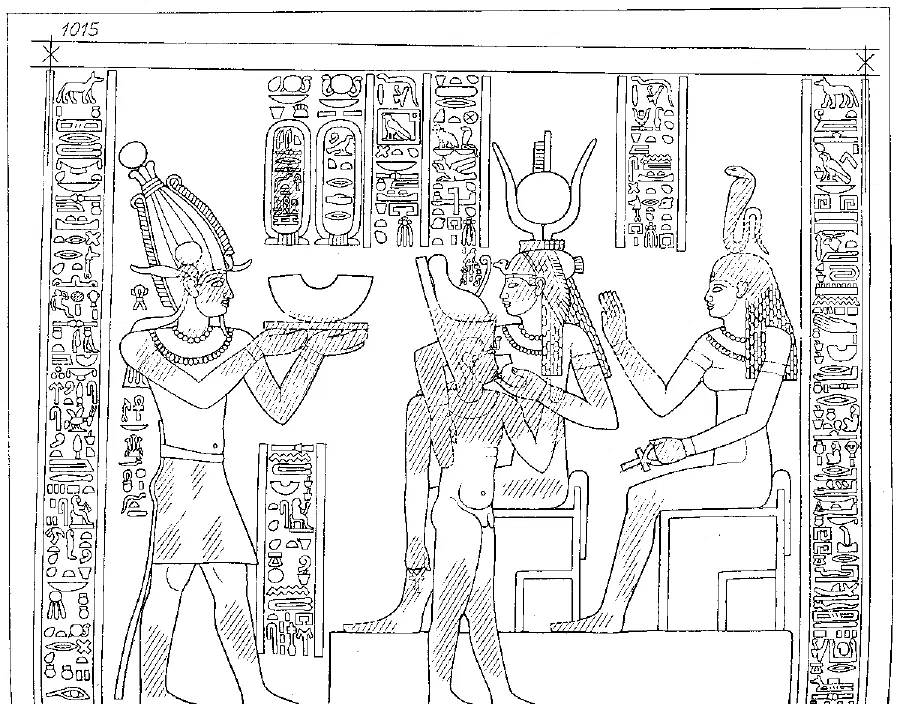
Page 399. The scene as drawn on the wall, facing p. 399 of the edition. Drawing by Otto Baum, in Junker and Winter, Das Geburtshaus des Tempels der Isis in Philä (1965) - 289p. 399, l. 1
mn n-ṯ bb.t¹ šps.t ḥnw.t
Take the collar for yourself, noble one, mistress;
- 290p. 399, l. 2
wḏꜣ-n-ṯ prj-ṯ m nfrw-s
with its beauty you have lit up your house.
- 291p. 399, l. 3
njśwt bjt nb tꜣ.wj ꜣwtḳrdr
King of Upper and Lower Egypt, lord of the Two Lands, Autokrator,
- 292p. 399, l. 4
sꜣ Rꜥ nb ḫꜥ.w Kjsrs …
son of Ra, lord of crowns, Caesar …
- 293p. 399, l. 5
sꜣ ꜥnḫ wꜣś nb ḥꜣ-f mj Rꜥ ḏ.t
May all protection, life and dominion surround him as they surround Ra, forever.
- 294p. 399, l. 6
ḏd mdw n | Ḥw.t-Ḥrw wr.t nb(.t) Śnm.t
Words spoken by Hathor the Great, lady of Bigeh,
- 295p. 399, l. 7
ḥnw.t prj-msj(.t) ḥnw.t ꜣJrk
sovereign of the birth house, sovereign of Philae,
- 296p. 399, l. 8
nb.tj rḫj.t mw.t nṯr ḫnt prj-msj(.t)
queen of the people, mother of the god, foremost in the birth house.
- 297p. 399, l. 9
Ḥrw smꜣ tꜣ.wj (so) pꜣ ḫrd sꜣ Ḥw.t-Ḥrw
Harsomtus the Child, son of Hathor.
Note · Line 297
Harsomtus means “Horus who unites the Two Lands.” - 298p. 399, l. 10
ḏd mdw n | Wps.t ḥnw.t m Śnm.t
Words spoken by Wepeset, sovereign in Bigeh,
Note · Line 298
Wepeset is a goddess of flame. - 299p. 399, l. 11
wr.t wśr.t ḫnt prj-msj.t
the great one, the mighty one, foremost in the birth house.
- 300p. 399, l. 12
jj-n-j ḫr-ṯ nb nb(.t) Śnm.t
I have come before you, O Gold, lady of Bigeh,
Note · Line 300
The king addresses Hathor as Gold, the very metal he brings her. - 301p. 399, l. 13
wr.t wśr.t nn ḫr ḫ.w-s
great and mighty, without equal.
- 302p. 399, l. 14
jnj-j n-ṯ bb.t m nb
I bring you a collar of gold,
- 303p. 399, l. 15
śḫkr.tj m kꜣ.t-s
ornately worked,
- 304p. 399, l. 16
bꜣḳ.tj² m ꜥꜣ.wt šps.wt
gleaming with precious stones.
- 305p. 399, l. 17
twt ꜣḫ.t ḥnw.t nb(.t) wbn
You are the radiant one, the sovereign, lady of the sunrise,
- 306p. 399, l. 18
Rꜥj.t wr.t śn.nw(.t) n(.t) jrj-sj
the great sun goddess, second only to her maker.
- 307p. 399, l. 19
jj.tj m ḥtp sꜣ bꜣ nb ḥj
Welcome, son of the Ba, lord of the sky,
Note · Line 307
The goddess answers the king. - 308p. 399, l. 20
ꜥꜣ šfj.t m-ḳꜣb mn.tj
great in majesty among the hills on either bank.
- 309p. 399, l. 21
šsp-n-j bb.t rḏj-n-j sj r bꜥn.t-j
I have received the collar and set it about my neck.
- 310p. 399, l. 22
ḥtp jb-j ḫr rꜣ-ꜥ.wj-k
My heart is content with your handiwork.
- 311p. 399, l. 23
ḏj-j n-k Ḥḥ ḫr prj jm-f
I give you the land of Heh with what comes forth from it,
- 312p. 399, l. 24
štꜣ.w n kꜣ-k ḫr bjꜣ(.w)-śn
and to your ka the quarries with their treasures.
Upper border inscription: Horus gives life to Augustus
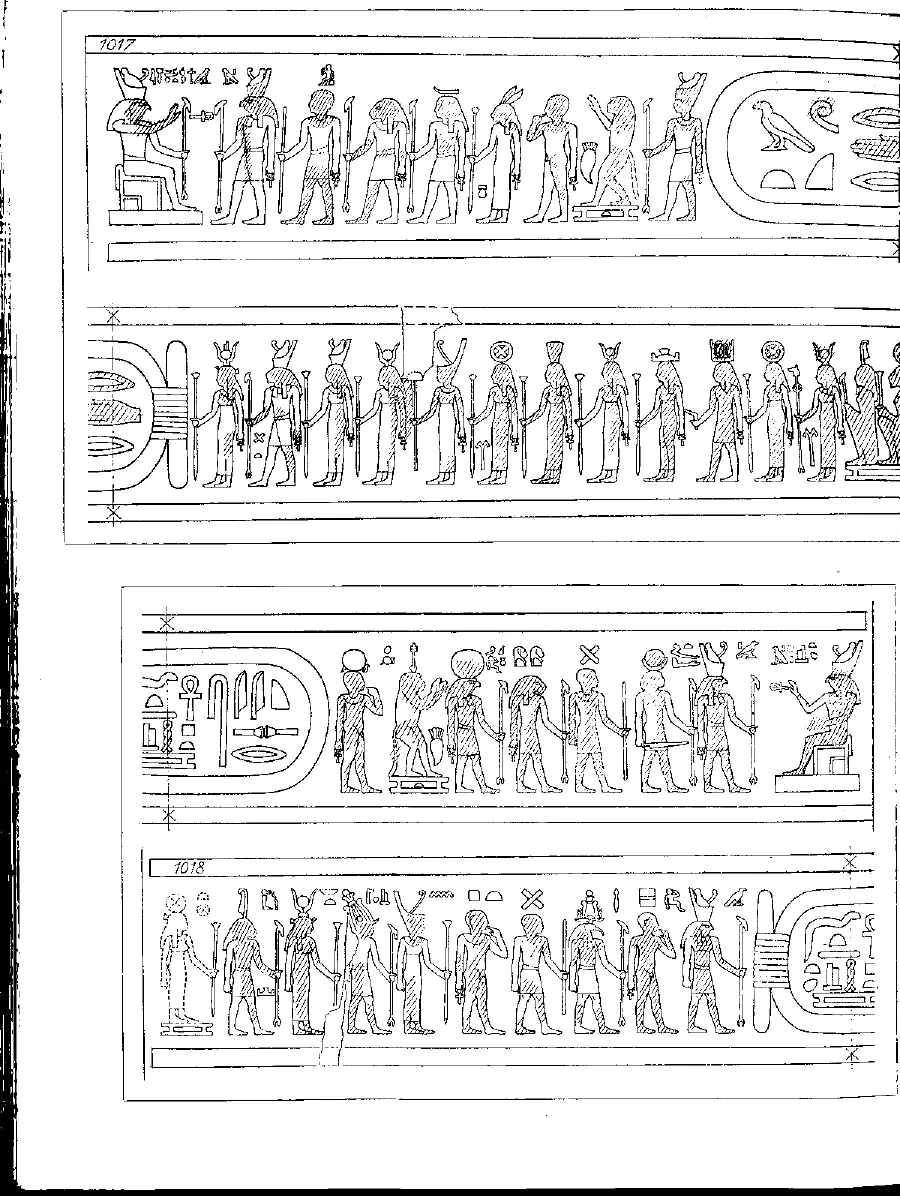
Page 401. The scene as drawn on the wall, facing p. 401 of the edition. Drawing by Otto Baum, in Junker and Winter, Das Geburtshaus des Tempels der Isis in Philä (1965) - 313p. 401, l. 1
Ḥrw nḏ.tj jt-f Bḥd.tj šꜣb šw.t dj ꜥnḫ²
Harendotes of Edfu, of many-colored plumage, gives life
Note · Line 313
Harendotes is Horus as the defender of his father, Osiris. - 314p. 401, l. 2
Ḥrw pꜣ³ ḫrd wr pḥtj
to Harpocrates, great in strength,
Note · Line 314
Harpocrates is Horus the Child. - 315p. 401, l. 3
ḥwn nfr bnr mrw.t
the handsome youth, sweet in love,
- 316p. 401, l. 4
njswt bjt⁴ ꜣwtḳrdr
King of Upper and Lower Egypt, Autokrator,
- 317p. 401, l. 5
mrj⁵ Jš.t wr.t mw.t nṯr (?) nb.t Šnm.t⁶ ḥnw.t nb.t Jrḳ
beloved of Isis the Great, mother of the god, lady of Bigeh, sovereign and lady of Philae,
- 318p. 401, l. 6
wsr.t m jꜣ.t wꜥb.t
mighty on the Sacred Mound.
Note · Line 318
The Sacred Mound was the Abaton, the sanctuary on Bigeh revered as a burial place of Osiris. - 319p. 401, l. 7
Ḥrw sꜣ Jš.t dj ꜥnḫ²
Horus, son of Isis, gives life
- 320p. 401, l. 8
Ḥrw ṯmꜣ-ꜥ wr pḥtj
to Horus, strong of arm, great in strength,
- 321p. 401, l. 9
ḥwn nfr bnr mrw.t
to the handsome youth, sweet in love,
- 322p. 401, l. 10
sꜣ Rꜥ Ḳjsrꜣ ꜥnḫ ḏ.t mrj Ptḥ Jš.t
the son of Ra, Caesar, who lives forever, beloved of Ptah and Isis,
- 323p. 401, l. 11
mrj⁵ Ḥrw pꜣ ḫrd ꜥꜣ wr tpj n Wsjr
beloved of Harpocrates, the very great one, firstborn of Osiris,
- 324p. 401, l. 12
nb jꜣ.t wꜥb.t
lord of the Abaton.
Note · Line 324
Its name means “the place not to be entered.” Cornice of the sanctuary’s north outer wall: Ihy, Horus of Edfu, Augustus and Horus the Child
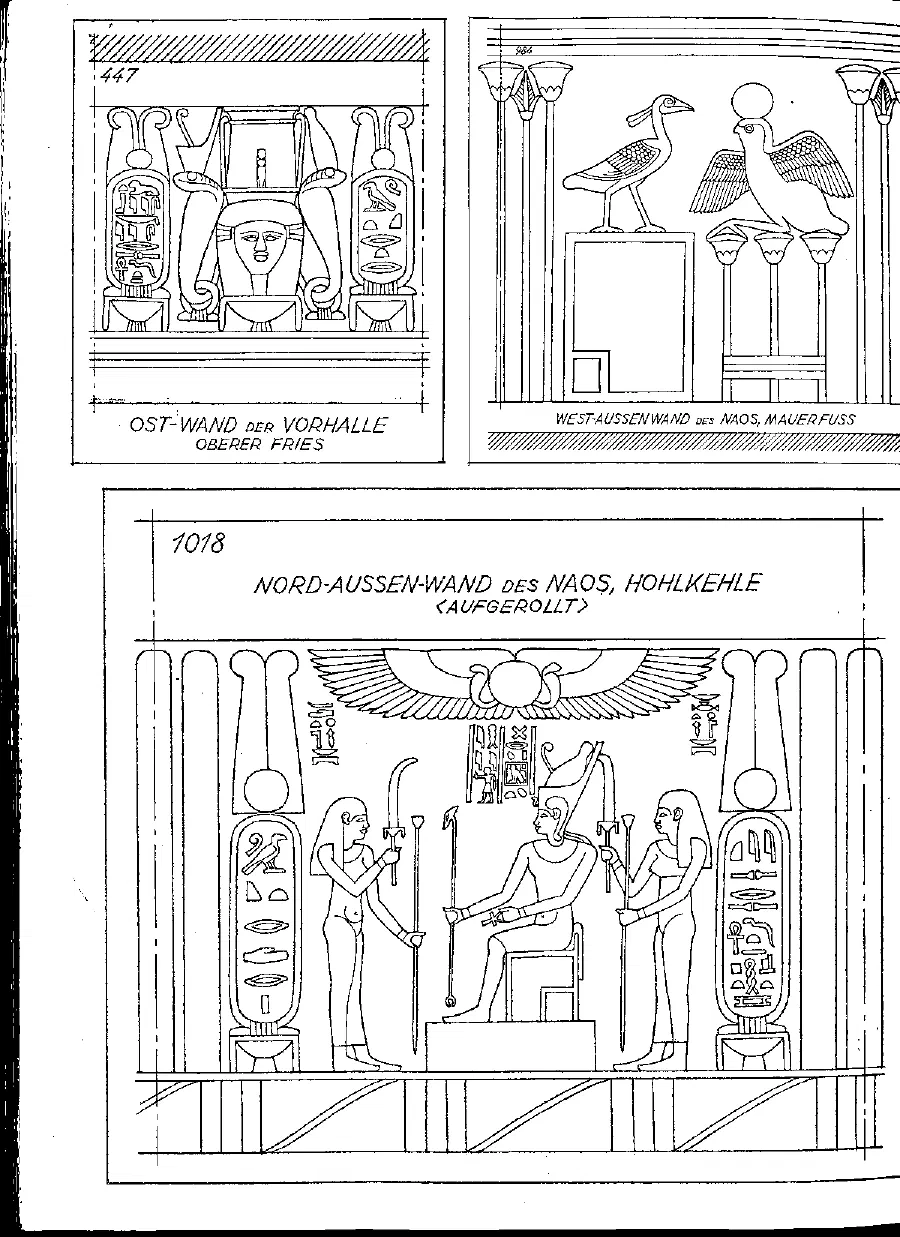
Page 403. The scene as drawn on the wall, facing p. 403 of the edition. Drawing by Otto Baum, in Junker and Winter, Das Geburtshaus des Tempels der Isis in Philä (1965) - 325p. 403, l. 1
Jḥj wr sꜣ Ḥw.t-Ḥrw
Ihy the Great, son of Hathor.
- 326p. 403, l. 2
Bḥd.tj nṯr ꜥꜣ nb p.t
He of Behdet, the great god, lord of the sky.
Note · Line 326
Behdet is Edfu, where Horus was worshipped as a falcon. - 327p. 403, l. 3
nb Mšn nṯr ꜥꜣ nb p.t
Lord of Mesen, the great god, lord of the sky.
Note · Line 327
Mesen is another sacred name for Edfu. - 328p. 403, l. 4
ꜣwtḳrdr
Autokrator,
- 329p. 403, l. 5
Kjsrs ꜥnḫ ḏ.t mrj Ptḥ Js.t
Caesar, who lives forever, beloved of Ptah and Isis.
- 330p. 403, l. 6
Ḥrw pꜣ ḫrd² sꜣ Js.t sꜣ Wsjr nb Jrḳ
Harpocrates, son of Isis, son of Osiris, lord of Philae.
- 331p. 403, l. 7
Ḥrw smꜣ tꜣ.wj pꜣ ḫrd³ sꜣ Ḥw.t-Ḥrw (?)
Harsomtus the Child, son of Hathor,
- 332p. 403, l. 8
… wr.t n Ḥrw Bḥd.t nṯr ꜥꜣ nb p.t
the great … of Horus of Edfu, the great god, lord of the sky.
East colonnade, undersides of the architraves: the king beloved of the gods of Philae
- 333p. 403, l. 9
Ḥrw smꜣ tꜣ.wj pꜣ ḫrd sꜣ Ḥw.t-Ḥrw Jḥj wr sꜣ Ḥw.t-Ḥrw mrj⁶
Beloved of Harsomtus the Child, son of Hathor, Ihy the Great, son of Hathor.
- 334p. 403, l. 10
Ḥw.t-Ḥrw wr.t nb(.t) Jwn.t jr.t Rꜥ nb(.t) p.t ḥnw.t nṯr.w nb.w mrj
Beloved of Hathor the Great, lady of Dendera, Eye of Ra, lady of the sky, sovereign of all the gods.
- 335p. 403, l. 11
Ḥrw Bḥd.t nṯr ꜥꜣ nb p.t šꜣb šw.t prj m ꜣḫ.t mrj
Beloved of Horus of Edfu, the great god, lord of the sky, whose plumage is many-colored, who rises from the horizon.
- 336p. 403, l. 12
Ḥrw pꜣ ḫrd nṯr ꜥꜣ ḫrj-jb jꜣ.t wꜥb.t ḥwj-f sꜣ-f mrj-f
Harpocrates, the great god who dwells in the Abaton. May he protect his beloved son.
- 337p. 403, l. 13
Ḥw.t-Ḥrw wr.t nb(.t) Snm.t ḥnw.t nb(.t) jꜣ.t wꜥb.t mrj
Beloved of Hathor the Great, lady of Bigeh, the sovereign, lady of the Abaton.
- 338p. 403, l. 14
Ḥrw nḏ.tj jt-f nṯr ꜥꜣ ḫrj-jb jꜣ.t wꜥb.t mrjj
Beloved of Harendotes, the great god who dwells in the Abaton.
- 339p. 403, l. 15
Wsjr Wnn nfrw mꜣꜥ ḫrw nṯr ꜥꜣ nb jꜣ.t wꜥb.t ḫrj-jb Jrḳ mrj
Beloved of Osiris Wennefer, the vindicated, the great god, lord of the Abaton, who dwells in Philae.
Note · Line 339
“Vindicated” declares that judgment was given in favor of Osiris against Seth. - 340p. 403, l. 16
Js.t nb(.t) jꜣ.t wꜥb.t ḥnw.t wr.t nb(.t) Jrḳ mrj
Beloved of Isis, lady of the Abaton, the great sovereign, lady of Philae.
Ptolemy VI offers Osiris the Eye of Horus and the testicles of Seth
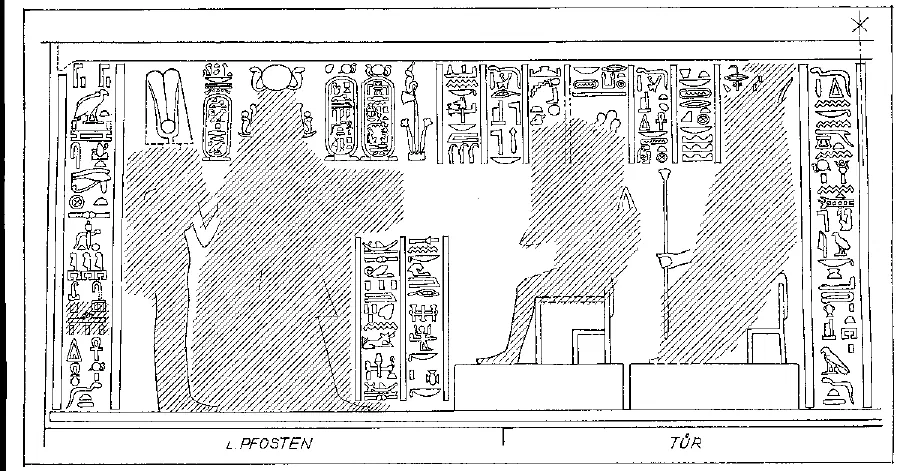
Page 407. The scene as drawn on the wall, facing p. 407 of the edition. Drawing by Otto Baum, in Junker and Winter, Das Geburtshaus des Tempels der Isis in Philä (1965) - 341p. 407, l. 1
mn n-k ḥꜣ.t m jr.t-Ḥrw
Take for yourself the first part as the Eye of Horus,
- 342p. 407, l. 2
ḥꜥj-k jb-k jm-s
and gladden your heart with it;
- 343p. 407, l. 3
pḥwj(?) m ḫrwj(?) n Stš
and take the last part as the testicles of Seth:
Note · Line 343
The two parts of the offering recall the fight for the kingship, in which Seth injured Horus’s eye and Horus injured Seth’s testicles. - 344p. 407, l. 4
sḫm.tj jm-s
through it you are mighty.
- 345p. 407, l. 5
njswt bjt jwꜥw n nṯr.wj prj.wj ḫpr.w Ptḥ stp n Jmn jrj mꜣꜥ.t Rꜥ
King of Upper and Lower Egypt, heir of the two Manifest Gods, embodiment of Ptah, chosen of Amun, who upholds the just order of Ra,
Note · Line 345
The two Manifest Gods are Ptolemy V and Cleopatra I, the king’s parents. The just order is Maat, the truth and justice the king must uphold. - 346p. 407, l. 6
sꜣ Rꜥ Ptwrmjs ꜥnḫ ḏ.t mrj Ptḥ
son of Ra, Ptolemy, who lives forever, beloved of Ptah.
Note · Line 346
This is Ptolemy VI Philometor. - 347p. 407, l. 7
ḥḳꜣ.t nb(.t) tꜣ.wj Krwꜣpdrꜣ(.t)
The queen, lady of the Two Lands, Cleopatra.
Note · Line 347
Cleopatra II was the sister and wife of Ptolemy VI. - 348p. 407, l. 8
ḏd mdw n | Wsjr nṯr ꜥꜣ nb jꜣ.t wꜥb.t
Words spoken by Osiris, the great god, lord of the Abaton,
- 349p. 407, l. 9
ḫnt … nb Jrḳ
foremost in …, lord of Philae:
- 350p. 407, l. 10
rdj-j n-k wsr nb m rnp.wt
I give you all power through the years.
- 351p. 407, l. 11
ḏd mdw n | Js.t dj(.t) ꜥnḫ nb(.t) jꜣ.t wꜥb.t
Words spoken by Isis, giver of life, Lady of the Abaton,
- 352p. 407, l. 12
ḥnw.t nb(.t) Jrḳ nb(.t) ḫꜣs.wt rsj.wt
sovereign lady, Lady of Philae, Lady of the foreign lands to the south.
- 353p. 407, l. 13
nṯr.wj mrj mw.tj swḏꜣ (so) bꜣḳ.t
The two Mother-loving Gods. He who keeps Egypt safe,
Note · Line 353
The two are Ptolemy VI and his sister and queen, Cleopatra II. Their shared title honors their mother, Cleopatra I; the singular titles that follow describe the king. - 354p. 407, l. 14
sḥḏ gs.w-prj.w smn ḥp.w
makes the sanctuaries shine and upholds the laws,
- 355p. 407, l. 15
dj ꜥnḫ (so) mj Rꜥ ḏ.t
is given life like Ra forever.
- 356p. 407, l. 16
ḏd mdw | dj(-j) n-k ns.t n Rꜥ
Words spoken: I give you the throne of Ra
- 357p. 407, l. 17
jꜥw.t n Jtmw
and the kingship of Atum,
- 358p. 407, l. 18
jw-k ḫꜥj.tj ḥr s.t Ḥrw ḏ.t
and you appear in glory on the throne of Horus forever.
Note · Line 358
The living king was identified with Horus. To appear in glory is to show oneself crowned as king, with the radiance of the rising sun. Ptolemy VI gives Khnum wine
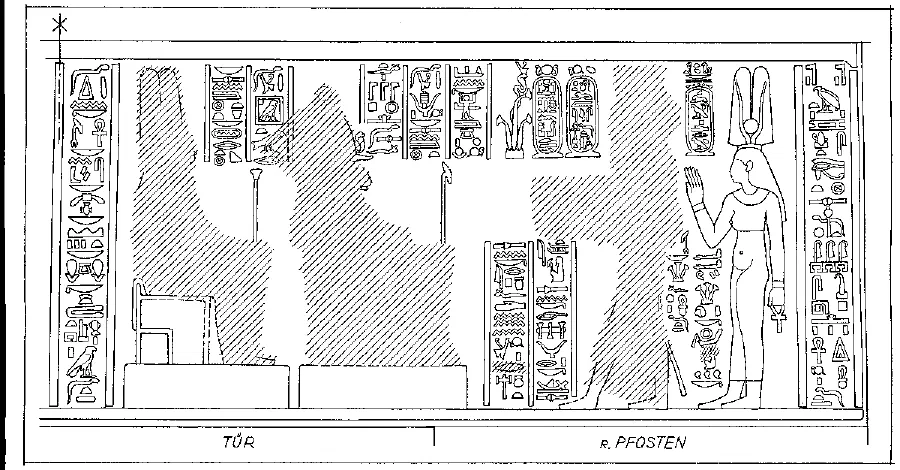
Page 409. The scene as drawn on the wall, facing p. 409 of the edition. Drawing by Otto Baum, in Junker and Winter, Das Geburtshaus des Tempels der Isis in Philä (1965) - 359p. 409, l. 1
mn n-k jrp jd.t n(.t) Rꜥ
Take for yourself the wine, the sweat of Ra,
Note · Line 359
The king now presents the wine to the god. - 360p. 409, l. 2
r(?) nḏ Jtmw
to protect Atum.
- 361p. 409, l. 3
mn n-k jr.t Ḥrw
Take for yourself the Eye of Horus;
Note · Line 361
Horus’s injured eye was made whole again. To offer it was to present the god with something whole and life-giving. - 362p. 409, l. 4
wp rꜣ-k jm-š
open your mouth with it.
- 363p. 409, l. 5
njśwt bjt jwꜥw …
King of Upper and Lower Egypt, heir of …
Note · Line 363
The royal title names Ptolemy as heir to his parents, Ptolemy V and Cleopatra I, worshipped as the Manifest Gods. - 364p. 409, l. 6
sꜣ Rꜥ Pt …
Son of Ra, Ptolemy …
- 365p. 409, l. 7
… wꜣś nb ḥꜣ-f mj Rꜥ ḏ.t
… and all dominion be about him as about Ra forever.
- 366p. 409, l. 8
ḥḳꜣ.t nb(.t) tꜣ.wj Krwꜣpdrꜣ(.t)
The ruler, Lady of the Two Lands, Cleopatra.
Note · Line 366
The Two Lands are Upper and Lower Egypt. - 367p. 409, l. 9
ꜥ.wj(-j) ḥꜣ-k
My two arms are around you;
- 368p. 409, l. 10
ḥwj-j ḥꜥ.w-k
I guard your body.
- 369p. 409, l. 11
ḏd mdw n | Ḫnmw-Rꜥ nb Śnm.t
Words spoken by Khnum-Ra, Lord of Bigeh,
- 370p. 409, l. 12
jt nṯr.w ḫpr ḏś-f
father of the gods, who came into being of himself:
- 371p. 409, l. 13
rdj-j n-k ḥꜥꜥ m ḫr.t hrw rꜥ nb
I give you joy as your daily fare, day after day.
- 372p. 409, l. 14
ḏd mdw n | Ḥw.t-Ḥrw wr.t nb(.t) Śnm.t
Words spoken by Hathor the Great, Lady of Bigeh,
- 373p. 409, l. 15
ḥnw.t nb(.t) Jrk
sovereign lady, Lady of Philae.
- 374p. 409, l. 16
nṯr.wj mrj mw.tj śwḏꜣ (so) bꜣḳ.t
The two Mother-loving Gods. He who keeps Egypt safe,
- 375p. 409, l. 17
śḫḏ gś.w-prj.w śmn hp.w
makes the sanctuaries shine and upholds the laws,
- 376p. 409, l. 18
dj ꜥnḫ (so) mj Rꜥ ḏ.t
is given life like Ra forever.
- 377p. 409, l. 19
ḏd mdw | dj(-j) n-k ꜥnḫ wꜣś nb
Words spoken: I give you all life and dominion,
- 378p. 409, l. 20
śnb nb ꜣw.t-jb nb.t
all health and every joy of heart,
- 379p. 409, l. 21
ḫꜣś.wt nb.wt ḫr ṯb.tj-k
all foreign lands beneath your two sandals,
Note · Line 379
The image places the foreign lands under the king’s feet as a sign of his rule over them. - 380p. 409, l. 22
ḫꜥj.tj ḥr ś.t Ḥrw ḏ.t
as you appear in glory on the throne of Horus forever.
Ptolemy VI burns incense for Amun-Ra
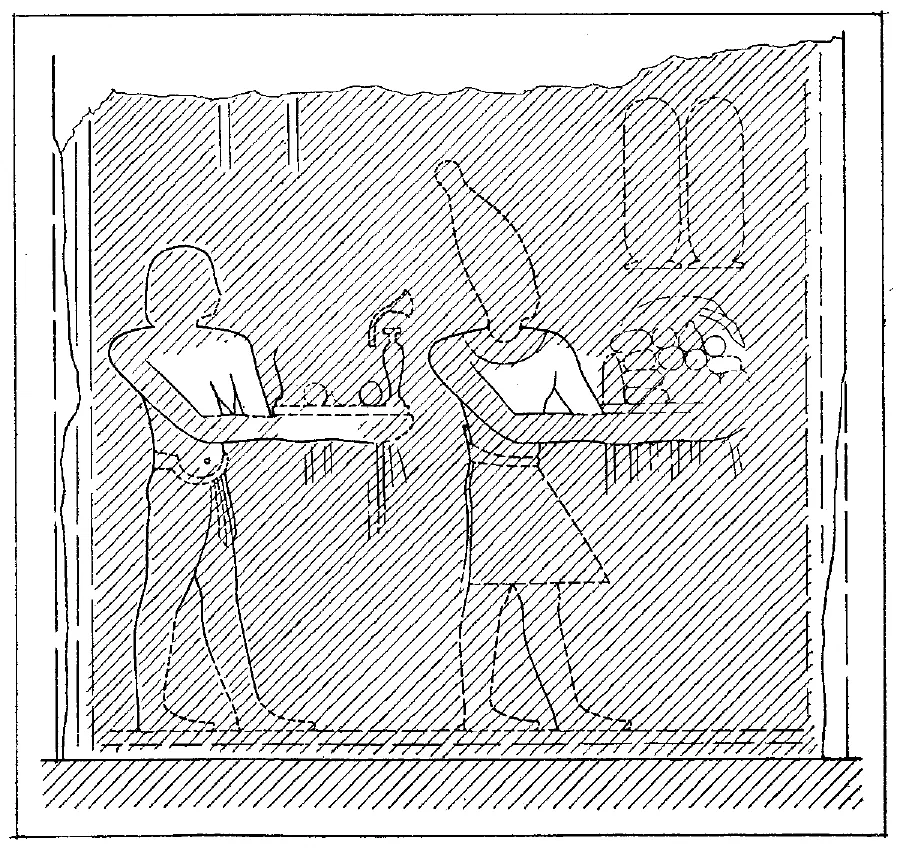
Page 411. The scene as drawn on the wall, facing p. 411 of the edition. Drawing by Otto Baum, in Junker and Winter, Das Geburtshaus des Tempels der Isis in Philä (1965) - 381p. 411, l. 1
jr(?) … Jmn-Rꜥ
Offering incense … to Amun-Ra.
- 382p. 411, l. 2
mn n-k jr.t-Ḥrw
Take for yourself the Eye of Horus.
Note · Line 382
The incense is offered as the Eye of Horus. The eye was injured and made whole again; to present it to a god was to offer wholeness itself. - 383p. 411, l. 3
… r nb … k ꜣꜣs¹ …
… to the lord … you …
- 384p. 411, l. 4
njswt bjt jwꜥw …
King of Upper and Lower Egypt, heir of the Manifest Gods …
Note · Line 384
The Manifest Gods were Ptolemy V and Cleopatra I, the parents of Ptolemy VI. - 385p. 411, l. 5
sꜣ Rꜥ Pt … (nṯr.wj) mrj (mw).tj
Son of Ra, Ptolemy …, the two gods who love their mother.
Note · Line 385
The title names Ptolemy VI and his sister and wife, Cleopatra II, as a pair. - 386p. 411, l. 6
Bḥd.tj nṯr ꜥꜣ
He of Edfu, the great god.
- 387p. 411, l. 7
ḏd mdw n | Jmn-Rꜥ pꜣw.tj tꜣ.wj
Words spoken by Amun-Ra, primeval one of the Two Lands,
- 388p. 411, l. 8
ḏsr-ꜥ nṯr ꜥꜣ
he of the upraised arm, the great god,
- 389p. 411, l. 9
njswt nṯr.w nb jꜣ.t wꜥb.t
king of the gods, lord of the Abaton,
- 390p. 411, l. 10
nb p.t ḥw.t … mw ḏw.w
lord of the sky, the temple …, the waters and the mountains,
- 391p. 411, l. 11
ꜥnḫ ḥr nb (n) mꜣꜣ-f
at the sight of whom every face lives.
Ptolemy VI burns incense for Horus, avenger of his father
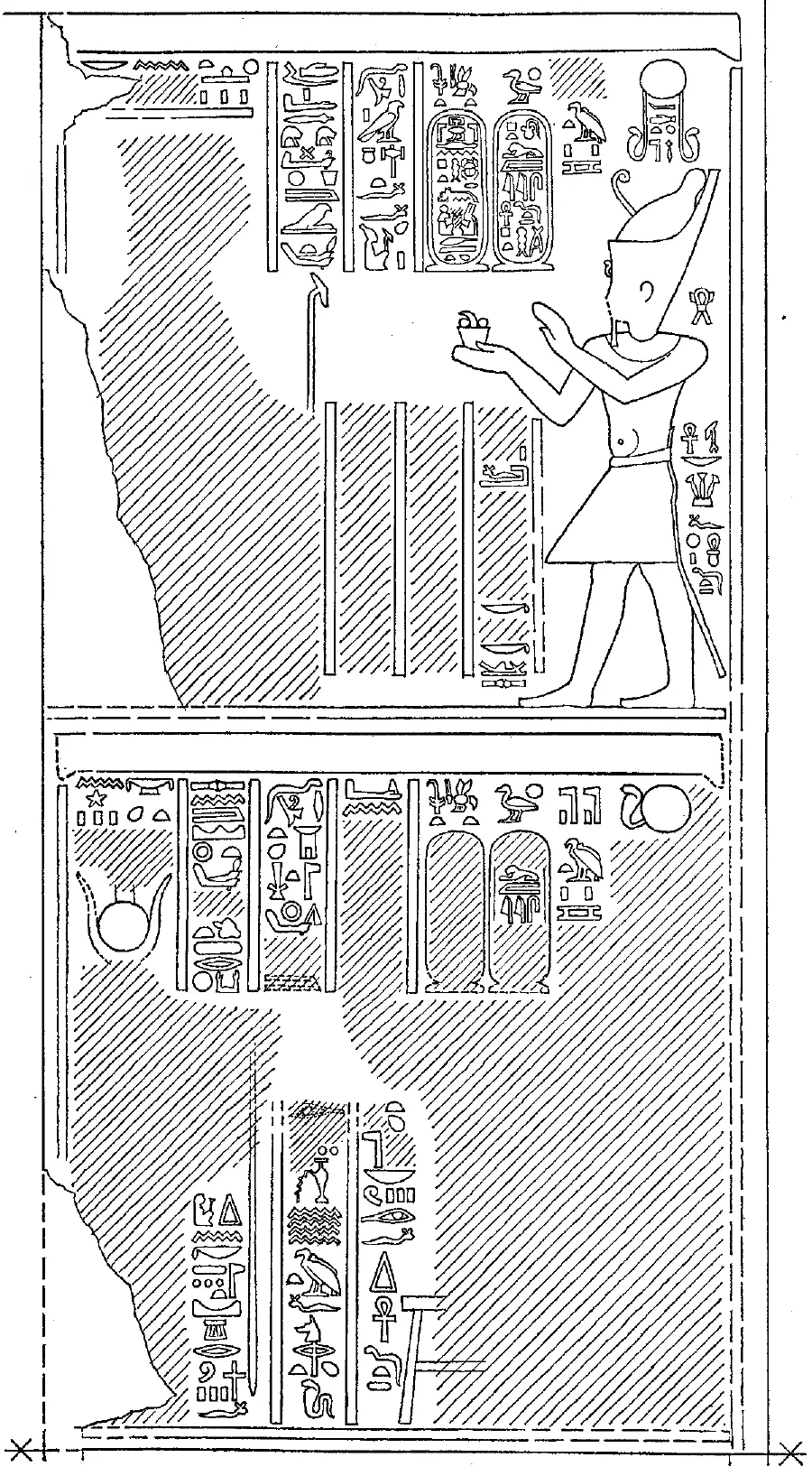
Page 413. The scene as drawn on the wall, facing p. 413 of the edition. Drawing by Otto Baum, in Junker and Winter, Das Geburtshaus des Tempels der Isis in Philä (1965) - 392p. 413, l. 1
… prj … k … -k jm-š
… come forth … you … you … in it.
- 393p. 413, l. 2
njśwt bjt jwꜥw …
King of Upper and Lower Egypt, heir of the Manifest Gods …
- 394p. 413, l. 3
sꜣ Rꜥ Pt … (nṯr.wj) mrj mw.tj
Son of Ra, Ptolemy …, the two gods who love their mother.
- 395p. 413, l. 4
sꜣ ꜥnḫ wꜣś nb ḥꜣ-f mj Rꜥ ḏ.t
May protection, life and all dominion surround him as they surround Ra, forever.
- 396p. 413, l. 5
Bḥd.tj nṯr ꜥꜣ
He of Edfu, the great god.
- 397p. 413, l. 6
ḏd mdw n | Ḥrw nḏ.tj jt-f sꜣ Wśjr
Words spoken by Horus, avenger of his father, son of Osiris,
- 398p. 413, l. 7
ṯmꜣ-ꜥ ꜥꜣ pḥtj
mighty of arm, great in strength,
- 399p. 413, l. 8
ꜥḥm ḏśr jḫ.t(?) n … nb …
the sacred falcon, offerings for … lord of …
Ptolemy VI burns incense and pours cool water for Nephthys
- 400p. 413, l. 9
jrj(.t śnṯr) ḳbḥ.w n mw.t-f
Burning incense and pouring cool water for his mother,
Note · Line 400
The king makes the offering to Isis in the role of her son Horus. - 401p. 413, l. 10
wśr.t (ḥnw.t?) nṯr(.w?) nb.w
the mighty one, mistress of all the gods.
- 402p. 413, l. 11
jrj-f dj ꜥnḫ ḏ.t
May he do so, granted life forever.
- 403p. 413, l. 12
njśwt bjt (jwꜥw …)
King of Upper and Lower Egypt, heir of the Manifest Gods …
- 404p. 413, l. 13
sꜣ Rꜥ (Pt …) nṯr.wj mrj mw.tj
Son of Ra, Ptolemy …, the two gods who love their mother.
- 405p. 413, l. 14
ḏd mdw n | Nb.t-ḥw.t śn.t nṯr
Words spoken by Nephthys, sister of the god,
- 406p. 413, l. 15
ḥwj(.t) … m Śnm.t
who guards … on Bigeh,
- 407p. 413, l. 16
ḏśr(.t) … ḫnt ’Jrk
splendid …, foremost in Philae,
- 408p. 413, l. 17
nb n nṯr.w
the gold of the gods:
- 409p. 413, l. 18
rdj(-j) n(-k) …
I give you …
- 410p. 413, l. 19
dj-j n-k Tꜣ-nṯr ḥr jmj.w-f
I give you the Land of the God with all it holds.
Note · Line 410
The Land of the God was a name for the distant region from which incense and other precious aromatics came. Ptolemy VI lays food on the flame before Isis
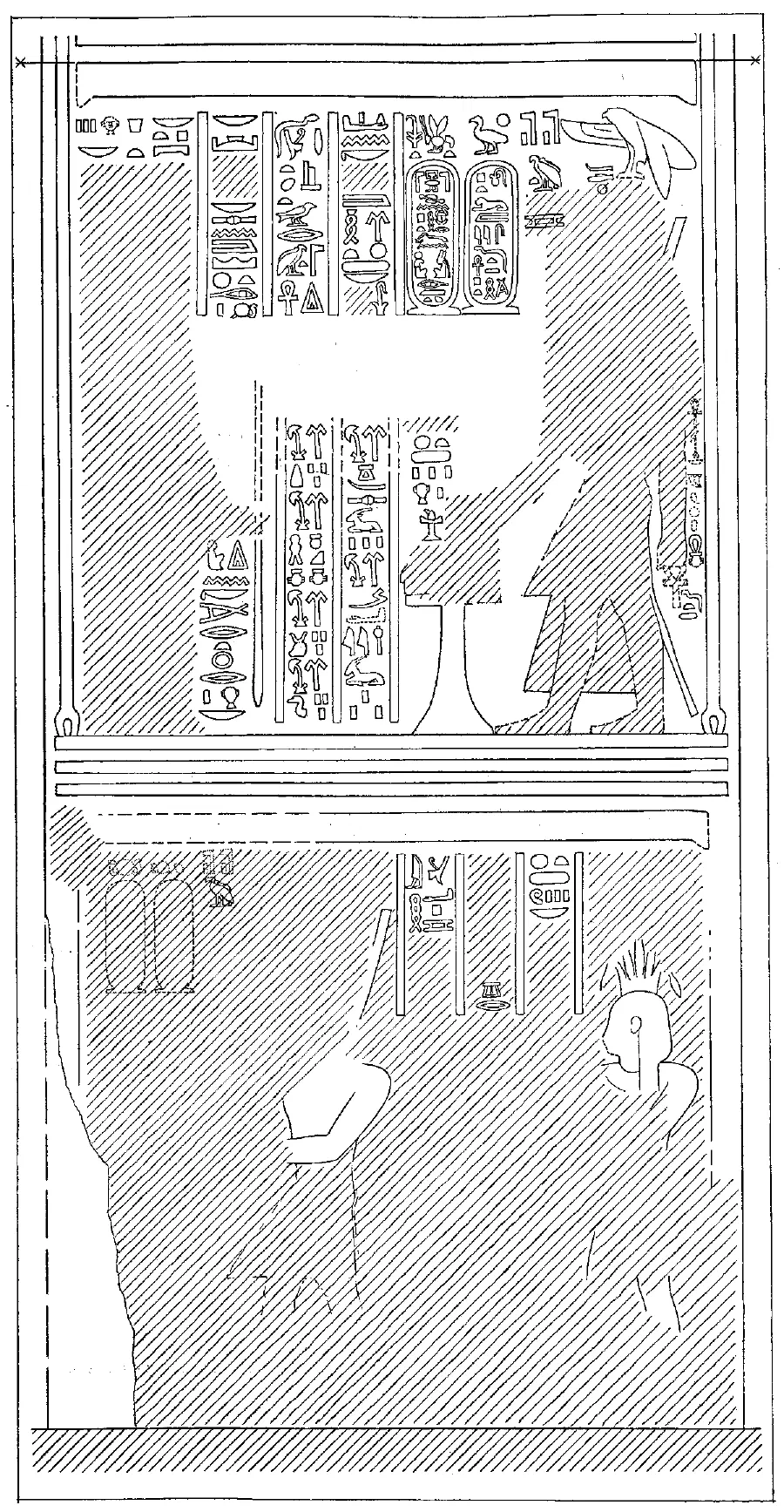
Page 415. The scene as drawn on the wall, facing p. 415 of the edition. Drawing by Otto Baum, in Junker and Winter, Das Geburtshaus des Tempels der Isis in Philä (1965) - 411p. 415, l. 1
ḫꜣ m t.w ḫꜣ m ḥnḳ.t
A thousand loaves, a thousand jars of beer,
- 412p. 415, l. 2
ḫꜣ m kꜣ.w ḫꜣ m ꜣpd.w
a thousand cattle, a thousand fowl,
- 413p. 415, l. 3
ḫꜣ m gḥs.w ḫꜣ m mꜣ-ḥḏ.w
a thousand gazelles, a thousand oryxes.
- 414p. 415, l. 4
(ṯs?) jḫ.t ḥr ḫꜣw.t
Heaping offerings on the altar.
- 415p. 415, l. 5
njśwt bjt jwꜥw …
King of Upper and Lower Egypt, heir …
- 416p. 415, l. 6
sꜣ Rꜥ Pt … nṯr.wj mrj mw.t(j)
Son of Ra, Ptolemy … the two Mother-loving Gods.
Note · Line 416
The paired title belongs to Ptolemy VI and his sister and wife, Cleopatra II. Its Greek form is Philometores. - 417p. 415, l. 7
… ꜥnḫ wꜣś nb ḥꜣ-f mj Rꜥ ḏ.t
… May all life and dominion surround him as they surround Ra, forever.
- 418p. 415, l. 8
Bḥd.tj …
He of Edfu …
- 419p. 415, l. 9
ḏd mdw n | ꜣś.t wr.t mw.t nṯr
Words spoken by Isis the Great, mother of the god,
- 420p. 415, l. 10
dj(.t) ꜥnḫ nb(.t) …
giver of life, lady of …
- 421p. 415, l. 11
nb(.t) Śnm.t jr.t Rꜥ
lady of Bigeh, Eye of Ra,
Note · Line 421
As the Eye of Ra, Isis acts as the sun god’s protective power. - 422p. 415, l. 12
nb(.t) p.t ḥnw.t ḥr.w nb.w
lady of heaven, sovereign of all people:
- 423p. 415, l. 13
rdj-j n-k …
I give you …
- 424p. 415, l. 14
m wꜣḥ jḫ.t nb.t nn (?)
in addition to all these things.
- 425p. 415, l. 15
dj-j n-k mrw.t ḫr ḥr nb
I grant you the love of all people.
Ptolemy VI followed by a Nile god
- 426p. 415, l. 16
njśwt bjt … sꜣ Rꜥ …
King of Upper and Lower Egypt, … Son of Ra, …
- 427p. 415, l. 17
nṯr.wj (mrj) mw.t(j)
the two Mother-loving Gods.
- 428p. 415, l. 18
jj n ḥꜥpj …
Hapy has come …
- 429p. 415, l. 19
… ḥr jḫ.t nb.t …
… bearing all things …
Ptolemy XII brings Isis the procession of Nile gods
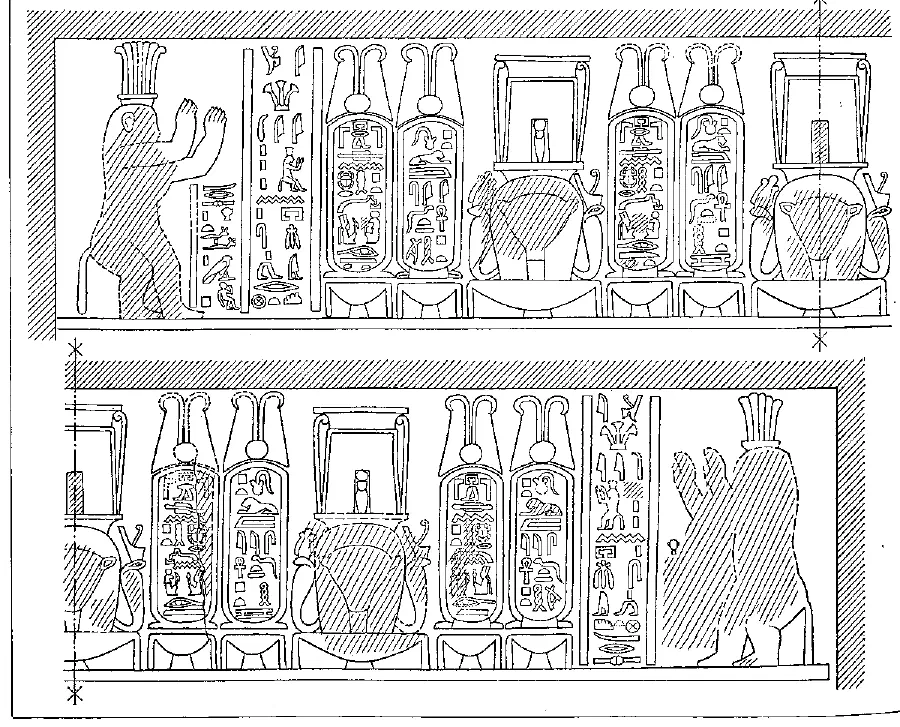
Page 417. The scene as drawn on the wall, facing p. 417 of the edition. Drawing by Otto Baum, in Junker and Winter, Das Geburtshaus des Tempels der Isis in Philä (1965) - 430p. 417, l. 1
jw n njśwt bjt nb tꜣ.wj jwꜥw n pꜣ nṯr nṯj nḥm …
The King of Upper and Lower Egypt, Lord of the Two Lands, heir of the god who saves … has come
Note · Line 430
The king here is Ptolemy XII. - 431p. 417, l. 2
ḫr-ṯ ꜣs.t dj(.t) ꜥnḫ nb(.t) jꜣ.t wꜥb.t
to you, Isis, giver of life, lady of the Abaton.
- 432p. 417, l. 3
jnj-f n-ṯ mw śnḏm (so) npr.t (so)²
He brings you water that gladdens the banks
- 433p. 417, l. 4
ḥr ꜥrꜥr ḥr jḥm.t³
as it rises over the shore.
- 434p. 417, l. 5
ꜥ.wj rwḏ ḥr ḳmꜣ n-ṯ ḥfn.w
Both arms are strong, fashioning hundreds of thousands for you,
- 435p. 417, l. 6
n …⁴ nb …
without … of any kind …
Dancing Bes gods between the cartouches of Ptolemy VI and Hathor emblems
- 436p. 417, l. 7
Ptwrmjś ꜥnḫ ḏ.t mrj Ptḥ
Ptolemy, who lives forever, beloved of Ptah,
- 437p. 417, l. 8
jwꜥw n nṯr.wj prj.wj ḫpr.w Ptḥ śtp n Jmn jrj mꜣꜥ.t Rꜥ
heir of the two Manifest Gods, embodiment of Ptah, chosen of Amun, who upholds the right order of Ra.
- 438p. 417, l. 9
jn ḥꜣj.tjw⁷ n prj-msj(.t)
By the Bes gods of the birth house,
- 439p. 417, l. 10
jj r Km.t ḥnꜥ-s
who came to Egypt with her,
Note · Line 439
The goddess returning to Egypt is Hathor. - 440p. 417, l. 11
ḫr jt-f (sic) Ḥrw pꜣ ḫrd
to his father, Horus the Child.
South door thickness: Ptolemy VI brings the great offering to Isis-Hathor
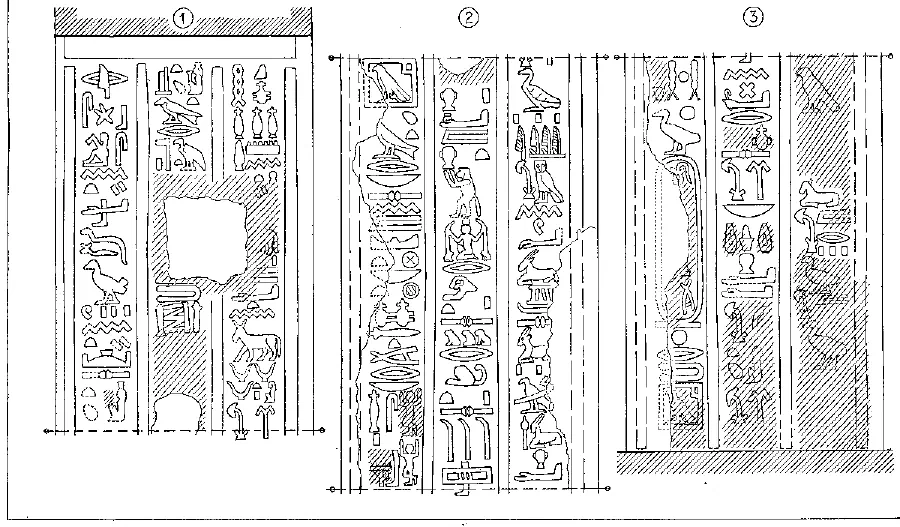
Page 419. The scene as drawn on the wall, facing p. 419 of the edition. Drawing by Otto Baum, in Junker and Winter, Das Geburtshaus des Tempels der Isis in Philä (1965) - 441p. 419, l. 1
jr sbꜣ šps ntj² jꜥb ḏfꜣ.w
As for the august gate where provisions are gathered
- 442p. 419, l. 2
ntj (sic)³ Js.t Ḥw.t-Ḥrw wr.t nb(.t) Snm.t
for Isis-Hathor the Great, lady of Bigeh,
Note · Line 442
Isis and Hathor are invoked here as one goddess. - 443p. 419, l. 3
nb(.t) tḫ(.t) ꜥꜣ.t mrw(.t)
lady of drunkenness, great in love,
Note · Line 443
Drinking, singing and dancing were acts of worship at Hathor’s festivals. - 444p. 419, l. 4
nb(.t) ḥs(.t) jbꜣ (r)-ꜥ nḥḥ
lady of song and dance for ever:
- 445p. 419, l. 5
(jj n)⁴ sꜣ Rꜥ (Ptwrmjs ꜥnḫ ḏ.t) mrj (Ptḥ)⁵
the Son of Ra, Ptolemy, ever living, beloved of Ptah, has come
Note · Line 445
The king is Ptolemy VI Philometor. - 446p. 419, l. 6
ḫr-ṯ Ḥw.t-Ḥrw Js.t wr.t mw.t nṯr
to you, Hathor-Isis the Great, mother of the god,
- 447p. 419, l. 7
… ꜥb.t ꜥꜣ.t …⁶
… a great offering …
- 448p. 419, l. 8
ḥr ḥnk m ḥr-ṯ nfr
presenting it before your beautiful face:
- 449p. 419, l. 9
ḥḥ r ḥꜣ.t-s ḥfn.w r pḥ(wj)-s
a million at its front, hundreds of thousands at its rear,
- 450p. 419, l. 10
ḏbꜥ.w šbn⁷ r (ḥrj)-jb-s
tens of thousands mingled in its midst,
- 451p. 419, l. 11
ḫꜣ m nb t.w(?) ḥr ꜥ.wj
a thousand loaves of every kind on his two arms,
- 452p. 419, l. 12
ḫꜣ m(?) … ḫꜣ m ḥnk.t
a thousand …, a thousand measures of beer,
- 453p. 419, l. 13
jmn.j.t … rdj.t(?) n wp.w
a standing offering … given by the milk cows,
- 454p. 419, l. 14
ḫꜣ m ꜣpd.w j (sic?) sḫ.t
a thousand birds of the field,
- 455p. 419, l. 15
ḫꜣ m njw(.w)⁹ gḥs.w mꜣ-ḥḏ(.w)
a thousand ibex, gazelles and antelopes,
- 456p. 419, l. 16
ḥr ꜥ …
on the arm …
- 457p. 419, l. 17
ḫꜣ m rꜣ.w ḫꜣ m …
a thousand ra-geese, a thousand …
North door thickness: Ptolemy VI brings the great offering to Horus the Child
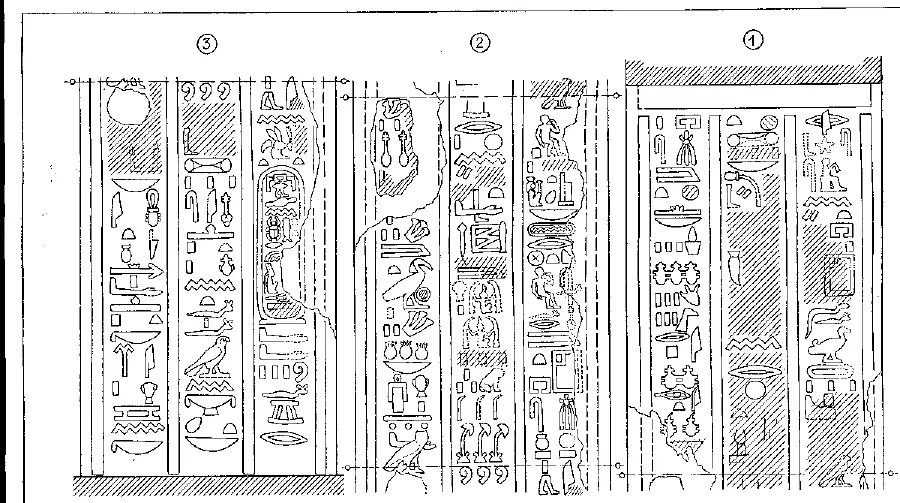
Page 421. The scene as drawn on the wall, facing p. 421 of the edition. Drawing by Otto Baum, in Junker and Winter, Das Geburtshaus des Tempels der Isis in Philä (1965) - 458p. 421, l. 1
jr sbꜣ šps ntj² prj- … ḥw.t … ḏfꜣ.w …
As for the august gate of the house of … the temple … provisions …
- 459p. 421, l. 2
(n?) Ḥrw pꜣ ḫrd (sꜣ) Jś.t nb Jrk
for Horus the Child, son of Isis, lord of Philae,
- 460p. 421, l. 3
šfj nfr m ḥw.t-msḫn
the beautiful child in the birth house:
- 461p. 421, l. 4
jj n (njśwt) bjt jwꜥ.w n nṯr.wj prj.wj ḫpr.w Ptḥ stp n Jmn jrj mꜣꜥ.t (Rꜥ)
the King of Upper and Lower Egypt has come, heir of the two Manifest Gods, embodiment of Ptah, chosen by Amun, who upholds the Maat of Ra.
Note · Line 461
Maat is the right order of the world, which the king is charged with maintaining. - 462p. 421, l. 5
ꜥ.wj-f ḥr jḫ.t nb.t (nfr.t) wꜥb.t … bnr.t …
His two arms bear every good and pure thing … sweet …
- 463p. 421, l. 6
… ḫr.t(?) hrw ntj(?)² ꜥb.t ꜥꜣ.t
… the daily needs of the great offering,
- 464p. 421, l. 7
m ḥḥ ḥr ḥḥ.w ḥfn.w ḏbꜥ.w ḫꜣ.w šn.wt …
in millions upon millions, hundreds of thousands, tens of thousands, thousands, hundreds …
- 465p. 421, l. 8
… bw nfr r(?) śḥtp jb n jt-f Ḥrw n nb
… good things to gladden the heart of his father, Horus of the Golden One,
Note · Line 465
The king calls Horus his father. - 466p. 421, l. 9
nb prj-mśj(.t) m jḫ.t nb.t
lord of the birth house, with all things:
- 467p. 421, l. 10
t.w ḥnḳ.t kꜣ.w³ ꜣpd.w jrp jrṯ.t
loaves, beer, bulls, fowl, wine, milk,
- 468p. 421, l. 11
… nfr nfr … m ꜣḫ.t
… very fine … plants and … plants from the fields,
- 469p. 421, l. 12
rd(.t) nb(.t) ḥr śꜣ tꜣ
all that grows on the face of the earth,
- 470p. 421, l. 13
m … kꜣ(?) nb mj ḳd wꜥ
with … every kind of food, all together.
- 471p. 421, l. 14
ḥtp-k jm ḥr mrj-n-k
You are content with it, for you wished it.
Ceiling of the gate room in the west tower: Horus of Edfu, Nekhbet and Wadjet guard Ptolemy VI
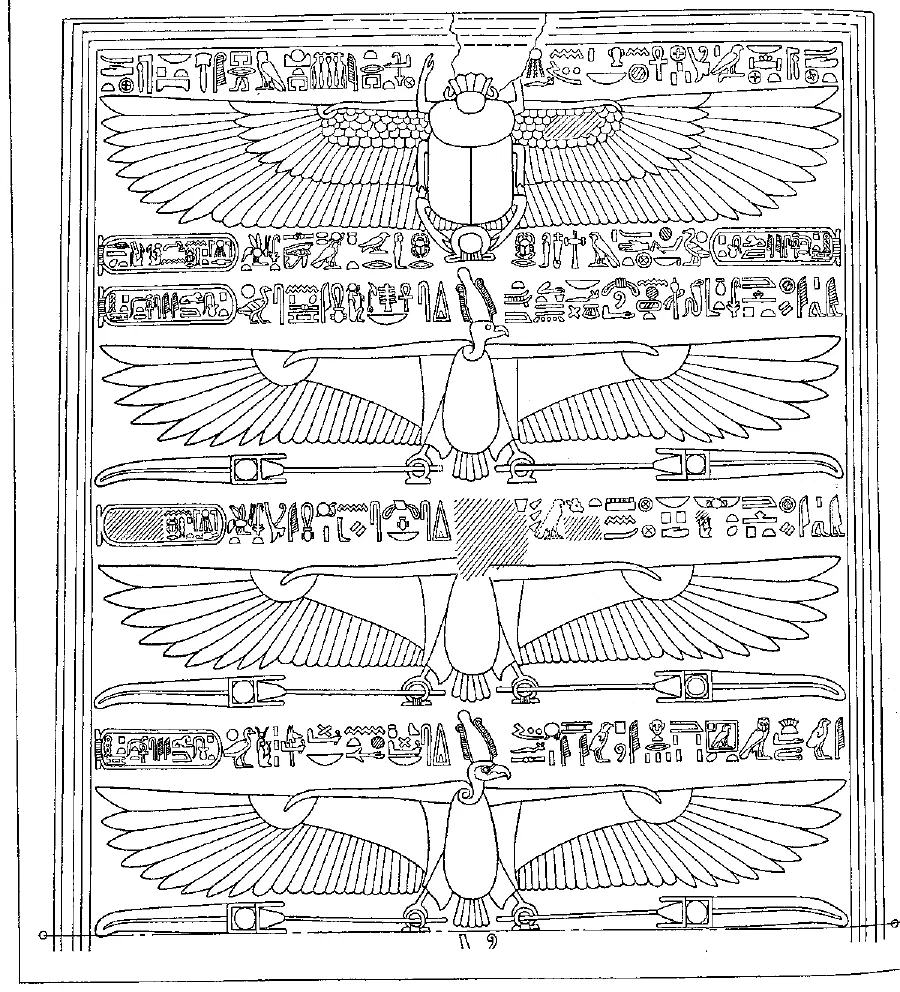
Page 423. The scene as drawn on the wall, facing p. 423 of the edition. Drawing by Otto Baum, in Junker and Winter, Das Geburtshaus des Tempels der Isis in Philä (1965) - 472p. 423, l. 1
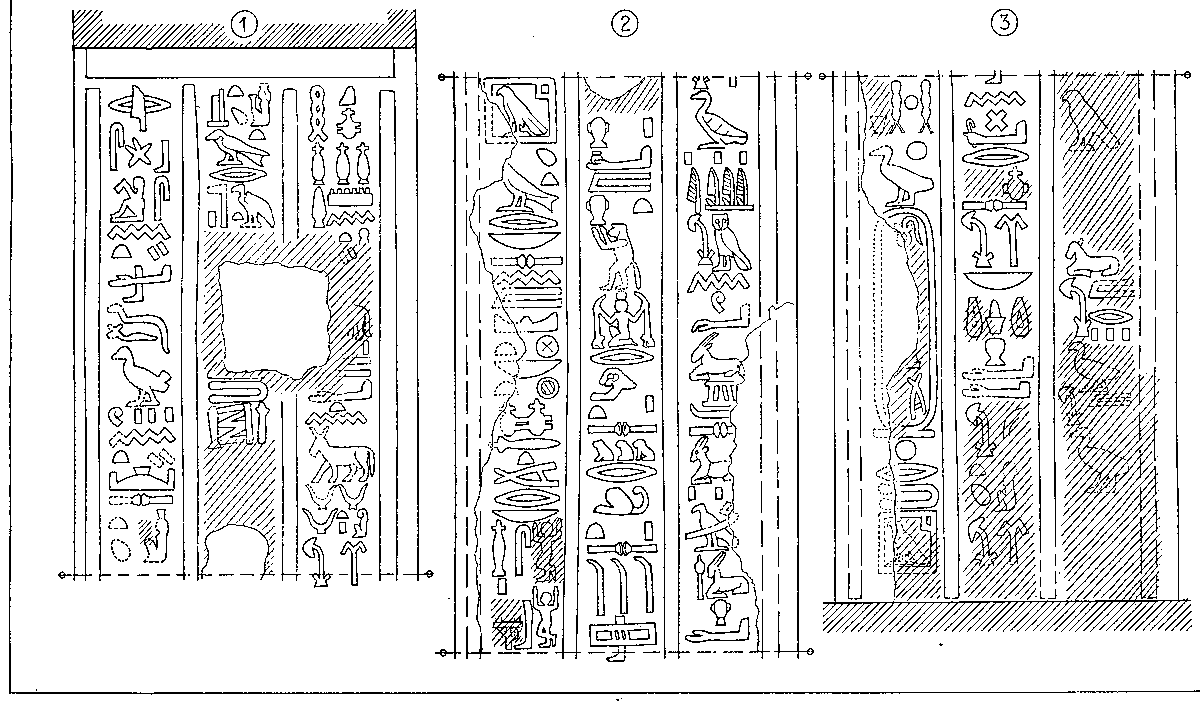
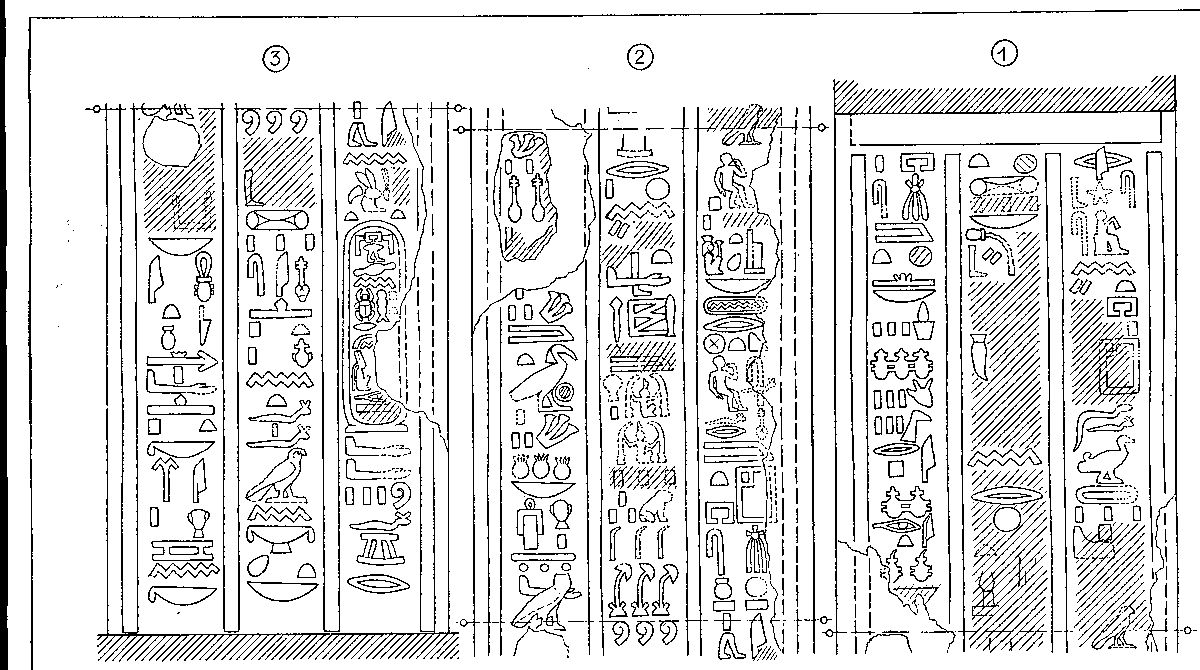
Bḥd.tj nṯr ꜥꜣ nb p.t šꜣb šw.t prj m ꜣḫ.t ḫnt jtr.t šmꜥ.t
He of Behdet, the great god, lord of the sky, many-colored in his plumage, who comes forth from the horizon, foremost in the shrine of Upper Egypt.
Note · Line 472
He of Behdet is Horus in his falcon form at Edfu. - 473p. 423, l. 2
Bḥd.tj nṯr ꜥꜣ nb Mšn nṯr² n njw.wt
He of Behdet, the great god, lord of Mesen, god of the cities.
- 474p. 423, l. 3
ꜥnḫ ḥr nb n mꜣꜣ wbn-f
Every face lives at the sight of his rising.
- 475p. 423, l. 4
ḫpr.w wr ntj³ Rꜥ-Ḥrw-ꜣḫ.tj
Great form of Ra-Horakhty,
Note · Line 475
Ra-Horakhty is Ra as Horus of the Two Horizons. - 476p. 423, l. 5
šwḏꜣ njśwt bjt jwꜥw n nṯr.wj prj.wj ḫpr.w Ptḥ śtp n Jmn jrj mꜣꜥ.t Rꜥ
protect the King of Upper and Lower Egypt, heir of the two Manifest Gods, image of Ptah, chosen of Amun, who upholds the just order of Ra.
- 477p. 423, l. 6
ḫpr.w tpj ntj⁴ Ḥrw Bḥd.t
First form of Horus of Behdet,
- 478p. 423, l. 7
ḥwj-k sꜣ Rꜥ Ptwrmjś ꜥnḫ ḏ.t mrj Ptḥ
may you protect the Son of Ra, Ptolemy, who lives forever, beloved of Ptah.
- 479p. 423, l. 8
jj (sp śn) m ḥtp Nḫb.t ḥḏ(.t) Nḫn
Come in peace, come in peace, Nekhbet, White One of Nekhen,
- 480p. 423, l. 9
ꜣw(.t)-ꜥ nb(.t) Fꜥg ḥnw.t tꜣ.wj tm
with arm outstretched, lady of Fag, mistress of the Two Lands in their entirety.
- 481p. 423, l. 10
dj-ś ꜥnḫ ḏd wꜣś nb mj Rꜥ n sꜣ-ś mrj-ś sꜣ Rꜥ Pt…
May she give all life, stability and dominion, like Ra, to the son she loves, the Son of Ra, Pto…
- 482p. 423, l. 11
jj (sp śn) m ḥtp ꜥpj.t(?)⁵ nb(.t) P Dp
Come in peace, come in peace, serpent goddess, lady of Pe and Dep,
- 483p. 423, l. 12
mnḥj.t ḫnt jdb.w-Ḥrw ḥnw.t…
uraeus, foremost on the banks of Horus, mistress …
Note · Line 483
The banks of Horus are the lands of Egypt along the Nile. - 484p. 423, l. 13
dj-ś ꜣw(.t)-jb nb.t śnb mj Rꜥ n njśwt bjt jwꜥw…
May she give all joy and health, like Ra, to the King of Upper and Lower Egypt, heir …
- 485p. 423, l. 14
jw ḫꜥj.tj m Ḥw.t-Ḥrw m fdw ḥr.w⁶ jpw
You appear as Hathor with these four faces,
Note · Line 485
Each face looks in a different direction, and each is addressed in turn. - 486p. 423, l. 15
mrjj(.t) Rꜥ mꜣꜣ-f śj
whom Ra loves when he sees her.
- 487p. 423, l. 16
dj-ś ḳn(.t) nb.t nḫt nb wśr n(?)⁷ sꜣ Rꜥ Pt…
May she grant every victory, all strength and power to the Son of Ra, Pto…
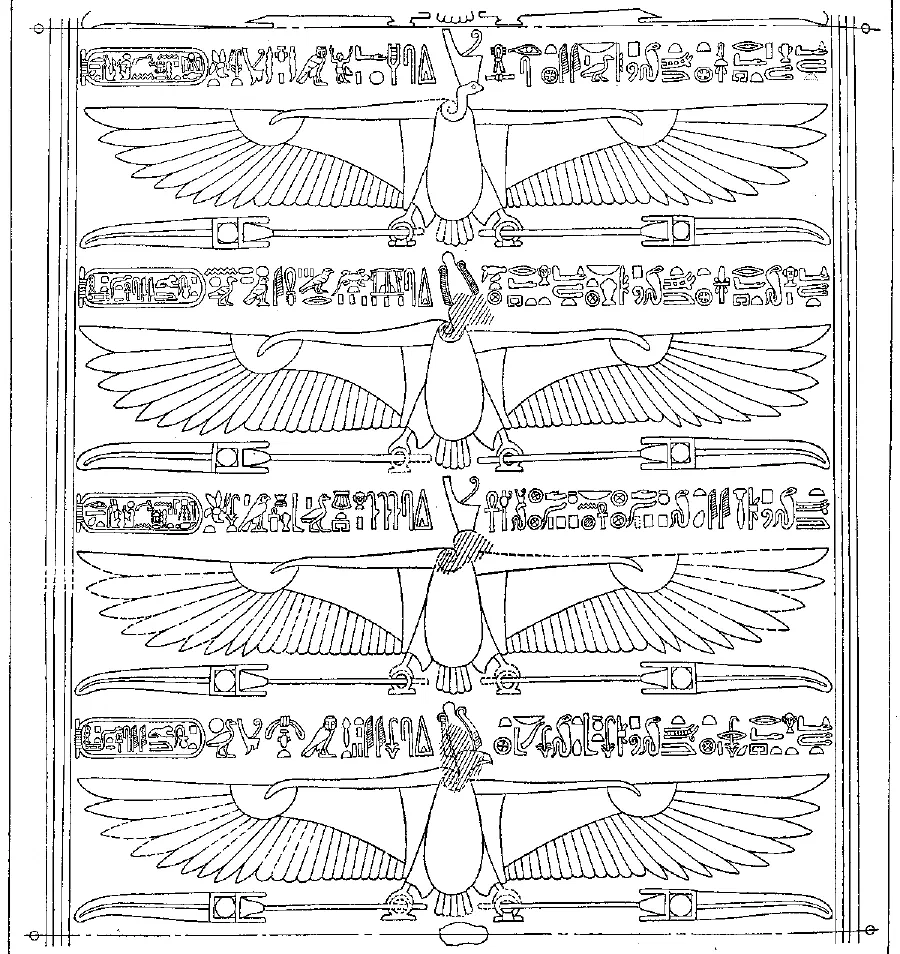
Page 425. The scene as drawn on the wall, facing p. 425 of the edition. Drawing by Otto Baum, in Junker and Winter, Das Geburtshaus des Tempels der Isis in Philä (1965) - 488p. 425, l. 1
ḏj-t ḥr-t r ꜥ.t wnm.t Jtm.t¹ pw
Turn your face toward the western chamber, O Atumet,
Note · Line 488
Atumet is the feminine form of the god Atum’s name. - 489p. 425, l. 2
nb.t Sꜣw (so) jrj-š sꜣ-š
lady of Sais, who extends her protection.
- 490p. 425, l. 3
ḏj-s ꜥḥꜥw ḳꜣj m nḏm jb n njśwt bjt jwꜥw ...
May she grant a long life with a glad heart to the King of Upper and Lower Egypt, heir …
- 491p. 425, l. 4
ḏj-t ḥr-t (so) r ꜥ.t jꜣb.t Jtm.t pw nb(.t) Bꜣś.t
Turn your face toward the eastern chamber, O Atumet, lady of Bubastis.
- 492p. 425, l. 5
ḏj-t ḥr-t r ꜥ.t mḥ.tj(.t)²
Turn your face toward the northern chamber.
- 493p. 425, l. 6
ḏj-s ḥb.w-sd ꜥšꜣ.w wr.w mj Rꜥ-Ḥrw-ꜣḫ.tj n sꜣ Rꜥ Pt ...
May she grant Sed festivals in great number, like Ra-Horakhty, to the Son of Ra, Pto…
- 494p. 425, l. 7
Jtm.t pw Wꜣḏ.t n P Dp
O Atumet, Wadjet of Pe and Dep,
- 495p. 425, l. 8
nb(.t) ꜥnḫ n P Dp Wꜣḏ.t wḏ(.t) ꜥnḫ³
lady of life in Pe and Dep, Wadjet who decrees life.
Note · Line 495
Wadjet’s name echoes the Egyptian word for “decree.” - 496p. 425, l. 9
ḏj-s rnp.wt ḥr ns.t Gb
May she grant years on the throne of Geb,
Note · Line 496
Geb is the earth god, from whom the kingship descends. - 497p. 425, l. 10
ḫꜥ ḥr sꜣ Ḥrw njśwt bjt jwꜥw ...
shining forth behind Horus, the King of Upper and Lower Egypt, heir …
- 498p. 425, l. 11
ḏj-t ḥr-t r ꜥ.t rśj.t
Turn your face toward the southern chamber,
- 499p. 425, l. 12
Jtm.t pw Nḫb.t nb(.t) Nḫb
O Atumet, Nekhbet, lady of Nekheb.
Note · Line 499
Nekheb, modern Elkab, gives Nekhbet her name: “She of Nekheb.” - 500p. 425, l. 13
ḏj-s njśwj.t ꜥꜣ.t m ꜣw.t-jb n sꜣ Rꜥ Pt ...
May she grant a great reign in joy to the Son of Ra, Pto…
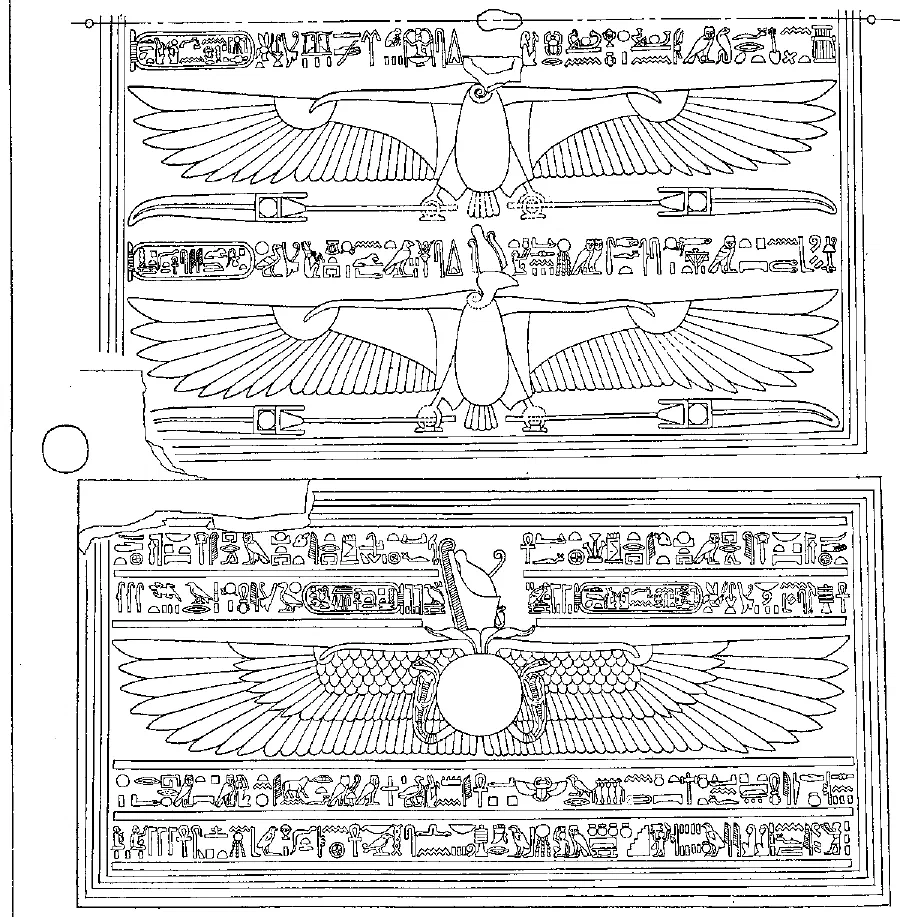
Page 427. The scene as drawn on the wall, facing p. 427 of the edition. Drawing by Otto Baum, in Junker and Winter, Das Geburtshaus des Tempels der Isis in Philä (1965) - 501p. 427, l. 1
Ḥnt-nfr.t¹ m šms(.w) wjꜣ n Rꜥ ḥrj-jb wjꜣ n Ḫprj
Hentneferet, in the train of Ra’s bark, aboard the bark of Khepri.
Note · Line 501
Khepri is the morning sun, often shown as a scarab. - 502p. 427, l. 2
dj-s ḥḥ ḥfn.w m ḥb.w-sd n njswt bjt jwꜥw …
May she grant a million and hundreds of thousands of Sed festivals to the King of Upper and Lower Egypt, the heir …
Note · Line 502
The Sed festival renewed the king’s power to rule; the first was traditionally held in his thirtieth year. - 503p. 427, l. 3
wbꜣ-n-t p.t m mḥj.t
You have opened the sky as the north wind,
- 504p. 427, l. 4
Rꜥ śrnp-f² tm.w³ dj-śn n-t jꜣw
and Ra makes people young again so that they may praise you.
- 505p. 427, l. 5
dj-s jꜣw.t n Rꜥ ns.t Jtmw (?) n sꜣ Rꜥ Pt …
May she grant the office of Ra and the throne of Atum to the Son of Ra, Ptolemy …
- 506p. 427, l. 6
Bḥd.tj nṯr ꜥꜣ nb p.t śꜣb šw.t prj m ꜣḫ.t ḫnt jtr.t šmꜥ.t
He of Edfu, the great god, lord of the sky, whose plumage is many-colored, who comes forth from the horizon and presides over the state shrine of Upper Egypt.
Note · Line 506
“He of Edfu” is Horus, the falcon god worshipped there. - 507p. 427, l. 7
dj-f wꜣś rnp.wt ꜥšꜣ.wt wr.w(t) mj Rꜥ n sꜣ Rꜥ Pt … nṯr.wj mrj mw.tj
May he grant dominion and years in great abundance, like Ra’s, to the Son of Ra, Ptolemy …, the two Mother-loving Gods.
Note · Line 507
Their mother was Cleopatra I. - 508p. 427, l. 8
Bḥd.tj nṯr ꜥꜣ nb p.t śꜣb šw.t prj m ꜣḫ.t ḫnt jtr.t mḥ.t
He of Edfu, the great god, lord of the sky, whose plumage is many-colored, who comes forth from the horizon and presides over the state shrine of Lower Egypt.
- 509p. 427, l. 9
dj-f ꜥnḫ ꜥnḫ ḏd wꜣś śnb nb n njswt bjt jwꜥw … nṯr.wj mrj mw.tj
May he grant life, life, stability, dominion and every kind of health to the King of Upper and Lower Egypt, the heir …, the two Mother-loving Gods.
- 510p. 427, l. 10
Jmn bꜣ jmj wnm.t-f
Amun, the ba in his right eye.
Note · Line 510
Here the right eye is the sun. - 511p. 427, l. 11
ḫnj⁵ jtn-f m p.t m hrw rꜥ nb (so)
His disk sails through the sky by day, day after day,
- 512p. 427, l. 12
nn śkj ꜥnḫ ḏ.t ḥr wbn ḥtp
never perishing, living forever as it rises and sets,
- 513p. 427, l. 13
śꜥnḫ (?)⁷ nṯr.w rmṯ
giving life to gods and people.
- 514p. 427, l. 14
ꜥpp wr ḫnt Nw.t nḏ.t.t
The great winged sun disk, foremost in Nut the protectress.
Note · Line 514
Nut is the sky goddess, whose body arches over the earth. - 515p. 427, l. 15
rdj n-f p.t tꜣ mj ḳd-śn
He has been given the whole of sky and earth
- 516p. 427, l. 16
ḏr wbn-f m Nwnw m (so) ḳꜣꜣ (od. ḳꜣj.t) ḳꜣj
ever since he rose shining from Nun on the high hill,
Note · Line 516
Nun is the water that existed before creation. The hill is the first land to rise from it. - 517p. 427, l. 17
Ḫmnj.w n-f m jꜣw
with the Eight praising him.
Note · Line 517
The Eight are the four pairs of primeval gods worshipped at Hermopolis.