~/sacred-texts/old-kingdom-tomb-biographies
Pepiankh’s Tomb Biography: An Egyptian Who Lived to 100
- Date
- Carved in the 6th Dynasty, under Pepi II (c. 2280–2180 BC), on the wall of Pepiankh's own rock-cut tomb at Meir
- Found
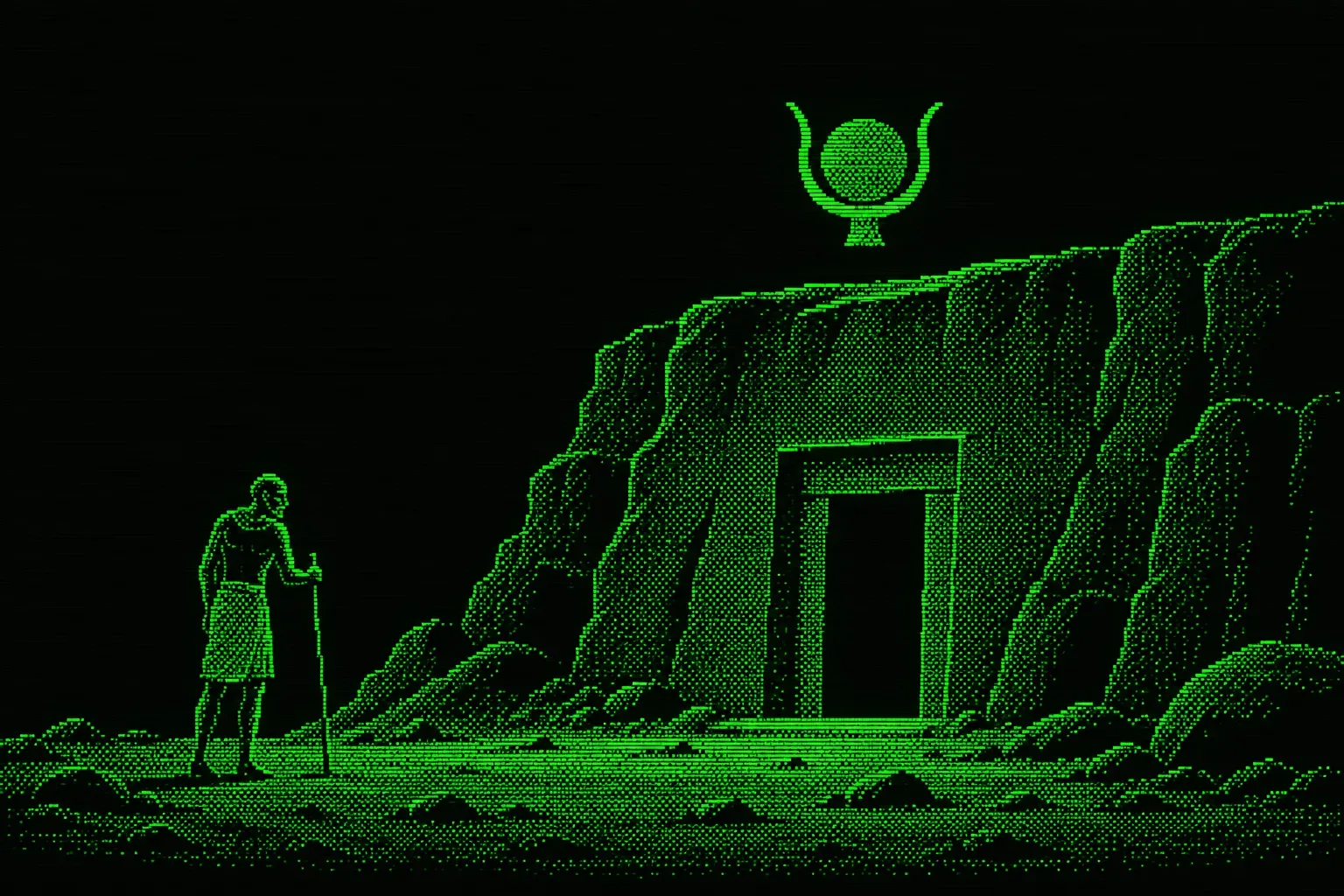
- Rock-cut tomb of Pepiankh the Middle (Meir D2), in the desert cliffs at Meir near Cusae (el-Qusiya), Middle Egypt; still in place
- Language
- Old Egyptian · Hieroglyphic
- 1
jw jri̯.n =(j) ꜥḥꜥ,w r rnp,t 100 m-m jmꜣḫ,w.pl ꜥnḫ,w ẖr,j-kꜣ.w
I spent a lifetime of a hundred years among the revered, the living, those still hale and in full possession of their ka.
Note · Line 1
The speaker is Pepiankh, a high official buried at Meir in Middle Egypt, who claims to have lived a full hundred years. - 2
jri̯.n =(j) bw ꜥꜣ n,j ꜥḥꜥ,w pn m (j)m(,j)-rʾ-ḥm,w-nṯr-n,w-Ḥw,t-Ḥr,w-nb,t-Qjs (j)sk w(j) ꜥq =(j) ḥr Ḥw,t-Ḥr,w nb,t-Qjs ḥr mꜣꜣ sj ḥr jri̯.t n =s (j)ḫ,t m ꜥ.du =(j)
The greater part of this lifetime I spent as overseer of the priests of Hathor, Lady of Cusae, going in to Hathor, Lady of Cusae, to behold her and to perform her rites with my own two hands.
Note · Line 2
Cusae (modern el-Qusiya) was the provincial town near Meir, and Hathor was its chief goddess. - 3
jnk jmꜣḫ,w-ḫr-nswt
I am one revered before the king.
- 4
jnk jmꜣḫ,w-ḫr-nṯr-ꜥꜣ
I am one revered before the great god.
- 5
jnk jmꜣḫ,w-ḫr-rmṯ,w
I am one revered among people.
- 6
jnk mr,y n,j jtj =f ḥz,y n,j mw,t =f
I am one beloved of his father, praised by his mother.
Note · Line 6
The switch to “his” is standard in these stock phrases. The speaker quotes a fixed formula about the ideal son instead of saying “my father.” - 7
jnk mr,y n,j sn,w =f
I am one beloved of his brothers and sisters.
- 8
jri̯.n =(j) ꜥḥꜥ,w nb jri̯.n =(j) m wnw,t sr (j)sk wj ḥr jri̯.t bw-nfr ḥr ḏd mrr!.t n-mrw,t zbi̯.t qd ḫr nṯr n-mrw,t jꜣw,t [...]
All the time I spent in an official's service, I was doing good and saying what is wished for, so that my character might reach the god, so that I might grow old …
- 9
jw wpi̯.n =(j) sn,wj r ḥtp =sn n rḫ =(j) mrr!.t nṯr js pw
I judged between two parties so that they went away content, for I know that this is what the god desires.
Note · Line 9
The verb for judging here is the one Pepiankh uses below for “opening up” the cemetery. Its basic sense is “to part, to open.” - 10
n-zp sḏr =(j) špt[.kj] [ḥnꜥ] [rmṯ] [nb] ḥr qd =sn jy.y ḥr =(j)
Never did I lie down at night angry with anyone over the way they had come at me.
- 11
rḏi̯.n =(j) ḥm jri̯.t jš,t =(j) n,j.t sr m jmn,t m wꜥr,t nb,t-mꜣꜥ,t m bw wꜥb m bw nfr
Now I had my official's estate set up in the West, in the district called Lady of Truth, in a pure place, in a good place.
Note · Line 11
“The West” is the land of the dead, the desert edge where tombs were cut. - 12
n js jri̯ =t(w) jm
No one had built there before.
- 13
n-zp pꜣu̯ k(y).w tp(,j)-ꜥ(,wy).w jri̯.t jm
Never had any other forebears done so there.
- 14
jnk wpi̯ wꜥr,t tn
It was I who opened up this district.
Note · Line 14
Pepiankh claims to have founded a new burial ground, which later burials would cluster around. - 15
j(w) =s r sbi̯.t ḥr =(j) m ẖr,t-nṯr
It shall serve me as a necropolis.
- 16
j(w) =s r jri̯.t mrr!.t =(j)
It shall do as I wish.
- 17
wꜣḥ.n jb =(j) (j)r =s wr,t m-m ꜥnḫ.pl
While still among the living, I set my heart greatly upon it.
Note · Line 17
“It” is almost certainly the necropolis, the cemetery on the desert edge where the tomb lies. - 18
jy.n =(j) r =s (j)sk wj jꜣw.k(j) sms.k(j) nfr wr,t (j)sk jri̯.n =(j) ꜥḥꜥ,w =(j) m-m ꜥnḫ.pl m-šwj jmꜣḫ =(j) ḫr nswt
To it I have now come, old, aged and finely aged indeed, having spent my lifetime among the living by virtue of my honoured standing with the king.