~/sacred-texts/papyrus-valençay-i
Papyrus Valencay I: Elephantine Mayor Protests a Barley Tax
- Date
- Written in the late 20th Dynasty (c. 1100–1070 BC) on papyrus by Meri-Iunu, mayor of Elephantine
- Found
- Sent from Elephantine; from the Château de Valençay collection, France
- Language
- Late Egyptian · Hieratic
- 1
[ḥzi̯] Jmn Mn-mꜣꜥ,t-Rꜥw-nḫt
May Amun praise Men-maat-Ra-nakhtu.
- 2
ḥꜣ,tj-ꜥ-n-Ꜣbw Mr-Jwnw swḏꜣ jb m ꜥnḫ-wḏꜣ-s(nb) m ḥz(w),t Jmn-Rꜥw nswt-nṯr,pl
Meri-Iunu, mayor of Elephantine, sends word in life, prosperity and health, in the favor of Amun-Ra, king of the gods.
Note · Line 2
Elephantine is an island in the Nile at Aswan. - 3
[...] [Jmn-Rꜥw-Ḥr,w-ꜣḫ,tj] jw =f wbn ḥtp n H̱nm,w St,y Ꜥnq,t nṯr.pl nb.w Ꜣbw ssnb pꜣ ꜥꜣ-n-št jmi̯ n =f ꜥnḫ-wḏꜣ-s(nb) ꜥḥꜥ(,w) qꜣi̯ jꜣ(w),t ꜥꜣ nfr jmi̯ n =f ḥz(w),t m-bꜣḥ Jmn-Rꜥw nswt-nṯr,pl pꜣy =f nb nfr m-bꜣḥ pr-ꜥꜣ ꜥnḫ-wḏꜣ-s(nb) pꜣy =f nb nfr rꜥw-nb zp-2
… to Amun-Ra-Horakhty as he rises and sets, to Khnum, Satet, Anuket and all the gods of Elephantine: Keep the tax collector in good health. Give him life, prosperity and health, a long life and a ripe and happy old age. Give him favor in the eyes of Amun-Ra, king of the gods, his good lord, and in the eyes of Pharaoh (life, prosperity and health to him!), his good lord, day after day.
Note · Line 3
The mayor asks the gods to bless the man he is writing to, the tax collector. - 4
zẖꜣ(,w) Pꜣ-ṯꜣ,w-m-di̯-Jmn n(,j) pr-dwꜣ n(,j) Jmn jwi̯
Pa-tjau-em-di-Amun, the scribe of Amun’s House of Morning, has come.
Note · Line 4
The House of Morning was a place for ritual washing and dressing. - 5
sw spr m ꜣbw r wḫꜣ{ḫ} nꜣ jt r tks.tw r pr-dwꜣ n(,j) Jmn jw =f ḏd jmi̯.tw 100 n(,j) ẖꜣr m jt j.n =f n =j jw mn ꜣḥ,t.pl ẖr,j {r}r =w
He has come to Elephantine to ask for the barley due to Amun’s House of Morning. He said, “Let a hundred sacks of barley be handed over.” That is what he said to me, though there were no fields to yield that much.
- 6
jw =f ḏd n =j jmi̯.tw wḫꜣ{ḫ} =w m-ꜥ =k ḥr wꜥ ꜣḥ,t n(,j) ḫꜣ-n-tꜣ n(,j) jw n(,j) Nby j.n =w n =j ḫr jw bw-pw =j skꜣ ꜣḥ,t n(,j) ḫꜣ-n-tꜣ m jw n(,j) Nby
He said to me, “The sacks are to be collected from you for a field of Thousand-land on the island of Kom Ombo.” That is what they told me, yet I had not cultivated a field of Thousand-land on the island of Kom Ombo.
Note · Line 6
“Thousand-land” designates a class of farmland. The demand rests on the claim that the mayor farmed a field of that kind. - 7
wꜣḥ Jmn wꜣḥ Pꜣ-ḥqꜣ mtw =w gmi̯ ꜣḥ,t ḫꜣ-n-tꜣ jw skꜣ =j sw m jw n(,j) Nby r šdi̯.t nꜣ jt m-ꜥ =j
As Amun lives, as the ruler lives, if they find a field of Thousand-land that I cultivate on the island of Kom Ombo, let them collect the barley from me!
- 8
wꜥ ꜣḥ,t n(,j) nhꜣ nmḥ,y fꜣi̯ nbw r pr-ḥḏ n(,j) pr-ꜥꜣ ꜥnḫ-wḏꜣ-s(nb) pꜣ skꜣ nꜣ nmḥ,y jw =w ꜥḥꜥ swꜣḏ pꜣy =f nbw r pr-ḥḏ n(,j) pr-ꜥꜣ ꜥnḫ-wḏꜣ-s(nb) jw bw-pw =j ẖn ꜣḥ,t jm
The field belongs to some freemen who carry gold to the treasury of Pharaoh (life, prosperity and health to him!). The freemen plow it, and they regularly pay the gold due from it into the treasury of Pharaoh (life, prosperity and health to him!). I never touched a field there.
- 9
jw =w ḏd n =j tꜣ mdw n ky ꜣḥ,t m w n(,j) Ḏbꜣ jw bw-pw =f tḫb jw =w 4 sṯꜣ,t ꜣḥ,t.pl nꜣ tḫb j:m =f jw ḏi̯ =j wꜥ r(m)ṯ wꜥ ḥtr ḥr =f jw =w skꜣ pꜣ nkt n(,j) ꜣḥ,t r gmi̯ =w j:m =f
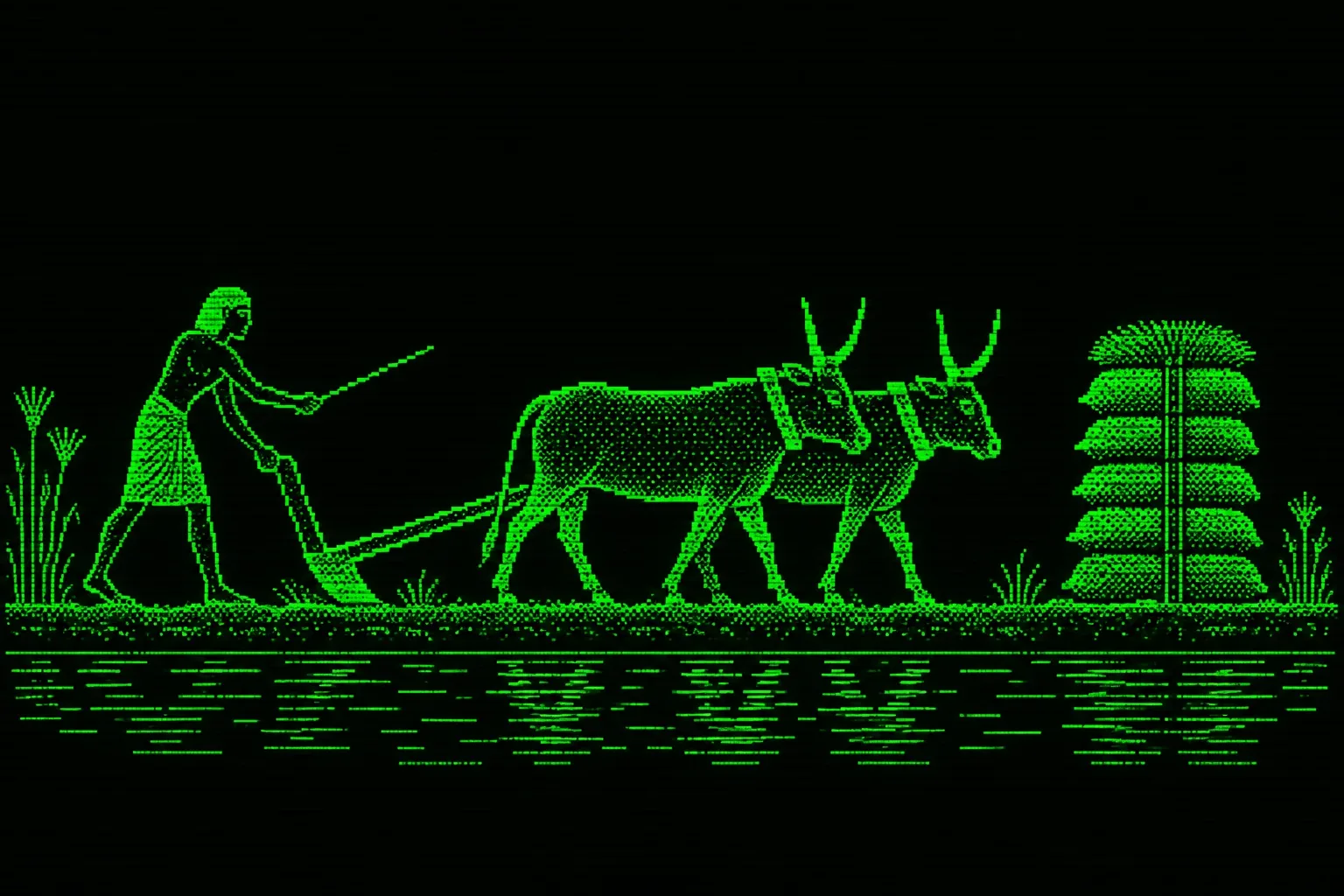
They told me about another field in the district of Edfu. The flood had not covered it: only four arouras of farmland there had been flooded. I put one man and one team of oxen to work on it, and they plowed what little farmland they found there.
Note · Line 9
The Nile flood watered the fields. Four arouras cover about 1.1 hectares, or 2.7 acres. - 10
ḫr-jr šm,w ḫpr.w jw =w jni̯ n =j 40 n(,j) ẖꜣr m jt j:m =f jw =j zꜣu̯ =w ḏrj jw bw-pw =j ẖn n wꜥ jp,t jt j:m =w
When the harvest season came, they brought me forty sacks of barley from that field. I kept close watch over them and did not touch a single oipe of the barley.
Note · Line 10
An oipe was a grain measure equal to a quarter of a standard sack, about nineteen liters. - 11
jw =j swꜣḏ =w n zẖꜣ(,w) Pꜣ-ṯꜣ,w-m-dj-Jmn jw =w m ẖꜣr 40
I handed them over to the scribe Pa-tjau-em-di-Amun, all forty sacks.
- 12
jw =j ꜥrq {r}r =w m ꜥnḫ ḏrj r-ḏd bw-pw =j ẖn n wꜥ jp,t wꜥ gs ẖꜣr j:m =w
I swore a solemn oath about those sacks: “I did not touch one oipe of it or half a sack!”
- 13
jw =j hꜣb ḏi̯.t ꜥm pꜣ ꜥꜣ-n-št
I have sent word to let the tax collector know.