~/sacred-texts/egyptian-funerary-papyri
Papyrus Louvre E 5353: Cast Apophis into the Fire
- Text
- Egyptian funerary papyri, Papyrus Louvre E 5353
- Date
- Written in hieratic in the Roman period (1st–2nd century AD) for a woman named Horankh
- Found
- Musée du Louvre, Paris (E 5353)
- Language
- Late Middle Egyptian · Hieratic
- 1
ḏd mdw hȝy sp 2 ỉn [Ỉ]npw mḏȝt nt ʿḳ r (tȝ) wsḫt nt nṯrw mȝʿtyw psḏ s m ḫww 41 ỉr.n⸗f r mȝȝ ḥrw nṯrw nb(w)
Words to be spoken: "Hail, hail!" says Anubis. Book for entering the Broad Hall of the righteous gods, for parting a man from the wrongs he has done, so as to see the faces of all the gods.
Note · Line 1
Anubis, the jackal god who embalms the dead and leads them to judgment, opens the rite. - 2
ḏd mdw hȝy ỉn Ỉnpw ỉt⸗ỉ 43 mwt(⸗ỉ) <ỉw⸗ỉ> (?) nn (sic) n-m tȝ ỉr n⸗ỉ Ỉst 44 st nn nn n ỉm
Words to be spoken: "Hail!" says Anubis. "My father, my mother, to which do I belong: the land that Isis made for me, or the place of those who are yonder?"
Note · Line 2
“Those who are yonder” is a common way of naming the dead without naming them. Anubis, who moves between both worlds, asks which is his. The wording is garbled in the papyrus. - 3
ḏd mdw hȝy ỉw⸗ỉ snsn⸗k ỉw⸗ỉ nhs bȝ⸗k mỉ ỉr n⸗ỉ ... (?)
Words to be spoken: "Hail! I make you breathe, I keep vigil over your ba, as … did for me."
Note · Line 3
The ba is the mobile, living aspect of a dead person, often shown as a human-headed bird. Giving breath back to the dead is the central aim of the late funerary “Books of Breathing”. - 4
ỉỉ.tỉ kȝ ỉmȝḫ ḫr Wsỉr
Welcome, bull revered before Osiris!
Note · Line 4
Said to the dead person, here a woman. “Bull” is an epithet of strength taken over unchanged from texts written for men and gods. - 5
snsnt<y>⸗k 58 m-ḫt ḳ(r)s⸗k snsn<⸗k> 59 ỉs-nỉw m bw dmḏ
Your two sisters are behind your mummy, and you breathe the breeze in the Place of Union.
Note · Line 5
Said to Osiris, whose sisters Isis and Nephthys mourn and guard his body. The Egyptian plays on snsnty, “two sisters”, and snsn, “breathe”. - 6
šms⸗k 63 Skr m ḥb⸗f ʿȝ
You follow Sokar in his great festival.
Note · Line 6
Sokar is the falcon god of the Memphite necropolis. At his yearly festival his sacred bark was drawn in procession, and the blessed dead hoped to walk in his train. - 7
original not preserved
[gap in the text]
Note · Line 7
The Egyptian for this line is not given here. - 8
wn ỉt⸗ỉ ḫr sȝ⸗k Ḥr sbỉ.w<⸗k> ḫr sp 4
My father is with your son Horus. Those who rebel against you are fallen. (Four times.)
Note · Line 8
Said to Osiris. “Four times” is a direction to repeat the line, once for each quarter of the world. The Egyptian uses the same sound, ḫr, for “with” and “fallen”. - 9
ỉn.ḫr.tw ṯstyw nw rn 80 ʿȝpp ỉr m ḫt ʿrw Ỉȝbt m šnḏt n 81 Sw mnḥ
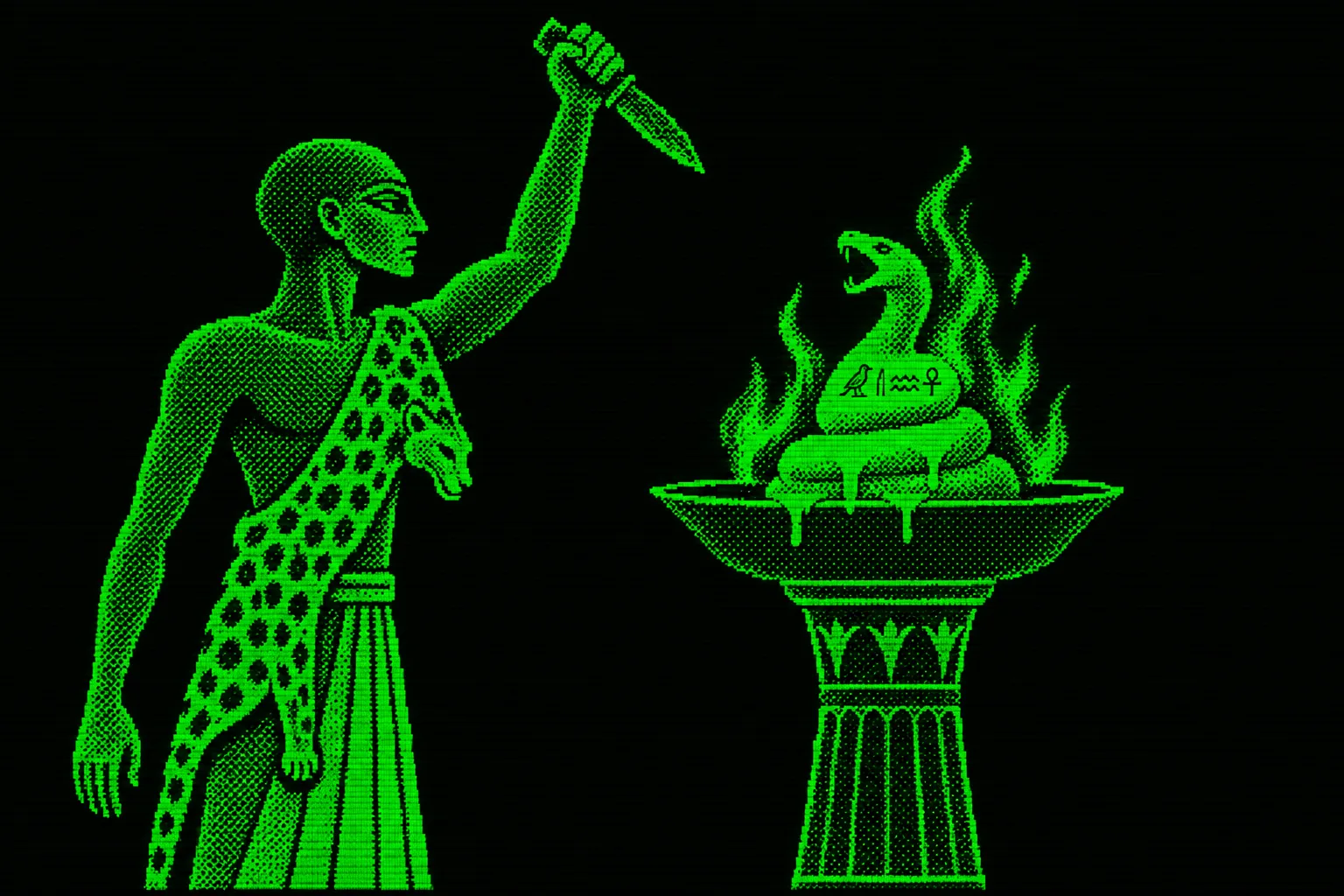
Then figures bearing the name of Apophis are to be brought, made of wood of the eastern juniper, of acacia of Su, and of wax.
Note · Line 9
Apophis is the giant serpent who attacks the sun god’s boat each night. - 10
sš rn ʿȝpp ḥr šnbt⸗f m ry wȝḏ ḥr šww n 87 mȝw 88 wrḥ m ʿḏ
Write the name of Apophis on its chest in fresh ink, on a new sheet of papyrus; smear it with fat.
- 11
rdỉt m sb n sḏt ỉw ʿm⸗sn ḥnʿ ỉr 95 twt ḫftyw 96 n mnḥ wrḥ m ʿḏ kȝ dšr
Put them into a blazing fire for it to devour them; and make an image of the enemies in wax, smeared with the fat of a red bull.
Note · Line 11
Red is the colour of Seth and of hostile forces, so the fat of a red animal marks the figure as an enemy fit for burning. - 12
šsp ḥwʿ ỉn stm ḥw ʿ sp 4
The sem-priest is to take up the hua-sceptre and strike, four times.
Note · Line 12
The sem-priest, robed in a leopard skin, performs the chief rites for the dead. - 13
ỉn.ḫr.tw twt ḫfty šʿ <m> ds sp 4 rdỉt ʿȝpp r sḏt
Then an image of the enemy is to be brought and cut with a flint knife, four times. Cast Apophis into the fire.
- 14
hȝy I smȝʿ ḫrw Wsỉr r ḫftyw⸗f smȝʿ-ḫrw Ḥwt-Ḥr 108 Ḥr-ʿnḫ r ḫftyw⸗s m-bȝḥ ḏȝḏȝt ʿȝt ỉmyw P Dp grḥ pfy n ṯs ḫwt ḫȝwt m Ḫm
Hail, Thoth, who vindicates Osiris against his enemies: vindicate the Hathor Horankh against her enemies before the great tribunal of those who are in Pe and Dep, on that night of setting out the offerings on the offering-table in Letopolis.
Note · Line 14
Horankh is the dead woman for whom the papyrus was written. - 15
ḏd mdw hȝy Ḥwt-Ḥr Ḥr-n-ʿnḫ ỉnk wʿ m nn nṯrw ḏȝḏȝt
Words to be spoken: "Hail, Hathor Horankh! I am one of these gods of the tribunal.
- 16
sḏm⸗k ḫrw⸗ỉ ỉnk s ỉmȝḫ ẖnw ỉmyw tȝ
May you hear my voice: I am a revered man among those who are in the earth.
- 17
hȝy p(ȝ) nty ỉw⸗f r mnmn rn⸗ỉ ḥr ỉr.n⸗ỉ ỉw rdỉt rn⸗f ỉw st⸗f sḫm Šw sȝ Rʿ
Hail, whoever would shift my name from what I have made, to set his own name in its place: Shu, son of Ra, is mighty!
Note · Line 17
A threat against anyone who would usurp the text or monument by replacing the owner’s name with his own. Shu, god of the air, is named as the avenger. - 18
hȝy pȝ bȝ n nȝ bȝw nty bw ... fd (?) ḏȝ ỉb⸗f ỉw (= r) wbn bȝ⸗f m-ẖnw tȝy⸗f ẖȝt nty ḥtp.tỉ m Swhȝḳn
Hail, ba of bas, whose heart never wearies of rising, whose ba is within his corpse that rests in Suhaqen!
Note · Line 18
From here the language shifts to the everyday speech of the late period. Suhaqen is an otherwise unknown place, spelled out syllable by syllable like a foreign word. - 19
mỉ n Wsỉr ỉw⸗f r p(ȝ) tȝ mȝʿ-ḫrw ỉw (= r ?) ỉr ḫȝ.tw⸗f wʿ.tw.f ỉw.f r p(ȝ) tȝ nty bw ỉr.f ptr ʿn
Come to Osiris, for he is bound for the land of vindication. Do not leave him alone, for he is bound for the land he has never yet seen.
Note · Line 19
“Osiris” here is the dead person, setting out for the realm of the dead. - 20
hȝy pr bȝ⸗f ỉrm ȝḫw ntf pȝ bȝ
Hail, you whose ba goes forth with the glorified! He is the ba.
Note · Line 20
“The glorified” are the akhs, the dead who have been transfigured into radiant, effective spirits. - 21
hȝy wbn šww ỉʿ⸗ỉ ḥr⸗k
Hail, you for whom the light rises! I wash your face.
- 22
ṯs tw ḥr nht... ( ?) n⸗k sw ỉr n⸗k ḥsmn tȝ ḥnḳt n (sic)
Raise yourself upon the sycamore … Natron, bread and beer are made ready for you, for …
Note · Line 22
The sycamore is the tree of the sky goddess, who gives the dead shade, food and water. Natron is the cleansing salt used in purification and embalming. - 23
ʿš⸗f r sȝww sbȝw nw Dwȝt sḏm⸗w nỉs⸗k
He calls to the keepers of the gates of the Duat; they hear your summons.
Note · Line 23
The Duat is the underworld, a land of guarded gates that the dead must pass. - 24
hȝy Skr-Wsỉr ỉw⸗ỉ wn rȝ⸗k ỉnk Ptḥ ỉw⸗ỉ sš rȝ⸗k ỉnk Ḥnw ỉw⸗ỉ rdỉt n⸗k ʿwy⸗k ỉnk Ỉ šsp⸗ỉ (sic) n⸗k
Hail, Sokar-Osiris! I open your mouth: I am Ptah. I unseal your mouth: I am Henu. I give you your two arms: I am Thoth. I take for you …
Note · Line 24
The Opening of the Mouth is the rite that restores speech, breath and eating to the dead. - 25
(1) hȝy ʿm(ȝ)ʿm(ȝ)t 137 wrt nn sḫm⸗t <m> bȝ pn n Ḥwt-Ḥr 138 Ḥr-ʿnḫ m pt m tȝ m Dwȝt m bw nb mr kȝ⸗s ỉm
Hail, great Devourer! You shall have no power over this ba of the Hathor Horankh, in the sky, on earth, in the Duat, or in any place where her ka desires to be."
Note · Line 25
The Devourer is Ammit, the monster (part crocodile, part lion, part hippopotamus) who crouches by the scales of judgment to eat those who fail. The ka is a person’s life force, which receives the offerings.