~/sacred-texts/late-egyptian-miscellanies-papyrus-lansing
Papyrus Lansing, Raia’s Villa: Joy Sits Within
- Date
- Copied in the late 20th Dynasty (about 1150–1069 BC) at Thebes, in the schoolbook of the scribe Wenemdiamun known as Papyrus Lansing
- Found
- Found at Thebes; acquired from Gulian Lansing in 1886; now in the British Museum, London (EA 9994)
- Language
- Late Egyptian · Hieratic
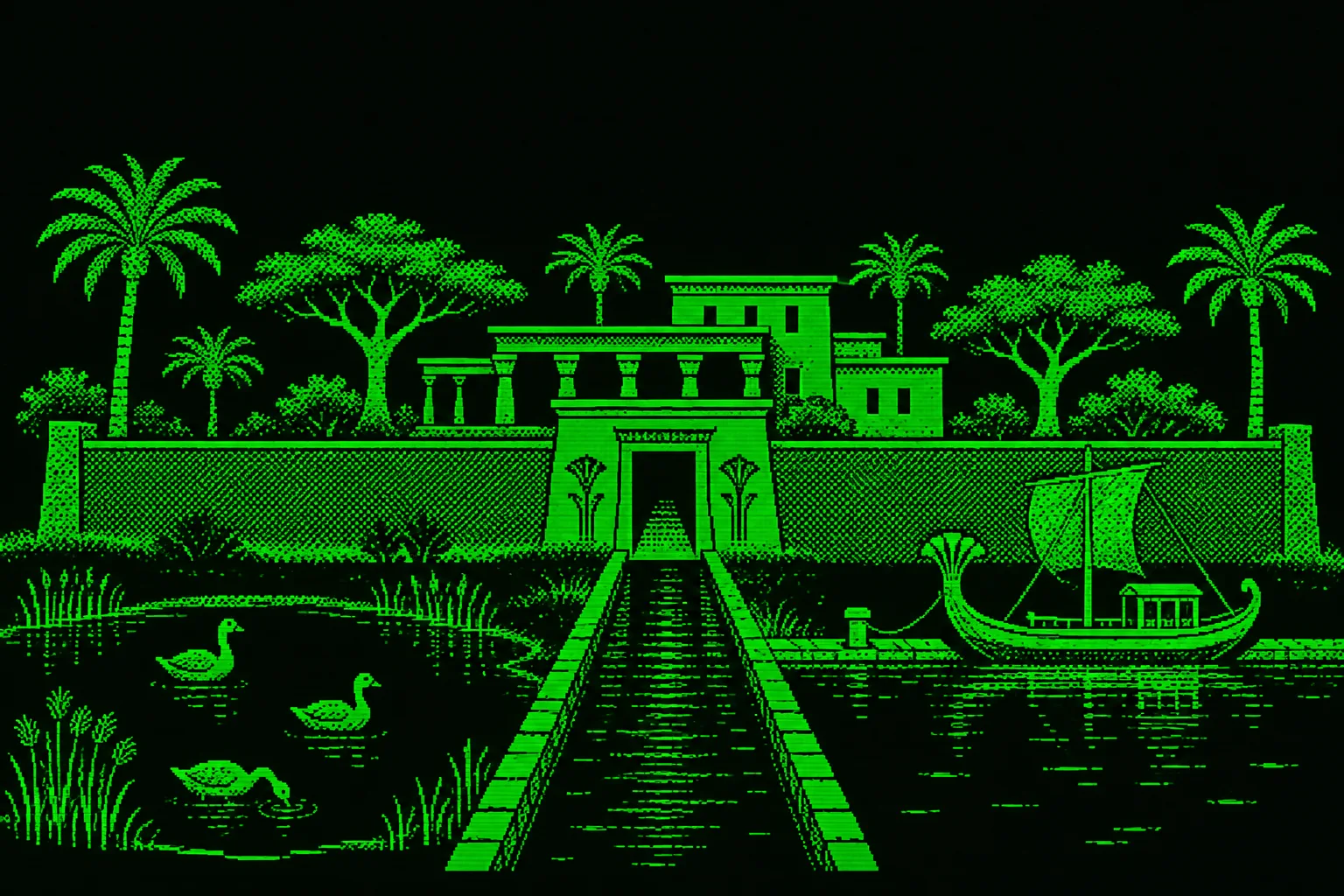
The scribe Wenemdiamun praises the estate of his teacher Nebmarenakht, called Raia, chief overseer of the cattle of Amun. He walks through it: limestone doorjambs, granaries, stables, a quay, ponds for snaring geese. At its gate you rejoice; in its halls you grow drunk. The fish outnumber the grains of sand on the bank. Then he names the true owner of the ground: It was Amun himself who founded it.
After a gap in the papyrus the pupil turns to trees and what they will give his teacher: shade, fruit, wreaths, boats and a chariot. You will grow drunk on their wines. Day after day you will be young and have more than enough.
- 1
qd Rꜥ-jꜣ wꜥ bḫn nfr jw =f ḫft-ḥr ⸮Wꜣḏ,t?
Raya built a fine fortified manor opposite Wadjet.
Note · Line 1
Wadjet here is a place in Upper Egypt. - 2
qd.n =f sw m ⸢zmꜣm⸣w sꜣt,w tj~jrʾ~rw m kꜣ,t (n) ḥḥ dgꜣ m šnw.pl 〈ḥr〉 wꜣ,t.ṱ =f nb.t
He built it at the river’s edge,
a match for a work made for eternity,
with trees planted on every side. - 3
mr šdi̯ m-bꜣḥ =f 〈nmꜥ〉 ngꜣ~ꜥ m sms hꜣn,w{t}
A canal has been dug before it,
lined with masonry, open to the beat of the waves. - 4
nn ft =tw mꜣꜣ.ṱ =f
No one will tire of looking at it.
- 5
wnf =tw ḥr sbꜣ.ṱ =f
At its gate you rejoice;
- 6
tḫi̯ =tw m wsḫ,t.pl.ṱ =f
in its halls you grow drunk.
- 7
ḥtrj.pl nfr.w.pl m jnr-n-ꜥn mtnw ṯꜣy 〈m〉 mḏꜣ,t
The fine doorjambs are limestone,
their inscriptions cut with a chisel. - 8
sbꜣ.pl nfr.w.pl 〈mḏḥ〉 m-mꜣw,t
The fine doors are newly hewn.
- 9
ḏrww mḥ m ḫsbd,t
The paint is rich in lapis lazuli.
- 10
nꜣy =f šnw,t{.du}.pl ꜥpr m nfr,pl gꜣ~wꜣ~⸮wt?.ṱ m wꜣḥ,t
His granaries are stocked with grain,
packed with the harvest. - 11
mḥwn hꜣm.w.pl ẖrj rʾ.pl
The aviary and the poultry yards are full of ra-geese.
Note · Line 11
Ra and ser are Egyptian names for geese; both have been identified as greylags. - 12
mḏ,wt.pl mḥ m jwꜣ.pl
The cattle pens are full of longhorns.
- 13
sš sms ẖrj sr{j,t}.pl
Ser-geese sit on the brooding nests.
- 14
ssm,t.pl m šmmy,t.pl
Horses stand in the stables.
- 15
sk,tj.pl ḏꜣ,y.pl ẖnw{,t}.pl-jḥ m-mꜣw,t mjnj 〈m〉 tꜣy ={st} =〈f〉 mr,t
New sketi-boats, ferries and cattle barges
lie moored at his quay. - 16
jwi̯ nmḥ.w.pl wr.w.pl mj nḏs.w.pl r ꜥnḫ m swꜣ =f
Common folk come, great and small alike,
to live near him. - 17
kꜣ{q} =k mn bꜥḥi̯{.t} ẖrj rʾ~sf n jy nb ḫr =k
Your provisions never fail. They overflow
with fish and fowl for everyone who comes to you.Note · Line 17
Here the speaker turns to Raya himself. - 18
pẖr =tj m ⸮jw?.pl n mꜣw,t qꜣy,t.pl nn rʾ-ꜥ =sn
You can roam over islands of new land
and high fields without end.Note · Line 18
The Nile laid down fresh silt, forming islands that could be sown with grain. - 19
ꜥšꜣ{.t} st m nfr,pl r mw sḥmy j:ḫpr m-ḥꜣ,t
They hold more grain than there was water
when the flood first rose. - 20
mjnj{ꜣ} =tw qw~jrʾ.pl r mr,yt ={st} =〈f〉 r s{b}ḥ〈b〉i̯ nꜣ šnw,t.pl 〈m〉 ꜥḥꜥ.pl qn,w nn rʾ-ꜥ =sn n pꜣ nb-n-Wꜣs,t
Dockhands are put ashore at his quay
to make the granaries festive with heap upon heap,
heaps without end for the Lord of Thebes. - 21
pꜣy ={st} =〈f〉 jmn,t{t}〈j〉 m swn,w n grg
On his western side lies a pond for setting snares.
- 22
rʾ.pl m tnw nb
Ra-geese gather there in any number.
- 23
ꜥ n mḥ,w r-šꜣꜥ〈-m〉 ḫpr
A hunter’s ground since the world began.
- 24
wꜥ m nꜣy =f swn,w wr sw m rm.w.pl 〈r〉 š
One of his fishponds alone
holds more fish than a lake. - 25
tꜣy =f ꜥḫ,w(t) mj qbḥ
His akh-birds are as plentiful as waterfowl.
Note · Line 25
The akh-bird may be a swan. - 26
rš,wt ḥmsi̯.ṱ m-ẖnw =f
Joy sits within.
- 27
nn ḏd =tw n =f ḥꜣ~n~rʾ n =j
No one there says, “If only I had some!”
- 28
j~hꜣy{,t}.pl qn,w m swꜣ ={st} =〈f〉 w-jḥ,pl n nꜣ jḥ.pl ꜥnḫ.pl ꜥšꜣ{.t}.pl jb.pl kꜣ~rʾ~sw wnḏ,w.w.pl qn,w sbḥ{,t}.pl ⸮s〈q〉b{q}?.pl ꜥšꜣ{.t}.pl sm,w wꜣḏwꜣḏ 〈m〉 šm,w mj pr,t
All around him are stalls in plenty
and pens for the cattle,
bucks in plenty and frisking kids,
shorthorns in plenty, bellowing,
shelters in plenty,
and fodder as green in summer as in winter.Note · Line 28
“Summer” is the harvest season; “winter” is the growing season that follows the flood. - 29
wḏ.w.pl qn,w m nꜣy ={sn} =〈f〉 ẖn~nj~nj,t jn.pl šnꜥ.pl ḏꜣ~sꜣ~sw.pl
In his pools are perch in plenty,
Nile perch, shena-fish and djeses-fish. - 30
ꜥšꜣ{.t} rm.w.pl r šꜥ{,t} n wḏb{,t}
The fish outnumber the grains of sand on the bank.
- 31
nn jni̯.tw 〈pḥ,wj〉 =w
no one can tell the end of them.
- 32
jn Jmn grg sw ḥr ḏs =f
It was Amun himself who founded it.
Note · Line 32
The estate is Raja’s, but the ground belongs to Amun. - 33
sw 〈m〉 sꜣt,w.ṱ =f m mꜣꜥ,t
It is truly his ground.
- 34
[...] jw =k ḥmsi̯ m nꜣy =sn ḫꜣ~bw~s jw =k (ḥr) wnm nꜣy =sn dqr
… as you sit in their shade and eat their fruits.
- 35
jry =tw n =k mꜣḥ.w.pl m nꜣy =sn sꜣ~bꜣ~jrʾ.pl
They will weave you wreaths from their branches.
- 36
tḫi̯ =k m nꜣy =sn jrp.w.pl
You will grow drunk on their wines.
- 37
mḏḥ(.tw) n =k sk(,tj).y.pl m nꜣy =sn ꜥš.pl wr~jrʾ~rw~jꜣ m nꜣy =sn ṯꜣ~gꜣ.pl
From their firs they will build you sketi-boats, from their tjeg-wood a chariot.
Note · Line 37
Sketi is the name of a type of boat; tjeg is a timber from Asia. - 38
jw =k rnpj.tj bꜥḥi̯{.t}.tj rꜥ-nb
Day after day you will be young and have more than enough.
- 39
kꜣ n Jmn ḫr =k Rꜥ-jꜣ pꜣ (j)m(,j)-r(ʾ)-jḥ,pl-wr-n-Jmn [...]
Amun’s ka is with you, Raja, chief overseer of Amun’s cattle …
Note · Line 39
The ka is the vital power of a god or a person.