~/sacred-texts/papyrus-lansing-late-egyptian-miscellanies
Papyrus Lansing, Praise of the Teacher: You Are an Ibis by Nature
- Date
- Copied in the late 20th Dynasty (about 1150–1070 BC) as a scribal schoolbook, in hieratic on papyrus, at Thebes
- Found
- From Thebes; acquired in 1886 from the collection of the Rev. Gulian Lansing; now in the British Museum, London (EA 9994)
- Language
- Late Egyptian · Hieratic
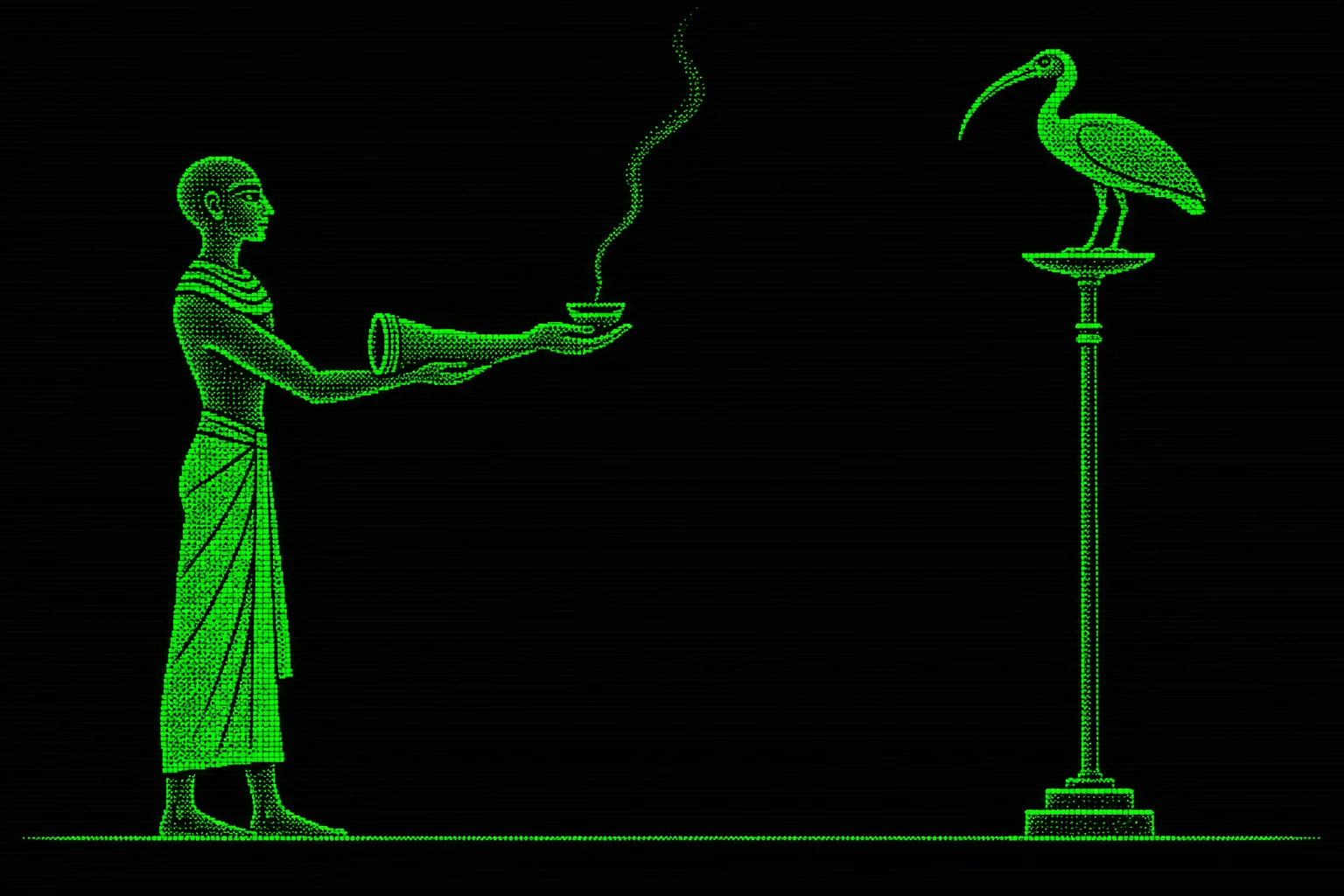
The pupil Wenemdiamun speaks to his teacher, the royal scribe Nebmare-nakht, in a litany of “You are”. First comes the priest, censer in hand before Amun, Ptah, Mut and Khonsu: You are a god’s father, a keeper of secrets. Then the mind: You judge hearts; you are an ibis by nature.
The praise turns to wealth: full granaries, horse teams, boats and singing crews, servants pouring strong beer. The teacher’s mouth is clean: You have loathed dirty talk since the day you were born. The text breaks off as he provisions the king’s Sed festivals and sets the Nine Bows under the king’s feet.
- 1
[...] mntk ꜥn ḏr,t{.pl} ẖrj sḥtp,y r-ḥꜣ,t nb-nṯr,pl r-tnw ḫꜥi̯ =f
… Your hand is graceful on the censer
before the lord of the gods whenever he appears.Note · Line 1
A pupil is praising his teacher, who also holds priestly office. A god could “appear” when priests brought his image out in procession. - 2
mntk jt-nṯr{.pl} ḥr,j-sštꜣ,w
You are a god’s father, a keeper of secrets.
Note · Line 2
“God’s father” is a priestly title. The secrets are rites and sacred knowledge entrusted to the priest. - 3
ṯꜣy =k ḫw ḥr wnm,j =k sšr-nsw 〈ḥr〉 jꜣb,j =k
You have taken the fan in your right hand,
the royal linen in your left. - 4
[...] ꜥ n Šw m ḫfꜥ =kwj 〈r〉 sꜣḫ ⸢nb⸣ =⸢k⸣
… The arm of Shu is in your grasp
to transfigure your lord.Note · Line 4
Shu is the god who holds up the sky. - 5
mntk sm⸢{.⸮pl?}⸣ ⸢šps,j⸣ ⸢m⸣ ⸢pr⸣ Ptḥ
You are a noble sem-priest in the temple of Ptah.
Note · Line 5
A sem-priest performed rites that restored the powers of a divine image or of the dead. - 6
ꜥrq tw m sštꜣ nb m ḥw,t-sr
You know every mystery in the House of the Prince.
Note · Line 6
The House of the Prince was a sanctuary at Heliopolis, associated with the tribunal of the gods. - 7
mntk zmꜣ-tꜣ ⸮n? Kꜣ-mw,t≡f wr-mꜣ,pl-Rꜥ-m-Wꜣs,t s[[mꜣꜥ]] n ⸮ꜥb,t? =f
You are the funerary priest of Kamutef,
chief seer of Ra in Thebes,
the one who sets his offering in order.Note · Line 7
Kamutef means “Bull of His Mother”: the god begets himself. “Chief Seer” is a high priestly title in the cult of the sun god Ra. - 8
mntk pd nmt.pl hꜣ(w) Skr ⸢stꜣ⸣ tꜣ-mrj.pl r nb =k ẖrj nḫnḫ
You take long strides on the day of Sokar’s feast;
flail in hand, you draw the Egyptians to your lord.Note · Line 8
Sokar was a god of the burial ground. His feast included a procession in which his sacred boat was hauled along on a sledge. - 9
mntk sṯnj ꜥ.du ẖrj ḥs,w jri̯ qbḥ snṯrj njs ḥkn,w.pl
You raise both arms with the libation jar,
offer water and incense,
and cry out praises. - 10
mntk ꜥn ḏr,t{.pl} 〈⸮ḥr?〉 wḏb{.w.pl}-(j)ḫ,t,pl dp,j njs 〈ḥkn,w〉 m jmn,y(t)
Your hand is graceful as the offerings make their rounds;
you are first among those who cry praise at the perpetual offering.Note · Line 10
An offering could pass from one altar to another before the food went to the priests. - 11
mntk ḥpt wḏꜣ,t n Mw,t nb,t-p,t 〈m〉 hꜣw ((dp,j)) n ẖni̯ =〈st〉 m-ẖnw ꜣšr,w
You clasp the wedjat-eye for Mut, Lady of Heaven,
on the first day she is rowed on the Isheru.Note · Line 11
The wedjat is the eye of Horus made whole after injury. At Mut’s temple in Karnak, her image traveled by boat on the sacred lake, the Isheru. - 12
mntk stꜣ mw n Ḫns,w-m-Wꜣs,t r h(ꜣw) n wḏb,w-(j)ḫ,t.pl m ḥw,t-sr
You bring water for Khonsu-in-Thebes
on the day the offerings make their rounds in the House of the Prince. - 13
mntk ꜥmꜣm m sḫr.w.pl mnḫ ḏd.w.pl pd ḥr m jꜣd,t nb(.t)
You are versed in affairs and excellent in speech;
your gaze ranges far at every moment. - 14
j:jri̯.t =k ḫpr
What you do comes to pass.
- 15
mntk wḏꜥ jb.pl hꜣb,w mj-qd =k
You judge hearts; you are an ibis by nature.
Note · Line 15
The ibis is the bird of Thoth, god of writing and reckoning. The heart was the seat of thought and judgment. - 16
wḥꜥ tw mj sḫr,w nb mj jrw sḏm
You can unravel any matter,
like the gods Sight and Hearing. - 17
mntk nḫ nfr n smd,t =k
You are a fine protector of those who serve you.
- 18
šb.pl =k ꜥꜣy{.t} wdn mj ḥꜥpj-wr
Your meals are ample,
abundant as the Nile in high flood. - 19
mntk ꜥšꜣ{.t} kꜣ rḫ sšm,t r bw-nb mri̯.n =k mj yw~mꜥ ṯtf
You have food in plenty and know how to apportion it
to whomever you wish, like a sea overflowing. - 20
mntk sr ⸢m⸣ ⸢qb⸣ zꜣ ḥsj.y.pl mr{w,t} n bw-nb ẖrj ḥs,t n nsw
You are a high official of calm temper, a son of men held in honor,
loved by all, favored by the king. - 21
mntk sꜥꜣ qꜣj ḏr msy,t =kwj
You have been noble by nature since the day you were born.
- 22
rwr,y(t).ṱ =k bꜥḥi̯.t ẖrj ḏfꜣ,w
Your hall overflows with provisions.
- 23
mntk tj~n~rʾ m sḫ,t.pl mḥ šn,t{j.du}.pl
You are a strong man in the fields;
you fill the granaries. - 24
dmj n =k wꜣḥ(,yt) h(rw) n ms,w =kwj
The harvest was yours on the day you were born.
- 25
mntk sꜥꜣ ḥtrj.pl wbḫ{.t} ḥtꜣ.w.pl
You have splendid teams of horses
and shining sails. - 26
nꜣy =k sk,tj.pl ḥr mt{,t} mj ḫnm,t
Your sketi-boats on the floodwaters are like jasper.
- 27
mntk ꜥšꜣ{.t} jz,t.pl ꜥrq m ẖni̯
You have many crews, skilled at the oar.
- 28
nꜣy =w ṯs.y.pl nḏm m fꜣy ⸮wꜣḥ?
Their verses are sweet
as they lift and dip their oars. - 29
mntk dns sḫr,w hꜣn wšb.t
You are measured in counsel
and give heed to an answer. - 30
bw,t =k ḫnw dj-zp-2 ḏr ms,yt =kwj
You have loathed dirty talk since the day you were born.
- 31
mntk ꜥn ḥꜥ,t =k hru̯ jmw
You are fair of body and gentle of temper.
- 32
mrw,t.ṱ =k m ẖ,t-nb(,t) mj ḥꜥpj-wr
Every breast holds love for you as it does for the Nile in full flood.
Note · Line 32
The yearly flood watered the fields and renewed their soil. - 33
mntk stp{pw} ṯs{js}.w.pl ꜥrq m ḏd.ṱ =w
You have choice sayings and the skill to speak them.
- 34
j:ḏd(.ṱ) =k nb ḥr ꜥqꜣ =f
Whatever you say is exactly right.
- 35
bw,t =k js{t}f(,t)
You abhor what is wrong.
- 36
mntk sꜥꜣ ḥmsi̯ m-ẖnw rwr,yt.ṱ =k
You sit in state in your audience hall.
- 37
nꜣy =k sḏm.wy.pl-ꜥš (ḥr) wšb.t ꜣs (ḥr) wḏḥ ḏsr.yw.pl mj ḏr,t ⸮stꜣ? ḏr,t
Your servants answer at once
and pour out strong beer as one hand draws another.Note · Line 37
The Egyptian word for a servant here means “one who hears the call.” - 38
p(tr)j tw nb m ḥb.pl ẖrj bw-nfr
Everyone who sees you is in a festive mood, full of good cheer.
- 39
mntk ꜣḫ n nb =f sꜥnḫ smd,t
You are a man who serves his lord well and provides for the staff.
- 40
pry nb m rʾ =k h(ru̯) 〈ḥr〉 ḥꜣ,tj.pl
All that comes from your mouth gladdens hearts.
- 41
mntk ḥn{n}k ꜥš mḥ 〈ꜥj〉 mry ẖrj ḥwi̯ ⸮{j}〈b〉(ḥs)?.pl m mꜣꜥ wꜥb
You offer the beer jar and fill the bowl;
you are dear to the man who drives the calves at the pure offering. - 42
mntk nḥb ḥbs.pl 〈n〉 jty (ꜥnḫ-wḏꜣ-snb) (ḥr) ḏi̯.t pḏ,t-9 ẖrj rd.du =f swḏꜣ mšꜥ =f [...]
You provision the Sed festivals for the king—life, prosperity, health!—
set the Nine Bows beneath his two feet
and keep his army safe …Note · Line 42
The Sed festival was a jubilee that renewed the king’s power. The Nine Bows stood for Egypt’s traditional enemies and were often depicted beneath the king’s feet.