~/sacred-texts/late-egyptian-miscellanies
Papyrus Lansing, the Peasant’s Lot: He Is Beaten Till He Breaks
- Date
- Copied in the late 20th Dynasty (about 1150–1070 BC) on Papyrus Lansing, a Theban school manuscript in which the royal scribe Nebmare-nakht lectures his pupil Wenemdiamun
- Found
- From Thebes, Egypt; now in the British Museum, London (EA 9994)
- Language
- Late Egyptian · Hieratic
A teacher lectures his pupil on the field hand’s year. The flood rises; the man cuts tools all day, and He spends the night twisting ropes. His plow team strays, and after three days he finds it in the mud, the hides gone: the jackals had eaten them. He begs another team and sows with borrowed barley. He sees no green leaves.
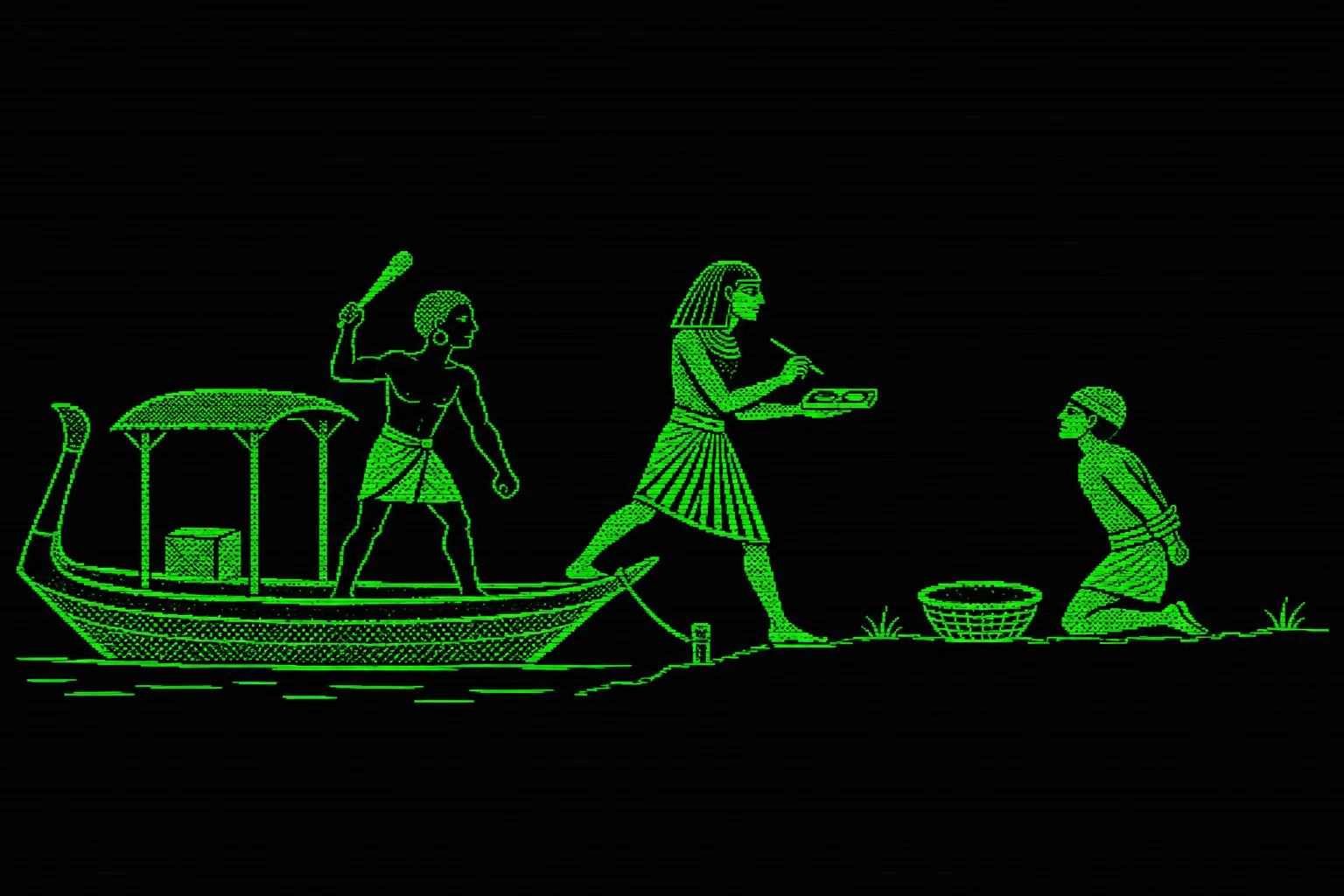
Then the tax scribe moors at the embankment. Behind him are attendants with sticks and Nubians with clubs. “Hand over the grain!” But there is none. He is beaten till he breaks, then bound and left in the well. His wife is tied up in front of him, his children are in fetters, and the neighbors run. The teacher’s verdict: If you have any sense, be a scribe!
- 1
[...] ḥnꜥ-ḏd
… And further:
- 2
mj ={j} wḥꜥ =((j)) n =k qꜣj ꜥḥ,wtj tꜣj k.tj jꜣw,t nḫt((.tj))
Come, let me tell you what it is to be a field hand. Here is another hard trade.
Note · Line 2
A scribe is urging his pupil to stick to his writing. The field hand’s lot is a warning. - 3
[...] pꜣ mw mḥ
… the water stands high.
Note · Line 3
This is the annual Nile flood. - 4
tḫb.ṱ =f ⸢⸮m?⸣ ⸢⸮sp{r}〈,t〉?⸣
It soaks into the bank.
- 5
sw ꜥḥꜥ ḥr sdbḥ[,t].pl.ṱ =f
He tends to his tools.
- 6
wršu̯ =f 〈ḥr〉 šꜥd ḫꜥ,w.pl n skꜣ
He spends the day cutting tools for tilling the soil.
- 7
sḏr =f 〈ḥr〉 šꜣšꜣ nwḥ.w.pl
He spends the night twisting ropes.
- 8
j:jri̯ =f tꜣy =f wnw,t n mtr,t n bꜣk,w n pꜣ ꜥḥ,wtj
Even his noon hour goes to a field hand’s work.
- 9
jry =f sdbḥ,t.pl.ṱ =f r pri̯ r sḫ,t.pl mj mꜥḥꜣ{.pl} nb{.t}
Like any other fellow, he makes his gear for going out to the fields.
- 10
tꜣ ꜥḥ,t ꜥḫm.ṱ wꜣḥ.ṱ m-bꜣḥ =f
The field lies soaked before him.
- 11
sw pri̯.y r šdi̯ ḥtrj =f
He has gone out to fetch his team.
Note · Line 11
The team is a pair of oxen for the plow. - 12
hꜣw.pl qn,w ḥr swꜣi̯ 〈ḥr〉 nn jw =f m-sꜣ pꜣ mjnj
Many days go by like this, with him trailing after the herdsman.
- 13
šdi̯ =f pꜣ ḥtrj
He gets the team,
- 14
sw jwi̯.w ẖrj-r =f
and back he comes with it.
- 15
jry =f n =f ꜥ m sḫ,t.pl
With it he cuts a furrow in the fields.
- 16
ḥḏ-tꜣ sw pri̯.y r sdwꜣ
At first light he is out in the fields for the morning.
- 17
bw gmi̯.n =f sw ḥr s,t(.ṱ) =f
He did not find the team in its place.
- 18
jry =f hrw 3 n wḫꜣ =f
He spent three days looking for it.
- 19
gmi̯.n =f sw m tꜣ ꜥmꜥm,t
He found it in the mud.
- 20
bw gmi̯⸮.n? =f dḥrjw.pl jm =sn
He found no hides on the beasts:
- 21
wšꜥ sn nꜣ wnš.w.pl
the jackals had eaten them.
- 22
sw pri̯.y pꜣy =f d(ꜣj,w) m ḏr,t =f r dbḥ n =f ḥtrj
Out he goes, his linen kilt in his hand, to beg a team for himself.
- 23
spr =f r tꜣy =f ꜥḥ,t
He reached his field
- 24
gmi̯.n =f 〈st〉 pttj
and found it trampled.
- 25
jry =f nw r ꜥḥꜥ (ḥr) skꜣ jw tꜣ 〈ḥfꜣ,t〉 m-sꜣ =f
It takes him time to start plowing, with the worm following behind him.
- 26
ꜥḏn.n =f tꜣ pr,t m ḫꜣꜥ 〈r〉 jwtn
He used up the seed scattering it on the ground.
- 27
bw p(t)j =⸢f⸣ gꜣ~bw~jꜣ.pl wꜣḏwꜣḏ
He sees no green leaves.
- 28
jry =f swst m 3 skꜣ m jt n wšb,yt
It takes him three plowings with borrowed barley.
- 29
tꜣy =f [ḥm,t] hꜣy.tj m šꜣ~wꜣ~tj,t.pl
His wife has gone down among the merchants.
- 30
bw gmi̯ =st nkt r ḏbw
She can find nothing to pay them with.
- 31
jw pꜣ zẖꜣ,w (ḥr) mjnj{ꜣ} ḥr mr,yt{.pl} jw =f (ḥr) spẖr šm,w jw ꜥꜣ.pl m-sꜣ =f ẖrj šꜣbd,t,pl nḥs,j.pl ẖrj bḏn,w
The scribe moors at the embankment and records the harvest yield. Behind him are attendants with sticks and Nubians with clubs.
- 32
jw =tw 〈ḥr〉 〈(ḏd)〉
They say,
- 33
jmm.tw jt
“Hand over the grain!”
- 34
nn-wn
But there is none.
- 35
ḥwi̯(.tw) =f m prš jw =f snḥ ḫꜣꜥ m tꜣ šd,t
He is beaten till he breaks, then bound and left in the well.
- 36
tꜣḥ.n =f m ḏꜣbqbq jw tꜣy =f ḥm,t snḥ.tj m-bꜣḥ =f
He goes under headfirst, his wife bound before his eyes.
- 37
nꜣy =f ẖrd.w.pl m m~ḫꜣ~j.w.pl
His children are in fetters.
- 38
nꜣy =f sꜣḥ.pl-tꜣ (ḥr) ḫꜣꜥ =w
His neighbors abandon them.
- 39
st (ḥr) wꜥr{d}〈.t〉
They flee.
- 40
grḥ
The end.
- 41
bn nꜣ jt
No grain!
- 42
jr wnn jb =k jri̯ zẖꜣ,w
If you have any sense, be a scribe!
Note · Line 42
Here the teacher turns from the farmer’s plight to address his pupil. - 43
jry =k swḏꜣ jb =k r ꜥḥ,wtj
You’ll give your heart more ease than a field hand can.
- 44
bn jw =k rḫ r jri̯ =f
You wouldn’t know how to do his work.
- 45
jḫ rḫ =k sw [...]
Know this, then …