~/sacred-texts/late-egyptian-miscellanies
Papyrus Anastasi IV: Preparing for Pharaoh’s Arrival
- Date
- Copied in the 19th Dynasty (reign of Seti II, c. 1200 BC) on Papyrus Anastasi IV
- Found
- British Museum, London (EA 10249)
- Language
- Late Egyptian · Hieratic
In these two model letters, a senior official instructs a subordinate charged with making the harbor ready and provisioning the palace before Pharaoh arrives. The first warns him—Look to it! Take heed! Be on your guard!—and tallies baskets, tens of thousands of cakes and loaves, dried meat, tripe, roasted geese, rams, fruit, honey, and firewood.
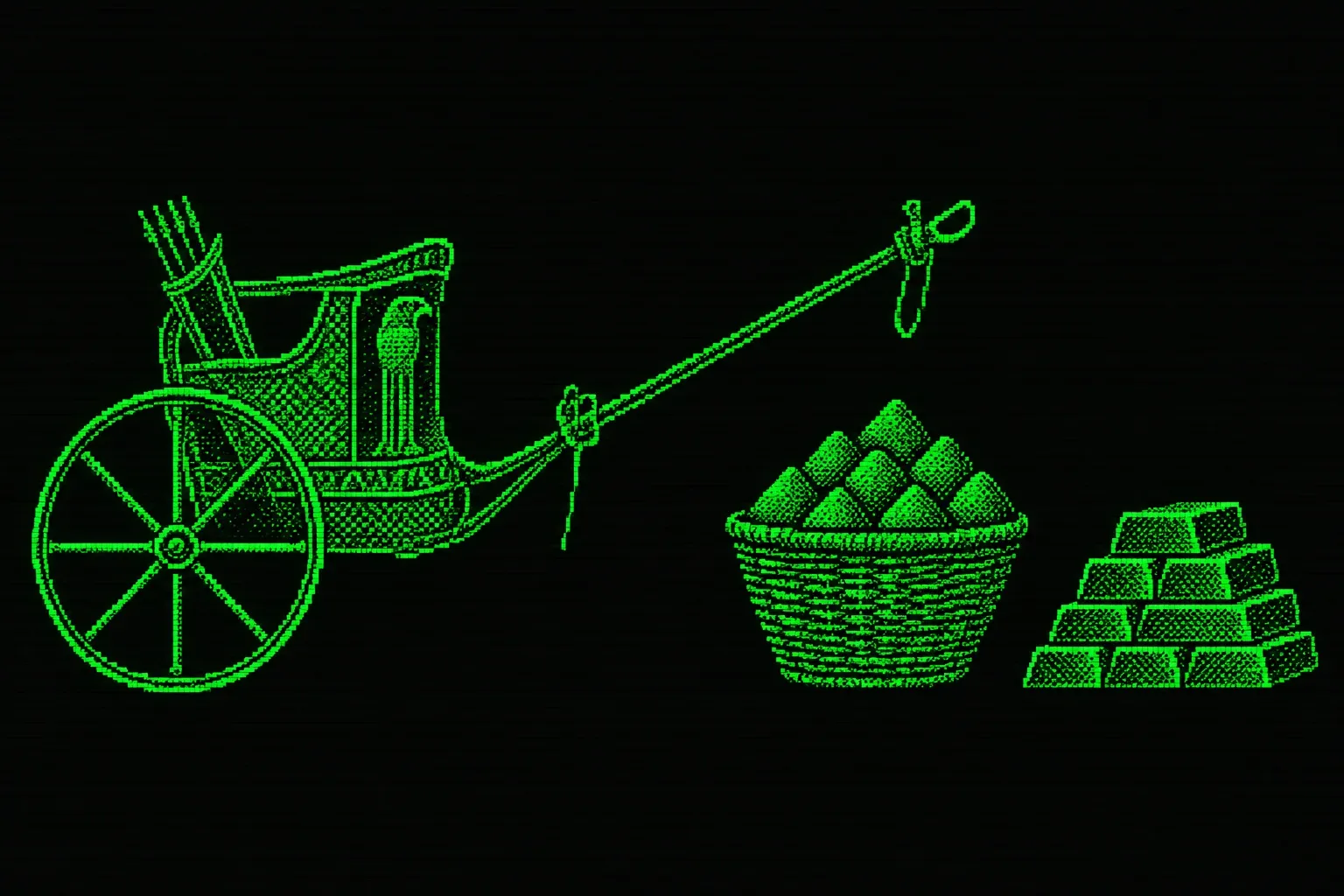
The second widens to imperial trade and tribute: oils from Cyprus, Hatti, Babylonia, and the Levant to anoint his army and his chariotry; fish from across Egypt; Nubian fan-bearers and Canaanite servants; gold-fitted chariots; copper bars and tin ingots carried by Cypriots; and foreign horses led by princes bowed beneath the Window of Appearance.
- 1
[...] ḥnꜥ-ḏd jḫ ḏi̯ =k ḥr =k r ḏi̯.t grg =tw r-ḥꜣ,t Pr-ꜥꜣ ꜥnḫ-(w)ḏꜣ-s(nb) pꜣy =k nb nfr m-šs ḏrj mnḫ
… Further, please see that preparations for the arrival of Pharaoh (life, prosperity and health!), your good lord, are made with care, skill and diligence.
Note · Line 1
This is a model letter of instruction. The wish for life, prosperity and health is the customary blessing that follows Pharaoh’s title. - 2
m-ḏy.t ṯꜣy =tw n =k
Do not let anyone reproach you.
- 3
ptrj n =k bꜥ zꜣw tw
Look to it! Take heed! Be on your guard!
- 4
jmi̯ =k bgꜣ.y
Do not slacken.
- 5
r rḏi̯.t rḫ =k pꜣ n,tj nb jw =k r ḏi̯.t grg.tw =f
So that you may know all that you are to have made ready:
- 6
jmm jri̯.y.tw sdbḥ{,t} nꜣ jri̯.w-ḥtp m gꜣšj js~jrʾ
Have the basket makers supplied with reeds and rushes.
- 7
m-mj,tt mtw =k ḏi̯.t jri̯.y.tw sjd 10 n ḏdm,t ꜥgꜣ~y~nꜣ n 〈mz〉 100 ḥtp n mꜥk.w 500
Likewise, have them make 10 trays for heaped portions, 100 ring stands for bouquets and 500 baskets for extra rations.
- 8
r rḏi̯.t rḫ =k pꜣ nkt n,tj jw =k r jri̯ =f ḥr-rʾ =sn
So that you may know what you are to prepare for these containers:
- 9
tʾ nfr ḥr,t ___ n ṯw~rw~tj 1000 tʾ nfr j~bꜣ~štw 10000 tʾ nfr tw~tw 2000 tʾ nfr hꜣ~tj,t 1000 tʾ nfr pꜥ,t 1000 tʾ sšr,t 1000 krʾštw kꜣ~mꜥ~ḥw,t 1000 gꜣ~tj,t 1000 〈ḫ〉ꜣ~rw~pw~sꜣ,t 10000 tʾ šbn n ꜥꜣm,w.pl 1200
Fine bread: 1,000 sweet heret cakes of fine wheat flour; fine bread: 10,000 ibeshet biscuits; fine bread: 2,000 tet pastries; fine bread: 1,000 hati pastries; fine bread: 1,000 pa’at cakes; bread: 1,000 sesheret pastries; kyllestis bread: 1,000 kameh loaves; 1,000 gat loaves; 10,000 kharpes cakes; 1,200 assorted loaves of the peoples of western Asia.
Note · Line 9
The list names distinct kinds of baked goods, though for most we no longer know what distinguished one from another. - 10
šꜥy ḥtp 100 šꜥy mḥ,tt 70 šꜥy jp,t 2000 rʾ~ḥw~sw ḥtp 100 ꜥgꜣ~sꜣ 2000
Shay cakes: 100 baskets; shay cakes: 70 mehet bowls; shay cakes: 2,000 oipe measures; rehes cakes: 100 baskets; agas cakes: 2,000.
Note · Line 10
An oipe held about 19 litres. These cakes are reckoned by volume rather than counted one by one. - 11
jwf šwi̯ ḥtp 100 jri̯ n dgꜣy,t 300 mꜥ~ẖ,t ḏr,t 250
Dried meat: 100 baskets, making 300 degayt cuts; tripe: 250 handfuls.
- 12
j~jr〈ṯ,t〉 gs~jrʾ 60 smy gꜣ,t 90
Milk: 60 geser measures; soured milk: 90 gat measures.
- 13
wꜥḥ gꜣy 30 ḥw~qw~qw mḥ,t 100 sm,w ḏdm,t 100
Tiger nuts: 30 gay bowls; heqeq fruit: 100 mehet bowls; greens: 100 heaps.
Note · Line 13
Tiger nuts are the small, sweet tubers of a sedge. - 14
tw~rʾ~pw sṯi̯.t 10 tw~rʾ~pw mgꜣ~jrʾ 40 j~jrʾ~y 70
White-fronted geese: 10 plucked; white-fronted geese: 40 roasted; rams: 70.
- 15
jꜣ~jr,t pd~jrʾ 50 jwn~npl~jrʾ~hmꜣꜣ pd~jrʾ 60 d(ꜣ)b mḫꜣ 300 d(ꜣ)b kꜣ~jrʾ~ḥw~tj 20 ḥw~rw~rw mꜣḥw gꜣy 100 bꜣ~y ṯꜣy 10
Grapes: 50 peder baskets; pomegranates: 60 peder baskets; figs: 300 strings; figs: 20 fruit baskets; flowers and garlands: 100 gay bowls; sweet bay cakes: 10 tjay baskets.
- 16
n,tj jm =sn jꜣ~jr(,t) 〈n〉 wḥꜣ,t 1000 wꜥḥ jb,pl-n-jdnpl~rʾ~gꜣ bꜣ~y n jt
Among their contents: 1,000 grapes from the oasis, tiger nuts, the seeds of denreg melons, and sweet barley cakes.
- 17
ṯꜣ~⸮tj~rj? gꜣšj ⸢2⸣00 [...] ⸢3⸣00 ḫt pḫꜣ 2000 ꜥḫm.w gs~jrʾ 100 ḏꜥb,t gs~jrʾ 200
Tjeter fuel: 200 reeds; …: 300; firewood: 2,000 split logs; tinder: 100 geser measures; charcoal: 200 geser measures.
- 18
ptrj hꜣb =j n =k r mtr.w =k r pꜣ tp-rd n grg mnj,wt n,tj jw =k 〈r〉 jr{r} =f r-ḥꜣ,t Pr-ꜥꜣ ꜥnḫ-(w)ḏꜣ-s(nb) pꜣy =k nb nfr
Look, I have written to instruct you in the procedure you are to follow in making the harbor ready before the arrival of Pharaoh (life, prosperity and health!), your good lord.
- 19
bn tw≡k gꜣw.tj m sḫr.w nb n,tj jw =k r wḫꜣḫ =w
You lack none of the directions you will be looking for.
- 20
m-jri̯ wꜣḥ ((n)) =((k)) ḥꜣ,tj n pꜣ pw~zꜣ~zꜣ
Do not let your heart flag in the undertaking.
- 21
m-jri̯ wꜣḥ n =k pḥ,tj m grg
Do not let your strength flag in the preparations.
- 22
m-mj,tt mtw =k ḏi̯.t šdi̯.tw pꜣ bj,t n jn
Likewise, have the in-honey drawn off.
Note · Line 22
The word “in” qualifies the honey; it is not clear whether it names a source or a kind. - 23
wꜣḥ n =sn ḥtp
Set out baskets for them.
- 24
r rḏi̯.t rḫ =〈k〉 st
So that you may know what they are:
- 25
bj,t n jn gꜣy n-mꜣw,t 50 sšzp gꜣy 50 jdnpl~rʾ~gꜣ gꜣy 50 jꜣq.w ḏꜣḏꜣ ḥtp 60 jri̯ n ḏr,t 120
In-honey: 50 new gay bowls; chate melons: 50 gay bowls; denreg melons: 50 gay bowls; leek heads: 60 baskets, making 120 handfuls.
- 26
[...] jḫ ḏi̯ =k ḥr =k r ḏi̯.t grg =tw r-ḥꜣ,t Pr-ꜥꜣ ꜥnḫ-(w)ḏꜣ-s(nb) pꜣy =k nb nfr m-šs jqr ḏrj mnḫ
… Please see that preparations for the arrival of Pharaoh (life, prosperity and health!), your good lord, are made with the utmost care, skill and diligence:
- 27
m ꜥq.w ḥ(n)q,t jwf šꜥy rʾ~ḥw~sw n-mj,tt =sn sntrj bꜣ~qꜣ nḏm ḏf~tj n J~jrʾ~sꜣ qꜣ~ḏꜣ~wꜣ~jrʾ tp,tj n Ḫtꜣ y~npl~bw n J~jrʾ~sꜣ nk~fj~tj~jrʾ n Sꜣ~npl~gꜣ~jrʾ qnnj n J~mꜥw~jrʾ gꜣ~tj n Tj~ḫj~sꜣ bꜣ~qꜣ n Nꜣ~hꜣ~rn~nꜣ m nḥḥ qn,w n tꜣ mnj,wt r sgnn mšꜥ =f {n,t-}tj-n,t-ḥtrj =f
with bread, beer, meat, shay cakes and rehes cakes; likewise with incense, sweet moringa oil, djefet oil from Alashiya, the finest qedwer oil from Hatti, yeneb oil from Alashiya, nekfeter oil from Babylonia, qenni oil from Amurru, get oil from Takhsi and moringa oil from Naharina—many oils from the harbor, to anoint his army and his chariotry;
Note · Line 27
Alashiya was on Cyprus, Hatti was the Hittite kingdom in Anatolia, and Naharina was the Egyptian name for the realm of Mitanni in northern Mesopotamia. - 28
m jwꜣ wnḏw nfr.w sꜥb n tꜣ jmn,tt jb ḫpnn n pꜣ ꜥ-rsj ꜣpd.w qn,w qnj.w n Ṯwfj
with longhorn cattle, fine shorthorn steers from the west, fattened young he-goats from Upper Egypt, birds in plenty and qeni marsh birds from the papyrus thickets;
- 29
wḏ n tꜣ šꜣ~jn~jw bꜣ~gꜣ n Ptrj jw~wꜣ.w ꜥd.w n š šnꜥ n Mr-wr jnw wgꜣs n Ṯꜣ~rw bꜣ~jrʾ~y n Nḫ~jrʾ~〈y~nꜣ〉 ⸮Nḥs,t? bꜣ~jrʾ~y tm n nꜣ wḥꜥ jmskꜣ.w n bꜥḥ hꜣ~wꜣ~〈ṯꜣ~〉nꜣ n ḥꜣ,t dpy n mꜥ~ḥw~ḏꜣ~jrʾ~tj ḫj~pn~pn~nw n š šꜥf.w
perch from the waters of Shani, beg mullet from the Peteri Canal, iwa fish and grey mullet from the lake district, little shena fish from Mer-wer, gutted tilapia from Tjaru, buri mullet from the Nekheryn waters of the Nubian town, whole buri mullet from the fishermen, imeska perch from the flood basin, hawtjen fish from the river mouth, tepi fish from the fishpond, khepenpen fish from the embanked lake;
Note · Line 29
The lake district is the Faiyum. Tjaru, by contrast, was a fortress on Egypt’s northeastern frontier. - 30
prꜥ ḫpnn mnw(,t) n šm,w
fattened quail and summer pigeons;
- 31
bj,t (n)ḥḥ 〈n〉 wnm.w ꜥd.w srj smy sft mn{,t} qn,w gs~jrʾ~wt n j~jrt
Honey, oil for eating, greylag goose fat, soured milk, many jars of sefet oil, geser measures of milk;
Note · Line 31
Sefet was one of the seven sacred oils. The geser was a measure of capacity; its exact size is unknown. - 32
mꜣꜥ~jw~jrʾ~tj j~kꜣ pw~jrʾ~jꜣ ꜥꜣ~jrʾ~šꜣ~nꜣ tjḥwt pr,t (n) Km,t šb,t šꜣw,t jw~jrʾ~y(,t) jw =w hꜣ~fj
Mayert fruit, sesame, broad beans, lentils, peas, Egyptian seed, chate melons, coriander, shelled yardlong beans;
- 33
mn{,t} n pꜣwr n nꜣ sḏm,y.pl ḥ(n)q,t Qdj jrp n Ḫꜣrw jꜣ~jr,t m ḏdm,t
Men jars of pawer wine for the servants, beer of Qedi, wine of Kharu, grapes in heaps;
Note · Line 33
Pawer was an inferior drink. Qedi lay in Cilicia, on the southern coast of Anatolia; Kharu was the Egyptian name for a region of Syria and Palestine. - 34
ḥḏ nbw y~npl~rʾ dd,w(t) ꜥpr ẖr.j pꜣ sšd
Iner bowls and dedut dishes of silver and gold, filled and set beneath the Window of Appearance;
Note · Line 34
The Window of Appearance was the palace window where the king showed himself on ceremonial occasions. - 35
ḥm.w.pl Kꜣ~jrʾ~kꜣ mnḥ.pl m zꜣ.pl m-šꜣw wdpw.pl n ḥm =f ꜥnḫ-(w)ḏꜣ-s(nb) jw =w wꜥb sgnn ṯꜣi̯.y m sfr,y(t) m šmi̯.t ẖr.j pꜣ sšd
Servants from Kerek and young men from the priestly companies, fit to serve as cupbearers to His Majesty—life, prosperity, health!—bathed, anointed and dressed in seferet garments as they pass beneath the window.
Note · Line 35
“Life, prosperity, health” is a blessing customarily spoken or written after a mention of the king. - 36
pꜣ z n,tj jm =sn jw =f r nꜣ wꜥb,wt ḥr jri̯.t ḥ(n)q,t Qdj n pr-nsw ꜥnḫ-(w)ḏꜣ-s(nb) srm,t n tꜣ ꜥn,t
Whoever among them is a grown man will go to the service houses to brew beer of Qedi for the royal palace—life, prosperity, health!—and date beer for the anet;
Note · Line 36
Anet names the second recipient of the beer; its identity is unknown. - 37
ḥm.w.pl Kꜣ~ꜥn~mꜥ n Ḫꜣrw mnḥ.pl nfr.w [...]
Canaanite servants from Kharu, handsome young men …
- 38
nḥs,y.pl nfr.w n Kš n-šꜣw ḥbs bhꜣ jw =w db.y [m] tjw,t.du ḥḏ (jw) =(w) ṯꜣi̯.y m sfr,y(t) nꜣy =sn kꜣ~jrʾ~mꜥ~tj r ḏr,t =sn
Handsome Nubians from Kush, fit to bear the fans, each shod in a pair of white sandals and dressed in a seferet garment, their keremet bracelets at their wrists;
Note · Line 38
Kush was the kingdom on the Nile south of Egypt. - 39
pw~gꜣ nfr.w n J~mꜥ~jrʾ jw nꜣy =sn mꜣw,t n mry jw =w mḥ m bꜣk (n) Qdj nꜣy =sn ḥꜣw,tj m jns,t
Fine chests from Amurru, their carrying poles of cedar inlaid with work from Qedi, their tips in scarlet linen;
Note · Line 39
Amurru was a kingdom in the northern Levant. - 40
mꜥ~jrʾ~kꜣ~bw~tj nfr.w m bꜣ~jrʾ~rw~y jw tḥn{t} st r ḫsbd jw nꜣy =sn ꜥꜣ~mꜥ~dj~y bꜣk m nbw
Fine chariots of berery wood, shining brighter than lapis lazuli, their braces worked in gold;
- 41
nꜣy =sn ḫt~jrʾ m nbw
Their rails are gold.
- 42
nꜣy =sn tj~ḫj~rʾ mj jnm n jns jw =w ṯꜣi̯ ḥr ḏjḏj jw pḫꜣ,t bꜣk m dš~rw
Their leather panels are the color of scarlet linen and engraved with flowers; the floorboard is fashioned from desher wood.
- 43
t[ꜣ]y =sn ṯ(ꜣ)z,t m ꜣbw
Their tjeset fitting is ivory.
Note · Line 43
Several of the chariot fittings in this inventory are known by name, but their precise functions are lost. - 44
nꜣy =sn jw~mꜥ m sḫ{,t}
Their footboards are of sekh.
- 45
nꜣy =sn [ḫn]~rʾ m zbw,t wꜥ
Their reins are of a single piece.
- 46
nꜣy =sn mꜣw,t n Pꜣ~ḥw~jrʾ
Their spokes come from Pella.
- 47
nꜣy =sn ꜥ n Jw~pꜣ jw =w jꜥi̯ gꜣ~jrʾ~bw dby tm sgnn mꜥ~šꜣ~rʾ~rʾ jw nꜣy =sn mꜥ~ḫj~tj wꜣḥ m zmꜣ,w-n-6
Their chariot poles come from Upe, washed, polished smooth, sheathed in leather, finished, oiled and fitted in place; their mekhet fittings are set in a sixfold alloy.
- 48
nꜣ[y] =sn gs-ḏꜣb m nbw jw ={w} nꜣy =sn swꜣ~jrʾ m bꜣk kꜣ~ṯꜣ~tj
Their ges-djeb fittings are gold, their pads of woven blanket cloth.
- 49
pḏ,t js~pꜣ~tj qn,w sk-nh⸢m⸣ ḥw~jrʾ~pw mꜥ~jrʾ~ḥw sfd ꜥḥꜣ nfr n ḥm =f ꜥnḫ-(w)ḏꜣ-s(nb)
Bows, quivers in plenty, sek-nehem weapons, herep swords, lances, zefet knives, and the fine weapons of His Majesty—life, prosperity, health!
- 50
js~bw~jrʾ nfr{t}〈.w〉 n ṯꜣ~gꜣ nꜣy =sn kꜣ~jrʾ~ṯꜣ m jns,t nꜣy =sn ḥꜣw,tj m mḥ n Qdj
Fine whips of tjega wood, their lashes of scarlet linen, their tips inlaid with work from Qedi;
- 51
mꜥ~npl~tj~ḏj n Rʾ~ḥw~bw
Mentjed leather fittings from Rehob;
- 52
sꜣ~gꜣ~rʾ~ṯꜣ mꜥ~ꜥn n-mꜣw,t
Wooden segretj fittings, newly adorned;
- 53
ḥꜥ,w qꜣ.y n ḥm =f ꜥnḫ-(w)ḏꜣ-s(nb) ḏr,t =w dgꜣ m nbw
The long staffs of His Majesty—life, prosperity, health!—their grips sheathed in gold;
- 54
ꜥwn.w(t) ẖr.j ḏꜣ~npl~rʾ m wꜥf.w ḏs =sn bꜣ~ḏꜣ~jrʾ~y ḏꜣ~ꜥꜣ~dj~dj
Sticks of aunet wood with branches that curve of their own accord, bedjer clubs and djaaded sticks;
- 55
nḏ m ꜥḥꜥ ꜥšꜣ ḏdm,t n ṯw~rw~tj
Flour in heap upon heap, and mounds of fine wheat flour;
- 56
jꜣ~jr(,t) d(ꜣ)b n Ḫꜣrw jwn~npl~rʾ~〈h〉mꜣꜣ dpḥ
Grapes and figs from Kharu, pomegranates and apples;
- 57
ꜥḫm ḏꜥb-n-wḥm gs~jrʾ~wt jw =w r ẖnj
Wicks and charcoal for rekindling the fire, in geser measures, for the royal residence;
- 58
ꜥq.w ꜥꜣ.y nfr.w m pss n-šꜣw mꜥk,w sr.w.pl
Loaves that bake up large and fine, fit for the officials’ allowance;
- 59
kꜣ~mꜥ~ḥw tʾ šbn n ꜥꜣm,w jw =w r mꜥk,w mšꜥ jw =w 〈m〉 sjd ẖr.j pꜣ sšd n tꜣ rw~jꜣ wnmj
Qemehu cakes and assorted breads of the Asiatics, for the army’s rations, on trays beneath the window on the right-hand side;
- 60
ḥmtj ḥr ḫꜣs,ṱ =f db,t qn,w dḥ nms,t jw =w 〈ḥr〉 nḥb(,t) nꜣ ms.w.pl J~jrʾ~sꜣ m jn,w n ḥm =f ꜥnḫ-(w)ḏꜣ-s(nb)
Copper from its mountain country in bars without number, and ingots of tin, on the necks of the children of Alashiya as gifts for His Majesty—life, prosperity, health!
Note · Line 60
Its “children” are the people of the land who bring the metal. - 61
nꜣ db n,t〈j〉w 〈m〉 ḏr,t =sn mḥ m bꜣ~qꜣ n Jw~jrʾ~⸮npl?
The horns in their hands are full of moringa oil from Iren.
Note · Line 61
The horns serve as vessels. Moringa oil is pressed from the seeds of the tree. - 62
ḥtrj gꜣ~wꜣ nfr.w ms.w Sꜣ~npl~gꜣ~jrʾ j~bꜣ~jrʾ~y tp,tj.y n Ḫtꜣ jd,t n J~rʾ~sꜣ jw =w 〈m〉 ḏr,t nꜣy =sn wr.pl ksi̯.y ẖr.j pꜣ 〈sšd〉 [...]
Horse teams and fine gw-horses foaled in Babylonia, the finest stallions of Hatti, a cow from Alashiya—all are in the hands of their princes, who are bowed beneath the Window of Appearance …
Note · Line 62
Gw names a kind of horse.