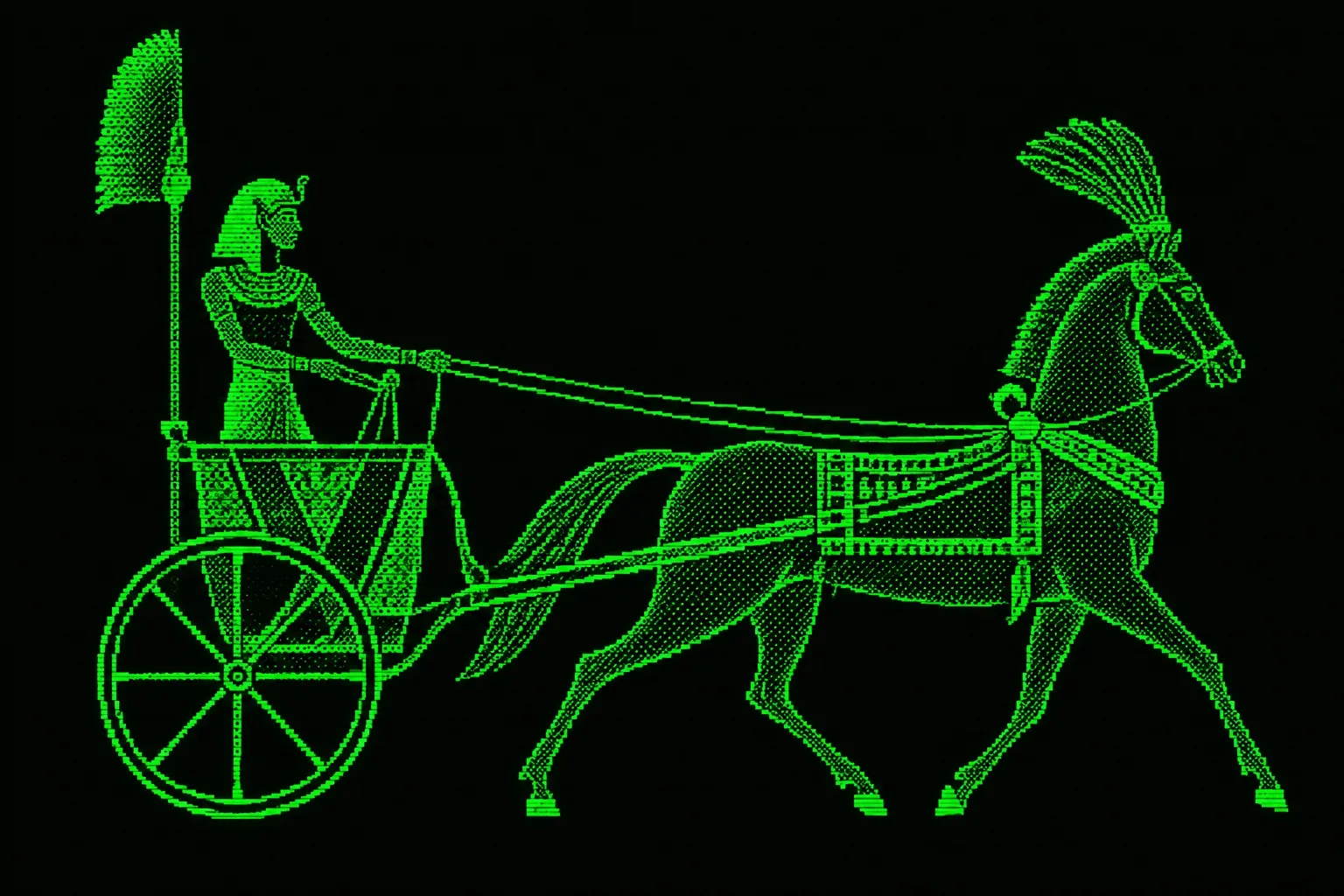
~/sacred-texts/late-egyptian-miscellanies
Papyrus Anastasi III: Praise of the Charioteer Amenemope
- Date
- Copied in the 19th Dynasty (reign of Merenptah, c. 1213–1203 BC) on Papyrus Anastasi III
- Found
- Acquired in Egypt by Giovanni Anastasi (Memphite provenance); now in the British Museum, London (EA 10246,1)
- Language
- Late Egyptian · Hieratic
- 1
[...] ⸮[t]w? r-gs ḥm =f ꜥnḫ-(w)ḏꜣ-s(nb) nn 2-nw =f jr〈,j〉-rd.du-n-nb-tꜣ.du sḏm [m]dw,t =f r-[ḥꜣ],t [r]ḫ,yt
… beside His Majesty (life, prosperity, health!), who has no equal;
companion of the Lord of the Two Lands,
whose words are heard before the people.Note · Line 1
The Two Lands are Upper and Lower Egypt. The companion’s title places him, literally, at the king’s feet. - 2
mntf [...] [___] =f
He is the one who … his …
- 3
jn kꜣ n wsḫ{.t} 〈nmt,t〉 m s,t štꜣ.tj qꜣi̯ 〈ḫrw〉 m s,t sgꜣ
For the ka of him whose stride is wide in the secret place,
whose voice is loud in the place of silence,Note · Line 3
The ka is a person’s vital spirit. Here the praise is addressed to the ka of the living official. - 4
ꜥꜣi̯ rd jw =tw [...] _ ẖr.j pꜣ sšd
whose foot is great while the king …
… beneath the Window of Appearance.Note · Line 4
The Window of Appearance was the palace window where the king showed himself and bestowed rewards. - 5
mdw,t =f nb(.t) hru̯ ḥr [ḥ]ꜣ,tj n nb =f
His every word pleases his lord’s heart.
- 6
j:jri̯ =tw m j:ḏd.t =f nb
People act on all he has said.
- 7
[...] ⸮[j]?:nḥi̯ =tw m pꜣ j:jri̯ =f nb
… When people ask, it is for all that he does.
- 8
ns n nsw ⸮〈jri̯〉? [s]šm.w =f m tꜣ.du
He is the king’s tongue,
carrying out the king’s commands in the Two Lands. - 9
ḥtp jb =f ḥr mꜣꜥ,t
His heart is content with truth.
Note · Line 9
The Egyptian word for truth, maat, also embraces justice and the right ordering of things. - 10
[...] m tꜣ.du nb.w mḫꜣ,t jdb.du n.t rpꜥ zꜣ-nsw wr sꜥqꜣ rḫ,yt
… throughout the Two Lands,
the balance of the Two Banks for the crown prince,
the great king’s son who guides the people aright.Note · Line 10
The Two Banks are the banks of the Nile, another name for Egypt. The balance is the scale on which things are weighed. - 11
jri̯.w [...] n =f
Doing … for him.
- 12
ḏd =tw jri̯.y =j n 〈n〉ꜣ n,tj gꜣb [...]
To those who are weak one says, “I will do it.” …
- 13
mri̯ mꜣꜥ,t [...]
Who loves truth …
- 14
[...] [___] =⸮f? [dw]ꜣ[.w] 〈ḥ(ꜣ)b〉 kꜣ-ḥr-kꜣ
… he … on the morning of the Khoiak festival.
Note · Line 14
Khoiak was the month of rites mourning Osiris and celebrating his return to life. - 15
[...] [___] =f fqꜣ.w n [...]
… he … gifts from …
- 16
jni̯ =f jtwr m [...] [s]mj n =f gꜣb
He brought the river from …
… who reports a loss to him. - 17
[ṯꜣy]-ḫw-〈ḥr〉-wmnj-n-nsw kꜣ~ṯꜣ~nꜣ-tp,j-n-[ḥm≡f] [jdnw-n-tj-n,t-ḥ]trj wpw,tj-nsw [n] [nꜣ] [wr.w.pl] n.t ḫꜣs,t.pl n Ḫꜣrw šꜣꜥ-m Ṯꜣ~rw r Jw~pꜣ [...] n nꜣ wr.w.pl n.w St,tjw.pl [Jmn-m-jp,t]
Fan-bearer at the king’s right hand,
first charioteer of His Majesty,
deputy commander of the chariot corps,
royal envoy to the chiefs of the foreign lands of Kharu,
from Tjaru to Upe,
… to the chiefs of the peoples of Asia: Amenemope.Note · Line 17
Amenemope is the man praised in the hymn. Tjaru stood on Egypt’s northeastern frontier; Upe was the region around Damascus. - 18
grḥ [...]
End. …