~/sacred-texts/orphic-hymns
Orphic Hymns: The Serpent and the Bullroarer
Translated by AI straight from the Ancient Greek, not from a modern translation, then checked against the editions and studies listed below. How we translate
- Text
- Orphic Hymns, Nos. 4, 6, 30, 31, 32, 38, 39, 40, 46, 47, 48, 49 and 52
- Date
- 2nd–3rd century AD
- Found
- Western Asia Minor (the hymns invoke Phrygia, Lydia, Mount Tmolos and Mount Ida)
- Language
- Ancient Greek · Greek alphabet; hexameter verse
The Orphic Hymns are eighty-seven short hymns and a prologue, the hymnbook of a cult group of Dionysus in western Asia Minor in the second or third century AD. They invoke Phrygia, Lydia, Mount Tmolos and Ida, and the Phrygian gods Sabazios and Hipta. Each hymn names its god in a long chain of titles, asks for a gift, and carries a rubric saying which incense to burn: myrrh for the First-born, storax for Dionysus, frankincense for the Kouretes. Whoever sang them called themselves mystai, initiates, and called the god to “the rite”.
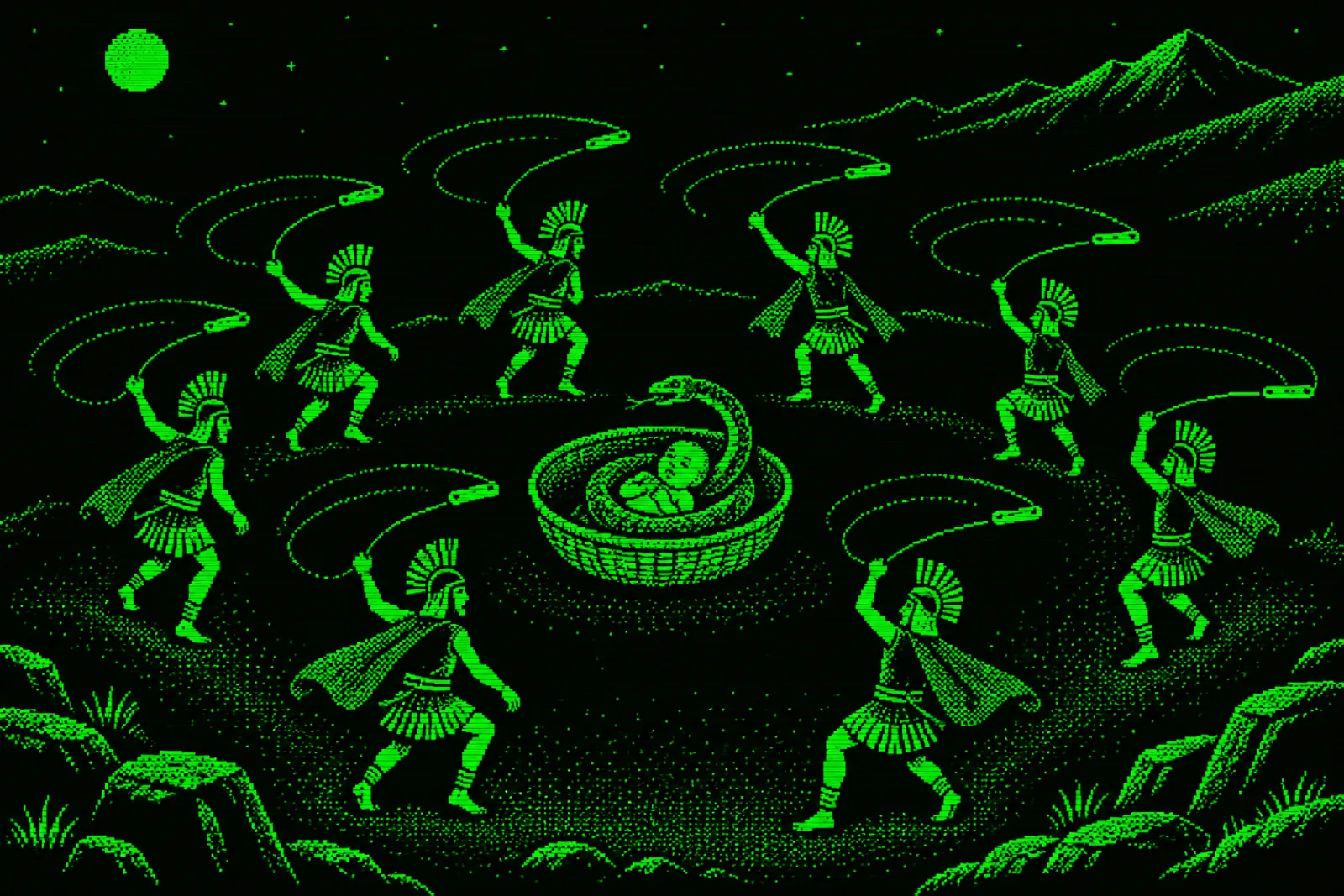
These thirteen are the ones whose Greek carries the serpent, the whirring sound of the rites, or the founders and objects of the mysteries. Hymns 4 and 6 give the sky and the egg-born First-born the whirl and the whirr. Hymns 31 and 38 call on the Kouretes, the armed dancers who guarded the infant god and, in Hymn 31, are named for the rhombos, the bullroarer. Athena (32), Korybas (39) and Demeter (40) take or drive the serpent. Hymns 30 and 46–52 are the Dionysus of the rite: begotten in the “unspeakable bed”, carried in the winnowing basket, sewn into Zeus’s thigh, nursed by Hipta. On the cult that sang them, see Orphism and the Eve Theory of Consciousness; on the rhombos in the Mother’s rites, the Bullroarer Atlas’s Mountain Mother’s rhombos and drum.
All thirteen hymns are translated in full, each line from the Greek, with the title and incense rubric as the first line. One line has lost words (38.17), and the English marks the loss. The numbering is Abel’s and Quandt’s, which most modern books use; older editions and dictionaries number many hymns one lower, so Hymn 31 can appear as 30.
Each numbered line gives the Ancient Greek first. Our English is underneath. Tap a dotted word for its meaning, and Note for our comment on the line; our comments are in the right margin.
Hymn 4: To Ouranos
- 4-0
Of Οὐρανός: Ouranos, Sky, the god. Incense: λίβανος: frankincense.
- 4-1
Οὐρανός Ouranos, Sky, the god · Logeion παγγενέτορ, κόσμου μέρος αἰὲν ἀτειρές,
Sky, begetter of all, part of the cosmos that never wears out,
- 4-2
πρεσβυγένεθλ’, ἀρχὴ πάντων πάντων τε τελευτή,
eldest-born, beginning of all things and end of all things,
- 4-3
κόσμοκράτορ, σφαιρηδὸν ἑλίσσω to turn round, roll, whirl; of a snake, to coil · Logeion περὶ γαῖαν,
ruler of the cosmos, ἑλίσσω: to turn round, roll, whirl; of a snake, to coil the earth like a ball,
Note on line 4-3
Helissomenos peri, “turning round”, is the participle Homer uses of the snake at its hole, “coiling round its lair” (Iliad 22.95, ἑλισσόμενος περὶ χειῇ). Euripides uses the same verb of the rhombos in the Mother’s rites (next note). - 4-4
οἶκε θεῶν μακάρων, ῥόμβος rhombos: the bullroarer, a slat of wood whirled on a cord in the mysteries; also a spinning top, a magic wheel, a drum · Logeion δίνη whirl, eddy, rotation · Logeion ὁδεύων,
house of the blessed gods, travelling on the δίνη: whirl, eddy, rotation of the ῥόμβος: rhombos: the bullroarer, a slat of wood whirled on a cord in the mysteries; also a spinning top, a magic wheel, a drum,
Note on line 4-4
Athanassakis–Wolkow translate “your motion is a roaring whirl”, and their own note (p. 128) says the word is rhombos, “which more properly designates either the bull-roarer or kettle-drums”, and that such an instrument may have sounded as these lines were sung. LSJ’s first sense is the bullroarer, “used in the mysteries”. The best parallel is Euripides, Helen 1362–1363, on the Mother’s rites: ῥόμβου θ’ εἱλισσομένα κύκλιος ἔνοσις αἰθερία, “the circling quake in the air of the whirled rhombos”. The sky turns the way the bullroarer turns, and the hymn names the instrument to say so. - 4-5
οὐράνιος χθόνιος of the earth, under the earth · Logeion τε φύλαξ guard, watcher · Logeion πάντων περιβληθείς,
guard of heaven and of earth, thrown round all things,
- 4-6
ἐν στέρνοισιν ἔχων φύσις nature; Physis, Nature as a goddess · Logeion ἄπλητον ἀνάγκη necessity, constraint, force · Logeion
holding in your breast the overwhelming ἀνάγκη: necessity, constraint, force of φύσις: nature; Physis, Nature as a goddess,
- 4-7
κυανόχρως, ἀδάμαστε, παναίολος, αἰολόμορφος of shimmering, shifting form · Logeion
dark-blue, untamed, all-glittering, αἰολόμορφος: of shimmering, shifting form,
- 4-8
πανδερκές, Κρονότεκνος having Kronos as child; father of Kronos · Logeion μάκαρ, πανυπέρτατε δαῖμον,
all-seeing, Κρονότεκνος: having Kronos as child; father of Kronos, blessed one, highest power of all:
- 4-9
κλῦθ’ ἐπάγων ζωὴν ὁσίην μύστης an initiate in the mysteries · Logeion νεοφάντης newly initiated: one to whom the sacred things have just been shown · Logeion
hear, and bring a holy life to the μύστης: an initiate in the mysteries νεοφάντης: newly initiated: one to whom the sacred things have just been shown.
Note on line 4-9
The initiate is singular, “the new initiate”; Athanassakis–Wolkow make it plural. The prayer is said for one person who has just been through the rite. Hymn 6: To Protogonos, the First-born
- 6-0
Πρωτόγονος the First-born, the god hatched from the cosmic egg · Logeion θυμίαμα σμύρναν.
Of Πρωτόγονος: the First-born, the god hatched from the cosmic egg. Incense: myrrh.
- 6-1
Πρωτόγονος the First-born, the god hatched from the cosmic egg · Logeion καλέω διφυής of two natures; here male and female · Logeion μέγαν, αἰθερόπλαγκτον,
I call the Πρωτόγονος: the First-born, διφυής: of two natures; here male and female, great, wandering the aether,
Note on line 6-1
Diphyēs, “of two natures”, is male and female: the hymnbook uses it of the god who is “male and female” in 42.4, and Athena is “born male and female” in Hymn 32 below. - 6-2
ᾠογενής egg-born · Logeion χρυσέῃσιν ἀγαλλόμενον πτερύγεσσι,
ᾠογενής: egg-born, glorying in golden wings,
- 6-3
ταυροβόας bull-bellowing, roaring with a bull's voice · Logeion γένεσιν μακάρων θνητῶν τ’ ἀνθρώπων,
ταυροβόας: bull-bellowing, roaring with a bull's voice, the begetting of the blessed gods and of mortal men,
Note on line 6-3
The bull’s voice is the sound of the rites. Aeschylus (Edonoi, fr. 57) on the rites of the Thracian Dionysus: ταυρόφθογγοι δ’ ὑπομυκῶνται ποθὲν ἐξ ἀφανοῦς φοβεροὶ μῖμοι, “and from somewhere out of sight bull-voiced mimics bellow, terrifying”. The First-born’s bull-voice belongs with them, and with the “whirring one” of line 5. - 6-4
σπέρμα seed, semen; offspring · Logeion πολύμνηστος much-remembered, much-mentioned · Logeion πολυόργιος celebrated with many orgia, rites · Logeion Ἠρικεπαῖος Erikepaios, an Orphic name of the First-born, of unknown meaning · Logeion
σπέρμα: seed, semen; offspring πολύμνηστος: much-remembered, much-mentioned, πολυόργιος: celebrated with many orgia, rites, Ἠρικεπαῖος: Erikepaios, an Orphic name of the First-born, of unknown meaning,
Note on line 6-4
The manuscripts are garbled here (ὅς τε πολύμνηστον, πολυόργιον εὕρηκε παιάν, Kern’s apparatus, p. 160). Abel, like Athanassakis–Wolkow, prints the old editors’ restoration, which echoes Hymn 50.2, where Dionysus is σπέρμα πολύμνηστον in the same words (and 42.2). So the First-born as “seed” rests on the hymnbook’s own phrase for Dionysus, not on this line’s manuscripts. Sperma is seed and semen alike. - 6-5
ἄρρητος unspeakable, not to be told; secret, of the mysteries · Logeion κρύφιος hidden, secret · Logeion ῥοιζήτωρ one who moves with a rushing, whirring sound · Logeion παμφαὲς ἔρνος young shoot, sprout; offspring · Logeion
ἄρρητος: unspeakable, not to be told; secret, of the mysteries, κρύφιος: hidden, secret, ῥοιζήτωρ: one who moves with a rushing, whirring sound, all-shining ἔρνος: young shoot, sprout; offspring,
Note on line 6-5
LSJ gives rhoizētōr as “one who moves with a rushing sound”, from rhoizos, the whizz of an arrow, the rush of wings, and the hiss of a serpent (Apollonius, Argonautica 4.129, the dragon of the fleece: ῥοίζει δὲ πελώριον, “it hisses hugely”; line 129 in the Perseus text, 4.138 in LSJ). A scholion on Clement defines the rhombos of the rites by the same verb: it “was whirled in the rites to make it whirr” (ἐν ταῖς τελεταῖς ἐδονεῖτο, ἵνα ῥοιζῇ, quoted in LSJ s.v. ῥόμβος). Athanassakis–Wolkow: “forever in whirring motion”. The god’s name is the bullroarer’s sound. - 6-6
ὄσσε the two eyes · Logeion ὃς σκοτόεσσαν ἀπημαύρωσας ὁμίχλην
you who wiped the dark mist from ὄσσε: the two eyes
Note on line 6-6
The Greek says “of eyes”, not “your eyes” as in Athanassakis–Wolkow. They are everyone’s eyes: the first light is also the first sight. - 6-7
πάντῃ δινέω to whirl, spin round · Logeion πτερύγων ῥιπαῖς κατὰ κόσμον
δινέω: to whirl, spin round everywhere through the cosmos on the beat of your wings,
Note on line 6-7
The manuscripts have δινήεις, “whirling”; Hermann’s δινηθείς, “having whirled”, is printed by Abel (Kern, p. 160). Either way the god spins. - 6-8
λαμπρὸν ἄγων φάος ἁγνόν, ἀφ’ οὗ σε Φάνης Phanes, "he who appears, who shows", from φαίνω · Logeion κικλήσκω
bringing bright, pure light. For this I call you Φάνης: Phanes, "he who appears, who shows", from φαίνω
- 6-9
ἠδὲ Πρίηπος Priapus, the god of the erect phallus · Logeion ἄνακτα καὶ Ἀνταύγης "Light-Facing", "Reflected Light" · Logeion ἑλίκωψ with rolling, quick-glancing eyes · Logeion
and lord Πρίηπος: Priapus, the god of the erect phallus, and Ἀνταύγης: "Light-Facing", "Reflected Light" with ἑλίκωψ: with rolling, quick-glancing eyes.
Note on line 6-9
The egg-born god of light is named Priapus, the god whose image is an erect phallus. Athanassakis–Wolkow translate it plainly (“Lord Priapos”). With the “seed” of line 4 and “sower of much seed” in line 10, the hymn makes the First-born a phallic, seminal god. - 6-10
ἀλλά, μάκαρ, πολύμητι, πολύσπορος sowing much seed, fertile · Logeion βαῖνε γεγηθὼς
Come, blessed one, of many counsels, πολύσπορος: sowing much seed, fertile, come rejoicing
- 6-11
ἐς τελετή rite of initiation, mystery · Logeion ἁγίην πολυποίκιλον ὀργιοφάντης one who shows, reveals the orgia: an initiating priest · Logeion
to the holy, many-coloured τελετή: rite of initiation, mystery for ὀργιοφάντης: one who shows, reveals the orgia: an initiating priest.
Hymn 30: To Dionysus
- 30-0
Διόνυσος Dionysus · Logeion θυμίαμα στύρακα.
Of Διόνυσος: Dionysus. Incense: storax.
- 30-1
Κικλήσκω Διόνυσος Dionysus · Logeion ἐρίβρομος loud-roaring, loud-shouting · Logeion εὐαστήρ one who cries εὐαί, the Bacchic shout · Logeion
I call Dionysus, the ἐρίβρομος: loud-roaring, loud-shouting, εὐαστήρ: one who cries εὐαί, the Bacchic shout,
- 30-2
πρωτόγονος first-born; the name of the egg-born god of Hymn 6 · Logeion διφυής of two natures; here male and female · Logeion τρίγονος born three times · Logeion Βακχεῖον ἄνακτα,
πρωτόγονος: first-born; the name of the egg-born god of Hymn 6, διφυής: of two natures, male and female, τρίγονος: born three times, Bacchic lord,
Note on line 30-2
The hymnbook gives Dionysus the titles of the egg-born god of Hymn 6: prōtogonos, diphyēs. Hymn 52.6 below goes further and calls him Erikepaios. - 30-3
ἄγριον, ἄρρητος unspeakable, not to be told; secret, of the mysteries · Logeion κρύφιος hidden, secret · Logeion δικέρως two-horned · Logeion δίμορφος of two forms · Logeion
wild, ἄρρητος: unspeakable, secret, hidden, δικέρως: two-horned, δίμορφος: of two forms,
- 30-4
κισσόβρυον, ταυρωπός bull-faced · Logeion ἀρήιον, εὔιος hailed with εὐοῖ, the Bacchic cry · Logeion ἁγνόν,
teeming with ivy, ταυρωπός: bull-faced, warlike, εὔιος: hailed with εὐοῖ, the Bacchic cry, pure,
- 30-5
ὠμάδιος eater of raw flesh, a title of Dionysus · Logeion τριετής of the feast held every other year ("every third year", counting inclusively) · Logeion βοτρυοτρόφον, ἐρνεσίπεπλον.
ὠμάδιος: eater of raw flesh, a title of Dionysus, τριετής: of the feast held every other year ("every third year", counting inclusively), nurse of the grape-clusters, robed in young shoots.
Note on line 30-5
LSJ: ōmadios, “= ὠμηστής [eater of raw flesh], because he had human sacrifices at Chios and Tenedos”, citing this line and Euelpis in Porphyry, On Abstinence 2.55. Athanassakis–Wolkow: “You take raw flesh in triennial feasts.” - 30-6
Εὐβουλεύς Eubouleus, "Good Counsel": a name of Dionysus and of the god of the dead, also invoked on the gold tablets · Logeion πολύβουλε, Διὸς καὶ Φερσεφόνεια Persephone, daughter of Zeus and Demeter · Logeion
Εὐβουλεύς: Eubouleus, "Good Counsel": a name of Dionysus and of the god of the dead, also invoked on the gold tablets, of many counsels, begotten by Zeus on Φερσεφόνεια: Persephone, daughter of Zeus and Demeter
- 30-7
ἄρρητος unspeakable, not to be told; secret, of the mysteries · Logeion λέκτρον bed, marriage-bed · Logeion τεκνωθείς, ἄμβροτε δαῖμον·
in an ἄρρητος: unspeakable, not to be told λέκτρον: bed, marriage-bed, immortal power:
Note on line 30-7
Persephone is Zeus’s own daughter. Clement (Protrepticus 2.16.1) tells what the unspeakable bed was: Zeus “has sex with” her “having become a serpent” (μίγνυται δράκων γενόμενος). Athanassakis–Wolkow: “sired by Zeus when he mated with Persephone in unspeakable union”. The son of this serpent-rape of a daughter is the god of the hymn. - 30-8
κλῦθι, μάκαρ φωνῆς, ἡδὺς δ’ ἐπιπνέω to breathe upon, blow upon; inspire · Logeion ἀμεμφής,
hear my voice, blessed one, and ἐπιπνέω: to breathe upon, blow upon; inspire me, sweet and blameless,
- 30-9
εὐμενὲς ἦτορ ἔχων, σὺν ἐυζώνοισι τιθήνη nurse; the god's nurses, the first maenads · Logeion
with a kindly heart, you and your well-girdled τιθήνη: nurse; the god's nurses, the first maenads.
Hymn 31: Of the Kouretes
- 31-0
Ὕμνος Κουρής the Kouretes, armed dancers who guarded the infant Zeus, and in the Orphic myth the infant Dionysus · Logeion
Hymn of the Κουρής: the Kouretes, armed dancers who guarded the infant Zeus, and in the Orphic myth the infant Dionysus.
- 31-1
σκιρτητής leaper, dancer · Logeion Κουρής the Kouretes, armed dancers who guarded the infant Zeus, and in the Orphic myth the infant Dionysus · Logeion ἐνόπλια βήματα θέντες,
σκιρτητής: leaper, dancer Kouretes, who tread the armed steps,
- 31-2
ποσσίκροτοι, ῥομβητής one who whirls, or spins like, the rhombos (the bullroarer); found only in this line · Logeion ὀρέστεροι, εὐαστήρ one who cries εὐαί, the Bacchic shout · Logeion
stamping with your feet, ῥομβητής: one who whirls, or spins like, the rhombos (the bullroarer); found only in this line, mountain-dwellers, εὐαστήρ: one who cries εὐαί, the Bacchic shout,
Note on line 31-2
Rhombētai is the agent noun of rhombos: LSJ, “one that spins like a ῥόμβος, Orph. H. 31.2”, its only occurrence. In a line of sounds (stamping feet, the Bacchic cry, and lyre-strikers in the next line) the rhombos is the instrument, the bullroarer that “was whirled in the rites to make it whirr” (scholion on Clement, Protr. 2.17.2, quoted in LSJ). In the Orphic myth the Kouretes dance in arms round the infant Dionysus, and the Titans lure him from them with toys: “a top and a rhombos and jointed dolls” (Clement, Protr. 2.17.2 = Kern fr. 34). Athanassakis–Wolkow’s English has no word for rhombētai (“howling mountain men whose feet pound the ground”), although their note on 4.4 (p. 128) calls the Kouretes “literally … ‘rhombosters’”. The guardians of the god are named as bullroarer-men. - 31-3
κρουσιλύρης striking the lyre · Logeion παράρρυθμος in time, in measure (LSJ, of this line); elsewhere out of time · Logeion ἐπεμβάται ἴχνεσι κούφοις,
κρουσιλύρης: striking the lyre, παράρρυθμος: in time, in measure (LSJ, of this line); elsewhere out of time, treading with light feet,
Note on line 31-3
Athanassakis–Wolkow take pararythmoi as “discordant” and build on it (note, p. 192). LSJ gives the opposite for this line, “in time or measure”. They are dancers who stamp and strike in time with the music. - 31-4
ὁπλοφόροι, φύλαξ guard, watcher · Logeion κοσμήτορες, ἀγλαόφημοι,
bearers of arms, φύλαξ: guard, watcher, marshals, of shining fame,
- 31-5
μήτηρ mother; the Mother of the gods, Rhea-Kybele · Logeion ὀρειμανής raving, mad on the mountains · Logeion συνοπάονες, ὀργιοφάντης one who shows, reveals the orgia: an initiating priest · Logeion
companions of the μήτηρ: mother; the Mother of the gods, Rhea-Kybele who ὀρειμανής: raving, mad on the mountains, ὀργιοφάντης: one who shows, reveals the orgia:
Note on line 31-5
Euripides puts the rhombos in exactly this company: in the rites of the Mountain Mother, “the circling quake in the air of the whirled rhombos” (Helen 1362–1363). Here the rhombos-whirlers are also the ones who show the rites. - 31-6
ἔλθοιτ’ εὐμενέοντες ἐπ’ εὔφημος of good omen, holy; uttering only sacred words · Logeion λόγοισι,
come with kind minds to these εὔφημος: of good omen, holy; uttering only sacred words,
- 31-7
βουκόλος oxherd; a title of the worshippers of Dionysus in bull form · Logeion εὐάντητοι ἀεὶ κεχαρηότι θυμῷ.
and meet the βουκόλος: oxherd; a title of the worshippers of Dionysus in bull form gladly, with a heart that always rejoices.
Note on line 31-7
LSJ gives boukolos a cult sense: a “worshipper of Dionysos in bull-form”, attested in inscriptions from Pergamon and Eretria. The oxherd is the singer, named by his office in the thiasos. Clement quotes the mystery verse “the bull is the serpent’s father and the serpent the bull’s; on the mountain the hidden thing, the oxherd, the goad” (Protr. 2.16.3). Hymn 32: To Athena
- 32-0
Ἀθηνᾶ Athena · Logeion θυμίαμα ἀρώματα.
Of Ἀθηνᾶ: Athena. Incense: spices.
- 32-1
Παλλὰς μονογενής only child; born of one parent alone · Logeion μεγάλου Διὸς ἔκγονε σεμνή,
Pallas, μονογενής: only child; born of one parent alone, august child of great Zeus,
Note on line 32-1
Mounogenēs: “only child”, or born of a single parent. Athena was born from Zeus’s head with no mother, and Athanassakis–Wolkow translate “great Zeus bore you by himself”. - 32-2
δῖα, μάκαιρα θεά, πολεμοκλόνος, ὀβριμόθυμε,
divine, blessed goddess, stirrer of war, mighty-hearted,
- 32-3
ἄρρητος unspeakable, not to be told; secret, of the mysteries · Logeion ῥητή, μεγαλώνυμος, ἀντροδίαιτος living in caves · Logeion
ἄρρητος: unspeakable, secret and spoken, great-named, ἀντροδίαιτος: living in caves,
- 32-4
ἣ κατέχεις ὄχθων ὑψηχέας ἀκρωρείας
you who hold the high-echoing ridges of the hills
- 32-5
ἠδ’ ὄρεα σκιόεντα, νάπῃσί τε σὴν φρένα τέρπεις,
and the shadowed mountains, and you delight your heart in the glens,
- 32-6
ὁπλοχαρής, οἰστράω to sting like the gadfly (οἶστρος); to drive mad · Logeion βροτῶν ψυχή soul · Logeion μανία madness, frenzy, possession · Logeion
delighting in arms, οἰστράω: to sting like the gadfly (οἶστρος); to drive mad the ψυχή: soul of mortals with μανία: madness, frenzy, possession,
- 32-7
γυμνάζουσα κόρη, φρικώδη θυμὸν ἔχουσα,
a girl who trains hard, with a heart that makes men shudder,
- 32-8
Γοργοφόνος, φυγόλεκτρε, τεχνῶν μήτηρ mother; the Mother of the gods, Rhea-Kybele · Logeion πολύολβε.
Gorgon-slayer, who flees the bed, rich mother of the crafts,
- 32-9
ὁρμήτειρα, φίλοιστρος loving the gadfly-sting, frenzy · Logeion κακοῖς, ἀγαθοῖς δὲ φρόνησις understanding, prudence · Logeion
you who drive us on; to the bad you are φίλοιστρος: loving the gadfly-sting, frenzy, to the good, φρόνησις: understanding, prudence.
- 32-10
ἄρσην male · Logeion μὲν καὶ θῆλυς ἔφυς, πολεμήτοκε μῆτις cunning, counsel; Metis, Athena's swallowed mother · Logeion
You were born ἄρσην: male, μῆτις: cunning, counsel; Metis, Athena's swallowed mother that gives birth to war,
Note on line 32-10
Mētis, “cunning”, is also the name of the mother Zeus swallowed while she carried Athena. The hymn addresses the daughter by the mother’s name. - 32-11
αἰολόμορφος of shimmering, shifting form · Logeion δράκαινα she-serpent, female δράκων · Logeion φιλένθεος loving the state of being filled with the god · Logeion ἀγλαότιμε·
αἰολόμορφος: of shimmering, shifting form, δράκαινα: she-serpent, female δράκων, φιλένθεος: loving the state of being filled with the god, of shining honour,
Note on line 32-11
Drakaina is the feminine of drakōn, “serpent”. LSJ glosses it “she-dragon”, but its first example is the serpent of Delphi (Homeric Hymn to Apollo 300), and its next are the Erinyes, the snake-haired women of Hymns 69–70. Athanassakis–Wolkow follow LSJ (“she-dragon of the many shapes”). Aiolos, the first part of aiolomorphos, is Homer’s word for a snake’s glitter: “the shimmering snake” (αἰόλον ὄφιν, Iliad 12.208). The Athenians say that a great snake guarded the Acropolis and was given a honey-cake every month (Herodotus 8.41). - 32-12
Φλεγραίων ὀλέτειρα Γιγάντων, ἱππελάτειρα.
destroyer of the Giants of Phlegra, driver of horses,
- 32-13
Τριτογένεια, λύτειρα she who looses, frees · Logeion κακῶν, νικηφόρε δαῖμον,
Tritogeneia, λύτειρα: she who looses, frees, victory-bringing power,
- 32-14
γλαυκῶπις grey-eyed, owl-eyed · Logeion εὑρεσίτεχνε, πολυλλίστη βασίλεια
γλαυκῶπις: grey-eyed, owl-eyed, inventor of crafts, queen prayed to by many
- 32-15
ἤματα καὶ νύκτας αἰεὶ νεάτῃσιν ἐν ὥραις,
by day and night, always, in the last hours:
- 32-16
κλῦθί μευ εὐχομένου, δὸς δ’ εἰρήνην πολύολβον
hear me as I pray, and give a rich peace
- 32-17
καὶ κόρος fullness, plenty · Logeion ἠδ’ ὑγίειαν ἐπ’ εὐόλβοισιν ἐν ὥραις.
and κόρος: fullness, plenty and health in seasons of good fortune.
Note on line 32-17
Abel prints κόρην, “girl”, which gives no sense in a prayer for peace and health; the right reading is κόρον, “plenty”, as Athanassakis–Wolkow’s “a full measure” also implies. Hymn 38: To the Kouretes
- 38-0
Κουρής the Kouretes, armed dancers who guarded the infant Zeus, and in the Orphic myth the infant Dionysus · Logeion θυμίαμα λίβανος frankincense · Logeion
Of the Κουρής: the Kouretes. Incense: frankincense.
- 38-1
χαλκόκροτος clashing, ringing with bronze · Logeion Κουρής the Kouretes, armed dancers who guarded the infant Zeus, and in the Orphic myth the infant Dionysus · Logeion Ἀρήια τεύχε’ ἔχοντες,
χαλκόκροτος: clashing, ringing with bronze Kouretes, who carry the arms of Ares,
- 38-2
οὐράνιοι χθόνιος of the earth, under the earth · Logeion τε καὶ εἰνάλιοι, πολύολβοι,
of the sky, of the earth and of the sea, rich in blessings,
- 38-3
ζῳογόνος: begetting life πνοή: breath, blast of wind, glorious saviours of the cosmos,
Note on line 38-3
The Kouretes of Samothrace are winds: “breaths” here and in line 22, and at the end they are begged to “breathe on us”. - 38-4
οἵτε Σαμοθρᾴκη Samothrace, the island of the Great Gods and their mysteries · Logeion ἱερὴν χθόνα, ναιετάοντες
who dwell in Σαμοθρᾴκη: Samothrace, the island of the Great Gods and their mysteries, the holy land,
- 38-5
κινδύνους θνητῶν ἀπερύκετε ποντοπλανήτων·
and keep dangers away from mortals who wander the sea.
- 38-6
ὑμεῖς καὶ τελετή rite of initiation, mystery · Logeion πρῶτοι μερόπεσσιν ἔθεσθε,
It was you who first set up the τελετή: rite of initiation, mystery for mortals,
Note on line 38-6
The founders of the mysteries are the same Kouretes whom Hymn 31 calls rhombos-whirlers. Athanassakis–Wolkow (note to 31.5, p. 192) also tie the two lines together: the Kouretes are “the mythical paradigm for the practitioners of the actual ritual”. - 38-7
ἀθάνατοι Κουρής the Kouretes, armed dancers who guarded the infant Zeus, and in the Orphic myth the infant Dionysus · Logeion Ἀρήια τεύχε’ ἔχοντες·
immortal Kouretes, who carry the arms of Ares.
- 38-8
νωμάω to wield, ply, drive, sway · Logeion Ὠκεανόν, νωμάω to wield, ply, drive, sway · Logeion ἅλα δένδρεά θ' αὕτως·
You νωμάω: to wield, ply, drive, sway Ocean, you sway the sea, and the trees as well.
- 38-9
ἐρχόμενοι γαῖαν κοναβίζω to clash, ring, resound · Logeion ποσσὶν ἐλαφροῖς,
When you come, you make the earth κοναβίζω: to clash, ring, resound under your light feet,
- 38-10
μαρμαίροντες ὅπλοις· πτήσσουσι δὲ θῆρες ἅπαντες
flashing in your armour. All the wild beasts cower
- 38-11
ὁρμώντων, θόρυβος noise, uproar, din · Logeion δὲ βοή τ’ εἰς οὐρανὸν ἵκει,
as you rush on, and the θόρυβος: noise, uproar, din and the shouting reach the sky,
- 38-12
εἱλιγμός whirling, winding, turning (from ἑλίσσω) · Logeion τε ποδῶν κονίη νεφέλας ἀφικάνει
and from the εἱλιγμός: whirling, winding, turning (from ἑλίσσω) of your feet the dust reaches the clouds
- 38-13
ἐρχομένων· τότε δή ῥα καὶ ἄνθεα πάντα τέθηλε.
as you come; and then every flower bursts into bloom.
- 38-14
δαίμονες ἀθάνατοι, τροφέες καὶ αὖτ’ ὀλετῆρες,
Immortal powers, nurses and also destroyers,
- 38-15
ἡνίκ’ ἂν ὁρμαίνητε χολούμενοι ἀνθρώποισιν
when you rush out in anger against men,
- 38-16
ὀλλύντες βίοτον καὶ κτήματα ἠδὲ καὶ αὐτοὺς
destroying their living and their goods, and the men themselves
- 38-17
πιμπλάντες· στοναχεῖ δὲ μέγας πόντος βαθυδίνης,
you fill [with …]. The great deep-eddying sea groans,
Note on line 38-17
Pimplantes, “filling”, has no second object; something is missing, and Athanassakis–Wolkow mark a gap here (“you ruin men themselves. … the great deep-eddying sea groans”). - 38-18
δένδρη δ’ ὑψικάρην’ ἐκ ῥιζῶν ἐς χθόνα πίπτει,
high-crowned trees fall from their roots to the ground,
- 38-19
ἠχὼ δ' οὐρανίη κελαδεῖ ῥοίζημα a rushing, whirring noise · Logeion φύλλων.
and the echo in the sky resounds with the ῥοίζημα: a rushing, whirring noise of the leaves.
Note on line 38-19
Rhoizēma is the noun of the same whirr as the “whirring one” of Hymn 6.5, but here it is the noise of leaves in a gale, part of the storm of lines 14–19; it is not an instrument. The Kouretes come as wind, and their sound is the roar of wind. - 38-20
Κουρής the Kouretes, armed dancers who guarded the infant Zeus, and in the Orphic myth the infant Dionysus · Logeion Κορύβας the Korybantes, ecstatic dancers of the Mother; here one with the Kouretes · Logeion ἀνάκτορες εὐδύνατοί τε
Kouretes, Κορύβας: the Korybantes, ecstatic dancers of the Mother; here one with the Kouretes, lords of great power,
- 38-21
ἐν Σαμοθρᾴκη Samothrace, the island of the Great Gods and their mysteries · Logeion ἄνακτες, ὁμοῦ Ζηνὸς κόρος fullness, plenty · Logeion αὐτοί,
lords in Samothrace, and yourselves the κόρος: boy, son; Ζηνὸς κόροι, the Dioskouroi,
Note on line 38-21
The words Zēnos kouroi, “sons of Zeus”, are the name Dioskouroi taken apart. The hymn makes the Kouretes, the Korybantes, the Samothracian gods and the Twins one company. - 38-22
ever-flowing breaths, ψυχοτρόφος: nourishing the soul, shaped of air,
- 38-23
οἵτε καὶ οὐράνιοι δίδυμοι κλήιζεσθ’ ἐν Ὀλύμπῳ,
who are also called the heavenly Twins on Olympus,
- 38-24
εὔπνοοι, εὔδιοι, σωτήριοι ἠδὲ προσηνεῖς·
fair-blowing, bringers of clear skies, saving and gentle,
- 38-25
ὡροτρόφοι, φερέκαρποι ἐπιπνέω to breathe upon, blow upon; inspire · Logeion ἄνακτες.
nurses of the seasons, bringers of fruit: ἐπιπνέω: to breathe upon, blow upon, lords.
Hymn 39: To Korybas
- 39-0
Κορύβας the Korybantes, ecstatic dancers of the Mother; here one with the Kouretes · Logeion θυμίαμα λίβανος frankincense · Logeion
Of Κορύβας: Korybas, the murdered third brother of the Korybantes. Incense: frankincense.
- 39-1
Κικλήσκω χθονὸς ἀενάου βασιλῆα μέγιστον,
I call the greatest king of the everlasting earth,
- 39-2
Κύρβαντ’ ὀλβιόμοιρον, Ἀρήιον, ἀπροσόρατος not to be looked on, frightful (LSJ, of this line) · Logeion
Kyrbas, of blessed lot, warlike, ἀπροσόρατος: not to be looked on, frightful (LSJ, of this line),
- 39-3
νυκτερινὸν Κουρής the Kouretes, armed dancers who guarded the infant Zeus, and in the Orphic myth the infant Dionysus · Logeion φόβων ἀποπαύστορα δεινῶν,
the Κουρής: a Koures, one of the Kouretes, who puts an end to dread terrors,
- 39-4
φαντασία appearance, apparition, vision · Logeion ἐπαρωγόν, ἐρημοπλάνον Κορύβας the Korybantes, ecstatic dancers of the Mother; here one with the Kouretes · Logeion
helper in φαντασία: appearance, apparition, vision, Korybas who wanders in empty places,
Note on line 39-4
Epārōgos with the genitive is a helper in or with something. Athanassakis–Wolkow read “you save us from fantasies”, and line 10 does ask him to stop them; but the Greek of this line makes him the visions’ helper. We keep both: the god who sends apparitions is the one who ends them. - 39-5
αἰολόμορφος of shimmering, shifting form · Logeion ἄνακτα, θεὸν διφυής of two natures; here male and female · Logeion πολύμορφον,
αἰολόμορφος: of shimmering, shifting form lord, god διφυής: of two natures, of many shapes,
- 39-6
φοίνιον, αἱμάσσω to make bloody; passive, to be bloodied, slain · Logeion κασιγνήτων ὑπὸ δισσῶν,
blood-red, αἱμάσσω: to make bloody; passive, to be bloodied, slain by your two brothers,
Note on line 39-6
The participle is passive: he was bloodied, that is killed, by two brothers. Athanassakis–Wolkow’s “your blood is tainted with the murder of twin brothers” makes him the killer, though their commentary (p. 210) treats him as the murdered brother. Clement tells the story (Protr. 2.19): the two Korybantes killed their third brother, wrapped the dead man’s head in purple, and carried off the box “in which the phallus of Dionysus was stored” (ἐν ᾗ τὸ τοῦ Διονύσου αἰδοῖον ἀπέκειτο) to Etruria. - 39-7
Δηώ Deo, Demeter · Logeion ὃς γνώμῃσιν ἐνήλλαξας δέμας ἁγνόν,
You who, by the will of Δηώ: Deo, Demeter, changed your pure body,
- 39-8
θηρότυπος shaped, stamped like a beast · Logeion θέμενος μορφὴν δνοφεροῖο δράκων serpent, great snake · Logeion
taking on the θηρότυπος: shaped, stamped like a beast shape of a dark δράκων: serpent, great snake:
Note on line 39-8
Athanassakis–Wolkow: “a savage, dark dragon”, and their note (p. 211) calls the change “obscure”, probably a lost myth. The rest of the hymnbook shows where the serpent belongs: Demeter drives serpents (40.14), and Clement’s Zeus couples with Persephone “having become a serpent”. The murdered god returns as a snake. - 39-9
κλῦθι, μάκαρ, φωνῶν, χαλεπὴν δ’ ἀποπέμπεο μῆνις wrath, the anger of a god · Logeion
hear our voices, blessed one, and send away your harsh μῆνις: wrath, the anger of a god,
- 39-10
παύων φαντασία appearance, apparition, vision · Logeion ψυχή soul · Logeion ἔκπληκτος struck out of one's senses, terror-stricken · Logeion ἄναγνος unclean, unholy, defiled; not purified · Logeion
stopping the φαντασία: apparition, vision of the ἔκπληκτος: struck out of one's senses, terror-stricken, ἄναγνος: unclean, unholy, defiled; not purified soul.
Note on line 39-10
LSJ: ekplēktos “terror-stricken”, citing this line; anagnos “unclean, unholy, defiled”. Athanassakis–Wolkow’s “free from fantasies souls stunned by compulsions” has no word for anagnos. The prayer asks the serpent-god to end the visions that seize a soul not yet purified. Hymn 40: To Demeter of Eleusis
- 40-0
Δημήτηρ Demeter, the corn-mother · Logeion Ἐλευσίνιος of Eleusis, the seat of her mysteries · Logeion θυμίαμα στύρακα.
Of Δημήτηρ: Demeter, the corn-mother of Ἐλευσίνιος: of Eleusis, the seat of her mysteries. Incense: storax.
- 40-1
Δηώ: Deo, Demeter, goddess παμμήτειρα: mother of all, power of many names,
- 40-2
σεμνὴ Δημήτηρ Demeter, the corn-mother · Logeion κουροτρόφος, ὀλβιοδῶτι,
holy Demeter, nurse of the young, giver of wealth,
- 40-3
πλουτοδότειρα θεά, σταχυοτρόφε, παντοδότειρα,
goddess who gives riches, nurse of the ears of grain, giver of all,
- 40-4
εἰρήνῃ χαίρουσα καὶ ἐργασίαις πολυμόχθοις,
rejoicing in peace and in hard-toiling work,
- 40-5
σπερμεῖος of seed · Logeion σωρῖτις, ἀλωαίη, χλοόκαρπε,
goddess of the σπερμεῖος: of seed, of the grain-heap, of the threshing floor, of the green fruit,
- 40-6
ἣ ναίεις ἁγνοῖσιν Ἐλευσῖνος γυάλοισιν,
you who dwell in the holy hollows of Eleusis,
- 40-7
ἱμερόεσσ’, ἐρατή, θνητῶν θρέπτειρα προπάντων,
desirable, lovely, nurse of all mortals,
- 40-8
ἡ πρώτη ζεύξασα βοῶν ἀροτῆρα τένοντα
who first yoked the ploughing necks of oxen
- 40-9
καὶ βίον ἱμερόεντα βροτοῖς πολύολβον ἀνεῖσα,
and sent up for mortals a rich and lovely living,
- 40-10
αὐξιθαλές, Βρόμιος Bromios, "the Roarer", Dionysus · Logeion συνέστιος, ἀγλαότιμος,
you who make things grow and bloom, hearth-mate of Βρόμιος: Bromios, "the Roarer", Dionysus, of shining honour,
- 40-11
λαμπαδόεσσ’, ἁγνή, δρεπάνοις χαίρουσα θερείοις·
torch-bearing, pure, rejoicing in the sickles of summer;
- 40-12
σὺ χθόνιος of the earth, under the earth · Logeion σὺ δὲ φαίνω to show; passive, to appear · Logeion σὺ δε πᾶσι προσηνής·
you are χθόνιος: of the earth, under the earth, and you are the one who φαίνω: to show; passive, to appear, and you are gentle to all;
- 40-13
εὔτεκνε, παιδοφίλη, σεμνή, κουροτρόφε κούρη,
blessed in children, child-loving, holy, a girl who nurses the young,
- 40-14
ἅρμα δρακόντειος of a serpent, of serpents · Logeion ὑποζεύξασα χαλινοῖς
you who yoked your chariot under δρακόντειος: of a serpent, of serpents bridles,
Note on line 40-14
Demeter’s car is drawn by serpents. Athanassakis–Wolkow: “bridled dragons”; their note (p. 214) ties them to Korybas’s serpent shape in the hymn before, which was taken “by Deo’s will”. - 40-15
ἐγκυκλίοις δίνη whirl, eddy, rotation · Logeion περὶ σὸν θρόνον εὐάζω to cry εὐαί, the Bacchic shout · Logeion
while round your throne they δίνη: whirl, rotation in circles, εὐάζω: to cry εὐαί, the Bacchic shout.
Note on line 40-15
Euazontōn is a masculine or neuter plural: “while they cry euai”. Athanassakis–Wolkow make the goddess the one who whirls (“round your throne you whirl and howl in ecstasy”), but a plural cannot be her. They are the celebrants, wheeling round the throne with the Bacchic cry. - 40-16
μονογενής only child; born of one parent alone · Logeion πολύτεκνε θεά, πολυπότνια θνητοῖς,
μονογενής: only child, goddess of many children, most revered among mortals,
- 40-17
ἧς πολλαὶ μορφαί, πολυάνθεμοι, ἱεροθαλεῖς.
whose forms are many, many-flowered, in holy bloom.
- 40-18
ἐλθέ, μάκαιρ’, ἁγνή, καρποῖς βρίθουσα θερείοις,
Come, blessed and pure one, heavy with the fruits of summer,
- 40-19
εἰρήνην κατάγουσα καὶ εὐνομίην ἐρατεινὴν
bringing down peace and lovely good order
- 40-20
καὶ πλοῦτον πολύολβον, ὁμοῦ δ’ ὑγίειαν ἄνασσαν.
and rich wealth, and with them Health, the queen.
Hymn 46: To Liknites, the god in the basket
- 46-0
λικνίτης god of the λίκνον, the winnowing basket used as a cradle and to carry the sacred things · Logeion θυμίαμα μάνναν.
Of λικνίτης: god of the λίκνον, the winnowing basket used as a cradle and to carry the sacred things. Incense: frankincense powder.
- 46-1
λικνίτης god of the λίκνον, the winnowing basket used as a cradle and to carry the sacred things · Logeion Διόνυσος Dionysus · Logeion ἐπ’ εὐχαῖς ταῖσδε κικλήσκω,
I call Dionysus of the λικνίτης: god of the λίκνον, the winnowing basket to these prayers,
Note on line 46-1
The liknon was a winnowing fan, the baby’s cradle, and in the rites a basket for the sacred things. Proclus, allegorising the Orphic poem (Kern fr. 199, p. 222), says that Hipta (Hymn 49), “having set the liknon on her head and wreathed it with a serpent” (καὶ δράκοντι αὐτὸ περιστέψασα), receives Dionysus as he comes from Zeus’s thigh. Demosthenes, attacking Aeschines, says that Aeschines led thiasoi through the streets squeezing pareias snakes and swinging them over his head, crying euoi saboi, and was hailed “ivy-bearer and liknon-bearer” (18.260). - 46-2
Νύσιον ἀμφιθαλής blooming on both sides; of a child whose father and mother are both alive · Logeion πεποθημένον, εὔφρονα Βάκχον,
the Nysian, ἀμφιθαλής: blooming on both sides; of a child whose father and mother are both alive, longed-for, kindly Bacchus,
Note on line 46-2
LSJ: amphithalēs, “of children who have both parents alive”, the condition for a child to serve in a rite. Athanassakis–Wolkow: “blossoming”. The god of the cradle-basket is named as the ritual child. - 46-3
νυμφῶν ἔρνος young shoot, sprout; offspring · Logeion ἐραστὸν ἐυστεφάνου τ’ Ἀφροδίτης,
the lovely ἔρνος: young shoot; offspring of the Nymphs and of well-crowned Aphrodite,
- 46-4
ὅς ποτ’ ἀνὰ δρυμοὺς κεχορευμένα βήματα πάλλες
who once in the oak-woods shook your feet in the dance
- 46-5
σὺν νύμφαις χαρίεσσιν ἐλαυνόμενος μανία madness, frenzy, possession · Logeion
with the graceful Nymphs, driven on by μανία: madness, frenzy, possession,
- 46-6
καὶ βουλαῖσι Διὸς πρὸς ἀγαυὴν Φερσεφόνεια Persephone, daughter of Zeus and Demeter · Logeion
and by the plans of Zeus you were brought to noble Φερσεφόνεια: Persephone, queen of the dead
- 46-7
ἀχθεὶς ἐξετράφης φίλος ἀθανάτοισι θεοῖσιν.
and reared by her, to be dear to the deathless gods.
- 46-8
εὔφρων ἐλθέ, μάκαρ, κεχαρισμένα δ’ ἱερόν sacred thing, offering, victim · Logeion δέξαι.
Come kindly, blessed one, and receive these welcome ἱερόν: sacred thing, offering, victim.
Hymn 47: To Perikionios, he around the pillar
- 47-0
περικιόνιος "he around the pillar", a name of Dionysus at Thebes · Logeion θυμίαμα ἀρώματα.
Of περικιόνιος: "he around the pillar", a name of Dionysus at Thebes. Incense: spices.
- 47-1
Κικλήσκω Βάκχον περικιόνιος "he around the pillar", a name of Dionysus at Thebes · Logeion μεθυδώτην,
I call Bacchus περικιόνιος: "he around the pillar", a name of Dionysus at Thebes, giver of wine,
- 47-2
Καδμείοισι δόμοις ὃς ἑλίσσω to turn round, roll, whirl; of a snake, to coil · Logeion πέρι πάντη
who, ἑλίσσω: to turn round, wind, whirl; of a snake, to coil all the way round the house of Kadmos,
Note on line 47-2
Helissomenos peri, “winding round”, again the participle of Homer’s snake coiled round its lair (Iliad 22.95), and of the sky in Hymn 4.3. The god coils like that snake round the Theban palace where Semele died by lightning; Athanassakis–Wolkow (p. 226) give the older story, in which ivy wrapped the palace and gave the god this name. - 47-3
ἔστησε κρατερῶς βρασμοὺς γαίης ἀποπέμψας,
held it up by force and sent away the heavings of the earth,
- 47-4
ἡνίκα πυρφόρος αὐγὴ ἐκίνησε χθόνα πᾶσαν
when the fire-bearing flash shook all the land
- 47-5
πρηστήρ hurricane or waterspout with lightning · Logeion ῥοῖζος whistling, rushing, whirring sound; also the hiss of a serpent · Logeion ὃ δ’ ἀνέδραμε δεσμός bond, band, fetter · Logeion ἁπάντων.
with the ῥοῖζος: whistling, rushing, whirring sound; also the hiss of a serpent of the πρηστήρ: hurricane or waterspout with lightning; and he shot up, the δεσμός: bond, band, fetter of all things.
Note on line 47-5
Abel’s accented ὃ makes the god the subject: he “shot up” (ἀνέδραμε, used of plants springing up) as the bond that holds everything, having held the house up in line 3. The Greek also allows “and the bond of all sprang back”, and Athanassakis–Wolkow take it so (“as everyone’s bonds sprang loose”; their note, pp. 227–228, reads the bonds as the initiates’ old life). Rhoizos, the whirr of the fire-wind, is the sound-word of Hymn 6.5’s “whirring one”. - 47-6
ἐλθέ, μάκαρ, βακχευτής reveller, one who raves in the Bacchic rite · Logeion γεγηθυίαις πραπίδεσσι.
Come, blessed βακχευτής: reveller, one who raves in the Bacchic rite, with a rejoicing heart.
Hymn 48: To Sabazios
- 48-0
Σαβάζιος Sabazios, a Phrygian god whose mysteries passed a snake through the initiate's lap · Logeion θυμίαμα ἀρώματα.
Of Σαβάζιος: Sabazios, a Phrygian god whose mysteries passed a snake through the initiate's lap. Incense: spices.
Note on line 48-0
Clement gives the token (σύμβολον) of these mysteries (Protr. 2.16.2): “the god through the lap” (ὁ διὰ κόλπου θεός): “this is a serpent, drawn through the lap of those being initiated”. Arnobius (5.21) adds that a golden snake “is let down into the bosom of the consecrated and drawn out again from the lower and lowest parts”. - 48-1
Κλῦθι, πάτερ, Κρόνου υἱέ, Σαβάζιος Sabazios, a Phrygian god whose mysteries passed a snake through the initiate's lap · Logeion κύδιμε δαῖμον,
Hear, father, son of Kronos, Sabazios, glorious power,
- 48-2
ὃς Βάκχον Διόνυσος Dionysus · Logeion ἐρίβρομος loud-roaring, loud-shouting · Logeion εἰραφιώτης Eiraphiotes, a title of Dionysus, taken in antiquity as "the sewn-in one" · Logeion
who sewed Bacchus Dionysus, the ἐρίβρομος: loud-roaring, the εἰραφιώτης: Eiraphiotes, a title of Dionysus, taken in antiquity as "the sewn-in one",
- 48-3
μηρός thigh · Logeion ἐγκατέραψας, ὅπως τελέω to complete, fulfil; to initiate; perfect passive, "fulfilled, initiated" · Logeion ἔλθοι
into your μηρός: thigh, so that he would come out τελέω: to complete, fulfil; to initiate; perfect passive, "fulfilled, initiated"
Note on line 48-3
Tetelesmenos is the perfect participle of teleō, “complete” and “initiate”. It is the word for the initiate: “the one purified and initiated (τετελεσμένος) who arrives there will dwell with the gods” (Plato, Phaedo 69c). Athanassakis–Wolkow’s “that he might come whole” keeps only “complete”. The birth from the thigh is the god’s own initiation. - 48-4
Τμῶλος Tmolos, the mountain of Lydia · Logeion ἐς ἠγάθεον παρὰ θ’ Ἵπτα Hipta, the Mother of Asia Minor who nursed Dionysus · Logeion καλλιπάρῃον.
to holy Τμῶλος: Tmolos, the mountain of Lydia, and to fair-cheeked Ἵπτα: Hipta, the Mother of Asia Minor who nursed Dionysus.
Note on line 48-4
Abel prints a gap before this line and the name as Hippa. Kern (p. 222, after Quandt) prints the six lines without a gap, and the sense runs on: born initiated, the god comes to Tmolos and to his nurse. Hipta is the spelling of the Laurentian manuscript and of dedications “to Mother Hipta” from Maeonia in Lydia (Keil, cited by Kern, p. 223). - 48-5
ἀλλά, μάκαρ, Φρυγία Phrygia, in central Asia Minor · Logeion μεδέων, βασιλεύτατε πάντων,
Come, blessed one, lord of Φρυγία: Phrygia, in central Asia Minor, kingliest of all,
- 48-6
εὐμενέων ἐπαρωγὸς ἐπέλθοις μυστιπόλος performing a mystic rite · Logeion
come kindly as a helper to μυστιπόλος: performing a mystic rite.
Hymn 49: To Hipta
- 49-0
Ἵπτα Hipta, the Mother of Asia Minor who nursed Dionysus · Logeion θυμίαμα στύρακα.
Of Ἵπτα: Hipta, the Mother of Asia Minor who nursed Dionysus. Incense: storax.
- 49-1
Ἵπτα Hipta, the Mother of Asia Minor who nursed Dionysus · Logeion κικλήσκω, Βάκχου τροφόν, εὐάς one who cries εὐαί, a Bacchant · Logeion κούρην,
I call Hipta, nurse of Bacchus, the εὐάς: one who cries εὐαί, a Bacchant,
Note on line 49-1
Proclus (On the Timaeus, Kern fr. 199, p. 222), allegorising the Orphic poem, says Hipta, “having set the liknon on her head and wreathed it with a serpent, receives Dionysus” as he comes out of Zeus’s thigh (Hymn 48). The image is the rite’s: the nurse, the basket and the snake. Abel spells her Hippa, Kern Hipta (see 48.4). - 49-2
μυστιπόλος performing a mystic rite · Logeion τελετή rite of initiation, mystery · Logeion ἀγαλλομένην Σάβος Sabos, Sabazios · Logeion ἁγνοῦ
performer of μυστιπόλος: performing a mystic rite, glorying in the τελετή: rite of initiation of holy Σάβος: Sabos, Sabazios
- 49-3
νυκτερίοις τε χοροῖσιν ἐριβρεμέταο Ἴακχος Iakchos, the cry of the Eleusinian procession, and its god · Logeion
and in the night dances of loud-thundering Ἴακχος: Iakchos, the cry of the Eleusinian procession, and its god.
Note on line 49-3
The manuscripts read χοροῖσι πυριβρεμέτοις ἰάχοισι; the text is Hermann’s and Schenkl’s correction (Kern, p. 223). Athanassakis–Wolkow translate the same corrected text. - 49-4
κλῦθί μευ εὐχομένου, χθόνιος of the earth, under the earth · Logeion μήτηρ mother; the Mother of the gods, Rhea-Kybele · Logeion βασίλεια,
Hear me as I pray, χθόνιος: of the earth, under the earth, queen,
- 49-5
εἴτε σύ γ’ ἐν Φρυγία Phrygia, in central Asia Minor · Logeion κατέχεις Ἴδης ὄρος ἁγνὸν
whether you hold Ida, the holy mountain in Phrygia,
- 49-6
ἢ Τμῶλος Tmolos, the mountain of Lydia · Logeion τέρπει σε, καλὸν Λυδοῖσι θόασμα a place for dancing (LSJ, of this line) · Logeion
or Tmolos delights you, the Lydians' fair θόασμα: a place for dancing (LSJ, of this line):
Note on line 49-6
LSJ: thoasma, “a place for dancing”, citing this line. Athanassakis–Wolkow: “fair seat of the Lydians”. - 49-7
ἔρχεο πρὸς τελετή rite of initiation, mystery · Logeion ἱερῷ γήθουσα προσώπῳ.
come to the τελετή: rite of initiation with joy on your holy face.
Hymn 52: To Trieterikos
- 52-0
τριετηρικός god of the trieteric feast, held every other year · Logeion θυμίαμα ἀρώματα.
Of τριετηρικός: god of the trieteric feast, held every other year. Incense: spices.
- 52-1
Κικλήσκω σε, μάκαρ, πολυώνυμε, μανικός mad, frenzied, raving · Logeion Βακχεῦ,
I call you, blessed one, many-named, μανικός: mad, frenzied, raving Bacchus,
- 52-2
ταυρόκερως, ληναῖε, πυρίσπορε, Νύσιε, λυσεύς the one who looses, releases · Logeion
bull-horned, god of the wine-press, sown in fire, Nysian, λυσεύς: the one who looses, releases,
- 52-3
μηροτρεφής, λικνίτης god of the λίκνον, the winnowing basket used as a cradle and to carry the sacred things · Logeion πυριπόλε καὶ τελετάρχης leader of the rite of initiation · Logeion
nursed in the thigh, λικνίτης: god of the λίκνον, the winnowing basket, torch-walker and τελετάρχης: leader of the rite of initiation,
- 52-4
νυκτέρι’, Εὐβουλεύς Eubouleus, "Good Counsel": a name of Dionysus and of the god of the dead, also invoked on the gold tablets · Logeion μιτρηφόρε, θυρσοτινάκτα,
god of the night, Εὐβουλεύς: Eubouleus, "Good Counsel", wearer of the headband, shaker of the thyrsus,
- 52-5
ὄργιον secret rite, mystery; the sacred objects of the rite · Logeion ἄρρητος unspeakable, not to be told; secret, of the mysteries · Logeion τριφυές, κρύφιος hidden, secret · Logeion Διὸς ἔρνος young shoot, sprout; offspring · Logeion
ἄρρητος: unspeakable, secret ὄργιον: secret rite, mystery; the sacred objects of the rite, of triple nature, hidden shoot of Zeus,
Note on line 52-5
The god is addressed as the rite itself: “unspeakable rite”. Athanassakis–Wolkow spread it into a description (“your nature three-fold, your rites ineffable”). - 52-6
πρωτόγονος first-born; the name of the egg-born god of Hymn 6 · Logeion Ἠρικεπαῖος Erikepaios, an Orphic name of the First-born, of unknown meaning · Logeion θεῶν πάτερ ἠδὲ καὶ υἱέ,
πρωτόγονος: the First-born, the egg-born god of Hymn 6, Ἠρικεπαῖος: Erikepaios, an Orphic name of the First-born, father of the gods and their son,
Note on line 52-6
Dionysus is called by the two names of the egg-born god of Hymn 6, Protogonos and Erikepaios, and so is both father and son of the gods. Athanassakis–Wolkow’s note (p. 236) makes the same identification. - 52-7
ὠμάδιος eater of raw flesh, a title of Dionysus · Logeion σκηπτοῦχε, χοροιμανές, ἁγέτα κώμων,
ὠμάδιος: eater of raw flesh, sceptre-bearer, mad for the dance, leader of revels,
- 52-8
βακχεύων ἁγίας τριετηρίς a feast held every other year · Logeion ἀμφὶ τιθήνη nurse; the god's nurses, the first maenads · Logeion
raving through the holy τριετηρίς: a feast held every other year among your τιθήνη: nurse; the god's nurses, the first maenads,
Note on line 52-8
Abel’s text has the god rave “among the nurses”. Athanassakis–Wolkow’s “the frenzy of triennial feasts that bestow calm on us” translates a different reading of the line’s end. - 52-9
ῥηξίχθον, πυριφεγγές, ἐπάφριε, κοῦρε διμήτωρ having two mothers · Logeion
earth-breaker, blazing with fire, foaming, boy διμήτωρ: having two mothers,
- 52-10
οὐρεσίφοιτος, Ἔρως Eros, Desire; in the Orphic theogonies a name of the egg-born god · Logeion νεβριδοστόλος, ἀμφιέτηρε,
roaming the mountains, Ἔρως: Eros, Desire; in the Orphic theogonies a name of the egg-born god, clad in fawnskin, god of the yearly feast,
Note on line 52-10
Abel prints Erōs, “Desire”, the name Aristophanes’ bird-theogony gives the golden-winged god born from Night’s egg (Birds 693–697). Athanassakis–Wolkow’s text has “horned” in its place. - 52-11
Παιάν Paian, the healer; the hymn-cry · Logeion θυρσεγχής, ὑποκόλπιος lying in the lap or on the bosom; worn hidden in the fold of the robe; in the mother's womb (LSJ) · Logeion βοτρυόκοσμε,
Παιάν: Paian, the healer; the hymn-cry of the thyrsus-spear, ὑποκόλπιος: lying in the lap or on the bosom; worn hidden in the fold of the robe; in the mother's womb (LSJ), grape-adorned,
Note on line 52-11
Hypokolpios is hypo, “under”, with kolpos, the lap, the bosom, the fold of the robe, the womb. LSJ: “lying on the bosom, in the lap”; “worn or concealed in the fold of the robe”; “in the mother’s womb”. Athanassakis–Wolkow’s “nursling” keeps only the first. The gold tablet of Thurii has the same two words (“I went down under the lap of the Mistress”, ὑπὸ κόλπον ἔδυν), and the Sabazian token has the lap again: “the god through the lap” (διὰ κόλπου), the snake drawn through the initiate’s robe (Hymn 48, note to the title). The god “under the lap” is that serpent. - 52-12
Βασσαρεύς Bassareus, Dionysus of the βασσάρα, the fox-skin robe of the Thracian bacchants · Logeion κισσοχαρής, πολυπάρθενος of many maidens, attended by many young women · Logeion κύδμε κοῦρε·
Βασσαρεύς: Bassareus, Dionysus of the βασσάρα, the fox-skin robe of the Thracian bacchants, glad in ivy, glorious boy πολυπάρθενος: of many maidens, attended by many young women:
Note on line 52-12
The two titles go together: with hypokolpios in the line before, the boy-god is under the lap of many young women, the place where the Sabazian snake went. Athanassakis–Wolkow: “followed by many maidens”. - 52-13
ἐλθέ, μάκαρ, μύστης an initiate in the mysteries · Logeion βρύων κεχαρημένος αἰεί.
Come, blessed one, to the μύστης: an initiate in the mysteries, teeming, rejoicing for ever.