~/sacred-texts/old-kingdom-tomb-inscriptions
Egyptian Offering List: Geese, Beer, Wine and Tiger Nuts
- Date
- Carved in the Old Kingdom (c. 2686–2181 BC) on the wall of a private tomb
- Language
- Old Egyptian · Hieroglyphic
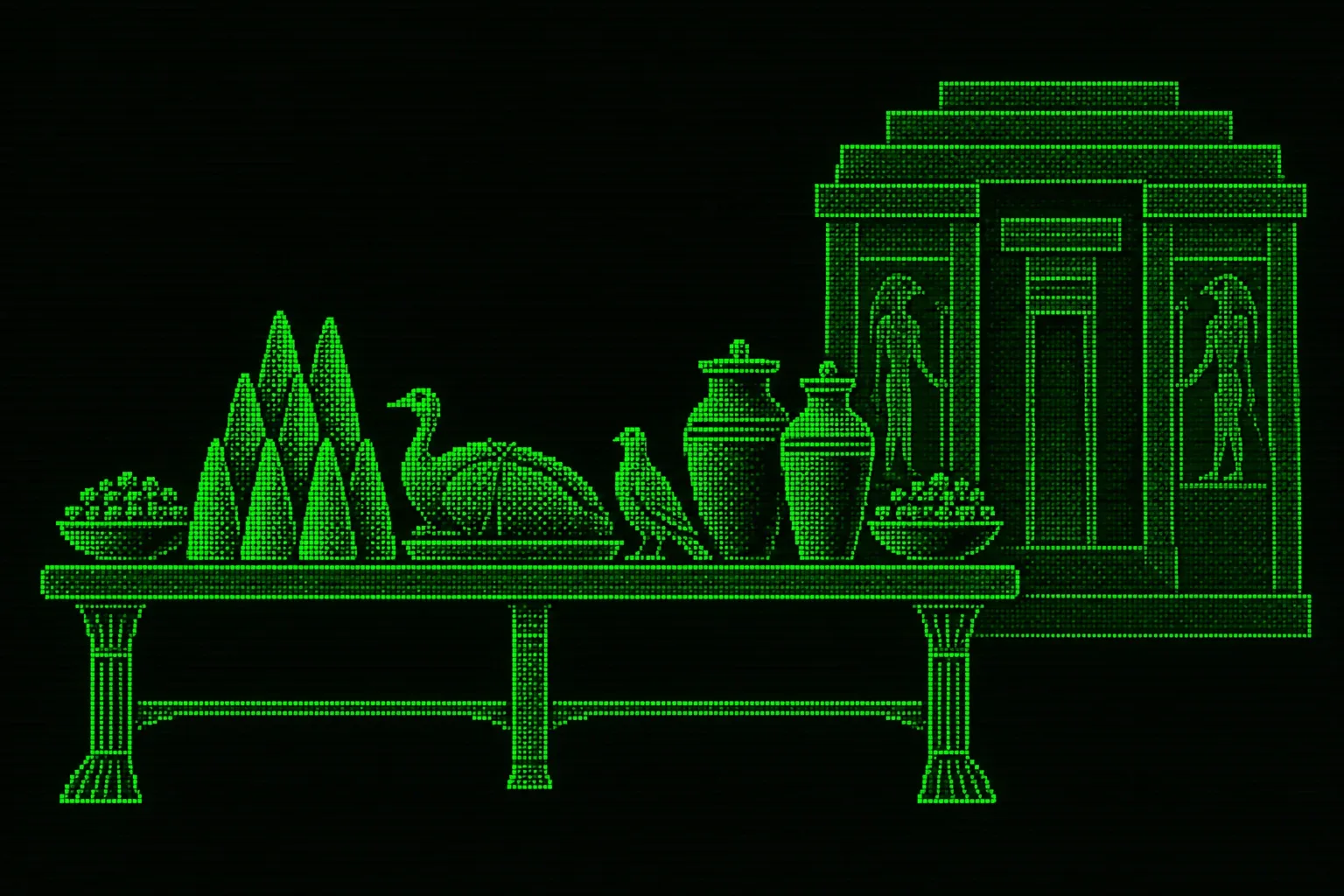
No one speaks: the list itself is the gift, an inventory of what the dead person is to eat and drink forever. It runs from meat, Spleen and Meat of the forepart, through Greylag goose and Pigeon, breads, cakes and beers, to Wine of Lower Egypt. Then come grain and fruit: Roasted emmer, 1, Two bowls of jujubes, Two bowls of tiger nuts. Most of the quantities are broken away.
At the end the list covers anything it might have missed: every thing, 1; sweet things, All the year’s offerings, Every offering presented. It closes on the prize portion: The best from the offering stand, 1.
- 1
nn[šm] _
Spleen: …
Note · Line 1
This is part of an offering list carved in the tomb. - 2
ḥꜥ _
Ha cut of meat: …
- 3
jwf n ḥꜣt _
Meat of the forepart: …
- 4
rʾ _
Greylag goose: …
- 5
mnt _
Pigeon: …
- 6
tʾ-zjf _
Zif bread: …
- 7
šꜥtı͗ _
Two shat cakes: …
- 8
ḏsrt _
Djeseret drink: …
- 9
ḥnkt _
Henket offering: …
- 10
_ _
[gap in the text]
- 11
ḥqt _
Beer: …
- 12
ḥqt ḫnms _
Khenems beer: …
- 13
ḥqt sḫpt _
Beer and sekhepet drink: …
- 14
ꜥ pḫꜣ _
A bowl of pekha drink: …
- 15
ḏwjwı͗ sẖr 2
Two dju jars of sesher: 2
- 16
_ _
[gap in the text]
- 17
jrp mḥw _
Wine of Lower Egypt, …
Note · Line 17
These lines come from an offering list carved in the tomb. - 18
š _
Sha, …
Note · Line 18
An unidentified item, Egyptian š. Coming straight after the wine, it may be another kind of wine. - 19
_ _
[gap in the text]
- 20
ḥbnn[wt] _
Hebenenut bread, …
Note · Line 20
A kind of bread whose exact nature is unknown, Egyptian ḥbnnwt. - 21
ḫ[nf]w _
Khenfu cake, …
Note · Line 21
A cake or sweet loaf, Egyptian ḫnfw. Its precise kind is unknown. - 22
_ _
[gap in the text]
- 23
_ _
[gap in the text]
- 24
_ _
[gap in the text]
- 25
jḥb _
Iheb, …
Note · Line 25
An unidentified item, Egyptian jḥb. - 26
ḫn[fw] _
Khenfu cake, …
- 27
jšd 1
Ished fruit, 1
- 28
sẖt ḥḏt 1 wꜣḏt _
White sekhet grain, 1; green, …
- 29
jd 1
Barley, 1
- 30
ꜥgwt ztt 1
Roasted emmer, 1
Note · Line 30
Emmer is the ancient wheat that, with barley, was Egypt’s staple grain. Here it is offered parched. - 31
ꜥwı͗ bꜣbꜣt 1
Two bowls of babat grain, 1
- 32
ꜥwı͗ nbs _
Two bowls of jujubes, …
Note · Line 32
The fruit of the Christ’s-thorn tree (Ziziphus spina-christi), a small sweet berry like a jujube. - 33
tʾ-nbs _
Jujube bread, …
- 34
ꜥwı͗ wꜥḥ _
Two bowls of tiger nuts, …
Note · Line 34
Tiger nuts (wꜥḥ) are the small sweet tubers of a sedge, eaten raw, roasted or ground. They are still a popular snack in Egypt. - 35
nb ḫt nb 1 bnrt _
of every kind; every thing, 1; sweet things, …
Note · Line 35
The first “every” seems to complete the tiger nuts (“tiger nuts of every kind”). “Every thing” and “sweet things” are catch-all entries meant to cover anything the list might have left out. - 36
rnpwt nb _
All the year's offerings, …
- 37
ḥnkt nb _
Every offering presented, …
- 38
gsw nb 1
All the half-loaves, 1
- 39
pš 1
The round of offerings, 1
- 40
pḏw 1
The spread, 1
- 41
spt 1
Choice cuts of meat, 1
- 42
ḥꜣt wdḥw 1
The best from the offering stand, 1
Note · Line 42
The first and finest portion taken from the stand on which the offerings are set out.