~/sacred-texts/tomb-of-niankhkhnum-and-khnumhotep
Niankhkhnum and Khnumhotep: Rules for Their Tomb Priests
- Date
- Carved in the 5th Dynasty, under King Niuserre (c. 2450–2400 BC), on the east wall of the tomb chapel of Niankhkhnum and Khnumhotep at Saqqara
- Found
- Found in 1964 beside the causeway of Unas at Saqqara; still in place in the tomb.
- Language
- Egyptian (Old Egyptian) · Hieroglyphic
Niankhkhnum and Khnumhotep, overseers of the palace manicurists, speak to the priests paid to make offerings at their tomb: We shall not let our children, our two wives, or any person at all have power over them. A priest who sells his share or takes on another service loses it to his own crew. A priest who goes to law against a colleague is setting his hand to wreck the invocation offerings of the lords of provision, and his whole share goes to the man he sued.
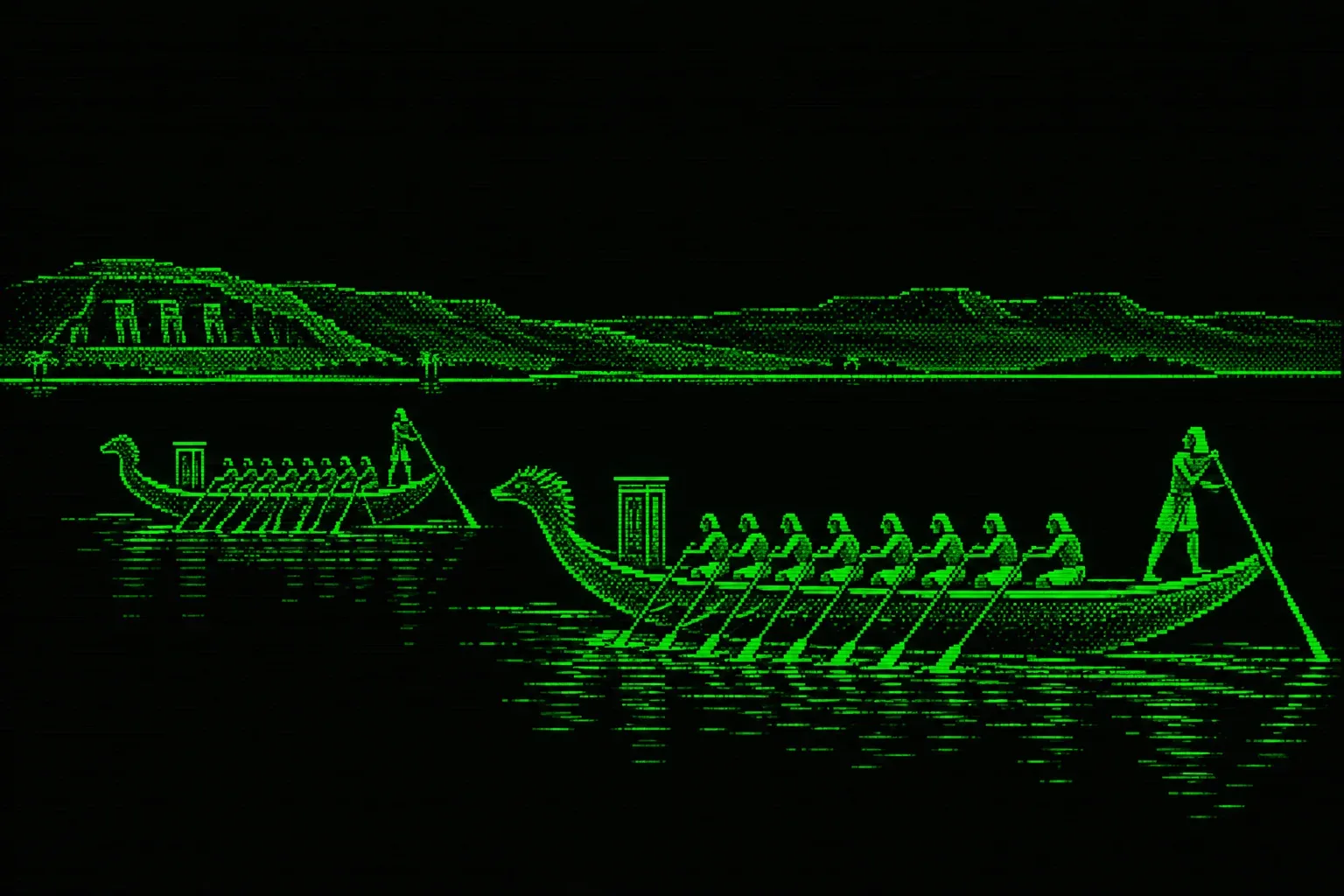
Beside the decree, captions name the household: women who run the royal weaving houses, scribes, a police officer, ka-priests. Then boats carry the dead to the necropolis, and a crewman shouts: Don’t ram our hedgehog-boat!
- 1
N,j-⸢ꜥnḫ-H̱nm,w⸣ ⸢H̱nm,w-ḥtp,w⸣
Niankhkhnum and Khnumhotep
Note · Line 1
These are the two men buried together in this tomb at Saqqara. - 2
⸢sḥḏ⸣-jr,w-⸢ꜥn(,t)-pr⸣-ꜥꜣ ⸢nb-jmꜣḫ-⸣ḫ⸢r-nṯr-ꜥꜣ⸣ N,j-⸢ꜥnḫ-H̱nm,w⸣ 〈〈sḥḏ-jr,w-ꜥn(,t)-pr-ꜥꜣ〉〉 〈〈nb-jmꜣḫ-ḫr-nṯr-ꜥꜣ〉〉 ⸢H̱nm,w-ḥtp,w⸣ ḏd =sn
The overseer of the manicurists of the Great House, honoured before the great god, Niankhkhnum, and the overseer of the manicurists of the Great House, honoured before the great god, Khnumhotep. They say:
Note · Line 2
“Great House” (per-aa) is the palace. - 3
jr sn.pl j⸢p⸣n ḥm-kꜣ.pl jpn jri̯ n =n r ⸢pr-ḫrw⸣ n =n ⸢m⸣ ⸢ẖr-nṯr⸣
As for these brethren and these funerary priests who serve us for the invocation offering made to us in the necropolis:
Note · Line 3
“Brethren” are the members of the endowment that supported the tomb’s cult. - 4
⸢nn⸣ ⸢rḏi̯⸣.n =n sḫm ms.w =n ⸢ḥm,t.du⸣ =n rmṯ nb jm =⸢s⸣n
We shall not let our children, our two wives, or any person at all have power over them.
Note · Line 4
“Two wives” is in the dual: one wife for each man. The two owners are guaranteeing the priests’ independence from their own heirs. - 5
jw =sn r pr-ḫrw n =n ḥnꜥ jtj.pl mw,t.pl jm,j.w ẖr-nṯr
They are there for the invocation offering made to us, and to the fathers, the mothers, and those who dwell in the necropolis.
- 6
jr ⸢gr⸣ ḥm-kꜣ nb rḏi̯.t =f ẖr,t =f r ⸢jsw⸣ ⸢n⸣ ⸢rmṯ⸣ ⸢nb⸣
Further, as for any funerary priest who hands his share to anyone at all in return for payment:
Note · Line 6
His “share” is the portion of the endowment’s income that paid him for his service. - 7
nḥ⸢m⸣ (j)ḫ,⸢t⸣ ⸢nb(.t)⸣ [r]ḏi̯.t n =f m-ꜥ =f ḏḏ!.t ⸢n⸣ ḥm-kꜣ.pl n zꜣ =f
everything that was given to him shall be taken from him and given to the funerary priests of his phyle.
Note · Line 7
A phyle was a crew of priests who served in rotation. The forfeited income stays within the forfeiting priest’s own crew. - 8
jr gr ḥm-kꜣ nb ⸢jṯi̯⸣.t =f n k(y).t wnw,t
Further, as for any funerary priest who takes on another service:
- 9
⸢nḥm⸣ (j)ḫ,t nb(.t) rḏi̯.t n =f m-ꜥ =f ⸢ḏḏ!⸣.t ⸢n⸣ ḥm-kꜣ.pl n zꜣ =f
everything that was given to him shall be taken from him and given to the funerary priests of his phyle.
- 10
j⸢r⸣ ⸢g⸣r ḥm-kꜣ nb šni̯.t =f (j)ḫ.t r ⸢ḥm-kꜣ⸣ sn,nw =f
Further, as for any funerary priest who goes to law over property against his fellow priest:
- 11
pri̯ =f tp(,j)-rʾ =f n ⸢s,t-ꜥ⸣ jrr! =f ꜥ n sḏ pr(,t)-ḫrw n,t nb⸢.w⸣-ḫr,t
He shall forfeit the yield of his service, for he is setting his hand to wreck the invocation offerings of the lords of provision.
Note · Line 11
“Lords of provision” are the dead who are entitled to receive offerings. - 12
nḥm ẖr,t =f nb(.t) ⸢m⸣-ꜥ =f ⸢ḏḏ!.⸣t ⸢n⸣ ḥm-kꜣ pf šnn! =⸢f⸣ (j)ḫ,t r =f
All his share shall be taken from him and given to that funerary priest with whom he is disputing over property.
- 13
jr.n =n nw jr n =⸢ṯ⸣n mnḫ nw n pr(,t)-ḫr⸢w⸣ n,t ꜣḫ⸢.w⸣ nb.w-ḫr,t jmj.⸢w⸣ ⸢ẖr-nṯr⸣
We have made this, made it for you, so that these invocation offerings for the spirits, the lords of provision who dwell in the necropolis, may be well performed.
Note · Line 13
The “spirits” are the akh, the transfigured and effective form the blessed dead attained. “You” means the priests being addressed. - 14
⸢ḥm-kꜣ⸣ ⸢jr(,w)-ꜥn,t⸣ ⸢Jtjw⸣
The funerary priest and manicurist Itiu.
Note · Line 14
This caption and the ones that follow label figures carved in the scene beside the decree. - 15
sḫpi̯ stp(,w)
Choice cuts are brought.
- 16
(j)m(,j)-rʾ-⸢pr-ḥts,(w)t⸣ ⸢N,j-sw-qd⸣
The steward of the house of the weaving women, Nisuqed.
- 17
(j)r(,j-j)⸢ḫ(,t)-nswt⸣ ⸢ḫrp⸣-ꜥpr(,w) ⸢sḥḏ⸣-wjꜣ Ḫꜥi̯-⸢bꜣ,w⸣-Ḫwi̯≡f-w(j)
Custodian of the King's Property, Director of the Crew, Inspector of the Boat, Khaibaukhufu.
Note · Line 17
These lines are captions written beside figures carved on the tomb wall, naming the people shown. - 18
(j)r(,jt-j)⸢ḫ(,t)-nswt⸣ (j)m(,jt)-rʾ-⸢pr⸣-ḥts,(w)t Rwḏ-zꜣ(,w)≡s
Custodian of the King's Property, Overseer of the House of Weavers, Rudjzaues.
Note · Line 18
The “House of Weavers” was a linen workshop staffed by women, and here women also run it. - 19
(j)m(,j)-ḫt-pr,w-ḥts,wt Tty
Under-Supervisor of the Houses of Weavers, Teti.
- 20
(j)r(,j-j)⸢ḫ(,t)-nswt⸣ nb-jmꜣ⸢ḫ⸣-ḫ⸢r-nṯr-ꜥꜣ⸣ ⸢Nfr-nsw⸣t
Custodian of the King's Property, possessor of honor before the great god, Nefernisut.
- 21
(j)r(,jt-j)ḫ(,t)-⸢nswt⸣ ẖkr(,t)-nswt [mr,yt] =⸢f⸣ Nfr-ḥ⸢tp⸣-Ḥw,t-Ḥr,w
Custodian of the King's Property, Ornament of the King, his beloved, Neferhetep-Hathor.
Note · Line 21
“Ornament of the King” was a court title for women. “His” refers to the king. - 22
(j)r(,j-j)⸢ḫ(,t)⸣-nswt (j)m(,jt)-rʾ-⸢pr⸣-ḥts,wt Mḥw,t
Custodian of the King's Property, Overseer of the House of Weavers, Mehut.
- 23
(j)r(,jt-j)ḫ(,t)-nswt (j)m(,jt)-⸢rʾ[-pr]-ḥts,wt⸣ Ḥz⸢,t⸣n-⸢Ptḥ⸣
Custodian of the King's Property, Overseer of the House of Weavers, Hezetenptah.
- 24
(j)r(,j-j)ḫ(,t)-nswt nb-jmꜣḫ-(ḫ)r-nṯr-ꜥꜣ kꜣ(≡j)-ḥr-s,t≡f
Custodian of the King's Property, possessor of honor before the great god, Kaihersetef.
- 25
sḥḏ-jr,w-ꜥn(,t)-pr-ꜥꜣ nb-jmꜣḫ-ḫr-nṯr-ꜥꜣ N(,j)-⸢ꜥnḫ-H̱nm,w⸣
Overseer of the Manicurists of the Palace, possessor of honor before the great god, Niankhkhnum.
- 26
〈〈sḥḏ-jr,w-ꜥn,t-pr-ꜥꜣ〉〉 〈〈nb-jmꜣḫ-ḫr-nṯr-ꜥꜣ〉〉 ⸢H̱nm,w-ḥtp,w⸣
Overseer of the Manicurists of the Palace, possessor of honor before the great god, Khnumhotep.
Note · Line 26
Niankhkhnum and Khnumhotep, both overseers of the royal manicurists, are the two men who share this tomb. Their titles are carved only once and serve for both names. - 27
(j)r(,jt-j)ḫ,t-nswt Ṯst
Custodian of the King's Property, Tjeset.
- 28
zꜣb-(j)m(,j)-ḫt-zꜣ-pr ẖnm,w-ḥzi̯≡f
Senior Under-Supervisor of the Police, Khnumhezief.
- 29
jr(,w)-ꜥn(,t)-pr-⸢ꜥꜣ⸣ Kꜣ(≡j)-ḥr-s,t≡f
Manicurist of the Palace, Kaihersetef.
- 30
zẖꜣ,w(-n)-pr-ḥḏ Sḫm
Scribe of the Treasury, Sekhem.
- 31
zẖꜣ,w-šnw,t Nfr
Granary Scribe, Nefer.
- 32
zẖꜣ,w H̱nm,w-ḥtp,w
Scribe, Khnumhotep.
- 33
(j)m(,j)-rʾ-pr sḥḏ-ḥm(,w)-kꜣ ꜥnḫ-rd,wj-nswt
The estate steward and overseer of ka-priests, Ankh-redwi-nisut.
Note · Line 33
Ka-priests were funerary priests paid from the tomb owner’s endowment. They kept up offerings for his ka, the life-force that went on living after death. - 34
sḥḏ-ḥm(,w)-kꜣ N(,j)-kꜣ(,w)-Ptḥ
The overseer of ka-priests, Ni-kau-Ptah.
- 35
[Nfr-ḥr-n]-ptḥ
Nefer-her-en-Ptah.
- 36
sq⸢d⸣,wt r s,t.pl ⸢nfr.(w)t⸣ m-⸢m⸣ ⸢jmꜣḫ,w⸣
Sailing to the beautiful places among the honoured dead.
Note · Line 36
The “honoured” (imakhu) are the dead who are properly provided for in the afterlife. The boats are carrying the tomb owner to the necropolis. - 37
⸢jri̯⸣ ⸢ḥr⸣ [jm,j-]wr,t r wꜣ,t nfr.t
Keep to starboard, onto the good way!
Note · Line 37
One Egyptian word means both “starboard” and “west”. - 38
ḫrp-jz,t
Director of the crew.
- 39
sq⸢d,⸣w[t] r sḫ,t-ḥtp
Sailing to the Field of Offerings.
Note · Line 39
The Field of Offerings is a fertile, abundant region of the afterlife where the blessed dead are fed for ever. - 40
jri̯ ḥr jm,j-wr,t
Keep to starboard!
- 41
m wdi̯ m ḥnt(j) =n
Don't ram our hedgehog-boat!