~/sacred-texts/tomb-of-niankhkhnum-and-khnumhotep-saqqara
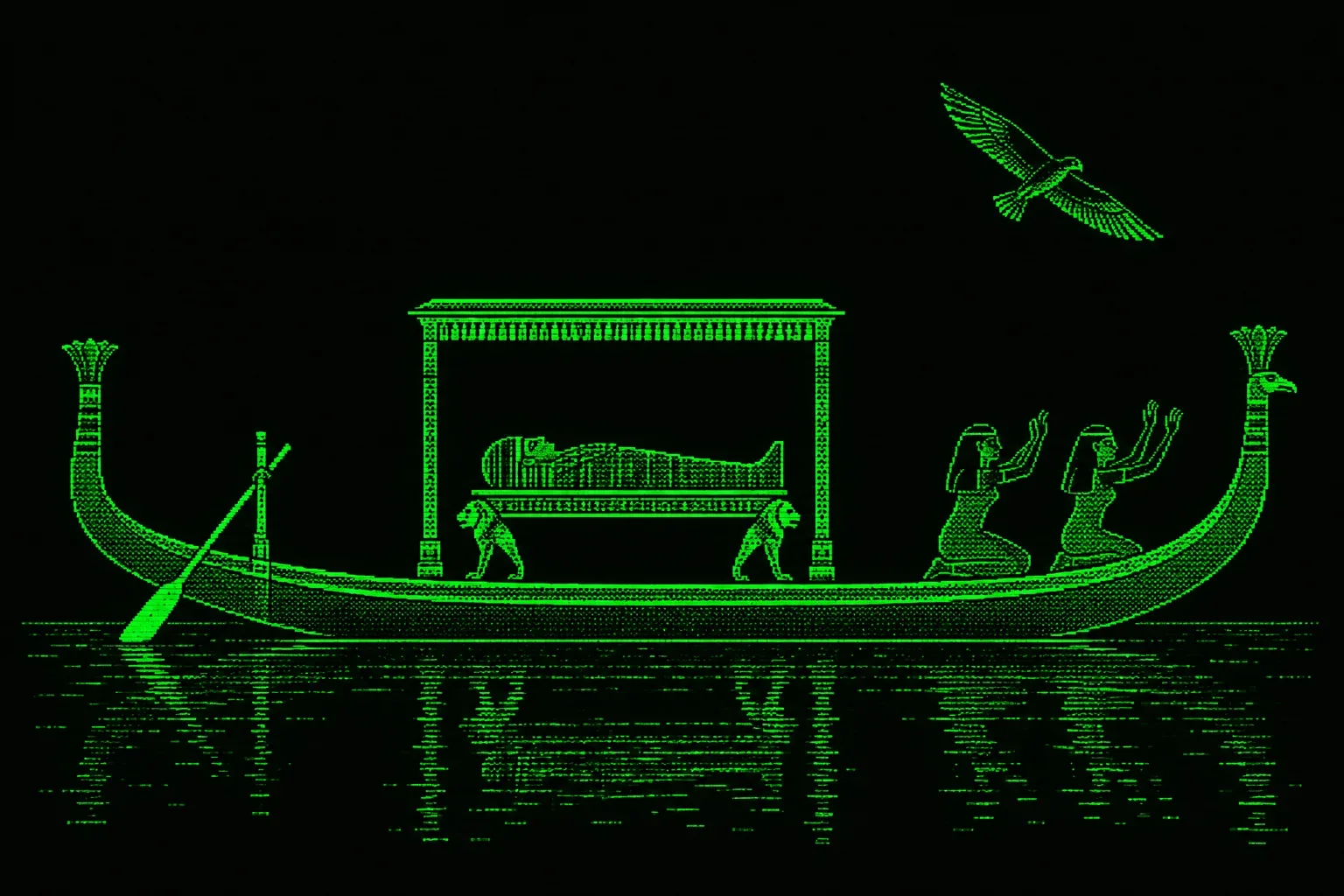
Tomb of Niankhkhnum and Khnumhotep: A Manicurist’s Funeral
- Date
- Carved in the 5th Dynasty, reign of Niuserre (c. 2450–2400 BC), on the east wall of the tomb of Niankhkhnum and Khnumhotep at Saqqara
- Found
- Mastaba of Niankhkhnum and Khnumhotep beside the Unas causeway, Saqqara; still in place in the tomb
- Language
- Egyptian (Old Egyptian) · Hieroglyphic
- 1
sḏꜣ.t [tp(,j)-]š ⸢m⸣ ⸢pr-nfr⸣ ⸢m⸣-ḥtp m-ḥtp r jz =f n ẖr-nṯr
The bearing of the one upon the Lake out of the House of Embalming, in peace, in peace, to his tomb in the necropolis.
Note · Line 1
A caption to the funeral procession painted on the wall. - 2
s⸢ḥḏ-ḥm(,w)-kꜣ⸣ ⸢zẖꜣ-⸣šnw Nfr
The inspector of ka-priests, the granary scribe Nefer.
Note · Line 2
Ka-priests were paid to bring offerings to the dead man’s ka, his life-force, which lived on and had to be fed. The names that follow belong to the men walking in the procession. - 3
ḥm-kꜣ wdp(,w) Šzm,w-ḥtp(,w) ḥm-[kꜣ] [⸮_?]
The ka-priest and attendant Shesemuhotep; the ka-priest …
- 4
⸢(j)m(,j)-ḫt-⸣ḥm(,w)-kꜣ Fktt
The under-supervisor of ka-priests Feketet.
- 5
Ṯmzj ḥm-kꜣ Jni̯-(j)t(j)≡f
Tjemzi; the ka-priest Intef.
- 6
ḥm-kꜣ (j)m(,j)-ḫt Ftk-tʾ
The ka-priest and retainer Fetekta.
- 7
ḥm-kꜣ Mmj ⸢ḥm-kꜣ⸣ ṯ[⸮_?] ⸢ḥm-kꜣ⸣ ⸢Sti̯-mw⸣ ⸢ḥm-kꜣ⸣ [⸮_?] ⸢ḥm-kꜣ⸣ [⸮_?]
The ka-priest Memi; the ka-priest Tj…; the ka-priest Setimu; the ka-priest …; the ka-priest …
- 8
zẖꜣ(,w) H̱nm(,w)-ḥtp(,w) ⸢ḥm-kꜣ⸣ ḫrp-jz(,t) Mmj
The scribe Khnumhotep; the ka-priest and work-gang leader Memi.
- 9
⸢ḥm-kꜣ⸣ Dmḏ ⸢ḥm-kꜣ⸣ Sti̯-mw ⸢ḥm-kꜣ⸣ jr(,w)-ꜥn(,t) Rḏi̯-j ⸢ḥm-kꜣ⸣ ẖꜥq Ṯjw ⸢ḥm-kꜣ⸣ ḫrp-jz(,t) N(,j)-s(w)-qd ⸢ḥm-kꜣ⸣ ḫrp-jz(,t) Mmj ḥm-kꜣ (j)m(,j)-ḫt Ftk-tʾ ḥm-kꜣ (j)m(,j)-ḫt H̱nm(,w)-ḥtp(,w) zẖꜣ(,w)-šnw(,t) Nfr
The ka-priest Demedj; the ka-priest Setimu; the ka-priest and manicurist Redji; the ka-priest and barber Tjiu; the ka-priest and work-gang leader Nisuqed; the ka-priest and work-gang leader Memi; the ka-priest and retainer Fetekta; the ka-priest and retainer Khnumhotep; the granary scribe Nefer.
Note · Line 9
Many of these men also held ordinary household jobs, such as barber or manicurist, alongside their duty to the dead. - 10
zẖꜣ(,w)-šnw(,t) Nfr
The granary scribe Nefer.
- 11
ḏr,t
A Kite.
Note · Line 11
“Kite” (the bird of prey) was the title of a professional mourning woman. Two such women played the goddesses Isis and Nephthys, who took the form of kites and wailed over the dead Osiris. - 12
j:ḫpi̯ nfr
Pass on in beauty!
Note · Line 12
The mourners call out to the dead man. The verb means “to go, travel on,” and is also used for dying. - 13
j:ḫp nf⸢r⸣
Pass on in beauty!
- 14
sḥḏ-jr(,w)-ꜥn(,t)-pr-ꜥꜣ (j)r(,j-j)ḫ(,t)-⸢nsw⸣t wꜥb-nswt H̱nm(,w)-ḥ⸢tp⸣(,w)
The inspector of the palace manicurists, keeper of the king's property, royal wab-priest Khnumhotep.
Note · Line 14
A wab-priest was a “pure” priest, one ritually cleansed for service. Khnumhotep is the tomb owner, and he is named here beside the scene of his own funeral. - 15
ḏꜣi̯.⸢t⸣ Wr,t
The crossing of the Weret Canal.
Note · Line 15
The name Weret means “the Great One.” Ferrying the body over water was a fixed stage of the funeral and was modelled on a journey to the realm of the dead. - 16
wt(,j) ḏr,t wt(,j)
An embalmer; a Kite; an embalmer.
- 17
⸢stp⸣ ⸢s[tp,t] jni̯.t m pr[-ḏ,t] n qrs,t
Cutting out the choice cuts brought from the funerary estate for the burial.
Note · Line 17
The verb “cut” and the noun “choice cuts” share one root in Egyptian (stp, stp. t). The funerary estate is the land and staff endowed to keep supplying the dead man’s tomb. - 18
pḏi̯.t ds
Sharpening the knife.
- 19
ḥm-kꜣ N(,j)-sw-ḥn,w ḥm-kꜣ Kꜣj ḥm-kꜣ Šꜣṯw ḥm-kꜣ Kꜣ≡j-zb-j ḥm-kꜣ Rḏi̯-j ḥm-kꜣ Nfr ḥm-kꜣ mḏḥ(,w) Ḏꜥꜥ
The ka-priest Ni-su-henu; the ka-priest Kai; the ka-priest Shatju; the ka-priest Kai-zeb-i; the ka-priest Redji-i; the ka-priest Nefer; the ka-priest and carpenter Djaa.
Note · Line 19
A ka-priest was paid from the estate to bring offerings to the dead man’s ka, the life-force that lived on after death and had to be fed. - 20
sḥḏ-wt(,w) ḏr,t
An inspector of embalmers; a kite-woman.
Note · Line 20
The “kite” is a professional mourner. Mourning women played the goddesses Isis and Nephthys, who in the myth wailed like kites over the dead Osiris. - 21
[ḥtp]-ḏi̯ [nswt] ḥtp-〈〈ḏi̯〉〉 Jnp,w ḫnt(,j)-zḥ-nṯr
An offering that the king gives, an offering that Anubis gives, Foremost of the God's Booth:
Note · Line 21
This is the standard offering formula, which opens a prayer for the dead. Anubis, the jackal god of embalming, presides over the “god’s booth”, the tent or hall where the body was embalmed. - 22
qrs(.w) m ẖr-nṯr jꜣwi̯(.w) nfr wr,t nb-jmꜣḫ [(j)m(,j)]-rʾ-jr(,w)-ꜥn(,t)-[pr-ꜥꜣ] [mḥnk]-nswt [ḥr(,j)-sštꜣ] [jmꜣ]ḫ,w-ḫr-nṯr-ꜥꜣ H̱nm(,w)-ḥ⸢tp(,w)⸣
may he be buried in the necropolis, having grown old most fittingly, the possessor of honour, overseer of the palace manicurists, confidant of the king, keeper of secrets, honoured one before the great god, Khnumhotep.
- 23
(j)m(,j)-rʾ-jr(,w)-ꜥn(,t)-pr-ꜥꜣ mḥnk-nswt nb-jmꜣḫ-ḫr-nṯr-ꜥꜣ H̱nm(,w)-ḥ⸢tp(,w)⸣
The overseer of the palace manicurists, confidant of the king, possessor of honour before the great god, Khnumhotep.
- 24
ꜥḥꜥ m-tp jz sḥḏ-jr(,w)-ꜥn(,t)-pr-ꜥꜣ H̱nm(,w)-ḥ⸢tp(,w)⸣
Standing at the head of the tomb of the inspector of palace manicurists, Khnumhotep.
Note · Line 24
Here Khnumhotep carries the lower title “inspector”, a rank below the “overseer” named in the lines above. - 25
wꜣḥ pr-ḫrw jn wt(,j)
Laying down the invocation offering, by an embalmer.
Note · Line 25
The “invocation offering” is literally a “going-forth at the voice”: food and drink that come out for the dead when the offering prayer is spoken aloud. - 26
ḥnk jn wt(,j)
Presenting, by an embalmer.
- 27
zẖꜣ(,w-n)-pr-ḥḏ sḥḏ-ḥm(,w)-kꜣ [S]ḫm
The scribe of the treasury and inspector of ka-priests, Sekhem.