~/sacred-texts/demotic-literary-papyri
Myth of the Sun's Eye: The Ape Lures the Cat-Goddess Home
Translated by AI straight from the German, not from a modern translation, then checked against the editions and studies listed below. How we translate
- Text
- Demotic literary papyri, Papyrus Leiden I 384, cols. I–XXII
- Date
- Roman period, about AD 100; Spiegelberg's German 1917
- Found
- Thebes; now Rijksmuseum van Oudheden, Leiden
- Language
- German · Demotic (given here from Spiegelberg's German)
This is the Demotic Myth of the Sun’s Eye as it stands in Leiden papyrus I 384, a Roman-period copy of a tale in which the goddess Tefnut, the Eye of the sun-god Phre (Re), has left Egypt in anger and lives in the Nubian desert as an Ethiopian cat. Phre sends Thoth after her in the form of a little dog-ape. The ape argues, flatters and tells animal fables (the vulture and the cat, the two jackals, the lion and the man, the lion and the mouse) until she returns to Egypt, by way of El-Kab and Thebes to Heliopolis and Memphis. The papyrus is damaged throughout; Columns I and XXIII are mostly lost.
The English here is made from Wilhelm Spiegelberg’s German translation of 1917, not from the Demotic, and it carries his brackets and his hesitations. A German translation of this text is itself an interpretation: Spiegelberg writes more than once that the sense is dark or that he restored a line on slight evidence. In the Nachträge he accepts Junker’s suggestion that many passages introduced by “he said” and “she said also” are later commentary on the poetic speeches before them. His footnotes are given as notes, shortened; his transliteration and glossary are left to the book.
Refs give the page of the 1917 book and his column (Kolumne) and line. Where the line numbers could not be read off the page with certainty the column alone is given. Column XXIII survives only as a narrow strip, which Spiegelberg did not translate.
Each numbered line gives the German first. Our English is underneath. Tap a dotted word for its meaning, and Note for our comment on the line; our comments are in the right margin.
The first column
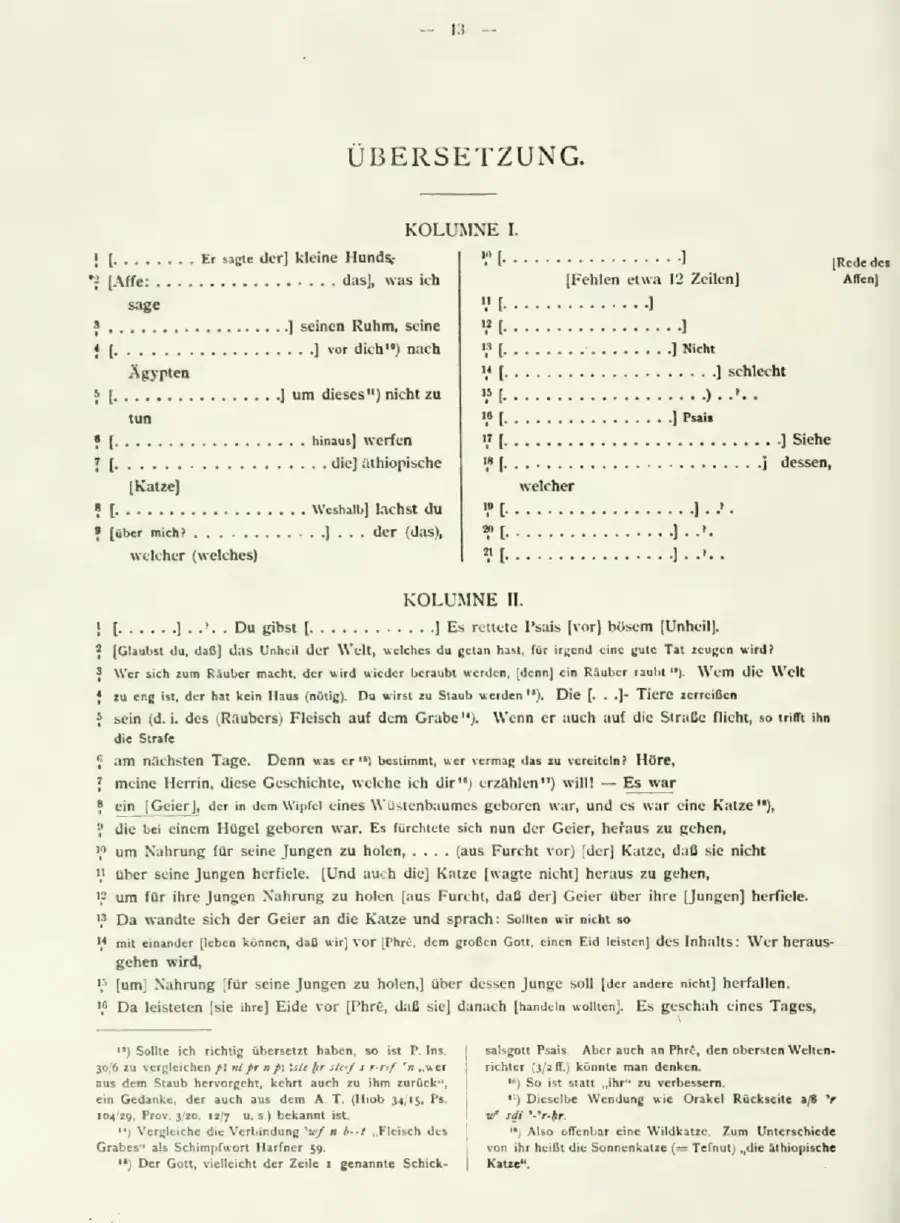
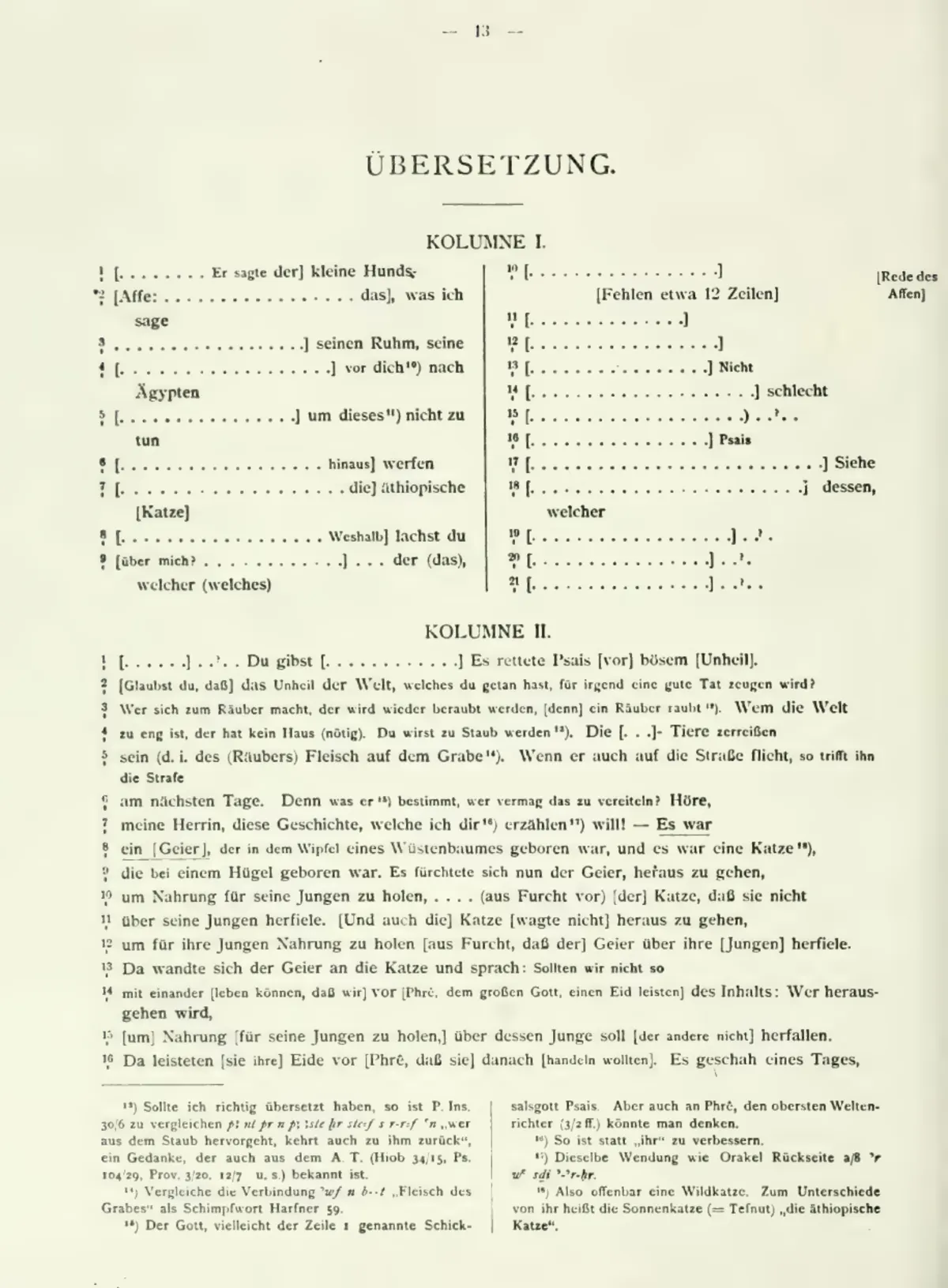
Page 13. Spiegelberg p. 13: the torn Column I, and Column II 1-16: the ape's warning and the beginning of the vulture and the cat Spiegelberg 1917, pp. 13–55 (archive.org scan) - 113, Kol. I 1–9
[Er sagte der] kleine Hunds-[Affe: das], was ich sage [ ] seinen Ruhm, seine [ ] vor dich nach Ägypten [ ] um dieses nicht zu tun [ hinaus] werfen [ die] äthiopische [Katze] [. Weshalb] lachst du [über mich? ] ... det (das), welcher (welches)
[He said, the] little dog-[ape: that] which I say [ ] his fame, his [ ] before you to Egypt [ ] in order not to do this [ out] throw [ the] Ethiopian [cat] [. Why] do you laugh [at me? ] ... that, which (the one who)
Note on line 1
Spiegelberg’s first column is torn: the right-hand end of each line survives and the left is lost. The speaker is the little dog-faced ape (Thoth), and the one addressed is the Ethiopian cat, the sun-goddess Tefnut. The ‘Ethiopian cat’ of this line is the ‘distant goddess’ who has gone off to Nubia. - 213, Kol. I 10–21
This line is missing from the open German text we translate from.
Paraphrase Line 10 of Column I is empty and about twelve lines are lost after it. Lines 11 to 21 keep only a few words at their ends: 'not', 'bad', 'Psais', 'behold', 'of him who'. No sentence can be made out.
Taken from the published translations until we can translate the German ourselves.
The ape’s first warning
- 313, Kol. II 1–6
[ ] ... Du gibst [ ] Es rettete Psais [vor] bösem [Unheil]. [Glaubst du, daß] das Unheil der Welt, welches du getan hast, für irgend eine gute Tat zeugen wird? Wer sich zum Räuber macht, der wird wieder beraubt werden, [denn] ein Räuber raubt. Wem die Welt zu eng ist, der hat kein Haus (nötig). Du wirst zu Staub werden. Die [. . .]-Tiere zerreißen sein (d. i. des (Räubers) Fleisch auf dem Grabe. Wenn er auch auf die Straße flieht, so trifft ihn die Strafe am nächsten Tage. Denn was er bestimmt, wer vermag das zu vereiteln?
[ ] ... You give [ ] Psais rescued [from] evil [mischief]. [Do you think that] the mischief of the world which you have done will bear witness to any good deed? He who makes himself a robber will be robbed in turn, [for] a robber robs. For whom the world is too narrow, he needs no house. You will become dust. The [. . .]-animals tear his (that is, the robber's) flesh on the grave. Even if he flees into the street, the punishment finds him on the next day. For what he decides, who can frustrate it?
Note on line 3
Spiegelberg compares Papyrus Insinger 30/6, ‘he who comes out of the dust returns to it’, and cites Job 34:15, Psalm 104:29 and Proverbs 3 and 12 for the same thought. ‘Flesh of the grave’ as a term of abuse is in the Harper’s Song (Harfner 59). The god who decides is perhaps Psais, the god of fate named in line 1, or Phre, the supreme judge of the world. A wild cat, Spiegelberg notes, is meant here; the sun-cat (Tefnut) is distinguished from it as ’the Ethiopian cat’. The Vulture and the Cat
- 413, Kol. II 6–12
Höre, meine Herrin, diese Geschichte, welche ich dir erzählen will! — Es war ein [Geier], der in dem Wipfel eines Wüstenbaumes geboren war, und es war eine Katze, die bei einem Hügel geboren war. Es fürchtete sich nun der Geier, heraus zu gehen, um Nahrung für seine Jungen zu holen, .... (aus Furcht vor) [der] Katze, daß sie nicht über seine Jungen herfiele. [Und auch die] Katze [wagte nicht] heraus zu gehen, um für ihre Jungen Nahrung zu holen [aus Furcht, daß der] Geier über ihre [Jungen] herfiele.
Hear, my mistress, this story which I will tell you! — There was a [vulture] born in the crown of a desert tree, and there was a cat born by a hill. Now the vulture was afraid to go out to fetch food for his young, .... (for fear of) [the] cat, that she might fall upon his young. [And the] cat, too, [did not dare] to go out to fetch food for her young [for fear that the] vulture might fall upon her [young].
- 513, Kol. II 13–16
Da wandte sich der Geier an die Katze und sprach: Sollten wir nicht so mit einander [leben können, daß wir] vor [Phre, dem großen Gott, einen Eid leisten] des Inhalts: Wer herausgehen wird, [um] Nahrung [für seine Jungen zu holen,] über dessen Junge soll [der andere nicht] herfallen. Da leisteten [sie ihre] Eide vor [Phre, daß sie] danach [handeln wollten]. Es geschah eines Tages,
Then the vulture turned to the cat and said: Could we not live with one another so [that we swear] before [Phre, the great god, an oath] to this effect: Whoever goes out [to] fetch food [for his young], upon his young shall [the other not] fall. Then [they swore their] oaths before [Phre, that they would] act accordingly. It happened one day,
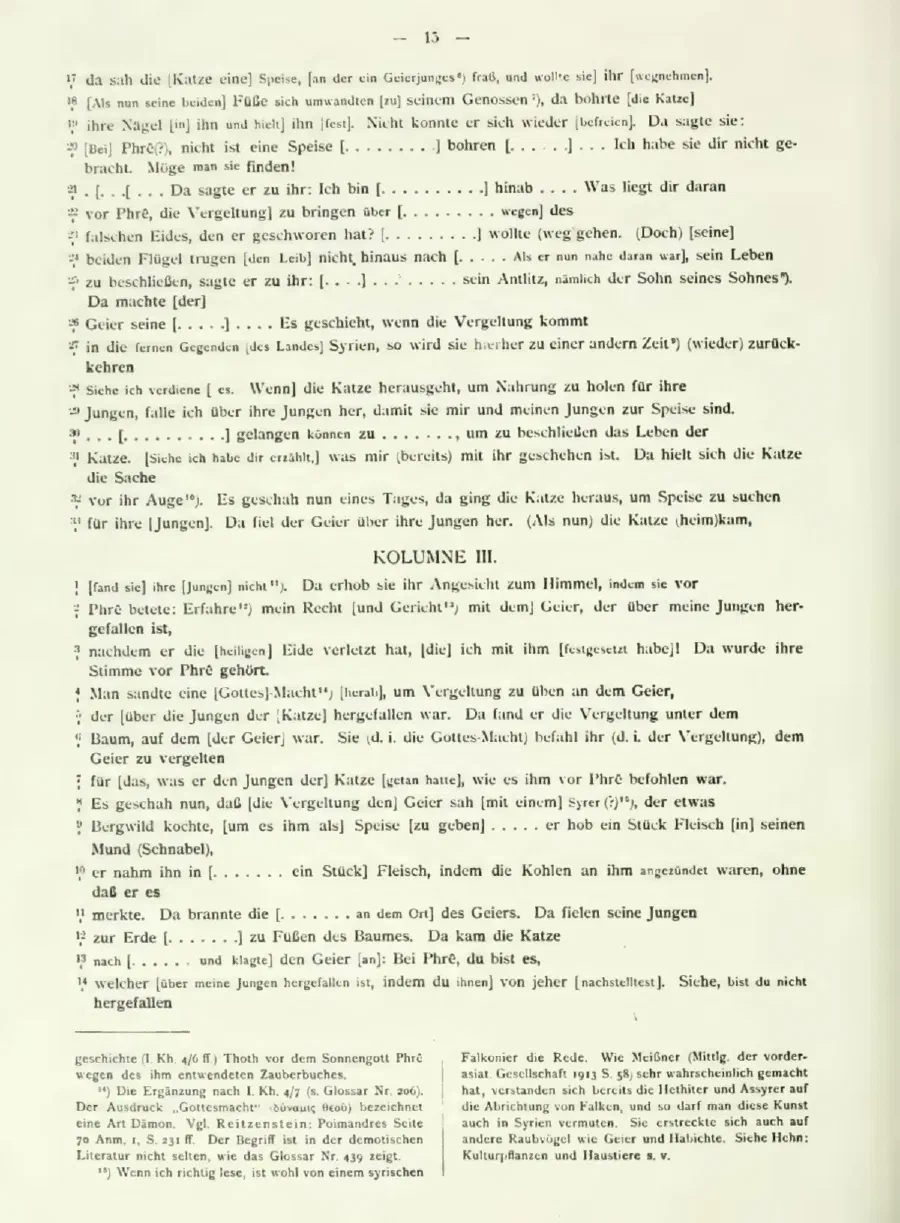
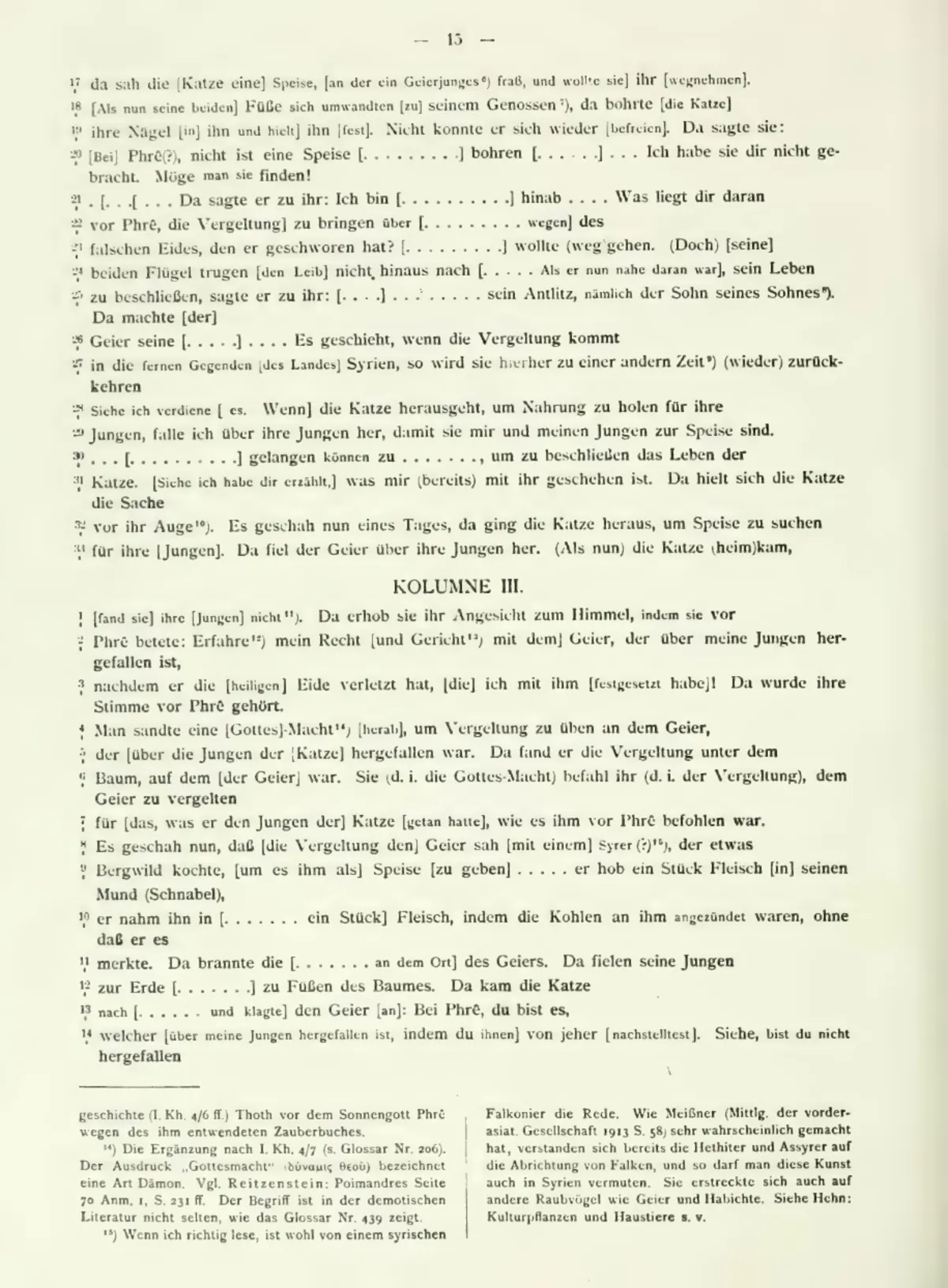
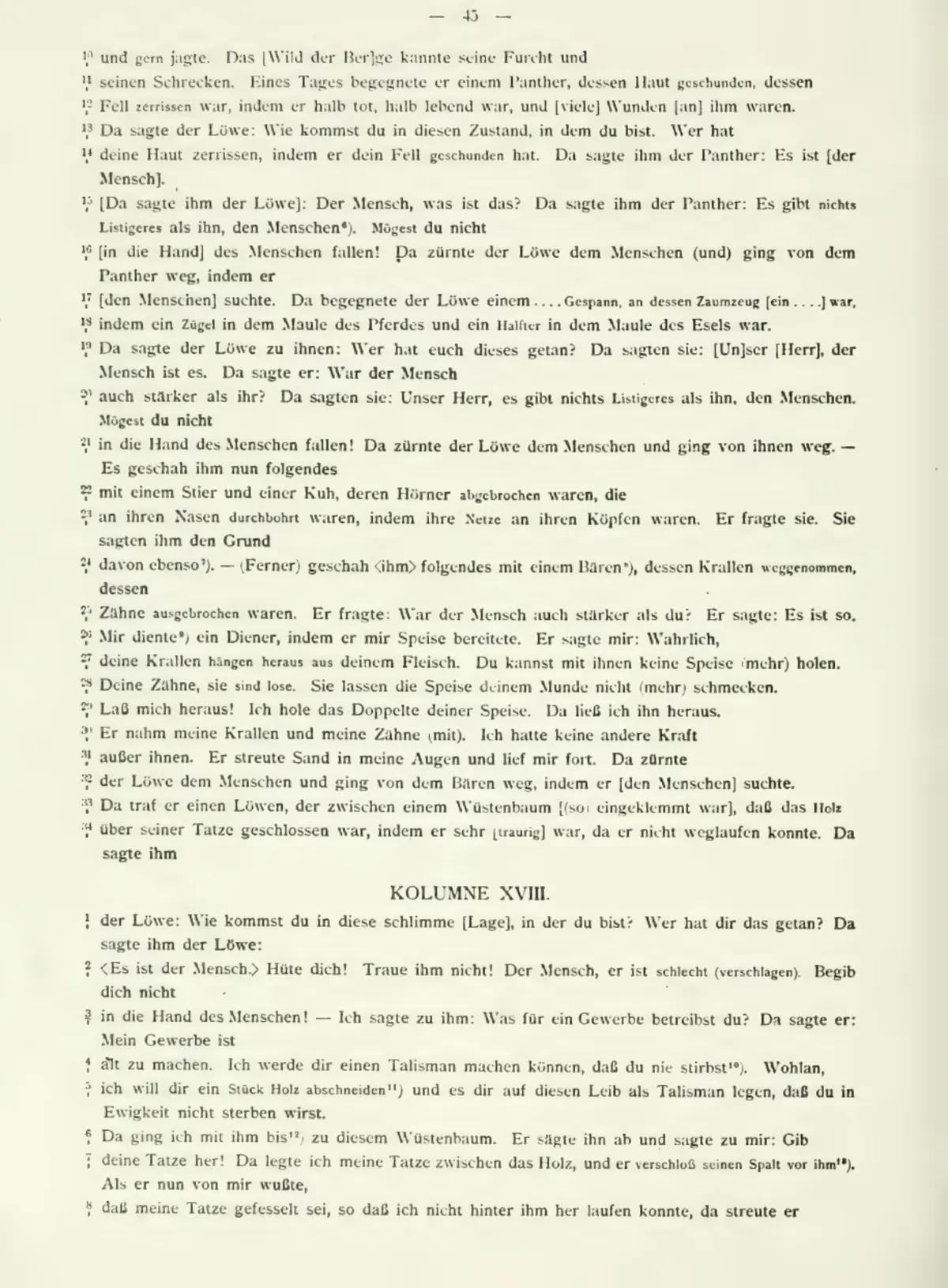
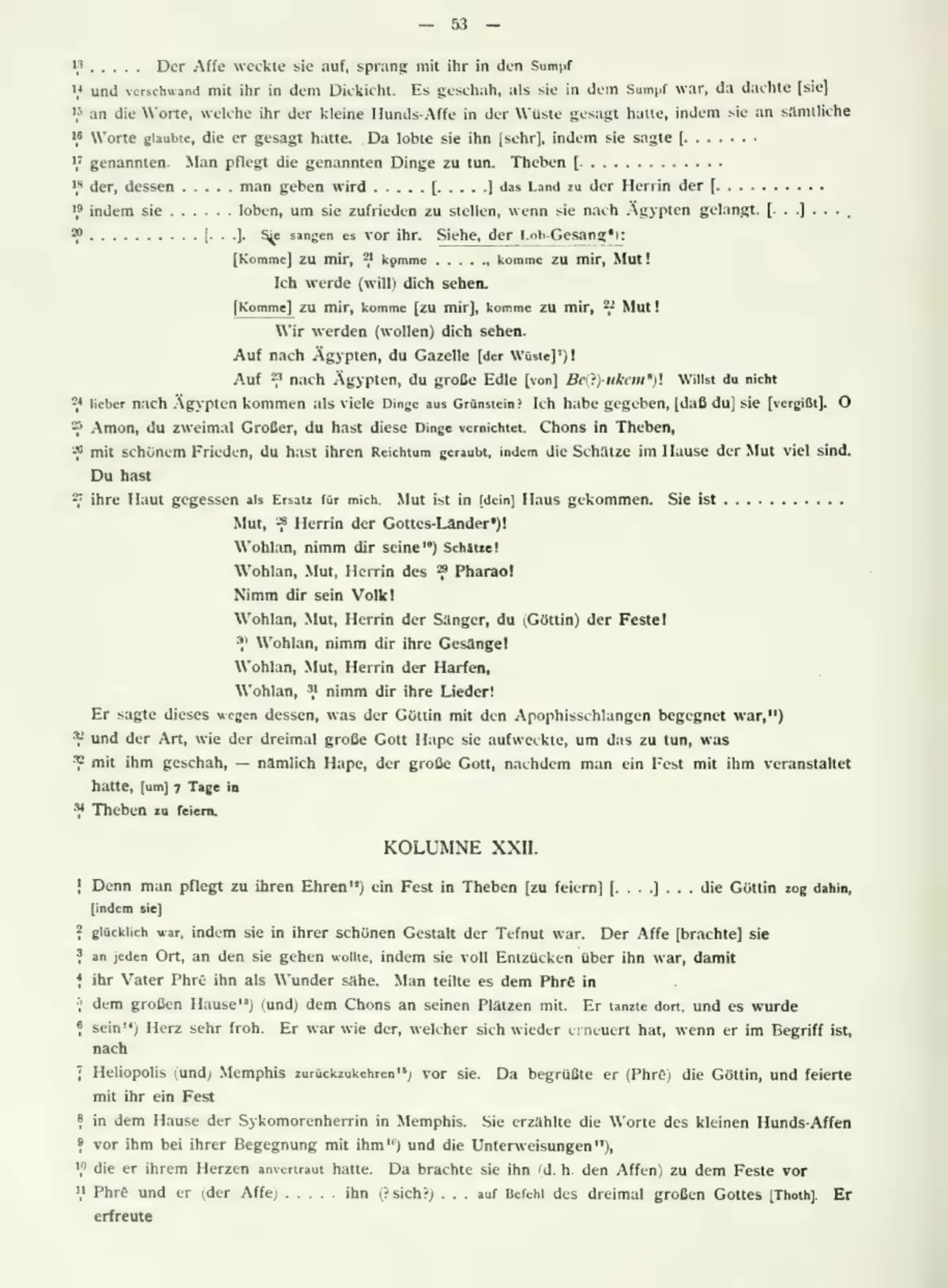
Page 15. p. 15: Column II 17-33 and III 1-14: the cat's claws, the dying vulture, the cat's prayer, Retribution and the burning nest Spiegelberg 1917, pp. 13–55 (archive.org scan) - 615, Kol. II 17–20
da sah die [Katze eine] Speise, [an der ein Geierjunges fraß, und wollte sie] ihr [wegnehmen]. [Als nun seine beiden] Füße sich umwandten [zu] seinem Genossen, da bohrte [die Katze] ihre Nägel [in] ihn und hielt ihn [fest]. Nicht konnte er sich wieder [befreien]. Da sagte sie: [Bei] Phre, nicht ist eine Speise [ ] bohren [ ] ... Ich habe sie dir nicht gebracht. Möge man sie finden!
the [cat saw] food, [at which a young vulture was feeding, and wanted to] take it from him. [Now when his two] feet turned [to] his companion, the [cat] drove her claws [into] him and held him [fast]. He could not free himself again. Then she said: [By] Phre, there is no food [ ] pierce [ ] ... I did not bring it to you. May it be found!
Note on line 6
Spiegelberg says that a young vulture must be meant here: the pronouns in the lines that follow are suddenly masculine, so a new bird, a young one or perhaps a grandchild of the vulture (line 22, ’the son of his son’), has entered the story. The lacuna is filled from the fable of the swallow and the sea (Krugtexte, p. 17). ‘By Phre’ is an oath in the optative sense, as in I. Kh. 4/6 and the Krugtexte. - 715, Kol. II 21–33
Da sagte er zu ihr: Ich bin [ ] hinab .... Was liegt dir daran [vor Phre die Vergeltung] zu bringen über [ wegen] des falschen Eides, den er geschworen hat? [ ] wollte (weggehen. (Doch) [seine] beiden Flügel trugen [den Leib] nicht, hinaus nach [ Als er nun nahe daran war], sein Leben zu beschließen, sagte er zu ihr: [. . .] . . . sein Antlitz, nämlich der Sohn seines Sohnes. Da machte [der] Geier seine [ ] .... Es geschieht, wenn die Vergeltung kommt in die fernen Gegenden [des Landes] Syrien, so wird sie hierher zu einer andern Zeit (wieder) zurückkehren; siehe ich verdiene [es. Wenn] die Katze herausgeht, um Nahrung zu holen für ihre Jungen, falle ich über ihre Jungen her, damit sie mir und meinen Jungen zur Speise sind. ... [ ] gelangen können zu , um zu beschließen das Leben der Katze. [Siehe ich habe dir erzählt,] was mir (bereits) mit ihr geschehen ist. Da hielt sich die Katze die Sache vor ihr Auge. Es geschah nun eines Tages, da ging die Katze heraus, um Speise zu suchen für ihre [Jungen]. Da fiel der Geier über ihre Jungen her. (Als nun) die Katze (heim)kam,
Then he said to her: I am [ ] down .... What is it to you [to bring retribution before Phre] on [account of] the false oath which he swore? [ ] wanted (to go away. (But) [his] two wings did not carry [the body], out to [ When he was near to] ending his life, he said to her: [. . .] . . . his face, namely the son of his son. Then [the] vulture made his [ ] .... It happens that when retribution goes to the distant regions [of the land of] Syria, it will return here at another time; behold, I deserve [it. When] the cat goes out to fetch food for her young, I fall upon her young, so that they are food for me and my young. ... [ ] be able to reach to , to end the life of the cat. [Behold, I have told you] what has (already) happened to me with her. Then the cat kept the matter before her eye. Now it happened one day that the cat went out to look for food for her [young]. Then the vulture fell upon her young. (When) the cat (came) home,
Note on line 7
The vulture’s speech is damaged. As far as it can be read, the dying bird says that retribution may wander off to Syria but always comes back, and that he himself would have broken the oath again at the first chance. ‘Kept the matter before her eye’ means that she thought it over (Spiegelberg, note 10). - 815, Kol. III 1–7
[fand sie] ihre [Jungen] nicht. Da erhob sie ihr Angesicht zum Himmel, indem sie vor Phre betete: Erfahre mein Recht [und Gericht mit dem] Geier, der über meine Jungen hergefallen ist, nachdem er die [heiligen] Eide verletzt hat, [die] ich mit ihm [festgesetzt habe]. Da wurde ihre Stimme vor Phre gehört. Man sandte eine [Gottes]-Macht [herab], um Vergeltung zu üben an dem Geier, der [über die Jungen der] Katze hergefallen war. Da fand er die Vergeltung unter dem Baum, auf dem [der Geier] war. Sie (d. i. die Gottes-Macht) befahl ihr (d. i. der Vergeltung), dem Geier zu vergelten für [das, was er den Jungen der] Katze [getan hatte], wie es ihm vor Phre befohlen war.
[she found] her [young] gone. Then she raised her face to heaven, praying before Phre: Take cognizance of my right [and judgment with the] vulture who fell upon my young after he broke the [holy] oaths [which] I [had made] with him. Then her voice was heard before Phre. A [god]-power was sent [down] to exercise retribution on the vulture who had fallen [upon the young of the] cat. Then he found Retribution under the tree on which [the vulture] was. She (that is, the god-power) commanded her (that is, Retribution) to repay the vulture [for what he had done to the young of the] cat, as had been commanded him before Phre.
Note on line 8
‘God-power’ is Greek dynamis theou, a kind of demon (Reitzenstein, Poimandres p. 70). The sun-god as judge is old: in the Tale of the Two Brothers (d’Orbiney 6/4 ff.) the two enemy brothers call on him as arbiter, and Truth (Maat) is his daughter. - 915, Kol. III 8–14
Es geschah nun, daß [die Vergeltung den] Geier sah [mit einem] Syrer (?), der etwas Bergwild kochte, [um es ihm als] Speise [zu geben]; er hob ein Stück Fleisch [in] seinen Mund (Schnabel), er nahm ihn in [ ein Stück] Fleisch, indem die Kohlen an ihm angezündet waren, ohne daß er es merkte. Da brannte die [....... an dem Ort] des Geiers. Da fielen seine Jungen zur Erde [ ] zu Füßen des Baumes. Da kam die Katze nach [ und klagte] den Geier [an]: Bei Phre, du bist es, welcher [über meine Jungen hergefallen ist, indem du ihnen] von jeher [nachstelltest]. Siehe, bist du nicht hergefallen
Now it happened that [Retribution saw the] vulture [with a] Syrian (?) who was cooking some mountain game [to give it to him as] food; he lifted a piece of meat [into] his mouth (beak), he took it in [a piece of] meat, with the coals kindled on it, without his noticing. Then the [....... in the place] of the vulture burned. Then his young fell to the ground [ ] at the foot of the tree. Then the cat came [ and accused] the vulture: By Phre, it is you who [fell upon my young, having stalked them] from of old. Behold, did you not fall
Note on line 9
Spiegelberg’s reading of ‘Syrian’ is uncertain. He remarks that the Hittites and Assyrians already knew falconry, and that it was probably practised in Syria and extended to vultures and hawks (Hehn, Kulturpflanzen und Haustiere). 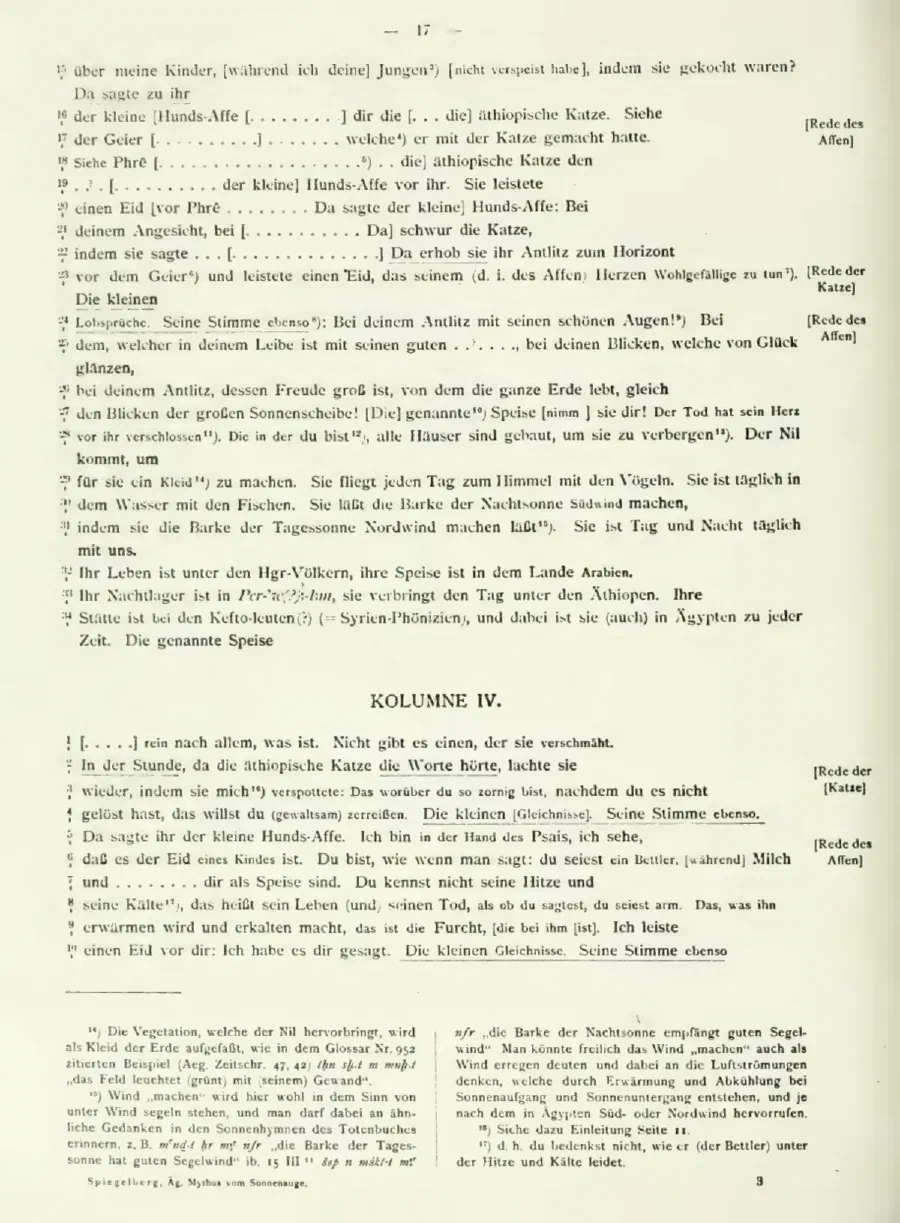
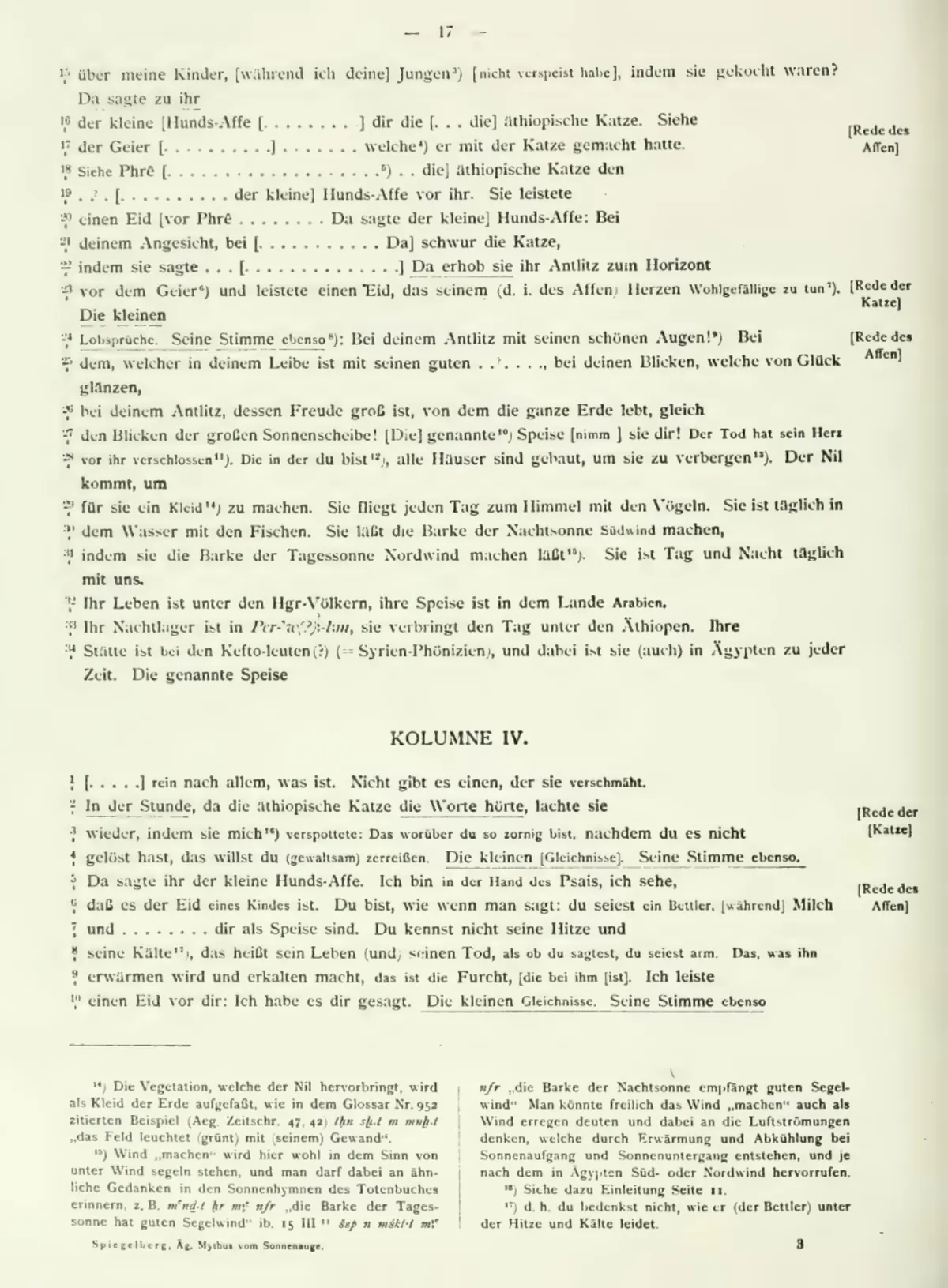
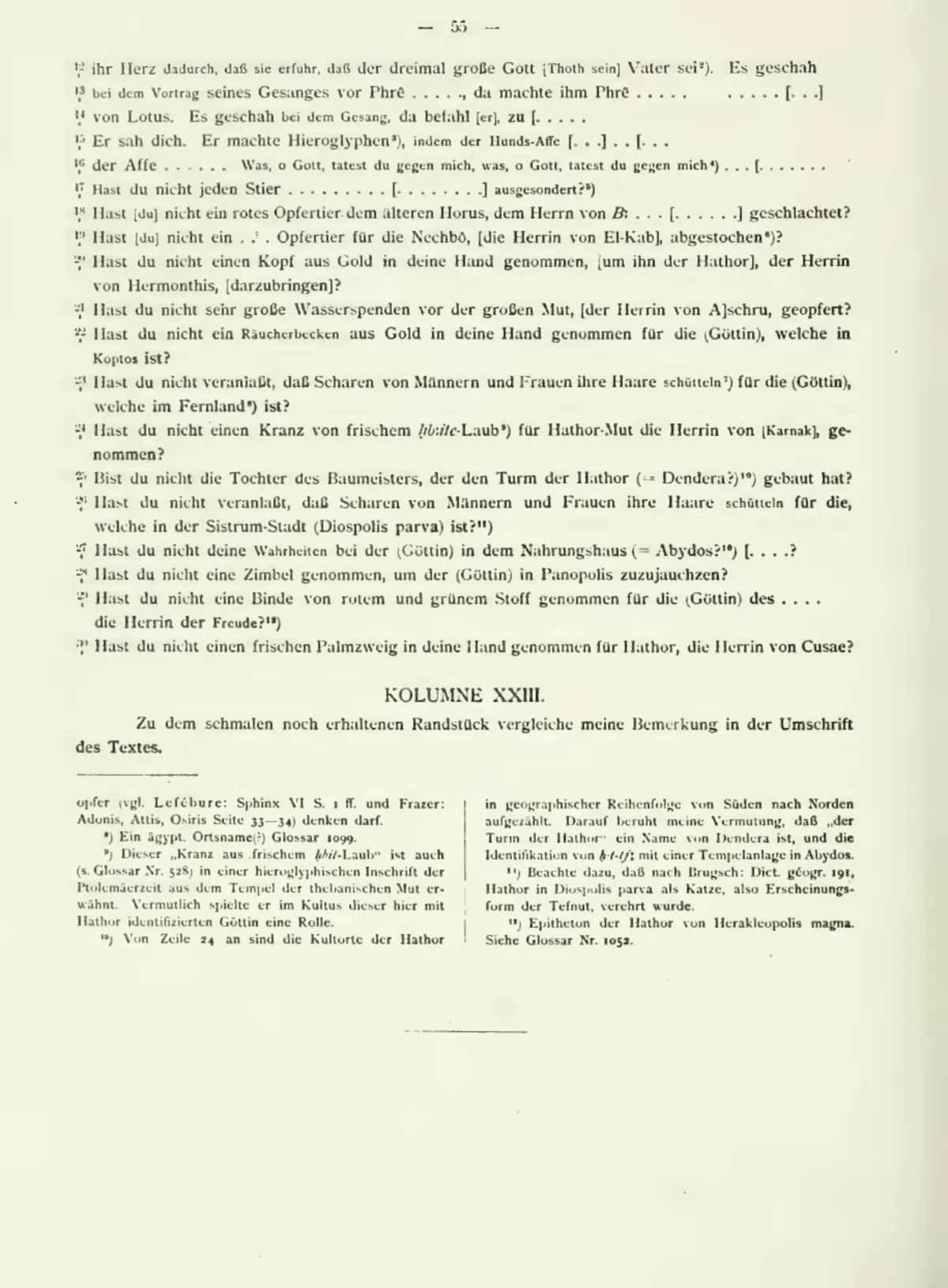
Page 17. p. 17: Column III 15-34 and IV 1-10: the cat's oath and the first lure, the 'food' that is everywhere Spiegelberg 1917, pp. 13–55 (archive.org scan) - 1017, Kol. III 15–19
über meine Kinder, [während ich deine] Jungen [nicht verspeist habe], indem sie gekocht waren? Da sagte zu ihr der kleine [Hunds-]Affe [ ] dir die [. . . die] äthiopische Katze. Siehe [ ] der Geier [ ] welche er mit der Katze gemacht hatte. Siehe Phre [ . . die] äthiopische Katze den [ . . . der kleine] Hunds-Affe vor ihr.
upon my children, [while I] did not [eat your] young, although they were cooked? Then the little [dog-]ape said to her [ ] to you the [. . . the] Ethiopian cat. Behold [ ] the vulture [ ] which he had done with the cat. Behold Phre [ . . the] Ethiopian cat the [ . . . the little] dog-ape before her.
The cat’s oath
- 1117, Kol. III 19–23
Sie leistete einen Eid [vor Phre. Da sagte der kleine] Hunds-Affe: Bei deinem Angesicht, bei [ Da] schwur die Katze, indem sie sagte . . . [ ] Da erhob sie ihr Antlitz zum Horizont vor dem Geier und leistete einen Eid, das seinem (d. i. des Affen) Herzen Wohlgefällige zu tun.
She swore an oath [before Phre. Then the little] dog-ape said: By your face, by [ Then] the cat swore, saying . . . [ ] Then she raised her face to the horizon before the vulture and swore an oath to do what pleased his (that is, the ape's) heart.
Note on line 11
The speaker-labels in the margin of the papyrus (‘Speech of the ape’, ‘Speech of the cat’) are given here in square brackets only where the papyrus has them. Spiegelberg reads lines 15–19 of Column IV as the ape drawing the ethical moral of the story so as to move the cat to spare his life. The first lure: the food
- 1217, Kol. III 24–34
Die kleinen Lobsprüche. Seine Stimme ebenso: Bei deinem Antlitz mit seinen schönen Augen! Bei dem, welcher in deinem Leibe ist mit seinen guten ..., bei deinen Blicken, welche von Glück glänzen, bei deinem Antlitz, dessen Freude groß ist, von dem die ganze Erde lebt, gleich den Blicken der großen Sonnenscheibe! [Die] genannte Speise [nimm ] sie dir! Der Tod hat sein Herz vor ihr verschlossen. Die in der du bist, alle Häuser sind gebaut, um sie zu verbergen. Der Nil kommt, um für sie ein Kleid zu machen. Sie fliegt jeden Tag zum Himmel mit den Vögeln. Sie ist täglich in dem Wasser mit den Fischen. Sie läßt die Barke der Nachtsonne Südwind machen, indem sie die Barke der Tagessonne Nordwind machen läßt. Sie ist Tag und Nacht täglich mit uns. Ihr Leben ist unter den Hgr-Völkern, ihre Speise ist in dem Lande Arabien. Ihr Nachtlager ist in Per-w[?]-Hm, sie verbringt den Tag unter den Äthiopen. Ihre Stätte ist bei den Kefto-leuten (?) (= Syrien-Phönizien), und dabei ist sie (auch) in Ägypten zu jeder Zeit. Die genannte Speise
The little praises. His voice likewise: By your face with its beautiful eyes! By him who is in your body with his good ..., by your glances which shine with good fortune, by your face whose joy is great, from which the whole earth lives, like the glances of the great sun-disk! [The] food spoken of, [take] it for yourself! Death has closed his heart against it. She in whom you are, all houses are built to hide her. The Nile comes to make her a garment. She flies every day to the sky with the birds. She is every day in the water with the fishes. She makes the barque of the night-sun make a south wind, while she has the barque of the day-sun make a north wind. She is with us every day, day and night. Her life is among the Hgr-peoples, her food is in the land of Arabia. Her night-quarters are in Per-w[?]-Hm, she spends the day among the Ethiopians. Her station is with the Kefto-people (?) (= Syria-Phoenicia), and at the same time she is (also) in Egypt at every time. The food spoken of
Note on line 12
Spiegelberg’s notes: the vegetation brought by the Nile is understood as the garment of the earth, as in ’the field gleams with its garment’ (Ägypt. Zeitschr. 47, 42); ’to make wind’ is here probably ’to sail with the wind’, as in the sun hymns of the Book of the Dead (’the barque of the day-sun has a good sailing wind’); the houses may be built to hide the sun’s rays and so protect the inhabitants. He asks whether the passage means that the food protects against death or confers immortality, and calls the translation very doubtful because of the lacuna. - 1317, Kol. IV 1–5
[ ] rein nach allem, was ist. Nicht gibt es einen, der sie verschmäht. In der Stunde, da die äthiopische Katze die Worte hörte, lachte sie wieder, indem sie mich verspottete: Das, worüber du so zornig bist, nachdem du es nicht gelöst hast, das willst du (gewaltsam) zerreißen. Die kleinen [Gleichnisse]. Seine Stimme ebenso.
[ ] pure in respect of everything that is. There is no one who scorns her. In the hour when the Ethiopian cat heard the words, she laughed again, mocking me: That about which you are so angry, after you have not solved it, that you want to tear apart (by force). The little [parables]. His voice likewise.
- 1417, Kol. IV 6–10
Da sagte ihr der kleine Hunds-Affe: Ich bin in der Hand des Psais, ich sehe, daß es der Eid eines Kindes ist. Du bist, wie wenn man sagt: du seiest ein Bettler, [während] Milch [und ] dir als Speise sind. Du kennst nicht seine Hitze und seine Kälte, das heißt sein Leben (und) seinen Tod, als ob du sagtest, du seiest arm. Das, was ihn erwärmen wird und erkalten macht, das ist die Furcht, [die bei ihm ist]. Ich leiste einen Eid vor dir: Ich habe es dir gesagt. Die kleinen Gleichnisse. Seine Stimme ebenso.
Then the little dog-ape said to her: I am in the hand of Psais; I see that it is the oath of a child. You are as when one says: you are a beggar, [while] milk [and ] are your food. You do not know its heat and its cold, that is, its life (and) its death, as if you said you were poor. What will warm him and make him cold is the fear [that is in him]. I swear an oath before you: I have told it to you. The little parables. His voice likewise.
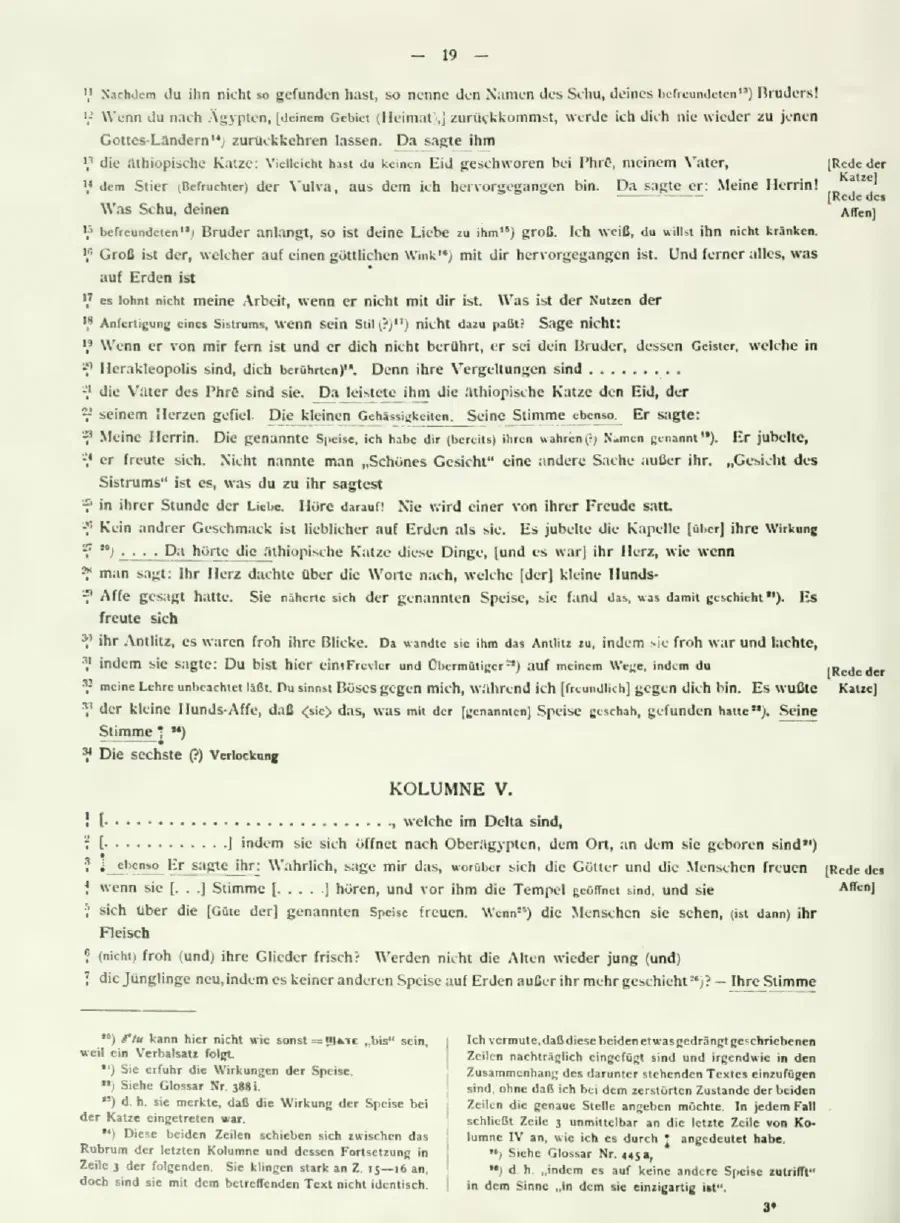
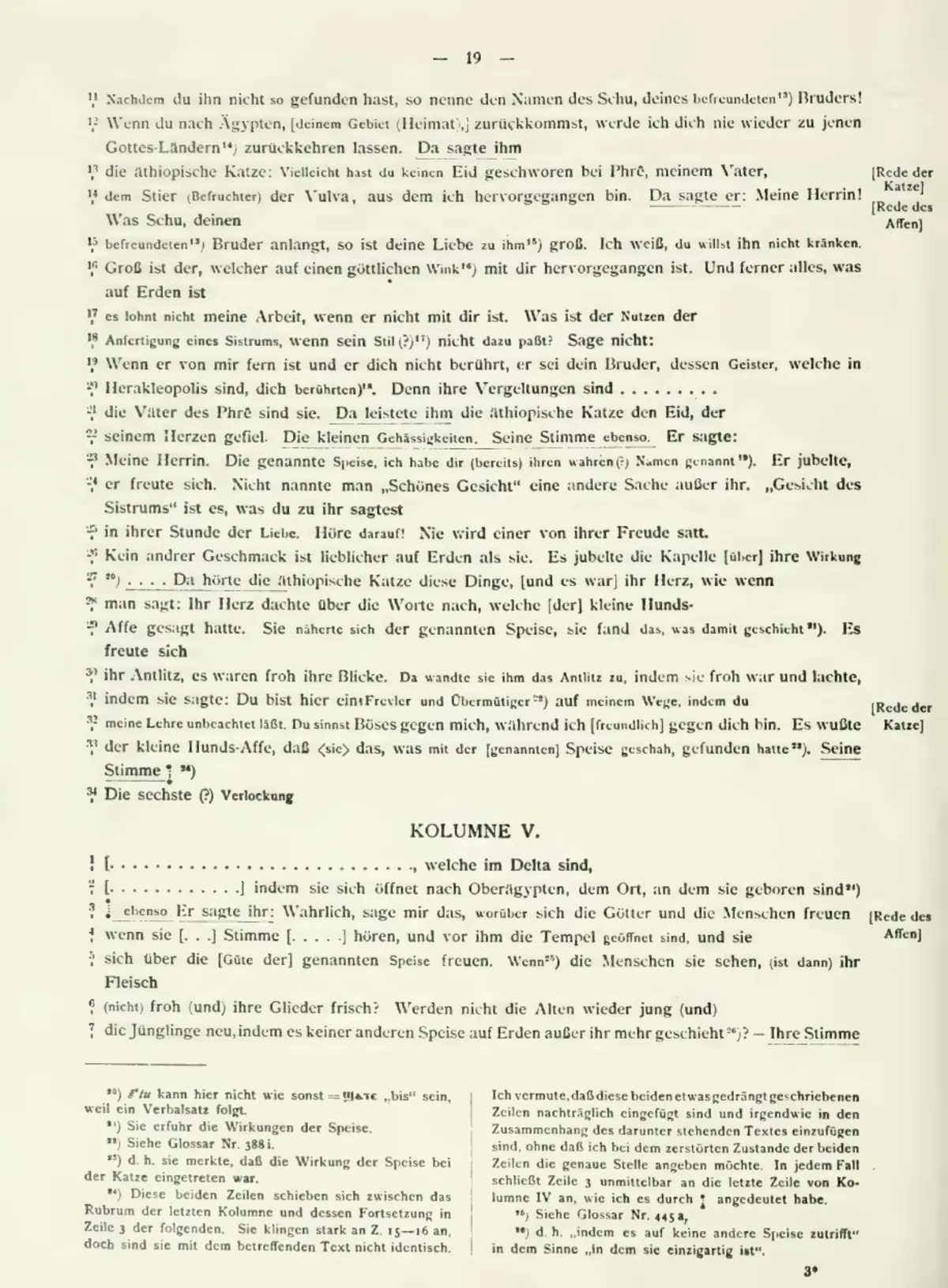
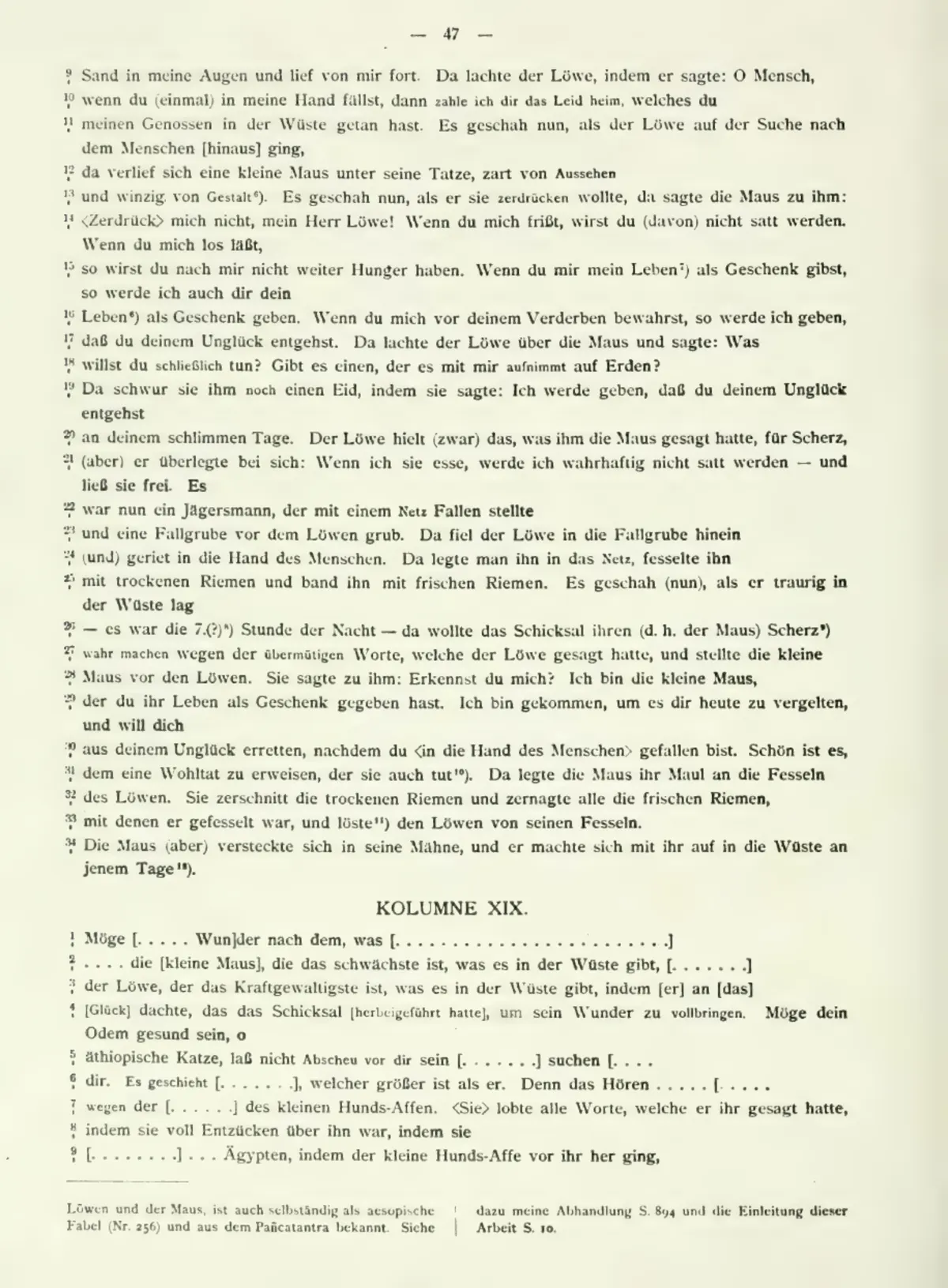
Page 19. p. 19: Column IV 11-34 and V 1-7: Shu, the sistrum, the cat laughing and turning her face Spiegelberg 1917, pp. 13–55 (archive.org scan) - 1519, Kol. IV
Nachdem du ihn nicht so gefunden hast, so nenne den Namen des Schu, deines befreundeten Bruders! Wenn du nach Ägypten, [deinem Gebiet (Heimat),] zurückkommst, werde ich dich nie wieder zu jenen Gottes-Ländern zurückkehren lassen. Da sagte ihm die äthiopische Katze: Vielleicht hast du keinen Eid geschworen bei Phre, meinem Vater, dem Stier (Befruchter) der Vulva, aus dem ich hervorgegangen bin.
Since you have not found him so, call the name of Shu, your friendly brother! When you come back to Egypt, [your domain (home),] I will never again let you return to those God's-lands. Then the Ethiopian cat said to him: Perhaps you have not sworn an oath by Phre, my father, the bull (impregnator) of the vulva, from whom I came forth.
Note on line 15
Spiegelberg’s note on ‘friendly brother’: a word perhaps meaning ’twin brother’, and corresponding to ‘good life-companion’, the title given to Shu, who is Tefnut’s brother and husband (Sethe, Untersuchungen V 141). The ‘God’s-lands’ are Nubia, where Tefnut has fled. - 1619, Kol. IV
Da sagte er: Meine Herrin! Was Schu, deinen befreundeten Bruder anlangt, so ist deine Liebe zu ihm groß. Ich weiß, du willst ihn nicht kränken. Groß ist der, welcher auf einen göttlichen Wink mit dir hervorgegangen ist. Und ferner, alles, was auf Erden ist, es lohnt nicht meine Arbeit, wenn er nicht mit dir ist. Was ist der Nutzen der Anfertigung eines Sistrums, wenn sein Stiel (?) nicht dazu paßt? Sage nicht: Wenn er von mir fern ist und er dich nicht berührt, er sei dein Bruder, dessen Geister, welche in Herakleopolis sind, dich berührten. Denn ihre Vergeltungen sind die Väter des Phre, sie sind es. Da leistete ihm die äthiopische Katze den Eid, der seinem Herzen gefiel. Die kleinen Gehässigkeiten. Seine Stimme ebenso.
Then he said: My mistress! As for Shu, your friendly brother, your love for him is great. I know you do not want to hurt him. Great is he who came forth with you at a divine sign. And further, everything that is on earth, my work is not worth it if he is not with you. What is the use of making a sistrum if its handle (?) does not fit it? Do not say: If he is far from me and does not touch you, let him be your brother, whose spirits, which are in Herakleopolis, touched you. For their retributions are the fathers of Phre, they are. Then the Ethiopian cat swore him the oath that pleased his heart. The little spites. His voice likewise.
Note on line 16
‘At a divine sign’ is literally ‘on a hand of god’; Spiegelberg thinks it may allude to the act by which the pair Shu and Tefnut came into being, when Khepre ‘with his fist’ mated with himself (Bremner-Rhind 26/24 ff. and 28/22 ff.; Erman, Sitzber. Berlin 1916, 1144 ff.). Of the sentence on the sistrum he writes that it seems to contain an obscene allusion (the Egyptian word is literally ‘phallus’). He reads the whole dark passage as an attempt to rouse in Tefnut the longing for her brother Shu, whose bodily presence the bare name ‘brother’ cannot replace. - 1719, Kol. IV
Er sagte: Meine Herrin. Die genannte Speise, ich habe dir (bereits) ihren wahren (?) Namen genannt. Er jubelte, er freute sich. Nicht nannte man „Schönes Gesicht“ eine andere Sache außer ihr. „Gesicht des Sistrums“ ist es, was du zu ihr sagtest in ihrer Stunde der Liebe. Höre darauf! Nie wird einer von ihrer Freude satt. Kein andrer Geschmack ist lieblicher auf Erden als sie. Es jubelte die Kapelle [über] ihre Wirkung ... Da hörte die äthiopische Katze diese Dinge, [und es war] ihr Herz, wie wenn man sagt: Ihr Herz dachte über die Worte nach, welche [der] kleine Hunds-Affe gesagt hatte. Sie näherte sich der genannten Speise, sie fand das, was damit geschieht. Es freute sich ihr Antlitz, es waren froh ihre Blicke. Da wandte sie ihm das Antlitz zu, indem sie froh war und lachte, indem sie sagte: Du bist hier ein Frevler und Übermütiger auf meinem Wege, indem du [meine] Lehre unbeachtet läßt. Du sinnst Böses gegen mich, während ich [freundlich] gegen dich bin. Es wußte der kleine Hunds-Affe, daß [sie] das, was mit der [genannten] Speise geschah, gefunden hatte. Seine Stimme ... Die sechste (?) Verlockung.
He said: My mistress. The food spoken of, I have already told you its true (?) name. He rejoiced, he was glad. One did not call anything else 'Beautiful Face' but her. 'Face of the sistrum' is what you said to her in her hour of love. Listen to it! No one is ever sated with her joy. No other taste on earth is lovelier than she. The chapel rejoiced [at] her effect ... Then the Ethiopian cat heard these things, [and it was] her heart, as when one says: her heart thought about the words which the little dog-ape had said. She drew near the food spoken of, she found what is done with it. Her face rejoiced, her glances were glad. Then she turned her face to him, being glad and laughing, saying: You are a wrongdoer and an insolent one here on my path, leaving [my] teaching unheeded. You plan evil against me, while I am [friendly] toward you. The little dog-ape knew that [she] had found what was done with the food spoken of. His voice ... The sixth (?) lure.
Note on line 17
Two lines are squeezed into the papyrus between the rubric of the last column and its continuation, and are probably inserted later (Spiegelberg’s note). - 1819, Kol. V 1–7
[ ] welche im Delta sind, [ ] indem sie sich öffnet nach Oberägypten, dem Ort, an dem sie geboren sind; ebenso. Er sagte ihr: Wahrlich, sage mir das, worüber sich die Götter und die Menschen freuen, wenn sie [. . .] Stimme [ ] hören, und vor ihm die Tempel geöffnet sind, und sie sich über die [Güte der] genannten Speise freuen. Wenn die Menschen sie sehen, (ist dann) ihr Fleisch (nicht) froh (und) ihre Glieder frisch? Werden nicht die Alten wieder jung (und) die Jünglinge neu, indem es keiner anderen Speise auf Erden außer ihr mehr geschieht? — Ihre Stimme ebenso.
[ ] who are in the Delta, [ ] as she opens toward Upper Egypt, the place where they were born; likewise. He said to her: Truly, tell me that over which the gods and men rejoice when they hear [. . .] the voice [ ], and the temples are opened before him, and they rejoice at the [goodness of the] food spoken of. When men see her, is not their flesh glad (and) their limbs fresh? Do not the old become young again (and) the young men new, while it happens to no other food on earth but her? — Her voice likewise.
Note on line 18
Junker’s view, printed in Spiegelberg’s Nachträge, is that many passages in Columns V to IX introduced by ‘he said’ or ‘she said also’ are commentary (scholia) on the poetic speeches before them. The homeland
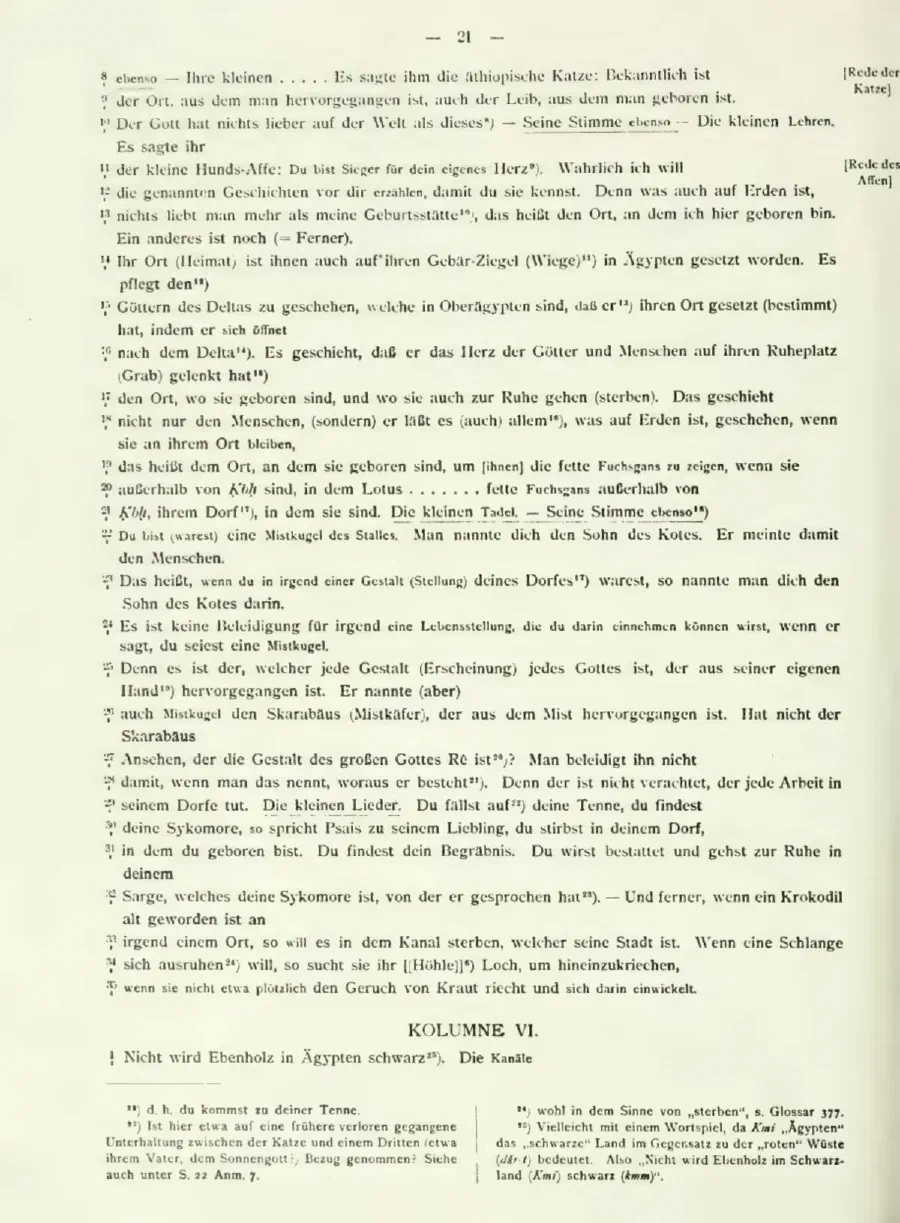
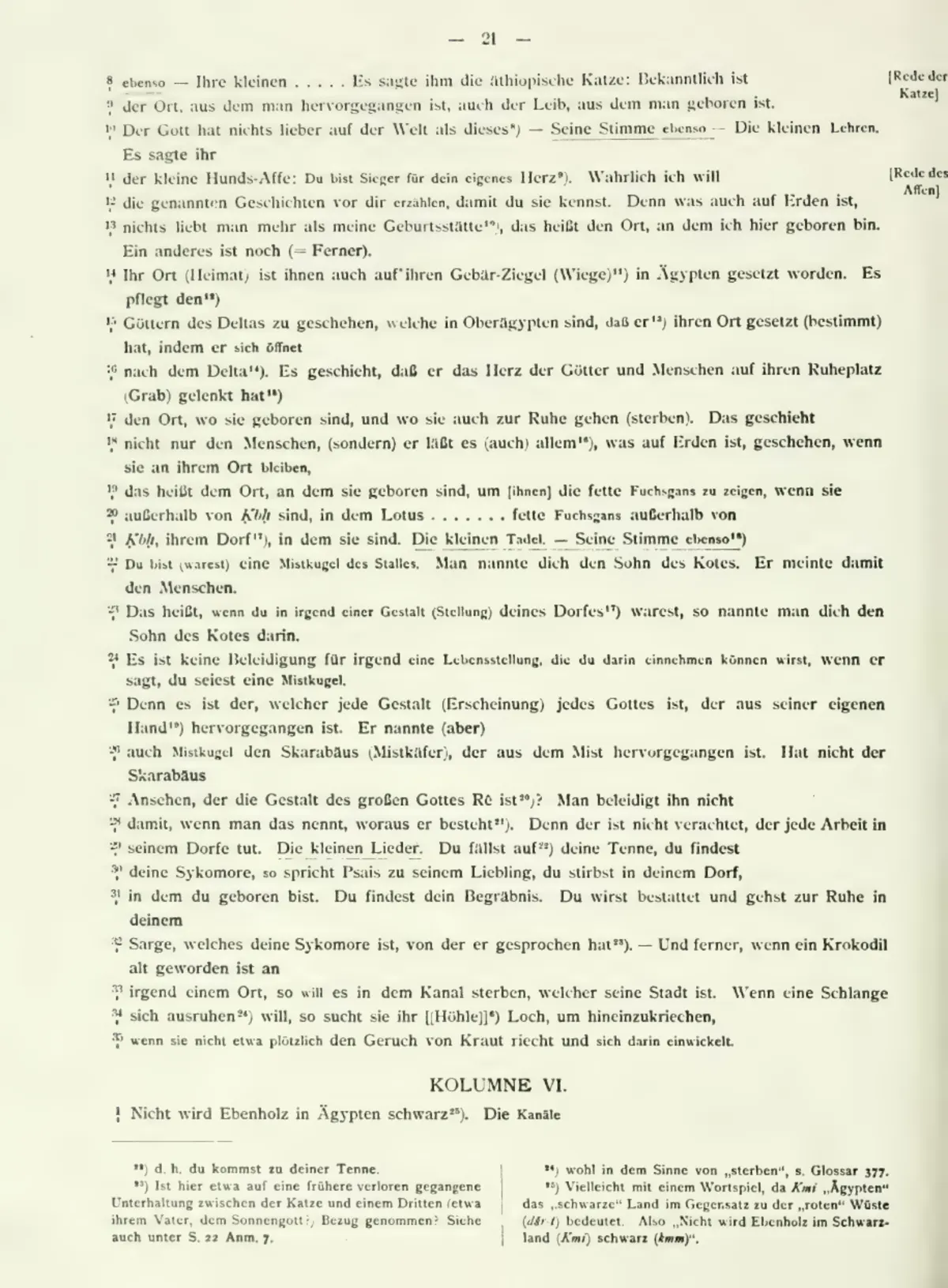
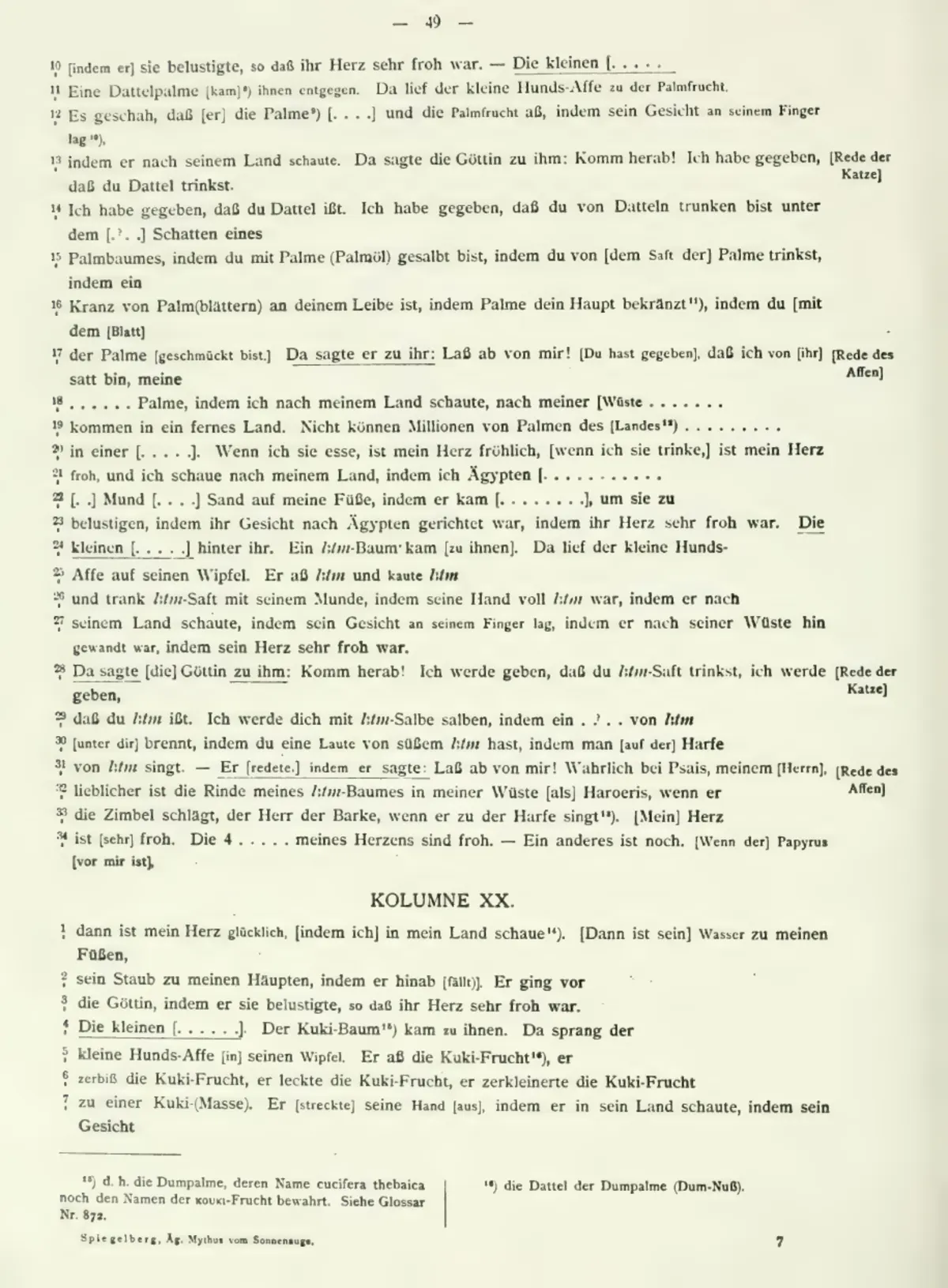
Page 21. p. 21: Column V 8-34 and VI 1: every creature loves its birthplace; the scarab, the crocodile, the snake that seeks its hole Spiegelberg 1917, pp. 13–55 (archive.org scan) - 1921, Kol. V 8 ff.
ebenso. Ihre kleinen ... Es sagte ihm die äthiopische Katze: Bekanntlich ist der Ort, aus dem man hervorgegangen ist, auch der Leib, aus dem man geboren ist. Der Gott hat nichts lieber auf der Welt als dieses. — Seine Stimme ebenso — Die kleinen Lehren. Es sagte ihr der kleine Hunds-Affe: Du bist Sieger für dein eigenes Herz. Wahrlich, ich will die genannten Geschichten vor dir erzählen, damit du sie kennst. Denn was auch auf Erden ist, nichts liebt man mehr als meine Geburtsstätte, das heißt den Ort, an dem ich hier geboren bin.
likewise. Her little ... The Ethiopian cat said to him: It is known that the place from which one has come forth is also the body from which one was born. The god has nothing dearer in the world than this. — His voice likewise — The little teachings. The little dog-ape said to her: You are victor over your own heart. Truly I will tell you the stories spoken of, that you may know them. For whatever there is on earth, nothing is loved more than my birthplace, that is, the place where I was born here.
- 2021, Kol. V
Ein anderes ist noch (= Ferner). Ihr Ort (Heimat) ist ihnen auch auf ihren Gebär-Ziegel (Wiege) in Ägypten gesetzt worden. Es pflegt den Göttern des Deltas zu geschehen, welche in Oberägypten sind, daß er ihren Ort gesetzt (bestimmt) hat, indem er sich öffnet nach dem Delta. Es geschieht, daß er das Herz der Götter und Menschen auf ihren Ruheplatz (Grab) gelenkt hat, den Ort, wo sie geboren sind, und wo sie auch zur Ruhe gehen (sterben). Das geschieht nicht nur den Menschen, (sondern) er läßt es (auch) allem, was auf Erden ist, geschehen, wenn sie an ihrem Ort bleiben, das heißt dem Ort, an dem sie geboren sind, um [ihnen] die fette Fuchsgans zu zeigen, wenn sie außerhalb von Khb sind, in dem Lotus, fette Fuchsgans außerhalb von Khb, ihrem Dorf, in dem sie sind. Die kleinen Tadel. — Seine Stimme ebenso.
Another thing besides (= further). Their place (homeland) has been set for them even on their birth-brick (cradle) in Egypt. It is the custom with the gods of the Delta who are in Upper Egypt that he has set (fixed) their place, opening himself toward the Delta. It happens that he has turned the heart of gods and men to their resting-place (grave), the place where they were born and where they also go to rest (die). This happens not only to men, (but) he lets it happen (also) to everything that is on earth, when they stay in their place, that is, the place where they were born, to show [them] the fat fox-goose, when they are outside Khb, in the lotus, fat fox-goose outside Khb, their village, in which they are. The little reproofs. — His voice likewise.
Note on line 20
Spiegelberg’s note: this means that the Delta gods who have shrines in Upper Egypt always long for their home cult-place, the Delta; the ruler of the world has filled gods and men with special love not only for their birthplace but for their grave. - 2121, Kol. V
Du bist (wärest) eine Mistkugel des Stalles. Man nannte dich den Sohn des Kotes. Er meinte damit den Menschen. Das heißt, wenn du in irgend einer Gestalt (Stellung) deines Dorfes wärest, so nannte man dich den Sohn des Kotes darin. Es ist keine Beleidigung für irgend eine Lebensstellung, die du darin einnehmen können wirst, wenn er sagt, du seiest eine Mistkugel. Denn es ist der, welcher jede Gestalt (Erscheinung) jedes Gottes ist, der aus seiner eigenen Hand hervorgegangen ist. Er nannte (aber) auch Mistkugel den Skarabäus (Mistkäfer), der aus dem Mist hervorgegangen ist. Hat nicht der Skarabäus Ansehen, der die Gestalt des großen Gottes Re ist? Man beleidigt ihn nicht damit, wenn man das nennt, woraus er besteht. Denn der ist nicht verachtet, der jede Arbeit in seinem Dorfe tut.
You are (would be) a dung-ball of the stable. One called you the son of dung. By this he meant man. That is: if you were in any shape (station) of your village, one would call you the son of dung in it. It is no insult to any station in life that you will be able to take in it, when he says you are a dung-ball. For it is he who is every form (appearance) of every god, who came forth from his own hand. He (however) called the scarab (dung-beetle), which came forth from the dung, also a dung-ball. Has not the scarab standing, who is the form of the great god Re? One does not insult him with it when one names that of which he consists. For he is not despised who does every work in his village.
Note on line 21
‘From his own hand’: the sun-god begot himself with his own hand (Spiegelberg, note 19). - 2221, Kol. V
Die kleinen Lieder. Du fällst auf deine Tenne, du findest deine Sykomore, so spricht Psais zu seinem Liebling, du stirbst in deinem Dorf, in dem du geboren bist. Du findest dein Begräbnis. Du wirst bestattet und gehst zur Ruhe in deinem Sarge, welches deine Sykomore ist, von der er gesprochen hat. — Und ferner, wenn ein Krokodil alt geworden ist an irgend einem Ort, so will es in dem Kanal sterben, welcher seine Stadt ist. Wenn eine Schlange sich ausruhen will, so sucht sie ihr Loch, um hineinzukriechen, wenn sie nicht etwa plötzlich den Geruch von Kraut riecht und sich darin einwickelt.
The little songs. You fall on your threshing-floor, you find your sycamore, so Psais speaks to his darling, you die in your village in which you were born. You find your burial. You are buried and go to rest in your coffin, which is your sycamore of which he spoke. — And further: when a crocodile has grown old in any place, it wants to die in the canal which is its town. When a snake wants to rest, it seeks its hole to creep into, unless it should suddenly smell the scent of an herb and wind itself up in it.
Note on line 22
Spiegelberg’s notes: ‘you fall on your threshing-floor’ means ‘you come to your threshing-floor’; ’to rest’ is here probably ’to die’ (Glossar 377). The green stones
- 2321, Kol. VI 1
Nicht wird Ebenholz in Ägypten schwarz.
Ebony does not turn black in Egypt.
Note on line 23
Spiegelberg suggests a word-play: Egypt, Kmt, is the ‘black land’ as against the red desert; so, ’the ebony will not be black in the Black Land’. 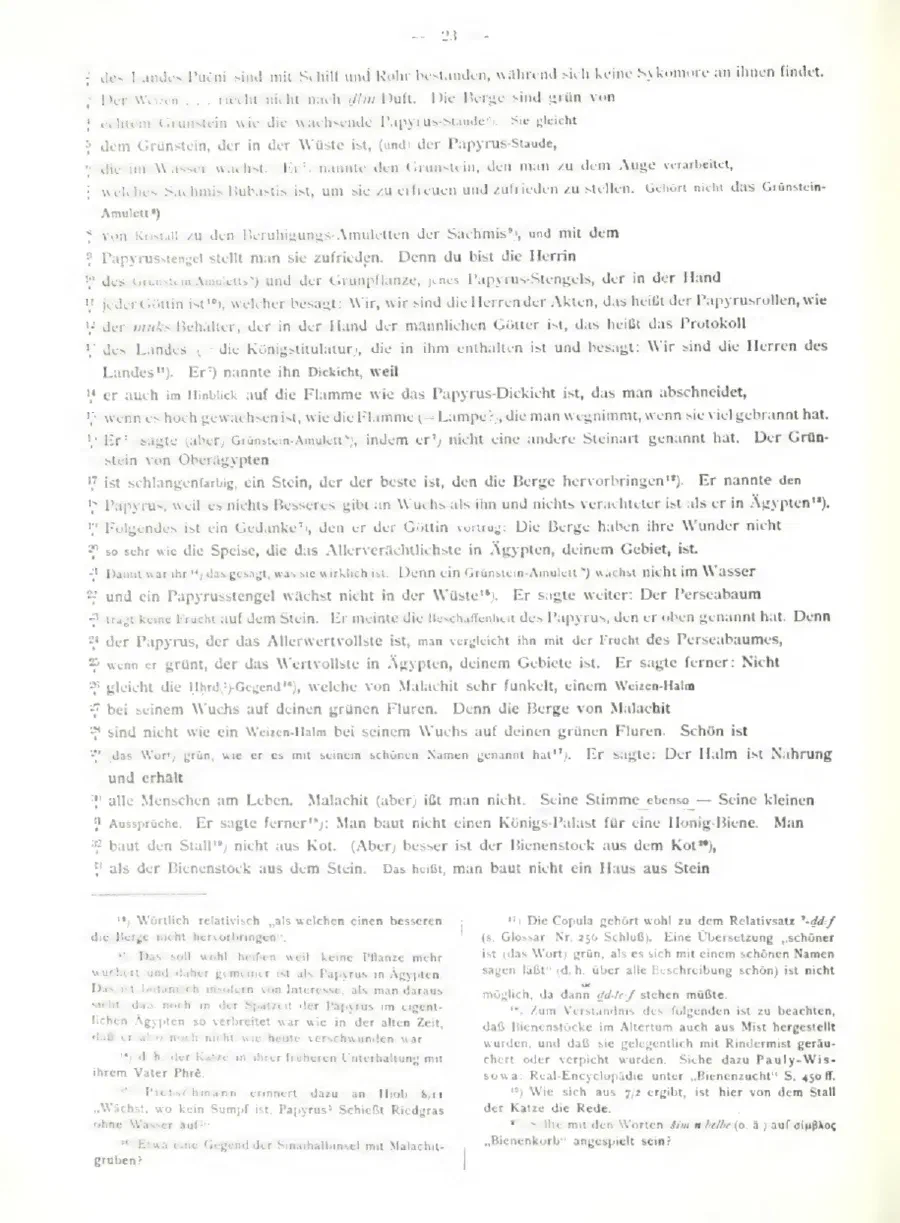
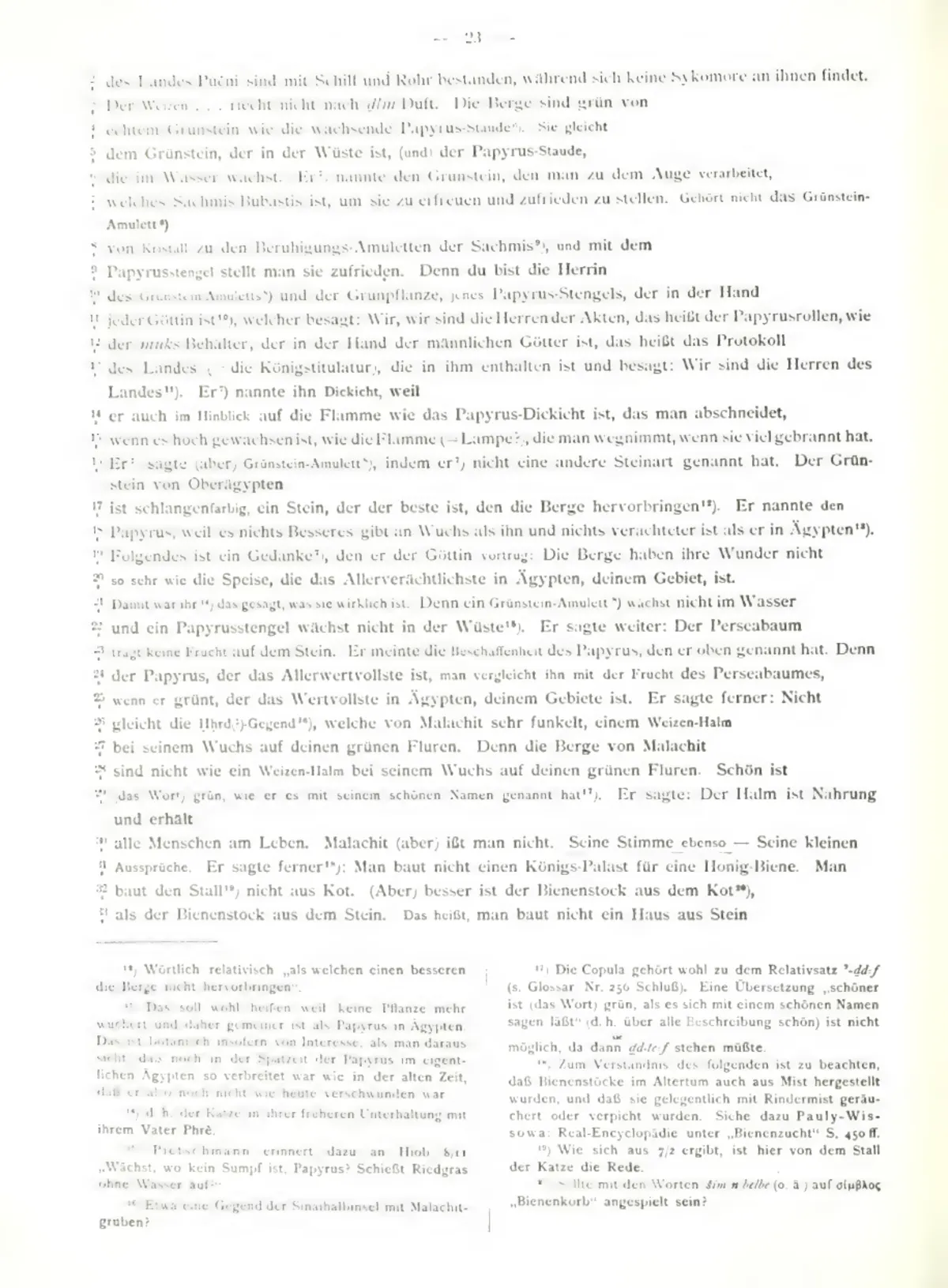
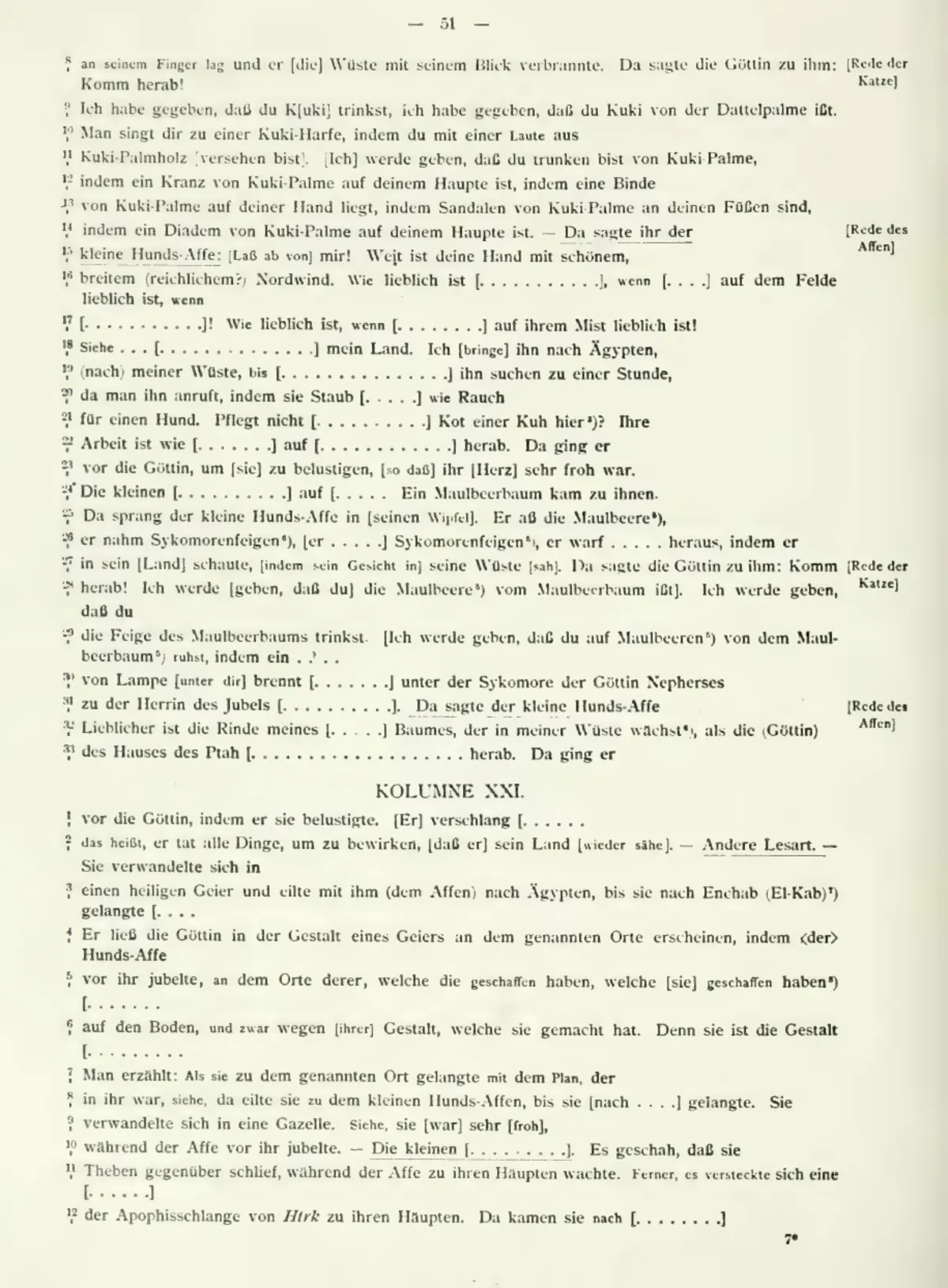
Page 23. p. 23: Column VI: ebony and papyrus, the green-stone that is snake-coloured, the beehive of dung Spiegelberg 1917, pp. 13–55 (archive.org scan) - 2423, Kol. VI
Die Kanäle des Landes Puoni sind mit Schilf und Rohr bestanden, während sich keine Sykomore an ihnen findet. Der Weizen ... riecht nicht nach Gum-Duft. Die Berge sind grün von echtem Grünstein wie die wachsende Papyrus-Staude. Sie gleicht dem Grünstein, der in der Wüste ist, (und) der Papyrus-Staude, die im Wasser wächst. Er nannte den Grünstein, den man zu dem Auge verarbeitet, welches das der Sachmis-Bubastis ist, um sie zu erfreuen und zufrieden zu stellen. Gehört nicht das Grünstein-Amulett von Kristall zu den Beruhigungs-Amuletten der Sachmis, und mit dem Papyrusstengel stellt man sie zufrieden? Denn du bist die Herrin des Grünstein-Amuletts und der Grünpflanze, jenes Papyrus-Stengels, der in der Hand jeder Göttin ist, welcher besagt: Wir, wir sind die Herren der Akten, das heißt der Papyrusrollen, wie der mnks-Behälter, der in der Hand der männlichen Götter ist, das heißt das Protokoll des Landes (= die Königstitulatur), die in ihm enthalten ist und besagt: Wir sind die Herren des Landes.
The canals of the land of Puoni are overgrown with reed and rushes, while no sycamore is found on them. The wheat ... does not smell of Gum-scent. The mountains are green with genuine green-stone like the growing papyrus plant. She is like the green-stone that is in the desert, (and) the papyrus plant that grows in the water. He named the green-stone that is worked into the Eye, which is that of Sachmis-Bubastis, to please her and to make her content. Does not the green-stone amulet of crystal belong to the soothing amulets of Sachmis, and with the papyrus stalk one makes her content? For you are the mistress of the green-stone amulet and of the green plant, that papyrus stalk which is in the hand of every goddess, which says: We, we are the lords of the documents, that is, of the papyrus rolls, like the mnks-case which is in the hand of the male gods, that is, the protocol of the land (= the royal titulary) contained in it, which says: We are the lords of the land.
Note on line 24
Spiegelberg notes the Edfu library catalogue has a work titled ‘Sachmis is content’, and that in this text Sachmis, as elsewhere, is only another form of the sun-cat Tefnut. ‘The Eye’ is the sun’s eye; the passages introduced by ‘he said’ are, in Junker’s view, commentary (see Nachträge). The ‘sceptre of the goddesses’ is the papyrus sceptre of the Canopus decree. - 2523, Kol. VI
Er nannte ihn Dickicht, weil er auch im Hinblick auf die Flamme wie das Papyrus-Dickicht ist, das man abschneidet, wenn es hoch gewachsen ist, wie die Flamme (= Lampe?), die man wegnimmt, wenn sie viel gebrannt hat. Er sagte (aber) Grünstein-Amulett, indem er nicht eine andere Steinart genannt hat. Der Grünstein von Oberägypten ist schlangenfarbig, ein Stein, der der beste ist, den die Berge hervorbringen. Er nannte den Papyrus, weil es nichts Besseres gibt an Wuchs als ihn und nichts verachteter ist als er in Ägypten. Folgendes ist ein Gedanke, den er der Göttin vortrug: Die Berge haben ihre Wunder nicht so sehr wie die Speise, die das Allerverächtlichste in Ägypten, deinem Gebiet, ist. Damit war ihr das gesagt, was sie wirklich ist. Denn ein Grünstein-Amulett wächst nicht im Wasser und ein Papyrusstengel wächst nicht in der Wüste.
He called it thicket because, in regard to the flame too, it is like the papyrus thicket which one cuts off when it has grown tall, like the flame (= lamp?) which one takes away when it has burned much. He said (however) green-stone amulet, not having named any other kind of stone. The green-stone of Upper Egypt is snake-coloured, a stone that is the best the mountains bring forth. He named the papyrus because there is nothing better than it in growth and nothing more despised than it in Egypt. The following is a thought which he put to the goddess: The mountains do not have their wonders so much as the food which is the most despised thing in Egypt, your domain. By this she was told what she really is. For a green-stone amulet does not grow in the water, and a papyrus stalk does not grow in the desert.
Note on line 25
Spiegelberg’s note on the botany: that papyrus was still as common in Egypt itself in the late period as in ancient times, so it had not yet vanished as it has today. Pietschmann compares Job 8:11 (‘Does papyrus grow where there is no marsh? Do reeds shoot up without water?’). - 2623, Kol. VI
Er sagte weiter: Der Perseabaum trägt keine Frucht auf dem Stein. Er meinte die Beschaffenheit des Papyrus, den er oben genannt hat. Denn der Papyrus, der das Allerwertvollste ist, man vergleicht ihn mit der Frucht des Perseabaumes, wenn er grünt, der das Wertvollste in Ägypten, deinem Gebiete ist. Er sagte ferner: Nicht gleicht die Hhrd-Gegend, welche von Malachit sehr funkelt, einem Weizen-Halm bei meinem Wuchs auf deinen grünen Fluren. Denn die Berge von Malachit sind nicht wie ein Weizen-Halm bei seinem Wuchs auf deinen grünen Fluren. Schön ist (das Wort) grün, wie er es mit seinem schönen Namen genannt hat. Er sagte: Der Halm ist Nahrung und erhält alle Menschen am Leben. Malachit (aber) ißt man nicht. Seine Stimme ebenso — Seine kleinen Aussprüche.
He said further: The persea tree bears no fruit on the stone. He meant the nature of the papyrus which he named above. For the papyrus, which is the most precious thing, one compares it with the fruit of the persea tree when it turns green, which is the most precious thing in Egypt, your domain. He said further: The Hhrd-region, which sparkles greatly with malachite, is not like a wheat stalk in my growth on your green fields. For the mountains of malachite are not like a wheat stalk in its growth on your green fields. Beautiful is (the word) green, as he named it with its beautiful name. He said: The stalk is food and keeps all men alive. Malachite, however, one does not eat. His voice likewise — His little sayings.
The bee
- 2723, Kol. VI
Er sagte ferner: Man baut nicht einen Königs-Palast für eine Honig-Biene. Man baut den Stall nicht aus Kot. (Aber) besser ist der Bienenstock aus dem Kot, als der Bienenstock aus dem Stein. Das heißt, man baut nicht ein Haus aus Stein
He said further: One does not build a king's palace for a honey-bee. One does not build the stable of dung. (But) better is the beehive of dung than the beehive of stone. That is, one does not build a house of stone
Note on line 27
Spiegelberg: beehives in antiquity were also made of dung, and were sometimes smoked or pitched with cow dung (Pauly-Wissowa, ‘Bienenzucht’). The stable meant here is the cat’s (Col. VII 2). 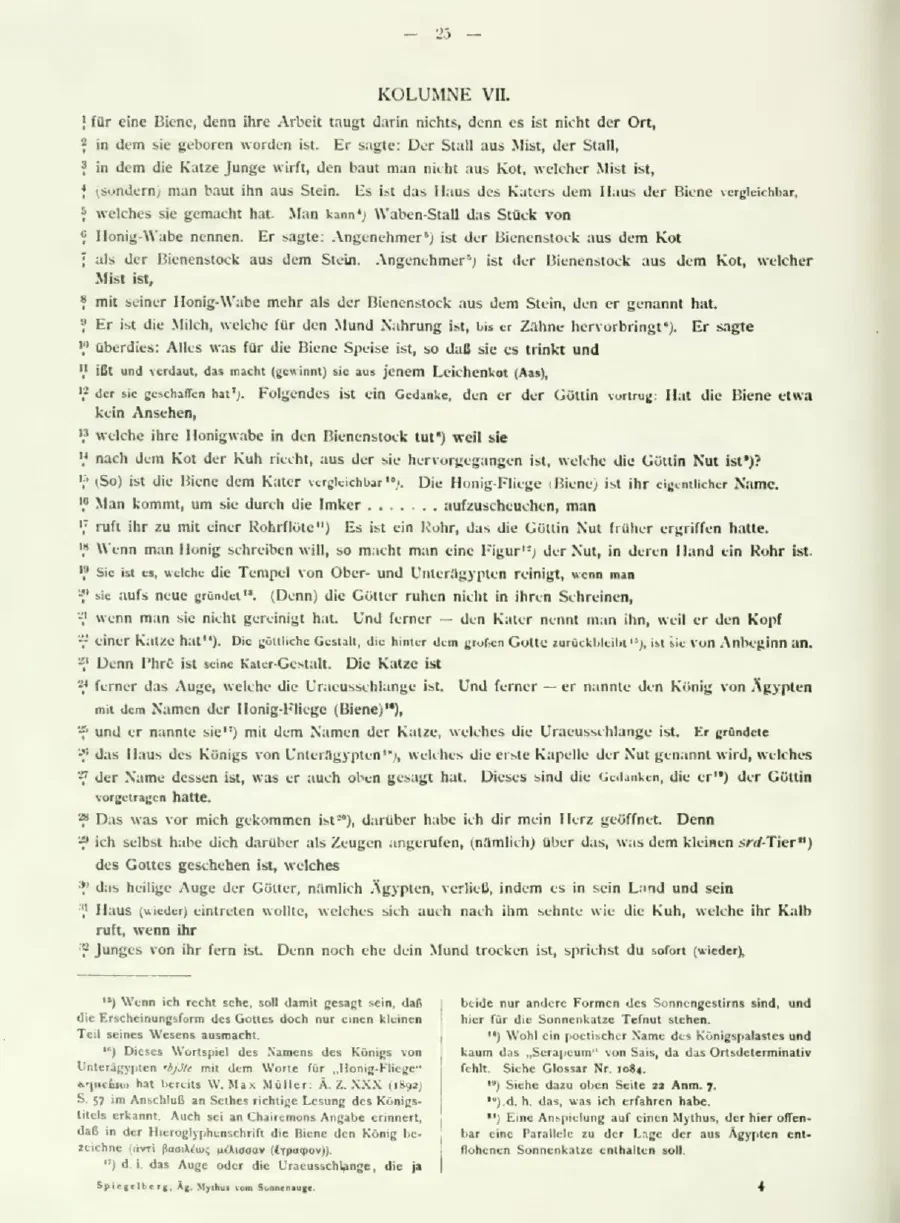
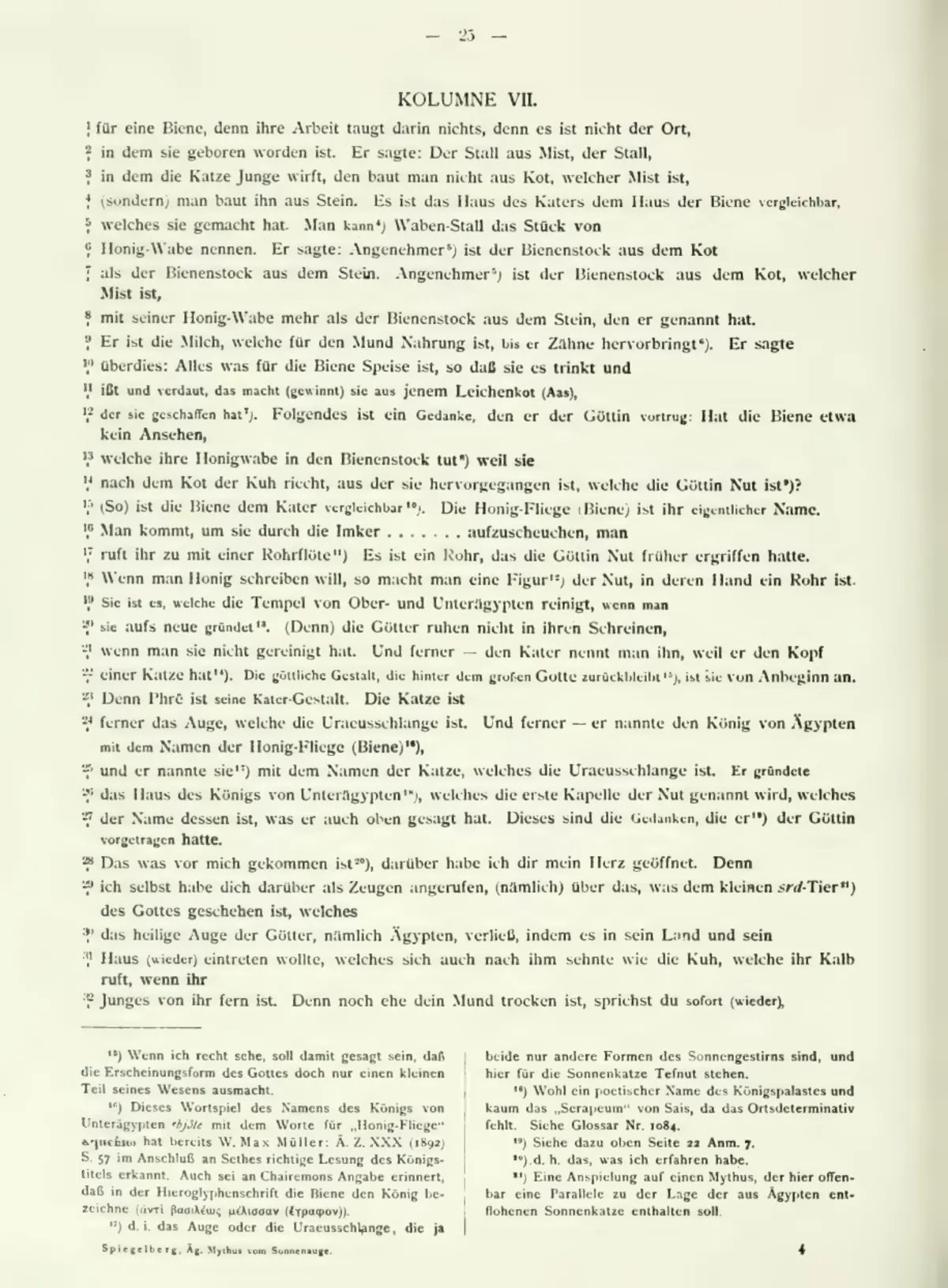
Page 25. p. 25: Column VII: the bee born of the cow Nut, and 'the cat is the Eye, which is the uraeus serpent' Spiegelberg 1917, pp. 13–55 (archive.org scan) - 2825, Kol. VII
für eine Biene, denn ihre Arbeit taugt darin nichts, denn es ist nicht der Ort, in dem sie geboren worden ist. Er sagte: Der Stall aus Mist, der Stall, in dem die Katze Junge wirft, den baut man nicht aus Kot, welcher Mist ist, (sondern) man baut ihn aus Stein. Es ist das Haus des Katers dem Haus der Biene vergleichbar, welches sie gemacht hat. Man kann Waben-Stall das Stück von Honig-Wabe nennen. Er sagte: Angenehmer ist der Bienenstock aus dem Kot als der Bienenstock aus dem Stein. Angenehmer ist der Bienenstock aus dem Kot, welcher Mist ist, mit seiner Honig-Wabe mehr als der Bienenstock aus dem Stein, den er genannt hat. Er ist die Milch, welche für den Mund Nahrung ist, bis er Zähne hervorbringt.
for a bee, for her work is no good in it, for it is not the place in which she was born. He said: The stable of dung, the stable in which the cat throws young, one does not build of dung, which is manure, (but) one builds it of stone. The house of the tom-cat is comparable to the house of the bee which she has made. One may call the piece of honeycomb 'comb-stable'. He said: More agreeable is the beehive of dung than the beehive of stone. More agreeable is the beehive of dung, which is manure, with its honeycomb, than the beehive of stone which he named. It is the milk which is food for the mouth until it brings forth teeth.
Note on line 28
Spiegelberg: ’tom-cat’ is here the tom-cat form of the sun-god Phre (see p. 4). - 2925, Kol. VII
Er sagte überdies: Alles was für die Biene Speise ist, so daß sie es trinkt und ißt und verdaut, das macht (gewinnt) sie aus jenem Leichenkot (Aas), der sie geschaffen hat. Folgendes ist ein Gedanke, den er der Göttin vortrug: Hat die Biene etwa kein Ansehen, welche ihre Honigwabe in den Bienenstock tut, weil sie nach dem Kot der Kuh riecht, aus der sie hervorgegangen ist, welche die Göttin Nut ist? (So) ist die Biene dem Kater vergleichbar. Die Honig-Fliege (Biene) ist ihr eigentlicher Name. Man kommt, um sie durch die Imker ....... aufzuscheuchen, man ruft ihr zu mit einer Rohrflöte. Es ist ein Rohr, das die Göttin Nut früher ergriffen hatte. Wenn man Honig schreiben will, so macht man eine Figur der Nut, in deren Hand ein Rohr ist.
He said besides: Everything that is food for the bee, so that she drinks and eats and digests it, she makes (wins) from that carrion-dung that created her. The following is a thought which he put to the goddess: Is the bee not esteemed, who puts her honeycomb into the hive, though she smells of the dung of the cow from which she came forth, who is the goddess Nut? (Thus) the bee is comparable to the tom-cat. 'Honey-fly' (bee) is her proper name. One comes to rouse her by the beekeepers ....... , one calls to her with a reed flute. It is a reed which the goddess Nut had earlier taken hold of. When one wants to write 'honey', one makes a figure of Nut with a reed in her hand.
Note on line 29
Spiegelberg’s notes: the belief that bees arise from rotting cattle is general in antiquity (Pauly-Wissowa, ‘Biene’; Horapollo; Leemans); the cow is the holy animal of the sky-goddess Nut; and the passage shows that the late enigmatic hieroglyphic writing wrote ‘honey’ with a figure of the goddess holding a reed (compare the picture of Nut on sarcophagus floors, Rhind I 4/11). The cat is the uraeus
- 3025, Kol. VII
Sie ist es, welche die Tempel von Ober- und Unterägypten reinigt, wenn man sie aufs neue gründet. (Denn) die Götter ruhen nicht in ihren Schreinen, wenn man sie nicht gereinigt hat. Und ferner — den Kater nennt man ihn, weil er den Kopf einer Katze hat. Die göttliche Gestalt, die hinter dem großen Gotte zurückbleibt, ist sie von Anbeginn an. Denn Phre ist seine Kater-Gestalt. Die Katze ist ferner das Auge, welche die Uräusschlange ist. Und ferner — er nannte den König von Ägypten mit dem Namen der Honig-Fliege (Biene), und er nannte sie mit dem Namen der Katze, welches die Uräusschlange ist. Er gründete das Haus des Königs von Unterägypten, welches die erste Kapelle der Nut genannt wird, welches der Name dessen ist, was er auch oben gesagt hat. Dieses sind die Gedanken, die er der Göttin vorgetragen hatte.
She it is who purifies the temples of Upper and Lower Egypt when one founds them anew. (For) the gods do not rest in their shrines if they have not been purified. And further — one calls him the tom-cat because he has the head of a cat. The divine form that remains behind the great god, she is from the beginning. For Phre is his tom-cat form. The cat is, further, the Eye, which is the uraeus serpent. And further — he named the King of Egypt with the name of the honey-fly (bee), and he named her with the name of the cat, which is the uraeus serpent. He founded the house of the King of Lower Egypt, which is called the first chapel of Nut, which is the name of that which he also said above. These are the thoughts which he had put to the goddess.
Note on line 30
Spiegelberg’s notes: ’the divine form that remains behind the great god’ means that the god’s appearance is only a small part of his nature; the word-play of the title ‘King of Lower Egypt’ (bit) on the word for ‘honey-fly’ was seen by W. Max Müller (Ä.Z. 30, 57), and Chaeremon says the bee stands for the king in hieroglyphic writing; ’the Eye or the uraeus serpent’ are ‘both only other forms of the sun-star’, here standing for the sun-cat Tefnut; the ‘first chapel of Nut’ is a poetic name of the royal palace. - 3125, Kol. VII
Das, was vor mich gekommen ist, darüber habe ich dir mein Herz geöffnet. Denn ich selbst habe dich darüber als Zeugen angerufen, (nämlich) über das, was dem kleinen srd-Tier des Gottes geschehen ist, welches das heilige Auge der Götter, nämlich Ägypten, verließ, indem es in sein Land und sein Haus (wieder) eintreten wollte, welches sich auch nach ihm sehnte wie die Kuh, welche ihr Kalb ruft, wenn ihr Junges von ihr fern ist. Denn noch ehe dein Mund trocken ist, sprichst du sofort (wieder),
That which has come before me, concerning it I have opened my heart to you. For I myself have called you as a witness concerning it, (namely) concerning what happened to the little srd-animal of the god, which left the holy Eye of the gods, namely Egypt, wanting to enter (again) its land and its house, which also longed for it like the cow who calls her calf when her young one is far from her. For before your mouth is dry you speak at once (again),
Note on line 31
Spiegelberg’s note: this is an allusion to a myth that here evidently parallels the plight of the sun-cat who fled from Egypt. The cat’s anger
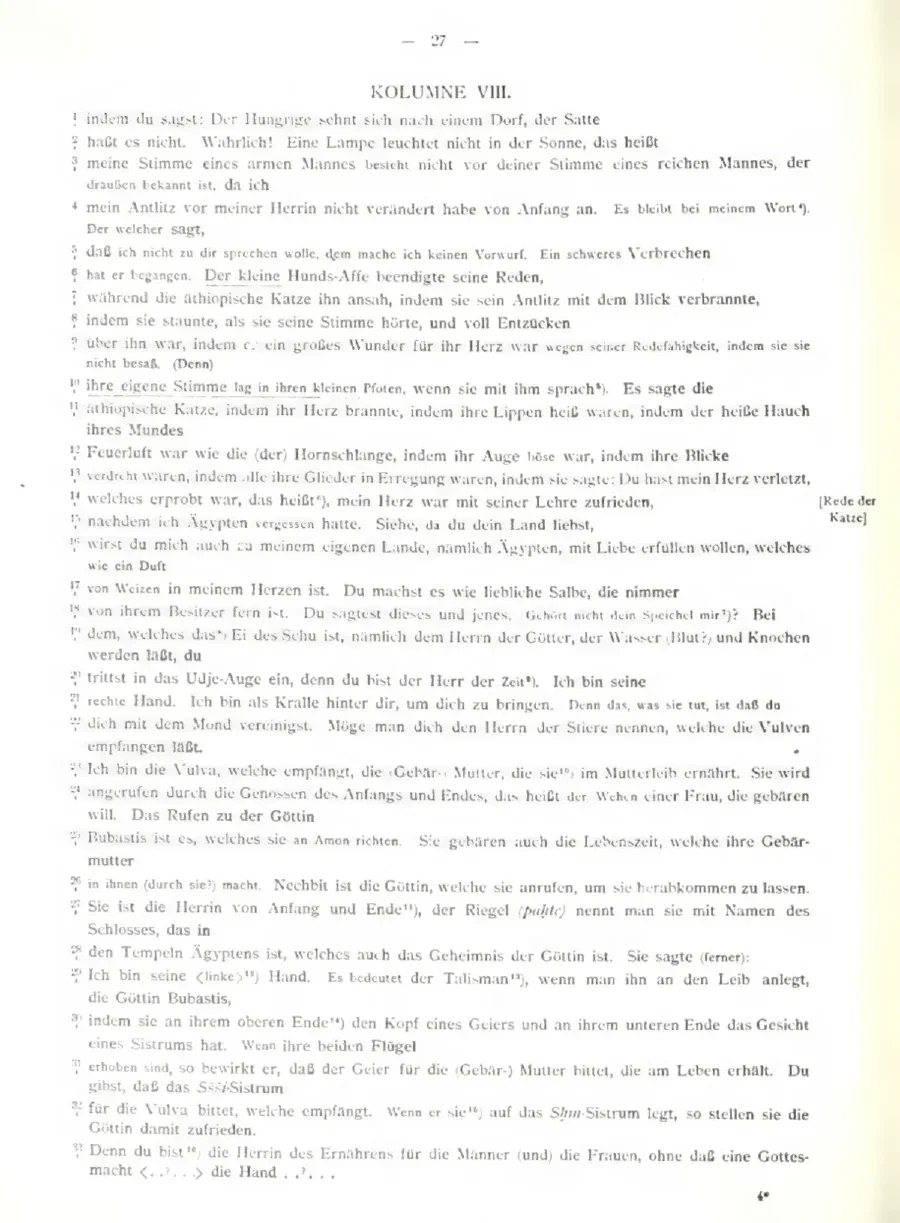
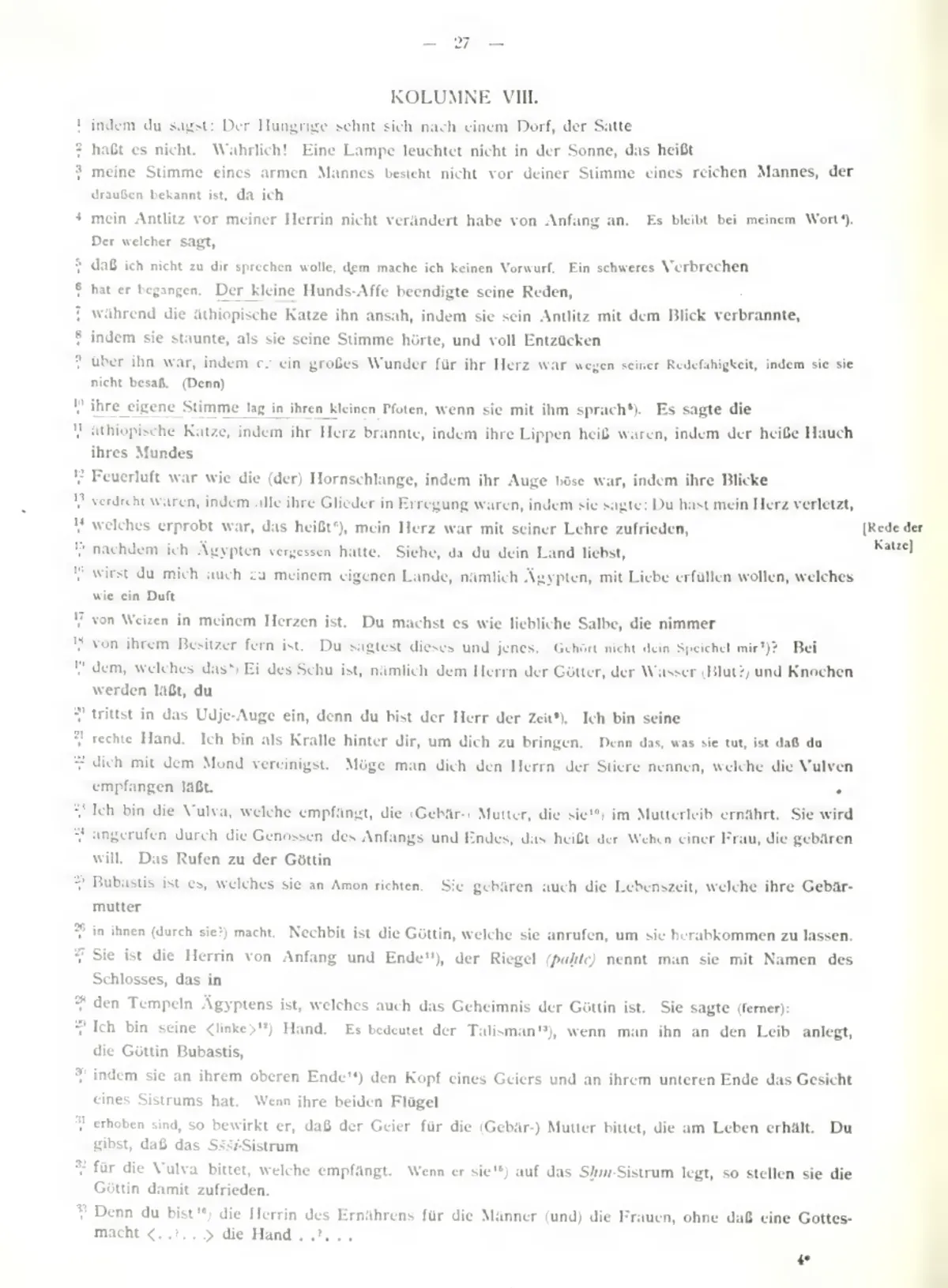
Page 27. p. 27: Column VIII: the cat's anger, her breath 'like the horned serpent', the vulva that conceives and Bubastis the bolt Spiegelberg 1917, pp. 13–55 (archive.org scan) - 3227, Kol. VIII
indem du sagst: Der Hungrige sehnt sich nach einem Dorf, der Satte haßt es nicht. Wahrlich! Eine Lampe leuchtet nicht in der Sonne, das heißt meine Stimme eines armen Mannes besteht nicht vor deiner Stimme eines reichen Mannes, der draußen bekannt ist, da ich mein Antlitz vor meiner Herrin nicht verändert habe von Anfang an. Es bleibt bei meinem Wort. Der, welcher sagt, daß ich nicht zu dir sprechen wolle, dem mache ich keinen Vorwurf. Ein schweres Verbrechen hat er begangen.
saying: The hungry man longs for a village, the sated man does not hate it. Truly! A lamp does not shine in the sun, that is, my voice of a poor man does not hold its own against your voice of a rich man, who is known abroad, since I have not changed my face before my mistress from the beginning. I stand by my word. He who says that I do not want to speak to you, I make him no reproach. A heavy crime has he committed.
- 3327, Kol. VIII
Der kleine Hunds-Affe beendigte seine Reden, während die äthiopische Katze ihn ansah, indem sie sein Antlitz mit dem Blick verbrannte, indem sie staunte, als sie seine Stimme hörte, und voll Entzücken über ihn war, indem er ein großes Wunder für ihr Herz war wegen seiner Redefähigkeit, indem sie sie nicht besaß. (Denn) ihre eigene Stimme lag in ihren kleinen Pfoten, wenn sie mit ihm sprach. Es sagte die äthiopische Katze, indem ihr Herz brannte, indem ihre Lippen heiß waren, indem der heiße Hauch ihres Mundes Feuerluft war wie die (der) Hornschlange, indem ihr Auge böse war, indem ihre Blicke verdreht waren, indem alle ihre Glieder in Erregung waren, indem sie sagte:
The little dog-ape ended his speeches while the Ethiopian cat looked at him, burning his face with her glance, amazed when she heard his voice, and full of delight over him, since he was a great wonder to her heart because of his power of speech, which she did not possess. (For) her own voice lay in her little paws when she spoke with him. The Ethiopian cat said, her heart burning, her lips hot, the hot breath of her mouth fire-air like that of the horned serpent, her eye evil, her glances twisted, all her limbs in agitation, saying:
Note on line 33
‘Her own voice lay in her little paws’: Spiegelberg’s note 1 asks whether this means that while the ape was marked out by his cleverness the cat could work only by brute power. - 3427, Kol. VIII
Du hast mein Herz verletzt, welches erprobt war, das heißt, mein Herz war mit seiner Lehre zufrieden, nachdem ich Ägypten vergessen hatte. Siehe, da du dein Land liebst, wirst du mich auch zu meinem eigenen Lande, nämlich Ägypten, mit Liebe erfüllen wollen, welches wie ein Duft von Weizen in meinem Herzen ist. Du machst es wie liebliche Salbe, die nimmer von ihrem Besitzer fern ist. Du sagtest dieses und jenes. Gehört nicht dein Speichel mir? Bei dem, welches das Ei des Schu ist, nämlich dem Herrn der Götter, der Wasser (Blut?) und Knochen werden läßt, du trittst in das Udjat-Auge ein, denn du bist der Herr der Zeit. Ich bin seine rechte Hand. Ich bin als Kralle hinter dir, um dich zu bringen. Denn das, was sie tut, ist, daß du dich mit dem Mond vereinigst. Möge man dich den Herrn der Stiere nennen, welche die Vulven empfangen läßt.
You have wounded my heart, which was tried, that is, my heart was content with his teaching, after I had forgotten Egypt. Behold, since you love your land, you will also want to fill me with love for my own land, namely Egypt, which is like the scent of wheat in my heart. You make it like sweet ointment that is never far from its owner. You said this and that. Does not your spittle belong to me? By that which is the egg of Shu, namely the Lord of the gods, who makes water (blood?) and bones, you enter the Udjat-eye, for you are the lord of time. I am his right hand. I am as a claw behind you, to bring you. For what she does is that you unite yourself with the moon. May one call you the lord of the bulls who lets the vulvae conceive.
Note on line 34
Spiegelberg: ’the egg of Shu’ is taken to mean Shu’s father, the sun-god Re, ’lord of the gods’; the ’lord of time’ (nb ʿḥʿ) is perhaps the ape Thoth, who as moon-god regulates time; the epithet may also refer to a constellation. - 3527, Kol. VIII
Ich bin die Vulva, welche empfängt, die (Gebär-)Mutter, die sie im Mutterleib ernährt. Sie wird angerufen durch die Genossen des Anfangs und Endes, das heißt der Wehen einer Frau, die gebären will. Das Rufen zu der Göttin Bubastis ist es, welches sie an Amon richten. Sie gebären auch die Lebenszeit, welche ihre Gebärmutter in ihnen (durch sie) macht. Nechbit ist die Göttin, welche sie anrufen, um sie herabkommen zu lassen. Sie ist die Herrin von Anfang und Ende, den Riegel (pah-ta) nennt man sie mit Namen des Schlosses, das in den Tempeln Ägyptens ist, welches auch das Geheimnis der Göttin ist.
I am the vulva that conceives, the (birth-)mother who nourishes them in the womb. She is invoked through the companions of beginning and end, that is, the pangs of a woman who wants to give birth. The call to the goddess Bubastis is what they address to Amon. They also bear the lifetime which their womb makes in them (through them). Nekhbet is the goddess whom they call upon to make them come down. She is the mistress of beginning and end, the bolt (pah-ta) one calls her, with the name of the lock which is in the temples of Egypt, which is also the secret of the goddess.
Note on line 35
Spiegelberg: a play on the word for ‘door-bolt’ (ph-ʿḥʿ), on Pahte, one of the names of Bubastis (Mag. Pap. 8/14), and on the phrase ’end and beginning’. - 3627, Kol. VIII
Sie sagte (ferner): Ich bin seine (linke) Hand. Es bedeutet der Talisman, wenn man ihn an den Leib anlegt, die Göttin Bubastis, indem sie an ihrem oberen Ende den Kopf eines Geiers und an ihrem unteren Ende das Gesicht eines Sistrums hat. Wenn ihre beiden Flügel erhoben sind, so bewirkt er, daß der Geier für die (Gebär-)Mutter bittet, die am Leben erhält. Du gibst, daß das Ssai-Sistrum für die Vulva bittet, welche empfängt. Wenn er sie auf das Sinn-Sistrum legt, so stellen sie die Göttin damit zufrieden. Denn du bist die Herrin des Ernährens für die Männer (und) die Frauen, ohne daß eine Gottes-Macht [. . .] die Hand ...
She said (further): I am his (left) hand. The talisman, when one puts it on the body, means the goddess Bubastis, having at its upper end the head of a vulture and at its lower end the face of a sistrum. When its two wings are raised, it brings it about that the vulture intercedes for the (birth-)mother who keeps alive. You cause the Ssai-sistrum to intercede for the vulva that conceives. When he lays it on the Sinn-sistrum, they content the goddess with it. For you are the mistress of nourishing for the men (and) the women, without a god-power [. . .] the hand ...
Note on line 36
Spiegelberg writes that the sense of this passage is very dark: it seems to describe a sistrum-like talisman of Bubastis that brings about conception, and he recalls the rattle (sistrum) in Plutarch, Isis and Osiris 63, which shows a cat with a human head on top of its curve. The goddess speaks
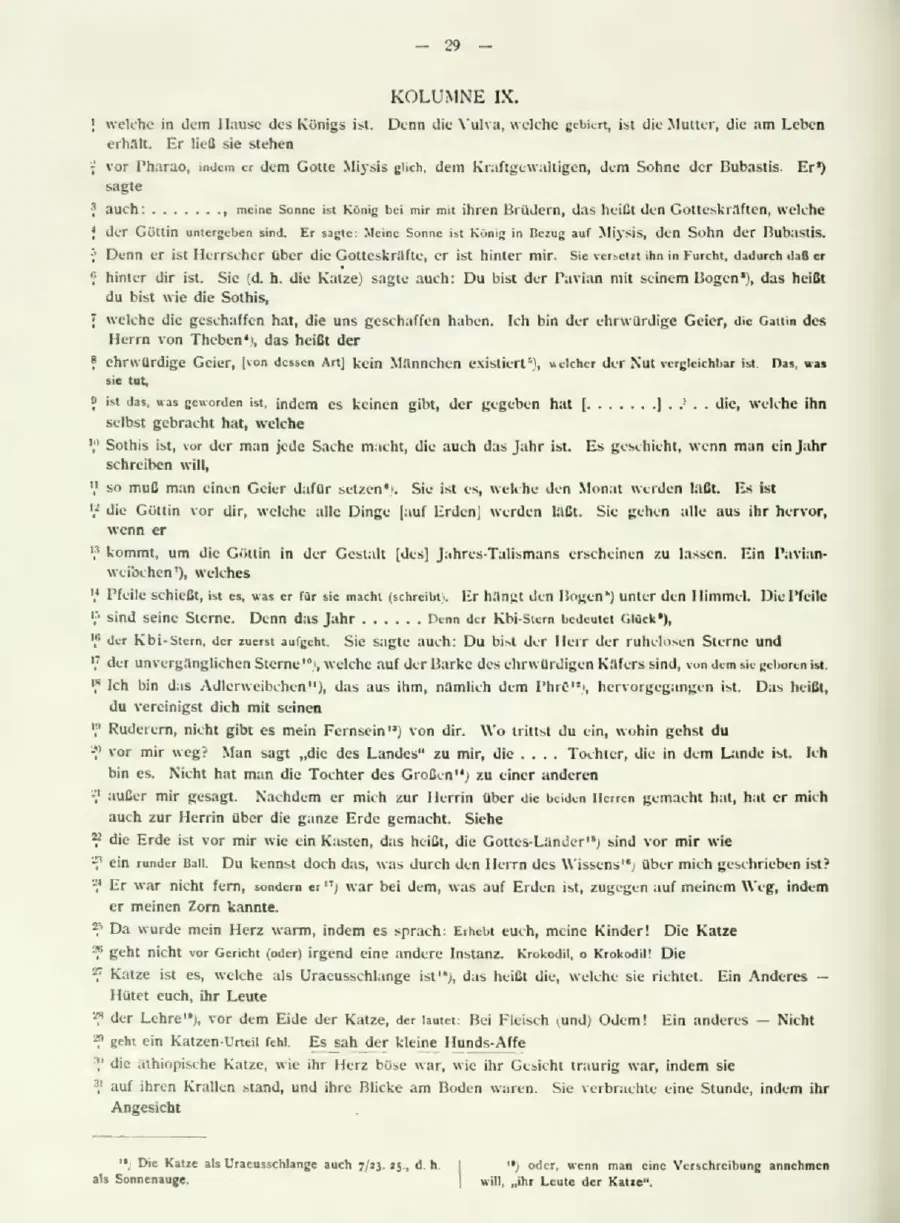
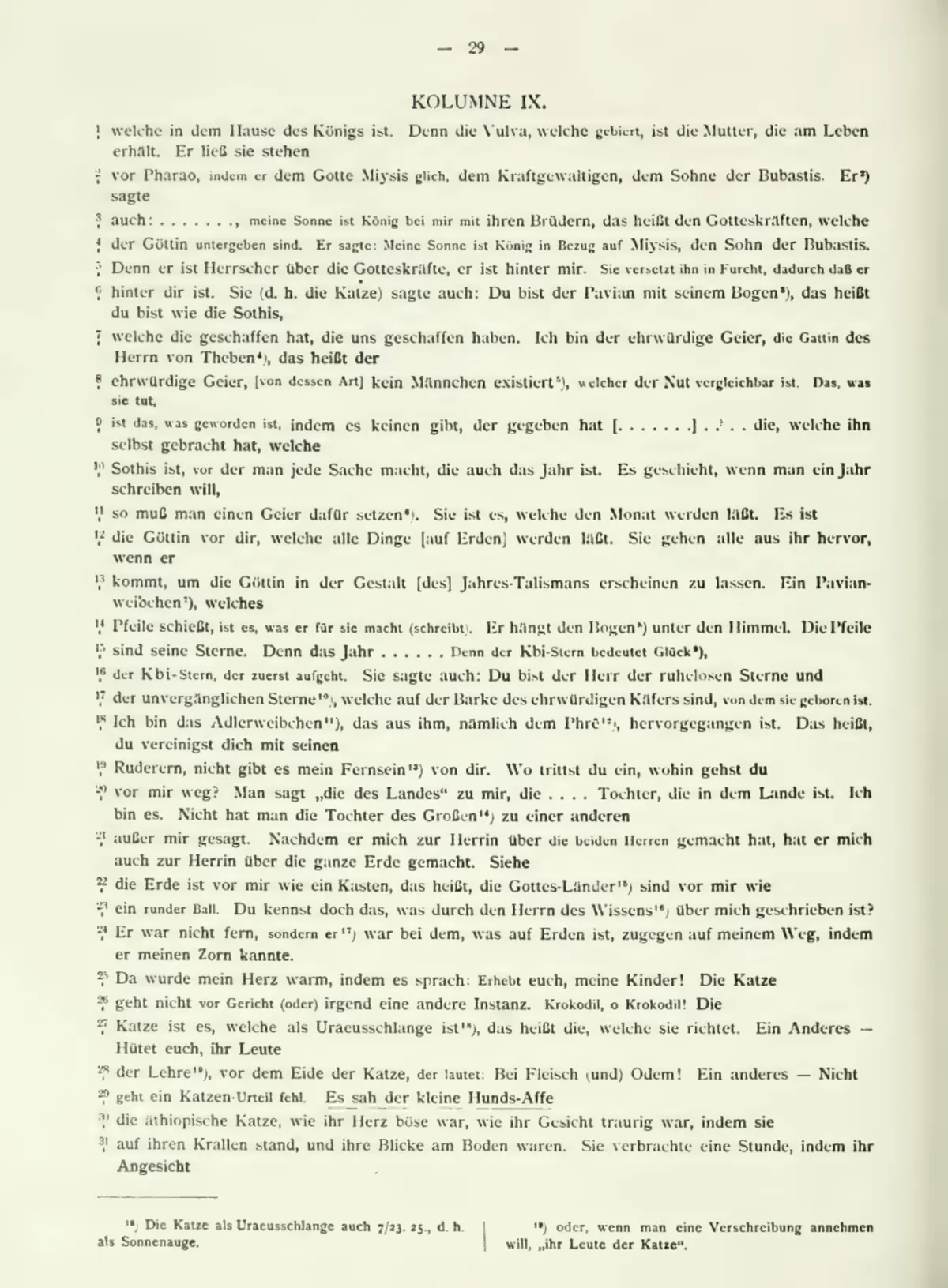
Page 29. p. 29: Column IX: Sothis, the baboon with the bow, 'the cat is the uraeus', the cat's judgment Spiegelberg 1917, pp. 13–55 (archive.org scan) - 3729, Kol. IX
[ ] welche in dem Hause des Königs ist. Denn die Vulva, welche gebiert, ist die Mutter, die am Leben erhält. Er ließ sie stehen vor Pharao, indem er dem Gotte Miysis glich, dem Kraftgewaltigen, dem Sohne der Bubastis. Er sagte auch: Meine Sonne ist König bei mir mit ihren Brüdern, das heißt den Gotteskräften, welche der Göttin untergeben sind. Er sagte: Meine Sonne ist König in Bezug auf Miysis, den Sohn der Bubastis. Denn er ist Herrscher über die Gotteskräfte, er ist hinter mir. Sie versetzt ihn in Furcht, dadurch daß er hinter dir ist.
[ ] who is in the house of the king. For the vulva that gives birth is the mother who keeps alive. He let her stand before Pharaoh, resembling the god Miysis, the mighty one, the son of Bubastis. He said also: My sun is king with me with her brothers, that is, the god-powers which are subject to the goddess. He said: My sun is king in respect of Miysis, the son of Bubastis. For he is ruler over the god-powers, he is behind me. She puts him in fear, in that he is behind you.
- 3829, Kol. IX
Sie (d. h. die Katze) sagte auch: Du bist der Pavian mit seinem Bogen, das heißt du bist wie die Sothis, welche die geschaffen hat, die uns geschaffen haben. Ich bin der ehrwürdige Geier, die Gattin des Herrn von Theben, das heißt der ehrwürdige Geier, [von dessen Art] kein Männchen existiert, welcher der Nut vergleichbar ist. Das, was sie tut, ist das, was geworden ist, indem es keinen gibt, der gegeben hat [. . .] die, welche ihn selbst gebracht hat, welche Sothis ist, vor der man jede Sache macht, die auch das Jahr ist. Es geschieht, wenn man ein Jahr schreiben will, so muß man einen Geier dafür setzen. Sie ist es, welche den Monat werden läßt. Es ist die Göttin vor dir, welche alle Dinge [auf Erden] werden läßt. Sie gehen alle aus ihr hervor, wenn er kommt, um die Göttin in der Gestalt [des] Jahres-Talismans erscheinen zu lassen. Ein Pavianweibchen, welches Pfeile schießt, ist es, was er für sie macht (schreibt). Er hängt den Bogen unter den Himmel. Die Pfeile sind seine Sterne. Denn der Kbi-Stern bedeutet Glück, der Kbi-Stern, der zuerst aufgeht.
She (that is, the cat) said also: You are the baboon with his bow, that is, you are like Sothis, who created those who created us. I am the venerable vulture, the wife of the Lord of Thebes, that is, the venerable vulture [of whose kind] no male exists, who is comparable to Nut. What she does is what has become, there being none who has given [ ] she who brought him himself, who is Sothis, before whom every thing is made, who is also the year. It happens that when one wants to write 'year', one must put a vulture for it. She it is who lets the month come to be. It is the goddess before you who lets all things [on earth] come to be. They all come forth from her when he comes to make the goddess appear in the form of the year-talisman. A female baboon shooting arrows is what he makes (writes) for her. He hangs the bow under the heaven. The arrows are his stars. For the Kbi-star means good fortune, the Kbi-star that rises first.
Note on line 38
Spiegelberg’s notes: the sun-god as an ape with a bow is attested (Lanzone, Dizionario mitologico pl. 183); the vulture as the sign for ‘year’ is in Horapollon I 11, and the Ptolemaic writing uses it for ‘year’; the goddess Nut is also shown with bow and arrow; the bow might be the rainbow; and the ’lord of Thebes’ wife’ is Mut of Thebes. - 3929, Kol. IX
Sie sagte auch: Du bist der Herr der ruhelosen Sterne und der unvergänglichen Sterne, welche auf der Barke des ehrwürdigen Käfers sind, von dem sie geboren ist. Ich bin das Adlerweibchen, das aus ihm, nämlich dem Phre, hervorgegangen ist. Das heißt, du vereinigst dich mit seinen Ruderern, nicht gibt es mein Fernsein von dir. Wo trittst du ein, wohin gehst du vor mir weg? Man sagt „die des Landes“ zu mir, die ... Tochter, die in dem Lande ist. Ich bin es. Nicht hat man die Tochter des Großen zu einer anderen außer mir gesagt. Nachdem er mich zur Herrin über die beiden Herren gemacht hat, hat er mich auch zur Herrin über die ganze Erde gemacht. Siehe, die Erde ist vor mir wie ein Kasten, das heißt, die Gottes-Länder sind vor mir wie ein runder Ball. Du kennst doch das, was durch den Herrn des Wissens über mich geschrieben ist? Er war nicht fern, sondern er war bei dem, was auf Erden ist, zugegen auf meinem Weg, indem er meinen Zorn kannte.
She said also: You are the lord of the restless stars and of the imperishable stars, which are on the barque of the venerable beetle from whom she was born. I am the female eagle who came forth from him, namely from Phre. That is, you unite with his rowers; there is no distance of me from you. Where do you enter, where do you go away from before me? They say 'she of the land' to me, the ... daughter who is in the land. I am she. Never has 'the daughter of the Great One' been said of any other but me. After he made me mistress over the two lords, he made me also mistress over the whole earth. Behold, the earth is before me like a box, that is, the God's-lands are before me like a round ball. But you know what has been written about me by the Lord of Knowledge? He was not far, but he was present with what is on earth on my road, knowing my anger.
Note on line 39
Spiegelberg: according to whether the sun-god Phre is conceived as tom-cat, lion or eagle, his daughter Tefnut is a cat, a lioness or a female eagle; ‘she of the land’ and ‘daughter of the Great One’ allude to the ‘distant’ Sun-Eye (Sethe, Sonnenauge 141 ff.); the ‘Great One’ is the sun-god Re, whose ’eye’ Tefnut (= the cat) is called (15/26–27); the ‘God’s-lands’ are Nubia; the ‘Lord of Knowledge’ is Thoth; the two groups of stars distinguished in the old literature are the northern (imperishable) and southern (restless) ones. The cat is the uraeus
- 4029, Kol. IX
Da wurde mein Herz warm, indem es sprach: Erhebt euch, meine Kinder! Die Katze geht nicht vor Gericht (oder) irgend eine andere Instanz. Krokodil, o Krokodil! Die Katze ist es, welche als Uräusschlange ist, das heißt die, welche sie richtet. Ein Anderes — Hütet euch, ihr Leute der Lehre, vor dem Eide der Katze, der lautet: Bei Fleisch (und) Odem! Ein anderes — Nicht geht ein Katzen-Urteil fehl. Es sah der kleine Hunds-Affe die äthiopische Katze, wie ihr Herz böse war, wie ihr Gesicht traurig war, indem sie auf ihren Krallen stand, und ihre Blicke am Boden waren. Sie verbrachte eine Stunde, indem ihr Angesicht
Then my heart grew warm, saying: Arise, my children! The cat does not go before a court (or) any other authority. Crocodile, O crocodile! It is the cat who is as the uraeus serpent, that is, she who judges them. Another — Beware, you people of the teaching, of the oath of the cat, which runs: By flesh (and) breath! Another — A cat's judgment never fails. The little dog-ape saw the Ethiopian cat, how her heart was evil, how her face was sad, as she stood on her claws and her glances were on the ground. She spent an hour, her face
Note on line 40
Spiegelberg’s note: the cat as uraeus serpent also in 7/23 and 25, that is, as the Sun-Eye; his note offers ‘you people of the cat’ as the other reading if a scribal error is assumed. 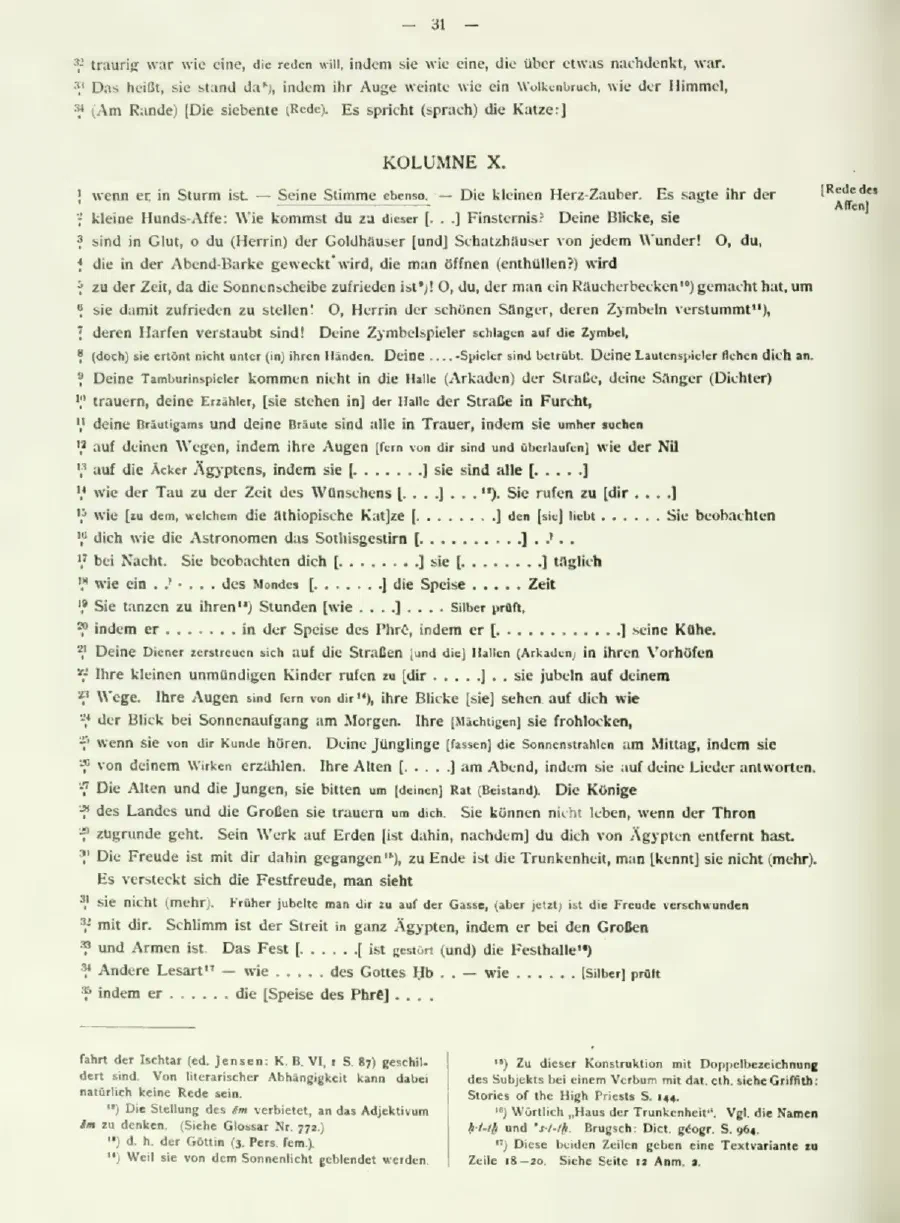
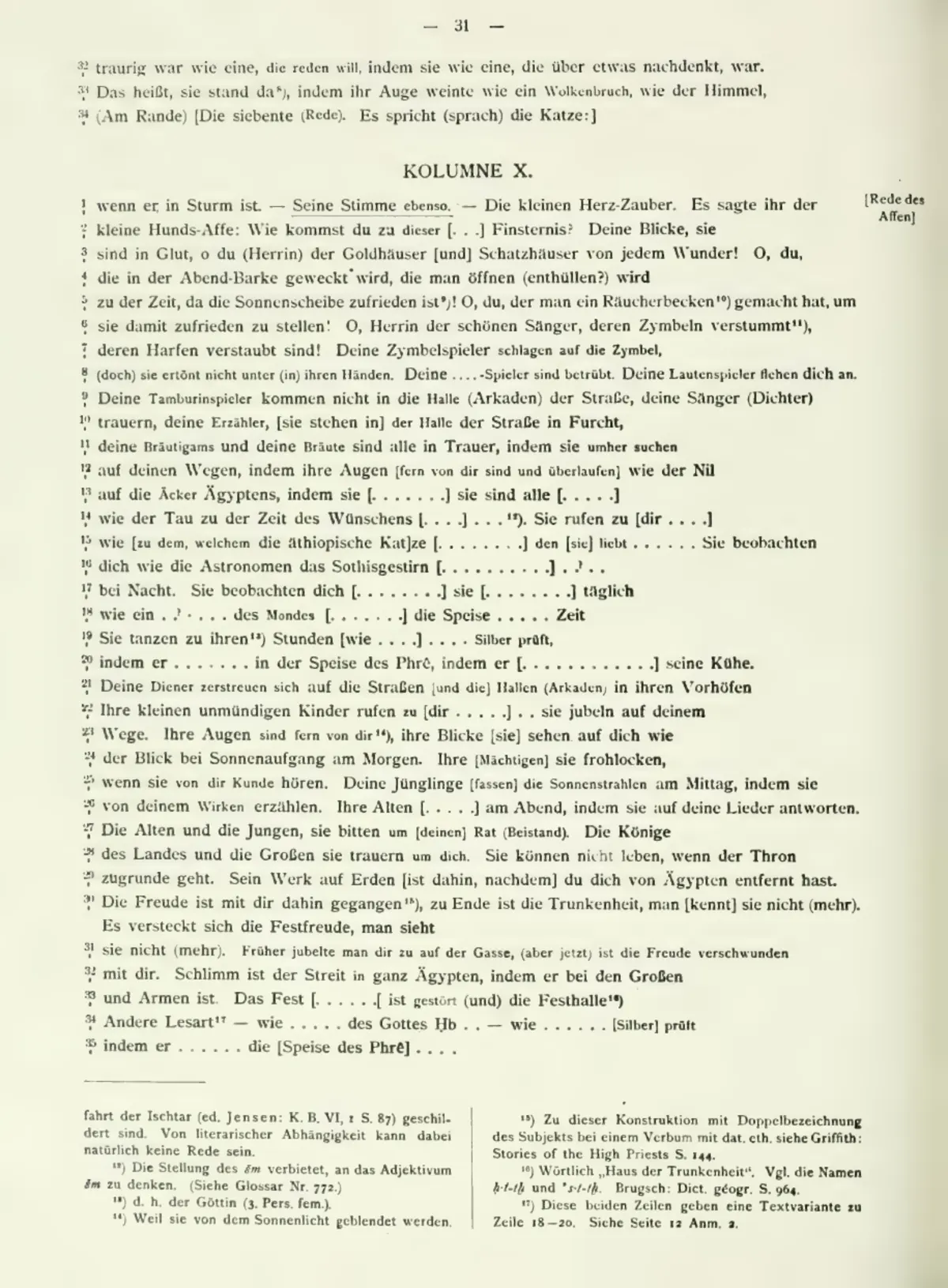
Page 31. p. 31: Columns IX end and X: the ape's lament for Egypt without its goddess Spiegelberg 1917, pp. 13–55 (archive.org scan) - 4131, Kol. IX 35–36
traurig war wie eine, die reden will, indem sie wie eine, die über etwas nachdenkt, war. Das heißt, sie stand da, indem ihr Auge weinte wie ein Wolkenbruch, wie der Himmel, wenn er in Sturm ist. [Am Rande: Die siebente (Rede). Es spricht (sprach) die Katze:]
sad like one who wants to speak, like one who thinks over something. That is, she stood there, her eye weeping like a cloudburst, like the sky when it is in storm. [In the margin: The seventh (speech). The cat speaks (spoke):]
The ape’s lament for Egypt
- 4231, Kol. X
Seine Stimme ebenso. — Die kleinen Herz-Zauber. Es sagte ihr der kleine Hunds-Affe: Wie kommst du zu dieser [. . .] Finsternis? Deine Blicke, sie sind in Glut, o du (Herrin) der Goldhäuser [und] Schatzhäuser von jedem Wunder! O, du, die in der Abend-Barke geweckt wird, die man öffnen (enthüllen?) wird zu der Zeit, da die Sonnenscheibe zufrieden ist! O, du, der man ein Räucherbecken gemacht hat, um sie damit zufrieden zu stellen! O, Herrin der schönen Sänger, deren Zymbeln verstummt, deren Harfen verstaubt sind! Deine Zymbelspieler schlagen auf die Zymbel, (doch) sie ertönt nicht unter (in) ihren Händen. Deine ....-Spieler sind betrübt. Deine Lautenspieler flehen dich an. Deine Tamburinspieler kommen nicht in die Halle (Arkaden) der Straße, deine Sänger (Dichter) trauern, deine Erzähler, [sie stehen in] der Halle der Straße in Furcht, deine Bräutigame und deine Bräute sind alle in Trauer, indem sie umher suchen auf deinen Wegen, indem ihre Augen [fern von dir sind und überlaufen] wie der Nil auf die Äcker Ägyptens,
His voice likewise. — The little heart-charms. The little dog-ape said to her: How do you come to this [. . .] darkness? Your glances, they are in glow, O you (mistress) of the gold-houses [and] treasure-houses of every wonder! O you who are awakened in the evening barque, whom one will open (unveil?) at the time when the sun-disk is content! O you for whom a censer has been made, to content her with it! O mistress of the beautiful singers, whose cymbals are silent, whose harps are dusty! Your cymbal-players strike the cymbal, (but) it does not sound under (in) their hands. Your ....-players are grieved. Your lute-players implore you. Your tambourine-players do not come into the hall (arcade) of the street, your singers (poets) mourn, your story-tellers [stand in] the hall of the street in fear, your bridegrooms and your brides are all in mourning, seeking about on your roads, their eyes [far from you and overflowing] like the Nile onto the fields of Egypt,
Note on line 42
‘Censer’ (shr) is a play on shr, ‘one who contents’. Spiegelberg’s note: the sad state of Egypt after the departure of the sun-goddess recalls somewhat the consequences of the disappearance of Ishtar into the underworld in the Descent of Ishtar (ed. Jensen, K.B. VI), though there can be no question of literary dependence. - 4331, Kol. X
indem sie [ ] sie sind alle [ ] wie der Tau zu der Zeit des Wünschens [....]. Sie rufen zu [dir . . . .] wie [zu dem, welchem die äthiopische Kat]ze [ ] den [sie] liebt. Sie beobachten dich wie die Astronomen das Sothisgestirn [ ] bei Nacht. Sie beobachten dich [ ] sie [ ] täglich wie ein ....... des Mondes [ ] die Speise Zeit. Sie tanzen zu ihren Stunden [wie ....] ... Silber prüft, indem er in der Speise des Phre, indem er [ ] seine Kühe. Deine Diener zerstreuen sich auf die Straßen [und die] Hallen (Arkaden) in ihren Vorhöfen. Ihre kleinen unmündigen Kinder rufen zu [dir . . . .], sie jubeln auf deinem Wege. Ihre Augen sind fern von dir, ihre Blicke [sie] sehen auf dich wie der Blick bei Sonnenaufgang am Morgen. Ihre [Mächtigen] sie frohlocken, wenn sie von dir Kunde hören. Deine Jünglinge [fassen] die Sonnenstrahlen am Mittag, indem sie von deinem Wirken erzählen. Ihre Alten [ ] am Abend, indem sie auf deine Lieder antworten. Die Alten und die Jungen, sie bitten um [deinen] Rat (Beistand). Die Könige des Landes und die Großen, sie trauern um dich. Sie können nicht leben, wenn der Thron zugrunde geht. Sein Werk auf Erden [ist dahin, nachdem] du dich von Ägypten entfernt hast. Die Freude ist mit dir dahin gegangen, zu Ende ist die Trunkenheit, man [kennt] sie nicht (mehr). Es versteckt sich die Festfreude, man sieht sie nicht (mehr). Früher jubelte man dir zu auf der Gasse, (aber jetzt) ist die Freude verschwunden mit dir. Schlimm ist der Streit in ganz Ägypten, indem er bei den Großen und Armen ist. Das Fest [ ] ist gestört (und) die Festhalle (Haus der Trunkenheit) [ ].
[ ] they are all [ ] like the dew at the time of desire [....]. They cry to [you . . . .] like [to him whom the Ethiopian ca]t [ ] whom [she] loves. They watch for you as the astronomers watch for the star Sothis [ ] by night. They watch for you [ ] they [ ] daily like a ....... of the moon [ ] the food-time. They dance at their hours [like ....] ... tests silver, in the food of Phre, [ ] his cows. Your servants scatter into the streets [and the] halls (arcades) in their forecourts. Their little children, not yet speaking, cry to [you . . . .], they rejoice on your road. Their eyes are far from you, their glances look to you like the glance at sunrise in the morning. Their [mighty ones] exult when they hear news of you. Your young men [seize] the sun's rays at noon, telling of your work. Their old men [ ] in the evening, answering your songs. The old and the young, they ask for [your] counsel (aid). The kings of the land and the great, they mourn for you. They cannot live if the throne perishes. His work on earth [is gone, since] you have withdrawn from Egypt. Joy has gone away with you, drunkenness is ended, one does not [know] it (any more). Festival-joy hides itself, one does not see it (any more). Formerly one cheered you in the street, (but now) joy has vanished with you. Bad is the strife in all Egypt, being among the great and the poor. The festival [ ] is disturbed (and) the festival-hall (house of drunkenness) [ ].
Note on line 43
‘Their eyes are far from you’: Spiegelberg notes that this is because they are dazzled by the sunlight. The last two lines of the column give a textual variant to lines 18–20 (his note, p. 12 note 2). Return to Egypt: the ape’s prayer
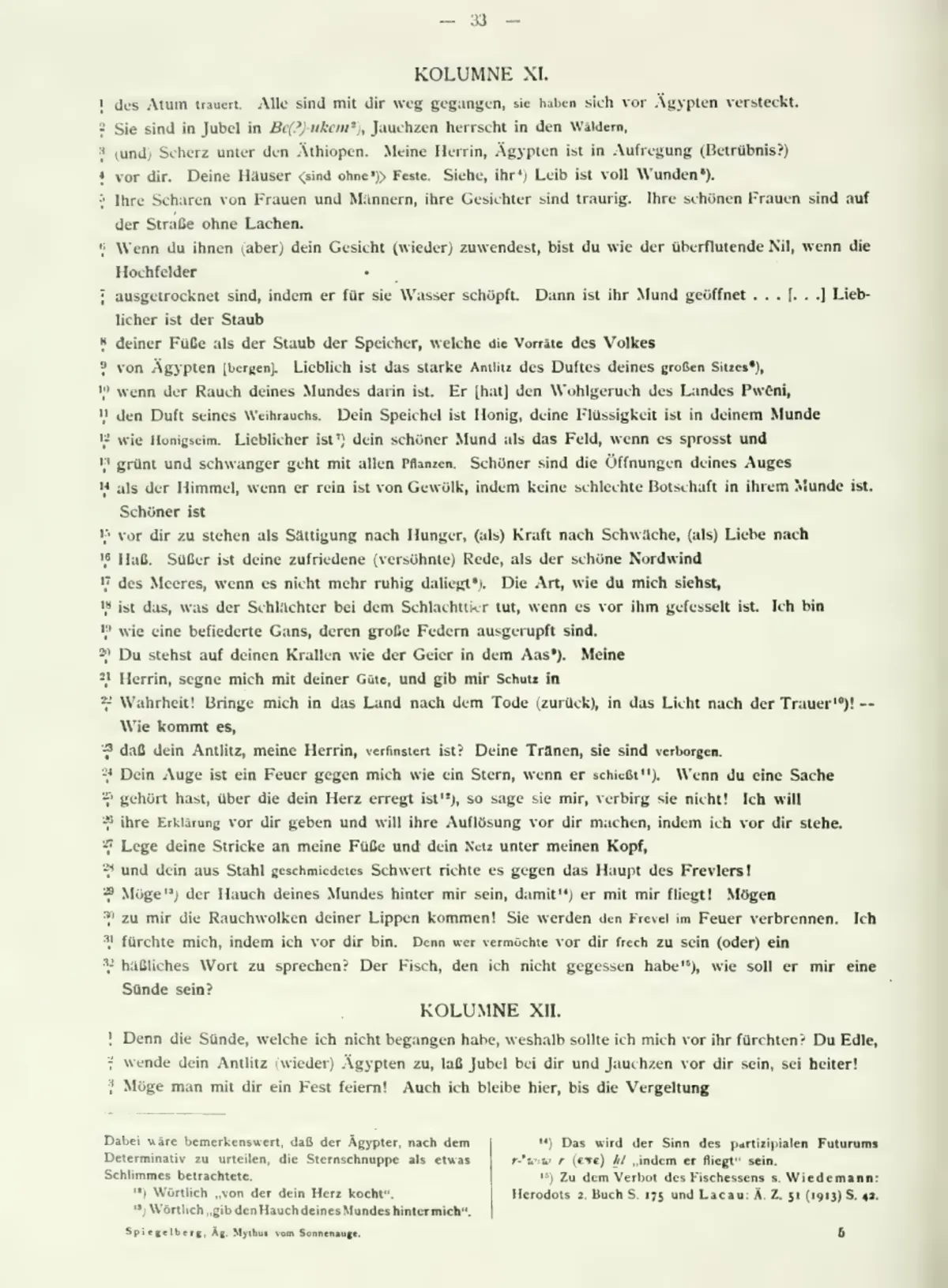
Page 33. p. 33: Column XI and XII 1-3: the ape's prayer and 'the fish I have not eaten' Spiegelberg 1917, pp. 13–55 (archive.org scan) - 4433, Kol. XI
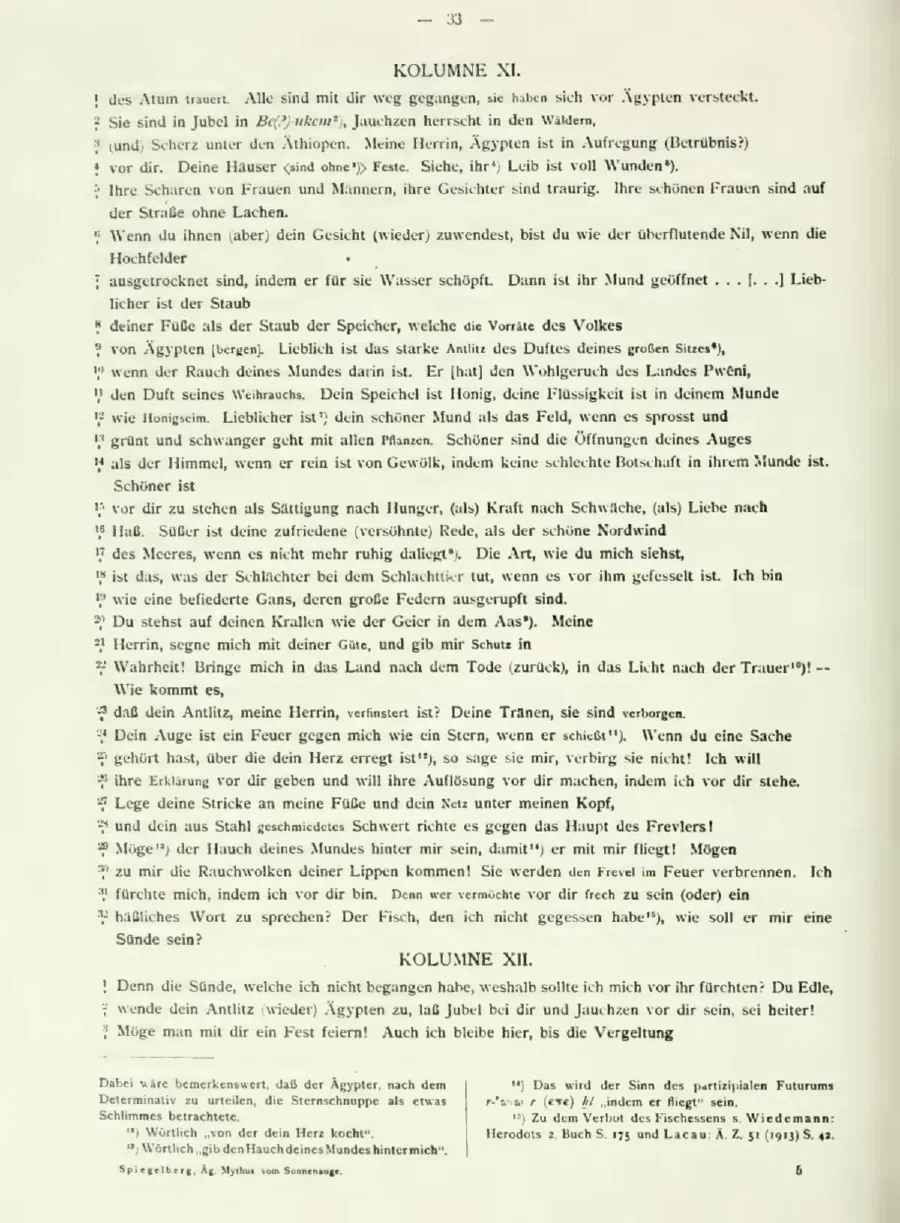
[ ] des Atum trauert. Alle sind mit dir weggegangen, sie haben sich vor Ägypten versteckt. Sie sind in Jubel in Bekhukem, Jauchzen herrscht in den Wäldern, (und) Scherz unter den Äthiopen. Meine Herrin, Ägypten ist in Aufregung (Betrübnis?) vor dir. Deine Häuser (sind ohne) Feste. Siehe, ihr Leib ist voll Wunden. Ihre Scharen von Frauen und Männern, ihre Gesichter sind traurig. Ihre schönen Frauen sind auf der Straße ohne Lachen.
[ ] of Atum mourns. All have gone away with you, they have hidden themselves from Egypt. They are in jubilation in Bekhukem, rejoicing reigns in the woods, (and) merriment among the Ethiopians. My mistress, Egypt is in uproar (grief?) before you. Your houses (are without) festivals. Behold, her body is full of wounds. Her crowds of women and men, their faces are sad. Her beautiful women are in the street without laughter.
Note on line 44
Spiegelberg notes that the Egyptian says ‘wounds’ where the cause is maltreatment. - 4533, Kol. XI
Wenn du ihnen (aber) dein Gesicht (wieder) zuwendest, bist du wie der überflutende Nil, wenn die Hochfelder ausgetrocknet sind, indem er für sie Wasser schöpft. Dann ist ihr Mund geöffnet [. . .]. Lieblicher ist der Staub deiner Füße als der Staub der Speicher, welche die Vorräte des Volkes von Ägypten [bergen]. Lieblich ist das starke Antlitz des Duftes deines großen Sitzes, wenn der Rauch deines Mundes darin ist. Er [hat] den Wohlgeruch des Landes Pueni, den Duft seines Weihrauchs. Dein Speichel ist Honig, deine Flüssigkeit ist in deinem Munde wie Honigseim. Lieblicher ist dein schöner Mund als das Feld, wenn es sprosst und grünt und schwanger geht mit allen Pflanzen. Schöner sind die Öffnungen deines Auges als der Himmel, wenn er rein ist von Gewölk, indem keine schlechte Botschaft in ihrem Munde ist. Schöner ist es, vor dir zu stehen als Sättigung nach Hunger, (als) Kraft nach Schwäche, (als) Liebe nach Haß. Süßer ist deine zufriedene (versöhnte) Rede, als der schöne Nordwind des Meeres, wenn es nicht mehr ruhig daliegt.
But if you turn your face to them (again), you are like the overflowing Nile when the high fields are dried out, drawing water for them. Then their mouth is open [. . .]. Lovelier is the dust of your feet than the dust of the granaries which [hold] the stores of the people of Egypt. Lovely is the strong face of the fragrance of your great seat when the smoke of your mouth is in it. It [has] the sweet scent of the land of Pueni, the fragrance of its incense. Your spittle is honey, your fluid in your mouth is like honey-dew. Lovelier is your beautiful mouth than the field when it sprouts and greens and is heavy with all plants. More beautiful are the openings of your eye than the sky when it is clear of cloud, no bad message being in their mouth. More beautiful it is to stand before you than satiety after hunger, (than) strength after weakness, (than) love after hate. Sweeter is your appeased (reconciled) speech than the lovely north wind of the sea when it no longer lies calm.
Note on line 45
Spiegelberg’s note on the ‘great seat’: since the Demotic gives the feminine form of the adjective, a feminine noun is required, which leads him to ‘great seat’, that is, ‘shrine’. The parallel comparisons, which may be metrical, echo in their comparatives the old poem of the Man Weary of Life, lines 87 ff. - 4633, Kol. XI
Die Art, wie du mich siehst, ist das, was der Schlächter bei dem Schlachttier tut, wenn es vor ihm gefesselt ist. Ich bin wie eine befiederte Gans, deren große Federn ausgerupft sind. Du stehst auf deinen Krallen wie der Geier in dem Aas. Meine Herrin, segne mich mit deiner Güte, und gib mir Schutz in Wahrheit! Bringe mich in das Land nach dem Tode (zurück), in das Licht nach der Trauer! — Wie kommt es, daß dein Antlitz, meine Herrin, verfinstert ist? Deine Tränen, sie sind verborgen. Dein Auge ist ein Feuer gegen mich wie ein Stern, wenn er schießt. Wenn du eine Sache gehört hast, über die dein Herz erregt ist, so sage sie mir, verbirg sie nicht! Ich will ihre Erklärung vor dir geben und will ihre Auflösung vor dir machen, indem ich vor dir stehe. Lege deine Stricke an meine Füße und dein Netz unter meinen Kopf, und dein aus Stahl geschmiedetes Schwert richte es gegen das Haupt des Frevlers! Möge der Hauch deines Mundes hinter mir sein, damit er mit mir fliegt! Mögen zu mir die Rauchwolken deiner Lippen kommen! Sie werden den Frevel im Feuer verbrennen. Ich fürchte mich, indem ich vor dir bin. Denn wer vermöchte vor dir frech zu sein (oder) ein häßliches Wort zu sprechen? Der Fisch, den ich nicht gegessen habe, wie soll er mir eine Sünde sein?
The way you look at me is what the butcher does with the beast for slaughter when it is bound before him. I am like a feathered goose whose great feathers have been plucked out. You stand on your claws like the vulture on the carrion. My mistress, bless me with your goodness, and give me protection in truth! Bring me (back) to the land after death, to the light after mourning! — How is it that your face, my mistress, is darkened? Your tears, they are hidden. Your eye is a fire against me like a star when it shoots. If you have heard a thing over which your heart is stirred, tell it to me, do not hide it! I will give its explanation before you and will make its solution before you, standing before you. Lay your ropes on my feet and your net beneath my head, and your sword forged of steel, point it at the head of the wrongdoer! May the breath of your mouth be behind me, so that it flies with me! May the clouds of smoke of your lips come to me! They will burn the wrongdoing in fire. I am afraid, being before you. For who could be insolent before you (or) speak an ugly word? The fish which I have not eaten, how should it be a sin to me?
Note on line 46
Spiegelberg’s notes: ’the land’ and ’the light’ seem to mean the Egyptian homeland, ’the death’ and ’the mourning’ Ethiopia; the ‘star when it shoots’ could be a shooting star, which the Egyptian, judging from the determinative, took as something bad; for the prohibition on eating fish he cites Wiedemann (Herodots 2. Buch, p. 175) and Lacau (Ä.Z. 51, 43). - 4733, Kol. XII 1–3 and 35, Kol. XII 4–8
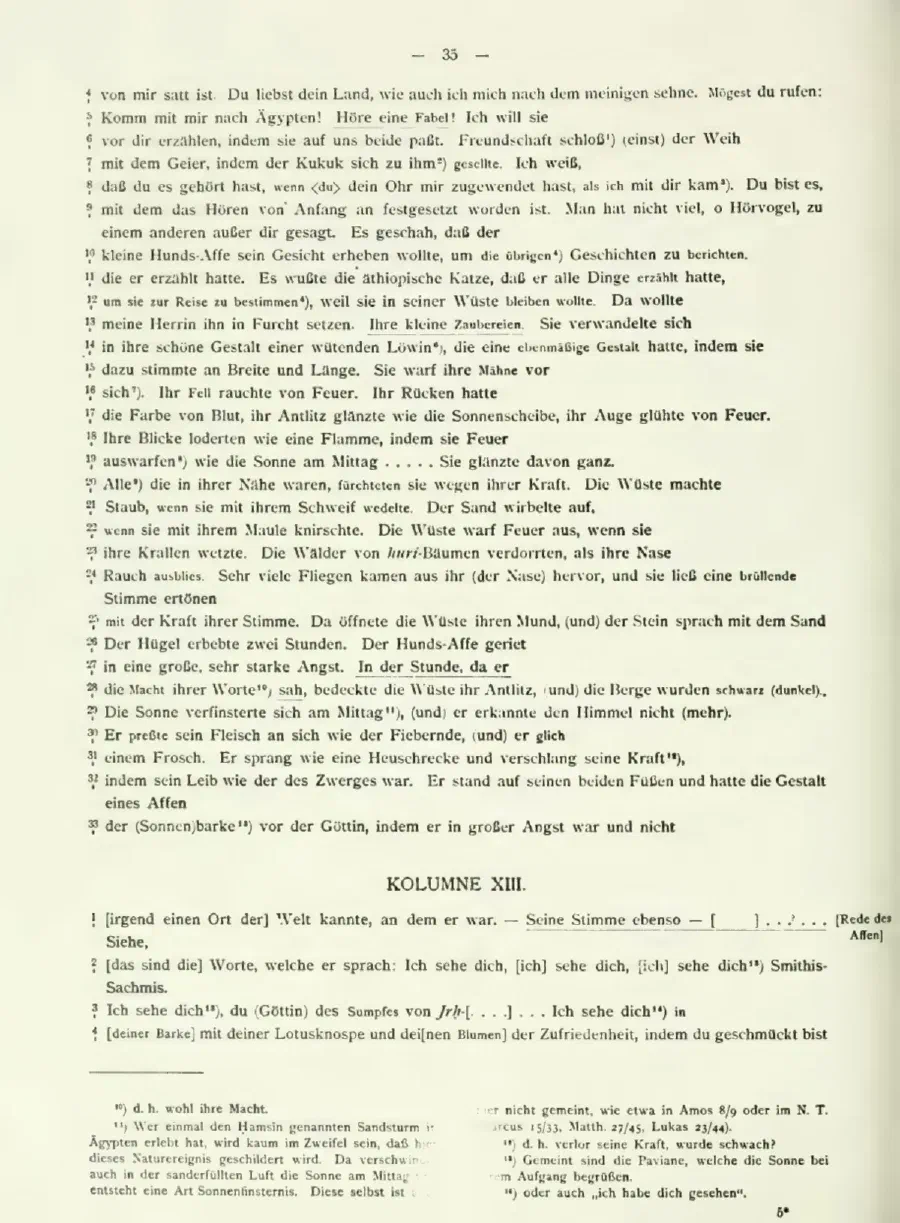
Denn die Sünde, welche ich nicht begangen habe, weshalb sollte ich mich vor ihr fürchten? Du Edle, wende dein Antlitz (wieder) Ägypten zu, laß Jubel bei dir und Jauchzen vor dir sein, sei heiter! Möge man mit dir ein Fest feiern! Auch ich bleibe hier, bis die Vergeltung [ ] von mir satt ist. Du liebst dein Land, wie auch ich mich nach dem meinigen sehne. Mögest du rufen: Komm mit mir nach Ägypten! Höre eine Fabel! Ich will sie vor dir erzählen, indem sie auf uns beide paßt. Freundschaft schloß (einst) der Weih mit dem Geier, indem der Kuckuck sich zu ihm gesellte. Ich weiß, daß du es gehört hast, wenn <du> dein Ohr mir zugewendet hast, als ich mit dir kam. Du bist es, mit dem das Hören von Anfang an festgesetzt worden ist. Man hat nicht viel, o Hörvogel, zu einem anderen außer dir gesagt.
For the sin which I have not committed, why should I be afraid of it? Noble one, turn your face (again) to Egypt, let there be jubilation with you and rejoicing before you, be cheerful! May one celebrate a festival with you! I too will stay here until Retribution [ ] is sated with me. You love your land, as I too long for mine. May you call: Come with me to Egypt! Hear a fable! I will tell it before you, since it fits us both. Friendship once made the kite with the vulture, the cuckoo joining him. I know that you have heard it, if you turned your ear to me when I came with you. It is you with whom hearing has been established from the beginning. Little has been said, O Hearing-bird, to another than you.
Note on line 47
Spiegelberg’s notes: the Demotic literally says ’to be a comrade was what the kite did with …’; ‘with you’ means setting out on the journey to Egypt together, and the cat seems to have promised to hear the ape’s story; the address ‘Hearing-bird’ is to the cat. The lioness
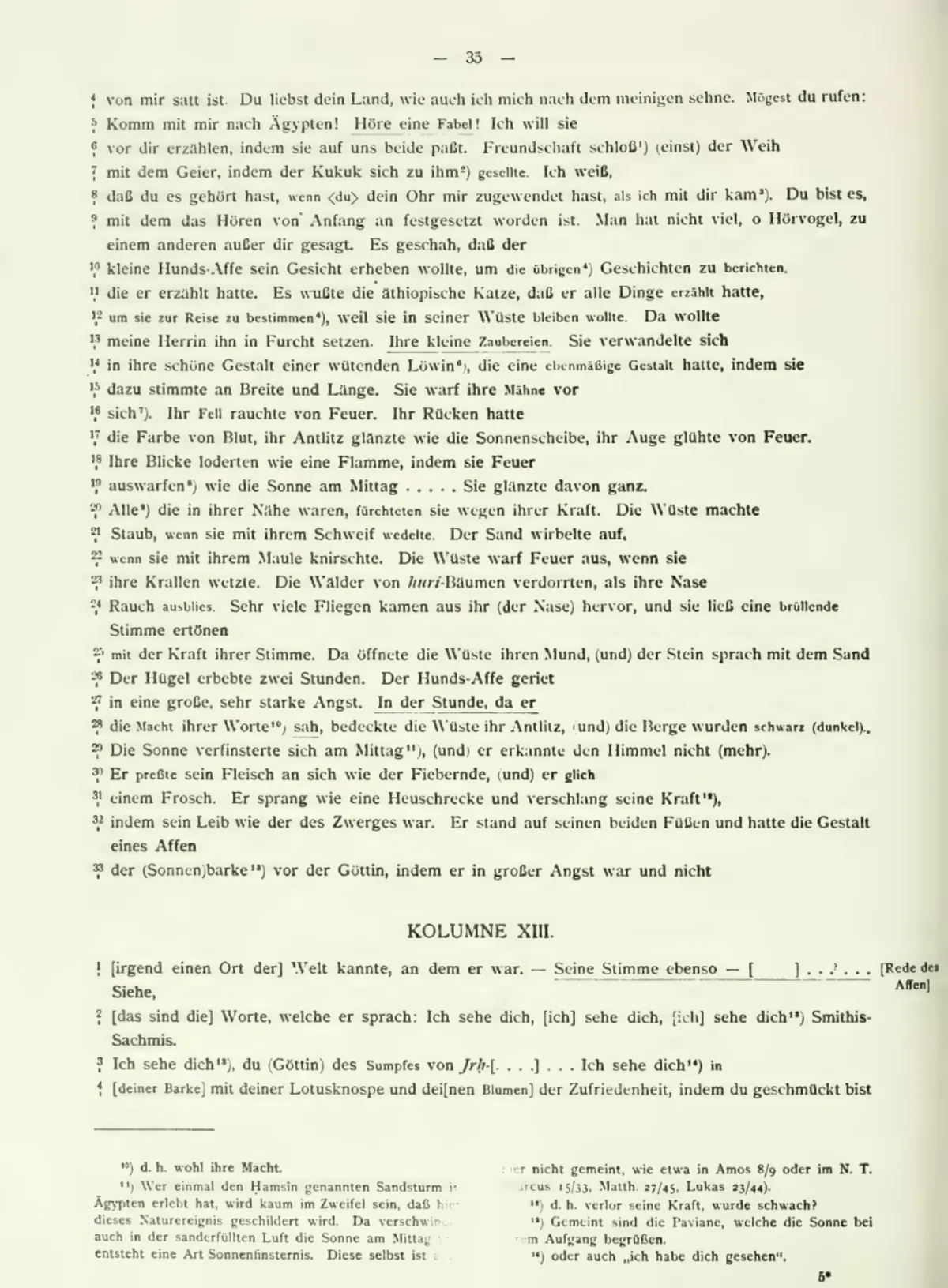
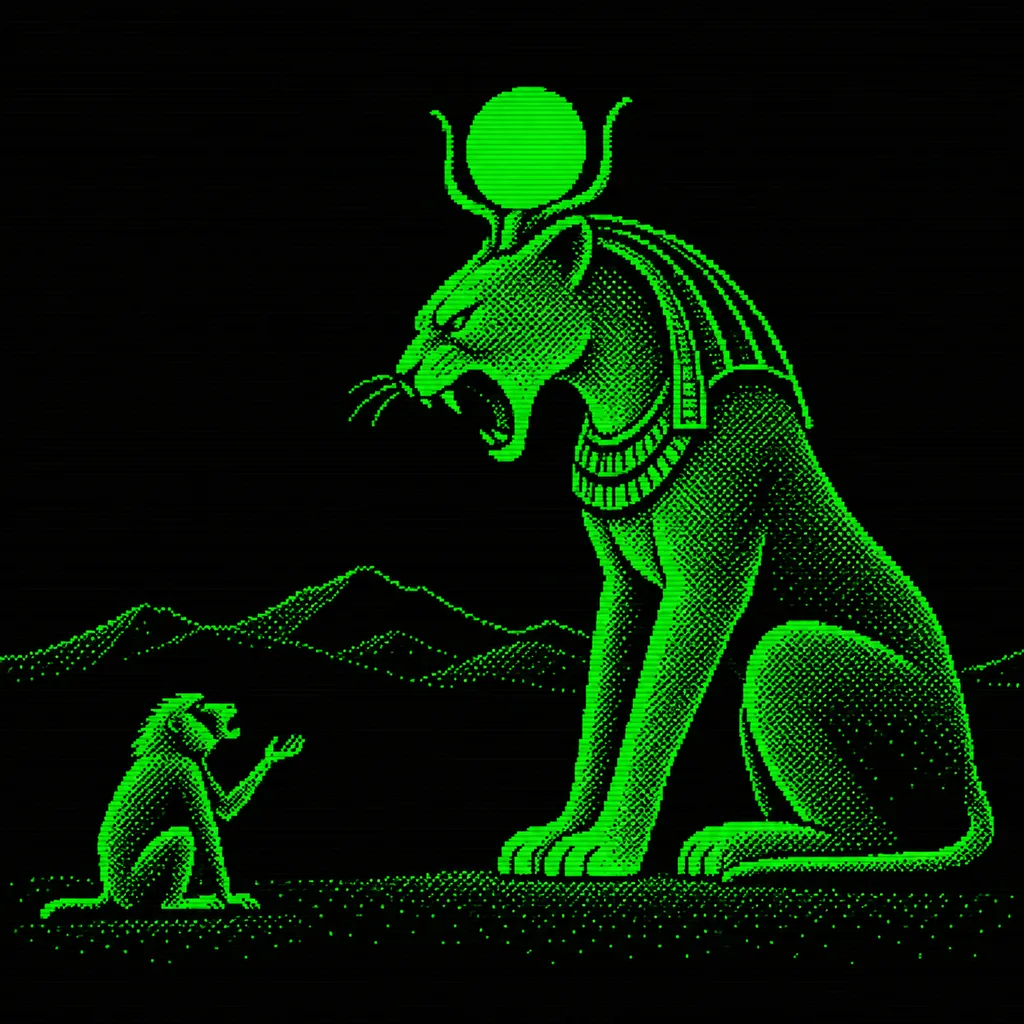
Page 35. p. 35: Columns XII and XIII 1-4: the ape proposes a fable; Tefnut becomes the raging lioness Spiegelberg 1917, pp. 13–55 (archive.org scan) - 4835, Kol. XII 9–12
Es geschah, daß der kleine Hunds-Affe sein Gesicht erheben wollte, um die übrigen Geschichten zu berichten, die er erzählt hatte. Es wußte die äthiopische Katze, daß er alle Dinge erzählt hatte, um sie zur Reise zu bestimmen, weil sie in seiner Wüste bleiben wollte. Da wollte meine Herrin ihn in Furcht setzen. Ihre kleinen Zaubereien.
It happened that the little dog-ape wanted to lift his face to report the remaining stories which he had told. The Ethiopian cat knew that he had told all these things to persuade her to the journey, because she wanted to stay in his desert. Then my mistress wanted to put him in fear. Her little enchantments.
Note on line 48
Spiegelberg’s note on ’to persuade her to the journey’: literally ’to give the road into her hand'. - 4935, Kol. XII 13–24
Sie verwandelte sich in ihre schöne Gestalt einer wütenden Löwin, die eine ebenmäßige Gestalt hatte, indem sie dazu stimmte an Breite und Länge. Sie warf ihre Mähne vor sich. Ihr Fell rauchte von Feuer. Ihr Rücken hatte die Farbe von Blut, ihr Antlitz glänzte wie die Sonnenscheibe, ihr Auge glühte von Feuer. Ihre Blicke loderten wie eine Flamme, indem sie Feuer auswarfen wie die Sonne am Mittag ... Sie glänzte davon ganz. Alle, die in ihrer Nähe waren, fürchteten sie wegen ihrer Kraft. Die Wüste machte Staub, wenn sie mit ihrem Schweif wedelte. Der Sand wirbelte auf, wenn sie mit ihrem Maule knirschte. Die Wüste warf Feuer aus, wenn sie ihre Krallen wetzte. Die Wälder von Khmt-Bäumen verdorrten, als ihre Nase Rauch ausblies. Sehr viele Fliegen kamen aus ihr (der Nase) hervor, und sie ließ eine brüllende Stimme ertönen mit der Kraft ihrer Stimme.
She changed herself into her beautiful form of a raging lioness, who had an even-proportioned figure, fitting in breadth and length. She threw her mane before her. Her fur smoked with fire. Her back had the colour of blood, her face shone like the sun-disk, her eye glowed with fire. Her glances blazed like a flame, throwing out fire like the sun at noon ... She shone all over with it. All who were near her feared her because of her strength. The desert made dust when she wagged her tail. The sand whirled up when she gnashed with her mouth. The desert threw out fire when she whetted her claws. The woods of khmt-trees withered when her nose blew out smoke. Very many flies came out of her (the nose), and she let a roaring voice sound with the force of her voice.
Note on line 49
Spiegelberg’s notes: the lioness’s relation to the sun is clearly shown, as in Horapollon I 17, where the lion is said to have ‘a round face with ray-like hair about it, in imitation of the sun’; Hathor-Tefnut-Bubastis-Sechmet is shown here as the terrible goddess of wrath, the ’lady of glow’ who throws down enemies with the breath of her mouth, ‘who scorches the mountains with her flame’ (Junker, Auszug 80–81), of whom it is said ‘she is angry as Sechmet and gracious as Bubastis’ (Junker 32). ‘She threw her mane’: he glosses ‘she shook her mane’, and says that the mane on a lioness is a zoological inexactness. A like description is in Petubastis 3/16. - 5035, Kol. XII 25–33
Da öffnete die Wüste ihren Mund, (und) der Stein sprach mit dem Sand. Der Hügel erbebte zwei Stunden. Der Hunds-Affe geriet in eine große, sehr starke Angst. In der Stunde, da er die Macht ihrer Worte sah, bedeckte die Wüste ihr Antlitz, (und) die Berge wurden schwarz (dunkel). Die Sonne verfinsterte sich am Mittag, (und) er erkannte den Himmel nicht (mehr). Er preßte sein Fleisch an sich wie der Fiebernde, (und) er glich einem Frosch. Er sprang wie eine Heuschrecke und verschlang seine Kraft, indem sein Leib wie der des Zwerges war. Er stand auf seinen beiden Füßen und hatte die Gestalt eines Affen der (Sonnen-)Barke vor der Göttin, indem er in großer Angst war und nicht [irgend einen Ort der] Welt kannte, an dem er war.
Then the desert opened its mouth, (and) the stone spoke with the sand. The hill trembled for two hours. The dog-ape fell into a great, very strong fear. In the hour when he saw the power of her words, the desert covered its face, (and) the mountains turned black (dark). The sun darkened at noon, (and) he no longer knew the sky. He pressed his flesh to himself like one in fever, (and) he looked like a frog. He leapt like a locust and swallowed his strength, his body like that of the dwarf. He stood on his two feet and had the form of an ape of the (sun-)barque before the goddess, being in great fear and not [knowing any place of the] world where he was.
Note on line 50
Spiegelberg’s notes: anyone who has lived through a khamsin sandstorm in Egypt will hardly doubt that this natural event is meant (he compares Mark 15:33, Matthew 27:45, Luke 23:44; Amos 8:9); the ‘apes of the barque’ are the baboons who greet the sun at its rising. The ape appeases the lioness
- 5135, Kol. XIII 1–4 and 37, Kol. XIII 5–10
— Seine Stimme ebenso — [Rede des Affen] Siehe, das sind die Worte, welche er sprach: Ich sehe dich, [ich] sehe dich, [ich] sehe dich, Smithis-Sachmis. Ich sehe dich, du (Göttin) des Sumpfes von Jrh[...]. Ich sehe dich in [deiner Barke] mit deiner Lotusknospe und deinen Blumen der Zufriedenheit, indem du geschmückt bist [mit deinem] Halskragen mit Fayence-Besatz, indem dein Fernhalsband aus Grünstein ist [und dein] aus Fayence, indem ihr Kranz aus [....] Blumen an deinem Hals ist mit seinem [ ] und deinem ... aus [ ], indem deine Stöcke aus Ebenholz [gelegt sind] in die Hand deiner Aufseher mit [ ]. Deine Rinderaufseher haben ihre [ ] aus Gold. Deine Lautenspieler haben [ihre Lauten], indem ihre Kränze aus [ ] ... indem sie ein Fest veranstalten in ... [ ].
— His voice likewise — [Speech of the ape] Behold, these are the words that he spoke: I see you, [I] see you, [I] see you, Smithis-Sachmis. I see you, you (goddess) of the marsh of Jrh[...]. I see you in [your barque] with your lotus-bud and your flowers of contentment, adorned [with your] collar with faience inlay, your pectoral necklace of green-stone [and your] of faience, its wreath of [....] flowers at your neck with its [ ] and your ... of [ ], your sticks of ebony [laid] in the hand of your overseers with [ ]. Your cattle-overseers have their [ ] of gold. Your lute-players have [their lutes], their garlands of [ ] ... while they hold a festival in ... [ ].
Note on line 51
Spiegelberg reads the word for the necklace (mnjt) as the old menat, which marks the goddess clearly as Hathor, whose emblems are the sistrum and the menat necklace (Gardiner, Recueil 34, 72 ff.). 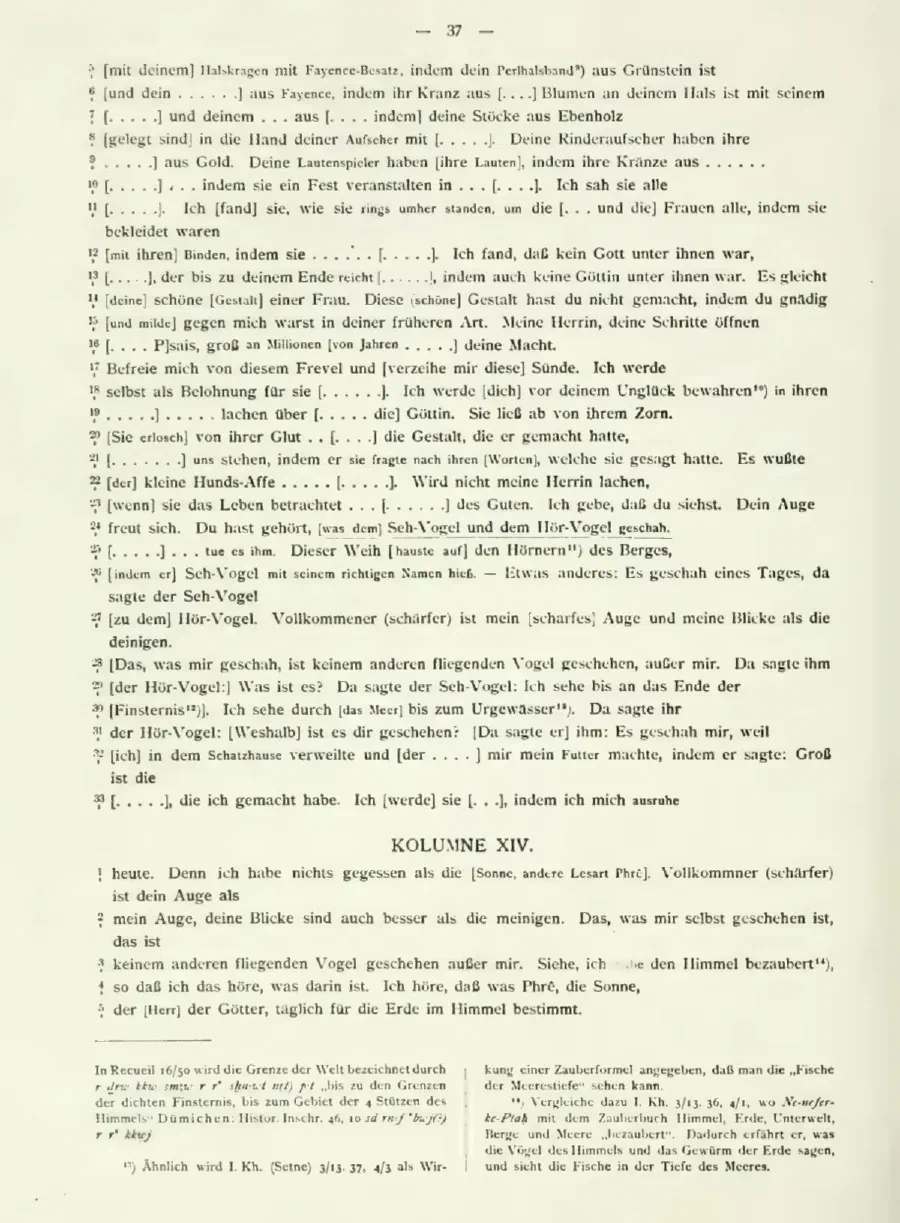
Page 37. p. 37: Columns XIII and XIV 1-5: the ape appeases the lioness; the Seeing-bird and the Hearing-bird begin Spiegelberg 1917, pp. 13–55 (archive.org scan) - 5237, Kol. XIII 10–20
Ich sah sie alle [ ]. Ich [fand] sie, wie sie rings umher standen, um die [. . . und die] Frauen alle, indem sie bekleidet waren [mit ihren] Binden, indem sie ...... [ ]. Ich fand, daß kein Gott unter ihnen war, [ ], der bis zu deinem Ende reicht [ ], indem auch keine Göttin unter ihnen war. Es gleicht [deine] schöne [Gestalt] einer Frau. Diese [schöne] Gestalt hast du nicht gemacht, indem du gnädig [und milde] gegen mich warst in deiner früheren Art. Meine Herrin, deine Schritte öffnen [. . . . P]sais, groß an Millionen [von Jahren ] deine Macht. Befreie mich von diesem Frevel und [verzeihe mir diese] Sünde. Ich werde selbst als Belohnung für sie [ ]. Ich werde [dich] vor deinem Unglück bewahren in ihren [ ] lachen über [ die] Göttin. Sie ließ ab von ihrem Zorn. [Sie erlosch] von ihrer Glut ... [ ] die Gestalt, die er gemacht hatte.
I saw them all [ ]. I [found] them standing all around, to the [. . . and the] women all, clothed [in their] bandages, ...... [ ]. I found that no god was among them, [ ] who reaches to your end [ ], and no goddess was among them. [Your] beautiful [form] resembles a woman. This [beautiful] form you did not make, being gracious [and mild] to me in your former way. My mistress, your steps open [. . . . P]sais, great in millions [of years ] your power. Free me from this wrong and [forgive me this] sin. I myself will, as a reward for them [ ]. I will protect [you] from your misfortune in their [ ] laugh at [ the] goddess. She let go of her anger. [She was extinguished] from her glow ... [ ] the form which he had made.
The Seeing-bird and the Hearing-bird
- 5337, Kol. XIII 21–28
[ ] uns stehen, indem er sie fragte nach ihren [Worten], welche sie gesagt hatte. Es wußte [der] kleine Hunds-Affe [ ]. Wird nicht meine Herrin lachen, [wenn] sie das Leben betrachtet ... [ ] des Guten. Ich gebe, daß du siehst. Dein Auge freut sich. Du hast gehört, [was dem] Seh-Vogel und dem Hör-Vogel geschah. [ ] ... tue es ihm. Dieser Weih [hauste auf] den Hörnern des Berges, [indem er] Seh-Vogel mit seinem richtigen Namen hieß. — Etwas anderes: Es geschah eines Tages, da sagte der Seh-Vogel [zu dem] Hör-Vogel: Vollkommener (schärfer) ist mein [scharfes] Auge und meine Blicke als die deinigen. [Das, was mir geschah, ist keinem anderen fliegenden Vogel geschehen, außer mir.]
[ ] us stand, asking her about her [words] which she had said. The little dog-ape knew [ ]. Will not my mistress laugh [when] she contemplates life ... [ ] of the good. I make you see. Your eye rejoices. You have heard [what happened to] the Seeing-bird and the Hearing-bird. [ ] ... do it to him. This kite [dwelt on] the horns of the mountain, [being] called Seeing-bird by his right name. — Something else: It happened one day that the Seeing-bird said [to the] Hearing-bird: Sharper is my [keen] eye and my glances than yours. [What happened to me has happened to no other flying bird, except me.]
Note on line 53
Spiegelberg’s note: the ‘horns’ are the peaks. - 5437, Kol. XIII 28 – XIV 5
Da sagte ihm [der Hör-Vogel]: Was ist es? Da sagte der Seh-Vogel: Ich sehe bis an das Ende der [Finsternis]. Ich sehe durch [das Meer] bis zum Urgewässer. Da sagte ihr der Hör-Vogel: [Weshalb] ist es dir geschehen? [Da sagte er] ihm: Es geschah mir, weil [ich] in dem Schatzhause verweilte und [der . . . .] mir mein Futter machte, indem er sagte: Groß ist die [ ], die ich gemacht habe. Ich [werde] sie [. . .], indem ich mich ausruhe heute. Denn ich habe nichts gegessen als die [Sonne, andere Lesart: Phre]. Vollkommner (schärfer) ist dein Auge als mein Auge, deine Blicke sind auch besser als die meinigen. Das, was mir selbst geschehen ist, das ist keinem anderen fliegenden Vogel geschehen außer mir. Siehe, ich habe den Himmel bezaubert, so daß ich das höre, was darin ist. Ich höre, daß was Phre, die Sonne, [der Herr] der Götter, täglich für die Erde im Himmel bestimmt.
Then [the Hearing-bird] said to him: What is it? Then the Seeing-bird said: I see to the end of the [darkness]. I see through [the sea] to the Primeval Water. Then the Hearing-bird said to her: [Why] has it happened to you? [Then he said] to him: It happened to me because [I] lingered in the treasure-house and [the . . . .] made me my fodder, saying: Great is the [ ] which I have made. I [will] [. . .] her, resting today. For I have eaten nothing but the [sun; other reading: Phre]. More perfect (sharper) is your eye than my eye, your glances are also better than mine. What has happened to me myself has happened to no other flying bird but me. Behold, I have enchanted the sky, so that I hear what is in it. I hear what Phre, the sun, [the lord] of the gods, ordains daily for the earth in heaven.
Note on line 54
Spiegelberg’s notes: the darkness as the outermost end of the cosmos is also in the older literature (Urk. XV 288: ’they set your boundary to the breadth of the heaven, to the limit of the dense (?) darkness’); with the ’enchanting’ of heaven, earth and underworld compare Setne (I. Kh. 3/13, 36; 4/1), where Neneferkeptah with the magic book ’enchants’ heaven, earth, underworld, mountains and seas, and so learns what the birds of heaven and the worms of the earth say, and sees the fishes in the depth of the sea. The food chain
Page 39. p. 39: Columns XIV and XV 1-9: the chain of eaters and the griffin with a serpent's tail Spiegelberg 1917, pp. 13–55 (archive.org scan) - 5539, Kol. XIV
Da sagte ihm der Seh-Vogel: Weshalb ist dir das geschehen? Da sagte er ihm: Es ist mir geschehen, weil ich nicht am Mittag schlief und nichts aß als [[die Sonne, andere Lesart]] Phre. Denn wenn ich mich am Abend zur Ruhe legte, war meine Kehle trocken. Da legte der Seh-Vogel die Worte in sein Herz. Da lachte der Hör-Vogel eine Weile. Da sagte der Seh-Vogel: Weshalb lachst du? Da sagte ihm der Hör-Vogel: In Wahrheit, ein Hör-Vogel des Phre war es, der es mir [erzählte], als er weit weg im Himmel war, indem [der] Erdboden — möge er gesegnet sein — es vor mir meldete — ich will es ihm lohnen —, indem er sagte: Die Hundsfliege, welche das Allerschamloseste ist, sie wurde von der Eidechse gefressen, der gesagt wurde: Tue es ihr.
Then the Seeing-bird said to him: Why has this happened to you? Then he said to him: It has happened to me because I did not sleep at noon and ate nothing but [[the sun, other reading]] Phre. For when I lay down to rest in the evening, my throat was dry. Then the Seeing-bird laid the words in his heart. Then the Hearing-bird laughed a while. Then the Seeing-bird said: Why do you laugh? Then the Hearing-bird said to him: In truth, it was a Hearing-bird of Phre who [told] it to me when he was far away in the sky, the ground — may it be blessed — reporting it before me — I will reward it — saying: The dog-fly, which is the most shameless of all, was eaten by the lizard, to whom it was said: Do it to her.
Note on line 55
The words between double brackets are struck through in the papyrus. The dog-fly is the symbol of shamelessness and importunity (Spiegelberg, with Horapollon I 51 and Philo, who calls it the boldest and most unabashed of insects). - 5639, Kol. XIV
Der Waran fraß die Eidechse (und) die Schlange fraß (wieder) den Waran. Der Falke warf die Schlange in das Meer. Das sagte der Hör-Vogel zu dem Seh-Vogel: Wenn du in das Meer siehst und du das siehst, was in dem Wasser ist, was ist der Schlange und dem Falken geschehen? Da sagte der Seh-Vogel: In Wahrheit, alle Dinge, welche du gesagt hast oder von welchen du erzählt hattest, die glaube ich. Sie sind alle vor mir wahr. Siehe die Schlange und der Falke, welche in das Meer gefallen sind, die verschlang ein ʿꜣ-Fisch mit seinem Maul. Siehe der Geier, er fraß den ʿꜣ-Fisch. Siehe der ʿꜣ-Fisch, ihn fraß auch (wieder) der mr-Fisch, als er an das Ufer schwamm. Siehe ein Löwe kam an den Fluß und zog den ʿꜣ-Fisch ans Land. Da roch (witterte) sie ein Greif und schlug seine Krallen in sie beide, indem er sie unter den Glanz der Sonnenkreise des Himmels trug. Dann legte er sie nieder und zerriß sie auf dem Berg vor sich und verspeiste sie.
The monitor lizard ate the lizard (and) the snake ate (in turn) the monitor. The falcon threw the snake into the sea. This the Hearing-bird said to the Seeing-bird: When you look into the sea and see what is in the water, what has happened to the snake and the falcon? Then the Seeing-bird said: In truth, all things which you have said, or of which you had told, I believe them. They are all true before me. Behold the snake and the falcon who fell into the sea, a ʿꜣ-fish swallowed them with its mouth. Behold the vulture, he ate the ʿꜣ-fish. Behold the ʿꜣ-fish, the mr-fish also ate it (in turn) as he swam to the shore. Behold, a lion came to the river and drew the ʿꜣ-fish to land. Then a griffin scented them and struck his claws into both of them, carrying them under the splendour of the sun-circles of heaven. Then he laid them down and tore them to pieces on the mountain before him and ate them.
Note on line 56
Spiegelberg’s notes: ’the two vultures’ are the Seeing-bird and the Hearing-bird; ‘ate her’ is literally ’the lizard eats her’; ‘swam to the shore’ is literally ’landed on the shore’. - 5739, Kol. XIV
Sollte ich eine Lüge sagen, so komm mit mir zu dem Wüsten-Berg! Ich lasse dich sie sehen, wie sie zerrissen und zerstückt vor ihm liegen, und er sie verspeist. Da eilten die beiden Geier zu [dem] Berge. Sie fanden, daß alles das, was die beiden gesagt hatten, Wahrheit sei. Da sagte der Seh-Vogel zu dem Hör-Vogel: Vernimm, es geschieht nichts auf Erden als das, was der Gott im Himmel bestimmen wird, er der (nur) Gutes tut. Wenn es (aber) zu ihm zurückkehrt, ist es etwas [....] Schlechtes. Ferner <sagte der Seh-Vogel zu> dem Hör-Vogel: Was wird mit dem Leichnam des Löwen geschehen, den der Greif überwältigt hat? Wohin legt man ihn? Da sagte der Hör-Vogel zu dem Seh-Vogel: In Wahrheit,
Should I tell a lie, come with me to the desert mountain! I will let you see them, lying torn and dismembered before him, and he eating them. Then the two vultures hurried to [the] mountain. They found that all that the two had said was true. Then the Seeing-bird said to the Hearing-bird: Understand, nothing happens on earth but what the god in heaven will ordain, he who (only) does good. When it (however) returns to him, it is something [....] bad. Further, <the Seeing-bird said to> the Hearing-bird: What will happen to the corpse of the lion whom the griffin overpowered? Where does one lay him? Then the Hearing-bird said to the Seeing-bird: In truth,
Note on line 57
Spiegelberg’s note on the sense: Re ordains only good in heaven; but this good is spoiled on earth and so comes back to the creator. The griffin
- 5839, Kol. XV 1–9
weißt du nicht, daß der Greif der ....[....] ist, der Hirt von allem, was auf Erden ist, der Vergelter, dem kein Vergelter vergilt? Sein Schnabel ist der des Falken, seine Augen die eines Menschen, sein Leib der eines Löwen, seine Ohren wie die des Chenfi-Fisches (oder) des ibh-Fisches des Meeres, sein Schwanz der einer Schlange. Die 5 Lebewesen sind auf [ihm]. So sieht er aus. Er hat Macht über alle Dinge auf Erden gleich dem Tode, dem Vergelter, welcher auch der Hirt von allem ist, was heu[te] auf Erden ist. Wahrlich, der welcher tötet, wird (wieder) getötet. Wer den Tod befiehlt, dessen Untergang wird befohlen werden. Ich habe die genannten Worte gesagt, um es in dein Herz gelangen zu lassen, daß es kein [Ding] gibt, das dem Gotte verborgen bleiben kann, Phre,
do you not know that the griffin is the .... [....], the shepherd of everything that is on earth, the avenger whom no avenger avenges? His beak is that of the falcon, his eyes those of a man, his body that of a lion, his ears like those of the Khenfi-fish (or) the ibh-fish of the sea, his tail that of a snake. The 5 living creatures are on [him]. So he looks. He has power over all things on earth like Death, the avenger, who is also the shepherd of everything that is on earth to-day. Truly, he who kills is (in turn) killed. He who commands death, his destruction will be commanded. I have spoken the words named so that it may reach your heart that there is no [thing] that can remain hidden from the god, Phre,
Note on line 58
Spiegelberg’s notes: the five creatures are falcon, man, lion, fish and snake; the ear ’like a gill (?)’ refers to the fish-ear; the verb ’to let it reach your heart’ means to convince you of it. 
Page 41. p. 41: Columns XV and XVI 1-8: Retribution; the cat relents Spiegelberg 1917, pp. 13–55 (archive.org scan) - 5941, Kol. XV
der Sonne, dem Vergelter der Götter — andere Lesart: dem Gotte —. [Er] übt Vergeltung an allem, was auf Erden ist, von der Hundsfliege an, dem kleinsten (schwächsten) Wesen, das existiert, bis zu dem von ihm am meisten Verabscheuten, dem Greif, dem größten Wesen [auf Erden]. Denn das Gute (und) das Böse, was man auf Erden tun wird, das vergilt Phre. Denn mag man auch sagen, daß ich zarter (kleiner) an Gestalt sei als du, so sieht (doch) Phre auf mich wie er auf dich sieht. Sein Geruch (und) sein Gehör ist in allem, was auf Erden ist [ ]. Sie sagte ferner: Er sieht das, was in dem Ei ist, wenn es geschlossen ist. Der, welcher das Ei öffnet, ist wie der, welcher tötet.
the sun, the avenger of the gods — other reading: the god —. [He] exacts retribution on everything that is on earth, from the dog-fly, the smallest (weakest) being that exists, to the one most abhorred by him, the griffin, the greatest being [on earth]. For the good (and) the evil that one will do on earth, Phre repays. For though one may say that I am more delicate (smaller) in form than you, Phre (still) looks upon me as he looks upon you. His smell (and) his hearing are in everything that is on earth [ ]. She said further: He sees what is in the egg when it is closed. He who opens the egg is like him who kills.
Note on line 59
Spiegelberg’s note: this looks as if the eating of an egg is forbidden here. The sun-god had come forth from a self-created egg, which might be connected with a prohibition; a Leiden stele (V 58) has ‘I have not received an egg (?) for any food’. Retribution
- 6041, Kol. XV
Ihre Spur wird nie wieder von ihnen abgewaschen. Wenn ich eine Lüge sage, so sieh (die Spur) auf dir. Seine Spur ist auf deinen Kleidern. Das Blut der Feinde, die gemordet haben, das man nicht heimgesucht hat an ihnen, das schreit [nach ihrem (d. i. der Feinde) Leben]. Nachdem sie gestorben waren, hat man nach ihren Gebeinen geforscht, um an ihnen Rache zu nehmen nach ihrem Tode, indem sie — die Götter und die Menschen — durch ihr Blut gezeichnet sind, um ihr Herz zu erfreuen. Denn die Vergeltung nimmt Rache an dem, dem vergolten werden soll. Sie hat ihre Kleider bezeichnet, um die Erdenbewohner vor ihnen zu bewahren. Denn die Spur des Mordes wird in Ewigkeit nicht abgewaschen, da sie (d. h. die Vergeltung) hinter dem ist, der ihn verübt hat, ob er lebt oder tot ist. Nie entfernt sie sich wieder von ihm.
Their trace is never washed away from them. If I tell a lie, see (the trace) on you. His trace is on your clothes. The blood of the enemies who have murdered, which has not been visited upon them, cries [for their (that is, the enemies') life]. After they had died, their bones were searched for, to take vengeance on them after their death, those — the gods and men — being marked by their blood, to rejoice their heart. For Retribution takes vengeance on him to whom it is to be repaid. She has marked her garments to protect the dwellers on earth from them. For the trace of murder will never be washed away, since she (that is, Retribution) is behind the one who committed it, whether he is alive or dead. Never does she withdraw from him again.
The cat relents
- 6141, Kol. XV
Ich weiß, daß die Katze dein Name ist. Denn sie ist die, über welche die Vergeltung keine Macht hat. Ich weiß, daß sie das Glied des Todes und auch die ist, welche nie stirbt. Du bist das Glied der Vergeltung und der Rache, nämlich die Tochter des Phre. Man nennt dich die Flüster-Katze, denn sie ist es, welche in das Ohr der Erdenbewohner flüstert. Da lachte sie, nämlich die äthiopische Katze. Ihr Herz war fröhlich über die Worte, welche der kleine Hunds-Affe gesagt hatte. Sie lobte ihn sehr, indem sie sagte: Ich werde dich nicht töten und dich nicht töten lassen. Mein Abscheu ist es, Zeuge einer Schlechtigkeit zu sein, vielmehr soll man dir nur Gutes tun. Was soll es, daß ich dir Gewalt antue, da du mir nichts Schlechtes getan hast, sondern nur Gutes? Du hast mein Herz von Trauer befreit, du hast es wieder in Freude hervorgehen (erstrahlen) lassen.
I know that cat is your name. For she is the one over whom Retribution has no power. I know that she is the limb of Death and also the one who never dies. You are the limb of Retribution and of Vengeance, namely the daughter of Phre. One calls you the Whisper-cat, for she it is who whispers in the ear of the dwellers on earth. Then she laughed, namely the Ethiopian cat. Her heart was glad at the words which the little dog-ape had said. She praised him greatly, saying: I will not kill you and not have you killed. It is my abhorrence to be witness of a wickedness; rather one should do only good to you. What is it to me, that I should use force on you, since you have done me nothing bad, but only good? You have freed my heart from grief, you have made it come forth (shine) again in joy.
- 6241, Kol. XV 34 – XVI 8
Sie sagte ferner: Es geschieht, daß das Lamm sanft ist vor [dem Hirten] und der Löwe ruhig da liegt an dem ... der Seth, mit anderen Worten: Der Reiche beraubt den großen Fürsten nicht [in] seinen Häusern. Sie sagte ferner: Er gibt doch nicht Fleisch als Speise dem Opfertier, das heißt, er [. . . .] nicht dem Schwachen? Den Starken, welcher den Schwachen beleidigt, den läßt der, welcher (noch) stärker ist als er, leiden (büßen). Der Himmel fährt mit Nordwind, er bringt den Wohlgeruch des Landes Pueni mit sich, wenn der Nil steigt. Er erhellt sich, wenn Phre am Morgen aufgeht, indem er als Sonnenball erscheint mit großer Glut, indem seine Blicke voll Freude und seine Strahlen voll Leben sind, indem keine Wolke auf dem Wege ist. Sothis, groß sind ihre Strahlen in dem Glanz Ägyptens. Wirf sie in das Hhrd-Land! — Es bewirkte die schöne Rede, daß ihr Antlitz Ägypten (wieder) gnädig wurde.
She said further: It happens that the lamb is gentle before [the shepherd] and the lion lies quiet at the ... of Seth, in other words: the rich man does not rob the great prince [in] his houses. She said further: Does he not give meat as food to the sacrificial animal, that is, he does not [. . . .] the weak? The strong man who insults the weak, him he who is (still) stronger than he lets suffer (atone). The sky travels with the north wind, bringing the fragrance of the land of Pueni with it when the Nile rises. It brightens when Phre rises in the morning, appearing as a sun-ball with great glow, his glances full of joy and his rays full of life, no cloud on the way. Sothis, great are her rays in the splendour of Egypt. Throw her into the Hhrd-land! — The beautiful speech made her face gracious toward Egypt (again).
Note on line 62
Spiegelberg’s note on ‘Throw her into the Hhrd-land’: that is, leave this region. The two jackals
Page 43. p. 43: Columns XVI and XVII 1-9: the two jackals and the lion, the lion sets out to find man Spiegelberg 1917, pp. 13–55 (archive.org scan) - 6343, Kol. XVI
Da trat er eilig vor die Göttin, um sie zu belustigen, so daß ihr Herz sehr froh war. Er sagte zu ihr: Meine Herrin, der Weg des Gehens nach Ägypten ist dieser. Nicht ist es das Wüstengebirge, auf dem du deine Reise viele Tage machst. Ich will sie dich in 4 (?) Tagen machen lassen. Da lachte sie, indem sie sagte: Weshalb hast du mir das nicht früher gesagt? Seine Stimme ebenso. — Die kleinen Fabeln. Es öffnete der kleine Hunds-Affe [seinen] Mund. Er sprach, indem er sagte: Wohlan! Höre die Geschichte, welche 2 Schakalen begegnete!
Then he stepped hurriedly before the goddess to amuse her, so that her heart was very glad. He said to her: My mistress, the way of going to Egypt is this. It is not the desert mountains on which you make your journey for many days. I will let you make it in 4 (?) days. Then she laughed, saying: Why did you not tell me that earlier? His voice likewise. — The little fables. The little dog-ape opened [his] mouth. He spoke, saying: Come! Hear the story which befell 2 jackals!
- 6443, Kol. XVI
Es waren nämlich 2 Schakale in der Wüste, welche sehr befreundet waren, so daß sie eifersüchtig waren, [indem einer zum] andern [sagte]: Wirst du etwa gehen und mit einem anderen Freundschaft schließen? Und nicht [verließ] ein Schakal den anderen, indem sie tranken und aßen [miteinander] zu zweit ... [ ] zu ihnen, indem sie sich abkühlten unter dem Wipfel eines Wüstenbaumes. Da sahen sie [einen] wüten[den Löwen], der auf Beute ausging, wie er auf sie zu rannte. Da blieben sie stehen [und wagten nicht zu] fliehen. Da holte der Löwe die beiden Schakale ein. Er sagte zu ihnen: Wahrlich, [eure Glieder] sind alt geworden. Seht ihr nicht, wie ich auf euch zukomme? Warum flieht ihr nicht vor mir? Da sagten sie: In Wahrheit, unser Herr, wir sahen dich in Wut. Da überlegten wir, daß wir nicht vor dir fliehen wollten. Wenn du uns einholst, so ist es besser, daß du uns frißt, wenn unsere Kraft noch auf uns ist, ohne daß [wir] Not gelitten haben, als daß du uns ermüdet verzehrst. Du [kannst über uns] schlimmen Tod verhängen. Sollte das Krokodil mich fassen, so werde ich ein guter Geschmack in seinem Maule sein. Es hörte der Löwe die große (laute) Stimme. Die Stimme der Schakale ist ... [. . .], wie wenn man sagt: Der Mächtige zürnt nicht wegen der Wahrheit. Da ging [der Löwe] von ihnen weg und ließ sie an jenem Tage frei.
For there were 2 jackals in the desert who were great friends, so that they were jealous, [one saying to the] other: Will you perhaps go and make friendship with another? And one jackal did not [leave] the other, drinking and eating [together] the two ... [ ] to them, cooling themselves under the crown of a desert tree. Then they saw [a] rag[ing lion] going out for prey, running toward them. Then they stood still [and did not dare to] flee. Then the lion overtook the two jackals. He said to them: Truly, [your limbs] have grown old. Do you not see how I come toward you? Why do you not flee from me? Then they said: In truth, our lord, we saw you in rage. Then we reflected that we did not want to flee from you. If you overtake us, it is better that you eat us while our strength is still on us, without [our] having suffered distress, than that you devour us weary. You [can decree] a bad death [for us]. Should the crocodile seize me, I will be a good taste in its mouth. The lion heard the great (loud) voice. The voice of the jackals is ... [. . .], as when one says: The mighty one is not angry because of the truth. Then [the lion] went away from them and let them go free on that day.
- 6543, Kol. XVI–XVII
— Meine Herrin, man ist auf dich eifersüchtig, daß du gehst und auch mit [mir] befreundet bist. Ich bin mit dir und werde dir nie fern sein. Ferner — so wahr [dein] Odem gesund ist, [....] den ... dieses Berges auf die Häuser deiner Stadt? Da sagte [ihm] die Göttin: Dein Herz hat noch [nicht] seinen Halt verloren, du kleiner Hunds-Affe. Muß ich mich nicht darüber wundern, daß du mir gesagt hast: Ich werde dich vor deinem Unheil bewahren? Denn wer gibt schließlich [ ] ... Gibt es einen Stärkeren [als Psais] als einen Bären? Strenge das Äußerste deiner Kraft an. [Wohlan, errette mich vor meiner Peitsche!]
— My mistress, one is jealous of you, that you go and are also friends with [me]. I am with you and will never be far from you. Further — as truly as [your] breath is sound, [....] the ... of this mountain upon the houses of your city? Then the goddess said [to him]: Your heart has not yet lost its hold, you little dog-ape. Must I not wonder at your having said to me: I will protect you from your misfortune? For who after all gives [ ] ... Is there a stronger one [than Psais] than a bear? Strain the utmost of your strength. [Come, save me from my whip!]
Note on line 65
Spiegelberg’s note: since the bear is not native to the Nile valley (compare Wiedemann on Herodotus II 67), the fable of the lion and the man may not have originated in Egypt but may be borrowed in some way. - 6643, Kol. XVII
Da sagte ihr der kleine Hunds-Affe: Nimm dich in Acht! Dein Odem, möge er gesund sein! Das Schatzhaus des Reichen sind seine Ohren. Mögen dir seine Ohren eine Gewähr für das sein, was <du> hören wirst. Dein Angesicht, möge es dir eine Stütze (Bestätigung) sein! Die [. . . ., welche] Psais, der große Gott, verbirgt, der Weise erkennt sie. Der Starke, es gibt einen (noch) Stärkeren als ihn, der Mächtige, es gibt einen (noch) Mächtigeren als ihn, der Stier, es gibt einen (noch) stärkeren Stier als ihn, der Zeugungskräftige, es gibt einen (noch) Zeugungskräftigeren als ihn. — Seine Stimme ebenso. — Die kleinen Vorbereitungen [ ]: Vernimm eine Geschichte. Ich will [sie] dir erzählen.
Then the little dog-ape said to her: Take care! Your breath, may it be sound! The treasure-house of the rich man is his ears. May his ears be a surety to you for what <you> will hear. Your face, may it be a support (confirmation) to you! The [. . . . which] Psais, the great god, hides, the wise man recognizes them. The strong one, there is a (still) stronger than he; the mighty one, there is a (still) mightier than he; the bull, there is a (still) stronger bull than he; the begetter, there is a (still) more potent begetter than he. — His voice likewise. — The little preparations [ ]: Hear a story. I will tell [it] to you.
The lion and the man
- 6743, Kol. XVII 8–9 and 45, Kol. XVII–XVIII
Es war einmal ein [Löwe in der] Wüste, der stark an Kraft war und gern jagte. Das [Wild der Ber]ge kannte seine Furcht und seinen Schrecken. Eines Tages begegnete er einem Panther, dessen Haut geschunden, dessen Fell zerrissen war, indem er halb tot, halb lebend war, und [viele] Wunden [an] ihm waren. Da sagte der Löwe: Wie kommst du in diesen Zustand, in dem du bist? Wer hat deine Haut zerrissen, indem er dein Fell geschunden hat? Da sagte ihm der Panther: Es ist [der Mensch]. [Da sagte ihm der Löwe]: Der Mensch, was ist das? Da sagte ihm der Panther: Es gibt nichts Listigeres als ihn, den Menschen. Mögest du nicht [in die Hand] des Menschen fallen! Da zürnte der Löwe dem Menschen (und) ging von dem Panther weg, indem er [den Menschen] suchte.
There was once a [lion in the] desert who was strong in power and loved to hunt. The [game of the mou]ntains knew his fear and his terror. One day he met a panther whose skin was flayed, whose pelt was torn, being half dead, half alive, and [many] wounds were [on] him. Then the lion said: How do you come into this state in which you are? Who tore your skin, flaying your pelt? Then the panther said to him: It is [man]. [Then the lion said to him]: Man, what is that? Then the panther said to him: There is nothing more cunning than he, man. May you not fall [into the hand] of man! Then the lion was angry at man (and) went away from the panther, seeking [man].
Page 45. p. 45: Columns XVII and XVIII: the lion meets the panther, the horse and ass, the bull and cow, the bear Spiegelberg 1917, pp. 13–55 (archive.org scan) - 6845, Kol. XVII–XVIII
Da begegnete der Löwe einem Gespann, an dessen Zaumzeug [ein . . . .] war, indem ein Zügel in dem Maule des Pferdes und ein Halfter in dem Maule des Esels war. Da sagte der Löwe zu ihnen: Wer hat euch dieses getan? Da sagten sie: [Un]ser [Herr], der Mensch ist es. Da sagte er: War der Mensch auch stärker als ihr? Da sagten sie: Unser Herr, es gibt nichts Listigeres als ihn, den Menschen. Mögest du nicht in die Hand des Menschen fallen! Da zürnte der Löwe dem Menschen und ging von ihnen weg. — Es geschah ihm nun folgendes mit einem Stier und einer Kuh, deren Hörner abgebrochen waren, die an ihren Nasen durchbohrt waren, indem ihre Netze an ihren Köpfen waren. Er fragte sie. Sie sagten ihm den Grund davon ebenso.
Then the lion met a team on whose harness [a . . . .] was, a rein being in the mouth of the horse and a halter in the mouth of the ass. Then the lion said to them: Who has done this to you? Then they said: [Ou]r [lord], it is man. Then he said: Was man stronger than you? Then they said: Our lord, there is nothing more cunning than he, man. May you not fall into the hand of man! Then the lion was angry at man and went away from them. — Now there happened to him the following with a bull and a cow whose horns were broken off, who were pierced at their noses, with their nets on their heads. He asked them. They told him the reason of it in the same way.
- 6945, Kol. XVIII
— (Ferner) geschah <ihm> folgendes mit einem Bären, dessen Krallen weggenommen, dessen Zähne ausgebrochen waren. Er fragte: War der Mensch auch stärker als du? Er sagte: Es ist so. Mir diente ein Diener, indem er mir Speise bereitete. Er sagte mir: Wahrlich, deine Krallen hängen heraus aus deinem Fleisch. Du kannst mit ihnen keine Speise (mehr) holen. Deine Zähne, sie sind lose. Sie lassen die Speise deinem Munde nicht (mehr) schmecken. Laß mich heraus! Ich hole das Doppelte deiner Speise. Da ließ ich ihn heraus. Er nahm meine Krallen und meine Zähne (mit). Ich hatte keine andere Kraft außer ihnen. Er streute Sand in meine Augen und lief mir fort. Da zürnte der Löwe dem Menschen und ging von dem Bären weg, indem er [den Menschen] suchte.
— (Further) there happened to <him> the following with a bear whose claws were taken away, whose teeth were knocked out. He asked: Was man also stronger than you? He said: It is so. A servant served me, preparing food for me. He said to me: Truly, your claws hang out of your flesh. You cannot fetch food with them (any more). Your teeth, they are loose. They do not let the food taste good in your mouth (any more). Let me out! I will fetch twice your food. Then I let him out. He took my claws and my teeth (with him). I had no other strength but them. He strewed sand in my eyes and ran away from me. Then the lion was angry at man and went away from the bear, seeking [man].
Note on line 69
Spiegelberg’s note: in this possibly incomplete text, ‘bear’ makes him think of the well-known bear story in Reynard the Fox. - 7045, Kol. XVIII
Da traf er einen Löwen, der zwischen einem Wüstenbaum [(so) eingeklemmt war], daß das Holz über seiner Tatze geschlossen war, indem er sehr [traurig] war, da er nicht weglaufen konnte. Da sagte ihm der Löwe: Wie kommst du in diese schlimme [Lage], in der du bist? Wer hat dir das getan? Da sagte ihm der Löwe: <Es ist der Mensch.> Hüte dich! Traue ihm nicht! Der Mensch, er ist schlecht (verschlagen). Begib dich nicht in die Hand des Menschen! — Ich sagte zu ihm: Was für ein Gewerbe betreibst du? Da sagte er: Mein Gewerbe ist alt zu machen. Ich werde dir einen Talisman machen können, daß du nie stirbst. Wohlan, ich will dir ein Stück Holz abschneiden und es dir auf diesen Leib als Talisman legen, daß du in Ewigkeit nicht sterben wirst. Da ging ich mit ihm bis zu diesem Wüstenbaum. Er sägte ihn ab und sagte zu mir: Gib deine Tatze her! Da legte ich meine Tatze zwischen das Holz, und er verschloß seinen Spalt vor ihm. Als er nun von mir wußte, daß meine Tatze gefesselt sei, so daß ich nicht hinter ihm her laufen konnte, da streute er Sand in meine Augen und lief von mir fort.
Then he met a lion who was [so] wedged in a desert tree that the wood was closed over his paw, being very [sad] since he could not run away. Then the lion said to him: How do you come into this bad [plight] in which you are? Who did this to you? Then the lion said to him: <It is man.> Beware! Do not trust him! Man, he is wicked (cunning). Do not go into the hand of man! — I said to him: What trade do you ply? Then he said: My trade is making old. I shall be able to make you a talisman so that you never die. Come, I will cut you a piece of wood and lay it on this body of yours as a talisman, that you will not die for ever. Then I went with him to this desert tree. He sawed it off and said to me: Give here your paw! Then I laid my paw between the wood, and he closed its cleft before it. When he knew of me that my paw was fettered so that I could not run after him, he strewed sand in my eyes and ran away from me.
Note on line 70
Spiegelberg’s notes: the ’talisman’ is a life-amulet (Rhind I 11/1; Diodorus I 25; Reitzenstein, Hellenist. Mysterienreligionen p. 206); the scene is probably of a split tree: when the lion has put his paw into the cleft, the man pulls out the wedge and the animal is caught, as in the bear story in Reynard the Fox. A Ramesside ostracon (his p. 7) shows this scene. The lion and the mouse
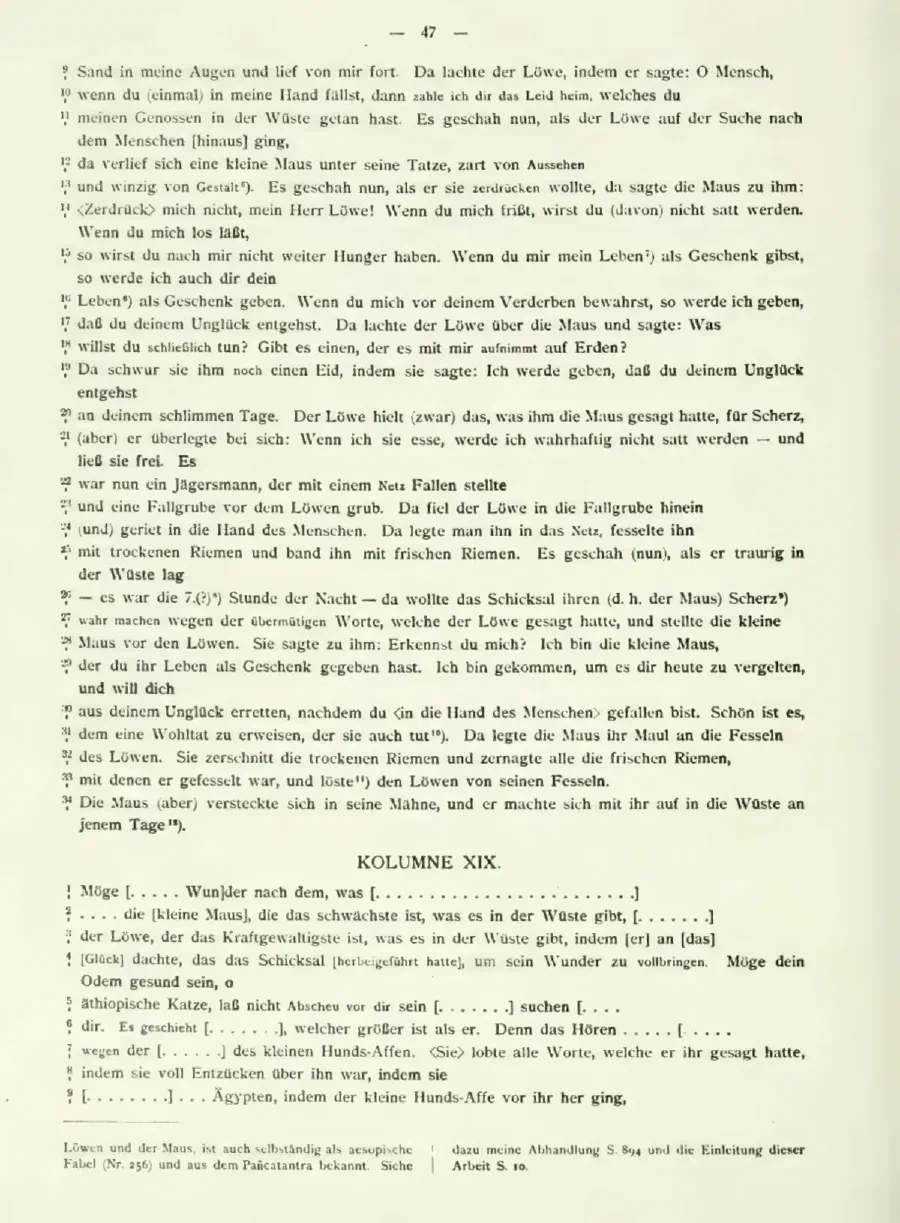
Page 47. p. 47: Columns XVIII and XIX 1-9: the lion in the tree, the lion and the mouse Spiegelberg 1917, pp. 13–55 (archive.org scan) - 7147, Kol. XVIII
Da lachte der Löwe, indem er sagte: O Mensch, wenn du (einmal) in meine Hand fällst, dann zahle ich dir das Leid heim, welches du meinen Genossen in der Wüste getan hast. Es geschah nun, als der Löwe auf der Suche nach dem Menschen [hinaus] ging, da verlief sich eine kleine Maus unter seine Tatze, zart von Aussehen und winzig von Gestalt. Es geschah nun, als er sie zerdrücken wollte, da sagte die Maus zu ihm: <Zerdrück> mich nicht, mein Herr Löwe! Wenn du mich frißt, wirst du (davon) nicht satt werden. Wenn du mich los läßt, so wirst du nach mir nicht weiter Hunger haben. Wenn du mir mein Leben als Geschenk gibst, so werde ich auch dir dein Leben als Geschenk geben. Wenn du mich vor deinem Verderben bewahrst, so werde ich geben, daß du deinem Unglück entgehst.
Then the lion laughed, saying: O man, if you fall (once) into my hand, then I will pay you back the harm which you did to my companions in the desert. Now it happened, as the lion went out seeking man, that a little mouse strayed under his paw, delicate of appearance and tiny of form. Now it happened, as he wanted to crush her, that the mouse said to him: <Crush> me not, my lord lion! If you eat me, you will not be sated by it. If you let me go, you will have no further hunger after me. If you give me my life as a gift, I will also give you your life as a gift. If you save me from your destruction, I will make you escape your misfortune.
- 7247, Kol. XVIII
Da lachte der Löwe über die Maus und sagte: Was willst du schließlich tun? Gibt es einen, der es mit mir aufnimmt auf Erden? Da schwur sie ihm noch einen Eid, indem sie sagte: Ich werde geben, daß du deinem Unglück entgehst an deinem schlimmen Tage. Der Löwe hielt (zwar) das, was ihm die Maus gesagt hatte, für Scherz, (aber) er überlegte bei sich: Wenn ich sie esse, werde ich wahrhaftig nicht satt werden — und ließ sie frei. Es war nun ein Jägersmann, der mit einem Netz Fallen stellte und eine Fallgrube vor dem Löwen grub. Da fiel der Löwe in die Fallgrube hinein (und) geriet in die Hand des Menschen. Da legte man ihn in das Netz, fesselte ihn mit trockenen Riemen und band ihn mit frischen Riemen.
Then the lion laughed at the mouse and said: What will you do after all? Is there anyone who can match me on earth? Then she swore him another oath, saying: I will make you escape your misfortune on your bad day. The lion took what the mouse had said to him for a joke, (but) he thought to himself: If I eat her I shall truly not be sated — and let her go. Now there was a hunter who set traps with a net and dug a pit before the lion. Then the lion fell into the pit (and) came into the hand of man. Then he was laid in the net, bound with dry thongs and tied with fresh thongs.
- 7347, Kol. XVIII
Es geschah (nun), als er traurig in der Wüste lag — es war die ...(?) Stunde der Nacht — da wollte das Schicksal ihren (d. h. der Maus) Scherz wahr machen wegen der übermütigen Worte, welche der Löwe gesagt hatte, und stellte die kleine Maus vor den Löwen. Sie sagte zu ihm: Erkennst du mich? Ich bin die kleine Maus, der du ihr Leben als Geschenk gegeben hast. Ich bin gekommen, um es dir heute zu vergelten, und will dich aus deinem Unglück erretten, nachdem du <in die Hand des Menschen> gefallen bist. Schön ist es, dem eine Wohltat zu erweisen, der sie auch tut. Da legte die Maus ihr Maul an die Fesseln des Löwen. Sie zerschnitt die trockenen Riemen und zernagte alle die frischen Riemen, mit denen er gefesselt war, und löste den Löwen von seinen Fesseln. Die Maus (aber) versteckte sich in seine Mähne, und er machte sich mit ihr auf in die Wüste an jenem Tage.
It happened (then), as he lay sad in the desert — it was the ...(?) hour of the night — that Fate wanted to make her (that is, the mouse's) jest come true because of the arrogant words which the lion had said, and set the little mouse before the lion. She said to him: Do you know me? I am the little mouse to whom you gave her life as a gift. I have come to repay it to you today, and will rescue you from your misfortune, now that you have fallen <into the hand of man>. It is fine to do a kindness to him who also does it. Then the mouse put her mouth to the lion's bonds. She cut through the dry thongs and gnawed all the fresh thongs with which he was bound, and loosed the lion from his bonds. The mouse (however) hid in his mane, and he set off with her into the desert on that day.
Note on line 73
Spiegelberg’s notes: the fable of the lion and the mouse is also known independently as an Aesopic fable (no. 256) and from the Pancatantra; for the line ‘It is fine to do a kindness to him who also does it’ he cites Diodorus I 90, on the Egyptians’ idea of gratitude. - 7447, Kol. XIX 1–9
Möge [ Wun]der nach dem, was [ ] ... die [kleine Maus], die das schwächste ist, was es in der Wüste gibt, [ ] der Löwe, der das Kraftgewaltigste ist, was es in der Wüste gibt, indem [er] an [das Glück] dachte, das das Schicksal [herbeigeführt hatte], um sein Wunder zu vollbringen. Möge dein Odem gesund sein, o äthiopische Katze, laß nicht Abscheu vor dir sein [ ] suchen [ ] dir. Es geschieht [ ], welcher größer ist als er. Denn das Hören [ ] wegen der [ ] des kleinen Hunds-Affen. <Sie> lobte alle Worte, welche er ihr gesagt hatte, indem sie voll Entzücken über ihn war, indem sie [ ] ... Ägypten, indem der kleine Hunds-Affe vor ihr her ging,
May [ wo]nder after what [ ] ... the [little mouse], who is the weakest there is in the desert, [ ] the lion, who is the most mighty there is in the desert, thinking of [the good fortune] which Fate [had brought about] to accomplish its wonder. May your breath be sound, O Ethiopian cat, let there be no abhorrence of you [ ] seek [ ] you. It happens [ ], who is greater than he. For the hearing [ ] because of the [ ] of the little dog-ape. <She> praised all the words which he had said to her, being full of delight over him, [ ] ... Egypt, the little dog-ape going before her,
The lures of the trees
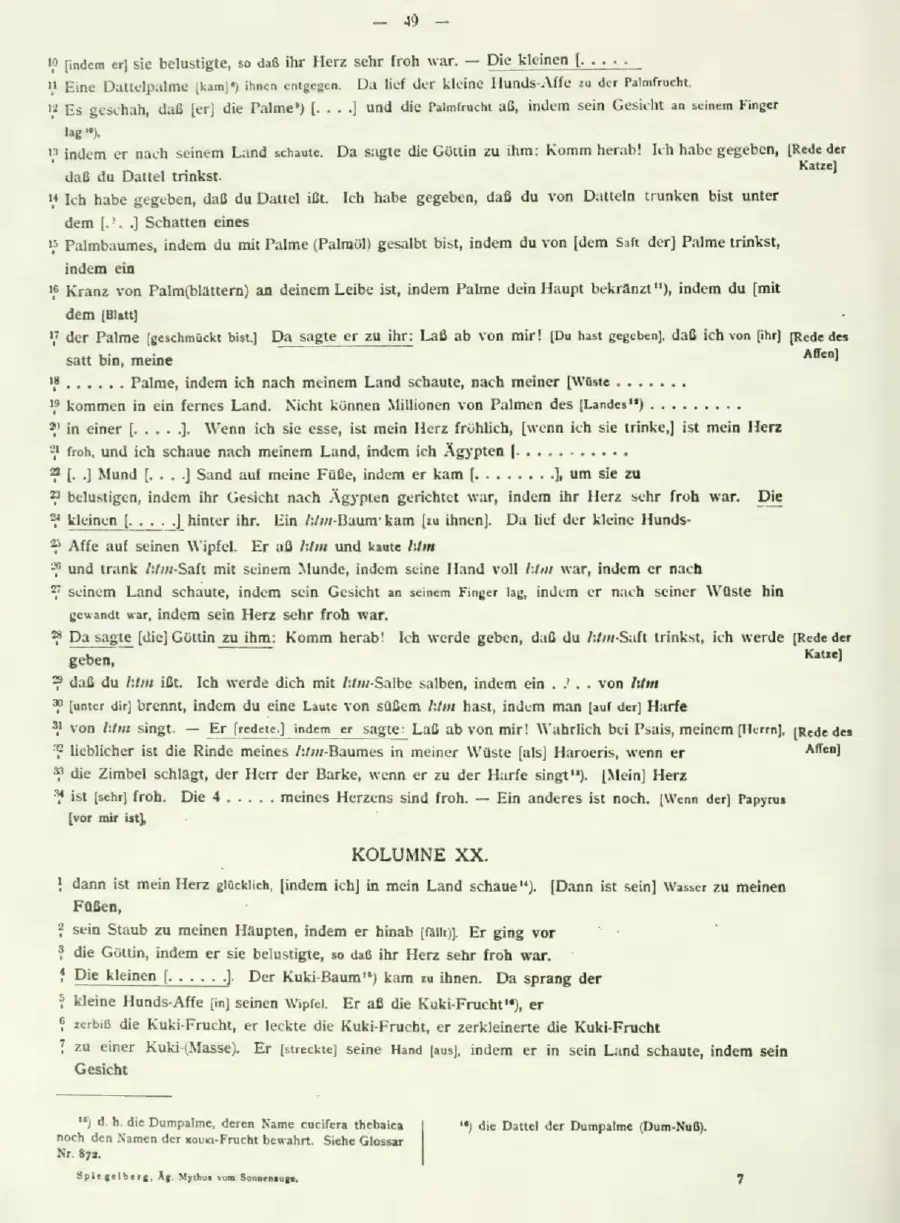
Page 49. p. 49: Columns XIX and XX: the date-palm and the khmt-tree; the ape will not leave his desert Spiegelberg 1917, pp. 13–55 (archive.org scan) - 7549, Kol. XIX 10–34
[indem er] sie belustigte, so daß ihr Herz sehr froh war. — Die kleinen [ ]. Eine Dattelpalme [kam] ihnen entgegen. Da lief der kleine Hunds-Affe zu der Palmfrucht. Es geschah, daß [er] die Palme [ ] und die Palmfrucht aß, indem sein Gesicht an seinem Finger lag, indem er nach seinem Land schaute. Da sagte die Göttin zu ihm: Komm herab! Ich habe gegeben, daß du Dattel trinkst. Ich habe gegeben, daß du Dattel ißt. Ich habe gegeben, daß du von Datteln trunken bist unter dem [ ] Schatten eines Palmbaumes, indem du mit Palme (Palmöl) gesalbt bist, indem du von [dem Saft der] Palme trinkst, indem ein Kranz von Palm(blättern) an deinem Leibe ist, indem Palme dein Haupt bekränzt, indem du [mit dem Blatt] der Palme [geschmückt bist]. Da sagte er zu ihr: Laß ab von mir! [Du hast gegeben], daß ich von [ihr] satt bin, meine Herrin! Palme, indem ich nach meinem Land schaute, nach meiner [Wüste ... ] kommen in ein fernes Land. Nicht können Millionen von Palmen des [Landes ... ] in einer [ ]. Wenn ich sie esse, ist mein Herz fröhlich, [wenn ich sie trinke,] ist mein Herz froh, und ich schaue nach meinem Land, indem ich Ägypten [ ]
[while he] amused her, so that her heart was very glad. — The little [ ]. A date-palm [came] toward them. Then the little dog-ape ran to the palm-fruit. It happened that [he] the palm [ ] and ate the palm-fruit, his face resting on his finger, looking toward his land. Then the goddess said to him: Come down! I have given that you drink date. I have given that you eat date. I have given that you are drunk with dates under the [ ] shade of a palm-tree, anointed with palm (palm-oil), drinking of [the sap of] the palm, a wreath of palm(-leaves) on your body, palm wreathing your head, [adorned with the leaf] of the palm. Then he said to her: Let me be! [You have given] that I am sated with [it], my mistress! Palm, while I looked toward my land, toward my [desert ... ] come into a far land. Millions of palms of the [land ... ] cannot [ ] in a [ ]. When I eat them my heart is glad, [when I drink them] my heart is happy, and I look toward my land, I [ ] Egypt [ ]
Note on line 75
Spiegelberg’s notes: the date-palm ‘came toward’ them, since trees are understood as living beings (compare the love-songs of the Turin papyrus, W. Max Müller, Liebespoesie 58 ff.); the scene is shown on the Ramesside ostracon (his p. 7); the ape is shown to answer the cat’s lures by declaring his home trees better than Ethiopia’s; the ‘Millions of palms’ sentence he completes as ‘millions of Ethiopian palms cannot measure up to one Egyptian palm’. - 7649, Kol. XIX 21 – XX 3
[ ] Mund [....] Sand auf meine Füße, indem er kam [ ], um sie zu belustigen, indem ihr Gesicht nach Ägypten gerichtet war, indem ihr Herz sehr froh war. Die kleinen [ ] hinter ihr. Ein Khmt-Baum kam [zu ihnen]. Da lief der kleine Hunds-Affe auf seinen Wipfel. Er aß khmt und kaute khmt und trank khmt-Saft mit seinem Munde, indem seine Hand voll khmt war, indem er nach seinem Land schaute, indem sein Gesicht an seinem Finger lag, indem er nach seiner Wüste hin gewandt war, indem sein Herz sehr froh war. Da sagte [die] Göttin zu ihm: Komm herab! Ich werde geben, daß du khmt-Saft trinkst, ich werde geben, daß du khmt ißt. Ich werde dich mit khmt-Salbe salben, indem ein ... von khmt [unter dir] brennt, indem du eine Laute von süßem khmt hast, indem man [auf der] Harfe von khmt singt. — Er [redete], indem er sagte: Laß ab von mir! Wahrlich bei Psais, meinem [Herrn], lieblicher ist die Rinde meines khmt-Baumes in meiner Wüste [als] Haroeris, wenn er die Zimbel schlägt, der Herr der Barke, wenn er zu der Harfe singt. [Mein] Herz ist [sehr] froh. Die 4 meines Herzens sind froh. — Ein anderes ist noch. [Wenn der] Papyrus [vor mir ist], dann ist mein Herz glücklich, [indem ich] in mein Land schaue. [Dann ist sein] Wasser zu meinen Füßen, sein Staub zu meinen Häupten, indem er hinab [fällt]. Er ging vor die Göttin, indem er sie belustigte, so daß ihr Herz sehr froh war.
[ ] mouth [....] sand on my feet, he having come [ ], to amuse her, her face being turned toward Egypt, her heart being very glad. The little [ ] behind her. A khmt-tree came [to them]. Then the little dog-ape ran up to its crown. He ate khmt and chewed khmt and drank khmt-juice with his mouth, his hand full of khmt, looking toward his land, his face resting on his finger, turned toward his desert, his heart very glad. Then [the] goddess said to him: Come down! I will give that you drink khmt-juice, I will give that you eat khmt. I will anoint you with khmt-ointment, a ... of khmt burning [under you], you having a lute of sweet khmt, one singing [to the] harp of khmt. — He [spoke], saying: Let me be! Truly, by Psais, my [lord], lovelier is the bark of my khmt-tree in my desert [than] Haroeris when he strikes the cymbal, the lord of the barque, when he sings to the harp. [My] heart is [very] glad. The 4 of my heart are glad. — Another thing besides. [When the] papyrus [is before me], then my heart is happy, [as I] look toward my land. [Then its] water is at my feet, its dust at my head, falling down. He went before the goddess, amusing her, so that her heart was very glad.
Note on line 76
Spiegelberg’s notes: in the following, the Demotic word for ‘palm’ is used both for the tree and for its produce (fruit, juice, leaves); ‘when I see papyrus I believe myself again in my homeland’; he wonders whether Haroeris, here shown playing cymbals and harp, is a form of Bes (compare Lanzone, pls. 76, 77, the lute-playing Bes). - 7749, Kol. XX 4–14
Die kleinen [ ]. Der Kuki-Baum kam zu ihnen. Da sprang der kleine Hunds-Affe [in] seinen Wipfel. Er aß die Kuki-Frucht, er zerbiß die Kuki-Frucht, er leckte die Kuki-Frucht, er zerkleinerte die Kuki-Frucht zu einer Kuki-(Masse). Er [streckte] seine Hand [aus], indem er in sein Land schaute, indem sein Gesicht an seinem Finger lag und er [die] Wüste mit seinem Blick verbrannte. Da sagte die Göttin zu ihm: Komm herab! Ich habe gegeben, daß du K[uki] trinkst, ich habe gegeben, daß du Kuki von der Dattelpalme ißt. Man singt dir zu einer Kuki-Harfe, indem du mit einer Laute aus Kuki-Palmholz [versehen bist]. [Ich] werde geben, daß du trunken bist von Kuki-Palme, indem ein Kranz von Kuki-Palme auf deinem Haupte ist, indem eine Binde von Kuki-Palme auf deiner Hand liegt, indem Sandalen von Kuki-Palme an deinen Füßen sind, indem ein Diadem von Kuki-Palme auf deinem Haupte ist.
The little [ ]. The kuki-tree came to them. Then the little dog-ape leapt [into] its crown. He ate the kuki-fruit, he bit the kuki-fruit, he licked the kuki-fruit, he crumbled the kuki-fruit to a kuki-(mass). He [stretched out] his hand, looking toward his land, his face resting on his finger and burning [the] desert with his gaze. Then the goddess said to him: Come down! I have given that you drink k[uki], I have given that you eat kuki of the date-palm. One sings to you to a kuki-harp, you [being furnished] with a lute of kuki palm-wood. [I] will give that you are drunk with kuki-palm, a wreath of kuki-palm on your head, a band of kuki-palm lying on your hand, sandals of kuki-palm on your feet, a diadem of kuki-palm on your head.
Note on line 77
The kuki-tree is the dom palm, whose botanical name Hyphaene thebaica keeps the name of the kuki-fruit (Spiegelberg’s note). 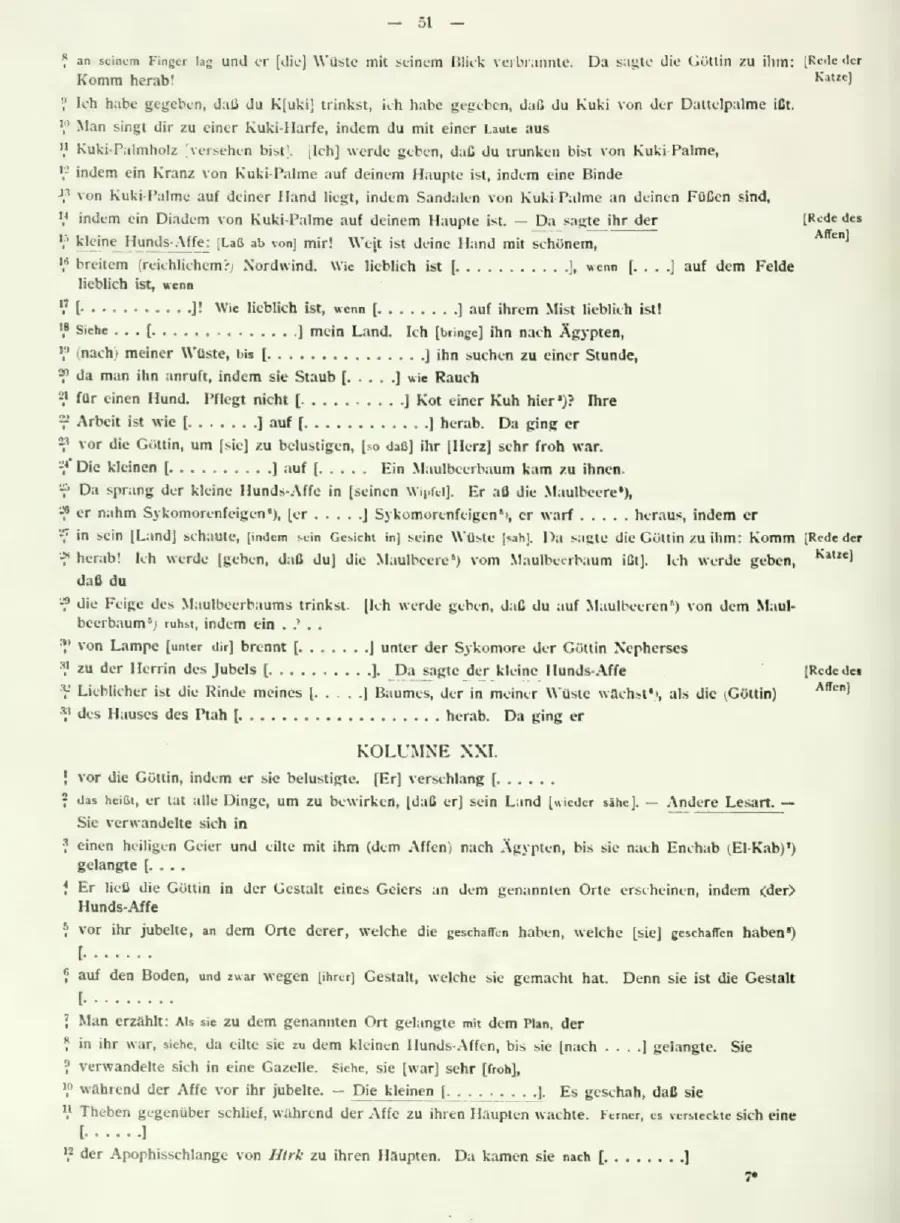
Page 51. p. 51: Columns XX and XXI 1-12: the kuki-tree and the mulberry; the goddess as a vulture and a gazelle; the Apophis-serpent at her head Spiegelberg 1917, pp. 13–55 (archive.org scan) - 7851, Kol. XX 15–34
— Da sagte ihr der kleine Hunds-Affe: [Laß ab von] mir! Weit ist deine Hand mit schönem, [...] breitem (reichlichem?) Nordwind. Wie lieblich ist [ ], wenn [....] auf dem Felde lieblich ist, wenn [ ]! Wie lieblich ist, wenn [ ] auf ihrem Mist lieblich ist! Siehe ... [ ] mein Land. Ich [bringe] ihn nach Ägypten, (nach) meiner Wüste, bis [ ] ihn suchen zu einer Stunde, da man ihn anruft, indem sie Staub [ ] wie Rauch für einen Hund. Pflegt nicht [ ] Kot einer Kuh hier? Ihre Arbeit ist wie [ ] auf [ ] herab. Da ging er vor die Göttin, um [sie] zu belustigen, [so daß] ihr [Herz] sehr froh war. Die kleinen [ ] auf [ ]. Ein Maulbeerbaum kam zu ihnen. Da sprang der kleine Hunds-Affe in [seinen Wipfel]. Er aß die Maulbeere, er nahm Sykomorenfeigen, [er ] Sykomorenfeigen, er warf heraus, indem er in sein [Land] schaute, [indem sein Gesicht in] seine Wüste [sah]. Da sagte die Göttin zu ihm: Komm herab! Ich werde [geben, daß du] die Maulbeere vom Maulbeerbaum ißt. Ich werde geben, daß du die Feige des Maulbeerbaums trinkst. [Ich werde geben, daß du auf Maulbeeren von dem Maulbeerbaum ruhst, indem ein ... von Lampe [unter dir] brennt [ ] unter der Sykomore der Göttin Nepherses zu der Herrin des Jubels [ ]. Da sagte der kleine Hunds-Affe: Lieblicher ist die Rinde meines [ ] Baumes, der in meiner Wüste wächst, als die (Göttin) des Hauses des Ptah [ ] herab. Da ging er vor die Göttin, indem er sie belustigte.
— Then the little dog-ape said to her: [Let me be] ! Wide is your hand with lovely, [...] broad (abundant?) north wind. How lovely is [ ], when [....] is lovely in the field, when [ ]! How lovely is, when [ ] is lovely on its dung! Behold ... [ ] my land. I [bring] him to Egypt, (to) my desert, until [ ] seek him at an hour when he is called upon, as they [ ] dust like smoke for a dog. Does not [ ] dung of a cow here [ ] ? Their work is like [ ] on [ ] down. Then he went before the goddess to amuse [her], [so that] her [heart] was very glad. The little [ ] on [ ]. A mulberry tree came to them. Then the little dog-ape leapt into [its crown]. He ate the mulberry, he took sycamore figs, [he ] sycamore figs, he threw out, looking toward his [land], [his face looking toward] his desert. Then the goddess said to him: Come down! I will [give that you] eat the mulberry of the mulberry tree. I will give that you drink the fig of the mulberry tree. [I will give that you rest on mulberries of the mulberry tree, a ... of lamp [burning under you] [ ] under the sycamore of the goddess Nepherses, to the mistress of rejoicing [ ]. Then the little dog-ape said: Lovelier is the bark of my [ ] tree which grows in my desert than the (goddess) of the house of Ptah [ ] down. Then he went before the goddess, amusing her.
Note on line 78
Spiegelberg: ’the ape explains here, facing the cat’s temptations, that his native (Egyptian) trees deserve preference over those of Ethiopia.' Egypt, and Apophis
- 7951, Kol. XXI 1–12
[Er] verschlang [ ], das heißt, er tat alle Dinge, um zu bewirken, [daß er] sein Land [wieder sähe]. — Andere Lesart. — Sie verwandelte sich in einen heiligen Geier und eilte mit ihm (dem Affen) nach Ägypten, bis sie nach Enchab (El-Kab) gelangte [ ... ]. Er ließ die Göttin in der Gestalt eines Geiers an dem genannten Orte erscheinen, indem <der> Hunds-Affe vor ihr jubelte, an dem Orte derer, welche die geschaffen haben, welche [sie] geschaffen haben [ ] auf den Boden, und zwar wegen [ihrer] Gestalt, welche sie gemacht hat. Denn sie ist die Gestalt [ ]. Man erzählt: Als sie zu dem genannten Ort gelangte mit dem Plan, der in ihr war, siehe, da eilte sie zu dem kleinen Hunds-Affen, bis sie [nach ... ] gelangte. Sie verwandelte sich in eine Gazelle. Siehe, sie [war] sehr [froh], während der Affe vor ihr jubelte. — Die kleinen [ ]. Es geschah, daß sie Theben gegenüber schlief, während der Affe zu ihren Häupten wachte. Ferner, es versteckte sich eine [. . . . . .] der Apophisschlange von ... zu ihren Häupten. Da kamen sie nach [ ]
[He] devoured [ ], that is, he did all things to bring it about that [he] might see his land [again]. — Other reading. — She changed herself into a holy vulture and hurried with him (the ape) to Egypt until she reached Enkhab (El-Kab) [ ... ]. He made the goddess appear in the form of a vulture at the said place, the dog-ape rejoicing before her, at the place of those who created those who created [her] [ ] on the ground, and this because of [her] form, which she made. For she is the form [ ]. It is told: When she reached the said place with the plan that was in her, behold, she hurried to the little dog-ape until she reached [ ... ]. She changed herself into a gazelle. Behold, she was very [glad], while the ape rejoiced before her. — The little [ ]. It happened that she slept opposite Thebes, while the ape watched at her head. Further, a [. . . . . .] of the Apophis-serpent of ... hid itself at her head. Then they came to [ ]
Note on line 79
Spiegelberg’s notes: the two wanderers here first set foot on Egyptian ground, because they last went through the deserts of El-Kab, which mediated traffic from the Nile valley to Punt (Sethe, Sage vom Sonnenauge 138 ff.); ’those who created’: Spiegelberg suggests ’the primeval begetters’, compare Rosetta stone 22 (’the begotten of him who begot him’); and ‘by this passage several Apophis-serpents are spoken of’ (he notes that the text speaks of the serpents in the plural). The song to Mut
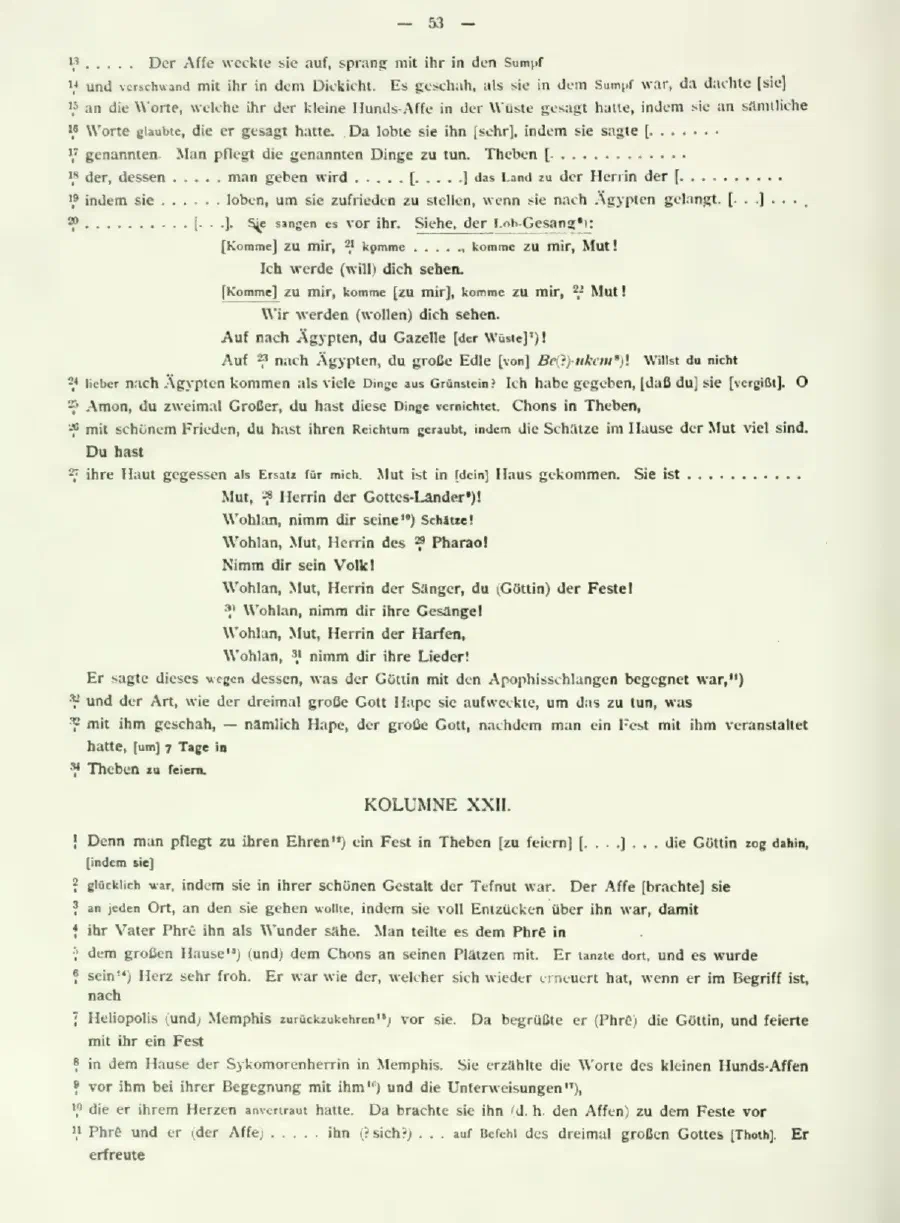
Page 53. p. 53: Columns XXI and XXII 1-11: the marsh, the song to Mut, the return to Heliopolis and Memphis Spiegelberg 1917, pp. 13–55 (archive.org scan) - 8053, Kol. XXI 13–22
Der Affe weckte sie auf, sprang mit ihr in den Sumpf und verschwand mit ihr in dem Dickicht. Es geschah, als sie in dem Sumpf war, da dachte [sie] an die Worte, welche ihr der kleine Hunds-Affe in der Wüste gesagt hatte, indem sie an sämtliche Worte glaubte, die er gesagt hatte. Da lobte sie ihn [sehr], indem sie sagte [ ]. ... Man pflegt die genannten Dinge zu tun. Theben [ ] der, dessen man geben wird [ ] das Land zu der Herrin der [. . .], indem sie loben, um sie zufrieden zu stellen, wenn sie nach Ägypten gelangt. [....] Sie sangen es vor ihr. Siehe, der Lob-Gesang:
The ape woke her up, leapt with her into the marsh and vanished with her in the thicket. It happened that when she was in the marsh, [she] thought of the words which the little dog-ape had said to her in the desert, believing all the words that he had said. Then she praised him [greatly], saying [ ]. ... One is accustomed to do the said things. Thebes [ ] he whose one will give [ ] the land to the mistress of the [. . .], praising to content her when she reaches Egypt. [....] They sang it before her. Behold, the song of praise:
- 8153, Kol. XXI 23–30
[Komme] zu mir, komme, komme zu mir, Mut! Ich werde (will) dich sehen. [Komme] zu mir, komme [zu mir], komme zu mir, Mut! Wir werden (wollen) dich sehen. Auf nach Ägypten, du Gazelle [der Wüste]! Auf nach Ägypten, du große Edle [von] Bekhukem! Willst du nicht lieber nach Ägypten kommen als viele Dinge aus Grünstein? Ich habe gegeben, [daß du] sie [vergißt]. O Amon, du zweimal Großer, du hast diese Dinge vernichtet. Chons in Theben, mit schönem Frieden, du hast ihren Reichtum geraubt, indem die Schätze im Hause der Mut viel sind. Du hast ihre Haut gegessen als Ersatz für mich. Mut ist in [dein] Haus gekommen. Sie ist Mut, Herrin der Gottes-Länder! Wohlan, nimm dir seine Schätze! Wohlan, Mut, Herrin des Pharao! Nimm dir sein Volk! Wohlan, Mut, Herrin der Sänger, du (Göttin) der Feste! Wohlan, nimm dir ihre Gesänge! Wohlan, Mut, Herrin der Harfen, wohlan, nimm dir ihre Lieder!
[Come] to me, come, come to me, Mut! I will (shall) see you. [Come] to me, come [to me], come to me, Mut! We will (shall) see you. Up to Egypt, you gazelle [of the desert]! Up to Egypt, you great noble lady [of] Bekhukem! Would you not rather come to Egypt than many things of green-stone? I have given [that you forget] them. O Amon, you twice great, you have destroyed these things. Khons in Thebes, with lovely peace, you have robbed their wealth, the treasures in the house of Mut being many. You have eaten their skin as a replacement for me. Mut has come into [your] house. She is Mut, mistress of the God's-lands! Come, take his treasures! Come, Mut, mistress of Pharaoh! Take his people! Come, Mut, mistress of the singers, you (goddess) of festivals! Come, take their songs! Come, Mut, mistress of harps, come, take their songs!
Note on line 81
Spiegelberg’s note on the ‘gazelle of the desert’: compare Junker, Auszug p. 62, where the ape greets Tefnut as ‘gazelle of the desert’; the ‘metrical hymn’ he compares with the Isis song of the Heidelberg papyrus 736 (Ä.Z. 53). The goddesses Nekhbet, Mut and above all Hathor are only other forms of Tefnut, that is, in the end of the Sun-Eye. Home
- 8253, Kol. XXI 31–35 and XXII 1–4
Er sagte dieses wegen dessen, was der Göttin mit den Apophisschlangen begegnet war, und der Art, wie der dreimal große Gott Hape sie aufweckte, um das zu tun, was mit ihm geschah, — nämlich Hape, der große Gott, nachdem man ein Fest mit ihm veranstaltet hatte, [um] 7 Tage in Theben zu feiern. Denn man pflegt zu ihren Ehren ein Fest in Theben [zu feiern] [....] ... die Göttin zog dahin, [indem sie] glücklich war, indem sie in ihrer schönen Gestalt der Tefnut war. Der Affe [brachte] sie an jeden Ort, an den sie gehen wollte, indem sie voll Entzücken über ihn war, damit ihr Vater Phre ihn als Wunder sähe.
He said this on account of what had befallen the goddess with the Apophis-serpents, and the way the thrice-great god Hapi woke her to do what happened with him — namely Hapi, the great god, after a festival had been held with him, [to] celebrate 7 days in Thebes. For one is accustomed to celebrate in her honour a festival in Thebes [ ] ... the goddess went on her way, [being] happy, being in her beautiful form of Tefnut. The ape [brought] her to every place to which she wanted to go, being full of delight over him, so that her father Phre might see him as a wonder.
Note on line 82
Spiegelberg’s notes: the Demotic literally has ‘in their (plural) name’ and he asks whether it refers to a joint festival of Tefnut and Hapi, who was identified at Thebes with the ape-god Thoth; the dead-genius Hapi has an ape’s head. - 8353, Kol. XXII 4–11
Man teilte es dem Phre in dem großen Hause (und) dem Chons an seinen Plätzen mit. Er tanzte dort, und es wurde sein Herz sehr froh. Er war wie der, welcher sich wieder erneuert hat, wenn er im Begriff ist, nach Heliopolis (und) Memphis zurückzukehren vor sie. Da begrüßte er (Phre) die Göttin, und feierte mit ihr ein Fest in dem Hause der Sykomorenherrin in Memphis. Sie erzählte die Worte des kleinen Hunds-Affen vor ihm bei ihrer Begegnung mit ihm und die Unterweisungen, die er ihrem Herzen anvertraut hatte. Da brachte sie ihn (d. h. den Affen) zu dem Feste vor Phre, und er (der Affe) ihn (?) ... auf Befehl des dreimal großen Gottes [Thoth]. Er erfreute
It was reported to Phre in the great house (and) to Khons in his places. He danced there, and his heart became very glad. He was like one who has renewed himself, when he is about to return to Heliopolis (and) Memphis before her. Then he (Phre) greeted the goddess and celebrated a festival with her in the house of the Lady of the Sycamore in Memphis. She told the words of the little dog-ape before him at her meeting with him, and the instructions which he had entrusted to her heart. Then she brought him (that is, the ape) to the festival before Phre, and he (the ape) [ ] him (?) ... at the command of the thrice-great god [Thoth]. He rejoiced
Note on line 83
Spiegelberg’s notes: ’the great house’ is the name of the temple of Heliopolis; ‘one who has renewed himself’ is the phoenix, the sacred bird of the sun-god; the ‘instructions’ are the first conversation with the ape sent by Phre. The litany of the cult-places
Page 55. p. 55: Column XXII 12-34: the questions about the shrines of Hathor, from Edfu to Cusae Spiegelberg 1917, pp. 13–55 (archive.org scan) - 8455, Kol. XXII 12–19
ihr Herz dadurch, daß sie erfuhr, daß der dreimal große Gott [Thoth sein] Vater sei. Es geschah bei dem Vortrag seines Gesanges vor Phre, da machte ihm Phre ... [ ] von Lotus. Es geschah bei dem Gesang, da befahl [er], zu [ ]. Er sah dich. Er machte Hieroglyphen, indem der Hunds-Affe [ ]. ... der Affe: Was, o Gott, tatest du gegen mich, was, o Gott, tatest du gegen mich [ ]. Hast du nicht jeden Stier [ ] ausgesondert? Hast [du] nicht ein rotes Opfertier dem älteren Horus, dem Herrn von B... [ ] geschlachtet? Hast [du] nicht ein ... Opfertier für die Nechbet, [die Herrin von El-Kab], abgestochen?
her heart, in that she learned that the thrice-great god [Thoth was his] father. It happened at the recital of his song before Phre that Phre made for him ... [ ] of lotus. It happened at the song that [he] commanded to [ ]. He saw you. He made hieroglyphs, the dog-ape [ ]. ... the ape: What, O god, did you do against me, what, O god, did you do against me [ ]. Have you not set aside every bull [ ]? Have [you] not slaughtered a red sacrificial animal for Horus the Elder, the lord of B... [ ]? Have [you] not cut the throat of a ... sacrificial animal for Nekhbet, [the mistress of El-Kab]?
Note on line 84
Spiegelberg’s notes: if his restoration is right, the ape has made himself known as the son of the god whose sacred animal (embodiment) he is, that is, of Thoth. ‘He made hieroglyphs’: he asks whether this destroyed passage means that the story of the cat and the ape is to be written down (his reconstruction, Introduction p. 9). The questions form strophes, as in Mariette, Dendera II 39 and IV 73, and the singer seems to be the ape addressing Phre. - 8555, Kol. XXII 20 ff.
Hast du nicht einen Kopf aus Gold in deine Hand genommen, [um ihn der Hathor], der Herrin von Hermonthis, [darzubringen]? Hast du nicht sehr große Wasserspenden vor der großen Mut, [der Herrin von A]schru, geopfert? Hast du nicht ein Räucherbecken aus Gold in deine Hand genommen für die (Göttin), welche in Koptos ist? Hast du nicht veranlaßt, daß Scharen von Männern und Frauen ihre Haare schütteln für die (Göttin), welche im Fernland ist? Hast du nicht einen Kranz von frischem Mhrt-Laub für Hathor-Mut, die Herrin von [Karnak], genommen? Bist du nicht die Tochter des Baumeisters, der den Turm der Hathor (= Dendera?) gebaut hat? Hast du nicht veranlaßt, daß Scharen von Männern und Frauen ihre Haare schütteln für die, welche in der Sistrum-Stadt (Diospolis parva) ist? Hast du nicht deine Wahrheiten bei der (Göttin) in dem Nahrungshaus (= Abydos?) [....]? Hast du nicht eine Zimbel genommen, um der (Göttin) in Panopolis zuzujauchzen? Hast du nicht eine Binde von rotem und grünem Stoff genommen für die (Göttin) des ..., die Herrin der Freude? Hast du nicht einen frischen Palmzweig in deine Hand genommen für Hathor, die Herrin von Cusae?
Have you not taken a head of gold in your hand, [to bring it to Hathor], the mistress of Hermonthis? Have you not offered very great water-libations before the great Mut, [the mistress of A]shru? Have you not taken a censer of gold in your hand for the (goddess) who is in Koptos? Have you not caused crowds of men and women to shake their hair for the (goddess) who is in the Far Land? Have you not taken a wreath of fresh mhrt-leaf for Hathor-Mut, the mistress of [Karnak]? Are you not the daughter of the master-builder who built the tower of Hathor (= Dendera?)? Have you not caused crowds of men and women to shake their hair for her who is in the Sistrum-city (Diospolis parva)? Have you not [set] your truths with the (goddess) in the House of Food (= Abydos?) [....]? Have you not taken a cymbal to shout for joy to the (goddess) in Panopolis? Have you not taken a band of red and green cloth for the (goddess) of the ..., the mistress of joy? Have you not taken a fresh palm-branch in your hand for Hathor, the mistress of Cusae?
Note on line 85
Spiegelberg’s notes: the goddesses named, Nekhbet, Mut and above all Hathor, are only other forms of Tefnut, that is, in the end of the Sun-Eye. The verb is literally ’to throw’; he does not think ’to throw away the hair’ (= to cut it off) admissible, so that a hair-offering to the goddess is not to be thought of (compare Lefebure, Sphinx VI; Frazer, Adonis, Attis, Osiris). The ‘wreath of fresh mhrt-leaf’ is also named in a Ptolemaic hieroglyphic inscription from the temple of Mut at Thebes. From line 24 on the cult-places of Hathor are listed geographically from south to north; in Diospolis parva, according to Brugsch, Hathor was worshipped as a cat, a form of Tefnut. Junker, in the Nachträge, restores the destroyed name in line 18 as Edfu and shows that the whole list is geographical: Edfu, El-Kab, Hermonthis, Thebes, Koptos, the Far Land (the road to the Red Sea), Kus, Dendera, Diospolis parva, Abydos, Panopolis, Assiut, Cusae. - 8655, Kol. XXIII
This line is missing from the open German text we translate from.
Paraphrase Column XXIII is preserved only as a narrow strip at the right-hand edge; almost every line begins with 'will/does ... you' and the strip continues the style of Column XXII. Spiegelberg gives no translation of it. (The Demotic text ends here.)
Taken from the published translations until we can translate the German ourselves.