~/sacred-texts/old-kingdom-tomb-inscriptions
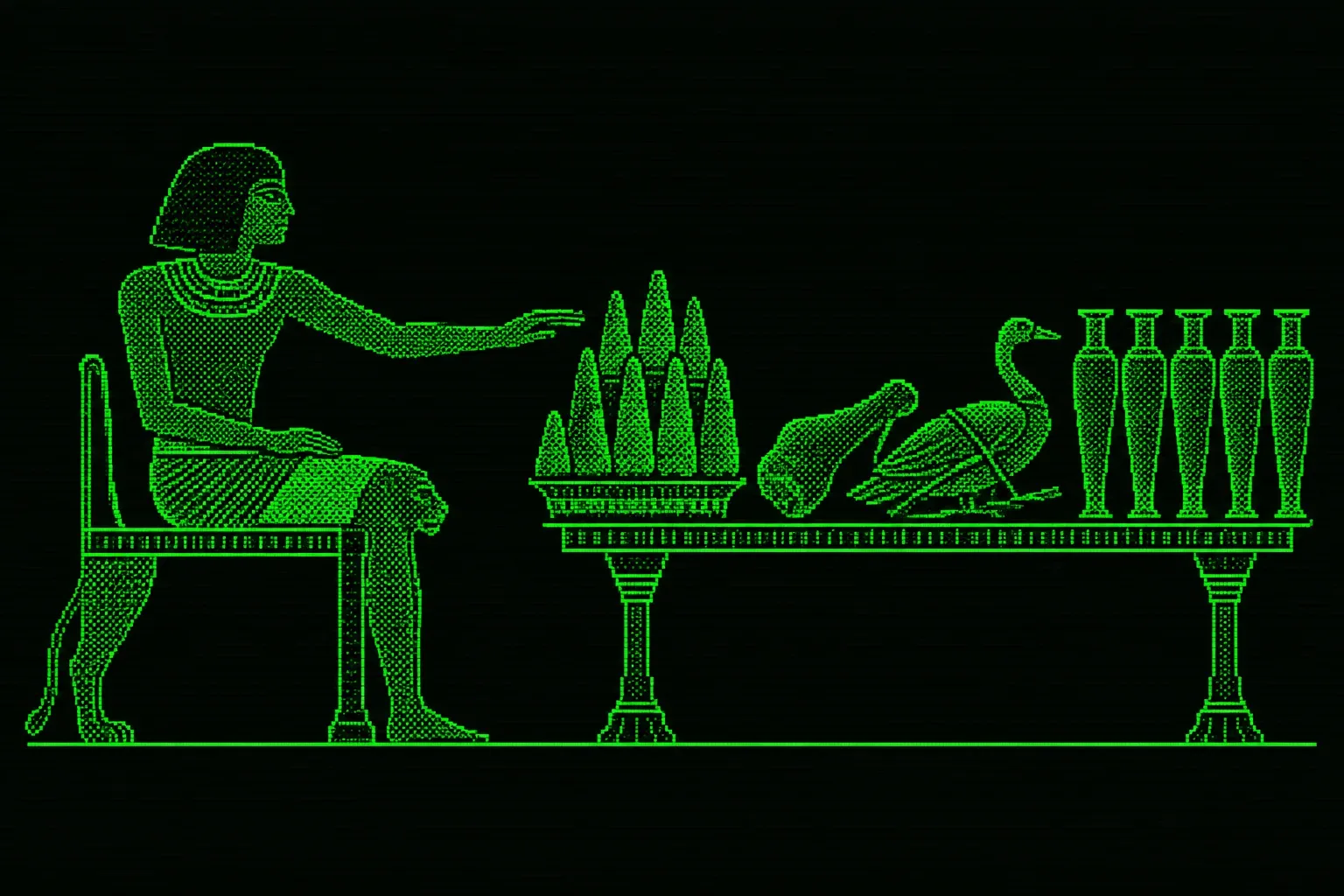
Egyptian Offering List of Meri: Ox, Geese and Five Wines
- Date
- Carved in the Old Kingdom (c. 2686–2181 BC) in the tomb of the Count and Sole Companion Meri
- Language
- Old Egyptian · Hieroglyphic
No one speaks in this text. It is a menu carved on the tomb wall, item by item and with a count for each, so that the dead man would be fed for ever. It opens with Roast-bread, 4 and Onions, 4, then lists the cuts of a slaughtered ox: Foreleg, 1, Liver, 1, Spleen, 1. Three kinds of geese follow, then a duck and a pigeon.
Next come cakes, beer and milk drinks by the bowl, figs, and named vintages from the Delta: Wine of Buto: 1, Wine of Pelusium, 1;. The last lines name the diner: The best from the offering table: for the Count and Sole Companion, Meri.
- 1
tʾ-ꜣšr 4
Roast-bread, 4
Note · Line 1
This is part of an offering list, an itemised menu carved in the tomb so that the dead owner’s spirit would be fed for ever. - 2
ḥḏw 4
Onions, 4
- 3
ḫpš 1
Foreleg, 1
Note · Line 3
The foreleg of an ox was the prime cut of Egyptian sacrifice. - 4
jwꜥ 1
Haunch, 1
Note · Line 4
A joint of meat on the bone, from the leg. - 5
zḫn 1
Sekhen cut, 1
Note · Line 5
Egyptian zḫn. It is a cut of meat from an animal’s body, but which part is unknown. - 6
swt 1
Sut cut, 1
- 7
spḥt 4
Rib cuts, 4
- 8
ꜣšrt 4
Roasts, 4
Note · Line 8
These are small pieces of grilled meat. The word shares its root with the roast-bread at the head of the list. - 9
mjzt 1
Liver, 1
- 10
nnšm 1
Spleen, 1
- 11
ḥꜥ 1
Ha cut, 1
- 12
jwf n ḥꜣt 1
Meat of the forepart, 1
Note · Line 12
The word for “forepart” also means “the best,” so this was the choice meat of the front quarters. - 13
rʾ 1
Greylag goose, 1
- 14
ṯrp 1
White-fronted goose, 1
- 15
sr 1
Ser goose, 1
Note · Line 15
Egyptian sr, another kind of goose. - 16
zt 1
Pintail duck, 1
- 17
mnt 1
Pigeon: 1
- 18
tʾ-zjf 1
Zif bread: 1
Note · Line 18
A type of bread that cannot be identified more closely (Egyptian tʾ-zjf). - 19
šꜥt 1
Shat cake: 1
Note · Line 19
A kind of cake or bread (Egyptian šꜥt). - 20
npꜣt ꜥwı͗ 2
Nepat cakes, two portions: 2
Note · Line 20
Small cakes (Egyptian npꜣt). - 21
mzt ꜥwı͗ 2
Mezut, two portions: 2
Note · Line 21
A dish made from emmer wheat (Egyptian mzwt). - 22
ḏsrt ꜥwı͗ 2
Djeseret drink, two bowls: 2
- 23
ḏsrt jꜣtt ꜥwı͗ 2
Djeseret and iatet milk, two bowls: 2
- 24
ḥqt ḫnms ꜥwı͗ 2
Khenmes beer, two bowls: 2
Note · Line 24
A particular kind of beer (Egyptian ḫnms). - 25
ḥqt sḫpt ꜥwı͗ 2
Beer and sekhepet drink, two bowls: 2
- 26
pḫꜣ ꜥwı͗ 2
Pekha drink, two bowls: 2
- 27
ḏwjw 2
Clay jugs: 2
- 28
bd ꜥwı͗ 2
Figs, two bowls: 2
- 29
jrp mḥw 1
Wine of Lower Egypt: 1
Note · Line 29
Lower Egypt is the north of the country, the Nile Delta. - 30
ꜥbš 1
Abesh jar of wine: 1
- 31
jmt 1
Wine of Buto: 1
Note · Line 31
Buto was an ancient town in the Delta. This and the next entry are named vintages, called after the places where the wine was made. - 32
ḥꜣm 1
Wine of Hamu: 1
- 33
snw 1
Wine of Pelusium, 1;
- 34
ḥbnnwt 4
Hebenenut bread, 4;
Note · Line 34
A kind of bread whose exact nature is unknown (Egyptian ḥbnnwt). - 35
ḫnfwt 4
Khenfu cakes, 4;
Note · Line 35
A kind of cake or pastry whose exact nature is unknown (Egyptian ḫnfw). - 36
jšd ꜥwı͗ 4
Ished fruit, two bowls, 4;
- 37
sẖt ḥḏt wꜣḏt 2
White barley and green barley, 2;
Note · Line 37
“Green” here means fresh or unripe grain, as against the pale, ripe kind. - 38
ꜥgwt jt zt 2
Roasted barley and emmer, 2;
Note · Line 38
Emmer is an ancient hulled wheat, one of Egypt’s staple grains. - 39
ḥnkt nbt 2
Every kind of offering, 2;
- 40
stpt
Choice cuts of meat;
- 41
ḥꜣt wdḥw
The best from the offering table:
- 42
n ḥꜣt-ꜥ smr-wꜥt mry
for the Count and Sole Companion, Meri.
Note · Line 42
“Count” and “Sole Companion (of the king)” are honorific court titles. They mark Meri as a high-ranking official, and the whole list is laid out for him.