~/sacred-texts/bundahi%C5%A1n-and-the-selections-of-z%C4%81dspram
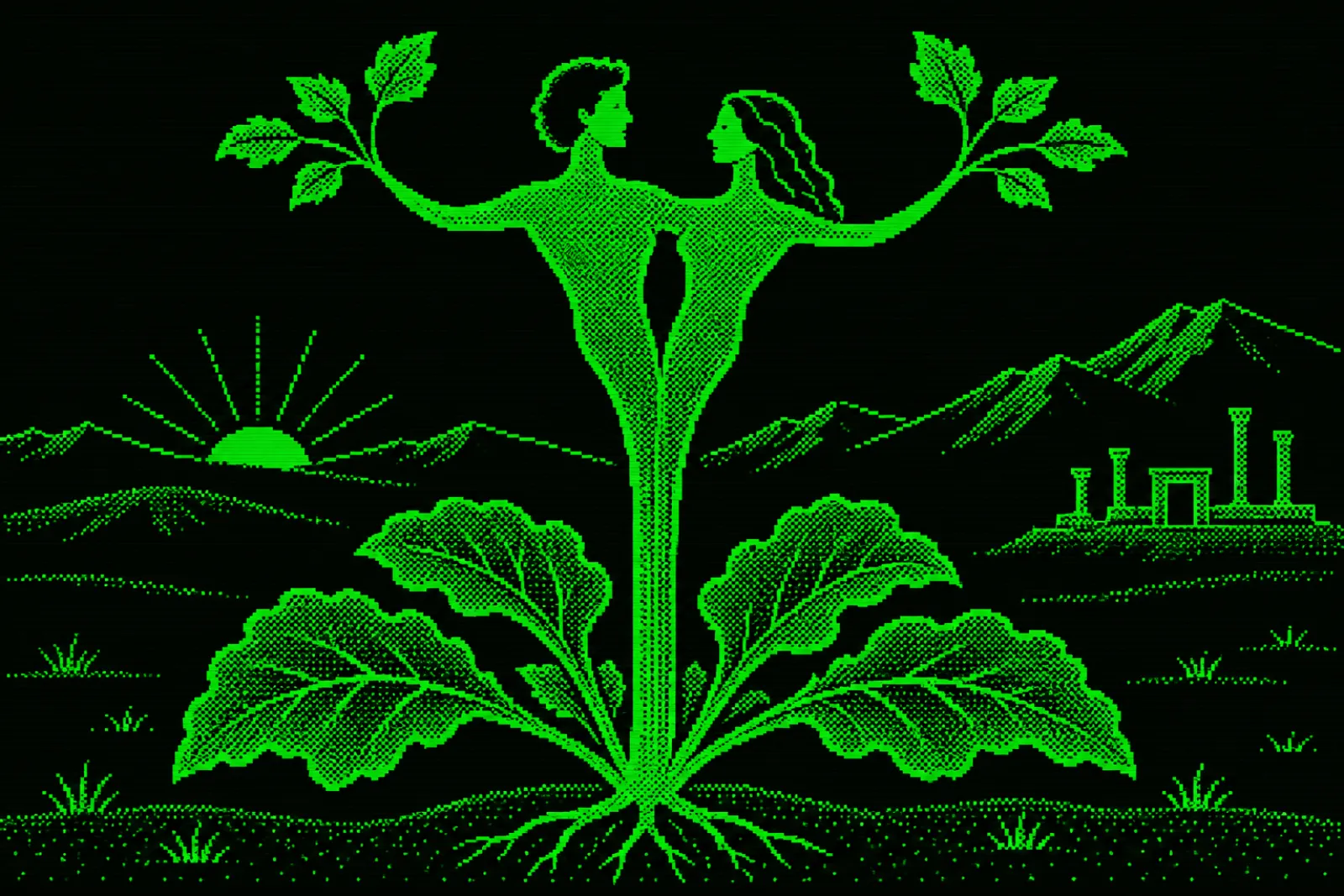
Mashya and Mashyane: The Zoroastrian First Couple
Translated by AI straight from the Middle Persian (Pahlavi), not from a modern translation, then checked against the editions and studies listed below. How we translate
- Text
- Bundahišn and the Selections of Zādspram, Indian Bundahišn 15 (Greater Bundahišn 14); Wizīdagīhā ī Zādspram 3.67–76
- Date
- Compiled in the 9th century AD from older Zoroastrian commentary (Zand); Zādspram wrote in the late 9th century
- Found
- Iran (Fārs and Kermān); copied by Zoroastrian priests in Iran and India
- Language
- Middle Persian (Pahlavi) · Book Pahlavi, given here in transcription; Zādspram also in transliteration
The Bundahišn, “Primal Creation”, is the Zoroastrian account of the world from its making to its end, compiled in Middle Persian in the 9th century AD from the commentary on lost books of the Avesta. It survives in two recensions: a shorter one copied in India, which E. W. West translated in 1880, and a longer one from Iran, the Greater Bundahišn, which B. T. Anklesaria translated in 1956. The chapter on mankind tells how the first man, Gayōmard, was killed by the Foul Spirit, Ahriman, and how the first couple, Mašī and Mašyānē, grew from his seed in the earth. Zādspram, a priest of Sirjān writing at the end of the 9th century, tells the same birth in his Selections.
The page gives the whole chapter of the Bundahišn, line by line, from the Indian recension. The Greater Bundahišn is fuller at the start, with the ten kinds of men and the metals of Gayōmard’s body, and differs in a few places that the notes give: who pours the milk to the demons, how many pairs of children there are. After it comes Zādspram’s account in full. It runs from Gayōmard’s death to the moment the plant becomes two people, and has the glory, xwarrah, where the Bundahišn has the soul.
The Pahlavi script writes several letters alike, and the notes say where a reading is in doubt. Where West or Anklesaria soften the text, the notes say so. The two places that matter most are the couple’s words to each other after fifty years (lines 45–46) and the fate of their first children (line 50).
On what these texts show about the first humans, see The Ages of Man and Serpent Sovereignty.
Each numbered line gives the Middle Persian (Pahlavi) first: the original script, then the same words in Latin letters. Our English is underneath. Tap a dotted word for its meaning, and Note for our comment on the line; our comments are in the right margin.
The Bundahišn: the first couple (Indian Bundahišn 15; Greater Bundahišn 14)
- 115.1 · GBd 14.5
pad dēn the Religion: the Zoroastrian revelation and its scripture gōwēd kū gayōmart Gayōmard, the First Man (Avestan gaiia- marətan-, 'mortal life') andar widerišnīh passing away, dying tōhm seed, semen; lineage, family bē dād, ān tōhm seed, semen; lineage, family pad rōšnīh xwaršēd the sun bē pālūdan to filter, to purify ud dō bahr nēryōsang Nēryōsang, the god who is Ohrmazd's messenger nigāh dāšt, ud bahr-ē spandarmad Spandarmad, Holy Devotion: the Amahraspand goddess of the earth padīriftan to receive, to accept
It says in the dēn: the Zoroastrian revelation that gayōmart: the First Man, as he was widerišnīh: passing away, dying, let go his tōhm: seed, semen. That seed was pālūdan: to filter, to purify by the light of the sun; nēryōsang: Ohrmazd's messenger god kept watch over two parts of it, and spandarmad: Holy Devotion, goddess of the earth received one part.
Note on line 1
Gayōmard, the first man, has been killed by Ahriman’s attack; the Greater Bundahišn (14.1–4) first lists the ten kinds of men and the metals that came out of his body. Tōhm is seed in both senses, a plant’s and a man’s: here it is his semen, and the earth goddess takes it in. Zādspram (3.71, below) has her receive his gold, not his seed. - 215.2 · GBd 14.6
pad čehel forty sāl rēbās rhubarb (MacKenzie: rēbās; Gignoux–Tafazzoli: rēwās) stōn column, pillar; here the plant's single stem pānzdah fifteen: in Zoroastrian texts the age of the ideal adult sālag, pānzdah fifteen: in Zoroastrian texts the age of the ideal adult warg leaf mihrē mihryānē az zamīg abar rustan to grow (of plants) hēnd.
In čehel: forty years, in the rēbās: rhubarb, one stōn: column, pillar; the plant's single stem, fifteen years old, fifteen warg: leaf, Mihrē and Mihryānē rustan: to grow, of plants out of the earth,
Note on line 2
Mihrē and Mihryānē are the first couple under other names: West reads them Matro and Matroyao, and the Pahlavi Pand-nāmag ī Zardušt uses the same pair; below, the chapter calls them Mašī and Mašyānē. Fifteen is the age of the ideal adult in Zoroastrian texts. Anklesaria’s Greater Bundahišn has a single stem of fifteen leaves, without the fifteen years. - 315.2 · GBd 14.6
ōwōn homānāg kū-šān dast pad dōš shoulder; the script writes g and d alike, so the edition's gōš 'ear' and dōš 'shoulder' are one spelling abāz ēstād.
in such a way that their hands rested back on their dōš: shoulder; the script writes g and d alike.
Note on line 3
The edition transcribes gōš, “ear”. Book Pahlavi writes g and d with one letter, so the same spelling also reads dōš, “shoulder”, which is what West and Anklesaria have, and what makes sense of two bodies grown with their arms around each other. - 415.2 · GBd 14.6
ud ēk ō did paywastan to join, to be joined ham-bašn of the same stature, the same height ud ham-dēsag of the same shape būd hēnd.
One was paywastan: to join, to be joined to the other; they were ham-bašn: of the same stature and ham-dēsag: of the same shape.
- 515.3 · GBd 14.7
u-šān mayān middle, between ī har dō ruwān soul abar āwurd.
And the ruwān: soul was brought up into the mayān: middle, between of the two of them.
Note on line 5
The Indian text has ruwān, the soul (West: nismo, the heterogram written for it). The Greater Bundahišn and Zādspram (3.73) have xwarrah, the glory or light, here: Anklesaria translates “light”, Gignoux–Tafazzoli keep xwarrah. Either way something comes into the space between the joined bodies, and it belongs to only one of them. - 615.3 · GBd 14.7
ōwōn ham-bašn of the same stature, the same height būd hēnd kū nē paydāg kū kadām nar male ud kadām mādag female ud kadām ān ī ruwān soul ī ohrmazd Ohrmazd, the Wise Lord (Avestan Ahura Mazdā), the creator abāg ast.
They were so alike in stature that it was not clear which was the nar: male and which the mādag: female, and which one had the soul that ohrmazd: the Wise Lord, the creator gave with it.
Note on line 6
West: “which is the one whose living soul of Auharmazd is not away”, that is, which had a soul. The question the text keeps asking is not whether they are alive but which of the two bodies the soul is in. - 715.4 · GBd 14.8
čiyōn gōwēd kū kadām pēš dād ruwān soul ayāb tan body
As it says: which was created first, the soul or the tan: body?
- 815.4 · GBd 14.8
u-š guft ohrmazd Ohrmazd, the Wise Lord (Avestan Ahura Mazdā), the creator kū ruwān soul pēš dād tan body pas, ō ān ī dād ēstēd andar tan body dād.
And Ohrmazd said: the soul was created first and the body after; what had been created was put into the body,
Note on line 8
Zādspram’s version of the same answer (3.75) says that a body was made for the glory; here the soul is put into the body (andar tan dād). - 915.4 · GBd 14.8
kū xwēškārīh one's own work, proper function, duty bē brēhēnīdan to fashion, to create; to decree ud tan body bē ō xwēškārīh one's own work, proper function, duty dād.
that is, he brēhēnīdan: to fashion, to create; to decree its xwēškārīh: one's own work, function, duty and gave the body over to that work.
- 1015.5 · GBd 14.9–10
u-š wizārišn ēn kū ruwān soul pēš dād, ud tan body pas; u-š har dō az urwar plant bē ō mardōm human being, man; mankind waštan to turn, to change hēnd, ān ruwān soul mēnōg spiritual, of the unseen world (opposite of gētīg, the material) andar awēšān šud, ī ast ī ruwān soul
Its explanation is this: the soul was created first and the body after. And the two of them waštan: to turn, to change from urwar: plant form into mardōm: human being form, and that soul went into them mēnōg: spiritual, of the unseen world, which is to say, the soul.
Note on line 10
The last clause glosses the word: West’s text has nismo (the Aramaic heterogram for the breath-soul) for the first “soul”, explained here as ruwān. Zādspram 3.76 has the same change from plant to human, with the glory going into them. - 1215.5 · GBd 14.10
nūn-iz pad ān hangōšīdag draxt tree ul rustan to grow (of plants) ēstēd kē-š bar dah ēwēnag manner, kind, form mardōm human being, man; mankind
Even now a draxt: tree of that likeness has grown up, whose fruit is the ten kinds of men.
Note on line 12
West takes this as another tree, the one that bears the ten kinds of monstrous men listed at the end of the chapter (line 66). Anklesaria reads it of the couple themselves: they had grown “in the semblance of a tree, whose fruit was the ten races of mankind”. The Pahlavi has a tree in their likeness, still growing, fruiting in people. - 13a15.6 · GBd 14.11
guft-iš ohrmazd Ohrmazd, the Wise Lord (Avestan Ahura Mazdā), the creator ō mašī Mašī (Mašya), the first man: Avestan mašiia- 'mortal' mašyānē Mašyānē, the first woman kū mardōm human being, man; mankind hēd, pidar father ī gēhān the world hēd; u-m bowandag-menišnīh perfect devotion, 'complete thinking': the Pahlavi for Avestan Ārmaiti, Spandarmad pāhlom dād hēd; kār dādestān bowandag-menišnīh perfect devotion, 'complete thinking': the Pahlavi for Avestan Ārmaiti, Spandarmad kunēd: humat menēd, hūxt gōwēd, huwaršt warzēd, ud dēw demon, daēva ma yaštan to worship, to sacrifice to
Ohrmazd said to mašī: the first man; Avestan 'mortal' and mašyānē: the first woman: “You are human; you are the pidar: father of the gēhān: the world. I created you the best, in bowandag-menišnīh: Pahlavi for Ārmaiti, Spandarmad. Do the work of the law in perfect devotion: think good thoughts, speak good words, do good deeds, and do not yaštan: to worship, to sacrifice to the dēw: demon.”
Note on line 13a
God’s first words name what they are, and then give a command and a prohibition, as in Genesis 2:16–17, where God tells the man what he may eat and the one tree he may not. Here the forbidden thing is worship of the dēws. Mašī is the Avestan mašiia-, “mortal”: the first man is named Mortal. - 13b15.7 · GBd 14.12
awēšān har dō fradom ēn menīdan to think kū-šān ēk ō did rāy menīdan to think kū-š mardōm human being, man; mankind ast.
The first thing the two of them menīdan: to think was this: each thought of the other, “that is a human.”
Note on line 13b
Literally, “each thought about the other that he is a human”. West: “that one of them should please the other, as he is a man for him”. Anklesaria: “He or she is the seed of man.” We keep the bare sense. The first thought in the world is the recognition of another person. - 1415.7 · GBd 14.13
u-šān nazdist kunišn ēn kard kū bē raft hēnd, u-šān bē mēzīdan to urinate (MacKenzie: mēz-); the same spelling can be read mizīdan, to suck hēnd.
The first act they did was this: they went off and mēzīdan: to urinate.
Note on line 14
MacKenzie gives mēz- as “urinate”, which fits a first act on going out. West has “washed themselves thoroughly”, admitting in his note that the verb may mean “made water”. Anklesaria has “made water”. - 1515.7 · GBd 14.14
u-šān fradom gōwišn speech, saying ēn guft kū ohrmazd Ohrmazd, the Wise Lord (Avestan Ahura Mazdā), the creator dād āb ud zamīg ud urwar plant ud gōspand beneficent animal: sheep, goat or cattle ud star ud māh ud xwaršēd the sun ud harwisp ābādīh, kē az ahlāyīh righteousness, truth (Avestan aša) padyāgīh gōwēd bun ud bar.
The first gōwišn: speech, saying they spoke were these: “Ohrmazd created the water and the earth, the plants and the animals, the stars, the moon and the sun, and all prosperity, whose root and fruit, it says, come from the showing of righteousness.”
Note on line 15
Their first speech is true, and it is about who made the world. - 1615.8 · GBd 14.15
u-šān pas petyārag the Adversary, Ahriman; adversity pad menišn abar dwāristan to run, to rush: the verb used of demons only u-šān menišn bē āhōgēnīdan to corrupt, to defile u-šān drāyīdan to speak, to jabber: the verb used of demons only hēnd kū gannāg foul, stinking: gannāg mēnōg, the Foul Spirit, is Ahriman mēnōg spiritual, of the unseen world (opposite of gētīg, the material) dād āb ud zamīg ud urwar plant ud gōspand beneficent animal: sheep, goat or cattle abārīg čiš.
Then the petyārag: the Adversary, Ahriman dwāristan: to run, to rush; used of demons only upon their minds and āhōgēnīdan: to corrupt, to defile their minds, and they drāyīdan: to speak, to jabber; used of demons only: “The gannāg: foul, stinking Spirit created the water and the earth, the plants and the animals and the other things.”
Note on line 16
Pahlavi has two vocabularies, one for good beings and one for demons, and both verbs here are demonic: the Adversary does not “go”, he dwārēd, and once he is in them the couple do not “speak”, they drāyēnd. Their speech has gone over to the other side in mid-sentence. The Foul Spirit, Ahriman, broke into the world at the start “like a snake”, leaping from the sky down under the earth (Greater Bundahišn 4.10; in the Indian text, 3.20, mār homānāg, with mār restored by the editors). - 1715.9 · GBd 14.16
čiyōn guft ān drō-gōwišnīh lie-speaking, a lie pad abāyist ī dēw demon, daēva guft; gannāg foul, stinking: gannāg mēnōg, the Foul Spirit, is Ahriman mēnōg spiritual, of the unseen world (opposite of gētīg, the material) nazdist urwāhmanīh joy, gladness az awēšān az ēn xwēšēnīdan to make one's own, to appropriate
As it says, that drō-gōwišnīh: lie-speaking, a lie was spoken at the demons' wish; and from this the Foul Spirit took for his own their first urwāhmanīh: joy, gladness.
Note on line 17
West: “through the will of the demons”; Anklesaria: “by the compulsion of the devs”. In Genesis it is the serpent who tells the first lie, “Ye shall not surely die” (3:4), and the couple believe it. Here the demons want it said and the couple say it themselves. - 1815.9 · GBd 14.16
pad ān drō-gōwišnīh lie-speaking, a lie har dō druwand follower of the Lie (druj), wicked, damned būd hēnd.
Through that lie the two of them became druwand: follower of the Lie, wicked, damned.
- 1915.9 · GBd 14.16
u-šān ruwān soul tā tan body ī pasēn pad dušox hell
And their souls are in dušox: hell until the tan ī pasēn: the resurrection at the end of time.
Note on line 19
The first humans are damned. The text says it in passing and moves on: their souls will be in hell until the resurrection. - 2015.10 · GBd 14.17–18
u-šān sīh rōz xwarišn food, eating šud būd, wistarag garment, clothing giyāh grass, herb nihuftan to cover, to clothe; to hide pas az sīh rōz pad wiškar wilderness, hunting-ground frāz raft hēnd, ō buz goat spēd mōy mad hēnd.
For thirty days their xwarišn: food, eating had gone, nihuftan: to cover, to clothe; to hide in wistarag: garment, clothing of giyāh: grass, herb. After thirty days they went out into the wiškar: wilderness, hunting-ground and came to a white-haired buz: goat.
Note on line 20
Literally “food had gone”; West emends to a-xwarišn, “without food”, Anklesaria has “in search of food”. Either way they went thirty days without eating. Their first clothes are plants, and then (line 33) skins. Genesis is strikingly close: fig leaves first (3:7), then the “coats of skins” God makes for them (3:21). The Pahlavi gives no reason for the covering and does not mention shame. - 2115.10 · GBd 14.18
u-šān pad dahān pēm milk az pestān breast, udder dōxtan to milk
With their mouths they dōxtan: to milk the pēm: milk from its pestān: breast, udder.
Note on line 21
They suck straight from the goat. Their first food is an animal’s milk, before any killing. - 2215.11 · GBd 14.19
ka-šān pēm milk xward būd hēnd, mašī Mašī (Mašya), the first man: Avestan mašiia- 'mortal' ō mašyānē Mašyānē, the first woman guft kū, šādīh joy, gladness ī man az ān kū-m nē xward būd ān ī šīr milk u-m šādīh joy, gladness šādtar nūn ast ka-m xward, ā-m pad tan body sagrīh satiety, fullness
When they had drunk the milk, Mašī said to Mašyānē: “I had šādīh: joy, gladness from not having drunk that milk, and my joy is greater now that I have drunk it: my body is sagrīh: satiety, fullness.”
Note on line 22
MacKenzie has sagr, “sated”, and sagrīh, “satiety”. West’s “devoured by my vile body” rests on a different reading. The lie is in praising the food: eating has made him happier than he was before. Anklesaria: “there is satiety to my body.” - 2315.12 · GBd 14.20
ān dudīgar drō-gōwišnīh lie-speaking, a lie dēw demon, daēva ōz abar mad; u-šān mizag taste ī xwarišn food, eating bē appurdan to steal, to rob ōwōn kū az sad bahr ēk bahr bē mānd.
Through that second lie strength came upon the demons, and they appurdan: to steal, to rob the mizag: taste of food from them, so that of a hundred parts one part was left.
Note on line 23
Food has kept a hundredth of its taste ever since. The punishment for praising the food is the food itself. - 2415.13 · GBd 14.21
pas pad sīh rōz-šabān dudīgar ō gōspand beneficent animal: sheep, goat or cattle mad hēnd dabr, ērwārag jaw, cheek u-šān bē kuštan to kill
Then, after another thirty days and nights, they came to a gōspand: beneficent animal: sheep, goat or cattle, dark, with a white ērwārag: jaw, cheek, and they kuštan: to kill it.
Note on line 24
MacKenzie glosses dabr as “dark-coloured”. The first meat is a killing they do themselves. - 2515.13 · GBd 14.21
u-šān az dār ī kunār the jujube or lote tree ud šamšār pad nimūdārīh yazad god, deity worthy of worship mēnōgān ātaxš fire abgand.
And from the wood of the kunār: the jujube or lote tree and the box tree they struck ātaxš: fire, as the spirit gods showed them.
- 2615.13 · GBd 14.21
čē awēšān, har dō dar ātaxš fire dādārtar hēnd.
For those two woods give fire more than any.
- 2715.13 · GBd 14.21
u-šān pad dahān ātaxš fire abrōxtan to kindle, to make blaze
And they abrōxtan: to kindle, to make blaze with their mouths.
- 2815.13 · GBd 14.21
u-šān nazdist ēzm kuhunz, kundur frankincense kunār the jujube or lote tree pēš ī xormā, mōrd myrtle sōzēnīd.
The first firewood they burned was kuhunz, kundur: frankincense, jujube, date-palm fibre and mōrd: myrtle.
Note on line 28
Kuhunz is unidentified: West has “dry grass”, Anklesaria “pronged oxyacanth”. Pēš ī xormā is part of the date palm, its fibre or fronds. - 2915.13 · GBd 14.21
u-šān ān gōspand beneficent animal: sheep, goat or cattle gardānāg roast; roasting spit (MacKenzie *wardānāg, N gardāna) kard.
And they made a gardānāg: roast on the spit; MacKenzie's *wardānāg 'roasting spit' of that sheep.
- 3015.14 · GBd 14.21
u-šān sē must fist; must-masāy, fist-sized gōšt andar ātaxš fire hišt, guft kū ēn bahr ī ātaxš fire
They dropped three must: fist; -masāy '-sized' pieces of the meat into the fire and said, “This is the fire's share.”
Note on line 30
This is the first sacrifice. In Genesis it comes one generation later, when Abel brings “the firstlings of his flock and of the fat thereof” (4:4); here the first couple make it themselves. - 3115.14 · GBd 14.21
az ān ī did, pārag-ē ō asmān rawēnīd, guft kū ēn bahr ī yazad god, deity worthy of worship
Of the rest, they sent a piece up to the sky and said, “This is the yazad: god, deity worthy of worship share.”
- 3215.14 · GBd 14.22
az pēš murw ī kargās vulture abar raft az awēšān bē burd, čiyōn fradom gōšt ē sag dog xward.
A bird, a kargās: vulture, came over before them and carried it off, as a sag: dog ate the first meat.
Note on line 32
The last clause gives the origin of a share: the gods’ portion goes to the vulture and the first meat to the dog, the two animals to which Zoroastrians give their dead. - 3315.15 · GBd 14.23
u-šān az ān nazdist wistarag garment, clothing pōstēn of skin, of hide nihuftan to cover, to clothe; to hide
From it they first covered themselves in clothing of pōstēn: of skin, of hide.
Note on line 33
The second covering: skins after grass, as in Genesis the coats of skins come after the fig leaves (3:21). Az ān, “from that”, is the sheep just killed. In Genesis God makes the skins. - 3415.15 · GBd 14.23
pas pad wiškar wilderness, hunting-ground a-šān sarmag bē tadan to spin, to weave ān ī tadan to spin, to weave jāmag garment bē kard.
Then in the wilderness they tadan: to spin, to weave sarmag cloth and made woven jāmag: garment.
Note on line 34
Sarmag is the editors’ restoration: a woven cloth, which Anklesaria makes cotton. - 3515.16 · GBd 14.24
u-šān pad zamīg gār-ē bē kand.
They dug a pit in the earth.
- 3615.16 · GBd 14.24
u-šān āhen iron bē widāxtan to melt, to smelt
They widāxtan: to melt, to smelt āhen: iron.
Note on line 36
In Genesis iron comes seven generations from Adam, with Tubal-cain, “an instructer of every artificer in brass and iron” (4:22). - 3715.16 · GBd 14.24
u-šān pad sang bē zad u-šān tēx blade, edge aziš bē kard.
They beat it with a stone and made a tēx: blade, edge from it.
Note on line 37
The edition brackets the words tābag-ē bē, which West read as “without a forge”, as a scribe’s addition. - 3815.16 · GBd 14.24
u-šān dār padiš brīd ān ī dārēn padišxwār dish, bowl (MacKenzie) ārāst.
With it they cut wood and made a wooden padišxwār: dish, bowl.
Note on line 38
MacKenzie: padišxwār, “dish, bowl”. West read pēš-xwar as “a wooden shelter from the sun”; Anklesaria has “wooden utensils”. - 3915.17 · GBd 14.25
az ān anespāsīh ingratitude ī-šān kard, dēw demon, daēva stambag violent, oppressive būd hēnd.
Because of the anespāsīh: ingratitude they showed, the demons grew more stambag: violent, oppressive.
- 4015.17 · GBd 14.26
u-šān xwad pad xwad ān ī abārōn wrong, evil arešk envy, jealousy abar burd, ēk pad did frāz raft hēnd, zad ud darrīd hēnd; wars hair rūd.
They turned abārōn: wrong, evil arešk: envy, jealousy on each other; they went at one another, struck and tore, wars: hair and face.
Note on line 40
The first violence is between the first man and woman. In Genesis it is between their sons (4:8). - 4115.18 · GBd 14.27
pas dēw demon, daēva az tom darkness wāng kard kū mardōm human being, man; mankind hēd, dēw demon, daēva yaštan to worship, to sacrifice to tā-tān arešk envy, jealousy dēw demon, daēva nišīnēd.
Then the demons cried out of the tom: darkness: “You are human. Worship the demon, so that your demon of envy will settle down.”
Note on line 41
The demons repeat God’s first words, “You are human” (line 13a), and then reverse his command. - 4215.19 · GBd 14.28
mašī Mašī (Mašya), the first man: Avestan mašiia- 'mortal' frāz raft ud šīr milk ī gāw dōšīd, ō abāxtar the north: the quarter of the demons and of hell rōn abar rēxtan to pour pad ān dēw demon, daēva ōzōmandtar būd hēnd.
Mašī went and milked a cow, and rēxtan: to pour the milk out toward the abāxtar: the north, quarter of the demons; by that the demons grew stronger.
Note on line 42
This is the first offering to the demons. The north is their quarter, and hell lies there. In Anklesaria’s Greater Bundahišn it is Mašyānē who springs up, milks the cow and pours. - 4315.19 · GBd 14.29
u-šān awēšān har dō ēdōn hušk-kūn impotent (MacKenzie); literally 'dry-arsed', from hušk 'dry' and kūn 'buttocks, anus' būd hēnd, kū-šān pad panjāh zamestān kāmag desire, wish pad ham-gumēzišnīh intercourse; literally 'mixing together' nē būd, ka-šān ham-gumēzišnīh intercourse; literally 'mixing together' kard, ēgišān frazand child, offspring zāyišnīh nē būd; ud pad bowandagīh ī panjāh sāl pus-xwāhišnīh desire for a son, for offspring frāz mad.
And the two of them became so hušk-kūn: impotent; literally 'dry-arsed' that for fifty winters they had no kāmag: desire, wish for ham-gumēzišnīh: intercourse, 'mixing together', and when they did have intercourse, no frazand: child, offspring was born of it; and at the end of fifty years the pus-xwāhišnīh: desire for a son, for offspring came.
Note on line 43
Hušk-kūn is “dry” plus kūn, “buttocks, anus”; MacKenzie’s dictionary gives the compound as “impotent”. West and Anklesaria both write “dry-backed”, which is the softening: the Pahlavi names the rump. West (“owing to them”) and Anklesaria make the demons the cause; the Pahlavi has only u-šān, “and they”. It follows straight on the milk offering to the demons. - 4415.20 · GBd 14.29
nazdist mašī Mašī (Mašya), the first man: Avestan mašiia- 'mortal' ud pas mašyānē Mašyānē, the first woman
First in Mašī and then in Mašyānē.
- 4515.20 · GBd 14.29
čē guft mašī Mašī (Mašya), the first man: Avestan mašiia- 'mortal' ō mašyānē Mašyānē, the first woman kū ka ēn tō karm by the context, the sexual organ, of the man and of the woman alike; MacKenzie gives karm only as action (see the note) wēnēm ān ī man meh ul āxēzīdan to rise, to rise up
For Mašī said to Mašyānē: “When I see this karm: by the context, the sexual organ of yours, mine āxēzīdan: to rise up up big.”
Note on line 45
West: “When I see thy shame my desires arise”, which turns the organ into “shame” and the erection into “desires”. Anklesaria: “When I see thy stomach, my organ of generation is much excited.” The Pahlavi uses one word, karm, for her part and for his. MacKenzie’s dictionary has no such sense for karm (only “action”); that it names the sexual organ is inferred from the context, as West and Anklesaria infer it, and the line leaves no doubt that his rises up big. The open edition gives only the transcription. If the scribe wrote the same letters as the dictionary’s kirm, “worm, serpent”, the organ is named as a snake; we cannot check the manuscript spelling here. - 4615.20 · GBd 14.29
pas mašyānē Mašyānē, the first woman guft kū brād brother mašī Mašī (Mašya), the first man: Avestan mašiia- 'mortal' ka ān ī tō karm by the context, the sexual organ, of the man and of the woman alike; MacKenzie gives karm only as action (see the note) meh wēnēm, ān ī man karm by the context, the sexual organ, of the man and of the woman alike; MacKenzie gives karm only as action (see the note) drafšīdan to shine; to tremble, to quiver
Then Mašyānē said: “brād: brother Mašī, when I see that karm of yours big, my karm drafšīdan: to shine; to tremble.”
Note on line 46
West: “when I see thy great desire I am also agitated”, and in his note he calls his own English “merely a paraphrase of the original”. Anklesaria: “when I see thy organ of generation excited my stomach trembles.” She calls him brother: they grew from one seed. - 4715.21 · GBd 14.30
pas awēšān kāmag desire, wish ō ham mad.
Then their desire came together.
- 4815.21 · GBd 14.30
ka-šān kāmag desire, wish wizārišnīh kard, ēdōn abar menīdan to think kū amā ān-iz panjāh sāl kār ēn abāyist būdan.
When they had satisfied their desire, they thought: “This is what we should have been doing all those fifty years.”
Note on line 48
Their first thought after sex is regret for the fifty lost years. Genesis 4:1: “And Adam knew Eve his wife; and she conceived.” - 4915.22 · GBd 14.31
az awēšān zād pad nō māh juxt pair, couple mard ud zan.
From them, in nine months, a juxt: pair, couple was born, a male and a female.
- 5015.22 · GBd 14.31
az šīrēnīh sweetness ī frazand child, offspring ēk mād ud ēk pid bē jūdan to chew, to devour: the verb used of demons eating
Because the children were so šīrēnīh: sweetness, the mother jūdan: to chew, to devour; used of demons one and the father the other.
Note on line 50
Šīrēnīh is sweetness, taste as well as love. West makes it “tenderness for offspring” but gives “the deliciousness of children” in his note. The verb, jūdan, is the demons’ word for eating (MacKenzie: “chew; devour (daevic)”): the parents eat their children the way demons eat. Another Pahlavi text, quoted by West, says Mašī and Mašyānē “at first ate up their own offspring”. Justi made it “the mother deserted one”. - 5115.23 · GBd 14.31
ud pas ohrmazd Ohrmazd, the Wise Lord (Avestan Ahura Mazdā), the creator šīrēnīh sweetness ī frazand child, offspring az awēšān abāz stad, tā frazand child, offspring parwardan to rear, to nourish ud frazand child, offspring bē mānēd.
Then Ohrmazd took the sweetness of children away from them, so that people would parwardan: to rear, to nourish their children and the children would live.
Note on line 51
Anklesaria’s Greater Bundahišn adds that Ohrmazd left them as much sweetness as is needed to raise children. Parents still find their children sweet, and that is why they can raise them without eating them. - 5215.24 · GBd 14.32
u-šān haft juxt pair, couple aziš būd hēnd nar male ud mādag female
Seven pairs came from them, male and female.
Note on line 52
Anklesaria’s Greater Bundahišn has six pairs. - 5315.24 · GBd 14.32
hamāg brād brother ud xwah sister nar male ud zan būd hēnd.
Every pair were brād: brother and xwah: sister, husband and wife.
Note on line 53
The first marriages are between brother and sister. Zoroastrian law praised next-of-kin marriage (xwēdōdah) as a pious act. - 5415.24 · GBd 14.33
u-šān har ē pad panjāh sāl frazand child, offspring azist zād hēnd, ud xwad pad sad sālag bē murd hēnd.
Each of them had children at fifty, and they themselves died at a hundred years old.
- 5515.25 · GBd 14.34
az ān haft juxt pair, couple ek siyāmak nām ī mard ud zan wašāg.
Of those seven pairs, one was a man named Siyāmak and a woman Wašāg.
- 5615.25 · GBd 14.34
u-šān juxt pair, couple aziš zād, kē mard frawāg ud zan frawagēn nām būd hēnd.
A pair was born of them, the man named Frawāg and the woman Frawagēn.
- 5715.26 · GBd 14.35
az awēšān panzdah juxt pair, couple zād hēnd kē har juxt pair, couple sardag kind, race, species būd hēnd.
From them fifteen pairs were born, and each pair became a sardag: kind, race, species.
- 5815.26 · GBd 14.35
u-šān purr-rawišnīh paywand ī gēhān the world aziš būd.
And from them came the full course of the generations of the world.
- 5915.27 · GBd 14.36
az har pānzdah fifteen: in Zoroastrian texts the age of the ideal adult sardag kind, race, species īšān nō sardag kind, race, species pad pušt ī gāw ī srisōg, pad ān ī frāxwkard zrēh, ō ān šaš kišwar clime: one of the seven regions of the earth dudīgar widārd, ud ānōh būd hēnd.
Of those fifteen races, nine crossed on the back of the ox Srisōg, over the sea Frāxwkard, to the six other kišwar: one of the seven regions of the earth, and lived there.
- 6015.27 · GBd 14.36
ud šaš sardag kind, race, species mardōm human being, man; mankind pad xwanirah Xwanirah, the central clime, where Iran lies mānd hēnd.
And six races of men stayed in xwanirah: the central clime, where Iran lies.
- 6115.28 · GBd 14.36
az ān šaš sardag kind, race, species juxt pair, couple mard tāz ud zan tāzag nām būd hēnd, ud pad dast ī tāzīgān šud hēnd.
Of those six races, one pair were named Tāz, the man, and Tāzag, the woman, and they went to the plain of the Arabs.
- 6215.28 · GBd 14.36
ud juxt pair, couple hōšang mard ud zan gūzag nām, u-šān ērānagān az awēšān būd hēnd.
One pair were Hōšang, the man, and Gūzag, the woman, and from them came the Iranians.
- 6315.28–29 · GBd 14.36–37
ud juxt pair, couple māzandarān aziš būd hēnd, pad āmār, ān ī pad ērān dēhān.
From one pair came the people of Māzandarān. In the count are those in the lands of Iran,
- 6415.29 · GBd 14.37
ān ī pad anēr deh: ān ī pad tūr dēhān, ān ī pad salm deh, ast ī hrōm.
those in the non-Iranian lands, those in the lands of Tūr, those in the land of Salm, which is Rome,
- 6515.29–30 · GBd 14.37
ān ī pad sind deh, ān ī pad čīnestān, ān ī pad gāy deh, ān-iz pad šaš kišwar clime: one of the seven regions of the earth hamāg az paywand frawāg ud siyāmak ud mašī Mašī (Mašya), the first man: Avestan mašiia- 'mortal' hēnd.
those in the land of Sind, those in China, those in the land of the Dahae, and those in the six climes: all are of the line of Frawāg and Siyāmak and Mašī.
- 6615.31 · GBd 14.38
čiyōn dah sardag kind, race, species mardōm human being, man; mankind az bun guft pānzdah fifteen: in Zoroastrian texts the age of the ideal adult sardag kind, race, species az frawāg būd, ud wīst ud panj sardag kind, race, species hamāg az tōhm seed, semen; lineage, family ī gayōmart Gayōmard, the First Man (Avestan gaiia- marətan-, 'mortal life') būd hēnd, čiyōn zamīgīg, ābīg, war-gōš, war-čašm ud ēk-pāy ān-iz kē parr dārēnd čiyōn šawāg ud xwēšagīg dumbōmand kē mōy pad tan body dārēnd.
As the ten kinds of men were spoken of at the beginning, and fifteen races came from Frawāg, twenty-five races in all came from the tōhm: seed, semen; lineage of Gayōmard: those of the land, those of the water, the breast-eared, the breast-eyed and the one-footed, and those who have wings like a bat, and those of the forest, with tails, who have hair on their bodies.
Note on line 66
The ten kinds include the monstrous races and, in the Greater Bundahišn (14.1), the ape, “the lowest of mankind”. The Selections of Zādspram: the death of Gayōmard and the rhubarb (WZ 3.67–76)
- z67WZ 3.67
cygwn ššwm OL g՚ywkmlt mt , ZK hm g՚ywkmlt ptylk BRA wyn՚lt .
čiyōn šašom ō gayōmart Gayōmard, the First Man (Avestan gaiia- marətan-, 'mortal life') mad, ān ham gayōmart Gayōmard, the First Man (Avestan gaiia- marətan-, 'mortal life') padīrag bē winnārd.
When [Ahriman] came sixth to Gayōmard, [Ohrmazd] set Gayōmard himself to face him.
Note on line z67
Zādspram’s third chapter tells Ahriman’s assault on the seven creations in turn: sky, water, earth, plants, animals, man and fire. The man is the sixth. The Pahlavi names neither actor; the brackets supply them, as Gignoux–Tafazzoli do. - z68WZ 3.68
cygwn ngwhšyt g՚ywkmlt ՚pyck m՚nslspnd Y ՚whrmzd ՚pyck-mynšnyh՚ mynyt ZK Y ŠPYL ՚hl՚dyh PWN znšn Y dlwc .
čiyōn niyōxšīd gayōmart Gayōmard, the First Man (Avestan gaiia- marətan-, 'mortal life') abēzag mānsarspand the holy word, the sacred prayer (Avestan mąθra spənta) ī ohrmazd Ohrmazd, the Wise Lord (Avestan Ahura Mazdā), the creator menīdan to think menīdan to think ān ī weh ahlāyīh righteousness, truth (Avestan aša) pad zanišn ī druz the Lie, the demon of falsehood (Avestan druj)
As Gayōmard heard the pure mānsarspand: the holy word, the sacred prayer of Ohrmazd, he thought it with a pure mind, “the good is ahlāyīh: righteousness, truth”, to strike down the druz: the Lie, the demon of falsehood.
Note on line z68
Ān ī weh ahlāyīh recalls the Ašem Vohū prayer, “righteousness is the best good”; Gignoux–Tafazzoli’s French says he meditated the Ahunawar. Gayōmard’s weapon is a prayer said in the mind. - z69WZ 3.69
AMT wtlt ՚ywkšwst-cyhlyh l՚d 8 ՚dwynk ՚ywkšwst MN hn՚m hn՚m BRA YHWWNt HWEd , Y AYT ZHBA W ՚sym W ՚sn W lwd W ՚lcyc W slwp W ՚pkynk W ՚lm՚s .
ka widard ayōxšust metal rāy hašt ēwēnag manner, kind, form ayōxšust metal az handām handām bē būd hēnd, ī ast zarr gold ud asēm ud āhen iron ud rōy ud arzīz ud srub ud ābgēnag ud almās.
When he died, because his nature was ayōxšust: metal, eight kinds of metal came out of his limbs, one from each: zarr: gold, silver, iron, brass, tin, lead, glass and steel.
Note on line z69
The last two are ābgēnag, glass or crystal, and almās, which MacKenzie gives as “steel; diamond” and Gignoux–Tafazzoli as steel. West has “quicksilver and adamant”. - z70WZ 3.70
p՚hlwmyh Y ZHBA l՚d MN HYA W twhm YHBWNyhst .
pahlomīh ī zarr gold rāy az gyān life, the life-breath ud tōhm seed, semen; lineage, family dahīhistan to be created, to be given
Gold, because it is the best, was dahīhistan: to be created, to be given from his gyān: life, the life-breath and his tōhm: seed, semen.
Note on line z70
Zādspram puts gold where the Bundahišn puts semen: the first couple grow from the gold made of Gayōmard’s seed. - z71WZ 3.71
*PWN wtltn Y g՚ywkmlt ZHBA spndrmt pr՚c ptglpt W 40 ŠNT BYN zmyk YHWWNt .
pad widardan ī gayōmart Gayōmard, the First Man (Avestan gaiia- marətan-, 'mortal life') zarr gold spandarmad Spandarmad, Holy Devotion: the Amahraspand goddess of the earth frāz padīriftan to receive, to accept ud čehel forty sāl andar zamīg būd.
When Gayōmard died, spandarmad: Holy Devotion, goddess of the earth received the gold, and it was in the earth forty years.
- z72WZ 3.72
PWN sl Y 40 ŠNT lyp՚s ՚dwynk mšyy W mš՚nyy QDM *lwst HWEd , ՚ywk OL TWB ptwst , hm-bšn W hm-dysk* .
pad sar ī čehel forty sāl rēbās rhubarb (MacKenzie: rēbās; Gignoux–Tafazzoli: rēwās) ēwēnag manner, kind, form mašī Mašī (Mašya), the first man: Avestan mašiia- 'mortal' ud mašyānē Mašyānē, the first woman abar rustan to grow (of plants) hēnd, ēk ō did paywastan to join, to be joined ham-bašn of the same stature, the same height ud ham-dēsag of the same shape
At the end of forty years Mašī and Mašānī grew up in the ēwēnag: manner, kind, form of a rēbās: rhubarb, one paywastan: to join to the other, of one ham-bašn: of the same stature and ham-dēsag: of the same shape.
Note on line z72
The text reads QDM *lwst, abar rust, “grew up”, emended by MacKenzie and Paul. Gignoux–Tafazzoli read abar āwurd hēnd, “were brought forth”. Zādspram spells the woman’s name mš՚nyy, Mašānī. - z73WZ 3.73
APš՚n mdy՚n GDE QDM YATWNt PWN hm-bšnyh Y OLEš՚n ՚wgwn AYK LA pyt՚k bwt AYK kt՚l ZKL W kt՚l NKB W kt՚l ZK GDE Y ՚whrmzd-d՚t .
u-šān mayān middle, between xwarrah glory, fortune, radiance: the divine light that marks a being abar āmad pad ham-bašnīh ī awēšān, ōwōn kū nē paydāg būd kū kadār nar male ud kadār mādag female ud kadār ān xwarrah glory, fortune, radiance: the divine light that marks a being ī ohrmazd Ohrmazd, the Wise Lord (Avestan Ahura Mazdā), the creator
And the xwarrah: glory, fortune, radiance; the divine light came up between them, and they were so alike in stature that it was not clear which was the male and which the female, and which was the glory Ohrmazd gave.
Note on line z73
Where the Bundahišn has the soul (line 5), Zādspram has xwarrah, the divine light; in the Avesta it is the glory that leaves Yima when he lies (Yasht 19.34). - z74WZ 3.74
HNA AYT ZK GDE MNWš ANŠWTA ՚wbš YHBWNyhst .
ēn ast ān xwarrah glory, fortune, radiance: the divine light that marks a being kē-š mardōm human being, man; mankind awiš dahīhistan to be created, to be given
This is the glory for which man was created.
Note on line z74
Literally, “the glory to which man was given”. Gignoux–Tafazzoli: “the xwarrah in which mankind was created”. The light comes first, and the human is made for it. - z75WZ 3.75
cygwn YMRRWNyhyt PWN dyn AYK kt՚l pyš bwt , GDE ՚ywp tn . APš gwpt ՚whrmzd AYKm GDE pyš YHBWNt AHL OL ZK Y YHBWNt YKOYMWNyt GDE tn YHBWNt , AYK hwyšk՚lyh blyhynyt APš tn BRA OL hwyšk՚lyh YHBWNt .
čiyōn gōwīhēd pad dēn the Religion: the Zoroastrian revelation and its scripture kū kadār pēš būd, xwarrah glory, fortune, radiance: the divine light that marks a being ayāb tan body u-š guft ohrmazd Ohrmazd, the Wise Lord (Avestan Ahura Mazdā), the creator kū-m xwarrah glory, fortune, radiance: the divine light that marks a being pēš dād, pas ō ān ī dād ēstēd xwarrah glory, fortune, radiance: the divine light that marks a being tan body dād, kū xwēškārīh one's own work, proper function, duty brēhēnīdan to fashion, to create; to decree u-š tan body bē ō xwēškārīh one's own work, proper function, duty dād.
As it is said in the Religion: which came first, the glory or the body? And Ohrmazd said, “I created the glory first, and then, for the glory that had been created, I created the body”: that is, he fashioned the xwēškārīh: one's own work, function, duty and gave the body over to the work.
Note on line z75
This is the same question and answer as the Bundahišn’s (lines 7–9), with glory in place of soul. - z76WZ 3.76
AHL MN ՚wlwl-klpyh BRA OL ANŠWTA-klpyh wšt HWEd . GDE mynwkyh՚ BYN OL OLEš՚n OZLWNt .
pas az urwar plant bē ō mardōm human being, man; mankind waštan to turn, to change hēnd. xwarrah glory, fortune, radiance: the divine light that marks a being mēnōg spiritual, of the unseen world (opposite of gētīg, the material) andar ō awēšān šud.
Then they waštan: to turn, to change from urwar: plant form into mardōm: human being form, and the glory went into them mēnōg: spiritual.
Note on line z76
Zādspram stops here and moves on to the seventh assault, on fire. The lie, the eating, the covering, the sex and the eaten children are told only in the Bundahišn.