~/sacred-texts/egyptian-wisdom-literature
The Loyalist Teaching: There Is No Tomb for One Who Rebels
- Date
- Carved in the 12th Dynasty, in the reign of Amenemhat III (about 1860–1814 BC), on the two-sided limestone stela of the deputy treasurer Sehetepibre at Abydos
- Found
- Found at Abydos, in the cemetery beside the temple of Osiris; now in the Egyptian Museum, Cairo (CG 20538)
- Language
- Middle Egyptian · Hieroglyphic
Sehetep-ib-Ra, deputy treasurer under Senusret III and Amenemhat III, speaks from his stela at Abydos. He lists his titles, his tomb and his service in the mysteries of Osiris, then gives the instruction he composed for his children: Worship King Nimaatre—may he live forever—in the very depths of your bodies. The king is Sia, Ra, Khnum, a Nile flood. Noses turn cold when he is about to rage.
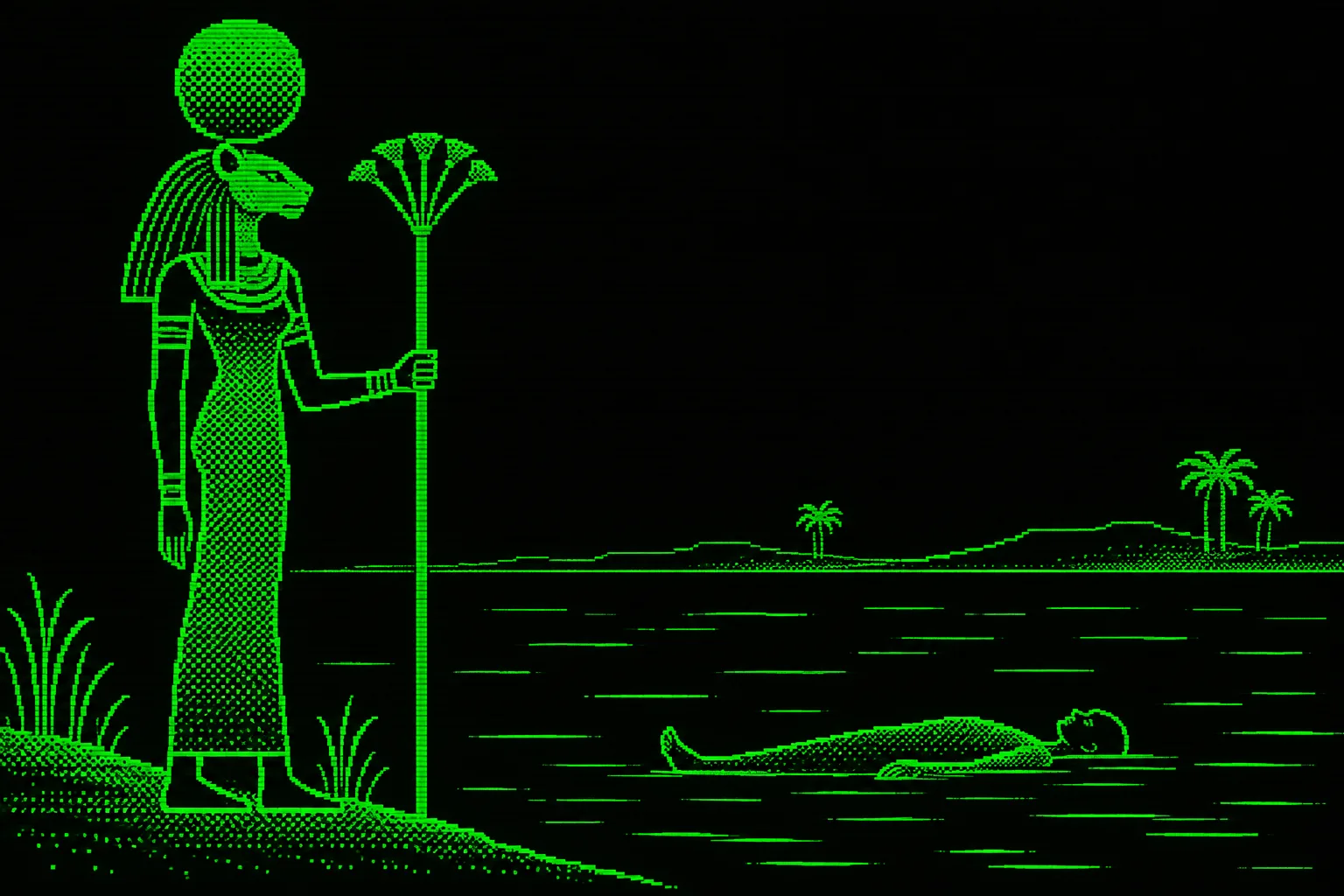
The loyal are fed and buried. For the rest: Against the man who breaks his command, he is Sekhmet. There is no tomb for one who rebels against His Majesty. His corpse is thrown into the water. Twice he asks passers-by to speak the offering prayer for him.
- 1
[...] Bḥd,tj nb-p,t
… He of Behdet, lord of the sky.
Note · Line 1
He of Behdet is Horus in the form of the winged sun disk. - 2
[...] Bḥd,tj nb-p,t
… He of Behdet, lord of the sky.
- 3
[...] Ḫnt(,j)-jmn,tjw nb-ꜣbḏw ḏi̯ =f ꜥnḫ ḏd wꜣs nb
… Foremost of the Westerners, lord of Abydos: may he grant all life, stability, and dominion.
Note · Line 3
The Westerners are the dead: the west, where the sun sets, was their realm. Their lord at Abydos was Osiris. - 4
[...] Ḥr Ꜥꜣ-bꜣ,w nṯr-nfr nb-tꜣ.du nb-jri̯.t-ḫ,t N(,j)-mꜣꜥ,t-Rꜥ ꜥnḫ ḏ,t
… The Horus Great in Powers, the perfect god, lord of the Two Lands, lord of rites, Nimaatre—may he live forever.
Note · Line 4
Nimaatre was the throne name of Amenemhat III; Great in Powers was his name as Horus. The Two Lands are Upper and Lower Egypt. - 5
(j)r(,j)-pꜥ(,t) ḥꜣ(,tj)-ꜥ ḫtm,tj-bj,tj smr-wꜥ,t(j)-n(,j)-mr,wt wr-n(,j)-nsw,t-ꜥꜣ-n(,j)-bj,tj sr-m-ḥꜣ,t-rḫ,yt (j)m(,j)-rʾ-ꜥb-wḥm-šw,t-nšm,t zš.du n(,j) sḫmḫ-jb sꜣu̯-jwi̯.t≡f n šny,t ḏd.n n =f ẖ,t.pl ḫr,t =sn ptr.n nb-tꜣ.du jqr =f 〈ṯni̯.n〉 =f ḫnt jdb.du jr(,j)-n(,j)-ḥḏ-ḥnꜥ-nbw nr-⸮kꜣ.pl?-n(,j)-ꜥꜣ,t-nb.t z n(,j) mꜣꜥ,t ḫnt tꜣ.du mt(j) mꜣꜥ mj Ḏḥwtj ḥr(,j)-sštꜣ.pl-m-rʾ-pr.pl (j)m(,j)-rʾ-kꜣ,t-nb(.t)-n.t-pr-nsw,t ꜥqꜣ r tḫ mj,tj mḫꜣ,t wꜣḥ-jb mnḫ nḏ,wt-rʾ ḏd nfr,t wḥm mrr.t wꜣḥ-jb jw,tj-sn.nw≡f nfr sḏm jqr ḏd sr wḥꜥ ṯss.t ṯnn nb =f ḫnt ḥḥ,pl twt mꜣꜥ n(,j) mr,wt šw m jri̯.t jsf,t wꜥ jb n(,j) bj,tj smt(j).n =f jwn-Šmꜥw-m-pr-nsw,t šms nb =f r nmt,t.pl =f ꜥq-jb =f ḫnt šny,t ḥꜣ(,j) nb =f m wꜥꜥ,w Ḥr mnḫ m s,t ꜥḥ jm(,j)-jb-n(,j)-nb≡f-mꜣꜥ ḏd.w n =f mdw,t ḥꜣp.t gmi̯ ṯ(ꜣ)s snḏm qsn,t jri̯ ḫ,t r tp-nfr ḫtm,tj-bj,tj jm,j-rʾ-gs-pr jdn,w-n(,j)-(j)m(,j)-rʾ-ḫtm,t Sḥtp-jb-Rꜥ ḏd =f
The hereditary prince and count, seal-bearer of the King of Lower Egypt, beloved sole companion, great one of the King of Upper Egypt, magnate of the King of Lower Egypt, high official at the head of the people; overseer of horned beasts and hoofed beasts, birds and fish, and the two fowling pools kept for pleasure; one whose coming the court awaits, to whom people have told their needs, whose worth the lord of the Two Lands has seen and whom he has raised above the Two Banks; keeper of silver and gold, guardian of every precious stone; a man of truth at the head of the Two Lands, upright and true as Thoth; keeper of secrets in the temples, overseer of all the works of the royal house; truer than the plummet, the very image of the balance; kindly, excellent in counsel, who says what is good and repeats what is dear; kindly, without an equal, a fine listener and a gifted speaker; an official who unties what is knotted, whom his lord singles out among millions; a man truly beloved, who does no wrong; the one man in the heart of the King of Lower Egypt, whom the king has put to the test; pillar of Upper Egypt in the royal house, who follows his lord at every step, his confidant at the head of the court, at his lord’s side when Horus is alone; a man who excels at his post in the palace, his lord’s true favorite, to whom secrets are told, who finds the right words, eases hardship, and brings matters to a good end; the seal-bearer of the King of Lower Egypt, overseer of the estate, deputy to the overseer of the seal, Sehetep-ib-Ra, says:
Note · Line 5
The Two Banks are the banks of the Nile, another name for Egypt. Horus here is the living king: Sehetep-ib-Ra attended him even when the rest of the court was absent. - 6
j ḥꜣ(,tj)-ꜥ (j)m(,j)-rʾ-ḥm(.pl)-nṯr nb ḥm-nṯr-ꜥꜣ nb ẖr(,j)-ḥ(ꜣ)b(,t) ḫtm,tj-nṯr wt(,j)-Jnpw nb ḥm-nṯr-ꜥšꜣ nb mtꜣ-n(,j)-sꜣ.pl nb ꜥnḫ nb n(,j) nʾ,t ṯn ḫpr.t(j) =fj m ḥw,t-nṯr tn swꜣ.t(j) =sn ḥr mꜥḥꜥ,t tn šdi̯.t(j) =sn wḏ pn
O every count and overseer of priests, every high priest, all lector priests, god’s seal-bearers, and embalmers of Anubis, every ordinary priest, every head of a priestly company, every living person of this city who shall come to this temple—all you who shall pass this tomb and read this stela aloud:
- 7
m mrr =tn Wsjr-Ḫnt(,j)-jmn,tjw wḥm =tn jri̯.t ḥ(ꜣ)b.pl =f m mrr =tn Wpi̯-wꜣ,t.pl nṯr =tn bnr-mr,wt nḏm jb =tn m nsw,t r-nḥḥ mri̯.w =tn ꜥnḫ smḫ.w =tn m(w)t snb n =tn ẖrd.w.pl =tn ḏd =tn m tp,t-rʾ =tn
As surely as you love Osiris, Foremost of the Westerners, and celebrate his feasts again and again, as surely as you love Wepwawet, your dearly beloved god, and your hearts rejoice in the king forever, you shall love life and forget death, and your children shall thrive for you, if you say these words with your own mouths:
Note · Line 7
Sehetep-ib-Ra asks those who pass his monument to speak the offering into being. Wepwawet, whose name means “Opener of Ways,” led the divine procession at Abydos. - 8
ḥtp-ḏi̯-nsw,t ḫꜣ m tʾ ḥ(n)q,t kꜣ.pl ꜣpd.pl šs mnḫ,t ḫ,t nb(.t) bnr.t ꜥnḫ.t nṯr jm n jmꜣḫ (j)r(,j)-pꜥ(,t) ḥꜣ(,tj)-ꜥ ḫtm,tj-bj,tj jm,j-rʾ-gs-pr jdn,w-n(,j)-jm,j-rʾ-ḫtm,t Sḥtp-jb-Rꜥ jri̯.n Ḏḏ,t-⸮Mw,t? mꜣꜥ(,t)-ḫrw
“An offering the king gives: a thousand each of loaves, jars of beer, cattle, fowl, alabaster vessels, lengths of linen, and every sweet thing on which a god lives, for the honored one, the hereditary prince and count, seal-bearer of the King of Lower Egypt, overseer of the estate, deputy to the overseer of the seal, Sehetep-ib-Ra, born of Dedet-Mut, the justified.”
Note · Line 8
“The justified” here is Dedet-Mut, his mother. The title declares that the deceased has been vindicated before the gods. - 9
[...] Bḥd,tj nb-p,t
… He of Behdet, lord of the sky.
- 10
[...] Bḥd,tj nb-p,t
… He of Behdet, lord of the sky.
- 11
[...] Ḫnt(,j)-jmn,tjw nb-ꜣbḏw ḏi̯ =f ꜥnḫ ḏd wꜣs
… Foremost of the Westerners, lord of Abydos: may he grant life, stability, and dominion.
- 12
[...] Ḥr Nṯr(,j)-ḫpr,w nṯr-nfr nb-tꜣ.du nb-jri̯.t-ḫ,t Ḫꜥi̯-kꜣ.pl-Rꜥ ꜥnḫ ḏ,t
… The Horus Divine in Forms, the perfect god, lord of the Two Lands, lord of rites, Khakaure—may he live forever.
Note · Line 12
Khakaure was the throne name of Senusret III, father of Amenemhat III. - 13
(j)r(,j)-pꜥ(,t) ḥꜣ(,tj)-ꜥ ḫtm,tj-bj,tj jm,j-rʾ-gs-pr jdn,w-n(,j)-jm,j-rʾ-ḫtm,t Sḥtp-jb-Rꜥ mꜣꜥ-ḫrw ḏd =f
The hereditary prince and count, seal-bearer of the King of Lower Egypt, overseer of the estate, deputy to the overseer of the seal, Sehetep-ib-Ra, the justified, says:
- 14
jri̯.n =j gr,t mꜥḥꜥ,t ṯn sꜣḫ.tj smnḫ s,t =s rḏi̯.n =j ḫtm,t ḏbꜣ,w n ḥm.pl-nṯr n.w ꜣbḏw
Now I built this tomb, splendidly equipped, its site made beautiful. I gave the priests of Abydos a contract for payment.
- 15
jw jri̯.n =j zꜣ-mri̯≡f m sšm n(,j) ḥw,t-nbw m sštꜣ n(,j) nb-ꜣbḏw
I served as the Son Whom He Loves in directing the House of Gold and in the mystery of the lord of Abydos.
Note · Line 15
The Son Whom He Loves was a priestly role. The House of Gold was a sacred workshop where divine images were fashioned and adorned. - 16
jw ḫrp.n =j kꜣ,t m nšm,t msi̯.n =j jn(j).pl =s
I directed the work on the Neshmet barque and made her ropes.
Note · Line 16
The Neshmet was the ceremonial boat that carried Osiris in procession. - 17
jri̯.n =j hꜣkr n nb =f pr,t.pl Wpi̯-wꜣ,t jri̯ n =f ḥ(ꜣ)b,yt nb.t šdi̯(.t) n ḥm.pl-nṯr
I held the Haker feast for its lord and the processions of Wepwawet. Every festival rite was performed for him and recited by the priests.
- 18
ḏbꜣ.n =j nṯr m ḫꜥ.pl =f m jꜣ,t =j n.t ḥr(,j)-sštꜣ jr,t =j n.t zmꜣ
I arrayed the god in his crowns in my office as keeper of mysteries and in my service as vesting priest.
- 19
jnk ꜥbꜣ ꜥ.wj m sẖkr nṯr sm wꜥb ḏbꜥ.pl
Both my hands are skilled in adorning the god; I am a sem-priest with pure fingers.
Note · Line 19
A sem-priest served in rites that restored the powers of life to a mummy or sacred image. - 20
jḫ wn =j m šms n(,j) nṯr n-mr,wt ꜣḫ wsr r r(w)d n(,j) nb-ꜣbḏw
May I be in the god’s following, that I may be a transfigured spirit, mighty at the stairway of the lord of Abydos.
- 21
ḥꜣ(,t)-ꜥ-m sbꜣ,yt jri̯.t.n =f ḫr ms.w.pl =f
Beginning of the instruction he composed for his children:
- 22
ḏd =j wr,t
I will speak of a great matter.
- 23
ḏi̯ =j sḏm =ṯn
I will let you hear it.
- 24
ḏi̯ =j rḫ =ṯn sḫr n(,j) nḥḥ sš{s}r ꜥnḫ n(,j) mꜣꜥ,w zbi̯.t ꜥḥꜥ,w m-ḥtp
I will make known to you counsel for all time,
a way to live uprightly
and spend a lifetime in peace. - 25
dwꜣ.pl nsw,t N(,j)-mꜣꜥ,t-Rꜥ ꜥnḫ ḏ,t m-ẖnw-n ẖ(,t).pl =ṯn
Worship King Nimaatre—may he live forever—in the very depths of your bodies.
- 26
snsn.pl ḥm =f m jb.pl =ṯn
Join yourselves to His Majesty in your hearts.
- 27
Sjꜣ pw jm(,j) ḥꜣ,tj.pl
He is Sia, who dwells in hearts.
Note · Line 27
Sia is perception personified as a god. The king not only dwells in his subjects’ hearts but can discern what is there. - 28
jw jr,t.du =f(j) ḏꜥr =sn ẖ,t-nb.t
His two eyes probe every body.
- 29
Rꜥ pw mꜣꜣ.w m stw,t =f
He is Ra, by whose rays one sees.
- 30
sḥḏ.w sw tꜣ.du r jtn
He lights the Two Lands more brightly than the sun disk.
- 31
swꜣḏ.w sw r ḥꜥp(j)-ꜥꜣ mḥ.n =f tꜣ.du m nḫt ꜥnḫ
He brings more green growth than a high Nile flood,
having filled the Two Lands with might and life.Note · Line 31
Both depended on the Nile’s yearly flood for their crops. - 32
qbb fnd.pl wꜣi̯ =f r nšn
Noses turn cold when he is about to rage.
Note · Line 32
The chill is one of fear: even a breath depends on the king’s temper. - 33
ḥtp =f r tpr ṯꜣw
When he is calm, one can draw breath.
- 34
ḏḏ =f kꜣ.pl n n,tjw m šms =f sḏf(ꜣ) =f mḏd mṯn =f
He gives food to those in his retinue;
he feeds the man who follows his path. - 35
kꜣ pw nsw,t
The king is the ka.
- 36
ḥꜣ,w pw rʾ =f
His mouth is abundance.
- 37
sḫpr =f pw wnn.t(j) =f(j)
Whoever is to be is one he brings into being.
- 38
H̱nm,w pw n(,j) ḥꜥ.pl nb wtt,w sḫpr rḫ,yt
He is Khnum to every body,
the father who brings the people into being.Note · Line 38
Khnum was the god who shaped human bodies on a potter’s wheel. - 39
Bꜣs,tt pw ḫwi̯.t-tꜣ.du
He is Bastet, she who guards the Two Lands.
- 40
jw dwꜣ sw r nh.w ꜥ =f
Whoever worships him will be sheltered by his arm.
- 41
Sḫm,t pw r thi̯ wḏ,t =f
Against the man who breaks his command, he is Sekhmet.
Note · Line 41
Bastet and Sekhmet are feline goddesses. The loyal meet the king as a guardian; the disobedient face Sekhmet, the lioness. - 42
jw sfꜣ =f r ẖr(,j) šmꜣ.w.pl
The man he neglects will sink into misery.
- 43
ꜥḥꜣ.pl ḥr rn =f
Fight for his name!
- 44
twr ḥr ꜥnḫ =f
Honor the oath you swear by his life!
- 45
šwi̯ =ṯn m sp n(,j) bgs,w
Then you will be clear of any act of rebellion.
- 46
jw mr(,w) n(,j) nsw,t r jmꜣḫ,y
A man of the king’s household will be honored in death.
- 47
nn js n sbj ḥr ḥm =f
There is no tomb for one who rebels against His Majesty.
- 48
jw ẖꜣ,t =f m qmꜣ n mw
His corpse is thrown into the water.
Note · Line 48
Without a tomb the rebel has no resting place where the living can bring him offerings. - 49
jri̯ =ṯn nn wḏꜣ ḥꜥ.⸢pl⸣ =ṯn
May you do this, that your bodies may remain sound.
- 50
gmi̯ =ṯn st n ḏ,t
You will find that it holds for eternity.
- 51
(j)r(,j)-pꜥ(,t) ḥꜣ(,tj)-ꜥ ḫtm,tj-bj,tj jm,j-rʾ-gs-pr Sḥtp-〈jb〉-Rꜥ mꜣꜥ-ḫrw ḏd =f
The hereditary prince and count, seal-bearer of the king of Lower Egypt and overseer of the estate, Sehetep-ib-Ra, justified, says:
Note · Line 51
The royal instruction gives way here to Sehetep-ib-Ra’s appeal to those who pass his monument. “Justified” is a title of the dead: they have been declared in the right. - 52
mri̯ nsw,t pw mri̯.w nṯr =f nʾ,tj pw wꜥb.w.pl n(.w) Wsjr-Ḫnt(,j)-jmn,tjw m ꜣbḏw wnw,t-ḥw,t-nṯr n.t nṯr pn wꜥb.w.pl n.w nsw,t-bj,tj N(,j)-mꜣꜥ,t-Rꜥ ꜥnḫ ḏ,t r-nḥḥ nsw,t-bj,tj Ḫꜥi̯-kꜣ.pl-Rꜥ mꜣꜥ-ḫrw wnw,t-ḥw,t-nṯr =sn jm(,j).w nʾ,t ṯn r(m)ṯ(,t) nb(.t) n.t ꜣbḏw swꜣ.t(j) =sn ḥr mjꜥḥꜥ,t ṯn m-ḫdi̯(.t) m-ḫnti̯(.t)
O man beloved of the king, man beloved of his city god; you wab-priests of Osiris, Foremost of the Westerners, in Abydos, and you who serve by turns in this god’s temple; you wab-priests of the King of Upper and Lower Egypt Nimaatre, may he live forever and ever, and of the King of Upper and Lower Egypt Khakaure, justified, and you who serve by turns in their temples in this city; all you people of Abydos who will pass this tomb going downstream or upstream:
Note · Line 52
Wab-priests were priests required to observe ritual purity. Nimaatre and Khakaure are the throne names of Amenemhat III and Senusret III. - 53
m mrr =ṯn nsw,t =ṯn ḥz[z] =ṯn nṯr.pl =ṯn nʾ,tjw mn ms.w.pl =ṯn ḥr ⸮ns,t?.pl =ṯn mri̯.w =ṯn ꜥnḫ smḫ.w =ṯn m(w)t ḏd =ṯn
As surely as you love your king and praise the gods of your city, your children will endure in your seats, and you will love life and forget death, if you say:
Note · Line 53
The seats are the offices the visitors hope to pass on to their children. - 54
ḫꜣ m tʾ ḥ(n)q,t kꜣ.pl ꜣpd.pl šs mnḫ,t snṯr mrḥ,t rnp,t nb(.t) ḥnk,t nb(.t) ꜥnḫ.t nṯr jm n kꜣ n(,j) jmꜣḫ (j)r(,j)-pꜥ(,t) ḥꜣ(,tj)-ꜥ ḫtm,tj-bj,tj mri̯.y-nb≡f smr-wꜥ,tj-n(,j)-mr,(w)t jdn,w-n(,j)-jm,j-rʾ-ḫtm,t Sḥtp-〈jb〉-Rꜥ mꜣꜥ-ḫrw jri̯.n Ḏḏ,t-Mw,t mꜣꜥ(,t)-ḫrw nb(,t)-jmꜣḫ
“A thousand of each: loaves, jars of beer, cattle, fowl, alabaster vessels, linen, incense, anointing oil, every kind of fresh produce and every offering on which a god lives, for the ka of the honored one, the hereditary prince and count, seal-bearer of the king of Lower Egypt, beloved of his lord, beloved sole companion, deputy to the chief seal-keeper, Sehetep-ib-Ra, justified, born of Dedet-Mut, justified, lady of honor.”
Note · Line 54
By speaking the list aloud, a passerby could make the offerings available to the dead man’s ka. - 55
[...] (j)r(,j)-pꜥ(,t) ḥꜣ(,tj)-ꜥ ḫtm,tj-bj,tj (j)m(,j)-rʾ-gs-pr Sḥtp-jb-Rꜥ mꜣꜥ-ḫrw nb-jmꜣḫ
… the hereditary prince and count, seal-bearer of the king of Lower Egypt and overseer of the estate, Sehetep-ib-Ra, justified, lord of honor.
- 56
[...] dwꜣ Wpi̯-wꜣ,t.pl m ḥ(ꜣ)b.pl =f nfr.w.pl tp(,j).pl ꜣḫ,t jn jmꜣḫ (j)r(,j)-pꜥ(,t) ḥꜣ(,tj)-ꜥ ḫtm,tj-bj,tj jm,j-rʾ-gs-pr Sḥtp-jb-Rꜥ mꜣꜥ-ḫrw
… Adoration of Wepwawet at his beautiful festivals at the opening of the flood season by the honored one, the hereditary prince and count, seal-bearer of the king of Lower Egypt and overseer of the estate, Sehetep-ib-Ra, justified.
Note · Line 56
Wepwawet, the jackal god whose name means “Opener of the Ways,” led the festival procession at Abydos. - 57
[...] (j)r(,j)-pꜥ(,t) ḥꜣ(,tj)-ꜥ jdn,w-n(,j)-(j)m(,j)-rʾ-ḫtm,t Sḥtp-jb-Rꜥ mꜣꜥ-ḫrw nb-jmꜣḫ
… the hereditary prince and count, deputy to the chief seal-keeper, Sehetep-ib-Ra, justified, lord of honor.
- 58
[...] dwꜣ Wsjr-Ḫnt(,j)-jmn,tjw m ḥ(ꜣ)b.pl =f tp(,j).pl ꜣḫ,t jn jmꜣḫ (j)r(,j)-pꜥ(,t) ḥꜣ(,tj)-ꜥ jdnw-n(,j)-jm,j-rʾ-ḫtm,t Sḥtp-jb-〈Rꜥ〉 mꜣꜥ-ḫrw
… Adoration of Osiris, Foremost of the Westerners, at his festivals at the opening of the flood season by the honored one, the hereditary prince and count, deputy to the chief seal-keeper, Sehetep-ib-Ra, justified.