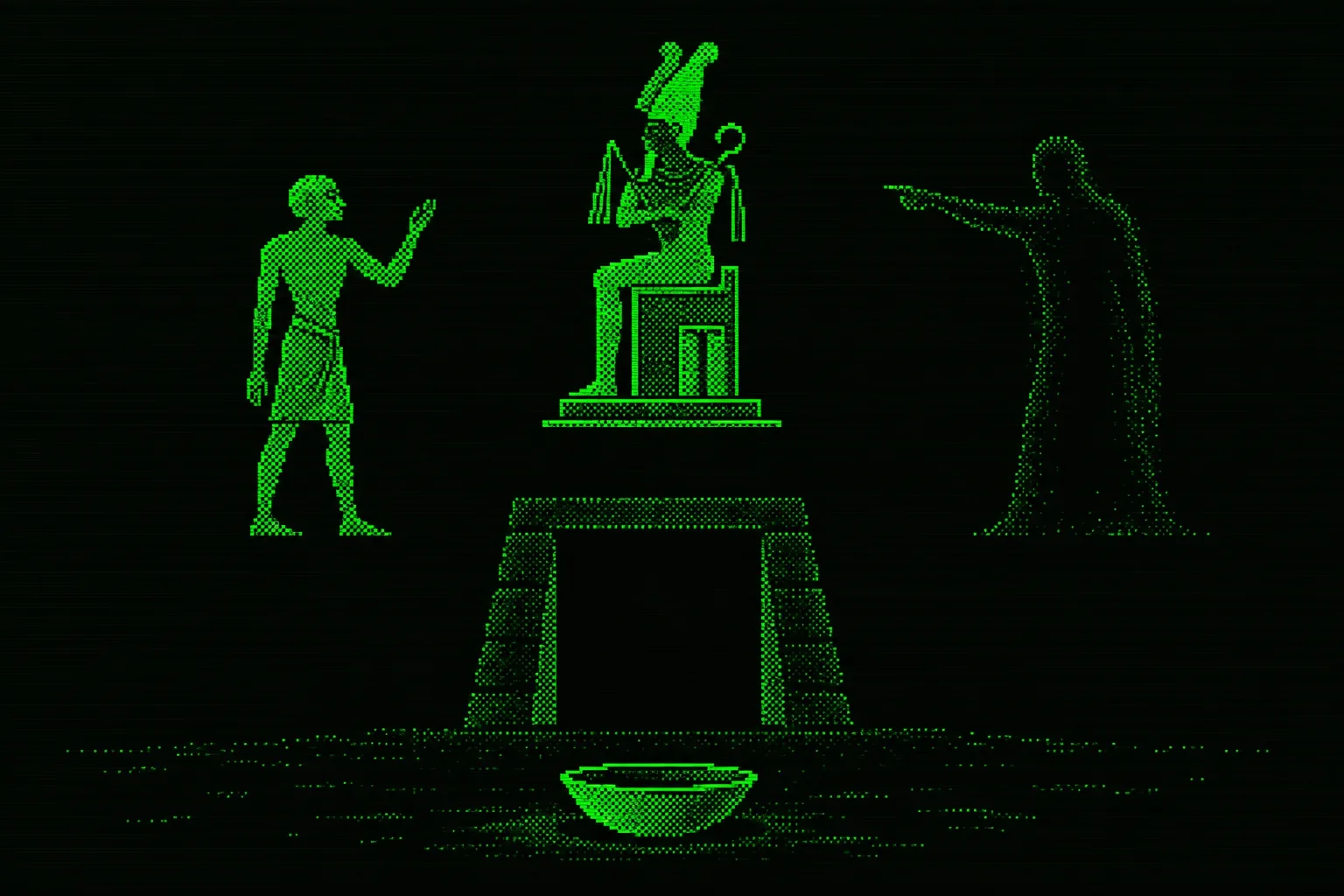
~/sacred-texts/letters-to-the-dead
Louvre Letter to the Dead: Mother Asks Dead Son to Sue
- Date
- Written in hieratic ink on a pottery bowl at the end of the Old Kingdom (about 2300–2150 BC)
- Found
- Now in the Musée du Louvre, Paris (E 6134)
- Language
- Old Egyptian · Hieratic
- 1
j! Mrrj ms.w Mr,t-j
O Mereri, born of Merti!
Note · Line 1
This is a “letter to the dead,” written in ink on a pottery bowl. - 2
jri̯ n =k Wsjr-Ḫnt(,j)-jmn,tw ḥḥ n.w rnp.w,t m rḏi̯.t n =k ṯꜣw m fnḏ =k m rḏi̯.t n =k tʾ ḥ(n)q,t r-gs Ḥw,t-Ḥr(,w) nb,t-ꜣḫ,t
May Osiris Foremost-of-the-Westerners grant you millions of years, giving breath to your nose, giving you bread and beer beside Hathor, Lady of the Horizon.
Note · Line 2
“Foremost of the Westerners” (Khentiamentiu) was a god of the cemetery at Abydos who was merged with Osiris. The “Westerners” are the dead, buried on the west bank where the sun sets. - 3
jw ḫr,t =k mj ꜥnḫ ḥḥ n(,j) zp m wḏ nṯr.w n,tw m p,t tꜣ
Your state is as one who lives a million times over, by decree of the gods who are in heaven and on earth.
- 4
jri̯ =k ḏr n ḫft(,j) 〈〈ḫft,〉〉t ḏw-qd 〈〈ḏw,〉〉t-〈〈qd〉〉 r pr =ṯ{n} r sn =k r mw,t =k
May you set up a barrier against the enemies, male and female, the evil-natured, man and woman, who are set against your house, against your brother, against your mother.
Note · Line 4
Merti asks her son to use his power among the dead to shield his living family from hostile people, whether living or dead. - 5
[...] n zꜣ =s jqr Mrr(j)
… for her excellent son Mereri.
Note · Line 5
The start of this line is lost. - 6
ntk jqr ḥr tꜣ ntk mnḫ m ẖr,t-nṯr
You were excellent on earth; you are effective in the realm of the dead.
- 7
pri̯.t(j)-ḫrw n =k jri̯.t(j) n =k hꜣkr jri̯.t n =k wꜣg rḏi̯.t n =k tʾ ḥ(n)q,t ḥr wḏḥ,w n(,j) Ḫnt(,j)-jmn,tw
May the invocation offering come forth for you; may the Haker festival be held for you; may the Wag festival be held for you; may bread and beer be given you from the altar of Foremost-of-the-Westerners.
Note · Line 7
The “invocation offering” is literally a “coming forth of the voice”: food made real for the dead by being spoken aloud. - 8
ḫdi̯ =k m sk,tt ḫnti̯ =k m ꜥnḏw,t
May you sail downstream in the Evening Boat, and sail upstream in the Morning Boat.
Note · Line 8
These are the two boats in which the sun crosses the sky by day and the underworld by night. The blessed dead hoped to travel with the sun. - 9
rḏi̯.t(j) n =k mꜣꜥ-ḫrw r-gs nṯr nb
May it be granted you to be true of voice beside every god.
- 10
jri̯ n =k ḥz.w n m(w)t =j 〈〈m(w)t〉〉,t 〈〈=j〉〉
Make yourself one whom my dead, man and woman, will praise.
Note · Line 10
“My dead” are Merti’s own departed kin. Her son is to act so that they speak well of him. - 11
j(w) =k rḫ.t ḏd.n =f n (=j)
You know that he said to me:
Note · Line 11
“He” is not named. - 12
jnk sm.y jm =ṯ ḥnꜥ ẖrd.pl =ṯ
"I am the one who will report you and your children!"
Note · Line 12
“Report” here means “denounce”: to bring an accusation before a tribunal. “You” is feminine; the threat is aimed at Merti herself. - 13
smj r =k jm =s m =k ṯw m s,t mꜣꜥ-ḫrw
Then make your own report about it, for look, you stand in the place of being true of voice.
Note · Line 13
Merti asks her son to get his case in first. He has already been declared “true of voice,” so he is now on the ground where cases are won.