~/sacred-texts/royal-inscriptions-of-ramesses-ii
The Kuban Stela of Ramesses II: Come Out of the Mountain!
- Date
- Carved in regnal year 3 of Ramesses II (about 1277 BC, 19th Dynasty) on a rose granite stela set up at the fortress of Quban in Nubia
- Found
- Found at Quban (ancient Baki) in Lower Nubia, at the mouth of the desert road to the gold mines of Wadi Allaqi; now in the Musée de Grenoble (MG 1937, 1969, 3565)
- Language
- Egyptian (Middle Egyptian with Late Egyptian forms) · Hieroglyphic
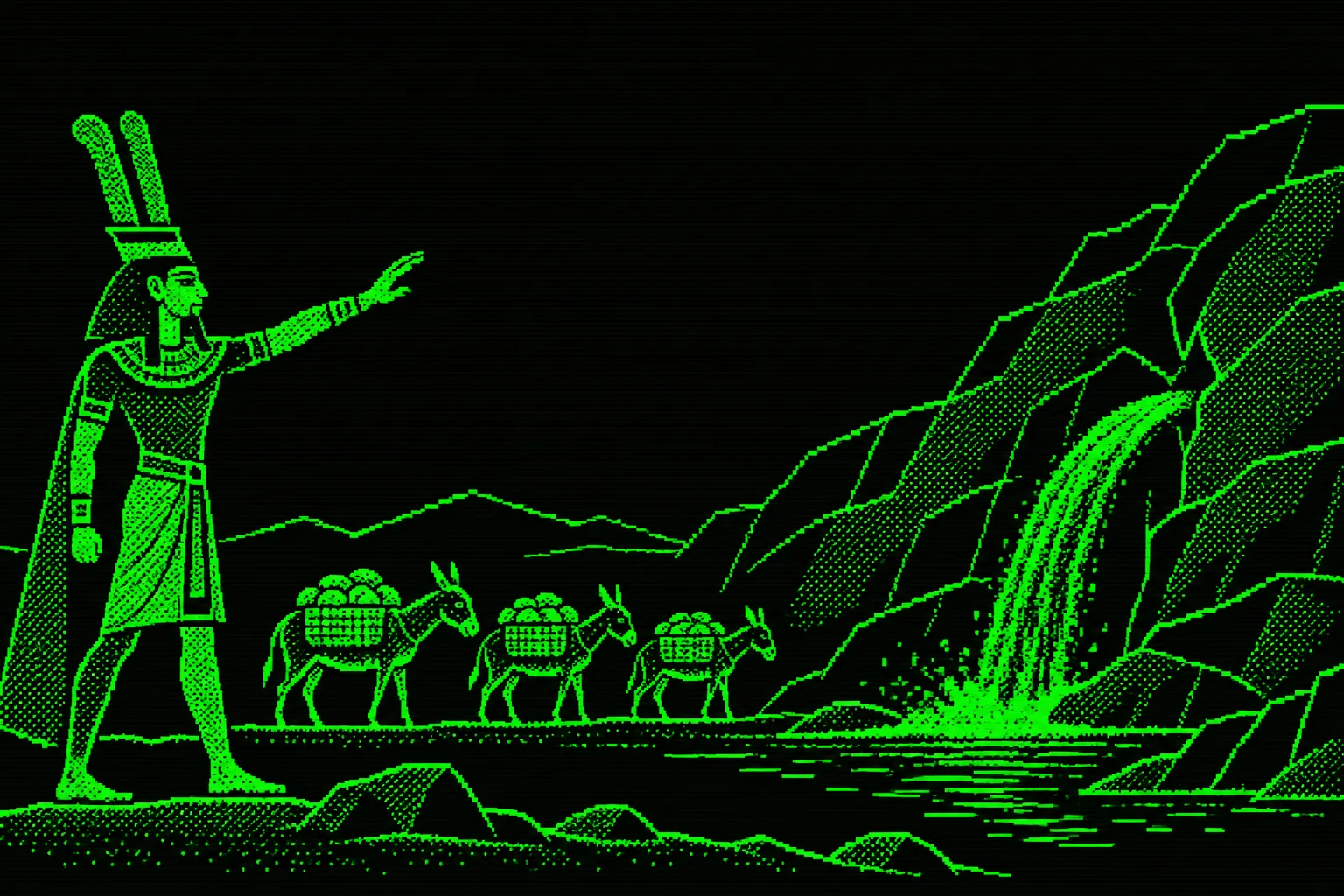
The stela opens at the birth of Ramesses II. The gods say Our semen is in him. Amun says It was I who made him. Then the king sits in Memphis on a throne of electrum, thinking of the gold of Iket. Of the gold workers sent there, only half of them reached it; men died of thirst on the road with their donkeys.
His officials answer that every king before him failed. Seti I sank a well a hundred and twenty cubits deep and no water came out of it. But if Ramesses speaks to the water, Nun comes rushing forth at your word. He orders the well. The viceroy of Kush writes back: Water sprang up in the well at twelve cubits, four of them the depth of the water.
- 1
rnp,t-sp 3 tp,j pr,t sw 4 ḫr ḥm n Ḥr,w kꜣ-nḫt-mri̯.y-Mꜣꜥ,t Nb,tj mki̯-Km,t-wꜥf-ḫꜣs,t.pl Ḥr,w-nbw wsr-rnp,t.pl-ꜥꜣ-nḫt,w nswt-bj,tj Wsr-Mꜣꜥ,t-Rꜥw-stp.n-Rꜥw sꜣ-Rꜥw Rꜥw-msi̯-s(w)-mri̯-Jmn di ꜥnḫ ḏ,t nḥḥ mri̯.y Jmn-Rꜥw nb-ns,t.pl-Tꜣ.du ḫnt,j-Jp,t-s,t.pl ḫꜥi̯ ḥr s,t Ḥr,w n.t ꜥnḫ.pl mj jtj =f Rꜥw rꜥw-nb
Regnal year 3, first month of Peret, day 4, under the Majesty of Horus: Strong Bull, Beloved of Maat; the Two Ladies: Protector of Egypt, Subduer of Foreign Lands; Golden Horus: Mighty in Years, Great in Victories; King of Upper and Lower Egypt: Usermaatre Setepenre; Son of Ra: Ramesses Meryamun, given life forever and ever, beloved of Amun-Ra, lord of the thrones of the Two Lands, foremost in Karnak. He has appeared on the throne of Horus among the living, like his father Ra each day.
Note · Line 1
Peret was the growing season. The five royal names all belong to Ramesses II. The Two Ladies are the vulture and cobra goddesses who protect Upper and Lower Egypt. - 2
nṯr-nfr nb-Tꜣ-šmꜥ,w Bḥd,tj Ḥr,w-sꜣb-šw,t bjk nfr n.w ḏꜥm
He is the perfect god, lord of Upper Egypt, the god of Edfu, Horus of many-colored plumage, the perfect falcon of electrum.
Note · Line 2
The king is portrayed as Horus, the falcon god worshipped at Edfu. Electrum is an alloy of gold and silver. - 3
ḫwi̯.yn =f Km,t m ḏnḥ =f jri̯ ḫꜣyb,t n rḫ,yt m sbtı͗ n qn nḫt
He has sheltered Egypt with his wing; he gives the people shade, a rampart of strength and might.
- 4
pri̯.n =f m ẖ,t ḥr r jṯi̯
He came from the womb ready to conquer.
- 5
pḥ,tj =f ḥr swsḫ tꜣš.pl =f
His strength pushes his borders farther out.
- 6
dj.ntw tr,w n ḥꜥ,w.pl =f m nḫt,w n Mnṯ,w
His limbs were painted with ochre as in the victories of Montu.
Note · Line 6
Montu is a god of war; ochre is an earth pigment. - 7
Nb,wj nhm m p,t hrw n msw,t =f
The Two Lords rejoiced in heaven on the day of his birth.
Note · Line 7
The Two Lords are Horus and Seth, rivals for the kingship, here united in acclaiming the newborn king. - 8
nṯr.pl ḥr [ḏd]
The gods said:
- 9
mtw,t ={t}n j:m =f
“Our semen is in him.”
- 10
nṯr,t.pl ḥr [ḏd]
The goddesses said:
- 11
pri̯.n =f j:m =n r jri̯.t nsw,yt n Rꜥw
“He came forth from us to exercise the kingship of Ra.”
- 12
Jmn ḥr [ḏd]
Amun said:
- 13
jnk jri̯ sw
“It was I who made him.
- 14
jri̯.n =j mꜣꜥ,t r s,t =s
I set Maat in her place.”
Note · Line 14
Maat is justice and right order, embodied in a goddess. In making the king, Amun gives that order its place in the world. - 15
tꜣ smn
Earth stood firm.
- 16
p,t hru̯.tj
Heaven was at peace.
- 17
psḏ,t ḥtp.tj ḥr sp =f
The Ennead was content with what he had done.
Note · Line 17
The Ennead is the company of nine gods. The deed they approve is Amun’s. - 18
kꜣ-nḫt r Kš ẖzi̯ kꜣhꜣ dnj,wt r Tꜣ-nḥsj
A strong bull against wretched Kush, he bellows at the land of the Nubians.
- 19
wnn ꜥgꜣ,t.pl =f ḥr ptpt Jwn,tjw
His claws trample the Iuntiu
Note · Line 19
The Iuntiu here are nomadic peoples of Nubia. - 20
jw ꜥb =f ḥr kꜣhb j:m =sn
as his horn tears into them.
- 21
bꜣ.pl =f sḫm m Ḫnt.t-ḥn-nfr
His ba-powers hold sway in Khent-hen-nefer.
Note · Line 21
A ba is a power through which a god or king makes his presence felt. Khent-hen-nefer and Kery are regions of Nubia. - 22
ḥr,yt =f pḥ =s Kꜣ~ry
The dread of him reaches Kery.
- 23
rn =f pẖr m tꜣ.pl nb.pl ḥr nḫt,w jri̯.tn ꜥ.wı͗ =f
His name goes round all lands for the victories his two arms have won.
- 24
pri̯ nbw m ḏw ḥr rn =f mj jtj =f Ḥr,w nb-Bꜣkꜣ
At his name gold comes forth from the mountain, as it does for his father Horus, lord of Quban.
- 25
ꜥꜣ mrw,t ḥr ḫꜣs,t.pl rs,j.pl mj Ḥr,w m Mjꜥm nb-Bhn
He is greatly loved in the foreign lands to the south, like Horus in Miam, lord of Buhen.
Note · Line 25
Quban, Miam (modern Aniba), and Buhen were centers of Horus worship in Nubia. - 26
nswt-bj,tj Wsr-Mꜣꜥ,t-Rꜥw-stp.n-Rꜥw sꜣ-Rꜥw n ẖ,t =f nb-ḫꜥ,w Rꜥw-msi̯-s(w)-mri̯-Jmn di ꜥnḫ ḏ,t nḥḥ mj jtj =f Rꜥw rꜥw-nb
King of Upper and Lower Egypt, Usermaatre Setepenre; Son of Ra, of his very body, lord of crowns, Ramesses Meryamun, given life forever and ever like his father Ra each day.
- 27
jst ḥm =f m Ḥw,t-kꜣ-Ptḥ ḥr jri̯.t ḥss,t.pl jtj.pl =f nṯr.pl nb.pl 〈n〉 Šmꜥ,w Mḥ,w mj rdi̯ =sn n =f qn nḫt ꜥḥꜥ,w ꜥꜣ n ḥḥ.pl m rnp,t.pl
Now His Majesty was in Memphis, doing what his fathers, all the gods of Upper and Lower Egypt, praised, just as they gave him strength and might and a long life of millions of years.
- 28
wꜥ m nn hrw ḫpr
It happened on one of those days.
- 29
jst ḥm =f ḥmsi̯ ḥr bḥd.w n ḏꜥm ḫꜥi̯.w m sšd šw,tj ḥr sḫꜣ.t ḫꜣs,t.pl jnn nbw j:m =sn ḥr wꜣwꜣ sḫr.pl n šdi̯ ẖnm,yt.pl ḥr wꜣ,t.pl qsn.tpl ḥr mw m-ḫt sḏm =tw r-ḏd
His Majesty sat on a throne of electrum, crowned with the diadem of two plumes. He was calling to mind the foreign lands from which gold was brought and weighing plans to dig wells along roads where water was hard to find, after word had come:
- 30
jw wn nbw ꜥšꜣ ḥr ḫꜣs,t J~kꜣy~tꜣ ḫr wꜣ,t =s qsn.tj ḥr mw r-jqr
“There is gold in abundance in the desert of Iket, but for lack of water the road there is very hard going.”
- 31
jr šm.t nhı͗.pl-m nꜣ n qꜣı͗~rꜣ.pl n jꜥi̯-nbw r =s
“Whenever some of the gold washer’s gold workers set out for that land,
Note · Line 31
The destination is Iket, a gold-mining district in the Nubian desert. - 32
gs =sn jrı͗ nꜣ n,tj ḥr spr r =s
only half of them reached it.
- 33
mt.jn =sn n jbi̯.t ḥr wꜣ,t ḥnꜥ nꜣ n ꜥꜣ.pl n,tj r-ḥꜣ,t =sn
They would die of thirst on the road, along with the donkeys that went ahead of them.
- 34
nn gmi̯.n =w ẖr,t.pl =sn n swrj m ṯsi̯ hꜣi̯.yt m mw n.w šd.w
On the way up and the way down, the water in the leather skin did not give them enough to drink.
- 35
wnn bw jni̯.tw nbw ḥr ḫꜣs,t tn m-ꜥ ngꜣ.w
So for want of water no gold was brought from this desert land.”
- 36
ḏd.jn ḥm =f n ḫtm,tj-bj,tj n,tı͗ r gs =f
Then His Majesty said to the seal-bearer of the King of Lower Egypt at his side:
- 37
njs mj sr.pl jm,j.pl-bꜣḥ nḏ ḥm =f rʾ =sn ḥr ḫꜣs,t tn
“Call out ‘Come!’ to the high officials in attendance, so that His Majesty may consult them about this desert land.
- 38
jnk jri̯ grg.t.pl m-ḥr
I myself will found settlements before their eyes.”
- 39
sṯꜣ.jntw ḥr-ꜥ m-bꜣḥ nṯr-nfr
At once they were brought before the perfect god,
Note · Line 39
“The perfect god” is the king himself, Ramesses II. - 40
ꜥ.du =sn m jꜣ,w n kꜣ =f ḥr hn,w sn-tꜣ n ḥr =f nfr
each with both arms raised in praise of his ka, acclaiming him and kissing the ground before his beautiful face.
Note · Line 40
The ka is the king’s vital power. Kissing the ground was an act of homage. - 41
wn.jn =tw ḥr ḏd n =sn pꜣ qj n ḫꜣs,t tn ḥr nḏ-rʾ =sn ḥr =s ḥr sḫr.pl n wbꜣ ẖnm,t ḥr wꜣ,t =s
Then they were told how matters stood in this desert land, and their counsel was sought on plans to dig a well on the road to it.
- 42
ḏd.jn =sn ḫft ḥm =f
Then they spoke before His Majesty:
- 43
tw≡k mj Rꜥw m jri̯.n =k nb.t
“You are like Ra in all you have done.
Note · Line 43
Ra is the sun god. The officials liken the king’s accession to the rising of the sun. - 44
mrr.tpl jb =k ḥr bs.t
Whatever your heart desires comes to pass.
- 45
jr ꜣbi̯ =k sḫr m grḥ ḥḏ-tꜣ jw =f ḫpr ꜣs
If you set your heart on a plan by night, day breaks and already it is done.
- 46
tw≡n ḥr ptr qn.pl m bjꜣ,yt =k ḏr ḫꜥi̯ =k m nswt-Tꜣ.du
We have seen many of your wonders since you rose as King of the Two Lands.
Note · Line 46
The Two Lands are Upper and Lower Egypt. - 47
bw sḏm =n bw mꜣ jr,t.du =n jw wn ḫpr mj-qd =sn
Never have we heard of such things happening, nor have our two eyes seen their like.
- 48
jr pri̯.w nb n rʾ =k sw mj mdw Rꜥw-Ḥr,w-ꜣḫ,du
All that has come from your mouth is like the speech of Ra-Horakhty.
Note · Line 48
Ra-Horakhty is the sun god as Horus of the Two Horizons. - 49
mḫꜣ ns =k ꜥqꜣ sp,t.du =kı͗ r tḫ mtj n Ḏḥw,tj
Your tongue is more finely balanced, your two lips truer, than the true plummet of Thoth.
Note · Line 49
Thoth is the god of reckoning. The plummet shows whether the beam of a balance stands level. - 50
jḫ dy jw bw rḫ =k sw
What is there here that you do not know?
- 51
nmw ꜥrq =f mj-qd =k
Who is as wise as you?
- 52
ṯꜣ s,t jw bw mꜣ =k s
What place have you not seen?
- 53
nn ḫꜣs,t tm.wn =k ḫnd s
There is no foreign land where you have not set foot.
- 54
sp nb sni̯ ḥr msḏr.du =k ḏr wn =k ḥr jdn tꜣ pn
Every matter has reached your ears since you took charge of this land.
- 55
jri̯.n =k sḫr.pl jw =k m swḥ,t m jꜣw,t =k n ẖrd jr,j-pꜥ,t
You made plans while still in the egg, in your office as child of the crown prince.
- 56
ḏd.yt n =k ḫr,t.pl Jdb,du jw =k m sfj ẖr dbn,t
The needs of the Two Banks were reported to you when you were still a boy wearing the sidelock.
Note · Line 56
The Two Banks of the Nile stand for Egypt. The braided lock at the side of the head marked the wearer as a child. - 57
bw jy mn,w jw bn sw ḥr-ꜥ =k
No monument rose except under your eye.
- 58
bw ḫpr wpw,t m ḫm.t =k
No commission was carried out without your knowledge.
- 59
jri̯.n =k rʾ-ḥr,j-n-pꜣ-mšꜥ jw =k m ḥwn,w n rnp,t 〈mḥ.t〉-10
You commanded the army when you were a boy in your tenth year.
- 60
kꜣ,t.pl nb wn ḥr ḫpr m ḏr,t =k jri̯.t snṯ,t =s
For every work that took shape under your hand, the foundation was laid.”
- 61
jr ḏd =k n mw
“If you say to the water,
Note · Line 61
The king’s officials are addressing Ramesses II about the lack of water on the desert road to the gold mines. - 62
mj ḥr ḏw
‘Come out of the mountain!’
- 63
pri̯ Nnw ꜣs m-sꜣ rʾ =k mj ntk Rꜥw pw m-ḥꜥ,[w] =[f] Ḫpr,j m qmꜣ =f mꜣꜥ
Nun comes rushing forth at your word, for you are Ra himself, Khepri in his true form.
Note · Line 63
Nun is the primeval deep, the source of all water. Khepri is the rising sun, Ra at dawn. - 64
ntk twt ꜥnḫ tp tꜣ n jtj =k Jtm,w m Jwn,w
You are the living image on earth of your father Atum in Heliopolis.
Note · Line 64
Heliopolis was the seat of worship of Atum, the creator god. - 65
ḥw m rʾ =k
Hu is in your mouth;
Note · Line 65
Hu is the divine power of speech that brings into being what it names. - 66
sjꜣ m jb =k
Sia is in your heart.
Note · Line 66
Sia is divine understanding. For the Egyptians, the heart was the seat of thought. - 67
s,t ns =k kꜣr n Mꜣꜥ,t
The seat of your tongue is the shrine of Maat.
Note · Line 67
Maat embodies truth, justice, and the right order of the world. - 68
ḥmsi̯ nṯr ḥr sp,t.du =kj
A god sits on your two lips.
- 69
mdw =k ḥr ḫpr rꜥw-nb
Day after day, your word comes to pass.
- 70
jri̯.ntw ḥꜣ,tj =k m-sn-r Ptḥ qmꜣ-ḥmw,t.pl
Your heart was fashioned in the likeness of Ptah, who fashioned the crafts.
- 71
jw =k r nḥḥ
You will endure forever.
- 72
jri̯ =tw m sḫr.pl =k
People act according to your plans;
- 73
sḏm =tw ḏd.t.pl =k nb.t jty nb =n
they heed all you say, O sovereign, our lord.
- 74
jr ḫꜣs,t J~kꜣy~tꜣ ḏd.yt nn r =s
As for the foreign land of Iket, this is what was said of it.
- 75
jw ḏd.n pꜣ sꜣ-nswt-n-Kš-ẖs r =s m-bꜣḥ ḥm =f
The King’s Son of wretched Kush reported on it before His Majesty:
Note · Line 75
“King’s Son of Kush” was the title of Egypt’s viceroy in Nubia, not a claim of royal birth. “Wretched” was a conventional epithet for foreign lands in royal inscriptions. - 76
jw =s m pꜣı͗ sḫr qsn.ṯ ḥr mw ḏr rk nṯr
‘Ever since the time of the god, the land has been in these straits for lack of water.
Note · Line 76
“The time of the god” is the age when the gods were said to rule on earth. - 77
jw mt =tw ḥr =s n jbi̯.t
People die of thirst there.
- 78
jw ꜣbi̯.yn nswt nb n ẖr-ḥꜣ,t wbꜣ ẖnm,t ḥr =s
Every king of old wished to dig a well there,
- 79
bw ḫpr rwḏ.pl =sn
but none succeeded.
- 80
jw jri̯.n nswt Mn-Mꜣꜥ,t-Rꜥw m-mjt,t
King Menmaatre did likewise:
Note · Line 80
Menmaatre was the throne name of Seti I, the father of Ramesses II. - 81
rḏj.n =f šd =tw ẖnm,t n mḥ 120 mḏw,t m-hꜣ,w =f
in his day he had a well sunk a hundred and twenty cubits deep.
Note · Line 81
About 63 metres, or 206 feet. - 82
ḫꜣꜥ.ntw =s ḥr wꜣ,t
It was left unfinished:
- 83
bw pri̯ mw j:m =s
no water came out of it.’
- 84
jr ḏd =k ḏs =k n jtj =k Ḥꜥpj jtj-nṯr.pl
If you yourself say to your father Hapi, father of the gods,
Note · Line 84
Hapi is the god of the Nile flood. - 85
jmi̯ bs mw ḥr tp ḏw
‘Let water well up on the mountaintop!’
- 86
jw =f r jri̯.t mj ḏd.tn =k nb mj sḫr.pl =k nb.t n,tj ḥr ḫpr m-bꜣḥ =n
he will do just as you have said, in keeping with all your plans, which come to pass before our eyes.
- 87
jw bw sḏm.tw =w m sḏd.ṯ ḥr-n,tt mrr tw jtj.pl =k nṯr.pl nb.pl r nswt nb ḫpr ḏr Rꜥw
It is not by hearsay that we know them, for your fathers, all the gods, love you more than any king who has lived since the days of Ra.”
- 88
ḏd.jn ḥm =f n sr.pl jpn
Then His Majesty said to these officials:
- 89
Mꜣꜥ,t sp-2 ḏd =tn nb {d}〈r〉ḥ,w.pl
“Truth, truth in every word you say, friends!
Note · Line 89
“Truth” is Maat again: the king answers with the name of the goddess whose shrine is on his tongue. - 90
bw šd.y mw ḥr ḫꜣs,t tn ḏr rk nṯr mj ḏd.w =tn
No one has struck water in this foreign land since the time of the god, just as you say.”
- 91
jnk wbꜣ ẖnm,t j:m ḥr rḏi̯.t mw rꜥw-nb mj [⸮m?]
“It is I who will dig a well there, one that gives water day after day, as in …
Note · Line 91
Ramesses II is speaking. Men and donkeys had died of thirst on the desert road to the goldfields of Iket. - 92
[...] [ẖnm,t] ḥr wḏ jtj Jmn-Rꜥw nb-ns.wt-Tꜣ,du Ḥr,w.pl-nb.pl-Tꜣ-Stj mj jꜥj =sn jb m mrr.tpl
… a well at the command of my father Amun-Ra, Lord of the Thrones of the Two Lands, and of the Horus gods, lords of Nubia, just as they refresh their hearts with what they desire.
Note · Line 92
The Horus gods are local forms of Horus worshipped in Nubia. - 93
jw =j r rdi̯.t ḏd.y =tw m tꜣ [...]
I shall have it told throughout the land …”
- 94
[...] ḥr dwꜣ nb =sn ḥr sn tꜣ ḥr rdi̯.t ḥr ẖ,t m-bꜣḥ ḥr sgb r qꜣw n p,t
… praising their lord, kissing the ground, throwing themselves down on their bellies before him and shouting to the heights of heaven.
- 95
ḏd.jn ḥm =f n jm,j-rʾ-zẖꜣ,w-nswt rʾ-ꜥ [n] [...]
Then His Majesty said to the overseer of the royal scribes, “The work of …
- 96
[...] [ps]⸢š⸣ n wꜣ,t r J~kꜣy~tꜣ
… halfway along the road to Iket.
- 97
dd =k ḫpr ꜣbd n hrw
You are to let a full month pass
- 98
jw hb =[k] [...] [⸮jri̯?].n =f mj rdi̯.yt m-ḥr =f
before you send …” He did as he had been ordered.
- 99
jst wnn =f ḥr sḥn.t r(m)ṯ r [...]
Now he was assigning men to …
- 100
[p]wtr sj nꜣ jri̯.w pꜣ sꜣ-nswt
What are these things the King’s Son is doing?
Note · Line 100
“King’s Son” here is short for “King’s Son of Kush,” the title of Egypt’s viceroy in Nubia. It does not imply that he was Ramesses’ son. - 101
jn-jw pꜣw mw [...] wꜣ,t r ḫꜣs,t J~kꜣy~tꜣ
Is this water … on the road to the foreign land of Iket?
- 102
nn-sp jri̯.t mj,tt ḏr nswt.pl jm,j.pl [...]
Never has the like been done since the days of the kings who were …
- 103
[...] [⸮_?] rm.wpl m š.pl-qꜥḥ.pl n.w ẖꜣ,t n jdḥ.w ḥr swḏꜣ ḥr =f m qmꜣ [...]
… fish in the fishponds of the lagoon in the Delta marshes, bringing joy to his face by creating …
- 104
[...] ⸢ḫpš⸣ =⸢f⸣ mj ḥmw ḥr mꜣꜥ
… his arm is like the oar that steers the ship.
- 105
jwi̯.t ẖr wst.t m-ꜥ sꜣ-nswt-n-Kš-ẖs ⸢r⸣ [...] [⸮_?]t ḏd.tn ḥm =f m rʾ =f ḏs =f
A messenger came bearing an official dispatch from the hand of the King’s Son of wretched Kush, to … what His Majesty had said with his own mouth.
- 106
pri̯.n mw j:m =s ḥr mḥ 12 jw mḥ 4 j:m =sn m mḏw,t
“Water sprang up in the well at twelve cubits, four of them the depth of the water.
Note · Line 106
Twelve royal cubits were about 6. 3 metres; four were about 2. 1 metres. - 107
[...] st r-bnr mj-sḫr-n jri̯.w nṯr m jꜥi̯ jb m mrw,t =k
… it out, as a god acts when your wish refreshes his heart.
- 108
nn-sp jri̯.t [...] J~kꜣy~tꜣ ḥr nhm m rš,wt ꜥꜣ.t
Never has the like been done … Iket shouted for sheer joy.
- 109
nꜣ wn wꜣw.w [...] pꜣ ḥqꜣ
Those who were far away … the ruler.
- 110
pꜣ mw n,tı͗ m dwꜣ,t ḥr sḏm n =f šdi̯.y =f mw ḥr pꜣ ḏw
The water in the underworld heeds him when he digs for water on the mountain.
Note · Line 110
The praise makes the discovery an act of obedience: even the waters beneath the earth answer to the king. - 111
[...] [šdi̯.y].n =f m pꜣ 〈n,tj〉 sꜣ-nswt ḥr hb
…” He read aloud what the King’s Son had written.
- 112
wn.jn =sn nfr ḥr [...] mnḫ sḫr.pl nfr mtr.jwt
Then they were glad at … whose plans are excellent, whose instructions are perfect.
- 113
ḏd.yt nb [...] ẖnm,t tn r tꜣ-ẖmn,t-Rꜥw-msi̯-s(w)-mri̯-Jmn-qn-m-[ꜥnḫ]
All that was said … this well shall be called “The Well of Ramesses, Beloved of Amun, Mighty in Life.”