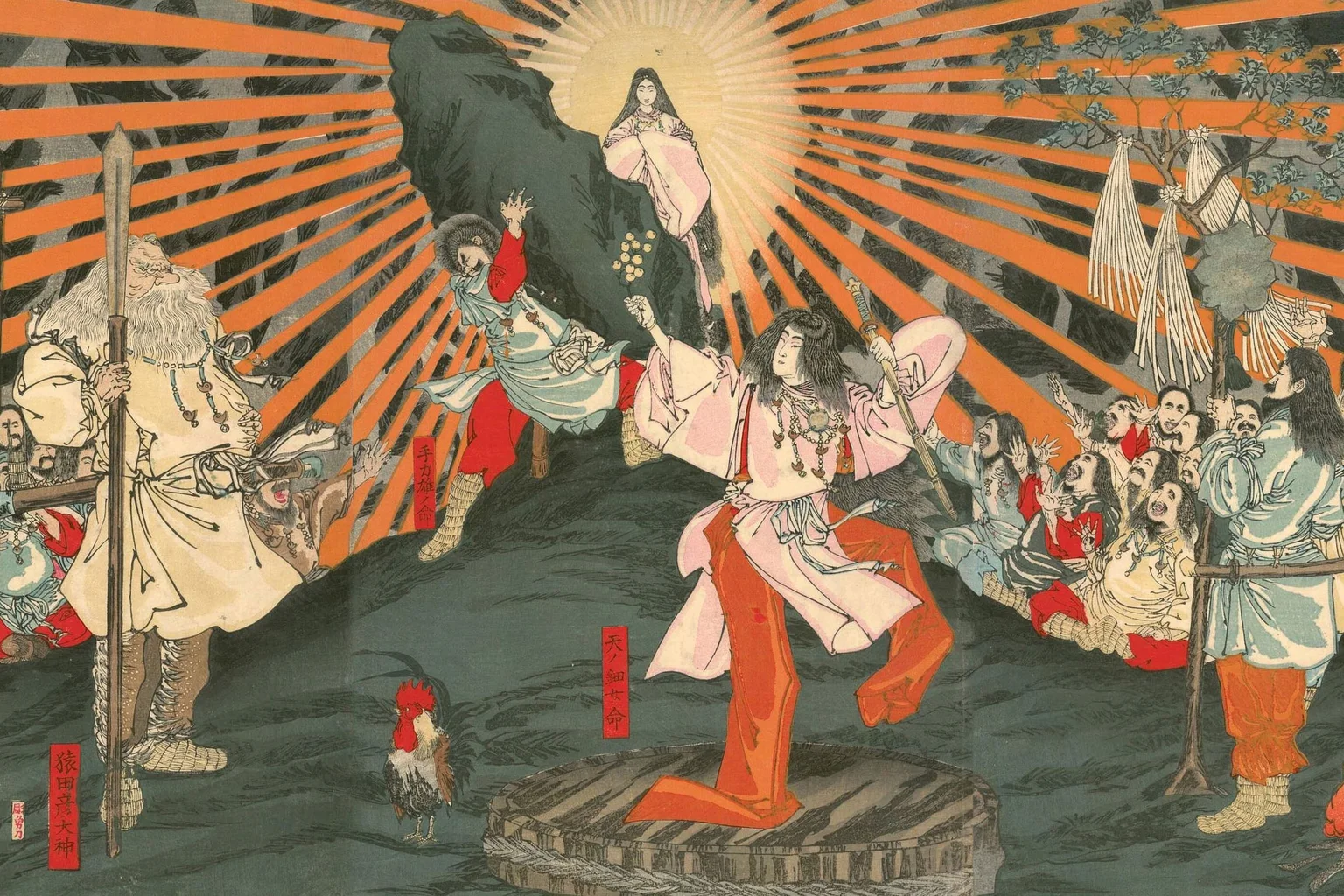
Shunsai Toshimasa, Origin of the Cave Door Dance (岩戸神楽之起顕), woodblock triptych, 1889. Public domain.
~/sacred-texts/kojiki-records-of-ancient-matters
Kojiki: Amaterasu, the Rock Cave and Uzume’s Dance
- Text
- Kojiki (Records of Ancient Matters), Upper volume: Susanoo's rampage and the Heavenly Rock Dwelling
- Date
- Compiled by Ō no Yasumaro from the recitation of Hieda no Are and presented to Empress Genmei in 712 CE
- Found
- Nara, Japan
- Language
- Old Japanese, written in Chinese characters · Chinese characters, used partly for meaning and partly for Japanese sound (man'yōgana); modern punctuation
The Kojiki 古事記, “Records of Ancient Matters”, is the oldest surviving Japanese book. Ō no Yasumaro presented it to the empress in 712, writing down what the court reciter Hieda no Are had learned by heart. It is written in Chinese characters, but in Japanese: some characters stand for their meaning, others only for their sound, and the author added small notes between the lines to say which. Those notes are kept here in brackets, because they show the seams: the word hoto, vulva, appears twice in this episode, once written with the character 陰 for its meaning and once spelled out by sound as 番登.
The episode comes from the first of its three volumes, the age of the gods. The storm god Susanoo has gone up to heaven, won (he says) a contest of oaths with his sister Amaterasu, the sun, and celebrates by wrecking her rice fields and shitting in her sacred hall. She excuses all of it. Then he drops a horse, flayed backwards, through the roof of her weaving hall, and a weaving woman startled by it strikes her vulva on the shuttle and dies. Amaterasu shuts herself in the rock, and heaven and earth go dark.
The gods’ plan fills one enormous sentence: roosters, a mirror, jewels, a stag’s shoulder blade cracked for an oracle, a sakaki tree hung with offerings, a strong god hidden by the door. At its end Ame-no-Uzume, crowned with vines, stamps on an upturned tub, falls into possession, bares her breasts and pushes her skirt down to her vulva, and the gods laugh until heaven shakes. Amaterasu opens the door a crack to ask why, is told there is a nobler god outside, and is shown the mirror.
The page runs from Susanoo’s boast to the return of the light, and stops before his punishment and expulsion. Chamberlain’s English of 1882 put both sexual passages into Latin; the English here says what the Japanese says.
Susanoo’s rampage
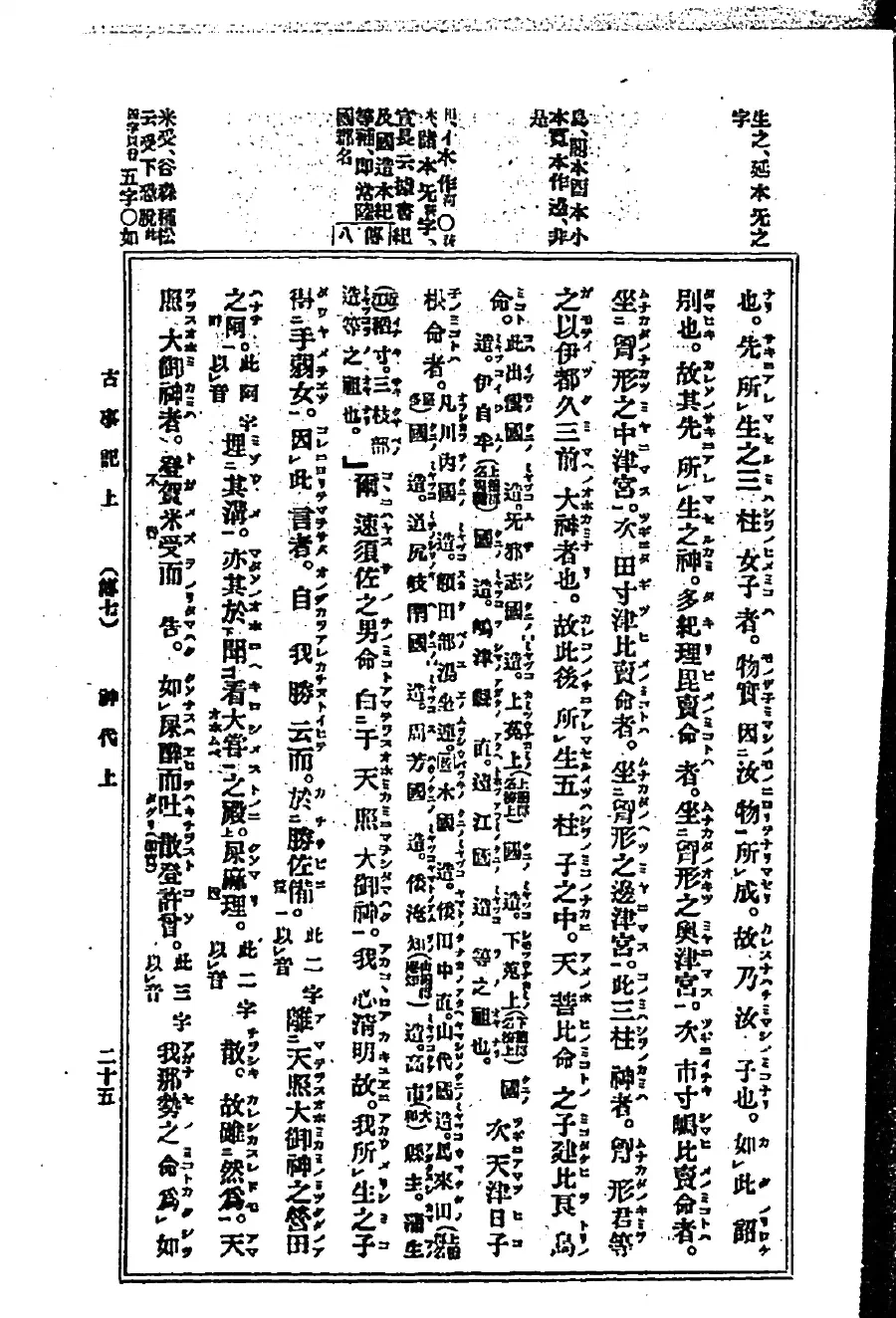
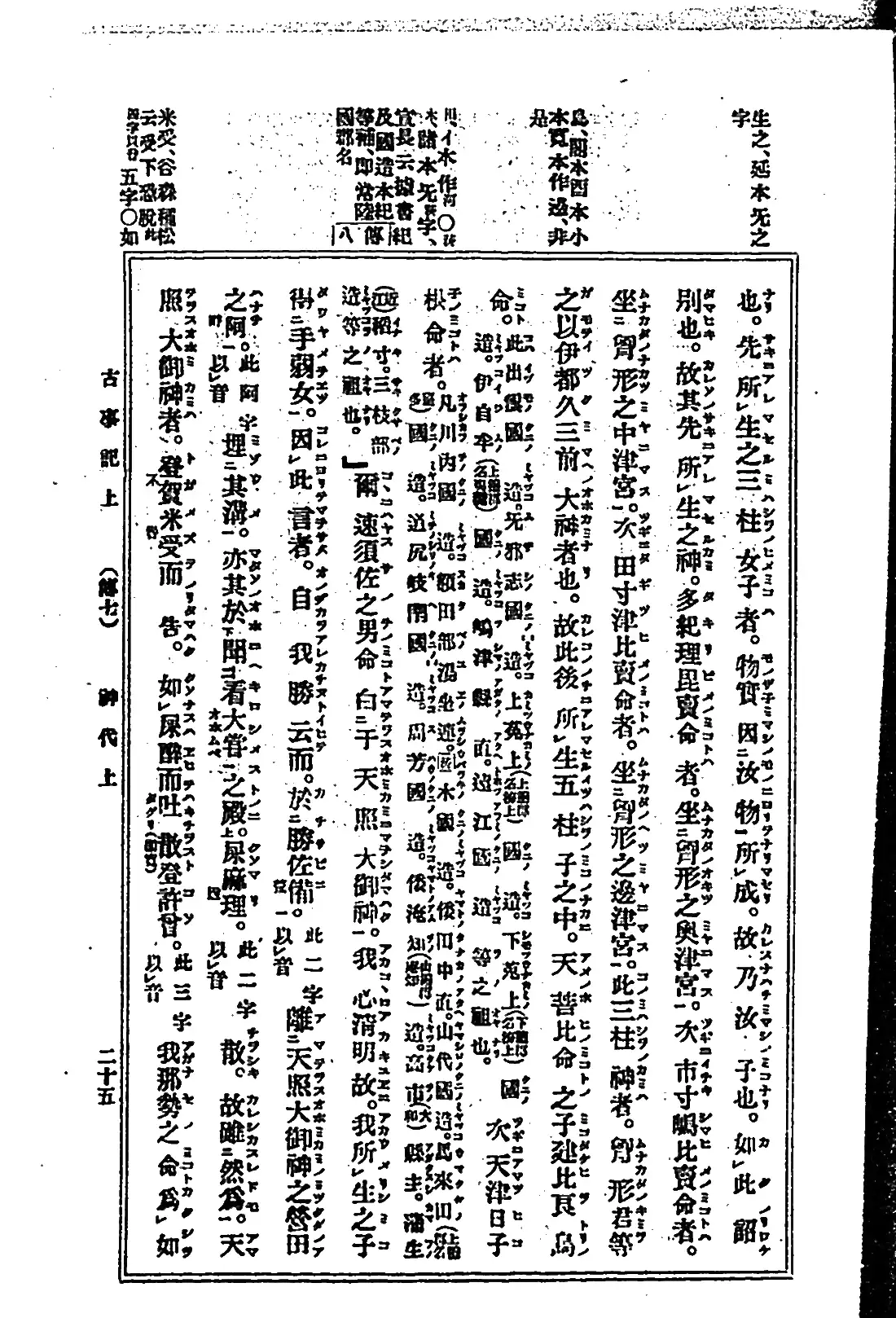
Page 25. Susanoo claims victory and wrecks Amaterasu's fields and hall. Scan of the Kojiki in the Kokushi taikei, vol. 7 (1898), National Diet Library Digital Collections Full source - 125
尒速須佐之男命白于天照大御神:「我心清明。故我所生子,得手弱女。因此言者,自我勝。」
Then 速須佐之男命: Haya-Susa-no-o, 'Swift Susa Man', the storm god said to 天照大御神: Amaterasu-ō-mikami, 'Great August Deity Shining in Heaven', the sun goddess "My heart is pure and bright. That is why the children I made were 手弱女: tawayame, 'soft-armed women' Going by this, I have won, of course."
Note · Line 1
Susanoo and his sister Amaterasu have just made children by a contest of oaths, she from his sword and he from her jewels. He claims the contest proves him honest because his offspring were girls. - 225
云而,於勝佐備〔此二字以音〕,離天照大御神之營田之阿〔此阿字以音〕,埋其溝,亦其於聞看大嘗之殿屎麻理〔此二字以音〕散。
So saying, in the swagger of a winner [two characters for their sound], he broke down the ridges [阿 for its sound] of the rice fields Amaterasu had laid out and filled in their ditches, and in the hall where she eats the 大嘗: ōnie, the great tasting of the new rice he 屎麻理散: kuso-mari, 'shit-voiding': 屎 written for its meaning, 麻理 for the sound mari [two characters for their sound].
Note · Line 2
The bracketed notes are the author’s own, written small between the lines: they tell the reader which characters are only spelling out Japanese sounds. Wrecking field ridges and shitting in a sacred hall are both on the old list of ‘heavenly sins’ recited at the Great Purification. - 325
故雖然為,天照大御神者登賀米受而告:「如屎,醉而吐散登許曾〔此三字以音〕,我那勢之命為如此。又離田之阿埋溝者,地矣阿多良斯登許曾〔自阿以下七字以音〕,我那勢之命為如此。」
But though he did all this, Amaterasu did not 登賀米: togame, 'blame', written for sound him, and said: "What looks like shit, surely my 那勢: nase, a woman's word for her brother or husband did this vomiting and spewing it about in drink [three characters for their sound]. And breaking the ridges of the fields and filling the ditches, surely my dear brother did this because he thought the land was being 阿多良斯: atarashi, 'it is a pity, it is wasteful' [seven characters from 阿 for their sound]."
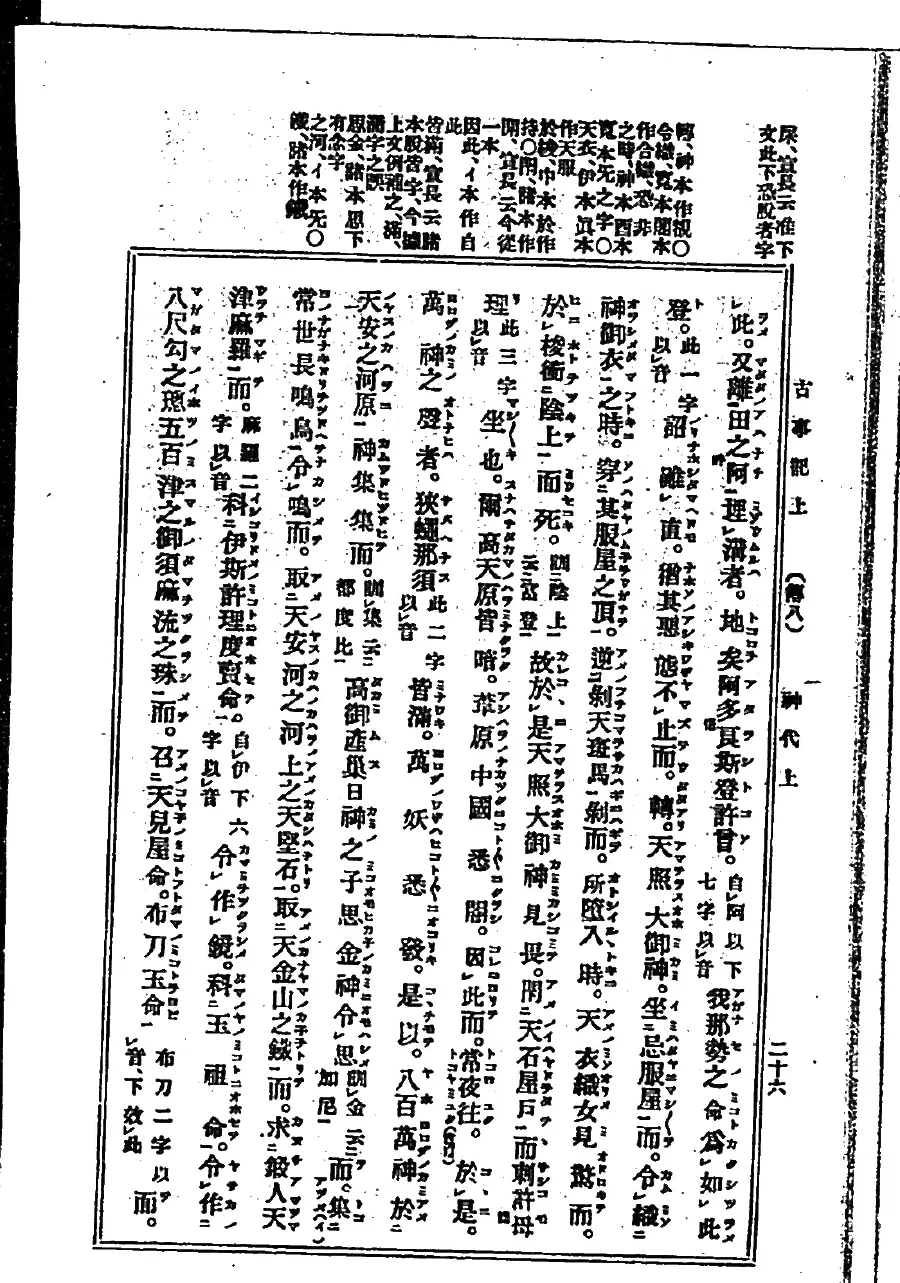
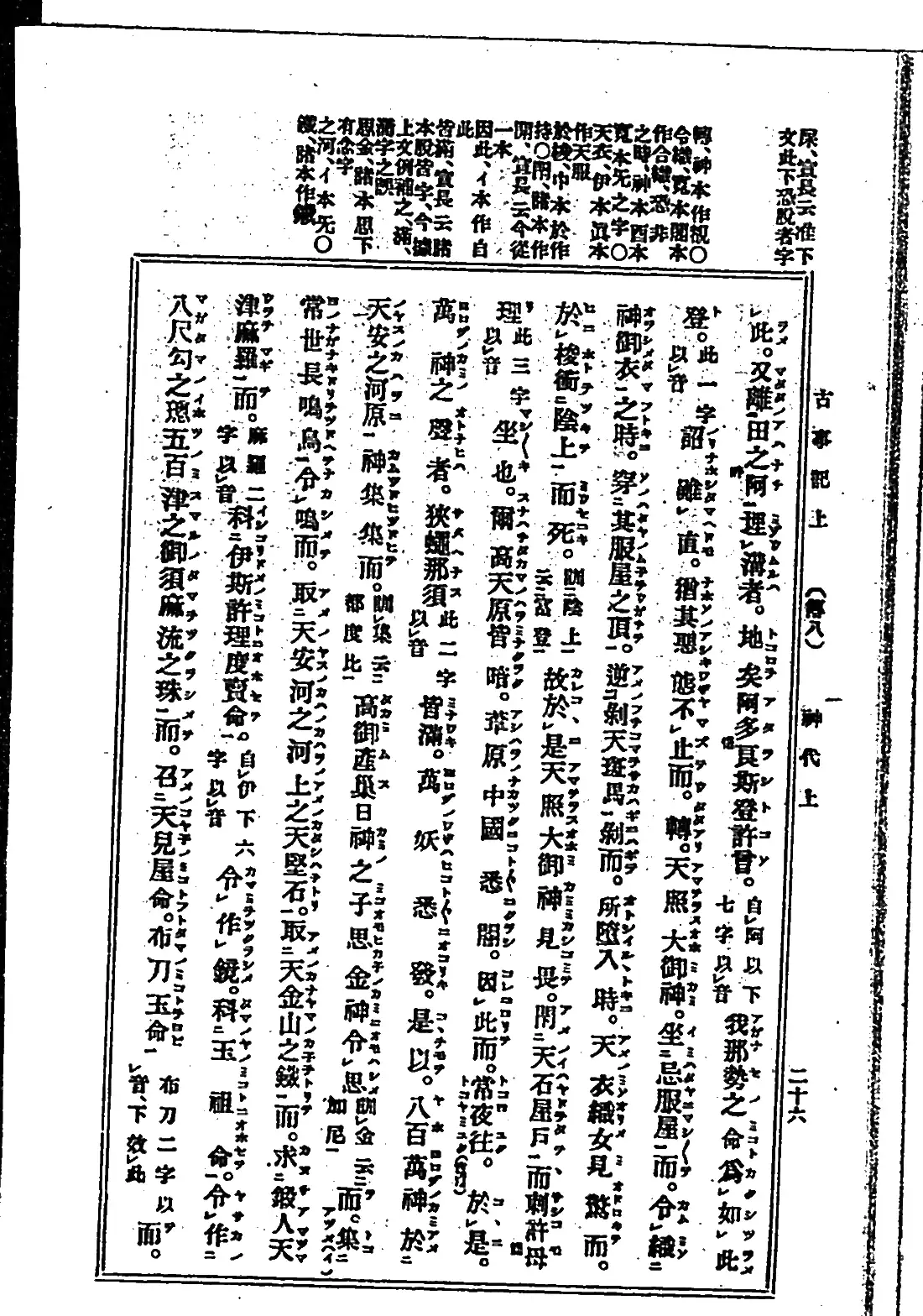
Page 26. The flayed horse, the weaving woman's death, the sun shut in the rock, the gods' assembly. Scan of the Kojiki in the Kokushi taikei, vol. 7 (1898), National Diet Library Digital Collections Full source - 426
登〔此一字以音〕詔雖直,猶其惡態不止而轉。
Though she 詔直: nori-naoshi, to put a wrong right by declaring it otherwise [one character for its sound], his wicked doings did not stop but grew worse.
Note · Line 4
Amaterasu tries to undo the pollution with words, by declaring the shit to be vomit and the vandalism to be thrift. It does not work. - 526
天照大御神坐忌服屋而令織神御衣之時,穿其服屋之頂,逆剥天斑馬剥而所墮入時,天衣織女見驚而,於梭衝陰上而死。〔訓陰上云富登〕
While Amaterasu sat in the 忌服屋: imi-hataya, the weaving house kept ritually pure having the gods' robes woven, he broke a hole through the roof of the weaving hall, 逆剥天斑馬: sakahagi, skinning from the tail end and dropped it in. The 天衣織女: ame-no-hataorime, the maiden who weaves the heavenly robes saw it, started, 於梭衝陰上: the shuttle (梭, hi) driven into the vulva and died. [陰上 is read 陰上: hoto, the vulva; written here by meaning with 陰, 'the hidden, the genitals'
Note · Line 5
Flaying alive and flaying backwards are also listed among the heavenly sins. The Nihon shoki, the other early chronicle, tells this differently: in its main version it is Amaterasu herself who wounds herself with the shuttle, and in one variant a weaving goddess called Wakahirume dies of it. The sun goes into the rock
- 626
故於是天照大御神見畏,閉天石屋戸而刺許母理〔此三字以音〕坐也。
At this Amaterasu, seeing it, was afraid. She shut the door of the 天石屋戸: ame-no-iwaya-to, the door of the rock house of heaven, a cave and 刺許母理: sashi-komori, to bolt and seclude oneself; 許母理 for the sound komori [three characters for their sound].
Note · Line 6
The oldest manuscript writes 開 ‘open’ for 閉 ‘shut’: she opens the rock door, goes in, and shuts herself away. - 726
尒高天原皆暗,葦原中國悉闇。因此而常夜往。
Then the 高天原: Takama-no-hara, the gods' heaven was all dark, and the 葦原中國: Ashihara-no-nakatsukuni, the world of men, Japan was dark through and through. And so 常夜: tokoyo, everlasting night went on.
- 826
於是萬神之聲者,狹蠅那須〔此二字以音〕皆滿,萬妖悉發。
Then the voices of the myriad gods filled everything 狹蠅那須: sabae nasu, 'like early-summer flies'; 那須 for the sound nasu, 'like' [two characters for their sound], and every kind of calamity broke out.
The gods’ plan
- 926
是以八百萬神,於天安之河原神集集而〔訓集云都度比〕,高御產巢日神之子思金神令思〔訓金云加尼〕而,集常世長鳴鳥令鳴而,
So the 八百萬神: yaoyorozu no kami, the countless gods met in assembly in the riverbed of the 天安之河: Ame-no-yasu-no-kawa [集 is read tsudohi], and had 思金神: Omoi-kane, 'Thought-Combining', the god of plans the child of Takami-musuhi, think it out [金 is read kane]. They gathered the 常世長鳴鳥: tokoyo no naganakidori, roosters from the land beyond the sea and made them crow;
Note · Line 9
From here one sentence runs on through the whole preparation, clause after clause, down to Uzume’s dance. Roosters crow up the dawn; the gods begin by making the morning’s sound without the morning. Tokoyo is written here 常世, ’eternal world’, the land over the sea; the ’endless night’ above is the same sound written 常夜. - 1026
取天安河之河上之天堅石,取天金山之鐵而,求鍛人天津麻羅而〔麻羅二字以音〕,科伊斯許理度賣命〔自伊下六字以音〕令作鏡,科玉祖命令作八尺勾璁之五百津之御須麻流之珠而,
they took the hard rock of heaven from the upper reaches of the Heavenly Peaceful River, took iron from the Heavenly Metal Mountain, and sent for the smith 天津麻羅: Ama-tsu-mara, 'Heavenly Penis'; 麻羅 for the sound mara [the two characters 麻羅 for their sound]; they charged 伊斯許理度賣命: Ishi-kori-do-me, the woman who casts the mirror [six characters from 伊 for their sound] to make a 鏡: kagami and charged 玉祖命: Tama-no-ya, 'Jewel Ancestor' to make a 御須麻流之珠: misumaru no tama, jewels threaded on one cord of five hundred 勾璁: magatama, comma-shaped beads eight feet long;
Note · Line 10
Mara is an old Japanese word for the penis. Chamberlain read the smith’s name that way in 1882 and hid it in a Latin footnote (‘Coelestis Penis’). The mirror and the jewels made here are two of the three imperial regalia; the mirror is kept at the Ise shrine. - 1126
召天兒屋命、布刀玉命〔布刀二字以音。下效此〕而,內拔天香山之真男鹿之肩拔而,取天香山之天之波波迦〔此三字以音。木名〕而,令占合麻迦那波而〔自麻下四字以音〕,
they summoned 天兒屋命: ancestor of the Nakatomi priests and 布刀玉命: Futo-tama, 'Great Jewel', ancestor of the Imbe priests; 布刀 for the sound futo [the two characters 布刀 for their sound, and so below], had them pull out whole the shoulder blade of a true stag of 天香山: Ame-no-kaguyama take 波波迦: a tree, probably a wild cherry, burned to heat the bone wood of Heavenly Mount Kagu [three characters for their sound; the name of a tree], and 占合麻迦那波: urahe makanahu, to divine by heating the bone and interpret its cracks [four characters from 麻 for their sound];
Note · Line 11
Scapulimancy: the bone is heated until it cracks, and the cracks are read. The text does not say what the oracle answered. 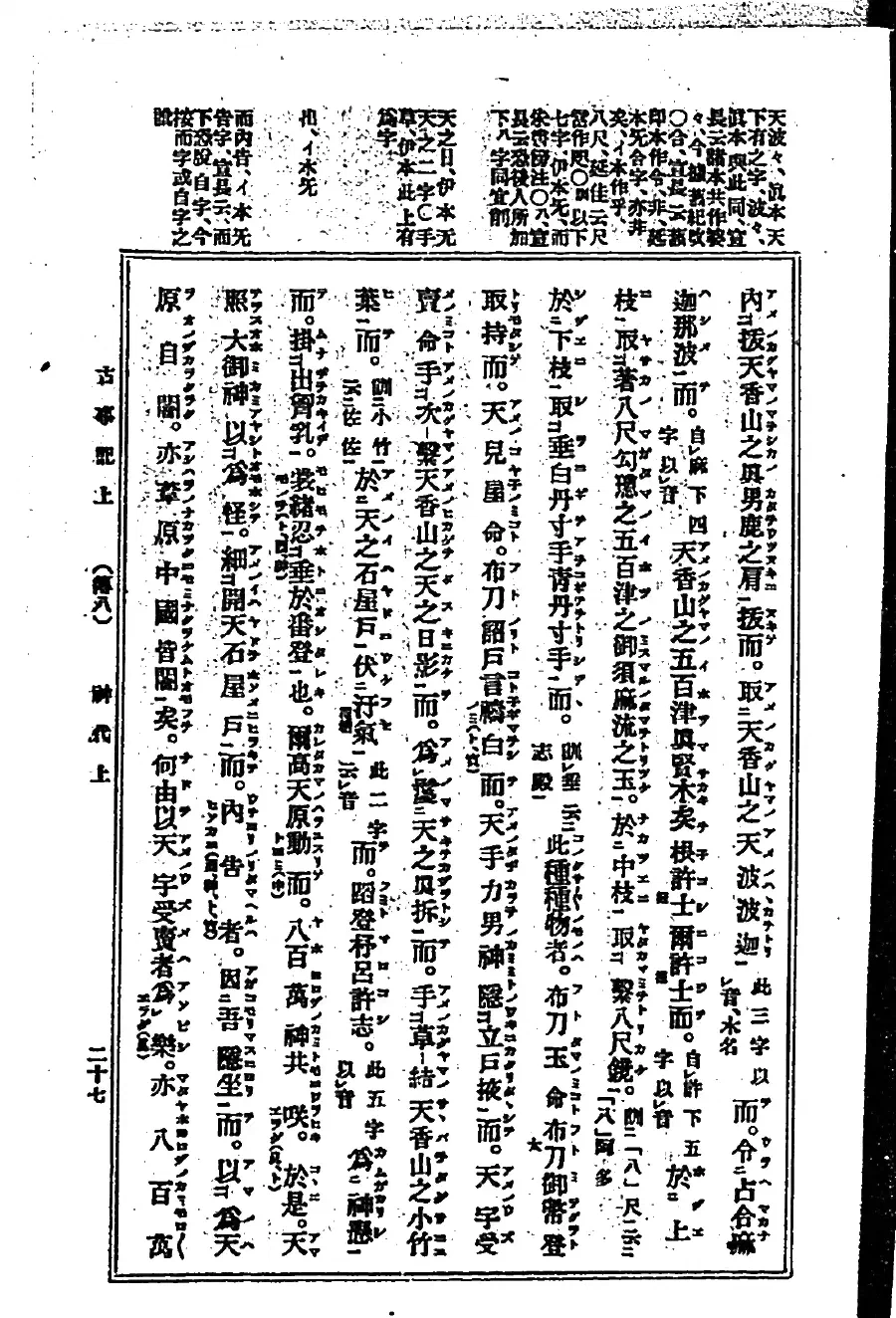
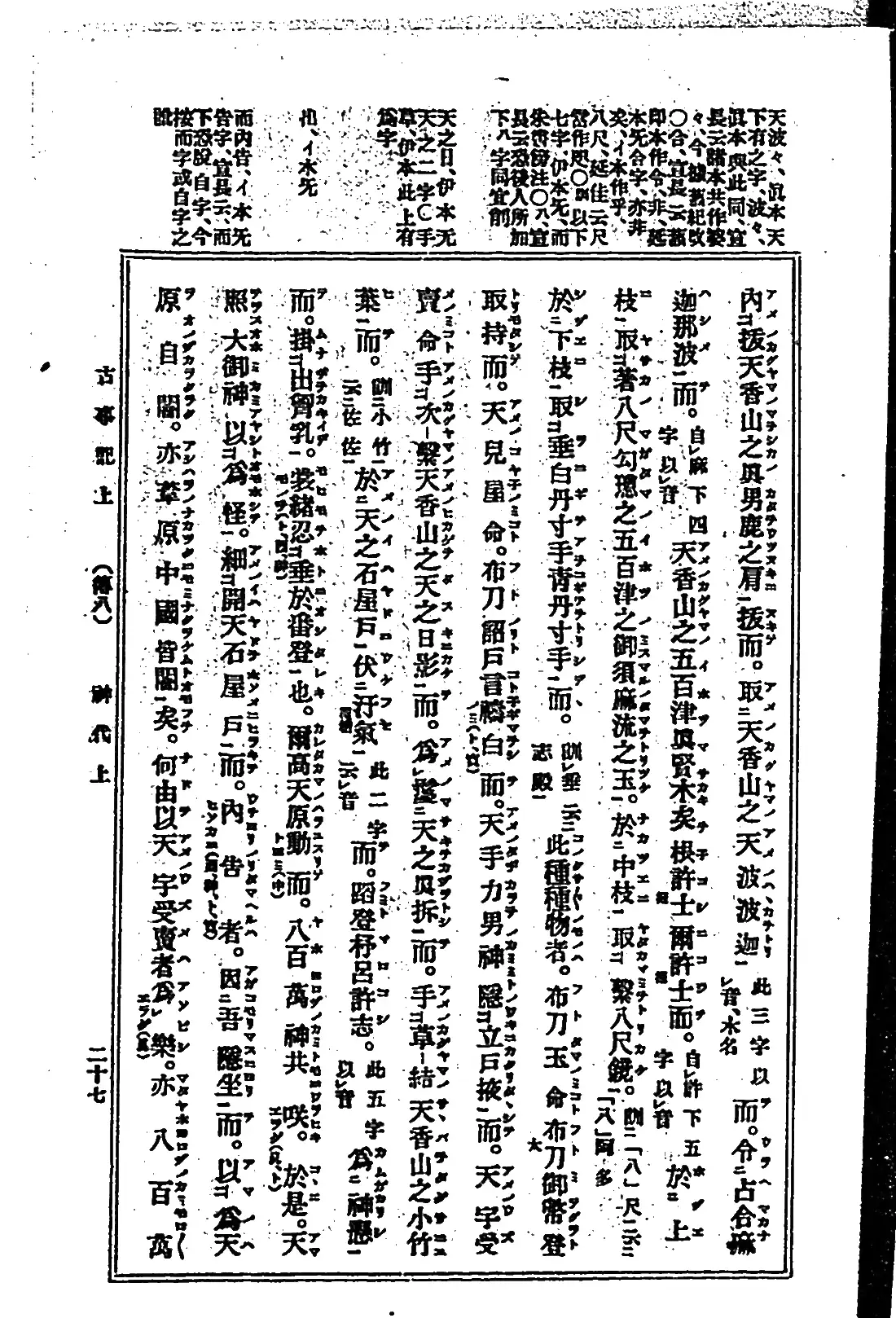
Page 27. The sakaki tree, Uzume's dance (掛出胸乳、裳緒忍垂於番登), the gods' laughter. Scan of the Kojiki in the Kokushi taikei, vol. 7 (1898), National Diet Library Digital Collections Full source - 1227
天香山之五百津真賢木矣根許士尒許士而〔自許下五字以音〕,於上枝取著八尺勾璁之五百津之御須麻流之玉,於中枝取繫八尺鏡〔訓八尺云八阿多〕,於下枝取垂白丹寸手青丹寸手而〔訓垂云志殿〕,
they dug up by the roots [five characters from 許 for their sound] a many-branched 真賢木: ma-sakaki, the evergreen sacred tree of Shinto shrines of Heavenly Mount Kagu, and on its upper branches hung the eight-foot string of five hundred curved jewels, on its middle branches tied the 八尺鏡: yata no kagami, the regalia mirror [八尺 is read ya-ata], and from its lower branches let hang white 丹寸手: nikite, soft cloth offerings, white of paper-mulberry bark and blue of hemp and blue cloth offerings [垂 is read shide];
Note · Line 12
The decorated sakaki tree with mirror, jewels and hanging cloth is still the form of a Shinto offering. - 1327
此種種物者,布刀玉命布刀御幣登取持而,天兒屋命布刀詔戸言禱白而,天手力男神隱立戸掖而,
Futotama took and held these many things as great 御幣: mitegura, offerings held up to a god Ame-no-Koyane spoke great 詔戸言: norito-goto, ritual prayer as a prayer, and 天手力男神: 'Heavenly Hand-Strength Man' stood hidden beside the door;
Uzume’s dance
- 1427
天宇受賣命手次繫天香山之天之日影而,為鬘天之真拆而,手草結天香山之小竹葉而〔訓小竹云佐佐〕,
and 天宇受賣命: Ame-no-uzume, goddess of the dance; uzu, a head ornament, written for sound (the Nihon shoki writes 鈿女, 'hairpin woman') tied the heavenly 日影: hikage-no-kazura, club moss of Heavenly Mount Kagu across her shoulders as a 手次: tasuki made the heavenly 真拆: masaki-no-kazura, a climbing vine vine her headdress, and bound a bunch of 小竹: sasa leaves of Heavenly Mount Kagu to hold in her hands [小竹 is read sasa];
Note · Line 14
Uzume dresses as a shamaness: green club moss, a vine crown, and leaves to shake. Her descendants, the Sarume, danced at court rites. - 1527
於天之石屋戸伏汙氣〔此二字以音〕而蹈登杼呂許志〔此五字以音〕,為神懸而,掛出胸乳,裳緒忍垂於番登也。
she turned a 汙氣: uke, a tub or trough, written for sound upside down before the door of the Heavenly Rock Dwelling [two characters for their sound] and 登杼呂許志: todorokoshi, 'making it boom', written for sound [five characters for their sound], and 神懸: kamugakari, a god coming down into the body she pulled out her 胸乳: mune-chi and pushed the cord of her skirt down to her 番登: hoto, the vulva; 番登 spells the sound, the same word written 陰 by meaning above
Note · Line 15
This is the sentence that the whole rite has been building to. Uzume does not play at possession: the text says she became possessed. The word for her vulva, hoto, is the same word used of the weaving woman’s wound, there written with a character for meaning and here spelled out by sound. - 1627
尒高天原動而,八百萬神共咲。
Then the High Plain of Heaven shook, and the eight hundred myriad gods all 咲: warau, laugh; 咲 is an old form of 笑, later used for 'bloom' together.
Note · Line 16
Darkness began with a woman’s wounded vulva; the turn begins with a woman’s bared vulva and a roar of laughter. The mirror
- 1727
於是天照大御神以為恠,細開天石屋戸而內告者:「因吾隱坐而,以為天原自闇,亦葦原中國皆闇矣。何由以天宇受賣者為樂,亦八百萬神諸咲?」
At this Amaterasu thought it strange. She opened the door of the Heavenly Rock Dwelling a crack and said from inside: "Because I have hidden myself away, I thought the Plain of Heaven would be dark of itself, and the Central Land of the Reed Plains all dark too. Why does Ame-no-Uzume 為樂: asobi, music, dance and play in a god's presence and why do the eight hundred myriad gods all laugh?"
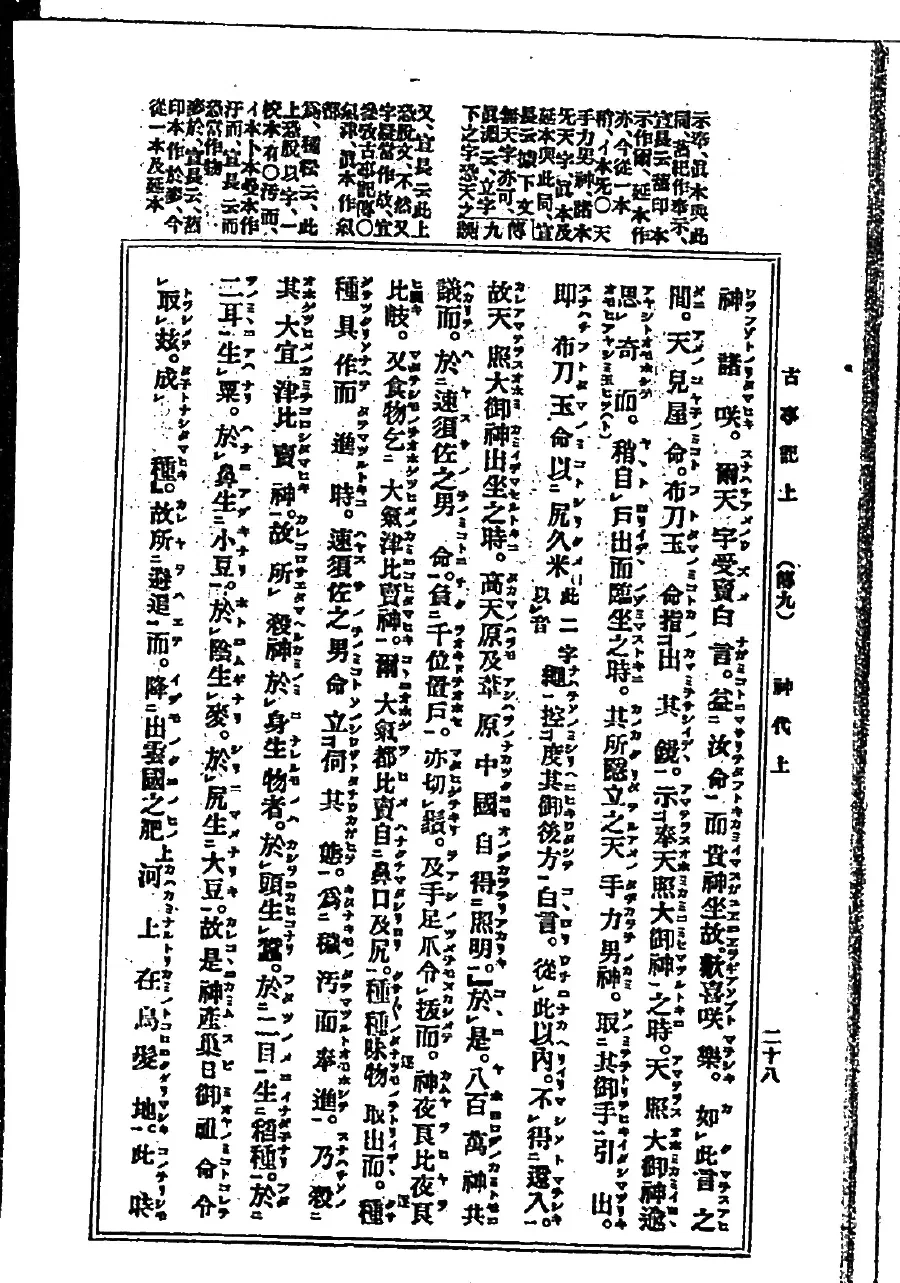
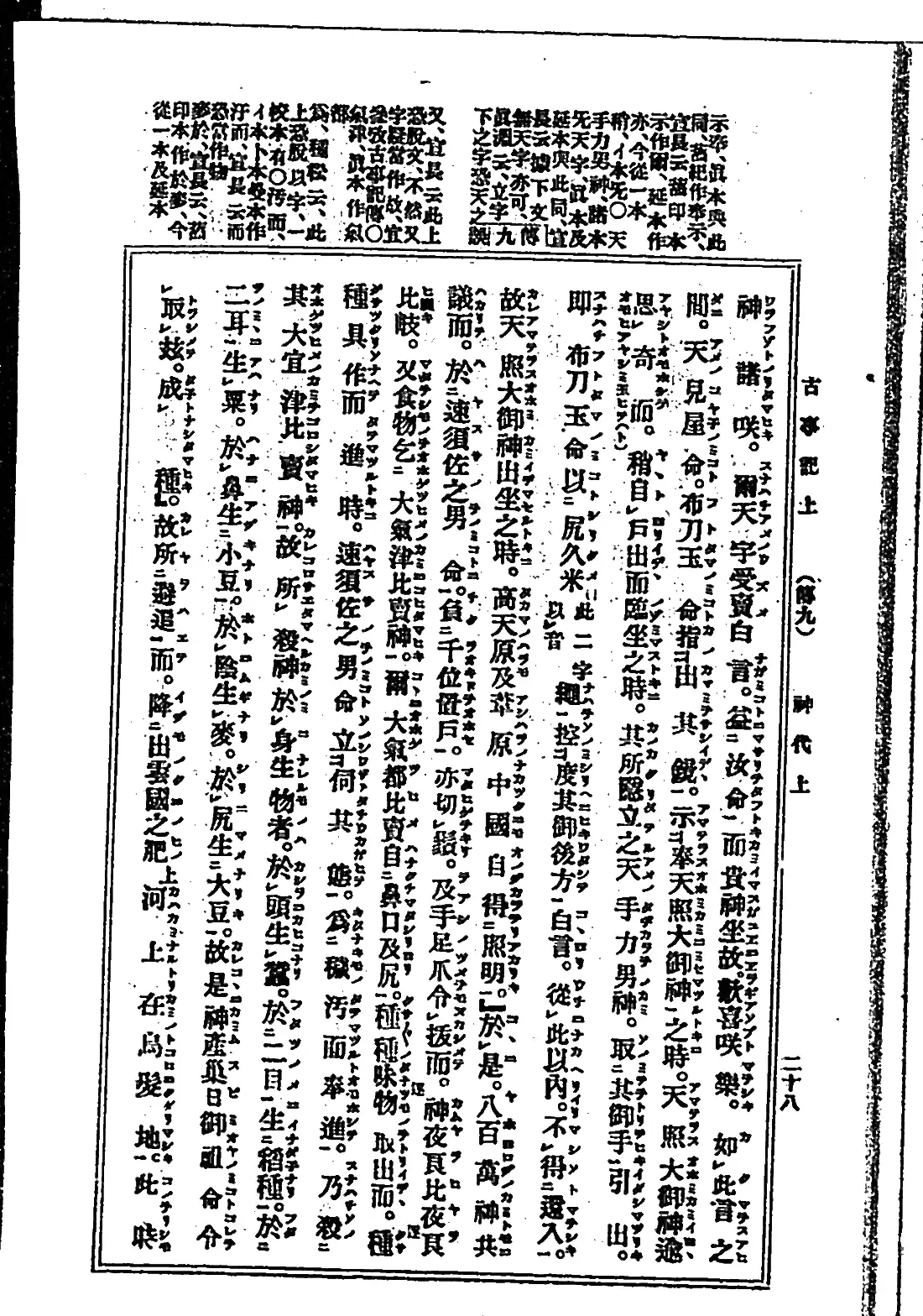
Page 28. Uzume's answer, the mirror, the hand that pulls the sun out, and the rope. Scan of the Kojiki in the Kokushi taikei, vol. 7 (1898), National Diet Library Digital Collections Full source - 1828
尒天宇受賣白言:「益汝命而貴神坐。故歡喜咲樂。」
Ame-no-Uzume answered: "There is a god here 益汝命而貴神: a god nobler than Your Augustness That is why we rejoice and laugh and make merry."
Note · Line 18
The ‘more glorious god’ is Amaterasu’s own reflection, about to be shown her in the mirror. - 1928
如此言之間,天兒屋命、布刀玉命指出其鏡,示奉天照大御神之時,天照大御神逾思奇而,稍自戸出而臨坐之時,
While she was saying this, Ame-no-Koyane and Futotama held out the mirror and showed it to Amaterasu. Amaterasu, more and more astonished, came out a little way from the door and 臨坐: nozokimasu, to peer at, lean over to look
Note · Line 19
She looks into the mirror and sees a shining god there. It is herself. - 2028
其所隱立之天手力男神,取其御手引出。
and Ame-no-Tajikarao, who stood hidden there, took her by the hand and pulled her out.
- 2128
即布刀玉命以尻久米〔此二字以音〕縄控度其御後方,白言:「從此以內,不得還入。」
At once Futotama stretched a 尻久米縄: shirikume-nawa, a straw rope with the cut ends left on; the shimenawa of Shinto shrines [two characters for their sound] across behind her and said: "You may not go back in past this."
Note · Line 21
The rope stretched behind the goddess is the shimenawa that still marks off sacred ground at every shrine. - 2228
故天照大御神出坐之時,高天原及葦原中國自得照明。
So when Amaterasu came out, the High Plain of Heaven and the Central Land of the Reed Plains were lit again of themselves.
Note · Line 22
The next sentence turns to Susanoo: the gods make him pay a thousand tables of offerings, cut off his beard, have his finger- and toenails pulled out, and drive him out of heaven.