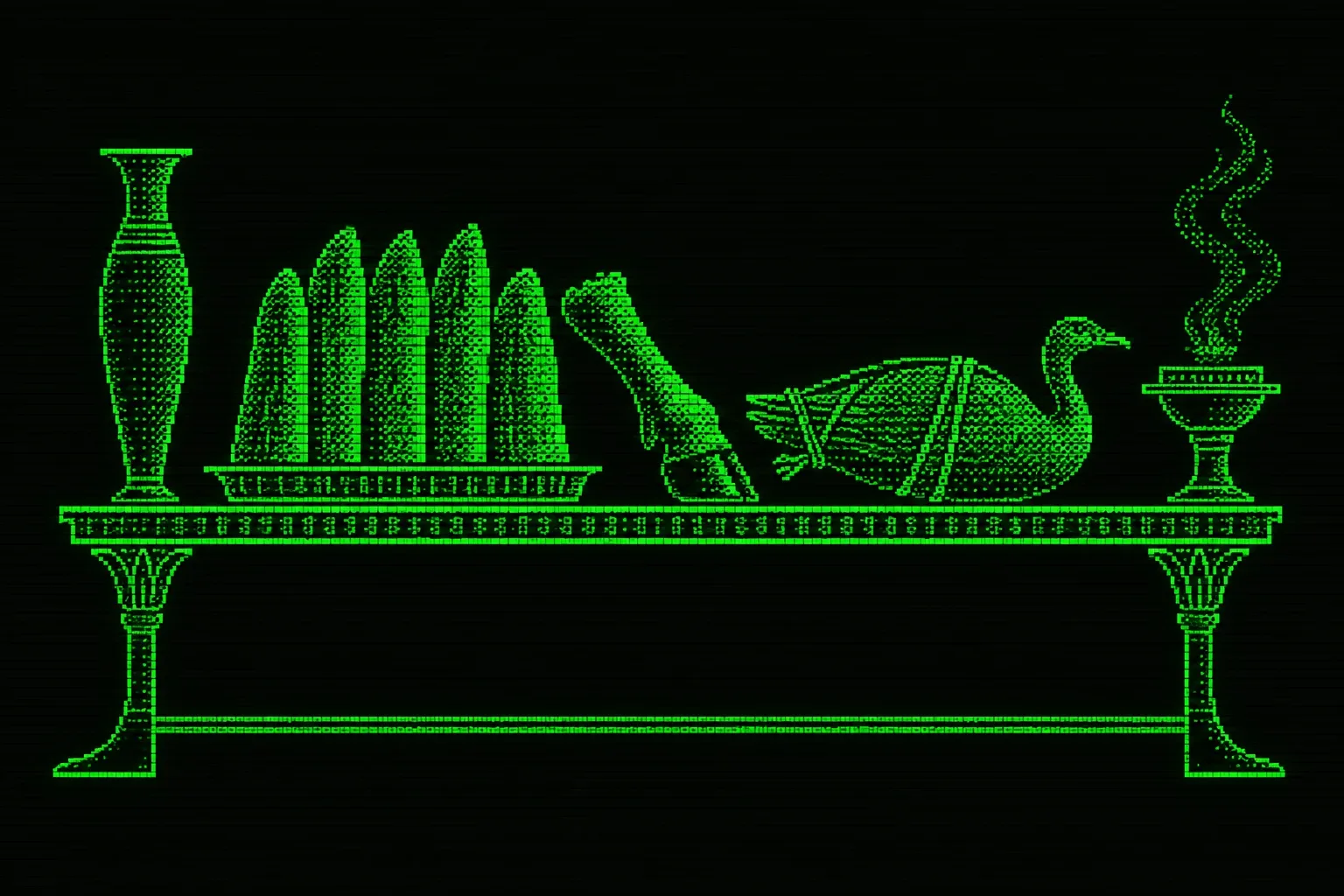
~/sacred-texts/old-kingdom-tomb-inscriptions
Egyptian Tomb of Kai-em-neferet: A Feast Menu for the Dead
- Date
- Carved in the 5th Dynasty (c. 2450–2350 BC) on the wall of the tomb chapel of Kai-em-neferet at Saqqara
- Found
- Mastaba D 23 at Saqqara, Egypt; now in the Museum of Fine Arts, Boston
- Language
- Old Egyptian · Hieroglyphic
- 1
(zꜣṯ) mw 1 snṯr sḏ(,t) 1 sṯi̯-ḥꜣb 1 ḥkn,w 1 sfṯ 1 nẖnm 1 twꜣ,wt 1
One libation of water; one incense fire; festival-scent oil, hekenu oil, sefetj oil, nekhenem oil, tewaut oil: one of each.
Note · Line 1
The list counts rites to be performed for the dead as well as goods to be set out. These five oils and the next two make up the seven sacred oils for anointing. - 2
ḥꜣ,tt ꜥš 1 ḥꜣ,tt ṯḥn,w 1 wꜣḏ(,w) ꜥrf 1 msd(m),t ꜥrf 1 wnḫ,w(j) 2 snṯr sḏ,t 1 ṯꜣ 2
Finest cedar oil and finest Libyan oil, one of each; one pouch of green eye paint, one pouch of black eye paint; two pairs of cloth strips; one incense fire; two cleansing pellets.
Note · Line 2
The green eye paint was made from malachite, the black from galena. - 3
ḫ(ꜣw),t 1 ḥtp-nswt 2 ḥtp-wsḫ,t 2 ḥmsi̯ 1 šns n jꜥ,w-rʾ 1 ḏwj,w 〈〈n〉〉 〈〈jꜥ,w-rʾ〉〉 1 tʾ-wt 1 tʾ-rtḥ 2
One offering platter; two royal offerings, two court offerings; sitting down, once; one shenes cake and one djuyu jar for breakfast; one wet loaf, two reteh loaves.
Note · Line 3
The Egyptian word for breakfast means “washing the mouth.” The djuyu was an earthenware jar. - 4
ḏsr,t 1 ḥ(n)q,t 1 šns-ꜥ n fꜣi̯(.t) 1 šns n šb,w 1 ḏwj,w 〈〈n〉〉 〈〈šb,w〉〉 1 sw,t 2 mw ꜥ 2 bd 2
One djeseret beer, one beer; one shenes cake in a bowl for carrying; one shenes cake and one djuyu jar for the main meal; two sut cuts of beef; two portions of water, two of natron.
Note · Line 4
Natron is a naturally occurring mineral salt used in purification. A sut cut came from the leg of the animal. - 5
šns n jꜥ,w-rʾ 1 ḏwj,w 〈〈n〉〉 〈〈jꜥ,w-rʾ〉〉 1 tʾ-wt 1 tʾ-rtḥ 1 ḥṯ(ꜣ) 2 nḥr,w 2 dp,t 4 pzn ⸢2⸣
One shenes cake and one djuyu jar for breakfast; one wet loaf, one reteh loaf, two hetja loaves, two neheru loaves, four depet loaves, two pesen loaves.
Note · Line 5
The loaves are listed by their Egyptian names. For many of them, the name survives but the recipe does not. - 6
šns 4 tʾ-jm,j-tꜣ 4 ḫnf,w ꜥ 4 ḥbnn,wt ꜥ 4 q(m)ḥ,w-qmꜣ 4 jdꜣ,t ḥꜣ =k 4 [pꜣ],t ⸢4⸣
Four shenes cakes, four imy-ta loaves; four portions of khenfu cake, four portions of hebenenut bread; four qemhu-qema loaves; behind you, four idat loaves; four pat loaves.
Note · Line 6
“Behind you” gives the position of the loaves in relation to the dead man, addressing him directly. - 7
tʾ-ꜣ(šr) 4 ḥḏ(,w) ꜥ 4 ḫpš 1 jwꜥ 1 zḫn 1 sw,t ⸢4⸣ ⸢spr⸣ 4
Four asher loaves, four portions of onions; one foreleg, one iwa joint on the bone, one sekhen cut, four sut cuts of beef, four cuts of rib meat.
- 8
ꜣšr,t 4 mjz,t 1 nnšm 1 ḥꜥ(,w) 1 j(w)f ḥꜣ(,t) 1 rʾ 1 ṯ(rp) 1
Four pieces of roast meat, one liver, one spleen, one hau cut, one piece of breast meat; one greylag goose, one white-fronted goose.
- 9
z,t 1 s 1 mn,wt 1 tʾ-z(j)f 1 šꜥ,t 3 npꜣ,t 2 mz(,w)t 2
One pintail duck, one es-goose, one pigeon; one sif loaf, three shat cakes, two small nepat cakes, two servings of the emmer dish called mesut.
- 10
ḏsr,t ꜥ 2 ḏsr,t jꜣ,tt 2 ḥ(n)q,t ḫnms ꜥ 2 ḥ(n)q,t ꜥ 2 sḫp,t ꜥ 2 pḫꜣ ꜥ 2 ḏwj,w sšr 1
Two portions of djeseret beer, two djeseret-iatet beers; two portions of khenemes beer, two of beer, two of sekhepet drink, two of pekha fruit beer; one djuyu jar of sesher.
- 11
dꜣb.pl ꜥ 2 jrp ꜥ 2 〈〈jrp〉〉 ꜥbš 2 〈〈jrp〉〉 ꜥ 2 〈〈jrp〉〉 ꜥ 2 〈〈jrp〉〉 ꜥ 2 ḥbnn(,w)t ꜥ 2
Two portions of figs, two portions of wine, two abesh jars of wine, two portions of wine, two portions of wine, two portions of wine, two portions of hebenenut bread.
- 12
ḫnf,w ꜥ 2 jšd.pl ꜥ 2 sẖ,t ḥḏ.t ꜥ 2 sẖ,t wꜣḏ.t ꜥ [2] ꜥg,t z(w),t ꜥ 2 ꜥg,t jt ꜥ 2 bꜣbꜣ,t.pl ꜥ 2
Two portions of khenfu cake, two of ished fruit, two of white grain, two of green grain, two of parched emmer, two of parched barley, two of babat grain.
- 13
nbs ꜥ 2 tʾ-nbs ꜥ 2 wꜥḥ ꜥ 2 (j)ḫ,t nb(.t) bnj.t 1 rnp(,w)t nb.t 1 gs,w 1 ḥnk(,t) 1
Two portions of jujubes, two of jujube bread, two of tiger nuts; one of every sweet thing, one of every kind of fresh produce; one serving of half-loaves, one henket offering.
Note · Line 13
Jujubes are the small fruits of the Christ’s thorn tree. Tiger nuts are the edible tubers of a sedge. - 14
ḥꜣ(,t) wdḥ,w stp,t zꜣb-ꜥḏ-mr Kꜣ≡j-m-nfr,t
The best from the offering stand and the choice cuts, for Kai-em-neferet, senior administrator of the province.
- 15
ẖr(,j)-tp-nswt mdw-rḫ,yt ḥr,j-sštꜣ wḏ-mdw-n-ḥr,j-wḏb,w wr-mḏ-Šmꜥ,w ḫrp-zẖꜣ(,ww) jwn-knmw,t (j)m(,j)-r(ʾ)-wsḫ,t ḥr,j-sštꜣ-n-wḏ(,t)-mdw-n,t-nb≡f mr,y-nb≡f mrr(,w)-nb≡f-[rꜥw]-nb nb-jmꜣḫ Kꜣ≡j-m-nfr,t
The king’s chamber attendant, staff of the Rekhyt people, keeper of secrets, giver of orders to the chief of distribution, great one of the Ten of Upper Egypt, director of scribes, pillar of the Kenmut, overseer of the Broad Hall, keeper of the secret of his lord’s command, beloved of his lord, whom his lord loves day after day, lord of honor: Kai-em-neferet.
- 16
zꜣb-ꜥḏ-mr ns,t-ḫnt,jt jwn-knmw,t ḫrp-zẖꜣ(,ww-j)r(,j)-jꜥḥ ḫrp-wsḫ,t ḥm-nṯr-Mꜣꜥ,t zẖꜣ(,w)-ꜥ-nswt (j)m(,j)-r(ʾ) jmꜣḫ,w-ḫr-nṯr-ꜥꜣ jmꜣḫ,w-ḫr-⸢nswt⸣ jmꜣḫ [...] Kꜣ≡j-m-nfr,t
Senior administrator of the province, presiding officer, pillar of the Kenmut, director of the scribes of the keeper of the moon, director of the Broad Hall, priest of Maat, scribe of the king’s records, overseer, honored before the great god, honored before the king, the honored one … Kai-em-neferet.
Note · Line 16
Maat is the goddess of truth, justice, and right order. To be “honored” in the tomb formula meant not only to be held in esteem but also to be provided for after death.