~/sacred-texts/kadesh-battle-reliefs-of-ramesses-ii
Kadesh Battle Relief: Severed Hands Counted for Ramesses II
- Date
- Carved in the reign of Ramesses II (c. 1279–1213 BC), after the battle of Kadesh in 1274 BC, on the outer walls of the Ramesseum at Thebes
- Found
- Ramesseum, the mortuary temple of Ramesses II in western Thebes (Luxor); still in place
- Language
- Egyptian (Ramesside) · Hieroglyphic
- 1
sḥw nn ḫꜣs,t.pl sbj.pl smꜣ.n ḥm =f jw =[f] wꜥi̯ ḏr,t ḥr ẖꜣ,t ssm,t.pl ḥr wrr,yt.pl pḏ,t.pl ḫpš.pl ḫꜥ,w.pl nb n.w rʾ-〈ꜥ〉-ḫt
Tally of these rebel foreign lands whom His Majesty killed, he alone: hands with bodies, horses with chariots, bows, swords, all the weapons of battle.
Note · Line 1
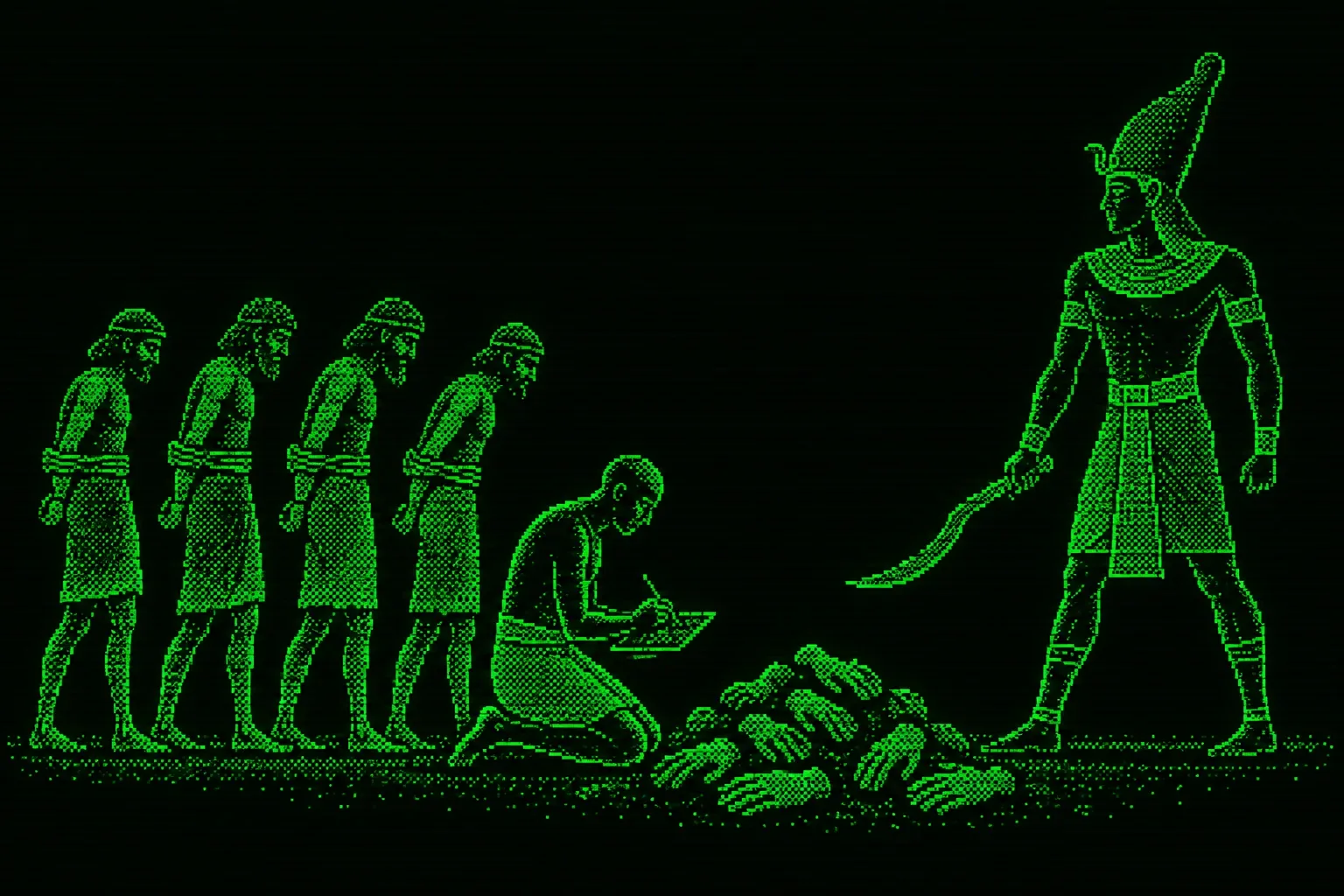
This caption belongs to the Ramesseum reliefs of the battle of Kadesh (c. 1274 BC) and labels the counting of the spoils: an Egyptian piles up hands cut from the enemy dead while scribes record them, with a file of prisoners behind. The Egyptian army counted enemy kills by cutting off their hands. The sword named here (ḫpš) is the khopesh, a curved sickle-sword. - 2
šsp kfꜥ.pl jni̯.n ḥm =f m nḫt,w.pl ḫpš =f m tꜣ pn ẖs n Ḫt tꜣ pn ẖs N~h~rj~n ḥnꜥ wr.pl n ḫꜣs,t.pl nb.t jy ḥnꜥ pꜣ ḫr,w n Ḫt m sqr-ꜥnḫ.pl
Receiving the plunder that His Majesty brought in by the victories of his sword-arm from this wretched land of Hatti and this wretched land of Naharin, together with the chiefs of every foreign land who had come with the Fallen One of Hatti, all as captives taken alive.
- 3
ms kfꜥ.pl m-bꜣḥ ḥm =f m jni̯.n =f m nḫt,w.pl ḫpš =f m tꜣ pn ẖs n Ḫt m-ḫt rdi̯.n ḥm =f m [ḥr] [n] mšꜥ =f n,ṯ-ḥtr.pl =f wr.pl =f r-ḏd
Presenting the plunder before His Majesty, all that he brought in by the victories of his sword-arm from this wretched land of Hatti, after His Majesty had given his orders to his army, his chariotry and his officials, saying:
- 4
jni̯ n =tn kfꜥ.pl m ḥꜣq,t =j ḏs =j j〈w〉 =j wꜥi̯.kw jw n mšꜥ ḥnꜥ ḥm =f n wr.pl ḥnꜥ =j n n,ṯ-ḥtr.pl
"Bring in the plunder of my own spoil, mine alone! I was by myself, there was no army with His Majesty, no officials with me, no chariotry!"
Note · Line 4
The king speaks, and his speech slides between “I” and “His Majesty,” a common habit of royal inscriptions.