~/sacred-texts/kadesh-inscriptions-of-ramesses-ii
The Kadesh Bulletin of Ramesses II: I Was After Them Like a Griffin
- Date
- Carved in the 19th Dynasty under Ramesses II (1279–1213 BC), after the battle of his regnal year 5 (1274 BC), on the pylon of Luxor Temple at Thebes
- Found
- Luxor Temple, Thebes (modern Luxor, Egypt); still in place on the east tower of the pylon
- Language
- Egyptian (hieroglyphic) · Hieroglyphic
Regnal year 5 of Ramesses II, south of Kadesh. Two Shasu tell the king that the Hittite ruler is far away near Aleppo; what they told His Majesty was a lie. He camps northwest of the city. Two captured Hittite scouts are dragged before His Majesty and admit that the enemy stands in formation behind Kadesh-ta-Iset, ready to fight! The officials call the failure of the king’s nobles a grave offense.
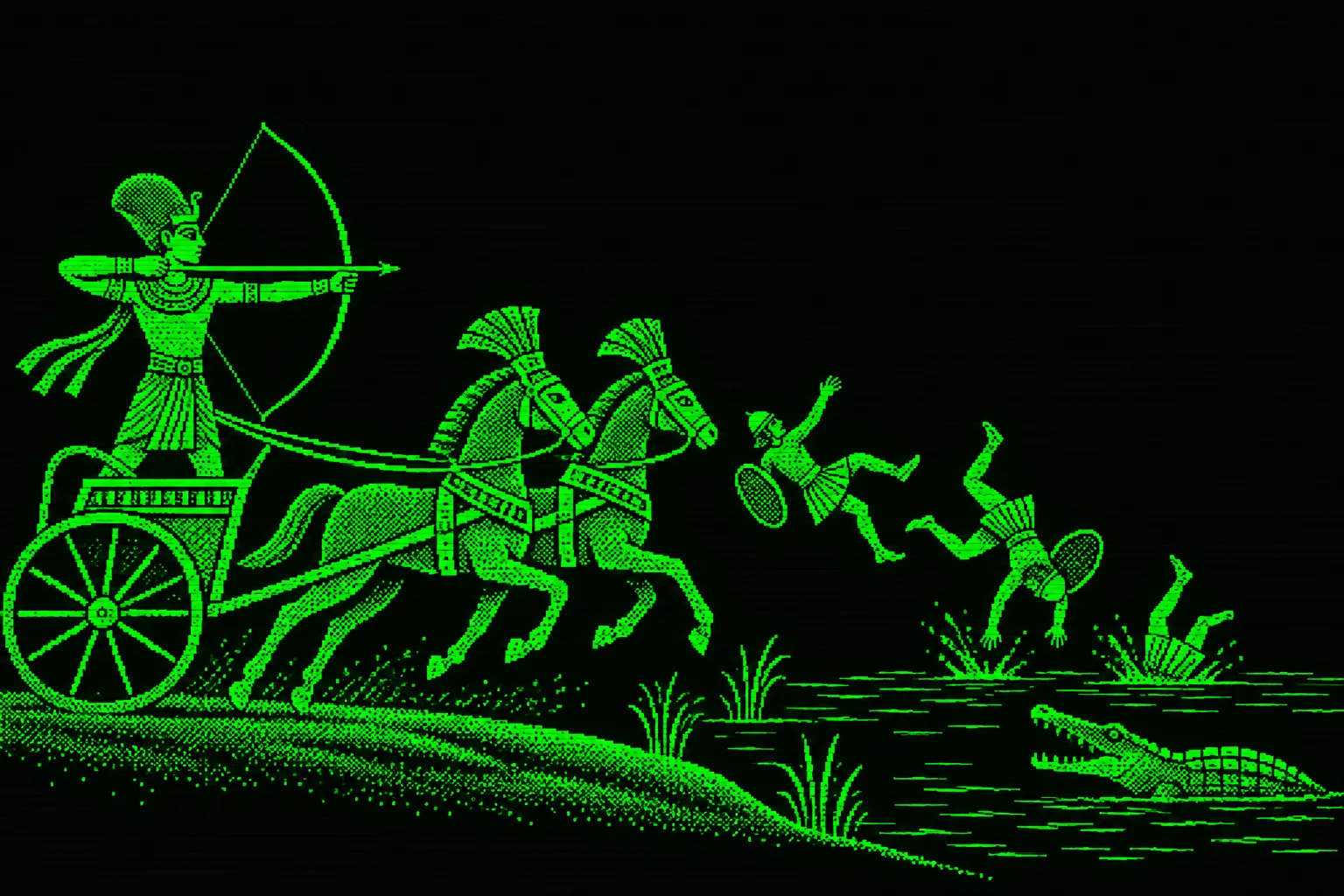
The Hittite chariots cross the ford and break into the marching army. Ramesses arms, mounts behind Victory-in-Thebes, his great team of horses, and charges all alone. His Majesty slaughtered them. Then he speaks himself: the foes plunge into the Orontes as crocodiles plunge, and I was after them like a griffin.
- 1
rnp,t-sp 5 ꜣbd 3 n šm,w sw 9 ḫr ḥm n Ḥr,w Kꜣ-nḫt-mr,y-Mꜣꜥ,t [...]
Regnal year 5, third month of the harvest season, day 9, under the Majesty of Horus, Strong Bull Beloved of Maat …
Note · Line 1
This is the Horus name of Ramesses II. Maat is the goddess of truth and right order. - 2
[jst] ḥm =f ḥr Ḏꜣ~hj m wḏ,t =f sn,nw.t n.[t] nḫt
Now His Majesty was in Djahy on his second victorious campaign.
Note · Line 2
Djahy was an Egyptian name for a region along the eastern Mediterranean seaboard. - 3
rs nfr m ꜥnḫ-(w)ḏꜣ-s(nb) [...] ḥm =f ḥr ṯs,t ⸢rs,j⸣.[t] n.t Qdš
A good awakening in life, prosperity and health … His Majesty in the hill country south of Kadesh.
Note · Line 3
Kadesh stood on the Orontes River in what is now Syria. - 4
m-ḫt nn ḥr tr n dwꜣ,yt [...] [Mnṯ],w
After this, in the morning, … Montu.
Note · Line 4
Montu was an Egyptian war god. - 5
wḏꜣ nb m-ḫd
The lord marched north.
- 6
spr r-[hꜣ],w rs,j dmj [n] Šꜣ⸢b~tw⸣[n]
He came near the southern edge of the town of Shabtuna.
- 7
[...] Šꜣ~s,w 2 m nꜣ-n mhw,t.pl Šꜣ~s,w.[pl] [r] [ḏd] [n] [ḥm] =[f]
… two Shasu men from the Shasu clans, to say to His Majesty:
Note · Line 7
The Shasu were nomadic herders of the Levant. - 8
[m] nꜣy =[n] sn.pl n,tj m ꜥ[ꜣ].wpl n mhw,t.pl ⸢m⸣ [...] n Ḫt di jwi̯.t =n n ḥm =f r ḏ[d]
“It was our brothers, the chiefs of the clans with … of Hatti, who sent us to His Majesty to say:
- 9
jw =n r jri̯.t bꜣk.pl n Pr-ꜥꜣ [ꜥnḫ-(w)ḏꜣ-s(nb)] mtw =n rwi̯ =n m-dj pꜣ [wr] [n] [Ḫt]
‘We will become servants of Pharaoh—may he live, prosper and be well—and break away from the prince of Hatti.’”
Note · Line 9
Hatti was the Hittite kingdom. The ruler whom the Egyptian account calls a prince was himself a king. - 10
[ḏd].jn ḥm =f n =sn
Then His Majesty said to them:
- 11
[...] [tn]w nꜣy =[tn] [...]
“… where are your …?
- 12
[...] jwi̯ =tn r ḏd pꜣj sḫr [n] ḥm =f
… you to come and tell His Majesty of this matter?”
Note · Line 12
The king refers to himself in the third person. - 13
ḏd.j[n] =⸢sn⸣ [n] ḥm =[f]
Then they answered His Majesty:
- 14
st m pꜣ n,tj pꜣ wr ẖs n Ḫt jm
“They are where the wretched prince of Hatti is.
- 15
pꜣ-wn pꜣ ⸢ḫr,w⸣ ⸢n⸣ Ḫt m pꜣ [...] ḥr mḥ,tj Tw~n~pj
For the Hittite foe is in the … north of Tunip.
- 16
[...] r jy.t m-ḫnt.wtjw ḏr [...] Pr-ꜥꜣ [...] m-ḫd
… to come south since … Pharaoh … northward.”
- 17
js[t] ḏd [...] ḏd =sn n ḥm =[f] m [ꜥ]ḏꜣ
But they spoke …, and what they told His Majesty was a lie.
- 18
[jw] m pꜣ ḫr,w [ẖs] n Ḫ[t] [...] r ptr pꜣ n,tj ḥm =f jm n-jb-n tm [...] ḥm =[f] [...]
For it was the wretched Hittite foe who … to see where His Majesty was, so as not to … His Majesty …
- 19
[...] [Šꜣ]~s,w.pl r ḏd nꜣ.pl [...] ḥnꜥ mšꜥ =f n,ṯ-ḥtr.pl =f ḥnꜥ wr.pl n [tꜣ] [nb] [n,t]j ⸢m⸣ [ww] [n] pꜣ tꜣ n Ḫt
… the Shasu to say these … with his army and his chariot warriors, and with the princes of every land under Hatti’s rule.
- 20
mšꜥ.pl =⸢w⸣ [n,ṯ-ḥtr.pl] =w ⸢jni̯.n⸣ =⸢f⸣ m-dj =f m [nḫt.wpl] r ꜥḥꜣ [ḥ]nꜥ mšꜥ.pl [n] ḥm =f ꜥḥꜥ grg [...] [Qdš]-tꜣ-js,t jw n rḫ ḥm =f r-ḏd st jm {m}〈w〉šd.w pꜣ Šꜣ~s,w 2 n,tj m-bꜣḥ
Their armies and their chariot warriors, whom he had brought with him as warriors to fight His Majesty’s armies, stood drawn up for battle … Kadesh-ta-Iset. His Majesty did not know they were there when the two Shasu who stood before him were questioned.
Note · Line 20
The troops were already at Kadesh, not far off to the north as the Shasu had claimed. - 21
[nꜥi̯.t] ḥm =f m-ḫd
His Majesty went north.
- 22
spr r mḥ,[tj-jmn,tj] Qdš
He reached the northwest side of Kadesh.
- 23
wꜣḥ jhy n ⸢mšꜥ⸣ [n] ḥm =f [jm]
Camp was pitched there for His Majesty’s army.
- 24
[...] jsb,t n.t ḏꜥm ḥr mḥ,tj Q[d]š [ḥr] [tꜣ] [r]j,[t] jmn,[tt] [n.t] J~⸢r~n~ṯ⸣
… a throne of electrum north of Kadesh, on the west bank of the Orontes.
Note · Line 24
Electrum is an alloy of gold and silver. - 25
jy{t}.jn ḥꜣ~p,wt [n,tj] m šms,w ḥm =f ẖr ḥꜣ~p,wt 2 [n] pꜣ ḫr,w n Ḫt sṯꜣ.[wpl] m-bꜣḥ
Then a scout from His Majesty’s retinue came with two scouts of the Hittite foe. The two were dragged before His Majesty.
Note · Line 25
These captives are not the two Shasu who spoke earlier. - 26
ḏd.[jn] ḥm =f [n] =[sn]
Then His Majesty said to them:
- 27
nt[w]tn jḫ
“Who are you?”
- 28
ḏ[d.{t}〈j〉n] =[sn]
Then they answered:
- 29
[tw]≡n pꜣ wr n Ḫt
“We belong to the prince of Hatti.
- 30
ntf di jwi̯.t =n r ptr pꜣ n,tj ḥm =f jm
It was he who sent us to see where His Majesty is.”
- 31
ḏd.〈j〉n ḥm =⸢f⸣ ⸢n⸣ =sn
Then His Majesty said to them:
Note · Line 31
Ramesses II is questioning two captured Hittite scouts. - 32
sw tnw ntf pꜣ ḫr,w n Ḫt
“Where is he, that foe from Hatti?
Note · Line 32
The king calls its ruler “the foe” rather than naming him. - 33
m =k [...] sḏm =j r-ḏd sw m pꜣ tꜣ [n] [Ḫ~r]~b ḥr mḥ,tj Tw[npj]
Look … I heard he was in the land of Aleppo, north of Tunip!”
- 34
ḏd.n =[sn] [n] ḥm =f
They said to His Majesty:
- 35
ptr pꜣ wr ẖs n Ḫt jwi̯ ḥnꜥ ḫꜣs,t.pl qn,w.pl n,tj ḥnꜥ =f jni̯.n =f m-dj =f [m] nḫt.t[pl] [...] pꜣ tꜣ n Dr~[d~n]~y [pꜣ] tꜣ n N~h~[r~n] [pꜣ] K~š~k~š nꜣ Mꜣ~[s] [nꜣ] [P~dꜣ]~s pꜣ tꜣ n Q~r~q~š ḥnꜥ R~k pꜣ tꜣ n K~r~k~m~š pꜣ [tꜣ] [n] J~r~ṯ pꜣ tꜣ n J~[k]~r~ṯ [pꜣ] [Jr~wn] pꜣ tꜣ [n] Jn~s M~š~nṯ Qdš Ḫ~r~[b] pꜣ tꜣ n Qdw r-ḏr =f
“Look, the wretched prince of Hatti has come. Many foreign lands are with him; he has brought them with him as warriors: … the land of Dardany, the land of Naharina, Kashkash, the people of Masa, the people of Pidasa, the land of Qarkisha and Lukka, the land of Carchemish, the land of Arzawa, the land of Ugarit, Arwanna, the land of Inesa, Mushnatu, Kadesh, Aleppo, and the whole land of Qadi.
- 36
st ꜥpr ẖr mšꜥ.pl =w ḥnꜥ n,ṯ-[ḥ]tr.pl =w
They come equipped with their armies and their chariot fighters.
- 37
[ꜥšꜣ] [st] r šꜥj n.w wḏb.pl
They outnumber the grains of sand on the riverbanks.
- 38
ptr [st] ꜥḥꜥ grg ḥr [r] ꜥḥꜣ n-ḥꜣ Qdš-tꜣ-js,t
Look, they stand in formation behind Kadesh-ta-Iset, ready to fight!”
Note · Line 38
Kadesh-ta-Iset is Kadesh on the Orontes River, in what is now Syria. - 39
ꜥḥꜥ.n rdi̯.n ḥm =f ꜥš =tw sr.pl m-bꜣḥ [...]
Then His Majesty had the high officials summoned before …
- 40
ḏd.jn ḥm =f [n] [tn] =sn
Then His Majesty said to them:
- 41
ptr [...] [n,t]j nꜣ.w jm,j-rʾ-ḫꜣs,t.pl ḥnꜥ nꜣ wr.pl n Pr-ꜥꜣ [ꜥnḫ-(w)ḏꜣ]-s(nb) j:m =f
“Look at … in which the overseers of foreign lands and the nobles of Pharaoh (may he live, prosper, and be well) find themselves!
Note · Line 41
The king speaks of himself here as Pharaoh. The wish that follows the title is a customary blessing. - 42
jri̯ =[s]n ꜥḥꜥ ḥr ḏd n Pr-ꜥꜣ ꜥnḫ-(w)ḏꜣ-s(nb) tnw hrw
Day after day they stood and told Pharaoh (may he live, prosper, and be well):
- 43
pꜣ wr ẖs n Ḫt m pꜣ tꜣ n Ḫ~r~b ḥr mḥ,tj Twnpj
‘The wretched prince of Hatti is in the land of Aleppo, north of Tunip.
- 44
sw wꜥr ⸢r-ḥꜣ⸣.t [ḥm] =[f] ḏr sḏm =f r-ḏd
He has been in flight before His Majesty ever since he heard the words:
- 45
m =k ꜣ Pr-ꜥꜣ ⸢ꜥnḫ-(w)ḏꜣ-s(nb)⸣ [jwi̯]
“Look now, Pharaoh (may he live, prosper, and be well) has come!”’
- 46
[ḫ]r =⸢sn⸣ ḥr{r} ḏd n ḥm =f m-mn,t
That is what they told His Majesty day after day.
- 47
ptr jri̯ =j sḏm m tꜣj wnw,t m-dj pꜣj ḥꜣ~p,wt 2 n pꜣ ḫr,w n Ḫt r-ḏd
Look what I have heard this very hour from these two scouts of the foe from Hatti:
- 48
pꜣ ḫr,w [ẖs] [n] [Ḫt] jwi̯ ḥnꜥ ḫꜣs,t.pl ꜥšꜣ n,tj ḥnꜥ =f m [rmṯ] [ssm.pl] [q]n,w mj pꜣ šꜥj
‘The wretched foe from Hatti has come with many foreign lands at his side, men and horses as numerous as grains of sand.’
- 49
ptr st ꜥḥꜥ kp.w n-ḥꜣ Qdš-tꜣ-js,t jw bw rḫ nꜣy =j jm,j-rʾ-ḫꜣs,t.pl ḥnꜥ nꜣy =j [wr.pl] ḏd n =n
Look, they stand hidden behind Kadesh-ta-Iset, yet my overseers of foreign lands and my nobles could not tell us,
- 50
st jwi̯
‘They have come.’”
- 51
ḏd.n sr.pl n,tj m-bꜣḥ wšb =sn n [nṯr]-nfr r-n,tj
The high officials in his presence spoke, answering the perfect god in these words:
Note · Line 51
“The perfect god” is a royal title: the officials are answering Ramesses himself. - 52
btꜣ,w ꜥꜣ pꜣ jri̯.w nꜣ jm,j-rʾ-ḫꜣs,t.pl ḥnꜥ nꜣ wr.pl n Pr-[ꜥꜣ] ꜥnḫ-(w)ḏꜣ-s(nb)
“What the overseers of foreign lands and the nobles of Pharaoh (may he live, prosper, and be well) have done is a grave offense:
- 53
pꜣ tm di.t smtj.tw n =sn pꜣ ḫr,w n Ḫt m [pꜣ] [n,tj] [nb] sw jm mtw =sn ḏd smj =f n Pr-ꜥꜣ ꜥnḫ-[(w)ḏꜣ-s(nb)] m-mn,[t]
they failed to have the foe from Hatti watched for them wherever he was, and to give Pharaoh (may he live, prosper, and be well) a daily report on him.”
- 54
ꜥḥꜥ.n rdi̯ m-ḥr-n ṯꜣ,tj r ꜣs pꜣ mšꜥ n ḥm =f jw =sn ḥr mšꜥ ḥr rsj dmj n Š~b~tw~n r jni̯.ṱ =w [r] pꜣ n,t[j] ḥm =f j[m]
Then the vizier was ordered to hurry His Majesty’s troops along as they marched south of the town of Shabtuna, and to bring them to where His Majesty was.
Note · Line 54
The vizier was the king’s chief minister. - 55
[js]t wnn sr.pl ḥm =f snḏm ḥr mdwi̯.t m-dj jw pꜣ ḫr,w ẖs n Ḫt [jwi̯] ḥnꜥ mšꜥ =f [n],ṯ-ḥtr.pl =f m-mj,tt ḫꜣs,t.pl ꜥšꜣ.t n,tj ḥnꜥ =f
Now His Majesty’s officials were seated at ease, talking with him, when the wretched foe from Hatti arrived with his army and his chariot fighters, and with the many foreign lands at his side.
- 56
ḏꜣi̯.yw =sn tꜣ mšd,t [...]
They crossed the ford …
- 57
[...] ꜥ[q] m-ẖnw pꜣ mšꜥ [n] [ḥm] =f jw =[sn] [ḥr] [m]š[ꜥ] jw bw [r]ḫ =sn
… they broke into the midst of His Majesty’s army while his men were marching, unaware.
- 58
ꜥḥꜥ.n bdš.n pꜣ mšꜥ n,ṯ-ḥt[r].pl n ḥm =f r-ḥꜣ,[t] =sn m-ḫd r b(w) [n],tj ḥm =f jm
Then His Majesty’s troops and chariot fighters gave way before them and went north to where His Majesty was.
- 59
ꜥḥꜥ.n jn[ḥ] [...] [n]ꜣ-n ḫr,pl [n] Ḫt nꜣ šms,w.pl [n] ⸢ḥm⸣ =[f] [n,tj] r-gs =[f]
Then … of these foes from Hatti surrounded the followers of His Majesty who were at his side.
- 60
ꜥḥꜥ.n gmḥ st ḥm =f
Then His Majesty caught sight of them.
- 61
wn.jn =f ḥr ꜥḥꜥ ꜣs ḫꜥr.w r =sn mj jtj =f Mnṯ,w
Then he sprang to his feet,
raging against them like his father Montu.Note · Line 61
The “he” is Ramesses II. The king calls Montu, the Egyptian war god, his father. - 62
šsp.n =f ẖkr.pl ꜥḥꜣ ṯꜣi̯ [...] [⸮_?] =f ṯꜣ~r~yn
He took up his battle gear and put on … his coat of scale armor.
- 63
sw mj Swtḫ m ꜣ,t sḫm =f
He was like Seth in the hour of his strength.
Note · Line 63
Seth was the god of storms, famed for his strength in battle. - 64
ꜥḥꜥ.n =f ṯsi̯ r Nḫt,[w]-m-[Wꜣs,t] pꜣy =[f] [ḥtr] ꜥꜣ
Then he mounted his chariot behind Victory-in-Thebes, his great team of horses,
- 65
jw =f ḥr ḫrp ꜣs wꜥi̯ ḥr tp =f
and drove swiftly on, all alone.
- 66
ḥm =f sḫm
His Majesty was mighty.
- 67
jb =f wmtj
His heart was resolute.
- 68
n rḫ =t[w] [ꜥḥꜥ] r-ḥꜣ,t =[f]
No one could stand before him.
- 69
[⸮_?] =f nb ḥr rkḥ ḫ,t wbd.n =f ḫꜣs,t nb.[t] m hh =f
His whole … was ablaze;
he burned every foreign land with his scorching breath. - 70
jr,t.j =f ḥs.y ḏr mꜣꜣ =[f] st
Both his eyes were fierce from the moment he saw them.
- 71
bꜣ,w =f ḥr n[b]i̯.[t] mj ḫ,t r =sn
His power blazed like fire against them.
- 72
[n] ḏꜥr.n =f ḥḥ m ḫꜣs,t.jw.pl
He paid no heed to a million foreigners.
- 73
ptr =f st mj dḥꜣ
He saw them as chaff.
- 74
j[w] [...] [m]-ẖnw pꜣ ḫr,w n nꜣ-n ḫr,pl n Ḫt ḥ[n]ꜥ ḫꜣs,t.pl ꜥšꜣ.t [n,tj] ḥnꜥ =sn [j]w ḥm =f mj Swtḫ-ꜥꜣ-pḫ,tj mj Sḫm,t m ꜣ,t nšn,j =s
… into the midst of the troops of the foes of Hatti
and the many foreign lands that were with them.
His Majesty was like Seth, great in strength, like Sekhmet in the hour of her rage.Note · Line 74
Sekhmet is the lioness goddess whose fury brings slaughter. - 75
jw ḥm =f ḥr ḥdb pꜣ ḫr,w n pꜣ ḫr,w n Ḫt [r-ḏr] =[f] [...] wr.[pl]-ꜥꜣ.wpl nꜣy =[f] sn.pl r-ḏ[r] =w m-mj,tt [w]r.pl nb n ḫꜣs,[t.pl] [nb.t] ⸢jyi̯⸣ ḥnꜥ =f mšꜥ =w n,ṯ-ḥtr.pl =w ḫr ḥr ḥr =sn m wꜥ ḥr wꜥ
His Majesty struck down the whole army of the foe of Hatti,
… great princes, all his brothers,
and likewise all the princes of all the foreign lands who had come with him.
Their troops and chariot fighters lay fallen on their faces, one on top of another.Note · Line 75
The “foe of Hatti” is the Hittite king, Muwatalli II. - 76
jw ḥm =f ḥr smꜣ st ⸮ḫr? [...] ⸢s,t⸣ =sn [...] m gbgb,t.pl r-ḥꜣ,t ssm,t =f jw ḥm =f [wꜥi̯].w n ky ḥnꜥ =f
His Majesty slaughtered them. They fell … their place,
… in heaps of corpses before his horse.
His Majesty was alone; no one else was with him. - 77
〈rḏi̯.n〉 ḥm =j hꜣi̯ pꜣ ḫr,w.pl n nꜣ-n ḫr,pl n Ḫt ḥr ḥr =sn m wꜥ ḥr wꜥ m hꜣi̯ msḥ.pl r pꜣ mw n.w J~r~n~[ṯ] jw =[j] m-sꜣ =[sn] [mj] ꜥḫḫ
My Majesty sent the troops of those foes of Hatti plunging face-first into the waters of the Orontes,
one on top of another, as crocodiles plunge,
and I was after them like a griffin.Note · Line 77
Ramesses now speaks in his own voice. The Orontes flows past Kadesh. The griffin, part lion and part bird of prey, is an image of the king in pursuit.