~/sacred-texts/kadesh-inscriptions-of-ramesses-ii
The Kadesh Poem of Ramesses II: Did a Father Ever Forget His Son?
- Date
- Carved in the 19th Dynasty under Ramesses II (1279–1213 BC), after the battle of his fifth year (about 1274 BC), on the east and west towers of the pylon of Luxor Temple
- Found
- Luxor Temple, Thebes (modern Luxor), Egypt; still in place on the two towers of the pylon of Ramesses II
- Language
- Egyptian · Hieroglyphic
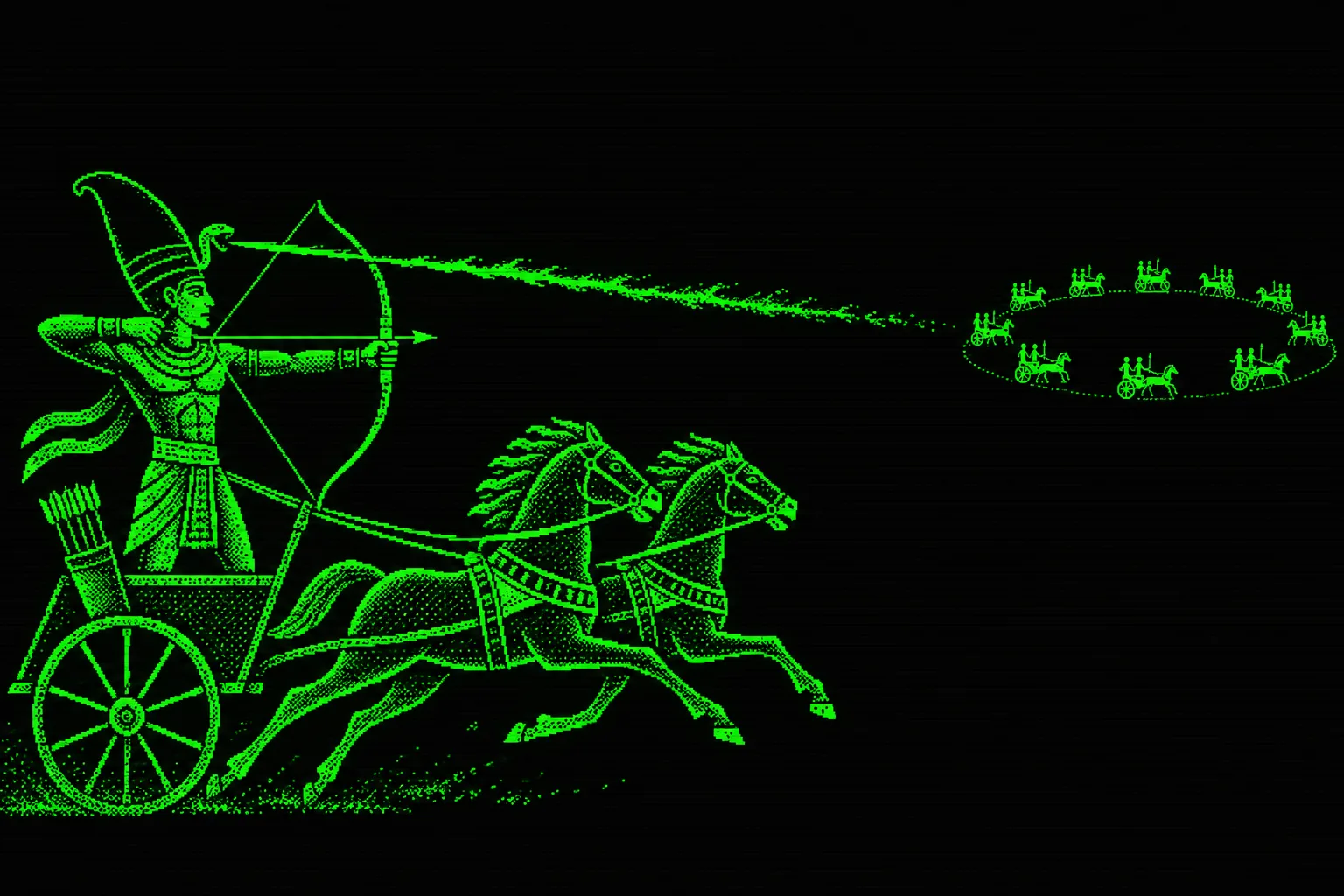
The poem opens in praise of the young Ramesses II, then marches him north to Kadesh, where the Hittite king has hidden his chariots, thick as swarming locusts. They strike the division of Pre, the army runs, and the king finds 2,500 chariots around him. He cries to Amun: Did a father ever forget his son? The god answers I am with you! and the chariots become a heap of corpses before my horse.
Ramesses then turns on his own troops (I am your wall of iron), fights again at daybreak, and reads out the Hittite king’s letter: Peace is better … He goes home to Pi-Ramesses, where the gods welcome him.
- 1
ḥꜣ,t-ꜥ-m pꜣ [n]ḫt,w [n] nswt-bj,tj Wsr-Mꜣꜥ,t-Rꜥw-stp.n-Rꜥw sꜣ-Rꜥw [Rꜥw-msi̯-s(w)-mri̯.y-Jmn] ⸢di⸣ ⸢ꜥnḫ⸣ ḏ,t jri̯.n =f m pꜣ tꜣ n Ḫt [N]h~r~n pꜣ tꜣ [n] [...] m P~d~s [m] pꜣ D~r~dny m pꜣ tꜣ n M~s m pꜣ tꜣ n [Q]~r~q~š [...] [m] K~r~k~m~š Qdj ⸢tꜣ⸣ [n] Qdš m pꜣ [...]
Here begins the account of the victory of the King of Upper and Lower Egypt, Usermaatre-Setepenre, the Son of Ra, Ramesses-Meriamun, given life forever,
which he won in the land of Hatti, in Naharina, in the land of …,
in Pidasa, in Dardania,
in the land of Masa, in the land of Karkisa …,
in Carchemish, in Qode, in the land of Kadesh,
in the …Note · Line 1
Usermaatre-Setepenre is the throne name of Ramesses II. Meriamun means “beloved of Amun.” - 2
[jst] ⸢ḥm⸣ =f m nb rnp,j pr-ꜥ jw,tj sn,nw =f
Now His Majesty was a young lord, a hero without equal.
- 3
ḫpš.du =f wsr
Both his arms were mighty;
- 4
jb =f wmt
his heart was resolute.
- 5
[...] ⸢mj⸣ Mnṯ,w m ꜣ,[t] =[f] nfr ꜣb,wt mj Jtm,w [...] wr nḫt,w ḥr ḫꜣs,t.pl nb.t
… like Montu in his hour,
perfect in form like Atum …,
great in victory over all foreign lands.Note · Line 5
Montu was the warrior god of Thebes; Atum was the creator god of Heliopolis. - 6
n rḫ =tw šs[p] =f r ꜥḥꜣ
No one could face him in battle.
- 7
sbtj ḏr m-[r]k mšꜥ =f pꜣy =s[n] [...] hrw n ꜥḥꜣ [...] mj,tt [...]
A stout wall around his army, their … on the day of battle,
… the like … - 8
[...] ⸢ꜥq⸣ m ꜥšꜣ.t jw jb =f mḥ m pḥ,tj =f sḫm-ḥꜣ,tj m wnw,t ḥwi̯-n-ḥr mj ḫ,t m tr =[s] n wnm [...] ⸢mj⸣ [...]
… he went in among the throng, his heart sure of his strength,
bold in the hour of hand-to-hand fighting, like fire when its time comes to feed,
… like … - 9
[...] r-ḥꜣ,t =[f]
… before him;
- 10
ḥfn,w.pl bdš.w n ptr =f
hundreds of thousands grew weak at the sight of him.
- 11
nb snḏ,t.pl ꜥꜣ hmhm,t m ḥꜣ,tj n.w tꜣ.pl nb.pl wr šf,yt [w]⸢s⸣r fꜣ,w mj [Swt]ḫ [...]
Lord of terrors, whose war cry rang loud in the heart of every land,
great in the awe he inspired, mighty in renown like Seth …Note · Line 11
Seth, god of storms and violent strength, was invoked as a model of the king’s power in battle. - 12
[...] ꜥw,t.pl
… of the sheep and goats.
- 13
wḏi̯ m qn,t jy ḥbi̯.n =f ḫf[t]-ḥr n ḏd m ꜥbꜥ
He went out in strength and came back having triumphed in the sight of all, without a word of boasting.
- 14
mnḫ sḫr.pl nfr tp-rd gmi̯ =[t]w m tꜣy =f [...]
Excellent were his plans, flawless the orders one found in his …
- 15
[...] jni̯ šms,w.pl =f nḥm mnfy,t =f jw jb =f mj ḏw n [bjꜣ] nswt-bj,tj Wsr-Mꜣꜥ,t-Rꜥw-stp.n-Rꜥw sꜣ-Rꜥw Rꜥw-msi̯-s(w)-mri̯.y-Jmn ⸢di⸣ ⸢ꜥnḫ⸣
… he brought back his followers and saved his troops, his heart like a mountain of ore:
the King of Upper and Lower Egypt, Usermaatre-Setepenre, the Son of Ra, Ramesses-Meriamun, given life. - 16
jst rf spdd.[n] [...] [jni̯].n =f m nḫt,w.pl ḫpš =f sdbḥ.w m ḫꜥ,w =[sn] [nb].pl dd n =sn tp-rd n ꜥḥꜣ
Now … equipped those he had brought by the two victories of his arm.
They were furnished with all their weapons and given their orders for battle. - 17
nꜥi̯.t pw jri̯.n ḥm =f m-ḫd [...]
Then His Majesty journeyed north …
- 18
[...] sw 9
… day nine.
- 19
sš ḥm =f pꜣ ḫtm n Ṯꜣ~rw [...] [M]⸢nṯ⸣,w m pr[i̯] =f
His Majesty passed the fortress of Tjaru … Montu as he went forth.
Note · Line 19
Tjaru guarded Egypt’s northeastern frontier, where the military road led out into Sinai. - 20
ḫꜣs,t nb.t ḥr jsdd r-[ḥꜣ,t] =[f]
Every foreign land trembled before him.
- 21
[wr].pl [...] ⸢jn,w⸣ =sn
The princes … their tribute.
- 22
[b]št.[pl] [...] bꜣ,w.pl ḥm =f
The rebels … the manifest power of His Majesty.
- 23
šmi̯ mšꜥ =f ḥr nꜣ [...] m[t]n.wpl n [Km],t
His army marched along the … roads of Egypt.
- 24
ḫr-m-ḫt hr[w.pl] [swꜣi̯] ḥr nn jst ḥm =f m pꜣ-[dmj]-Rꜥw-msi̯-[s]w-mri̯.y-J[m]n [...]
When days had passed since then,
His Majesty was in the City of Ramesses-Meriamun … - 25
[wḏꜣ] ḥm =f m ḫdi̯
His Majesty pressed on northward.
- 26
ḫ[r]-m-ḫt [...] Qdš ꜥḥꜥ.n ḥm =f šmi̯.w n-ḥr =f mj jtj =f Mnṯ,w nb-Wꜣs,t
After … Kadesh,
His Majesty went forward like his father Montu, lord of Thebes. - 27
ḏꜣi̯.n =f mšd,t n.t J~r~n~ṯ m pꜣ mšꜥ tp,j n [...]
He crossed the ford of the Orontes
with the first division of … - 28
⸢s⸣pr ḥm =f r dmj [...]
His Majesty reached the city of …
- 29
[...] Ḫt jwi̯ sḥwi̯ =f n =f ḫꜣs,t nb.t r-šꜣꜥ pḥ,wj n pꜣ ym
… of Hatti had come;
he had gathered to himself every foreign land as far as the ends of the sea.Note · Line 29
The king facing Ramesses at Kadesh was Muwatalli II of Hatti. The roll call that follows names the lands whose forces he had gathered. - 30
pꜣ tꜣ n Ḫt jwi̯ r-ḏr =f pꜣ Nh~r~n m-[mj],tt [...] D~r~dny pꜣ [...] [nꜣ] P~d~s ⸢pꜣ⸣ Jr~wn~n pꜣ Q~r~q~š R~k Q~ḏ~w~dn K~r~k~mš J~k~r~ṯ Qdj pꜣ tꜣ [n] [N~g]s r-ḏr =f Mw~š~n[ṯ] Qdš
The whole land of Hatti had come, and Naharina likewise,
… Dardania, the …,
the people of Pidasa, Arwanna, Karkisa, Lukka,
Kizzuwatna, Carchemish, Ugarit,
Qode, the whole land of Nuhashshe, Mushnatu and Kadesh. - 31
[...] wꜣ
… far distant …
- 32
nꜣy =sn wr.pl jm ḥnꜥ =f
Their princes were there with him,
Note · Line 32
The princes are the rulers of the allied lands. They have joined Muwatalli, king of Hatti. - 33
s-nb ẖr mšꜥ =f
each with his own army.
- 34
n,ṯ-ḥtr.pl =w ꜥšꜣ r-jqr n rʾ-ꜥ mjt,t =sn
Their chariot warriors were many indeed; there was no end to their like.
- 35
ḥbs =sn ḏw.pl jn,t.pl [s]t mj pꜣ snḥm.pl [m-dj] ⸢ꜥšꜣ⸣ =sn
They covered mountains and valleys, thick as swarming locusts.
- 36
[...] sw m ḫ,t =f nb.t
… it from all his possessions.
Note · Line 36
The payment was silver from Muwatalli’s own wealth. - 37
rdi̯.n =f st n ḫꜣs,t.pl nb.t r jni̯.ṱ =w m-dj =f r ꜥḥꜣ
He gave it to all the foreign lands to bring them with him to battle.
- 38
jst pꜣ ḫr ẖs n Ḫt ḥnꜥ ḫꜣs,t.pl ꜥšꜣ.t n,tj ḥ[n]ꜥ =f ꜥḥꜥ.w kꜣp.w ḥri̯ ḥr [...] Q[dš]
Now the wretched foe of Hatti and the many foreign lands with him
stood hidden and ready on the … of Kadesh. - 39
[jst] ḥm =f [...] ḥr [tp] =f [ḥ]n[ꜥ] ⸢šms,w.pl⸣ =f
His Majesty, meanwhile, was … on his own, with his retinue.
Note · Line 39
“His Majesty” is Ramesses II of Egypt. His personal escort was with him, but his army was still on the march. - 40
[pꜣ] ⸢mšꜥ⸣ n [J]mn ḥr m[š]ꜥ m-sꜣ =f
The division of Amun was marching behind him.
Note · Line 40
The four Egyptian divisions bore the names of gods: Amun, Pre (the sun god Ra), Ptah and Seth. - 41
pꜣ mšꜥ n Pꜣ-Rꜥw ḥr ḏꜣi̯.t tꜣ mšd,t m hw rs,j dmj n Š~btn m wꜣ,t jtr,w r pꜣ [n,tj] [ḥm] =[f] j:m
The division of Pre was crossing the ford
just south of the town of Shabtuna,
one iteru by road from where His Majesty was.Note · Line 41
An iteru was an Egyptian measure of distance, about ten kilometres. - 42
⸢pꜣ⸣ [mšꜥ] [n] [P]t[ḥ] [ḥr] ⸢rs,j⸣ dmj n J~r~n~m
The division of Ptah was south of the town of Aranam.
- 43
pꜣ mšꜥ n Swtḫ ḥr mšꜥ ḥr wꜣ,t
The division of Seth was marching along the road.
- 44
jw jri̯.n ḥm =f sk,w.pl tp,j m ḥꜣ,wtj.pl nb n ⸢mšꜥ⸣ =f
His Majesty had formed the front ranks from all the foremost men of his army.
- 45
jst st ḥr mry,t m pꜣ tꜣ n pꜣ J~⸢m⸣~[r]
They were then on the shore in the land of Amurru.
- 46
jst ⸢pꜣ⸣ [wr] ẖs n Ḫt ꜥḥꜥ m-ḥr,j-jb mšꜥ [n],tj ḥnꜥ =f
The wretched prince of Hatti stood in the midst of the army that was with him,
- 47
n pri̯.[n] =f r ꜥḥꜣ n snḏ [n] ḥm =f
but for fear of His Majesty he did not come out to fight.
- 48
jst rdi̯.[n] =f jwi̯.t rmṯ.pl ḥtr.pl qnw ꜥšꜣ r-jqr [mj] [pꜣ] šꜥy jw =sn m ḫmt rmṯ [ḥr] [ḥ]t[r] jw =sn [ꜥpr] ⸢m⸣ ḫꜥ,w.pl nb n ꜥḥꜣ
Then he called up men and teams of horses in great numbers, as many as grains of sand,
three men to a chariot,
armed with every weapon of war. - 49
m =k rdi̯ =tw ꜥḥꜥ =sn kꜣp.w n-ḥꜣ Qdš
Look: they were posted out of sight behind Kadesh.
- 50
ꜥḥꜥ.n =sn pri̯ m tꜣ rj,t rs,j.t n Qdš
Then they came out on the south side of Kadesh.
- 51
šꜥf =sn pꜣ mšꜥ n Pꜣ-Rꜥw m-ḥr,j-jb =f jw =w ḥr mšꜥ jw bw rḫ =[sn] jw bn st [ḥ]r r ꜥḥꜣ
They struck the division of Pre in the middle of its ranks
as its men marched, unaware and unready for battle. - 52
wn.jn pꜣ mšꜥ n,ṯ-ḥtr.pl n ḥm =f ḥr bdš ẖr-ḥꜣ,t =[sn]
Then His Majesty’s troops and chariot warriors lost heart before them.
- 53
jst ḥm =[f] smn ḥr mḥ,tj Qdš ḥr tꜣ rj,t jmn,t.[t] n J~r~n~ṯ
His Majesty, meanwhile, had taken up his position north of Kadesh, on the west bank of the Orontes.
- 54
ꜥḥꜥ.n =tw jwi̯ r ḏd.ṱ =f n ḥm =f
Then someone came to report it to His Majesty.
- 55
ꜥḥꜥ.n [ḥm] =[f] ḫꜥi̯.w mj jtj =f [Mnṯ],w
Then His Majesty appeared like his father Montu.
Note · Line 55
The king calls him his father as he takes the field. - 56
šsp.n =f ẖkr.pl ꜥḥꜣ [...] pꜣ =f ṯ~r~yn
He took up his battle gear … his shirt of scale armour.
- 57
sw mj Bꜥr m wnw,t =f
He was like Baal in his hour.
Note · Line 57
Baal was a storm god worshipped in the Levant and in Egypt, famed for his strength in battle. - 58
ḥtr ꜥꜣ n,tj ẖ[r] ḥm =f Nḫt,w.pl-m-Wꜣs,t n jḥ,w-ꜥꜣ-Wsr-Mꜣꜥ,t-Rꜥw-stp.n-Rꜥw-mri̯.y-Jmn
The great team that bore His Majesty was “Victory in Thebes,” from the Great Stable of Usermaatre Setepenre, beloved of Amun.
- 59
ꜥḥꜥ.n ḫr[p].n ḥm =f m jfd
Then His Majesty drove forward at a gallop.
- 60
ꜥḥꜥ.n =f ꜥq m-ẖnw [...] [jw] =f wꜥ.w ḥr tp =f n ky ḥnꜥ =f
He went into the midst of …,
all alone, with no one else beside him. - 61
šmi̯.t pw [jri̯].n [ḥm] =f r nw n-ḥꜣ =f
Then His Majesty turned to look behind him.
Note · Line 61
The king is Ramesses II, fighting the Hittites at Kadesh on the Orontes. - 62
gmi̯.n =f jnḥ sw 2.500 n ꜥ-n-ḥtr.pl m tꜣ =f wꜣ,t bnr m pḥrr.[wpl] nb n n[ꜣ] [...] [ḥn]ꜥ =f m J~r~ṯ M~s P~d~s jw =sn m ḫmt ḥr ḥtr jw jri̯ =w smꜣ,w jw [b]n sr ḥnꜥ =j bn kḏn jw bn wꜥ,w n mšꜥ [...]
He found that 2,500 chariot teams had hemmed him in on his way out,
all the runners of the … who were with him, from Arzawa, Masa and Pidasa.
They rode three to a chariot and formed a single fighting unit.
There was no officer with me, no charioteer,
not a foot soldier of the army …Note · Line 62
Arzawa, Masa and Pidasa were Anatolian lands fighting on the Hittite side. As the king recalls being left alone, the telling shifts from “he” to “me.” - 63
[...] [tꜣ]y =j n,ṯ-ḥtr.pl m m~r~q~ḥ~t ẖr-ḥꜣ,t =sn
… my chariot fighters were fleeing before them.
- 64
n smn.n wꜥ j:m =sn r ꜥḥꜣ ḥnꜥ =sn
Not one of them stood his ground to fight the enemy.
- 65
ꜥḥꜥ.n ḏd.n ḥm =f
Then His Majesty said:
- 66
jḫ r =k tr jtj =j Jmn
“What ails you, my father Amun?
Note · Line 66
The king calls Amun his father and claims a son’s right to his help. - 67
js pw.n jtj ḫm ḥr sꜣ =[f]
Did a father ever forget his son?
- 68
ḫr-nꜣ [jri̯] =[j] [ḫ]n m ḫm.ṱ =k
Or have I done anything without your knowledge?
- 69
js bn šmi̯.n =j ꜥḥꜥ.n =j ḥr rʾ =k
Did I not go forth and take my stand at your word?
- 70
bw thi̯.t =j sḫr wḏ.n =k
Never have I gone against a plan you decreed.
- 71
ꜥꜣ-⸢wj⸣ sw nb-ꜥꜣ-n-Km,t r di.t ḫꜥ[m] [ḫꜣs],t[j].wpl m [rʾ] wꜣ,t =f
How great he is, the great lord of Egypt—
too great to let foreigners come near the very start of his road! - 72
jḫ ḥr jb =k nn ꜥꜣm.pl Jm[n] ẖsi̯.ypl ḫm.pl nṯr
What are these Asiatics to you, Amun,
these wretches who do not know the god? - 73
js bn jri̯ =j n =[k] mn,w ꜥšꜣ wr,t
Did I not raise monument after monument for you,
- 74
mḥ =j tꜣy =k ḥw,t-nṯr m nꜣy =j ḥꜣq,t.pl
fill your temple with my captives of war,
- 75
qd =j n =k ḥw,t+ =j +[n.t]-[ḥḥ]-[m]-rnp,t.pl
build for you my House of Millions of Years,
Note · Line 75
A House of Millions of Years was a royal temple where the king’s cult was to endure after his death. - 76
di.w =j n =k ḫ,t =j nb m jm,jt-pr
make over to you by deed all I possessed,
- 77
ḫrp =j n =k tꜣ nb dmḏ r sḏfꜣ pꜣy =k ḥtp-nṯr
bring you all lands together to supply your sacred offerings?
- 78
⸢di⸣ =⸢j⸣ mꜣꜥ n =k ḏbꜥ.pl m jwꜣ.pl ḥr ḫꜣ,w.pl nb nḏm [s]tj
Did I not have longhorn cattle offered to you by the tens of thousands,
along with every sweet-scented herb? - 79
bw wꜣḥ =j nfr ḥꜣ ḏr,[t] =j r t[m] [jri̯.ṱ] =[w] m pꜣy =k wbꜣ
I kept back no good thing: all were offered in your forecourt.
- 80
qd =⸢j⸣ [n] =[k] b[ḫn],t.pl ꜥ[ꜣ].pl
I built great pylons for you.
Note · Line 80
Pylons were the towering gateways of Egyptian temples, with tall flagstaffs set against their fronts. - 81
sꜥḥꜥ.[n] =j nꜣy =sn sn,t.pl ḏ⸢s⸣ =⸢j⸣
I myself raised their flagstaffs.
- 82
⸢jni̯⸣ =⸢j⸣ n =k tḫn.pl m ꜣbw jw jnk jri̯ ms jnr
I brought you obelisks from Elephantine;
it is I who haul the stone.Note · Line 82
Elephantine, at Egypt’s southern border, stood by the granite quarries of Aswan. - 83
stꜣ =j n =k mnš.pl m Wꜣḏ-w[r] [r] [ẖni̯.t] n =[k] bꜣk,t.pl ḫꜣs,t.pl
I brought you cargo ships from the Great Green
to carry the tribute of foreign lands to you.Note · Line 83
The Great Green here is the Mediterranean Sea. - 84
jḫ kꜣ =tw ḫpr sp-šrj r pꜣ n,tj hn =f n pꜣy =k sḫ[r]
What will people say if harm befalls a man who bows to your counsel?
- 85
jri̯ nfr n pꜣ n,tj ḥr jp =k
Do good to the one who acknowledges you!
- 86
[kꜣ] jri̯ =tw n =k m jb mr[r]
Then people will serve you with a loving heart.”
- 87
ꜥš.n =j n =k jtj =j Jmn [...] [ꜥšꜣ],t.pl n rḫ =j st
I cried out to you, my father Amun,
… multitudes I did not know. - 88
ḫꜣs,t.pl nb.t dmḏ =sn r =j jw =j wꜥi̯.kw ḥr tp =j n ky ḥnꜥ =j
All the foreign lands had joined forces against me.
I was all alone, with no one beside me. - 89
jw ḫꜣꜥ [wj] pꜣy =j mšꜥ ꜥšꜣ
My great host had abandoned me.
- 90
⸢bw⸣ [nwi̯].n wꜥ r =j m tꜣy =j [...]
Not one of my … looked my way.
- 91
[w]nn =j ḥr sg[b] n =[sn]
I roared for them.
Note · Line 91
Ramesses II is speaking. Cut off in the fighting at Kadesh, he calls for his troops. - 92
[bw] [sḏm.n] n =[j] wꜥ j:m =sn jw =j ḥr ꜥš
Not one of them heeded me when I called.
- 93
[gmi̯].n =j ꜣḫ n =j Jmn r ḥḥ.pl n mšꜥ r ḥfn,w [m] n,ṯ-[ḥ]t[r].pl r s ḏbꜥ n sn ḥr ẖrd.wpl ⸢jw⸣ =sn dmḏ m jb wꜥ
I found Amun of more help to me than millions of soldiers,
than hundreds of thousands of chariot fighters,
than ten thousand brothers and children, even if all were of one heart.Note · Line 93
Amun is the god Ramesses calls on when his troops fail him. - 94
bn [kꜣ,t] [n] [rmṯ] [qn,w]
The work of many men counts for nothing.
- 95
[ꜣḫ] Jmn r =sn
Amun is of more help than they are.
- 96
pḥ.n =j nꜣj ḥr sḫr n rʾ =k Jmn
I came to all this by the counsel of your mouth, Amun.
- 97
bw sni̯ =j pꜣy =k sḫr
I did not stray from your counsel.
- 98
jst ⸢jri̯⸣ =j ⸢smꜣꜥ.wpl⸣ m pḥ,wj ḫꜣs,t.pl j[w] [...] Jwn,w-[Šmꜥ,w]
Though I prayed at the far end of foreign lands,
yet … Southern Heliopolis.Note · Line 98
Southern Heliopolis is Thebes, where Amun had his great temple at Karnak. - 99
[gmi̯].n =j Jmn jwi̯ ḏr ꜥš =j n =f
I found that Amun had come the moment I called to him.
- 100
[di].w =f [n] =j ḏr,t =f ḥnꜥ =j
He put his hand in mine.
- 101
tw≡⸢j⸣ ḥꜥi̯.kw
I rejoiced.
- 102
[ꜥš].n =f n-ḥꜣ =j m ḥr n ḥr
From behind me he called, face to face:
- 103
n-ḥr =k
“Forward!
- 104
tw≡j ḥ[n]ꜥ =k
I am with you!
- 105
jnk jtj =k
I am your father!
- 106
ḏr,t =[j] [m-dj] =[k]
My hand is with you!
- 107
[jn]k nb-nḫt,w mri̯ [...]
I am the lord of victory, who loves …”
- 108
[gmi̯.n] =[j] [jb] =[j] wmt ḥꜣ,tj =j m rš,wt
I found my mind steadfast, my heart full of joy.
Note · Line 108
The Egyptian uses two words for the heart, one here expressing resolve, the other joy. - 109
pꜣ jri̯ =j nb ḥr ḫpr
All I set out to do came to pass.
- 110
tw≡j mj Mnṯ,w
I was like Montu.
- 111
tw≡j ḥr sti̯.t ḥr wnm,j =j ḥr kfꜥ m [s]m[ḥ] =[j]
I shot with my right hand and seized with my left.
- 112
[...] [ꜣ,t] =f m-ḥr =[sn]
… his moment before them.
- 113
gmi̯.n =j pꜣ ⸢2⸣500 n ꜥ-n-[ḥ]tr.pl wn.w =j [m]-ẖnw =[sn] ḫpr m gbgb,t r-ḥꜣ,t s[s]⸢m,t⸣ =j
I found that the two thousand five hundred chariot teams in whose midst I stood
had become a heap of corpses before my horse. - 114
bw gmi̯.n wꜥ ḏr,t =f r ꜥḥꜣ j:m =sn
Not one of them could raise a hand to fight.
- 115
ḥꜣ,tj =w [bd]š [...]
Their hearts failed them …
- 116
[ꜥ.du] =sn nb [g]nw
Both arms of every man were limp.
- 117
bw rḫ =sn sti̯.t
They could not shoot.
- 118
bw gmi̯.n =w ḥꜣ,tj =sn r ṯꜣi̯.t nꜣy =sn njw,y.pl
They could not find the heart to take up their spears.
- 119
di.w =j hꜣi̯ =sn ḥr mw mj hꜣi̯ [msḥ.pl] jw =w ḫr [...]
I made them plunge into the water as crocodiles plunge,
and they fell … - 120
[...] [mri̯].n =j
… as I pleased.
- 121
bw nw.n wꜥ ḥꜣ =f
Not one looked behind him,
- 122
bn ky ḥr ꜥn =f
nor did another turn around.
- 123
pꜣ hꜣi̯ nb j:m =sn n ṯsi̯.t =f sw
Of all who went down, not one rose again.
Note · Line 123
The fleeing men had plunged into the Orontes, the river at Kadesh. - 124
jst pꜣ [wr] ẖs n Ḫt ꜥḥꜥ m-ḥr-jb [...] [ḥr] [ptr] pꜣ ꜥḥꜣ n ḥm =f wꜥi̯ ḥr tp =f jw bn mšꜥ =f ḥnꜥ =f bn n,ṯ-ḥt[r].pl =[f]
Now the wretched prince of Hatti stood in the midst of …,
watching His Majesty fight all alone,
with neither his army nor his charioteers beside him.Note · Line 124
The prince is Muwatalli II, the Hittite king; His Majesty is Ramesses II of Egypt. - 125
jw =f ḥr ꜥḥꜥ ꜥn tnbẖ snḏ.w
The prince stood with his face turned away, bewildered and afraid.
- 126
ꜥḥ[ꜥ].n di.n =f jwi̯.t wr.pl qn,w jw wꜥ nb j:m =[s]n ẖr n[⸮ꜣj?] =[sn] [...] ꜥpr ⸢m⸣ [ḫ]ꜥ,w =sn n.w rʾ-ꜥ-ḫt pꜣ wr n J~r~ṯ p[n] [pꜣ] [M~s] ⸢pꜣ⸣ wr [n] Jr~wn pn pꜣ R~k pn D~r~dny pꜣ wr n K~r~k~m~š pꜣ wr [n] [Q]~r~[q]~š [p]n Ḫ~r~b [nꜣ] sn.wpl [n] [p]n [Ḫt] twt m ⸢bw⸣ ⸢wꜥ⸣
Then he summoned many princes, each bearing his …,
all armed with their weapons of war:
the prince of Arzawa, the prince of Masa, the prince of Arwanna,
the prince of Lukka, the prince of Dardany,
the prince of Carchemish, the prince of Karkisa, the prince of Aleppo,
and the brothers of the prince of Hatti, all gathered in one place. - 127
dmḏ =sn m ḫꜣ n ꜥ-n-ḥtr.pl jwi̯ m ꜥqꜣ n-ḥr =w r tꜣ ḫ,t
Together they numbered a thousand teams of horses, coming straight on toward the flame.
Note · Line 127
The flame is Ramesses himself in battle. - 128
m[s].n wj [r] =[sn] jw =j mj Mnṯ,w
I went against them like Montu.
Note · Line 128
Ramesses takes up the tale in his own voice. - 129
di.w =j dp.t =sn ḏr,t =j m km-n-ꜣ,t
In an instant I made them taste my hand.
- 130
jw =j ḥr wꜥ[wꜥ] [j:m] =[s]n s[mꜣ] m s,t =sn
I cut them down; they lay slaughtered where they stood.
- 131
[w]ꜥ ḥr ꜥš j:m =sn [n] sn,nw =f ḥr-〈ḏd〉
One of them cried out to his fellow:
- 132
bn rmṯ pw pꜣ n,tj [m]-ẖnw =n Swtḫ-ꜥꜣ-pḥ,tj Bꜥr m-ḥꜥ,[w] =[f]
“No man is this who stands among us! He is Seth, great in strength, Baal in the flesh.
Note · Line 132
The Egyptian Seth and the Near Eastern Baal were both storm gods. The enemy sees the god himself in Ramesses. - 133
bn jri̯.n rmṯ m nꜣ jri̯ =f
No man has done what he has done.
- 134
nꜣ pw n wꜥ wꜥ,tj [hd] ḥfn,w.pl jw bn mšꜥ ḥnꜥ =f bn n,ṯ-ḥtr.pl
These are the deeds of one man all alone,
who attacks hundreds of thousands with neither army nor charioteers beside him. - 135
mj-n ꜣs
Come, quickly!
- 136
wꜥr n r-ḥꜣ,t =f
Let us flee from him!
- 137
wḫꜣ n n =n pꜣ ꜥnḫ
Let us seek life for ourselves!
- 138
tpj [n] ṯꜣw
Let us draw breath!
- 139
m =k ꜣ pꜣ [n],tj ḥr ⸢ms⸣ =⸢f⸣ ⸢r⸣ ⸢ẖnẖn⸣ =⸢f⸣ ⸢ḫr⸣ [g]nn ḏr,t =f ꜥ,t.pl =f nb.t
Look! Whenever a man advances to close with him, his hand goes slack, and so does every limb.
- 140
bw rḫ =tw ṯꜣi̯.t pḏ,t njw,y.pl m-mjt,t j[w] =tw [ḥr] ptr =f jwi̯ ⸢m⸣ ḥ[p].t-wꜣ,t
No one can hold a bow or take up spears
at the sight of him coming as He Who Races Down the Road.” - 141
jst ḥm =f m-sꜣ =sn mj ꜥḫḫ
Now His Majesty was after them like a griffin.
- 142
[jw] =j ḥr ẖdb j:m =sn n w[hs.n] =[j]
I killed among them; I did not miss.
- 143
[jw] =[j] [...] ꜥš r pꜣy =j mšꜥ r-ḏd
I … called out to my army:
- 144
smn tn
“Stand firm!
- 145
smn ḥꜣ,tj =tn pꜣy =j mšꜥ
Hold your hearts firm, my army!
- 146
ptr tn pꜣy =j nḫt,w jw =j wꜥi̯.k[w] jw Jmn [r] [n]by,w =j jw ḏr,t =f ḥnꜥ =j
Look at my victory! I was alone,
with Amun for my protector and his hand with me. - 147
ẖs [...] [n,t]-ḥtr.pl
How wretched … charioteers!
- 148
bn šꜣ,w mḥ-jb j:m =tn gr
Nor was there any use in trusting you!
- 149
js n-wn w[ꜥ] j:m =tn jw jri̯.y =j n =f sp-nfr m pꜣy =j tꜣ
Is there truly not one among you to whom I did good in my land?
- 150
[js] bn ꜥḥꜥ.n =j m nb jw =tn m nmḥ.ypl
Did I not rise as lord when you were commoners?”
- 151
di.w =j sꜣ ḥr ḫ,t jtj =f
Did I not set a son over his father’s estate?
Note · Line 151
He reminds them how he treated them before they abandoned him in battle. - 152
r⸢wi̯⸣ =j [bjn] nb n,tj m tꜣ pn
Did I not drive out every evil there was in this land?
- 153
ḫꜣꜥ =j [n] =[tn] nꜣy.w =[t]n bꜣk.pl
Did I not leave you your servants?
- 154
di.yn ktḫ.w nḥm m-ꜥ =tn
Did I not give you back other things that had been taken from you?
- 155
pꜣ n,tj [...] [n] =f rꜥw-nb
And as for the man who … to him each day …?
- 156
bw-pw nb jri̯.t =w n mšꜥ =f [nꜣ] [jri̯].n [ḥm] =j ⸢n⸣ [jb] =[t]n
No lord ever did for his army
the things My Majesty did to meet your wishes. - 157
di.w =j [ḥmsi̯] =t[n] m nꜣy.w =tn [d]mj.pl jw b[n] [jri̯].t wpw,t n wꜥ,w
I let you live in your towns
with no soldier’s duties to perform. - 158
tꜣy =j n,ṯ-[ḥ]tr.pl [m-mj,tt-jr,j] [di] =[j] [...] nʾ,t.pl =sn r-ḏd
My chariot troops likewise: I let them … their towns,
saying: - 159
gmi̯ =j st mj,tt pꜣ hrw m tꜣy wnw,t ṯḥn r ꜥḥꜣ
“In this hour of meeting in battle
I shall find them as I find them today.” - 160
ḫr ptr jri̯ =tn sp-[ẖ]s dmḏ m bw wꜥ
Yet look what a cowardly deed you did,
all gathered in one place! - 161
bw ꜥḥꜥ rmṯ j:m =tn r di.t ḏr,[t] =f [ḥ]nꜥ =j [j]w =[j] [ḥr] [ꜥḥꜣ]
Not a man among you stood up to give me his hand
while I fought. - 162
[wꜣḥ] kꜣ n jtj =j Jmn ḥꜣ tw =j [ḥr] Km,t mj jtj jtj.pl =j n,tj bw ptr =w ḫꜣ~rw.pl [bw] ꜥḥꜣ =⸢w⸣ [...]
As surely as the ka of my father Amun endures,
if only I had stayed in Egypt
like the father of my fathers,
who saw no Syrians and did not fight …!Note · Line 162
The ka is the vital force of a person or a god. The king swears by the life of Amun, his divine father. - 163
[...] jyi̯ wꜥ j:m =tn r sḏd.t wp,t.ṱ =f m pꜣ [tꜣ] [n] [Km,t]
… one of you might come home
to give an account of his service in the land of Egypt. - 164
ḫy [pꜣ] sp-nfr n pꜣ ḫrp mn,w qn,w [r] Wꜣs,[t] [nʾ,t]-Jmn pꜣ btꜣ,w jri̯.w pꜣy =j mšꜥ ḥnꜥ [...]
Oh, the fine deed of bringing so many monuments
to Thebes, the city of Amun,
and the crime my army and … committed! - 165
ptr di.w n =j Jmn pꜣy =f nḫt,[w.pl] [jw] [bn] mšꜥ ḥnꜥ =j bn n,ṯ-ḥtr.pl
Look, Amun gave me his victories
when no army was with me, no chariot troops. - 166
di.w =[f] [pt]r tꜣ nb wꜣ pꜣy =j nḫt,w.pl ḥr ḫpš =j [j]⸢w⸣ [...] [jw] bn kḏn jw bn wꜥ,w n mšꜥ [bn] [snn]
He made every distant land see the victories I won with my own arm,
when …
with no chariot driver, no foot soldier, no chariot fighter. - 167
jri̯ ḫꜣs,t.pl ptr.pl (w)j r sḏd.t r[n] =[j] [r]-šꜣꜥ ḫꜣs,t.pl wꜣ.pl n r[ḫ] =[tw]
The foreign lands that saw me will speak my name
as far as distant lands no one knows. - 168
j[r] [...] [ꜥ]n ḥr mꜣ jri̯.tn =j
As for …, they look back to see what I did.
- 169
jr pḥ =j r ḥḥ.pl ⸢j:m⸣ =[sn] [bw] [jri̯] rd.du =w smn.t [ḫr] wꜥr =[s]n
Whenever I charged millions of them,
neither foot would hold firm; they would flee. - 170
nꜣ n,[t]j nb [ḥr] sti̯.t m-ꜥqꜣ =j ḫr ḫ[nr] nꜣy.w =s[n] [...]
As for all who shot at me,
their … would scatter. - 171
[ḫr-jr] [ḏr] [p]tr Mn-nꜣ pꜣ[y] =j qrꜥ,w r-ḏd jnḥ wj rḫt ꜥšꜣ.t n ḥtr.pl wn.jn =f ḥr bd[š] jb =f ẖs snḏ,t ꜥꜣ.t wr.t ꜥq.ṯ m [ḥꜥ.pl] =[f]
Now when Menna, my shield-bearer, saw
how many teams of horses had ringed me in,
his strength failed, his heart sank,
and a terrible fear entered his body:Note · Line 171
Ramesses returns to the moment when he was surrounded. It is Menna who now calls on him to escape. - 172
pꜣ ḥqꜣ ṯnr pꜣ-nḫ,w-ꜥꜣ-n-Km,t hrw ꜥḥꜣ tw =[n] ꜥḥꜥ.wn [w]ꜥi̯.n m-⸢ẖnw⸣ [pꜣ] [ḫrw]
“Valiant ruler, great protector of Egypt on the day of battle,
we stand alone in the thick of the fighting. - 173
m =k ꜣ ḫꜣꜥ n pꜣ mšꜥ n,ṯ-ḥtr.pl
Look! The army and the chariot troops have abandoned us!
- 174
jri̯ =k [...] ḥr rʾ n jḫ
Why do you …?
- 175
jmi̯.tw wꜥb =n
Let us get clear!
- 176
šdi̯ =k n Wsr-Mꜣꜥ,t-Rꜥw-stp.n-Rꜥw
Save us, Usermaatre Setepenre!”
- 177
ꜥḥꜥ.n ḏd.n ḥm =f n pꜣy =f qrꜥ,w
Then His Majesty said to his shield-bearer:
- 178
smn tw
“Steady yourself!
- 179
smn ḥꜣ,tj =k pꜣy =j qrꜥ,w
Steady your heart, my shield-bearer!
- 180
jw =j r ꜥq [j:m] =sn [...] ⸢bjk⸣
I will drive into their midst … a falcon.”
- 181
jw =j [ḥr] ẖdb ḥr wꜥwꜥ ḥr [ḫꜣꜥ] r jwtn
“I kill them, cut them down, hurl them to the ground.
- 182
jḫ tr ḥr jb =k [nꜣj] ḥm.pl n,tj [bw] ḥḏ.n ḥr =j n ḥḥ.pl j:m =sn
What weighs on your heart, then? These cowards?
Not for millions of them would my face light up.” - 183
wn.jn ḥm =f ḥr ḫrp ꜣs
Then His Majesty charged ahead.
- 184
[ꜥḥꜥ.n] =[f] [ꜥq] m [jfd] ⸢m⸣-[ẖnw] [pꜣ] ḫrw r pꜣ n,tj sp ⸢6⸣ n ꜥq j:m =sn [jw] =j mj [Bꜥr] m-sꜣ =sn m ꜣ,t sḫm =f
For the sixth time he drove headlong into the midst of the enemy troops.
I was at their heels like Baal in the hour of his might.Note · Line 184
The voice shifts from the narrator to the king himself. - 185
jw =j ḥr [ẖd]b j:m =sn n whs.n =j
I killed among them. I never missed.
- 186
ḫr-jr ḏr ptj wj pꜣ[y] =[j] [mšꜥ] [t]ꜣy =j n,ṯ-ḥtr.pl r-ḏd tw =j mj Mnṯ,w [ḫpš] [...] jtj ḥnꜥ =j n-sp jri̯.y =f n =j ḫꜣs,t.pl nb.[t] m d[ḥ]ꜣ r-ḥꜣ,[t] =j
Now when my army and my chariot warriors saw me,
saw that I was like Montu,
that the arm …,
that my father was suddenly beside me
and had turned all foreign lands to straw before me for my sake,Note · Line 186
The father at the king’s side is Amun, whom Ramesses had called on for help. - 187
wn.jn =[s]n ḥr ms =w wꜥ-wꜥ r ẖni̯ n pꜣ jhy ḥr tr n rw[h],t
they set out at evening, every one of them,
to make their way back to camp. - 188
gmi̯.n =w ḫꜣs,t.pl nb.[t] ꜥq =j j:m =sn sḏr m ḥdb,yt ḥr [s]nf =sn m ꜥḥꜣ,wtj.pl nb nfr n ⸢pꜣ⸣ Ḫt m ẖrd.wpl ḥr sn.pl n pꜣy =[sn] wr
They found all the foreign lands I had charged into lying in a heap of slain, in their own blood:
all the finest warriors of Hatti,
the children and brothers of their prince.Note · Line 188
The “foreign lands” are the forces that fought for Hatti, the Hittite kingdom. - 189
di.w =j [ḥ]⸢ḏ⸣ tꜣ [...]
I made the … turn white,
- 190
[...] rḫ =[tw] s,t dgs m-dj ꜥšꜣ =sn
and there were so many of them that one … tell where to set foot.
- 191
ꜥḥꜥ.n pꜣy =j mšꜥ jwi̯ r dwꜣ =j ḥr =sn [...] jri̯.tn =j
Then my army came to praise me, their faces … what I had done.
- 192
nꜣy.w =j sr.pl ⸢jwi̯⸣ r sꜥꜣi̯ ḫpš =j
My high officers came to extol my strong arm.
- 193
[tꜣ]⸢y⸣ =⸢j⸣ [n,ṯ-ḥtr.pl] [...] m r[n] =[j] [ḥr]-〈ḏd〉
My chariot warriors … in my name,
saying: - 194
ḫy pꜣ ꜥḥꜣ,wtj nfr smn ḥꜣ,tj šdi̯.y =k pꜣy =k [...] [n,t]-⸢ḥtr.pl⸣
“O peerless warrior, steadfast of heart,
you saved your … and your chariot warriors! - 195
ntk sꜣ-J[mn] jri̯.w m ꜥ.du =fj
You are Amun’s son, who acts with his own two hands!
- 196
f[⸮_?] [...]
[gap in the text]
- 197
[...] nfr [n] mj,tt =k nswt ꜥḥꜣ ḥr mšꜥ =f hrw ꜥḥꜣ
… perfect, with none to match you,
a king who does battle for his army on the day of battle. - 198
ntk ꜥꜣ ḥꜣ,tj tp m sk,w.pl
You are great of heart, first among the fighting men.
- 199
[bw] [ḏꜥ]r.n =k tꜣ nb dmḏ m bw wꜥ
You pay no heed to all the lands, even massed in one place.
- 200
n[t]k ꜥꜣ nḫt,w.pl m-bꜣḥ mšꜥ =k [r-ḫft-ḥr] [tꜣ] [r-ḏr] =[f] [...] m [...] mki̯ Km,t wꜥf ḫꜣs,t.pl
Great are your victories before your army
and in the sight of the whole earth, … in …,
you who protect Egypt and strike down foreign lands. - 201
sꜣw =k jꜣ,t [n] Ḫt n ḏ,t
You break the back of Hatti for all time.”
- 202
ꜥḥꜥ.n ḏd.tn [ḥm] =[f] [n] [pꜣy] =[f] mšꜥ nꜣy.w =[f] [sr.pl] m-mj,tt tꜣy =f n,ṯ-ḥtr.pl
Then His Majesty said to his army and his high officers,
and to his chariot warriors as well: - 203
⸢jḫ⸣ [r] =[tn] [tr] [nꜣ]y =j sr.pl pꜣy =j mšꜥ tꜣy =j n,ṯ-ḥtr.pl ḫm.pl ꜥḥꜣ
“What has come over you, then, my high officers,
my army, my chariot warriors, who did not know how to fight? - 204
js bn jri̯.n rmṯ [sꜥꜣ]i̯ =f m nʾ,[t] =[f] [jw] =[f] ⸢jwi̯⸣ jri̯.y =f qn.w [m-bꜣḥ] [nb] =f
Is a man not praised in his own town
when he comes home after showing courage in his lord’s sight? - 205
nfr ꜣ r[n] ḥr ꜥḥꜣ m-rʾ-ꜥ sp-2
A name won in battle is a fine name indeed.
- 206
trj.⸢tw⸣ s ḥr ḫpš =f ḏr ẖr-ḥꜣ,t
Since ancient times a man has been honored for the strength of his arm.
- 207
js bw jri̯ =j nfr n wꜥ j:m =tn
Have I not done good to each one of you,
- 208
pꜣy =tn ḫꜣꜥ =j [...] [m-ẖnw] [pꜣ] [ḫrw]
that you should abandon me … in the midst of the enemy troops?
- 209
sbq-wj [sw] [m-dj] =[tn] ꜥnḫ tr
How lucky is the one among you who is still alive!
- 210
pꜣy =tn ss[n] p[ꜣ] [ṯꜣw] jw =⸢j⸣ [...] [jw] bw rḫ =tn r ḏd m jb =tn
You breathed the air while I …,
and you did not know enough to say in your hearts: - 211
jnk pꜣy =tn sbtj n bjꜣ-n-p,t
I am your wall of iron.
- 212
[jḫ] [k]ꜣ =tw m sḏd.t jw =tw ḥr sḏm =f
What will people say in the telling, when they hear this?
- 213
pꜣy =tn ḫꜣꜥ =j wꜥi̯.kw n [sn],nw =j jw bw [jyi̯] [n] =[j] snn wꜥ,w [r] [di.t] ḏr,t =f ḥnꜥ =j jw =j ḥr ꜥḥꜣ
You left me alone, without a comrade.
Not a chariot fighter, not a foot soldier came to lend me a hand
as I fought. - 214
hd =j ḥḥ.pl n ḫꜣs,t jw =j wꜥi̯.⸢kw⸣ j[w] =j [ḥr] Nḫt,w.pl-m-Wꜣs,t Mw,t-hr,tj nꜣy =j [ḥtr.pl] ꜥꜣ.w
Alone I faced millions from a foreign land,
borne by Victory-in-Thebes and Mut-Is-Content, my great horses. - 215
[nts]n nꜣ gmi̯.y =j r šsp ḏr,t =j jw =[j] [wꜥi̯].kw ḥr ꜥḥꜣ [...]
They were the ones I found to take my hand
when I fought alone … - 216
[...] [nꜣy] =j di.t wnm =sn wnm,t.pl ḏs =j m-[bꜣḥ] =[j] tnw hrw jw =j m ꜥḥ =j
… I myself see that they eat their fodder before me
each day that I am in my palace. - 217
ntsn nꜣ [...] m-ẖnw pꜣ ḫrw [...] [Mn-nꜣ] pꜣy =j qrꜥ,w m-dj nꜣ[y] =[j] wbꜣ.pl n ꜥ-ẖn,wt n,tj r-gs =j
They were the ones who … in the midst of the enemy troops …
Menna, my shield-bearer,
together with my attendants from the audience hall, who were at my side. - 218
nꜣ [m]t[r] =[j] r ꜥḥꜣ [pt]r [...]
Those I trained for battle—look, …
- 219
[...] [qn,t] ḥnꜥ nḫt,w sḫr.n =j [...] [⸮_?] =j
… valor and victory, after I had struck down … my …
- 220
ḥḏ-tꜣ ṯs.n =j sk,w.pl m ꜥḥꜣ
At daybreak I mustered the troops for battle.
- 221
tw≡j ḥr.[kw] [r] [ꜥḥ]ꜣ mj kꜣ [spd] 〈ꜥb.du〉
I was ready to fight like a bull with two sharp horns.
- 222
[...] [r] =sn mj,tt Mnṯ,w ꜥpr.kw [...] nḫt,w
… against them like Montu, armed with … of victory.
- 223
ꜥq.kw m sk,w ḥr ꜥḥꜣ mj ḥwi̯.{t}t bjk
I entered the fray and fought as a falcon strikes.
- 224
ḥr,jt-tp =j ḥr sḫr [...]
The cobra on my brow was striking down …
Note · Line 224
This cobra, called the uraeus, reared on the royal crown. - 225
[di] =[s] hh =s m nsr,t m ḥr n [...]
She sent her scorching breath in a flame into the face of …
- 226
tw≡j mj Rꜥw m ḫꜥi̯ =f tp-dwꜣy,t
I was like Ra rising at dawn.
- 227
stw,t.pl =j wbd.n =s [ḥꜥ,w].pl n [s]bj.pl
My rays burned the rebels’ flesh.
- 228
[wꜥ] ḥr ꜥš [...]
Each man cried out …
Note · Line 228
The cries are those of the Hittite soldiers facing Ramesses. - 229
sꜣw tn
“Guard yourselves!
- 230
jmi̯ =tn ḫꜥ[m] =[f]
Do not go near him!
- 231
[m] =[k] [ꜣ] Sḫm,t wr,t tꜣ n,tj ḥnꜥ =f
Look! It is Sekhmet the Great who is with him.
Note · Line 231
Sekhmet was a lioness goddess whose fury in battle was likened to the heat of the sun. - 232
sj m-dj =f ḥr ssm,t =f
She is with him on his horse.
- 233
ḏr,[t] =s ḥnꜥ =f
Her hand is with him.
- 234
jr p[ꜣ] n,tj nb ḥr šmi̯.t r ḫꜥ[m] =[f] [...] [wbd] ḥꜥ,w.pl =f
If anyone goes to confront him,
then … burns his flesh.” - 235
wn.[j]n =[sn] [ḥr] [ḫpr] [ꜥḥꜥ] [wꜣ]w.w ḥr sn-tꜣ m ḏr,t.pl =sn r-ḫft-ḥr =j
Then they halted far off and paid me homage with their hands.
Note · Line 235
The Egyptian expression for this act of submission is “kissing the ground.” - 236
wn.jn [ḥm] =j [ḥr] [sḫ]m j:m =sn
Then My Majesty gained mastery over them.
- 237
jw [...] [n] whꜣs.n =[j] [jw] =[w] [...] r-[ḥꜣ,t] ssm,t =j sḏr pḫd m bw w[ꜥ] [ḥr] sn[f] =s[n]
… and I did not miss them.
They … before my horse,
lying twisted together in one place in their own blood. - 238
wn.jn pꜣ [...] [ẖs] n Ḫt ḥr hꜣ[b] [ḥr] [swꜣš] [ḥr] [rn] =[j] mj,tt Rꜥw ḥr-ḏd
Then the wretched … of Hatti sent word,
praising my name as he would the name of Ra,
in these words:Note · Line 238
The sender is Muwatalli II, king of Hatti, the Hittite kingdom. - 239
ntk Swtḫ Bꜥr m-[ḥꜥ,w] =[f]
“You are Seth, Baal in the flesh.
Note · Line 239
The Egyptians identified Baal, a Near Eastern storm god, with their own storm god Seth. - 240
[tꜣ]y =k [ḥr],yt [m] [tkꜣ] [m] ⸢pꜣ⸣ tꜣ n Ḫt
The dread of you is a flame in the land of Hatti.”
- 241
[ꜥḥꜥ.n] [rdi̯.n] =[f] jw[t] [...] šꜥ,t m ḏr,t =f ḥr rn wr n ḥm =j ḥr swḏꜣ jb r [ḥm] [n] [stp]-sꜣ ꜥnḫ-(w)ḏꜣ-s(nb) n Ḥr,w Kꜣ-nḫt-mri̯.y-Mꜣꜥ,t [...] mki̯ mšꜥ =f [ṯnr] [ḥr] [ḫpš] =[f] [sbtj] n mnfy,t =f hrw ꜥḥꜣ nswt-bj,tj Wsr-Mꜣꜥ,t-Rꜥw-[stp.n-Rꜥw] sꜣ-Rꜥw [m]ꜣj nb-ḫpš Rꜥw-msi̯-sw-[mri̯.y]-J[mn] di ꜥnḫ ḏ,t
Then he had … come, a letter in his hand addressed to the great name of My Majesty,
bearing word to the Majesty of the Palace—life, prosperity, health!—
the Horus, Strong Bull, Beloved of Maat,
… who shields his army, mighty of arm,
a wall for his foot soldiers on the day of battle,
King of Upper and Lower Egypt, Usermaatre Setepenre,
Son of Ra, the lion, lord of the sword, Ramesses, Beloved of Amun, given life forever.Note · Line 241
The Hittite king Muwatalli sends the letter. “My Majesty” is Ramesses II, the one king named by all the titles that follow. - 242
[...] [bꜣk-j]m di =f rḫ{n} =tw r-n,t[j]
“… this servant makes the following known:
Note · Line 242
Muwatalli calls himself a servant as he addresses Ramesses. - 243
[ntk] [sꜣ-Rꜥw] [...]
You are the Son of Ra …
- 244
[...] dmḏ m bw wꜥ
… joined together in one place.
- 245
j[r] pꜣ tꜣ n Km,t pꜣ tꜣ n Ḫt tjw st
The land of Egypt and the land of Hatti—both are yours.
- 246
nꜣy =k bꜣk.pl st ẖr rd.du =k
Your servants are beneath your two feet.
- 247
[d]i.w [st] [n] =[k] [...]
… gave them to you.
- 248
m-jri̯ sḫm j:m =n
Do not wield your power over us!
- 249
m =k ꜣ bꜣ,w.pl =k ꜥꜣ.y
See how great your divine might is!
- 250
pḥ,tj =k dns.tj ḥr tꜣ n Ḫt
Your strength weighs heavy on the land of Hatti.
- 251
jn-jw nfr pꜣy =k ẖdb nꜣy =k bꜣk.[pl] [jw] [ḥr] =[k] ḥsꜣ.y [j]:m =[sn] [...]
Is it good for you to kill your servants,
your face fierce against them …? - 252
m =k ꜣ jri̯.yn =k sf ẖdb =k ḥfn,w.pl
See, you spent yesterday killing hundreds of thousands.
- 253
tw≡k jy.tj m pꜣ hrw
Today you have come back,
- 254
bw wꜣḥ =k jwꜥꜥ,t.pl
and you have left no heirs.
- 255
m-[jri̯] [ḏ]r[i̯] ḫn.pl =k [nswt]-nḫt
Let your words not be harsh, mighty king!
- 256
⸢ꜣḫ⸣ [hr,t] [...]
Peace is better …”
- 257
ꜥḥꜥ.n wḥꜥ.n ḥm =j m ꜥnḫ wꜣs jw =j mj Mnṯ,w m ꜣ,t =f hd =f ḫpr
Then My Majesty turned back in life and well-being,
like Montu in his hour, his charge complete. - 258
ꜥḥꜥ.n r[d]i.n ḥm =j stꜣ =tw n =j ḥꜣ,wtj.wpl nb n mšꜥ =j ḥnꜥ [n],ṯ-ḥtr.pl =j nꜣ[y] =[j] [...] r-ḏr =w twt m bw wꜥ r di.t sḏm =sn pꜣ sḫr hꜣb.n =f ḥr =f
Then My Majesty had all the commanders of my army brought before me,
with my chariot warriors and all my …, gathered in one place,
to let them hear the proposal he had written about. - 259
ꜥḥꜥ.n r[d]i.n =j [sḏ]m =sn nn mdw,[t] hꜣb n =j pꜣ wr ẖs n Ḫt
Then I let them hear these words the wretched chief of Hatti had sent me.
- 260
wn.jn =[sn] [...]
Then they …:
- 261
nfr r-jqr hr,t jty nb =n
“Peace is a great good, O sovereign, our lord!
- 262
n-wn ṯꜣy m ḥtp jw =[k] ḥr jri̯.t =[f]
There is no blame in peace when you make it.
- 263
m njm tꜣy =f tw h[r]w qn[d] =k
Who can hold you off on the day of your fury?”
- 264
ꜥḥꜥ.n wḏ.n ḥm =j sḏm md,w[t] =[f]
Then My Majesty commanded that his words be heard.
Note · Line 264
“His words” are the Hittite king’s plea for peace. - 265
[...] ḥtp m-ḫnṯ,yt
… peace, southward.
- 266
ḥsi̯.t ḥm =f m ḥtp r Tꜣ-mr[j.t] ḥnꜥ nꜣy =f mšꜥ tꜣy =f n,ṯ-ḥ[t]r.pl [...] [nṯr],yt.pl m sꜣ.pl ḥꜥ,w =f ḥr dr [...]
His Majesty’s journey in peace to the Beloved Land
with his troops and his chariot warriors.
… goddesses guarded his body, driving off …Note · Line 266
The Beloved Land is Egypt. Here the poem begins to speak of Ramesses in the third person. - 267
pḥ,tjt ḥm =f mki̯.n =s mšꜥ =f
His Majesty’s strength protected his army.
- 268
ḫꜣs,t.pl nb.t m [jꜣ,w] n ḥr =f nfr
All foreign lands praised his beautiful face.
- 269
pḥ m ḥtp r Tꜣ-mrj.t r pr-Rꜥw-msi̯-[sw]-mri̯.y-Jmn-[ꜥꜣ-nḫt,w]
Arriving in peace in the Beloved Land, at Pi-Ramesses.
Note · Line 269
The royal residence bore the full name “House of Ramesses, Beloved of Amun, Great in Victories.” - 270
ḥtp m ꜥḥ =f n ꜥnḫ wꜣs mj Rꜥw jm,j-[ꜣḫ,tj≡f]
Resting in his palace of life and well-being,
like Ra in his two horizons. - 271
[...] m njnj ḥr-ḏd
… in greeting, saying:
Note · Line 271
The gods of Egypt welcome Ramesses II home from Kadesh. - 272
jy.wj sꜣ =n mri̯.y =n [nswt-bj,tj] Wsr-Mꜣꜥ,t-[Rꜥw]-stp.n-Rꜥw di ꜥnḫ
“Welcome, our son whom we love,
King of Upper and Lower Egypt, Usermaatre-setepenre, given life!” - 273
rḏi̯.n =sn n =[f] ḥḥ.pl m ḥꜣb-sd.pl [ḏ,t] [ḥr] [s,t] [Rꜥw]
They granted him millions of Sed festivals,
forever on the throne of Ra.Note · Line 273
The Sed festival renewed the king’s strength and his right to rule. The first was traditionally held after thirty years on the throne. - 274
tꜣ.pl nb.pl ḫꜣs,t.pl nb.t ḫr ẖ[t]b ẖr ṯb,t.du =f r nḥḥ [ḥnꜥ] [ḏ,t]
All lands, all foreign lands,
lay fallen and slain beneath his two sandals,
forever and ever.