~/sacred-texts/papyrus-prisse
The Instruction of Kagemni: Knives Are Sharp for Whoever Strays
- Date
- Copied in the 12th Dynasty (about 1991–1802 BC) in hieratic on the first two columns of Papyrus Prisse; only the end of the teaching survives, set in the reigns of Huni and Snefru
- Found
- Bought at Thebes (Dra Abu el-Naga) by Émile Prisse d'Avennes in the 1840s; now in the Bibliothèque nationale de France, Paris
- Language
- Middle Egyptian · Hieratic
Only the end of the teaching survives. A vizier instructs his children. Keep quiet: The silent man’s tent stands open, and The knives are sharp for whoever strays from the path. Most of the advice is about eating in company: When you sit with others, spurn the bread you love, because A man with a greedy belly is a wretch.
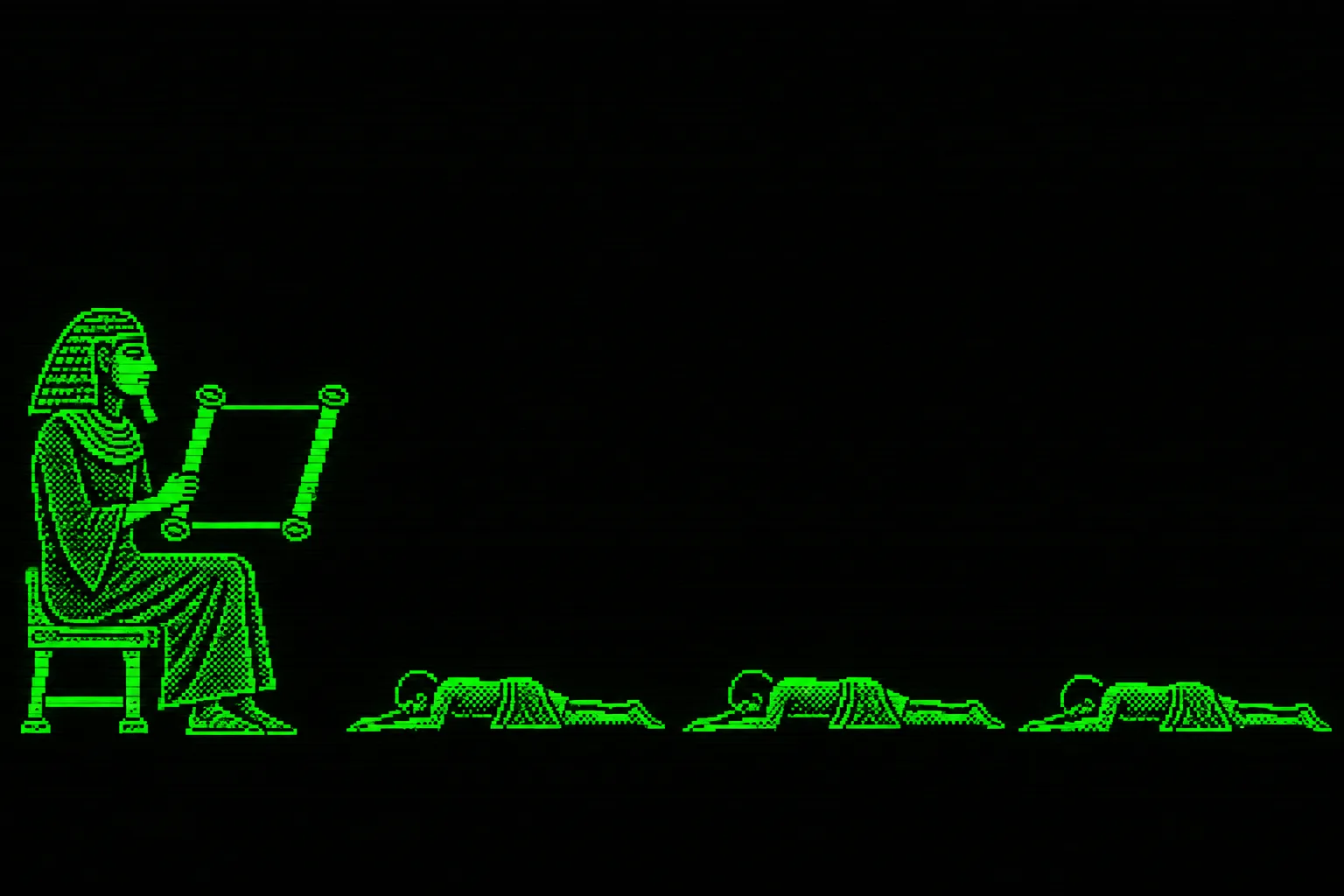
Then a narrator closes the story. The vizier summons his children and orders them to heed the scroll; they lay face down on their bellies and recite it. King Huni dies, Snefru takes the throne, and Kagemni was appointed overseer of the city and vizier.
- 1
wḏꜣ snḏ,w
The man who shows respect is safe.
- 2
ḥzi̯ mt(j)
The trustworthy man is praised.
- 3
wn ẖn n gr,w
The silent man’s tent stands open.
- 4
wsḫ s,t n.t hru̯
The calm man has room to spare.
- 5
m mdwi̯.w
Do not speak.
- 6
spd ds.w.pl r thi̯-mtn
The knives are sharp for whoever strays from the path.
- 7
nn ḥn n js ḥr zp =f
There is no call for haste except at the proper moment.
- 8
jr ḥmsi̯ =k ḥnꜥ ꜥšꜣ,t msdi̯ tʾ mrr =k
When you sit with others, spurn the bread you love.
Note · Line 8
Bread stands for the food on offer. The test is how you behave when a dish you love comes within reach. - 9
ꜣ,t pw kt.t dꜣjr-jb
It takes but a moment to master the heart.
- 10
ḫw pw ꜣfꜥ
Greed is a sin.
- 11
jw ḏbꜥ =t(w) jm
People point the finger at it.
- 12
jw jkn n mw ꜥḫm =f jb,t
A dipper of water quenches thirst.
- 13
jw mḥ,{t}〈w〉 rʾ m šw,w smn =f jb
A mouthful of rush grass steadies the heart.
Note · Line 13
The heart is the seat of the will as well as of desire. - 14
jw nfr,t jdn bw-nfr
One good thing can stand for all that is good.
- 15
jw nh(j) n ktt jdn wr
A little of a small thing can stand for much.
- 16
ẖz pw ḥnti̯ n ẖ,t =f
A man with a greedy belly is a wretch.
- 17
swꜣ tr smḫ.n =f
By the time the moment passes, he has forgotten it.
Note · Line 17
The moment is the time to stop eating. - 18
wstn ẖ,t m pr =sn
Under their own roof the belly roams free.
- 19
jr ḥmsi̯ =k ḥnꜥ ꜣfꜥ wnm =k ꜣḫf =f swꜣ
If you sit with a glutton, eat when his ravenous hunger has passed.
- 20
jr zw{r}j =k ḥnꜥ tḫ,w šzp =k
If you drink with a drunkard, take the cup.
- 21
jw jb =f ḥtp.w
His heart is content.
- 22
m ꜣt.w r jwf r-gs skn
Do not pounce on the meat when you sit beside a greedy man.
- 23
šzp ḏi̯ =f n =k
Take it when he gives it to you.
- 24
m wjn st
Do not refuse it.
- 25
kꜣ szf.t pw
That will put him in a friendly mood.
- 26
jr šw.w m srḫ n tʾ n sḫm.n md,t nb.t jm =f
Not a word can prevail against a man whose eating is above reproach.
- 27
ḫ{r}〈t〉r n ḥr r dfꜣ jb
Faces show respect for a man content at heart.
- 28
j{m}ꜣm n =f kꜣhs r mw,t =f
A harsh man is kinder to him than his own mother is.
- 29
mr =f pw bw-nb
Everyone is one of his people.
- 30
jmi̯ pri̯ rn =k
Let your name travel.
- 31
jw gr =k m rʾ =k njs.t(w) =k
You can keep your mouth shut and still be called upon.
- 32
m ꜥꜣi̯ jb =k ḥr ḫpš m-ḥr(,j)-jb ḏꜣm =k
Do not let your heart swell with pride in your strength among your young men.
- 33
zꜣw jtn =k
Beware of defiance.
- 34
n rḫ.n =tw ḫpr.t jrr.t nṯr ḫft ḫsf =f
No one knows what may happen,
or what the god will do when he punishes. - 35
rḏi̯.jn ṯꜣ,t(j) njs.t(w) nꜣy =f n ẖrd.w.pl m-ḫt ꜥrq =f sḫr r(m)ṯ bj(ꜣ),t =sn m jyi̯.t ḥr =f
Then the vizier had his children summoned. He had learned the ways of people, and their character was becoming clear to him.
Note · Line 35
The vizier was the king’s chief official. - 36
ḏr.n ḏd.n =f n =sn
At last he said to them:
- 37
jr n,t.t nb.t m zẖꜣw ḥr pꜣ šfd,w sḏm st mj ḏd =j st
“Everything written on this scroll—heed it just as I say it.
- 38
m zni̯ ḥꜣw-ḥr šꜣꜣ.t
Do not go beyond what has been laid down.”
- 39
wn.jn =sn ḥr rḏi̯.t st ḥr ẖ,t.pl =sn
Then they lay face down on their bellies.
Note · Line 39
They bowed with their whole bodies as a sign of respect. - 40
wn.jn =sn ḥr šdi̯.t st mj n,t.t m zẖꜣw
Then they recited it just as it was written.
- 41
wn.jn nfr st ḥr jb =sn r ḫ,t nb.t n,t{j}〈.t〉 m tꜣ pn r-ḏr =f
It was dearer to their hearts than anything else in this whole land.
- 42
wn.jn ꜥḥꜥ =sn ḥmsi̯ =sn ḫft
They stood up and sat down as it prescribed.
Note · Line 42
Standing and sitting together stand for the whole of their daily conduct. - 43
ꜥḥꜥ.n ḥm n nsw,t-bj,tj Ḥwnj mnj.n =f
Then His Majesty Huni, King of Upper and Lower Egypt, came to his mooring.
Note · Line 43
The king had died. His life is pictured as a voyage that ends when the boat is made fast. - 44
ꜥḥꜥ.n sꜥḥꜥ ḥm n nsw,t-bj,tj Snfr,w m nsw,t mnḫ m tꜣ pn r-ḏr =f
Then His Majesty Snefru, King of Upper and Lower Egypt, was installed as an excellent king over this whole land.
- 45
ꜥḥꜥ.n rḏi̯ Kꜣ=(j)-gmi̯.n=j r (j)m(,j)-rʾ-nʾ,t ṯꜣ,t(j)
Then Kagemni was appointed overseer of the city and vizier.
- 46
jwi̯ =f pw [...]
It has come to its end …
Note · Line 46
This is the scribe’s closing formula.