~/sacred-texts/old-kingdom-tomb-inscriptions
Tomb of Idu: Egyptian Offering List of Oils, Meat and Beer
- Date
- Inscribed in the tomb of Idu during the Old Kingdom to First Intermediate Period (c. 2686–2055 BC)
- Language
- Old Egyptian · Hieroglyphic
- 1
mw zꜣṯ 1 snṯr sḏ,t 1 s{f}ṯi̯-ḥꜣb 1 ḥkn,w 1 sfṯ 1 nẖnm 1 twꜣ,wt 1 ḥꜣ,tt n,(j)t ꜥš 1 〈〈ḥꜣ,tt〉〉 〈〈n,(j)t〉〉 ṯḥn,w 1 ꜥrf.du n wꜣḏ,w 2 〈〈ꜥrf.du〉〉 〈〈n〉〉 (m)sdm(,t) 2 wnḫ,w(j) 2 snṯr sḏ,t 1 qbḥ(,w) ṯꜣ.du 1 ḫꜣ(w,)t 1 ḥtp.du nswt 2 ḥtp.du 〈〈nswt〉〉 jm,j wsḫ,t 2 ḥmsi̯ 1 šns n jꜥ,w-rʾ 1 ḏwj,w 〈〈n〉〉 〈〈jꜥ,w-rʾ〉〉 1 tʾ-wt 1 tʾ-rtḥ 1 nms,t n,(j)t ḏsr,t 1 〈〈nms,t〉〉 〈〈n,(j)t〉〉 ḥ(n)q,t (ḫnm)s 1 šns-ꜥ n fꜣi̯ 2 šns n šb(,w) 1 sw,t 1
Water for pouring, once; one incense fire; festival scent oil, hekenu oil, sefet oil, nekhenem oil, tuawet oil, the finest conifer oil and the finest Libyan oil, one of each; two double pouches of green eye paint and two double pouches of black eye paint; two pairs of cloth strips; one incense fire; one pair of water pellets for the libation; one offering platter; two royal offerings; two royal offerings in the courtyard. “Sit down!”—once. One shenes cake for breakfast, one clay jug for breakfast, one wet loaf, one reteh loaf, one nemeset jar of djeseret beer, one nemeset jar of khenemes beer, two shenes cakes in pots for carrying, one shenes cake for the main meal, one sut cut from the thigh of an ox.
Note · Line 1
The list provides for Idu as a guest at a meal. The seven sacred oils are for anointing; the invitation to sit is addressed to Idu himself. - 2
ꜥj.du n mw 2 〈〈ꜥj.du〉〉 〈〈n〉〉 bd 2 šns jꜥ,w-rʾ 2 tʾ-wt 1 tʾ-rtḥ 1 ḥṯꜣ 2 nḥr,w 2 dp,t.pl 4 pzn 4 šns 4 tʾ-jm,j-tꜣ 4 ꜥj.pl n,w ḫnf,w 4 〈〈ꜥj.pl〉〉 〈〈n,w〉〉 ḥbnn,wt 4 q(m)ḥw-qmꜣ 4 ⸢jdꜣ,t⸣ ⸢ḥꜣ⸣ =k 4 pꜣw,t 4 tʾ-ꜣšr 4 ḥḏ,w ꜥ 4 ḫpš 1 jwꜥ 1 zḫn 1 sw,t 1 spḥ,t n,(j)t spr 1 ꜣšr,t 1 mjz,t 1 nnšm 1 ḥꜥ(,w) 1
Two bowls of water, two bowls of natron; two shenes cakes for breakfast, one wet loaf, one reteh loaf, two hetja loaves, two neheru loaves, four depet loaves, four pezen loaves, four shenes cakes, four ta-imi-ta loaves, four bowls of khenefu cakes, four bowls of hebenenut bread, four qemehu-qema loaves, four idat loaves to lay behind you, four pawet cakes, four asher loaves; four portions of onions; one foreleg, one iwa cut of leg on the bone, one zekhen cut, one sut cut from the thigh of an ox, one sepehet cut from the ribs, one portion of grilled meat, one liver, one spleen, one hau cut.
Note · Line 2
Natron is a naturally occurring mineral salt used for cleansing. The many names for loaves and cakes distinguish kinds of baking whose recipes are mostly unknown. - 3
jwf n ḥꜣ,t 1 rʾ 1 ṯrp 1 mz(ꜣ),t 1 sr 1 mnw,t 1 tʾ-zjf 1 šꜥ,(w)t.du 2 npꜣ,t 2 mz,wt 2 ꜥj.du n ḏsr,t 2 〈〈ꜥj.du〉〉 〈〈n〉〉 jꜣ,tt 2 ꜥj.du n ḥ(n)q,t 2 〈〈ꜥj.du〉〉 〈〈n〉〉 ḫnms 2 sḫp,t 2 pḫꜣ 2 ḏwj,w 2 dꜣb 2 ꜥj.du jrp 2 ꜥbš.du 2 ꜥj.du jrp jr 2 ꜥj.du jrp 2 ꜥj.du jrp ḥꜣm(,j) 2 ḥbnn,w(t) 2 ḫnf,w 2 jšd 2 ꜥj.du sẖ,t ḥḏt 2
One cut of breast meat; one greylag goose, one white-fronted goose, one mezat goose, one ser greylag goose, one pigeon; one zif loaf, two shaut cakes, two small nepat cakes, two servings of emmer wheat; two bowls of djeseret beer, two bowls of iatet drink, two bowls of beer, two bowls of khenemes beer, two servings of sekhepet drink, two of pekha fruit drink, two djuw clay jugs; two figs; two bowls of wine, two abesh wine jars, two bowls of jr wine, two bowls of wine, two bowls of Hamu wine; two hebenenut loaves, two khenefu cakes, two ished fruits, two bowls of white barley.
Note · Line 3
Iatet was a milky fermented drink. Hamu is named as the place the wine came from. The jr wine stands where the other lists name the wine of Buto. - 4
ꜥj.du sẖ,t wꜣḏ.t 2 ꜥ n zw,t 2 ꜥ n jt 2 bꜣbꜣ,t 2 ꜥj.du n nbs 2 ꜥj.du n tʾ-nbs 2 ꜥj.du ḥwꜥ 2 (j)ḫ,t nb(.t) bnj(.t) 1 rnp,(w)t nb(.t) 1 gs,w 1 ḥnk,t 1 pẖr 1 stp,t 1 ḥꜣ,t (wd)ḥ,w 1 jni̯.t rd 1 sḏ dš(r),t 1 ḥtp-ḏi̯-nswt 1 rḏi̯.t qbḥ,w 1 snṯr sḏ,t 1 wdn (j)ḫ,t 1 ḥtp-ḏi̯-nswt n Jdw
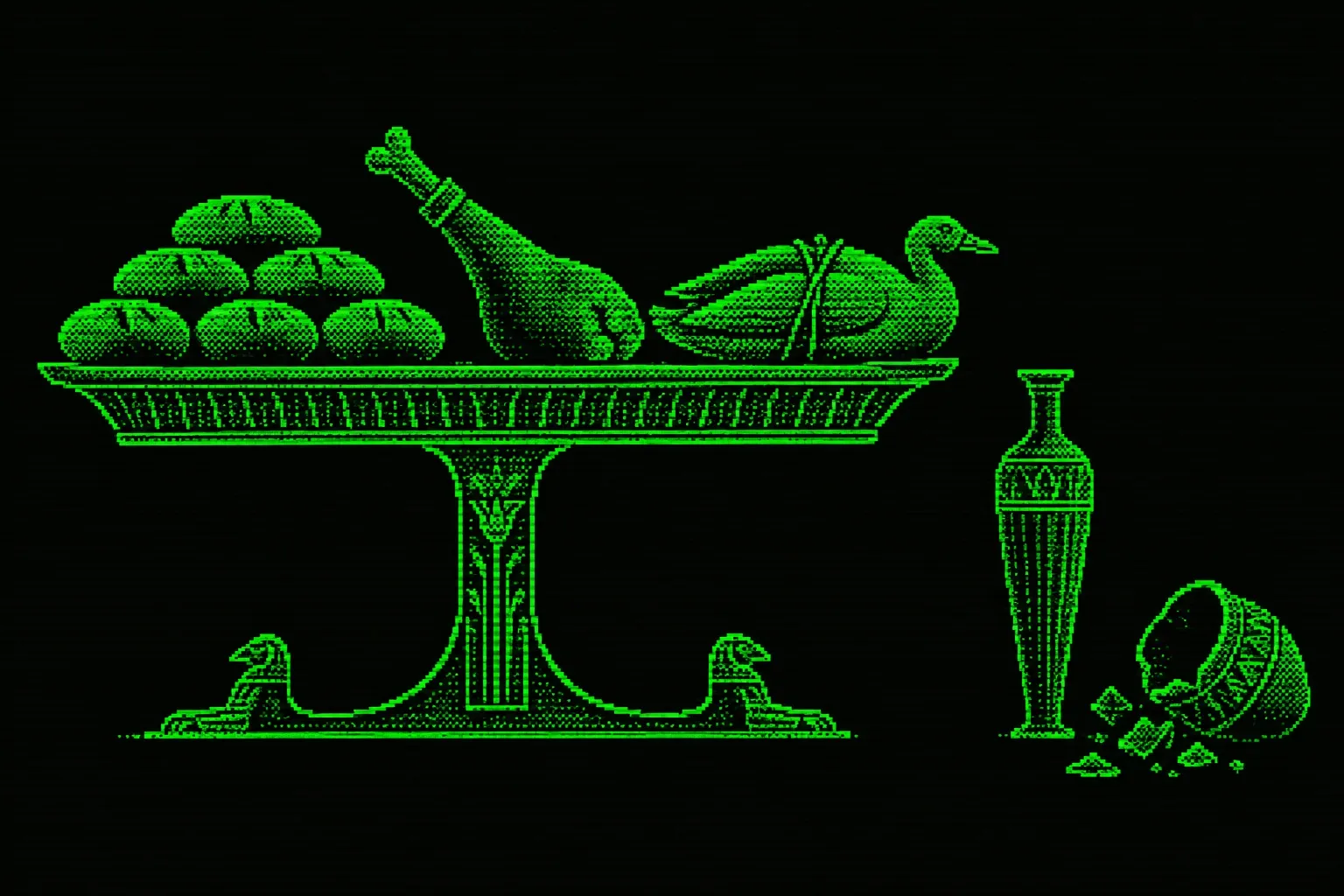
Two bowls of green barley, two portions of emmer, two portions of barley, two portions of babat grain, two bowls of jujubes, two bowls of jujube bread, two bowls of tiger nuts; every sweet thing, once; every kind of fresh produce, once; bread halves, once; one henket offering, one reversion of offerings, one portion of choice cuts, one portion of the best on the offering stand; wiping away the footprint, once; breaking the red pot, once; one offering that the king gives; pouring a libation, once; one incense fire; presenting the offerings, once. An offering that the king gives for Idu.
Note · Line 4
The “reversion of offerings” is the passing on of food already presented in one rite for use in another. Wiping away the footprint removes the trace of the officiant’s steps.