~/sacred-texts/egyptian-hymns
The Hymn to the Nile: No One Eats True Lapis Lazuli
- Date
- Composed in the Middle Kingdom, 12th Dynasty (about 1900 BC); copied by scribes and schoolboys in the Ramesside period, 19th–20th Dynasties (1292–1077 BC), on papyri and ostraca
- Found
- School copies come from Deir el-Medina at Thebes and from Memphis. The main papyri, Sallier II, Anastasi VII and Chester Beatty V, are in the British Museum, London.
- Language
- Egyptian (Middle Egyptian) · Hieratic
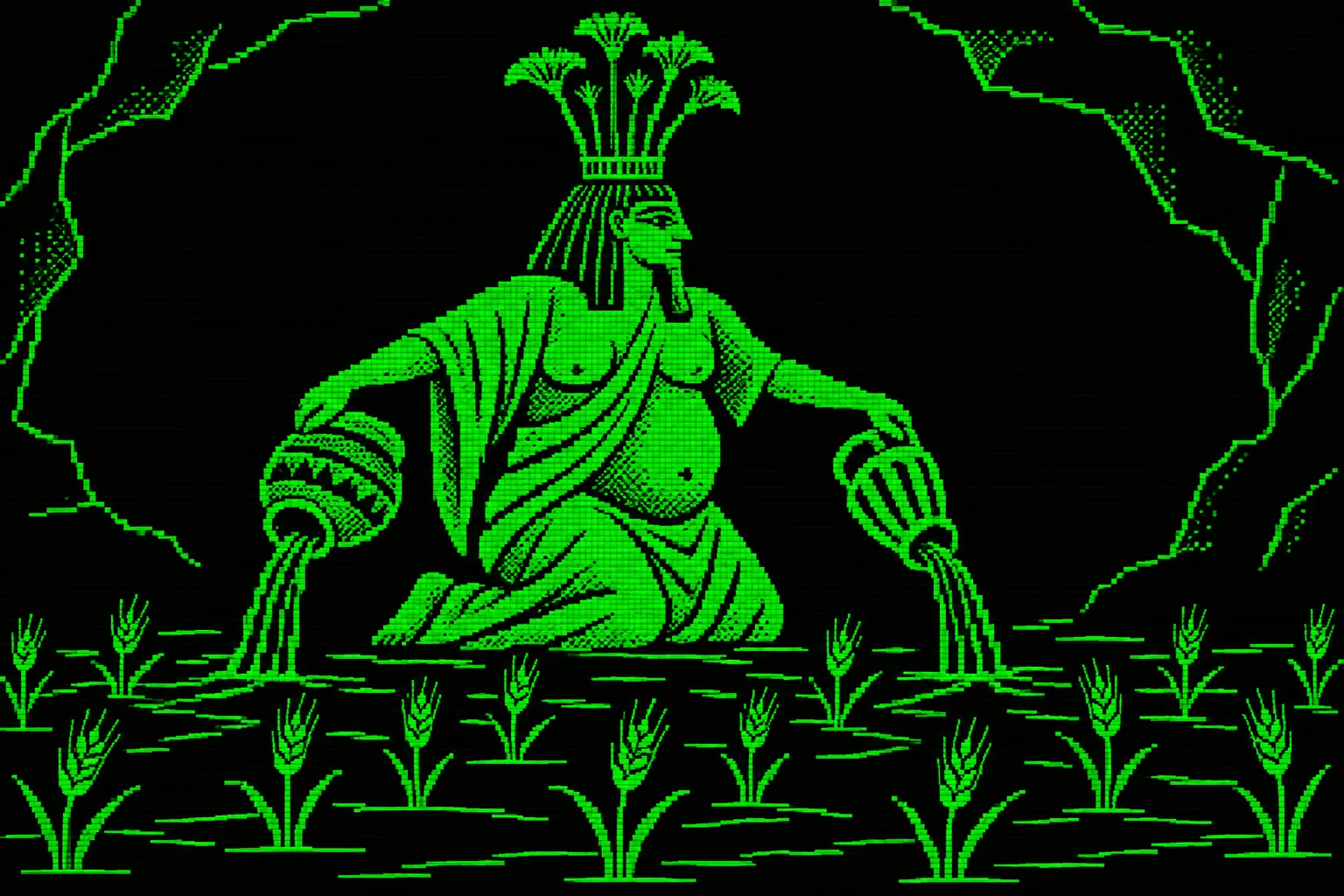
A singer hails Hapi, the Nile flood, sprung from the earth, come to give Egypt life. Hapi makes barley and emmer, fills the storehouses, clothes people in flax and spews up the fields. He is also a robber: If he delays, the nose is stopped up and everyone is left destitute, and Thebes looks like a gathering of women when every man who bears arms has been swept away.
Nobody has seen him: no writing shows him in his cavern. Gold and silver are no substitute: No one eats true lapis lazuli; strength begins with barley. The people slaughter long-horned cattle, trap lions for him and chant Flourish, hidden one! Pause ends each stanza.
- 1
[...] tw r [...] sḏm [...] ⸢rd.du⸣ [...] stj [...] n [...]
… you are to … hear … both feet … scent … for …
- 2
[dwꜣ.ww] [Ḥꜥpj]
In praise of Hapi.
Note · Line 2
Hapi is the annual flood of the Nile in the form of a god. - 3
[j:]nḏ ḥr =[k] [Ḥꜥpj] pri̯ m tꜣ jyi̯.y r sꜥnḫ Km,t
Hail to you, Hapi, sprung from the earth,
come to give Egypt life! - 4
jmn sšm[,w] kk,wj m hrw ḥsi̯ n{.w} ⸢šmsw⸣ =〈f〉
His form is hidden; he is dark by day.
His followers sing of him. - 5
jwḥ šꜣ qmꜣm Rꜥ r sꜥnḫ [⸮jb?] [...] [⸮jb?] nb{.t}
He waters the field crops Ra has made,
to keep the young goat alive … and all who thirst. - 6
swrj.tw mw ḥr ḫꜣs,t b[w] [wꜣi̯.w]w mw hꜣi̯.y
People drink water in the hill country;
the water that falls is not far off. - 7
mri̯ ⸢tʾ⸣ [Gb] [ḫ]rp{.pl} [N]p[rj] swꜣḏ ⸢ḥmw⸣,t n.t Ptḥ [...]
He loves the bread of Geb and brings forth Nepri;
he makes Ptah’s workshop flourish. …Note · Line 7
Geb is the earth god, Nepri is grain in divine form, and Ptah is the patron of craftspeople. - 8
[nb] [rm],w sḫnti̯.y ⸢qbḥ⸣ [n]n ꜣpd,w hꜣi̯.y ḥny,t[_]
Lord of fish, he leads the waterbirds upstream;
no bird comes down … - 9
jri̯ jt s[ḫpr] [btj] r sḥ(ꜣ)b rʾ.pl-pr.pl
He makes the barley, he brings forth the emmer,
that the temples may keep festival.Note · Line 9
Emmer is a kind of wheat. These two grains supplied the temples with bread and beer for their festivals. - 10
w[sfꜣ] ḫr ḏb(ꜣ) fnd ḫr ḥr-nb nmḥ
If he delays, the nose is stopped up
and everyone is left destitute. - 11
[⸮jr?] [ḫbꜣ] =tw 〈⸮m?〉 pꜣw,t.pl nṯr.pl [ḫr] ḥḥ.pl [⸮ꜣq.w?] [m] [r(m)ṯ.pl] [...]
If people cut back on the gods’ offering cakes,
then millions of people have perished. … - 12
jri̯ ꜥwn 〈r〉 〈mn〉 tꜣ r-[ḏr] =[f] [wr] šrjw ḥr nmj
He plays the robber till the whole land suffers,
and great and small roam through it. - 13
wšb{t} [r(m)ṯ.pl] [ḫft] [s]rf jw qd ⸢sw⸣ [H̱n]m,w
He answers the people when the heat comes,
once Khnum has shaped him.Note · Line 13
Khnum is the divine potter who shapes living beings on his wheel. - 14
wb[n] =f 〈ḫr〉 tꜣ m ḥꜥꜥ,wt [⸮ḫr?] ẖ,t-[nb.t] m rš,wt
When he rises, the land rejoices
and every belly is glad. - 15
[ṯs,t] nb.t šzp =〈s〉n s[b]jꜣ[,t] [jbḥ] nb [kfꜣ.w]
Every mouth breaks into laughter,
every tooth is bared. - 16
[jni̯] [kꜣ.pl] wr ḏf[ꜣ,w] [q]mꜣ[m] [nfr,t] =[f] [nb.t]
Bringer of food, rich in provisions,
he creates all his good gifts. - 17
nb{.t} šfšf,yt nḏm stj [sḥt]p.y [jyi̯.y] =[f]
A lord held in awe, sweet of scent,
he brings contentment when he comes. - 18
[sḫpr] sjm,w n mn[mn,t] [rḏi̯] s[fd(,t)] [n] nṯr nb{.t}
He makes fodder grow for the cattle
and gives a slaughtered beast to every god. - 19
sw ={f} 〈m〉 dwꜣ,t 〈p,t〉 〈tꜣ〉 ḥr sḫn[,t.pl] =[f] [jṯi̯] tꜣ 2
He is in the underworld;
sky and earth rest on his pillars.
He takes possession of the Two Lands.Note · Line 19
The Two Lands are Upper Egypt, the Nile Valley in the south, and Lower Egypt, the Delta in the north. - 20
mḥ wḏꜣ.pl [swsḫ] [šnw],t.pl rḏi̯ ꜣḫ,t 〈n〉 nmḥ
He fills the storehouses and widens the granaries;
he gives the poor something of their own. - 21
〈srd〉 ḫt ꜣb[b(.t)] nb.t nn gꜣ,wt =[tw] [r] =[s]
He makes timber grow, and all that anyone could wish for;
no one lacks for it. - 22
[s]ḫpr =⸮⸢f⸣? jmw 〈m〉 pḥ,tj.ṱ =[f] [nn] [mḏḥ] [m] [j]{r}n〈r〉
By his strength he brings a ship into being:
there is no carpentry in stone. - 23
[jṯi̯]{.tw} =f ḏw.pl 〈⸮ḥr?〉 ḥw[,(y)t] =[⸮f?] nn gmḥ[.tw] =[f]
With his rain he takes possession of the mountains,
yet no one catches sight of him. - 24
[bꜣk] nn ḫrp =[⸮f?] šdi̯ =[t]⸢w⸣ m štꜣ
He works with no one to direct him;
he is nourished in secret. - 25
nn rḫ =tw bw n,tw =f nn gm[i̯.tw] =f [m] [tpḥ,t] =[f] [m] [zẖꜣ,w]
No one knows where he is;
no writing shows him in his cavern. - 26
[grḥ]
Pause.
- 27
[⸮mw?] nꜥꜥ.y nn dnjt.tw =f nn sšm =f jb =[f]
Water on the move, he cannot be dammed,
nor can he steer his own heart.Note · Line 27
The heart was the seat of thought and will as well as feeling. - 28
[šm]s sw ḏꜣm,w ẖ[rd.pl] [...] [tw] [〈r〉] nḏ ḫr,ṱ =f m nsw
Let a troop of children follow him …
he will be greeted as king. - 29
mn hꜣ[p.pl] ⸢jy.y⸣ 〈r〉 trj =f mḥ ⸢⸮m?⸣ [Šmꜥ,w] [Mḥ,w]
His laws stand fast. He comes in his season
and floods Upper and Lower Egypt. - 30
swrj.tw mw jr,t nb.t [jm] =f rḏi̯ ḥꜣ,w 〈ḥr〉 nfr.pl =f
When people drink water, every eye is on him;
beyond his good gifts he gives still more. - 31
grḥ
Pause.
- 32
wn m{ꜥ} gꜣ,wt pri̯ m [ḫntš] ⸢jb⸣ [nb] ḫntšj
Whoever was in want has come forth in joy;
every heart rejoices. - 33
jwr Sbjwk msi̯ n,t{n,tw} psḏ,t [n,tj] [jm] =[f] ⸢ḏsr.w⸣
He conceived Sobek and gave birth to the flood.
Holy are the Nine within him.Note · Line 33
Sobek is the crocodile god; the Nine are a company of gods. - 34
[bši̯] [ꜣḥ,t].pl sqdd sḫ,t s⸢qf⸣[_] tꜣ-tmm
He spews up the fields and sails over the meadow;
he warms all humankind.Note · Line 34
The flood leaves behind the rich silt that makes the fields. - 35
[swsr] wꜥ smꜣj(r) ky nn wp[⸮p?] [ḥnꜥ] =[f]
He makes one rich and brings another to ruin.
No one can bring a case against him. - 36
jri̯ ḥtp,w nn ks[m].n.tw =〈f〉 tm[m] jri̯ n =f t(ꜣ)š
He makes people content; no one can defy him.
No one can set a bound to him. - 37
grḥ
Pause.
- 38
sḥḏ pr[i̯.pl] m kk[,wj] =[s]n m ꜥd n mnmn,t
With the fat of the herd he lights the way
for those who go out in their darkness.Note · Line 38
Animal fat served as lamp fuel. - 39
ḥnw[,t.ṱ] =f pw sḫpr nb{.t} nn [w] [ꜥnḫ] [m-ḫm,t] =f
All increase is his work;
no district lives without him. - 40
ḥbs{.pl} ⸢r(m)ṯ.pl⸣ m mḥ{jm} ⸢šꜣ⸣[ꜥ.n] =⸢f⸣ jri̯ n Ḥḏ-ḥtp r bꜣk.pl =[f] [jri̯] [n] [Šzm,w] [m] [mr]ḥ(,t) =f
He clothes people in the flax he set growing;
he works for Hedjhotep as his craft requires,
and for Shesmu with his oil.Note · Line 40
Hedjhotep is the god of weaving; Shesmu presides over the pressing of oil. - 41
⸢mḏr⸣ [...] ⸢nḏr⸣ P[t]ḥ m qj〈s〉 =f
To him … turns;
with what he vomits up, Ptah works wood.Note · Line 41
Ptah is the god of craftsmen. - 42
[s]ḫpr ⸮⸢ꜣ⸣[ḫ,t]? [⸮bꜣk.pl?] nb{.t} jm =f
From himself he brings forth the products of every craft.
- 43
zẖꜣ[,w] nb{.t} [n] mdw〈.pl〉-nṯr nn ḥn,ṱ =f m Mḥ,w
Every text written in the god’s words—
is that not his work in Lower Egypt?Note · Line 43
The “god’s words” are hieroglyphs. The papyrus used for writing grew in the marshes of Lower Egypt, the Nile Delta. - 44
grḥ
Pause.
- 45
ꜥq m jmḥ,t pri̯ m ḥr,j [wb]ꜣ.j pri̯ [m] štꜣ,w
He enters the underworld and comes forth at the surface;
he reveals himself and comes forth from hiding.Note · Line 45
The flood was thought to rise from caverns beneath the earth. - 46
dn〈s〉{mn} ⸮⸢n⸣? =⸮⸢f⸣? [ꜥn]d rḫ,yt ẖ{r}db sw ⸢sn⸣[m] [rnp,t]
When he weighs heavy, the people are few;
the year’s grief kills him. - 47
⸮[mꜣ]ꜣ?.tw Wꜣs,t mj 〈ḥm,t.pl〉 dr [z] [nb] ẖrj ḫꜥ,w.pl =[⸮f?]
Thebes looks like a gathering of women
when every man who bears arms has been swept away. - 48
nn jn{t}w r ⸮pḥ(,wj)? [nn] [ḥ]bs r ḥbs
No cord for the backside,
no cloth for clothing, - 49
nn ẖkr,w r ms.w.pl špsj nn 〈msdm,t〉 〈⸮n?〉 ḥr
no jewels for a nobleman’s children,
no black eye paint for the face. - 50
wš 〈šnj〉 [n] gꜣ,j =f nn wrḥ n bw-nb
For want of him the hair falls out;
there is no ointment for anyone. - 51
grḥ
Pause.
- 52
smn mꜣꜥ,t m jb.pl r(m)ṯ.pl r:ḏd grg r-sꜣ šwꜣ[.ww]
He sets truth firm in the hearts of people
who tell lies once they have fallen into want. - 53
[šbn] =sn ḥnꜥ Wꜣḏ-wrj 〈tm〉 ḫr[p] ḥr mw =f
They mingle with the Great Green,
which leads no one onto its waters.Note · Line 53
The Great Green is the sea. - 54
dwꜣ.ww tw nṯr.pl ⸢nb.pl⸣ rḏi̯ hꜣi̯[.y] ꜣpd,w ḥr ḫꜣs,t =f
All the gods will praise you,
you who bring the birds down from their far country. - 55
nn 〈sḫt〉 ḏr,t =f m nbw nn z 〈tḫ.w〉 n ḥḏ
No man’s hand weaves with gold;
no man gets drunk on silver. - 56
nn wnmw =tw ḫsbd{.t} mꜣꜥ jt ẖr.j-ḥꜣ,t rdw
No one eats true lapis lazuli;
strength begins with barley. - 57
grḥ
Pause.
- 58
šꜣꜥ =tw n =k ⸢ḥsi̯⸣ m bn,t ḥsi̯ =tw n =k ḥr ḏr,t ={j}
For you they strike up a song to the harp;
for you they sing to the clap of hands. - 59
nh[ꜣm] [n] =[k] ḏꜣm,w ẖrd.w.pl =k ꜥpr =tw n =k [wpw,t].pl
The young ranks of your children cheer for you;
for you they array the bands of women who come to greet you. - 60
jyi̯.y ⸢špsj⸣ [s]ẖkr [tꜣ] [⸮pn?] [swꜣḏ] [jwn] ⸢ꜥn⸣d r(m)ṯ.pl
Here comes the noble one who adorns this land,
who restores the people’s color when they are few. - 61
sꜥnḫ ḥꜣ,tj.pl m bꜣ[kꜣ,t].pl mri̯ ꜥšꜣ,t mnmn,t [nb.t]
He quickens the hearts of those who carry young;
he loves great herds of cattle of every kind. - 62
wbn =f m nʾ,t [ḥqr] [ḫr] sꜣ =sn m jn,w n šꜣ
When he rises in the city of hunger,
its people eat their fill of the gifts of the water meadows. - 63
ḥn[_] [⸮z?] [⸮nb?] m sšnj šrjw [ꜣ]ḫ,t nb.t ṯtf [ḥr-tp] [tꜣ]
He gives everyone a little lotus;
all things lie spilled across the ground. - 64
sjm,w nb{.t} m-ꜥ ẖrd.w.pl =f smḫ[.⸮n?] =[⸮sn?] [wnm]w
His children hold greens of every kind in their hands;
they have forgotten to eat. - 65
bw-nfr ḫꜣ~n~⸢rʾ⸣ [m] jwy,t p[ꜣ] [tꜣ] [h]ꜣi̯.w 〈ḥr〉 ftft
Good things lie strewn in the street;
the land has come leaping down. - 66
grḥ
Pause.
- 67
ḥw[i̯] [Ḥꜥpj] wdn =tw n =k sfd =tw n =k j[wꜣ].w.pl
Flow, Hapi, that they may bring you offerings,
that they may slaughter long-horned cattle for you, - 68
[jri̯].y =tw n =k ꜥ(ꜣ)b,t ꜥꜣ.t wšꜣ =tw n =⸢k⸣ ꜣpd,w
that they may prepare a great offering for you,
that they may fatten fowl for you, - 69
grg =tw [n] =k mꜣj〈.pl〉 ḥr ḫꜣs,t ⸢ḏbꜣ⸣ =tw n =k ⸢nfr⸣.pl =⸢k⸣
that they may trap lions for you in the desert,
that they may repay you for your kindness. - 70
wdn =tw n nṯr nb{.t} m jri̯.t ⸢n⸣ Ḥꜥpj m sntrj tp,j(t) jwꜣ.pl [wnḏ]w.pl ꜣpd,w n,j-s(w)j [⸮nsr,t?]
To every god they offer what Hapi has made:
incense and fine anointing oil,
long-horned cattle and short-horned cattle,
and fowl for the fire. - 71
[Ḥ]ꜥ[p]j m [t]pḥ,t =f wsr
Hapi is mighty in his cavern.
- 72
nn rḫ =tw rn =f m dwꜣ,t nn ⸢pri̯⸣ nṯr ḥr ḫpr,w =f
No one knows his name in the underworld;
no god comes forth in his form. - 73
grḥ
Pause.
- 74
tmm.pl [w]ṯs psḏ,t sndw n šf,yt =〈f〉
All you people who exalt the Ennead,
stand in awe of his majesty!Note · Line 74
The Ennead is the company of nine gods. - 75
jri̯ n zꜣ =f Nb{.t}-(r-)ḏr swꜣḏ jdb,du
Act for his son, the Lord of All,
who makes the Two Banks green!Note · Line 75
The Two Banks are Egypt on either side of the Nile. - 76
wꜣḏ kꜣpw wꜣḏ kꜣpw Ḥꜥpj wꜣḏ kꜣpw
Flourish, hidden one!
Flourish, hidden one!
O Hapi, flourish, hidden one! - 77
mj r Km,t sḫpr [ḥt]p =f swꜣḏ jdb,du
Come to Egypt, you who bring it peace,
who make the Two Banks green! - 78
wꜣḏ kꜣpw.tw =f [wꜣḏ] kꜣpw.tw =f Ḥꜥpj wꜣḏ [kꜣ]pw[.tw] =[f]
May he flourish and be veiled in incense!
May he flourish and be veiled in incense!
Hapi, may he flourish and be veiled in incense!Note · Line 78
The chant turns on two Egyptian words that sound alike: one means to hide, the other to burn incense. - 79
⸮ꜥnḫ? r(m)ṯ.pl mnmn,t m jn,w =f n ={k} [šꜣ] nb{.t}
May people and cattle live on his gifts
from every water meadow. - 80
wꜣḏ kꜣpw.tw =f wꜣḏ kꜣpw[.tw] =[f] [Ḥꜥp]j wꜣḏ kꜣpw.tw =〈f〉
May he flourish and be veiled in incense!
May he flourish and be veiled in incense!
Hapi, may he flourish and be veiled in incense! - 81
grḥ [...]
Pause. …