~/sacred-texts/hittite-myths
Tale of Appu: Hittite Story of the Brothers Evil and Just
- Text
- Hittite myths, CTH 360.1, KUB 24.8 (dupl. KBo 7.18, KBo 26.84, KBo 19.108, KBo 19.106, KBo 19.107, KBo 26.85, Bo 3627)
- Date
- Probably composed in the Middle Hittite period (14th century BC), drawing on Hurrian tradition; the surviving copies are in New Hittite script, 13th century BC.
- Found
- Hattusa
- Language
- Hittite · Cuneiform
The Tale of Appu is a Hittite story, probably adapted from Hurrian tradition, about a rich man who cannot get a child. It survives on the main tablet KUB 24.8 and seven smaller duplicates from Hattusa, all in New Hittite script of the 13th century BC. The story itself is likely older. The tablet’s colophon calls it Tablet 1 of Appu. Not finished, so the story ran on to at least a second tablet. Only scraps of that tablet survive.
It opens with a broken hymn to a god who exalts the just and fells the evil like a tree, striking them on their skulls. Appu lives in Shudul, a city on the sea in the land of Lulluwa. He has cattle, sheep, silver, gold and lapis, but no son or daughter. At a feast, the elders each give bread and fat to their sons, and Appu gives bread to no one. He goes home and lies down to sleep with his shoes on. His wife asks the household whether he has now had sex with her, lies beside him clothed, and asks him to his face. He tells her she is a woman and knows nothing.
Appu takes a white lamb to the Sun-god, who comes down from heaven as a young man. The god tells him to go home, drink his fill, and with your wife well sleep the sleep. In heaven the Storm-god sees the Sun-god coming and fears that some land has perished, then orders food and drink for him. After a break, Appu’s wife carries a child for ten months and bears a son. Appu names him “Bad”, because his paternal gods held the bad road. A second son is named “Just”.
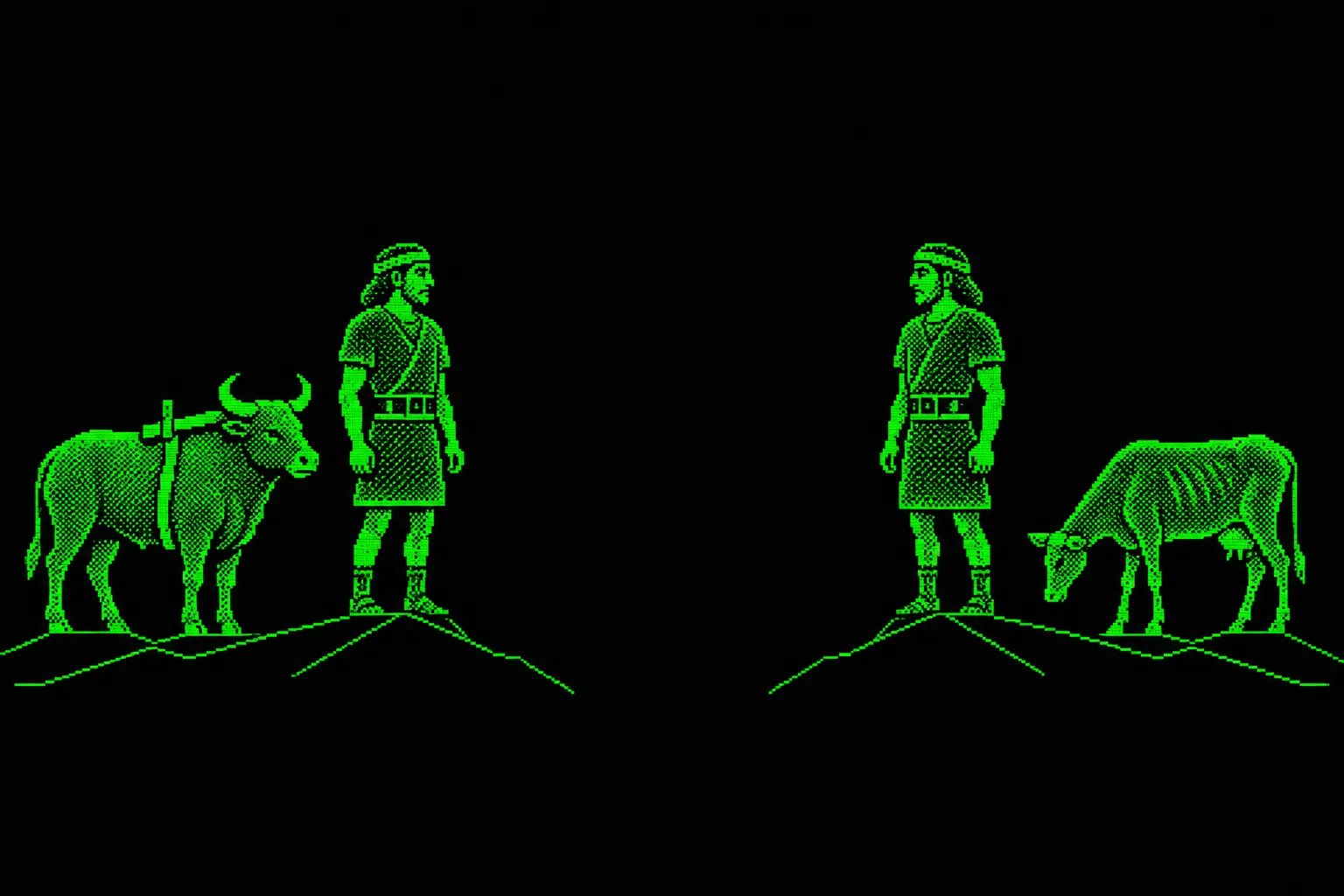
When the brothers come of age, Evil demands that they divide the estate, because the gods also sit apart: the Sun-god in Sippar, the Moon-god in Kuzina, the Storm-god in Kummiya, Ishtar in Nineveh, Marduk in Babylon. Evil keeps the good plough-ox and gives Just the bad cow. The Sun-god looks down and declares that the cow will become good and give birth. The fragments of the second tablet show the brothers suing before the Sun-god in Sippar, with curses. The Sun-god refuses to judge the case and sends them to Ishtar of Nineveh, and there the text breaks off. The verdict and the fate of the cow are lost.
The page gives 158 tablet lines, 27 restored from a duplicate. Square brackets mark breaks in the clay and restorations; ... is a lost stretch. Hover over or tap a Hittite word for its meaning and the English words it becomes.
- 1Vs. I 1–4
▒𒄩𒀭𒁕𒀭𒁺𒍑𒇽𒈨𒌍𒍑𒂉𒅖 𒊬𒇷𒅖𒆠𒄑𒍣𒄷𒌋𒉿𒀊𒉺𒊭𒃷𒇽𒈨𒌍𒍑 𒄑𒊒𒈠𒀀𒀭𒇷𒆷𒀝𒆠𒄷𒌋𒉿𒀊𒁍𒊭𒃷𒇽𒈨𒌍𒀸
[ ] x x [ ] [ ḫandant- just LÚ man kui- who šarliške- to exalt ḫuwappa- evil LÚ man GIŠ tree mān like lilakk- to fell ḫuwappa- evil LÚ man
... [the ju]st men [w]ho [exa]lts, but the evil men [like a tree] fells, and to the evil men
Note · Line 1
[{€1} Vs. I 2]: Line order follows the Hittite, so the relative pronoun kuiš is rendered where it stands. The clause reads “who exalts the just men”; its subject is in the broken part above. [{€1} Vs. I 3]: The text writes LÚ{MEŠ}-⸢uš!?⸣ as accusative plural, which is the object of “fells”. [{€1} Vs. I 4]: LÚ{MEŠ}-aš is a dative plural. B writes the same form as LÚ{MEŠ}-na-aš. [{€1} Vs. I 5]: tarnaš “skull” is taken with the emended possessive -〈aš〉 “their”; B has tar-na-aš-ma-aš in full. šakšakila- is of uncertain meaning, possibly a stone or club, and is left untranslated. - 2Vs. I 5–6
𒋻𒈾𒀸𒈠𒀸 𒊭𒀝𒊭𒆠𒇻𒍑 𒉿𒀠𒄩𒀭𒈾𒄿 𒌅𒍑 𒄯𒉌𒅅𒍣
tarna- skull šakšakila- stone (?) walḫanna- to strike ta and; then ḫarnink- to destroy
on their [skull]s the šakšakila-s he strikes, [an]d destroys them.
- 3Vs. I 7
𒌷𒀸𒋳𒀭𒊺𒀉𒌷𒋗𒁺𒌌
URU city ŠUMU name Šudul Shudul
[(There is) a city; its name (is) Shu]dul.
Note · Line 3
[{€1} Vs. I 9] ZAG-ši is read as “at its border/shore,” meaning the shore of the sea, as in the CHD and the earlier edition. The CHD treats eš- here as “is (situated).” [{€1} Vs. I 13] u[d-d]a?-ni is damaged. I read it as the dative-locative of uttar, “in the matter of” (earlier edition: “in S[ac]hen”). The earlier edition restores more of this line than the sign readings here show. [{€1} Vs. I 14] mān is taken as “like,” not as the irrealis particle. ḫuigatar is of uncertain meaning; “heap(?)” follows the earlier edition. ḫaḫḫariyan is read as a participle of ḫaḫḫariya- “scrape, rake.” Duplicate F (KBo 19.107) has the same wording: p]a-an-ku ḫu-u-i-ga-tar. [{€1} Vs. I 8] The text has lu-ul-lu-wa-ia-aš-š[a!-a]n with an emended sign, read as “and (the land) of Lulluwa.” Duplicate B’s lu-ul-lu-w[a- does not decide the emendation. [{€1} Vs. I 8] The earlier edition takes KUR-e as nominative, “the land of Lulluwa lies by the sea,” but we read it with -ššan as a locative setting that places the city in Lulluwa. - 4Vs. I 8–11
𒌷𒇻𒌌𒇻𒉿𒅀𒀸𒊭𒀭 𒆳𒂊 𒀀𒊒𒉌 𒍠𒅆 𒂊𒌍𒍣 𒉡𒃷 𒊺𒅕 𒇽𒀸 𒁹𒀊𒁍 𒋳𒀭𒊺𒀉 𒆳𒂊𒃷 𒅖𒋻𒈾 𒀀𒉺𒀀𒀸 𒄩𒀊𒁉𒈾𒀭𒍝 𒄞𒄭𒀀𒍑𒅆𒅖
Lulluwa Lulluwa KUR land aruna- sea ZAG edge; shore eš- to be nu and; then šer up; above LÚ man Appu Appu ŠUMU name KUR land ištarna within apa- he; that one ḫappenant- rich GU₄ cattle
And in the land of Lulluwa, at the sea, it is at its shore. And up there (is) a man, Appu (is) his name. Within the land he (is) rich. His cattle
- 5Vs. I 12
𒇻𒍑 𒈨𒅅𒆠𒅖
UDU sheep mekki- many
(and) sheep (are) many.
- 6Vs. I 13–14
𒆬𒌓𒈠𒀸𒅆 𒆬𒄀𒀸 𒉌𒌓𒍝𒆳𒀸𒌓𒁕𒉌 𒉺𒀭𒂉𒄷𒌋𒄿𒂵𒋻𒈠𒀀𒀭 𒄩𒄴𒄩𒊑𒅀𒀭
KÙ.BABBAR silver KÙ.SI₂₂ gold ZA.GÌN lapis lazuli uddar matter; word panku- entire ḫuigatar heap mān like ḫaḫḫariya- to rake
But for him, in the matter of silver, gold (and) lapis lazuli, (are) raked together like an entire heap(?).
- 7Vs. I 15
𒉡𒍑𒅆𒉺 𒌑𒌌 𒂉𒀉𒆠 𒉿𒀝𒋡𒊑
nu=šši=pa and; to him UL not kuiški anything wakk- to be lacking
And to him nothing is lacking.
Note · Line 7
[{€1} Vs. I 16]: The numeral is emended (1!-an). Duplicate F reads ⌈1-an ut-tar⌉, “one thing”, which confirms the reading. The “one thing” lacking is the absence of children: “son (and) daughter” stands in the break of the main manuscript and is restored. [{€1} Vs. I 19]: {UZU}Ì is animal fat or tallow, marked by the flesh determinative, so I translate it as “fat”. The earlier edition has “Öl” (“oil”) and the BOOK has “Fleisch” (“meat”). DUMU.NITA-li is a dative singular, “to the son”. [{€1} Vs. I 20]: I restore [ku-i]š-ma and read it with kuišša in Vs. I 19 as a contrast (“each one” … “another”), following the BOOK. Duplicate F has DUMU-iš-ši (“his son”) in this passage and the next. The manuscript at hand writes DUMU.NITA-li, “to the son”. [{€1} Vs. I 21]: ku-i-ta-ni-ik-ki is the dative of kuiški (“to anyone”). With _Ú-UL it means “to no one”, and F confirms the reading. The BOOK takes the line as “Appu has no one to give bread to”. The Hittite literally says he “gives bread to no one”, because he is childless. [{€1} Vs. I 20] The earlier edition reads “each, however,” but we take kuiš-ma as contrastive, “but another,” set against kuišša “each one” in the previous line. - 8Vs. I 16–18
𒉡𒍑𒅆𒉺 𒁹𒀭 𒌓𒋻 𒉿𒀝𒋡𒊑𒌉𒍑𒅆 𒌉𒊩𒅖 𒉡𒅅 𒇽𒈨𒌍𒋗𒄀𒌷𒋗𒁺𒌌𒌝𒉌𒅖 𒁉𒊏𒀭𒅆𒀉 𒀀𒁕𒀭𒈾 𒀀𒊭𒀭𒍣
nu=šši=pa and; to him 1 one uttar word; thing wakk- to be lacking DUMU.NITA son DUMU.MUNUS daughter NU.GÁL does not exist ŠU.GI elder Šudulumni- of Sudul peran=šit before him ed-/ad- to eat eš- to be
To him one thing is lacking: [son (and) daughter there are not. The Elders of Sudul sit before him to eat.
- 9Vs. I 19
𒉡𒍝𒂉𒅖𒊭𒌉𒍑𒇷𒃻𒀭 𒍜𒉌𒅀 𒉺𒀀𒄿
nu=za and; reflexive kuišša each one DUMU.NITA son NINDA bread Ì=ya fat; and pai- to give
And each one gives to (his) son [bread] and fat.
- 10Vs. I 20
𒂉𒅖𒈠𒍝 𒌉𒍑𒇷 𒀀𒂉𒉿𒀭𒈾 𒉺𒀀𒄿
kui-=ma=za one; but; reflexive DUMU.NITA son eku-/aku- to drink pai- to give
[But anoth]er gives to his son to drink.
- 11Vs. I 21
𒁹𒀊𒁍𒍑𒈠 𒃻𒀭 𒌑𒌌 𒂉𒄿𒋫𒉌𒅅𒆠 𒉺𒀀𒄿
Appu=ma Appu; however NINDA bread UL not kuiški anything pai- to give
[Ap]pu, however, gives bread to no one.
- 12Vs. I 22–23
𒄑𒌷𒍏𒃷 𒃰𒀉 𒅗𒊑𒅀𒀭 𒈾𒀜 𒄑𒍠𒃻𒊏 𒁉𒊏𒀭 𒅈𒋫𒊑
BANŠUR=kan table GADA linen kariya- to cover nu=at and; it ZAG.GAR.RA offering table peran in front of ar- to stand
[The table] is covered with linen, [and] it stands in front of the offering table.
Note · Line 12
[{€1} Vs. I 28]–[{€1} Vs. I 29]: kuššanka with negation means “(not) ever”. katta ep- “take/seize down” is the euphemism the wife uses for sexual intercourse; the earlier edition renders it “had sex (with me)”. H confirms the reading [ku-uš-š]a-an-ka₄ k[at-ta]. [{€1} Vs. I 30]: “[the woman]” is restored from H (MUNUS-za). waššanza “clothed” stresses that she lies with Appu dressed, as he lay down shod in [{€1} Vs. I 26], so no intercourse takes place. [{€1} Vs. I 27]: the subject is broken away. The earlier edition restores “[the wife] of Appu”, but here only “of Appu” survives. [{€1} Vs. I 23]: F has {GIŠ}ZAG.GAR.RA-ni, with an explicit dative-locative ending; the sense is the same. - 13Vs. I 24–26
𒀀𒊏𒄿𒊭𒉺𒁹𒀊𒁍𒍑 𒈾𒀸𒍝 𒁇𒈾𒀸𒊭 𒄑𒈿𒀸𒊬𒂉𒉿𒀭𒍝 𒊺𒌍𒆠𒀉
arāi-=a=pa to rise; then Appu Appu nu=aš=za and; he; reflexive per house iyanna- to go pā-=aš=šan to go; he GIŠ.NÁ bed šarkuwiye/a- to put shoes on šišk- to sleep
[Then] Appu rose up, and he to his house [w]ent. He went [to the] bed and lay sleeping with his shoes on.
- 14Vs. I 27–28
▒▒▒𒁹𒀊𒁍𒇽𒈨𒌍𒂼𒌅𒀭 𒁍𒉡𒍑𒆠𒉿𒀭 𒁕𒀀𒅖 𒌑𒌌𒉿 𒂉𒍑𒊭𒀭𒋡 𒃰𒋫 𒂊𒅁𒋫
[…] Appu Appu AMA.TU household member punušk- to ask dai- to put UL=wa not kuššanka ever katta down ēp(p)- to seize
[...] of Appu began to question the household members: "He has never had sex (with me).
- 15Vs. I 29–30
𒉡𒉿 𒆠𒉡𒌦 𒃰𒋫 𒂊𒅁𒋫 𒉺𒀀𒄿𒋫𒀸
nu=wa and; then kinun now katta down ēp(p)- to seize pai- to give MUNUS woman nu=aš=za and; he; reflexive ITTI with Appu Appu wašš- to wear šišk- to sleep
[Has] he now had sex (with me)?" She went, [the woman], and she lay sleeping with Appu, clothed.
Note · Line 15
Restored from H, a duplicate manuscript; the main tablet is broken here. - 16Vs. I 31
𒉡𒁹𒀊𒁍𒍑 𒅇𒊍 𒁇𒂉𒄿𒅀𒋫𒀜
nu and; then Appu Appu Ù sleep parkuiye/a- to cleanse oneself
[And A]ppu awoke from sleep.
Note · Line 16
[{€1} Vs. I 31] parkuiya- means “become pure, cleanse oneself”. With Ù-az “from sleep” the CHD reads “became pure as a result of (his) sleep/dream”. The edition renders it as “started up out of sleep”. [{€1} Vs. I 33]–[34] katta ep- is literally “hold down”. Here it is the wife’s question about whether her husband had sex with her, and the earlier edition renders it “had sexual intercourse”. StBoT 14 has a softer “embraced”. The object “me” is understood, not written. Ú-UL kuššanka means “never”. [{€1} Vs. I 33] Duplicate H has [ka]t-ta e-ep-pa-aš at this point, a different form from e-ep-ta. I have translated the main manuscript. [{€1} Vs. I 36] The main manuscript has MUNUS-anza and MUNUS-nili-yaz. Duplicate H has [MUNUS-z]a and MUNUS-li-ya-a[z]. The sense is the same. - 17Vs. I 32–33
𒈾𒀭 𒁮𒍪 𒁍𒉡𒍑𒆠𒌋𒉿𒀭 𒁕𒀀𒅖 𒌑𒌌𒉿 𒂉𒍑𒊭𒀭𒋡 𒃰𒋫 𒂊𒅁𒋫
nu=an and him DAM-SÚ his wife punušk- to ask dai- to put UL=wa not kuššanka ever katta down ēp(p)- to seize
[And] his wife began to question him: "You have never held (me) down (= had sex with me).
- 18Vs. I 34
𒉡𒉿 𒆠𒉡𒌦 𒃰𒋫 𒂊𒅁𒋫
nu=wa and; then kinun now katta down ēp(p)- to seize
[And] now have you held (me) down (= had sex with me)?"
- 19Vs. I 35–37
𒁹𒀊𒁍𒍑 𒅖𒈨 𒉡𒍑𒅆 𒈨𒈪𒅖𒆠𒉿𒀭 𒁕𒀀𒅖 𒊩𒀭𒍝𒉿𒍝 𒊩𒉌𒇷𒅀𒊍 𒍣𒅅 𒉡𒉿 𒌑𒌌 𒂉𒀉𒆠 𒊭𒀝𒋾
Appu Appu ŠEMÛ to hear nu=šši and to her memišk- to speak dai- to put MUNUS woman MUNUS-nili as a woman zik you nu=wa and; then UL not kuiški anything šak(k)- to know
[A]ppu heard, and began to speak to her: "You are [a wom]an, in a woman's way, [and] you do not know anything."
- 20Vs. I 38–40
𒀀𒊏𒄿𒊭𒉺 𒁹𒀊𒁍𒍑 𒄑𒈿𒊍 𒉡𒍝𒄯𒆠𒅔𒃢𒀭𒁕𒀀𒀸 𒈾𒀸𒀭𒌓𒄿𒃰𒋫𒀭𒄿𒅀𒀭𒉌𒅖
arāi- to rise Appu Appu GIŠ.NÁ bed nu=za and; reflexive ḫarki- white SILA₄ lamb dā- to take nu=aš and he UTU Sun-god kattan before iyanna- to go
Appu rose up from the bed and took a white lamb and he went before the Sun-god.
Note · Line 20
[{€1} Vs. I 38]: the form a-ra-i-ša-pa is parsed as 2sg. past (“you rose”), but Appu is the subject, so it is translated as 3sg. “rose up”. =apa (directional) is left unrendered. [{€1} Vs. I 41]: š[a-ku-wa-ia-at] “looked” is broken here and is restored from H [Vs. I 10’-11’], which has ša-ku-wa-ya-at. [{€1} Vs. I 42]: {LÚ}GURUŠ-an-za could mean “man” or “adult”. It is taken as “young man”, following the earlier edition. The god changes form before he approaches Appu. [{€1} Vs. I 45]: waštul is literally “sin, fault, offence”. The edition renders it as “lack”. In context the god is asking what Appu’s trouble is, which is his childlessness. The rest of the clause is broken, and its verb is lost. - 21Vs. I 41–44
𒈾𒀸𒍝𒇽𒆗𒀭𒍝𒆠𒊭𒀜 𒈾𒀸𒅆𒉺𒀭𒁕𒄿𒅀𒀭𒉌𒅖 𒈾𒀭𒁍𒉡𒍑𒆠𒉿𒀭𒁕𒀀𒅖
UTU Sun-god nepiš- heaven katta down šakuwāi- to look nu=aš=za and; he; reflexive GURUŠ young man kiš- to become nu=aš=šši=pa and he to him anda in; into iyanna- to go nu=an and him punuške- to ask dāi- to put; begin
The Sun-god [looked] down from heaven and he became a young man and he went up to him and began to ask him:
Note · Line 21
Restored from H, a duplicate manuscript; the main tablet is broken here. - 22Vs. I 45
𒂉𒀉𒉿𒉿𒀸𒇥𒋾𒀉𒉡𒉿𒊏𒀜𒋫▒
kui- who waštul fault nu=wa=at=ta and it to you ]
"[W]hat is your fault? And it ... to you [...]"
- 23Vs. II 1–2
▒▒▒▒▒▒▒▒▒𒉡𒉿𒈬 𒀀𒀸𒋗 𒁉𒂊𒅕
[… … … … ŠEMÛ to hear nu=šši and to her EGIR-pa back; again [ ] [… … …] nu=wa=mu and to me aššu- goods; wealth pai- to give
[Appu] heard. And back to him [he began to speak]: […] "[And] they have given me good things (wealth).
Note · Line 23
[{€1} Vs. II 6] pár-na-aš-ša is literally “to his house,” though the Sun-god is speaking to Appu, so “your” is meant. The CHD likewise marks it (sic). The duplicate B is broken at this point. [{€1} Vs. II 7] The final -iš of i-ia-an-ni-〈〈iš〉〉 is a scribal error. The intended form is the imperative “go!”, which B writes as i-ya-an-ni. [{€1} Vs. II 8] na-aš-ma-ta reads as našma=ta, “or to you,” which fits poorly. B has šašdanta at this point, “in the bed,” as in “in the bed the gods (will give you) a son.” The scribe here may have corrupted that word. This line follows this manuscript’s reading. [{€1} Vs. II 2] The second clause in the earlier edition (§50), “[they] have given …,” appears only in B, and there it is mostly broken. It is not translated here. [{€1} Vs. II 8] The earlier edition takes šaštan as “bed” and renders “sleep well with your wife in bed,” but we read šaštan šeški as a figura etymologica, “sleep the sleep,” meaning have sex. Restored from B, a duplicate manuscript; the main tablet is broken here. - 24Vs. II 3–6
𒄿𒀉𒍝 𒂊𒂉 𒉡𒍝 𒉌𒅔𒋡 𒉡𒍝 𒁇𒈾𒀸𒊭
[ ] nu=mu=ššan and to me 1 one uttar word; thing wak- to be lacking [… (_) DUMU.MUNUS daughter NU.GÁL does not exist UTU Sun-god ŠEMÛ to hear nu and; then EGIR-pa back; again memiške- to speak dai- to put pai- to give eku- to drink nu and; then nink- to quench thirst nu and; then pēr house
[And] to me one thing [is lacking]: [son] and daughter there is not." The Sun-god heard and [began to speak back] to him: "Go, drink, and drink your fill! And to your house
Note · Line 24
Restored from B, a duplicate manuscript; the main tablet is broken here. Restored from B, a duplicate manuscript; the main tablet is broken here. Restored from B, a duplicate manuscript; the main tablet is broken here. - 25Vs. II 7
iyanna- to go
go!
- 26Vs.II 7–9
𒊭𒀸𒋫𒀭𒊺𒌍𒆠𒈾𒀸𒈠𒋫𒀭𒈨𒌍𒀸 𒁉𒀭𒍣 𒁹𒀭 𒌉𒍑𒀭
nu and; then DAM wife aššu- goods; wealth šašta- sleep; bed šiške- to sleep našma or DINGIR god pai- to give 1 one DUMU.NITA son
And [with] your wife well sleep the sleep (= have sex)! Or (?) to you the gods will give one son."
Note · Line 26
[Vs. II 7] This manuscript has only DAM-KA, “your wife.” B writes _IT-TI DAM-_KA, “with your wife,” and the “with” is supplied from B. The sentence tells Appu to sleep with his wife so that she conceives a son, so šeš- here is sexual. Restored from B, a duplicate manuscript; the main tablet is broken here. - 27B Vs. I 2'' §50
... pai- to give
... [they] gave
Note · Line 27
: The verb is badly damaged (pí!?-i?-e-er?). It is read as pai-/piya- “to give”, 3rd plural preterite, “they gave”, which agrees with the earlier edition’s “gegeben”. The English senses listed (“to go”) belong to the homograph pai- “to go” and are not used here. The object of the giving is lost in the break. - 28Vs. II 10–13
𒁹𒀊𒁍𒍑 𒅖𒈨 𒈾𒀸𒍝 𒂕𒉺 𒁇𒈾𒀸𒊭
Appu Appu ŠEMÛ to hear nu and; then EGIR-pa back; again pēr house iyanna- to go UTU Sun-god šara up nepiš- heaven iyanna- to go UTU Sun-god 10 Storm-god IGI-anda towards 3 three DANNA mile auš- to see nu and; then ANA to SUKKAL vizier
Appu heard, and he back to his house went. But the Sun-god up to [heav]en went. The Storm-god the Sun-god [towards] three miles saw, and to [his vizier]
Note · Line 28
[{€1} Vs. II 14] a-aš-ma-wa-ra-[aš]: taken as ašma “look, there”. The StBoT 14 earlier edition reads it as “for the first time”, and the other earlier edition as “there behind”. The final -[aš] “he” is restored from the context. [{€1} Vs. II 15] KUR-e-〈an〉-ta-aš: the scribe omitted the sign -an-, and C has the same omission (KUR-e<-an>-ta-aš). This is the gen. pl. “of the inhabitants of the lands”. Neither duplicate preserves {D}UTU here, so “[Sun-god]” is restored from the context. [{€1} Vs. II 16-18] Each question is introduced by nikku “surely not …, is it?”. I render man/mān as “or”, following the earlier edition. dan-na-ti-eš-ša-an-te-eš has no analysis in the glosses. I read it as a participle of tannatešš- “become empty/desolate”. [{€1} Vs. II 12] B has [menaḫḫand]a instead of IGI-anda. Both mean “towards, to meet”. Restored from C, a duplicate manuscript; the main tablet is broken here. Restored from C, a duplicate manuscript; the main tablet is broken here. Restored from B, a duplicate manuscript; the main tablet is broken here. - 29Vs. II 14–15
𒈨𒈪𒅖𒆠𒌋𒉿𒀭 𒁕𒀀𒅖 𒀀𒀸𒈠𒉿𒊏𒀸 𒌑𒄑𒍣 𒀭𒌓𒍑𒆳𒂊𒀭𒋫𒀸𒇽𒉺𒇻𒇻𒀸
memiške- to speak dai- to put ašma look uwa- to come UTU Sun-god KUR land SIPA.UDU shepherd
he began to speak: "Look, [he] comes, the [Sun-god], the shepherd of the (people of the) lands.
- 30Vs. II 16–17
𒆳𒂊𒉿 𒉌𒅅𒂉 𒂉𒉿𒁉𒅅𒆠 𒄯𒃷 𒈠𒀭𒉿 𒌷𒐀𒄭𒀀 𒉌𒅅𒂉 𒂉𒌋𒉿𒁉𒅅𒆠 𒆗𒈾𒋾𒌍𒊭𒀭𒋼𒌍
KUR land nikku is it not? kuwapikki somewhere ḫark- to perish mān like URU city nikku is it not? kuwapikki somewhere dannatiešš- to become desolate
The land has not somewhere perished, has it? Or the cities have not somewhere become desolate, have they?
- 31Vs. II 18
𒈠𒀀𒀭𒉿 𒇽𒂟𒈨 𒌍 𒉌𒅅𒂉 𒂉𒉿𒁉𒆠 𒄷𒌌𒆷𒀭𒋼𒌍
mān like ÉRIN troops nikku is it not? kuwapikki somewhere ḫulla- to defeat
Or the troops have not somewhere been beaten, have they?"
- 32Vs. II 19–20
𒇽𒈬𒀭 𒇽𒋡𒋗𒂃𒀀𒀭 𒉿𒋻𒈾𒄴𒁷 𒉡𒍑𒅆 𒀀𒁕𒀭𒈾𒀀𒂉𒉿𒀭𒈾𒁉𒅖𒆠𒁷
MUḪALDIM cook SAGI.A cupbearer watarnaḫḫ- to instruct nu=šši and to her ed- to eat eku- to drink piške- to keep giving
Instruct the cook (and) the cupbearer, and keep giving him [to] eat [and to dr]ink!"
Note · Line 32
[Vs. II 19] watarnaḫten is emended from wa-tar-aḫ-tén (〈na〉 supplied). It is a 2pl. preterite form, but the sense here is a command (“instruct!”), as in the earlier edition. [Vs. II 20] piškiten is an imperfective imperative, “keep giving.” The šši (“to him”) is the Sun-god. - 33Vs. II 21–24
𒈾𒀸 𒌑𒀉▒ 𒈾𒀭 𒀀𒁉𒅀▒ 𒀭𒌋𒀸 𒀭𒌓▒▒ 𒈾𒀭 𒁍𒉡𒍑𒆠𒉿𒀭▒
nu=aš and he uwa- to come ] nu=an and him apiya there ] 10 Storm-god UTU Sun-god ] nu=an and him punuške- to ask ]
And he came [ ... ] and him there [ ... ] The Storm-god ... the Sun-god ... [ ... ] and [began] to a[sk] him:
Note · Line 33
[Vs. II 23] The Sun-god’s case ending is broken (dUTU-x). Restorations such as dUTU-i (dative) or dUTU-u[n] (accusative) are both possible, so the Sun-god’s role in the clause is unclear. [Vs. II 24] “began to” follows the earlier edition’s restoration of a supine with dāi-. Only punuškewan “to ask” survives in part. - 34Vs. II 25–28
𒂉𒀉𒉿 ▒▒ 𒂕𒉺 ▒▒ 𒉡𒉿 ▒▒
kui- who [ ] nu=war=at and it ] [ ] EGIR-pa back; again [ ] nu=wa and; then x[ ]
"What [...] and it [...] back [...] and ... [...]
Note · Line 34
In [{€1} Vs. II 27], EGIR-pa (“back”) at the start of the line may begin EGIR-pa [tar-] “[began to] answer”, as the earlier edition restores. Nothing of that verb survives here. The enclitic in [{€1} Vs. II 26], nu=war=at, can be “it” (neuter singular) or “they” (common plural). It is the =wa(r) of quoted speech. [{€1} Vs. II 29] am-⸢mu⸣-u[k] can be nominative “I” or dative/accusative “me”. The earlier edition also leaves this open (“Mich/Mir”). [{€1} Vs. II 31] reads [nu]-u[š] “and them” (accusative plural). The earlier edition’s “ihm?” (“him?”) does not match this enclitic, so I follow the Hittite. [{€2} Rs. III 1′] is a different manuscript. Its broken traces cannot be aligned with certainty. Duplicate E (KBo 19.106), which names Appu, matches the earlier edition’s §88 and not this line, so I did not restore from it. [{€1} Vs. II 31] The earlier edition reads “And [to him?],” taking the broken enclitic as -šši, but we read the surviving -uš as the plural accusative, “them.” - 35Vs. II 29–1′
ammuk I; me ] ŠU hands ] nu=uš and; them ] [… … ]x-⸢an⸣ x x[ ]
I/me [...] the hands [...]" [And] them [...] [...] ... [...]
- 36E 1' §82–§86
dai- to put nu=wa=naš and; quotative; us ... udā-=wa bring; quotative URU city ... nu=kan and; local particle Appu Appu ...
[he] began (lit. put) "[And] us/to us [...] bring [...] the town x[...] [a]nd to Appu [...]"
Note · Line 36
[E 1’ §82] dāiš literally means “put, placed”. With an infinitive it means “began”, as the earlier edition reads it. The infinitive is lost in the break, so the reading is not certain. The subject could be “he” or “she”. [E 2’ §84] Read as nu=wa=nnaš: =wa marks quoted speech and =nnaš is “us” or “to us”. The lemma nuwan “not (volitive)” is also possible, but the =wa of direct speech favours the reading above. [E 3’ §85] uda=wa is the imperative “bring!” with the quote particle. The name of the town after {URU} is lost, so the earlier edition’s “into the town” is only partly secured. [E 4’ §86] The case of Appu’s name is broken. The earlier edition’s “to Appu” (dative) is restored, not legible. - 37E 5' §87
pā-=at go; they URU city ...
They [w]ent [to] the town [...]
- 38Rs. III 2′–4′
DAM wife Appu Appu šumrešš- to become pregnant dai- to put ITU month 1 one ITU month 2 second ITU month 3 three ITU month 4 fourth ITU month 5 fifth ITU month 6 sixth ITU month 7 seventh ITU month 8 eighth ITU month 9 ninth pā- to go nu and; then ITU month 10.KAM tenth tiya- to step nu=za and; reflexive DAM wife Appu Appu DUMU.NITA son ḫašš- to give birth
[Appu's wife began to become pregnant. The first month, the] second month, [the third month, the fourth month, the fifth month, the sixth month, the seventh month, the eighth month,] the ninth month p[assed], and [the tenth month] stepped in, and Appu's wife bore a son.
Note · Line 38
[{€1+2} Rs. III 5′]: ḫalaiš is literally “swung, set swinging”. With the local particle =šan it means the nurse put the baby on Appu’s knees, so the exact verb is left as “…”; the earlier edition has “setzte”. [{€1+2} Rs. III 7′]: šanezzi laman means “fine/sweet name”, and the name is written {LÚ}ḪUL-lu, “Bad (one)”. The name is ironic: Appu blames his paternal gods for having held “the bad road”. [{€1} Rs. III 10′]: The tablet has a dittographic {LÚ} before ḪUL-lu, which was erased, and a gap before it. The negation goes with “the right road” in {€1+2} Rs. III 9′. The verb there is lost. [{€1} Rs. III 12′]: The duplicate B reads da-a-an-za namma, so the opening is taken as dān “a second time”. It is not the participle “taken”. The bracketed “wife” is supplied from the parallel first birth. [{€1} Rs. III 16′]: e-ep-pir means “seized, took (the road)”. The earlier edition’s “einschlugen” agrees. The parallel line about keeping “the good road” (§111) is not preserved on this manuscript. Restored from E, a duplicate manuscript; the main tablet is broken here. Restored from E, a duplicate manuscript; the main tablet is broken here. Restored from E, a duplicate manuscript; the main tablet is broken here. - 39Rs. III 5′–8′
𒊩𒍏𒁕𒀸𒍝𒌉𒍑𒀭𒋼 𒀀𒀊𒋫 𒈾𒀸𒊭𒀭 𒁹𒀊𒁍 𒄀𒉡𒉿𒀸 𒄩𒆷𒅖 𒁹𒀊𒁍𒍑𒍝 𒌉𒍑𒀭 𒁺𒍑𒆠𒌍𒆠𒉿𒀭 𒁕𒀀𒅖 𒈾𒀭 𒂉𒌦𒆠𒅖𒆠𒌋𒉿𒀭 𒁕𒀀𒅖 𒉡𒍑𒅆𒅖𒊭𒀭 𒊭𒉌𒄑𒍣 𒇴𒀭 𒇽𒅆𒌨𒇻 𒁕𒀀𒅖
ÙMMEDA nurse DUMU.NITA son karp- to lift nu=an=ššan and; him; on Appu Appu genu- knee ḫalāi- to set in motion Appu Appu DUMU.NITA son duškišk- to rejoice dai- to put nu=an and him kunkišk- to shake dai- to put nu=šši=ššan and; on him šanezzi- fine laman- name ḪUL-lu Bad dai- to put
The [nurse] lifted the son, and she [set] him on Appu's knees. Appu began to rejoice over the son and began to rock him, and he placed on him the fine name "Bad":
- 40Rs. III 9′–11′
𒂉𒌋𒉿𒁉𒅆 𒀜𒋫𒀸𒈪𒅖𒀭𒈨𒌍𒀸 𒃻𒋛𒁲𒀭 𒆜𒀭 𒌑𒌌 ▒▒▒▒▒▒𒅆𒌨𒇻 𒆜𒀭 𒄯𒆠𒅕 𒉡𒍑𒅆𒅖𒊭𒀭𒇽𒅆𒌨𒇻 𒋳𒀭 𒂊𒌍𒁺
kuwapi=ši since; for him atta- father DINGIR god NÍG.SI.SÁ right KASKAL road UL not … ] [ ] ḪUL bad KASKAL road ḫark- to perish nu=šši=ššan and; on him ḪUL-lu Bad ŠUMU name eš- to be
"Since for him my [paternal] gods [did not ...] the right road, ... they held the bad road, let [his] name be ["Ba]d."
- 41Rs. III 12′
dān=za a second time ] Appu Appu šumreške- to become pregnant dai- to put
[For the] se[cond time] [the wife of] Appu began to become pregnant.
Note · Line 41
Restored from B, a duplicate manuscript; the main tablet is broken here. - 42Rs. III 13′–15′
𒌗 ▒▒▒▒▒▒𒋾𒅀𒀜𒉡𒍝𒊩𒍝𒌉𒍑𒀭𒄩𒀸𒋫𒊩𒍏𒁕𒀸𒍝 ▒▒▒▒▒▒▒▒▒𒋼𒀀𒀊𒋫 𒉡𒍑𒅆𒃷 𒃻𒋛𒁲𒀭 𒋳𒀭 𒁕𒅖 𒉺𒀉𒁺𒉿𒊏𒀭𒊭𒀭 𒃻𒋛𒁲𒀭 𒋳𒀭 𒄬𒍣𒌍𒊭𒀭𒁺
ITU month … … tiya- to step nu=za and; reflexive MUNUS woman DUMU.NITA son ḫašš- to give birth ÙMMEDA nurse [… … … karp- to lift nu=šši=kan and; to him NÍG.SI.SÁ right ŠUMU name dai- to put pai-=war=an=šan to go; him NÍG.SI.SÁ right ŠUMU name ḫalzešša- to call
[The tenth] month [stepp]ed in, and the woman bore a son. The nurse [lift]ed [the son], and he placed on him the name "Just": "[Henceforth] let them call [him] by the name 'Just'.
- 43Rs. III 16′–17′
▒𒀜𒋫𒀸𒈪𒅖𒀭𒈨𒌍 𒃻𒋛𒁲𒀭 𒆜𒀭 𒂊𒅁𒌓 ▒▒ 𒉺𒀉𒁺 𒃻𒋛𒁲𒀭 𒋳𒀭 𒂊𒌍𒁺
[ atta- father DINGIR god NÍG.SI.SÁ right KASKAL road epp- to take [ ]x pai- to give NÍG.SI.SÁ right ŠUMU name eš- to be
[Since for him] my [patern]al gods took the right road, ... henceforth let (his) name be 'Just'."
- 44B Vs. II 10' §105–§107
nu=an=šan and him Appu Appu ... DUMU.NITA son duškešk- to rejoice ... ... dāi- to put; begin
And him [on the knees] Appu [set] ... [he began to] re[joice over] the son ... ... [to rock him he] bega[n].
Note · Line 44
[B Vs. II 10’ §105]: Only “him” (n=an=ššan, with the local particle =ššan “on”) and Appu survive. “Set … on the knees” is restored from the earlier edition. [B Vs. II 11’ §106]: du-[u]š-[ke-eš-ki-u-wa-an] is the supine of the iterative of dušk- “rejoice”, so the sense is “began to rejoice”. “Son” here is DUMU.NITA, “male child”. [B Vs. II 11’-Vs. II 12’ §107]: daiš is the 3sg. past of dai- “set”. With a supine in -wan it means “began”. The infinitive “to rock (him)” is lost and comes from the earlier edition. - 45Rs. III 18′–19′
▒𒊩𒇷𒊺𒅕 𒈾𒀜 𒈠𒅀𒋼𒌍𒊺𒅕 ▒𒈨𒄷𒉌 𒂊𒊑𒅕
[ šallešš- to grow up n=at and they mayatešš- to become adult [ meḫur time ar- to stand
[... they grew] up, and they became adult; [and to the man's ti]me they arrived.
Note · Line 45
[{€1} Rs. IV 2]: a-ra-er is the preterite of ar- “to arrive”. Its parallel is e-re-er in [{€1} Rs. III 19′]. It is not “raised” or “washed”, which the glosses also list. LÚ-ni meḫuni means literally “at the man’s time”, that is, the age of manhood. [{€1} Rs. III 18′]: šallišš- means “to become big, grow up” and mayantešš- means “to become adult”. TLHdig has no analysis for either, but the CHD earlier edition supports both readings. [{€1} Rs. III 19′]: I restored “man’s” from the parallel in [{€1} Rs. IV 2]. Only [me]ḫuni survives on this line. [{€1} Rs. IV 2]–[{€1} Rs. IV 3]: The object of the division is broken after Appu’s name. The earlier edition takes it as Appu’s estate, divided by his sons (Bad and Just). - 46Rs. IV 1–3
▒▒▒▒▒▒𒌉𒈨𒌍𒁹𒀊𒁍𒊩𒇷𒌍𒋓𒈾𒀜▒ 𒈾𒀜𒇽𒉌𒈨𒄷𒉌𒀀𒊏𒅕𒁹𒀊𒁍▒ 𒊬𒊏𒀭𒋫𒀜𒂍𒅕𒈠𒃷𒃰𒋫▒
[… …] DUMU child Appu Appu šallešš- to grow up n=at and they ] n=at and they LÚ man meḫur time ar- to stand Appu Appu ] šarra- to divide É house katta down ]
[When] the sons of A[ppu] grew [up] and [they ...] [and the]y arrived at the age of manhood, A[ppu's ...] they [div]ided. But the house ... down [...]
- 47Rs. IV 4–5
𒇽𒅆𒌨𒀸𒋀𒀸𒇽𒃻𒋛𒁲𒋀𒅆𒈨𒈪𒅖𒆠𒌋𒉿𒀭▒ 𒌑𒂊𒊭𒉿𒍝𒊬𒊏𒌋𒂊𒉌𒉡𒉿𒀭𒈾𒀸𒅈𒄩𒅀𒀭
ḪUL bad ŠEŠ brother NÍG.SI.SÁ right ŠEŠ brother memišk- to speak ] weš we šarra- to divide nu=wa=naš and; quotative; us arḫayan apart
[Brother Evil] began to spe[ak] to his brother Just: "[We] shall divide, and let us [settle] ourselves a[part]."
Note · Line 47
[{€1} Rs. IV 5] šarrawēni is 1pl present of šarra- “divide”, with the estate implied. nu-wa-an-na-aš is nu=wa=nnaš “and us”. With the middle [e]šuwaštati (“we settle”), the clause reads “let us settle ourselves apart”. [{€1} Rs. IV 6] NÍG.SI!.SÁ-za is an emended sign. The -za is the reflexive particle =za attached to the name, not an ablative “from justice”. [{€1} Rs. IV 7] After “Who” the line breaks. Duplicate B has ku-iš-wa ku-u-[…] (“who these/this …”), which is too fragmentary to translate. [{€1} Rs. IV 8] Duplicate B spells the name {LÚ}ḪUL-pa-aš, i.e. ḪUL-wa-/idālu- “Evil”. It is the same person, Brother Evil, as in the manuscript at hand. [{€1} Rs. IV 12] ne-ta is n=e=tta “and those (n. pl.) to you”, not the verb nai- “turn”. The tablet’s gloss is misleading here. - 48Rs. IV 6–9
𒂊𒋗𒉿𒀸𒋫𒋾𒃻𒋛𒁲𒍝𒋀𒀸𒇽𒅆𒌨▒ 𒈨𒈪𒅖𒆠𒌋𒉿𒀭𒁕𒀀𒅖𒉡𒉿𒂉𒅖▒ 𒁕𒀀𒅖𒈠𒀀𒀭𒉿𒄯𒊕𒄭𒀀𒁶𒀭▒▒
eš- to be NÍG.SI.SÁ right ŠEŠ brother ḪUL bad ] memai- to speak dai- to put nu=wa and; then kui- who ] ḪUL bad ŠEŠ brother NÍG.SI.SÁ right ŠEŠ brother memai- to speak dai- to put mān like ḪUR.SAG mountain GIM as [ ]
Brother Just [to Brother] Evil began [to sp]eak: "Who [...]" [Brother Evil] began to spe[ak] to Brother Just: "As the mountains [apart]
Note · Line 48
Restored from B, a duplicate manuscript; the main tablet is broken here. - 49Rs. IV 10–12
𒀀𒊭𒀭𒍣𒈠𒀀𒀭𒉿𒀀𒇉𒈨𒌍𒁶𒀭𒅈𒄩𒅀𒀭 𒅈𒊭𒀭𒍣𒀭𒈨𒌍𒅀𒁶𒀭𒅈𒄩𒅀𒀭 𒀀𒊭𒀭𒍣𒉈𒋫𒌑𒊌𒈨𒈠𒄴𒄭
eš- to be mān like ÍD river GIM as arḫayan apart arš- to flow DINGIR god GIM as arḫayan apart eš- to be nu=e=tta them to you ūk I memai- to speak
[s]it, as the rivers a[part] [f]low, and as the gods apa[rt] [s]it, those (things) I will te[ll] you."
- 50Rs. IV 13–14
𒀭𒌓𒍑𒍝𒌷𒌓𒄒𒉣𒈨𒀭𒂊𒌍𒍣 𒀭𒌍𒀸𒈠𒍝𒌷𒂉𒍣𒈾𒀭𒂊𒌍𒍣
UTU Sun-god ZIMBIR.ME Sippar eš- to be 30 Moon-god Kuzina Kuzina eš- to be
The Sun-god occupies Sippar, but the Moon-god occupies Kuzina.
Note · Line 50
[{€1} Rs. IV 13]–[{€1} Rs. IV 18]: eš- with reflexive =za and an accusative town name means “occupy, take up residence in,” not “be.” The earlier edition reads “bewohnt”; the BOOK reads “setzt sich nach.” [{€1} Rs. IV 18]: The Sumerogram AMAR.UTU is glossed “Šanta,” but this list of Mesopotamian cities and gods requires Marduk of Babylon. [{€1} Rs. IV 19]: ašanzi can mean “sit” or “dwell.” “Sit apart” follows the wording of the earlier comparisons with the mountains, rivers and gods. [{€1} Rs. IV 20]: The verb is lost in the break. The earlier edition supplies “let us dwell / settle.” Duplicate F (Rs. 1’) ešuwaštati (“we settled / let us settle”) may belong to this place, but its alignment is uncertain, so it is not restored here. - 51Rs. IV 15–16
𒀭𒌋𒀸𒍝𒌷𒄣𒈪𒅀𒀭𒂊𒌍𒍣 𒀭𒌋𒁯𒅖𒈠𒍝𒌷𒉈𒉡𒉿𒀭𒂊𒌍𒍣
10 Storm-god Kummiya Kummiya eš- to be IŠTAR Ishtar Nenuwa Nineveh eš- to be
The Storm-god occupies Kummiya, but Ishtar occupies Nineveh.
- 52Rs. IV 17–18
𒀭𒈾𒈾𒅀𒀸𒈠𒍝 𒌷𒆠𒅖𒅆𒈾𒀭▒ 𒌷𒆍𒀭𒊏𒀭𒈠𒍝𒀭𒀫𒌓𒀸𒂊𒌍𒍣
Nanaya Nanaya Kiššina Kiššina ] KÁ.DINGIR.RA Babylon AMAR.UTU Marduk eš- to be
Nanaya, however, [occupies] Kiššina, and Babylon Marduk oc[cupies].
- 53Rs. IV 19–20
𒉡𒀭𒈨𒌍𒁶𒀭𒅈𒄩𒅀𒀭𒀀𒊭𒀭𒍣 𒌑𒂊𒊭𒍝 𒋡𒌓𒈠 𒅈𒄩𒅀𒀭▒
nu and; then DINGIR god GIM-an as arḫayan apart eš- to be weš we QĀTAMMA likewise arḫayan apart ]
And as the gods s[it] apart, likewise we too apa[rt ...]
- 54Rs. IV 21–24
𒇽𒅆𒌨𒀸𒋀𒀸𒁕𒀀𒀸
nu and; then ḪUL bad NÍG.SI.SÁ right ] dai- to put nu and; then UTU Sun-god nepiš- heaven ] šakuwai- to see nu and; then ] ḪUL bad ŠEŠ brother dā- to take
And Evil and Just [began to divide] (they) began [to divide]. And the Sun-god [looked down] from [the sky] looked [down]. And [for himself ...] Brother Evil took [half];
Note · Line 54
In [{€1} Rs. IV 21]–[22] the verb phrase “began to divide” is restored from the infinitive š[arriyauan in G, completed by dāer at the head of [{€1} Rs. IV 22]. dā-/dai- + supine is the inceptive “began to”; it is not “took”. In [{€1} Rs. IV 22] the Sumerogram is {D}UTU-uš, rendered as the Sun-god as in the parallel and the earlier edition. The “down” (katta) in [{€1} Rs. IV 22]–[23] comes from G. In [{€1} Rs. IV 24], ŠEŠ-aš is “brother”, in apposition to Evil (“Brother Evil”). It is not šeš- “sleep with”. G spells the name {LÚ}ḪUL-pa-aš. [{€1} Rs. IV 25]: šarran is “half/share”, the division of the brothers’ property. “His brother” (ŠEŠ-iš-ši) and “he gave” (pāiš) are restored from F and G. Restored from G, a duplicate manuscript; the main tablet is broken here. Restored from G, a duplicate manuscript; the main tablet is broken here. Restored from G, a duplicate manuscript; the main tablet is broken here. - 55Rs. IV 25
šarra- to divide NÍG.SI.SÁ right ]
[the ha]lf [he gave] to Just, [his brother].
Note · Line 55
Restored from F and G, a duplicate manuscript; the main tablet is broken here. - 56Rs. IV 26–29
𒉡𒍑𒈠𒀸𒃷▒▒▒▒▒▒▒▒▒⬚▒▒𒌍𒋓 ▒▒▒▒▒▒𒄑𒀳𒀸𒄞𒍑▒▒▒▒▒▒▒▒▒ 𒀖𒀸 𒄞𒍑
nu and; then [… … … (_) ]x x-⸢eš⸣-[šir] [… …] APIN plough GU₄ cattle [… … … ÁB cow GU₄ cattle nu and; then 1 one GU₄.APIN.LÁ plough-ox ḪUL bad dā- to take GU₄.ÁB cow ḪUL bad NÍG.SI.SÁ right
[And] to them [...] they [...]-ed [...] a plough-ox [... and ...] a cow [...] [And] Evil took for himself the one plough-ox, [the good ox], but the cow, the bad [one], [he gave] to [his brother] Just.
Note · Line 56
- [{€1} Rs. IV 28–29]: “the good ox” and “the bad ox” are restored from G (GU₄-un SIG₅-un, GU₄-u]n ḪUL-lu-u[n]) and F (SIG₅-u]n). “His brother” is restored from F (ŠE]Š-iš-[ši]). No manuscript preserves the verb “gave” that the earlier edition supplies, so it is left as a gap. 2. {LÚ}ḪUL “Evil” and {LÚ}NÍG.SI.SÁ “Just” are personified brothers. The inheritance is divided so that Evil keeps the good plough-ox and gives the cow to Just. 3. [{€1} Rs. IV 31]: pa-id-du-wa is “let it go” with the quotation particle =wa. It opens the Sun-god’s speech. The earlier edition renders the phrase idiomatically as “henceforth”. 4. [{€1} Rs. IV 33]: ḫaš- means “beget/give birth”. Here it is said of the cow, which the Sun-god blesses so that she will bear offspring. 5. [{€1} Rs. IV 26]: the verb x-eš-šir is damaged in all manuscripts (G ]x-[eš-š]ir) and cannot be read. Restored from G and F, a duplicate manuscript; the main tablet is broken here. Restored from G and F, a duplicate manuscript; the main tablet is broken here.
- 57Rs. IV 30–33
𒉡𒃷𒀭𒌓𒍑𒉈𒁉𒊭𒊍 ▒▒▒▒▒▒▒▒▒▒▒▒▒▒▒▒▒▒⬚𒄞𒀖𒅆 𒂟𒊒 𒉡𒍝▒▒▒▒▒▒▒▒▒▒⬚▒𒉌 𒄩𒀸𒁺
nu=kan and; local particle UTU Sun-god nepiš- heaven [ šakuwai- to see pai- to give ] [… … … … … … (_) GU₄.ÁB cow SIG₅ to become good nu=za and; reflexive x[ … … … (_) ]x-ni ḫašš- to give birth
And the Sun-god from the sky [looked down]: "Let [it] go [...] [...] let the cow become good, and [...] let her give birth [...] to/in [...]."
- 58Rs. IV 34
▒𒁾𒁹𒄰𒊭𒁹𒀊𒁍 𒉡 𒁁
[ DUB tablet 1 one ŠA of Appu Appu NU not TIL to finish
[Tablet 1 of Ap]pu. Not finished.
- 59G 1'' §151–§153
... ]x-wa-a[š? ... ... ]x-an šer up; above x[ ... ... EGIR-pa back; again dāi- to put; begin
... ... ... ... up/above ... ... he puts/takes back.
Note · Line 59
[G] {URU}ZIMBIR is the Sumerogram for Sippar, the Sun-god’s city. Only its end survives, so the name is restored. [G] ŠEŠ-an {LÚ}NÍG.SI.SÁ-an: the brother called “Righteous/Right”. The verb šarlae- (“exalt, praise”) here means the Sun-god found in his favour. The subject is lost in the break, and the earlier edition’s “Sun-god” is not in the transliteration. [G] ḫurzakiwan dāiš means “began to curse”. The subject and object are broken away. The earlier edition supplies “Bad” and “the Sun-god”, but the text here does not contain them. [H] Rs. IV 3’ has {LÚ}Ḫ]UL?-aš {d}UTU-un (“Evil one … the Sun-god”), which supports that reading. [D] [G] D’s spelling of the speech clause carries the emphatic “I” (ammuk). For the following line, G adds MUNUS.LUGAL-aš “queen” of Nineveh. In D that title would fall in the gap. [H] The city name is spelled Nenuwa here, against Ninuwa in [D] and [G]. “They went” comes from G’s iyannir; H’s own verb is broken after i-[. [G 5’’ §156] The earlier edition reads this as the Sun-god ruling in favor of the brother Righteous; we keep “exalted” because that is the attested basic sense of šarlai-, and the legal sense is only inferred from the context. - 60G 4'' §154
... Sippar Sippar ar- to stand
... they arrived [at Sipp]ar.
- 61D li. Kol. 3' §155
nu=at=za and; they UTU Sun-god DI-eššar lawsuit tiya- to step
[And] they stepped before the Sun-god in the lawsuit.
- 62G 5'' §156
... ŠEŠ brother LÚ.NÍG.SI.SÁ righteous person šarlai- to exalt
... he exa[lted] the [brothe]r, the Righteous one.
Note · Line 62
Restored from D, a duplicate manuscript; the main tablet is broken here. - 63G 6'' §157
... ḫurtai- to curse dāi- to put; begin
... he began to curse.
- 64D li. Kol. 5' §158
UTU Sun-god ḫurtai- to curse IŠME to hear
The Sun-god heard the curses.
- 65G 7'' §159–§160
... kiššan thus memai- to speak Ú-UL not ... ḫanna- to judge ḫanneššar case
... he spoke [thu]s: "Not [I will judge it for you] ..., the case.
Note · Line 65
Restored from D, a duplicate manuscript; the main tablet is broken here. - 66D li. Kol. 7'-li. Kol. 8' §161
pai- to give IŠTAR Ishtar Ninuwa Nineveh ... ḫanna- to judge
[Let] Ishtar [the queen] of Nineveh [go] [and] judge it [for you]."
Note · Line 66
Restored from G, a duplicate manuscript; the main tablet is broken here. - 67H Rs. IV 6' §162
Ninuwa Nineveh pai- to give ...
To Nineveh [they went] ...
Note · Line 67
Restored from G, a duplicate manuscript; the main tablet is broken here. - 68D li. Kol. 9' §163–§167
... Ninuwa Nineveh ar- to stand nu and; then IŠTAR Ishtar ... ... ]x-at duwān hither IKU unit of area SUD to pull ... nu and; then ...
[But when they] arrived [in] Ninuwa, they [stepped] before Ishtar ... ... ]... and hither an IKU (field-measure) pull[ ... And i[t/they ...
Note · Line 68
[D] li. Kol. 9’: The clause opening “[But when they]” is restored from G 10’’ GIM-an-ma-at. The “they” may be the parties to the lawsuit, the DI-eš-šar of §160. [D] li. Kol. 9’-10’: The verb “stepped” is restored from G 11’’ ti-i-e-er. The D/L {d}IŠTAR-li gives “before Ishtar”. H Rs. IV 7’ agrees with ⌈na-at⌉ {d}IŠ[TAR. The earlier edition’s “in the lawsuit” is not preserved in D. [D] li. Kol. 10’: I read du-wa-a-an-na as duwān=a “and thither” (earlier edition: “hither and thither”), not the personal name Dumana. IKU is a field or length measure. SUD-x[ is a form of “pull, draw” with a broken ending, so the syntax is uncertain. [D] re. Kol. 2’, [F] Vs. 1’: Only {LÚ} “man” and the plural marker {MEŠ} survive. The glosses for these signs as nu or DUG are spurious. [F] Vs. 3’: ]-⌈na?-an?⌉ is damaged. It may be n=an “and him/her”, but this is uncertain. Restored from G, a duplicate manuscript; the main tablet is broken here. Restored from G, a duplicate manuscript; the main tablet is broken here. - 69D re. Kol. 2' §168–§173
LÚ man ... ... MEŠ plural marker ... -an him; her; it
The man [ ... ... ]s ... ]... him(?)