~/sacred-texts/tomb-of-hezi-teti-cemetery-saqqara
Egyptian Tomb Curse of Hezi: No Entry After Sex
- Date
- Carved in the early 6th Dynasty (c. 2345–2300 BC) on the left jamb of the passage into the tomb of Hezi at Saqqara
- Found
- Tomb of Hezi in the Teti Cemetery at Saqqara
- Language
- Egyptian (Old Egyptian) · Hieroglyphic
- 1
{{ẖr,j-tp-nswt}} {{Ḥz,j}} ḏd =f
The King's Chamberlain Hezi, he says:
Note · Line 1
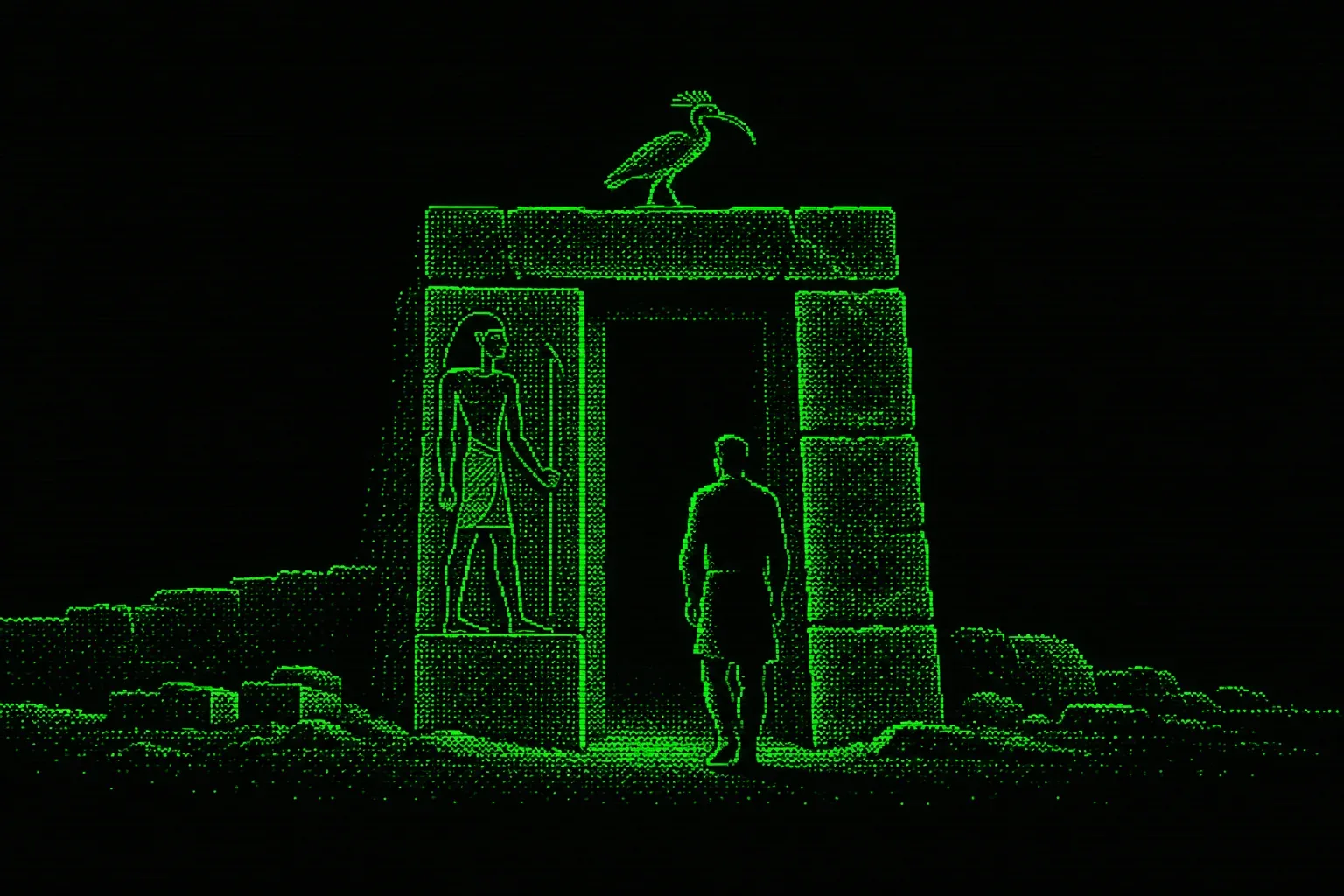
Hezi was an official of the Sixth Dynasty, buried at Saqqara. These words are carved on the left jamb of the passage into his tomb, where everyone entering would pass them. - 2
jr z nb ꜥq.t(j) =f r jz pn wnm.n =f bw,t ntj bw,t ꜣḫ nk.n =f ḥm,t jw wḏꜥ =(j) ḥnꜥ =f m ḏꜣḏꜣ,t nṯr-ꜥꜣ
As for any man who shall enter this tomb having eaten what is abhorrent, the very thing an akh abhors, and having had sex with a woman: I shall be judged with him in the tribunal of the Great God.
Note · Line 2
Anyone who entered a tomb, above all a priest bringing offerings, had to be ritually pure. - 3
jnk ꜣḫ jqr r ꜣḫ nb
I am an akh more excellent than any akh.
Note · Line 3
An akh is the transfigured, effective spirit a person became after a proper burial and the right rites. It was a power that could help or harm the living. - 4
jnk ꜣḫ ꜥpr r ꜣḫ nb
I am an akh better equipped than any akh.
Note · Line 4
“Equipped” means furnished with the spells, knowledge and provisions an akh needs to act in the beyond. - 5
jw =(j) rḫ.k(wi̯) (j)ḫ,t nb(.t) jqr jqr.t ꜣḫ n mnḫ(,w) ꜣḫ.t ꜣḫ n nt(j) m ẖr-nṯr
I know right well everything that serves an akh toward excellence, everything that makes an akh effective, for one who is in the necropolis.
Note · Line 5
The line plays on one root. - 6
jnk ḥzi̯.w n jtj =f
I was one praised by his father.
Note · Line 6
Egyptian idiom speaks of oneself as “his” in such phrases, so “his father” means Hezi’s own father. - 7
jnk mry mw,t =f nbi̯.w n ꜣb,t =f
I was the beloved of his mother, one moulded by his family.
Note · Line 7
The verb behind “moulded” is used for casting metal: his family shaped him as a smith casts a figure. - 8
rḏj.n =(j) jri̯.t ꜥ,t wꜥ.t m jz p(w) n-mrw,t pr,t-ḫrw n =(j) jm =s sḫm.k(wj) m jri̯.t =f m ꜥ,t.pl ꜥšꜣ.(w)t
Though I had the power to build it with many chambers, I had only a single chamber made in this tomb, so that invocation offerings might be made for me in it.
Note · Line 8
Invocation offerings were bread, beer and other goods “called forth” by reciting the offering formula. Hezi presents the small size of his tomb as a mark of modesty rather than of poverty. - 9
n-zp jri̯.y =(j) n =(j) msḏ wj ꜥq r =f ẖnm jm =f n-mrw.t wꜥb =f n =(j)
Never did I do anything for which those who enter it and abide in it might hate me, so that it might stay pure for me.