~/sacred-texts/old-kingdom-tomb-inscriptions
Egyptian Tomb Curse of Herimeru: Robbers Seized Like Geese
- Date
- Carved in the late Old Kingdom (5th–6th Dynasty, about 2400–2180 BC) in the tomb of the official Herimeru, called Merery
- Language
- Old Egyptian · Hieroglyphic
- 1
[ḥtp-ḏi̯] [nswt] ⸢ḥtp-ḏi̯⸣ ⸢Jnp,w⸣ ḫnt,j-zḥ-nṯr jm,j-wt tp,j-ḏw≡f nb-tꜣ-ḏsr
An offering which the king gives, and an offering which Anubis gives, he who is before the god's booth, Imiut, he who is upon his mountain, lord of the sacred land:
Note · Line 1
This is the standard offering formula that opens Egyptian funerary texts: the king, and through him a god, grants offerings to the dead. - 2
qrs =f m jz =f n,j ẖr-nṯr m jmꜣḫ,w mrr,w-nṯr
that he be buried in his tomb in the necropolis as one honoured, beloved of the god.
Note · Line 2
“Honoured one” renders imakhu, a person in a state of honour and provision, cared for by the king, the gods and those who bring offerings. - 3
ḏi̯ jmn,t ꜥ.du =s r =f m jri̯ ḥtp,t zbi̯ jmꜣḫ smr-wꜥ,tj (j)m(,j)-rʾ-ḫnt,w-š Ḥr,j-mr,w rn =f nfr Mrry
May the West hold out her two arms to him, as one who has made peace, one who has passed into honour, the sole companion, overseer of the khentiu-she, Herimeru, whose good name is Merery.
Note · Line 3
The West, where the sun sets, is the land of the dead, imagined as a goddess who embraces the newcomer. - 4
zmꜣ =f tꜣ
May he be joined to the earth.
Note · Line 4
“Joining the earth” is a standard phrase for being laid in the grave. - 5
ḏꜣi̯ =f bjꜣ
May he cross the metal sea of the sky.
Note · Line 5
The word for the sky’s waters also means “metal” (iron or copper): the firmament was pictured as a sheet of water with a metal floor, which the dead cross to reach the gods. - 6
jꜥr =f n nṯr-ꜥꜣ
May he ascend to the great god.
- 7
ḫnti̯ kꜣ =f ḫr nswt
May his ka be foremost with the king.
Note · Line 7
The ka is a person’s life-force and vital double. It lives on after death and receives the offerings. - 8
ḏd bꜣ =f ḫr nṯr
May his ba endure with the god.
Note · Line 8
The ba is the mobile aspect of the self, free to move between the tomb and the world of the gods. - 9
šzp ꜥ =f jn nṯr r s.wt wꜥb.(w)t m mr,y-(j)t(j)≡f ḥz,y-(n-)mw,t≡f
May the god take him by the arm and lead him to the pure places, as one beloved of his father, praised by his mother.
- 10
ḥtp-ḏi̯ [nswt] 〈〈ḥtp-ḏi̯〉〉 Wsjr
An offering which the king gives, and Osiris.
Note · Line 10
Osiris is the god of the dead and king of the underworld. - 11
ḫpi̯ =f nfr ḥr wꜣ,t.pl nfr.(w)t ḫpp! jmꜣḫ,w ḥr =sn
May he walk well on the good roads on which the honoured one walks.
- 12
šms.t =f jn kꜣ.pl =f
May he be followed by his kas.
Note · Line 12
Here the ka appears in the plural, the many life-forces and provisions that sustain the dead. - 13
sšmi̯.t =f ḥr wꜣ,t.pl ḏsr.(w)t
May he be led on the holy roads.
- 14
mnḫ kꜣ.pl =f ḫr nswt
May his kas be excellent with the king.
- 15
wꜥb s,t.pl =f ḫr nṯr
May his places be pure with the god.
- 16
ḥtp-ḏi̯ [nswt] 〈〈ḥtp-ḏi̯〉〉 nṯr.pl nb.w Jmn,t
An offering which the king gives, and all the gods of the West.
- 17
pr-ḫrw n =f m Wp-rnp,t Ḏḥw,t(y)t Wꜣg Tp,j-rnp,t Ḥꜣb-Zkr 〈〈Ḥꜣb〉〉-wr Rkḥ Pr,t-Mnw Sꜣḏ ꜣbd.w Smd,t m ḥꜣb nb nfr rꜥw-nb n jmꜣḫ,w
An invocation offering for him at the Opening of the Year, the Thoth Festival, the Wag Festival, the First of the Year, the Festival of Sokar, the Great Festival, the Burning, the Going Forth of Min, the Sadj Festival, the Monthly Feast, the Half-Month Feast, and at every good festival, every day, for the honoured one.
Note · Line 17
An “invocation offering” (literally “going forth of the voice”) is food and drink that comes into being for the dead when the offering formula is spoken aloud. - 18
sḥḏ-ḫnt,w-š-pr-ꜥꜣ Ḥr,j-mr.w ḏd =f
The inspector of the khentiu-she of the Great House, Herimeru, says:
- 19
jnk ꜣḫ šps jqr
I am a noble and excellent spirit.
- 20
rḫ =(j) (j)ḫ,t
I know the secret things.
Note · Line 20
To “know the thing(s)” means to command ritual and magical knowledge. - 21
ḏd =(j) nfr wḥm =(j) nfr
I spoke what was good and repeated what was good.
- 22
n-zp ḏd =(j) jri̯.y =(j) (j)ḫ,t nb(.t) ḏw(.t) r r(m)ṯ nb mri̯ =(j) mꜣꜥ n ḫr,j nṯr nfr n ḫr,j rmṯ
Never did I say or do anything evil against anyone, for I wished to be in the right with the god and in good standing with people.
- 23
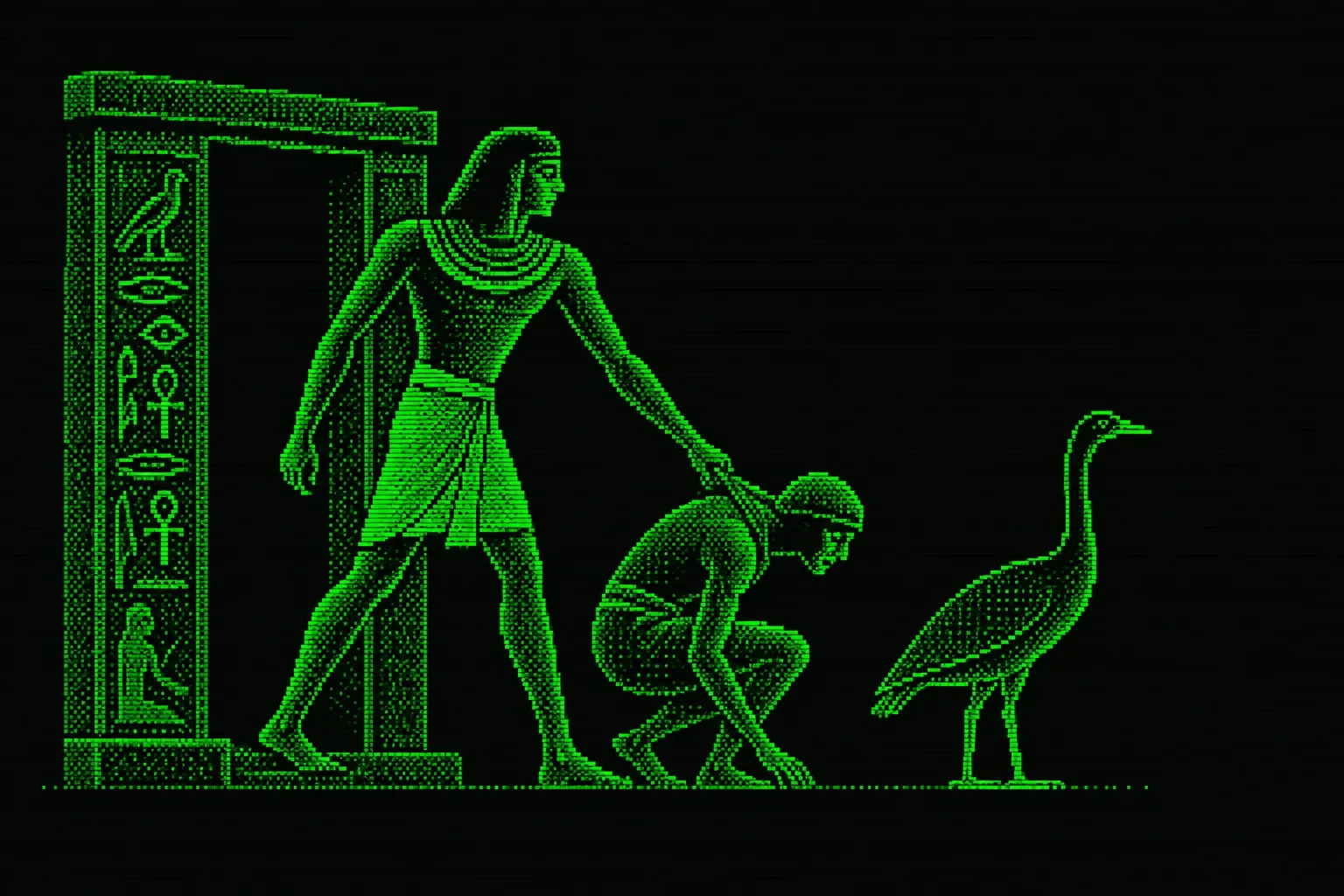
jr swt z nb jri̯.t (j)ḫ,t nb(.t) ḏw(.t) r jz ⸢pn⸣ ꜥq.tj =f r =f zb jw =(j) r jṯi̯.t ṯ(ꜣ)z =f mj s
But as for any man who would do anything evil to this tomb, who would enter it in wrongdoing: I shall grab him by the neck like a goose.
- 24
wḏꜥ.k(w) ḥnꜥ =f m ḏꜣḏꜣ,t nṯr-ꜥꜣ
I shall go to judgement with him in the court of the Great God.
Note · Line 24
The dead man threatens to sue the intruder before the tribunal of the “Great God”, here the god who presides over the dead. - 25
jr swt rmṯ nb pr-ḫrw
But as for anyone who brings the invocation offering,
- 26
sti̯.tj =sn mw wꜥb.tj =sn mj wꜥb n,j nṯr jw =(j) r ḥꜣ(,y) =f m ẖr-nṯr
they who will pour out water, who will be pure as a priest of the god is pure: I shall be his protector in the necropolis.