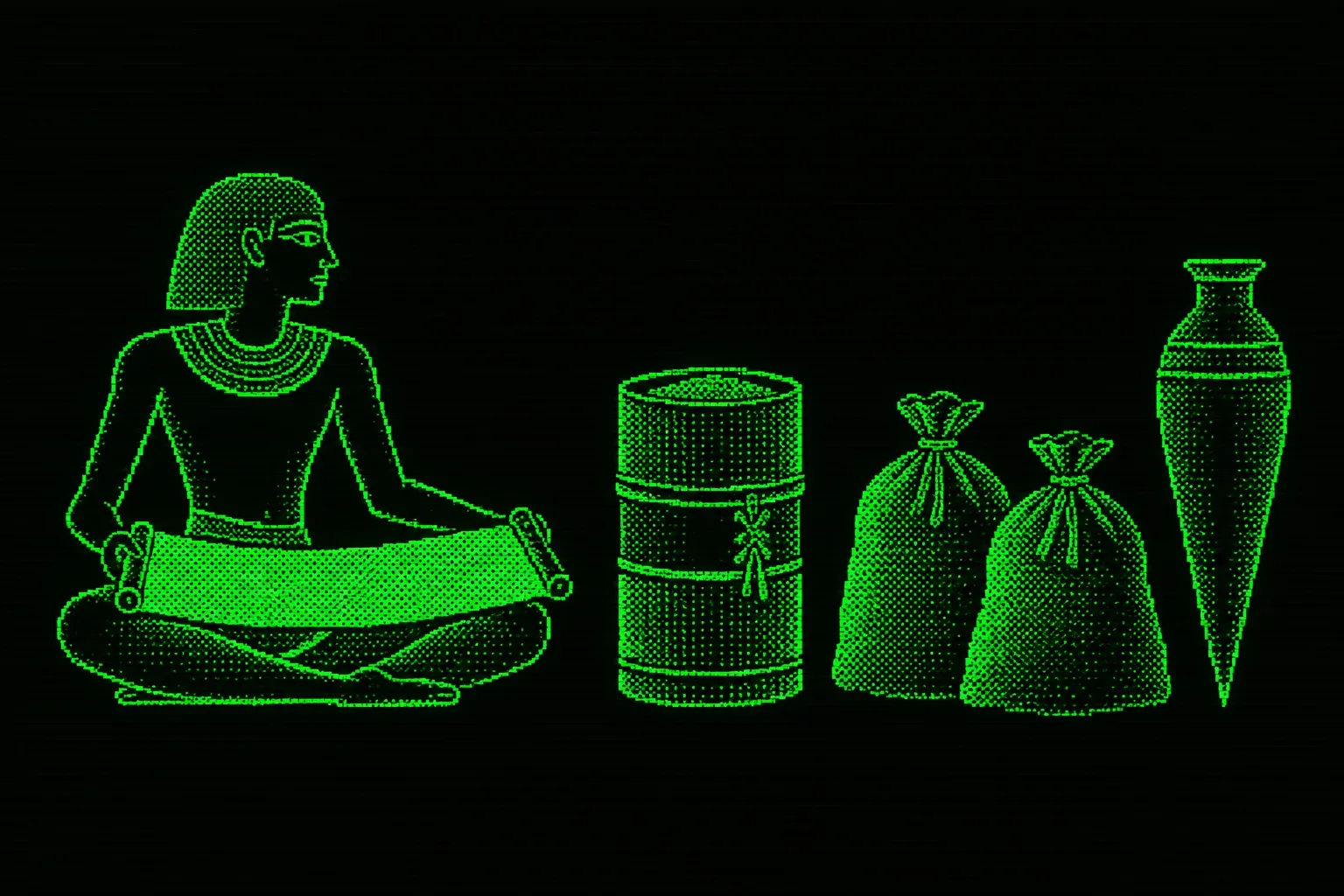
~/sacred-texts/hekanakhte-papyri
Hekanakhte Letter III: I Would Rather Be Paid in Barley
- Date
- Written in the early 12th Dynasty (c. 1950 BC) in hieratic on papyrus
- Found
- Found in the tomb of Ipi (TT 315) at Deir el-Bahari, Western Thebes; now in the Metropolitan Museum of Art, New York
- Language
- Middle Egyptian · Hieratic
- 1
bꜣk-n-pr-ḏ,t ḥm-kꜣ Ḥqꜣ-nḫt ḏd n
The servant of the endowment, the ka-priest Hekanakhte, says to …:
Note · Line 1
A ka-priest tended the offerings for the dead. The endowment provided for them, and the ka was the life force they sustained. - 2
jw ḫr,t =k mj ꜥnḫ ḥḥ n(,j) zp
You fare as one who lives a million times over.
- 3
jr.y n=k Ḥr,j-š≡f nb-Nn-nswt nṯr.pl nb.w n,t.w 〈m〉 〈ḥr,t〉 〈tꜣ〉
May Heryshef, lord of Herakleopolis, and all the gods in heaven and on earth act on your behalf.
- 4
snḏm Ptḥ rs,j-jnb≡f jb =k m ꜥnḫ wr,t jꜣw,t
May Ptah, who is south of his wall, give your heart great joy with life and old age.
Note · Line 4
“South of his wall” is a title of Ptah at Memphis. - 5
wn jmꜣḫ =k nfr ḫr kꜣ n Ḥr,j-š≡f nb-Nn-nswt
May you stand in high honor before the ka of Heryshef, lord of Herakleopolis.
- 6
ḏd bꜣk-jm jmi̯ rḫ zẖꜣ(,w) =k ꜥnḫ-wḏꜣ-snb n,t.t rḏi̯.n jwt Ḥty zꜣ Nḫt ḥnꜥ Zꜣ-nb-nʾ,t ḥr nꜣ-n ⸢jt-mḥ(,j)⸣ bd,t n,t(j) ꜥꜣ
This servant says: Let your scribe—life, prosperity, health—know that I have sent Heti’s son Nakht with Sanebniut about the Lower Egyptian barley and the emmer here.
Note · Line 6
“This servant” is Hekanakhte’s courteous way of referring to himself. “Life, prosperity, health” is a customary blessing. - 7
jr,t (j)r =f zẖꜣ(,w) =k pw ꜥnḫ-wḏꜣ-snb rḏi̯.t šdi̯ =t nn rḏi̯.t tḫtḫ nh(j) jm mj nfr =k nb snb.t(j) ꜥnḫ.t(j)
It falls, then, to your scribe—life, prosperity, health—to have the grain collected without letting any of it get mixed, as befits your goodness in all things. May you be healthy and live!
- 8
jr gr,t r-sꜣ šdi̯.t st ḏḏ.t(w) m pr zẖꜣ(,w) =k ꜥnḫ-wḏꜣ-snb r jwi̯.t r =s
Once the grain has been collected, it is to be kept in your scribe’s house—life, prosperity, health to him—until someone comes for it.
- 9
m =k gr,t rḏi̯.n =j jnt =sn tꜣ jp,t ḫꜣ.t st j:m =s jw =s ꜥn.t(j) m ẖn,t km.t
Note, too, that I have had them bring the oipe measure that was used to measure the grain. It is trimmed with black hide.
Note · Line 9
An oipe was a measure of volume; here it is the measuring vessel itself. - 10
m =k gr,t bd,t 15 m Ḥw,t-hꜣꜣ m-ꜥ Nnk-sw ḥnꜥ jt-mḥ(,j) 13+5 m-ꜥ Jpj-ẖrd m Jw-Sbk.w
Note also that Nenek-su holds 15 sacks of emmer at Hut-haa, and Ipi the Younger holds 13 sacks and 5 heqats of Lower Egyptian barley at Sobek’s Island.
Note · Line 10
A heqat was a smaller measure of grain than a sack. - 11
n,tt m Spꜣ,t-mꜣ,t m-ꜥ Nḥr zꜣ Jpj bd,t 20 sn =f Dšr 3 dmḏ 38 13+5
At Sepat-maat, Neher’s son Ipi holds 20 sacks of emmer, and his brother Desher holds 3. Total: 38 sacks of emmer and 13 sacks and 5 heqats of Lower Egyptian barley.
- 12
jr gr,t rḏi̯.t =f n =j dbꜣ m mrḥ,t ḏḏ =f n =j hbn,t 1 ḥr jt-mḥ(,j) 2 ḥr bd,t 3 rʾ-pw
If anyone pays me in oil, he is to give me one large jar for two sacks of Lower Egyptian barley or three sacks of emmer.
- 13
m =k swt mrr =j rḏi̯.t(w) n =j (j)ḫ,t =j m jt-mḥ(,j)
Mind you, I would rather have what is mine paid to me in Lower Egyptian barley.
- 14
ḥnꜥ tm rḏ ꜥm jb ḥr Nḫt ḥr jwi̯.t =f n =k nb.t ḥr =s
And do not let Nakht be neglected, or any matter he brings to you.
- 15
m =k ntf mꜣꜣ r (j)ḫ,t =j nb.t
He is the one, you see, who looks after everything I own.
- 16
(j)m(,j)-rʾ-Tꜣ-mḥ,w Hrw-nfr
To Herunefer, overseer of Lower Egypt.