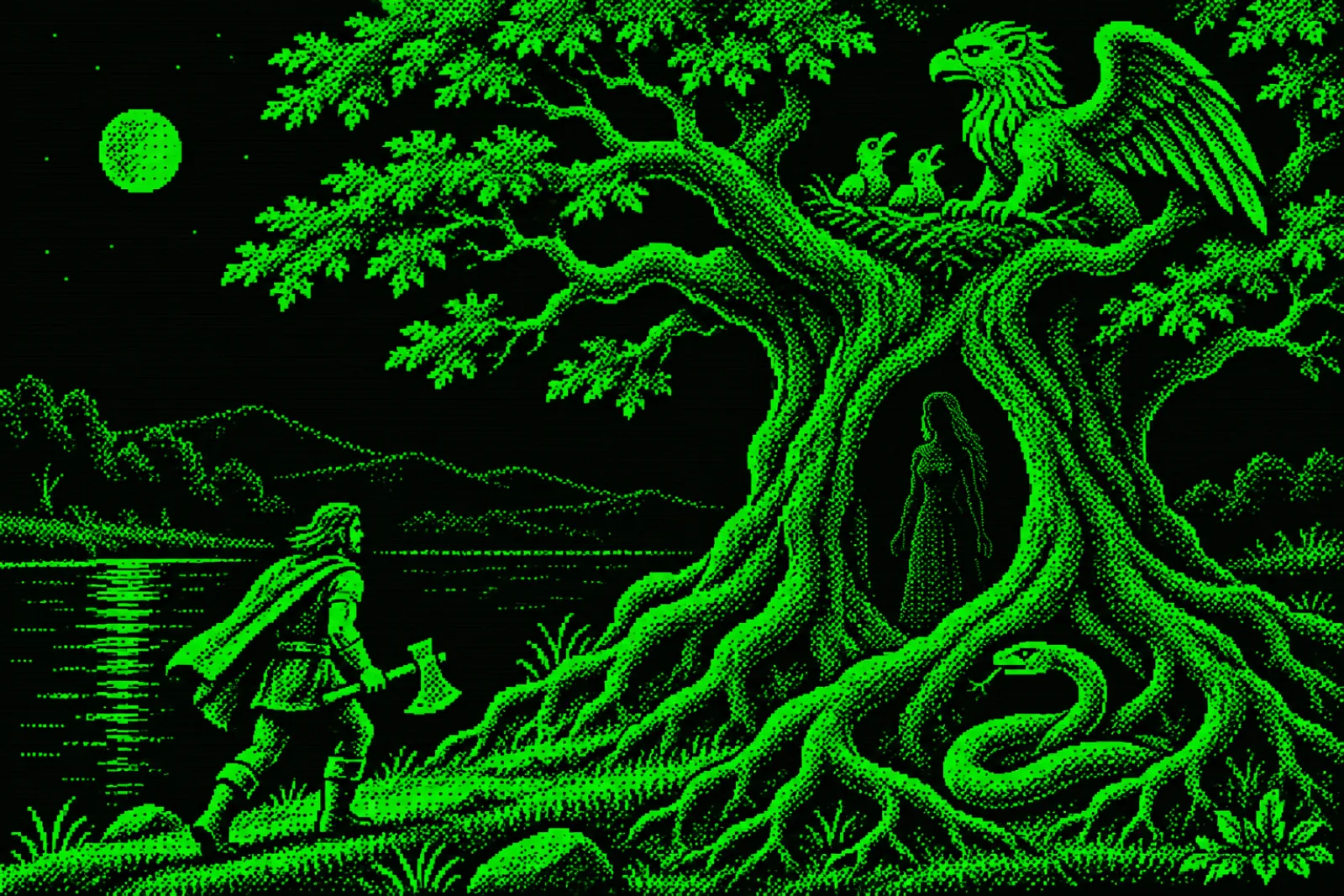
~/sacred-texts/sumerian-gilgamesh-poems
Gilgamesh, Enkidu and the Netherworld: the Huluppu Tree
Translated by AI straight from the Sumerian, not from a modern translation, then checked against the editions and studies listed below. How we translate
- Text
- Sumerian Gilgamesh poems, ETCSL c.1.8.1.4: Version A, lines 1–303; UET 6 58, lines 3–13 and 20–28; UET 6 60, lines 1–17
- Date
- Old Babylonian copies, c. 1800–1700 BC, of a poem composed earlier
- Found
- Nippur (Nibru) and Ur (Urim), southern Iraq; a further copy from Me-Turan in the Diyala valley
- Language
- Sumerian · Cuneiform
This Sumerian poem tells how Gilgamesh, king of Unug (Uruk), lost two wooden objects to the netherworld and what his servant Enkidu saw there when he went to fetch them. It begins in the first days of the world. A storm uproots a tree on the bank of the Euphrates, and the goddess Inana carries it to her garden. She wants a throne and a bed from it, but a snake “who knows no spell” nests in its roots, the Anzu bird in its crown, and a demon, the maiden of the wind, in its trunk. Utu, her brother the sun god, will not help. Gilgamesh does: he kills the snake, drives out the bird and the demon, fells the tree, gives Inana wood for her throne and bed, and makes himself an ellag and an ekidma, a ball and the mallet that drives it.
He plays with them mounted on the widows’ sons, and at the outcry of the widows and the girls the ball and mallet fall into the netherworld. Enkidu offers to go down for them. Gilgamesh tells him how not to be noticed by the dead: no clean clothes, no scented oil, no throwstick, no staff, no sandals, no noise, no kissing or striking of wife or child. Enkidu does all of it and is held. Enlil will not help; Enki has Utu open a hole in the earth, and Utu brings Enkidu up through it on a wind. The rest of the poem is Enkidu’s report: the dead are ranked by how many sons they left to feed them, and he describes the eunuch, the woman who never gave birth, the young man and woman who died before they had sex, the man eaten by a lion, the leper, the man killed in battle, the man no one makes offerings for, the drowned, the stillborn, and the man burned to ashes.
The text here is ETCSL’s composite of the copies from Nippur and Ur (Version A, 303 lines), with the further fates of the Ur tablet UET 6 58 (among them the man who did not respect his parents) and the broken ending of UET 6 60, where Gilgamesh, back in Unug, orders clean water for his dead father and mother. Lines 280–285 are lost, and many lines are damaged; the notes say where a word can be read more than one way. The second half of the poem was translated into Akkadian as Tablet XII of the Babylonian Epic of Gilgamesh. Inana’s speeches are written in Emesal, the Sumerian of women and goddesses. A separate copy from Me-Turan, with its own order of the fates and a bridge to the next Gilgamesh poem, is not translated here.
Each numbered line gives the Sumerian first: the original script, then the same words in Latin letters. Our English is underneath. Tap a dotted word for its meaning, and Note for our comment on the line; our comments are in the right margin.
- 1-3
𒌓 𒊑𒀀 𒌓 𒋤𒁺 𒊑𒀀 / 𒈪 𒊑𒀀 𒈪 𒁁𒁺 𒊑𒀀 / 𒈬 𒊑𒀀 𒈬 𒋤𒁺 𒊑𒀀
ud re-a ud su₃-ra₂ re-a / ĝi₆ re-a ĝi₆ ba₉-ra₂ re-a / mu re-a mu su₃-ra₂ re-a
In those days, in those far-off days; in those nights, in those far-off nights; in those years, in those far-off years —
Note on line 1-3
The opening formula is cited by its first line in Old Babylonian library catalogues from Nippur, Ur and the Louvre, so the composition was known by these words. - 4-5
𒌓 𒌋𒄞 𒃻𒌋𒄞𒂊 𒉺 𒌓𒁺𒀀𒁀 / 𒌓 𒌋𒄞 𒃻𒌋𒄞𒂊 𒊩 𒍣 𒅗𒂵𒀀𒁀
ud ul niĝ₂-du₇-e pa pa: branch, crown of a tree · ePSD2 e₃-a-ba / ud ul niĝ₂-du₇-e mi₂ zid dug₄-ga-a-ba
in days of old, when what was fitting had been brought into the light, in days of old, when what was fitting had been cared for rightly,
Note on line 4-5
ETCSL reads niĝ₂-du₇, ‘what is fitting’; Attinger reads niĝ₂ ul, ’the primordial things’, as certain. - 6-7
𒀊 𒌦𒈠𒅗 𒃻 𒋙𒀀𒁀 / 𒅎𒋗𒆸𒈾 𒌦𒈠𒅗 𒃻𒋰 𒀝𒀀𒁀
eš₃ kalam kalam: the Land, Sumer · ePSD2 ninda šu2 šu2: to cover; here of bread in the shrines · ePSD2 / {im}šu-rin-na kalam kalam: the Land, Sumer · ePSD2 niĝ₂-tab ak-a-ba
when bread had been šu2: to cover; here of bread in the shrines in the shrines of kalam: the Land, Sumer, when the ovens of the Land had been fired,
Note on line 6-7
ninda šu₂ is literally ’to cover bread’; ETCSL takes it as ’to taste’. The sense is that the first offerings had been made. - 8-9
𒀭 𒆠𒋫 𒁀𒁕𒁁𒁺𒀀𒁀 / 𒆠 𒀭𒋫 𒁀𒁕𒋩𒊏𒀀𒁀
an an: An, the sky god · ePSD2 ki-ta ba-da-ba₉-ra₂-a-ba / ki an an: An, the sky god · ePSD2 ba-da-sur-ra-a-ba
when heaven had been moved away from earth, when earth had been parted from heaven,
- 10
𒈬 𒉆𒇽𒍇𒇻 𒁀𒀭𒃻𒊏𒀀𒁀
mu nam-lu₂-u₁₈-lu ba-an-ĝar-ra-a-ba
when the name of mankind had been set in place,
- 11-13
𒌓 𒀭𒉌 𒀭 𒁀𒀭𒁺𒀀𒁀 / 𒀭𒂗𒆤𒇷 𒆠 𒁀𒀭𒁺𒀀𒁀 / 𒀭𒊩𒌆𒆠𒃲𒆷𒊏 𒆳𒊏 𒊕 𒉺𒄸𒁺𒁉𒂠 𒅎𒈠𒀊𒉺𒄸𒁺𒀀𒁀
ud an an: An, the sky god · ePSD2 an an: An, the sky god · ePSD2 ba-an-de₆-a-ba / en-lil2 en-lil2: Enlil, king of the gods · ePSD2 ki ba-an-de₆-a-ba / ereš-ki-gal-la ereš-ki-gal-la: Ereškigal, queen of the netherworld · ePSD2 kur kur: mountain, foreign land; the netherworld · ePSD2 saĝ rig₇-bi-še₃ im-ma-ab-rig₇-a-ba
when an: An, the sky god had carried off heaven, when en-lil2: Enlil, king of the gods had carried off earth, when the kur: mountain land; the netherworld had been given to ereš-ki-gal-la: Ereškigal, queen of the netherworld as her gift —
Note on line 11-13
kur is ‘mountain, foreign land’ and, in this composition throughout, the land of the dead. Ereškigal’s name means ‘Lady of the Great Earth’. - 14-16
𒁀𒄷𒋛𒀀𒁀 𒁀𒄷𒋛𒀀𒁀 / 𒀀𒀀 𒆳𒂠 𒁀𒄷𒋛𒀀𒁀 / 𒀭𒂗𒆠 𒆳𒂠 𒁀𒄷𒋛𒀀𒁀
ba-u₅-a-ba ba-u₅-a-ba / a-a kur kur: mountain, foreign land; the netherworld · ePSD2 ba-u₅-a-ba / en-ki en-ki: Enki, god of the sweet waters and of wisdom · ePSD2 kur kur: mountain, foreign land; the netherworld · ePSD2 ba-u₅-a-ba
when he set sail, when he set sail, when the father set sail for the netherworld, when en-ki: Enki, god of the sweet waters and of wisdom set sail for the netherworld —
Note on line 14-16
u₅ is ’to ride’ and ’to sail a ship’ (ePSD2). Why Enki sails there is not told here; Attinger connects it with Enki’s exclusion from the division of the world. - 17-18
𒈗𒊏 𒌉𒌉 𒁀𒀭𒁕𒊑 / 𒀭𒂗𒆠𒊏 𒃲𒃲 𒁀𒀭𒁕𒊑
lugal-ra tur-tur ba-an-da-ri / en-ki en-ki: Enki, god of the sweet waters and of wisdom · ePSD2 gal-gal ba-an-da-ri
against the king the small ones were hurled, against Enki the large ones were hurled;
Note on line 17-18
The text does not name what is hurled. The editions supply ‘hailstones’. - 19-20
𒌉𒌉𒁉 𒉌𒌓 𒋗𒄰 / 𒃲𒃲𒁉 𒉌𒌓 𒄀 𒄞𒌓𒁕𒄰
tur-tur-bi na₄ šu-kam / gal-gal-bi na₄ gi gu₄-ud-da-kam
the small ones were stones for the hand, the large ones were stones that make the reeds leap.
Note on line 19-20
na₄ gi gu₄-ud-da, literally ‘stone of reed-jumping’. ETCSL has ‘stones from catapults (?)’; Attinger reads the large ones as ‘violently tossing the reeds’. - 21-22
𒌫 𒄑𒈣 𒌉𒊑 𒀭𒂗𒆠𒂵𒆤 / 𒃻𒅮𒈾 𒌋𒄞𒀀𒀭 𒈪𒋙𒋙
ur2 ur2: root, trunk, base; lap · ePSD2 {ĝiš}ma₂ tur-re en-ki en-ki: Enki, god of the sweet waters and of wisdom · ePSD2 / niĝ2-bun2-na niĝ2-bun2-na: turtle · ePSD2 du₇-am₃ šu2 šu2: to cover; here of bread in the shrines · ePSD2
The bottom of Enki's little boat — they butted at it like niĝ2-bun2-na: turtle, they covered it over.
- 23-24
𒈗𒊏 𒀀 𒄑𒈣𒊕𒂷𒆤 / 𒌨𒁇𒊏𒁶 𒌨 𒈬𒈾𒅥𒂊
lugal-ra a {ĝiš}ma₂-saĝ-ĝa₂-ke₄ / ur-bar-ra ur-bar-ra: wolf · ePSD2 teš₂ mu-na-gu₇-e
Against the king the water at the boat's prow devoured all at once, like a ur-bar-ra: wolf;
- 25-26
𒀭𒂗𒆠𒊏 𒀀 𒄑𒈣𒂕𒊏𒆤 / 𒌨𒈤𒁶 𒊕 𒄑 𒅎𒊏𒊏
en-ki en-ki: Enki, god of the sweet waters and of wisdom · ePSD2 a {ĝiš}ma₂-eĝer-ra-ke₄ / ur-maḫ ur-maḫ: lion · ePSD2 saĝ ĝiš im-ra-ra
against Enki the water at the boat's stern struck like a ur-maḫ: lion.
- 27
𒌓𒁉𒀀 𒄑 𒁹𒀀𒀭 𒄑𒄩𒇻𒂠 𒁹𒀀𒀭 𒄑 𒁹𒀀𒀭
ud-bi-a ĝiš 1-am₃ ḫa-lu-ub2 ḫa-lu-ub2: a tree (ePSD2 halub), conventionally 'oak'; older English 'huluppu' · ePSD2 1-am₃ ĝiš 1-am₃
At that time there was one tree, one ḫa-lu-ub2: a tree, conventionally 'oak', one tree,
Note on line 27
ḫalub is a large tree, usually rendered ‘oak’ (Civil 2013); willow (Keetman, Heimpel), poplar (Frayne) and the mahaleb cherry (Gadotti 2014, pp. 27–49) have also been proposed (Attinger, n. 41). Older English versions call it the huluppu tree. - 28-29
𒄘 𒀀𒇉□𒈾 𒆬𒂵𒅗 𒆕𒀀𒁉 / 𒀀𒇉□𒈾 𒀀 𒅘𒅘𒁕𒁉
gu₂ buranuna buranuna: the Euphrates · ePSD2 kug-ga-ka du₃-a-bi / buranuna buranuna: the Euphrates · ePSD2 a na₈-na₈-da-bi
planted on the bank of the pure buranuna: the Euphrates, drinking the water of the Euphrates.
- 30-31
𒀉 𒍇𒇻 𒌫𒁀 𒈬𒉌𒅔𒁍 𒉺𒁀 𒈬𒉌𒅔□ / 𒀀𒇉□𒈾 𒀀 𒅎𒈠𒉌𒅁𒊏
a₂ u₁₈-lu ur2 ur2: root, trunk, base; lap · ePSD2 mu-ni-in-bur₁₂ pa pa: branch, crown of a tree · ePSD2 mu-ni-in-suḫ / buranuna buranuna: the Euphrates · ePSD2 a im-ma-ni-ib-ra
The force of the south wind tore it out at its ur2: root, trunk, base; lap and stripped its pa: branch, crown of a tree, and the Euphrates carried it off on its water.
- 32-33
𒊩𒂊 𒅗 𒀭𒈾𒋫 𒉎 𒋼𒀀 𒁺 / 𒅗 𒀭𒂗𒆤𒇲𒋫 𒉎 𒋼𒀀 𒁺
munus-e inim an an: An, the sky god · ePSD2 ni₂ te-a du / inim en-lil2 en-lil2: Enlil, king of the gods · ePSD2 ni₂ te-a du
A woman who went in awe of An's word, who went in awe of Enlil's word,
Note on line 32-33
Inana’s own retelling (lines 75–80) puts this in the first person, ‘I, the woman’, in her women’s dialect. The woman who rescues the tree is Inana herself. - 34-35
𒄑 𒋗𒈾 𒈬𒌦𒆪 𒀕𒆠𒂠 𒁀𒉌𒅔𒆭𒊑 / 𒄑𒊬 𒄀𒆸 𒀭𒈹𒂠 𒅎𒈠𒉌𒅔𒆭𒆭𒊑
ĝiš šu-na mu-un-dab₅ unug unug: Unug (Uruk), Inana's city · ePSD2 ba-ni-in-kur₉-re / kiri6 kiri6: orchard, garden · ePSD2 gi-rin gi-rin: blossom; luxuriant, splendid · ePSD2 inana inana: Inana, goddess of love and war · ePSD2 im-ma-ni-in-ku₄-ku₄-re
took the tree in her hand and brought it into unug: Unug (Uruk), Inana's city; she brought it into the gi-rin: blossom; luxuriant, splendid kiri6: orchard, garden of inana: Inana, goddess of love and war.
- 36-37
𒊩𒂊 𒄑 𒋗𒈾 𒇷𒉈𒅔𒁺 𒄊𒉌𒋫 𒉈𒅔𒁺 / 𒊩𒂊 𒄑 𒋗𒈾 𒀀 𒇷𒉈𒅔𒅗 𒄊𒉌𒋫 𒉈𒅔𒅗
munus-e ĝiš šu-na li-bi₂-in-du ĝiri₃-ni-ta bi₂-in-du / munus-e ĝiš šu-na a li-bi₂-in-dug₄ ĝiri₃-ni-ta bi₂-in-dug₄
The woman planted the tree, not with her hand: she planted it with her foot. The woman watered the tree, not with her hand: she watered it with her foot.
Note on line 36-37
Attinger reads ‘with the foot’ as doing it clumsily, and ‘watered’ as flooding where she should have sprinkled; the overwatered tree grows too big to cut, and evil things move into it. Gadotti (2014, pp. 254–255) takes it as a real watering practice. - 38-39
𒈨𒈾𒀀𒀭 𒄑𒄖𒍝 𒄀𒆸 𒁀𒉌𒆪𒉈𒂗 𒉈𒅔𒅗 / 𒈨𒈾𒀀𒀭 𒄑𒈿 𒄀𒆸 𒁀𒉌𒈿𒉈𒂗 𒉈𒅔𒅗
me-na-am₃ gu-za gu-za: chair, throne · ePSD2 gi-rin gi-rin: blossom; luxuriant, splendid · ePSD2 ba-ni-tuš-de₃-en bi₂-in-dug₄ / me-na-am₃ ĝiš-nu2 ĝiš-nu2: bed · ePSD2 gi-rin gi-rin: blossom; luxuriant, splendid · ePSD2 ba-ni-nu₂-de₃-en bi₂-in-dug₄
"When will it be a flowering gu-za: chair, throne for me to sit on?" she said. "When will it be a flowering ĝiš-nu2: bed for me to lie on?" she said.
Note on line 38-39
Chair and bed are the throne and the marriage bed: what the tree is meant to become. - 40-41
𒈬 𒐊𒀀𒀭 𒈬 𒌋𒀀𒀭 𒁀𒂊𒉌𒆷 𒊑 / 𒄑 𒁀𒆸 𒋢𒁉 𒉡𒈬𒌦𒁕𒁯
mu 5-am₃ mu [10-am₃ ba-e-zal-la re] / ĝiš ba-gur₄ kuš-bi nu-mu-un-da-dar
Five years, ten years went by. The tree grew thick, but its bark did not split.
- 42
𒌫𒁉𒀀 𒈲 𒅲 𒉡𒍪𒂊 𒌑𒆠𒋧𒂵 𒅎𒈠𒉌𒅁𒍑
ur2 ur2: root, trunk, base; lap · ePSD2 muš muš: snake (ePSD2 muš[snake], 676 attestations) · ePSD2 tu6 tu6: incantation, spell (ePSD2 tu[incantation]). The sign KA×LI also reads uš₇, 'poison; spittle' (ePSD2 uš[poison], uš[spittle]); at line 140 two copies have uš₁₁ 'poison' instead (Attinger) · ePSD2 zu zu: to know · ePSD2 gud3 gud3: nest · ePSD2 im-ma-ni-ib-us₂
In its ur2: root, base the muš: snake who zu: to know no tu6: incantation, spell made its gud3: nest.
Note on line 42
muš tu₆ nu-zu, literally ‘snake, spell, not knowing’. The sign KA×LI reads tu₆ ‘incantation’, the standard reading; the ePSD2 sign list gives the same sign the value uš₇, which ePSD2 lists under ‘poison’ and ‘spittle’. At line 140, but not here, two manuscripts (N33 from Nippur and Ur3) have uš₁₁ instead of tu₆ (Attinger 2019, apparatus); uš₁₁ is the sign KA×BAD in the ePSD2 sign list and is listed under ‘poison’. Attinger still renders that line ‘who does not know spells’. The variant shows the scribes hearing the venom word in the epithet: a snake no charmer’s spell can bind, named with the sign for venom. - 43
𒉺𒁉𒀀 𒄷 𒀭𒅎𒂂𒄷𒉈 𒀫 𒅎𒈠𒉌𒅁𒃻
pa pa: branch, crown of a tree · ePSD2 mušen anzud anzud: Anzu, the lion-headed eagle of the mountains · ePSD2 amar amar: calf; young, chick · ePSD2 im-ma-ni-ib-ĝar
In its branches the anzud: Anzu, the lion-headed eagle of the mountains set its amar: calf; young, chick.
- 44
𒉺𒅁𒁉𒀀 𒆠𒂖 𒆤𒇲𒆤 𒂍 𒅎𒈠𒉌𒅁𒆕
šab-bi-a ki-sikil ki-sikil: young woman, maiden (ePSD2 kisikil). With lil₂-la₂, the demon 'maiden of the wind' · ePSD2 lil2 lil2: wind, breeze; ghost (ePSD2 lil[ghost]). ePSD2 lists ki-sikil-lil₂-la₂ as a demon; Akkadian ardat lilî · ePSD2 e₂ im-ma-ni-ib-du₃
In its trunk the ki-sikil: young woman, maiden of the lil2: wind, breeze; ghost built herself a house,
Note on line 44
ki-sikil-lil₂-la₂, ‘maiden of the wind’ or ‘of the ghost’: ePSD2 lists the compound as a demon. Her Akkadian counterpart is ardat lilî, a demoness who preys on men; Kramer’s 1938 edition already called her Lilith, and the Hebrew lîlît of Isaiah 34:14 is commonly derived from this family of wind-demons (a scholars’ proposal). ETCSL has ’the phantom maid’, Attinger ‘Demoiselle-des-souffles’. - 45-46
𒆠𒂖 𒅗 𒉈𒉈 𒊮 𒄾𒄾 / 𒆬 𒀭𒈹𒆤 𒀀𒅆 𒂊𒉈 𒁀𒋁𒋁
ki-sikil ki-sikil: young woman, maiden (ePSD2 kisikil). With lil₂-la₂, the demon 'maiden of the wind' · ePSD2 zu₂ li₉-li₉ šag₄ ḫul₂-ḫul₂ / kug inana inana: Inana, goddess of love and war · ePSD2 er₂ e-ne ba-še₈-še₈
the young woman who flashes her teeth in laughter, the glad-hearted. But holy Inana wept.
Note on line 45-46
zu₂ li₉-li₉ is ’to flash the teeth’, to laugh. ETCSL and Kramer give the laughter to the wind-maiden in the trunk; Attinger (2019) gives it to Inana: ’the young woman, always laughing and glad — holy Inana, how she wept!’ The grammar allows both. We keep the laughing girl with the demon, as the line follows hers directly, and let Inana’s tears answer her. - 47-49
𒌓 𒉌𒇷𒁕 𒀭𒌫 𒌓𒄀𒁕 / □ 𒌓 𒉌𒇷 𒆂 𒄄𒄄𒁕 / 𒀭𒌓 𒂍𒉣𒋫 𒌓𒁺𒀀𒉌
ud zal-le-da an-ur₂ zalag-ge-da / buru₅ ud zal-le šeg₁₀ gi₄-gi₄-da / utu utu: Utu, the sun god · ePSD2 agrun agrun: inner chamber · ePSD2 e₃-a-ni
When day was breaking, when the horizon grew bright, when the little birds at daybreak set up their noise, when utu: Utu, the sun god came out of his agrun: inner chamber,
- 50-51
𒊩𒆪𒀀𒉌 𒆬 𒀭𒈹𒆤 / 𒌨𒊕 𒂄 𒀭𒌓𒊏 𒅗 𒈬𒈾𒌤𒂊
[nin₉]-a-ni kug inana inana: Inana, goddess of love and war · ePSD2 / [ur-saĝ šul] utu utu: Utu, the sun god · ePSD2 gu₃ mu-na-de₂-e
his sister, holy Inana, spoke to the hero, the young man Utu:
- 52-53
𒋀𒈬 𒌓 𒊑𒀀 𒈾𒉘 𒁀𒋻𒊏𒀀𒁀 / 𒌓 𒃶𒈠𒀠𒆷 𒅗𒈾𒉘𒂷 𒁀𒂊𒉌𒆷 𒊑
šeš-ĝu₁₀ ud re-a na-aĝ₂ ba-tar-ra-a-ba / ud ḫe₂-ma-al-la kalam kalam: the Land, Sumer · ePSD2 ba-e-zal-la re
"My brother, in those days when destiny was cut, when abundance flowed through the Land,
Note on line 52-53
From here to line 89 Inana speaks, and the copyists write her words in Emesal, the dialect of women and goddesses: u₃-mu-un for en ’lord’, mu for ĝiš ’tree’, e-ne-eĝ₃ for inim ‘word’, nu-nus for munus ‘woman’, me-ri for ĝiri₃ ‘foot’, {d}am-an-ki for Enki, {d}mu-ul-lil₂ for Enlil. - 54-56
𒌓 𒀭𒉌 𒀭 𒁀𒀭𒅕𒊏𒀀𒁀 / 𒀭𒈬𒌋𒄞𒆤𒇷 𒆠 𒁀𒀭𒅕𒊏𒀀𒁀 / 𒀭𒂵𒊭𒀭𒆠𒃲𒆷𒊏 𒆳𒊏 𒊕 𒉺𒄸𒁺𒂵𒂠 𒅎𒈠𒀊𒉺𒄸𒁺𒂵𒀀𒁀
ud an an: An, the sky god · ePSD2 an an: An, the sky god · ePSD2 ba-an-ir-ra-a-ba / en-lil2 en-lil2: Enlil, king of the gods · ePSD2 ki ba-an-ir-ra-a-ba / ereš-ki-gal-la ereš-ki-gal-la: Ereškigal, queen of the netherworld · ePSD2 kur kur: mountain, foreign land; the netherworld · ePSD2 saĝ rig₇-ga-še₃ im-ma-ab-rig₇-ga-a-ba
when An had carried off heaven, when Enlil had carried off earth, when the netherworld had been given to Ereškigal as her gift —
- 57-59
𒁀𒄷𒋛𒀀𒁀 𒁀𒄷𒋛𒀀𒁀 / 𒀀𒀀 𒆳𒂠 𒁀𒄷𒋛𒀀𒁀 / 𒀭𒄠𒀭𒆠 𒆳𒂠 𒁀𒄷𒋛𒀀𒁀
ba-u₅-a-ba ba-u₅-a-ba / a-a kur kur: mountain, foreign land; the netherworld · ePSD2 ba-u₅-a-ba / en-ki en-ki: Enki, god of the sweet waters and of wisdom · ePSD2 kur kur: mountain, foreign land; the netherworld · ePSD2 ba-u₅-a-ba
when he set sail, when he set sail, when the father set sail for the netherworld, when Enki set sail for the netherworld —
- 60-61
𒅆𒁳𒈬𒌦𒊏 𒌉𒌉 𒁀𒀭𒁕𒊑 / 𒀭𒄠𒀭𒆠𒊏 𒃲𒃲 𒁀𒀭𒁕𒊑
u₃-mu-un-ra tur-tur ba-an-da-ri / en-ki en-ki: Enki, god of the sweet waters and of wisdom · ePSD2 gal-gal ba-an-da-ri
against the lord the small ones were hurled, against Enki the large ones were hurled;
- 62-63
𒌉𒌉𒁉 𒉌𒌓 𒋗𒀀𒄰 / 𒃲𒃲𒁉 𒉌𒌓 𒄀 𒄞𒌓𒁕𒄰
tur-tur-bi na₄ šu-a-kam / gal-gal-bi na₄ gi gu₄-ud-[da-kam]
the small ones were stones for the hand, the large ones were stones that make the reeds leap.
- 64-65
𒌫 𒄑𒈣 𒌉𒊑 𒀭𒄠𒀭𒆠𒂵𒆤 / 𒊺𒂗𒅮𒈾 𒌋𒄞𒀀𒀭 𒉌𒋙𒋙
ur2 ur2: root, trunk, base; lap · ePSD2 {ĝiš}ma₂ tur-re en-ki en-ki: Enki, god of the sweet waters and of wisdom · ePSD2 / niĝ2-bun2-na niĝ2-bun2-na: turtle · ePSD2 du₇-am₃ šu2 šu2: to cover; here of bread in the shrines · ePSD2
The keel of Enki's little boat — they butted at it like turtles, they covered it over.
- 66-67
𒅆𒁳𒈬𒌦𒊏 𒀀 𒄑𒈣𒊕𒂷𒆤 / 𒌨𒁇𒊏𒁶 𒌨 𒈬𒌦𒈾𒅥𒂊
u₃-mu-un-ra a {ĝiš}ma₂-saĝ-ĝa₂-[ke₄] / ur-bar-ra ur-bar-ra: wolf · ePSD2 teš₂ mu-un-na-gu₇-[e]
Against the lord the water at the boat's prow devoured all at once, like a wolf;
- 68-69
𒀭𒄠𒀭𒆠𒊏 𒀀 𒄑𒈣𒂕𒊏𒆤 / 𒌨𒈤𒁶 𒊕 𒄑 𒅎𒊏𒊏
en-ki en-ki: Enki, god of the sweet waters and of wisdom · ePSD2 a {ĝiš}ma₂-eĝer-ra-[ke₄] / ur-maḫ ur-maḫ: lion · ePSD2 saĝ ĝiš im-ra-ra
against Enki the water at the boat's stern struck like a lion.
- 70
𒌓𒁉𒀀 𒈬 𒁲𒋫𒀀𒀭 𒄑𒄩𒇻𒂠 𒁲𒋫 𒄑 𒌆 𒁲𒋫𒀀𒀭
ud-bi-a mu di-ta-am₃ ḫa-lu-ub2 ḫa-lu-ub2: a tree (ePSD2 halub), conventionally 'oak'; older English 'huluppu' · ePSD2 di-ta ĜIŠ TUG₂ di-ta-am₃
At that time there was one tree, one ḫalub tree, one box tree,
Note on line 70
ĜIŠ TUG₂ is the ĝešdašgari, the box tree, as other manuscripts write it here and at line 114 (Attinger). - 71-72
𒄘 𒀀𒇉□𒈾 𒆬𒂵𒅗 𒆕𒀀𒁀 / 𒀀𒇉□𒈾 𒀀 𒅘𒅘𒁕𒁉
gu₂ buranuna buranuna: the Euphrates · ePSD2 kug-ga-ka du₃-a-ba / buranuna buranuna: the Euphrates · ePSD2 a na₈-na₈-da-bi
planted on the bank of the pure Euphrates, drinking the water of the Euphrates.
- 73-74
𒀉 𒅎𒍇𒇻 𒌫𒁀 𒈬𒉌𒅔𒁍 𒉺𒁀 𒈬𒉌𒅔□ / 𒀀𒇉□𒈾 𒀀 𒅎𒈠𒉌𒅁𒊏
a₂ {tum₉}u₁₈-lu ur2 ur2: root, trunk, base; lap · ePSD2 mu-ni-in-bur₁₂ pa pa: branch, crown of a tree · ePSD2 mu-ni-in-suḫ / buranuna buranuna: the Euphrates · ePSD2 a im-ma-ni-ib-ra
The force of the south wind tore it out at its roots and stripped its branches, and the Euphrates carried it off on its water.
- 75-76
𒉡𒉭 𒂊𒉈𒉘 𒀭𒈾𒋫 𒉎 𒋼𒀀 𒁺 / 𒂊𒉈𒉘 𒀭𒈬𒌋𒄞𒆤𒇲𒋫 𒉎 𒋼𒀀 𒁺
nu-nus e-ne-eĝ₃ an an: An, the sky god · ePSD2 ni₂ te-a du / e-ne-eĝ₃ en-lil2 en-lil2: Enlil, king of the gods · ePSD2 ni₂ te-a du
A woman who went in awe of An's word, who went in awe of Enlil's word,
- 77-78
𒈬 𒋗𒂷 𒈬𒌦𒆪 𒀕𒆠𒂠 𒁀𒉌𒅔𒆭 / 𒄑𒊬 𒄀𒆸 𒆬 𒂵𒊭𒀭𒈾𒂠 𒅎𒈠𒉌𒅔𒆭𒆭
mu šu-ĝa₂ mu-un-dab₅ unug unug: Unug (Uruk), Inana's city · ePSD2 ba-ni-in-kur₉ / kiri6 kiri6: orchard, garden · ePSD2 gi-rin gi-rin: blossom; luxuriant, splendid · ePSD2 kug inana inana: Inana, goddess of love and war · ePSD2 im-ma-ni-in-ku₄-ku₄
I took the tree in my hand and brought it into Unug; I brought it into the flowering garden of holy Inana.
Note on line 77-78
šu-ĝa₂, ‘my hand’: the goddess tells the story of herself. - 79-80
𒉡𒉭𒁺 𒈬 𒋗𒂷 𒇷𒉈𒅔𒁺 𒈨𒊑𒈬𒋫 𒉈𒅔𒁺 / 𒀭𒂵𒊭𒀭𒈾𒁺 𒈬 𒋗𒂷 𒀀 𒇷𒉈𒅔𒌤 𒈨𒊑𒈬𒋫 𒀀 𒉈𒁺
nu-nus-ĝen mu šu-ĝa₂ li-bi₂-in-du me-ri-ĝu₁₀-ta bi₂-in-du / inana inana: Inana, goddess of love and war · ePSD2 mu šu-ĝa₂ a li-bi₂-in-de₂ me-ri-ĝu₁₀-ta a bi₂-du
I, the woman, planted the tree, not with my hand: I planted it with my foot. I, inana: Inana, written in Emesal ga-ša-an-na, watered the tree, not with my hand: I watered it with my foot.
Note on line 79-80
nu-nus-ĝen, ‘I am the woman’; in line 80 most copies write {d}ga-ša-an-na-ĝen, ‘I am Inana’, one copy ‘I am the woman’. - 81-82
𒈨𒈾𒀀𒀭 𒄑𒄖𒍝 𒄀𒆸 𒁀𒉌𒆪𒅆𒁳𒉈𒂗 𒉈𒅔𒅗 / 𒈨𒈾𒀀𒀭 𒄑𒈿 𒄀𒆸 𒁀𒉌𒈿𒉈𒂗 𒉈𒅔𒅗
me-na-am₃ gu-za gu-za: chair, throne · ePSD2 gi-rin gi-rin: blossom; luxuriant, splendid · ePSD2 ba-ni-tuš-u₃-de₃-en bi₂-in-dug₄ / me-na-am₃ ĝiš-nu2 ĝiš-nu2: bed · ePSD2 gi-rin gi-rin: blossom; luxuriant, splendid · ePSD2 ba-ni-nu₂-de₃-en bi₂-in-dug₄
'When will it be a flowering chair for me to sit on?' I said. 'When will it be a flowering bed for me to lie on?' I said.
- 83-84
𒈬 𒐊𒀀𒀭 𒈬 𒌋𒀀𒀭 𒁀𒂊𒉌𒆷 𒊑 / 𒈬 𒁀𒆸 𒋢𒁉 𒉡𒈬𒌦𒁕𒁯
mu 5-am₃ mu 10-am₃ ba-e-zal-la re / mu ba-gur₄ [kuš]-bi nu-mu-un-da-dar
Five years, ten years went by. The tree grew thick, but its bark did not split.
- 85
𒌫𒁉𒀀 𒈲 𒅲 𒉡𒍪𒂊 𒌑𒆠𒋧𒂵 𒅎𒈠𒉌𒅁𒍑
ur2 ur2: root, trunk, base; lap · ePSD2 muš muš: snake (ePSD2 muš[snake], 676 attestations) · ePSD2 tu6 tu6: incantation, spell (ePSD2 tu[incantation]). The sign KA×LI also reads uš₇, 'poison; spittle' (ePSD2 uš[poison], uš[spittle]); at line 140 two copies have uš₁₁ 'poison' instead (Attinger) · ePSD2 zu zu: to know · ePSD2 gud3 gud3: nest · ePSD2 im-ma-ni-ib-us₂
In its roots the snake who knows no spell made its nest.
- 86
𒉺𒁉𒀀 𒄷 𒀭𒅎𒂂𒄷 𒀫 𒅎𒈠𒉌𒅁𒃻
pa pa: branch, crown of a tree · ePSD2 mušen anzud anzud: Anzu, the lion-headed eagle of the mountains · ePSD2 amar amar: calf; young, chick · ePSD2 im-ma-ni-ib-ĝar
In its branches the Anzu bird set its young.
- 87
𒉺𒅁𒁀𒁉𒀀 𒆠𒂖 𒆤𒇲𒆤 𒂍 𒅎𒈠𒉌𒅔𒍑
šab-ba-bi-a ki-sikil ki-sikil: young woman, maiden (ePSD2 kisikil). With lil₂-la₂, the demon 'maiden of the wind' · ePSD2 lil2 lil2: wind, breeze; ghost (ePSD2 lil[ghost]). ePSD2 lists ki-sikil-lil₂-la₂ as a demon; Akkadian ardat lilî · ePSD2 e₂ im-ma-ni-in-us₂
In its trunk the young woman of the wind set up her house,
- 88-89
𒆠𒂖 𒅗 𒉈𒉈 𒊮 𒄾𒄾 / 𒆬 𒀭𒈹𒆤 𒀀𒅆 𒂊𒉈 𒁀𒋁𒋁
ki-sikil ki-sikil: young woman, maiden (ePSD2 kisikil). With lil₂-la₂, the demon 'maiden of the wind' · ePSD2 zu₂ [li₉]-li₉ šag₄ ḫul₂-ḫul₂ / kug inana inana: Inana, goddess of love and war · ePSD2 er₂ e-ne ba-še₈-še₈
the young woman who flashes her teeth in laughter, the glad-hearted." But holy Inana wept.
- 90
𒋀𒀀𒉌 𒌨𒊕 𒂄 𒀭𒌓 𒅗𒁉 𒉡𒈬𒉈𒁺
šeš-a-ni ur-saĝ šul utu utu: Utu, the sun god · ePSD2 inim-bi nu-mu-de₃-gub
Her brother, the hero, the young man Utu, did not stand by her in the matter.
- 91-93
𒌓 𒉌𒇷𒁕 𒀭𒌫 𒌓𒄀𒉈 / 𒄷 □𒄷 𒌓 𒉌𒇷 𒆂 𒄄𒄄𒁕 / 𒀭𒌓 𒂍𒉣𒋫 𒌓𒁺𒀀𒉌
ud zal-le-da an-ur₂ zalag-ge-de₃ / mušen buru₅{mušen} ud zal-le šeg₁₀ gi₄-gi₄-da / utu utu: Utu, the sun god · ePSD2 agrun agrun: inner chamber · ePSD2 e₃-a-ni
When day was breaking, when the horizon grew bright, when the little birds at daybreak set up their noise, when Utu came out of his bedchamber,
- 94-95
𒊩𒆪𒀀𒉌 𒆬 𒀭𒈹𒆤 / 𒌨𒊕 𒀭𒄑𒉋𒂵𒈩 𒅗 𒈬𒈾𒌤𒂊
nin₉-a-ni kug inana inana: Inana, goddess of love and war · ePSD2 / ur-saĝ gilgameš2 gilgameš2: Gilgamesh, king of Unug · ePSD2 gu₃ mu-na-[de₂-e]
his sister, holy Inana, spoke to the hero gilgameš2: Gilgamesh, king of Unug:
- 96-97
𒋀𒈬 𒌓 𒊑𒀀 𒈾𒉘 𒁀𒋻𒊏𒀀𒁀 / 𒌓 𒃶𒈠𒀠𒆷 𒅗𒈾𒉘 𒁀𒂊𒉌𒆷 𒊑
šeš-ĝu₁₀ ud re-a na-aĝ₂ ba-tar-ra-a-[ba] / ud [ḫe₂-ma-al-la] kalam kalam: the Land, Sumer · ePSD2 ba-e-zal-la re
"My brother, in those days when destiny was cut, when abundance flowed through the Land,
Note on line 96-97
Inana calls Gilgamesh ‘my brother’, as she called Utu. - 98-100
𒌓 𒀭𒉌 𒀭 𒁀𒀭𒅕𒊏𒀀𒁀 / 𒀭𒈬𒌋𒄞𒆤𒇷 𒆠 𒁀𒀭𒅕𒊏𒀀𒁀 / 𒀭𒂵𒊭𒀭𒆠𒃲𒆷𒊏 𒆳𒊏 𒊕 𒉺𒄸𒁺𒂵𒂠 𒅎𒈠𒀊𒉺𒄸𒁺𒂵𒀀𒁀
[ud an an: An, the sky god · ePSD2 an an: An, the sky god · ePSD2 [ba-an]-ir-ra-a-ba / en-lil2 en-lil2: Enlil, king of the gods · ePSD2 ki] [ba]-an-ir-ra-a-ba / ereš-ki-gal-la ereš-ki-gal-la: Ereškigal, queen of the netherworld · ePSD2 kur kur: mountain, foreign land; the netherworld · ePSD2 saĝ rig₇-ga-še₃ im-ma-ab-rig₇-ga-a-ba
when An had carried off heaven, when Enlil had carried off earth, when the netherworld had been given to Ereškigal as her gift —
- 101-103
𒁀𒄷𒋛𒀀𒁀 𒁀𒄷𒋛𒀀𒁀 / 𒀀𒀀 𒆳𒂠 𒁀𒄷𒋛𒀀𒁀 / 𒀭𒄠𒀭𒆠 𒆳𒂠 𒁀𒄷𒋛𒀀𒁀
ba-u₅-a-ba ba-u₅-a-ba / a-a kur kur: mountain, foreign land; the netherworld · ePSD2 ba-u₅-a-ba / en-ki en-ki: Enki, god of the sweet waters and of wisdom · ePSD2 kur kur: mountain, foreign land; the netherworld · ePSD2 ba-u₅-a-ba
when he set sail, when he set sail, when the father set sail for the netherworld, when Enki set sail for the netherworld —
- 104-105
𒅆𒁳𒈬𒌦𒊏 𒌉𒌉 𒁀𒀭𒁕𒊑 / 𒀭𒄠𒀭𒆠𒊏 𒃲𒃲 𒁀𒀭𒁕𒊑
u₃-mu-un-ra tur-tur ba-an-da-ri / en-ki en-ki: Enki, god of the sweet waters and of wisdom · ePSD2 gal-gal ba-an-da-ri
against the lord the small ones were hurled, against Enki the large ones were hurled;
- 106-107
𒌉𒌉𒁉 𒉌𒌓 𒋗𒄰 / 𒃲𒃲𒁉 𒉌𒌓 𒄀 𒄞𒌓𒁕𒄰
tur-tur-bi na₄ šu-kam / gal-gal-bi na₄ gi gu₄-ud-da-kam
the small ones were stones for the hand, the large ones were stones that make the reeds leap.
- 108-109
𒌫 𒄑𒈣 𒌉𒊑 𒀭𒄠𒀭𒆠𒂵𒆤 / 𒊺𒂗𒅮𒈾 𒌋𒄞𒀀𒀭 𒉌𒋙𒋙
ur2 ur2: root, trunk, base; lap · ePSD2 {ĝiš}ma₂ tur-re en-ki en-ki: Enki, god of the sweet waters and of wisdom · ePSD2 / niĝ2-bun2-na niĝ2-bun2-na: turtle · ePSD2 du₇-am₃ šu2 šu2: to cover; here of bread in the shrines · ePSD2
The keel of Enki's little boat — they butted at it like turtles, they covered it over.
- 110-111
𒅆𒁳𒈬𒌦𒊏 𒀀 𒄑𒈣𒊕𒂷𒆤 / 𒌨𒁇𒊏𒁶 𒌨 𒈬𒌦𒈾𒅥𒂊
u₃-mu-un-ra a {ĝiš}ma₂-saĝ-ĝa₂-ke₄ / ur-bar-ra ur-bar-ra: wolf · ePSD2 teš₂ mu-un-na-gu₇-e
Against the lord the water at the boat's prow devoured all at once, like a wolf;
- 112-113
𒀭𒄠𒀭𒆠𒊏 𒀀 𒄑𒈣𒂕𒊏𒆤 / 𒌨𒈤𒁶 𒊕 𒄑 𒅎𒊏𒊏
en-ki en-ki: Enki, god of the sweet waters and of wisdom · ePSD2 a {ĝiš}ma₂-eĝer-ra-ke₄ / ur-maḫ ur-maḫ: lion · ePSD2 saĝ ĝiš im-ra-ra
against Enki the water at the boat's stern struck like a lion.
- 114
𒌓𒁉𒀀 𒈬 𒁲𒋫𒀀𒀭 𒄑𒄩𒇻𒂠 𒁲𒋫𒀀𒀭 𒄑 𒌆 𒁲𒋫𒀀𒀭
ud-bi-a mu di-ta-am₃ ḫa-lu-ub2 ḫa-lu-ub2: a tree (ePSD2 halub), conventionally 'oak'; older English 'huluppu' · ePSD2 di-ta-am₃ ĜIŠ TUG₂ di-ta-am₃
At that time there was one tree, one ḫalub tree, one … tree,
- 115-116
𒄘 𒀀𒇉□𒈾 𒆬𒂵𒅗 𒆕𒀀𒁀 / 𒀀𒇉□𒈾 𒀀 𒅘𒅘𒁕𒁉
gu₂ buranuna buranuna: the Euphrates · ePSD2 kug-ga-ka du₃-[a]-ba / buranuna buranuna: the Euphrates · ePSD2 a na₈-na₈-da-bi
planted on the bank of the pure Euphrates, drinking the water of the Euphrates.
- 117-118
𒀉 𒅎𒍇𒇻 𒌫𒁀 𒈬𒉌𒅔𒁍 𒉺𒁀 𒈬𒌦𒉌𒅔□ / 𒀀𒇉□𒈾 𒀀 𒅎𒈠𒉌𒅁𒊏
a₂ {tum₉}u₁₈-lu ur2 ur2: root, trunk, base; lap · ePSD2 mu-ni-in-bur₁₂ pa pa: branch, crown of a tree · ePSD2 mu-un-ni-in-suḫ / buranuna buranuna: the Euphrates · ePSD2 a im-ma-ni-ib-ra
The force of the south wind tore it out at its roots and stripped its branches, and the Euphrates carried it off on its water.
- 119-120
𒉡𒉭𒂊 𒂊𒉈𒉘 𒀭𒈾𒋫 𒉎 𒋼𒀀 𒁺 / 𒂊𒉈𒉘 𒀭𒈬𒌋𒄞𒆤𒇲𒋫 𒉎 𒋼𒀀 𒁺
nu-nus-e e-ne-eĝ₃ an an: An, the sky god · ePSD2 ni₂ te-a du / e-ne-eĝ₃ en-lil2 en-lil2: Enlil, king of the gods · ePSD2 ni₂ te-a du
A woman who went in awe of An's word, who went in awe of Enlil's word,
- 121-122
𒈬 𒋗𒂷 𒈬𒌦𒆪 𒀕𒆠𒂠 𒁀𒀭𒉌𒆭 / 𒄑𒊬 𒄀𒆸 𒂵𒊭𒀭𒀭𒈾𒂠 𒅎𒈠𒉌𒅔𒆭𒆭𒊑
mu šu-ĝa₂ mu-un-dab₅ unug unug: Unug (Uruk), Inana's city · ePSD2 ba-an-ni-kur₉ / kiri6 kiri6: orchard, garden · ePSD2 gi-rin gi-rin: blossom; luxuriant, splendid · ePSD2 inana inana: Inana, goddess of love and war · ePSD2 im-ma-ni-in-ku₄-<ku₄>-re
I took the tree in my hand and brought it into Unug; I brought it into the flowering garden of Inana.
- 123-124
𒉡𒉭𒂊 𒈬 𒋗𒈾 𒇷𒉈𒅗 𒄊𒉌𒋫 𒉈𒅔𒁺 / 𒀭𒂵𒊭𒀭𒈾𒆤 𒈬 𒋗𒈾 𒀀 𒇷𒉈𒌤 𒄊𒉌𒋫 𒉈𒅔𒁺
nu-nus-e mu šu-na li-bi₂-du₁₁ ĝiri₃-ni-ta bi₂-in-du / inana inana: Inana, goddess of love and war · ePSD2 mu šu-na a li-bi₂-de₂ ĝiri₃-ni-ta bi₂-[in]-du
The woman planted the tree, not with her hand: she planted it with her foot. Inana watered the tree, not with her hand: she watered it with her foot.
- 125-126
𒈨𒈾𒀀𒀭 𒄑𒄖𒍝 𒄀𒆸 𒁀𒉌𒆪𒅆𒁳𒉈𒂗 𒉈𒅔𒅗 / 𒈨𒈾𒀀𒀭 𒄑𒈿 𒄀𒆸 𒁀𒉌𒈿𒉈𒂗 𒉈𒅔𒅗
me-na-am₃ gu-za gu-za: chair, throne · ePSD2 gi-rin gi-rin: blossom; luxuriant, splendid · ePSD2 ba-ni-tuš-u₃-de₃-en bi₂-in-dug₄ / me-na-am₃ ĝiš-nu2 ĝiš-nu2: bed · ePSD2 gi-rin gi-rin: blossom; luxuriant, splendid · ePSD2 ba-ni-nu₂-de₃-en bi₂-in-dug₄
'When will it be a flowering chair for me to sit on?' she said. 'When will it be a flowering bed for me to lie on?' she said.
- 127-128
𒈬 𒐊𒀀𒀭 𒈬 𒌋𒀀𒀭 𒁀𒂊𒉌𒆷 𒊑 / 𒈬 𒁀𒆸 𒋢𒁉 𒉡𒈬𒌦𒁕𒁯
mu 5-am₃ mu 10-am₃ ba-e-zal-la re / mu ba-gur₄ kuš-bi nu-mu-un-da-dar
Five years, ten years went by. The tree grew thick, but its bark did not split.
- 129
𒌫𒁉𒀀 𒈲 𒅲 𒉡𒍪𒂊 𒌑𒆠𒋧𒂵 𒅎𒈠𒉌𒅁𒍑
ur2 ur2: root, trunk, base; lap · ePSD2 muš muš: snake (ePSD2 muš[snake], 676 attestations) · ePSD2 tu6 tu6: incantation, spell (ePSD2 tu[incantation]). The sign KA×LI also reads uš₇, 'poison; spittle' (ePSD2 uš[poison], uš[spittle]); at line 140 two copies have uš₁₁ 'poison' instead (Attinger) · ePSD2 zu zu: to know · ePSD2 gud3 gud3: nest · ePSD2 im-ma-ni-ib-us₂
In its roots the snake who knows no spell made its nest.
- 130
𒉺𒁉𒀀 𒄷 𒀭𒅎𒂂𒄷𒉈 𒀫𒁉 𒅎𒈠𒉌𒅁𒃻
pa pa: branch, crown of a tree · ePSD2 mušen anzud anzud: Anzu, the lion-headed eagle of the mountains · ePSD2 amar amar: calf; young, chick · ePSD2 im-ma-ni-ib-ĝar
In its branches the Anzu bird set its young.
- 131
𒉺𒅁𒁀𒁉𒀀 𒆠𒂖 𒆤𒇲𒆤 𒂍 𒅎𒈠𒉌𒅔𒆕
šab-ba-bi-a ki-sikil ki-sikil: young woman, maiden (ePSD2 kisikil). With lil₂-la₂, the demon 'maiden of the wind' · ePSD2 lil2 lil2: wind, breeze; ghost (ePSD2 lil[ghost]). ePSD2 lists ki-sikil-lil₂-la₂ as a demon; Akkadian ardat lilî · ePSD2 e₂ im-ma-ni-in-du₃
In its trunk the young woman of the wind built herself a house,
- 132-133
𒆠𒂖 𒅗 𒉈𒉈 𒊮 𒄾𒄾 / 𒆬 𒀭𒈹𒆤 𒀀𒅆 𒂊𒉈 𒁀𒋁𒋁
ki-sikil ki-sikil: young woman, maiden (ePSD2 kisikil). With lil₂-la₂, the demon 'maiden of the wind' · ePSD2 zu₂ li₉-li₉ šag₄ ḫul₂-ḫul₂ / kug inana inana: Inana, goddess of love and war · ePSD2 er₂ e-ne ba-še₈-še₈
the young woman who flashes her teeth in laughter, the glad-hearted." But holy Inana wept.
- 134-135
𒊩𒆪𒀀𒉌 𒅗 𒅔𒈾𒀭𒅗𒂵 / 𒋀𒀀𒉌 𒌨𒊕 𒀭𒄑𒉋𒂵𒈩 𒅗𒁉 𒁀𒉈𒁺
nin₉-a-ni inim in-na-an-dug₄-ga / šeš-a-ni ur-saĝ gilgameš2 gilgameš2: Gilgamesh, king of Unug · ePSD2 inim-bi ba-de₃-gub
In the words his sister had spoken to him, her brother, the hero Gilgamesh, stood by her.
- 136-137
𒌆𒌈𒁀𒊒 𒊮𒁀 𒌋𒌋𒌋𒌋𒌋 𒈠𒈾𒀀𒀭 𒌈𒁀𒈾 𒁀𒀭𒆕 / 𒌋𒌋𒌋𒌋𒌋𒀀𒀭 𒌋𒌋𒌋 □ 𒁀𒅆𒅔𒀝
{tug₂}ib₂-ba-ru šag₄-ba 50 ma-na-am₃ ib₂-ba-na ba-an-du₃ / 50-am₃ 30 giĝ₄ ba-ši-in-ak
He fastened round his hips a belt of fifty minas; fifty minas he made of no more weight than thirty shekels.
Note on line 136-137
Fifty minas is about 25 kg; thirty shekels about a quarter of a kilo. - 138-139
𒍏𒄩𒍣𒅔𒈾𒉌 𒄯𒊏𒀭𒈾𒅗𒉌 / 𒐌 𒄘 𒐌 𒈠𒈾𒅗𒉌 𒋗𒉌𒀀 𒁀𒀭𒆪
{urud}ḫa-zi-in-na-ni ḫar-ra-an-na-ka-ni / 7 gun₂ 7 ma-na-ka-ni šu-ni-a ba-an-dab₅
His bronze axe of the road, seven talents and seven minas, he took in his hand.
Note on line 138-139
Seven talents and seven minas is over 200 kg (Attinger: 213.5 kg). - 140
𒌫𒁉𒀀 𒈲 𒅲 𒉡𒍪𒂊 𒊕 𒄑 𒁀𒀭𒊏
ur2 ur2: root, trunk, base; lap · ePSD2 muš muš: snake (ePSD2 muš[snake], 676 attestations) · ePSD2 tu6 tu6: incantation, spell (ePSD2 tu[incantation]). The sign KA×LI also reads uš₇, 'poison; spittle' (ePSD2 uš[poison], uš[spittle]); at line 140 two copies have uš₁₁ 'poison' instead (Attinger) · ePSD2 zu zu: to know · ePSD2 saĝ ĝiš ba-an-ra
In its roots he struck down the snake who knows no spell.
Note on line 140
saĝ ĝiš … ra, ’to strike the head with wood’, is to strike down, to kill. Here N33 and Ur3 have uš₁₁ (poison) for the tu₆ of the other copies (Attinger, apparatus and n. 73; see line 42). - 141
𒉺𒁉𒀀 𒄷 𒀭𒅎𒂂𒄷𒉈 𒀫𒁉 𒋗 𒁀𒀭𒋾 𒄯𒊕𒂠 𒁀𒀭𒆭
pa pa: branch, crown of a tree · ePSD2 mušen anzud anzud: Anzu, the lion-headed eagle of the mountains · ePSD2 amar amar: calf; young, chick · ePSD2 šu ba-an-ti ḫur-saĝ-še₃ ba-an-kur₉
From its branches the Anzu bird took its young and went off into the mountains.
- 142-143
𒉺𒅁𒁀𒁉𒀀 𒆠𒂖 𒆤𒇲𒆤 𒂍 𒅎𒈠𒀭𒉌𒅔𒉌 / 𒂍𒊑𒂍𒊑𒂠 𒁀𒀭𒋼𒀀𒋼𒀀𒊑𒌋𒌋𒌋
šab-ba-bi-a ki-sikil ki-sikil: young woman, maiden (ePSD2 kisikil). With lil₂-la₂, the demon 'maiden of the wind' · ePSD2 lil2 lil2: wind, breeze; ghost (ePSD2 lil[ghost]). ePSD2 lists ki-sikil-lil₂-la₂ as a demon; Akkadian ardat lilî · ePSD2 e₂ im-ma-an-ni-in-zal / e₂-ri-e₂-ri-še₃ ba-an-kar-kar-re-«eš»
In its trunk the young woman of the wind broke up her house; they fled to the waste places.
Note on line 142-143
zal is ’to pass, to dissolve, break down’ (ePSD2); ETCSL has ’left (?)’, Attinger ’leva le camp’. The verb in line 143 is plural. - 144
𒄑 𒌫𒁀 𒈬𒉌𒅔𒁍 𒉺𒁀 𒈬𒉌𒅔□
ĝiš ur2 ur2: root, trunk, base; lap · ePSD2 mu-ni-in-bur₁₂ pa pa: branch, crown of a tree · ePSD2 mu-ni-in-suḫ
He tore the tree out at its roots and stripped its branches.
- 145-146
𒌉 𒌷𒈾 𒈬𒌦𒉈𒁻𒌋𒌋𒌋𒀀𒀭 / 𒉺𒁉 𒉌𒋻𒊒𒉈 𒅗 𒁀𒆟𒊑𒉈
dumu iri-na mu-un-de₃-re₇-eš-am₃ / pa pa: branch, crown of a tree · ePSD2 i₃-ku₅-ru-ne zu₂ ba-keše₂-re-ne
The sons of his city who had come with him cut up its branches and bound them in bundles.
- 147-148
𒊩𒆪𒀀𒉌 𒆬 𒀭𒈹𒊏 𒄑𒄖𒍝𒉌𒂠 𒈬𒈾𒀊𒋧𒈬 / 𒄑𒈿𒁕𒉌𒂠 𒈬𒈾𒀊𒋧𒈬
nin₉-a-ni kug inana inana: Inana, goddess of love and war · ePSD2 gu-za gu-za: chair, throne · ePSD2 mu-na-ab-šum₂-mu / ĝiš-nu2 ĝiš-nu2: bed · ePSD2 mu-na-ab-šum₂-mu
To his sister, holy Inana, he gave wood for her chair; he gave wood for her bed.
- 149
𒂊𒉈 𒌫𒁉 𒄑𒆸𒀀𒉌𒂠 𒁀𒁕𒀊𒁶𒂊
e-ne ur2 ur2: root, trunk, base; lap · ePSD2 ellag ellag: ball, wheel (ePSD2 ellag[ball]); Akkadian pukku. Also read hoop; drum (Kramer 1944); a musical instrument (Steinkeller 2018) · ePSD2 ba-da-ab-dim₂-e
For himself, from its base he made his ellag: ball (ePSD2 'ball, wheel'); in Akkadian pukku. Other readings: hoop, drum, a musical instrument,
Note on line 149
{ĝiš}ellag, ‘wooden ellag’, is Akkadian pukku, the word Tablet XII of the Babylonian epic uses. ePSD2 gives ‘ball, wheel’, and ETCSL and Attinger read ‘ball’. Kramer (Sumerian Mythology, 1944) took the pair as drum and drumstick, a scholar’s proposal; Steinkeller (JANEH 5, 2018, pp. 161–172) argued for a musical instrument, which Attinger (n. 84) rejects on several philological grounds, among them that in Inana and Šukaletuda heads are rolled ’like heavy ella₂’. The ellag is a ball. - 150
𒉺𒁉 𒄑𒂊𒆤𒈠𒉌𒂠 𒁀𒀊𒁶𒂊
pa pa: branch, crown of a tree · ePSD2 e-ke4-ma e-ke4-ma: mallet (ePSD2 ekema[mallet]), also written e-AG-ma; Akkadian mekkû. The stick that drives the ball; drumstick in the drum reading · ePSD2 ba-ab-dim₂-e
from its branches he made his e-ke4-ma: mallet, stick (ePSD2 ekema 'mallet'); in Akkadian mekkû.
Note on line 150
{ĝiš}e-ke₄-ma, also written e-AG-ma (read ekidma by many), is Akkadian mekkû. ePSD2 gives ‘mallet’; it is the stick that drives the ball. In the drum reading it is the drumstick. - 151
𒄑𒆸 𒀠 𒅗𒅗𒄀 𒋻 𒃡𒊏 𒄑𒆸 𒈾𒈬𒌦𒂊
ellag ellag: ball, wheel (ePSD2 ellag[ball]); Akkadian pukku. Also read hoop; drum (Kramer 1944); a musical instrument (Steinkeller 2018) · ePSD2 al dug₄-dug₄-ge sila ur₃-ra ellag ellag: ball, wheel (ePSD2 ellag[ball]); Akkadian pukku. Also read hoop; drum (Kramer 1944); a musical instrument (Steinkeller 2018) · ePSD2 na-mu-un-e
His ellag, which he never stopped wanting: he played his ellag in the broad streets.
Note on line 151
al dug₄-dug₄-ge, ‘always desiring’ (Attinger: grammatically certain). ETCSL takes sila ur₃-ra as ‘broad square’; ur₃ is ’to flatten’, so ’levelled streets’. - 152
𒉎 𒁲 𒅗𒅗𒄀 𒋻 𒃡𒊏 𒉎 𒁲 𒈾𒈬𒌦𒂊
ni₂ silim dug₄-dug₄-ge sila ur₃-ra ni₂ silim na-mu-un-e
Praise of himself, which he never stopped speaking: he praised himself in the broad streets.
- 152A
𒄨 𒌷𒈾𒅗 𒄑𒆸 𒀠 𒅗𒅗𒂵𒉈
ĝuruš iri-na-ka ellag ellag: ball, wheel (ePSD2 ellag[ball]); Akkadian pukku. Also read hoop; drum (Kramer 1944); a musical instrument (Steinkeller 2018) · ePSD2 al dug₄-dug₄-ga-ne
The young men of his city, who never stopped wanting the ellag —
Note on line 152A
Line 152A is found only in the copies from Ur. - 153
𒂊𒉈 𒂟 𒌉 𒉡𒈬𒌦𒋢𒀀𒆤𒉈 𒌈𒁀 𒄷𒋛𒀀
e-ne erin₂ dumu nu-mu-un-su nu-mu-un-su: widow · ePSD2 TUM-ba u₅-a
he rode on the gang of the nu-mu-un-su: widow sons.
Note on line 153
u₅ is ’to ride, mount’. How Gilgamesh plays mounted on the widows’ sons is disputed: ETCSL ’team’, Rollinger two teams, and Attinger (n. 89) lists ‘many problems’, including whether TUM-ba is ib₂ ‘hips’ or a verbal prefix. - 154
𒀀 𒄘𒈬 𒀀 𒌈𒁀𒈬 𒀀𒉪 𒅎𒂷𒂷𒉈
a gu₂-ĝu₁₀ a ib₂-ba-ĝu₁₀ a-nir im-ĝa₂-ĝa₂-ne
"O my neck! O my hips!" they lamented.
- 155-156
𒂼 𒌇 𒌉𒉌𒅕 𒃻 𒈬𒈾𒀊𒁺 / 𒊩𒆪 𒌇 𒋀𒀀𒉌𒅕 𒀀 𒈬𒈾𒌤𒂊
ama tuku dumu-ni-ir ninda mu-na-ab-de₆ / nin₉ tuku šeš-a-ni-ir a mu-na-de₂-e
Whoever had a mother, she brought bread to her son; whoever had a sister, she poured water for her brother.
- 157-158
𒌑□𒀭𒂊 𒌝𒈠𒋼𒀀𒊏 / 𒆠 𒄑𒆸 𒃻𒊏𒅗𒉌 𒄑𒄯 𒅔𒄯𒊑
u₂-sa₁₁-an-e um-ma-te-a-ra / ki ellag ellag: ball, wheel (ePSD2 ellag[ball]); Akkadian pukku. Also read hoop; drum (Kramer 1944); a musical instrument (Steinkeller 2018) · ePSD2 ĝar-ra-ka-ni ĝiš-ḫur ĝiš-ḫur: plan, design; a drawn mark · ePSD2 in-ḫur-re
When evening came, he drew a ĝiš-ḫur: plan, design; a drawn mark at the place where his ellag had been set down,
- 159
𒄑𒆸𒀀𒉌 𒅆𒉌𒀀 𒈬𒉌𒅔𒅍 𒂍𒀀𒉌𒂠 𒈬𒌦𒁺
ellag ellag: ball, wheel (ePSD2 ellag[ball]); Akkadian pukku. Also read hoop; drum (Kramer 1944); a musical instrument (Steinkeller 2018) · ePSD2 igi-ni-a mu-ni-in-il₂ e₂-a-ni-še₃ mu-un-de₆
lifted his ellag before him and carried it to his house.
- 160-162
𒀉𒄘𒍣𒂵𒋫 𒆠 𒄑𒄯 𒅔𒄯𒊏 𒌈𒁀 𒄷𒋛𒀀 / 𒋗 𒆕𒆕𒀀 𒉡𒈬𒌦𒋢𒀀𒋫 / 𒄿𒀭𒌓 𒆠𒂖 𒌉𒊏𒋫
a₂-gu₂-zig₃-ga-ta ki ĝiš-ḫur ĝiš-ḫur: plan, design; a drawn mark · ePSD2 in-ḫur-ra TUM-ba u₅-a / šu du₃-du₃-a nu-mu-un-su nu-mu-un-su: widow · ePSD2 / i-utu i-utu: 'O Utu!', the cry for justice to the sun god · ePSD2 ki-sikil ki-sikil: young woman, maiden (ePSD2 kisikil). With lil₂-la₂, the demon 'maiden of the wind' · ePSD2 tur-ra-ta
At dawn, as he mounted again at the place where he had drawn the mark, at the widows' complaint and at the little girls' i-utu: 'O Utu!', the cry for justice to the sun god,
Note on line 160-162
i-{d}utu is literally ‘O Utu!’, the cry of the wronged to the sun god, the judge. The same cry seizes Enkidu below (line 198): the outcry of the living sends the objects down, the outcry of the dead keeps Enkidu there. - 163
𒄑𒆸𒀀𒉌 𒅆𒁳 𒄑𒂊𒆤𒈠𒉌 𒂉 𒆳𒊏𒂠 𒁀𒁕𒀭𒊒
ellag ellag: ball, wheel (ePSD2 ellag[ball]); Akkadian pukku. Also read hoop; drum (Kramer 1944); a musical instrument (Steinkeller 2018) · ePSD2 u₃ e-ke4-ma e-ke4-ma: mallet (ePSD2 ekema[mallet]), also written e-AG-ma; Akkadian mekkû. The stick that drives the ball; drumstick in the drum reading · ePSD2 dur2 dur2: buttocks, base, bottom · ePSD2 kur kur: mountain, foreign land; the netherworld · ePSD2 ba-da-an-šub
his ellag and his ekidma fell down to the dur2: buttocks, base, bottom of the netherworld.
- 163A
𒁕𒋫 𒁲 𒉡𒈬𒁕𒀊𒅗
[...]-da-ta sa₂ nu-mu-da-ab-dug₄
[…] he could not reach it with […].
Note on line 163A
Found in one manuscript only; the start is broken. - 164-165
𒋗𒉌 𒈬𒉌𒅔𒅗 𒁲 𒉡𒈬𒌦𒁕𒅗 / 𒄊𒉌 𒈬𒉌𒅔𒅗 𒁲 𒉡𒈬𒌦𒁕𒅗
šu-ni mu-ni-in-dug₄ sa₂ nu-mu-un-da-dug₄ / ĝiri₃-ni mu-ni-in-dug₄ sa₂ nu-mu-un-da-dug₄
He reached with his hand: he could not reach them. He reached with his foot: he could not reach them.
Note on line 164-165
One copy has instead ‘he stretched out his hand, he could not touch them’, and the same for the foot. - 166
𒆍𒃲 𒅆𒆳𒍝 𒅆 𒆳𒊏𒅗 𒂉 𒅎𒈠𒉌𒅔𒃻
abula ganzer ganzer: the netherworld; its gate · ePSD2 igi kur kur: mountain, foreign land; the netherworld · ePSD2 dur2 dur2: buttocks, base, bottom · ePSD2 im-ma-ni-in-ĝar
At the ganzer: the netherworld; its gate gate, before the netherworld, he sat down.
Note on line 166
ganzer is a name of the netherworld and its entrance (ePSD2 ’netherworld, door to the underworld’); Akkadian ganzir. - 167
𒀭𒄑𒉋𒂵𒈩 𒀀𒅆 𒅎𒈠𒀭𒅆𒊒 □□ 𒉌𒂷𒂷
gilgameš2 gilgameš2: Gilgamesh, king of Unug · ePSD2 er₂ im-ma-an-pad₃ šex(SIG₇)-šex(SIG₇) i₃-ĝa₂-ĝa₂
Gilgamesh wept, he sobbed:
- 168-170
𒀀 𒄑𒆸𒈬 𒀀 𒄑𒂊𒆤𒈠𒈬 / 𒄑𒆸 𒆷𒆷𒁉 𒉡𒈬𒌦𒄄𒀀𒈬 / 𒆠𒂊𒉈𒁲 𒁲 𒉡𒈬𒌦𒋤𒂵𒈬
a ellag ellag: ball, wheel (ePSD2 ellag[ball]); Akkadian pukku. Also read hoop; drum (Kramer 1944); a musical instrument (Steinkeller 2018) · ePSD2 a e-ke4-ma e-ke4-ma: mallet (ePSD2 ekema[mallet]), also written e-AG-ma; Akkadian mekkû. The stick that drives the ball; drumstick in the drum reading · ePSD2 / ellag ellag: ball, wheel (ePSD2 ellag[ball]); Akkadian pukku. Also read hoop; drum (Kramer 1944); a musical instrument (Steinkeller 2018) · ePSD2 la-la-bi nu-mu-un-gi₄-a-ĝu₁₀ / ešemen ešemen: game, play; skipping rope · ePSD2 di nu-mu-un-sug₄-ga-ĝu₁₀
"O my ellag! O my ekidma! My ellag, whose pleasure I had not yet had my fill of; my ešemen: game, play; skipping rope, of which I had not yet had enough!
Note on line 168-170
ešemen is ‘game, play’ and ‘skipping rope’ (ePSD2). Other Sumerian poems call battle the ešemen, the game, of Inana. - 171
𒌓𒁀 𒄑𒆸𒈬 𒂍 𒉄𒊏𒅗 𒉡𒍑𒈠𒁕𒅅𒀀𒀭
ud-ba ellag ellag: ball, wheel (ePSD2 ellag[ball]); Akkadian pukku. Also read hoop; drum (Kramer 1944); a musical instrument (Steinkeller 2018) · ePSD2 e₂ nagar nagar: carpenter · ePSD2 nu-uš-ma-da-ĝal₂-am₃
If only my ellag had stayed by me that day in the nagar: carpenter house!
- 172-173
𒁮 𒉄𒊏 𒂼 𒌋𒅗𒈬𒁶 𒉡𒍑𒈠𒁕𒅅𒆷𒀀𒀭 / 𒌉 𒉄𒊏 𒊩𒆪 𒌉𒁕𒈬𒁶 𒉡𒍑𒈠𒁕𒅅𒆷𒀀𒀭
dam nagar nagar: carpenter · ePSD2 ama ugu-ĝu₁₀-gin₇ nu-uš-ma-da-ĝal₂-la-am₃ / dumu nagar nagar: carpenter · ePSD2 nin₉ ban₃-da-ĝu₁₀-gin₇ nu-uš-ma-da-ĝal₂-la-am₃
If only the carpenter's wife had stayed by me like the mother who bore me! If only the carpenter's child had stayed by me like my little sister!
Note on line 172-173
Tablet XII of the Babylonian epic is an Akkadian translation of the second half of this composition, beginning about here, with pukku and mekkû for ellag and ekidma (Thompson 1928, an older reading, renders the pair ‘seine’ and ’net’). - 174-175
𒄑𒆸𒈬 𒆳𒂠 𒈬𒁕𒊒 𒀀𒁀𒀀 𒈠𒊏𒀊𒇯𒁺𒉈 / 𒄑𒂊𒆤𒈠𒈬 𒅆𒆳𒍝𒂠 𒈬𒁕𒊒 𒀀𒁀𒀀 𒈠𒊏𒀊𒇯𒁺𒉈
ellag ellag: ball, wheel (ePSD2 ellag[ball]); Akkadian pukku. Also read hoop; drum (Kramer 1944); a musical instrument (Steinkeller 2018) · ePSD2 kur kur: mountain, foreign land; the netherworld · ePSD2 mu-da-šub a-ba-a ma-ra-ab-ed₃-de₃ / e-ke4-ma e-ke4-ma: mallet (ePSD2 ekema[mallet]), also written e-AG-ma; Akkadian mekkû. The stick that drives the ball; drumstick in the drum reading · ePSD2 ganzer ganzer: the netherworld; its gate · ePSD2 mu-da-šub a-ba-a ma-ra-ab-ed₃-de₃
My ellag has fallen to the netherworld: who will bring it up for me? My ekidma has fallen to Ganzer: who will bring it up for me?"
- 176-177
𒀴𒁕𒉌 𒂗𒆠𒄭𒂊 𒅗 𒈬𒌦𒉌𒅁𒄄𒄄 / 𒈗𒈬 𒀀𒅆 𒂊𒉈 𒁀𒋁𒋁 𒊮 𒅆𒌨 𒀀𒈾𒀸 𒈬𒂊𒁶
arad-da-ni en-ki-du10 en-ki-du10: Enkidu, Gilgamesh's servant and companion · ePSD2 inim mu-un-ni-ib-gi₄-gi₄ / lugal-ĝu₁₀ er₂ e-ne ba-še₈-še₈ šag₄ ḫul a-na-aš mu-e-dim₂
His servant en-ki-du10: Enkidu, Gilgamesh's servant and companion answered him: "My king, why do you weep? Why have you made your heart sick?
Note on line 176-177
In the Sumerian stories Enkidu is Gilgamesh’s servant, arad, not the wild man and equal of the Babylonian epic. - 178-179
𒌓𒁕 𒄑𒆸𒍪 𒆳𒋫 𒂷𒂊 𒂵𒈬𒊏𒀊𒇯𒁺𒉈 / 𒄑𒂊𒆤𒈠𒍪 𒅆𒆳𒍝𒋫 𒂷𒂊 𒂵𒈬𒊏𒀊𒇯𒁺𒉈
ud-da ellag ellag: ball, wheel (ePSD2 ellag[ball]); Akkadian pukku. Also read hoop; drum (Kramer 1944); a musical instrument (Steinkeller 2018) · ePSD2 kur kur: mountain, foreign land; the netherworld · ePSD2 ĝe₂₆-e ga-mu-ra-ab-ed₃-de₃ / e-ke4-ma e-ke4-ma: mallet (ePSD2 ekema[mallet]), also written e-AG-ma; Akkadian mekkû. The stick that drives the ball; drumstick in the drum reading · ePSD2 ganzer ganzer: the netherworld; its gate · ePSD2 ĝe₂₆-e ga-mu-ra-ab-ed₃-de₃
Today I will bring your ellag up for you from the netherworld; I will bring your ekidma up for you from Ganzer."
- 180-181
𒀭𒄑𒉋𒂵𒈩𒂊 𒂗𒆠𒄭𒊏 𒅗 𒈬𒌦𒈾𒉌𒅁𒄄 / 𒋗𒃻𒌉𒇲𒁉 𒌓𒁕 𒆳𒂠 𒈬𒉌𒅔𒇯𒁺𒉈
gilgameš2 gilgameš2: Gilgamesh, king of Unug · ePSD2 en-ki-du10 en-ki-du10: Enkidu, Gilgamesh's servant and companion · ePSD2 inim mu-[un-na-ni-ib-gi₄] / tukum-bi ud-da kur kur: mountain, foreign land; the netherworld · ePSD2 mu-ni-in-ed₃-[de₃]
Gilgamesh answered Enkidu: "If today you go down to the netherworld,
- 182-183
𒈾 𒂵𒊑 𒈾 𒊑𒈬 𒃶𒆪 / 𒅗 𒂵𒊏𒀊𒅗 𒅗𒈬𒂠 𒄑𒌆𒉿𒍪
na ga-de₅ na de₅-ĝu₁₀ ḫe₂-dab₅ / inim ga-ra-ab-dug₄ inim-ĝu₁₀-še₃ ĝeštug₂-zu
let me give you advice: take my advice. Let me speak a word to you: give ear to my word.
- 184-185
𒌆 □□𒈾𒍪 𒈾𒀭𒌆𒌆𒌦 / □𒁶 𒅆𒁾 𒈾𒀭𒉌𒅁𒌓𒁺𒌋𒌋𒌋
tug₂ dan₂-dan₂-na-zu na-an-mu₄-mu₄-un / gir5 gir5: stranger, foreigner · ePSD2 ĝiškim na-an-ni-ib-e₃-eš
Do not put on your clean garment: they would mark you out as a gir5: stranger, foreigner.
- 186-187
𒉌 𒄭𒂵 𒁓𒊏 𒈾𒀭𒂞𒂞𒂗 / 𒅕𒋛𒅎𒁉𒂠 𒉆𒈬𒂊𒆸𒆸𒉈𒌋𒌋𒌋
i₃ dug₃-ga bur-ra na-an-še₂₂-še₂₂-en / ir-si-im-bi-še₃ nam-mu-e-niĝin₂-niĝin₂-ne-eš
Do not anoint yourself with fine oil from the bowl: at its scent they would crowd around you.
- 188-189
𒄑□ 𒆳𒊏 𒉆𒈬𒂊𒉺𒄀 / 𒇽 𒄑□ 𒊏𒀀 𒉆𒈬𒂊𒆸𒆸𒉈𒌋𒌋𒌋
ilar ilar: throwstick, boomerang · ePSD2 kur kur: mountain, foreign land; the netherworld · ePSD2 nam-mu-e-sag₃-ge / lu₂ ilar ilar: throwstick, boomerang · ePSD2 ra-a nam-mu-[e]-niĝin₂-niĝin₂-ne-eš
Do not throw a ilar: throwstick, boomerang in the netherworld: those struck by the throwstick would crowd around you.
Note on line 188-189
The dead who were killed by a throwstick would come for the man who throws one. - 190-191
𒄑𒈠𒉡 𒋗𒍝 𒉆𒁀𒂊𒂷𒂷𒀭 / 𒄇 𒁀𒂊𒉈𒌴𒊑𒌋𒌋𒌋
ma-nu ma-nu: willow wood · ePSD2 šu-za nam-ba-e-ĝa₂-ĝa₂-an / gidim gidim: spirit of a dead person, ghost (ePSD2 gidim[ghost]) · ePSD2 ba-e-de₃-ur₄-re-eš
Do not hold a ma-nu: willow wood in your hand: the gidim: ghost, spirit of a dead person would quiver around you.
Note on line 190-191
ur₄, ’to be convulsed, to quiver’ (ePSD2). ETCSL: ’the spirits would feel insulted by you’; Attinger: ‘would tremble before you’. - 192-193
𒋢𒂊𒁍 𒄊𒍝 𒉆𒈬𒂊𒋛𒄀 / 𒆳𒊏 𒅗 𒉆𒈬𒌦𒂷𒂷𒀭
{kuš}e-sir₂ ĝiri₃-za nam-mu-e-sig₉-ge / kur kur: mountain, foreign land; the netherworld · ePSD2 gu₃ nam-mu-un-ĝa₂-ĝa₂-an
Do not put sandals on your feet. Do not raise a cry in the netherworld.
- 194-195
𒁮 𒆠 𒉘𒂷𒍪 𒉈 𒈾𒀭𒋢𒌒𒁉𒂗 / 𒁮 𒅆𒌨 𒍼𒂵𒍪 𒃻 𒉆𒈬𒊏𒊏𒀭
dam ki aĝ₂-ĝa₂-zu ne na-an-su-ub-be₂-en / dam ḫul gig-ga-zu niĝ₂ nam-mu-ra-ra-an
Do not kiss the wife you love; do not strike the wife you hate.
Note on line 194-195
ne su-ub is ’to kiss’; dam ḫul gig-ga is literally ’the wife (who is) evil, painful’, the hated wife. ETCSL softens it to ’even if you are annoyed with her'. - 196-197
𒌉 𒆠 𒉘𒍪 𒉈 𒈾𒀭𒋢𒌒𒁉𒂗 / 𒌉 𒅆𒌨 𒍼𒂵𒍪 𒃻 𒉆𒈬𒊏𒊏𒀭
dumu ki aĝ₂-zu ne na-an-su-ub-be₂-[en] / dumu ḫul gig-ga-zu niĝ₂ nam-mu-ra-ra-an
Do not kiss the child you love; do not strike the child you hate.
- 198
𒄿𒀭𒌓 𒆳𒊏 𒁀𒂊𒆪𒁉
i-utu i-utu: 'O Utu!', the cry for justice to the sun god · ePSD2 kur kur: mountain, foreign land; the netherworld · ePSD2 ba-e-dab₅-be₂
The netherworld's cry for justice would seize you.
Note on line 198
i-{d}utu kur-ra, ’the O-Utu! of the netherworld’. Attinger: ’l’appel à la justice'. - 199-200
𒉌𒈿𒀀𒊏 𒉌𒈿𒀀𒊏 / 𒂼 𒀭𒊩𒌆𒀀𒍪 𒉌𒈿𒀀𒊏
i₃-nu₂-a-ra i₃-nu₂-a-ra / ama nin-a-zu nin-a-zu: Ninazu, a netherworld god · ePSD2 i₃-nu₂-a-ra
She who lies there, she who lies there, the mother of nin-a-zu: Ninazu, a netherworld god, who lies there —
Note on line 199-200
Ninazu’s genealogy varies: the Enegir hymn makes him Ereškigal’s son, Enlil and Ninlil the son of Enlil and Ninlil. Here his mother lies in the netherworld, so the queen of the dead is meant. Wiggermann (RlA 9, ‘Ninazu’) gives him the snake-dragon mušḫuššu as his beast and the snake god Ningišzida as his son, a scholar’s reconstruction from god lists and seals. - 201-202
𒄯 𒆬𒂵𒈾 𒌆 𒉡𒌝𒌋𒌆 / 𒃮 𒆬𒂵𒈾 𒃰 𒉡𒌝𒁔
mur kug-ga-na tug₂ nu-um-dul / gaba kug-ga-na gada nu-um-bur₂
her holy shoulders are not covered with a garment, no linen is spread over her holy breast.
Note on line 201-202
She lies naked. mur is read murgu ‘back, shoulders’ by ETCSL; Attinger renders it ‘giron’, her lap. - 203-204
𒋗𒋛𒉌 𒍏𒈜𒁶 𒀭𒁕𒅅 / 𒋠𒉌 𒂵𒆜𒊬𒁶 𒉌𒍀𒍀
[šu-si-ni] {urud}lub-gin₇ an-da-ĝal₂ / [siki-ni ga-raš]{sar}-gin₇ i₃-guru₅-guru₅
Her fingers she holds like a pickaxe; her hair she tears out like leeks.
Note on line 203-204
Tearing the hair is the gesture of mourning: the queen of the dead lies naked, mourning. {urud}lub is ‘pickaxe’ (Alster), ‘axe’ (Civil; ePSD2 lubi ‘an ax’), ‘hoe’ (Attinger, n. 118). - 205
𒂗𒆠𒄭 𒅗 𒈗𒆷𒈾𒀸 𒋗 𒉡𒌝𒈠𒁍𒄿
en-ki-du10 en-ki-du10: Enkidu, Gilgamesh's servant and companion · ePSD2 inim lugal-la-na-aš šu nu-um-ma-gid₂-[i]
Enkidu did not heed the word of his master.
- 206-207
𒌆 □□𒈾𒉌 𒅎𒈠𒀭𒌆 / □𒁶 𒅆𒁾 𒅎𒈠𒀭𒉈𒌋𒌋𒌋
tug₂ dan₂-dan₂-na-ni im-ma-an-mur₁₀ / gir5 gir5: stranger, foreigner · ePSD2 ĝiškim im-ma-an-ne-eš
He put on his clean garment: they marked him out as a stranger.
- 208-209
𒉌 𒄭𒂵 𒉌𒌓𒁓𒊏 𒅎𒈠𒀭𒂞 / 𒅕𒋛𒅎𒁉𒂠 𒅎𒈠𒀭𒆸𒆸𒉈𒌋𒌋𒌋
i₃ dug₃-ga {na₄}bur-ra im-ma-an-šeš₄ / ir-si-im-bi-še₃ im-ma-an-niĝin₂-niĝin₂-ne-eš
He anointed himself with fine oil from the bowl: at its scent they crowded around him.
- 210-211
𒄑□ 𒆳𒊏 𒅎𒈠𒀭𒉺𒄀 / 𒇽 𒄑□ 𒊏𒀀 𒅎𒈠𒀭𒆸𒆸𒉈𒌋𒌋𒌋
ilar ilar: throwstick, boomerang · ePSD2 kur kur: mountain, foreign land; the netherworld · ePSD2 im-ma-an-sag₃-ge / lu₂ ilar ilar: throwstick, boomerang · ePSD2 ra-a im-ma-an-niĝin₂-niĝin₂-ne-eš
He threw a throwstick in the netherworld: those struck by the throwstick crowded around him.
- 212-213
𒄑𒈠𒉡 𒋗𒈾 𒅎𒈠𒉌𒅔𒃻 / 𒄇 𒁀𒀭𒁕𒌴𒊑𒌋𒌋𒌋
ma-nu ma-nu: willow wood · ePSD2 šu-na im-ma-ni-in-ĝar / gidim gidim: spirit of a dead person, ghost (ePSD2 gidim[ghost]) · ePSD2 ba-an-da-ur₄-re-eš
He held a staff of manu wood in his hand: the ghosts quivered around him.
- 214-215
𒋢𒂊𒁍 𒄊𒈾 𒅎𒈠𒉌𒅔𒋛 / 𒆳𒊏 𒇥𒌋𒌋𒇥𒌋𒌋 𒅎𒈠𒉌𒅔𒃻
{kuš}e-sir₂ ĝiri₃-na im-ma-ni-in-sig₉ / kur kur: mountain, foreign land; the netherworld · ePSD2 tuku₄-tuku₄ im-ma-ni-in-ĝar
He put sandals on his feet: he set the netherworld shaking.
- 216-217
𒁮 𒆠 𒉘𒂷𒉌 𒉈 𒅎𒈠𒀭𒋢𒌒 / 𒁮 𒅆𒌨 𒍼𒂵𒉌 𒃻 𒅎𒈠𒉌𒅔𒊏
dam ki aĝ₂-ĝa₂-ni ne im-ma-an-su-ub / dam ḫul gig-ga-ni niĝ₂ im-ma-ni-in-ra
He kissed the wife he loved; he struck the wife he hated.
- 218-219
𒌉 𒆠 𒉘𒂷𒉌 𒉈 𒅎𒈠𒀭𒋢𒌒 / 𒌉 𒅆𒌨 𒍼𒂵𒉌 𒃻 𒅎𒈠𒉌𒅔𒊏
dumu ki aĝ₂-ĝa₂-ni ne im-ma-an-[su]-ub / dumu ḫul gig-ga-ni niĝ₂ im-ma-ni-in-ra
He kissed the child he loved; he struck the child he hated.
- 220
𒄿𒀭𒌓 𒆳𒊏 𒅎𒈠𒀭𒆪
i-utu i-utu: 'O Utu!', the cry for justice to the sun god · ePSD2 kur kur: mountain, foreign land; the netherworld · ePSD2 im-ma-an-dab₅
The netherworld's cry for justice seized him.
- 221-222
𒌨𒊕 𒀭𒄑𒉋𒂵𒈩 𒌉 𒀭𒊩𒌆𒄢𒈾𒆤 / 𒂍𒆳𒊑 𒂍 𒀭𒂗𒆤𒇲𒂠 𒄊𒉌 𒀸 𒈬𒌦𒁺
ur-saĝ gilgameš2 gilgameš2: Gilgamesh, king of Unug · ePSD2 dumu nin-sumun2 nin-sumun2: Ninsumun, Gilgamesh's divine mother · ePSD2 / e2-kur e2-kur: the Ekur, Enlil's temple at Nippur · ePSD2 e₂ en-lil2 en-lil2: Enlil, king of the gods · ePSD2 ĝiri₃-[ni dili mu-un-gub]
The hero Gilgamesh, son of nin-sumun2: Ninsumun, Gilgamesh's divine mother, set his foot alone toward the e2-kur: the Ekur, Enlil's temple at Nippur, Enlil's house.
- 223-224
𒅆 𒀭𒂗𒆤𒇲𒂠 𒀀𒅆 𒅎𒈠𒋁𒋁 / 𒀀𒀀 𒀭𒂗𒆤 𒄑𒆸𒈬 𒆳𒂠 𒈬𒁕𒀭𒊒 𒄑𒂊𒆤𒈠𒈬 𒅆𒆳𒍝𒂠 𒈬𒁕𒀭𒊒
[igi] en-lil2 en-lil2: Enlil, king of the gods · ePSD2 er₂ [im-ma-še₈-še₈] / [a-a] en-lil2 en-lil2: Enlil, king of the gods · ePSD2 ellag ellag: ball, wheel (ePSD2 ellag[ball]); Akkadian pukku. Also read hoop; drum (Kramer 1944); a musical instrument (Steinkeller 2018) · ePSD2 kur kur: mountain, foreign land; the netherworld · ePSD2 mu-da-an-šub e-ke4-ma e-ke4-ma: mallet (ePSD2 ekema[mallet]), also written e-AG-ma; Akkadian mekkû. The stick that drives the ball; drumstick in the drum reading · ePSD2 ganzer ganzer: the netherworld; its gate · ePSD2 [mu-da-an-šub]
Before Enlil he wept: "Father Enlil, my ellag fell into the netherworld, my ekidma fell into Ganzer.
- 225
𒂗𒆠𒄭 𒇯𒁺𒉈 𒉌𒄄 𒆳𒊑 𒅎𒈠𒀭𒆪
en-ki-du10 en-ki-du10: Enkidu, Gilgamesh's servant and companion · ePSD2 ed₃-de₃ i₃-gi₄ kur kur: mountain, foreign land; the netherworld · ePSD2 im-ma-an-dab₅]
Enkidu went down to bring them up: the netherworld seized him.
Note on line 225
ed₃-de₃ i₃-gi₄(-en): ETCSL ‘Enkidu went down’; Attinger (n. 124) takes i₃-ge₄ as ‘I sent’: ‘I sent Enkidu to bring them up’. - 226
𒉆𒋻 𒉡𒌦𒆪 𒀉𒉺 𒉡𒌦𒆪 𒆳𒊑 𒅎𒈠𒀭𒆪
nam-tar nam-tar: Namtar, 'Fate', the netherworld's messenger of death · ePSD2 nu-un]-dab₅ a2-sag3 a2-sag3: Asag, a disease demon · ePSD2 nu-un-dab₅ kur kur: mountain, foreign land; the netherworld · ePSD2 im]-ma-an-dab₅
nam-tar: Namtar, 'Fate', the netherworld's messenger of death did not seize him, a2-sag3: Asag, a disease demon did not seize him: the netherworld seized him.
- 227
𒀭𒌜 𒀭𒌋𒄥 𒊕 𒋗 𒉡𒌋𒄞 𒉡𒈬𒌦𒆪 𒆳𒊑 𒅎𒈠𒀭𒆪
udug udug: udug, a demon · ePSD2 nergal nergal: Nergal, god of death and plague · ePSD2 saĝ šu nu-[du₇] nu-mu-un-dab₅ kur kur: mountain, foreign land; the netherworld · ePSD2 im-ma-an-dab₅
The merciless udug: udug, a demon of nergal: Nergal, god of death and plague did not seize him: the netherworld seized him.
Note on line 227
saĝ šu nu-du₇, ‘who spares no head’. - 228
𒆠 𒉆□𒀀𒆤 𒀞𒀀 𒉡𒌦𒊒 𒆳𒊑 𒅎𒈠𒀭𒆪
ki nam-nitaḫ-a-ke₄ me₃-a nu-un-šub kur kur: mountain, foreign land; the netherworld · ePSD2 im-ma-an-dab₅
He did not fall in battle, the place of manhood: the netherworld seized him."
- 229
𒀀𒀀 𒀭𒂗𒆤 𒅗𒁉 𒉡𒈬𒉈𒁺 𒉣𒆠𒂠 𒁀𒁺
a-a en-lil2 en-lil2: Enlil, king of the gods · ePSD2 inim-bi nu-mu-de₃-gub eridug eridug: Eridug (Eridu), Enki's city · ePSD2 ba-ĝen
Father Enlil did not stand by him in the matter. He went to eridug: Eridug (Eridu), Enki's city.
- 230-231
𒉣𒆠 𒂍 𒀭𒂗𒆠𒂵𒂠 𒄊𒉌 𒀸 𒈬𒌦𒁺 / 𒅆 𒀭𒂗𒆠𒂵𒂠 𒀀𒅆 𒅎𒈠𒋁𒋁
eridug eridug: Eridug (Eridu), Enki's city · ePSD2 e₂ en-ki en-ki: Enki, god of the sweet waters and of wisdom · ePSD2 ĝiri₃-ni dili mu-un-gub / igi en-ki en-ki: Enki, god of the sweet waters and of wisdom · ePSD2 er₂ im-ma-še₈-še₈
In Eridug he set his foot alone toward Enki's house. Before Enki he wept:
- 232
𒀀𒀀 𒀭𒂗𒆠 𒄑𒆸𒈬 𒆳𒂠 𒈬𒁕𒀭𒊒 𒄑𒂊𒆤𒈠𒈬 𒅆𒆳𒍝𒂠 𒈬𒁕𒀭𒊒
a-a en-ki en-ki: Enki, god of the sweet waters and of wisdom · ePSD2 ellag ellag: ball, wheel (ePSD2 ellag[ball]); Akkadian pukku. Also read hoop; drum (Kramer 1944); a musical instrument (Steinkeller 2018) · ePSD2 kur kur: mountain, foreign land; the netherworld · ePSD2 mu-da-an-šub e-ke4-ma e-ke4-ma: mallet (ePSD2 ekema[mallet]), also written e-AG-ma; Akkadian mekkû. The stick that drives the ball; drumstick in the drum reading · ePSD2 ganzer ganzer: the netherworld; its gate · ePSD2 mu-da-an-šub
"Father Enki, my ellag fell into the netherworld, my ekidma fell into Ganzer.
- 233
𒂗𒆠𒄭 𒇯𒁺𒉈 𒉌𒄄𒂗 𒆳𒊑 𒅎𒈠𒀭𒆪
en-ki-du10 en-ki-du10: Enkidu, Gilgamesh's servant and companion · ePSD2 ed₃-de₃ i₃-gi₄-en kur kur: mountain, foreign land; the netherworld · ePSD2 im-ma-an-dab₅
Enkidu went down to bring them up: the netherworld seized him.
- 234
𒉆𒋻 𒉡𒌦𒆪 𒀉𒉺 𒉡𒌦𒆪 𒆳𒊑 𒅎𒈠𒀭𒆪
nam-tar nam-tar: Namtar, 'Fate', the netherworld's messenger of death · ePSD2 nu-un-dab₅ a2-sag3 a2-sag3: Asag, a disease demon · ePSD2 nu-un-dab₅ kur kur: mountain, foreign land; the netherworld · ePSD2 im-ma-an-dab₅
Namtar did not seize him, Asag did not seize him: the netherworld seized him.
- 235
𒀭𒌜 𒀭𒌋𒄥 𒊕 𒋗 𒉡𒌋𒄞 𒉡𒈬𒌦𒆪 𒆳𒊑 𒅎𒈠𒀭𒆪
udug udug: udug, a demon · ePSD2 nergal nergal: Nergal, god of death and plague · ePSD2 saĝ šu nu-du₇ nu-mu-un-dab₅ kur kur: mountain, foreign land; the netherworld · ePSD2 im-ma-an-dab₅
The merciless demon of Nergal did not seize him: the netherworld seized him.
- 236
𒆠 𒉆□𒀀𒆤 𒀞𒀀 𒉡𒌦𒊒 𒆳𒊑 𒅎𒈠𒀭𒆪
ki nam-nitaḫ-a-ke₄ me₃-[a] nu-un-šub kur kur: mountain, foreign land; the netherworld · ePSD2 im-ma-an-dab₅
He did not fall in battle, the place of manhood: the netherworld seized him."
- 237
𒀀𒀀 𒀭𒂗𒆠 𒅗𒁉 𒁀𒂊𒉈𒁺
a-a en-ki en-ki: Enki, god of the sweet waters and of wisdom · ePSD2 inim-bi ba-e-de₃-gub
Father Enki stood by him in the matter.
- 238-240
𒌨𒊕 𒂄 𒀭𒌓𒊏 𒌉 𒀭𒊩𒌆𒃲𒂊 𒌅𒁕 𒅗 𒈬𒈾𒌤𒂊 / 𒉌𒉈𒂠 𒀊𒋭 𒆳𒊏 𒅅 𒅆𒁳𒉈𒅔𒋺 / 𒋚𒀀𒉌 𒆳𒋫 𒇯𒁺𒉈𒈬𒈾𒀊
ur-saĝ šul utu utu: Utu, the sun god · ePSD2 dumu nin-gal nin-gal: Ningal, the moon god's wife, Utu's mother · ePSD2 tud-da gu₃ mu-na-de₂-e / i₃-ne-eš₂ ab-lal3 ab-lal3: nest, nook, opening · ePSD2 kur kur: mountain, foreign land; the netherworld · ePSD2 ĝal₂ u₃-bi₂-in-taka₄ / šubur-a-ni kur kur: mountain, foreign land; the netherworld · ePSD2 ed₃-de₃-mu-na-ab
He spoke to the hero, the young man Utu, born of nin-gal: Ningal, the moon god's wife, Utu's mother: "Now, when you have opened a ab-lal3: nest, nook, opening in the netherworld, bring his servant up to him from the netherworld."
Note on line 238-240
ab-lal₃ is ’nest, nook, opening’ (ePSD2). In Tablet XII of the Babylonian epic it is Nergal, at Ea’s word, who opens ‘a hole in the earth’. - 241-242
𒀊𒋭 𒆳𒊏 𒅅 𒅎𒈠𒀭𒋺 / 𒋛𒋛𒅅𒉌𒋫 𒋚𒀀𒉌 𒆳𒋫 𒈬𒁕𒊏𒀊𒇯𒁺𒉈
ab-lal3 ab-lal3: nest, nook, opening · ePSD2 kur kur: mountain, foreign land; the netherworld · ePSD2 ĝal₂ im-ma-an-taka₄ / si-si-ig si-si-ig: breeze, wind; storm; ghost? (ePSD2 sisig); Akkadian zaqīqu, the dream-spirit · ePSD2 šubur-a-ni kur kur: mountain, foreign land; the netherworld · ePSD2 mu-da-ra-ab-ed₃-de₃
He opened a hole in the netherworld, and by his si-si-ig: breeze, wind; a ghost; the dream-spirit he brought his servant up to him from the netherworld.
Note on line 241-242
si-si-ig is ‘breeze, wind’ and also ‘ghost?’ (ePSD2); Akkadian zaqīqu, the free soul or dream-soul (Steinert 2012, Zgoll 2012, cited by Attinger n. 132). Attinger takes ‘his’ as Utu’s: ‘by means of his dream-spirit’; Gadotti takes it as a wind that carries Enkidu up. In Tablet XII (Thompson) Enkidu’s spirit ‘issued forth from the earth like a wind’. - 243-244
𒄘𒉌 𒄘𒁕 𒈬𒉌𒅔𒇲 𒉈 𒈬𒌦𒋢𒌒𒁉 / 𒇷 𒋻𒊑 𒅎𒈪𒅔□𒅆𒁳𒉈
gu₂-ni gu₂-da mu-ni-in-la₂ ne mu-un-su-ub-be₂ / en₃ tar-re im-mi-in-kuš₂-u₃-ne
They hugged each other and kissed; they wore each other out with questions.
Note on line 243-244
gu₂ … la₂, ’to hang on the neck’, to embrace; en₃ tar, ’to ask'. - 245
𒀉 𒉘𒂷 𒆳𒊏 𒅆 𒉈𒂃
a₂ aĝ₂-ĝa₂ kur kur: mountain, foreign land; the netherworld · ePSD2 igi bi₂-du₈
"Did you see the a2 aĝ2-ĝa2: instruction, order of the netherworld?"
- 246
𒉡𒍑𒈠𒀊𒁉𒂗 𒆪𒇷𒈬 𒉡𒍑𒈠𒁉𒂗
nu-uš-ma-ab-be₂-en gu₅-li-ĝu₁₀ nu-uš-ma-be₂-en
If only you would tell me, my friend, if only you would tell me!"
Note on line 246
nu-uš-, ‘if only’, as in line 171. Gilgamesh begs; Enkidu answers in the next line. - 247-248
𒋗𒃻𒌉𒇲𒁉 𒀉 𒉘𒂷 𒆳𒊏 𒈬𒊏𒀊𒁉𒂗 / 𒍝𒂊 𒆪𒀀 𒀀𒅆 𒂷𒂊 𒂵𒆪 𒂵𒀀𒅆
tukum-bi a₂ aĝ₂-ĝa₂ kur kur: mountain, foreign land; the netherworld · ePSD2 mu-ra-ab-[be₂-en] / [za]-e tuš-a er₂ ĝe₂₆-e ga-tuš ga-er₂
If I tell you the order of the netherworld, you must sit down and weep." "Then I will sit down and weep."
- 249-250
□ 𒋗 𒉈𒅔𒋳𒂵 𒊮𒍪 𒁀𒂊𒄾 / 𒅆𒁺𒌦 𒉈𒅔𒅗
[X] šu bi₂-in-tag-ga šag₄-zu ba-e-ḫul₂ / [...]-ši{?}-du-un bi₂-in-dug₄
"[…] that she touched, so that your heart rejoiced; […] she said, '[…] go.'
Note on line 249-250
What was touched is broken off. Attinger (nn. 138–140) restores ‘[your penis], which she touched, your heart rejoiced’, and in the next lines ‘[her vulva(?)]’ eaten by vermin and filled with dust; Gadotti reads ‘when the hand touched’. Tablet XII in Thompson’s rendering has two clauses: ’the friend(?) thou didst fondle’, entered by the worm like an old mantle, and ’the bride(?) thou didst fondle’, filled with dust. - 251-252
□ 𒌆 𒌀𒀀𒁶 𒄴 𒉈𒅔𒋳 / □ 𒆠𒅔𒁯𒊏𒁶 𒅖𒊏 𒀀𒀊𒋛
[... tug₂ sumun]-a-gin₇ uḫ uḫ: insect, louse, vermin · ePSD2 bi₂-in-tag / [... ki]-in-dar-ra-gin₇ saḫar-ra a-ab-si
[…] like an old garment, the uḫ: insect, louse, vermin have touched it; […] like a crack in the ground, it is filled with dust."
- 253
𒂗𒂊 □ 𒉈𒅔𒅗 𒅖𒊏 𒁀𒁕𒀭𒆪
en-e u₈ bi₂-in-dug₄ saḫar-ra ba-da-an-tuš
The lord said "Woe!" and sat down in the dust.
- 254-255
𒇽 𒌉𒉌 𒁹𒀀𒀭 𒅆 𒉈𒂃𒀀𒀭 𒅆 𒉈𒂃𒀀𒀭 𒀀𒈾𒁶 𒀭𒀝 / 𒄑𒆕 𒂍□𒀀𒈾 𒀊𒆕𒀀 𒍼𒂵 𒄿𒄿
lu₂ dumu-ni 1-am₃ igi bi₂-du₈-am₃ igi bi₂-du₈-am₃ a-na-gin₇ an-ak / {ĝiš}gag e₂-ĝar₈-a-na ab-du₃-a gig-ga i-i
"Did you see the man with one son?" "I saw him." "How does he fare?" "For the peg driven into his wall he weeps bitterly."
Note on line 254-255
From here the dead are ranked by the sons they left to pour water and bread for them. Attinger: ‘a nail is driven into his wall, which makes him moan bitterly’. - 256-257
𒇽 𒌉𒉌 𒁹𒁹𒀀𒀭 𒅆 𒉈𒂃𒀀𒀭 𒅆 𒉈𒂃𒀀𒀭 𒀀𒈾𒁶 𒀭𒀝 / 𒋞 𒁹𒁹𒀀 𒀠𒆪 𒃻 𒀠𒅥𒂊
lu₂ dumu-ni 2-am₃ igi bi₂-du₈-am₃ igi bi₂-du₈-am₃ a-na-gin₇ an-ak / šeg₁₂ 2-a al-tuš ninda al-gu₇-e
"Did you see the man with two sons?" "I saw him." "How does he fare?" "He sits on two bricks and eats bread."
- 258-259
𒇽 𒌉𒉌 𒐈𒀀𒀭 𒅆 𒉈𒂃𒀀𒀭 𒅆 𒉈𒂃𒀀𒀭 𒀀𒈾𒁶 𒀭𒀝 / 𒋢𒀀𒂔𒇲 𒁖𒋛𒆤 𒀀 𒀠𒅘𒅘
lu₂ dumu-ni 3-am₃ igi bi₂-du₈-am₃ igi bi₂-du₈-am₃ a-na-gin₇ an-ak / {kuš}ummud dag-si-ke₄ a al-na₈-na₈
"Did you see the man with three sons?" "I saw him." "How does he fare?" "He drinks water from the waterskin on the saddle hook."
- 260-261
𒇽 𒌉𒉌 𒐉𒀀𒀭 𒅆 𒉈𒂃𒀀𒀭 𒅆 𒉈𒂃𒀀𒀭 𒀀𒈾𒁶 𒀭𒀝 / 𒇽 𒀲 𒐉 𒇲𒁶 𒊮𒂵𒉌 𒀠𒄾
lu₂ dumu-ni 4-am₃ igi bi₂-du₈-am₃ igi bi₂-du₈-am₃ a-na-gin₇ an-ak / lu₂ anše 4 la₂-gin₇ šag₄-ga-ni al-ḫul₂
"Did you see the man with four sons?" "I saw him." "How does he fare?" "Like a man who yokes four donkeys, his heart rejoices."
- 262-263
𒇽 𒌉𒉌 𒐊𒀀𒀭 𒅆 𒉈𒂃𒀀𒀭 𒅆 𒉈𒂃𒀀𒀭 𒀀𒈾𒁶 𒀭𒀝 / 𒁾𒊬 𒊷𒂵𒁶 𒀉𒉌 𒅅 𒉈𒅔𒋺 𒂍𒃲 𒋛 𒁲𒁉 𒁀𒀭𒆭𒆭
lu₂ dumu-ni 5-am₃ igi bi₂-du₈-am₃ igi bi₂-du₈-am₃ a-na-gin₇ an-ak / dub-sar sag₉-ga-gin₇ a₂-ni ĝal₂ bi₂-in-taka₄ e₂-gal si sa₂-bi ba-an-ku₄-ku₄
"Did you see the man with five sons?" "I saw him." "How does he fare?" "Like a good scribe, his arm is free; he walks straight into the palace."
- 264-265
𒇽 𒌉𒉌 𒐋𒀀𒀭 𒅆 𒉈𒂃𒀀𒀭 𒅆 𒉈𒂃𒀀𒀭 𒀀𒈾𒁶 𒀭𒀝 / 𒇽𒄑𒀳𒇲𒁶 𒊮𒂵𒉌 𒀠𒄾
lu₂ dumu-ni 6-am₃ igi bi₂-du₈-am₃ igi bi₂-du₈-am₃ a-na-gin₇ an-ak / {lu₂}{ĝiš}apin-la₂-gin₇ šag₄-ga-ni al-ḫul₂
"Did you see the man with six sons?" "I saw him." "How does he fare?" "Like a ploughman, his heart rejoices."
- 266-267
𒇽 𒌉𒉌 𒐌𒀀𒀭 𒅆 𒉈𒂃𒀀𒀭 𒅆 𒉈𒂃𒀀𒀭 𒀀𒈾𒁶 𒀭𒀝 / 𒁾𒍑 𒀭𒊑𒂊𒉈𒆤 𒄑𒄖𒍝 𒌈𒆪 𒁲𒁕 𒄑 𒁀𒌇
lu₂ dumu-ni 7-am₃ igi bi₂-du₈-am₃ igi bi₂-du₈-am₃ a-na-gin₇ an-[ak] / dub-us₂ diĝir-re-e-ne-ke₄ gu-za gu-za: chair, throne · ePSD2 ib₂-tuš di-da ĝiš ba-tuku
"Did you see the man with seven sons?" "I saw him." "How does he fare?" "As a companion of the gods he sits on a throne and hears lawsuits."
- 268-269
𒃲𒋼𒂊 𒅆 𒉈𒂃𒀀𒀭 𒅆 𒉈𒂃𒀀𒀭 𒀀𒈾𒁶 𒀭𒀝 / 𒉺 𒀀𒆷𒆷 𒄯𒊏𒁶 𒌒𒅗𒂵𒀀 𒀊𒍑
tiru tiru: courtier (ePSD2 tiru); rendered 'eunuch' by ETCSL and Attinger · ePSD2 igi bi₂-du₈-am₃ igi bi₂-du₈-am₃ a-na-gin₇ an-[ak] / pa pa: branch, crown of a tree · ePSD2 a-la-la a-la-la: a designation of a stick · ePSD2 ḫur-ra-gin₇ ub-dug₄-ga-a ab-us₂
"Did you see the tiru: courtier (ePSD2); a palace official, read 'eunuch' by ETCSL and Attinger?" "I saw him." "How does he fare?" "Like a notched a-la-la: a designation of a stick, he is propped in a corner."
Note on line 268-269
tiru is ‘courtier’ in ePSD2; ETCSL and Attinger render ’eunuch’, and it stands here between the men by number of sons and the woman who never gave birth: the man who cannot father a son. ETCSL makes the stick ‘useless’; ḫur is ’to scratch, notch’. - 270-271
𒊩 𒉡𒅆𒁳𒌅 𒅆 𒉈𒂃𒀀𒀭 𒅆 𒉈𒂃𒀀𒀭 𒀀𒈾𒁶 𒀭𒀝 / 𒂁𒉌𒆤𒁕𒁶 𒋾𒈾 𒉌□ 𒇽 𒉡𒈬𒌦𒄾𒂊
munus nu-u₃-tud igi bi₂-du₈-am₃ igi bi₂-du₈-[am₃] a-na-gin₇ an-ak / {dug}zal-lil₂-da-gin₇ TI-na i₃-gurud lu₂ nu-mu-un-ḫul₂-e
"Did you see the woman who never gave birth?" "I saw her." "How does she fare?" "Like a … pot she is thrown aside; no man takes pleasure in her."
Note on line 270-271
TI-na i₃-gurud: ETCSL ’thrown away violently’, Attinger ‘violently thrown to the ground’ (n. 157). - 272-273
𒄨 𒌉 𒌫 𒁮𒈾𒅗 𒌆 𒉡𒌒𒋛𒄀 𒅆 𒉈𒂃𒀀𒀭 𒅆 𒉈𒂃𒀀𒀭 𒀀𒈾𒁶 𒀭𒀝 / 𒂠𒋗𒀝 𒋗 𒅎𒈪𒌋𒄞𒌦 𒂠𒋗𒀝𒁀 𒀀𒅆 𒅎𒈪𒅔𒋁𒋁
ĝuruš tur ur2 ur2: root, trunk, base; lap · ePSD2 dam-na-ka tug₂ nu-ub-sig₉-ge igi bi₂-du₈-am₃ igi bi₂-du₈-am₃ a-na-gin₇ an-ak / eš₂-šu-ak šu im-mi-du₇-un eš₂-šu-ak-ba [er₂ im-mi]-in-še₈-še₈
"Did you see the young man who never stripped the cloth from his wife's ur2: root, base; loins, lap?" "I saw him." "How does he fare?" "He finishes a rope, and over the rope he weeps."
Note on line 272-273
He died before he had sex with his wife. ur₂ dam-na-ka tug₂ nu-ub-sig₉-ge, literally ‘who did not put away the garment at his wife’s lap’. ETCSL: ‘who never undressed his wife’. - 274-275
𒆠𒂖 𒌫 𒁮𒈾𒅗 𒌆 𒉡𒌒𒋛𒄀 𒅆 𒉈𒂃𒀀𒀭 𒅆 𒉈𒂃𒀀𒀭 𒀀𒈾𒁶 𒀭𒀝 / 𒄀𒋗𒀝 𒋗 𒅎𒈪𒌋𒄞𒌦 𒄀𒋗𒀝 𒀀𒅆 𒈪𒅔𒋁𒋁
ki-sikil ki-sikil: young woman, maiden (ePSD2 kisikil). With lil₂-la₂, the demon 'maiden of the wind' · ePSD2 ur2 ur2: root, trunk, base; lap · ePSD2 dam-na-ka tug₂ nu-ub-sig₉-ge igi bi₂-du₈-am₃ [igi bi₂]-du₈-am₃ a-na-gin₇ an-ak / gi-šu-ak šu im-mi-du₇-un gi-šu-ak er₂ mi-in-še₈-še₈
"Did you see the young woman who never stripped the cloth from her husband's lap?" "I saw her." "How does she fare?" "She finishes a reed mat, and over the reed mat she weeps."
Note on line 274-275
She died before she had sex with her husband. Attinger: ‘reeds worked by hand’. - 276-277
𒇽 𒌉𒍑 𒉡𒌇 𒅆 𒉈𒂃𒀀𒀭 𒅆 𒉈𒂃𒀀𒀭 𒀀𒈾𒁶 𒀭𒀝 / 𒋞 𒄑𒆤𒊏𒁶 𒃻 𒀠𒅥𒂊
lu₂ ibila ibila: heir · ePSD2 nu-tuku igi bi₂-du₈-am₃ [igi bi₂]-du₈-am₃ a-na-gin₇ an-ak / šeg₁₂ {ĝiš}KID-ra-gin₇ ninda al-gu₇-e
"Did you see the man who had no ibila: heir?" "I saw him." "How does he fare?" "He eats bread like a beam-brick."
Note on line 276-277
Attinger: ‘bread like a beam-brick’. - 278-279
□ □ 𒅆 𒉈𒂃𒀀𒀭 𒀀𒈾𒁶 𒀭𒀝 / □ 𒌝 □ □
X [... igi] bi₂-du₈-am₃ a-na-gin₇ an-ak / [...] UM X [(X)]
"[…]" "[I saw] him." "How does he fare?" "[…]."
Note on line 278-279
Broken. - 280-285lines 280–285
This line is missing from the open Sumerian text we translate from.
Paraphrase Six lines are missing from the composite. The other versions suggest further questions about the dead here (in the Ur and Me-Turan copies: the man eaten by a dog or lion, the man struck by the storm god Iškur).
Taken from the published translations until we can translate the Sumerian ourselves.
- 286-287
𒇽 □ 𒁀 □ 𒅆 𒉈𒂃𒀀𒀭 / 𒌑𒉌 𒀠𒁇 𒀀𒉌 𒀠𒁇 𒌑 𒁍 𒀠𒅥𒂊 𒀀 𒁍 𒀠𒅘𒅘
lu₂ [...] BA{?} [... igi bi₂-du₈-am₃] / u₂-ni al-[bar a-ni al-bar u₂ gid₂ al-gu₇-e] a gid₂ al-na₈-na₈
"[Did you see] the man […]?" "[I saw him.]" "[…]" "His food is set apart, his water is set apart; he eats food held out at arm's length, he drinks water held out at arm's length."
Note on line 286-287
gid₂, ’to be long, to stretch’. In the Ur version (UET 6 58, lines 5–7) this answer belongs to the leper, who ’lives outside the city’. ETCSL: ’the food offered (?)'. - 287A-287B
𒇽 𒌨𒈤𒂊 𒅥𒀀 𒅆 𒉈𒂃𒀀𒀭 / 𒀀 𒋗𒈬 𒀀 𒄊𒈬 𒍼𒂵𒁉 𒅎𒈨
lu₂ ur-maḫ ur-maḫ: lion · ePSD2 gu₇-a [igi] bi₂-du₈-am₃ / [a] šu-ĝu₁₀ a ĝiri₃-ĝu₁₀ gig-[ga]-bi im-me
"Did you see the man eaten by a ur-maḫ: lion?" "'O my hand! O my foot!' he cries bitterly."
Note on line 287A-287B
In one manuscript only. The Me-Turan version has a man eaten by a dog. - 287C-287D
𒇽 𒃡 𒊒𒁀 𒅆 𒉈𒂃𒀀𒀭 / 𒄊𒉻𒁺𒉌 𒋗 𒉈 𒉡𒌒𒁉𒌋𒌋𒌋
lu₂ ur₃ šub-ba igi [bi₂]-du₈-am₃ / [ĝiri₃]-pax(PAD)-ra₂-ni šu [NE nu]-ub-be₂-eš
"Did you see the man who fell from the roof?" "His bones are not cared for."
Note on line 287C-287D
No one tends his bones (Attinger: ‘his bones have not been cared for’). - 288-289
𒇽𒅖𒊒𒁀 𒅆 𒉈𒂃𒀀𒀭 / 𒄞𒁶 𒀠𒂀 𒄴 𒅎𒁕𒅥𒂊
lu2-saḫar-šub-ba lu2-saḫar-šub-ba: man with saḫaršubbû, a skin disease, traditionally 'leprosy' · ePSD2 igi bi₂-du₈-am₃ / gud-gin₇ al-dub₂ uḫ uḫ: insect, louse, vermin · ePSD2 im-da-gu₇-e
"Did you see the lu2-saḫar-šub-ba: man with saḫaršubbû, a skin disease, traditionally 'leprosy'?" "He twitches like an ox as the vermin eat him."
Note on line 288-289
lu₂ saḫar-šub-ba, ‘man fallen in dust’, Akkadian saḫaršubbû, a skin disease that put a man outside the city; Attinger: ‘unidentified skin disease’. al-dub₂ ‘he trembles’ (ePSD2); Attinger ‘he bellows’. In UET 6 58 this answer belongs to the man struck by Iškur. - 290-291
𒇽 𒀞𒀀 𒊒𒁀 𒅆 𒉈𒅔𒂃𒀀𒀭 𒅆 𒉈𒂃𒀀𒀭 𒀀𒈾𒁶 𒀭𒀝 / 𒀜 𒂼𒉌 𒊕𒁺 𒉡𒈬𒌦𒆪 𒁮𒀀𒉌 𒀀𒅆 𒉌𒋁𒋁
lu₂ me₃-[a] šub-ba igi bi₂-in-[du₈-am₃ igi bi₂-du₈-am₃] a-na-gin₇ an-[ak] / ad ama-ni saĝ-[du nu]-mu-un-dab₅ dam-a-ni er₂ i₃-še₈-še₈
"Did you see the man who fell in battle?" "I saw him." "How does he fare?" "His father and mother do not hold his head, and his wife weeps."
Note on line 290-291
The page follows ETCSL’s ad ama-ni, ‘father and mother’; Attinger reads ki ama-ni, ‘his mother’. His family is not there to cradle his head. Tablet XII reverses it: ‘father, mother raise his head’ (Thompson 1928). - 292-293
𒄇 𒇽 𒃻 𒋧𒆠 𒉡𒌇 𒅆 𒉈𒂃𒀀𒀭 𒅆 𒉈𒂃𒀀𒀭 𒀀𒈾𒁶 𒀭𒀝 / 𒋗 𒋢𒌒𒁉 𒃻 𒉻𒉻𒁺 𒉺𒀀 𒋻 𒊒𒁀 𒉌𒅥𒂊
gidim gidim: spirit of a dead person, ghost (ePSD2 gidim[ghost]) · ePSD2 lu₂ ninda sig₁₀-ge₅ nu-tuku igi bi₂-du₈-am₃ [igi bi₂]-du₈-am₃ [a-na-gin₇] an-ak / šu su-ub-be₂ ninda pad-pax(PAD)-ra₂ PA-a sila šub-ba i₃-gu₇-e
"Did you see the ghost of the man who has no one to make his funerary offerings?" "I saw him." "How does he fare?" "Scraping, he eats the pieces of bread thrown in the street."
Note on line 292-293
šu su-ub, ‘rubbing with the hand’: scraping the pot, as UET 6 58 adds utul₂-a, ‘in the pot’ (Attinger: ‘scraping the bottom of pots’). Tablet XII ends on this line: ‘Lees of cup, and broken bread thrown into the street he eateth’ (Thompson). - 293A-293Blines 293A–293B
This line is missing from the open Sumerian text we translate from.
Paraphrase Two broken lines in one manuscript: another question about the dead, '[…] did you see?', with its answer lost.
Taken from the published translations until we can translate the Sumerian ourselves.
- 294
𒇽 𒄑𒈣𒆕 𒊏 𒅆 𒉈𒂃𒀀𒀭 𒀀𒈾𒁶 𒀭𒀝
lu₂ ma2-du3 ma2-du3: a part of a boat · ePSD2 ra igi bi₂-du₈-am₃ [a]-na-gin₇ an-ak
"Did you see the man who … a ma2-du3: a part of a boat?" "How does he fare?"
Note on line 294
{ĝiš}ma₂-du₃ ra: ra is ’to strike’ or ’to drive in’. ETCSL: ‘hit by a ship’s board’; Attinger: ‘who drove in mooring posts’ (n. 189). One manuscript adds a verb, ‘covered’. - 295-297
𒀉𒊺 𒂼𒈬 𒇽 𒃶𒂗𒈾𒀊𒁉 / 𒄑𒈣𒆕 𒁍𒊏𒉌 𒀀 𒃶𒅎𒈪𒁳𒁉𒌋𒌋𒌋 / 𒄑𒊕𒁺 𒃻 𒉻𒉻𒁺𒉌 𒃻 𒈬𒉌𒄖𒌋𒄞𒂊
a₂-še ama-ĝu₁₀ lu₂ ḫe₂-en-na-ab-[be₂] / ma2-du3 ma2-du3: a part of a boat · ePSD2 bur₁₂-ra-ni a ḫe₂-em-mi-dib-be₂{?}-eš / {ĝiš}saĝ-du ninda pad-pax(PAD)-ra₂-ni niĝ₂ mu-ni-gu-ul-e
"'Alas, my mother!' let someone tell her. When the ship's post was torn out, the water went over him. He breaks up a crossbeam for his crumbs of bread."
Note on line 295-297
He drowned. In line 297 {ĝiš}saĝ-du is a beam and ninda pad-pad-ra₂ crumbs of bread; Attinger: ‘he heaps up the wooden heads: those are his crumbs of bread’. - 298-299
𒌋𒌓𒆤𒃻 𒌉𒌉𒈬 𒉎𒁀 𒉡𒍪 𒅆 𒉈𒂃𒀀𒀭 𒅆 𒉈𒂃𒀀𒀭 𒀀𒈾𒁶 𒀭𒀝 / 𒄑𒍎 𒆬𒄀 𒆬𒌓 𒋭 𒉌𒉣𒋫 𒂊𒉈 𒅎𒁲𒂊𒉈
niĝin3-ĝar niĝin3-ĝar: stillborn baby · ePSD2 tur-tur-ĝu₁₀ ni₂-ba zu zu: to know · ePSD2 igi bi₂-du₈-am₃ igi bi₂-du₈-am₃ a-na-gin₇ an-ak / {ĝiš}banšur kug-sig₁₇ kug-babbar lal₃ i₃-nun-ta e-ne im-di-e-ne
"Did you see my little niĝin3-ĝar: stillborn baby, who never knew themselves?" "I saw them." "How do they fare?" "At a table of gold and silver, with syrup and ghee, they play."
Note on line 298-299
ETCSL reads niĝin₃-ĝar tur-tur-ĝu₁₀, ‘my little stillborn’; Attinger (n. 200) reads niĝarĝar TUR.TUR mu ni₂-ba nu-zu, ’the little stillborn who do not know their own name’, with no ‘my’. The Me-Turan copy has ‘who were not named’. ETCSL: ‘who never knew existence’. - 300-301
𒇽 𒌀𒀀𒀭 □ □𒈾 𒉌𒌀 𒅆 𒉈𒂃𒀀𒀭 𒅆 𒉈𒂃𒀀𒀭 𒀀𒈾𒁶 𒀭𒀝 / 𒆠 𒄑𒈿 𒀭𒊑𒂊𒈾 𒀠𒈿
lu₂ ug₇-am₃{?} (X) X-na i₃-uš₂ igi bi₂-du₈-am₃ igi [bi₂-du₈-am₃] a-na-gin₇ an-ak / ki ĝiš-nu2 ĝiš-nu2: bed · ePSD2 diĝir-re-e-na al-nu₂
"Did you see the man who died […]?" "I saw him." "How does he fare?" "He lies on the bed of the gods."
Note on line 300-301
The man’s manner of death is broken. Attinger restores ‘who died by the will of his god’, a natural death. - 302-303
𒇽 𒉈 𒇲 𒅆 𒉈𒂃𒀀𒀭 𒅆 𒉡𒈬𒉌𒂃𒀀𒀭 / 𒄇𒀀𒉌 𒉡𒅅 𒄿𒉈𒉌 𒀭𒈾 𒁀𒂊𒇯𒁺
lu₂ izi la₂ igi bi₂-du₈-am₃ igi nu-mu-ni-du₈-am₃ / gidim gidim: spirit of a dead person, ghost (ePSD2 gidim[ghost]) · ePSD2 nu-ĝal₂ i-bi₂-ni an an: An, the sky god · ePSD2 [ba]-e-ed₃
"Did you see the man who was set on fire?" "I did not see him. His ghost is not there; his smoke went up to heaven."
Note on line 302-303
Of the burned man nothing is below: his smoke went up instead. Version A ends here. - ur58-3-4UET 6 58, lines 3–4
𒇽 𒀭𒅎𒊏 𒄊𒁄 𒈬𒉌𒅔𒊏𒊏 𒅆 𒉈𒂃𒀀𒀭 𒅆 𒄿𒉌𒂃𒀀𒀭 𒀀𒈾𒁶 𒀭𒀝 / 𒄞𒁶 𒀠𒂀 𒄴 𒅎𒁕𒅥𒂊
lu₂ iškur iškur: Iškur, the storm god · ePSD2 ĝiri3-bal ĝiri3-bal: flood-storm (ETCSL); overturning, devastation (Attinger, Akkadian riḫṣu) · ePSD2 mu-ni-in-[ra]-ra igi bi₂-du₈-am₃ igi i-ni-du₈-am₃ a-na-[gin₇ an-ak] / gud-gin₇ al-dub₂ uḫ uḫ: insect, louse, vermin · ePSD2 im-da-gu₇-[e]
"Did you see the man whom iškur: Iškur, the storm god ĝiri3-bal: flood-storm (ETCSL); overturning, devastation (Attinger, Akkadian riḫṣu) struck?" "I saw him." "How does he fare?" "He twitches like an ox as the vermin eat him."
Note on line ur58-3-4
Attinger (n. 170): ’the man whom Iškur overturned’. In the Ur copy UET 6 58 the questions run in a different order and add new fates. Lines 1–2 (the man fallen from the roof), 5–6 (the leper) and 14–19 duplicate Version A and are not repeated here. - ur58-7UET 6 58, line 7
𒌷 𒁇𒊏𒀀 𒀠𒆪
iri bar-ra-a al-tuš
"He lives outside the city."
Note on line ur58-7
The end of the leper’s answer (A 287). - ur58-8-9UET 6 58, lines 8–9
𒇽 𒅗 𒂼 𒀀𒀀𒈾𒆤 𒉎 𒉡𒋼𒂷𒁮 𒅆 𒉈𒂃𒀀𒀭 𒅆 𒄿𒉌𒂃𒀀𒀭 𒀀𒈾𒁶 𒀭𒀝 / 𒀀 𒉎𒈬 𒀀 𒄑𒄀𒂗𒈾 𒆂 𒄄 𒉡𒌒𒄢𒂊
lu₂ inim ama a-a-na-ke₄ ni₂ nu-teĝ₃-ĝe₂₆-dam igi bi₂-du₈-am₃ igi i-ni-du₈-am₃ a-na-gin₇ an-ak / a ni₂-ĝu₁₀ a ĝiš-ge-en-na šeg₁₀ gi₄ nu-ub-gul-e
"Did you see the man who did not respect the word of his mother and his father?" "I saw him." "How does he fare?" "'O my body! O my limbs!' — he never stops crying it."
Note on line ur58-8-9
ETCSL and Gadotti read a ni₂-ĝu₁₀ a ĝiš-gen-na, ‘O my body, O my limbs’. Attinger (n. 195) rejects it and reads ‘rain water for a year …, he will not stop crying’. - ur58-10-11UET 6 58, lines 10–11
𒇽 𒀾 𒂼 𒀀𒀀𒈾𒆤 𒁲 𒉈𒅗𒂵 𒅆 𒉈𒂃𒀀𒀭 𒅆 𒄿𒉌𒂃𒀀𒀭 𒀀𒈾𒁶 𒀭𒀝 / 𒌉𒍑 𒁀𒁕𒋼𒀀 𒄇𒈠𒉌 𒋗 𒀠𒁖𒁖𒄀
lu₂ aš2 aš2: curse · ePSD2 ama a-a-na-ke₄ sa₂ bi₂-dug₄-ga igi bi₂-du₈-am₃ igi i-ni-du₈-am₃ a-na-[gin₇] an-ak / ibila ibila: heir · ePSD2 ba-da-kar gidim gidim: spirit of a dead person, ghost (ePSD2 gidim[ghost]) · ePSD2 šu al-[dag]-dag-ge
"Did you see the man whom the aš2: curse of his mother and his father reached?" "I saw him." "How does he fare?" "He has been robbed of an heir; his ghost roams about."
- ur58-12-13UET 6 58, lines 12–13
𒇽 𒈬 𒀭𒊏𒉌 𒊕 𒉈𒅔□𒆷 𒅆 𒉈𒂃𒀀𒀭 𒅆 𒄿𒉌𒂃𒀀𒀭 𒀀𒈾𒁶 𒀭𒀝 / 𒄇𒈠𒉌 □ □ □ □
lu₂ mu diĝir-ra-[ni] saĝ bi₂-in-[X]-la igi bi₂-du₈-[am₃ igi] i-ni-du₈-am₃ [a]-na-gin₇ <an>-ak / gidim gidim: spirit of a dead person, ghost (ePSD2 gidim[ghost]) · ePSD2 X [...] X [...]
"Did you see the man who […] the name of his god?" "I saw him." "How does he fare?" "His ghost […]."
Note on line ur58-12-13
The verb and the answer are broken. Attinger restores ‘who discredited the name of his god: his ghost eats bitter food and drinks brackish water’. - ur58-20-21UET 6 58, lines 20–21
𒇽 𒀭 𒈜𒈜 𒋧𒆠 𒉆𒉈𒊒 𒁀𒀭𒋻 𒅆 𒉈𒂃𒀀𒀭 𒅆 𒄿𒉌𒂃𒀀𒀭 𒀀𒈾𒁶 𒀭𒀝 / 𒆠𒀀𒅘 𒊕 𒆳𒊏𒆤 □ □𒊏𒄴 𒅘𒀀 𒉌𒅘𒂊
lu₂ diĝir lul-lul sig₁₀-ge₅ nam-erim₂ ba-an-kud igi bi₂-du₈-am₃ igi i-[ni]-du₈-am₃ a-na-gin₇ an-ak / ki-a-naĝ ki-a-naĝ: place where water is poured for the dead · ePSD2 saĝ kur kur: mountain, foreign land; the netherworld · ePSD2 ...] X-ra-aḫ{?} naĝ-a i₃-naĝ-e
"Did you see the man who lied to his god and swore a false oath?" "I saw him." "How does he fare?" "At the ki-a-naĝ: place where water is poured for the dead at the head of the netherworld, […] he drinks, and drinks."
Note on line ur58-20-21
Attinger: ‘he drinks without quenching his thirst’. - ur58-22UET 6 58, line 22
𒌉 𒄈𒋢𒆠 𒀀 𒅍𒅍 𒀀𒀀𒈾 𒅆𒁳 𒂼𒈾 𒅆 𒉈𒂃𒀀𒀭 𒅆 𒄿𒉌𒂃𒀀𒀭 𒀀𒈾𒁶 𒀭𒀝
dumu ĝir2-su ĝir2-su: Girsu, city of the state of Lagaš · ePSD2 a il₂{?}-il₂{?} a-a-na u₃ ama-na igi bi₂-du₈-am₃ [igi] i-ni-du₈-am₃ a-na-gin₇ [an-ak]
"Did you see the son of ĝir2-su: Girsu, city of the state of Lagaš who offered water to his father and his mother?" "I saw him." "How does he fare?"
Note on line ur58-22
The damaged verb is a il₂-il₂, ‘raising water’ (Cavigneaux and Al-Rawi), water offered to the dead parents (Attinger, n. 209). - ur58-23-24UET 6 58, lines 23–24
𒅆 𒇽 𒁹𒋫𒀀𒀭 𒇷𒅎 𒌉 𒈥𒌅𒈨𒌋𒌋𒌋 𒄇𒀀𒉌 𒋗 𒆷𒁀𒀭𒋫𒊏𒊏 𒃮 𒉡𒅆𒁾𒁍 / 𒌉 𒈥𒌅𒆠𒀀 𒆠𒀀𒅘 𒊕 𒆳𒊏𒆤 𒅆𒁀 𒉈𒌈𒆪𒁉𒂗
igi lu₂ 1-ta-am₃ li-im dumu mar-tu mar-tu: Martu, the Amorites, western nomads · ePSD2 gidim gidim: spirit of a dead person, ghost (ePSD2 gidim[ghost]) · ePSD2 šu la-ba-an-ta-ra-ra gaba nu-ši-dub-bu / dumu mar-tu mar-tu: Martu, the Amorites, western nomads · ePSD2 ki-a-naĝ ki-a-naĝ: place where water is poured for the dead · ePSD2 saĝ kur kur: mountain, foreign land; the netherworld · ePSD2 igi-ba bi₂-ib₂-dab₅-be₂-en
"Before each man stand a thousand mar-tu: Martu, the Amorites, western nomads; his ghost cannot push them back with the hand, cannot shove them with the chest. At the place of libations at the head of the netherworld, the Amorites have taken me in front of them."
Note on line ur58-23-24
The Amorites overran Sumer at the end of the third millennium; here they crowd the dead of Girsu away from the water poured for them. The verb ends in -en, first or second person; Attinger: ’the Amorites have taken me in front of them'. - ur58-25-26UET 6 58, lines 25–26
𒌉 𒆠𒂗𒄀 𒆠𒌵𒆤 𒅆 𒉈𒂃𒀀𒀭 𒅆 𒄿𒉌𒂃𒀀𒀭 𒀀𒈾𒁶 𒀭𒀝 / 𒀀 𒆠𒈜𒆷 𒀀 𒈖𒀀 𒉈𒌈𒅘𒈨𒌋𒌋𒌋
dumu ki-en-gi ki-uri-ke₄ igi bi₂-du₈-am₃ igi i-ni-du₈-am₃ a-na-gin₇ an-ak / a ki-lul-la a lu₃-a bi₂-ib₂-naĝ-me-eš
"Did you see the sons of Sumer and Akkad?" "I saw them." "How do they fare?" "They drink the water of a place of slaughter, muddy water."
Note on line ur58-25-26
ki-lul-la, ‘place of slaughter’. a lu₃-a, ‘stirred, muddied water’. - ur58-27-28UET 6 58, lines 27–28
𒀀𒀀𒈬 𒅆𒁳 𒂼𒈬 𒈨𒀀 □𒈨𒌋𒌋𒌋 𒅆 𒉈𒂃𒀀𒀭 𒅆 𒄿𒉌𒂃𒀀𒀭 𒀀𒈾𒁶 𒀭𒀝 / 𒁹𒁹𒀀𒉈𒉈𒉈 𒀀 𒆠𒈜𒆷 𒀀 𒈖𒀀 𒉈𒌈𒅘𒈨𒌋𒌋𒌋
a-a-ĝu₁₀ u₃ ama-ĝu₁₀ me-a se₁₂-[me]-eš igi bi₂-du₈-am₃ igi i-ni-du₈-am₃ [a-na-gin₇ an-ak] / [2]-a-ne-ne-ne a ki-lul-[la a lu₃-a] bi₂-ib₂-naĝ-[me-eš]
"My father and my mother: where do they live? Did you see them?" "I saw them." "How do they fare?" "The two of them drink the water of a place of slaughter, muddy water."
Note on line ur58-27-28
Gilgamesh asks after his own parents. In UET 6 60 he orders clean water for them. - ur60-1-2UET 6 60, lines 1–2
𒀕𒆠 𒅎𒈪𒄄𒄄𒉈 / 𒌷𒁉 𒅎𒈪𒄄𒄄𒉈
unug unug: Unug (Uruk), Inana's city · ePSD2 im-mi-gi₄-gi₄-[ne] / iri-bi im-mi-gi₄-gi₄-ne
They brought them back to Unug; they brought them back to the city.
Note on line ur60-1-2
The ending survives only in the Ur copy UET 6 60, and only in part. The verb is transitive (Attinger, n. 214); ETCSL has ’they returned’. What they bring back is not preserved. - ur60-3-4UET 6 60, lines 3–4
𒄑𒋗□ 𒀉□𒊏𒆤 𒉺𒀀𒋗 𒀉𒁍𒁕 𒁕𒁕𒊏𒂠 𒈪𒉌𒅔𒆭 / 𒂍𒃲𒆷𒈾 𒄾𒄾𒆷 𒈪𒉌𒅔𒃻
{ĝiš}šu-kar₂ a₂-kar₂-ra-ke₄ pa-a-šu a₂-gid₂-[da] da-da-ra-še₃ mi-ni-in-kur₉ / e₂-gal-la-na ḫul₂-ḫul₂-la mi-ni-in-ĝar
With tools and weapons, the axe and the long-armed spear, he girded himself; he set them up joyfully in his palace.
Note on line ur60-3-4
Attinger: ‘he equipped himself with tools, the weapon, the axe and the spear’. - ur60-5-6UET 6 60, lines 5–6
𒄨 𒆠𒂖 𒀕𒂵𒆠 𒊕𒌇 𒁓𒋧𒈠 𒆰𒀊𒆠 / 𒀩𒁉 𒅆 𒈬𒌦𒁇𒁇𒊑𒉈 𒅎𒈠𒄾𒄾𒆷
ĝuruš ki-sikil ki-sikil: young woman, maiden (ePSD2 kisikil). With lil₂-la₂, the demon 'maiden of the wind' · ePSD2 unug unug: Unug (Uruk), Inana's city · ePSD2 saĝ-tuku bur-šum₂-ma kul-[aba{ki}] / alan alan: statue, image · ePSD2 igi mu-un-bar-bar-re-ne im-ma-ḫul₂-ḫul₂-la
The young men and young women of Unug, the elders and old women of Kulaba, gazed at its alan: statue, image and rejoiced.
Note on line ur60-5-6
Whose statue it is, is not preserved. - ur60-7-8UET 6 60, lines 7–8
𒀭𒌓 𒂍𒉣𒈾𒋫 𒌓𒁺𒀀𒈾 𒊕 𒈬𒌦𒈾 𒈪𒉌𒅔𒅍 / 𒀉𒁉 𒈬𒌦𒁕𒀭𒉘
utu utu: Utu, the sun god · ePSD2 agrun agrun: inner chamber · ePSD2 e₃-a-na{?} saĝ «mu-un-na» mi-ni-in-il₂ / a₂-bi mu-un-da-an-aĝ₂
When Utu came out of his chamber, he raised his head toward him and gave him instructions:
Note on line ur60-7-8
Attinger: Gilgamesh raises his head toward Utu. - ur60-9UET 6 60, line 9
𒀀𒀀𒈬 𒅆𒁳 𒂼𒈬 𒀀 𒋛𒅅𒂵 𒅘𒍢𒂗
a-a-ĝu₁₀ u₃ ama-ĝu₁₀ a si-ig-ga naĝ-ze₂-en
"My father and my mother, drink clear water!"
Note on line ur60-9
a si-ig-ga, ‘quiet, still water’, the clear water of the offerings, against the muddy water Enkidu saw them drinking. - ur60-10UET 6 60, line 10
𒌓 𒉡𒈬𒌦𒁕𒈦 𒀀𒀭𒁕𒋛𒀀 □𒁉 𒅔𒅆𒅔𒋳𒉈
ud nu-mu-un-da-sa₉ am₃-da-dirig aga₃-bi in-ši-in-tag-ne
Midday had not yet passed; they were still weaving its crown,
Note on line ur60-10
ETCSL: ‘Midday had hardly passed when they touched the statue’s (?) crown’. - ur60-11-12UET 6 60, lines 11–12
𒀭𒄑𒉋𒂵𒈩𒂊 𒆠 𒅆𒌨𒀀 𒁀𒀭𒊒 / 𒌓 𒐎𒄰 𒆠 𒅆𒌨𒀀 𒁀𒀭𒊒
gilgameš2 gilgameš2: Gilgamesh, king of Unug · ePSD2 ki ḫul-a ba-an-šub / ud 9-kam ki ḫul-a ba-an-šub
when Gilgamesh threw himself down in the place of mourning; on the ninth day he threw himself down in the place of mourning.
Note on line ur60-11-12
ki ḫul-a, ’the evil place’; Attinger (n. 222) takes it as the place where the dead lies in state. - ur60-13UET 6 60, line 13
𒄨 𒆠𒂖 𒀕𒆠𒂵 𒊕𒌇 𒁓𒋗𒈠 𒆰𒀊𒆠 𒀀𒅆 𒁀𒋁𒋁
ĝuruš ki-sikil ki-sikil: young woman, maiden (ePSD2 kisikil). With lil₂-la₂, the demon 'maiden of the wind' · ePSD2 unug unug: Unug (Uruk), Inana's city · ePSD2 saĝ-tuku bur-šu-ma kul-aba{ki} er₂ ba-še₈-še₈
The young men and young women of Unug, the elders and old women of Kulaba wept.
- ur60-14-15UET 6 60, lines 14–15
𒉈𒅔𒅗𒂵𒁶𒉆 / 𒌉 𒄈𒋢𒆠𒀀 𒍠 𒉈𒅔𒋳
bi₂-in-dug₄-ga-gin₇-nam / dumu ĝir2-su ĝir2-su: Girsu, city of the state of Lagaš · ePSD2 zag bi₂-in-tag
As he had said, he pushed back the son of Girsu.
Note on line ur60-14-15
Gilgamesh drives the man of Girsu away from the libation. - ur60-16UET 6 60, line 16
𒀀𒀀𒈬 𒅆𒁳 𒂼𒈬 𒀀 𒋛𒅅𒂵 𒅘𒍢𒂗
a-a-ĝu₁₀ u₃ ama-ĝu₁₀ a si-ig-ga naĝ-ze₂-en
"My father and my mother, drink clear water!"
- ur60-17UET 6 60, line 17
𒌨𒊕 𒀭𒄑𒉋𒂵𒈩 𒌉 𒀭𒊩𒌆𒄢𒅗 𒍠𒊩𒍪 𒄭𒂵𒀀𒀭
ur-saĝ gilgameš2 gilgameš2: Gilgamesh, king of Unug · ePSD2 dumu nin-sumun2 nin-sumun2: Ninsumun, Gilgamesh's divine mother · ePSD2 za₃-mi₂-zu dug₃-ga-am₃
Hero Gilgamesh, son of Ninsumun, sweet is your praise!