~/sacred-texts/temple-of-esna
Esna Cosmogony of Neith: The Goddess, Re and Apophis
Translated by AI straight from the Ptolemaic Egyptian (Roman period), not from a modern translation, then checked against the editions and studies listed below. How we translate
- Text
- Temple of Esna, Esna 206 (Sauneron, Esna III, pp. 28–34)
- Date
- Carved under Trajan, AD 98–117; the rite is older
- Found
- Temple of Khnum at Esna (Latopolis), Upper Egypt: pronaos, column 2
- Language
- Ptolemaic Egyptian (Roman period) · Hieroglyphic (Ptolemaic signs)
The temple of Khnum at Esna, south of Luxor, is a Roman building: its great hall was finished under the emperors, and its columns are covered with some of the last hieroglyphic texts ever carved. On the second column, under Trajan (AD 98–117), the priests cut the rite for the feast of Neith on 13 Epiphi, the day she came home to her city. It opens with the longest Egyptian account of how the world began. Neith, the goddess of Sais in the Delta, here also lady of Esna, is the creator. She is father and mother at once, and everything else comes after her.
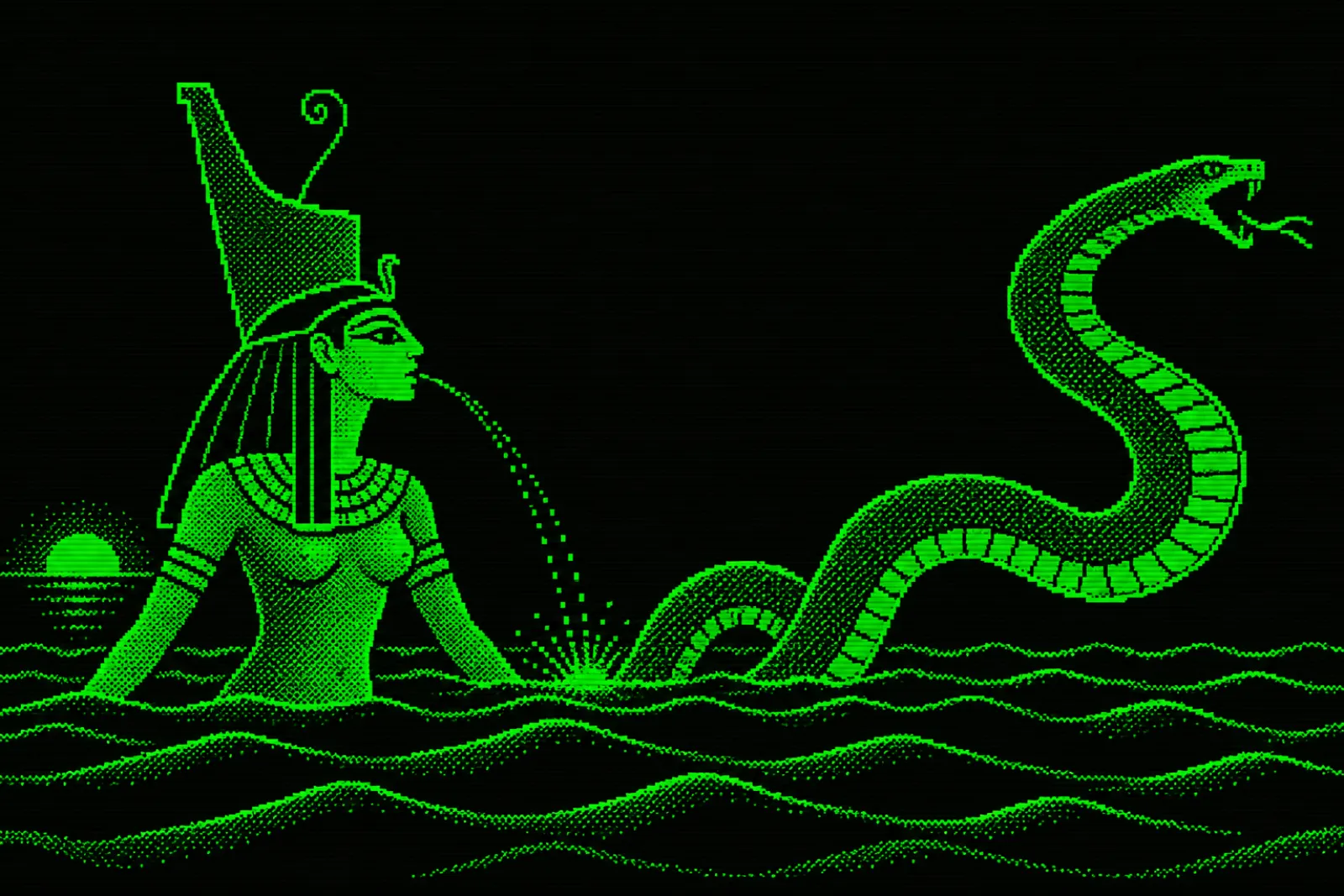
The story runs in Sauneron’s twenty sections. Neith is in the first waters. She becomes a cow, then a fish, makes light with her eyes, and wishes for ground to lean on. The ground appears and becomes Esna, which is also Sais. She creates thirty gods by naming them, and they tell her they did not know their own names. They ask her what is to come. She teaches them to count, to bring out what is in their bellies and to say it, and then foretells the sun. Re breaks out of an egg she filled with her own discharge. People are born from his tears when he loses sight of his mother, and gods from the spittle at his lips when he finds her. Then Apophis, the great serpent, is born from her spittle (on Sauneron’s reading) and turns against Re. Thoth is born from Re’s bitterness. Neith carries her son home between her horns, swimming, and the gods light torches for her.
This is the whole text; the one small break in the stone (line 9a) is restored as Sauneron and Elli restore it. It is not in the Thesaurus Linguae Aegyptiae. The hieroglyphs are published in Sauneron’s Esna III, and the English is made from two modern transliterations of them. Where they disagree, Sauneron’s plates decide, and the note says which reading the line follows. The two places that matter most for the serpent are the semen that falls on the egg (line 12c) and the birth of Apophis (line 15a). In 15a another scholar reads “the cord of her son” instead of “the spittle of her mouth”.
Each numbered line gives the Ptolemaic Egyptian (Roman period) first, in Latin letters. Our English is underneath. Tap a dotted word for its meaning, and Note for our comment on the line; our comments are in the right margin.
The rite
- 1206,1
nty-ꜥ jr(.w) m pr n N.t wr.t mw.t-nṯr nb(.t) tꜣ-sn.t jr(.w) m pr n N.t wr.t mw.t-nṯr nb.t Zꜣw m ꜣbd 3 šmw hrw 13
The rite done in the house of N.t: Neith, goddess of Sais and Esna the Great, Mother of the God, lady of Esna; done in the house of Neith the Great, Mother of the God, lady of Sais, in the third month of Summer, day 13.
Note on line 1
The date is 13 Epiphi, Neith’s great festival at Esna. Elli notes that wr.t, “the Great”, is written here with the sign of a cow’s womb. Before creation: Neith is born
- 2a206,1
jt jt.w mw.t mw.wt nṯr šꜣꜥ ḫp(r) m-ḥꜣ.t wn=s m ḥrj-jb Nwn (ḥr) pr(.t) m ḥꜥw=s
Father of fathers, mother of mothers, the god who šꜣꜥ: to begin to be at the beginning: she was in the midst of Nwn: Nun, the first waters, coming out of her own ḥꜥw: body, flesh, limbs.
Note on line 2a
Sauneron and Elli read nṯr šꜣꜥ ḫpr m-ḥꜣ.t, “who began to be at the beginning”. Elli allows the first sign to be wꜥ, “the one”, and Klotz reads nṯr wꜥ ḫp(r) m snw, “the one god who became two”. The last words, pr(.t) m ḥꜥw=s, are “coming out of her body”. Sauneron gives “apparue d’elle-même”, Elli “uscita dal suo (proprio) corpo”. Klotz makes Nun the subject, “which came forth from her body”, because other Esna texts (252, 317) have Neith make Nun. - 2b206,1
js tꜣ m kkw-zmꜣw nj pr tꜣ-Tnn srwḏ jdb.w
The earth was still in deep darkness; Tatenen had not come out, who makes the riverbanks grow with plants.
Note on line 2b
Klotz reads Tatenen here, after Kurth, though he notes the name lacks its determinative. Sauneron and Elli read nj pr tꜣ nn srd: “no land had come out, and nothing grew”. Her first forms
- 3a206,1
jr.n=s ḫprw=s m ḥm.t nty nn rḫ s(y) nṯr.w m bw nb.w
She made her form a cow that no god could rḫ: to know, anywhere.
Note on line 3a
The cow word is ḥm.t (Wb. III 76), with Elli; Klotz reads jd.t. Sauneron: creation happened with no witness to see it. - 3b206,2
wḥm.n=s jrw=s m ꜥḥꜣ šm=s n=s
She changed her shape again into a ꜥḥꜣ: Nile perch (Lates), Neith's sacred fish at Esna, and went her way.
Note on line 3b
Esna was Latopolis, “city of the perch”, and a vast cemetery of mummified fish lies in the desert there. Sauneron notes the fish is written here with the flail, the mark of a sacred being. Light
- 4206,2
sḥḏ.n=s stw.t nt jr.tj=s ḫp(r) šzp
She made the rays of her eyes bright, and light came to be.
The first ground
- 5a206,2
ꜥḥꜥ.n ḏ(d).n=s ḥꜣ-n=j bw pn m zꜣṯ m ḥrj-jb Nwn rhn.n=j ḥr=f
Then she said: "If only this place were zꜣṯ: ground, soil for me in the midst of Nun, so that I could rhn: to lean on, to rest on it!"
Note on line 5a
Sauneron counts this as the first of Neith’s seven creative speeches (see line 18a). - 5b206,2
bw pn wꜣḥ=f m zꜣṯ m ḥrj-jb Nwn mj ḏd=s ḫp(r) tꜣ-sn.t Zꜣw pw
This place was laid down as ground in the midst of Nun, as she had said, and Esna came to be: that is Sais.
Note on line 5b
A pun on zꜣṯ, “ground”, and the names of the twin cities. The whole text sets Esna in the south and Sais in the Delta as one city. - 5c206,2
ꜥpj.n=s ḥr jꜣ.t tn ḫp(r) Pr-nṯr P pw
She flew over this mound, and Per-netjer came to be: that is Pe.
Note on line 5c
ꜥpj, “to fly”, explains Pe (Buto). Sauneron points out that the same text puns ꜥpp, Apophis, on the word for spittle (line 15a), so a missing ꜥ did not stop these etymologies. - 5d206,2
ḏ(d)=s dp nḏm m jꜣ.t tn ḫp(r) Dp pw ḫp(r) tꜣ-nḏm pw m rn n Zꜣw
She said: "The taste is sweet on this mound!" So Dep came to be, and "Sweet Land" came to be as the name of Sais.
Note on line 5d
dp nḏm, “sweet taste”, gives Dep (the other half of Buto) and Tꜣ-nḏm. Sauneron renders it more loosely: “Je me sens bien sur cette émergence.” Egypt
- 6a206,2
js mꜣṯ.n jb=s ḫp(r)=sn ḥr-ꜥ
Whatever her heart mꜣṯ: to conceive, to think out came to be at once.
- 6b206,3
ꜥḥꜥ.n bꜣq.n=s m jꜣ.t tn ḫp(r) Bꜣq.t m jhꜣy
Then she shone on this mound, and Egypt came to be, in joy.
Note on line 6b
The English follows Klotz (“radiant”). A pun: bꜣq, “to be bright”, and Bꜣq.t, Egypt. Sauneron and Elli take bꜣq as “to be well” (“conçut du bien-être”); Sauneron calls his choice “pure hypothèse” and allows “répandre de la lumière”. Klotz reads “radiant”, which fits line 4. The thirty gods
- 7a206,3
qmꜣ.n=s nṯr.w 30 ḏd=s rn.w wꜥ-wꜥ.w ḫp(r)=s m jḥy m-ḫt mꜣꜣ=s sn
She qmꜣ: to create, to shape the thirty gods, saying their rn: name one by one, and she was glad when she saw them.
Note on line 7a
Sauneron: “en prononçant leurs noms”; he thinks it “semble possible” that the naming itself gives them being. An Armant text lists the thirty: the seven Utterances of Mehet-weret, the seven Khnums, the Eight and the eight Djebau (Klotz, after Thiers and Volokhine). - 7b206,3
ḏ(d)=w dwꜣ n=t nb.t nṯr.w mw.t=n sḫp(r.t)=n jr=t rn.w=n nn rḫ=n s(n)
They said: "Praise to you, lady of the gods, our mother, who made us come to be! You made our names, and we did not rḫ: to know them.
Note on line 7b
Sauneron: “Tu as fait nos noms, alors que nous n’avions pas encore conscience”, “while we were not yet conscious”. Elli: “when we did not yet know it”. The gods exist before they know their own names, and the names come from her. - 7c206,3
wḏꜥ=t n=n ꜥn.t kkw jr=t n=n tꜣ rhn=n ḥr=f wp=t n=n grḥ r hrw
You parted the gleam from the darkness for us. You made us ground to lean on. You split night from day for us.
Note on line 7c
The first clause is hard. The transliteration is Klotz’s; Sauneron and Elli read ꜥnḏw, the sun’s gleam (Wb. I 207.13), so “you separated dawn from darkness”. Klotz: “you removed for us the period of darkness”. - 7d206,3
ꜣḫ.wj pr.w nb.w n jb=t nt(t) wꜥ.t ḫp(r.t) m ḥꜣ.t zb.t nḥḥ ḏ.t m ḥr=t
How ꜣḫ: effective power; a spell that makes what it says is everything that comes out of your heart, you the One who came to be at the beginning! You pass through endless time, and lasting time lies before your face."
Note on line 7d
nḥḥ and ḏ.t are the two Egyptian eternities, the cycling and the lasting. Sauneron: “la durée éternelle des temps passe devant ton visage”. The great hymn to Neith (Esna 163) ends with the same epithets. The gods go to the mound
- 8a206,4
ꜥḥꜥ.n ḏd.n=s n ms.w=s jmj sqꜣ=n m bw pn m tꜣ rhn=n ḥr=f r dr wrḏ
Then she said to her children: "Come, let us go up onto this place, ground we can lean on, to drive our weariness away.
Note on line 8a
Sauneron counts this as Neith’s third creative speech. - 8b206,4
ḫdj=n r bw pfy tꜣ-sn.t Zꜣw pw tꜣ m ḥrj-jb Nwn jꜣ.t tn nḏm ḥms=n jm=s
Let us sail downstream to that place, Esna, which is Sais, the land in the midst of Nun. This mound is sweet: we will settle on it."
Note on line 8b
Elli reads ḥms=n, “we will sit”; Klotz snḏm=n, “we will dwell”, which makes a second pun on nḏm, “sweet”. - 8c206,4
wꜣḥ.n=s tꜣ m ḥrj-jb Nwn jr.n=s rn=f m Qꜣy.t-qꜣ
She laid down land in the midst of Nun and made its name "High Mound".
The gods ask about what is to come
- 9a206,4
ꜥḥꜥ.n ḏd=sn n wr.t wsr.t j tꜣ ms.t=n j tꜣ pr=n jm=s
Then they said to the Great and Mighty One: "O you who bore us, O you we came out of!
Note on line 9a
Klotz marks a gap after the second j; Sauneron and Elli restore tꜣ pr=n jm=s, “she from whom we came out”. - 9b206,4-5
šsr=t n=n jw nj ḫp(r)=sn mt sw wꜥ nj rḫ=n nty r ḫp(r)
Tell us what has not yet come to be. Look, there is only this, and we do not know what is going to be."
Note on line 9b
mt sw wꜥ, literally “look, it is alone”. Sauneron and Elli: only the ground exists so far, a sense Sauneron calls “très hypothétique”. Klotz: “it is lonely here”. - 9c206,5
ḏ(d).jn N.t jw=j r rdj.t rḫ=tn nty r ḫp(r)
Then Neith said: "I will make you know what is going to be.
- 9d206,5
jmj jp=n ꜣḫ 4 sbꜣq=n jmj.w ẖ.t=n šd=n tp-rꜣ=n rḫ=n s(t) nb mjn
Come, let us count four ꜣḫ: effective power; a spell that makes what it says; let us sbꜣq: to make bright, to make clear what is in our ẖ.t: belly, body, womb; let us šd: to recite, to read out what is on our mouths; and we will know it all today."
Note on line 9d
Sauneron calls this the key to creation by the word: count what is inside, make it clear, speak it, and it exists. He takes “what is in our bellies” literally: spells are eaten and carried in the belly (PT 506, 518; P. Berlin 3050). The gods learn to know by looking into their own bodies and speaking what they find. - 9e206,5
jr=sn ḏ(d)=s nb wnw.t 8.t jj.t m ꜥnḏ
They did all that she said, and the eighth hour came in an instant.
Note on line 9e
Klotz reads “8 hours passed in an instant”; Sauneron and Elli “the eighth hour”. Neith foretells the sun
- 10a206,5
ḥms pw jr.n jh.t ḥr mꜣṯ nty r ḫp(r)
Then the jh.t: the Ihet-cow, the cow who bears the sun sat thinking out what was going to be.
- 10b206,5-6
ḏd=s jw nṯr šps r ḫp(r) mjn wn.n=f jr.t=f ḫp(r) ḥḏḏ.wt=f ꜥḫn.n=f s(t) ḫp(r) kkw
She said: "A noble god will come to be today. When he opens his eye, his light will be; when he shuts it, there will be darkness.
- 10c206,6
ḫp(r) rmṯ.w m rmy.t n.t jr.t=f nṯr.w m ntt n sp.tj=f
rmṯ: people, humankind will come from the rmy.t: tears of his eye, and gods from the ntt: discharge, spittle of his lips.
Note on line 10c
The old pun rmṯ / rmy.t, people from tears; we compare the Bremner-Rhind creation, where the creator weeps people too. ntt is “discharge, spittle” (Wb. II 357.6). Line 13f tells how both came true. - 10d206,6
snḫt=j sw m nḫt=j ꜣḫ=j sw m ꜣḫ=j wsr=j sw m wsr=j
I will make him strong with my strength, effective with my power, mighty with my might.
- 10e206,6
jw ms.w=f r ẖꜣk-jb r=f sḫr=sn n=f ḥw=sn n=f zꜣ pw pr m ḥꜥw=j
His children will rebel against him, but they will be struck down for him and beaten for him, for he is my son, who came out of my ḥꜥw: body, flesh, limbs.
Note on line 10e
Elli takes sḫr and ḥw as passives. Klotz restores “I” as subject: “I will strike them down for him”. Sauneron allows “his children will defend him against the rebels”, but prefers the rebellion. - 10f206,6-7
jw=f r nb n tꜣ pn ḏ.t jw=j ḥr mk.t=f m-ẖnw ꜥ.wj=j nn tkn ḏw nb ḥr=f
He will be lord of this land forever. I will protect him in my arms, and no evil will come near him.
Note on line 10f
Klotz’s English has “I will be lord”, but his own transliteration has jw=f, “he”. - 10g206,7
ḏd=j n=tn rn=f m-ꜥ=j Ḫprj m dwꜣw Jtm m mšr jw=f m rdj ḫꜥ=f r nḥḥ m rn=f pfy n Rꜥ rꜥ-nb
I tell you his name myself: Khepri in the morning, Atum in the evening. He will be the one who gives his shining forever, in this his name of Re, every day."
The Eight
- 11206,7
ꜥḥꜥ.n ḏd.jn nṯr.w jp(n) ḫm=n m nn sḏm=n ḫp(r) Ḫmny.w m rn n nn n nṯr.w ḫp(r)=f m rn n njw.t tn
Then these gods said: "We ḫm: not to know what we are hearing." So Ḫmny.w: the Eight, the first gods of Hermopolis came to be as the name of these gods, and it became the name of this city.
Note on line 11
The pun is ḫm=n, “we do not know”, and Ḫmnw, “the Eight”, the Ogdoad of Hermopolis (Sauneron, Elli). Elli and Sauneron read the first word as jp.t, “you list things we do not know”. Sauneron sees the Hermopolitan creation borrowed here. The sun is born from an egg
- 12a206,7
ꜥḥꜥ.n nṯr pn m rḏw pr(.w) m ḥꜥw=s rdj.n=s m-ẖnw ẖ.t n swḥ.t tn
Then this god came to be from the rḏw: discharge, secretion (of a body) that came out of her body, which she had put inside the ẖ.t: belly, body, womb of this swḥ.t: egg.
Note on line 12a
Sauneron and Elli assume a verb “came to be” is missing after ꜥḥꜥ.n. rḏw is “fluid, discharge” (Wb. II 469). Sauneron: “excrétions sorties des chairs de Neith”; Klotz: “efflux of her body”. - 12b206,7-8
sd.n=s Nwn ḫpr.n Ḥꜥpj r bw wꜥ
It broke through Nun, and the Flood came to be, in one place.
Note on line 12b
Sauneron and Elli: the egg broke through the surface of Nun, and the Nile flood came to be. Klotz reads the egg as broken by Nun, become the flood. Elli calls “in one place” a doubtful reading, and Sauneron calls the words that follow a “passage pour nous désespéré”. - 12c206,8
hꜣy mt(w.t) m swḥ.t ḥr sd.n=f swḥ.t twy wnn.t m swꜣ.w nṯr pn šps
mtw.t: semen; also venom fell on the egg, when he broke this egg that was around this noble god.
Note on line 12c
Sauneron (note f) and Elli read hꜣy mt(w.t): “semen fell”. In Sauneron’s plate the phallus sign is written right after hꜣy. Klotz reads the same signs hy n swḥ.t, “the husband of the egg”, meaning Nun-Hapi, the one male present. Sauneron marks the reading with a query and says the sense is far from settled; Elli takes “he” as the Flood and says the egg “must be fertilized”. Sauneron compares Ptah “who poured his seed on the egg”. - 12d206,8
sw m Rꜥ jmn.n=f sw m-ẖnw Nwn m rn=f pfy n Jmn-wr
He is Re, who hid himself inside Nun, in this his name of Amun the Great.
Note on line 12d
A pun: jmn, “to hide”, and Amun. - 12e206,8
ẖnm nṯr.w nṯr.wt m stw.t=f m rn=f pfy n ẖnmw
He joins gods and goddesses with his rays, in this his name of Khnum.
Note on line 12e
A pun on ẖnm and Khnum, the ram god of Esna. Sauneron: “qui devait former dieux et déesses par ses rayons”; Klotz: “were endowed”. Mother and son
- 13a206,8
ꜥš mw.t=f jh.t m qꜣ n ḫrw=s
His mother, the Ihet-cow, called out at the top of her voice:
- 13b206,8-9
mj=n zp-snw pꜣy qmꜣ=j mj=n zp-snw pꜣy ms=j mj=n zp-snw pꜣy sḫp(r)=j jnk mw.t=k jh.t
"Come, come, you I created! Come, come, you I bore! Come, come, you I made to be! I am your mother, the Ihet-cow!"
- 13c206,9
jj.n nṯr pn rꜣ=f wn(.w) ꜥ.wj=f pgꜣ.w r nṯr.t tn hdb.n=f sw m ḫḫ=s nn pw jr.n zꜣ mꜣꜣ.n=f mw.t=f
This god came to this goddess with his mouth open and his arms spread wide, and threw himself on her neck. That is what a son does when he has seen his mother.
Note on line 13c
Sauneron and Elli read ḫḫ, “neck”; Klotz “bosom”. - 13d206,9
ḫp(r) hrw pn m sw nfr tpy rnp.t
And this day became the good day of the New Year.
- 13e206,9
js rmy=f m Nwn nj mꜣꜣ.n=f jh.t ḫp(r) rmṯ.w m rmy.t nt jr.t=f
He had wept into Nun when he could not see the Ihet-cow, and rmṯ: people, humankind came to be from the rmy.t: tears of his eye.
Note on line 13e
Humankind is the tears of a child who cannot see his mother. Sauneron: “quand il ne vit plus sa mère”. - 13f206,9
sdb=f m-ḫt mꜣꜣ=f sy ḫp(r) nṯr.w m ntt n sp.tj=f
He sdb: to chew; here, Sauneron: to drool once he saw her, and gods came to be from the ntt: discharge, spittle of his lips.
Note on line 13f
Sauneron and Elli read sdb, “to chew”; Sauneron explains it as a baby’s drooling when he wants the breast, which brings the spittle. Klotz reads sbṯ, “he laughed”. Either way the gods come from the newborn’s spittle when he sees his mother. The first gods greet the sun
- 14a206,10
nn nṯr.w pꜣwty.w ḥtp=sn m kꜣr=sn dm=sn ḫft mꜣṯ sn nṯr.t tn
These first gods rest in their shrines. They were dm: to pronounce, to name as this goddess conceived them.
Note on line 14a
dm, “to pronounce” (Elli; Sauneron “exprimés”): each god is a word Neith said as she thought of it. Klotz omits pꜣwty.w, “first, primeval”. - 14b206,10
šdj=sn Rꜥ m-ẖnw kꜣr jr=sn jꜣw n nṯr pn ḏd=sn jj.tj zp-snw pꜣ jwꜥꜥ n N.t jr(.w) m ꜥ.wj=s qmꜣ(.w) m jb=s
They protect Re inside the cabin and praise this god, saying: "Welcome, welcome, heir of Neith, made by her hands, created in her heart!
Note on line 14b
kꜣr is the cabin on the sun’s boat (Sauneron). Klotz: “they took care of Re within their shrines”. - 14c206,10
jw=k m nb n tꜣ pn ḏ.t mj nn sr.n mw.t=k
You are lord of this land forever, as your mother foretold."
Apophis is born
- 15a206,10-11
js ꜣ dr.n=sn pꜥ n rꜣ=s jr.n=s m Nwn ḫpr=f m ḥfꜣw n mḥ 120 ḏd.tw n=f Ꜥꜣpp
But they drove off the pꜥ: spittle (Sauneron, from pꜥy "to spit") of her mouth, which she had made in Nun, and it became a ḥfꜣw: snake, serpent of 120 cubits, who is called Ꜥꜣpp: Apophis, the serpent enemy of the sun.
Note on line 15a
This is Sauneron’s reading, which Elli follows: the first gods refuse Neith’s spittle in the water and drive it off, and it becomes Apophis. Sauneron hears a pun in the name on pꜥy, “to spit”: “le serpent est « ce qui a été craché »”. Klotz, referring to Quack (2006), reads the same signs differently: dr.n=s npꜣ n zꜣ=s, “she removed the umbilical cord from her son and put it in Nun”. On that reading Apophis is the sun’s own birth cord. In Sauneron’s plate we see the flying-duck sign (pꜣ) in this group, which does not settle the dispute. On Sauneron’s reading the serpent comes from her mouth; on Klotz’s, from the cord that joined mother and son. Either way it is thrown into the water at the sun’s birth. - 15b206,11
qmꜣ jb=f sbj r Rꜥ ḥnꜥ zmꜣy.w=f pr(.w) m jr.t=f
His heart conceived sbj: rebellion; rebel against Re, with his companions, who came out of his eye.
Note on line 15b
“His eye” is ambiguous. Klotz takes it as Re’s eye; Sauneron leaves it open. Sauneron: here the text explains where evil comes from, which other cosmogonies leave out. It is part of the creation, always defeated and never wiped out. Thoth
- 16a206,11
Ḏḥwty pr(.w) m jb=f ḫft dḥr=f ḏd.tw n=f Ḏḥwty
Ḏḥwty: Thoth came out of his heart when he was dḥr: to be bitter, and so he is called Thoth.
Note on line 16a
A pun on dḥr, “bitter”, and Ḏḥwty. Sauneron: “en un moment d’amertume”; Elli: “when he grew sad”; Klotz: “upset”. - 16b206,11
mdw=f ḥnꜥ jt=f hb.n=f sw r sbj m rn=f n nb mdw-nṯr
He spoke with his father, who sent him against the rebel, in his name of Lord of the God's Words.
Note on line 16b
mdw-nṯr, “the god’s words”, is the Egyptian name for hieroglyphs. Elli: the spelling of hb, “to send”, also calls up the ibis, Thoth’s bird. - 16c206,11
ḫp(r) Ḏḥwty nb Ḫmnw m s.t tn ḥnꜥ Ḫmny.w n pꜣ.t tpy.t
So Thoth, lord of Hermopolis, came to be in this place, with the Eight of the first company of gods.
Neith takes her son home
- 17a206,12
N.t ḏd=s n zꜣ=s mj ḥnꜥ=j r tꜣ-sn.t Zꜣw pw zꜣṯ pfy m ḥrj-jb Nwn
Neith said to her son: "Come with me to Esna, that is Sais, that ground in the midst of Nun.
Note on line 17a
Sauneron counts this as Neith’s seventh and last creative speech. - 17b206,12
dm=j rn=k r njw.t=k nn ꜣb n sḏm rn=k rꜥ-nb
I will dm: to pronounce, to name your name to your city, and there will be no end to hearing your name, every day.
Note on line 17b
Sauneron: she will introduce him to the city, as Sinuhe names each person at court. Klotz hears a pun on zꜣ, “son”, in Zꜣw, Sais. - 17c206,12
ꜣṯ=j tw r wr pḥty=k r sꜥꜣ snḏ=k smꜣ.n=k nn wꜣwꜣ.w jm=k
I will nurse you, to make your strength great and to make the fear of you great, so that you will slaughter those who plot against you."
Note on line 17c
Klotz reads “I shall slaughter for you”; Elli and Sauneron make the son the killer. The seven Utterances
- 18a206,12
js pr ḏꜣjs.w 7 m rꜣ=s ḫp(r)=sn m nṯr 7
Now seven ḏꜣjs: utterance, decree had come out of her mouth, and they became seven gods.
Note on line 18a
Sauneron counted them: Neith speaks exactly seven times in the text (lines 5a, 5d, 8a, 9c, 10b, 13b, 17a). Each speech, once it had made what it said, became a god. They are the “seven ḏꜣjs” of the Coffin Texts. Esna 197 says they lie buried at Pi-neter. Sauneron compares the Leiden Kosmopoiia, where God laughs seven times and seven gods are born. - 18b206,12-13
ḫp(r) ḏd=s m rn n ḏꜣjs.w m rn n mdw-nṯr r=f m rn n Zꜣw
What she said became the name of the Utterances, the name of the god's words, and the name of Sais.
Note on line 18b
The text ties ḏꜣjs.w, “utterances”, to the name of Sais (Zꜣw) by sound-play. Klotz has “13 utterances”, but the 13 is the column number. - 18c206,13
ḫp(r) ḏꜣjs.w 7 nw Mḥ.t-wr.t wn=sn m zꜣ n Mḥ.t-wr.t r bw nb šm=s jm
So the seven Utterances of Mḥ.t-wr.t: Mehet-weret, "the Great Swimmer", the cow who carries the sun came to be, and they guard Mehet-weret wherever she goes.
- 18d206,13
ꜥḥꜥ.n jr.n=s ḫprw=s m jh.t jr.n=s Rꜥ m wp.t=s mḥj.n=s ẖr=f
Then she took her form as the Ihet-cow, put Re between her horns, and swam, carrying him.
- 18e206,13
ḏd.jn nṯr.w Mḥ.t-wr.t dy ḥnꜥ zꜣ=s ḫp(r) Mḥ.t-wr.t pw
The gods said: "The Great Swimmer is here with her son!" And so Mehet-weret came to be.
Four months in the south
- 19a206,13-14
ꜥḥꜥ.n jr.n=s ꜥḥꜥ ꜣbd 4 m njw.wt Šmꜥ Ḫnt-tꜣ ḫr.tw r=f ḥr sḫr sbj.w jj(.w) r msḏ ḥm=s
Then she stayed four months in the cities of the South (Khent-ta, it is called), striking down the sbj: rebellion; rebel who had come out of hatred for her Majesty.
- 19b206,14
sšp.tw tkꜣ ḥꜣ.t=s m Šmꜥ-Mḥw
A torch was lit before her in the South and the North.
Neith comes to Sais
- 20a206,14
jr spr=s r Zꜣw m wḫꜣ m ꜣbd 3 šmw hrw 13 ḥb pn nfr wr m p.t m tꜣ m tꜣ.w nb.w
When she reached Sais, in the evening, in the third month of Summer, day 13, it was this good and great festival in the sky, on earth and in all lands.
- 20b206,14-15
ꜥḥꜥ.n wḥm.n=s ḫprw=s m wrr.t šdj.n=s pḏ.t=s m-ꜥ=s šsr=s m ḫfꜥ=s ḫnj=s m ḥw.t-N.t ḥnꜥ zꜣ=s Rꜥ
Then she changed her form into wrr.t: the Great One, a name of the sun's cow-mother, took her bow in her hand and her arrow in her fist, and alighted in the House of Neith with her son Re.
Note on line 20b
Klotz notes that wrr.t is written with a cobra; Sauneron: Wereret is the sun’s cow-mother. The verb before “her bow” is šdj, “took”, with Elli; Klotz reads smꜣ.n=s, “when she made a massacre”. Neith the archer is the goddess’s official form at Sais. Re founds the festival
- 21a206,15
ḏd.jn Rꜥ n nṯr.w nty.w r-ḥnꜥ=f sšp m-ḥꜣ.t N.t m hrw pn
Then Re said to the gods who were with him: "Make light before Neith on this day!
Note on line 21a
Sauneron also allows “Welcome Neith on this day” for sšp. - 21b206,15
mj.w hmy.w n=s m hrw pn nfr ḏr jn=s tw=j r ꜥḏ-wḏꜣ
Come, shout for her on this good day, for she has brought me here safe and sound.
Note on line 21b
Elli and Sauneron read jn=s tw=j, “she brought me”; Klotz “since she returned safe and sound”. Sauneron: the phrase is used of sailors come safe to port, as Re has, on the head of the Great Swimmer. - 21c206,15
sṯj tkꜣ.w m-ḥꜣ.t=s jr.w ḥb m-bꜣḥ=s r ḥḏ-tꜣ
Light torches before her, and keep festival in her presence until the earth grows bright!"
Note on line 21c
Hence the torches lit for Neith on the night of 13 Epiphi, described in the festival text that follows (Esna 207).