~/sacred-texts/sumerian-literary-texts-etcsl
Enki and Ninmah: Man from Clay, and the Child Who Cannot Speak
Translated by AI straight from the Sumerian, not from a modern translation, then checked against the editions and studies listed below. How we translate
- Text
- Sumerian literary texts (ETCSL), ETCSL 1.1.2, Enki and Ninmaḫ (complete)
- Date
- Old Babylonian copies, about 1800 BC; a bilingual Sumerian–Akkadian version was still copied at Nineveh under Ashurbanipal (668–627 BC)
- Found
- Old Babylonian tablets, the main one from Nippur (University Museum, Philadelphia), and bilingual fragments from Nineveh
- Language
- Sumerian · Cuneiform
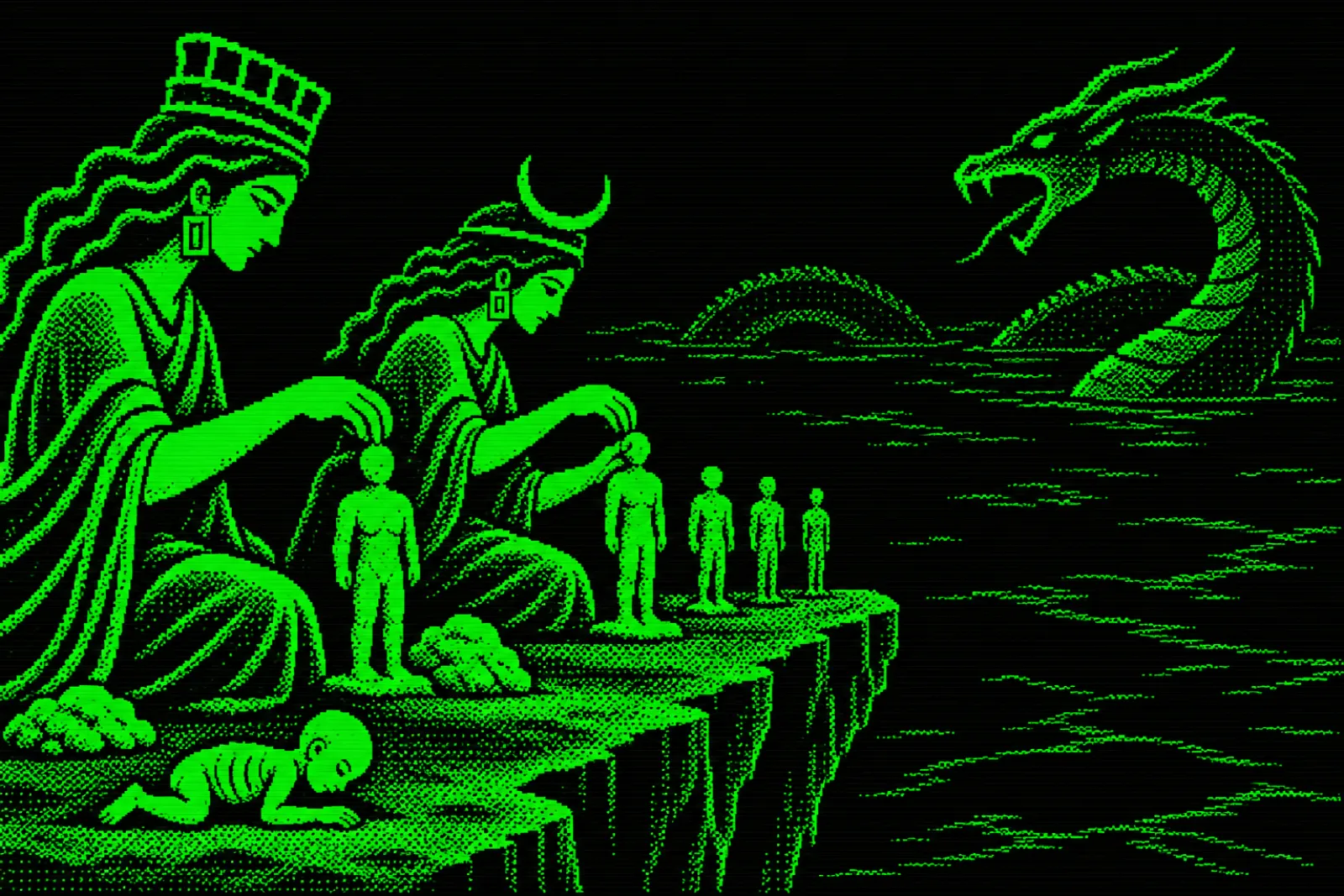
Enki and Ninmaḫ is a Sumerian poem of about 140 lines on the making of mankind. The main Old Babylonian tablet, from Nippur, came to Philadelphia in four pieces; a bilingual Sumerian–Akkadian version was still being copied at Nineveh a thousand years later. It opens in the time before people, when the gods themselves dig the canals, haul the earth and complain. Enki, god of the sweet waters under the earth and of wisdom, sleeps in the deep. His mother Namma brings him the gods’ tears, and he wakes and tells her how to make a creature from the clay above the Abzu, with Ninmaḫ, the mother goddess, and seven birth goddesses beside her, and to bind on it the gods’ basket.
At the feast that follows, Enki and Ninmaḫ drink beer, and Ninmaḫ boasts that she can make a human body good or bad as she pleases. Enki answers that he will find a fate for whatever she makes. She makes six: a man whose hands will not bend, a man who “turns back the light”, a blind man, a man with broken feet, a man who drips semen, a woman who cannot give birth, and one with neither penis nor vulva. Enki gives each a place and bread. Then he makes one himself, by semen poured into a woman’s womb, and the child is Umul, sick in every part, who cannot speak, eat, sit or stand. Ninmaḫ can find no fate for him. Her lament and Enki’s reply close the poem, with praise of Enki.
The English is translated from ETCSL’s composite text, word by word, and compared with ETCSL’s English and Kramer’s account of 1944, and checked for word senses against Attinger’s Sumerian glossary of 2023, which cites the two modern editions, Lambert’s (2013) and Ceccarelli’s (2016); the editions themselves were not reached. Kramer wrote that “the manner in which [Enki] goes about it is not clear”; the Sumerian says it plainly, and the notes give the literal sense. The opening of the making scene (lines 38–43) and Ninmaḫ’s reply (lines 110–121) are broken: they are marked as gaps or translated as far as the signs go.
Each numbered line gives the Sumerian first: the original script, then the same words in Latin letters. Our English is underneath. Tap a dotted word for its meaning, and Note for our comment on the line; our comments are in the right margin.
When the gods did the work
- 1-3
𒌓 𒊑𒀀𒋫 𒌓 𒀭 𒆠𒁉𒋫 𒁀𒀭𒁶𒈠𒁀 / 𒈪 𒊑𒀀𒋫 𒈪 𒀭 𒆠𒁉𒋫 𒁀𒀭𒁶𒈠𒁀 / 𒈬 𒊑𒀀𒋫 𒈬 𒉆 𒁀𒋻𒊏𒁀
ud re-a-ta ud an heaven · ePSD2 ki-bi-ta dim2 to create, fashion · ePSD2 / ĝi₆ re-a-ta ĝi₆ an heaven · ePSD2 ki-bi-ta dim2 to create, fashion · ePSD2 / mu name · ePSD2 re]-a-ta mu name · ePSD2 nam destiny, fate · ePSD2 ba-[tar-ra-ba]
In those days, in the days when an: heaven and earth were dim2: to create, fashion; in those nights, in the nights when heaven and earth were created; in those years, in the years when the nam: destiny, fate were decided;
Note on line 1-3
The same opening as other Sumerian origin poems: the first line is cited in an Old Babylonian library catalogue. - 4
when the a-nun-na: the Anuna, the great gods gods had been born;
- 5
𒀭𒂼𒀭𒈹 𒉆□𒉺𒂠 𒁀𒌇𒀀𒁀
ama-inana goddess; Attinger 'protective goddess' · ePSD2 nam-NIR.PA-še₃ ba-tuku-a-ba
when the ama-inana: goddess; Attinger 'protective goddess' had been taken in marriage;
- 6
𒀭𒂼𒀭𒈹 𒀭 𒆠𒀀 𒁀𒄬𒄬𒆷𒀀𒁀
ama-inana goddess; Attinger 'protective goddess' · ePSD2 an heaven · ePSD2 ki-a ba-ḫal-ḫal-la-a-ba
when the goddesses had been shared out over heaven and earth;
- 7
𒀭𒂼𒀭𒈹 □ 𒁀𒀀𒄩 𒅆𒁳𒌅𒁕𒀀𒁀
ama-inana goddess; Attinger 'protective goddess' · ePSD2 [...] peš to be thick; to be pregnant · ePSD2 tud to give birth · ePSD2
when the goddesses … had become peš: to be thick; to be pregnant and given tud: to give birth;
- 8
𒀭 𒉻𒈠𒁉 𒀀 □ □ 𒋼𒀊𒁉𒂠 𒁀𒀊𒆟𒀀𒁀
diĝir kurum6 food ration · ePSD2 A X X unu₂{?}-bi-še₃ ba-ab-keše₂-a-<ba>
when the gods had been tied to … their kurum6: food ration … their dining halls:
Note on line 8
Two signs are illegible. - 9
𒀭 𒊹𒊹 𒆥𒂷 𒀠𒁻𒄀𒌋𒌋𒌋 𒀭 𒌉𒌉 𒌅𒈝 𒅎𒅍𒅍𒂊𒉈
diĝir šar₂-šar₂ kiĝ2 work · ePSD2 al-sug₂-ge-eš diĝir tur-tur du-lum toil, hardship · ePSD2 im-il₂-il₂-e-ne
the senior gods stood over the kiĝ2: work, and the minor gods carried the du-lum: toil, hardship.
Note on line 9
Literally ’the numerous gods’ and ’the small gods'. - 10
𒀭 𒀀𒇉 𒅎 𒂄𒂄𒅆𒁳𒉈 𒅖𒁉 𒄩𒊏𒇷 𒅎𒁾𒁾𒁉𒉈
diĝir id₂ im clay · ePSD2 dun to dig · ePSD2 saḫar-bi ḫa-ra-li Harali, a land where the gods dug · ePSD2 im-dub-dub-be₂-ne
The gods were dun: to dig the canals and heaping up their earth in ḫa-ra-li: Harali, a land where the gods dug.
- 11
𒀭 𒅎 𒄯𒄯𒊑𒉈 𒍣𒁉 𒅗 𒀀𒀭𒈠𒃻𒊑𒉈
diĝir im clay · ePSD2 ar₃-ar₃-re-ne zi life, breath · ePSD2 inim word · ePSD2 am₃-ma-ĝar-re-ne
The gods, grinding the im: clay, were complaining about this zi: life, breath.
Note on line 11
zi-bi inim … ĝar: ’they set words on their life’, complained about their existence. Namma wakes Enki
- 12-14
𒌓𒁀 𒄑𒌆𒉿 𒂼 𒄷𒄭 𒀭 𒊹𒊹 𒅅𒅅 / 𒀭𒂗𒆠𒆤 𒇉 𒌋 𒀀𒋩𒊏 𒆠 𒀭 𒈾𒈨 𒊮𒁉 𒅆𒂍 𒉡𒌝𒈨 / 𒆠𒈿𒉌 𒉌𒈿 𒅆𒁳 𒆪 𒉡𒌝𒍣𒍣
ud-ba ĝeštug2 ear; wisdom, understanding · ePSD2 daĝal mud to create; also blood (ePSD2) · ePSD2 diĝir šar₂-šar₂ ĝal₂-ĝal₂ / en-ki Enki, god of the Abzu, the sweet waters under the earth, of wisdom and of incantation · ePSD2 engur the subterranean water · ePSD2 buru₃ a-sur-ra ki diĝir na-me šag4 heart; belly, womb · ePSD2 u6 to gaze at · ePSD2 nu-um-me / ki-nu₂-ni i₃-nu₂ u₃ ku nu-um-zi-zi
At that time the one of wide ĝeštug2: ear; wisdom, understanding, creator of all the senior gods there are, en-ki: Enki, god of the Abzu, the sweet waters under the earth, of wisdom and of incantation, in the deep engur: the subterranean water, the water under the earth, the place whose inside no god knows, lay on his bed asleep and did not rise from his sleep.
Note on line 12-14
‘Wide of ear’ is the Sumerian for wise: ĝeštug₂ is both ’ear’ and ‘wisdom’. - 15
𒀭 𒀀𒅆𒊏 𒅎𒉻𒉻𒉈 𒀀𒉪 𒅅 𒉌𒀝 𒅎𒈨𒉈
diĝir er₂-ra im-pad-pad-ne a-nir lament · ePSD2 ĝal₂ i₃-ak im-me-ne
The gods wept and said: "He has caused this a-nir: lament!"
- 16-18
𒇽 𒆪𒊏 𒉌𒈿𒀀𒊏 𒆠𒈿𒁉 𒉡𒌝𒍣𒍣𒊏 / 𒀭𒇉𒆤 𒂼 𒅆𒁺 𒅆𒁳𒌅 𒀭 𒊹𒊹𒊏𒆤𒉈 / 𒀀𒅆𒊏 𒀭𒊑𒂊𒉈 𒌉𒉌𒅕 𒁀𒅆𒅔𒁺
lu₂ ku-ra i₃-nu₂-a-ra ki-nu₂-bi nu-um-zi-zi-<ra> / namma Namma, the primeval mother, mother of Enki · ePSD2 ama mother · ePSD2 palil tud to give birth · ePSD2 diĝir šar₂-šar₂-ra-ke₄-ne / er₂-ra diĝir-re-e-ne dumu child, son · ePSD2 ba-ši-in-de₆
To the one who lay asleep, who did not rise from his bed, namma: Namma, the primeval mother, mother of Enki, the first ama: mother, who bore all the senior gods, carried the tears of the gods to her son:
Note on line 16-18
ama palil: ’the foremost mother’; Attinger’s glossary reads the word, tentatively, as ‘first in time’. - 19-20
□ 𒈬𒌦𒅆𒈿𒅆𒁳𒉆 𒅆𒁳 𒈬𒌦𒅆𒆪𒆪𒈾𒉆 / □ 𒋼 𒁀 □ 𒉡𒈬𒌦𒍣𒍣
X mu-un-ši-nu₂-u₃-nam u₃ mu-un-ši-ku-ku-na-nam / [X] TE BA [... nu-mu-un]-zi-zi
"… You are lying there, you are asleep! … you do not rise!
Note on line 19-20
Line 20 is broken but for a few signs. - 21
𒇽𒈪𒅕 𒋗 𒁶𒁶𒈠𒍪 □ 𒄘𒁉 𒅎𒄽𒄽𒉈
dim₃-me₂-er šu hand · ePSD2 dim2 to create, fashion · ePSD2 X gu₂{?}-bi im-tu₁₀-tu₁₀-ne
The gods, the creatures of your hand, are smashing their …!
Note on line 21
dim₃-me₂-er, ‘gods’, is Emesal, the women’s register: Namma speaks it. - 22
𒂅𒈬𒈬 𒆠𒈿𒍪 𒍣𒂵 𒄿𒉈 𒈠𒀠𒆷𒍪𒋫 𒈾𒉘𒆬𒍪 𒅆𒁳𒈬𒂊𒆥𒂷
dumu child, son · ePSD2 ki-nu₂-zu zig₃-ga [i-bi₂] ma-al-la-zu-ta nam-kug-zu wisdom, cleverness · ePSD2 kiĝ2 work · ePSD2
My dumu: child, son, rise from your bed! With the nam-kug-zu: wisdom, cleverness that is yours, seek out the skill,
- 23
𒆥𒋧 𒇽𒈪𒅕𒂊𒉈𒆤 𒅆𒁳𒈬𒂊𒁶 𒌅𒈝𒁉 𒄩𒁀𒌅𒇻𒉈
kiĝ2-sig ETCSL 'afternoon meal'; Attinger kiĝ₂-si₃, 'equivalent, image' · ePSD2 dim₃-me₂-er-e-ne-ke₄ dim2 to create, fashion · ePSD2 du-lum toil, hardship · ePSD2 ḫa-ba-tu-lu-ne
make a kiĝ2-sig: kiĝ₂-si₃, 'equal, equivalent, image' to stand in for the gods, so that they may be freed from their toil!"
Note on line 23
kiĝ₂-si₃, ’equal, equivalent, image’: man is made as the gods’ likeness, to do their work in their place. Man made from clay to carry the gods’ basket
- 24
𒀭𒂗𒆠𒆤 𒅗 𒂼𒈾 𒀭𒇉𒆤 𒆠𒈿𒈾 𒁀𒋫𒍣
en-ki Enki, god of the Abzu, the sweet waters under the earth, of wisdom and of incantation · ePSD2 inim word · ePSD2 ama mother · ePSD2 namma Namma, the primeval mother, mother of Enki · ePSD2 ki-nu₂-na ba-ta-zig₃
At the inim: word of his mother Namma, Enki rose from his bed.
- 25
𒄬𒀭𒆬 𒆸 𒊮 𒊕𒅆𒁳𒁕𒈾 𒋻 𒅎𒈪𒉌𒊏
ḫal-an-kug Ḫalankug, Enki's chamber · ePSD2 niĝin₂ šag4 heart; belly, womb · ePSD2 kuš₂-u₃-da-na ḫaš2 thigh · ePSD2 im-mi-ni-[ra]
In ḫal-an-kug: Ḫalankug, Enki's chamber, his room for pondering, he slapped his ḫaš2: thigh.
- 26
𒄑𒌆𒉿 𒄑𒌆𒉿𒉢 𒇷 𒋻 □ 𒉆𒆬𒍪 𒄷𒄭 𒈨𒁶 𒃻𒉆𒈠 𒅆𒂗 𒅆𒄭 𒅎𒋫𒀭𒌓𒁺
ĝeštug2 ear; wisdom, understanding · ePSD2 ĝizzal en₃ tar [...] nam-kug-zu wisdom, cleverness · ePSD2 mud to create; also blood (ePSD2) · ePSD2 me-dim2 limbs; design, form · ePSD2 niĝ₂-nam-ma SIG7-EN a group of birth goddesses (ETCSL, with a query); Kramer 'fashioners' · ePSD2 SIG₇-ḪI im-ta-an-e₃
The wise one, of attentive ear, …, the skilled one, who creates the me-dim2: limbs; design, form of everything, brought forth the SIG7-EN: a group of birth goddesses; Kramer 'fashioners'.
Note on line 26
SIG₇-EN SIG₇-ḪI: the birth goddesses, ’the good and princely fashioners’ in Kramer (1944, p. 70). - 27
𒀭𒂗𒆠𒆤 𒀉𒉌 𒁀𒅆𒅔𒁺 𒄑𒌆𒉿 𒉌𒆸𒆸𒂊
en-ki Enki, god of the Abzu, the sweet waters under the earth, of wisdom and of incantation · ePSD2 a2 arm · ePSD2 ba-ši-in-de₆ ĝeštug2 ear; wisdom, understanding · ePSD2 i₃-ni₁₀-ni₁₀-e
Enki stretched out his a2: arm over them and turned his ear to them.
- 28-29
𒀭𒂗𒆠𒆤 𒄷𒄭 𒈨𒁶 𒉎𒋼𒀀𒈾 𒊮𒁉 𒄑𒌆𒉿𒋫 𒅆𒁳𒈬𒉌𒊑𒄀 / 𒂼𒉌 𒀭𒇉𒊏 𒅗 𒈬𒌦𒈾𒌤𒂊
en-ki Enki, god of the Abzu, the sweet waters under the earth, of wisdom and of incantation · ePSD2 mud to create; also blood (ePSD2) · ePSD2 me-dim2 limbs; design, form · ePSD2 ni₂-te-a-na šag4 heart; belly, womb · ePSD2 ĝeštug2 ear; wisdom, understanding · ePSD2 u₃-mu-ni-de₅-ge / ama mother · ePSD2 namma Namma, the primeval mother, mother of Enki · ePSD2 gu₃ mu-un-na-de₂-e
When Enki, who creates the limbs, had by himself pondered its heart with his ear, he called out to his mother Namma:
Note on line 28-29
ĝeštug₂ … de₅, ’to gather with the ear’: Attinger’s glossary ’to reflect on, to ponder’. Enki thinks with his ear. - 30
𒂼𒈬 𒄷𒄭 𒈬𒃻𒊏𒍪 𒉌𒅅𒆷𒀀𒀭 𒍭𒉺 𒀭𒊑𒂊𒉈 𒆟𒉌
ama mother · ePSD2 mud to create; also blood (ePSD2) · ePSD2 mu-ĝar-ra-zu i₃-ĝal₂-la-am₃ dusu earth-carrying basket · ePSD2 diĝir-re-e-ne keše₂-i₃
"My mother, the mud: to create; also blood (ePSD2) you have named is there: bind on it the dusu: earth-carrying basket of the gods!
Note on line 30
mud is ‘creature’, the thing whose name has been spoken (Kramer: ’the creature whose name thou hast uttered’). The same word means ‘blood’, and Attinger’s glossary (2023) takes it so here: in the Akkadian Atrahasis man is made from a god’s blood and clay. The basket is the labourer’s earth-basket. - 31
𒊮 𒅎 𒌋𒅗 𒍪𒀊𒅗 𒅆𒁳𒈬𒂊𒉌𒅔𒊹
šag4 heart; belly, womb · ePSD2 im clay · ePSD2 ugu abzu the Abzu, the fresh water under the earth, Enki's home · ePSD2 u₃-mu-e-ni-in-šar₂
When you have mixed the heart of the clay above the abzu: the Abzu, the fresh water under the earth, Enki's home,
Note on line 31
im ugu abzu-ka: ’the clay of the top of the Abzu’, the clay over the deep. - 32
𒅆𒂗 𒅆𒄭 𒅎 𒈬𒂊𒆸𒆸𒊑𒉈 𒍝𒂊 𒈨𒁶 𒅆𒁳𒈬𒂊𒉌𒅅
SIG7-EN a group of birth goddesses (ETCSL, with a query); Kramer 'fashioners' · ePSD2 SIG₇-ḪI im clay · ePSD2 kir3-kir3 to nip off (a lump of clay) · ePSD2 za-e me-dim2 limbs; design, form · ePSD2 u₃-mu-e-ni-ĝal₂
the birth goddesses will kir3-kir3: to nip off (a lump of clay) the clay, and you will bring the limbs into being.
- 33
𒀭𒊩𒌆𒈤𒂊 𒀭𒋫𒍪 𒃶𒀝𒂊
nin-maḫ Ninmaḫ, 'August Lady', the mother goddess and goddess of birth · ePSD2 an-ta-zu ḫe₂-ak-e
Let nin-maḫ: Ninmaḫ, 'August Lady', the mother goddess and goddess of birth be your helper,
Note on line 33
Ninmaḫ is a name of the mother goddess, elsewhere Ninḫursaĝa. - 34-36
𒀭𒊩𒌆𒅆 𒀭𒋗𒍣𒀭𒈾 𒀭𒊩𒌆𒈠𒁕 𒀭𒊩𒌆𒁈 / 𒀭𒊩𒌆𒈮 𒀭𒊹𒊹𒃮 𒀭𒊩𒌆𒁯𒈾 / 𒌅𒌅𒀀𒍪 𒄩𒊏𒁺𒁍𒉈
{d}nin-imma₃ {d}šu-zi-an-na {d}nin-ma-da {d}nin-barag / {d}nin-mug {d}ŠAR.ŠAR.GABA {d}nin-gun₃-na / tud to give birth · ePSD2 ḫa-ra-gub-bu-ne
and let Ninimma, Šuzianna, Ninmada, Ninbarag, Ninmug, ŠAR.ŠAR.GABA and Ninguna stand by you as you give birth.
Note on line 34-36
Seven birth goddesses; the sixth is written ŠAR.ŠAR.GABA. - 37
𒂼𒈬 𒍝𒂊 𒉆𒁉 𒅆𒁳𒈬𒂊𒋻 𒀭𒊩𒌆𒈤 𒍭𒉺𒁉 𒃶𒆟
ama mother · ePSD2 za-e nam destiny, fate · ePSD2 u₃-mu-e-tar nin-maḫ Ninmaḫ, 'August Lady', the mother goddess and goddess of birth · ePSD2 dusu earth-carrying basket · ePSD2 ḫe₂-keše₂
My mother, when you have decreed its fate, let Ninmaḫ bind the basket on it."
- 38
□ 𒉌𒆕 𒉆𒇽𒍇 □
[...] i₃-du₃ nam-lu2-ulu3 humanity, mankind · ePSD2 [...]
[…] … nam-lu2-ulu3: humanity, mankind […]
Note on line 38
Lines 38–43 are broken at the start; they are translated as far as the signs go. - 39
𒆤 𒉆𒇽𒍇 𒀀𒀭𒈠
[...]-ke₄{?} nam-lu2-ulu3 humanity, mankind · ePSD2 am₃-[ma-...]
[…] mankind […]
- 40
□ 𒄩 𒊕𒂊 𒊕 𒀀𒀭𒈠
[...] ḪA{?} saĝ-e saĝ am₃-ma-[...]
[…] … head to head […]
- 41
□ 𒁶𒍪 𒋼𒀊 𒊑𒍪 𒂵𒀀𒀀𒀭
[...] dim2 to create, fashion · ePSD2 unu₆ RI-zu me essence; the divine powers and offices of civilisation · ePSD2
[…] your creating, … the dining hall …, it is …
- 42
□ 𒊬𒂊 𒄑𒉢 𒈪𒉌𒅔𒅍 𒉆𒇽𒍇 □
[...] SAR-e ĝiš-nu11 light; (luminous) gaze · ePSD2 mi-ni-in-il₂ nam-lu2-ulu3 humanity, mankind · ePSD2 ...]
[…] … raised the light … mankind […]
- 43
□ 𒉺𒃶 𒍤𒆸𒂊 𒈪𒉌𒅔𒊑 𒅆𒁳𒌅 𒈾𒁉 𒈬𒊑
[...] sag₂ numun2 ETCSL 'grass, alfalfa'; Lambert and Ceccarelli 'woman' · ePSD2 mi-ni-in-ri tud to give birth · ePSD2 na-bi mu-de₅
[…] … poured into the numun2: ETCSL 'grass, alfalfa'; Lambert and Ceccarelli 'woman'; … the birth … .
Note on line 43
ETCSL reads ‘she placed it on grass and purified the birth’. Attinger’s glossary, after Lambert (2013) and Ceccarelli (2016), takes numun₂ in this passage as ‘woman’ and inda as ‘male’, and cites a late copy with du₁₀-nir-ra, ’ejaculation’: on that reading the broken lines tell of man and woman and the first begetting. ri is ePSD2’s ’to cast, pour out’. The feast and the contest over beer
- 44
𒀭𒂗𒆠𒆤 𒆥 𒆸𒆸𒁕 □ 𒈪𒉌𒅔𒇲 𒊮𒁉 𒁀𒄾
en-ki Enki, god of the Abzu, the sweet waters under the earth, of wisdom and of incantation · ePSD2 kiĝ2 work · ePSD2 ni₁₀-ni₁₀-da [X] la2 to hang; to weigh · ePSD2 šag4 heart; belly, womb · ePSD2 ba-ḫul₂
Enki … the work … : his heart rejoiced.
- 45
𒂼𒉌 𒀭𒇉 𒀭𒊩𒌆𒈤𒂠 𒆠𒁉𒃻 𒈾𒀀𒀭𒈠𒉌𒅔𒃻
ama mother · ePSD2 namma Namma, the primeval mother, mother of Enki · ePSD2 nin-maḫ Ninmaḫ, 'August Lady', the mother goddess and goddess of birth · ePSD2 ĝišbun (cult) meal, feast · ePSD2 na-am₃-ma-ni-in-ĝar
He set out a ĝišbun: (cult) meal, feast for his mother Namma and for Ninmaḫ.
- 46
𒄘 𒅆𒂗 𒅆𒄭 𒉣𒉈𒆤 𒉆𒋻 𒄀 𒊕 𒃻 𒄿𒅎𒅥𒂊
gu₂ SIG7-EN a group of birth goddesses (ETCSL, with a query); Kramer 'fashioners' · ePSD2 SIG₇-ḪI nun-ne-ke₄ nam-tar Namtar, the demon of fate and death; also 'fate' · ePSD2 gi saĝ ninda bread · ePSD2 i-im-gu₇-e
All the princely birth goddesses … ate … and ninda: bread.
Note on line 46
nam-tar gi saĝ: ETCSL ‘ate delicate reed and bread’. - 47
𒀭𒂊 𒀭𒂗𒆤𒁉 𒂗 𒀭𒉡𒁶𒄷𒄭𒂊 𒈦 𒆬 𒄿𒅎𒉈𒉈
an heaven · ePSD2 {d}en-lil₂-bi en nu-dim2-mud Nudimmud, a name of Enki · ePSD2 maš kug i-im-šeĝ₆-šeĝ₆
An, Enlil and lord nu-dim2-mud: Nudimmud, a name of Enki roasted holy kids.
- 48
𒀭 𒊹𒊹𒊏𒆤𒂊𒉈 𒅗 𒋻 𒄿𒅎𒋛𒅋𒇷𒉈
diĝir šar₂-šar₂-ra-ke₄-e-ne ka mouth · ePSD2 tar i-im-si-il-le-ne
All the senior gods sang his praises:
Note on line 48
ka tar … si-il: ’to sing the praises’ (Attinger’s glossary); the phrase returns in line 136. - 49
𒂗 𒄑𒌆𒉿 𒂼𒆷 𒀀𒁀𒀀 𒄑𒌆𒉿 𒉌𒊑𒄀
en ĝeštug2 ear; wisdom, understanding · ePSD2 daĝal-la a-ba-a ĝeštug2 ear; wisdom, understanding · ePSD2 i₃-de₅-ge
"Lord of wide ear, who gathers wisdom as you do?
- 50
𒂗 𒃲 𒀭𒂗𒆠𒆤 𒃻 𒀝𒀝𒍪𒂠 𒀀𒁀𒀀 𒉌𒋧𒄀
en gal en-ki Enki, god of the Abzu, the sweet waters under the earth, of wisdom and of incantation · ePSD2 niĝ₂ ak-ak-zu-še₃ a-ba-a i₃-sig₁₀-ge
Great lord Enki, who can equal what you do?
- 51
𒀀𒀀 𒌅𒁕𒁶 𒈨 𒉆 𒋻𒋻𒊏 𒈨 𒍝𒂊 𒀠𒈨𒂗𒈾
a-a tud to give birth · ePSD2 me essence; the divine powers and offices of civilisation · ePSD2 nam destiny, fate · ePSD2 tar-tar-ra me essence; the divine powers and offices of civilisation · ePSD2 za-e me essence; the divine powers and offices of civilisation · ePSD2
Like a father who begets, you hold the me: essence; the divine powers and offices of civilisation of deciding fates; you are the me itself!"
Note on line 51
The me are the divine powers, offices and arts that make civilisation. - 52
𒀭𒂗𒆠𒆤 𒀭𒊩𒌆𒈤𒂊 𒁉 𒅎𒅘𒅘𒉈 𒊮𒁉 𒌋𒄞 𒈬𒌦𒋼
en-ki Enki, god of the Abzu, the sweet waters under the earth, of wisdom and of incantation · ePSD2 nin-maḫ Ninmaḫ, 'August Lady', the mother goddess and goddess of birth · ePSD2 kaš beer · ePSD2 im-na₈-na₈-ne šag4 heart; belly, womb · ePSD2 ul to swell (with joy) · ePSD2 mu-un-te
Enki and Ninmaḫ drank kaš: beer, and their hearts ul: to swell (with joy).
Note on line 52
Kramer (1944, p. 71) has ‘drink much wine’; kaš is beer. - 53-55
𒀭𒊩𒌆𒈤𒂊 𒀭𒂗𒆠𒊏 𒅗 𒈬𒈾𒌤𒂊 / 𒈨𒁶 𒈾𒉘𒇽𒍇𒋫 𒊷𒄀 𒅆𒌨 𒈠𒀠𒆷𒀀𒄰 / 𒆠 𒊮 𒄄𒀀𒈬 𒈾𒉘𒋻 𒉈𒅁𒋧𒄀 𒉈𒅁𒅆𒌨𒂊
nin-maḫ Ninmaḫ, 'August Lady', the mother goddess and goddess of birth · ePSD2 en-ki Enki, god of the Abzu, the sweet waters under the earth, of wisdom and of incantation · ePSD2 gu₃ mu-na-de₂-e / me-dim2 limbs; design, form · ePSD2 nam-lu2-ulu3 humanity, mankind · ePSD2 sag9 to be good · ePSD2 ḫul to be bad · ePSD2 ma-al-la-a-kam / ki šag4 heart; belly, womb · ePSD2 gi₄-a-ĝu₁₀ nam-tar Namtar, the demon of fate and death; also 'fate' · ePSD2 bi₂-ib-sig₁₀-ge ḫul to be bad · ePSD2
Ninmaḫ called out to Enki: "A human being's me-dim2: limbs; form, body, whether it is sag9: to be good or ḫul: to be bad, lies with me; as my heart moves me, I make its fate good, I make it bad."
- 56-57
𒀭𒂗𒆠𒆤 𒀭𒊩𒌆𒈤𒂊 𒈬𒈾𒉌𒅁𒄄𒄄 / 𒉆𒋻 𒊮𒄀 𒁺𒀀𒍪 𒊷𒄀 𒅆𒌨 𒈠𒀠 𒂵𒀀𒀭𒅆𒌈𒇲
en-ki Enki, god of the Abzu, the sweet waters under the earth, of wisdom and of incantation · ePSD2 nin-maḫ Ninmaḫ, 'August Lady', the mother goddess and goddess of birth · ePSD2 mu-na-ni-ib-gi₄-gi₄ / nam-tar Namtar, the demon of fate and death; also 'fate' · ePSD2 šag4 heart; belly, womb · ePSD2 de₆-a-zu sag9 to be good · ePSD2 ḫul to be bad · ePSD2 ma-al la2 to hang; to weigh · ePSD2
Enki answered Ninmaḫ: "Whatever fate your heart brings, good or bad, I will la2: to hang; to weigh."
Ninmaḫ’s six creatures, and the fate Enki gives each
- 58-59
𒀭𒊩𒌆𒈤𒂊 𒅎 𒌋𒅗 𒍪𒀊𒀀 𒋗𒉌 𒈬𒉌𒅔𒋾 / 𒇽 𒄀 𒋗 𒋙𒋙 𒁲𒁲𒉈 𒉡𒃵 𒇽𒅆𒁳 𒀀𒀭𒈠𒉌𒅔𒁶
nin-maḫ Ninmaḫ, 'August Lady', the mother goddess and goddess of birth · ePSD2 im clay · ePSD2 ugu abzu the Abzu, the fresh water under the earth, Enki's home · ePSD2 šu hand · ePSD2 mu-ni-in-ti / lu₂ gi šu hand · ePSD2 šu₂-šu₂ sa2 to equal · ePSD2 nu-gam lu₂-u₃ dim2 to create, fashion · ePSD2
Ninmaḫ took clay from above the Abzu in her šu: hand and made from it, first, a man who could not bend his outstretched weak hands.
Note on line 58-59
Line 103 calls him ’the man with weak hands'. - 60-61
𒀭𒂗𒆠𒆤 𒇽 𒄀 𒋗 𒋙𒋙 𒁲𒁲𒉈 𒉡𒃵 𒅆 𒂃𒀀𒉌𒋫 / 𒉆𒁉 𒄿𒉌𒅔𒋻 𒊕 𒈗𒆷𒆤 𒀀𒀭𒈠𒉌𒅔𒁺
en-ki Enki, god of the Abzu, the sweet waters under the earth, of wisdom and of incantation · ePSD2 lu₂ gi šu hand · ePSD2 šu₂-šu₂ sa2 to equal · ePSD2 nu-gam igi du₈-a-ni-ta / nam destiny, fate · ePSD2 i-ni-in-tar saĝ lugal king · ePSD2 am₃-ma-ni-in-gub
Enki, when he saw the man who could not bend his outstretched weak hands, decreed his fate: he set him at the service of the lugal: king.
Note on line 60-61
Literally ‘he made him stand at the king’s head’. - 62
𒄄𒁉 𒄑𒉢 𒄄𒄄 𒇽 𒅆𒂍𒂊 𒀀𒀭𒈠𒉌𒅔𒁶
gi₄-bi ĝiš-nu11 light; (luminous) gaze · ePSD2 gi₄-gi₄ lu₂ u6 to gaze at · ePSD2 dim2 to create, fashion · ePSD2
Second, she made one who turns back the ĝiš-nu11: light; (luminous) gaze, a man who u6: to gaze at.
Note on line 62
ĝiš-nu₁₁ gi₄-gi₄, ’turning back the light’: his eyes give back no light. He is blind, and Enki gives him the singer’s craft. - 63-65
𒀭𒂗𒆠𒆤 𒄑𒉢 𒄄𒄄 𒇽 𒅆𒂍𒂊 𒅆 𒂃𒀀𒉌𒋫 / 𒉆𒁉 𒄿𒉌𒅔𒋻 𒉆𒈜 𒈪𒉌𒅔𒁀 / □ 𒃲 𒃲𒁔𒆷 𒅆 𒈗𒆷𒆤 𒀀𒀭𒈠𒉌𒅔𒁺
en-ki Enki, god of the Abzu, the sweet waters under the earth, of wisdom and of incantation · ePSD2 ĝiš-nu11 light; (luminous) gaze · ePSD2 gi₄-gi₄ lu₂ u6 to gaze at · ePSD2 igi [du₈-a-ni-ta] / nam destiny, fate · ePSD2 i-ni-in-tar nam-nar the musician's craft · ePSD2 mi-ni-in-ba / [X] gal ušumgal great dragon, snake (ePSD2) · ePSD2 igi lugal king · ePSD2 am₃-[ma]-ni-in-[gub]
Enki, when he saw the one who turns back the light, the man who stares, decreed his fate: he gave him the nam-nar: the musician's craft, and set him as [chief singer] of the ušumgal: great dragon, snake (ePSD2) before the king.
Note on line 63-65
The first sign of line 65 is lost; it is restored [nar]-gal, ‘chief singer’ (Attinger). ušumgal, ‘great dragon’, is also a title of kings and gods. The blind singer of the Mesopotamian court begins here. - 66-68
𒄩𒁉 𒄊 𒁹𒁹 𒈝 𒄊 𒆪𒁀𒀀 𒀀𒀭𒈠𒉌𒅔𒁶 / 𒀭𒂗𒆠𒆤 𒄊 𒁹𒁹 𒈝 𒄊 𒆪𒁀 𒅆 𒂃𒀀𒉌𒋫 / 𒆥 □ 𒆬𒌓𒁶 𒈨𒉈𒈠𒉌 𒀀𒀭𒈠𒉌𒅔□
peš-bi [ĝiri₃ 2] ḫum ĝiri₃ dab₅-ba-a dim2 to create, fashion · ePSD2 / en-ki Enki, god of the Abzu, the sweet waters under the earth, of wisdom and of incantation · ePSD2 ĝiri₃ 2 ḫum ĝiri₃ dab₅-ba igi [du₈-a-ni-ta] / kiĝ2 work · ePSD2 [...] kug-babbar-dim2 silversmith · ePSD2 me-lem₄-ma-ni am₃-[ma]-ni-in-[X]
Third, she made one with both feet broken, with paralysed feet. Enki, when he saw the one with both feet broken, with paralysed feet, … for the work … of the kug-babbar-dim2: silversmith … his radiance … .
Note on line 66-68
One copy has instead: ‘She made a third, a man born an {idiot|lil: fool, idiot}. Enki, when he saw the one born an idiot, decreed his fate: he set him at the service of the king.’ ĝiri₃ dab₅, ‘seized feet’, is paralysis. - 69
𒄩𒄀 𒇽 𒀀 𒋩𒋩𒊏 𒀀𒀭𒈠𒉌𒁶
peš-gi lu₂ a water; semen · ePSD2 sur to drip; to press out a liquid · ePSD2 dim2 to create, fashion · ePSD2
Fourth, she made a man who sur: to drip; to press out a liquid a: water; semen.
Note on line 69
lu₂ a sur-sur-ra, ’the man who drips water’: a is water and semen in one word, and here it is semen, not urine (Ceccarelli 2016, pp. 175 f.). - 70-71
𒀭𒂗𒆠𒆤 𒇽 𒀀 𒋩𒋩𒊏 𒅆 𒂃𒀀𒉌𒋫 / 𒀀 𒅲𒅲 𒈪𒉌𒅔𒋗𒉀 𒉆𒋻 𒋢𒁉 𒀀𒀭𒈠𒉌𒅔𒍣
en-ki Enki, god of the Abzu, the sweet waters under the earth, of wisdom and of incantation · ePSD2 lu₂ a water; semen · ePSD2 sur to drip; to press out a liquid · ePSD2 igi du₈-a-ni-ta / a water; semen · ePSD2 mu7-mu7 incantation · ePSD2 mi-ni-in-tu₅ nam-tar Namtar, the demon of fate and death; also 'fate' · ePSD2 su-bi am₃-ma-ni-in-zig₃
Enki, when he saw the man who drips semen, bathed him in mu7-mu7: incantation water and drove the nam-tar: Namtar, the demon of fate and death; also 'fate' out of his body.
- 72-74
𒄩𒄩𒄀 𒊩 𒉡𒅆𒁳𒌅 𒀀𒀭𒈠𒉌𒅔𒁶 / 𒀭𒂗𒆠𒆤 𒊩 𒉡𒅆𒁳𒌅 𒅆 𒂃𒀀𒉌𒋫 / 𒉆𒁉 𒈪𒉌𒅔𒋻 𒂍𒊩𒀀𒆤 𒀀𒀭𒈠𒉌𒅔𒆕
peš-peš-gi munus tud to give birth · ePSD2 dim2 to create, fashion · ePSD2 / en-ki Enki, god of the Abzu, the sweet waters under the earth, of wisdom and of incantation · ePSD2 munus tud to give birth · ePSD2 igi du₈-a-ni-ta / nam destiny, fate · ePSD2 mi-ni-in-tar e2-mi2 woman's estate, the queen's household · ePSD2 am₃-ma-ni-in-du₃
Fifth, she made a woman who could not give birth. Enki, when he saw the woman who could not give birth, decreed her fate: he made her belong to the e2-mi2: woman's estate, the queen's household.
Note on line 72-74
One copy has instead: ‘he made her a {weaver|uš-bar: weaver} and made her belong to the women’s house’. Kramer (1944, p. 71): ‘destined her to be stationed in the “woman house”’. - 75-76
𒄩𒁄𒄀 𒇽 𒋢𒁀 𒍑 𒉡𒃻 𒊩𒆷 𒉡𒃻 𒀀𒀭𒈠𒉌𒁶 / 𒀭𒂗𒆠𒆤 𒇽 𒋢𒁀 𒍑 𒉡𒃻 𒊩𒆷 𒉡𒃻 𒅆 𒂃𒀀𒉌𒋫
peš-bal-gi lu₂ su-ba ĝiš3 penis · ePSD2 nu-ĝar gal4-la female genitals, vulva · ePSD2 nu-ĝar dim2 to create, fashion · ePSD2 / en-ki Enki, god of the Abzu, the sweet waters under the earth, of wisdom and of incantation · ePSD2 lu₂ su-ba ĝiš3 penis · ePSD2 nu-ĝar gal4-la female genitals, vulva · ePSD2 nu-ĝar igi du₈-a-ni-ta
Sixth, she made one on whose body no ĝiš3: penis was set and no gal4-la: female genitals, vulva was set. Enki, when he saw the one on whose body no penis was set and no vulva was set,
Note on line 75-76
Kramer (1944): ‘one who has no male organ, who has no female organ’; ETCSL: ‘one with neither penis nor vagina on its body’. - 77-78
𒀭𒂗𒆤𒆠 𒃲𒋼𒂊 𒈬𒂊 𒈬𒉌𒅔𒄷𒈿𒀀 / 𒅆 𒈗𒆷𒆤 𒁺𒁍𒉈 𒉆𒁉 𒀀𒈠𒉌𒅔𒋻
{d}nibru{ki} tiru courtier; George and Attinger, a sexually deficient courtier, a eunuch · ePSD2 mu name · ePSD2 mu-ni-in-sa₄-a / igi lugal king · ePSD2 gub-bu-de₃ nam destiny, fate · ePSD2 a-ma-ni-in-tar
gave it the mu: name 'tiru: courtier; George and Attinger, a sexually deficient courtier, a eunuch', and decreed as its fate to stand before the king.
Note on line 77-78
tiru is a courtier; here a courtier without sex, a eunuch, as in Gilgamesh, Enkidu and the Netherworld 271 (George 2003; Attinger). - 79
𒀭𒊩𒌆𒈤𒂊 𒅎 𒆸 𒋗𒈾 𒆠𒀀 𒈬𒌦𒊒 𒈜𒀸 𒈜 𒈬𒌦𒃻
nin-maḫ Ninmaḫ, 'August Lady', the mother goddess and goddess of birth · ePSD2 im clay · ePSD2 niĝin₂ šu hand · ePSD2 ki-a šub to fall, drop; of a woman, to miscarry (Attinger, after Ceccarelli) · ePSD2 lul-aš lib dazed silence · ePSD2 mu-un-ĝar
Ninmaḫ threw the pinched-off clay in her hand to the ground, and a great lib: dazed silence fell.
Note on line 79
One copy has instead: ‘Enki threw all the clay to the ground and was greatly …’. lul-aš is ‘very, greatly’ (Attinger’s glossary). - 80-82
𒂗 𒃲 𒀭𒂗𒆠𒆤 𒀭𒊩𒌆𒈤𒀀𒊏 𒅗 𒈬𒌦𒈾𒌤𒂊 / 𒇽 𒋗 𒁶𒈠𒍪𒂠 𒉆𒁉 𒄿𒉌𒅔𒋻 𒃻 𒄿𒉌𒅔𒋧 / 𒂷𒂊 𒂵𒈾 𒂵𒈬𒊏𒀊𒁶 𒍝𒂊 𒅆𒁳𒌅𒁉 𒉆𒁉 𒋻𒊏𒀊
en gal en-ki Enki, god of the Abzu, the sweet waters under the earth, of wisdom and of incantation · ePSD2 nin-maḫ Ninmaḫ, 'August Lady', the mother goddess and goddess of birth · ePSD2 gu₃ mu-un-[na]-de₂-e / lu₂ šu hand · ePSD2 dim2 to create, fashion · ePSD2 nam destiny, fate · ePSD2 i-ni-in-tar ninda bread · ePSD2 i-ni-in-šum₂ / ĝe₂₆-e ga-na dim2 to create, fashion · ePSD2 za-e tud to give birth · ePSD2 nam destiny, fate · ePSD2 tar-ra-ab
The great lord Enki called out to Ninmaḫ: "For the creatures your hand made I have decreed fates and given them bread. Come, let me make one for you: you decree the fate of the newborn!"
Enki’s creature: semen in a woman’s womb
- 83-84
𒀭𒂗𒆠𒆤 𒈨𒁶 𒊕𒂷 □𒂵 𒅗 𒊮𒁀 𒀀𒈠𒉌𒁶 / 𒀭𒊩𒌆𒈤𒀀𒊏 𒅗 𒈬𒌦𒈾𒌤𒂊
en-ki Enki, god of the Abzu, the sweet waters under the earth, of wisdom and of incantation · ePSD2 me-dim2 limbs; design, form · ePSD2 saĝ-ĝa₂ X-ga{?} ka mouth · ePSD2 šag4 heart; belly, womb · ePSD2 dim2 to create, fashion · ePSD2 / nin-maḫ Ninmaḫ, 'August Lady', the mother goddess and goddess of birth · ePSD2 gu₃ mu-un-na-de₂-e
Enki made a me-dim2: limbs; form with a head, …, and a ka: mouth in its middle, and called out to Ninmaḫ:
- 85
𒀀 𒍑 𒀝 𒊮 𒊩𒀀𒅗 𒊑𒀀 𒀀 𒊮𒂵𒈾 𒊩𒁉 𒈬𒌦𒅆𒁳𒌅
a water; semen · ePSD2 ĝiš3 penis · ePSD2 ak šag4 heart; belly, womb · ePSD2 munus-a-ka ri-a a water; semen · ePSD2 šag4 heart; belly, womb · ePSD2 munus-bi tud to give birth · ePSD2
"a: water; semen of ĝiš3: penis; with ak 'to do', sexual penetration, poured into a woman's šag4: heart; belly, womb: the woman will give birth to the semen of her womb."
Note on line 85
a ĝiš₃ ak, ’the water of doing the penis’: Attinger’s glossary gives ĝeš₃-AK in this line as ‘sexual penetration’. ETCSL: ‘Pour ejaculated semen into a woman’s womb’. Kramer (1944, p. 71) wrote that ’the manner in which he goes about it is not clear’. One copy has a gan, ‘water of childbearing’. Where Ninmaḫ made people from clay, Enki makes one by sex. - 86
𒀭𒊩𒌆𒈤 □ 𒅆𒁳𒌅𒁉𒂠 𒀀𒀭𒈪𒉌𒁺
nin-maḫ Ninmaḫ, 'August Lady', the mother goddess and goddess of birth · ePSD2 [...] tud to give birth · ePSD2 am₃-mi-ni-gub
Ninmaḫ … stood by for its birth.
- 87
𒊩𒁉 𒌓𒁉 □ 𒂵 𒀸 □ 𒅗 𒊮𒁀 𒄿𒅔𒊒
munus-bi ud-bi [...] GA AŠ X KA šag4 heart; belly, womb · ePSD2 šub to fall, drop; of a woman, to miscarry (Attinger, after Ceccarelli) · ePSD2
On that day the woman … … šub: to fall, drop; of a woman, to miscarry (Attinger, after Ceccarelli).
Note on line 87
Part of the line is lost. šub, ’to drop’, said of a woman, is to miscarry, to lose her foetus (Ceccarelli 2016, p. 63). One copy has instead ‘brought it out head first’. - 87A
𒀭𒊩𒌆𒈤 □ 𒉌𒋛𒅅
nin-maḫ Ninmaḫ, 'August Lady', the mother goddess and goddess of birth · ePSD2 [...] i₃-si-ig
Ninmaḫ […] laid it down.
Note on line 87A
A line found in one copy only. - 88
𒄄𒁉 𒌓𒈬𒌋𒄞 𒀀𒍝𒀜𒁉 𒍼𒂵 𒆠 𒉆□𒁉 𒍼𒂵 𒅆𒁉 𒍼𒂵 𒄘𒁉 𒍼𒂵
gi₄-bi u4-mu-ul Umul, 'my day is far off', the sickly creature · ePSD2 a-za-ad head · ePSD2 gig to be sick · ePSD2 ki nam-X-bi gig to be sick · ePSD2 igi-bi gig to be sick · ePSD2 gu₂-bi gig to be sick · ePSD2
In turn: u4-mu-ul: Umul, 'my day is far off', the sickly creature. Its a-za-ad: head was gig: to be sick, its … was sick, its eyes were sick, its neck was sick.
Note on line 88
The name u₄-mu-ul means ‘my day is far off’. Umul is the first baby, born before its time (Kilmer 1976, reported by Gomes de Almeida 2024). - 89
𒍣 𒌀𒌀 𒋾 𒋩𒋩 𒄯 𒍼𒂵 𒊮 𒍼𒂵 𒀚 𒍼𒂵
zi life, breath · ePSD2 til-til ti rib · ePSD2 sur to drip; to press out a liquid · ePSD2 mur lung · ePSD2 gig to be sick · ePSD2 šag4 heart; belly, womb · ePSD2 gig to be sick · ePSD2 lipiš inner body, bowels · ePSD2 gig to be sick · ePSD2
Its breath was failing, its ti: rib were shaking, its mur: lung were sick, its heart was sick, its lipiš: inner body, bowels were sick.
- 90
𒋗𒁉 𒀀𒍝𒀜 𒇲𒇲 𒅗𒁉𒂠 𒃻 𒉡𒃻 𒈱 𒊕𒁺 𒍢𒊑
šu hand · ePSD2 a-za-ad head · ePSD2 la2 to hang; to weigh · ePSD2 ka mouth · ePSD2 ninda bread · ePSD2 nu-ĝar murgu back, spine · ePSD2 [saĝ]-du ze₂-re
With its hand and its hanging head it could not put bread into its mouth; its murgu: back, spine and head were out of joint.
- 91
𒍠𒊺 𒋩 𒄊 𒋩𒋩 𒀀𒃼 𒉡𒁺 𒀀𒀭𒈠𒉌𒅔𒁶
zag-še sur to drip; to press out a liquid · ePSD2 ĝiri₃ sur to drip; to press out a liquid · ePSD2 a-gar₃ nu-DU dim2 to create, fashion · ePSD2
Its weak shoulders and shaking feet could not … in the field: so Enki made it.
- 92-94
𒀭𒂗𒆠𒆤 𒀭𒊩𒌆𒈤𒊏 𒅗 𒈬𒈾𒌤𒂊 / 𒇽 𒋗 𒁶𒈠𒍪 𒉆 𒄿𒉌𒅔𒋻 𒃻 𒈪𒉌𒋧 / 𒍝𒂊 𒇽 𒋗 𒁶𒈬𒍑 𒉆𒁉 𒋻𒊏𒀊 𒃻 𒃶𒋧
en-ki Enki, god of the Abzu, the sweet waters under the earth, of wisdom and of incantation · ePSD2 nin-maḫ Ninmaḫ, 'August Lady', the mother goddess and goddess of birth · ePSD2 gu₃ mu-na-de₂-e / lu₂ šu hand · ePSD2 dim2 to create, fashion · ePSD2 nam destiny, fate · ePSD2 i-ni-in-tar ninda bread · ePSD2 mi-ni-[šum₂] / za-e lu₂ šu hand · ePSD2 dim2 to create, fashion · ePSD2 nam destiny, fate · ePSD2 tar-ra-ab ninda bread · ePSD2 ḫe₂-[...-šum₂]
Enki called out to Ninmaḫ: "For the creatures your hand made I decreed fates and gave them bread. Now you decree the fate of the one my hand made, give him bread!"
- 95
𒀭𒊩𒌆𒈤𒂊 𒌓𒈬𒌋𒄞 𒅆 𒂃𒀀𒉌𒋫 𒂊𒉈𒂠 𒁀𒂊𒄄
nin-maḫ Ninmaḫ, 'August Lady', the mother goddess and goddess of birth · ePSD2 u4-mu-ul Umul, 'my day is far off', the sickly creature · ePSD2 igi [du₈-a-ni-ta e-ne]-še₃ ba-e-gi₄
Ninmaḫ looked at Umul and turned to him.
- 96
𒌓𒈬𒌋𒄞 𒈬𒈾𒋼 𒇷 𒈬𒈾𒋻𒋻𒊑 𒅗𒂵 𒉡𒍪𒂊
u4-mu-ul Umul, 'my day is far off', the sickly creature · ePSD2 mu-na-te en₃ mu-na-tar-tar-re dug₄-ga zu to know · ePSD2
She went up to Umul and asked him questions: he did not zu: to know speaking.
Note on line 96
dug₄-ga nu-zu-e: ‘he does not know speech’, the verb zu, ’to know’. ETCSL: ‘he could not speak’; Kramer (1944): ‘She talks to him but he fails to answer’. - 97
𒃻 𒅥𒀀𒉌𒂠 𒈬𒈾𒀊𒁺 𒋗 𒉡𒈬𒈾𒁕𒁍𒉈
ninda bread · ePSD2 gu₇-a-ni-še₃ mu-na-ab-de₆ šu hand · ePSD2 nu-mu-na-da-gid₂-de₃
She held out bread for him to eat: he could not reach out his hand to it.
- 98
𒄑𒋼𒅆𒂍 𒊮 𒉡𒈬𒈾𒈿 𒉡𒈬𒁕𒀭𒅅𒅅
{ĝiš}gur₈-u₆ šag4 heart; belly, womb · ePSD2 nu-mu-na-nu₂ nu-mu-da-an-ĝal₂-ĝal₂
He could not lie on the …, he could not … .
- 99
𒁺 𒉡𒈬𒁕𒆪 𒉡𒈬𒁕𒈿 𒂍 𒉡𒈬𒁕□ 𒃻 𒉡𒈬𒁕𒅥
gub [nu]-mu-da-tuš nu-mu-da-nu₂ e2 house · ePSD2 nu-mu-da-[X] ninda bread · ePSD2 nu-mu-da-[gu₇]
Standing, he could not sit down, he could not lie down, he could not … a house, he could not eat bread.
- 100-101
𒀭𒊩𒌆𒈤𒂊 𒀭𒂗𒆠𒊏 𒅗𒈠 𒈬𒄄𒄄 / 𒇽 𒋗 𒁶𒈠𒍪 𒇽 𒋾𒆷 𒅔𒉡 𒇽 𒂦𒂵 𒅔𒉡 𒅍𒁉 𒉡𒈬𒁕
nin-maḫ Ninmaḫ, 'August Lady', the mother goddess and goddess of birth · ePSD2 en-ki Enki, god of the Abzu, the sweet waters under the earth, of wisdom and of incantation · ePSD2 inim word · ePSD2 mu-[...-gi₄-gi₄] / lu₂ šu hand · ePSD2 dim2 to create, fashion · ePSD2 lu₂ til3 to live · ePSD2 me essence; the divine powers and offices of civilisation · ePSD2 lu₂ uš2 to die · ePSD2 me essence; the divine powers and offices of civilisation · ePSD2 il₂-bi me essence; the divine powers and offices of civilisation · ePSD2
Ninmaḫ answered Enki: "The man your hand made is not til3: to live, he is not uš2: to die. He cannot hold himself up."
Note on line 100-101
il₂-bi nu-mu-da: ‘he cannot raise himself’. Enki’s answer and Ninmaḫ’s lament
- 102-103
𒀭𒂗𒆠𒆤 𒀭𒊩𒌆𒈤𒂊 𒈬𒈾𒉌𒅁𒄄𒄄 / 𒇽 𒄀 𒋗 𒋝𒊏 𒉆 𒈪𒉌𒋻 𒃻 𒈪𒉌𒅔𒋧
en-ki Enki, god of the Abzu, the sweet waters under the earth, of wisdom and of incantation · ePSD2 nin-maḫ Ninmaḫ, 'August Lady', the mother goddess and goddess of birth · ePSD2 mu-na-ni-ib-gi₄-gi₄ / lu₂ gi šu hand · ePSD2 sig-ra nam destiny, fate · ePSD2 mi-ni-tar ninda bread · ePSD2 mi-ni-in-šum₂
Enki answered Ninmaḫ: "For the man with weak hands I decreed a fate, I gave him bread.
- 104
𒇽 𒄑𒉢 𒄄𒄄𒊏 𒉆 𒈪𒉌𒋻 𒃻 𒈪𒉌𒅔𒋧
lu₂ ĝiš-nu11 light; (luminous) gaze · ePSD2 gi₄-gi₄-ra nam destiny, fate · ePSD2 mi-ni-tar ninda bread · ePSD2 mi-ni-in-šum₂
For the man who turns back the light I decreed a fate, I gave him bread.
- 105
𒇽 𒄊 𒈝 𒆪𒊏 𒉆 𒈪𒉌𒋻 𒃻 𒈪𒉌𒅔𒋧
lu₂ ĝiri₃ ḫum dab₅-ra nam destiny, fate · ePSD2 mi-ni-tar ninda bread · ePSD2 mi-ni-in-šum₂
For the man with broken, paralysed feet I decreed a fate, I gave him bread.
- 106
𒇽 𒀀 𒋩𒋩𒊏 𒉆 𒈪𒉌𒋻 𒃻 𒈪𒉌𒅔𒋧
lu₂ a water; semen · ePSD2 sur to drip; to press out a liquid · ePSD2 nam destiny, fate · ePSD2 mi-ni-tar ninda bread · ePSD2 mi-ni-in-šum₂]
For the man who drips semen I decreed a fate, I gave him bread.
- 107
𒊩 𒉡𒅆𒁳𒌅𒊏 𒉆 𒈪𒉌𒋻 𒃻 𒈪𒉌𒅔𒋧
munus tud to give birth · ePSD2 nam destiny, fate · ePSD2 mi-ni-tar ninda bread · ePSD2 mi-ni-in-[šum₂]
For the woman who could not give birth I decreed a fate, I gave her bread.
- 108
𒇽 𒋢𒁀 𒍑 𒉡𒃻 𒊩𒆷 𒉡𒃻𒊏 𒉆 𒈪𒉌𒋻 𒃻 𒈪𒉌𒅔𒋧
lu₂ [su-ba ĝiš3 penis · ePSD2 nu-ĝar gal4-la female genitals, vulva · ePSD2 nu-ĝar]-ra nam destiny, fate · ePSD2 mi-ni-[tar ninda bread · ePSD2 mi-ni-in-šum₂]
For the one on whose body no penis was set and no vulva was set I decreed a fate, I gave it bread.
- 109
𒊩𒆪𒈬 □
nin9 sister · ePSD2 [...]
My nin9: sister, […]
- 110-111
This line is missing from the open Sumerian text we translate from.
Paraphrase Two lines of Enki's speech are broken away (110 wholly, 111 but for one sign).
Taken from the published translations until we can translate the Sumerian ourselves.
- 112
𒀭𒊩𒌆𒈤𒂊 𒀭𒂗𒆠𒊏 𒅗 𒈬𒈾𒌤𒂊
nin-maḫ Ninmaḫ, 'August Lady', the mother goddess and goddess of birth · ePSD2 en-ki Enki, god of the Abzu, the sweet waters under the earth, of wisdom and of incantation · ePSD2 gu₃ mu-na-de₂-e]
Ninmaḫ called out to Enki:
- 113-121
This line is missing from the open Sumerian text we translate from.
Paraphrase Nine lines of Ninmaḫ's reply are broken: six begin with *aĝ₂-ĝa₂* and the rest are lost. Her lament continues in line 122.
Taken from the published translations until we can translate the Sumerian ourselves.
- 122
□ 𒉌 𒁺 𒉘 𒋳𒂠 𒈬𒉌𒅔𒆭𒊑
[...] NI DU AĜ₂ TAG-še₃ [mu-ni]-in-kur₉-re
"[…] … you entered … .
Note on line 122
Only a few signs survive at the start of the line. - 123
𒀉𒂠 𒀭 𒉡𒈬𒂊𒆪 𒆠 𒉡𒈬𒂊𒆪 𒄿𒉈 𒅍𒆷𒍪 𒅗𒈾𒉘𒂷 𒉡𒌓𒁺𒂗
a₂-še₃ an heaven · ePSD2 nu-mu-e-tuš ki nu-[mu-e]-tuš i-bi₂ il₂-la-zu kalam the Land, Sumer · ePSD2 nu-ed₂-en
Look: you do not dwell in heaven, you do not dwell on earth, you do not come out to look at kalam: the Land, Sumer.
Note on line 123
Ninmaḫ speaks Emesal (ka-na-aĝ₂ for kalam). - 124
Where you do not dwell, where my house is built, your word is not heard;
Note on line 124
One copy has ĝiš tuku, ’to hear’, for mu tuku. - 125
𒆠 𒍝𒂊 𒉡𒋾𒂗 𒌷𒈬 𒆕𒀀 𒃻𒈬 𒈜 𒁀𒋛𒄀𒂗
ki za-e til3 to live · ePSD2 iri-ĝu₁₀ du₃-a niĝ₂-ĝu₁₀ lib dazed silence · ePSD2 ba-sig₉-ge-en
where you do not live, where my city is built, I myself am struck silent.
- 126
𒌷𒈬 □𒇷𒉘𒂷 𒂍𒈬 𒄢𒆷 𒂅𒈬𒈬 𒋗 𒆪𒁀
[iri]-ĝu₁₀ gel-le-eĝ₃-ĝa₂ e2 house · ePSD2 gul-la dumu child, son · ePSD2 šu hand · ePSD2 dab₅-ba
My city is ruined, my house is destroyed, my child is taken captive.
Note on line 126
The copies differ on du₅-mu, the Emesal form, and dumu, ‘child’. - 127-128
𒇽𒋼𒀀𒊏𒁺 𒂍𒆳𒋫 𒌓𒁺𒁺 / 𒌓 𒈨𒂊 𒃻𒈬 𒋗𒍪𒋫 𒋗 𒆷𒁀𒊏𒌓𒁺
[lu₂]-kar-ra-ĝen e2-kur the Ekur, Enlil's temple at Nibru · ePSD2 e₃-ĝen / ud me-e niĝ₂-ĝu₁₀ šu hand · ePSD2 šu hand · ePSD2 la-ba-ra-e₃
I am a fugitive who has left the e2-kur: the Ekur, Enlil's temple at Nibru; even I could not escape from your hand."
Enki’s last word
- 129-130
𒀭𒂗𒆠𒆤 𒀭𒊩𒌆𒈤𒊏 𒈬𒈾𒉌𒅁𒄄𒄄 / 𒅗 𒅗𒍪 𒌓𒁺𒀀 𒀀𒁀𒀀 𒉌𒉽𒊑
en-ki Enki, god of the Abzu, the sweet waters under the earth, of wisdom and of incantation · ePSD2 nin-maḫ Ninmaḫ, 'August Lady', the mother goddess and goddess of birth · ePSD2 mu-na-ni-ib-gi₄-gi₄ / inim word · ePSD2 ka mouth · ePSD2 e₃-a a-ba-a i₃-kur₂-re
Enki answered Ninmaḫ: "Who can change the word that has left your mouth?
- 131
𒌓𒈬𒌋𒄞 □ 𒌅 𒆪𒁀 𒌫𒍪𒋫 𒋗 𒅅𒀊𒋫
u4-mu-ul Umul, 'my day is far off', the sickly creature · ePSD2 X TU dab₅-ba ur2 lap; root · ePSD2 šu hand · ePSD2 ĝal₂-ab-ta
Umul …: take him from your ur2: lap; root!
Note on line 131
Two signs are illegible. - 132
𒀭𒊩𒌆𒈤 𒆥𒂷𒍪 𒃶𒉈𒇲𒇲 𒋗 𒉡𒌋𒄞 𒈠𒆪 𒀀𒁀𒀀𒀭 𒊕 𒈬𒌦𒂷𒂷
nin-maḫ Ninmaḫ, 'August Lady', the mother goddess and goddess of birth · ePSD2 kiĝ2 work · ePSD2 la2 to hang; to weigh · ePSD2 šu hand · ePSD2 du7 to be perfect, fitting · ePSD2 ma-dab₅ a-ba-am₃ saĝ mu-un-ĝa₂-ĝa₂
Ninmaḫ, let your work be weighed: you have taken up for me the one who is not du7: to be perfect, fitting. Who can oppose it?
Note on line 132
la₂ is ’to weigh’ and dab₅ ’to take up’: Ninmaḫ’s work is put on the scales. - 133
𒇽 𒈨𒁶𒈬 𒂕𒍪𒂠 𒌇𒀀 𒅗𒁉 𒋗 𒃶𒉈𒅅
lu₂ me-dim2 limbs; design, form · ePSD2 eĝer-zu-še₃ tuku-a ka mouth · ePSD2 šu hand · ePSD2 ḫe₂-bi₂-ĝal₂
The man whose limbs I shaped, who comes after you, let him put his hand to his mouth in prayer!
Note on line 133
ka šu ĝal₂: literally ’to put the hand to the mouth’; ETCSL: ’let him pray'. - 134
𒌓𒁕 𒍑𒈬 𒈨𒌨 𒄩𒁀𒄿𒄿 𒄑𒌆𒉿 𒊑𒄀𒍪 𒃶𒅅
ud-da ĝiš3 penis · ePSD2 me-teš2 praise · ePSD2 ḫa-ba-i-i ĝeštug2 ear; wisdom, understanding · ePSD2 de₅-ge-zu ḫe₂-ĝal₂
Today let my ĝiš3: penis be me-teš2: praise, and let your gathered wisdom be!
Note on line 134
ĝeštug₂ de₅-ge-zu ḫe₂-ĝal₂: ’let your gathering of the ear be’. ETCSL: ‘Today let my penis be praised, may your wisdom be confirmed!’ The god is praised for his penis, the goddess for her ear. - 135-136
□ □ / 𒌓 □ 𒄊 𒊒𒊒 𒄘 𒉆𒁉 𒅗 𒋻𒍪 𒃶𒋛𒅋𒇷𒉈
enkum a temple official · ePSD2 ninkum a priestess of purification · ePSD2 / ud X ĝiri₃ šub to fall, drop; of a woman, to miscarry (Attinger, after Ceccarelli) · ePSD2 gu₂ nam-bi-[...] ka mouth · ePSD2 tar-zu ḫe₂-[si-il]-le-ne
Let the enkum: a temple official and ninkum: a priestess of purification … fall at the feet … and sing your praises!
- 137
My sister, the arm of nam-ur-saĝ: heroism … .
- 138
𒂡 □ 𒉆𒁾 □
šir3 song · ePSD2 [...] nam-dub{?} [...]
The šir3: song … writing … .
- 139
𒀭 𒄑 𒌇𒀀𒁉 𒌓𒈬𒌋𒄞 𒆕 □ 𒂍𒈬 𒃶𒀝𒂊
diĝir ĝiš tuku-a-bi u4-mu-ul Umul, 'my day is far off', the sickly creature · ePSD2 du₃{?} [...] e2 house · ePSD2 ḫe₂-ak-[e]
The gods who hear it …, Umul … let him build my e2: house."
Note on line 139
The end of Enki’s speech is broken. - 140
𒀭𒊩𒌆𒈤𒂊 𒂗 𒃲 𒀭𒂗𒆠𒆤 𒍠 𒉡𒈬𒉌𒅔𒁺
nin-maḫ Ninmaḫ, 'August Lady', the mother goddess and goddess of birth · ePSD2 en gal en-ki Enki, god of the Abzu, the sweet waters under the earth, of wisdom and of incantation · ePSD2 zag sa2 to equal · ePSD2
Ninmaḫ could not sa2: to equal the great lord Enki.
- 141
𒀀𒀀 𒀭𒂗𒆠 𒍠𒊩𒍪 𒄭𒂵
a-a en-ki Enki, god of the Abzu, the sweet waters under the earth, of wisdom and of incantation · ePSD2 za3-mi2 praise · ePSD2 dug₃-ga
Father Enki, your za3-mi2: praise is sweet!