~/sacred-texts/sumerian-literary-texts-etcsl
Enki and Ninhursag: Dilmun, Incest and the Lady of the Rib
Translated by AI straight from the Sumerian, not from a modern translation, then checked against the editions and studies listed below. How we translate
- Text
- Sumerian literary texts (ETCSL), ETCSL 1.1.1, Enki and Ninḫursaĝa (complete)
- Date
- Old Babylonian copies, about 1800 BC; first written down by the start of the Isin period (about 2000 BC) at the latest, and Attinger allows a much earlier date
- Found
- Three tablets: Nippur (University Museum, Philadelphia; Langdon 1915), Ur, and one of unknown origin in the Louvre
- Language
- Sumerian · Cuneiform
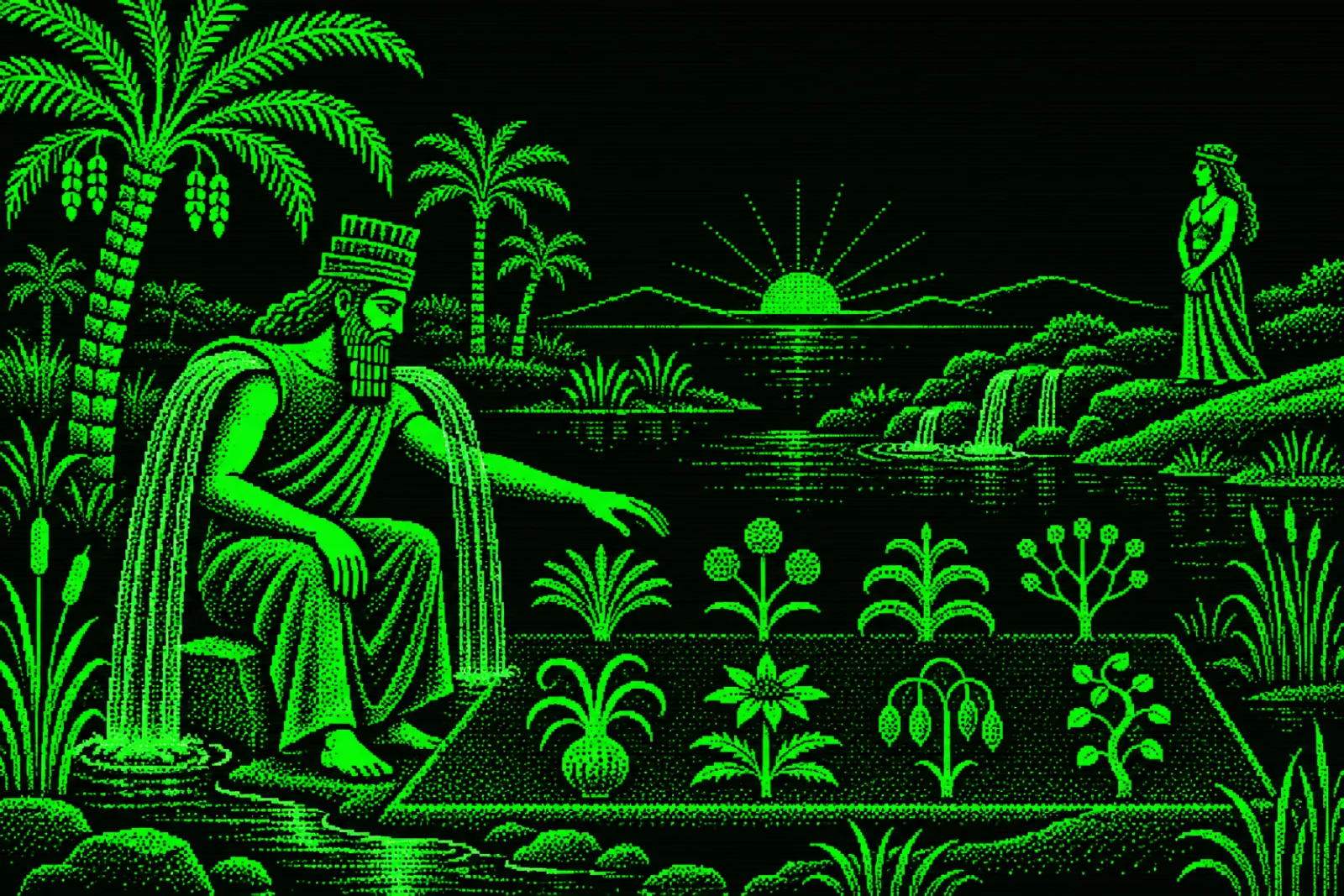
Enki and Ninḫursaĝa is a Sumerian poem of about three hundred lines, known from three Old Babylonian tablets: one from Nippur, published by Stephen Langdon in 1915 as a “Sumerian Epic of Paradise”, a shorter one from Ur, and one of unknown origin in the Louvre, which adds a generation to the line of daughters. It opens on Dilmun, the island land of the Gulf, pure and bright but not yet alive: no animal kills, no one falls sick or grows old, and no one says “I am”. Enki, god of the sweet waters under the earth and of wisdom, gives it fresh water and makes it a port for the trade of the Gulf.
Then the god digs the dykes with his penis and pours his semen into Ninḫursaĝa, the mother goddess. In Sumerian one word, a, means both water and semen, and the poem uses both. Each pregnancy lasts nine days. Enki sees the daughter born of it on the riverbank, has his minister urge him on, and makes her pregnant; then her daughter, and then (in the Nippur tablet) her daughter’s daughter, Uttu. Uttu holds out for fruit, and Enki comes to her disguised as a gardener, gives her fruit and beer, and drives his penis into her; she cries out, “Ah, my crotch!” The mother goddess takes the semen from her, and eight plants grow from it. Enki has his minister name them, eats them one by one and comes to know them. Ninḫursaĝa curses him to die, and he sickens in eight parts of his body. A fox brings her back. She seats him in her vulva and gives birth to eight healing gods, one for each part, among them Ninti, born from his rib.
The English is translated from ETCSL’s composite text, word by word, and compared with ETCSL’s English, Kramer’s translation in ANET and Pascal Attinger’s French (2007) and German (2015). The published English often softens the sex; the notes say where, and give the literal sense. About twenty-five lines are lost or broken: they are marked as gaps, and lines with only a few signs left are translated as far as they go.
Each numbered line gives the Sumerian first: the original script, then the same words in Latin letters. Our English is underneath. Tap a dotted word for its meaning, and Note for our comment on the line; our comments are in the right margin.
- 1
𒌷𒆠 𒆬𒆬𒂵𒀀𒀭 𒂊𒉈 𒁀𒀀𒀭𒈨𒂗𒍢𒂗 𒆳 𒉌𒌇𒆠 𒆬𒂵𒀀𒀭
iri town · ePSD2 kug pure, holy; shining (ePSD2 kug[pure]) · ePSD2 e-ne he, she · ePSD2 ba to allot · ePSD2 kur (mountain) land · ePSD2 dilmun Dilmun, the island land of the Gulf (Bahrain) kug pure, holy; shining (ePSD2 kug[pure]) · ePSD2
The cities are kug: pure, holy, shining — … — the land of dilmun: Dilmun, the island land of the Gulf (Bahrain and the opposite coast) is holy.
Note on line 1
e-ne ba-am₃-me-en-ze₂-en, here and in line 2, has no agreed reading. ETCSL gives ‘you are the ones to whom they are allotted’; Attinger (2007, n. 19) calls every proposal grammatically or semantically hard and cites Civil’s ‘and how you (like to often?) say it!’. We leave it untranslated. - 2
𒆠𒂗𒄀 𒆬𒂵 𒂊𒉈 𒁀𒀀𒀭𒈨𒂗𒍢𒂗 𒆳 𒉌𒌇𒆠 𒆬𒂵𒀀𒀭
ki-en-gi Sumer kug pure, holy; shining (ePSD2 kug[pure]) · ePSD2 e-ne he, she · ePSD2 ba to allot · ePSD2 kur (mountain) land · ePSD2 dilmun Dilmun, the island land of the Gulf (Bahrain) kug pure, holy; shining (ePSD2 kug[pure]) · ePSD2
ki-en-gi: Sumer is holy — … — the land of Dilmun is holy.
- 3
𒆳 𒉌𒌇𒆠 𒆬𒂵𒀀𒀭 𒆳 𒉌𒌇 𒂖𒀀𒀭
kur (mountain) land · ePSD2 dilmun Dilmun, the island land of the Gulf (Bahrain) kug pure, holy; shining (ePSD2 kug[pure]) · ePSD2 kur (mountain) land · ePSD2 dilmun Dilmun, the island land of the Gulf (Bahrain) sikil pure; to purify, clean (ePSD2 sikil) · ePSD2
The land of Dilmun is holy, the land of Dilmun is sikil: pure, clean; ETCSL 'virginal'.
- 4
𒆳 𒉌𒌇𒆠 𒂖𒀀𒀭 𒆳 𒉌𒌇𒆠 𒌓𒌓𒂵𒀀𒀭
kur (mountain) land · ePSD2 dilmun Dilmun, the island land of the Gulf (Bahrain) sikil pure; to purify, clean (ePSD2 sikil) · ePSD2 kur (mountain) land · ePSD2 dilmun Dilmun, the island land of the Gulf (Bahrain) dadag bright; to brighten, clean (ePSD2 dadag) · ePSD2
The land of Dilmun is pure, the land of Dilmun is dadag: bright, clean.
- 5
𒀸𒉌𒉈 𒉌𒌇𒆠𒀀 𒅆𒁳𒉈𒅔𒈿
dili single, sole, alone (ePSD2 dili) · ePSD2 dilmun Dilmun, the island land of the Gulf (Bahrain) nu₂ to lie down; to sleep with; to be pregnant with (ePSD2 nud) · ePSD2
When he, dili: single, alone, had nu₂: to lie down; to sleep with in Dilmun,
Note on line 5
dili-ni-ne … u₃-bi₂-in-nu₂ is a transitive form, ‘he alone laid (someone) down’. ETCSL: ‘He laid her down all alone in Dilmun’. Attinger (2007; 2015) makes the lone one the object: ‘after one had made him who was alone lie down in Dilmun’. Kramer (ANET): ‘Who had lain by himself in Dilmun’. - 6
𒆠 𒀭𒂗𒆠 𒁮𒀀𒉌𒁕 𒁀𒀭𒁕𒈿𒀀𒁀
ki place · ePSD2 en-ki Enki, god of the Abzu (the sweet waters under the earth), of wisdom and of incantation dam spouse · ePSD2 nu₂ to lie down; to sleep with; to be pregnant with (ePSD2 nud) · ePSD2
the place where en-ki: god of the Abzu, the sweet waters under the earth; god of wisdom and incantation nu₂: to lie down; with -da-, to lie with, sleep with his dam: spouse,
Note on line 6
ba-an-da-nu₂, ’lay down with’: the same verb is ePSD2’s ’to sleep with’. Attinger (2015, p. 5) says the text does not state that they have sex; it states that he lies down with her. - 7
𒆠𒁉 𒂖𒀀𒀭 𒆠𒁉 𒌓𒌓𒂵𒀀𒀭
ki place · ePSD2 sikil pure; to purify, clean (ePSD2 sikil) · ePSD2 ki place · ePSD2 dadag bright; to brighten, clean (ePSD2 dadag) · ePSD2
that place was pure, that place was bright.
- 8
𒀸𒉌𒉈 𒉌𒌇𒆠𒀀 𒅆𒁳𒉈𒅔𒈿
dili single, sole, alone (ePSD2 dili) · ePSD2 dilmun Dilmun, the island land of the Gulf (Bahrain) nu₂ to lie down; to sleep with; to be pregnant with (ePSD2 nud) · ePSD2
When he, alone, had laid (her) down in Dilmun,
- 9
𒆠 𒀭𒂗𒆠 𒀭𒊩𒌆𒂖𒆷 𒁀𒀭𒁕𒈿𒀀𒁀
ki place · ePSD2 en-ki Enki, god of the Abzu (the sweet waters under the earth), of wisdom and of incantation nin-sikil-la Ninsikila, 'Pure Lady', goddess of Dilmun nu₂ to lie down; to sleep with; to be pregnant with (ePSD2 nud) · ePSD2
the place where Enki lay down with nin-sikil-la: 'Pure Lady', the goddess of Dilmun,
Note on line 9
Ninsikila is Enki’s wife here (lines 6, 9) and, in line 29, his daughter: she calls him ‘her father’. Kramer (ANET n. 20) took ‘father’ as an honorific; Attinger (2015, p. 5) reads her as both wife and daughter. - 10
𒆠𒁉 𒂖𒀀𒀭 𒆠𒁉 𒌓𒌓𒂵𒀀𒀭
ki place · ePSD2 sikil pure; to purify, clean (ePSD2 sikil) · ePSD2 ki place · ePSD2 dadag bright; to brighten, clean (ePSD2 dadag) · ePSD2
that place was pure, that place was bright.
- 11
𒉌𒌇𒆠𒀀 𒌑𒉀𒂵𒄷 𒅗𒅗 𒉡𒈬𒉌𒁉
dilmun Dilmun, the island land of the Gulf (Bahrain) uga raven · ePSD2 gu₃ voice · ePSD2 dug₄ to say, speak; to do. With ĝiš₃, to copulate (ePSD2 ŋeš dug) · ePSD2
In Dilmun the uga: raven did not gu₃: voice, cry; with dug₄, to cry out.
- 12
𒁯𒄷𒂊 𒅗 𒁯𒄷𒊑 𒉡𒈬𒉌𒅁𒁉
dar francolin? · ePSD2 gu₃ voice · ePSD2 dar francolin? · ePSD2 dug₄ to say, speak; to do. With ĝiš₃, to copulate (ePSD2 ŋeš dug) · ePSD2
The dar: francolin did not cry the francolin's cry.
- 13
The ur-gu-la: lion did not ra: to strike; saĝ ĝiš ra, 'to strike the head with a weapon', to kill.
- 14
The ur-bar-ra: wolf did not kar(flee): to take away by force lambs.
- 15
𒌨𒂠 𒈧 𒃵𒃵 𒉡𒌒𒍪
ur-gir₁₅ domestic dog · ePSD2 maš₂ (kid) goat · ePSD2 gam to bow down · ePSD2 zu to know, learn; to make known (ePSD2 zu[know]) · ePSD2
The ur-gir₁₅: domestic dog did not know how to make the kids crouch.
- 16
𒂄 𒊺 𒅥𒅥𒂊 𒉡𒌒𒍪
šaḫ₂ pig · ePSD2 še barley · ePSD2 gu₇ to eat (ePSD2 gu[eat]) · ePSD2 zu to know, learn; to make known (ePSD2 zu[know]) · ePSD2
The šaḫ₂: pig did not know how to eat barley.
Note on line 16
The animals do not yet know (nu-ub-zu) the habits that make them dangerous or useful. Kramer (ANET): ‘unknown is the kid-devouring wild dog, unknown is the grain-devouring …’; Attinger (2015): ‘unknown was the pig that devoured barley’. - 17
𒉡𒈬𒌦𒍪 𒉽𒉽 𒃡𒊏 𒁖𒂵𒁀
nu-mu-un-su widow · ePSD2 munu₄ malt · ePSD2 ur₃ roof · ePSD2 barag₂ to spread out · ePSD2
When a nu-mu-un-su: widow spread malt on the roof,
- 18
𒄷𒂊 𒀭𒈾 𒉽𒉽𒁉 𒈾𒀭𒅥𒂊
mušen bird · ePSD2 an heaven · ePSD2 munu₄ malt · ePSD2 gu₇ to eat (ePSD2 gu[eat]) · ePSD2
the birds of heaven did not eat that malt.
- 19
The pigeon did not … its head.
Note on line 19
The verb is written with the sign RU, of unsettled reading. ETCSL: ‘did not tuck the head under its wing’; Attinger: ‘puffed itself up’ before her. - 20
𒅆𒍼𒂊 𒅆𒍼𒈨𒂗 𒉡𒈬𒉌𒁉
igi-gig eye disease; one sick in the eye. With -me-en, 'I am' · ePSD2 igi-gig eye disease; one sick in the eye. With -me-en, 'I am' · ePSD2 dug₄ to say, speak; to do. With ĝiš₃, to copulate (ePSD2 ŋeš dug) · ePSD2
The igi-gig: eye disease; one sick in the eye did not say there: 'igi-gig: eye-sick, with -me-en, I am'
Note on line 20
Four lines (20–23) are built on -me-en, ‘I am’. The sick do not say ‘I am sick’, the old do not say ‘I am old’. Attinger’s German (2015) turns two of them into ‘My eyes hurt!’ and ‘My head hurts!’ and keeps ‘I am’ only in a note; an Ur manuscript reads ‘my sick eyes!’. ETCSL and Kramer keep ‘I am’. - 21
𒊕𒍼𒂊 𒊕𒍼𒈨𒂗 𒉡𒈬𒉌𒁉
saĝ-gig headache; one sick in the head. With -me-en, 'I am' · ePSD2 saĝ-gig headache; one sick in the head. With -me-en, 'I am' · ePSD2 dug₄ to say, speak; to do. With ĝiš₃, to copulate (ePSD2 ŋeš dug) · ePSD2
The saĝ-gig: headache did not say there: 'I am head-sick.'
- 22
𒌝𒈠𒁉 𒌝𒈠𒈨𒂗 𒉡𒈬𒉌𒁉
um-ma old woman (ePSD2 umma) · ePSD2 um-ma old woman (ePSD2 umma) · ePSD2 dug₄ to say, speak; to do. With ĝiš₃, to copulate (ePSD2 ŋeš dug) · ePSD2
Its um-ma: old woman did not say there: 'I am an old woman.'
- 23
𒀊𒁀𒁉 𒀊𒁀𒈨𒂗 𒉡𒈬𒉌𒁉
ab-ba father; old man · ePSD2 ab-ba father; old man · ePSD2 dug₄ to say, speak; to do. With ĝiš₃, to copulate (ePSD2 ŋeš dug) · ePSD2
Its ab-ba: father; old man did not say there: 'I am an old man.'
- 24
𒆠𒂖 𒀀 𒉡𒋗𒉀𒀀𒉌 𒌷𒀀 𒉡𒈬𒉌𒅁𒋧𒄀
ki-sikil young woman · ePSD2 a water; semen, sperm; progeny (ePSD2 a[water]). One word for water and semen · ePSD2 tu₅ to wash · ePSD2 iri town · ePSD2 sig₁₀ to place · ePSD2
The ki-sikil: young woman, unwashed, did not throw out (her) water in the city.
Note on line 24
This is Attinger’s literal alternative (2007 n. 24). His main rendering: ‘No girl bathed, none poured out (used) water in the city’. ETCSL leaves the verb untranslated. - 25
𒇽 𒀀𒇉𒁕 𒁄𒂊 𒈪𒉈 𒉡𒈬𒉌𒁉
lu₂ person · ePSD2 id₂ watercourse · ePSD2 bal to turn over · ePSD2 ĝi₆ night · ePSD2 dug₄ to say, speak; to do. With ĝiš₃, to copulate (ePSD2 ŋeš dug) · ePSD2
The man who crosses the river did not say there: 'Night!'
Note on line 25
ĝi₆-de₃, ’night!’ or ‘at night’. Attinger (2007 n. 25): ‘This night!’ is possible in principle, but he asks what it would mean. ETCSL: ‘It is getting dark’. - 26
The niĝir: herald did not go round his border district.
- 27
𒈜𒂊 𒂊𒇻𒇴 𒉡𒈬𒉌𒁉
nar musician · ePSD2 e-lu-lam a song (ePSD2); ETCSL 'sad song', Attinger 'song of joy' · ePSD2 dug₄ to say, speak; to do. With ĝiš₃, to copulate (ePSD2 ŋeš dug) · ePSD2
The nar: musician, singer did not sing an e-lu-lam: a song; ETCSL 'sad song', Attinger 'song of joy' there,
- 28
𒍠 𒌷𒅗 𒄿𒇻 𒉡𒈬𒉌𒁉
zag side · ePSD2 iri town · ePSD2 i-lu a lament; a joyful song (ePSD2 ilu) · ePSD2 dug₄ to say, speak; to do. With ĝiš₃, to copulate (ePSD2 ŋeš dug) · ePSD2
at the edge of the city he did not sing an i-lu: lament; also a joyful song there.
Note on line 28
No song and no lament: nothing in Dilmun yet calls for either. - 29
𒀭𒊩𒌆𒂖𒆷 𒀀𒀀𒉌 𒀭𒂗𒆠𒊏 𒅗 𒈬𒈾𒌌𒂊
nin-sikil-la Ninsikila, 'Pure Lady', goddess of Dilmun a-a father · ePSD2 en-ki Enki, god of the Abzu (the sweet waters under the earth), of wisdom and of incantation gu₃ voice · ePSD2 de₂ to pour · ePSD2
Ninsikila said to her a-a: father Enki:
- 30
𒌷 𒈬𒂊𒋧 𒌷 𒈬𒂊𒋧 𒉆𒈬 𒋧𒈠𒍪
iri town · ePSD2 šum₂ to give · ePSD2 iri town · ePSD2 šum₂ to give · ePSD2 nam-ĝu₁₀ what is it to me šum₂ to give · ePSD2
'You have given a city, you have given a city — nam-ĝu₁₀: 'what is it to me?'
- 31
𒉌𒌇 𒌷 𒈬𒂊𒋧 𒌷 𒈬𒂊𒋧 𒉆𒈬 𒋧𒈠𒍪
dilmun Dilmun, the island land of the Gulf (Bahrain) iri town · ePSD2 šum₂ to give · ePSD2 iri town · ePSD2 šum₂ to give · ePSD2 nam-ĝu₁₀ what is it to me šum₂ to give · ePSD2
Dilmun, the city, you have given; you have given a city — what is your giving to me?
- 32
□ □ 𒈬𒂊𒋧 𒌷 𒈬𒂊𒋧 𒉆𒈬 𒋧𒈠𒍪
[X X] šum₂ to give · ePSD2 iri town · ePSD2 šum₂ to give · ePSD2 nam-ĝu₁₀ what is it to me šum₂ to give · ePSD2
[…] you have given; you have given a city — what is your giving to me?
- 33
[A city] that has no river quay,
- 34
□ □ 𒈬𒂊𒋧 𒌷 𒈬𒂊𒋧 𒉆𒈬 𒋧𒈠𒍪
[X X] šum₂ to give · ePSD2 iri town · ePSD2 šum₂ to give · ePSD2 nam-ĝu₁₀ what is it to me šum₂ to give · ePSD2
[…] you have given; you have given a city — what is your giving to me?
- 35
… □ … □
[…] X […] X
[…] … […] …
- 36
𒌷 𒀀𒊮 𒀀𒃼 𒀊𒉆 𒉡𒌦𒌇𒀀
iri town · ePSD2 a-šag₄ field · ePSD2 a-gar₃ meadow · ePSD2 absin₃ furrow · ePSD2 tuku to have · ePSD2
[A city] that has no [field], meadow [or furrow].'
- 37ll. 37–39
This line is missing from the open Sumerian text we translate from.
Paraphrase Three lines are lost (37–39). Ninsikila's complaint ends here.
Taken from the published translations until we can translate the Sumerian ourselves.
- 40
[When utu: the sun god stands in heaven,
Note on line 40
Lines 40–43 are lost on the tablets and restored by ETCSL from their fulfilment in lines 51–54; Enki is speaking. - 41
from the gir₁₆: a vessel for liquids, above all beer … of the shore of Ezen,
- 42
𒂍𒋦 𒋛 𒀭𒋀𒆠𒀀𒋫
e₂-suḫur summit shrine si(shine) brilliance · ePSD2 nanna Nanna, the moon god
from the shining e₂-suḫur: summit shrine; Attinger reads the signs differently and leaves the word open of nanna: the moon god,
- 43
𒅗 𒀀 𒆠𒀀 𒁺𒁺𒋫 𒀀 𒄭 𒆠𒋫 … 𒁺
ka mouth · ePSD2 a water; semen, sperm; progeny (ePSD2 a[water]). One word for water and semen · ePSD2 ki place · ePSD2 DU DU a water; semen, sperm; progeny (ePSD2 a[water]). One word for water and semen · ePSD2 dug₃ to be good · ePSD2 ki place · ePSD2 … DU DU
from the mouth of the waters that run in the earth, sweet water from the earth … ]
- 44
𒄊𒈠𒀭 𒃲𒆷𒍝 𒀀 𒃶𒅎𒋫𒇯𒁺𒉈
ĝiri₃-ma-an basin · ePSD2 gal to be big · ePSD2 a water; semen, sperm; progeny (ePSD2 a[water]). One word for water and semen · ePSD2 ed₃ to go down or up · ePSD2
Into your great ĝiri₃-ma-an: basin; Attinger calls the usual rendering ad hoc let water rise.
- 45
𒌷𒍪 𒀀 𒃶𒅅𒆷 𒄷𒈬𒊏𒅘𒅘
iri town · ePSD2 a water; semen, sperm; progeny (ePSD2 a[water]). One word for water and semen · ePSD2 ḫe₂-ĝal₂ plenty · ePSD2 naĝ to drink · ePSD2
Let your city drink from them water of ḫe₂-ĝal₂: plenty, abundance.
- 46
𒉌𒌇𒆠 𒀀 𒃶𒅅𒆷 𒄷𒈬𒊏𒅘𒅘
dilmun Dilmun, the island land of the Gulf (Bahrain) a water; semen, sperm; progeny (ePSD2 a[water]). One word for water and semen · ePSD2 ḫe₂-ĝal₂ plenty · ePSD2 naĝ to drink · ePSD2
Let Dilmun drink from them water of plenty.
- 47
𒇥 𒀀 𒋀𒀀𒍪 𒇥 𒀀 𒄭𒂵 𒃶𒅎
pu₂ (water) hole · ePSD2 a water; semen, sperm; progeny (ePSD2 a[water]). One word for water and semen · ePSD2 sis to be bitter · ePSD2 pu₂ (water) hole · ePSD2 a water; semen, sperm; progeny (ePSD2 a[water]). One word for water and semen · ePSD2 dug₃ to be good · ePSD2 me to be · ePSD2
Let your wells of sis: to be bitter, brackish water be wells of dug₃: good, sweet, fresh (of water) water.
- 48
𒌷𒍪 𒂍𒄘 𒋼𒀀𒊏 𒌦𒈠𒅗 𒃶𒀀
iri town · ePSD2 e₂-gun₂ storeroom · ePSD2 kar quay · ePSD2 kalam the Land · ePSD2 me to be · ePSD2
Let your city be the e₂-gun₂: storeroom on the quay of the Land.
- 49
𒉌𒌇𒆠 𒂍𒄘 𒋼𒀀𒊏 𒌦𒈠𒅗 𒃶𒀀
dilmun Dilmun, the island land of the Gulf (Bahrain) e₂-gun₂ storeroom · ePSD2 kar quay · ePSD2 kalam the Land · ePSD2 me to be · ePSD2
Let Dilmun be the storehouse on the quay of the Land.'
- 49A
'Let the land of tu-uk-ri-iš: Tukriš, a land in the eastern highlands [give you] kug-sig₁₇: gold of ḫa-ra-li: Ḫarali, a land of gold,
Note on line 49A
Lines 49A–49V, the list of goods, are found only in the manuscript from Ur. ETCSL sets them here; Attinger says the placing is possible but not certain. - 49B
lapis lazuli and […] … let it hand over to you.
- 49C
𒆳 𒈨𒈛𒄩𒆠 𒉌𒌓𒍝𒄢 𒃻 𒀠 𒁲 𒆗𒆷
kur (mountain) land · ePSD2 me-luḫ-ḫa Meluha gug cornelian · ePSD2 niĝ₂ thing · ePSD2 al desire · ePSD2 dug₄ to say, speak; to do. With ĝiš₃, to copulate (ePSD2 ŋeš dug) · ePSD2 kal to be rare · ePSD2
Let the land of me-luḫ-ḫa: Meluḫḫa, the Indus lands [load] gug: carnelian, a desired and rare thing,
- 49D
𒄑𒈩 𒊮𒃶 𒄑𒀊𒁀 𒅆𒂟𒂵
meš₃ type of tree · ePSD2 ma₂-gan Magan ĝiš-ab-ba type of tree · ePSD2 sig₅ to be fine · ePSD2
meš₃: a tree of Magan, the fine ĝiš-ab-ba: a tree, 'sea-wood',
Note on line 49D
The tablet writes šag₄-gan; ETCSL takes it as a spelling of Magan. - 49E
into great ships for you.
- 49F
𒆳 𒈥𒄩𒅆𒆠 𒉌𒌓 𒆗𒆷 𒉌𒌓𒂃𒅆𒀀
kur (mountain) land · ePSD2 mar-ḫa-ši Marhaci na₄ stone · ePSD2 kal to be rare · ePSD2 du₈-ši-a quartz? · ePSD2
Let the land of mar-ḫa-ši: Marḫaši, a land in south-eastern Iran [give you] rare stones, du₈-ši-a: a stone, quartz,
- 49G
𒃮 𒄷𒈬𒊏𒀊□
gaba chest · ePSD2 ḫu-mu-ra-ab-[X]
… for you […].
- 49H
𒆳 𒈣𒃶𒆠 𒍏 𒃻 𒆗𒂵 𒀉𒆗□
kur (mountain) land · ePSD2 ma₂-gan Magan urud copper · ePSD2 niĝ₂ thing · ePSD2 kalag to be strong · ePSD2 usu strength · ePSD2
Let the land of ma₂-gan: Magan, Oman [give you] urud: copper, a strong thing, of great strength,
- 49I
esi(stone): diorite?, u-stone and šu-min₃: hammer-stone? […].
- 49K
𒆳 𒀊𒁀𒆠𒆤 𒄑𒆗 𒈨𒋼𒁉 □ 𒈗𒆷 𒄷𒈬𒊏𒀊□ □
kur (mountain) land · ePSD2 ab-ba(Sealand) Sea-land esi(wood) ebony? · ePSD2 me-te (fitting) attribute · ePSD2 [X] lugal king · ePSD2 ḫu-mu-ra-ab-[X (X)]
Let the ab-ba(Sealand): the Sealand, at the head of the Gulf [give you] esi(wood): ebony?, the fitting attribute […] of a king.
- 49L
𒆳 𒍝𒇴𒃻𒆠 𒋠 𒁯 𒊷𒂵 □ 𒄷𒈬𒊏𒀊□
kur (mountain) land · ePSD2 za-lam-ĝar Tent-land siki hair · ePSD2 gun₃ to be multicoloured · ePSD2 sag₉ to be good · ePSD2 [X] ḫu-mu-ra-ab-[X]
Let the za-lam-ĝar: the 'Tent' land, the land of the herders [give you] fine many-coloured wool […].
- 49M
𒆳 𒉏𒆠𒈠 𒋠 𒅆 𒉠 𒄘𒌦𒄘𒌦 𒄷𒈬𒊏𒀊𒁄𒁄𒂊
kur (mountain) land · ePSD2 elam Elam siki hair · ePSD2 igi eye; face (ePSD2) · ePSD2 saĝ₅ to choose · ePSD2 gun₂ weight measure (load) · ePSD2 bal to turn over · ePSD2
Let the land of elam: Elam, south-western Iran hand over to you choice wool, its tribute.
- 49N
𒀊 𒋀𒀕𒆠 𒁈 𒉆𒈗𒆷 𒌷𒆠 …
eš₃ shrine · ePSD2 urim₂ Urim barag dais · ePSD2 nam-lugal kingship · ePSD2 iri town · ePSD2 […]
Let the shrine of urim₂: Ur, the dais of kingship, the city […],
- 49O
𒊺𒉌𒄑 𒌆 𒈤 𒌆 𒅆𒂟 𒈣 𒃲𒃲 𒄷𒈬𒊏𒀊𒁲
še-ĝiš-i₃ sesame · ePSD2 tug₂ garment · ePSD2 maḫ to be majestic · ePSD2 tug₂ garment · ePSD2 sig₅ to be fine · ePSD2 ma₂ boat · ePSD2 gal to be big · ePSD2 sa₂ to equal · ePSD2
[load] sesame, great garments and fine garments into great ships for you.
- 49P
𒀀𒀊𒁀 𒂼𒆷 𒃶𒅅𒁉 𒄷𒈬
a-ab-ba sea(water) · ePSD2 daĝal to be wide · ePSD2 ḫe₂-ĝal₂ plenty · ePSD2 ḫu-⸢mu⸣-[…]
Let the wide a-ab-ba: sea [bring] you its plenty.'
- 49Q
𒌷𒆠 𒆪 𒆠𒆪𒁉 𒆠𒆪 𒄭𒂵𒀀𒀭
iri town · ePSD2 «tuš» ki-tuš dwelling place · ePSD2 ki-tuš dwelling place · ePSD2 dug₃ to be good · ePSD2
The dwellings of the city are good dwellings,
Note on line 49Q
The scribe of the Ur copy wrote an extra tuš (in «»), which ETCSL marks as an error. - 49R
𒉌𒌇𒆠 𒆠𒆪𒁉 𒆠𒆪 𒄭𒂵𒀀𒀭
dilmun Dilmun, the island land of the Gulf (Bahrain) ki-tuš dwelling place · ePSD2 ki-tuš dwelling place · ePSD2 dug₃ to be good · ePSD2
the dwellings of Dilmun are good dwellings.
- 49S
Its barley is small barley,
- 49T
its zu₂-lum: date are big dates,
- 49U
its harvests are three(fold) […],
- 49V
its trees are … trees […].
- 50
Then, by Utu, on that day,
- 51
when Utu stood in heaven,
- 52
from the gir-vessels … of the shore of Ezen,
- 53
𒂍𒋦 𒋛 𒀭𒋀𒆠𒀀𒋫
e₂-suḫur summit shrine si(shine) brilliance · ePSD2 nanna Nanna, the moon god
from the shining high shrine of Nanna,
- 54
𒅗 𒀀 𒆠𒀀 𒁺𒁺𒋫 𒀀 𒄭 𒆠𒋫 𒈬𒈾𒊏𒁺
ka mouth · ePSD2 a water; semen, sperm; progeny (ePSD2 a[water]). One word for water and semen · ePSD2 ki place · ePSD2 DU DU a water; semen, sperm; progeny (ePSD2 a[water]). One word for water and semen · ePSD2 dug₃ to be good · ePSD2 ki place · ePSD2 DU DU
from the mouth of the waters that run in the earth, sweet water from the earth came for her.
- 55
𒄊𒈠𒀭 𒃲𒆷𒈾 𒀀 𒅎𒋫𒇯𒁺𒉈
ĝiri₃-ma-an basin · ePSD2 gal to be big · ePSD2 a water; semen, sperm; progeny (ePSD2 a[water]). One word for water and semen · ePSD2 ed₃ to go down or up · ePSD2
Into her great basins water rose.
- 56
𒌷𒉌 𒀀 𒃶𒅅𒆷 𒅎𒋫𒅘𒅘
iri town · ePSD2 a water; semen, sperm; progeny (ePSD2 a[water]). One word for water and semen · ePSD2 ḫe₂-ĝal₂ plenty · ePSD2 naĝ to drink · ePSD2
Her city drank from them water of plenty.
- 57
𒉌𒌇𒆠 𒀀 𒃶𒅅𒆷 𒅎𒋫𒅘𒅘
dilmun Dilmun, the island land of the Gulf (Bahrain) a water; semen, sperm; progeny (ePSD2 a[water]). One word for water and semen · ePSD2 ḫe₂-ĝal₂ plenty · ePSD2 naĝ to drink · ePSD2
Dilmun drank from them water of plenty.
- 58
𒇥 𒀀 𒋀𒀀𒉌 𒇥 𒀀 𒄭𒂵 𒈾𒉆
pu₂ (water) hole · ePSD2 a water; semen, sperm; progeny (ePSD2 a[water]). One word for water and semen · ePSD2 sis to be bitter · ePSD2 pu₂ (water) hole · ePSD2 a water; semen, sperm; progeny (ePSD2 a[water]). One word for water and semen · ePSD2 dug₃ to be good · ePSD2 me to be · ePSD2
Her wells of bitter water became wells of sweet water.
- 59
𒀀𒊮 𒀀𒃼 𒀊𒉆𒀀𒉌 𒊺 𒈬𒈾𒀊□𒋧
a-šag₄ field · ePSD2 a-gar₃ meadow · ePSD2 absin₃ furrow · ePSD2 še barley · ePSD2 šum₂ to give · ePSD2
Her fields, meadows and furrows gave her barley.
- 60
𒌷𒉌 𒂍𒄘 𒋼𒀀𒊏 𒌦𒈠𒅗 𒈾𒉆
iri town · ePSD2 e₂-gun₂ storeroom · ePSD2 kar quay · ePSD2 kalam the Land · ePSD2 me to be · ePSD2
Her city became the storehouse on the quay of the Land.
- 61
𒉌𒌇𒆠 𒂍𒄘 𒋼𒀀𒊏 𒌦𒈠𒅗 𒈾𒉆
dilmun Dilmun, the island land of the Gulf (Bahrain) e₂-gun₂ storeroom · ePSD2 kar quay · ePSD2 kalam the Land · ePSD2 me to be · ePSD2
Dilmun became the storehouse on the quay of the Land.
- 62
𒉌𒉈𒂠 𒀭𒌓 𒌓 𒉈𒀀 𒄯 𒃶𒈾𒉆𒈠
i₃-ne-eš₂ now · ePSD2 utu Utu, the sun god ud day; daylight · ePSD2 ne-en this · ePSD2 ur₅ that · ePSD2 me to be · ePSD2
Then, by Utu, on that day, so it was.
- 63
𒀸𒉌 𒄑𒌆𒉿𒄀 𒌇𒀀 𒀭𒊩𒌆𒌅 𒂼 𒌦𒈠𒂠
dili single, sole, alone (ePSD2 dili) · ePSD2 ĝeštug₂ ear; wisdom, understanding (ePSD2 ŋeštug) · ePSD2 tuku to have · ePSD2 nin-tur₅ Nintur, a name of the mother goddess (Ninḫursaĝa) ama mother · ePSD2 kalam the Land · ePSD2
He who was alone, the one who has the ĝeštug₂: ear; wisdom, understanding, toward nin-tur₅: Nintur, a name of the mother goddess Ninḫursaĝa, mother of the Land,
Note on line 63
ĝeštug₂ tuku, ‘having the ear’, is the Sumerian for being wise: the ear is the seat of understanding (ePSD2). ETCSL: ’the wise one’. Attinger: ‘seized by a (sudden) inspiration’. Nintur and Ninḫursaĝa are two names for one goddess in this poem. - 64
𒀭𒂗𒆠𒆤 𒄑𒌆𒉿𒄀 𒌇𒀀 𒀭𒊩𒌆𒌅 𒂼 𒌦𒈠𒂠
en-ki Enki, god of the Abzu (the sweet waters under the earth), of wisdom and of incantation ĝeštug₂ ear; wisdom, understanding (ePSD2 ŋeštug) · ePSD2 tuku to have · ePSD2 nin-tur₅ Nintur, a name of the mother goddess (Ninḫursaĝa) ama mother · ePSD2 kalam the Land · ePSD2
Enki, the one who has the ear, toward Nintur, mother of the Land,
- 65
with his ĝiš₃: penis digs into the eg₂: levee, dyke,
Note on line 65
ĝiš₃ is the plain word for the penis (ePSD2). The god irrigates the land with it: digging, plunging, raising. Kramer (ANET): ‘causes his phallus to water the dikes’; ETCSL: ‘digging his phallus into the dykes’. - 66
𒍑𒀀𒉌 𒄀𒀀 𒁽𒁽𒂊 𒁀𒀭𒅆𒁽𒁽𒂊
ĝiš₃ penis; male (ePSD2 ŋeš[penis]) · ePSD2 gi reed · ePSD2 gir₅ to slip in or through · ePSD2 gir₅ to slip in or through · ePSD2
with his penis gir₅: to slip in, glide, dive into the reeds,
- 67
𒍑𒀀𒉌 𒁇𒂠 𒈤𒄭 𒊭𒁀𒊏𒀭𒍣𒍣
ĝiš₃ penis; male (ePSD2 ŋeš[penis]) · ePSD2 bar outside; body, skin (ePSD2 bar[outside]) · ePSD2 maḫ to be majestic · ePSD2 zig₃ to rise · ePSD2
his penis, outward, mighty, he made zig₃: to rise; to swell.
Note on line 67
The composite has bar-še₃ maḫ-e, ‘outward, majestically’. ETCSL: ‘The august one pulled his phallus aside’. Attinger reads the signs as bar-dul₅, a garment, and translates ‘with his penis he made a huge, tender cloak (of green) spring up’ (2015 n. 16): the penis makes the vegetation grow. Kramer left the line open. - 68
𒅗 𒉈𒅔𒌌 𒆹𒊏 𒇽 𒉡𒈬𒌦𒁳𒁉
gu₃ voice · ePSD2 de₂ to pour · ePSD2 ambar marsh, reed-bed · ePSD2 lu₂ person · ePSD2 dab₅ to seize, take, hold (ePSD2 dab[seize]) · ePSD2
He shouted: 'In the ambar: marsh, reed-bed let no one dab₅: to seize, take, hold!'
Note on line 68
ETCSL: ‘No man take me in the marsh’. Kramer and Attinger read a different verb: ‘Let no one walk in the marshland’ / ‘No one shall cross the marsh!’ - 69
𒀭𒂗𒆠𒆤 𒅗 𒉈𒅔𒌌
en-ki Enki, god of the Abzu (the sweet waters under the earth), of wisdom and of incantation gu₃ voice · ePSD2 de₂ to pour · ePSD2
Enki shouted (it).
- 70
𒍣 𒀭𒈾 𒉌𒅆𒊒
zi life, breath; throat (ePSD2 zi[life]) · ePSD2 an heaven · ePSD2 pad₃ to find; to swear; to adjure (ePSD2 pad[find]) · ePSD2
He pad₃: to find; to swear; to adjure by the zi: life, breath; throat of heaven.
Note on line 70
zi … pad₃ is the oath ‘by the life of’. ETCSL makes it the start of Enki’s speech: ‘By the life’s breath of heaven I adjure you’. - 71
𒈿𒀀 𒆹𒊏 𒈿𒀀 𒆹𒊏 𒅗𒉌
nu₂ to lie down; to sleep with; to be pregnant with (ePSD2 nud) · ePSD2 ambar marsh, reed-bed · ePSD2 nu₂ to lie down; to sleep with; to be pregnant with (ePSD2 nud) · ePSD2 ambar marsh, reed-bed · ePSD2 giri₁₇-zal joy, delight · ePSD2
'nu₂: to lie down; to sleep with in the marsh, lie down in the marsh — what giri₁₇-zal: joy, delight!'
Note on line 71
So ETCSL, and Attinger’s alternative (2015 n. 17). His main reading makes the line the object of the next: ‘her who had lain down in the marsh, his own who had lain down in the marsh, Enki spattered with his semen’. - 72
𒀭𒂗𒆠𒆤 𒀀 𒀭𒁮𒃲𒉣𒈾𒅗𒉌 𒈪𒉌𒅔𒅗
en-ki Enki, god of the Abzu (the sweet waters under the earth), of wisdom and of incantation a water; semen, sperm; progeny (ePSD2 a[water]). One word for water and semen · ePSD2 dam-gal-nun-na Damgalnuna, Enki's wife at Eridu dug₄ to say, speak; to do. With ĝiš₃, to copulate (ePSD2 ŋeš dug) · ePSD2
Enki dug₄: to say; to do; a … dug₄, to sprinkle water his a: water; semen meant for dam-gal-nun-na: Enki's wife at Eridu.
Note on line 72
a, ‘water’, is also ‘semen’ (ePSD2; Attinger 2015 n. 5: ‘In Sumerian both water and semen are a’). The poem moves between the two senses: the water Enki brings Dilmun in lines 40–62 and the semen of lines 72–185 are one word. The semen was ‘of Damgalnuna’, his own wife, and it goes into Ninḫursaĝa. - 73
𒀭𒊩𒌆𒄯𒊕𒂷𒆤 𒀀 𒊮𒂵 𒁀𒉌𒅔𒊑
nin-ḫur-saĝ-ĝa₂ Ninḫursaĝa, 'Lady of the foothills', the mother goddess a water; semen, sperm; progeny (ePSD2 a[water]). One word for water and semen · ePSD2 šag₄ heart; inner body, womb, belly; inside (ePSD2 šag[heart]) · ePSD2 ri to lay down, cast; to impose; to pour out (ePSD2 ri[impose]) · ePSD2
Into the šag₄: heart; inner body, womb, belly of nin-ḫur-saĝ-ĝa₂: 'Lady of the foothills', the mother goddess he ri: to lay down, cast; to pour out semen.
- 74
𒀀 𒊮𒂵 𒋗 𒁀𒉌𒅔𒋾 𒀀 𒀭𒂗𒆠𒂵𒅗
a water; semen, sperm; progeny (ePSD2 a[water]). One word for water and semen · ePSD2 šag₄ heart; inner body, womb, belly; inside (ePSD2 šag[heart]) · ePSD2 šu hand · ePSD2 te to approach; with šu, to receive · ePSD2 a water; semen, sperm; progeny (ePSD2 a[water]). One word for water and semen · ePSD2 en-ki Enki, god of the Abzu (the sweet waters under the earth), of wisdom and of incantation
She te: to approach; šu … ti, to receive the semen into the womb, the semen of Enki.
- 75
One day was her one month,
Note on line 75
Each pregnancy lasts nine days, one day for each month. Attinger: literally ‘it was day one: her month one’. - 76
two days were her two months,
- 77
three days were her three months,
- 78
four days were her four months,
- 79
five days were her five months,
- 80
six days were her six months,
- 81
seven days were her seven months,
- 82
eight days were her eight months,
- 83
𒌓 𒐎𒀀𒀭 𒌗 𒐎𒀀𒉌 𒌗 𒉆𒊩𒀀𒅗
ud day; daylight · ePSD2 9 9 · ePSD2 itid moon; month (ePSD2 itud) · ePSD2 9 9 · ePSD2 itid moon; month (ePSD2 itud) · ePSD2 nam-munus womanhood, femininity · ePSD2
nine days were her nine months, the months of nam-munus: womanhood, femininity.
Note on line 83
nam-munus, literally ‘womanhood’ (ETCSL ’the month of womanhood’); Attinger renders the phrase ’the months of pregnancy’. - 84
𒉌 𒇷𒁶 𒉌 𒇷𒁶 𒉌𒄭𒉣𒈾𒁶
i₃ fatty substance · ePSD2 li fine i₃ fatty substance · ePSD2 li fine i₃-ḫe-nun-na precious oil (ePSD2 ihenunak) · ePSD2
Like fine oil, like fine oil, like i₃-ḫe-nun-na: precious oil, 'oil of plenty',
Note on line 84
The birth is as smooth as if she were rubbed with oil: without pain (Attinger: ‘so smoothly, as if anointed’). - 85
𒀭𒊩𒌆𒌅 𒂼 𒌦𒈠𒅗
nin-tur₅ Nintur, a name of the mother goddess (Ninḫursaĝa) ama mother · ePSD2 kalam the Land · ePSD2
Nintur, mother of the Land,
- 86
𒉌 𒇷𒁶
i₃ fatty substance · ePSD2 li fine
like fine oil,
- 87
𒀭𒊩𒌆𒊬 𒅔𒌅𒌓
nin-nisig Ninnisig, 'Lady Greenery' (older readings Ninsar, Ninmu) tud to give birth (ePSD2 tud) · ePSD2
tud: to give birth to nin-nisig: 'Lady Greenery' (nisig, vegetables); read Ninsar or Ninmu in older editions.
Note on line 87
The daughter’s name is written {d}nin-NISIG; the same sign was earlier read SAR or MU, so older books call her Ninsar or Ninmu (Kramer, ANET n. 5). - 88
𒀭𒊩𒌆𒊬 𒄘 𒀀𒇉𒁕𒆤 𒂠𒈪𒉌𒅁𒌓𒁺
nin-nisig Ninnisig, 'Lady Greenery' (older readings Ninsar, Ninmu) gu₂ neck · ePSD2 id₂ watercourse · ePSD2 e₃ to go out or in · ePSD2
Ninnisig … on the bank of the river.
Note on line 88
ETCSL: ‘In turn Ninnisig went out to the riverbank’. Attinger (2007 n. 43) calls that grammatically indefensible and writes ‘Ninnisi: on the bank of the river …’. - 89
𒀭𒂗𒆠𒆤 𒆹𒊏 𒅎𒁕𒇲 𒂊𒉈 𒅎𒁕𒇲 𒂊𒉈
en-ki Enki, god of the Abzu (the sweet waters under the earth), of wisdom and of incantation ambar marsh, reed-bed · ePSD2 la₂ to hang, suspend; to stretch out; to be lacking (ETCSL 'to hang') · ePSD2 e-ne he, she · ePSD2 la₂ to hang, suspend; to stretch out; to be lacking (ETCSL 'to hang') · ePSD2 e-ne he, she · ePSD2
Enki in the marsh was la₂: to hang; to stretch out; here, to be on the watch, on the lookout, he.
Note on line 89
im-da-la₂ e-ne: ETCSL ‘was able to see up there’; Attinger ’lay in wait’; Kramer ’loops about’. The god watches his daughter from the reeds. - 90
𒈛𒀀𒉌 𒀭𒉽𒅊𒉈 𒅗 𒈬𒈾𒌌𒂊
sukkal minister, envoy (ePSD2 sukkal) · ePSD2 isimud Isimud, Enki's two-faced minister gu₃ voice · ePSD2 de₂ to pour · ePSD2
He said to his sukkal: minister, envoy isimud: Isimud, Enki's two-faced minister:
- 91
𒇽𒌉 𒊷𒂵𒂊 𒉈 𒉡𒈬𒌦𒋢𒌒𒁉
lu₂-tur child, youth (ePSD2 lutur); literally 'small person' · ePSD2 sag₉ to be good · ePSD2 ne with su-ub, 'to kiss' (ePSD2 ne sub[kiss]) · ePSD2 su-ub to rub; to suck; with ne, to kiss (ePSD2 sub, ne sub) · ePSD2
'Shall I not su-ub: to rub; with ne, to kiss the lovely lu₂-tur: child, youth; literally 'small person'?
Note on line 91
lu₂-tur is ‘child, youth’ (ePSD2), literally ‘small person’. The ’little one’ is Enki’s own daughter. The poem puts no time between her birth and the riverbank; Attinger (2015, p. 5) supposes she has grown up meanwhile, ’though this is not said’. - 92
𒀭𒊩𒌆𒊬 𒊷𒂵𒂊 𒉈 𒉡𒈬𒌦𒋢𒌒𒁉
nin-nisig Ninnisig, 'Lady Greenery' (older readings Ninsar, Ninmu) sag₉ to be good · ePSD2 ne with su-ub, 'to kiss' (ePSD2 ne sub[kiss]) · ePSD2 su-ub to rub; to suck; with ne, to kiss (ePSD2 sub, ne sub) · ePSD2
Shall I not kiss the lovely Ninnisig?'
- 93
𒈛𒀀𒉌 𒀭𒉽𒅊𒉈 𒈬𒈾𒉌𒅁𒄄𒄄
sukkal minister, envoy (ePSD2 sukkal) · ePSD2 isimud Isimud, Enki's two-faced minister gi₄ to return · ePSD2
His minister Isimud answered him:
- 94
𒇽𒌉 𒊷𒂵𒂊 𒉈 𒉡𒈬𒌦𒋢𒌒𒁉
lu₂-tur child, youth (ePSD2 lutur); literally 'small person' · ePSD2 sag₉ to be good · ePSD2 ne with su-ub, 'to kiss' (ePSD2 ne sub[kiss]) · ePSD2 su-ub to rub; to suck; with ne, to kiss (ePSD2 sub, ne sub) · ePSD2
'Kiss the lovely little one,
Note on line 94
The Nippur tablet repeats Enki’s negative question word for word; Kramer and Attinger read Isimud’s answer as ‘Kiss!’, as the scribe writes it in lines 114–115. - 95
𒀭𒊩𒌆𒊬 𒊷𒂵𒂊 𒉈 𒉡𒈬𒌦𒋢𒌒𒁉
nin-nisig Ninnisig, 'Lady Greenery' (older readings Ninsar, Ninmu) sag₉ to be good · ePSD2 ne with su-ub, 'to kiss' (ePSD2 ne sub[kiss]) · ePSD2 su-ub to rub; to suck; with ne, to kiss (ePSD2 sub, ne sub) · ePSD2
kiss the lovely Ninnisig!
- 96
𒈗𒈬 𒅎𒋛𒀀 𒂵𒊑 𒅎𒋛𒀀 𒂵𒊑
lugal king · ePSD2 dirig to drift, float, glide along (ePSD2 dirig[float]); ETCSL 'to be superior' · ePSD2 ri to lay down, cast; to impose; to pour out (ePSD2 ri[impose]) · ePSD2 dirig to drift, float, glide along (ePSD2 dirig[float]); ETCSL 'to be superior' · ePSD2 ri to lay down, cast; to impose; to pour out (ePSD2 ri[impose]) · ePSD2
My king drifts on; let me steer! He drifts on; let me steer!'
Note on line 96
im-dirig ga-ri: dirig ’to float, drift’ and ri ’to lead’ (ePSD2). Attinger: ‘My lord will drift along, I will steer’. ETCSL: ‘My master will sail, let me navigate’. - 97
His foot, the first, he set in the boat,
- 98
the second he set on dry land.
- 99
𒃮 𒅎𒈠𒀭𒋰 𒉈 𒅎𒈠𒀭𒋢𒌒
gaba chest · ePSD2 tab to be parallel · ePSD2 ne with su-ub, 'to kiss' (ePSD2 ne sub[kiss]) · ePSD2 su-ub to rub; to suck; with ne, to kiss (ePSD2 sub, ne sub) · ePSD2
He clasped her to his chest and kissed her.
- 100
𒀭𒂗𒆠𒆤 𒀀 𒊮𒂵 𒁀𒉌𒅔𒊑
en-ki Enki, god of the Abzu (the sweet waters under the earth), of wisdom and of incantation a water; semen, sperm; progeny (ePSD2 a[water]). One word for water and semen · ePSD2 šag₄ heart; inner body, womb, belly; inside (ePSD2 šag[heart]) · ePSD2 ri to lay down, cast; to impose; to pour out (ePSD2 ri[impose]) · ePSD2
Enki poured semen into the womb.
- 101
𒀀 𒊮𒂵 𒋗 𒁀𒉌𒅔𒋾 𒀀 𒀭𒂗𒆠𒂵𒅗
a water; semen, sperm; progeny (ePSD2 a[water]). One word for water and semen · ePSD2 šag₄ heart; inner body, womb, belly; inside (ePSD2 šag[heart]) · ePSD2 šu hand · ePSD2 te to approach; with šu, to receive · ePSD2 a water; semen, sperm; progeny (ePSD2 a[water]). One word for water and semen · ePSD2 en-ki Enki, god of the Abzu (the sweet waters under the earth), of wisdom and of incantation
She took the semen into the womb, the semen of Enki.
- 102
One day was her one month,
- 103
two days were her two months,
- 104
𒌓 𒐎𒀀𒀭 𒌗 𒐎𒀀𒀭 𒌗 𒉆𒊩𒀀𒅗
ud day; daylight · ePSD2 9 9 · ePSD2 itid moon; month (ePSD2 itud) · ePSD2 9 9 · ePSD2 itid moon; month (ePSD2 itud) · ePSD2 nam-munus womanhood, femininity · ePSD2
nine days were her nine months, the months of womanhood.
- 105
𒉌 𒇷𒁶 𒉌 𒇷𒁶 𒉌𒄭𒉣𒈾𒁶
i₃ fatty substance · ePSD2 li fine i₃ fatty substance · ePSD2 li fine i₃-ḫe-nun-na precious oil (ePSD2 ihenunak) · ePSD2
Like fine oil, like fine oil, like precious oil,
- 106
𒀭𒊩𒌆𒊬 𒉌 𒇷𒁶 𒉌 𒇷𒁶 𒉌𒄭𒉣𒈾𒁶
nin-nisig Ninnisig, 'Lady Greenery' (older readings Ninsar, Ninmu) i₃ fatty substance · ePSD2 li fine i₃ fatty substance · ePSD2 li fine i₃-ḫe-nun-na precious oil (ePSD2 ihenunak) · ePSD2
Ninnisig, like fine oil, like fine oil, like precious oil,
- 107
𒀭𒊩𒌆𒆳𒊏 𒅔𒌅𒌓
nin-kur-ra Ninkura, 'Lady of the mountain land' tud to give birth (ePSD2 tud) · ePSD2
gave birth to nin-kur-ra: 'Lady of the mountain land'.
Note on line 107
Enki’s granddaughter, by his daughter. - 108
𒀭𒊩𒌆𒆳𒊏 𒄘 𒀀𒇉𒁕𒆤 𒂠𒈪𒉌𒅁𒌓𒁺
nin-kur-ra Ninkura, 'Lady of the mountain land' gu₂ neck · ePSD2 id₂ watercourse · ePSD2 e₃ to go out or in · ePSD2
Ninkura … on the bank of the river.
- 109
𒀭𒂗𒆠𒆤 𒆹𒊏 𒅎𒁕𒇲 𒂊𒉈 𒅎𒁕𒇲 𒂊𒉈
en-ki Enki, god of the Abzu (the sweet waters under the earth), of wisdom and of incantation ambar marsh, reed-bed · ePSD2 la₂ to hang, suspend; to stretch out; to be lacking (ETCSL 'to hang') · ePSD2 e-ne he, she · ePSD2 la₂ to hang, suspend; to stretch out; to be lacking (ETCSL 'to hang') · ePSD2 e-ne he, she · ePSD2
Enki in the marsh was on the lookout, on the lookout, he.
- 110
𒈛𒀀𒉌 𒀭𒉽𒅊𒉈 𒅗 𒈬𒈾𒌌𒂊
sukkal minister, envoy (ePSD2 sukkal) · ePSD2 isimud Isimud, Enki's two-faced minister gu₃ voice · ePSD2 de₂ to pour · ePSD2
He said to his minister Isimud:
- 111
𒇽𒌉 𒊷𒂵𒂊 𒉈 𒉡𒈬𒌦𒋢𒌒𒁉
lu₂-tur child, youth (ePSD2 lutur); literally 'small person' · ePSD2 sag₉ to be good · ePSD2 ne with su-ub, 'to kiss' (ePSD2 ne sub[kiss]) · ePSD2 su-ub to rub; to suck; with ne, to kiss (ePSD2 sub, ne sub) · ePSD2
'Shall I not kiss the lovely little one?
- 112
𒀭𒊩𒌆𒆳𒊏 𒊷𒂵𒂊 𒉈 𒉡𒈬𒌦𒋢𒌒𒁉
nin-kur-ra Ninkura, 'Lady of the mountain land' sag₉ to be good · ePSD2 ne with su-ub, 'to kiss' (ePSD2 ne sub[kiss]) · ePSD2 su-ub to rub; to suck; with ne, to kiss (ePSD2 sub, ne sub) · ePSD2
Shall I not kiss the lovely Ninkura?'
- 113
𒈛𒀀𒉌 𒀭𒉽𒅊𒉈 𒈬𒈾𒉌𒅁𒄄𒄄
sukkal minister, envoy (ePSD2 sukkal) · ePSD2 isimud Isimud, Enki's two-faced minister gi₄ to return · ePSD2
His minister Isimud answered him:
- 114
𒇽𒌉 𒊷𒂵𒂊 𒉈 𒋢𒌒𒁍𒈠𒉌
lu₂-tur child, youth (ePSD2 lutur); literally 'small person' · ePSD2 sag₉ to be good · ePSD2 ne with su-ub, 'to kiss' (ePSD2 ne sub[kiss]) · ePSD2 su-ub to rub; to suck; with ne, to kiss (ePSD2 sub, ne sub) · ePSD2
'Kiss the lovely little one,
- 115
𒀭𒊩𒌆𒆳𒊏 𒊷𒂵𒂊 𒉈 𒋢𒌒𒁍𒈠𒉌
nin-kur-ra Ninkura, 'Lady of the mountain land' sag₉ to be good · ePSD2 ne with su-ub, 'to kiss' (ePSD2 ne sub[kiss]) · ePSD2 su-ub to rub; to suck; with ne, to kiss (ePSD2 sub, ne sub) · ePSD2
kiss the lovely Ninkura!
- 116
𒈗𒈬 𒅎𒋛𒀀 𒂵𒊑 𒅎𒋛𒀀 𒂵𒊑
lugal king · ePSD2 dirig to drift, float, glide along (ePSD2 dirig[float]); ETCSL 'to be superior' · ePSD2 ri to lay down, cast; to impose; to pour out (ePSD2 ri[impose]) · ePSD2 dirig to drift, float, glide along (ePSD2 dirig[float]); ETCSL 'to be superior' · ePSD2 ri to lay down, cast; to impose; to pour out (ePSD2 ri[impose]) · ePSD2
My king drifts on; let me steer! He drifts on; let me steer!'
- 117
His foot, the first, he set in the boat,
- 118
the second he set on dry land.
- 119
𒃮 𒅎𒈠𒀭𒋰 𒉈 𒅎𒈠𒀭𒋢𒌒
gaba chest · ePSD2 tab to be parallel · ePSD2 ne with su-ub, 'to kiss' (ePSD2 ne sub[kiss]) · ePSD2 su-ub to rub; to suck; with ne, to kiss (ePSD2 sub, ne sub) · ePSD2
He clasped her to his chest and kissed her.
- 120
𒀭𒂗𒆠𒆤 𒀀 𒊮 𒁀𒉌𒅔𒊑
en-ki Enki, god of the Abzu (the sweet waters under the earth), of wisdom and of incantation a water; semen, sperm; progeny (ePSD2 a[water]). One word for water and semen · ePSD2 šag₄ heart; inner body, womb, belly; inside (ePSD2 šag[heart]) · ePSD2 ri to lay down, cast; to impose; to pour out (ePSD2 ri[impose]) · ePSD2
Enki poured semen into the womb.
- 121
𒀀 𒊮𒂵 𒋗 𒁀𒉌𒅔𒋾 𒀀 𒀭𒂗𒆠𒂵𒅗
a water; semen, sperm; progeny (ePSD2 a[water]). One word for water and semen · ePSD2 šag₄ heart; inner body, womb, belly; inside (ePSD2 šag[heart]) · ePSD2 šu hand · ePSD2 te to approach; with šu, to receive · ePSD2 a water; semen, sperm; progeny (ePSD2 a[water]). One word for water and semen · ePSD2 en-ki Enki, god of the Abzu (the sweet waters under the earth), of wisdom and of incantation
She took the semen into the womb, the semen of Enki.
- 122
One day was her one month,
- 123
𒌓 𒐎𒀀𒀭 𒌗 𒐎𒀀𒉌 𒌗 𒉆𒊩𒀀𒅗
ud day; daylight · ePSD2 9 9 · ePSD2 itid moon; month (ePSD2 itud) · ePSD2 9 9 · ePSD2 itid moon; month (ePSD2 itud) · ePSD2 nam-munus womanhood, femininity · ePSD2
nine days were her nine months, the months of womanhood.
- 124
𒉌 𒇷𒁶 𒉌 𒇷𒁶 𒉌𒄭𒉣𒈾𒁶
i₃ fatty substance · ePSD2 li fine i₃ fatty substance · ePSD2 li fine i₃-ḫe-nun-na precious oil (ePSD2 ihenunak) · ePSD2
Like fine oil, like fine oil, like precious oil,
- 125
𒀭𒊩𒌆𒆳𒊏 𒉌 𒇷𒁶 𒉌 𒇷𒁶 𒉌𒄭𒉣𒈾
nin-kur-ra Ninkura, 'Lady of the mountain land' i₃ fatty substance · ePSD2 li fine i₃ fatty substance · ePSD2 li fine i₃-ḫe-nun-na precious oil (ePSD2 ihenunak) · ePSD2
Ninkura, like fine oil, like fine oil, like precious oil,
- 126
𒀭𒋸 𒊩 𒉌𒉽𒉽 𒅔𒌅𒌓
uttu Uttu, goddess of weaving and the spider munus woman · ePSD2 buluĝ₃ to grow, rear, nurture (ePSD2 buluŋ) · ePSD2 tud to give birth (ePSD2 tud) · ePSD2
gave birth to uttu: Uttu, goddess of weaving, the buluĝ₃: to grow, rear, nurture woman.
Note on line 126
munus NI-buluĝ₃: ETCSL ’the exalted (?) woman’; Attinger ‘a woman with womanly forms’; Kramer ’the fair lady’. In the Nippur tablet Ninkura bears Uttu, so Uttu is Enki’s great-granddaughter; the Louvre tablet adds one more generation (126A–126CC). - 126A
𒀭𒊩𒌆𒆳𒊏 𒀭𒊩𒌆𒅊 𒅆𒅎𒈠𒀭𒌅𒌓
nin-kur-ra Ninkura, 'Lady of the mountain land' nin-imma₃ Ninimma, a goddess tud to give birth (ePSD2 tud) · ePSD2
Ninkura in turn gave birth to nin-imma₃: Ninimma, a goddess; also a scribe of Enlil.
Note on line 126A
Lines 126A–126CC come from the Louvre tablet (TRS 62, De Genouillac; Kramer, ANET), which adds a fourth generation: Ninkura bears Ninimma, and Enki’s child by Ninimma is Uttu. Attinger inserts it here, as ETCSL does. - 126B
𒇽𒌉 𒉌𒉽𒉽𒂊 𒌋𒄞 𒅎𒈠𒀭𒋾
lu₂-tur child, youth (ePSD2 lutur); literally 'small person' · ePSD2 buluĝ₃ to grow, rear, nurture (ePSD2 buluŋ) · ePSD2 ul to swell, be distended; to rejoice; pleasure (ePSD2 ul[swell]) · ePSD2 te to approach; with šu, to receive · ePSD2
The little one grew up, came into ul: to swell; fruit, bud.
Note on line 126B
So Attinger (’the little one grew […] blossoms’). ETCSL makes Ninkura the subject: ‘She brought the child up and made her flourish’. - 126C
𒀭𒊩𒌆𒅊 𒄘 𒀀𒇉𒁕𒄰 𒂠𒅎𒈪
nin-imma₃ Ninimma, a goddess gu₂ neck · ePSD2 id₂ watercourse · ePSD2 ⸢še₃⸣-em-mi-[…]
Ninimma, on the bank of the river, […].
- 126D
𒀭𒂗𒆠𒆤 𒈣𒋫 𒅎𒋫𒁍𒉈 𒅎𒁕𒇲 □ …
en-ki Enki, god of the Abzu (the sweet waters under the earth), of wisdom and of incantation ma₂ boat · ePSD2 gid₂ to be long · ePSD2 la₂ to hang, suspend; to stretch out; to be lacking (ETCSL 'to hang') · ePSD2 X […]
Enki, being towed out of the boat, was on the lookout, … […].
Note on line 126D
ma₂-ta im-ta-gid₂, ‘drawn from the boat’: Attinger ’they towed him out of …’; ETCSL ‘Enki was towing his boat along’. - 126E
𒀭𒊩𒌆𒅊 𒄘 𒀀𒇉𒁕𒄰 𒅆 𒅎𒈠𒉌𒅔□
nin-imma₃ Ninimma, a goddess gu₂ neck · ePSD2 id₂ watercourse · ePSD2 igi eye; face (ePSD2) · ePSD2 <im>-ma-ni-in-X-[…]
Ninimma, on the bank of the river — he set (his) eye on her […].
- 126F
𒈛𒀀𒉌 𒀭𒉽𒅊𒊏 𒅗 𒈬𒈾𒌌𒂊
sukkal minister, envoy (ePSD2 sukkal) · ePSD2 isimud Isimud, Enki's two-faced minister gu₃ voice · ePSD2 de₂ to pour · ePSD2
He said to his minister Isimud:
- 126G
𒇽𒌉 𒊷𒂵𒁶 𒂷𒂊 𒉈 𒉆𒅔𒋢𒌒
lu₂-tur child, youth (ePSD2 lutur); literally 'small person' · ePSD2 sag₉ to be good · ePSD2 ĝe₂₆ I · ePSD2 ne with su-ub, 'to kiss' (ePSD2 ne sub[kiss]) · ePSD2 su-ub to rub; to suck; with ne, to kiss (ePSD2 sub, ne sub) · ePSD2
'Have I ever kissed one like this lovely little one?
- 126H
𒀭𒊩𒌆𒅊 𒊷𒂵𒁶 𒂷𒂊 𒍑 𒉆𒅔𒆕
nin-imma₃ Ninimma, a goddess sag₉ to be good · ePSD2 ĝe₂₆ I · ePSD2 ĝiš₃ penis; male (ePSD2 ŋeš[penis]) · ePSD2 du₃ to plant; to fix upright, erect, drive in; to impregnate (ePSD2 du[plant]) · ePSD2
Have I ever du₃: to plant, drive in, erect; to impregnate with one like the lovely Ninimma?'
Note on line 126H
ĝiš₃ … du₃, ’to drive in / erect the penis’, with du₃ ’to plant, fix upright, drive in; to impregnate’ (ePSD2). ETCSL softens it to ‘Have I ever made love to one like nice Ninimma?’; Attinger: ‘habe ich eine wie die schöne Ninimma jemals begattet?’ (‘mated with’). - 126I
𒈛𒀀𒉌 𒀭𒉽𒅊𒂊 𒈬𒈾𒉌𒅁𒄄𒄄
sukkal minister, envoy (ePSD2 sukkal) · ePSD2 isimud Isimud, Enki's two-faced minister gi₄ to return · ePSD2
His minister Isimud answered him:
- 126K
𒈗𒈬 𒄿𒅎𒋛𒀀 𒂵𒊑 𒄿𒅎𒋛𒀀 𒂵𒊑
lugal king · ePSD2 dirig to drift, float, glide along (ePSD2 dirig[float]); ETCSL 'to be superior' · ePSD2 ri to lay down, cast; to impose; to pour out (ePSD2 ri[impose]) · ePSD2 dirig to drift, float, glide along (ePSD2 dirig[float]); ETCSL 'to be superior' · ePSD2 ri to lay down, cast; to impose; to pour out (ePSD2 ri[impose]) · ePSD2
'My king drifts on; let me steer! He drifts on; let me steer!'
- 126L
His foot, the first, he set in the boat,
- 126M
the second he set on dry land.
- 126N
𒃮 𒋗 𒅎𒈪𒅔𒆪 𒌫𒊏𒈾 𒈿𒀀
gaba chest · ePSD2 šu hand · ePSD2 dab₅ to seize, take, hold (ePSD2 dab[seize]) · ePSD2 ur₂ root, base; limbs; loins, lap (ePSD2 ur[root]) · ePSD2 nu₂ to lie down; to sleep with; to be pregnant with (ePSD2 nud) · ePSD2
He took her breast in his hand, lying on her ur₂: root, base; loins, lap.
Note on line 126N
ur₂-ra-na nu₂-a, ’lying on/in her ur₂’: ur₂ is ‘root; loins, lap’ (ePSD2). ETCSL: ’lying in her crotch’; Attinger: ‘in her lap’ (2015), ‘on her lower belly / her thighs’ (2007 n. 49). - 126O
𒇽𒌉 𒍑 𒅎𒈪𒅔𒅗 𒉈 𒅎𒈠𒉌𒅔𒋢𒌒
lu₂-tur child, youth (ePSD2 lutur); literally 'small person' · ePSD2 ĝiš₃ penis; male (ePSD2 ŋeš[penis]) · ePSD2 dug₄ to say, speak; to do. With ĝiš₃, to copulate (ePSD2 ŋeš dug) · ePSD2 ne with su-ub, 'to kiss' (ePSD2 ne sub[kiss]) · ePSD2 su-ub to rub; to suck; with ne, to kiss (ePSD2 sub, ne sub) · ePSD2
He dug₄: to say, do; ĝiš₃ dug₄, to copulate the little one, he kissed her.
Note on line 126O
ĝiš₃ … dug₄, literally ’to do the penis’, is ePSD2’s ’to copulate’. We give it its plain English. ETCSL: ‘made love to the youngster’; Kramer: ‘cohabited’. - 126P
𒀭𒂗𒆠𒆤 𒀭𒊩𒌆𒅊 𒀀 𒊮 𒈬𒉌𒅔𒊑
en-ki Enki, god of the Abzu (the sweet waters under the earth), of wisdom and of incantation nin-imma₃ Ninimma, a goddess a water; semen, sperm; progeny (ePSD2 a[water]). One word for water and semen · ePSD2 šag₄ heart; inner body, womb, belly; inside (ePSD2 šag[heart]) · ePSD2 ri to lay down, cast; to impose; to pour out (ePSD2 ri[impose]) · ePSD2
Enki poured semen into the womb of Ninimma.
- 126Q
𒀀 𒊮𒂵 𒋗 𒁀𒉌𒅔𒋾 𒀀 𒀭𒂗𒆠𒂵𒄰
a water; semen, sperm; progeny (ePSD2 a[water]). One word for water and semen · ePSD2 šag₄ heart; inner body, womb, belly; inside (ePSD2 šag[heart]) · ePSD2 šu hand · ePSD2 te to approach; with šu, to receive · ePSD2 a water; semen, sperm; progeny (ePSD2 a[water]). One word for water and semen · ePSD2 en-ki Enki, god of the Abzu (the sweet waters under the earth), of wisdom and of incantation
She took the semen into the womb, the semen of Enki.
- 126R
𒊩𒂊 𒌓 𒁹𒁉 𒌗 𒁹𒁉 𒈾𒉆
munus woman · ePSD2 ud day; daylight · ePSD2 1 1 · ePSD2 itid moon; month (ePSD2 itud) · ePSD2 1 1 · ePSD2 me to be · ePSD2
For the woman one day was her one month,
- 126S
𒌓 𒈫𒁉 𒌗 𒈫𒁉 𒈾𒉆
ud day; daylight · ePSD2 2 2 · ePSD2 itid moon; month (ePSD2 itud) · ePSD2 2 2 · ePSD2 me to be · ePSD2
two days were her two months,
- 126T
𒌓 𒐈𒁉 𒌗 𒐈𒁉 𒈾𒉆
ud day; daylight · ePSD2 3 3 · ePSD2 itid moon; month (ePSD2 itud) · ePSD2 3 3 · ePSD2 me to be · ePSD2
three days were her three months,
- 126U
𒌓 𒐉𒁉 𒌗 𒐉𒁉 𒈾𒉆
ud day; daylight · ePSD2 4 4 · ePSD2 itid moon; month (ePSD2 itud) · ePSD2 4 4 · ePSD2 me to be · ePSD2
four days were her four months,
- 126V
𒌓 𒐊𒁉 𒌗 𒐊𒁉 𒈾𒉆
ud day; daylight · ePSD2 5 5 · ePSD2 itid moon; month (ePSD2 itud) · ePSD2 5 5 · ePSD2 me to be · ePSD2
five days were her five months,
- 126W
𒌓 𒐋𒁉 𒌗 𒐋𒁉 𒈾𒉆
ud day; daylight · ePSD2 6 6 · ePSD2 itid moon; month (ePSD2 itud) · ePSD2 6 6 · ePSD2 me to be · ePSD2
six days were her six months,
- 126X
𒌓 𒐌𒁉 𒌗 𒐌𒁉 𒈾𒉆
ud day; daylight · ePSD2 7 7 · ePSD2 itid moon; month (ePSD2 itud) · ePSD2 7 7 · ePSD2 me to be · ePSD2
seven days were her seven months,
- 126Y
𒌓 𒐍𒁉 𒌗 𒐍𒁉 𒈾𒉆
ud day; daylight · ePSD2 8 8 · ePSD2 itid moon; month (ePSD2 itud) · ePSD2 8 8 · ePSD2 me to be · ePSD2
eight days were her eight months,
- 126Z
𒌓 𒐎𒁉 𒌗 𒉆𒊩𒀀𒉌 𒈾𒉆
ud day; daylight · ePSD2 9 9 · ePSD2 itid moon; month (ePSD2 itud) · ePSD2 nam-munus womanhood, femininity · ePSD2 me to be · ePSD2
[nine days] were her months of womanhood.
- 126AA
𒉌 𒇷𒁶 𒉌 𒇷𒁶 𒉌𒄭𒉣𒈾𒁶
i₃ fatty substance · ePSD2 li fine i₃ fatty substance · ePSD2 li fine i₃-ḫe-nun-na precious oil (ePSD2 ihenunak) · ePSD2
Like fine oil, like fine oil, like precious oil,
- 126BB
𒀭𒊩𒌆𒅊 𒉌 𒇷𒁶 𒉌𒄭𒉣𒈾𒁶
nin-imma₃ Ninimma, a goddess i₃ fatty substance · ePSD2 li fine i₃-ḫe-nun-na precious oil (ePSD2 ihenunak) · ePSD2
Ninimma, like fine oil, like precious oil,
- 126CC
𒀭𒋸 𒊩 𒉌𒉽𒉽 𒅔𒌅𒌓
uttu Uttu, goddess of weaving and the spider munus woman · ePSD2 buluĝ₃ to grow, rear, nurture (ePSD2 buluŋ) · ePSD2 tud to give birth (ePSD2 tud) · ePSD2
[gave birth to Uttu, the full-grown woman.]
- 127
𒀭𒊩𒌆𒌅𒊑 𒀭𒋸𒊏 𒅗 𒈬𒈾𒌌𒂊
nin-tur₅ Nintur, a name of the mother goddess (Ninḫursaĝa) uttu Uttu, goddess of weaving and the spider gu₃ voice · ePSD2 de₂ to pour · ePSD2
Nintur said to Uttu:
Note on line 127
The mother goddess, now Uttu’s great-great-grandmother (great-grandmother in the Nippur version), warns her. - 128
𒈾 𒂵𒂊𒊑 𒈾 𒊑𒈬 𒃶𒂊𒆪
na advice · ePSD2 de₅ to collect na advice · ePSD2 de₅ to collect dab₅ to seize, take, hold (ePSD2 dab[seize]) · ePSD2
'Let me give you advice; may you take my advice.
- 129
𒅗 𒂵𒊏𒀊𒅗 𒅗𒈬𒂠 𒄑𒌆𒉿𒍪
inim word · ePSD2 dug₄ to say, speak; to do. With ĝiš₃, to copulate (ePSD2 ŋeš dug) · ePSD2 inim word · ePSD2 ĝeštug₂ ear; wisdom, understanding (ePSD2 ŋeštug) · ePSD2
Let me speak a word to you; [give your ear] to my word.
- 130
𒇽 𒁹𒀀𒀭 𒆹𒊏 𒅎𒁕𒇲 𒂊𒉈 𒅎𒁕𒇲 𒂊𒉈
lu₂ person · ePSD2 1 1 · ePSD2 ambar marsh, reed-bed · ePSD2 la₂ to hang, suspend; to stretch out; to be lacking (ETCSL 'to hang') · ePSD2 e-ne he, she · ePSD2 la₂ to hang, suspend; to stretch out; to be lacking (ETCSL 'to hang') · ePSD2 e-ne he, she · ePSD2
One man in the marsh is on the lookout, [on the lookout, he];
- 131
𒀭𒂗𒆠𒆤 𒆹𒊏 𒅎𒁕𒇲 𒂊𒉈 𒅎𒁕𒇲 𒂊𒉈
en-ki Enki, god of the Abzu (the sweet waters under the earth), of wisdom and of incantation ambar marsh, reed-bed · ePSD2 la₂ to hang, suspend; to stretch out; to be lacking (ETCSL 'to hang') · ePSD2 e-ne he, she · ePSD2 la₂ to hang, suspend; to stretch out; to be lacking (ETCSL 'to hang') · ePSD2 e-ne he, she · ePSD2
Enki in the marsh is on the lookout, [on the lookout, he].
- 132
𒅆 𒅎□ □ …
igi eye; face (ePSD2) · ePSD2 im-X X […]
(His) eye … […]
- 133ll. 133–141
This line is missing from the open Sumerian text we translate from.
Paraphrase About nine lines are broken (133–141). Nintur's warning to Uttu ends here; Kramer guessed she told Uttu to refuse Enki unless he brought cucumbers, apples and grapes.
Taken from the published translations until we can translate the Sumerian ourselves.
- 142
… □ …
[…] X […]
[…] … […]
- 143
… 𒀭𒋸 𒊩 𒉌𒉽𒉽 □ □ …
[… uttu Uttu, goddess of weaving and the spider munus woman · ePSD2 buluĝ₃ to grow, rear, nurture (ePSD2 buluŋ) · ePSD2 X X […]
[… Uttu], the full-grown woman, … […]
- 144
… □ □ …
[…] X X […]
[…] … […]
- 145
… □ □ □ 𒀀 𒈾 □ …
[…] X X X A A NA NA X […]
[…] … […]
- 146
… □ □ □ 𒊮𒍝 …
[…] X X X šag₄ heart; inner body, womb, belly; inside (ePSD2 šag[heart]) · ePSD2 […]
[…] … your heart […]
- 147
'[Cucumbers, … ,] bring!
Note on line 147
In lines 147–151 Uttu speaks, demanding fruit from a gardener (Attinger 2007 n. 53); ETCSL and Kramer have her ask Enki. - 148
𒄑𒈢 𒄖 𒌋𒄞𒌋𒄞𒁀 𒁺𒌝
ḫašḫur apple, apple tree (ePSD2 hašhur) · ePSD2 gu (flax) thread · ePSD2 ul to swell, be distended; to rejoice; pleasure (ePSD2 ul[swell]) · ePSD2 de₆ to carry · ePSD2
ḫašḫur: apple, apple tree on their stalks bring!
Note on line 148
ḫašḫur is ‘apple (tree)’ (ePSD2). ETCSL: ‘apples with their stems sticking out (?)’. Kramer and Attinger: ‘apples in/on their …’. - 149
ĝeštin: grape; vine; wine in their bunches bring!
- 150
𒂍𒀀 𒂠𒁍𒉣𒂠𒌅𒈬 𒃶𒆪
e₂ house(hold) · ePSD2 saman tethering rope, halter · ePSD2 dab₅ to seize, take, hold (ePSD2 dab[seize]) · ePSD2
In the house let my saman: tethering rope be taken,
Note on line 150
Attinger (2015 n. 21) takes ’to seize my halter’ as a figure for ’to become my master’; Kramer: ’to follow the lead of someone'. - 151
𒀭𒂗𒆠𒆤 𒂠𒁍𒉣𒂠𒌅𒈬 𒃶𒉈𒅔𒆪
en-ki Enki, god of the Abzu (the sweet waters under the earth), of wisdom and of incantation saman tethering rope, halter · ePSD2 dab₅ to seize, take, hold (ePSD2 dab[seize]) · ePSD2
let Enki take my halter there!'
- 152
𒈫𒄰𒈠 𒀀 𒋛𒋛𒁕𒉌
2-kam-ma 2nd a water; semen, sperm; progeny (ePSD2 a[water]). One word for water and semen · ePSD2 si to fill · ePSD2
When for the second time he was filling (them) with water,
- 153
𒂊 𒀀 𒉈𒅔𒋛
eg₂ embankment · ePSD2 a water; semen, sperm; progeny (ePSD2 a[water]). One word for water and semen · ePSD2 si to fill · ePSD2
he filled the dykes with water,
- 154
𒉽𒂊 𒀀 𒉈𒅔𒋛
pa₅ canal · ePSD2 a water; semen, sperm; progeny (ePSD2 a[water]). One word for water and semen · ePSD2 si to fill · ePSD2
he filled the canals with water,
- 155
𒆠𒌓 𒀀 𒉈𒅔𒋛
kislaḫ uncultivated land · ePSD2 a water; semen, sperm; progeny (ePSD2 a[water]). One word for water and semen · ePSD2 si to fill · ePSD2
he filled the fallow land with water.
- 156
𒉡𒄑𒊬 𒅖𒊏 𒄾𒀀𒈾 𒉈
nu-kiri₆ gardener (ePSD2 nukirik) · ePSD2 saḫar earth · ePSD2 ḫul₂ to be happy · ePSD2 bi₂-[…]
The nu-kiri₆: gardener, in his joy, … from the dust,
- 157
𒄘𒉌 𒄘𒁕 𒅎𒅆𒅔𒇲𒂊𒉈
gu₂ neck · ePSD2 gu₂ neck · ePSD2 la₂ to hang, suspend; to stretch out; to be lacking (ETCSL 'to hang') · ePSD2
hugged him, neck to neck:
- 158
'Who are you, who [… my] garden?'
- 159
𒀭𒂗𒆠𒆤 𒉡𒄑𒊬
en-ki Enki, god of the Abzu (the sweet waters under the earth), of wisdom and of incantation nu-kiri₆ gardener (ePSD2 nukirik) · ePSD2
Enki [answered] the gardener: […]
- 160ll. 160–163
This line is missing from the open Sumerian text we translate from.
Paraphrase Four lines are broken (160–163). Enki asks the gardener for the cucumbers, apples and grapes (Attinger).
Taken from the published translations until we can translate the Sumerian ourselves.
- 164
[Cucumbers, …,] he brought him;
- 165
𒄑𒈢 𒄖 𒌋𒄞𒌋𒄞𒁀 𒅎𒈠𒈾𒀭𒁺
ḫašḫur apple, apple tree (ePSD2 hašhur) · ePSD2 gu (flax) thread · ePSD2 ul to swell, be distended; to rejoice; pleasure (ePSD2 ul[swell]) · ePSD2 de₆ to carry · ePSD2
apples on their stalks he brought him;
- 166
𒄑𒃾 𒂵𒊏𒀭𒁀 𒅎𒈠𒈾𒀭𒁺 𒌫𒊏𒉌 𒉈𒅔𒋛𒋛
ĝeštin grape; vine; wine · ePSD2 ga-ra-an bunch (of fruit) · ePSD2 de₆ to carry · ePSD2 ur₂ root, base; limbs; loins, lap (ePSD2 ur[root]) · ePSD2 si to fill · ePSD2
grapes in their bunches he brought him; he filled his lap with them.
- 167
𒀭𒂗𒆠𒆤 𒅆𒉌 𒅎𒈠𒀭𒅊𒅊 𒉺 𒋗 𒉈𒅔𒂃
en-ki Enki, god of the Abzu (the sweet waters under the earth), of wisdom and of incantation igi eye; face (ePSD2) · ePSD2 sig₇ to be green or yellow; to be beautiful · ePSD2 ĝidru sceptre, staff · ePSD2 šu hand · ePSD2 du₈ to spread · ePSD2
Enki made his igi: eye; face sig₇: to be green, yellow; to be beautiful, he took a ĝidru: sceptre, staff in his hand.
Note on line 167
igi … sig₇-sig₇, ’to make the eyes/face green’. ETCSL: ‘made his face attractive’; Kramer: ‘his face turned green’. Attinger (2015 n. 22) hears an allusion to An’s chief gardener Igisigsig, ‘Green-Eyes’: Enki disguises himself as the gardener. - 168
𒀭𒂗𒆠𒆤 𒀭𒋸𒊏 𒄊 𒅎𒈠𒀭𒁺
en-ki Enki, god of the Abzu (the sweet waters under the earth), of wisdom and of incantation uttu Uttu, goddess of weaving and the spider ĝiri₃ foot · ePSD2 gub to stand · ePSD2
Enki set his foot toward Uttu.
- 169
𒂍𒈾 𒀠𒂀𒂀𒂊 𒅅𒅆𒁳 𒅅𒅆𒁳
e₂ house(hold) · ePSD2 dub₂ to tremble, make tremble; to push, smash (ePSD2 dub[tremble]) · ePSD2 ĝal₂ to open · ePSD2 ĝal₂ to open · ePSD2
At her house he dub₂: to tremble, make tremble; to push, smash: 'Open! Open!'
Note on line 169
Attinger (2007 n. 57) emends to gu₃ al-de₂-de₂-e, ‘he cried’. - 170
'Who are you? You?'
- 171
𒂷𒂊 𒉡𒄑𒊬 𒄾 𒄑𒈢 𒄑𒃾 𒃶𒀀𒀭𒂠 𒂵𒈬𒊏𒀊𒋧
ĝe₂₆ I · ePSD2 nu-kiri₆ gardener (ePSD2 nukirik) · ePSD2 ukuš₂ cucumber · ePSD2 ḫašḫur apple, apple tree (ePSD2 hašhur) · ePSD2 ĝeštin grape; vine; wine · ePSD2 ḫe₂-am₃ 'so be it'; consent (ePSD2 heʾam) · ePSD2 šum₂ to give · ePSD2
'I am a gardener. Cucumbers, apples and grapes — let me give them to you for ḫe₂-am₃: 'so be it', consent.'
Note on line 171
ḫe₂-am₃-še₃, ‘for the “so be it”’. Attinger (2015 n. 23) calls it deliberately double: Uttu hears a delivery as she asked, Enki means the price of her consent. Kramer: ‘as a “so be it”’; ETCSL: ‘for your consent’. - 172
𒀭𒋸 𒊮 𒄾𒆷𒉌𒋫 𒂍𒂊 𒅅 𒁀𒀭𒋺
uttu Uttu, goddess of weaving and the spider šag₄ heart; inner body, womb, belly; inside (ePSD2 šag[heart]) · ePSD2 ḫul₂ to be happy · ePSD2 e₂ house(hold) · ePSD2 ĝal₂ to open · ePSD2 taka₄ to leave behind · ePSD2
Uttu, with a glad heart, opened the house.
- 173
𒀭𒂗𒆠𒆤 𒀭𒋸𒊏 𒊩 𒉌𒉽𒉽
en-ki Enki, god of the Abzu (the sweet waters under the earth), of wisdom and of incantation uttu Uttu, goddess of weaving and the spider munus woman · ePSD2 buluĝ₃ to grow, rear, nurture (ePSD2 buluŋ) · ePSD2
Enki, to Uttu, the full-grown woman,
- 174
gave the cucumbers, …,
- 175
𒄑𒈢 𒄖 𒌋𒄞𒌋𒄞𒁀 𒁀𒈾𒀊𒋧𒈬
ḫašḫur apple, apple tree (ePSD2 hašhur) · ePSD2 gu (flax) thread · ePSD2 ul to swell, be distended; to rejoice; pleasure (ePSD2 ul[swell]) · ePSD2 šum₂ to give · ePSD2
gave the apples on their stalks,
- 176
𒄑𒃾 𒂵𒊏𒀭𒁀 𒁀𒈾𒀊𒋧𒈬
ĝeštin grape; vine; wine · ePSD2 ga-ra-an bunch (of fruit) · ePSD2 šum₂ to give · ePSD2
gave the grapes in their bunches.
- 177
𒁉 𒄀𒁀𒀭 𒄖𒆷 𒅎𒈠𒀊
kaš beer · ePSD2 ba-an capacity measure (container) · ePSD2 gal to be big · ePSD2 im-ma-ab-[…]
Beer in a big ba-an: a measure of capacity, about 10 litres he [poured for her].
Note on line 177
Not in the Nippur tablet (ETCSL); Attinger (2007 n. 60) has it only in the Louvre copy. - 178
𒀭𒋸 𒊩 𒉌𒉽𒉽 𒆏 𒈬𒈾𒀊𒋧𒄀 𒋗 𒈬𒈾𒉺𒄀
uttu Uttu, goddess of weaving and the spider munus woman · ePSD2 buluĝ₃ to grow, rear, nurture (ePSD2 buluŋ) · ePSD2 gabu₂ left (side) sig₁₀ to place · ePSD2 šu hand · ePSD2 sag₃ to beat · ePSD2
Uttu, the full-grown woman, … to the left for him, clapped her hands for him.
Note on line 178
Attinger: ‘Uttu skips (for joy) and claps her hands in front of him’. ETCSL leaves the first verb open. - 179
𒀭𒂗𒆠𒆤 𒀭𒋸𒊏 𒌋𒄞 𒅎𒈠𒉌𒅔𒋾
en-ki Enki, god of the Abzu (the sweet waters under the earth), of wisdom and of incantation uttu Uttu, goddess of weaving and the spider ul to swell, be distended; to rejoice; pleasure (ePSD2 ul[swell]) · ePSD2 te to approach; with šu, to receive · ePSD2
Enki ul: to swell, be distended; to rejoice; pleasure at Uttu.
Note on line 179
ul … te, with ul ’to swell; to rejoice; pleasure’ (ePSD2). ETCSL: ‘Enki aroused Uttu’; Kramer: ‘Enki took his joy of Uttu’; Attinger: ‘Enki was drunk with Uttu’ (2007 n. 61), noting that the verb’s middle form makes Enki the one affected. ‘Swelled’ is the literal sense of ul. - 180
𒃮 𒋗 𒅎𒈪𒅔𒁳 𒌫𒊏𒈾 𒈿𒀀
gaba chest · ePSD2 šu hand · ePSD2 dab₅ to seize, take, hold (ePSD2 dab[seize]) · ePSD2 ur₂ root, base; limbs; loins, lap (ePSD2 ur[root]) · ePSD2 nu₂ to lie down; to sleep with; to be pregnant with (ePSD2 nud) · ePSD2
He took her breast in his hand, lying on her loins;
- 181
𒍨 𒈬𒌦𒋳𒋳𒄀 𒋗 𒈬𒌦𒋳𒋳𒄀
ḫaš₂ lower body, abdomen; thigh; crotch (ePSD2 haš[thigh]) · ePSD2 tag to touch, take hold of; to attack; to slap on (ePSD2 tag[touch]) · ePSD2 šu hand · ePSD2 tag to touch, take hold of; to attack; to slap on (ePSD2 tag[touch]) · ePSD2
he tag: to touch, take hold of; to attack; to slap on at her ḫaš₂: lower body, abdomen; thigh; crotch, grabbed at her with his hand.
Note on line 181
tag is ’to touch, take hold of; to attack; to slap’ (ePSD2); ḫaš₂ ’lower body; thigh; crotch’. Attinger (2007 n. 63) rejects ‘caressed her thighs’ (his own earlier rendering, and Bottéro–Kramer’s) because this is ‘in all likelihood a rape (cf. l. 186)’: ‘he slapped her thighs and touched her all over’. ETCSL: ‘fondled her thighs’. - 182
𒃮 𒋗 𒅎𒈪𒅔𒆪 𒌫𒊏𒈾 𒈿𒀀
gaba chest · ePSD2 šu hand · ePSD2 dab₅ to seize, take, hold (ePSD2 dab[seize]) · ePSD2 ur₂ root, base; limbs; loins, lap (ePSD2 ur[root]) · ePSD2 nu₂ to lie down; to sleep with; to be pregnant with (ePSD2 nud) · ePSD2
He took her breast in his hand, lying on her loins;
- 183
𒇽𒌉 𒍑 𒅎𒅔𒆕 𒉈 𒅎𒈠𒉌𒅔𒋢𒌒
lu₂-tur child, youth (ePSD2 lutur); literally 'small person' · ePSD2 ĝiš₃ penis; male (ePSD2 ŋeš[penis]) · ePSD2 du₃ to plant; to fix upright, erect, drive in; to impregnate (ePSD2 du[plant]) · ePSD2 ne with su-ub, 'to kiss' (ePSD2 ne sub[kiss]) · ePSD2 su-ub to rub; to suck; with ne, to kiss (ePSD2 sub, ne sub) · ePSD2
the little one — he drove in his ĝiš₃: penis, he kissed her.
Note on line 183
ĝiš₃ … du₃, ’to drive in the penis’, as in 126H. ETCSL: ‘made love to the youngster’; Kramer: ‘With the young one he cohabited’; Attinger: ‘begattete … die Kleine’ and, in his summary, ‘he rapes her’ (vergewaltigt, 2015 p. 6). Attinger (2007 n. 65) cites Cooper: Enki was so excited that he ejaculated both on her belly and inside her. - 184
𒀭𒂗𒆠𒆤 𒀭𒋸 𒀀 𒊮 𒈬𒉌𒅔𒊑
en-ki Enki, god of the Abzu (the sweet waters under the earth), of wisdom and of incantation uttu Uttu, goddess of weaving and the spider a water; semen, sperm; progeny (ePSD2 a[water]). One word for water and semen · ePSD2 šag₄ heart; inner body, womb, belly; inside (ePSD2 šag[heart]) · ePSD2 ri to lay down, cast; to impose; to pour out (ePSD2 ri[impose]) · ePSD2
Enki poured semen into the womb of Uttu.
- 185
𒀀 𒊮𒂵 𒋗 𒁀𒅆𒅔𒋾 𒀀 𒀭𒂗𒆠𒂵𒄰
a water; semen, sperm; progeny (ePSD2 a[water]). One word for water and semen · ePSD2 šag₄ heart; inner body, womb, belly; inside (ePSD2 šag[heart]) · ePSD2 šu hand · ePSD2 te to approach; with šu, to receive · ePSD2 a water; semen, sperm; progeny (ePSD2 a[water]). One word for water and semen · ePSD2 en-ki Enki, god of the Abzu (the sweet waters under the earth), of wisdom and of incantation
She took the semen into the womb, the semen of Enki.
- 186
𒀭𒋸 𒊩 𒊷𒂵 𒀉 𒍨𒈬 𒅎𒈨 𒀉 𒁇𒈬 𒀉 𒊮𒁀𒈬 𒅎𒈨
uttu Uttu, goddess of weaving and the spider munus woman · ePSD2 sag₉ to be good · ePSD2 a(ah) ah!, woe! — a cry (ETCSL tags it as an exclamation) ḫaš₂ lower body, abdomen; thigh; crotch (ePSD2 haš[thigh]) · ePSD2 dug₄ to say, speak; to do. With ĝiš₃, to copulate (ePSD2 ŋeš dug) · ePSD2 a(ah) ah!, woe! — a cry (ETCSL tags it as an exclamation) bar outside; body, skin (ePSD2 bar[outside]) · ePSD2 a(ah) ah!, woe! — a cry (ETCSL tags it as an exclamation) šag₄ heart; inner body, womb, belly; inside (ePSD2 šag[heart]) · ePSD2 dug₄ to say, speak; to do. With ĝiš₃, to copulate (ePSD2 ŋeš dug) · ePSD2
Uttu, the beautiful woman, cried: 'a(ah): a cry of pain, 'ah! woe!', my crotch!' She cried: 'Ah, my bar: outside; body, skin! Ah, my šag₄: heart; inner body, womb, belly!'
Note on line 186
A cry of pain from the lower body outward and inward. For ḫaš₂ we choose ePSD2’s ‘crotch’; ETCSL, Kramer and Attinger all read ’thighs’. ETCSL: ‘Woe, my thighs … Woe, my body. Woe, my heart’; Attinger: ‘Uttu groaned: Oh, my thighs, oh, my body, oh, my belly!’. Kramer’s ANET prints only ‘Uttu, the fair lady …’, leaving the cry out. - 187
𒀭𒊩𒌆𒄯𒊕𒂷 𒀀 𒍨𒋫 𒁀𒀭𒋳𒋳
nin-ḫur-saĝ-ĝa₂ Ninḫursaĝa, 'Lady of the foothills', the mother goddess a water; semen, sperm; progeny (ePSD2 a[water]). One word for water and semen · ePSD2 ḫaš₂ lower body, abdomen; thigh; crotch (ePSD2 haš[thigh]) · ePSD2 tag to touch, take hold of; to attack; to slap on (ePSD2 tag[touch]) · ePSD2
Ninḫursaĝa tag: to touch, take hold of the a: water; semen from her crotch.
Note on line 187
a here is the semen: ETCSL’s word-tagging marks it as the exclamation ‘ah’, but its own translation reads ‘removed the semen from the thighs’; Kramer has ‘…d the semen from the thighs’, Attinger ‘wiped the semen off the thighs’. - 188ll. 188–189
This line is missing from the open Sumerian text we translate from.
Paraphrase Two lines are fragmentary (188–189). When the text resumes, eight plants are growing from Enki's semen.
Taken from the published translations until we can translate the Sumerian ourselves.
- 190
[The 'u₂-ĝiš: a plant, 'tree-plant' grew,]
Note on line 190
The eight plants grow from Enki’s semen. im-ma-an-mu₂: ETCSL ‘she grew the … plant’ (Ninḫursaĝa makes them grow); Attinger (2007 n. 67) knows no case where the form means ‘she made it grow’ and translates ‘it grew’. - 191
[the 'u₂-lal₃: a plant, 'honey-plant'] grew,
- 192
[the 'u₂-sar-ra: a plant] grew,
- 193
[the A.NUMUN₂: ePSD2 alfalfa grass; ETCSL esparto here, alfalfa at 209] grew,
- 194
𒌑𒀀𒌅𒌅 𒅎𒈠𒀭𒊬
a-tu-tu type of plant mu₂ to grow; to make grow (ePSD2 mu[grow]) · ePSD2
[the a-tu-tu: a plant] grew,
- 195
[the aš-tal₂-tal₂: a plant] grew,
- 196
𒌑 𒅎𒈠𒀭𒊬
[{u₂}…] mu₂ to grow; to make grow (ePSD2 mu[grow]) · ePSD2
[the …-plant] grew,
- 197
[the am-ḫa-ru: a plant; Attinger 'a medicinal plant'] grew.
- 198
𒀭𒂗𒆠𒆤 𒆹𒊏 𒅎𒁕𒇲 𒂊𒉈 𒅎𒁕𒇲 𒂊𒉈
en-ki Enki, god of the Abzu (the sweet waters under the earth), of wisdom and of incantation ambar marsh, reed-bed · ePSD2 la₂ to hang, suspend; to stretch out; to be lacking (ETCSL 'to hang') · ePSD2 e-ne he, she · ePSD2 la₂ to hang, suspend; to stretch out; to be lacking (ETCSL 'to hang') · ePSD2 e-ne he, she · ePSD2
Enki in the marsh was on the lookout, on the lookout, he.
- 199
𒈛𒀀𒉌 𒀭𒉽𒅊𒉈 𒅗 𒈬𒈾𒌌𒂊
sukkal minister, envoy (ePSD2 sukkal) · ePSD2 isimud Isimud, Enki's two-faced minister gu₃ voice · ePSD2 de₂ to pour · ePSD2
He said to his minister Isimud:
- 200
𒌑 𒂷𒂊 𒉆𒁉 𒇷𒉈𒋻𒊑
u₂ plant · ePSD2 ĝe₂₆ I · ePSD2 nam fate, destiny; with tar, to decree a destiny (ePSD2 nam tar) · ePSD2 tar to cut; to decide, decree; with nam, to decree a destiny · ePSD2
'The plants — I have not tar: to cut; nam … tar, to decree a destiny their nam: fate, destiny.
Note on line 200
nam … tar, literally ’to cut the destiny’, is to fix what a thing is and will be. The god of wisdom finds eight things whose nature he has not fixed. Attinger reads a question: ‘Should I not decree the destiny of the plants?’ - 201
What is this? What is this?'
- 202
𒈛𒀀𒉌 𒀭𒉽𒅊𒉈 𒈬𒈾𒉌𒌈𒄄𒄄
sukkal minister, envoy (ePSD2 sukkal) · ePSD2 isimud Isimud, Enki's two-faced minister gi₄ to return · ePSD2
His minister Isimud answered him:
- 203
𒈗𒈬 𒌑𒄑 𒈬𒈾𒀊𒁉
lugal king · ePSD2 u₂-ĝiš type of plant · ePSD2 dug₄ to say, speak; to do. With ĝiš₃, to copulate (ePSD2 ŋeš dug) · ePSD2
'My king, the tree-plant,' he said to him.
- 204
𒈬𒈾𒋻𒉈 𒁀𒅥𒂊
kud to cut, cut off; with nam-erim₂, to swear an oath · ePSD2 gu₇ to eat (ePSD2 gu[eat]) · ePSD2
He cut it for him, and he gu₇: to eat it.
Note on line 204
Isimud cuts, Enki eats (Kramer, ANET n. 44). - 205
𒈗𒈬 𒌑𒋭 𒈬𒈾𒀊𒁉
lugal king · ePSD2 u₂-lal₃ type of plant · ePSD2 dug₄ to say, speak; to do. With ĝiš₃, to copulate (ePSD2 ŋeš dug) · ePSD2
'My king, the honey-plant,' he said to him.
- 206
He bur₁₂: to tear out for him, and he ate it.
- 207
𒈗𒈬 𒌑𒊬𒊏 𒈬𒈾𒀊𒁉
lugal king · ePSD2 u₂-sar-ra type of plant · ePSD2 dug₄ to say, speak; to do. With ĝiš₃, to copulate (ePSD2 ŋeš dug) · ePSD2
'My king, the vegetable-plant,' he said to him.
- 208
𒈬𒈾𒋻𒉈 𒁀𒅥𒂊
kud to cut, cut off; with nam-erim₂, to swear an oath · ePSD2 gu₇ to eat (ePSD2 gu[eat]) · ePSD2
He cut it for him, and he ate it.
- 209
𒈗𒈬 𒌑𒀀𒍤𒆸 𒈬𒈾𒀊𒁉
lugal king · ePSD2 A.NUMUN₂ esparto grass · ePSD2 dug₄ to say, speak; to do. With ĝiš₃, to copulate (ePSD2 ŋeš dug) · ePSD2
'My king, the alfalfa,' he said to him.
- 210
He pulled it up for him, and he ate it.
- 211
𒈗𒈬 𒌑𒀀𒌅𒌅 𒈬𒈾𒀊𒁉
lugal king · ePSD2 a-tu-tu type of plant dug₄ to say, speak; to do. With ĝiš₃, to copulate (ePSD2 ŋeš dug) · ePSD2
['My king, the] atutu-plant,' he said to him.
- 212
𒈬𒈾𒋻𒉈 𒁀𒅥𒂊
kud to cut, cut off; with nam-erim₂, to swear an oath · ePSD2 gu₇ to eat (ePSD2 gu[eat]) · ePSD2
[He cut it for him,] and he ate it.
- 213
𒈗𒈬 𒌑𒀸𒉿𒉿 𒈬𒈾𒀊𒁉
lugal king · ePSD2 aš-tal₂-tal₂ type of plant · ePSD2 dug₄ to say, speak; to do. With ĝiš₃, to copulate (ePSD2 ŋeš dug) · ePSD2
['My king, the] aštaltal-plant,' he said to him.
- 214
[He pulled it up for him, and he ate it.]
- 215
𒈗𒈬 𒌑 𒈬𒈾𒀊𒁉
lugal king · ePSD2 {u₂}… dug₄ to say, speak; to do. With ĝiš₃, to copulate (ePSD2 ŋeš dug) · ePSD2
['My king, the …-plant,' he said to him.]
- 216
𒈬𒈾𒋻𒉈 𒁀𒅥𒂊
kud to cut, cut off; with nam-erim₂, to swear an oath · ePSD2 gu₇ to eat (ePSD2 gu[eat]) · ePSD2
[He cut it for him,] and he ate it.
- 217
𒈗𒈬 𒌑𒄠𒄩𒊒 𒈬𒈾𒀊𒁉
lugal king · ePSD2 am-ḫa-ru type of plant · ePSD2 dug₄ to say, speak; to do. With ĝiš₃, to copulate (ePSD2 ŋeš dug) · ePSD2
['My king, the] amḫaru-plant,' he said to him.
- 218
[He pulled it] up for him, and he ate it.
- 219
𒀭𒂗𒆠𒆤 𒌑 𒉆𒁉 𒉈𒅔𒋻 𒊮𒁀 𒁀𒉌𒅔𒍪
en-ki Enki, god of the Abzu (the sweet waters under the earth), of wisdom and of incantation u₂ plant · ePSD2 nam fate, destiny; with tar, to decree a destiny (ePSD2 nam tar) · ePSD2 tar to cut; to decide, decree; with nam, to decree a destiny · ePSD2 šag₄ heart; inner body, womb, belly; inside (ePSD2 šag[heart]) · ePSD2 zu to know, learn; to make known (ePSD2 zu[know]) · ePSD2
Enki decreed the destiny of the plants; he zu: to know, learn them in their šag₄: heart; inner body.
Note on line 219
šag₄-ba ba-ni-in-zu, literally ‘he knew (them) in their heart’. Kramer (ANET, intro): ‘he had to know their heart, that is, he probably had to taste what they were like’. Attinger: ‘he knew their inmost nature’ (2007), ’literally, he knew them in their hearts’ (2015 n. 25). ETCSL moves the knowing to the plants: ‘had them know it in their hearts’. Enki names nothing; he is told the names, eats, and knows. - 220
𒀭𒊩𒌆𒄯𒊕𒂷𒆤 𒈬 𒀭𒂗𒆠 𒉆𒉈𒊒 𒁀𒀭𒋻
nin-ḫur-saĝ-ĝa₂ Ninḫursaĝa, 'Lady of the foothills', the mother goddess mu name · ePSD2 en-ki Enki, god of the Abzu (the sweet waters under the earth), of wisdom and of incantation nam-erim₂ oath; evil (ePSD2 namerim); with kud, to swear · ePSD2 kud to cut, cut off; with nam-erim₂, to swear an oath · ePSD2
Ninḫursaĝa swore an nam-erim₂: oath; evil, curse by the name of Enki:
Note on line 220
mu … nam-erim₂ kud, ’to swear an oath by the name’. ETCSL: ‘cursed the name Enki’; Kramer: ‘cursed Enki’s name’; Attinger: ‘swore by the name of Enki’. The oath is a curse: the next line. - 221
𒄿𒉈 𒈾𒉘𒋾𒆷 𒂗𒈾 𒁀𒂦𒄀𒀀 𒄿𒉈 𒁀𒊏𒀭𒁇𒊑𒂗
igi eye; face (ePSD2) · ePSD2 nam-til₃ life (ePSD2 namtil) · ePSD2 en-na as long as · ePSD2 uš₂ to die (ePSD2) · ePSD2 igi eye; face (ePSD2) · ePSD2 bar(look) with igi, to look at (ePSD2 igi bar) · ePSD2
'Until he uš₂: to die, I will not look at him with the igi: eye of nam-til₃: life.'
Note on line 221
The ’eye of life’ has its opposite in the ’eye of death’ of Inana’s Descent (Kramer, ANET n. 47). The withdrawn look is the death sentence: the next time Enki appears (line 254) he is sick in eight parts. - 222
The a-nun-na: the Anuna, the great gods sat down in the dust.
Note on line 222
Attinger (2007 n. 71): literally ‘she made the Anuna sit (in the dust)’. Sitting in the dust is mourning. - 223
𒈜𒀀 𒀭𒂗𒆤𒊏 𒈬𒈾𒁕𒀊𒁉
ka₅-a fox (ePSD2 kaʾa) · ePSD2 en-lil₂ Enlil, king of the gods dug₄ to say, speak; to do. With ĝiš₃, to copulate (ePSD2 ŋeš dug) · ePSD2
The ka₅-a: fox spoke to en-lil₂: Enlil, king of the gods:
- 224
𒂷𒂊 𒀭𒊩𒌆𒄯𒊕𒂷 𒈬𒂊𒅆𒁺𒈬𒌦 𒀀𒈾𒀀𒀭 𒃻𒁀𒈬
ĝe₂₆ I · ePSD2 nin-ḫur-saĝ-ĝa₂ Ninḫursaĝa, 'Lady of the foothills', the mother goddess de₆ to carry · ePSD2 a-na what · ePSD2 niĝ₂-ba gift · ePSD2
'If I bring Ninḫursaĝa to you, what is my reward?'
- 225
Enlil answered the fox:
- 226
𒍝𒂊 𒀭𒊩𒌆𒄯𒊕𒂷 𒈬𒂊𒁺𒈬𒌦𒉆
za you (sg.) · ePSD2 nin-ḫur-saĝ-ĝa₂ Ninḫursaĝa, 'Lady of the foothills', the mother goddess de₆ to carry · ePSD2
'If you bring Ninḫursaĝa to me,
- 227
𒌷𒂷 𒈫 𒄑𒃷 𒂵𒊑𒆕 𒈬𒍪 𒃶𒅆𒊒𒉈
iri town · ePSD2 2 2 · ePSD2 ĝiš-gana₂ birch? · ePSD2 du₃ to plant; to fix upright, erect, drive in; to impregnate (ePSD2 du[plant]) · ePSD2 mu name · ePSD2 pad₃ to find; to swear; to adjure (ePSD2 pad[find]) · ePSD2
let me set up two ĝiš-gana₂: a tree; Attinger the kiškanu, Enki's tree at Eridu for you in my city; your name shall be called.'
Note on line 227
ETCSL: ’two birch (?) trees’. Attinger (2007 n. 74): the kiškanu, a tree tied to Enki and Eridu and important in ritual; standards are not excluded. - 228
𒈜𒀀 𒋢𒉌 𒁹𒀀𒀭 𒅎𒈠𒀭𒆒𒆒
ka₅-a fox (ePSD2 kaʾa) · ePSD2 su flesh · ePSD2 1 1 · ePSD2 peš₅-peš₅ to anoint · ePSD2
The fox, first, peš₅-peš₅: to anoint; Attinger 'groomed' his body,
Note on line 228
diš-am₃, ‘it is one’, here and in the next two lines. Attinger (2007 n. 75) thinks the usual ‘first’ is wrong; the words balance a series. - 229
first loosened his siki: hair, fur,
Note on line 229
Jacobsen’s reading siki, ‘hair’ (The Harps that Once…, p. 202), cited by Attinger (2007 n. 76): ’let his hair hang loose’. - 230
first put šembizid: kohl, eye-paint on his eyes.
- 231ll. 231–234
This line is missing from the open Sumerian text we translate from.
Paraphrase About four lines are broken (231–234): the fox reaches Ninḫursaĝa.
Taken from the published translations until we can translate the Sumerian ourselves.
- 235
𒂗𒆤𒆠𒂠 𒈬𒁺𒉈𒂗 𒀭𒂗𒆤 …
nibru Nibru ĝen to go · ePSD2 en-lil₂ Enlil, king of the gods […]
'[To Nippur] I went; Enlil […];
Note on line 235
The fox speaks, most think to Ninḫursaĝa (Attinger 2007 n. 77). Attinger restores ‘but Enlil did not help me’, and so for each god. - 236
𒋀𒀕𒆠𒂠 𒈬𒁺𒉈𒂗 𒀭𒋀𒆠 …
urim₂ Urim ĝen to go · ePSD2 nanna Nanna, the moon god […]
to [Ur] I went; Nanna […];
- 237
𒌓𒀕𒆠𒂠 𒈬𒁺𒉈𒂗 𒀭𒌓 …
larsam Larsam ĝen to go · ePSD2 utu Utu, the sun god […]
to [Larsa] I went; Utu […];
- 238
𒀕𒆠𒂠 𒈬𒁺𒉈𒂗 𒀭𒈹 □ …
unug Unug ĝen to go · ePSD2 inana Inana, goddess of love and war X […]
to [Uruk] I went; Inana … […];
- 239
… □ 𒉌𒈨𒀀 𒍣𒈬 𒈬□𒁺𒈬 …
[…] X me to be · ePSD2 zi life, breath; throat (ePSD2 zi[life]) · ePSD2 de₆ to carry · ePSD2 […]
[…] who is …, my life I bring […].'
- 240
□ □ □ …
X X X […]
… […]
- 241
𒀭𒊩𒌆𒄯𒊕𒂷 □ …
nin-ḫur-saĝ-ĝa₂ Ninḫursaĝa, 'Lady of the foothills', the mother goddess X […]
Ninḫursaĝa … […]
- 242ll. 242–244
This line is missing from the open Sumerian text we translate from.
Paraphrase Three lines are broken (242–244). Ninḫursaĝa agrees to go; Attinger reads one fragment as '[I want] to go with you'.
Taken from the published translations until we can translate the Sumerian ourselves.
- 245
… 𒉈 …
[…] NE NE […]
[…] … […]
- 246
… 𒁀 𒉈 𒁺
[…] BA BA NE NE DU DU
[…] …
- 247
𒀭𒊩𒌆𒄯𒊕𒂷𒆤 𒂍 𒁽 𒅎𒈠𒀭𒅗
nin-ḫur-saĝ-ĝa₂ Ninḫursaĝa, 'Lady of the foothills', the mother goddess e₂ house(hold) · ePSD2 kaš₄ to run · ePSD2 dug₄ to say, speak; to do. With ĝiš₃, to copulate (ePSD2 ŋeš dug) · ePSD2
Ninḫursaĝa kaš₄: to run to the house.
- 248
𒀭𒀀𒉣𒈾𒆤𒉈 𒌆𒂵𒉌 𒁀𒀭𒆪𒁉𒌋𒌋𒌋
a-nun-na the Anuna, the great gods tug₂ garment · ePSD2 dab₅ to seize, take, hold (ePSD2 dab[seize]) · ePSD2
The Anuna took hold of her tug₂: garment, textile.
Note on line 248
dab₅, ‘seize, take hold of’: so Kramer and Attinger; ETCSL ‘slipped off her garment’. - 249
𒇷 𒅎𒈠𒀭𒀝𒌋𒌋𒌋
LI LI ak to do · ePSD2
They made …,
- 250
𒉆 𒅎𒈠𒀭𒋻𒌋𒌋𒌋
nam fate, destiny; with tar, to decree a destiny (ePSD2 nam tar) · ePSD2 tar to cut; to decide, decree; with nam, to decree a destiny · ePSD2
they decreed a destiny,
- 251
they released the … hand.
- 252
𒀭𒊩𒌆𒄯𒊕𒂷𒆤 𒀭𒂗𒆠 𒊩𒆷𒈾 𒁀𒉌𒅔𒆪
nin-ḫur-saĝ-ĝa₂ Ninḫursaĝa, 'Lady of the foothills', the mother goddess en-ki Enki, god of the Abzu (the sweet waters under the earth), of wisdom and of incantation gal₄-la female genitals, vulva (ePSD2 gala[vulva]) · ePSD2 tuš to sit · ePSD2
Ninḫursaĝa seated Enki in her gal₄-la: female genitals, vulva.
Note on line 252
gal₄-la-na: gal₄-la ‘vulva’ (ePSD2), -a-na ‘in her’. The grammar says in. Kramer printed ‘by her vulva’ with the footnote ‘Actually the text seems to say “in her vulva”’; ETCSL has ‘made Enki sit by her vagina’. Attinger translates ‘in her vulva’ (2007; 2015). His reason (2007 n. 79, after Kirk 1970 and Alster 1978): Enki ate plants grown from his own semen and is pregnant, and as a male he cannot give birth without the goddess’s vulva. He allows ‘before’ as possible. - 253
𒋗 𒈹𒁀 … 𒁇𒁀 𒉈 □ …
šu hand · ePSD2 MUŠ₃ MUC3 […] bar outside; body, skin (ePSD2 bar[outside]) · ePSD2 NE NE X […]
… her hand … […], on its outside … […].
Note on line 253
Not in the Nippur tablet. ETCSL: ‘She placed (?) her hands on …… and …… on its outside’. ETCSL leaves the sign MUŠ₃ unglossed; it is not the snake sign MUŠ (muš, ‘snake’). - 254
𒋀𒈬 𒀀𒈾𒍪 𒀀𒊏𒍼
šeš brother · ePSD2 a-na what · ePSD2 gig to be sick, to hurt; sickness (ePSD2 gig[sick]) · ePSD2
'My šeš: brother, what of you gig: to be sick, to hurt you?'
Note on line 254
She calls him ‘brother’. Kramer (ANET n. 53): if taken literally, Enki and Ninḫursaĝa are brother and sister. - 255
'The ugu-dilim₂: top of the skull, scalp hurts me.'
- 256
𒀭𒀊𒌑 𒅎𒈠𒊏𒀭𒌅𒌓
ab-u₂ Abu, a vegetation god tud to give birth (ePSD2 tud) · ePSD2
She gave birth to ab-u₂: Abu, a god of vegetation out of it.
Note on line 256
Each god’s name echoes the body part (Kramer, ANET n. 13: ‘punlike etymologizing’). ugu-dili : Abu (Attinger 2007 n. 81 suggests ugu was pronounced ugbu). im-ma-ra-an-tu-ud: ETCSL reads ‘out of it’; Kramer took -ra- as ‘for you’ and made her the speaker: ‘Abu I have caused to be born for thee’. - 257
𒋀𒈬 𒀀𒈾𒍪 𒀀𒊏𒍼
šeš brother · ePSD2 a-na what · ePSD2 gig to be sick, to hurt; sickness (ePSD2 gig[sick]) · ePSD2
'My brother, what of you hurts you?'
- 258
𒉺 𒋠𒈬 𒈠𒍼
pa branch · ePSD2 siki hair · ePSD2 gig to be sick, to hurt; sickness (ePSD2 gig[sick]) · ePSD2
'The locks of my siki: hair hurt me.'
- 259
𒀭𒊩𒌆𒋠𒇲 𒅎𒈠𒊏𒀭𒌅𒌓
nin-sikil-la Ninsikila, 'Pure Lady', goddess of Dilmun tud to give birth (ePSD2 tud) · ePSD2
She gave birth to nin-sikil-la: written here nin-siki-la₂, as if 'Lady of the hair' out of it.
- 260
𒋀𒈬 𒀀𒈾𒍪 𒀀𒊏𒍼 𒅗𒈬 𒈠𒍼
šeš brother · ePSD2 a-na what · ePSD2 gig to be sick, to hurt; sickness (ePSD2 gig[sick]) · ePSD2 giri₁₇ nose · ePSD2 gig to be sick, to hurt; sickness (ePSD2 gig[sick]) · ePSD2
'My brother, what of you hurts you?' 'My giri₁₇: nose hurts me.'
- 261
𒀭𒊩𒌆𒅗𒅆𒁳𒌅 𒅎𒈠𒊏𒀭𒌅𒌓
nin-giri₁₇-u₃-tud Ningiriutud, 'Lady who gives birth to the nose' tud to give birth (ePSD2 tud) · ePSD2
She gave birth to nin-giri₁₇-u₃-tud: 'Lady who gives birth to the nose' out of it.
- 262
𒋀𒈬 𒀀𒈾𒍪 𒀀𒊏𒍼 𒅗𒈬 𒈠𒍼
šeš brother · ePSD2 a-na what · ePSD2 gig to be sick, to hurt; sickness (ePSD2 gig[sick]) · ePSD2 ka mouth · ePSD2 gig to be sick, to hurt; sickness (ePSD2 gig[sick]) · ePSD2
'My brother, what of you hurts you?' 'My ka: mouth hurts me.'
- 263
𒀭𒊩𒌆𒅗𒋛 𒅎𒈠𒊏𒀭𒌅𒌓
nin-ka-si Ninkasi, goddess of beer tud to give birth (ePSD2 tud) · ePSD2
She gave birth to nin-ka-si: goddess of beer, heard as 'Lady who fills the mouth' out of it.
- 264
𒋀𒈬 𒀀𒈾𒍪 𒀀𒊏𒍼 𒍣𒈬 𒈠𒍼
šeš brother · ePSD2 a-na what · ePSD2 gig to be sick, to hurt; sickness (ePSD2 gig[sick]) · ePSD2 zi life, breath; throat (ePSD2 zi[life]) · ePSD2 gig to be sick, to hurt; sickness (ePSD2 gig[sick]) · ePSD2
'My brother, what of you hurts you?' 'My zi: life, breath; throat hurts me.'
- 265
𒀭𒈾𒍣 𒅎𒈠𒊏𒀭𒌅𒌓
nanše Nazi (ETCSL lemma Nanše) tud to give birth (ePSD2 tud) · ePSD2
She gave birth to nanše: Nazi, the Akkadian form of the name Nanše out of it.
- 266
𒋀𒈬 𒀀𒈾𒍪 𒀀𒊏𒍼 𒀉𒈬 𒈠𒍼
šeš brother · ePSD2 a-na what · ePSD2 gig to be sick, to hurt; sickness (ePSD2 gig[sick]) · ePSD2 a₂ arm · ePSD2 gig to be sick, to hurt; sickness (ePSD2 gig[sick]) · ePSD2
'My brother, what of you hurts you?' 'My a₂: arm; strength hurts me.'
- 267
𒀭𒀉𒍣𒊬𒀀 𒅎𒈠𒊏𒀭𒌅𒌓
a₂-zi-mu₂-a Azimua, a goddess tud to give birth (ePSD2 tud) · ePSD2
She gave birth to a₂-zi-mu₂-a: Azimua, heard as 'she who grew a good arm' out of it.
- 268
𒋀𒈬 𒀀𒈾𒍪 𒀀𒊏𒍼 𒋾𒈬 𒈠𒍼
šeš brother · ePSD2 a-na what · ePSD2 gig to be sick, to hurt; sickness (ePSD2 gig[sick]) · ePSD2 ti rib; side (ePSD2 ti[rib]). The sign TI is also read til₃, 'to live' · ePSD2 gig to be sick, to hurt; sickness (ePSD2 gig[sick]) · ePSD2
'My brother, what of you hurts you?' 'My ti: rib; side hurts me.'
Note on line 268
ti is ‘rib’ (ePSD2 ti[rib], ‘rib; side’). ETCSL and Attinger: ‘my ribs’. - 269
𒀭𒊩𒌆𒋾 𒅎𒈠𒊏𒀭𒌅𒌓
nin-ti Ninti, 'Lady of the rib' (from ti, rib) tud to give birth (ePSD2 tud) · ePSD2
She gave birth to nin-ti: 'Lady of the rib'; Kramer also heard 'Lady who makes live' out of it.
Note on line 269
The poem’s own pun makes Ninti ‘Lady of the rib’, as each god is named from a body part. The second sense is Kramer’s proposal (History Begins at Sumer, 3rd ed. 1981, pp. 143–144; his ANET note 13 gives only the rib): the sign TI is also read til₃, ’to live’ (ePSD2 sign list), so Nin-ti can be heard as ’the Lady who makes live’. Attinger (2007 n. 88) lists both, ‘Lady of the ribs’ and ‘Lady (giving) life’, as popular etymologies. Kramer set this beside Eve, made from Adam’s rib and named ‘mother of all living’ (Gen 2:21–22; 3:20): in Sumerian one sign, read ti or til₃, gives both. - 270
𒋀𒈬 𒀀𒈾𒍪 𒀀𒊏𒍼 𒍠𒈬 𒈠𒍼
šeš brother · ePSD2 a-na what · ePSD2 gig to be sick, to hurt; sickness (ePSD2 gig[sick]) · ePSD2 zag side · ePSD2 gig to be sick, to hurt; sickness (ePSD2 gig[sick]) · ePSD2
'My brother, what of you hurts you?' 'My zag: side; shoulder hurts me.'
- 271
𒀭𒂗𒊷𒀝 𒅎𒈠𒊏𒀭𒌅𒌓
en-sa₆-ag Ensag (Inzak), chief god of Dilmun tud to give birth (ePSD2 tud) · ePSD2
She gave birth to en-sa₆-ag: Ensag (Inzak), chief god of Dilmun out of it.
- 272
𒌉𒌉𒇲𒇲 𒁀𒌅𒉈𒂗𒈾𒀸 𒃻𒁀 𒉆𒇲
di₄-di₄ to be small · ePSD2 tud to give birth (ePSD2 tud) · ePSD2 niĝ₂-ba gift · ePSD2 la₂ to hang, suspend; to stretch out; to be lacking (ETCSL 'to hang') · ePSD2
'For the little ones I have borne, let gifts not be lacking:
Note on line 272
Ninḫursaĝa speaks line 272 and Enki lines 273–280 (Kramer, ANET n. 55); Attinger (2007 n. 90) allows ‘you have borne’. - 273
Abu shall be king of the plants;
- 274
𒀭𒊩𒌆𒋠𒇲 𒂗 𒈣𒃶𒈾 𒃶𒀀
nin-sikil-la Ninsikila, 'Pure Lady', goddess of Dilmun en lord · ePSD2 ma₂-gan Magan me to be · ePSD2
Ninsikila shall be lord of ma₂-gan: Magan, Oman;
- 275
𒀭𒊩𒌆𒅗𒅆𒁳𒌅 𒀭𒊩𒌆𒀀𒍪 𒄩𒁀𒀭𒌇𒌇
nin-giri₁₇-u₃-tud Ningiriutud, 'Lady who gives birth to the nose' nin-a-zu Ninazu, god of healing and the underworld tuku to have · ePSD2
Ningiriutud shall marry nin-a-zu: Ninazu, a god of healing and the underworld;
- 276
𒀭𒊩𒌆𒅗𒋛 𒃻 𒊮 𒋛 𒃶𒀀
nin-ka-si Ninkasi, goddess of beer niĝ₂ thing · ePSD2 šag₄ heart; inner body, womb, belly; inside (ePSD2 šag[heart]) · ePSD2 si to fill · ePSD2 me to be · ePSD2
Ninkasi shall be what fills the heart;
- 277
𒀭𒈾𒍣 𒅆𒁳𒈬𒌦𒁯𒀀 𒄩𒁀𒀭𒌇𒌇
nanše Nazi (ETCSL lemma Nanše) nin-dar-a Nindara, a god tuku to have · ePSD2
Nazi shall marry nin-dar-a: Nindara, here written u₃-mu-un-dar-a;
- 278
𒀭𒀉𒍣𒊬𒀀 𒀭𒊩𒌆𒄑𒍣𒁕 𒄩𒁀𒀭𒌇𒌇
a₂-zi-mu₂-a Azimua, a goddess nin-ĝiš-zid-da Ningišzida, 'Lord of the true tree', an underworld god shown with horned snakes (Gudea's seal) tuku to have · ePSD2
Azimua shall marry nin-ĝiš-zid-da: 'Lord of the true tree', an underworld god shown with horned snakes;
Note on line 278
Ningišzida is a serpent god: on Gudea’s seal horned snakes rise from his shoulders (Van Buren, Iraq 1, 1934, the study Kramer cites in ANET n. 54). His name, ‘Lord of the true tree’, puts a tree in the name of a snake god. The poem itself says nothing of snakes. - 279
𒀭𒊩𒌆𒋾 𒊩𒌆 𒌗𒂊 𒃶𒀀
nin-ti Ninti, 'Lady of the rib' (from ti, rib) nin lady · ePSD2 itid moon; month (ePSD2 itud) · ePSD2 me to be · ePSD2
Ninti shall be itid: moon; month;
Note on line 279
nin itid-e, ’lady of the month(s)’. Attinger (2007 n. 88, after Rosengarten) hears a play on ti / iti and on the equal number of ribs and months. Kramer: ‘queen of the months’. - 280
𒀭𒂗𒊷𒀝 𒂗 𒉌𒌇𒈾 𒃶𒀀
en-sa₆-ag Ensag (Inzak), chief god of Dilmun en lord · ePSD2 dilmun Dilmun, the island land of the Gulf (Bahrain) me to be · ePSD2
Ensag shall be lord of Dilmun.'
- 281
𒀭𒂗𒆠 𒍠𒊩
en-ki Enki, god of the Abzu (the sweet waters under the earth), of wisdom and of incantation za₃-mi₂ praise · ePSD2
Praise be to [Enki]!
Note on line 281
ETCSL restores ‘Father Enki’.