~/sacred-texts/old-kingdom-tomb-inscriptions
Egyptian Offering List of Ipi: Beef, Geese and Five Wines
- Date
- Carved in the Old Kingdom (about 2686–2181 BC) in the tomb of Ipi, Sole Ornament of the King
- Language
- Old Egyptian · Hieroglyphic
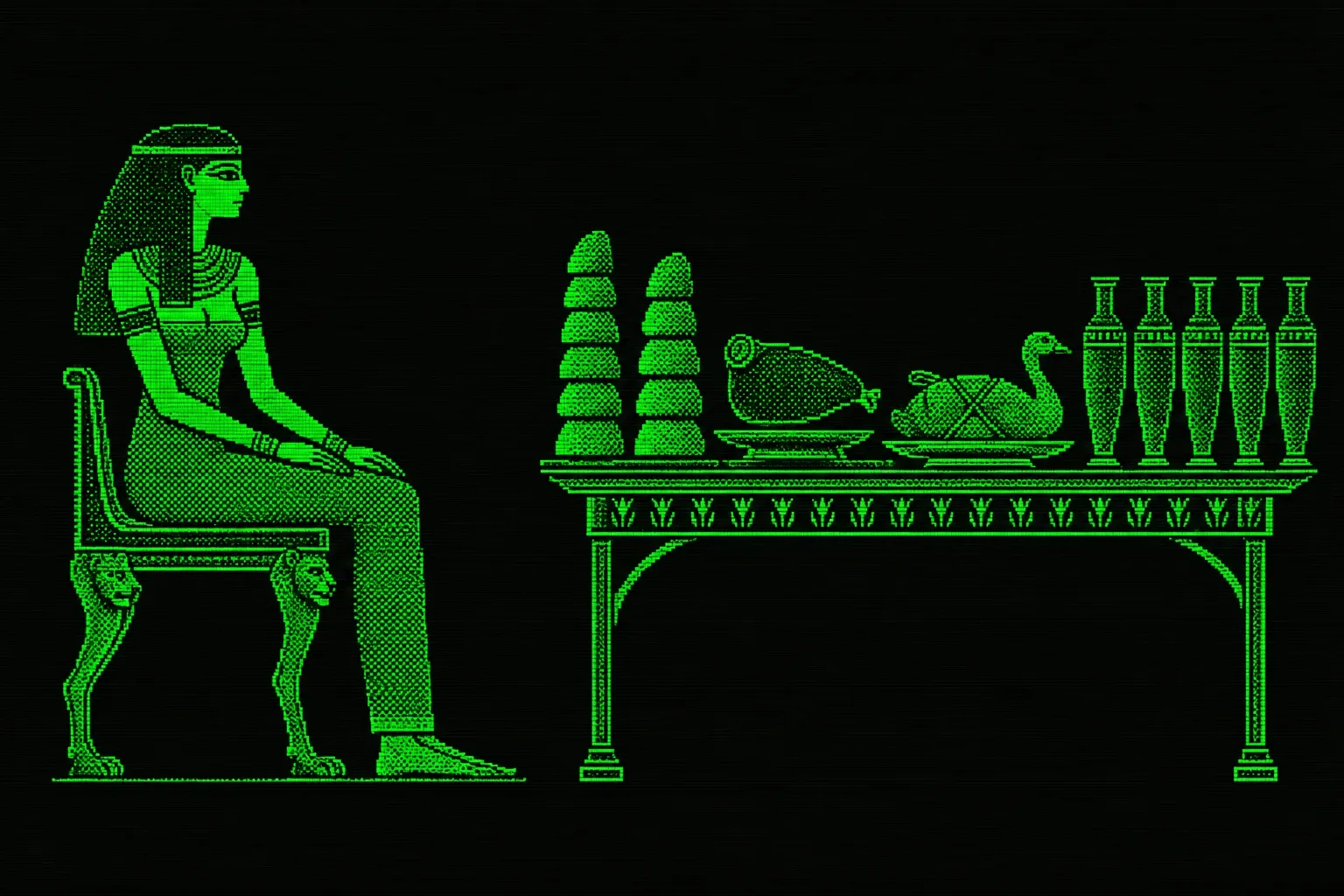
No one speaks in this text. It is a menu carved into the tomb of a woman, Ipi, and it reads like a butcher’s order and a cellar list: Liver, 1, Spleen, 1, Rib cuts, 4, then geese and a pigeon, cakes and loaves, bowls of beer, natron to cleanse the mouth, and five wines, among them Wine of Buto: 1 and Wine of Pelusium: 1. Jujubes and tiger nuts follow, then Every sweet thing: 1.
The last line names the one it is all for: for the King’s Sole Ornament, Ipi: 1. Cut in stone, the meal was hers forever.
- 1
swt 1
A sut cut of beef, 1
Note · Line 1
This is part of an offering list carved in the tomb: food meant to sustain the dead person forever, each item followed by its quantity. - 2
sprḥt 4
Rib cuts, 4
- 3
ꜣšrt _
Roast meat, …
Note · Line 3
The Egyptian ꜣšrt means small pieces of meat roasted over a fire. The number after it is lost. - 4
mjzt 1
Liver, 1
- 5
nnšm 1
Spleen, 1
- 6
ḥꜥ 1
A ha cut of meat, 1
Note · Line 6
The word ḥꜥ ordinarily means “body” or “limb”. Here it names a particular cut of meat. - 7
jwf n ḥꜣt 1
Meat from the forepart, 1
- 8
rʾ 1
Greylag goose, 1
- 9
ṯrp 1
White-fronted goose, 1
- 10
sr 1
Ser goose, 1
- 11
mnt 1
Pigeon, 1
- 12
tʾ-zjf 1
Ta-zif bread, 1
- 13
šꜥtı͗ 2
Two shat cakes, 2
- 14
npꜣt ꜥwı͗ 2
Two portions of nepat cakes, 2
- 15
mzt ꜥwı͗ 2
Two portions of mezut, 2
- 16
ḏsrt ꜥwı͗ 2
Two bowls of djeseret beer, 2
- 17
ḏsrt jꜣtt ꜥwı͗ 1+[1]
Djeseret beer and iatet, two bowls: 2
- 18
ḥqt ḫnms ꜥwı͗ [1]+1
Khenmes beer, two bowls: 2
- 19
ḥqt sḫpt ꜥwı͗ [2]
Beer and sekhepet, two bowls: 2
- 20
pḫꜣ ꜥwı͗ [1]+1
Pekha, two bowls: 2
- 21
ḏwjwı͗ 2
Two clay jugs: 2
- 22
bd ꜥwı͗ 2
Natron, two bowls: 2
Note · Line 22
Natron is a natural soda salt, used to cleanse and purify, including the mouth before eating. - 23
jrp mḥw [1]
Wine of Lower Egypt: 1
Note · Line 23
Lower Egypt is the north of the country, the Nile Delta. - 24
ꜥbš 1
A jar of wine: 1
- 25
jmt 1
Wine of Buto: 1
Note · Line 25
Buto was a town in the Delta. Its wine was one of several named vintages in such lists. - 26
ḥꜣm 1
Wine of Hamu: 1
Note · Line 26
Hamu was a wine-growing district in the Delta. - 27
snw 1
Wine of Pelusium: 1
Note · Line 27
Pelusium lay on the north-eastern edge of the Delta. - 28
ḥbnnwt [1]+3
Hebenenut loaves: 4
- 29
ḫnfwt 4
Khenfu cakes: 4
- 30
jšd ꜥwı͗ 2
Ished fruit, two bowls: 2
- 31
sẖt ḥḏ wꜣḏ ꜥwı͗ _
White and green barley, two bowls: …
Note · Line 31
“Green” means fresh, unripe grain. - 32
ꜥgwt nt jt [1] nt zt 1
Roasted grain: of barley, 1; of emmer, 1
Note · Line 32
Emmer is an ancient kind of wheat, a staple grain of Egypt. - 33
bꜣbꜣwt ꜥwı͗ 2
Two bowls of babat grain: 2
Note · Line 33
These lines come from an offering list carved in the tomb: each entry names a food, sometimes its container, and then a tally of how many portions the dead woman is to receive forever. - 34
nbs ꜥwı͗ 2
Two bowls of jujube: 2
Note · Line 34
The fruit is that of the Christ’s-thorn tree (Ziziphus spina-christi), a small sweet jujube that grows wild in Egypt. - 35
tʾ-[nbs] ꜥwı͗ 1
Two bowls of jujube bread: 1
Note · Line 35
The list gives “two bowls” but tallies only one portion. - 36
wꜥḥ ꜥwı͗ 2
Two bowls of tiger nuts: 2
Note · Line 36
Tiger nuts are the small sweet tubers of a sedge (Cyperus esculentus), eaten raw or ground into cakes. - 37
ḫt nb bnr 1
Every sweet thing: 1
- 38
rnpt nbt [1]
Every yearly offering: 1
- 39
ḥnkt nbt 1
Every presented offering: 1
Note · Line 39
The Egyptian word comes from a verb meaning “to hold out, present”: the gift offered up in the hands. - 40
gsw nbw 1
Every half-loaf: 1
- 41
pẖr 1
The round of offerings: 1
Note · Line 41
The Egyptian means “what goes round”: food that is first laid before the gods and then passed on to the dead. - 42
pḏw 1
The spread: 1
Note · Line 42
The Egyptian word means “what is spread out”, a laid-out meal. - 43
stpt 1
Choice cuts: 1
- 44
ḥꜣt _ wdḥw 1
The best, …, from the offering table: 1
- 45
n ẖkr-nsw-wꜥtt jpj 1
for the King's Sole Ornament, Ipi: 1.
Note · Line 45
Ipi is the woman buried here and the one these provisions are for. “Sole Ornament of the King” is a high court title held by women.