~/sacred-texts/old-kingdom-tomb-inscriptions
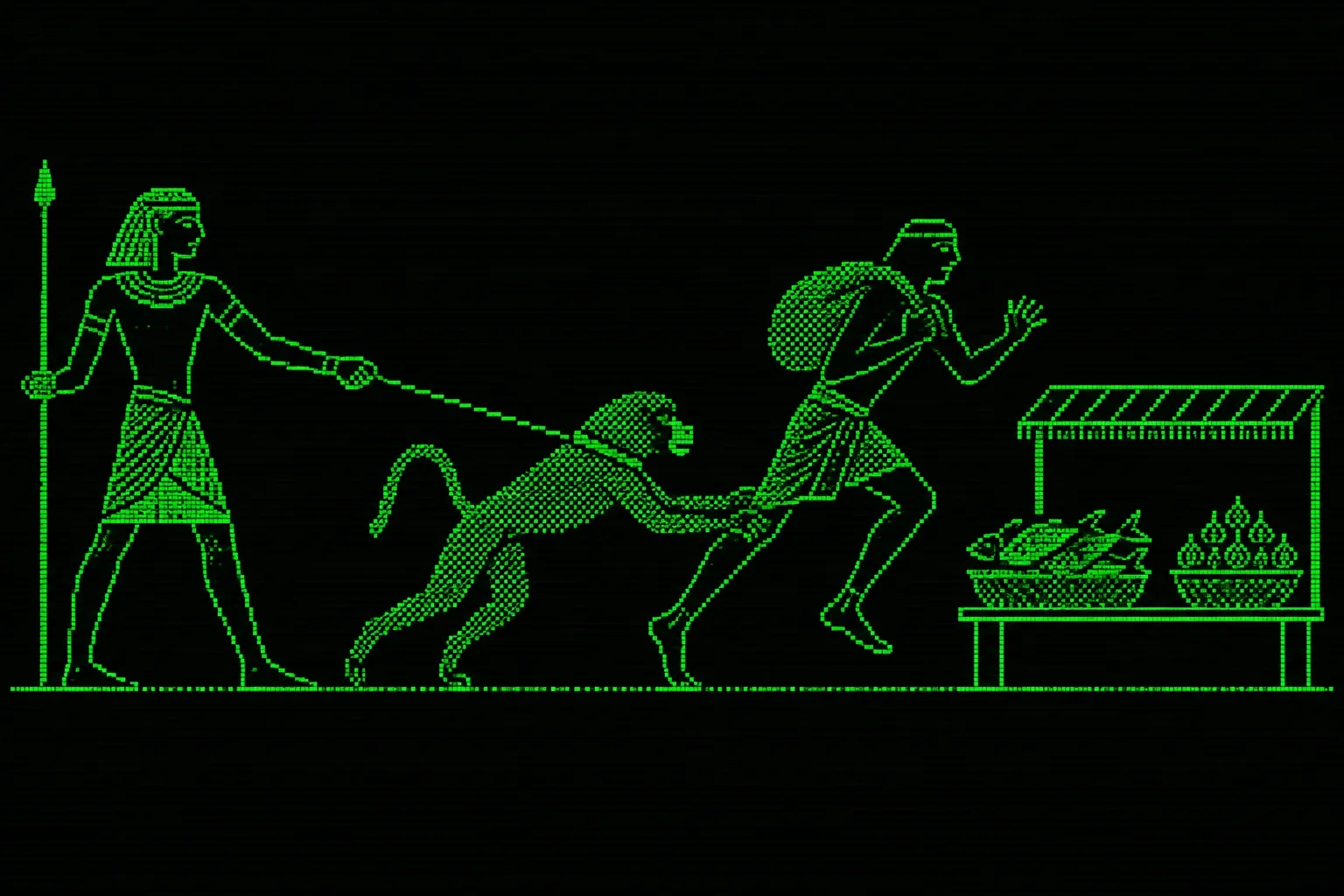
Egyptian Tomb Market Scene: A Baboon Catches a Thief
- Date
- Carved in the Old Kingdom (about 2500–2200 BC) as captions to the reliefs of a tomb chapel
- Found
- North wall, right of the doorway, of an Old Kingdom tomb chapel
- Language
- Egyptian (Old Egyptian) · Hieroglyphic
The captions run along the carved wall like speech bubbles. Barbers and manicurists work on their clients (Shake the razor clean!), while a bystander needles a young helper: Hey, lad, play the boss the way you love to, or they’ll fetch you the real boss! In the market, sellers shout Hand over your goods for the price of fish! and a guard sets his baboon on a thief: Grab him! Grab him!
The wall ends with the funeral boats. Helmsmen call Keep to starboard, for the good waterway! as the ka-priests and crew steer for The canal of the beautiful West, the land of the dead.
- 1
ḫsf ⸢rd.wj⸣
Depilating the legs.
Note · Line 1
The opening captions label a scene of barbers and grooms at work on their clients. The verb usually means “ward off, drive away”; here it means removing the hair from the legs. - 2
[šꜥ]q tp
Shaving the head.
- 3
šꜥq ḫꜥm
Shaving the chin.
- 4
šꜥq ⸢šnj⸣
Shaving the hair.
- 5
⸢w[ḫ]ꜣ⸣ ⸢⸮mẖꜥq,t?⸣
Shake the razor clean!
Note · Line 5
A command shouted to a barber. The Egyptian word for razor is built on the verb “to shave”, so it is literally “the shaver”. - 6
sbꜣ(,w)
A master barber.
- 7
jri̯.t ꜥn(,t)
Doing the toenails.
- 8
zẖꜣ,w-(n-)pr-ḏ,t
A scribe of the funerary estate.
Note · Line 8
The funerary estate was the endowment of land and staff that supplied the tomb owner’s offerings forever. - 9
(j)m(,j)-rʾ-pr
A steward.
- 10
šms,w
An attendant.
- 11
jri̯.t ꜥn(,t)
Doing the fingernails.
- 12
zẖꜣ,w
A scribe.
- 13
j ḥwn(,w) jri̯ (j)m(,j)-rʾ mrr! =k j:⸢jni̯⸣ =⸢tw⸣ ⸢n⸣ =⸢k⸣ ⸢nb⸣ jr(,j)
Hey, lad, play the boss the way you love to, or they'll fetch you the real boss!
Note · Line 13
A bystander needles a young assistant who is giving himself airs. If he keeps acting like the man in charge, the actual overseer will be brought to deal with him. - 14
⸢jmi̯⸣ jš,t =k r mḥ,(y)t swn,t
Hand over your goods for the price of fish!
Note · Line 14
These lines move to a market scene, where people trade by barter, goods for goods, with no coinage. - 15
bg,t
Mullet.
- 16
jmi̯ jš,t =ṯ r nqꜥ,w⸢t⸣ bnj.t wr,t
Hand over your goods, lady, for figs good and sweet!
Note · Line 16
The “your” is feminine, so a woman is being addressed. Sycamore figs had to be gashed on the tree to ripen, and the Egyptian word for them means “gashed fruit”. - 17
mri̯ =ṯ jwi̯ rꜣ =(j) m pr
Would you like my share brought home to the house?
Note · Line 17
These captions label a market scene carved on the tomb wall, with buyers and sellers haggling over goods. - 18
j[ꜣ]w,t(j) m sṯꜣ n =j
Officer, don't bring it near me!
Note · Line 18
Market scenes often show guards with trained baboons on leashes, set on thieves. A frightened man is pleading with the guard to keep the animal off him. - 19
⸢wꜣ⸣ḥ sw r ⸢tꜣ⸣
Pin him to the ground!
- 20
šzp šzp
Grab him! Grab him!
Note · Line 20
The guard is urging the baboon on against the thief. - 21
ḏr r [⸮_?]t jr[⸮_?]
Keep away from …!
- 22
mk nn n,j šmd.w
Look at these shemed loaves!
- 23
6 jm p(w) r ḥqꜣ,t 2 z(w,)t
Six of them go for two hekats of emmer.
Note · Line 23
The hekat was the standard grain measure, about 4.8 litres. With no coinage, goods were traded directly for grain and other goods. - 24
jmi̯ (j)ḫ,t z(wr) =(j) nn ḥr =s ḥnk.k(w)
Hand something over and I'll drink to it, and count myself well paid.
- 25
ḥmw,w dbn.w
Maker of deben-weights.
Note · Line 25
The deben was the standard unit of weight, about 91 grams. Merchants weighed metal against it to settle prices. - 26
mk jsw dbn =k j:pn
Look, here's the payment for this very weight of yours.
- 27
wḏꜥ ḫtm
Cutting a seal.
Note · Line 27
Seals, usually small stone cylinders, were rolled over clay to mark ownership. - 28
wdi̯ =(j) ḥr =f wḏꜣ,w jš,t =(j)
I'll lay the rest of my goods down for it.
- 29
jb =(j) nḏm(.w) m swn,t
My heart is sweet on the bargain.
- 30
ḥmt,j
Coppersmith.
- 31
ṯn,t
Beer-seller.
Note · Line 31
A woman selling drink at the market. - 32
mḥ sw
Fill it up!
- 33
⸮mnzꜣ?
A menza-jar.
Note · Line 33
The market scenes on this wall come with short captions and bits of overheard speech. - 34
jw jt nfr ḥmw,t
This barley is fine stuff!
- 35
mk jḫ,t z(wr) =k ḥr =s
Look, something for you to drink from!
- 36
jmi̯ ḥqꜣ,t 1/2 pw
Hand over that half-hekat!
Note · Line 36
Buyer and seller are arguing over the measuring vessel itself. - 37
ḫꜣi̯ =(j) nn jm =f
Let me measure this with it.
- 38
rw,tj ḏi̯ =j ḥqꜣ,t 1/2 ḥqꜣ =(j)
Stranger, I'm giving you my master's half-hekat.
Note · Line 38
The seller vouches for his measure: it belongs to his master and is therefore honest. - 39
jmi̯ jš.t =k ḏi̯ =j sm(,w) nfr.w
Hand over your goods, and I'll give you fine greens.
- 40
⸢mḥ⸣ ⸢1(+)⸣ ḥbs ⸢r⸣ ḏ⸢bꜣ⸣,w šꜥ,t 6
Ten cubits of cloth as payment for six shat.
Note · Line 40
A cubit was about half a metre. - 41
ḏd =(j) nn r ⸢mꜣꜥ⸣[,t] ⸮⸢nṯr.w(j)⸣? p(ꜣ) ⸮nwr? ḥmw,t
I tell you truly: how splendid is this bustle of the craftsmen!
- 42
sqd,wt r ⸢jmn,t⸣ ⸢nfr.t⸣ m jmꜣḫ,w
The voyage to the beautiful West as an honoured one.
Note · Line 42
The scene changes to boats. - 43
jri̯ ḥr jm,j-wr,t n tp[,t]-⸢ꜥ⸣=k r šm,w nfr.w
Keep to starboard for the boat ahead of you, toward the good waterways!
Note · Line 43
Starboard is the steering side of the boat. Here a helmsman calls out orders on the crowded river. - 44
mr ⸢jmn,t⸣ ⸢nfr.t⸣
The canal of the beautiful West.
- 45
⸢ḥm-kꜣ⸣ ⸢Ḥz,y⸣
The ka-priest Hezy.
- 46
⸢ḥm-kꜣ⸣ ⸢zẖꜣ,w⸣ ⸢K(ꜣ≡j)-ḥr-Ptḥ⸣
The ka-priest and scribe Kai-her-Ptah.
- 47
jri̯ ḥr jm,j-wr,t n mn,t(j)
Keep to starboard for the meneti-boat!
- 48
rs.t r ḥr
You keep a sharp eye on the steering rope.
- 49
ṯꜣw ⸢ḥꜣ⸣ =k wḥm(,w)
There's wind at your back, herald!
Note · Line 49
The “herald” (literally “repeater”) was the man on board who relayed the captain’s orders to the crew. - 50
(j)m(,j)-rʾ-⸢jz,w(t)⸣ ⸢Wr-nḏw⸣
The overseer of crews, Wer-nedju.
Note · Line 50
This caption names one of the men shown in the scene. - 51
jri̯ ḥr jm,j-wr,t r šm,w nfr.w
Keep to starboard, for the good waterway!
Note · Line 51
The Egyptian word for “starboard” also means “west”. - 52
mr jmn,t ⸢nfr.t⸣
The canal of the beautiful West.
Note · Line 52
The “beautiful West” is the land of the dead. Tombs lay on the west bank, where the sun sets. The waterway the boat is steering for leads there. - 53
sḥḏ-ḥm(,w)-kꜣ N(,j)-k(ꜣ,w)-Ptḥ
The overseer of ka-priests, Ni-kau-Ptah.
Note · Line 53
Ka-priests were paid to bring offerings to a dead person’s tomb and keep their cult going. Ni-kau-Ptah, their overseer, is shown taking part in the voyage.