~/sacred-texts/new-kingdom-literary-texts
Egyptian Marsh Text: Fowlers, Geese and a Fleeing Hippo
- Date
- Written in the New Kingdom (c. 1550–1070 BC)
- Language
- Egyptian · Hieratic
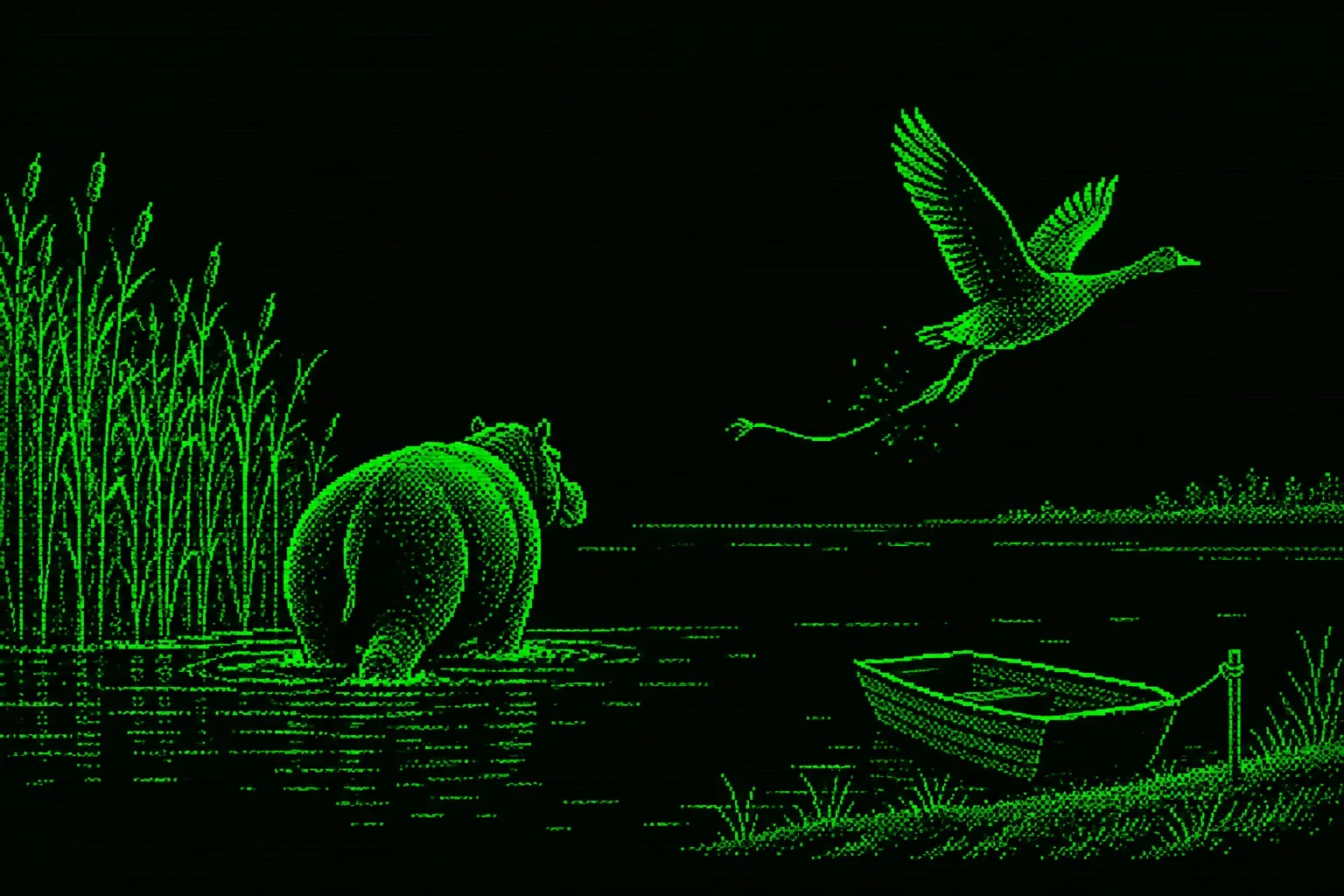
A string of short scenes from the marshes, addressed to someone in charge of the catch: Your fishers and fowlers have gone down to Tjereh. Waves rise on the Gesem waters, a skiff lies moored, and the animals scatter: The hippopotamus has fled the irrigation basin; The snake is in the hole. People dry fish for lack of oil to rub on them, and birds are brought in summer to pay the dues.
The last lines show the birds in uproar: The greylag goose has cut the cord; The sekem-bird is crying out to the sky. The ostrich is afraid to stand up.
- 1
[...] [bꜣ~jrʾ]~kꜣ~tj pꜣ ꜥḫy pꜣ jn~jw~šꜣ~nꜣ
… pond, the akhy bird and the iniushana pondweed.
Note · Line 1
The akhy may be a swan. - 2
[n]ꜣy =k [wḥ]ꜥ.w.pl hꜣi̯.y r Ṯꜣ~rw~ḥw
Your fishers and fowlers have gone down to Tjereh.
- 3
pꜣ gsm.w jri̯.y =f hꜣn,w
The Gesem waters have thrown up waves.
- 4
[nꜣ] __n.w.pl jri̯.y =sn ḏꜥ,wt n-gꜣ(,w) nḥḥ 〈r〉 sjn =w
The … folk have dried fish for lack of oil to rub on them.
- 5
tꜣ ṯꜣ~rw~tj mnj.w[t] ḥr-⸢bw~npl⸣~rʾ
The tjeret skiff lies moored outside;
Note · Line 5
The tjeret was a small, flat-bottomed boat. - 6
tꜣ bꜣ~jꜣ(,t) gꜣ~šj ḥr mrw
the reed thicket is on the far bank.
- 7
j:___ [...] ___ =⸮n? r mr n js,y
… us to the reed canal.
- 8
pꜣ db.w wꜥr m pꜣ ẖn~nj~n[j]
The hippopotamus has fled the irrigation basin;
- 9
[...] s[ḏr] ḥr mꜣs,t
… sleeps on the sandbank.
- 10
pꜣ mw (ḥr) bw~jrʾ~qꜣ n-bw~npl~rʾ
Outside, the water glitters.
- 11
p[ꜣ] [...]
The …
- 12
_g_ gꜣ~šj n pꜣ j~jrʾ~tj~ḏꜣ~jrʾ
… reeds for the irtedjer bird;
- 13
bn nꜣ [...]
the … do not …
- 14
[...] ⸮n? ꜣḫ,wy
… the akhi plants.
- 15
tꜣ ḏrj,t m ꜥḫi̯.y
The female kite is rising.
- 16
tꜣ j:___ [...]
The …
- 17
[...] wḥꜥ.w.pl
… fishers and fowlers.
- 18
wnm =st ḥr mw n mḥ 7 [...]
She feeds on water seven cubits deep. …
Note · Line 18
Seven cubits is about twelve feet (3.7 metres). - 19
[...] ⸮d?ꜣ~jrʾ~tj ṯꜣi̯ =w pꜣ mꜣꜥ.w
… deret birds have raided the water’s edge;
- 20
kꜣ~pw~sꜣ =w [...]
they have …
- 21
[...] __n [...]
… cattle …
- 22
pꜣ tw~rpw bw nw =f
The white-fronted goose does not look.
- 23
bw rḫ =tw [...]
No one knows …
- 24
[...] __w [...]
… birds …
- 25
jni̯ =tw ((ꜣpd)) ꜥšꜣ m šmw r mḥ bꜣk,w [...]
Many birds were brought in summer to pay the dues …
Note · Line 25
Summer here is Shemu, the harvest season. The birds themselves were the payment. - 26
[...] __y [...]
… thicket …
- 27
pꜣ ḥfꜣw m pꜣ bꜣbꜣ
The snake is in the hole.
- 28
pꜣ šꜣ~[__] [...] [⸮š?]ꜣ~bw [...] ḥnw [...]
The … bird …
- 29
tꜣ gm(,t) ḥr sd ⸮bꜣ~〈n~〉dw(,t)? [...] n,tj ḥr qꜥḥ,t.pl
The black ibis is splitting cucumbers open … that are in the districts.
- 30
pꜣ [...] n jmn,tt ḏi̯ =f šm.w pꜣ ꜣpd.w
The … plant of the west has made the bird grow hot.
- 31
tꜣ srj,t šꜥd =st [pꜣ] nwḥ
The greylag goose has cut the cord;
- 32
〈ḥfd〉 =s[t] [...]
she has risen …
- 33
pꜣ [sꜣ]~kꜣ~mꜥ ḥr ꜥš r tꜣ p,t
The sekem-bird is crying out to the sky.
Note · Line 33
The sekem may have been a rooster. - 34
pꜣ [n]r[j] s[n]d.w r [ṯ]si̯.y
The ostrich is afraid to stand up.
- 35
jr jni̯ =tw [...] ꜥq,w
If someone brings …, then … food.
- 36
grḥ [...]
The end. …