~/sacred-texts/temple-of-edfu-building-texts
Edfu Building Texts: The Primeval Island of the Falcon
- Text
- Temple of Edfu, building texts, Edfou VI 181,9–184,18 (the first record of the primeval island)
- Date
- Carved under the later Ptolemies, about 116–80 BC; the myth is older
- Found
- Temple of Horus at Edfu, Upper Egypt: inner face of the enclosure wall
- Language
- Ptolemaic Egyptian · Hieroglyphic (Ptolemaic signs)
The temple of Horus at Edfu, between Luxor and Aswan, is the best preserved temple in Egypt. Its stone enclosure wall was carved inside with long texts under the last Ptolemies, and on the inner face, among the rites and lists, the priests set down how the temple came to exist at all. Modern scholars call these the Building Texts. They describe a time before the gods’ houses, when an island rose from the first water, and they present the temple of Edfu as that island, still standing.
The first of these records is translated here, from Chassinat’s printed hieroglyphs (Edfou VI, pp. 181–184). It is told through the Shebtiw (šbtyw), creator beings of the first time, and through the Ancestors (tpyw-ꜥ). In these four pages the island has two names, the Island of Combat and the Island of Peace. The wider cycle also calls it the Island of Trampling. A reed (nbj) stands in the flood water and goes round and round, and its float (ḏbꜣ) becomes the perch of the falcon. That perch gives Edfu its old name, Djeba, and the text plays on it again and again beside Wetjeset-Hor, “the Throne of Horus”, and a being called This One (Pn). Ptah-Nun and Tatenen, the risen land, come into being. The Falcon is named with a spear and a lance, and the rebels are hacked to pieces. Then the cities of the mounds are named one after another.
Through all of it runs the Ka (kꜣ), the living double of the place. One line names it five times. It is written with the raised arms of the Ka and once with a bull: “the Ka came”. The snakes of the record are the Earth-Maker (jr-tꜣ, 183,9), a creator snake, and a “son of the earth” (zꜣ-tꜣ, 183,18), the ordinary Egyptian word for a snake. Several more words end in a wavy serpent sign.
Horus of Behdet and the First Occasion
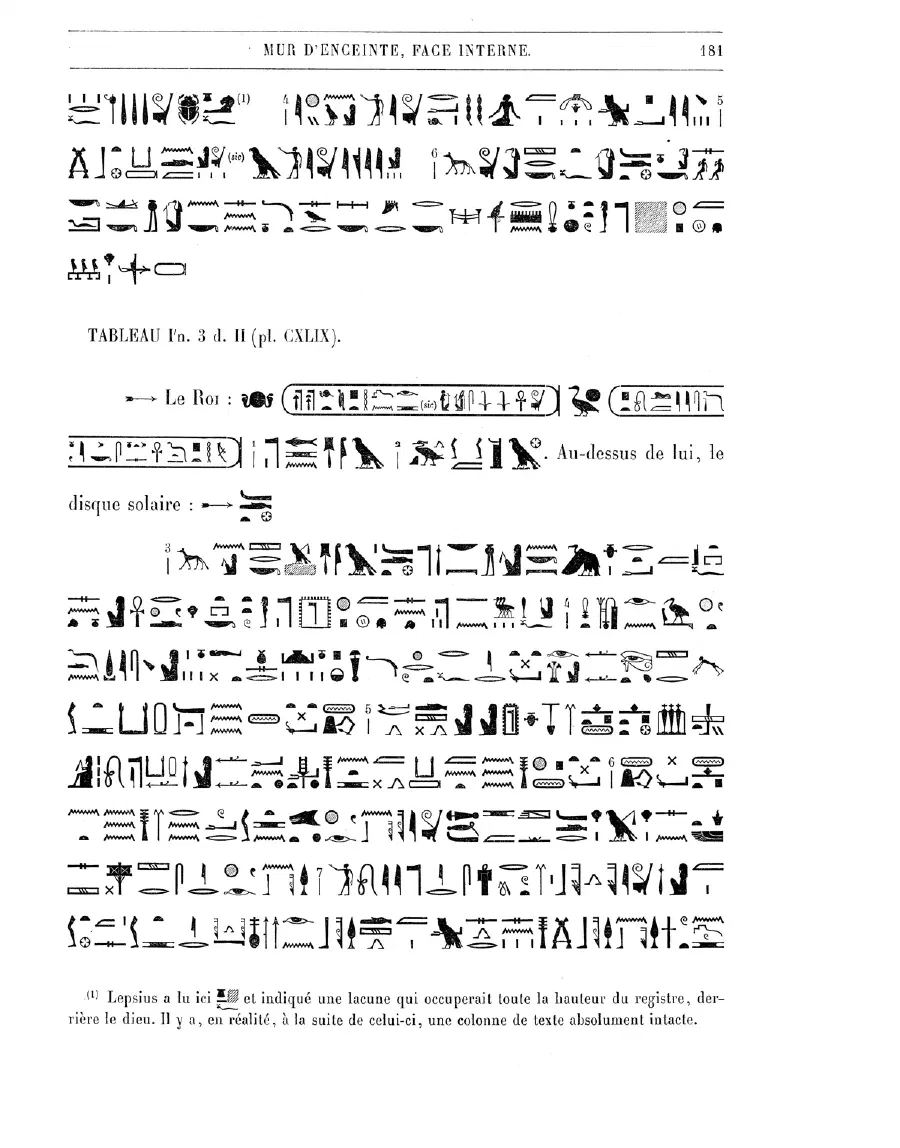
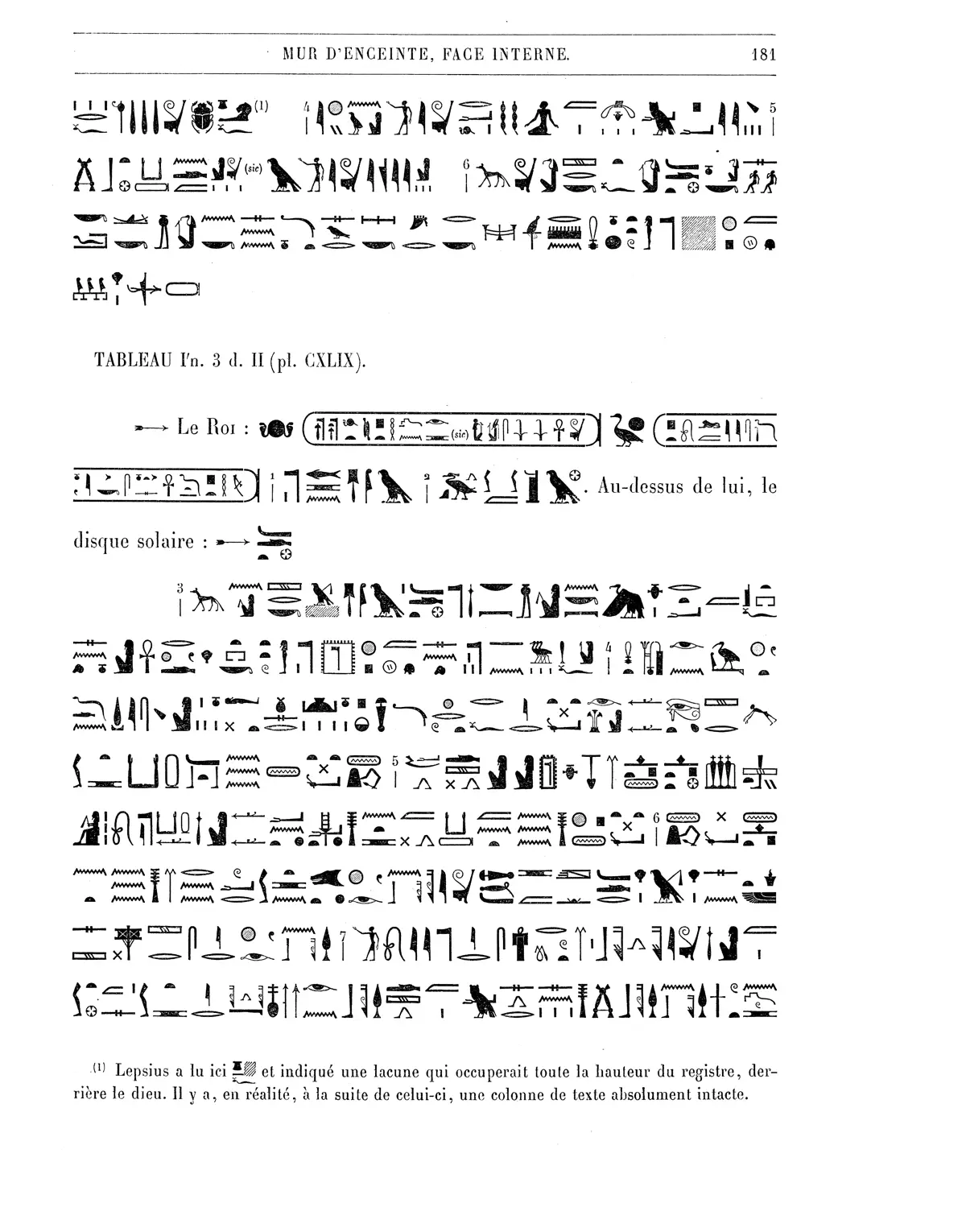
Page 181. Edfou VI, p. 181 Chassinat's typeset hieroglyphic text, Le temple d'Edfou VI (IFAO 1931) - 181-9181,9

zꜣb n=j ꜥḏ-mr […] šw.t Ḥr Bḥd.tj nṯr ꜥꜣ nb p.t jni̯=j n=k p.t mw.t jb […] mꜣꜥ wṯs […] =f
Judge of me, administrator […] shade: Horus of Behdet, the great god, lord of the sky. I bring you the sky, mother, heart […] true, raise […] his.
Note · Line 181-9
Behdet is a sacred name for Edfu. The god addressed here is Horus in his local form as a falcon. - 181-10181,10

[…] =j ꜥnḫ r Rꜥ […] jb pr=k twt nṯr ḥw.t-nṯr Rꜥ sp-tp(j) =sn nṯr.w dmḏ bꜣ.w ḥm=f mj.t(j) […] jri̯ n Ḏḥwtj Rꜥ.w
[…] I live toward Re […] heart, your house, the image of the god, the temple of Re at the First Occasion; their gods assembled, the Bas, his Majesty likewise […] made by Thoth for Re.
Note · Line 181-10
The First Occasion is the dawn of creation, when the first land rose from the water. Thoth is the divine scribe, Re is the sun god, and the Bas are forms in which divine powers can make themselves present. The record of the mounds of the primeval age
- 181-11181,11

[…] ḏi̯=j […] sḏr […] jꜣ.t pꜣw.t tp.t […] wꜥr.t ḏ.t r=f […] jri̯ ḥꜣ=j […] wḏꜣ.t zꜣ š r ḫr
[…] I give […] lying down […] the mound of the first primeval age […] the Leg for ever, to it […] made around me […] the Wedjat eye, the son, the lake, toward falling.
Note · Line 181-11
The Wedjat is the eye Horus regained after it was injured. Its name means “the sound one,” and Egyptians wore it as an amulet for healing and protection. - 181-12181,12

wꜥr.t kꜣ rn […] mw jw sww jw-ꜥḥꜣ […] nṯr.wj ḥw.t-nṯr ḥw.t-nṯr jb zmꜣ sḫn ḥtp ḥtp.t ḫnt Šbty
The Leg, the Ka, the name […] the water, the island, the vicinity of the Island of Combat […] the two gods, the temple, the temple, heart, uniting, embracing, peace, offerings, foremost, the Shebtiw.
Note · Line 181-12
The Ka is the power that gives life, and here even the island has a Ka of its own. The Shebtiw are the creator gods who gather on the first island. - 181-13181,13

Šbty.w wꜣ nṯr kꜣ rn ꜥꜣ […] ꜥn […] ḏd […] sww kꜣ […] mw ḏd Rꜥ jw sww jw-ꜥḥꜣ sww jw-ḥtp
The Shebtiw far off, the god, the Ka, the name, great […] turning back […] saying […] the vicinity of the Ka […] the water; Re says: the island, the vicinity of the Island of Combat, the vicinity of the Island of Peace.
Note · Line 181-13
The Island of Combat and the Island of Peace are two names for the same ground. One recalls the first fight, the other the peace that followed. The reed and its float on the flood water
- 181-14181,14

n.t mw ḏd […] mw wꜥr.t […] bf Rꜥ jri̯ nbj […] ẖ.t […] Ḥr jb ndb
of the water, saying […] the water of the Leg […] seeing Re made the reed […] the body […] Horus, heart, wing.
- 181-15181,15

sš […] sr r Rꜥ jri̯ nbj j wꜣ […] nṯr […] sꜣ rwḏ nbj […] =j
The scribe […] foretelling to Re, making the reed, saying: far off […] the god […] protection, firm is the reed […] me.
- 181-16181,16

wꜥr.t mꜣꜥ wꜥr.t jri̯ nbj […] jri̯ n nbj ẖn […] m-ꜥ zni̯ =sn ḏd ḏbꜣ nbj […] nwy
The Leg true, the Leg makes the reed […] made for the reed, approaching […] by passing they say: the float of the reed […] the flood water.
Note · Line 181-16
The floating reed gives the falcon a place to land. The Egyptian word for its perch also gives Edfu the name Djeba. 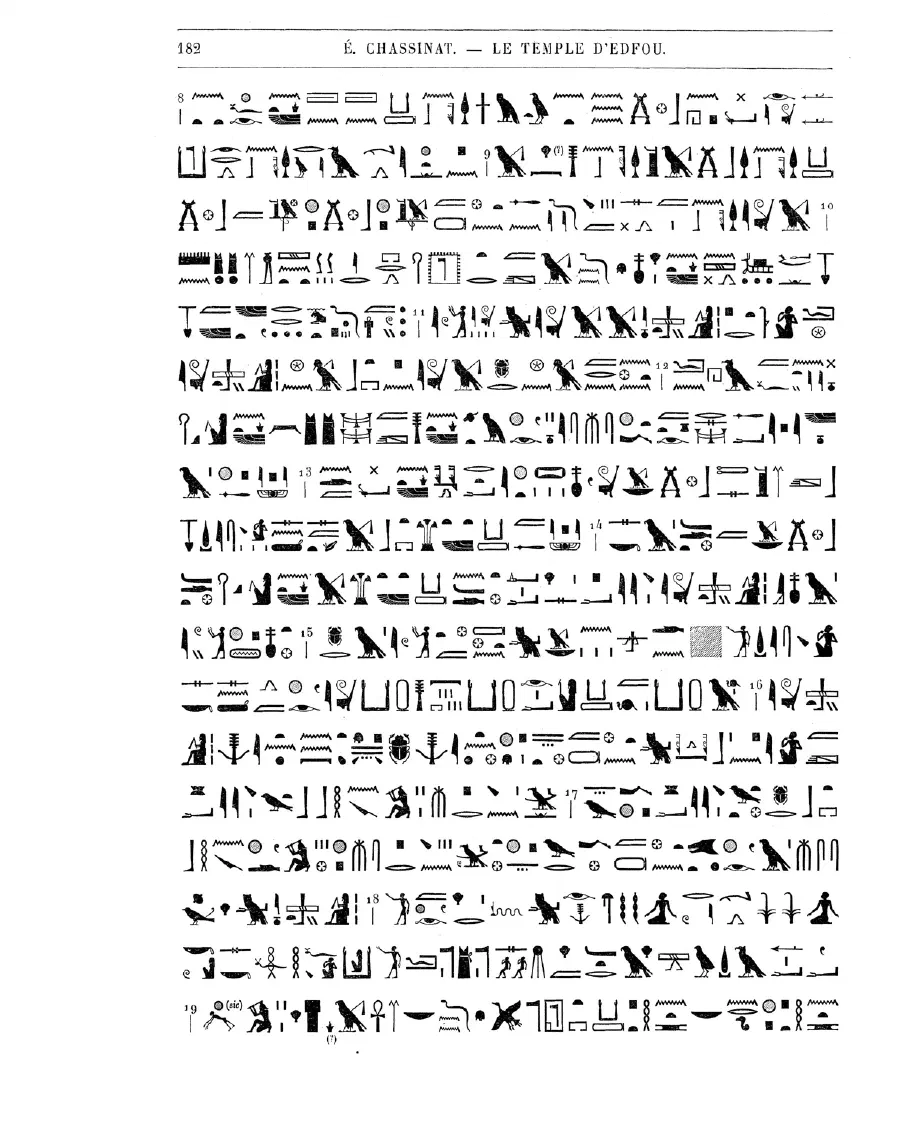
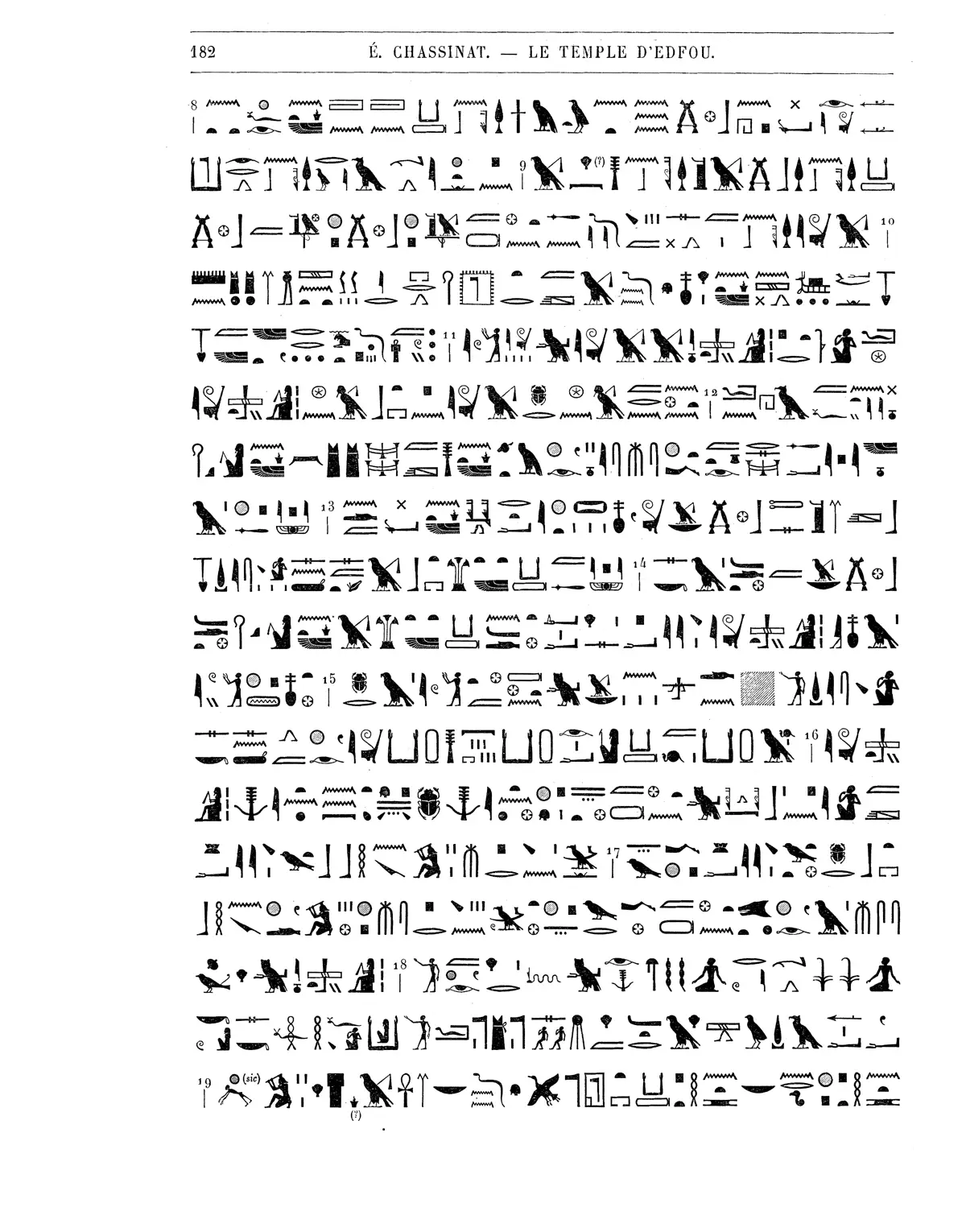
Page 182. Edfou VI, p. 182 Chassinat's typeset hieroglyphic text, Le temple d'Edfou VI (IFAO 1931) - 182-1182,1

n.t Rꜥ jri̯.n=f ndb dbndbn kꜣ nbj jm m […] n.t mw Ḏbꜣ […] sww jri̯ […]
of Re he made the wing going round and round, the Ka, the reed therein, in […] of the water of Djeba […] the vicinity made […]
Note · Line 182-1
The word for circling repeats both a sound and a hieroglyph. A reader tracing the signs encounters the same coiled shape twice. - 182-2182,2

kꜣ jrr jwi̯ nbj […] wr […] Pn Ḏbꜣ Ḥr ꜣḫ ḏd nbj nbj Wṯs.t-Ḥr ḏbꜣ nbj kꜣ
The Ka made, came the reed […] great […] This One, Djeba, Horus, spirit, saying: reed, reed, Wetjeset-Hor, perch, reed, Ka.
Note · Line 182-2
Wetjeset-Hor means “Throne of Horus,” another name for Edfu. For a god who takes the form of a falcon, a perch can serve as a throne. - 182-3182,3

Ḏbꜣ Rꜥ ḏbꜣ Ḏbꜣ Rꜥ ḏbꜣ mꜣꜥ jw […] ḏ.t […] sww swꜣ […] nbj Ḥr
Djeba, Re, the perch; Djeba, Re, the perch; true island […] for ever […] the vicinity, passing […] the reed, Horus.
Note · Line 182-3
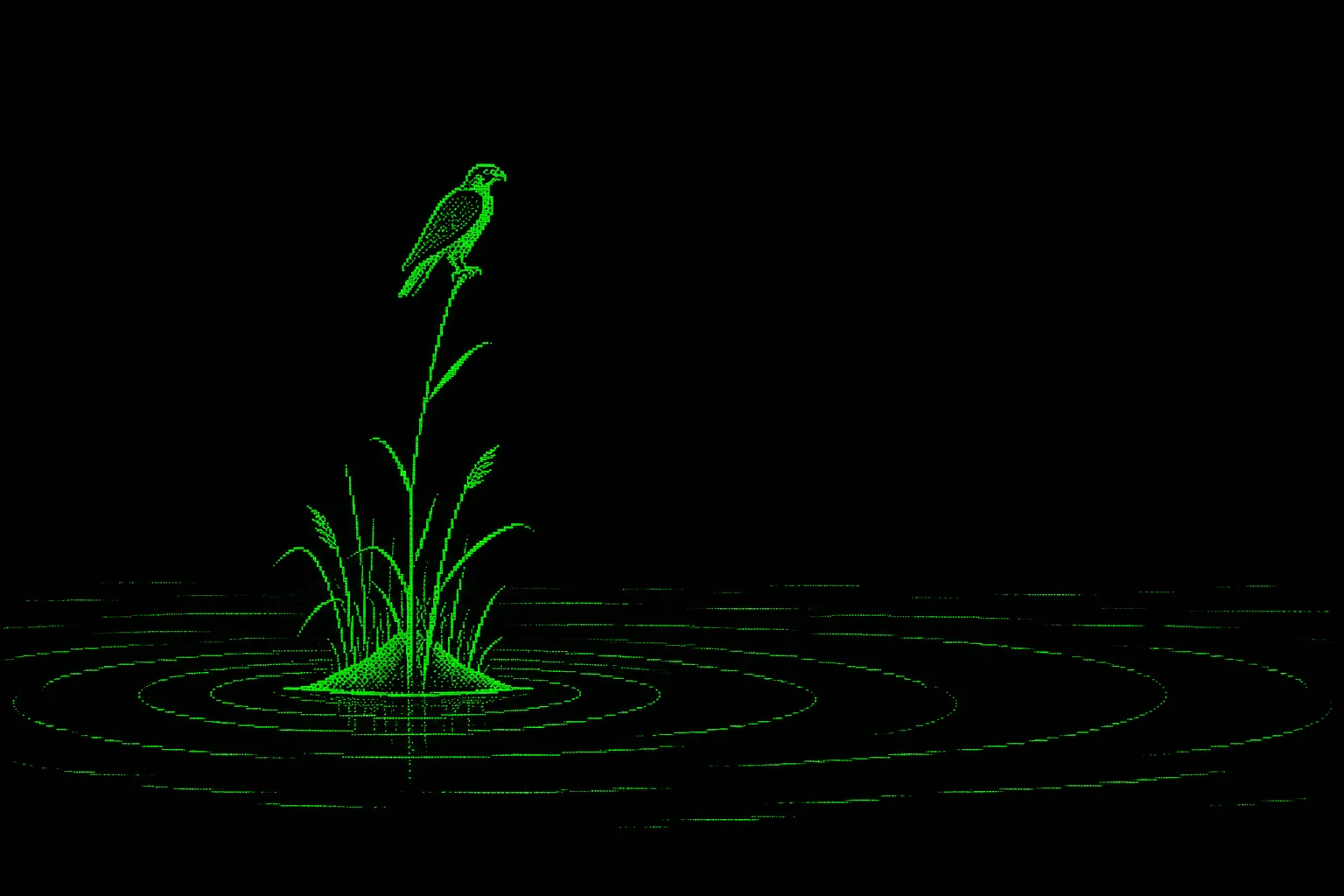
Beside the written name Djeba stands a small picture of a falcon on a perch. The bird’s arrival is visible in the name itself. The falcon, the wing and the Shebtiw
- 182-4182,4

mnmn […] sḫn jni̯ […] rd.wj jri̯ pri̯ ḥqꜣ ḥw.t-nṯr […] sꜣ […] tp nfr jb ndb […] bjꜣ […] zmꜣ
Moving […] embracing, bringing […] the two legs making come forth the ruler of the temple […] the falcon […] good head, heart, wing […] marvel […] uniting.
- 182-5182,5

zmꜣ […] jꜣ.w […] jw jꜣw m-ꜥ jw bjk.w Šbty.w […] rnp […] prj niw.t
Uniting […] praises […] then adoring by … then the falcons, the Shebtiw […] young […] come forth the city.
- 182-6182,6

[…] Šbty.w niw.t Ḥr […] jw Ḥr ḫpr niw.t Ḥr […] prj […]
[…] the Shebtiw, the city, Horus […] then Horus came into being, the city, Horus […] come forth […]
- 182-7182,7

ḥqꜣ ndb ḥr.t […] ḏd ndb […] m Rꜥ.w […] grḥ […] ndb
The ruler, the wing, the sky […] saying: the wing […] in Re […] night […] the wing.
- 182-8182,8

Ḥr Rꜥ […] sww ndb […] Rꜥ nfr […] Ḥr nb Ḏbꜣ […] wṯs […]
Horus, Re […] the vicinity, the wing […] Re, good […] Horus, lord of Djeba […] raising […]
- 182-9182,9

smt zni̯ […] Ḥr […] ḥꜣ […] kꜣ […] Ḥr Bḥd.t Ḥr nb Ḏbꜣ […]
Listen, pass […] Horus […] around […] Ka […] Horus of Behdet, Horus lord of Djeba […]
- 182-10182,10

Bḥd.t Ḥqꜣ-ꜥnḏ ndb Ḥr ḥꜣ […] kꜣ […] pꜥ […] ḏi̯-ꜥ jw Šbty.w nfr Ḥr
Behdet, the Heliopolitan nome, the wing, Horus around […] the Ka […] spat out […] going then the Shebtiw, good, Horus.
Note · Line 182-10
A nome was an Egyptian district. The mention of spitting recalls the creation story of Heliopolis, where the god Atum spat out Shu, the god of air. - 182-11182,11

jw jꜣw Rꜥ rn nfr niw.t ḫpr Ḥr jw jꜣw […] m-ꜥ Ḥr nb mw Šbty […] j zwr
Then adoring Re, the good name of the city: Horus came into being; then adoring […] by Horus, lord of the water, the Shebtiw […] saying, drinking.
The Ka litany and the cutting-up of the rebels
- 182-12182,12

zni̯ Rꜥ jri̯ jw kꜣ kꜣ ḏd p.t kꜣ jri̯ […] kꜣ kꜣ Ḥr jw Šbty.w
Passing, Re made, then the Ka, the Ka, saying: the sky, the Ka made […] the Ka, the Ka, Horus, then the Shebtiw.
- 182-13182,13

Šbty.w sꜣḥ […] tp tꜣ […] ḫpr sꜣḥ […] Rꜥ tꜣ […] m-ꜥ nbj […] zwr […]
The Shebtiw reaching […] the first land […] came into being, reaching […] Re the land […] by the reed […] drinking […]
- 182-14182,14

šꜣꜥ jj wr bḥn sbj.w […] msi̯ p(ꜣ) […] tꜣ wr Rꜥ […] šꜣꜥ jj wr.t niw.t ḫpr pr
Beginning, coming, the great one hacked up the rebels […] born the […] the great land, Re […] beginning, coming, the great city became a house.
Note · Line 182-14
The rebels are enemies of the gods. Their defeat gives the newly formed land protection from the outset. - 182-15182,15

bḥn […] sbj.w hrw pꜣ msi̯ […] nt […] hrw wr […] rn […] jr.t-Ḥr msi̯ […]
Hacked up […] the rebels on the day the birth […] the flood […] day great […] name […] the Eye of Horus born […]
- 182-16182,16

[…] jb m-ꜥ […] Šbty.w j […] Rꜥ jri̯ jb r ḥfꜣw m-ꜥ […] ḥḥ […]
[…] heart by […] the Shebtiw say […] Re made the heart toward the serpent by […] seeking […]
- 182-17182,17

=k […] =s ḥfḥf ḏi̯ zwr kꜣ j prj nṯr […] nṯr ẖrd.w […] jb […] Ḥr jb […] Ḥr […] mw.t […]
you […] she overflows, giving drink, the Ka saying: come forth, god […] god, the children […] heart […] Horus, heart […] Horus […] mother […]
- 182-18182,18

Rꜥ […] sbj.w jb […] Ḥr ꜥnḫ sḫn nb […] tp pꜣ nṯr ḥw.t-nṯr pr kꜣ […] ptḥ nb […] Rꜥ pꜣ ptḥ n.t […]
Re […] the rebels, heart […] Horus, living, embracing, lord […] the first, the god of the temple, the house of the Ka […] Ptah the lord […] Re, the creator of […]
Note · Line 182-18
Ptah is the patron god of craftsmen. His name sounds like the Egyptian verb “to fashion,” so the act of making something calls the maker to mind. Ptah-Nun, Tatenen and the Ancestors
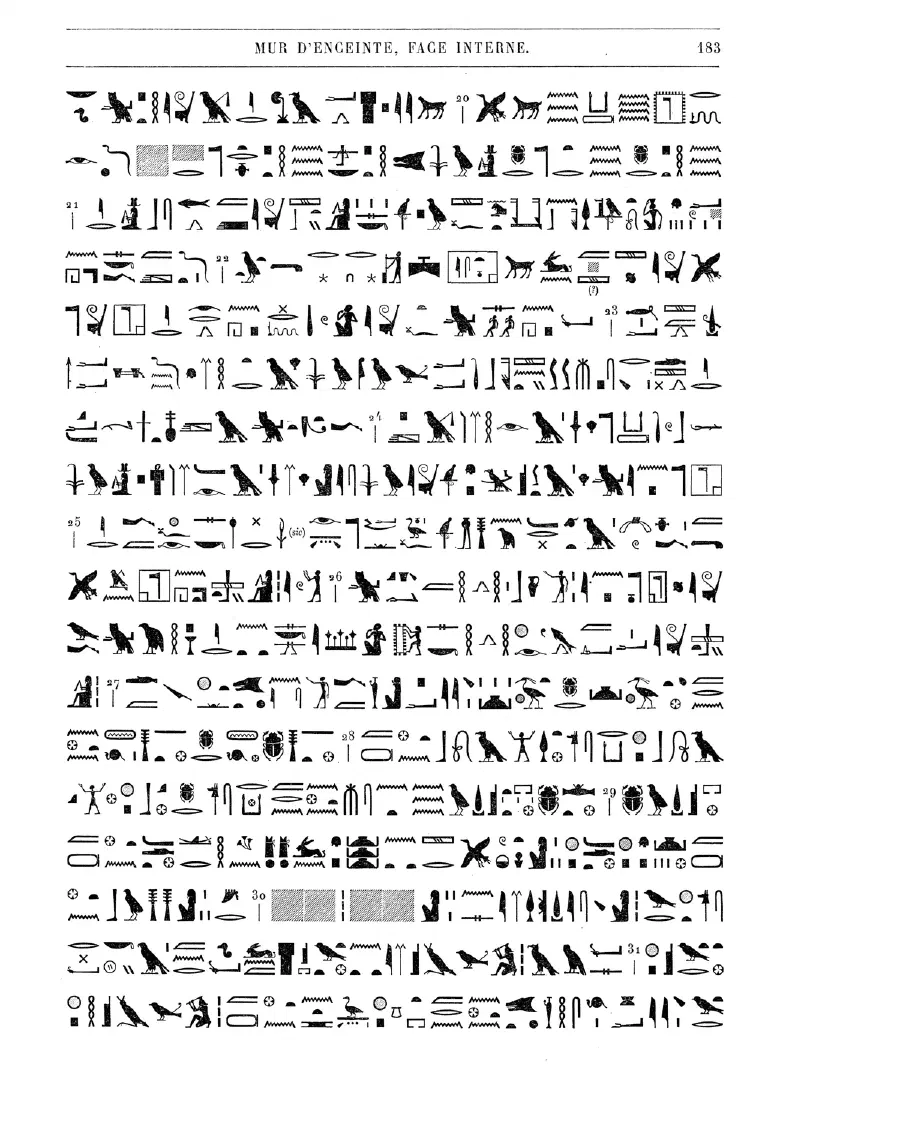
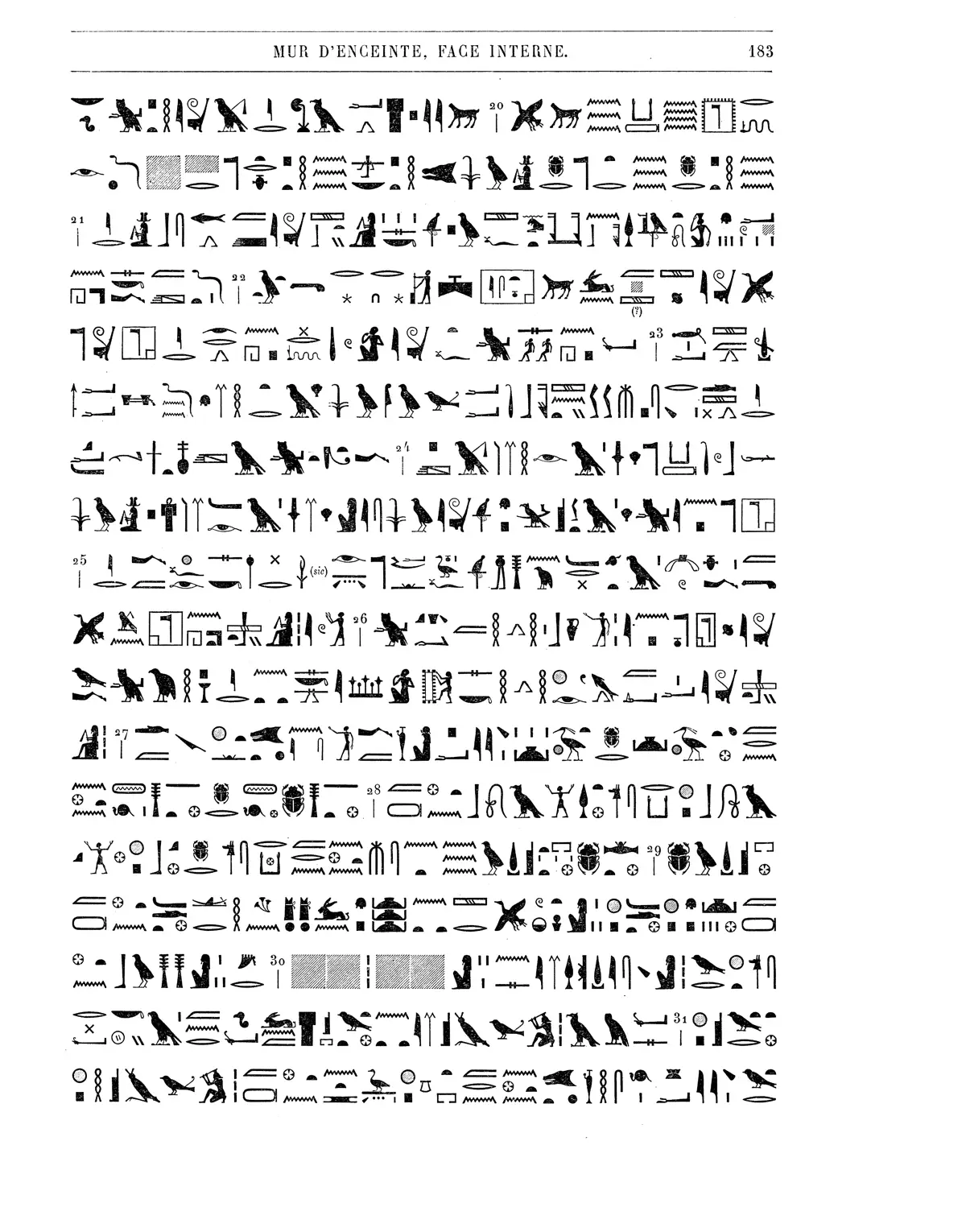
Page 183. Edfou VI, p. 183 Chassinat's typeset hieroglyphic text, Le temple d'Edfou VI (IFAO 1931) - 183-1183,1

nb nrw m Ptḥ jn bjk jr ḫꜣꜥ […] jy kꜣ pꜣ kꜣ Nnw kꜣ jw mw ḥw.t-nṯr […]
lord of awe, as Ptah, by the Falcon. As for the hurling […] the Ka came; the Ka of Nun, the Ka of the island (in) the water, the temple […]
Note · Line 183-1
Nun is the water that existed before there was land. The bull sign used here plays on the sound of ka, which is also the Egyptian word for a bull. - 183-2183,2

jr ḏ.t […] nṯr jb Ptḥ Nnw […] nb Ptḥ […] Tꜣ-ṯnn ḫpr nṯr Nnw ḫpr Ptḥ Nnw
make the body […] the god, heart of Ptah-Nun […] lord, Ptah […] Tatenen. The god came into being (in) Nun; Ptah-Nun came into being.
Note · Line 183-2
Tatenen means “the rising land” and personifies the earth as it emerges. The joined name Ptah-Nun identifies the creator with the water from which that earth rose. - 183-3183,3

jr Tꜣ-ṯnn bs m sjꜣ jn Šbtyw […] pꜣ […] tpyw-ꜥ […]
As for Tatenen, he was introduced in perception by the Shebtiw […] the […] the ancestors […]
- 183-4183,4

nh.t […] m ḏ.t ꜣ.t […] sbꜣ […] ḥw.t […] kꜣ wn […] swḥ.t jn pꜣ
the refuge […] in the body (at) the moment […] star […] the Mansion of […]; the Ka existed […] the egg, by the …
The spear, the stave and the Earth-Maker
- 183-5183,5

nṯr n ḥw.t-nṯr jr jr nhp […] jn jt=f m-ꜥ […] nhp šm-wḏꜣ
the god of the temple; as for (what was) made, fashioned […] by his father with […] fashioned the spear
Note · Line 183-5
The spear belongs to the falcon and serves to defend the island. - 183-6183,6

[…] mrḥ […] Ḥr tb […] jr
[…] decay […] Horus, the stave […] make
- 183-7183,7

qꜥḥ […] tb sjꜣ m […] pꜣ sjꜣ […] jr Ḥr ḥḏ jb nṯr kꜣ […]
the arm […] the stave (of) the Falcon, in […] the Falcon […] made Horus, bright of heart, the god, the Ka […]
- 183-8183,8

[…] Tꜣ-ṯnn […] Ḥr […] jn […] jn nṯr tp ḏbꜣ […] Ḥr jb m […] ḥw.t-nṯr
[…] Tatenen […] Horus […] by […] by the god, upon the Perch […] Horus, heart in […] the temple
- 183-9183,9

jr […] Rꜥ jr=f sk ḥḏ […] jr-tꜣ nṯr […] zꜣ=f nṯr […] n mw.t […] Ḥr ꜣw jb […]
As for […] Re made … wiped out, destroyed […] the Earth-Maker, the god […] his son, the god […] of the mother […] Horus, long of heart (joyful) […]
Note · Line 183-9
The Earth-Maker is a creator god in the form of a serpent. - 183-10183,10

pꜣ […] ḥw.t-nṯr […] Šbtyw jꜣw m […] ḥḥ […] n pꜣ nṯr ḥw.t-nṯr […] jn
the […] temple […] the Shebtiw, in praise in […] Heh […] of the god (of) the temple […] by
Note · Line 183-10
Heh is the god who personifies boundlessness. His name can also mean “a million.” - 183-11183,11

wr m […] jr n.tt […] qd […] nhp […] jn Šbtyw
great in […] made, that […] built […] fashioned […] by the Shebtiw
The names of the cities on the mounds
- 183-12183,12

[…] Rꜥ ptḥ […] ḥsj […] ỉꜣ.t ꜣḫ ḫpr ỉꜣ.t ꜣḫ […] njw.t m rn
(the Shebtiw) […] Re fashioned […] praised […] the mound of the akh; the mound of the akh came into being […] the city, in the name
Note · Line 183-12
An akh is a spirit with the power to act. The mound takes its name from such a presence. - 183-13183,13

n njw.t rn […] Ḏd.t njw.t […] ḫpr njw.t rn […] ḫpr Ḏd.t njw.t m rn njw.t bwꜣ […] wsr […] Rꜥ bwꜣ
of the city; name […] Djedet city […] came into being, city; name […] came into being, Djedet city; in the name "City of the Exalted" […] powerful […] Re, exalted
Note · Line 183-13
Djedet is Mendes, a city in the Nile Delta whose sacred animal was a ram. Here the naming of the first mounds gives familiar Egyptian cities a place in the creation story. - 183-14183,14

njw.t […] ḫpr wsr […] m rn njw.t ms […] wṯs.t […] ḫpr […] njw.t ḫpr […] wṯs.t njw.t
(exalted) city […] came into being; powerful […]; in the name "City born […]" Wetjeset […] came into being […] city; came into being […] Wetjeset city
- 183-15183,15

m rn njw.t n […] wn tp ỉꜣ.wt […] pꜣ […] njw.t […] tp ỉꜣ.wt njw.t m rn
in the name "City of […]"; existed upon the Mounds […] the […] city […] upon the Mounds, city; in the name
- 183-16183,16

njw.t bꜣ Ḏd.t […] wr Rꜥ.t wsr […]
city; the Ba of Djedet […] the great Rat, powerful […]
Note · Line 183-16
The Ba of Djedet is the local ram god. Rat is the feminine form of Re’s name and designates a sun goddess. - 183-17183,17

r sꜣw […] Ḥr m nrw wn m […] wr.t njw.t n […] ḥwj Ḥr m […] Rꜥ […] wr.t njw.t
to break […] Horus in awe; existed in […] the great city of […] striking … Horus in […] Re […] the great city
- 183-18183,18

Rꜥ […] ḥwj m rn njw.t […] zꜣ-tꜣ Rꜥ […] m rn njw.t ꜣ.t […] ḥꜥy.t […] wr.t
Re […] striking … in the name "City of […]"; the Son-of-the-Earth serpent, Re […]; in the name "City of the moment […]" the primeval mound […] the great
Note · Line 183-18
“Son of the Earth” was an Egyptian way of saying “snake,” an animal seen slipping into and out of the ground. 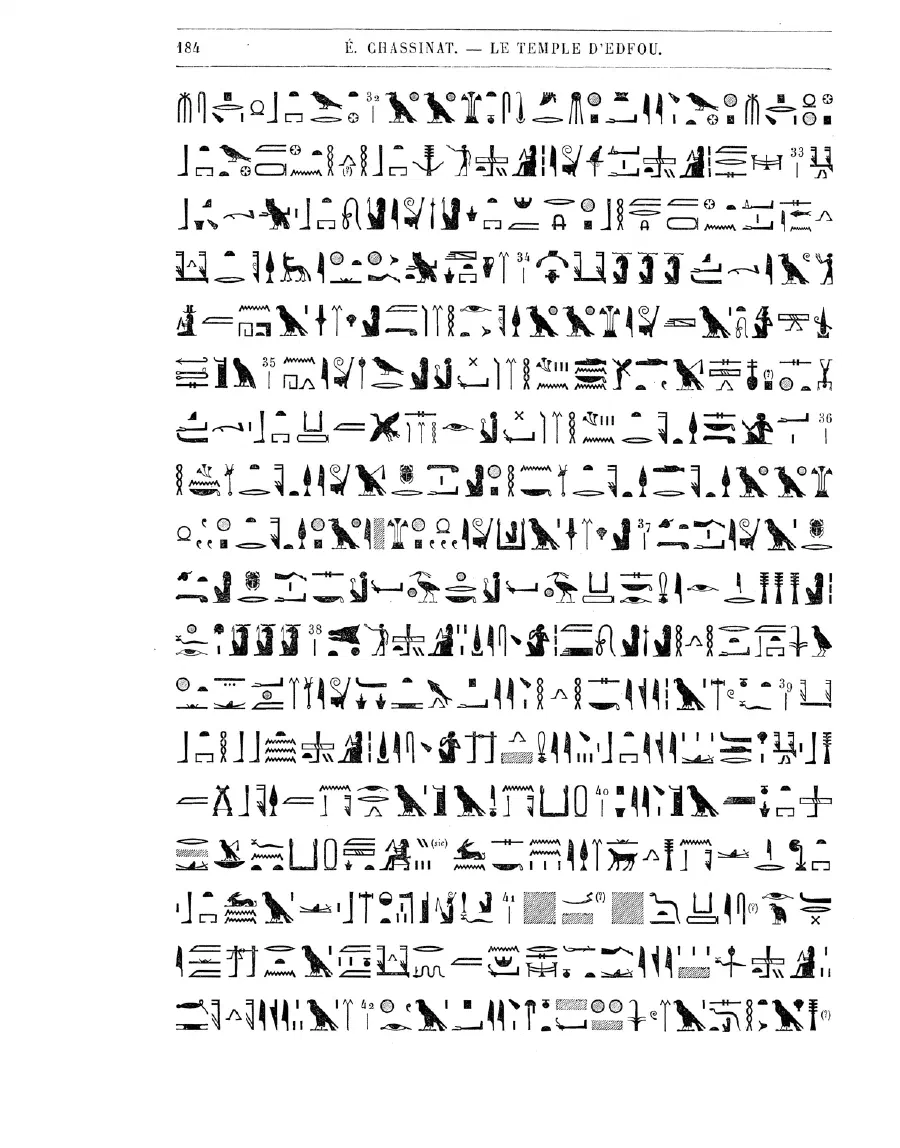
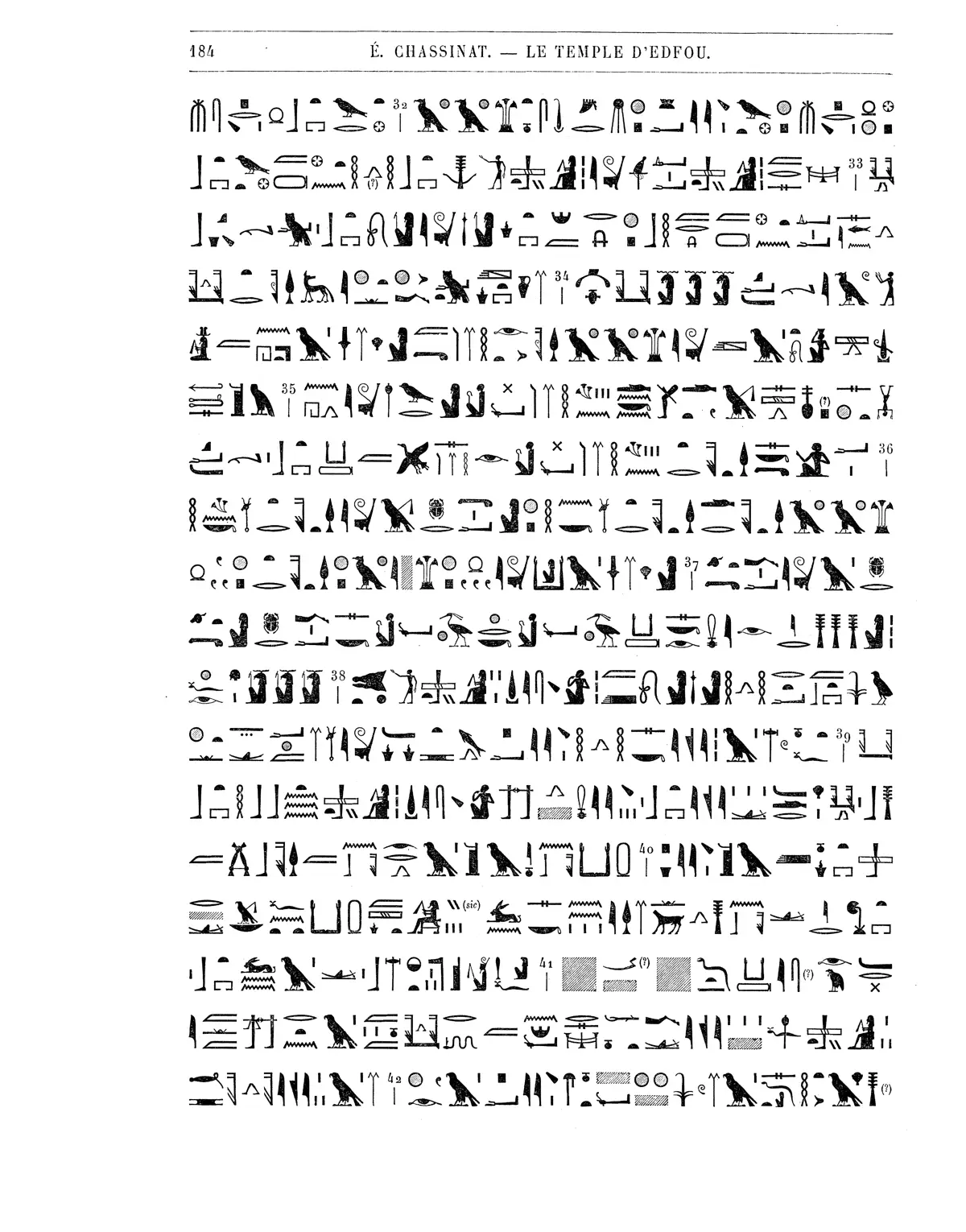
Page 184. Edfou VI, p. 184 Chassinat's typeset hieroglyphic text, Le temple d'Edfou VI (IFAO 1931) - 184-1184,1

msj […] wr.t njw.t Ḥr Rꜥ […] mḥ.t […] psḏ […] wr.t njw.t […] msj
born […] the great city; Horus, Re […] the north […] shining […] the great city […] born
- 184-2184,2

[…] wr.t njw.t rn ḥḥ bꜥḥ […] Šbtyw jn […] Šbtyw m r=s […]
[…] the great city; name: Heh, the flood […] the Shebtiw, by […] the Shebtiw, in it […]
- 184-3184,3

[…] m […] Šw jn […] sḏ.t […] Rꜥ […] m rn njw.t […]
[…] in […] Shu by […] fire […] Re […] in the name "City of […]"
The falcon with spear and lance
- 184-4184,4

sbtj […] zꜣb […] Rꜥ […] m […] ẖnm sbtj ẖnmw […]
the enclosure wall […] the jackal […] Re […] in […] joined the enclosure wall (of) the Khnum-gods […]
Note · Line 184-4
Khnum was a ram-headed god who shaped bodies on a potter’s wheel. The plural here presents a group of divine craftsmen at work. - 184-5184,5

Tꜣ-ṯnn m nh.t Ḥr ḥḏ jb m […] jr […] Ḥr Rꜥ Ḥr Rꜥ mḥ jn sjꜣ […]
Tatenen in the refuge; Horus, bright of heart, in […] made […] Horus-Re, Horus-Re (of) the north, by the Falcon […]
- 184-6184,6

šm-wḏꜣ […] m […] jn ḥḏ wr […] sꜣw […] sꜣw […] sjꜣ tb
the spear […] in […] by the bright great one […] broken […] cut […] the Falcon, the stave
- 184-7184,7

qꜥḥ […] kꜣ m pꜣ sgmḥ jr […] sꜣw […] qs.t […]
the arm […] the Ka with the lance made […] broken […] the bone […]
- 184-8184,8

[…] wsr.t qs.t jn bjk ḫpr ḫpr […] Rꜥ […] wsr.t qs.t […] qs.t Ḥr
[…] the powerful bone, by the Falcon; came into being; came into being […] Re […] the powerful bone […] bone, Horus
- 184-9184,9

[…] Rꜥ qs.t Rꜥ Ḥr […] mḥ Rꜥ […] jn […] Ḥr ḥḏ jb […] jn
[…] Re the bone Re Horus […] the north Re […] by […] Horus, bright of heart […] by
- 184-10184,10

[…] ḫpr […] sꜣ ꜣḫ ꜣḫ […] sꜣ ꜣḫ kꜣ […] ꜥnḫ jr jr
[…] came into being […] protection of the akh-spirits, the akh-spirits […] protection of the akh, the Ka […] life, making, making
The words of the Shebtiw
- 184-11184,11

Rꜥ jr=f tp […] ꜣ.t […] Šbtyw ḏꜣjs Ḏꜣjsw […] ḥḥ […]
Re he made upon […] the moment […] the Shebtiw; the words, the Djaisu […] Heh […]
Note · Line 184-11
The name Djaisu echoes the Egyptian word for a spoken spell. The words that bring things into being appear here as divine beings in their own right. - 184-12184,12

[…] ḥbb […] wsr jn […] sḏ.t […] ḥḥ […] Ḥr […]
[…] the flood-water […] powerful, by […] fire […] Heh […] Horus […]
- 184-13184,13

[…] mw Šbtyw ḏꜣjs […] ꜥnḫ […]
[…] water (of) the Shebtiw, the words […] life […]
- 184-14184,14

m Ḏbꜣ qs.t m […] jr Ḥr Wṯs.t-Ḥr […] kꜣ rn […] Wṯs.t Ḥr m […]
in Djeba, the bone in […] made Horus, Wetjeset-Hor […] the Ka name […] Wetjeset Horus in […]
- 184-15184,15

r […] bjk nb =f n.tt kꜣ rn […] wn sk mw […] kꜣ jw ḏd […]
to […] the Falcon, lord; his … that the Ka (of the) name […] existed, wiped out … water […] the Ka came, said […]
- 184-16184,16

[…] wn Ḥr […] ḥḏ […] ḏ.t kꜣ […]
[…] Horus existed […] bright […] eternity, the Ka […]
- 184-17184,17

j m […] Ḥr […] sbtj […] sꜣ […]
O in […] Horus […] the enclosure wall […] protection […]
- 184-18184,18

[…] Ḥr […] Rꜥ jrw Ḥr […] sw Ḥr […]
[…] Horus […] Re, the form of Horus […] he (is) Horus […]