~/sacred-texts/late-ramesside-letters
Dhutmose’s Letter to Butehamun: Drive Out This Sickness That Is in Me
- Date
- Written about 1080–1069 BC, at the end of the 20th Dynasty under Ramesses XI, in hieratic on papyrus
- Found
- From western Thebes, the tomb-builders' community of Deir el-Medina and Medinet Habu; now in the Rijksmuseum van Oudheden, Leiden (P. Leiden I 370)
- Language
- Late Egyptian · Hieratic
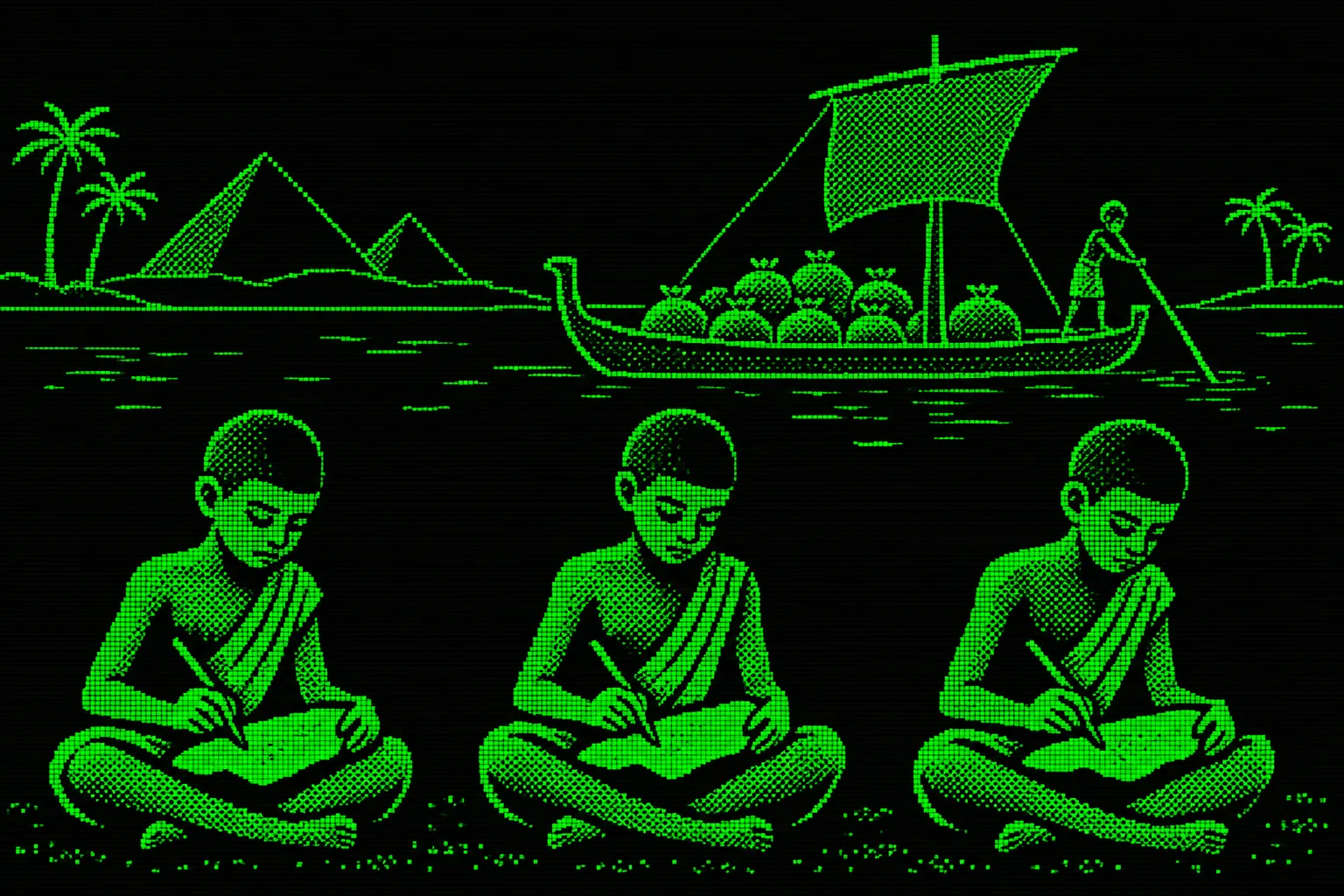
Dhutmose (Djehuti-mesu), scribe of the royal necropolis at Thebes, writes home to his son, the scribe Butehamun (Bu-teh-Imen), and the chantress of Amun Shedu-em-duat. After the blessings he speaks to his son alone and the orders pour out: take delivery of the grain, recorded and in full; take charge of the cargo boat, its oars, its mast and its deck fittings; thin the trees on the riverbank plots; get three garments back from Pa-kheru. Then the household: Give them clothes. Do not let them go naked. And the children: Do not let the little boys at school take their hands from their writing.
Twice he turns to the god. His son is to take water for Amun and say to him, “Save me!” The letter ends: Say to Amun, “Drive out this sickness that is in me.”
- 1
zẖꜣ(,w)- Ḏḥw,tj-ms,w -n-pꜣ-ḫr-ꜥꜣ-šps,j n zẖꜣ(,w) Bw-th-Jmn šmꜥ,yt-n-Jmn Šd.w-m-dwꜣ,t m ꜥnḫ-wḏꜣ-s(nb) 〈m〉 ḥz(w),t Jmn-Rꜥw nswt-nṯr,pl
From Djehuti-mesu, scribe of the great and splendid royal necropolis, to the scribe Bu-teh-Imen and the chantress of Amun, Shedu-em-duat: in life, prosperity and health, and in the favor of Amun-Ra, king of the gods.
Note · Line 1
The royal necropolis was the burial ground of the pharaohs on the west bank at Thebes. A chantress sang in temple worship. - 2
tw=j ḏd n Jmn-Rꜥw-Ḥr,w-ꜣḫ,tj Ḥr,j-š≡f nṯr-ꜥꜣ Ḏḥw,tj nb-Ḫmnw nṯr nb nṯr,t nb.t n,tj tw=j zni̯ ḥr =w jmi̯ n =tn ꜥnḫ-wḏꜣ-s(nb) [ꜥḥꜥ,w] [qꜣi̯] jꜣw,t ꜥꜣ[.t] nfr.t [rꜥw-nb]
Every day I ask Amun-Ra-Horakhty, Heryshef the great god, Thoth the lord of Hermopolis, and every god and every goddess I pass, to grant you both life, prosperity and health, long years and a good, ripe old age.
- 3
[ḥnꜥ-ḏd] r-[n,tj] sḏm =j mdw,t nb j:hꜣb =k n =j ḥr =w m-ḏr,t šms(,w) N,j-sw-Jmn
Now to my news: I have heard about every matter you sent word of by the retainer Nesu-Imen.
Note · Line 3
Here the writer turns from greeting both recipients to addressing Bu-teh-Imen in the singular. - 4
pꜣ ḏd j:jri̯ =k tꜣ md(w),t n nꜣ ḥn,w.pl n wꜣḏ rḥb 2 j:ḏd =k tw=j ḏi̯.t grḥ =w j:m =w ḫr m-dj tꜣ mdw,t n nꜣ ꜥꜣ.pl j:ḏd =k ḏi̯ =j st n wꜥb Ṯꜣ,w-mḥ,j-m-ḥꜣb r fꜣy nꜣ jt j.n =k sw m-šs pꜣj j:jri̯ =k
You wrote about the greenstone vessels and the two flasks, “I am having them finished.” As for the donkeys, you said, “I gave them to the wab-priest Tjau-mehi-em-hab to carry the grain.” So you said, and you have done very well.
Note · Line 4
A wab-priest, literally a “pure priest,” was a temple priest who had to observe rules of ritual purity. - 5
jnn qn =f fꜣi̯.y nꜣ jt jw =k šzp =w jw =w spẖr jw =w mḥ mtw =k ꜥq =w r tꜣy =w šnw,t mtw =k ḏi̯.t =w n ḥr,j-mḏꜣ,pl Sr-Mnṯw r fꜣy nꜣy =f jt n,tj m sḫ,t.pl jw bn nꜣ n,tj wꜣḥ m nꜣ wꜣḥ,yt.pl j:m =w ⸢jw⸣nꜣ jw j:jri̯ =k ḏi̯.t jni̯.tw m nꜣ n,tj ḫnr m sḫ,t.pl jw nꜣ n,tj m nꜣ mẖr.ypl smn s.w,t.pl
When he has finished hauling the grain, take delivery of it, recorded and in full, and bring it into its granary. Then give the donkeys to Ser-Montu, chief of the Medjay, to haul his grain from the fields. That does not include what was left in the settlements. Have only the grain that lies scattered in the fields brought in; what is in the granaries is to stay where it is.
Note · Line 5
The Medjay served as a police force. - 6
⸢wnn⸣ pꜣ mw mḥ jw =k šzp n ḥꜣ,t n tꜣj ꜥqꜣ,y j:ḏi̯ =j jni̯.tw n =k mtw =k ḏi̯.t sw n nꜣ wḥꜥ.pl nꜣ mḏꜣ.y
When the floodwater is high, take charge of the cargo boat I had brought to you and give it to the fishers and fowlers and the Medjay.
- 7
mtw =w jni̯ pꜣy =w mn mtw =k šzp =w jw [=w] spẖr jw zẖꜣ(,w) Pꜣ-n-tꜣ-ḥw,t-nḫt,w zꜣ Sbk-nḫt,w jrm =k jw jw =f nwi̯ n =k mtw =k sꜥq.t{w} =w
They are to bring what they still owe. Take delivery of it duly recorded, with the scribe Pa-en-ta-hut-nakht, son of Sobek-nakhtu, at your side. He will help you. Then bring it into store.
- 8
mtw =k šzp tꜣj ꜥqꜣ,y nꜣy =st wsr.pl pꜣy =st ḫt-ṯꜣw nꜣ zmꜣ,y.pl [mtw] [=k] ꜣti̯ n =st jw jw =k gmi̯ =st r jri̯.t nꜣy =k jpw,t j:m =st ḥnꜥ nꜣ ḫt.pl nꜣ ḏꜥb r ḏi̯.t ⸢jr⸣y.w ẖni̯ =w
Take charge of the cargo boat, its oars, its mast and its deck fittings. Look after it: you will find it useful for carrying out your errands and for having the wood and charcoal shipped.
- 9
mtw =k sꜥq 〈=w〉 r tꜣy =w s,t ḥnꜥ nꜣ ḫt n,tj [...] [nꜣ] r(m)ṯ.pl zwꜣ =w mtw =k jṯꜣ r pꜣy =j pr
Bring them in and put them in their place, along with the timber that … the men are cutting down. Then take it to my house.
- 10
y wn hrw dy r-ḥꜣ,t =tn
Why, you have a day before you here!
- 11
mtw =k ptr nꜣ ꜥḏd.pl šrj.pl mtw =k ꜣti̯ n =w m-šs mj-qd tꜣj šrj,t n Ḥm(,t)-šrj(,t) tꜣy =st mw,t tꜣy =st mnꜥ,t
Look in on the little boys and take good care of them. Do the same for Hemet-sherit’s little daughter, her mother and her wet nurse.
- 12
mtw =k ptr tꜣy =w (j)ꜣ,t.y
See what they lack.
- 13
mtw =k ptr nꜣ r(m)ṯ.pl-mšꜥ.pl mtw =k zꜣu̯ =w m-šs zp-2
Look in on the soldiers and keep a very close watch on them.
- 14
mtw =k ḏi̯.t ḥr =k n nꜣ r(m)ṯ.pl n,tj m sḫ,t mtw =k ḏi̯.t jry =w nꜣy =w sḥn sḫ,t.pl m-šs zp-2
Give your attention to the people in the fields. See that they do their allotted fieldwork very well indeed.
- 15
mtw =k tm ḏi̯.t ḫꜣꜥ nꜣ ꜥḏd.pl šrj.pl n,tj m tꜣ ꜥ,t-sbꜣ ḏr,t =w m zẖꜣ,w.pl
Do not let the little boys at school take their hands from their writing.
- 16
mtw =k ptr nꜣ r(m)ṯ n,tj m pꜣy =j pr
Look in on the people in my house.
- 17
mtw =k ḏi̯.t n =w ḥbs.pl m-dy ḥꜣy =w
Give them clothes. Do not let them go naked.
- 18
mtw =k wḫꜣ pꜣ 3 ḥbs.pl m-dj Pꜣ-ḫrw
Ask Pa-kheru for the three garments back.
- 19
mtw =k ptr pꜣj 3 jdb.pl jnn mtw =k ḏi̯.t jry.tw sḥḏ nꜣ šn.w n,tj m tꜣy =w (j)ꜣ,t mj-qd pꜣ ꜣḥ,t.pl j:wn N,j-sw-Mnṯ,w skꜣ =f
Look over our three plots along the riverbank. Have the trees on their rise thinned, and do the same on the farmland Nisu-Montu used to plow.
- 20
⸢mtw⸣ ⸢=k⸣ sḥḏ nꜣy =f šn.w r šꜣꜥ-m pꜣ tꜣš n Pꜣ-Rꜥw nfr,yt-r tꜣ šd,w n pꜣ tꜣš
Thin its trees from Pa-Ra’s boundary all the way to the plot at the edge of the district.
- 21
mtw =k nwi̯ r tꜣj šrj,t n Ḫns,w-ms,w mtw =k ḏi̯.t jri̯.y =st wꜥ šꜥ,t mtw =k ḏi̯.t jni̯〈.tw〉 sw n =j
Look after Khonsu-mesu’s little daughter. Have her write a letter and have it brought to me.
- 22
mtw =k tm ḏi̯.t (j)ꜣt Ḥm,t-šrj,t m nkt.pl ḥnꜥ Šd,w-m-dwꜣ(,t) nꜣy =st ꜥḏd.pl šrj.pl
Do not let Hemet-sherit lack for anything, or Shedu-em-duat and her little boys either.
- 23
mtw =k ḏd n Tꜣ-pzš-[_] gmi̯ =j Pꜣ-trꜥ m tꜣ dhn,t mḥ,tj
Tell Ta-pesesh-… that I met Pa-tera at the northern rock spur.
- 24
mtw =k hꜣb n =j pꜣ pr j:gmi̯ =k [pꜣ] [...] [m-jm] =f mtw =k hꜣb n =j jnn swḏ =k nꜣ jt n Ḥr(,w)-j ⸢n⸣ =f
Write and tell me in which house you found the …, and let me know whether you handed Hori’s grain over to him.
- 25
mtw =k ḏi̯.t grḥ =tw m [tꜣ] ꜥr,t mki̯ m bꜣk sꜣq.tj
Have the gate court finished and made secure by fitting the stones together.
- 26
mtw =k ptr [pꜣ] ḥ⸢tr⸣ ⸢n⸣ ⸢jḥ,t⸣.pl n,tj m-dj mnj,w N,j-sw-Jmn zꜣ [⸮Ḏꜣi̯-hꜣ?]y mtw =k ḏi̯.t =w ⸢n⸣ [⸮Pꜣj-dgš-_?]
Look in on the team of cows in the keeping of the herdsman Nesu-Imen, son of Djai-hay, and hand them over to Pai-degesh-….
- 27
mtw =k ṯꜣi̯ mw n Jmn-ns,wt-tꜣ,wj mtw =k ḏd n =f ⸢šdi̯⸣ 〈wj〉
Take water for Amun of the Thrones of the Two Lands and say to him, “Save me!”
Note · Line 27
The Two Lands are Upper and Lower Egypt. The water is an offering to Amun. - 28
mtw =k ⸢tm⸣ nni̯ [...] [⸮Pꜣ-kꜣmn?] [pꜣy] [=j] sn
Do not neglect … Pa-kamen, my brother.
- 29
mtw =k ḏi̯.t ḥr =k n nꜣy =j sḥn m-jr nni̯ n =w [jm] [...] [pꜣ]y =j hrw n jy
Give your attention to my instructions. Do not neglect them there … the day I return.
- 30
mtw =k ḏd n Jmn j:rwi̯ pꜣj mr n,tj j:m [⸮=j?]
Say to Amun, “Drive out this sickness that is in me.”