~/sacred-texts/dendera-osiris-chapel-khoiak-inscription
Dendera Khoiak Text: Making Osiris of Grain and Cake
Translated by AI straight from the French, not from a modern translation, then checked against the editions and studies listed below. How we translate
- Text
- Dendera Osiris chapel (Khoiak inscription), Chapters I–VII (cols. 1–152), with Loret's summary
- Date
- Ptolemaic–Roman period; Loret's French 1881–1884
- Found
- Osiris chapels on the roof of the Hathor temple, Dendera
- Language
- French · Hieroglyphic (given here from Loret's French)
The Egyptians built a second, smaller temple on the roof of the temple of Hathor at Dendera, and gave it to Osiris. Its southern chapel has an open court whose walls show two processions of priests from the nomes of Egypt, the king at their head, coming to the feasts of Osiris. A long inscription beside them lays out the rite of the month of Khoiak, the fourth month of the inundation. This page gives it as Victor Loret translated it in three instalments (1881, 1883, 1884): seven chapters, one hundred and one numbered sections, columns 1 to 152 of the stone, with his corrections, summary and conclusion.
What the text describes is the making of Osiris. In each of the nomes, a god of that place (the Osiris of Coptos, of Abydos, of Heracleopolis, of Sais, the Great Old Man of Heliopolis, the Black Bull of Ka-kem) is placed in the vat and fashioned of grain and cake; beside him, in a double basin, is fashioned the shred of the divine members, brought from Letopolis. Chapter II gives the vat, the gold mould in the form of a mummy and the bronze basin of Sep, with their measures, and then the days: the paste is made on 12 Khoiak, watered morning and evening, taken out on the 21st, bound with four bands of papyrus, dried at sunset, carried by water at the eighth hour of the 22nd among lamps and barques of gods, and buried on the last day of the month. Chapter III is the paste of Sokari, made of earth, dates, incense, myrrh and precious stones and shaped as an egg. Chapter IV is a list of the gods who attend; Chapter V gives the inscriptions engraved on the moulds and coffin and the sixteen members of the god, cut in cake.
Loret’s article continues in volumes IV (1883) and V (1884) of the same journal. The continuation gives the contents of the sacred vessel (twelve aromatics and a list of fourteen, later twenty-four, stones, all ground fine), the cloth of one day, the fourteen amulets, the fourteen tebeh that are the god’s members in gold, silver and black bronze, the Field of Osiris ploughed with two black cows and sown with barley, spelt and flax, the cow Remen-t, the 34 barques with their 365 lights, the four heifers and the funerary genii drawn in procession with the serpent Apophis behind them, and the calendar from 12 to 30 Khoiak: the dismemberment of the god at Ka-kem on the 14th, the crocodile that brings his members on the 16th, the unmoulding on the 19th, the embalming on the 24th and the night burial in the shrine of the ašet trees on the last day. Chapters VI and VII then give the rite itself, with the priest Fekti speaking as Horus to the goddess. Loret ends with a summary, the rite taken day by day, and a reading of the whole against Plutarch.
Loret does not reproduce the hieroglyphs in his text, only in the plates; the English follows his French. Where he leaves a row of dots for a gap in the stone, the English marks it [ . . . ]. His notes are given beside the sections they belong to, and his 1881 readings of the Egyptian are his own. Page numbers in the reference column are the printed ones of each volume (43–57, 21–33, 85–103).
Each numbered line gives the French first. Our English is underneath. Tap a dotted word for its meaning, and Note for our comment on the line; our comments are in the right margin.
Loret’s introduction
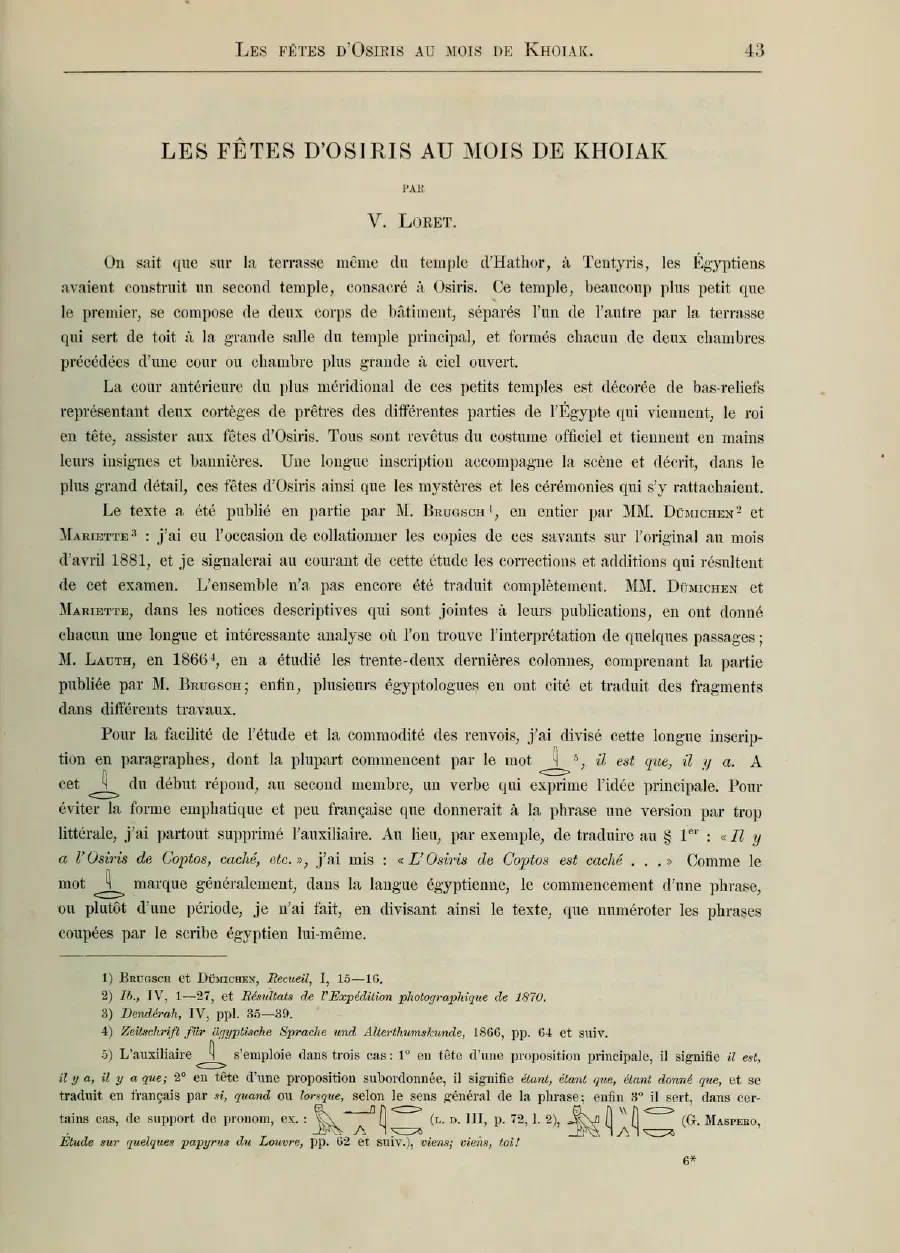
Page 43. p. 43: Loret's introduction to the Dendera inscription: the Osiris chapels on the roof, the carved procession, the division into numbered paragraphs Recueil de travaux III, IV and V (archive.org scans) - pref-143
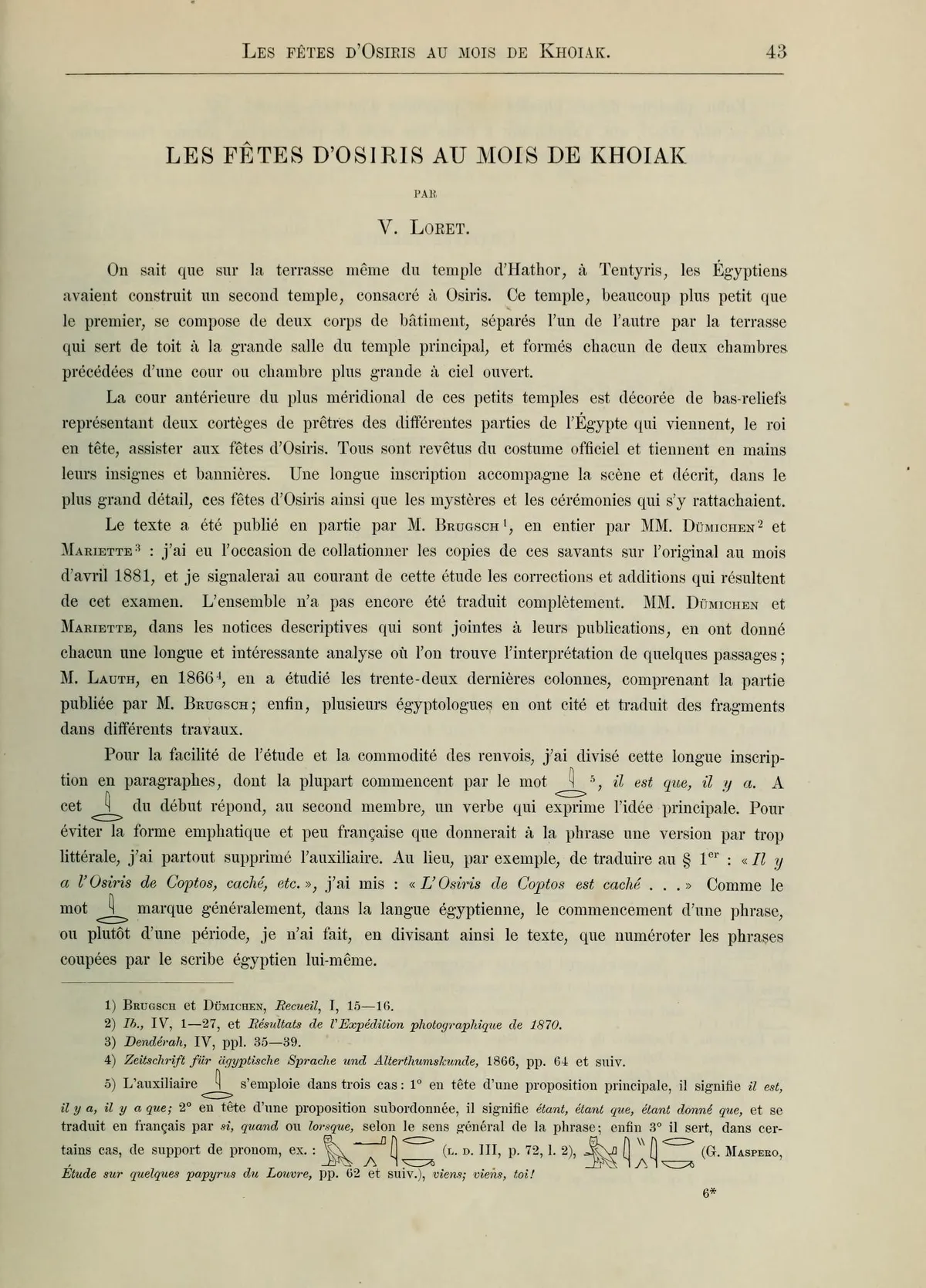
On sait que sur la terrasse même du temple d'Hathor, à Tentyris, les Égyptiens avaient construit un second temple, consacré à Osiris. Ce temple, beaucoup plus petit que le premier, se compose de deux corps de bâtiment, séparés l'un de l'autre par la terrasse qui sert de toit à la grande salle du temple principal, et formés chacun de deux chambres précédées d'une cour ou chambre plus grande à ciel ouvert.
It is known that on the very terrace of the temple of Hathor, at Tentyris, the Egyptians had built a second temple, consecrated to Osiris. This temple, much smaller than the first, is made up of two bodies of building, separated from each other by the terrace that serves as the roof of the great hall of the main temple, and formed each of two chambers preceded by a larger court or chamber open to the sky.
- pref-243
La cour antérieure du plus méridional de ces petits temples est décorée de bas-reliefs représentant deux cortèges de prêtres des différentes parties de l'Égypte qui viennent, le roi en tête, assister aux fêtes d'Osiris. Tous sont revêtus du costume officiel et tiennent en mains leurs insignes et bannières. Une longue inscription accompagne la scène et décrit, dans le plus grand détail, ces fêtes d'Osiris ainsi que les mystères et les cérémonies qui s'y rattachaient.
The front court of the more southerly of these little temples is decorated with bas-reliefs showing two processions of priests from the different parts of Egypt, who come, the king at their head, to attend the feasts of Osiris. All are dressed in official costume and hold their insignia and banners in their hands. A long inscription accompanies the scene and describes, in the greatest detail, these feasts of Osiris and the mysteries and ceremonies that were attached to them.
- pref-343
Le texte a été publié en partie par M. Brugsch, en entier par MM. Dümichen et Mariette : j'ai eu l'occasion de collationner les copies de ces savants sur l'original au mois d'avril 1881, et je signalerai au courant de cette étude les corrections et additions qui résultent de cet examen. L'ensemble n'a pas encore été traduit complètement. MM. Dümichen et Mariette, dans les notices descriptives qui sont jointes à leurs publications, en ont donné chacun une longue et intéressante analyse où l'on trouve l'interprétation de quelques passages ; M. Lauth, en 1866, en a étudié les trente-deux dernières colonnes, comprenant la partie publiée par M. Brugsch ; enfin, plusieurs égyptologues en ont cité et traduit des fragments dans différents travaux.
The text has been published in part by M. Brugsch, in full by MM. Dümichen and Mariette. I had the opportunity to collate these scholars' copies against the original in April 1881, and in the course of this study I shall point out the corrections and additions that result from that examination. The whole has not yet been completely translated. MM. Dümichen and Mariette, in the descriptive notices attached to their publications, each gave a long and interesting analysis in which the interpretation of some passages is found; M. Lauth, in 1866, studied the last thirty-two columns, comprising the part published by M. Brugsch; finally, several Egyptologists have cited and translated fragments of it in various works.
Note on line pref-3
Loret’s notes give the publications: Brugsch and Dümichen, Recueil I, 15-16; Dümichen, Recueil IV, 1-27, and Résultats de l’Expédition photographique de 1870; Mariette, Dendérah IV, pls. 35-39; Lauth in the Zeitschrift für ägyptische Sprache 1866, pp. 64 ff. - pref-443
Pour la facilité de l'étude et la commodité des renvois, j'ai divisé cette longue inscription en paragraphes, dont la plupart commencent par le mot [signe], il est que, il y a. À cet [signe] du début répond, au second membre, un verbe qui exprime l'idée principale. Pour éviter la forme emphatique et peu française que donnerait à la phrase une version par trop littérale, j'ai partout supprimé l'auxiliaire. Au lieu, par exemple, de traduire au § 1er : « Il y a l'Osiris de Coptos, caché, etc. », j'ai mis : « L'Osiris de Coptos est caché ... » Comme le mot [signe] marque généralement, dans la langue égyptienne, le commencement d'une phrase, ou plutôt d'une période, je n'ai fait, en divisant ainsi le texte, que numéroter les phrases coupées par le scribe égyptien lui-même.
For ease of study and convenience of reference, I have divided this long inscription into paragraphs, most of which begin with the word [sign], it is that, there is. To this [sign] at the start answers, in the second member, a verb that expresses the main idea. To avoid the emphatic, unidiomatic form that a too literal version would give the sentence, I have everywhere suppressed the auxiliary. Instead, for example, of translating in § 1: "There is the Osiris of Coptos, hidden, etc.," I have put: "The Osiris of Coptos is hidden ..." As the word [sign] generally marks, in the Egyptian language, the beginning of a sentence, or rather of a period, in dividing the text thus I have only numbered the sentences cut by the Egyptian scribe himself.
Note on line pref-4
His note 5: the auxiliary is used in three cases: at the head of a main clause, where it means it is, there is, there is that; at the head of a subordinate clause, where it means being, being that, given that and is translated into French by if, when or while; and, in some cases, as a support for a pronoun (he cites Maspero, Étude sur quelques papyrus du Louvre, pp. 62 ff., “come, come, you!”). 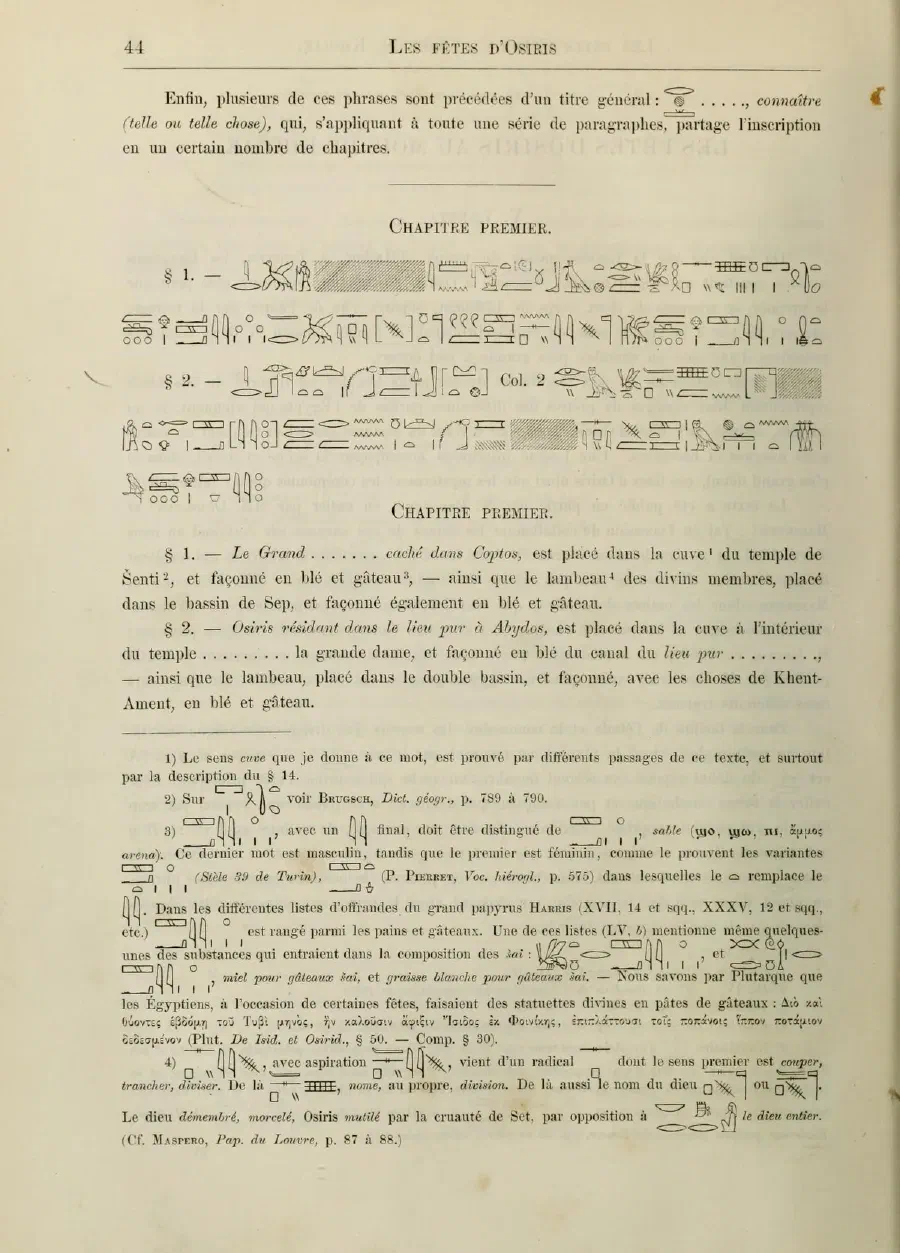
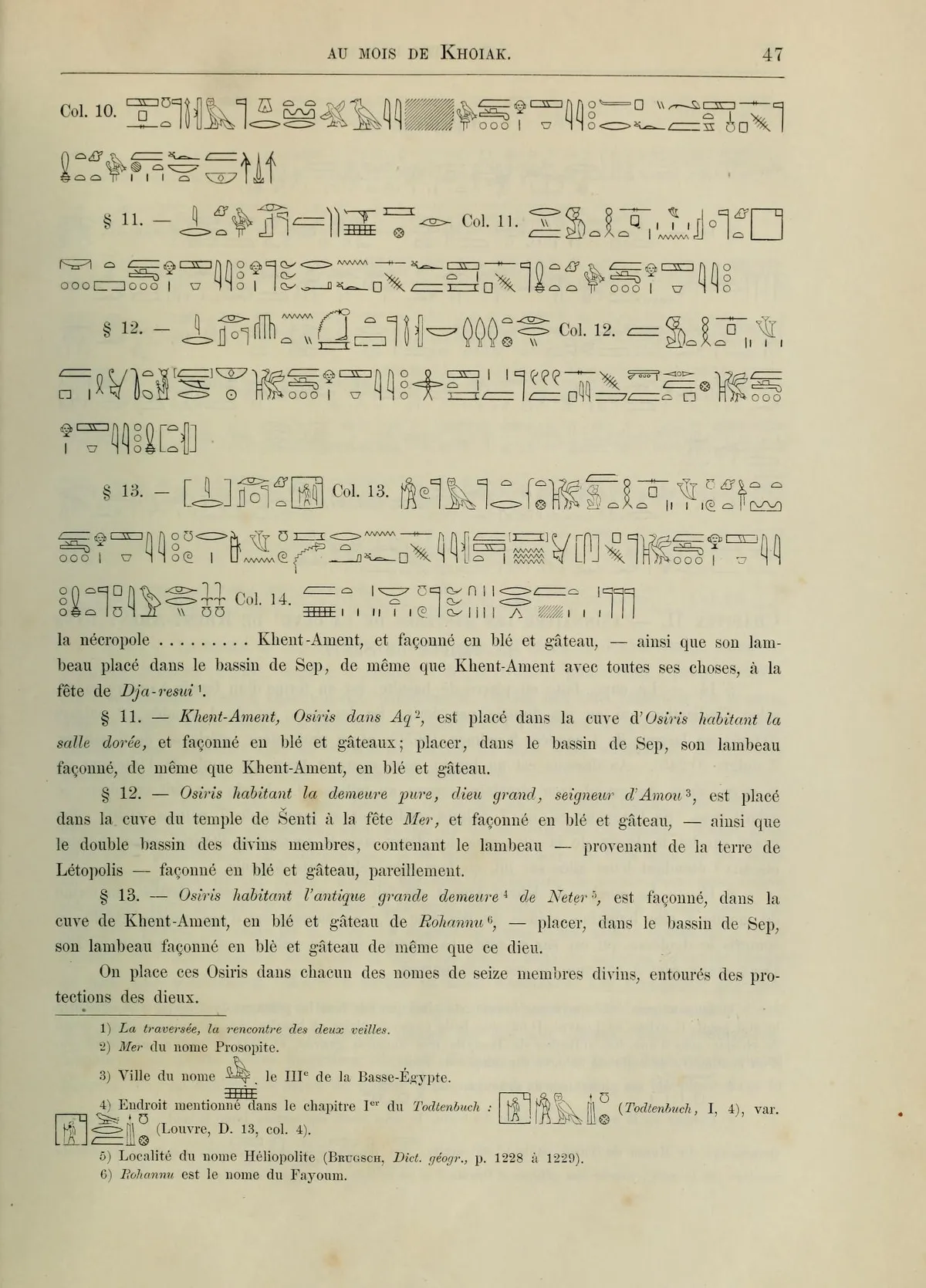
Page 44. p. 44: Chapter I begins: the Osiris of Coptos, Abydos, in the vat; the 'shred' of the divine members in the basin of Sep Recueil de travaux III, IV and V (archive.org scans) - pref-544
Enfin, plusieurs de ces phrases sont précédées d'un titre général : [signes] . . . . ., connaître (telle ou telle chose), qui, s'appliquant à toute une série de paragraphes, partage l'inscription en un certain nombre de chapitres.
Finally, several of these sentences are preceded by a general title: [signs] . . . . ., to know (such or such a thing), which, applying to a whole series of paragraphs, divides the inscription into a certain number of chapters.
Chapter I
- s0144
§ 1. — Le Grand [ . . . ] caché dans Coptos, est placé dans la cuve du temple de Senti, et façonné en blé et gâteau, — ainsi que le lambeau des divins membres, placé dans le bassin de Sep, et façonné également en blé et gâteau.
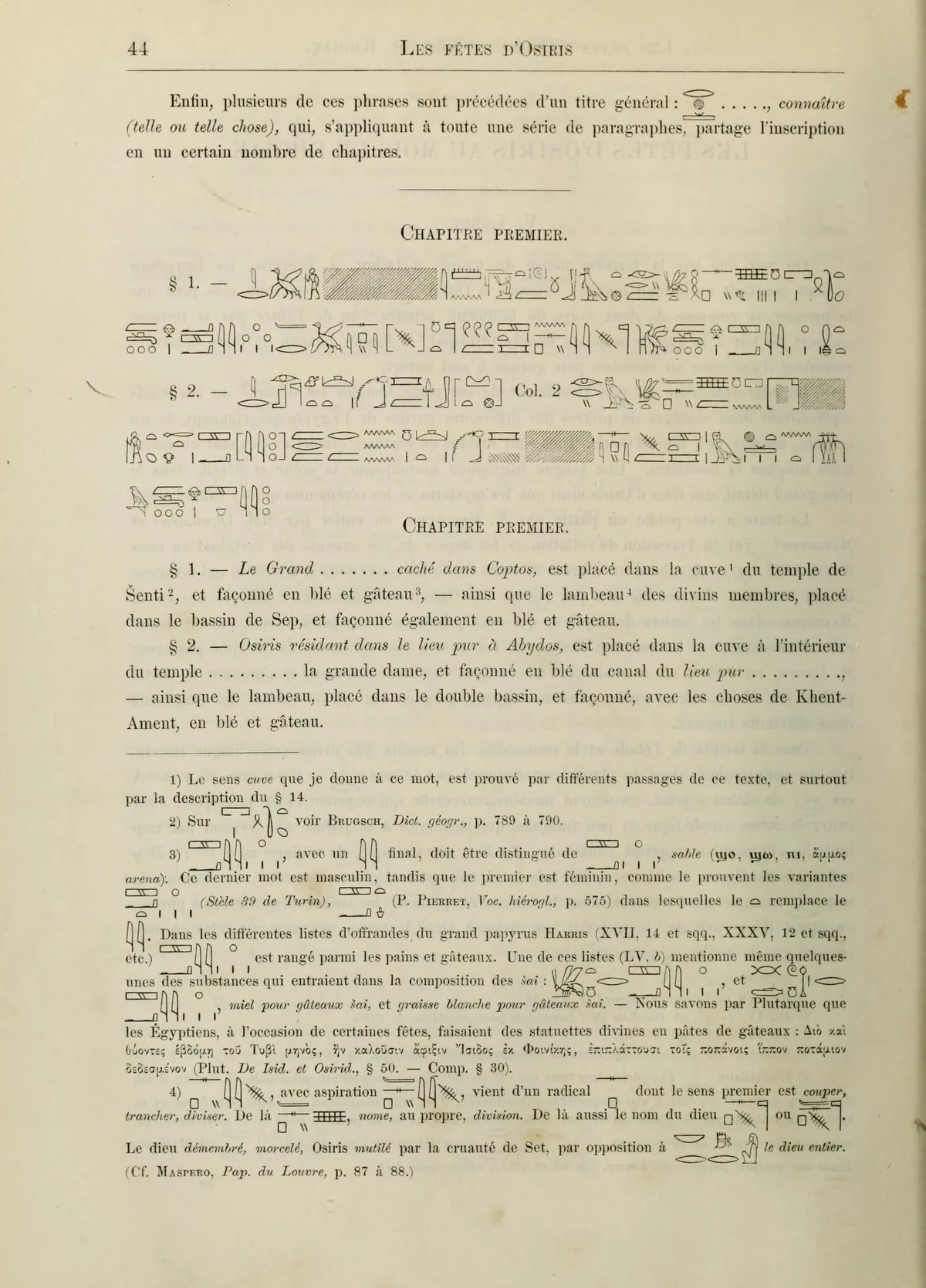
§ 1. — The Great [ . . . ] hidden in Coptos is placed in the vat of the temple of Senti, and fashioned of grain and cake, together with the shred of the divine members, placed in the basin of Sep and likewise fashioned of grain and cake.
Note on line s01
Loret’s notes. (1) Vat: the sense is proved by several passages of this text and above all by the description in § 14. (2) On Senti, see Brugsch, Dictionnaire géographique, pp. 789-790. (3) Cake: Loret distinguishes the word, with its final sign, from the masculine word for sand (Coptic šō, Greek ammos, Latin arena); the cake-word is feminine, and in the offering lists of the great Papyrus Harris (XVII, 14 ff.; XXXV, 12 ff.; LV, b) it is ranked among breads and cakes. One of those lists names some of the substances that went into these cakes: “honey for cakes” and “white fat for cakes”. Plutarch tells us that on certain feasts the Egyptians made divine figurines out of cake dough: “Therefore, sacrificing on the seventh of the month Tybi, which they call the arrival of Isis from Phoenicia, they mould on the cakes a bound hippopotamus” (De Iside et Osiride 50; compare 30). (4) Shred (lambeau): from a root whose first sense is to cut, to cleave, to divide, whence the word for nome, properly “division”, and the name of the god written with the same root: the dismembered god, torn to pieces, Osiris mutilated by the cruelty of Set, as against “the whole god” (compare Maspero, Papyrus du Louvre, pp. 87-88). - s0244
§ 2. — Osiris résidant dans le lieu pur à Abydos, est placé dans la cuve à l'intérieur du temple [ . . . ] la grande dame, et façonné en blé du canal du lieu pur [ . . . ], — ainsi que le lambeau, placé dans le double bassin, et façonné, avec les choses de Khent-Ament, en blé et gâteau.
§ 2. — Osiris dwelling in the pure place at Abydos is placed in the vat inside the temple [ . . . ] the great lady, and fashioned of grain from the canal of the pure place [ . . . ], together with the shred, placed in the double basin, and fashioned, with the things of Khent-Ament, of grain and cake.
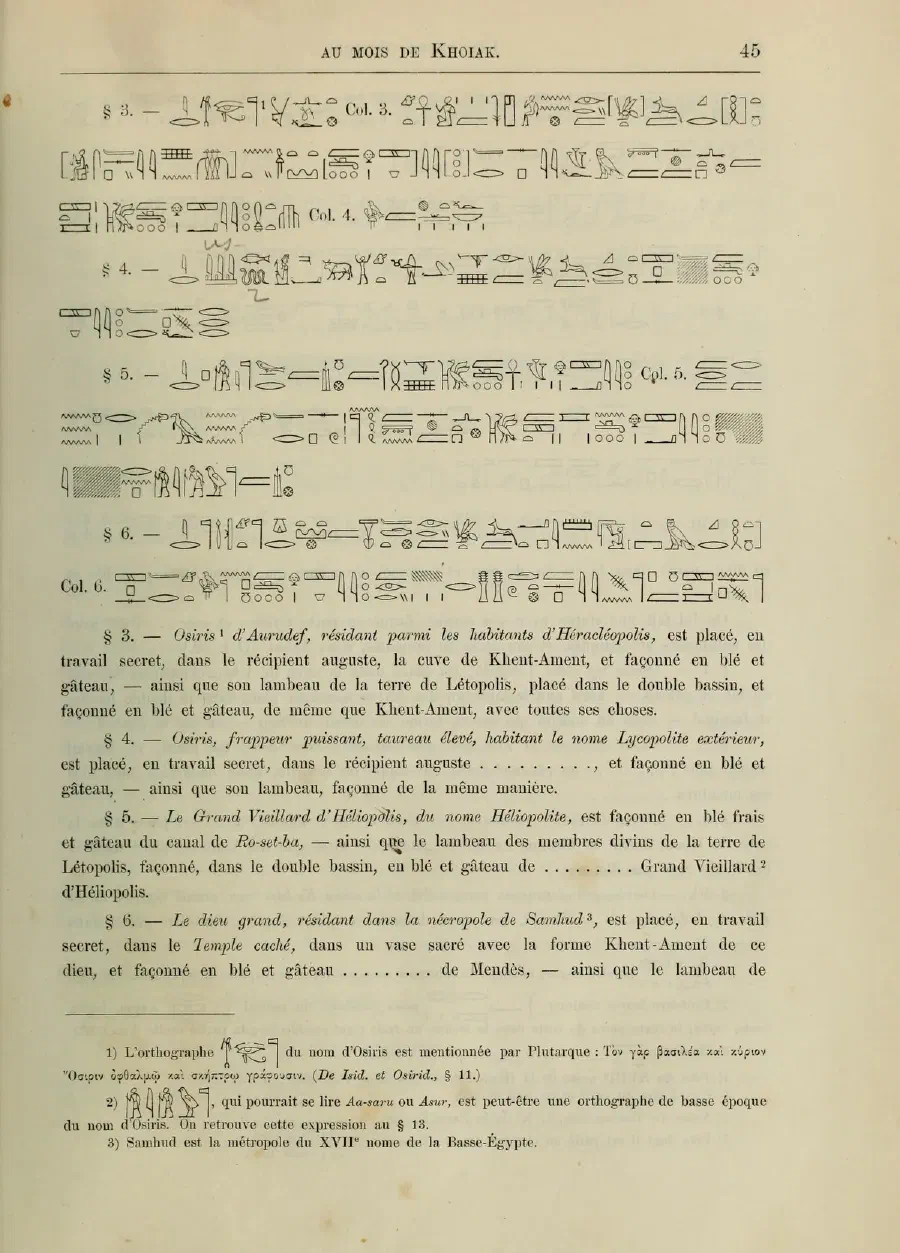
Page 45. p. 45: The Osirises of Heracleopolis, Lycopolis, Heliopolis and Samhud, each with his shred from the land of Letopolis Recueil de travaux III, IV and V (archive.org scans) - s0345
§ 3. — Osiris d'Aurudef, résidant parmi les habitants d'Héracléopolis, est placé, en travail secret, dans le récipient auguste, la cuve de Khent-Ament, et façonné en blé et gâteau, — ainsi que son lambeau de la terre de Létopolis, placé dans le double bassin, et façonné en blé et gâteau, de même que Khent-Ament, avec toutes ses choses.
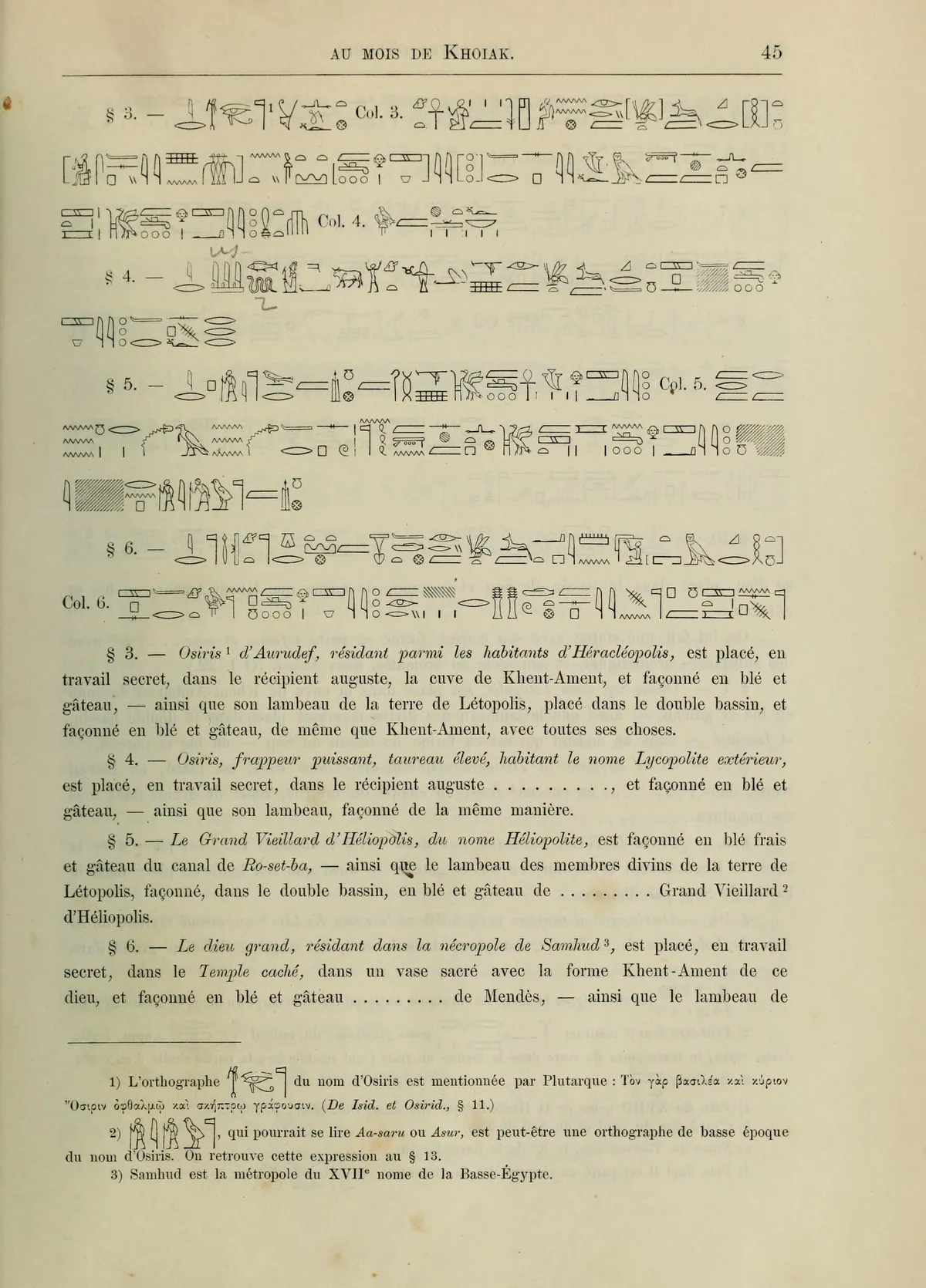
§ 3. — Osiris of Aurudef, dwelling among the inhabitants of Heracleopolis, is placed, in secret work, in the august vessel, the vat of Khent-Ament, and fashioned of grain and cake, together with his shred from the land of Letopolis, placed in the double basin and fashioned of grain and cake, like Khent-Ament, with all his things.
Note on line s03
Loret’s note 1, on the spelling of the name Osiris, which Plutarch mentions: “For the king and lord Osiris they write with an eye and a sceptre” (De Iside et Osiride 11). - s0445
§ 4. — Osiris, frappeur puissant, taureau élevé, habitant le nome Lycopolite extérieur, est placé, en travail secret, dans le récipient auguste [ . . . ], et façonné en blé et gâteau, — ainsi que son lambeau, façonné de la même manière.
§ 4. — Osiris, mighty striker, raised bull, dwelling in the outer Lycopolite nome, is placed, in secret work, in the august vessel [ . . . ], and fashioned of grain and cake, together with his shred, fashioned in the same manner.
- s0545
§ 5. — Le Grand Vieillard d'Héliopolis, du nome Héliopolite, est façonné en blé frais et gâteau du canal de Ro-set-ba, — ainsi que le lambeau des membres divins de la terre de Létopolis, façonné, dans le double bassin, en blé et gâteau de [ . . . ] Grand Vieillard d'Héliopolis.
§ 5. — The Great Old Man of Heliopolis, of the Heliopolite nome, is fashioned of fresh grain and cake from the canal of Ro-set-ba, together with the shred of the divine members from the land of Letopolis, fashioned, in the double basin, of grain and cake of [ . . . ] Great Old Man of Heliopolis.
Note on line s05
Loret’s note 2: the group of signs after “Great Old Man”, which could be read Aa-saru or Asur, is perhaps a late spelling of the name of Osiris. The expression recurs in § 13. - s0645
§ 6. — Le dieu grand, résidant dans la nécropole de Samhud, est placé, en travail secret, dans le Temple caché, dans un vase sacré avec la forme Khent-Ament de ce dieu, et façonné en blé et gâteau [ . . . ] de Mendès, — ainsi que le lambeau de
§ 6. — The great god, dwelling in the necropolis of Samhud, is placed, in secret work, in the Hidden Temple, in a sacred vessel with the Khent-Ament form of this god, and fashioned of grain and cake [ . . . ] of Mendes, together with the shred of
Note on line s06
Loret’s note 3: Samhud is the capital of the seventeenth nome of Lower Egypt. 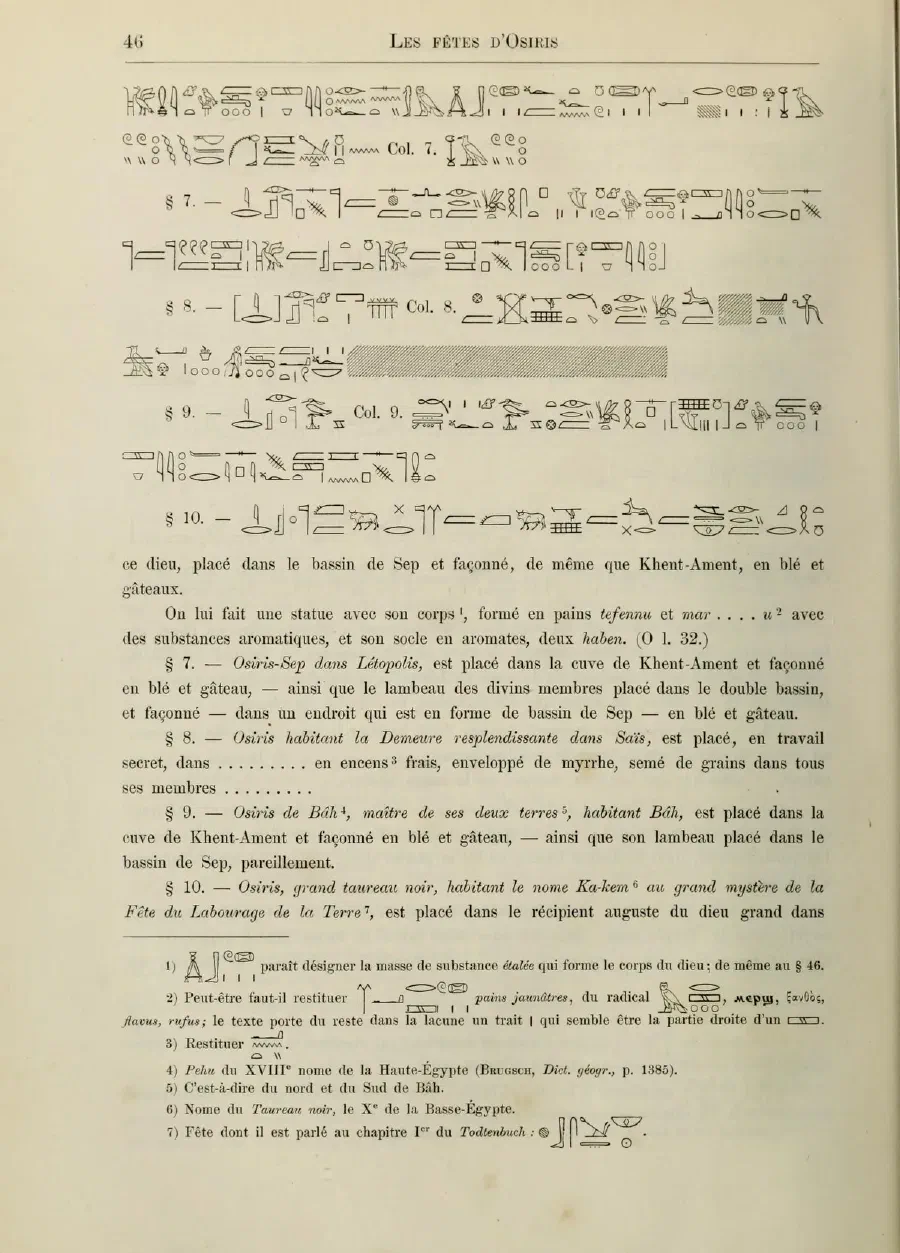
Page 46. p. 46: Osiris of Sais in incense and myrrh, 'sown with grain in all his members'; the Black Bull of Ka-kem Recueil de travaux III, IV and V (archive.org scans) - s06b46
ce dieu, placé dans le bassin de Sep et façonné, de même que Khent-Ament, en blé et gâteaux. On lui fait une statue avec son corps, formé en pains tefennu et mar . . . . u avec des substances aromatiques, et son socle en aromates, deux haben. (0 l. 32.)
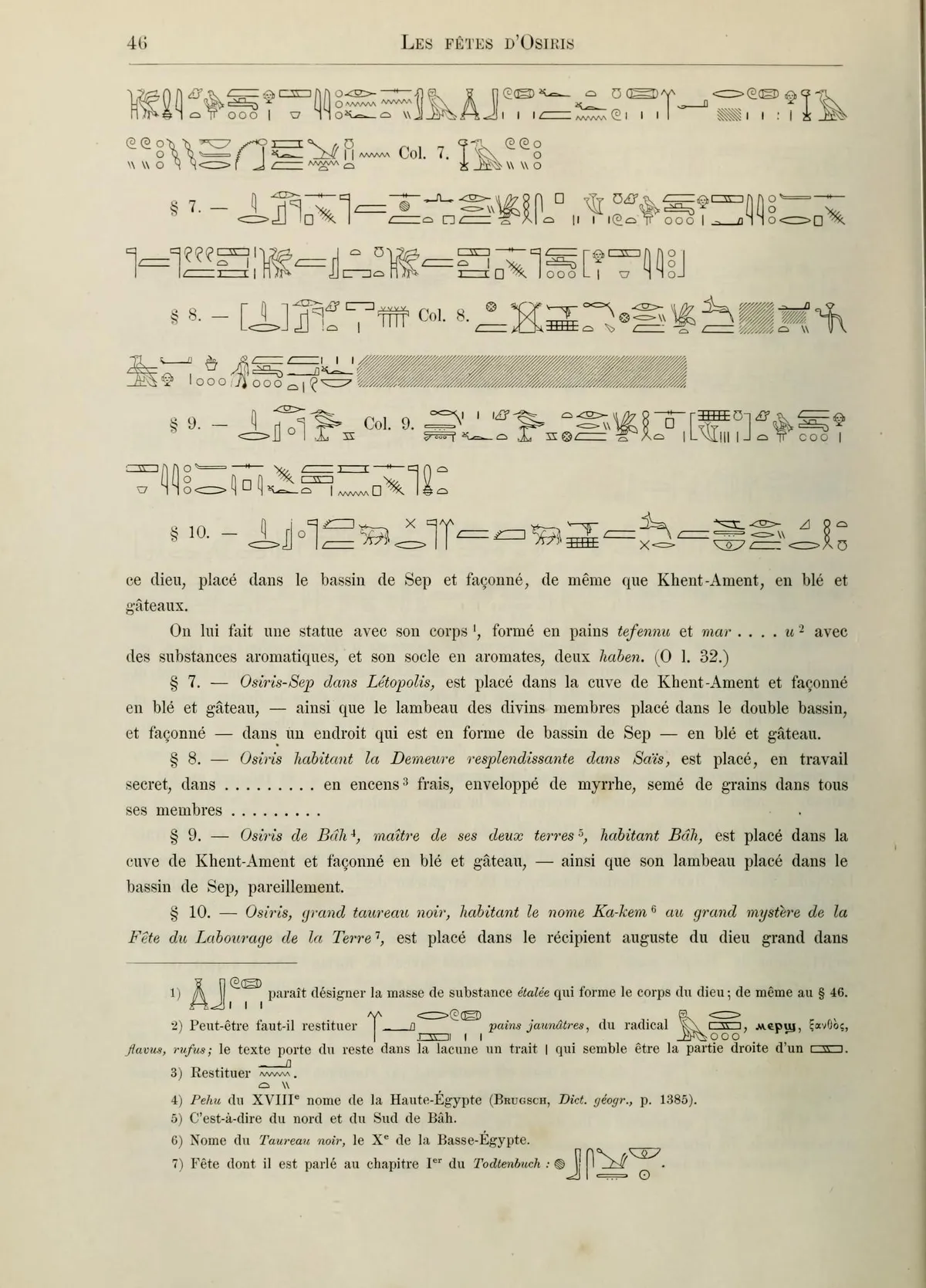
this god, placed in the basin of Sep and fashioned, like Khent-Ament, of grain and cakes. A statue is made for him with his body, formed of tefennu and mar . . . . u breads with aromatic substances, and his base of aromatics, two haben (0.32 litre).
Note on line s06b
Loret’s notes. (1) The word for body seems to designate the spread-out mass of substance that forms the body of the god; likewise in § 46. (2) Perhaps restore “yellowish breads”, from a root meaning yellow, red (Latin flavus, rufus); the text carries, in the lacuna, a stroke that seems to be the right-hand part of a sign. - s0746
§ 7. — Osiris-Sep dans Létopolis, est placé dans la cuve de Khent-Ament et façonné en blé et gâteau, — ainsi que le lambeau des divins membres placé dans le double bassin, et façonné — dans un endroit qui est en forme de bassin de Sep — en blé et gâteau.
§ 7. — Osiris-Sep in Letopolis is placed in the vat of Khent-Ament and fashioned of grain and cake, together with the shred of the divine members placed in the double basin, and fashioned, in a place that is in the form of a basin of Sep, of grain and cake.
- s0846
§ 8. — Osiris habitant la Demeure resplendissante dans Saïs, est placé, en travail secret, dans [ . . . ] en encens frais, enveloppé de myrrhe, semé de grains dans tous ses membres [ . . . ].
§ 8. — Osiris dwelling in the Resplendent Dwelling in Sais is placed, in secret work, in [ . . . ] in fresh incense, wrapped in myrrh, sown with grain in all his members [ . . . ].
- s0946
§ 9. — Osiris de Bâh, maître de ses deux terres, habitant Bâh, est placé dans la cuve de Khent-Ament et façonné en blé et gâteau, — ainsi que son lambeau placé dans le bassin de Sep, pareillement.
§ 9. — Osiris of Bah, master of his two lands, dwelling in Bah, is placed in the vat of Khent-Ament and fashioned of grain and cake, together with his shred placed in the basin of Sep, likewise.
Note on line s09
Loret’s notes. Bah is Pehu of the eighteenth nome of Upper Egypt (Brugsch, Dictionnaire géographique, p. 1385); “his two lands” means the north and the south of Bah. - s1046
§ 10. — Osiris, grand taureau noir, habitant le nome Ka-kem au grand mystère de la Fête du Labourage de la Terre, est placé dans le récipient auguste du dieu grand dans
§ 10. — Osiris, great black bull, dwelling in the nome Ka-kem at the great mystery of the Feast of the Ploughing of the Earth, is placed in the august vessel of the great god in
Note on line s10
Loret’s notes: Ka-kem is the nome of the Black Bull, the tenth of Lower Egypt; the Feast of the Ploughing of the Earth is the feast spoken of in chapter I of the Book of the Dead. 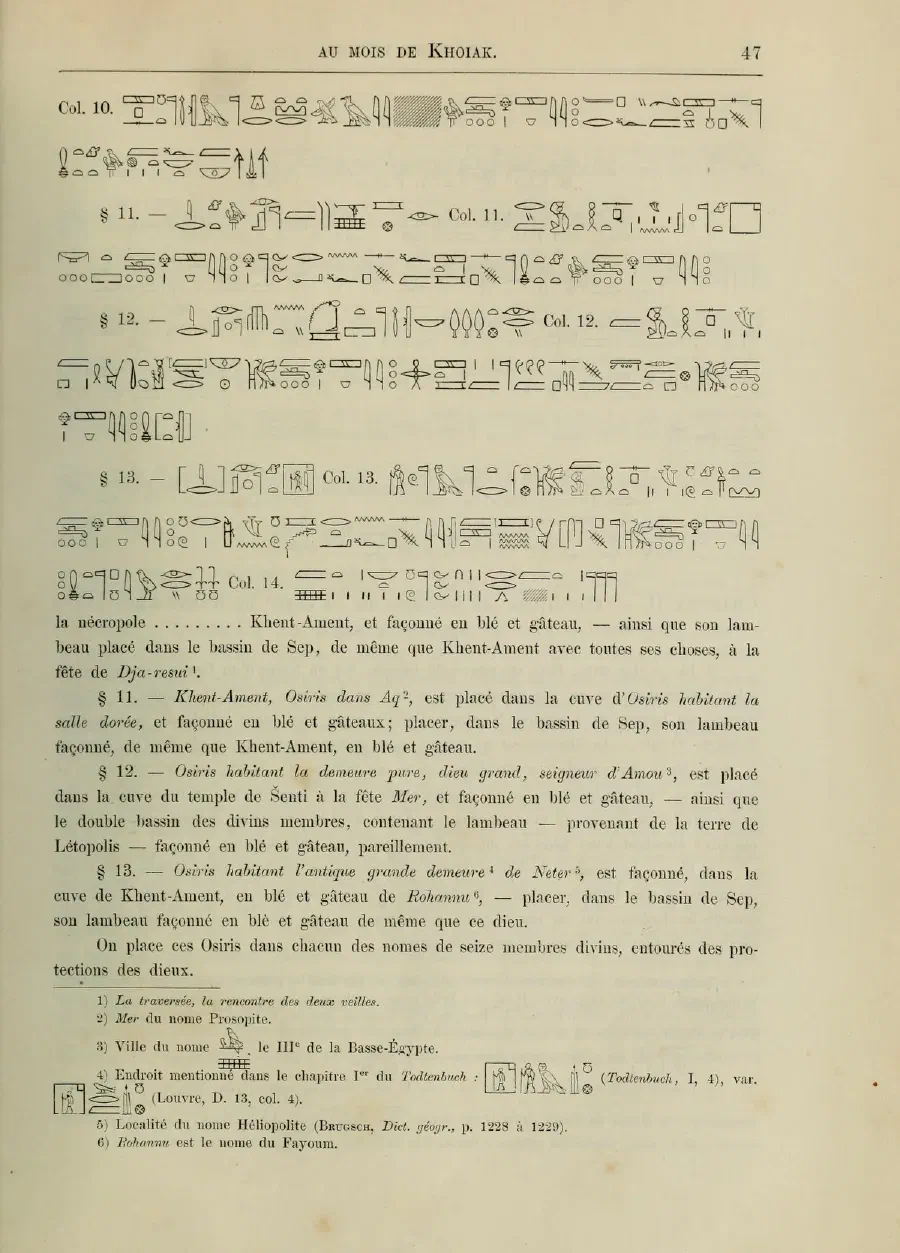
Page 47. p. 47: The Osirises of Aq, Amou and Neter; the end of Chapter I Recueil de travaux III, IV and V (archive.org scans) - s10b47
la nécropole [ . . . ] Khent-Ament, et façonné en blé et gâteau, — ainsi que son lambeau placé dans le bassin de Sep, de même que Khent-Ament avec toutes ses choses, à la fête de Dja-resui.
the necropolis [ . . . ] Khent-Ament, and fashioned of grain and cake, together with his shred placed in the basin of Sep, like Khent-Ament with all his things, at the feast of Dja-resui.
Note on line s10b
Loret’s note 1: Dja-resui is “the crossing, the meeting of the two vigils”. - s1147
§ 11. — Khent-Ament, Osiris dans Aq, est placé dans la cuve d'Osiris habitant la salle dorée, et façonné en blé et gâteaux ; placer, dans le bassin de Sep, son lambeau façonné, de même que Khent-Ament, en blé et gâteau.
§ 11. — Khent-Ament, Osiris in Aq, is placed in the vat of Osiris dwelling in the golden hall, and fashioned of grain and cakes; place, in the basin of Sep, his shred, fashioned like Khent-Ament of grain and cake.
Note on line s11
Loret’s note 2 on Aq reads “Mer du nome Prosopite”, that is Mer of the Prosopite nome. - s1247
§ 12. — Osiris habitant la demeure pure, dieu grand, seigneur d'Amou, est placé dans la cuve du temple de Senti à la fête Mer, et façonné en blé et gâteau, — ainsi que le double bassin des divins membres, contenant le lambeau — provenant de la terre de Létopolis — façonné en blé et gâteau, pareillement.
§ 12. — Osiris dwelling in the pure dwelling, great god, lord of Amou, is placed in the vat of the temple of Senti at the feast of Mer, and fashioned of grain and cake, together with the double basin of the divine members, containing the shred, from the land of Letopolis, fashioned of grain and cake, likewise.
Note on line s12
Loret’s note 3: Amou is a city of the third nome of Lower Egypt. - s1347
§ 13. — Osiris habitant l'antique grande demeure de Neter, est façonné, dans la cuve de Khent-Ament, en blé et gâteau de Rohannu, — placer, dans le bassin de Sep, son lambeau façonné en blé et gâteau de même que ce dieu.
§ 13. — Osiris dwelling in the ancient great dwelling of Neter is fashioned, in the vat of Khent-Ament, of grain and cake of Rohannu; place, in the basin of Sep, his shred, fashioned of grain and cake like this god.
Note on line s13
Loret’s notes. (4) The “ancient great dwelling” is a place named in chapter I of the Book of the Dead (I, 4; Louvre D. 13, col. 4). (5) Neter is a locality of the Heliopolite nome (Brugsch, Dictionnaire géographique, pp. 1228-1229). (6) Rohannu is the nome of the Fayum. - s13b47
On place ces Osiris dans chacun des nomes de seize membres divins, entourés des protections des dieux.
These Osirises are placed in each of the nomes of sixteen divine members, surrounded by the protections of the gods.
Chapter II
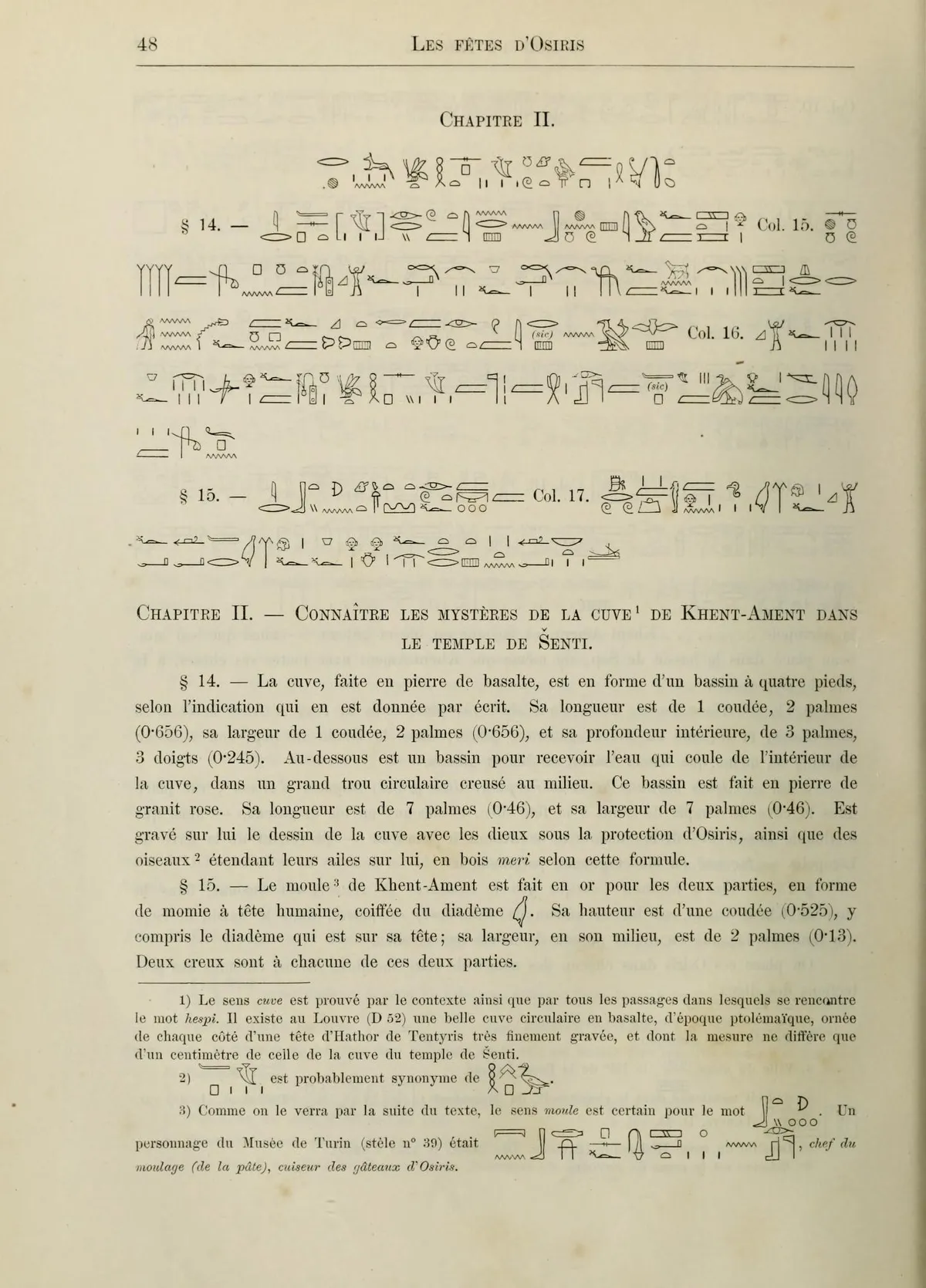
Page 48. p. 48: Chapter II: the basalt vat and the gold mould of Khent-Ament, with measures Recueil de travaux III, IV and V (archive.org scans) - ch248
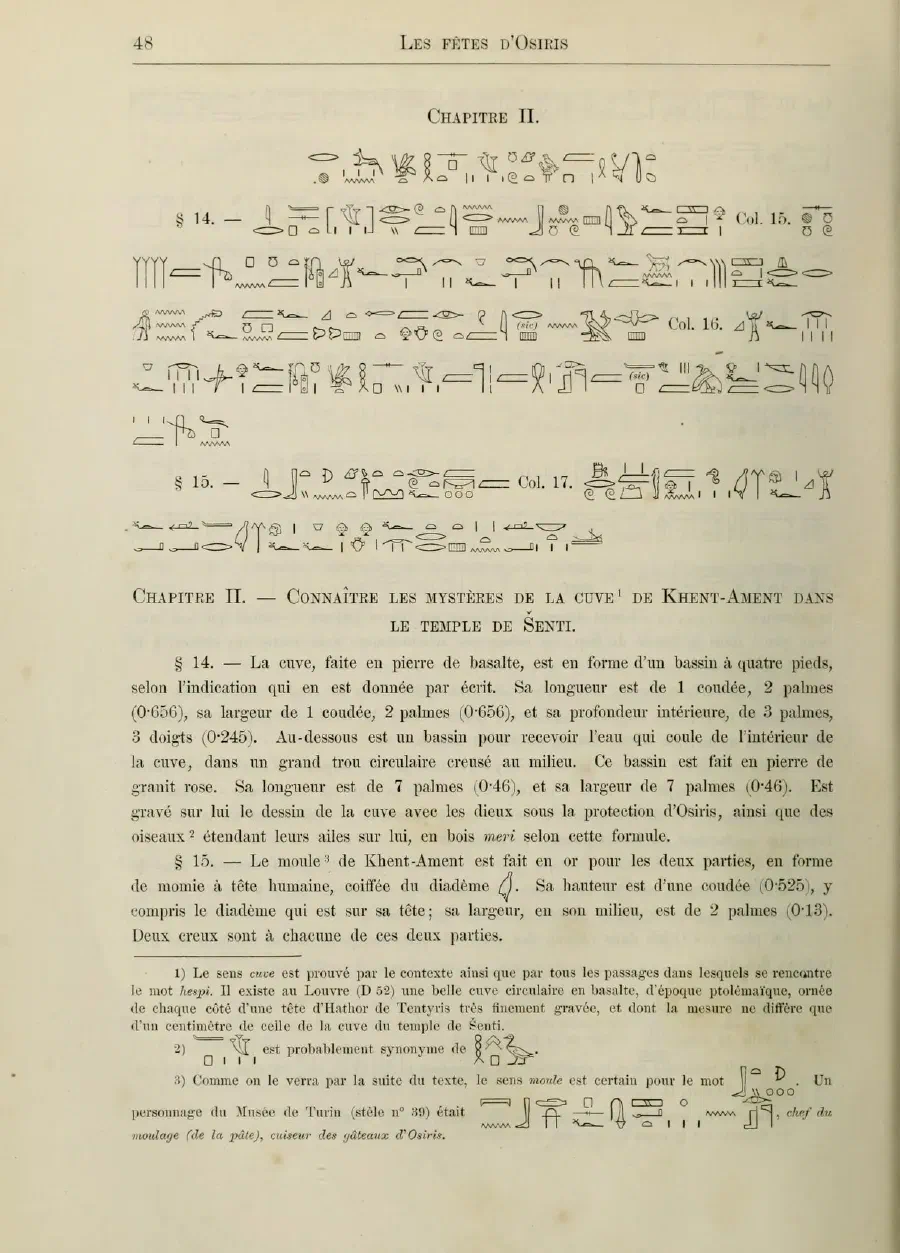
Chapitre II. — Connaître les mystères de la cuve de Khent-Ament dans le temple de Senti.
Chapter II. — To know the mysteries of the vat of Khent-Ament in the temple of Senti.
- s1448
§ 14. — La cuve, faite en pierre de basalte, est en forme d'un bassin à quatre pieds, selon l'indication qui en est donnée par écrit. Sa longueur est de 1 coudée, 2 palmes (0.656), sa largeur de 1 coudée, 2 palmes (0.656), et sa profondeur intérieure, de 3 palmes, 3 doigts (0.245). Au-dessous est un bassin pour recevoir l'eau qui coule de l'intérieur de la cuve, dans un grand trou circulaire creusé au milieu. Ce bassin est fait en pierre de granit rose. Sa longueur est de 7 palmes (0.46), et sa largeur de 7 palmes (0.46). Est gravé sur lui le dessin de la cuve avec les dieux sous la protection d'Osiris, ainsi que des oiseaux étendant leurs ailes sur lui, en bois meri selon cette formule.
§ 14. — The vat, made of basalt stone, is in the form of a four-footed basin, according to the indication given of it in writing. Its length is 1 cubit, 2 palms (0.656), its width 1 cubit, 2 palms (0.656), and its interior depth 3 palms, 3 fingers (0.245). Beneath it is a basin to receive the water that runs from the inside of the vat, through a large circular hole hollowed out in the middle. This basin is made of rose granite stone. Its length is 7 palms (0.46) and its width 7 palms (0.46). Engraved on it is the drawing of the vat with the gods under the protection of Osiris, as well as birds spreading their wings over him, in meri wood, according to this formula.
Note on line s14
The figures in brackets are metres, as Loret gives them. His note 1: the sense vat is proved by the context and by all the passages in which the word hespi occurs; in the Louvre (D 52) there is a fine circular vat of basalt, of the Ptolemaic period, ornamented on each side with a finely engraved head of Hathor of Tentyris, whose measure differs by only a centimetre from that of the vat of the temple of Senti. Note 2 (the word for birds) says only that it is probably a synonym of another word, given in hieroglyphs. - s1548
§ 15. — Le moule de Khent-Ament est fait en or pour les deux parties, en forme de momie à tête humaine, coiffée du diadème [signe]. Sa hauteur est d'une coudée (0.525), y compris le diadème qui est sur sa tête ; sa largeur, en son milieu, est de 2 palmes (0.13). Deux creux sont à chacune de ces deux parties.
§ 15. — The mould of Khent-Ament is made of gold for the two parts, in the form of a mummy with a human head, crowned with the diadem [sign]. Its height is one cubit (0.525), including the diadem that is on its head; its width, in the middle, is 2 palms (0.13). Two hollows are in each of these two parts.
Note on line s15
Loret’s note 3: as will be seen further on in the text, the sense mould is certain for this word. A person in the Turin Museum (stele no. 39) was “chief of the moulding (of the paste), baker of the cakes of Osiris”. 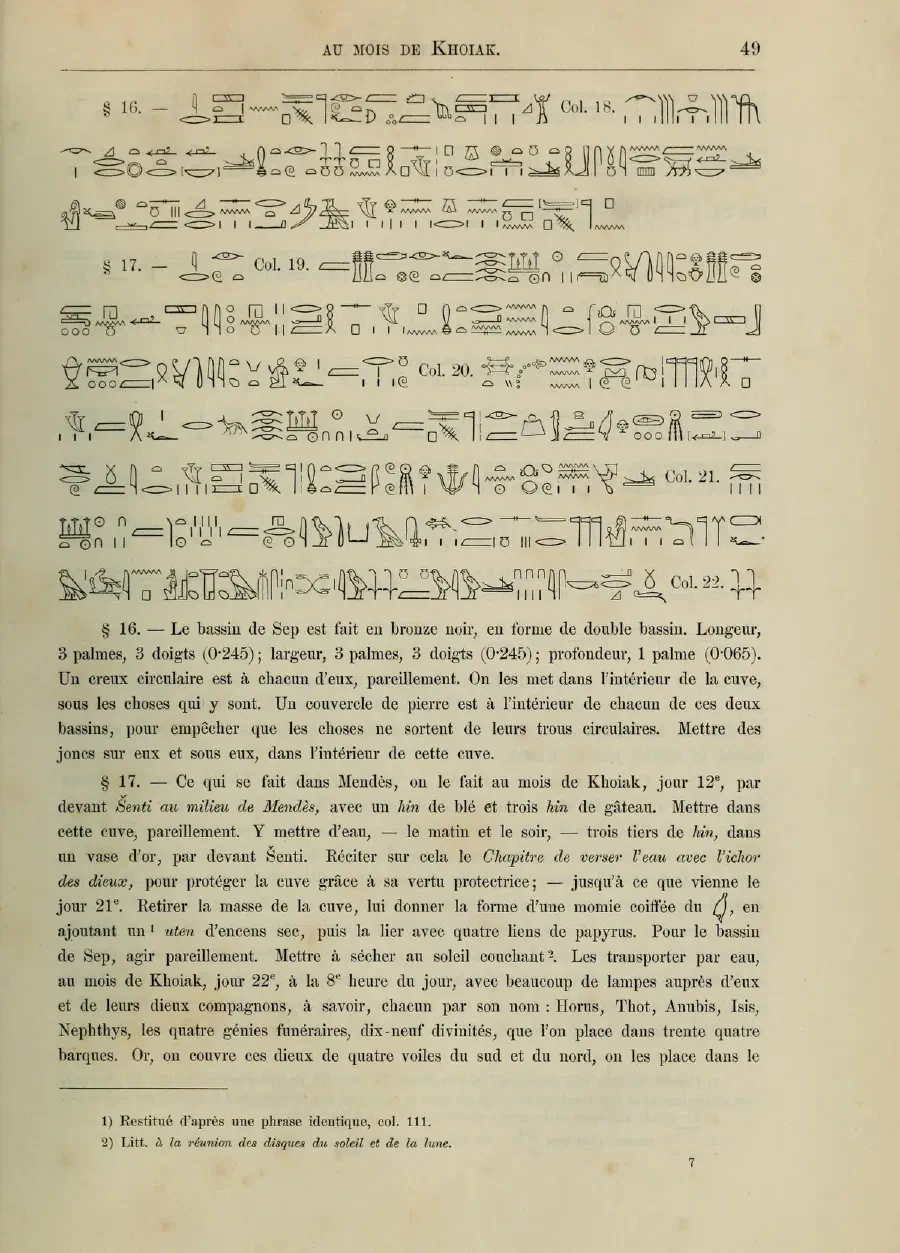
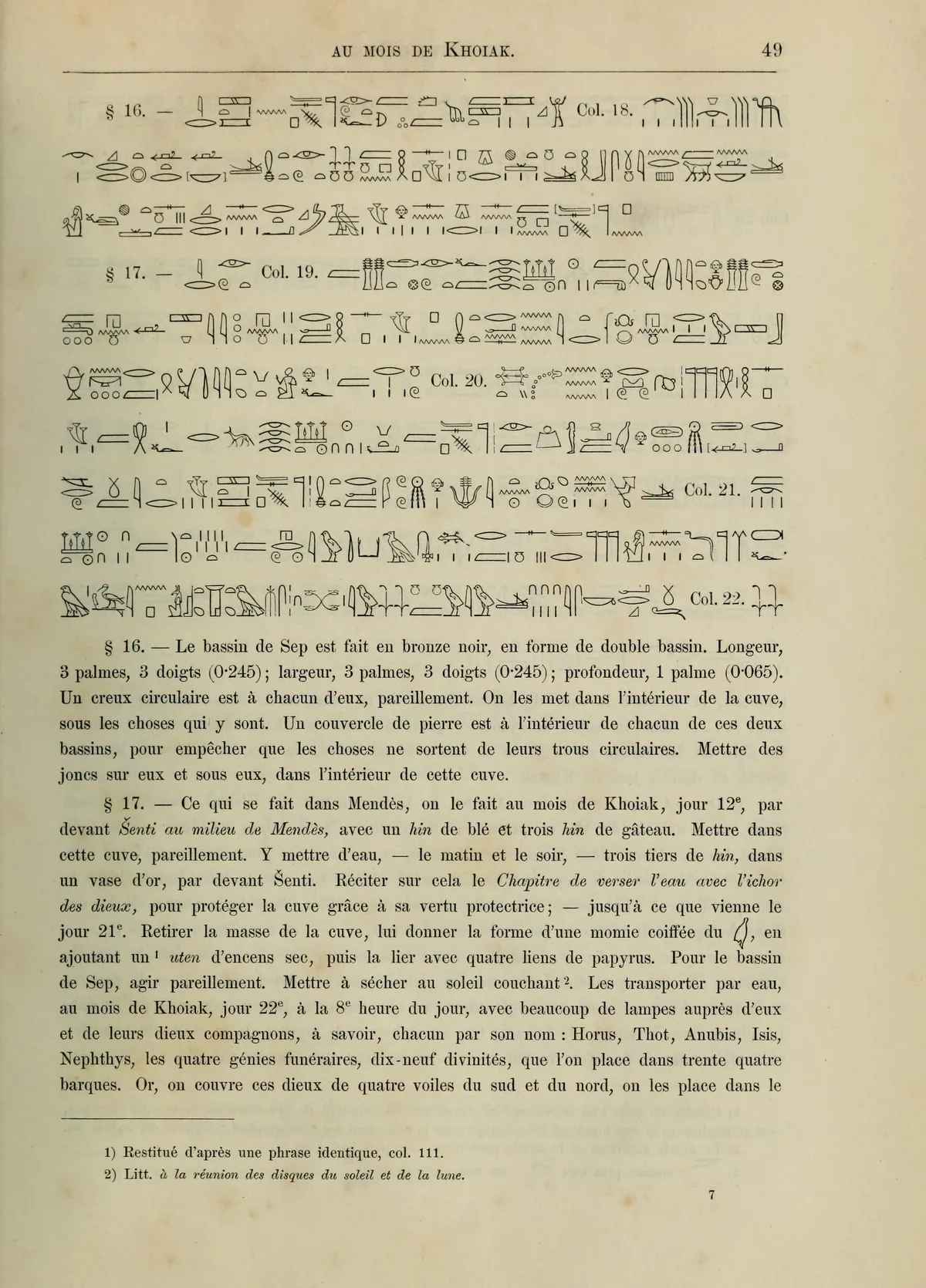
Page 49. p. 49: The bronze basin of Sep; the Khoiak rite at Mendes, day 12 to the last day, with the barques and lamps of day 22 Recueil de travaux III, IV and V (archive.org scans) - s1649
§ 16. — Le bassin de Sep est fait en bronze noir, en forme de double bassin. Longueur, 3 palmes, 3 doigts (0.245) ; largeur, 3 palmes, 3 doigts (0.245) ; profondeur, 1 palme (0.065). Un creux circulaire est à chacun d'eux, pareillement. On les met dans l'intérieur de la cuve, sous les choses qui y sont. Un couvercle de pierre est à l'intérieur de chacun de ces deux bassins, pour empêcher que les choses ne sortent de leurs trous circulaires. Mettre des joncs sur eux et sous eux, dans l'intérieur de cette cuve.
§ 16. — The basin of Sep is made of black bronze, in the form of a double basin. Length, 3 palms, 3 fingers (0.245); width, 3 palms, 3 fingers (0.245); depth, 1 palm (0.065). A circular hollow is in each of them, likewise. They are put inside the vat, under the things that are in it. A stone lid is inside each of these two basins, to prevent the things from coming out of their circular holes. Put rushes over them and under them, inside this vat.
- s1749
§ 17. — Ce qui se fait dans Mendès, on le fait au mois de Khoiak, jour 12e, par devant Senti au milieu de Mendès, avec un hin de blé et trois hin de gâteau. Mettre dans cette cuve, pareillement. Y mettre d'eau, — le matin et le soir, — trois tiers de hin, dans un vase d'or, par devant Senti. Réciter sur cela le Chapitre de verser l'eau avec l'ichor des dieux, pour protéger la cuve grâce à sa vertu protectrice ; — jusqu'à ce que vienne le jour 21e. Retirer la masse de la cuve, lui donner la forme d'une momie coiffée du [signe], en ajoutant un uten d'encens sec, puis la lier avec quatre liens de papyrus. Pour le bassin de Sep, agir pareillement. Mettre à sécher au soleil couchant. Les transporter par eau, au mois de Khoiak, jour 22e, à la 8e heure du jour, avec beaucoup de lampes auprès d'eux et de leurs dieux compagnons, à savoir, chacun par son nom : Horus, Thot, Anubis, Isis, Nephthys, les quatre génies funéraires, dix-neuf divinités, que l'on place dans trente-quatre barques. Or, on couvre ces dieux de quatre voiles du sud et du nord, on les place dans le
§ 17. — What is done in Mendes is done in the month of Khoiak, day 12, before Senti in the middle of Mendes, with one hin of grain and three hin of cake. Put into this vat, likewise. Put into it water, morning and evening, three thirds of a hin, in a golden vase, before Senti. Recite over it the Chapter of pouring out the water with the ichor of the gods, to protect the vat by its protective virtue; until the 21st day comes. Take the mass out of the vat, give it the form of a mummy crowned with the [sign], adding one uten of dry incense, then bind it with four bands of papyrus. For the basin of Sep, do likewise. Put it to dry at sunset. Carry them by water, in the month of Khoiak, day 22, at the 8th hour of the day, with many lamps beside them and their companion gods, namely, each by his name: Horus, Thoth, Anubis, Isis, Nephthys, the four funerary genii, nineteen divinities, whom one places in thirty-four barques. Now one covers these gods with four veils of the south and the north, one places them in the
Note on line s17
Loret’s notes. (1) The word “one” (un) before uten is restored from an identical phrase at col. 111. (2) “At sunset” is, literally, “at the meeting of the discs of the sun and the moon”. 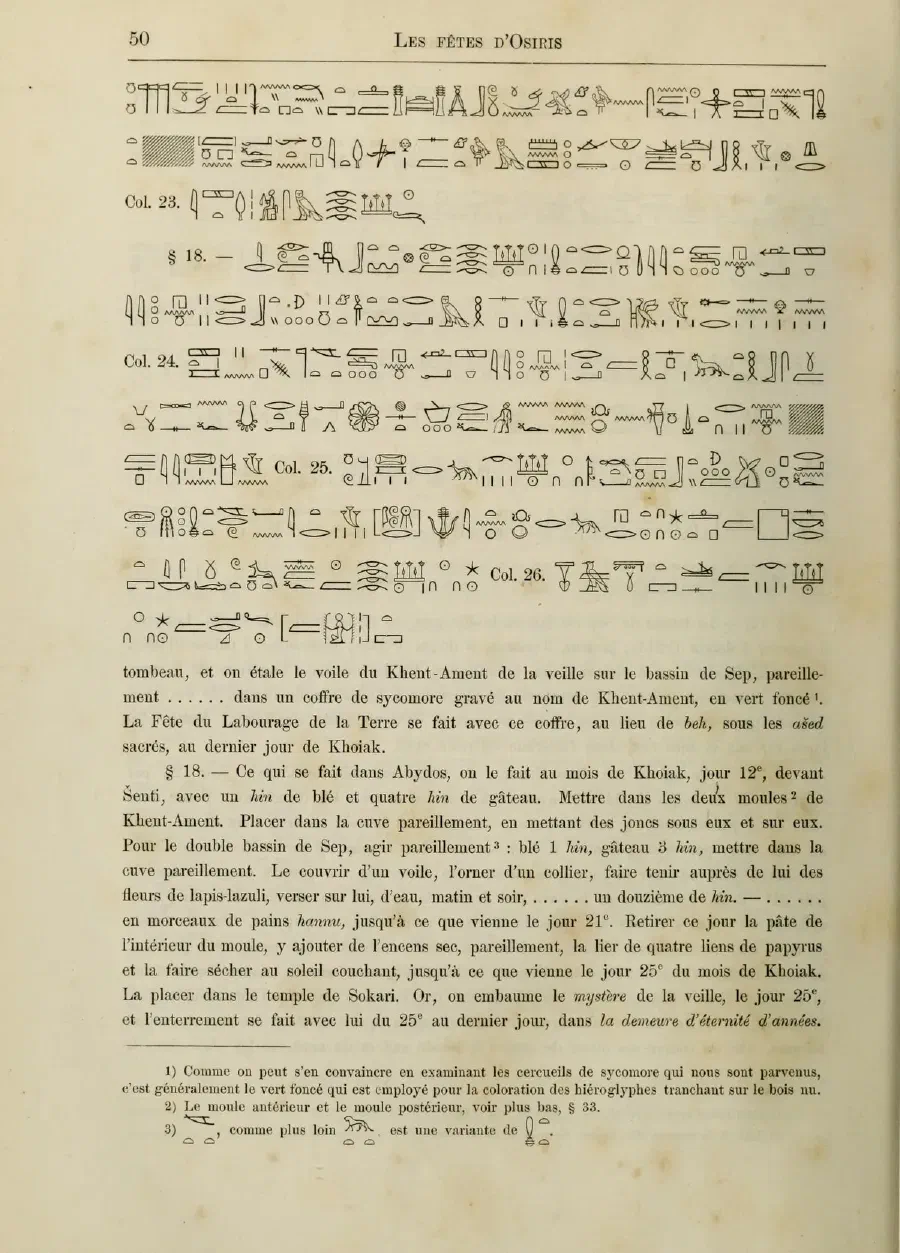
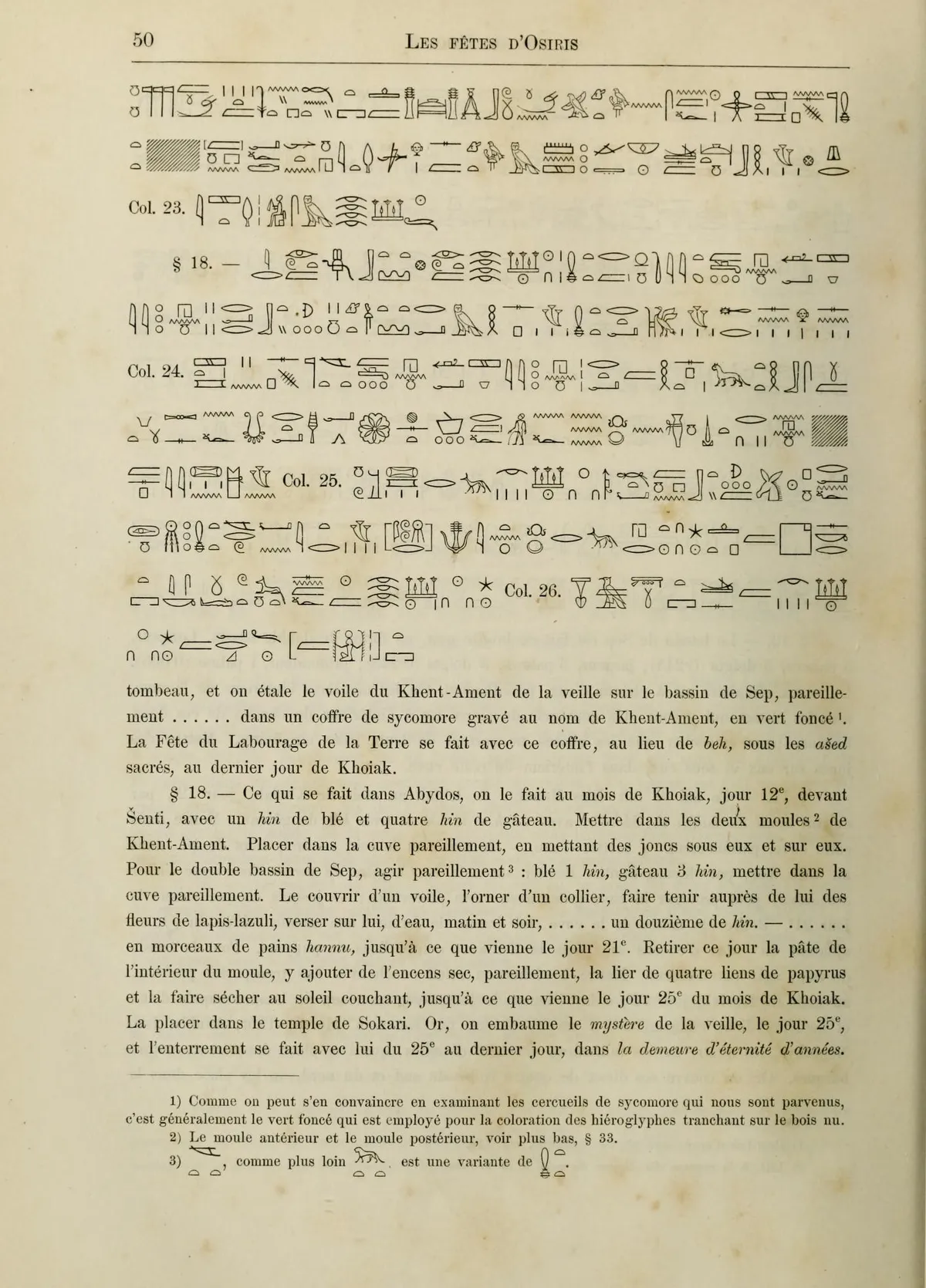
Page 50. p. 50: The rite at Abydos: grain and cake, rushes, water morning and evening, drying at sunset, burial on the last day Recueil de travaux III, IV and V (archive.org scans) - s17b50
tombeau, et on étale le voile du Khent-Ament de la veille sur le bassin de Sep, pareillement [ . . . ] dans un coffre de sycomore gravé au nom de Khent-Ament, en vert foncé. La Fête du Labourage de la Terre se fait avec ce coffre, au lieu de beh, sous les ased sacrés, au dernier jour de Khoiak.
tomb, and one spreads the veil of Khent-Ament of the day before over the basin of Sep, likewise [ . . . ] in a sycamore chest engraved with the name of Khent-Ament, in dark green. The Feast of the Ploughing of the Earth is held with this chest, in the place of beh, under the sacred ased, on the last day of Khoiak.
Note on line s17b
Loret’s note 1: as one can convince oneself by examining the sycamore coffins that have come down to us, it is generally dark green that is used to colour the hieroglyphs that stand out against the bare wood. - s1850
§ 18. — Ce qui se fait dans Abydos, on le fait au mois de Khoiak, jour 12e, devant Senti, avec un hin de blé et quatre hin de gâteau. Mettre dans les deux moules de Khent-Ament. Placer dans la cuve pareillement, en mettant des joncs sous eux et sur eux. Pour le double bassin de Sep, agir pareillement : blé 1 hin, gâteau 3 hin, mettre dans la cuve pareillement. Le couvrir d'un voile, l'orner d'un collier, faire tenir auprès de lui des fleurs de lapis-lazuli, verser sur lui, d'eau, matin et soir, [ . . . ] un douzième de hin. — [ . . . ] en morceaux de pains hannu, jusqu'à ce que vienne le jour 21e. Retirer ce jour la pâte de l'intérieur du moule, y ajouter de l'encens sec, pareillement, la lier de quatre liens de papyrus et la faire sécher au soleil couchant, jusqu'à ce que vienne le jour 25e du mois de Khoiak. La placer dans le temple de Sokari. Or, on embaume le mystère de la veille, le jour 25e, et l'enterrement se fait avec lui du 25e au dernier jour, dans la demeure d'éternité d'années.
§ 18. — What is done in Abydos is done in the month of Khoiak, day 12, before Senti, with one hin of grain and four hin of cake. Put into the two moulds of Khent-Ament. Place in the vat likewise, putting rushes under them and over them. For the double basin of Sep, do likewise: grain 1 hin, cake 3 hin; put in the vat likewise. Cover it with a veil, adorn it with a collar, have flowers of lapis lazuli stand beside it, pour water over it, morning and evening, [ . . . ] one twelfth of a hin. [ . . . ] in pieces of hannu breads, until the 21st day comes. On that day take the paste out of the mould, add dry incense to it, likewise, bind it with four bands of papyrus and have it dry at sunset, until the 25th day of the month of Khoiak comes. Place it in the temple of Sokari. Now one embalms the mystery of the day before, on the 25th day, and the burial is done with it from the 25th to the last day, in the dwelling of eternity of years.
Note on line s18
Loret’s note 2: the front mould and the rear mould; see § 33 below. (Note 3 is about a variant spelling of the word for likewise.) 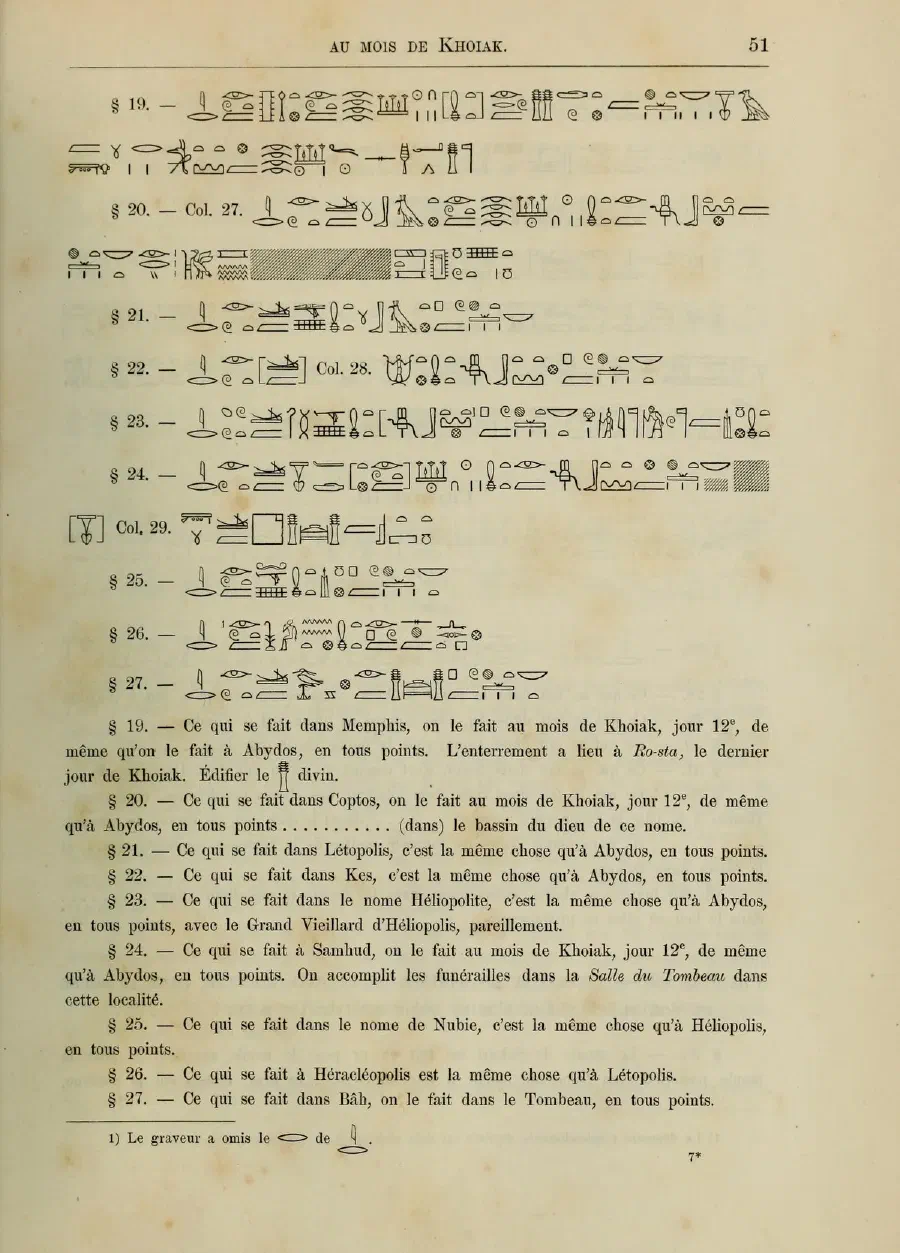
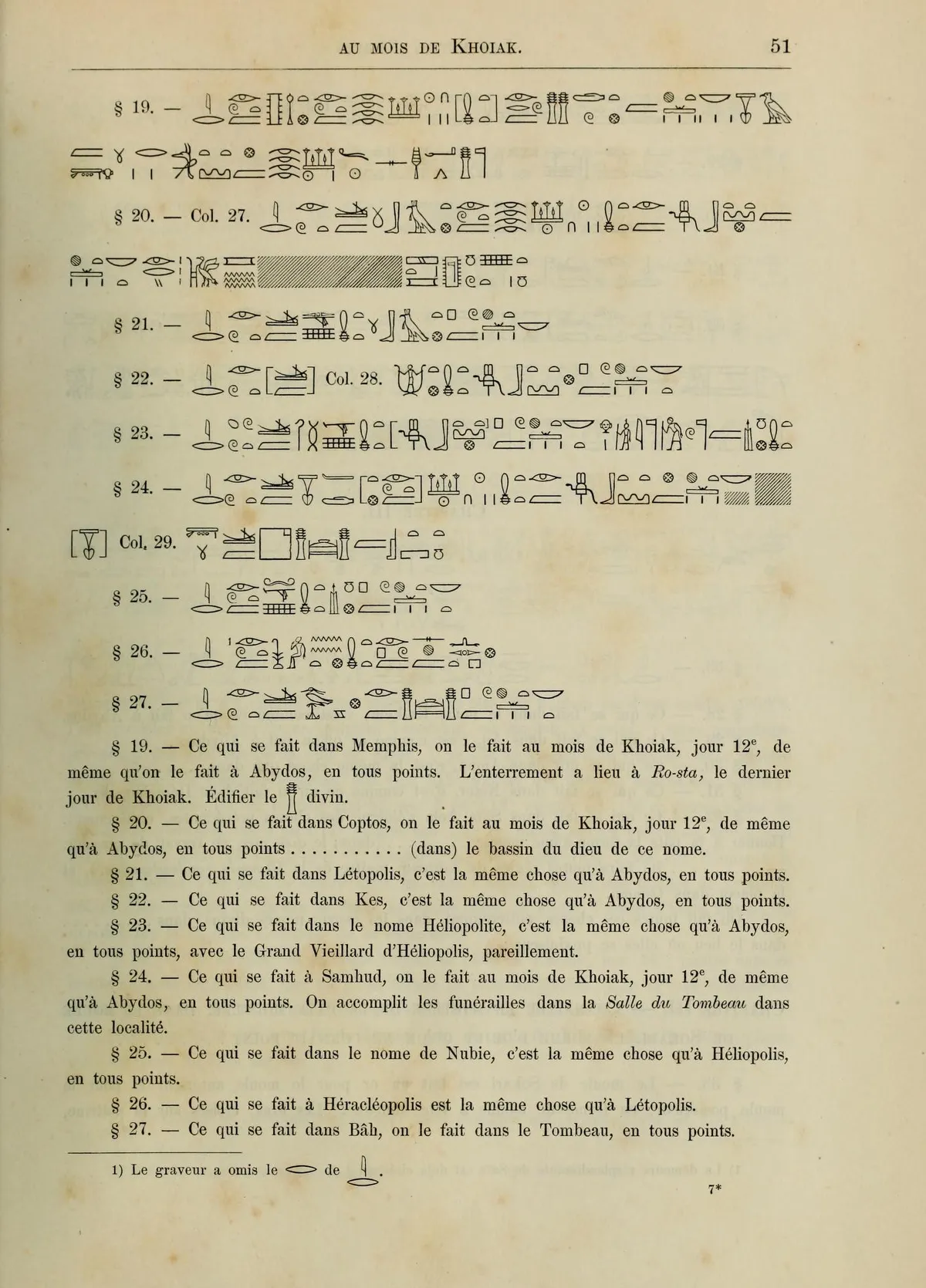
Page 51. p. 51: The same rite at Memphis, Coptos, Letopolis, Kes, Heliopolis, Samhud, Nubia, Heracleopolis and Bah Recueil de travaux III, IV and V (archive.org scans) - s1951
§ 19. — Ce qui se fait dans Memphis, on le fait au mois de Khoiak, jour 12e, de même qu'on le fait à Abydos, en tous points. L'enterrement a lieu à Ro-sta, le dernier jour de Khoiak. Édifier le [signe] divin.
§ 19. — What is done in Memphis is done in the month of Khoiak, day 12, in the same way as it is done at Abydos, in all points. The burial takes place at Ro-sta, on the last day of Khoiak. Erect the divine [sign].
- s2051
§ 20. — Ce qui se fait dans Coptos, on le fait au mois de Khoiak, jour 12e, de même qu'à Abydos, en tous points [ . . . ] (dans) le bassin du dieu de ce nome.
§ 20. — What is done in Coptos is done in the month of Khoiak, day 12, the same as at Abydos, in all points [ . . . ] (in) the basin of the god of that nome.
Note on line s20
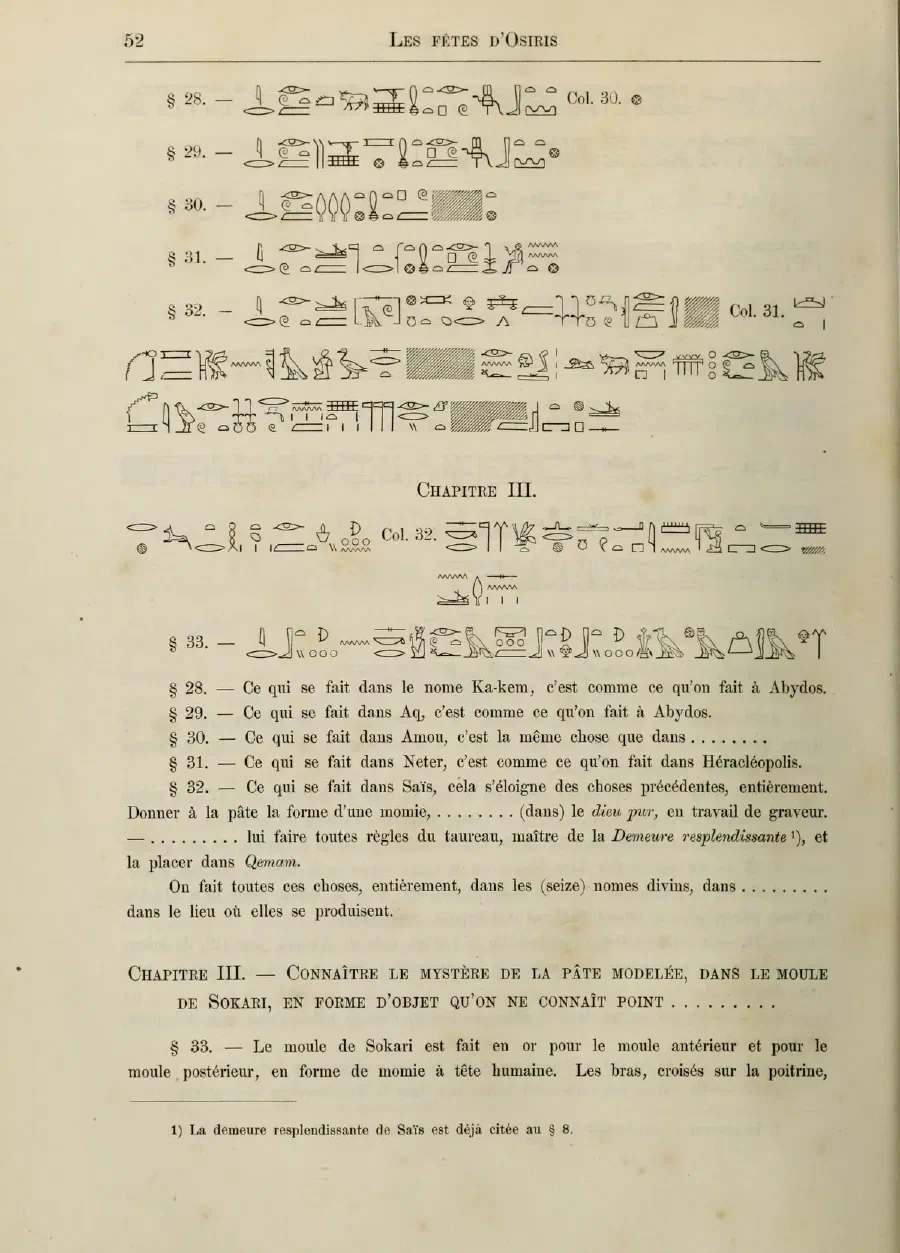
Loret’s note 1 (p. 51): the engraver omitted one sign of a word in this section; the signs themselves are on the page scan. - s2151
§ 21. — Ce qui se fait dans Létopolis, c'est la même chose qu'à Abydos, en tous points.
§ 21. — What is done in Letopolis is the same thing as at Abydos, in all points.
- s2251
§ 22. — Ce qui se fait dans Kes, c'est la même chose qu'à Abydos, en tous points.
§ 22. — What is done in Kes is the same thing as at Abydos, in all points.
- s2351
§ 23. — Ce qui se fait dans le nome Héliopolite, c'est la même chose qu'à Abydos, en tous points, avec le Grand Vieillard d'Héliopolis, pareillement.
§ 23. — What is done in the Heliopolite nome is the same thing as at Abydos, in all points, with the Great Old Man of Heliopolis, likewise.
- s2451
§ 24. — Ce qui se fait à Samhud, on le fait au mois de Khoiak, jour 12e, de même qu'à Abydos, en tous points. On accomplit les funérailles dans la Salle du Tombeau dans cette localité.
§ 24. — What is done at Samhud is done in the month of Khoiak, day 12, the same as at Abydos, in all points. The funeral rites are performed in the Hall of the Tomb in that locality.
- s2551
§ 25. — Ce qui se fait dans le nome de Nubie, c'est la même chose qu'à Héliopolis, en tous points.
§ 25. — What is done in the nome of Nubia is the same thing as at Heliopolis, in all points.
- s2651
§ 26. — Ce qui se fait à Héracléopolis est la même chose qu'à Létopolis.
§ 26. — What is done at Heracleopolis is the same thing as at Letopolis.
- s2751
§ 27. — Ce qui se fait dans Bâh, on le fait dans le Tombeau, en tous points.
§ 27. — What is done in Bah is done in the Tomb, in all points.
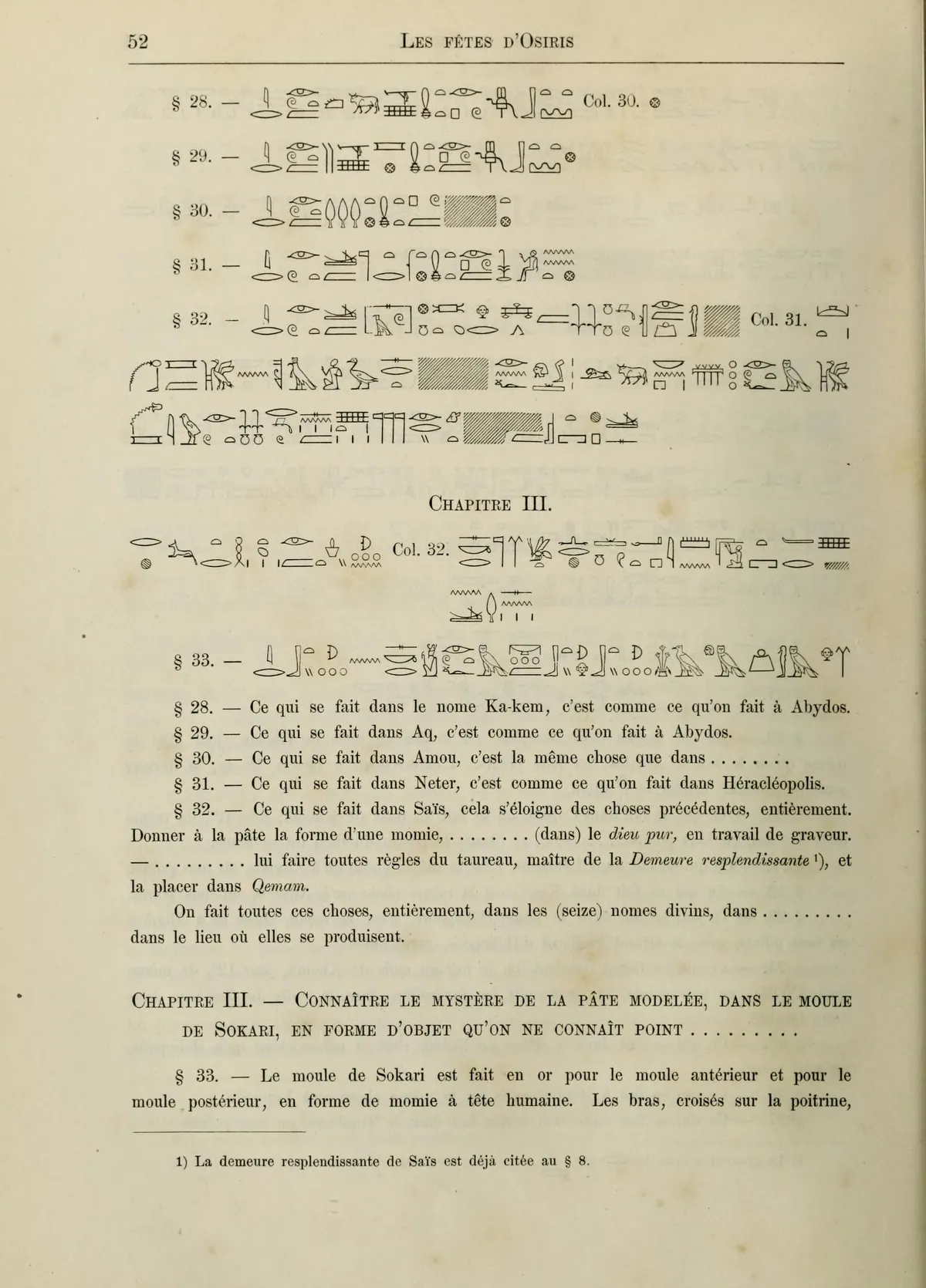
Page 52. p. 52: The rite at Sais departs from the others; Chapter III begins: the mould of Sokari Recueil de travaux III, IV and V (archive.org scans) - s2852
§ 28. — Ce qui se fait dans le nome Ka-kem, c'est comme ce qu'on fait à Abydos.
§ 28. — What is done in the nome of Ka-kem is like what is done at Abydos.
- s2952
§ 29. — Ce qui se fait dans Aq, c'est comme ce qu'on fait à Abydos.
§ 29. — What is done in Aq is like what is done at Abydos.
- s3052
§ 30. — Ce qui se fait dans Amou, c'est la même chose que dans [ . . . ].
§ 30. — What is done in Amou is the same thing as in [ . . . ].
- s3152
§ 31. — Ce qui se fait dans Neter, c'est comme ce qu'on fait dans Héracléopolis.
§ 31. — What is done in Neter is like what is done in Heracleopolis.
- s3252
§ 32. — Ce qui se fait dans Saïs, cela s'éloigne des choses précédentes, entièrement. Donner à la pâte la forme d'une momie, [ . . . ] (dans) le dieu pur, en travail de graveur. — [ . . . ] lui faire toutes règles du taureau, maître de la Demeure resplendissante, et la placer dans Qemam. On fait toutes ces choses, entièrement, dans les (seize) nomes divins, dans [ . . . ] dans le lieu où elles se produisent.
§ 32. — What is done in Sais departs entirely from the preceding things. Give the paste the form of a mummy, [ . . . ] (in) the pure god, in engraver's work. [ . . . ] make for it all the rules of the bull, lord of the Resplendent Dwelling, and place it in Qemam. All these things are done, entirely, in the (sixteen) divine nomes, in [ . . . ] in the place where they are produced.
Note on line s32
Loret’s note 1: the Resplendent Dwelling of Sais is already cited at § 8. “Rules” renders Loret’s règles; his “(sixteen)” is a restoration in brackets of his own. Chapter III
- ch352
Chapitre III. — Connaître le mystère de la pâte modelée, dans le moule de Sokari, en forme d'objet qu'on ne connaît point [ . . . ].
Chapter III. — To know the mystery of the modelled paste, in the mould of Sokari, in the form of an object that one does not know at all [ . . . ].
- s3352
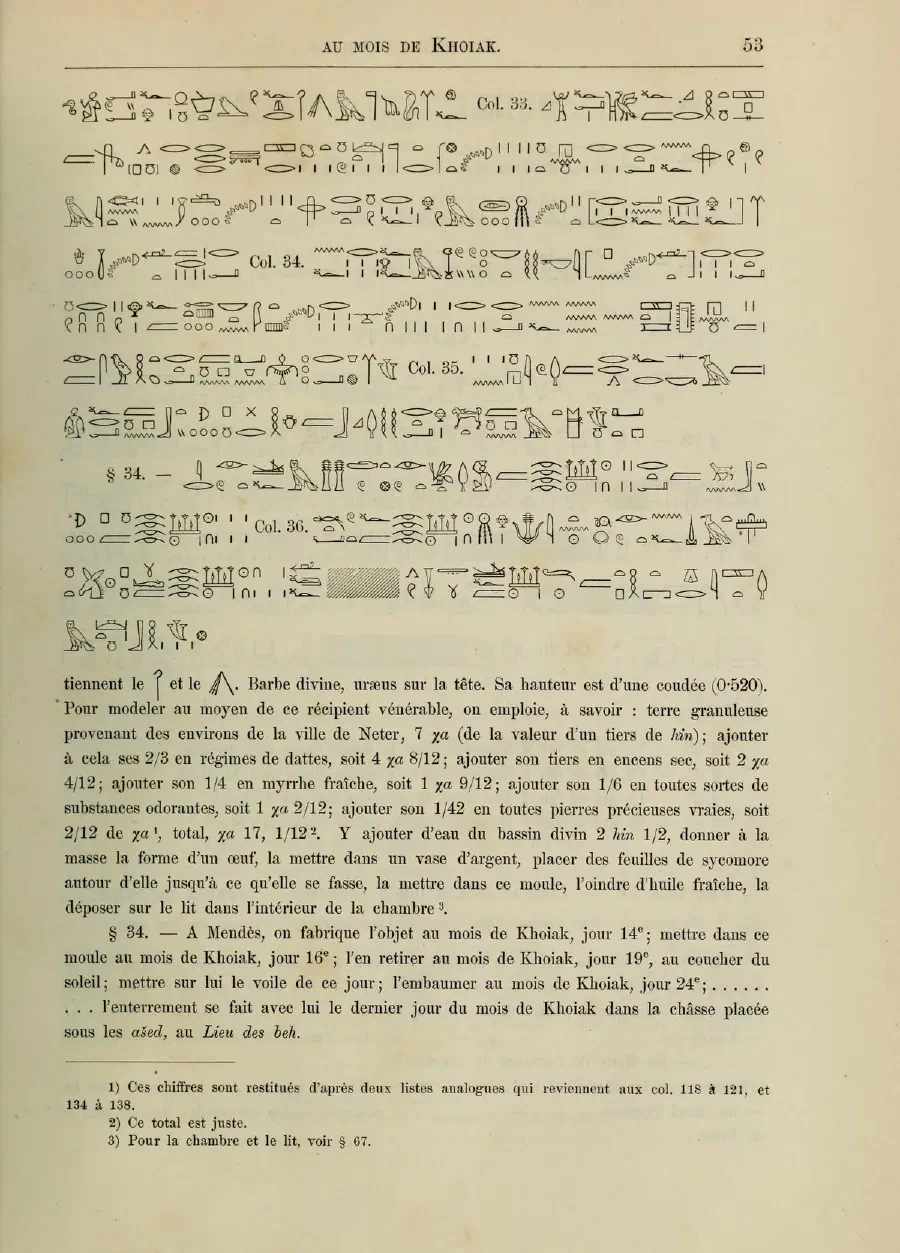
§ 33. — Le moule de Sokari est fait en or pour le moule antérieur et pour le moule postérieur, en forme de momie à tête humaine. Les bras, croisés sur la poitrine,
§ 33. — The mould of Sokari is made of gold for the front mould and for the rear mould, in the form of a mummy with a human head. The arms, crossed on the chest,
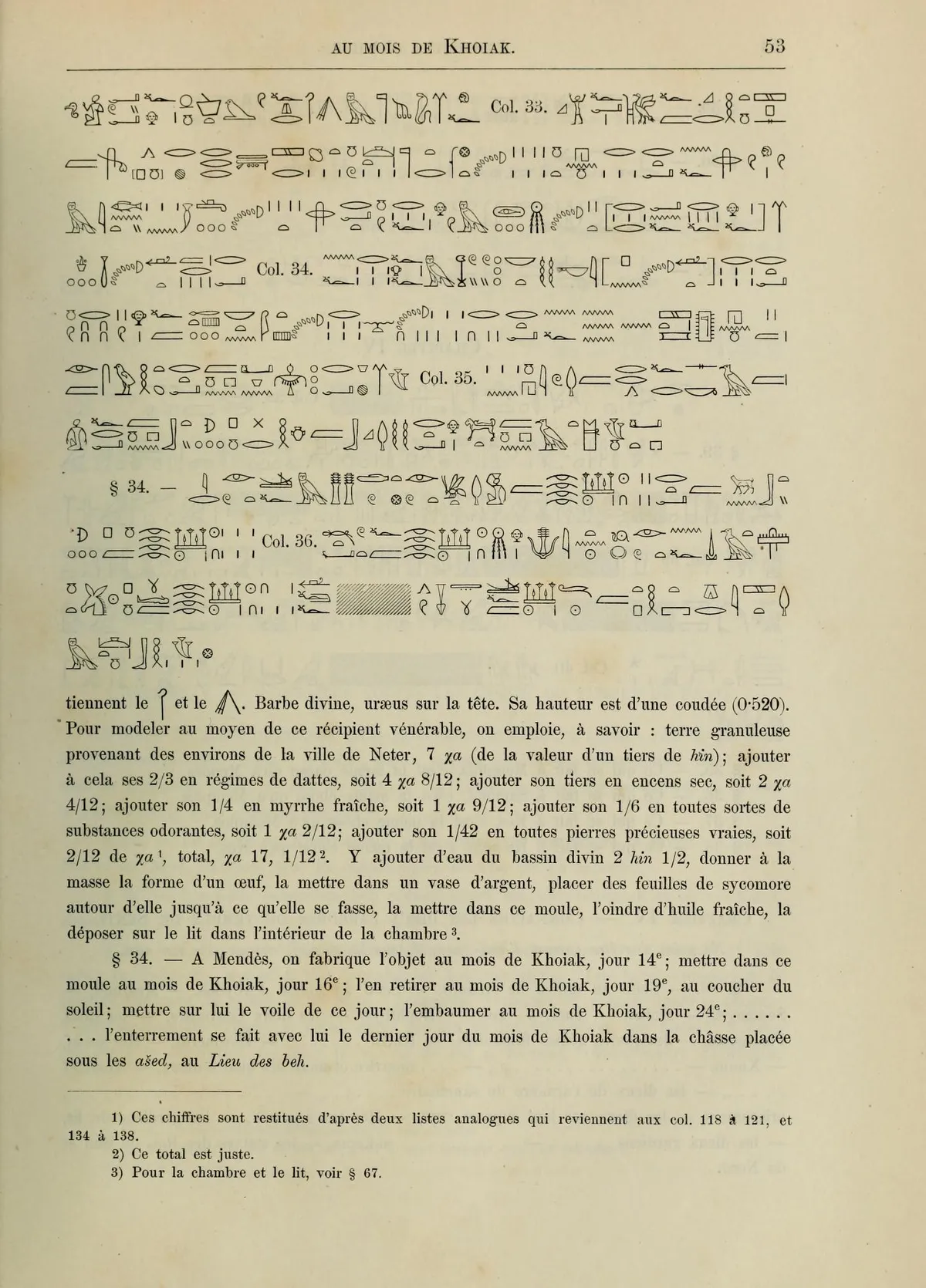
Page 53. p. 53: The recipe for the paste of Sokari, shaped as an egg; the dates at Mendes, 14 to 30 Khoiak Recueil de travaux III, IV and V (archive.org scans) - s33b53
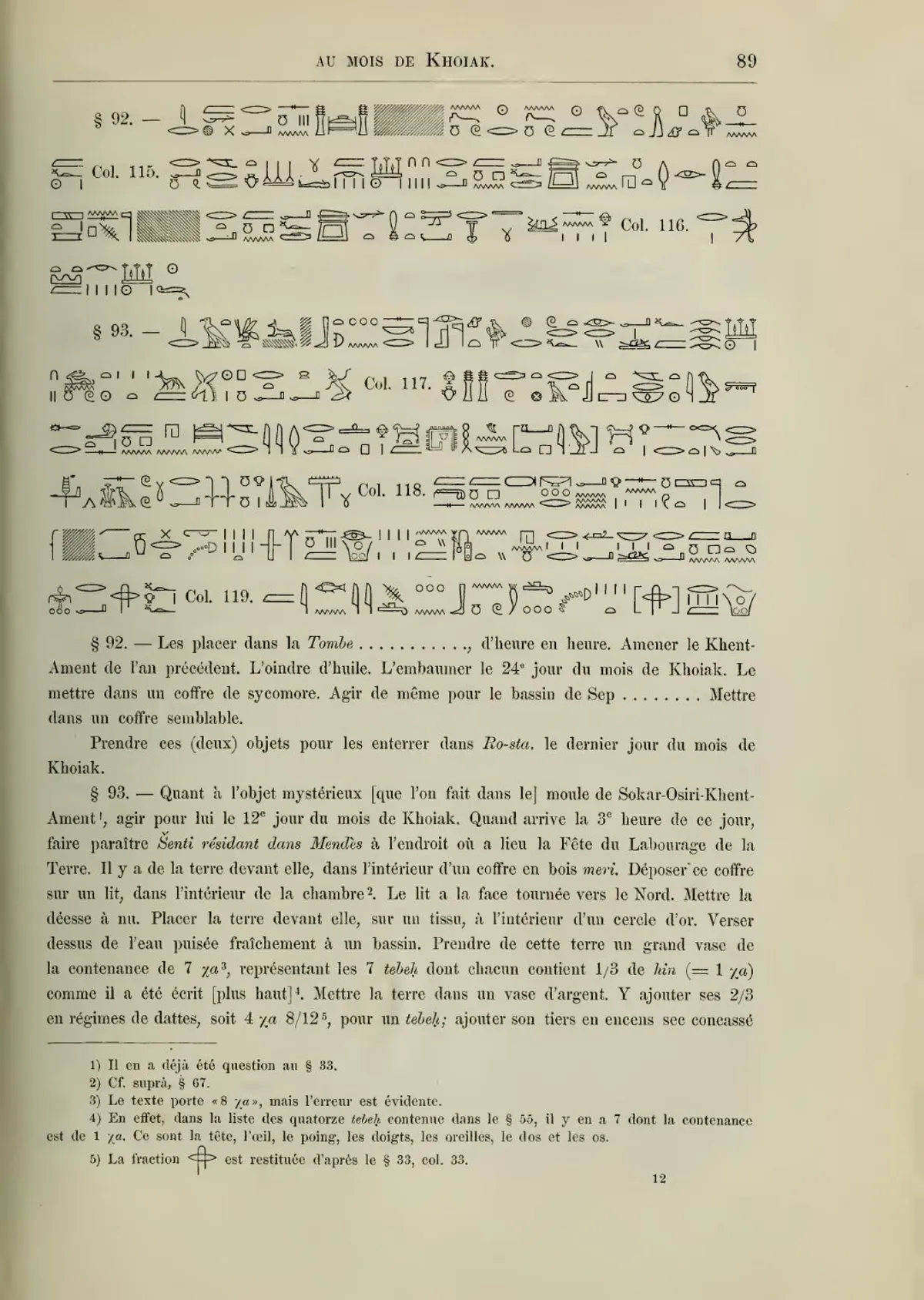
tiennent le [signe] et le [signe]. Barbe divine, uraeus sur la tête. Sa hauteur est d'une coudée (0.520). Pour modeler au moyen de ce récipient vénérable, on emploie, à savoir : terre granuleuse provenant des environs de la ville de Neter, 7 χa (de la valeur d'un tiers de hin) ; ajouter à cela ses 2/3 en régimes de dattes, soit 4 χa 8/12 ; ajouter son tiers en encens sec, soit 2 χa 4/12 ; ajouter son 1/4 en myrrhe fraîche, soit 1 χa 9/12 ; ajouter son 1/6 en toutes sortes de substances odorantes, soit 1 χa 2/12 ; ajouter son 1/42 en toutes pierres précieuses vraies, soit 2/12 de χa ; total, χa 17, 1/12. Y ajouter d'eau du bassin divin 2 hin 1/2, donner à la masse la forme d'un œuf, la mettre dans un vase d'argent, placer des feuilles de sycomore autour d'elle jusqu'à ce qu'elle se fasse, la mettre dans ce moule, l'oindre d'huile fraîche, la déposer sur le lit dans l'intérieur de la chambre.
hold the [sign] and the [sign]. Divine beard, uraeus on the head. Its height is one cubit (0.520). To model by means of this venerable receptacle one uses, namely: granular earth from the environs of the city of Neter, 7 χa (worth a third of a hin); add to that two thirds of it in bunches of dates, that is 4 χa 8/12; add a third of it in dry incense, that is 2 χa 4/12; add a quarter of it in fresh myrrh, that is 1 χa 9/12; add a sixth of it in all kinds of fragrant substances, that is 1 χa 2/12; add 1/42 of it in all true precious stones, that is 2/12 of a χa; total, χa 17, 1/12. Add to it water from the divine basin, 2 hin 1/2, give the mass the form of an egg, put it in a silver vase, place sycamore leaves around it until it is made, put it into this mould, anoint it with fresh oil, lay it on the bed inside the chamber.
Note on line s33b
Loret’s notes. (1) These figures are restored from two analogous lists that recur at cols. 118 to 121 and 134 to 138. (2) This total is correct. (3) For the chamber and the bed, see § 67 (beyond this instalment). The two signs held in the hands are not named here; § 43 gives the crook and the flail for the same mummy form. - s3453
§ 34. — À Mendès, on fabrique l'objet au mois de Khoiak, jour 14e ; mettre dans ce moule au mois de Khoiak, jour 16e ; l'en retirer au mois de Khoiak, jour 19e, au coucher du soleil ; mettre sur lui le voile de ce jour ; l'embaumer au mois de Khoiak, jour 24e ; [ . . . ] l'enterrement se fait avec lui le dernier jour du mois de Khoiak dans la châsse placée sous les ased, au Lieu des beh.
§ 34. — At Mendes, the object is made in the month of Khoiak, day 14; put it in this mould in the month of Khoiak, day 16; take it out of it in the month of Khoiak, day 19, at sunset; put on it the veil of that day; embalm it in the month of Khoiak, day 24; [ . . . ] the burial is done with it on the last day of the month of Khoiak in the shrine placed under the ased, at the Place of the beh.
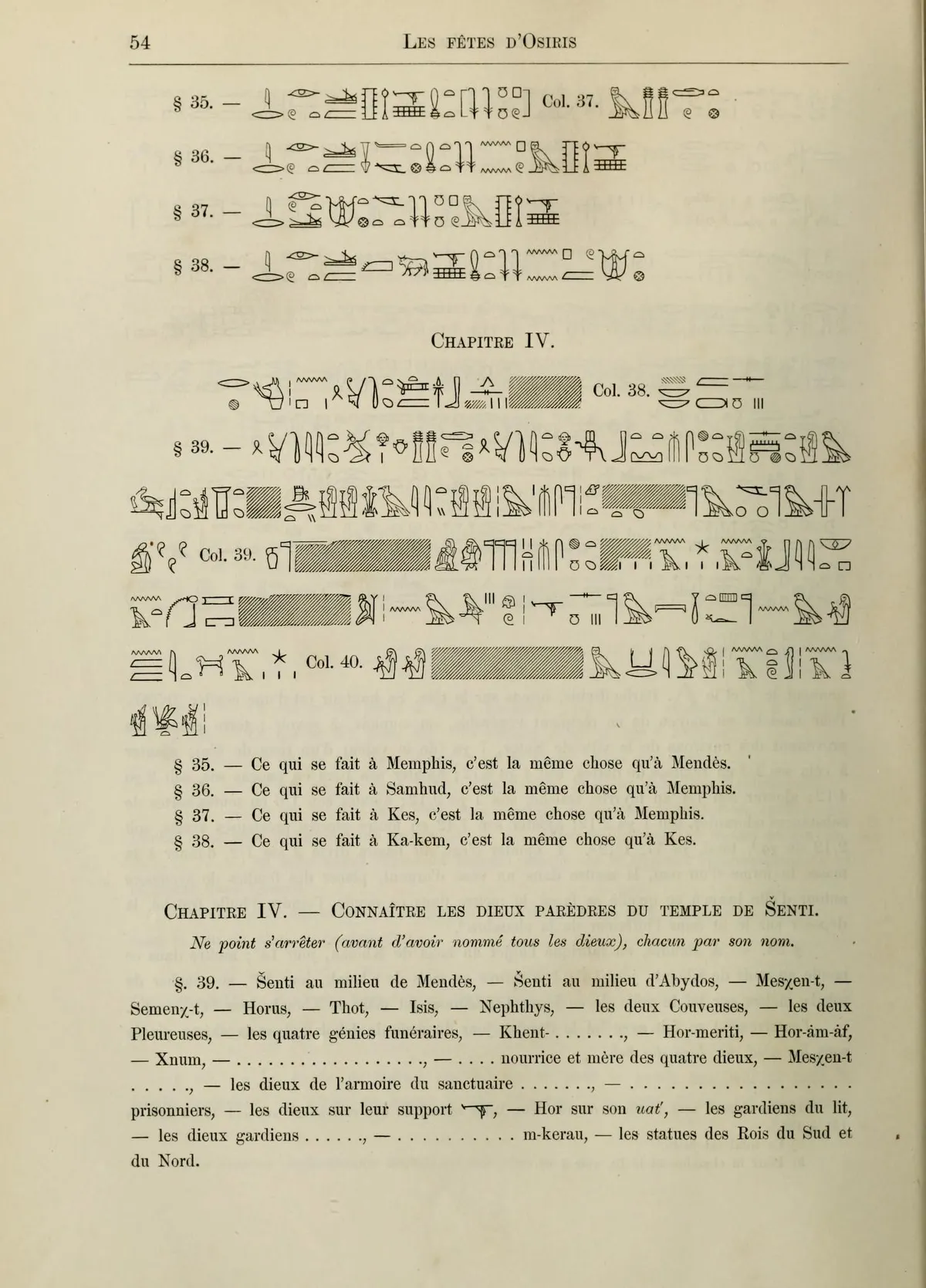
Page 54. p. 54: The rite at Memphis, Samhud, Kes and Ka-kem; Chapter IV: the list of the attendant gods Recueil de travaux III, IV and V (archive.org scans) - s3554
§ 35. — Ce qui se fait à Memphis, c'est la même chose qu'à Mendès.
§ 35. — What is done at Memphis is the same thing as at Mendes.
- s3654
§ 36. — Ce qui se fait à Samhud, c'est la même chose qu'à Memphis.
§ 36. — What is done at Samhud is the same thing as at Memphis.
- s3754
§ 37. — Ce qui se fait à Kes, c'est la même chose qu'à Memphis.
§ 37. — What is done at Kes is the same thing as at Memphis.
- s3854
§ 38. — Ce qui se fait à Ka-kem, c'est la même chose qu'à Kes.
§ 38. — What is done at Ka-kem is the same thing as at Kes.
Chapter IV
- ch454
Chapitre IV. — Connaître les dieux parèdres du temple de Senti. Ne point s'arrêter (avant d'avoir nommé tous les dieux), chacun par son nom.
Chapter IV. — To know the attendant gods of the temple of Senti. Do not stop (before having named all the gods), each by his name.
- s3954
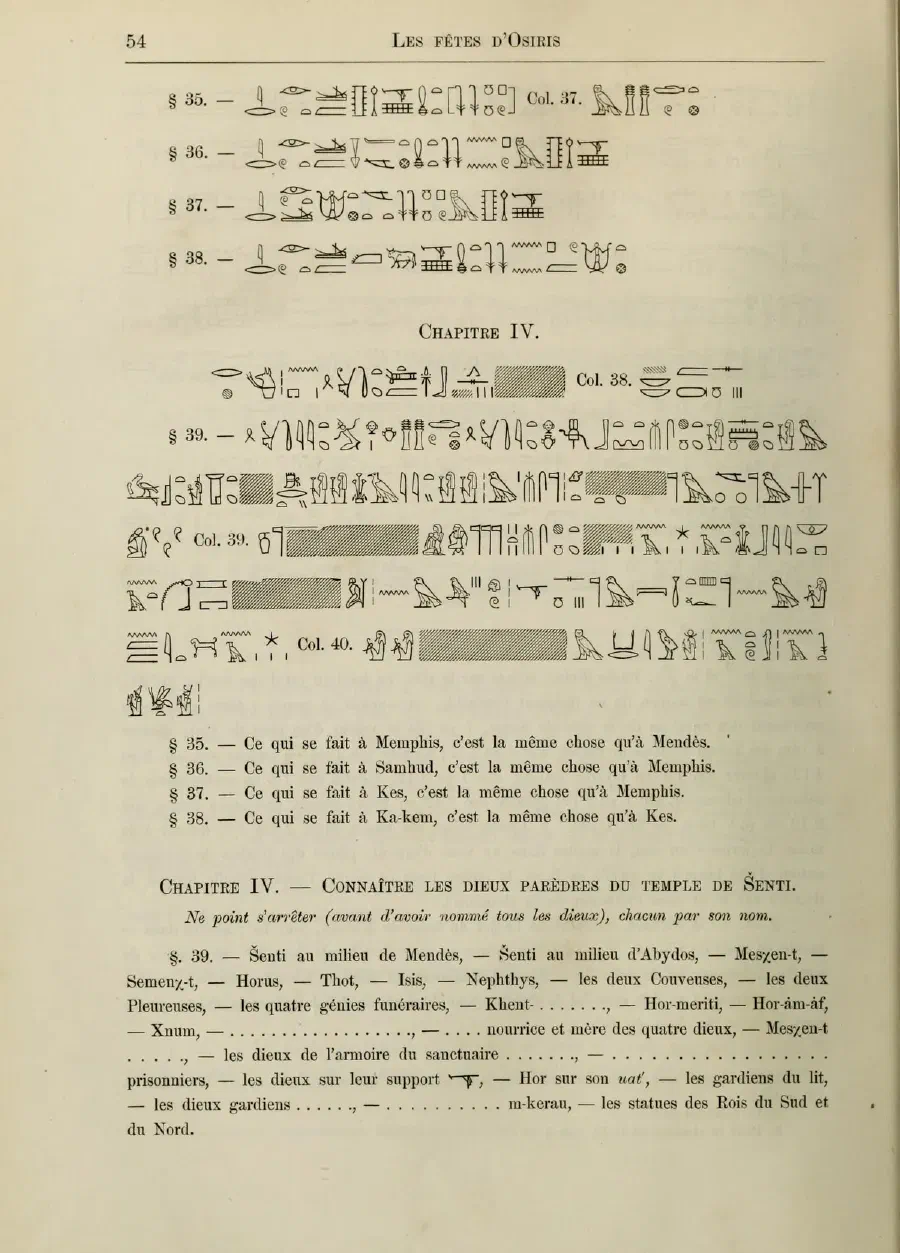
§ 39. — Senti au milieu de Mendès, — Senti au milieu d'Abydos, — Mesχen-t, — Semenχ-t, — Horus, — Thot, — Isis, — Nephthys, — les deux Couveuses, — les deux Pleureuses, — les quatre génies funéraires, — Khent- [ . . . ], — Hor-meriti, — Hor-âm-âf, — χnum, — [ . . . ], — [ . . . ] nourrice et mère des quatre dieux, — Mesχen-t [ . . . ], — les dieux de l'armoire du sanctuaire [ . . . ], — [ . . . ] prisonniers, — les dieux sur leur support, — Hor sur son uat, — les gardiens du lit, — les dieux gardiens [ . . . ], — [ . . . ] m-kerau, — les statues des Rois du Sud et du Nord.
§ 39. — Senti in the middle of Mendes, Senti in the middle of Abydos, Mesχen-t, Semenχ-t, Horus, Thoth, Isis, Nephthys, the two Brooders, the two Mourners, the four funerary genii, Khent- [ . . . ], Hor-meriti, Hor-âm-âf, Χnum, [ . . . ], [ . . . ] nurse and mother of the four gods, Mesχen-t [ . . . ], the gods of the cabinet of the sanctuary [ . . . ], [ . . . ] prisoners, the gods on their support, Hor on his uat, the guardians of the bed, the guardian gods [ . . . ], [ . . . ] m-kerau, the statues of the Kings of the South and North.
Note on line s39
Loret prints a list with dashes between the names; the English keeps them as commas. Loret’s Couveuses is “brooders” and Pleureuses “mourners”; he gives no note on them. Chapter V
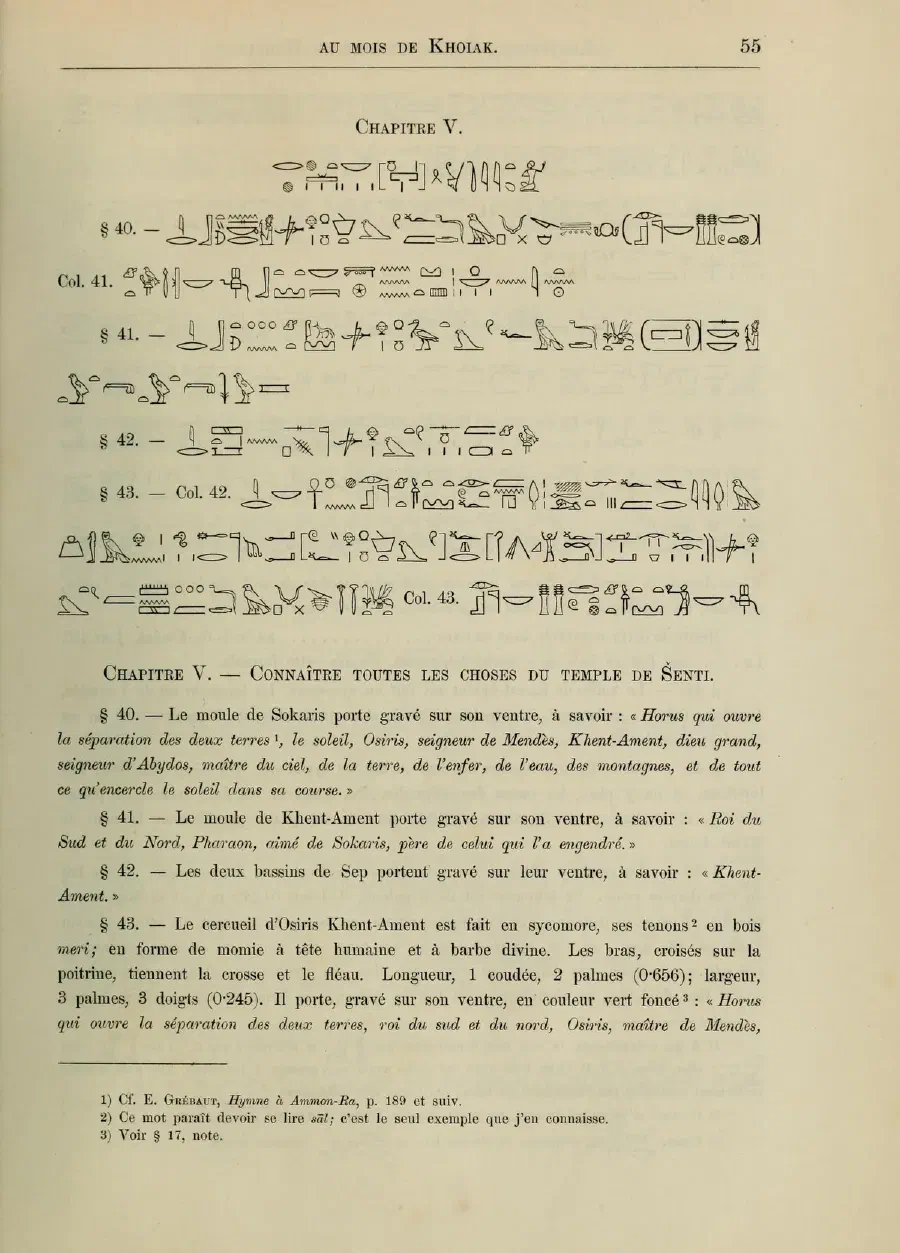
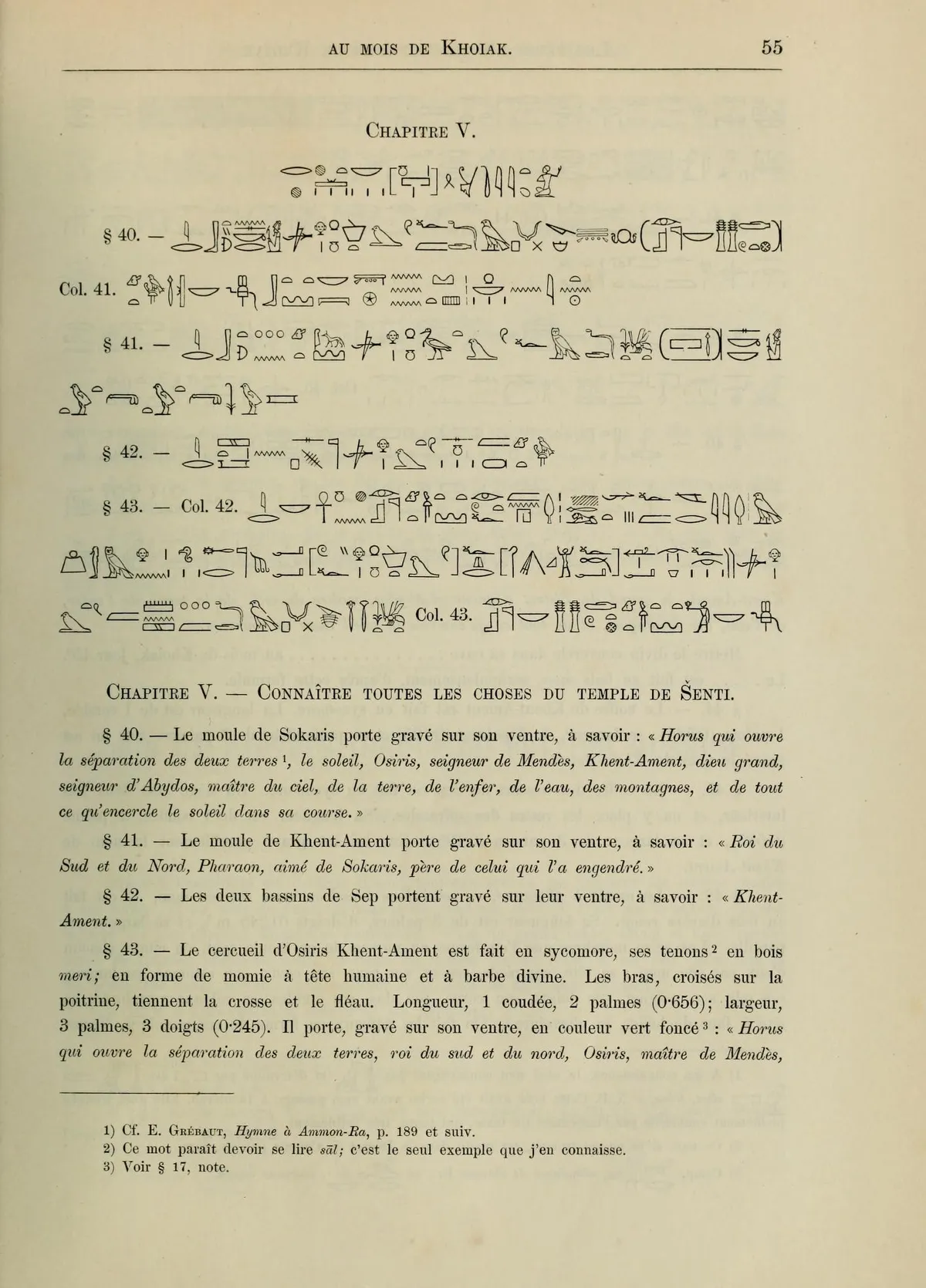
Page 55. p. 55: Chapter V: the inscriptions engraved on the belly of the moulds; the coffin of Osiris Khent-Ament Recueil de travaux III, IV and V (archive.org scans) - ch555
Chapitre V. — Connaître toutes les choses du temple de Senti.
Chapter V. — To know all the things of the temple of Senti.
- s4055
§ 40. — Le moule de Sokaris porte gravé sur son ventre, à savoir : « Horus qui ouvre la séparation des deux terres, le soleil, Osiris, seigneur de Mendès, Khent-Ament, dieu grand, seigneur d'Abydos, maître du ciel, de la terre, de l'enfer, de l'eau, des montagnes, et de tout ce qu'encercle le soleil dans sa course. »
§ 40. — The mould of Sokaris bears engraved on its belly, namely: "Horus who opens the separation of the two lands, the sun, Osiris, lord of Mendes, Khent-Ament, great god, lord of Abydos, master of the sky, of the earth, of the underworld, of the water, of the mountains, and of all that the sun encircles in his course."
Note on line s40
Loret’s note 1 refers to Grébaut, Hymne à Ammon-Râ, p. 189 ff. “Underworld” renders his enfer. - s4155
§ 41. — Le moule de Khent-Ament porte gravé sur son ventre, à savoir : « Roi du Sud et du Nord, Pharaon, aimé de Sokaris, père de celui qui l'a engendré. »
§ 41. — The mould of Khent-Ament bears engraved on its belly, namely: "King of the South and North, Pharaoh, beloved of Sokaris, father of him who begot him."
- s4255
§ 42. — Les deux bassins de Sep portent gravé sur leur ventre, à savoir : « Khent-Ament. »
§ 42. — The two basins of Sep bear engraved on their belly, namely: "Khent-Ament."
- s4355
§ 43. — Le cercueil d'Osiris Khent-Ament est fait en sycomore, ses tenons en bois meri ; en forme de momie à tête humaine et à barbe divine. Les bras, croisés sur la poitrine, tiennent la crosse et le fléau. Longueur, 1 coudée, 2 palmes (0.656) ; largeur, 3 palmes, 3 doigts (0.245). Il porte, gravé sur son ventre, en couleur vert foncé : « Horus qui ouvre la séparation des deux terres, roi du sud et du nord, Osiris, maître de Mendès,
§ 43. — The coffin of Osiris Khent-Ament is made of sycamore, its tenons of meri wood; in the form of a mummy with a human head and a divine beard. The arms, crossed on the chest, hold the crook and the flail. Length, 1 cubit, 2 palms (0.656); width, 3 palms, 3 fingers (0.245). It bears, engraved on its belly, in dark green colour: "*Horus who opens the separation of the two lands, king of the south and of the north, Osiris, master of Mendes,
Note on line s43
Loret’s notes. (2) The word for tenons seems to be read sâl; it is the only example he knows. (3) For the dark green colour, see the note to § 17. 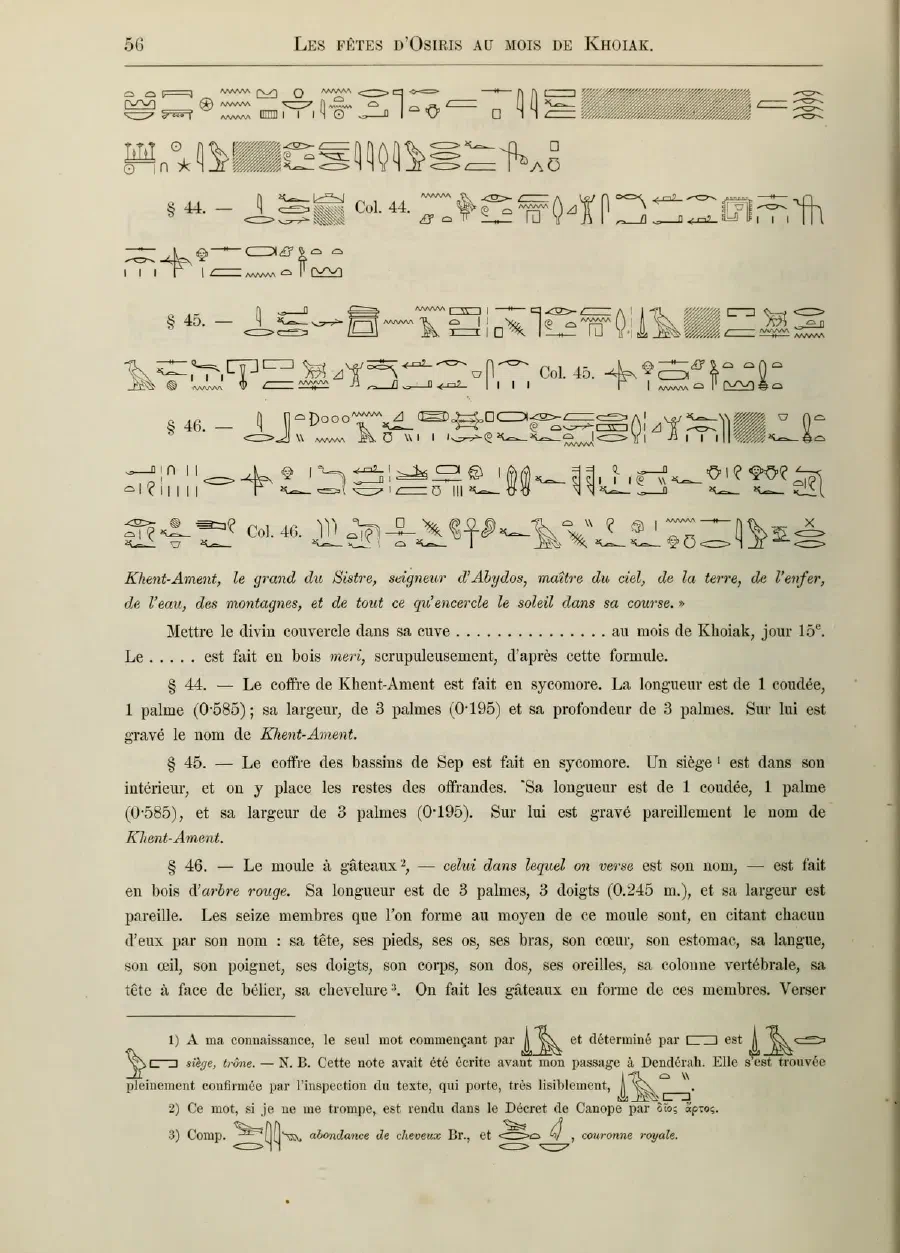
Page 56. p. 56: The chests; the cake mould and the sixteen members of the god, from head to hair Recueil de travaux III, IV and V (archive.org scans) - s43b56
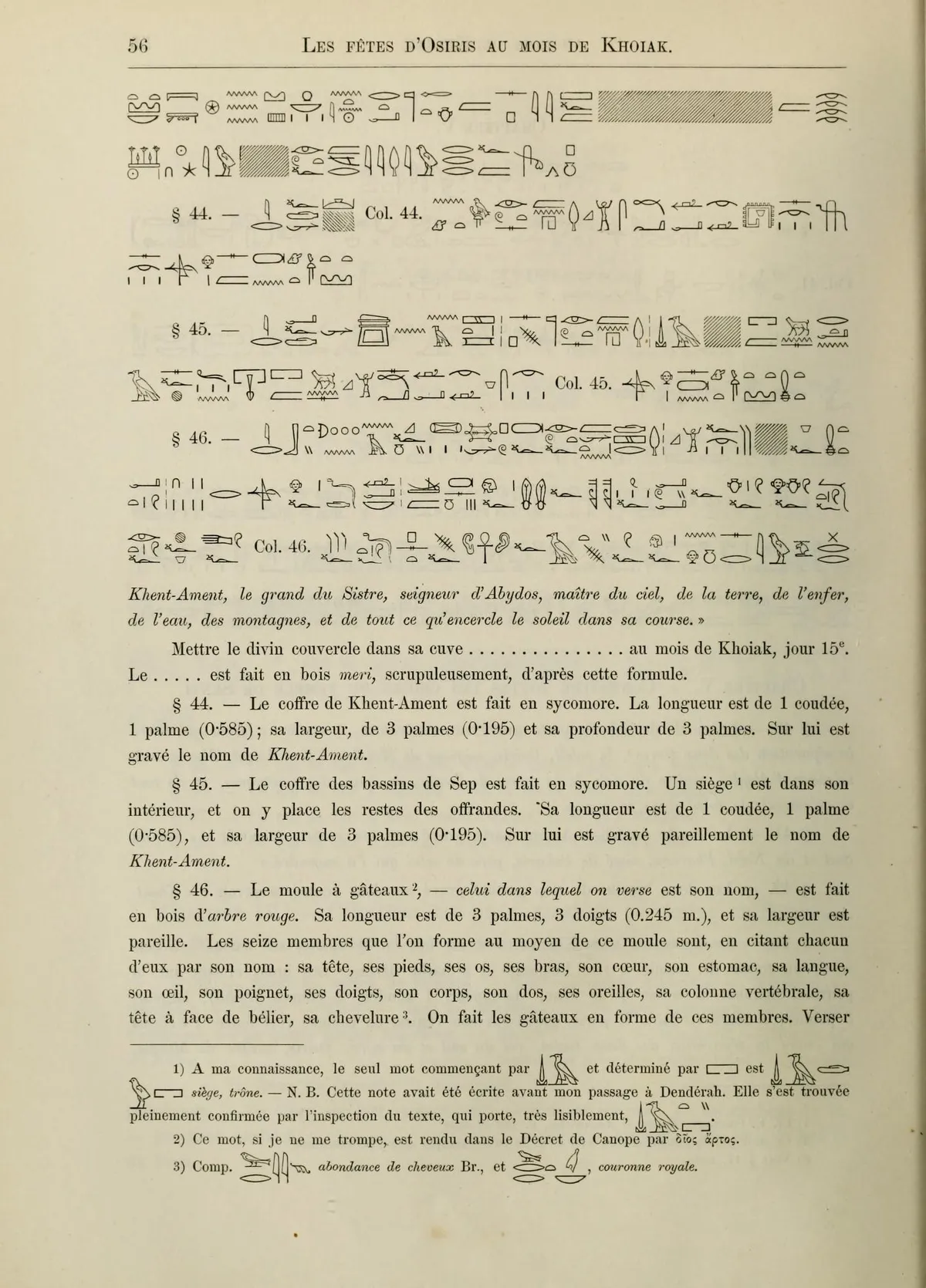
Khent-Ament, le grand du Sistre, seigneur d'Abydos, maître du ciel, de la terre, de l'enfer, de l'eau, des montagnes, et de tout ce qu'encercle le soleil dans sa course. » Mettre le divin couvercle dans sa cuve [ . . . ] au mois de Khoiak, jour 15e. Le [ . . . ] est fait en bois meri, scrupuleusement, d'après cette formule.
Khent-Ament, the great one of the Sistrum, lord of Abydos, master of the sky, of the earth, of the underworld, of the water, of the mountains, and of all that the sun encircles in his course." Put the divine lid in its vat [ . . . ] in the month of Khoiak, day 15. The [ . . . ] is made of meri* wood, scrupulously, according to this formula.
- s4456
§ 44. — Le coffre de Khent-Ament est fait en sycomore. La longueur est de 1 coudée, 1 palme (0.585) ; sa largeur, de 3 palmes (0.195) et sa profondeur de 3 palmes. Sur lui est gravé le nom de Khent-Ament.
§ 44. — The chest of Khent-Ament is made of sycamore. The length is 1 cubit, 1 palm (0.585); its width, 3 palms (0.195) and its depth 3 palms. On it is engraved the name of Khent-Ament.
- s4556
§ 45. — Le coffre des bassins de Sep est fait en sycomore. Un siège est dans son intérieur, et on y place les restes des offrandes. Sa longueur est de 1 coudée, 1 palme (0.585), et sa largeur de 3 palmes (0.195). Sur lui est gravé pareillement le nom de Khent-Ament.
§ 45. — The chest of the basins of Sep is made of sycamore. A seat is inside it, and the remains of the offerings are placed in it. Its length is 1 cubit, 1 palm (0.585), and its width 3 palms (0.195). On it is engraved likewise the name of Khent-Ament.
Note on line s45
Loret’s note 1: to his knowledge the only word beginning with those signs and determined by the sign for a seat is the word for seat, throne. He adds that the note was written before his visit to Dendera and “fully confirmed by inspection of the text, which carries, very legibly” the word. - s4656
§ 46. — Le moule à gâteaux, — celui dans lequel on verse est son nom, — est fait en bois d'arbre rouge. Sa longueur est de 3 palmes, 3 doigts (0.245 m.), et sa largeur est pareille. Les seize membres que l'on forme au moyen de ce moule sont, en citant chacun d'eux par son nom : sa tête, ses pieds, ses os, ses bras, son cœur, son estomac, sa langue, son œil, son poignet, ses doigts, son corps, son dos, ses oreilles, sa colonne vertébrale, sa tête à face de bélier, sa chevelure. On fait les gâteaux en forme de ces membres. Verser
§ 46. — The cake mould, "that into which one pours" is its name, is made of the wood of the red tree. Its length is 3 palms, 3 fingers (0.245 m.), and its width is the same. The sixteen members that are formed by means of this mould are, naming each of them by its name: his head, his feet, his bones, his arms, his heart, his stomach, his tongue, his eye, his wrist, his fingers, his body, his back, his ears, his spinal column, his ram-faced head, his hair. The cakes are made in the form of these members. Pour
Note on line s46
Loret’s notes. (2) The word for cake mould is rendered, if he is not mistaken, in the Decree of Canopus by a Greek phrase ending in artos, “loaf” (the OCR of his Greek is unreliable here). (3) For hair he compares a word meaning “abundance of hair” (Brugsch) and a word meaning “royal crown”. 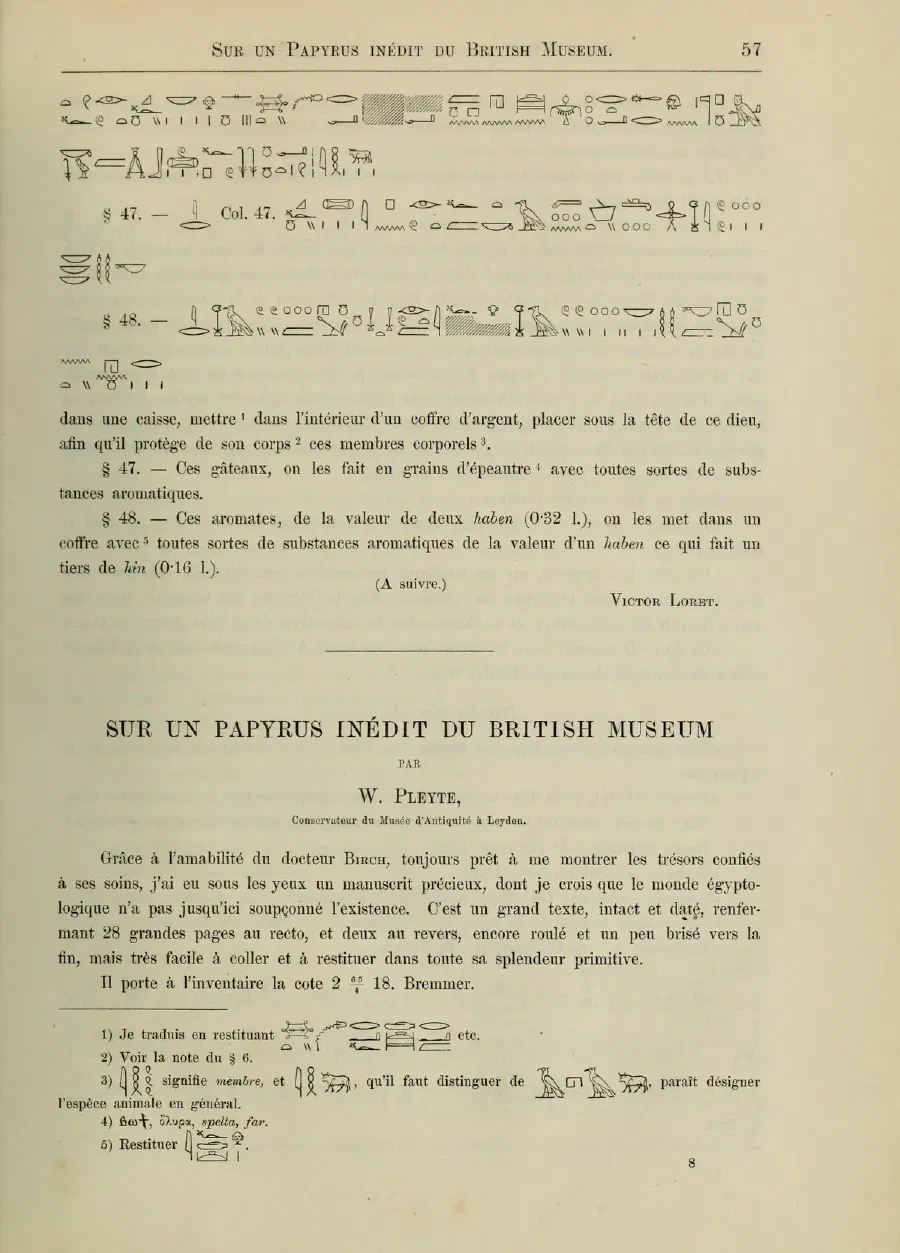
Page 57. p. 57: The cakes of spelt, the aromatics; 'to be continued'. (The article following is by Pleyte and not translated.) Recueil de travaux III, IV and V (archive.org scans) - s46b57
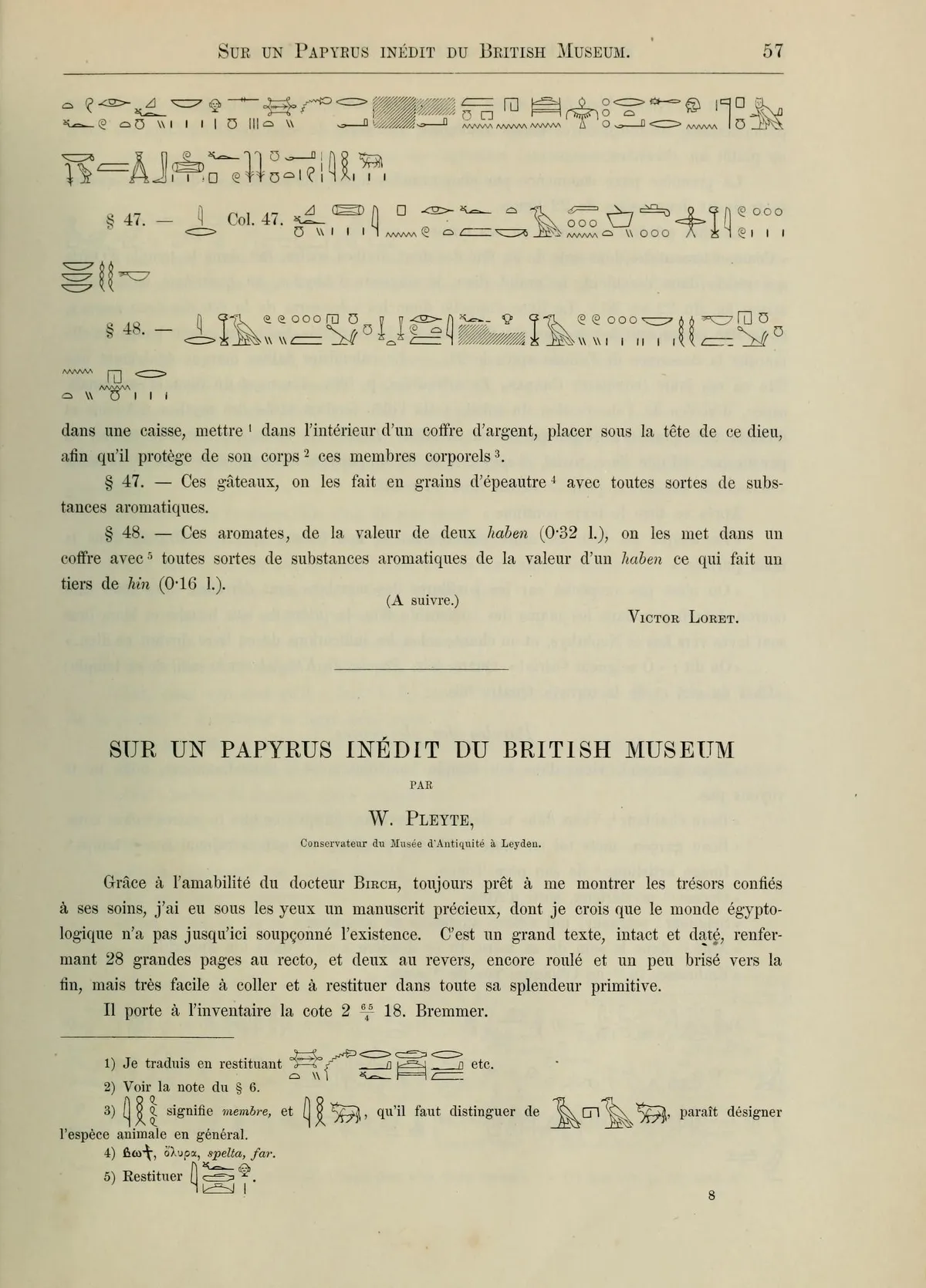
dans une caisse, mettre dans l'intérieur d'un coffre d'argent, placer sous la tête de ce dieu, afin qu'il protège de son corps ces membres corporels.
into a case, put inside a silver chest, place under the head of this god, so that he may protect with his body these bodily members.
Note on line s46b
Loret’s notes. (1) He translates restoring a word in the lacuna. (2) With his body: see the note to § 6. (3) The word translated “members” signifies member, and he distinguishes it from a similar word that seems to designate the animal species in general. The grammar of the opening, “Pour into a case”, is Loret’s; the object of “pour” is not stated. - s4757
§ 47. — Ces gâteaux, on les fait en grains d'épeautre avec toutes sortes de substances aromatiques.
§ 47. — These cakes are made of grains of spelt with all kinds of aromatic substances.
Note on line s47
Loret’s note 4 gives the word for spelt in Coptic with the Greek olyra, Latin spelta, far. - s4857
§ 48. — Ces aromates, de la valeur de deux haben (0.32 l.), on les met dans un coffre avec toutes sortes de substances aromatiques de la valeur d'un haben, ce qui fait un tiers de hin (0.16 l.). (À suivre.) Victor Loret.
§ 48. — These aromatics, amounting to two haben (0.32 litre), are put into a chest with all kinds of aromatic substances amounting to one haben, which makes a third of a hin (0.16 litre). (To be continued.) Victor Loret.
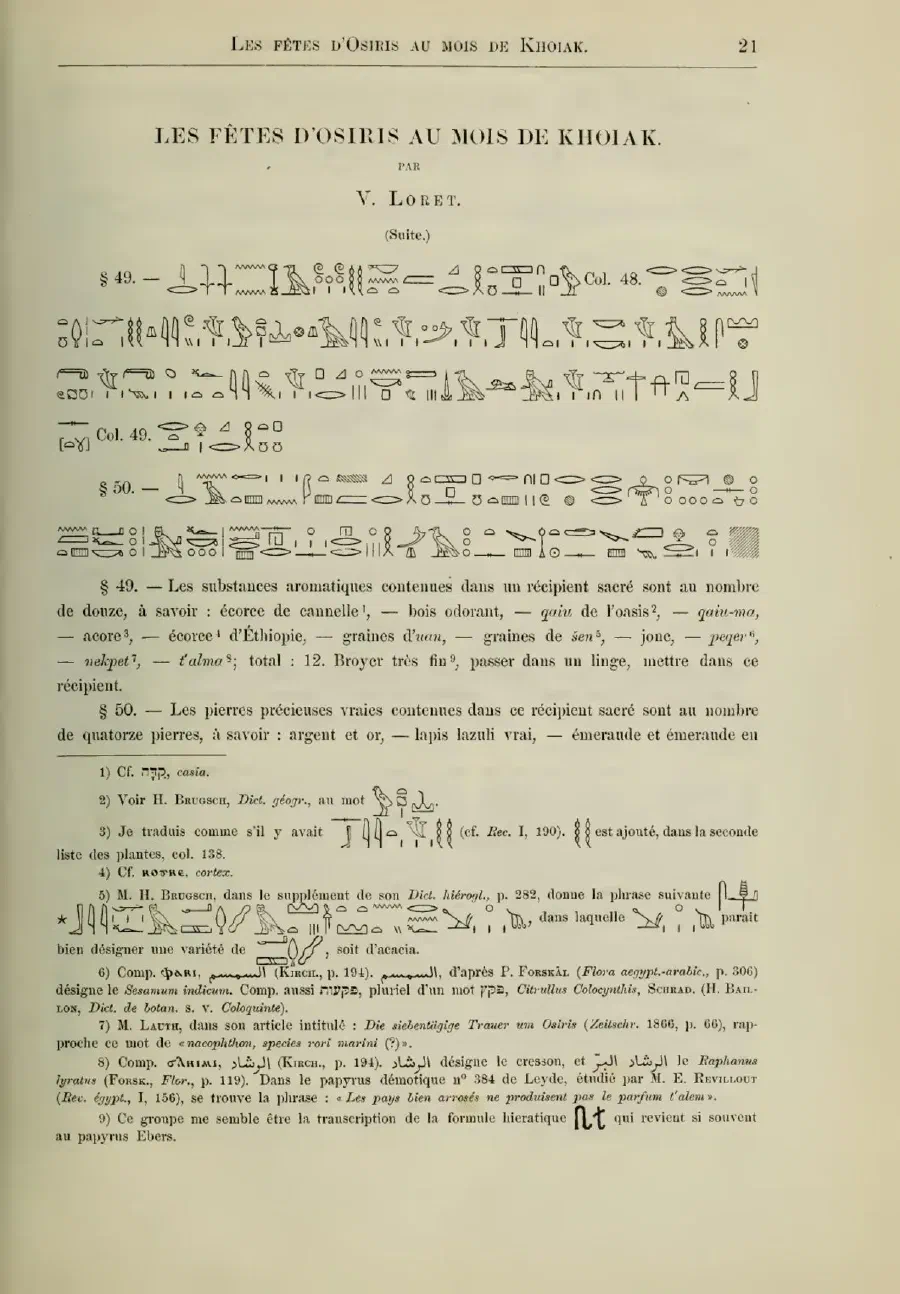
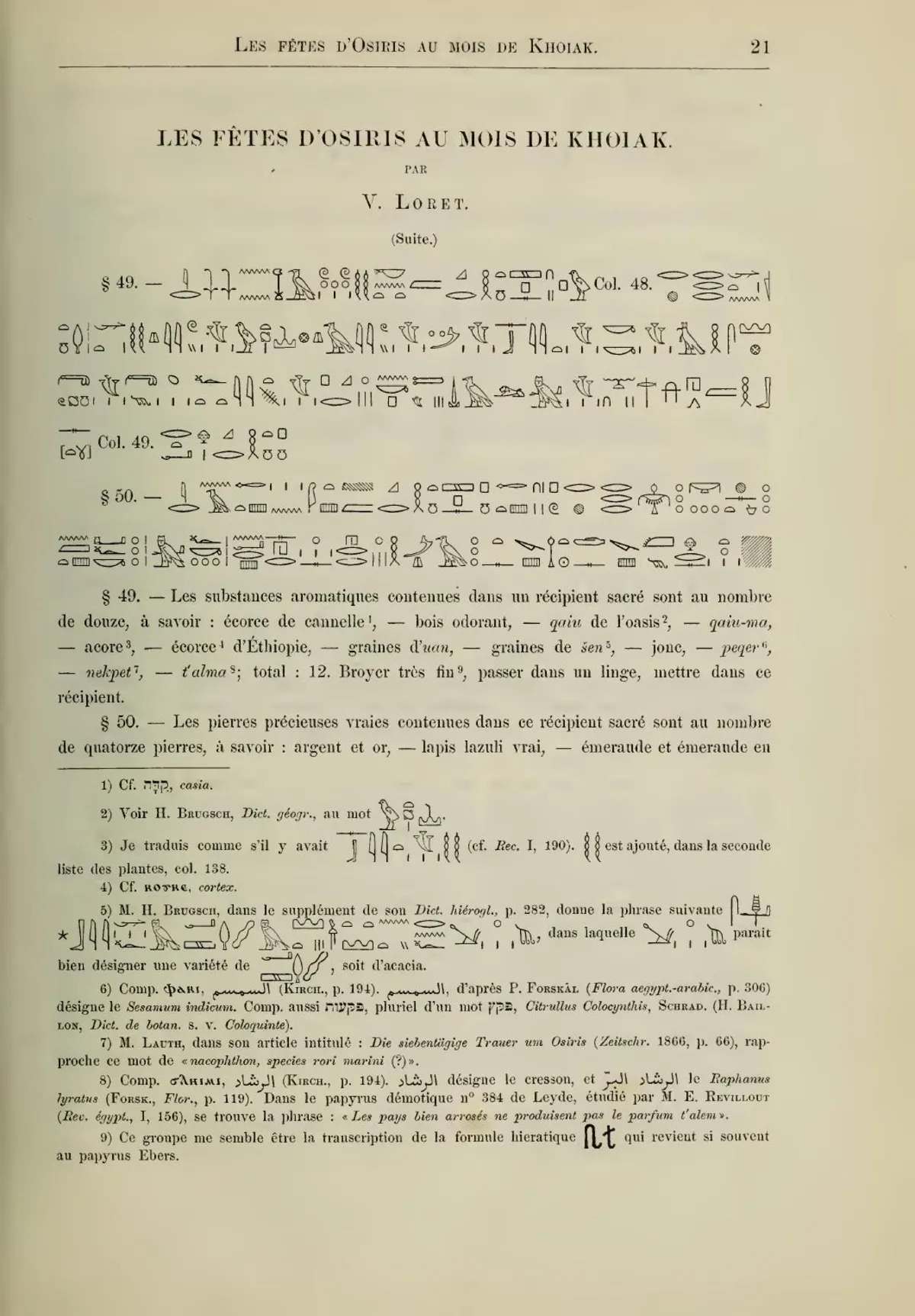
Page 21. Recueil IV, p. 21: the continuation begins: the twelve aromatic substances and the stones of the sacred vessel (§§ 49–50) Recueil de travaux III, IV and V (archive.org scans) - s4921
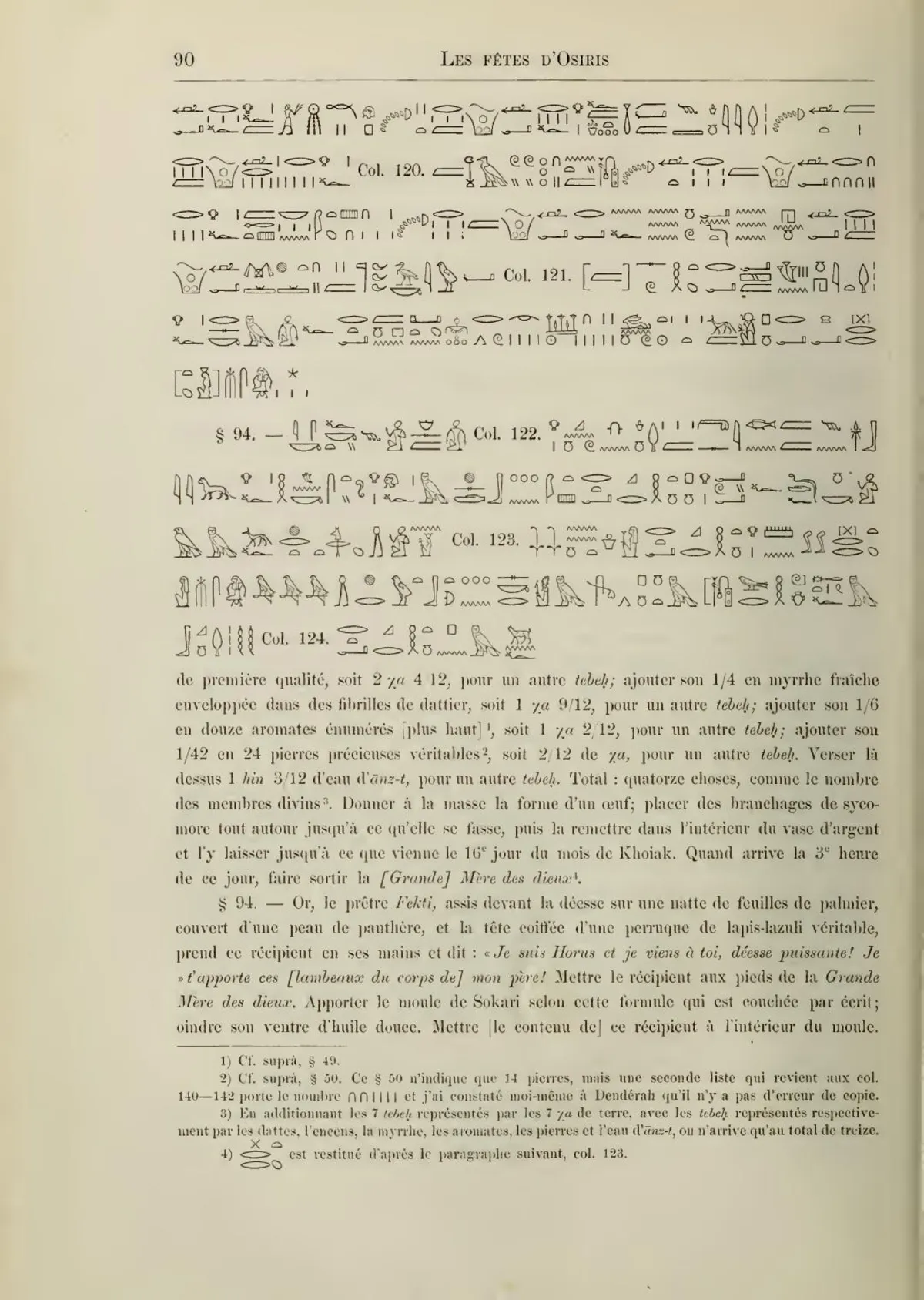
§ 49. — Les substances aromatiques contenues dans un récipient sacré sont au nombre de douze, à savoir : écorce de cannelle, — bois odorant, — qaiu de l'oasis, — qaiu-ma, — acore, — écorce d'Éthiopie, — graines d'uan, — graines de šen, — jonc, — peqer, — nekpet, — t'alma ; total : 12. Broyer très fin, passer dans un linge, mettre dans ce récipient.
§ 49. — The aromatic substances contained in a sacred vessel are twelve in number, namely: cinnamon bark, — fragrant wood, — qaiu of the oasis, — qaiu-ma, — sweet flag, — bark of Ethiopia, — uan seeds, — šen seeds, — rush, — peqer, — nekpet, — t'alma; total: 12. Grind very fine, pass through a cloth, put into this vessel.
Note on line s49
Loret’s notes. (1) Cinnamon: compare the Hebrew word for casia. (2) For the oasis he refers to Brugsch, Dict. géogr., under the word [sign]. (3) He translates as if the text had [sign] (cf. Rec. I, 190); the last signs are added in the second list of plants, col. 138. (4) Compare the Coptic kotre, cortex. (Loret withdraws “bark” in Recueil V, p. 87 n. 3, and in his corrections on p. 97: the word is reed of Ethiopia.) (5) Brugsch, in the supplement to his Dict. hiérogl., p. 282, gives a phrase in which a word seems clearly to designate a variety of acacia. (6) Compare the Coptic šakri and the Arabic word given by Kircher, p. 194; according to P. Forskål (Flora aegypt.-arabica, p. 306) the Arabic word designates Sesamum indicum; compare also a Hebrew word, plural of a word for Citrullus colocynthis Schrad. (H. Baillon, Dict. de botan., s. v. Coloquinte). (7) Lauth, in his article Die siebentägige Trauer um Osiris (Zeitschr. 1866, p. 66), compares this word with “nacophthon, species rori marini (?)”. (8) Compare the Coptic šhimi and the Arabic word given by Kircher, p. 194, which designates cress; another Arabic word designates Raphanus lyratus (Forsk., Flor., p. 119). In the demotic papyrus no. 384 of Leyden, studied by E. Revillout (Rev. égypt., I, 156), occurs the phrase “well-watered lands do not produce the perfume t’alem”. (9) This group seems to him to be the transcription of the hieratic formula [sign] which recurs so often in the Ebers papyrus. - s5021
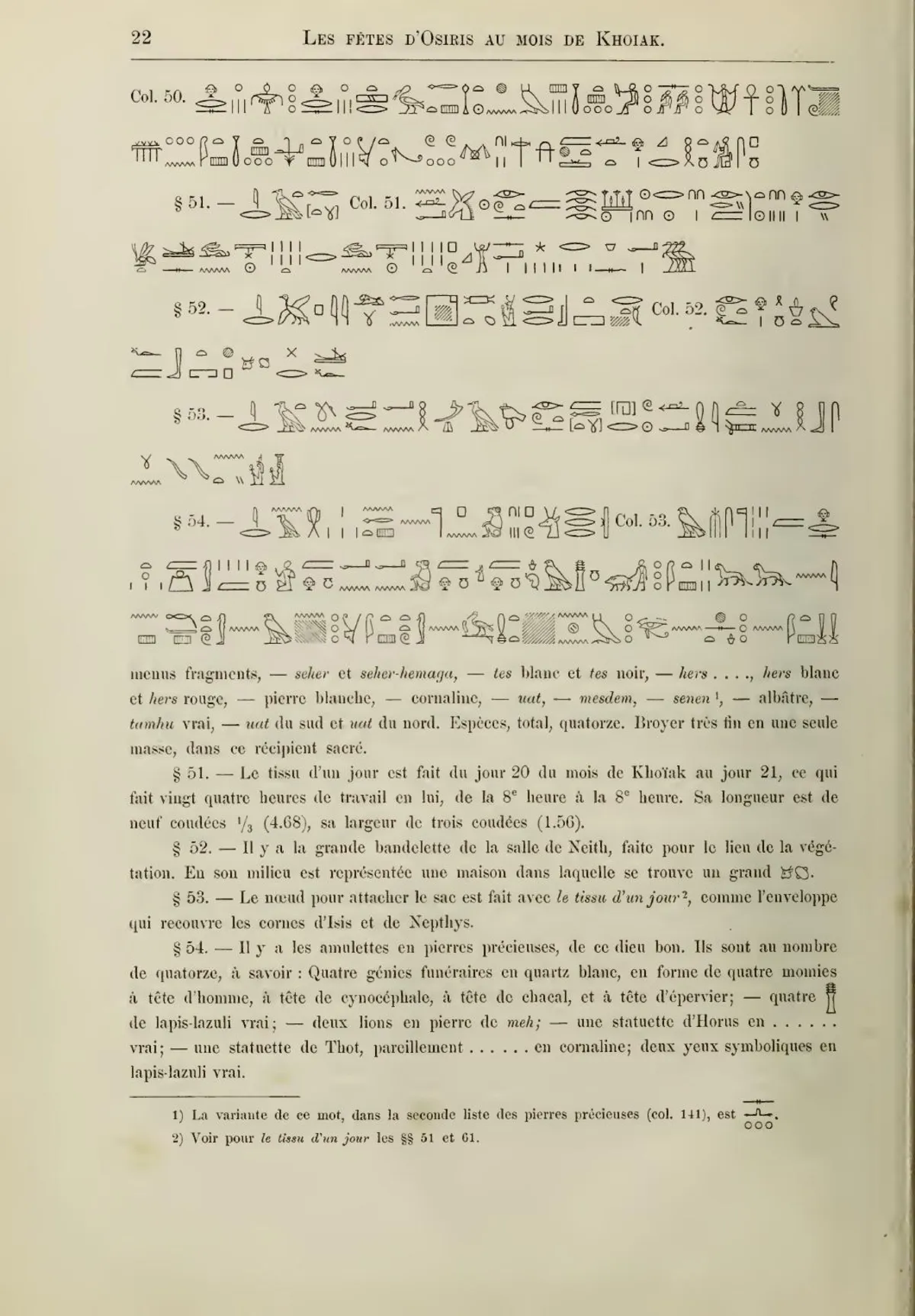
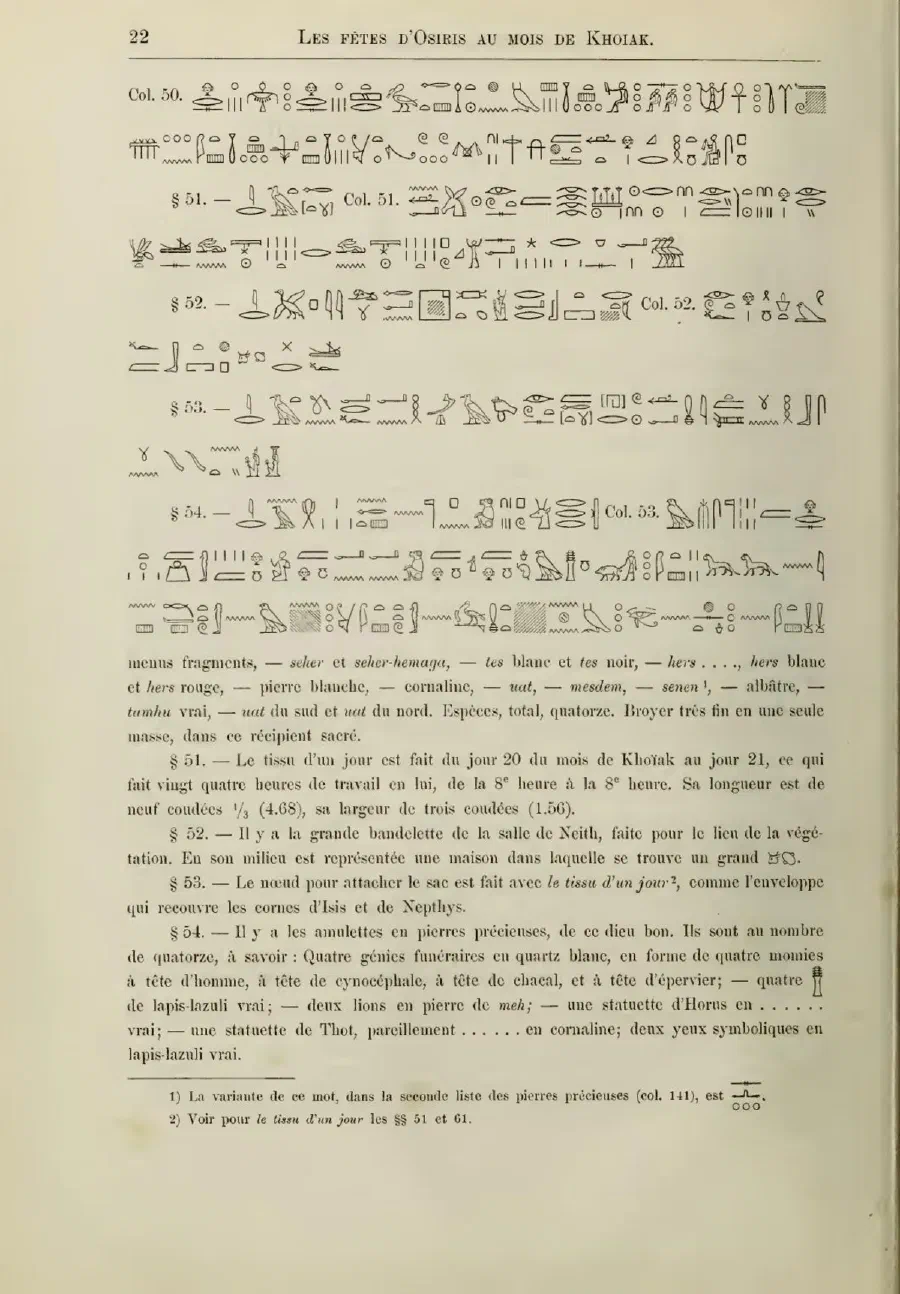
§ 50. — Les pierres précieuses vraies contenues dans ce récipient sacré sont au nombre de quatorze pierres, à savoir : argent et or, — lapis lazuli vrai, — émeraude et émeraude en
§ 50. — The true precious stones contained in this sacred vessel are fourteen stones in number, namely: silver and gold, — true lapis lazuli, — emerald and emerald in
Page 22. Recueil IV, p. 22: the stones ground fine; the cloth of one day; the great band of the hall of Neith; the fourteen amulets (§§ 50–54) Recueil de travaux III, IV and V (archive.org scans) - s50b22
menus fragments, — seher et seher-hemaga, — tes blanc et tes noir, — hers [ . . . ], hers blanc et hers rouge, — pierre blanche, — cornaline, — uat, — mesdem, — senen, — albâtre, — tamhu vrai, — uat du sud et uat du nord. Espèces, total, quatorze. Broyer très fin en une seule masse, dans ce récipient sacré.
small fragments, — seher and seher-hemaga, — white tes and black tes, — hers [ . . . ], white hers and red hers, — white stone, — carnelian, — uat, — mesdem, — senen, — alabaster, — true tamhu, — uat of the south and uat of the north. Kinds, total, fourteen. Grind very fine into a single mass, in this sacred vessel.
Note on line s50b
Loret’s note 1: the variant of the word senen in the second list of precious stones (col. 141) is a different spelling, which he gives in signs. - s5122
§ 51. — Le tissu d'un jour est fait du jour 20 du mois de Khoïak au jour 21, ce qui fait vingt-quatre heures de travail en lui, de la 8e heure à la 8e heure. Sa longueur est de neuf coudées 1/3 (4.68), sa largeur de trois coudées (1.56).
§ 51. — The cloth of one day is made from day 20 of the month of Khoiak to day 21, which makes twenty-four hours of work in it, from the 8th hour to the 8th hour. Its length is nine cubits 1/3 (4.68 m.), its width three cubits (1.56 m.).
- s5222
§ 52. — Il y a la grande bandelette de la salle de Neith, faite pour le lieu de la végétation. En son milieu est représentée une maison dans laquelle se trouve un grand [sign].
§ 52. — There is the great band of the hall of Neith, made for the place of vegetation. In its middle is represented a house in which there is a great [sign].
- s5322
§ 53. — Le nœud pour attacher le sac est fait avec le tissu d'un jour, comme l'enveloppe qui recouvre les cornes d'Isis et de Nephthys.
§ 53. — The knot for tying the sack is made with the cloth of one day, like the wrapping that covers the horns of Isis and Nephthys.
Note on line s53
Loret’s note 2: for the cloth of one day see §§ 51 and 61. - s5422
§ 54. — Il y a les amulettes en pierres précieuses, de ce dieu bon. Ils sont au nombre de quatorze, à savoir : quatre génies funéraires en quartz blanc, en forme de quatre momies à tête d'homme, à tête de cynocéphale, à tête de chacal, et à tête d'épervier ; — quatre [sign] de lapis-lazuli vrai ; — deux lions en pierre de meh ; — une statuette d'Horus en [ . . . ] vrai ; — une statuette de Thot, pareillement [ . . . ] en cornaline ; deux yeux symboliques en lapis-lazuli vrai.
§ 54. — There are the amulets of precious stones of this good god. They are fourteen in number, namely: four funerary genii of white quartz, in the form of four mummies, with the head of a man, the head of a cynocephalus, the head of a jackal and the head of a hawk; — four [sign] of true lapis lazuli; — two lions of meh stone; — a statuette of Horus of true [ . . . ]; — a statuette of Thoth, likewise [ . . . ] of carnelian; two symbolic eyes of true lapis lazuli.
Page 23. Recueil IV, p. 23: the fourteen tebeh of the mould of Sokari, each a member of the god, with their metals and measures (§ 55) Recueil de travaux III, IV and V (archive.org scans) - s5523
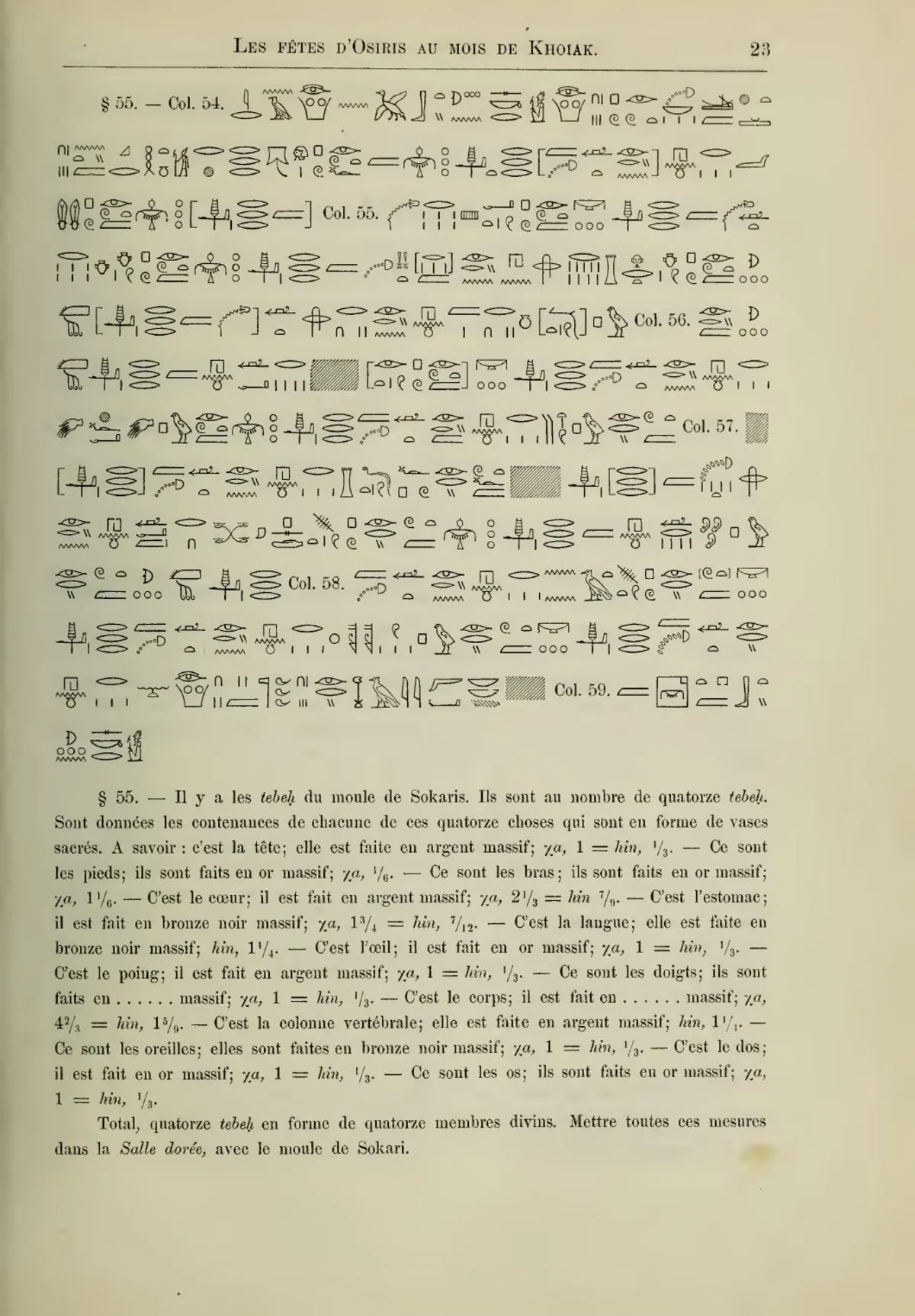
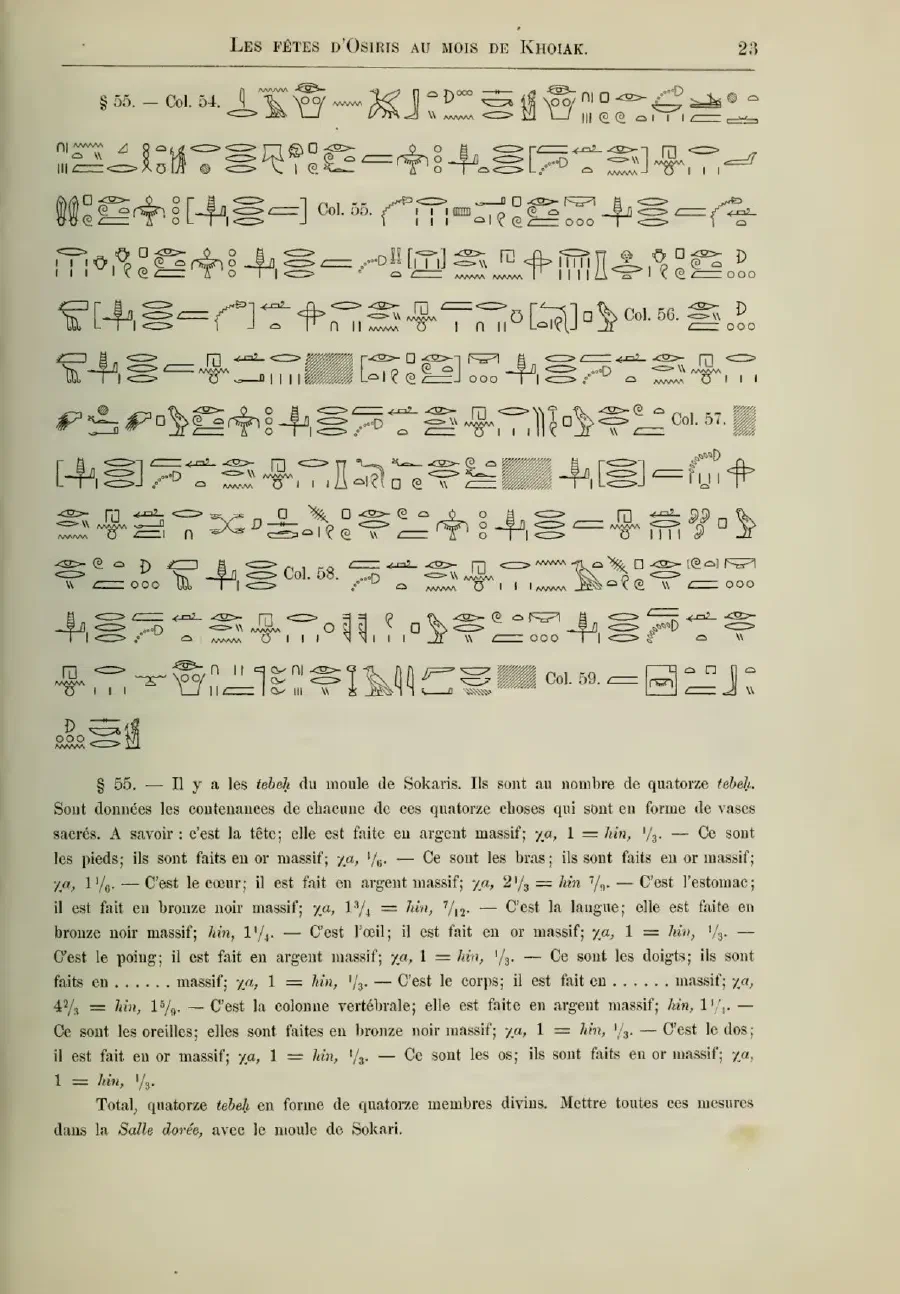
§ 55. — Il y a les tebeh du moule de Sokaris. Ils sont au nombre de quatorze tebeh. Sont données les contenances de chacune de ces quatorze choses qui sont en forme de vases sacrés. À savoir : c'est la tête ; elle est faite en argent massif ; χa, 1 = hin, 1/3. — Ce sont les pieds ; ils sont faits en or massif ; χa, 1/6. — Ce sont les bras ; ils sont faits en or massif ; χa, 1 1/6. — C'est le cœur ; il est fait en argent massif ; χa, 2 1/3 = hin 7/9. — C'est l'estomac ; il est fait en bronze noir massif ; χa, 1 3/4 = hin, 7/12. — C'est la langue ; elle est faite en bronze noir massif ; hin, 1 1/4. — C'est l'œil ; il est fait en or massif ; χa, 1 = hin, 1/3. — C'est le poing ; il est fait en argent massif ; χa, 1 = hin, 1/3. — Ce sont les doigts ; ils sont faits en [ . . . ] massif ; χa, 1 = hin, 1/3. — C'est le corps ; il est fait en [ . . . ] massif ; χa, 4 2/3 = hin, 1 5/9. — C'est la colonne vertébrale ; elle est faite en argent massif ; hin, 1 1/1. — Ce sont les oreilles ; elles sont faites en bronze noir massif ; χa, 1 = hin, 1/3. — C'est le dos ; il est fait en or massif ; χa, 1 = hin, 1/3. — Ce sont les os ; ils sont faits en or massif ; χa, 1 = hin, 1/3.
§ 55. — There are the tebeh of the mould of Sokaris. They are fourteen tebeh in number. The capacities of each of these fourteen things, which are in the form of sacred vessels, are given. Namely: it is the head; it is made of solid silver; χa, 1 = hin, 1/3. — These are the feet; they are made of solid gold; χa, 1/6. — These are the arms; they are made of solid gold; χa, 1 1/6. — It is the heart; it is made of solid silver; χa, 2 1/3 = hin 7/9. — It is the stomach; it is made of solid black bronze; χa, 1 3/4 = hin, 7/12. — It is the tongue; it is made of solid black bronze; hin, 1 1/4. — It is the eye; it is made of solid gold; χa, 1 = hin, 1/3. — It is the fist; it is made of solid silver; χa, 1 = hin, 1/3. — These are the fingers; they are made of solid [ . . . ]; χa, 1 = hin, 1/3. — It is the body; it is made of solid [ . . . ]; χa, 4 2/3 = hin, 1 5/9. — It is the spinal column; it is made of solid silver; hin, 1 1/1 [as printed]. — These are the ears; they are made of solid black bronze; χa, 1 = hin, 1/3. — It is the back; it is made of solid gold; χa, 1 = hin, 1/3. — These are the bones; they are made of solid gold; χa, 1 = hin, 1/3.
- s55b23
Total, quatorze tebeh en forme de quatorze membres divins. Mettre toutes ces mesures dans la Salle dorée, avec le moule de Sokari.
Total, fourteen tebeh in the form of fourteen divine members. Put all these measures in the Golden Hall, with the mould of Sokari.
Page 24. Recueil IV, p. 24: the Field of Osiris and the rule for ploughing the earth with two black cows; the barley (§§ 56–59) Recueil de travaux III, IV and V (archive.org scans) - s5624
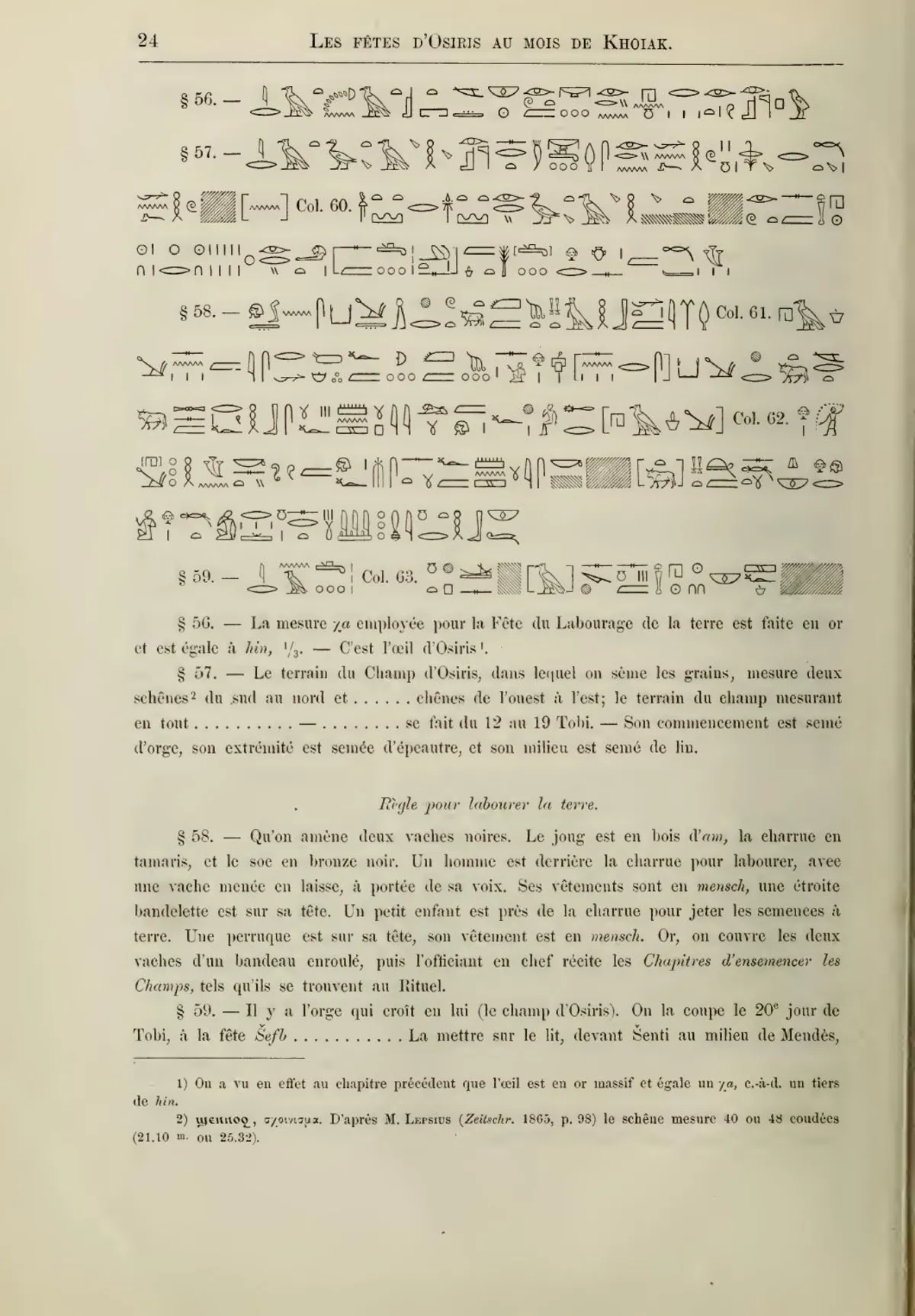
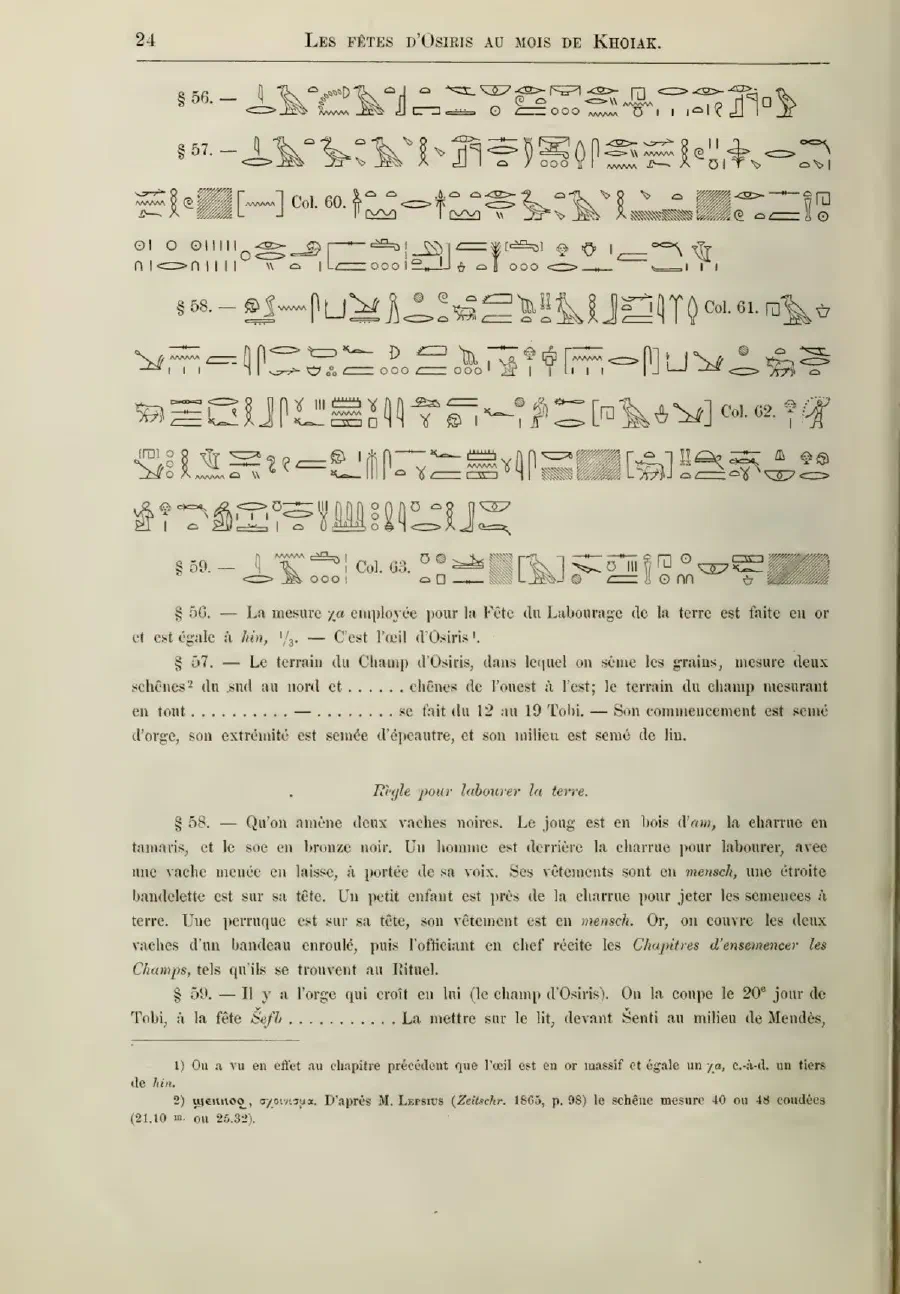
§ 56. — La mesure χa employée pour la Fête du Labourage de la terre est faite en or et est égale à hin, 1/3. — C'est l'œil d'Osiris.
§ 56. — The measure χa used for the Feast of Ploughing the Earth is made of gold and is equal to hin, 1/3. — It is the eye of Osiris.
Note on line s56
Loret’s note 1: it was seen in the preceding chapter that the eye is of solid gold and equals one χa, that is, a third of a hin. - s5724
§ 57. — Le terrain du Champ d'Osiris, dans lequel on sème les grains, mesure deux schènes du sud au nord et [ . . . ] schènes de l'ouest à l'est ; le terrain du champ mesurant en tout [ . . . ] — [ . . . ] se fait du 12 au 19 Tobi. — Son commencement est semé d'orge, son extrémité est semée d'épeautre, et son milieu est semé de lin.
§ 57. — The ground of the Field of Osiris, in which the grains are sown, measures two schoenes from south to north and [ . . . ] schoenes from west to east; the ground of the field measuring in all [ . . . ] — [ . . . ] is made from 12 to 19 Tobi. — Its beginning is sown with barley, its end is sown with spelt, and its middle is sown with flax.
Note on line s57
Loret’s note 2: the Coptic word for schoene, Greek schoinisma. According to Lepsius (Zeitschr. 1865, p. 98) the schoene measures 40 or 48 cubits (21.10 m. or 25.32 m.). Rule for ploughing the earth
- rule-plough24
Règle pour labourer la terre.
Rule for ploughing the earth.
- s5824
§ 58. — Qu'on amène deux vaches noires. Le joug est en bois d'am, la charrue en tamaris, et le soc en bronze noir. Un homme est derrière la charrue pour labourer, avec une vache menée en laisse, à portée de sa voix. Ses vêtements sont en mensch, une étroite bandelette est sur sa tête. Un petit enfant est près de la charrue pour jeter les semences à terre. Une perruque est sur sa tête, son vêtement est en mensch. Or, on couvre les deux vaches d'un bandeau enroulé, puis l'officiant en chef récite les Chapitres d'ensemencer les Champs, tels qu'ils se trouvent au Rituel.
§ 58. — Let two black cows be brought. The yoke is of am wood, the plough of tamarisk, and the share of black bronze. A man is behind the plough to plough, with a cow led on a leash, within reach of his voice. His clothes are of mensch, a narrow band is on his head. A small child is near the plough to throw the seed on the ground. A wig is on his head, his garment is of mensch. Then the two cows are covered with a rolled headband, and the chief officiant recites the Chapters of Sowing the Fields, as they are found in the Ritual.
- s5924
§ 59. — Il y a l'orge qui croît en lui (le champ d'Osiris). On la coupe le 20e jour de Tobi, à la fête Šefb [ . . . ]. La mettre sur le lit, devant Šenti au milieu de Mendès,
§ 59. — There is the barley that grows in him (the field of Osiris). It is cut on the 20th day of Tobi, at the feast of Šefb [ . . . ]. Put it on the bed, before Šenti in the middle of Mendes,
Page 25. Recueil IV, p. 25: spelt and flax from the field; the ansuti, casket of rush (§§ 59–65) Recueil de travaux III, IV and V (archive.org scans) - s59b25
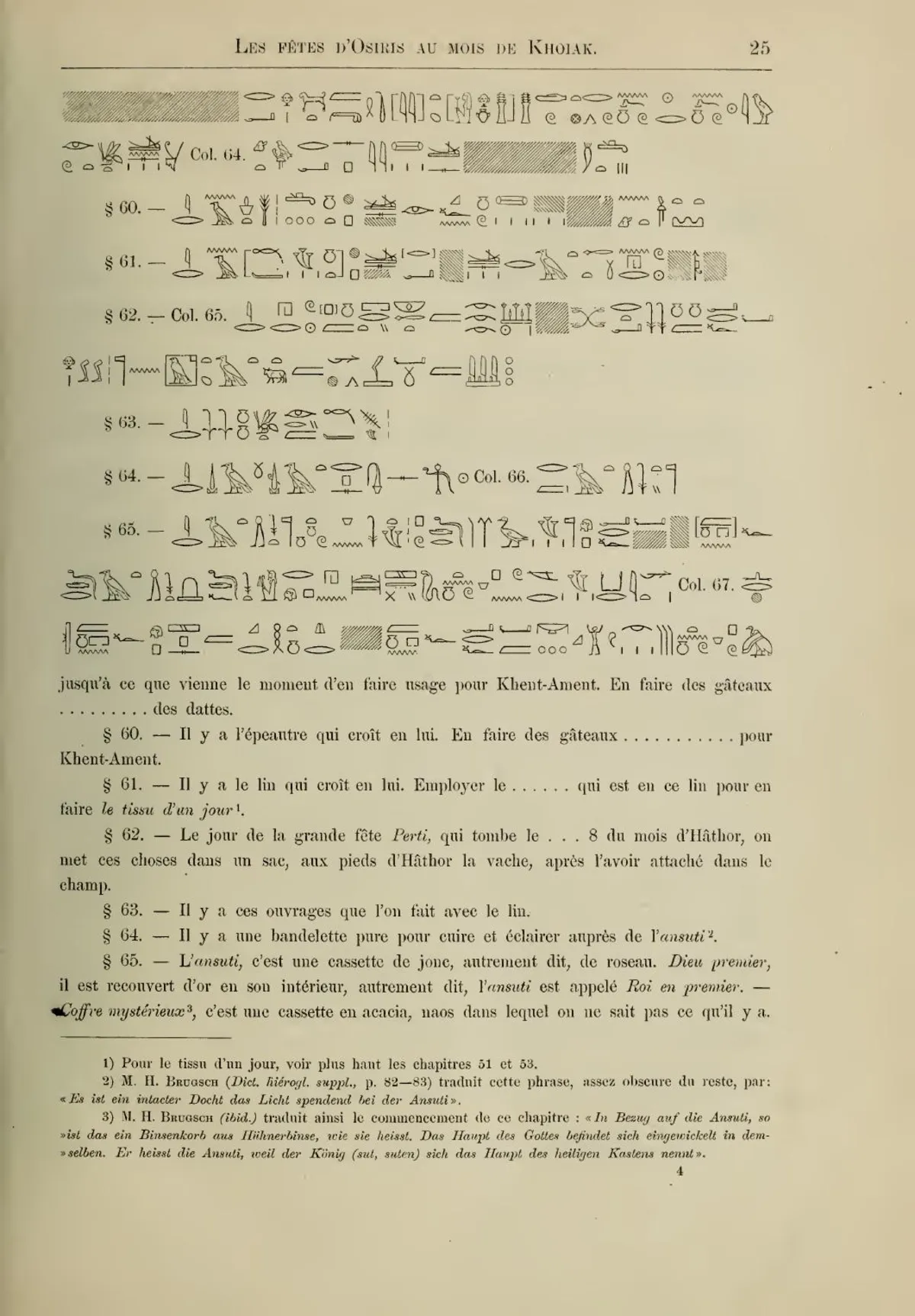
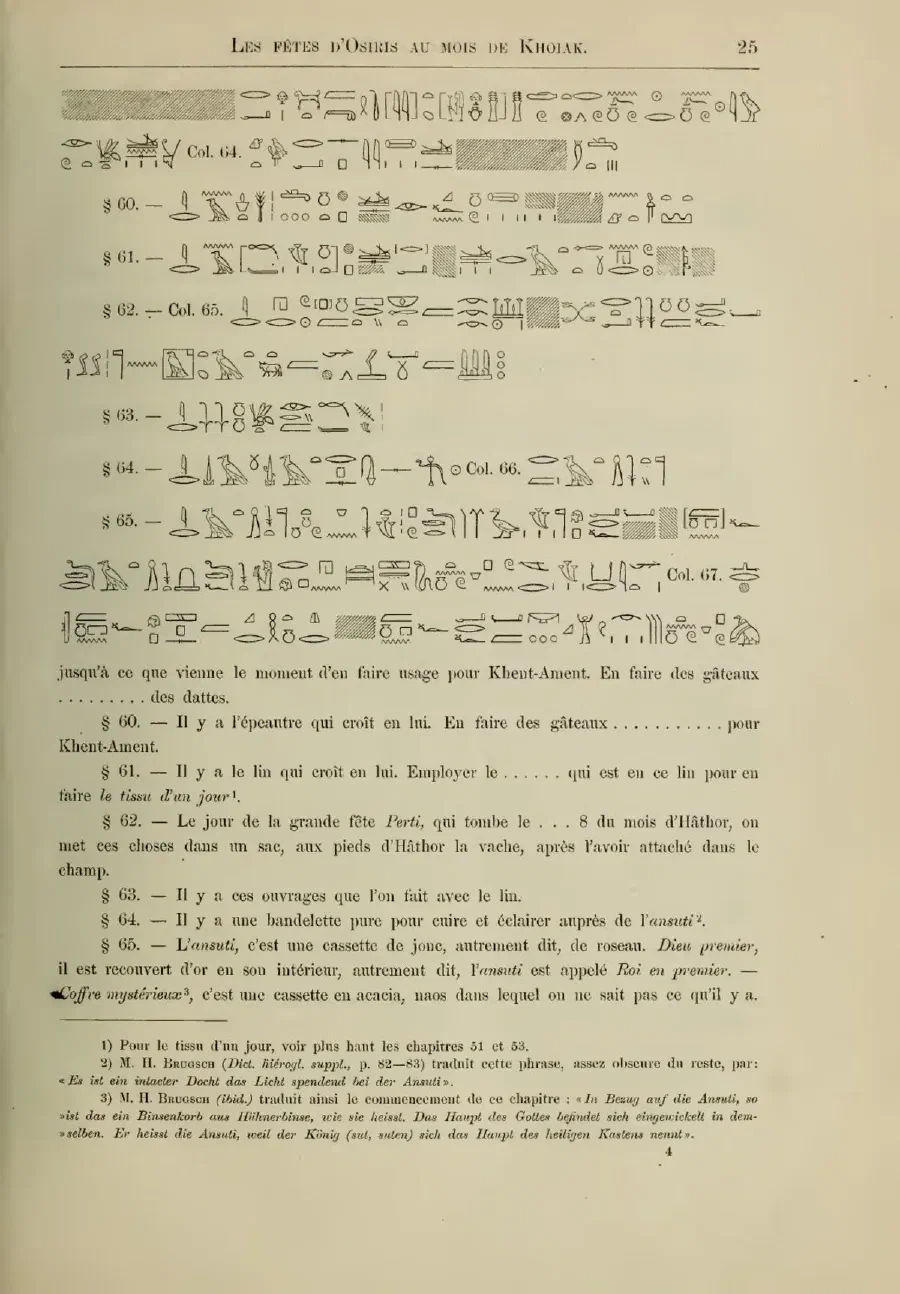
jusqu'à ce que vienne le moment d'en faire usage pour Khent-Ament. En faire des gâteaux [ . . . ] des dattes.
until the moment comes to use it for Khent-Ament. Make cakes of it [ . . . ] dates.
- s6025
§ 60. — Il y a l'épeautre qui croît en lui. En faire des gâteaux [ . . . ] pour Khent-Ament.
§ 60. — There is the spelt that grows in him. Make cakes of it [ . . . ] for Khent-Ament.
- s6125
§ 61. — Il y a le lin qui croît en lui. Employer le [ . . . ] qui est en ce lin pour en faire le tissu d'un jour.
§ 61. — There is the flax that grows in him. Use the [ . . . ] that is in this flax to make of it the cloth of one day.
Note on line s61
Loret’s note 1: for the cloth of one day, see above, chapters 51 and 53. - s6225
§ 62. — Le jour de la grande fête Perti, qui tombe le [ . . . ] 8 du mois d'Hâthor, on met ces choses dans un sac, aux pieds d'Hâthor la vache, après l'avoir attaché dans le champ.
§ 62. — On the day of the great feast Perti, which falls on the [ . . . ] 8 of the month of Hathor, these things are put in a sack, at the feet of Hathor the cow, after it has been tied in the field.
- s6325
§ 63. — Il y a ces ouvrages que l'on fait avec le lin.
§ 63. — There are these works that are made with the flax.
- s6425
§ 64. — Il y a une bandelette pure pour cuire et éclairer auprès de l'ansuti.
§ 64. — There is a pure band for cooking and giving light beside the ansuti.
Note on line s64
Loret’s note 2: Brugsch (Dict. hiérogl. suppl., pp. 82-83) translates this phrase, rather obscure besides, as “There is an intact wick giving light at the Ansuti.” - s6525
§ 65. — L'ansuti, c'est une cassette de jonc, autrement dit, de roseau. Dieu premier, il est recouvert d'or en son intérieur, autrement dit, l'ansuti est appelé Roi en premier. — Coffre mystérieux, c'est une cassette en acacia, naos dans lequel on ne sait pas ce qu'il y a.
§ 65. — The ansuti is a casket of rush, otherwise said, of reed. First god, it is covered with gold on its inside; otherwise said, the ansuti is called King first. — Mysterious chest is a casket of acacia, a shrine in which one does not know what there is.
Note on line s65
Loret’s note 3: Brugsch (ibid.) translates the beginning of this chapter thus: “As for the Ansuti, it is a rush basket of chicken-rush, as it is called. The head of the god is found wrapped in it. It is called the Ansuti because the king (sut, suten) calls himself the head of the holy chest.” 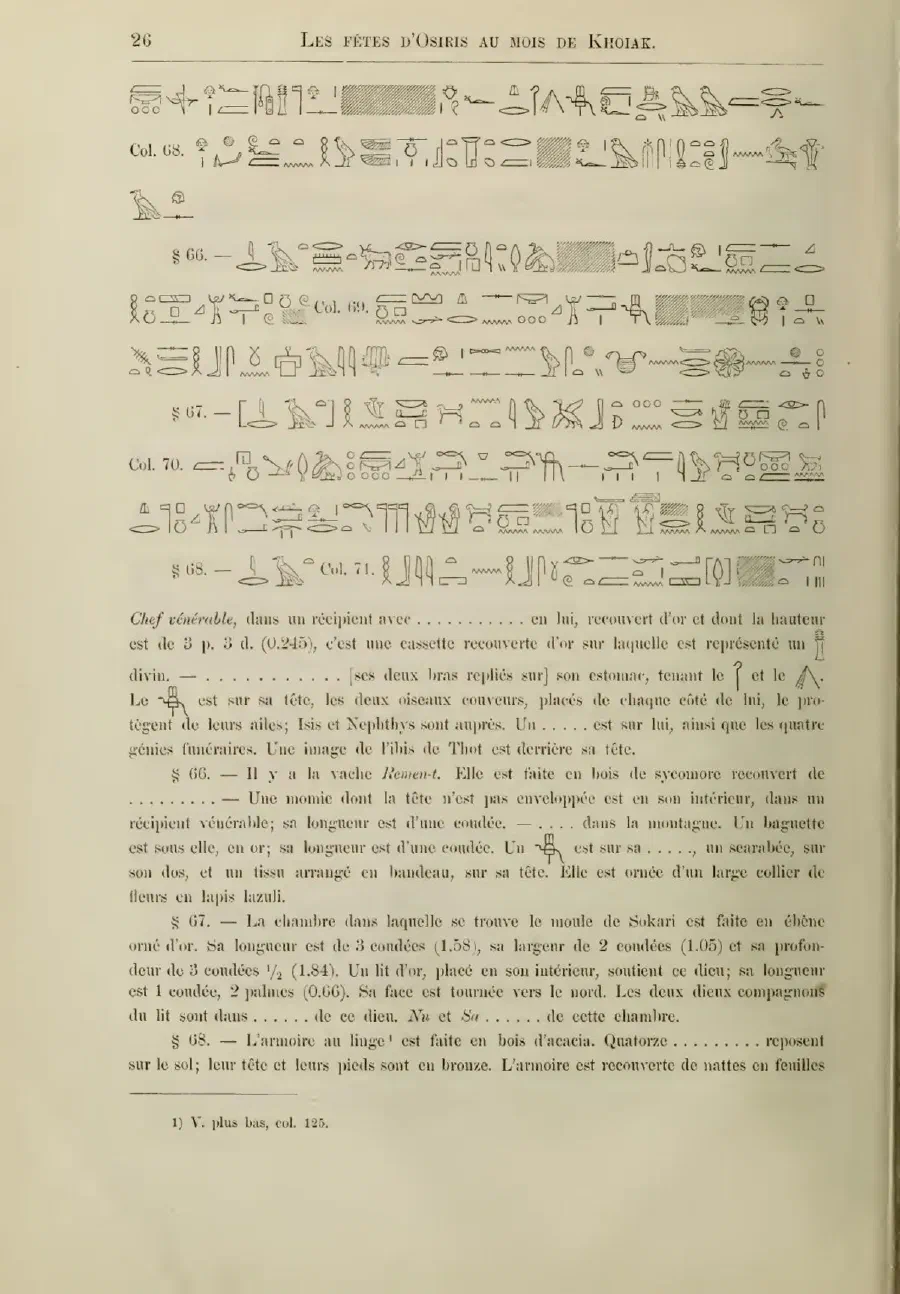
Page 26. Recueil IV, p. 26: the venerable head; the cow Remen-t; the chamber and bed of Sokari; the linen cupboard (§§ 65–68) Recueil de travaux III, IV and V (archive.org scans) - s65b26
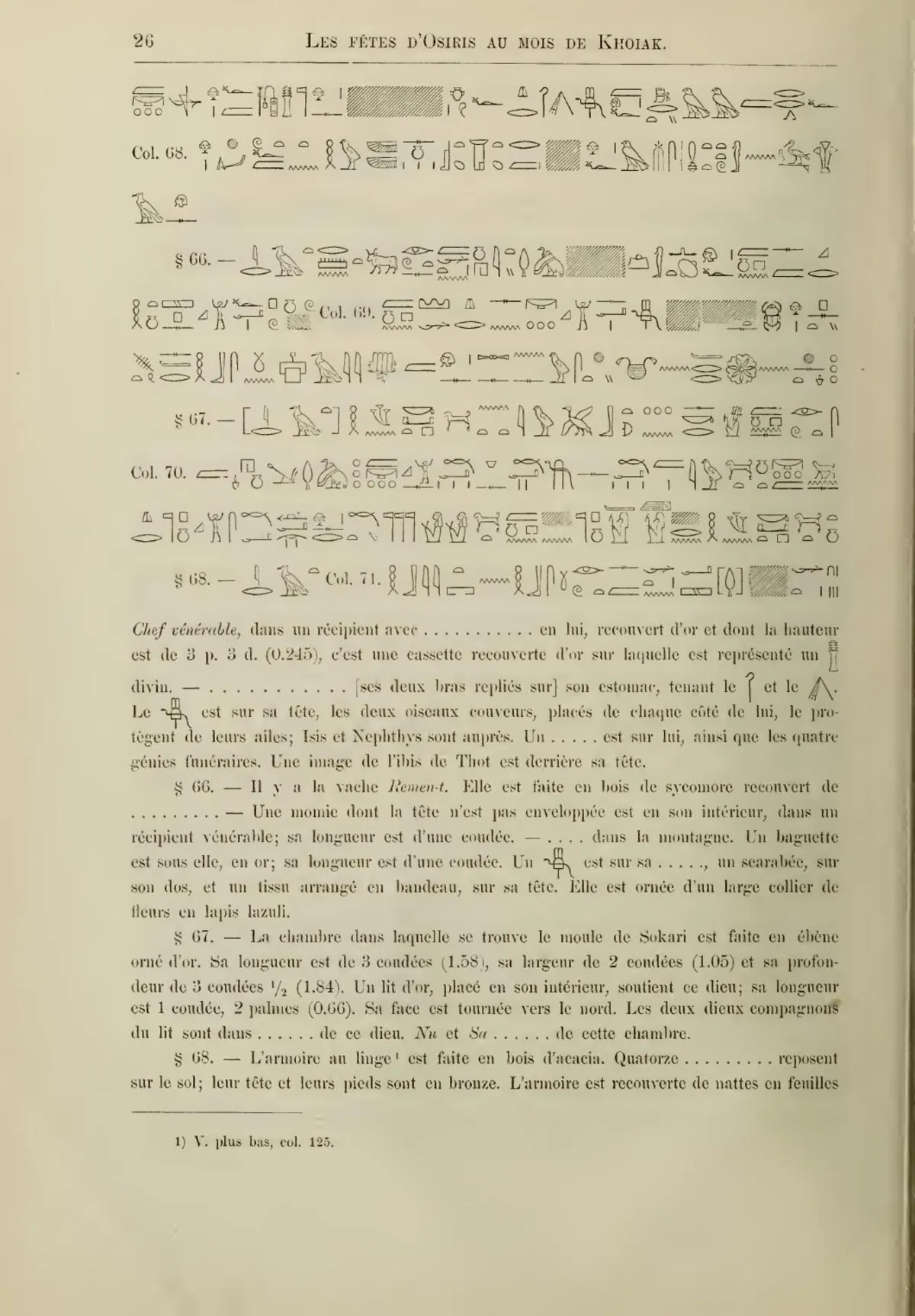
Chef vénérable, dans un récipient avec [ . . . ] en lui, recouvert d'or et dont la hauteur est de 3 p. 3 d. (0.245), c'est une cassette recouverte d'or sur laquelle est représenté un [sign] divin. — [ . . . ] [ses deux bras repliés sur] son estomac, tenant le [sign] et le [sign]. Le [sign] est sur sa tête, les deux oiseaux couveurs, placés de chaque côté de lui, le protègent de leurs ailes ; Isis et Nephthys sont auprès. Un [ . . . ] est sur lui, ainsi que les quatre génies funéraires. Une image de l'ibis de Thot est derrière sa tête.
Venerable head, in a vessel with [ . . . ] in it, covered with gold and whose height is 3 palms 3 fingers (0.245 m.), it is a casket covered with gold on which is represented a divine [sign]. — [ . . . ] [his two arms folded on] his stomach, holding the [sign] and the [sign]. The [sign] is on his head, the two brooding birds, placed on each side of him, protect him with their wings; Isis and Nephthys are beside him. A [ . . . ] is on him, as are the four funerary genii. An image of the ibis of Thoth is behind his head.
- s6626
§ 66. — Il y a la vache Remen-t. Elle est faite en bois de sycomore recouvert de [ . . . ]. — Une momie dont la tête n'est pas enveloppée est en son intérieur, dans un récipient vénérable ; sa longueur est d'une coudée. — [ . . . ] dans la montagne. Un baguette est sous elle, en or ; sa longueur est d'une coudée. Un [sign] est sur sa [ . . . ], un scarabée, sur son dos, et un tissu arrangé en bandeau, sur sa tête. Elle est ornée d'un large collier de fleurs en lapis lazuli.
§ 66. — There is the cow Remen-t. She is made of sycamore wood covered with [ . . . ]. — A mummy whose head is not wrapped is inside her, in a venerable vessel; its length is one cubit. — [ . . . ] in the mountain. A rod is under her, of gold; its length is one cubit. A [sign] is on her [ . . . ], a scarab on her back, and a cloth arranged as a headband on her head. She is adorned with a broad collar of flowers in lapis lazuli.
- s6726
§ 67. — La chambre dans laquelle se trouve le moule de Sokari est faite en ébène orné d'or. Sa longueur est de 3 coudées (1.58), sa largeur de 2 coudées (1.05) et sa profondeur de 3 coudées 1/2 (1.84). Un lit d'or, placé en son intérieur, soutient ce dieu ; sa longueur est 1 coudée, 2 palmes (0.66). Sa face est tournée vers le nord. Les deux dieux compagnons du lit sont dans [ . . . ] de ce dieu. Nu et Sa [ . . . ] de cette chambre.
§ 67. — The chamber in which the mould of Sokari is found is made of ebony adorned with gold. Its length is 3 cubits (1.58 m.), its width 2 cubits (1.05 m.) and its depth 3 1/2 cubits (1.84 m.). A bed of gold, placed inside it, supports this god; its length is 1 cubit, 2 palms (0.66 m.). His face is turned to the north. The two gods who are companions of the bed are in [ . . . ] of this god. Nu and Sa [ . . . ] of this chamber.
- s6826
§ 68. — L'armoire au linge est faite en bois d'acacia. Quatorze [ . . . ] reposent sur le sol ; leur tête et leurs pieds sont en bronze. L'armoire est recouverte de nattes en feuilles
§ 68. — The linen cupboard is made of acacia wood. Fourteen [ . . . ] rest on the ground; their head and their feet are of bronze. The cupboard is covered with mats of leaves
Note on line s68
Loret’s note 1: see below, col. 125. 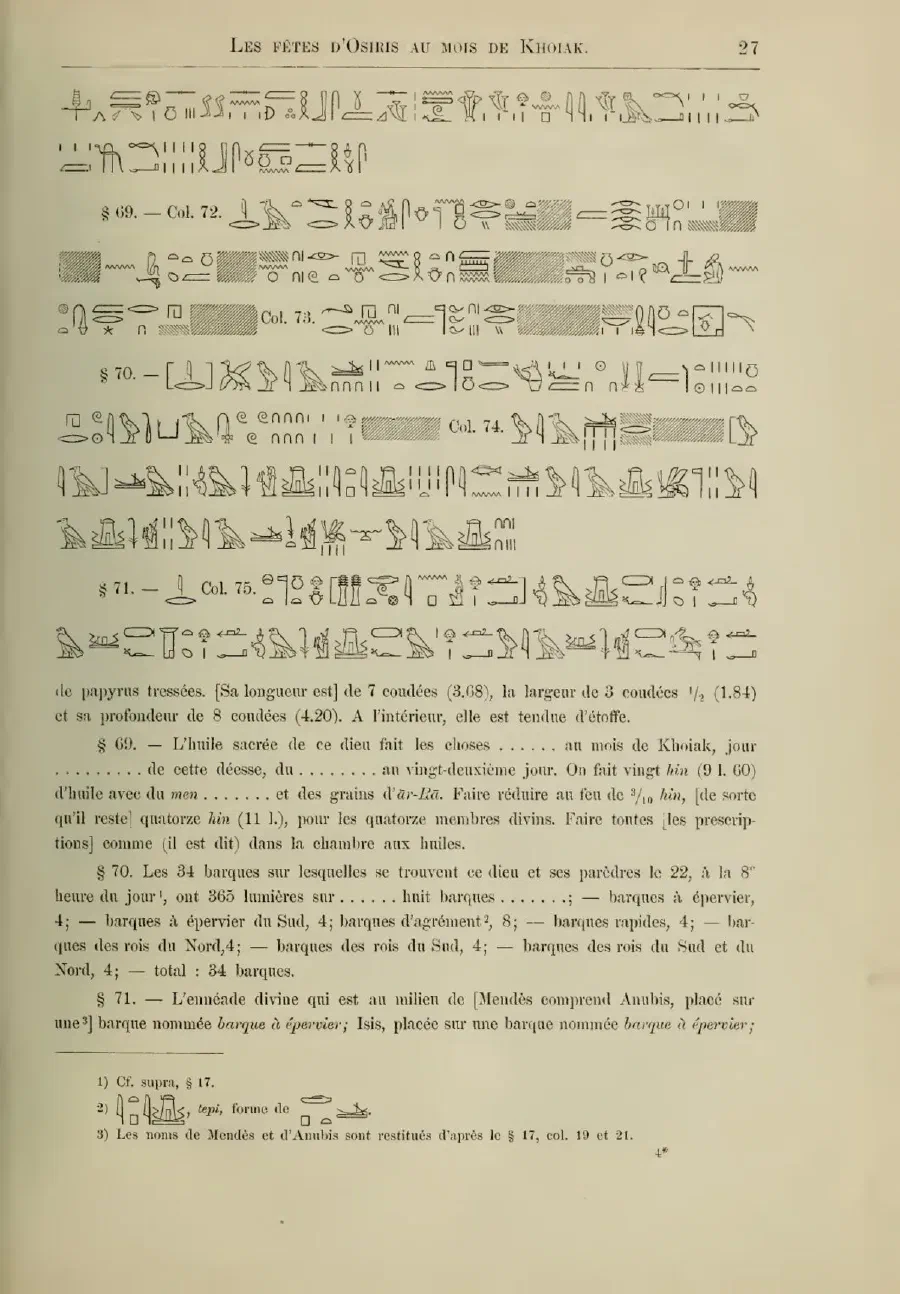
Page 27. Recueil IV, p. 27: the sacred oil; the 34 barques with their 365 lights; the divine ennead of Mendes (§§ 68–71) Recueil de travaux III, IV and V (archive.org scans) - s68b27
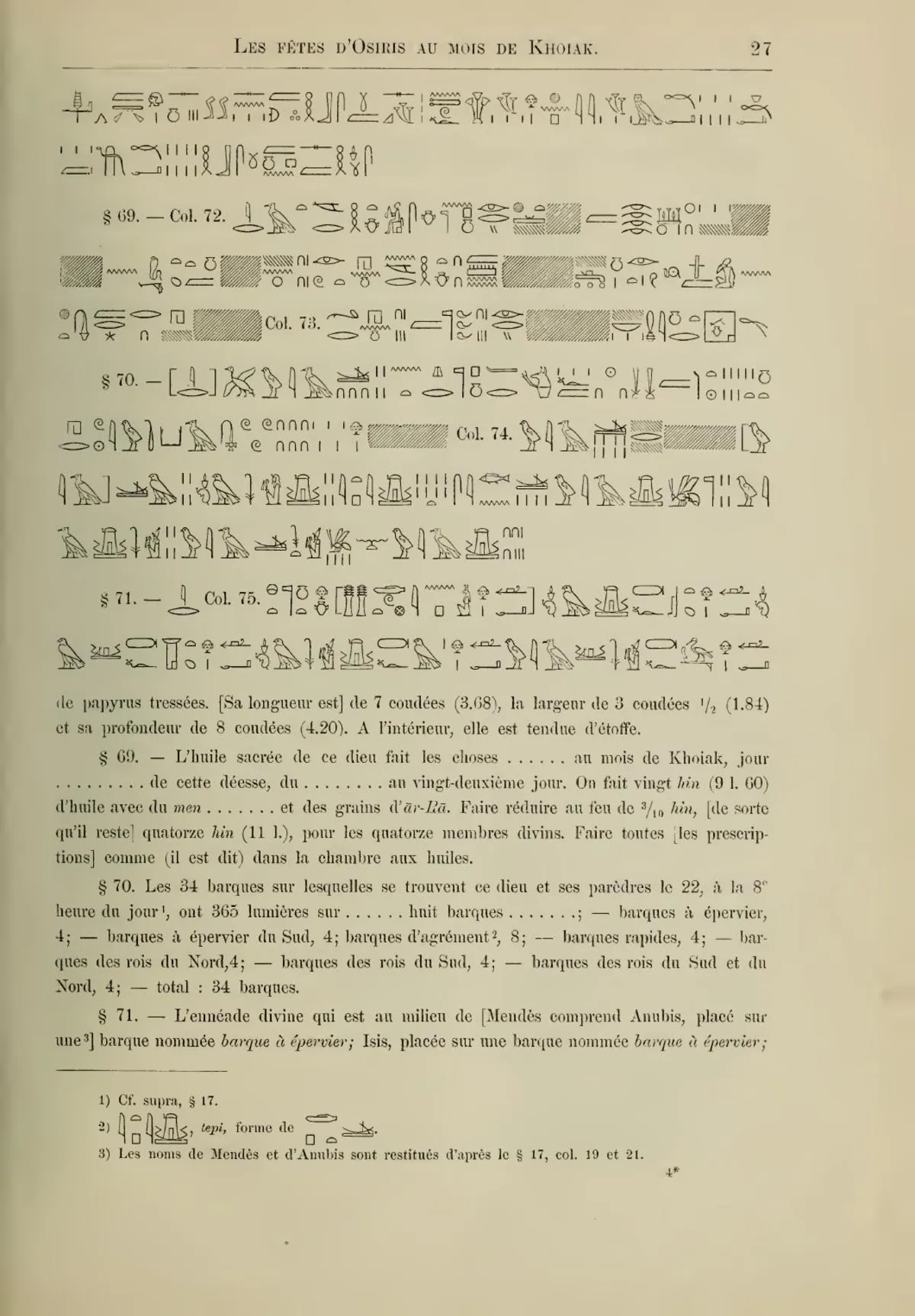
de papyrus tressées. [Sa longueur est] de 7 coudées (3.68), la largeur de 3 coudées 1/2 (1.84) et sa profondeur de 8 coudées (4.20). À l'intérieur, elle est tendue d'étoffe.
of plaited papyrus. [Its length is] 7 cubits (3.68 m.), its width 3 1/2 cubits (1.84 m.) and its depth 8 cubits (4.20 m.). Inside, it is hung with cloth.
- s6927
§ 69. — L'huile sacrée de ce dieu fait les choses [ . . . ] au mois de Khoiak, jour [ . . . ] de cette déesse, du [ . . . ] au vingt-deuxième jour. On fait vingt hin (9 l. 60) d'huile avec du men [ . . . ] et des grains d'âr-Râ. Faire réduire au feu de 3/10 hin, [de sorte qu'il reste] quatorze hin (11 l.), pour les quatorze membres divins. Faire toutes [les prescriptions] comme (il est dit) dans la chambre aux huiles.
§ 69. — The sacred oil of this god makes the things [ . . . ] in the month of Khoiak, day [ . . . ] of this goddess, from the [ . . . ] to the twenty-second day. Twenty hin (9.60 litres) of oil are made with men [ . . . ] and grains of âr-Râ. Reduce it on the fire by 3/10 hin, [so that there remain] fourteen hin (11 litres), for the fourteen divine members. Do all [the prescriptions] as (is said) in the oil chamber.
- s7027
§ 70. — Les 34 barques sur lesquelles se trouvent ce dieu et ses parèdres le 22, à la 8e heure du jour, ont 365 lumières sur [ . . . ] huit barques [ . . . ] ; — barques à épervier, 4 ; — barques à épervier du Sud, 4 ; barques d'agrément, 8 ; — barques rapides, 4 ; — barques des rois du Nord, 4 ; — barques des rois du Sud, 4 ; — barques des rois du Sud et du Nord, 4 ; — total : 34 barques.
§ 70. — The 34 barques on which this god and his attendants are found on the 22nd, at the 8th hour of the day, have 365 lights on [ . . . ] eight barques [ . . . ]; — hawk barques, 4; — hawk barques of the South, 4; pleasure barques, 8; — swift barques, 4; — barques of the kings of the North, 4; — barques of the kings of the South, 4; — barques of the kings of the South and North, 4; — total: 34 barques.
Note on line s70
Loret’s notes. (1) Cf. above, § 17. (2) The word for pleasure barques is tepi, a form of the word in the sign-group he gives. - s7127
§ 71. — L'ennéade divine qui est au milieu de [Mendès comprend Anubis, placé sur une] barque nommée barque à épervier ; Isis, placée sur une barque nommée barque à épervier ;
§ 71. — The divine ennead that is in the middle of [Mendes comprises Anubis, placed on a] barque named hawk barque; Isis, placed on a barque named hawk barque;
Note on line s71
Loret’s note 3: the names of Mendes and Anubis are restored after § 17, cols. 19 and 21. 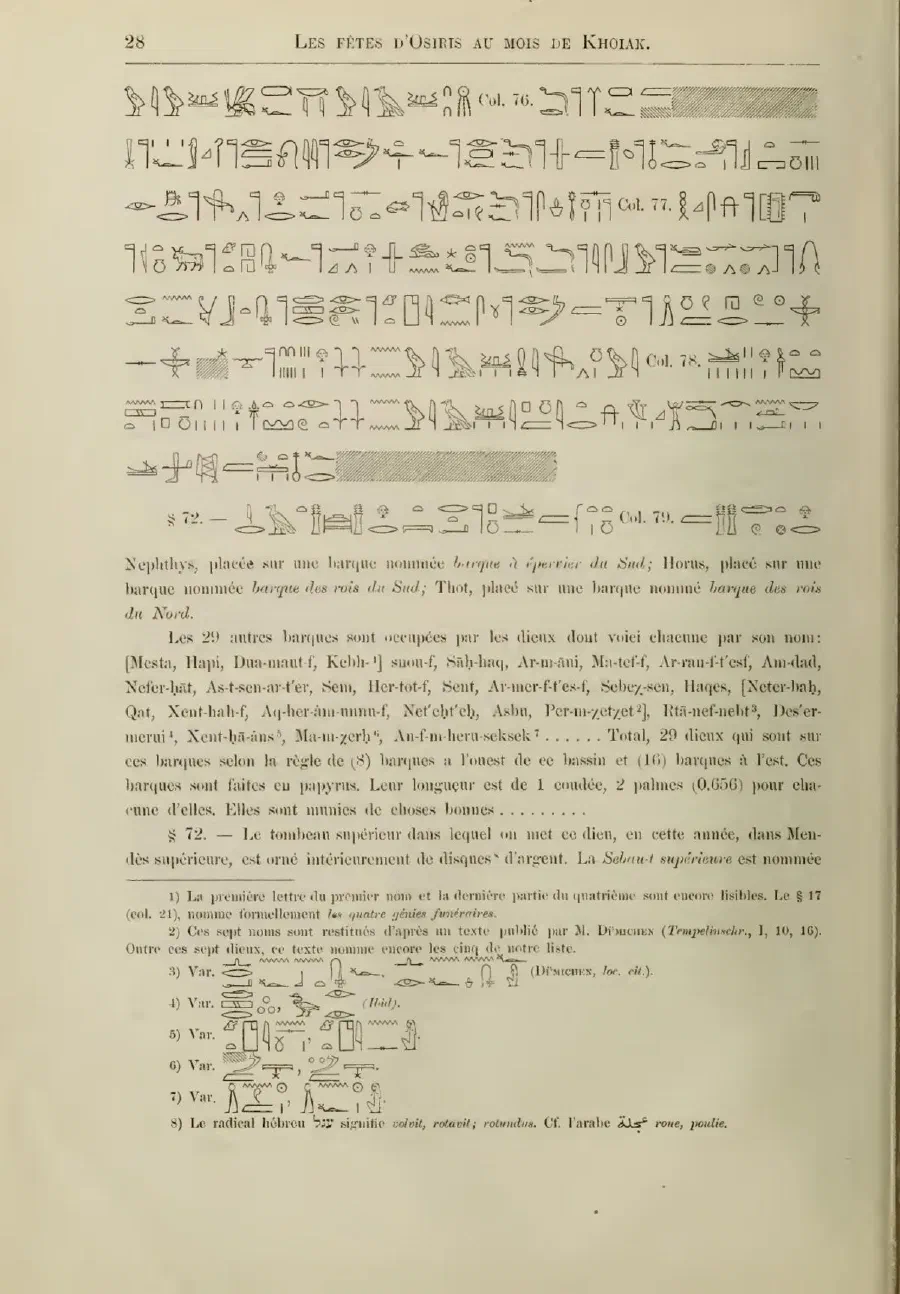
Page 28. Recueil IV, p. 28: the 29 gods on the barques, listed by name; the upper tomb (§§ 71–72) Recueil de travaux III, IV and V (archive.org scans) - s71b28
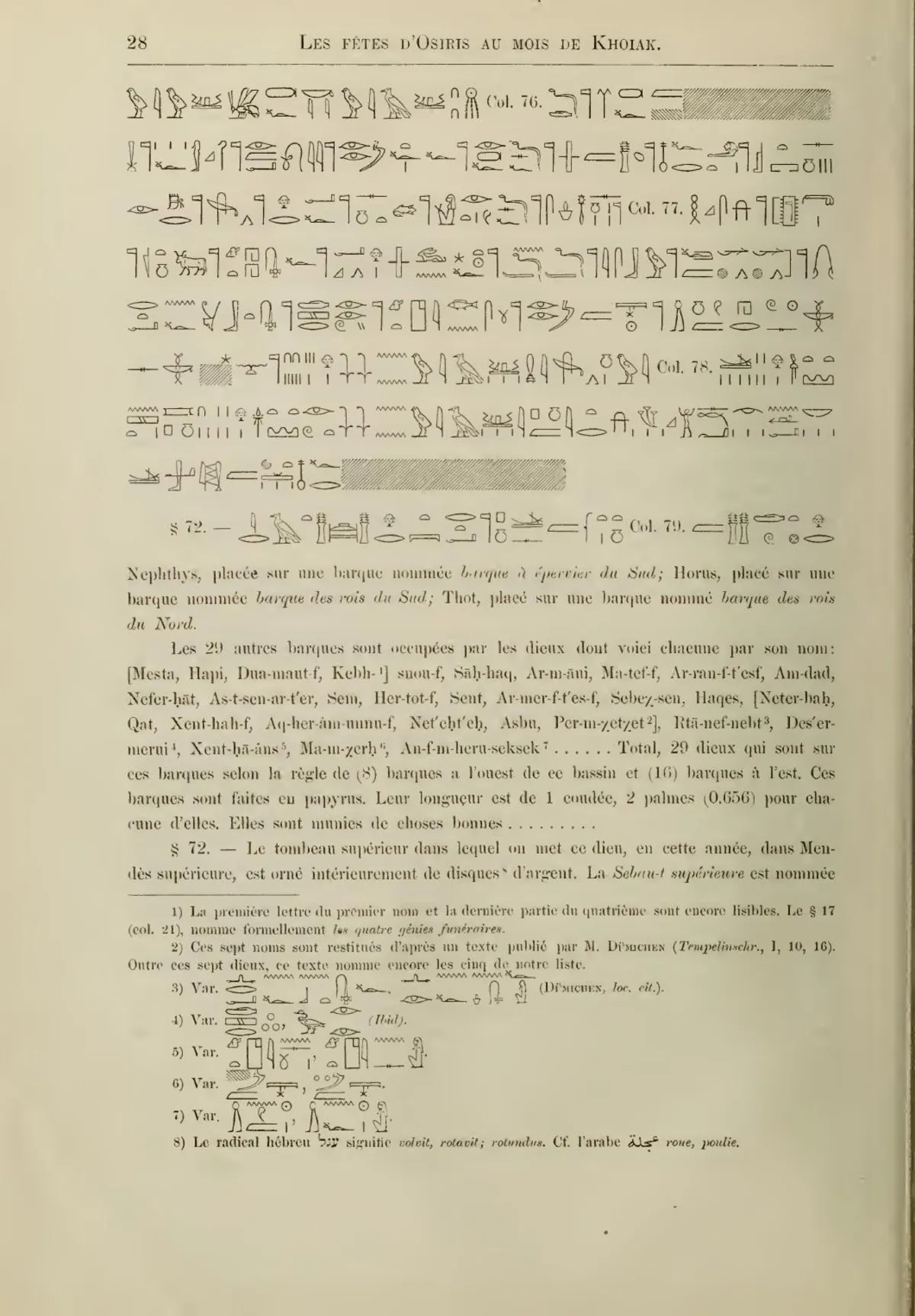
Nephthys, placée sur une barque nommée barque à épervier du Sud ; Horus, placé sur une barque nommée barque des rois du Sud ; Thot, placé sur une barque nommé barque des rois du Nord.
Nephthys, placed on a barque named hawk barque of the South; Horus, placed on a barque named barque of the kings of the South; Thoth, placed on a barque named barque of the kings of the North.
- s71c28
Les 29 autres barques sont occupées par les dieux dont voici chacune par son nom : [Mesta, Hapi, Dua-maut-f, Kebh-]snou-f, Sâh-haq, Ar-m-âui, Ma-tef-f, Ar-ran-f-t'esf, Am-dad, Nefer-hât, As-t-sen-ar-t'er, Sem, Her-tot-f, Sent, Ar-mer-f-t'es-f, Sebez-sen, Haqes, [Neter-bah, Qat, Xent-hah-f, Aq-her-âm-unnu-f, Net'eht'eb, Asbu, Per-m-zetzet], Rtâ-nef-nebt, Des'er-merui, Xent-hâ-âns, Ma-m-zerh, An-f-m-heru-seksek [ . . . ]. Total, 29 dieux qui sont sur ces barques selon la règle de (8) barques à l'ouest de ce bassin et (16) barques à l'est. Ces barques sont faites en papyrus. Leur longueur est de 1 coudée, 2 palmes (0.656) pour chacune d'elles. Elles sont munies de choses bonnes [ . . . ].
The other 29 barques are occupied by the gods of whom the following, each by his name: [Mesta, Hapi, Dua-maut-f, Kebh-]snou-f, Sâh-haq, Ar-m-âui, Ma-tef-f, Ar-ran-f-t'esf, Am-dad, Nefer-hât, As-t-sen-ar-t'er, Sem, Her-tot-f, Sent, Ar-mer-f-t'es-f, Sebez-sen, Haqes, [Neter-bah, Qat, Xent-hah-f, Aq-her-âm-unnu-f, Net'eht'eb, Asbu, Per-m-zetzet], Rtâ-nef-nebt, Des'er-merui, Xent-hâ-âns, Ma-m-zerh, An-f-m-heru-seksek [ . . . ]. Total, 29 gods who are on these barques according to the rule of (8) barques to the west of this basin and (16) barques to the east. These barques are made of papyrus. Their length is 1 cubit, 2 palms (0.656 m.) for each of them. They are furnished with good things [ . . . ].
Note on line s71c
Loret’s notes. (1) The first letter of the first name and the last part of the fourth are still legible; § 17 (col. 21) names the four funerary genii expressly. (2) These seven names are restored from a text published by Dümichen (Tempelinschr., I, 10, 16); besides these seven gods that text names the five of Loret’s list. (3-7) Variant spellings of five of the names, given in signs, after Dümichen, loc. cit. The names are given here as the OCR and the page agree, without the diacritics under the letters. - s7228
§ 72. — Le tombeau supérieur dans lequel on met ce dieu, en cette année, dans Mendès supérieure, est orné intérieurement de disques d'argent. La Sebau-t supérieure est nommée
§ 72. — The upper tomb in which this god is placed, in this year, in upper Mendes, is adorned on the inside with discs of silver. The upper Sebau-t is named
Note on line s72
Loret’s note 8: the Hebrew root of the word for disc signifies “he rolled, he turned; round”. Compare the Arabic word for wheel, pulley. 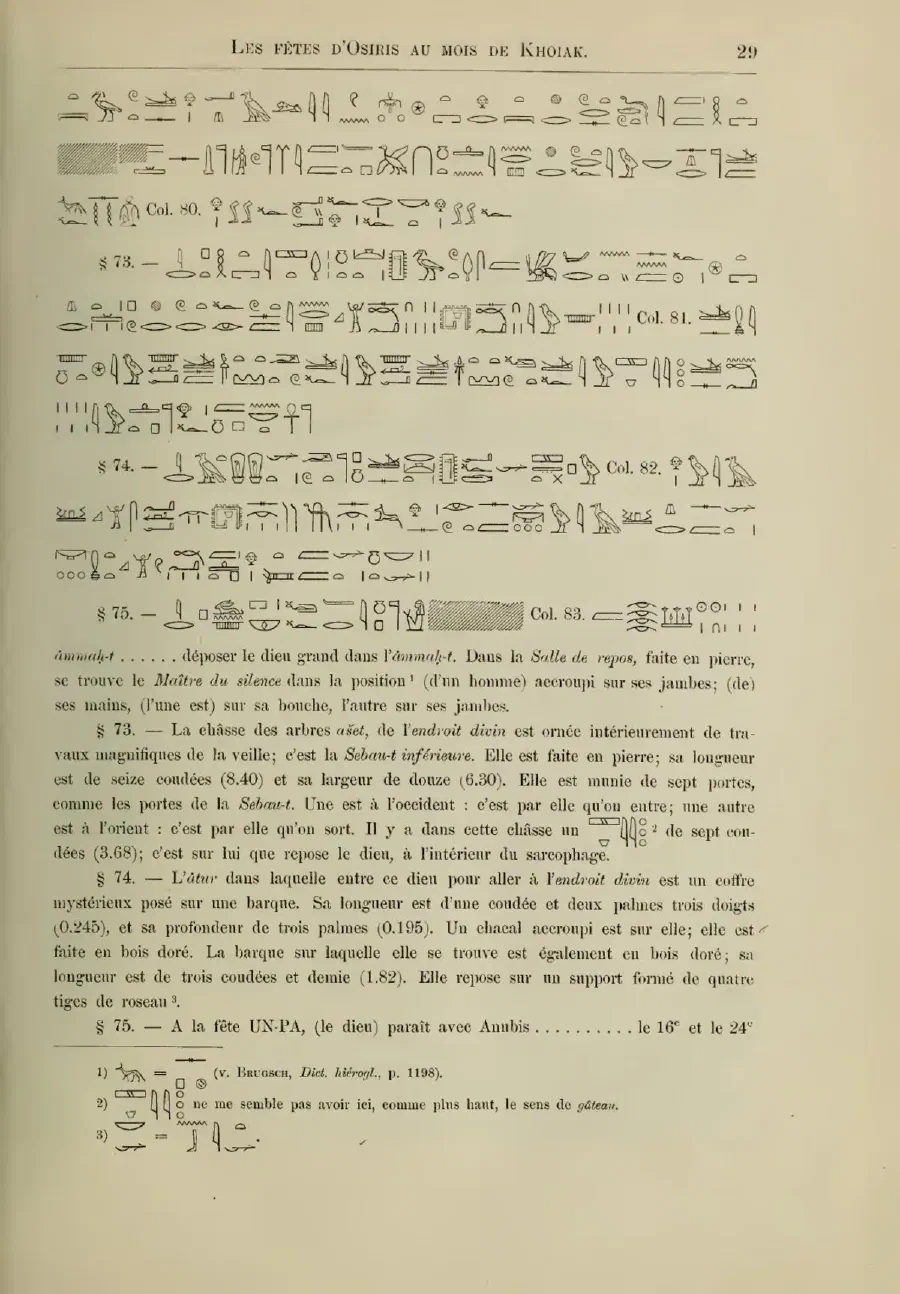
Page 29. Recueil IV, p. 29: the Master of silence with a hand on his mouth; the shrine of the ašet trees; the atur (§§ 72–75) Recueil de travaux III, IV and V (archive.org scans) - s72b29
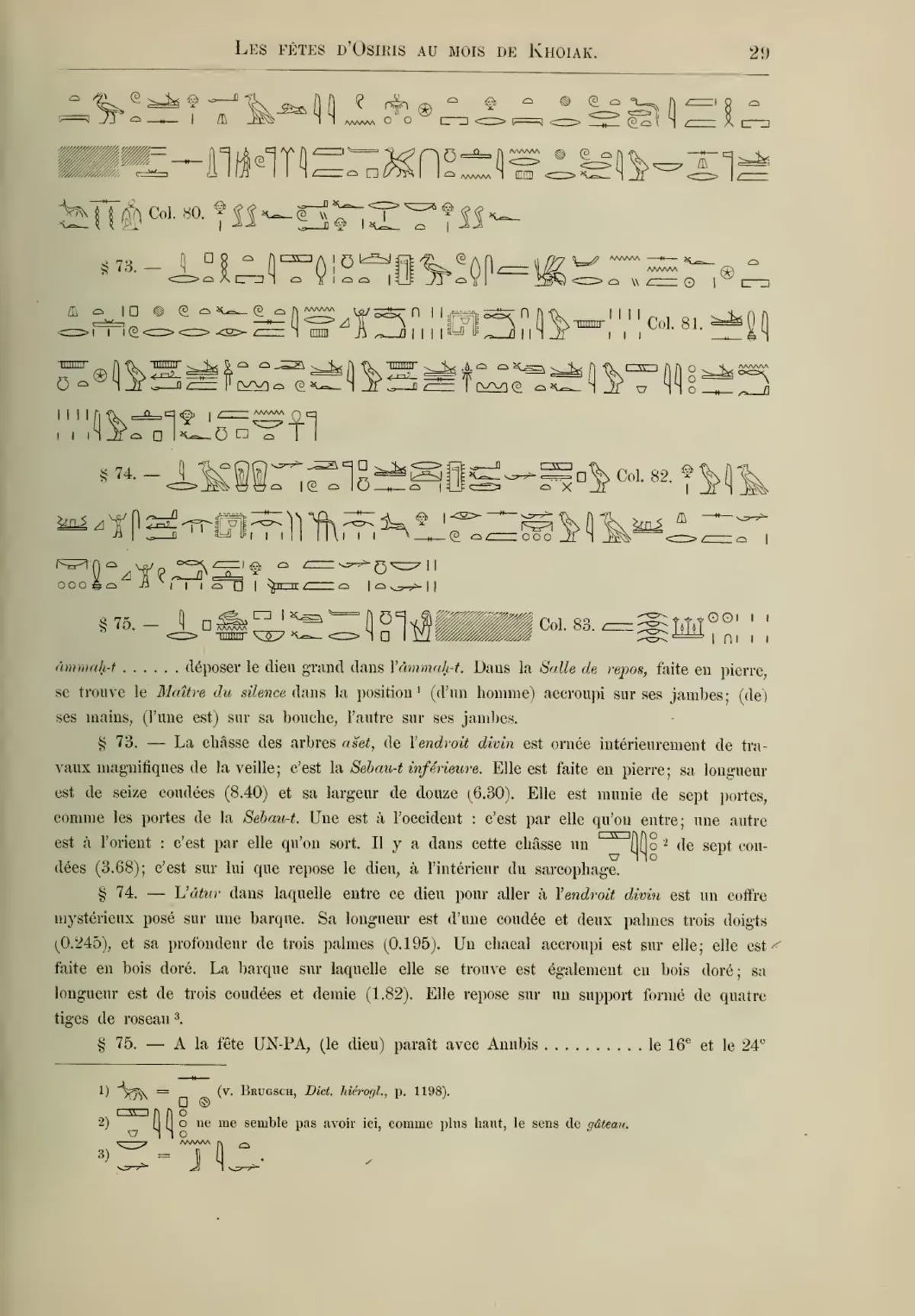
âmmah-t [ . . . ] déposer le dieu grand dans l'âmmah-t. Dans la Salle de repos, faite en pierre, se trouve le Maître du silence dans la position (d'un homme) accroupi sur ses jambes ; (de) ses mains, (l'une est) sur sa bouche, l'autre sur ses jambes.
âmmah-t [ . . . ] lay the great god in the âmmah-t. In the Hall of Rest, made of stone, is the Master of silence in the position (of a man) squatting on his legs; (of) his hands, (one is) on his mouth, the other on his legs.
Note on line s72b
Loret’s note 1: the word for position equals a word that Brugsch gives, Dict. hiérogl., p. 1198, in signs. - s7329
§ 73. — La châsse des arbres ašet, de l'endroit divin est ornée intérieurement de travaux magnifiques de la veille ; c'est la Sebau-t inférieure. Elle est faite en pierre ; sa longueur est de seize coudées (8.40) et sa largeur de douze (6.30). Elle est munie de sept portes, comme les portes de la Sebau-t. Une est à l'occident : c'est par elle qu'on entre ; une autre est à l'orient : c'est par elle qu'on sort. Il y a dans cette châsse un [sign] de sept coudées (3.68) ; c'est sur lui que repose le dieu, à l'intérieur du sarcophage.
§ 73. — The shrine of the ašet trees, of the divine place, is adorned on the inside with magnificent works of the vigil; it is the lower Sebau-t. It is made of stone; its length is sixteen cubits (8.40 m.) and its width twelve (6.30 m.). It is furnished with seven doors, like the doors of the Sebau-t. One is to the west: it is by this that one enters; another is to the east: it is by this that one goes out. There is in this shrine a [sign] of seven cubits (3.68 m.); it is on this that the god rests, inside the sarcophagus.
Note on line s73
Loret’s note 2: the word he gives in signs does not seem to him to have here, as above, the sense of cake. - s7429
§ 74. — L'âtur dans laquelle entre ce dieu pour aller à l'endroit divin est un coffre mystérieux posé sur une barque. Sa longueur est d'une coudée et deux palmes trois doigts (0.245), et sa profondeur de trois palmes (0.195). Un chacal accroupi est sur elle ; elle est faite en bois doré. La barque sur laquelle elle se trouve est également en bois doré ; sa longueur est de trois coudées et demie (1.82). Elle repose sur un support formé de quatre tiges de roseau.
§ 74. — The âtur into which this god enters to go to the divine place is a mysterious chest set on a barque. Its length is one cubit and two palms three fingers (0.245 m.), and its depth three palms (0.195 m.). A squatting jackal is on it; it is made of gilded wood. The barque on which it stands is likewise of gilded wood; its length is three cubits and a half (1.82 m.). It rests on a support formed of four reed stalks.
Note on line s74
Loret’s note 3: the Egyptian word for the support, written in signs, is equated with a second word, also in signs. - s7529
§ 75. — À la fête UN-PA, (le dieu) paraît avec Anubis [ . . . ] le 16e et le 24e
§ 75. — At the feast UN-PA, (the god) appears with Anubis [ . . . ] on the 16th and the 24th
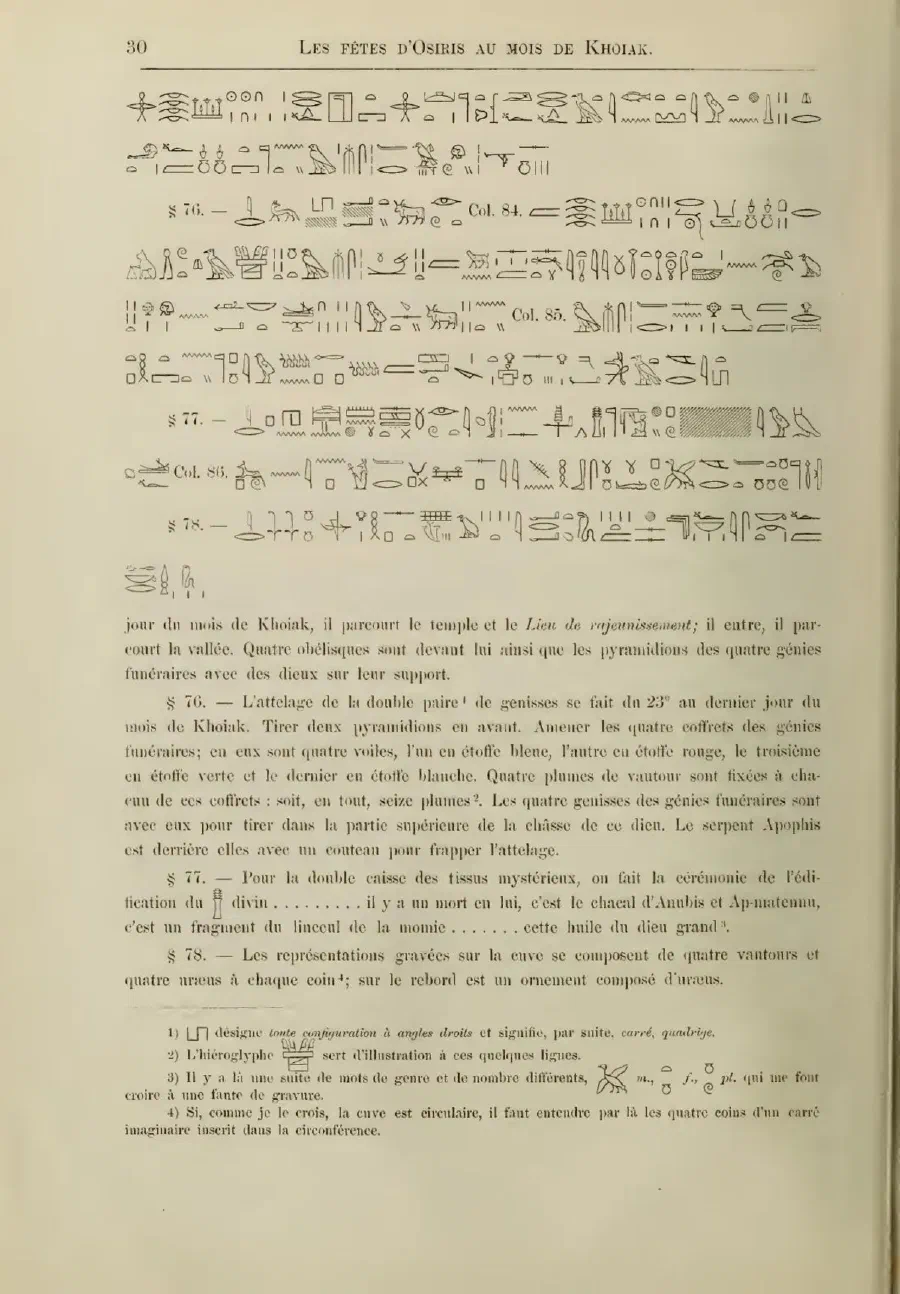
Page 30. Recueil IV, p. 30: the harnessing of the heifers, the four funerary genii, and Apophis with a knife (§§ 75–78) Recueil de travaux III, IV and V (archive.org scans) - s75b30
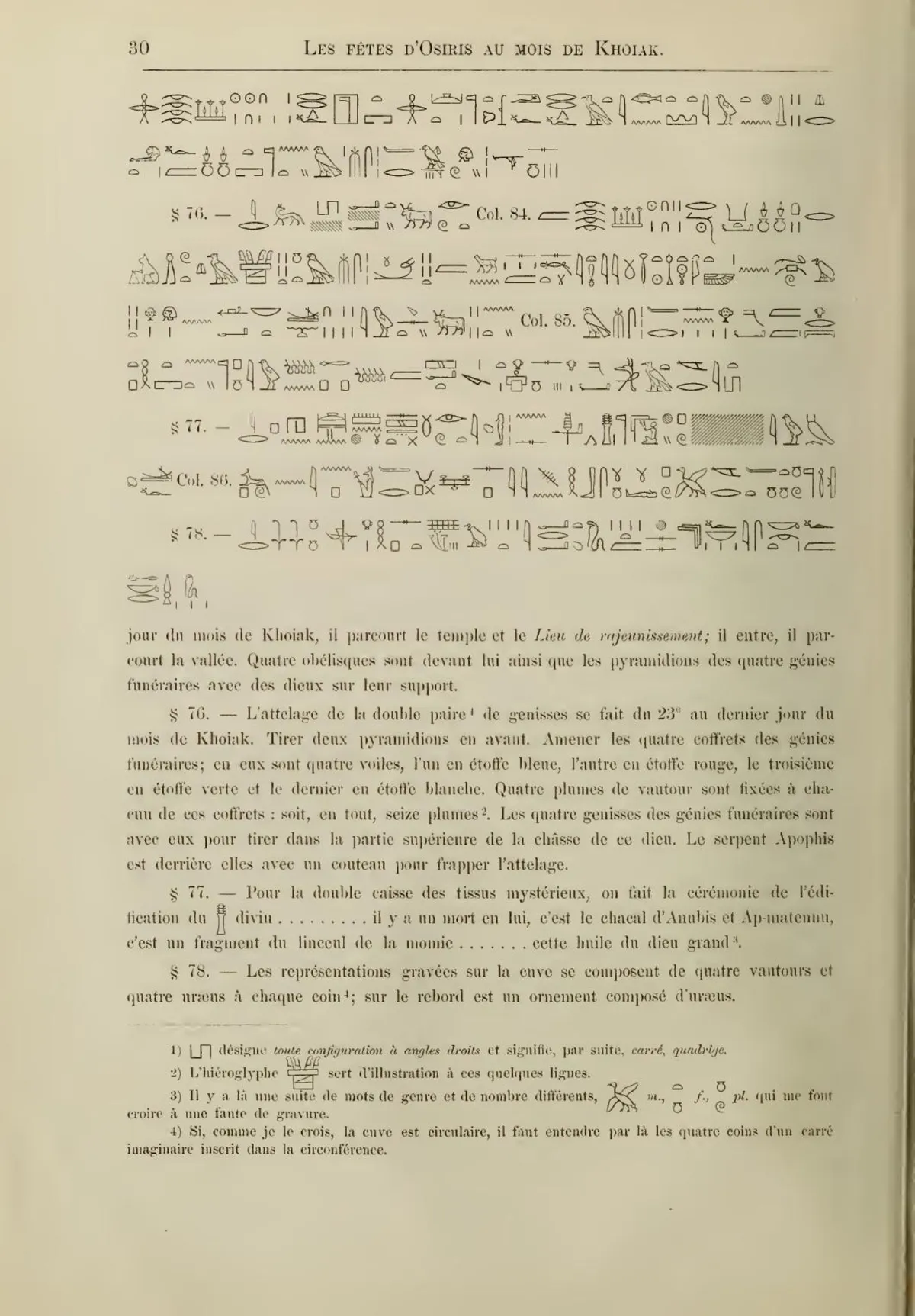
jour du mois de Khoiak, il parcourt le temple et le Lieu de rajeunissement ; il entre, il parcourt la vallée. Quatre obélisques sont devant lui ainsi que les pyramidions des quatre génies funéraires avec des dieux sur leur support.
day of the month of Khoiak, he goes through the temple and the Place of rejuvenation; he enters, he goes through the valley. Four obelisks are before him, as well as the pyramidions of the four funerary genii with gods on their support.
- s7630
§ 76. — L'attelage de la double paire de génisses se fait du 23e au dernier jour du mois de Khoiak. Tirer deux pyramidions en avant. Amener les quatre coffrets des génies funéraires ; en eux sont quatre voiles, l'un en étoffe bleue, l'autre en étoffe rouge, le troisième en étoffe verte et le dernier en étoffe blanche. Quatre plumes de vautour sont fixées à chacun de ces coffrets : soit, en tout, seize plumes. Les quatre génisses des génies funéraires sont avec eux pour tirer dans la partie supérieure de la châsse de ce dieu. Le serpent Apophis est derrière elles avec un couteau pour frapper l'attelage.
§ 76. — The harnessing of the double pair of heifers is done from the 23rd to the last day of the month of Khoiak. Draw two pyramidions forward. Bring the four small chests of the funerary genii; in them are four veils, one of blue cloth, another of red cloth, the third of green cloth and the last of white cloth. Four vulture feathers are fixed to each of these small chests: that is, in all, sixteen feathers. The four heifers of the funerary genii are with them to draw in the upper part of the shrine of this god. The serpent Apophis is behind them with a knife to strike the team.
Note on line s76
Loret’s notes. (1) The word for double pair designates any configuration with right angles and so signifies square, quadriga. (2) The hieroglyph for feather serves as an illustration to these few lines. - s7730
§ 77. — Pour la double caisse des tissus mystérieux, on fait la cérémonie de l'édification du [sign] divin [ . . . ] il y a un mort en lui, c'est le chacal d'Anubis et Ap-matennu, c'est un fragment du linceul de la momie [ . . . ] cette huile du dieu grand.
§ 77. — For the double chest of the mysterious cloths, the ceremony of the raising of the divine [sign] is performed [ . . . ] there is a dead one in it, it is the jackal of Anubis and Ap-matennu, it is a fragment of the shroud of the mummy [ . . . ] this oil of the great god.
Note on line s77
Loret’s note 3: there is here a series of words of different gender and number (masculine, feminine, plural, in signs), which makes him believe in an engraver’s error. - s7830
§ 78. — Les représentations gravées sur la cuve se composent de quatre vautours et quatre uræus à chaque coin ; sur le rebord est un ornement composé d'uræus.
§ 78. — The representations engraved on the vat consist of four vultures and four uraei at each corner; on the rim is an ornament composed of uraei.
Note on line s78
Loret’s note 4: if, as he believes, the vat is circular, the “corners” must be understood as the four corners of an imaginary square inscribed in the circumference. 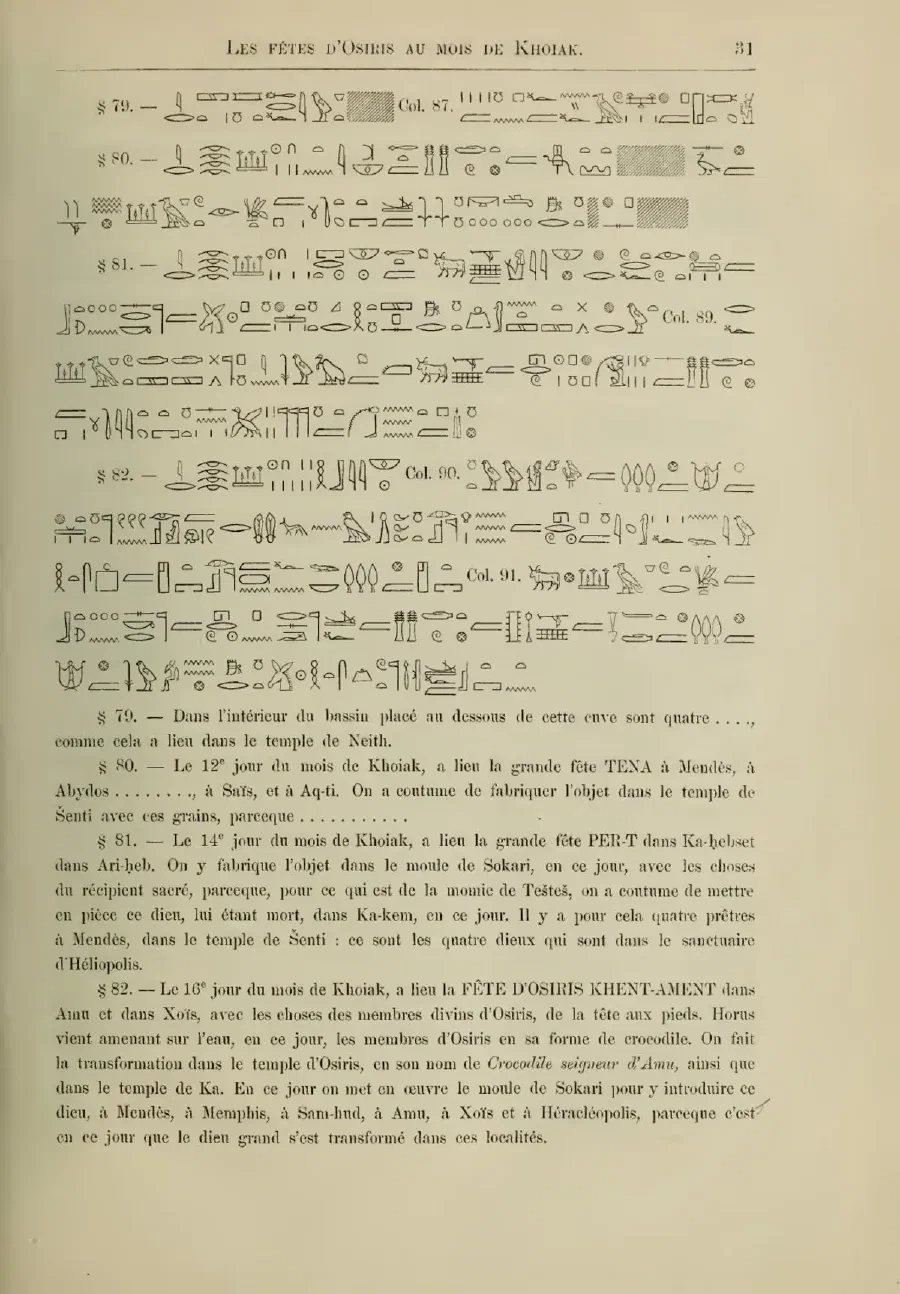
Page 31. Recueil IV, p. 31: the feasts of the 12th, 14th and 16th Khoiak: the god put in pieces at Ka-kem; Horus bringing the members as a crocodile (§§ 79–82) Recueil de travaux III, IV and V (archive.org scans) - s7931
§ 79. — Dans l'intérieur du bassin placé au dessous de cette cuve sont quatre [ . . . ], comme cela a lieu dans le temple de Neith.
§ 79. — Inside the basin placed beneath this vat are four [ . . . ], as is the case in the temple of Neith.
- s8031
§ 80. — Le 12e jour du mois de Khoiak, a lieu la grande fête TENA à Mendès, à Abydos [ . . . ], à Saïs, et à Aq-ti. On a coutume de fabriquer l'objet dans le temple de Šenti avec ces grains, parceque [ . . . ]
§ 80. — On the 12th day of the month of Khoiak the great feast TENA takes place at Mendes, at Abydos [ . . . ], at Sais, and at Aq-ti. It is the custom to make the object in the temple of Šenti with these grains, because [ . . . ]
- s8131
§ 81. — Le 14e jour du mois de Khoiak, a lieu la grande fête PER-T dans Ka-hebset dans Ari-heb. On y fabrique l'objet dans le moule de Sokari, en ce jour, avec les choses du récipient sacré, parceque, pour ce qui est de la momie de Teštes, on a coutume de mettre en pièce ce dieu, lui étant mort, dans Ka-kem, en ce jour. Il y a pour cela quatre prêtres à Mendès, dans le temple de Šenti : ce sont les quatre dieux qui sont dans le sanctuaire d'Héliopolis.
§ 81. — On the 14th day of the month of Khoiak the great feast PER-T takes place in Ka-hebset in Ari-heb. The object is made there in the mould of Sokari, on this day, with the things of the sacred vessel, because, as for the mummy of Teštes, it is the custom to put this god in pieces, he being dead, in Ka-kem, on this day. There are for this four priests at Mendes, in the temple of Šenti: they are the four gods who are in the sanctuary of Heliopolis.
- s8231
§ 82. — Le 16e jour du mois de Khoiak, a lieu la FÊTE D'OSIRIS KHENT-AMENT dans Amu et dans Xoïs, avec les choses des membres divins d'Osiris, de la tête aux pieds. Horus vient amenant sur l'eau, en ce jour, les membres d'Osiris en sa forme de crocodile. On fait la transformation dans le temple d'Osiris, en son nom de Crocodile seigneur d'Amu, ainsi que dans le temple de Ka. En ce jour on met en œuvre le moule de Sokari pour y introduire ce dieu, à Mendès, à Memphis, à Sam-hud, à Amu, à Xoïs et à Héracléopolis, parceque c'est en ce jour que le dieu grand s'est transformé dans ces localités.
§ 82. — On the 16th day of the month of Khoiak the FEAST OF OSIRIS KHENT-AMENT takes place in Amu and in Xois, with the things of the divine members of Osiris, from the head to the feet. Horus comes bringing on the water, on this day, the members of Osiris in his form of crocodile. The transformation is performed in the temple of Osiris, in his name of Crocodile lord of Amu, as well as in the temple of Ka. On this day the mould of Sokari is put to work to introduce this god into it, at Mendes, at Memphis, at Sam-hud, at Amu, at Xois and at Heracleopolis, because it is on this day that the great god transformed himself in these localities.
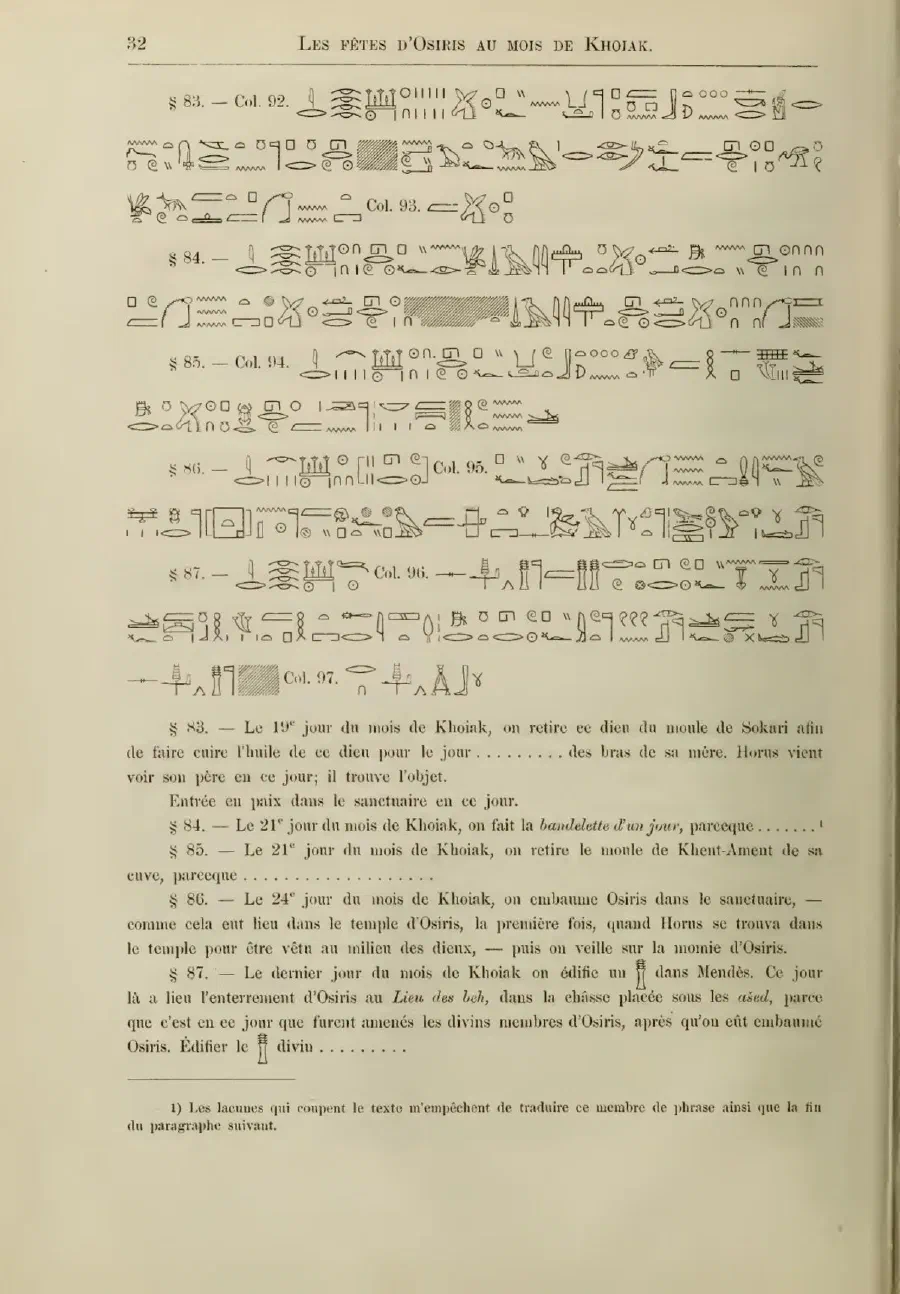
Page 32. Recueil IV, p. 32: the 19th to the 24th and the last day: Horus finds the object; embalming; burial at the Place of the beh (§§ 83–87) Recueil de travaux III, IV and V (archive.org scans) - s8332
§ 83. — Le 19e jour du mois de Khoiak, on retire ce dieu du moule de Sokari afin de faire cuire l'huile de ce dieu pour le jour [ . . . ] des bras de sa mère. Horus vient voir son père en ce jour ; il trouve l'objet.
§ 83. — On the 19th day of the month of Khoiak, this god is taken out of the mould of Sokari in order to cook the oil of this god for the day [ . . . ] of the arms of his mother. Horus comes to see his father on this day; he finds the object.
- s83b32
Entrée en paix dans le sanctuaire en ce jour.
Entry in peace into the sanctuary on this day.
- s8432
§ 84. — Le 21e jour du mois de Khoiak, on fait la bandelette d'un jour, parceque [ . . . ]
§ 84. — On the 21st day of the month of Khoiak the band of one day is made, because [ . . . ]
Note on line s84
Loret’s note 1: the gaps that cut the text prevent him from translating this clause and the end of the following paragraph. - s8532
§ 85. — Le 21e jour du mois de Khoiak, on retire le moule de Khent-Ament de sa cuve, parceque [ . . . ]
§ 85. — On the 21st day of the month of Khoiak the mould of Khent-Ament is taken out of its vat, because [ . . . ]
- s8632
§ 86. — Le 24e jour du mois de Khoiak, on embaume Osiris dans le sanctuaire, — comme cela eut lieu dans le temple d'Osiris, la première fois, quand Horus se trouva dans le temple pour être vêtu au milieu des dieux, — puis on veille sur la momie d'Osiris.
§ 86. — On the 24th day of the month of Khoiak Osiris is embalmed in the sanctuary, — as took place in the temple of Osiris the first time, when Horus was in the temple to be clothed in the midst of the gods, — then a vigil is kept over the mummy of Osiris.
- s8732
§ 87. — Le dernier jour du mois de Khoiak on édifie un [sign] dans Mendès. Ce jour là a lieu l'enterrement d'Osiris au Lieu des beh, dans la châsse placée sous les ašed, parce que c'est en ce jour que furent amenés les divins membres d'Osiris, après qu'on eût embaumé Osiris. Édifier le [sign] divin [ . . . ]
§ 87. — On the last day of the month of Khoiak a [sign] is raised in Mendes. On that day the burial of Osiris takes place at the Place of the beh, in the shrine placed under the ašed trees, because it is on this day that the divine members of Osiris were brought, after Osiris had been embalmed. Raise the divine [sign] [ . . . ]
Page 33. Recueil IV, p. 33: seven days unburied on sycamore branches, 'in the belly of his mother Nut'; 'to be continued'. (The article following is by von Bergmann and not translated.) Recueil de travaux III, IV and V (archive.org scans) - s8833
§ 88. — Pendant sept jours, — du 24e au dernier jour de Khoiak, — ce dieu, après avoir été embaumé, reste sans être enterré. On le place pendant ce temps sur des branchages de sycomores dans la Sebau-t de Mendès supérieure.
§ 88. — For seven days, — from the 24th to the last day of Khoiak, — this god, after having been embalmed, remains unburied. He is placed during this time on branches of sycamores in the Sebau-t of upper Mendes.
Note on line s88
Loret’s note 1: cf. §§ 34, 86, 87. - s88b33
(On fait cela) pour les sept jours qu'ils passa dans le ventre de sa mère Nout, enceinte de lui. Un jour est pour (remplacer) un mois ; — les sycomores sont pour (tenir lieu de) Nout. (À suivre.) Victor Loret.
(This is done) for the seven days that he spent in the belly of his mother Nut, pregnant with him. A day is for (replacing) a month; — the sycamores are for (taking the place of) Nut. (To be continued.) Victor Loret.
Chapter VI
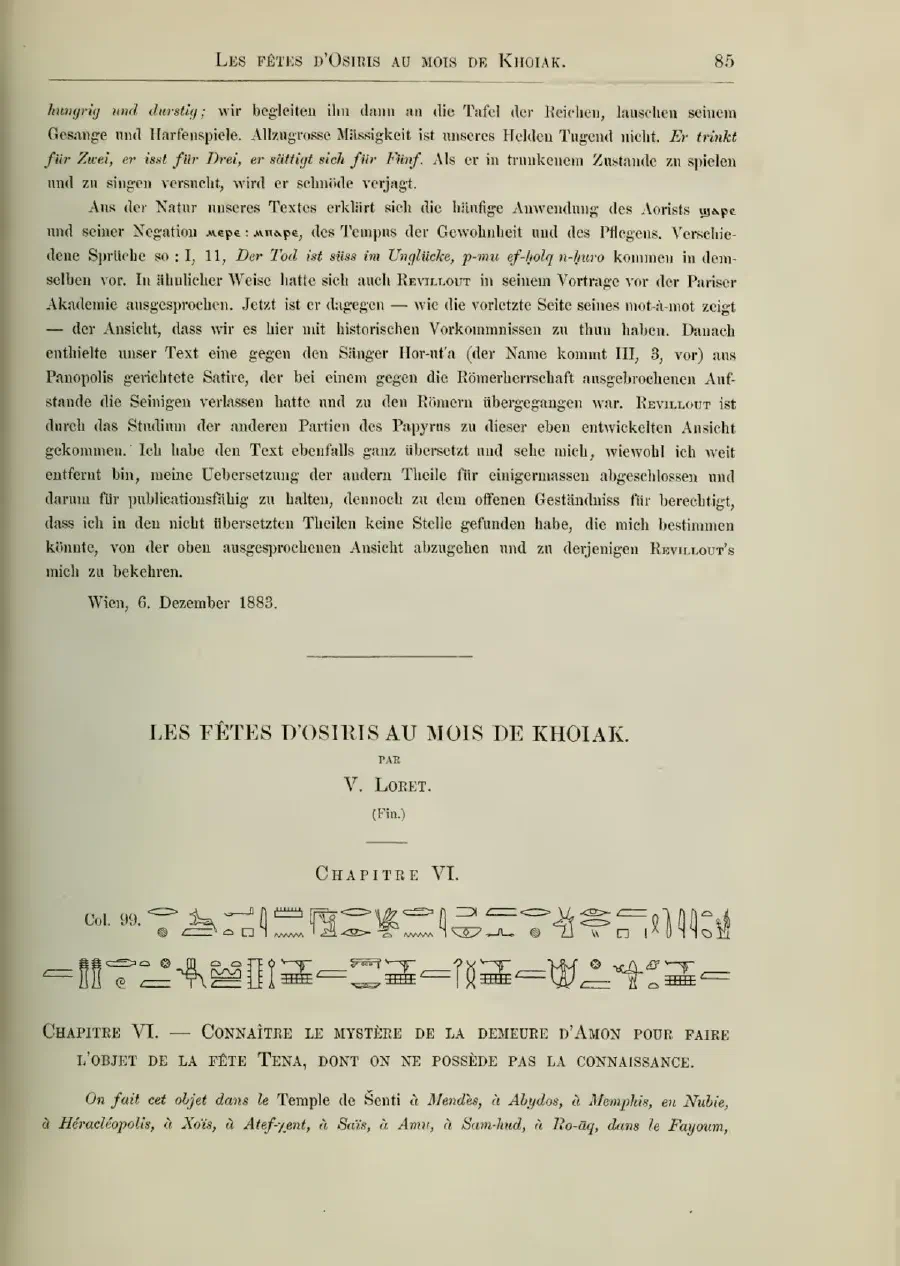
Page 85. Recueil V, p. 85: 'Fin': Chapter VI begins, the sixteen nomes of the sixteen divine members. (The text above it is the end of another article and not translated.) Recueil de travaux III, IV and V (archive.org scans) - ch685
Chapitre VI. — Connaître le mystère de la demeure d'Amon pour faire l'objet de la fête Tena, dont on ne possède pas la connaissance.
Chapter VI. — To know the mystery of the dwelling of Amun for making the object of the feast Tena, of which one does not possess the knowledge.
- ch6-places85
On fait cet objet dans le Temple de Šenti à Mendès, à Abydos, à Memphis, en Nubie, à Héracléopolis, à Xoïs, à Atef-zent, à Saïs, à Amu, à Sam-hud, à Ro-âq, dans le Fayoum, à Neter, à Bâh, à Ka-kem, à Tentyris, dans les seize nomes des seize membres divins, tous nomes d'Osiris dans lesquels on fait l'objet de la Fête Tena pour Khent-Ament.
This object is made in the Temple of Šenti at Mendes, at Abydos, at Memphis, in Nubia, at Heracleopolis, at Xois, at Atef-zent, at Sais, at Amu, at Sam-hud, at Ro-âq, in the Fayum, at Neter, at Bâh, at Ka-kem, at Tentyris, in the sixteen nomes of the sixteen divine members, all nomes of Osiris in which the object of the Feast Tena is made for Khent-Ament.
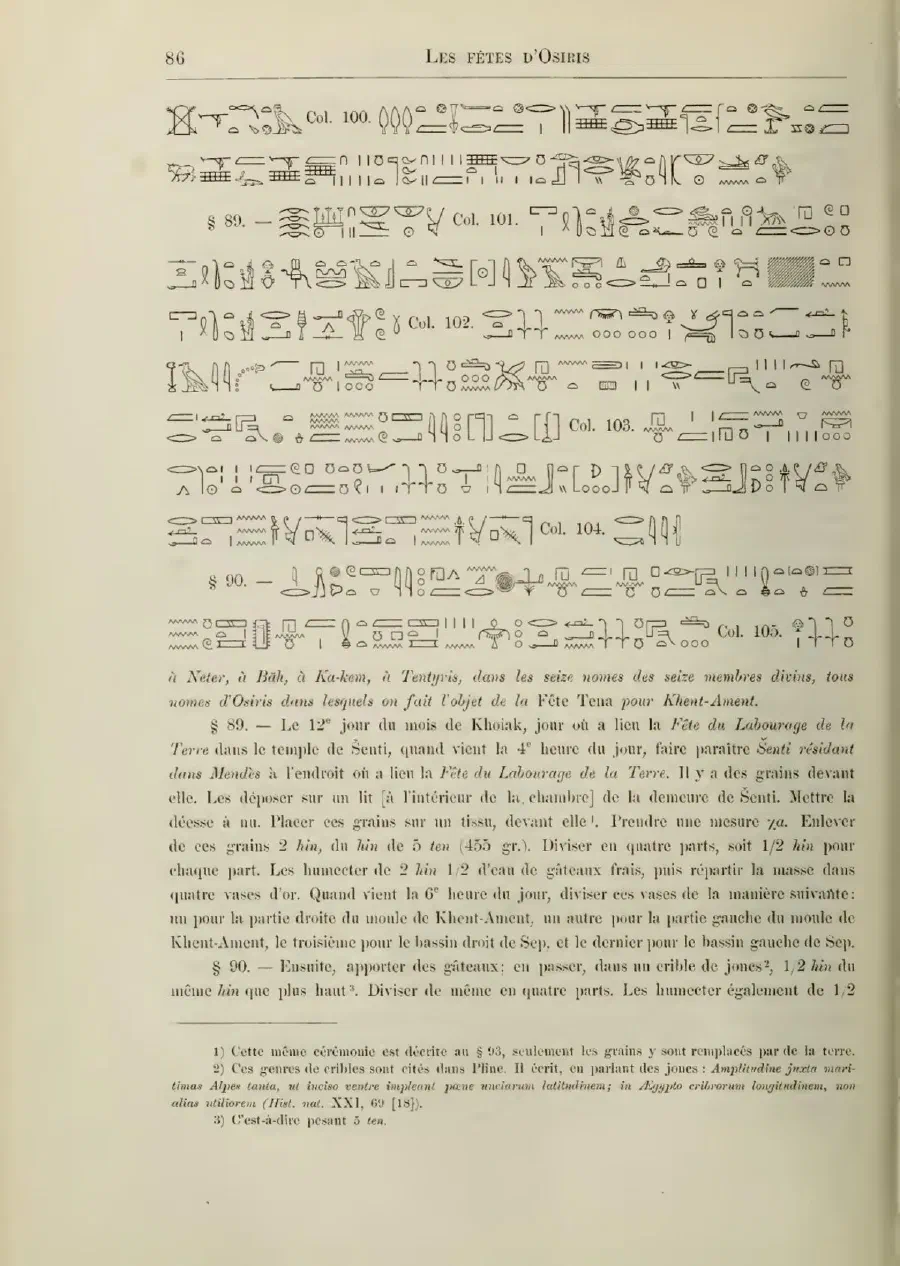
Page 86. Recueil V, p. 86: the 12th Khoiak, the Feast of Ploughing the Earth: the goddess uncovered, the grain measured into four gold vessels (§§ 89–90) Recueil de travaux III, IV and V (archive.org scans) - s8986
§ 89. — Le 12e jour du mois de Khoiak, jour où a lieu la Fête du Labourage de la Terre dans le temple de Šenti, quand vient la 4e heure du jour, faire paraître Šenti résidant dans Mendès à l'endroit où a lieu la Fête du Labourage de la Terre. Il y a des grains devant elle. Les déposer sur un lit [à l'intérieur de la chambre] de la demeure de Šenti. Mettre la déesse à nu. Placer ces grains sur un tissu, devant elle. Prendre une mesure χa. Enlever de ces grains 2 hin, du hin de 5 ten (455 gr.). Diviser en quatre parts, soit 1/2 hin pour chaque part. Les humecter de 2 hin 1/2 d'eau de gâteaux frais, puis répartir la masse dans quatre vases d'or. Quand vient la 6e heure du jour, diviser ces vases de la manière suivante : un pour la partie droite du moule de Khent-Ament, un autre pour la partie gauche du moule de Khent-Ament, le troisième pour le bassin droit de Sep, et le dernier pour le bassin gauche de Sep.
§ 89. — On the 12th day of the month of Khoiak, the day on which the Feast of Ploughing the Earth takes place in the temple of Šenti, when the 4th hour of the day comes, make Šenti dwelling in Mendes appear at the place where the Feast of Ploughing the Earth takes place. There are grains before her. Lay them on a bed [inside the chamber] of the dwelling of Šenti. Put the goddess naked. Place these grains on a cloth, before her. Take a measure χa. Take from these grains 2 hin, of the hin of 5 ten (455 grams). Divide into four parts, that is 1/2 hin for each part. Moisten them with 2 1/2 hin of water of fresh cakes, then distribute the mass in four vessels of gold. When the 6th hour of the day comes, divide these vessels in the following manner: one for the right part of the mould of Khent-Ament, another for the left part of the mould of Khent-Ament, the third for the right basin of Sep, and the last for the left basin of Sep.
Note on line s89
Loret’s notes. (1) This same ceremony is described in § 93, only the grains there are replaced by earth. (2) [attached to § 90, below.] - s9086
§ 90. — Ensuite, apporter des gâteaux ; en passer, dans un crible de joncs, 1/2 hin du même hin que plus haut. Diviser de même en quatre parts. Les humecter également de 1/2
§ 90. — Next, bring cakes; pass through a sieve of rushes 1/2 hin of the same hin as above. Divide likewise into four parts. Moisten them likewise with 1/2
Note on line s90
Loret’s notes. (2) These kinds of sieve are cited in Pliny. Speaking of rushes he writes: “Amplitudine juxta maritimas Alpes tanta, ut inciso ventre impleant pœne unciarum latitudinem; in Ægypto cribrorum longitudinem, non alias utiliorem” (Hist. nat. XXI, 69 [18]). (3) That is, weighing 5 ten. 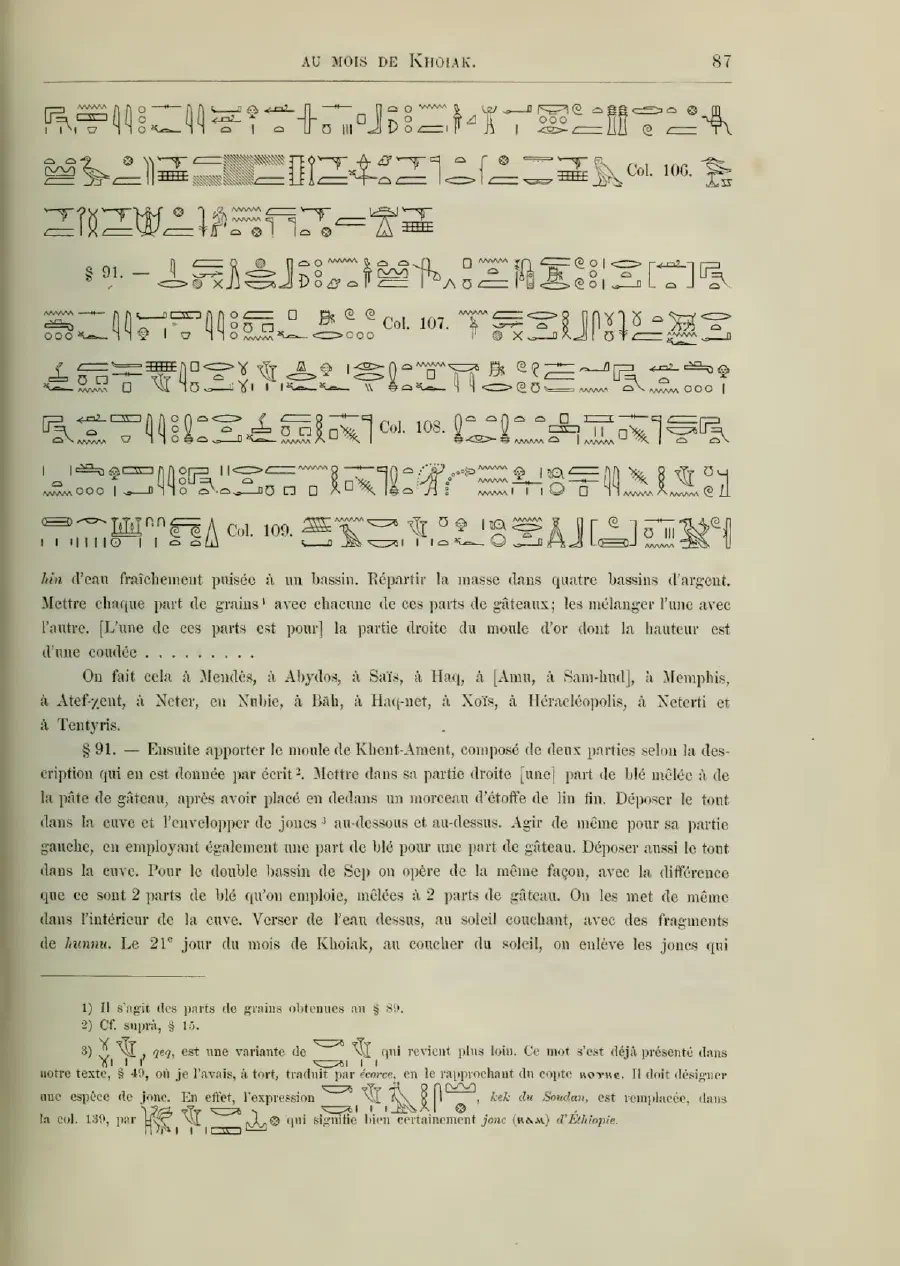
Page 87. Recueil V, p. 87: grain and cake paste laid in the two halves of the mould, wrapped in rushes, watered at sunset (§§ 90–91) Recueil de travaux III, IV and V (archive.org scans) - s90b87
hin d'eau fraîchement puisée à un bassin. Répartir la masse dans quatre bassins d'argent. Mettre chaque part de grains avec chacune de ces parts de gâteaux ; les mélanger l'une avec l'autre. [L'une de ces parts est pour] la partie droite du moule d'or dont la hauteur est d'une coudée [ . . . ].
hin of water freshly drawn from a basin. Distribute the mass in four basins of silver. Put each part of grains with each of these parts of cakes; mix them one with the other. [One of these parts is for] the right part of the gold mould whose height is one cubit [ . . . ].
Note on line s90b
Loret’s note 1: this refers to the parts of grain obtained in § 89. - s90c87
On fait cela à Mendès, à Abydos, à Saïs, à Haq, à [Amu, à Sam-hud], à Memphis, à Atef-zent, à Neter, en Nubie, à Bâh, à Haq-net, à Xoïs, à Héracléopolis, à Neterti et à Tentyris.
This is done at Mendes, at Abydos, at Sais, at Haq, at [Amu, at Sam-hud], at Memphis, at Atef-zent, at Neter, in Nubia, at Bâh, at Haq-net, at Xois, at Heracleopolis, at Neterti and at Tentyris.
- s9187
§ 91. — Ensuite apporter le moule de Khent-Ament, composé de deux parties selon la description qui en est donnée par écrit. Mettre dans sa partie droite [une] part de blé mêlée à de la pâte de gâteau, après avoir placé en dedans un morceau d'étoffe de lin fin. Déposer le tout dans la cuve et l'envelopper de joncs au-dessous et au-dessus. Agir de même pour sa partie gauche, en employant également une part de blé pour une part de gâteau. Déposer aussi le tout dans la cuve. Pour le double bassin de Sep on opère de la même façon, avec la différence que ce sont 2 parts de blé qu'on emploie, mêlées à 2 parts de gâteau. On les met de même dans l'intérieur de la cuve. Verser de l'eau dessus, au soleil couchant, avec des fragments de hunnu. Le 21e jour du mois de Khoiak, au coucher du soleil, on enlève les joncs qui
§ 91. — Next bring the mould of Khent-Ament, composed of two parts according to the description of it that is given in writing. Put in its right part [one] part of wheat mixed with cake paste, after having placed inside a piece of fine linen cloth. Lay the whole in the vat and wrap it in rushes below and above. Do the same for its left part, using likewise one part of wheat to one part of cake. Lay the whole also in the vat. For the double basin of Sep one proceeds in the same way, with the difference that it is 2 parts of wheat that are used, mixed with 2 parts of cake. They are put in the same way inside the vat. Pour water over them, at sunset, with fragments of hunnu. On the 21st day of the month of Khoiak, at sunset, the rushes are taken off that
Note on line s91
Loret’s notes. (1) The parts of grain obtained in § 89. (2) Cf. above, § 15. (3) The word qeq is a variant of a word that recurs further on. It already appeared in this text, § 49, where he translated it wrongly as bark, comparing the Coptic kotre. It must designate a species of rush: the expression kek of the Sudan is replaced, in col. 139, by a phrase that certainly means rush (kam) of Ethiopia. 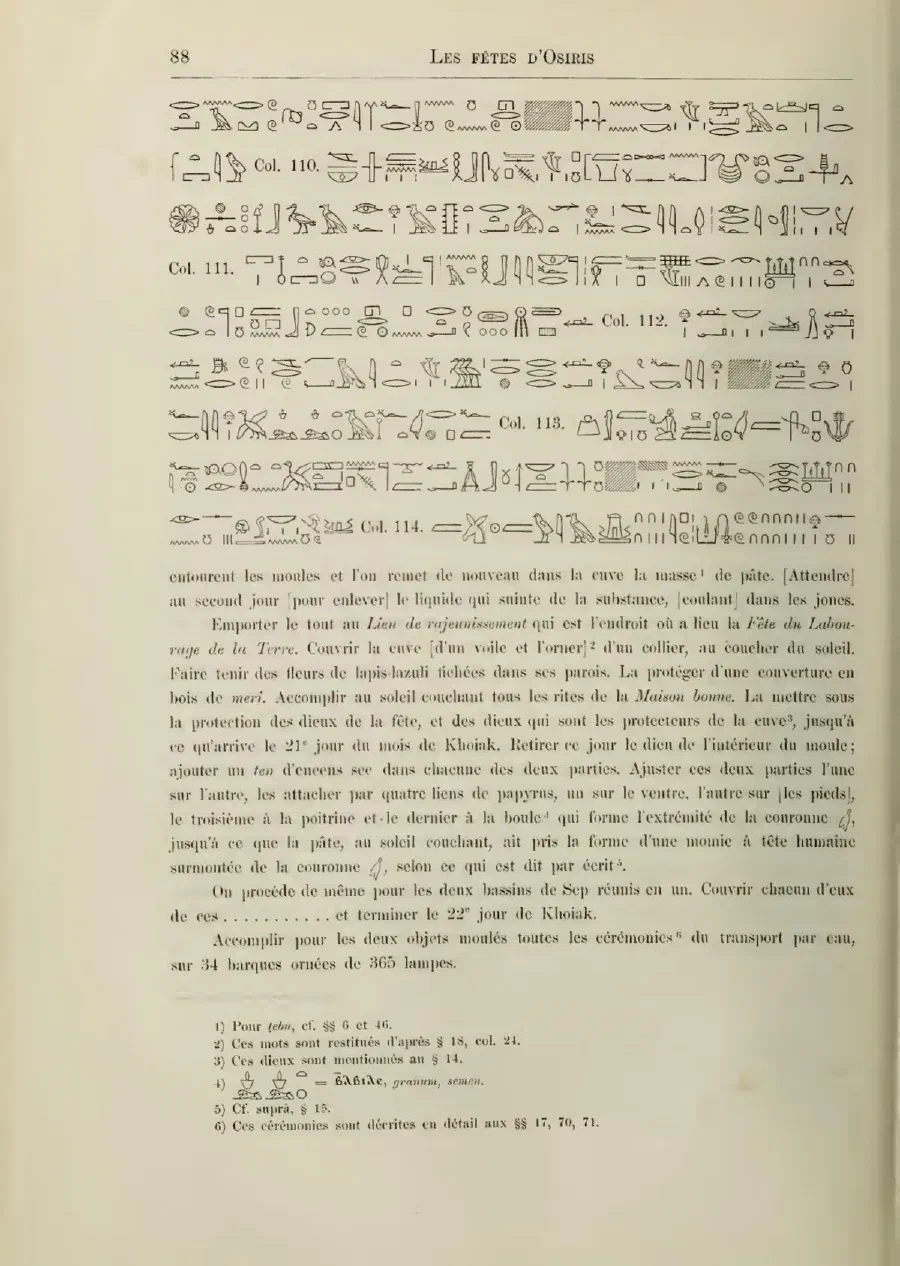
Page 88. Recueil V, p. 88: the 21st: the god taken out of the mould, bound with four papyrus bands into a mummy with a human head (§ 91) Recueil de travaux III, IV and V (archive.org scans) - s91b88
entourent les moules et l'on remet de nouveau dans la cuve la masse de pâte. [Attendre] au second jour [pour enlever] le liquide qui suinte de la substance, [coulant] dans les joncs.
surround the moulds, and the mass of paste is put back again in the vat. [Wait] until the second day [to take off] the liquid that oozes from the substance, [running] into the rushes.
Note on line s91b
Loret’s note 1: for the word tebu (mass), cf. §§ 6 and 46. - s91c88
Emporter le tout au Lieu de rajeunissement qui est l'endroit où a lieu la Fête du Labourage de la Terre. Couvrir la cuve [d'un voile et l'orner] d'un collier, au coucher du soleil. Faire tenir des fleurs de lapis-lazuli fichées dans ses parois. La protéger d'une couverture en bois de meri. Accomplir au soleil couchant tous les rites de la Maison bonne. La mettre sous la protection des dieux de la fête, et des dieux qui sont les protecteurs de la cuve, jusqu'à ce qu'arrive le 21e jour du mois de Khoiak. Retirer ce jour le dieu de l'intérieur du moule ; ajouter un ten d'encens sec dans chacune des deux parties. Ajuster ces deux parties l'une sur l'autre, les attacher par quatre liens de papyrus, un sur le ventre, l'autre sur [les pieds], le troisième à la poitrine et le dernier à la boule qui forme l'extrémité de la couronne [sign], jusqu'à ce que la pâte, au soleil couchant, ait pris la forme d'une momie à tête humaine surmontée de la couronne [sign], selon ce qui est dit par écrit.
Carry the whole to the Place of rejuvenation, which is the place where the Feast of Ploughing the Earth takes place. Cover the vat [with a veil and adorn it] with a collar, at sunset. Make flowers of lapis lazuli stand fixed in its walls. Protect it with a cover of meri wood. Perform at sunset all the rites of the Good House. Place it under the protection of the gods of the feast, and of the gods who are the protectors of the vat, until the 21st day of the month of Khoiak arrives. On this day take the god out of the mould; add one ten of dry incense in each of the two parts. Fit these two parts one upon the other, bind them with four bands of papyrus, one on the belly, the other on [the feet], the third at the chest and the last at the knob that forms the end of the crown [sign], until the paste, at sunset, has taken the form of a mummy with a human head surmounted by the crown [sign], according to what is said in writing.
Note on line s91c
Loret’s notes. (2) The words in brackets are restored after § 18, col. 24. (3) These gods are mentioned in § 14. (4) The word for knob is a hieroglyphic group equated with a Coptic word glossed granum, semen. (5) Cf. above, § 15. - s91d88
On procède de même pour les deux bassins de Sep réunis en un. Couvrir chacun d'eux de ces [ . . . ] et terminer le 22e jour de Khoiak.
One proceeds in the same way for the two basins of Sep joined into one. Cover each of them with these [ . . . ] and finish on the 22nd day of Khoiak.
- s91e88
Accomplir pour les deux objets moulés toutes les cérémonies du transport par eau, sur 34 barques ornées de 365 lampes.
Perform for the two moulded objects all the ceremonies of the transport by water, on 34 barques adorned with 365 lamps.
Note on line s91e
Loret’s note 6: these ceremonies are described in detail in §§ 17, 70, 71. 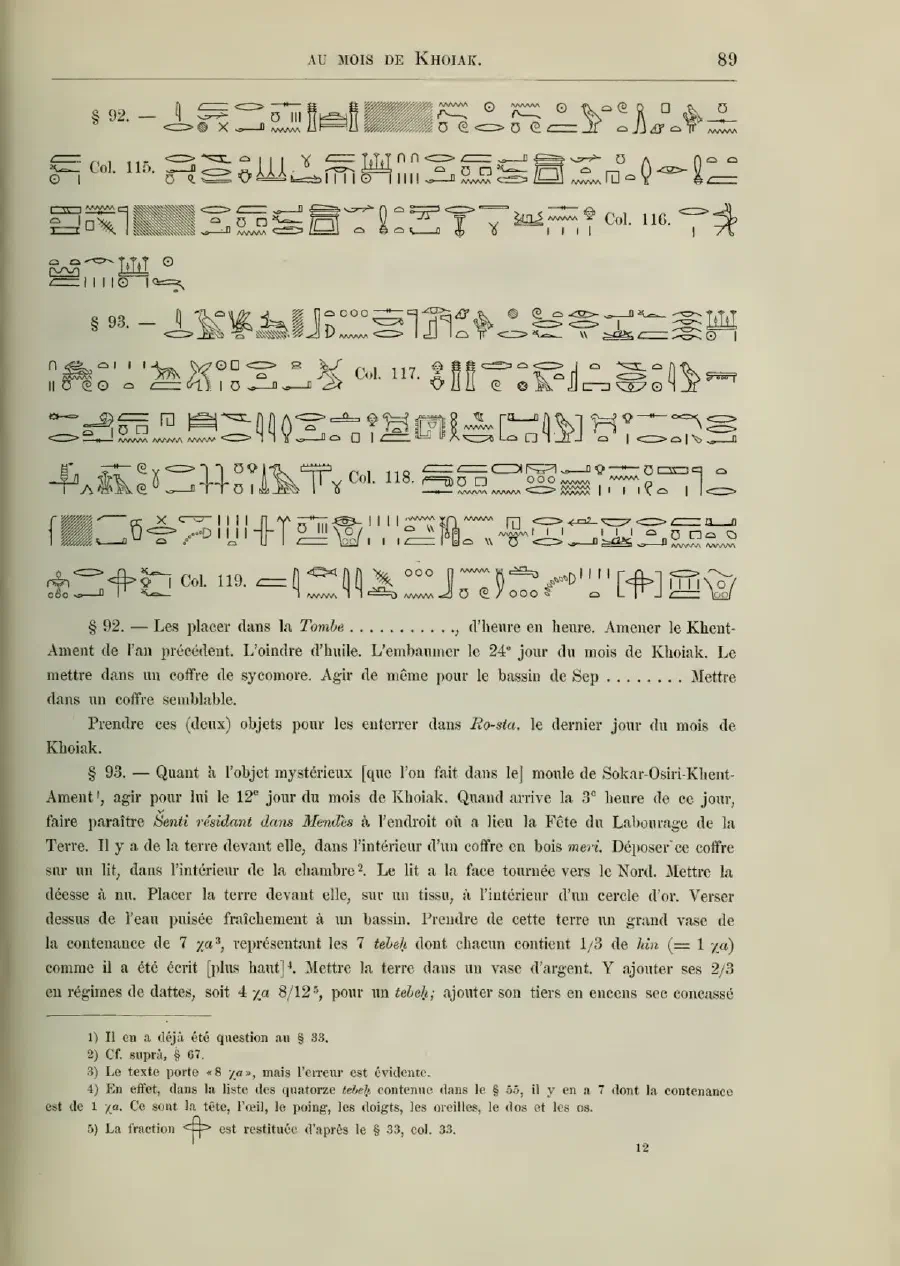
Page 89. Recueil V, p. 89: the tomb, the burial at Ro-sta; the earth of the mysterious object, measured in seven tebeh (§§ 92–93) Recueil de travaux III, IV and V (archive.org scans) - s9289
§ 92. — Les placer dans la Tombe [ . . . ], d'heure en heure. Amener le Khent-Ament de l'an précédent. L'oindre d'huile. L'embaumer le 24e jour du mois de Khoiak. Le mettre dans un coffre de sycomore. Agir de même pour le bassin de Sep [ . . . ] Mettre dans un coffre semblable.
§ 92. — Place them in the Tomb [ . . . ], hour by hour. Bring the Khent-Ament of the preceding year. Anoint him with oil. Embalm him on the 24th day of the month of Khoiak. Put him in a chest of sycamore. Do the same for the basin of Sep [ . . . ] Put it in a similar chest.
- s92b89
Prendre ces (deux) objets pour les enterrer dans Ro-sta, le dernier jour du mois de Khoiak.
Take these (two) objects to bury them in Ro-sta, on the last day of the month of Khoiak.
- s9389
§ 93. — Quant à l'objet mystérieux [que l'on fait dans le] moule de Sokar-Osiri-Khent-Ament, agir pour lui le 12e jour du mois de Khoiak. Quand arrive la 3e heure de ce jour, faire paraître Šenti résidant dans Mendès à l'endroit où a lieu la Fête du Labourage de la Terre. Il y a de la terre devant elle, dans l'intérieur d'un coffre en bois meri. Déposer ce coffre sur un lit, dans l'intérieur de la chambre. Le lit a la face tournée vers le Nord. Mettre la déesse à nu. Placer la terre devant elle, sur un tissu, à l'intérieur d'un cercle d'or. Verser dessus de l'eau puisée fraîchement à un bassin. Prendre de cette terre un grand vase de la contenance de 7 χa, représentant les 7 tebeh dont chacun contient 1/3 de hin (= 1 χa) comme il a été écrit [plus haut]. Mettre la terre dans un vase d'argent. Y ajouter ses 2/3 en régimes de dattes, soit 4 χa 8/12, pour un tebeh ; ajouter son tiers en encens sec concassé
§ 93. — As for the mysterious object [that is made in the] mould of Sokar-Osiris-Khent-Ament, act for it on the 12th day of the month of Khoiak. When the 3rd hour of this day comes, make Šenti dwelling in Mendes appear at the place where the Feast of Ploughing the Earth takes place. There is earth before her, inside a chest of meri wood. Set this chest on a bed, inside the chamber. The bed has its face turned to the north. Put the goddess naked. Place the earth before her, on a cloth, inside a circle of gold. Pour over it water freshly drawn from a basin. Take of this earth a large vessel of the capacity of 7 χa, representing the 7 tebeh of which each contains 1/3 of a hin (= 1 χa) as has been written [above]. Put the earth in a vessel of silver. Add to it its 2/3 in bunches of dates, that is 4 χa 8/12, for one tebeh; add its third in dry crushed incense
Note on line s93
Loret’s notes. (1) This has already been spoken of in § 33. (2) Cf. above, § 67. (3) The text has “8 χa,” but the error is evident. (4) In the list of the fourteen tebeh in § 55 there are seven whose capacity is 1 χa: the head, the eye, the fist, the fingers, the ears, the back and the bones. (5) The fraction is restored after § 33, col. 33. 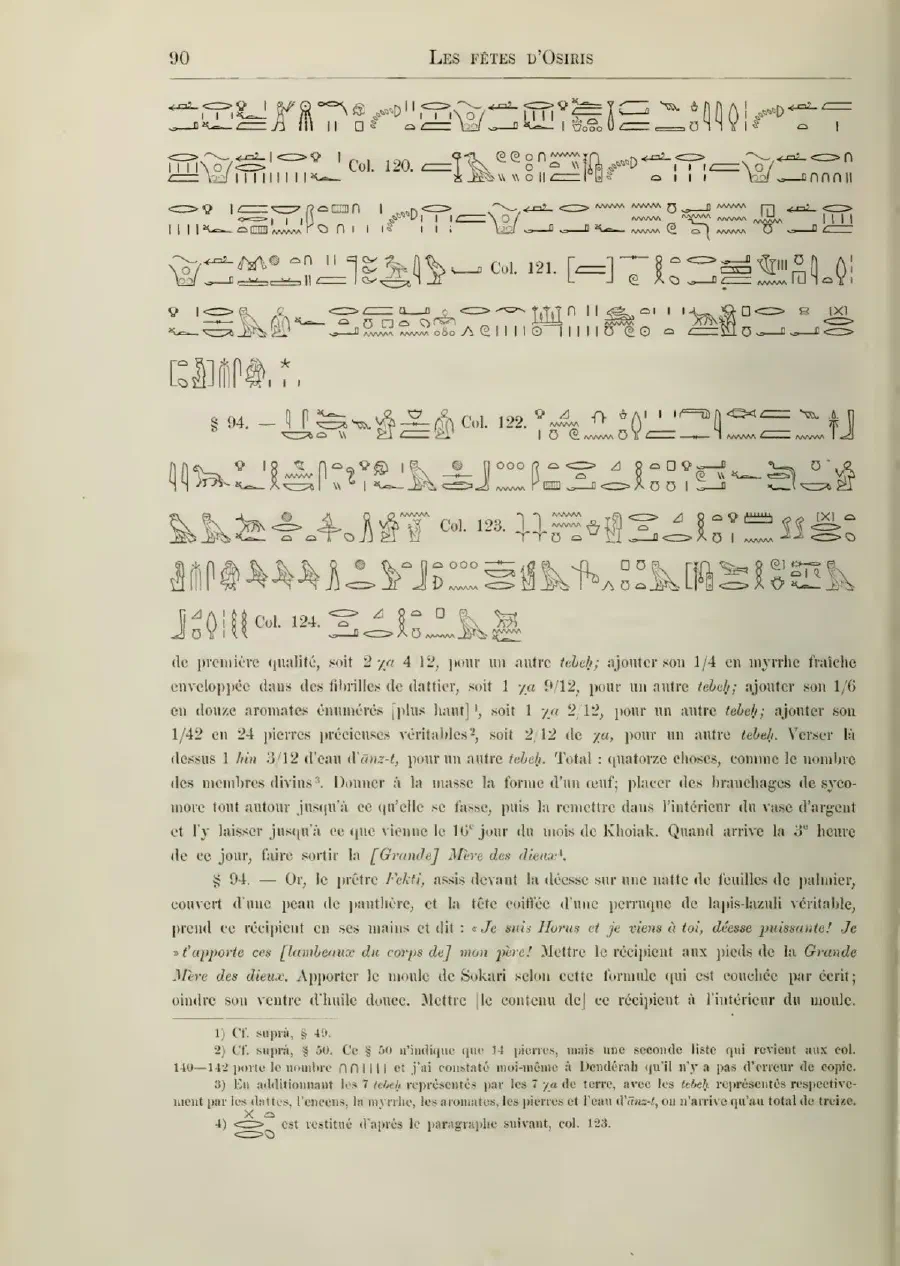
Page 90. Recueil V, p. 90: the mass given the form of an egg; the priest Fekti: 'I am Horus and I come to thee' (§§ 93–94) Recueil de travaux III, IV and V (archive.org scans) - s93b90
de première qualité, soit 2 χa 4/12, pour un autre tebeh ; ajouter son 1/4 en myrrhe fraîche enveloppée dans des fibrilles de dattier, soit 1 χa 9/12, pour un autre tebeh ; ajouter son 1/6 en douze aromates énumérés [plus haut], soit 1 χa 2/12, pour un autre tebeh ; ajouter son 1/42 en 24 pierres précieuses véritables, soit 2/12 de χa, pour un autre tebeh. Verser là dessus 1 hin 3/12 d'eau d'ânz-t, pour un autre tebeh. Total : quatorze choses, comme le nombre des membres divins. Donner à la masse la forme d'un œuf ; placer des branchages de sycomore tout autour jusqu'à ce qu'elle se fasse, puis la remettre dans l'intérieur du vase d'argent et l'y laisser jusqu'à ce que vienne le 16e jour du mois de Khoiak. Quand arrive la 3e heure de ce jour, faire sortir la [Grande] Mère des dieux.
of first quality, that is 2 χa 4/12, for another tebeh; add its 1/4 in fresh myrrh wrapped in fibres of the date palm, that is 1 χa 9/12, for another tebeh; add its 1/6 in the twelve aromatics enumerated [above], that is 1 χa 2/12, for another tebeh; add its 1/42 in 24 true precious stones, that is 2/12 of a χa, for another tebeh. Pour over it 1 hin 3/12 of water of ânz-t, for another tebeh. Total: fourteen things, like the number of the divine members. Give the mass the form of an egg; place branches of sycamore all around until it sets, then put it back inside the silver vessel and leave it there until the 16th day of the month of Khoiak comes. When the 3rd hour of this day arrives, bring out the [Great] Mother of the gods.
Note on line s93b
Loret’s notes. (1) Cf. above, § 49. (2) Cf. above, § 50. This § 50 gives only 14 stones, but a second list that recurs in cols. 140-142 carries the number 24, and he ascertained for himself at Dendera that there is no copying error. (3) Adding the 7 tebeh represented by the 7 χa of earth to the tebeh represented respectively by the dates, the incense, the myrrh, the aromatics, the stones and the water of ânz-t, one arrives only at a total of thirteen. (4) The word for Great is restored after the following paragraph, col. 123. - s9490
§ 94. — Or, le prêtre Fekti, assis devant la déesse sur une natte de feuilles de palmier, couvert d'une peau de panthère, et la tête coiffée d'une perruque de lapis-lazuli véritable, prend ce récipient en ses mains et dit : « Je suis Horus et je viens à toi, déesse puissante ! Je t'apporte ces [lambeaux du corps de] mon père ! » Mettre le récipient aux pieds de la Grande Mère des dieux. Apporter le moule de Sokari selon cette formule qui est couchée par écrit ; oindre son ventre d'huile douce. Mettre [le contenu de] ce récipient à l'intérieur du moule.
§ 94. — Now the priest Fekti, seated before the goddess on a mat of palm leaves, covered with a panther skin, and his head crowned with a wig of true lapis lazuli, takes this vessel in his hands and says: "I am Horus and I come to thee, mighty goddess! I bring thee these [shreds of the body of] my father!" Put the vessel at the feet of the Great Mother of the gods. Bring the mould of Sokari according to this formula which is laid down in writing; anoint its belly with sweet oil. Put [the contents of] this vessel inside the mould.
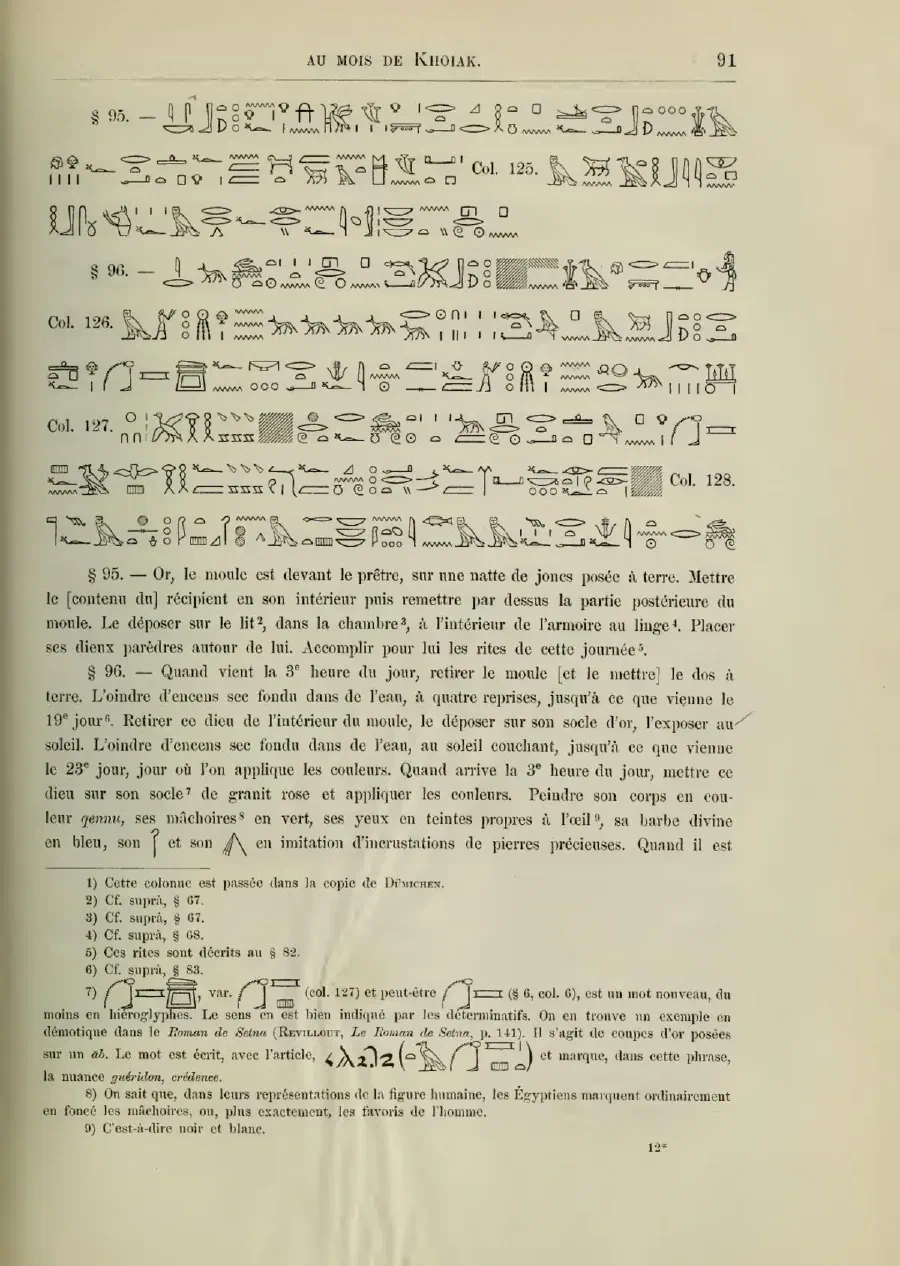
Page 91. Recueil V, p. 91: the mould laid on the bed; the colours applied to the god, jaws green, beard blue (§§ 95–96) Recueil de travaux III, IV and V (archive.org scans) - s9591
§ 95. — Or, le moule est devant le prêtre, sur une natte de joncs posée à terre. Mettre le [contenu du] récipient en son intérieur puis remettre par dessus la partie postérieure du moule. Le déposer sur le lit, dans la chambre, à l'intérieur de l'armoire au linge. Placer ses dieux parèdres autour de lui. Accomplir pour lui les rites de cette journée.
§ 95. — Now the mould is before the priest, on a mat of rushes laid on the ground. Put the [contents of the] vessel inside it, then put back over it the rear part of the mould. Set it on the bed, in the chamber, inside the linen cupboard. Place his attendant gods around him. Perform for him the rites of this day.
Note on line s95
Loret’s notes. (1) This column is omitted in Dümichen’s copy. (2) Cf. above, § 67. (3) Cf. above, § 67. (4) Cf. above, § 68. (5) These rites are described in § 82. - s9691
§ 96. — Quand vient la 3e heure du jour, retirer le moule [et le mettre] le dos à terre. L'oindre d'encens sec fondu dans de l'eau, à quatre reprises, jusqu'à ce que vienne le 19e jour. Retirer ce dieu de l'intérieur du moule, le déposer sur son socle d'or, l'exposer au soleil. L'oindre d'encens sec fondu dans de l'eau, au soleil couchant, jusqu'à ce que vienne le 23e jour, jour où l'on applique les couleurs. Quand arrive la 3e heure du jour, mettre ce dieu sur son socle de granit rose et appliquer les couleurs. Peindre son corps en couleur qenmu, ses mâchoires en vert, ses yeux en teintes propres à l'œil, sa barbe divine en bleu, son [sign] et son [sign] en imitation d'incrustations de pierres précieuses. Quand il est
§ 96. — When the 3rd hour of the day comes, take out the mould [and put it] on its back on the ground. Anoint it with dry incense dissolved in water, four times, until the 19th day comes. Take this god out of the mould, set him on his base of gold, expose him to the sun. Anoint him with dry incense dissolved in water, at sunset, until the 23rd day comes, the day on which the colours are applied. When the 3rd hour of the day arrives, put this god on his base of rose granite and apply the colours. Paint his body the colour qenmu, his jaws green, his eyes in the tints proper to the eye, his divine beard blue, his [sign] and his [sign] in imitation of inlays of precious stones. When he is
Note on line s96
Loret’s notes. (6) Cf. above, § 83. (7) The word for base is, in hieroglyphs at least, a new word. Its sense is well indicated by the determinatives. An example is found in demotic in the Romance of Setna (Revillout, Le Roman de Setna, p. 141), which speaks of gold cups set on an ab; there the word, written with the article, carries the nuance pedestal table, sideboard. (8) In their representations of the human figure the Egyptians ordinarily mark the jaws dark, or more exactly the whiskers of the man. (9) That is, black and white. 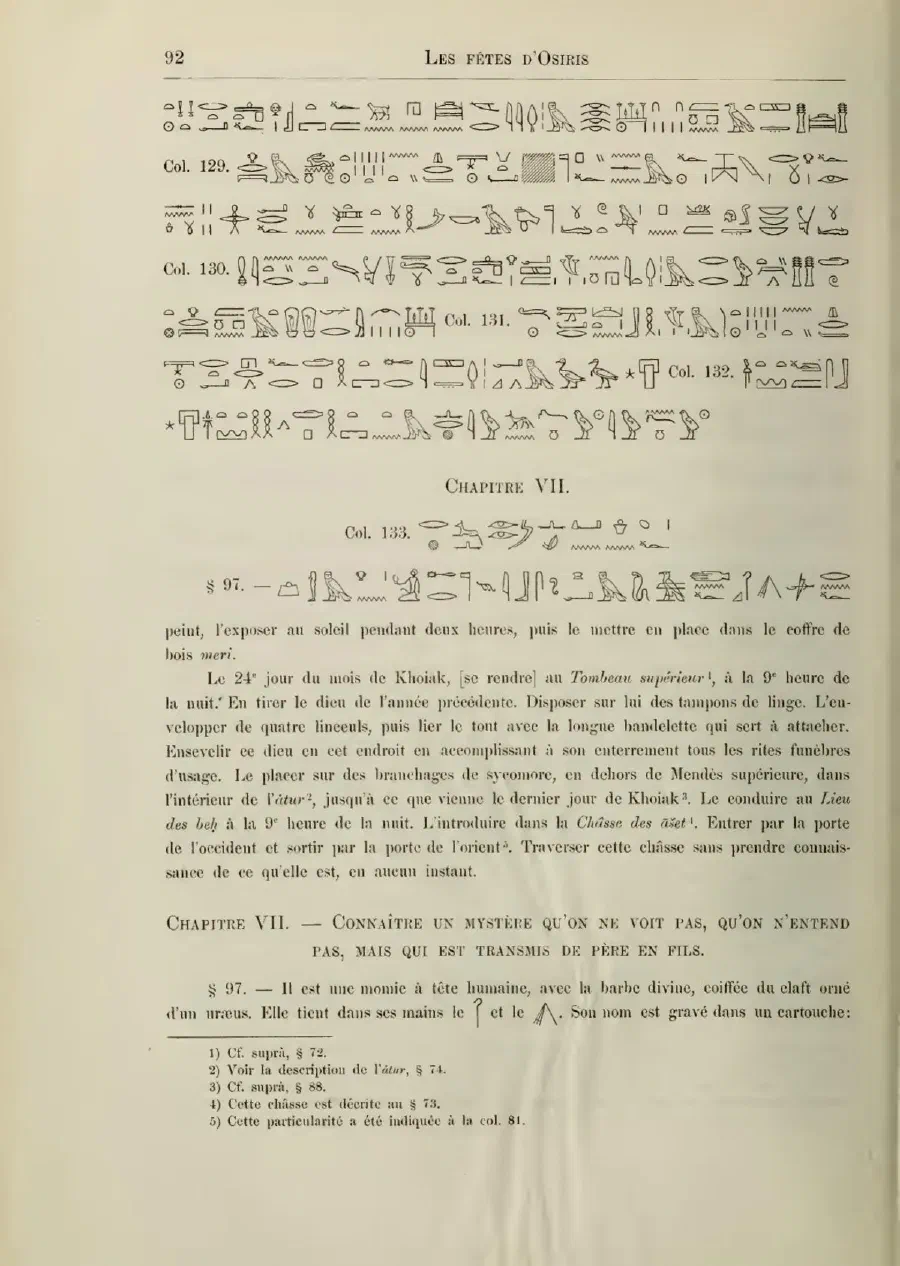
Page 92. Recueil V, p. 92: the 24th: the god of the preceding year taken from the tomb; the passage of the shrine of the ašet; Chapter VII begins (§§ 96–97) Recueil de travaux III, IV and V (archive.org scans) - s96b92
peint, l'exposer au soleil pendant deux heures, puis le mettre en place dans le coffre de bois meri.
painted, expose him to the sun for two hours, then put him in place in the chest of meri wood.
- s96c92
Le 24e jour du mois de Khoiak, [se rendre] au Tombeau supérieur, à la 9e heure de la nuit. En tirer le dieu de l'année précédente. Disposer sur lui des tampons de linge. L'envelopper de quatre linceuls, puis lier le tout avec la longue bandelette qui sert à attacher. Ensevelir ce dieu en cet endroit en accomplissant à son enterrement tous les rites funèbres d'usage. Le placer sur des branchages de sycomore, en dehors de Mendès supérieure, dans l'intérieur de l'âtur, jusqu'à ce que vienne le dernier jour de Khoiak. Le conduire au Lieu des beh à la 9e heure de la nuit. L'introduire dans la Châsse des ašet. Entrer par la porte de l'occident et sortir par la porte de l'orient. Traverser cette châsse sans prendre connaissance de ce qu'elle est, en aucun instant.
On the 24th day of the month of Khoiak, [go] to the Upper Tomb, at the 9th hour of the night. Take from it the god of the preceding year. Arrange pads of linen on him. Wrap him in four shrouds, then bind the whole with the long band that serves for tying. Bury this god in this place, performing at his burial all the funeral rites in use. Place him on branches of sycamore, outside upper Mendes, inside the âtur, until the last day of Khoiak comes. Lead him to the Place of the beh at the 9th hour of the night. Introduce him into the Shrine of the ašet. Enter by the door of the west and go out by the door of the east. Cross this shrine without taking knowledge of what it is, at any moment.
Note on line s96c
Loret’s notes. (1) Cf. above, § 72. (2) See the description of the âtur, § 74. (3) Cf. above, § 88. (4) This shrine is described in § 73. (5) This particularity was indicated in col. 81. Chapter VII
- ch792
Chapitre VII. — Connaître un mystère qu'on ne voit pas, qu'on n'entend pas, mais qui est transmis de père en fils.
Chapter VII. — To know a mystery that one does not see, that one does not hear, but that is transmitted from father to son.
- s9792
§ 97. — Il est une momie à tête humaine, avec la barbe divine, coiffée du claft orné d'un uræus. Elle tient dans ses mains le [sign] et le [sign]. Son nom est gravé dans un cartouche : « Horus qui ouvre la séparation des deux terres, Osiris seigneur de Mendès, Oun-nefer véridique, Khent-Ament, dieu grand, seigneur d'Abydos. »
§ 97. — It is a mummy with a human head, with the divine beard, wearing the claft adorned with a uraeus. It holds in its hands the [sign] and the [sign]. Its name is engraved in a cartouche: "Horus who opens the separation of the two lands, Osiris lord of Mendes, Un-nefer the truthful, Khent-Ament, great god, lord of Abydos."
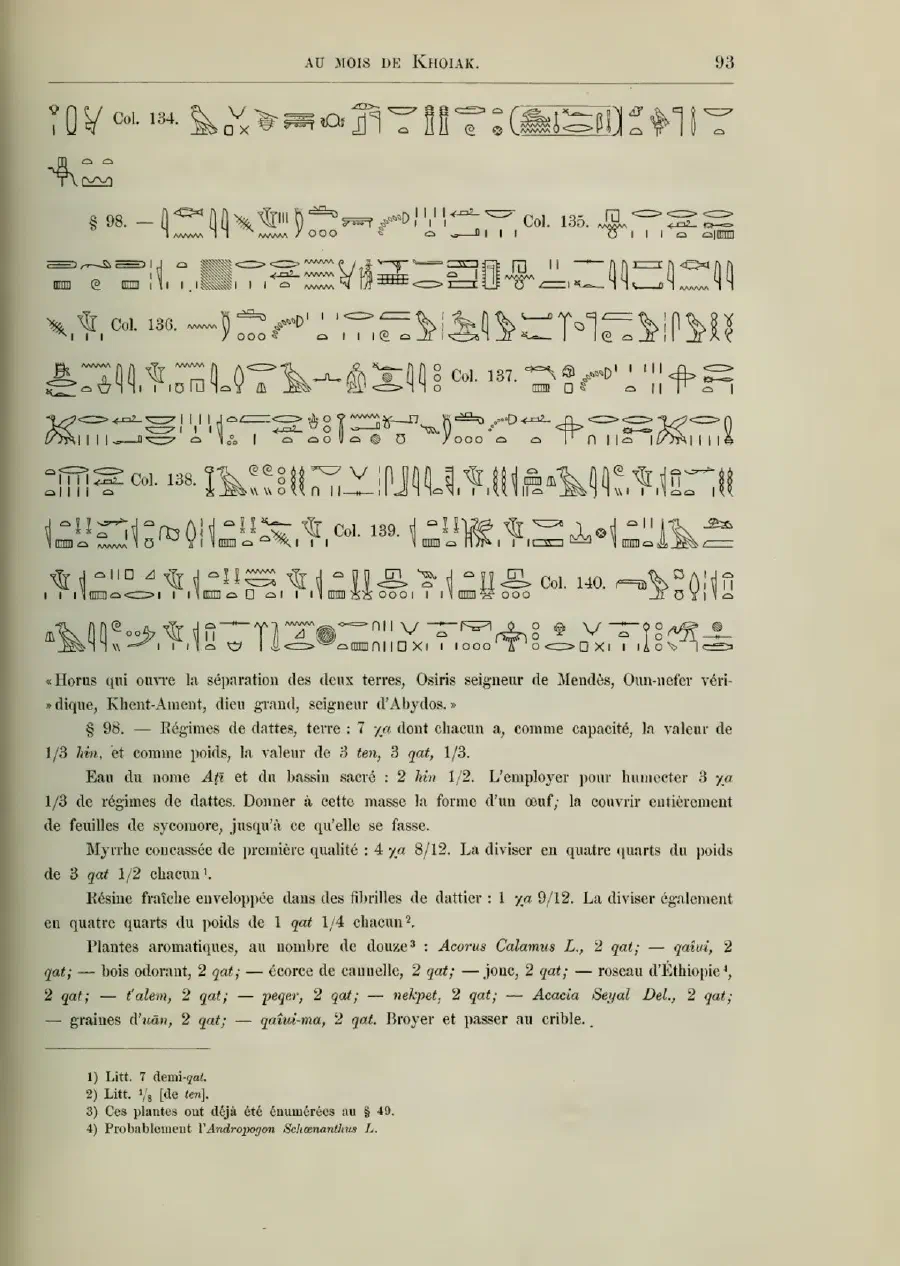
Page 93. Recueil V, p. 93: the cartouche of Horus-Osiris-Khent-Ament; weights of earth, dates, myrrh, resin and the twelve plants (§§ 97–98) Recueil de travaux III, IV and V (archive.org scans) - s9893
§ 98. — Régimes de dattes, terre : 7 χa dont chacun a, comme capacité, la valeur de 1/3 hin, et comme poids, la valeur de 3 ten, 3 qat, 1/3.
§ 98. — Bunches of dates, earth: 7 χa, each of which has, as capacity, the value of 1/3 hin, and as weight, the value of 3 ten, 3 qat, 1/3.
- s98b93
Eau du nome Ati et du bassin sacré : 2 hin 1/2. L'employer pour humecter 3 χa 1/3 de régimes de dattes. Donner à cette masse la forme d'un œuf ; la couvrir entièrement de feuilles de sycomore, jusqu'à ce qu'elle se fasse.
Water of the nome Ati and of the sacred basin: 2 hin 1/2. Use it to moisten 3 χa 1/3 of bunches of dates. Give this mass the form of an egg; cover it entirely with sycamore leaves, until it sets.
- s98c93
Myrrhe concassée de première qualité : 4 χa 8/12. La diviser en quatre quarts du poids de 3 qat 1/2 chacun.
Crushed myrrh of first quality: 4 χa 8/12. Divide it into four quarters of the weight of 3 qat 1/2 each.
Note on line s98c
Loret’s note 1: literally, 7 half-qat. - s98d93
Résine fraîche enveloppée dans des fibrilles de dattier : 1 χa 9/12. La diviser également en quatre quarts du poids de 1 qat 1/4 chacun.
Fresh resin wrapped in fibres of the date palm: 1 χa 9/12. Divide it likewise into four quarters of the weight of 1 qat 1/4 each.
Note on line s98d
Loret’s note 2: literally, 1/8 [of a ten]. - s98e93
Plantes aromatiques, au nombre de douze : Acorus Calamus L., 2 qat ; — qâûi, 2 qat ; — bois odorant, 2 qat ; — écorce de cannelle, 2 qat ; — jonc, 2 qat ; — roseau d'Éthiopie, 2 qat ; — t'alem, 2 qat ; — peqer, 2 qat ; — nekpet, 2 qat ; — Acacia Seyal Del., 2 qat ; — graines d'uân, 2 qat ; — qâûi-ma, 2 qat. Broyer et passer au crible.
Aromatic plants, twelve in number: Acorus Calamus L., 2 qat; — qâûi, 2 qat; — fragrant wood, 2 qat; — cinnamon bark, 2 qat; — rush, 2 qat; — reed of Ethiopia, 2 qat; — t'alem, 2 qat; — peqer, 2 qat; — nekpet, 2 qat; — Acacia Seyal Del., 2 qat; — uân seeds, 2 qat; — qâûi-ma, 2 qat. Grind and pass through a sieve.
Note on line s98e
Loret’s notes. (3) These plants have already been enumerated in § 49. (4) Probably Andropogon Schoenanthus L. 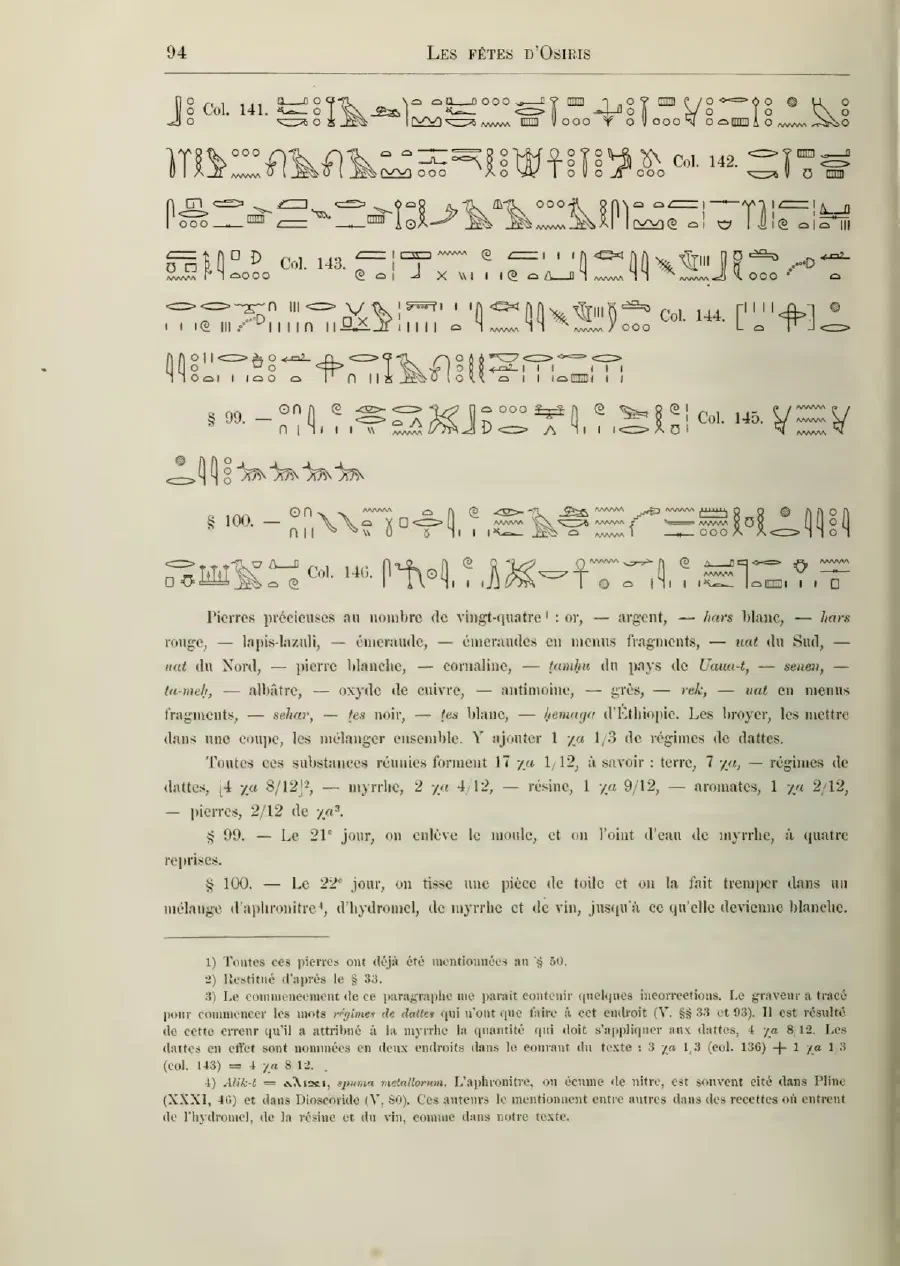
Page 94. Recueil V, p. 94: the twenty-four stones; the totals; cloth soaked in aphronitre, mead, myrrh and wine (§§ 98–100) Recueil de travaux III, IV and V (archive.org scans) - s98f94
Pierres précieuses au nombre de vingt-quatre : or, — argent, — hars blanc, — hars rouge, — lapis-lazuli, — émeraude, — émeraudes en menus fragments, — uat du Sud, — uat du Nord, — pierre blanche, — cornaline, — tamhu du pays de Uaua-t, — senen, — ta-meh, — albâtre, — oxyde de cuivre, — antimoine, — grès, — rek, — uat en menus fragments, — sehar, — tes noir, — tes blanc, — hemaga d'Éthiopie. Les broyer, les mettre dans une coupe, les mélanger ensemble. Y ajouter 1 χa 1/3 de régimes de dattes.
Precious stones, twenty-four in number: gold, — silver, — white hars, — red hars, — lapis lazuli, — emerald, — emerald in small fragments, — uat of the South, — uat of the North, — white stone, — carnelian, — tamhu of the land of Uaua-t, — senen, — ta-meh, — alabaster, — oxide of copper, — antimony, — sandstone, — rek, — uat in small fragments, — sehar, — black tes, — white tes, — hemaga of Ethiopia. Grind them, put them in a cup, mix them together. Add to them 1 χa 1/3 of bunches of dates.
Note on line s98f
Loret’s note 1: all these stones have already been mentioned in § 50. - s98g94
Toutes ces substances réunies forment 17 χa 1/12, à savoir : terre, 7 χa, — régimes de dattes, [4 χa 8/12], — myrrhe, 2 χa 4/12, — résine, 1 χa 9/12, — aromates, 1 χa 2/12, — pierres, 2/12 de χa.
All these substances together make 17 χa 1/12, namely: earth, 7 χa, — bunches of dates, [4 χa 8/12], — myrrh, 2 χa 4/12, — resin, 1 χa 9/12, — aromatics, 1 χa 2/12, — stones, 2/12 of a χa.
Note on line s98g
Loret’s notes. (2) Restored after § 33. (3) The beginning of this paragraph seems to him to contain some incorrections. The engraver began by tracing the words bunches of dates, which have no business here (see §§ 33 and 93), and so attributed to the myrrh the quantity that belongs to the dates. The dates are in fact named in two places in the course of the text: 3 χa 1/3 (col. 136) + 1 χa 1/3 (col. 143) = 4 χa 8/12. - s9994
§ 99. — Le 21e jour, on enlève le moule, et on l'oint d'eau de myrrhe, à quatre reprises.
§ 99. — On the 21st day, the mould is taken off, and it is anointed with myrrh water, four times.
- s10094
§ 100. — Le 22e jour, on tisse une pièce de toile et on la fait tremper dans un mélange d'aphronitre, d'hydromel, de myrrhe et de vin, jusqu'à ce qu'elle devienne blanche.
§ 100. — On the 22nd day a piece of cloth is woven and soaked in a mixture of aphronitre, mead, myrrh and wine, until it becomes white.
Note on line s100
Loret’s note 4: alik-t, a Coptic word glossed spuma metallorum. Aphronitre, or foam of nitre, is often cited in Pliny (XXXI, 46) and Dioscorides (V, 80). These authors mention it, among other places, in recipes in which mead, resin and wine enter, as in this text. 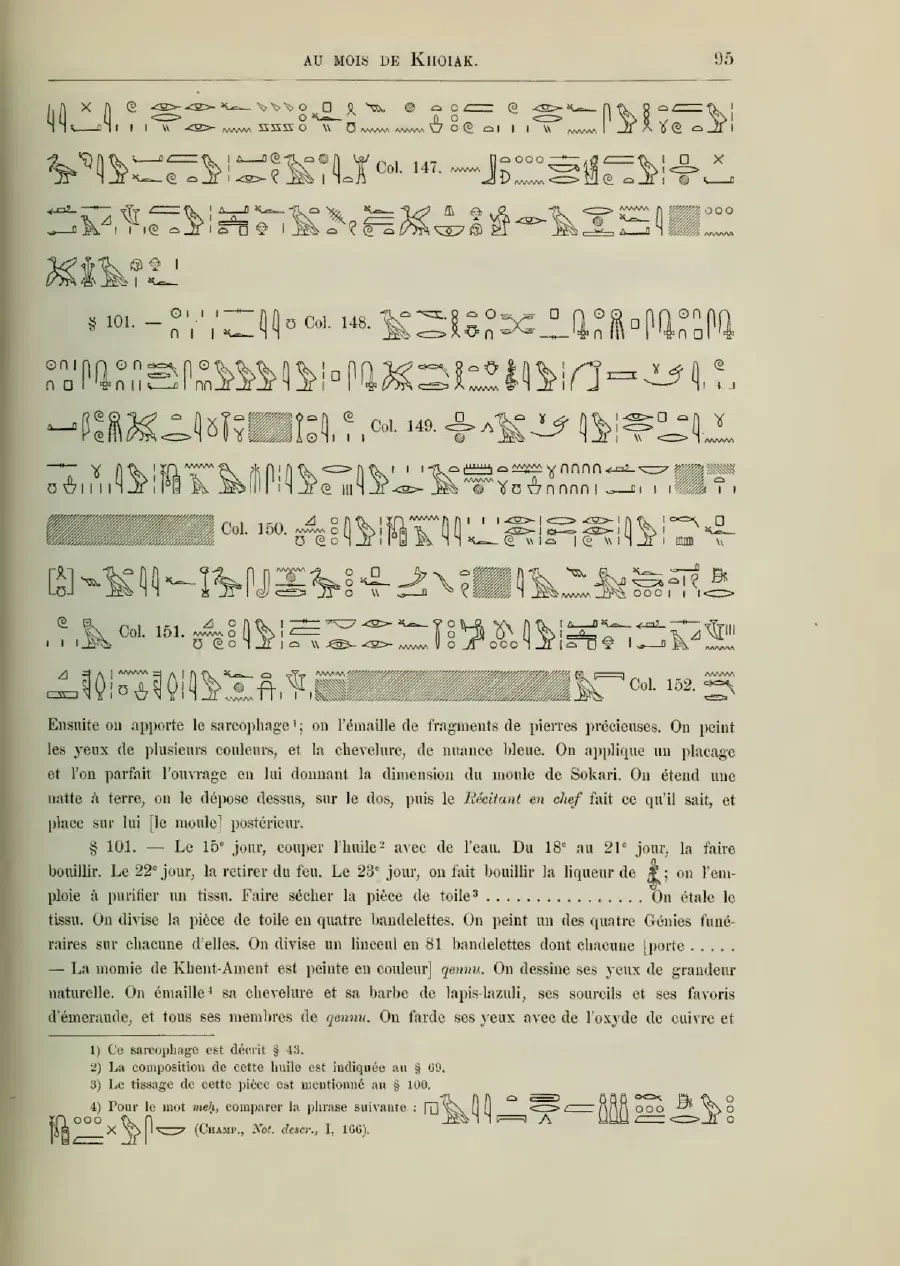
Page 95. Recueil V, p. 95: the sarcophagus enamelled; the oil; the shroud in 81 bands; the eyes painted (§§ 100–101) Recueil de travaux III, IV and V (archive.org scans) - s100b95
Ensuite on apporte le sarcophage ; on l'émaille de fragments de pierres précieuses. On peint les yeux de plusieurs couleurs, et la chevelure, de nuance bleue. On applique un placage et l'on parfait l'ouvrage en lui donnant la dimension du moule de Sokari. On étend une natte à terre, on le dépose dessus, sur le dos, et le Récitant en chef fait ce qu'il sait, et place sur lui [le moule] postérieur.
Next the sarcophagus is brought; it is enamelled with fragments of precious stones. The eyes are painted in several colours, and the hair in a blue shade. A veneer is applied and the work is perfected by giving it the dimension of the mould of Sokari. A mat is spread on the ground, he is laid upon it, on his back, and the Chief reciter does what he knows, and places the posterior [mould] on him.
Note on line s100b
Loret’s note 1: this sarcophagus is described in § 43. - s10195
§ 101. — Le 15e jour, couper l'huile avec de l'eau. Du 18e au 21e jour, la faire bouillir. Le 22e jour, la retirer du feu. Le 23e jour, on fait bouillir la liqueur de [sign] ; on l'emploie à purifier un tissu. Faire sécher la pièce de toile [ . . . ] On étale le tissu. On divise la pièce de toile en quatre bandelettes. On peint un des quatre Génies funéraires sur chacune d'elles. On divise un linceul en 81 bandelettes dont chacune [porte [ . . . ] — La momie de Khent-Ament est peinte en couleur] qennu. On dessine ses yeux de grandeur naturelle. On émaille sa chevelure et sa barbe de lapis-lazuli, ses sourcils et ses favoris d'émeraude, et tous ses membres de qennu. On farde ses yeux avec de l'oxyde de cuivre et
§ 101. — On the 15th day, cut the oil with water. From the 18th to the 21st day, make it boil. On the 22nd day, take it from the fire. On the 23rd day the liquor of [sign] is boiled; it is used to purify a cloth. Dry the piece of cloth [ . . . ] The cloth is spread out. The piece of cloth is divided into four bands. One of the four Funerary Genii is painted on each of them. A shroud is divided into 81 bands, each of which [bears [ . . . ] — The mummy of Khent-Ament is painted the colour] qennu. His eyes are drawn life-size. His hair and his beard are enamelled with lapis lazuli, his eyebrows and his whiskers with emerald, and all his members with qennu. His eyes are made up with oxide of copper and
Note on line s101
Loret’s notes. (2) The composition of this oil is given in § 69. (3) The weaving of this piece of cloth is mentioned in § 100. (4) For the word meh (enamel), compare the following phrase from Champollion, Notices descriptives, I, 166, given in signs. 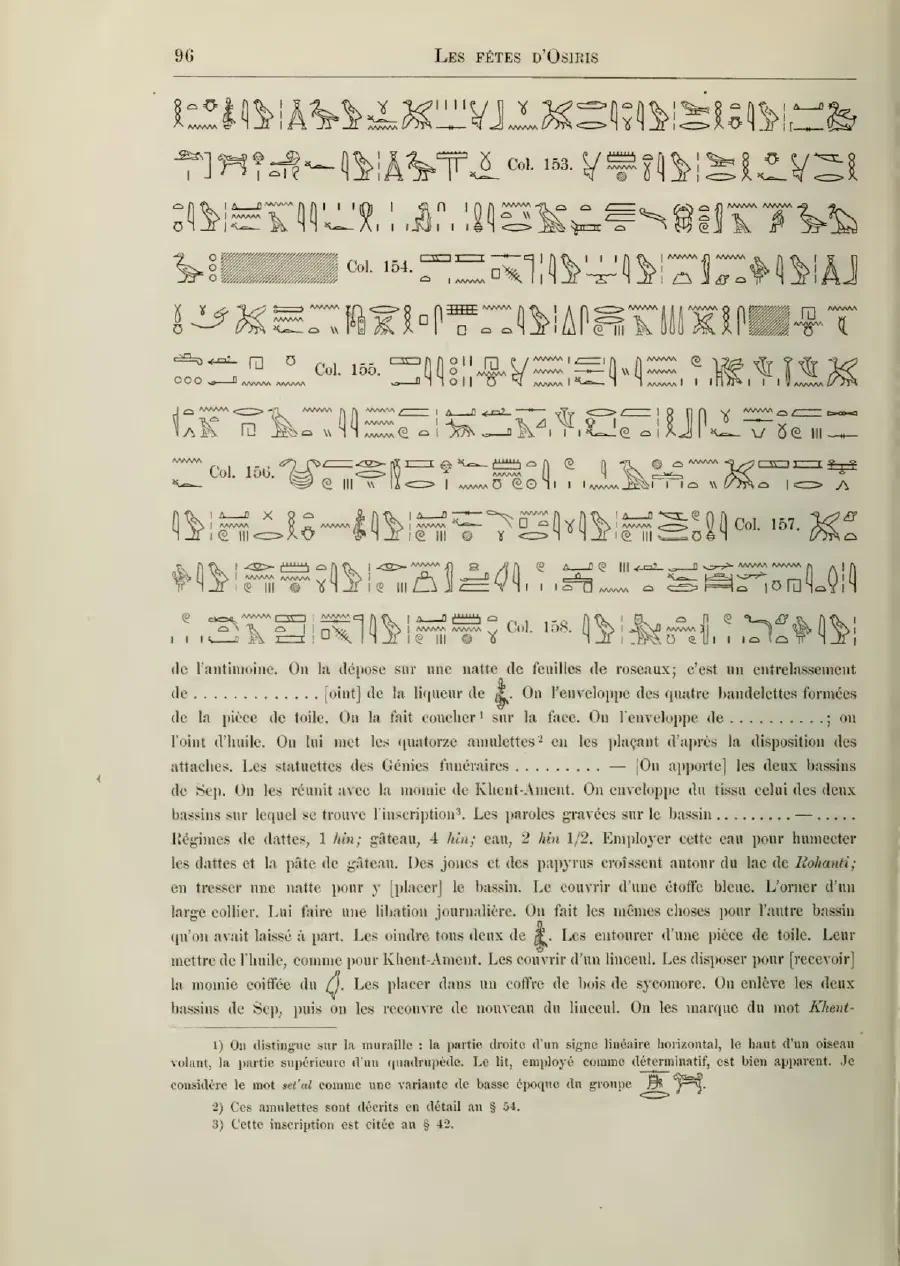
Page 96. Recueil V, p. 96: the mummy laid on its face with fourteen amulets; the two basins of Sep joined to it (§ 101) Recueil de travaux III, IV and V (archive.org scans) - s101b96
de l'antimoine. On la dépose sur une natte de feuilles de roseaux ; c'est un entrelacement de [ . . . ] [oint] de la liqueur de [sign]. On l'enveloppe des quatre bandelettes formées de la pièce de toile. On la fait coucher sur la face. On l'enveloppe de [ . . . ] ; on l'oint d'huile. On lui met les quatorze amulettes en les plaçant d'après la disposition des attaches. Les statuettes des Génies funéraires [ . . . ] — [On apporte] les deux bassins de Sep. On les réunit avec la momie de Khent-Ament. On enveloppe du tissu celui des deux bassins sur lequel se trouve l'inscription. Les paroles gravées sur le bassin [ . . . ] — [ . . . ] Régimes de dattes, 1 hin ; gâteau, 4 hin ; eau, 2 hin 1/2. Employer cette eau pour humecter les dattes et la pâte de gâteau. Des joncs et des papyrus croissent autour du lac de Rohanti ; en tresser une natte pour y [placer] le bassin. Le couvrir d'une étoffe bleue. L'orner d'un large collier. Lui faire une libation journalière. On fait les mêmes choses pour l'autre bassin qu'on avait laissé à part. Les oindre tous deux de [sign]. Les entourer d'une pièce de toile. Leur mettre de l'huile, comme pour Khent-Ament. Les couvrir d'un linceul. Les disposer pour [recevoir] la momie coiffée du [sign]. Les placer dans un coffre de bois de sycomore. On enlève les deux bassins de Sep, puis on les recouvre de nouveau du linceul. On les marque du mot Khent-
antimony. It is laid on a mat of reed leaves; it is a plaiting of [ . . . ] [anointed] with the liquor of [sign]. It is wrapped in the four bands formed from the piece of cloth. It is made to lie on its face. It is wrapped in [ . . . ]; it is anointed with oil. The fourteen amulets are put on it, placing them according to the arrangement of the ties. The statuettes of the Funerary Genii [ . . . ] — [Bring] the two basins of Sep. They are joined with the mummy of Khent-Ament. The one of the two basins on which the inscription is found is wrapped in cloth. The words engraved on the basin [ . . . ] — [ . . . ] Bunches of dates, 1 hin; cake, 4 hin; water, 2 hin 1/2. Use this water to moisten the dates and the cake paste. Rushes and papyri grow around the lake of Rohanti; plait of them a mat on which to [place] the basin. Cover it with a blue cloth. Adorn it with a broad collar. Make it a daily libation. The same things are done for the other basin that had been left apart. Anoint both of them with [sign]. Surround them with a piece of cloth. Put oil on them, as for Khent-Ament. Cover them with a shroud. Dispose them to [receive] the mummy crowned with the [sign]. Place them in a chest of sycamore wood. The two basins of Sep are taken up, then they are covered again with the shroud. They are marked with the word Khent-
Note on line s101b
Loret’s notes. (1) On the wall can be made out: the right part of a horizontal linear sign, the top of a flying bird, the upper part of a quadruped. The bed, used as determinative, is quite apparent. He considers the word set’al a late variant of the group he gives in signs. (2) These amulets are described in detail in § 54. (3) This inscription is cited in § 42. 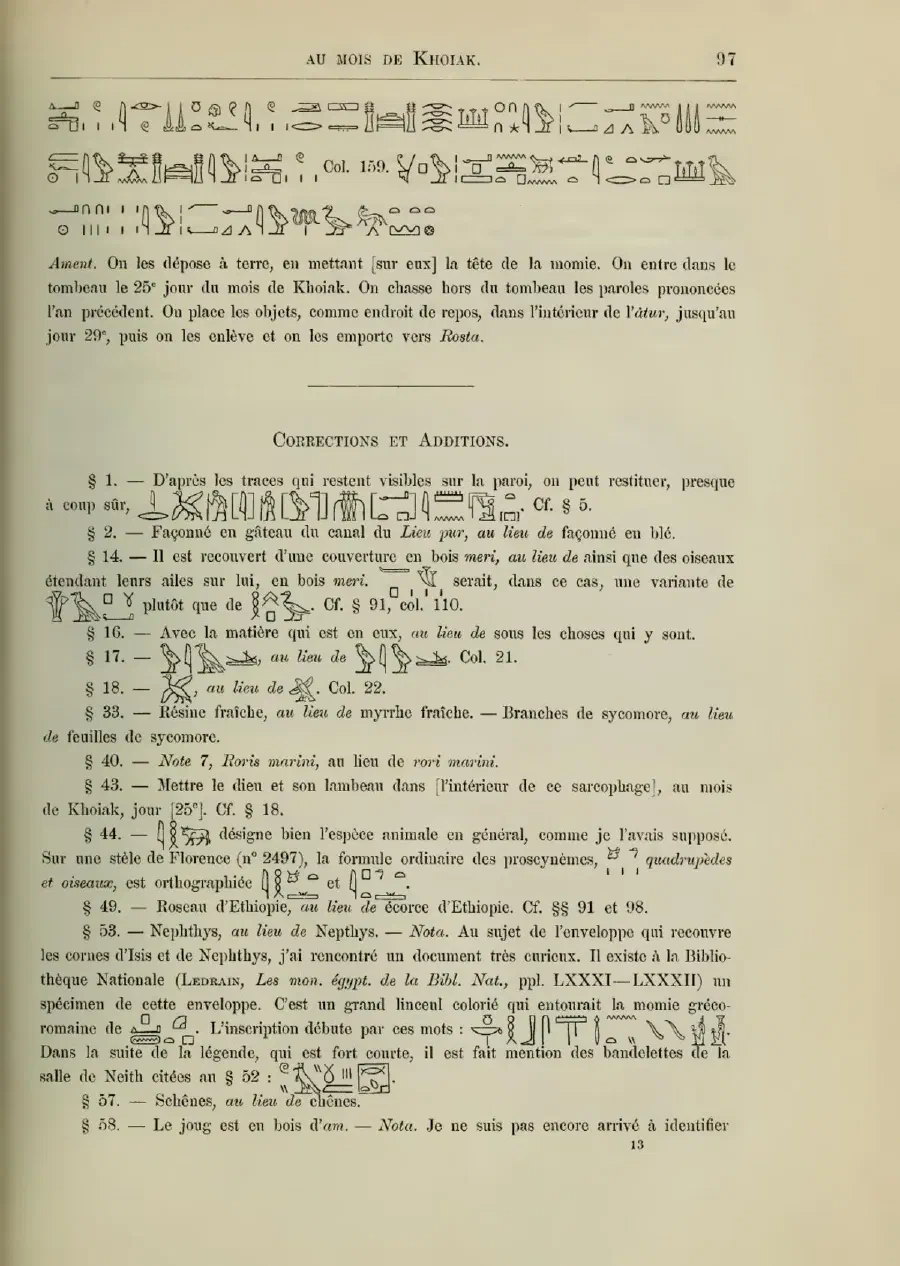
Page 97. Recueil V, p. 97: the tomb entered on the 25th and last year's words driven out; Loret's corrections and additions begin Recueil de travaux III, IV and V (archive.org scans) - s101c97
Ament. On les dépose à terre, en mettant [sur eux] la tête de la momie. On entre dans le tombeau le 25e jour du mois de Khoiak. On chasse hors du tombeau les paroles prononcées l'an précédent. On place les objets, comme endroit de repos, dans l'intérieur de l'âtur, jusqu'au jour 29e, puis on les enlève et on les emporte vers Rosta.
Ament. They are laid on the ground, putting [on them] the head of the mummy. The tomb is entered on the 25th day of the month of Khoiak. The words spoken the preceding year are driven out of the tomb. The objects are placed, as a resting place, inside the âtur, until the 29th day, then they are taken up and carried toward Rosta.
Corrections and additions
- corr-head97
Corrections et Additions.
Corrections and Additions.
- corr197
§ 1. — D'après les traces qui restent visibles sur la paroi, on peut restituer, presque à coup sûr, [sign]. Cf. § 5.
§ 1. — From the traces that remain visible on the wall one can restore, almost with certainty, [sign]. Cf. § 5.
- corr297
§ 2. — Façonné en gâteau du canal du Lieu pur, au lieu de façonné en blé.
§ 2. — Fashioned of cake of the canal of the Pure Place, instead of fashioned of grain.
- corr1497
§ 14. — Il est recouvert d'une couverture en bois meri, au lieu de ainsi que des oiseaux étendant leurs ailes sur lui, en bois meri. [sign] serait, dans ce cas, une variante de [sign] plutôt que de [sign]. Cf. § 91, col. 110.
§ 14. — It is covered with a cover of meri wood, instead of as well as birds spreading their wings over it, of meri wood. [sign] would, in this case, be a variant of [sign] rather than of [sign]. Cf. § 91, col. 110.
- corr1697
§ 16. — Avec la matière qui est en eux, au lieu de sous les choses qui y sont.
§ 16. — With the matter that is in them, instead of under the things that are in it.
- corr1797
§ 17. — [sign], au lieu de [sign]. Col. 21. § 18. — [sign], au lieu de [sign]. Col. 22.
§ 17. — [sign], instead of [sign]. Col. 21. § 18. — [sign], instead of [sign]. Col. 22.
- corr3397
§ 33. — Résine fraîche, au lieu de myrrhe fraîche. — Branches de sycomore, au lieu de feuilles de sycomore.
§ 33. — Fresh resin, instead of fresh myrrh. — Branches of sycamore, instead of leaves of sycamore.
- corr4097
§ 40. — Note 7, Roris marini, au lieu de rori marini.
§ 40. — Note 7, Roris marini, instead of rori marini.
- corr4397
§ 43. — Mettre le dieu et son lambeau dans [l'intérieur de ce sarcophage], au mois de Khoiak, jour [25e]. Cf. § 18.
§ 43. — Put the god and his shred in [the interior of this sarcophagus], in the month of Khoiak, day [25]. Cf. § 18.
- corr4497
§ 44. — [sign] désigne bien l'espèce animale en général, comme je l'avais supposé. Sur une stèle de Florence (n° 2497), la formule ordinaire des proscynèmes, [sign] quadrupèdes et oiseaux, est orthographiée [sign] et [sign].
§ 44. — [sign] does designate the animal species in general, as I had supposed. On a stela of Florence (no. 2497), the ordinary formula of the proskynemata, [sign] quadrupeds and birds, is spelled [sign] and [sign].
- corr4997
§ 49. — Roseau d'Éthiopie, au lieu de écorce d'Éthiopie. Cf. §§ 91 et 98.
§ 49. — Reed of Ethiopia, instead of bark of Ethiopia. Cf. §§ 91 and 98.
- corr5397
§ 53. — Nephthys, au lieu de Nepthys. — Nota. Au sujet de l'enveloppe qui recouvre les cornes d'Isis et de Nephthys, j'ai rencontré un document très curieux. Il existe à la Bibliothèque Nationale (Ledrain, Les mon. égypt. de la Bibl. Nat., pl. LXXXI—LXXXII) un spécimen de cette enveloppe. C'est un grand linceul colorié qui entourait la momie gréco-romaine de [sign]. L'inscription débute par ces mots : [sign]. Dans la suite de la légende, qui est fort courte, il est fait mention des bandelettes de la salle de Neith citées au § 52 : [sign].
§ 53. — Nephthys, instead of Nepthys. — Note. Concerning the wrapping that covers the horns of Isis and Nephthys, I have come upon a very curious document. A specimen of this wrapping exists in the Bibliothèque Nationale (Ledrain, Les monuments égyptiens de la Bibliothèque Nationale, pl. LXXXI–LXXXII). It is a large coloured shroud that surrounded the Greco-Roman mummy of [sign]. The inscription begins with these words: [sign]. In the rest of the legend, which is very short, mention is made of the bands of the hall of Neith cited in § 52: [sign].
- corr5797
§ 57. — Schènes, au lieu de chênes.
§ 57. — Schoenes, instead of oaks.
- corr5897
§ 58. — Le joug est en bois d'am. — Nota. Je ne suis pas encore arrivé à identifier
§ 58. — The yoke is of am wood. — Note. I have not yet succeeded in identifying
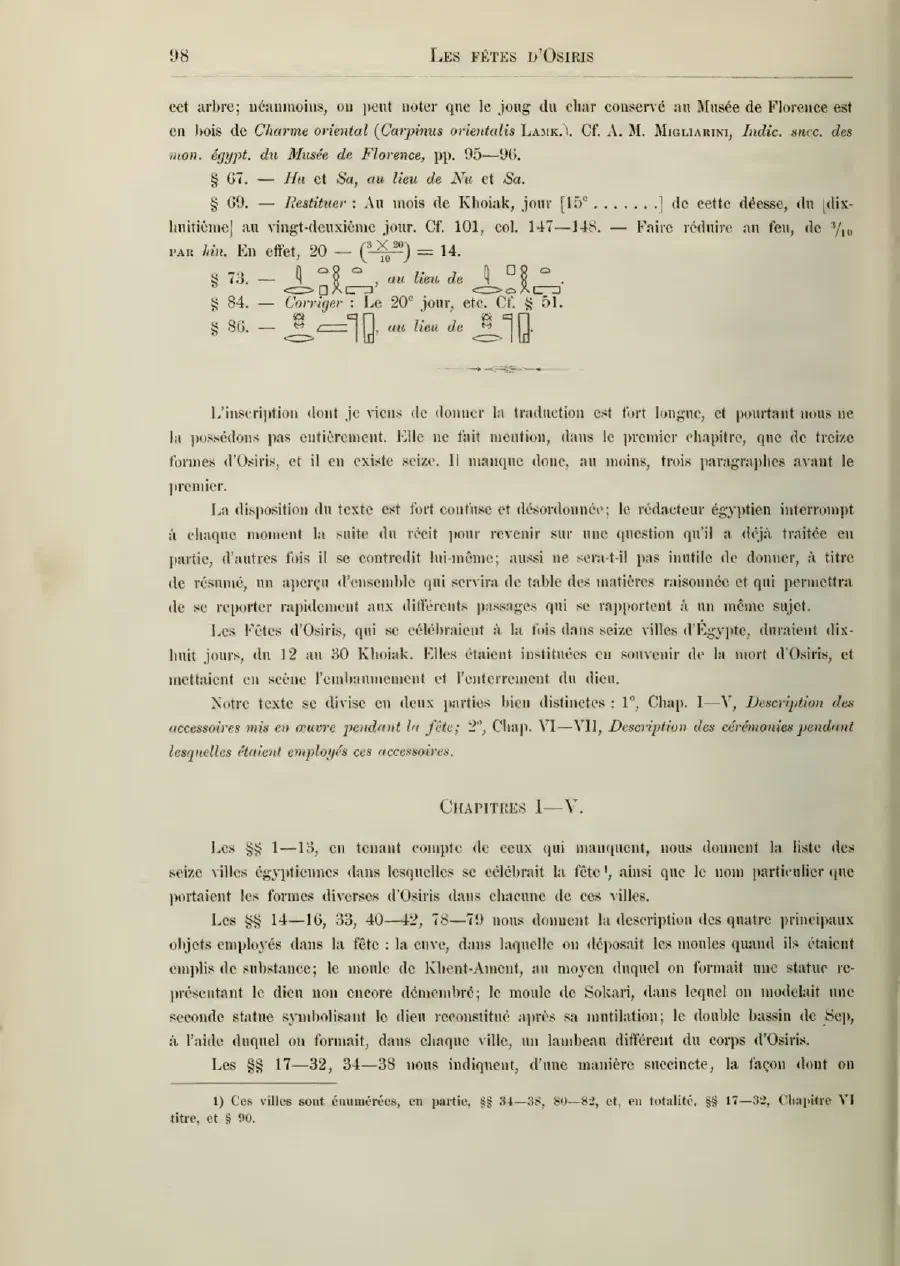
Page 98. Recueil V, p. 98: corrections end; Loret's summary of the inscription, Chapters I–V, begins Recueil de travaux III, IV and V (archive.org scans) - corr58b98
cet arbre ; néanmoins, on peut noter que le joug du char conservé au Musée de Florence est en bois de Charme oriental (Carpinus orientalis Lamk.). Cf. A. M. Migliarini, Indic. succ. des mon. égypt. du Musée de Florence, pp. 95—96.
this tree; nevertheless, it may be noted that the yoke of the chariot preserved in the Museum of Florence is of oriental hornbeam (Carpinus orientalis Lamk.). Cf. A. M. Migliarini, Indic. succ. des mon. égypt. du Musée de Florence, pp. 95–96.
- corr6798
§ 67. — Ha et Sa, au lieu de Nu et Sa.
§ 67. — Ha and Sa, instead of Nu and Sa.
- corr6998
§ 69. — Restituer : Au mois de Khoiak, jour [15e . . . ] de cette déesse, du [dix-huitième] au vingt-deuxième jour. Cf. 101, col. 147—148. — Faire réduire au feu, de 3/10 par hin. En effet, 20 — (3 × 20/10) = 14.
§ 69. — Restore: In the month of Khoiak, day [15 . . . ] of this goddess, from the [eighteenth] to the twenty-second day. Cf. § 101, cols. 147–148. — Reduce on the fire by 3/10 per hin. Indeed, 20 − (3 × 20/10) = 14.
- corr7398
§ 73. — [sign], au lieu de [sign]. § 84. — Corriger : Le 20e jour, etc. Cf. § 51. § 86. — [sign], au lieu de [sign].
§ 73. — [sign], instead of [sign]. § 84. — Correct: On the 20th day, etc. Cf. § 51. § 86. — [sign], instead of [sign].
Loret’s summary
- sum198
L'inscription dont je viens de donner la traduction est fort longue, et pourtant nous ne la possédons pas entièrement. Elle ne fait mention, dans le premier chapitre, que de treize formes d'Osiris, et il en existe seize. Il manque donc, au moins, trois paragraphes avant le premier.
The inscription of which I have just given the translation is very long, and yet we do not possess it entire. It mentions, in the first chapter, only thirteen forms of Osiris, and there exist sixteen. At least three paragraphs are therefore missing before the first.
- sum298
La disposition du texte est fort confuse et désordonnée ; le rédacteur égyptien interrompt à chaque moment la suite du récit pour revenir sur une question qu'il a déjà traitée en partie, d'autres fois il se contredit lui-même ; aussi ne sera-t-il pas inutile de donner, à titre de résumé, un aperçu d'ensemble qui servira de table des matières raisonnée et qui permettra de se reporter rapidement aux différents passages qui se rapportent à un même sujet.
The arrangement of the text is very confused and disordered; the Egyptian writer interrupts at every moment the course of the narrative to return to a question he has already treated in part, at other times he contradicts himself; so it will not be useless to give, by way of summary, a general view which will serve as a reasoned table of contents and which will allow one to refer quickly to the different passages that relate to one subject.
- sum398
Les Fêtes d'Osiris, qui se célébraient à la fois dans seize villes d'Égypte, duraient dix-huit jours, du 12 au 30 Khoiak. Elles étaient instituées en souvenir de la mort d'Osiris, et mettaient en scène l'embaumement et l'enterrement du dieu.
The Feasts of Osiris, which were celebrated at the same time in sixteen cities of Egypt, lasted eighteen days, from 12 to 30 Khoiak. They were instituted in memory of the death of Osiris, and put on stage the embalming and burial of the god.
- sum498
Notre texte se divise en deux parties bien distinctes : 1°, Chap. I—V, Description des accessoires mis en œuvre pendant la fête ; 2°, Chap. VI—VII, Description des cérémonies pendant lesquelles étaient employés ces accessoires.
Our text divides into two quite distinct parts: 1, Chap. I–V, Description of the accessories put to use during the feast; 2, Chap. VI–VII, Description of the ceremonies during which these accessories were employed.
Loret’s summary, Chapters I–V
- sum-ch1-598
Chapitres I—V. Les §§ 1—13, en tenant compte de ceux qui manquent, nous donnent la liste des seize villes égyptiennes dans lesquelles se célébrait la fête, ainsi que le nom particulier que portaient les formes diverses d'Osiris dans chacune de ces villes.
Chapters I–V. Sections 1–13, taking account of those that are missing, give us the list of the sixteen Egyptian cities in which the feast was celebrated, as well as the particular name that the various forms of Osiris bore in each of these cities.
Note on line sum-ch1-5
Loret’s note 1: these cities are enumerated in part in §§ 34-38, 80-82, and in full in §§ 17-32, the title of Chapter VI, and § 90. - sum598
Les §§ 14—16, 33, 40—42, 78—79 nous donnent la description des quatre principaux objets employés dans la fête : la cuve, dans laquelle on déposait les moules quand ils étaient remplis de substance ; le moule de Khent-Ament, au moyen duquel on formait une statue représentant le dieu non encore démembré ; le moule de Sokari, dans lequel on modelait une seconde statue symbolisant le dieu reconstitué après sa mutilation ; le double bassin de Sep, à l'aide duquel on formait, dans chaque ville, un lambeau différent du corps d'Osiris.
Sections 14–16, 33, 40–42, 78–79 give us the description of the four principal objects employed in the feast: the vat, in which the moulds were laid when they were filled with substance; the mould of Khent-Ament, by means of which a statue was formed representing the god not yet dismembered; the mould of Sokari, in which a second statue was modelled symbolizing the god reconstituted after his mutilation; the double basin of Sep, with the help of which was formed, in each city, a different shred of the body of Osiris.
- sum698
Les §§ 17—32, 34—38 nous indiquent, d'une manière succincte, la façon dont on
Sections 17–32, 34–38 indicate to us, in a succinct manner, the way in which
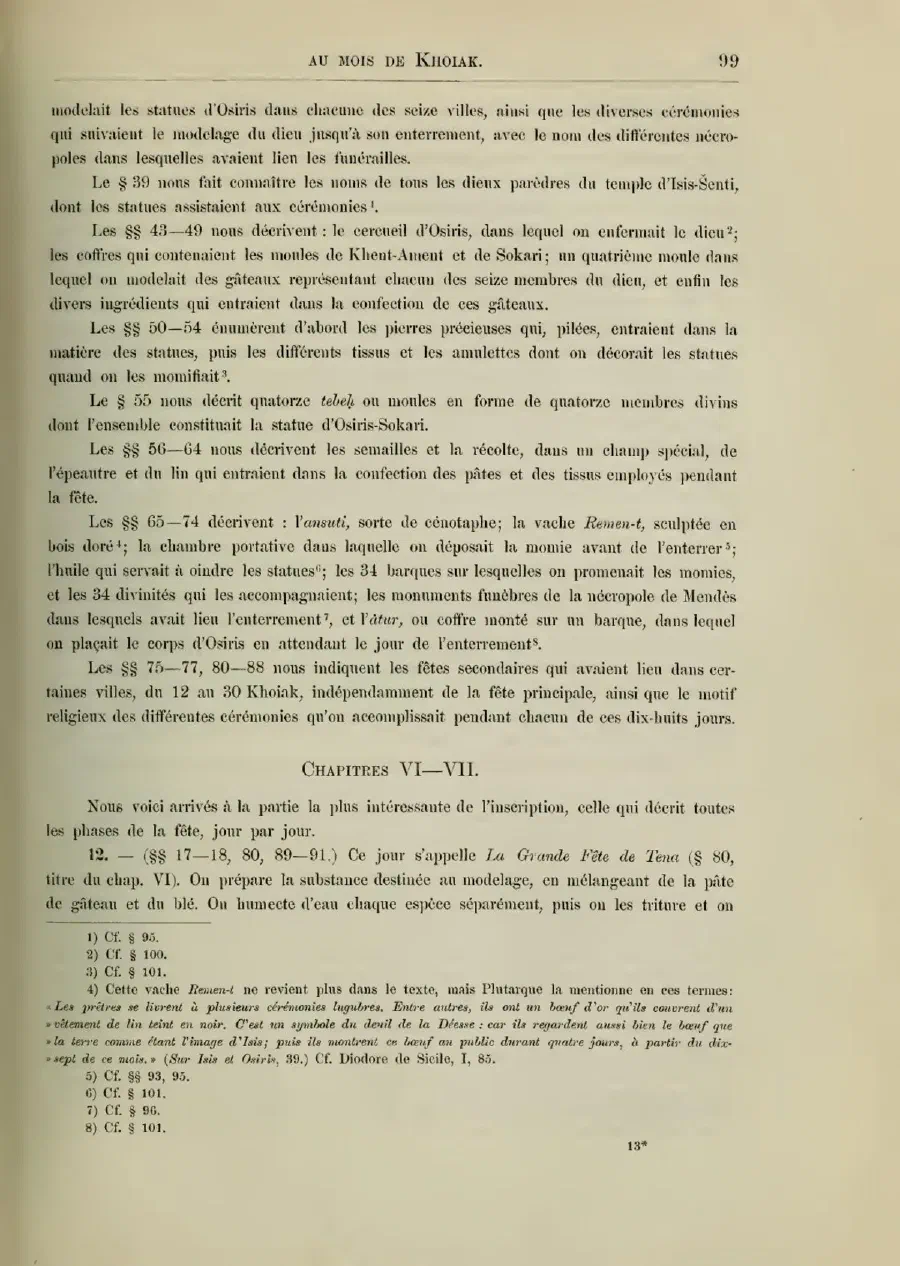
Page 99. Recueil V, p. 99: summary of the objects; Chapters VI–VII: the feast day by day, from the 12th Recueil de travaux III, IV and V (archive.org scans) - sum6b99
modelait les statues d'Osiris dans chacune des seize villes, ainsi que les diverses cérémonies qui suivaient le modelage du dieu jusqu'à son enterrement, avec le nom des différentes nécropoles dans lesquelles avaient lieu les funérailles.
the statues of Osiris were modelled in each of the sixteen cities, as well as the various ceremonies that followed the modelling of the god up to his burial, with the name of the different necropolises in which the funerals took place.
- sum799
Le § 39 nous fait connaître les noms de tous les dieux parèdres du temple d'Isis-Šenti, dont les statues assistaient aux cérémonies.
Section 39 makes known to us the names of all the attendant gods of the temple of Isis-Šenti, whose statues attended the ceremonies.
Note on line sum7
Loret’s note 1: cf. § 95. - sum899
Les §§ 43—49 nous décrivent : le cercueil d'Osiris, dans lequel on enfermait le dieu ; les coffres qui contenaient les moules de Khent-Ament et de Sokari ; un quatrième moule dans lequel on modelait des gâteaux représentant chacun des seize membres du dieu, et enfin les divers ingrédients qui entraient dans la confection de ces gâteaux.
Sections 43–49 describe: the coffin of Osiris, in which the god was shut up; the chests that contained the moulds of Khent-Ament and of Sokari; a fourth mould in which cakes were modelled representing each of the sixteen members of the god, and finally the various ingredients that went into the making of these cakes.
Note on line sum8
Loret’s note 2: cf. § 100. - sum999
Les §§ 50—54 énumèrent d'abord les pierres précieuses qui, pilées, entraient dans la matière des statues, puis les différents tissus et les amulettes dont on décorait les statues quand on les momifiait.
Sections 50–54 enumerate first the precious stones which, pounded, entered into the matter of the statues, then the different cloths and the amulets with which the statues were decorated when they were mummified.
Note on line sum9
Loret’s note 3: cf. § 101. - sum1099
Le § 55 nous décrit quatorze tebeh ou moules en forme de quatorze membres divins dont l'ensemble constituait la statue d'Osiris-Sokari.
Section 55 describes fourteen tebeh or moulds in the form of fourteen divine members, the whole of which constituted the statue of Osiris-Sokari.
- sum1199
Les §§ 56—64 nous décrivent les semailles et la récolte, dans un champ spécial, de l'épeautre et du lin qui entraient dans la confection des pâtes et des tissus employés pendant la fête.
Sections 56–64 describe the sowing and the harvest, in a special field, of the spelt and the flax that entered into the making of the pastes and the cloths used during the feast.
- sum1299
Les §§ 65—74 décrivent : l'ansuti, sorte de cénotaphe ; la vache Remen-t, sculptée en bois doré ; la chambre portative dans laquelle on déposait la momie avant de l'enterrer ; l'huile qui servait à oindre les statues ; les 34 barques sur lesquelles on promenait les momies, et les 34 divinités qui les accompagnaient ; les monuments funèbres de la nécropole de Mendès dans lesquels avait lieu l'enterrement, et l'âtur, ou coffre monté sur un barque, dans lequel on plaçait le corps d'Osiris en attendant le jour de l'enterrement.
Sections 65–74 describe: the ansuti, a sort of cenotaph; the cow Remen-t, carved of gilded wood; the portable chamber in which the mummy was laid before being buried; the oil that served to anoint the statues; the 34 barques on which the mummies were carried in procession, and the 34 divinities who accompanied them; the funerary monuments of the necropolis of Mendes in which the burial took place, and the âtur, or chest mounted on a barque, in which the body of Osiris was placed while awaiting the day of burial.
Note on line sum12
Loret’s notes. (4) This cow Remen-t does not recur in the text, but Plutarch mentions her in these terms: “The priests perform several mournful ceremonies. Among others, they have a golden ox which they cover with a garment of linen dyed black. It is a symbol of the mourning of the Goddess; for they regard the ox as well as the earth as being the image of Isis; then they show this ox to the public for four days, beginning on the seventeenth of this month.” (On Isis and Osiris, 39.) Cf. Diodorus Siculus, I, 85. (5) Cf. §§ 93, 95. (6) Cf. § 101. (7) Cf. § 96. (8) Cf. § 101. - sum1399
Les §§ 75—77, 80—88 nous indiquent les fêtes secondaires qui avaient lieu dans certaines villes, du 12 au 30 Khoiak, indépendamment de la fête principale, ainsi que le motif religieux des différentes cérémonies qu'on accomplissait pendant chacun de ces dix-huit jours.
Sections 75–77, 80–88 indicate the secondary feasts that took place in certain cities, from 12 to 30 Khoiak, independently of the main feast, as well as the religious motive of the different ceremonies that were performed during each of these eighteen days.
Loret’s summary, Chapters VI–VII
- sum-ch6-799
Chapitres VI—VII. Nous voici arrivés à la partie la plus intéressante de l'inscription, celle qui décrit toutes les phases de la fête, jour par jour.
Chapters VI–VII. We have now come to the most interesting part of the inscription, the one that describes all the phases of the feast, day by day.
- day1299
12. — (§§ 17—18, 80, 89—91.) Ce jour s'appelle La Grande Fête de Tena (§ 80, titre du chap. VI). On prépare la substance destinée au modelage, en mélangeant de la pâte de gâteau et du blé. On humecte d'eau chaque espèce séparément, puis on les triture et on
12. — (§§ 17–18, 80, 89–91.) This day is called The Great Feast of Tena (§ 80, title of Chap. VI). The substance destined for modelling is prepared by mixing cake paste and wheat. Each kind is moistened with water separately, then they are ground and
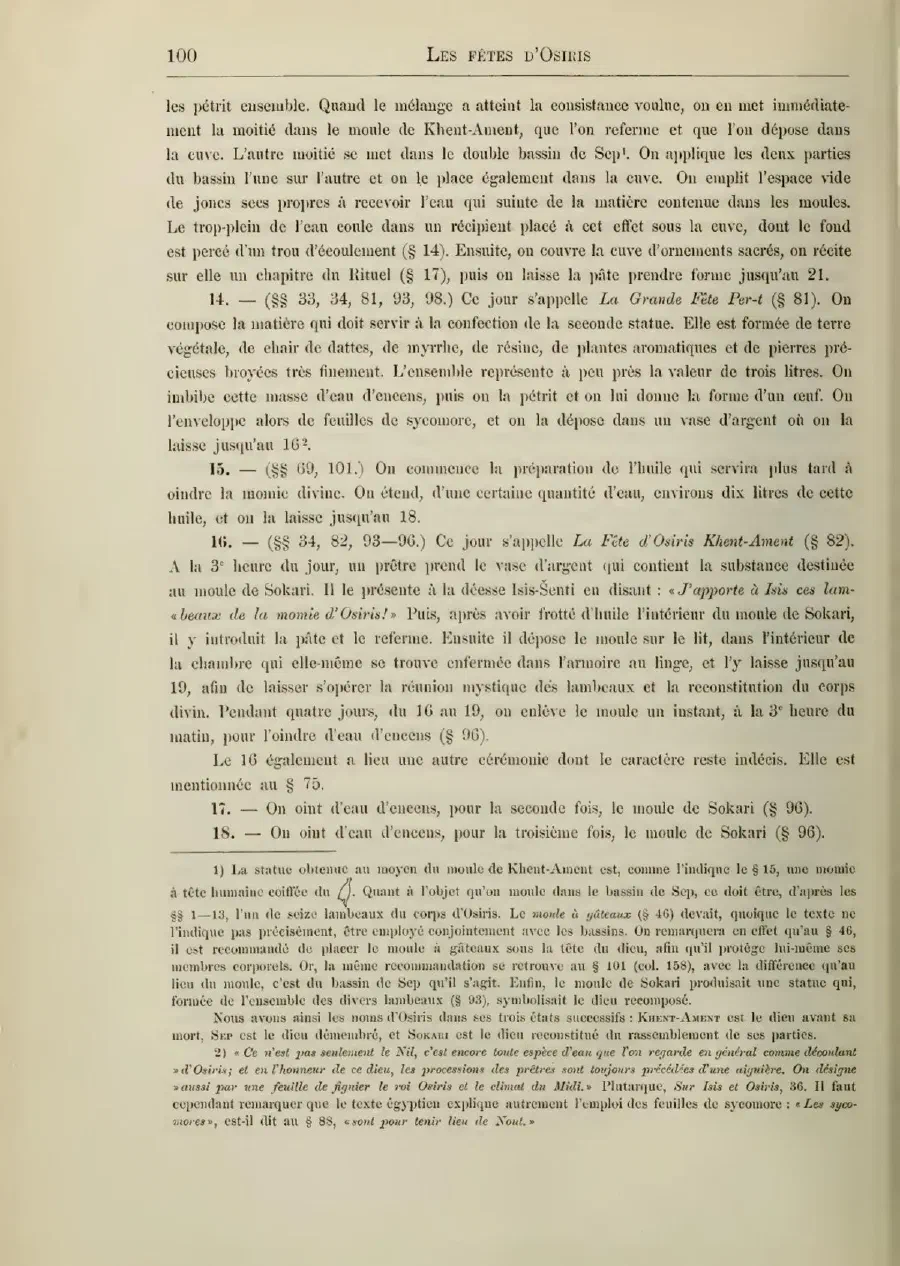
Page 100. Recueil V, p. 100: the days 12 to 18: the vat, the egg of earth, 'I bring to Isis these shreds of the mummy of Osiris'; the three states Khent-Ament, Sep, Sokari Recueil de travaux III, IV and V (archive.org scans) - day12b100
les pétrit ensemble. Quand le mélange a atteint la consistance voulue, on en met immédiatement la moitié dans le moule de Khent-Ament, que l'on referme et que l'on dépose dans la cuve. L'autre moitié se met dans le double bassin de Sep. On applique les deux parties du bassin l'une sur l'autre et on le place également dans la cuve. On emplit l'espace vide de joncs secs propres à recevoir l'eau qui suinte de la matière contenue dans les moules. Le trop-plein de l'eau coule dans un récipient placé à cet effet sous la cuve, dont le fond est percé d'un trou d'écoulement (§ 14). Ensuite, on couvre la cuve d'ornements sacrés, on récite sur elle un chapitre du Rituel (§ 17), puis on laisse la pâte prendre forme jusqu'au 21.
kneaded together. When the mixture has reached the desired consistency, half of it is put at once into the mould of Khent-Ament, which is closed again and laid in the vat. The other half is put in the double basin of Sep. The two parts of the basin are applied one upon the other and it is likewise placed in the vat. The empty space is filled with dry rushes fit to receive the water that oozes from the matter contained in the moulds. The overflow of water runs into a vessel placed for this purpose under the vat, whose bottom is pierced with a drain hole (§ 14). Then the vat is covered with sacred ornaments, a chapter of the Ritual is recited over it (§ 17), then the paste is left to take form until the 21st.
Note on line day12b
Loret’s note 1: the statue obtained by means of the mould of Khent-Ament is, as § 15 indicates, a mummy with a human head wearing the [sign] crown. As for the object that is moulded in the basin of Sep, it must be, according to §§ 1-13, one of sixteen shreds of the body of Osiris. The cake mould (§ 46) must, although the text does not say so precisely, have been used together with the basins. It will be noticed that in § 46 it is recommended to place the cake mould under the head of the god, so that he himself protects his bodily members; the same recommendation is found in § 101 (col. 158), with the difference that it is the basin of Sep that is in question. Finally, the mould of Sokari produced a statue which, formed of the whole of the various shreds (§ 93), symbolized the god put together again. We thus have the names of Osiris in his three successive states: Khent-Ament is the god before his death, Sep is the god dismembered, and Sokari is the god reconstituted by the gathering of his parts. - day14100
14. — (§§ 33, 34, 81, 93, 98.) Ce jour s'appelle La Grande Fête Per-t (§ 81). On compose la matière qui doit servir à la confection de la seconde statue. Elle est formée de terre végétale, de chair de dattes, de myrrhe, de résine, de plantes aromatiques et de pierres précieuses broyées très finement. L'ensemble représente à peu près la valeur de trois litres. On imbibe cette masse d'eau d'encens, puis on la pétrit et on lui donne la forme d'un œuf. On l'enveloppe alors de feuilles de sycomore, et on la dépose dans un vase d'argent où on la laisse jusqu'au 16.
14. — (§§ 33, 34, 81, 93, 98.) This day is called The Great Feast Per-t (§ 81). The matter that is to serve for the making of the second statue is composed. It is formed of vegetable earth, flesh of dates, myrrh, resin, aromatic plants and precious stones ground very fine. The whole represents about the value of three litres. This mass is soaked with water of incense, then it is kneaded and given the form of an egg. It is then wrapped in sycamore leaves, and laid in a silver vase where it is left until the 16th.
Note on line day14
Loret’s note 2: Plutarch: “It is not only the Nile, it is also every kind of water that is regarded in general as flowing from Osiris; and in honour of this god the processions of the priests are always preceded by a ewer. A fig leaf is also used to designate king Osiris and the climate of the South.” (On Isis and Osiris, 36.) It must however be remarked that the Egyptian text explains the use of sycamore leaves otherwise: “The sycamores,” it is said in § 88, “are in place of Nut.” - day15100
15. — (§§ 69, 101.) On commence la préparation de l'huile qui servira plus tard à oindre la momie divine. On étend, d'une certaine quantité d'eau, environ dix litres de cette huile, et on la laisse jusqu'au 18.
15. — (§§ 69, 101.) The preparation of the oil that will serve later to anoint the divine mummy is begun. About ten litres of this oil are diluted with a certain quantity of water, and it is left until the 18th.
- day16100
16. — (§§ 34, 82, 93—96.) Ce jour s'appelle La Fête d'Osiris Khent-Ament (§ 82). À la 3e heure du jour, un prêtre prend le vase d'argent qui contient la substance destinée au moule de Sokari. Il le présente à la déesse Isis-Šenti en disant : « J'apporte à Isis ces lambeaux de la momie d'Osiris ! » Puis, après avoir frotté d'huile l'intérieur du moule de Sokari, il y introduit la pâte et le referme. Ensuite il dépose le moule sur le lit, dans l'intérieur de la chambre qui elle-même se trouve enfermée dans l'armoire au linge, et l'y laisse jusqu'au 19, afin de laisser s'opérer la réunion mystique des lambeaux et la reconstitution du corps divin. Pendant quatre jours, du 16 au 19, on enlève le moule un instant, à la 3e heure du matin, pour l'oindre d'eau d'encens (§ 96).
16. — (§§ 34, 82, 93–96.) This day is called The Feast of Osiris Khent-Ament (§ 82). At the 3rd hour of the day a priest takes the silver vase that contains the substance destined for the mould of Sokari. He presents it to the goddess Isis-Šenti, saying: "I bring to Isis these shreds of the mummy of Osiris!" Then, after having rubbed with oil the inside of the mould of Sokari, he introduces the paste into it and closes it again. Next he lays the mould on the bed, inside the chamber, which is itself enclosed in the linen cupboard, and leaves it there until the 19th, to let the mystical reunion of the shreds and the reconstitution of the divine body take place. For four days, from the 16th to the 19th, the mould is taken out for a moment, at the 3rd hour of the morning, to anoint it with water of incense (§ 96).
- day16b100
Le 16 également a lieu une autre cérémonie dont le caractère reste indécis. Elle est mentionnée au § 75.
On the 16th also takes place another ceremony whose character remains undecided. It is mentioned in § 75.
- day17100
17. — On oint d'eau d'encens, pour la seconde fois, le moule de Sokari (§ 96). 18. — On oint d'eau d'encens, pour la troisième fois, le moule de Sokari (§ 96).
17. — The mould of Sokari is anointed with water of incense for the second time (§ 96). 18. — The mould of Sokari is anointed with water of incense for the third time (§ 96).
Page 101. Recueil V, p. 101: the days 19 to 30: the pedestal of gold, the procession of 34 barques, the mummification at the ninth hour of the night Recueil de travaux III, IV and V (archive.org scans) - day18b101
On met sur le feu l'huile préparée le 15, et on la laisse bouillir jusqu'au 22 (§§ 83, 101).
The oil prepared on the 15th is put on the fire, and it is left to boil until the 22nd (§§ 83, 101).
- day19101
19. — (§§ 33, 83, 96.) Le matin, à la 3e heure, on oint pour la dernière fois, d'eau d'encens, le moule de Sokari. Au coucher du soleil, on enlève la statue du moule, on la dépose sur un piédestal d'or, on la couvre d'un voile, et on la laisse sécher au soleil jusqu'au 23.
19. — (§§ 33, 83, 96.) In the morning, at the 3rd hour, the mould of Sokari is anointed for the last time with water of incense. At sunset the statue is taken out of the mould, laid on a pedestal of gold, covered with a veil, and left to dry in the sun until the 23rd.
- day20101
20. — (§§ 51, 61, 84, 96.) À la 8e heure, on tisse en lin le tissu d'un jour. On met 24 heures à le faire, d'où lui vient son nom. On doit l'employer, le 24, à la momification des statues.
20. — (§§ 51, 61, 84, 96.) At the 8th hour the cloth of one day is woven of linen. It takes 24 hours to make it, whence its name. It must be used, on the 24th, for the mummification of the statues.
- day21101
21. — (§§ 17, 18, 85, 91, 99.) On retire de la cuve, où on les avait déposées le 12, la statue de Khent-Ament et la représentation du lambeau. On place, dans chacun des deux moules, 190 gr. d'encens sec pilé. On remet à leur place les objets moulés pour qu'ils s'imprègnent d'encens, on rattache solidement les moules au moyen de quatre liens de papyrus, et on les laisse sécher au soleil, couverts d'un voile, jusqu'au lendemain.
21. — (§§ 17, 18, 85, 91, 99.) The statue of Khent-Ament and the representation of the shred are taken out of the vat, where they had been laid on the 12th. In each of the two moulds is placed 190 grams of pounded dry incense. The moulded objects are put back in place so that they become impregnated with incense, the moulds are fastened firmly again by means of four bands of papyrus, and they are left to dry in the sun, covered with a veil, until the next day.
- day21b101
Ce même jour, on nettoie à l'eau de myrrhe le moule de Sokari, devenu inutile (§ 99).
On this same day the mould of Sokari, which has become useless, is cleaned with myrrh water (§ 99).
- day22101
22. — (§§ 17, 43—45, 70—72, 91, 92, 100.) À la 8e heure, on met ces moulages dans une barque éclairée de nombreuses lampes, et on leur fait faire une promenade sur l'eau, suivis de 34 barques sur lesquelles sont les images de 34 divinités. Au retour, on les couvre de voiles et on les dépose dans des coffres de sycomore. On place ces coffres dans le Tombeau jusqu'au 24.
22. — (§§ 17, 43–45, 70–72, 91, 92, 100.) At the 8th hour these mouldings are put in a barque lit by numerous lamps, and are taken for a procession on the water, followed by 34 barques on which are the images of 34 divinities. On the return they are covered with veils and laid in chests of sycamore. These chests are placed in the Tomb until the 24th.
- day22b101
Le même jour on tisse une pièce de toile, puis on la blanchit. On orne le cercueil de peintures et d'incrustations et on le laisse sécher sur une natte (§§ 43, 100).
The same day a piece of cloth is woven, then bleached. The coffin is adorned with paintings and inlays and left to dry on a mat (§§ 43, 100).
- day22c101
Enfin, on retire du feu l'huile qu'on y avait mise le 18. Elle se trouve réduite de 3/10, de sorte qu'il en reste environ sept litres (§§ 69, 101).
Finally the oil that had been put on it on the 18th is taken from the fire. It is found reduced by 3/10, so that about seven litres of it remain (§§ 69, 101).
- day23101
23. — (§§ 76, 97, 101.) On retire du piédestal d'or la statue de Sokari, qu'on y avait placée le 18. On la met sur un socle de granit rose, on la peint de diverses couleurs, on la laisse sécher pendant deux heures, et on la replace, sur une natte de joncs, à l'intérieur d'un coffre en bois meri.
23. — (§§ 76, 97, 101.) The statue of Sokari, which had been placed there on the 18th, is taken from the pedestal of gold. It is put on a base of rose granite, painted in various colours, left to dry for two hours, and put back, on a mat of rushes, inside a chest of meri wood.
- day23b101
Le même jour, on fait bouillir la Liqueur de [sign], et on l'emploie à purifier l'un des tissus qui serviront à la momification du lendemain (§ 101). À partir du 23 jusqu'au 30, on accomplit, sur les quatre vases canopes, diverses cérémonies décrites au § 76. (Cf. § 75.)
The same day the Liquor of [sign] is boiled, and it is used to purify one of the cloths that will serve for the mummification of the next day (§ 101). From the 23rd to the 30th, various ceremonies described in § 76 are performed on the four canopic jars. (Cf. § 75.)
- day24101
24. — (§§ 34, 75, 86, 88, 92, 96, 101.) À la 9e heure de nuit, on procède à la momification des deux statues. Sokari est embaumé séparément ; Khent-Ament est momifié avec le lambeau. On place d'abord des tampons d'étoffes autour des corps, on les enveloppe de quatre linceuls, et on attache tout autour des bandelettes croisées sur lesquelles on dispose quatorze amulettes en pierres précieuses (§ 54). Ensuite on place les deux momies dans l'âtur (§ 74), sur un lit de branchages de sycomore, et on dépose l'âtur dans la Salle de repos.
24. — (§§ 34, 75, 86, 88, 92, 96, 101.) At the 9th hour of the night the mummification of the two statues is carried out. Sokari is embalmed separately; Khent-Ament is mummified with the shred. First pads of cloth are placed around the bodies, they are wrapped in four shrouds, and crossed bands are tied all around on which fourteen amulets of precious stones are arranged (§ 54). Then the two mummies are placed in the âtur (§ 74), on a bed of sycamore branches, and the âtur is laid in the Hall of Rest.
- day24b101
Ce même jour se reproduit la cérémonie secondaire du 16 (§ 75).
On this same day the secondary ceremony of the 16th is repeated (§ 75).
- day25101
25. — (§§ 18, 43, 101.) On enferme les momies dans leurs cercueils, puis on prononce des incantations dans la Salle de repos, afin d'en chasser les paroles dites l'année précédente pendant la même fête. On laisse les deux momies reposer jusqu'au 30 (§ 88).
25. — (§§ 18, 43, 101.) The mummies are shut in their coffins, then incantations are pronounced in the Hall of Rest, in order to drive out of it the words said the preceding year during the same feast. The two mummies are left to rest until the 30th (§ 88).
- day30101
30. — (§§ 17—32, 34—38, 73, 87, 88, 92, 69, 101.) Ce jour s'appelle La Fête du Labourage de la Terre (§ 17). À la 9e heure de nuit, on enlève les momies de l'endroit où
30. — (§§ 17–32, 34–38, 73, 87, 88, 92, 69, 101.) This day is called The Feast of Ploughing the Earth (§ 17). At the 9th hour of the night the mummies are taken from the place where
Page 102. Recueil V, p. 102: the burial at Mendes; Loret's conclusion: the murder, the sixteen parts, Isis's search; Plutarch's golden ox and crescent figure Recueil de travaux III, IV and V (archive.org scans) - day30b102
elles reposaient et on les transporte dans la nécropole où l'on doit les ensevelir. Chaque ville avait, pour ce dernier jour, ses usages particuliers.
they rested, and they are carried to the necropolis where they are to be buried. Each city had, for this last day, its particular usages.
- day30c102
À Mendès, on édifie pendant le jour un [sign] sacré. Au milieu de la nuit, on se rend au Lieu des beh. Là se trouve un monument funèbre ombragé d'arbres ašed. On entre par la porte de l'occident, on dépose les sarcophages sur un lit de sable au milieu de la salle, puis l'on sort par la porte de l'orient. Pour les autres localités, voir les §§ 18—32, 35—38.
At Mendes a sacred [sign] is raised during the day. In the middle of the night one goes to the Place of the beh. There is found a funerary monument shaded by ašed trees. One enters by the door of the west, the sarcophagi are laid on a bed of sand in the middle of the hall, then one goes out by the door of the east. For the other localities, see §§ 18–32, 35–38.
Loret’s conclusion
- concl1102
Tel est l'ensemble de l'inscription de Dendérah. La signification des Fêtes du mois de Khoiak est bien claire. Les Égyptiens accomplissaient, à l'anniversaire de la mort d'Osiris, des cérémonies lugubres destinées à rappeler éternellement la fin tragique du dieu : son assassinat, la lacération de son corps en seize parties, la dispersion de ses membres par toute l'Égypte, les recherches d'Isis qui, aidée de son fils Horus, finit par rassembler les lambeaux du cadavre de son mari et, après avoir reconstitué le corps, lui donna la sépulture. Cette légende est connue depuis longtemps grâce aux écrivains grecs et latins qui nous l'ont conservée intacte. Plutarque, entre autres, la raconte en grands détails dans son traité Sur Isis et Osiris. Cet ouvrage a été trop étudié pour que j'aie besoin d'y revenir ici ; je m'arrêterai seulement sur quelques passages qui se rapportent particulièrement à notre texte.
Such is the whole of the inscription of Dendera. The meaning of the Feasts of the month of Khoiak is quite clear. The Egyptians performed, on the anniversary of the death of Osiris, mournful ceremonies intended to recall for ever the tragic end of the god: his murder, the laceration of his body into sixteen parts, the dispersion of his members throughout Egypt, the searches of Isis who, helped by her son Horus, ends by gathering the shreds of the corpse of her husband and, after having reconstituted the body, gave it burial. This legend has long been known thanks to the Greek and Latin writers who have preserved it to us intact. Plutarch, among others, relates it in great detail in his treatise On Isis and Osiris. That work has been too much studied for me to need to return to it here; I shall dwell only on a few passages that relate particularly to our text.
Note on line concl1
Loret’s note 1: he cites these passages after the translation of Victor Bétolaud. - concl2102
Plutarque parle des Fêtes de Khoiak et les décrit en ces termes : « On dit qu'Osiris disparut au mois d'Athyr, parceque c'est l'époque où, les vents Étésiens ne soufflant plus du tout, le Nil se retire et laisse la contrée à découvert. C'est alors que les nuits deviennent plus longues, que l'obscurité augmente et prévaut sur la lumière dont elle triomphe. Les prêtres se livrent à plusieurs cérémonies lugubres. Entre autres, ils ont un bœuf d'or, qu'ils couvrent d'un vêtement de lin teint en noir. C'est un symbole du deuil de la déesse : car ils regardent aussi bien le bœuf que la terre comme étant l'image d'Isis ; puis ils montrent ce bœuf au public durant quatre jours, à partir du dix-sept de ce mois. Ces quatre jours de deuil ont chacun leur objet. Le premier, on déplore la défaillance et la retraite du Nil ; le deuxième, l'extinction des vents du Nord, complètement abattus par la supériorité de ceux du Midi ; le troisième, la diminution des jours, dont la durée est moins longue que celle des nuits ; enfin le dernier jour, on se lamente sur la nudité du sol et sur le chétif aspect des arbres, qui se dépouillent à ce moment de toutes leurs feuilles. Le dix-neuvième jour, quand viennent les ténèbres, on se rend sur le bord de la mer. Là les stolistes et les prêtres tirent de son réduit le coffre sacré contenant un petit vase d'or dans lequel ils versent de l'eau douce. Puis l'assistance jette un grand cri, comme pour faire comprendre qu'Osiris est retrouvé. Après cela ils détrempent de la terre végétale avec l'eau, en y mêlant des aromates et des parfums des plus précieux ; et de cette terre ils pétrissent une petite figure qui a la forme d'un croissant. Ils l'habillent d'une robe, ils la parent, et font ainsi voir clairement qu'ils regardent ces deux divinités (Isis et Osiris) comme étant l'essence, l'une de la terre, l'autre de l'eau. »
Plutarch speaks of the Feasts of Khoiak and describes them in these terms: "It is said that Osiris disappeared in the month of Athyr, because that is the season when, the Etesian winds no longer blowing at all, the Nile withdraws and leaves the country bare. It is then that the nights become longer, that the darkness increases and prevails over the light, which it triumphs over. The priests give themselves to several mournful ceremonies. Among others, they have a golden ox, which they cover with a garment of linen dyed black. It is a symbol of the mourning of the goddess: for they regard the ox as well as the earth as being the image of Isis; then they show this ox to the public for four days, beginning from the seventeenth of this month. These four days of mourning each have their object. On the first, the failing and withdrawal of the Nile is deplored; on the second, the extinction of the North winds, completely beaten down by the superiority of those of the South; on the third, the diminution of the days, whose duration is less long than that of the nights; finally on the last day, they lament over the nakedness of the soil and the wretched look of the trees, which at this moment strip themselves of all their leaves. On the nineteenth day, when the darkness comes, they go to the seashore. There the stolists and the priests draw from its recess the sacred chest containing a small vase of gold into which they pour fresh water. Then the assembly raises a great cry, as if to make it understood that Osiris is found. After that they steep vegetable earth with the water, mixing in aromatics and the most precious perfumes; and of this earth they knead a little figure that has the form of a crescent. They dress it in a robe, they adorn it, and so make it clearly seen that they regard these two divinities (Isis and Osiris) as being the essence, the one of the earth, the other of the water."
Note on line concl2
Loret’s note 2: chapter 39 of Plutarch. - concl3102
Tous ces caractères se retrouvent dans notre texte. Les dates concordent à peu près, puisque c'est le 16 que l'on met dans le moule de Sokari la pâte qui doit former la statue
All these features are found in our text. The dates agree approximately, since it is on the 16th that the paste that is to form the statue
Page 103. Recueil V, p. 103: Plutarch's fourteen pieces against the text's sixteen; Loret's closing note, Cairo, 28 October 1881. (The article below is by Robiou and not translated.) Recueil de travaux III, IV and V (archive.org scans) - concl3b103
du dieu, et le 19, qu'on l'en retire. Le vase d'or contenant l'eau est mentionné au § 17, [sign]. Le bœuf d'or, la terre végétale, les aromates, l'emmaillotement de la momie, tout cela revient à plusieurs reprises dans l'inscription. La seule différence est que Plutarque place par erreur la fête un mois plus tôt, dans le mois d'Hathor au lieu du mois de Khoiak.
of the god is put into the mould of Sokari, and on the 19th that it is taken out of it. The golden vase containing the water is mentioned in § 17, [sign]. The golden ox, the vegetable earth, the aromatics, the swaddling of the mummy, all this recurs several times in the inscription. The only difference is that Plutarch places the feast by mistake a month earlier, in the month of Hathor instead of the month of Khoiak.
- concl4103
D'après Plutarque (18, 43), Typhon coupa le corps d'Osiris en quatorze morceaux ; le texte égyptien en énumère seize (§ 46). On doit pourtant observer que les tebeh du moule de Sokari ne sont qu'au nombre de quatorze (§ 55).
According to Plutarch (18, 43), Typhon cut the body of Osiris into fourteen pieces; the Egyptian text enumerates sixteen (§ 46). It must be observed, however, that the tebeh of the mould of Sokari number only fourteen (§ 55).
- concl5103
Les villes d'Égypte que cite Plutarque (20) comme ayant reçu un des lambeaux du corps se retrouvent dans l'inscription de Dendérah : Abydos, Busiris, Philé ([sign]).
The cities of Egypt that Plutarch (20) cites as having received one of the shreds of the body are found again in the inscription of Dendera: Abydos, Busiris, Philae ([sign]).
- concl6103
Enfin l'expression hiéroglyphique [sign] qui sert à désigner l'exposition d'une statue divine, nous est expliquée par le passage suivant : « Dans les temples, une partie se déploie en ailes, en promenades découvertes et à perte de vue, tandis que l'autre partie se cache, se dérobe sous terre, et ne se compose que de cellules où l'on orne et habille les statues des dieux, cellules qui ressemblent plutôt à des cavernes ou à des tombeaux. » Les statues passent de l'obscurité à la lumière, de la profondeur des souterrains à la surface de la terre ; c'est pourquoi les Égyptiens ont employé, pour indiquer leur apparition, le mot qui s'applique ordinairement au lever du soleil.
Finally the hieroglyphic expression [sign], which serves to designate the exposition of a divine statue, is explained to us by the following passage: "In the temples, one part spreads out in wings, in open promenades stretching out of sight, while the other part hides, withdraws under the ground, and is composed only of cells where the statues of the gods are adorned and dressed, cells which resemble caverns or tombs rather." The statues pass from darkness to light, from the depth of the underground chambers to the surface of the earth; that is why the Egyptians employed, to indicate their appearance, the word that is ordinarily applied to the rising of the sun.
Note on line concl6
Loret’s note 1: Plutarch, chapter 20. - concl7103
Il me reste à réclamer pour cet essai l'indulgence du lecteur. Je m'étais donné la tâche aride d'interpréter, sans pouvoir m'aider d'aucune traduction antérieure, un document de basse époque, en somme assez mal agencé, empli de lacunes, et formé d'éléments disparates qui souvent se contredisent. J'ai fait tous mes efforts pour arriver à mon but, mais j'ai conscience d'avoir laissé pourtant bien des points dans l'obscurité. Il y a encore beaucoup à faire pour arriver à l'intelligence complète du texte. Il serait intéressant, par exemple, d'examiner bien soigneusement les bas-reliefs qui ornent, dans le temple de Dendérah, la chambre des fêtes d'Osiris, ainsi que les salles adjacentes. J'abandonne à de plus érudits le soin de parfaire le travail. J'ai fait un premier dégrossissement de l'inscription, d'autres en étudieront de plus près les détails. Le Caire, 28 Octobre 1881.
It remains for me to claim the reader's indulgence for this essay. I had set myself the arid task of interpreting, without being able to help myself with any earlier translation, a document of a late period, on the whole rather badly arranged, full of gaps, and formed of disparate elements which often contradict each other. I have made every effort to reach my goal, but I am aware of having left many points in obscurity. There is still much to do to arrive at the complete understanding of the text. It would be interesting, for example, to examine very carefully the bas-reliefs which adorn, in the temple of Dendera, the chamber of the feasts of Osiris, as well as the adjacent halls. I leave to more learned men the care of completing the work. I have made a first rough-hewing of the inscription; others will study its details more closely. Cairo, 28 October 1881.
Note on line concl7
Loret’s note 2: since the writing of these lines two studies of the Dendera inscription have appeared. The first, very curious, is by H. Brugsch, Das Osiris-Mysterium von Tentyra (Zeitschrift 1881, p. 77). Of the second, by Dümichen, Die dem Osiris im Denderatempel geweihten Räume und deren ehemalige Verwendung (Zeitschrift 1882, p. 88), only the beginning has appeared so far.