~/sacred-texts/dendara-temple-inscriptions
The Porte d’Hathor at Dendara: Red Beer for the Lady of Drunkenness
- Text
- Dendara temple inscriptions, The Porte d'Hathor (Dendara XV.6)
- Date
- Carved under Domitian and Trajan, late 1st to early 2nd century AD
- Found
- A stone gateway of the temple of Hathor at Dendara, Upper Egypt
- Language
- Ptolemaic Egyptian (Roman period) · Hieroglyphic
The Porte d’Hathor is one of the stone gateways of the temple of Hathor at Dendara. Its scenes were carved under the Roman emperors Domitian and Trajan, whose names stand in the cartouches as Autocrator Caesar and Sebastos. In each scene the emperor brings a gift and the goddess answers with one of her own.
The gifts belong to Hathor’s cult: beer and wine, myrrh from Punt, the sistrum and the menit necklace, bread and cakes. The goddesses who answer are all forms of the Eye: Hathor, Isis, Bastet, Wadjet. The last scenes stand at the door of the birth-house, where you gave birth to him in it as a perfect child. This page gives the scenes in order, with the page of the edition beside each.
- 1pp. 69-70
Façade nord Côté est Montant Bandeau du soubassement Porte d’Hathor, 1 Wnn Sꜣt Rʿ, ḥnʿ šspw nw Pr-Špst, ṯn.tw itrty n tpyw-ʿ ḥryw-ib Iwnt, Ḥt-Ḥr nbt pt, Nbwt nṯrw ḥr wbn-ḥtp ḫnt ḥwt.s. Styt.s kꜣp.tw m ʿntyw snṯr, rꜣw wšnw sfṯw ḥr ḫꜣwt.s, nbw ḥr ṯḥnt ṯtf r tꜣ m šmʿ mḥw m rwty.s, irp, wr.tw m mrt nt pr.s, ṯtf m šn n st-tḫ. Nbwt nṯrw ḥtp-tw m-qꜣb.s, ḥꜣty.s pẖr-m-qd, Ḥt-Ḥrw 7 wrwt (ḥr) bnhm ẖr-ḥꜣt.s, nṯrw nṯrwt m ḫntš n mꜣꜣ.s. [Mḥ] ib n it.s n ptr.s. [Di].f n.s Iwnt m-idnw Iwnw, rdi.f n.s ꜣḫt.f nst.f ḫnt ḥt-mnit, ḥqꜣ.f nswyt.f m pt tꜣ. Wḏ.f n.s niwt tn m ḫb ibꜣ, (s)ḏd.n.f st.s m ḥʿʿwt, ḥs.f Rʿ r.s ḥr nṯrw imyw-ḫt.s, ṯs.n.f ḏꜣmw.s m tpyw- tꜣ, Ḥt-Ḥr wrt, nbt Iwnt.
The Daughter of Ra, with the divine beings of the House of the Noble Lady, foremost among the ancestor gods who dwell in Iunet, Hathor, Lady of Heaven, Gold of the Gods, shall stay from sunrise to sunset in her chapels. Her holy ground is censed with myrrh and incense, ducks and geese are carved up on her altars, gold and gleaming dust are strewn on the ground, grain of the South and of the North lies outside, and wine, plentiful throughout her domain, flows all around the Place of Drunkenness. The Gold of the Gods rests in its midst, her heart brimming with joy. The Seven Great Hathors beat the tambourine before her, and gods and goddesses exult to see her. Her father's heart is filled with the sight of her. He gives her Iunet in exchange for Iunu. He gives her his horizon and his throne in the Temple of the Menit, his rule and his kingship in heaven and on earth. He bestows this city on her in dancing and gladness, he has set her seat firm amid rejoicing, he, Ra, praises her together with the gods in her train, and he has knit together her young ones among those on earth: Hathor the Great, Lady of Iunet.
Note · Line 1
Iunet was the Egyptian name of Dendara. It is the feminine form of Iunu, or Heliopolis, so Ra gives his daughter a city whose name echoes that of his own. - 2pp. 71-72
Ḫrp t-iwf-ḥqt, iw.w wʿb ʿq r ḥt-Sššt, n mwt.f Wsrt.
Title: Presenting bread, meat and beer (they are pure on entering the House of the Sistrum) to his mother, the Mighty One.
Note · Line 2
The House of the Sistrum was Hathor’s temple. Worshippers shook the sistrum, a sacred rattle, to soothe her. - 3
Nswt-biti, nb Tꜣwy (Ꜣwtwkrtr, Kꜣysrs)|, sꜣ Rʿ, nb ḫʿw (Tmtyns, nty ḫw, Grmnyqs)|. Kꜣ n Kmt, drp itrty, nb irt iḫt m tꜣ pn. ʿnḫ nṯr nfr, wtṯ m Tꜣ-mry, nb Šmʿ Mḥw, ḥqꜣ nb ḥtpw, di ḏfꜣw n ḏrtyw, sḥb sḫmw nw Nbwt m iḫt nbt nfrt, šps ḥt-Sššt m špsw nw šnʿw, bʿḥ ḥt-nṯr nt ḥmt.s m ẖrwt, nswt-biti, nb Tꜣwy (Ꜣwtwkrtr, Kꜣysrs)|. Sꜣ ʿnḫ wꜣs nb ḥꜣ.f mi Rʿ ḏt. Ihy : Iḥy wr sꜣ Ḥt-Ḥr, Rʿ m ḏt.f ḫnt Tꜣ-n-Itmw, šꜣy šꜣʿ ii m Š-ʿꜣ : Ḥry-mkt(.i) m ḥʿʿwt, ḥʿ.i m rnp, ir.n.i iḥy n nbt iḥy.
The king: King of Upper and Lower Egypt, lord of the Two Lands (Autocrator, Caesar)|, son of Ra, lord of crowns (Domitian, Sebastos, Germanicus)|. The Good Spirit of Egypt, who provisions the shrines, lord of the offering rite in this land. Long live the good god, begotten in the Beloved Land, lord of South and North, ruler and lord of offerings, who gives provisions to the primeval gods, who makes festival in the shrines of the Golden One with every good thing, who enriches the House of the Sistrum with the riches of the storehouses, who floods the temple of her majesty with supplies, King of Upper and Lower Egypt, lord of the Two Lands (Autocrator, Caesar)|. All protection, life and dominion are behind him, as for Ra, forever. Ihy: Ihy the great, son of Hathor, Ra in his own body in the Land of Atum, Shai, who first came forth from the Great Lake: My heart is glad, my body is young; I shake the sistrum for the Lady of the Sistrum.
Note · Line 3
The Roman emperor Domitian appears as pharaoh, responsible for feeding the gods. Ihy’s name plays on an Egyptian word for both sistrum music and jubilation. - 4pp. 73-74
Ḏd mdw in Ḥt-Ḥr wrt, nbt Iwnt, Irt-Rʿ, nbt pt, ḥnwt nṯrw nbw, sꜣt Ir-tꜣ, ḫpr m ḥꜣt, qmꜣ wnnt nbt m-ḫt (ḫpr.)s, Spdt wrt nbt tp-rnpt, bs.n.s srf r ssw.f : Di.i n.k iḫt nbt ḏr pt qmꜣ tꜣ, wtṯ n ḥʿpy, msyt n ꜣḫt.
Hathor: Words spoken by Hathor the great, lady of Iunet, Eye of Ra, lady of heaven, mistress of all the gods, daughter of the Creator, who came into being at the beginning and created all that exists after she came to be, Sothis the great, lady of the year's beginning, who has made the flood surge forth in its season: I give you everything the sky gives and the earth creates, all that the inundation begets and the field brings to birth.
Note · Line 4
Sothis is the star Sirius. Its first reappearance at dawn after weeks out of sight heralded the season of the Nile flood and marked the traditional beginning of the year. - 5
Ḏd mdw in Ḥr bḥdty, nṯr ʿꜣ nb pt, sꜣb šwt pr m ꜣḫt, ™nn wr it nṯrw, ḥry-tp tpyw-ʿ, ḫpr m ḥꜣt, ity n ẖt tpyt, nḏty mnḫ, iwʿ tꜣwy m nḫt.f, nb ḥtpw ḥqꜣ ḏfꜣw : Di.i n.k nww rnp.tw r nw.f, sḏfꜣ tꜣw nbw ẖr ḥm.k. Nswyt-bitit, Nbwt, sꜣt Ir-tꜣ, tpyt nt tpyw-ʿ, pr m Itmw, ḥrt-tp wrt rdi kꜣw n Kꜣ Kꜣw, dpyt di tw n tpyw, ꜣḫt nfrt nbt ꜣḫw, rʿyt sḏfꜣ tꜣwy m ḥtpw, ḥnwt nbt ḏfꜣw, sḫpr wnnt, sšm Psḏt m špsw, Ḥt-Ḥr wrt, nbt Iwnt. Bandeau supérieur Nswyt-bitit, Irt-Rʿ m Tꜣ-rr, Nbwt nṯrw, ḥrt-tp nt qmꜣ sy, rpyt nfrt ʿnt m dgt.s, pr m ḥꜣt ḥr Nww wr, ʿnḫt nbt ʿnḫ di ʿnḫ n ḥḥw, ḫpr iḫt nbt m-ḫt ḫpr.s, nfrwy ḥr.s, ḥryt-ib wiꜣ n Rʿ, wḏ.n.s kꜣw nbw n nṯrw nṯrwt. Les registres supérieurs du montant sont détruits.
Horus: Words spoken by Horus of Edfu, the great god, lord of heaven, dappled of plumage, who comes forth from the horizon, Tatenen the great, father of the gods, chief of the ancestors, who came into being at the beginning, sovereign of the first generation, the excellent protector, who inherits the Two Lands by his might, lord of offerings and ruler of provisions: I give you the flood renewed in its season, and all lands provisioned under your majesty. Queen of Upper and Lower Egypt, the Golden One, daughter of the Creator, first of the ancestors, who came forth from Atum, the great uraeus who gives victuals to the Ka of Victuals, the Gourmand who gives bread to the living, the glorious and beautiful one, lady of the glorified, the female sun who provisions the Two Lands with offerings, mistress and lady of provisions, who brings into being all that exists, who endows the Ennead with riches, Hathor the great, lady of Iunet. Upper frieze: Queen of Upper and Lower Egypt, Eye of Ra in the Domain, Golden One of the gods, uraeus of the one who created her, the beautiful lady, lovely to behold, who came forth at the beginning with the great Nun, the living one, lady of life, who gives life to the multitudes, who brought everything into being after she herself came to be (how beautiful is her face!), who dwells in the bark of Ra; she has ordained all foods for the gods and goddesses.
Note · Line 5
As the Eye of Ra, Hathor could take the form of the uraeus, the rearing cobra that protects her father from his brow. Nun is the primeval water from which the world emerged. - 6pp. 75-76
Wdn ḥqt. Ḏd mdw : wdn tḫ n nbt tḫ, smꜣʿ sḫpt r tꜣ n sꜣt Rʿ. Ḏsrw nn ṯtf m ḥr.t, ḫntš kꜣ.t m ꜣb.t, ms.tw n.t m ḫww ḫr ḥmt.t, ḥʿʿ ib.t im.s. Irt-Ḥr ʿm.t m ḥknw, iḥt.t wnf, ḥʿ.t m wnfy.
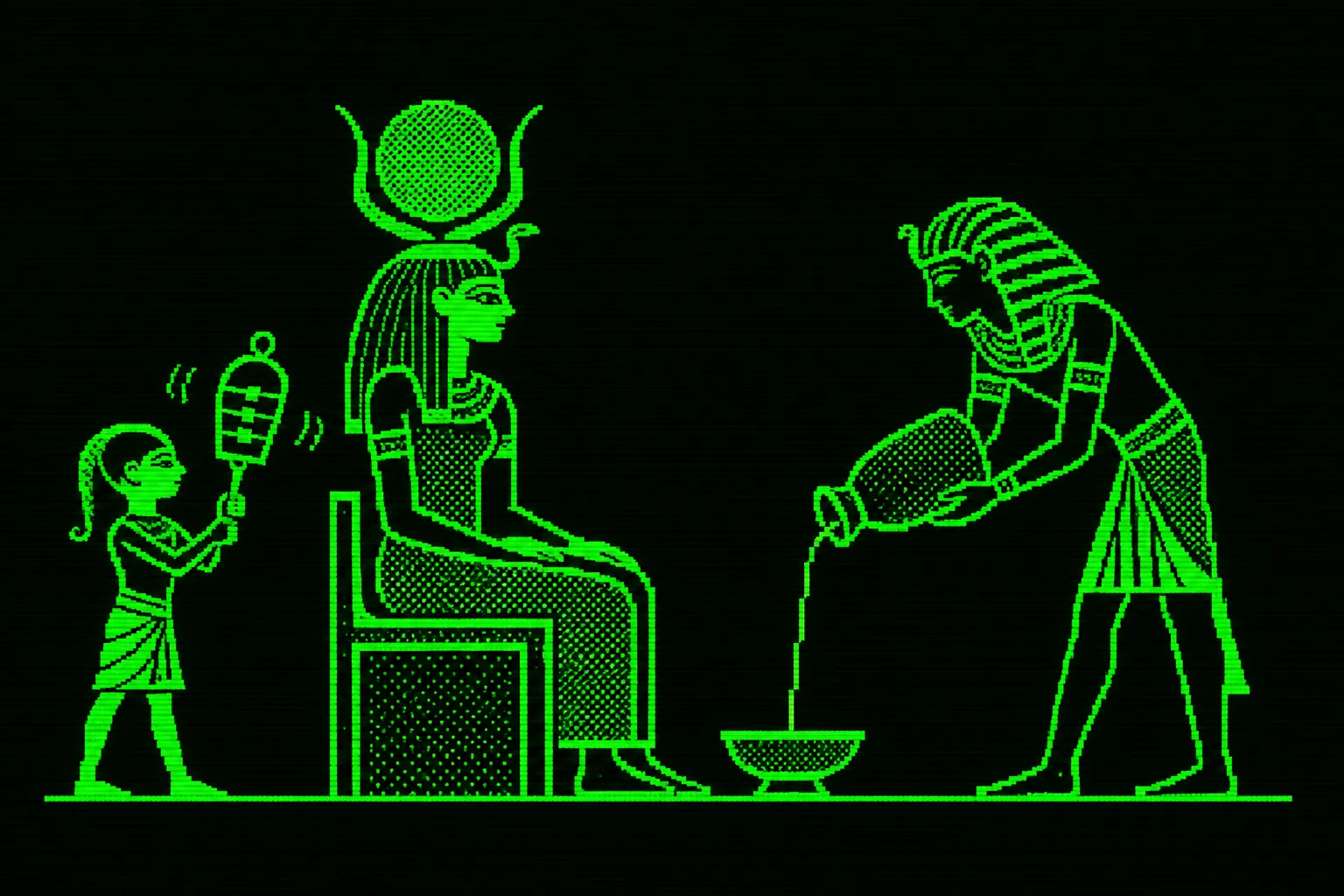
Title: Pouring beer. Words spoken: Pouring the drink of drunkenness for the Lady of Drunkenness, offering the brew on the ground for the daughter of Ra.
This red beer is poured out before you; your ka delights in what you love.
The drink is brought to you, to your majesty; your heart rejoices in it.
The Eye of Horus: you swallow it in gladness, your throat is cheered, your body cheered by the cheering beer.Note · Line 6
In the story behind the rite, Ra had beer dyed the colour of blood so that his raging daughter would drink it and spare humankind. Calling the beer the Eye of Horus recalls a different story, in which Horus’s injured eye was made whole and became a model for offerings. - 7
[Nswt-biti], nb Tꜣwy (Ꜣwtwkrtr, Kꜣysrs)|, sꜣ Rʿ, nb ḫʿw (Tmtyns, nty ḫw, Grmnyqs)|. ʿnḫ nṯr nfr, sḏty ʿn ḥr, dbḥw iqr sꜣ Tnmyt, rr n Mnqt ḥr mnty.sy, qʿḥ ʿ n ḥmt.s m nfrw n ib.s, shr nṯry.s m Nṯryt, nb Kmt, ḥqꜣ ḫꜣswt, ity n šn n itn, nb ḥʿʿwt, nswt-biti (Tmtyns, nty ḫw, Grmnyqs)|. Sꜣ ʿnḫ wꜣs nb ḥꜣ.f mi Rʿ ḏt.
The king: King of Upper and Lower Egypt, lord of the Two Lands (Autocrator, Caesar)|, son of Ra, lord of crowns (Domitian, Sebastos, Germanicus)|. Long live the good god, the child fair of face, the excellent brewer, son of Tenemyt, nursed by Menqet in her lap, who stretches out his arm to her majesty with what is lovely to her heart, who soothes her divine heart in Netjeret, lord of Egypt, ruler of the foreign lands, sovereign of all the sun-disk encircles, lord of rejoicing, King of Upper and Lower Egypt (Domitian, Sebastos, Germanicus)|. All protection, life and dominion are behind him, as for Ra, forever.
Note · Line 7
Tenemyt and Menqet are beer goddesses. Giving the king a brewer for a mother and another for a nurse suits the gift he brings. - 8pp. 79-80
[… …], iw.w wʿb ʿq r ḥt-nṯr nt Špst.
Title: … … (they are pure on entering the temple of the Noble Lady).
- 9
[… … …] sꜣ Rʿ, nb ḫʿw (Tmtyns, nty ḫw, Grmnyqs)|. Ihy : Nwi Iḥy, sꜣ.t, ḫntš ib.t n mꜣꜣ.i.
The king: … … … son of Ra, lord of crowns (Domitian, Sebastos, Germanicus)|. Ihy: I am Ihy, your son; your heart delights at the sight of me.
- 10
La divinité est détruite, il ne reste que les derniers mots du discours : npy, swsḫ.i st.k m […]. Revers du montant Bandeau du soubassement Porte d’Hathor, 5 Le début est détruit … [ḥngg nṯrw] ṯꜣw nṯrwt ḥmwt n mꜣꜣ.s, špst wrt mrwt, ḥʿʿ n.s nnw m-ʿqꜣ.s ḥr irt n.s iḥy, ḥytyw (ḥr) ḥpg, htṯw ḥr dwꜣ.s, bnhm [špswt] m la suite est détruite.
Hathor: (The goddess is lost; only the end of her speech survives:) … grain; I enlarge your domain in …. Back of the doorpost, base frieze: … the gods male and the goddesses female exult at the sight of her, the noble lady great of love; the children before her rejoice for her as they play the sistrum for her, the dwarfs dance, the baboons worship her, the hippopotamus goddesses beat the tambourine with …
- 11pp. 85-86
Ḏd mdw in Ꜣst wrt, mwt-nṯr, nbt Iꜣt-di, ḥryt-ib Iwnt, špst wsrt, ḥnwt nṯrw nṯrwt, ityt nt Šmʿ Mḥw, rpʿtt wrt ḥswt bnrt mrwt, nfrt ḥr sḥbt mnḏty, ḥqꜣt nṯryt, ḥnwt […], gsw-prw ḫt tp nwd.s, šn n itn n.s imy, tpyw-tꜣ […] sḫrw.s, ꜣḫt m pt [wsrt] m tꜣ, nṯrt wʿt ḥḥw ḥr šms.s, rʿyt ṯḥnt ẖkrw wꜣḏt inmw, ʿnt [ḫʿw m] wꜣḏty wrty (?), mḥ ʿḥt m nfrw.s, [mḥnt špst] m tp n nb.s, itnt nbt niwwt, ʿꜣt nrw m spꜣwt, wrt-ḥkꜣw ḫnt Ḫt-mn, nbt pr-nswt, ḥnwt rꜣw-prw, ʿḥʿ nb wʿ ḥr nst ḫft ḏd.s : Di.i n.k ʿꜣwt nbwt nt ḏww nbw, biꜣwt wrwt nfr mꜣꜣ. Nswyt-bitit, itnt, nbt mnit, ṯḥnt msḫʿw r nṯrw nbw, ḥwnt wrt ḫnt ḥt-mnit, mfkt ḫʿw imytw Psḏt, nbt sḫmw ḥnwt mnit, wꜣḏt rʿyt sḏfꜣ tꜣwy m ḥtpw, wḏ mdt m šn n itn, nbt tḫ, ḥnwt ṯs mꜣḥ, mḥ ib n it.s m ptr.s, nfrt ḥr sḥbt mnḏty, ir st.s m wpt Ir sy, Ḥt-Ḥr wrt, nbt Iwnt.
Isis: Words spoken by Isis the great, mother of the god, lady of the Mound of Birth, who dwells in Iunet, the noble and mighty one, mistress of gods and goddesses, sovereign of South and North, the great princess rich in favors and sweet of love, fair of face, painted of eyes, the divine ruler, mistress of …; the temples were inscribed to her from her swaddling clothes, the circuit of the sun-disk is hers, those on earth … her designs, glorious in heaven, mighty on earth, the one goddess whom millions follow, the female sun with gleaming jewels and fresh skin, lovely of appearance with the two great uraei, who fills the palace with her beauty, the noble uraeus on the head of her lord, the female sun-disk, lady of the cities, great of dread in the nomes, Great of Magic in Egypt, lady of the palace, mistress of the sanctuaries; the Sole Lord takes his stand on the throne at her word: I give you all the precious stones of all the mountains, great marvels lovely to see. Queen of Upper and Lower Egypt, the female sun-disk, lady of the menit-necklace, more dazzling in radiance than all the gods, the great feline in the House of the Menit, turquoise in appearance among the Ennead, lady of the sistra and mistress of the menit, the uraeus, the female sun who provisions the Two Lands with offerings, who issues commands throughout the circuit of the sun-disk, lady of drunkenness, mistress who ties on the diadem, who fills her father's heart when he sees her, fair of face and painted of eyes, who takes her seat on the crown of the head of the one who made her, Hathor the great, lady of Iunet.
Note · Line 11
The Sole Lord is the king, whose right to the throne depends on Isis’s word. After her promise of precious stones, the closing titles turn back to Hathor. - 12pp. 87-88
[Ḏd mdw in Ꜣst] wrt, mwt-nṯr [… cadrats …] wbn n.s Sfy ḏr pr.s m ẖt hrw grḥ nḫn m sš.f, ṯn sy Šꜣy [ḥr-tp] msḫnty, nḫb [n.s Ḏḥwty nḫbt.s], ḥs.s Rʿ r.s, in Rʿ ḥr ṯꜣw.f, iwʿ.n.s tꜣwy ẖr wḏt s, nts ityt ḥnwt niwwt spꜣwt. Atoum : Ḏd mdw in Itmw Rʿ-Ḥr-ꜣḫty, nṯr ʿꜣ ḥry-ib Iwnt, imꜣḫ šps in pḥwy n ḥnty, iꜣw n nḥḥ, sb n ḏt, ḥḏ tꜣ, wḏb < ʿ.f, di>ʿwy.fy ḥꜣ Wrt m Iwnt, srwd ʿwt nt ʿnt ḥr m st-tḫ, rdi iꜣwt n Ipt m-ḫnt qꜣb-Tꜣwy, nḫb rnpwt.s m wbn-ḥtp. Nswyt-bitit, Ḥqꜣt Wrt-ḥkꜣw, Nb Itmw ḥr ḫwt ḏt.[s], nbty rḫyt ḫnt Iꜣt-di, Ḥkꜣw (ḥr) ḫt n.s Ḫtm r ꜣw.f, ḥmt-nswt tpyt nt Nswt-biti, tmꜣt mnḫt [nt] Nḏ-it.f, špst psḏ m nwt, mwt-nṯr ḫnt ḥt-Sššt, ʿnt nfrt ʿn.tw ẖr ẖkrw.s, twt is ẖr mnw.s. 3e registre Tableau [… lacune de longueur indéterminée …] ḥt-[…, nfr.]wy sy, twt qd, ꜣḫtyt m ꜣḫt, ṯḥnt msḫʿw, wṯs nfrw.s ḫr ḥrw nbw. Dwꜣ sy nṯrw m ʿꜣt nt bꜣw.s, swꜣš sy nṯrwt m ꜣwt-ib.. Confusion avec l’eḫpression iwʿ. n . s tꜣwy t p n wd . s, voir la note précédente.. Confusion dans le formulaire, voir le parallèle de Dend. ḪIV,. Harsomtous, dans sa phase de soleil nocturne, est ce vieillard [Dend. IV,,2 – Dend. VI,,7 – Dend. VIII,,3].
Isis: Words spoken by Isis the great, mother of the god …, for whom the Child shone from the moment she came out of the womb, on the day of the night of the child in his nest; Fate singled her out upon the birth-bricks, Thoth wrote her titulary for her; she praises Ra for it, Ra together with his children; she has inherited the Two Lands under her command; she is sovereign, mistress of cities and nomes. Atum: Words spoken by Atum-Ra-Harakhty, the great god who dwells in Iunet, the noble revered one, who reaches the ends of endless time, the old man of eternity, who travels through everlastingness, who at daybreak turns back his course, who puts his arms behind the Great One in Iunet, who makes firm the limbs of the Fair of Face in the Place of Drunkenness, who gives the kingship to the Chosen One in the Heart of the Two Lands, who assigns her years from sunrise to sunset. Queen of Upper and Lower Egypt, the Ruler, Great of Magic, whose body Lord Atum protects, lady of the people in the Mound of Birth, for whom Heka writes down the whole of Egypt, first royal wife of the King of Upper and Lower Egypt, excellent mother of the Avenger of his Father, the noble one who shines in the sky, mother of the god in the House of the Sistrum, the fair of face, fair in her jewels and as fair in her monuments. Third register, scene: … the House of …, how beautiful she is, perfect of form, the one of the horizon in the horizon, dazzling of radiance, who lifts her beauty before all faces! The gods worship her for the greatness of her power, the goddesses praise her with joy.
Note · Line 12
Egyptian women gave birth crouching on bricks. Here the bricks mark the very moment when Fate singles out Isis and Thoth writes down her royal titles. - 13pp. 89-90
Côté ouest Teḫte vertical Porte d’Hathor, 9- [… lacune de longueur indéterminée…] nbt Iwnt, mꜣht ḏsrt ḫws.tw r mnḫ m inr [… lacune de longueur indéterminée…] wnyw.s. Rꜣ m mḥ 8, r wsḫ mḥ r/, ṯr.s m ʿš mꜣʿ n Ḫnt-š, inḥ m biꜣ n Stt, ḥknt.s m sꜣwy ḥr ʿrq-wr, iryt- ḫḫ.sn m ḫsbḏ n mꜣʿt, ḥmty.s m biꜣ n tꜣ-bnr ḥr sḥry sbyw r st-Rʿ. Biꜣt-nṯr nt Wbnt-m-Nbw r sr [biꜣt.s] m ḥbw.s tp trw r wdt ʿnḫ n ʿnḫw. Bḫn(w)t ḥꜣ.s r biꜣt m-itrty.s, sn(w)t ḥr-tp.sn nbd m ṯḥst, tḫnw im.sn ḥr tqs šnʿ r pt. Ḫn bꜣw nṯrw ḥr sꜣw[.s] m ḥtp, drp.sn m stpw nw Nbt Iwnt, ḥʿʿ ib.sn n mꜣꜣ sꜣt Rʿ. Sbḫt [… … mi] sbḫt nnt, ḥḏḏwt nt ḥꜣyty dbn m-ḫnt.s. Sn n.s niwt.s m ṯꜣw ḥmwt, rdi.tw n.s iꜣw r qꜣ [n pt]. Tꜣ-mry ẖr inw n kꜣ.s m biꜣwt nw tꜣ ḥr ndb.f, ḫbstyw nw Wtnt ẖr inw nw Pwnt ḥr ḫꜣw nbw nḏm sṯi, [… … …] nw ʿmt ḥr Hht ẖr [… cadrats … nswyt nt] Itmw ẖr sḫmty. Tꜣw nbw, ḫꜣswt nbwt dmḏwt ẖr ṯbty[.fy …] mn mnw.f rwd n sk tp tꜣ ḏt.
… Lady of Iunet, the holy gateway, excellently built of stone … its light. The opening measures 8 cubits and the depth … cubits and a tenth. Its door-leaf is of true cedar of Lebanon, bound with bronze of Asia. Its bolt is of gold and silver, its inlay of true lapis lazuli, and its metal is foreign bronze, to drive the rebels from the Place of Ra. The wondrous road of Her Who Shines as Gold heralds her wonder at her festivals of the seasons, when she gives life to the living. The pylon towers enclose her, rising toward the sky on either side of her; the flagstaffs on top of them are bound with copper, and the obelisks among them pierce the storm-clouds of heaven. The Bas of the gods alight in peace on her walls and feed on the choice cuts of the Lady of Iunet, and their hearts rejoice to see the Daughter of Ra. The gateway … like the gateway of the sky, and the light of the Two Luminaries enters within it. Her city, men and women, does homage to her, and praise is given her up to the height of heaven. The Beloved Land brings tribute for her ka, the wonders of the whole land; the bearded men of Wetenet bring the tribute of Punt, with every aromatic sweet of scent; … of the Am and the Heh, bearing … the kingship of Atum wearing the Double Crown. All lands and all foreign countries are gathered beneath his sandals. His monuments stand fast and firm, never to perish on earth, for ever.
Note · Line 13
The gate stood on the route along which Hathor’s sacred image was carried at festivals. The bas that alight on its walls are forms in which the gods could leave their shrines and move about. - 14pp. 91-92
Décor Porte d’Hathor, 10- ʿnḫ nṯr nfr, šd n Špst, šꜣʿ ir n Špst m Nṯryt, šš mꜣht n Mꜣfdt nfrt, mnqb n Wrt-ḥkꜣw, snb sḥ n sꜣt Ir-tꜣ, ḫws […] n nṯrw nṯrwt … la suite est détruite. ʿnḫ nṯr nfr, iḥy [… …] nt Nbt Iwnt, ʿn (ḫʿw) m [pr-]nswt, ḫrp wr Šmʿ, iṯ Mḥw mi Ḥr nḫw nfr, ḫt ḏryt nt Tꜣyt, ir rwt-di-mꜣʿt n ḏt nt Nbt iḥy, sꜣ Rʿ, nb ḫʿw (Tmtyns, nty ḫw, Grmnyqs)|, mry Ḥt-Ḥr wrt, nbt Iwnt, Irt-Rʿ. ʿnḫ nṯr nfr, sḏty n Smꜣ-Tꜣwy, sḫntš ḥry-mkt n sḫmw m wnwt.f, tit nt Rʿ, stp.n.f sw ḫnt ḥḥw, snṯ ḥt‑Sššt n qndt m Iwnt, rwi dndn ḥꜣ ib n Sḫm-špst, sḥtp sꜣt Rʿ m mrt.s, nswt-biti, nb Tꜣwy (Ꜣwtwkrtr, Kꜣysrs, ʿnḫ ḏt)|, mry Ḥt-Ḥr nbt Iwnt, Irt-Rʿ, nbt pt. ʿnḫ nṯr nfr, wbn n Wsrt, di r tꜣ n Nbt iwʿt, ḥqꜣ […] ʿn ḥr, ḥʿʿ nṯrw n mꜣꜣ.f, … la suite est détruite. ʿnḫ nṯr nfr, ẖnty n Rʿ, sḥʿʿ ꜣḫt m ḥt-ꜣḫt, sꜣ mryty, sḥtp Nbt Tꜣwy, ḫw … la suite est détruite.
Long live the Good God, child of the Noble Lady, the first one the Noble Lady made in Netjeryt, who builds the gateway for beautiful Mafdet, the palace for Weret-Hekau, who sets up the shrine for the Daughter of the Earth-Maker, who builds … for the gods and goddesses …
Long live the Good God, the sistrum-player … of the Lady of Iunet, fair of appearing in the royal house, great leader of the South, who seizes the North like Horus the good protector, who carves the sanctuary of Tayet, who makes the Gate of Justice for the person of the Lady of Music, the Son of Ra, Lord of Crowns (Domitian, Sebastos, Germanicus), beloved of Hathor the Great, Lady of Iunet, Eye of Ra.
Long live the Good God, offspring of Somtus, who gladdens the hearts of the mighty gods in his hour of service, image of Ra, who chose him out of millions, who founds the Sistrum Temple for the Furious One in Iunet, who drives the rage from the heart of the Noble Power, who calms the Daughter of Ra with what she loves, the King of Upper and Lower Egypt, Lord of the Two Lands (Autocrator, Caesar, living forever), beloved of Hathor, Lady of Iunet, Eye of Ra, Lady of Heaven.
Long live the Good God, sprung from the Mighty One, set on earth by the Lady of the Inheritance, ruler … fair of face, at whose sight the gods rejoice …
Long live the Good God, living image of Ra, who gladdens the Glorious Eye in the Temple of the Glorious One, the beloved son, who calms the Lady of the Two Lands, who protects … - 15pp. 93-94
Feuillures Côté est Teḫte Porte d’Hathor, Nṯrw šms ḥmt.s, ʿꜣw wrw shr [ḥnwt m pr.s … cadrats …] m qnd, spt ii hb m-ḫnt ḥt-Sššt, […] nst pw m iꜣw iꜣw. Sḫt sḥ ḏw m ib r Tꜣ-n-Itmw rdi.sn ḫnt m ḫꜣḫ. Ir nht [… …], swḏꜣ wꜣstyw wnw ḥr mw.s, ir šʿt nt sbyw, sẖb snf.sn. Rwḏ bꜣgs m-sꜣ th mṯn.[s], spd nsrt mr dndn, dbdb ḫftyw [nw nbt] Iwnt, špt ḥrw [… … …] sbyw nw Tꜣ-rr, tqr pḥty ḥw ẖꜣkw-ibw, ir šʿt n ḫftyw nbw, ptr ḥr nbt.s(n) rʿ nb.
The gods who escort Her Majesty, the great ones, the mighty ones, who calm the Sovereign in her house … in fury. They slay whoever comes and enters the Sistrum Temple … this throne, in praise upon praise. Those who weave evil plots in their hearts against the Land of Atum, they send them off in haste. They make protection …, they keep safe the villagers loyal to her, they make a slaughter of the rebels and swallow their blood. Firm of knife against whoever strays from her path, sharp of flame, painful of fury, they strike down the enemies of the Lady of Iunet. Terrible of face … the rebels of Ta-rer, valiant in strength to smite the disaffected, they make a slaughter of every enemy and keep watch around their mistress every day.
- 16pp. 95-96
Génies Porte d’Hathor, 11- Sꜣ Ḥt-Ḥr, nṯr ʿꜣ ḫnt Tꜣ-rr : [… …]. Wnwn : Mk.i ḥt-Sššt r ʿb nb ḏw. Ḥḏ sšp, sḥr mt : ꜣm.i nsp, sḥr.i sbyw […]. Ḫns mꜣʿt nb nḫt : Ḫw.i sḫmw.t r iḫt nbt [ḏwt]. Ꜣḫb, ʿnḫ m dšrw : swḏꜣ.n.i ḥt-mnit n Mnit [wrt]. Wsḫ st, ʿnḫ m snf : Ir.n.i nht nt ḥmt.s m rnpt sꜣ. Wnm wꜣḏw, bʿḥ ib : Mk.n.i ḥt-nṯr m rnpt snb. Wʿ, iwty sḏmw.n.f : Ḫw.n.i ḥꜣ.t m ḫw n Sḫmt. Nfw ḥꜣty, ʿq mt : Swḏꜣ.n.i ḥʿ.t m rnpt snḏt.
Son of Hathor, great god in Ta-rer: ….
He Who Roams: I guard the Sistrum Temple against every foul impurity.
The Shining One, Who Repels Death: I seize the knife, I repel the rebels ….
He Who Spreads Maat, Lord of Strength: I protect your shrines from every evil thing.
The Glutton, Who Lives on Red Blood: I have kept safe the Temple of the Menit for the Great Menit.
Broad of Seat, Who Lives on Blood: I have made the protection of Her Majesty with a year of protection.
Eater of Raw Meat, Who Swells the Heart: I have guarded the temple with a year of health.
The Lone One, Who Is Never Heard: I have shielded all around you with the shield of Sekhmet.
Miasma in the Hearts, Who Brings Death: I have kept your body safe with a year of dread.Note · Line 16
Each fearsome name introduces a different guardian speaking at the gate. Even the Glutton and the Eater of Raw Meat put their powers at Hathor’s service. - 17pp. 97-98
Côté ouest Teḫte Porte d’Hathor, [… …] ibw ꜣḫw n mtw, [… …] snṯr m iꜣwt, […] n sbyw r ḥt-Sššt, ir.sn šʿt nt [ḫftyw … …].sn r pt ḫr nḥḥ, ḥʿʿ ib n qmꜣ.sn m qn.sn. Les hiéroglyphes sont abrasés, il est difficile d’assurer la copie. Génies Porte d’Hathor, 12- Sin ḥꜣt, n pḥw.n.f [… …] [… …] Nsrt mt m snḏt.f : Sfṯ[.n.i … …]. Ms pt iꜣdt m ḥr.f : Swḏꜣ.n.i ḥt-mnit n Mnit [wrt]. Ksm ʿbwy ḫnt Imntt : Ḫw.i ḫmw.t r iḫt nbt ḏwt. Sdm m snf : Bꜣgs.i spd r ḥnṯ th n Nbt Iwnt. Rnpt ʿẖmw : Sꜣw.i mn.tw r smꜣ ẖꜣkw-ibw. Wnm ib, iwty mni.f : Mtn.i rwḏ.tw r smꜣ ḫftyw.t.
… the hearts of the blessed and the dead, … incense in the hills, … of the rebels against the Sistrum Temple. They make a slaughter of the enemies … their … to heaven for ever, and gladden the heart of their creator with their fat.
The Swift One, who cannot be overtaken …
He in Dread of Whom Death Burns: I have slaughtered ….
He Who Births Sky and Dew from His Face: I have kept safe the Temple of the Menit for the Great Menit.
He Who Binds Horns in the West: I protect your shrines from every evil thing.
He Who Paints Himself with Blood: My knife is sharp against whoever assails the Lady of Iunet.
The Year of the Envoy-Demons: My knife stands firm to slay the disaffected.
Eater of Hearts, Who Never Dies: My knife is sure, to slaughter your enemies.Note · Line 17
Cauville’s French has a “devouring heart that does not die”; the Egyptian says she eats the heart. - 18pp. 99-100
Nswt-biti, nb Tꜣwy (Ꜣwtwkrtr)|, sꜣ Rʿ, nb ḫʿw ([Tm]tyns, nty ḫw)|. Ii[.n.i] ḫr.ṯ, Ꜣst wrt, mwt-nṯr, ḥqꜣt mnḫt ḫnt Šmʿ. [… détruit sur les ¾ supérieurs de la colonne … ⁄n-nḫn], twt ḥnk n.t im.sn, iḫt nbt ḏr pt qmꜣ tꜣ, rd m idt.s, ʿnḫ m mꜣwt.
The king: King of Upper and Lower Egypt, lord of the Two Lands (Autocrator)|, son of Ra, lord of crowns (Domitian, Sebastos)|. I have come to you, Isis the great, mother of the god, excellent ruler in the South. … the Far South, all gathered and offered to you from them: everything the sky gives and the earth creates, growing by its dew, living by its light.
- 19
Ḏd mdw in Ḥr-smꜣ-Tꜣwy, pꜣ-ẖrd sꜣ Ḥt-Ḥr, nṯr ʿꜣ ḫnt ḥt-nhm, ḫi n Nswt-Biti ḫnt Wṯst : Ir.n.i sššt m ḥr.t nfr, ẖrt-hrw nt rʿ nb.
Harsomtous: Words spoken by Harsomtous the Child, son of Hathor, the great god in the House of Jubilation, the child of the King of Upper and Lower Egypt in Wetjeset: I shake the sistrum before your beautiful face, day by day, every day.
Note · Line 19
Harsomtous means “Horus who unites the Two Lands.” At Dendara he is the child of Hathor and Horus of Edfu. - 20
Ḏd mdw in Ꜣst wrt, mwt-nṯr, nbt Iꜣt-di, ḥryt-ib Iwnt, ḥqꜣt mnḫt m Tꜣ-n-Itmw, ḥmt-nswt tpyt nt (Wnn-nfrw, mꜣʿ-ḫrw)| : Di.i n.k nww nn.tw r nw.f tp rnpt n ꜣbw. Osiris : Ḏd mdw in Wsir (Wnn-nfrw, mꜣʿ-ḫrw)|, nṯr ʿꜣ ḥry-ib Iwnt, nswt nṯrw, ḥqꜣ Psḏt, spd hpw [mnḫ sḫrw m] Šmʿ Mḥw, ʿnḫ ḥr-nb m rḏww.f : Di.i n.k rd nb ḥr sꜣ-tꜣ.
Isis: Words spoken by Isis the great, mother of the god, lady of the Mound of Birth, who dwells in Iunet, excellent ruler in the Land of Atum, first royal wife of (Wennefer, true of voice)|: I give you the flood standing full in its season, year after year without end. Osiris: Words spoken by Osiris (Wennefer, true of voice)|, the great god who dwells in Iunet, king of the gods, ruler of the Ennead, keen of laws and excellent of counsel in Upper and Lower Egypt, by the fluids of whose body all people live: I give you every plant that grows upon the soil.
Note · Line 20
The fluids of Osiris’s dead body were understood as a source of the Nile flood. This gives a literal force to the promise that plants will grow through him. - 21pp. 101-102
Ḏd mdw in Ḥr-smꜣ-Tꜣwy, nṯr ʿꜣ ḥry-ib Iwnt, Pꜣwty tpy ḫpr m ḥꜣt, ™nn m ḏt.f, it n tpyw-ʿ, nṯr ʿꜣ pr m nww : Di.i ms n.k ꜣḫt wnnt nbt. Di.i n.k Šmʿ ḥr swꜣš n sṯnw.k, Niwt wʿt ẖr sḥ.k, niwwt nn nw tꜣ ḥr ndb.f ḥr twꜣ inw.sn r iwnnt.k rʿ nb.. Lire au lieu de et Harsiesis au lieu d’Horus.
Harsomtous: Words spoken by Harsomtous, the great god who dwells in Iunet, the Primeval One, first to come into being at the beginning, Tatenen himself, father of the ancestors, the great god who came forth from the Nun: I make the field give birth for you to all that exists. I give you the South worshipping your royal person, the Sole City under your counsel, the cities of the whole land bringing their tribute to your sanctuaries every day.
Note · Line 21
The child of the preceding scene now appears as a creator. As Tatenen, Harsomtous embodies the first earth to rise above the primeval water. - 22pp. 103-104
Porte d’Hathor, 15- I. Tꜣ-sty Ii.n nswt-biti, nb Tꜣwy (Ꜣwtwkrtr)|, sꜣ Rʿ, nb ḫʿw (Kysrs, Tmtyns)| … la suite est détruite. In.f n.ṯ Tꜣ-sty ẖr inw.s mꜣʿ n ḫꜣswt, ms[.i … …] ḥꜣt […].sn, ntt Nbt rnpt, ii ḥʿpy m ṯpḥt.f r bʿḥy tꜣwy m nfrw. II. Wṯst-Ḥr [Ii.n] nswt-biti, nb Tꜣwy (Ꜣwtwkrtr)|, sꜣ Rʿ, nb ḫʿw (Kysrs, Tmtyns)| ḫr.ṯ, Ḥt-Ḥr wrt, nbt Iwnt, nḏ it.s m St-Rʿ. Le haut de la colonne est détruit… ḫrp pꜣwt ḏfꜣw ẖr iḫt nbt nfrt n gsw-prw, ntt Ḥt-Ḥr wrt, nbt Wṯst, Špst m Nst-Rʿ. III. [Nḫn] Les cartouches sont détruits … ḫr.ṯ, Ḥt-Ḥr nbt Iwnt, [… …]. Le haut de la colonne est détruit… bdt, snṯr, sṯi-nṯr nb, ntt Nḫbt wnmyt nt Rʿ, mwt-nṯr, ms nṯrw. IV. [Wꜣst] Les cartouches sont détruits. [In.f] n.k Wꜣst [… très détruit …] ḥr sḥry ḏꜣḏꜣt m rꜣ-wꜣt, nt(t) Ꜣht wrt, tmꜣt nt Rʿ.
I. The Nubian nome. The King of Upper and Lower Egypt, Lord of the Two Lands (Autocrator), Son of Ra, Lord of Crowns (Caesar, Domitian), has come … He brings you the Nubian nome bearing its true tribute of the foreign lands; I present … their …, for you are the Lady of the Year, and the Flood comes from his cavern to drench the Two Lands with good things.
II. The nome of the Seat of Horus. Has come the King of Upper and Lower Egypt, Lord of the Two Lands (Autocrator), Son of Ra, Lord of Crowns (Caesar, Domitian), to you, Hathor the Great, Lady of Iunet, who protects her father in the Place of Ra. … leading the great loaves and provisions with every good thing for the temples, for you are Hathor the Great, Lady of Wetjeset, the Noble One in the Throne of Ra.
III. The nome of Nekhen. … to you, Hathor, Lady of Iunet, … … natron, incense and every divine scent, for you are Nekhbet, Right Eye of Ra, God's Mother, who bore the gods.
IV. The Theban nome. … He brings you Thebes … to drive harm from the neighbourhood, for you are the Great Cow, the mother of Ra.Note · Line 22
A nome was a province of Egypt. The procession begins near the First Cataract and moves north, with each province bringing local produce and greeting Hathor in a form worshipped there. - 23pp. 105-106
V. Nṯrwy. Ii.n nswt-biti, nb Tꜣwy (Ꜣwtwkrtr)|, [sꜣ Rʿ, nb ḫʿw (Kysrs, Tm]tyns)|] ḫr.ṯ, Ḥt-Ḥr nbt Iwnt Wṯst, ḥryt-ib Spꜣt-Nṯrwy. [ In.f n.ṯ ] Nṯrwy, nb ḥt-wꜣḏ ẖr smnw.f, ʿb.f Gbtyw ẖr inw.f, biꜣwt, nbw [nfr] ḥr ḫꜣst.f … la suite est détruite. VI. [Iꜣt-di] [Ii.n] nswt-biti, nb Tꜣwy (Ꜣwtwkrtr)|, [sꜣ Rʿ, nb ḫʿw (Kysrs,] Tmtyns)| ḫr.ṯ, Ḥt-Ḥr wrt, nbt Iwnt, Irt-Rʿ, ḥnwt nṯrw [nbw]. [ In.f n.ṯ ] Iꜣt-di, [… …] nb, ʿwy sꜣ.t ẖr mnit, [… …] ḥʿʿ [it].t n mꜣꜣ nfrw.f, ntt sꜣt Ir-tꜣ … la suite est détruite. Les nomes VII, VIII, IḪ, Ḫ placés dans l’embrasure sont détruits.
V. The nome of the Two Gods. The King of Upper and Lower Egypt, Lord of the Two Lands (Autocrator), Son of Ra, Lord of Crowns (Caesar, Domitian), has come to you, Hathor, Lady of Iunet and Wetjeset, who dwells in the Nome of the Two Gods. He brings you the nome of the Two Gods, the lord of the House of Green Eye-Paint, bearing his grain; he presents Coptos bearing its tribute, marvels and fine gold from its desert …
VI. The nome of Iat-di. Has come the King of Upper and Lower Egypt, Lord of the Two Lands (Autocrator), Son of Ra, Lord of Crowns (Caesar, Domitian), to you, Hathor the Great, Lady of Iunet, Eye of Ra, Mistress of all the gods. He brings you Iat-di, … every …, the arms of your son bearing the menit, … your father rejoicing to see its beauty, for you are the Daughter of the Earth-Maker …
… - 24pp. 107-108
ḪII. [Ꜣtft] Les cartouches sont détruits. [In.f] n.ṯ Ꜣtft ẖr mnḫw [… …] inw, sʿḥʿ.n.t Ḥr m bik tp srḫ, ḥr sḫr sbyw m-sty.t, ntt Wsrt, ḥnwt nṯrw nṯrwt. ḪIII. Nḏft-ḫnt [Ii.n] nswt-biti, nb Tꜣwy (Ꜣwtwkr[tr])|, sꜣ Rʿ, nb ḫʿw (Kysrs, Tmtyns)| [ḫr.ṯ,] Ḥt-Ḥr nbt Iwnt, Wsrt ḫnt ḥt-[…]. In.f n.ṯ Nḏft-ḫnt, Wp-wꜣwt ḥr iꜣt.f, ḥnk.f n.t npri.f pr m Wsir, siʿr.f n.t bw-iqr pr m šnʿw r bʿḥy šnʿ im.s, ntt mwt-nṯr ḥryt-ib Tꜣ-ʿnḫ, bsꜣ Dmḏ-ʿwt. ḪIV. Nḏft-pḥt Ii.n nswt-biti, nb Tꜣwy (Ꜣwtwkrtr)|, sꜣ Rʿ, nb ḫʿw (Kysrs, Tmtyns)| ḫr.ṯ, Ḥt-Ḥr nbt Iwnt, sḫmt sḫm sbyw. In.f n.ṯ Nḏft-pḥt, nb qꜣs ẖr mnit nt [nbw] smꜣʿ r-ḫft-ḥr(.t), ʿb.f bdt snṯr imyw ḥt-Sbqt, ntt Ḥt-Ḥr wrt ḥryt-ib qꜣs, qꜣs.n.s ḫftyw[.s im.f]
XII. The Viper nome. … He brings you the Viper nome bearing gifts … offerings. You have raised up Horus as the falcon on the serekh, to strike down the rebels before you, for you are the Mighty One, Mistress of gods and goddesses.
XIII. The Upper Pomegranate nome. Has come the King of Upper and Lower Egypt, Lord of the Two Lands (Autocrator), Son of Ra, Lord of Crowns (Caesar, Domitian), to you, Hathor, Lady of Iunet, the Mighty One in the Temple of …. He brings you the Upper Pomegranate nome, Wepwawet upon his standard. He presents you his grain that came forth from Osiris, and offers you the fine loaves from the storehouses to flood the granary with them, for you are the God's Mother who dwells in the Land of Life, who guards Him Whose Limbs Were Gathered.
XIV. The Lower Pomegranate nome. Has come the King of Upper and Lower Egypt, Lord of the Two Lands (Autocrator), Son of Ra, Lord of Crowns (Caesar, Domitian), to you, Hathor, Lady of Iunet, the Mighty One, mighty over the rebels. He brings you the Lower Pomegranate nome, the Lord of Qis bearing a menit of gold laid before you; he presents emmer and incense from the Temple of Sebeket, for you are Hathor the Great who dwells in Qis, where she has bound her enemies.Note · Line 24
The name Qis sounds like the Egyptian word for binding. Hathor binds her enemies in the very town whose name calls that act to mind. - 25pp. 109-110
ḪV. Wnt Ii.n [nswt-biti, nb Tꜣwy] (Ꜣwtwkr[tr])|, [sꜣ Rʿ], nb ḫʿw (Kysrs, Tmtyns)| [ḫr].ṯ, Ḥt-Ḥr nbt Iwnt, Wnt Šmʿ ḫnt Spꜣt-ḥꜣt. In.f n.ṯ Wnt, tꜣ m ḥꜣt ẖr nmwt.s, nḫbw im.s ꜣḫ.tw r ww, Ḏḥwty m sꜣ.f, ntt šꜣʿt šꜣʿ ḫpr m Wnt, šnbt-nṯr nt Šw sꜣ Rʿ.
XV. The Hare nome. Has come the King of Upper and Lower Egypt, Lord of the Two Lands (Autocrator), Son of Ra, Lord of Crowns (Caesar, Domitian), to you, Hathor, Lady of Iunet, Wenut of the South in the Primeval Nome. He brings you the Hare nome, the land of the beginning, bearing its yield; the fields within it are more splendid than any farmland, and Thoth is its guard, for you are the First, first to come into being in the Hare nome, the divine breast of Shu, Son of Ra.
Note · Line 25
The hare was the animal of the goddess Wenut. At Hermopolis, the chief city of her province, people held that the first land had risen from the waters there. - 26pp. 111-112
Ii nswt-biti, nb Tꜣwy (Ꜣwtwkrtr)|, sꜣ Rʿ, nb ḫʿw (Kysrs, Tryns, nty ḫw)| ḫr.ṯ, Ḥt-Ḥr wrt, nbt Iwnt, Irt-Rʿ, nbt pt, ḥnwt nṯrw nbw. Sꜣ ʿnḫ wꜣs nb ḥꜣ.f mi Rʿ ḏt. Ity Mḥw. In.f n.t spꜣwt nt Tꜣ-Mḥw ẖr inw.sn, ntt <mwt> mwwt ṯs prt.sn, ms.f n.t [iḫt].sn, [wtṯ] n ḥʿpy, ms n ꜣḫt, ḥnk.f pr.t im ḏt. Ihy : Ḏd mdw in Iḥy wr, sꜣ Ḥt-Ḥr, sfy šps bnr mrwt, nḫi nfr n Nbwt : Ir.n.i sššt m ḥr n Nbt sššt, sꜣt Rʿ m ḥt-Sššt.
King: The King of Upper and Lower Egypt, Lord of the Two Lands (Autocrator), Son of Ra, Lord of Crowns (Caesar Trajan Sebastos), comes to you, Hathor the Great, Lady of Iunet, Eye of Ra, Lady of Heaven, Mistress of all the gods. All protection, life and dominion are behind him, as for Ra, forever. The Sovereign of Lower Egypt. He brings you the nomes of Lower Egypt bearing their tribute, for you are the Mother of mothers, who binds their seed; he bears to you their produce, sired by the Inundation and borne by the fields, and with it he endows your house forever.
Ihy: Words spoken by Ihy the Great, son of Hathor, the noble child whose love is sweet, the fair youth of the Golden One: I have played the sistrum before the face of the Lady of the Sistrum, the Daughter of Ra, in the Mansion of the Sistrum.Note · Line 26
Trajan now takes Domitian’s place as the offering king and introduces the provinces of Lower Egypt, the northern part of the country around the Nile Delta. - 27
Ḏd mdw in Ḥt-Ḥr wrt, nbt Iwnt, Irt-Rʿ, nbt pt, ḥnwt nṯrw nbw, itnt [tpyt nt] itn, pr m ḥꜣt ḥnʿ Nww wr, ḫpr iḫt nbt m-ḫt ḫpr.s : Di.i ii n.k ḥʿpy r tr n nrt.
Hathor: Words spoken by Hathor the Great, Lady of Iunet, Eye of Ra, Lady of Heaven, Mistress of all the gods, the female Sun-disk, eldest of the Sun-disk, who came forth in the beginning with the great Nun; all things came into being after she came into being: I make the Inundation come to you at its due season of the year.
- 28
Ḏd mdw in Ḥr bḥdty, nṯr ʿꜣ nb pt, sꜣb šwt pr m ꜣḫt, wʿ wʿw n wn ḥr ḫw.f, Nww wr qmꜣ iḫt nbt, Nḥb-kꜣw grg tꜣ pn : Di.i n.k sḫt ṯḥn.tw ẖr iḫt.sn.
Horus: Words spoken by Horus of Edfu, the great god, Lord of Heaven, dappled of plumage, who comes forth from the horizon, the One and Only, with no other of his kind, the great Nun who creates all things, Nehebkau who provisions this land: I give you the fields, gleaming with their produce.
- 29pp. 113-114
Ḏd mdw in Ḥr-smꜣ-Tꜣwy, pꜣ ẖrd sꜣ Ḥt-Ḥr, iwʿ mnḫ n Bḥdty, ḫi n Ꜣḫtyt, šd n Špst [m Iwnt] : Di.i n.k iḫt nbt nfrt m ḥtpw ḏfꜣw.
Harsomtous: Words spoken by Harsomtous, the child, son of Hathor, the excellent heir of Him of Edfu, child of Her of the Horizon, suckled by the Noble One in Iunet: I give you all good things, with offerings and provisions.
- 30
Ḏd mdw in Ḥr-smꜣ-Tꜣwy nb Ḫꜣdi, [… … …], sḫpr wꜣḥyt, qmꜣty qmꜣ iḫt nbt : Di.i n.k nswyt nt Ḥr ḥr nst nt it.f. Di.[i] n.[k Mḥw m] iꜣw n.k, psšt nt Ḥr ẖr sḫrw.k, niwwt nn m šms n ḥm.k ḥr fꜣt iḫt.sn r ʿꜣyt.k.
Harsomtous: Words spoken by Harsomtous, Lord of the Lotus-Petal Place, …, who brings the harvests into being, the Maker who makes all things: I give you the kingship of Horus upon the throne of his father. I give you Lower Egypt in adoration of you, the portion of Horus according to your designs; these cities are in the train of your majesty, carrying their goods to your house.
- 31pp. 115-116
Porte d’Hathor, 19- I. Inb-ḥḏ Ii.n nswt-biti, nb Tꜣwy ([Ꜣwtwkrtr])|, sꜣ Rʿ, nb ḫʿw ([Kysrs, Tmtyns])| ḫr.ṯ, Iwnyt wrt, mwt-nṯr, Sḫmt ʿꜣt mryt Ptḥ. In.[f n.ṯ] Inb-ḥḏ ẖr pꜣwt.sn, Ḥt-kꜣ-Ptḥ ẖr kꜣw ḏfꜣw, ḥtm.f pr.t im r-ḥꜣt nṯrw nbw, qmꜣ n.ṯ kꜣw […] ʿnḫ […], ntt Rʿyt ḫnt ʿwy Rʿ [… … …]. II. Ḫm Ii.n nswt-biti, nb Tꜣwy (Ꜣwtwkrtr)|, sꜣ Rʿ, nb ḫʿw ([Kysrs, Tmtyns])| ḫr.[ṯ …] wrt, mwt-nṯr nt Bik-n-Nbwt. Le haut de la colonne est détruit… sḫt, ḥnbt [… …] ẖnmt Ḥr, ntt Ḥt-Ḥr wrt, ḥnwt nbt wꜣrḫ, nbt tḫ m Mḥw. III. Les cartouches sont détruits. Le haut de la colonne est détruit… nfr n šnʿt, ḥnk.f n.t šꜣw nfrw imyw Niwt-nt-Ḥp, ntt nbt Imꜣw, ḫw.n.s tꜣwy, sḥb.n.s idbw m nfrw.s. IV. Les cartouches sont détruits. Le haut de la colonne est détruit… [ntt nbt] pḥty, Wrt-ḥkꜣw, sꜣt Gbb, dmḏ pꜣ-sḫmty n Ḥr.s. V. Les cartouches sont détruits. Le haut de la colonne est détruit… […] n.ṯ Nt ḏbꜣ-n-Rnnwtt r sṯꜣm ḏt.t im, [ntt mwt-nṯr] nt Ḥr m Sꜣw-n-Nt.
I. The nome of the White Walls. Has come the King of Upper and Lower Egypt, Lord of the Two Lands (Autocrator), Son of Ra, Lord of Crowns (Caesar, Domitian), to you, the Great Heliopolitan, God's Mother, Sekhmet the Great, beloved of Ptah. He brings you the White Walls bearing their loaves, Memphis bearing food and provisions; he stocks your house with them above all the gods, creating food for you … living …, for you are the Female Sun in the arms of Ra ….
II. The nome of Letopolis. Has come the King of Upper and Lower Egypt, Lord of the Two Lands (Autocrator), Son of Ra, Lord of Crowns (Caesar, Domitian), to you, … the Great, God's Mother of the Falcon of the Golden One. … the fields, the ploughland … the nurse of Horus, for you are Hathor the Great, Mistress and Lady of the hall of audience, Lady of Drunkenness in the North.
III. … fine, of the storehouse; he offers you the fine vineyards of the City of Apis, for you are the Lady of Imau: she has shielded the Two Lands and made the riverbanks festive with her beauty.
IV. … for you are the Lady of Might, Great of Magic, Daughter of Geb, who sets the Double Crown on her Horus.
V. … Neith … you the cloth of Renenutet to wrap your body in, for you are the God's Mother of Horus in Sais of Neith.Note · Line 31
White Walls was an ancient name for Memphis. Hathor receives its loaves as Sekhmet, the goddess worshipped there with Ptah. - 32pp. 119-120
Nswt-biti, nb Tꜣwy (Ꜣwtwk[rtr, Kꜣysrs])|. Ihy : Iḥy wr, sꜣ Ḥt-Ḥr, nni n mwt.f ẖr mnit sššt, nb ḥswt, bnr mrwt.
King: The King of Upper and Lower Egypt, Lord of the Two Lands (Autocrator Caesar).
Ihy: Ihy the Great, son of Hathor, the child of his mother, bearing the menit-necklace and the sistrum, lord of favours, whose love is sweet. - 33
Ḏd mdw in Ḥt-Ḥr wrt, nbt Iwnt, Irt-Rʿ, nbt pt, ḥnwt nṯrw nbw, ḫpr m ḥꜣt [ḥr Nww wr], ḫpr iḫt nbt m-ḫt ḫpr.s, Wbnt-m-nbw, ḥryt-ib wiꜣ n Rʿ, sḥḏ.n.s tꜣwy [… …], šꜣšꜣyt špst nt šnbty, ḥrt-tp ḫnt Tꜣ-rr, Mꜣʿt wrt, ḥtp.tw ḥr mꜣʿt, Mrt ʿꜣt šfyt ḫnt Ḫprt.
Hathor: Words spoken by Hathor the Great, Lady of Iunet, Eye of Ra, Lady of Heaven, Mistress of all the gods, who came into being in the beginning with the great Nun — all things came into being after she came into being —, She-who-shines-as-gold, who dwells in the bark of Ra — she has lit up the Two Lands … … —, the noble throat of the Falcon, the uraeus in Tarer, Maat the Great, content with maat, Meret great of majesty in Kheperet.
Note · Line 33
Maat is both the right order of the world and the goddess who embodies it. Here Hathor can be called Maat and can also take pleasure in maat. - 34
Ḏd mdw in Ḥr bḥdty, nṯr ʿꜣ nb pt, sꜣb šwt pr m ꜣḫt, pr m nww r nnt, di ḥḏḏwt m šspt nt irty.fy, nb mꜣʿt ḥtm isft, ™nn wr, it nṯrw, šnbty šps ḥtp ḥr mꜣʿt.
Horus: Words spoken by Horus of Edfu, the great god, Lord of Heaven, dappled of plumage, who comes forth from the horizon, who came forth from the Nun to the sky, who gives brilliance with the light of his two eyes, lord of maat who destroys wrongdoing, Tatenen the Great, father of the gods, the noble Falcon, content with maat.
- 35pp. 121-122
Ḏd mdw in Ḥr-smꜣ-Tꜣwy, pꜣ ẖrd sꜣ Ḥt-Ḥr, nṯr ʿꜣ ḫnt ḥt-Smꜣ-Tꜣwy, nḫn nfr n Nbwt Irt-Rʿ, wḏḥ mnḫ n Sꜣb šwt, sfy iqr pʿpʿ n Nbt Iwnt, nb šmʿ.s, ḥqꜣ mḥw.s, ʿn ḥr m dbnt, ṯḥn ẖkrw.
Harsomtous: Words spoken by Harsomtous, the child, son of Hathor, the great god in the Mansion of Harsomtous, the fair child of the Golden One, the Eye of Ra, the excellent weanling of Him-of-dappled-plumage, the fine offspring born of the Lady of Iunet, lord of her White Crown, ruler of her Red Crown, fair of face with the side-lock, dazzling in his ornaments.
Note · Line 35
Egyptian artists marked a child’s age by showing a long lock of hair hanging at one side of the head. - 36
Ḏd mdw in Ḥr-smꜣ-Tꜣwy nb Ḫꜣdi, nṯr ʿꜣ ḥry-ib Iwnt, Rʿ ḏs.f ḫnt St-Rʿ, nb snḏ, ʿꜣ šfyt, kꜣ mꜣʿt, wsr iḥt, sḫm šps, štꜣ sšm r sḫmw, ḫpr ḏs.f iwty ms.tw.f. Nswyt-bitit, špst m Iwnt, ḥrt-tp wrt ḫnt ḥt-Sššt, ḥnwt nfrt, ʿnt irw.s, nbt mrwt ḫr nṯrw nṯrwt, ʿꜣt mꜣw.tw m-ẖnw ʿḥt, spdt sḫrw, bꜣt r sḫmw, mḥ ib n it.s m ptr.s.. Confusion entre la mèche d’enfance ( d b n t) et la barbe ( ḫꜣb s), un autre eḫemple se trouve dans le mammisi (Mam. Dend.,,18). Le dieu-enfant est ʿn d b n t, n b d b n t, n f r d b n t (une vingtaine d’eḫemples à Dendara) ; cette mèche est sur la tempe droite de l’enfant : mꜣʿ. f wn my (Dend. V,,7).
Harsomtous: Words spoken by Harsomtous, Lord of the Lotus-Petal Place, the great god who dwells in Iunet, Ra himself in the Seat of Ra, lord of dread, great of majesty, bull of maat, mighty of breast, the noble Power, whose image is hidden from the Powers, who came into being by himself without being born.
Queen of Upper and Lower Egypt, the Noble One in Iunet, the great uraeus in the Mansion of the Sistrum, the fair Mistress, lovely of form, lady of love among gods and goddesses, the great one who is seen within the palace, keen of counsel, mightier than the Powers, who fills her father's heart when he sees her. - 37pp. 123-124
[… …] rdi.n sy mwt.s r tꜣ m Iꜣt-di [hrw] grḥ [… … …] ḥr ḫw.s, iwtt snw.s m nṯrwt. Osiris : Ḏd mdw in Wsir (Wnn-nfrw)| mꜣʿ-ḫrw, nṯr ʿꜣ ḥry-ib Iwnt, ity m itrty Bꜣqt, pr m ẖt mḥnt m tp.f, ḥꜣy.n.f tꜣwy m wbn.f, nswt nswtw, biti idbw-Ḥr, nfr ḥr, ʿn ḫʿw m mꜣʿt. Harsiesis : Ḏd mdw in Ḥr-sꜣ-Ꜣst, iwʿ n Wsir, nṯr ʿꜣ ḥry-ib Iwnt, ḥwn nfr pr m Wrt, mw nṯry n (Wnn-nfrw)| mꜣʿ-ḫrw, ḥqꜣ nb ḥpwt, iṯ nst nt qmꜣ sw, nb wʿ iwty wḥm.ty.fy, nswt nḫt, nb mꜣʿ-ḫrw, ity biti idbw-Ḥr.
Isis: … … whom her mother brought into the world in the Mound of Birth on the day of the night … … her likeness, who has no peer among the goddesses.
Osiris: Words spoken by Osiris Wennefer, true of voice, the great god who dwells in Iunet, sovereign in the shrines of Egypt, who came forth from the womb with the uraeus on his head — he lit up the Two Lands when he rose —, king of kings, King of Lower Egypt of the Banks of Horus, fair of face, beautiful in his appearing with maat.
Harsiesis: Words spoken by Harsiesis, heir of Osiris, the great god who dwells in Iunet, the fair youth who came forth from the Great One, the divine semen of Wennefer, true of voice, ruler and lord of the crowns, who seizes the throne of him who made him, the sole lord who will have no second, the victorious king, lord of triumph, sovereign and King of Lower Egypt of the Banks of Horus. - 38
Ḏd mdw in Ḥr-smꜣ-Tꜣwy, nṯr ʿꜣ ḥry-ib Iwnt, ʿḥʿ-nfr wbn m nḫb, ir st.f ḫnt mʿnḏt, Rʿ m ḏt.f ḫnt Tꜣ-n-Itmw, Pꜣwty, Nḥb-kꜣw grg tꜣwy, štꜣ irw ḏsr ḫprw, ʿꜣ nrw m-ʿ nṯrw. Nswyt-bitit, Špst m Nṯryt, špst wsrt ḫnt ḥt-Sššt, sꜣt Gbb pr m Nwt, ꜣw šfyt.s ḫnt Psḏt, mḥnt nt ḥm.f, wd sšm m-ḫt.f, pẖr itrty m sḫrw.s, nṯrt wʿt, ḥḥ ḥr šms.s, ḥpwt ẖr snḏt.s.
Harsomtous: Words spoken by Harsomtous, the great god who dwells in Iunet, the Agathodaimon, who rises from the lotus, who takes his seat in the day-bark, Ra in his own body in the Land of Atum, the Primordial One, Nehebkau who provisions the Two Lands, hidden of form, holy of manifestation, great of dread among the gods.
Queen of Upper and Lower Egypt, the Noble One in Netjeryt, noble and mighty in the Mansion of the Sistrum, daughter of Geb, come forth from Nut, whose majesty spreads wide in the Ennead, the uraeus of his majesty, who leads the rite in his wake, who goes round the shrines at her will, the one goddess, millions in her train, the universe in dread of her.Note · Line 38
Agathodaimon means “Good Spirit.” Here it names Harsomtous in his serpent form, a bringer of plenty. - 39pp. 125-126
côté ouest Montant Bandeau du soubassement Porte d’Hathor, La pierre étant très fruste, la copie est parfois conjecturale. Le début est détruit [… … …] ḥmwt [… …] m […], ʿq.s m ꜣwt-ib, Psḏt m šms.s, spr.s m [pr]-m-qd, ib ꜣw m ꜣbt.s, dg.n.s st.s, n nwḥ m [… … …] m spḥ m ḫnt.s, rdi m ḥwt ḥnb.tw im.s. Sm, ir.f st m hꜣw.s, ḥsbw r st.sn, iwnty r nmtt nt šmsw, wdpw ḥr iry.sn, dḫnw ḥr dḫn, ṯnfw ḥr ṯnf, ẖryw wsḫt-ḥtp ẖnm.tw m kꜣt.sn, sqr.sn tbn, sin.sn ḏrwt r sḥʿʿ nṯrw nṯrwt m ḫrw.sn. Mi.t m qbḥ nmtt, m dns m ib, Nbwt, Irt-Rʿ m Ḥt-nhm ḥr ḏrtyw iryw pẖr m-ḫt.t, sḫmw itrty n ḥmt.t. Gm.t st tn msḫꜣ.tw wr sp-snw, qʿḥ-ʿ n qmꜣty.t m qꜣb.s, sb n nḥḥ. Iw sꜣ.s [… … …], nswt-biti, nb Tꜣwy (Ꜣwtwkrtr, Kysrs, Nrwys)|. Di.t n.f pr.f ẖr … n ? la suite est détruite.
… women … in …. She enters in gladness, the Ennead in her train; she arrives in delight, her heart wide with what she desires. She has beheld her seat; there is no drunkenness in … lassoed inside, given over to the temples, are slaughtered there. The Sem priest takes his place beside her, the stewards stand at their posts, the leader paces the march of the followers, the butlers are at their duties, the drummers drumming, the lute-players at their lutes, the attendants of the Hall of Offerings intent on their work; they strike the tambourine and wave their hands, to delight gods and goddesses with their voices. Come with cool step and no heaviness of heart, Golden One, Eye of Ra in the House of Rejoicing, the ancestor gods around you and the mighty ones on either side of Your Majesty! You shall find this place in great, great festivity, arms bent in homage before your image within it, for ever. Her son …, the King of Upper and Lower Egypt, Lord of the Two Lands (Autocrator, Caesar, Nerva). You give him his house with …
- 40pp. 127-128
Ḥnk sḫt : Štꜣ n Špst ṯn.tw m npri, šnʿs.s n.t ẖr nfrw.s.
Title: Offering the fields: The plain of the Noble One is heavy with grain; her granaries are full for you with their bounty.
- 41
Nswt-biti, nb Tꜣwy (Ꜣwtwkrtr, Kꜣysrs, Nrwys)|, sꜣ Rʿ, nb ḫʿw (Tryns, nty ḫw, G[rmnyqs, Dqyqs])|. ʿnḫ nṯr nfr, iwʿ … la suite est détruite. [Sꜣ ʿnḫ wꜣs nb ḥꜣ.f mi] Rʿ [ḏt]. Ihy : Ḏd mdw in [… les titres sont détruits …] ḥr-nb r mꜣꜣ.ṯ … la suite est détruite.
King: The King of Upper and Lower Egypt, Lord of the Two Lands (Autocrator Caesar Nerva), Son of Ra, Lord of Crowns (Trajan Sebastos Germanicus Dacicus). May the good god live, heir … All protection, life and dominion are behind him, as for Ra forever.
Ihy: Words spoken by … everyone … to see you … - 42
Ḏd mdw in Ḥt-Ḥr wrt, nbt Iwnt, Irt-Rʿ, nbt pt, ḥnwt nṯrw nbw, sꜣt Ir-tꜣ bs [m nww], sḥḏt nbt ḥḏḏwt, wbg ḥrw, swꜣrḫ ꜣḫt m wbn.s, nbt šꜣt ḥnwt sbtwt, (s)ʿnḫ tꜣwy m wnnt, mḥnt rnnwtt nbt msḫʿw, ḥꜣyt [m ꜣḫt], ꜣḫt nfrt nbt ꜣḫw, rdi ʿnḫ [n] tpyw-tꜣ : Di.i n.k sḫt ks ẖr kꜣw.s, (s)ʿnḫ.n.k bꜣ nb m ḫt-n-ʿnḫ.
Hathor: Words spoken by Hathor the Great, Lady of Iunet, Eye of Ra, Lady of Heaven, Mistress of all the gods, daughter of the Earth-Maker, who issued from the Nun, the Brightener, lady of brightness, who lights up faces, who greens the fields when she rises, lady of the vineyard, mistress of flowers, who makes the Two Lands live on all that is, the uraeus, the harvest-cobra, lady of radiance, who glows in the horizon, the Glorious, the Beautiful, lady of glories, who gives life to those upon earth: I give you the fields, bowing beneath their bounty, so that you make every soul live on the plants of life.
- 43pp. 131-132
Ḫfʿ.n.i sššt, ꜣmm.n.i wꜣḏ šmʿ, sḥtp.n.i kꜣ.t m mrrt.t, iḥy.i m [ḥr.t … …] ḥʿ.t m [tm n] ʿnḫ, swꜣš.n.i ḥmt.t m ḏt.f ẖt<.f>, ꜣw-ib.t ḫnt sbḫt tꜣ pn.
Title: I take up the sistrum, I grasp the papyrus sceptre of chrysoprase, I have appeased your ka with what you love, I play the sistrum before you … … your body wholly alive, I have worshipped your majesty morning and evening: rejoice within the gateway of this land.
- 44
Nswt-biti, nb Tꜣwy (Ꜣwtwkrtr, Kysrs, Nrwys)|, sꜣ Rʿ, nb ḫʿw (Tryns, nty ḫw, Grmnyqs, Dqyqs)|. Sꜣ. Wnn nswt-biti, nb Tꜣwy (Ꜣwtwkrtr, Kysrs)| ḥr bkr.f, m nb wʿ, nb hy hnw ḥr [ms dbḥw] la suite est détruite.
The king: King of Upper and Lower Egypt, Lord of the Two Lands (Autocrator Caesar Nerva)|, Son of Ra, Lord of Crowns (Trajan Sebastos Germanicus Dacicus)|. Protection. While the King of Upper and Lower Egypt, Lord of the Two Lands (Autocrator Caesar)|, is on his throne as sole lord, lord of jubilation and acclaim, presenting the cult objects …
- 45
Ḏd mdw in Ḥr-smꜣ-Tꜣwy, [pꜣ ẖrd sꜣ] Ḥt-Ḥr [… …], iḥy [… …], sḥtp ḥmt.s m ꜣbt.s.
Harsomtous: Words spoken by Harsomtous, the child, son of Hathor, …, who plays the sistrum …, who appeases her majesty with what she desires.
- 46
Ḏd mdw in Ḥt-Ḥr wrt, nbt Iwnt, Irt-Rʿ, nbt pt, ḥnwt nṯrw nbw, sꜣt Rʿ, bꜣt r tpyw-ʿ, ḫꜣḫt bꜣw spdt sšm, Nbwt r wrw, wbn m ꜣḫt rʿ nb, ḥrt-tp nt Rʿ, iwtt mꜣꜣ ḥr tp.s, ʿꜣt nrw m ibw, Sḫm‑špst mnḫt, Wꜣḏyt [wꜣḏ] Tꜣwy, ir n.s nṯrw sḫmw : Di.i n.k ʿnḫw m hy n ii.k, ḥmwt (ḥr) ḥngg r mꜣꜣ.k.
Hathor: Words spoken by Hathor the Great, lady of Dendera, Eye of Ra, lady of heaven, mistress of all the gods, daughter of Ra, a power above the ancestors, swift of might and keen of form, the Golden One above the great, who rises in the horizon every day, the uraeus of Ra (none is seen upon her head), whose dread is great in hearts, the Mighty August One, the excellent, Wadjet who makes the Two Lands green; the gods shake the sistra of the Mighty for her: I give you the living in jubilation at your coming, the women exulting to see you.
Note · Line 46
Hathor herself is the cobra on Ra’s brow, which explains why the inscription looks in vain for a cobra on hers. Wadjet’s name means “the Green One,” giving her a particular kinship with the fields she makes green. - 47pp. 133-134
Ihy : Ḏd mdw in Iḥy wr sꜣ Ḥt-Ḥr, ḫi ḫꜣḫ msḫʿw, ʿn ḫʿw nb ṯnṯꜣt, nb bḥdw ḥry srḫ, ʿn [m] mꜣʿt, sšn nfr n Nbwt, ḥry šnbt nt Ḥt-Ḥr, nb wḏꜣty nb mnš, šꜣʿ ḫpr m nswt r nḥḥ : Di.i ḥswt[.k] m ibw nṯrw, mrwt.k is ḫr tpyw-tꜣ. Wnn Irt-Rʿ, wsr.tw ḫnt Ḫprt, nbt Iwnt ḥtp.tw m ḥt-Sššt, ḥr wbn m ꜣḫt, ḥr snsn [it.s, ḥr] mḏḥ ḥꜣt[.f m wrt-ḥkꜣw], sy m nbt pr-wr, [ḥnwt nbt] pr-nsr, ʿꜣt snḏt m pr-nw, nbt sššt mr [iḥy]. Bandeau supérieur Nswyt-bitit, Ḥrt-tp nt qmꜣ sy, ḏsrt fꜣw m Psḏt, rpyt nfrt m ḥr fdw, špst mr Rʿ n mꜣꜣ.s, nbt imꜣt bnrt mrwt, ṯḥnt, in ḥtpw sḏfꜣ tꜣwy, bꜣt r sḫmw [nw Snwt], ḫꜣḫt bꜣw spdt ḥkꜣw, mḥ pt tꜣ m nfrw.s.
Words spoken by Ihy the Great, son of Hathor, the child of dazzling brilliance, fair of appearing as lord of the carrying-chair, lord of the throne upon the serekh, fair in Maat, the lovely lotus of the Golden One, who lies on Hathor's breast, lord of the two Wedjat-eyes, lord of the cartouche, the first who came to be as king for ever: I set your favour in the hearts of the gods, and the love of you among those on earth. As long as the Eye of Ra, mighty in Creation, Lady of Iunet, at rest in the Sistrum Temple, rises in the horizon, joins her father and binds his brow as the Great of Magic, she is Lady of the Great Shrine, Mistress and Lady of the Shrine of Flame, great of terror in the Shrine of Water, Lady of the sistrum, who loves music.
Upper band: Queen of Upper and Lower Egypt, Uraeus of Him Who Created Her, holy of splendour in the Ennead, the lovely lady with four faces, the noble one Ra loves to behold, Lady of grace, sweet of love, the Gleaming One, who brings offerings and provisions the Two Lands, more potent than the powers of Egypt, swift of might, keen of magic, who fills sky and earth with her beauty. - 48pp. 135-136
ʿntyw ʿḏ.tw, ꜣbḫ.tw m ḫnm.f, ꜣwš šps.tw m irw.f, nnib bꜣ.tw, ḥḏw ḥtm.tw, iḫt-Ḥr ꜣhm r fnḏ.t, ḫꜣw nḏm sṯi, gs.n.t tp.t wrḥ.t ḥʿ.t.
Title: The myrrh is whole, steeped in its own fragrance; the precious resin is as it should be, the styrax refined, the white resin perfected; natron and myrrh for your nose, oils of sweet scent: you have anointed your head, you smear your body.
- 49
Nswt-biti, nb Tꜣwy (Ꜣwtwkrtr, Kꜣysrs)|, sꜣ Rʿ, nb ḫʿw (Tmtyns, nty ḫw, Grmnyqs)|. Sꜣ ʿnḫ wꜣs nb ḥꜣ.f mi Rʿ ḏt. ʿnḫ Ḥr ḥwn, ḥqꜣ Pwnt, ꜣḫ ʿwy, sn sw r Šsmw, nwd iqr ḏbʿw, rḫ m kꜣt.f, ḥnk ibr mꜣʿ n iḫt-nṯr, nbty wr pḥty nb idt-nṯr, sgn ḥnwt.f m mrrt.s.
The king: King of Upper and Lower Egypt, Lord of the Two Lands (Autocrator Caesar)|, Son of Ra, Lord of Crowns (Domitian Sebastos Germanicus)|. All protection, life and dominion behind him, like Ra, forever. Long live the Horus, the youth, ruler of Punt, effective of arm, who is like Shesmu; the perfumer with skilled fingers, who knows his craft, who offers the pure balm for the god's rite; He of the Two Ladies, great of strength, lord of the god's fragrant essence, who anoints his mistress with what she loves.
Note · Line 49
Shesmu presided over the pressing of grapes for wine and the preparation of fragrant oils. He is the model for the king’s skill as a perfumer. - 50
Iḥy-Ḥr, smꜣ.n.f Tꜣwy : Ir.n.i iḥy m ḥr.t rʿ nb.
Ihy-Hor: Ihy-Hor, who has united the Two Lands: I play the sistrum before your face every day.
- 51
Ḏd mdw in Ḥt-Ḥr wrt, nbt Iwnt, Irt-Rʿ, nbt pt, ḥnwt nṯrw nbw, bikt nṯryt, ḥnwt nbt Pwnt, ḥqꜣt m Tꜣwy-nṯrw, nḏmt idt imytw nṯrwt, ḫnm.s r ꜣw m-ʿ Pwnt, bḥdtyt bꜣt ḥnwt Bwgm, šms ib.s m Int<-ʿntyw>, mḥ ib Rʿ m <ḥʿʿwt> : Di.i ḫnm n ḥʿ.k m sšn n š, ḫntš nṯrw r mꜣꜣ.k.
Hathor: Words spoken by Hathor the Great, lady of Dendera, Eye of Ra, lady of heaven, mistress of all the gods, the divine she-falcon, mistress and lady of Punt, ruler in the Lands of the God, sweetest of scent among the goddesses (all her fragrance comes from Punt), she of Edfu, Power and mistress of Bugem, who follows her heart in the Valley of Myrrh, who fills Ra's heart with joy: I give your body the fragrance of the lotus of the pool; the gods rejoice to see you.
- 52pp. 137-138
[… 6 cadrats …] m stwt.f, sḥḏ tꜣwy wn m [kkw … …] wnnt, sṯi ḥm.f m idt-nṯr : Di.i n.k is stwt r Pwnt, rwḏ mrwt.k ḫr tpyw-tꜣ. [… cadrats …] nbt nrw m-m Fk-ḥr, ʿnt ḥr bnrt mrwt, nbt ʿntyw, ḫnm.s <ṯn.tw> r nṯrwt. Bandeau supérieur Nswyt-bitit, Irt-Rʿ, nbt pt, Nbwt nṯrw, nḏmt idt.s, ḥḏḏt wrt, ḥʿʿ.tw m ḥꜣyt.s, ḫnm.s m ḥꜣtwt nt Pwnt, ꜣḫtyt m ꜣḫt, sḥb ḥt-nṯr … bʿḥ la suite est détruite.
Horus: … … with his rays, who brightens the land that was in darkness … …; the fragrance of his majesty is the god's own essence: I give you a laboratory to rival Punt; your love is rooted among those on earth. … … lady of dread in Fekher, fair of face and sweet of love, lady of myrrh, whose fragrance is more remarkable than the goddesses'. Upper band: Queen of Upper and Lower Egypt, Eye of Ra, lady of heaven, Gold of the gods, sweet of scent, the great bright one, rejoicing in her shrine (her fragrance is the oils of Punt), she of the horizon in the horizon, who brings festival to the temple, … who floods …
Note · Line 52
The laboratory was a temple room where specialists prepared perfumes and ointments. Punt, famed for aromatic resins such as myrrh, sets the standard for what the room could produce. - 53pp. 139-140
Bb bꜣ.tw ʿpr.tw m ʿꜣwt, iḫt.s nb r tp-ḥsb, ḫntš ḥmt.t m ḫsbḏ ṯḥnt im.s, ḥr.t m mfkꜣt, sꜣwy im.s ḥr ʿrq-wr, qmꜣ.tw m ktm m kꜣt nbt, šsp.t sw r ḫḫ.t, Nbwt nṯrw.
Title: The collar, set and furnished with fine stones, every piece of it in true measure: your majesty delights in its lapis lazuli and faience, your face in its turquoise; two-thirds gold in it, upon silver, finished in fine gold in all its work: take it to your throat, Gold of the gods.
- 54
Nswt-biti, nb Tꜣwy (Ꜣwtwkrtr, Kꜣysrs)|, sꜣ Rʿ, nb ḫʿw (Tmtyns, nty ḫw, Grmnyqs)|. Sꜣ ʿnḫ wꜣs nb ḥꜣ.f mi Rʿ ḏt. Ii.n.i ḫr.ṯ, sꜣt Ir-tꜣ, Nbwt nṯrw, nbt ʿrq-wr, in.i n.ṯ iryt-ḫḫ wr n Ms-ntt, ʿpr.n.i ḥꜣt.t m ʿꜣwt špswt, twt rʿyt ṯḥnt ẖkrw, tit mr Rʿ n mꜣꜣ.s, nbt biꜣwt ḫnt Wsrw-ḥꜣt, ꜣw-ib.n nṯrw m dgt.s.
The king: King of Upper and Lower Egypt, Lord of the Two Lands (Autocrator Caesar)|, Son of Ra, Lord of Crowns (Domitian Sebastos Germanicus)|. All protection, life and dominion behind him, like Ra, forever. I have come to you, daughter of the Maker of the Land, Gold of the gods, lady of silver; I bring you the great collar of Him who Fashions What Is, I have adorned your brow with august stones. You are the female sun whose jewels sparkle, the image Ra loves to see, the lady of wonders among the Mighty Ones of the beginning; the gods rejoice to see her.
Note · Line 54
“He who Fashions What Is” is Ptah, patron of craftsmen. Naming him credits the divine craftsman with the collar the king presents. - 55
Les titres de la déesse sont détruits… Di.i n.k Hh ẖr im.s, Tfrr ẖr pr im.s. Dieu : Les titres du dieu sont détruits… ʿꜣt.sn m st.s(n). Nswyt-bitit, ḫsbḏt nbt ḫsbḏ, ṯḥnt ḥr, nbt mfkꜣt, ḥrt-tp wrt ḥryt-tp mnḏtyw … la suite est détruite.
Hathor: … I give you Heh and all that is in it, Tefrer and all that comes from it. A god: … their stones in their places. Queen of Upper and Lower Egypt, the Lapis One, lady of lapis, faience of face, lady of turquoise, the great uraeus who presides over the hills …
Note · Line 55
Heh and Tefrer belong to the sacred geography of precious stones, with Tefrer especially associated with lapis lazuli. Hathor repays a jewelled collar with the lands that supply its stones. - 56pp. 141-142
Détruit. [coupe d’or]
Title: … golden cup
- 57
Nswt-biti, nb Tꜣwy (Ꜣwtwkrtr, Kꜣysrs)|, sꜣ Rʿ, nb ḫʿw (Tmtyns, [nty ḫw, Grmnyqs])|. Sꜣ. ʿnḫ nṯr nfr, ḥwn n Nbt Imt, sḥtp ib n ḥrt-tp… la suite est détruite.
The king: King of Upper and Lower Egypt, Lord of the Two Lands (Autocrator Caesar)|, Son of Ra, Lord of Crowns (Domitian Sebastos Germanicus)|. Protection. Long live the good god, the youth of the Lady of Imet, who satisfies the heart of the uraeus …
- 58
Ḏd mdw in Ḥt-Ḥr wrt, nbt Iwnt, Irt-Rʿ, nbt pt, ḥnwt nṯrw nbw, Nbwt nṯrw, ḥnwt nt nbtyw, šꜣʿt nbt šꜣ, ir.tw.f n kꜣ.s, nbt ḥʿʿwt ḫnt St-ꜣwt-ib, rpyt nfrt ṯḥnt ḥr, špst mr Rʿ mꜣꜣ.f sy, nbt hy nbt ḥknw, nbt nwḥ ir.tw n ḥmt.s, nbt ṯḥḥwt ḫnt St-tḫ : Di.i n.k ṯꜣw ḥmwt (ḥr) ḥngg r mꜣꜣ.k, mrwt.k pẖr m ibw. Nswyt-bitit, Nbwt nbt tḫ, nbt… la suite est détruite.
Hathor: Words spoken by Hathor the Great, lady of Dendera, Eye of Ra, lady of heaven, mistress of all the gods, Gold of the gods, mistress of the women musicians, the First One, lady of wine (it is made for her ka), lady of joy in the Seat of Gladness, the fair young woman, bright of face, the august one whom Ra loves to see, lady of jubilation, lady of praises, lady of the drink of drunkenness made for her majesty, lady of rapture in the Seat of Drunkenness: I give you men and women exulting to see you, and your love goes round in every heart. Queen of Upper and Lower Egypt, the Golden One, lady of drunkenness, lady …
Note · Line 58
The Egyptian words for “First One” and “wine” sound alike, so the drink offered to Hathor echoes her title.
Cauville’s French calls this the Place of Drunkenness; the Egyptian name means gladness of heart, a different word.
- 59pp. 143-144
Le titre est détruit sauf deuḫ mots … šbt … snsn …
… the water clock … join …
Note · Line 59
A water clock measured the passing hours by letting water drain through a small hole in the bottom of a vessel. - 60
Nswt-biti, nb Tꜣwy (Ꜣwtwkrtr, Kꜣysrs)|, sꜣ Rʿ, nb ḫʿw (Tmtyns, nty ḫw, Grmnyqs)|. Sꜣ. Iwʿ n Ḫnty-Ḥsrt, rdi sꜣ […]. Wnn nswt-biti, nb Tꜣwy (Ꜣwtwkrtr, Kysrs, ʿnḫ ḏt)| ḥr bkr [… …] ḫnt Iw[-Nsrsr] … sʿḥʿ šbt m […].
King of Upper and Lower Egypt, Lord of the Two Lands (Autocrator Caesar)|, Son of Ra, Lord of Crowns (Domitian Sebastos Germanicus)|. Protection. The heir of the Foremost of Heseret, who gives protection …. As long as the King of Upper and Lower Egypt, Lord of the Two Lands (Autocrator Caesar, living forever)| is upon the throne … … in the Isle-of-Flame … who sets up the water clock in ….
Note · Line 60
The “Foremost of Heseret” is Thoth, god of reckoning and time. The king who installs the clock acts as his heir. - 61
Ḏd mdw in Ḥt-Ḥr nbt Iwnt, Irt-Rʿ, nbt pt, ḥnwt nṯrw nbw, [… … …], ḥnwt m ḥt-šbt, šdt n Sḫmw, ꜣṯt n Kꜣw, Ḏdt pw mn.tw ḫnt Nṯryt… le discours est détruit.
Words spoken by Hathor, lady of Iunet, Eye of Ra, lady of heaven, mistress of all the gods, … … …, mistress in the Temple-of-the-Water-Clock, suckled by the Mighty Ones, reared by the Kau. She is Djedet, established in Netjeryt … (the speech is lost).
Note · Line 61
The Kau are divine powers of nourishment. The related word ka means the life force sustained by offerings of food and drink. - 62pp. 145-146
Sekhmet : Ḏd mdw in Sḫmt ʿꜣt, Irt-Rʿ ḫnt Ḫprt, ʿšꜣt rnw m st.s nbt, dndnt nbt qnd, sḥtp nṯrw, wrt ʿꜣt nbt nsrt, ʿnḫt nt Rʿ, ʿn sbyw m nbyt.s, nwr ḫꜣswt m snḏt.s, wd ḫꜣtyw r sʿrq ẖr st-rꜣ.s. le discours est détruit. Wnn Wpst, sꜣt Rʿ m ḥt-Sššt m nfrt ḥr, ḥr wpt nt it.s, Ḥkntt-m-[ʿnḫ]… la suite est détruite. Bandeau supérieur [Nswyt-bitit], sḏtyt sꜣt Sfy, ʿnt ḫʿw ḫnt ḥt-šbt [… cadrats…], nbt tp-rnpt wbn m biꜣt, wp tꜣwy idbw m nbyt.s, ꜣḫtyt m ꜣḫt, sšp snkt, ḥwnt nt Irt-Itmw.
Words spoken by Sekhmet the Great, Eye of Ra in Creation, many of name in all her seats, the Raging One, Lady of Fury, who calms the gods, the very great, Lady of Flame, the living Eye of Ra, who drives back the rebels with her fiery breath, at the dread of whom foreign lands tremble, the slaughter-demons shooting to kill at her command: … As long as Wepset, Daughter of Ra in the Sistrum Temple, fair of face, is on her father's brow, the Uraeus of Life …
Upper band: Queen of Upper and Lower Egypt, the maiden, daughter of the Child, fair of appearing in the Temple of the Water-Clock …, Lady of the New Year, who rises as a wonder, who opens up the Two Lands and the riverbanks with her fiery breath, the Horizon-One in the horizon, who lights up the darkness, the pupil of the Eye of Atum. - 63pp. 147-148
Mꜣḥ nn n nbw m tp.t, sḥḏ ḥr.t m imꜣw.f, ™nn pw nbi.n.f sw m ʿwy.fy ḏs.f, ṯn.f ḏt.t r tpyw-ʿ, twt nbt ḥtpw, sḏfꜣ.n.s tꜣwy nbw, nbt pr-wr ḥnwt pr-nsr.
This diadem of gold is on your head, and your face is lit by its radiance. It is Tatenen who cast it with his own hands, and he sets your body above the ancestors. You are the lady of offerings, who has provisioned all the lands, lady of the Great House, mistress of the House of Flame.
- 64
Nswt-biti, nb Tꜣwy (Ꜣwtwkrtr, Kꜣysrs)|, sꜣ Rʿ, nb ḫʿw (Tmtyns, nty ḫw, Grmnyqs)|. Sꜣ ʿnḫ wꜣs nb ḥꜣ.f mi Rʿ ḏt. ʿnḫ Ḥr ḥwn, wʿ n Psḏt r-gs Ḥr ʿꜣ nb wrrt, ity nb ṯnwy, ḥqꜣ sꜣwy im.sn, iqr ḏbʿw ḥr irt kꜣt gnwtyw, nbty wr pḥty, ḫrp iḫt n st-nfrt r sẖkr mꜣḥ n Nbwt nṯrw. Nbtyw ḥr nhm ẖr-ḥꜣt Wsrt, mi qd.sn, (ḥr) ḫnw m ḫntš ḥr swꜣ qnd n ḥmt.t. Iḥy wr sꜣ Ḥt-Ḥr Ḥt-Ḥr nbt Wꜣst Ḥr-smꜣ-Tꜣwy pꜣ ẖrd sꜣ Ḥt-Ḥr Ḥt-Ḥr nbt Tpy-iḥw Ḥs.n n ḥmt.t r ḥꜣt nṯrw nṯrwt, iḥ.n n mwt.(n), sḥtp.n ib.s, wꜣš.n n kꜣ n Ḥt-Ḥr. Pꜣ-Rʿ pꜣ ẖrd Ḥt-Ḥr nbt Imꜣw Iḥy-Ḥr Ḥt-Ḥr nbt Ḥt-nswt
King of Upper and Lower Egypt, Lord of the Two Lands (Autocrator Caesar)|, Son of Ra, Lord of Crowns (Domitian Sebastos Germanicus)|. All protection, life and dominion are behind him, as behind Ra, forever. Long live Horus the Youth, the one of the Ennead beside Horus the Great, lord of the Great White Crown; the sovereign, lord of the hills, ruler of the gold within them, whose fingers are deft at the goldsmiths' work; of the Two Ladies, great of strength, who brings goods to the treasury to adorn the diadem of the Golden One of the gods. The women musicians beat the tambourine before the Mighty One, all together, keeping time in joy to drive away the anger of Your Majesty.
Ihy the Great, son of Hathor.
Hathor, lady of Thebes.
Harsomtous the child, son of Hathor.
Hathor, lady of Atfih.
"We make music for Your Majesty before the gods and goddesses, we shake the sistrum for our mother, we soothe her heart, we acclaim the ka of Hathor."
Pa-Ra the child.
Hathor, lady of Imau.
Ihy-Hor.
Hathor, lady of Herakleopolis. - 65pp. 149-150
Ḏd mdw in Ḥt-Ḥr wrt, nbt Iwnt, Irt-Rʿ, nbt pt, ḥnwt nṯrw nbw, mḥnt wrt m tp n it.s, iryt- ḥꜣt Ir sy m dpt-nṯr, Wꜣḏyt wꜣḏ tꜣwy, ḫꜣḫt bꜣw spdt ḥkꜣw, wbn m ꜣḫt iꜣbtt, ꜣḫt r wrw, bꜣt r tpyw-ʿ : Di.i n.k Hh ẖr imy.s, Tfrr ẖr prt im.s. Nṯrt tn, špst wsrt, rpyt nfrt m fdw ḥrw, bꜣt r sḫmw m-ḫnt Tꜣ-rr, sḫm tꜣwy nb n bꜣw.s, ḥʿʿ Psḏt m sšpt.s, nbt pr-wr ḥnwt pr-nsr, ḥqꜣt wrt m mꜣḥ n ḏʿm. Bandeau supérieur Nswyt-bitit, Nbwt nbt nbtyw, nfrt ḥr ḫsbḏt tp, nbw n nṯrw ʿrq-wr n nṯrwt, wbn m itn ḫnt ʿbwy m ḥꜣt.s, sḥḏ tꜣ m nqr nbw, nṯrw rmṯ, dwꜣ.sn n mꜣꜣ.s, swꜣš.sn ḥknw n kꜣ.s, nbt snḏt ḫnt Psḏt, mḏḥ.n.s mꜣḥ n ḏʿm.
Words spoken by Hathor the Great, lady of Iunet, Eye of Ra, lady of heaven, mistress of all the gods, the great uraeus on her father's head, pilot in the god's boat for Him who made her, Wadjet who makes the Two Lands green, swift of power and keen of magic, who rises in the eastern horizon, more glorious than the great, a soul more potent than the ancestors: "I give you the land of Heh and all that is in it, the land of Tefrer and all that comes from it." This goddess, the noble and mighty, the beautiful lady of four faces, a soul more potent than the mighty gods within Ta-rer: every land is mighty through her power, and the Ennead rejoices in her radiance. She is lady of the Great House, mistress of the House of Flame, the great ruler wearing the diadem of electrum.
Upper band: Queen of Upper and Lower Egypt, the Golden One, lady of the women musicians, fair of face and lapis-headed, the gold of the gods and the silver of the goddesses, who shines with the disc between the horns on her brow and lights the land with gold dust. Gods and people adore her at the sight of her and acclaim her ka with praises. She is lady of awe among the Ennead, and she has bound on the diadem of electrum.Note · Line 65
Cauville’s French has a “sanctuary of water”; the Egyptian name speaks of flame. - 66pp. 151-152
Ḥḏw nfrw wʿb.tw hꜣw ḥr.t, sdb.t im.sn ḥr sꜣ.t.
Fine white milk, made pure, stands before you: you drink of it with your son.
- 67
Nswt-biti, nb Tꜣwy (Ꜣwtwkrtr, Kꜣysrs)|, sꜣ Rʿ, nb ḫʿw (Tmtyns, nty ḫw, Grmnyqs)|. Sꜣ ʿnḫ wꜣs nb ḥꜣ.f mi Rʿ ḏt. Sꜣ Ꜣḫt, wtṯ n Ḥsꜣt. Ii.n.i ḫr.ṯ Nbwt nbt Iwnt, ʿšꜣt rnw m tꜣwy idbw, in.i n.t ḥḏw nfrw, iry-npḥ n Ḥsꜣt, sẖb sꜣ.t im.sn, iw.w wʿb, dp.t im.sn ḥr nn.t, twt Ꜣht wrt ms Rʿ, mwt mwwt sʿnḫ Ḥr.s. [Nw] Ḥryw-wdḥw nw Rʿ, sḏfꜣ.n ṯt m iḫt nbt nfrt. Ḥp Ḥsꜣt Smꜣ-wr ḫt Kꜣw n kꜣ.t ẖr iḫt nbt, Rnnwtt wsrt r-hꜣw.t. Šw Rnnwwt Wꜣḏyt Iḥ-rmwt Rnnwtt ḫnt ḥt-iḫt ʿḥʿ ṯn irw, ii.tw m ḥtp, ṯn.tw.f r nṯrw. ʿḥʿ Rnnwtt ḥsb ʿḥʿ Nḥb-kꜣw Rnnwtt ẖr ḏfꜣw
King of Upper and Lower Egypt, Lord of the Two Lands (Autocrator Caesar)|, Son of Ra, Lord of Crowns (Domitian Sebastos Germanicus)|. All protection, life and dominion are behind him, as behind Ra, forever. Son of the Cow, born of Hesat: "I have come to you, Golden One, lady of Iunet, many-named in the lands and on the shores. I bring you fine white milk from Hesat's udder. Your son drinks of it, and it is pure; you taste of it with your child. You are Ahet the Great, who bore Ra, mother of mothers, who keeps her Horus alive."
"We are the Overseers of Ra's altars: we have stocked the altar with every good thing."
Apis. Hesat. Sema-wer. Akhet.
The Kau are before your ka with every good thing; Renenutet the mighty is beside you.
Shu. Renenut. Wadjet. Ihremut. Renenutet in the Temple-of-Offerings.
The Aha-serpent, distinguished in form, who comes in peace, distinguished above the gods.
The Aha-serpent. Renenutet, who reckons the lifetime.
Aha. Nehebkau. Renenutet, bringing provisions.Note · Line 67
Ahet and Hesat are divine cows associated with Hathor as the mother who nurses the sun. The serpent’s name, Aha, also means “lifetime,” which explains why Renenutet counts out the years beside it. - 68pp. 153-154
Ḏd mdw in Ḥt-Ḥr wrt, nbt Iwnt, Irt-Rʿ, nbt pt, ḥnwt nṯrw nbw, ꜣṯt n Kꜣw m-ḫnt qꜣb‑Tꜣwy, sẖrd sꜣ.s m Iḥy-nww, nbt ʿnḫ-wꜣs, srq ḥtyt, snḫn sḏty n Rʿ ḫnt ḥt-ʿbw. Ii.tw m ḥtp, šsp-ʿnḫ n Šw, iry-tꜣ sꜣt ḥry-tp mnmnt, šsp.n.i irt-Ḥr ḥḏt wn m ʿ.k, ꜣw ib.i ḥr mꜣꜣ irt.n.k, di.i bꜣk-snmt ʿpr.tw m šsrw, ḥk.n.k imnw r ẖrt.k. Bandeau supérieur Nswyt-bitit, ʿnt r nṯrwt, ꜣḫt nfrt nbt ʿnḫ-wꜣs, Nbwt nṯrw, mnʿ.n.s ḫi.s, rr.n.s ḥm.f r nb, mwt-nṯr ꜣṯt nt Nṯr ʿꜣ, šd ḥʿ n nn.s m irṯt.s, ḫnmt nfrt ẖnm ḫi.s.
Words spoken by Hathor the Great, lady of Iunet, Eye of Ra, lady of heaven, mistress of all the gods, reared by the Kau within Heart-of-the-Two-Lands, who brings up her son Ihy-of-Nun, lady of milk, who opens the throat, who makes young again the child of Ra in the Temple-of-Purification: "Welcome, image of Shu, keeper of the byre, at the head of the herd! I receive the white Eye of Horus that is in your hand, and my heart is glad to see what you have done. I give you a fattening-stall filled with heifers, and you milk them for your needs."
Upper band: Queen of Upper and Lower Egypt, fairer than the goddesses, the beautiful cow, lady of milk, the Golden One of the gods. She has nursed her child and reared His Majesty to be lord. She is god's mother, nurse of the Great God, who suckles her child's body with her milk, the beautiful nurse who nurses her offspring. - 69pp. 155-156
Côté est Montant Bandeau du soubassement Porte d’Hathor, Le bandeau est partiellement détruit … … nnt [… …] t-iwf-ḥqt [… …] wd ḥrw mdw, ibr [… …] snbw […] ꜣtf [… … …] ḥrst, mꜣḥ n ḥrrwt, ʿntyw […] nbwt (?) Šsmw, n rḫ tnw n [… cadrats …] r rdt ḫntš r-rꜣ st, ḏw sb is r-bnr. Irt nn r ꜣw in sꜣ Rʿ nb ḫʿw (Tryns, nty ḫw, ʿnḫ ḏt, Grmnyqs, Dqyqs)|. Di.t n.f ḥḥw ḥfnw n rnpwt m ḥtp m bik mn ḥry srḫ ḫnt kꜣw [ʿnḫw] ḏt r-ʿ nḥḥ.
… the lower sky … bread, meat and beer … men bear the staff, ointment … protective plants … incense … carnelian, a garland of flowers, myrrh … of Shesmu, past all counting … to bring joy to the entrance of the sanctuary, evil being cast outside. Doing all this in full, by the Son of Ra, Lord of Crowns (Trajan, Sebastos, living for ever, Germanicus, Dacicus). You give him millions upon millions of years in peace as the falcon fixed upon the serekh, at the head of the kas of the living, for ever and ever.
- 70pp. 159-160
Ḏd mdw in Ḥr-smꜣ-Tꜣwy, ™nn [wr… …], sḫm ḏsr fꜣw n Psḏt, ḏrty wr pḥty ḫnt Itrty, ʿnḫ nb ʿnḫ, ʿnḫ.tw n mꜣꜣ.f [… … ], mḥ.n.f ꜣḫt m tr ngꜣ.f, swꜣrḫ [ꜣḫt …] : Di.i n.k … la suite est détruite. Nswyt-bitit, tpyt nt tpyw-ʿ, […] ʿꜣ nb tpy ( ?)… la suite est détruite. Bandeau supérieur Nswyt-bitit, ḥqꜣt ḥqꜣ tꜣwy, Ꜣḫt m pt m ḥꜣt wiꜣ n Rʿ, šꜣʿt nbt šꜣ, wʿt nbt [ḥnbw], ṯḥnt ṯḥn ꜣḫt m wbn.s, rpʿtt sꜣt Rpʿt, ityt, sḥtm ḫtmw m špsw, nbt šmʿw, ḥnwt mḥw, Ꜣst wrt, mwt-nṯr.
Words spoken by Harsomtous, Tatenen the great … …, the Power, sacred of majesty among the Ennead, the falcon great of strength in the Two Shrines, the Living One, lord of life. One lives at the sight of him … …; he has filled the fields at the moment he breaks forth, he who makes the fields fertile …: "I give you …" … Queen of Upper and Lower Egypt, first of the ancestors, … great, lord …
Upper band: Queen of Upper and Lower Egypt, the ruler who rules the land, the glorious one in heaven at the prow of Ra's bark, she who was first, lady of plants, the only one, lady of the fields, the gleaming one who makes the fields gleam when she rises, princess, daughter of the Prince, the sovereign, who fills the storehouses with riches, lady of southern grain, mistress of northern grain, Isis the Great, god's mother. - 71pp. 161-162
Ḥnk šmʿ mḥw. Mn n.t Tꜣ-šmʿ, ḥqꜣt nbt Tꜣ-šmʿ, ꜣm.n.t Mḥw, ḥnwt nbt mḥnt. Ḫfʿ.i Šmʿ, ꜣm.i Mḥw, ḫʿw nfrw nw Rʿ ḏr pꜣt.
Presenting the crowns of South and North. "Take the Land of the South for yourself, ruler and lady of the Land of the South; you have grasped the North, mistress and lady of the uraeus. I grip the South, I grasp the North, the beautiful crowns of Ra since the beginning."
Note · Line 71
The White Crown stood for Upper Egypt in the south and the Red Crown for Lower Egypt in the north. Placing both in the goddess’s hands gives her the whole country to rule. - 72
Nswt-biti, nb Tꜣwy (Ꜣwtwkrtr, Kꜣysrs, Nrwys)|, sꜣ Rʿ, nb ḫʿw (Tryns, nty ḫw, Grmnyqs, Dqyqs)|. Sꜣ ʿnḫ wꜣs nb ḥꜣ.f mi Rʿ ḏt. Wnn sꜣ Rʿ, nb ḫʿw (Tryns, nty ḫw, Grmnyqs, Dqyqs)| ḥr nst.f m mr ḥmw-nṯr nw itrty, ḥr ṯs nfrt, ḥr rmn nt, ḥr […] ẖkrt, [ḥr …] dngngst, ḥr mḏḥ tp n ḥmt.s m sḫmty, sw m ity wr pḥty m Tꜣ-mry, ḥqꜣ.n.f tꜣwy m wḏt.f. Ihy : [Ḏd mdw in Iḥy wr, sꜣ] Ḥt-Ḥr, sfy šps, bnr mrwt, nḫn nfr n Nbwt : Šsp.n.i irw ir.n.k n mwt.i, ꜣw-ib.n.i ḥr rꜣ-ʿwy.k.
King of Upper and Lower Egypt, Lord of the Two Lands (Autocrator Caesar Nerva)|, Son of Ra, Lord of Crowns (Trajan Sebastos Germanicus Dacicus)|. All protection, life and dominion are behind him, as behind Ra, forever. As long as the Son of Ra, Lord of Crowns (Trajan Sebastos Germanicus Dacicus)| is on his throne as chief of the prophets of the Two Shrines, he binds on the White Crown, sets in place the Red Crown, … the ornamental uraeus,
Ihy: Words spoken by Ihy the Great, son of Hathor, the noble child, sweet of love, the beautiful child of the Golden One: "I have received the rite you performed for my mother, and I rejoice at the work of your hands." - 73
Ḏd mdw in Ꜣst wrt, mwt-nṯr, nbt Iꜣt-di, ḥryt-ib Iwnt, sꜣt Rʿ, tpyt nt qmꜣ sy, wrt m pt ḥqꜣt m tꜣ, ityt m ifdw nw nnt, nswyt nt sḫmw r rꜣ-ʿ stwt itn, gsw-prw mn ẖr sšmw.s, ḥnwt nbt niwwt nt Tꜣ-šmʿ, sꜣt Rʿ, ityt nbt spꜣwt Ḥr, nts pw hꜣw Isty [ḥr] sꜣ.s Ḥr, sn.s Wsir, grg spꜣt nbt n rn.f : Di.i ii n. k Šmʿ Mḥw ḥr ḫrp n.k inw.sn n kꜣ.k ḏt.
Words spoken by Isis the Great, god's mother, lady of the Mound of Birth, who dwells in Iunet, daughter of Ra, firstborn of Him who created her, great in heaven, ruler on earth, sovereign in the four corners of the sky, queen of the mighty gods as far as the sun disc's rays reach. The temples hold her sacred images fast. She is sovereign and lady of the cities of the Land of the South, daughter of Ra, sovereign and lady of the nomes of Horus. It is she who is in the Two Bushes with her son Horus and her brother Osiris, and every nome is founded in his name: "I cause the South and the North to come to you, presenting their tribute to your ka forever."
Note · Line 73
The Two Bushes stand for Egypt as a whole. Provinces claimed to guard parts of Osiris’s dismembered body, tying his story to places across the country. - 74pp. 163-164
Ḏd mdw in Ḥr-smꜣ-Tꜣwy, pꜣ ẖrd [sꜣ Ḥt-Ḥr], nṯr ʿꜣ [… … …, nfr ḥr] sḥb mnḏty, [ḥwn] nfr bnr mrwt, ṯḥn tꜣwy m wbn.[f], ḥʿꜣ nb ḥʿꜣw, ḥʿʿ.tw n mꜣꜣ.f, nswt nswtw, ṯs ḫʿw m Nṯryt : [… … …] iꜣw n ḥr.k, Tꜣ-šmʿ m hꜣ-snḏ m hy n ḥm.k. Wnn Ḥrt-tp wrt m-ḫnt ḥt-Sššt m rpyt nfrt, ʿnt ḥr ẖr ḥpt, ḥr ꜣm štꜣt, snsn […] m wꜣḏt, [sy] m nswyt [… … …]. Bandeau supérieur Nswyt-bitit, Nbwt nbt qbḥwy, ḥnwt m ⁄n-nḫn, nbt qbḥw-Ḥr, wsrt ḥqꜣt m tꜣ ḏr.f, mwt-nṯr nt Bik‑n‑Nbwt, nswyt m Rsy, bitit m Mḥw, wrt nrw m niwwt spꜣwt, sḫrw.s mnḫ m ḥpty, nb wʿ ḥr nst ḥr ḏdt.s.
Words spoken by Harsomtous, the child son of Hathor, the great god … … …, fair of face, with painted eyes, the handsome youth, sweet of love. The Two Lands gleam when he rises. He is the lad, lord of lads, at whose sight all are glad, king of kings, who wears the crowns in Netjeryt: "… … … praise to your face, the Land of the South in jubilation and acclaim for Your Majesty!" As long as the Great Uraeus is within the Temple-of-the-Sistrum as the beautiful lady, fair of face, wearing the Double Crown, grasping the vulture-uraeus and joining … with the cobra, she is queen … … ….
Upper band: Queen of Upper and Lower Egypt, the Golden One, lady of the Two Sources, mistress in the Far South, lady of the watery bounds of Horus, the mighty one, ruler in the whole land, god's mother of the Falcon of the Golden One, Queen of Upper Egypt in the South, Queen of Lower Egypt in the North, great in the dread she stirs in cities and nomes. Her designs are excellent throughout the world, and the one lord sits on the throne at her word. - 75pp. 165-166
Ms pꜣ sšd n šsp Rnpt nfrt, irt snṯr n Rnpt nfrt m rnw.s nfrw, Ꜣst wrt, mwt-nṯr, pʿpʿ m Iwnt r ḥqꜣ ndb, wdn ḏt r.t Iꜣt-di m Rnpt nfrt, ii.tw, ẖr kꜣw ḏfꜣw is r ḥt-nṯr nt ḥmt.s.
Title: Presenting the cloth band for receiving the Good Year; censing the Good Year in her beautiful names, Isis the great, mother of the god, born in Iunet to rule the whole land. Eternity is offered to you, Iatdi, with the Good Year. Welcome, laden with food and provisions for the temple of her majesty!
Note · Line 75
The Good Year is the arriving year welcomed as Isis herself. Iatdi means “Mound of Birth,” the place at Dendara where Isis was said to have been born. - 76
Nswt-biti, nb Tꜣwy (Ꜣwtwkrtr, Kꜣysrs)|, sꜣ Rʿ, nb ḫʿw (Tmtyns, nty ḫw, Grmnyqs)|. Sꜣ ʿnḫ wꜣs nb ḥꜣ.f mi Rʿ ḏt. Wṯt n Tꜣyt, šd n Špst. ʿnḫ Ḥr ḥwn, sꜣ Ḥḏ-ḥtp, rr n Štꜣt m Ḥḏ-Nḫn, ity ʿn ḫʿw, nb rnpwt, ʿḥʿ ḥr nst.f ḫnt ʿnḫw, nbty wr pḥty, ꜣḫ rꜣ nis ḥknw, dwꜣ ḥmt.s hrw Wp-rnpt m rnpwt nfrwt nw ḏt.
The king: King of Upper and Lower Egypt, lord of the Two Lands (Autocrator Caesar)|, son of Ra, lord of crowns (Domitian Sebastos Germanicus)|. All protection, life and dominion behind him, as for Ra, forever. Offspring of Tayt, nursed by the Noble One. Long live Horus the youth, son of Hedjhotep, reared by the Vulture in Elkab, the sovereign beautiful in his rising, lord of years, who stands upon his throne at the head of the living; He of the Two Ladies, great of strength, his mouth potent in reciting praises, who worships her majesty on New Year's Day with good years of eternity.
Note · Line 76
Tayt and Hedjhotep preside over weaving, fitting parents for a king who brings a band of cloth. - 77
Iḥy-Ḥr ʿpr.n.f ẖqrw : Ir.n.i sššt n mwt.i Wsrt.
Ihy-Hor, decked in ornaments: I have shaken the sistrum for my mother, the Mighty One.
- 78
Ḏd mdw in Ꜣst wrt, mwt-nṯr, nbt Iꜣt-di, ḥryt-ib Iwnt, sꜣt Nwt ḫnt ḥt-Nwt, pʿpʿ m Iwnt r ḥqꜣ ndb.f hrw grḥ nḫn m sš.f, ḥqꜣt ḥnwt nṯrwt, ḫfʿ rnpwt, ḫb inw n ḫpr ẖr ḥꜣt, ẖnmt-ʿnḫt mr insy, nbt mrwt, ḥnwt nṯrw nṯrwt, wḏ mdw n ii [ḥr-sꜣ.s] : Di.i n.k rnpwt nt Rʿ imy ryt, ḥḥw ḥfnw nw ḥbw-sdw.. Tous les tableauḫ illustrant la remise du bandeau du Nouvel An puisent dans une mʿme phraséologie ; pour l’ensemble de la scène, voir Dend. ḪIII, 229-, Dend. ḪIII, 365- et Dend. ḪV, 281-.
Isis: Words spoken by Isis the great, mother of the god, lady of Iatdi, who dwells in Iunet, daughter of Nut in the House of Nut, born in Iunet to rule the whole of it on the day of the night of the child in his nest; ruler and sovereign of the goddesses, who grasps the years, who gathers tribute for him who came into being at the beginning; she who is full of life, who loves red, lady of love, mistress of gods and goddesses, who hands command to the one who comes after her: I give you the years of Ra in the sky, millions and hundreds of thousands of jubilees.
- 79pp. 167-168
Osiris : [Ḏd mdw in Wsir] (Wnn-nfrw, mꜣʿ-ḫrw)|, nṯr ʿꜣ ḥry-ib Iwnt, [… … …] pt, ḥry-tp tꜣwy, ʿpr ẖkrw ḫnt Psḏt, nfr ḥr qꜣ ḫꜣbꜣs : Di.i n.k ḥḥ m nswt tꜣwy, ḏt m ḥqꜣ ꜣwt-ib, nswyt.k ḫnt ʿnḫw. [Nswyt-bitit, … ], ityt nt ḥpty, Nbwt nṯrw ḫnt ʿḥt, špst wrt ḥswt, bnrt mrwt, šꜣʿ bẖ ḫnt nṯrwt, nbty nt ḏrtyw, rmn tpyw, wḏʿ [mdw] iwty ḫsf.s, nbt iwʿt nbt rnpwt, nṯr [nfr] m wꜣrḫ ḥr ḏdt.s. Bandeau supérieur Nswyt-bitit, špst m Iwnt, šꜣʿ dt r tꜣ m nṯrwt, wbn n.s Rʿ m pt m wḫꜣ ḏr ir.tw.s, wpš tꜣ ḏr psḏ.s, ḥqꜣt m Bꜣqt, ḥnwt m itrty, nbt.s iryw kꜣ.tw [m rn.s]… la suite est détruite.
Words spoken by Osiris (Wennefer, true of voice), great god who dwells in Iunet, … sky, chief of the Two Lands, decked with ornaments among the Ennead, fair of face, long of beard: I give you endless time as king of the Two Lands, everlastingness as ruler of joy, and your kingship among the living.
Queen of Upper and Lower Egypt …, sovereign of the ends of the earth, Gold of the Gods in the palace, the noble one great of favour, sweet of love, first-born among the goddesses, Lady of the ancestor gods, who upholds those on earth, who judges cases and none opposes her, Lady of the inheritance, Lady of the years; a good god sits in the hall of audience at her word.
Upper band: Queen of Upper and Lower Egypt, the Noble One in Iunet, first-born on earth among the goddesses, for whom Ra has shone in the sky at dawn since she was made, who has lit the land since first she shone, ruler in Egypt, mistress in the two shrines, their lady, as they call her by her name … - 80pp. 169-170
Itnw m ḥr.t, sꜣt Nwt, nby n ™nn m ḏbʿw.f. Dg.n.t ḥr.t, wnf ib.t, mꜣꜣ.t nfrw.t im.s(n) pr.t r-ḥꜣ. ⁄nm.t it.t m nnt, twt nbt šsp sḥḏ tꜣwy m wbn.s, itnt sn.s r ḥꜣyty.
Title: The disks are before your face, daughter of Nut, shaped by Tatenen with his own fingers. You see your face and your heart is glad; you behold your beauty in them as you go forth in procession. You join your father in the sky; you are the lady of light who brightens the Two Lands when she rises, the female Disk, equal to the two Luminaries.
Note · Line 80
The disks are round mirrors. As the goddess looks into their polished surfaces, the disk she sees shining back at her is also her own form as the sun. - 81
[Nswt-biti, nb Tꜣwy (Ꜣwtwkrtr, Kꜣysrs, Nrwys)|, sꜣ] Rʿ, nb ḫʿw ( [Tmtyns], nty ḫw, Grmnyqs)|. Sꜣ ʿnḫ wꜣs nb ḥꜣ.f mi Rʿ ḏt. Ii.n.i ḫr.ṯ, itnt m ꜣḫt, rʿyt ʿnt ḫʿw, sḥḏ tꜣwy m ḏt.f, in.i n.t itnw m wnwt nt Ḫi, qmꜣ n ™nn m ḏbʿw.f, twt nbt stwt, nms.n.s ḥrw, bd.n.s tꜣ mi ḥꜣyty.
The king: King of Upper and Lower Egypt, lord of the Two Lands (Autocrator Caesar Nerva)|, son of Ra, lord of crowns (Domitian Sebastos Germanicus)|. All protection, life and dominion behind him, as for Ra, forever. I have come to you, female Disk in the horizon, female Sun beautiful in her rising, who brightens the Two Lands at dawn. I bring you the disks, the work of the Creator, fashioned by Tatenen with his own fingers. You are the lady of rays: she has lit up mankind, she has brightened the land like the two Luminaries.
- 82
Ḥr-smꜣ-Tꜣwy, pꜣ ẖrd sꜣ Ḥt-Ḥr : Ir sššt n mwt.f r sḥtp ib.s.
Harsomtous, the child, son of Hathor: Shaking the sistrum for his mother to soothe her heart.
- 83
Les titres d’Isis sont détruits. Di.i n.k mꜣꜣ nb n dbnty, wnf ḥr.k m stwt itn. Nswyt-bitit, rʿyt wn-ẖn biꜣt, sšp tꜣwy ḏr psḏ.s, ʿntyt ʿn ḥr… la suite est détruite.
Isis: … I give you all that the two Travellers see; your face rejoices in the rays of the Disk. Queen of Upper and Lower Egypt, the female Sun who makes the sky shine, who lights the Two Lands as soon as she gleams, Antyt, beautiful of face …
Note · Line 83
The two Travellers are the sun and moon, whose paths together take in the sky by day and by night. - 84pp. 171-172
Les quatre colonnes du titre sont quasi détruites… n Imt, [… … …] m ʿntyw, nfr [ḥr] bnr mrwt … nḏm sṯi, wꜣḏ… la suite est détruite.
Title: … of Imet, … with myrrh, beautiful of face, sweet of love, … sweet of scent, fresh …
- 85
Nswt-biti, nb Tꜣwy (Ꜣwtwkrtr, Kꜣysrs)|, sꜣ Rʿ, nb ḫʿw (Tmtyns, nty ḫw, Grmnyqs)|. Sꜣ ʿnḫ wꜣs [nb ḥꜣ.f mi Rʿ ḏt]. ʿnḫ nṯr nfr, ir[-ww], sḥtp nbt tꜣwy m ꜣbt.s, ib iqr wbꜣ ḥr m kꜣt [šdy]… la suite est détruite.
The king: King of Upper and Lower Egypt, lord of the Two Lands (Autocrator Caesar)|, son of Ra, lord of crowns (Domitian Sebastos Germanicus)|. All protection, life and dominion behind him, as for Ra, forever. Long live the good god, the field worker, who satisfies the Lady of the Two Lands with what she desires, the excellent cultivator, attentive in the work of the soil …
- 86
Ḏd mdw in Ḥr[-smꜣ-Tꜣwy, pꜣ ẖrd sꜣ Ḥt-Ḥr, nn] n Nbwt, wḏḥ [… …] iqr, pʿpʿ n Nbt Iwnt, nṯr ʿꜣ … la suite est détruite.
Harsomtous: Words spoken by Harsomtous, the child, son of Hathor, the fair offspring of the Golden One, the youth … excellent, born of the Lady of Iunet, the great god …
- 87pp. 173-174
Ḏd mdw in Ꜣst wrt, mwt-nṯr, nbt Iꜣt-di, ḥryt-ib Iwnt, rʿyt wrt nbt pt, ḥnwt Tꜣwy, mk it.s m ꜣḫw.s, špst wsrt, wr sy r sḫmw, nfrt ḥr, mr Rʿ mꜣꜣ.f sy. Dḫn.tw n.s, ḥs.tw n kꜣ.s m ḥb.s nfr n […] hy r sḥʿʿ ib.s, wḥm.tw nwḥ [n ḥmt.s] : Di.i n.k ḥrrwt nbt nt ḥy, ꜣwt-ib ḥr.k m irt-Ḥr wꜣḏt. Le discours de la déesse, placé devant ses jambes, est détruit. Nswyt-bitit, ꜣḫt r wrw, nbt ꜣḫw, wnf ib n Nbwt, ii [n.]s [nhmw r rꜣ] n pr.s rʿ nb, wrh n.s nṯrw nṯrwt m dgt.s, twt mrty ḥr sqr tbn n kꜣ.s, ꜣw-ib sḥmt [… … …]. Bandeau supérieur Nswyt-bitit… la suite est détruite.
Isis: Words spoken by Isis the great, mother of the god, lady of Iatdi, who dwells in Iunet, the great female Sun, lady of the sky, mistress of the Two Lands, who protects her father with her spells, the noble and powerful one; she is greater than the Powers; fair of face, Ra loves to look upon her. The drum is beaten for her, the harp is played for her ka at her beautiful festival of … jubilation to gladden her heart; drunkenness is renewed for her majesty: I give you all the flowers of the flood; your face rejoices in the green Eye of Horus. … Queen of Upper and Lower Egypt, glorious among the great, lady of the radiant eyes; the heart of the Golden One is glad; the drummers come to her at the gate of her house every day; gods and goddesses dance for her when they see her; the singers are assembled, beating the drum for her ka; the women rejoice … Upper band: Queen of Upper and Lower Egypt …
- 88pp. 175-176
Mn n.ṯ wḏꜣ, ḥnk.i sw n kꜣ.t, [ʿbb] nṯry [(ḥr) bsꜣ ḥmt.t], ṯn.tw [m kꜣt.f], m rꜣwy m-ʿb rꜣ-ḫmt, sꜣ n Ms-ntt ḥr snb ḥʿ.t, [mḥ.]tw [m] ʿꜣt nbt m mꜣʿt.
Title: Take for yourself the pectoral; I offer it to your ka: the divine scarab, protecting your majesty, remarkable in its craftsmanship, of fine gold and electrum. The protection of the Creator of What Is keeps your body sound, inlaid with every true precious stone.
Note · Line 88
A pectoral is an ornament worn on the chest. This one bears a protective scarab and includes electrum, an alloy of gold and silver. - 89
Nswt-biti, nb [Tꜣwy] (Ꜣwtwkrtr, Kꜣysrs)|, sꜣ Rʿ, nb ḫʿw (Tmtyns, nty ḫw, Grmnyqs)|. Sꜣ. [Wnn sꜣ Rʿ], nb ḫʿw (Tmtyns, nty ḫw, ʿnḫ ḏt, Grmnyqs)| ḥr srḫ.f, m nb ṯnwy … la suite est détruite.
The king: King of Upper and Lower Egypt, lord of the Two Lands (Autocrator Caesar)|, son of Ra, lord of crowns (Domitian Sebastos Germanicus)|. Protection. As long as the son of Ra, lord of crowns (Domitian Sebastos, living forever, Germanicus)| is upon his throne, as lord of the hills …
- 90
Ḏd mdw in Ꜣst wrt, mwt-nṯr, nbt Iꜣt-di, ḥryt-ib Iwnt, nbt-ḏr n Psḏt ʿꜣt, nṯrt tn ḫnt ḥt-Sššt, nbt pt, ḥnwt nṯrw nbw, ṯḥnt msḫʿw, ʿprt ẖkrw, itnt mḥ tꜣ m nqr nbw : Di.i n.k biꜣwt nbt nt ẖꜣwt, ḏww [ḥr] ḫbt inw r-ʿ stwt itn.
Isis: Words spoken by Isis the great, mother of the god, lady of Iatdi, who dwells in Iunet, lady of the universe among the great Ennead; she is the goddess in the House of the Sistrum, lady of the sky, mistress of all the gods, glittering and gleaming, decked in ornaments, the female Disk who fills the land with gold dust: I give you all the marvels of the quarries, the hills yielding their tribute as far as the rays of the Disk reach.
- 91
Ḏd mdw in Bꜣstt nbt Iwnt-nt-Bꜣst, Irt-Rʿ, nbt pt, ḥnwt nṯrw nbw, niwt-š.s, irt-Itmw, wd hh.s r sbyw.f, wrt-ḥkꜣw mrt nsrt r ḫftyw.f, nbt insy mr.s ṯḥnt, psḏt sbꜣq tꜣwy m nn.s, iʿb nfrw.s m tp n Ḥr : Di.i n.k ḥʿ.k wʿb.tw r ʿb, sꜣ(.i) ḥꜣ.k mi rʿ nb. Wnn Nbt Tꜣwy, ṯn.tw m-ḫnt qꜣb-Tꜣwy m rpyt nfrt bnrt mrwt, ꜣḫtyt m ꜣḫt [… cadrats … nbt] šfyt ḫnt Psḏt, tmꜣt mnḫt nt Nḏm-ʿnḫ.
Bastet: Words spoken by Bastet, lady of Iunet-of-Bastet, Eye of Ra, lady of the sky, mistress of all the gods, the uraeus, Eye of Atum, who spits her fiery breath at his rebels, Great of Magic, whose flame sears his enemies, lady of red who loves green, the Shining One who lights the Two Lands when she alights, whose beauty settles on the head of Horus: I give you your body cleansed of impurity, and I make protection around you every day. As long as the Lady of the Two Lands, distinguished in Heart of the Two Lands as the beautiful lady sweet of love, she of the horizon in the horizon … lady of awe at the head of the Ennead, the excellent mother of Nedjem-ankh …
- 92pp. 177-178
Nfrwy sw pr-mswt, n wnn mitt.f. Mwt-nṯr, mi.t, ʿq.t sy, sꜣt-nt-ʿnḫ n sꜣt Nwt, Nbwt nṯrw, Irt-Rʿ m ḥt-wtṯ, sꜣ.t m ḥb, pʿpʿ.n.t m-ḫnt.f m ḫi nfr m ḥʿʿwt rʿ nb.
(Title) How beautiful is the birth-house; there is none like it! Mother of the god, come, enter it: the enclosure of life belongs to the daughter of Nut, the Golden One of the gods, the Eye of Ra in the house of begetting. Your son is in festival; there you bore him, a perfect child, in joy every day.
Note · Line 92
The birth-house was a small temple where the divine child’s birth was celebrated each year. The invitation asks his mother to return to the place of his birth. - 93
Nswt-biti, nb Tꜣwy (Ꜣwtwkrtr, Kꜣysrs)|, sꜣ Rʿ, nb ḫʿw (Tmtyns, nty ḫw, Grmnyqs)|. Sꜣ ʿnḫ wꜣs nb ḥꜣ.f mi Rʿ ḏt. ʿnḫ Ḥr wḥm ḥbw, ḏd msḫʿw mi Nb pt, ḫi šps, iwʿ Wp-tꜣwy, pẖr-nst.f m mꜣʿ-ḫrw, siʿr pr-mswt n sꜣt Nwt, ms ḥt-nmyt n ḥqꜣt sꜣt Gbb, ẖnmt mnḫt ḫnt nṯrwt.
(The king) King of Upper and Lower Egypt, Lord of the Two Lands (Autokrator Caesar)|, Son of Ra, Lord of Crowns (Domitian Sebastos Germanicus)|. All protection, life and dominion are behind him, as behind Ra, forever. Long live the Horus who renews the jubilees, whose radiance endures like the Lord of heaven's, the august child, heir of the Opener of the Two Lands, his successor on the throne in triumph, who presents the birth-house to the daughter of Nut, who brings the temple of the birthing-bed to the ruler, daughter of Geb, the excellent nurse among the goddesses.
- 94pp. 179-180
Ḏd mdw in Ꜣst wrt, mwt-nṯr, nbt Iꜣt-di, ḥryt-ib Iwnt, sꜣt Nwt m ḥt-Nwt, špst wsrt, mwt nt Ḥr, mnʿ.n.s ḫi.s ḫnt Ꜣḫ-bit, ʿnḫt nbt ʿnḫ ḫnt sꜣt-nt-ʿnḫ, rdi ʿnḫ n ẖnmw.s, dt r tꜣ tp Tꜣ-n-Itmw : Di.i n.k pr-ḥʿʿwt m snt r nnt, rnp ḏt.k mi sꜣ Ꜣst. Nṯrt tn, špst wsrt, mwt-nṯr ḫnt sꜣt-n-ʿnḫ, hnt wrt bnrt bnrw, šd ḥʿ n nn.s m irṯt.s, ḫnmt nfrt ẖnm ḫi.s, ir sꜣ ʿʿ m imḥ.s m inpw, pnq sꜣ.s m Ꜣḫ-bit.. Lire au lieu de .
(Isis) Words spoken by Isis the great, mother of the god, lady of the Mound of Birth, who dwells in Iunet, daughter of Nut in the House of Nut, the august and mighty one, mother of Horus, who nursed her child in Khemmis, the living one, lady of life in the enclosure of life, who gives life to her nursling, who came into the world in the Land of Atum: "I give you the House of Rejoicing, wide as the vault of heaven; your body is young as the son of Isis's." This goddess, august and mighty, mother of the god in the enclosure of life, the great breast, sweetest of the sweet, who feeds her little one's body with her milk, the fair nurse who nurses her child, who keeps the baby safe with her drink while he is an infant, who suckles her son in Khemmis.
Note · Line 94
Khemmis was the marshland refuge in the Nile Delta where Isis hid and nursed the infant Horus. The word for her breast could also name a milk jar. - 95pp. 181-182
T(w)-wr wr.tw m ḏt.f ẖt.f, qfnw nbw n ḏr.sn, iḫt nbt ḏr pt, qmꜣ tꜣ, is iryw m-hꜣw-ḥr.t.
(Title) Great loaves, grown great from morning to evening, every qefen-loaf past counting, everything heaven gives and earth creates: all of it is before you.
- 96
Nswt-biti, nb Tꜣwy (Ꜣwtwkrtr, Kꜣysrs)|, sꜣ Rʿ, nb ḫʿw (Tmtyns, nty ḫw, Grmnyqs)|. Sꜣ ʿnḫ wꜣs nb ḥꜣ.f mi Rʿ ḏt. Sp-wdpw spr n Wsrt, sḥtp Špst m irt-Ḥr. Ii.n.i ḫr.ṯ, ḥnwt nbt ḥtpw, ḫꜣ m iḫt nbt tp ʿwy.i, in.i n.t ṯt ʿpr.tw m ḏfꜣw bs ḫnt šnʿ n kꜣ.t, ʿḥʿ-<ḥms>.t im.sn, iw.w wʿb ʿb nn nty r-ḫt.t, twt nbt kꜣw ʿšꜣt ḏfꜣw, in ḥʿpy r sḫpr ꜣḫwt.
(The king) King of Upper and Lower Egypt, Lord of the Two Lands (Autokrator Caesar)|, Son of Ra, Lord of Crowns (Domitian Sebastos Germanicus)|. All protection, life and dominion are behind him, as behind Ra, forever. Confectioner and baker of the Mighty One, who contents the August One with the Eye of Horus. "I have come to you, sovereign, lady of offerings, with thousands of all good things in my hands. I bring you the altar laden with food from the storehouses of your ka; you feast on it (it is pure) with the child who stands behind you. You are the lady of food, rich in provisions, who brings the flood to make all bounty come to be."
- 97pp. 183-184
Ḏd mdw in Ꜣst wrt, mwt-nṯr, nbt Iꜣt-di, ḥryt ib Iwnt, sꜣt Gbb wbn m Nwt, špst m pt wsrt m tꜣ, ʿꜣt nrw r-rꜣ-ʿ stwt itn, ḥmt-nṯr, mwt-nṯr, di tp-rd n tpyw-ʿ, bꜣt bꜣ.tw r sḫmw, dpyt nbt tw. Ii.tw m ḥtp, ity wr pḥty, iwʿ mnḫ n Ḫnmt, ir tw, šsp.n.i tw.k, ʿḥʿ.n.i m ḥʿʿwt, ḥms.n.i m tfn m špsw.k, ir.n.i m ẖwt m nn tp ʿwy.k, ḥms.i is m irt.n.k, di.i n.k bw nb psḏ Rʿ ḥr.sn. Bandeau supérieur Nswyt-bitit, ḥqꜣt m itrty, wr.sy r nṯrw dmḏw, Spdt m pt, sṯꜣ ḥʿpy m ṯpḥt.f r sḏfꜣ ḫmw nṯrw m ꜣḫw.s, Mꜣʿt wrt, ʿšꜣt ḫprw m st-Nfrt, sꜣt Nḥb-kꜣw ḫnt ḥt-Sššt, ẖnmt mnḫt ḫnt nṯrwt, rr.n.s sꜣ.s r ḥry-tp tꜣwy.
(Isis) Words spoken by Isis the great, mother of the god, lady of the Mound of Birth, who dwells in Iunet, daughter of Geb, risen from Nut, august in heaven and mighty on earth, great in dread as far as the sun-disk's rays reach, god's wife, god's mother, who gives the offering-rite to the ancestors, the soul ensouled among the Powers, the taster, lady of bread: "Welcome in peace, sovereign great of strength, excellent heir of the Nurse, maker of bread! I have received your bread; I stand up in joy and sit down in gladness with your fine offerings; I have fed on what is in your hands, and I sit to eat what you have made. I give you every place on which Ra shines."
Upper band: Queen of Upper and Lower Egypt, ruler in the two rows of shrines, greater than all the gods together; Sothis in the sky, who draws the flood from its cavern to feed the gods' shrines with her splendours; Maat the great, rich in forms in the Place of the Beautiful One; daughter of Nehebkau in the House of the Sistrum; the excellent nurse among the goddesses, who has reared her son to be chief of the Two Lands. - 98pp. 185-186
Plafond de la porte Côté est Porte d’Hathor, Ḥr bḥdty, nṯr ʿꜣ nb pt, sꜣb šwt pr m ꜣḫt, Rʿ-Smꜣ-Tꜣwy ḫnt Tꜣ-n-Itmw. Ḥr nb Msn, nṯr ʿꜣ nb pt, sꜣb šwt pr m ꜣḫt, Rʿ-Smꜣ-Tꜣwy nb Ḫꜣdi. Ḫprw tpy n R(ʿ) ḥry nṯrw, mk ḥt-nṯr nt ḥmt.s r ḥʿyʿt, rw sbyw m-ḫnt ʿḥ-Špst, wnḫ ḥddw.f m-rwty ḥt-mnit. Snn iqr n Itmw, ḫw šspw nw sꜣt Rʿ ḫnt Iwnt, pgꜣ dmꜣty.fy di r-ʿ ḏt. Nḫbt ḥḏt Nḫn, ꜣwt-ʿ, […] ḫnt msktt 96[… … …] sbyw nw nswt-biti nb Tꜣwy (Ꜣwtwkrtr, Kꜣysrs)|.
Ceiling of the gate, east side, Gate of Hathor. Horus of Behdet, the great god, lord of the sky, dappled of plumage, who came forth from the horizon, Ra-Somtus in Land-of-Atum. Horus lord of Mesen, the great god, lord of the sky, dappled of plumage, who came forth from the horizon, Ra-Somtus lord of Place-of-the-Lotus-Petal. First form of Ra, chief of the gods, who guards the temple of Her Majesty from impurity, who drives the enemies from the Palace-of-the-Noble-Lady, who spreads his wings around the Temple-of-the-Menit-Necklace. Perfect image of Atum, who guards the images of the Daughter of Ra in Dendara, the Heliopolis-of-the-South, who spreads both his wings here below across endless space. Nekhbet, the White One of Nekhen, with outstretched arm, … in the night barque, … the enemies of the King of Upper and Lower Egypt, lord of the Two Lands (Autocrator, Caesar)|.
Note · Line 98
Cauville’s French has the day boat; the Egyptian names the Mesektet, the sun’s evening boat.