~/sacred-texts/demotic-dream-book
Demotic Dream Book for Women: Dreams of Sex with Animals
Translated by AI straight from the Demotic Egyptian, not from a modern translation, then checked against the editions and studies listed below. How we translate
- Text
- Demotic Dream Book, P. Carlsberg 13 b, column II, 14–47
- Date
- Copied in the Roman period
- Found
- Tebtynis, in the Fayum; now in the Papyrus Carlsberg Collection, Copenhagen
- Language
- Demotic Egyptian · Demotic
Egyptians wrote their dream books as lists of omens: “If he sees himself doing this, it means that.” The oldest, the hieratic Papyrus Chester Beatty III, was copied in the 13th century BC. This one is a Demotic papyrus of the Roman period, found at Tebtynis in the Fayum and now in Copenhagen as Papyrus Carlsberg 13. It is broken into several pieces. At the top of the column translated here, a list of a man’s dreams runs out (“If his feet are on his head, he will reach a great and good old age”), four lines are left blank, and a new heading begins: “The kinds of fucking that a person sees, if a woman sees them.”
What follows is the women’s book, and nearly all of it is about sex. Each line names someone or something that fucks her, then what the dream foretells. First come the animals: a mouse, a horse, a donkey, a he-goat, a ram, a tom-cat, a jackal, a lion, a crocodile, a snake, a baboon, an ibis, a falcon, a bird whose name is lost, and one farmer among them. Then come people: a married woman, a Libyan, a Syrian, a herdsman, a bull, a stranger, and her own son. The omens are of husbands gained and lost, kindness from Pharaoh, a furnished house, weeping, false oaths and an early death.
The page gives the whole of the women’s section, lines 14 to 47 of column II of fragment b, as far as the papyrus keeps it. Most of its first twenty-odd lines can be read, with small gaps; from papyrus line 39 (line 32 here) the bottom of the column is broken, and the last lines keep only words here and there. The Egyptian verb is nk, the plain word for the act, with the creature as its subject and the woman as its object: in English, “fuck” (see the note to line 4). For the Egyptian serpent texts as a whole, see Within the Coiled One.
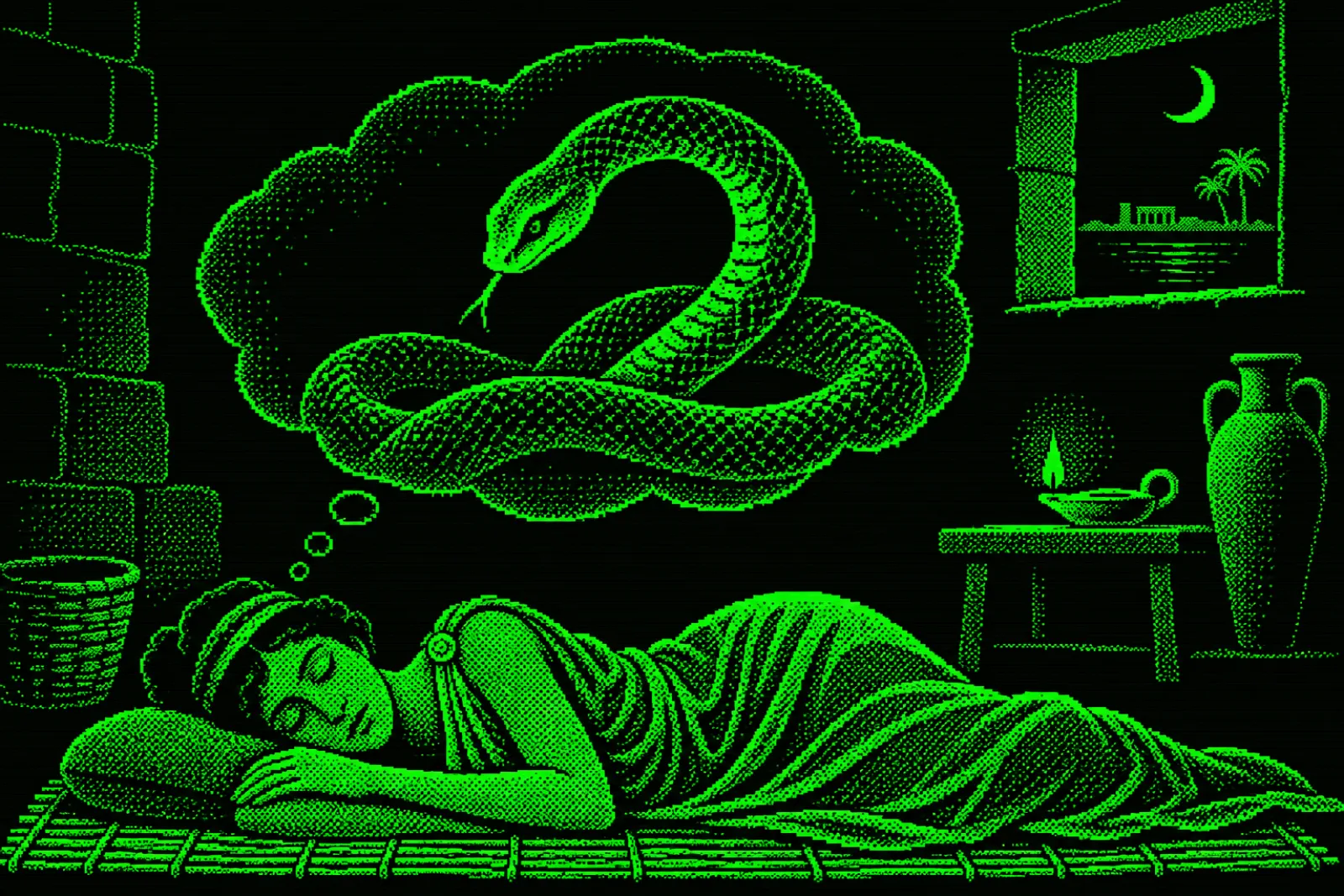
Each numbered line gives the Demotic Egyptian first, in Latin letters. Our English is underneath. Tap a dotted word for its meaning, and Note for our comment on the line; our comments are in the right margin.
- 1b II,14
nꜣ ẖ.t-nk.w kinds of fucking (TLA: “types of sexual intercourse”) · TLA mtw rmṯ nw(e) to see; in the dream books, to see in a dream · TLA r.[r] =[w] [r(?)] [wꜥ.t(?)] sḥm.t woman, wife · TLA nw(e) to see; in the dream books, to see in a dream · TLA r.r =w
The ẖ.t-nk.w: kinds of fucking (TLA: “types of sexual intercourse”) that a person nw(e): to see; in the dream books, to see in a dream, [if a] sḥm.t: woman, wife sees them.
Note on line 1
The heading of the section. See is the dream books’ word for dreaming: “if he sees himself …”. The scribe wrote nkt, “thing”; Joachim Quack (TUAT NF 4, 2008) takes it for nk, “to fuck”, and the TLA follows him. “[If a]” is Aksel Volten’s restoration (1942), which Vittmann marks as problematic. - 2b II,15
jw =w dy.t ḥmsy to sit; to sit (with), to live with, to marry · TLA sḥm.t woman, wife · TLA [jrm] hy husband · TLA =s(?) [jw] =w r dy.t ꜣq to perish, be ruined · TLA =s
If [a woman] is made to ḥmsy: to sit; to sit (with), to live with, to marry [with] her [husband], she will be made to ꜣq: to perish, be ruined.
Note on line 2
To “sit with” a man is to live with him as his wife; the TLA translates “if one marries [a woman] to her husband”. The words in brackets are Volten’s; the “phallus” sign that ends the word hy, “husband”, survives after the break (Vittmann). - 3b II,16
If she sšn: to embrace (him), [she will] have rwš: care, worry.
The creatures
- 4b II,17
r pn mouse · TLA nk to fuck; the plain Egyptian verb for a sex act, done to the one named after it · TLA n.[jm] =[s] ⸢r⸣ pꜣy =s hy husband · TLA r dy.t n =s […]
If a pn: mouse nk: to fuck; the plain Egyptian verb for a sex act, done to the one named after it [her], her hy: husband will give her […].
Note on line 4
Nk is the plain Egyptian verb for the act; the Berlin dictionary gives beschlafen, and Coptic ⲛⲟⲉⲓⲕ, “adultery, adulterer”, comes from it. Here the creature is the subject and the woman the object (n.jm=s, the preposition that marks her as the object): it does it to her. The TLA’s German, mit ihr Geschlechtsverkehr hat, “has sexual intercourse with her”, turns a blunt verb with a direction into a neutral mutual act. We keep the force and the direction with “fuck”. - 5b II,18
r ḥtr horse · TLA nk to fuck; the plain Egyptian verb for a sex act, done to the one named after it · TLA n.jm =s jw =s r nꜥš to be strong; with r, stronger than · TLA r pꜣy =s hy husband · TLA
If a ḥtr: horse fucks her, she will be nꜥš: to be strong; with r, stronger than her husband.
Note on line 5
Or “she will be strong against her husband”; the TLA gives both. - 6b II,19
r ḥwṱ farmer, husbandman (TLA: Ackerbauer) · TLA nk to fuck; the plain Egyptian verb for a sex act, done to the one named after it · TLA n.jm =s r ḥwṱ farmer, husbandman (TLA: Ackerbauer) · TLA r dy.t n =⸢s⸣ […]
If a ḥwṱ: farmer, husbandman (TLA: Ackerbauer) fucks her, a farmer will give her […].
Note on line 6
The only human in the run of creatures that goes on to line 20 (b II,32) (Vittmann notes the oddity). - 7b II,20
r ꜥꜣ donkey · TLA nk to fuck; the plain Egyptian verb for a sex act, done to the one named after it · TLA n.jm =s jw =s r sbḥ(ꜣ) to beg, cry out, complain · TLA n bw wrong, sacrilege; punishment · TLA ꜥꜣ jw(?) =w(?) […]
If a ꜥꜣ: donkey fucks her, she will sbḥ(ꜣ): to beg, cry out, complain over a great bw: wrong, sacrilege; punishment, and they […].
Note on line 7
Volten read sbꜣ, “she will be punished”, and “for a great sin”. Vittmann reads sbḥ, “to cry out, beg”, from the shape of the last letter, and translates “in great distress(??)”, calling n bw ꜥꜣ unclear. Bw is “wrong, sacrilege”: the wrong done to her. - 8b II,21
r by-ꜥꜣ-n-p.t he-goat · TLA nk to fuck; the plain Egyptian verb for a sex act, done to the one named after it · TLA n.jm =s jw =s r mwt to die · TLA n tkn to be near; n tkn, “soon” · TLA
If a by-ꜥꜣ-n-p.t: he-goat fucks her, she will mwt: to die tkn: to be near; n tkn, “soon”.
Note on line 8
Compare Herodotus (2.46): in his time, in the Mendesian nome, a he-goat coupled with a woman in public. In this book the woman who dreams it will die. - 9b II,22
r jsw ram; also a sacred animal · TLA nk to fuck; the plain Egyptian verb for a sex act, done to the one named after it · TLA n.jm =s r pr-ꜥꜣ Pharaoh, the king · TLA r jr n =s md.t-nfr.t a good thing, a kindness · TLA
If a jsw: ram; also a sacred animal fucks her, pr-ꜥꜣ: Pharaoh, the king will do her md.t-nfr.t: a good thing, a kindness.
- 10b II,23
r jmy tom-cat · TLA nk to fuck; the plain Egyptian verb for a sex act, done to the one named after it · TLA n.jm =s r sḫn(y) fate, what befalls one · TLA n wry(.t) misery; an evil spirit, a demoness of harm · TLA r gm to find · TLA =[s]
If a jmy: tom-cat fucks her, the sḫn(y): fate, what befalls one of the wry(.t): misery; an evil spirit, a demoness of harm will find [her].
Note on line 10
The animal’s name is miswritten. Quack reads “tom-cat”, assuming the scribe wrote a qd for the like-looking my (Vittmann). The fate of the evil one: wry.t is both “misery” and a demoness of harm; the TLA gives “the fate of the demoness of harm, i.e. a wretched fate”. The same phrase returns for the married woman, line 21. - 11b II,24
r wnš jackal, wolf (Coptic ⲟⲩⲱⲛϣ) · TLA nk to fuck; the plain Egyptian verb for a sex act, done to the one named after it · TLA n.jm =s r swrt steward, curator (Greek φροντιστής) · TLA r jr n =s md.t-nfr.t a good thing, a kindness · TLA
If a wnš: jackal, wolf (Coptic ⲟⲩⲱⲛϣ) fucks her, a swrt: steward, curator (Greek φροντιστής) will do her a kindness.
Note on line 11
The animal is wnš, the jackal, Anubis’s animal. Swrt is the Greek phrontistes, an estate steward. - 12b II,25
r mꜣy lion · TLA nk to fuck; the plain Egyptian verb for a sex act, done to the one named after it · TLA n.jm =s jw =s r mꜣꜣ to see · TLA m.nfr.w
If a mꜣy: lion fucks her, she will mꜣꜣ: to see good things.
- 13b II,26
r msḥ crocodile · TLA nk to fuck; the plain Egyptian verb for a sex act, done to the one named after it · TLA n.jm =s jw =s r mwt to die · TLA n tkn to be near; n tkn, “soon” · TLA
If a msḥ: crocodile fucks her, she will die soon.
- 14b II,27
r ḥf snake · TLA nk to fuck; the plain Egyptian verb for a sex act, done to the one named after it · TLA n.jm =s jw =s r jr n =s hy husband · TLA
If a ḥf: snake fucks her, she will get herself a hy: husband.
Note on line 14
Literally “she will make a husband for herself”. The TLA has “she will take a husband”. Of the creatures whose omens survive, only the snake brings her a new husband (the Libyan, line 23, has her “take her husband”), and its omen runs on into a condition (next line). - 15b II,27–28
If it happens that [she] wn-mtw: to have, to possess [a husband] (already), she will šn(y): to be ill.
Note on line 15
The rest of the snake’s omen, which runs on into line 28 of the column. “[A husband]” is restored (Vittmann). The two lines make one omen that splits: for a woman without a husband the snake brings one; for a woman who has one, it brings sickness. - 16b II,29
r ꜥꜥn(y) baboon, sacred animal of Thoth · TLA nk to fuck; the plain Egyptian verb for a sex act, done to the one named after it · TLA n.jm =s jw =s r jr md.t-nfr.t a good thing, a kindness · TLA n rmṯ
If a ꜥꜥn(y): baboon, sacred animal of Thoth fucks her, she will do a kindness to a person.
- 17b II,29
⸢bn(?)⸣-jw =w r(?) jr n =s tꜣy =s ⸢…⸣[…]
They will not do to her her […].
Note on line 17
Quack restores “one will not repay her for it” (via Vittmann). - 18b II,30
r hb ibis, sacred animal of Thoth · TLA nk to fuck; the plain Egyptian verb for a sex act, done to the one named after it · TLA n.jm =s r pr jw =f grg to equip, furnish · TLA ⸢r⸣ ⸢ḫpr⸣ n =s
If an hb: ibis, sacred animal of Thoth fucks her, a house that is grg: to equip, furnish will come to her.
- 19b II,31
r byk falcon, Horus' bird · TLA nk to fuck; the plain Egyptian verb for a sex act, done to the one named after it · TLA n.jm =s r šy fate; Shai, the god of destiny · TLA n ⸢…⸣ r ḫpr n =s n pꜣy =[s] […]
If a byk: falcon, Horus' bird fucks her, a šy: fate; Shai, the god of destiny of […] will come to her in [her] […].
- 20b II,32
[r] ⸢l⸣(?) nk to fuck; the plain Egyptian verb for a sex act, done to the one named after it · TLA n.jm =s r jry-(n-)ḏḏy enemy, adversary · TLA r ṯꜣy nkt thing; property, wealth · TLA [mtw](?) =[s](?)
If a […]-bird fucks her, an jry-(n-)ḏḏy: enemy, adversary will take nkt: thing; property, wealth [of hers].
Note on line 20
The bird’s name is a short group beginning with l, with the bird sign after it (Vittmann). “Of hers” is his restoration; Volten restores nothing. The people
- 21b II,33
r sḥm.t-hy “husband-woman”, a married woman · TLA nk to fuck; the plain Egyptian verb for a sex act, done to the one named after it · TLA n.jm =s jw =s r sḫn(y) fate, what befalls one · TLA n wry(.t) misery; an evil spirit, a demoness of harm · TLA
If a sḥm.t-hy: “husband-woman”, a married woman fucks her, she will (suffer) the fate of the evil one.
Note on line 21
The creatures end and people begin: a married woman, then a Libyan, a Syrian, a herdsman, a stranger and her own son. The verb is the same nk as for the animals, now with a woman as the one who does it. - 22b II,33
A šr: son of hers will [perish].
Note on line 22
Vittmann restores the verb from the son’s line, line 33. - 23b II,34
r Pyt a Libyan · TLA nk to fuck; the plain Egyptian verb for a sex act, done to the one named after it · TLA n.jm =s jw =s r ṯꜣy pꜣy =s hy husband · TLA
If a Pyt: a Libyan fucks her, she will take her husband;
- 24b II,34
they will find her dead.
- 25b II,35
r Jšr a Syrian · TLA nk to fuck; the plain Egyptian verb for a sex act, done to the one named after it · TLA n.jm =s jw =s r rmy to weep · TLA
If a Jšr: a Syrian fucks her, she will rmy: to weep.
- 26b II,35
jw =⸢s⸣ r dy.t nk to fuck; the plain Egyptian verb for a sex act, done to the one named after it · TLA s pꜣy =s bꜣk slave, servant · TLA
She will let her bꜣk: slave, servant fuck her.
Note on line 26
A second outcome of the Syrian dream: literally “she will cause that her slave fuck her”. - 27b II,36
[r] šs herdsman, shepherd · TLA nk to fuck; the plain Egyptian verb for a sex act, done to the one named after it · TLA n.jm =s jw =s r rmy to weep · TLA
[If] a šs: herdsman, shepherd fucks her, she will weep.
Note on line 27
Quack’s reading of the noun (TUAT NF 4, 361 and n. 184); it was earlier read škwrꜣ. - 28b II,36
She will ꜥrq: to swear an oath ꜥḏ: falsehood, lie.
- 29b II,37–38
[jw] =[s] ⸢r⸣ ḫnm(m) to smell; to be friendly to · TLA r pꜣ mtw =f r jy to come · TLA r.r =s (r) ⸢pꜣy⸣ =⸢s⸣ hy husband · TLA ⸢r⸣ jr n =f ḥm.t wife · TLA [k.t(?)] sḥm.t woman, wife · TLA
[If she] is ḫnm(m): to smell; to be friendly to to the one who will come to her, her husband will take [another] woman for himself as ḥm.t: wife.
Note on line 29
Ḫnm is “to smell”, and so “to be friendly with”, a euphemism for giving herself; the TLA, after Quack, has “if she gives herself to the one who will come to her”. - 30b II,38
r bw-jr-rḫ=s “she does not know (them)”: a stranger to her · TLA nk to fuck; the plain Egyptian verb for a sex act, done to the one named after it · TLA n.jm =s jw =w r wḫꜣ to seek, look for · TLA =s
If bw-jr-rḫ=s: “she does not know (them)”: a stranger to her fucks her, they will wḫꜣ: to seek, look for her.
Note on line 30
Literally “(one whom) she does not know”. The TLA’s German makes the stranger a woman (eine Unbekannte); the Demotic phrase does not mark the gender, and we leave it open. - 31b II,38
bn-jw =w gm to find · TLA =s
They will not gm: to find her.
- 32b II,39
[r] kꜣ bull · TLA ⸢…⸣ ⸢…⸣ šy fate; Shai, the god of destiny · TLA […] jw =s ⸢r⸣ nw(e) to see; in the dream books, to see in a dream · TLA n pꜣy =s pr
[If] a kꜣ: bull … … [fa]te […], she will see in her house.
Note on line 32
“Bull” is Quack’s reading; Volten read šy, “fate”, as certain. Vittmann notes that the traces fit Quack’s expected “[if] a bull fucks her” badly. - 33b II,40
[r] [pꜣy(?)] =[s(?)] šr son · TLA nk to fuck; the plain Egyptian verb for a sex act, done to the one named after it · TLA ⸢n.jm⸣ =s r šr son · TLA mtw =s [r] ꜣq to perish, be ruined · TLA
[If her] son fucks her, a son of hers will perish.
Note on line 33
The mother fucked by her son. The omen falls on a son: one of hers will die. - 34b II,41
[…] […] ⸢md(.t)(?)⸣ sḥm.t woman, wife · TLA (traces) ⸢jw⸣ =s (r) ⸢ḏd⸣ md.t-(n-)ꜥḏ a lie, falsehood · TLA
[…] something female … , she will tell md.t-(n-)ꜥḏ: a lie, falsehood.
- 35b II,42
[…] […] ⸢jy⸣ r ⸢…⸣ […] […].ṱ =s ⸢jw⸣ =w r ṯꜣy pꜣy =s […]
[…] come against … […] her; they will take her […] (a lost noun).
- 36b II,43
[r] […] nk to fuck; the plain Egyptian verb for a sex act, done to the one named after it · TLA n.jm =s r pꜣ⸢y⸣ =⸢s⸣ […] [r(?)] [mwt]
[If a …] [fucks] her, her […] will [die].
Note on line 36
Of the last word only the sign of the dying warrior is left; Volten restored “die” from line 39. - 37b II,44
[r] […] nk to fuck; the plain Egyptian verb for a sex act, done to the one named after it · TLA n.jm =s […] […] n =s
[If a …] fucks her, […] to her.
- 38b II,45
[…] […] hy husband · TLA r.r =s [……] jw =s r […]
[…] a husband against her [……], she will […].
- 39b II,46
[…] ḏḏy: to run, gallop … […], [her] son will die.
- 40b II,47
[…] […] […] =s r pꜣ sbt wall, fortress · TLA […] […] (traces)
[…] her to the sbt: wall, fortress […] …
Note on line 40
The last line of the column, as it survives.