~/sacred-texts/ptolemaic-temple-texts
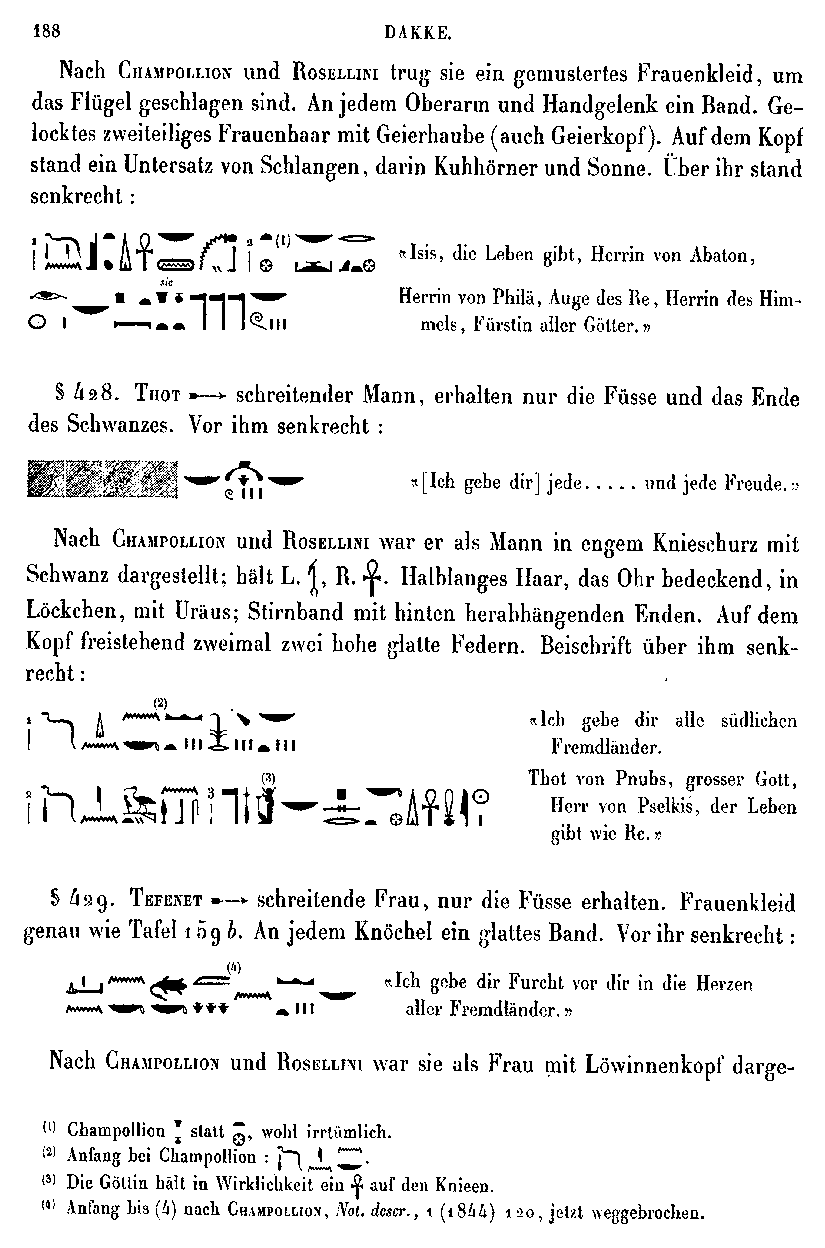
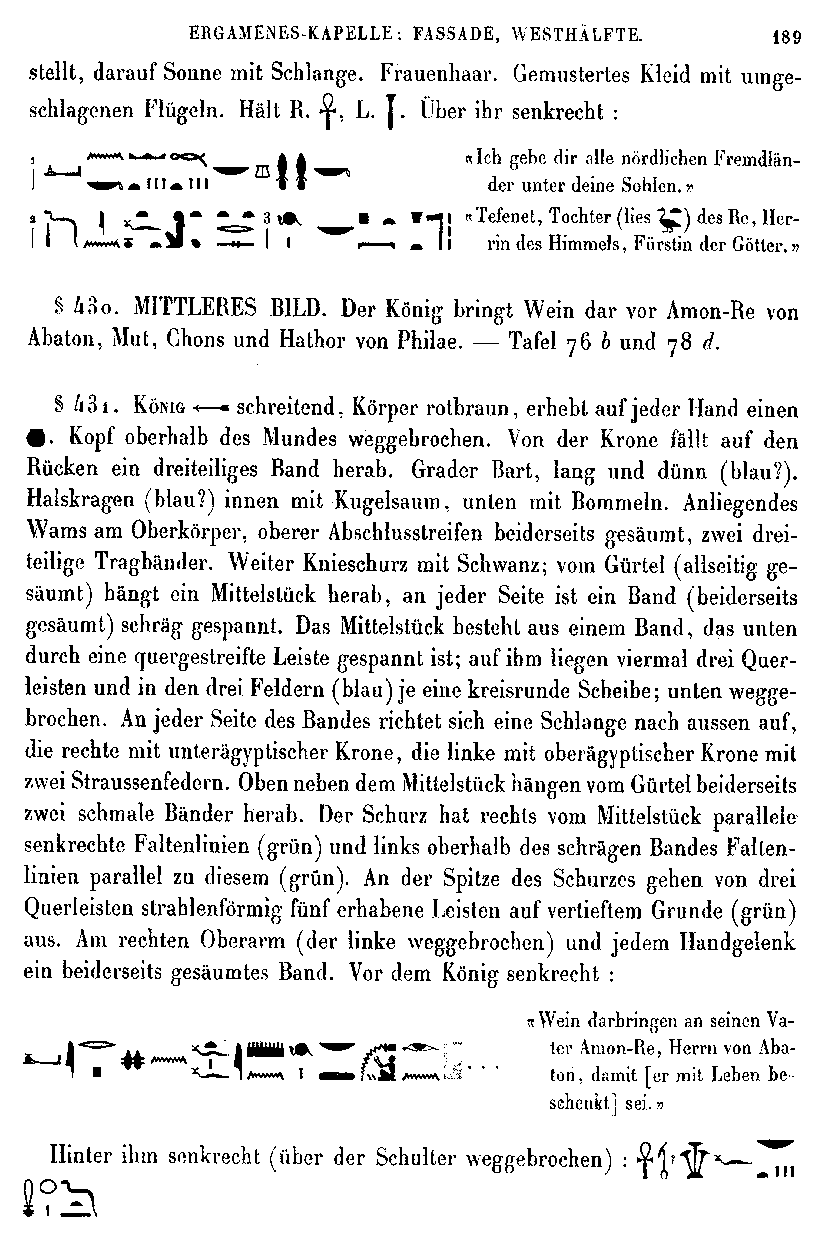
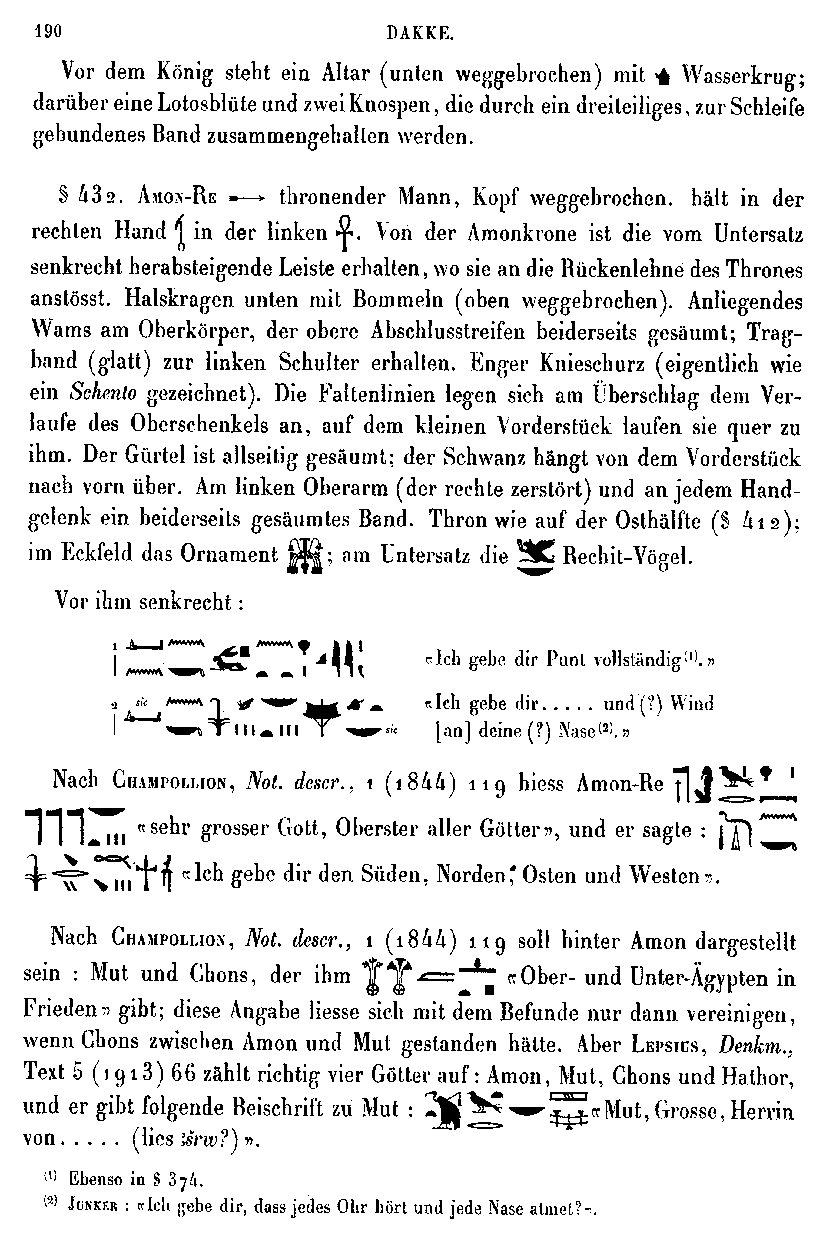
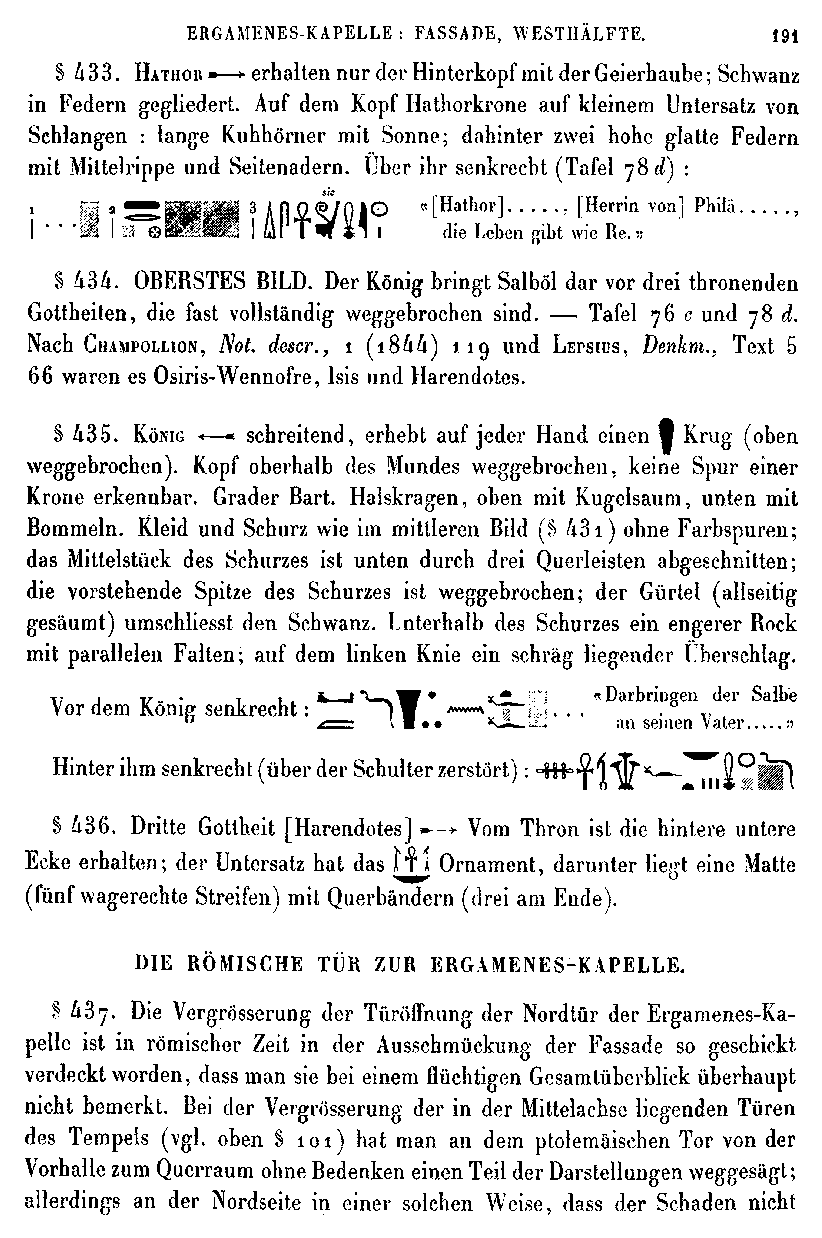
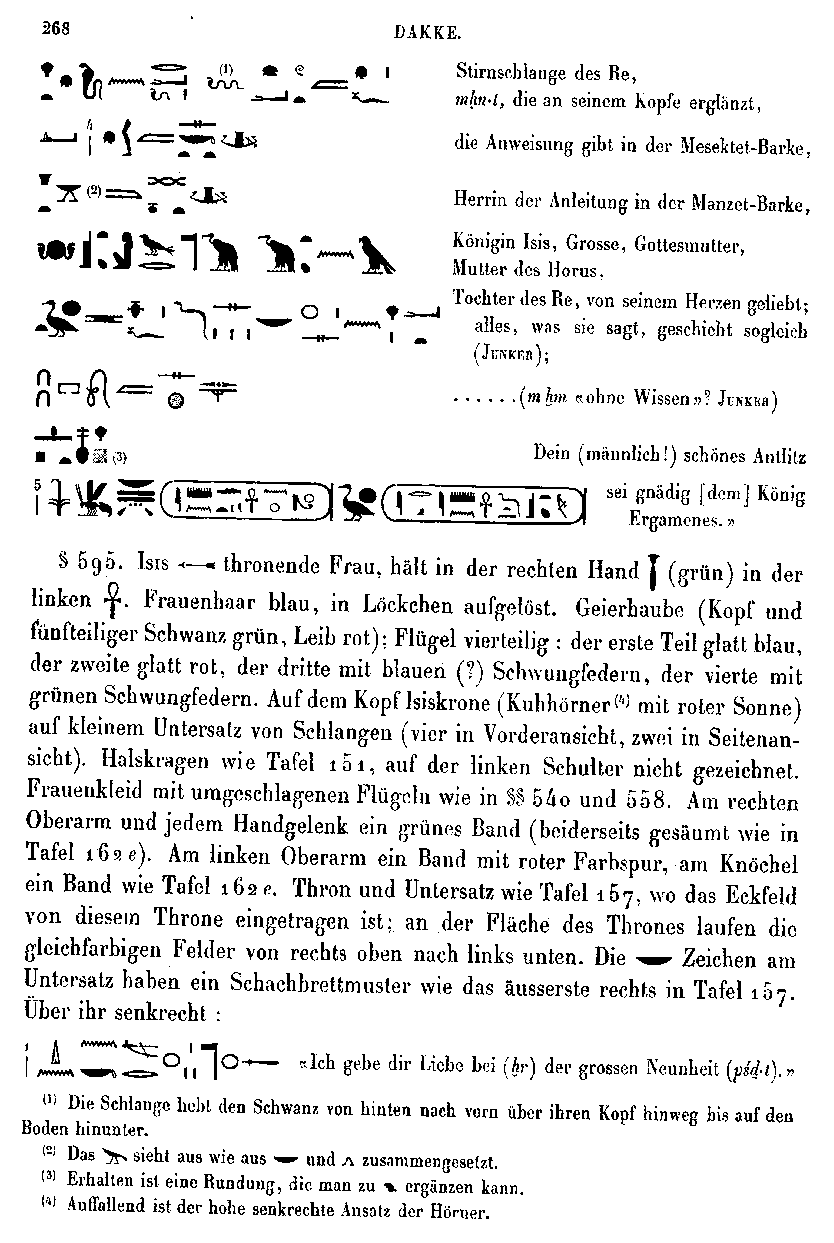
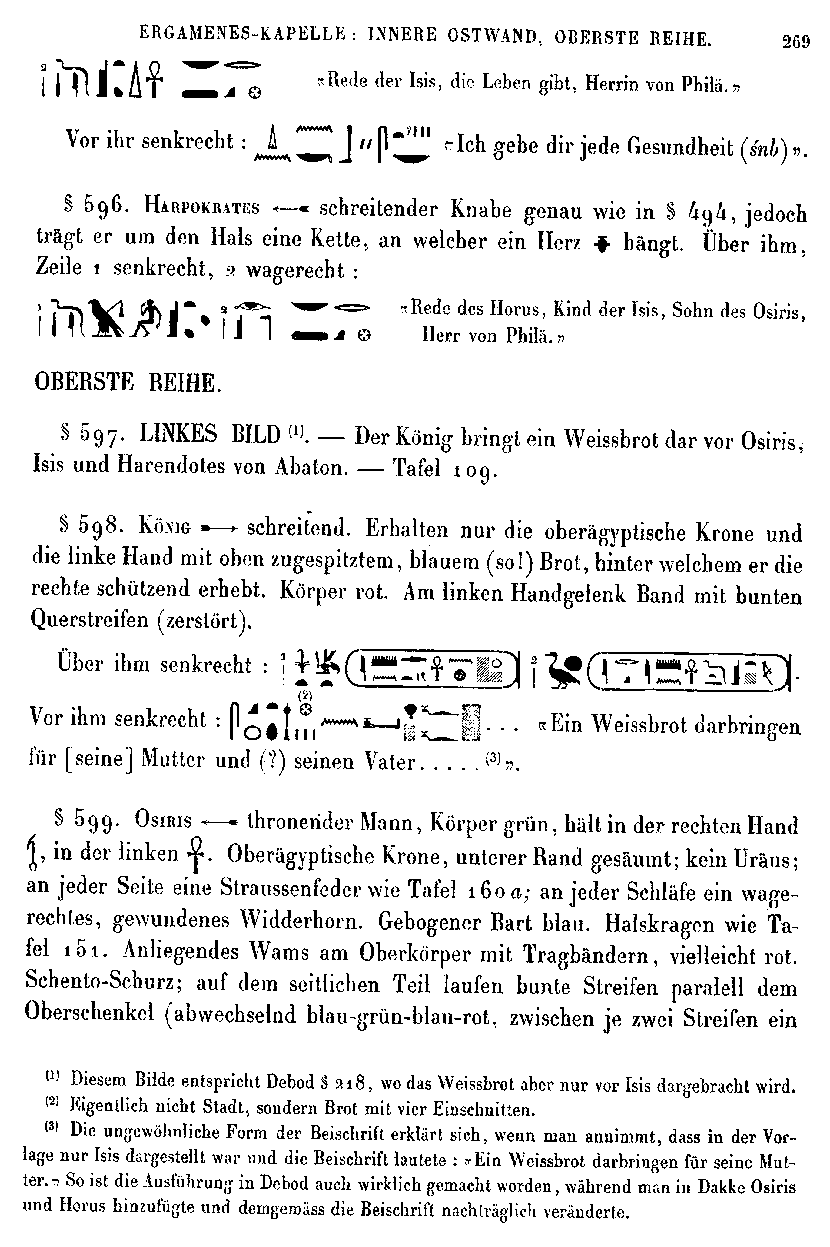
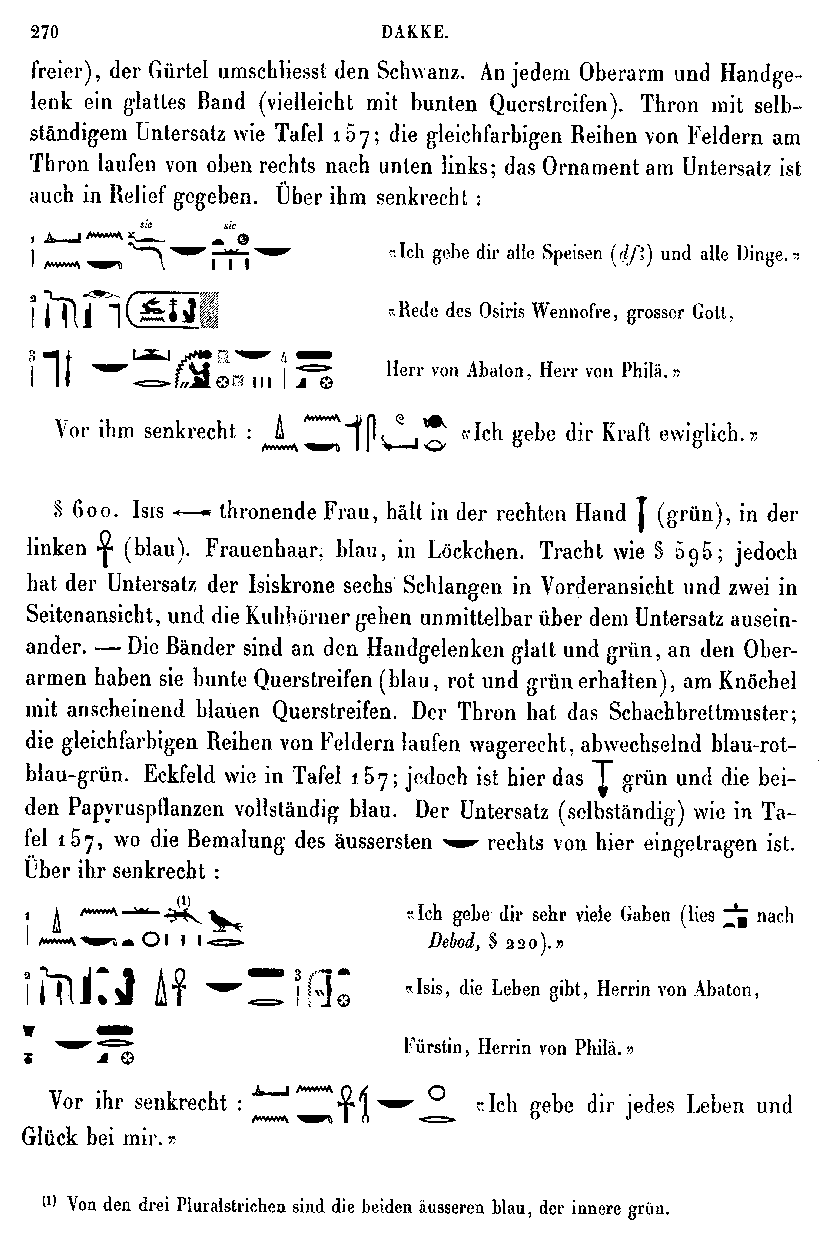
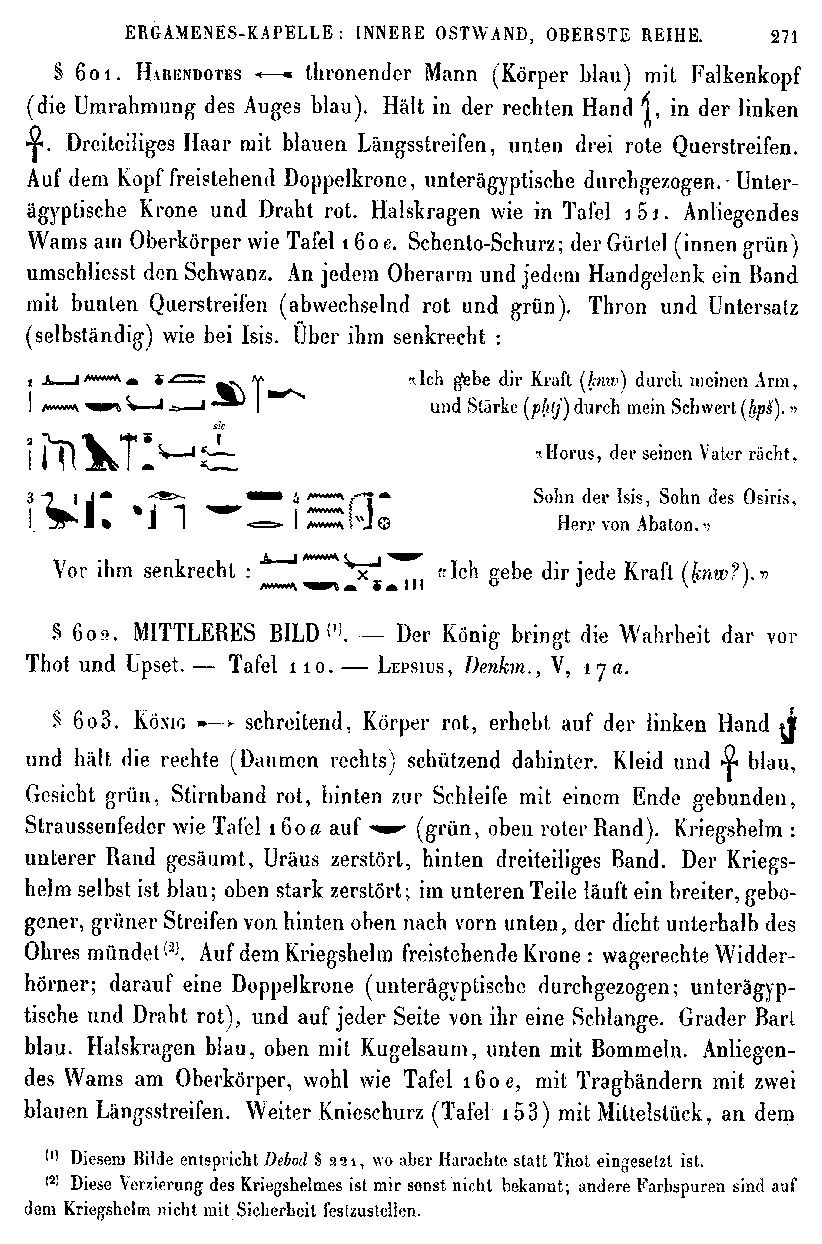
Temple of Dakka Inscriptions: Isis Blazes Against Apophis
- Date
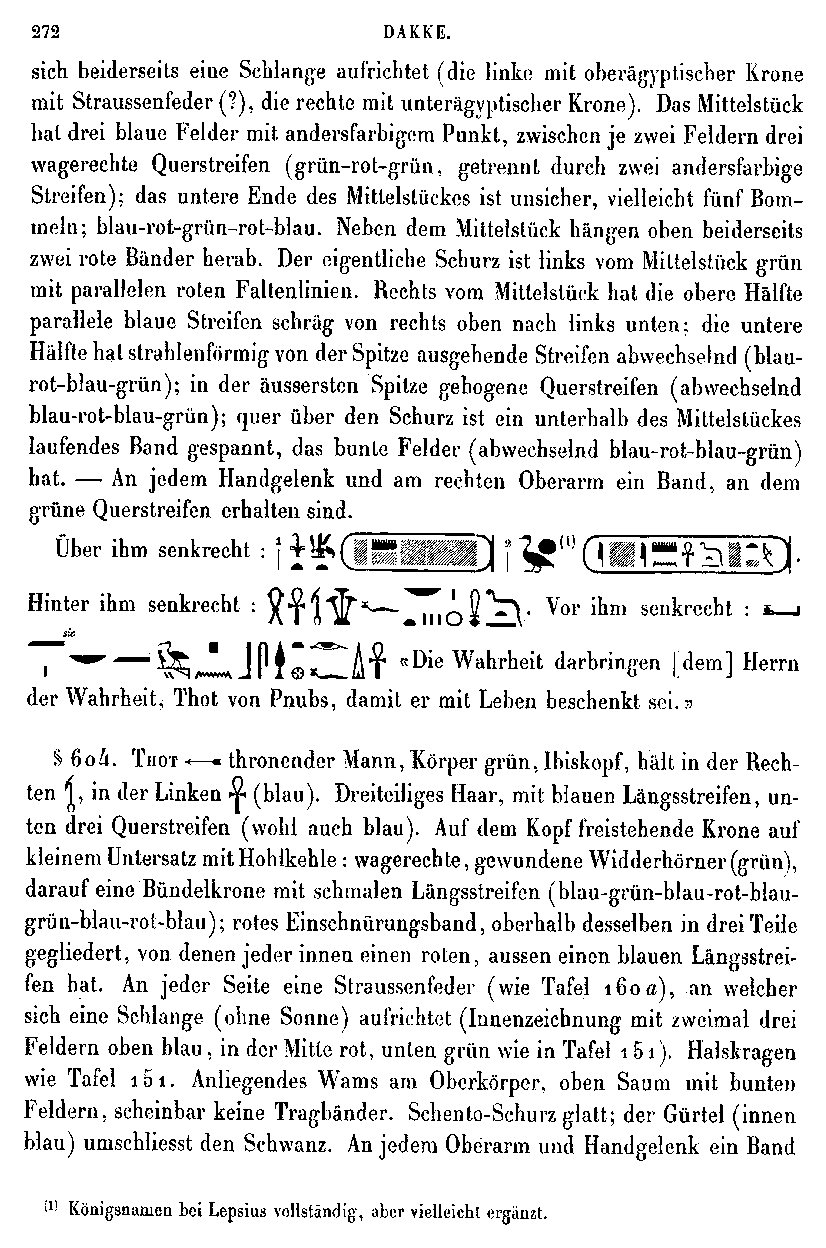
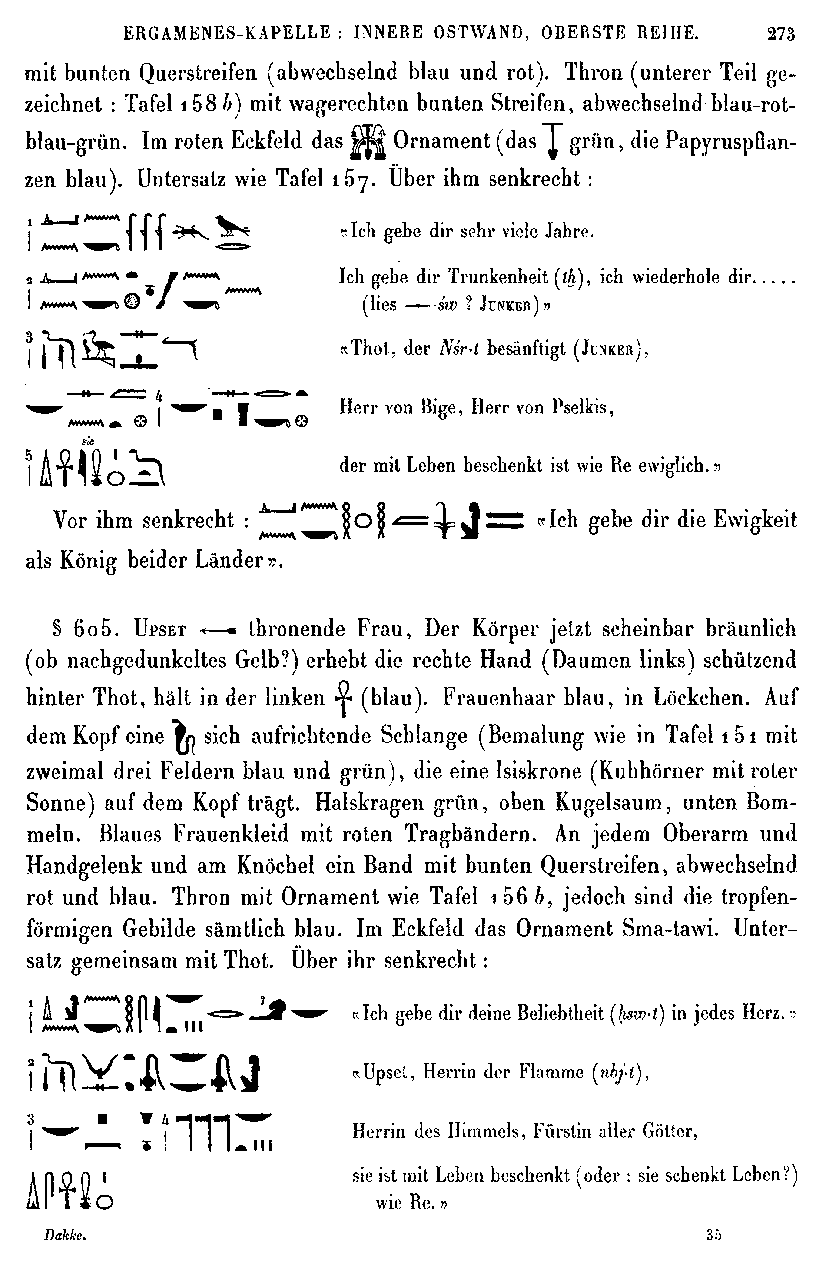
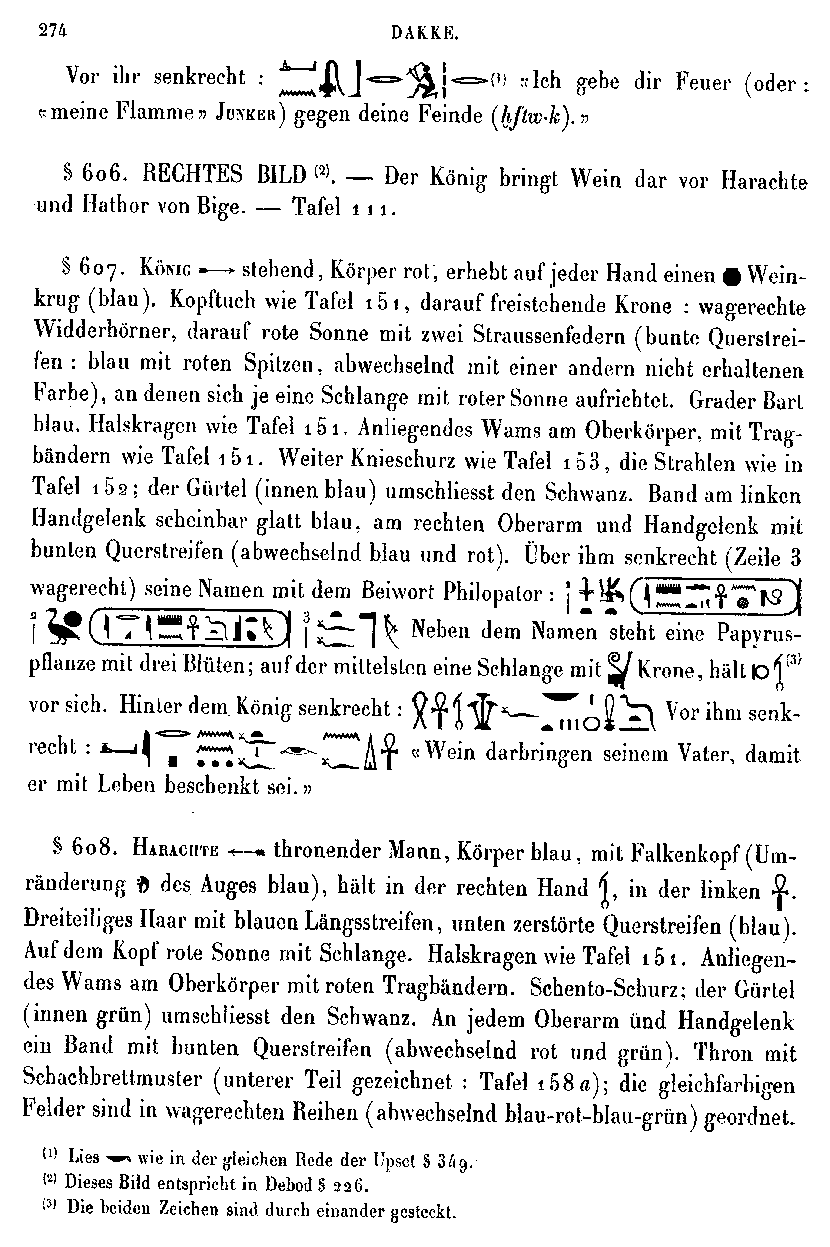
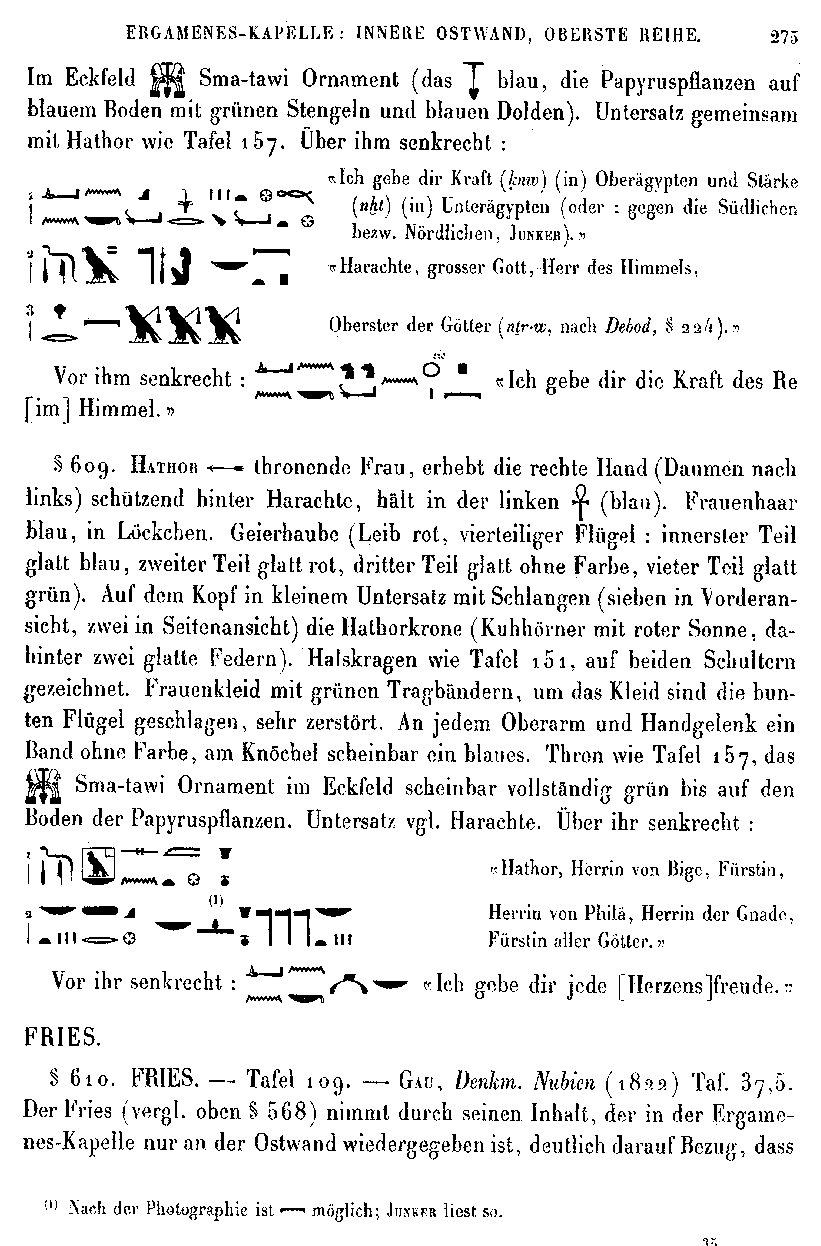
- Carved between about 220 BC and AD 37 on the walls of the temple of Thoth of Pnubs at Dakka: the chapel of the Kushite king Arqamani and Ptolemy IV, the hall of Ptolemy VIII, and the Roman sanctuary of Augustus and Tiberius
- Found
- Dakka (ancient Pselkis), Lower Nubia, about 100 km south of Aswan; the temple was dismantled in 1962–1968 and rebuilt at New Wadi es-Sebua above Lake Nasser
- Language
- Ptolemaic Egyptian · Hieroglyphic
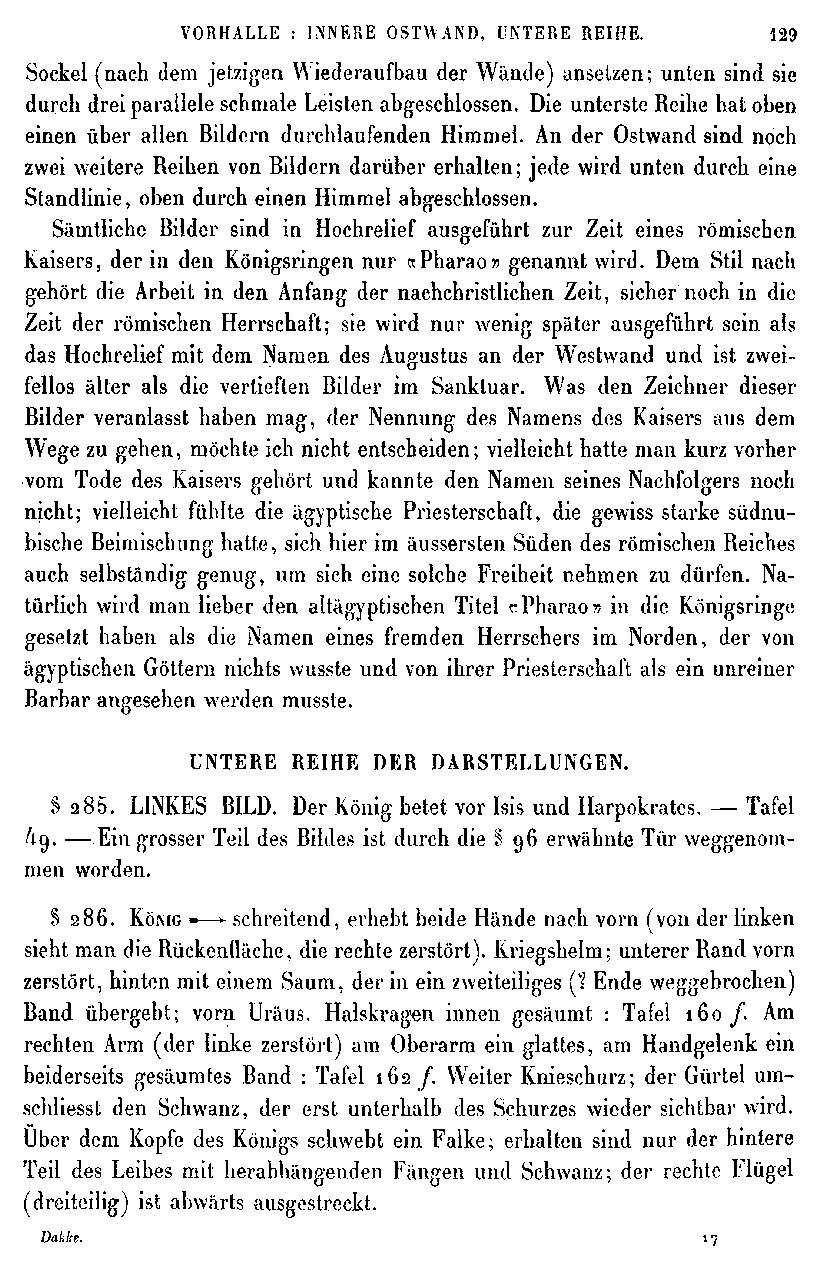
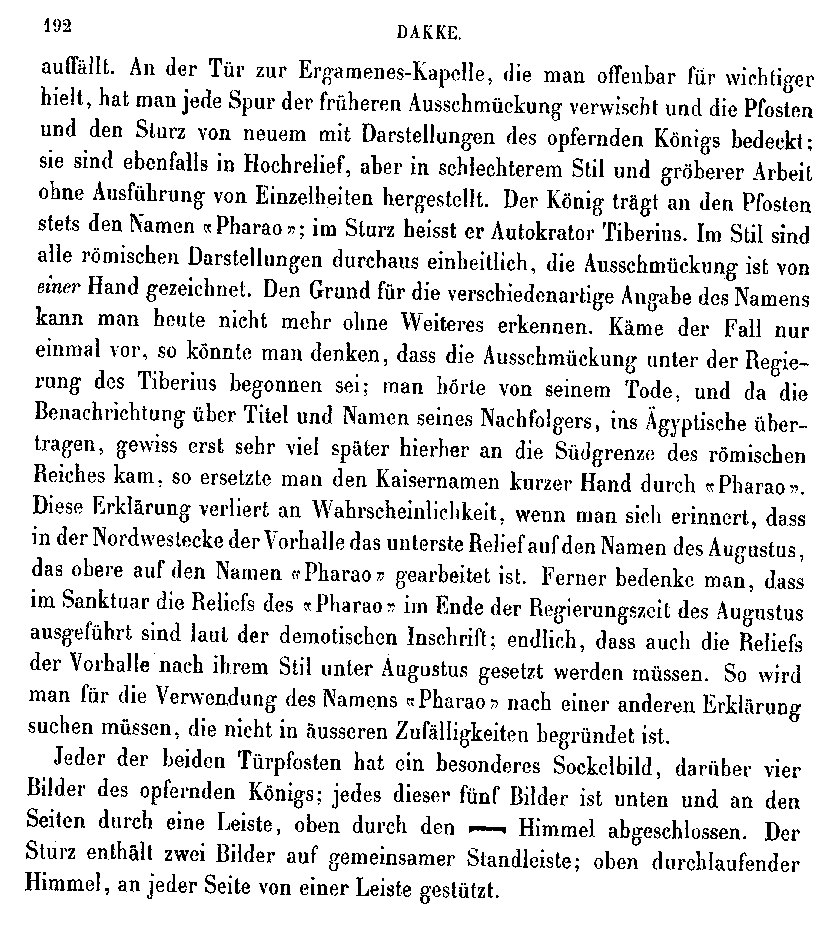
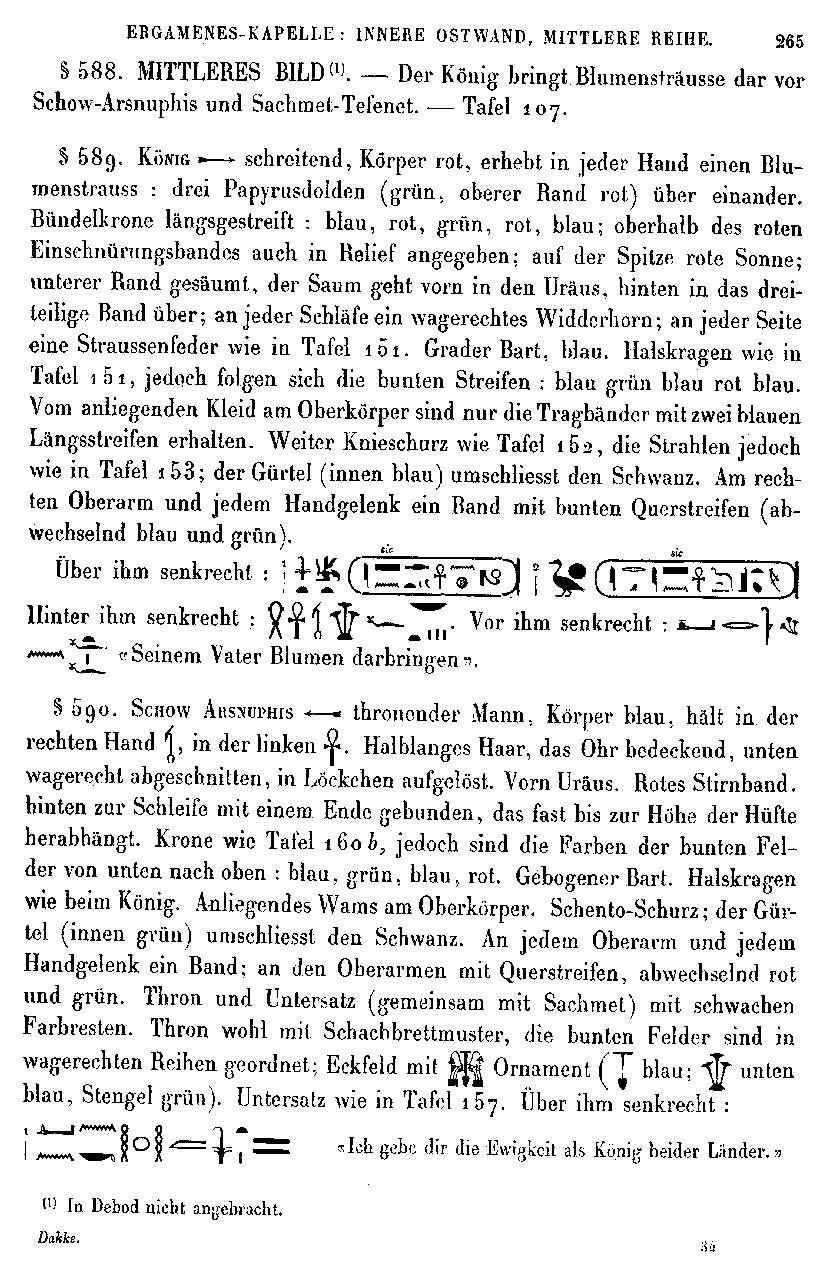
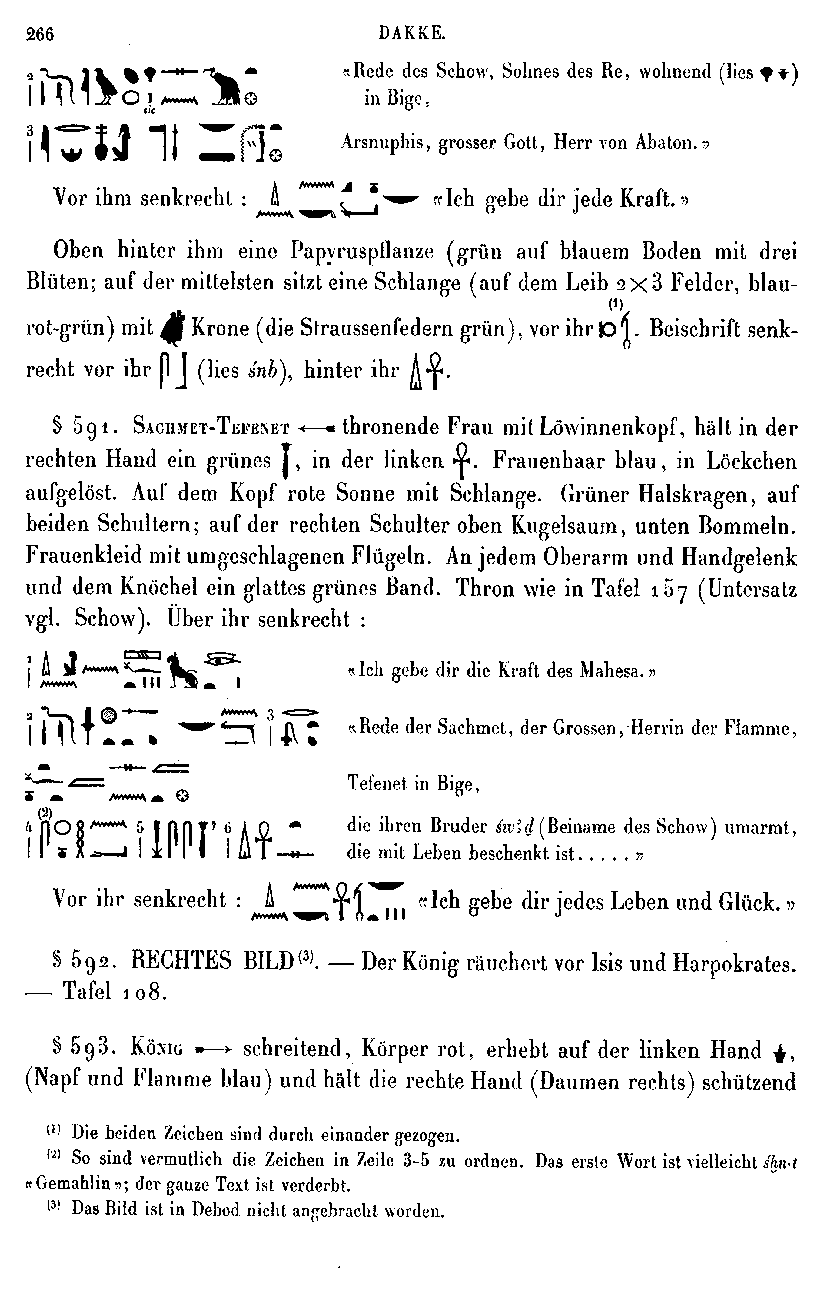
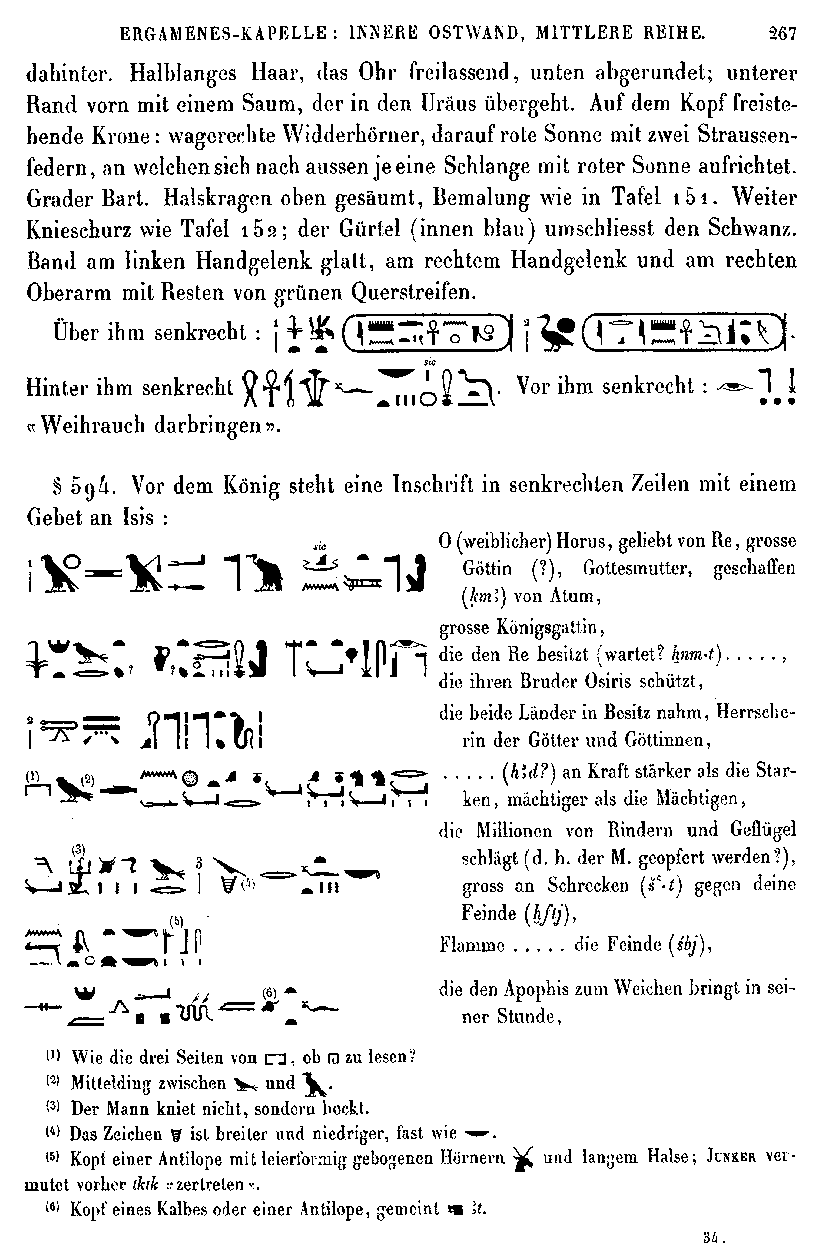
Four rulers stand before the gods on these walls: the Kushite king Arqamani (Ergamenes), Ptolemy IV, Ptolemy VIII with Cleopatra, and the Roman emperors, often named only Pharaoh. Each hands over wine, incense, milk, a field or the figure of Maat, and each god answers with a gift: I set the flame against your enemies; I have given you drunkenness; you have been drunk again.
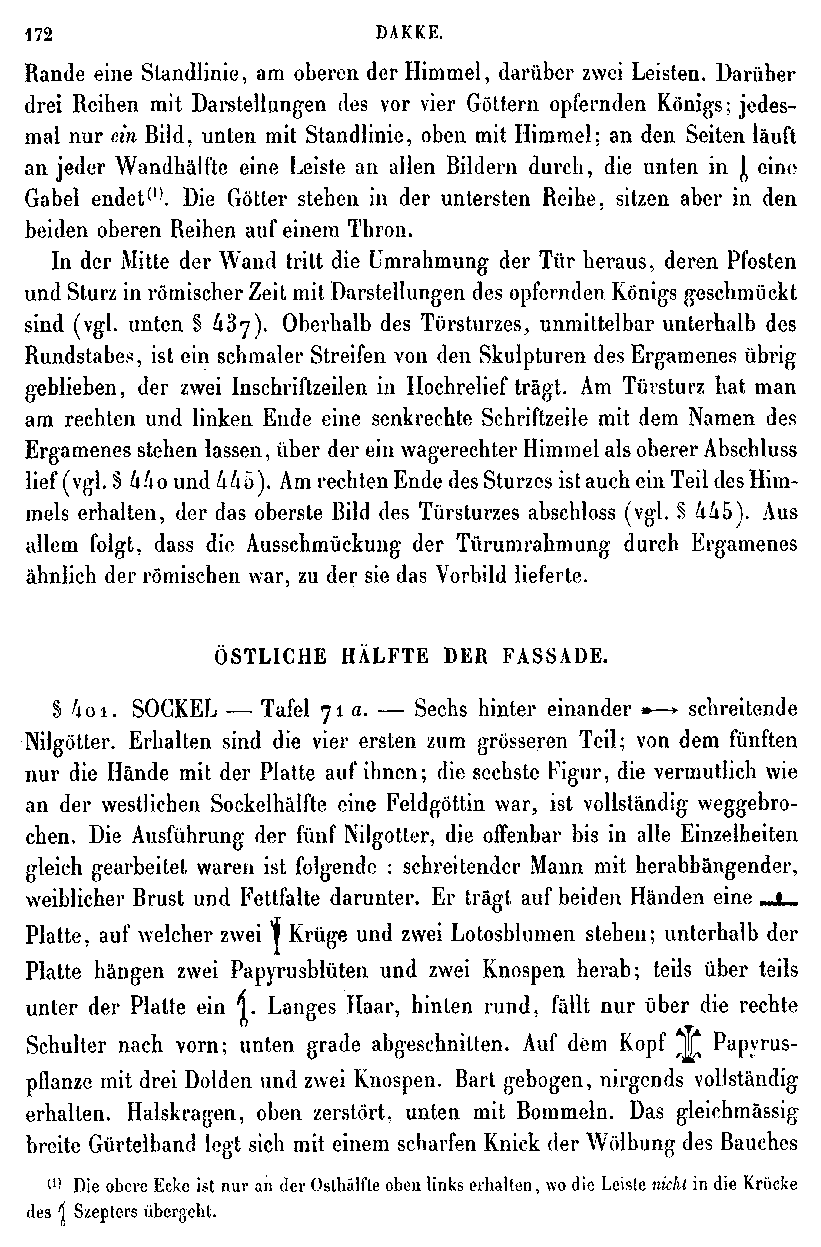
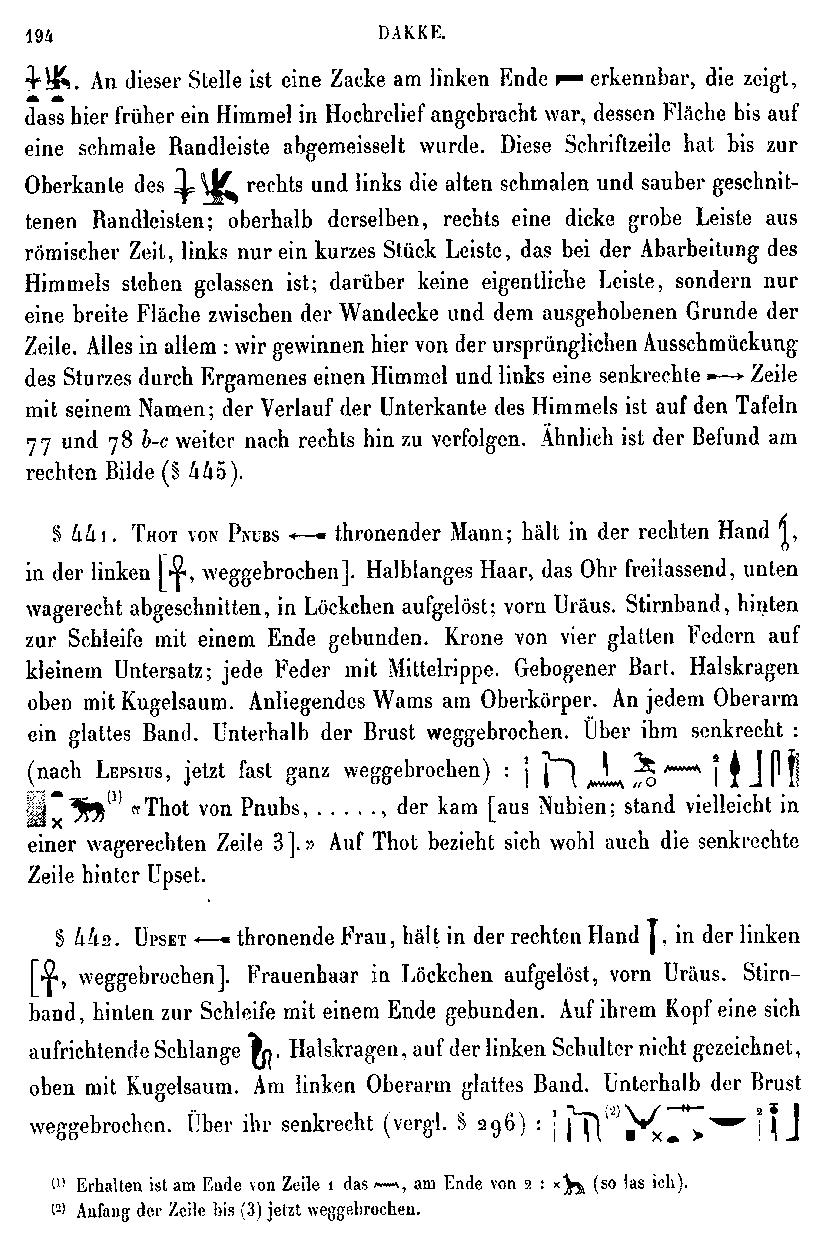
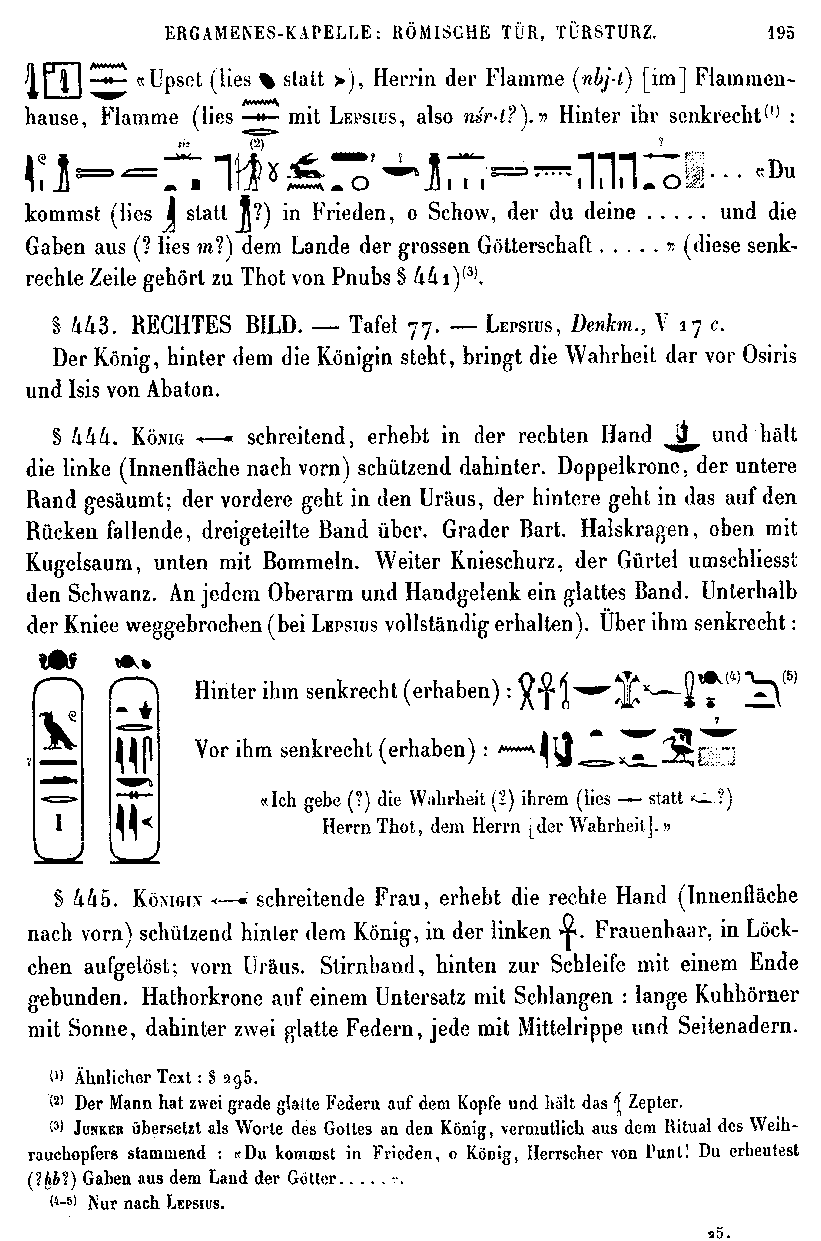
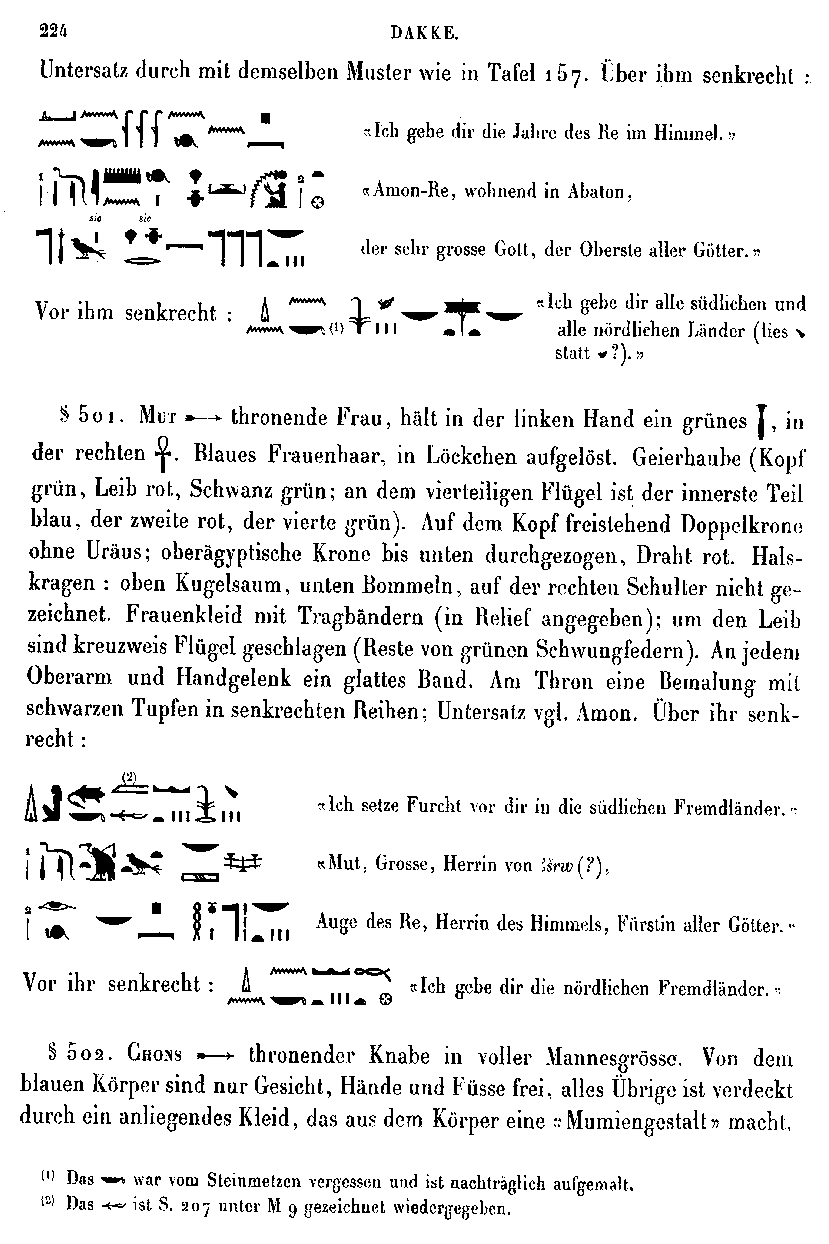
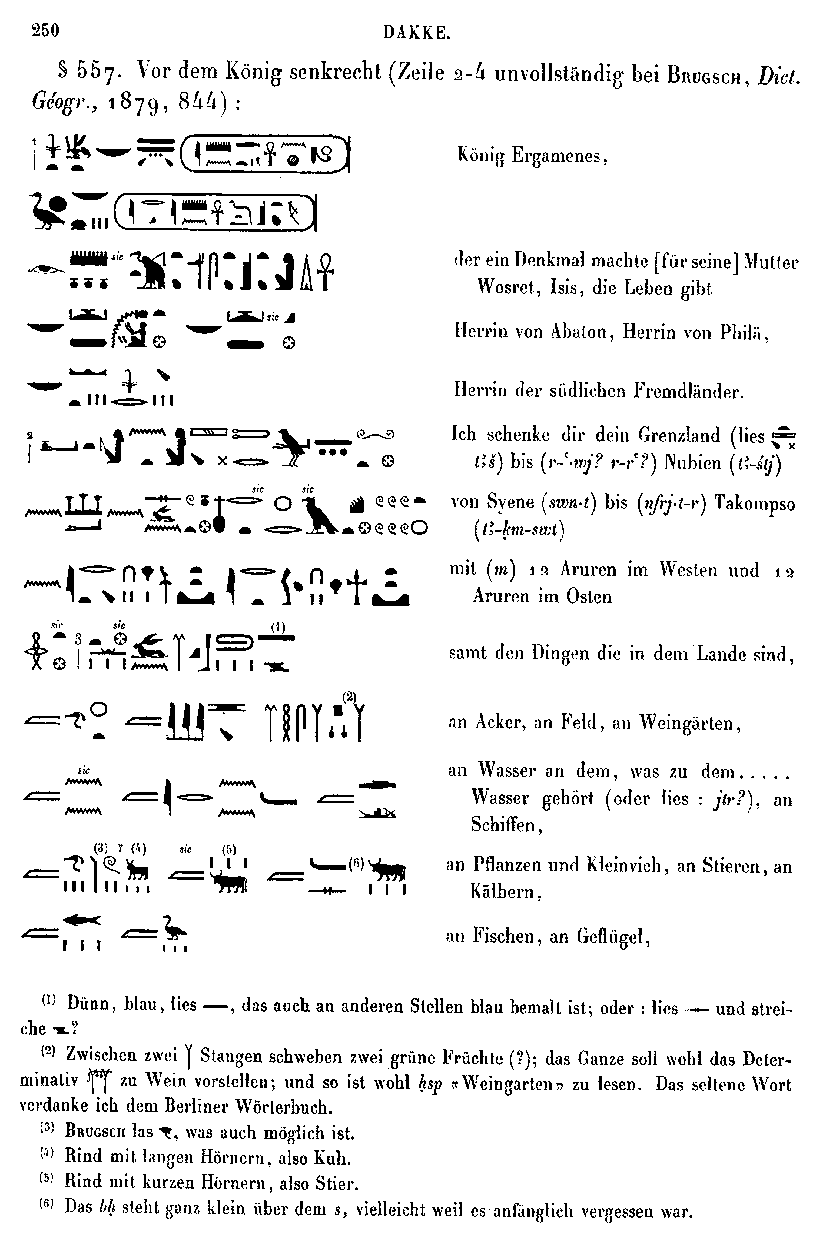
In Arqamani’s chapel Isis is deeded the land from Syene to Takompso: twelve schoinoi on the west bank and twelve on the east. Thoth of Pnubs, lion of the south, is the god who brought the Eye of Ra back from Kenmet: the raging goddess Tefnut, led home from Nubia.
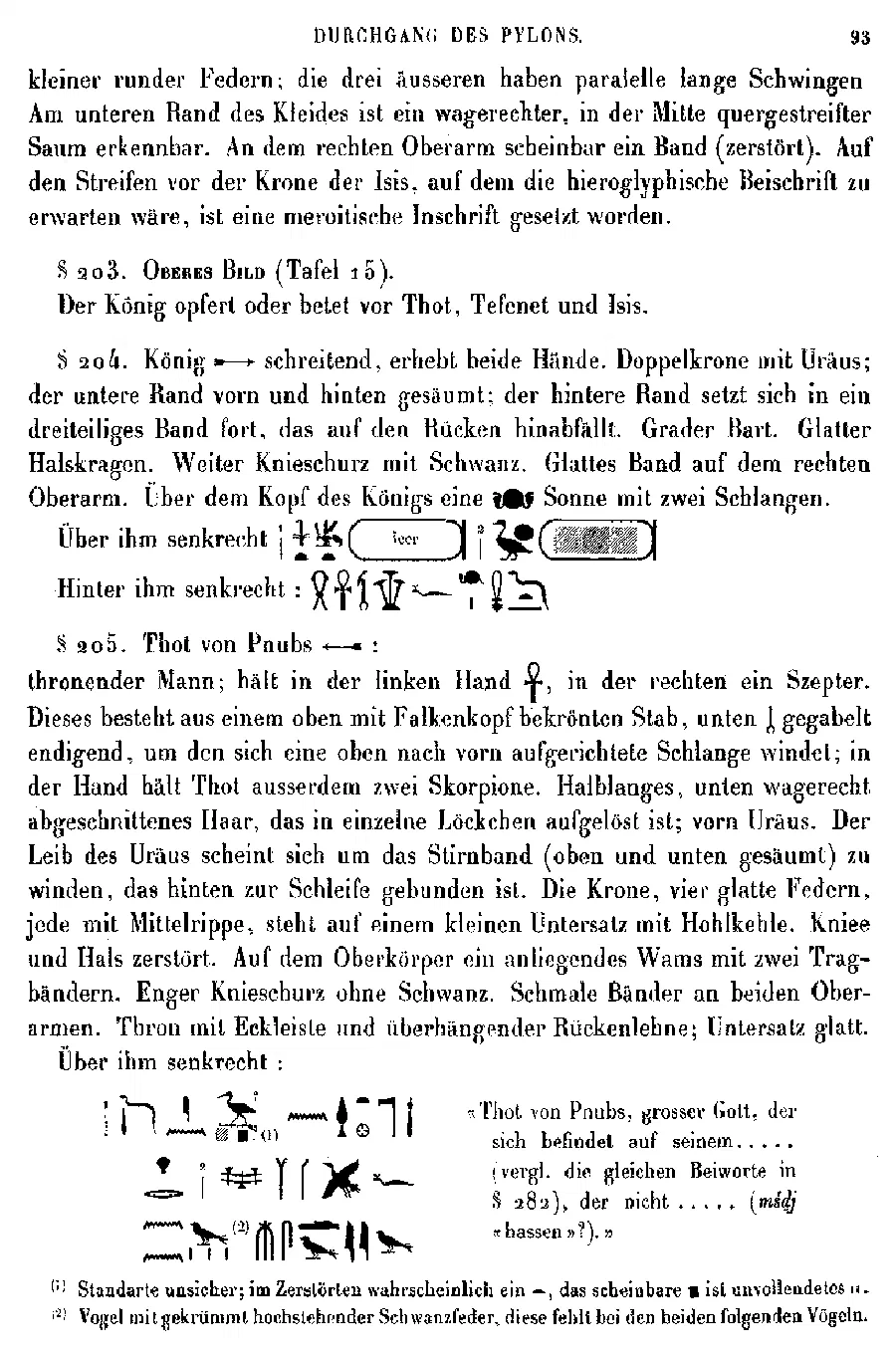
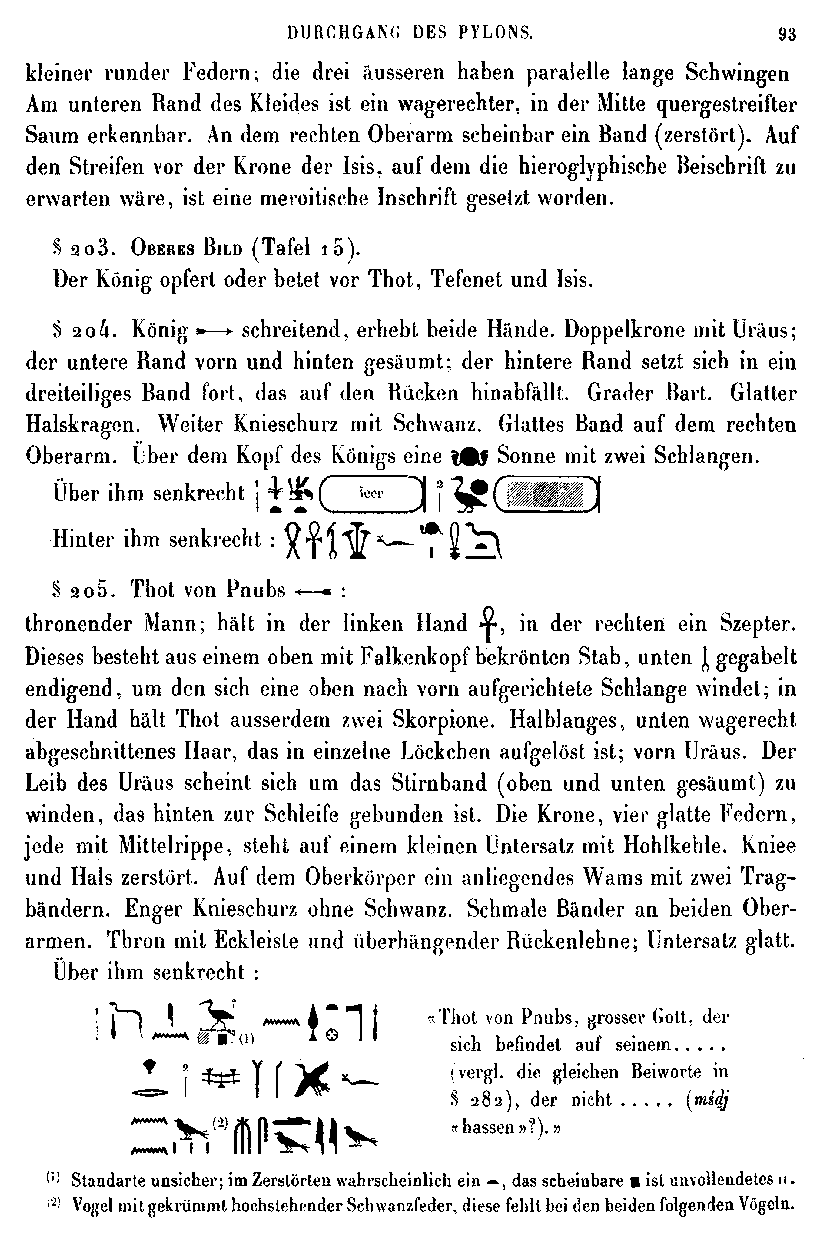
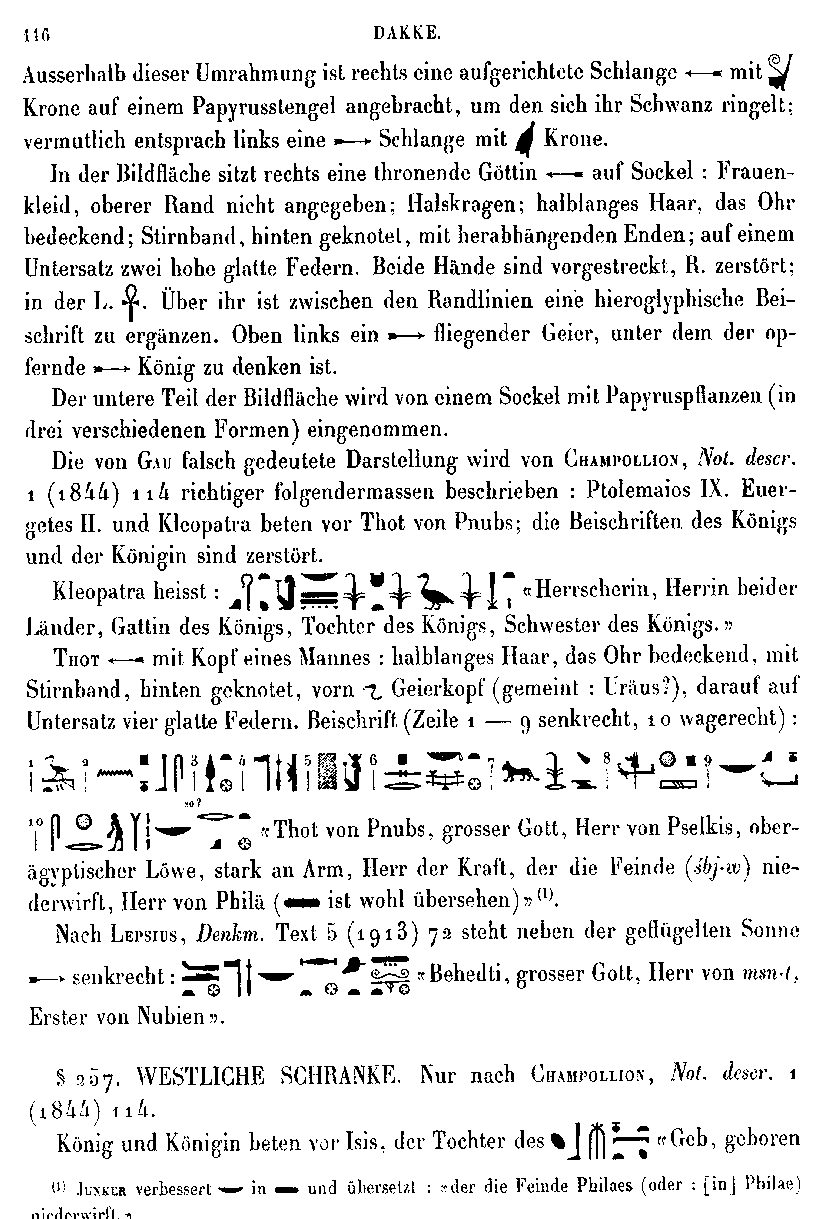
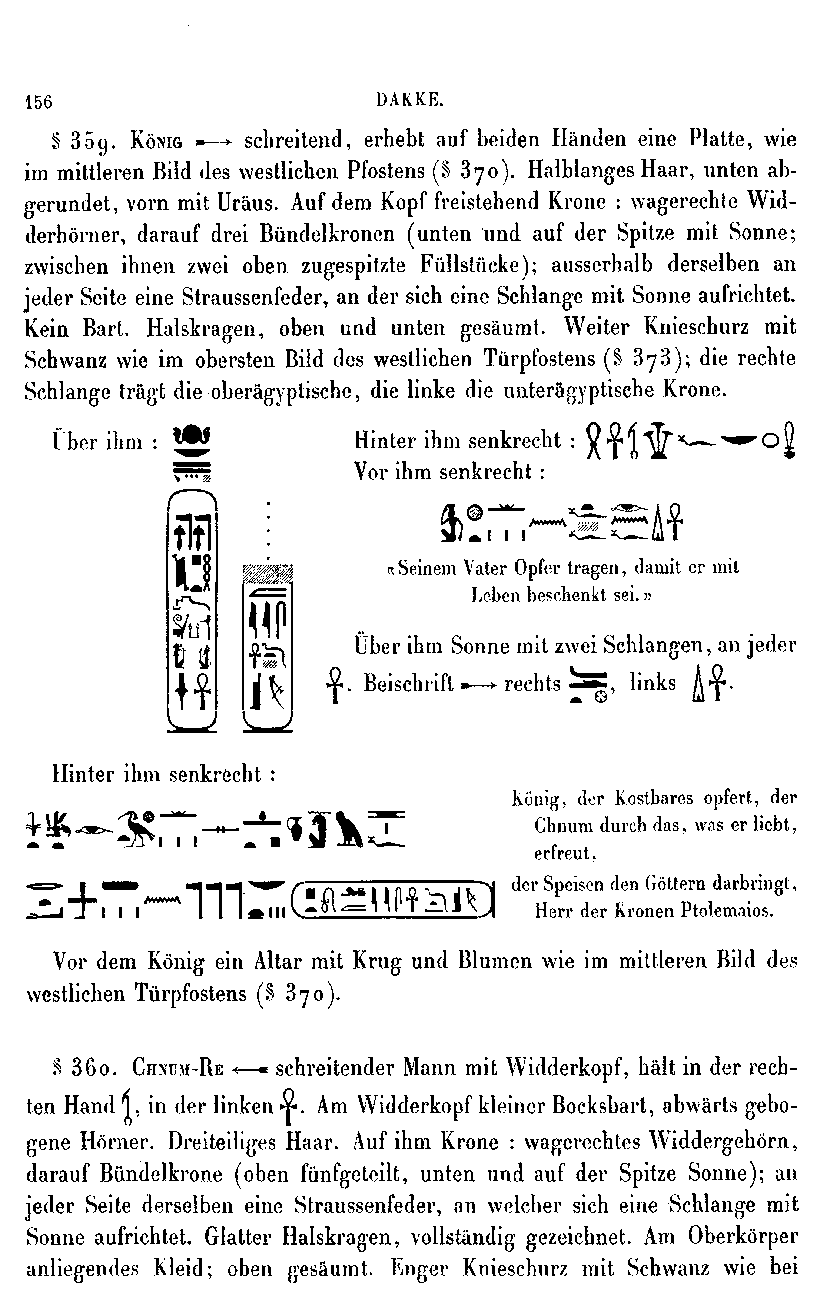
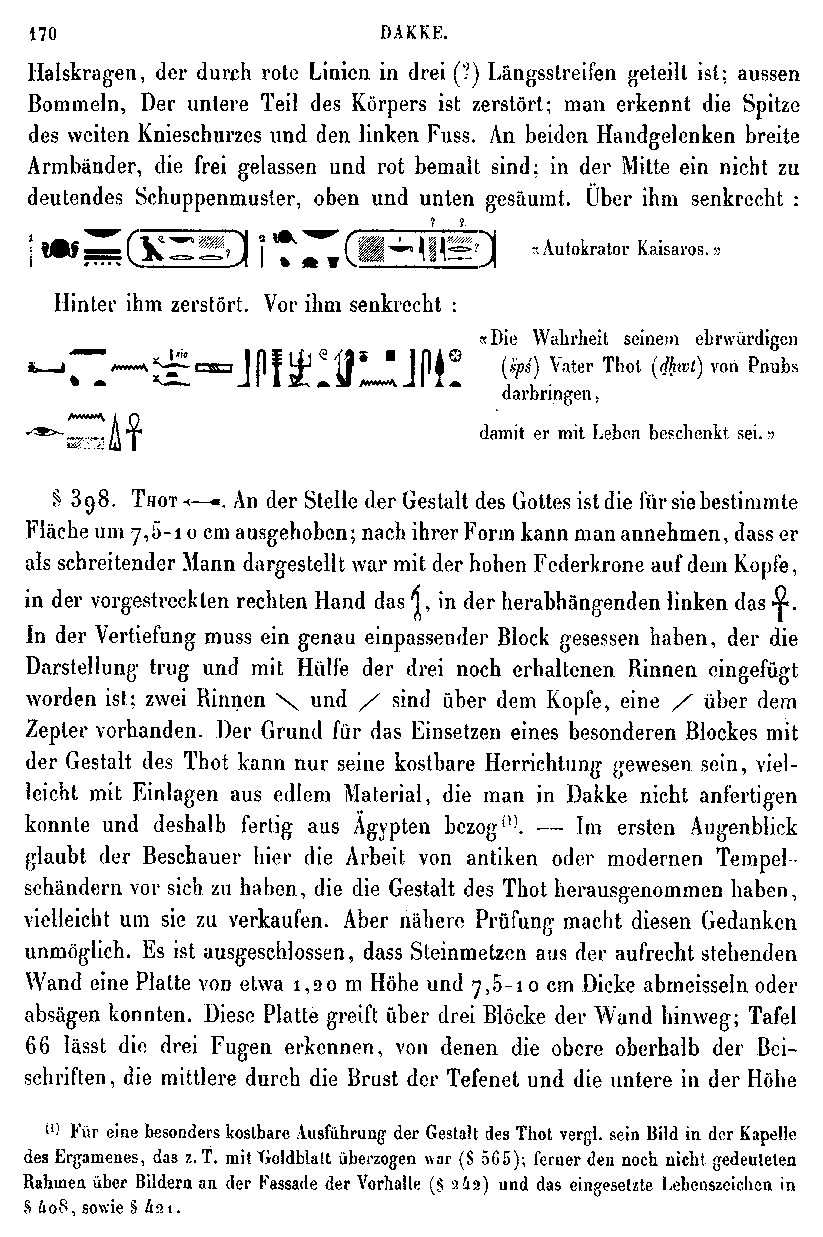
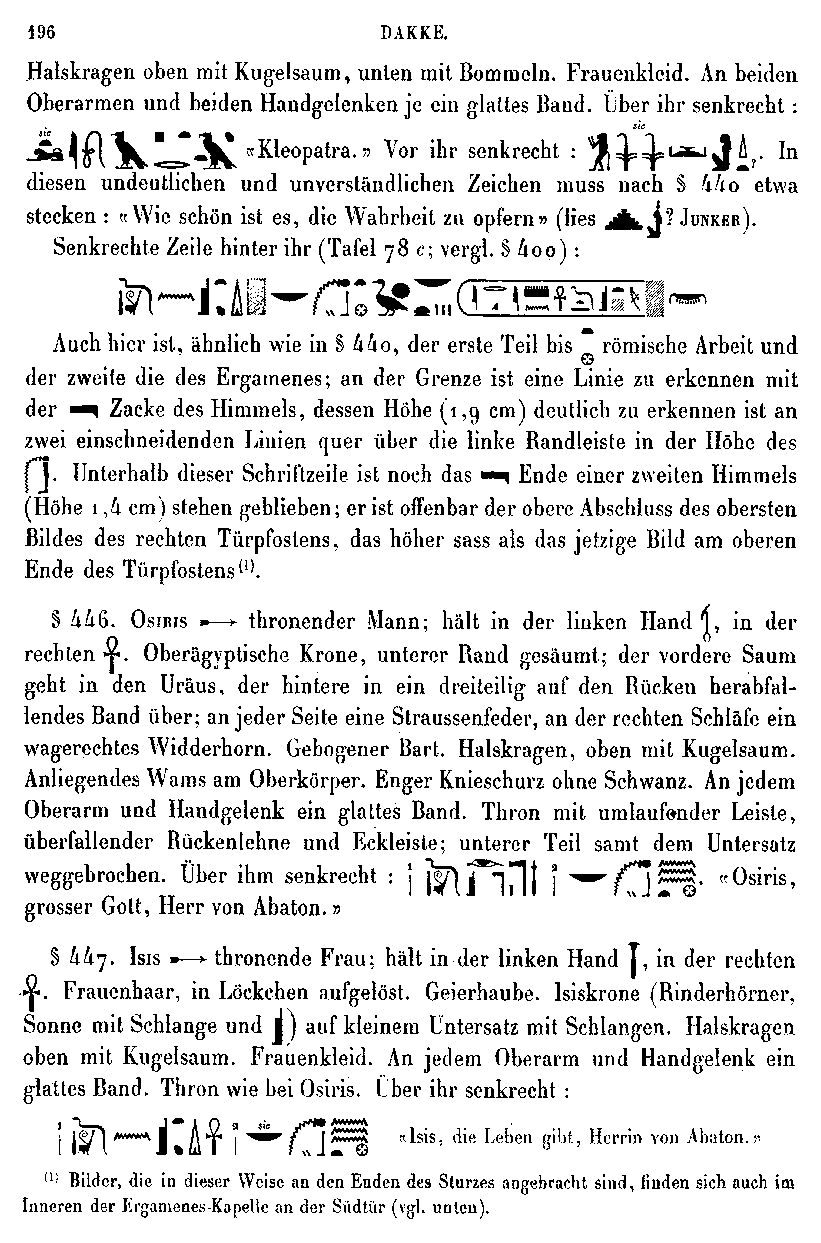
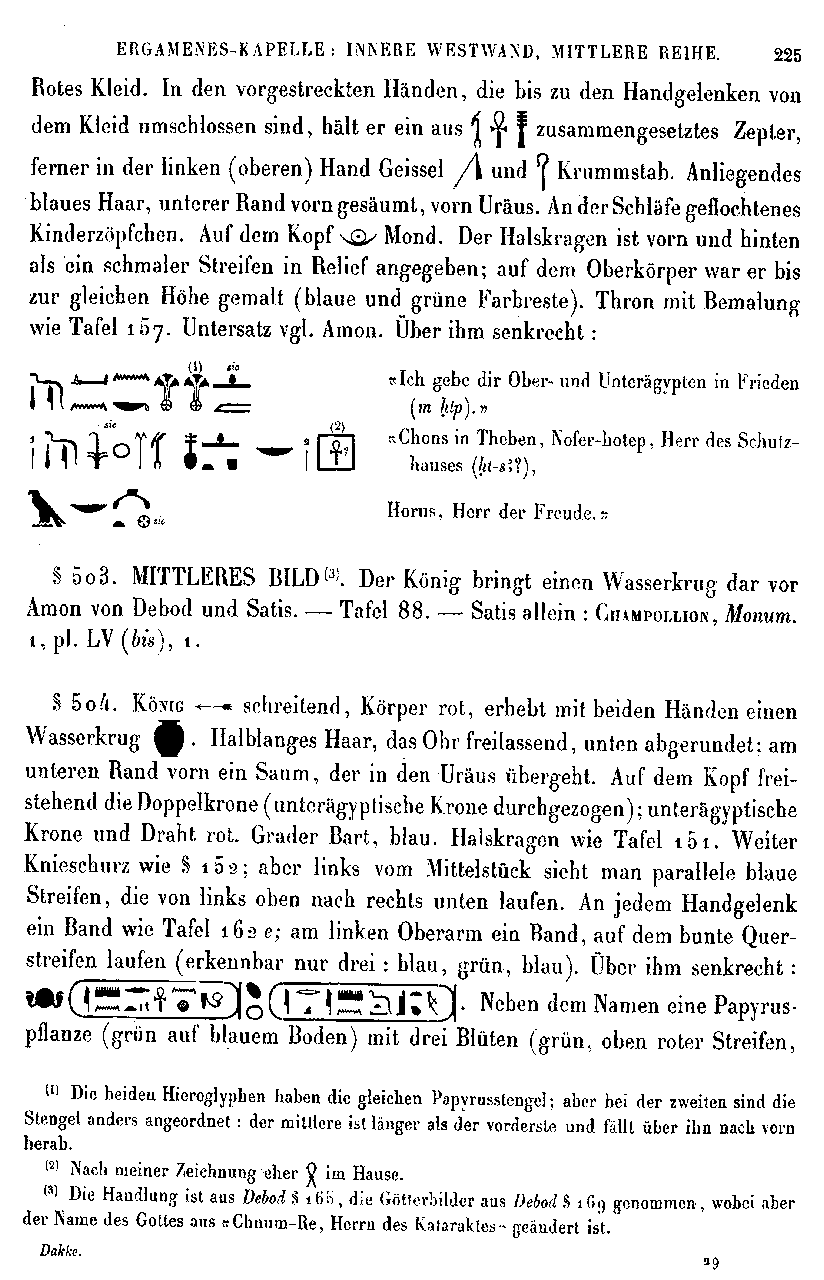
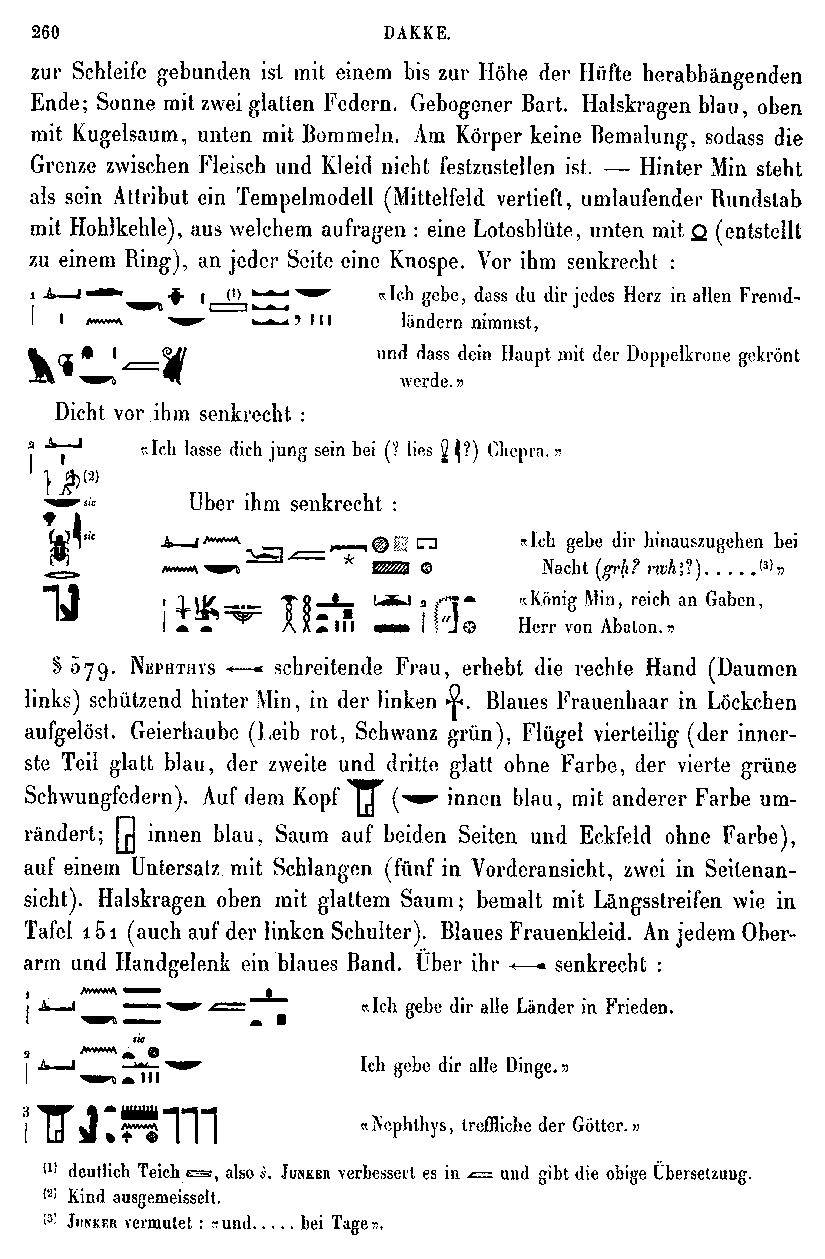
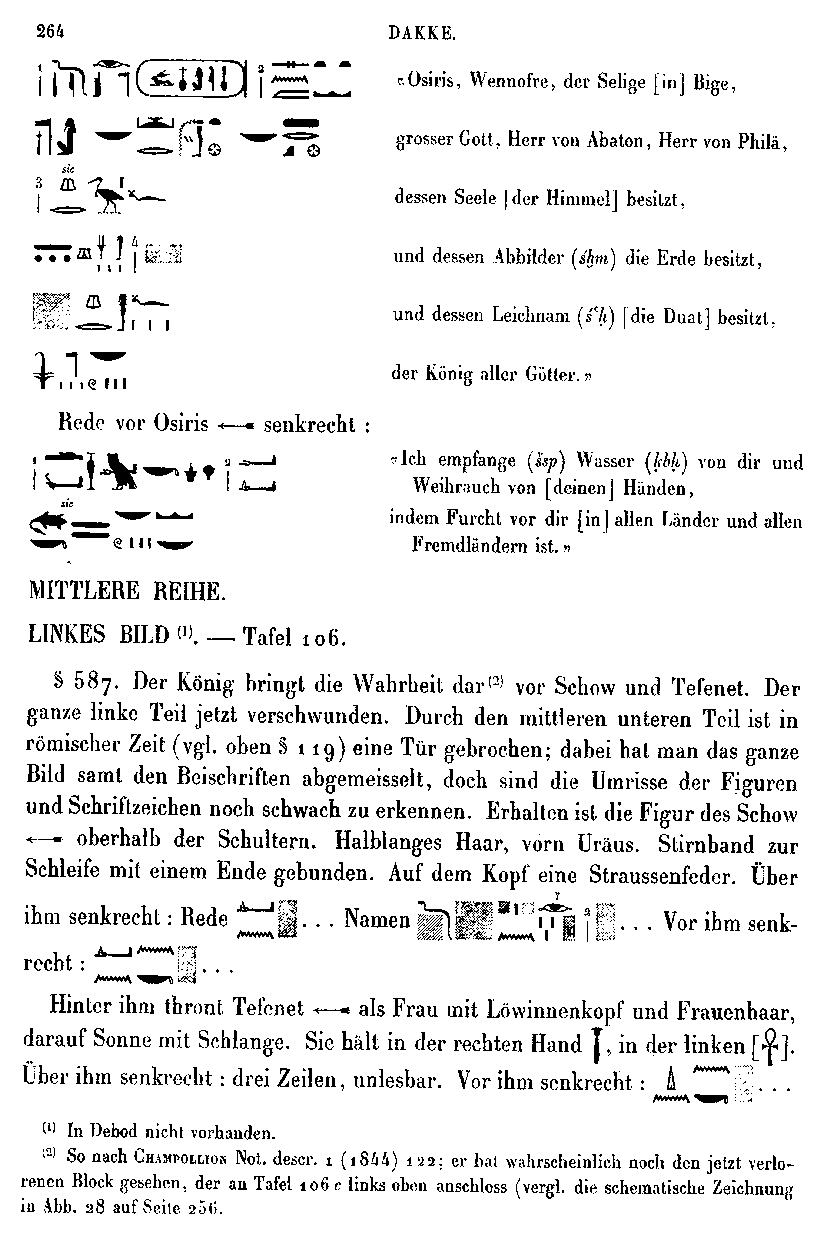
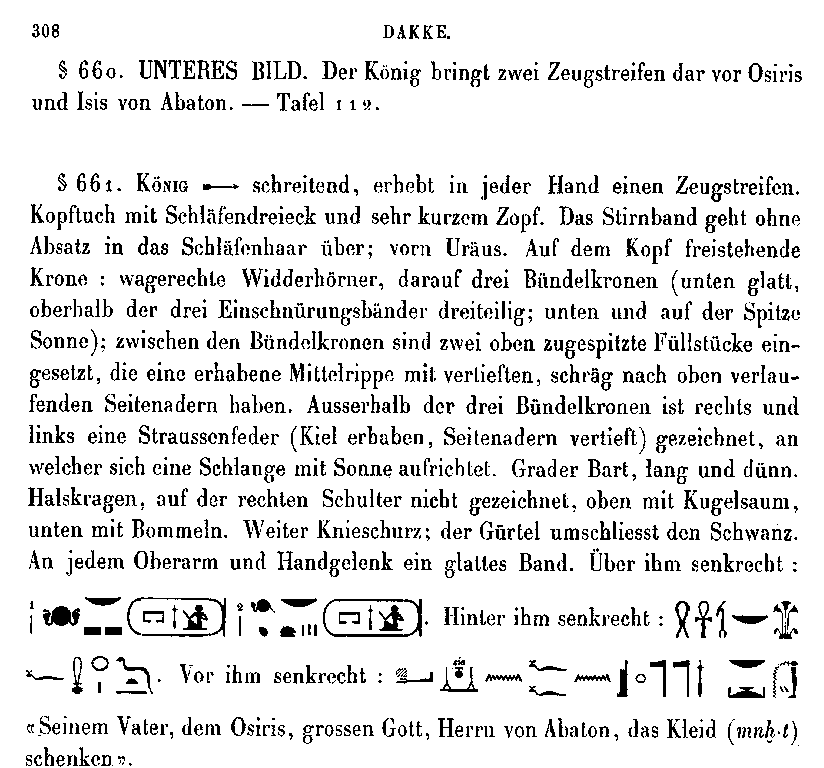
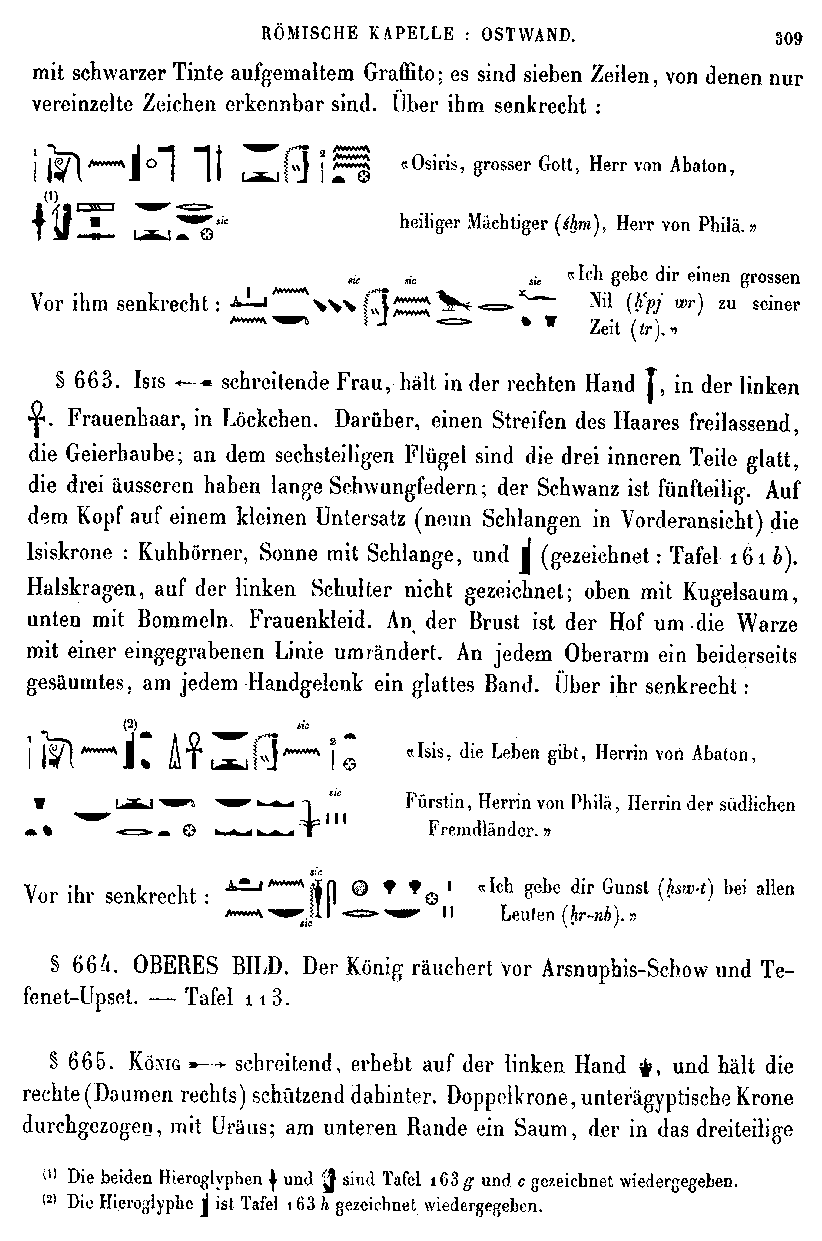
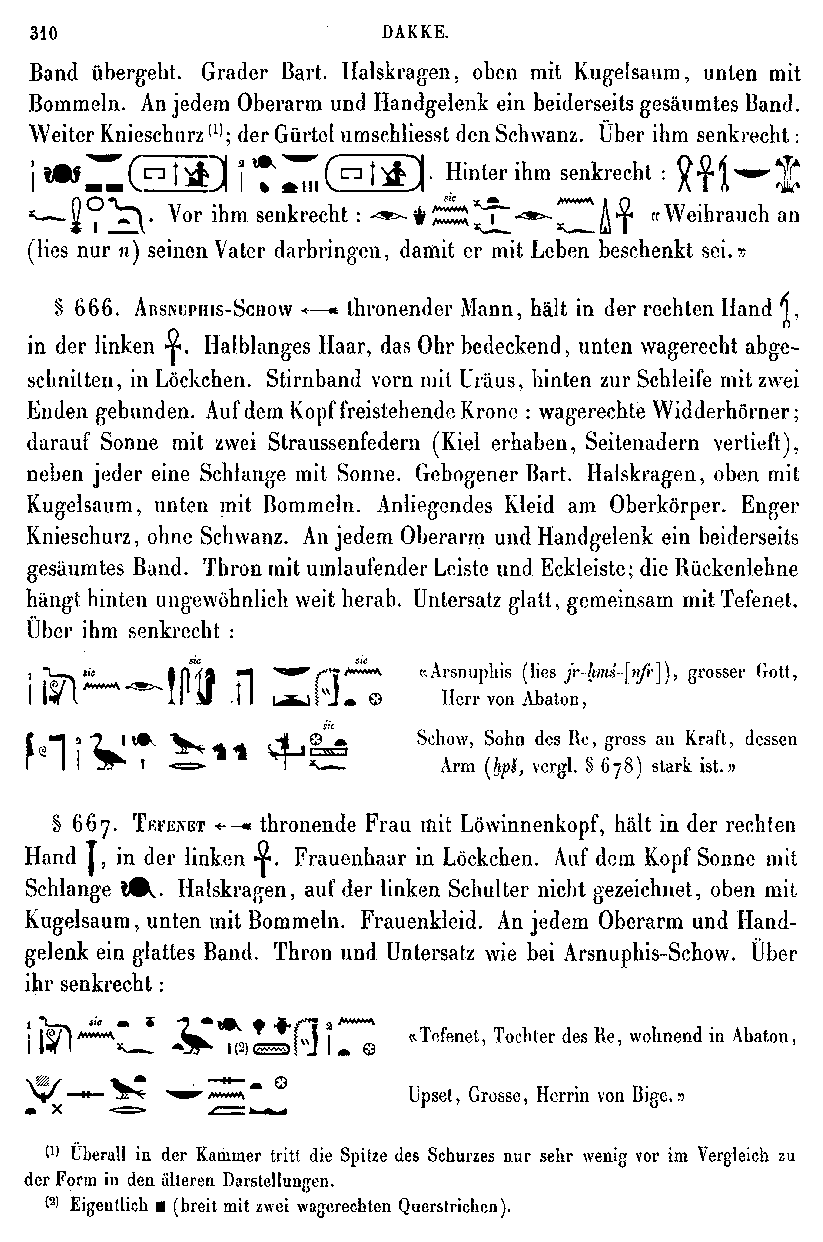
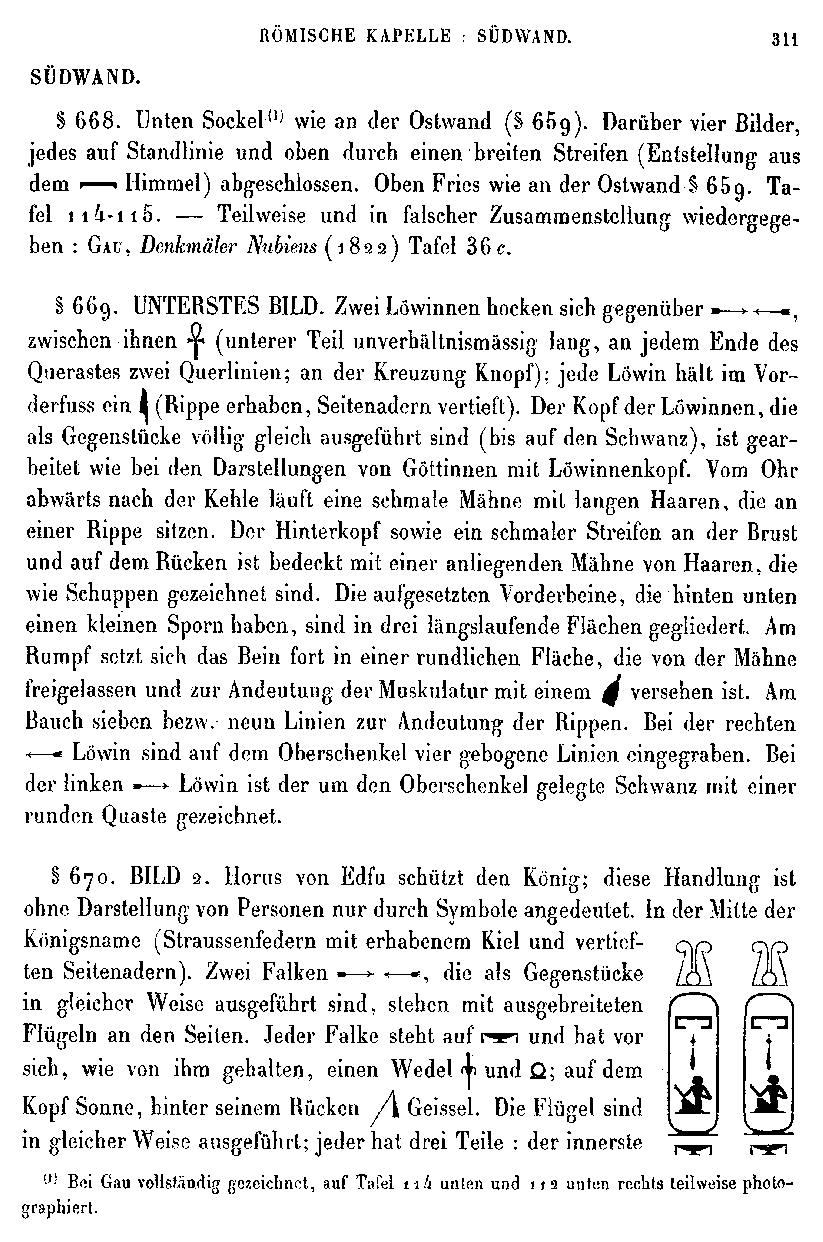
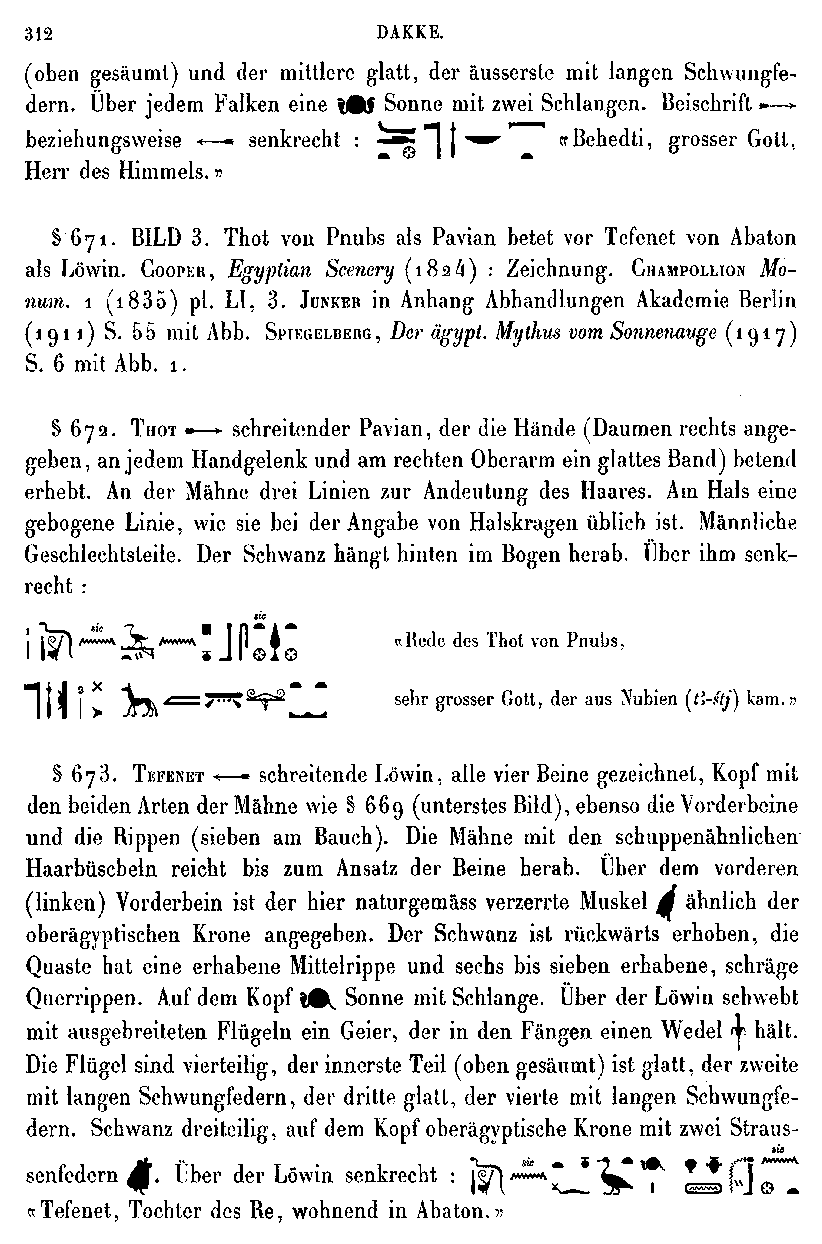
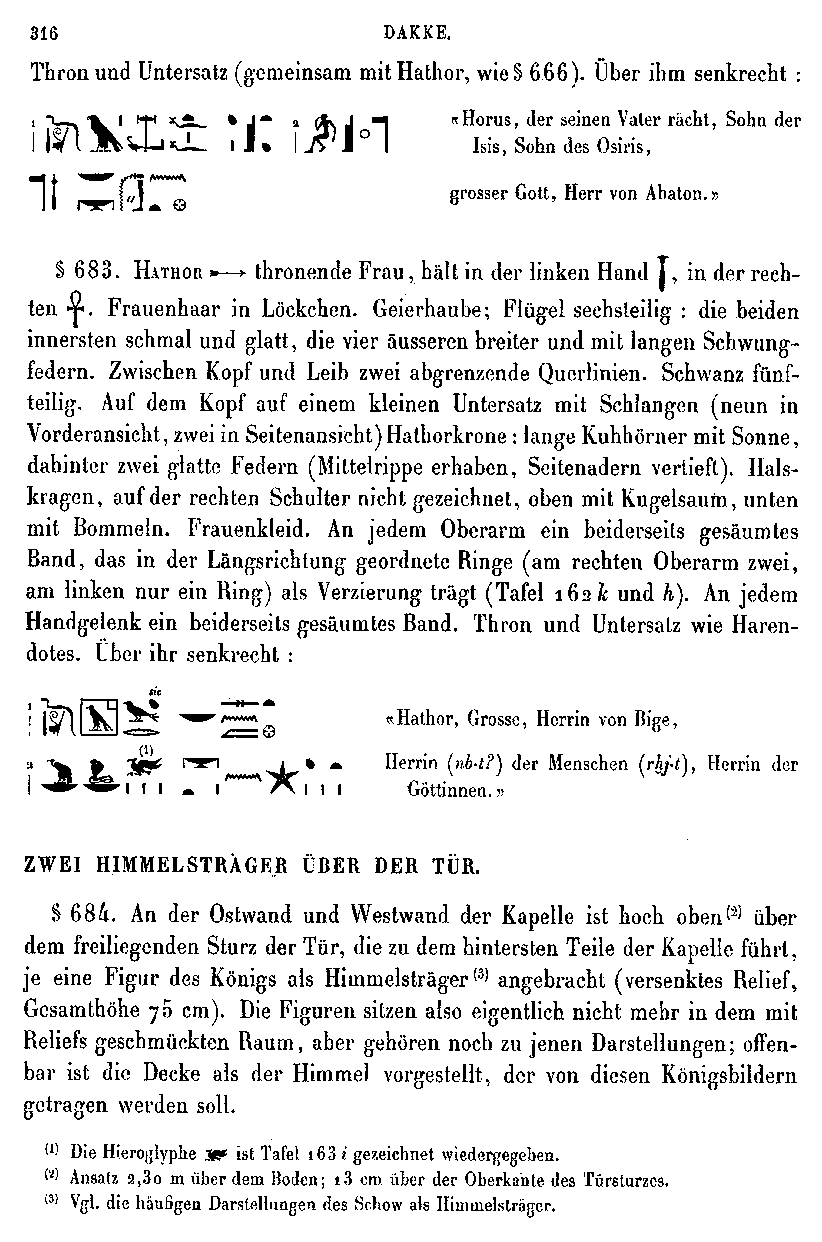
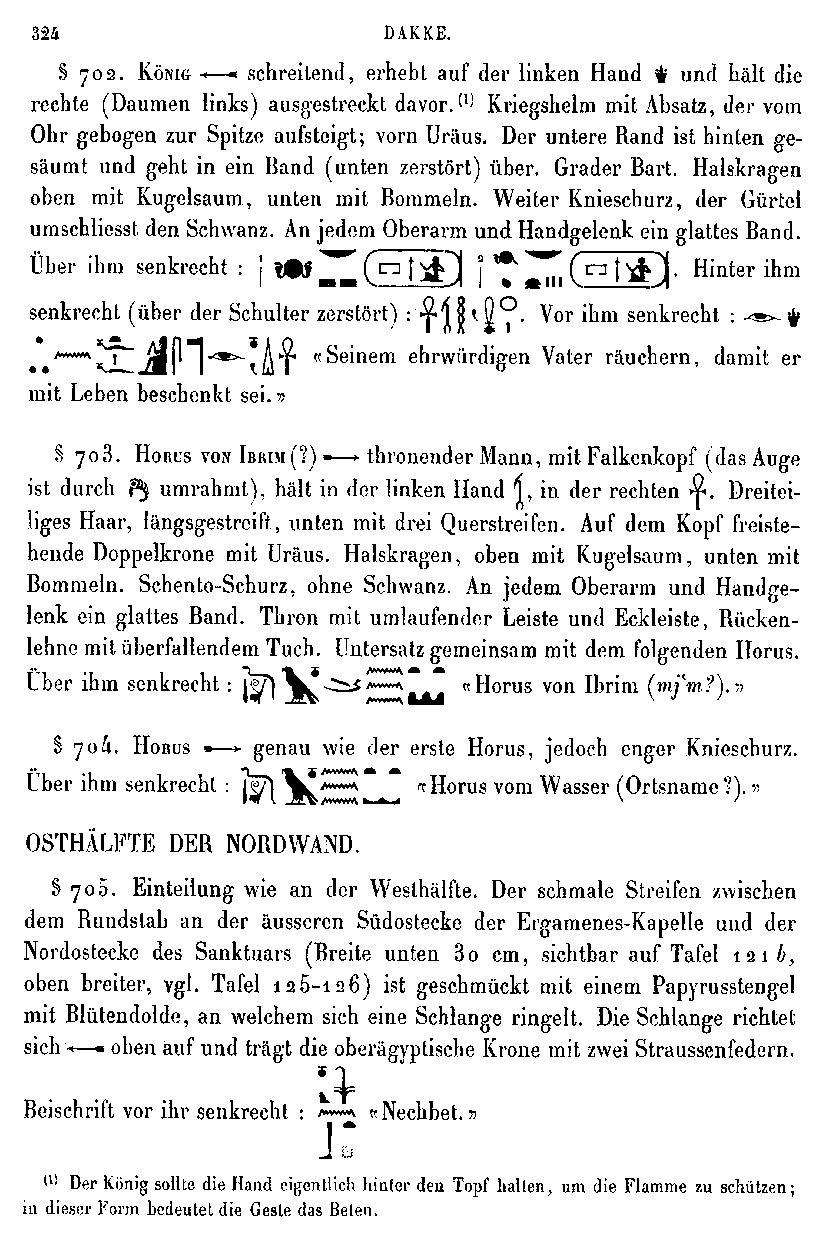
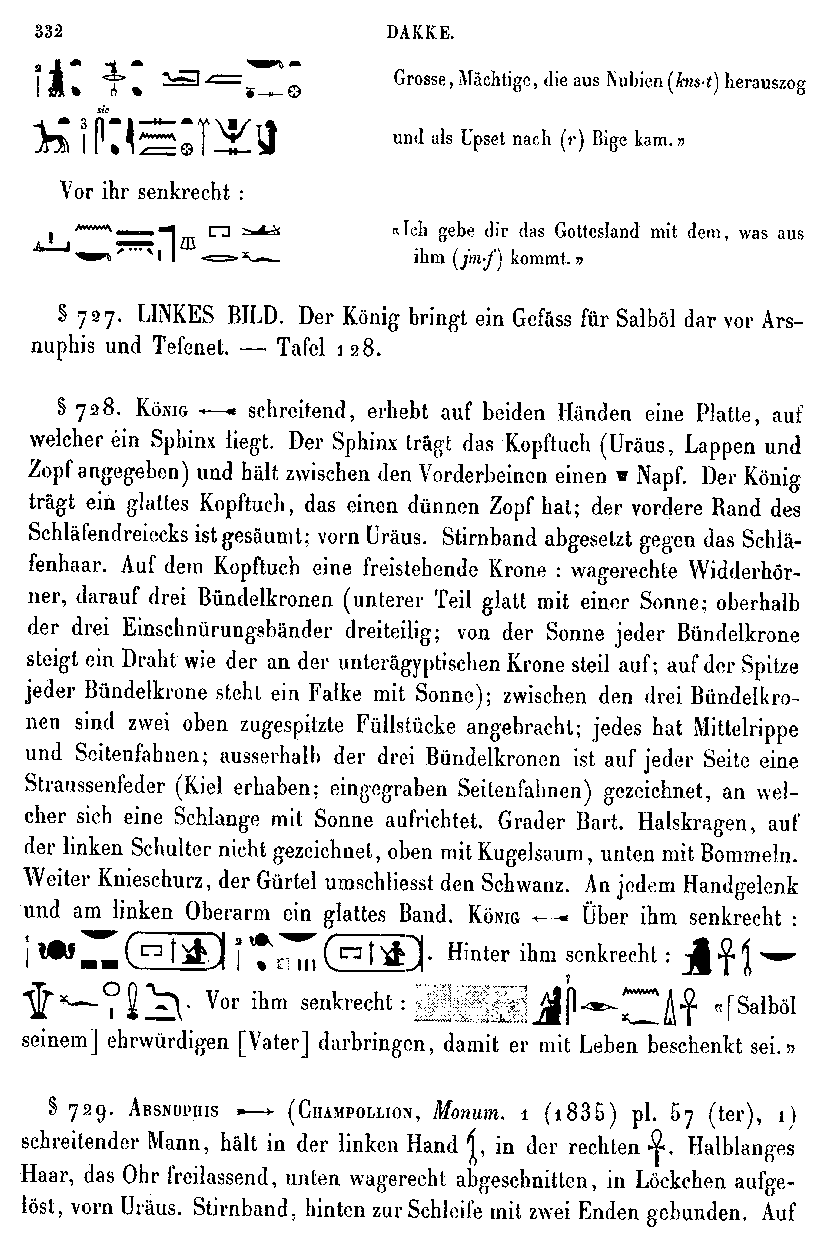
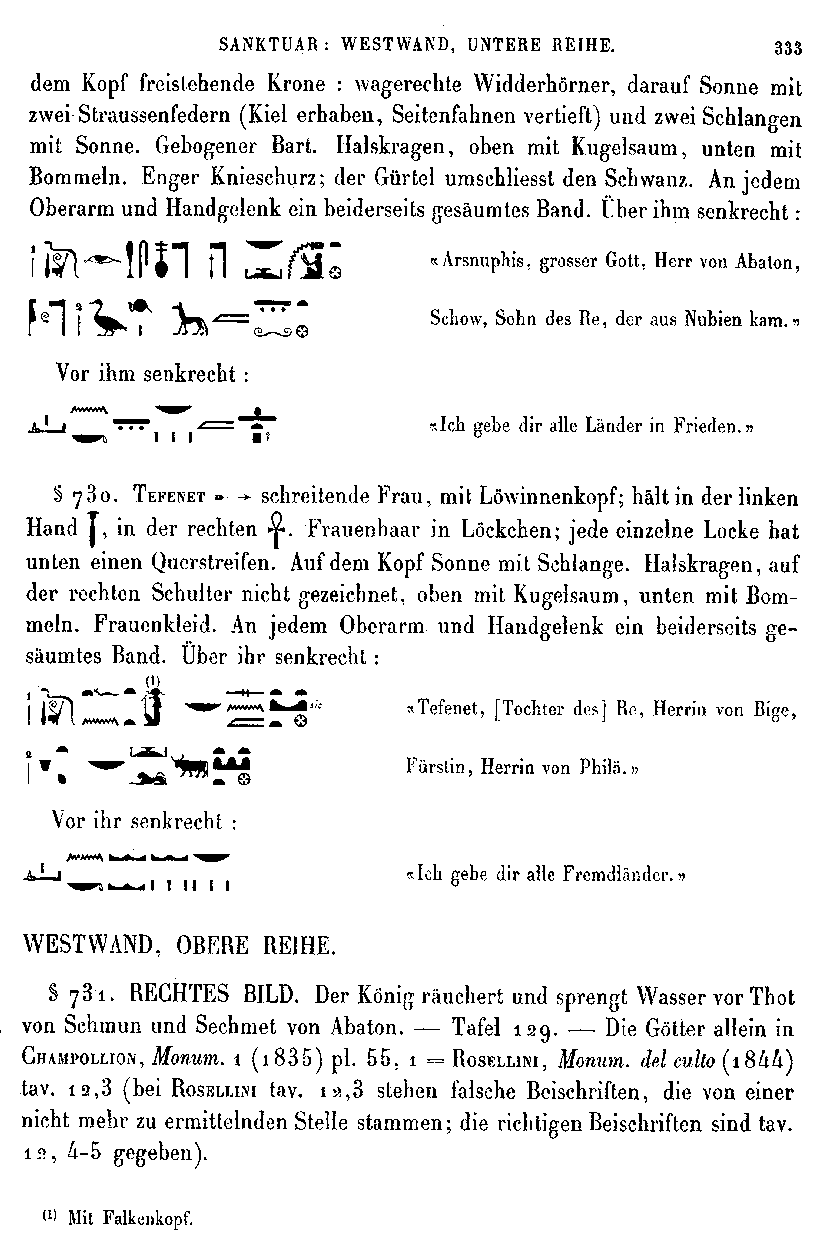
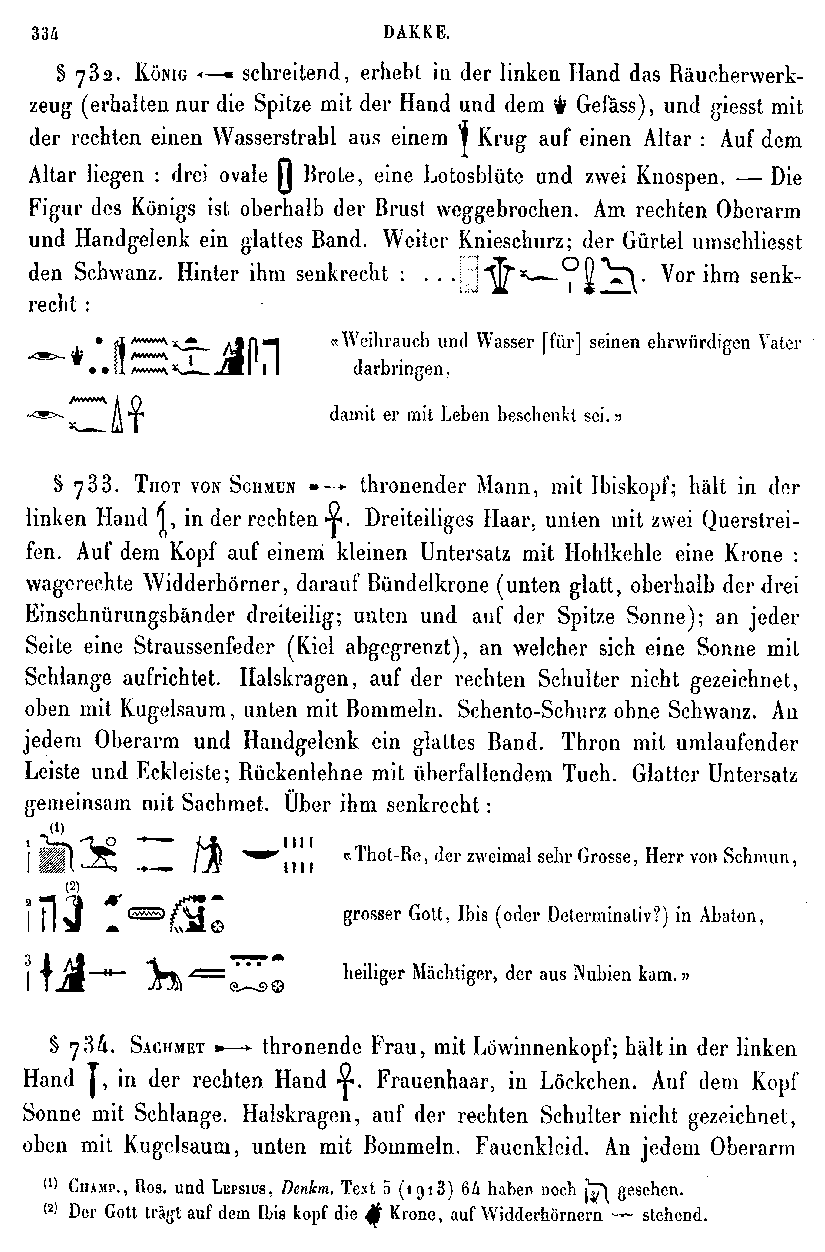
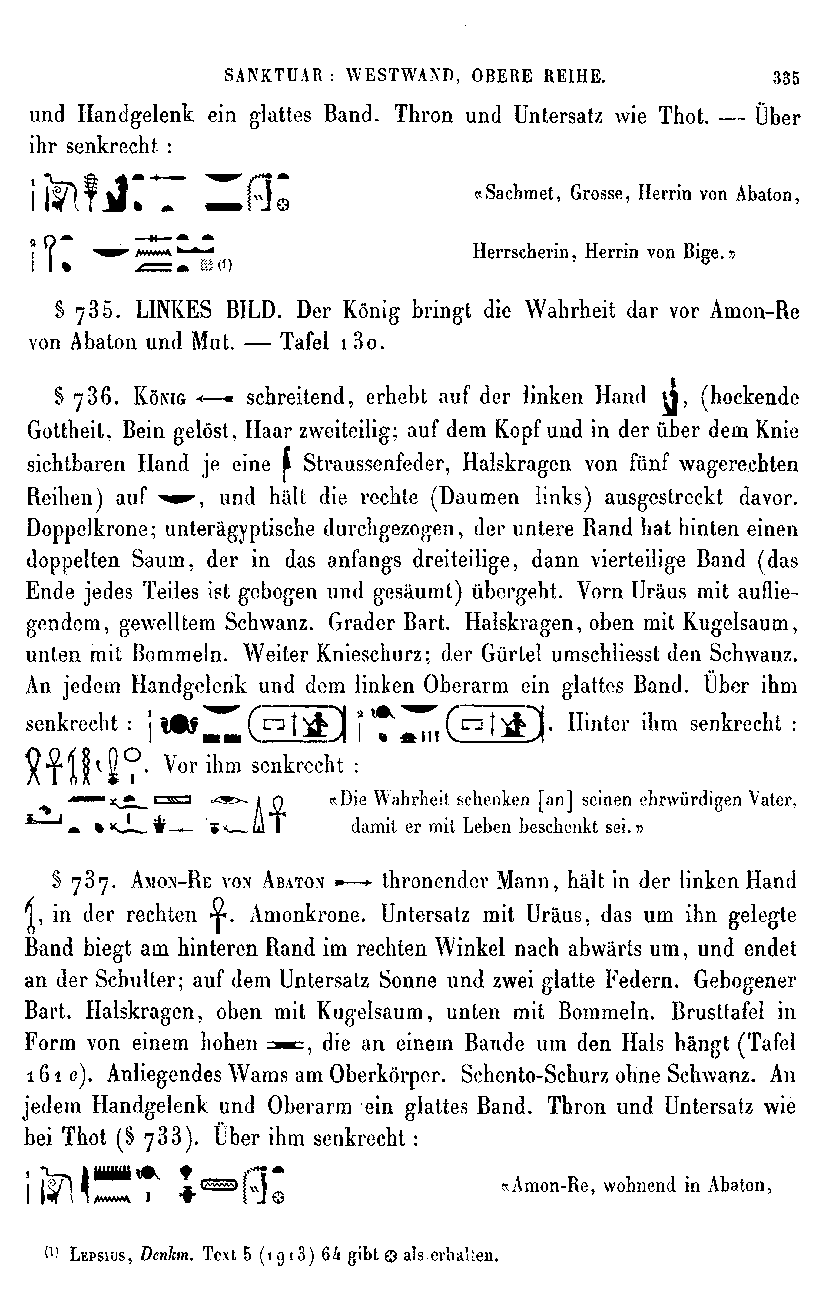
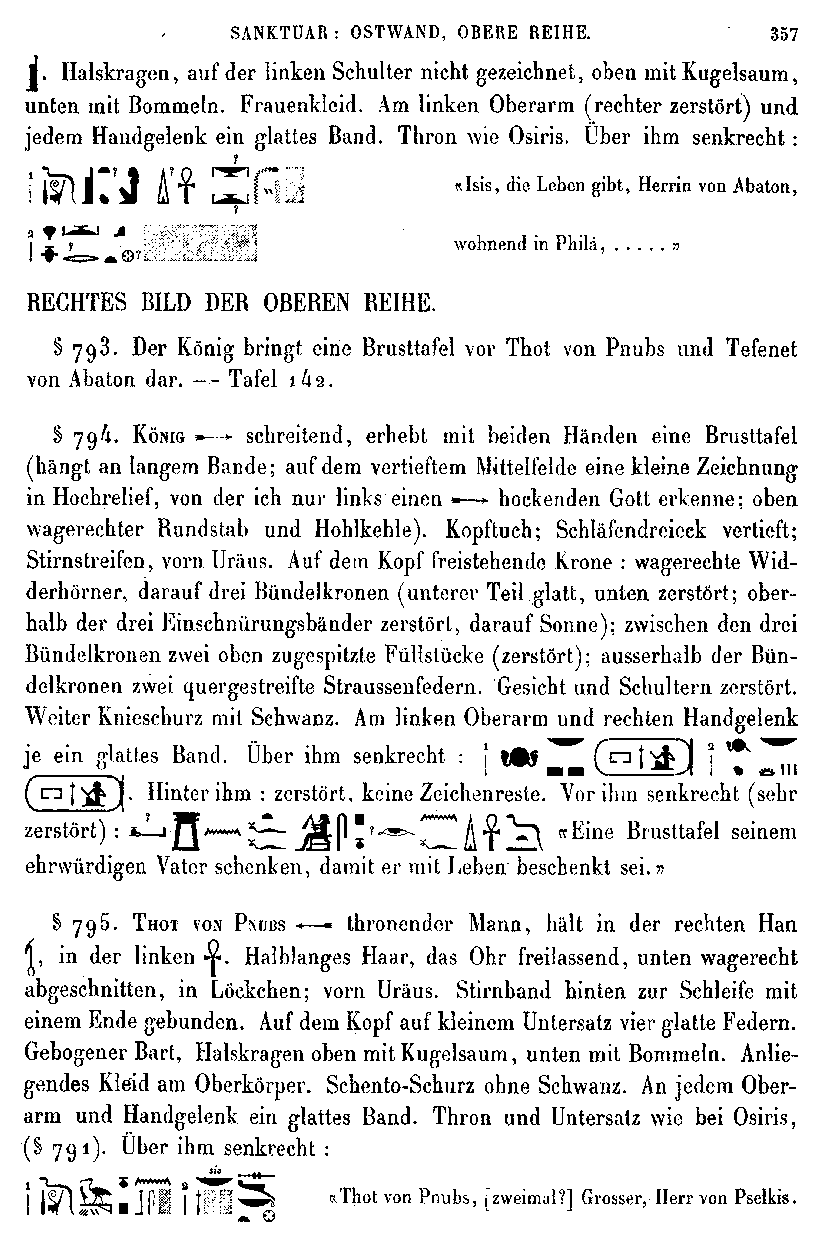
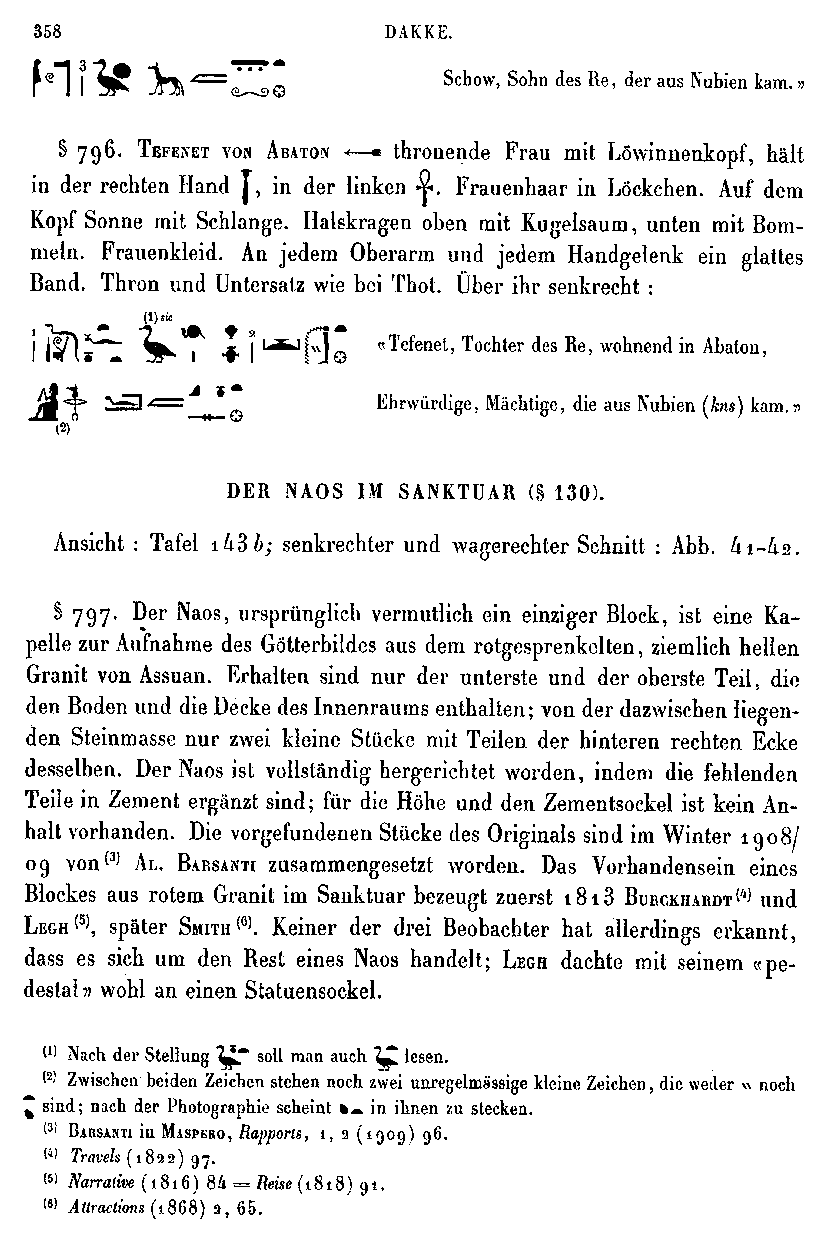
Page 93. Roeder, Der Tempel von Dakke (1930), p. 93 Printed hieroglyphs from G. Roeder, Der Tempel von Dakke (1930) - 1p. 93, § 204
nswt-bj.tj sꜣ-rꜥ --3Q-- sꜣ ꜥnḫ wꜣs nb ḥꜣ=f mj rꜥ ḏ.t
King of Upper and Lower Egypt, Son of Ra, … All protection, life and dominion stand behind him as they stand behind Ra, forever.
- 2p. 93, § 205
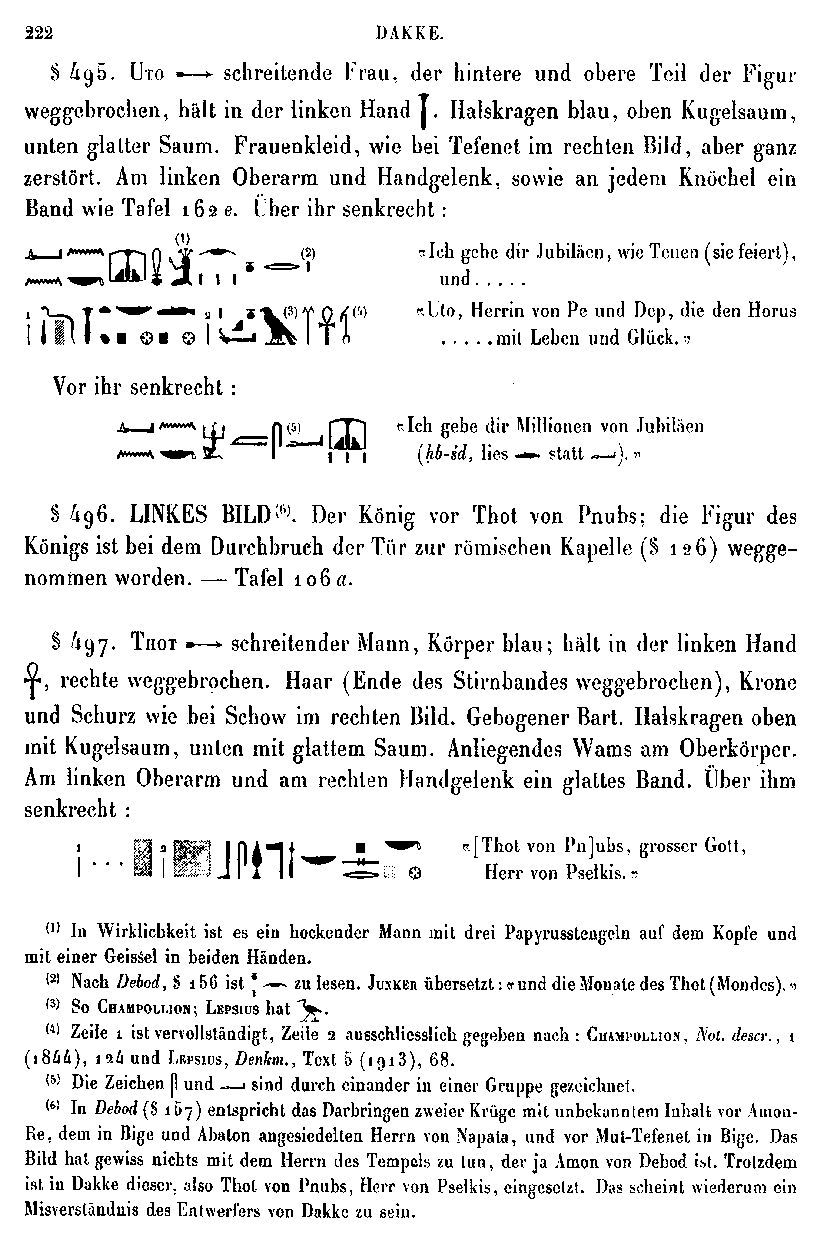
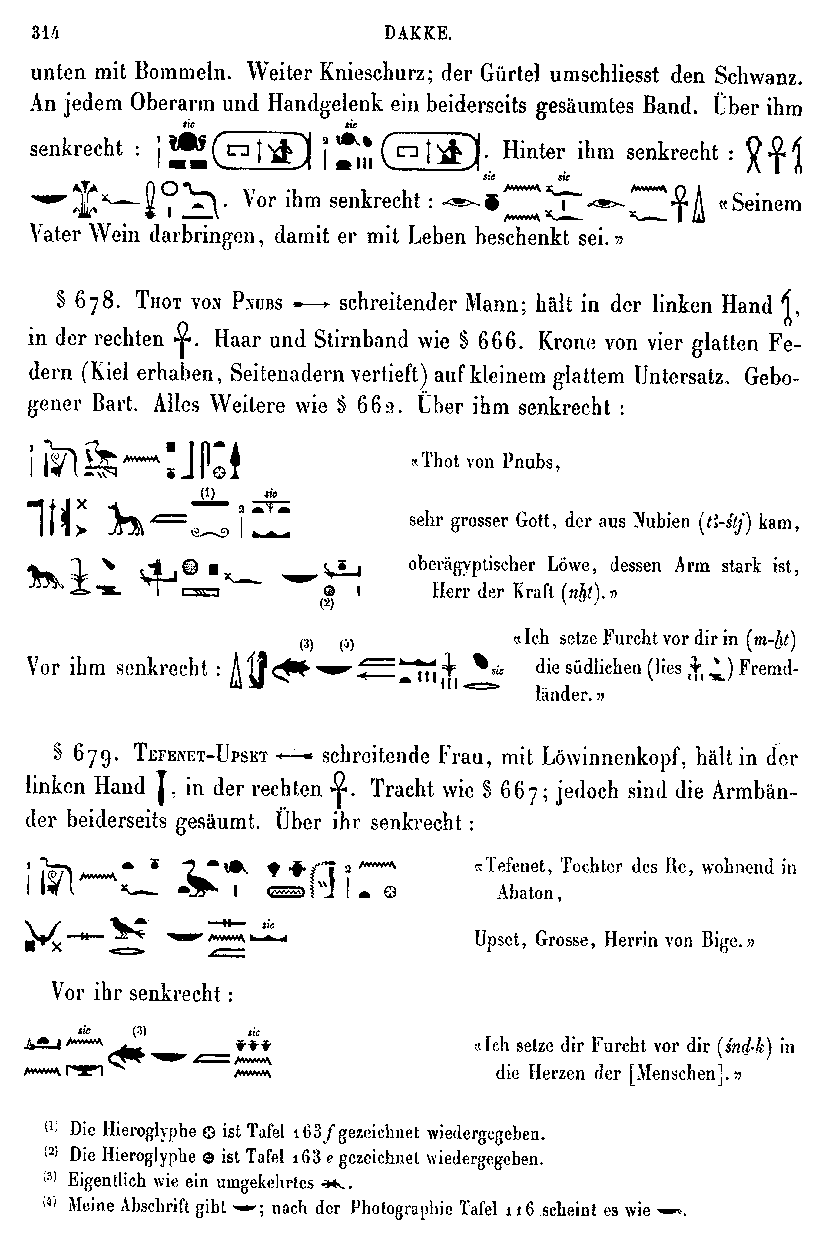
ḏd- ḏḥwtj n pnbs nṯr ꜥꜣ ḥrj sbj ṯnj(1) fnn.w (2) msḏj jy.(t)(3)
Words spoken by Thoth of Pnubs, the great god, who keeps rebels at bay, lifts up the weak and hates evil:
Note · Line 2
Pnubs is the Nubian place-name in the title of the Thoth worshipped at Dakka. - 3p. 93, § 205
--détruit-- =k m-ḫt ḫꜣs.wt rsj.w(t)
… the dread of you throughout the southern lands.
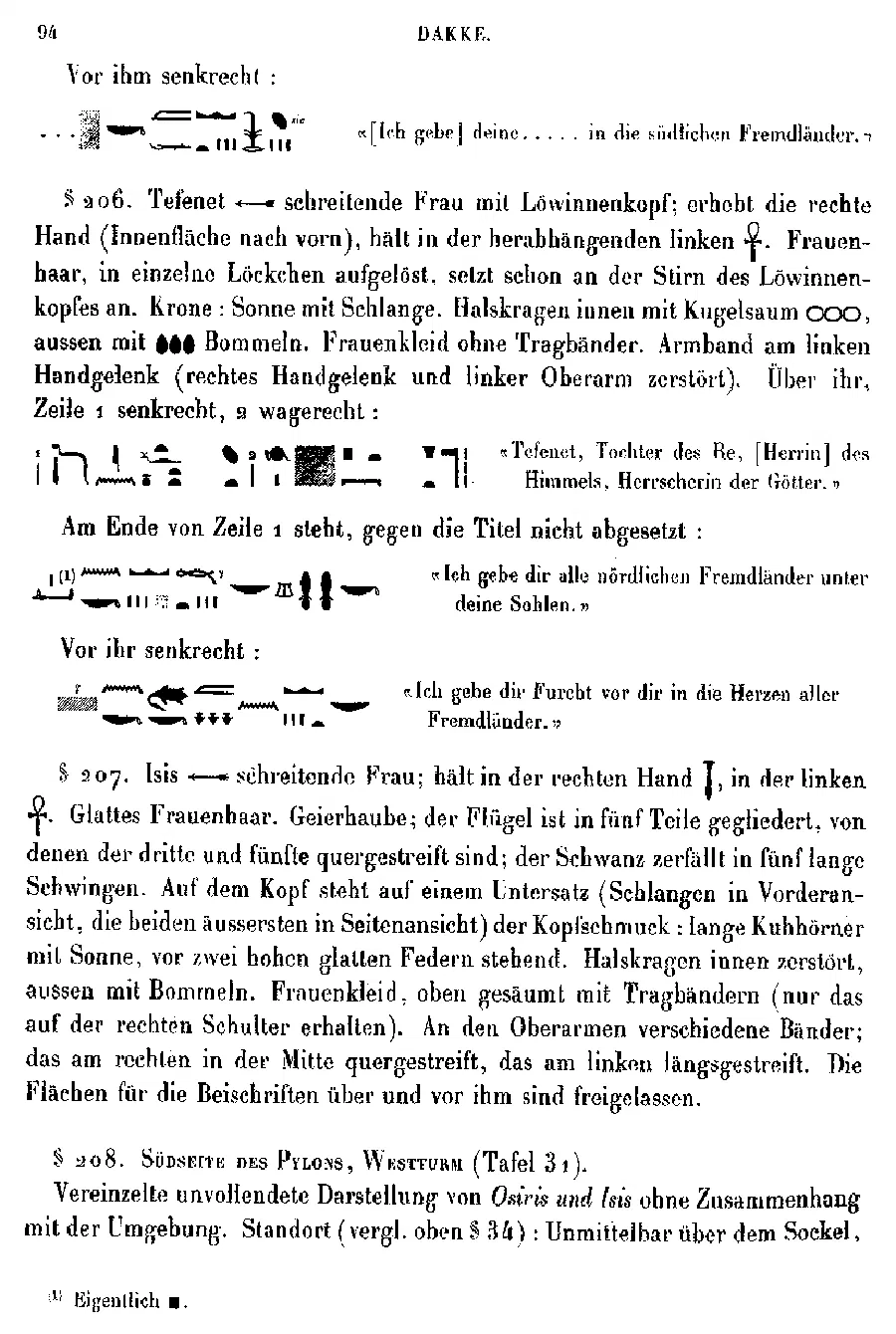
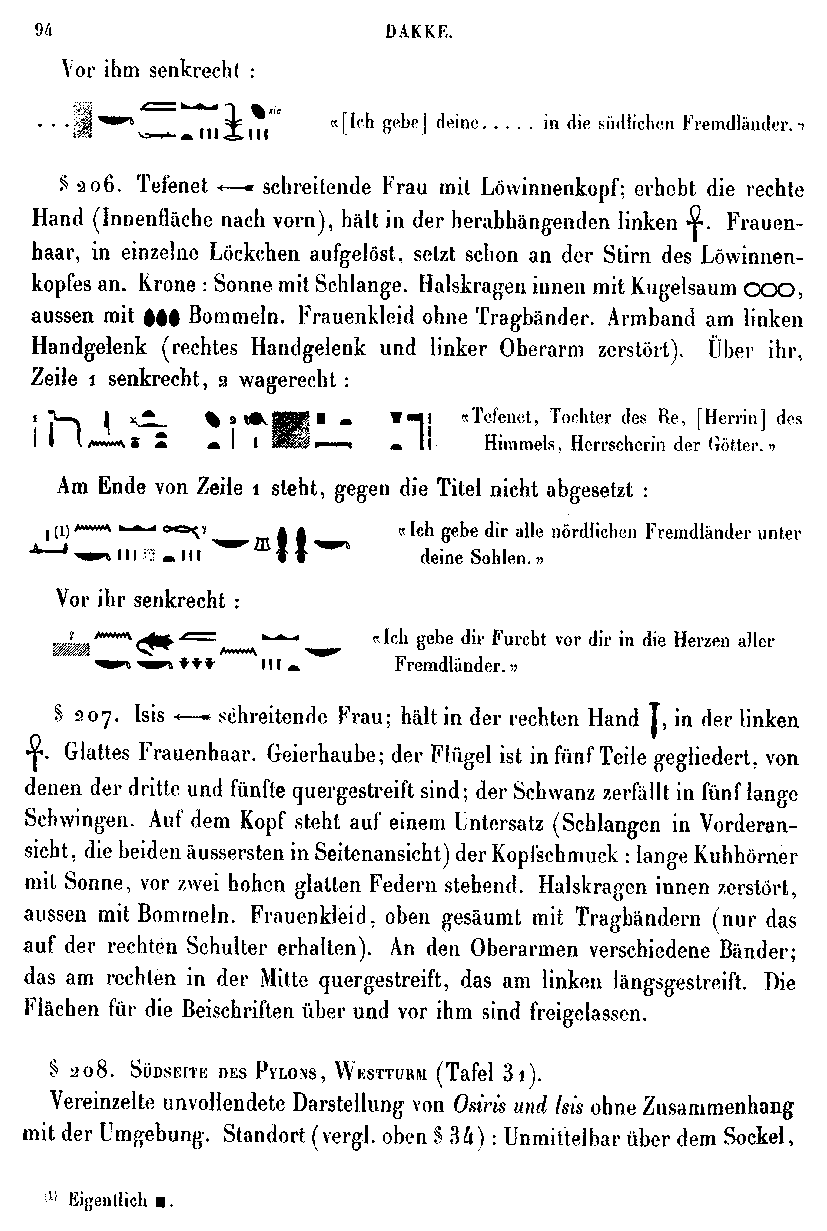
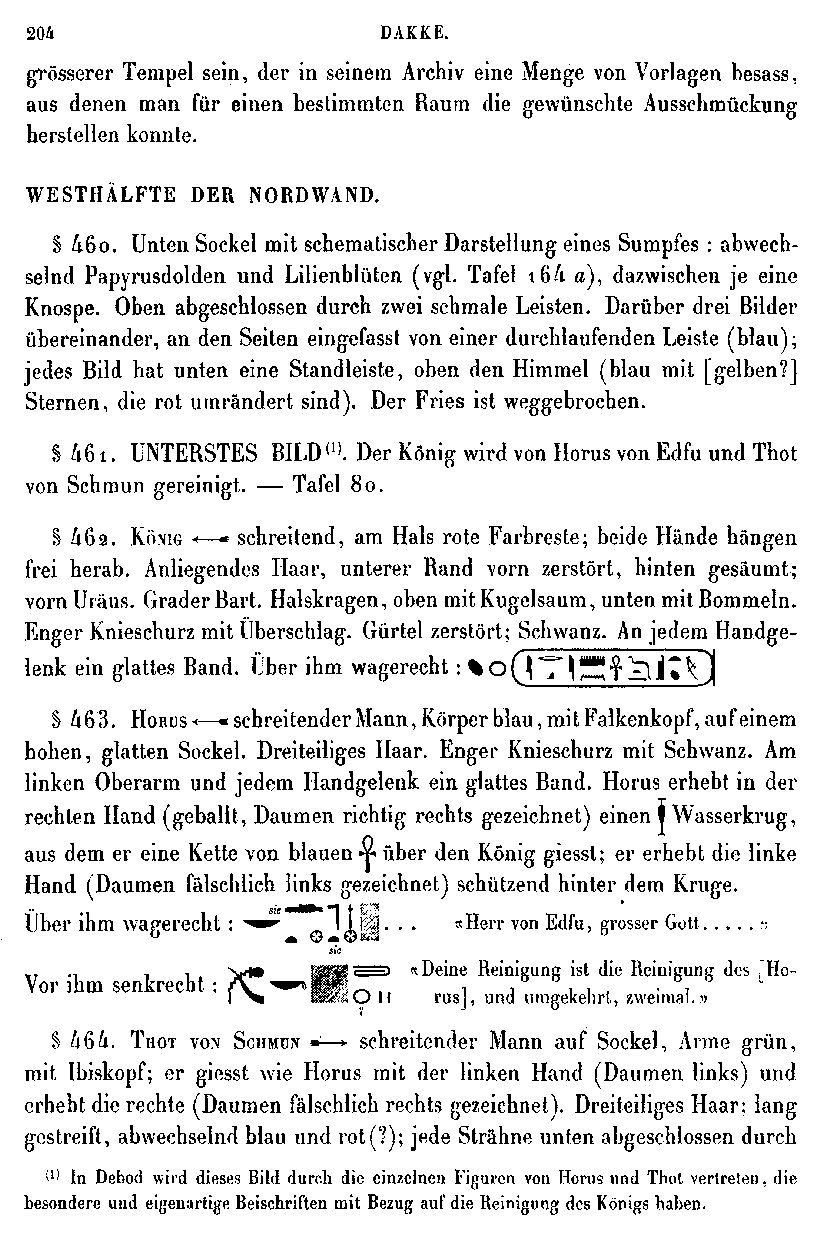
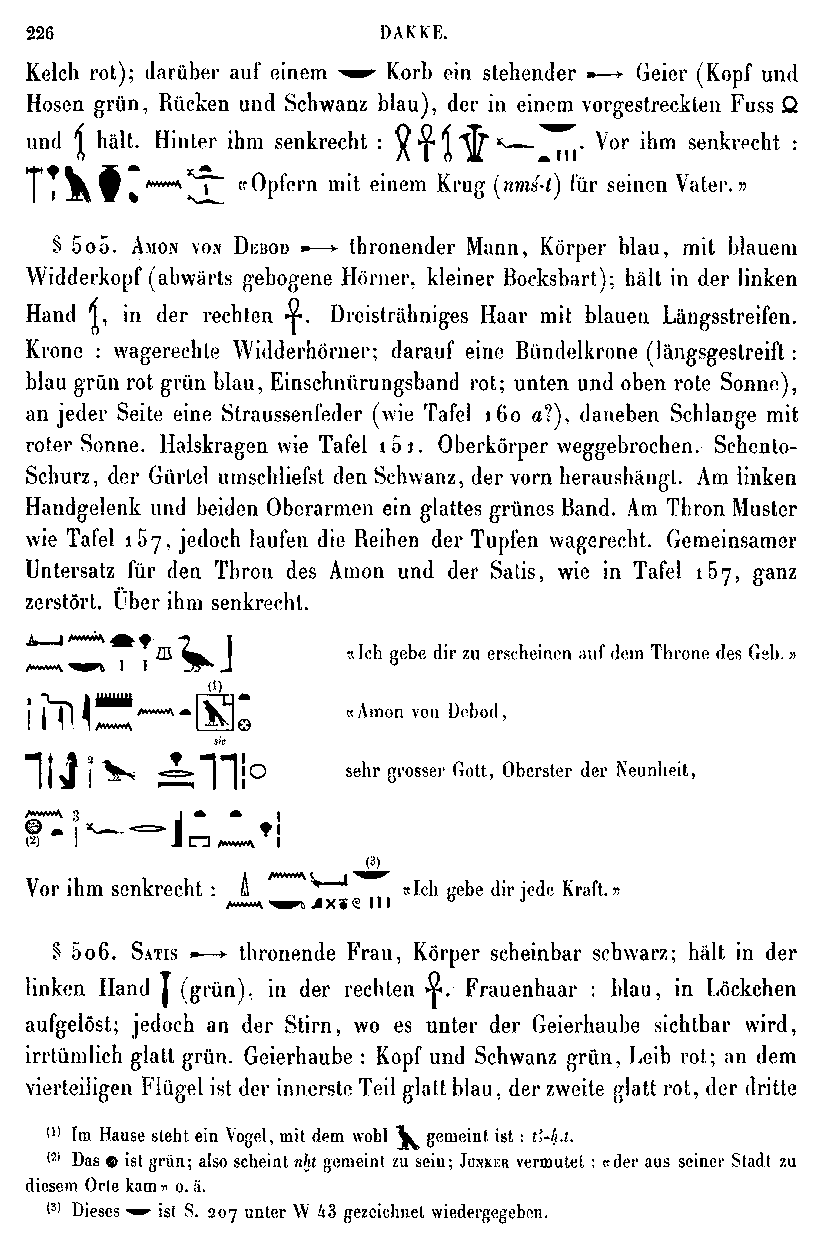
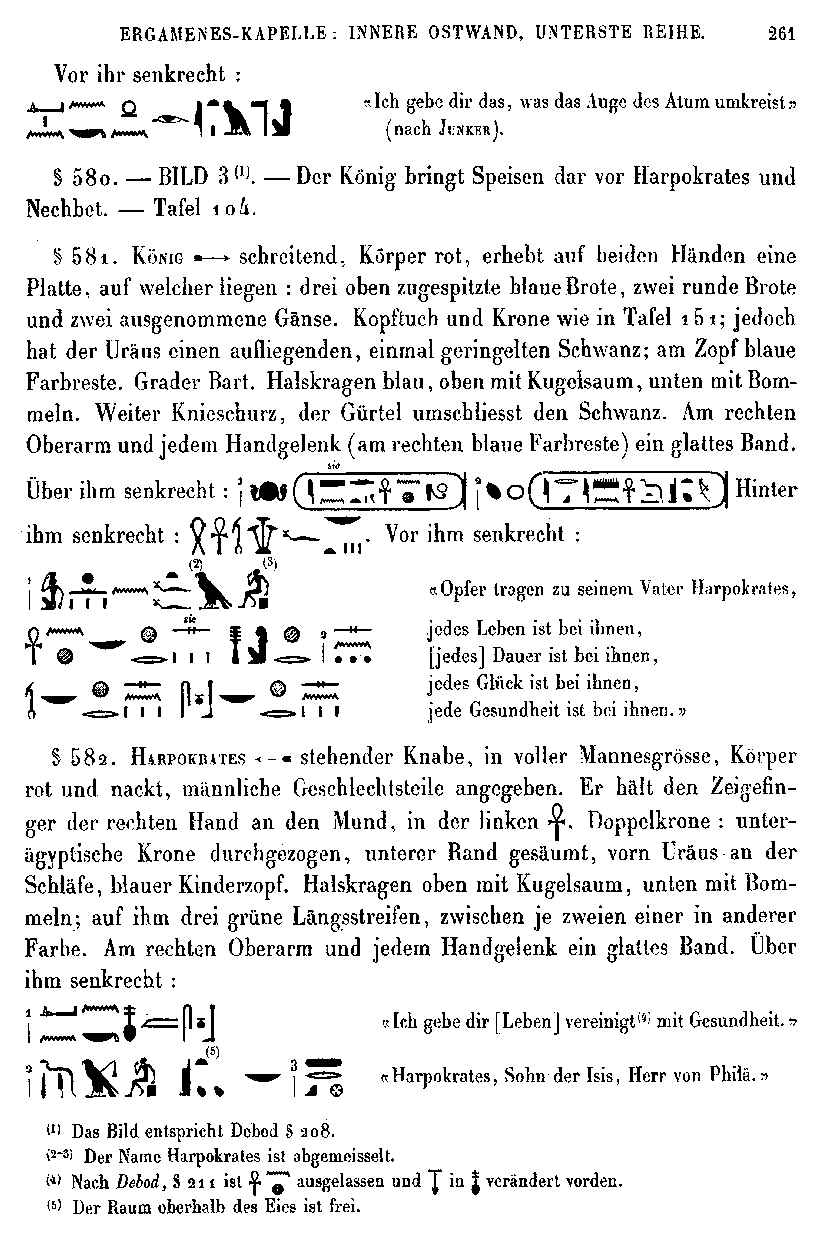
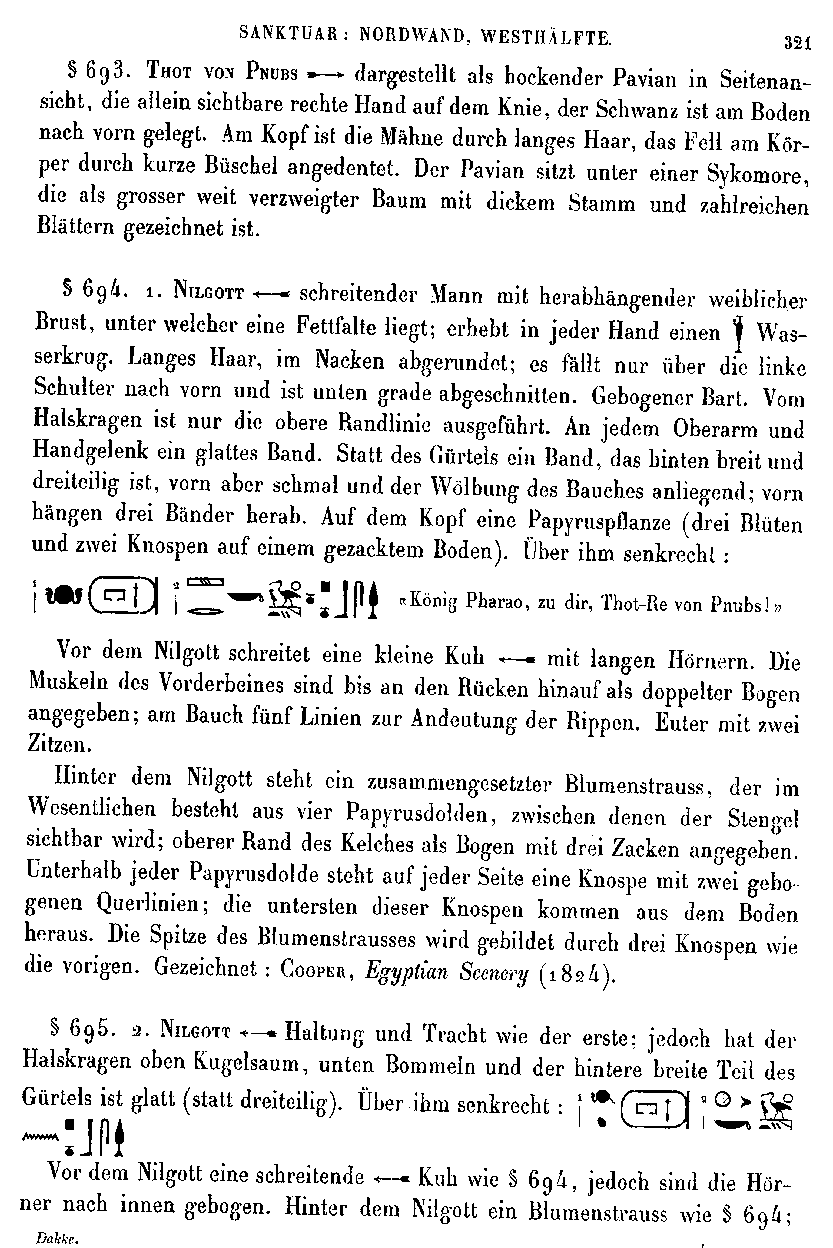
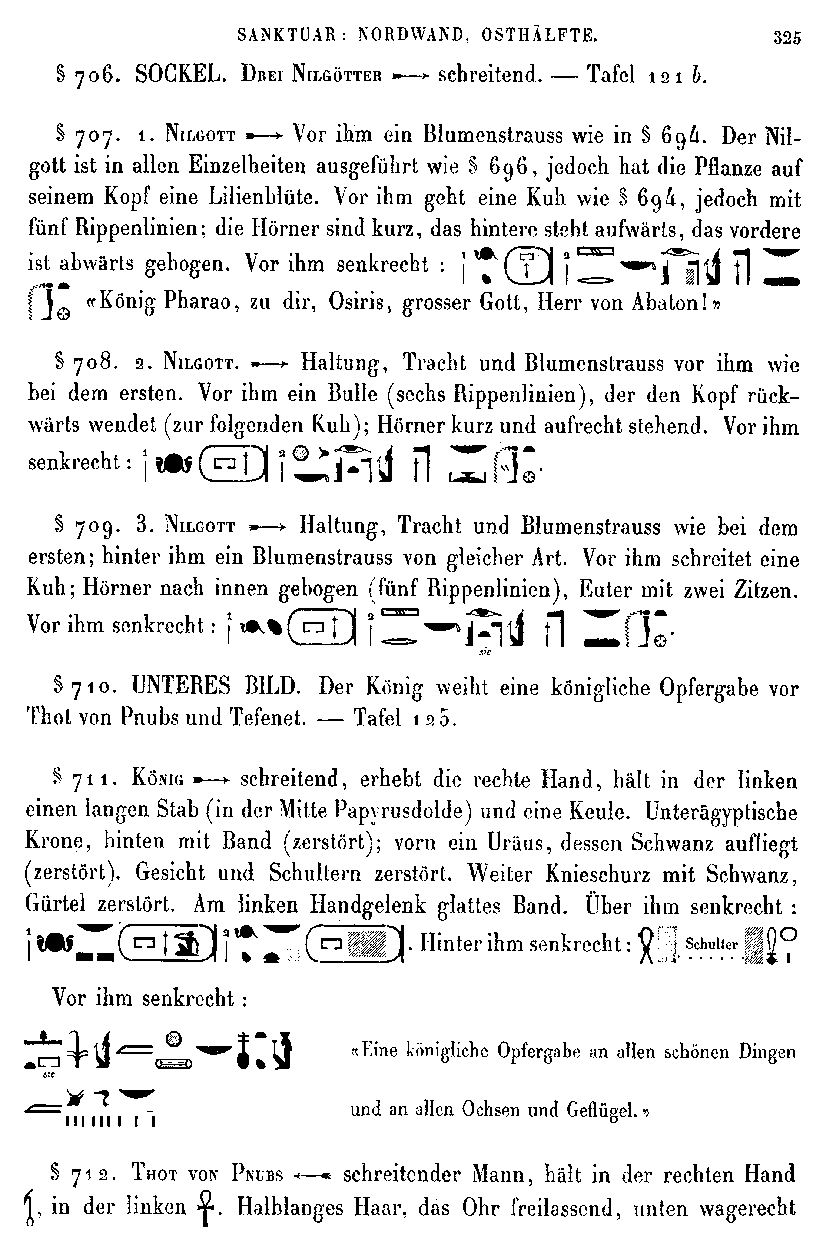
Page 94. Roeder, Der Tempel von Dakke (1930), p. 94 Printed hieroglyphs from G. Roeder, Der Tempel von Dakke (1930) - 4p. 94, § 206
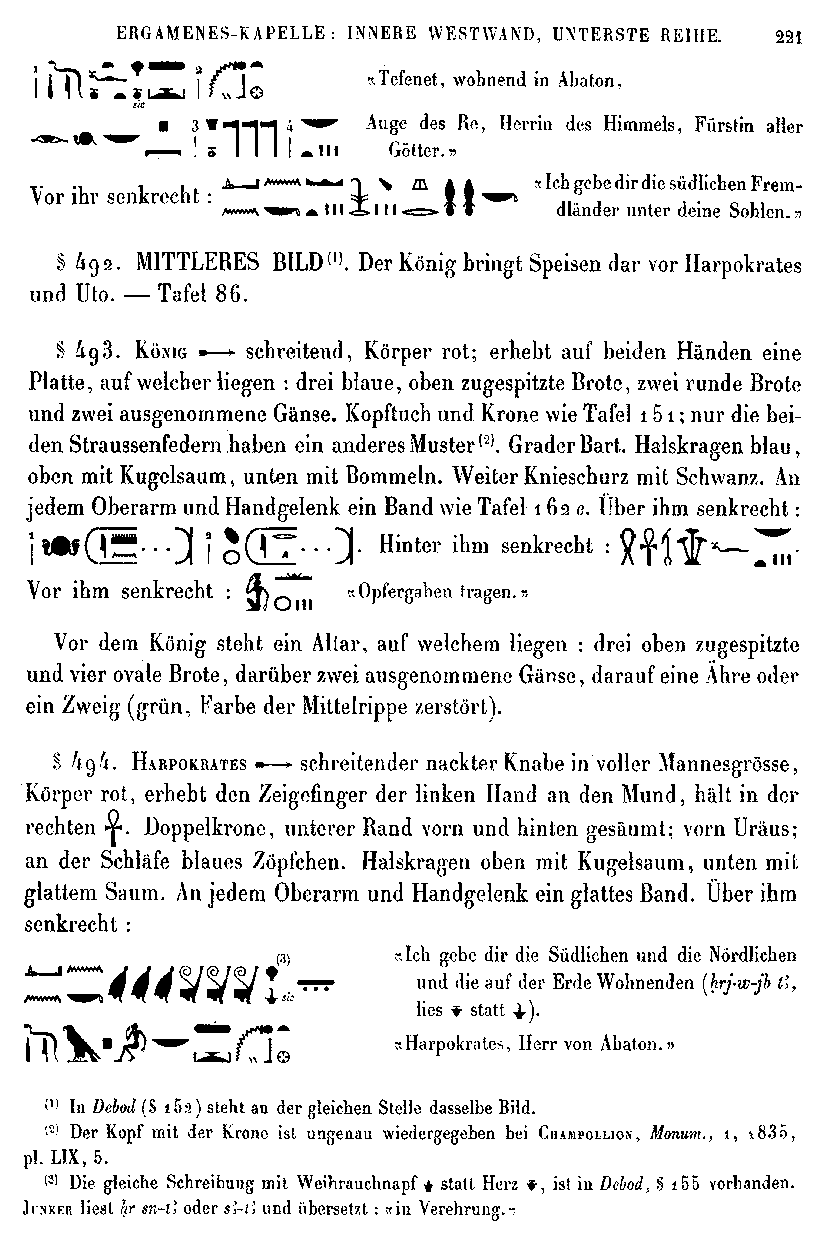
ḏd-mdw jn tfn.t sꜣ.t rꜥ [nb.t] p.t ḥnw.t nṯr.w
Words spoken by Tefnut, daughter of Ra, lady of the sky, mistress of the gods:
- 5p. 94, § 206
dj=j n=k ḫꜣs.wt mḥ.wt nb.(wt) ẖr ṯb.tj=k
I set all the northern lands beneath your two sandals.
Note · Line 5
The gods address the king. Foreign lands beneath his sandals are an image of his rule over them. - 6p. 94, § 206
[dj]=j n=k snḏ=k m jb.w n ḫꜣs.wt nb.(wt)
I set the dread of you in the hearts of all foreign lands.
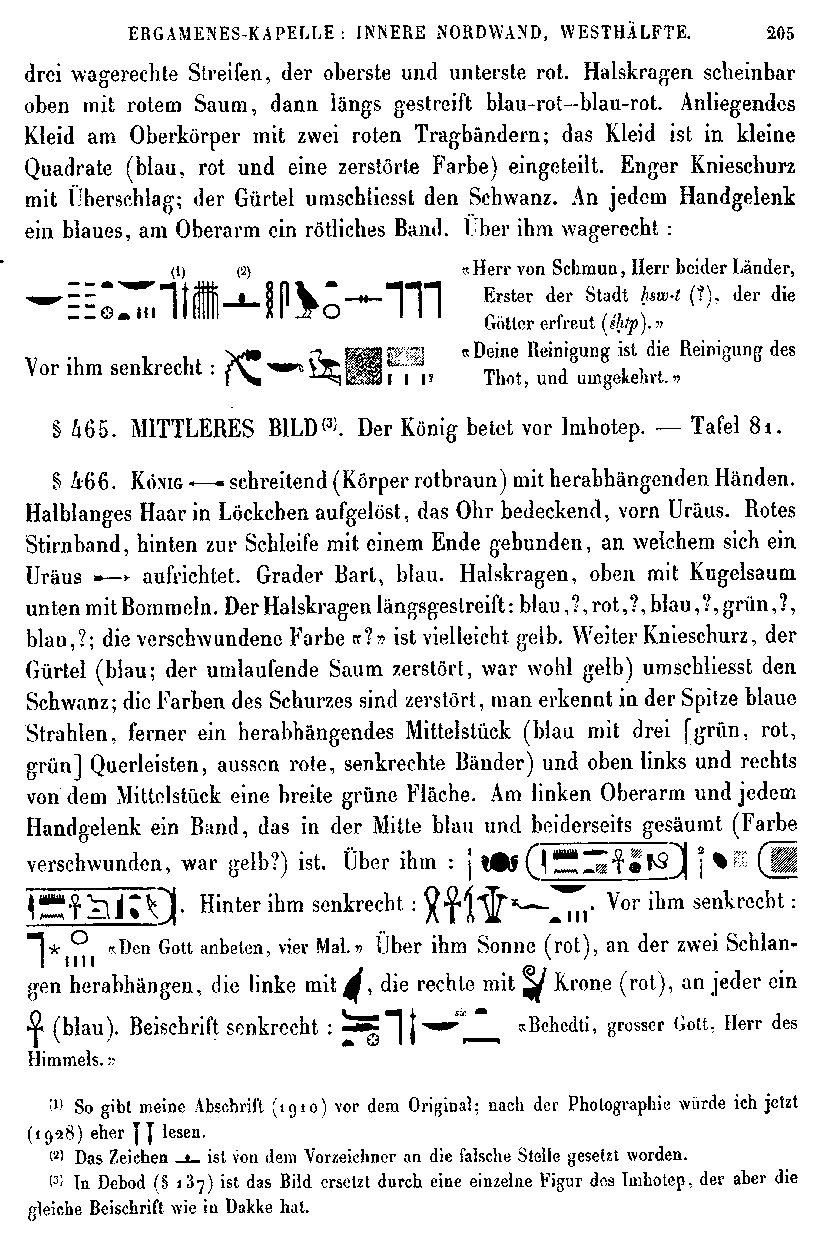
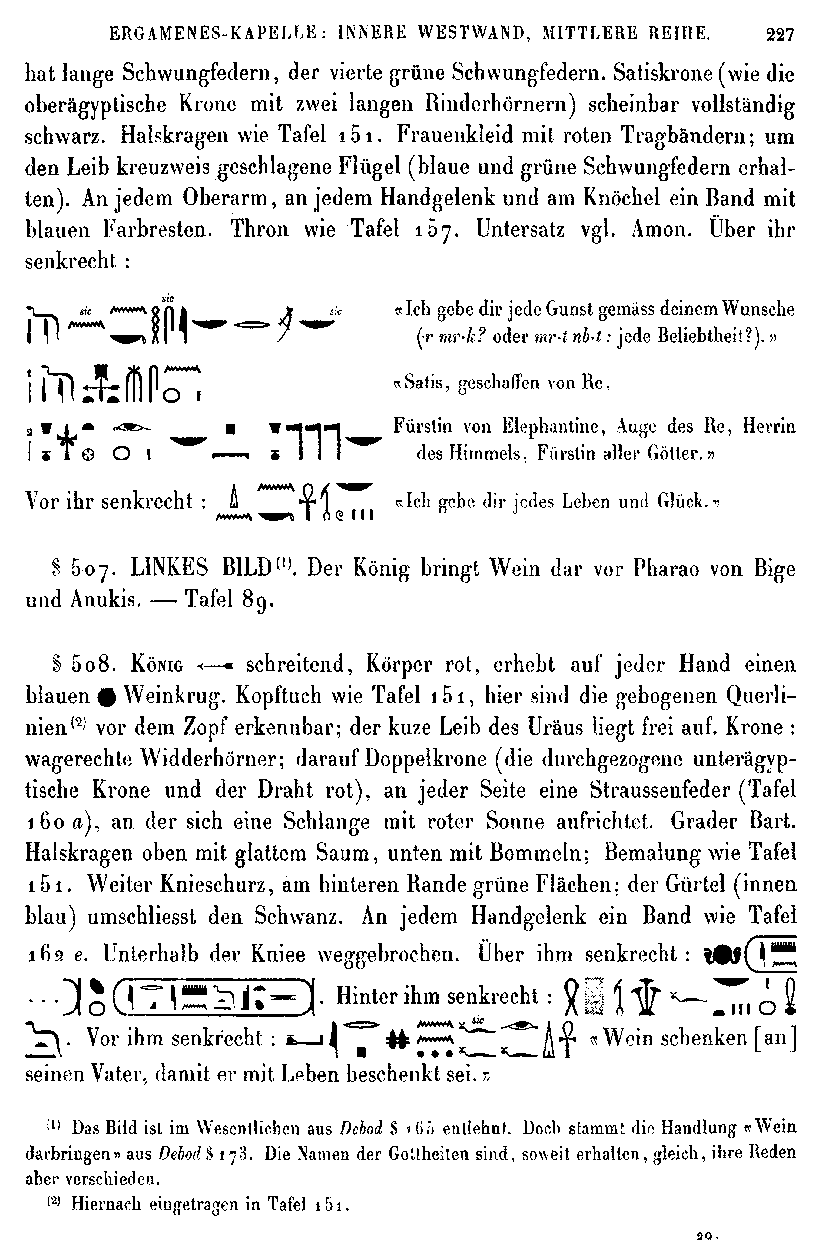
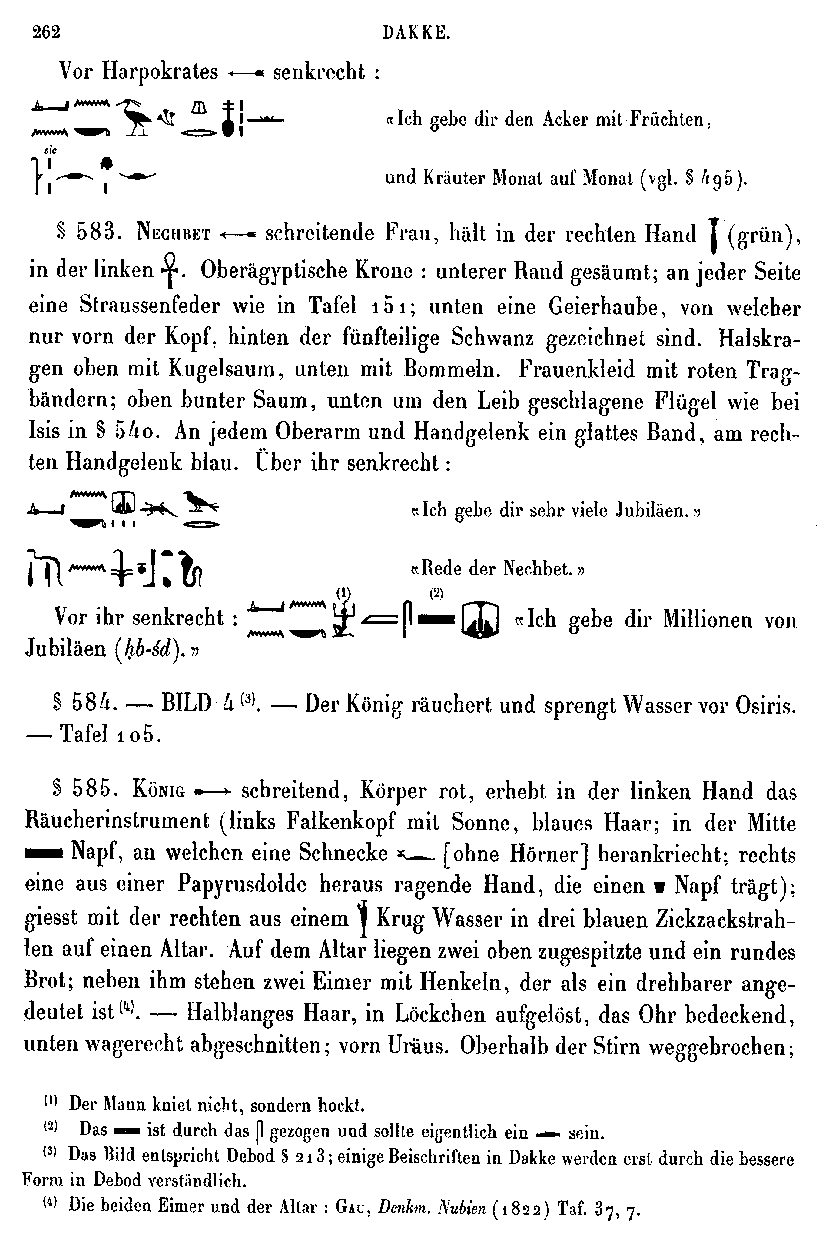
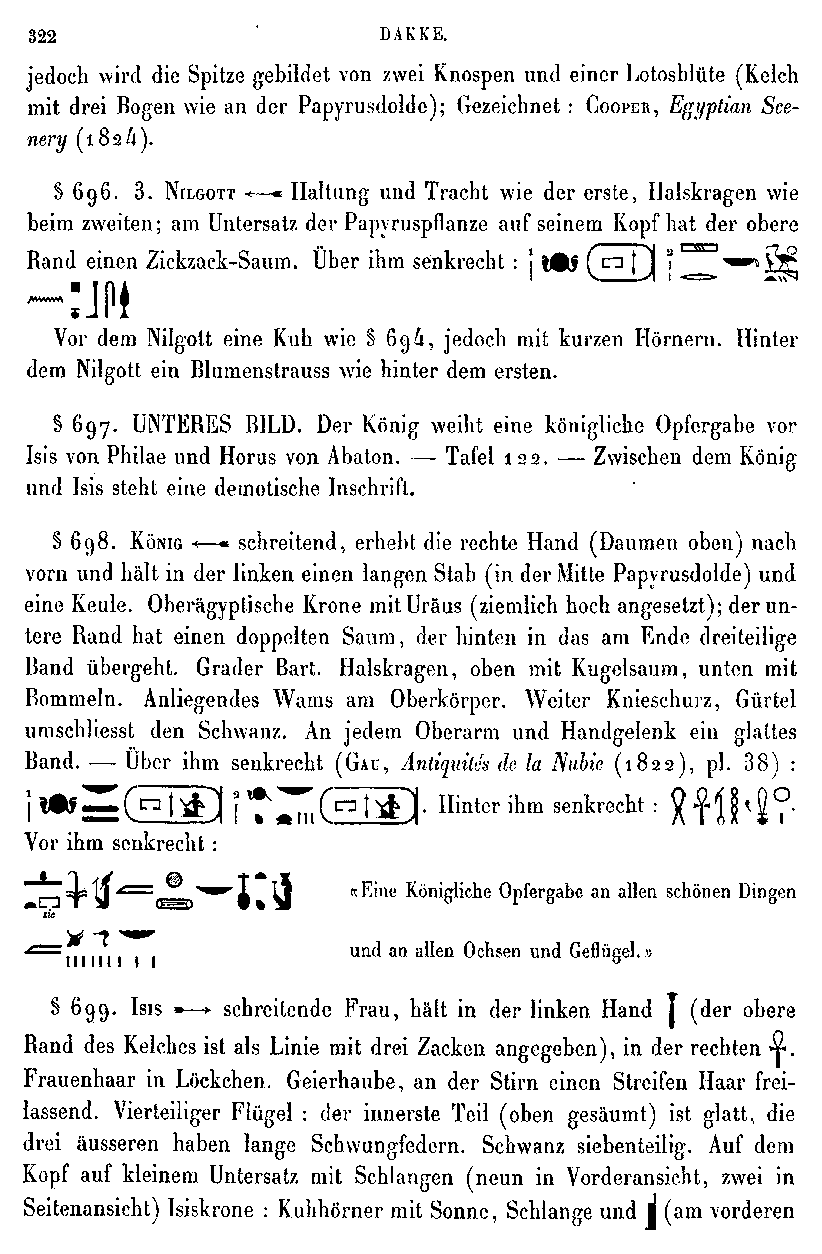
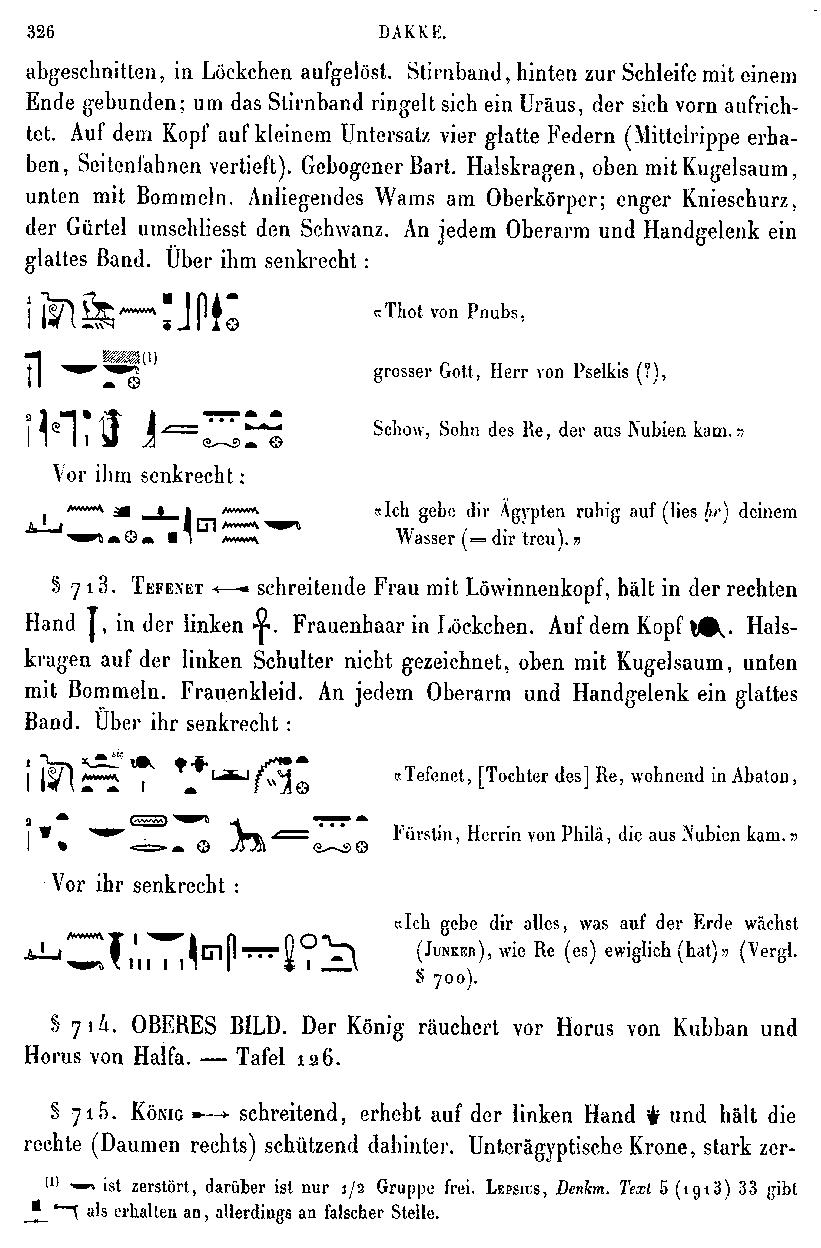
Page 98. Roeder, Der Tempel von Dakke (1930), p. 98 Printed hieroglyphs from G. Roeder, Der Tempel von Dakke (1930) - 7p. 98, § 220
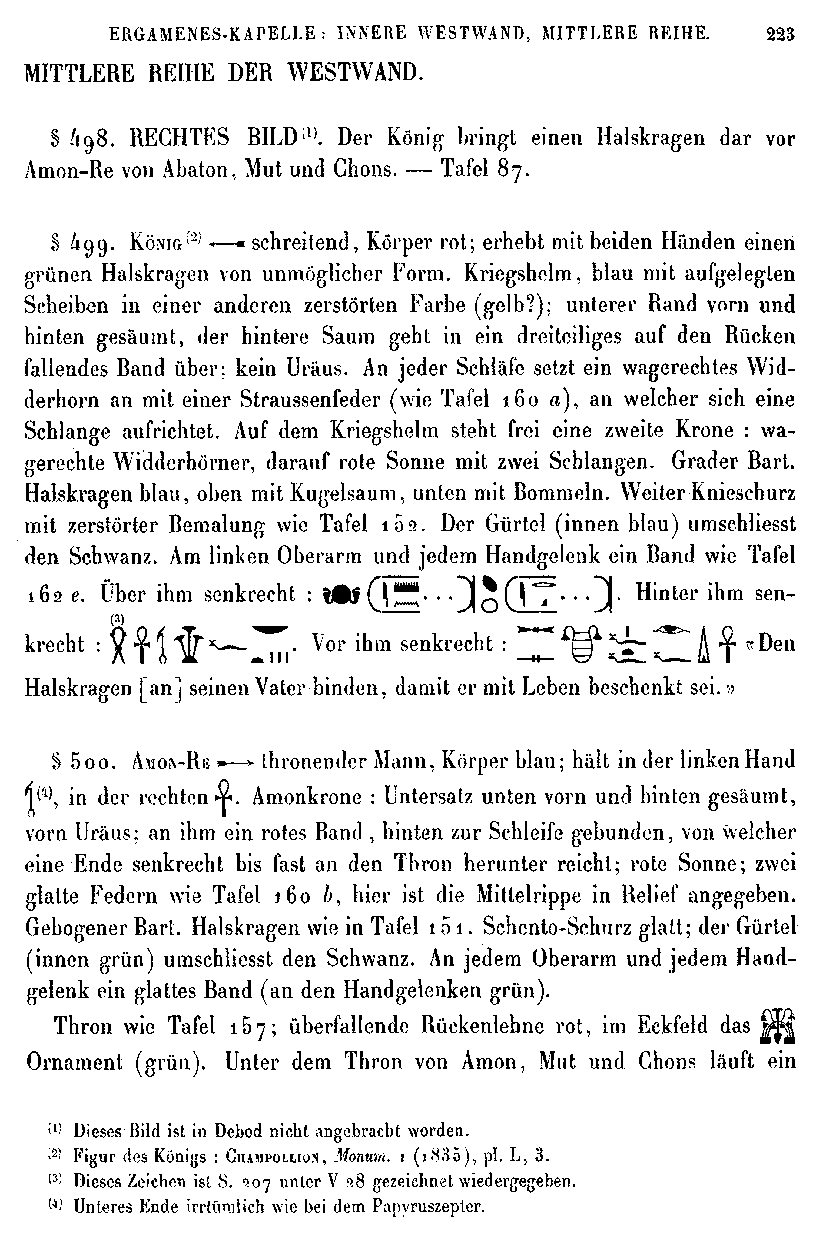
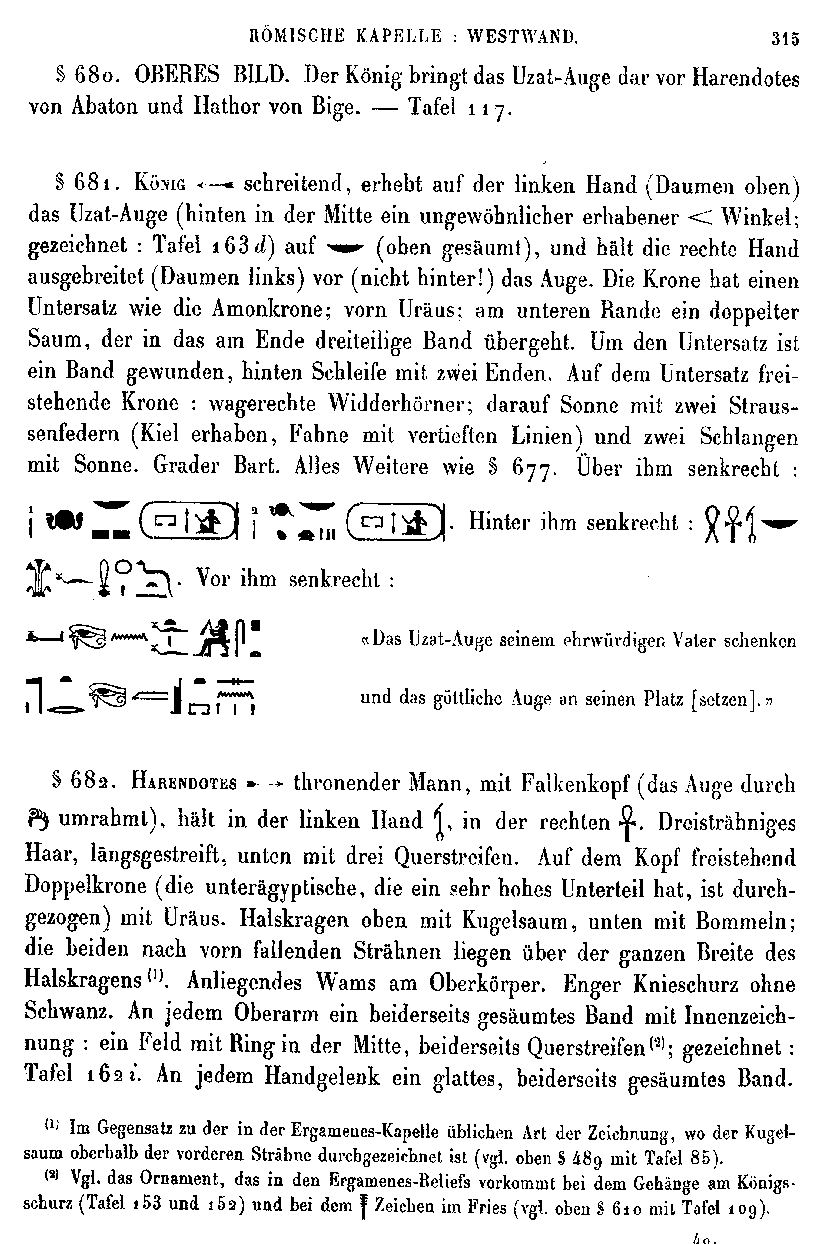
jj.n nswt-bj.tj jwꜥ-n-nṯr.wj-prj.wj-stp-n-ptḥ-jrj-mꜣꜥ.t-rꜥ-sḫm-ꜥnḫ-<n>-jmn ḫr=k ḏḥwtj n pnbs jnj=f n=k ḥꜥpj šmꜥ ẖr jḫ.t nb.(t) nfr.(t) wꜥb.(t)
The King of Upper and Lower Egypt, heir of the Two Manifest Gods, chosen of Ptah, who upholds the Maat of Ra, living image of Amun, has come to you, Thoth of Pnubs, to bring you Hapy of the South, bearing every good and pure thing.
Note · Line 7
The king is Ptolemy VIII. The Two Manifest Gods are his parents, Ptolemy V and Cleopatra I. Maat is the right order the king must maintain; Hapy is the Nile flood in divine form. - 8p. 98, § 220
nswt-bj.tj jwꜥ-n-nṯr.wj-prj.wj-stp-n-ptḥ-jrj-mꜣꜥ.t-rꜥ-sḫm-ꜥnḫ-<n>-jmn sꜣ-rꜥ ptwlmys-ꜥnḫ-ḏ.t-mrj-ptḥ nṯr.wj-mnḫ.wj
King of Upper and Lower Egypt, heir of the Two Manifest Gods, chosen of Ptah, who upholds the Maat of Ra, living image of Amun; Son of Ra, Ptolemy, ever living, beloved of Ptah; the Two Benefactor Gods.
Note · Line 8
The final title names the king and queen together as recipients of worship. - 9p. 98, § 220
sꜣ ꜥnḫ wꜣs nb ḥꜣ=f mj rꜥ ḏ.t
All protection, life and dominion stand behind him as they stand behind Ra, forever.
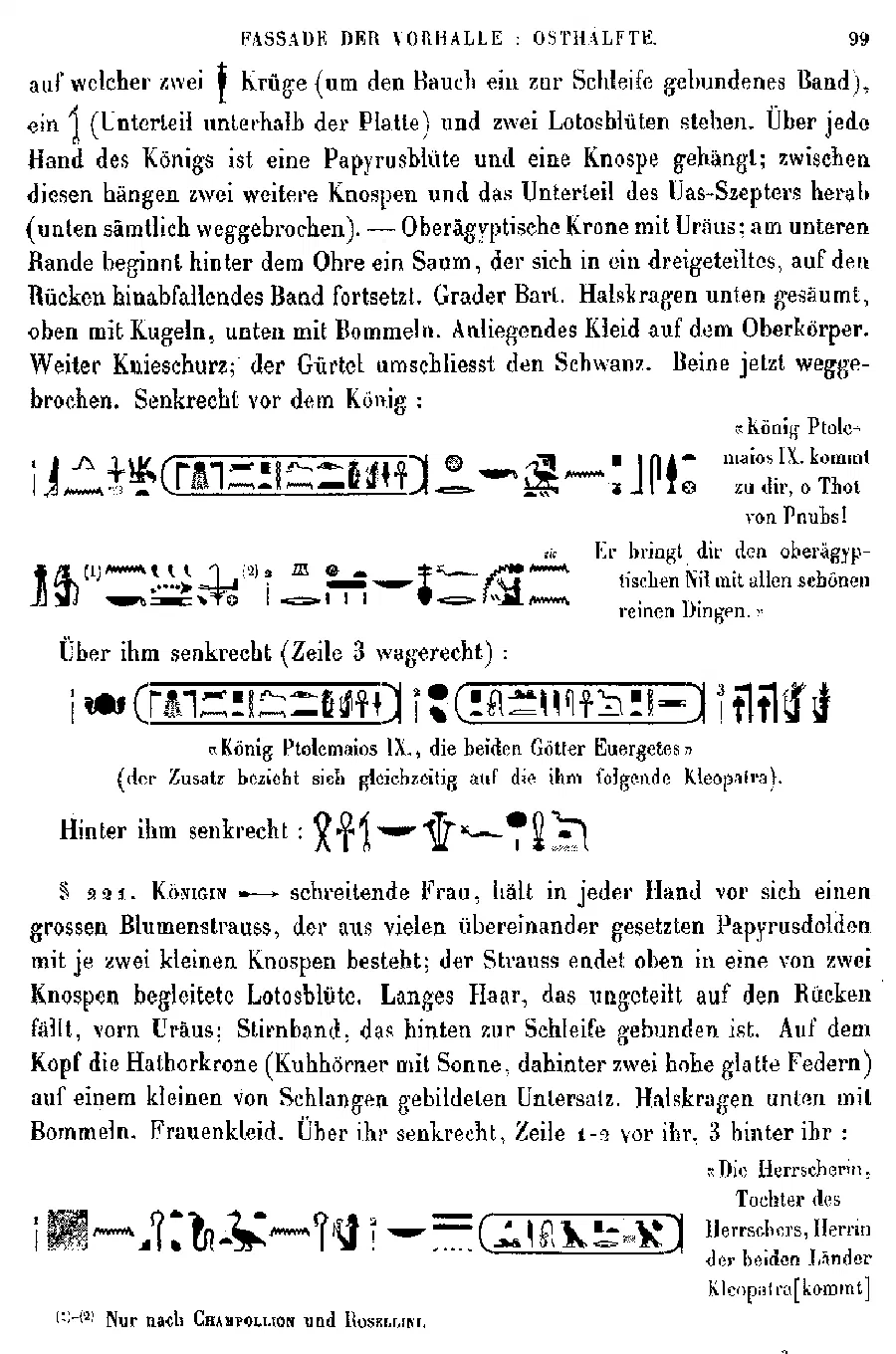
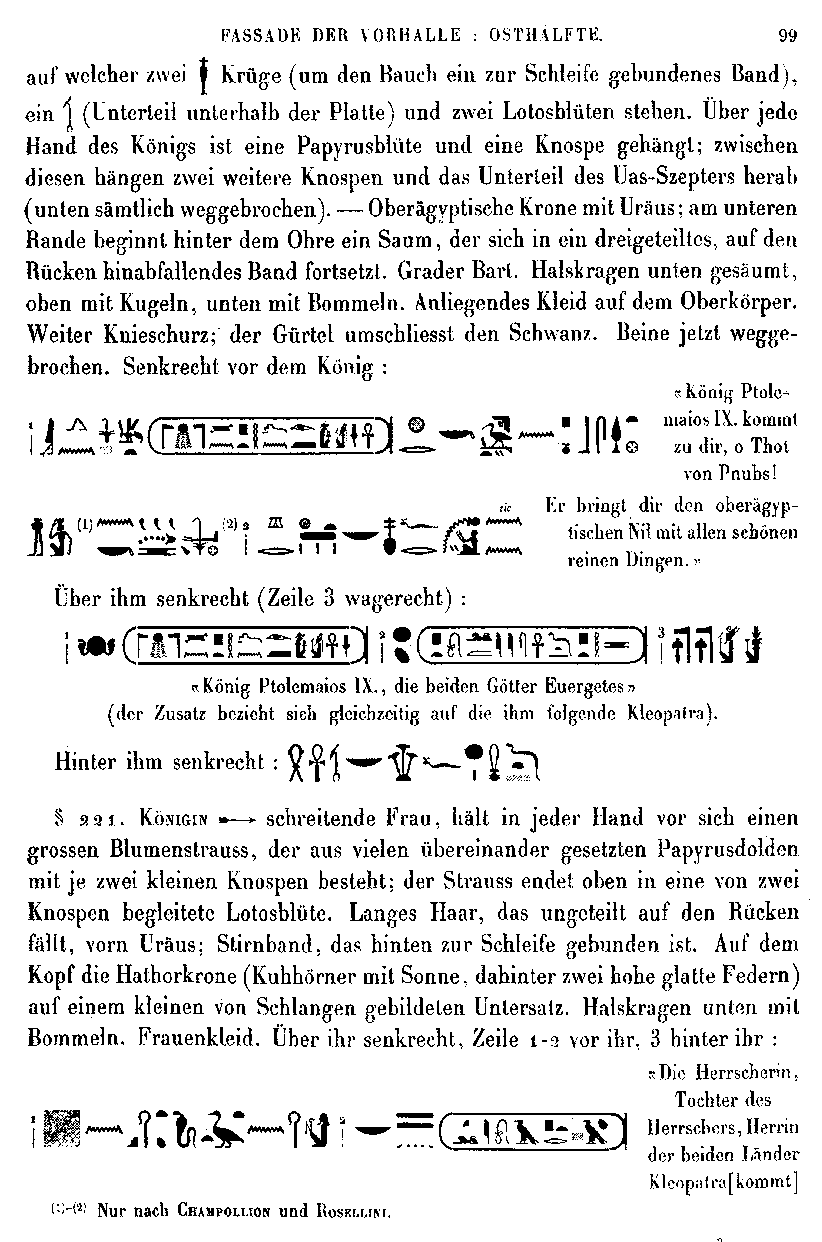
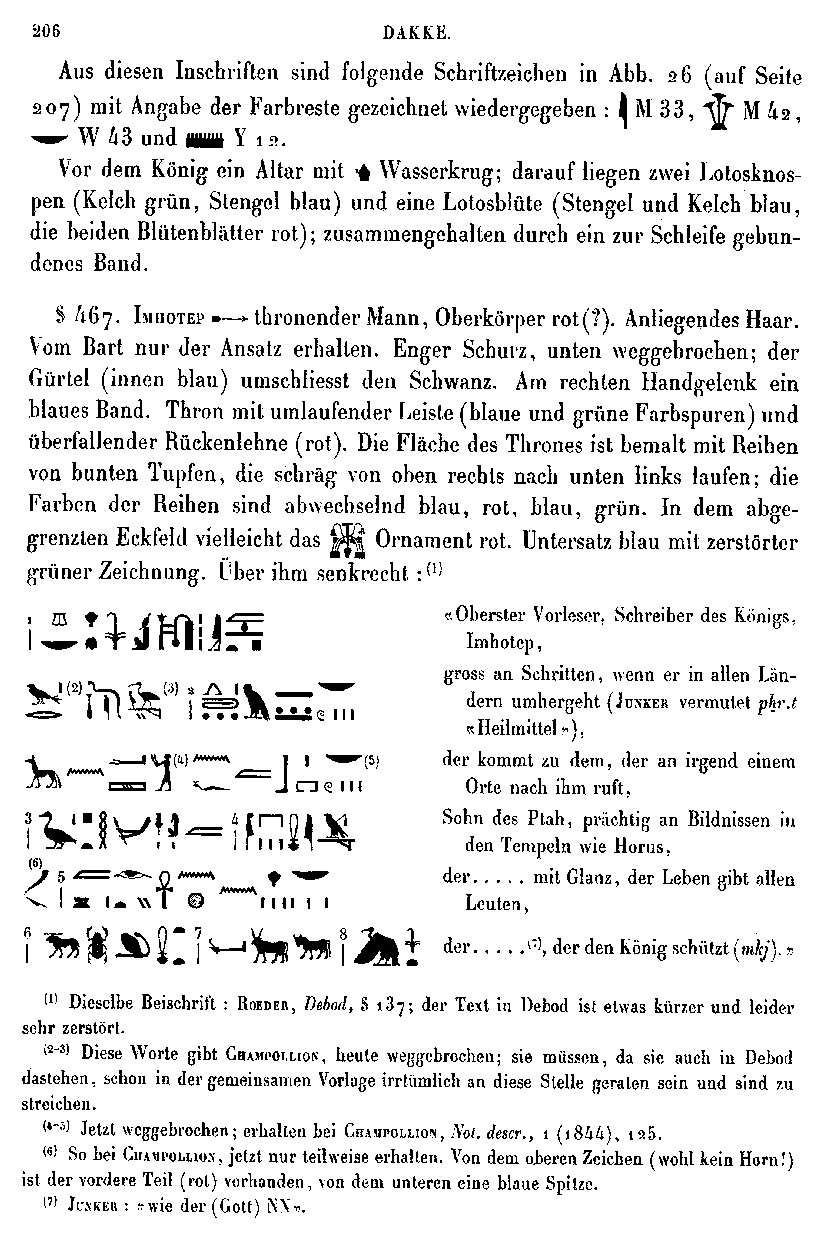
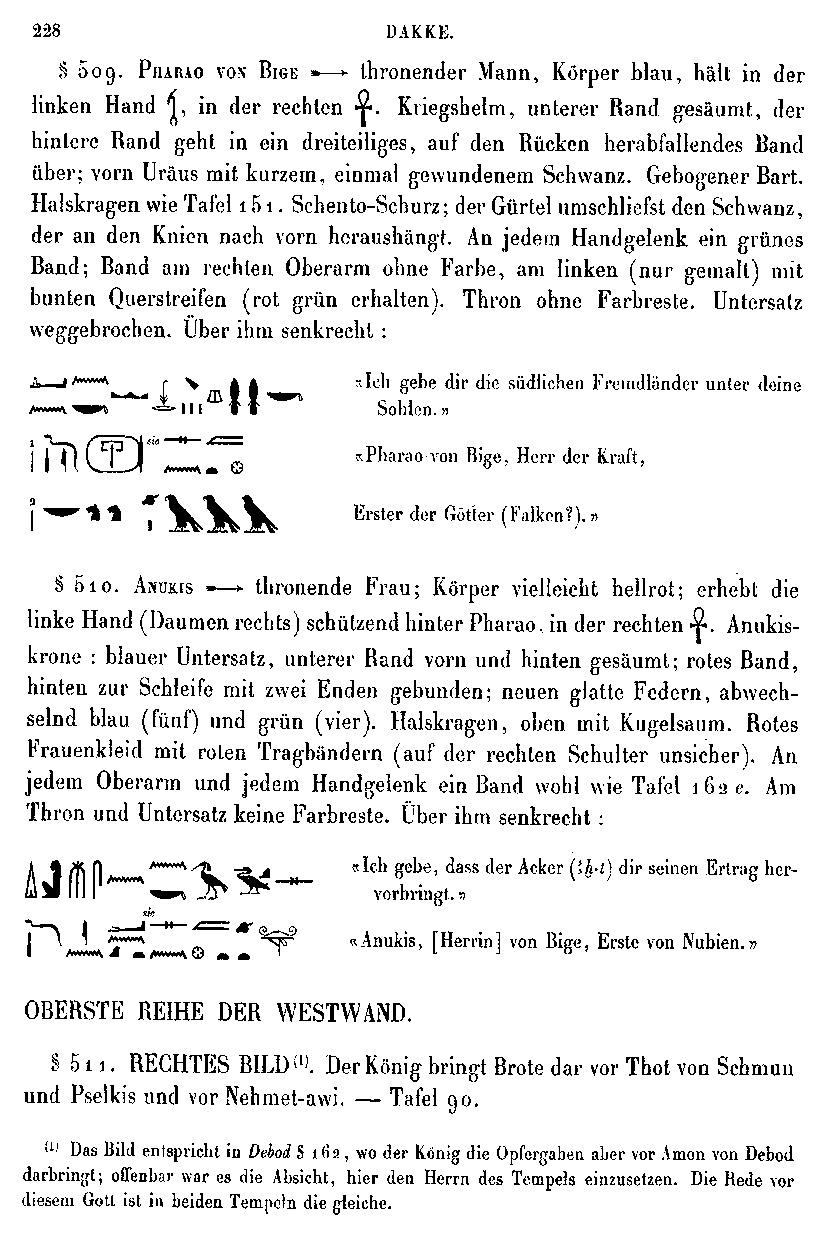
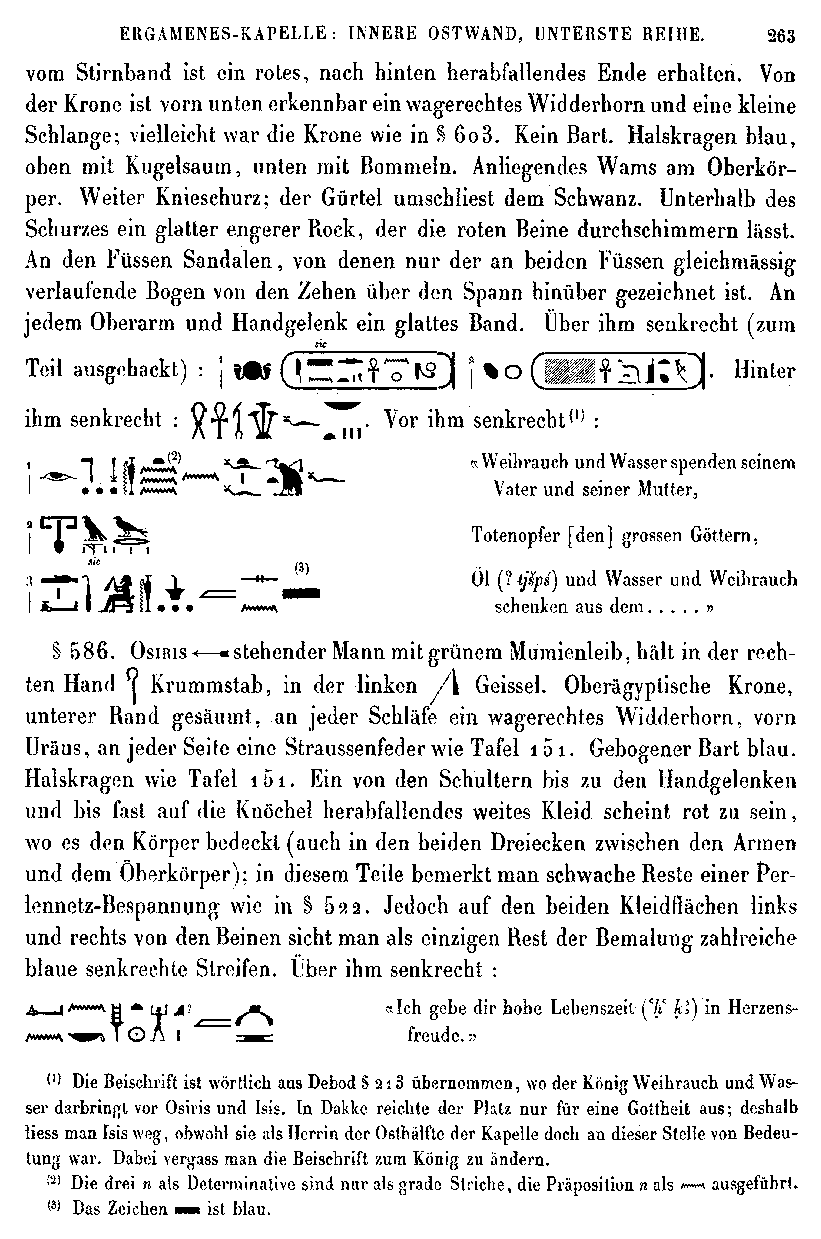
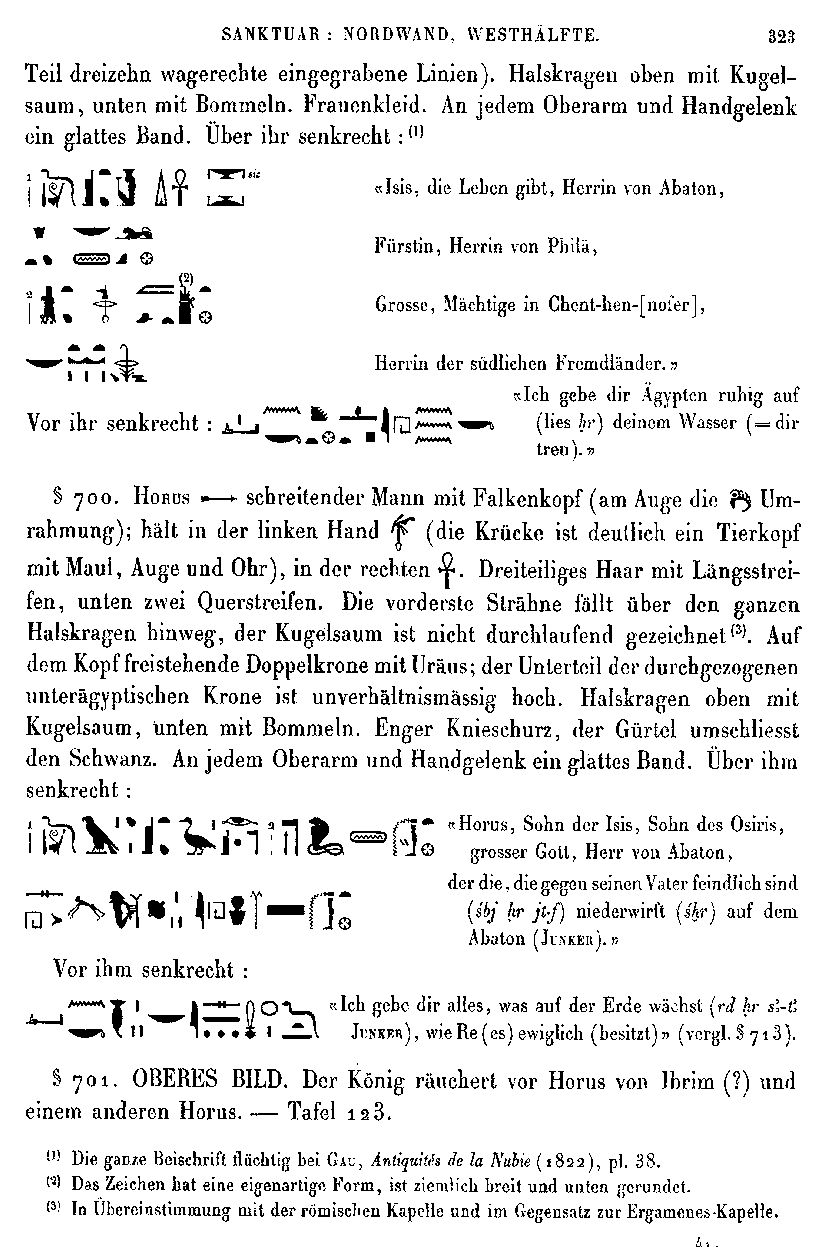
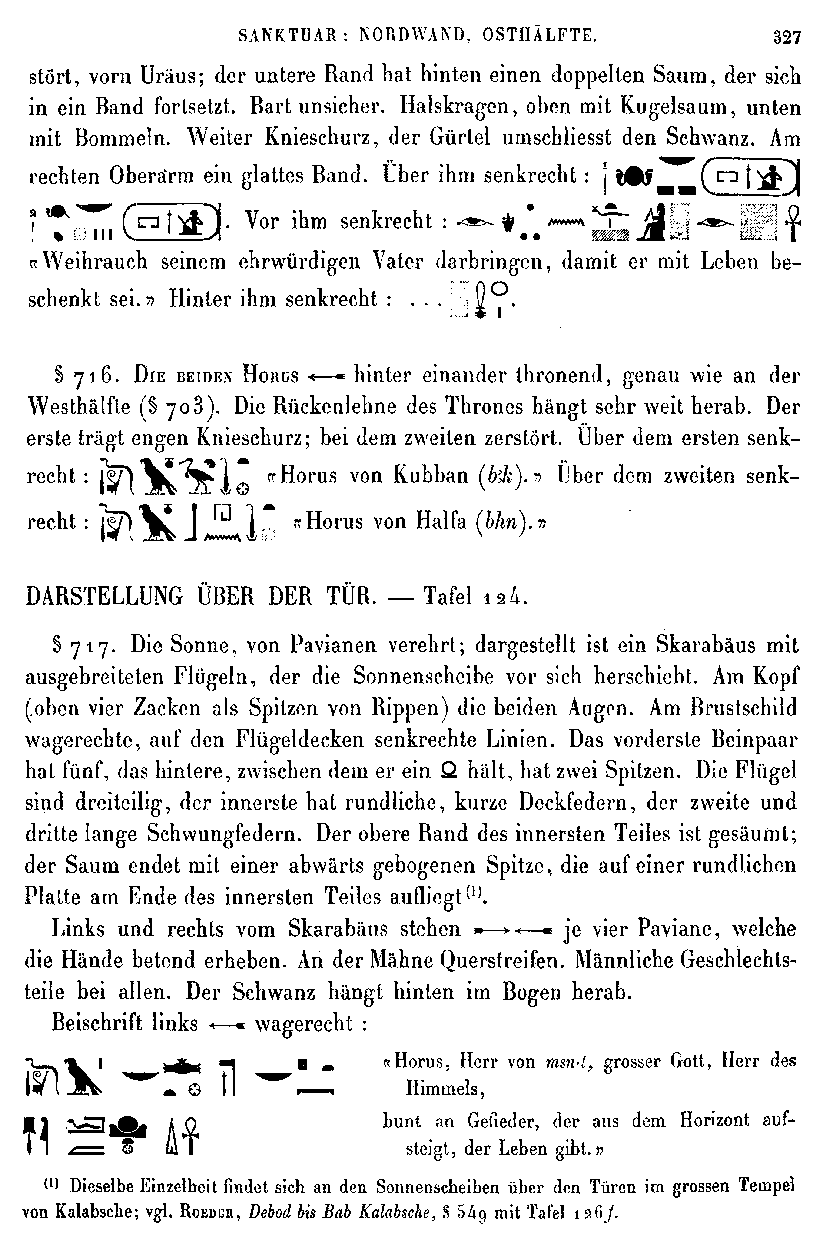
Page 99. Roeder, Der Tempel von Dakke (1930), p. 99 Printed hieroglyphs from G. Roeder, Der Tempel von Dakke (1930) - 10p. 99, § 221
[jj].n ḥḳꜣ.t sꜣ.t n ḥḳꜣ nb.(t)-tꜣ.wj ḳljwpꜣtrꜣ ḫr=k ḏḥwtj n pnbs jnj=s n=k sḫ.t ẖr jḫ.t=s nb.(t) ḥr ms n=k šmꜥ mḥw
The queen, daughter of a king, lady of the Two Lands, Cleopatra, has come to you, Thoth of Pnubs, to bring you the Field with all its produce, presenting Upper and Lower Egypt to you.
Note · Line 10
The Field personifies the cultivated land, as Hapy personifies the flood that feeds it. 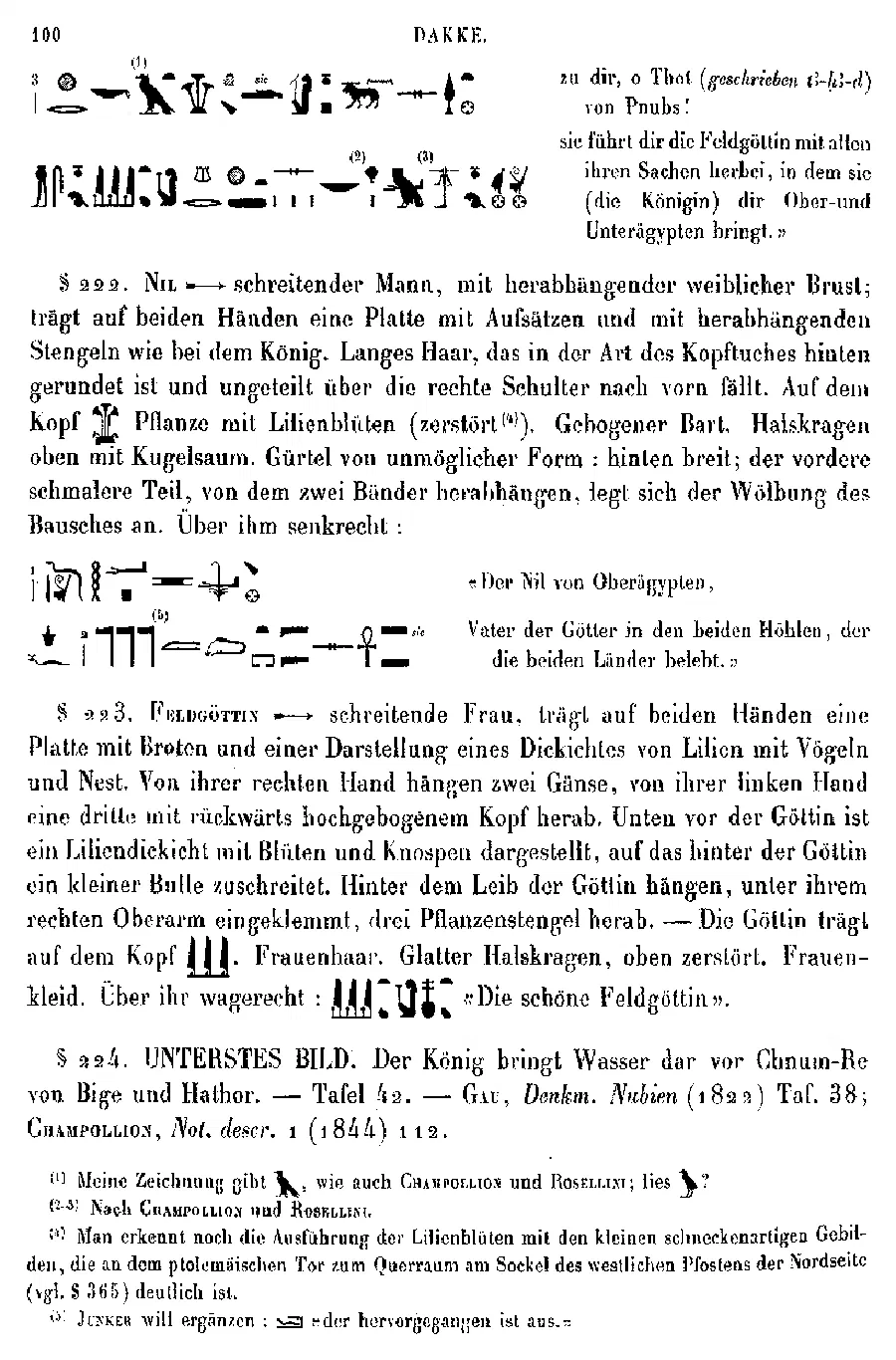
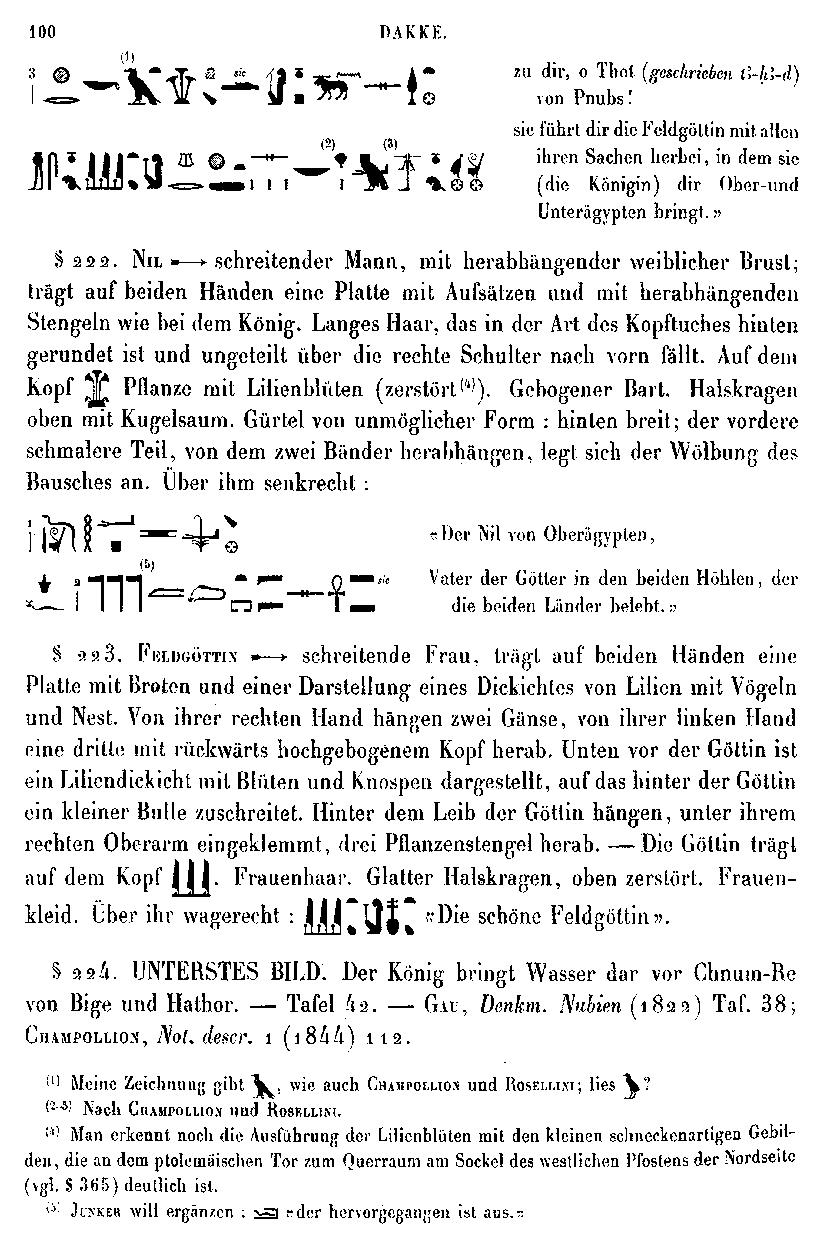
Page 100. Roeder, Der Tempel von Dakke (1930), p. 100 Printed hieroglyphs from G. Roeder, Der Tempel von Dakke (1930) - 11p. 100, § 222
ḏd-mdw jn ḥꜥpj šmꜥ jt nṯr.w m ḳr.tj sꜥnḫ tꜣ.wj
Words spoken by Hapy of the South, father of the gods in the Two Caverns, who gives life to the Two Lands.
Note · Line 11
The Two Caverns were the mythical source of the Nile flood at the First Cataract. The Two Lands are Upper and Lower Egypt. - 12p. 100, § 222
sḫ.t nfr.t
The beautiful Field.
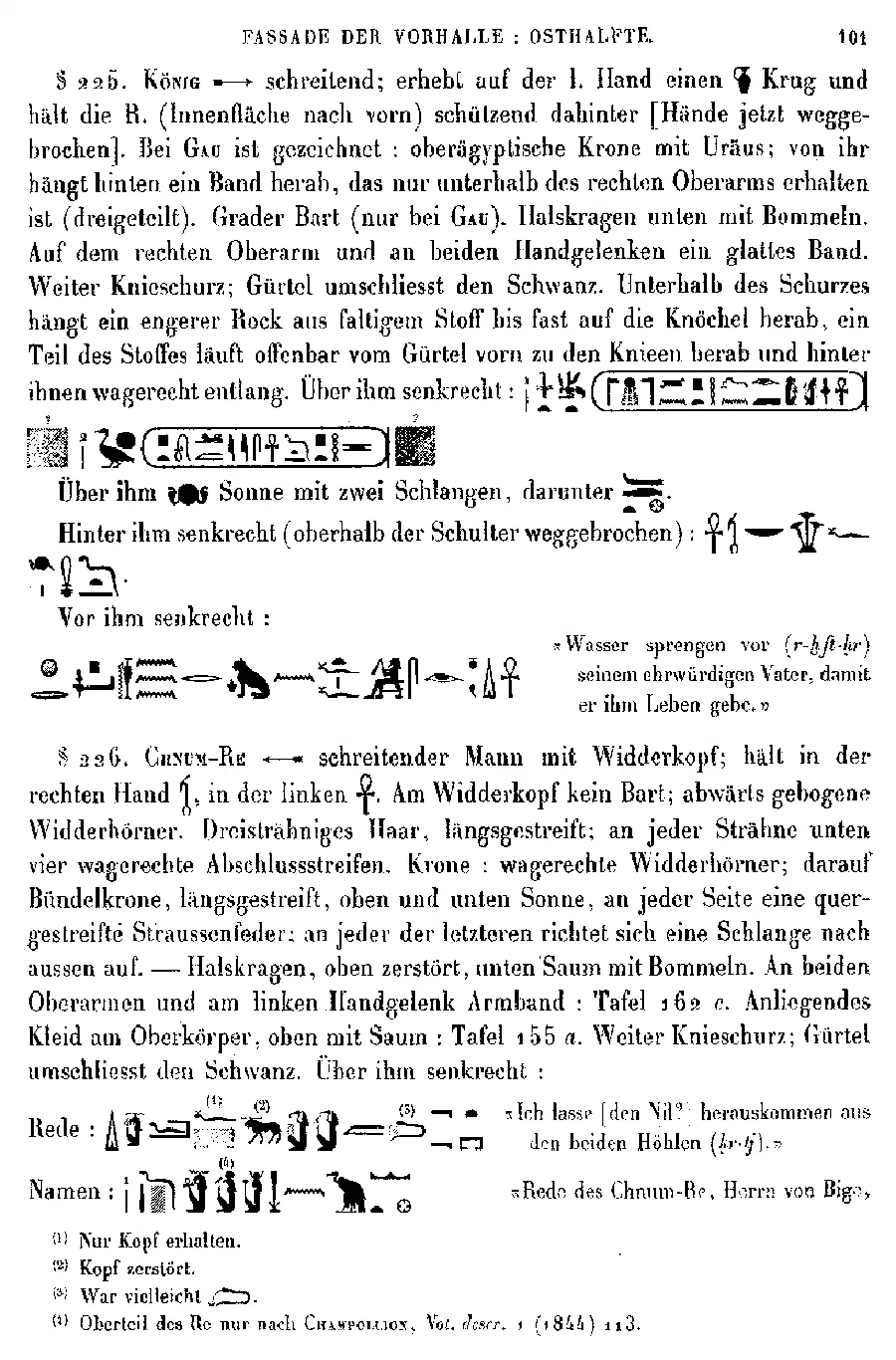
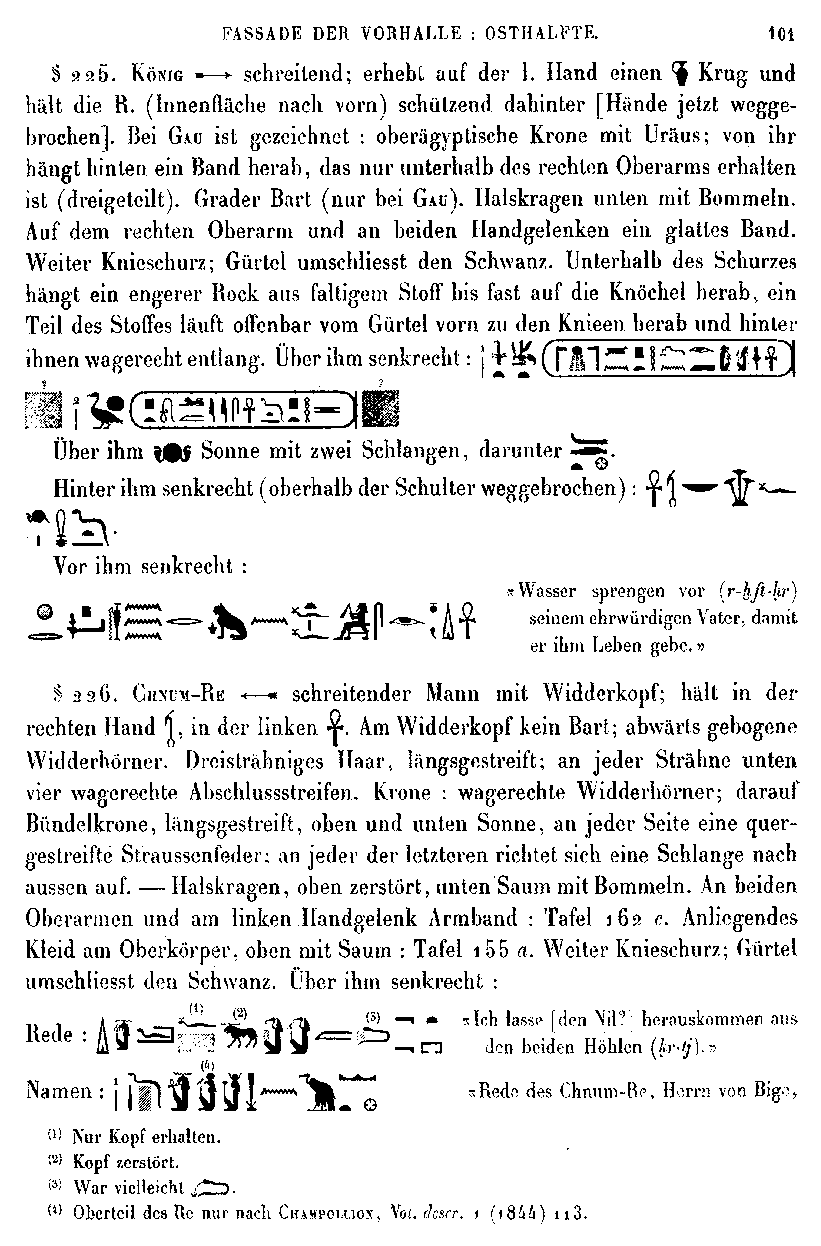
Page 101. Roeder, Der Tempel von Dakke (1930), p. 101 Printed hieroglyphs from G. Roeder, Der Tempel von Dakke (1930) - 13p. 101, § 225
nswt-bj.tj jwꜥ-n-nṯr.wj-prj.wj-stp-n-ptḥ-jrj-mꜣꜥ.t-rꜥ-sḫm-ꜥnḫ-<n>-jmn sꜣ-rꜥ ptwlmys-ꜥnḫ-ḏ.t-mrj-ptḥ [nṯr.wj-mnḫ.wj]
King of Upper and Lower Egypt, heir of the Two Manifest Gods, chosen of Ptah, who upholds the Maat of Ra, living image of Amun; Son of Ra, Ptolemy, ever living, beloved of Ptah; the Two Benefactor Gods.
- 14p. 101, § 225
bḥd.tj
He of Behdet.
Note · Line 14
Horus takes his title here from Behdet, the Egyptian name of Edfu. In temple scenes he often appears overhead as a winged sun disk. - 15p. 101, § 225
[sꜣ] ꜥnḫ wꜣs nb ḥꜣ=f mj rꜥ ḏ.t
All protection, life and dominion stand behind him as they stand behind Ra, forever.
- 16p. 101, § 225
ḫrp ḳbḥ r-ḫft-ḥr n jt=f šps jrj.n=f dj.(t) ꜥnḫ
Consecrating the libation before his august father. He has done this that he may be given life.
Note · Line 16
The king offers cool water. His “father” is the god who receives it. - 17p. 101, § 226
dj=j prj [n=k] ḥꜥpy m ḳr.tj
I cause Hapy to rise for you from the Two Caverns.
- 18p. 101, § 226
ḏd-mdw [jn] ẖnmw-rꜥ nb snm.t sḫm šps nb ḥꜣ.t[-spꜣ.wt]
Words spoken by Khnum-Ra, lord of Senmet, august power, lord of the first of the nomes:
Note · Line 18
A nome was a province. The first nome of Upper Egypt lay at the First Cataract. - 19p. 101, § 226
dj=j n=k ḥꜥpj wr r tr=f
I give you Hapy in full flood at his proper season.
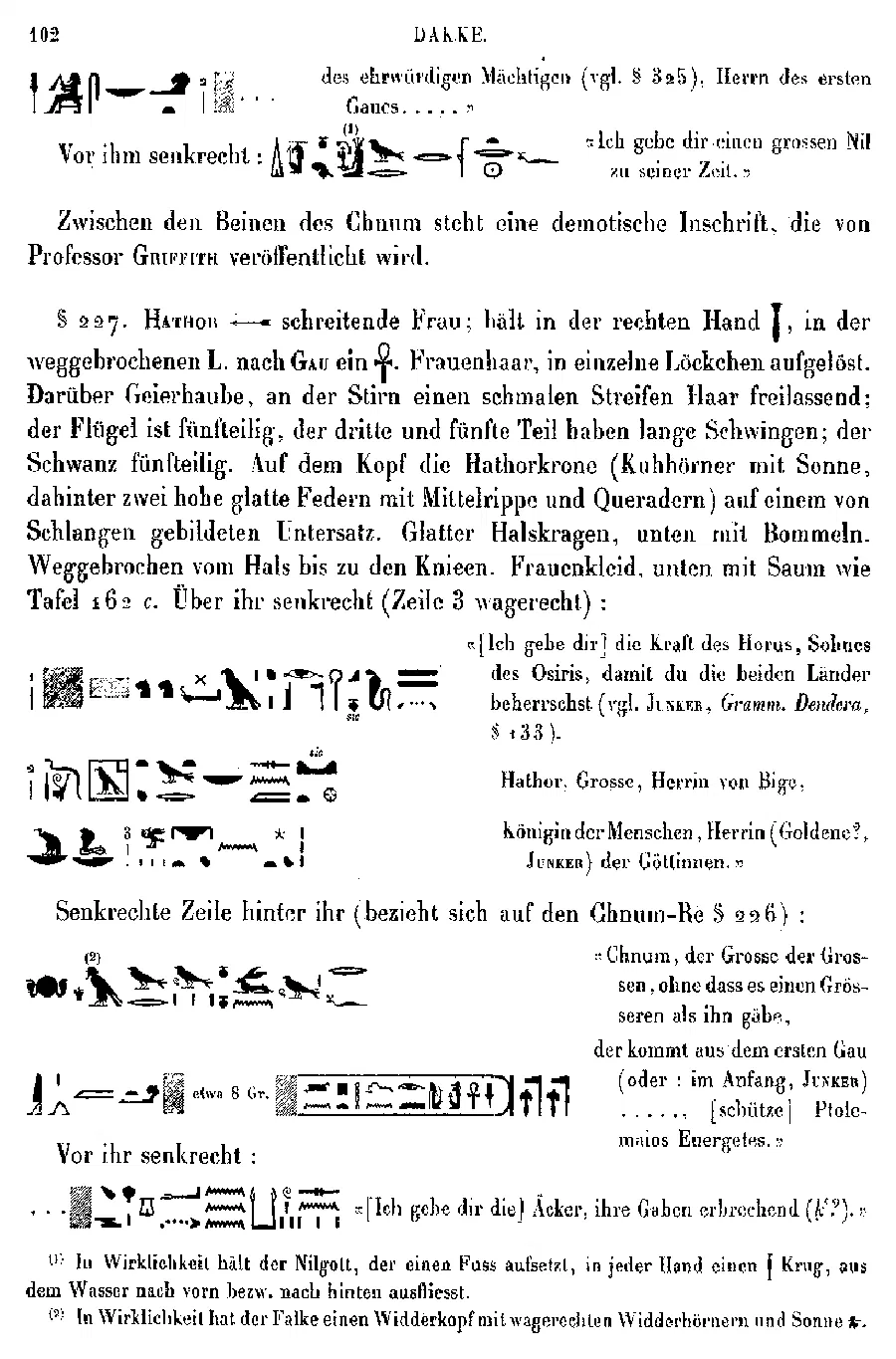
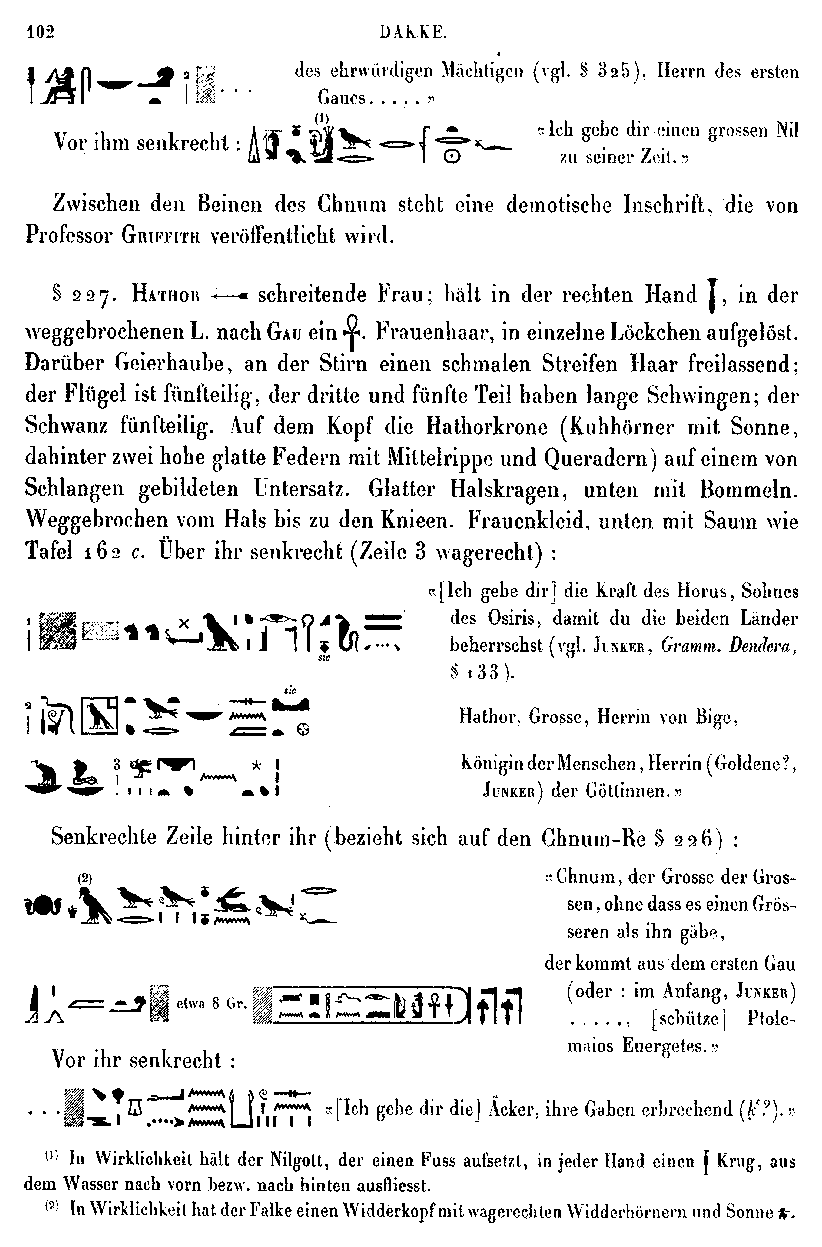
Page 102. Roeder, Der Tempel von Dakke (1930), p. 102 Printed hieroglyphs from G. Roeder, Der Tempel von Dakke (1930) - 20p. 102, § 227
[dj=j n=k] pḥtj ḥrw sꜣ wsjr ḥḳꜣ.n=k tꜣ.wj
I give you the strength of Horus, son of Osiris; thus you have come to rule the Two Lands.
- 21p. 102, § 227
ḏd-mdw jn ḥw.t-ḥrw wr.t nb.(t) snm.t nb.tj.t rḫj.t nbw.t n nṯr.w nṯr.wt
Words spoken by Hathor the Great, lady of Senmet, queen of the people, the gold of the gods and goddesses.
Note · Line 21
Gold evokes Hathor’s radiance; one of her names is the Golden One. - 22p. 102, § 227
bꜣ wr wr.w nn wn wr r=f jj m ḥꜣ.t[-spꜣ.wt] --4Q-- [nswt-bj.tj] jwꜥ-n-[nṯr.wj-prj.wj]-stp-n-ptḥ-jrj-mꜣꜥ.t-rꜥ-sḫm-ꜥnḫ-<n>-jmn nṯr.wj-mnḫ.wj
The ba, great among the great, with none greater than he, who comes from the first of the nomes … King of Upper and Lower Egypt, heir of the Two Manifest Gods, chosen of Ptah, who upholds the Maat of Ra, living image of Amun; the Two Benefactor Gods.
Note · Line 22
A ba is a being’s power to take form and move about. The word also sounds like the Egyptian word for a ram, Khnum’s sacred animal. - 23p. 102, § 227
[dj=j n=k sḫ.wt] ḳꜣꜥ kꜣ.w=sn
I give you fields that spit out their food.
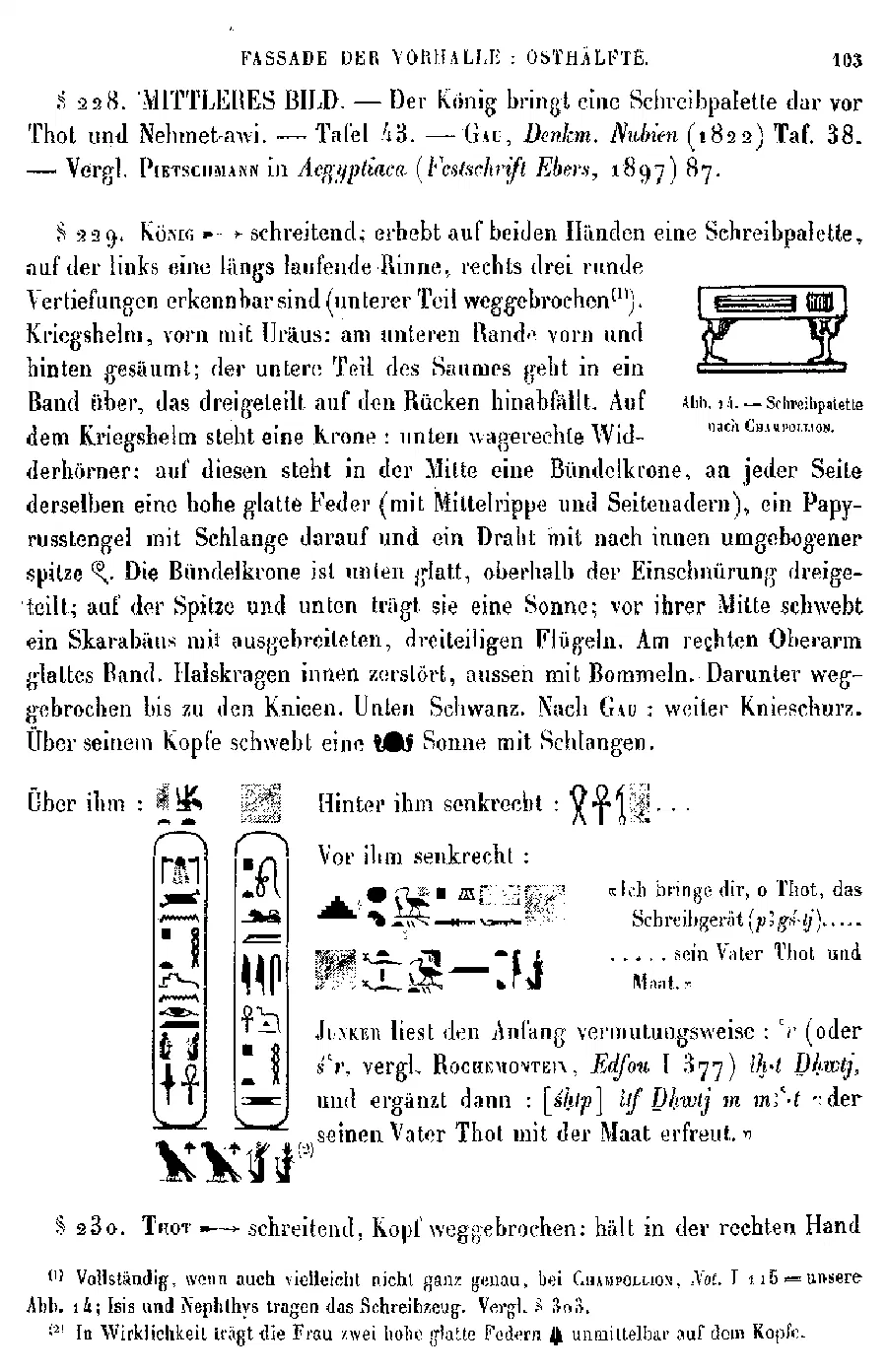
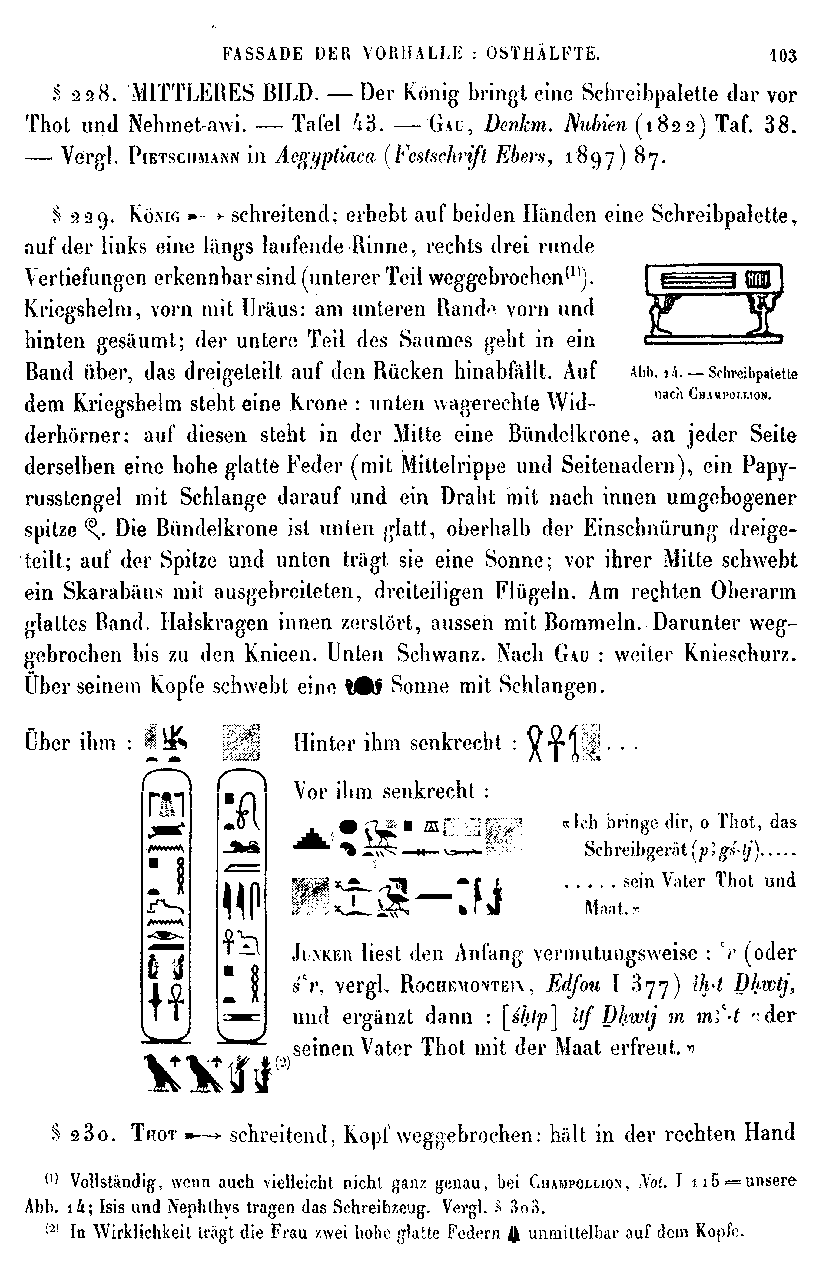
Page 103. Roeder, Der Tempel von Dakke (1930), p. 103 Printed hieroglyphs from G. Roeder, Der Tempel von Dakke (1930) - 24p. 103, § 229
[nswt-]bj.tj jwꜥ-n-nṯr.wj-prj.wj-stp-n-ptḥ-jrj-mꜣꜥ.t-rꜥ-sḫm-ꜥnḫ-<n>-jmn [sꜣ-rꜥ] ptwlmys-ꜥnḫ-ḏ.t-mrj-ptḥ nṯr.wj-mnḫ.wj
King of Upper and Lower Egypt, heir of the Two Manifest Gods, chosen of Ptah, who upholds the Maat of Ra, living image of Amun; Son of Ra, Ptolemy, ever living, beloved of Ptah; the Two Benefactor Gods.
- 25p. 103, § 229
sꜣ ꜥnḫ wꜣs [nb ḥꜣ=f mj rꜥ ḏ.t]
All protection, life and dominion stand behind him as they stand behind Ra, forever.
- 26p. 103, § 229
sꜥr n={k} ḏḥwtj pꜣ gstj --2Q-- jt=f (4) ḏḥwtj mrj mꜣꜥ.t
Raising the palette to Thoth … his father Thoth, who loves Maat.
Note · Line 26
The palette is a scribe’s writing kit, offered to Thoth as lord of writing. - 27p. 103, § 230
[dj=j] n=k ḥḥ m rnp.wt m nḏm jb
I give you a million years of gladness of heart.
- 28p. 103, § 230
--6Q-- nsr --détruit-- dj=j n=k --2Q-- m p.t nswj.t ꜥꜣ.t m ꜣw.(t)-jb
… the flame … I give you … in the sky, and great kingship in joy.
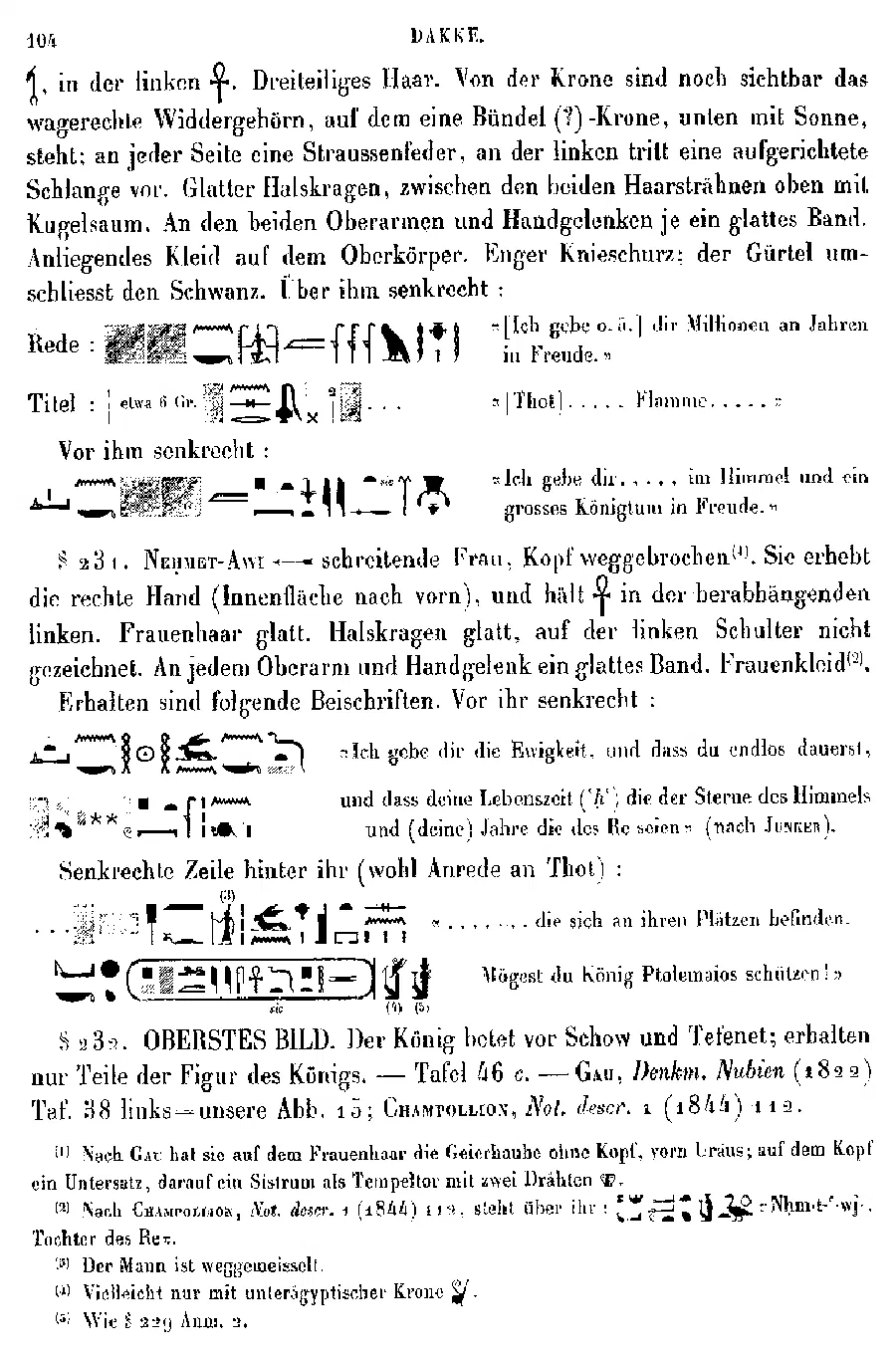
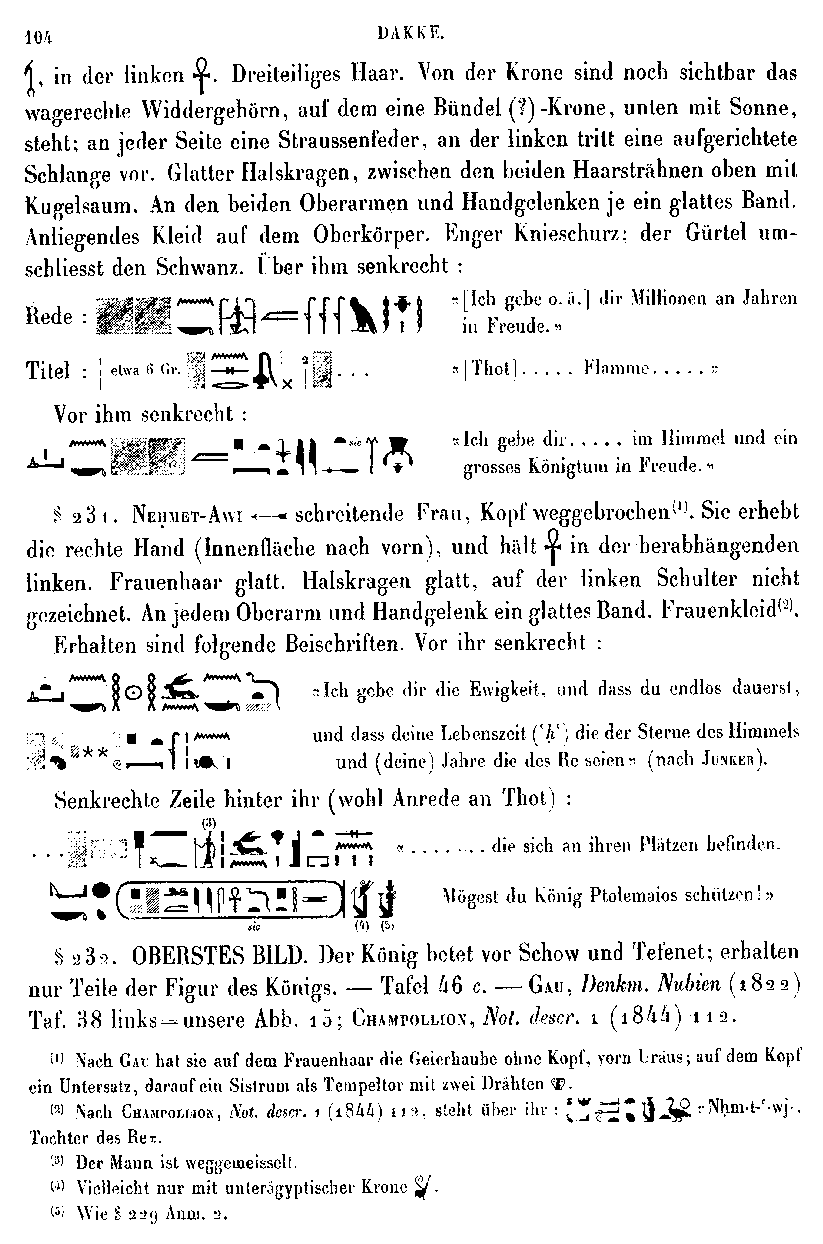
Page 104. Roeder, Der Tempel von Dakke (1930), p. 104 Printed hieroglyphs from G. Roeder, Der Tempel von Dakke (1930) - 29p. 104, § 231
dj=j n=k ḥḥ wn n=k ḏ.t [ꜥḥꜥ]=k sbꜣ.w n p.t rnp.wt=<k> n rꜥ
I give you eternity; forever is yours. Your lifetime is that of the stars of the sky, your years those of Ra.
- 30p. 104, § 231
--détruit-- [s]ꜥḥꜥ n=f (5) wr.w wn ḥr s.t=sn ḫwj=k sꜣ-rꜥ p[tw]lmys-ꜥnḫ-ḏ.t-mrj-ptḥ nṯr.wj-mnḫ.wj
… who raises up for him the great ones who stand in their places. May you protect the Son of Ra, Ptolemy, ever living, beloved of Ptah; the Two Benefactor Gods.
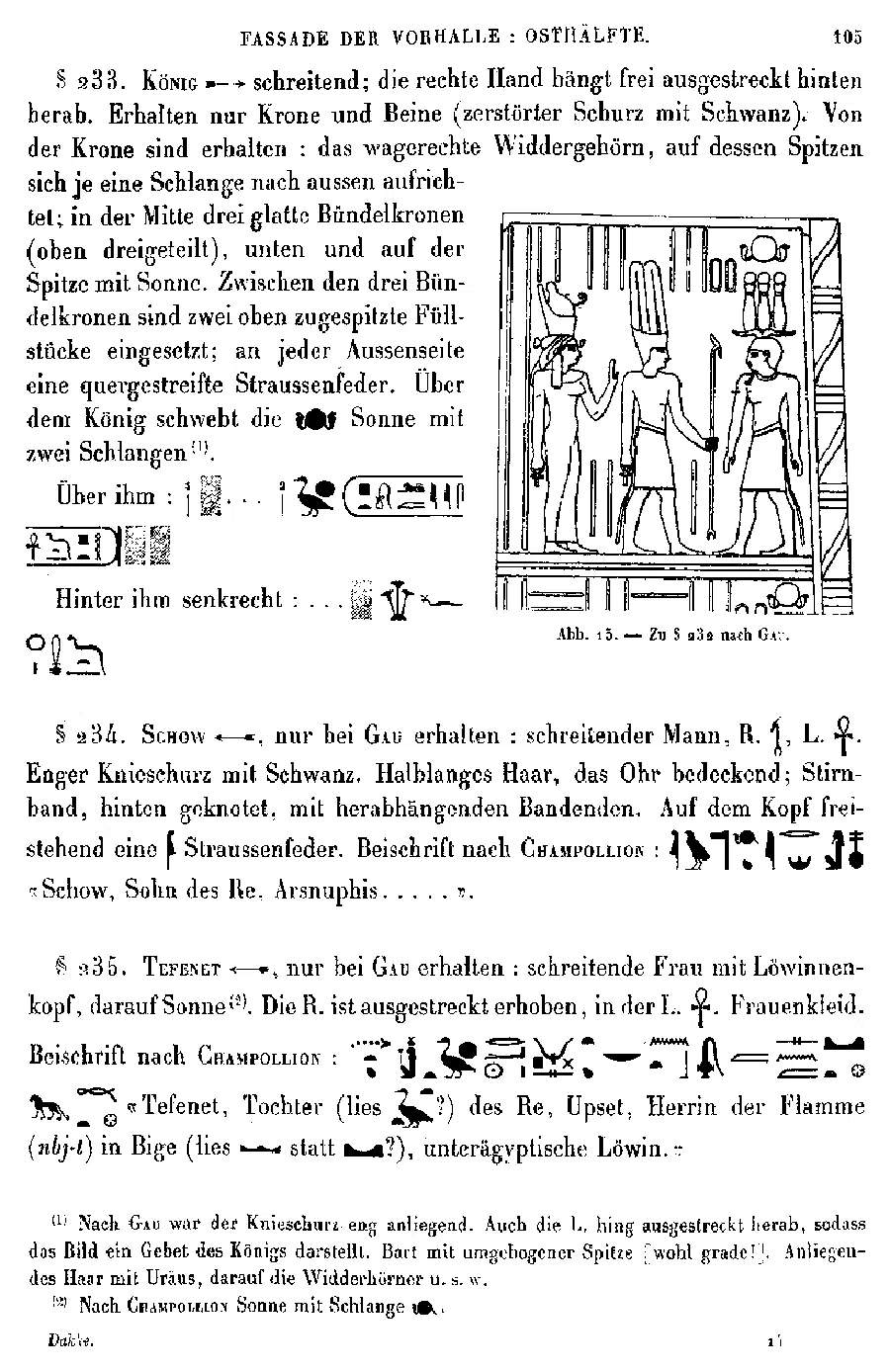
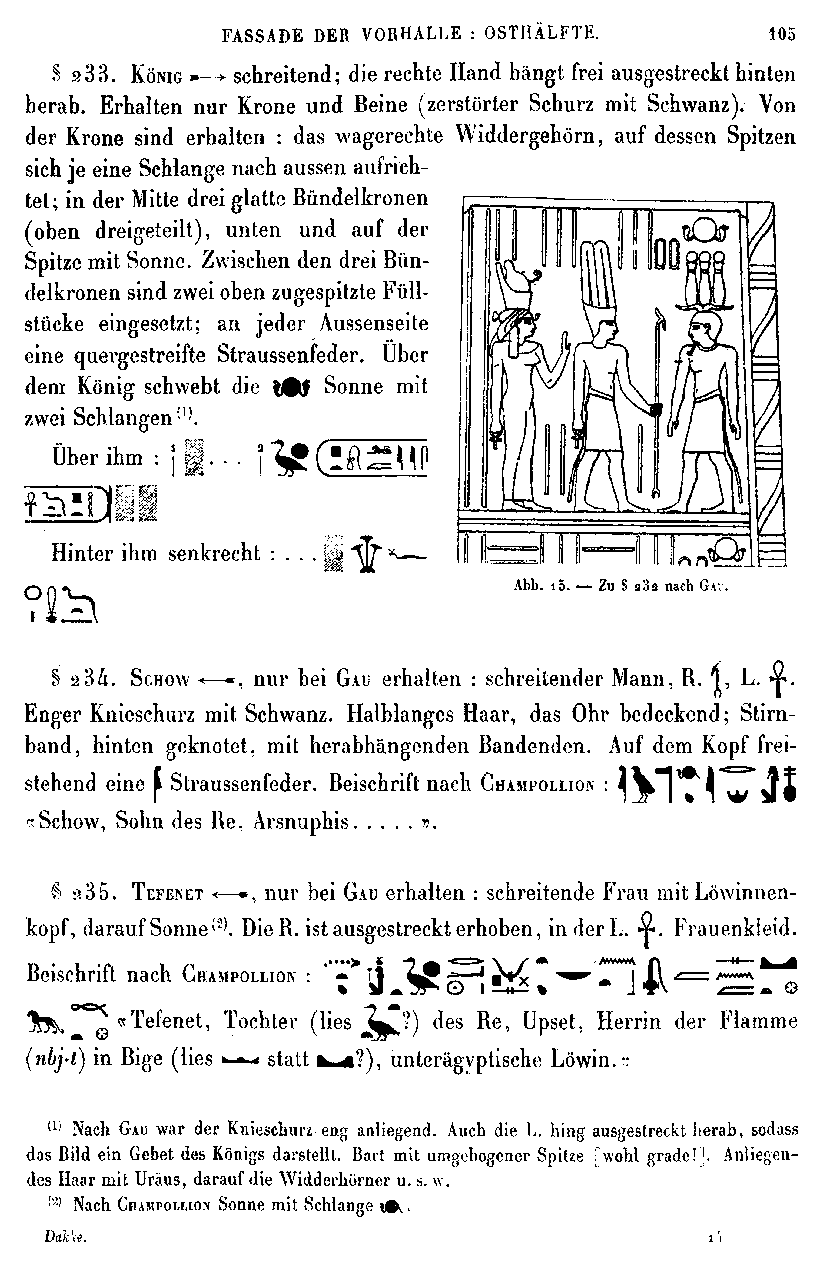
Page 105. Roeder, Der Tempel von Dakke (1930), p. 105 Printed hieroglyphs from G. Roeder, Der Tempel von Dakke (1930) - 31p. 105, § 233
--détruit-- sꜣ-rꜥ ptwlmys-ꜥnḫ-ḏ.t-mrj-ptḥ (6) --détruit-- [sꜣ ꜥnḫ wꜣs nb] ḥꜣ=f mj rꜥ ḏ.t
… Son of Ra, Ptolemy, ever-living, beloved of Ptah … All protection, life and dominion stand behind him as they stand behind Ra, forever.
- 32p. 105, § 234
šw sꜣ rꜥ jr.j-ḥm<s>-nfr (7)
Shu, son of Ra, Arensnuphis.
Note · Line 32
Arensnuphis, a god worshipped in Nubia, is identified here with Shu, the god of air. - 33p. 105, § 235
tfn.t sꜣ.t rꜥ wps.t nb.(t) nbj.t m snm.t ḥwn.t mḥ.t (8)
Tefnut, daughter of Ra, Wepset, lady of the flame in Senmet, lioness of the north.
Note · Line 33
Wepset is the fiery cobra who guards the sun god. The cobra and the lioness are two forms his daughter can take. 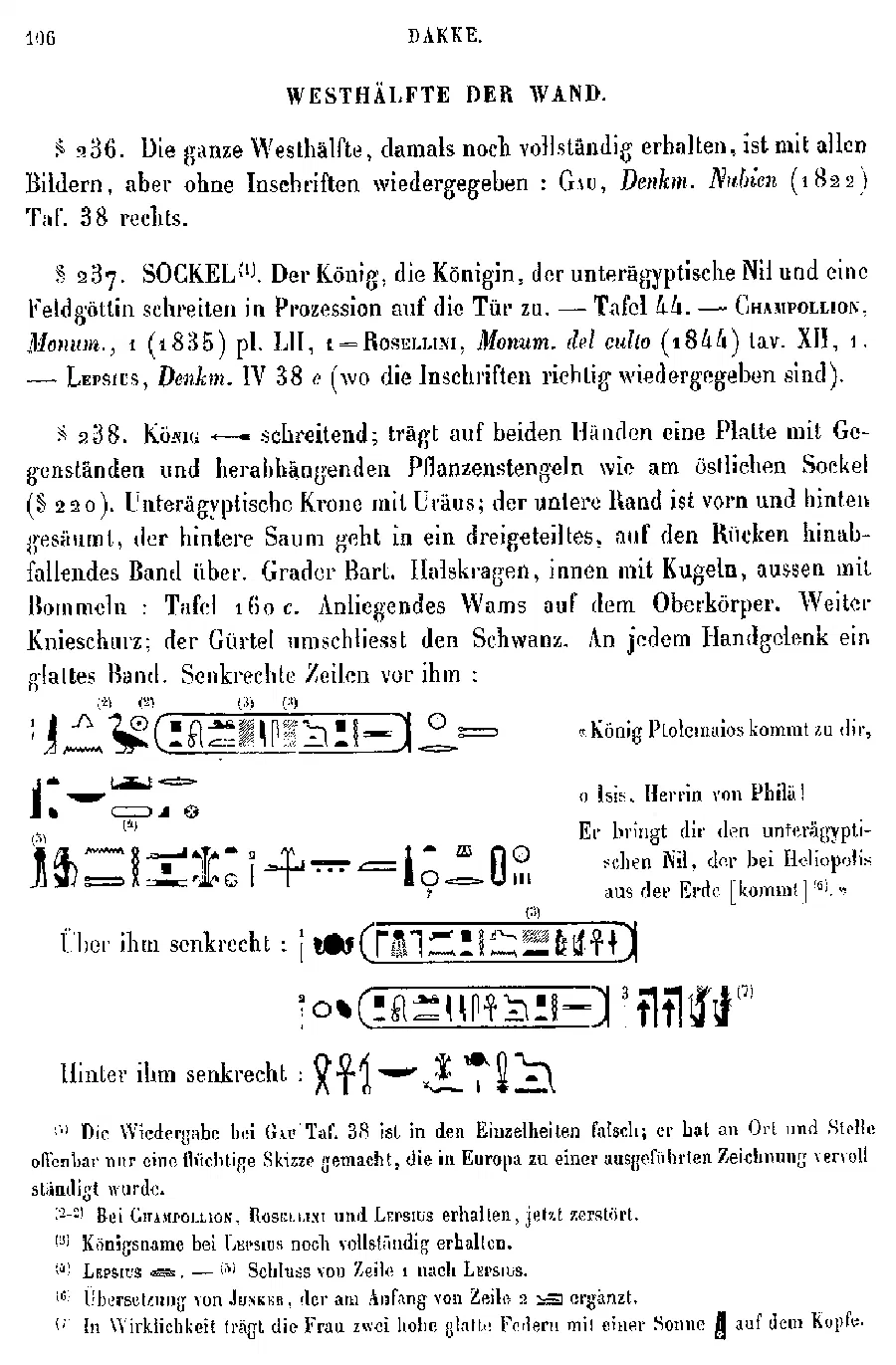
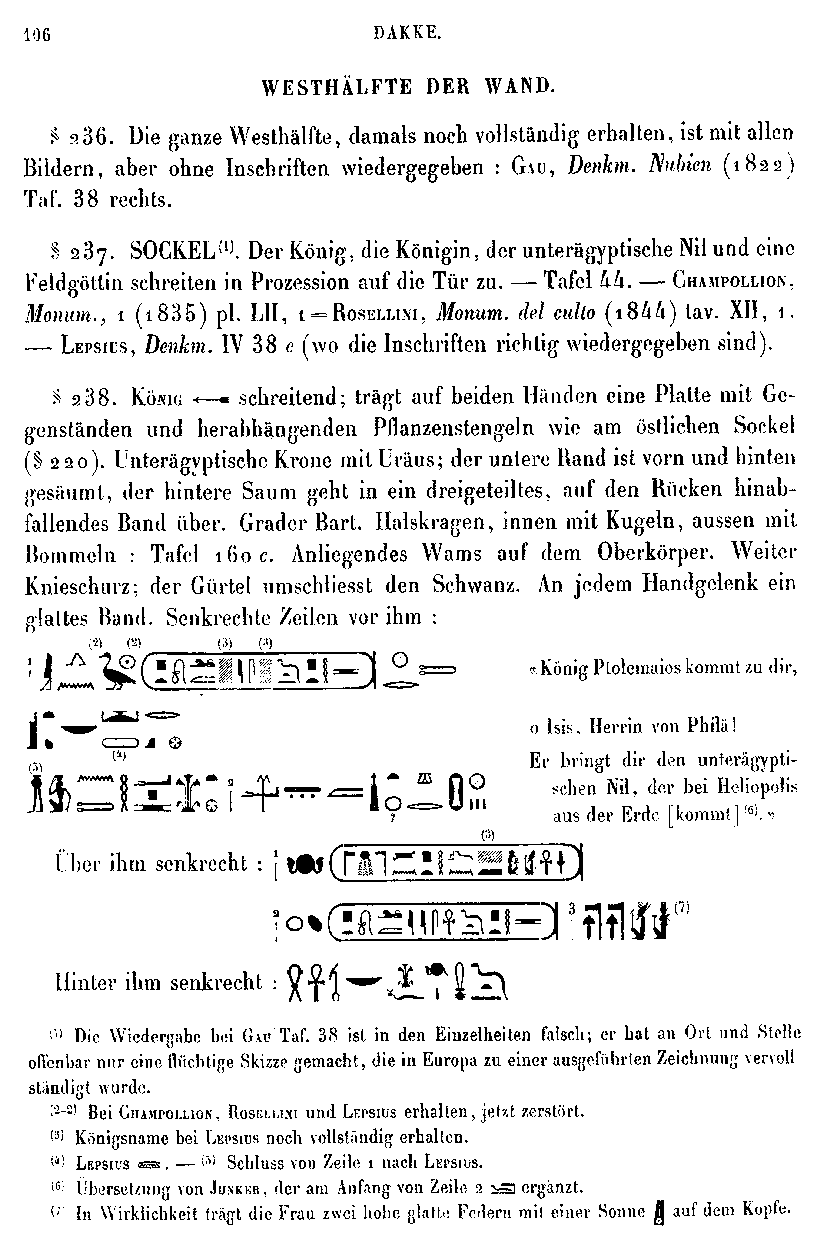
Page 106. Roeder, Der Tempel von Dakke (1930), p. 106 Printed hieroglyphs from G. Roeder, Der Tempel von Dakke (1930) - 34p. 106, § 238
jj.n sꜣ-rꜥ ptwlm[j]js-[ꜥnḫ]-ḏ.t-mrj-ptḥ ḫr=ṯ ꜣs.t nb.(t) jwrḳ [jnj=f n=ṯ ḥꜥpj mḥw] (9) m tꜣ m jwn.t ẖrw
The Son of Ra, Ptolemy, ever-living, beloved of Ptah, has come to you, Isis, Lady of Philae, to bring you Hapy of the North, rising from the earth at Heliopolis laden with produce.
Note · Line 34
Hapy is the Nile flood in divine form. What he carries is what his waters make the land yield. - 35p. 106, § 238
nswt-bj.tj jwꜥ-n-nṯr.wj-prj.wj-stp-n-ptḥ-jrj-mꜣꜥ.t-rꜥ-sḫm-ꜥnḫ-<n>-jmn sꜣ-rꜥ ptwlmys-ꜥnḫ-ḏ.t-mrj-ptḥ nṯr.wj-mnḫ.wj
King of Upper and Lower Egypt, heir of the two Manifest Gods, chosen by Ptah, who upholds the Maat of Ra, living image of Amun; Son of Ra, Ptolemy, ever-living, beloved of Ptah; the two Benefactor Gods.
Note · Line 35
The Manifest Gods are Ptolemy V and Cleopatra I, parents of Ptolemy VIII. The Benefactor Gods are Ptolemy VIII and his queen. - 36p. 106, § 238
sꜣ ꜥnḫ wꜣs nb ḥꜣ=f mj rꜥ ḏ.t
All protection, life and dominion stand behind him as they stand behind Ra, forever.
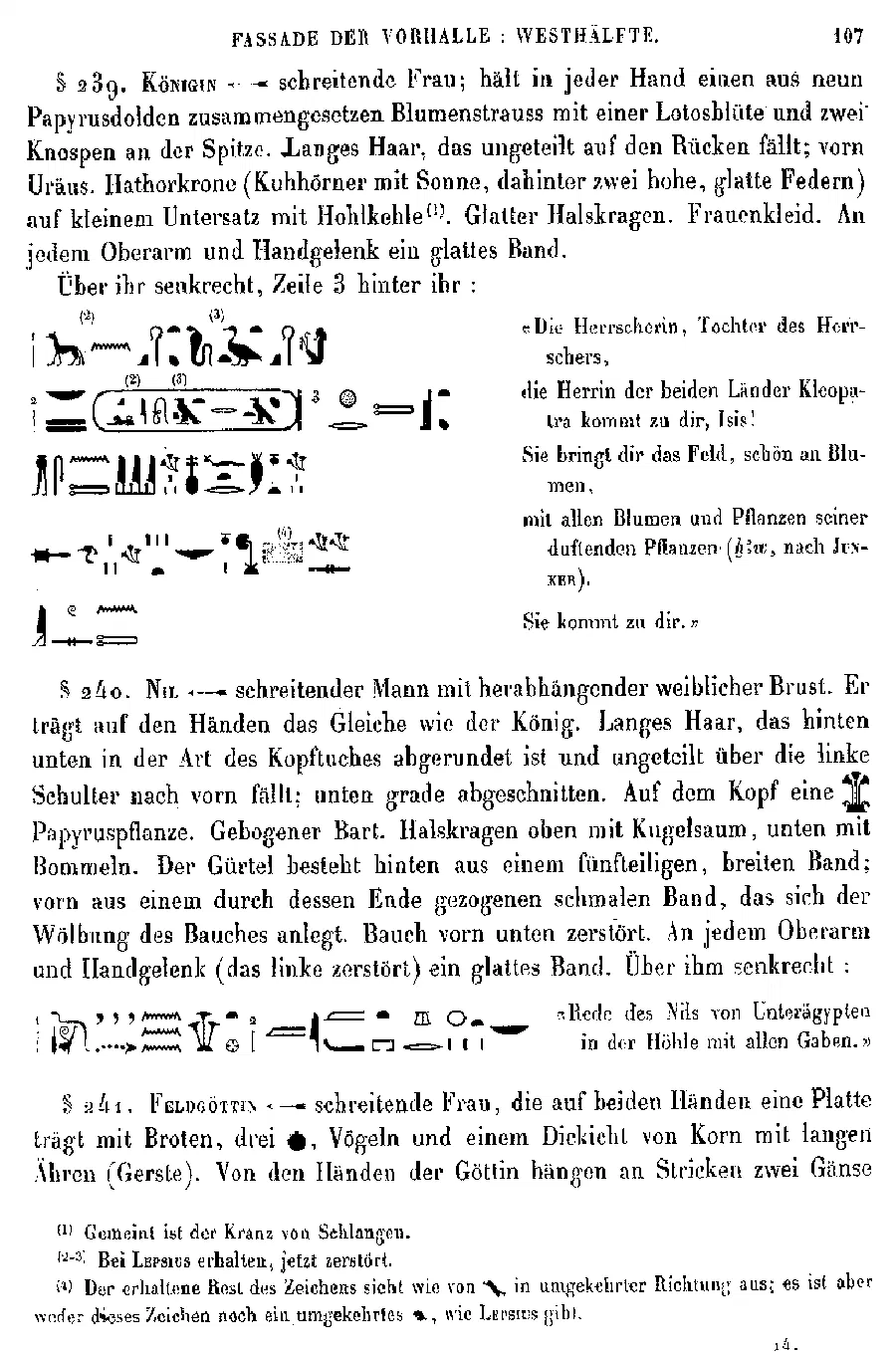
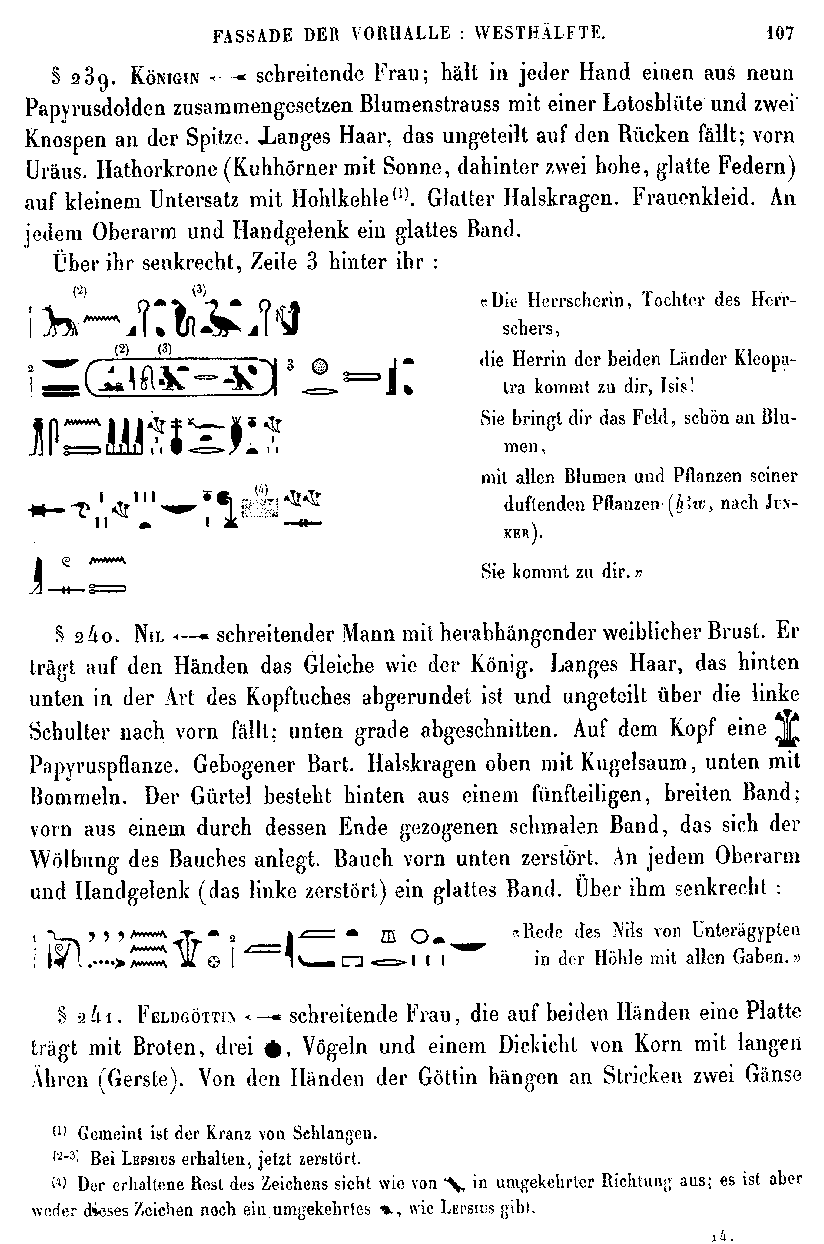
Page 107. Roeder, Der Tempel von Dakke (1930), p. 107 Printed hieroglyphs from G. Roeder, Der Tempel von Dakke (1930) - 37p. 107, § 239
[jj.n ḥḳꜣ.t sꜣ.t](10) ḥḳꜣ nb.(t)-tꜣ.wj [ḳljwpꜣ]trꜣ (11) ḫr=ṯ ꜣs.t jnj=s n=ṯ sḫ.t nfr.t bnr.t jsw ẖr ꜣḫ.w …(?) nb n is.tj(?) =s jj=s n=ṯ
The queen, daughter of a king, Lady of the Two Lands, Cleopatra, has come to you, Isis, to bring you the fair field, rich in plants, laden with all the shining plants … and its herbs. She comes to you.
- 38p. 107, § 240
ḏd-mdw jn ḥꜥpj mḥw m jmḥ.t ẖr jḫ.t nb.(t)
Words spoken by Hapy of the North in the cavern, bearing every kind of produce.
- 39p. 107, § 241
ꜣḫ.w nfr.w
The fair, shining plants.
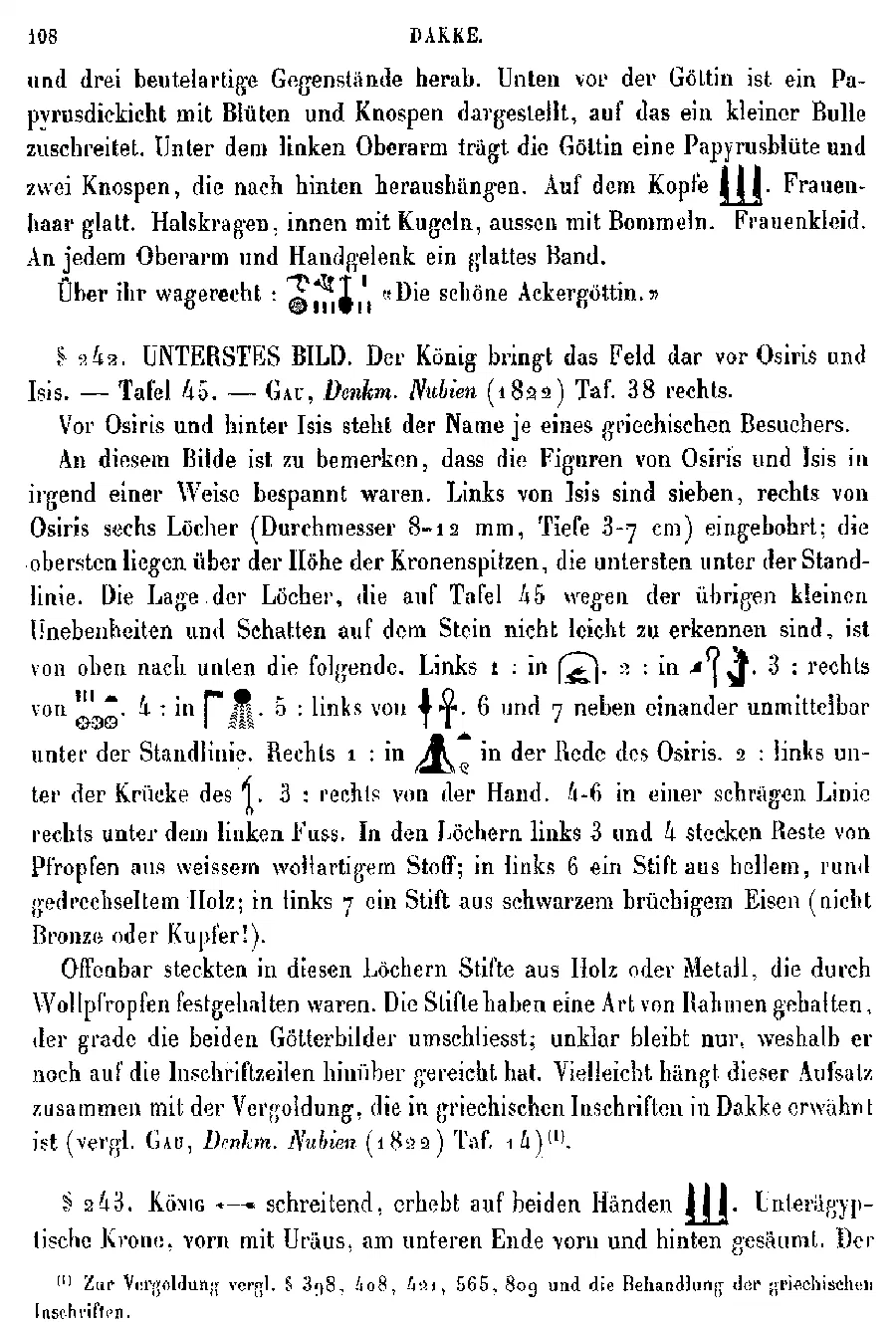
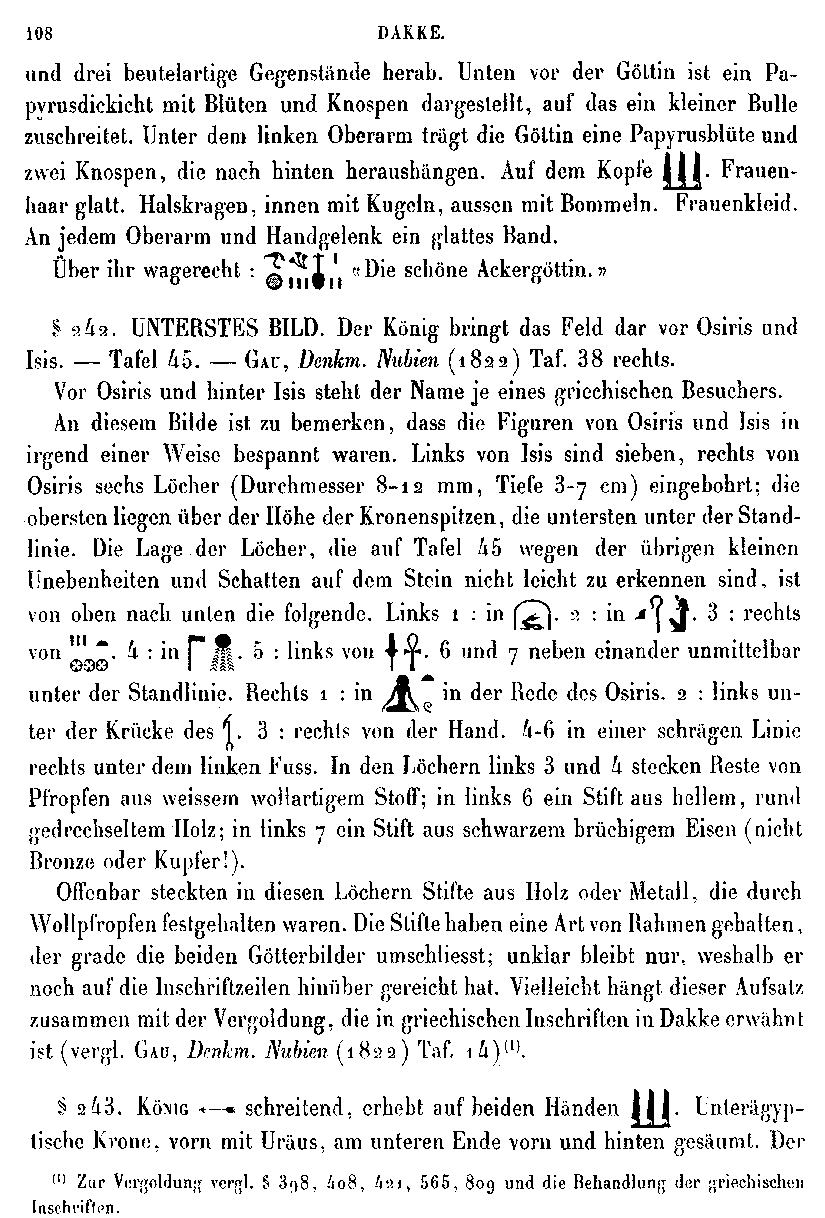
Page 108. Roeder, Der Tempel von Dakke (1930), p. 108 Printed hieroglyphs from G. Roeder, Der Tempel von Dakke (1930) - 40p. 108, § 243
nswt-bj.tj jwꜥ-n-nṯr.wj-prj.wj-stp-n-ptḥ-jrj-mꜣꜥ.t-rꜥ-sḫm-ꜥnḫ-<n>-jmn sꜣ-rꜥ ptwlmys-ꜥnḫ-ḏ.t-mrj-ptḥ nṯr.wj-mnḫ.wj
King of Upper and Lower Egypt, heir of the two Manifest Gods, chosen by Ptah, who upholds the Maat of Ra, living image of Amun; Son of Ra, Ptolemy, ever-living, beloved of Ptah; the two Benefactor Gods.
- 41p. 108, § 243
sꜣ ꜥnḫ wꜣs nb ḥꜣ=f mj rꜥ ḏ.t
All protection, life and dominion stand behind him as they stand behind Ra, forever.
- 42p. 108, § 243
bḥd.tj
He of Edfu.
Note · Line 42
This is Horus of Edfu, who appears over temple scenes as the winged sun disk. - 43p. 108, § 243
ḥnk{=j} sḫ.t n jt=f šps n mw.t=f wsr.t n jtr.w 24
Offering the field of twenty-four iteru to his venerable father and his mighty mother.
Note · Line 43
The iteru was an Egyptian measure of distance. 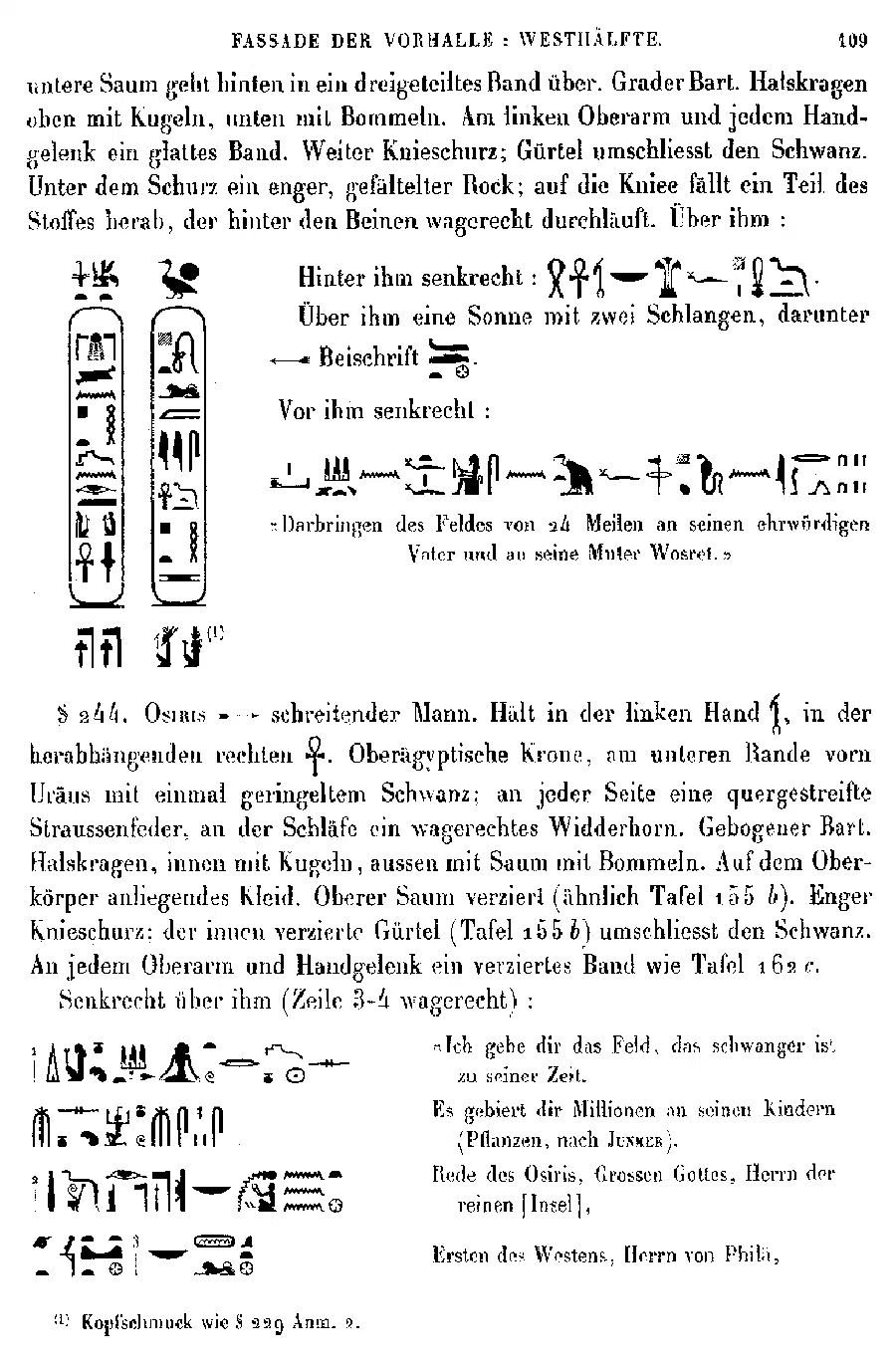
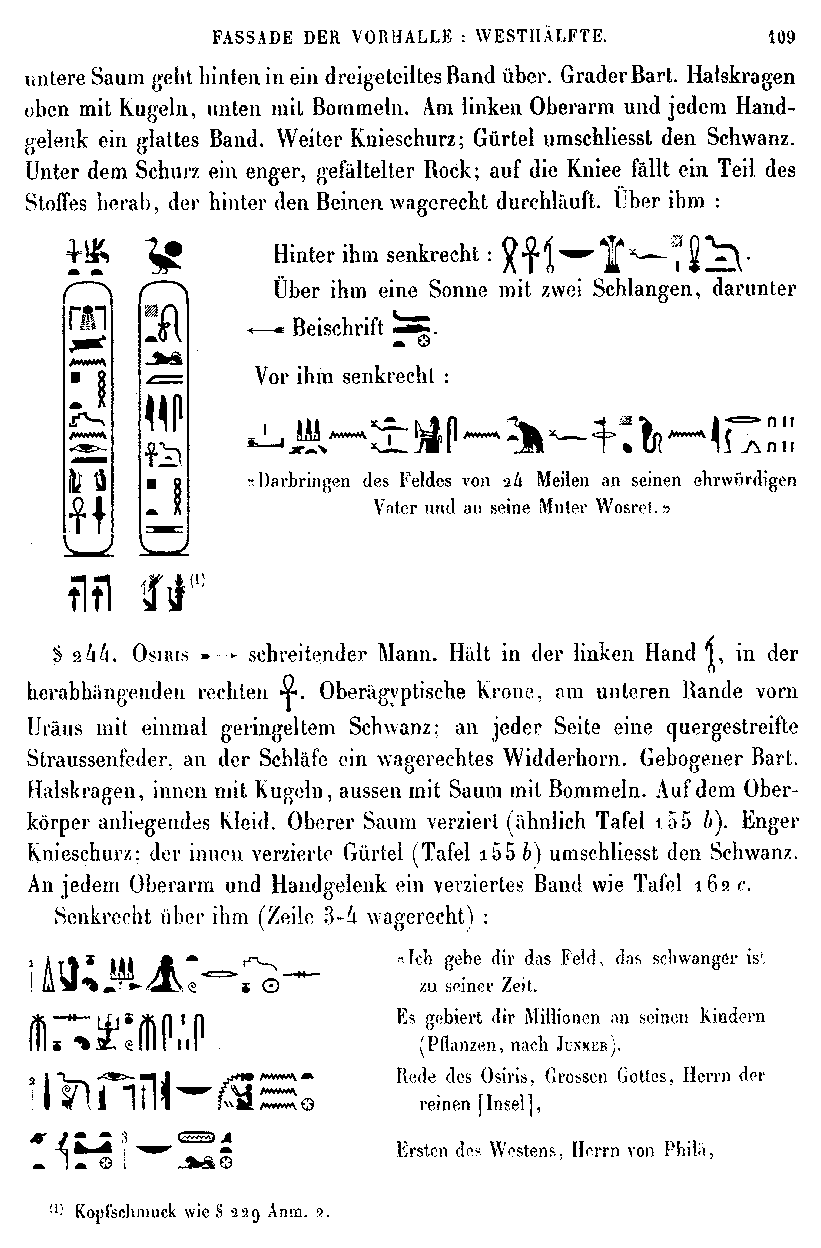
Page 109. Roeder, Der Tempel von Dakke (1930), p. 109 Printed hieroglyphs from G. Roeder, Der Tempel von Dakke (1930) - 44p. 109, § 244
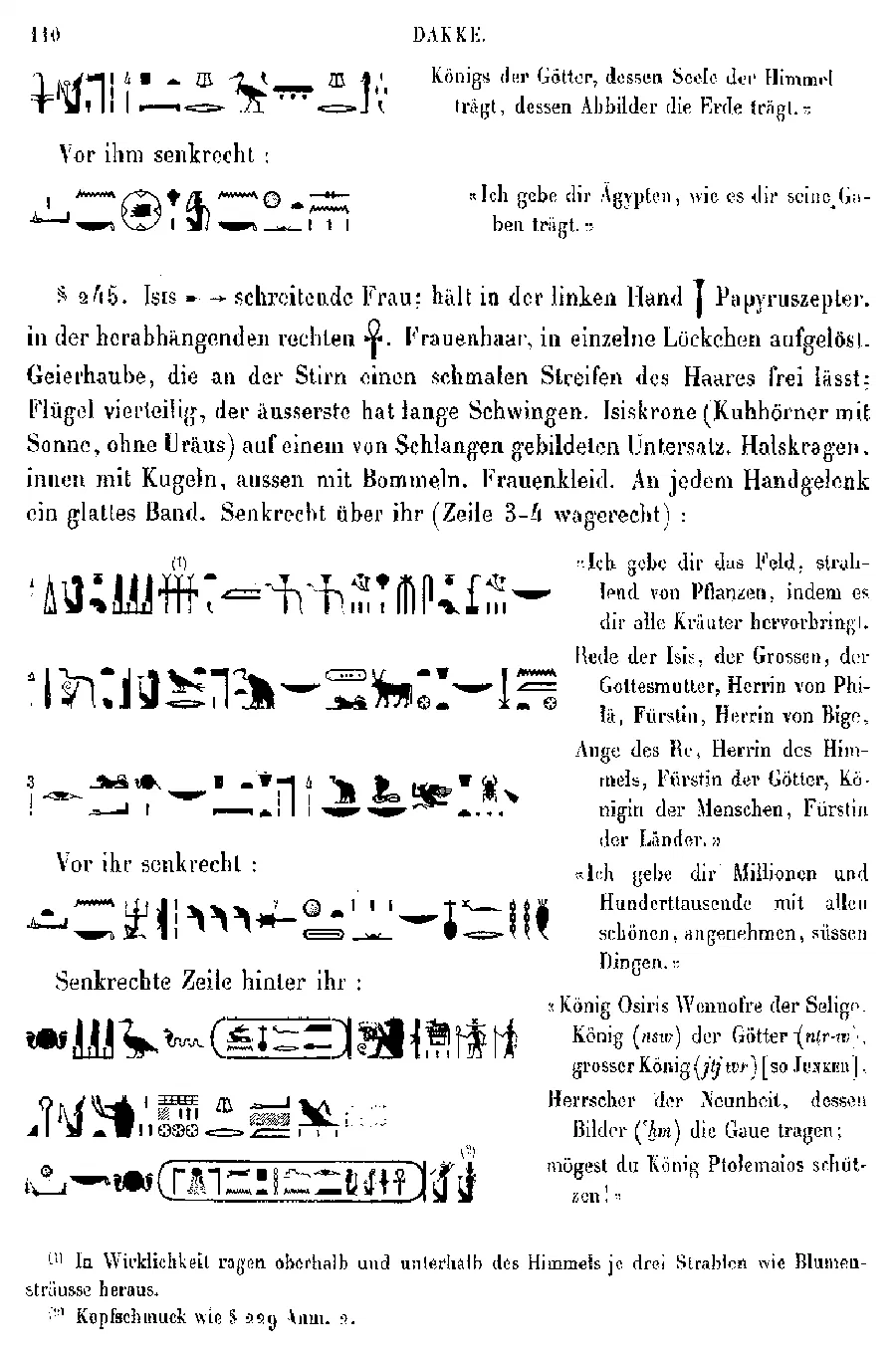
dj=j n=k sḫ.t jwr.tj r nw=s msj=s n=k ḥḥ n ms.w=s
I give you the field, pregnant in her season, that she may bear you a million of her children.
- 45p. 109, § 244
ḏd-mdw jn wsjr nṯr ꜥꜣ nb <jw>-wꜥb ḫnt.j jmnt.t nb jwrḳ nswt nṯr.w p.t ẖr bꜣ=f tꜣ ẖr sḫm.w=f (12)
Words spoken by Osiris, the great god, lord of the Abaton, foremost in the West, lord of Philae, king of the gods. The sky bears his ba, the earth his images.
Note · Line 45
The Abaton, the “inaccessible place,” was the burial sanctuary of Osiris on Bigeh, beside Philae. His ba is the form in which he can move freely. - 46p. 109, § 244
dj=j n=k km.t ḥr fꜣj.t n=k jḫ.t=sn
I give you Egypt, its people bearing you their produce.
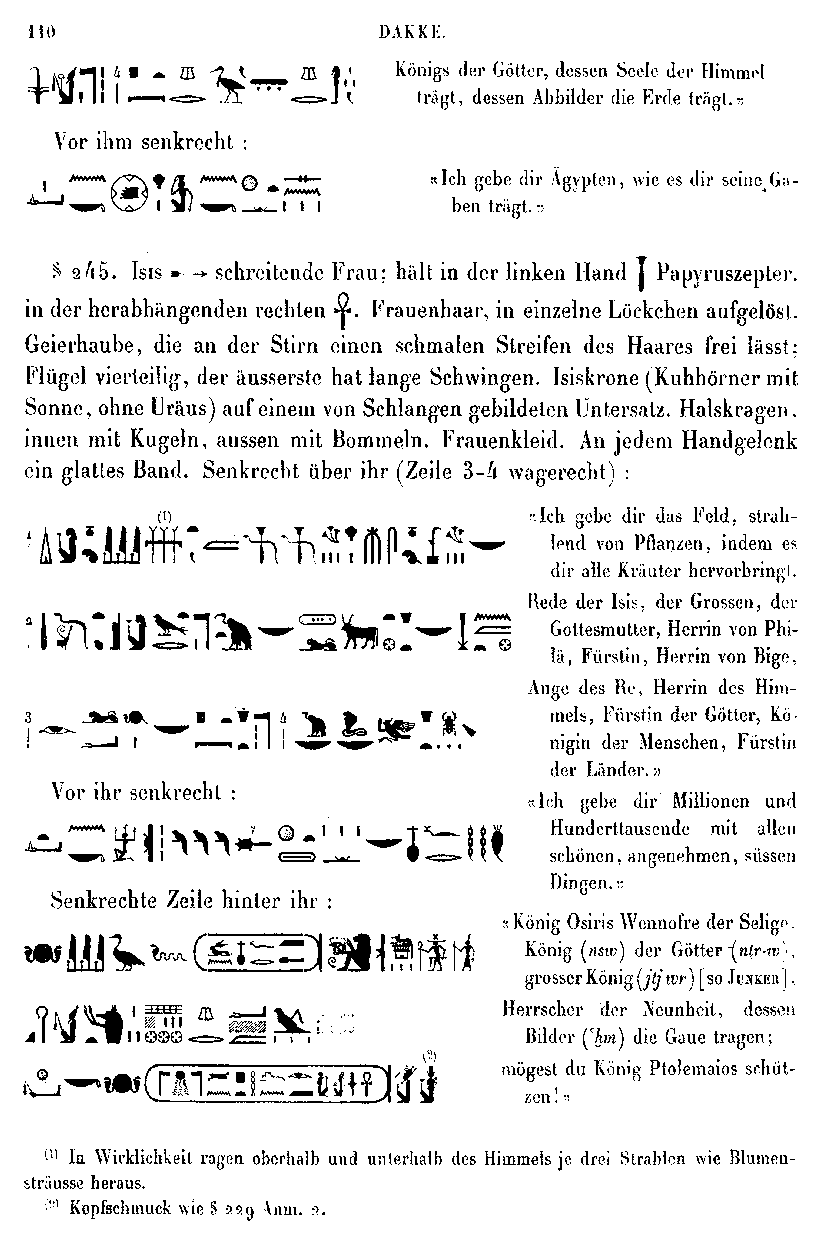
Page 110. Roeder, Der Tempel von Dakke (1930), p. 110 Printed hieroglyphs from G. Roeder, Der Tempel von Dakke (1930) - 47p. 110, § 245
dj=j n=k sḫ.t ṯḥn.tj m wꜣḏwꜣḏ.w ḥr msj.(t) n=k rnp.wt nb.(wt)
I give you the field, bright with greenery, bringing forth for you every kind of fresh growth.
- 48p. 110, § 245
ḏd-mdw jn ꜣs.t wr.t mw.t-nṯr nb.(t) jwrḳ ḥnw.t nb.(t) snm.t jr.t rꜥ nb.(t) p.t ḥnw.t nṯr.w nb.w nb.tj.t rḫj.t ḥnw.t tꜣ.w
Words spoken by Isis the Great, mother of the god, Lady of Philae, mistress, Lady of Senmet, Eye of Ra, lady of the sky, mistress of all the gods, queen of the people, mistress of the lands.
Note · Line 48
The Eye of Ra is the sun god’s power to act and protect, embodied in a goddess. - 49p. 110, § 245
dj=j n=k ḥḥ.w ḥfn.w ẖr jḫ.t nb.(t) nfr.(t) nḏm.(t) bnr.(t)
I give you millions and hundreds of thousands bearing every good, delightful, sweet thing.
- 50p. 110, § 245
wsjr wn-nfr mꜣꜥ-ḫrw nswt nṯr.w jtj wr ḥḳꜣ psḏ.t spꜣ.wt njw.wt ẖr ꜥ[ḫ]m.w[=f] ḫwj=k nswt-bj.tj jwꜥ-n-nṯr.wj-prj.wj-stp-n-ptḥ-jrj-mꜣꜥ.t-rꜥ-sḫm-ꜥnḫ-<n>-jmn nṯr.wj-mnḫ.wj
Osiris Wennefer, vindicated, king of the gods, great sovereign, ruler of the Ennead. The nomes and towns bear his images. May you protect the King of Upper and Lower Egypt, heir of the two Manifest Gods, chosen by Ptah, who upholds the Maat of Ra, living image of Amun; the two Benefactor Gods.
Note · Line 50
Wennefer is a name of Osiris; “vindicated” recalls the judgment in his favor against Seth. The Ennead is a company of nine gods. Nomes are the provinces of Egypt. 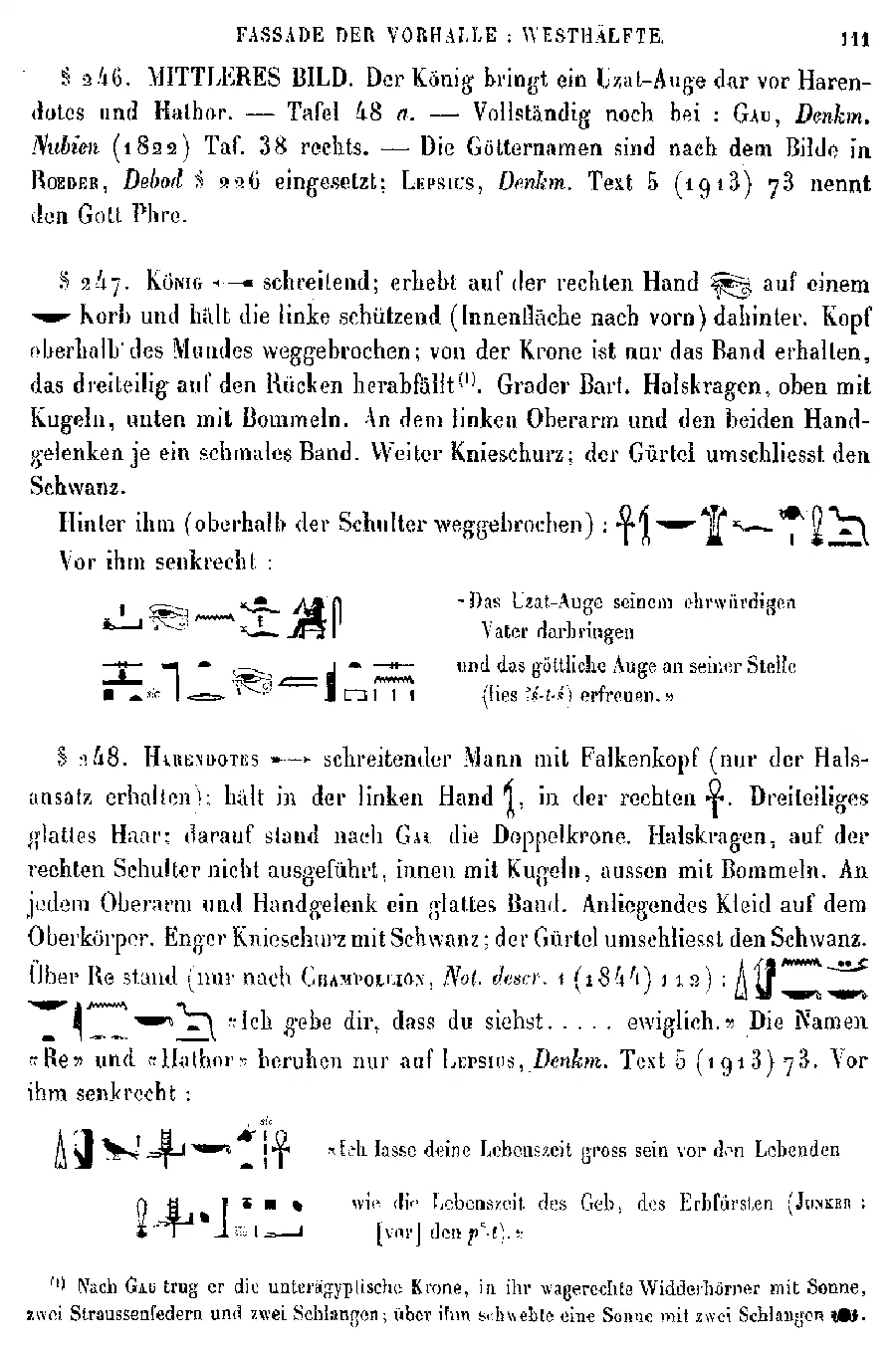
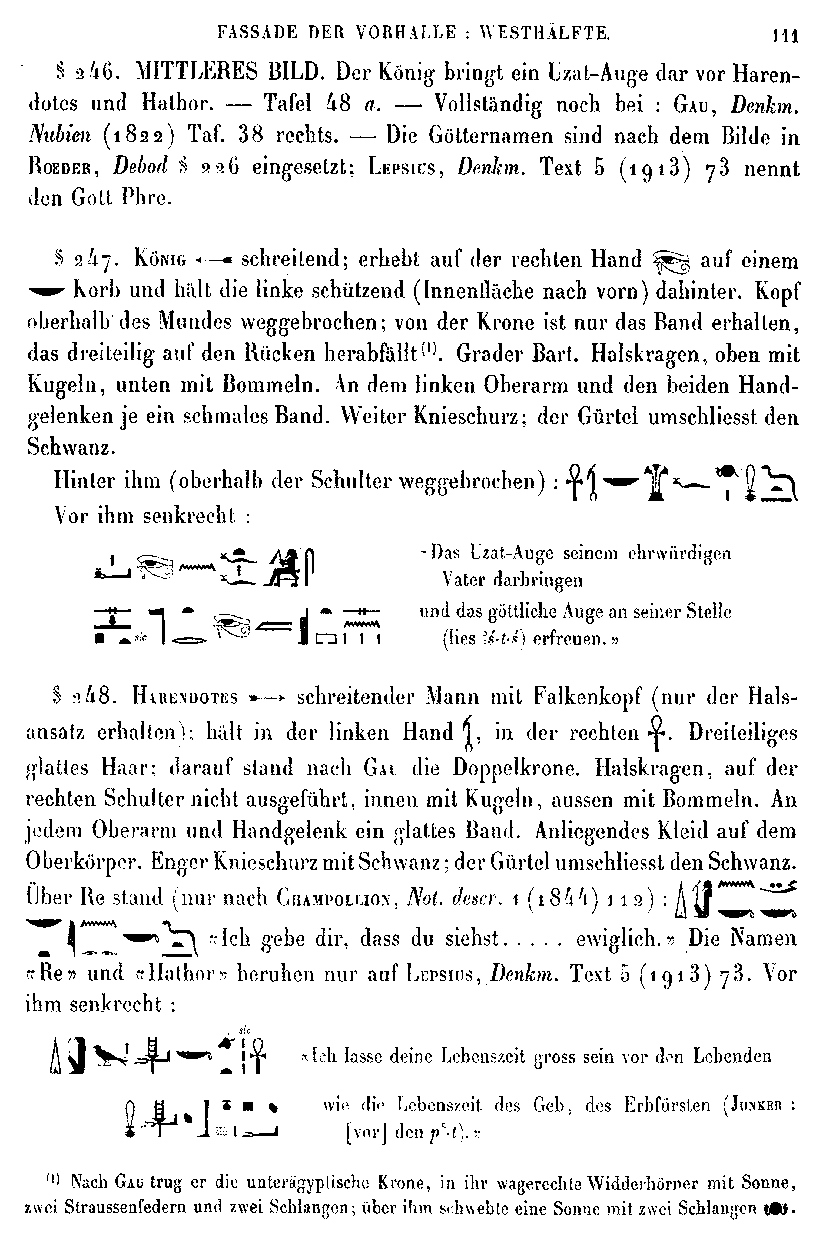
Page 111. Roeder, Der Tempel von Dakke (1930), p. 111 Printed hieroglyphs from G. Roeder, Der Tempel von Dakke (1930) - 51p. 111, § 247
sꜣ ꜥnḫ wꜣs nb ḥꜣ=f mj rꜥ ḏ.t
All protection, life and dominion stand behind him as they stand behind Ra, forever.
- 52p. 111, § 247
ḥnk {=j} wḏꜣ,t n jt=f šps sḥtp nṯrj.t m s.t=s{n}
Offering the wedjat-eye to his venerable father; soothing the divine eye in its place.
Note · Line 52
The wedjat is the eye of Horus, injured and made whole again. To offer it is to offer wholeness. - 53p. 111, § 248
dj=j n=k mꜣ.(t)=k nb.t jn jr.tj=k ḏ.t
I give you all that you see with your two eyes, forever.
- 54p. 111, § 248
dj=j wr ꜥḥꜥ=k ḫnt.j ꜥnḫ.w mj ꜥḥꜥ gb [jr.j-]pꜥ.t
I make your life at the head of the living as long as the life of Geb, prince of the nobles.
Note · Line 54
Geb, the earth god, ruled before Osiris; his reign is the measure invoked for the king’s. 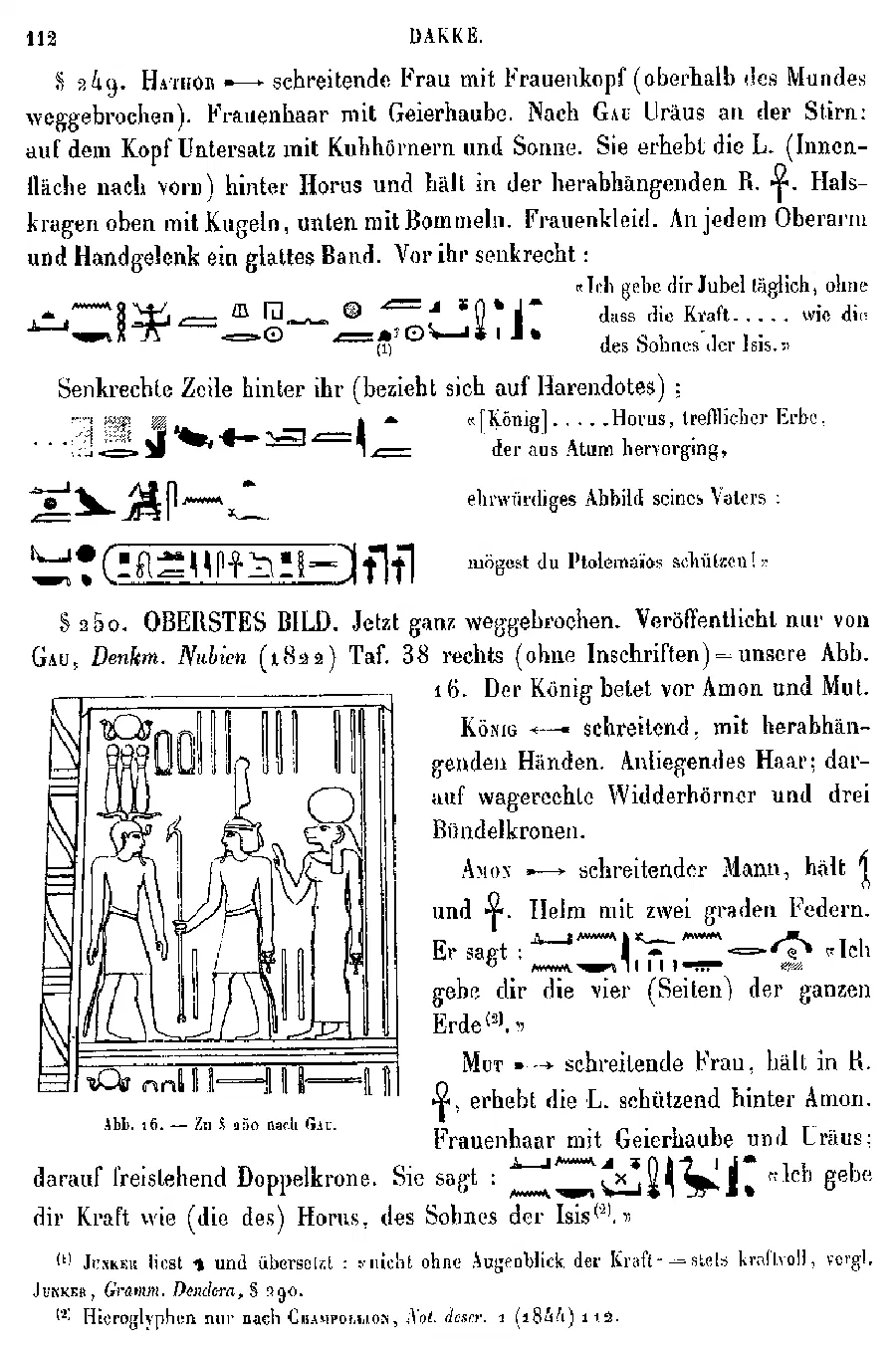
Page 112. Roeder, Der Tempel von Dakke (1930), p. 112 Printed hieroglyphs from G. Roeder, Der Tempel von Dakke (1930) - 55p. 112, § 249
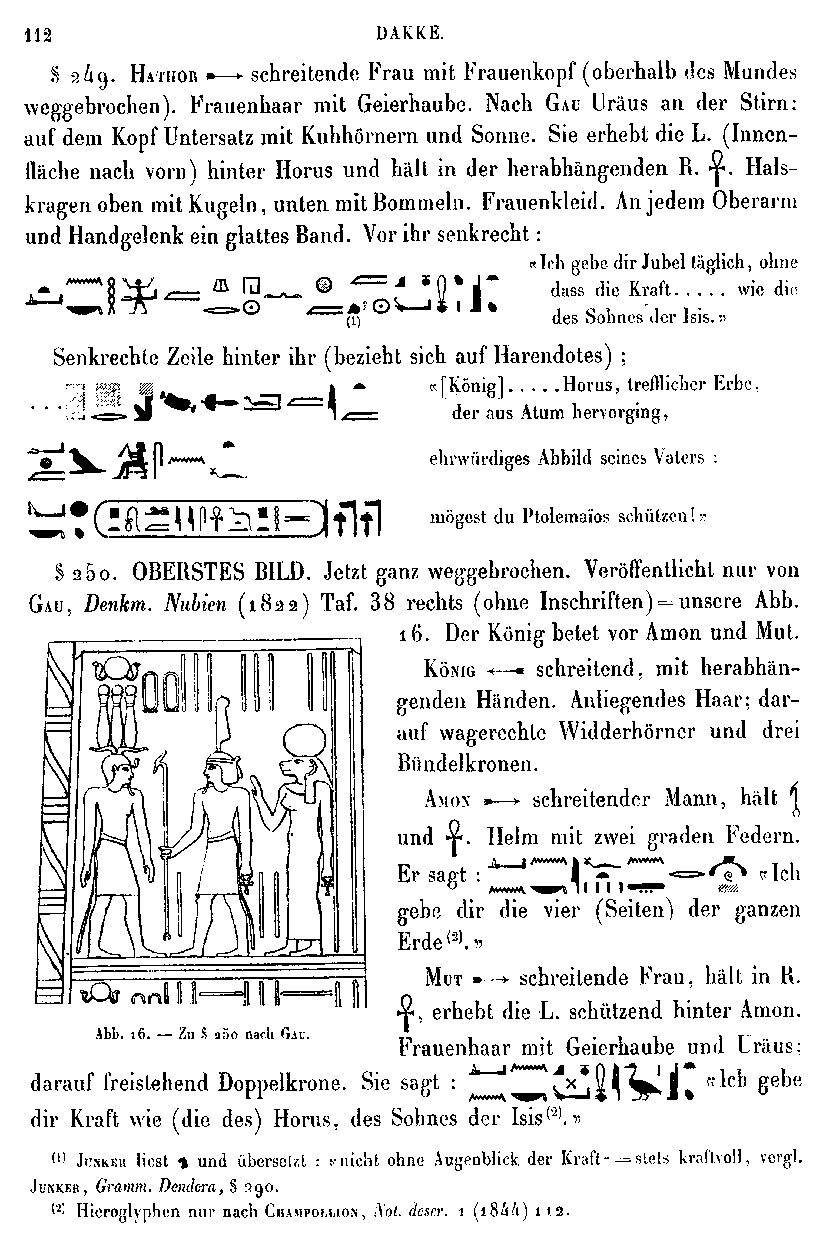
dj=j n=k ḥꜥꜥ m ẖr.t-hrw n šm.t (13) ḳn mj sꜣ ꜣs.t
I give you joy each day, free of fever, and strength like that of the son of Isis.
Note · Line 55
The son of Isis is Horus, the divine heir to the throne. - 56p. 112, § 249
--détruit-- jwꜥ mnḫ prj m jtm ꜥḫm šps n jt=f ḫwj=k sꜣ-rꜥ ptwlmys-ꜥnḫ-ḏ.t-mrj-ptḥ nṯr.wj-mnḫ.wj
… excellent heir sprung from Atum, venerable image of his father. May you protect the Son of Ra, Ptolemy, ever-living, beloved of Ptah; the two Benefactor Gods.
- 57p. 112, § 250
dj.n=j n=k jfd.w n tꜣ r ꜣw[=s]
I have given you the four corners of the earth in all its breadth.
- 58p. 112, § 250
dj=j n=k ḳn mj sꜣ ꜣs.t
I give you strength like that of the son of Isis.
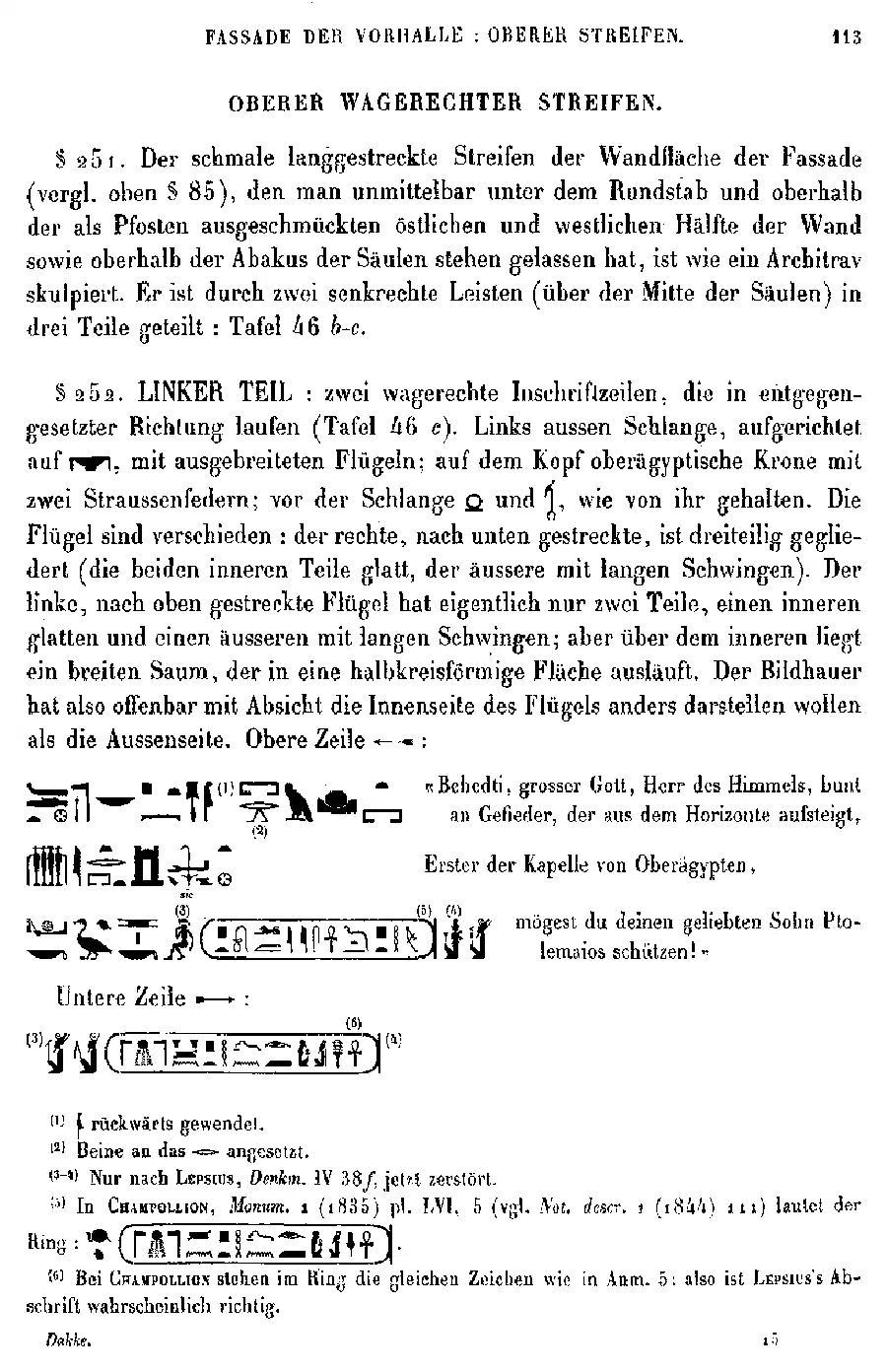
Page 113. Roeder, Der Tempel von Dakke (1930), p. 113 Printed hieroglyphs from G. Roeder, Der Tempel von Dakke (1930) - 59p. 113, § 252
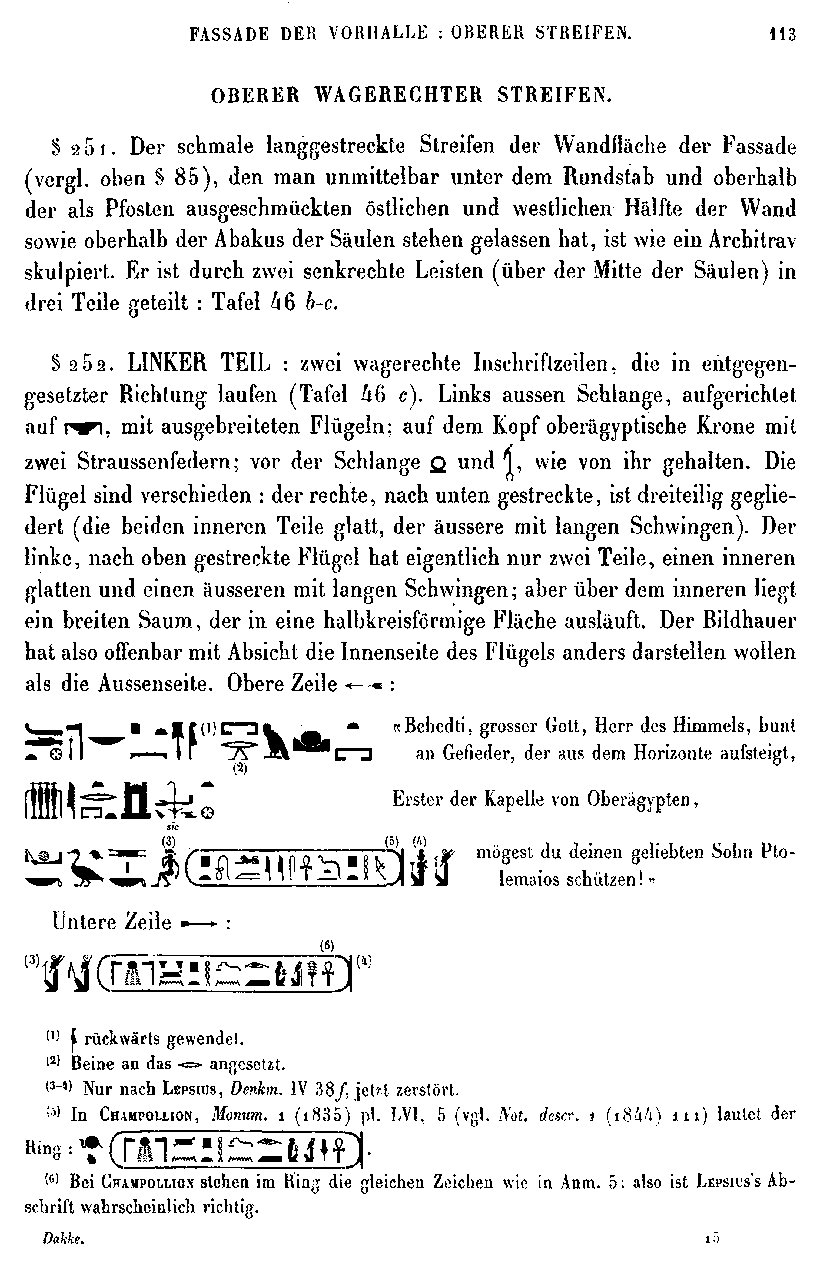
bḥd.tj nṯr ꜥꜣ nb p.t sꜣb šw.t prj m ꜣḫ.t ḫnt.j jtr.t šmꜥ ḫwj=k sꜣ=k mrj=k [sꜣ-rꜥ ptwlmys-ꜥnḫ-ḏ.t-mrj-ptḥ nṯr.wj-mnḫ.wj] (14)
He of Edfu, the great god, lord of the sky, many-colored of plumage, rising from the horizon, foremost in the southern shrine. May you protect your son whom you love, the Son of Ra, Ptolemy, ever-living, beloved of Ptah; the two Benefactor Gods.
- 60p. 113, § 252
nswt-bj.tj jwꜥ-n-nṯr.wj-prj.wj-stp-n-ptḥ-jrj-mꜣꜥ.t-rꜥ-sḫm-ꜥnḫ-<n>-jmn ḥnꜥ sn.t=f ḥm.t=f ḥḳꜣ.t nb.(t)-tꜣ.wj ḳljwpꜣtrꜣ nṯr.wj-mnḫ.wj mrj ḏḥwtj <n> pnbs
The King of Upper and Lower Egypt, heir of the two Manifest Gods, chosen by Ptah, who upholds the Maat of Ra, living image of Amun, together with his sister, his wife, the queen, Lady of the Two Lands, Cleopatra: the two Benefactor Gods, beloved of Thoth of Pnubs.
Note · Line 60
The king’s sister and wife is Cleopatra II. Thoth of Pnubs is the god to whom the temple at Dakka was dedicated. 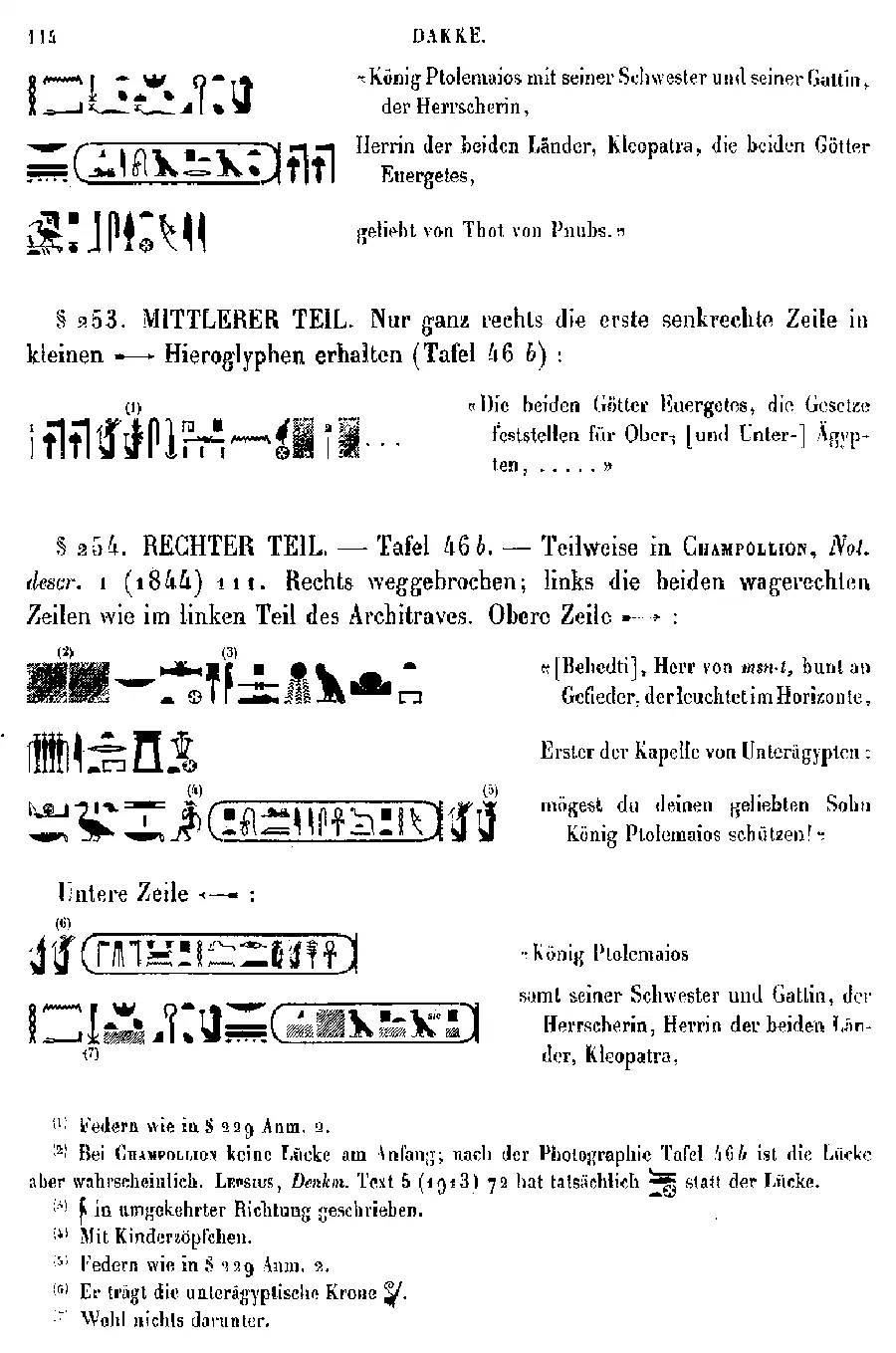
Page 114. Roeder, Der Tempel von Dakke (1930), p. 114 Printed hieroglyphs from G. Roeder, Der Tempel von Dakke (1930) - 61p. 114, § 253
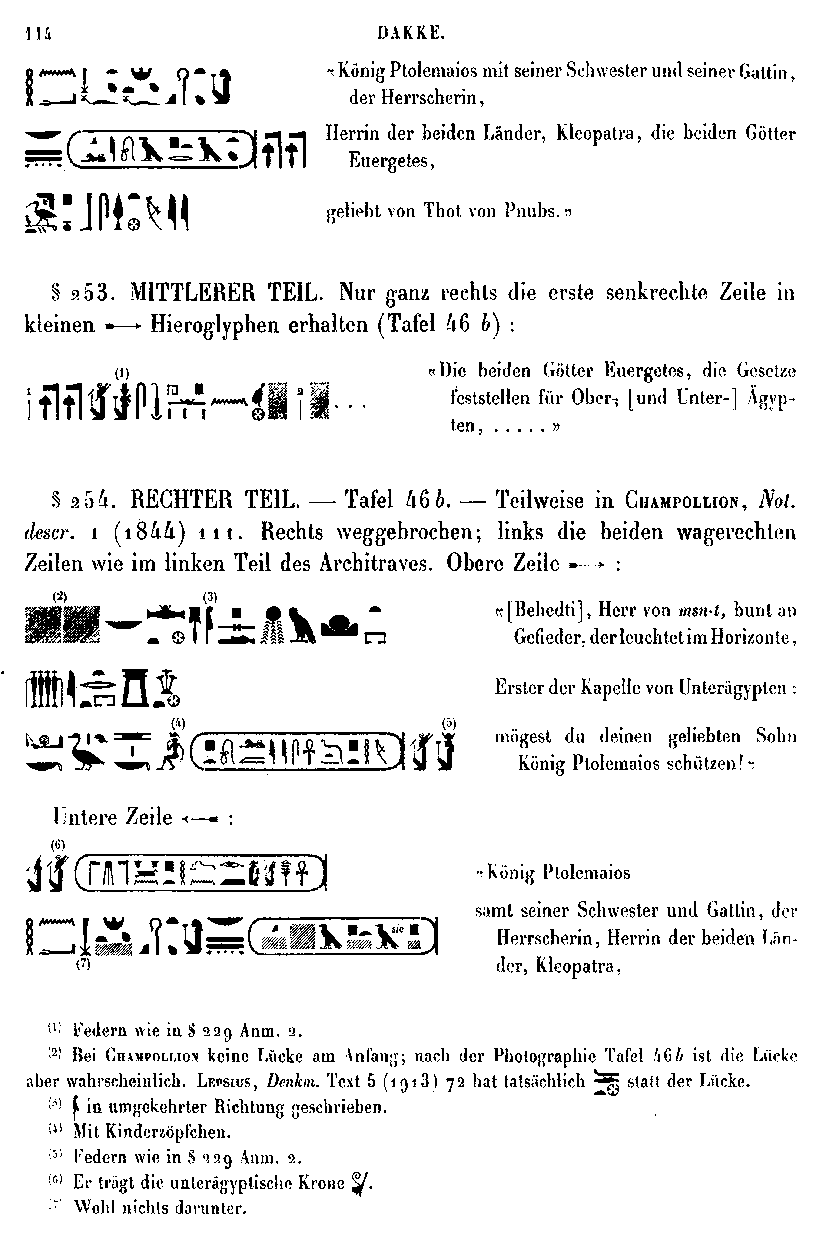
nṯr.wj mnḫ.wj smn hp.w n šmꜥ [mḥw] --détruit--
The two Benefactor Gods, who establish the laws of Upper and Lower Egypt …
- 62p. 114, § 254
[bḥd.tj] nb msn sꜣb šw.t psḏ m ꜣḫ.t ḫnt.j jtr.t mḥw ḫwj=k sꜣ=k mrj=k sꜣ-rꜥ ptwlmys-ꜥnḫ-ḏ.t-mrj-ptḥ nṯr.wj mnḫ.wj
He of Behdet, lord of Mesen, whose plumage is many-colored, who shines on the horizon and presides over the northern shrine. May you protect the son you love, the Son of Ra, Ptolemy, ever living, beloved of Ptah; the two Benefactor Gods.
Note · Line 62
He of Behdet is Horus of Edfu, often shown as a winged sun disk. - 63p. 114, § 254
nswt-bj.tj jwꜥ-n-nṯr.wj-prj.wj-stp-n-ptḥ-jrj-mꜣꜥ.t-rꜥ-sḫm-ꜥnḫ-<n>-jmn ḥnꜥ sn.t=<f> ḥm.t=f ḥḳꜣ.t nb.(t)-tꜣ.wj ḳ[ljw]pꜣt[r]ꜣ [mrj] ꜣs.t nb.(t) jwrḳ nb.(t) ḫꜣs.wt-rsj.w(t) [dj.t] ꜥnḫ
The King of Upper and Lower Egypt, heir of the two Manifest Gods, chosen of Ptah, who enacts the justice of Ra, living image of Amun, with his sister, his wife, the sovereign, Lady of the Two Lands, Cleopatra, beloved of Isis, Lady of Philae, Lady of the foreign lands to the south, who gives life.
Note · Line 63
The titles from “heir” through “living image of Amun” form the throne name of Ptolemy VIII. The justice he enacts is maat, the right order of the world. 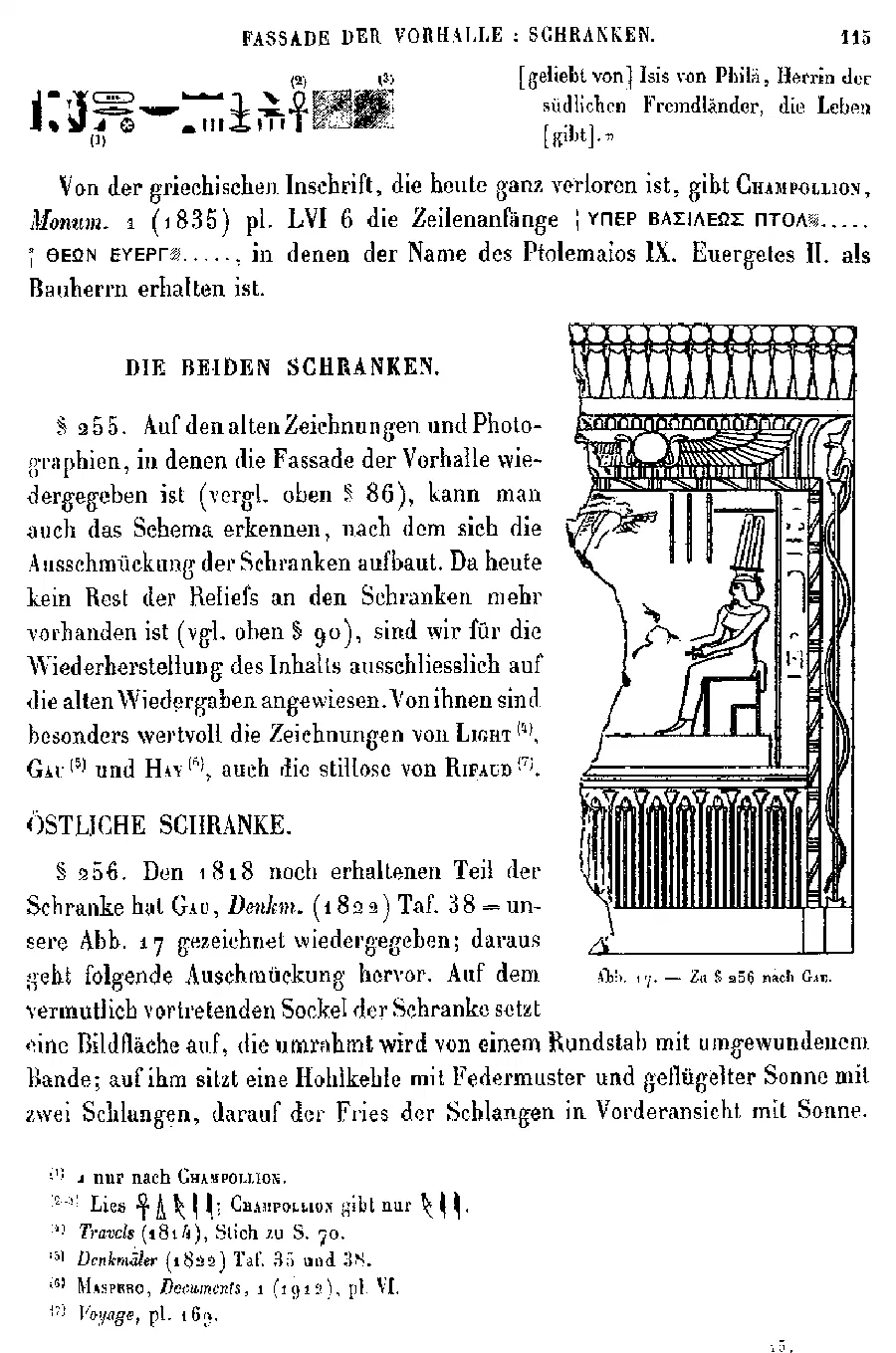
Page 115. Roeder, Der Tempel von Dakke (1930), p. 115 Printed hieroglyphs from G. Roeder, Der Tempel von Dakke (1930) - 64p. 115, § 256
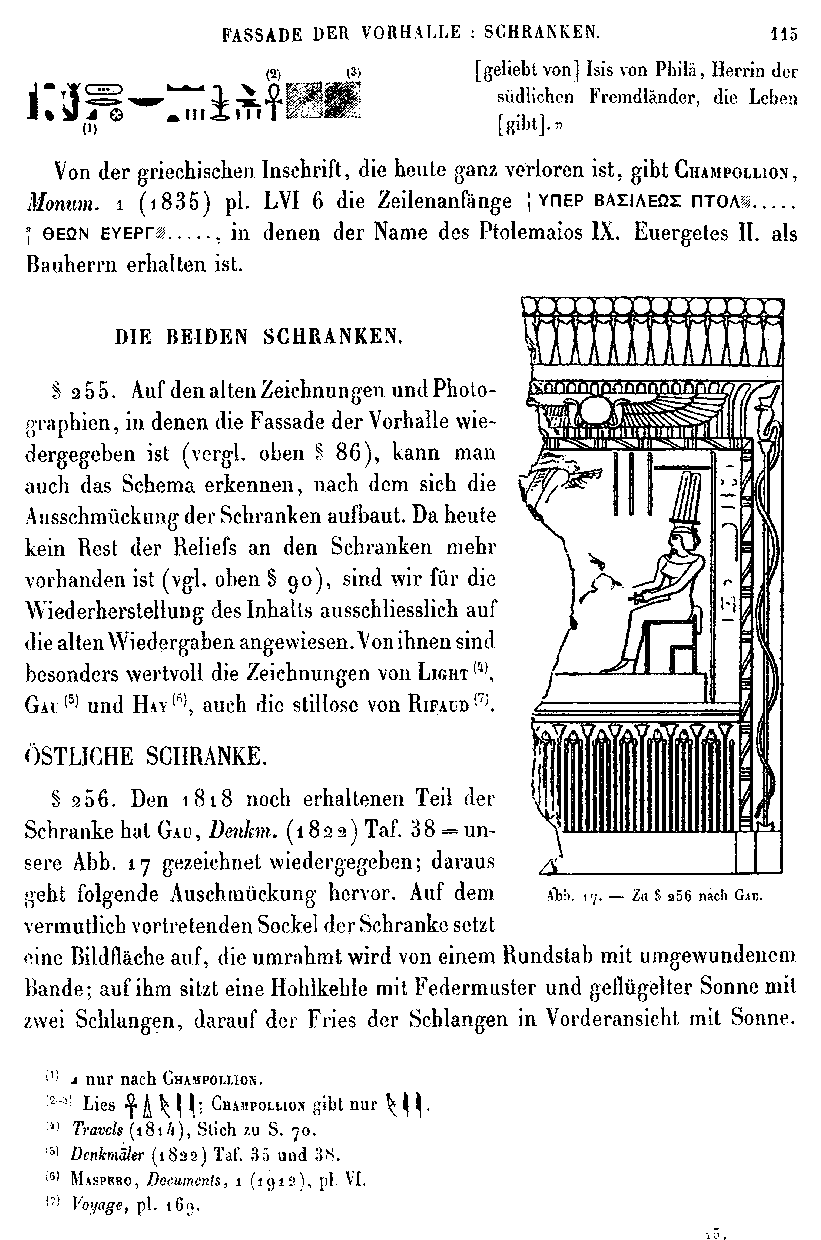
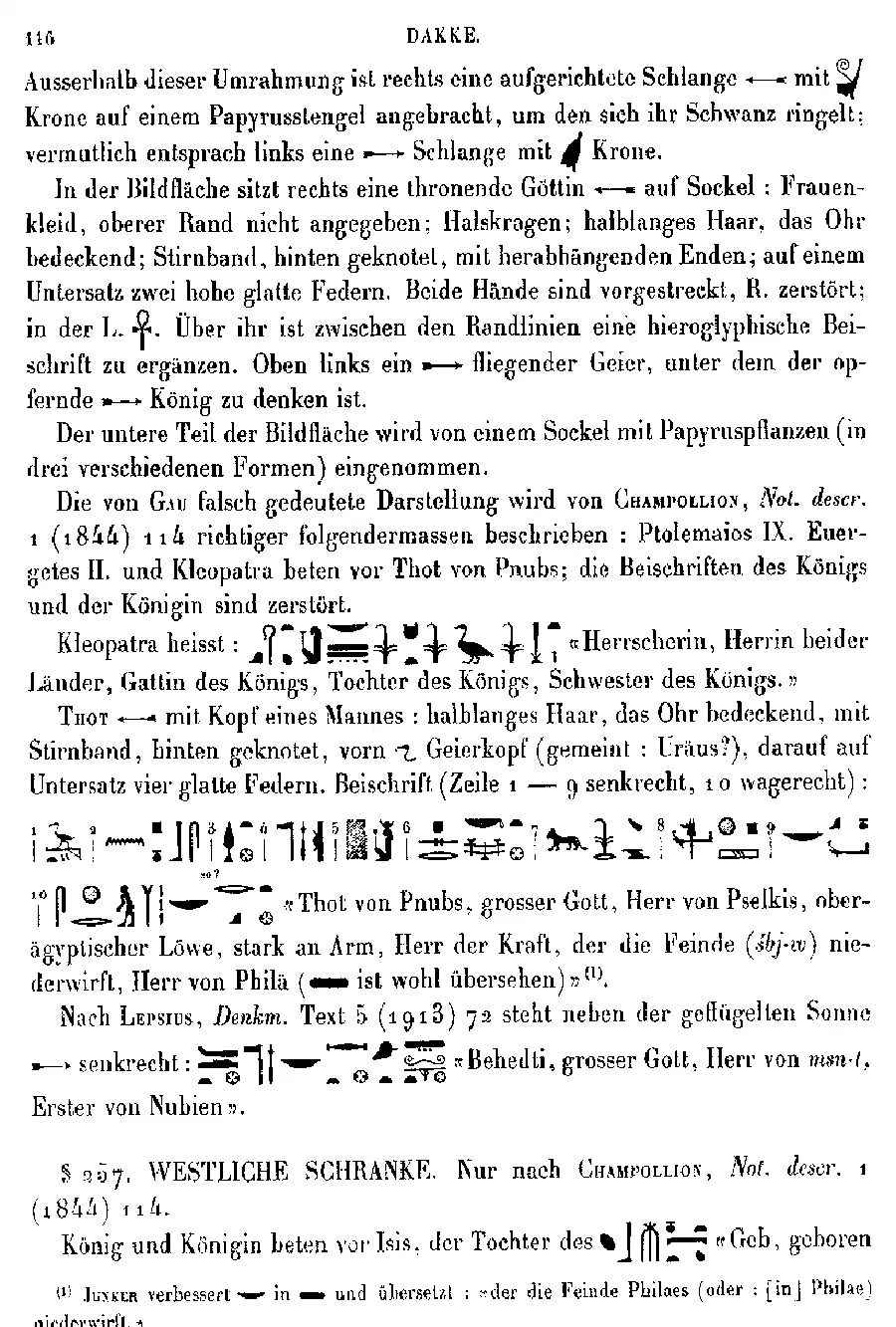
[ḥḳꜣ.t nb.(t)-tꜣ.wj ḥm.t nswt sꜣ.(t) nswt sn.t nswt] (15)
The sovereign, Lady of the Two Lands, king’s wife, king’s daughter, king’s sister.
- 65p. 115, § 256
[ḏḥwtj n pnbs nṯr ꜥꜣ nb psrk.t mꜣj rsj wsr ḫpš nb ḳn sḫr sbj.w nb <jw>rḳ] (16)
Thoth of Pnubs, the great god, lord of Pselkis, lion of the south, mighty of arm, lord of valor, who strikes down rebels, lord of Philae.
Note · Line 65
Pselkis is the ancient name of Dakka, where this temple stands. - 66p. 115, § 256
[bḥd.tj nṯr ꜥꜣ nb msn ḫnt.j tꜣ-stj] (17)
He of Behdet, the great god, lord of Mesen, foremost in Nubia.
Page 116. Roeder, Der Tempel von Dakke (1930), p. 116 Printed hieroglyphs from G. Roeder, Der Tempel von Dakke (1930) - 67p. 116, § 257
[ꜣs.t wr.t mw.t-nṯr dj.(t) ꜥnḫ nb.(t) <jw>-wꜥb nb.(t) jwrḳ nbw.t n nṯr.w ḏꜥm n nṯr.w nṯr.wt nb.w ḫwj=ṯ nswt-bj.tj jwꜥ-n-nṯr.wj-prj.wj-stp-n-ptḥ-jrj-mꜣꜥ.t-rꜥ-sḫm-ꜥnḫ-<n>-jmn] (18) [bḥd.tj nṯr ꜥꜣ nb p.t wbn m ḥr.t] (19)
Isis the Great, mother of the god, giver of life, Lady of the Abaton, Lady of Philae, gold of the gods, electrum of all the gods and goddesses. You protect the King of Upper and Lower Egypt, heir of the two Manifest Gods, chosen of Ptah, who enacts the justice of Ra, living image of Amun. He of Behdet, the great god, lord of the sky, who rises on high.
Note · Line 67
The Abaton was the sanctuary of Osiris on Bigeh, across from Philae. Electrum is an alloy of gold and silver. - 68p. 116, § 257
[bḥd.tj nṯr ꜥꜣ nb msn psḏ m ꜣḫ.t] (20)
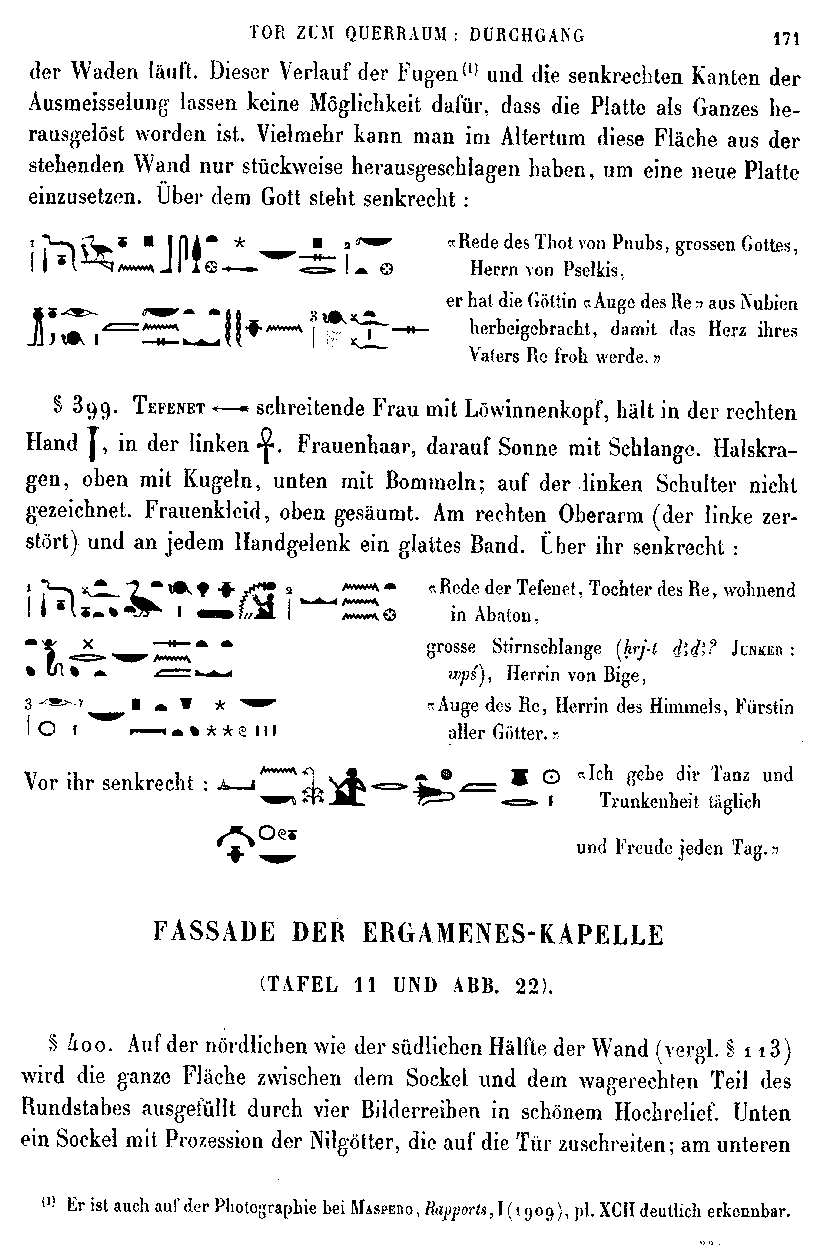
He of Behdet, the great god, lord of Mesen, who shines on the horizon.
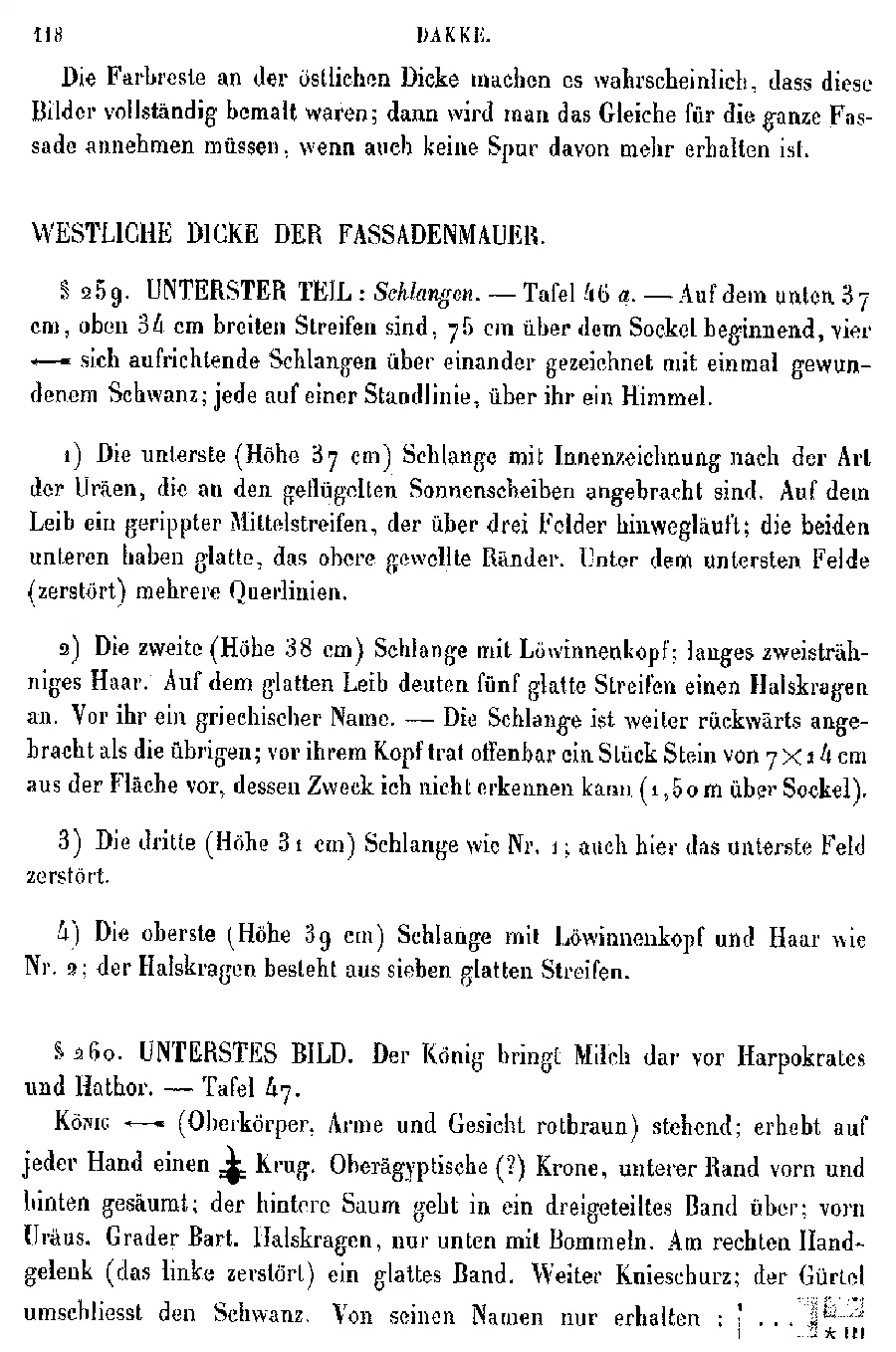
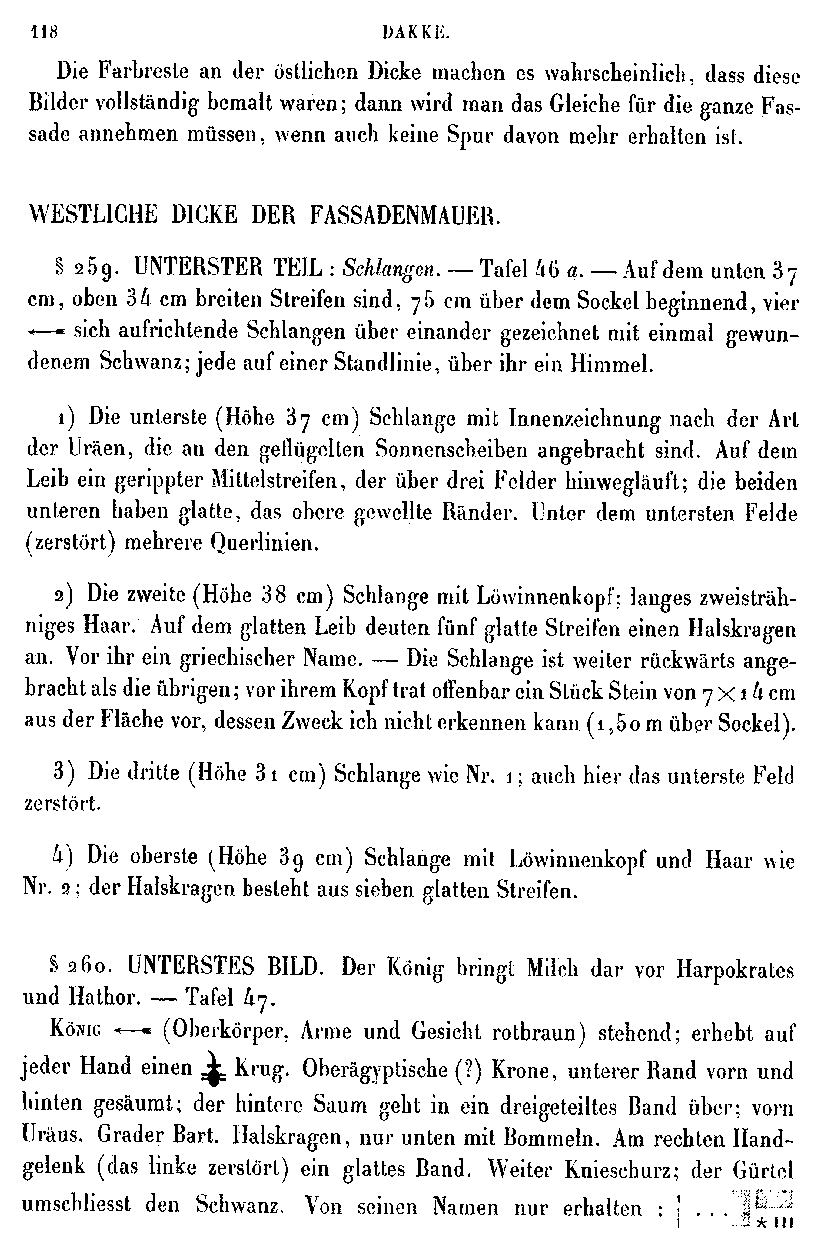
Page 118. Roeder, Der Tempel von Dakke (1930), p. 118 Printed hieroglyphs from G. Roeder, Der Tempel von Dakke (1930) - 69p. 118, § 260
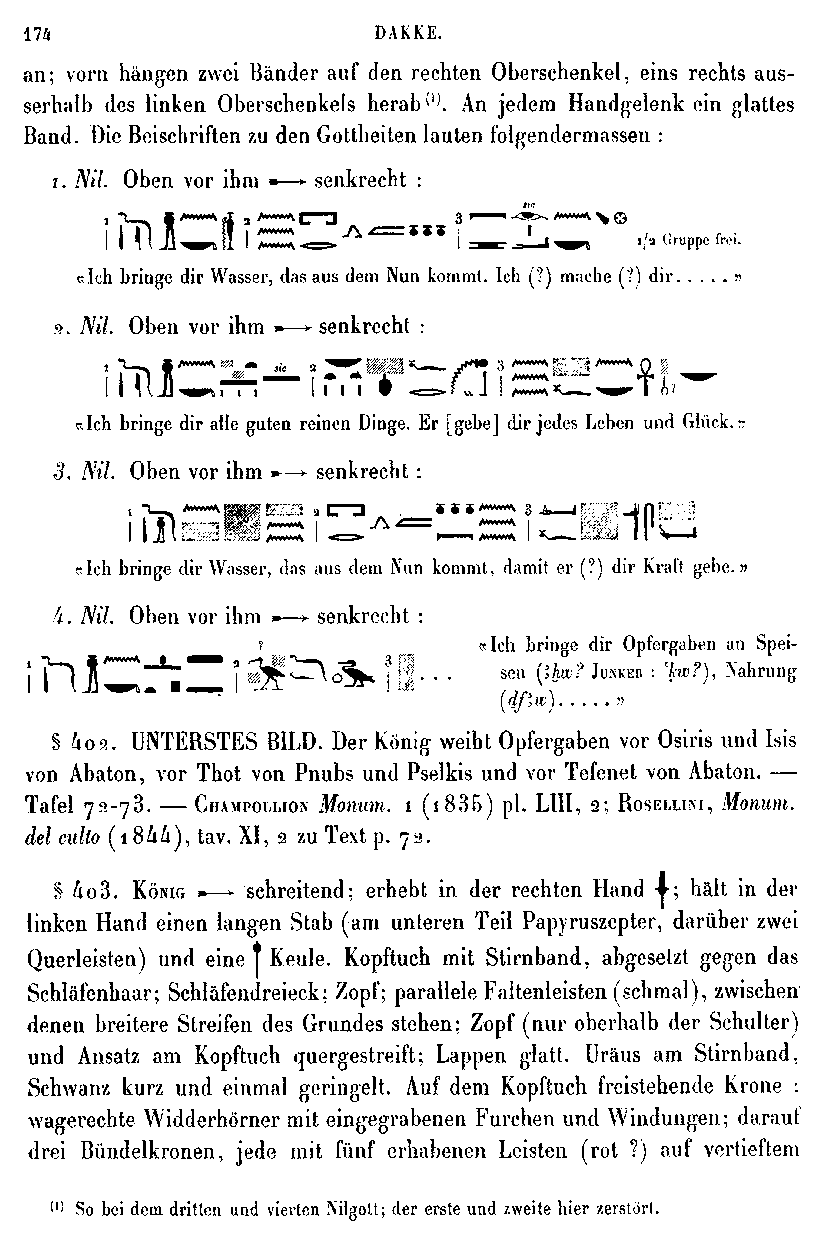
sꜣ ꜥnḫ wꜣs nb ḥꜣ=f mj rꜥ ḏ.t
All protection, life and dominion are behind him, as they are behind Ra, forever.
- 70p. 118, § 260
--détruit-- nṯr.w-mnḫ.w ḥnk{=j} jrṯ.t n jt=f [šps] --détruit--
… the Benefactor Gods. Offering milk to his revered father …
Note · Line 70
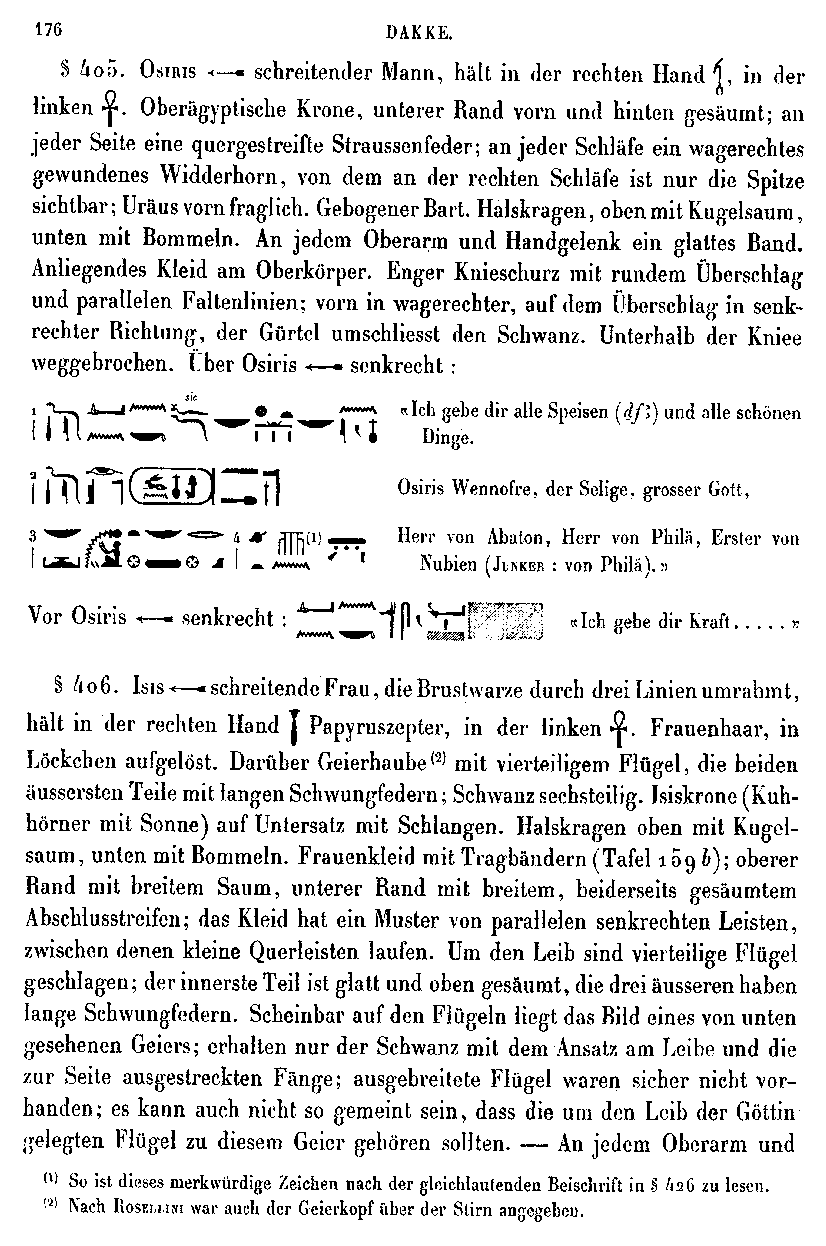
In the offering rite the king calls the god his father. 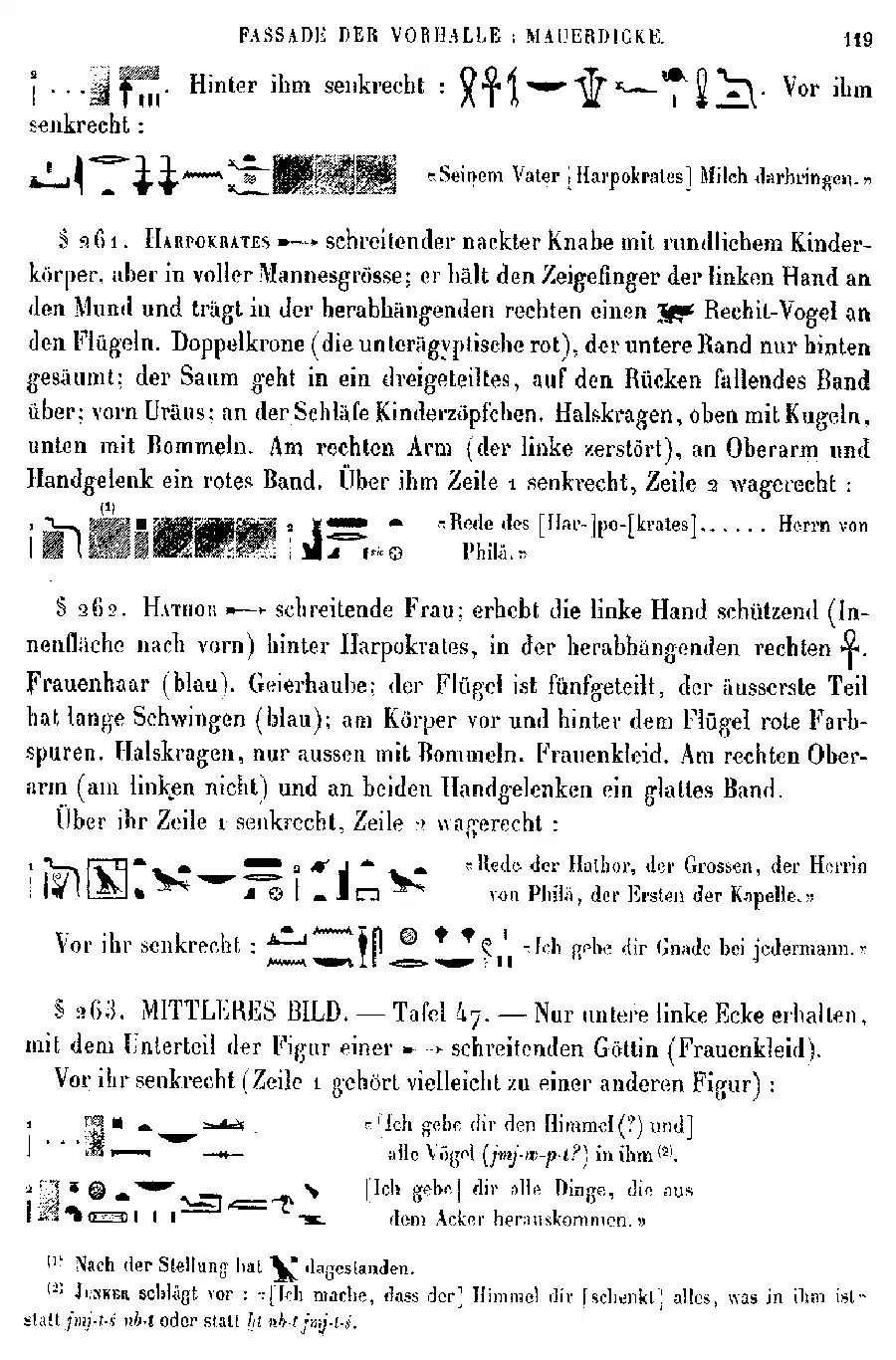
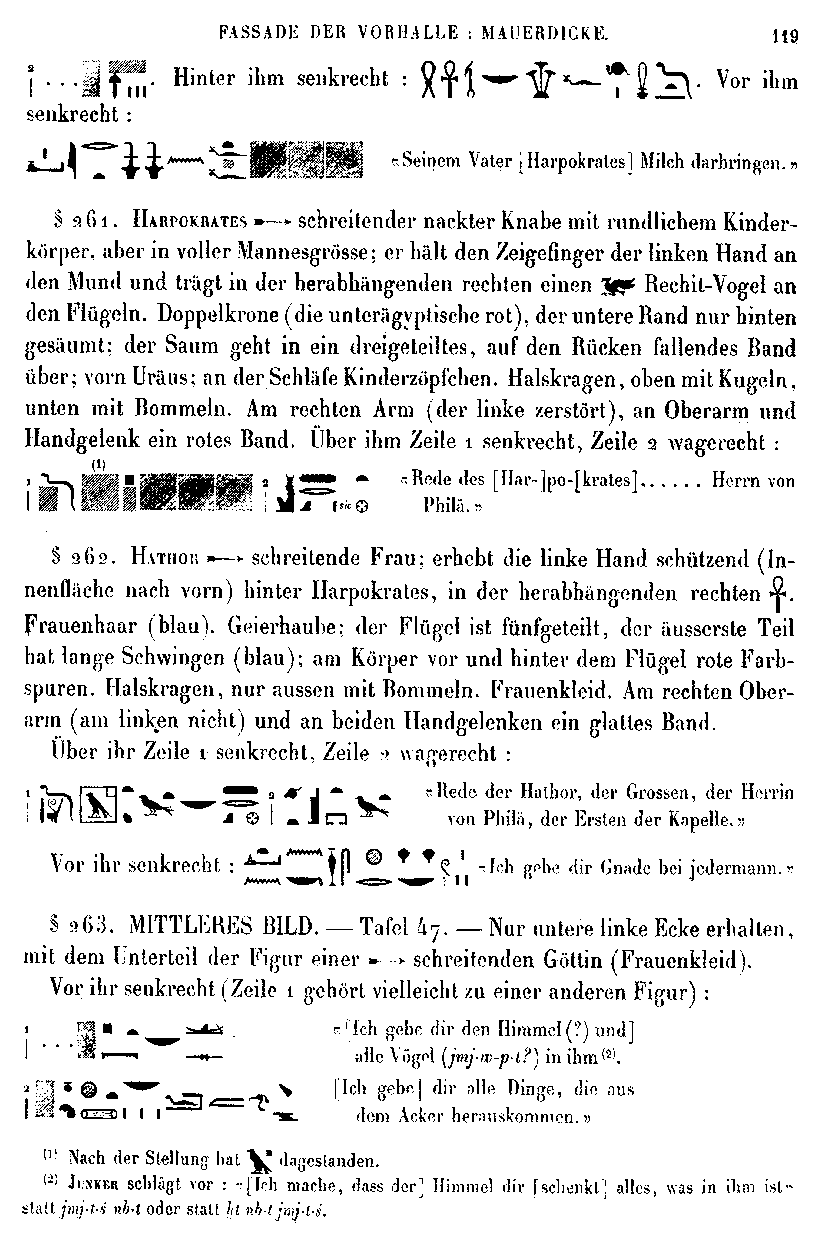
Page 119. Roeder, Der Tempel von Dakke (1930), p. 119 Printed hieroglyphs from G. Roeder, Der Tempel von Dakke (1930) - 71p. 119, § 261
ḏd[-mdw jn ḥrw]-pꜣ-[ẖrd] --2Q-- nb jwrḳ
Words spoken by Harpocrates … lord of Philae.
Note · Line 71
Harpocrates is Horus the Child. - 72p. 119, § 262
ḏd-mdw jn ḥw.t-ḥrw wr.t nb.(t) jwrḳ ḫnt.j.(t) s.t-wr.t
Words spoken by Hathor the Great, Lady of Philae, who presides over the Great Seat.
- 73p. 119, § 262
dj=j n=k ḥs.t ḫr ḥr-nb
I give you favor in the eyes of all.
- 74p. 119, § 263
--détruit-- p.t nb jm.j=s
… the sky and all that is in it.
- 75p. 119, § 263
[dj=j] n=k jḫ.t nb.(t) prj.(t) m ꜣḫ.t
I give you all that springs from the fields.
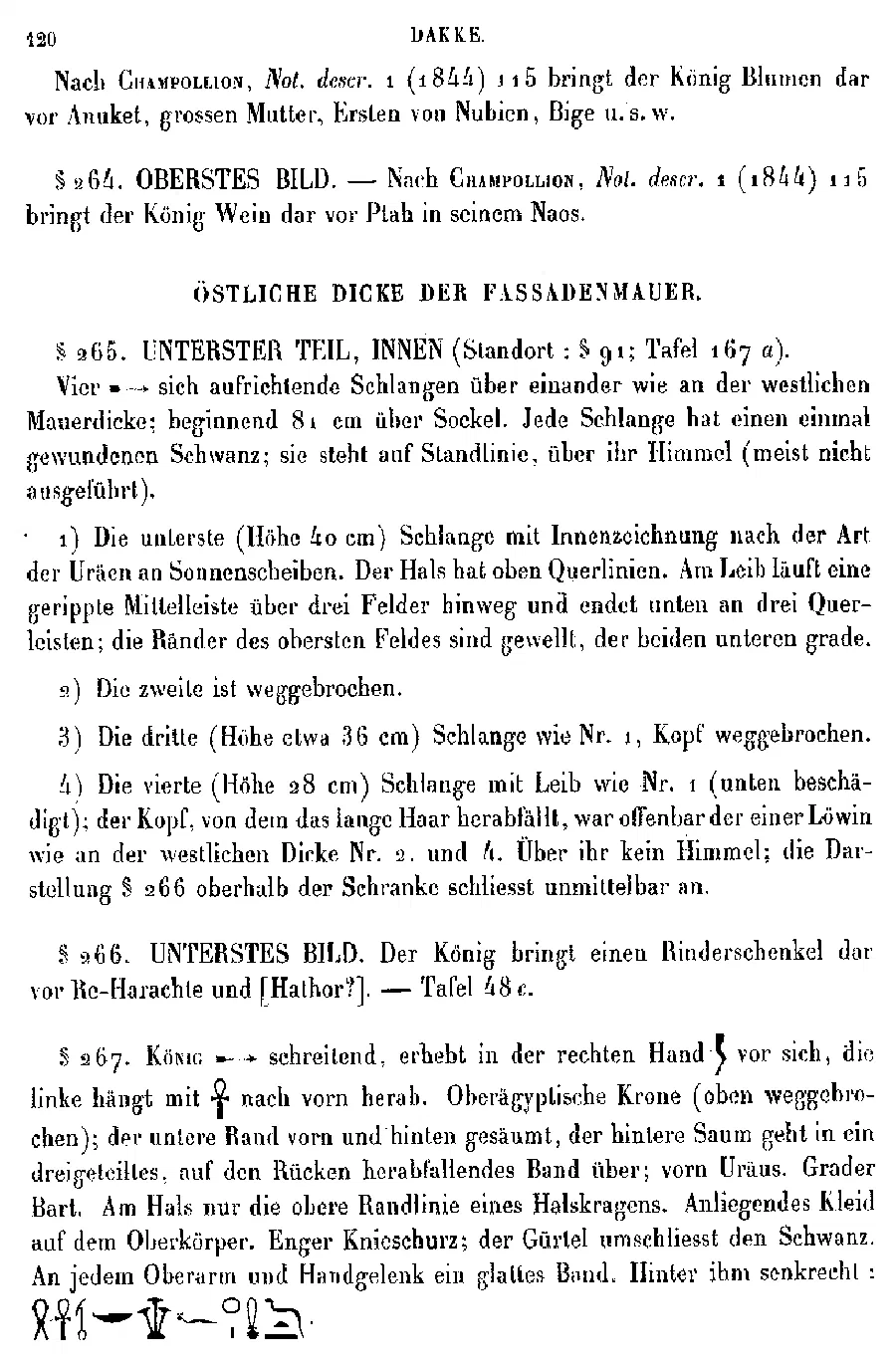
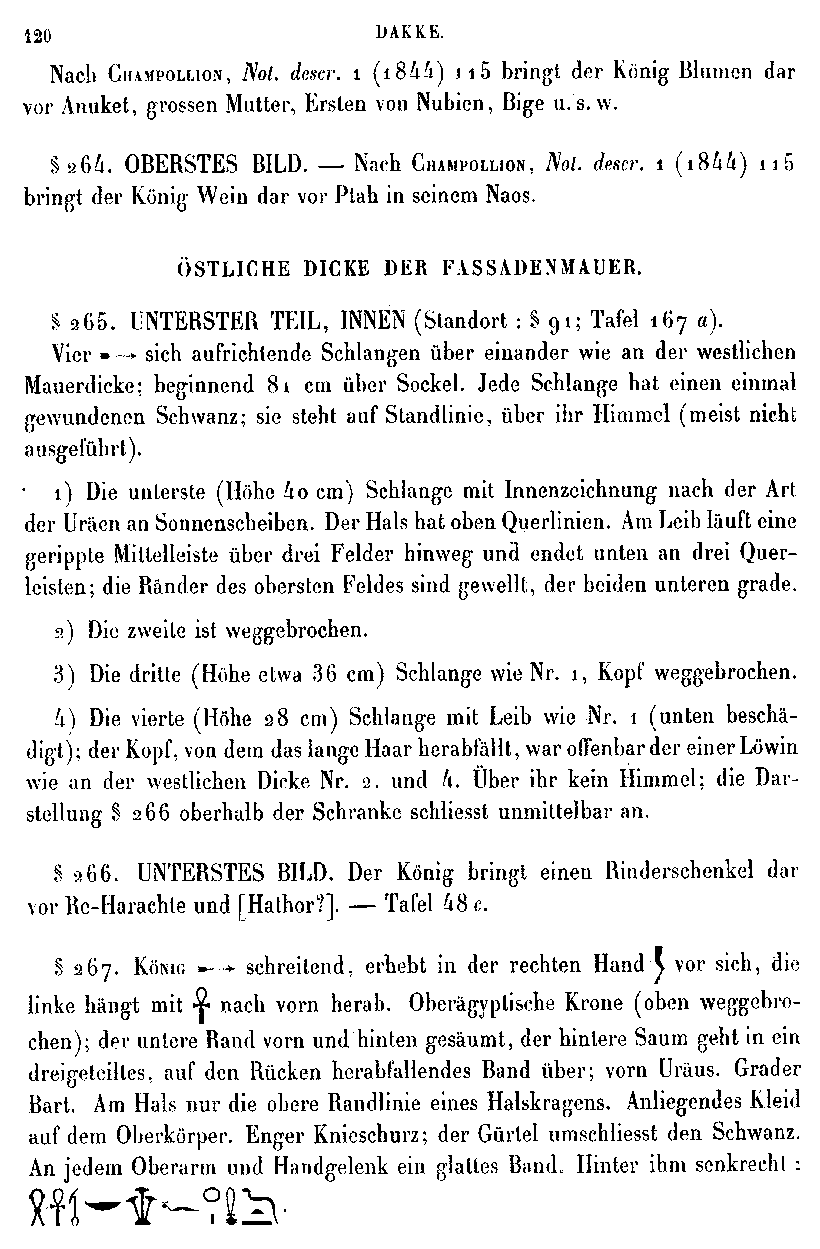
Page 120. Roeder, Der Tempel von Dakke (1930), p. 120 Printed hieroglyphs from G. Roeder, Der Tempel von Dakke (1930) - 76p. 120, § 267
sꜣ ꜥnḫ wꜣs nb ḥꜣ=f mj rꜥ ḏ.t
All protection, life and dominion are behind him, as they are behind Ra, forever.
- 77p. 120, § 267
jṯj n=k ḫpš n ḫft=k ḥnk s{n} m ḥr (21) =k
Take for yourself the khepesh before you; set it before your face.
Note · Line 77
Khepesh can mean a bull’s foreleg, presented as an offering, or a curved sword. It is also the word for Thoth’s “arm” above. 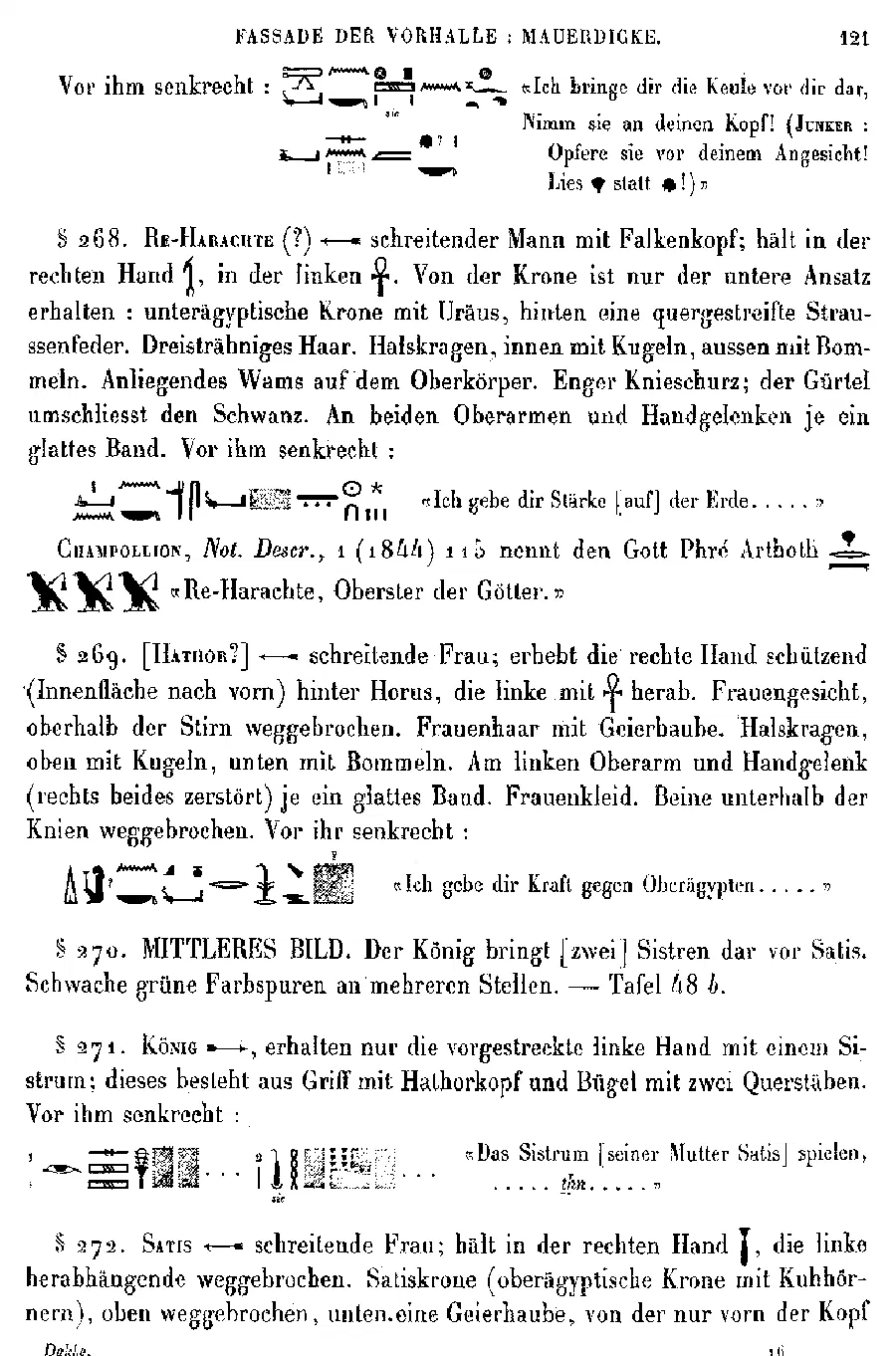
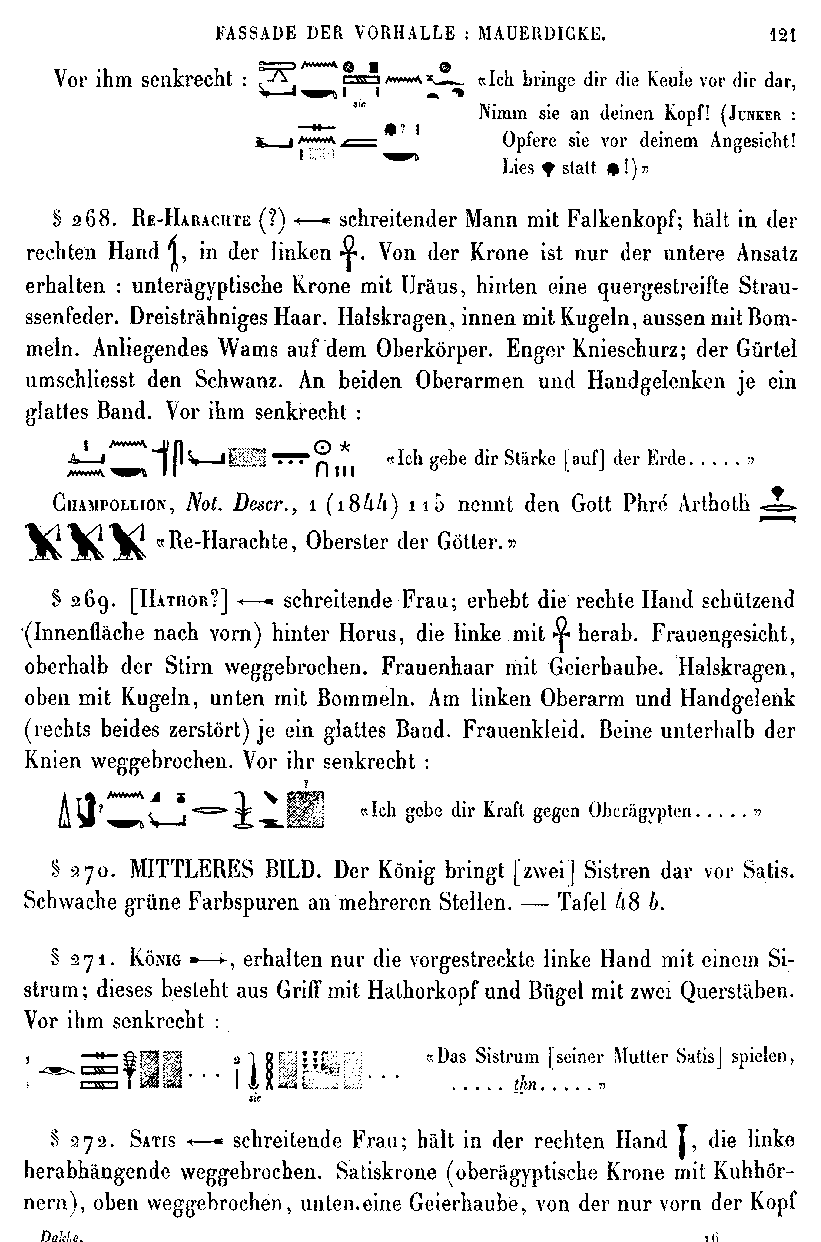
Page 121. Roeder, Der Tempel von Dakke (1930), p. 121 Printed hieroglyphs from G. Roeder, Der Tempel von Dakke (1930) - 78p. 121, § 268
dj.n=j n=k wsr [m] tꜣ hrw 18
I have given you strength on earth on the eighteenth day.
- 79p. 121, § 269
dj=j n=k ḳn r rsj --1Q--
I give you valor against the south …
- 80p. 121, § 271
jrj.t sšš.t --détruit-- ṯḥn --détruit--
Shaking the sistrum … gleaming …
Note · Line 80
A sistrum is a ritual rattle used especially in the worship of Hathor. - 81p. 121, § 272
--détruit-- ḥꜥpj r tr=f
… Hapy in his season.
- 82p. 121, § 272
--détruit-- ꜥꜣ.t nb.(t) ꜣbw
… the Great One, Lady of Elephantine.
- 83p. 121, § 272
--détruit-- [jr.t] rꜥ nb.t p.t ḥnw.t [nṯr.w] --détruit--
… Eye of Ra, Lady of the Sky, mistress of the gods …
- 84
[jrj=n mnw n mw.t=n ꜣs.t nb.t] (22)
We build a monument for our mother Isis, the Lady.
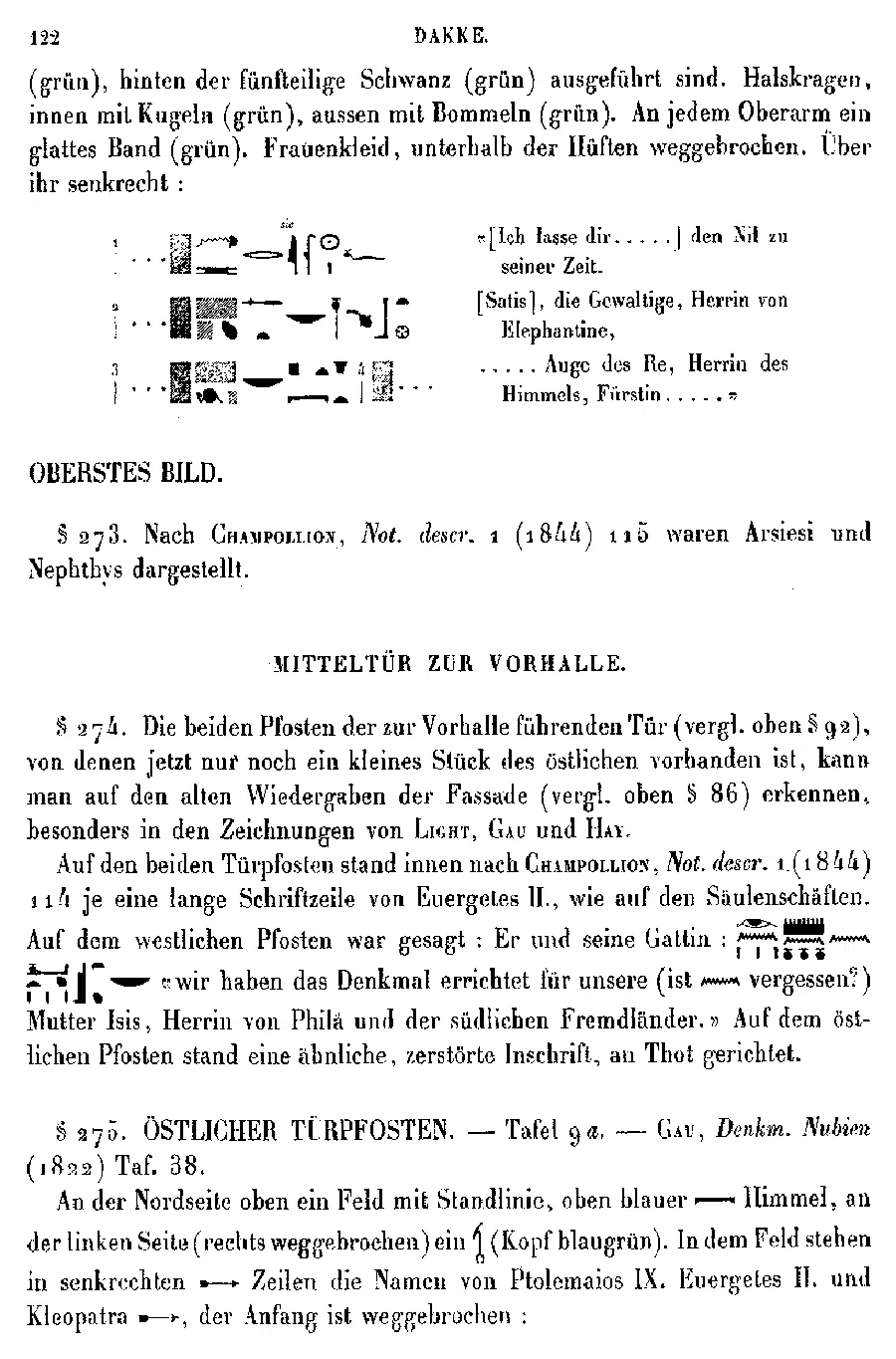
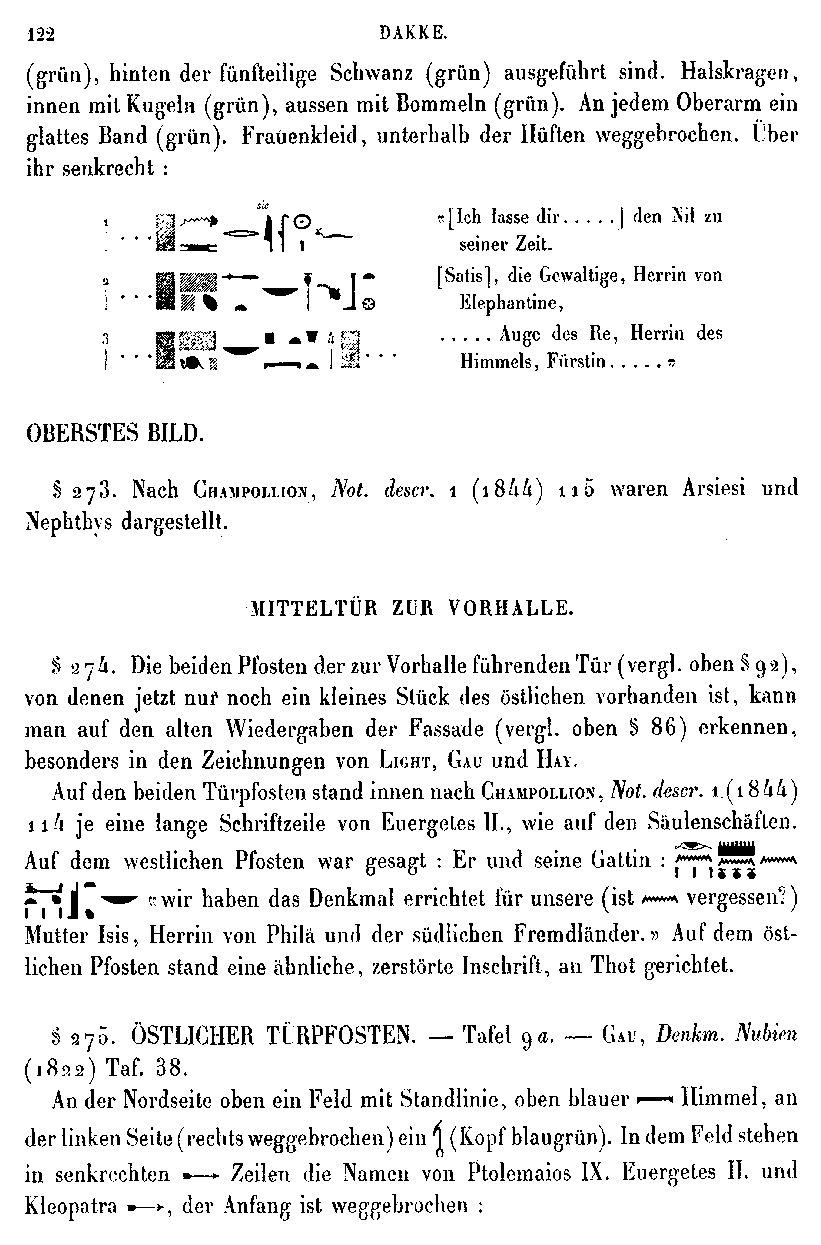
Page 122. Roeder, Der Tempel von Dakke (1930), p. 122 Printed hieroglyphs from G. Roeder, Der Tempel von Dakke (1930) - 85p. 122, § 275
jwꜥ-n-nṯr.wj-prj.wj-stp-n-ptḥ-jrj-mꜣꜥ.t-rꜥ-[sḫm-ꜥnḫ]-<n>-jmn ḥḳꜣ.t nb.(t)-tꜣ.wj ḳljwpꜣtrꜣ
Heir of the two Manifest Gods, chosen of Ptah, who enacts the justice of Ra, living image of Amun. The sovereign, Lady of the Two Lands, Cleopatra.
- 86p. 122, § 275
ptwlmys-ꜥnḫ-ḏ.t-mrj-ptḥ nḫb.t dj.(t) ꜥnḫ jwꜥ-n-nṯr.wj-prj.wj-stp-n-ptḥ-jrj-mꜣꜥ.t-rꜥ-sḫm-ꜥnḫ-<n>-jmn
Ptolemy, ever living, beloved of Ptah. Nekhbet, giver of life. Heir of the two Manifest Gods, chosen of Ptah, who enacts the justice of Ra, living image of Amun.
- 87
ḥrw-nbw wr pḥtj nb ḥb-sd mj jt=f ptḥ-ṯnn jt nṯr.w jtj mj rꜥ nswt-bj.tj jwꜥ-n-nṯr.wj-prj.wj-stp-n-ptḥ-jrj-mꜣꜥ.t-rꜥ-sḫm-ꜥnḫ-<n>-jmn ḥnꜥ sn.t=f ḥm.t=f ḥḳꜣ.t nb.(t)-tꜣ.wj ḳljwpꜣtrꜣ nṯr.wj-mnḫ.wj nṯr.wj-sn.wj nṯr.wj-mnḫ.wj nṯr.wj-mrj.wj-jt nṯr.wj-wbn.wj pꜣ-nṯr-<mrj>-jt=f tꜣ-nṯr.t-<mrj.t>-mw.t=f ḏḥwtj n pnbs hr ḥr mnw dj ꜥnḫ ḏ.t
The Golden Horus, great in might, lord of the jubilee like his father Ptah-Tatenen, father of the gods; sovereign like Ra, King of Upper and Lower Egypt, heir of the two Manifest Gods, chosen of Ptah, who enacts the justice of Ra, living image of Amun, with his sister, his wife, the sovereign, Lady of the Two Lands, Cleopatra: the two Benefactor Gods. The two Sibling Gods, the two Benefactor Gods, the two Father-loving Gods, the two Radiant Gods, the Father-loving God, the Mother-loving Goddess. Thoth of Pnubs, who rejoices in the monument and gives life forever.
Note · Line 87
The royal jubilee ritually renewed the king’s strength. The divine names after the reigning pair are the cult titles of earlier members of the dynasty. 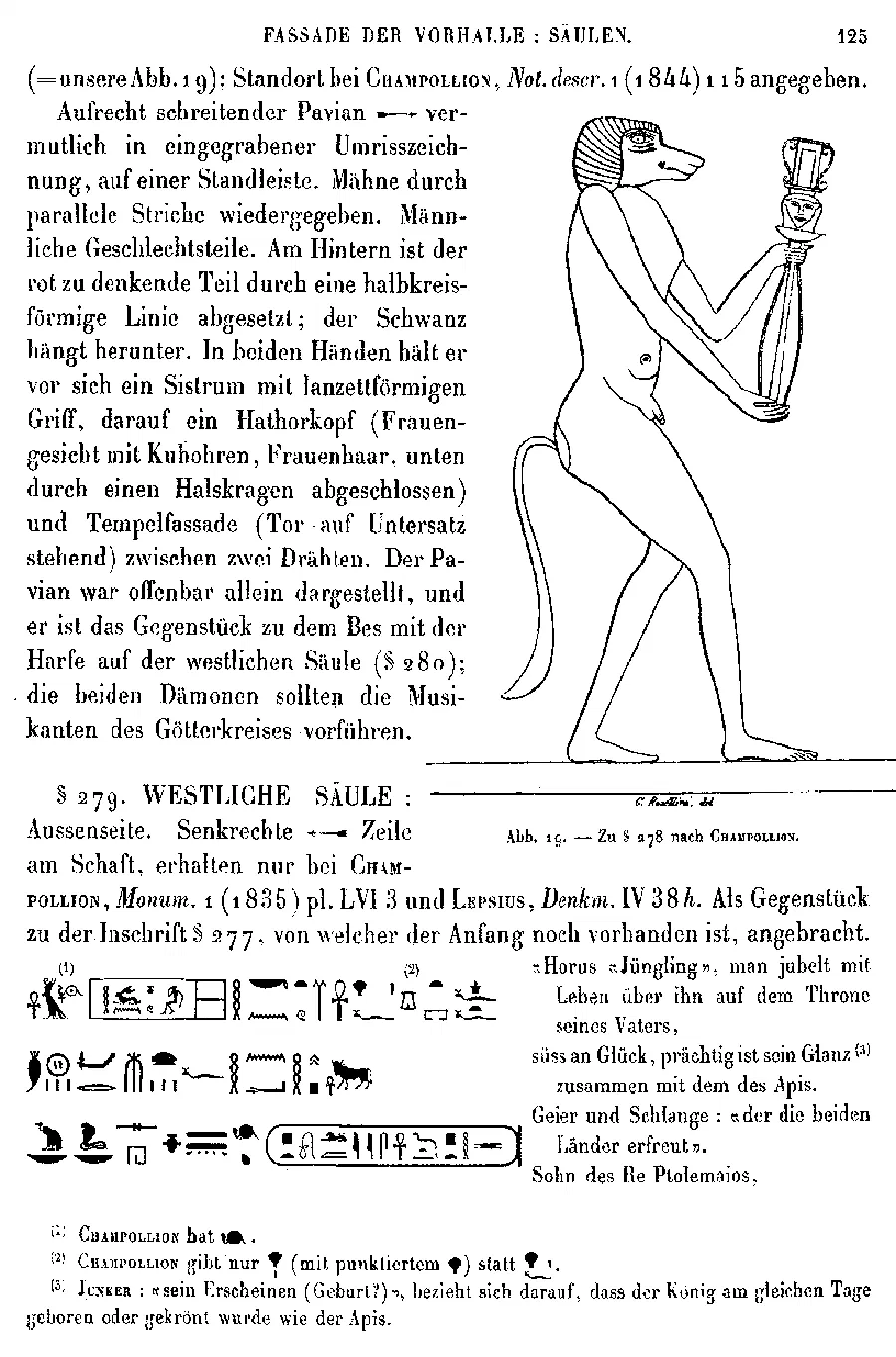
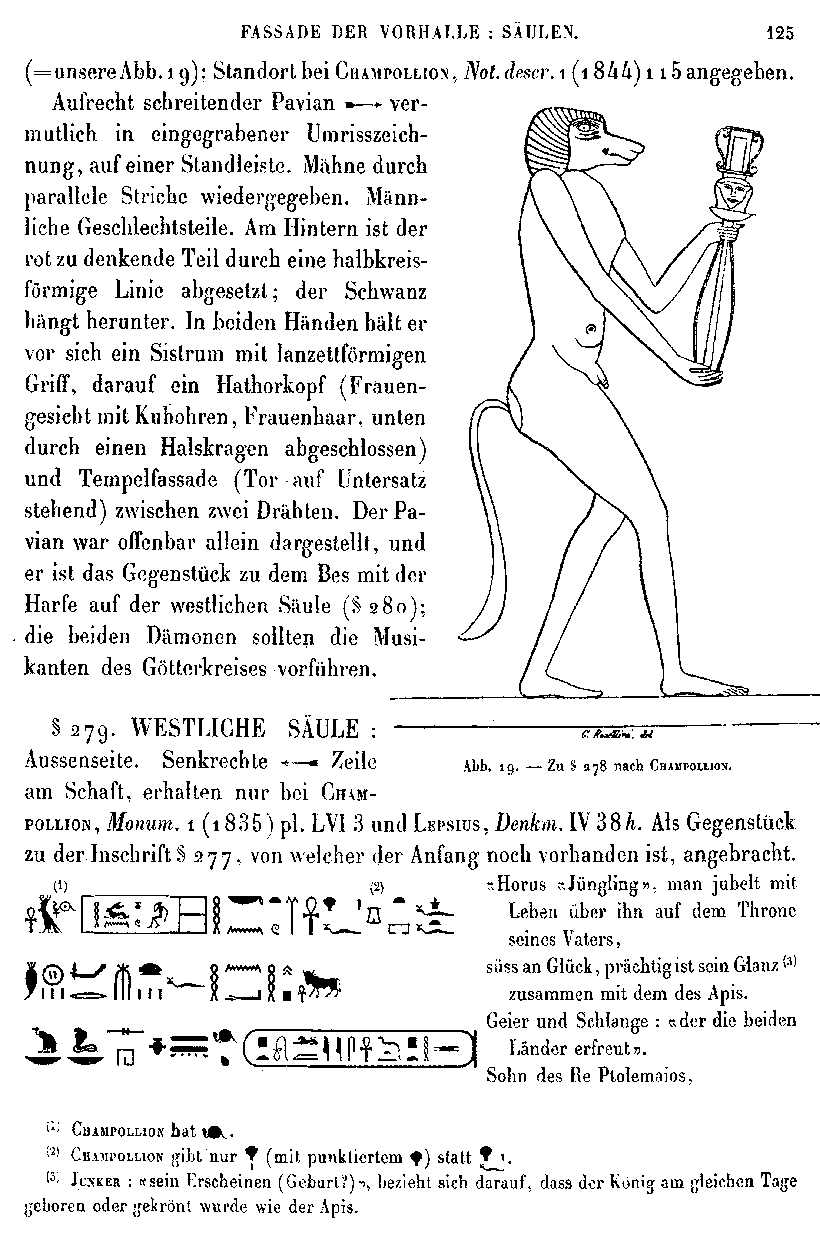
Page 125. Roeder, Der Tempel von Dakke (1930), p. 125 Printed hieroglyphs from G. Roeder, Der Tempel von Dakke (1930) - 88p. 125, § 279
ḥrw ḥwn ḥkn.tw m ꜥnḫ ḥr ns.t jt=f mꜥr sp.w ḏsr msḫꜣ=f ḥnꜥ ḥp ꜥnḫ nb.tj shr jb tꜣ.wj sꜣ-rꜥ ptwlmys-ꜥnḫ-ḏ.t-mrj-ptḥ ḥnꜥ sn.t=f ḥm.t=f ḥḳꜣ.t nb.(t)-tꜣ.wj ḳljwpꜣtrꜣ nṯr.wj-mnḫ.wj nṯr.wj-sn.wj nṯr.wj-mnḫ.wj nṯr.wj-mrj.wj-jt nṯr.wj-wbn.wj pꜣ-nṯr-<mrj>-jt=f tꜣ-nṯr.t-mrj.t>-mw.t=f mrj ꜣs.t nb.(t) jwrḳ hr.(t) ḥr mnw dj.(t) ꜥnḫ ḏ.t
Horus, the youth whose life on his father’s throne is hailed with joy, successful in his deeds, whose splendor is sacred beside the living Apis; he of the Two Ladies, who gladdens the heart of the Two Lands; Son of Ra, Ptolemy, ever living, beloved of Ptah, with his sister, his wife, the sovereign, Lady of the Two Lands, Cleopatra: the two Benefactor Gods. The two Sibling Gods, the two Benefactor Gods, the two Father-loving Gods, the two Radiant Gods, the Father-loving God, the Mother-loving Goddess. Beloved of Isis, Lady of Philae, who rejoices in the monument and gives life forever.
Note · Line 88
Apis was the sacred bull worshipped at Memphis. The Two Ladies are Nekhbet and Wadjet, the vulture and cobra goddesses who protect Upper and Lower Egypt. - 89
[…] nb.t ḫꜣs.wt rsj.wt
… Lady of the foreign lands to the south.
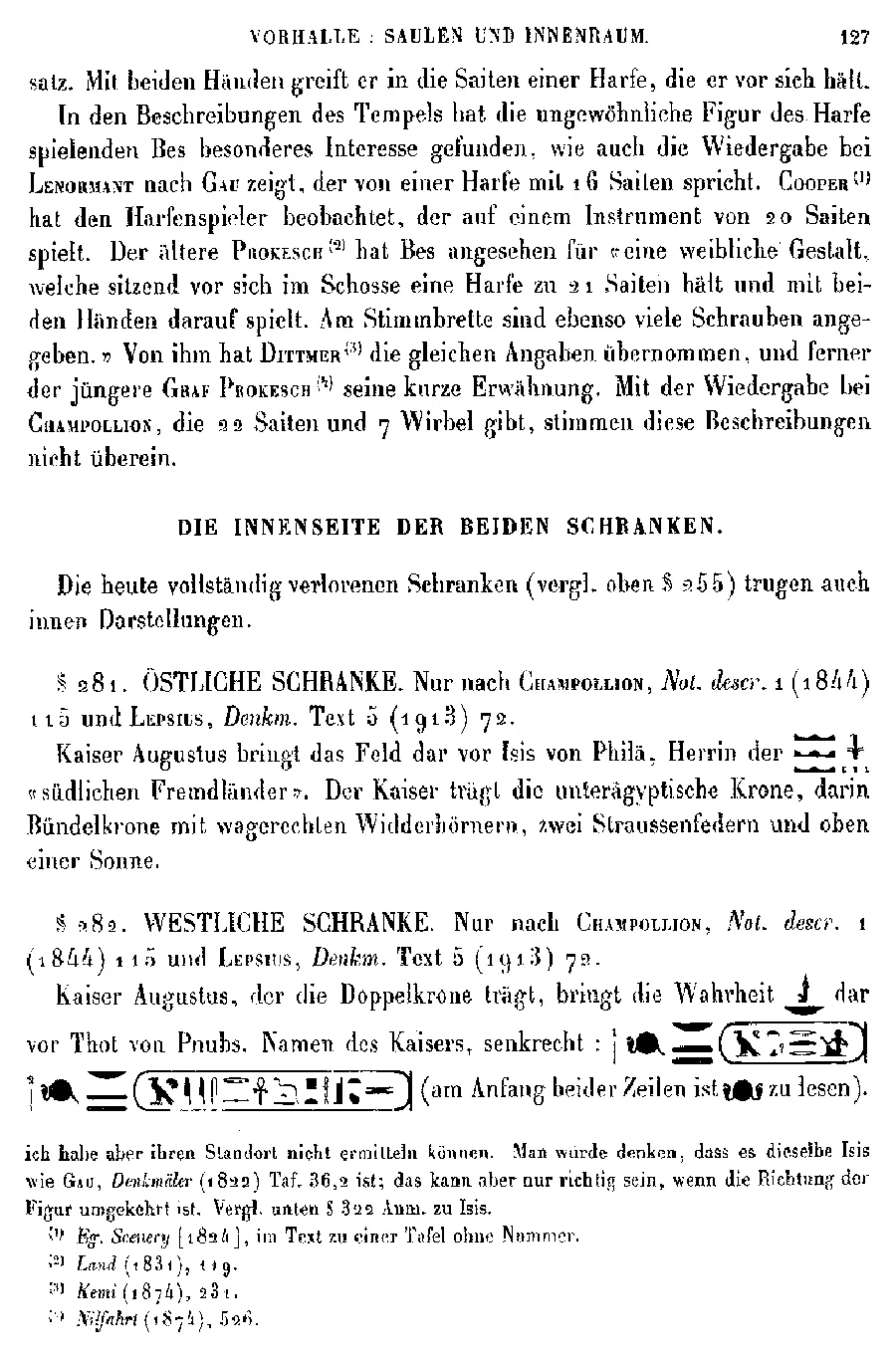
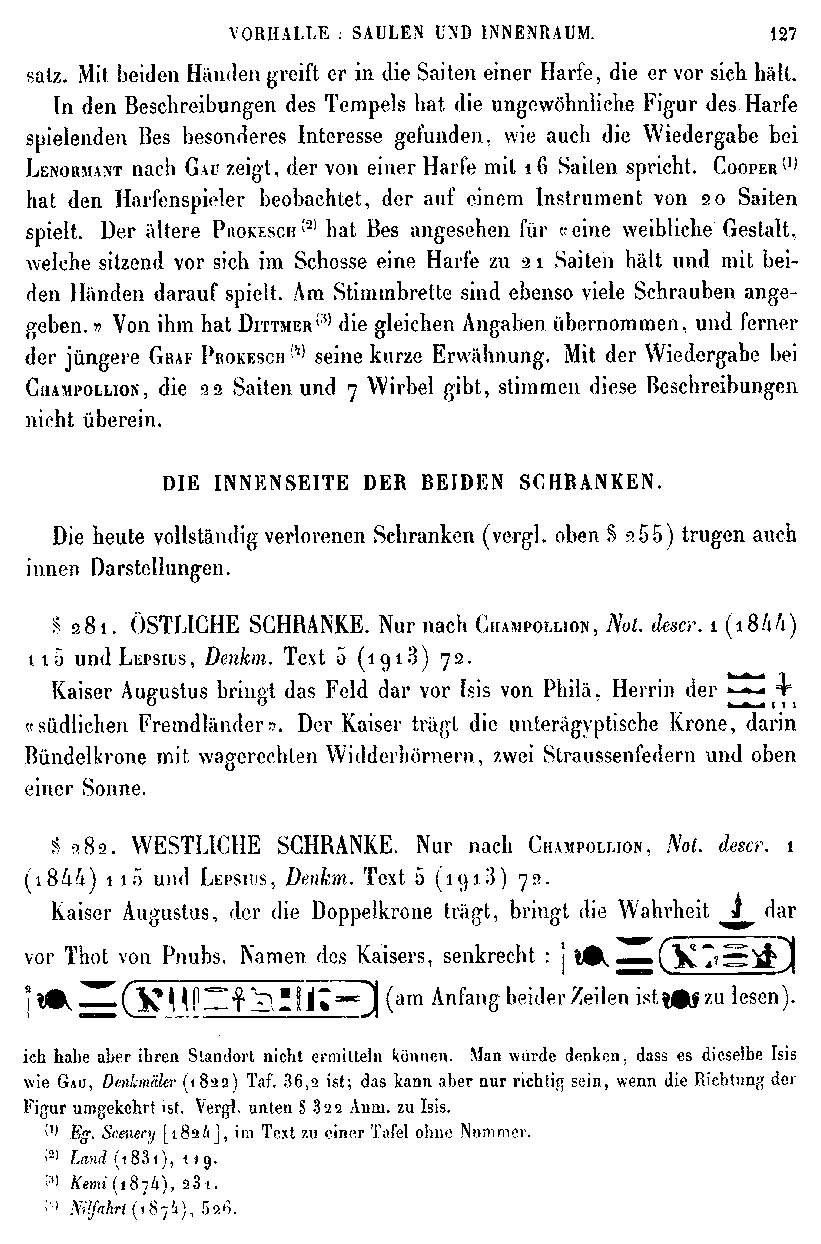
Page 127. Roeder, Der Tempel von Dakke (1930), p. 127 Printed hieroglyphs from G. Roeder, Der Tempel von Dakke (1930) - 90p. 127, § 282
nswt-bj.tj nb-tꜣ.wj ꜣwtḳrdr nswt-bj.tj nb-tꜣ.wj kꜣysrs-ꜥnḫ-ḏ.t-mrj-ptḥ-ꜣs.t
King of Upper and Lower Egypt, lord of the Two Lands, Autokrator; King of Upper and Lower Egypt, lord of the Two Lands, Caesar, living forever, beloved of Ptah and Isis.
Note · Line 90
Here the Roman emperor’s titles, Autokrator and Caesar, take the place of a pharaoh’s names. - 91p. 127, § 282
ḏḥwtj n pnbs nṯr ꜥꜣ ḥrj sbj ṯnj fnn.w msḏj jj (23)
Thoth of Pnubs, the great god, who drives back the rebel, raises up the weak and scorns the mighty.
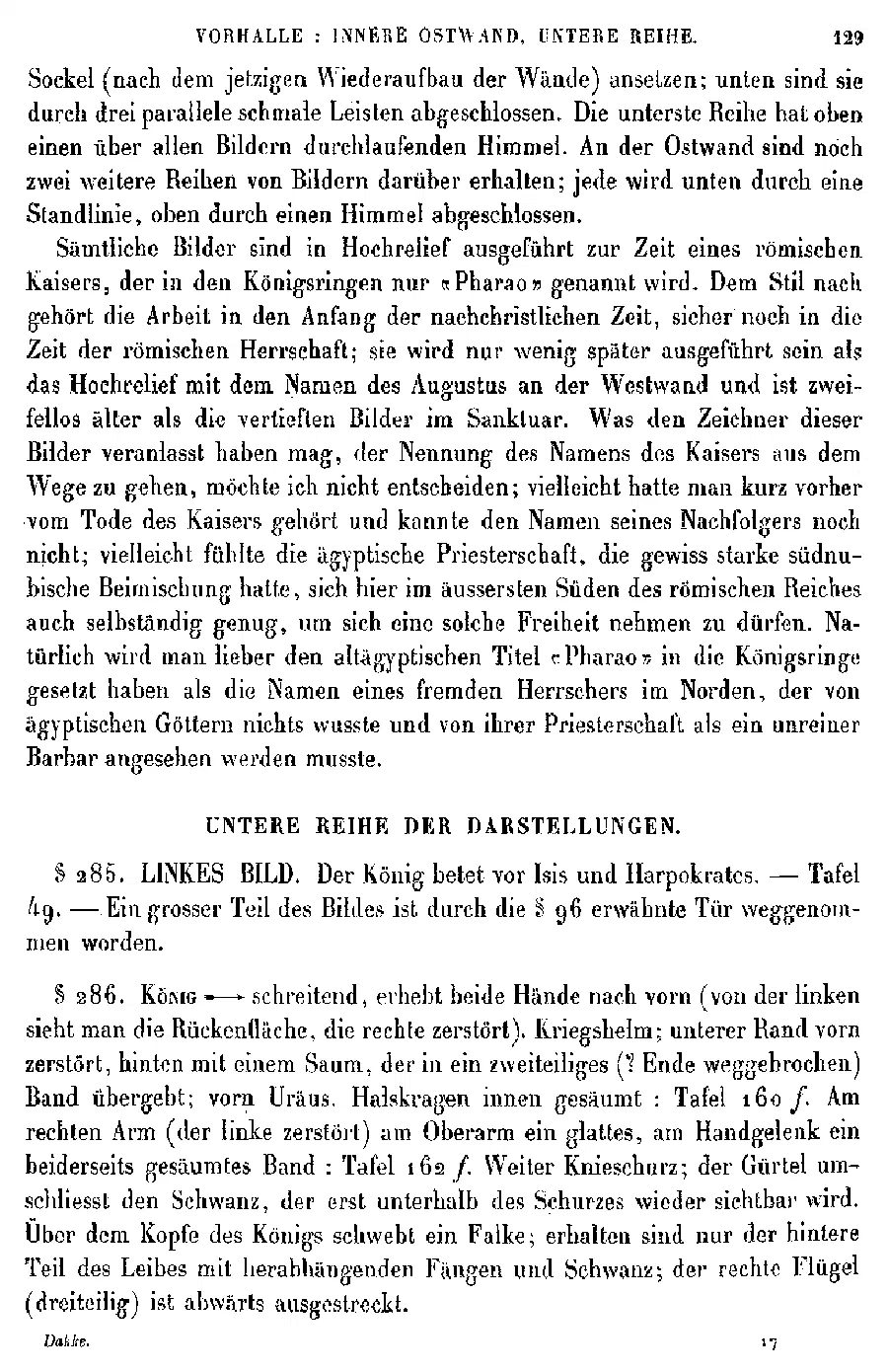
Page 129. Roeder, Der Tempel von Dakke (1930), p. 129 Printed hieroglyphs from G. Roeder, Der Tempel von Dakke (1930) - 92p. 129, § 286
nswt-bj.tj nb-[tꜣ.wj] --détruit--
King of Upper and Lower Egypt, lord of the Two Lands, …
- 93p. 129, § 286
sꜣ [ꜥnḫ wꜣs] nb ḥꜣ=f mj rꜥ ḏ.t
All protection, life and dominion are behind him, as they are behind Ra, forever.
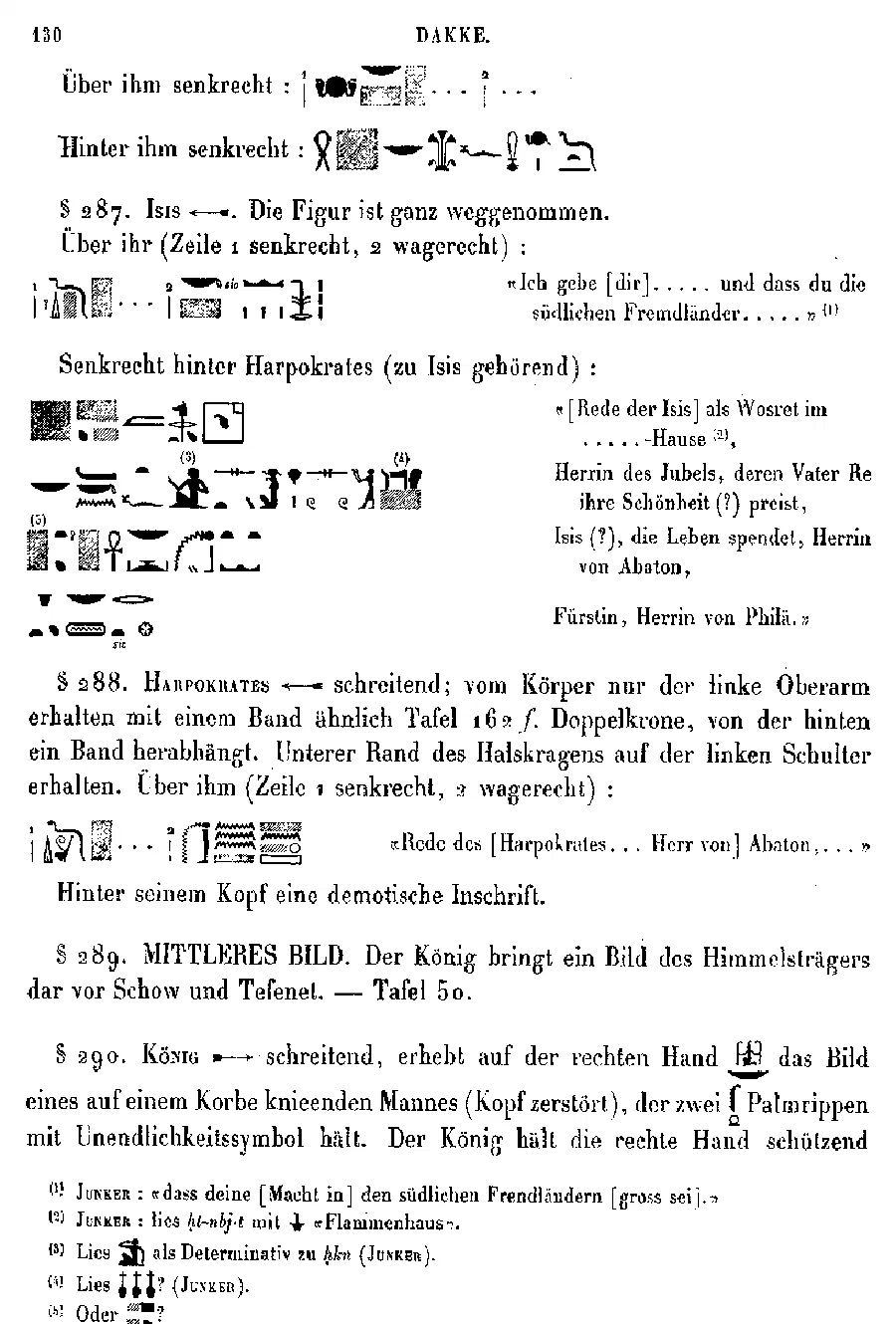
Page 130. Roeder, Der Tempel von Dakke (1930), p. 130 Printed hieroglyphs from G. Roeder, Der Tempel von Dakke (1930) - 94p. 130, § 287
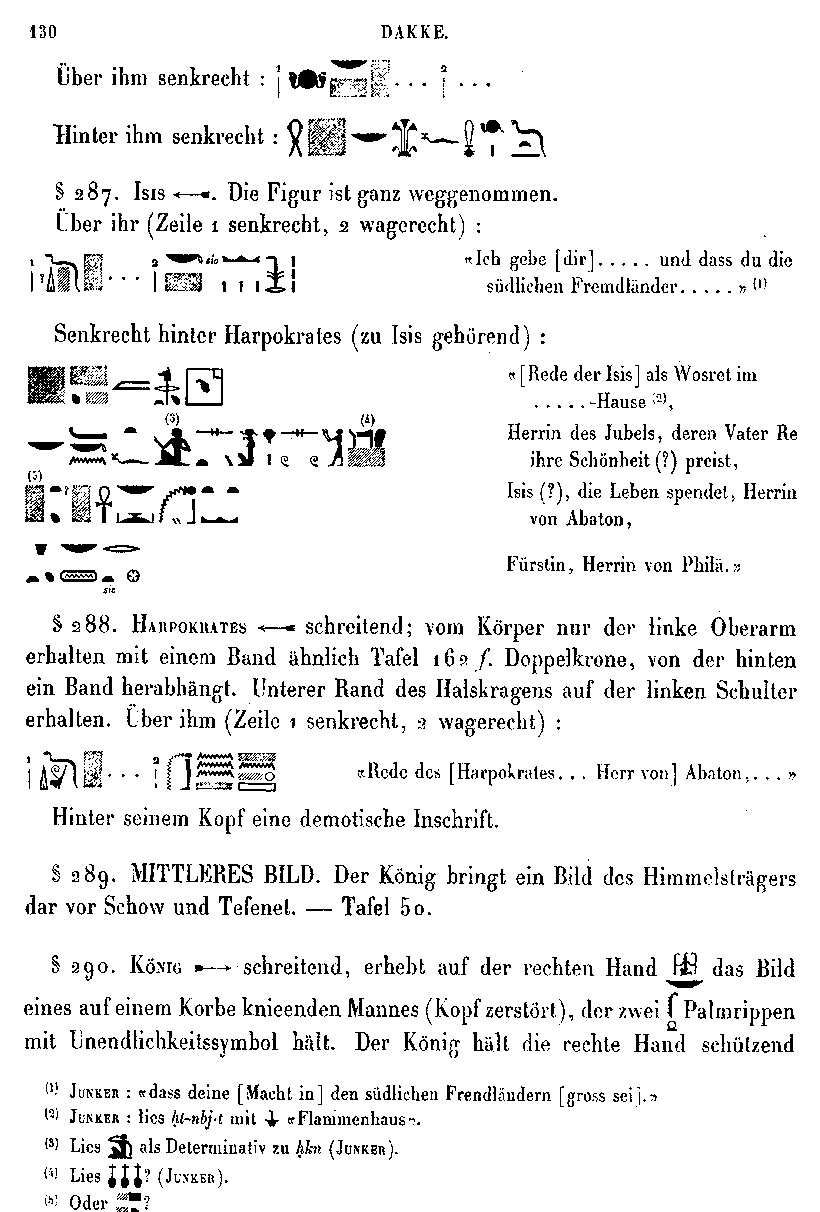
ḏd[-mdw jn] --1Q-- [nb.t jwr]k [nb.t] ḫꜣs.wt rsj.w(t)
Words spoken by …, lady of Philae, lady of the foreign lands of the south.
- 95p. 130, § 287
--2Q-- m wsr.t <nb.t> ḥw.t-nbj.t nb.t ḥkn jt=s rꜥ ḥr swꜣš … (24) ꜣs.t-[dj.t]-ꜥnḫ-nb.t-jꜣ.t-wꜥb.t ḥnw.t nb.t jwrḳ
… as the Mighty One, lady of the House of Flame, the lady whom her father Ra hails with praise … Isis, giver of life, lady of the Abaton, mistress, lady of Philae.
Note · Line 95
Its name means a place one may not enter. - 96p. 130, § 288
ḏd-mdw jn --détruit-- wꜥb --détruit--
Words spoken by … pure …
- 97p. 130, § 290
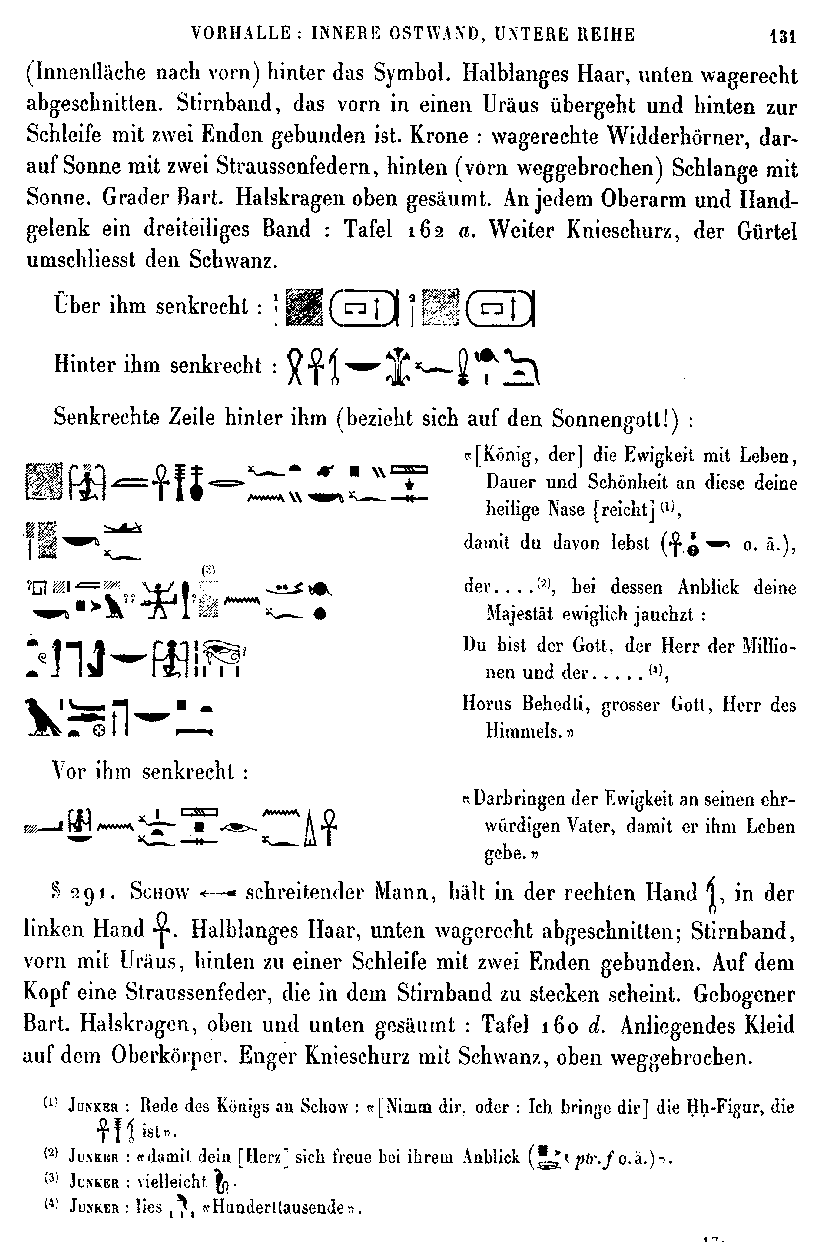
--1Q-- pr-ꜥꜣ --1Q-- pr-ꜥꜣ sꜣ ꜥnḫ wꜣs nb ḥꜣ=f mj rꜥ ḏ.t
… Pharaoh … Pharaoh. All protection, life and dominion are behind him, as they are behind Ra, forever.
- 98p. 130, § 290
--1Q-- ḥḥ m ꜥnḫ ḏd nfr r fnḏ=k pfj šps [ꜥnḫ]=k jm=f [hr jb]=k m ptr[=f] (25) ḥꜥ ḥm[=k] n mꜣ=f rꜥ nb twt nṯr nb ḥḥ.w ḥfn.w ḥrw bḥd.tj nṯr ꜥꜣ nb p.t
… the Heh figure, with life, stability and beauty, to that noble nose of yours, that you may live by it. Your heart is glad at the sight of it; Your Majesty rejoices to see it every day. You are the god, lord of millions and hundreds of thousands, Horus of Edfu, the great god, lord of the sky.
Note · Line 98
Heh personifies a million. The king offers his image as a gift of countless years; he holds it to the god’s nose as one would offer the breath of life. - 99p. 130, § 290
ḥnk ḥḥ n jt=f šps jrj.n=f dj.t ꜥnḫ
Offering the Heh figure to his revered father. This he has done that he may be given life.
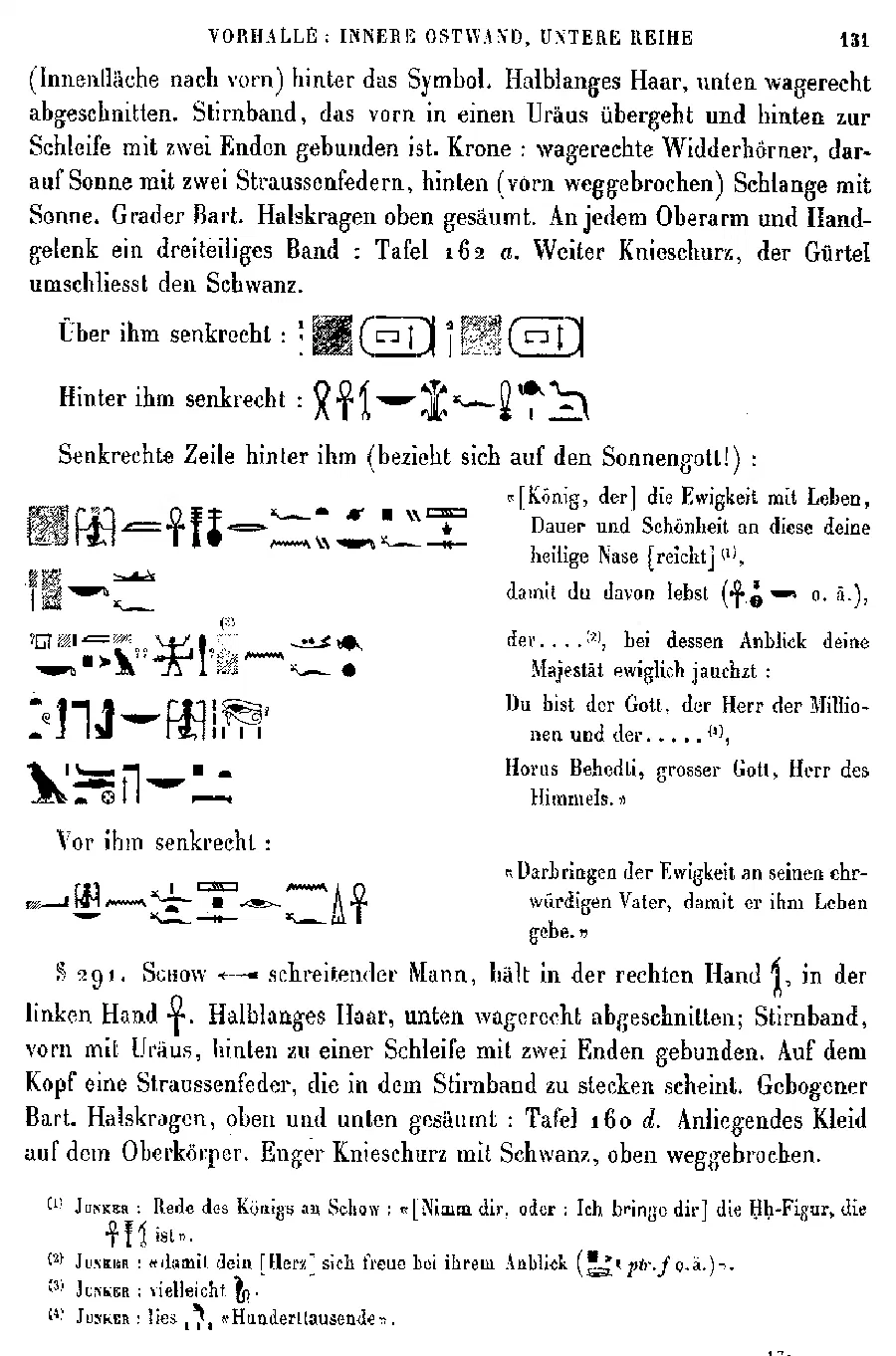
Page 131. Roeder, Der Tempel von Dakke (1930), p. 131 Printed hieroglyphs from G. Roeder, Der Tempel von Dakke (1930) - 100p. 131, § 291
ḏd-mdw jn šw sꜣ rꜥ nb tꜣ-stj jnj.n=f [jr.t] rꜥ m [k]n[m.t]
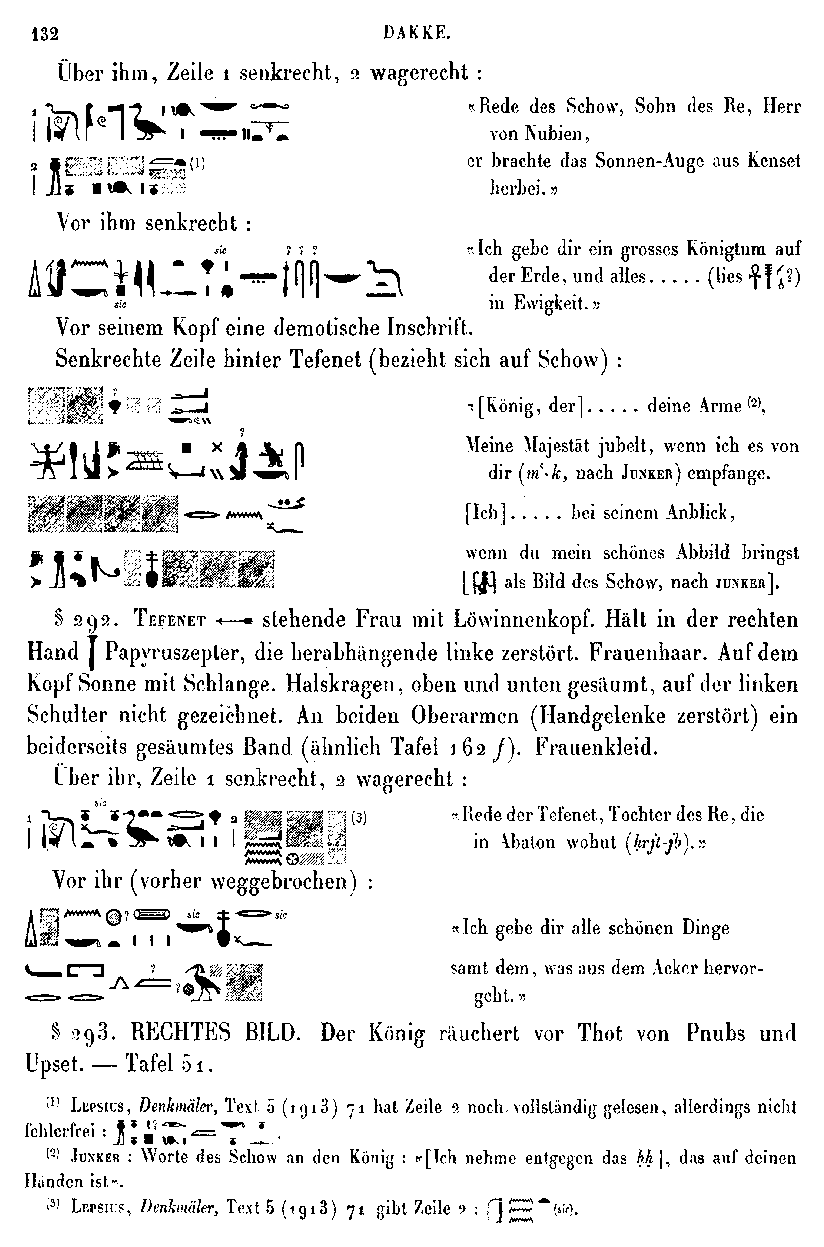
Words spoken by Shu, son of Ra, lord of Nubia, who has brought back the Eye of Ra from Kenmet.
Note · Line 100
The Eye is Ra’s daughter, the goddess who wandered south. Shu brings her home; Tefnut, who speaks below, is that returning goddess. - 101p. 131, § 291
dj=j n=k nswj.t ꜥꜣ.t ḥr tp tꜣ … (26) nb ḏ.t
I give you great kingship on earth, every … forever.
- 102p. 131, § 291
--2Q-- ḥr --2Q-- ꜥ.wj=k ḥꜥꜥ ḥm=j ḏr šsp=j s(w) m-ꜥ=k --4Q-- r n mꜣ=f ḏr jnj.n=k tj.t nfr.t --3Q--
… upon … your two arms. My Majesty rejoices now that I have received it from your hand … at the sight of it, since you brought the beautiful image …
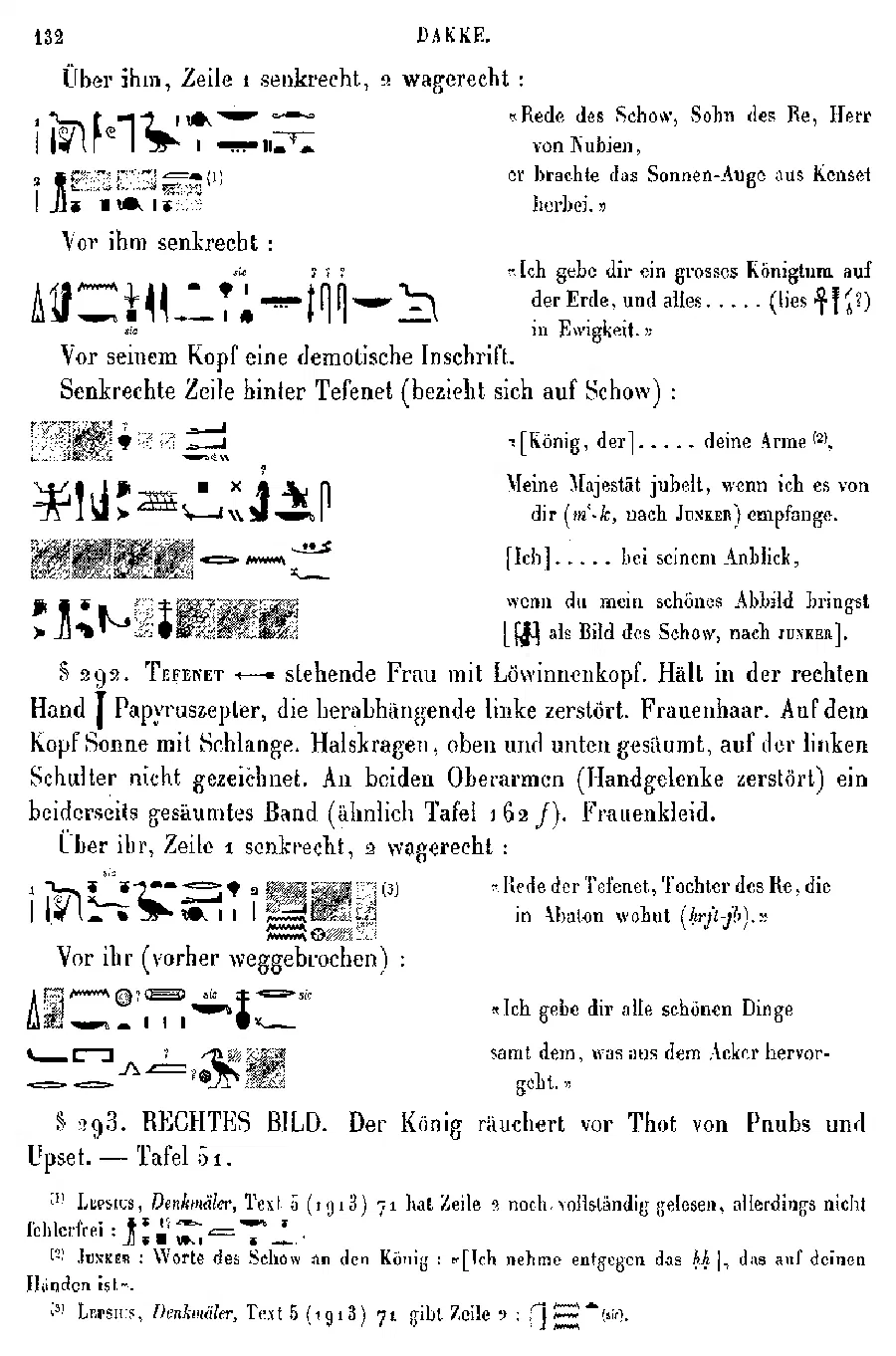
Page 132. Roeder, Der Tempel von Dakke (1930), p. 132 Printed hieroglyphs from G. Roeder, Der Tempel von Dakke (1930) - 103p. 132, § 292
ḏd-mdw jn tfn.t sꜣ.t rꜥ ḥr.j.(t)[-jb jꜣ.t-wꜥb.t]
Words spoken by Tefnut, daughter of Ra, who dwells in the Abaton.
- 104p. 132, § 292
dj[=j] n=k jḫ.t nb.(t) nfr.(t) ḥnꜥ prj.(t) m ꜣḫ.t
I give you every good thing and what springs from the fields.
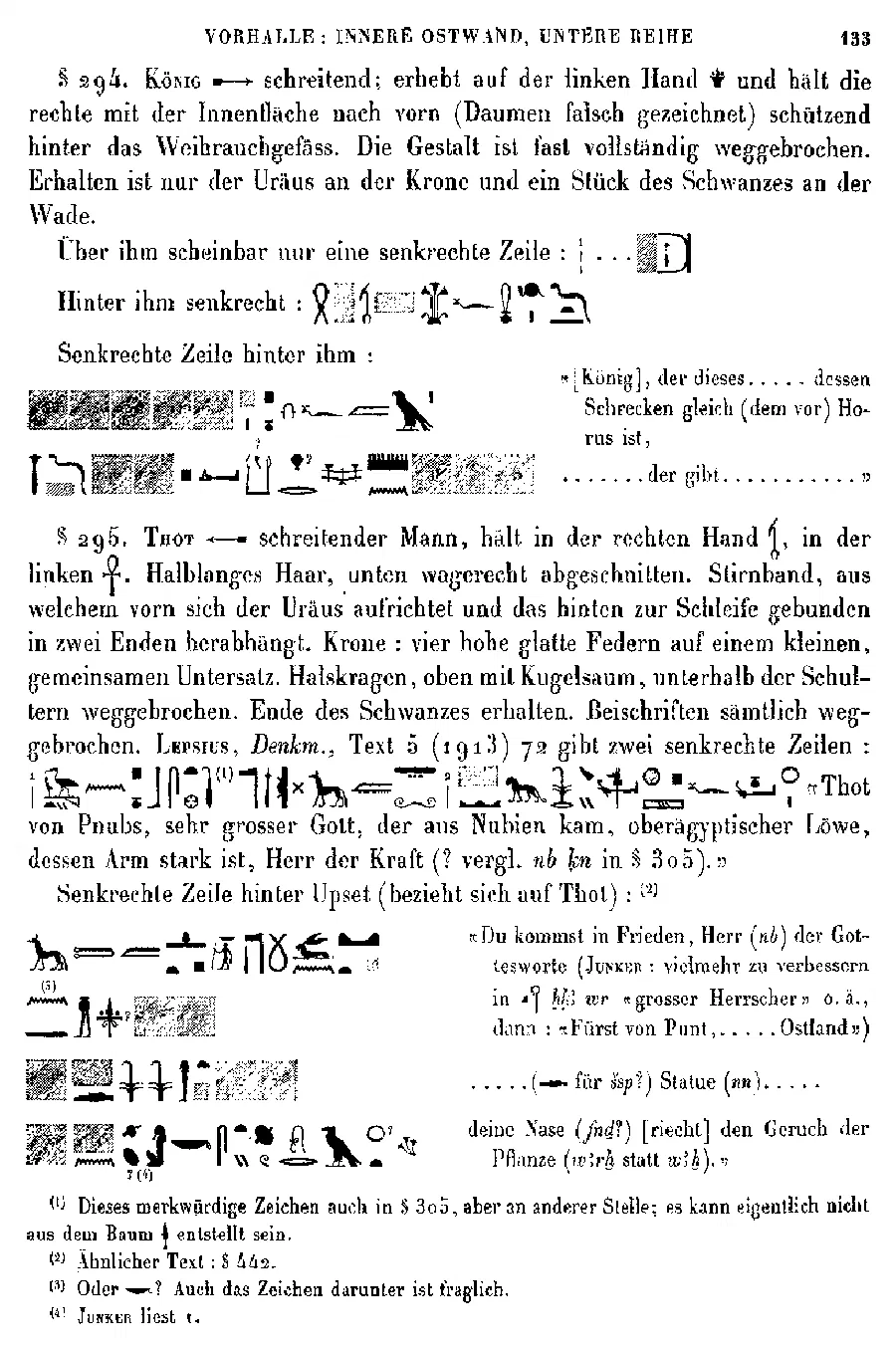
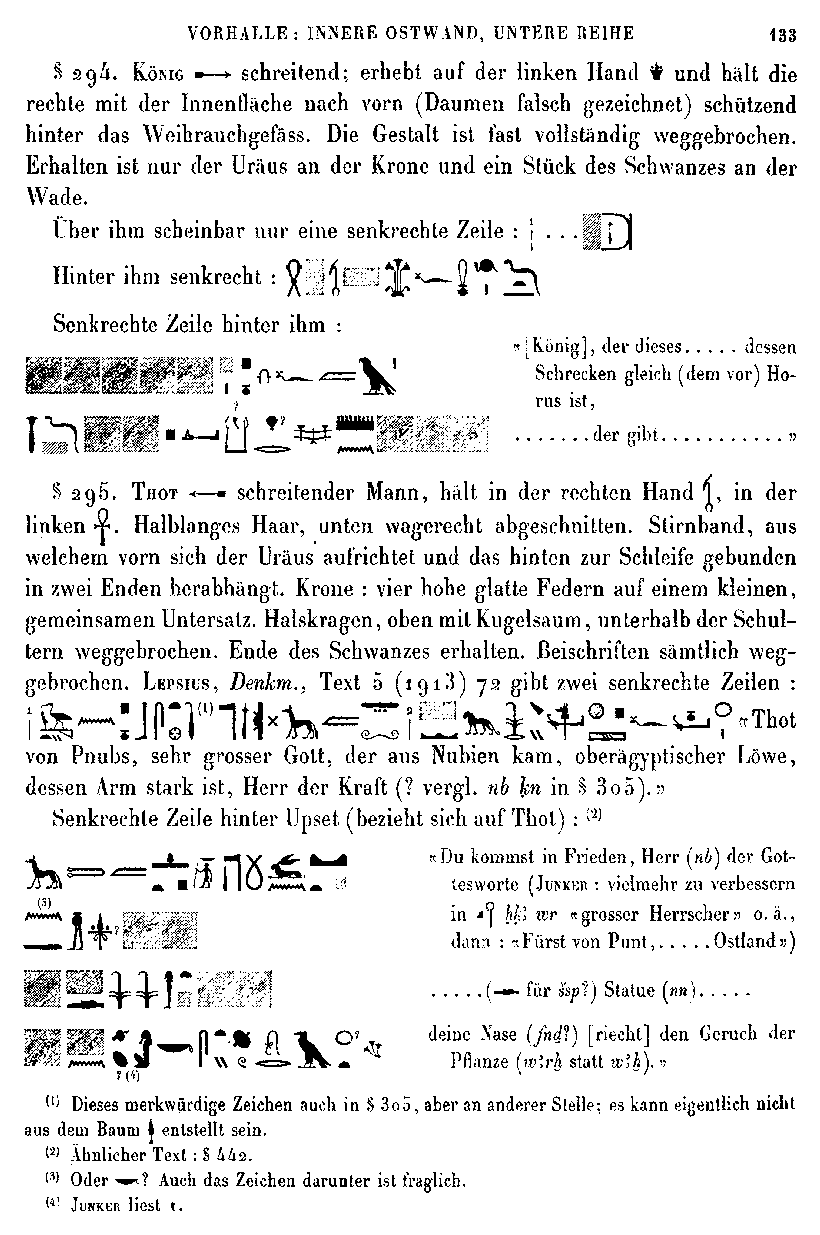
Page 133. Roeder, Der Tempel von Dakke (1930), p. 133 Printed hieroglyphs from G. Roeder, Der Tempel von Dakke (1930) - 105p. 133, § 294
sꜣ [ꜥnḫ] wꜣs [nb] ḥꜣ=f mj rꜥ ḏ.t
All protection, life and dominion are behind him, as they are behind Ra, forever.
- 106p. 133, § 294
--5.5Q-- [ḥr] p=f m ḥrw wꜣḏ --2Q-- dj kꜣ=f ḥr mn --3Q--
… on his throne as Horus in his youth … who makes his ka endure …
Note · Line 106
The ka is the vital power of a god or a person. - 107p. 133, § 295
[ḏḥwtj n pnbs nṯr ꜥꜣ jj m tꜣ-stj mꜣj rsj wsr ḫpš=f nb ḳn] (27)
Thoth of Pnubs, the great god who comes from Nubia, the lion of the south, mighty of arm, lord of valor.
- 108p. 133, § 295
jj.tj m ḥtp jtj ḥḳꜣ pwn.t (28) … jnj jꜣb.t --3.5Q-- snn --4Q-- [f]nḏ.t=k sṯj wꜣḫ.t
Welcome in peace, sovereign, ruler of Punt, … who brings the East … a likeness … your nose, the fragrance of herbs.
Note · Line 108
Punt, a land on the Red Sea, was famed in Egypt for its incense. 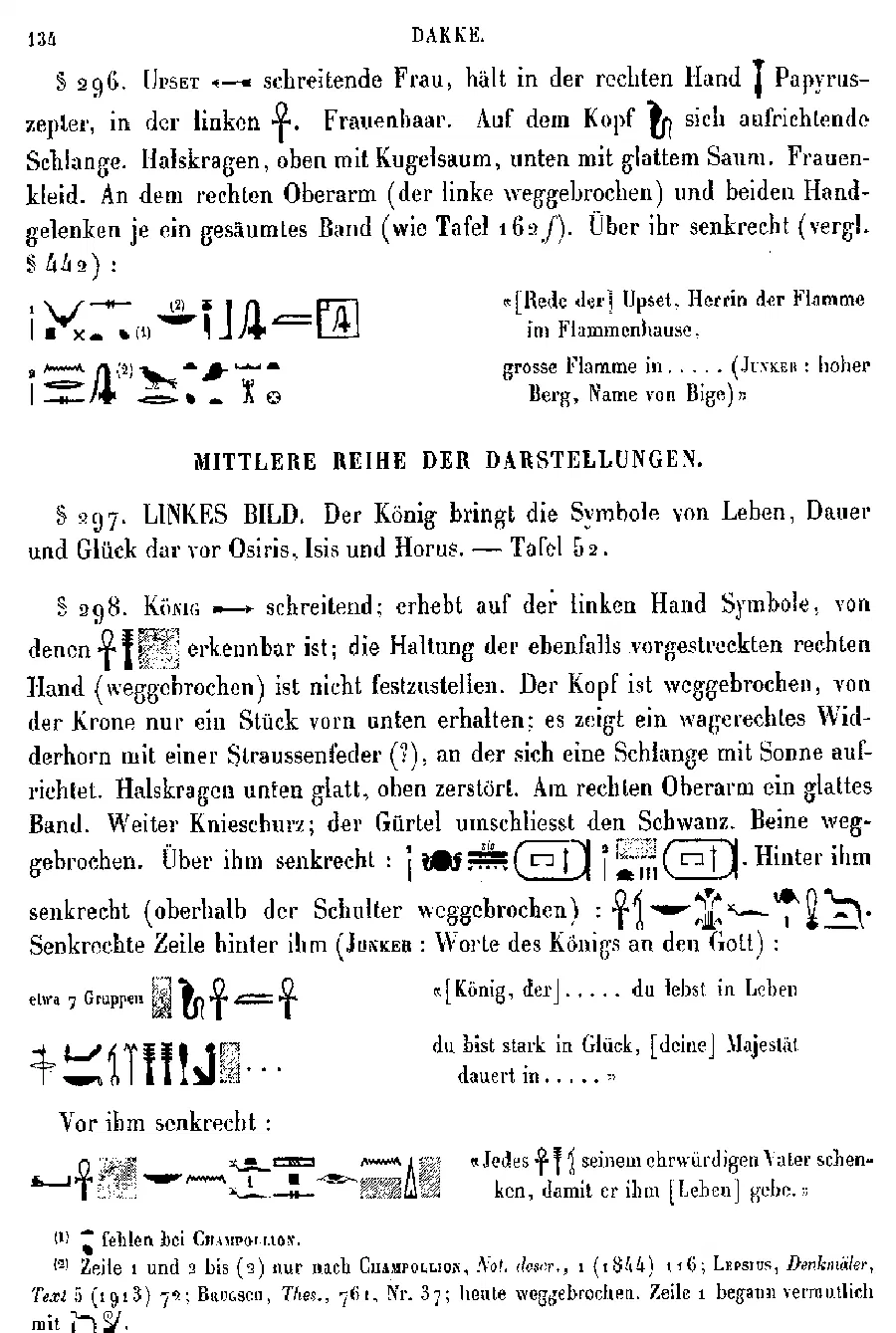
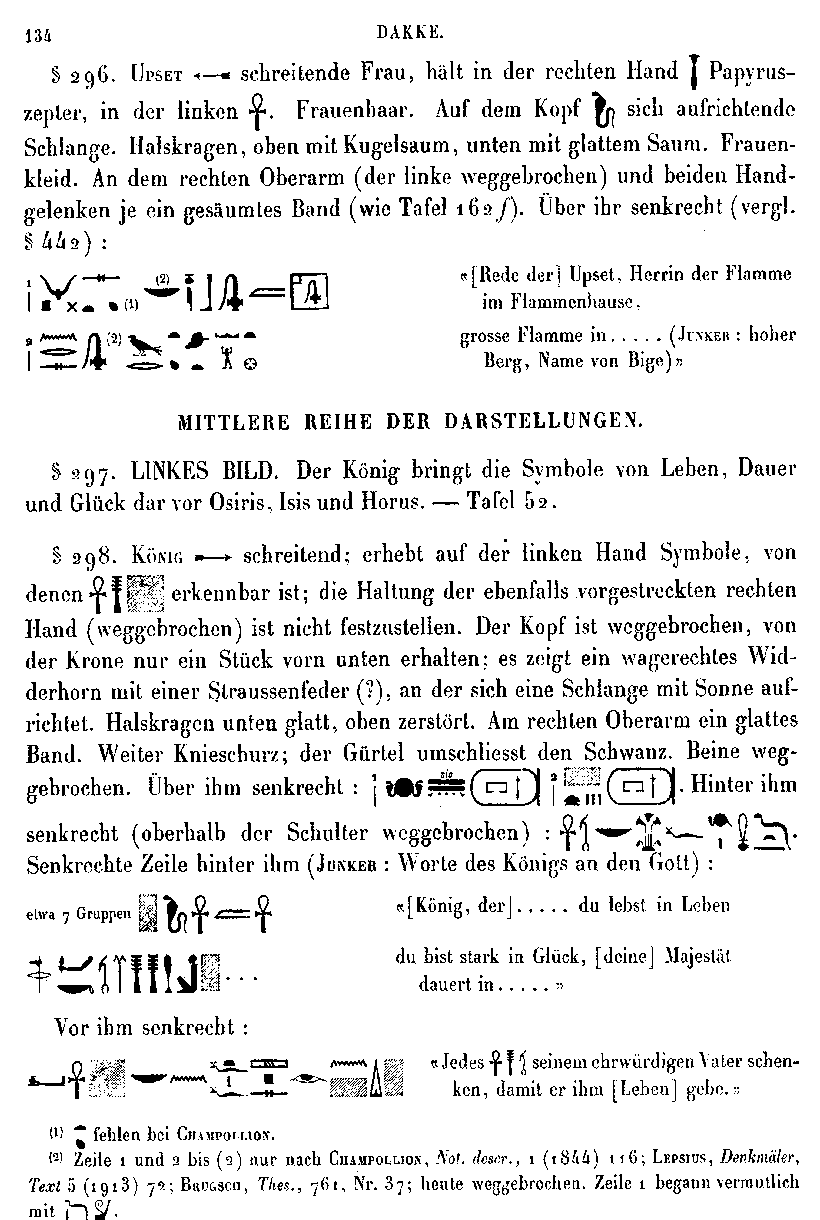
Page 134. Roeder, Der Tempel von Dakke (1930), p. 134 Printed hieroglyphs from G. Roeder, Der Tempel von Dakke (1930) - 109p. 134, § 296
[wps.t nb.t n]bj.t m ḥw.t-nbj.t nsr.t wr.t ḫnt.j.(t) ḏw-ḳꜣ
Wepset, lady of flame in the House of Flame, Neseret the Great, foremost on the High Mountain.
Note · Line 109
Wepset and Neseret are names of the fiery cobra goddess. - 110p. 134, § 296
dj.n=j n=k snḏ=k m jb.w n ḫꜣs.wt nb.(wt) (29)
For you I have set the fear of you in the hearts of all foreign lands.
- 111p. 134, § 298
nswt-bj.tj nb-tꜣ.wj pr-ꜥꜣ [sꜣ-rꜥ nb-]ḫꜥ.w pr-ꜥꜣ
King of Upper and Lower Egypt, lord of the Two Lands, Pharaoh; son of Ra, lord of crowns, Pharaoh.
- 112p. 134, § 298
[sꜣ] ꜥnḫ wꜣs nb ḥꜣ=f mj rꜥ ḏ.t
All protection, life and dominion are behind him, as they are behind Ra, forever.
- 113p. 134, § 298
--7Q-- ꜥnḫ=k m ꜥnḫ wsr=k m wꜣs ḏd ḥm=k [m ḏd] --détruit-- ḥnk ꜥnḫ-[ḏd-wꜣs] n jt=f šps jrj n[=f] dj.(t) [ꜥnḫ]
… that you may live by life, be mighty through dominion, and Your Majesty stand firm through stability … Offering the ankh-djed-was to his revered father, that he may give him life.
Note · Line 113
The offering joins three signs: the looped ankh for life, the djed pillar for stability and the was scepter for dominion. The blessing names the gift each sign conveys. 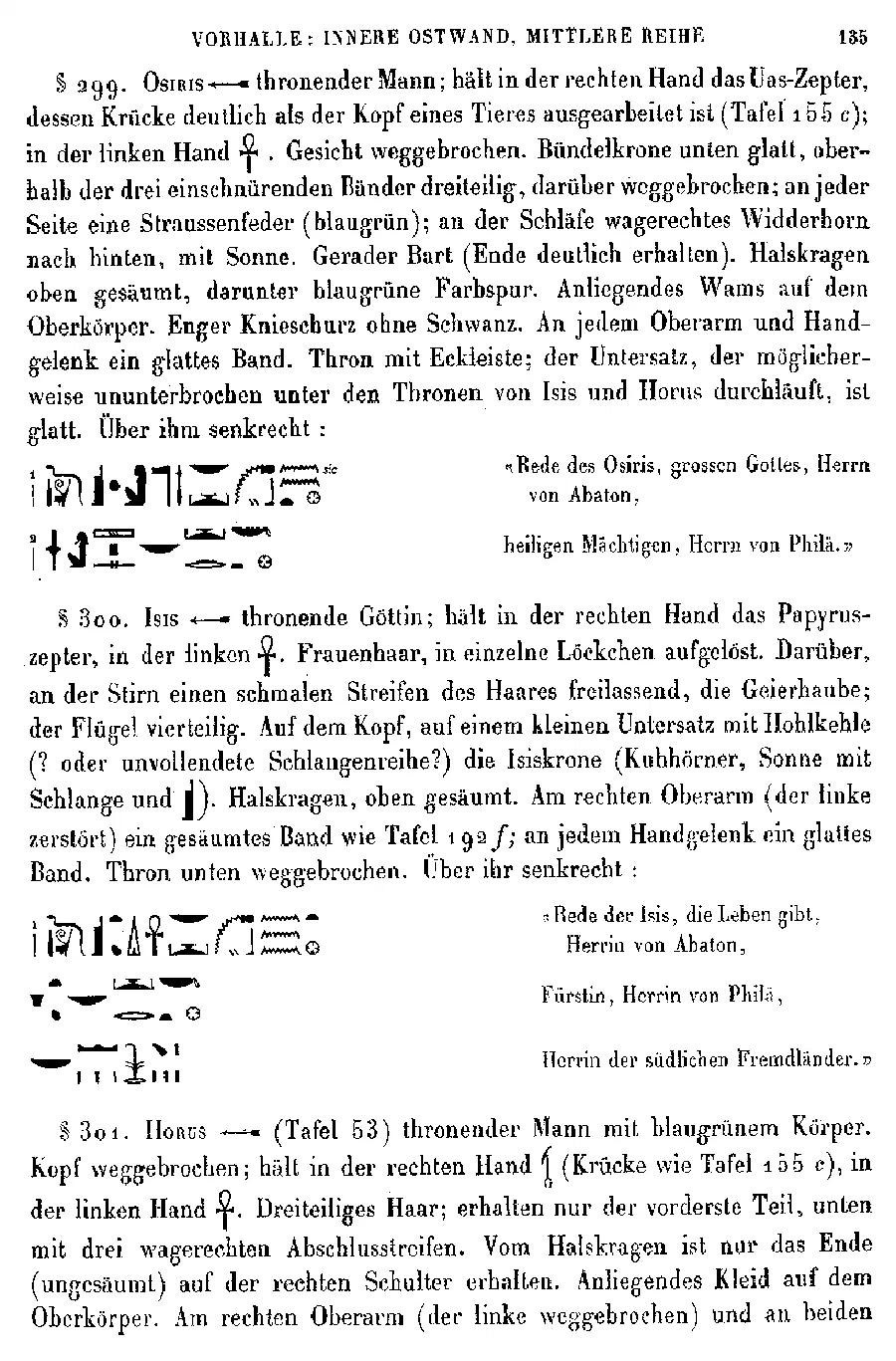
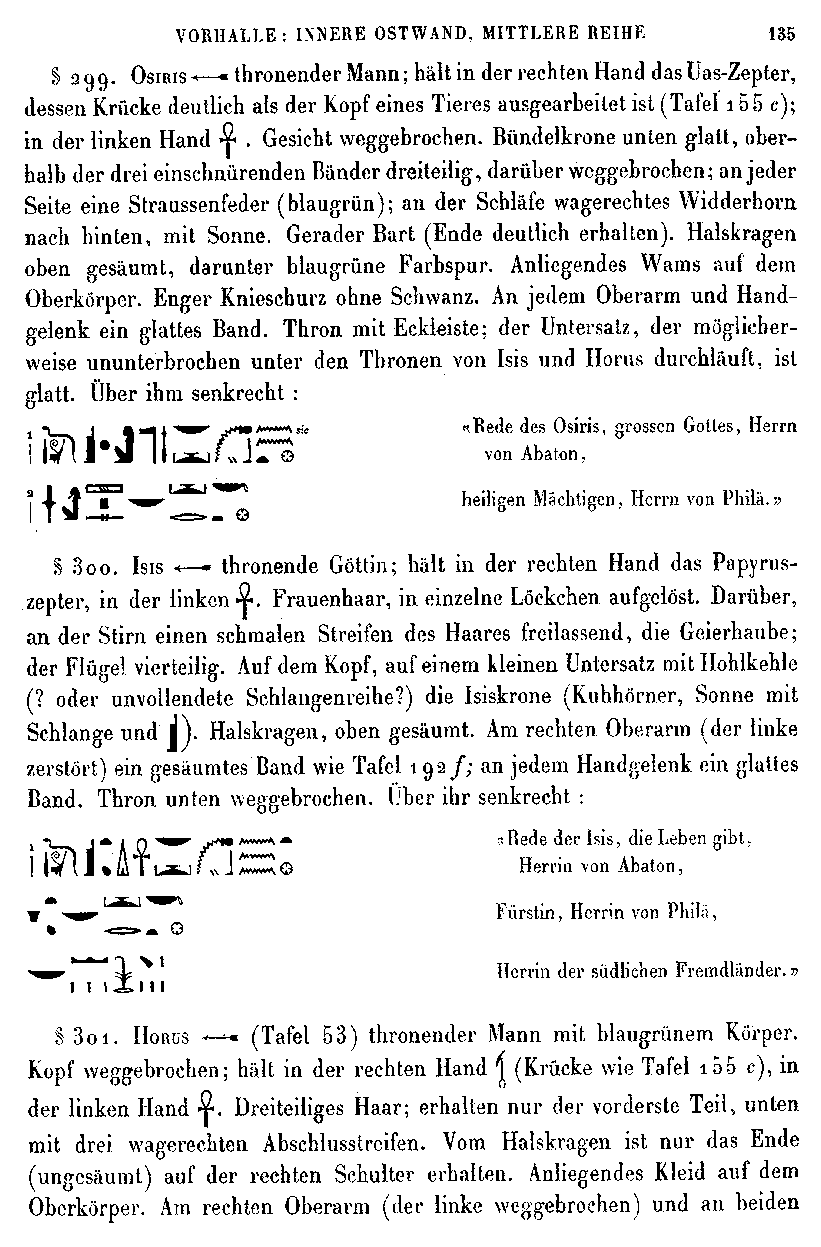
Page 135. Roeder, Der Tempel von Dakke (1930), p. 135 Printed hieroglyphs from G. Roeder, Der Tempel von Dakke (1930) - 114p. 135, § 299
ḏd-mdw jn wsjr nṯr ꜥꜣ nb jꜣ.t-wꜥb.t sḫm šps nb jwrḳ
Words spoken by Osiris, the great god, lord of the Abaton, revered power, lord of Philae.
- 115p. 135, § 300
ḏd-mdw jn ꜣs.t dj.(t) ꜥnḫ nb.(t) jꜣ.t-wꜥb.t ḥnw.t nb.(t) jwrḳ nb.(t) ḫꜣs.wt rsj.w(t)
Words spoken by Isis, giver of life, lady of the Abaton, mistress, lady of Philae, lady of the foreign lands of the south.
- 116p. 135, § 301
ḥḳꜣ nb ḥr.j.t-tp ḥḳꜣ n nṯr.w nb.w --4,5Q-- m šn jrj --8Q--
Ruler, lord of the uraeus, ruler of all the gods, … within its circuit …
Note · Line 116
The uraeus is the rearing cobra worn on the brow as a mark and a defense of royal power. 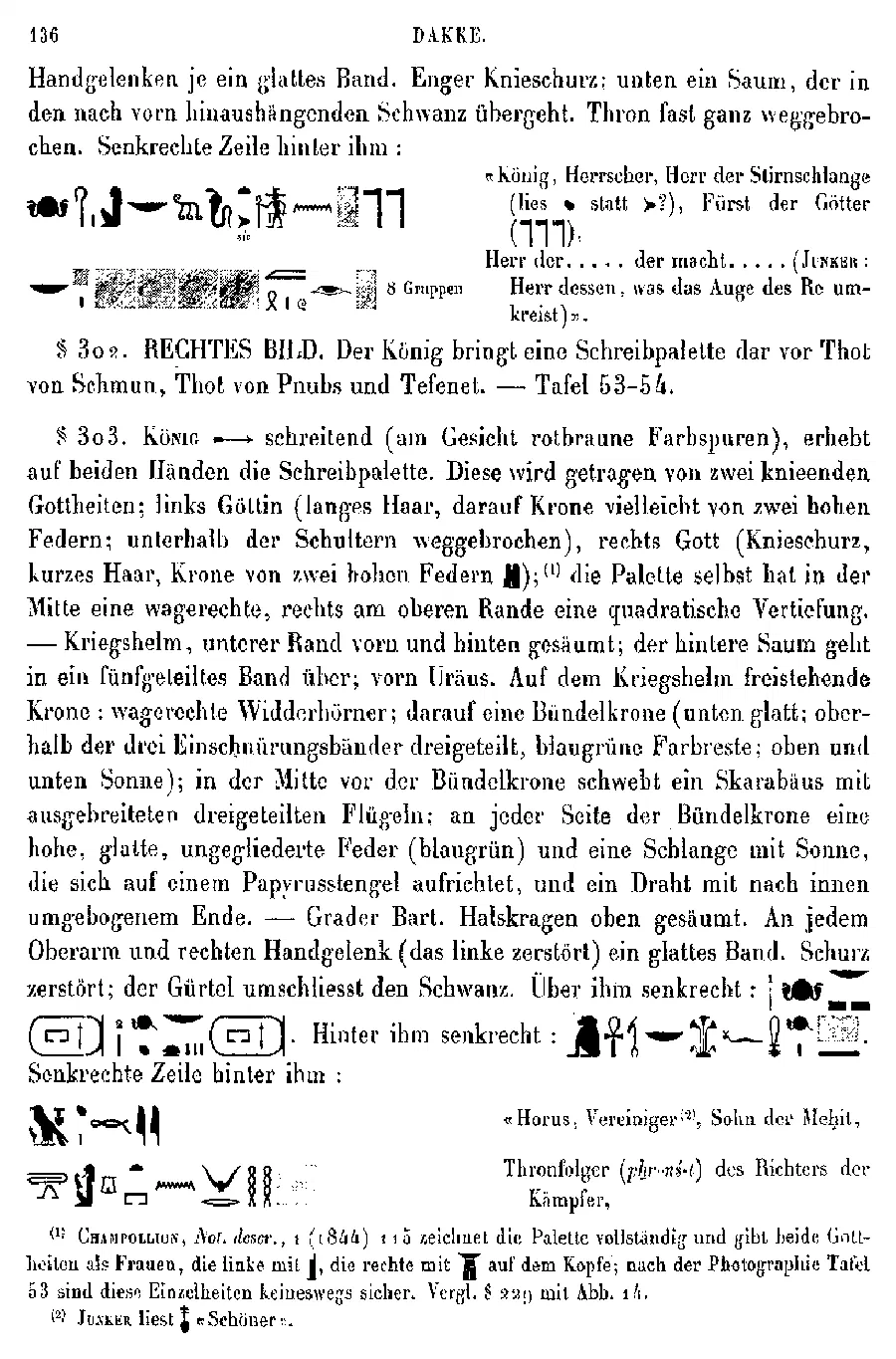
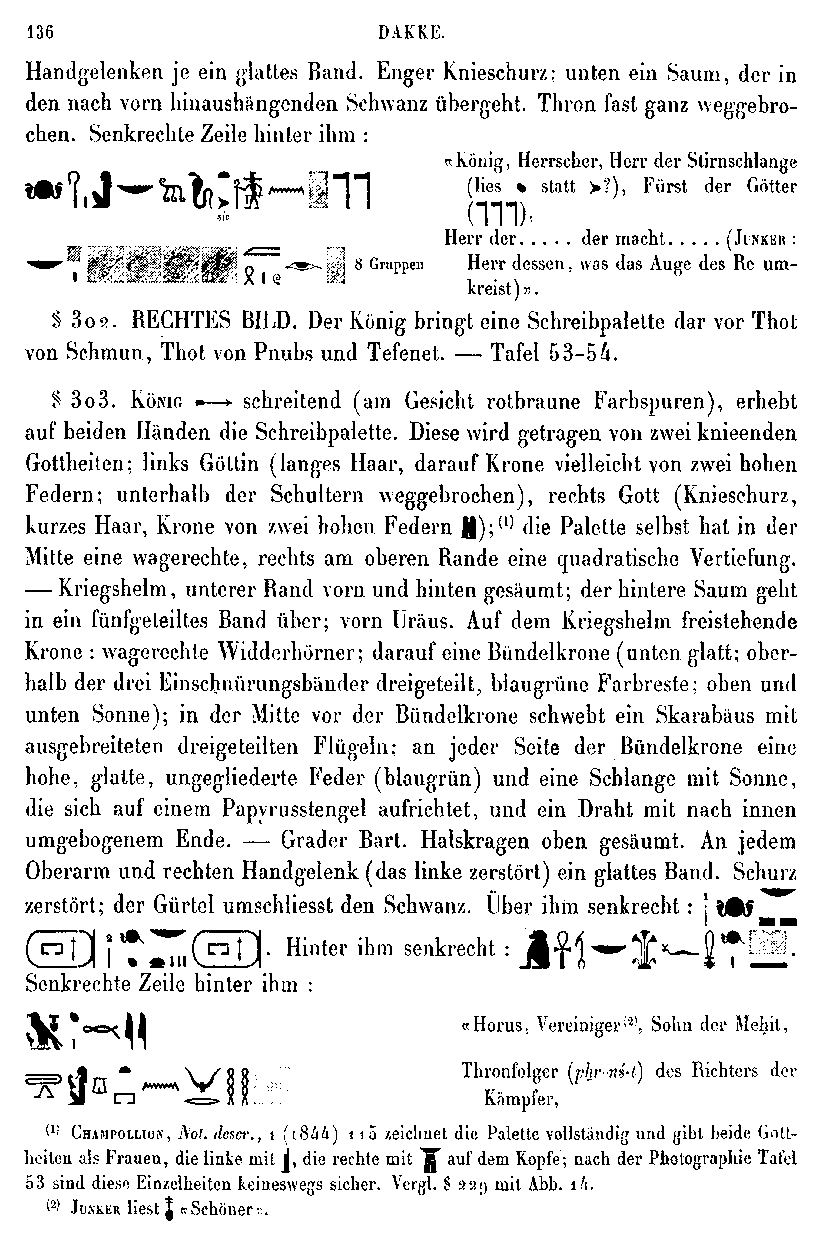
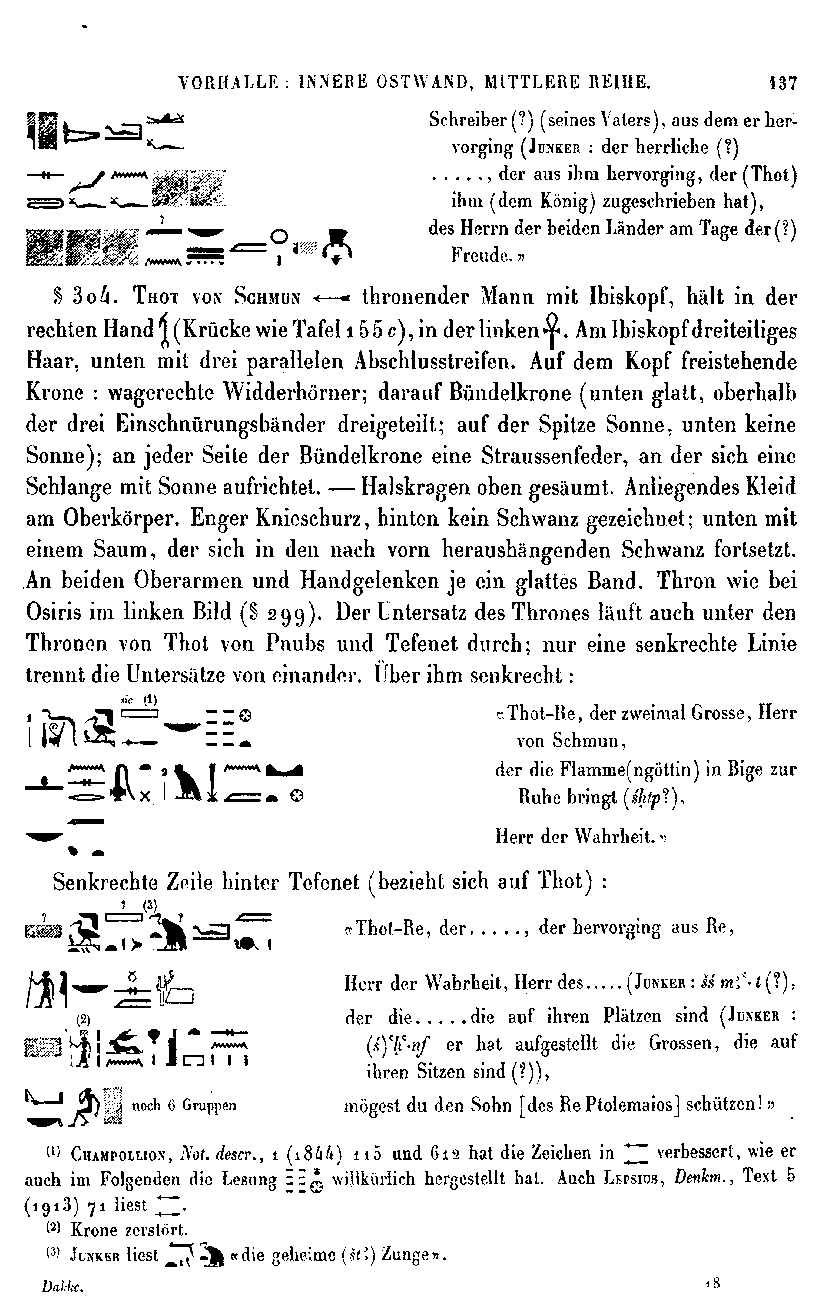
Page 136. Roeder, Der Tempel von Dakke (1930), p. 136 Printed hieroglyphs from G. Roeder, Der Tempel von Dakke (1930) - 117p. 136, § 303
nswt-bj.tj nb-tꜣ.wj pr-ꜥꜣ sꜣ-rꜥ nb-ḫꜥ.w pr-ꜥꜣ
King of Upper and Lower Egypt, lord of the Two Lands, Pharaoh; son of Ra, lord of crowns, Pharaoh.
- 118p. 136, § 303
sꜣ ꜥnḫ wꜣs nb ḥꜣ=f mj rꜥ [ḏ.t]
All protection, life and dominion are behind him, as they are behind Ra, forever.
- 119p. 136, § 303
ꜥnḫ nṯr nfr sꜣ mḥj.t pẖr ns.t n wpj rḥḥ.wj --1Q-- … prj jm=f spẖr=f n=f --5Q-- n nb tꜣ.wj m hrw n ꜣw.t-jb
Long live the perfect god, son of Mehyt, heir to the throne of him who parts the Two Companions … who came forth from him. He writes down for him … for the lord of the Two Lands on the day of rejoicing.
Note · Line 119
The Two Companions are the rivals Horus and Seth. 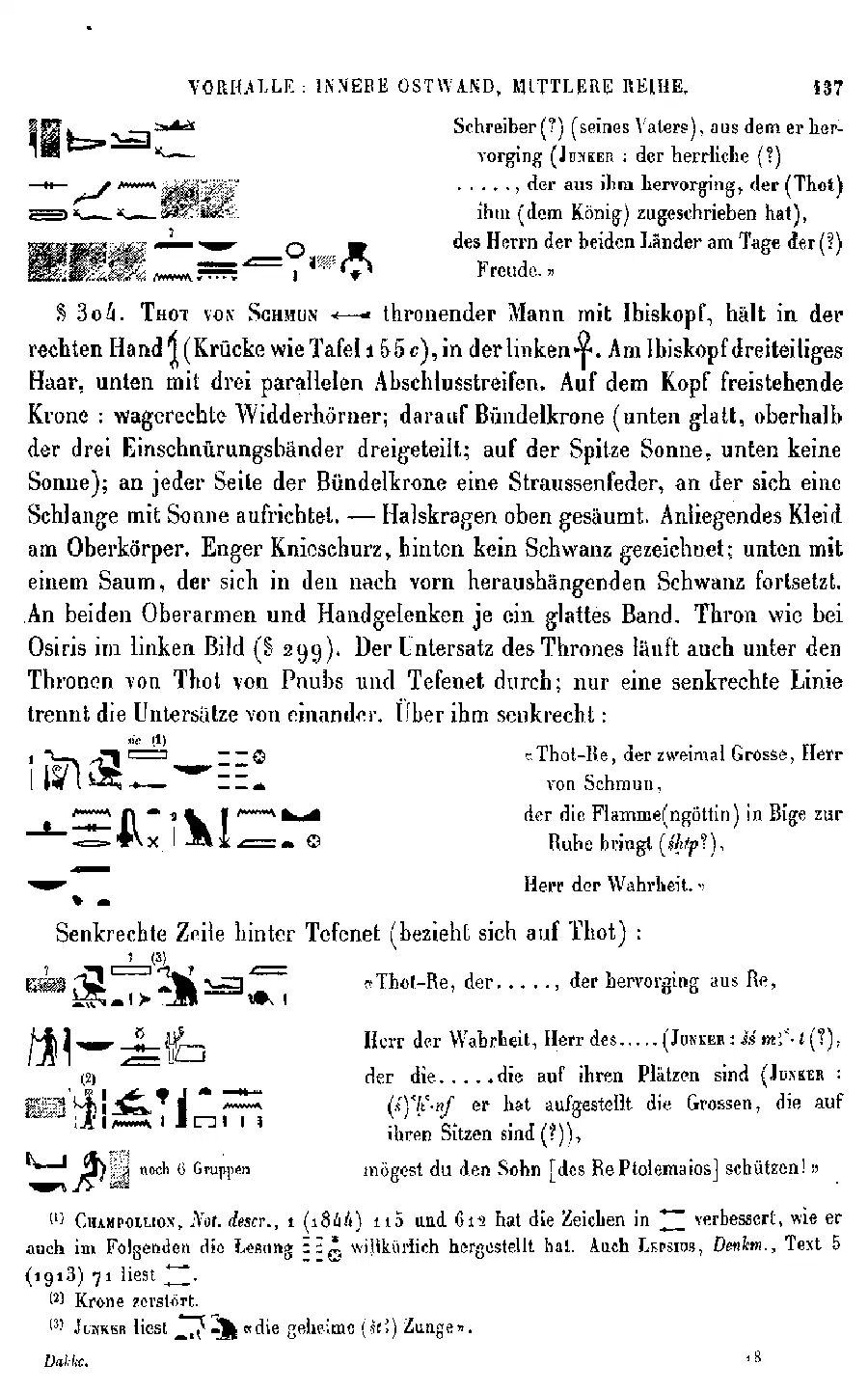
Page 137. Roeder, Der Tempel von Dakke (1930), p. 137 Printed hieroglyphs from G. Roeder, Der Tempel von Dakke (1930) - 120p. 137, § 304
ḏd-mdw jn ḏḥwtj ꜥꜣ ꜥꜣ nb ḫmnw ḥtp nsr.t m snm.t nb mꜣꜥ.t
Words spoken by Thoth, the twice-great, lord of Hermopolis, who stills the flame in Senmet, lord of Maat.
Note · Line 120
The flame is the wrath of the Eye of Ra, the goddess whom Thoth brings back from Nubia. - 121p. 137, § 304
ḏḥwtj [ꜥꜣ ꜥꜣ wr] prj m rꜥ wr mꜣꜥ.t nb šsm ꜥḥꜥ[.n=f] (30) wr.w wn ḥr s.t=sn ḫwj=k sꜣ[-rꜥ] --6Q--
Thoth, the thrice-great, who came forth from Ra, prince of Maat, lord of guidance, who has raised up the great ones who hold their places. May you protect the son of Ra …
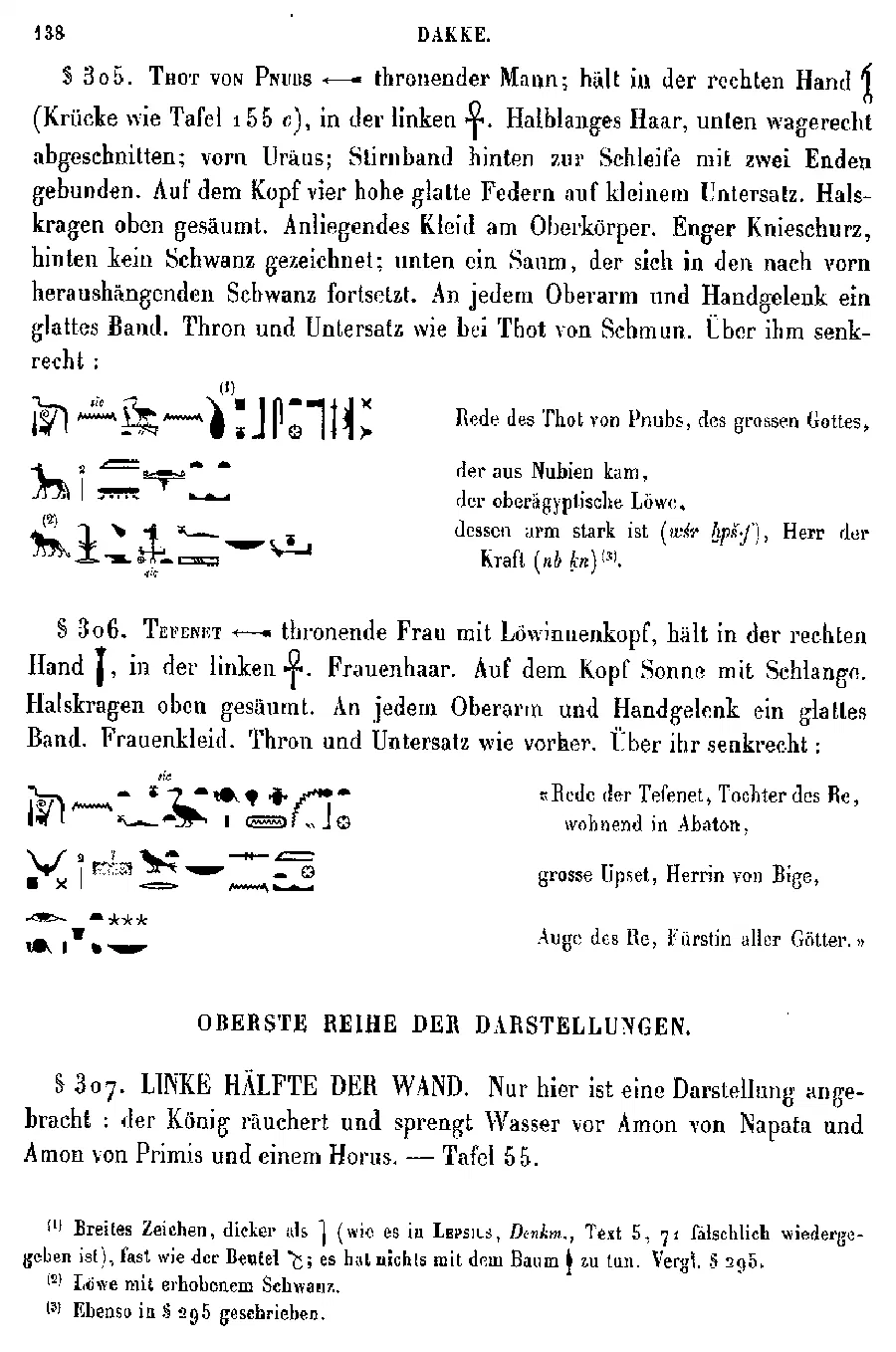
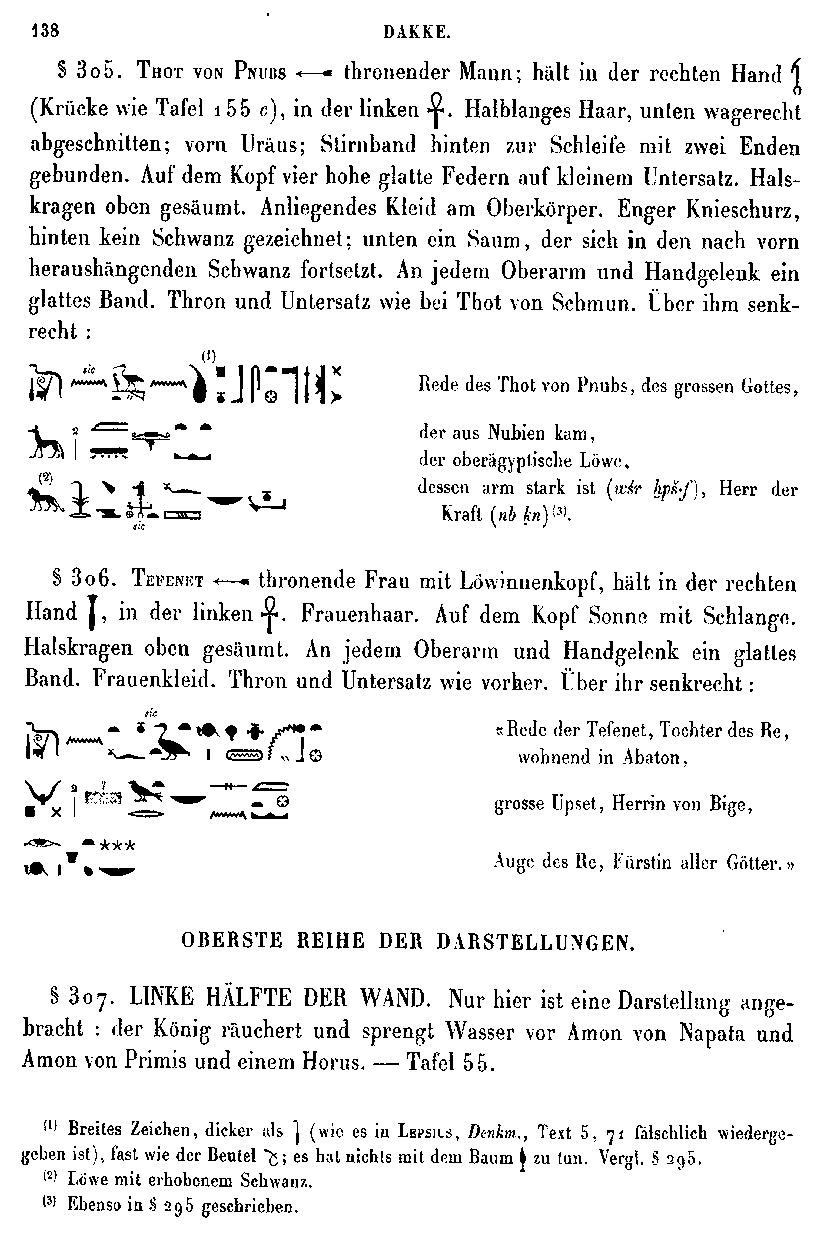
Page 138. Roeder, Der Tempel von Dakke (1930), p. 138 Printed hieroglyphs from G. Roeder, Der Tempel von Dakke (1930) - 122p. 138, § 305
ḏd-mdw jn ḏḥwtj n pnbs nṯr ꜥꜣ wr jj m tꜣ-stj mꜣj rsj wsr ḫpš nb ḳn
Words spoken by Thoth of Pnubs, the very great god who comes from Nubia, lion of the south, mighty of arm, lord of valor.
- 123p. 138, § 306
ḏd-mdw jn tfn.t sꜣ.t rꜥ ḥr.j.(t)-jb jw-wꜥb wps.t wr.t nb.(t) snm.t jr.t rꜥ ḥnw.t nṯr.w nb.(w)
Words spoken by Tefnut, daughter of Ra, who dwells on the Pure Island, Wepset the Great, lady of Senmet, Eye of Ra, mistress of all the gods.
Note · Line 123
The Pure Island is the Abaton, the sanctuary of Osiris on Bigeh, beside Philae. 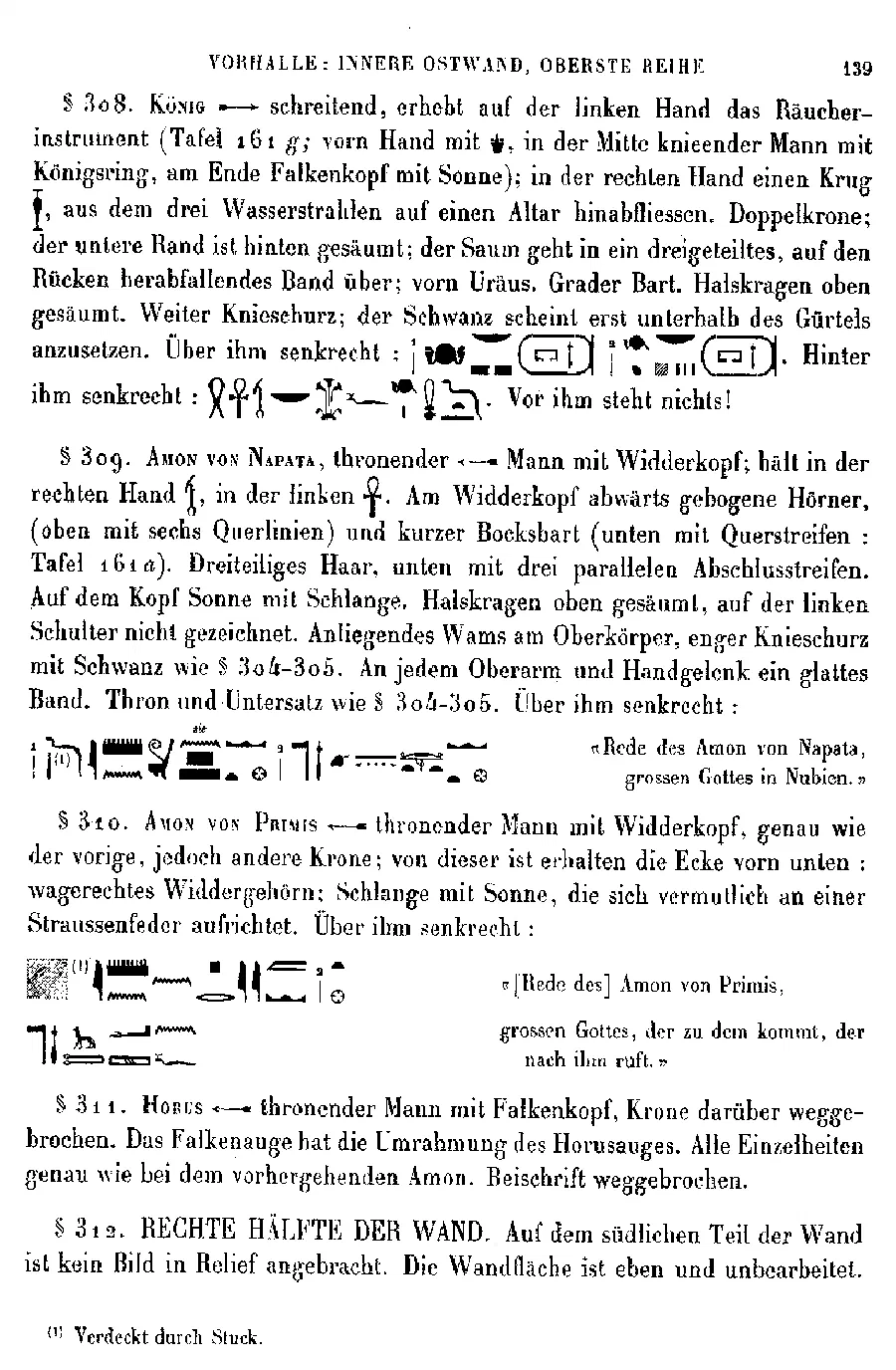
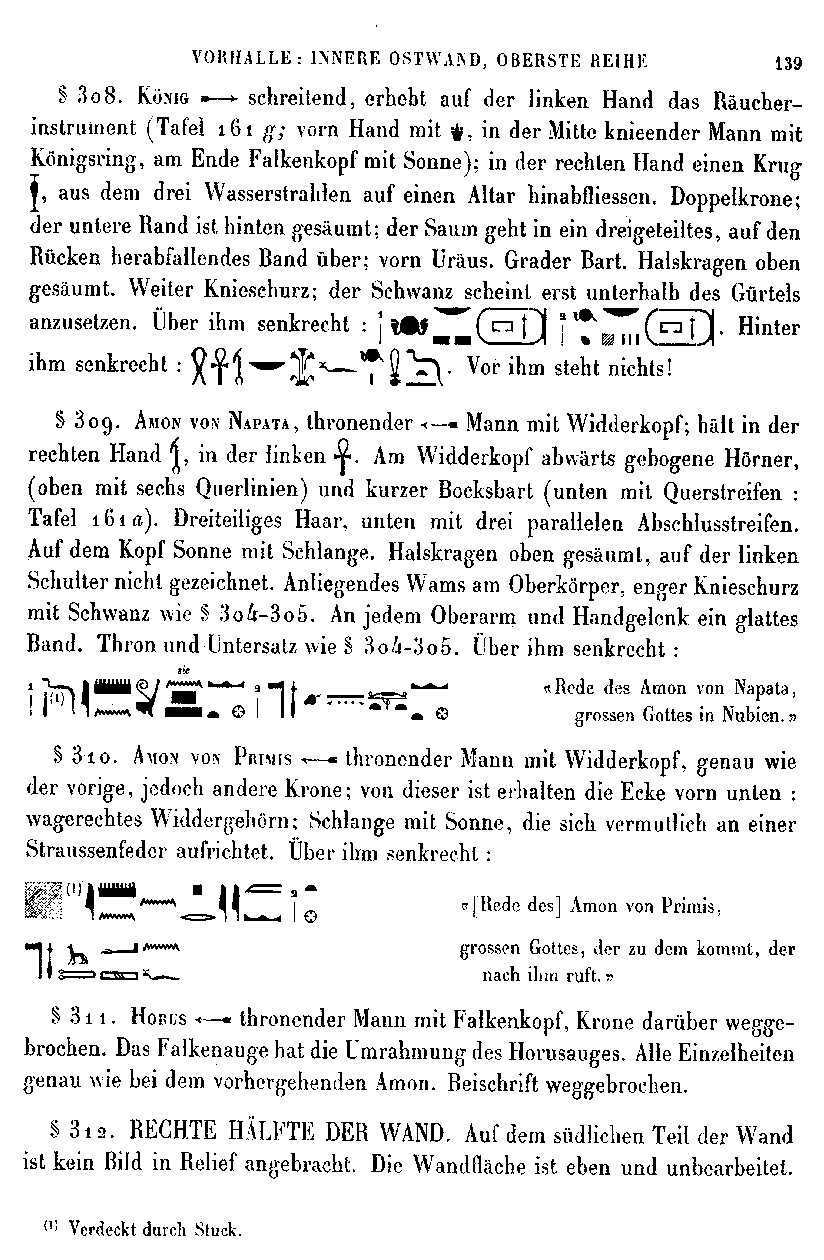
Page 139. Roeder, Der Tempel von Dakke (1930), p. 139 Printed hieroglyphs from G. Roeder, Der Tempel von Dakke (1930) - 124p. 139, § 308
nswt-bj.tj nb-tꜣ.wj pr-ꜥꜣ sꜣ-rꜥ nb-ḫꜥ.w pr-ꜥꜣ
King of Upper and Lower Egypt, lord of the Two Lands, Pharaoh; son of Ra, lord of crowns, Pharaoh.
Note · Line 124
“Pharaoh” stands in both places where the king’s names would ordinarily appear. - 125p. 139, § 308
sꜣ ꜥnḫ wꜣs nb ḥꜣ=f mj rꜥ ḏ.t
All protection, life and dominion are behind him, as they are behind Ra, forever.
- 126p. 139, § 309
ḏd-mdw jn jmn n npt nṯr ꜥꜣ ḫnt.j tꜣ-stj
Words spoken by Amun of Napata, the great god, foremost in Nubia.
- 127p. 139, § 310
[ḏd-mdw jn] jmn n prym nṯr ꜥꜣ jj m ꜥš n=f
Words spoken by Amun of Primis, the great god who comes when called.
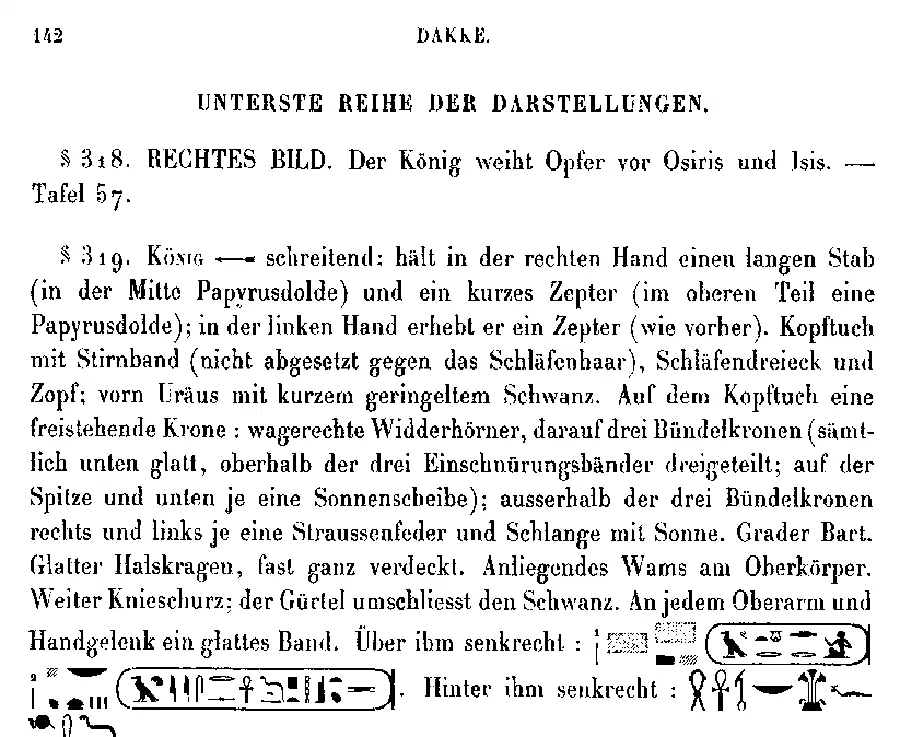
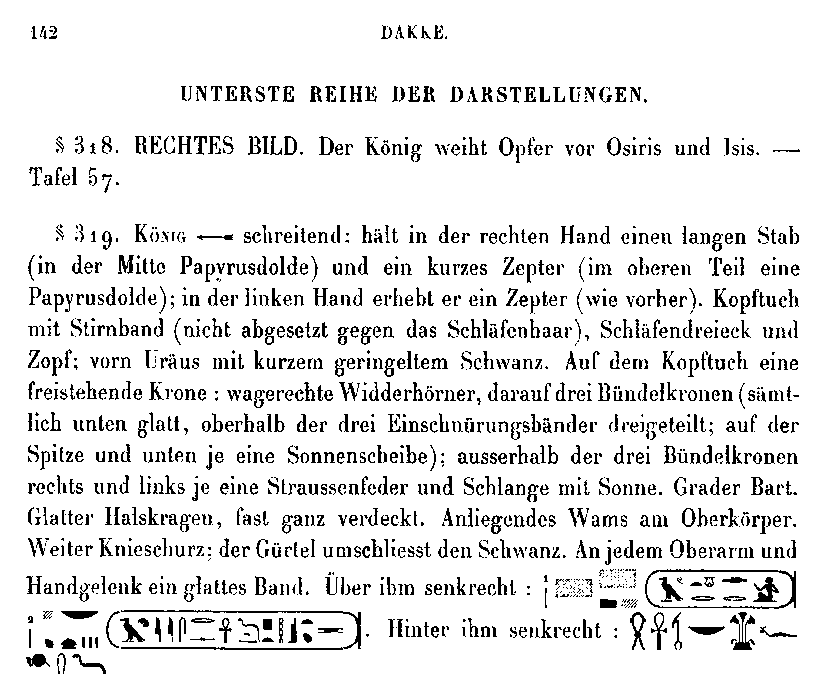
Page 142. Roeder, Der Tempel von Dakke (1930), p. 142 Printed hieroglyphs from G. Roeder, Der Tempel von Dakke (1930) - 128p. 142, § 319
[nswt-bj.tj nb]-tꜣ.wj ꜣwtgrdr sꜣ-[rꜥ] nb-ḫꜥ.w kꜣysrs-ꜥnḫ-ḏ.t-mrj-ptḥ-ꜣs.t
King of Upper and Lower Egypt, lord of the Two Lands, Autokrator; son of Ra, lord of crowns, Caesar, living forever, beloved of Ptah and Isis.
Note · Line 128
Autokrator is the Greek title of the Roman emperor. Here it takes the place of an Egyptian throne name. - 129p. 142, § 319
sꜣ ꜥnḫ wꜣs nb ḥꜣ=f mj rꜥ ḏ.t
All protection, life and dominion are behind him, as they are behind Ra, forever.
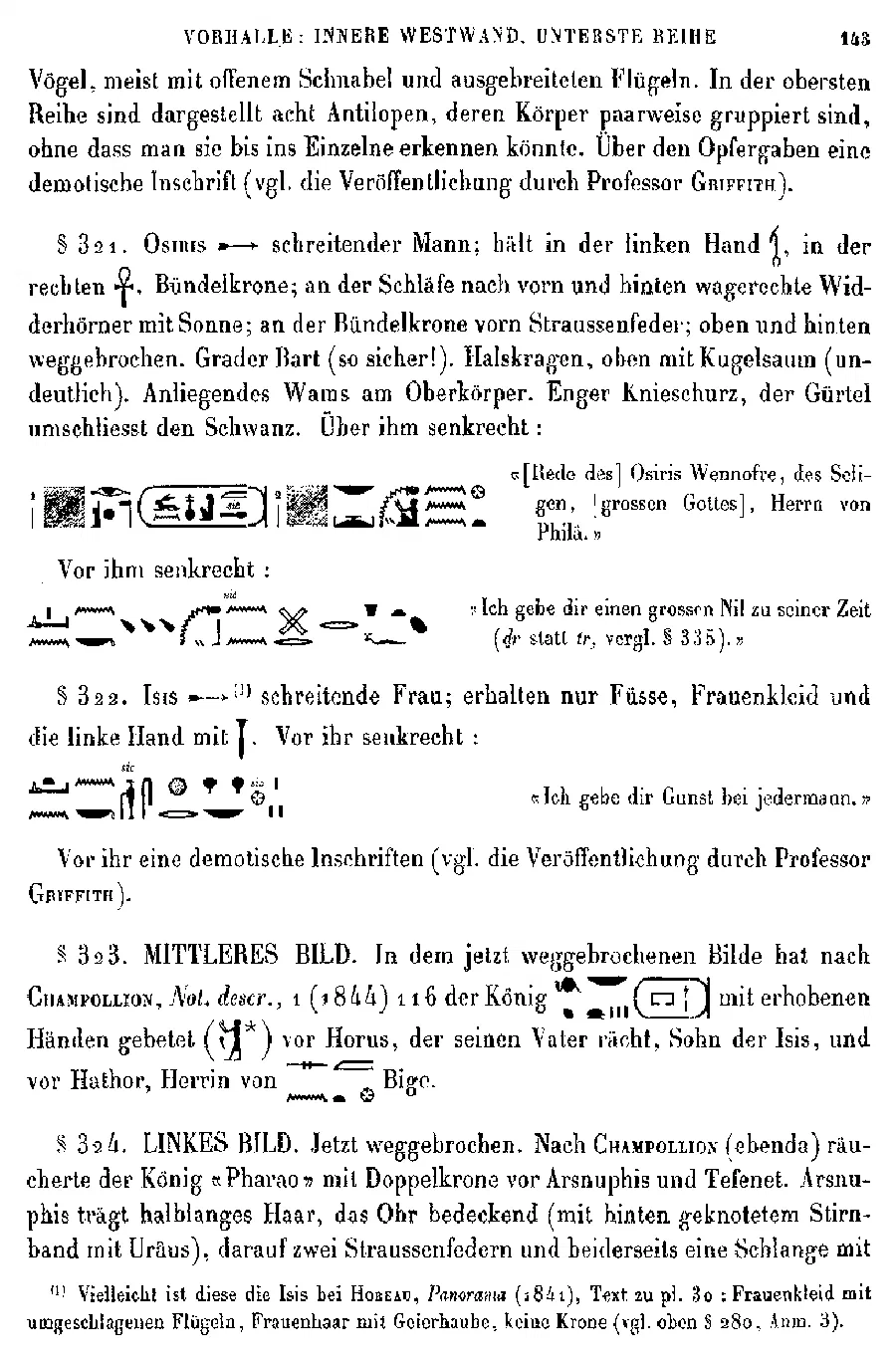
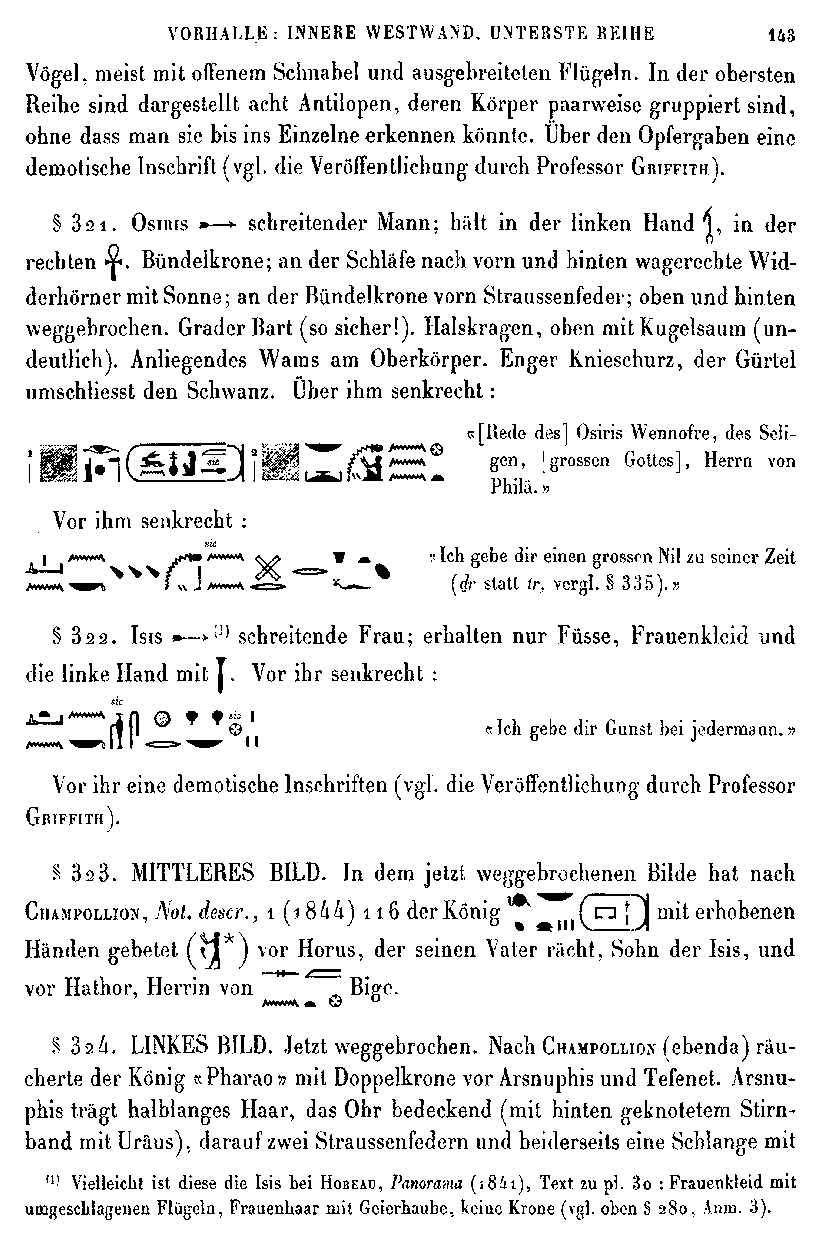
Page 143. Roeder, Der Tempel von Dakke (1930), p. 143 Printed hieroglyphs from G. Roeder, Der Tempel von Dakke (1930) - 130p. 143, § 321
[ḏd-mdw jn] wsjr wn-nfr mꜣꜥ-ḫrw [nṯr ꜥꜣ] nb jꜣ.t-wꜥb.t
Words spoken by Osiris Wennefer, vindicated, the great god, lord of the Pure Mound.
Note · Line 130
The Pure Mound is another name for the Abaton, revered as a burial place of Osiris. - 131p. 143, § 321
dj.n=j n=k ḥꜥpj wr tr=f
I have given you Hapy, high in his season.
Note · Line 131
The gift is a full flood at the proper time. - 132p. 127, § 322
dj.n=j n=k ḥs.t ḫr ḥr-nb
I have given you favor in everyone’s eyes.
- 133p. 143, § 323
[sꜣ-rꜥ nb-ḫꜥ.w pr-ꜥꜣ] (31)
Son of Ra, lord of crowns, Pharaoh.
- 134p. 143, § 324
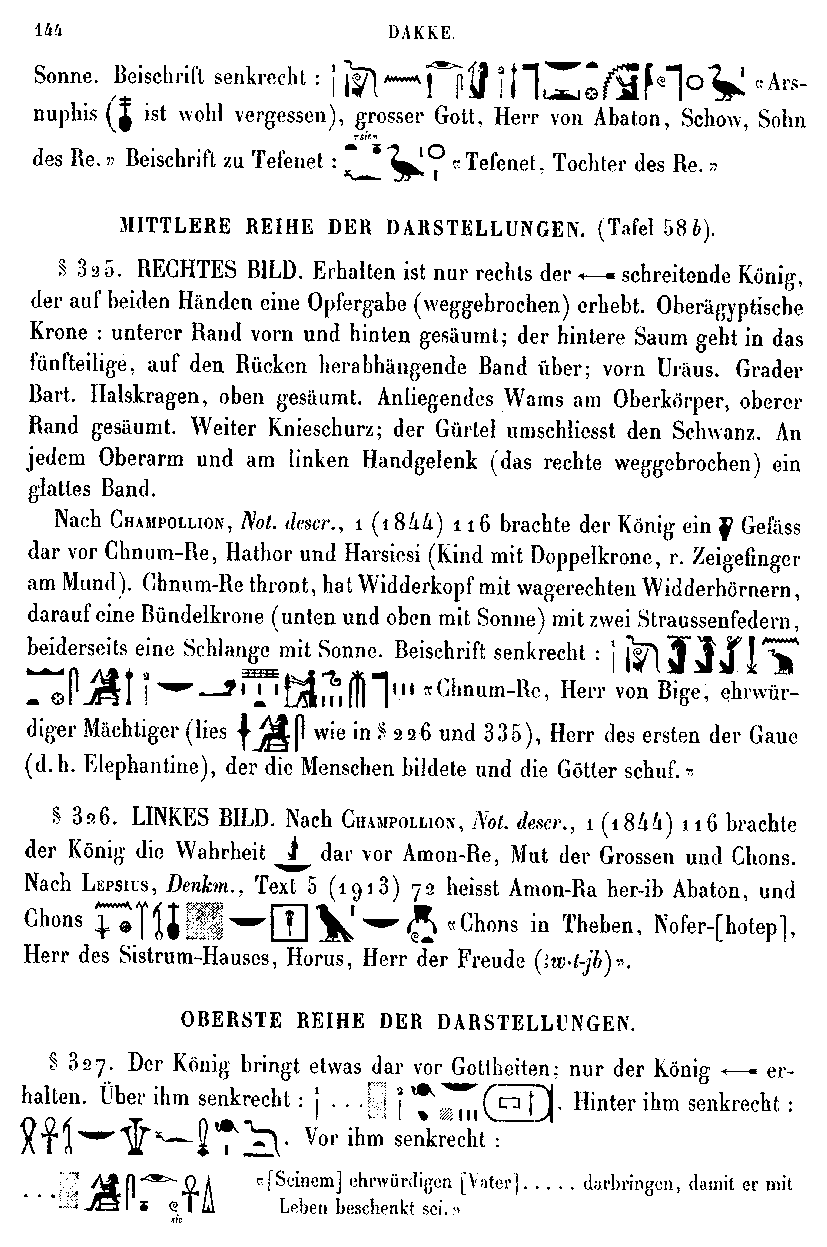
[ḏd-mdw jn jr.j-ḥms-<nfr> nṯr ꜥꜣ nb jꜣ.t-wꜥb.t šw sꜣ rꜥ] (32)
Words spoken by Arensnuphis, the great god, lord of the Abaton, Shu, son of Ra.
Note · Line 134
Arensnuphis is identified here with Shu, Tefnut’s brother and consort. - 135p. 143, § 324
tfn,t sꜣ.t rꜥ
Tefnut, daughter of Ra.
- 136
[ḏd-mdw jn ẖnmw-rꜥ nb snm.t sḫm šps nb ḥꜥ.t-spꜣ.wt nḥp rmṯ msj nṯr.w] (33)
Words spoken by Khnum-Ra, lord of Senmet, august power, lord of the first nome, who shapes humankind on his wheel and gives birth to the gods.
Note · Line 136
The first nome of Upper Egypt lay at the First Cataract, where Khnum was worshipped as a divine potter. 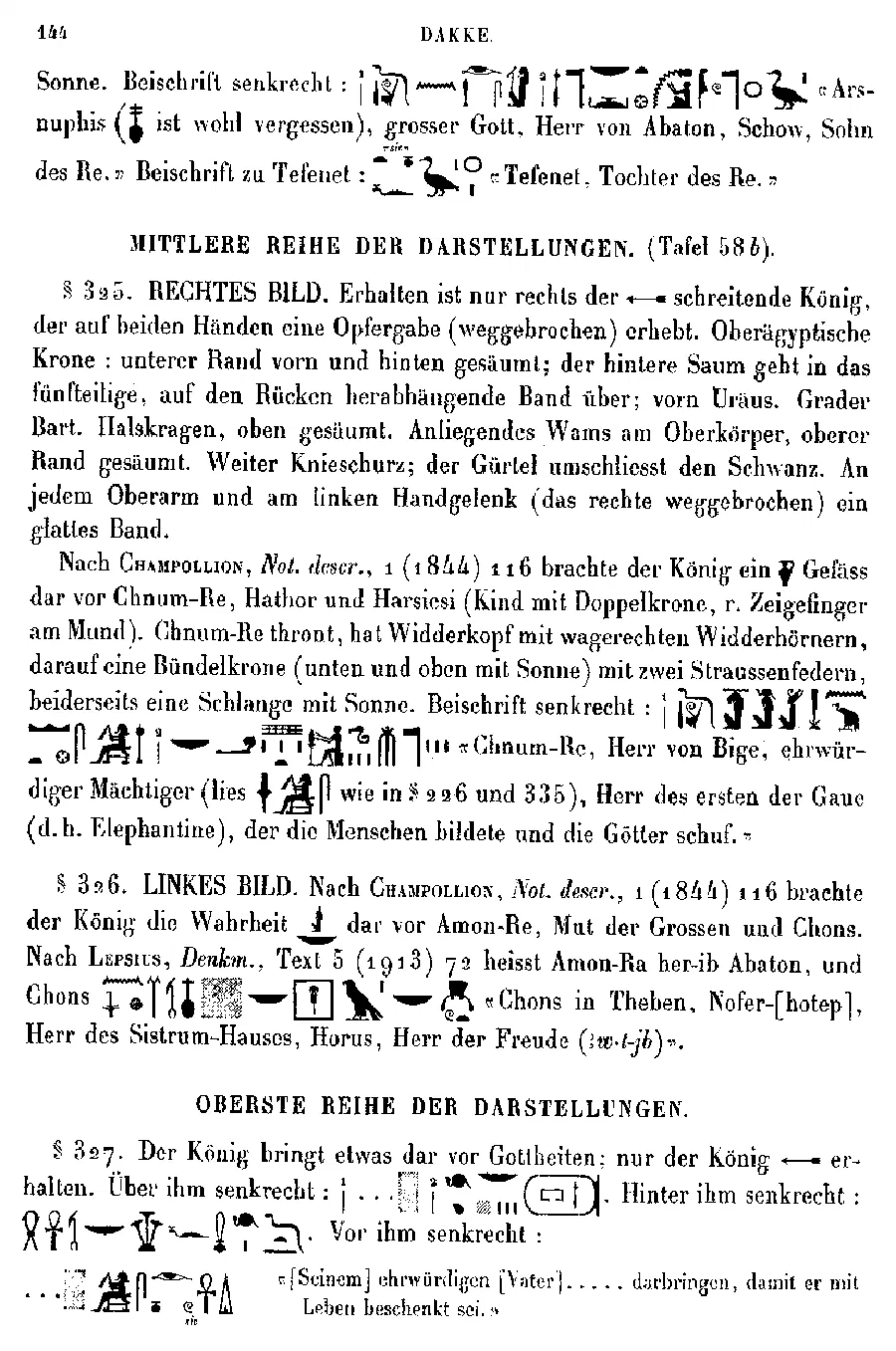
Page 144. Roeder, Der Tempel von Dakke (1930), p. 144 Printed hieroglyphs from G. Roeder, Der Tempel von Dakke (1930) - 137p. 144, § 326
[ḫnsw m wꜣs.t nfr-[ḥtp] nb ḥw.t-sḫm ḥrw nb ꜣw.t-<jb>] (34)
Khonsu in Thebes, Neferhotep, lord of the House of the Sistrum, Horus, lord of joy.
- 138
--détruit-- sꜣ-rꜥ nb-ḫꜥ.w pr-ꜥꜣ
… son of Ra, lord of crowns, Pharaoh.
- 139
sꜣ ꜥnḫ wꜣs nb ḥꜣ=f mj rꜥ ḏ.t
All protection, life and dominion are behind him, as they are behind Ra, forever.
- 140
--détruit-- [jt=f] šps jrj.n=f dj.(t) ꜥnḫ
… his august father. He has done this that he may be given life.
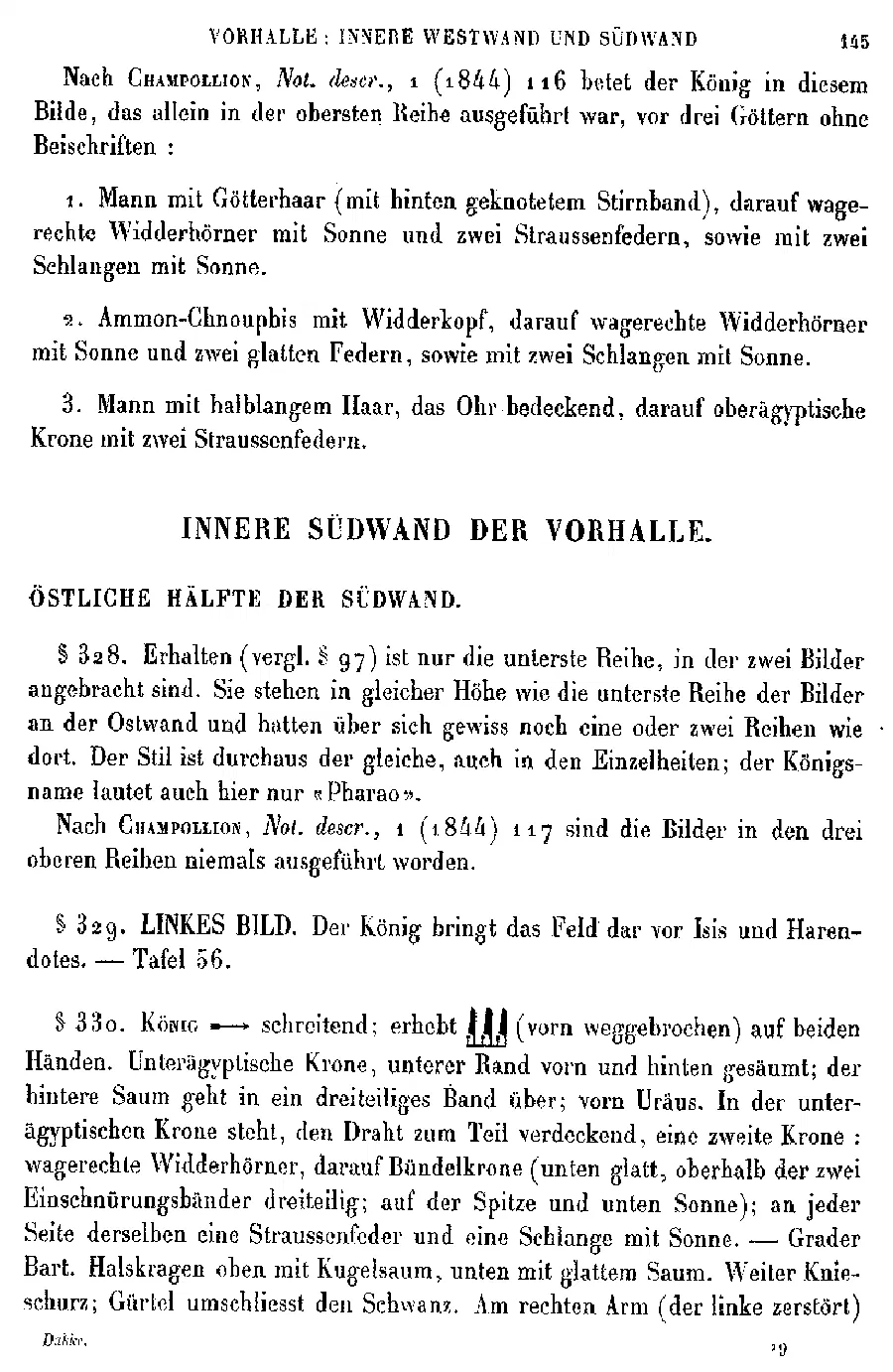
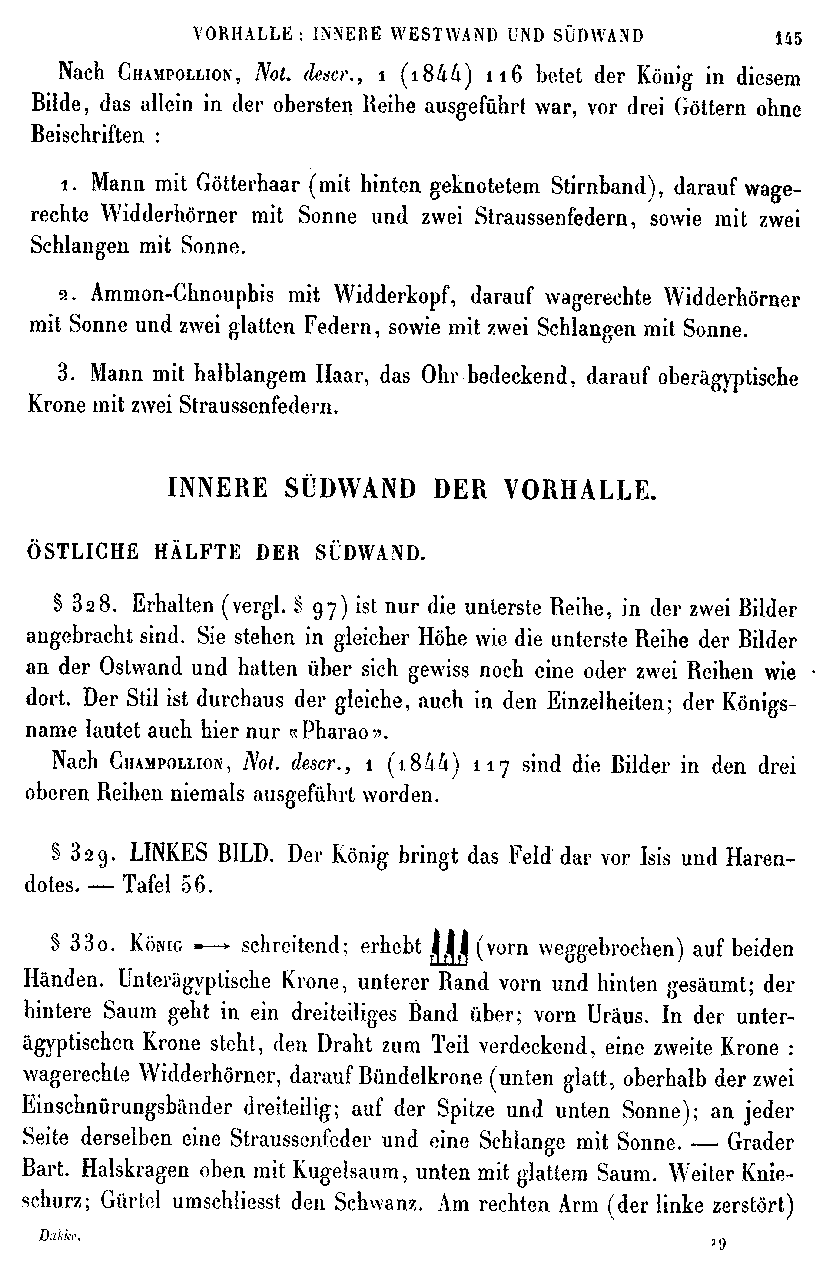
Page 145. Roeder, Der Tempel von Dakke (1930), p. 145 Printed hieroglyphs from G. Roeder, Der Tempel von Dakke (1930) - 141p. 145, § 330
sꜣ ꜥnḫ wꜣs nb ḥꜣ=f mj rꜥ ḏ.t
All protection, life and dominion are behind him, as they are behind Ra, forever.
- 142p. 145, § 330
ḥnk sḫ.t n mw.t=f jrj n=f [dj.t ꜥnḫ]
Offering the field to his mother, that she may grant him life.
- 143p. 145, § 330
ꜥnḫ nṯr nfr nḥm wḏꜣ,t šd sy m ẖ.t n ꜥmꜣ=s --6Q-- jr.t nb.t mꜣ ꜥnḫ nfr --3Q--
Long live the good god who rescues the Wedjat eye, who draws it from the belly of the one who swallowed it! … every eye sees a good life …
Note · Line 143
The “good god” is the king. 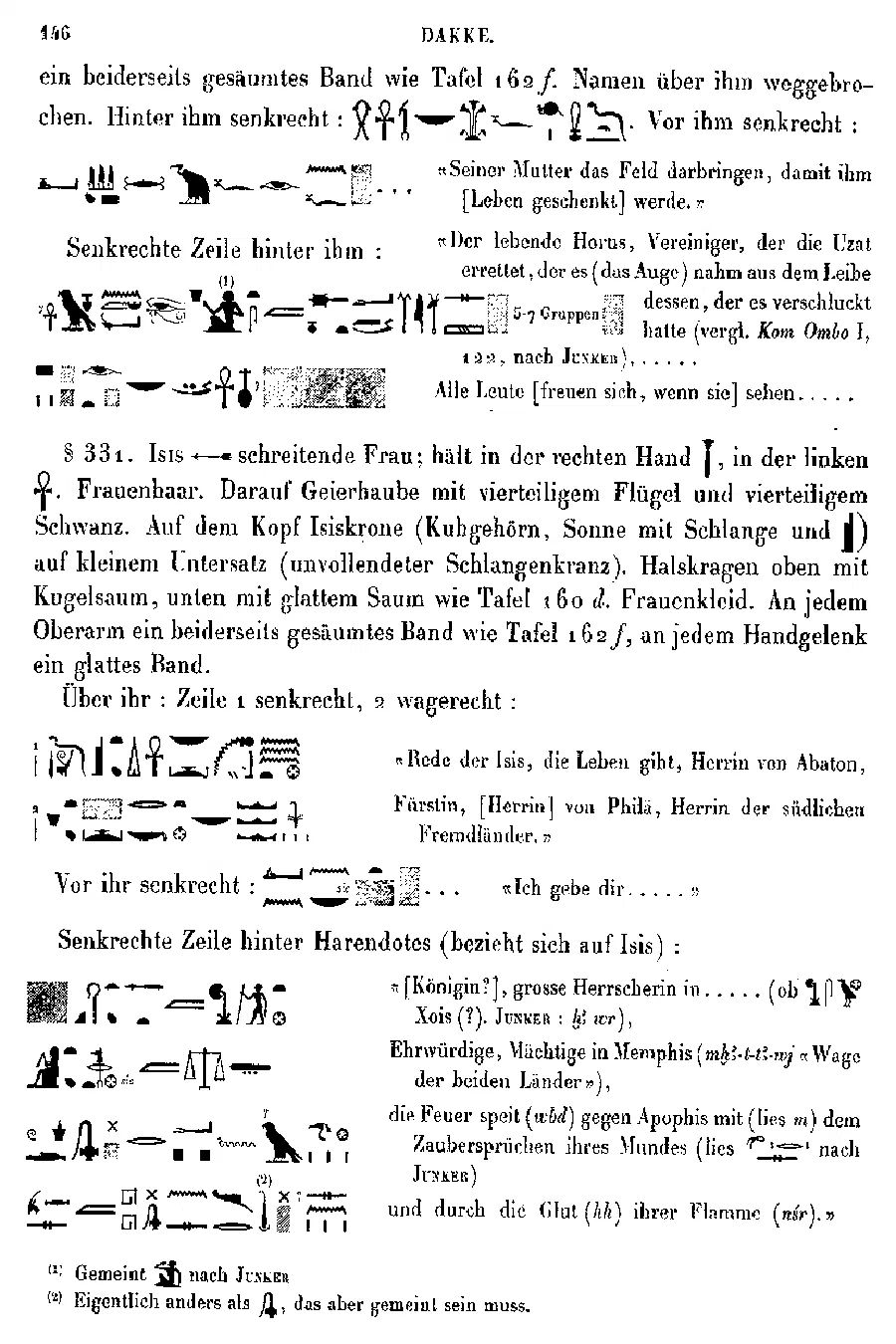
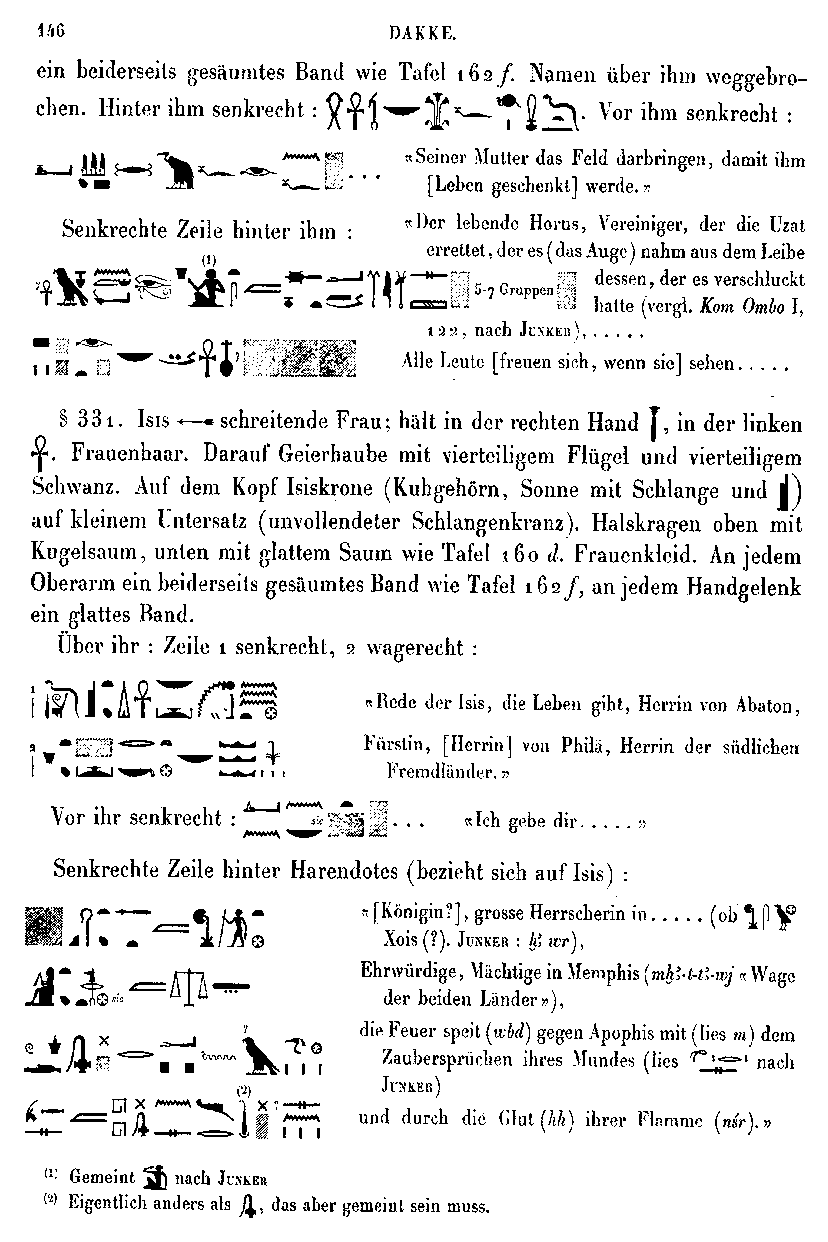
Page 146. Roeder, Der Tempel von Dakke (1930), p. 146 Printed hieroglyphs from G. Roeder, Der Tempel von Dakke (1930) - 144p. 146, § 331
ḏd-mdw jn ꜣs.t dj.(t) ꜥnḫ nb.(t) jꜣ.t-wꜥb.t ḥnw.t [nb.t] jwrḳ nb.(t) ḫꜣs.wt rsj.w(t)
Words spoken by Isis, giver of life, lady of the Abaton, mistress, lady of Philae, lady of the foreign lands to the south.
- 145p. 146, § 331
dj.n=(j) n=k --détruit--
I have given you …
- 146p. 146, § 331
ḥḳꜣ.t ꜥꜣ.t m ḫꜣwr šps.t wsr.t m mḫꜣ.t-tꜣ.wj wbd.(t) r ꜥpp m ꜣḫ.w n šsr=s (35) m hh nsr=sn
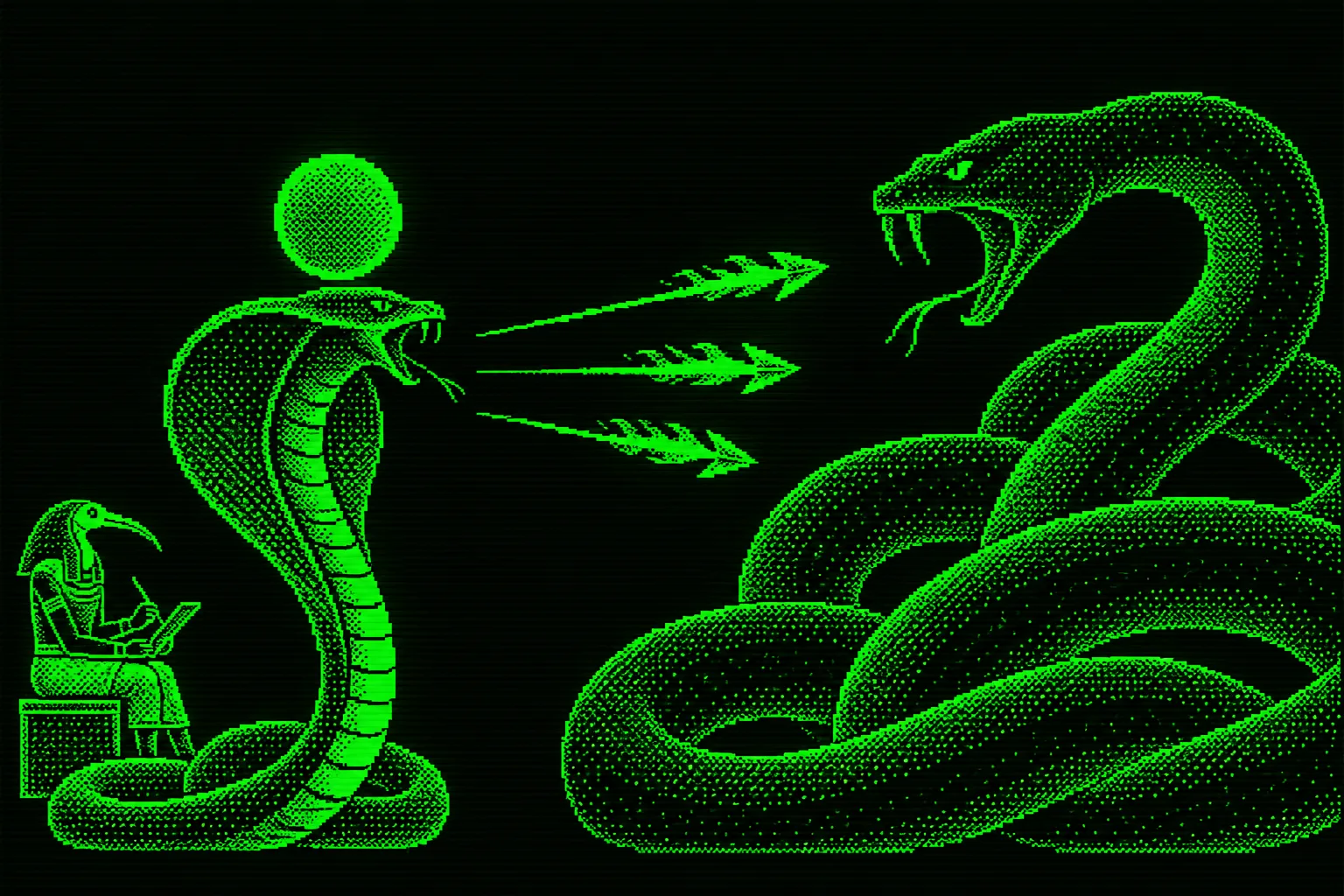
Sovereign lady, great in Khaur, august and mighty in the Balance of the Two Lands, who blazes against Apophis with the magic of her arrows, with the heat of their flame.
Note · Line 146
Apophis is the serpent who threatens the sun god on his nightly passage. 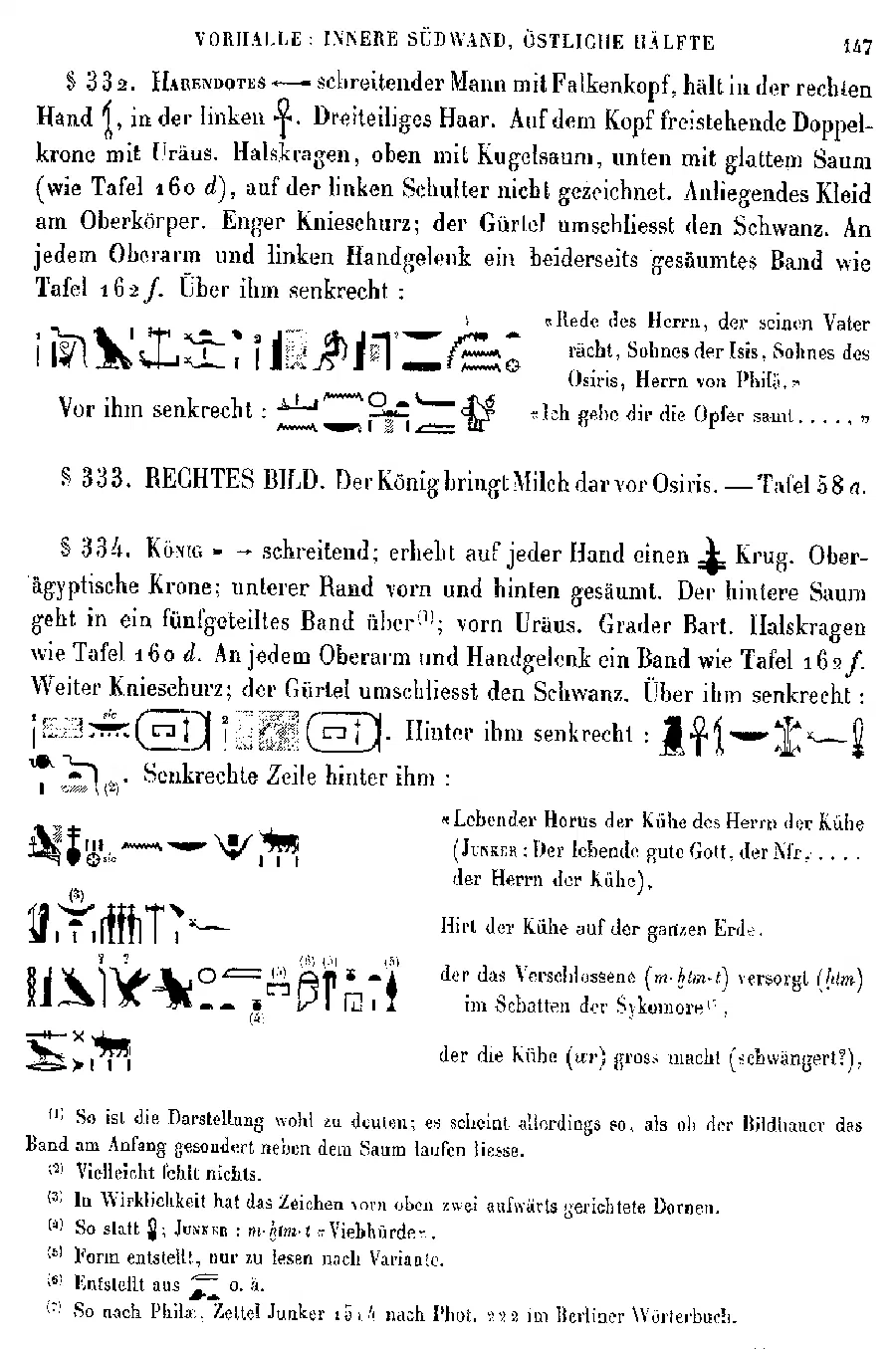
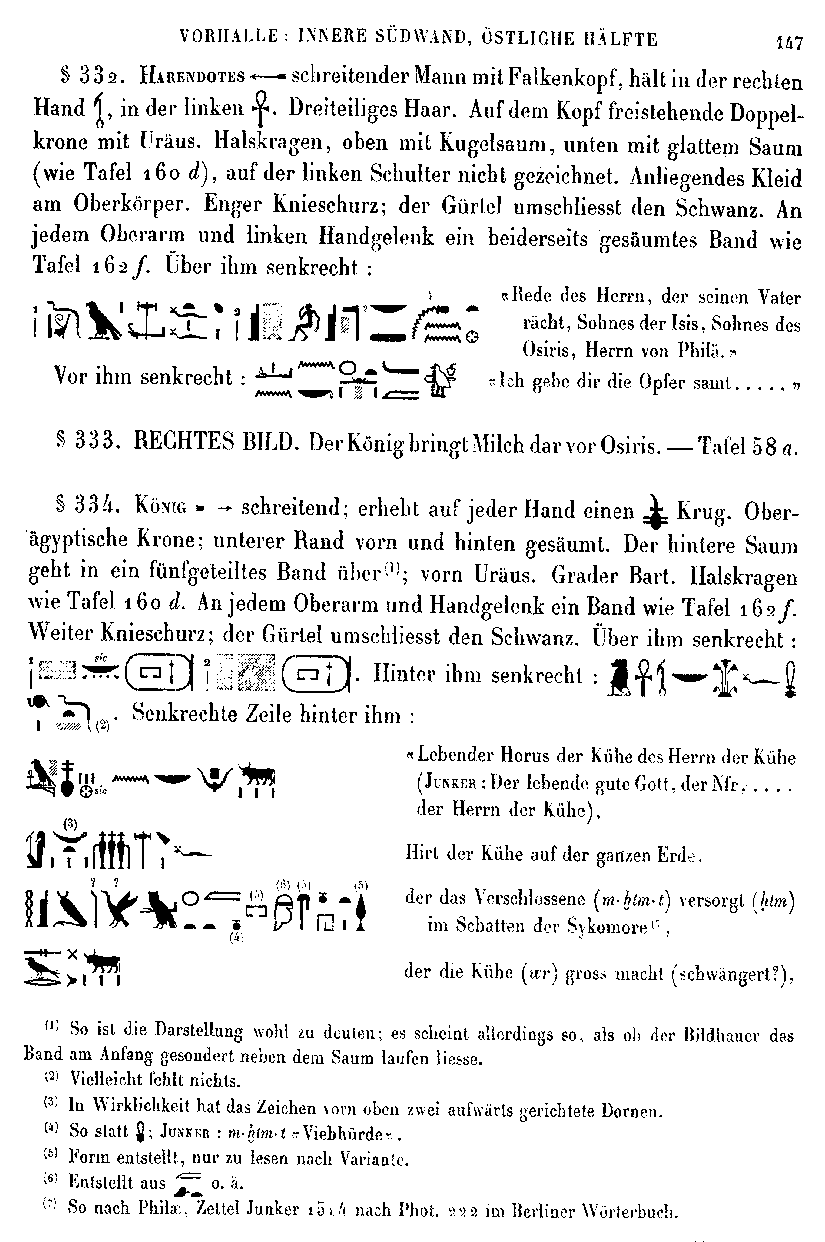
Page 147. Roeder, Der Tempel von Dakke (1930), p. 147 Printed hieroglyphs from G. Roeder, Der Tempel von Dakke (1930) - 147p. 147, § 332
ḏd-mdw jn ḥrw-nḏ-jt=f sꜣ ꜣs.t sꜣ wsjr nb jw-wꜥb
Words spoken by Harendotes, son of Isis, son of Osiris, lord of the Pure Island.
Note · Line 147
Harendotes is Horus in his role as protector and avenger of his father Osiris. - 148p. 147, § 332
dj.n=j n=k jḫ.t ḥnꜥ wdb
I have given you the offerings and their reversion.
Note · Line 148
After food had been presented to a god, it could pass to other altars and ultimately to the priests. This passing on was the “reversion” of the offerings. - 149p. 147, § 334
[nswt-bj.tj] tꜣ.wj pr-ꜥꜣ [sꜣ-rꜥ nb-ḫꜥ] pr-ꜥꜣ
King of Upper and Lower Egypt, lord of the Two Lands, Pharaoh; son of Ra, lord of crowns, Pharaoh.
Note · Line 149
Here the title “Pharaoh” stands in place of a personal name. - 150p. 147, § 334
sꜣ ꜥnḫ wꜣs nb ḥꜣ=f mj rꜥ ḏ.t
All protection, life and dominion are behind him, as they are behind Ra, forever.
- 151p. 147, § 334
ꜥnḫ nṯr [nfr] nfr n nb wp.t mnḥw jd.wt ḫnt nḏb=f ḥtm mḫtm.t m ḫnt šw.t nh.t (36) swr wr.w n ḏꜥj.t-rnp.t nbt.j.t rḫj.t
Long live the perfect god, child of the lord of cows, herdsman of cows the world over, who tends the stalls in the shade of the sycamore, who makes the bulls grow great without a year of hunger, king of humankind.
Note · Line 151
The herdsman is the king himself, praised here as he brings an offering of milk. - 152p. 147, § 334
ḥnk{=j} jrṯ.t n jt=f jrj.n=f dj.(t) ꜥnḫ ḏ.t
Offering milk to his father. He has done this that his father may give him life forever.
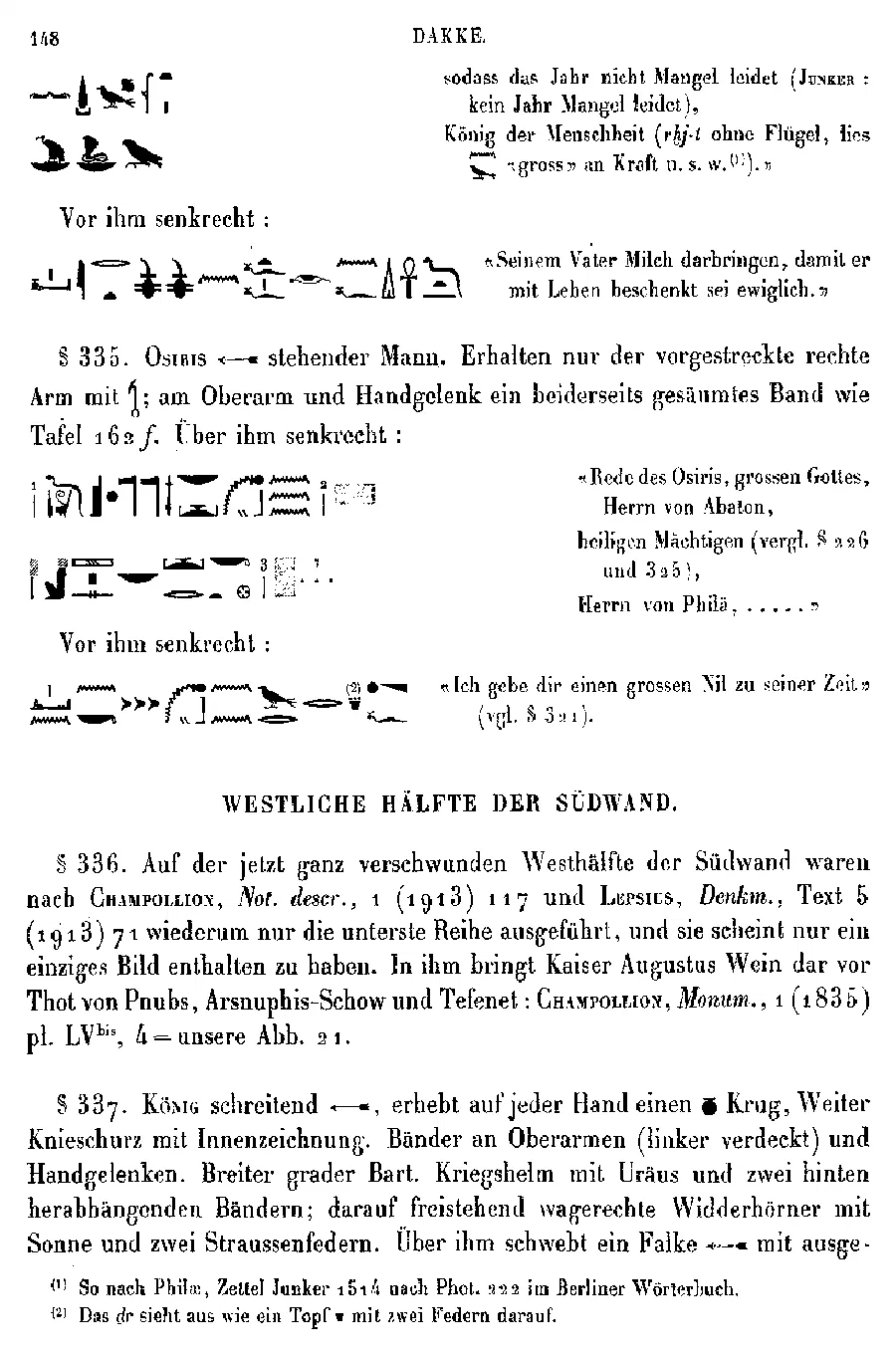
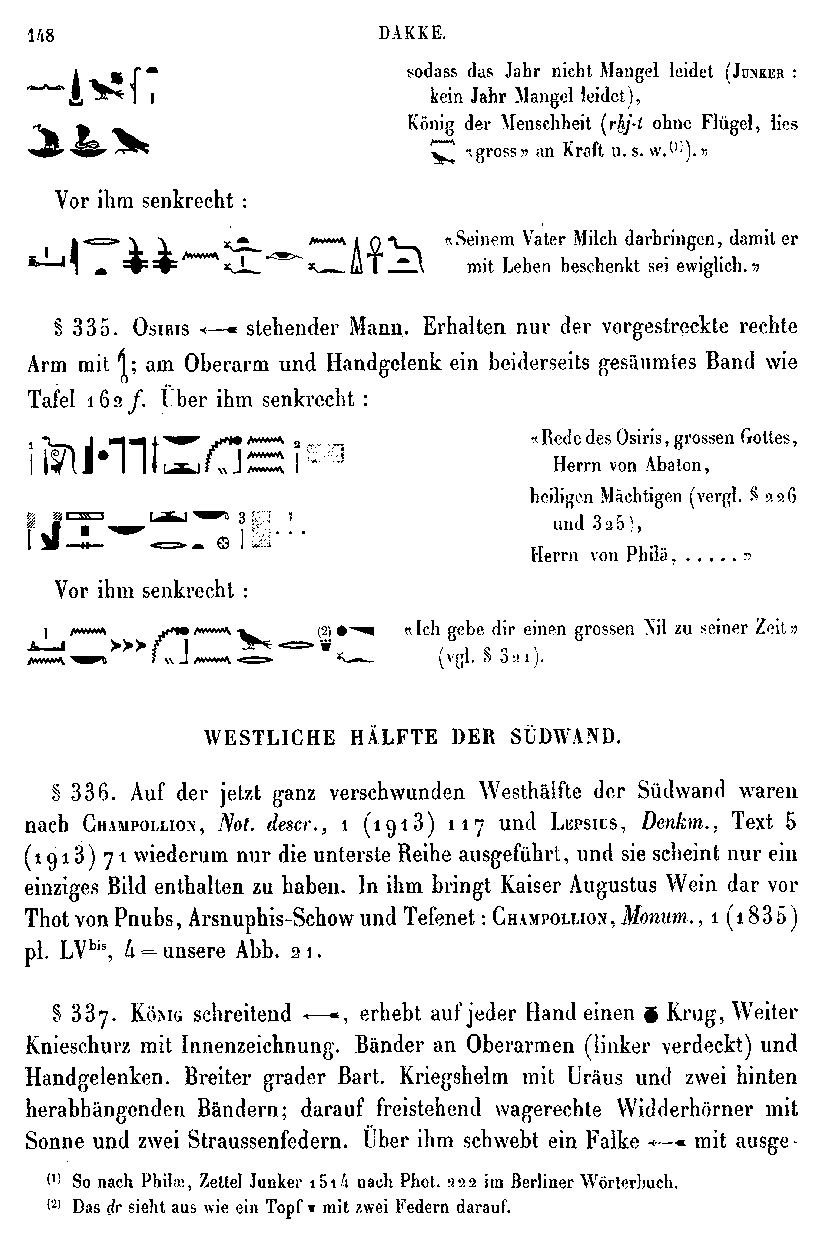
Page 148. Roeder, Der Tempel von Dakke (1930), p. 148 Printed hieroglyphs from G. Roeder, Der Tempel von Dakke (1930) - 153p. 148, § 335
ḏd-mdw jn wsjr nṯr ꜥꜣ nb jꜣ.t-wꜥb.t sḫm šps nb jwrḳ
Words spoken by Osiris, the great god, lord of the Abaton, the venerable power, lord of Philae:
Note · Line 153
Access to it was restricted. - 154p. 148, § 335
dj.n=j n=k ḥꜥpj wr r tr=f
I have given you Hapy, high in his season.
- 155p. 148, § 337
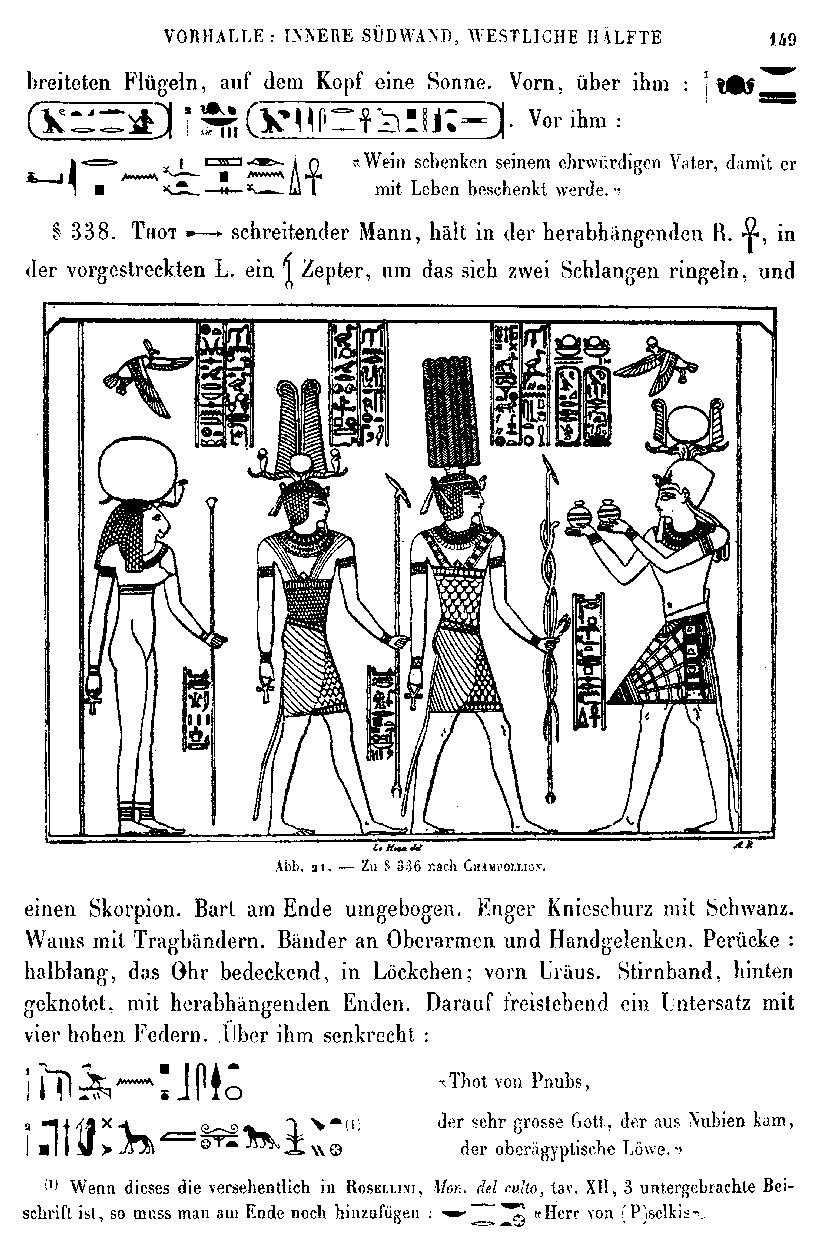
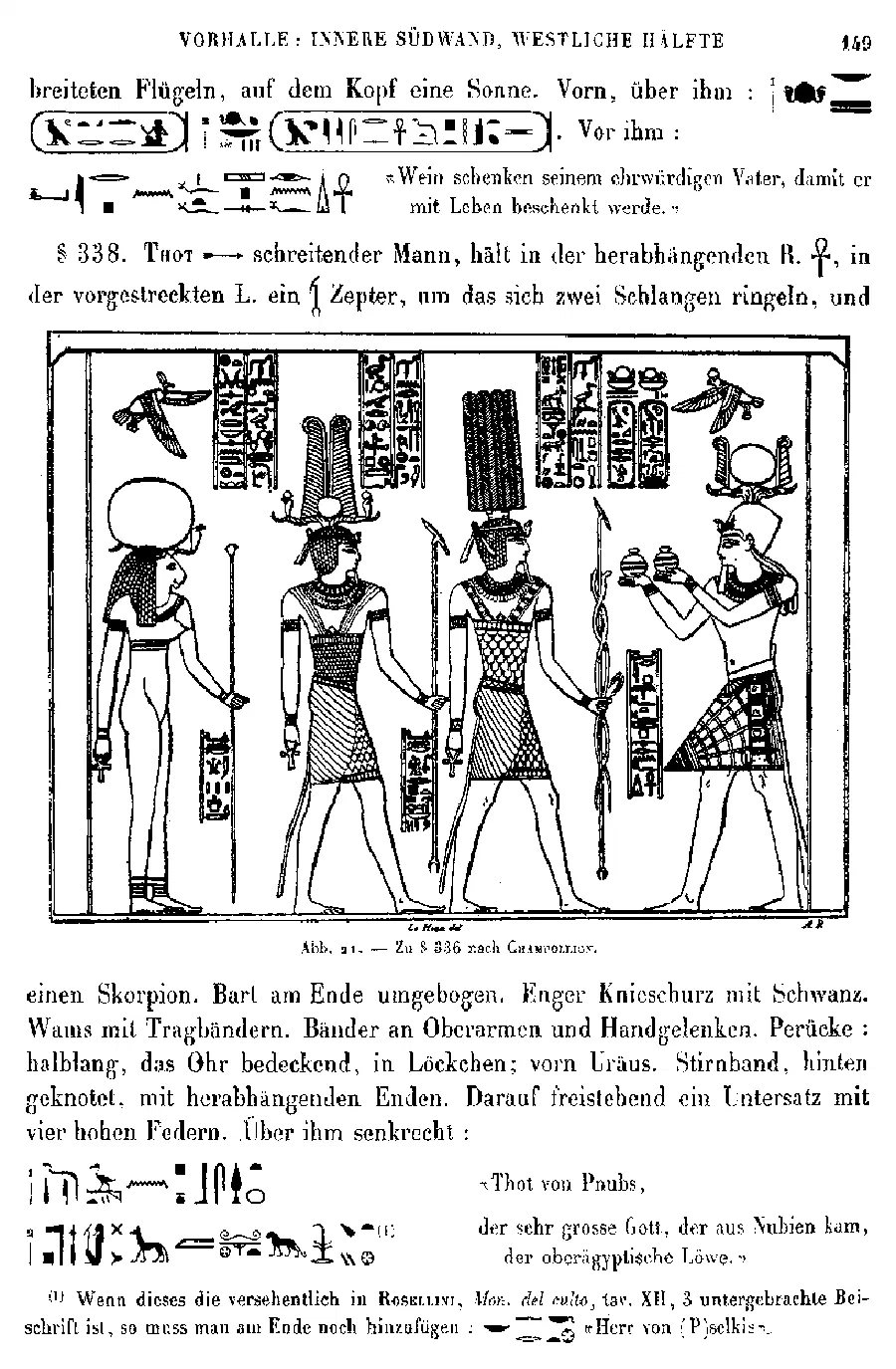
[nswt-bj.tj nb-tꜣ.wj ꜣwtḳrdr sꜣ-rꜥ nb-ḫꜥ.w kꜣysrs-ꜥnḫ-ḏ.t-mrj-ptḥ-ꜣs.t] (37)
King of Upper and Lower Egypt, lord of the Two Lands, Autokrator; son of Ra, lord of crowns, Caesar, ever living, beloved of Ptah and Isis.
Note · Line 155
Here the Roman emperor bears the titles of an Egyptian king. - 156p. 148, § 337
[ḥnk jrp n jt=f šps jrj.n=f dj.(t) ꜥnḫ] (38)
Offering wine to his revered father. He has done this that his father may give him life.
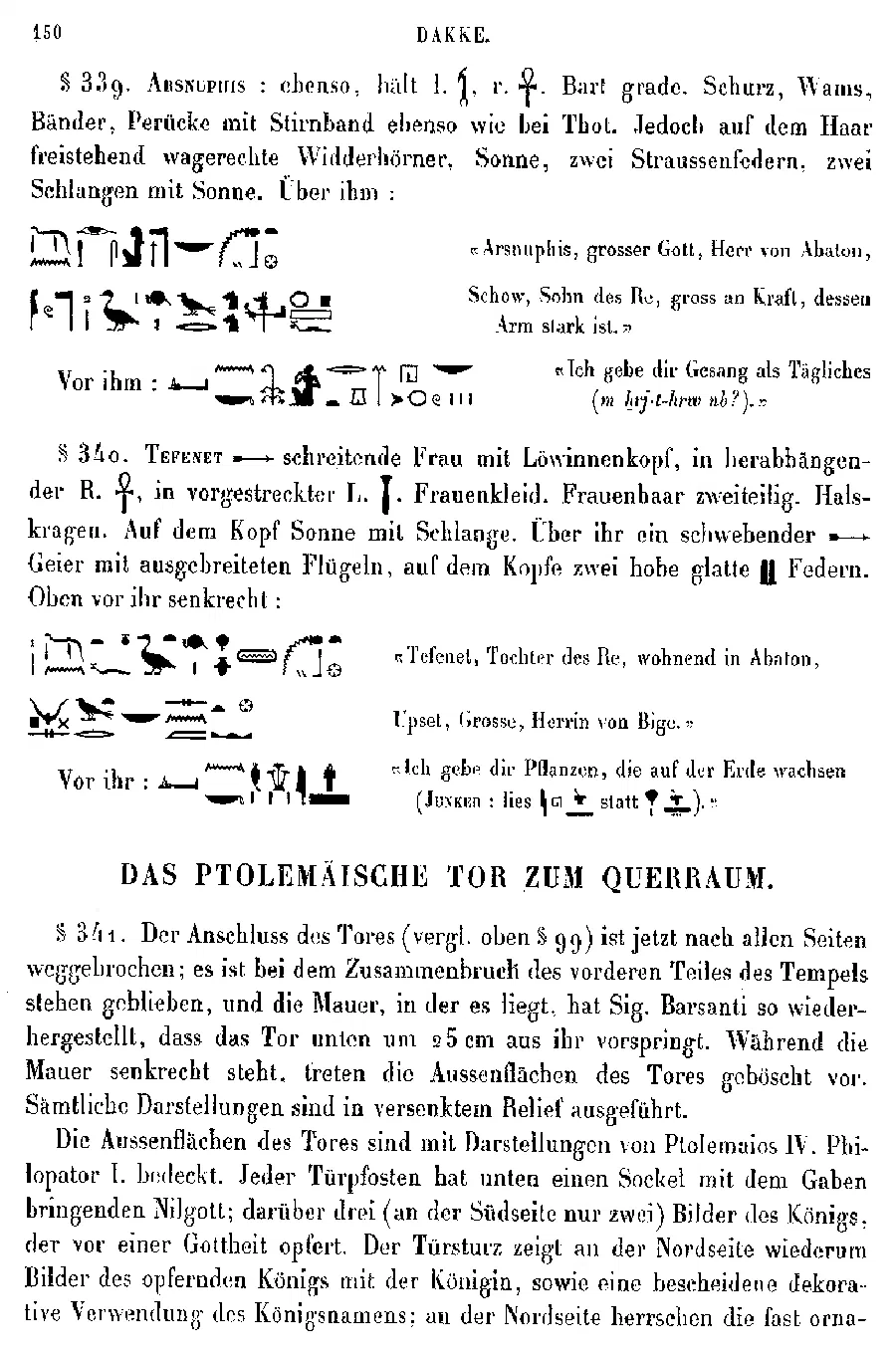
Page 149. Roeder, Der Tempel von Dakke (1930), p. 149 Printed hieroglyphs from G. Roeder, Der Tempel von Dakke (1930) - 157p. 149, § 338
[ḏd-mdw jn ḏḥwtj n pnbs pꜣ nṯr ꜥꜣ wr jj m tꜣ-stj mꜣj rsj] (39)
Words spoken by Thoth of Pnubs, the very great god who comes from Nubia, the lion of the south.
Page 150. Roeder, Der Tempel von Dakke (1930), p. 150 Printed hieroglyphs from G. Roeder, Der Tempel von Dakke (1930) - 158p. 150, § 339
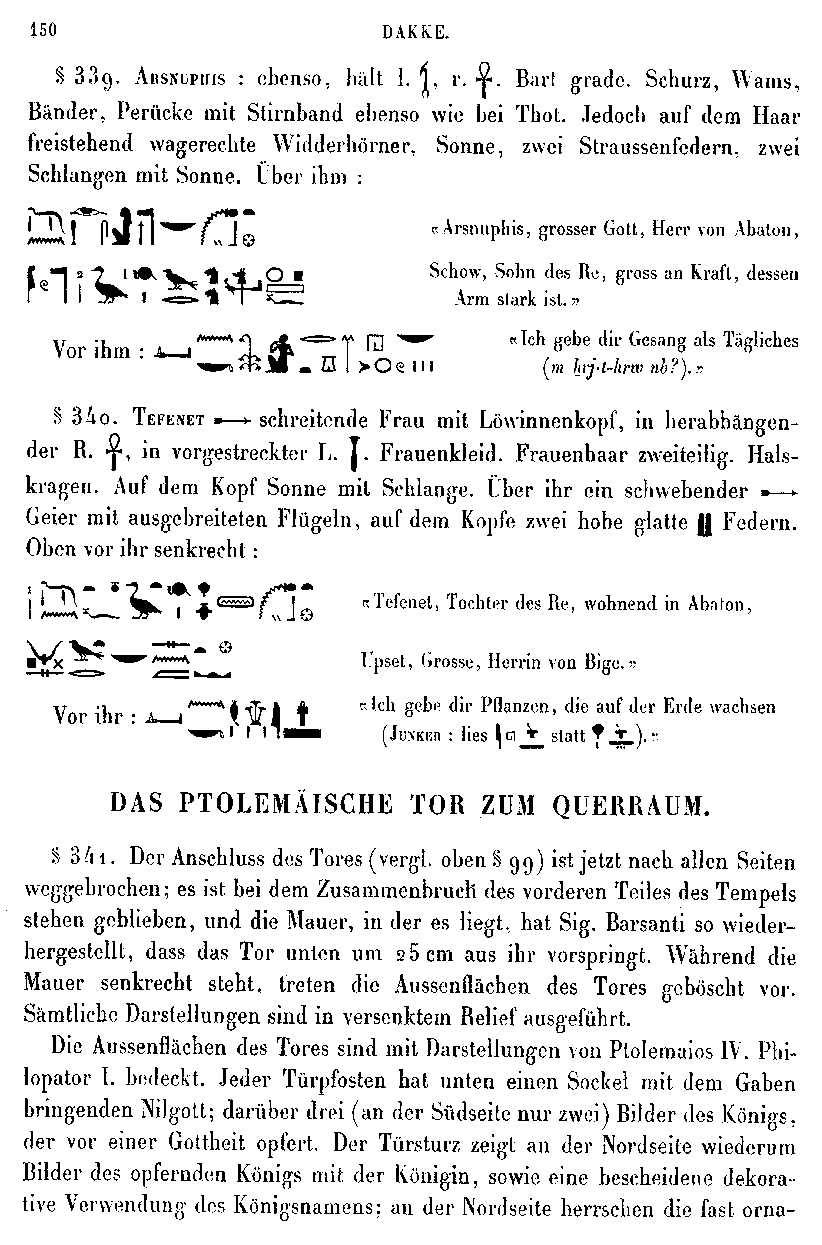
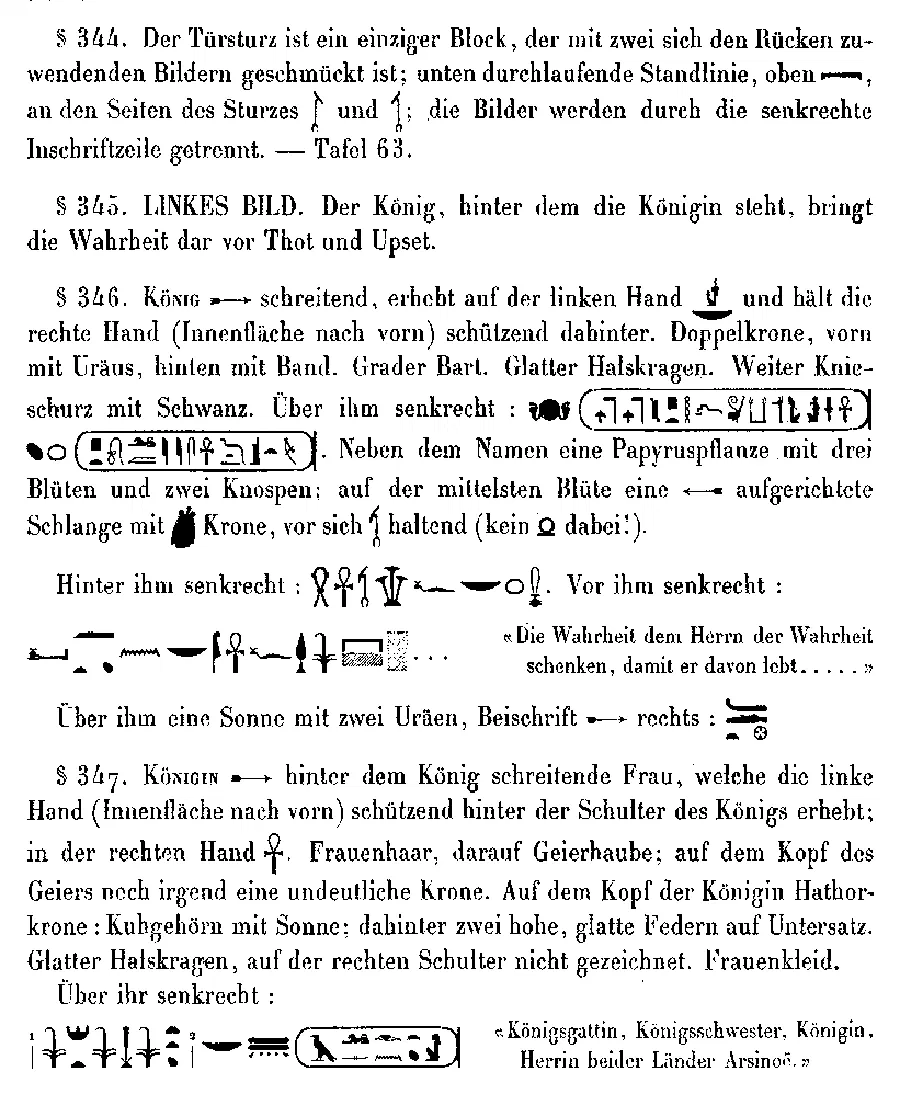
[ḏd-mdw jn jr.j-ḥms-<nfr> nṯr ꜥꜣ nb <jꜣ.t>-wꜥb.t šw sꜣ rꜥ wr pḥtj wsr ḫpš] (40)
Words spoken by Arensnuphis, the great god, lord of the Abaton, Shu, son of Ra, great in strength, mighty of arm:
- 159p. 150, § 339
[dj=(j) n=k šmꜥ m ẖr.t-hrw nb] (41)
I give you song day after day.
- 160p. 150, § 340
[ḏd-mdw jn tfn.t sꜣ.t rꜥ ḥr.j.(t)-jb jw-wꜥb wps.t wr.t nb.(t) snm.t] (42)
Words spoken by Tefnut, daughter of Ra, who dwells on the Pure Island, Wepset the Great, lady of Senmet:
Note · Line 160
Senmet is an Egyptian name for Bigeh. Here Wepset, goddess of flame, is a name of Tefnut. - 161p. 150, § 340
[dj=(j) n=k rwḏ ḥr sꜣ tꜣ] (43)
I give you what grows on the back of the earth.
Page 152. Roeder, Der Tempel von Dakke (1930), p. 152 Printed hieroglyphs from G. Roeder, Der Tempel von Dakke (1930) - 162p. 152, § 346
nswt-bj.tj jwꜥ-n-nṯr.wj-mnḫ.wj-stp-n-ptḥ-wsr-kꜣ-rꜥ-sḫm-ꜥnḫ-<n>-jmn sꜣ-rꜥ ptwlmys-ꜥnḫ-ḏ.t-mrj-ꜣs.t
King of Upper and Lower Egypt, heir of the two Benefactor Gods, chosen of Ptah, mighty is the ka of Ra, living image of Amun; son of Ra, Ptolemy, ever living, beloved of Isis.
Note · Line 162
The two Benefactor Gods are his parents, Ptolemy III and Berenice II. - 163p. 152, § 346
sꜣ ꜥnḫ wꜣs nb ḥꜣ=f mj rꜥ ḏ.t
All protection, life and dominion are behind him, as they are behind Ra, forever.
- 164p. 152, § 346
ḥnk mꜣꜥ.t n nb mꜣꜥ.t ꜥnḫ=f m=s --détruit-- bḥd.tj
Offering Maat to the lord of Maat. He lives by her. … He of Edfu.
Note · Line 164
The king offers her in the form of a small figure. “He of Edfu” is Horus. - 165p. 152, § 347
ḥm.t nswt sn.t nswt sꜣ.t nswt nb.(t)-tꜣ.wj ꜣrsjn nḏm jb=j ḏr mꜣ=j kꜣ.t rdj.n=k
King’s wife, king’s sister, king’s daughter, lady of the Two Lands, Arsinoe: My heart has been glad ever since I saw the work you gave.
- 166p. 152, § 347
ptwlmys-ꜥnḫ-ḏ.t-mrj-ꜣs.t nḫb.t wꜣḏj.t
Ptolemy, ever living, beloved of Isis. Nekhbet. Wadjet.
Note · Line 166
Nekhbet, the vulture goddess of Upper Egypt, and Wadjet, the cobra goddess of Lower Egypt, together protect the crown. 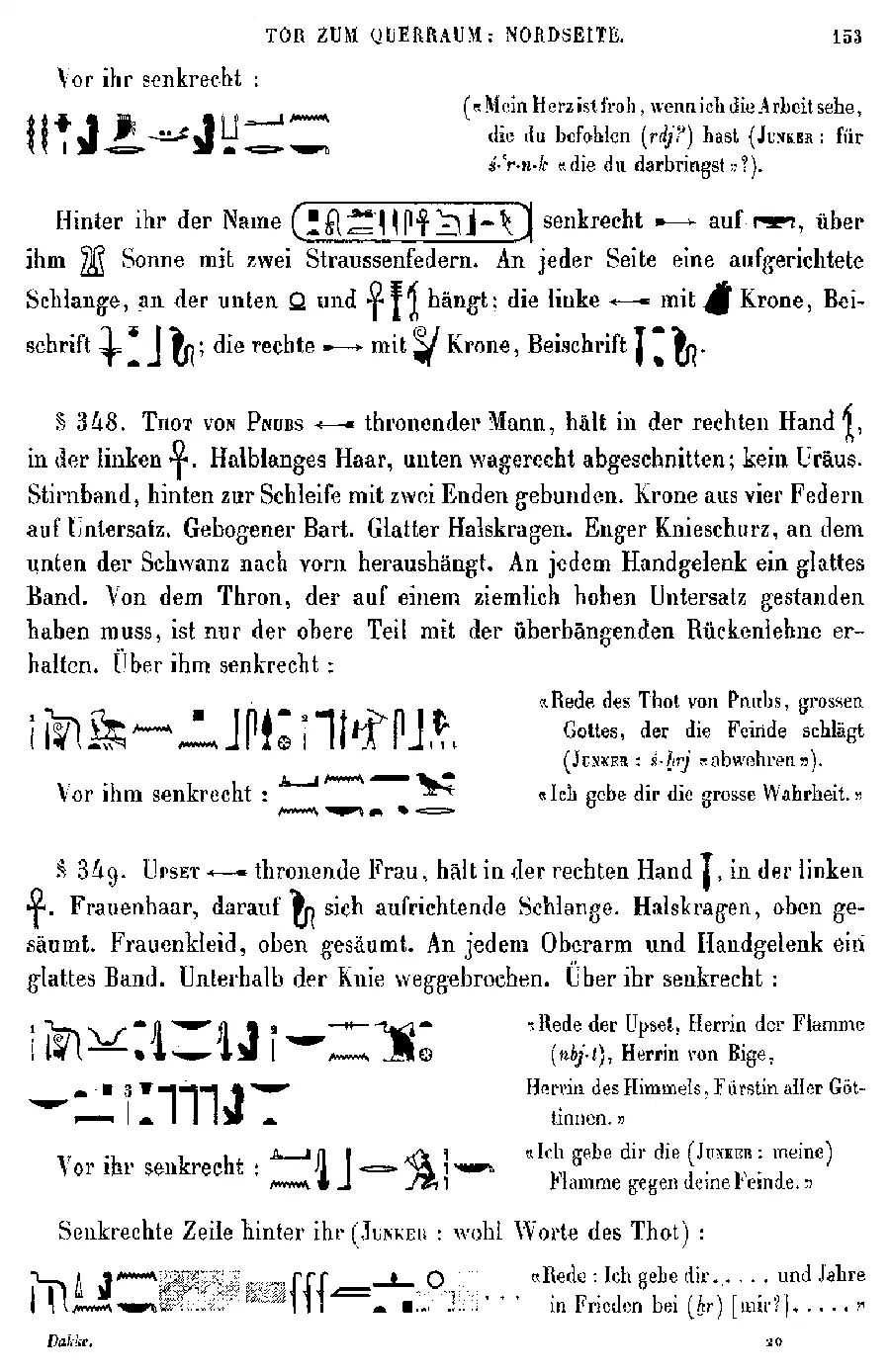
Page 153. Roeder, Der Tempel von Dakke (1930), p. 153 Printed hieroglyphs from G. Roeder, Der Tempel von Dakke (1930) - 167p. 153, § 348
ḏd-mdw jn ḏḥwtj n pnbs nṯr ꜥꜣ sḥrj sbj.w
Words spoken by Thoth of Pnubs, the great god who strikes down rebels:
- 168p. 153, § 348
dj.n=(j) n=k mꜣꜥ.t wr.t
I have given you Maat the Great.
- 169p. 153, § 349
ḏd-mdw jn wps.t nb.(t) nbj.t nb.(t) snm.t nb.(t) p.t ḥnw.t nṯr.w nb.w
Words spoken by Wepset, lady of the flame, lady of Senmet, lady of the sky, mistress of all the gods:
- 170p. 153, § 349
dj=(j) nbj.t r ḫft.j.w=k
I set the flame against your enemies.
- 171p. 153, § 349
ḏd-mdw {jn} dj.n=j n=k --2,5Q-- rnp.wt m ḥtp --détruit--
Words spoken: I have given you … years in peace …
Page 154. Roeder, Der Tempel von Dakke (1930), p. 154 Printed hieroglyphs from G. Roeder, Der Tempel von Dakke (1930) - 172p. 154, § 352
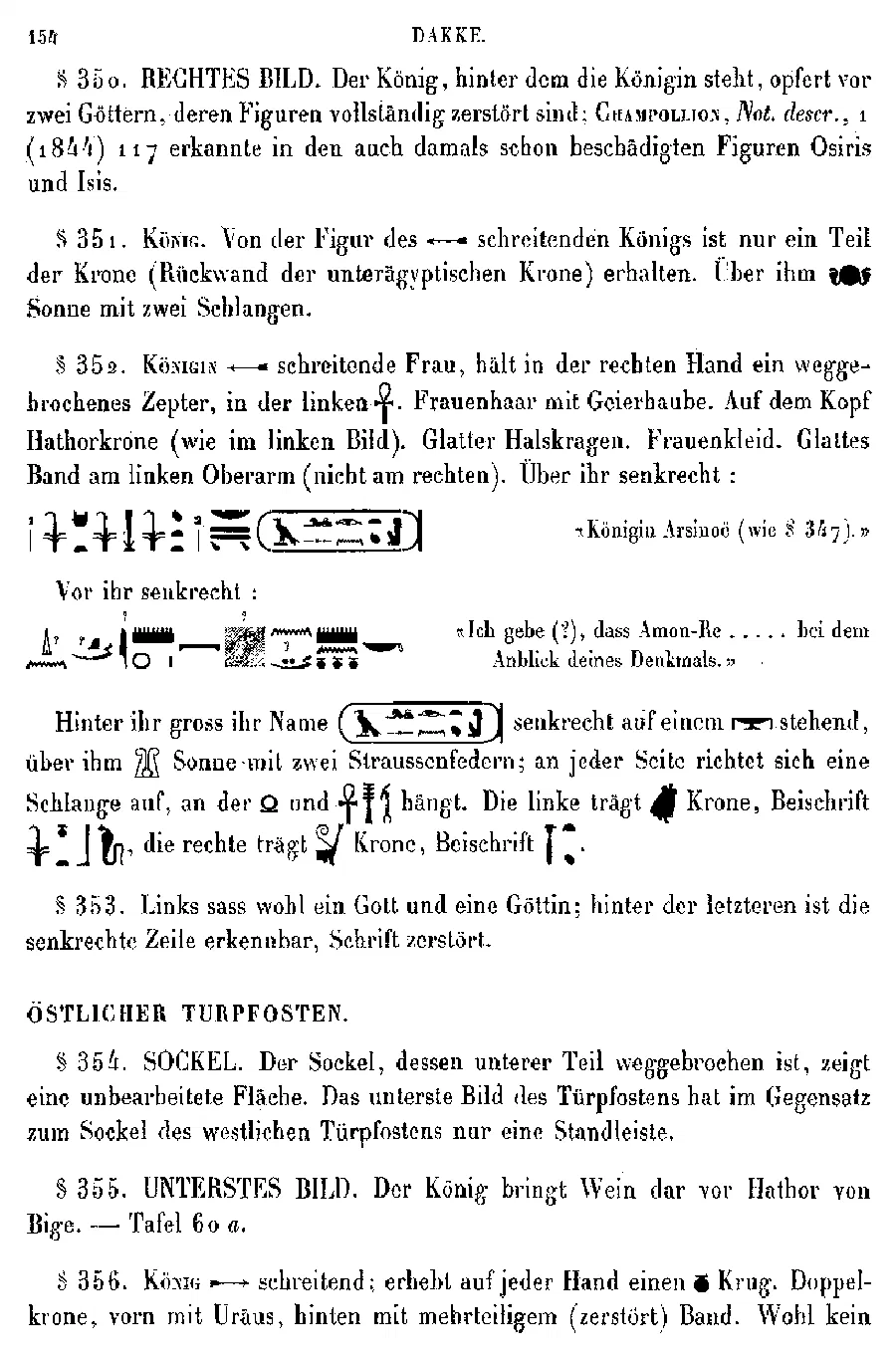
ḥm.t nswt sn.t nswt sꜣ.t nswt nb.(t)-tꜣ.wj ꜣrsjn
King’s wife, king’s sister, king’s daughter, lady of the Two Lands, Arsinoe.
- 173p. 154, § 352
dj=j __ --1Q-- n mꜣ mnw=k
I give … at the sight of your monument.
- 174p. 154, § 352
ꜣrsjn nḫb.t wꜣḏj.t
Arsinoe. Nekhbet. Wadjet.
- 175p. 154, § 356
nswt-bj.tj [jwꜥ-n-nṯr.wj-mnḫ.wj-stp].n-[ptḥ]-wsr-kꜣ-[rꜥ-sḫm-ꜥnḫ-<n>-jmn sꜣ-rꜥ ptwl]mys-[ꜥnḫ-ḏ.t-mrj-ꜣs.t]
King of Upper and Lower Egypt, heir of the two Benefactor Gods, chosen by Ptah, mighty is the ka of Ra, living image of Amun; son of Ra, Ptolemy, ever living, beloved of Isis.
- 176p. 154, § 356
sꜣ ꜥnḫ wꜣs nb ḥꜣ=f
All protection, life and dominion stand behind him.
- 177p. 154, § 356
ḥnk jrp n mw.t[=f jrj].n=f dj.(t) [ꜥnḫ]
Offering wine to his mother. This he has done that he may be granted life.
Note · Line 177
The king’s mother in this scene is Hathor, to whom he offers the wine. - 178p. 154, § 356
bḥ[d.tj] dj ꜥnḫ mj rꜥ
He of Edfu, who gives life like Ra.
- 179p. 154, § 356
bꜥḥ jr.t ḥrw m ꜣḫ.w=s jw=f ḥḳꜣ nfr wḥm ms.wt nb-ḫꜥ.w ptwlmys-ꜥnḫ-ḏ.t-mrj-ꜣs.t
He who floods the Eye of Horus with its wonders, as the good ruler who renews births, lord of crowns, Ptolemy, ever living, beloved of Isis.
Note · Line 179
The wine offering is identified with the Eye of Horus, the injured eye made whole again. 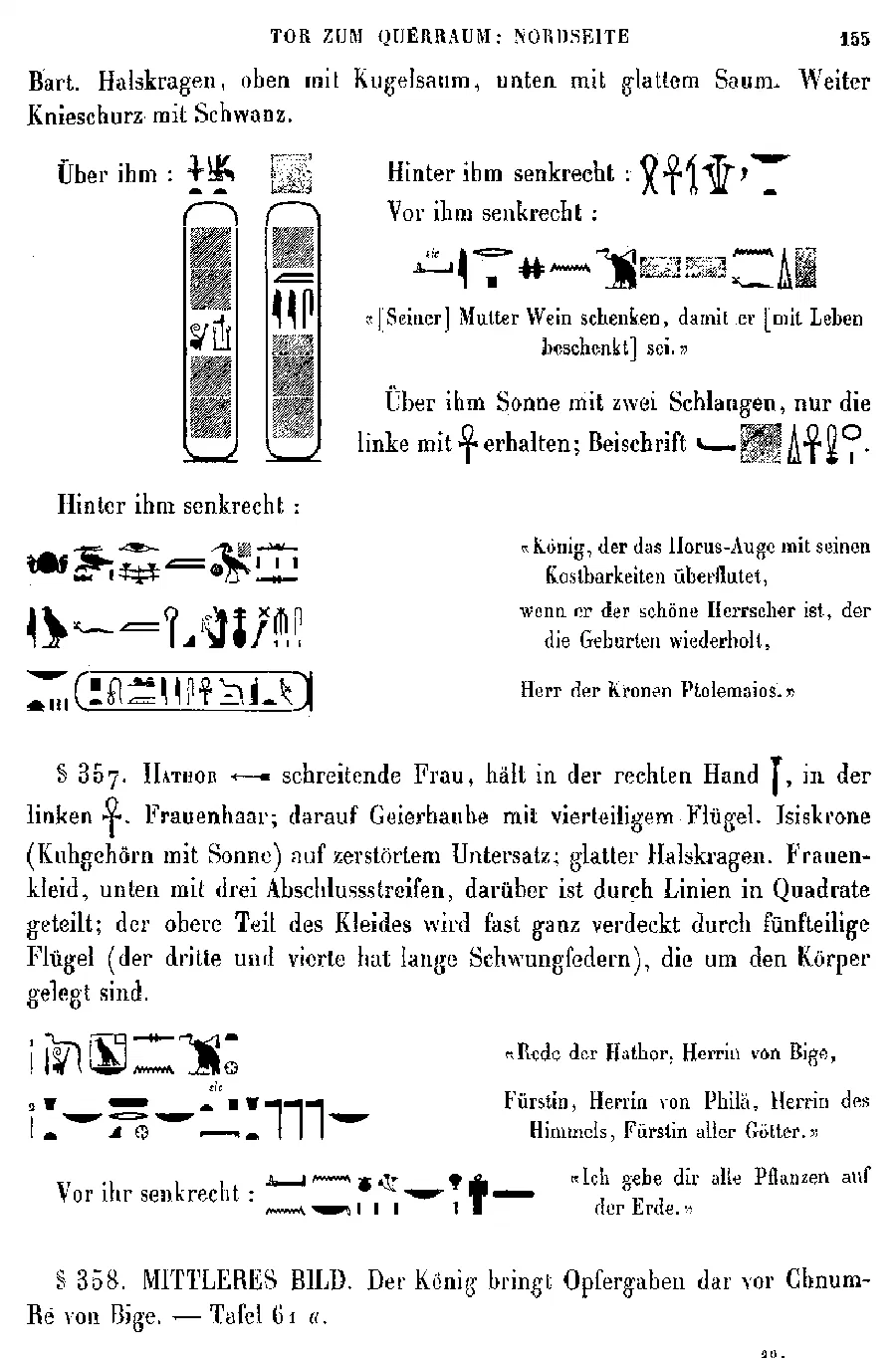
Page 155. Roeder, Der Tempel von Dakke (1930), p. 155 Printed hieroglyphs from G. Roeder, Der Tempel von Dakke (1930) - 180p. 155, § 357
ḏd-mdw jn ḥw.t-ḥrw nb.(t) snm.t ḥnw.t nb.(t) jwrḳ nb.(t) p.t ḥnw.t nṯr.w nb.(w)
Words spoken by Hathor, lady of Senmet, mistress, lady of Philae, lady of the sky, mistress of all the gods:
- 181p. 155, § 357
dj.n=(j) n=k rwḏ nb ḥr sꜣ tꜣ
I have given you all that grows upon the earth’s back.
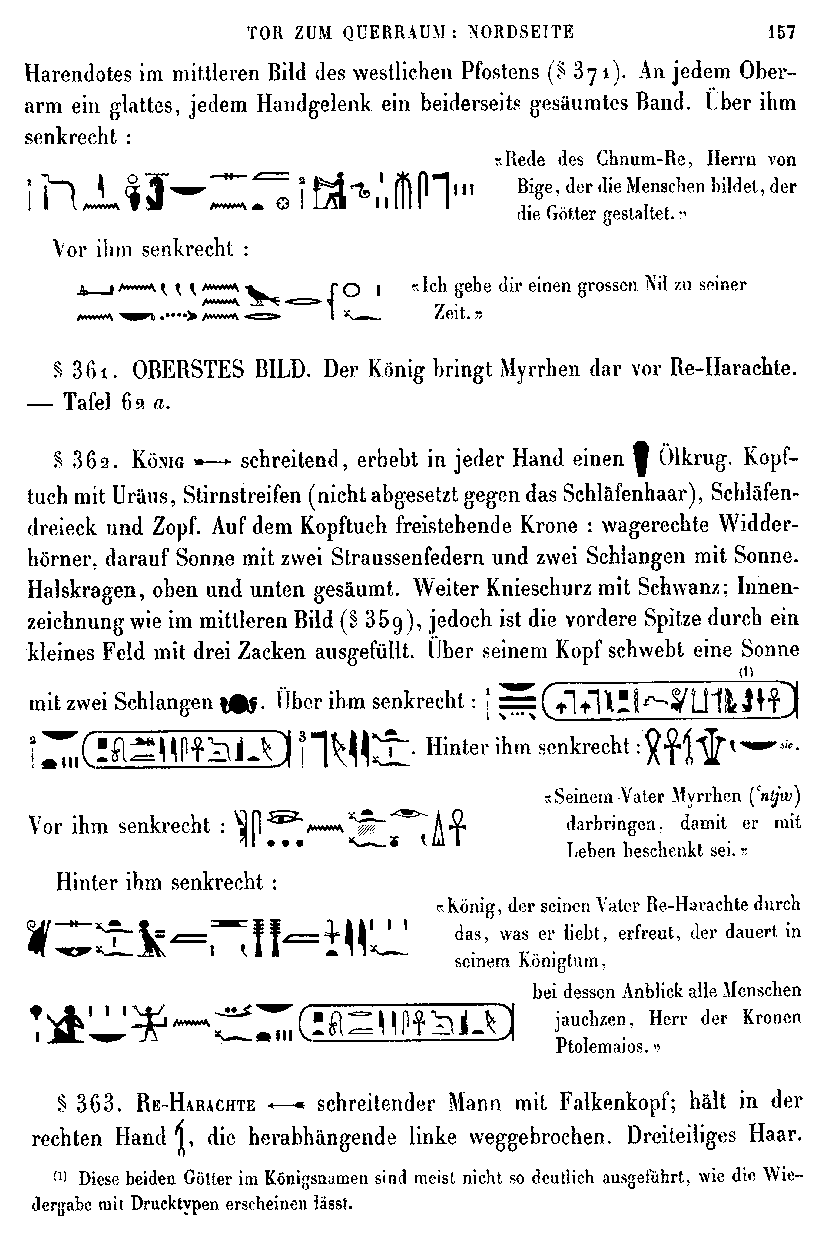
Page 156. Roeder, Der Tempel von Dakke (1930), p. 156 Printed hieroglyphs from G. Roeder, Der Tempel von Dakke (1930) - 182p. 156, § 359
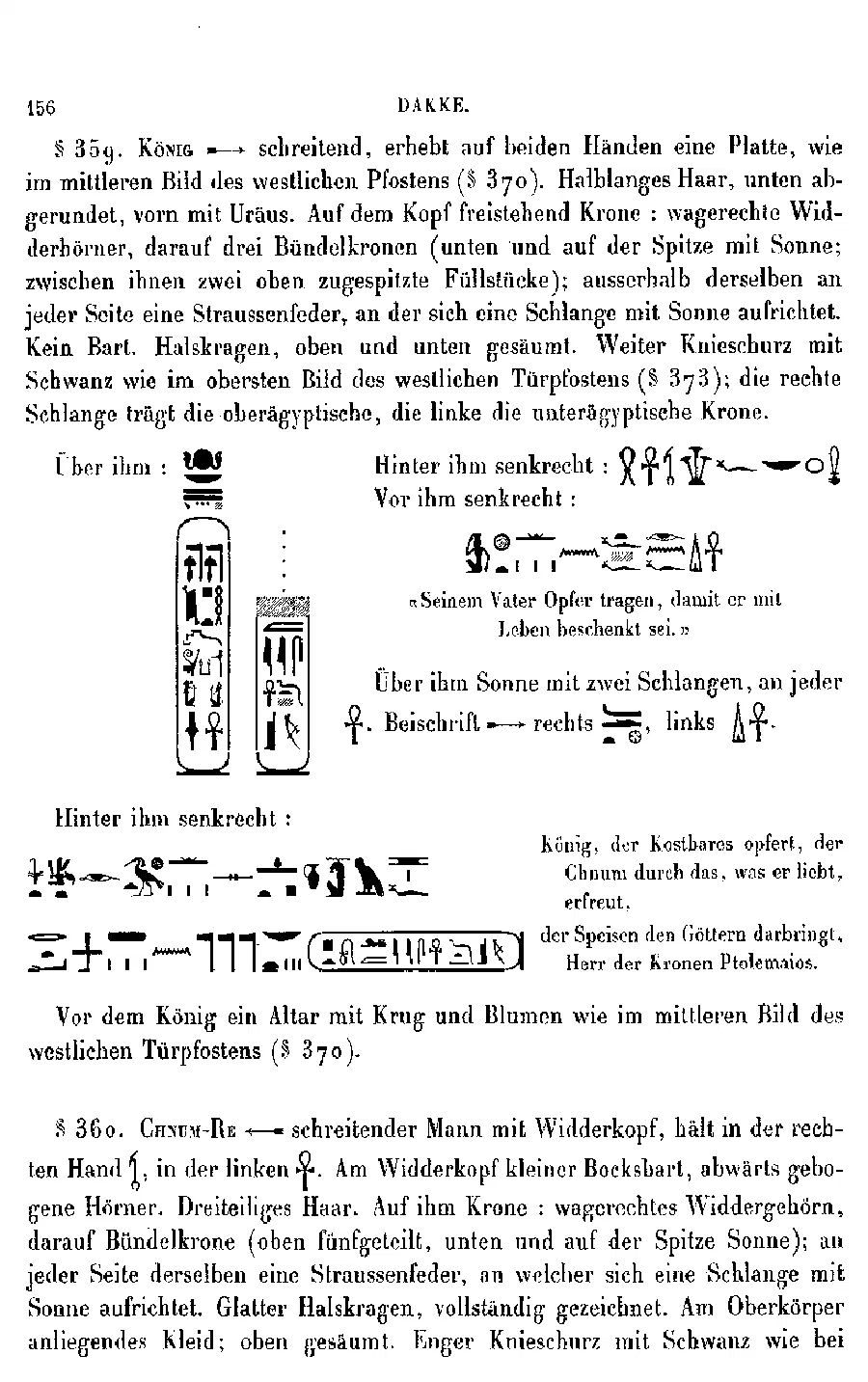
nswt-bj.tj jwꜥ-n-nṯr.wj-mnḫ.wj-stp-n-ptḥ-wsr-kꜣ-rꜥ-sḫm-ꜥnḫ-<n>-jmn [sꜣ-rꜥ ptwl]mys-ꜥnḫ-ḏ.t-mrj-ꜣs.t
King of Upper and Lower Egypt, heir of the two Benefactor Gods, chosen by Ptah, mighty is the ka of Ra, living image of Amun; son of Ra, Ptolemy, ever living, beloved of Isis.
- 183p. 156, § 359
sꜣ ꜥnḫ wꜣs nb ḥꜣ=f mj rꜥ
All protection, life and dominion stand behind him as they stand behind Ra.
- 184p. 156, § 359
bḥd.tj dj ꜥnḫ
He of Edfu, who gives life.
- 185p. 156, § 359
fꜣj.(t) jḫ.t n jt=f jrj.n=f dj.(t) ꜥnḫ
Bringing offerings to his father. This he has done that he may be granted life.
- 186p. 156, § 359
nswt-bj.tj jrj ꜣḫ.w sḥtp ẖnmw m mrj=f rdj ꜥb.w n nṯr.w nb-ḫꜥ.w ptwlmys-ꜥnḫ-ḏ.t-mrj-ꜣs.t
King of Upper and Lower Egypt, who works wonders, who contents Khnum with what he loves, who gives offerings to the gods; lord of crowns, Ptolemy, ever living, beloved of Isis.
- 187p. 156, § 360
ḏd-mdw jn ẖnmw nb snm.t nḥp rmṯ msj nṯr.w
Words spoken by Khnum, lord of Senmet, who shapes humankind on his wheel and gives birth to the gods:
Note · Line 187
Khnum is the divine potter. - 188p. 156, § 360
dj.n=(j) n=k ḥꜥpj wr r tr=f
I have given you Hapy, mighty in his season.
Note · Line 188
Its yearly rise waters the fields. 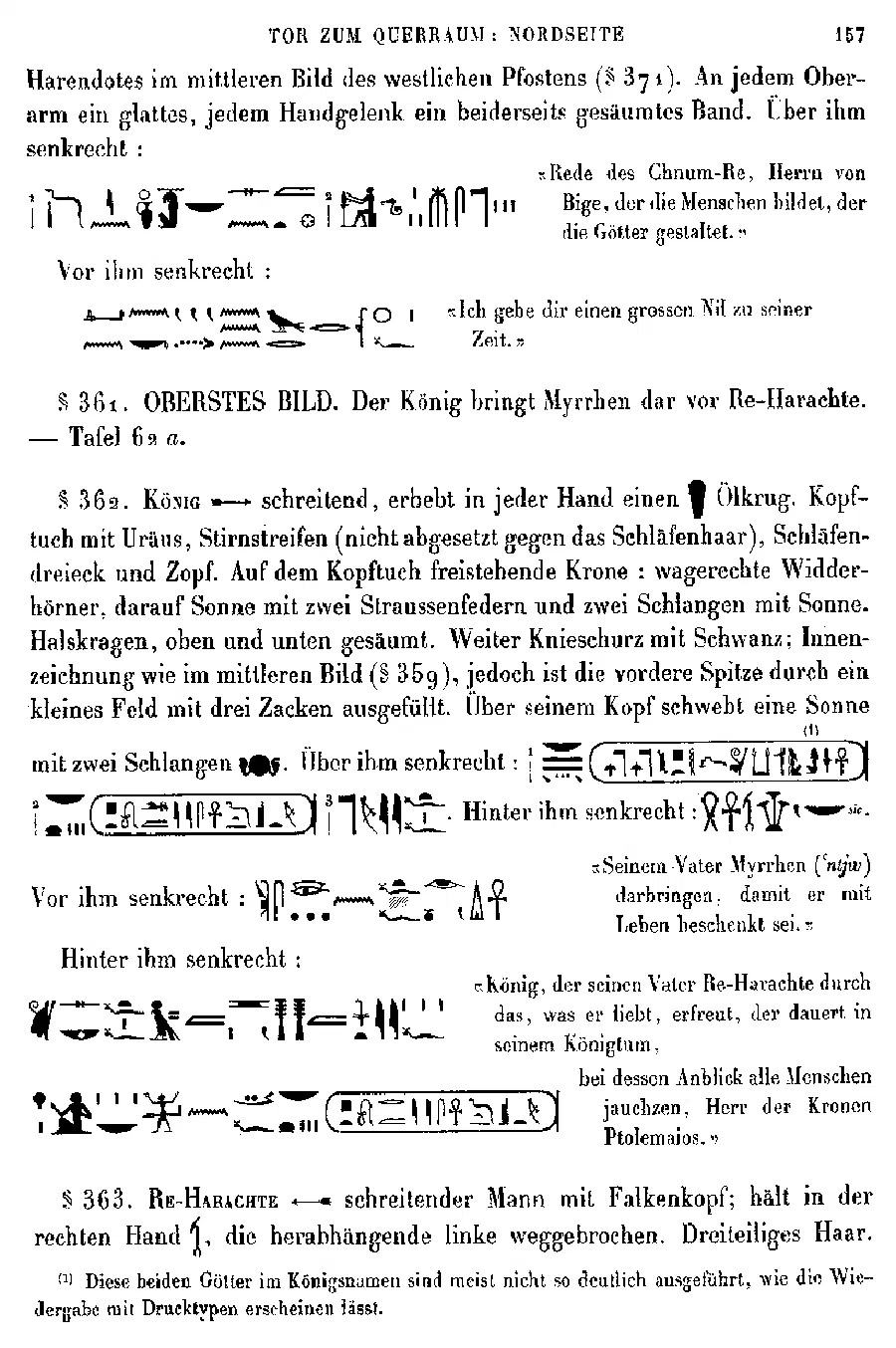
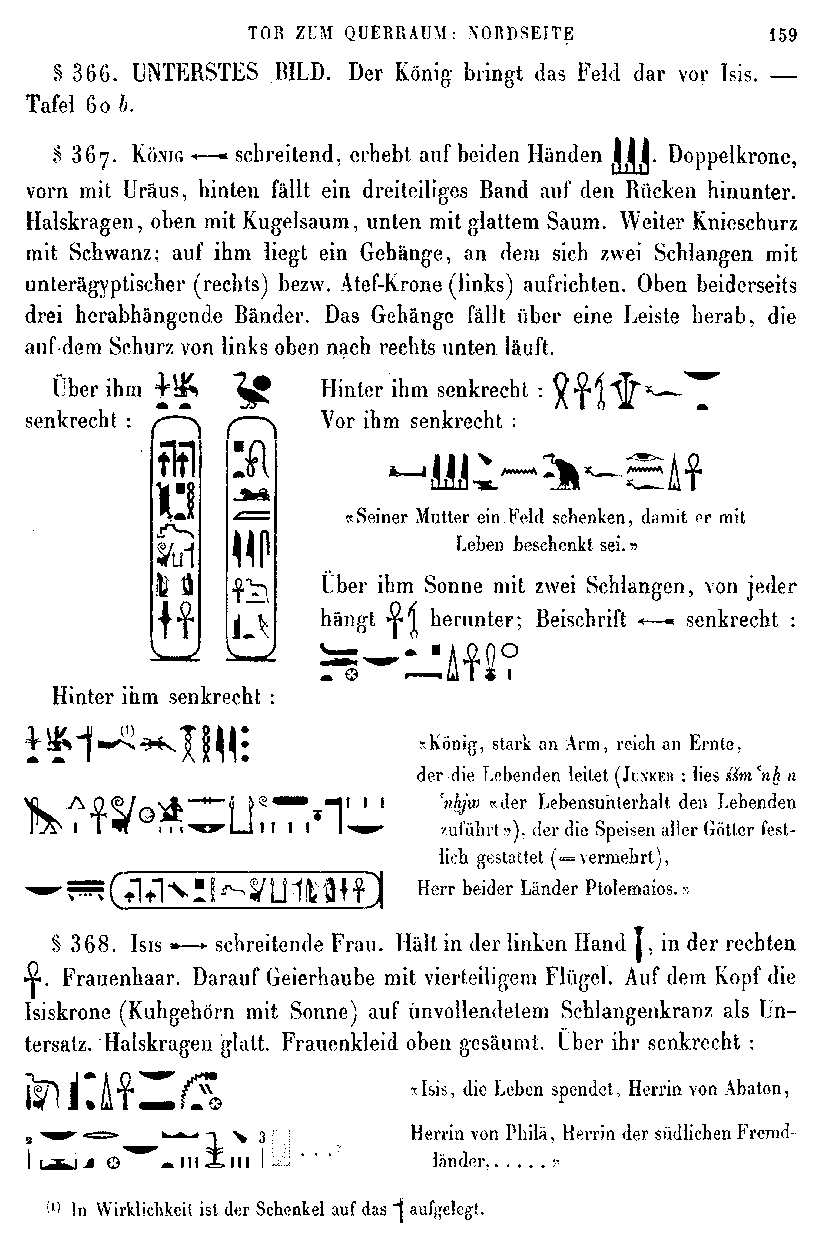
Page 157. Roeder, Der Tempel von Dakke (1930), p. 157 Printed hieroglyphs from G. Roeder, Der Tempel von Dakke (1930) - 189p. 157, § 362
nb-tꜣ.wj jwꜥ-n-nṯr.wj-mnḫ.wj-stp-n-ptḥ-wsr-kꜣ-rꜥ-sḫm-ꜥnḫ-<n>-jmn nb-ḫꜥ.w ptwlmys-ꜥnḫ-ḏ.t-mrj-ꜣs.t
Lord of the Two Lands, heir of the two Benefactor Gods, chosen by Ptah, mighty is the ka of Ra, living image of Amun; lord of crowns, Ptolemy, ever living, beloved of Isis.
- 190p. 157, § 362
sꜣ ꜥnḫ wꜣs nb ḥꜣ=f
All protection, life and dominion stand behind him.
- 191p. 157, § 362
šms ꜥntjw n jt=f jrj.n=f dj.(t) ꜥnḫ
Burning myrrh for his father. This he has done that he may be granted life.
- 192p. 157, § 362
sḥb jt=f rꜥ-ḥrw-ꜣḫ.tj m mrj=f ḏd m nswj.t=f ḥr-nb ḥꜥ n mꜣ=f nb-ḫꜥ.w ptwlmys-ꜥnḫ-ḏ.t-mrj-ꜣs.t
He who adorns his father Ra-Horakhty with what he loves, enduring in his kingship, every face brightening at the sight of him: the lord of crowns, Ptolemy, ever living, beloved of Isis.
- 193p. 157, § 363
ḏd-mdw jn rꜥ-ḥrw-ꜣḫ.tj nṯr ꜥꜣ nb p.t ḥr.j nṯr.w
Words spoken by Ra-Horakhty, the great god, lord of the sky, chief of the gods:
Note · Line 193
Ra-Horakhty unites Ra, the sun god, with Horus of the Two Horizons. - 194p. 157, § 363
dj.n=(j) n=k ꜥḥꜥ n p.t ḫr=j
I have given you the sky’s span of life at my side.
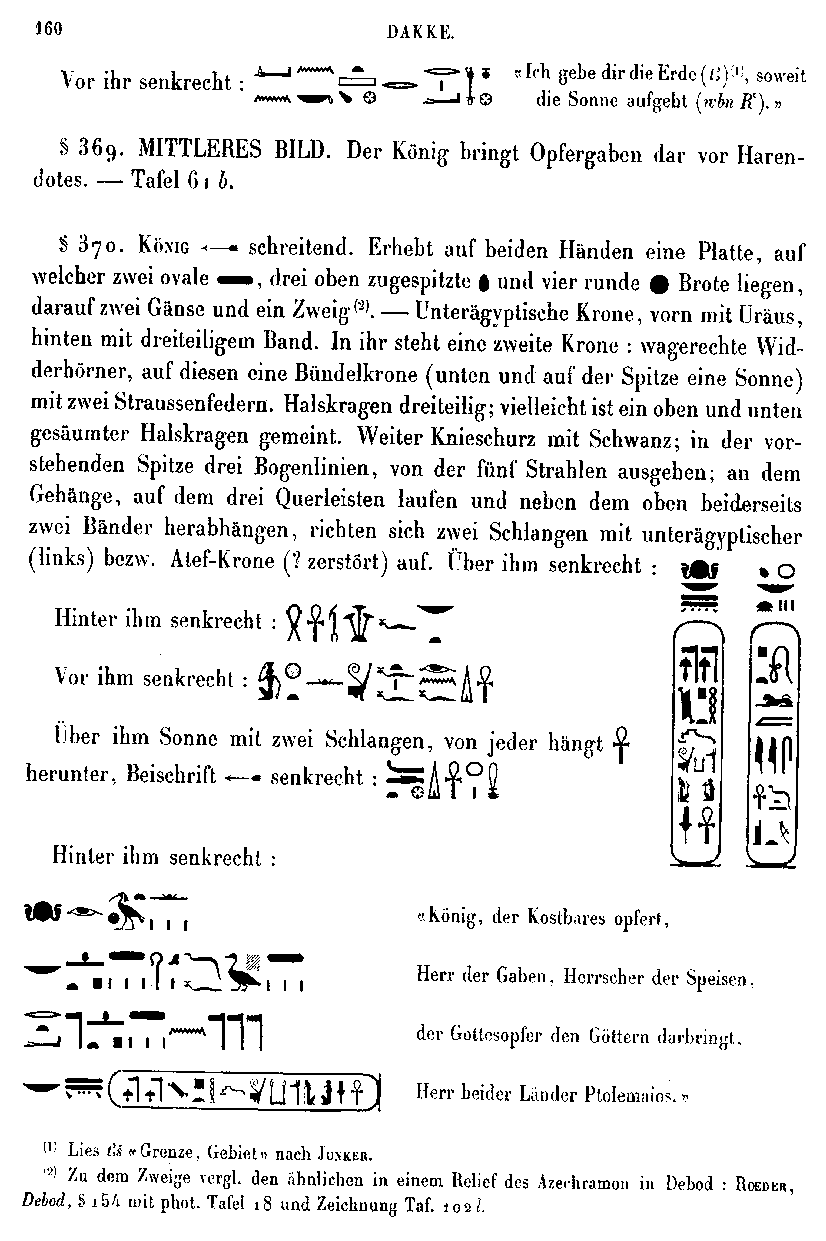
Page 159. Roeder, Der Tempel von Dakke (1930), p. 159 Printed hieroglyphs from G. Roeder, Der Tempel von Dakke (1930) - 195p. 159, § 367
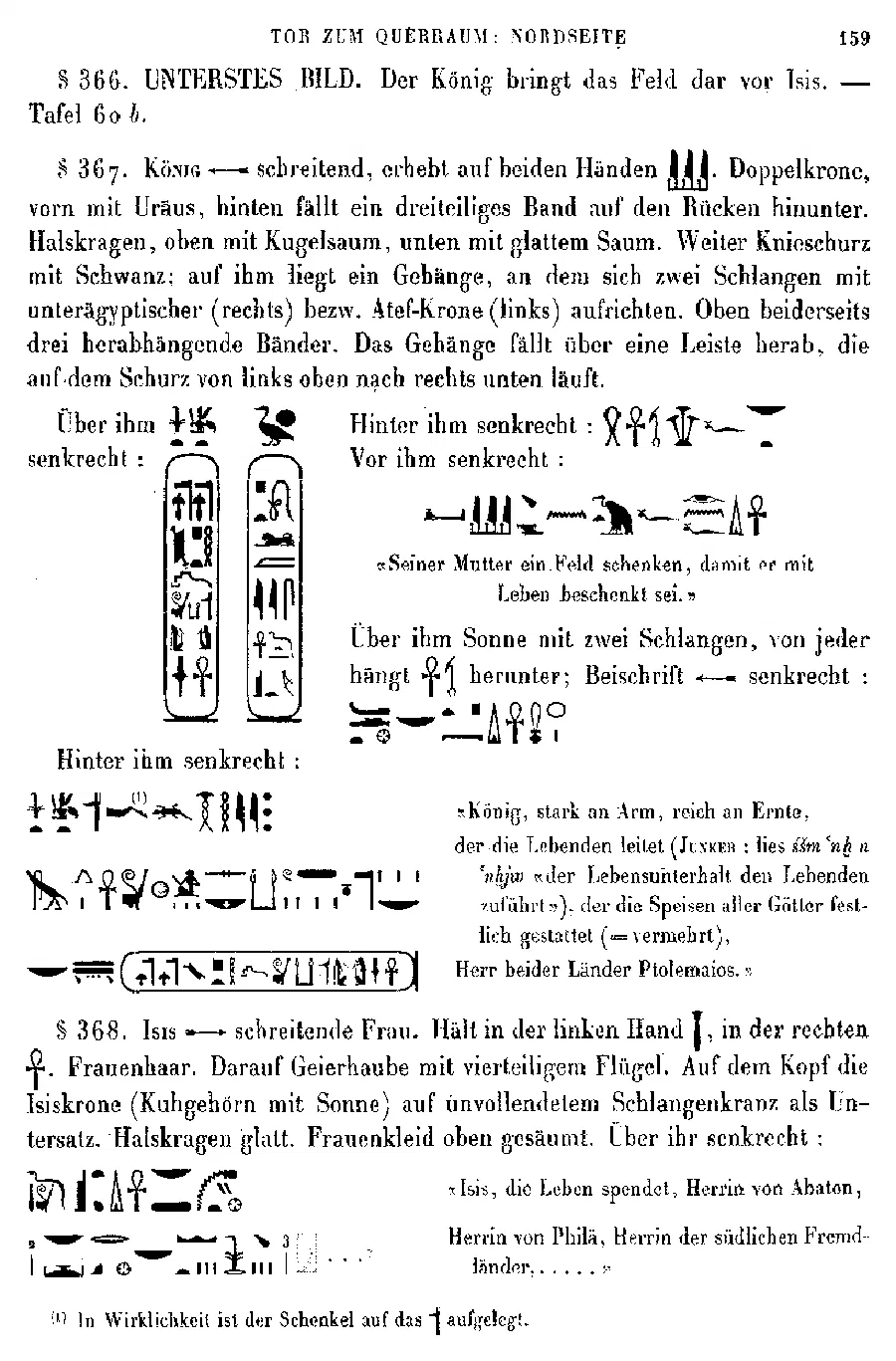
nswt-bj.tj jwꜥ-n-nṯr.wj-mnḫ.wj-stp-n-ptḥ-wsr-kꜣ-rꜥ-sḫm-ꜥnḫ-<n>-jmn sꜣ-rꜥ ptwlmys-ꜥnḫ-ḏ.t-mrj-ꜣs.t
King of Upper and Lower Egypt, heir of the two Benefactor Gods, chosen by Ptah, mighty is the ka of Ra, living image of Amun; son of Ra, Ptolemy, ever living, beloved of Isis.
- 196p. 159, § 367
sꜣ ꜥnḫ wꜣs nb ḥꜣ=f
All protection, life and dominion stand behind him.
- 197p. 159, § 367
ḥnk sḫ.t n mw.t=f jrj.n=f dj.(t) ꜥnḫ
Offering the field to his mother. This he has done that he may be granted life.
- 198p. 159, § 367
bḥd.tj nb p.t dj ꜥnḫ mj rꜥ
He of Edfu, lord of the sky, who gives life like Ra.
- 199p. 159, § 367
wsr ḫpš ꜥšꜣ wꜣḥy sšm <ꜥnḫ n> ꜥnḫ.w sḥb kꜣ.w n nṯr.w nb.(w) nb-tꜣ.wj jwꜥ-n-nṯr.wj-mnḫ.wj-stp-n-ptḥ-wsr-kꜣ-rꜥ-sḫm-ꜥnḫ-<n>-jmn
Mighty of arm, rich in grain, he who brings life to the living and spreads a feast for all the gods: the lord of the Two Lands, heir of the two Benefactor Gods, chosen by Ptah, mighty is the ka of Ra, living image of Amun.
- 200p. 159, § 368
ḏd-mdw jn ꜣs.t dj.(t) ꜥnḫ nb.(t) jw-wꜥb nb.(t) jwrḳ nb.(t) ḫꜣs.wt rsj.(wt) --détruit--
Words spoken by Isis, giver of life, lady of the Abaton, lady of Philae, lady of the southern foreign lands …
Note · Line 200
Access was restricted. - 201p. 159, § 368
dj.n=(j) n=k tꜣ r-r-ꜥ wbn
I have given you the earth as far as the rising sun.
Page 160. Roeder, Der Tempel von Dakke (1930), p. 160 Printed hieroglyphs from G. Roeder, Der Tempel von Dakke (1930) - 202p. 160, § 370
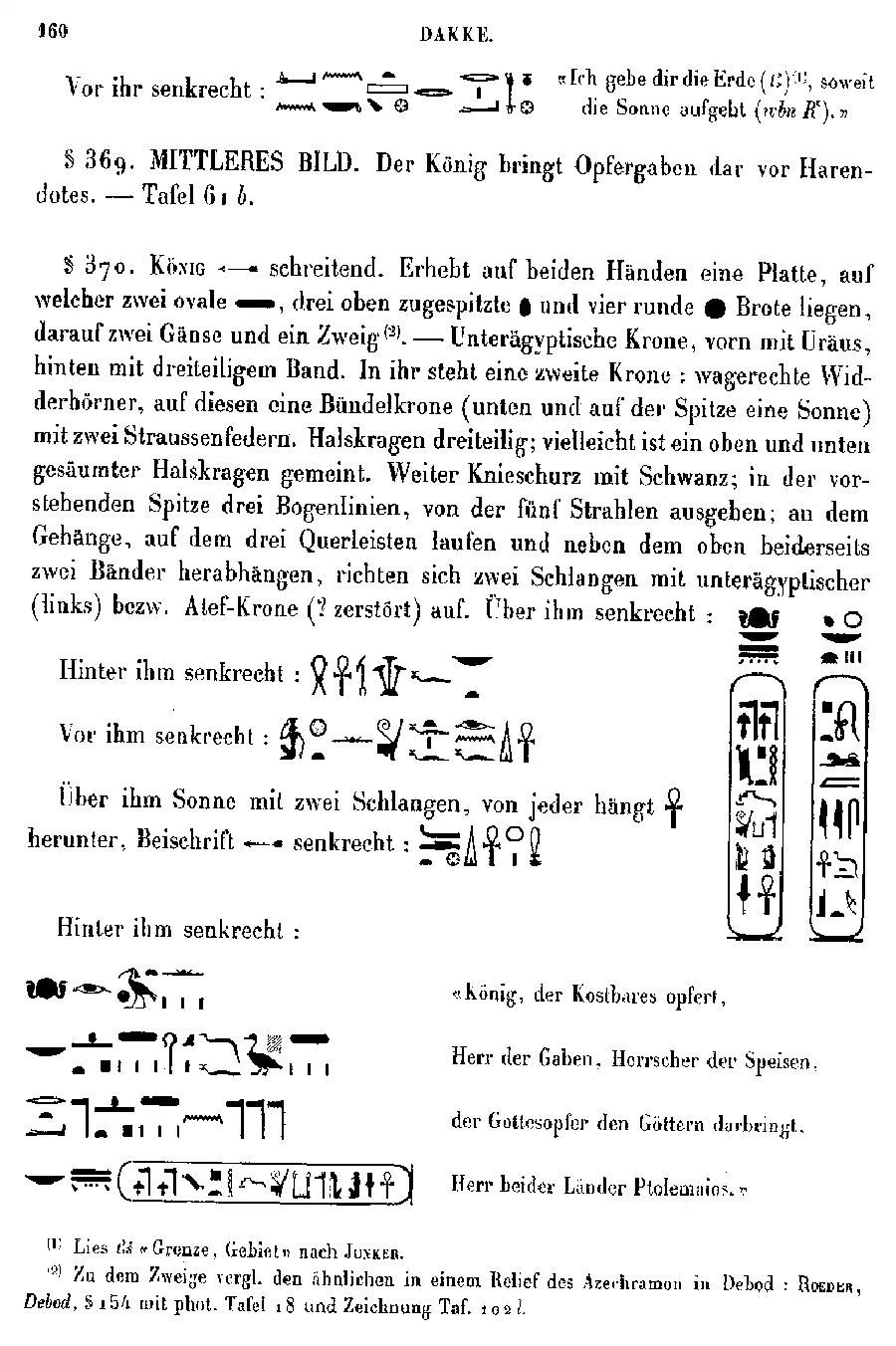
nswt-bj.tj jwꜥ-n-nṯr.wj-mnḫ.wj-stp-n-ptḥ-wsr-kꜣ-rꜥ-sḫm-ꜥnḫ-<n>-jmn sꜣ-rꜥ ptwlmys-ꜥnḫ-ḏ.t-mrj-ꜣs.t
King of Upper and Lower Egypt: Heir of the Two Benefactor Gods, Chosen of Ptah, Mighty Is the Ka of Ra, Living Image of Amun; Son of Ra: Ptolemy, living forever, beloved of Isis.
Note · Line 202
The long name after “King of Upper and Lower Egypt” is Ptolemy IV’s throne name. - 203p. 160, § 370
sꜣ ꜥnḫ wꜣs nb ḥꜣ=f
All protection, life, and dominion are behind him.
- 204p. 160, § 370
fꜣj.(t) jḫ.t n jt=f jrj.n=f dj.(t) ꜥnḫ
Bringing offerings to his father. He has done this to be granted life.
Note · Line 204
The king calls the god his father. He brings the god offerings and receives life in return. - 205p. 160, § 370
bḥd.tj dj ꜥnḫ mj rꜥ
He of Behdet, who gives life like Ra.
Note · Line 205
Behdet is Edfu. Horus of Behdet often appears as a winged sun disk above the king. - 206p. 160, § 370
jrj ꜣḫ.wt nb ḥtp.w ḥḳꜣ ḏfꜣ.w rdj ḥtp.w-nṯr n nṯr.w nb-tꜣ.wj jwꜥ-n-nṯr.wj-mnḫ.wj-stp-n-ptḥ-wsr-kꜣ-rꜥ-sḫm-ꜥnḫ-<n>-jmn
Worker of wonders, lord of offerings, ruler of provisions, who gives divine offerings to the gods; Lord of the Two Lands: Heir of the Two Benefactor Gods, Chosen of Ptah, Mighty Is the Ka of Ra, Living Image of Amun.
Page 161. Roeder, Der Tempel von Dakke (1930), p. 161 Printed hieroglyphs from G. Roeder, Der Tempel von Dakke (1930) - 207p. 161, § 371
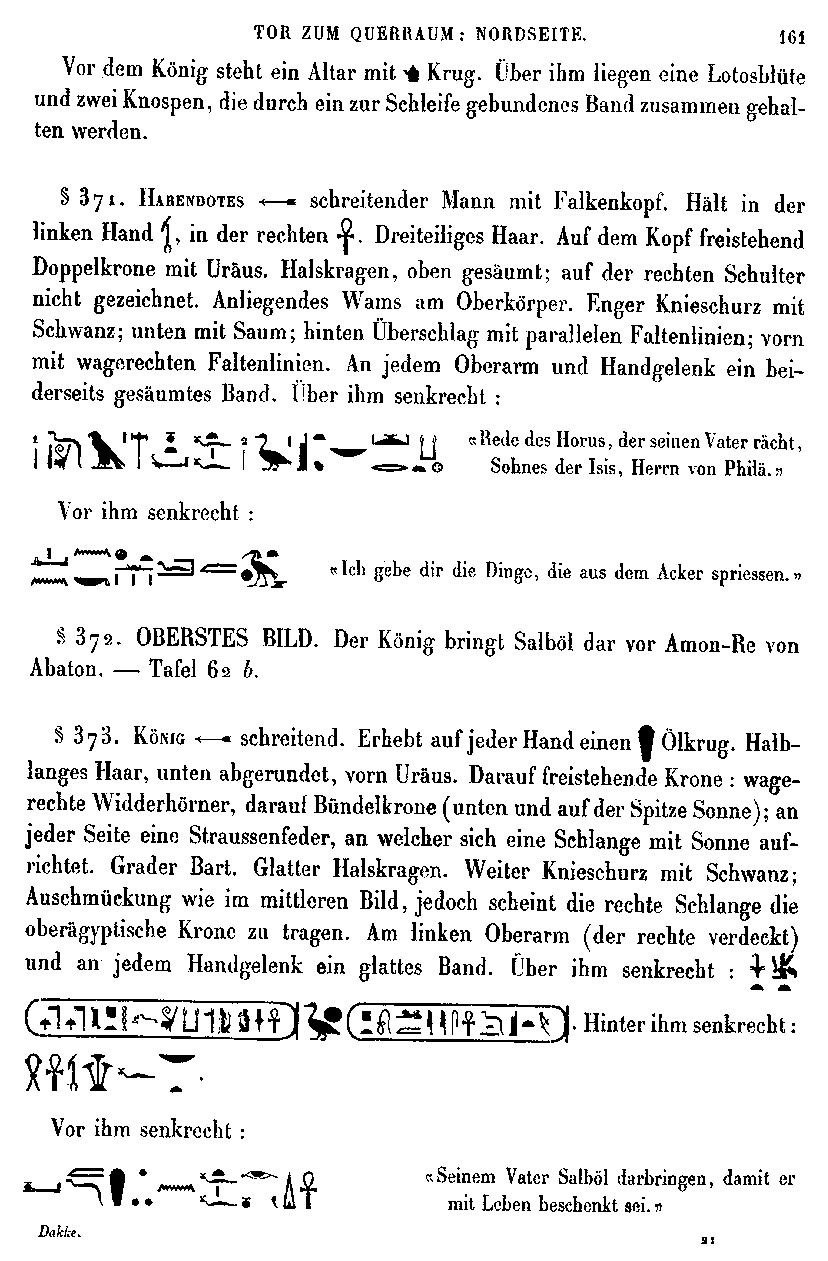
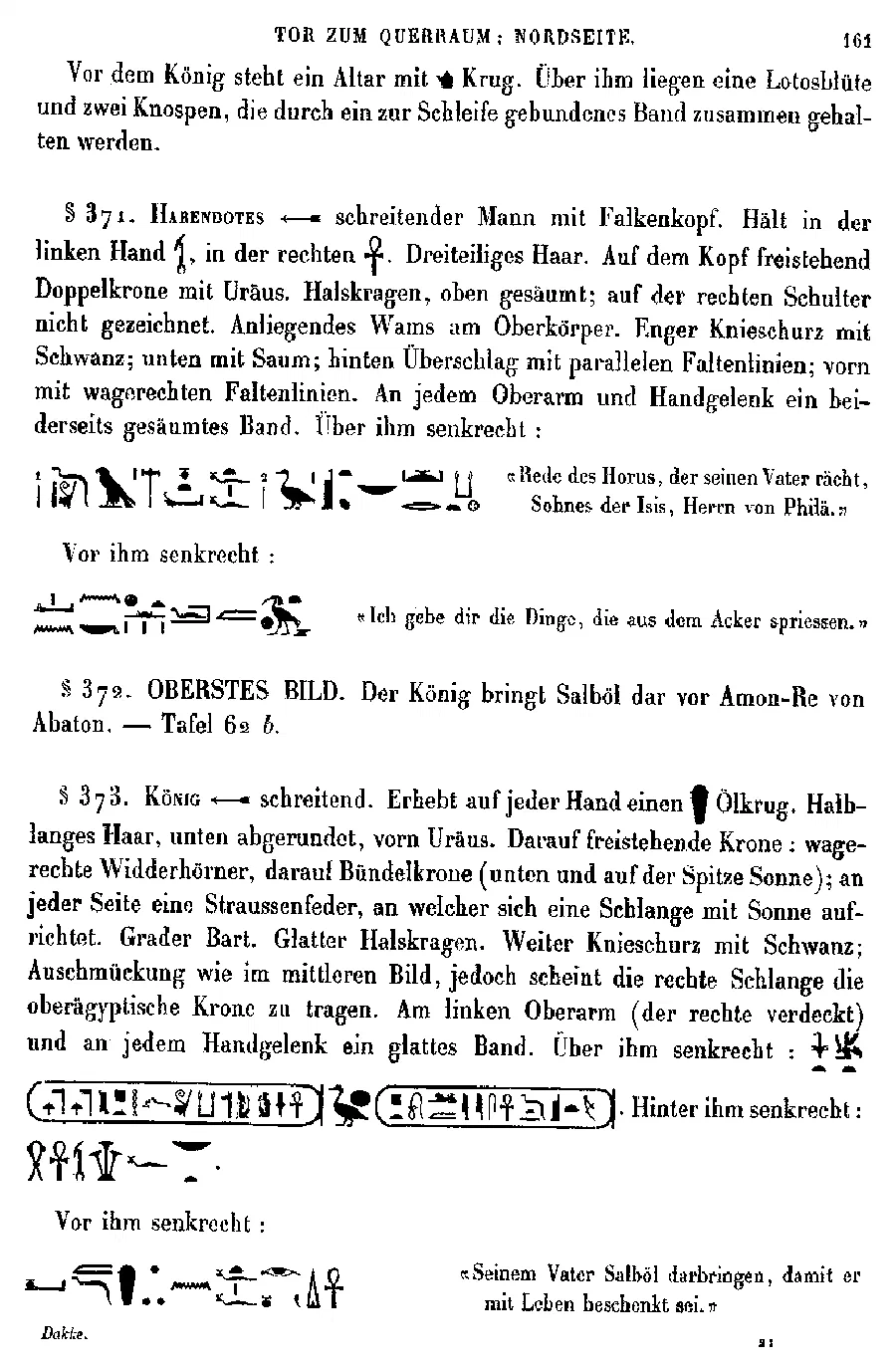
ḏd-mdw jn ḥrw-nḏ-jt=f sꜣ ꜣs.t nb jwrḳ
Words spoken by Harendotes, son of Isis, lord of Philae:
- 208p. 161, § 371
dj.n=j n=k jḫ.t prj.(t) m ꜣḫ.t
I have given you what springs from the fields.
- 209p. 161, § 373
nswt-bj.tj jwꜥ-n-nṯr.wj-mnḫ.wj-stp-n-ptḥ-wsr-kꜣ-rꜥ-sḫm-ꜥnḫ-<n>-jmn sꜣ-rꜥ ptwlmys-ꜥnḫ-ḏ.t-mrj-ꜣs.t
King of Upper and Lower Egypt: Heir of the Two Benefactor Gods, Chosen of Ptah, Mighty Is the Ka of Ra, Living Image of Amun; Son of Ra: Ptolemy, living forever, beloved of Isis.
- 210p. 161, § 373
sꜣ ꜥnḫ wꜣs nb ḥꜣ=f
All protection, life, and dominion are behind him.
- 211p. 161, § 373
ḥnk mḏ n jt=f jrj.n=f dj.(t) ꜥnḫ
Offering ointment to his father. He has done this to be granted life.
- 212p. 161, § 373
ḥn mḏ n jt=f jmn sḥb ḥr m jr.t ḥrw dj{.n} sw r --détruit--=f nb-tꜣ.wj nswt-bj.tj jwꜥ-n-nṯr.wj-mnḫ.wj-stp-n-ptḥ-wsr-kꜣ-rꜥ-sḫm-ꜥnḫ-<n>-jmn nṯr-mrj-jt=f
He who offers ointment to his father Amun, who adorns the face with the Eye of Horus and lays the ointment on his …; Lord of the Two Lands, King of Upper and Lower Egypt: Heir of the Two Benefactor Gods, Chosen of Ptah, Mighty Is the Ka of Ra, Living Image of Amun, the god who loves his father.
Note · Line 212
In the rite the ointment is the Eye of Horus: the god’s wounded eye, made whole and offered as a gift. 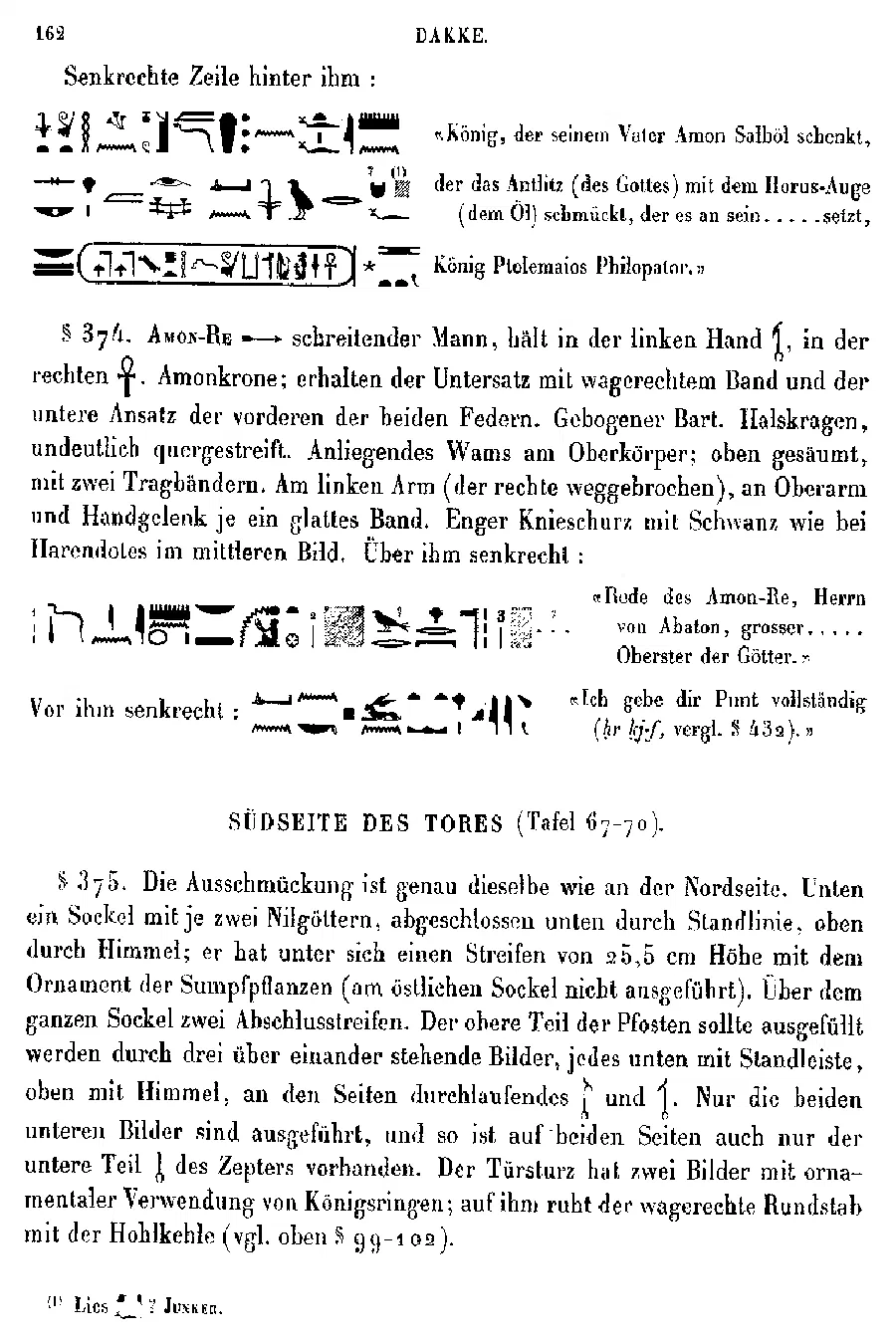
Page 162. Roeder, Der Tempel von Dakke (1930), p. 162 Printed hieroglyphs from G. Roeder, Der Tempel von Dakke (1930) - 213p. 162, § 374
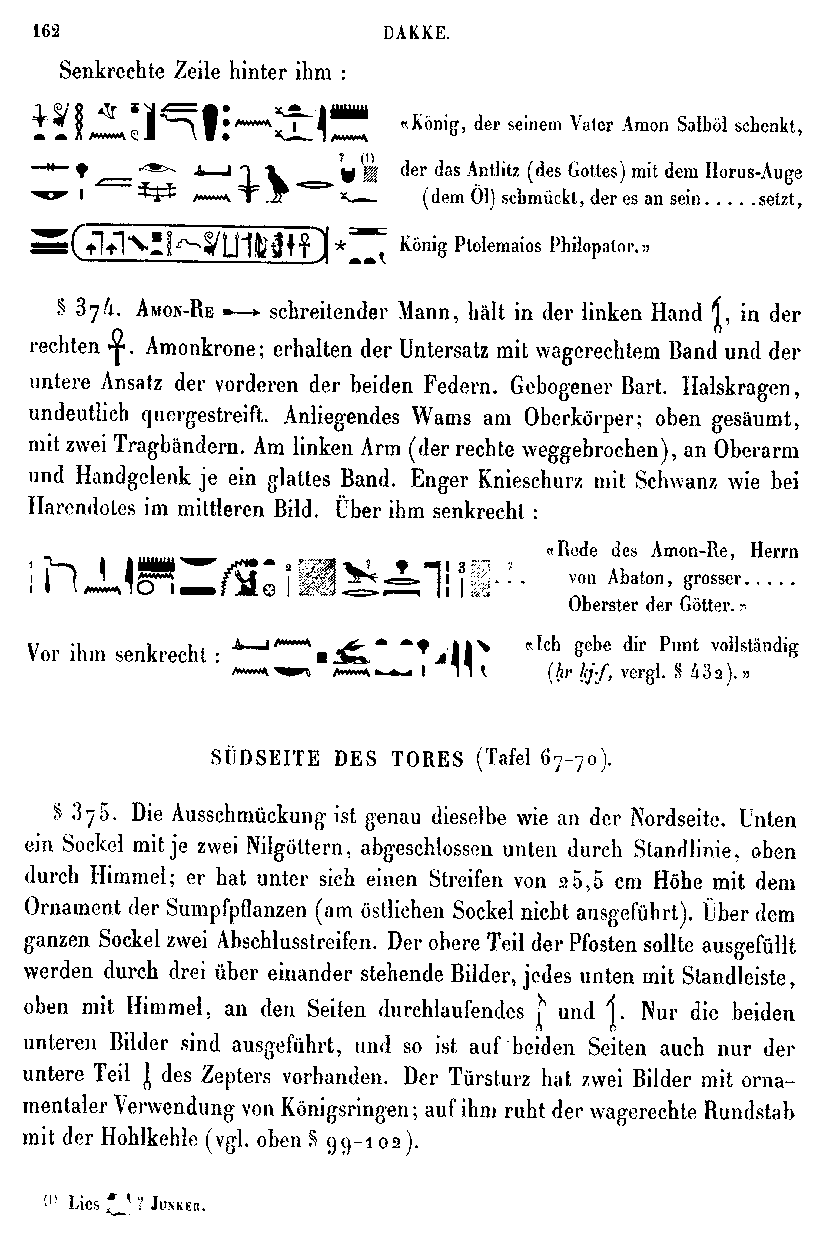
ḏd-mdw jn jmn-rꜥ nb jw-wꜥb --1Q-- wr ḥr.j nṯr.w
Words spoken by Amun-Ra, lord of the Abaton, the great …, chief of the gods:
Note · Line 213
Entry was restricted. - 214p. 162, § 374
dj.n=(j) n=k pwn.t ḥr ḳj=f
I have given you the whole of Punt.
Note · Line 214
Punt, on the Red Sea, was famed for the fragrant resins used in incense and ointments. 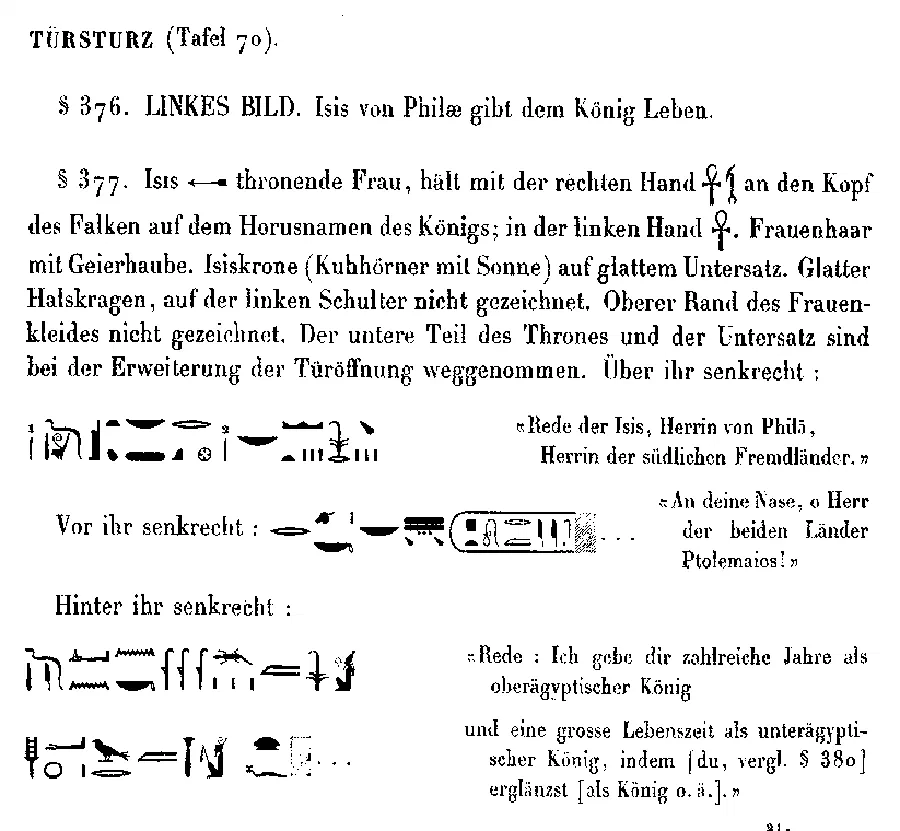
Page 163. Roeder, Der Tempel von Dakke (1930), p. 163 Printed hieroglyphs from G. Roeder, Der Tempel von Dakke (1930) - 215p. 163, § 377
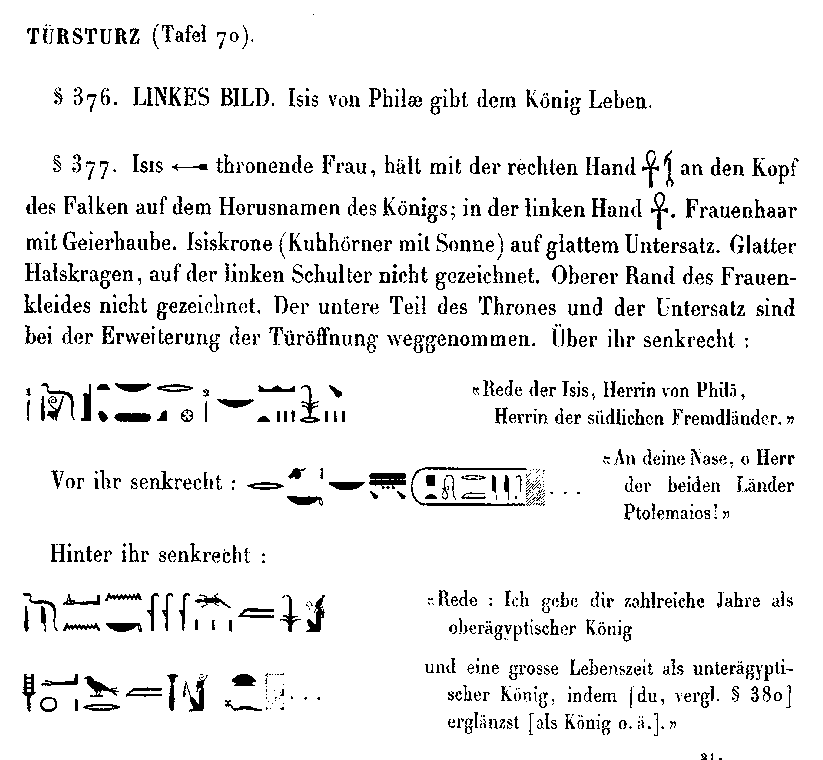
ḏd-mdw jn ꜣs.t nb.(t) jwrḳ nb.(t) ḫꜣs.wt rsj.w(t)
Words spoken by Isis, lady of Philae, lady of the southern foreign lands:
- 216p. 163, § 377
r fnḏ.t=k nb-tꜣ.wj ptwlmys --détruit-- ḏd-mdw {jn} dj.n=(j) n=k rnp.wt ꜥšꜣ.w(t) m nswt ꜥḥꜥ wr m bj.tj ḫꜥj[=k] (44) --détruit--
To your nose, Lord of the Two Lands, Ptolemy … Words to be spoken: I have given you many years as King of Upper Egypt, a long lifetime as King of Lower Egypt, as you appear in glory …
Note · Line 216
In temple scenes a god often holds the sign for life to the king’s nose, giving him the breath of life. 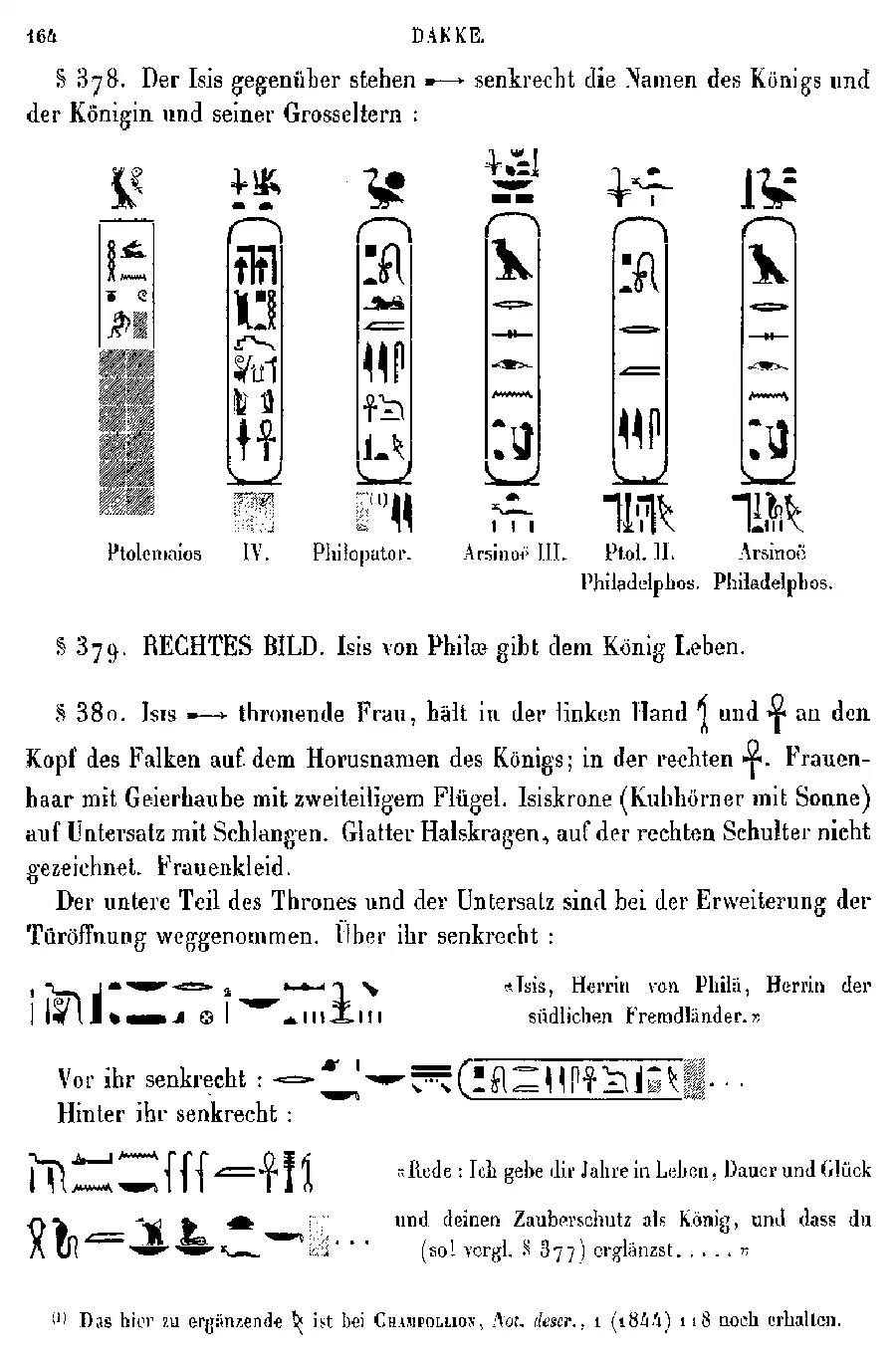
Page 164. Roeder, Der Tempel von Dakke (1930), p. 164 Printed hieroglyphs from G. Roeder, Der Tempel von Dakke (1930) - 217p. 164, § 378
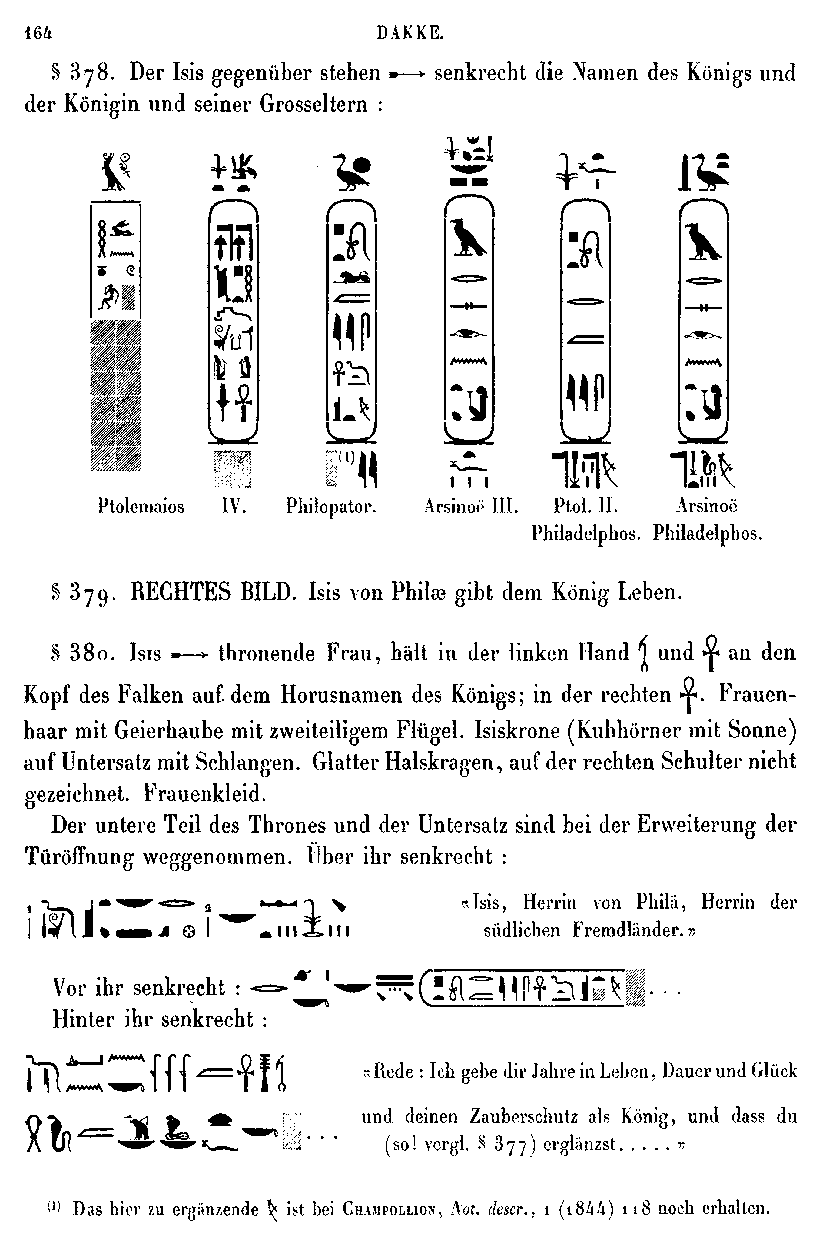
ḥrw ḥwn --3Q-- nswt-bj.tj jwꜥ-n-nṯr.wj-mnḫ.wj-stp-n-ptḥ-wsr-kꜣ-rꜥ-sḫm-ꜥnḫ-<n>-jmn sꜣ-rꜥ ptwlmys-ꜥnḫ-ḏ.t-mrj-ꜣs.t
Horus, the youth … King of Upper and Lower Egypt: Heir of the Two Benefactor Gods, Chosen of Ptah, Mighty Is the Ka of Ra, Living Image of Amun; Son of Ra: Ptolemy, living forever, beloved of Isis.
- 218p. 164, § 378
ḥm.t nswt sn.t nswt nb.(t)-tꜣ.wj ꜣrsjn [nṯr.wj] mrj.wj-jt
The king’s wife, the king’s sister, Lady of the Two Lands, Arsinoe; the two gods who love their father.
Note · Line 218
The paired title, known in Greek as the Theoi Philopatores, names Arsinoe III and her brother and husband Ptolemy IV together. - 219p. 164, § 378
jt nswt ptwlmys nṯr-sn mrj nṯr.w
The king’s father, Ptolemy, the Brother God, beloved of the gods.
Note · Line 219
The Brother God and Sister Goddess are the earlier royal couple Ptolemy II and Arsinoe II. Here “the king’s father” honors a royal forebear, not Ptolemy IV’s immediate father. - 220p. 164, § 378
sꜣ.t jmn ꜣrsjn nṯr.t-sn.t mrj.t nṯr.wt
Daughter of Amun, Arsinoe, the Sister Goddess, beloved of the goddesses.
- 221p. 164, § 380
ḏd-mdw jn ꜣs.t nb.(t) jwrḳ nb.(t) ḫꜣs.wt rsj.w(t)
Words spoken by Isis, lady of Philae, lady of the southern foreign lands:
- 222p. 164, § 380
r fnḏ.t=k nb-tꜣ.wj ptwlmys-ꜥnḫ-ḏ.t-mrj-ꜣs.t ḏd-mdw {jn} dj.n=(j) n=k rnp.wt m ꜥnḫ ḏd wꜣs sꜣ=k m nb.tj.t ḫꜥj=k (45) --détruit--
To your nose, Lord of the Two Lands, Ptolemy, living forever, beloved of Isis. Words to be spoken: I have given you years of life, stability, and dominion, with the Two Ladies as your protection as you appear in glory …
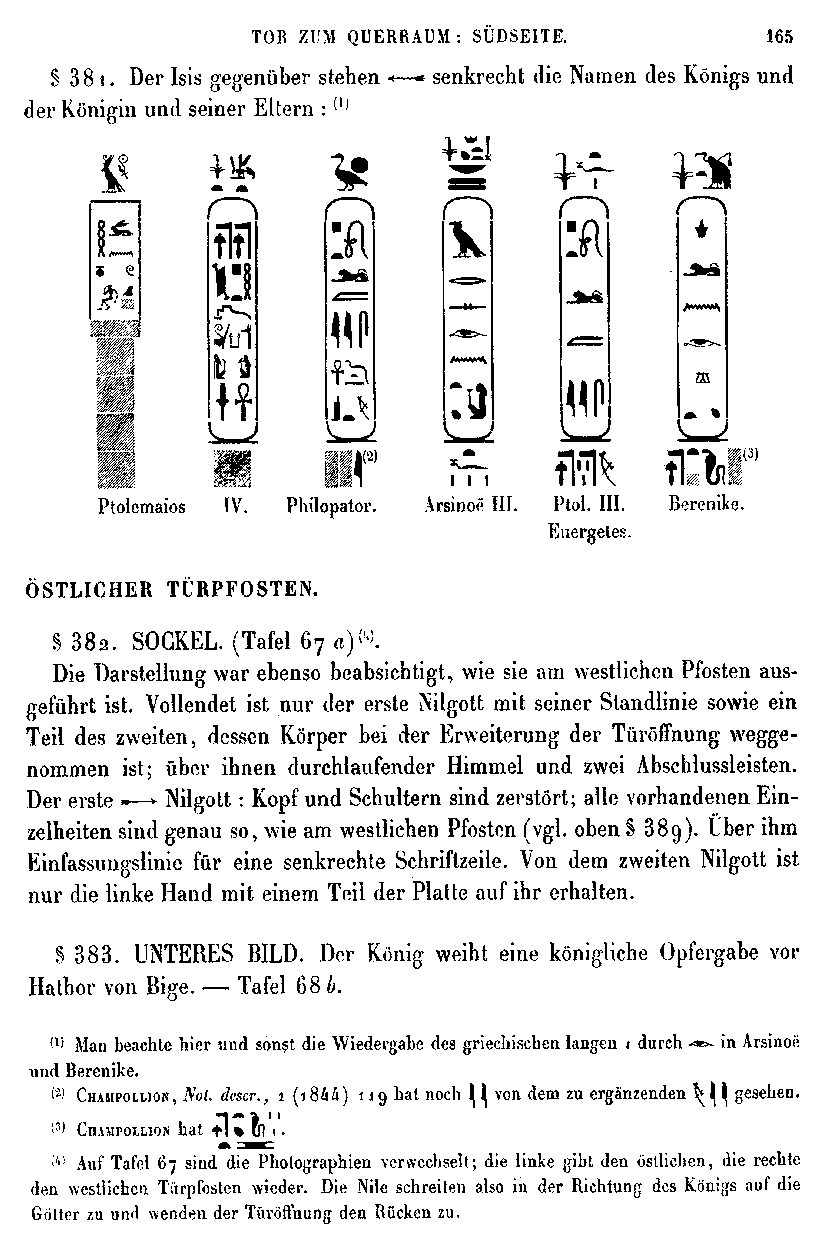
Page 165. Roeder, Der Tempel von Dakke (1930), p. 165 Printed hieroglyphs from G. Roeder, Der Tempel von Dakke (1930) - 223p. 165, § 381
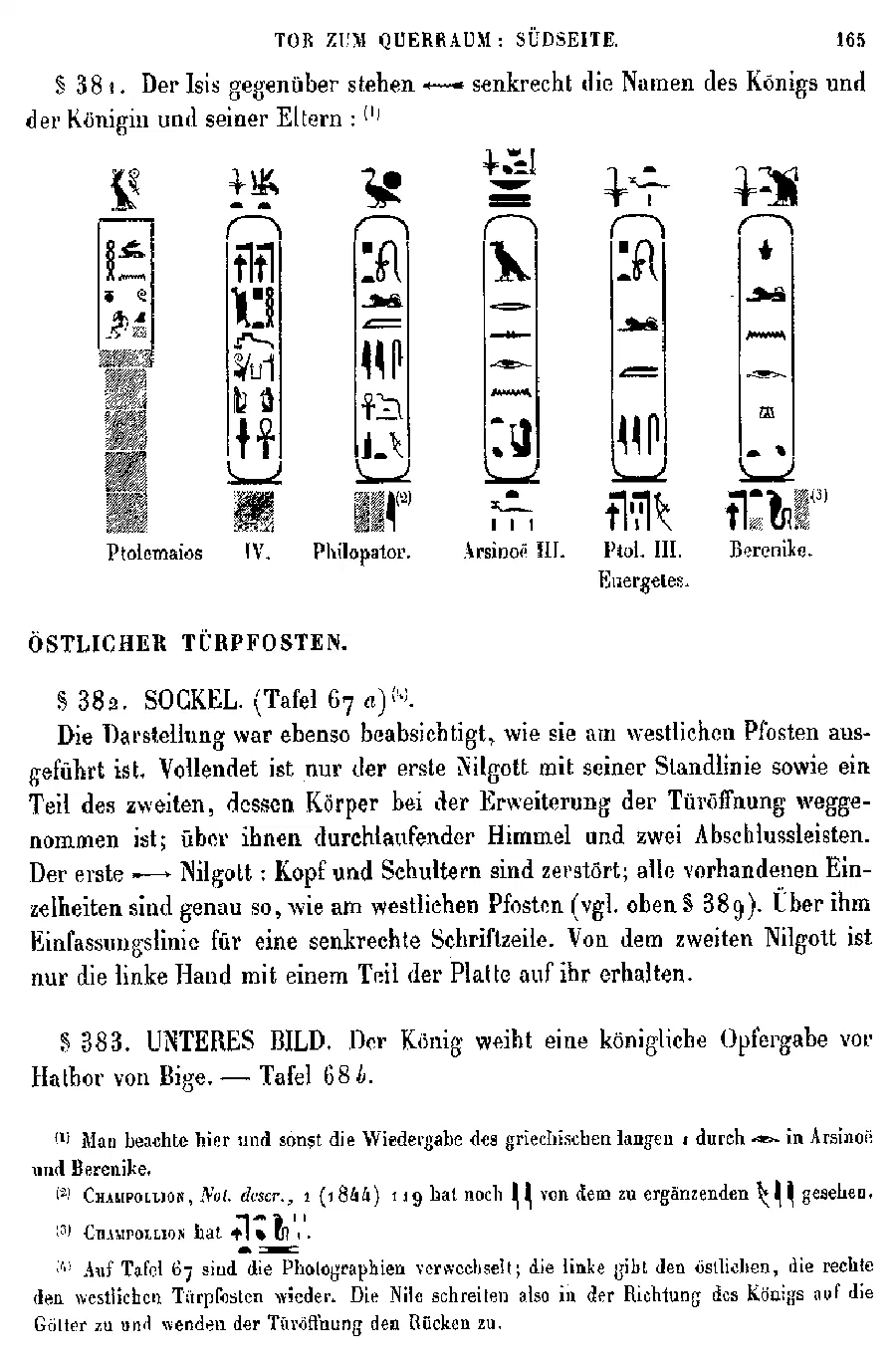
ḥrw ḥwn --4Q-- nswt-bj.tj jwꜥ-n-nṯr.wj-mnḫ.wj-stp-n-ptḥ-wsr-kꜣ-rꜥ-sḫm-ꜥnḫ-<n>-jmn sꜣ-rꜥ ptwlmys-ꜥnḫ-ḏ.t-mrj-ꜣs.t
Horus, the youth … King of Upper and Lower Egypt: Heir of the Two Benefactor Gods, Chosen of Ptah, Mighty Is the Ka of Ra, Living Image of Amun; Son of Ra: Ptolemy, living forever, beloved of Isis.
- 224p. 165, § 381
ḥm.t nswt sn.t nswt nb.(t)-tꜣ.wj ꜣrsjn [nṯr.wj] mrj.wj-jt
The king’s wife, the king’s sister, Lady of the Two Lands, Arsinoe; the two gods who love their father.
- 225p. 165, § 381
jt nswt ptwlmys nṯr-mnḫ mrj nṯr.w
The king’s father, Ptolemy, the Benefactor God, beloved of the gods.
- 226p. 165, § 381
mw.t nswt brnjg nṯr.t-mnḫ.t mrj.t nṯr.wt
The king’s mother, Berenice, the Benefactor Goddess, beloved of the goddesses.
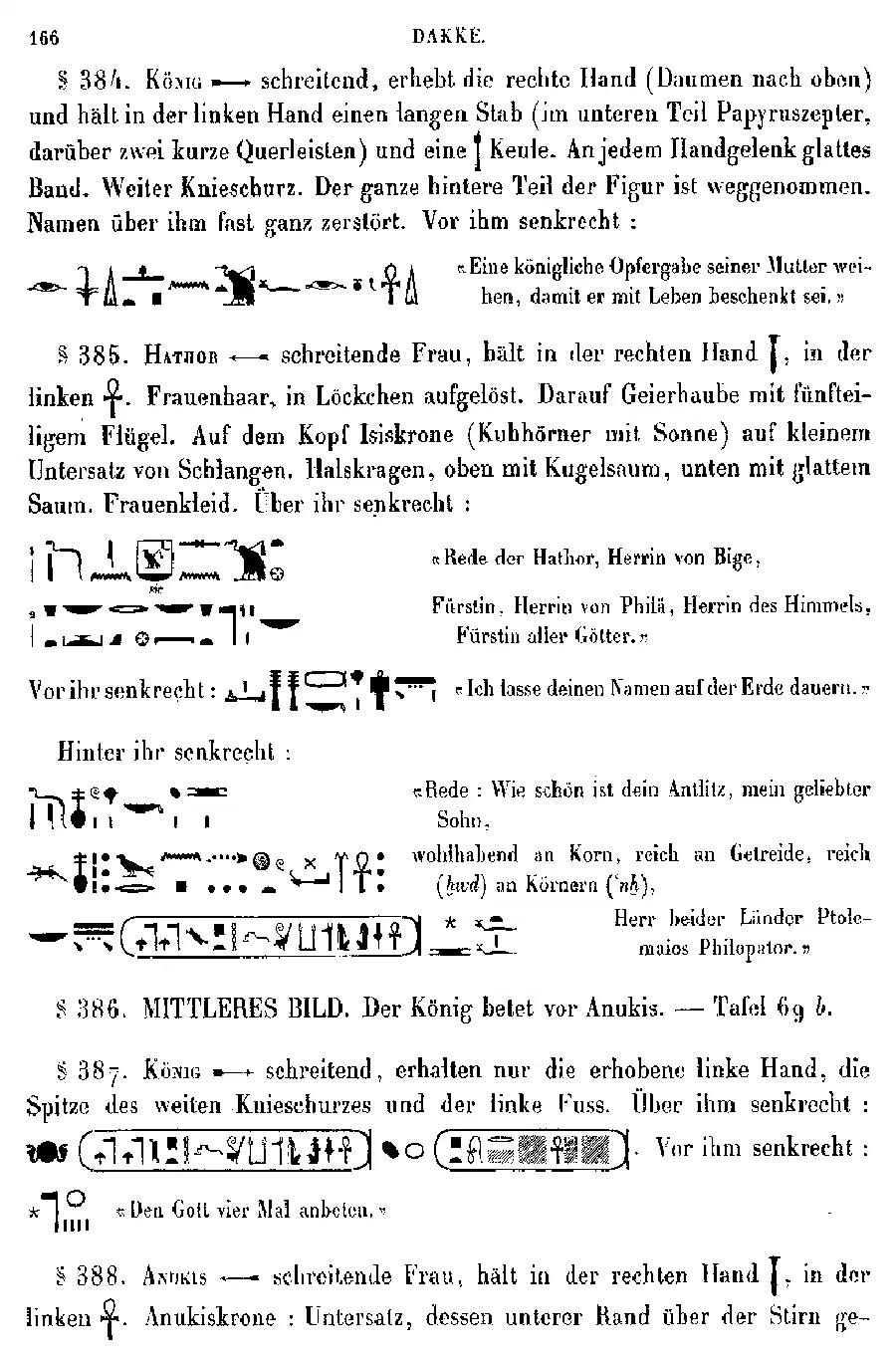
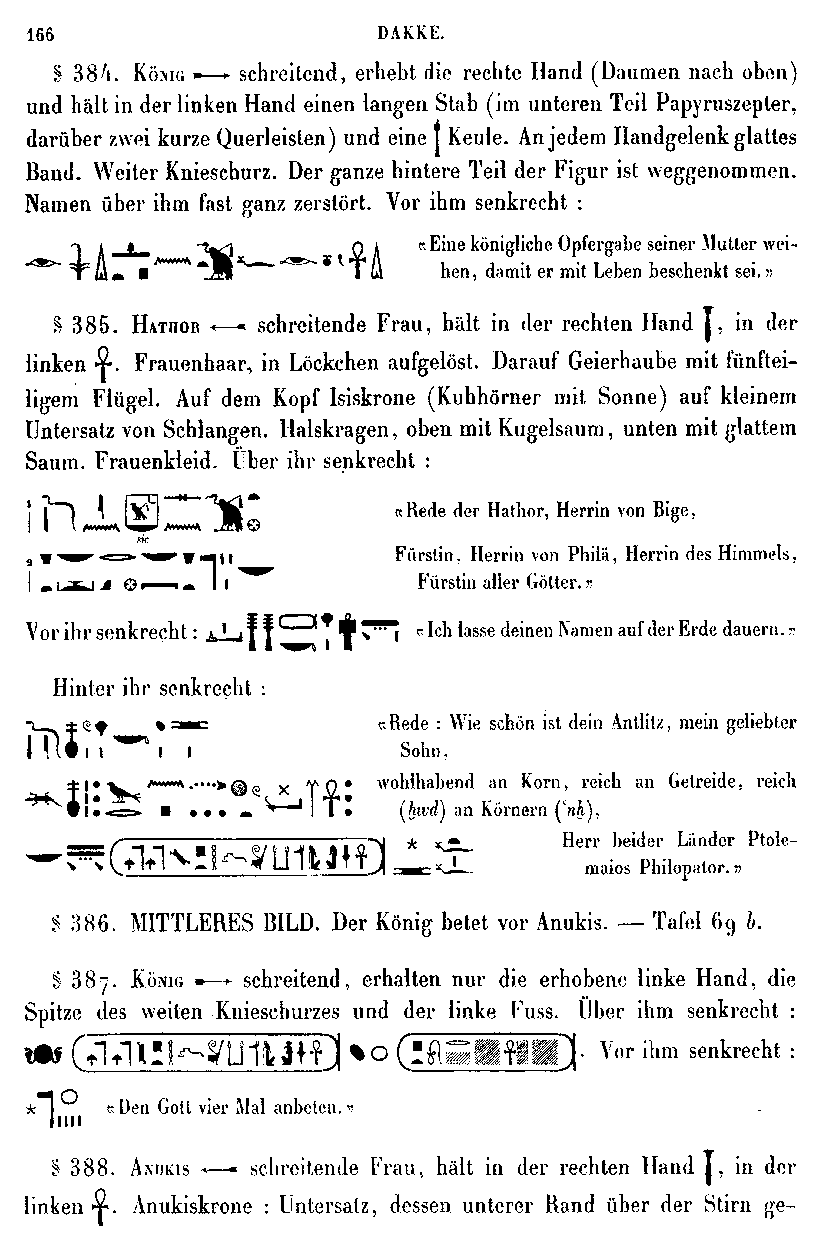
Page 166. Roeder, Der Tempel von Dakke (1930), p. 166 Printed hieroglyphs from G. Roeder, Der Tempel von Dakke (1930) - 227p. 166, § 384
jrj.(t) ḥtp-dj-nswt n mw.t=f jrj.n=f dj.(t) ꜥnḫ
Making the royal funerary offering for his mother. He has done this to be granted life.
Note · Line 227
The rite takes its name from the words “an offering the king gives,” the traditional formula for supplying the dead with food and drink. - 228p. 166, § 385
ḏd-mdw jn ḥw.t-ḥrw nb.(t) snm.t ḥnw.t nb.(t) jwrḳ nb.(t) p.t ḥnw.t nṯr.w nb.(w)
Words spoken by Hathor, lady of Senmet, sovereign lady, lady of Philae, lady of the sky, mistress of all the gods:
- 229p. 166, § 385
dj=j ḏd rn=k ḥr sꜣ tꜣ
I make your name endure on the face of the earth.
- 230p. 166, § 385
ḏd-mdw {jn} nfr.wj ḥr=k sꜣ=j mrj=j ꜥšꜣ nfrw wr nprj ḫwd m ꜥnḫ nb-tꜣ.wj nswt-bj.tj jwꜥ-n-nṯr.wj-mnḫ.wj-stp-n-ptḥ-wsr-kꜣ-rꜥ-sḫm-ꜥnḫ-<n>-jmn nṯr-mrj-jt=f
Words to be spoken: How fair your face, my son whom I love,
whose seeds are many, whose grains are large, rich in wheat,
Lord of the Two Lands, King of Upper and Lower Egypt: Heir of the Two Benefactor Gods, Chosen of Ptah, Mighty Is the Ka of Ra, Living Image of Amun, the god who loves his father!Note · Line 230
The Egyptian words for “fair” and “seed” echo each other, linking the king’s beauty to the abundance of his grain. - 231p. 166, § 387
nswt-bj.tj jwꜥ-n-nṯr.wj-mnḫ.wj-stp-n-ptḥ-wsr-kꜣ-rꜥ-sḫm-ꜥnḫ-<n>-jmn sꜣ-rꜥ ptwl[mys]-ꜥnḫ-[ḏ.t-mrj-ꜣs.t]
King of Upper and Lower Egypt, heir of the two Benefactor Gods, chosen of Ptah, mighty is the ka of Ra, living image of Amun; son of Ra, Ptolemy, living forever, beloved of Isis.
- 232p. 166, § 387
dwꜣ nṯr sp fdw
Adoring the god four times.
- 233p. 166, § 388
ḏd-mdw jn ꜥnḳ.t ḫnt.j.(t) tꜣ-stj --2Q-- nb.(t) p.t ḥnw.t nṯr.w nb.(w){t}
Words spoken by Anuket, foremost in Nubia, … lady of heaven, mistress of all the gods:
- 234p. 166, § 388
dj=(j) n=k ꜥnḫ ḏd wꜣs
I give you life, stability and dominion.
- 235p. 166, § 388
dj.n=(j) n=k sḫ.t wꜥb.tj r ꜥb
I have given you the field, cleansed of evil.
- 236p. 166, § 388
ḏd-mdw {jn} nfr.wj ḥr=k [w]r dwꜣ.w snsj.w ḥtp nṯr.w ḥr sḏm ḥkn=k nb-ḫꜥ.w ptwlmys-ꜥnḫ-ḏ.t-mrj-ꜣs.t nṯr-mrj-jt=f
Words spoken: How fair is your face, O you who are great in worship and praise! The gods are at peace when they hear your praises, lord of crowns, Ptolemy, living forever, beloved of Isis, the god Philopator.
Note · Line 236
Philopator means “he who loves his father.” 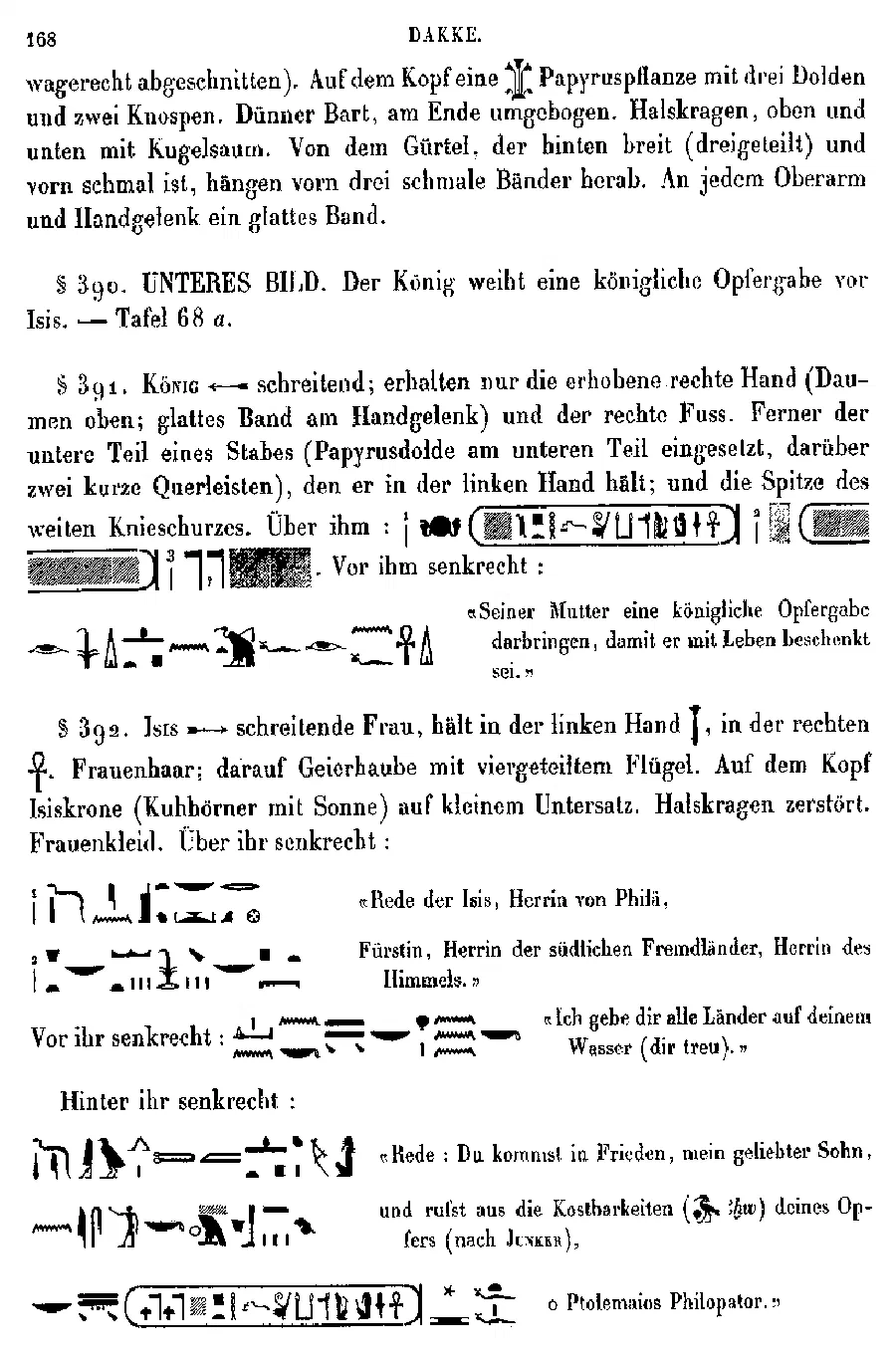
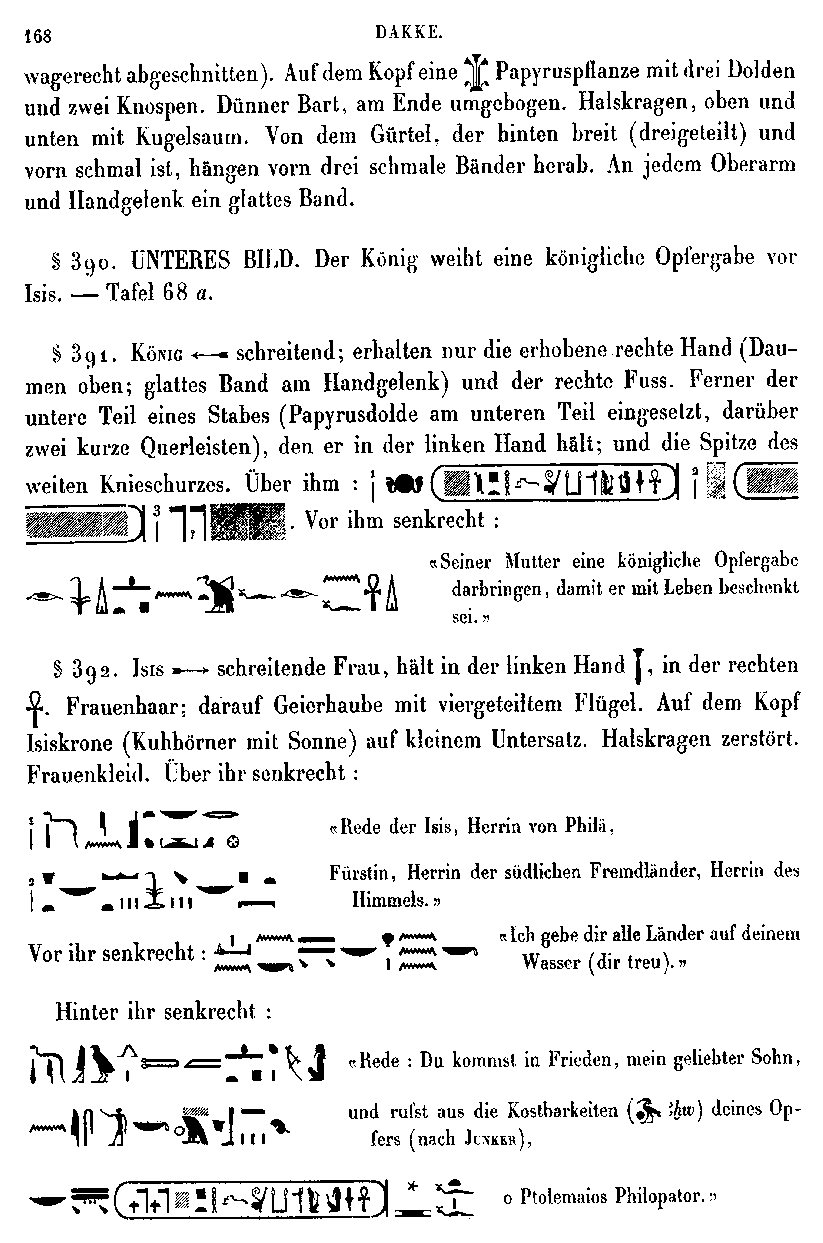
Page 168. Roeder, Der Tempel von Dakke (1930), p. 168 Printed hieroglyphs from G. Roeder, Der Tempel von Dakke (1930) - 237p. 168, § 391
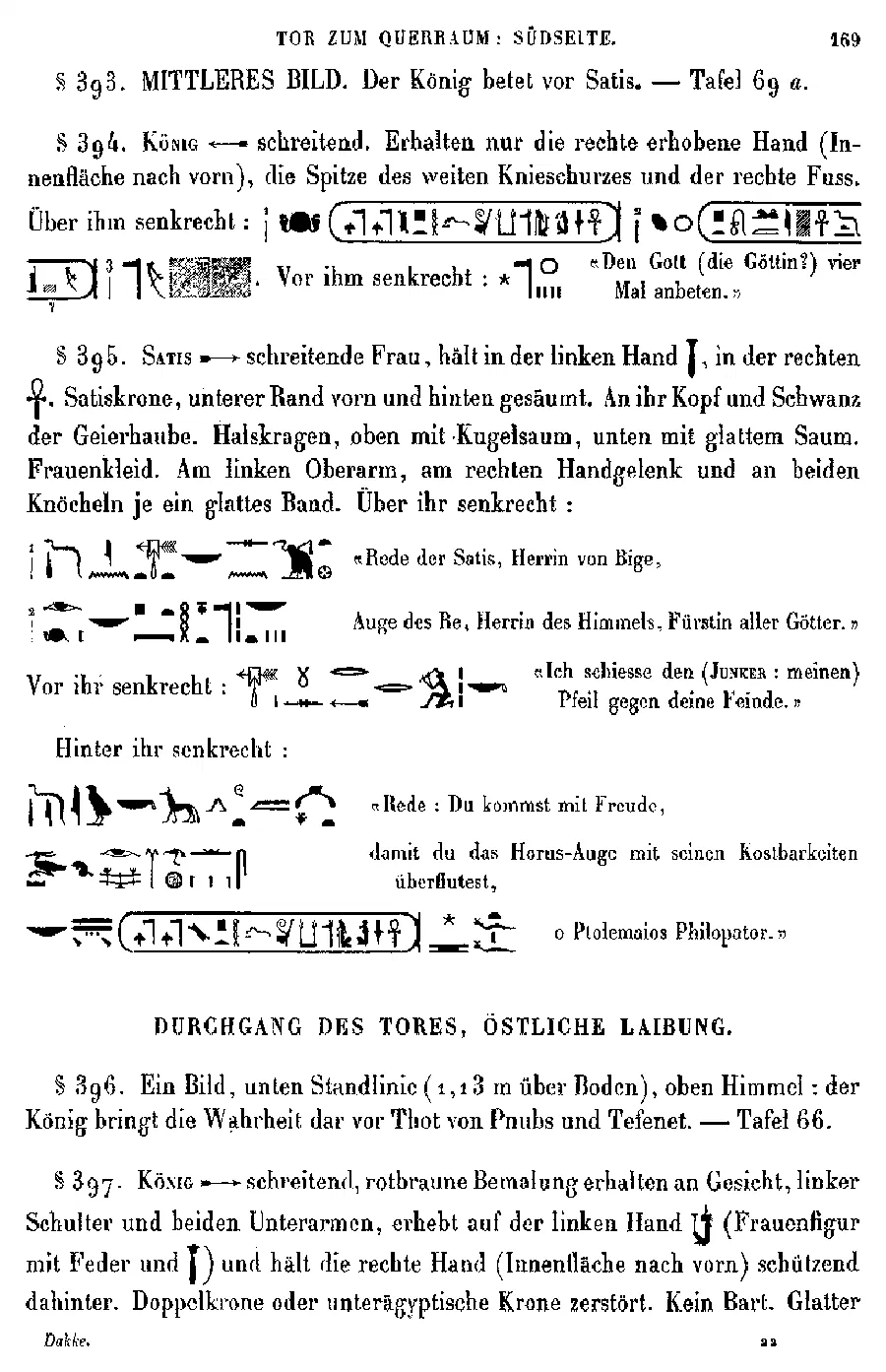
nswt-bj.tj jwꜥ-n-[nṯr.wj-mnḫ.wj]-stp-n-ptḥ-wsr-kꜣ-rꜥ-sḫm-ꜥnḫ-<n>-jmn [sꜣ-rꜥ ptwlmys-ꜥnḫ-ḏ.t-mrj-ꜣs.t] nṯr --1Q-- jrj.(t) ḥtp-dj-nswt n mw.t=f jrj.n=f dj.(t) ꜥnḫ
King of Upper and Lower Egypt, heir of the two Benefactor Gods, chosen of Ptah, mighty is the ka of Ra, living image of Amun; son of Ra, Ptolemy, living forever, beloved of Isis, the god … Making a royal funerary offering to his mother. He has done this that he may be given life.
Note · Line 237
The king approaches Isis as a son making an offering to his mother. - 238p. 168, § 392
ḏd-mdw jn ꜣs.t nb.(t) jwrḳ ḥnw.t nb.(t) ḫꜣs.wt rsj.w(t) nb.(t) p.t
Words spoken by Isis, lady of Philae, mistress, lady of the southern foreign lands, lady of heaven:
- 239p. 168, § 392
dj.n=j n=k tꜣ.wj nb ḥr mw=k
I have given you the Two Lands in their entirety, loyal to you.
Note · Line 239
To be “on your water” is to owe you allegiance. - 240p. 168, § 392
ḏd-mdw {jn} jj.tj m ḥtp sꜣ=j mrj=j njs=k __ ꜥb=k nb-tꜣ.wj nswt-bj.tj jwꜥ-n-nṯr.wj-mnḫ.wj-stp-n-ptḥ-wsr-kꜣ-rꜥ-sḫm-ꜥnḫ-<n>-jmn nṯr-mrj-jt=f
Words spoken: Welcome in peace, my son whom I love! You call out … your offering, lord of the Two Lands, King of Upper and Lower Egypt, heir of the two Benefactor Gods, chosen of Ptah, mighty is the ka of Ra, living image of Amun, the god Philopator.
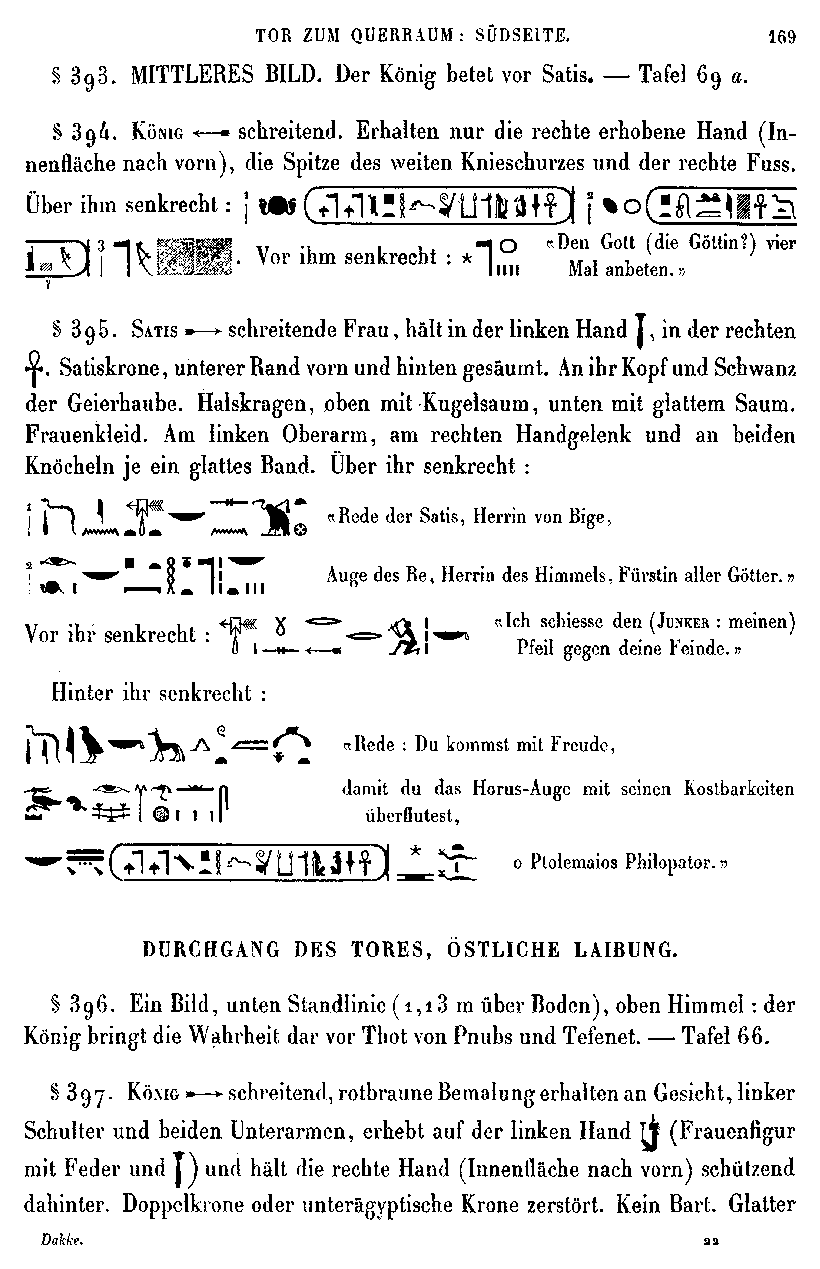
Page 169. Roeder, Der Tempel von Dakke (1930), p. 169 Printed hieroglyphs from G. Roeder, Der Tempel von Dakke (1930) - 241p. 169, § 394
nswt-bj.tj jwꜥ-n-nṯr.wj-mnḫ.wj-stp-n-ptḥ-wsr-kꜣ-rꜥ-sḫm-ꜥnḫ-<n>-jmn sꜣ-rꜥ ptwlmj[js]-ꜥnḫ-ḏ.t-mrj-ꜣs.t nṯr-mrj-[jt=f]
King of Upper and Lower Egypt, heir of the two Benefactor Gods, chosen of Ptah, mighty is the ka of Ra, living image of Amun; son of Ra, Ptolemy, living forever, beloved of Isis, the god Philopator.
- 242p. 169, § 394
dwꜣ nṯr sp fdw
Adoring the god four times.
- 243p. 169, § 395
ḏd-mdw jn st.t nb.(t) snm.t jr.t rꜥ nb.(t) p.t ḥnw.t nṯr.w nb.w{t}
Words spoken by Satis, lady of Senmet, Eye of Ra, lady of heaven, mistress of all the gods:
- 244p. 169, § 395
stj=j šsr r ḫft.j.w=k
I shoot arrows at your enemies.
Note · Line 244
The Egyptian word for “shoot” echoes the name of Satis, who is shown with a bow. - 245p. 169, § 395
ḏd-mdw {jn} jw=k jj.tj m ꜣw.t-jb bꜥḥ=k jr.t ḥrw m ꜣḫ.w=s nb-tꜣ.wj nswt-bj.tj jwꜥ-n-nṯr.wj-mnḫ.wj-stp-n-ptḥ-wsr-kꜣ-rꜥ-sḫm-ꜥnḫ-<n>-jmn nṯr-mrj-jt=f
Words spoken: You have come with joy in your heart to flood the Eye of Horus with its wonders, lord of the Two Lands, King of Upper and Lower Egypt, heir of the two Benefactor Gods, chosen of Ptah, mighty is the ka of Ra, living image of Amun, the god Philopator.
- 246p. 169, § 397
nswt-bj.tj nb-tꜣ.wj ꜣw(t)kr[t]r sꜣ-rꜥ ky[s]rs
King of Upper and Lower Egypt, lord of the Two Lands, Autokrator; son of Ra, Caesar.
Note · Line 246
Here a Roman emperor bears the titles of an Egyptian king. - 247p. 169, § 397
ḥnk mꜣꜥ.t n jt=f šps ḏḥwtj n pnbs jrj.n[=f] dj.(t) ꜥnḫ
Presenting Maat to his august father, Thoth of Pnubs. He has done this that he may be given life.
Note · Line 247
In this rite the king offers her image to the god. 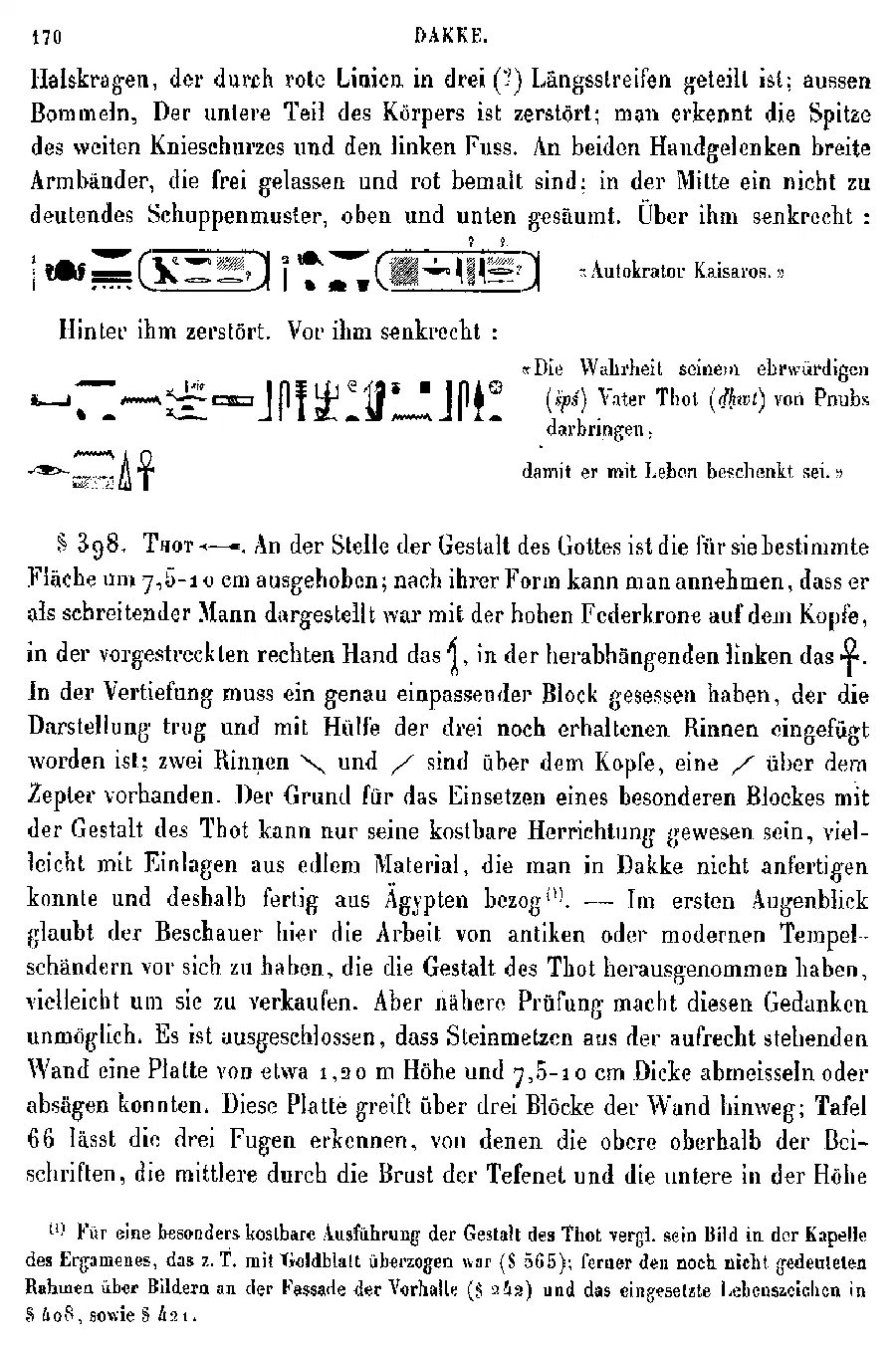
Page 170. Roeder, Der Tempel von Dakke (1930), p. 170 Printed hieroglyphs from G. Roeder, Der Tempel von Dakke (1930) - 248p. 170, § 398
ḏd-mdw jn ḏḥwtj n pnbs nṯr ꜥꜣ nb psrk.t jnj.n=f jr.t rꜥ m knm.t nḏm jb n rꜥ jt=s
Words spoken by Thoth of Pnubs, the great god, lord of Pselkis, who brought the Eye of Ra back from Kenmet so that the heart of Ra, her father, might rejoice.
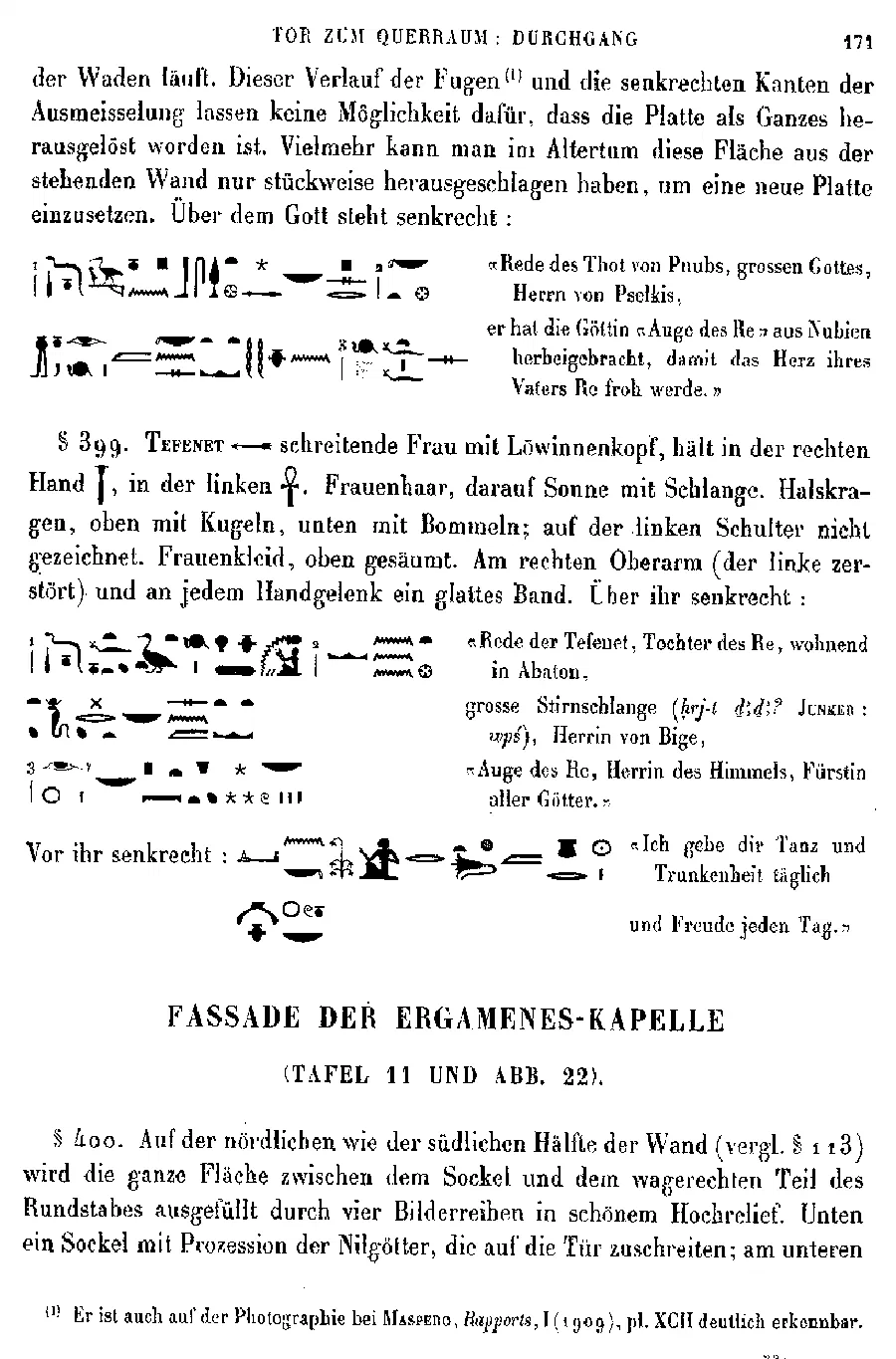
Page 171. Roeder, Der Tempel von Dakke (1930), p. 171 Printed hieroglyphs from G. Roeder, Der Tempel von Dakke (1930) - 249p. 171, § 399
ḏd-mdw jn tfn.t sꜣ.t rꜥ ḥr.j.(t)-jb jw-wꜥb ḥw.t-ḥrw wr.t nb.(t) snm.t jr.t rꜥ nb.(t) p.t ḥnw.t nṯr.w nb.w
Words spoken by Tefnut, daughter of Ra, who dwells on the Pure Island, Hathor the Great, lady of Senmet, Eye of Ra, lady of heaven, mistress of all the gods:
Note · Line 249
Tefnut is identified here with Hathor. - 250p. 171, § 399
dj=(j) n=k šmꜥ r tḫ m ẖr.t-hrw ꜣw.(t)-jb rꜥ nb
I give you singers for drunken revelry day after day, and joy every day.
- 251
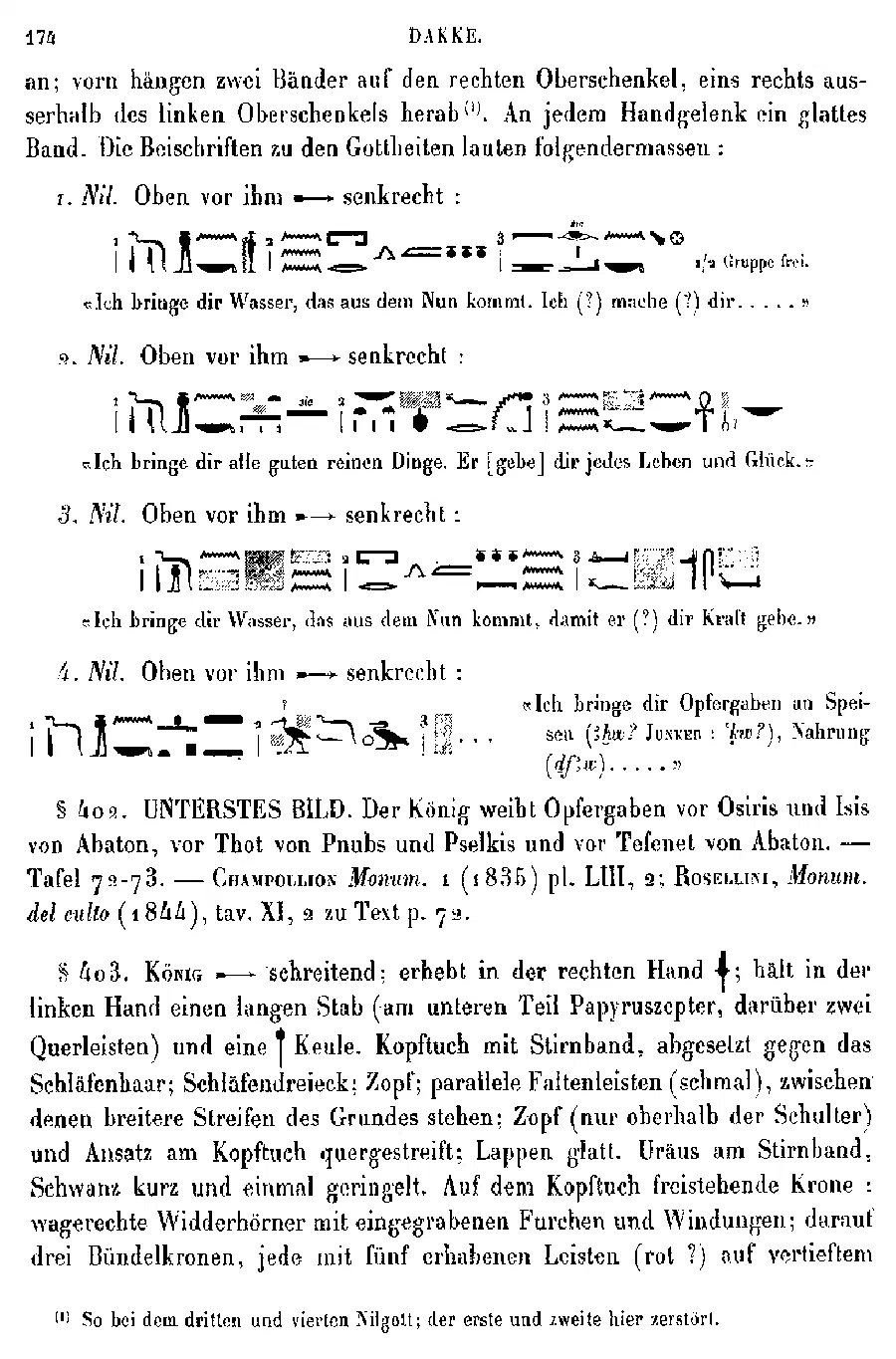
ḏd-mdw {jn} jnj=(j) n=k ḳbḥ prj m nwn dj=j(?) n=k … (?) ḏd-mdw {jn} jnj=(j) n=k j[ḫ].t nb.t nfr.(t) wꜥb.(t) dj=f n=k ꜥnḫ wꜣs nb
Words spoken: I bring you the libation water that flows from Nun, that I may give you … Words spoken: I bring you every good and pure thing, that he may give you all life and dominion.
Note · Line 251
Nun is the primeval expanse of water from which the world arose. - 252
ḏd-mdw jnj=(j) n=[k ḳbḥ] prj m nwn dj=f [n=k] wsr
Words spoken: I bring you the libation water that flows from Nun, that he may give you strength.
- 253
ḏd-mdw jnj=(j) n=k ḥtp ḏfꜣ --3Q--
Words spoken: I bring you offerings and provisions …
Page 174. Roeder, Der Tempel von Dakke (1930), p. 174 Printed hieroglyphs from G. Roeder, Der Tempel von Dakke (1930) - 254p. 174, § 403
nswt-bj.tj ḏr.t-ꜥnḫ-jmn-tj.t-rꜥ sꜣ-rꜥ jrḳ-jmn-ꜥnḫ-ḏ.t-mrj-ꜣs.t
King of Upper and Lower Egypt, living hand of Amun, image of Ra; son of Ra, Ergamenes, living forever, beloved of Isis.
Note · Line 254
Ergamenes was a king of Kush, the kingdom to Egypt’s south. - 255p. 174, § 403
jrj.(t) ꜥꜣb.t n jt=f jrj.n=f dj.(t) ꜥnḫ
Making a great offering to his father. He has done this that he may be given life.
- 256p. 174, § 403
sꜣ ꜥnḫ wꜣs nb.{wt} ḥꜣ=f mj rꜥ ḏ.t
All protection, life and dominion are behind him, as they are behind Ra, forever.
Page 176. Roeder, Der Tempel von Dakke (1930), p. 176 Printed hieroglyphs from G. Roeder, Der Tempel von Dakke (1930) - 257p. 176, § 405
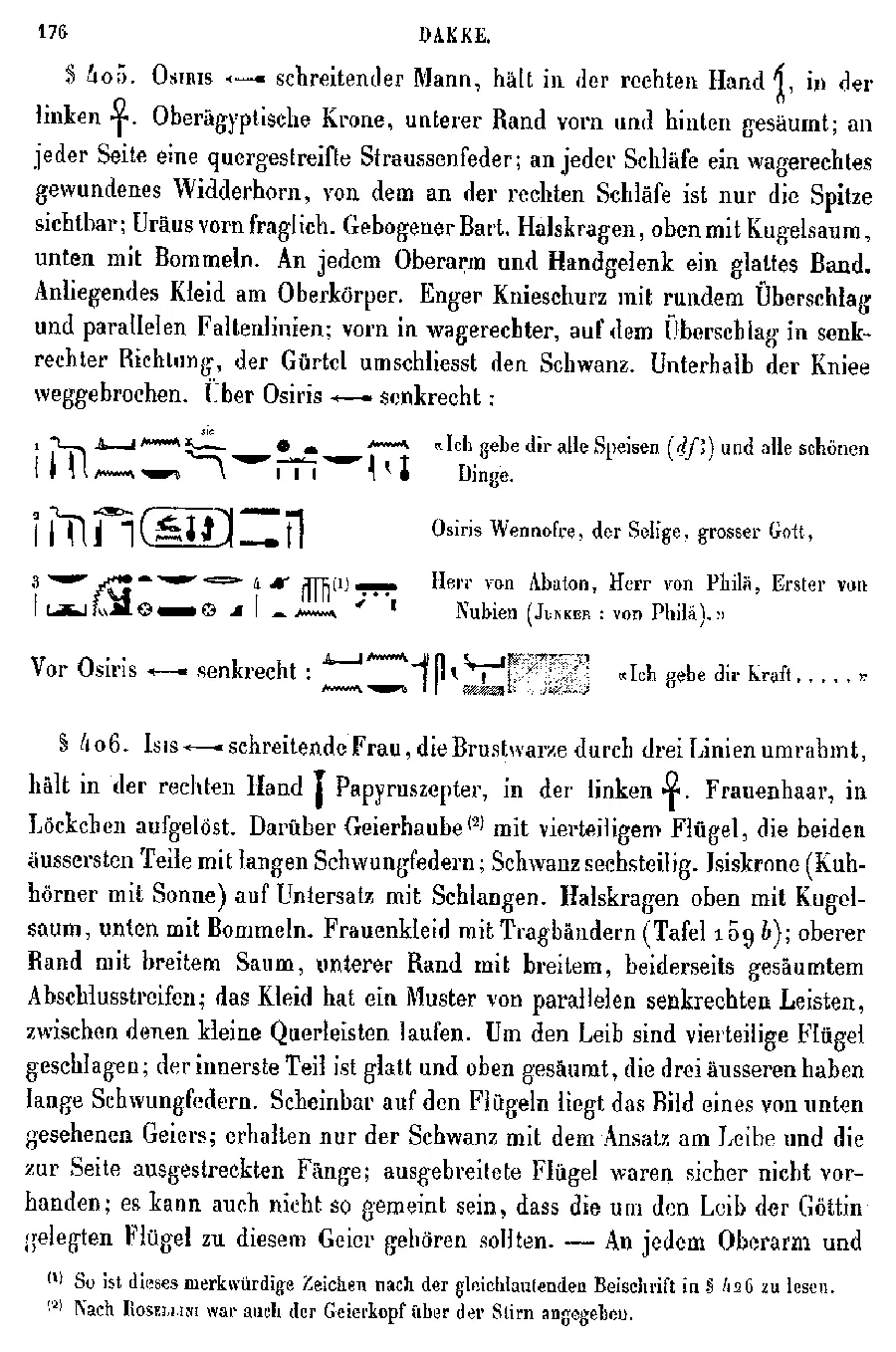
ḏd-mdw {jn} dj.n=(j) n=k ḏfꜣ nb jḫ.t nb.(t) nfr.(t)
Words spoken: I have given you every provision and every good thing.
- 258p. 176, § 405
ḏd-mdw jn wsjr wn-nfr mꜣꜥ-ḫrw nṯr ꜥꜣ nb jꜣ.t-wꜥb.t nb jwrḳ ḫnt.j ḫnt-tꜣ
Words spoken by Osiris Wennefer, justified, the great god, lord of the Abaton, lord of Philae, foremost in Khent-ta:
Note · Line 258
“Justified” declares him vindicated in divine judgment. - 259p. 176, § 405
dj.n=(j) n=k wsr --2Q--
I have given you strength …
- 260p. 176, § 406
dj=j msj.n n=k ꜣḫ.t ꜥḳw=s (46)
I make the field give birth to its harvest for you.
Note · Line 260
The gods address the king who makes the offering. - 261p. 176, § 406
ḏd-mdw jn ꜣs.t dj.(t) ꜥnḫ nb.(t) jꜣ.t-wꜥb.t nb.(t) jwrḳ nb.(t) p.t ḥnw.t nṯr.w
Words spoken by Isis, who gives life, lady of the Abaton, lady of Philae, lady of heaven, mistress of the gods:
- 262p. 176, § 406
dj.n=j n=k nswj.t n ḥrw ḥnꜥ ḥr.j.t-tp=f
I have given you the kingship of Horus together with his uraeus.
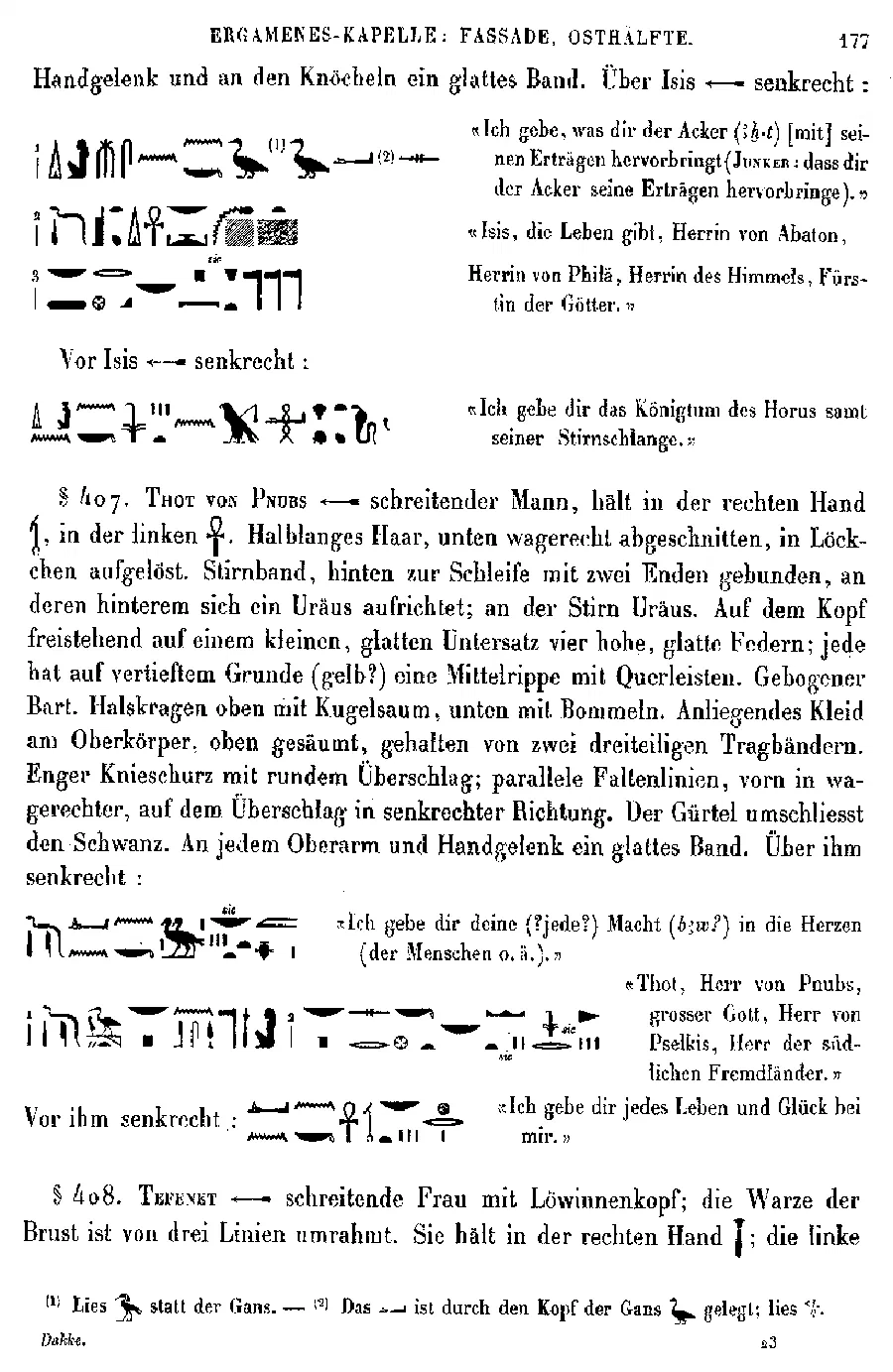
Page 177. Roeder, Der Tempel von Dakke (1930), p. 177 Printed hieroglyphs from G. Roeder, Der Tempel von Dakke (1930) - 263p. 177, § 407
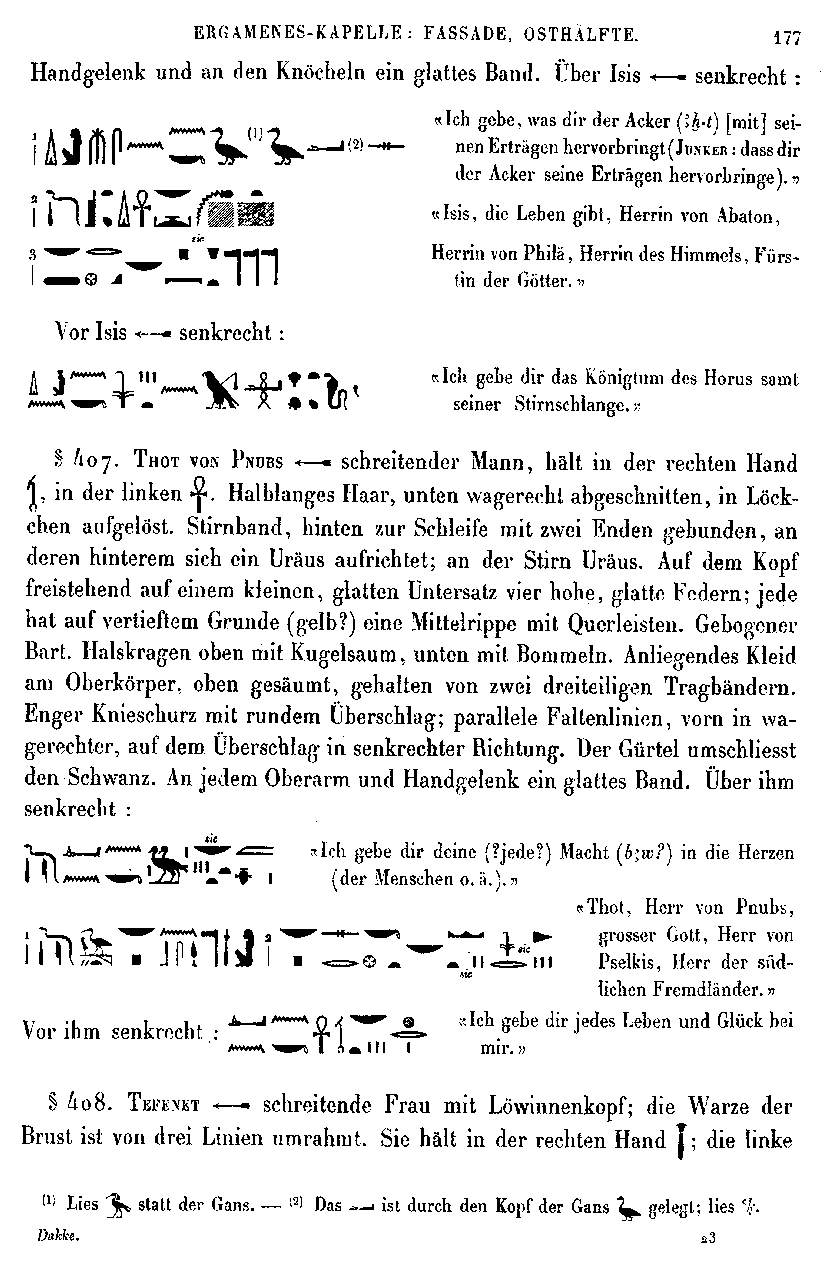
ḏd-mdw {jn} dj.n=(j) n=k bꜣw {nb.wt} =k m jb.(w)
Words spoken: I have given you the power you hold in people’s hearts.
- 264p. 177, § 407
ḏd-mdw jn ḏḥwtj n{b} pnbs nṯr ꜥꜣ nb psrk.t nb ḫꜣs.wt rsj.w(t)
Words spoken by Thoth of Pnubs, the great god, lord of Pselkis, lord of the foreign lands of the south:
- 265p. 177, § 407
dj.n=(j) n=k ꜥnḫ wꜣs nb ḫr=j
I have given you all the life and dominion in my keeping.
- 266p. 177, § 408
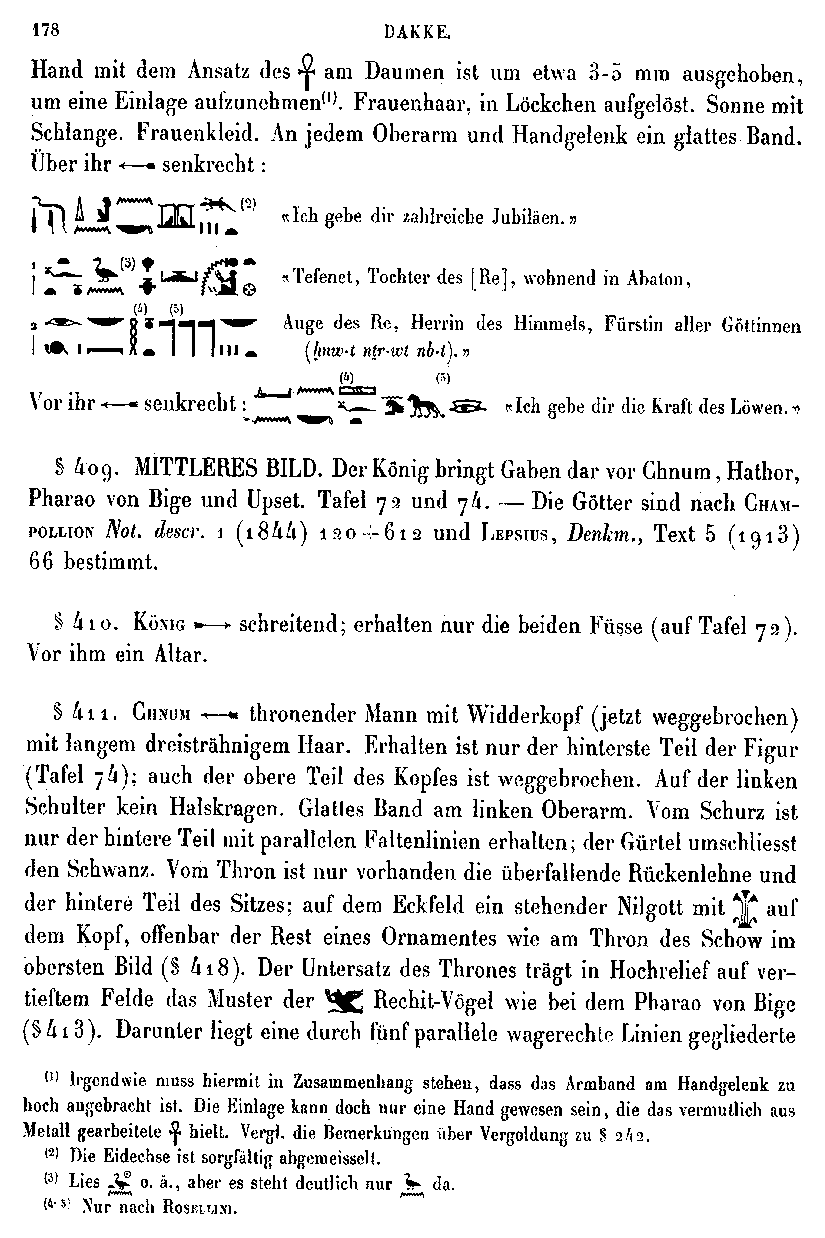
ḏd-mdw {jn} dj.n=j n=k ḥb.(w)-sd ꜥšꜣ.w{t}
Words spoken: I have given you many Sed festivals.
Note · Line 266
The Sed festival was a jubilee that renewed the king’s power, traditionally first celebrated after thirty years on the throne. - 267p. 177, § 408
tfn.t sꜣ.(t) {n} <rꜥ> ḥr.j.(t)-jb jꜣ.t-wꜥb.t jr.t rꜥ nb.(t) p.t ḥnw.t nṯr.w nb.w{t}
Tefnut, daughter of Ra, who dwells in the Abaton, Eye of Ra, lady of heaven, mistress of all the gods.
Note · Line 267
As the Eye of Ra, Tefnut embodies her father’s power to strike at his enemies. - 268p. 177, § 408
dj.n=(j) n=k šfj.t mꜣj ḥsꜣ
I have given you the awe a raging lion inspires.
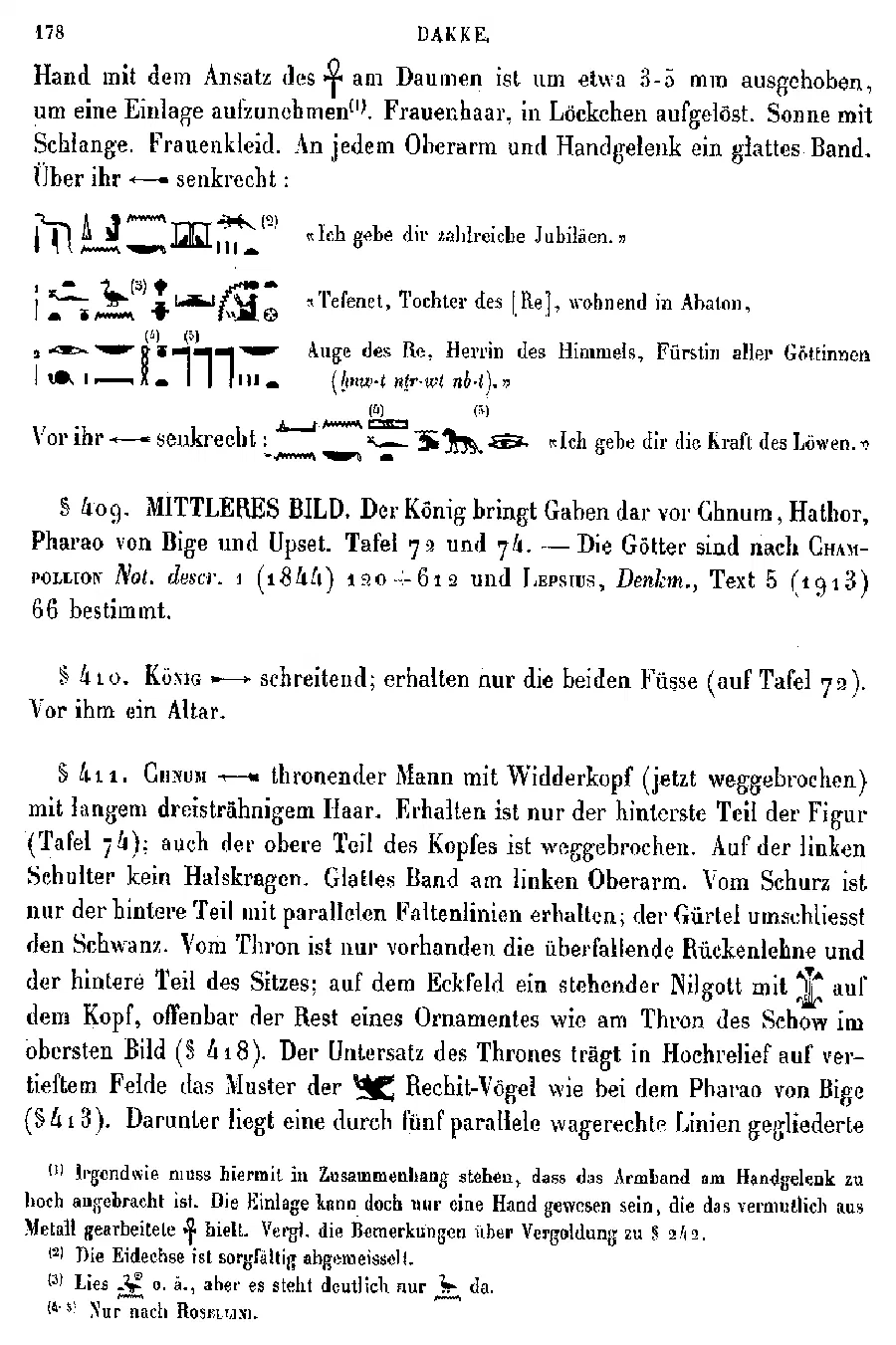
Page 178. Roeder, Der Tempel von Dakke (1930), p. 178 Printed hieroglyphs from G. Roeder, Der Tempel von Dakke (1930) - 269p. 178, § 411
dj.n=(j) n=k ḥꜥpj wr r tr=f (47)
I have given you Hapy, mighty in his season.
Note · Line 269
Hapy personifies the annual Nile flood, whose waters sustained the harvest. - 270p. 178, § 411
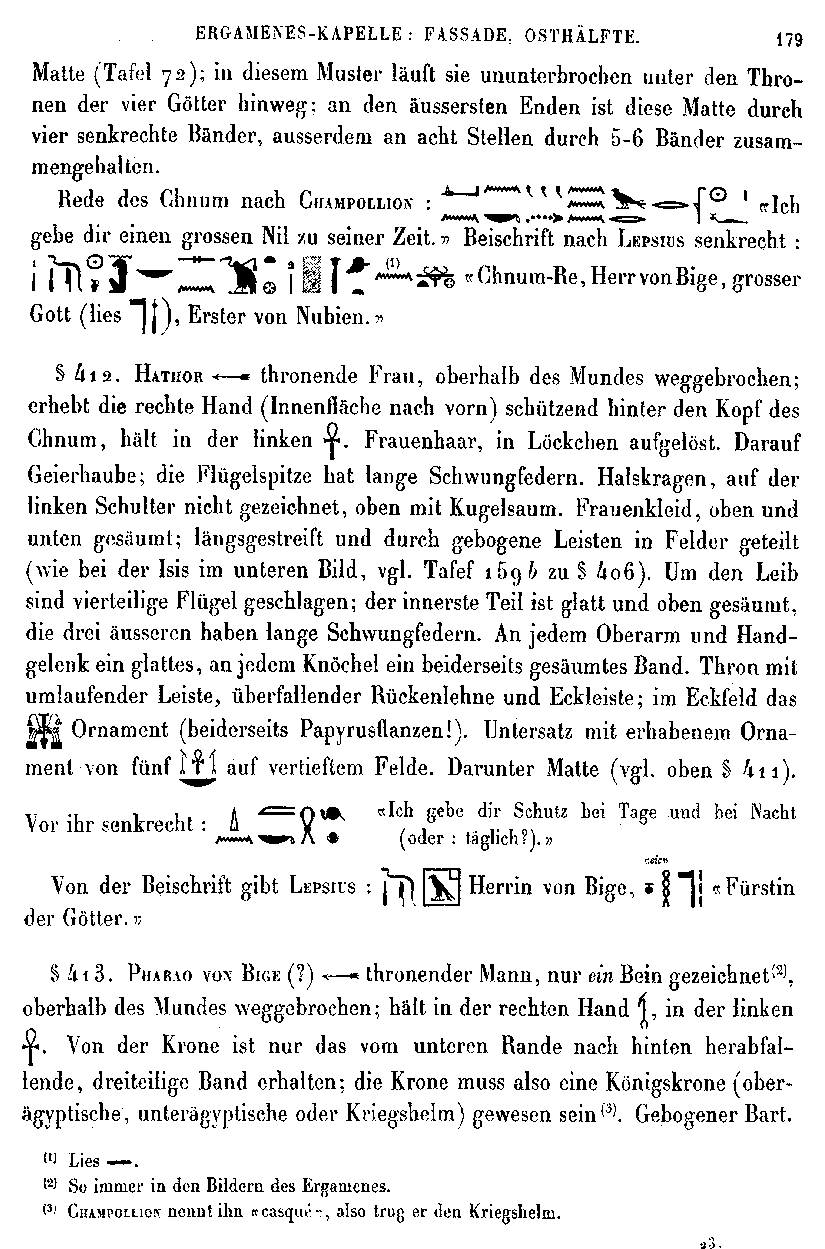
ḏd-mdw jn ẖnmw-rꜥ nb snm.t [nṯr] ꜥꜣ ḫnt.j tꜣ-stj (48)
Words spoken by Khnum-Ra, lord of Senmet, the great god, foremost in Nubia:
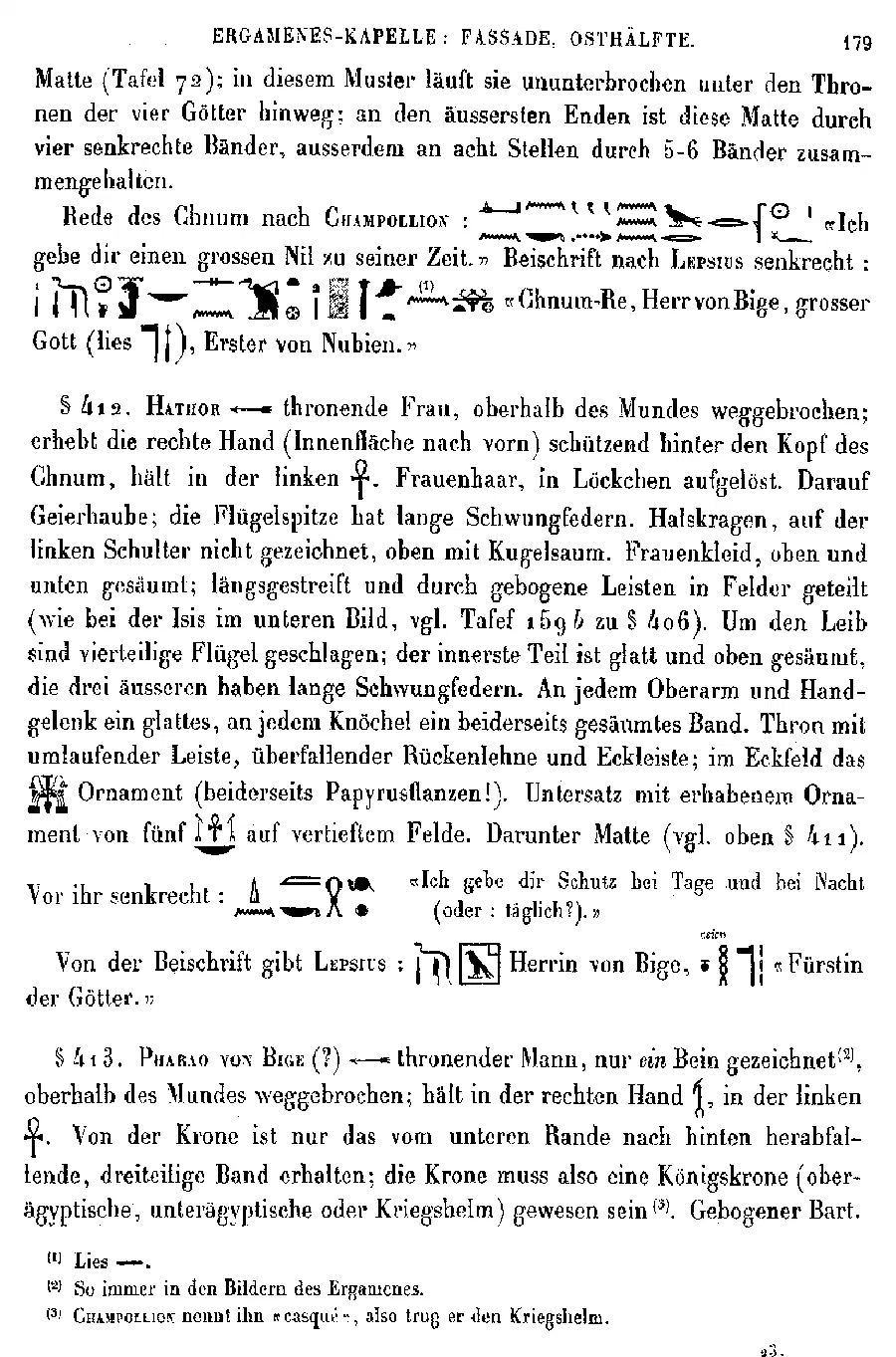
Page 179. Roeder, Der Tempel von Dakke (1930), p. 179 Printed hieroglyphs from G. Roeder, Der Tempel von Dakke (1930) - 271p. 179, § 412
dj=(j) n=k sꜣ rꜥ nb
I give you protection every day.
- 272p. 179, § 413
dj.n=(j) n=<k> snḏ.t=k m-ḫt ḫꜣs.wt rsj.w(t)
I have granted that you inspire dread throughout the foreign lands of the south.
- 273p. 179, § 413
ḏd-mdw jn pr-ꜥꜣ n snm.t nb pḥtj ḫnt.j [nṯr.w] (49)
Words spoken by Pharaoh of Senmet, lord of might, foremost among the gods:
Note · Line 273
Here “Pharaoh of Senmet” names a local god, not the king receiving the offering in return. 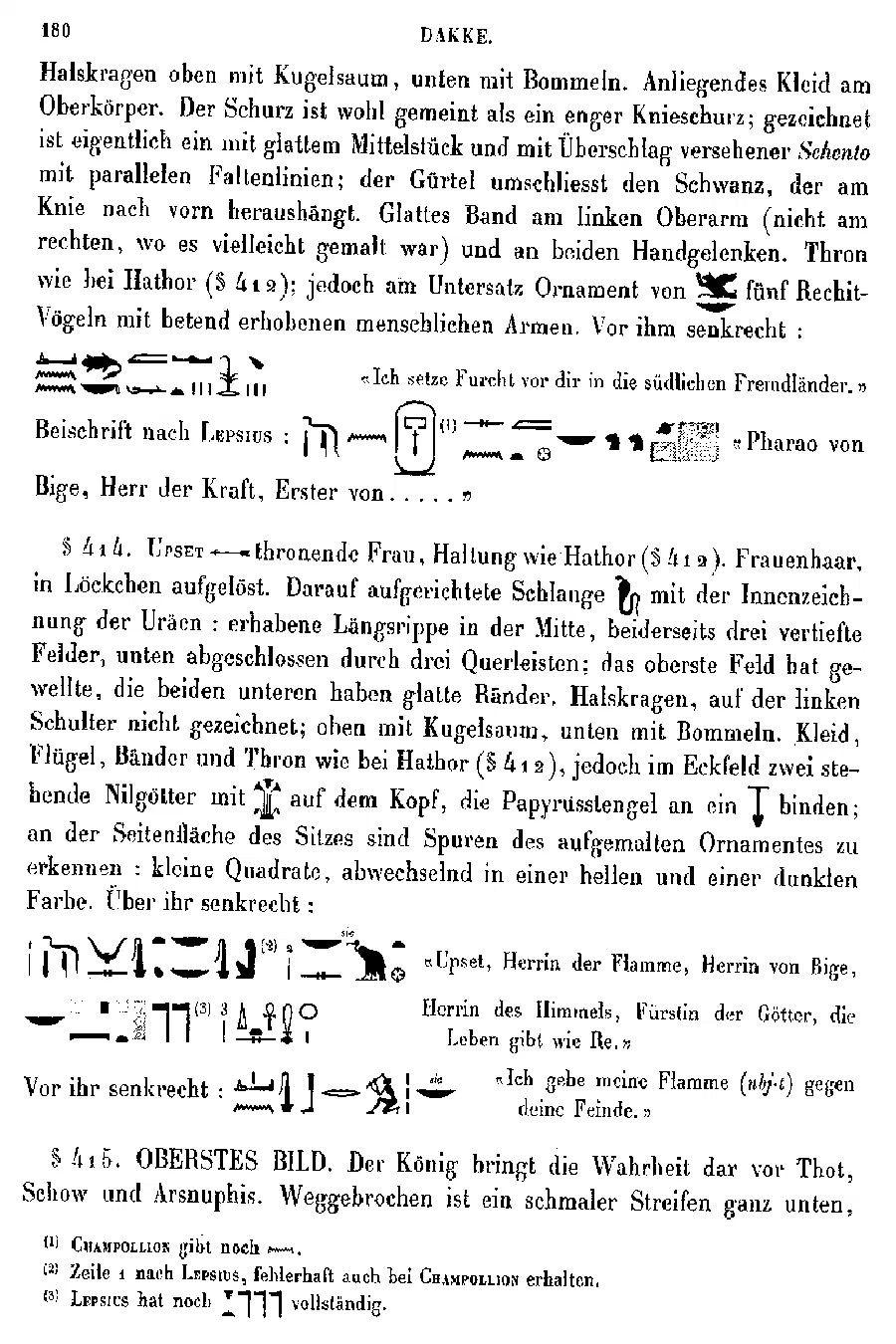
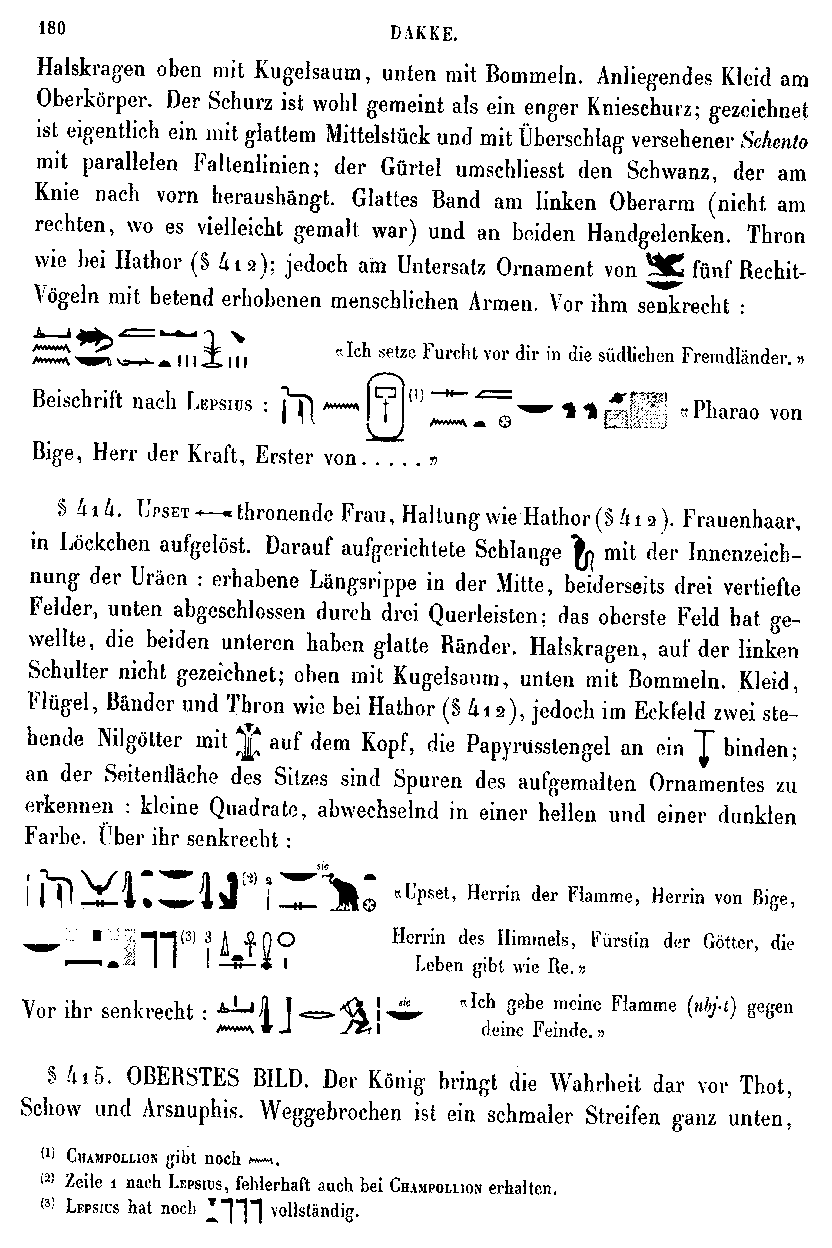
Page 180. Roeder, Der Tempel von Dakke (1930), p. 180 Printed hieroglyphs from G. Roeder, Der Tempel von Dakke (1930) - 274p. 180, § 414
ḏd-mdw jn wps.t nb.(t) nbj.t (50) nb.(t) snm.t nb.(t) p.t [ḥnw.]t nṯr.w dj.(t) ꜥnḫ mj rꜥ
Words spoken by Wepset, lady of the flame, lady of Senmet, lady of heaven, mistress of the gods, who gives life like Ra:
- 275p. 180, § 414
dj.n=j nbj.t r ḫft.j.w=k
I have turned the flame against your enemies.
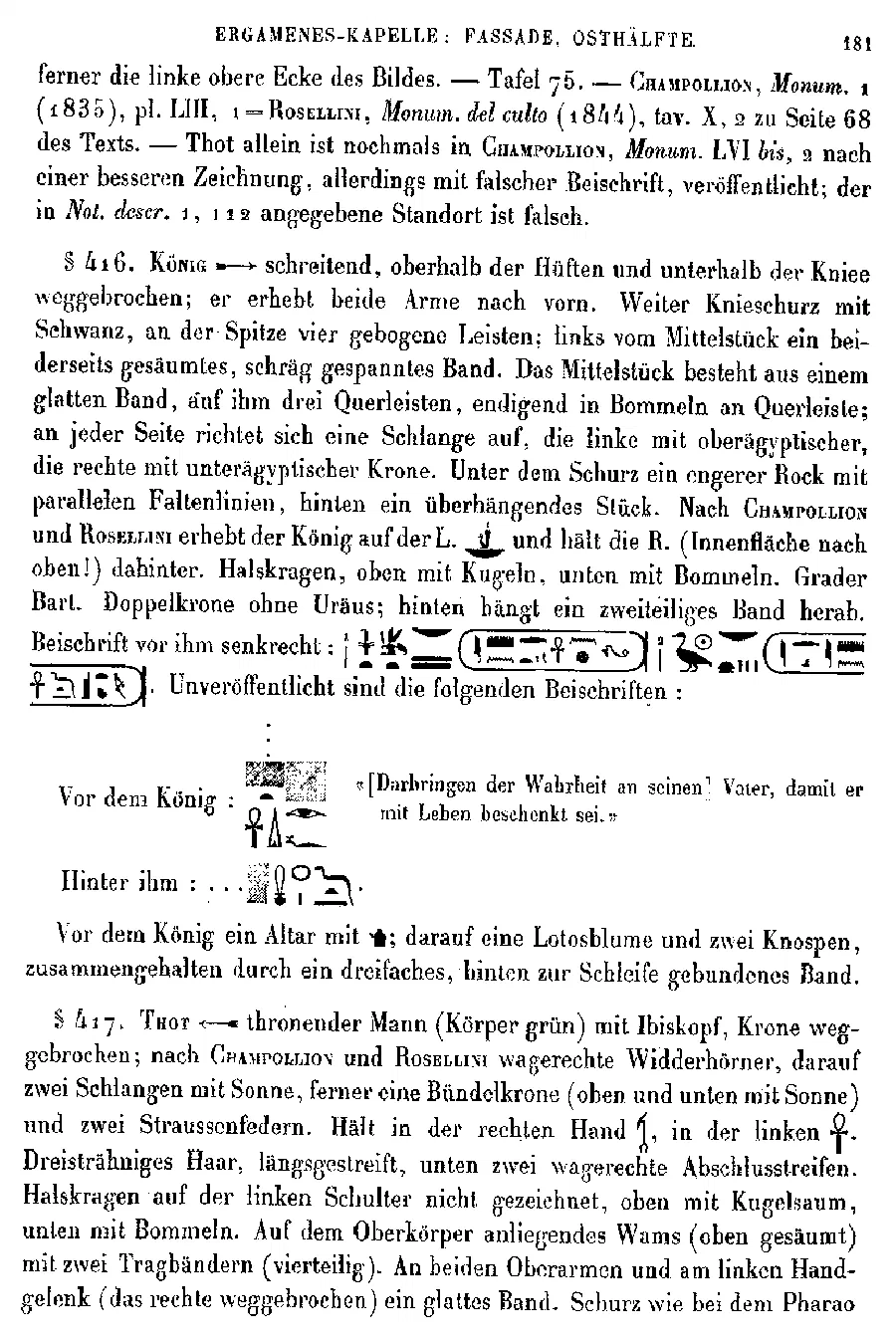
Page 181. Roeder, Der Tempel von Dakke (1930), p. 181 Printed hieroglyphs from G. Roeder, Der Tempel von Dakke (1930) - 276p. 181, § 416
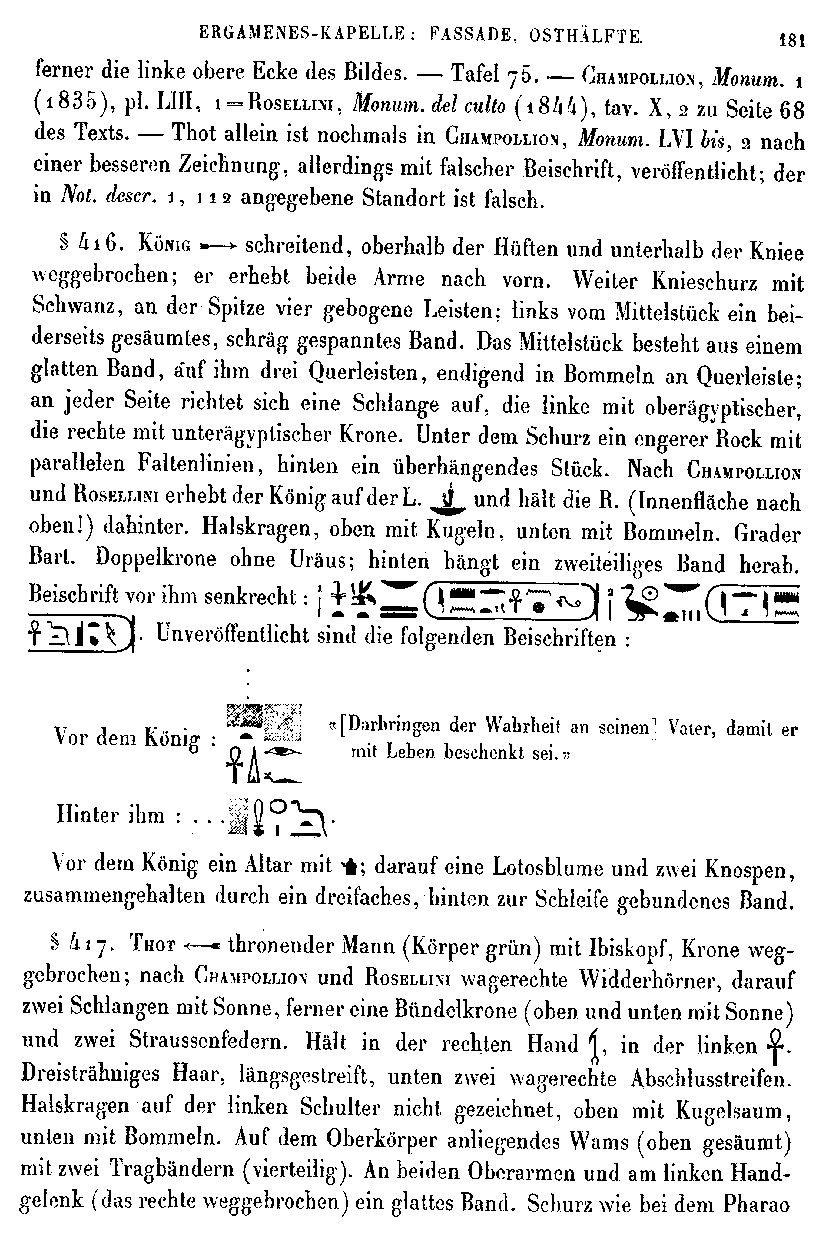
nswt-bj.tj nb-tꜣ.wj ḏr.t-ꜥnḫ-jmn-tj.t-rꜥ sꜣ-rꜥ nb-ḫꜥ.w jrḳ-jmn-ꜥnḫ-ḏ.t-mrj-ꜣs.t
King of Upper and Lower Egypt, lord of the Two Lands, Living Hand of Amun, Image of Ra; Son of Ra, lord of crowns, Arqamani, who lives forever, beloved of Isis.
Note · Line 276
Arqamani, also known as Ergamenes II, was a king of Kush. Here he bears the titles of an Egyptian pharaoh. - 277p. 181, § 416
--détruit-- jrj=f dj.(t) ꜥnḫ
… so that he may give life.
- 278p. 181, § 416
[sꜣ ꜥnḫ wꜣs nb ḥꜣ=f] mj rꜥ ḏ.t
All protection, life and dominion are behind him, as they are behind Ra, forever.
- 279p. 181, § 417
dj.n=j n=k rnp.wt n rꜥ tp tꜣ.wj
I have given you the years of Ra upon the Two Lands.
- 280p. 181, § 417
ḏd-mdw jn ḏḥwtj n <pn>bs nṯr ꜥꜣ nb psrk.t mꜣj rsj
Words spoken by Thoth of Pnubs, the great god, lord of Pselkis, lion of the south:
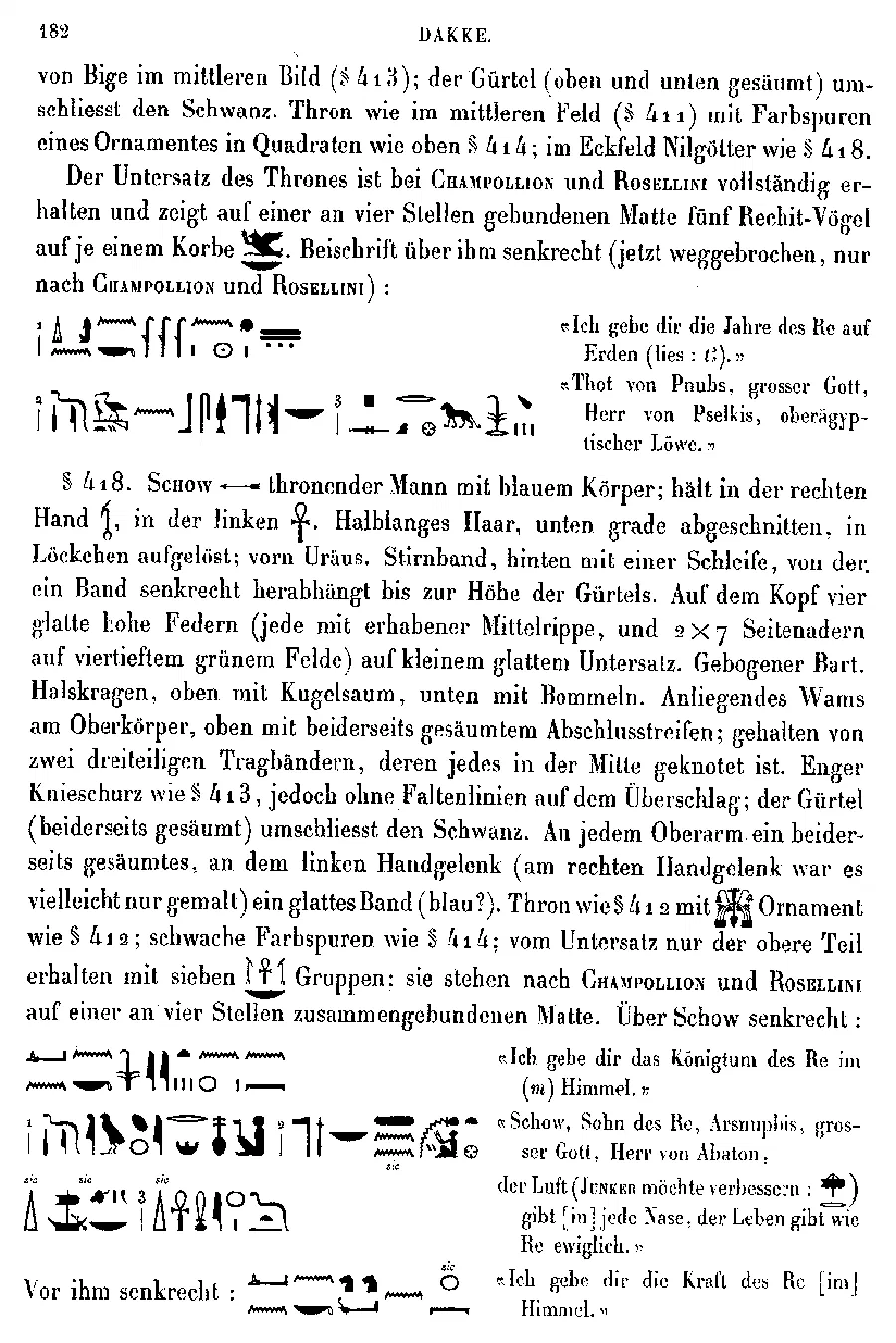
Page 182. Roeder, Der Tempel von Dakke (1930), p. 182 Printed hieroglyphs from G. Roeder, Der Tempel von Dakke (1930) - 281p. 182, § 418
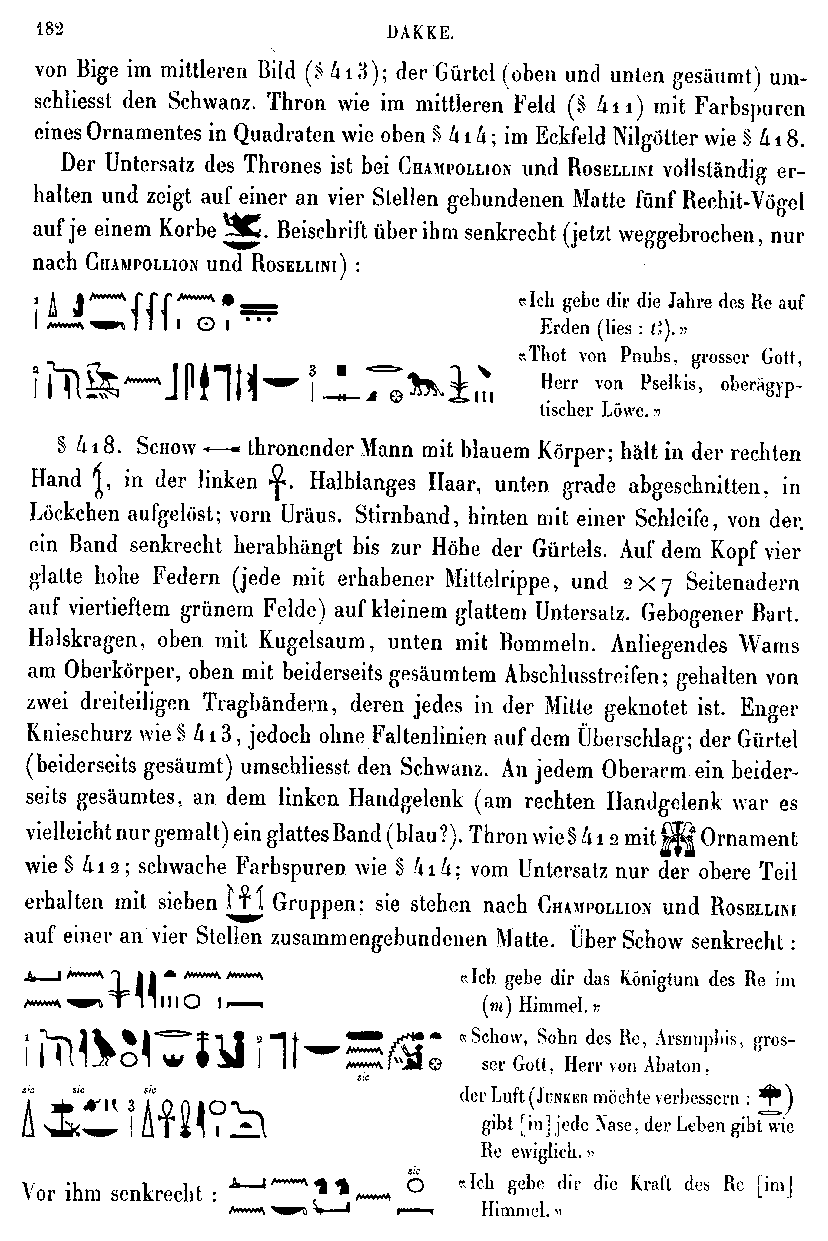
dj.n=(j) n=k nswj.t n rꜥ n p.t
I have given you the kingship of Ra in heaven.
- 282p. 182, § 418
ḏd-mdw jn šw sꜣ rꜥ jr.(j)-ḥms-nfr nṯr ꜥꜣ nb jw-wꜥb dj ṯꜣw r fnḏ nb dj ꜥnḫ mj rꜥ ḏ.t
Words spoken by Shu, son of Ra, Arensnuphis, the great god, lord of the Pure Island, who gives breath to every nostril, who gives life like Ra forever:
Note · Line 282
Here Arensnuphis is identified with Shu, the god of air. - 283p. 182, § 418
dj.n=(j) n=k pḥtj n rꜥ <m> p.t
I have given you the might of Ra in heaven.
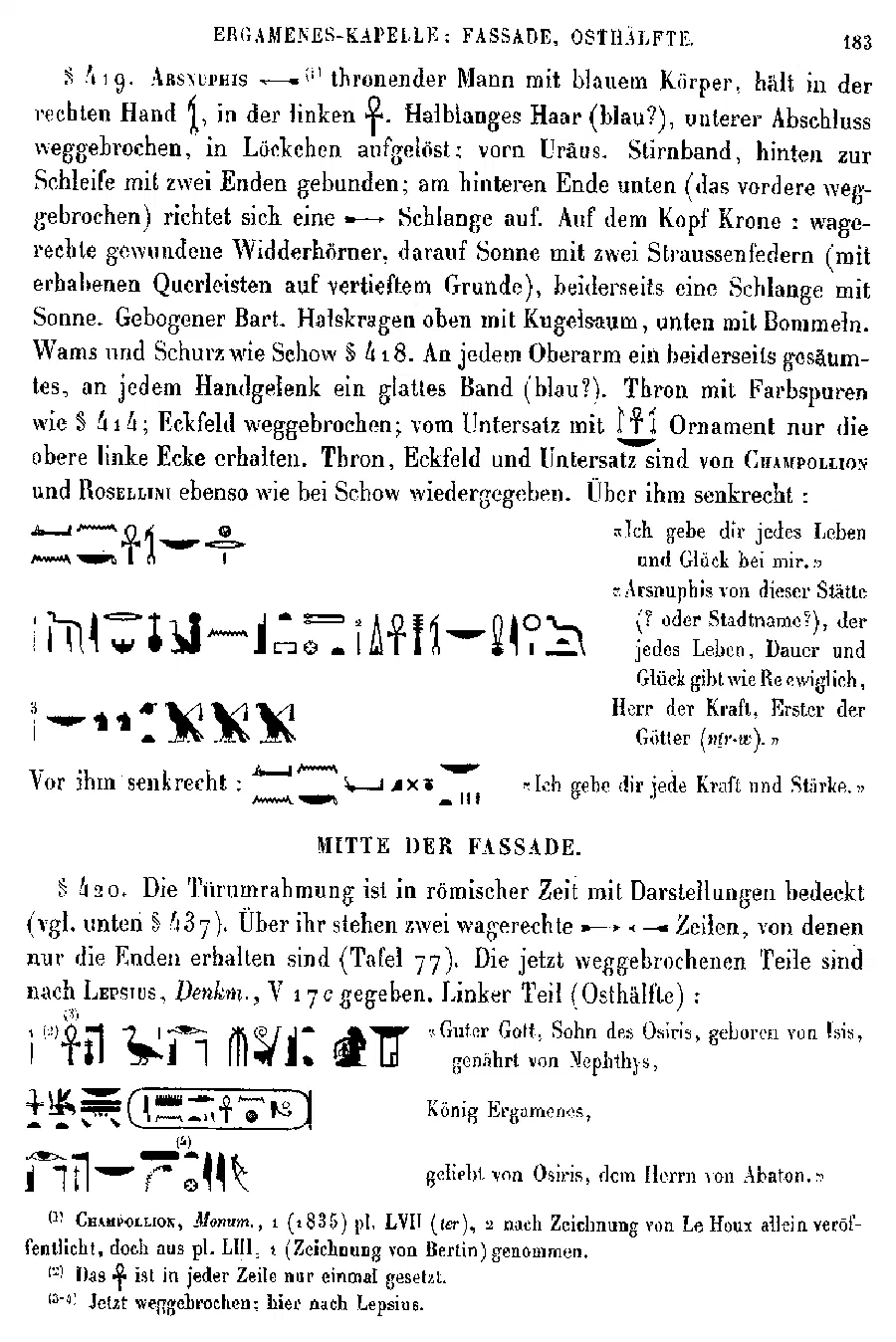
Page 183. Roeder, Der Tempel von Dakke (1930), p. 183 Printed hieroglyphs from G. Roeder, Der Tempel von Dakke (1930) - 284p. 183, § 419
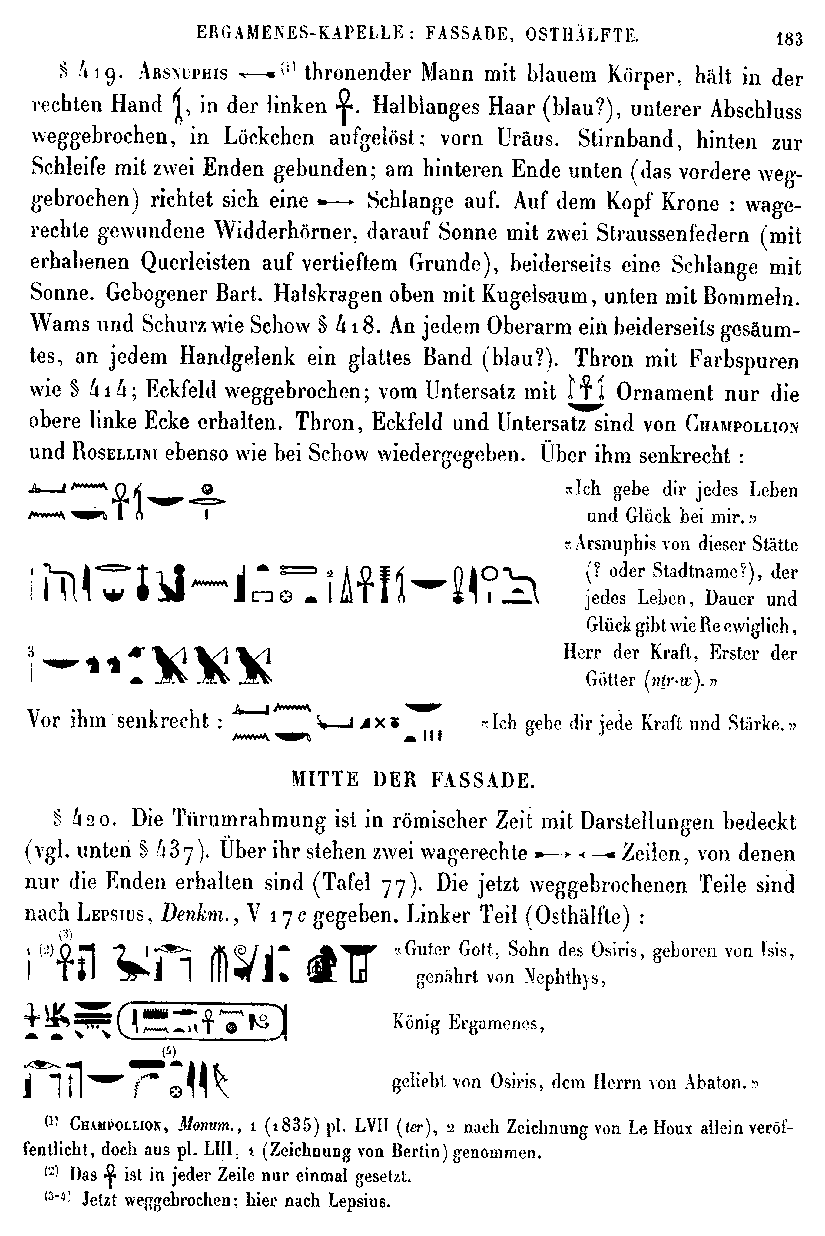
dj.n=(j) n=k ꜥnḫ wꜣs nb ḫr=j
I have given you all the life and dominion in my keeping.
- 285p. 183, § 419
ḏd-mdw jn jr.(j)-ḥms-nfr n s.t=ṯ dj ꜥnḫ ḏd wꜣs nb mj rꜥ ḏ.t nb pḥtj ḫnt.j nṯr.w
Words spoken by Arensnuphis of Setetj, who gives all life, stability and dominion like Ra forever, lord of might, foremost among the gods:
- 286p. 183, § 419
dj.n=(j) n=k ḳn nb.{wt}
I have given you valor in full measure.
- 287
ꜥnḫ nṯr nfr sꜣ wsjr msj.n ꜣs.t rr nb.t-ḥw.t nswt-bj.tj nb-tꜣ.wj ḏr.t-ꜥnḫ-jmn-tj.t-rꜥ mrj wsjr nṯr ꜥꜣ nb jw-wꜥb (51)
Long live the perfect god, son of Osiris, whom Isis bore and Nephthys nursed, King of Upper and Lower Egypt, lord of the Two Lands, Living Hand of Amun, Image of Ra, beloved of Osiris, the great god, lord of the Abaton!
Note · Line 287
The Abaton, the “Pure Island” of the Egyptian text, was the sacred burial place of Osiris on Bigeh, near Philae. - 288
ꜥnḫ nṯr nfr tj.t n rꜥ šrj jmn sꜣ-rꜥ nb-ḫꜥ.w jrḳ-jmn-ꜥnḫ-ḏ.t-mrj-ꜣs.t mrj dj.(t) ꜥnḫ ꜣs.t nb.(t) jw-wꜥb (52)
Long live the perfect god, image of Ra, child of Amun, Son of Ra, lord of crowns, Ergamenes, who lives forever, beloved of Isis, beloved of Isis the life-giver, lady of the Abaton!
Note · Line 288
The first “beloved of Isis” belongs to his royal name. - 289
ꜥnḫ nṯr nfr sꜣ ẖnmw msj.n st.t rr (53) ꜥnḳ.t nswt-bj.tj nb-tꜣ.wj ḏr.t-ꜥnḫ-jmn-tj.t-rꜥ mrj jr.(j)-ḥms-nfr nṯr ꜥꜣ nb jw-wꜥb
Long live the perfect god, son of Khnum, whom Satis bore and Anukis nursed, King of Upper and Lower Egypt, lord of the Two Lands, Living Hand of Amun, Image of Ra, beloved of Arensnuphis, the great god, lord of the Abaton!
- 290
ꜥnḫ nṯr nfr sꜣ ḥḏ.t msj N.t rr (54) n wr.(t)-ḥkꜣ.(w) sꜣ-rꜥ nb-ḫꜥ.w jrḳ-jmn-ꜥnḫ-ḏ.t-mrj-ꜣs.t mrj ḏḥwtj n pnbs
Long live the perfect god, son of the White Crown, whom the Red Crown bore and Werethekau nursed, Son of Ra, lord of crowns, Ergamenes, who lives forever, beloved of Isis, beloved of Thoth of Pnubs!
Note · Line 290
The White Crown of Upper Egypt and the Red Crown of Lower Egypt appear here as divine mothers. Werethekau, “Great of Magic,” embodies the power of the crowns. 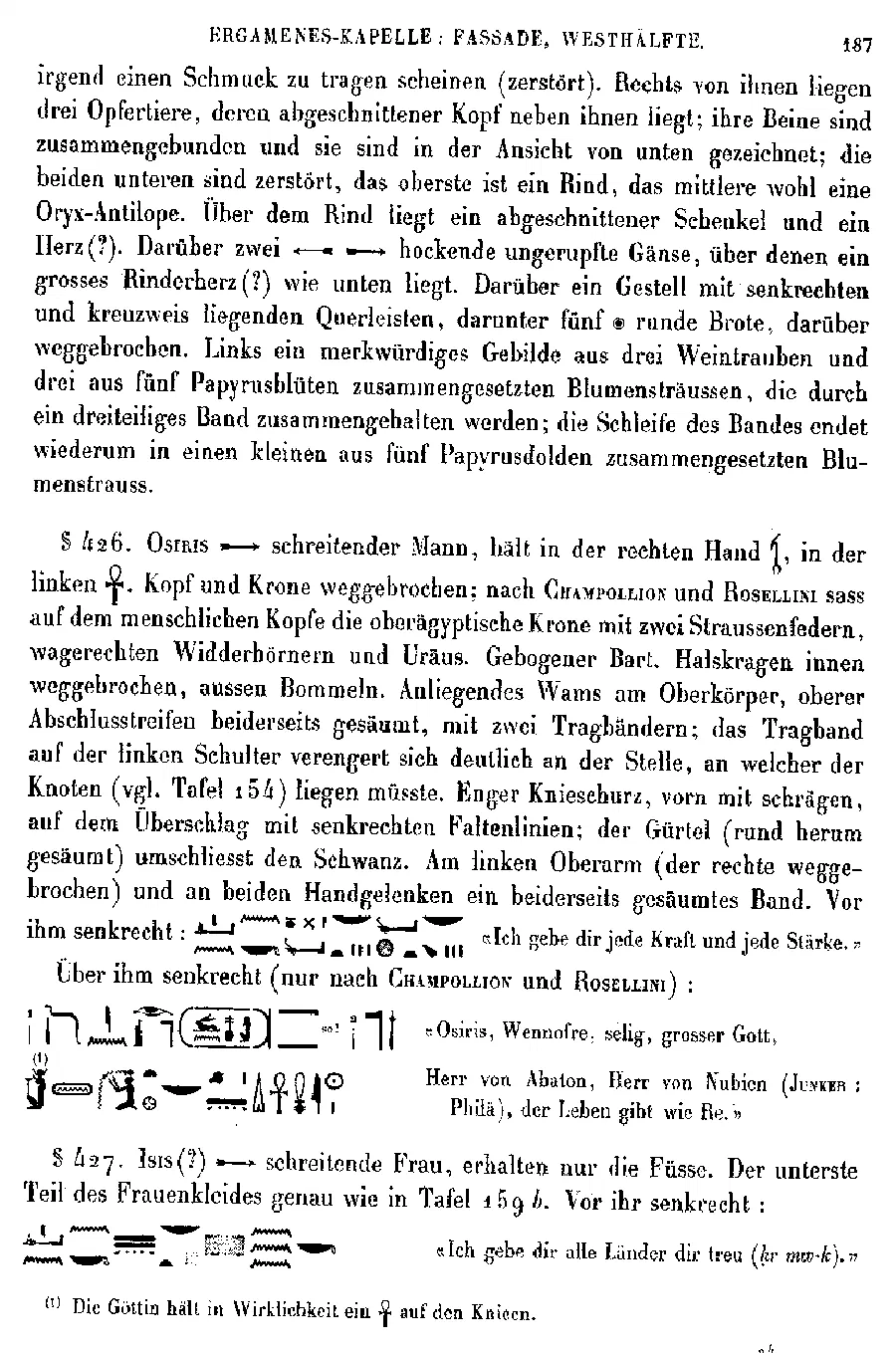
Page 187. Roeder, Der Tempel von Dakke (1930), p. 187 Printed hieroglyphs from G. Roeder, Der Tempel von Dakke (1930) - 291p. 187, § 426
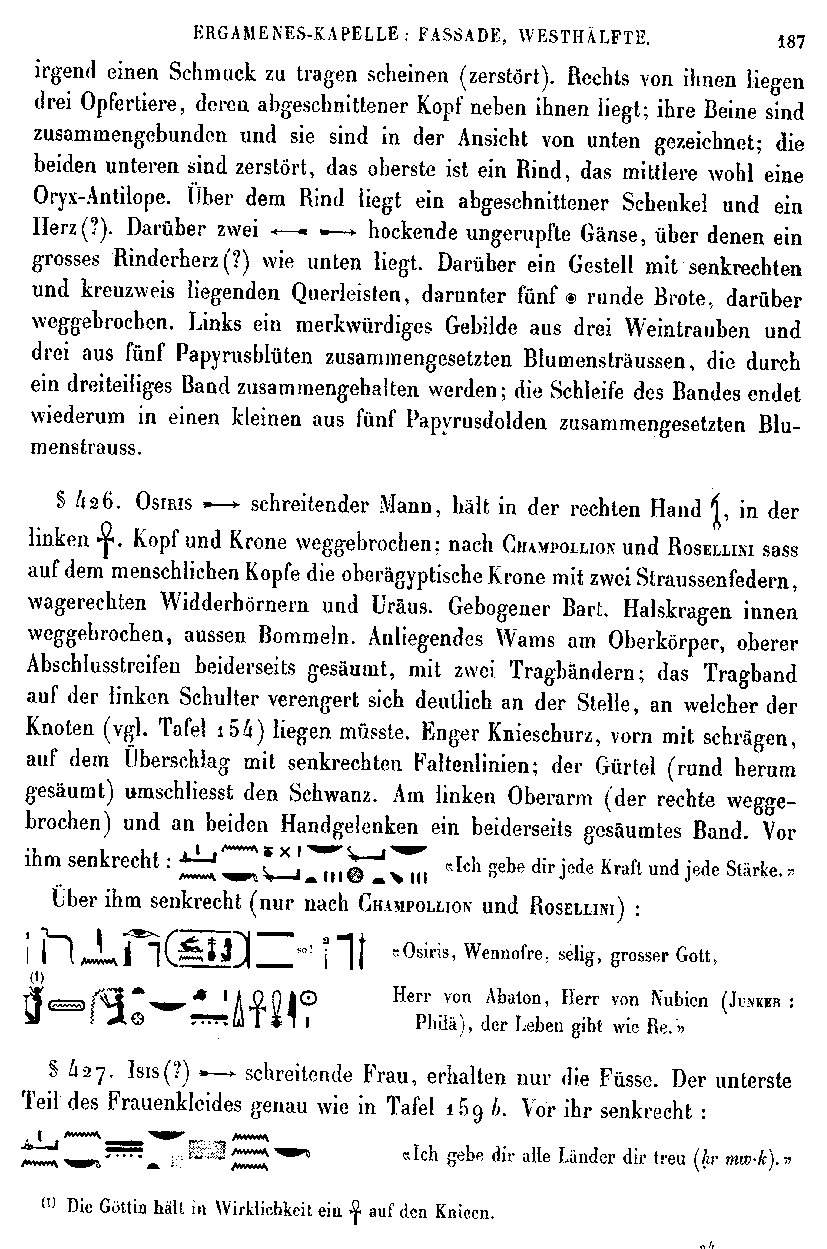
dj.n=j n=k ḳn nb.{wt} nḫt nb.{w} (55)
I have given you all strength and all might.
- 292p. 187, § 426
ḏd-mdw jn wsjr wn-nfr mꜣꜥ-ḫrw nṯr ꜥꜣ nb jw-wꜥb nb ḫnt-tꜣ dj ꜥnḫ mj rꜥ (56)
Words spoken by Osiris Wennefer, the vindicated one, the great god, lord of the Abaton, lord of Khent-ta, who gives life like Ra.
Note · Line 292
“The vindicated one” names Osiris as the victor in the divine judgment. - 293p. 187, § 427
dj.n=j n=k tꜣ.wj nb.{t} [ḥr] mw=k (57)
I have given you the Two Lands entire, upon your water.
Note · Line 293
To be “upon your water” is to owe you allegiance. - 294p. 187, § 427
ḏd-mdw jn ꜣs.t dj.(t) ꜥnḫ nb.(t) jw-wꜥb nb.(t) jwrḳ jr.t rꜥ nb.(t) p.t ḥnw.t nṯr.w nb.w (58)
Words spoken by Isis the life-giver, lady of the Abaton, lady of Philae, Eye of Ra, lady of the sky, mistress of all the gods.
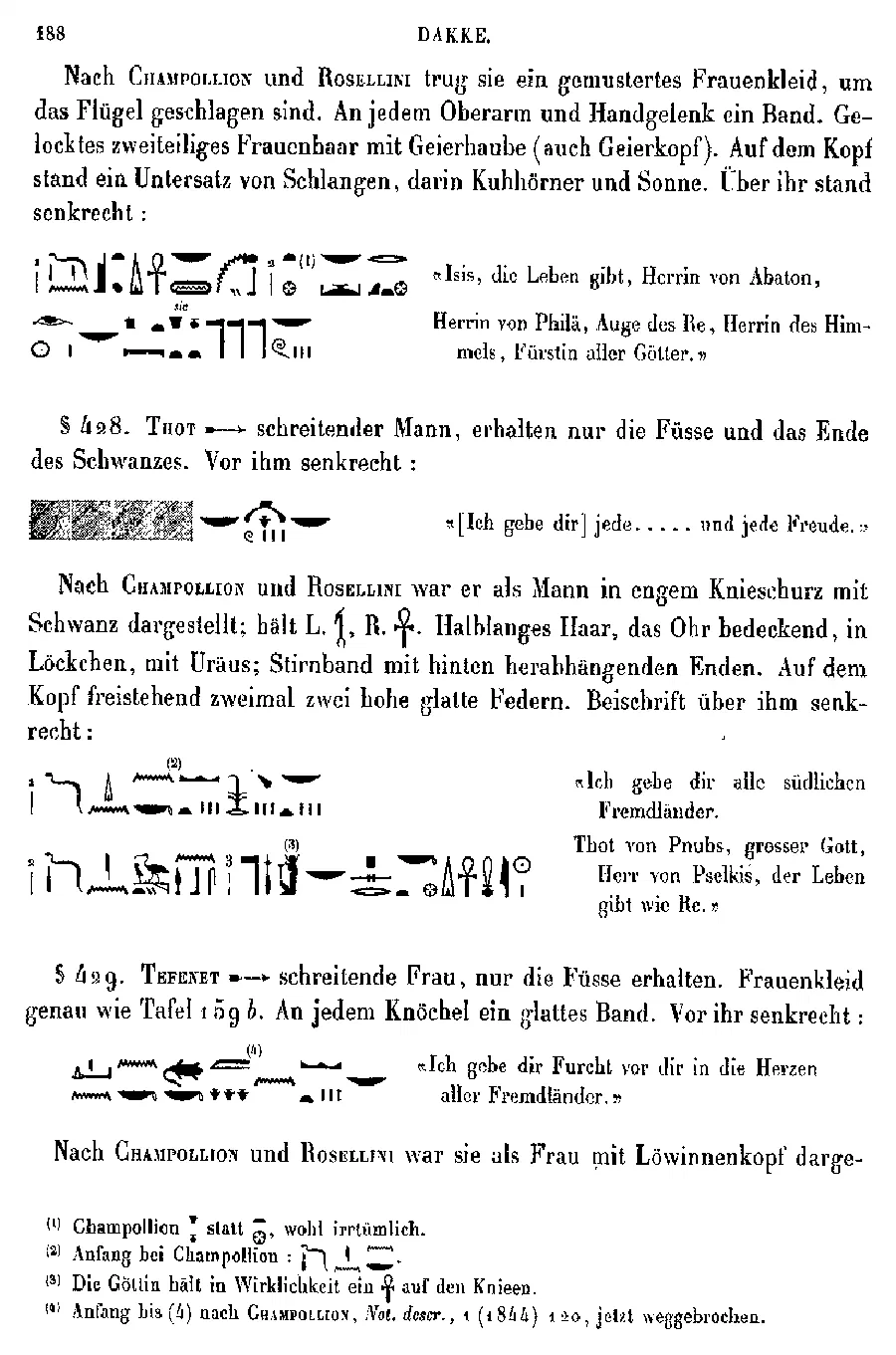
Page 188. Roeder, Der Tempel von Dakke (1930), p. 188 Printed hieroglyphs from G. Roeder, Der Tempel von Dakke (1930) - 295p. 188, § 428
ḏd-mdw dj.n=(j) n=k ḫꜣs.wt rsj.w(t) nb.wt (60)
Words spoken: I have given you all the foreign lands of the south.
- 296p. 188, § 428
ḏd-mdw jn ḏḥwtj n <pn>bs nṯr ꜥꜣ nb psrk.t dj ꜥnḫ mj rꜥ (61)
Words spoken by Thoth of Pnubs, the great god, lord of Pselkis, who gives life like Ra.
- 297p. 188, § 429
dj.n=j n=k snḏ=k m jb.w n ḫꜣs.wt nb.(wt) (62)
For you I have set the dread of you in the hearts of all foreign lands.
- 298p. 188, § 429
dj=(j) n=k ḫꜣs.wt mḥ.wt nb.(wt) ẖr ṯb.tj=k (63)
I give you all the foreign lands of the north beneath your two sandals.
- 299p. 188, § 429
ḏd-mdw jn tfn.t sꜣ.t rꜥ nb.(t) p.t ḥnw.t nṯr.w (64)
Words spoken by Tefnut, daughter of Ra, lady of the sky, mistress of the gods.
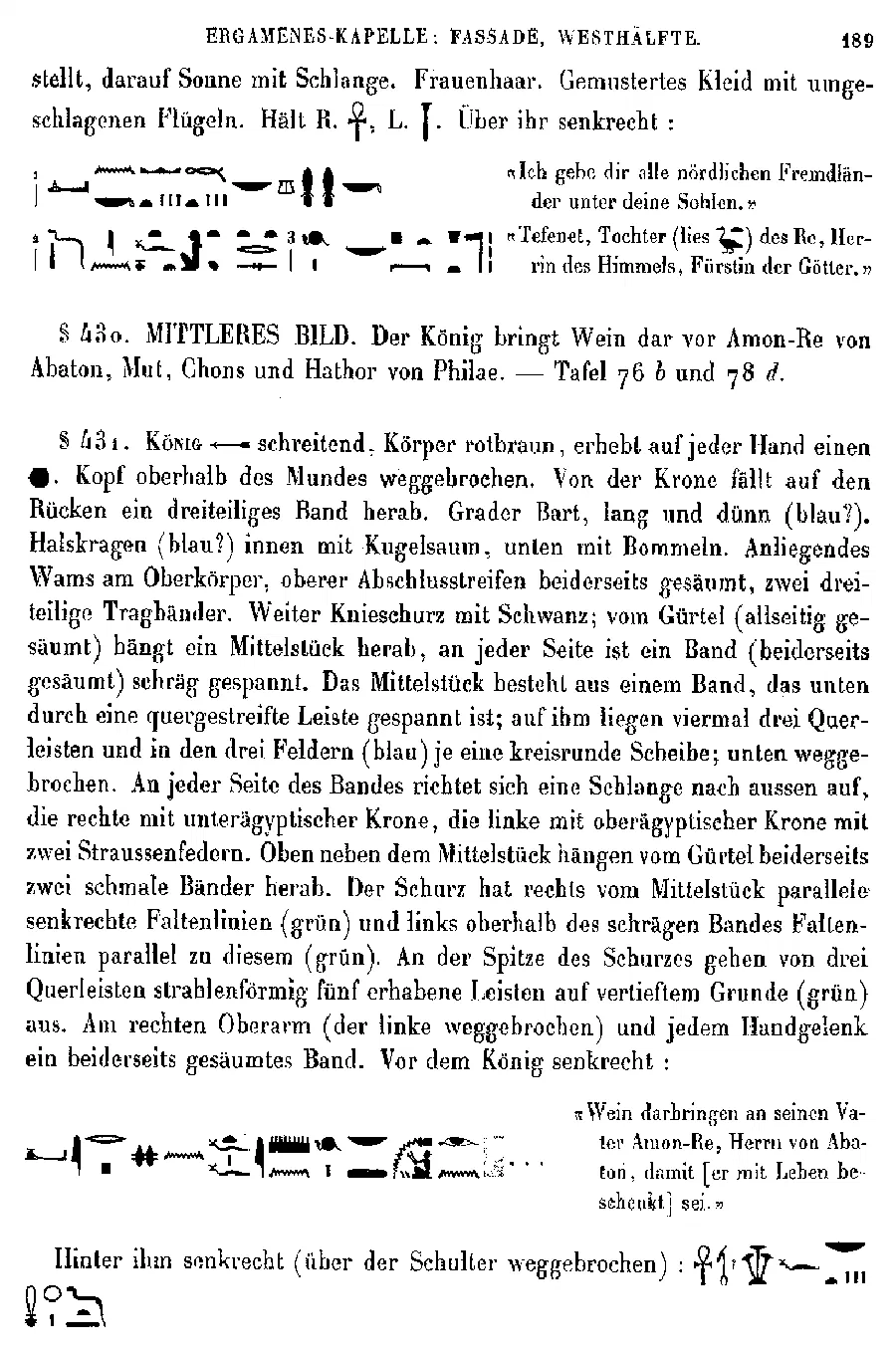
Page 189. Roeder, Der Tempel von Dakke (1930), p. 189 Printed hieroglyphs from G. Roeder, Der Tempel von Dakke (1930) - 300p. 189, § 431
ḥnk jrp n jt=f jmn-rꜥ nb jw-wꜥb jrj.n[=f dj.t ꜥnḫ]
Offering wine to his father Amun-Ra, lord of the Abaton. The king has done this so that his father may give him life.
- 301p. 189, § 431
[sꜣ] ꜥnḫ wꜣs nb.{wt} ḥꜣ=f mj rꜥ ḏ.t
All protection, life and dominion are behind him, as they are behind Ra, forever.
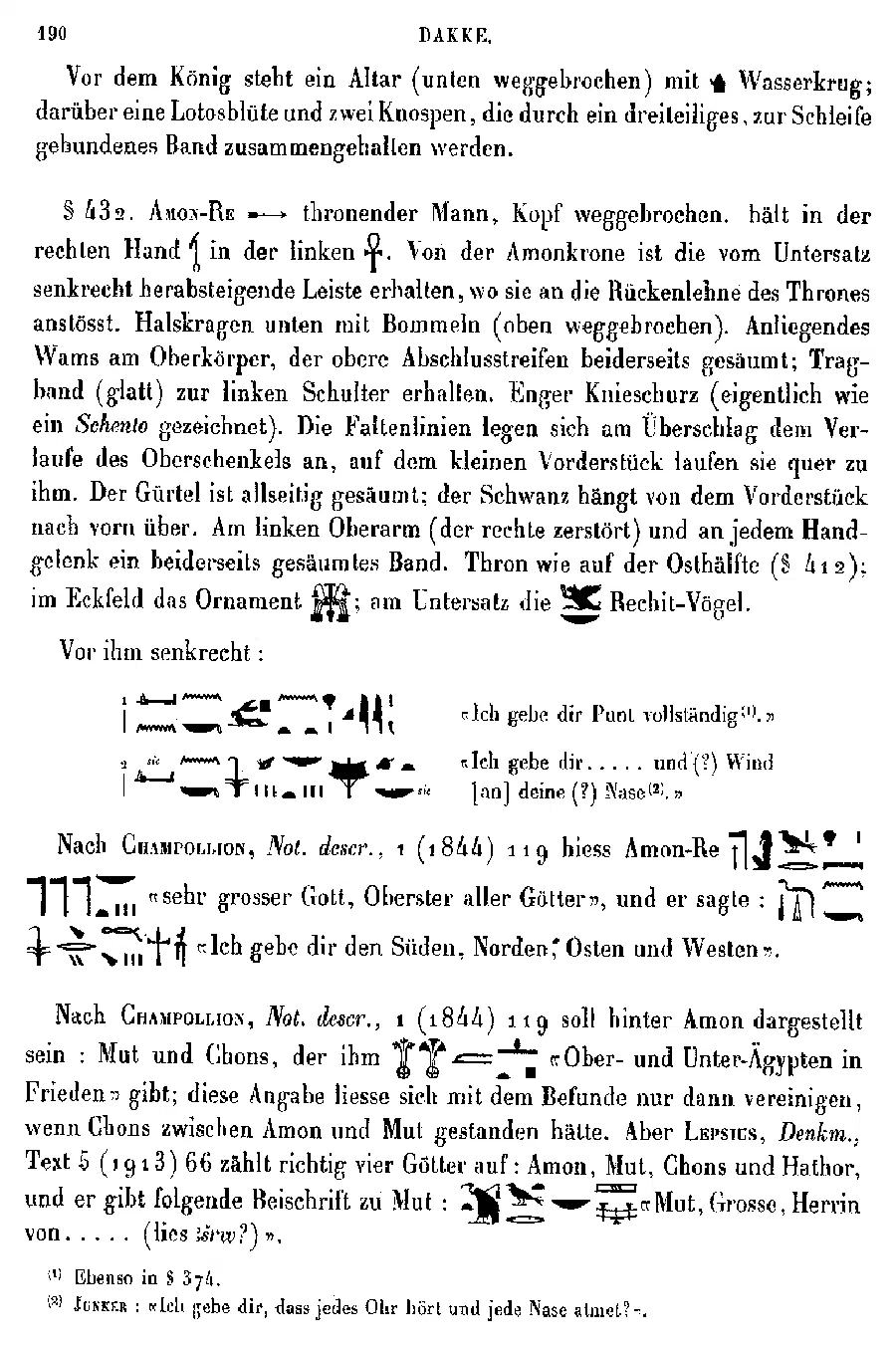
Page 190. Roeder, Der Tempel von Dakke (1930), p. 190 Printed hieroglyphs from G. Roeder, Der Tempel von Dakke (1930) - 302p. 190, § 432
dj.n=(j) n=k pwn.t ḥr ḳj=f (65)
I have given you Punt in its entirety.
Note · Line 302
Punt was a land on the Red Sea trading routes from which the Egyptians obtained incense and other precious goods. - 303p. 190, § 432
dj=(j) n=k rsj.j.w nb.w{t} mḥ.j.(w) nb.(w) (66)
I give you all southerners and all northerners.
- 304p. 190, § 432
jmn-rꜥ nṯr ꜥꜣ wr ḥr.j nṯr.w nb.w{t}
Amun-Ra, the very great god, chief of all the gods.
- 305p. 190, § 432
ḏd-mdw dj=(j) n=k rsj mḥw jꜣb.t jmnt.t
Words spoken: I give you the south, the north, the east and the west.
- 306p. 190, § 432
mw.t wr.t nb.(t) išrw
Mut the Great, lady of the Isheru.
Note · Line 306
The Isheru is the sacred lake at Mut’s temple at Karnak. 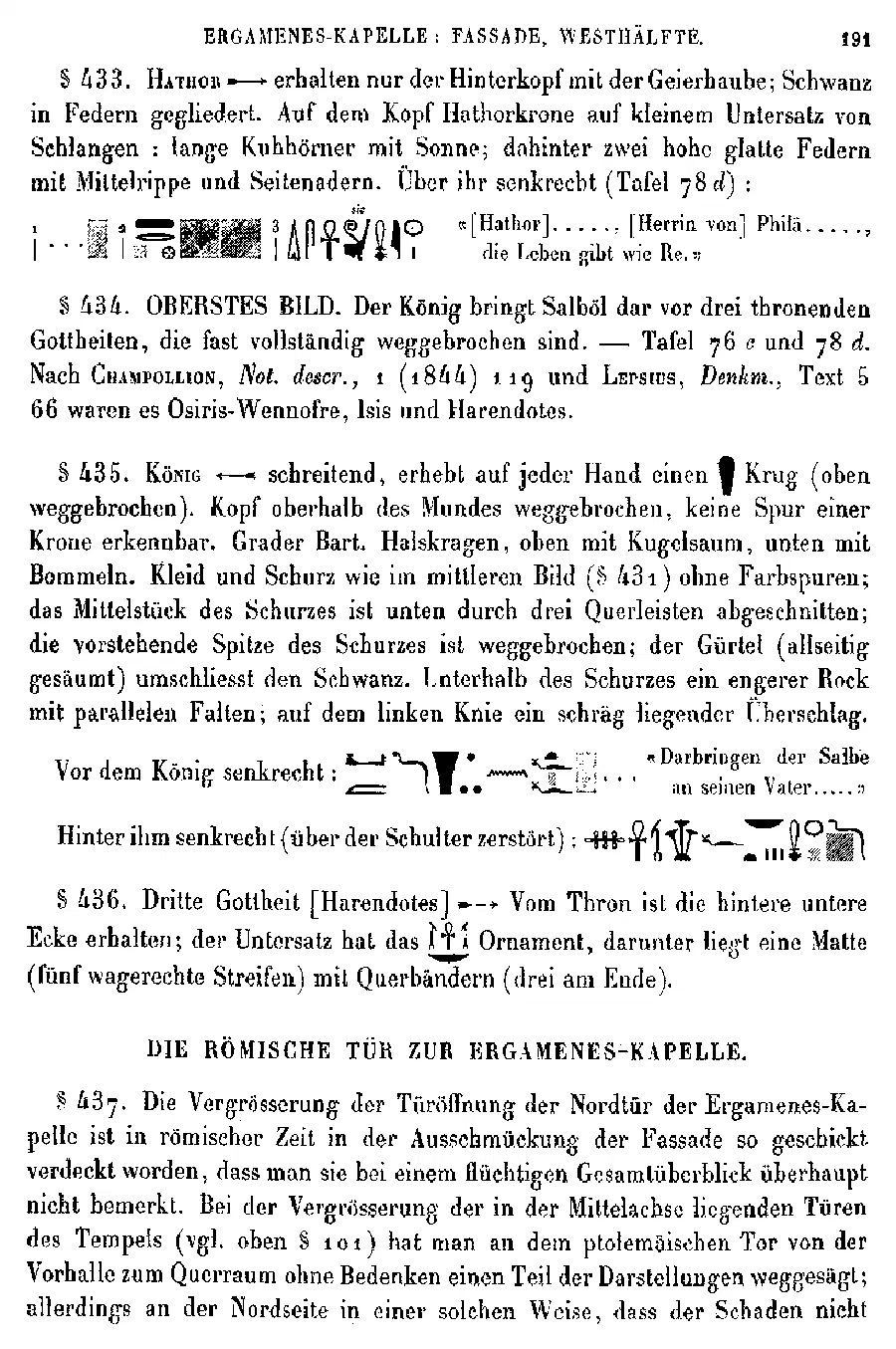
Page 191. Roeder, Der Tempel von Dakke (1930), p. 191 Printed hieroglyphs from G. Roeder, Der Tempel von Dakke (1930) - 307p. 191, § 433
--détruit-- jwrḳ --2Q-- dj=s ꜥnḫ mj rꜥ
… Philae … she gives life like Ra.
- 308p. 191, § 435
ḥnk mḏ n jt=f [šps] --détruit-- sꜣ ꜥnḫ wꜣs nb.{wt} ḥꜣ=f mj rꜥ ḏ.t
Offering ointment to his venerable father … All protection, life and dominion are behind him, as they are behind Ra, forever.
Page 192. Roeder, Der Tempel von Dakke (1930), p. 192 Printed hieroglyphs from G. Roeder, Der Tempel von Dakke (1930) - 309p. 192, § 439
nswt-bj.tj nb-<tꜣ.wj> ꜣ<w>t<ḳ>rdr sꜣ-rꜥ <nb>-ḫꜥ.w tbrys …(?)
King of Upper and Lower Egypt, lord of the Two Lands, Autokrator, Son of Ra, lord of crowns, Tiberius …
Note · Line 309
Here the Roman emperor bears the titles of a pharaoh. - 310p. 192, § 439
[sꜣ] ꜥnḫ wꜣs nb ḥꜣ=f mj rꜥ ḏ.t
All protection, life and dominion are behind him, as they are behind Ra, forever.
- 311p. 192, § 439
<dj> n=j mꜣꜥ.t r nb --1Q--détruit-- (67)
I have given Maat to the lord …
Note · Line 311
The king presents her image as an offering. 
Page 172. Roeder, Der Tempel von Dakke (1930), p. 172 Printed hieroglyphs from G. Roeder, Der Tempel von Dakke (1930) - 312p. 172, § 440
nfr.wj nn sn=(j) mrj=(j) sꜥr=k mꜣꜥ.t (68)
How beautiful this is, my beloved brother, as you lift up Maat!
- 313p. 172, § 440
ḏd-mdw jn ꜣs.t dj.(t) [ꜥnḫ] nb.(t) jw-wꜥb nswt-bj.tj nb-tꜣ.wj ḏr.t-ꜥnḫ-jmn-[tj.t-rꜥ]
Words spoken by Isis the life-giver, lady of the Abaton. King of Upper and Lower Egypt, lord of the Two Lands, Living Hand of Amun, Image of Ra.
Page 194. Roeder, Der Tempel von Dakke (1930), p. 194 Printed hieroglyphs from G. Roeder, Der Tempel von Dakke (1930) - 314p. 194, § 441
ḏd-mdw jn ḏḥwtj n <pn>bs …(?)
Words spoken by Thoth of Pnubs …
- 315p. 194, § 442
ḏd-mdw jn wps.t nb.(t) nbj.t <m> ḥw.t-nsr
Words spoken by Wepset, lady of flame in the House of Fire.
- 316p. 194, § 442
jw=<k> j{n}j.tj m ḥtp ḥḳꜣ pwn.t … (?) jnw m (?) tꜣ-nṯr.w … (?) (69)
You have come in peace, ruler of Punt … tribute from the Land of the Gods …
Page 195. Roeder, Der Tempel von Dakke (1930), p. 195 Printed hieroglyphs from G. Roeder, Der Tempel von Dakke (1930) - 317p. 195, § 444
nswt-bj.tj ꜣwt<g>rdr sꜣ-rꜥ tbrys ksyr<s>
King of Upper and Lower Egypt, Autokrator; Son of Ra, Tiberius Caesar.
Note · Line 317
Here it fills the place of an Egyptian king’s throne name. - 318p. 195, § 444
sꜣ ꜥnḫ wꜣs nb ḥꜣ=f mj rꜥ ḏ.t
All protection, life and dominion stand behind him as they stand behind Ra, forever.
- 319p. 195, § 444
<dj>.n=j mꜣꜥ.t r nb=f (70) ḏḥwtj nb --0.5Q--
I have given Maat to its lord, Thoth, lord of …
Note · Line 319
The king offers her image to Thoth. - 320p. 172, § 445
ḳljwpꜣtrꜣ nfr.wj nn … (?) ḏd-mdw jn ꜣs.t dj.(t) [ꜥnḫ] nb.(t) <jw>-wꜥb sꜣ-rꜥ nb-ḫꜥ.w jrḳ-jmn-ꜥnḫ-ḏ.t-mrj-ꜣs.t
Cleopatra. How beautiful this is … Words spoken by Isis, giver of life, Lady of the Abaton. Son of Ra, Lord of Crowns, Ergamenes, living forever, beloved of Isis.
Page 196. Roeder, Der Tempel von Dakke (1930), p. 196 Printed hieroglyphs from G. Roeder, Der Tempel von Dakke (1930) - 321p. 196, § 446
ḏd-mdw jn wsjr nṯr ꜥꜣ nb <jw>-wꜥb
Words spoken by Osiris, the great god, Lord of the Abaton.
- 322p. 196, § 447
ḏd-mdw jn ꜣs.t dj.(t) ꜥnḫ nb.(t) <jw>-wꜥb
Words spoken by Isis, giver of life, Lady of the Abaton.
- 323p. 196, § 447
ḥḳꜣ nb ꜥn ḫꜥj <m> ḥḏ.t … (?) jmj n nb nfr (?) nb <tꜣ-km>-sꜣ.t pꜥpꜥ m --détruit--
Ruler, lord, fair when he appears in the White Crown … Give to the good lord, lord of Takompso, born in …
Note · Line 323
The White Crown is the crown of Upper Egypt. Takompso was a place in Lower Nubia. - 324
nswt-bj.tj nb-<tꜣ.wj> pr-ꜥꜣ sꜣ-rꜥ nb-<ḫꜥ.w> pr-ꜥꜣ
King of Upper and Lower Egypt, Lord of the Two Lands, Pharaoh; Son of Ra, Lord of Crowns, Pharaoh.
- 325
sꜣ [ꜥnḫ wꜣs nb ḥꜣ=]f mj rꜥ ḏ.t
All protection, life and dominion stand behind him as they stand behind Ra, forever.
- 326
ḥnk sḫ.t n mw.t=f jrj.n=[f] dj.(t) ꜥnḫ
Offering the field to his mother. He has done this that he may be given life.
Note · Line 326
The king’s mother here is the goddess Isis. - 327
ḏd-mdw jn ꜣs.t dj.(t) ꜥnḫ nb.(t) <jw>-wꜥb --détruit--
Words spoken by Isis, giver of life, Lady of the Abaton …
- 328
nswt-bj.tj nb-<tꜣ.wj> pr-ꜥꜣ sꜣ-rꜥ nb-<ḫꜥ.w> pr-ꜥꜣ
King of Upper and Lower Egypt, Lord of the Two Lands, Pharaoh; Son of Ra, Lord of Crowns, Pharaoh.
- 329
sꜣ ꜥnḫ wꜣs nb ḥꜣ=f mj rꜥ ḏ.t
All protection, life and dominion stand behind him as they stand behind Ra, forever.
- 330
ḥnk {n=k} jrp jrj.n=f dj.(t) ꜥnḫ
Offering wine. He has done this that he may be given life.
- 331
ḏd-mdw jn ḥw.t-ḥrw wr.t nb.(t) snm.t
Words spoken by Hathor the Great, Lady of Senmet.
- 332
dj=(j) n=k tꜣ r-r-ꜥ <wbn> (71)
I give you the earth as far as the place where the sun rises.
- 333
nswt-bj.tj nb-<tꜣ.wj> pr-ꜥꜣ sꜣ-rꜥ nb-<ḫꜥ.w> pr-ꜥꜣ
King of Upper and Lower Egypt, Lord of the Two Lands, Pharaoh; Son of Ra, Lord of Crowns, Pharaoh.
- 334
sꜣ ꜥnḫ wꜣs nb ḥꜣ=f mj rꜥ ḏ.t
All protection, life and dominion stand behind him as they stand behind Ra, forever.
- 335
jrj.t snṯr n jt[=f šps jrj.n=f] dj.t [ꜥnḫ]
Burning incense for his venerable father. He has done this that he may be given life.
- 336
ḏd-mdw jn ḥrw-nḏ-jt=f sꜣ ꜣs.t sꜣ wsjr nṯr ꜥꜣ
Words spoken by Harendotes, son of Isis, son of Osiris, the great god.
- 337
dj=(j) n=k [rwḏ] (?) ḥr sꜣ tꜣ
I give you what grows on the face of the earth.
- 338
[nswt-bj.tj nb-<tꜣ.wj>] pr-ꜥꜣ [sꜣ-rꜥ nb-<ḫꜥ.w>] pr-ꜥꜣ
King of Upper and Lower Egypt, Lord of the Two Lands, Pharaoh; Son of Ra, Lord of Crowns, Pharaoh.
- 339
[sꜣ] ꜥnḫ wꜣs nb ḥꜣ=f mj rꜥ ḏ.t
All protection, life and dominion stand behind him as they stand behind Ra, forever.
- 340
ḥnk sḫ.t [n jt=f jrj].n=f dj.(t) ꜥnḫ
Offering the field to his father. He has done this that he may be given life.
- 341
[ḏd-mdw jn] wsjr nṯr ꜥꜣ --2Q-- [jw-wꜥb]
Words spoken by Osiris, the great god … the Abaton.
- 342
dj=(j) --2Q-- nb ḥr sꜣ tꜣ
I give every … on the face of the earth.
- 343
[sꜣ ꜥnḫ wꜣs nb ḥꜣ]=f mj rꜥ ḏ.t
All protection, life and dominion stand behind him as they stand behind Ra, forever.
- 344
--détruit-- nb
Every …
- 345
nswt-bj.tj nb-<tꜣ.wj> pr-ꜥꜣ sꜣ-rꜥ nb-<ḫꜥ.w> pr-ꜥꜣ
King of Upper and Lower Egypt, lord of the Two Lands, Pharaoh; Son of Ra, lord of crowns, Pharaoh.
- 346
sꜣ ꜥnḫ wꜣs nb ḥꜣ=f mj rꜥ [ḏ.t]
All protection, life and dominion are behind him, as they are behind Ra, forever.
- 347
ḏd-mdw jn ḏḥwtj n pnbs nṯr ꜥꜣ nb psrk.t dj ꜥnḫ mj rꜥ
Words spoken by Thoth of Pnubs, the great god, lord of Pselkis, who gives life like Ra.
- 348
ḥrw ḥwn ḥkn.n=f m [ꜥnḫ] --détruit-- (72) --détruit-- nb --détruit-- ḥꜣ.t --7Q-- ḥrw --détruit--
Horus the youth has rejoiced in life … all … the beginning … Horus …
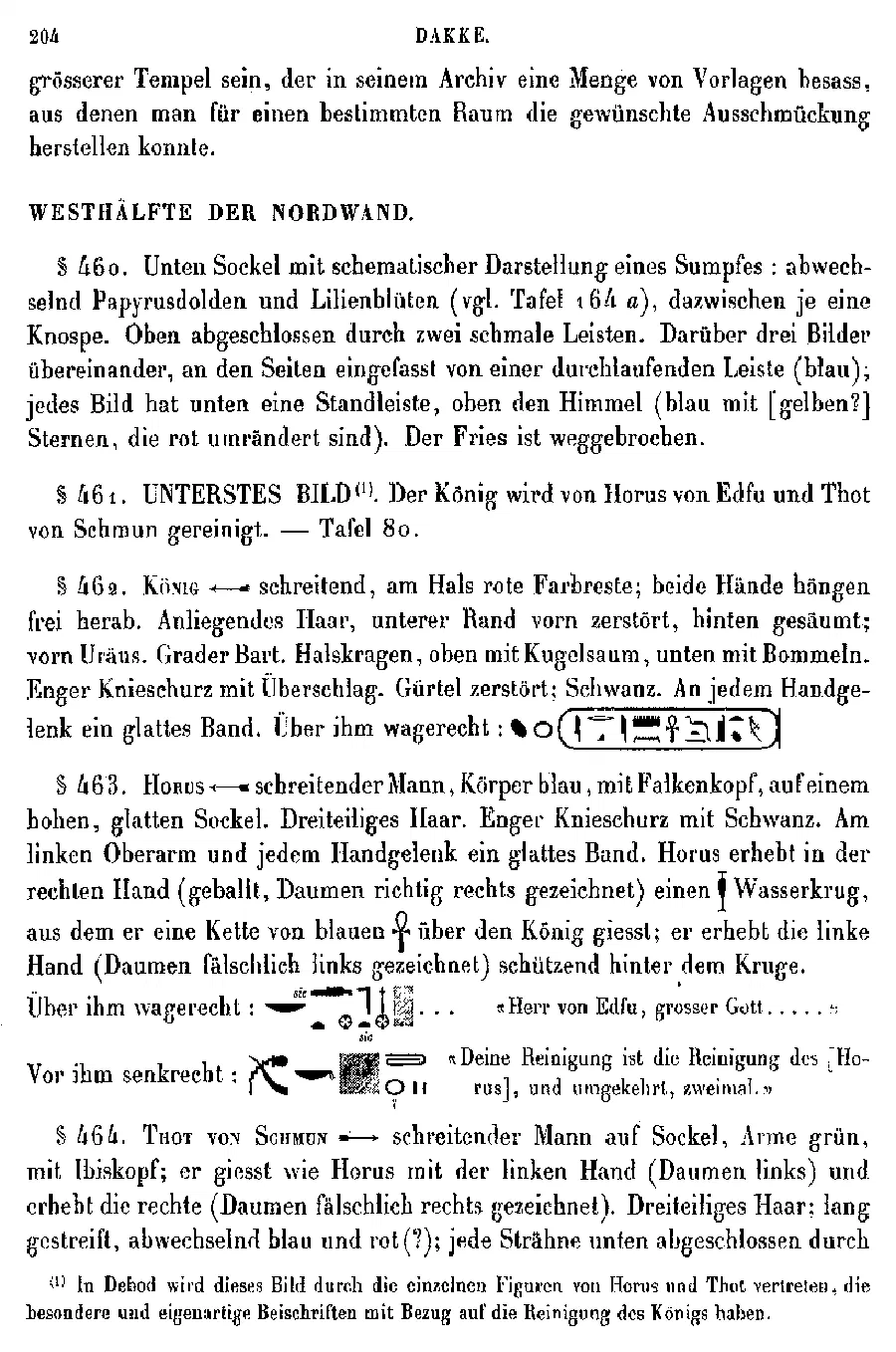
Page 204. Roeder, Der Tempel von Dakke (1930), p. 204 Printed hieroglyphs from G. Roeder, Der Tempel von Dakke (1930) - 349p. 204, § 462
sꜣ-rꜥ jrḳ-jmn-ꜥnḫ-ḏ.t-mrj-ꜣs.t
Son of Ra, Ergamenes, living forever, beloved of Isis.
- 350p. 204, § 463
bḥd.tj nṯr ꜥꜣ --détruit-- ꜥbw=k --1Q-- pẖr sp-sn
He of Edfu, the great god … your purification … and the reverse.
Note · Line 350
In the purification rite, the formula is repeated with the names exchanged: each one’s purification is the other’s. - 351p. 204, § 464
nb ḫmnw nb … (?) nṯr ꜥꜣ ḫnt.j ḥsw.t (?) sḥtp nṯr.w
Lord of Hermopolis, lord of the Two Lands, the great god who presides over Hesau and calms the gods.
- 352p. 204, § 464
ꜣbw=k ḏḥwtj --2Q--
Your purification, Thoth …
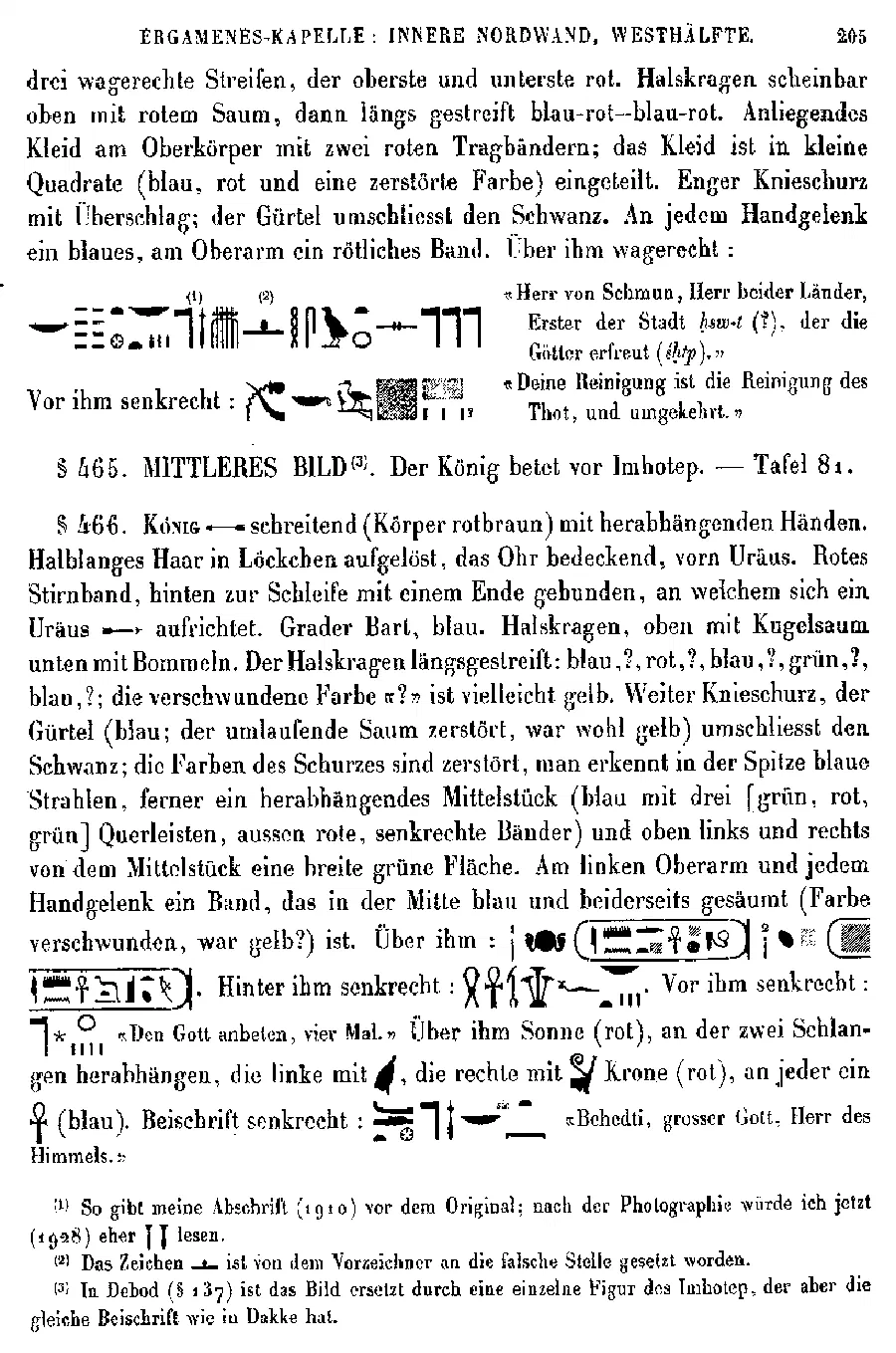
Page 205. Roeder, Der Tempel von Dakke (1930), p. 205 Printed hieroglyphs from G. Roeder, Der Tempel von Dakke (1930) - 353p. 205, § 466
nswt-bj.tj ḏr.t-ꜥnḫ-jmn-tj.t-rꜥ sꜣ[-rꜥ jrḳ]-jmn-ꜥnḫ-ḏ.t-mrj-ꜣs.t
King of Upper and Lower Egypt, Living Hand of Amun, Image of Ra; Son of Ra, Ergamenes, living forever, beloved of Isis.
- 354p. 205, § 466
sꜣ ꜥnḫ wꜣs nb ḥꜣ=f
All protection, life and dominion are behind him.
- 355p. 205, § 466
dwꜣ nṯr sp 4
Worshipping the god four times.
- 356p. 205, § 466
bḥd.tj nṯr ꜥꜣ nb p.t
He of Edfu, the great god, lord of heaven.
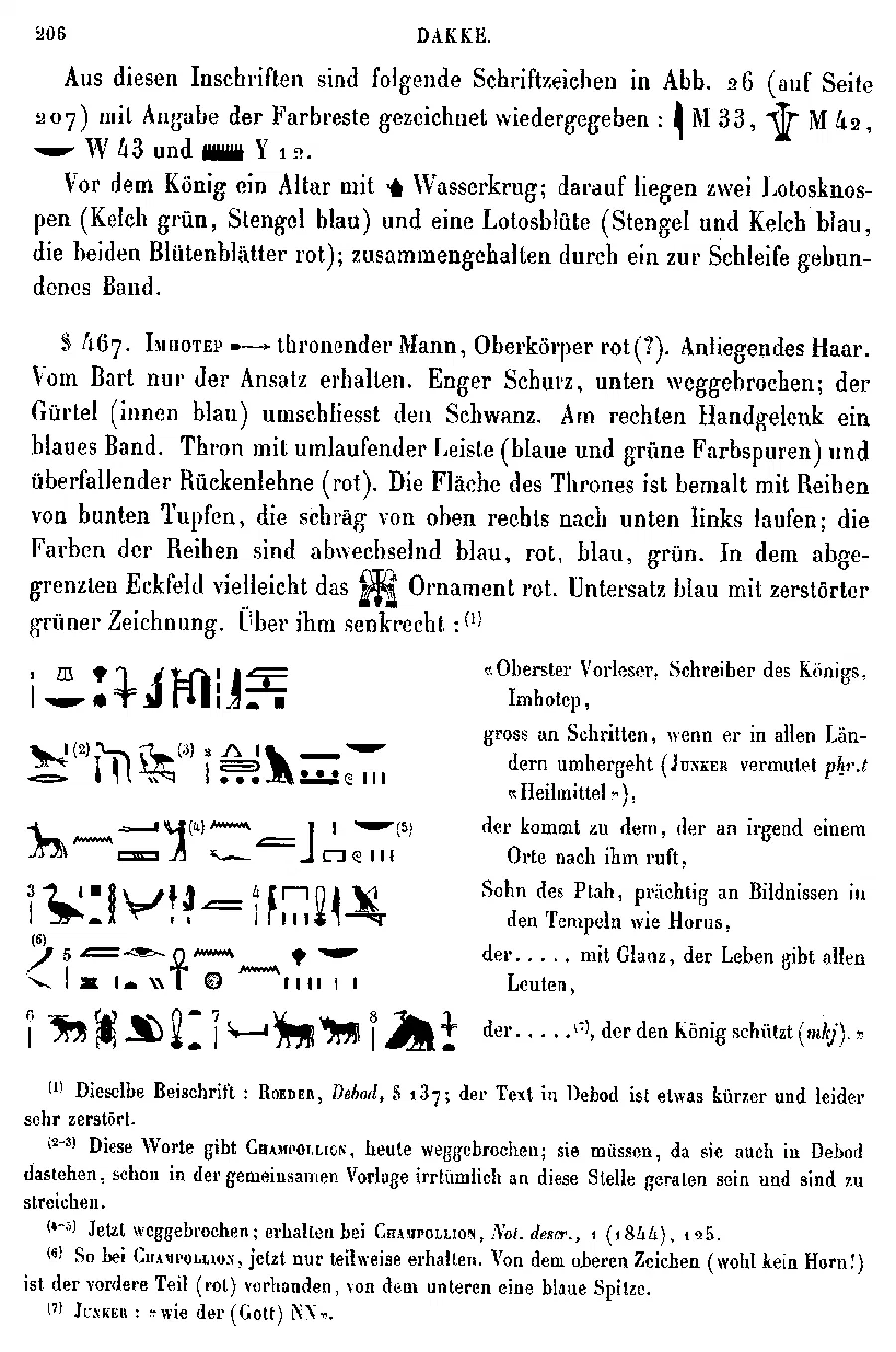
Page 206. Roeder, Der Tempel von Dakke (1930), p. 206 Printed hieroglyphs from G. Roeder, Der Tempel von Dakke (1930) - 357p. 206, § 467
ẖr.j-ḥb ḥr.j-tp sš nswt jj-m-ḥtp wr nmt pẖr.t m tꜣ.w nb.w jj n ꜥš n=f m bw nb.{w} sꜣ ptḥ ḏsr sḫm m gs.(w)-pr.w mj ḥrw … (?) m ḫꜥj.(t) jrj.{t} ꜥnḫ n ḥr-nb bꜣ ꜥnḫ nṯrj mj kꜣ nḫt (?) mkj nswt
The chief lector priest and royal scribe Imhotep, great of stride, the remedy in every land, who comes wherever anyone calls to him; son of Ptah, whose image in the chapels is sacred like that of Horus, who encircles as he appears, who brings life to everyone; the living ba, divine as a mighty bull, who guards the king.
Note · Line 357
A lector priest read the ritual words aloud. Imhotep, once a royal official, was worshipped as a healer. - 358p. 206, § 467
dj=j n=k ꜥnḫ wꜣs nb.{wt}
I give you all life and dominion.
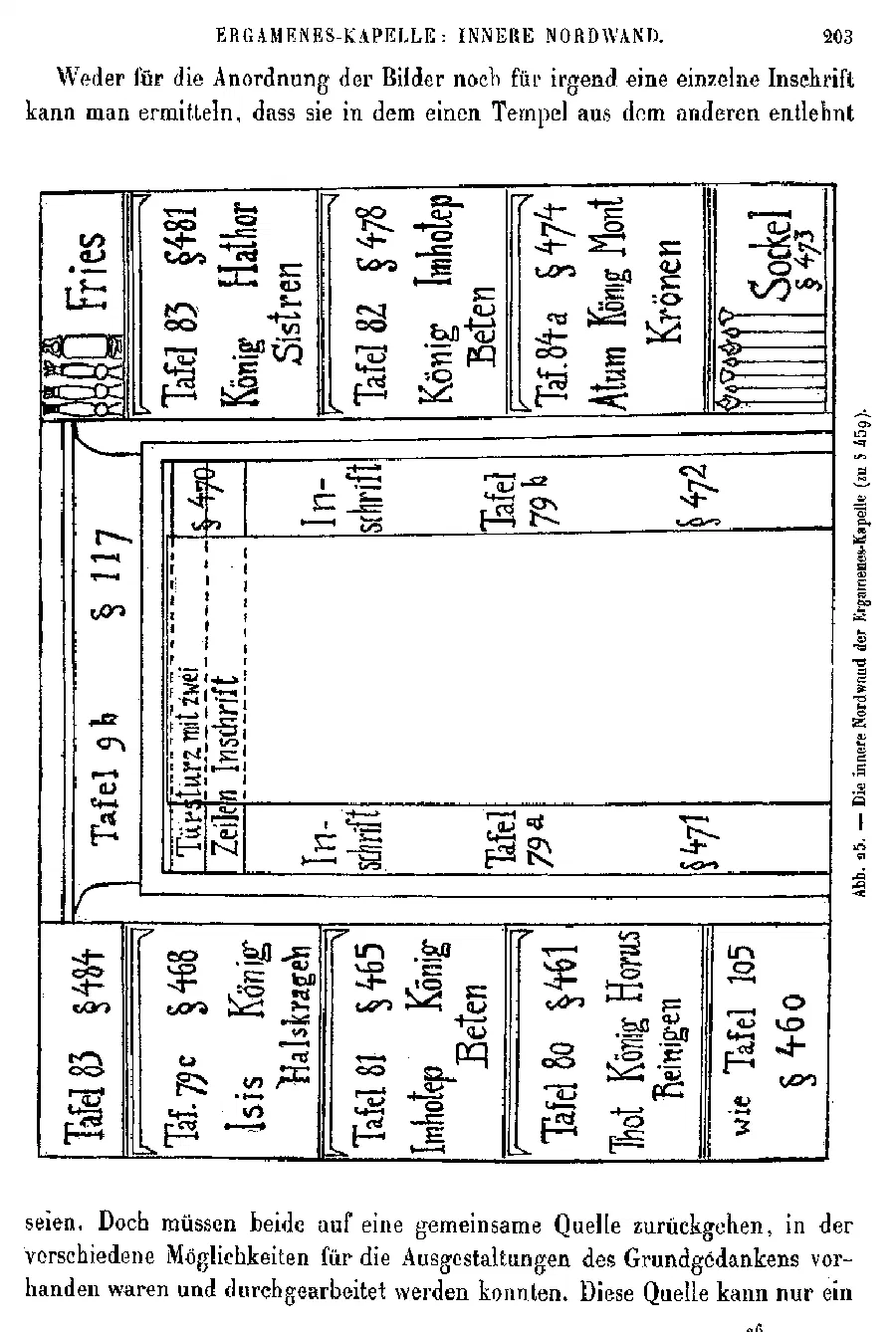
Page 203. Roeder, Der Tempel von Dakke (1930), p. 203 Printed hieroglyphs from G. Roeder, Der Tempel von Dakke (1930) - 359p. 203, § 468
ḥnk bb n mw.t=f ꜣs.t dj.(t) ꜥnḫ
Offering the necklace to his mother Isis, who gives life.
- 360p. 203, § 470
--détruit-- mrj --1Q-- nb.(t) snm.t nb.(t) jwrḳ
… beloved of …, lady of Senmet, lady of Philae.
- 361p. 203, § 470
--détruit-- mrj --détruit-- nb.(t) jwrḳ
… beloved of …, lady of Philae.
- 362p. 203, § 471
--détruit-- sp-sn ḥtp nswt-bj.tj ḏḥwtj n <pn>bs snṯr ḳbḥ dj p.t --4Q-- bꜥḥ --détruit--
… twice. May the King of Upper and Lower Egypt, Thoth of Pnubs, be content. Incense and cool water that heaven gives … floods …
- 363p. 203, § 472
--détruit-- jpn sš=ṯn --détruit-- ḏfꜣ=ṯn jw … ( ?) ntf jwꜥ (?) jm=ṯn …(?) =ṯn r ḏfꜣ …(?) pr-ꜥꜣ dj=n n=f ꜥnḫ nb ḫr=ṯn ḏd nb ḫr=ṯn wꜣs nb.{wt} ḫr=ṯn snb ḥtp ḥr=k nfr --détruit--
… these … your writing … your provisions … He is the heir among you … you … to nourish … Pharaoh. We give him all life in your keeping, all stability in your keeping, all dominion in your keeping, and health. May your fair face be at rest …
Page 210. Roeder, Der Tempel von Dakke (1930), p. 210 Printed hieroglyphs from G. Roeder, Der Tempel von Dakke (1930) - 364p. 210, § 475
sꜣ-rꜥ jrḳ-jmn-ꜥnḫ-ḏ.t-mrj-ꜣs.t (73)
Son of Ra, Ergamenes, living forever, beloved of Isis.
Page 211. Roeder, Der Tempel von Dakke (1930), p. 211 Printed hieroglyphs from G. Roeder, Der Tempel von Dakke (1930) - 365p. 211, § 476
tm <nb> tꜣ.wj jwnw
Atum, lord of the Two Lands and of Heliopolis.
- 366p. 211, § 477
mnṯw nb wꜣs.t
Montu, lord of Thebes.
Page 212. Roeder, Der Tempel von Dakke (1930), p. 212 Printed hieroglyphs from G. Roeder, Der Tempel von Dakke (1930) - 367p. 212, § 479
nswt-bj.tj ḏr.t-ꜥnḫ-jmn-tj.t-rꜥ sꜣ-rꜥ jrḳ-jmn-ꜥnḫ-ḏ.t-mrj-ꜣs.t sꜣ ꜥnḫ wꜣs <nb> ḥꜣ[=f mj rꜥ ḏ.t]
King of Upper and Lower Egypt, Living Hand of Amun, Image of Ra; Son of Ra, Ergamenes, living forever, beloved of Isis. All protection, life and dominion are behind him, as they are behind Ra, forever.
- 368p. 212, § 480
sš nswt ḥr.j-tp n nswt-bj.tj rḫ-jḫ.t nḏm ḏr.t ḥr smj jb jḳr ns ḥtp m wr nb.{t} dj ꜥnḫ <mj rꜥ> ḏ.t wr tꜣ ḏr=<f> jj-m-ḥtp sꜣ ptḥ msj ẖrd-ꜥnḫ bꜣ ḏd mrj (?) ptḥ m ꜥnḫ-tꜣ.wj dj ꜥnḫ mj rꜥ ḏ.t
Chief royal scribe to the King of Upper and Lower Egypt, the sage, gentle of hand in setting down what is in the heart, skilled of tongue, at peace with every great lord, who gives life like Ra forever; great throughout the land, Imhotep, son of Ptah, born of Kheredankh, the enduring ba, beloved of Ptah in Ankhtawy, who gives life like Ra forever.
Note · Line 368
Ankhtawy is a sacred name for the region of Memphis, Ptah’s city. - 369p. 212, § 480
dj.n=(j) n=k ꜣw.(t)-jb nb.(t)
I have given you every joy.
Page 214. Roeder, Der Tempel von Dakke (1930), p. 214 Printed hieroglyphs from G. Roeder, Der Tempel von Dakke (1930) - 370p. 214, § 482
nswt-bj.tj ḏr.t-ꜥnḫ-jmn-tj.t-rꜥ sꜣ-rꜥ jrḳ-jmn-ꜥnḫ-ḏ.t-mrj-ꜣs.t
King of Upper and Lower Egypt, Living Hand of Amun, Image of Ra; Son of Ra, Ergamenes, living forever, beloved of Isis.
- 371p. 214, § 482
--détruit-- mw.t=f jrj.t <s>šš.t [n mw.t=f] ḥw.t-ḥrw wr.t nb.(t) jwrḳ [mwt]-nṯr ḥm.t nswt tp.j.t wn-nfr [mꜣꜥ-ḫrw]
… to his mother. Shaking the sistrum for his mother Hathor the Great, lady of Philae, mother of the god, first royal wife of Wennefer, the vindicated.
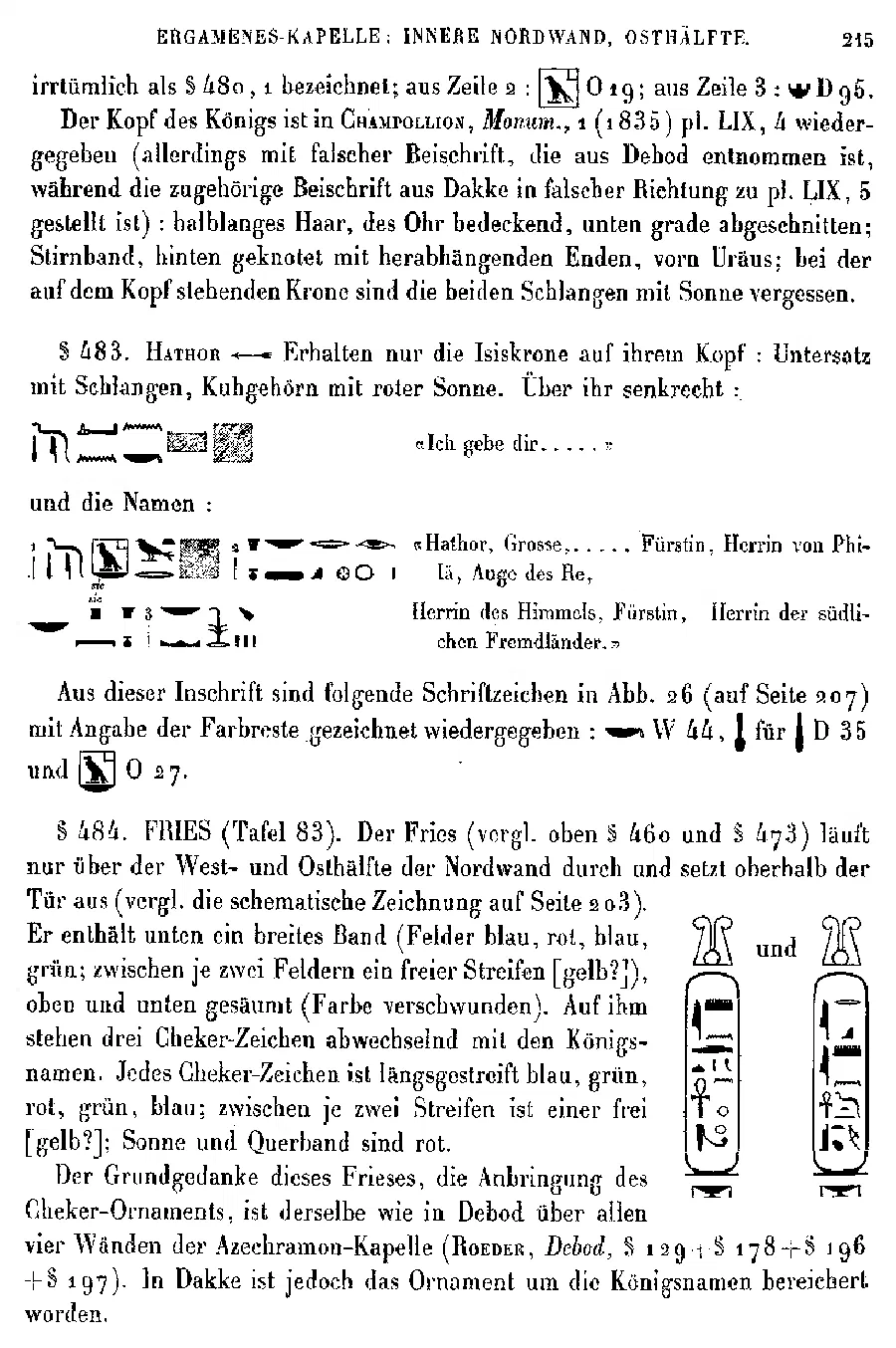
Page 215. Roeder, Der Tempel von Dakke (1930), p. 215 Printed hieroglyphs from G. Roeder, Der Tempel von Dakke (1930) - 372p. 215, § 483
ḏd-mdw jn dj.n=(j) n=k --2Q-- ḏd-mdw jn ḥw.t-ḥrw wr.t --1Q-- ḥnw.t nb.(t) jwrḳ jr.t rꜥ nb.(t) p.t ḥnw.t nb.(t) ḫꜣs.wt rsj.w(t)
Words spoken: “I have given you …” Words spoken by Hathor the Great, … mistress, lady of Philae, Eye of Ra, lady of heaven, mistress and lady of the southern foreign lands.
- 373p. 203, § 484
ḏr.t-ꜥnḫ-jmn-tj.t-rꜥ jrḳ-jmn-ꜥnḫ-ḏ.t-mrj-ꜣs.t
Living Hand of Amun, Image of Ra; Ergamenes, living forever, beloved of Isis.
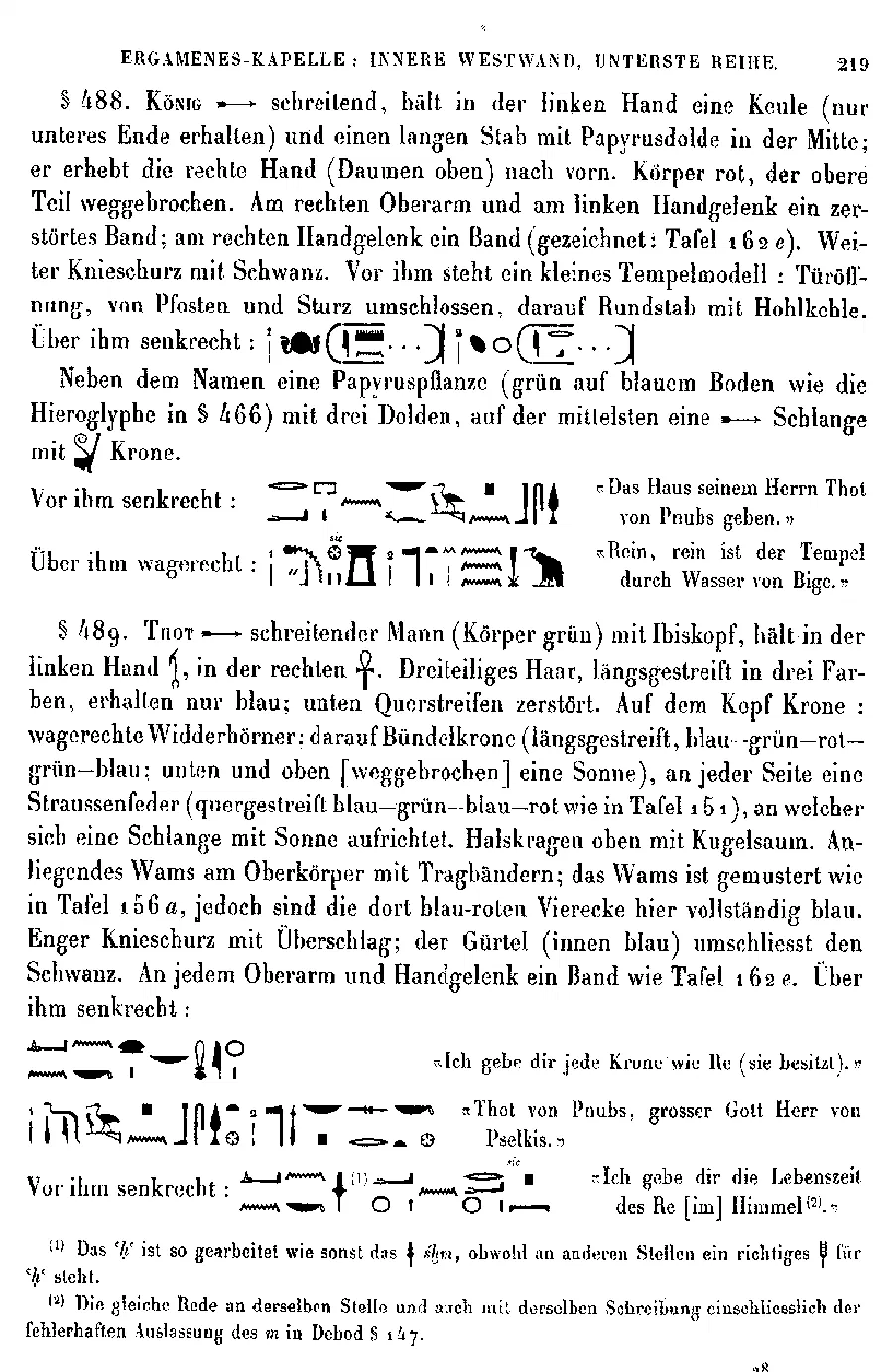
Page 219. Roeder, Der Tempel von Dakke (1930), p. 219 Printed hieroglyphs from G. Roeder, Der Tempel von Dakke (1930) - 374p. 219, § 488
nswt-bj.tj ḏr.t-ꜥnḫ-jmn-tj.t-rꜥ sꜣ-rꜥ jrḳ-jmn-ꜥnḫ-ḏ.t-mrj-ꜣs.t
King of Upper and Lower Egypt, Living Hand of Amun, Image of Ra; Son of Ra, Ergamenes, living forever, beloved of Isis.
Note · Line 374
The first title introduces his throne name; the second introduces his personal name. - 375p. 219, § 488
rdj.(t) pr n nb=f ḏḥwtj <n> pnbs
Offering the house to its lord, Thoth of Pnubs.
Note · Line 375
The house is the temple itself: the king presents it to the god who dwells there. - 376p. 219, § 488
wꜥb sp-sn ḥw.t-nṯr m mw snm.t
Pure, pure is the temple, washed with the water of Senmet.
- 377p. 219, § 489
dj.n=(j) n=k ḫꜥj=k mj rꜥ
I have granted that you rise like Ra.
Note · Line 377
The god addresses the king. The same word evokes the sun rising and the king appearing in glory. - 378p. 219, § 489
ḏd-mdw jn ḏḥwtj <n> pnbs nṯr ꜥꜣ nb psrk.t
Words spoken by Thoth of Pnubs, the great god, lord of Pselkis.
- 379p. 219, § 489
dj.n=(j) n=k ꜥḥꜥ n rꜥ <m> p.t
I have given you the lifespan of Ra in the sky.
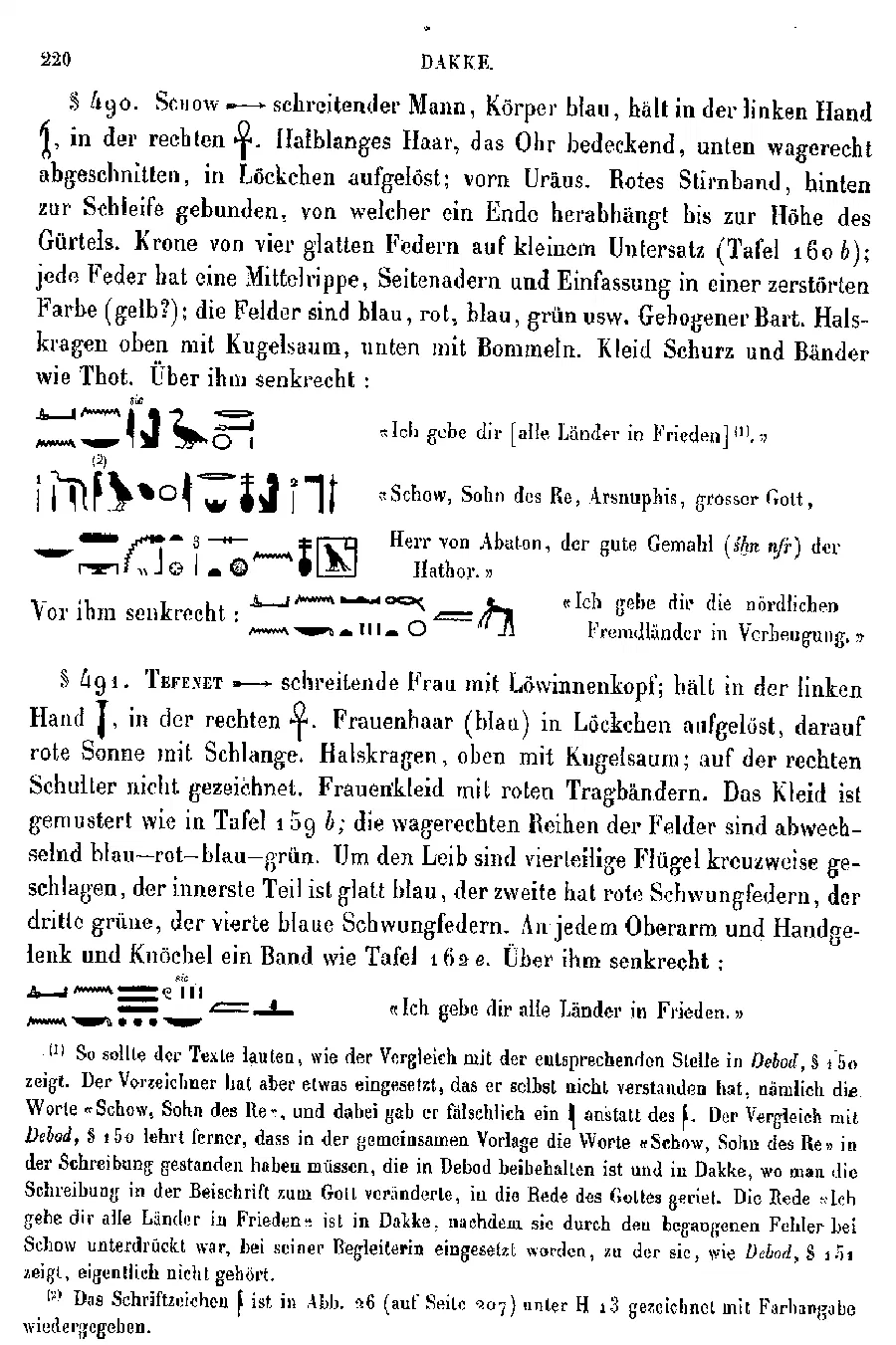
Page 220. Roeder, Der Tempel von Dakke (1930), p. 220 Printed hieroglyphs from G. Roeder, Der Tempel von Dakke (1930) - 380p. 220, § 490
dj.n=(j) n=k …(?) ḏd-mdw jn šw sꜣ rꜥ jr.(j)-ḥms-nfr nṯr ꜥꜣ nb jw-wꜥb sḫn nfr ḥw.t-ḥrw
I have given you … Words spoken by Shu, son of Ra, Arensnuphis, the great god, lord of the Abaton, Hathor’s perfect companion.
Note · Line 380
Shu is identified here with Arensnuphis. - 381p. 220, § 490
dj.n=(j) n=k ḫꜣs.wt mḥ.(w)t m ks
I have given you the foreign lands of the north, bowed low.
- 382p. 220, § 491
dj.n=(j) n=k tꜣ.w nb.w m ḥtp
I have given you all lands at peace.
- 383p. 220, § 491
ḏd-mdw jn tfn.t ḥr.j.(t)-jb jw-wꜥb jr.t rꜥ nb.(t) p.t ḥnw.t nṯr.w nb.w{t}
Words spoken by Tefnut, who dwells in the Abaton, Eye of Ra, lady of the sky, mistress of all the gods.
- 384p. 220, § 491
dj.n=(j) n=k ḫꜣs.wt rsj.w(t) ẖr ṯb.tj=k
I have given you the foreign lands of the south beneath your two sandals.
Note · Line 384
The king’s sandals could bear images of his enemies, placing them underfoot with every step. 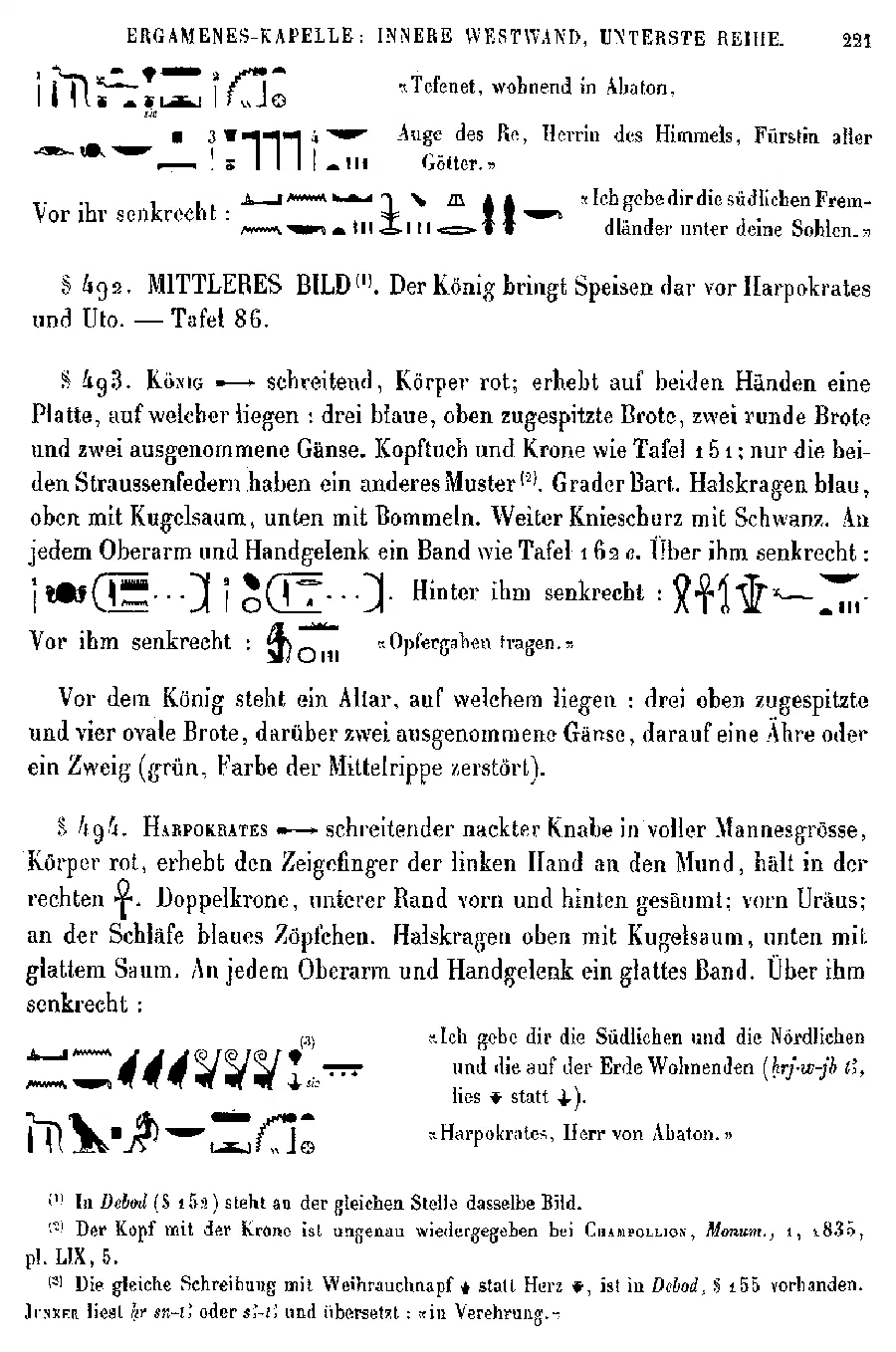
Page 221. Roeder, Der Tempel von Dakke (1930), p. 221 Printed hieroglyphs from G. Roeder, Der Tempel von Dakke (1930) - 385p. 221, § 493
nswt-bj.tj ḏr.t-ꜥnḫ-jmn-tj.t-rꜥ sꜣ-rꜥ jrḳ-jmn-ꜥnḫ-ḏ.t-mrj-ꜣs.t
King of Upper and Lower Egypt, Living Hand of Amun, Image of Ra; Son of Ra, Ergamenes, living forever, beloved of Isis.
- 386p. 221, § 493
sꜣ ꜥnḫ wꜣs nb.{wt} ḥꜣ=f
All protection, life and dominion are behind him.
- 387p. 221, § 493
fꜣj.(t) jḫ.t
Carrying the offerings.
- 388p. 221, § 494
dj.n=(j) n=k šmꜥ.j.w mḥ.j.w ḥr sꜣ tꜣ
I have given you the southerners and the northerners on the back of the earth.
- 389p. 221, § 494
ḏd-mdw jn ḥrw-pꜣ-ẖrd nb jw-wꜥb
Words spoken by Harpocrates, lord of the Abaton.
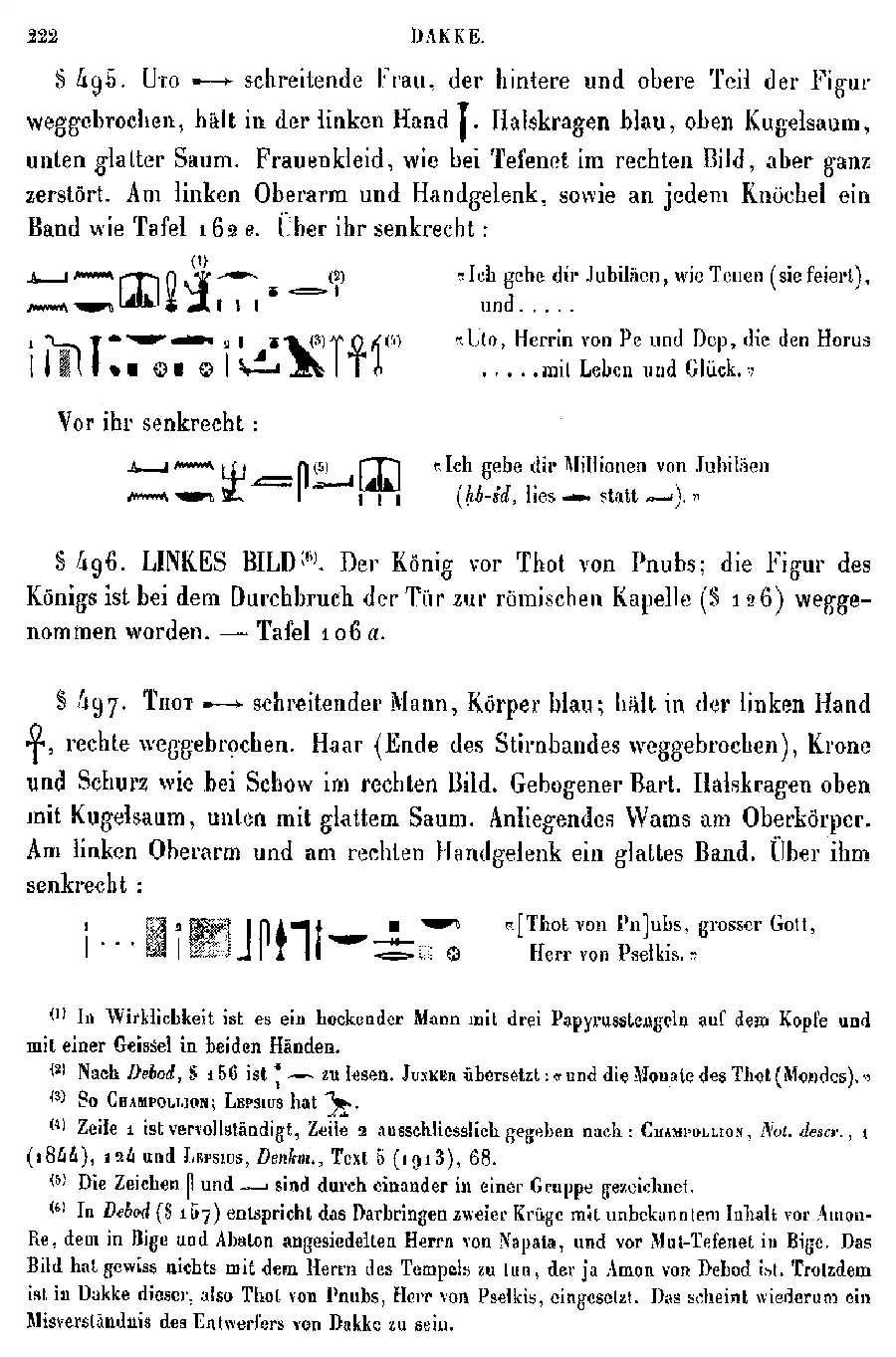
Page 222. Roeder, Der Tempel von Dakke (1930), p. 222 Printed hieroglyphs from G. Roeder, Der Tempel von Dakke (1930) - 390p. 222, § 495
dj.n=(j) n=k ḥb-sd mj ṯnn jbd.w n jꜥḥ
I have given you a Sed festival like Tatenen’s and the months of Iah.
Note · Line 390
The Sed festival renewed the king’s power, traditionally after thirty years on the throne. Tatenen grants royal jubilees; Iah is the moon god, whose cycle marks the month. - 391p. 222, § 495
ḏd-mdw jn wꜣḏj.t nb.t p dp inḳ (?) ḥrw m ꜥnḫ wꜣs
Words spoken by Wadjet, lady of Pe and Dep, who embraces Horus with life and dominion.
Note · Line 391
Pe and Dep were the twin towns of Buto in the Nile Delta, home of the cobra goddess Wadjet. - 392p. 222, § 495
dj.n=(j) n=k ḥḥ m ḥb.w-sd
I have given you a million Sed festivals.
- 393p. 222, § 497
--détruit-- [ḏḥwtj n pn]bs-nb-psrk.t
… Thoth of Pnubs, lord of Pselkis.
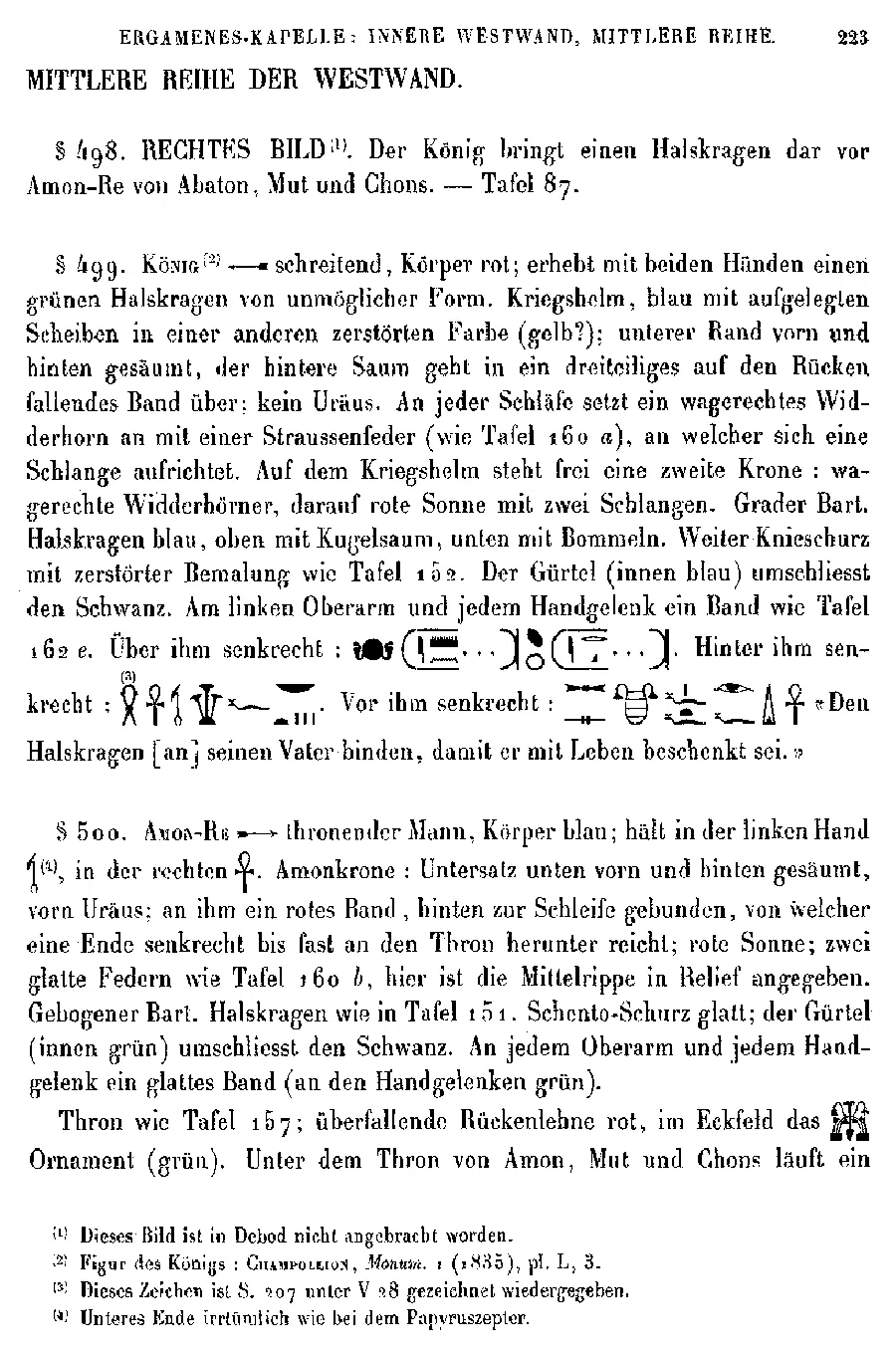
Page 223. Roeder, Der Tempel von Dakke (1930), p. 223 Printed hieroglyphs from G. Roeder, Der Tempel von Dakke (1930) - 394p. 223, § 499
nswt-bj.tj ḏr.t-ꜥnḫ-jmn-tj.t-rꜥ sꜣ-rꜥ jrḳ-jmn-ꜥnḫ-ḏ.t-mrj-ꜣs.t
King of Upper and Lower Egypt, Living Hand of Amun, Image of Ra; Son of Ra, Ergamenes, living forever, beloved of Isis.
- 395p. 223, § 499
sꜣ ꜥnḫ wꜣs nb.{wt} ḥꜣ=f
All protection, life and dominion are behind him.
- 396p. 223, § 499
ṯsj.(t) wsḫ <n> jt=f jrj.n=f dj.(t) ꜥnḫ
Fastening the broad collar for his father. He has done this that he may be given life.
Note · Line 396
The king’s father here is the god receiving the collar. - 397p. 223, § 500
dj.n=j n=k rnp.wt n rꜥ n p.t
I have given you the years of Ra of the sky.
- 398p. 223, § 500
ḏd-mdw jn jmn-rꜥ ḥr.j-jb jꜣ.t-wꜥb.t nṯr ꜥꜣ wr ḥr.j nṯr.w nb.w{t}
Words spoken by Amun-Ra, who dwells in the Abaton, the very great god, chief of all the gods.
- 399p. 223, § 500
dj.n=(j) n=k rsj.j.w nb.(w) mḥ.j.(w) nb.(w)
I have given you all the southerners and all the northerners.
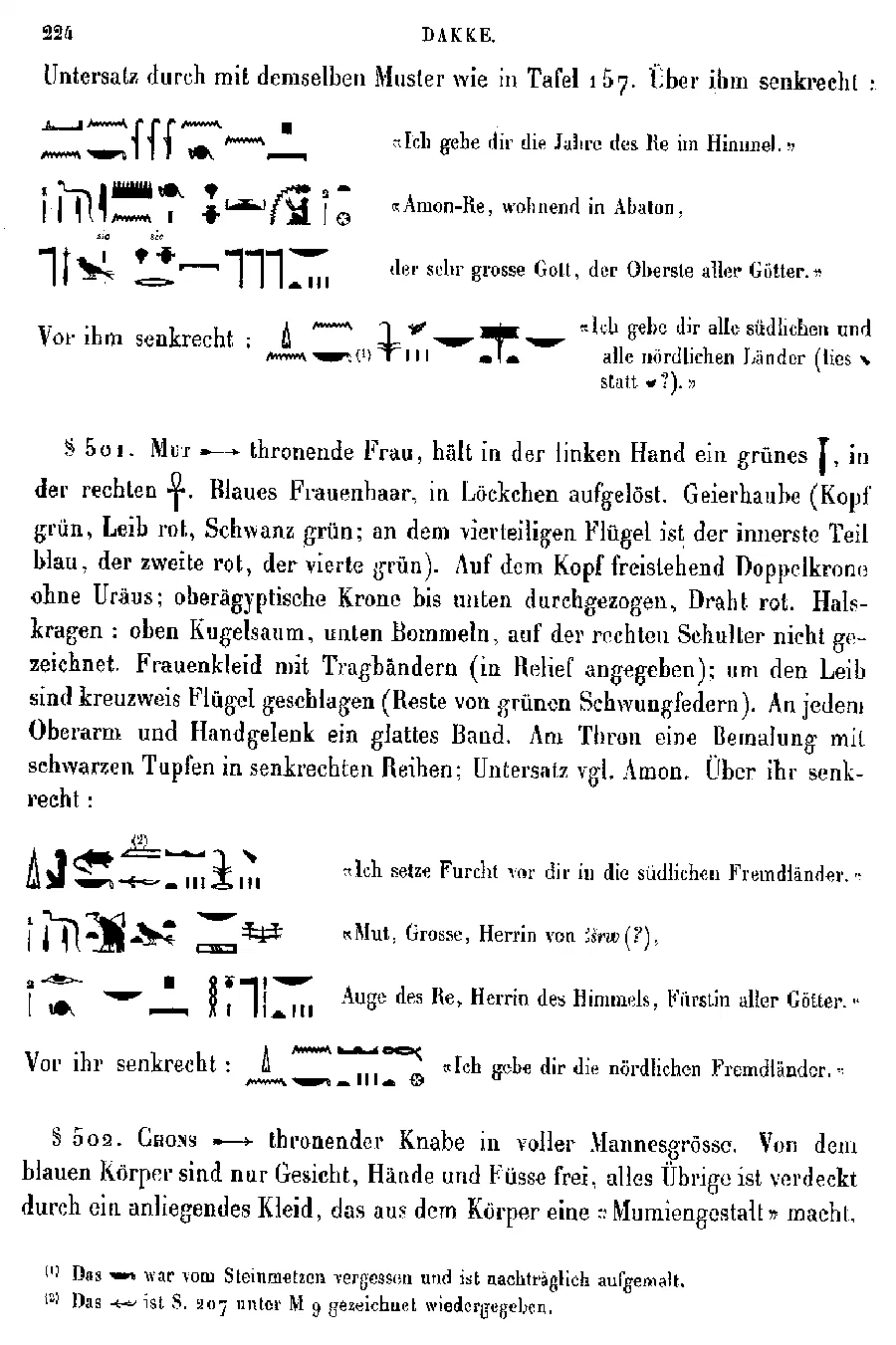
Page 224. Roeder, Der Tempel von Dakke (1930), p. 224 Printed hieroglyphs from G. Roeder, Der Tempel von Dakke (1930) - 400p. 224, § 501
dj=j snḏ=k m-ḫt ḫꜣs.wt rsj.w(t)
I spread the dread of you throughout the foreign lands of the south.
- 401p. 224, § 501
ḏd-mdw jn mw.t wr.t nb.(t) jšrw jr.t rꜥ nb.(t) p.t ḥnw.t nṯr.w nb.w{t}
Words spoken by Mut the Great, lady of the Isheru, Eye of Ra, lady of the sky, mistress of all the gods.
- 402p. 224, § 501
dj.n=(j) n=k ḫꜣs.wt mḥ.(w)t
I have given you the foreign lands of the north.
- 403p. 224, § 502
ḏd-mdw {jn} dj.n=(j) n=k šmꜥ mḥw m ḥtp
Words spoken: I have given you the South and the North in peace.
Note · Line 403
The South is Upper Egypt, upriver; the North is Lower Egypt, in the Delta. - 404p. 224, § 502
ḏd-mdw jn ḫnsw-m-wꜣs.t nfr-ḥtp nb ḥw.t-ꜥnḫ ḥrw nb ꜣw.t-jb
Words spoken by Khonsu in Thebes, Neferhotep, lord of the House of Life, Horus, lord of joy.
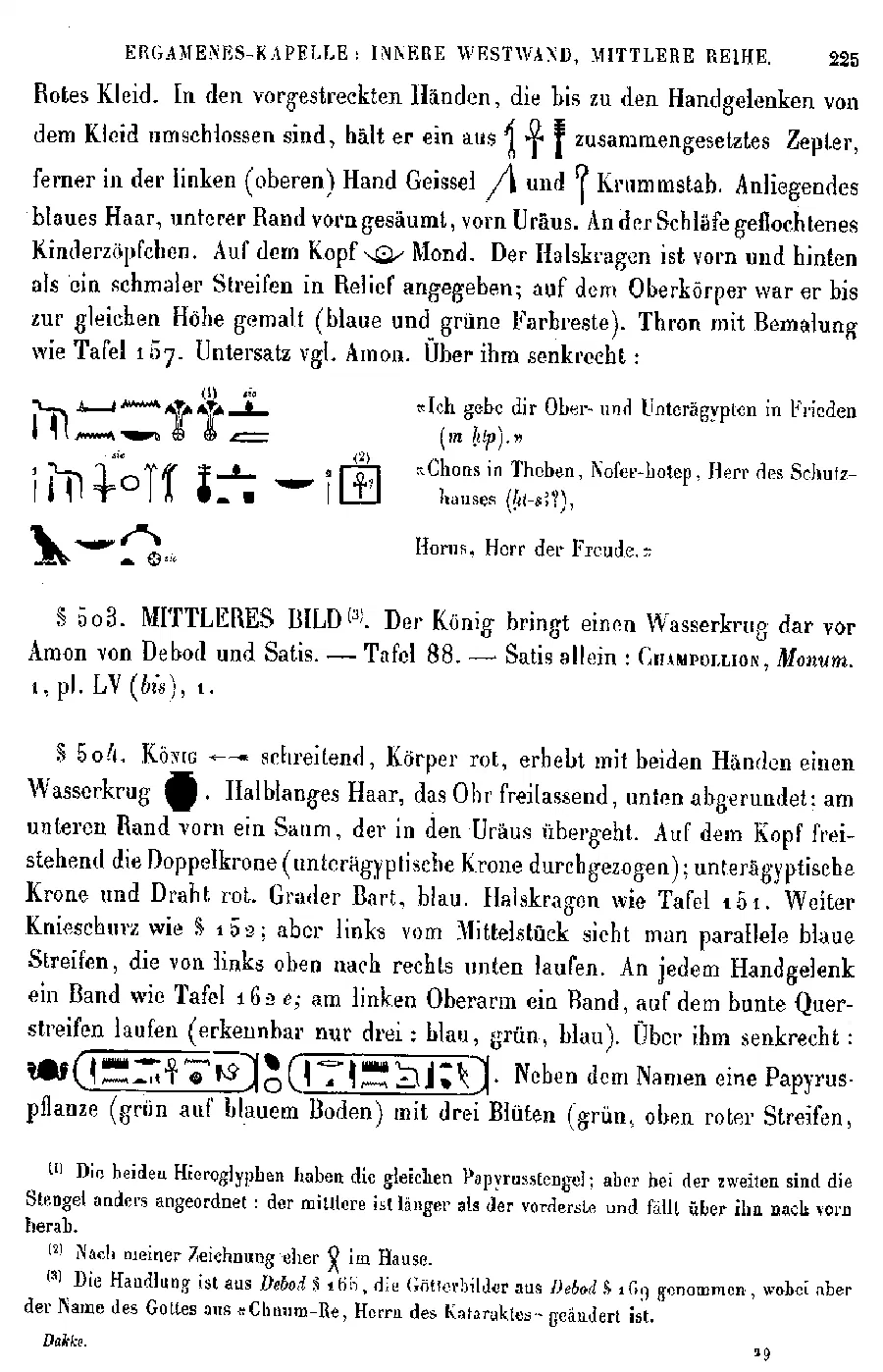
Page 225. Roeder, Der Tempel von Dakke (1930), p. 225 Printed hieroglyphs from G. Roeder, Der Tempel von Dakke (1930) - 405p. 225, § 504
nswt-bj.tj ḏr.t-ꜥnḫ-jmn-tj.t-rꜥ sꜣ-rꜥ jrḳ-jmn-ꜥnḫ-ḏ.t-mrj-ꜣs.t
King of Upper and Lower Egypt, Living Hand of Amun, Image of Ra; Son of Ra, Ergamenes, living forever, beloved of Isis.
Note · Line 405
The two titles introduce two names of the same king: first his throne name, then his personal name. - 406p. 225, § 504
sꜣ ꜥnḫ wꜣs nb.{wt} ḥꜣ=f
All protection, life and dominion stand behind him.
- 407p. 225, § 504
jnḏ ḥr m nms.t n jt=f
Greeting his father with the nemset jar.
Note · Line 407
The king salutes the god as his father. The nemset is a vessel for pouring water in rites of purification. 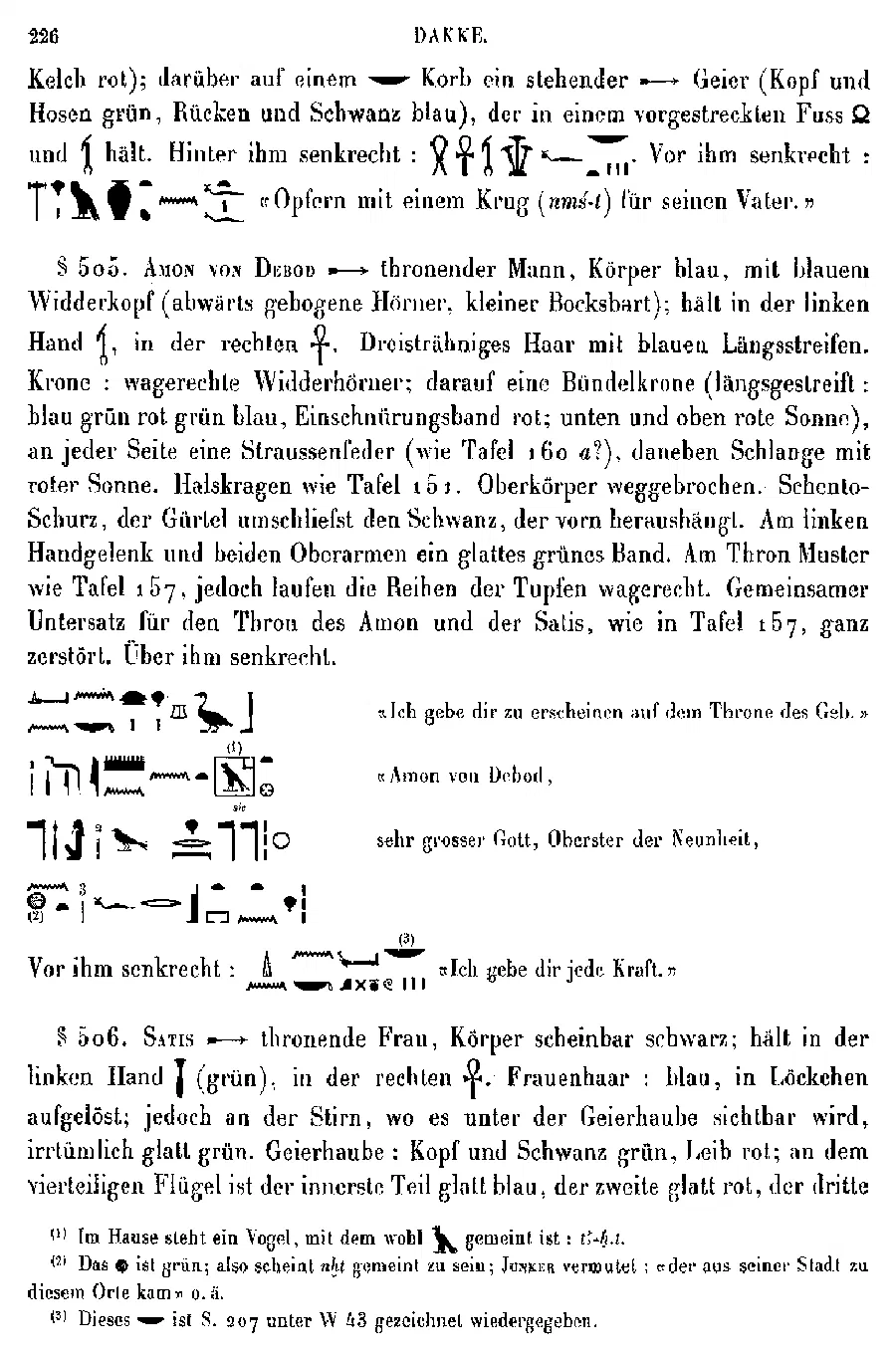
Page 226. Roeder, Der Tempel von Dakke (1930), p. 226 Printed hieroglyphs from G. Roeder, Der Tempel von Dakke (1930) - 408p. 226, § 505
dj.n=(j) n=k ḫꜥj.<tj> ḥr ns.t gb
I have granted you to appear in glory on the throne of Geb.
Note · Line 408
Geb, the earth god, was held to have ruled Egypt. His throne is the kingship the pharaoh inherits. - 409p. 226, § 505
ḏd-mdw jn jmn n tꜣ-ḥw.t nṯr ꜥꜣ wr ḥr.j nṯr.w psḏ.t nḫt=f (?) r s.t tn ḥr.w(?)
Words spoken by Amun of Debod, the very great god, chief of the gods of the Ennead. His might … to this place on high.
- 410p. 226, § 505
dj.n=(j) n=k ḳn nb.{w}
I have given you all strength.
- 411p. 226, § 506
ḏd-mdw {jn} <dj>.n=(j) n=k ḥs.t nb.(t) r mrj=k
Words spoken: I have given you every favor, as you desire.
- 412p. 226, § 506
ḏd-mdw jn st.t msj.n rꜥ ḥnw.t ꜣbw jr.t rꜥ nb.(t) p.t ḥnw.t nṯr.w nb.(w)
Words spoken by Satis, whom Ra begot, mistress of Elephantine, Eye of Ra, lady of the sky, mistress of all the gods.
Note · Line 412
Elephantine is an island at the First Cataract of the Nile. As the Eye of Ra, Satis embodies the sun god’s protective power. - 413p. 226, § 506
dj.n=(j) n=k ꜥnḫ wꜣs nb.w
I have given you all life and dominion.
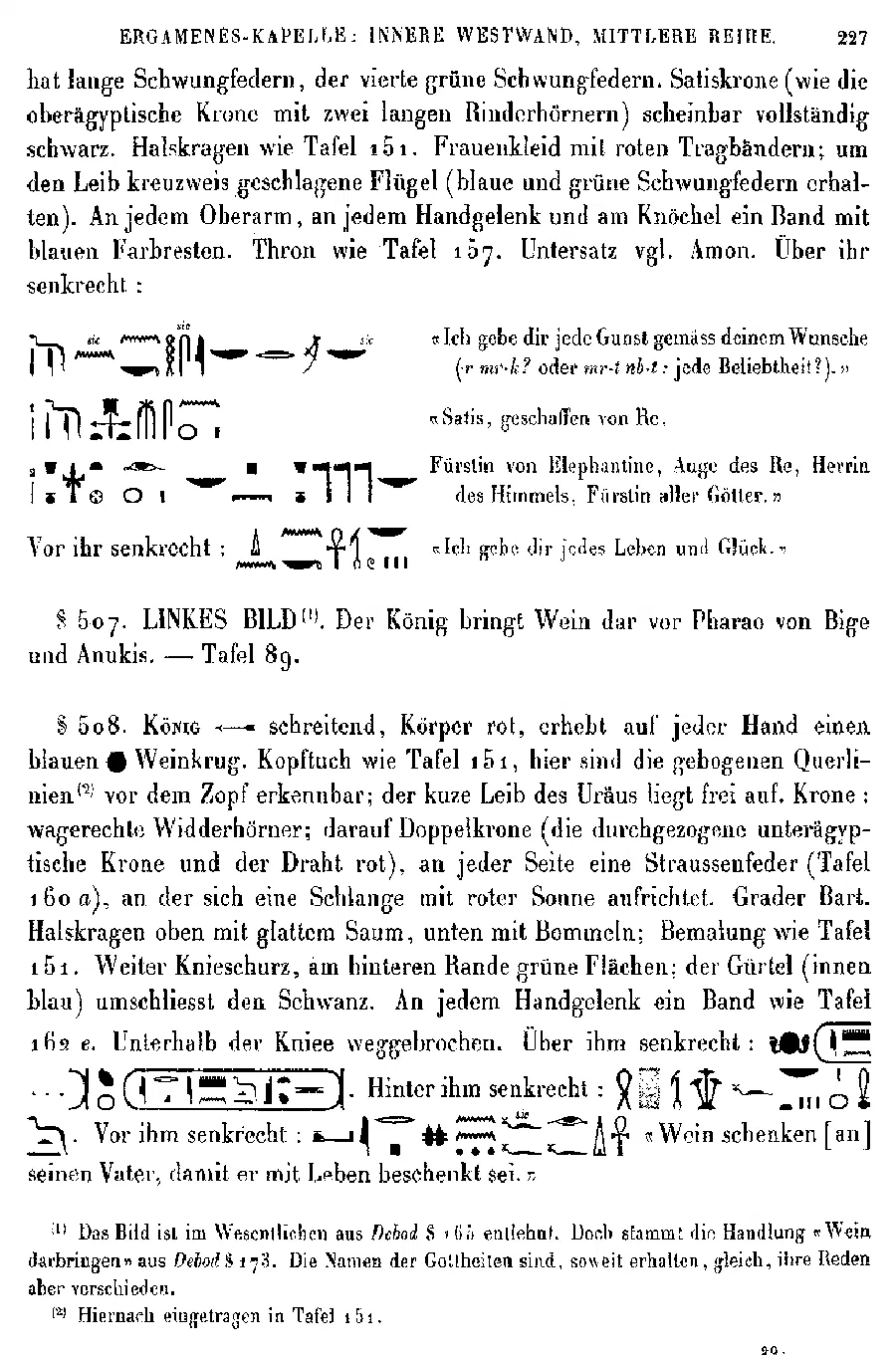
Page 227. Roeder, Der Tempel von Dakke (1930), p. 227 Printed hieroglyphs from G. Roeder, Der Tempel von Dakke (1930) - 414p. 227, § 508
nswt-bj.tj ḏr.t-ꜥnḫ-jmn-tj.t-rꜥ sꜣ-rꜥ jrḳ-jmn-ꜥnḫ-ḏ.t-mrj-ꜣs.t
King of Upper and Lower Egypt, Living Hand of Amun, Image of Ra; Son of Ra, Ergamenes, living forever, beloved of Isis.
- 415p. 227, § 508
sꜣ ꜥnḫ wꜣs nb.{wt} ḥꜣ=f mj rꜥ ḏ.t
All protection, life and dominion stand behind him as they stand behind Ra, forever.
- 416p. 227, § 508
ḥnk jrp n jt=f jrj.n=f dj.(t) ꜥnḫ
Offering wine to his father. He has done this that life may be given him.
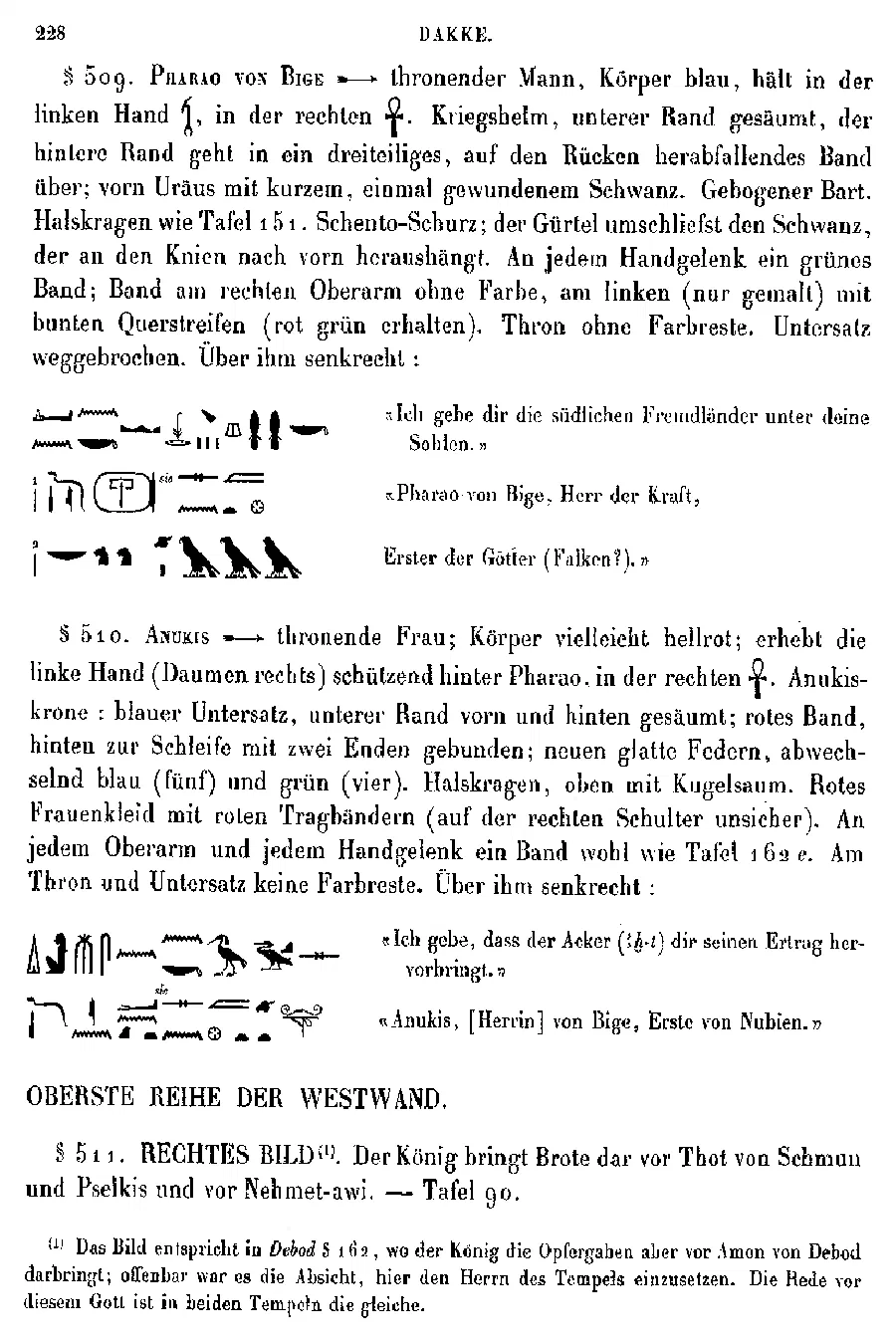
Page 228. Roeder, Der Tempel von Dakke (1930), p. 228 Printed hieroglyphs from G. Roeder, Der Tempel von Dakke (1930) - 417p. 228, § 509
dj.n=(j) n=k ḫꜣs.(w)t rsj.w(t) ẖr ṯb.tj=k
I have set the foreign lands of the south beneath your two sandals.
- 418p. 228, § 509
ḏd-mdw jn pr-ꜥꜣ snm.t nb pḥtj ḫnt.j nṯr.w
Words spoken by Pharaoh of Senmet, lord of might, foremost among the gods.
Note · Line 418
Pharaoh of Senmet is the god’s title here, not the name of the king making the offering. - 419p. 228, § 510
dj=j msj.n n=k ꜣḫ.t ꜥḳw=s
I make the field bring forth its food for you.
- 420p. 228, § 510
ḏd-mdw jn ꜥnḳ.t <nb.t> snm.t ḫnt.j.(t) tꜣ-stj
Words spoken by Anukis, lady of Senmet, foremost in Nubia.
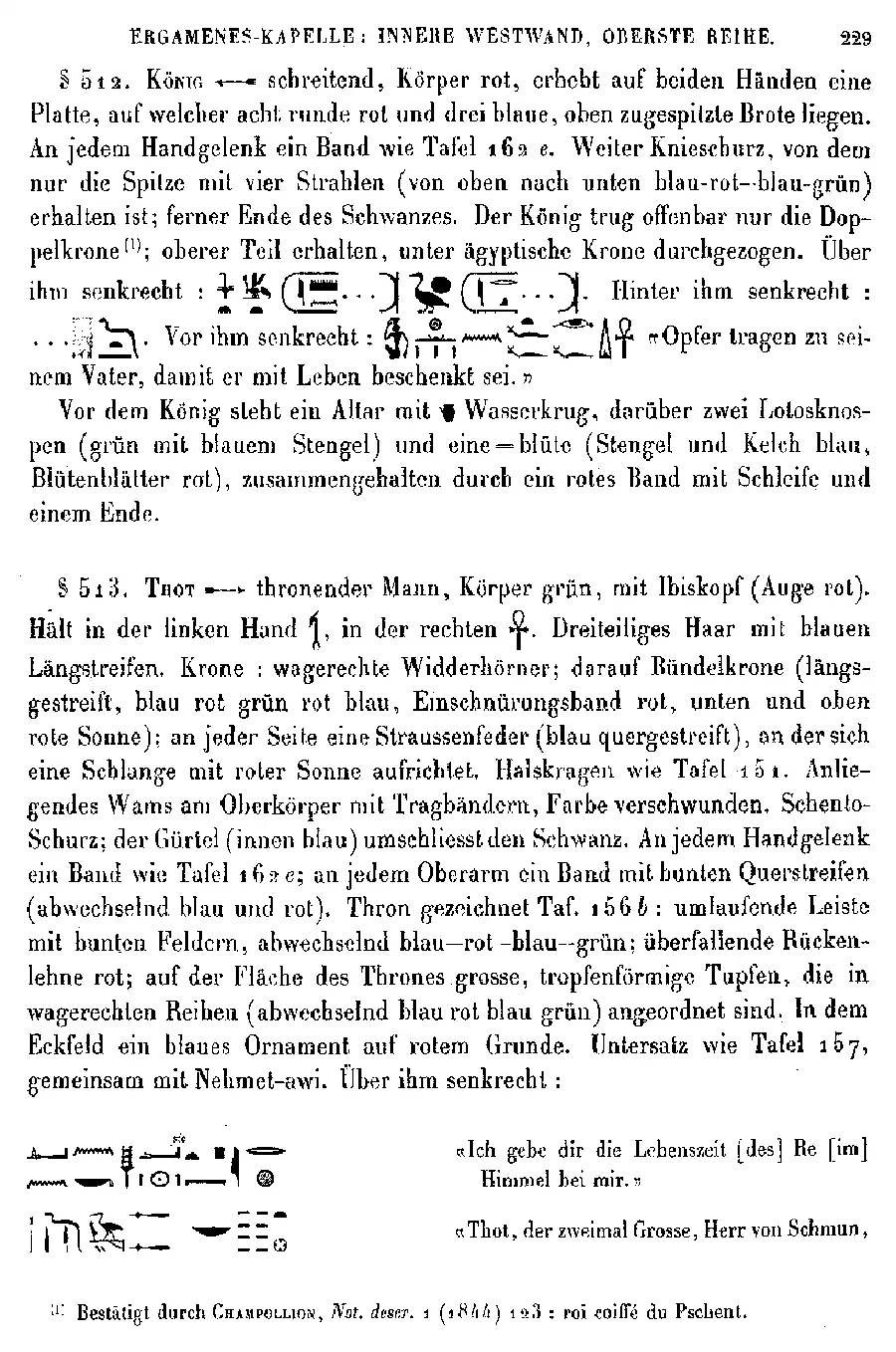
Page 229. Roeder, Der Tempel von Dakke (1930), p. 229 Printed hieroglyphs from G. Roeder, Der Tempel von Dakke (1930) - 421p. 229, § 512
nswt-bj.tj ḏr.t-ꜥnḫ-jmn-tj.t-rꜥ sꜣ-rꜥ jrḳ-jmn-ꜥnḫ-ḏ.t-mrj-ꜣs.t
King of Upper and Lower Egypt, Living Hand of Amun, Image of Ra; Son of Ra, Ergamenes, living forever, beloved of Isis.
- 422p. 229, § 512
[sꜣ ꜥnḫ wꜣs nb ḥꜣ=f mj rꜥ] ḏ.t
All protection, life and dominion stand behind him as they stand behind Ra, forever.
- 423p. 229, § 512
fꜣj.(t) jḫ.t n jt=f jrj.n=f dj.(t) ꜥnḫ
Carrying offerings to his father. He has done this that life may be given him.
- 424p. 229, § 513
dj.n=(j) n=k ꜥḥꜥ rꜥ <n> p.t ḫr=j
I have given you the lifespan of Ra in the sky, here beside me.
- 425p. 229, § 513
ḏd-mdw jn ḏḥwtj ꜥꜣ ꜥꜣ nb ḫmnw wp rḥḥ.wj sḥtp nṯr.w nṯr ꜥꜣ nb <p>srk.t nb ḫꜣs.(w)t rsj.w(t)
Words spoken by Thoth, twice great, lord of Hermopolis, who parts the Two Companions and brings the gods to peace, the great god, lord of Pselkis, lord of the foreign lands of the south.
Note · Line 425
Thoth settles their quarrel. - 426p. 229, § 513
dj.n=(j) n=k kꜣ nb ḏfꜣ
I have given you every kind of food and provisions.
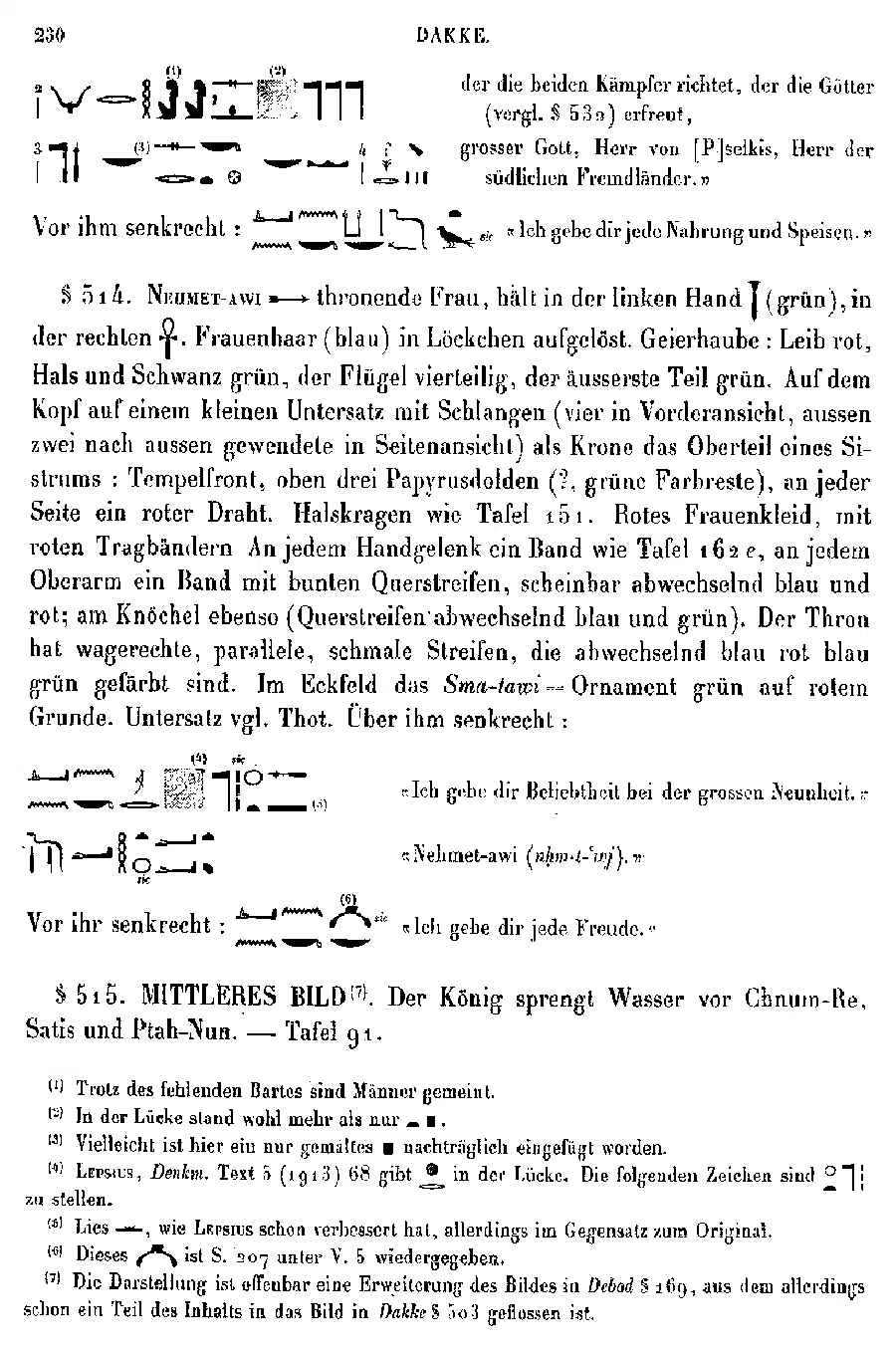
Page 230. Roeder, Der Tempel von Dakke (1930), p. 230 Printed hieroglyphs from G. Roeder, Der Tempel von Dakke (1930) - 427p. 230, § 514
dj.n=(j) n=k mrw.t --1Q-- psḏ.t ꜥꜣ.t
I have given you love … the Great Ennead.
- 428p. 230, § 514
ḏd-mdw jn nḥm.t-ꜥwꜣj
Words spoken by Nehemetaway.
- 429p. 230, § 514
dj.n=(j) n=k ꜣw.(t)-jb nb.(t)
I have given you every joy.
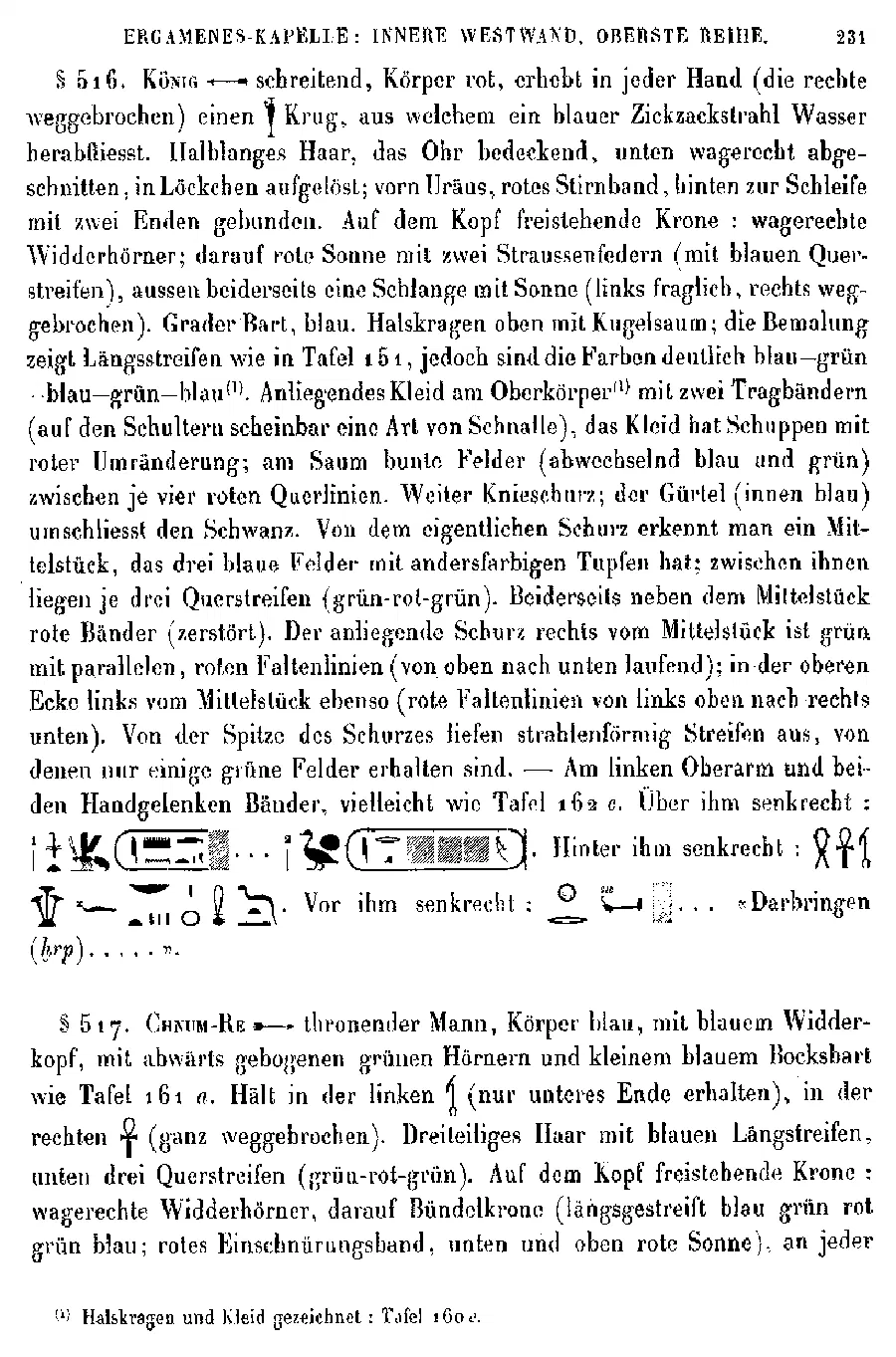
Page 231. Roeder, Der Tempel von Dakke (1930), p. 231 Printed hieroglyphs from G. Roeder, Der Tempel von Dakke (1930) - 430p. 231, § 516
nswt-bj.tj ḏr.t-ꜥnḫ-jmn-tj.t-rꜥ sꜣ-rꜥ jrḳ-[jmn-ꜥnḫ-ḏ.t-]mrj-[ꜣs.t]
King of Upper and Lower Egypt, Living Hand of Amun, Image of Ra; Son of Ra, Ergamenes, living forever, beloved of Isis.
- 431p. 231, § 516
sꜣ ꜥnḫ wꜣs nb.{wt} ḥꜣ=f mj rꜥ ḏ.t
All protection, life and dominion stand behind him as they stand behind Ra, forever.
- 432p. 231, § 516
ḫrp --détruit--
Presenting …
- 433p. 231, § 517
dj.n=(j) n=k tꜣ.w nb.(w) m --2Q--
I have given you all lands in peace.
- 434p. 231, § 517
ḏd-mdw jn ẖnmw-rꜥ nb ḳbḥw nṯr ꜥꜣ ḫnt.j snm.t --1.5Q-- ḏ.t=f m <ḏw>-ḳꜣ
Words spoken by Khnum-Ra, lord of the wellspring, the great god, foremost in Senmet, … his body in the High Mountain.
Note · Line 434
The wellspring is the source of the Nile, which Khnum was believed to guard at the First Cataract. 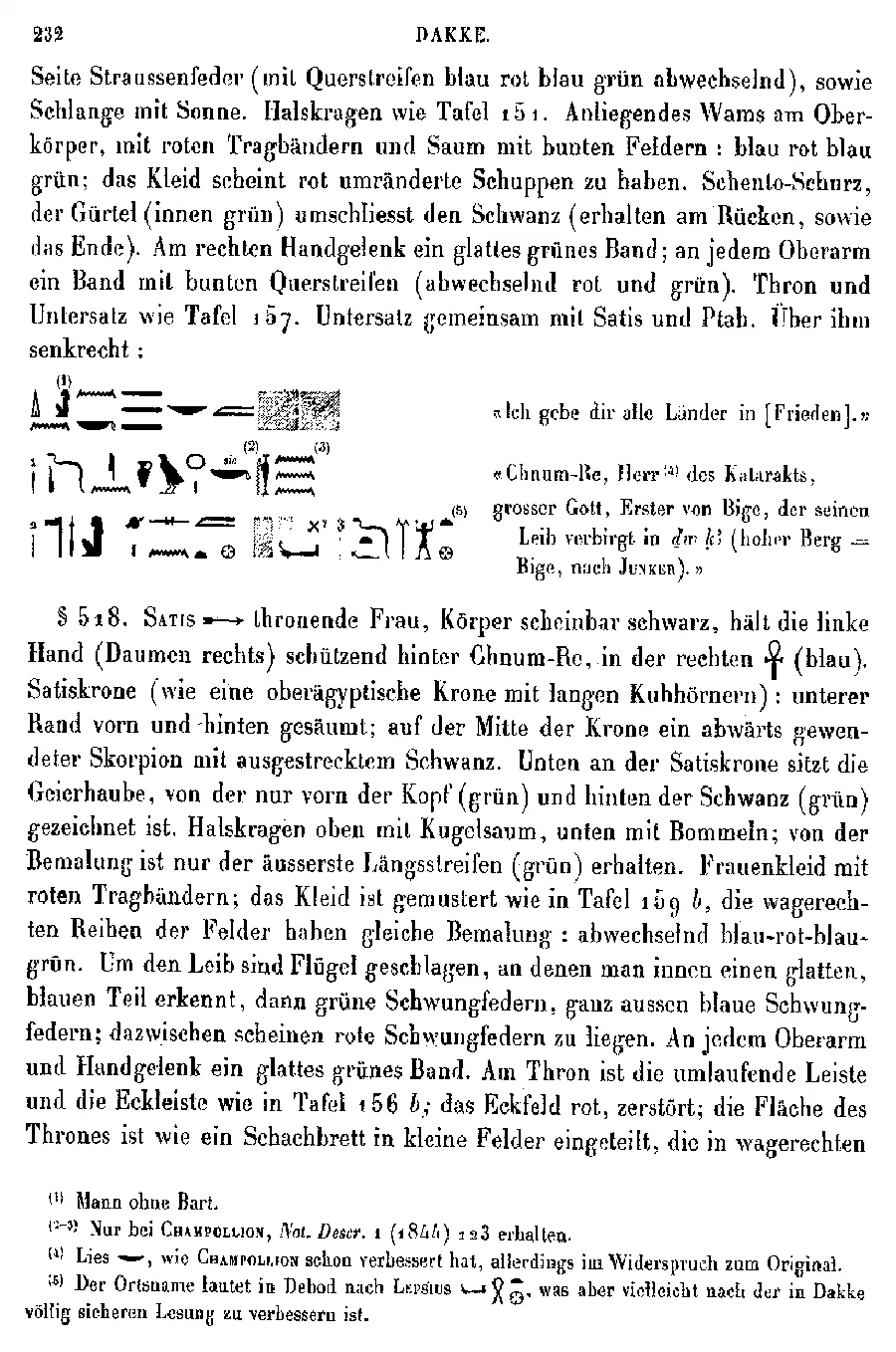
Page 232. Roeder, Der Tempel von Dakke (1930), p. 232 Printed hieroglyphs from G. Roeder, Der Tempel von Dakke (1930) - 435p. 232, § 518
dj.n=j n=k tꜣ.w nb.(w) m ḥtp
I have given you all lands in peace.
- 436p. 232, § 518
ḏd-mdw jn st.t ꜥꜣ.t nb.(t) ꜣbw ḫnt.j.(t) snm.t
Words spoken by Satet the Great, lady of Elephantine, foremost in Senmet.
- 437p. 232, § 518
stj=(j) šsr r ḫft.j.w=k
I shoot arrows at your enemies.
Note · Line 437
In Egyptian, the word for “shoot” echoes Satet’s name. 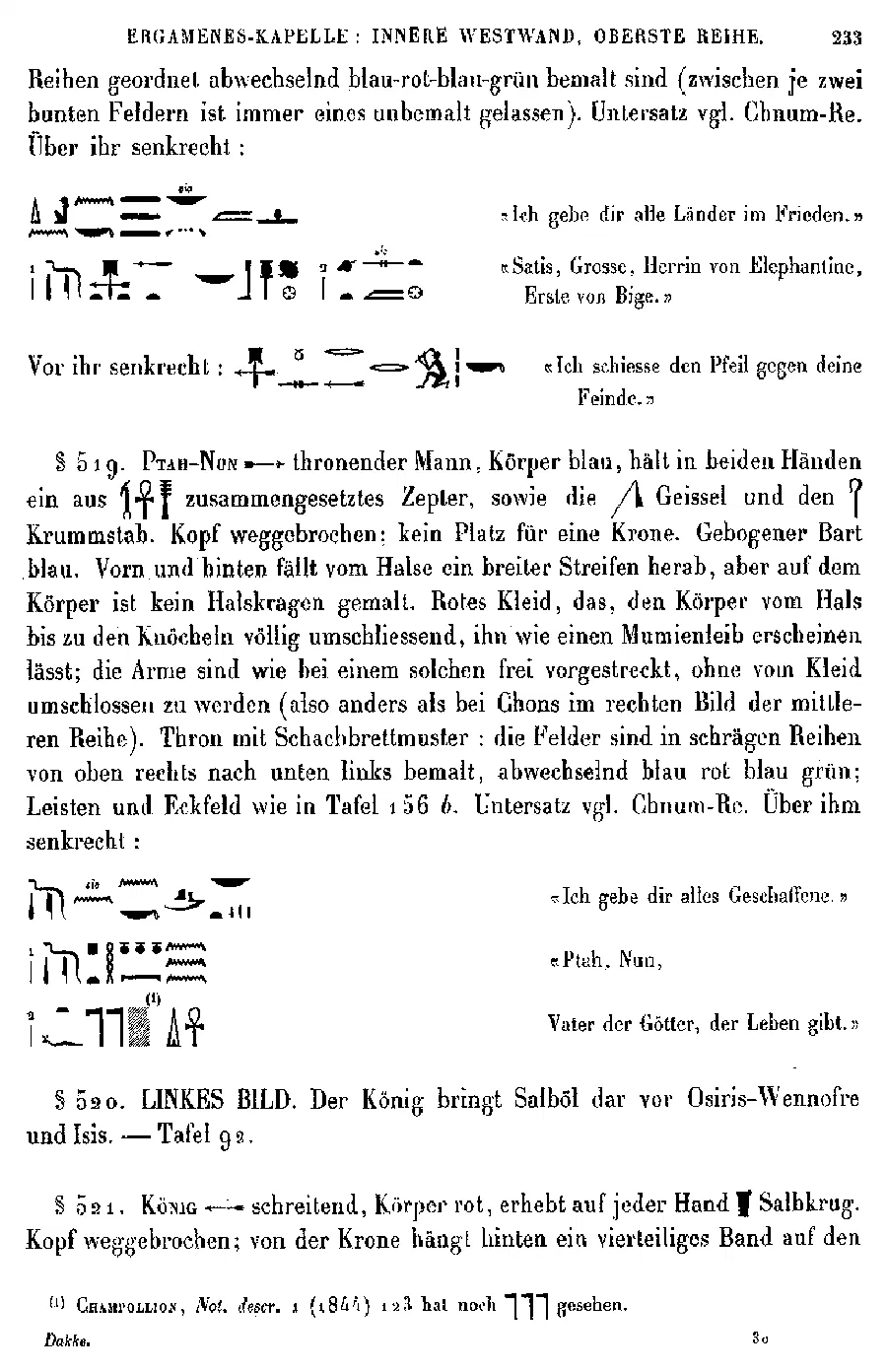
Page 233. Roeder, Der Tempel von Dakke (1930), p. 233 Printed hieroglyphs from G. Roeder, Der Tempel von Dakke (1930) - 438p. 233, § 519
ḏd-mdw {jn} <dj>.n=(j) n=k ḳmꜣ nb.{wt}
Words spoken: I have given you all that has been created.
- 439p. 233, § 519
ḏd-mdw jn ptḥ-nwn jt nṯr.w dj ꜥnḫ
Words spoken by Ptah-Nun, father of the gods, giver of life.
- 440p. 233, § 521
nswt-bj.tj ḏr.t-ꜥnḫ-jmn-tj.t-rꜥ sꜣ-rꜥ jrḳ-jmn-ꜥnḫ-ḏ.t-mrj-ꜣs.t
King of Upper and Lower Egypt, Living Hand of Amun, Image of Ra; Son of Ra, Ergamenes, living forever, beloved of Isis.
- 441p. 233, § 521
[sꜣ] ꜥnḫ wꜣs nb.{wt} ḥꜣ=f mj rꜥ ḏ.t
All protection, life and dominion are behind him as they are behind Ra, forever.
- 442p. 233, § 521
ḥnk mḏ <n> jt=f jrj.n=f dj.(t) ꜥnḫ
Offering ointment to his father. He has done this that he may be granted life.
Note · Line 442
The king makes the offering to a god whom he addresses as his father. 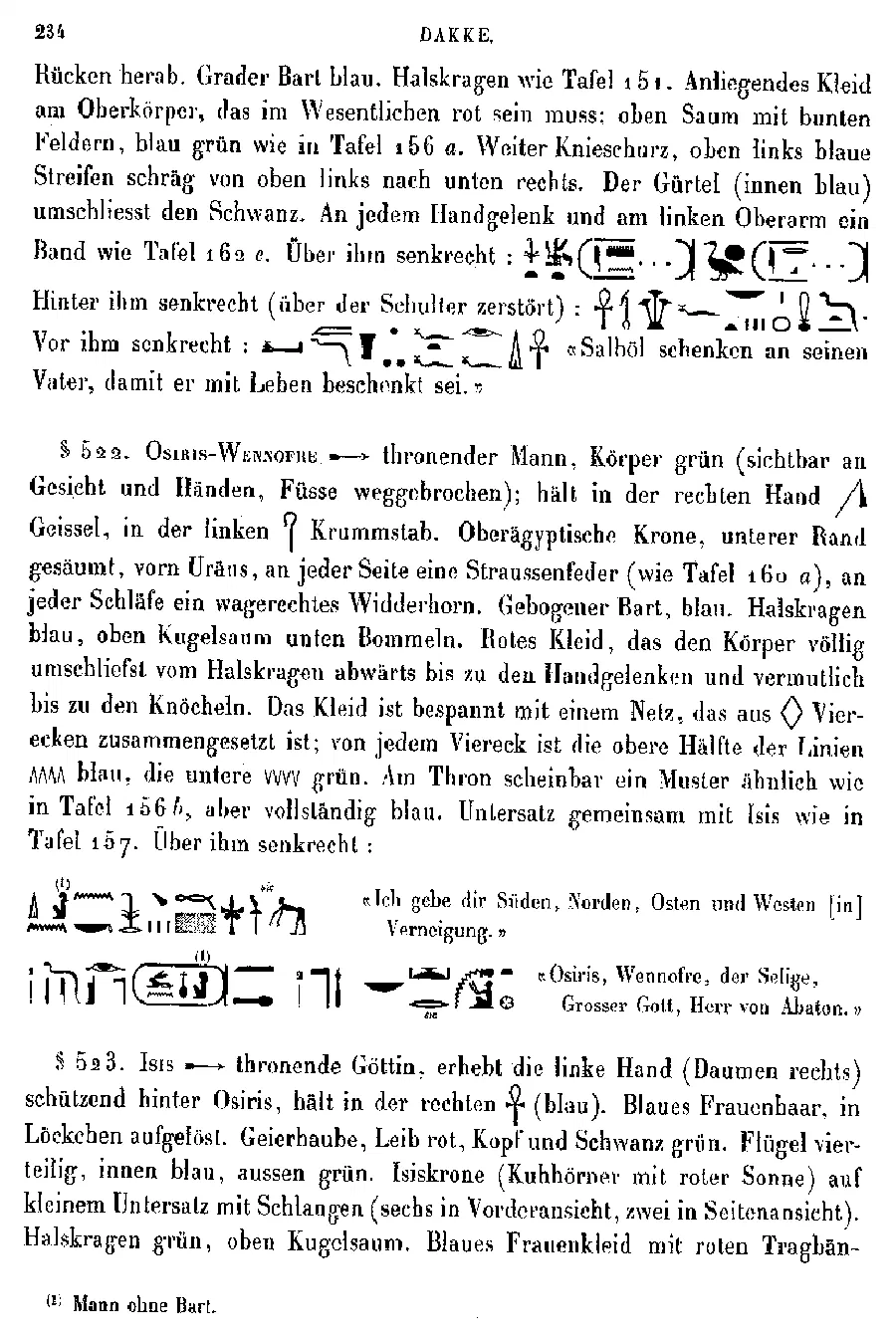
Page 234. Roeder, Der Tempel von Dakke (1930), p. 234 Printed hieroglyphs from G. Roeder, Der Tempel von Dakke (1930) - 443p. 234, § 522
dj.n=j n=k rsj mḥw jꜣb.t jmnt.t <m> ks
I have given you the South and the North, the East and the West, all bowed down.
- 444p. 234, § 522
ḏd-mdw jn wsjr wn-nfr mꜣꜥ-ḫrw nṯr ꜥꜣ nb jꜣ.t-wꜥb.t
Words spoken by Osiris Wennefer, vindicated, the great god, lord of the Abaton.
- 445p. 234, § 523
dj.n=j n=k ꜥnḫ wꜣs nb snb nb
I have given you all life and dominion, and health in full.
- 446p. 234, § 523
ḏd-mdw jn ꜣs.t dj.(t) ꜥnḫ nb.(t) jꜣ.t-wꜥb.t ḥnw.t nb.(t) jwrḳ
Words spoken by Isis, giver of life, lady of the Abaton, sovereign mistress, lady of Philae.
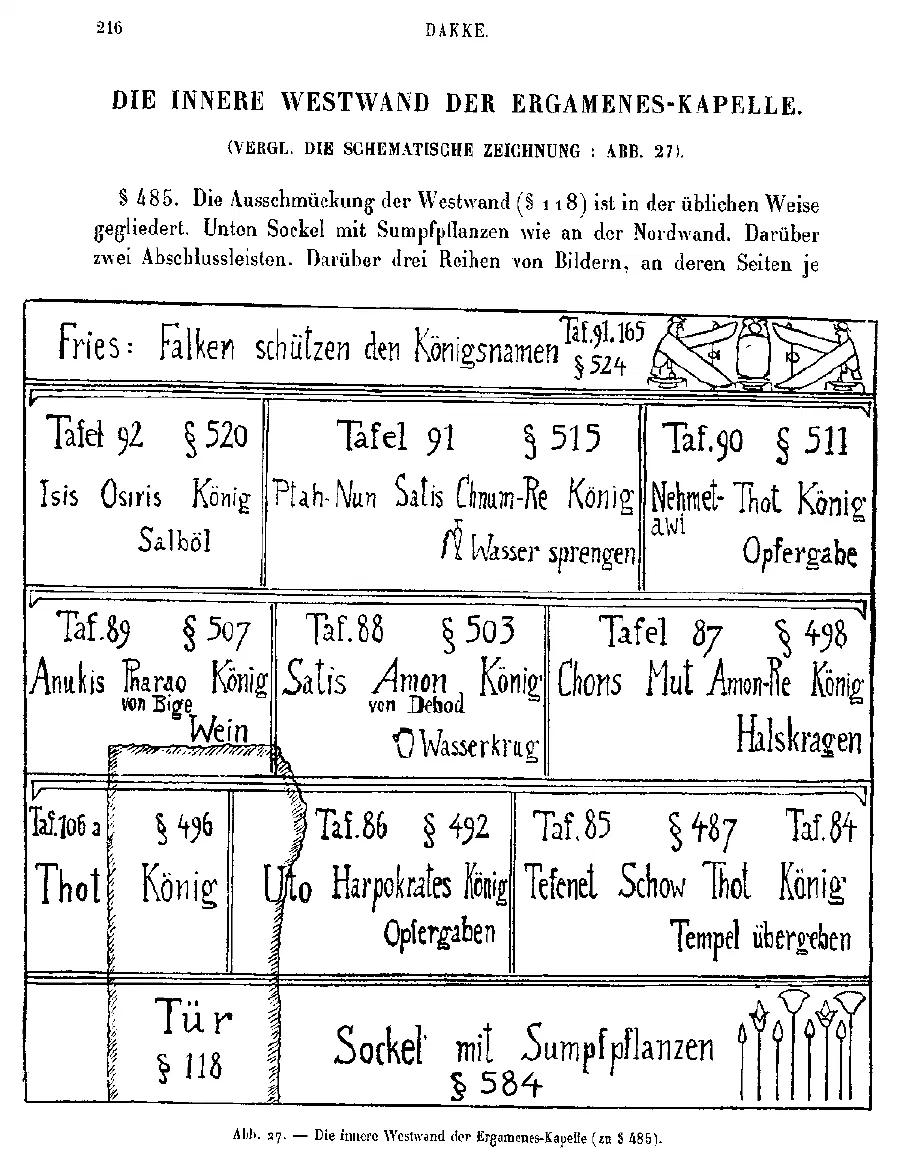
Page 216. Roeder, Der Tempel von Dakke (1930), p. 216 Printed hieroglyphs from G. Roeder, Der Tempel von Dakke (1930) - 447p. 216, § 524
jrḳ-jmn-ꜥnḫ-ḏ.t-mrj-ꜣs.t
Ergamenes, living forever, beloved of Isis.
- 448p. 216, § 524
ḏr.t-ꜥnḫ-jmn-tj.t-rꜥ bḥd.tj
Living Hand of Amun, Image of Ra. He of Behdet.
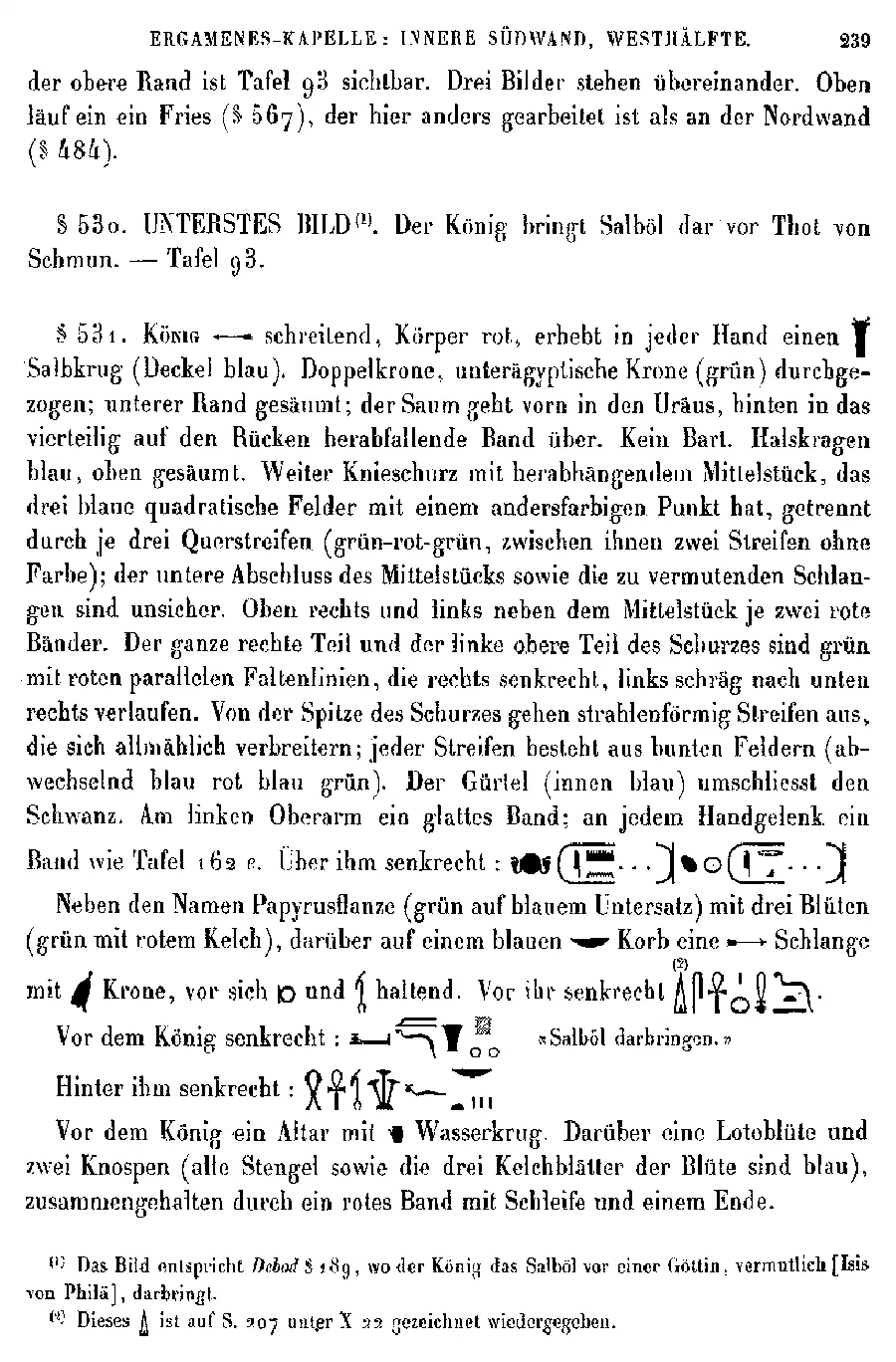
Page 239. Roeder, Der Tempel von Dakke (1930), p. 239 Printed hieroglyphs from G. Roeder, Der Tempel von Dakke (1930) - 449p. 239, § 531
nswt-bj.tj ḏr.t-ꜥnḫ-jmn-tj.t-rꜥ sꜣ-rꜥ jrḳ-jmn-ꜥnḫ-ḏ.t-mrj-ꜣs.t
King of Upper and Lower Egypt, Living Hand of Amun, Image of Ra; Son of Ra, Ergamenes, living forever, beloved of Isis.
- 450p. 239, § 531
dj=s ꜥnḫ mj rꜥ ḏ.t
She gives life like Ra, forever.
- 451p. 239, § 531
ḥnk mḏ
Offering ointment.
- 452p. 239, § 531
sꜣ ꜥnḫ wꜣs nb.{wt} ḥꜣ=f
All protection, life and dominion are behind him.
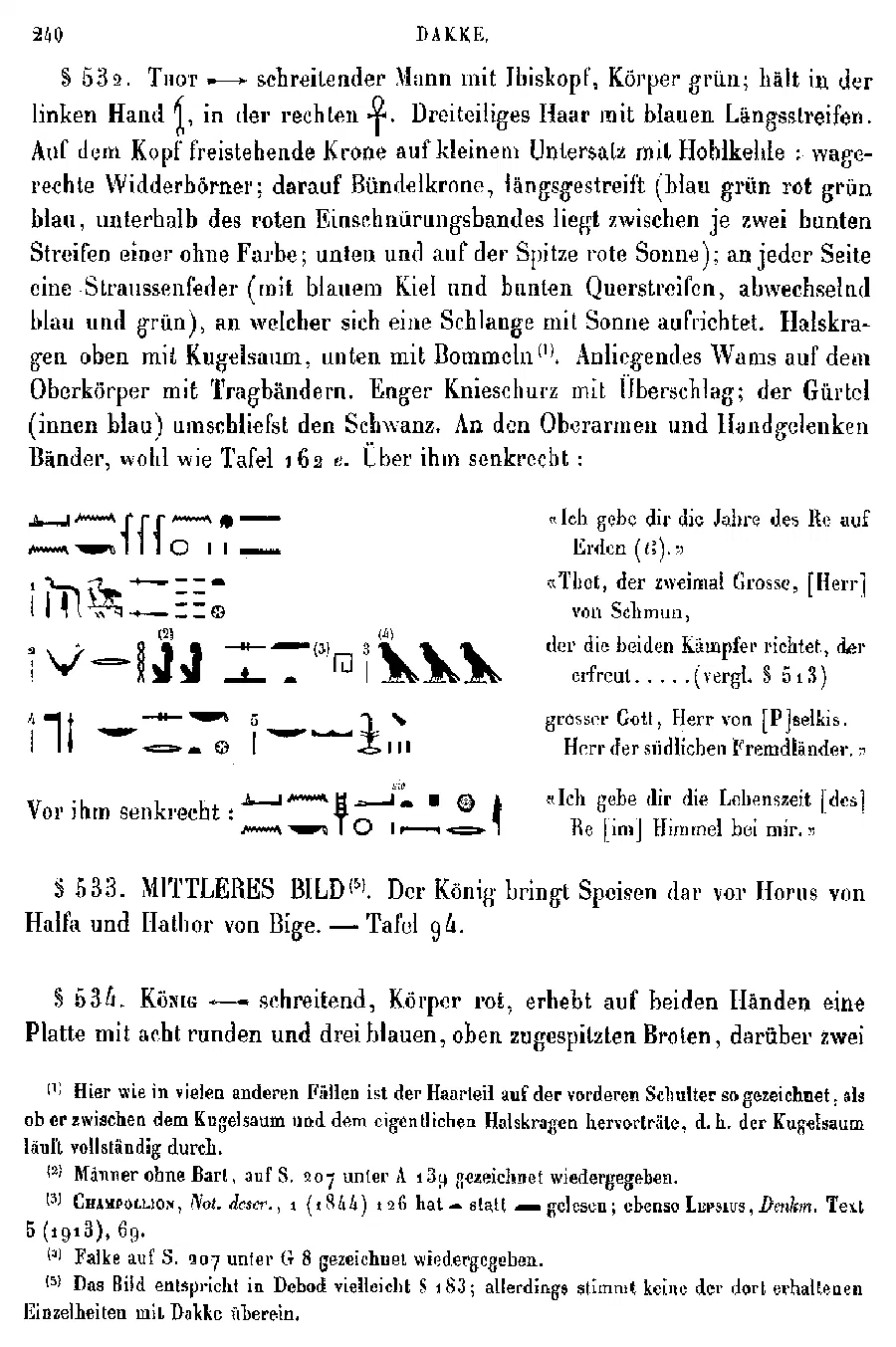
Page 240. Roeder, Der Tempel von Dakke (1930), p. 240 Printed hieroglyphs from G. Roeder, Der Tempel von Dakke (1930) - 453p. 240, § 532
dj.n=(j) n=k rnp.wt n rꜥ tp tꜣ.{wj}
I have given you the years of Ra on earth.
- 454p. 240, § 532
ḏd-mdw jn ḏḥwtj ꜥꜣ ꜥꜣ <nb> ḫmnw wp rḥḥ.wj sḥtp nṯr.w nṯr ꜥꜣ nb psrk.t nb ḫꜣs.wt rsj.w(t)
Words spoken by Thoth, twice great, lord of Hermopolis, who parts the Two Companions and brings the gods to peace, the great god, lord of Pselkis, lord of the southern foreign lands.
- 455p. 240, § 532
dj.n=(j) n=k ꜥḥꜥ <n> rꜥ <m> p.t ḫr=j
I have given you the lifetime of Ra in the sky beside me.
- 456p. 240, § 534
nswt-bj.tj ḏr.t-ꜥnḫ-jmn-tj.t-rꜥ sꜣ-rꜥ jrḳ-jmn-ꜥnḫ-ḏ.t-mrj-ꜣs.t
King of Upper and Lower Egypt, Living Hand of Amun, Image of Ra; Son of Ra, Ergamenes, living forever, beloved of Isis.
- 457p. 240, § 534
sꜣ ꜥnḫ wꜣs nb.{wt} ḥꜣ=f
All protection, life and dominion are behind him.
- 458p. 240, § 534
fꜣj.(t) jḫ.t <n> jt=f jrj.n=f dj.(t) ꜥnḫ
Bearing offerings to his father. He has done this that he may be granted life.
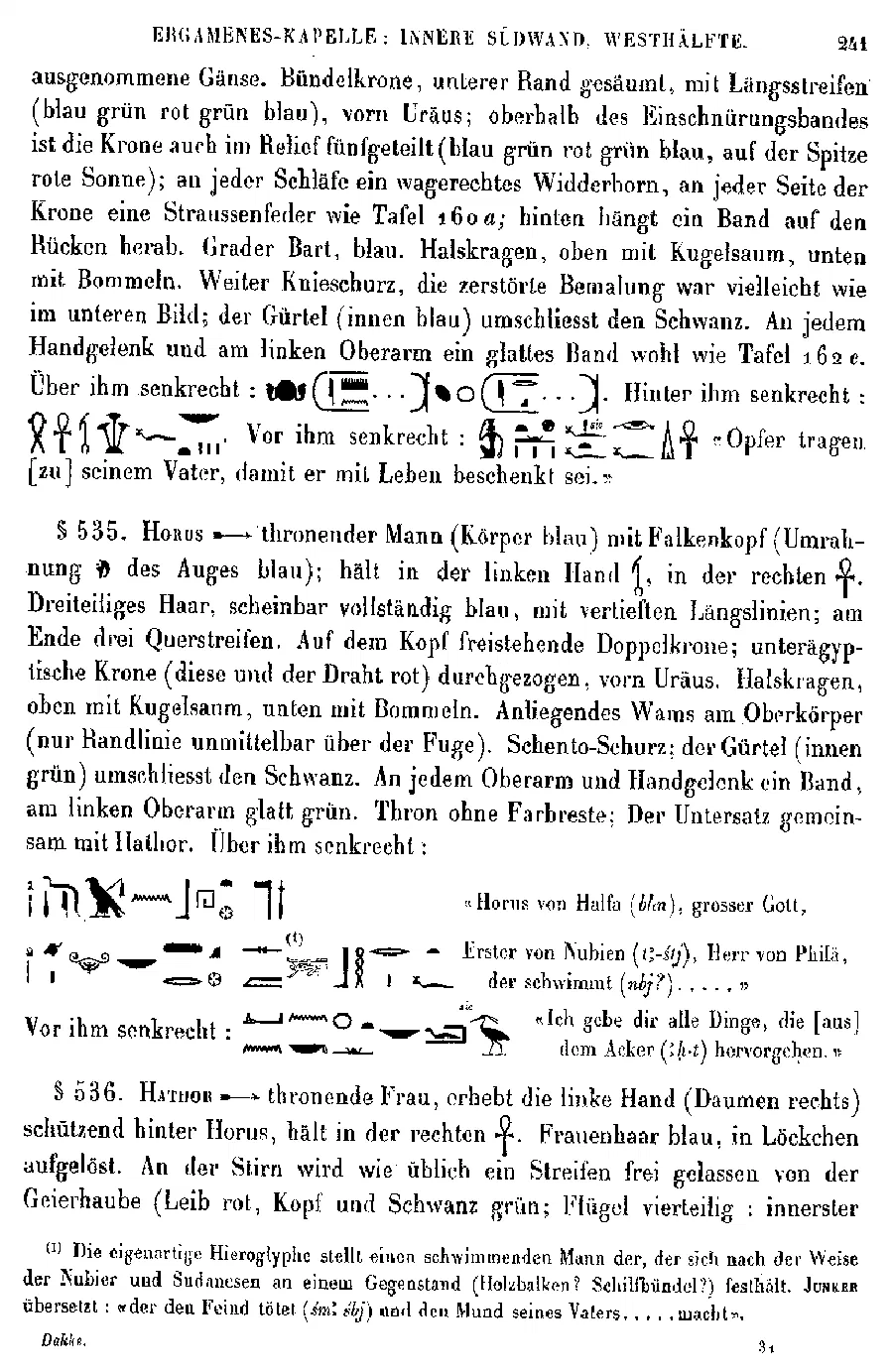
Page 241. Roeder, Der Tempel von Dakke (1930), p. 241 Printed hieroglyphs from G. Roeder, Der Tempel von Dakke (1930) - 459p. 241, § 535
ḏd-mdw jn ḥrw n bhn nṯr ꜥꜣ ḫnt.j tꜣ-stj nb jwrḳ … r jt=f
Words spoken by Horus of Buhen, the great god, foremost in Nubia, lord of Philae, … to his father.
- 460p. 241, § 535
dj.n=(j) n=k jḫ.t nb.(t) prj.(t) <m> ꜣḫ.t
I have given you everything the field brings forth.
- 461p. 241, § 536
ḏd-mdw jn ḥw.t-ḥrw <nb.t> snm.t jr.t rꜥ nb.(t) p.t ḥnw.t nṯr.w nb.(w)
Words spoken by Hathor, lady of Senmet, Eye of Ra, lady of the sky, mistress of all the gods.
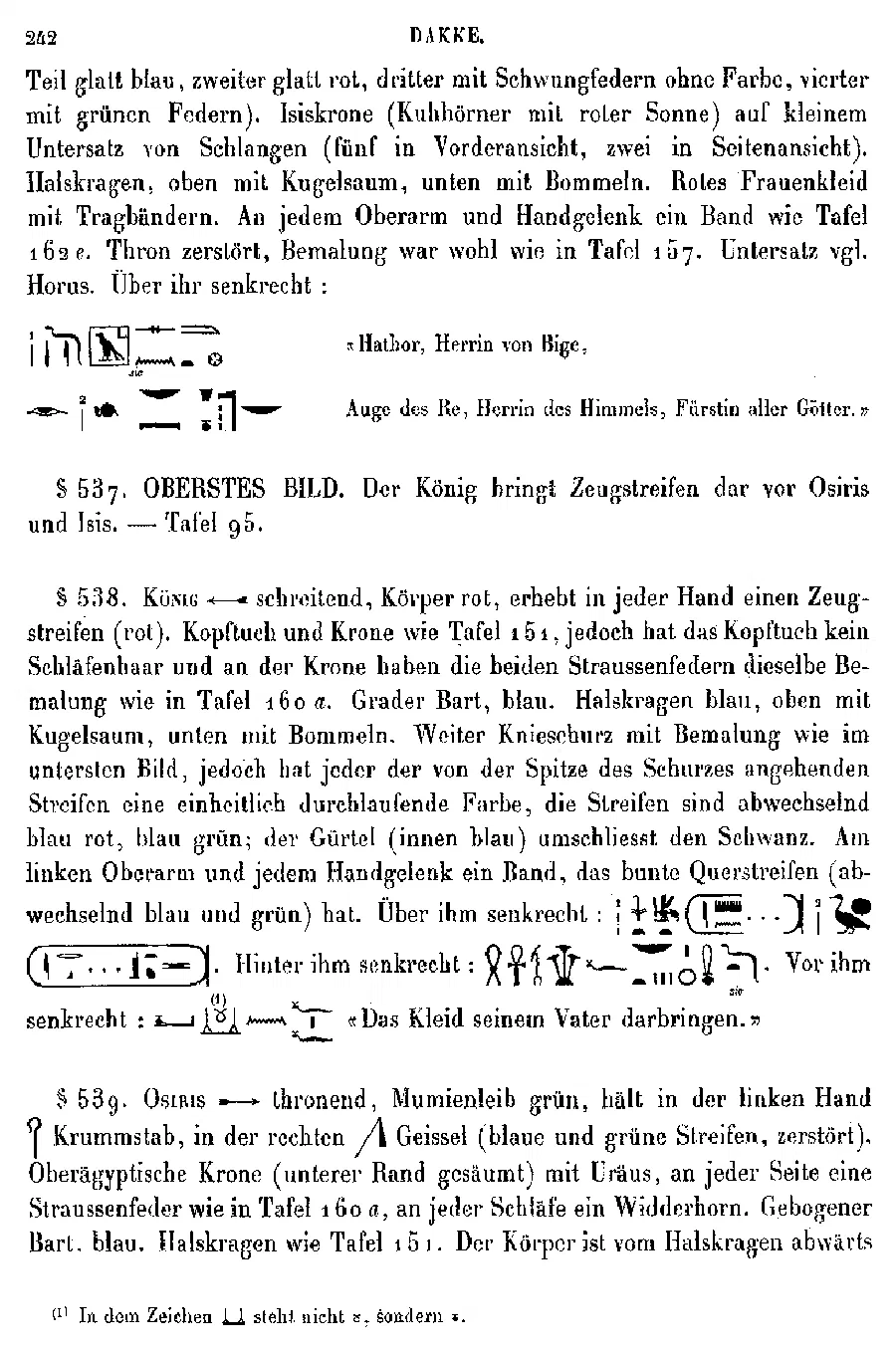
Page 242. Roeder, Der Tempel von Dakke (1930), p. 242 Printed hieroglyphs from G. Roeder, Der Tempel von Dakke (1930) - 462p. 242, § 538
nswt-bj.tj ḏr.t-ꜥnḫ-jmn-tj.t-rꜥ sꜣ-rꜥ jrḳ-jmn-ꜥnḫ-ḏ.t-mrj-ꜣs.t
The King of Upper and Lower Egypt, Living Hand of Amun, Image of Ra; the Son of Ra, Ergamenes, living forever, beloved of Isis.
Note · Line 462
The title “King of Upper and Lower Egypt” introduces his throne name; “Son of Ra” introduces his birth name. - 463p. 242, § 538
sꜣ ꜥnḫ wꜣs nb.{wt } ḥꜣ=f mj rꜥ ḏ.t
All protection, life and dominion are behind him, as they are behind Ra, forever.
- 464p. 242, § 538
ḥnk mnḫ.t n jt=f
Presenting linen to his father.
Note · Line 464
The king offers the cloth to a god as a son to his father. Linen was used to dress the divine image. - 465p. 242, § 539
dj.n=(j) n=k ꜥnḫ wꜣs nb ḫr=(j)
I have given you all the life and dominion that are mine.
- 466p. 242, § 539
ḏd-mdw jn wsjr wn-nfr mꜣꜥ-ḫrw nṯr ꜥꜣ nb jꜣ.t-wꜥb.t
Words spoken by Osiris Wennefer, vindicated, the great god, lord of the Abaton:
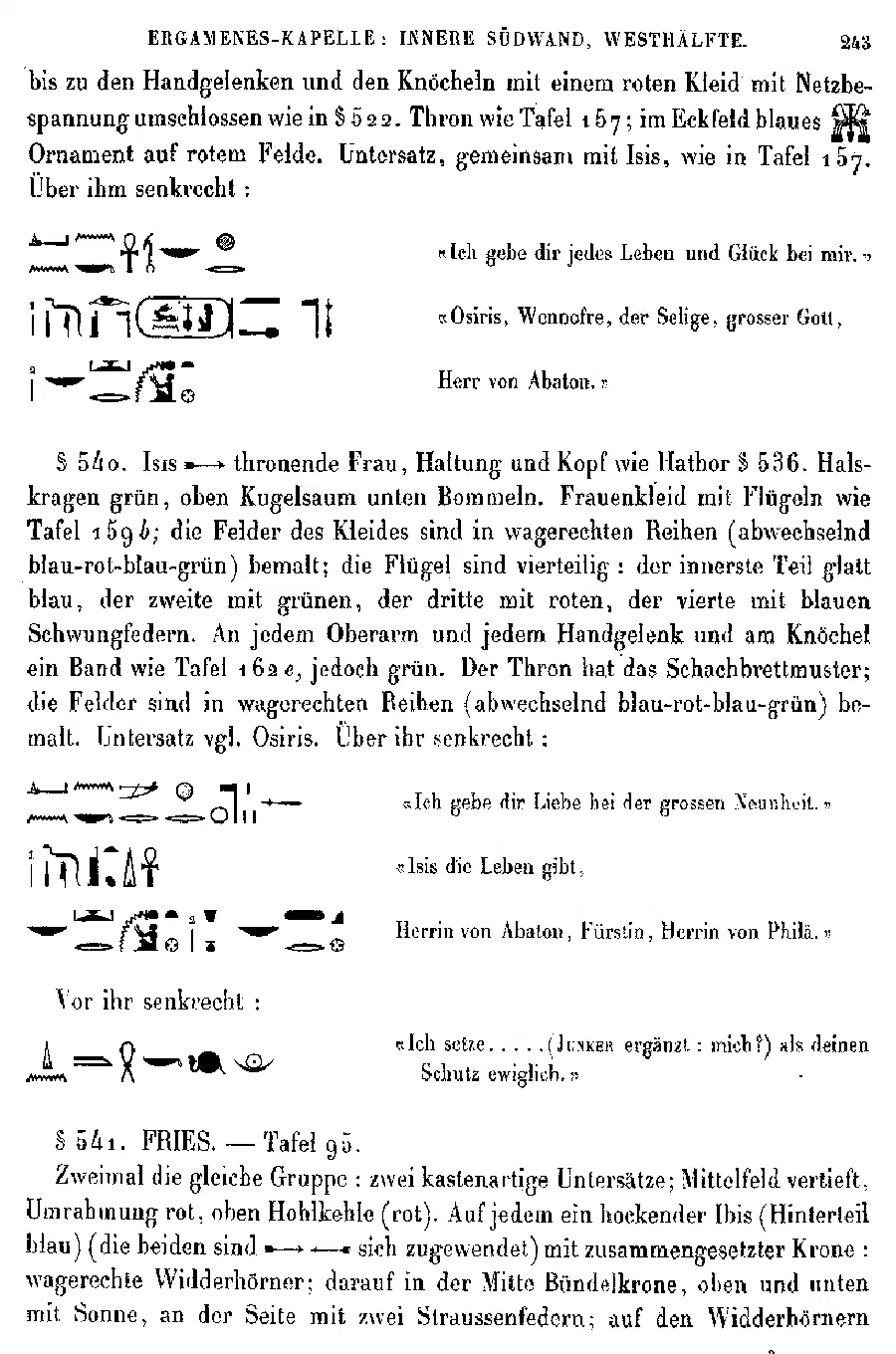
Page 243. Roeder, Der Tempel von Dakke (1930), p. 243 Printed hieroglyphs from G. Roeder, Der Tempel von Dakke (1930) - 467p. 243, § 540
dj.n=(j) n=k mrw.(t) ḫr psḏ.t ꜥꜣ.(t)
I have given you the love of the Great Ennead.
Note · Line 467
The Great Ennead is the company of nine gods headed by Atum. - 468p. 243, § 540
ḏd-mdw jn ꜣs.t dj.(t) ꜥnḫ nb.(t) jꜣ.t-wꜥb.t ḥnw.t nb.(t) jwrḳ
Words spoken by Isis, giver of life, lady of the Abaton, sovereign, lady of Philae:
- 469p. 243, § 540
dj.n=(j) m sꜣ=k rꜥ nb
I have given this for your protection every day.
- 470p. 243, § 541
nb ḫmnw
Lord of Hermopolis.
Note · Line 470
Hermopolis was the chief seat of Thoth, god of writing. - 471p. 243, § 541
nb mdw-nṯr
Lord of divine words.
Note · Line 471
“Divine words” was an Egyptian name for hieroglyphic writing. 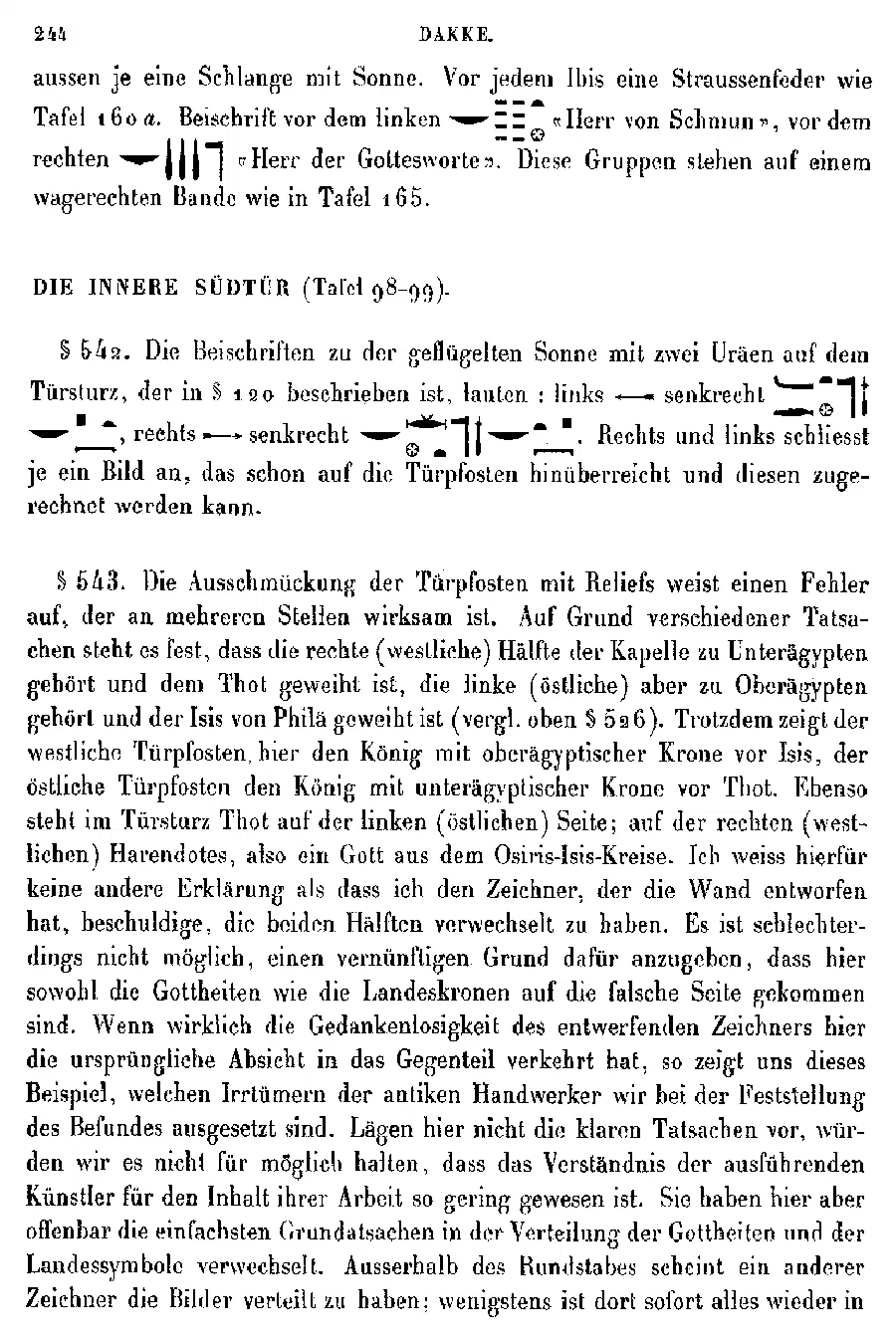
Page 244. Roeder, Der Tempel von Dakke (1930), p. 244 Printed hieroglyphs from G. Roeder, Der Tempel von Dakke (1930) - 472p. 244, § 542
bḥd.tj nṯr ꜥꜣ nb p.t
He of Behdet, the great god, lord of the sky.
Note · Line 472
The title names Horus, often shown over a temple scene as a winged sun disk. - 473p. 244, § 542
nb msn nṯr ꜥꜣ nb p.t
Lord of Mesen, the great god, lord of the sky.
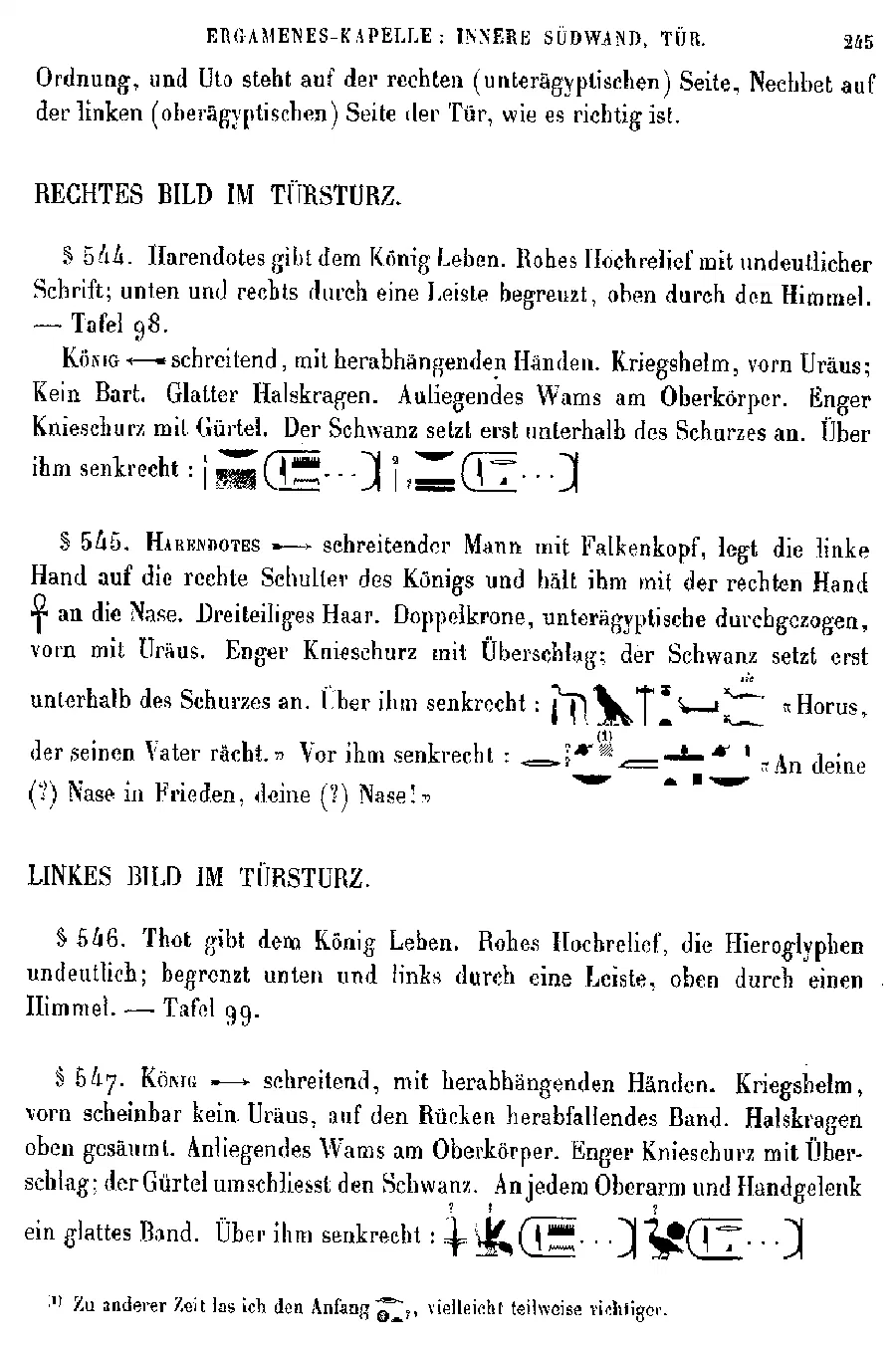
Page 245. Roeder, Der Tempel von Dakke (1930), p. 245 Printed hieroglyphs from G. Roeder, Der Tempel von Dakke (1930) - 474p. 245, § 544
nswt-bj.tj ḏr.t-ꜥnḫ-jmn-tj.t-rꜥ sꜣ-rꜥ jrḳ-jmn-ꜥnḫ-ḏ.t-mrj-ꜣs.t
The King of Upper and Lower Egypt, Living Hand of Amun, Image of Ra; the Son of Ra, Ergamenes, living forever, beloved of Isis.
- 475p. 245, § 545
ḏd-mdw jn ḥrw-nḏ-jt=f
Words spoken by Harendotes:
- 476p. 245, § 545
r fnḏ=k m ḥtp fnḏ=k
To your nose in peace, your nose.
Note · Line 476
In temple scenes a god often holds the sign for life to the king’s nose. The king receives life as breath. - 477p. 245, § 547
nswt-bj.tj ḏr.t-ꜥnḫ-jmn-tj.t-rꜥ sꜣ-rꜥ jrḳ-jmn-ꜥnḫ-ḏ.t-mrj-ꜣs.t
The King of Upper and Lower Egypt, Living Hand of Amun, Image of Ra; the Son of Ra, Ergamenes, living forever, beloved of Isis.
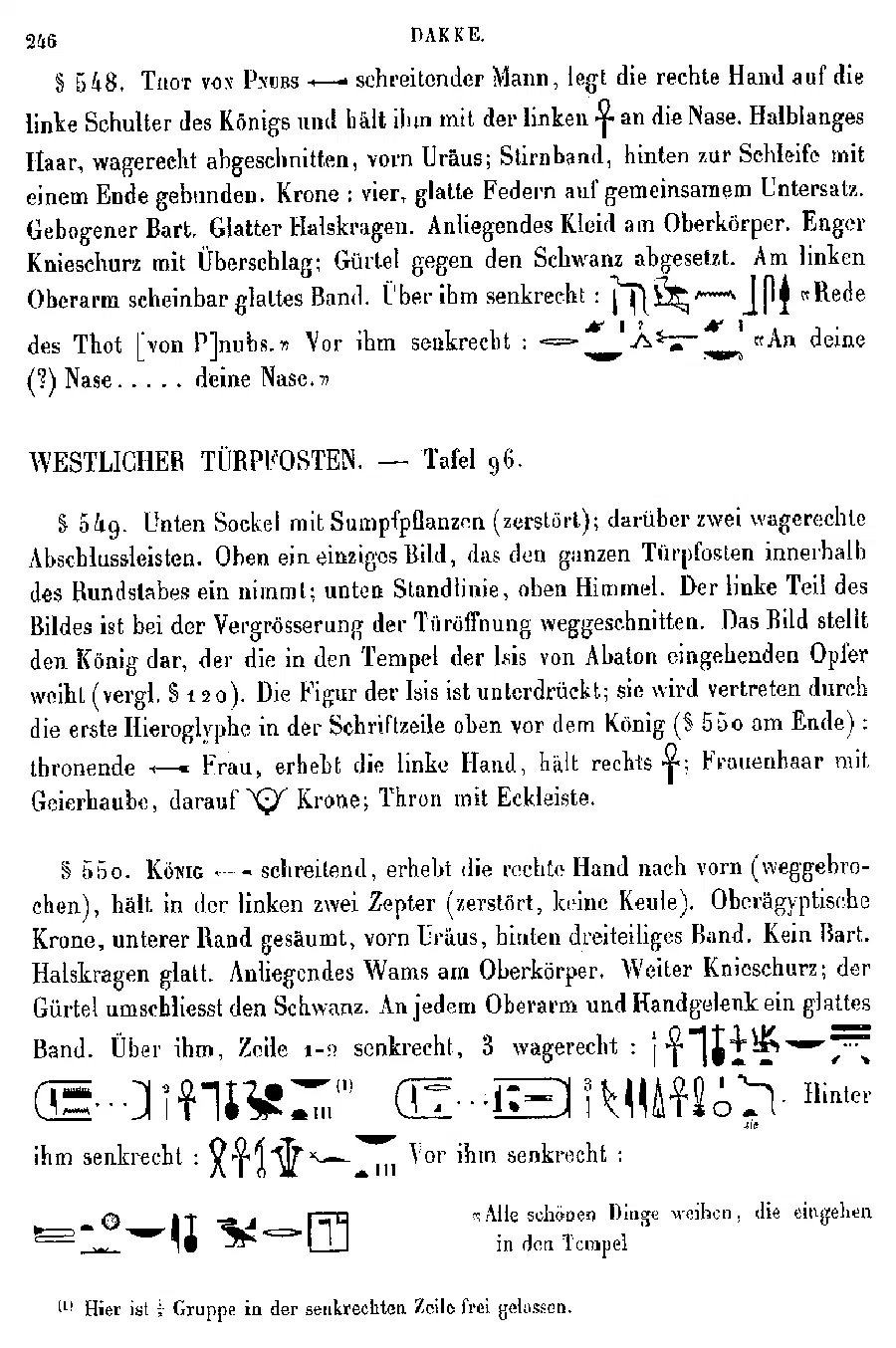
Page 246. Roeder, Der Tempel von Dakke (1930), p. 246 Printed hieroglyphs from G. Roeder, Der Tempel von Dakke (1930) - 478p. 246, § 548
ḏd-mdw jn ḏḥwtj <n p>nbs
Words spoken by Thoth of Pnubs:
- 479p. 246, § 548
r fnḏ=k … fnḏ=k
To your nose … your nose.
- 480p. 246, § 550
ꜥnḫ nṯr nfr nswt-bj.tj nb-tꜣ.wj ḏr.t-ꜥnḫ-jmn-tj.t-rꜥ
Long live the perfect god, King of Upper and Lower Egypt, lord of the Two Lands, Living Hand of Amun, Image of Ra!
- 481p. 246, § 550
ꜥnḫ nṯr nfr sꜣ-rꜥ nb-ḫꜥ.w jrḳ-jmn-ꜥnḫ-ḏ.t-mrj-ꜣs.t mrj <ꜣs.t> dj.(t) ꜥnḫ mj rꜥ ḏ.t
Long live the perfect god, Son of Ra, lord of crowns, Ergamenes, living forever, beloved of Isis, beloved of Isis who gives life like Ra forever!
- 482p. 246, § 550
sꜣ ꜥnḫ wꜣs nb.{wt} ḥꜣ=f
All protection, life and dominion are behind him.
- 483p. 246, § 550
wdn jḫ.t nb.(t) nfr.(t) ꜥḳ.(t) r ḥw.t-nṯr n ꜣs.t dj.(t) ꜥnḫ nb.(t) jꜣ.t-wꜥb.t nb.(t) jwrḳ jw=<w> wꜥb
Dedicating all the good things that enter the temple of Isis, giver of life, lady of the Abaton, lady of Philae. They are pure.
- 484p. 246, § 550
bḥd.tj nṯr ꜥꜣ nb p.t
He of Behdet, the great god, lord of the sky.
- 485p. 246, § 550
--détruit-- sꜣb šw.t prj m ꜣḫ.t ḫnt.j rsj dj=f ꜥnḫ
… of many-colored plumage, who came forth from the horizon, foremost in the south. He gives life.
- 486p. 246, § 550
ꜣs.t dj.(t) ꜥnḫ nb.(t) jꜣ.t-wꜥb.t
Isis, giver of life, lady of the Abaton.
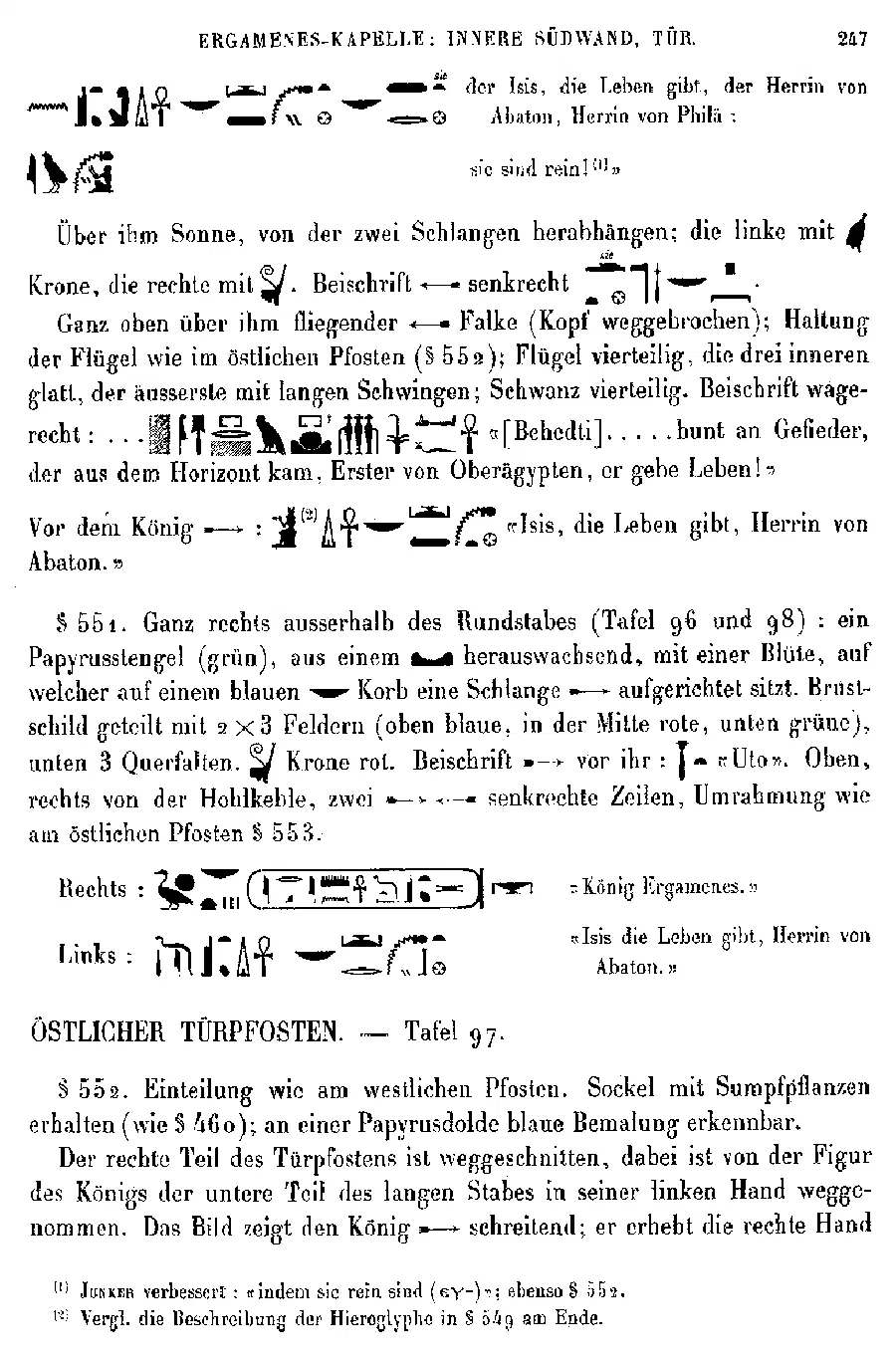
Page 247. Roeder, Der Tempel von Dakke (1930), p. 247 Printed hieroglyphs from G. Roeder, Der Tempel von Dakke (1930) - 487p. 247, § 551
wꜣḏ.t sꜣ-rꜥ nb-ḫꜥ.w jrḳ-jmn-ꜥnḫ-ḏ.t-mrj-ꜣs.t
Wadjet. The Son of Ra, lord of crowns, Ergamenes, living forever, beloved of Isis.
Note · Line 487
Wadjet is the cobra goddess of Lower Egypt, one of the king’s protectors. - 488p. 247, § 551
ḏd-mdw jn ꜣs.t dj.(t) ꜥnḫ nb.(t) jꜣ.t-wꜥb.t
Words spoken by Isis, giver of life, lady of the Abaton.
- 489p. 247, § 552
ꜥnḫ nṯr nfr nswt-bj.tj nb-tꜣ.wj ḏr.t-ꜥnḫ-jmn-tj.t-rꜥ
Long live the perfect god, King of Upper and Lower Egypt, Lord of the Two Lands, Living Hand of Amun, Image of Ra!
Note · Line 489
“Living Hand of Amun, Image of Ra” is the throne name of the Kushite king Ergamenes. - 490p. 247, § 552
ꜥnḫ nṯr nfr sꜣ-rꜥ nb-ḫꜥ.w jrḳ-jmn-ꜥnḫ-ḏ.t-mrj-ꜣs.t mrj <ꜣs.t> [dj.t ꜥnḫ mj rꜥ] ḏ.t
Long live the perfect god, Son of Ra, Lord of Crowns, Ergamenes, ever living, beloved of Isis, beloved of Isis who gives life like Ra forever!
- 491p. 247, § 552
sꜣ ꜥnḫ wꜣs nb ḥꜣ=f
All protection, life and dominion are behind him.
- 492p. 247, § 552
wdn jḫ.t nb.(t) nfr.(t) ꜥḳ.(t) nb.(t) r ḥw.t-nṯr ḏḥwtj <n p>nbs jw=<w> wꜥb
Consecrating every good thing, everything that enters the temple of Thoth of Pnubs. All are pure.
- 493p. 247, § 552
jrj.(t) ḥtp-dj-nswt n jt=f jrj.n=f dj.(t) ꜥnḫ
Making a royal offering for his father. He has done this that he may be given life.
Note · Line 493
The offering is the king’s gift; life is the god’s gift in return. - 494p. 247, § 552
bḥd.tj
He of Behdet.
- 495p. 247, § 552
bḥd.tj nṯr ꜥꜣ sꜣb šw.t prj m ꜣḫ.t ḫnt.j mḥw dj=f ꜥnḫ mj rꜥ
He of Behdet, the great god of many-colored plumage, who comes forth from the horizon, foremost in the North. He gives life like Ra.
- 496p. 247, § 552
ḏḥwtj <n p>nbs nṯr ꜥꜣ nb <p>srk.t
Thoth of Pnubs, the great god, lord of Pselkis.
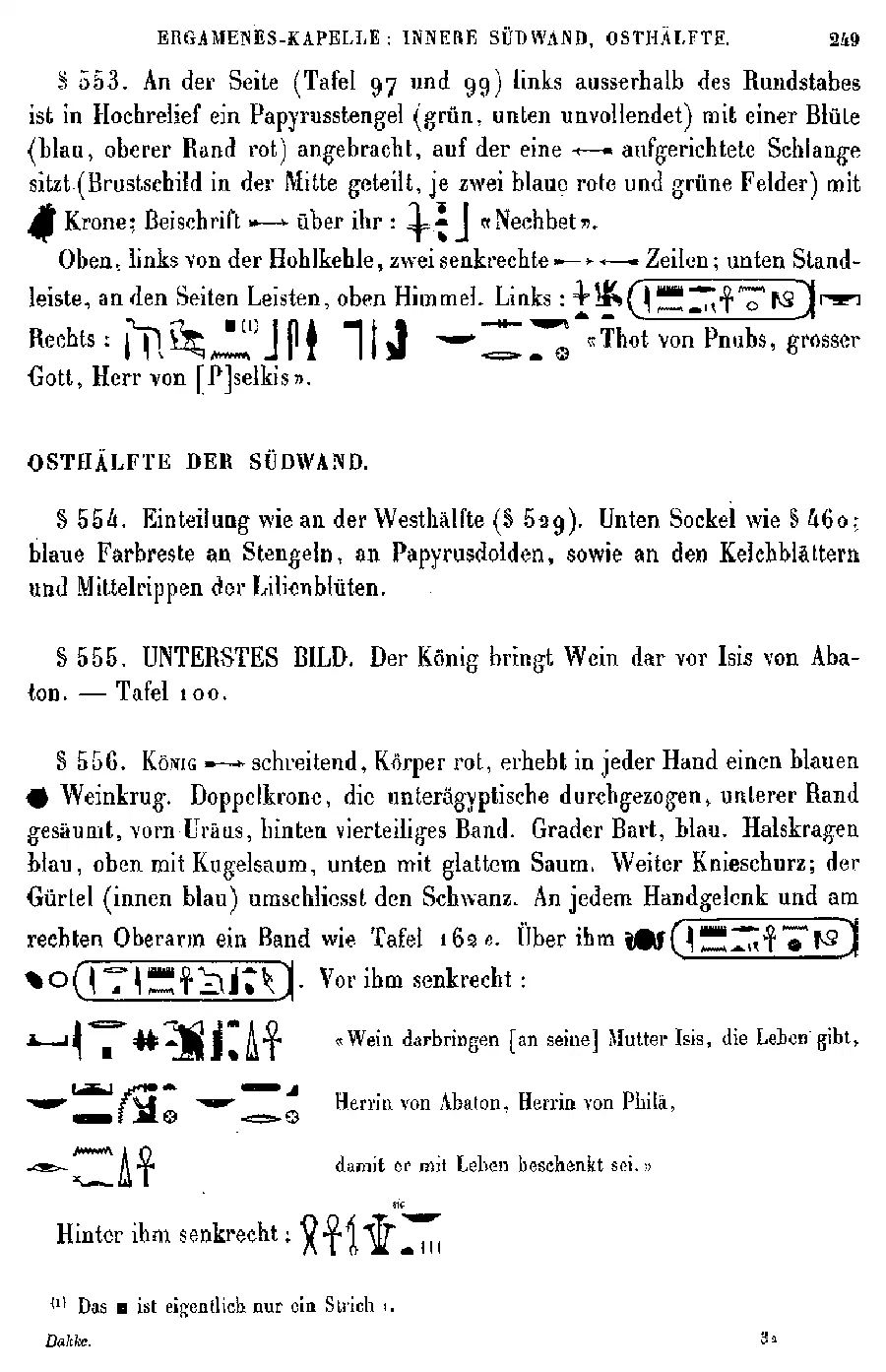
Page 249. Roeder, Der Tempel von Dakke (1930), p. 249 Printed hieroglyphs from G. Roeder, Der Tempel von Dakke (1930) - 497p. 249, § 553
nḫb.t nswt-bj.tj ḏr.t-ꜥnḫ-jmn-tj.t-rꜥ
Nekhbet. The King of Upper and Lower Egypt, Living Hand of Amun, Image of Ra.
Note · Line 497
Nekhbet is the vulture goddess who protects the king of Upper Egypt. - 498p. 249, § 553
ḏd-mdw jn ḏḥwtj <n> pnbs nṯr ꜥꜣ nb <p>srk.t
Words spoken by Thoth of Pnubs, the great god, lord of Pselkis.
- 499p. 249, § 556
nswt-bj.tj ḏr.t-ꜥnḫ-jmn-tj.t-rꜥ sꜣ-rꜥ jrḳ-jmn-ꜥnḫ-ḏ.t-mrj-ꜣs.t
The King of Upper and Lower Egypt, Living Hand of Amun, Image of Ra; the Son of Ra, Ergamenes, ever living, beloved of Isis.
- 500p. 249, § 556
ḥnk jrp <n> mw.t=f ꜣs.t dj.(t) ꜥnḫ nb.(t) jꜣ.t-wꜥb.t nb.(t) jwrḳ jrj.n=f dj.(t) ꜥnḫ
Presenting wine to his mother Isis, giver of life, lady of the Pure Mound, lady of Philae. He has done this that he may be given life.
Note · Line 500
The Pure Mound, also called the Pure Island, is the Abaton, the sacred burial place of Osiris on Bigeh, across from Philae. - 501p. 249, § 556
ꜥnḫ wꜣs nb.{wt} ḥꜣ=<f>
All life and dominion are behind him.
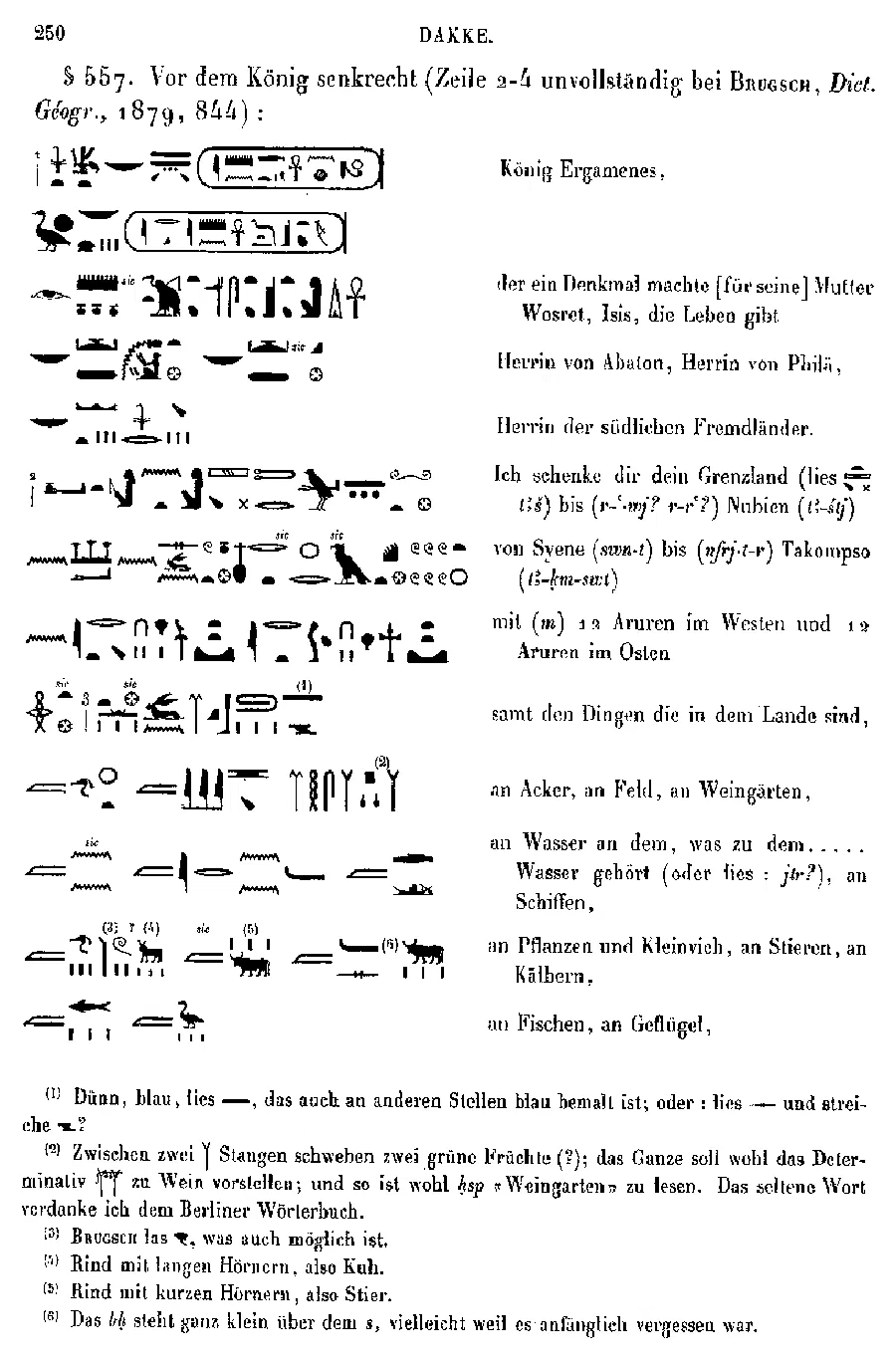
Page 250. Roeder, Der Tempel von Dakke (1930), p. 250 Printed hieroglyphs from G. Roeder, Der Tempel von Dakke (1930) - 502p. 250, § 557
nswt-bj.tj nb-tꜣ.wj ḏr.t-ꜥnḫ-jmn-tj.t-rꜥ sꜣ-rꜥ nb-ḫꜥ.w jrḳ-jmn-ꜥnḫ-ḏ.t-mrj-ꜣs.t jrj mnw <n> mw.t=f wsr.t ꜣs.t dj.(t) ꜥnḫ nb.(t) jꜣ.t-wꜥb.t nb.(t) jwrḳ nb.(t) ḫꜣs.wt rsj.w(t)
The King of Upper and Lower Egypt, Lord of the Two Lands, Living Hand of Amun, Image of Ra; the Son of Ra, Lord of Crowns, Ergamenes, ever living, beloved of Isis, makes a monument for his mother Wosret, Isis the giver of life, lady of the Pure Mound, lady of Philae, lady of the foreign lands of the south.
Note · Line 502
Wosret means “the Mighty One.” - 503p. 250, § 557
ḥnk=j n=ṯ tꜣš=ṯ r-ꜥ.wj tꜣ-stj n-šꜣꜥ-n swnw nfr.t r tꜣ-km-swt n jtr.w 12 ḥr jmnt.t jtr.w 12 ḥr jꜣb.t ḥnꜥ jḫ.t wn m-ḳꜣb tꜣ m ꜣḫ.t m sḫ.t m ḥsp m mw m jr.j-mw (?) m dp (?) m ꜣḫ.w ꜥw.t m kꜣ.w m bḥs.w m rm.w m ꜣpd.w ḥnꜥ wnn r prj.(t) jm=w mj jrj.n nswt tp.j.(w)-ꜥ r=s dj=(j) n=ṯn rsj r {n}ḏr ṯꜣw mḥw r {n}ḏr nn tmꜣ.t dmḏ <ẖr> ṯb.tj=ṯn nṯr.wj mrj.w jt ḏ.t
I grant you your territory stretching into Nubia, from Syene to Takompso: twelve schoinoi on the west bank and twelve on the east, with all that the land holds—tilled land, meadows and orchards, the water and what belongs to the water, boats, plants, flocks, bulls and calves, fish and birds—and whatever shall come forth from them, just as the kings of old did for this land. I give you both the south to the limit of the wind and the north to the limit of night, the earth united beneath your sandals, O Father-loving Gods, forever.
Note · Line 503
Syene is Aswan. 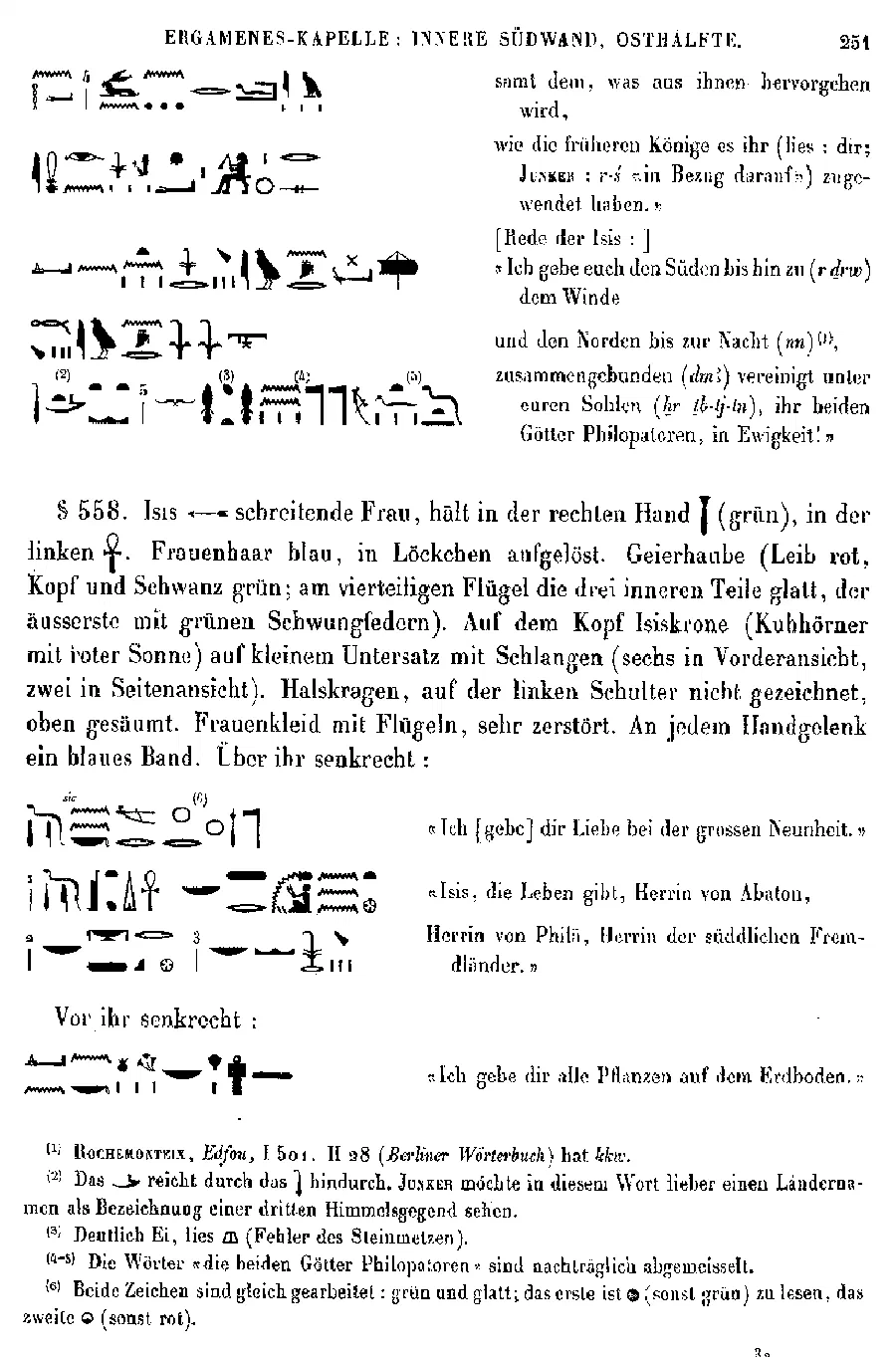
Page 251. Roeder, Der Tempel von Dakke (1930), p. 251 Printed hieroglyphs from G. Roeder, Der Tempel von Dakke (1930) - 504p. 251, § 558
ḏd-mdw jn <dj>.n=(j) n=k mrw.(t) ḫr psḏ.t ꜥꜣ.(t)
Words spoken: I have given you the love of the Great Ennead.
- 505p. 251, § 558
ḏd-mdw jn ꜣs.t dj.(t) ꜥnḫ nb.(t) jw-wꜥb nb.(t) jwrḳ nb.(t) ḫꜣs.(w)t rsj.w(t)
Words spoken by Isis, giver of life, lady of the Pure Island, lady of Philae, lady of the foreign lands of the south:
- 506p. 251, § 558
dj.n=(j) n=k rwḏ nb ḥr sꜣ tꜣ
I have given you all that grows on the back of the earth.
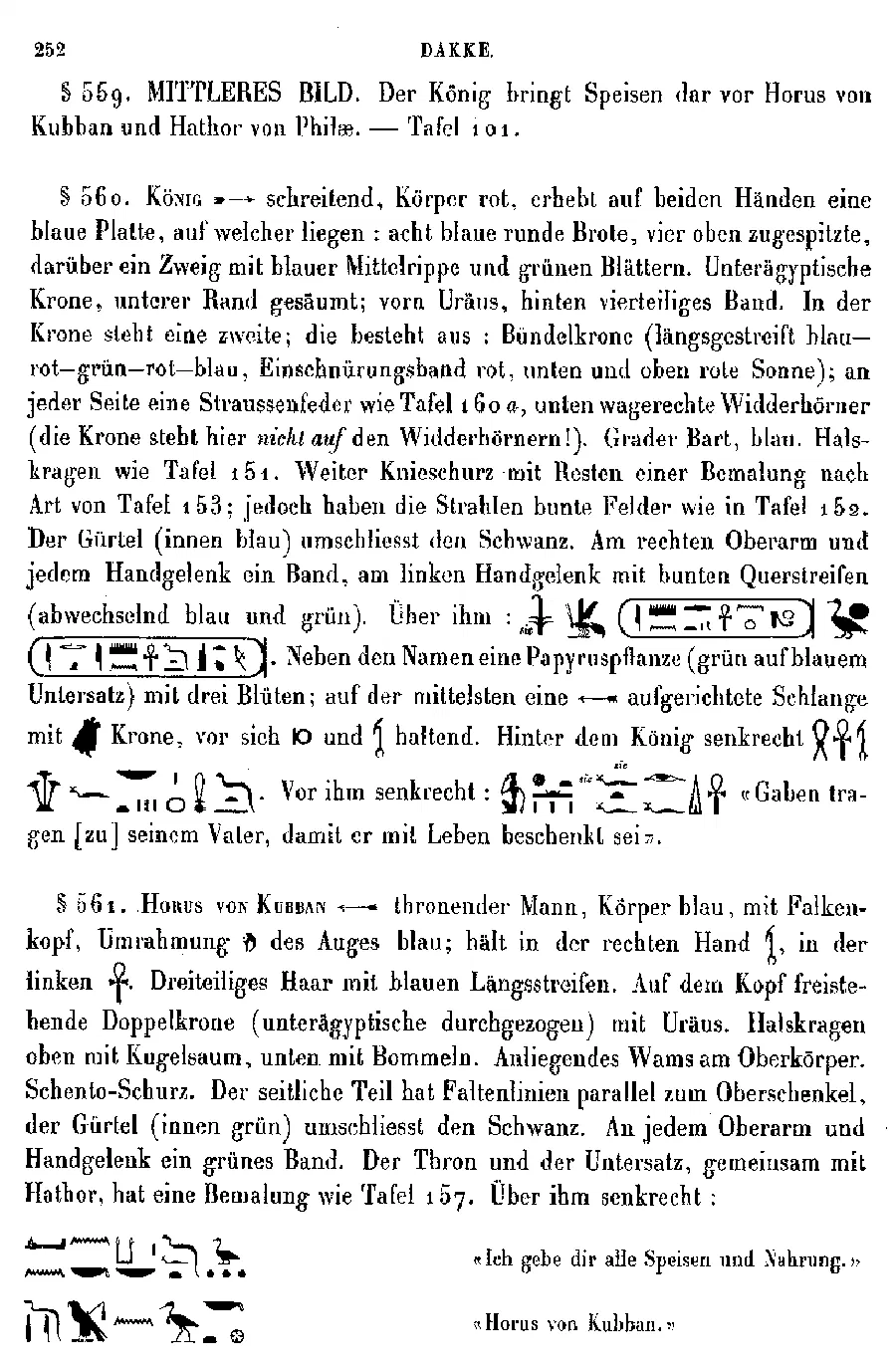
Page 252. Roeder, Der Tempel von Dakke (1930), p. 252 Printed hieroglyphs from G. Roeder, Der Tempel von Dakke (1930) - 507p. 252, § 560
nswt-bj.tj ḏr.t-ꜥnḫ-jmn-tj.t-rꜥ sꜣ-rꜥ jrḳ-jmn-ꜥnḫ-ḏ.t-mrj-ꜣs.t
The King of Upper and Lower Egypt, Living Hand of Amun, Image of Ra; the Son of Ra, Ergamenes, ever living, beloved of Isis.
- 508p. 252, § 560
sꜣ ꜥnḫ wꜣs nb.{wt} ḥꜣ=f mj rꜥ ḏ.t
All protection, life and dominion are behind him as they are behind Ra, forever.
- 509p. 252, § 560
fꜣj.(t) jḫ.t <n> jt=f jrj.n=f dj.(t) ꜥnḫ
Bearing offerings to his father. He has done this that he may be given life.
- 510p. 252, § 561
dj.n=(j) n=k kꜣ nb ḏfꜣ
I have given you food of every kind and provisions.
- 511p. 252, § 561
ḏd-mdw jn ḥrw n bꜣk
Words spoken by Horus of Quban:
Note · Line 511
Quban stood across the Nile from Dakka. - 512p. 252, § 561
dj.n=(j) n=k ḫꜣs.wt rsj.w(t)
I have given you the foreign lands of the south.
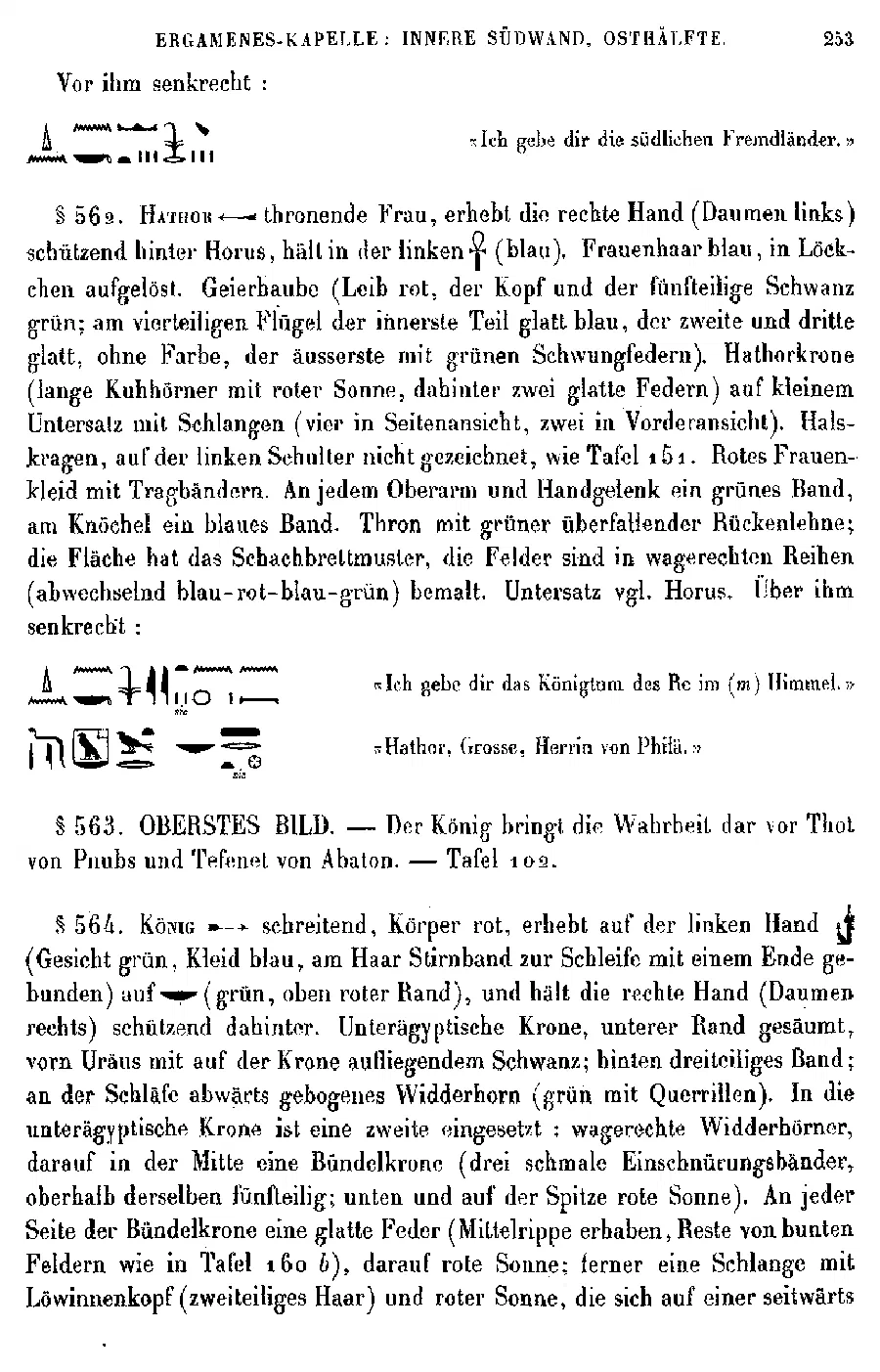
Page 253. Roeder, Der Tempel von Dakke (1930), p. 253 Printed hieroglyphs from G. Roeder, Der Tempel von Dakke (1930) - 513p. 253, § 562
dj.n=(j) n=k nswj.t n rꜥ n p.t
I have given you Ra’s kingship in the sky.
- 514p. 253, § 562
ḏd-mdw jn ḥw.t-ḥrw wr.t nb.(t) jwrḳ
Words spoken by Hathor the Great, lady of Philae.
- 515p. 253, § 564
nswt-bj.tj ḏr.t-ꜥnḫ-jmn-tj.t-rꜥ sꜣ-rꜥ jrḳ-jmn-ꜥnḫ-ḏ.t-mrj-ꜣs.t
The King of Upper and Lower Egypt, Living Hand of Amun, Image of Ra; the Son of Ra, Ergamenes, ever living, beloved of Isis.
- 516p. 253, § 564
sꜣ ꜥnḫ wꜣs nb.{wt} ḥꜣ=f mj rꜥ ḏ.t
All protection, life and dominion are behind him as they are behind Ra, forever.
- 517p. 253, § 564
ḥnk mꜣꜥ.t <n> nb mꜣꜥ.t ḏḥwtj <n> pnbs jrj.n=f dj.(t) ꜥnḫ
Presenting Maat to the lord of Maat, Thoth of Pnubs. He has done this that he may be given life.
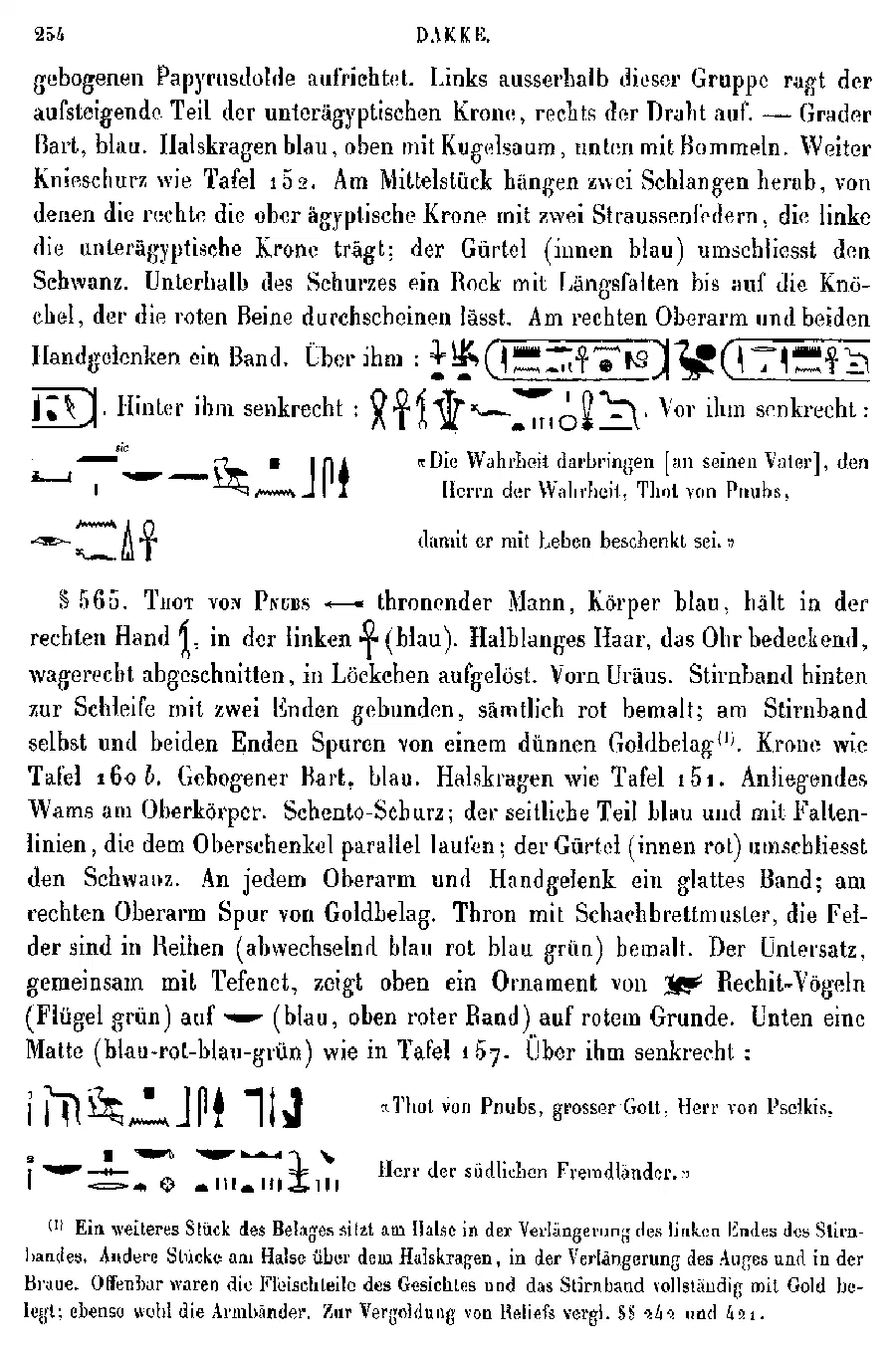
Page 254. Roeder, Der Tempel von Dakke (1930), p. 254 Printed hieroglyphs from G. Roeder, Der Tempel von Dakke (1930) - 518p. 254, § 565
ḏd-mdw jn ḏḥwtj <n> pnbs nṯr ꜥꜣ nb psrk.t nb.{wt} ḫꜣs.wt rsj.w(t)
Words spoken by Thoth of Pnubs, the great god, lord of Pselkis, lord of the foreign lands to the south.
- 519p. 254, § 565
dj.n=(j) n=k mꜣꜥ.t wr.t mrj.(t)=k
I have given you great Maat, whom you love.
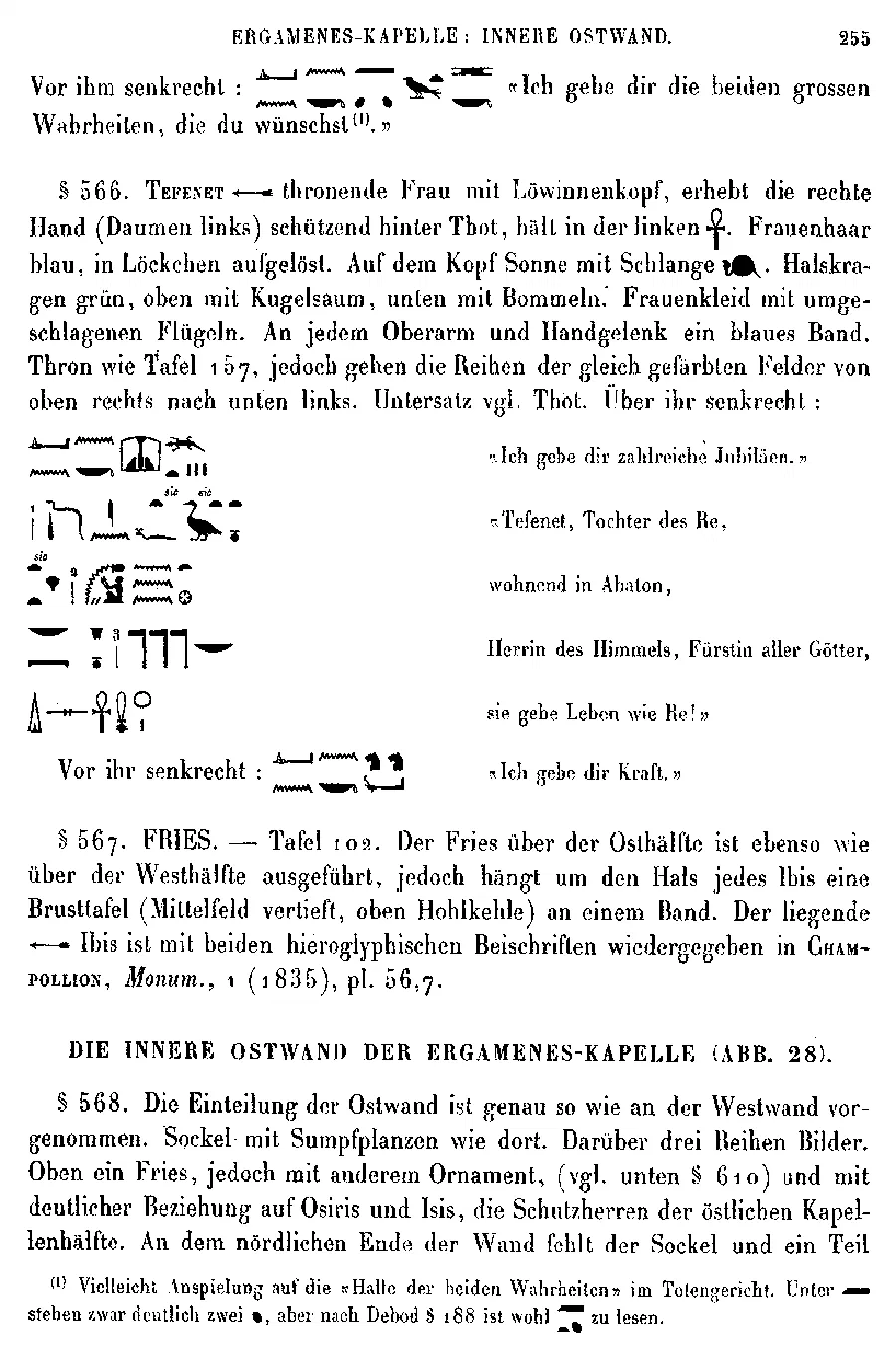
Page 255. Roeder, Der Tempel von Dakke (1930), p. 255 Printed hieroglyphs from G. Roeder, Der Tempel von Dakke (1930) - 520p. 255, § 566
dj.n=(j) n=k ḥb-sd ꜥšꜣ.{wt}
I have given you many Sed festivals.
- 521p. 255, § 566
ḏd-mdw jn tfn.t sꜣ.t <rꜥ> ḥr.j.(t)-jb <jꜣ.t>-wꜥb.t nb.(t) p.t ḥnw.t nṯr.w nb.(w) dj=s ꜥnḫ mj rꜥ
Words spoken by Tefnut, daughter of Ra, who dwells in the Abaton, lady of heaven, mistress of all the gods. She gives life as Ra does.
- 522p. 255, § 566
dj.n=(j) n=k pḥtj
I have given you strength.
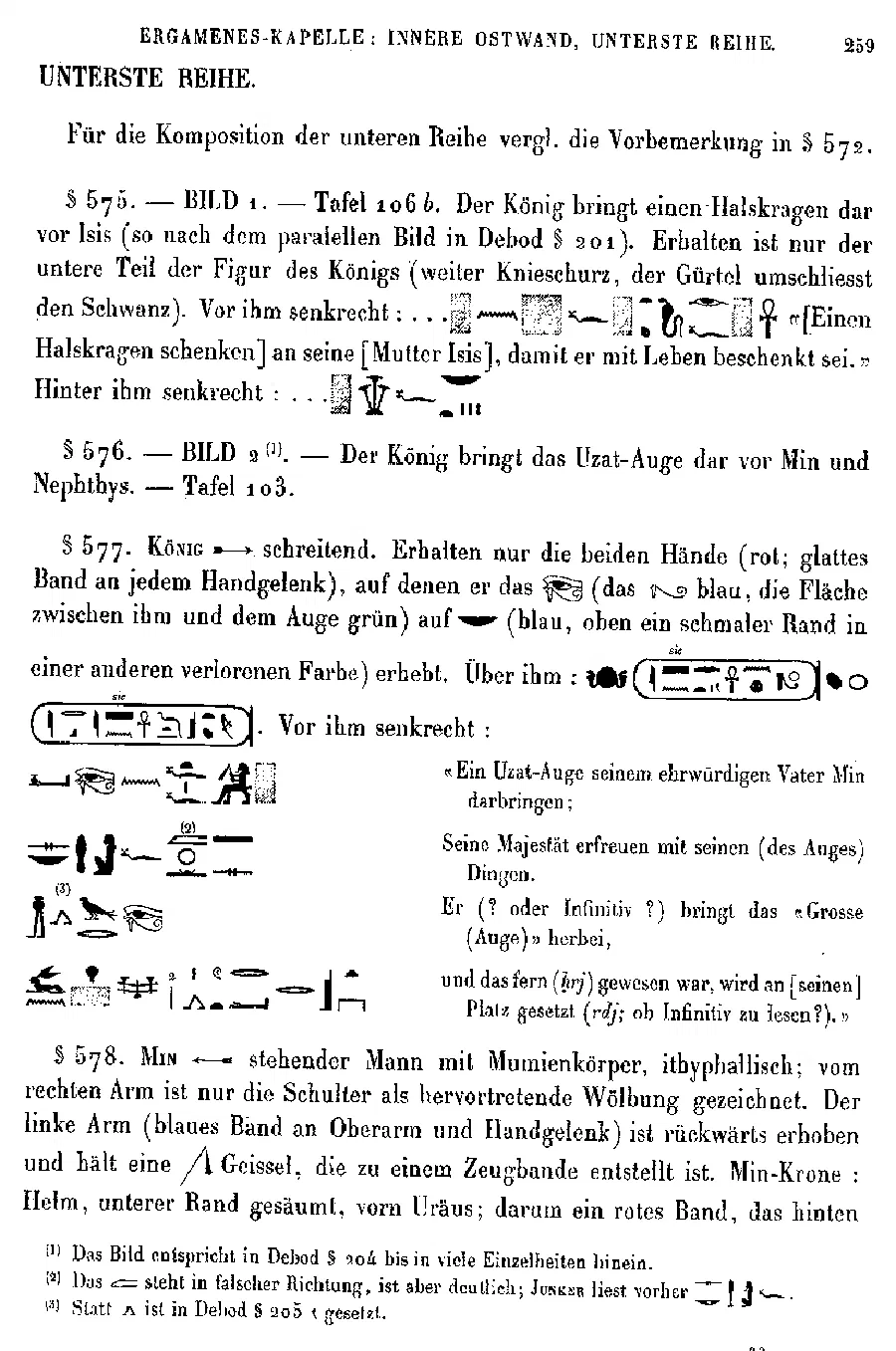
Page 259. Roeder, Der Tempel von Dakke (1930), p. 259 Printed hieroglyphs from G. Roeder, Der Tempel von Dakke (1930) - 523p. 259, § 575
--détruit-- n --1Q-- f --1Q-- jrj=f [dj.t] ꜥnḫ
… so that he may give life.
- 524p. 259, § 575
[sꜣ ꜥnḫ wꜣs] nb.{wt} ḥꜣ=f
All protection, life and dominion are behind him.
Note · Line 524
Such assurances were written behind the king’s figure, guarding his back. - 525p. 259, § 577
nswt-bj.tj ḏr.t-ꜥnḫ-jmn-tj.t-rꜥ sꜣ-rꜥ jrḳ-jmn-ꜥnḫ-ḏ.t-mrj-ꜣs.t
King of Upper and Lower Egypt, Living Hand of Amun, Image of Ra; Son of Ra, Ergamenes, living forever, beloved of Isis.
Note · Line 525
“Living Hand of Amun, Image of Ra” is his throne name. - 526p. 259, § 577
ḥnk wḏꜣ,t n jt=f šps sḥb ḥm=f m jḫ.t=s =s jnj.(t) wr.(t) wn ḥr.tj rdj.(t) r s.t
Presenting the wedjat-eye to his august father, adorning His Majesty with what is hers, bringing the Great One who was far away and setting her in her place.
Note · Line 526
Here the eye is also the goddess who wandered far from Ra and is brought home to his brow. - 527p. 259, § 578
dj=j šsp.n=k jb nb n ḫꜣs.wt nb.w(t) m ẖnm tp=k m sḫm.tj
By joining your head to the Double Crown, I grant you every heart in every foreign land to win.
Note · Line 527
The Double Crown joins the crowns of Upper and Lower Egypt. - 528p. 259, § 578
dj=j rnpj=k mj ḫprj
I make you young again like Khepri.
Note · Line 528
Khepri is the sun reborn at dawn, pictured as a scarab. - 529p. 259, § 578
dj.n=(j) n=k prj.t m grḥ ḫpr m hrw
I have granted you to go forth by night and come into being by day.
- 530p. 259, § 578
nswt-bj.tj mnw wꜣḥ ḥtp.w jꜣ.t-wꜥb.t
King of Upper and Lower Egypt, Min, who lays out the offerings of the Abaton.
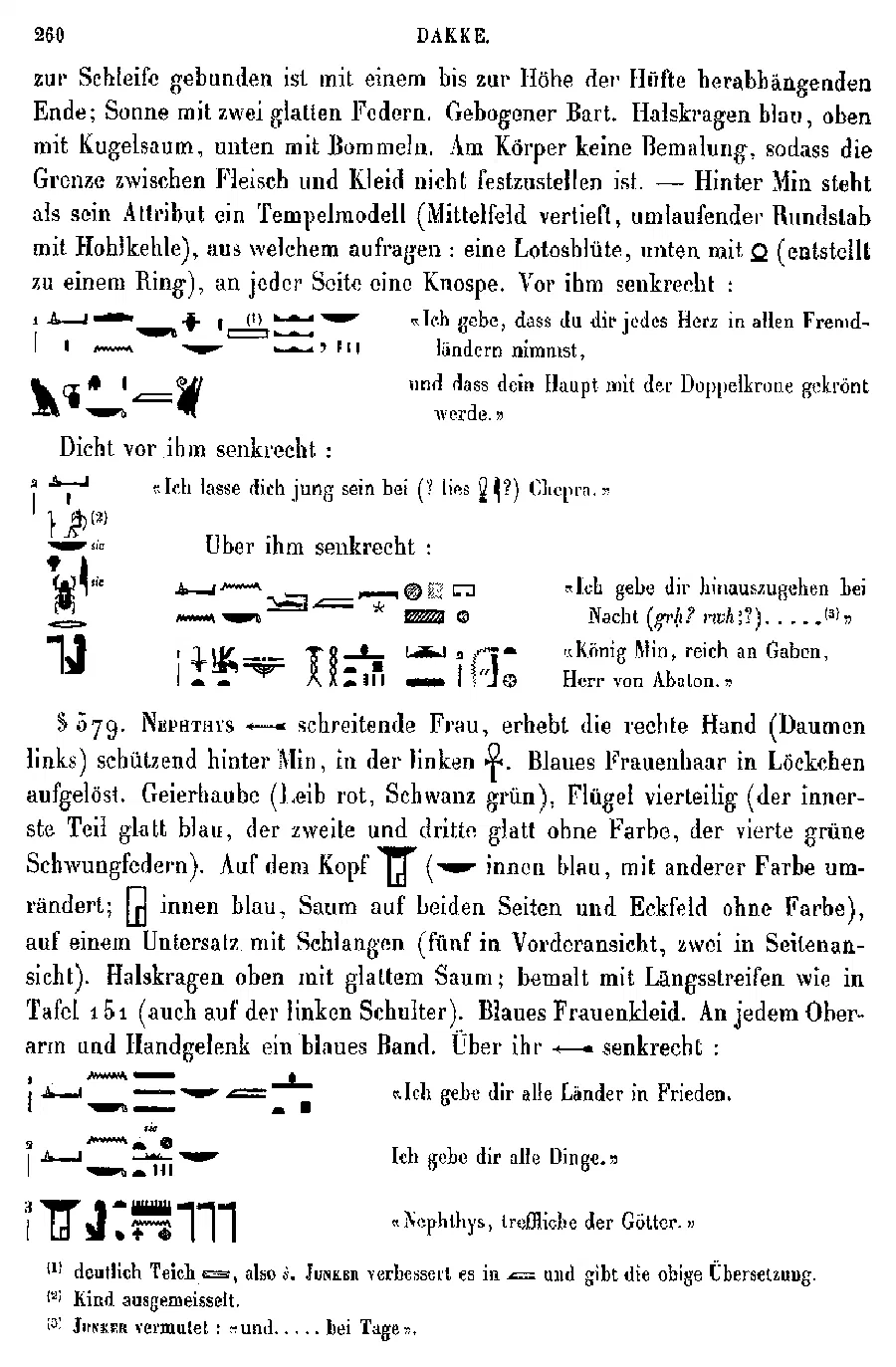
Page 260. Roeder, Der Tempel von Dakke (1930), p. 260 Printed hieroglyphs from G. Roeder, Der Tempel von Dakke (1930) - 531p. 260, § 579
dj=(j) n=k tꜣ.w nb.(w) m ḥtp
I give you all lands at peace.
- 532p. 260, § 579
dj=(j) n=k jḫ.t nb.(t)
I give you all things.
- 533p. 260, § 579
nb.t-ḥw.t mnḫ.(t) nṯr.w
Nephthys, excellent among the gods.
- 534p. 260, § 579
dj.n=j n=k šn n jr.t jtm
I have given you the orb of Atum’s eye.
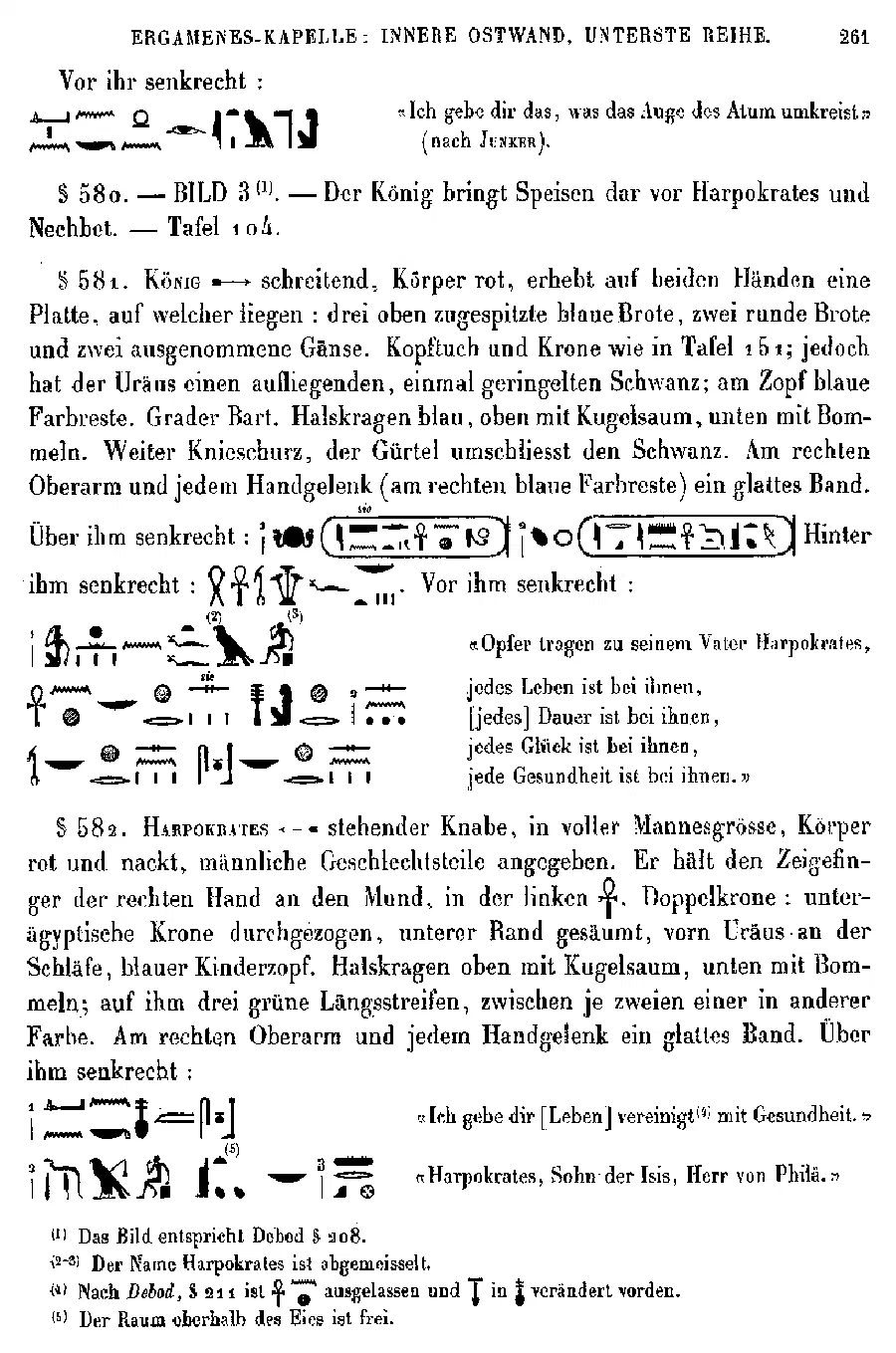
Page 261. Roeder, Der Tempel von Dakke (1930), p. 261 Printed hieroglyphs from G. Roeder, Der Tempel von Dakke (1930) - 535p. 261, § 581
nswt-bj.tj ḏr.t-ꜥnḫ-jmn-tj.t-rꜥ sꜣ-rꜥ jrḳ-jmn-ꜥnḫ-ḏ.t-mrj-ꜣs.t
King of Upper and Lower Egypt, Living Hand of Amun, Image of Ra; Son of Ra, Ergamenes, living forever, beloved of Isis.
- 536p. 261, § 581
sꜣ ꜥnḫ wꜣs nb.{wt} ḥꜣ=f
All protection, life and dominion are behind him.
- 537p. 261, § 581
fꜣj.(t) jḫ.t n jt=f ḥrw-pꜣ-ẖrd ꜥnḫ nb ḫr=sn ḏd ḫr=sn wꜣs nb ḫr=sn snb nb ḫr=sn
Bearing offerings to his father, Horus the Child.
All life is with them;
stability is with them;
all dominion is with them;
all health is with them. - 538p. 261, § 582
dj.n=(j) n=k nfr m snb
I have given you well-being and health.
- 539p. 261, § 582
ḏd-mdw jn ḥrw-pꜣ-ẖrd sꜣ ꜣs.t nb jwrḳ
Words spoken by Horus the Child, son of Isis, lord of Philae.
- 540p. 261, § 582
dj.n=(j) n=k ꜣḫ.t ẖr nfr.w rnp.t jbd tp jbd
I have given you the field laden with the bounty of the year, month after month.
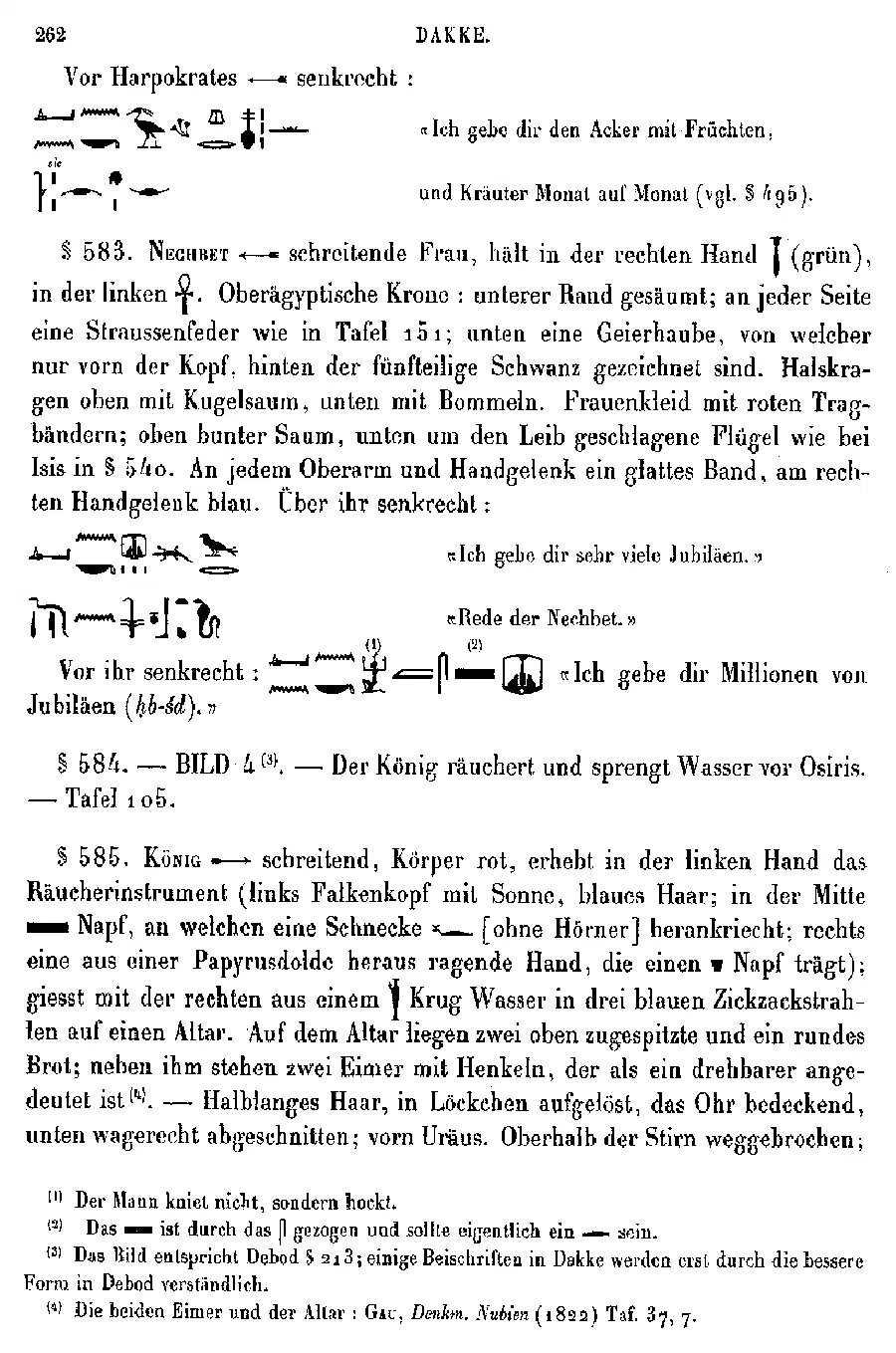
Page 262. Roeder, Der Tempel von Dakke (1930), p. 262 Printed hieroglyphs from G. Roeder, Der Tempel von Dakke (1930) - 541p. 262, § 583
dj=(j) n=k ḥb.w-sd ꜥšꜣ.(w) wr
I give you Sed festivals in great abundance.
- 542p. 262, § 583
ḏd-mdw jn nḫb.t
Words spoken by Nekhbet.
- 543p. 262, § 583
dj.n=(j) n=k ḥḥ m ḥb-sd
I have given you a million Sed festivals.
- 544p. 262, § 585
nswt-bj.tj ḏr.t-ꜥnḫ-jmn-tj.t-rꜥ sꜣ-rꜥ [jrḳ-jmn]-ꜥnḫ-ḏ.t-mrj-ꜣs.t
King of Upper and Lower Egypt, Living Hand of Amun, Image of Ra; Son of Ra, Ergamenes, living forever, beloved of Isis.
- 545p. 262, § 585
sꜣ ꜥnḫ wꜣs nb.{wt} ḥꜣ=f
All protection, life and dominion are behind him.
- 546p. 262, § 585
jrj.(t) snṯr ḳbḥ n jt=f mw.t=f prj.t-ḫrw <n> nṯr.w wr.w ḥnk (?) tjšps ḳbḥ snṯr m sn<m.t>
Burning incense and pouring a libation for his father and mother; making an invocation offering for the great gods. Presenting oil, a libation and incense in Senmet.
Note · Line 546
An invocation offering is a gift of food or drink ritually called forth by speaking its name. 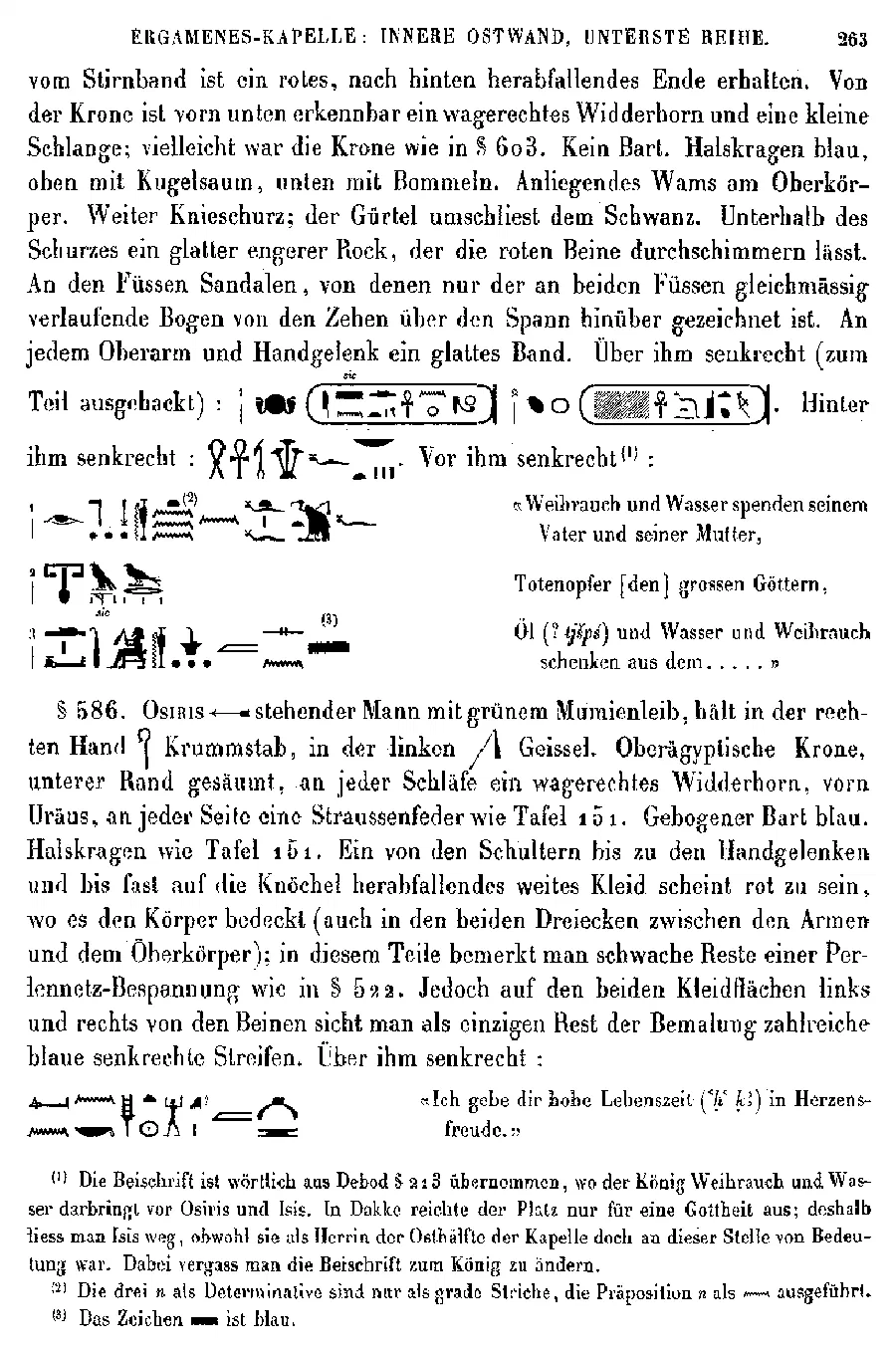
Page 263. Roeder, Der Tempel von Dakke (1930), p. 263 Printed hieroglyphs from G. Roeder, Der Tempel von Dakke (1930) - 547p. 263, § 586
dj.n=(j) n=k ꜥḥꜥ ḳꜣ m ꜣw.t-<jb>
I have given you a long life of gladness.
- 548p. 263, § 586
ḏd-mdw jn wsjr wn-nfr mꜣꜥ-ḫrw <nb> snm.t nṯr ꜥꜣ nb jꜣ.t-wꜥb.t nb jwrḳ <p.t> ẖr bꜣ=f tꜣ ẖr sḫm.w[=f] [dwꜣ.t] ẖr sꜥḥ=f nswt nṯr.w nb.w
Words spoken by Osiris Wennefer, vindicated, lord of Senmet, the great god, lord of the Abaton, lord of Philae—the sky bears his ba, the earth bears his statues, the Duat bears his mummified body—king of all the gods.
- 549p. 263, § 586
šsp=(j) ḳbḥ m-ꜥ=k snṯr ḥr ꜥ.wj=<k> snḏ=k <ḫt> tꜣ.w nb.w ḫꜣs.t nb.(t)
I receive the libation from your hand and the incense you bear on both hands, while dread of you fills all lands and every foreign country.
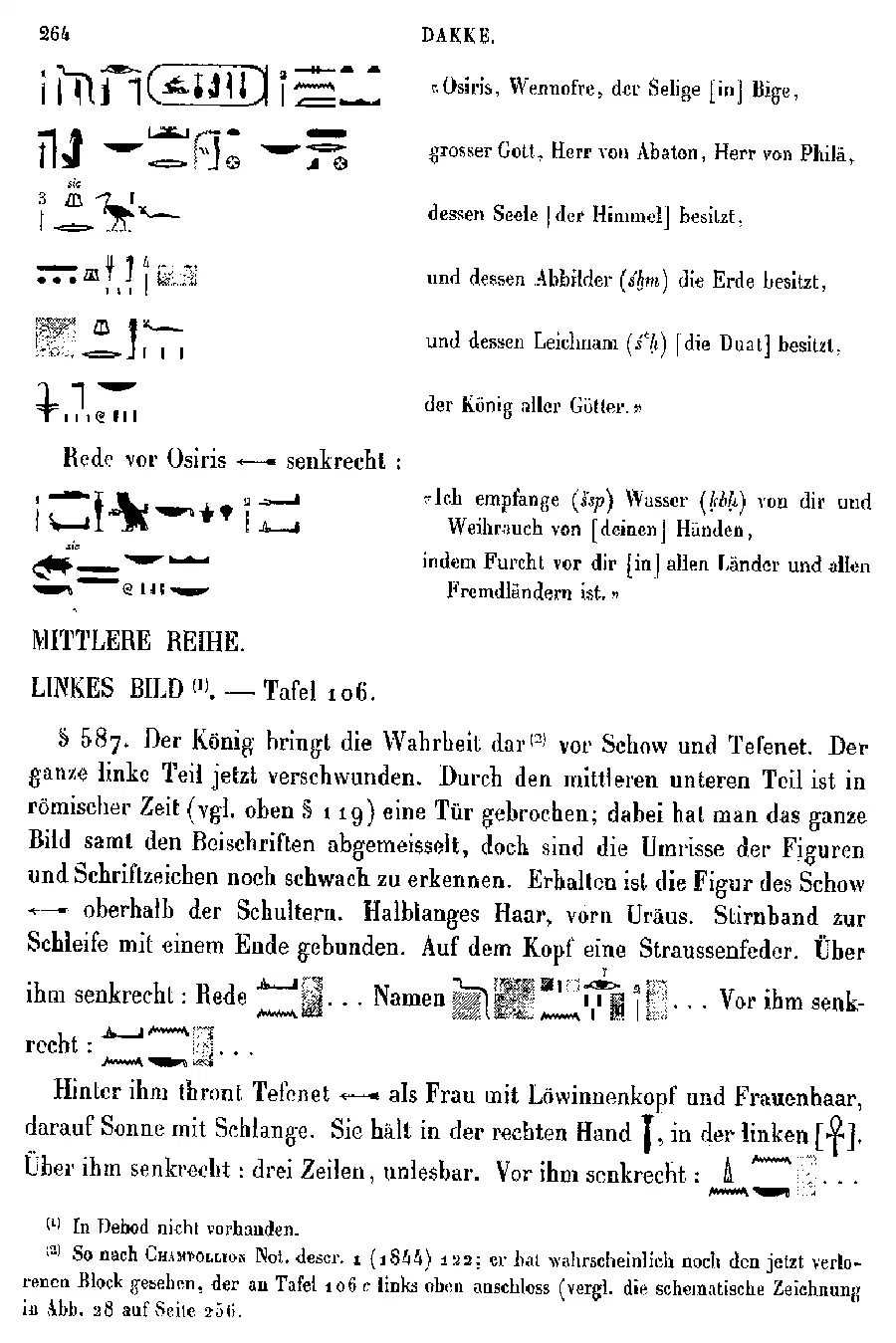
Page 264. Roeder, Der Tempel von Dakke (1930), p. 264 Printed hieroglyphs from G. Roeder, Der Tempel von Dakke (1930) - 550p. 264, § 587
dj.n --détruit-- ḏ[d-mdw jn] … --détruit-- dj.n=(j) n=k --détruit-- dj.n=(j) n=k --détruit--
I have given you … Words spoken by … I have given you … I have given you …
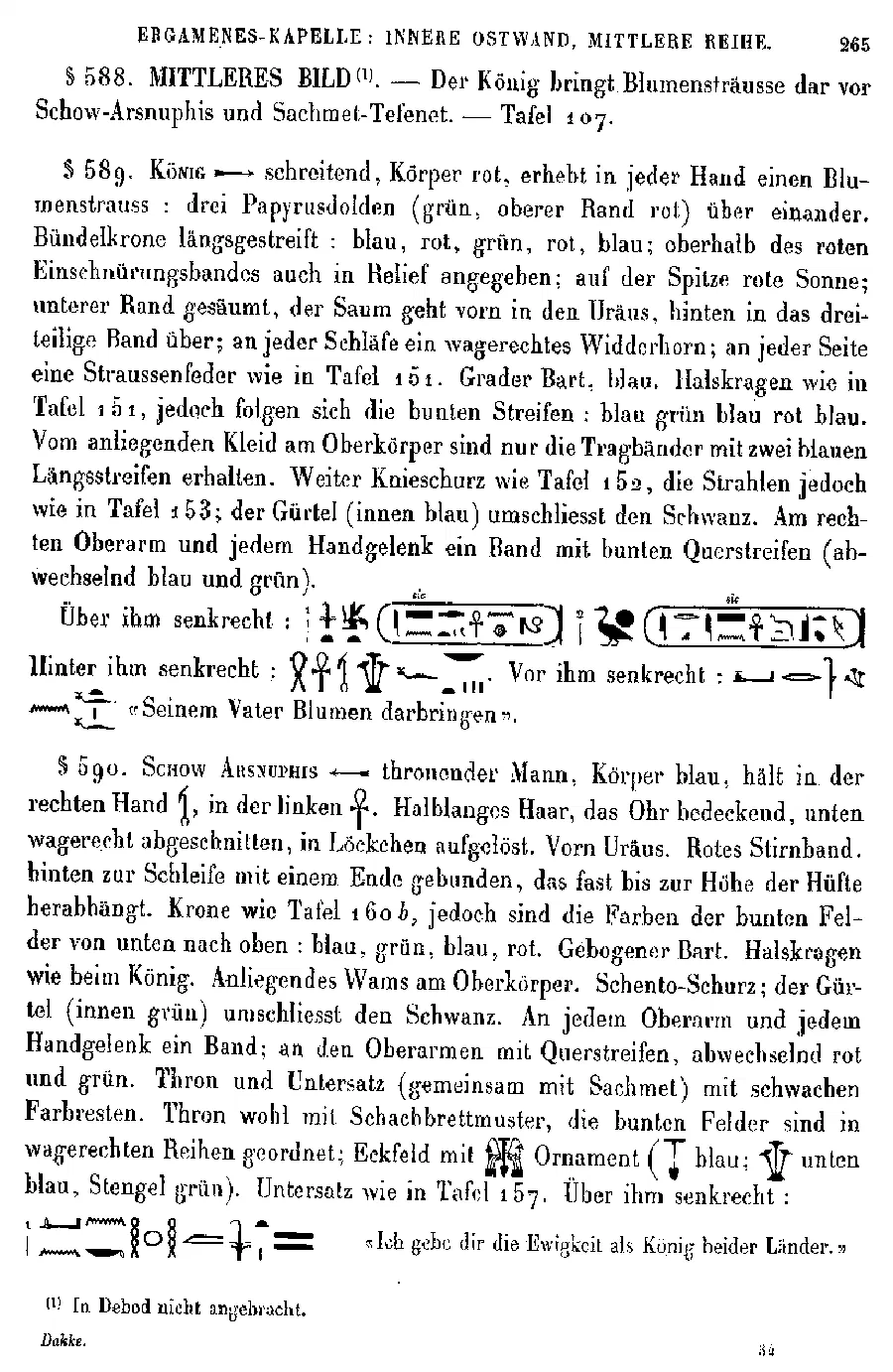
Page 265. Roeder, Der Tempel von Dakke (1930), p. 265 Printed hieroglyphs from G. Roeder, Der Tempel von Dakke (1930) - 551p. 265, § 589
nswt-bj.tj ḏr.t-ꜥnḫ-jmn-tj.t-rꜥ sꜣ-rꜥ jrḳ-jmn-ꜥnḫ-ḏ.t-mrj-ꜣs.t
The King of Upper and Lower Egypt, Living Hand of Amun, Image of Ra; the Son of Ra, Ergamenes, living forever, beloved of Isis.
Note · Line 551
The Kushite king is named twice in Egyptian royal fashion: first by his throne name, then by his birth name. - 552p. 265, § 589
sꜣ ꜥnḫ wꜣs nb.{wt} ḥꜣ=f
All protection, life and dominion stand behind him.
- 553p. 265, § 589
ḥnk rnp.t n jt=f
Offering fresh plants to his father.
- 554p. 265, § 590
dj.n=(j) n=k ḥḥ m nswt tꜣ.wj
I have given you eternity as king of the Two Lands.
- 555p. 265, § 590
ḏd-mdw jn šw sꜣ rꜥ ḥr.j-<jb> snm.t jr.(j)-ḥms-nfr nṯr ꜥꜣ nb jw-wꜥb
Words spoken by Shu, son of Ra, who dwells in Senmet: Arensnuphis, the great god, lord of the Abaton.
Note · Line 555
Shu and the Nubian god Arensnuphis speak here as one god. - 556p. 265, § 590
dj.n=(j) n=k ḳn nb
I have given you strength in full.
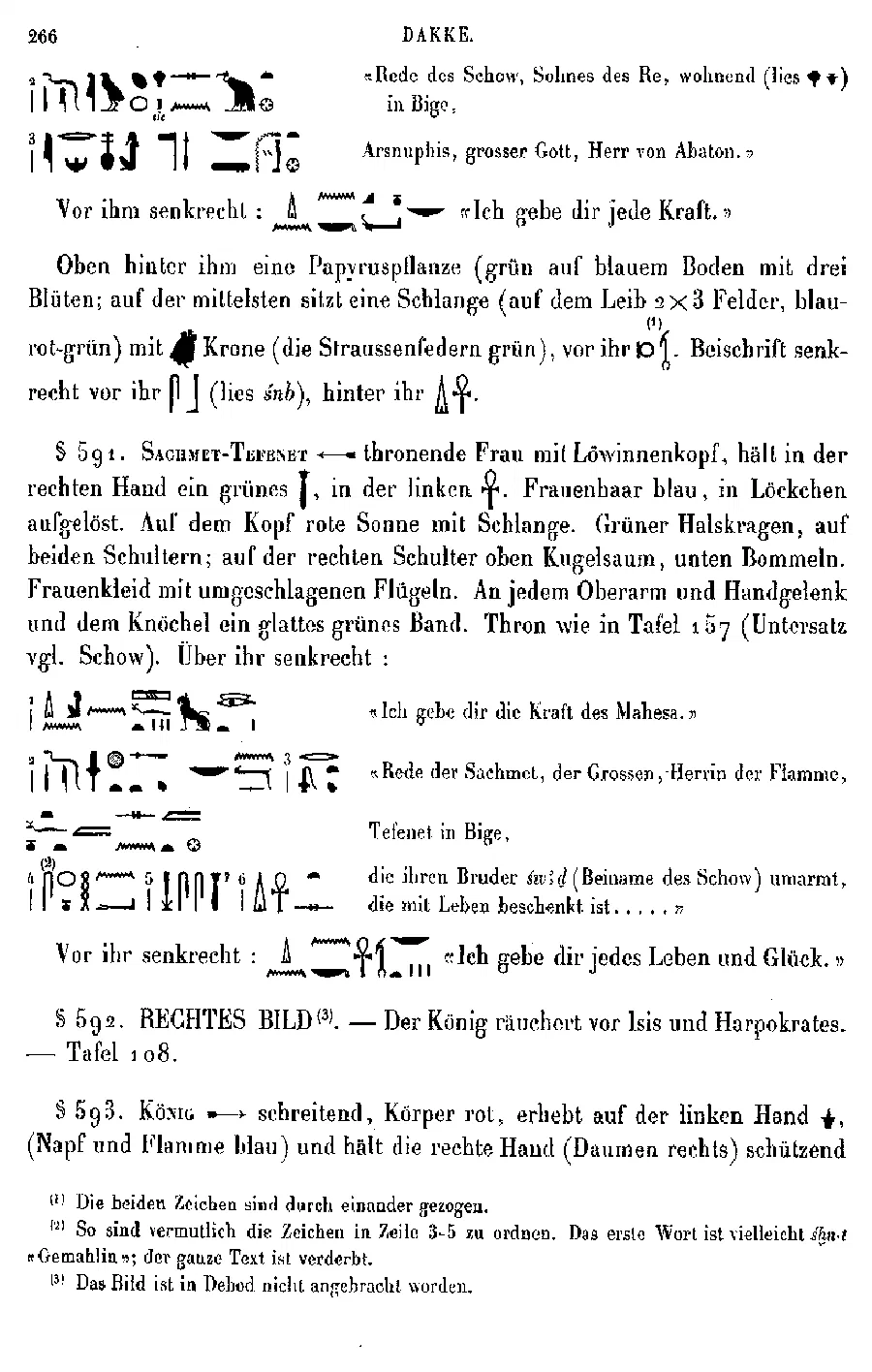
Page 266. Roeder, Der Tempel von Dakke (1930), p. 266 Printed hieroglyphs from G. Roeder, Der Tempel von Dakke (1930) - 557p. 266, § 591
dj.n=(j) n=<k> šfj.t mꜣj ḥsꜣ
I have given you the majesty of a raging lion.
- 558p. 266, § 591
ḏd-mdw jn sḫm.t ꜥꜣ.t nb.(t) nsr.t tfn.t m snm.t sḫn.(t) ḥnꜥ sn=s swꜣḏ dj.(t) ꜥnḫ <n> jt=s
Words spoken by Sekhmet the Great, lady of the flame, Tefnut in Senmet, who rests beside her brother Swadj and gives life to her father.
- 559p. 266, § 591
dj.n=(j) n=k ꜥnḫ wꜣs nb.{wt}
I have given you all life and dominion.
- 560p. 266, § 593
nswt-bj.tj ḏr.t-ꜥnḫ-jmn-tj.t-rꜥ sꜣ-rꜥ jrḳ-jmn-ꜥnḫ-ḏ.t-mrj-ꜣs.t
The King of Upper and Lower Egypt, Living Hand of Amun, Image of Ra; the Son of Ra, Ergamenes, living forever, beloved of Isis.
- 561p. 266, § 593
sꜣ ꜥnḫ wꜣs nb.{wt} ḥꜣ=f mj rꜥ ḏ.t
All protection, life and dominion stand behind him as they stand behind Ra, forever.
- 562p. 266, § 593
jrj.(t) snṯr
Burning incense.
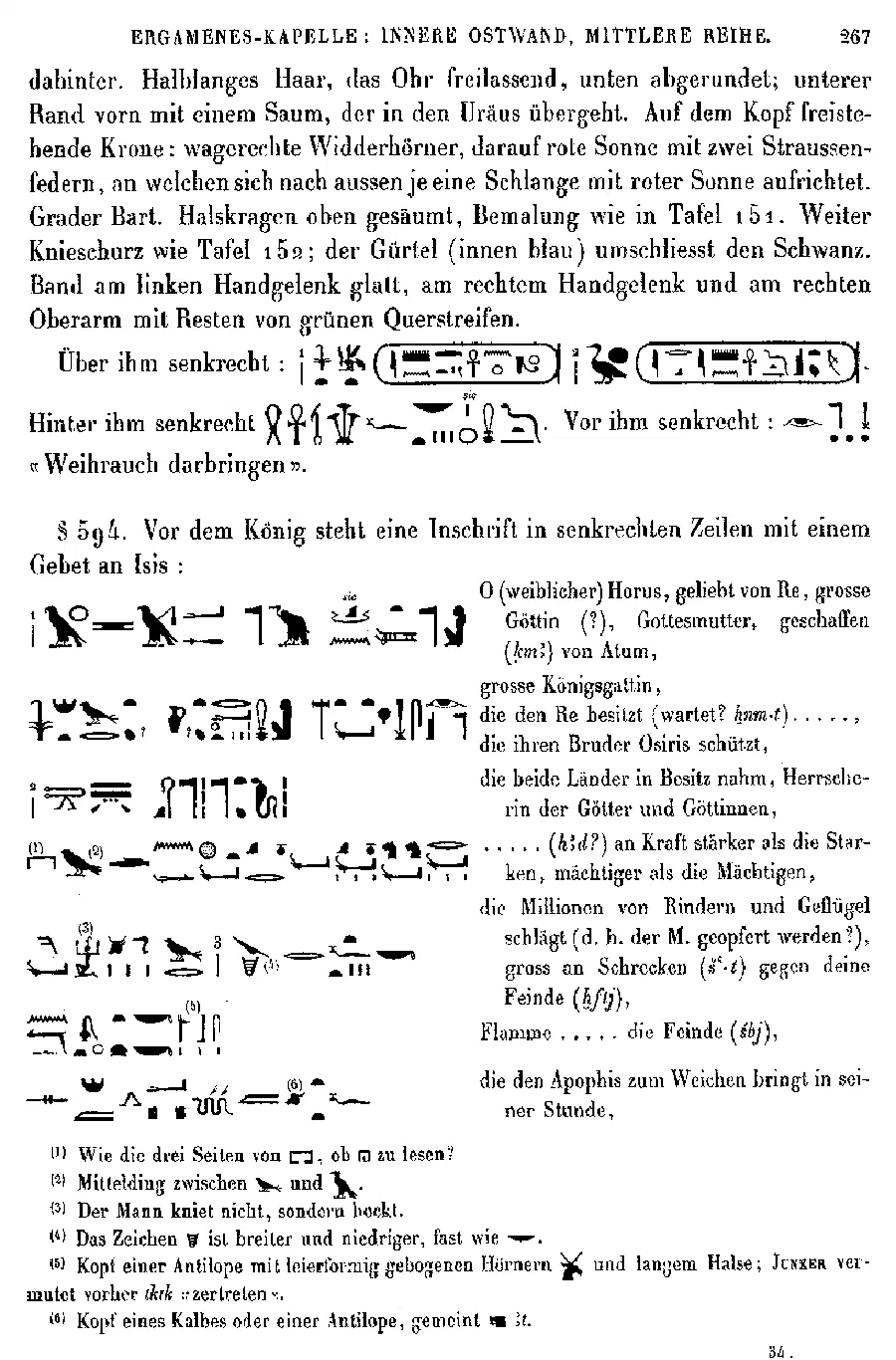
Page 267. Roeder, Der Tempel von Dakke (1930), p. 267 Printed hieroglyphs from G. Roeder, Der Tempel von Dakke (1930) - 563p. 267, § 594
ḥrw.t mrj.(t) rꜥ nṯr.(t) ꜥꜣ.(t) mw.t-nṯr ḳmꜣ.(t) n jtm ḥm.t nswt wr.t ẖnm.t rꜥ … nḏ.t ḥr sn=s wsjr jṯj.(t) tꜣ.wj ḥḳꜣ.(t) nṯr.w nṯr.wt hꜣd.t (?) nḫt ḳn ḳn.w pḥtj r phtj.w ḥwj.(t) ḥḥ kꜣ.w ꜣpd.w wr.(t) sꜣ.t r ḫft.j.w=k nsr.t tkꜣ (?) sbj.w sḥm.(t) ꜥpp m ꜣ.t=f ḥr.j.t-tp n rꜥ ḫꜥj.tj m tp=f dj.(t) tp-rd m skt.t wsḫ.t nmt.t m ꜥnḏ.t nswt-bj.tj ꜣs.t wr.t mw.t-nṯr mw.t n ḥrw sꜣ.t rꜥ mrj.(t) jb=f ḏd.w=s nb.(w) ḫpr=sn ḥr-ꜥ 20 pr wꜣ m sḫm.t (?)
The female falcon, beloved of Ra,
the great goddess, mother of the god, whom Atum fashioned,
great royal wife, nurse of Ra, …
who guards her brother Osiris,
who takes possession of the Two Lands and rules gods and goddesses,
fierce in strength, bold among the bold, mightier than the mighty,
who strikes down bulls and birds by the million,
great is the slaughter she makes among your enemies;
Neseret, who sets the rebels ablaze,
who drives Apophis back at his hour,
the uraeus of Ra, shining forth on his head,
who gives the orders in the night bark
and strides wide in the day bark;
the King of Upper and Lower Egypt, Isis the Great,
mother of the god, mother of Horus,
daughter of Ra, whom his heart loves.
Whatever she says comes to pass at once.
… who went far away as Sekhmet.Note · Line 563
Neseret, the Fiery One, is the uraeus, the cobra that rears on Ra’s brow. She guards him against the serpent Apophis on his daily voyage. - 564p. 267, § 594
ḥtp nfr ḥr nswt-bj.tj nb-tꜣ.wj ḏr.t-ꜥnḫ-jmn-tj.t-rꜥ sꜣ-rꜥ jrḳ-jmn-ꜥnḫ-ḏ.t-mrj-ꜣs.t
Be gracious, O fair of face, to the King of Upper and Lower Egypt, lord of the Two Lands, Living Hand of Amun, Image of Ra; the Son of Ra, Ergamenes, living forever, beloved of Isis.
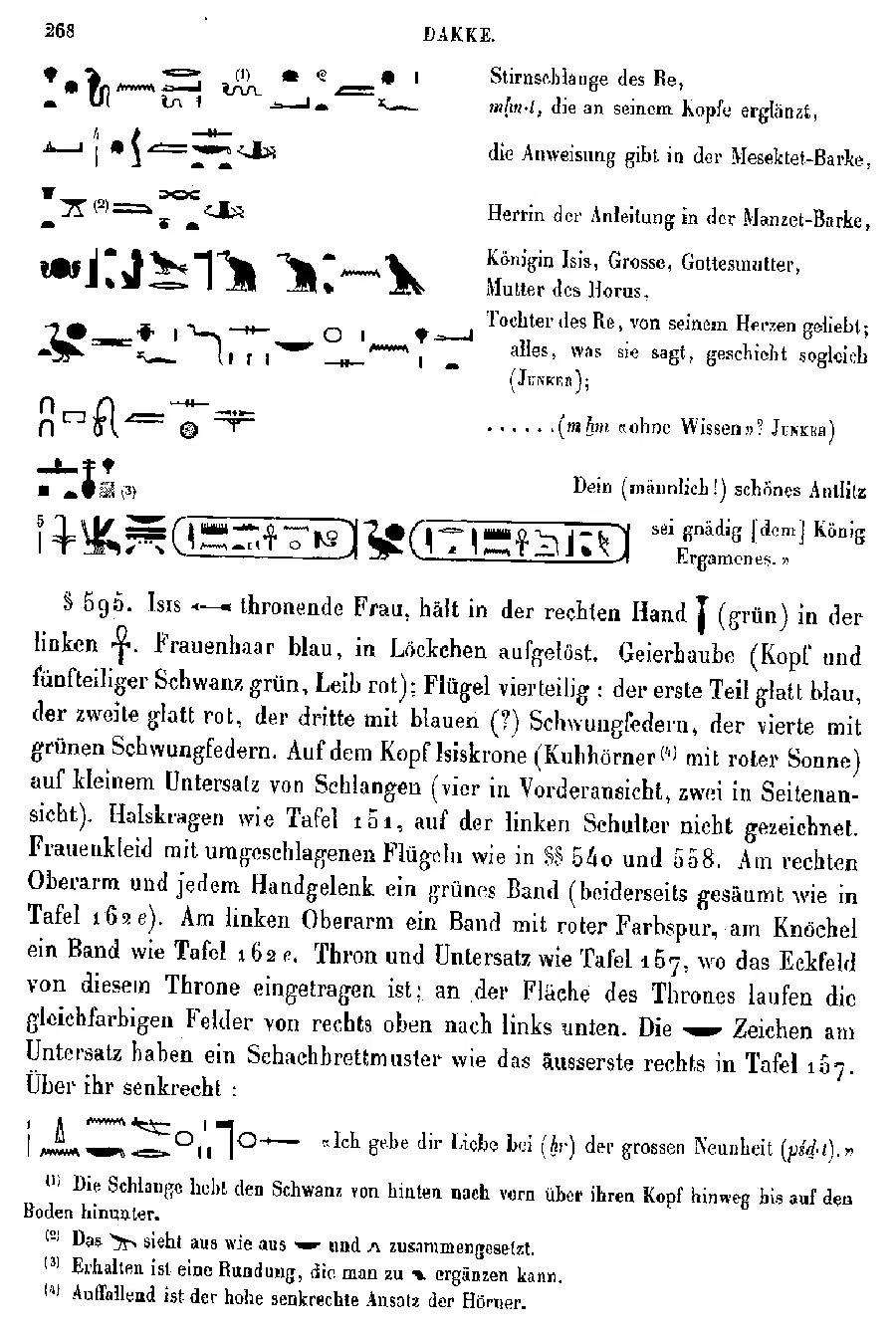
Page 268. Roeder, Der Tempel von Dakke (1930), p. 268 Printed hieroglyphs from G. Roeder, Der Tempel von Dakke (1930) - 565p. 268, § 595
dj.n=(j) n=k mrw.(t) ḫr psḏ.t ꜥꜣ.(t)
I have given you the love of the Great Ennead.
- 566p. 268, § 595
ḏd-mdw jn ꜣs.t dj.(t) ꜥnḫ nb.(t) jwrḳ dj.n=(j) n=k snb.{wt} nb
Words spoken by Isis, giver of life, lady of Philae: I have given you perfect health.
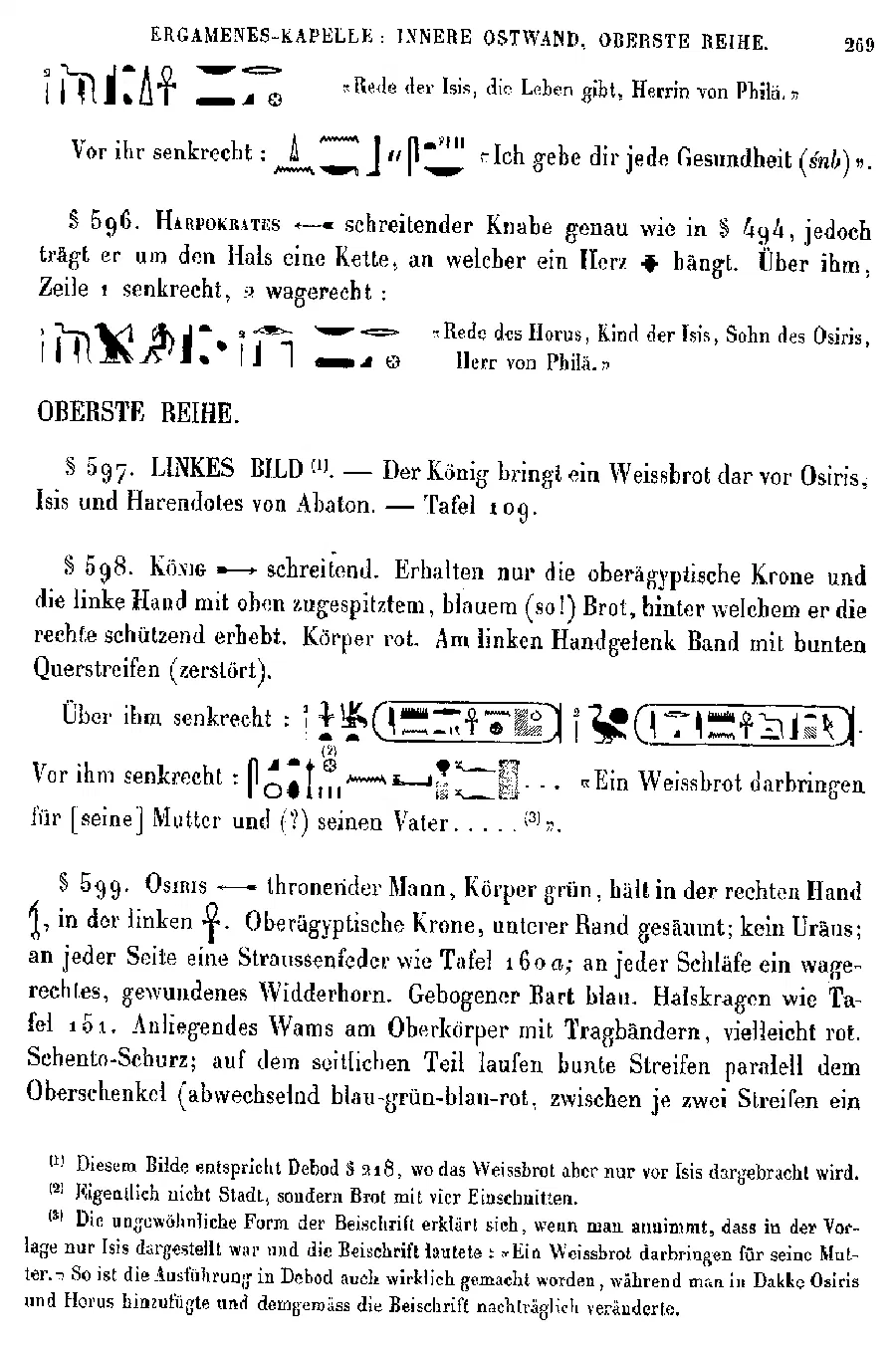
Page 269. Roeder, Der Tempel von Dakke (1930), p. 269 Printed hieroglyphs from G. Roeder, Der Tempel von Dakke (1930) - 567p. 269, § 596
ḏd-mdw jn ḥrw-sꜣ-ꜣs.t sꜣ wsjr nb jwrḳ
Words spoken by Harsiese, son of Osiris, lord of Philae.
Note · Line 567
Harsiese means “Horus, son of Isis.” - 568p. 269, § 598
nswt-bj.tj ḏr.t-ꜥnḫ-jmn-tj.t-rꜥ sꜣ-rꜥ jrḳ-jmn-ꜥnḫ-ḏ.t-mrj-ꜣs.t sḳr tꜣ ḥḏ n mw.t=f jt=f --détruit--
The King of Upper and Lower Egypt, Living Hand of Amun, Image of Ra; the Son of Ra, Ergamenes, living forever, beloved of Isis. Offering white bread to his mother and his father …
- 569p. 269, § 599
dj.n=(j) n=k ḏfꜣ nb jḫ.t nb.(t)
I have given you every provision and every kind of goods.
- 570p. 269, § 599
ḏd-mdw jn wsjr wn-nfr [mꜣꜥ-ḫrw] nṯr ꜥꜣ nb jꜣ.t-wꜥb.t nb.{wt} jwrḳ
Words spoken by Osiris Wennefer, vindicated, the great god, lord of the Abaton, lord of Philae.
- 571p. 269, § 599
dj.n=(j) n=k wsr rꜥ-nb
I have given you power every day.
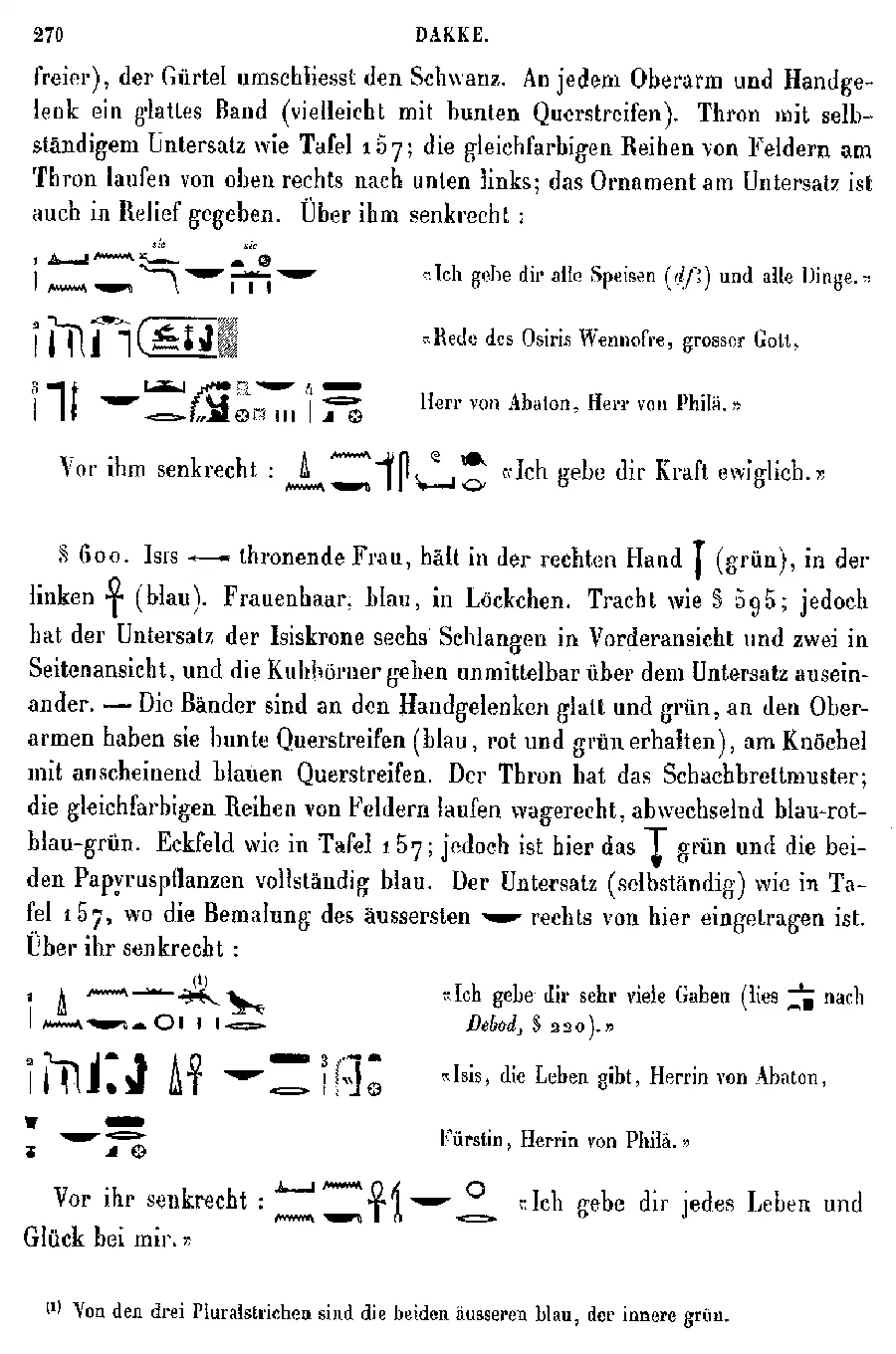
Page 270. Roeder, Der Tempel von Dakke (1930), p. 270 Printed hieroglyphs from G. Roeder, Der Tempel von Dakke (1930) - 572p. 270, § 600
dj.n=(j) n=k jḫ.t ꜥšꜣ.{w} wr
I have given you goods in great abundance.
- 573p. 270, § 600
ḏd-mdw jn ꜣs.t dj.(t) ꜥnḫ nb.(t) jw-wꜥb ḥnw.t nb.(t) jwrḳ
Words spoken by Isis, giver of life, lady of the Abaton, mistress, lady of Philae.
- 574p. 270, § 600
dj.n=(j) n=k ꜥnḫ wꜣs nb ḫr=(j)
I have given you all life and dominion in my presence.
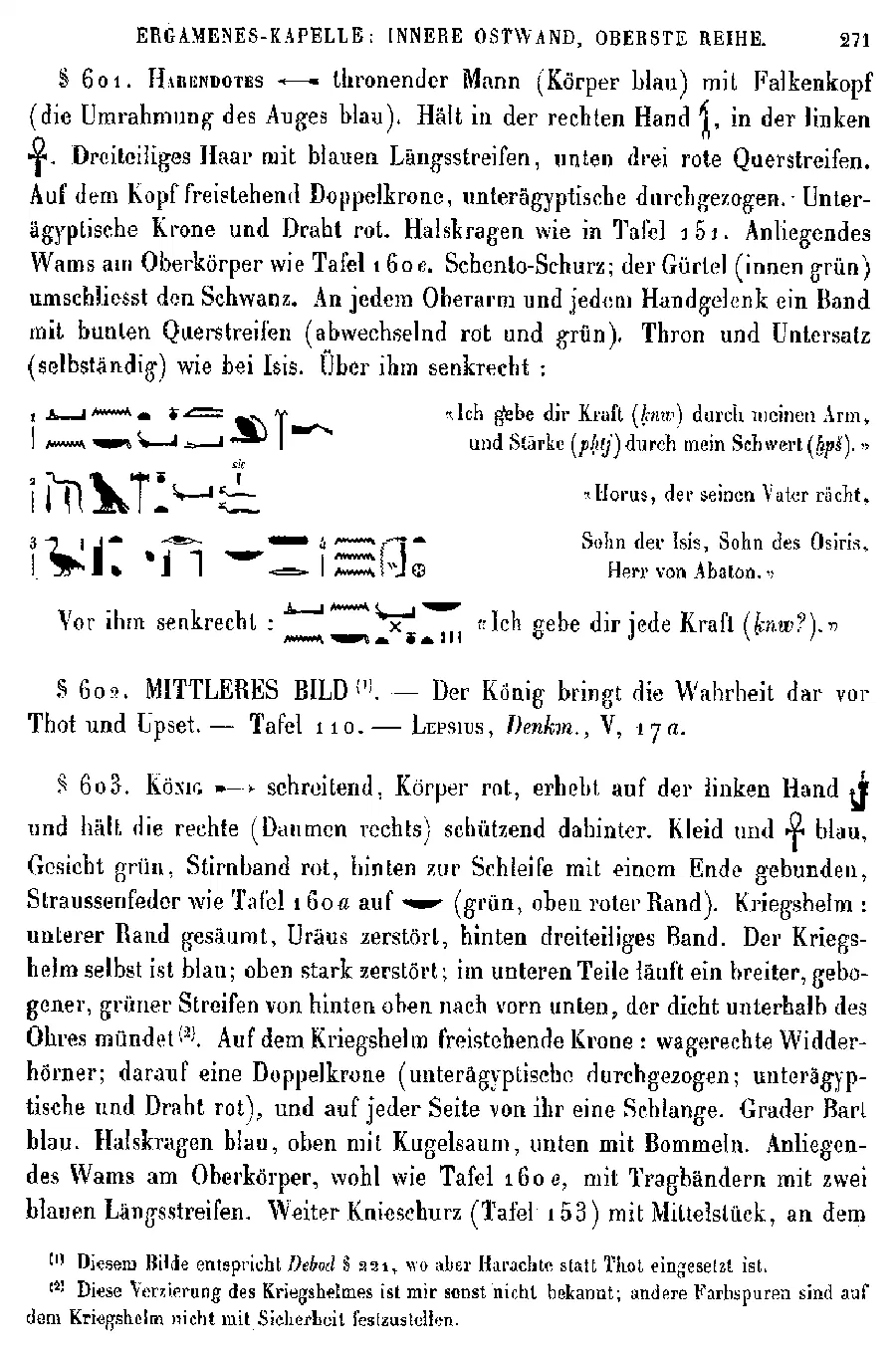
Page 271. Roeder, Der Tempel von Dakke (1930), p. 271 Printed hieroglyphs from G. Roeder, Der Tempel von Dakke (1930) - 575p. 271, § 601
dj.n=(j) n=k ḳn m ꜥ pḥtj m ḫpš
I have given you strength in your hand and might in your arm.
Note · Line 575
A god addresses the king, promising strength as something he now possesses. - 576p. 271, § 601
ḏd-mdw jn ḥrw-nḏ-jt=f sꜣ ꜣs.t sꜣ wsjr nb jw-wꜥb
Words spoken by Harendotes, son of Isis, son of Osiris, lord of the Abaton.
- 577p. 271, § 601
dj.n=(j) n=k ḳn nb
I have given you all strength.
- 578p. 271, § 603
nswt-bj.tj [ḏr.t -ꜥnḫ-j]mn-[tj.t-rꜥ] sꜣ-rꜥ j[rḳ]-jmn-ꜥnḫ-ḏ.t-mrj-[ꜣs.t]
King of Upper and Lower Egypt, Living Hand of Amun, Image of Ra; Son of Ra, Ergamenes, living forever, beloved of Isis.
- 579p. 271, § 603
sꜣ ꜥnḫ wꜣs nb.{wt} ḥꜣ=f mj rꜥ ḏ.t
All protection, life and dominion are behind him, as they are behind Ra, forever.
- 580p. 271, § 603
ḥnk mꜣꜥ.t <n> nb mꜣꜥ.t ḏḥwtj <n> pnbs jrj=f dj.(t) ꜥnḫ
Offering Maat to the lord of Maat, Thoth of Pnubs, that he may grant the king life.
Note · Line 580
The king offers her to Thoth in the form of a small figure of the goddess. 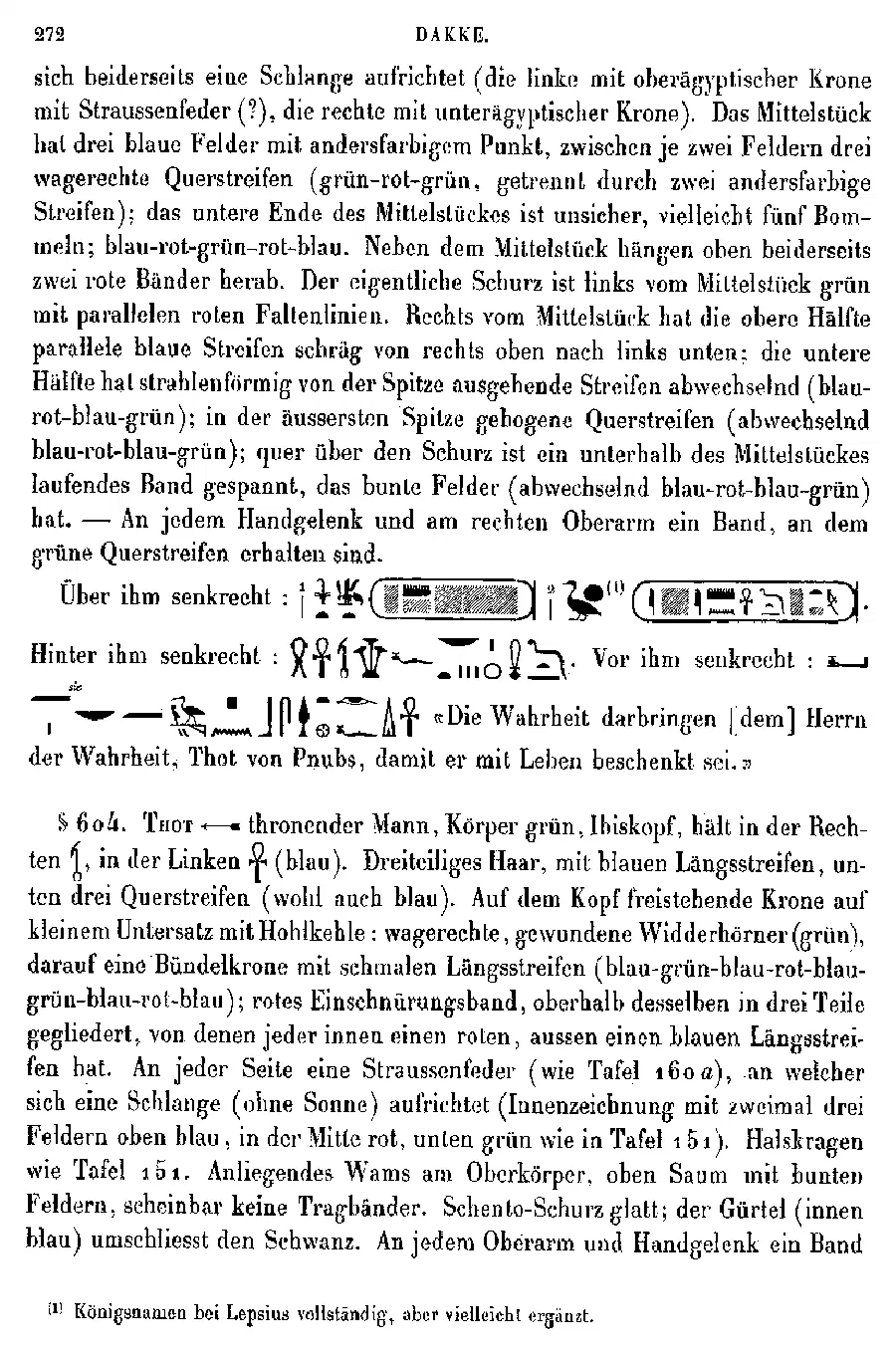
Page 272. Roeder, Der Tempel von Dakke (1930), p. 272 Printed hieroglyphs from G. Roeder, Der Tempel von Dakke (1930) - 581p. 272, § 604
dj.n=(j) n=k rnp.wt ꜥšꜣ.(wt) wr
I have given you years in great number.
- 582p. 272, § 604
dj.n=(j) n=k tḫ wḥm.n=k tḫ
I have given you drunkenness; you have been drunk again.
- 583p. 272, § 604
ḏd-mdw jn ḏḥwtj sḥtp ns<r.t> nb snm.t nb psrk.t dj ꜥnḫ mj rꜥ ḏ.t
Words spoken by Thoth, who soothes Neseret, lord of Senmet, lord of Pselkis, who gives life like Ra forever.
Note · Line 583
Neseret is the goddess of the rearing cobra, whose breath is flame. - 584p. 272, § 604
dj.n=(j) n=k ḥḥ m nswt tꜣ.wj
I have given you eternity as king of the Two Lands.
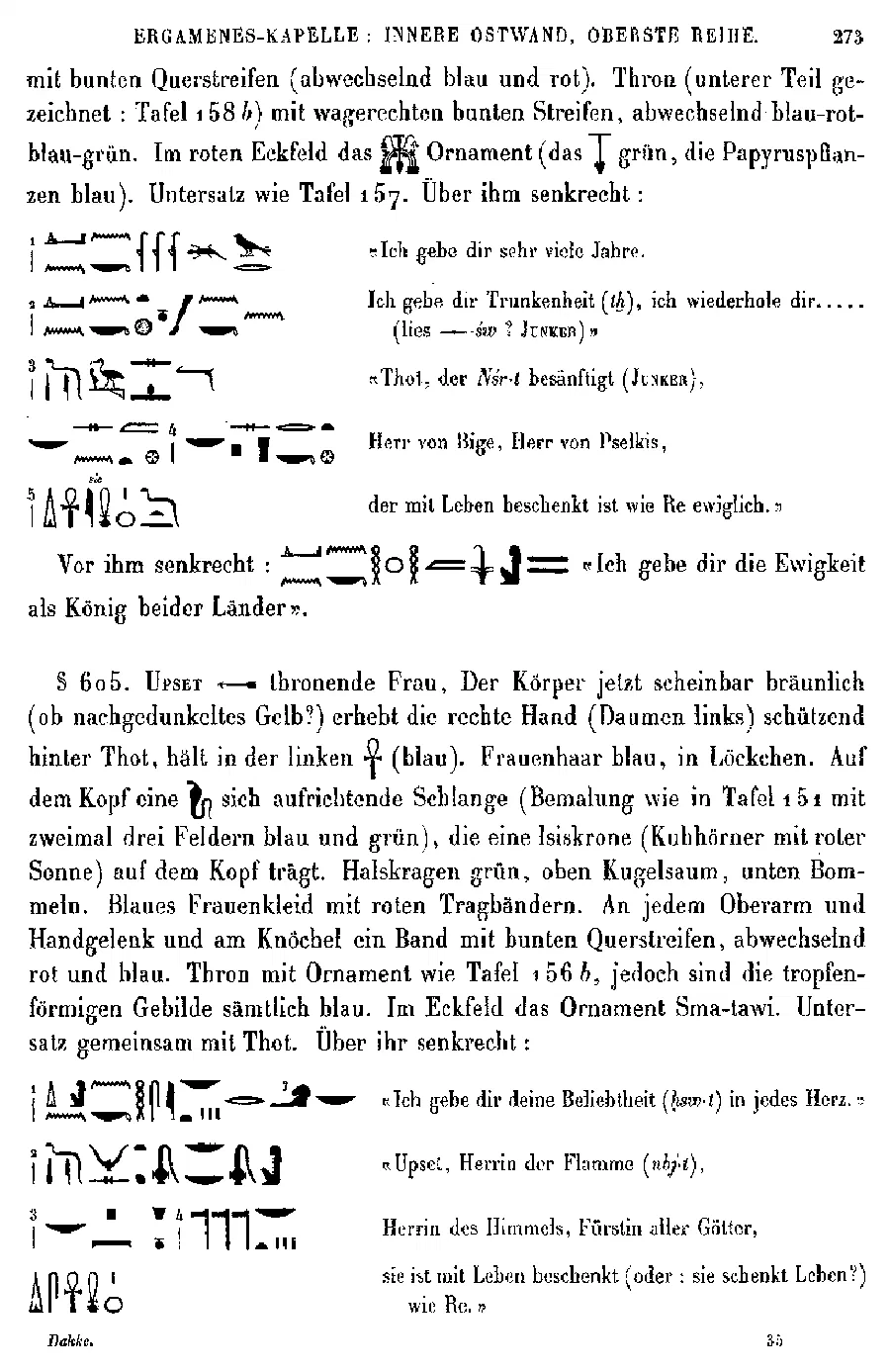
Page 273. Roeder, Der Tempel von Dakke (1930), p. 273 Printed hieroglyphs from G. Roeder, Der Tempel von Dakke (1930) - 585p. 273, § 605
dj.n=j n=k ḥs.t nb.{w}t r ḥꜥtj (?) nb
I have given you every favor in every heart.
- 586p. 273, § 605
ḏd-mdw jn wps.t nb.(t) nbj.t nb.(t) p.t ḥnw.t nṯr.w nb.w{t} dj.(t) ꜥnḫ mj rꜥ
Words spoken by Wepset, lady of the flame, lady of heaven, mistress of all the gods, who gives life like Ra.
- 587p. 273, § 605
dj.n=(j) nbj.t r ḫft.j.w=k
I have set the flame against your enemies.
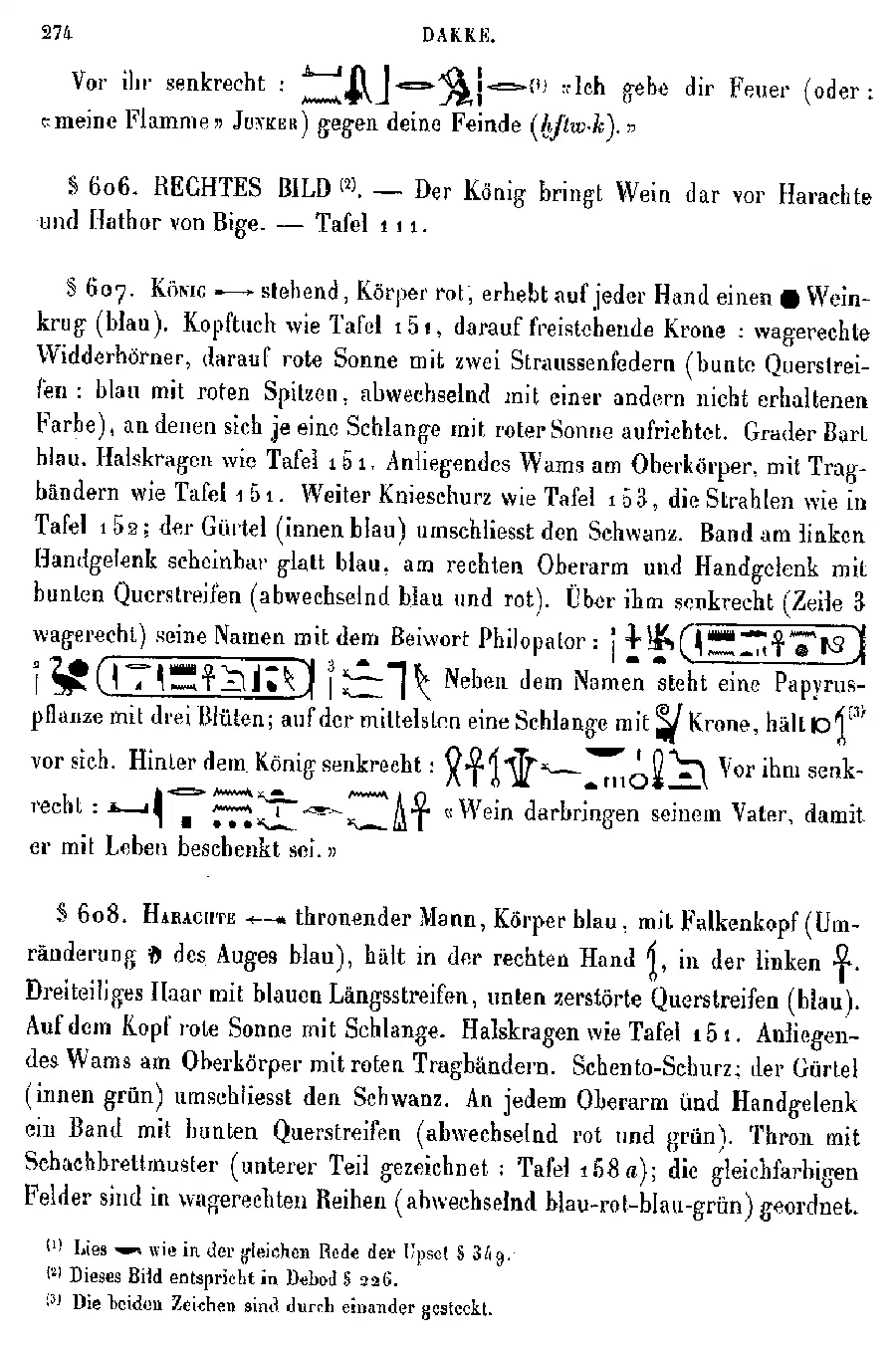
Page 274. Roeder, Der Tempel von Dakke (1930), p. 274 Printed hieroglyphs from G. Roeder, Der Tempel von Dakke (1930) - 588p. 274, § 607
nswt-bj.tj ḏr.t-ꜥnḫ-jmn-tj.t-rꜥ sꜣ-rꜥ jrḳ-jmn-ꜥnḫ-ḏ.t-mrj-ꜣs.t mrj jt=f sꜣ ꜥnḫ wꜣs nb.{wt} ḥꜣ=f mj rꜥ ḏ.t
King of Upper and Lower Egypt, Living Hand of Amun, Image of Ra; Son of Ra, Ergamenes, living forever, beloved of Isis, beloved of his father. All protection, life and dominion are behind him, as they are behind Ra, forever.
- 589p. 274, § 607
ḥnk jrp n jt=f jrj.n=f dj.(t) ꜥnḫ
Offering wine to his father. He has done this that his father may grant him life.
Note · Line 589
The king calls the god who receives his offering “his father.” - 590p. 274, § 608
dj.n=(j) n=k ḳn <m> rsj nḫt <m> mḥw
I have given you strength in the south and power in the north.
- 591p. 274, § 608
ḏd-mdw jn ḥrw-ꜣḫ.tj nṯr ꜥꜣ nb p.t ḥr.j nṯr.w
Words spoken by Horakhty, the great god, lord of heaven, chief of the gods.
Note · Line 591
Horakhty is “Horus of the Two Horizons,” the god of the rising and setting sun. - 592p. 274, § 608
dj.n=(j) n=k pḥtj n rꜥ <m> p.t
I have given you the might of Ra in heaven.
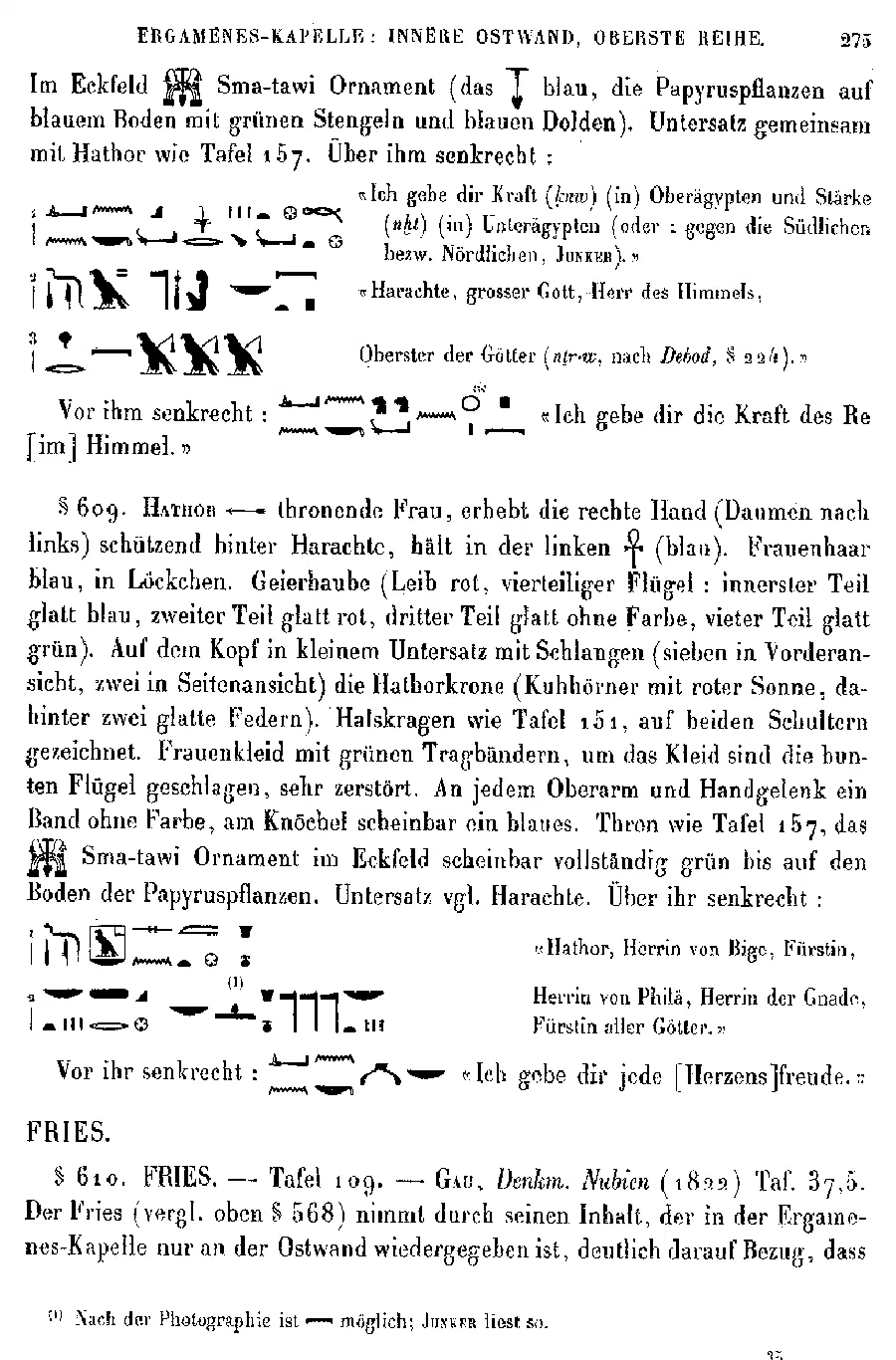
Page 275. Roeder, Der Tempel von Dakke (1930), p. 275 Printed hieroglyphs from G. Roeder, Der Tempel von Dakke (1930) - 593p. 275, § 609
ḏd-mdw jn ḥw.t-ḥrw nb.(t) snm.t ḥnw.t nb.(t) jwrḳ nb.(t) p.t ḥnw.t nṯr.w nb.w{t}
Words spoken by Hathor, lady of Senmet, sovereign, lady of Philae, lady of heaven, mistress of all the gods.
- 594p. 275, § 609
dj.n=(j) n=k ꜣw.(t)-<jb> nb.(t)
I have given you every joy.
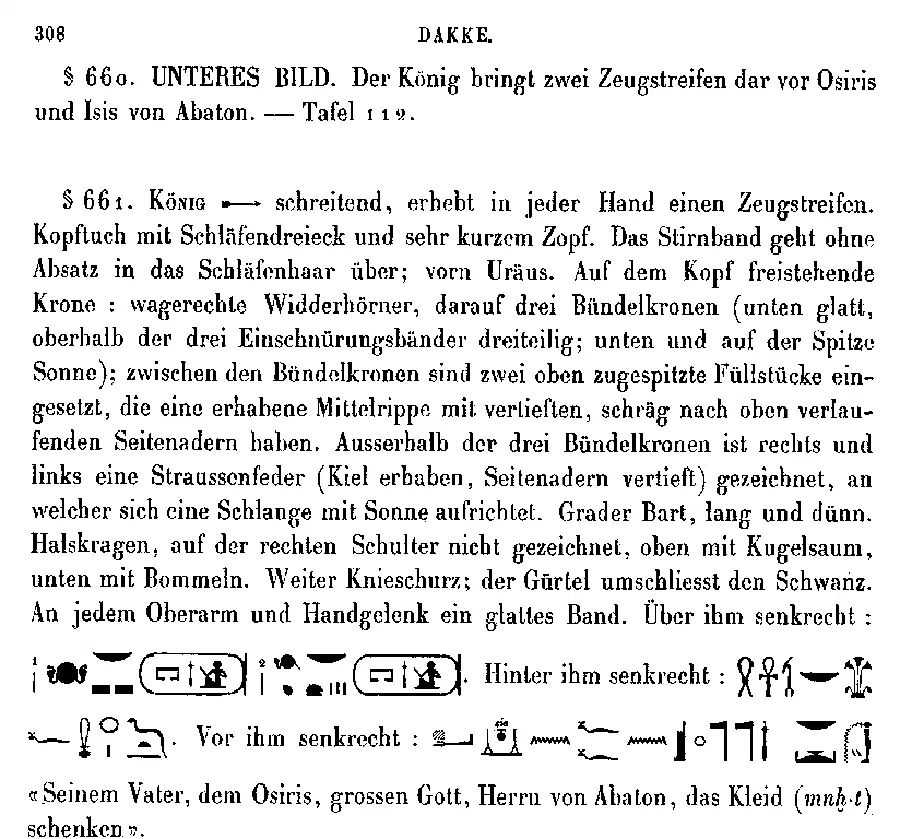
Page 308. Roeder, Der Tempel von Dakke (1930), p. 308 Printed hieroglyphs from G. Roeder, Der Tempel von Dakke (1930) - 595p. 308, § 661
nswt-bj.tj nb-tꜣ.wj pr-ꜥꜣ sꜣ-rꜥ nb-ḫꜥ.w pr-ꜥꜣ
King of Upper and Lower Egypt, Lord of the Two Lands, Pharaoh; Son of Ra, Lord of Crowns, Pharaoh.
Note · Line 595
Here “Pharaoh” stands in both places where the king’s names would normally appear. - 596p. 308, § 661
sꜣ ꜥnḫ wꜣs nb ḥꜣ=f mj rꜥ ḏ.t
All protection, life and dominion are behind him, as they are behind Ra, forever.
- 597p. 308, § 661
ḥnk mnḫ.t n jt=f n wsjr nṯr ꜥꜣ nb jꜣ.t-wꜥb.t
Offering linen to his father, to Osiris, the great god, lord of the Abaton.
- 598p. 308, § 662
ḏd-mdw jn wsjr nṯr ꜥꜣ nb jꜣ.t-wꜥb.t sḫm šps nb jwrḳ
Words spoken by Osiris, the great god, lord of the Abaton, venerable image, lord of Philae.
- 599p. 308, § 662
dj.n=j n=k ḥꜥpj wr r tr=f
I have given you Hapy, high in his season.
Note · Line 599
A high flood in due season brought water to the fields. 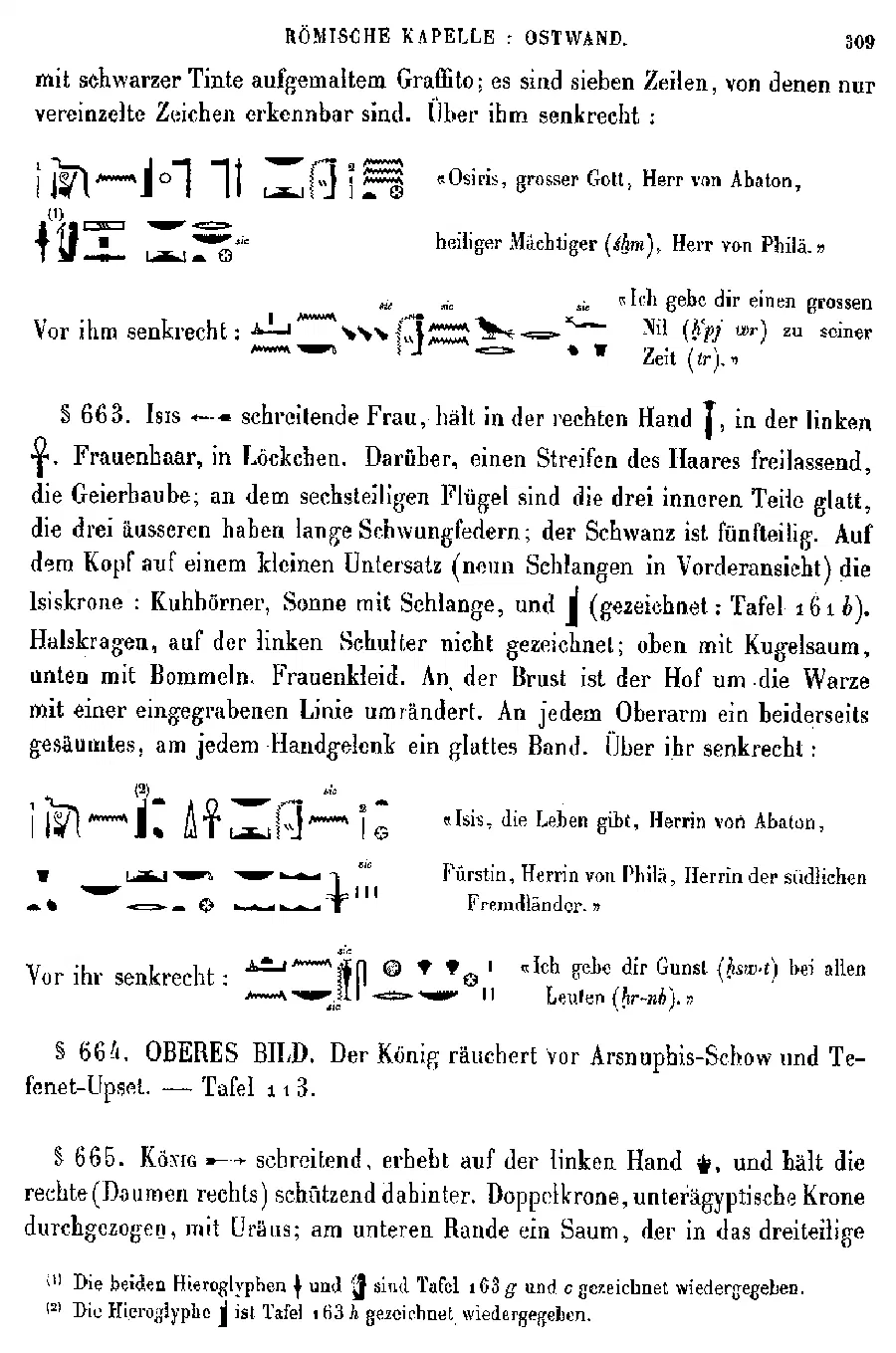
Page 309. Roeder, Der Tempel von Dakke (1930), p. 309 Printed hieroglyphs from G. Roeder, Der Tempel von Dakke (1930) - 600p. 309, § 663
ḏd-mdw jn ꜣs.t dj.(t) ꜥnḫ nb.(t) jꜣ.t-wꜥb.t ḥnw.t nb.(t) jwrḳ nb.(t) ḫꜣs.wt rsj.w(t)
Words spoken by Isis, giver of life, lady of the Abaton, sovereign, lady of Philae, lady of the foreign lands to the south.
- 601p. 309, § 663
dj.n=j n=k ḥs.t ḫr ḥr-nb
I have given you favor in everyone’s eyes.
- 602p. 309, § 665
nswt-bj.tj nb-tꜣ.wj pr-ꜥꜣ sꜣ-rꜥ nb-ḫꜥ.w pr-ꜥꜣ
King of Upper and Lower Egypt, Lord of the Two Lands, Pharaoh; Son of Ra, Lord of Crowns, Pharaoh.
- 603p. 309, § 665
sꜣ ꜥnḫ wꜣs nb ḥꜣ=f mj rꜥ ḏ.t
All protection, life and dominion are behind him, as they are behind Ra, forever.
- 604p. 309, § 665
jrj.(t) snṯr n jt=f jrj.n=f dj.(t) ꜥnḫ
Burning incense for his father. He has done this that his father may grant him life.
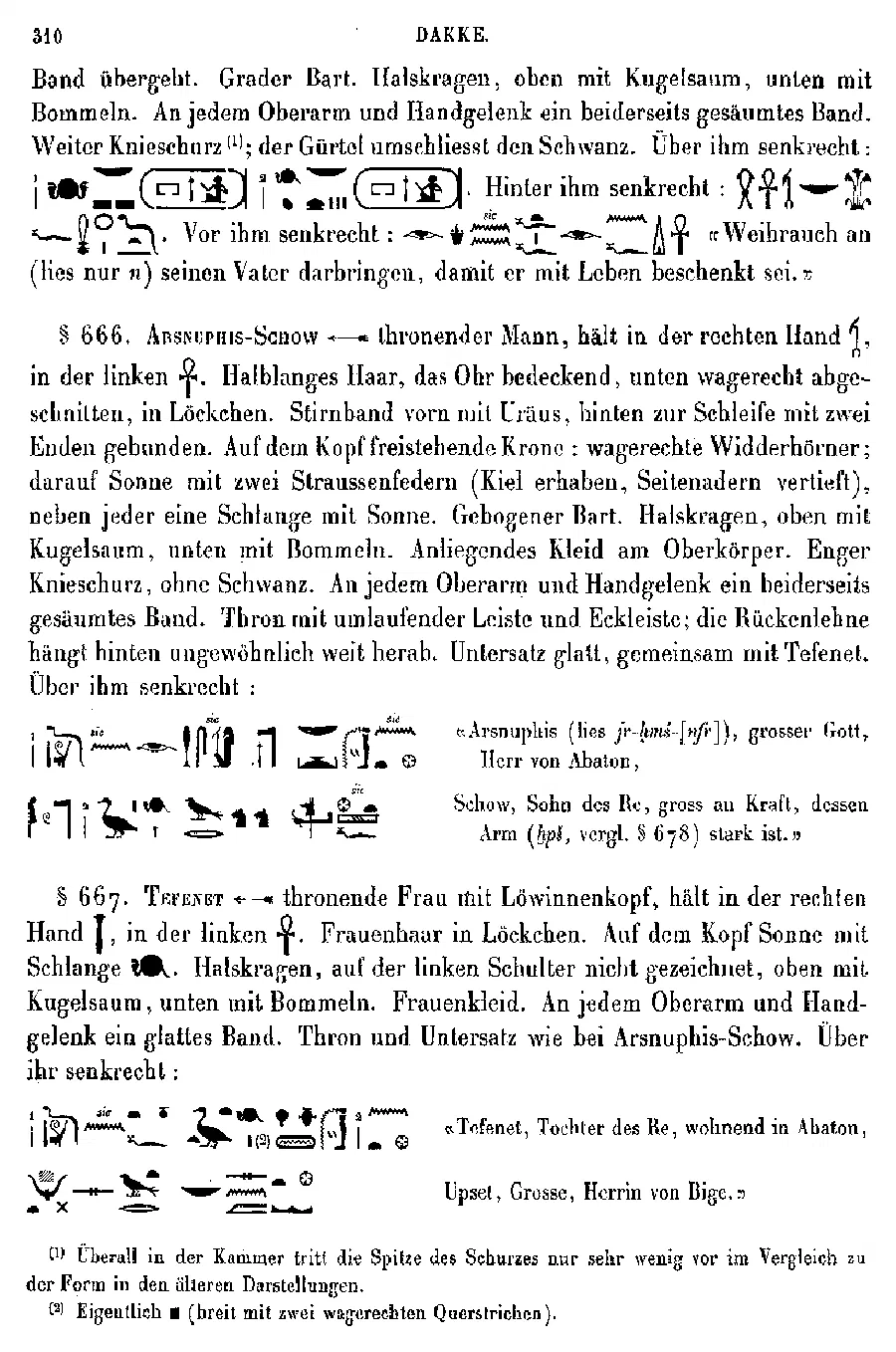
Page 310. Roeder, Der Tempel von Dakke (1930), p. 310 Printed hieroglyphs from G. Roeder, Der Tempel von Dakke (1930) - 605p. 310, § 666
ḏd-mdw jn jr.j-ḥms-<nfr> nṯr ꜥꜣ nb jꜣ.t-wꜥb.t šw sꜣ rꜥ wr pḥtj wsr ḫpš=f
Words spoken by Arensnuphis, the great god, lord of the Abaton, Shu, son of Ra, great in might and strong of arm.
Note · Line 605
The Abaton, the “Pure Mound,” was the sanctuary on Biga where Osiris was believed to lie buried. Here Arensnuphis bears the name of Shu, the god of air. - 606p. 310, § 667
ḏd-mdw jn tfn.t sꜣ.t rꜥ ḥr.j.(t)-jb jw-wꜥb wps.t wr.t nb.(t) snm.t
Words spoken by Tefnut, daughter of Ra, who dwells on the Pure Island, Wepset the Great, lady of Senmet.
Note · Line 606
Wepset, “the Burning One,” is the goddess in the form of the cobra on Ra’s brow. 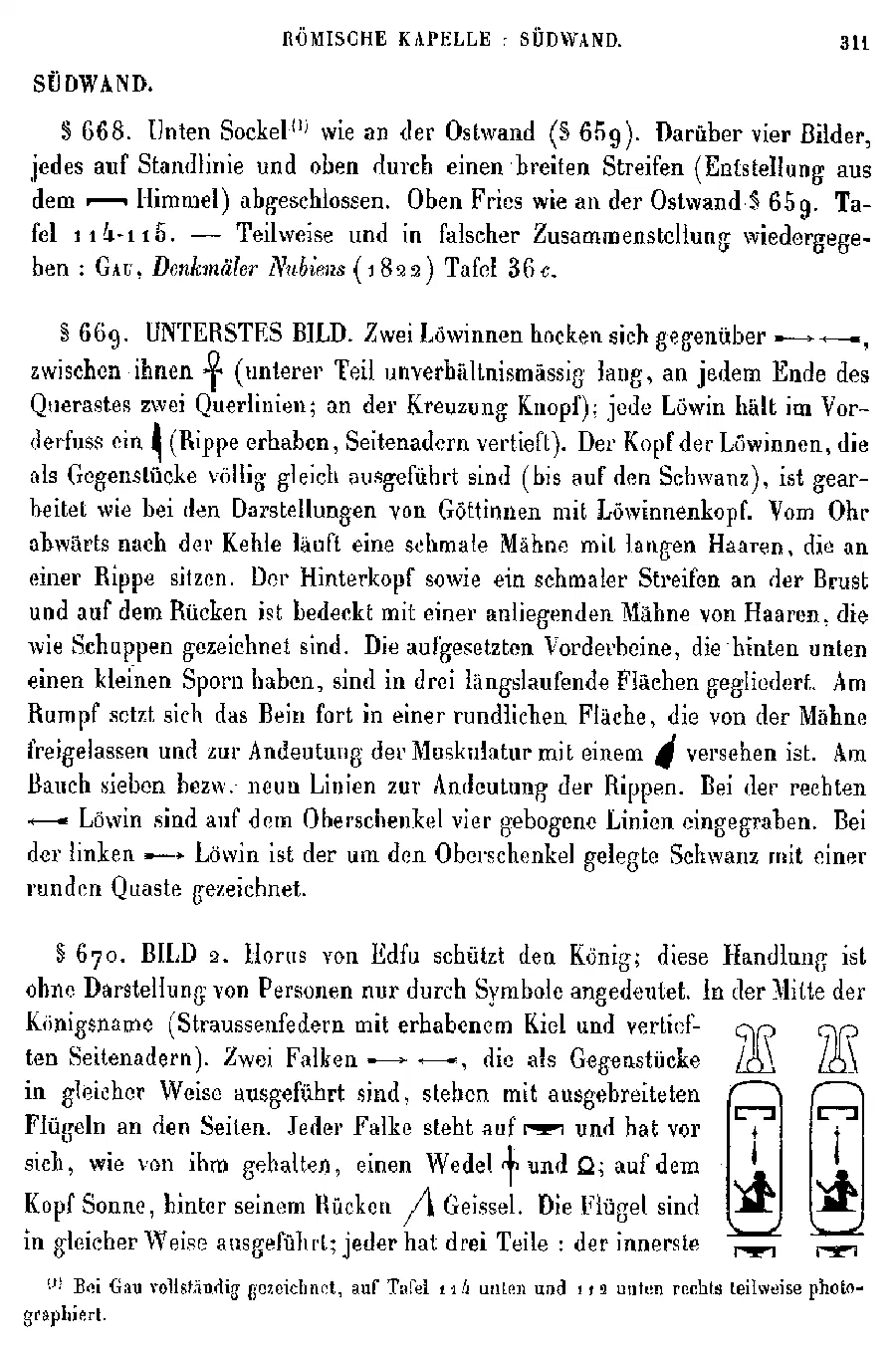
Page 311. Roeder, Der Tempel von Dakke (1930), p. 311 Printed hieroglyphs from G. Roeder, Der Tempel von Dakke (1930) - 607p. 311, § 670
pr-ꜥꜣ bḥd.tj nṯr ꜥꜣ nb p.t
Pharaoh. He of Behdet, the great god, lord of heaven.
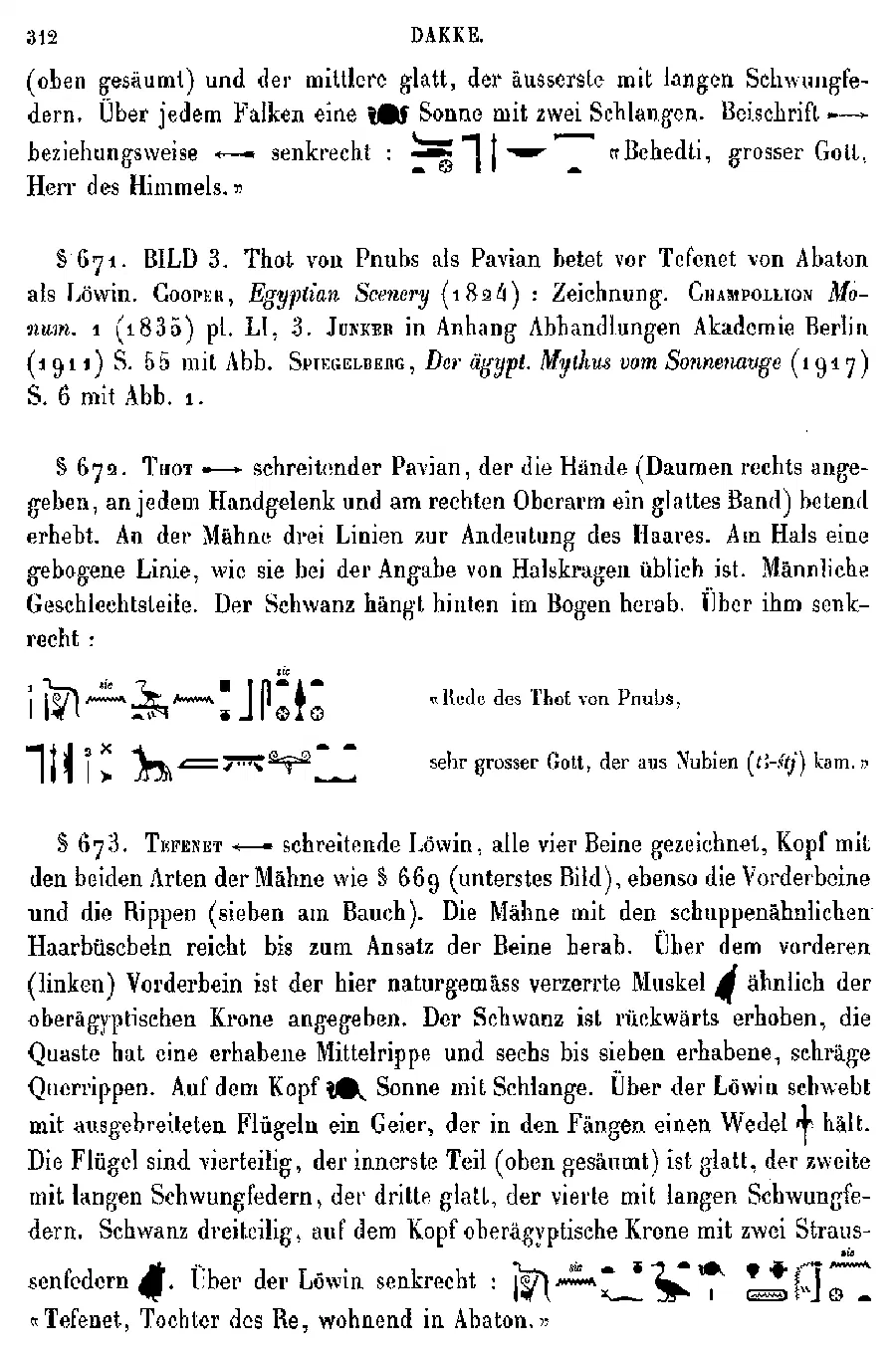
Page 312. Roeder, Der Tempel von Dakke (1930), p. 312 Printed hieroglyphs from G. Roeder, Der Tempel von Dakke (1930) - 608p. 312, § 672
ḏd-mdw jn ḏḥwtj n pnbs nṯr ꜥꜣ wr jj m tꜣ-stj
Words spoken by Thoth of Pnubs, the very great god who comes from Nubia.
Note · Line 608
He bears its name here at Dakka. - 609p. 312, § 673
ḏd-mdw jn tfn.t sꜣ.t rꜥ ḥr.j.(t)-jb jw-wꜥb
Words spoken by Tefnut, daughter of Ra, who dwells on the Pure Island.
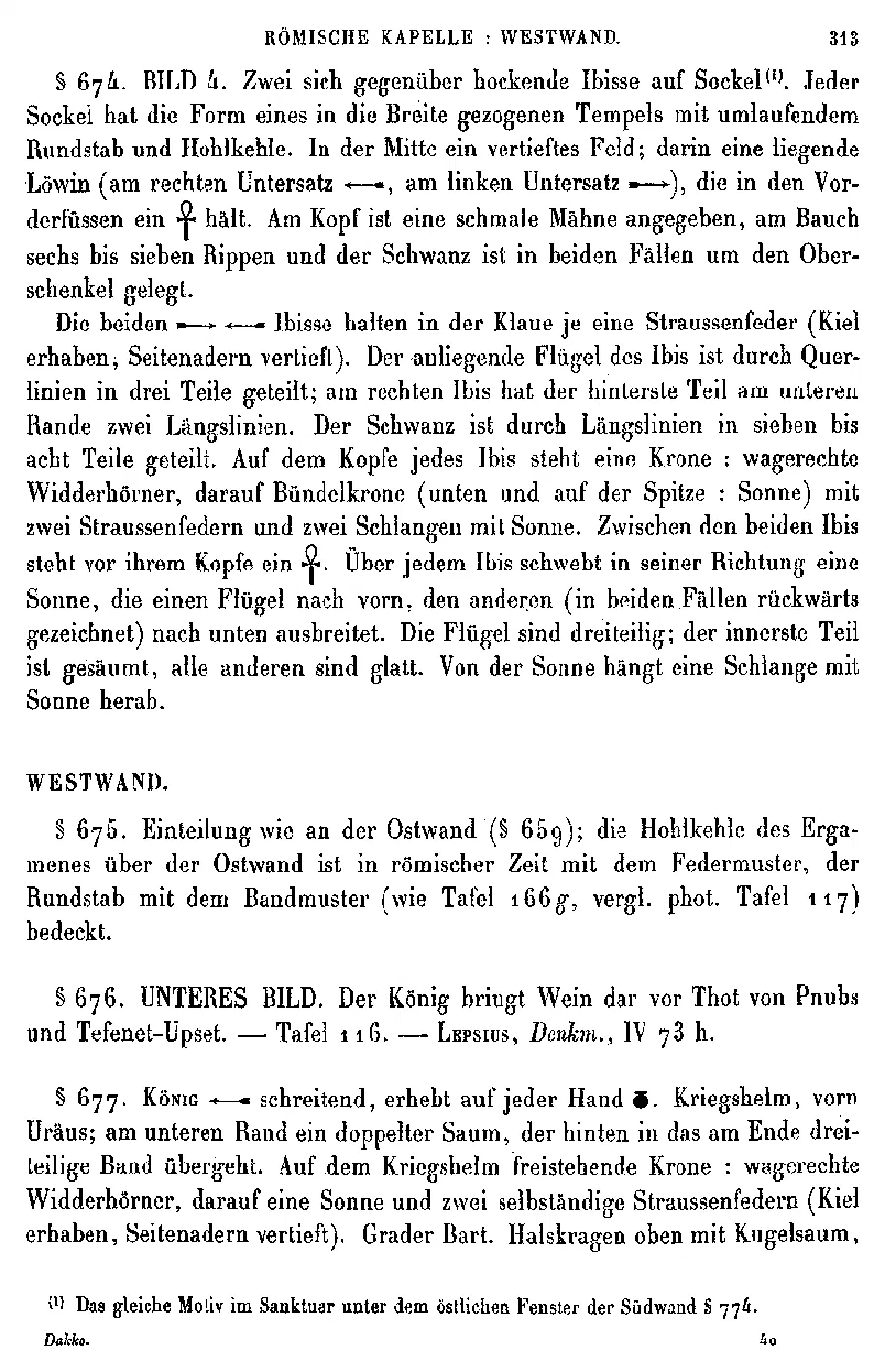
Page 313. Roeder, Der Tempel von Dakke (1930), p. 313 Printed hieroglyphs from G. Roeder, Der Tempel von Dakke (1930) - 610p. 313, § 677
nswt-bj.tj nb-tꜣ.wj pr-ꜥꜣ sꜣ-rꜥ nb-ḫꜥ.w pr-ꜥꜣ
King of Upper and Lower Egypt, lord of the Two Lands, Pharaoh; son of Ra, lord of crowns, Pharaoh.
Note · Line 610
“Pharaoh” stands in both places where a king’s names would ordinarily appear: first his throne name, then his birth name. - 611p. 313, § 677
sꜣ ꜥnḫ wꜣs nb ḥꜣ=f mj rꜥ ḏ.t
All protection, life and dominion are behind him as they are behind Ra, forever.
- 612p. 313, § 677
jrj.(t) jrp n jt=f jrj.n=f dj.(t) ꜥnḫ
Offering wine to his father. He has done this so that his father may give him life.
Note · Line 612
The king calls the god who receives his offering “father.” 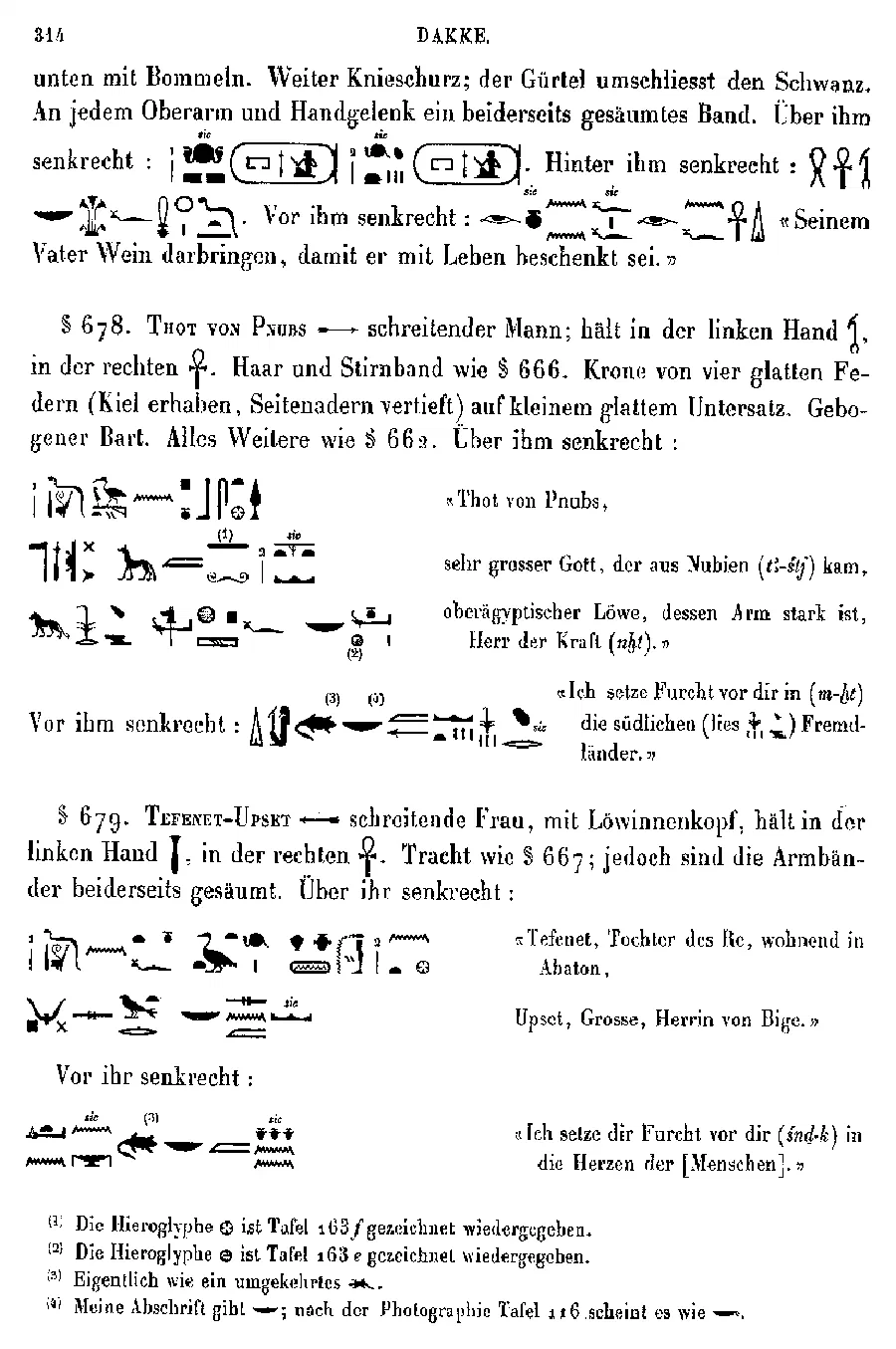
Page 314. Roeder, Der Tempel von Dakke (1930), p. 314 Printed hieroglyphs from G. Roeder, Der Tempel von Dakke (1930) - 613p. 314, § 678
ḏd-mdw jn ḏḥwtj n pnbs nṯr ꜥꜣ wr jj m tꜣ-stj mꜣj rsj wsr ḫpš=f nb nḫt
Words spoken by Thoth of Pnubs, the very great god who comes from Nubia, the lion of the south, strong of arm, lord of might.
- 614p. 314, § 678
dj=j snḏ=k m-ḫt ḫꜣs.wt rsj.w(t)
I spread the dread of you through the foreign lands of the south.
- 615p. 314, § 679
ḏd-mdw jn tfn.t sꜣ.t rꜥ ḥr.j.(t)-jb jw-wꜥb wps.t wr.(t) nb.(t) snm.t
Words spoken by Tefnut, daughter of Ra, who dwells on the Pure Island, Wepset the Great, lady of Senmet.
- 616p. 314, § 679
dj.n=j n=k snḏ=k m jb.w
For you I have set the fear of you in people’s hearts.
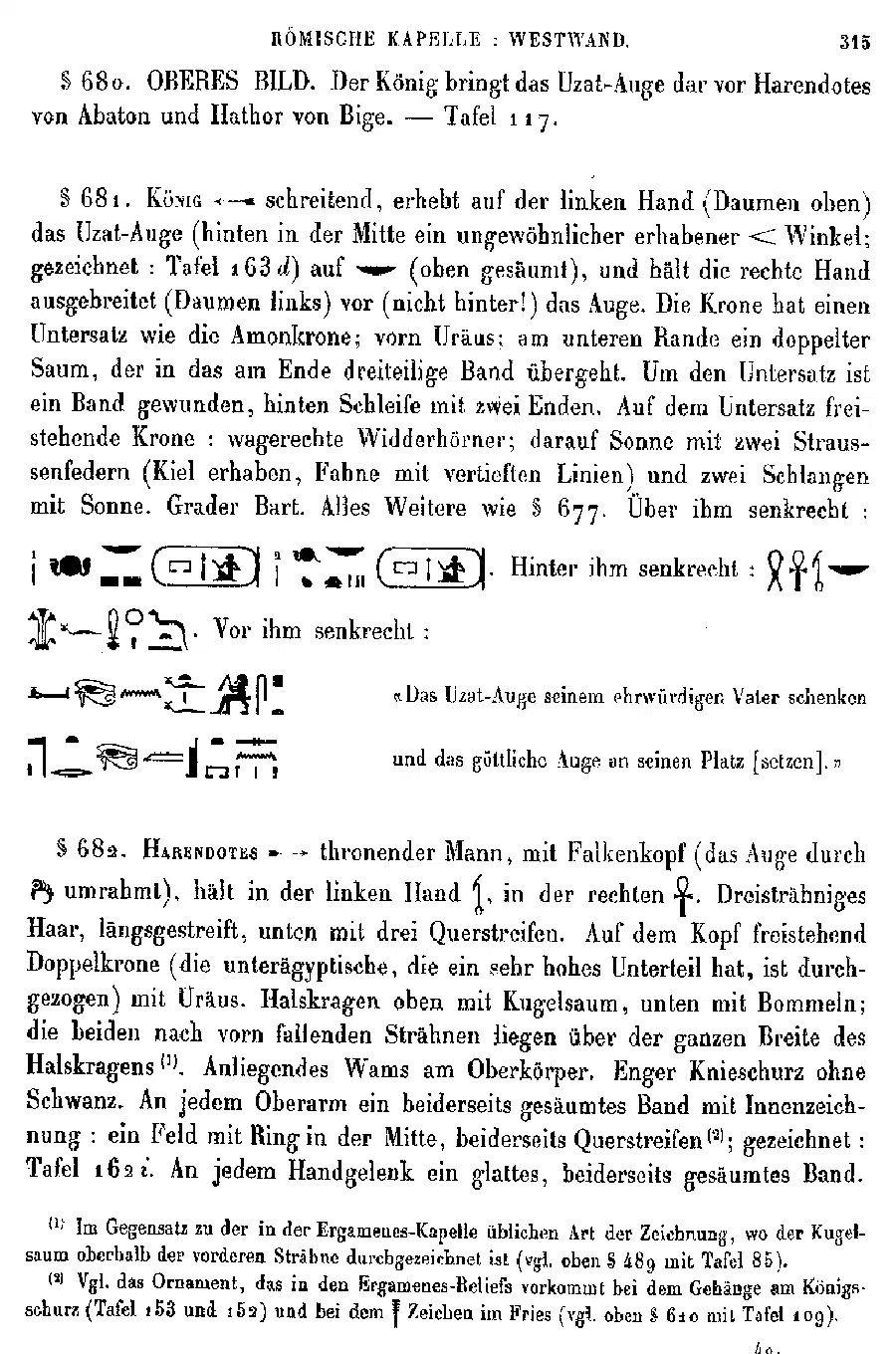
Page 315. Roeder, Der Tempel von Dakke (1930), p. 315 Printed hieroglyphs from G. Roeder, Der Tempel von Dakke (1930) - 617p. 315, § 681
nswt-bj.tj nb-tꜣ.wj pr-ꜥꜣ sꜣ-rꜥ nb-ḫꜥ.w pr-ꜥꜣ
King of Upper and Lower Egypt, lord of the Two Lands, Pharaoh; son of Ra, lord of crowns, Pharaoh.
- 618p. 315, § 681
sꜣ ꜥnḫ wꜣs nb ḥꜣ=f mj rꜥ ḏ.t
All protection, life and dominion are behind him as they are behind Ra, forever.
- 619p. 315, § 681
ḥnk wḏꜣ,t n jt=f šps <sḥ>tp nṯr.t m s.t=sn
Presenting the wedjat eye to his revered father; soothing the divine eye in their place.
Note · Line 619
The divine eye could itself be worshipped as a goddess whose anger had to be soothed. - 620p. 315, § 682
ḏd-mdw jn ḥrw-nḏ-jt=f sꜣ ꜣs.t sꜣ wsjr nṯr ꜥꜣ nb jꜣ.t-wꜥb.t
Words spoken by Harendotes, son of Isis, son of Osiris, the great god, lord of the Abaton.
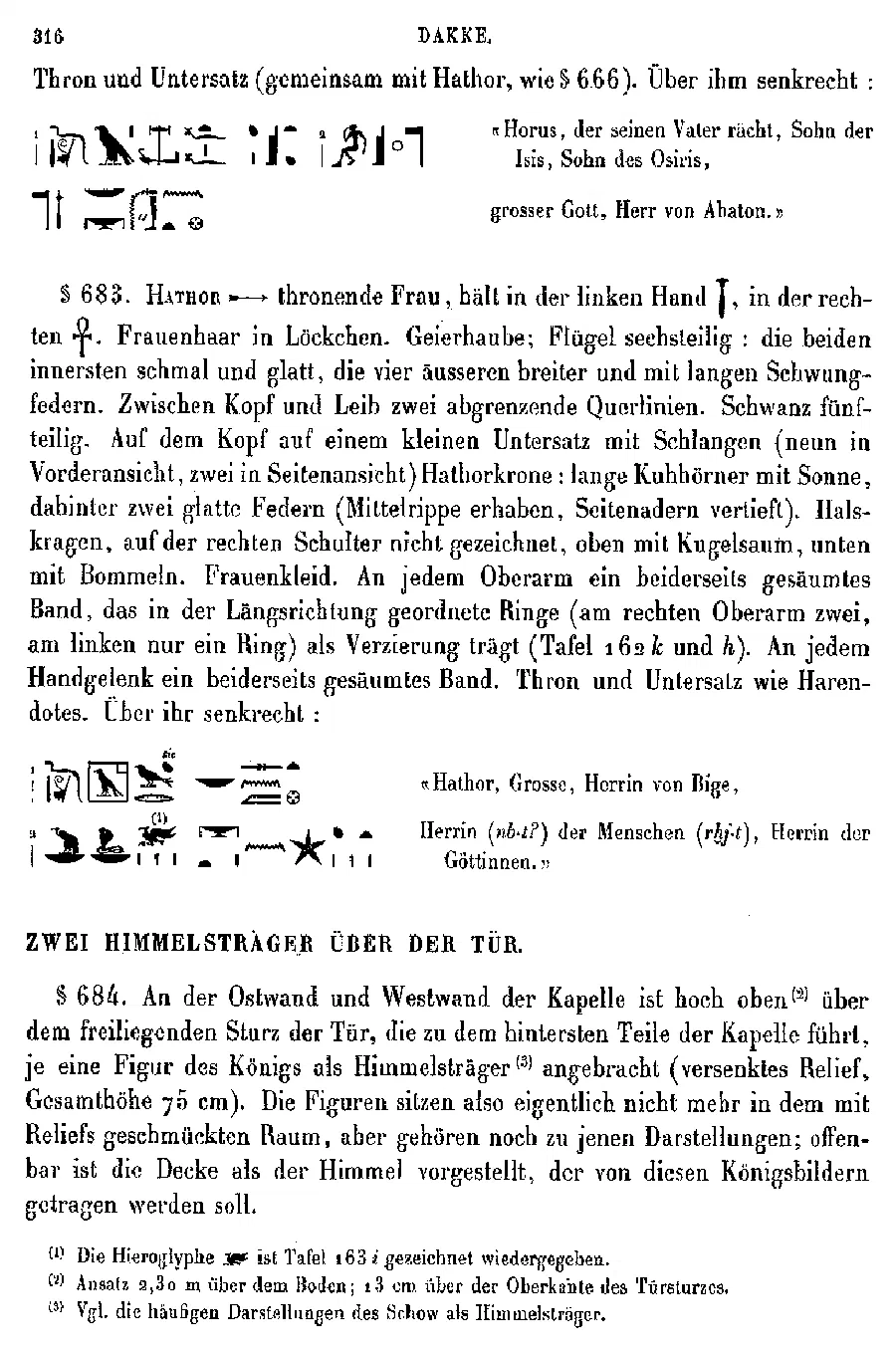
Page 316. Roeder, Der Tempel von Dakke (1930), p. 316 Printed hieroglyphs from G. Roeder, Der Tempel von Dakke (1930) - 621p. 316, § 683
ḏd-mdw jn ḥw.t-ḥrw wr.t nb.(t) snm.t nb.tj.t rḫj.t nbw.t n nṯr.wt
Words spoken by Hathor the Great, lady of Senmet, queen of the people, gold of the goddesses.
Note · Line 621
The people are the rekhyt, represented in temple art by lapwings. Gold was a sacred name of Hathor. 
Page 321. Roeder, Der Tempel von Dakke (1930), p. 321 Printed hieroglyphs from G. Roeder, Der Tempel von Dakke (1930) - 622p. 321, § 694
nswt-bj.tj pr-ꜥꜣ ḫr=k ḏḥwtj n pnbs
The king of Upper and Lower Egypt, Pharaoh, is in your presence, Thoth of Pnubs.
- 623p. 321, § 695
sꜣ-rꜥ pr-ꜥꜣ ḫr=k ḏḥwtj n pnbs
The son of Ra, Pharaoh, is in your presence, Thoth of Pnubs.
Page 322. Roeder, Der Tempel von Dakke (1930), p. 322 Printed hieroglyphs from G. Roeder, Der Tempel von Dakke (1930) - 624p. 322, § 696
nswt-bj.tj pr-ꜥꜣ ḫr=k ḏḥwtj n pnbs
The king of Upper and Lower Egypt, Pharaoh, is in your presence, Thoth of Pnubs.
- 625p. 322, § 698
nswt-bj.tj nb-tꜣ.wj pr-ꜥꜣ sꜣ-rꜥ nb-ḫꜥ.w pr-ꜥꜣ
King of Upper and Lower Egypt, lord of the Two Lands, Pharaoh; son of Ra, lord of crowns, Pharaoh.
- 626p. 322, § 698
sꜣ ꜥnḫ wꜣs <nb> ḥꜣ=f mj rꜥ ḏ.t
All protection, life and dominion are behind him as they are behind Ra, forever.
- 627p. 322, § 698
ḥtp-<dj>-nswt m jḫ.t nb.(t) nfr.t m kꜣ.w ꜣpd.w nb.w
An offering the king gives: every good thing, all manner of oxen and fowl.
- 628p. 322, § 699
ḏd-mdw jn ꜣs.t dj.(t) ꜥnḫ nb.(t) jꜣ.t-<wꜥb.t> ḥnw.t nb.(t) jwrḳ šps.t wsr.(t) m ḫnt-ḥn-nfr nb.t ḫꜣs.wt rsj.(wt)
Words spoken by Isis, giver of life, lady of the Abaton, sovereign, lady of Philae, revered and mighty in Khent-hen-nefer, lady of the foreign lands of the south.
Note · Line 628
Khent-hen-nefer is an Egyptian name for a region of Nubia. - 629p. 322, § 699
dj=j n=k km.t ḥtp ḥr mw=k
I give you Egypt, at peace and loyal to you.
Page 323. Roeder, Der Tempel von Dakke (1930), p. 323 Printed hieroglyphs from G. Roeder, Der Tempel von Dakke (1930) - 630p. 323, § 700
ḏd-mdw jn ḥrw-sꜣ-ꜣs.t sꜣ wsjr nṯr ꜥꜣ nb jw-wꜥb sḫr sbj.w ḥr jt=<f> m jw-wꜥb
Words spoken by Harsiese, son of Osiris, the great god, lord of the Pure Island, who strikes down those who rebel against his father on the Pure Island.
- 631p. 323, § 700
dj=(j) n=k rwḏ nb ḥr sꜣ tꜣ mj rꜥ ḏ.t
I give you all that grows on the face of the earth, like Ra, forever.
Page 324. Roeder, Der Tempel von Dakke (1930), p. 324 Printed hieroglyphs from G. Roeder, Der Tempel von Dakke (1930) - 632p. 324, § 702
nswt-bj.tj nb-tꜣ.wj pr-ꜥꜣ sꜣ-rꜥ nb-ḫꜥ.w pr-ꜥꜣ
King of Upper and Lower Egypt, lord of the Two Lands, Pharaoh; son of Ra, lord of crowns, Pharaoh.
- 633p. 324, § 702
<sꜣ>-ꜥnḫ-wꜣs-<nb>-ḥꜣ=f-mj-rꜥ
All protection, life and dominion are behind him as they are behind Ra.
- 634p. 324, § 702
jrj.(t) snṯr n jt=f šps jrj.n=f dj.(t) ꜥnḫ
Burning incense for his revered father. He has done this so that his father may give him life.
- 635p. 324, § 703
ḏd-mdw jn ḥrw n mjꜣm
Words spoken by Horus of Miam.
Note · Line 635
Miam was the Egyptian name for Aniba in Lower Nubia. Here and in the next captions, the place-name identifies a local form of the god. - 636p. 324, § 704
ḏd-mdw jn ḥrw n mw (?)
Words spoken by Horus of Mu.
- 637p. 324, § 705
nḫb.t n bhn (?)
Nekhbet of Buhen.
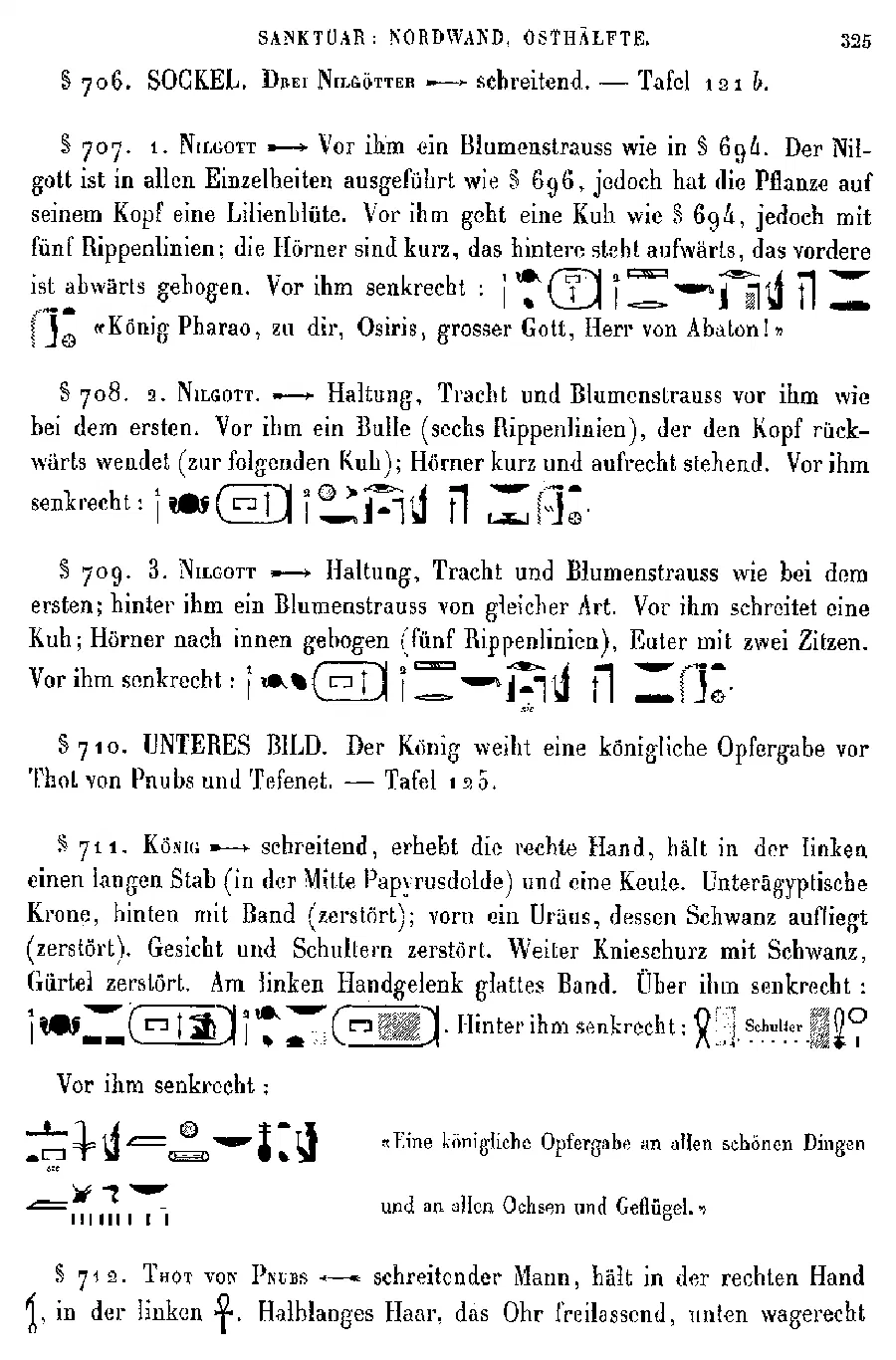
Page 325. Roeder, Der Tempel von Dakke (1930), p. 325 Printed hieroglyphs from G. Roeder, Der Tempel von Dakke (1930) - 638p. 325, § 707
sꜣ-rꜥ pr-ꜥꜣ ḫr=k wsjr nṯr ꜥꜣ nb jw-wꜥb
Pharaoh, the Son of Ra, is at your side, Osiris, great god, lord of the Pure Island.
Note · Line 638
The Pure Island and the Pure Mound name the Abaton, the sanctuary of Osiris on Bigeh, near Philae. - 639p. 325, § 708
nswt-bj.tj pr-ꜥꜣ ḫr=k wsjr nṯr ꜥꜣ nb jꜣ.t-wꜥb.t
Pharaoh, the King of Upper and Lower Egypt, is at your side, Osiris, great god, lord of the Pure Mound.
- 640p. 325, § 709
sꜣ-rꜥ pr-ꜥꜣ ḫr=k wsjr nṯr ꜥꜣ nb jw-wꜥb
Pharaoh, the Son of Ra, is at your side, Osiris, great god, lord of the Pure Island.
- 641p. 325, § 711
nswt-bj.tj nb-tꜣ.wj pr-ꜥꜣ sꜣ-rꜥ nb-ḫꜥ.w pr[-ꜥꜣ]
King of Upper and Lower Egypt, lord of the Two Lands, Pharaoh; Son of Ra, lord of crowns, Pharaoh.
Note · Line 641
“Pharaoh” stands in both places where a king’s names would normally appear: first his throne name, then his birth name. - 642p. 325, § 711
sꜣ-[ꜥnḫ-wꜣs-nb-ḥꜣ=f]-mj-rꜥ
All protection, life and dominion stand behind him as they stand behind Ra.
- 643p. 325, § 711
ḥtp-<dj>-nswt m jḫ.t nb.(t) nfr.(t) m kꜣ.w ꜣpd.w nb.w
An offering the king gives: every good thing, oxen and fowl of every kind.
- 644p. 325, § 712
ḏd-mdw jn ḏḥwtj n pnbs nṯr ꜥꜣ nb psrk.t šw sꜣ rꜥ jj m tꜣ-stj
Words spoken by Thoth of Pnubs, the great god, lord of Pselkis, Shu, son of Ra, who comes from Nubia.
Note · Line 644
Here Thoth is identified with Shu, the brother and consort of Tefnut, who speaks next. - 645p. 325, § 712
dj=j n=k km.t ḥtp ḥr mw=k
I give you Egypt, at peace upon your water.
Note · Line 645
Thoth promises the king Egypt’s allegiance. 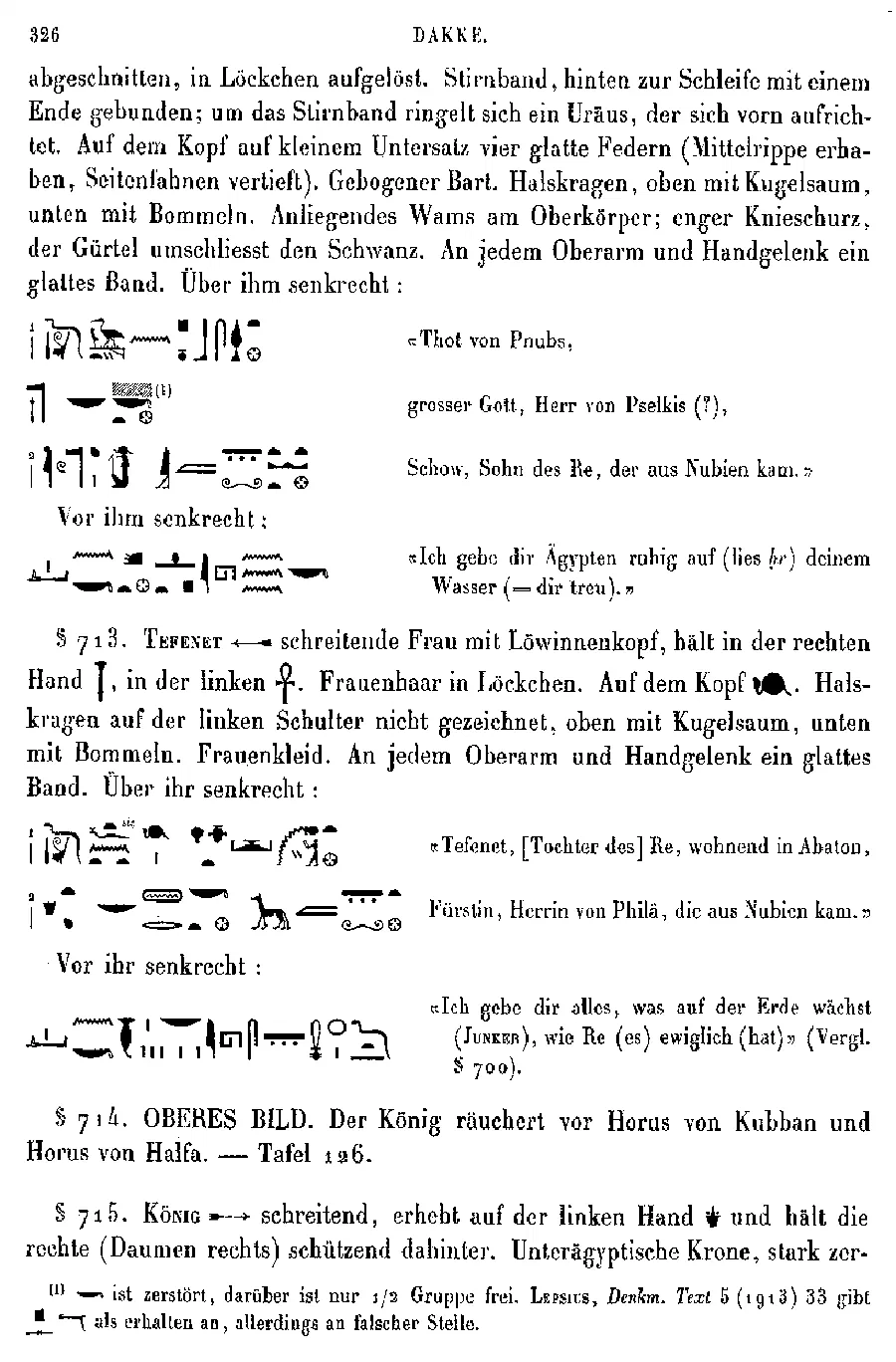
Page 326. Roeder, Der Tempel von Dakke (1930), p. 326 Printed hieroglyphs from G. Roeder, Der Tempel von Dakke (1930) - 646p. 326, § 713
ḏd-mdw jn tfn.t <sꜣ.t> rꜥ ḥr.j.(t)-jb jꜣ.t-wꜥb.t ḥnw.t nb.(t) jwrḳ jj m tꜣ-stj
Words spoken by Tefnut, daughter of Ra, who dwells on the Pure Mound, mistress, lady of Philae, who comes from Nubia.
- 647p. 326, § 713
dj=j n=k rwḏ nb ḥr sꜣ tꜣ mj rꜥ ḏ.t
I give you all that grows on the back of the earth, as to Ra, forever.
- 648p. 326, § 715
nswt-bj.tj nb-tꜣ.wj pr-ꜥꜣ sꜣ-rꜥ nb-ḫꜥ.w pr-ꜥꜣ
King of Upper and Lower Egypt, lord of the Two Lands, Pharaoh; Son of Ra, lord of crowns, Pharaoh.
- 649p. 326, § 715
jrj.(t) snṯr n jt=f šps jrj[.n=f dj.t] ꜥnḫ
Burning incense for his august father. This the king has done so that his father may give him life.
- 650p. 326, § 715
[sꜣ ꜥnḫ wꜣs nb ḥꜣ=f] mj rꜥ
All protection, life and dominion stand behind him as they stand behind Ra.
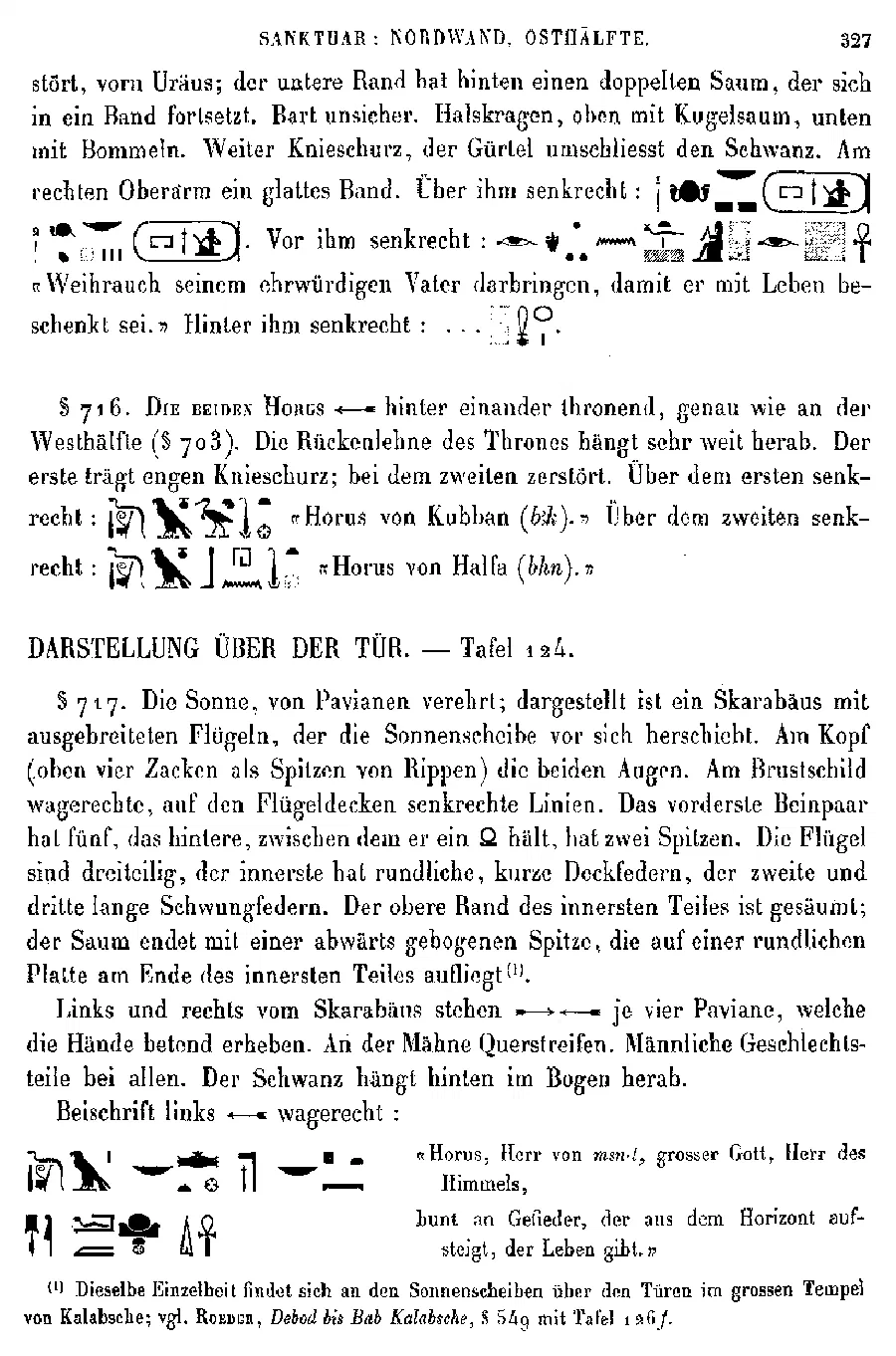
Page 327. Roeder, Der Tempel von Dakke (1930), p. 327 Printed hieroglyphs from G. Roeder, Der Tempel von Dakke (1930) - 651p. 327, § 716
ḏd-mdw jn ḥrw n bꜣk
Words spoken by Horus of Quban.
- 652p. 327, § 716
ḏd-mdw jn ḥrw n bhn
Words spoken by Horus of Buhen.
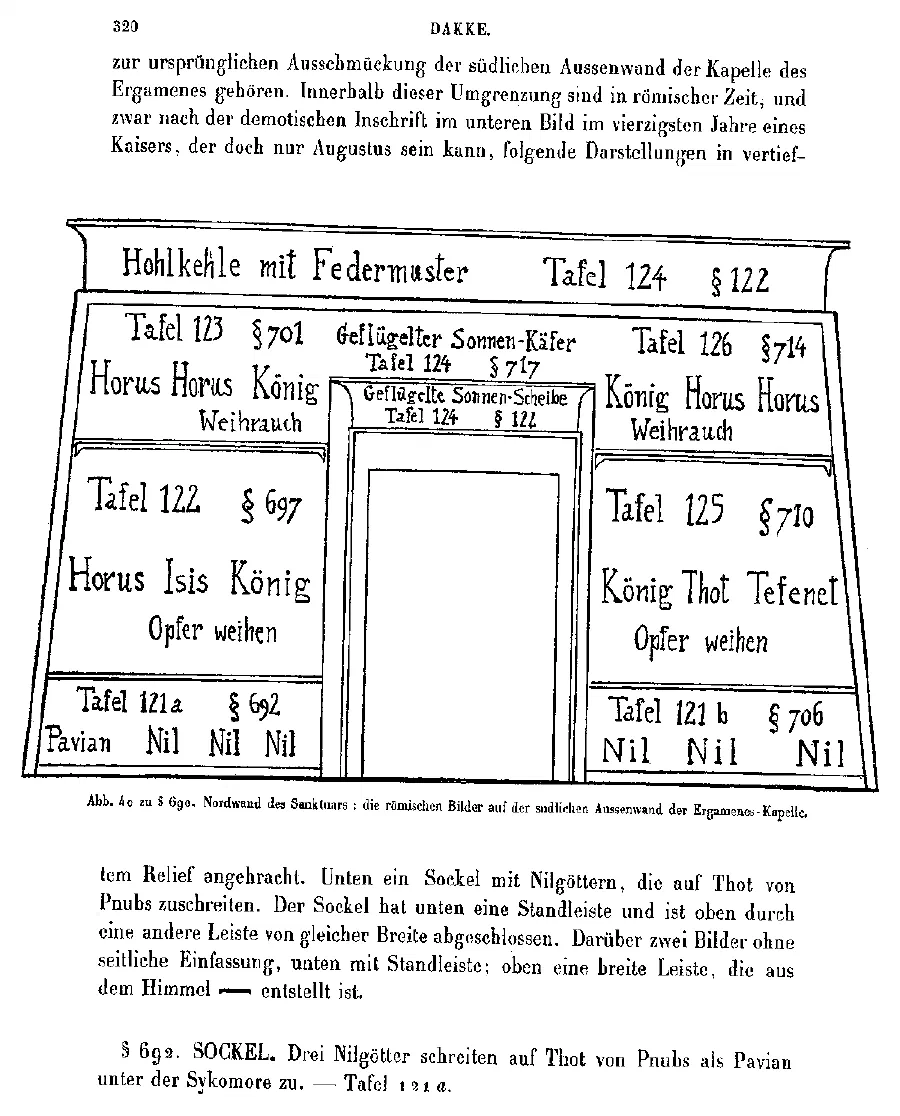
Page 320. Roeder, Der Tempel von Dakke (1930), p. 320 Printed hieroglyphs from G. Roeder, Der Tempel von Dakke (1930) - 653p. 320, § 717
ḏd-mdw jn ḥrw nb msn nṯr ꜥꜣ nb p.t sꜣb šw.t prj m ꜣḫ.t dj ꜥnḫ
Words spoken by Horus, lord of Mesen, the great god, lord of the sky, whose plumage is many-colored, who comes forth from the horizon and gives life.
- 654p. 320, § 717
ḏd-mdw jn ḥrw bḥd.tj nṯr ꜥꜣ nb p.t ꜥpj šps ḫnt.j jtr.wt dj ꜥnḫ
Words spoken by Horus of Behdet, the great god, lord of the sky, the august scarab, foremost in the shrines, who gives life.
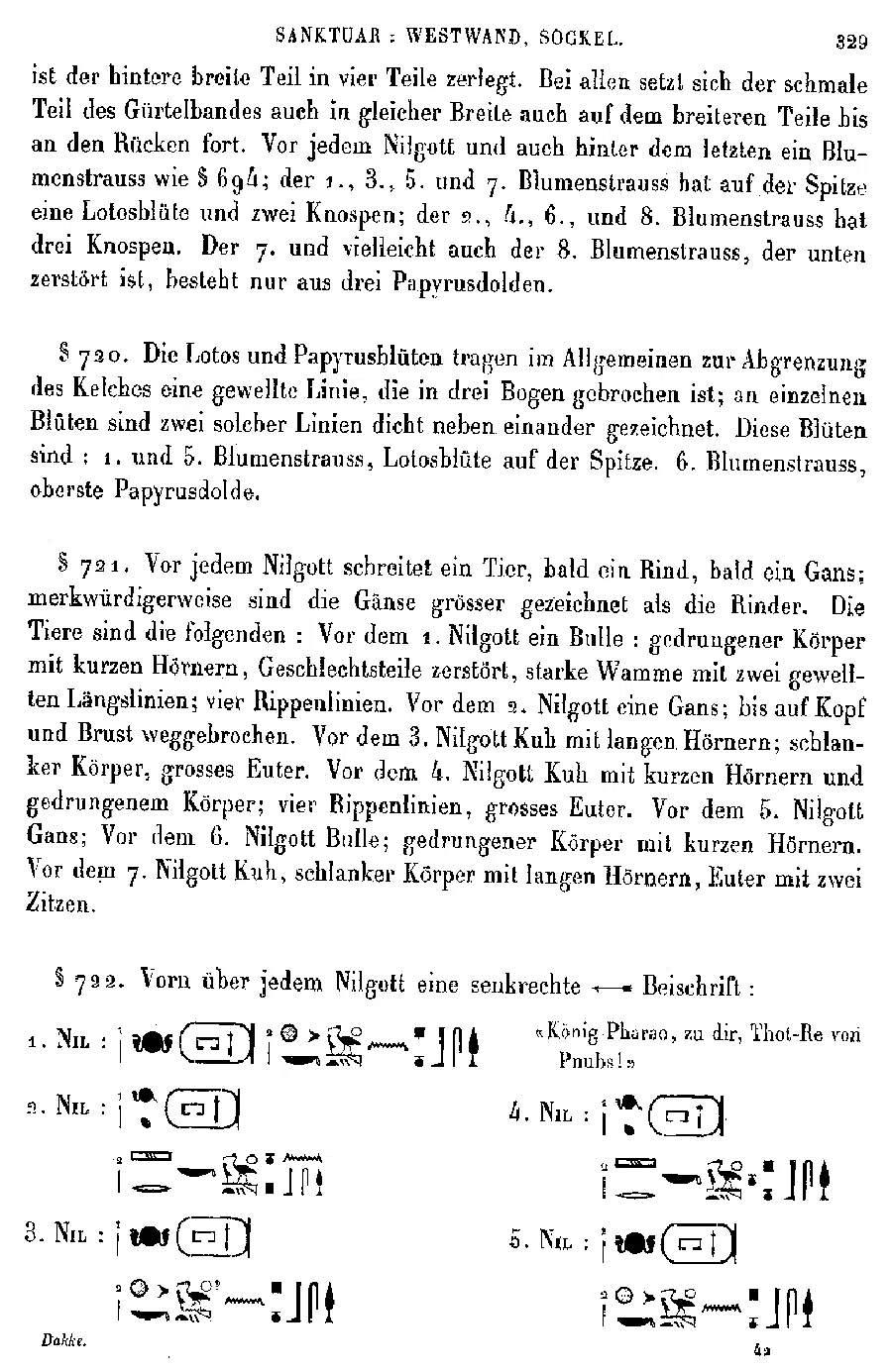
Page 329. Roeder, Der Tempel von Dakke (1930), p. 329 Printed hieroglyphs from G. Roeder, Der Tempel von Dakke (1930) - 655p. 329, § 722
nswt-bj.tj pr-ꜥꜣ ḫr=k ḏḥwtj n pnbs
Pharaoh, the King of Upper and Lower Egypt, is at your side, Thoth of Pnubs.
- 656p. 329, § 722
sꜣ-rꜥ pr-ꜥꜣ ḫr=k ḏḥwtj n pnbs
Pharaoh, the Son of Ra, is at your side, Thoth of Pnubs.
- 657p. 329, § 722
nswt-bj.tj pr-ꜥꜣ ḫr=k ḏḥwtj n pnbs
Pharaoh, the King of Upper and Lower Egypt, is at your side, Thoth of Pnubs.
- 658p. 329, § 722
sꜣ-rꜥ pr-ꜥꜣ ḫr=k ḏḥwtj n pnbs
Pharaoh, the Son of Ra, is at your side, Thoth of Pnubs.
- 659p. 329, § 722
nswt-bj.tj pr-ꜥꜣ ḫr=k ḏḥwtj n pnbs
Pharaoh, the King of Upper and Lower Egypt, is at your side, Thoth of Pnubs.
- 660p. 329, § 722
sꜣ-rꜥ pr-ꜥꜣ ḫr=k ḏḥwtj n pnbs
Pharaoh, the Son of Ra, is at your side, Thoth of Pnubs.
- 661p. 329, § 722
[nswt-bj.tj pr]-ꜥꜣ [ḫr=k ḏḥwtj n] pnbs
Pharaoh, the King of Upper and Lower Egypt, is at your side, Thoth of Pnubs.
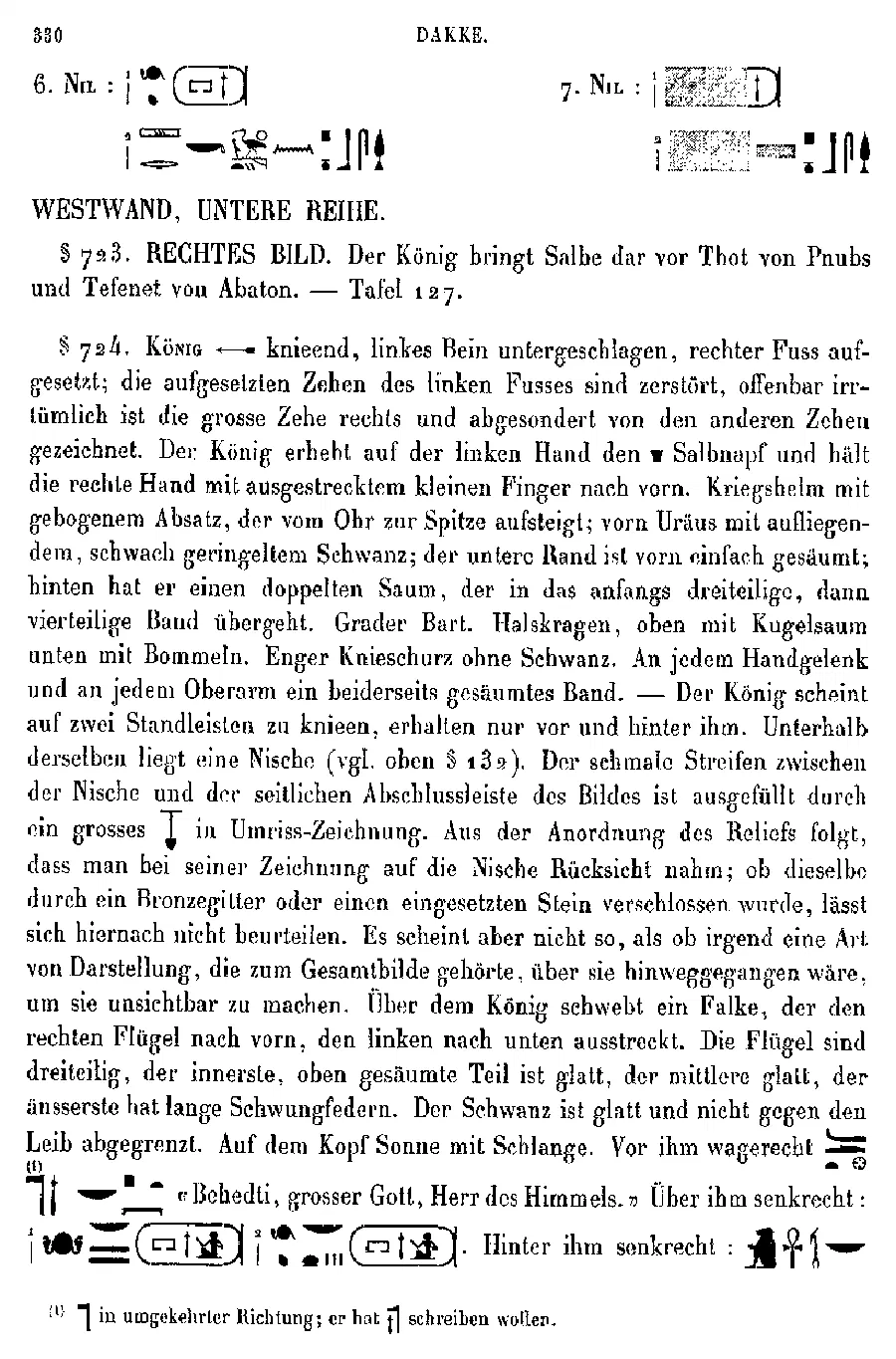
Page 330. Roeder, Der Tempel von Dakke (1930), p. 330 Printed hieroglyphs from G. Roeder, Der Tempel von Dakke (1930) - 662p. 330, § 724
bḥd.tj nṯr ꜥꜣ nb p.t
He of Behdet, the great god, lord of the sky.
Note · Line 662
Horus of Behdet often appears above temple scenes as a winged sun disk. - 663p. 330, § 724
nswt-bj.tj nb-tꜣ.wj pr-ꜥꜣ sꜣ-rꜥ nb-ḫꜥ.w pr-ꜥꜣ
King of Upper and Lower Egypt, lord of the Two Lands, Pharaoh; son of Ra, lord of crowns, Pharaoh.
Note · Line 663
Here the title “Pharaoh” stands in both places normally reserved for the king’s names. - 664p. 330, § 724
sꜣ ꜥnḫ wꜣs nb ḥꜣ=f mj rꜥ ḏ.t
All protection, life and dominion stand behind him as they do behind Ra, forever.
- 665p. 330, § 724
mn n=k mḏ m ḫꜣw.w nb.w (?) m tꜣ-nṯr
Take for yourself the ointment with all the aromatics from the god’s land.
Note · Line 665
The king presents the ointment. The god’s land is a name for the distant region from which precious aromatics came. 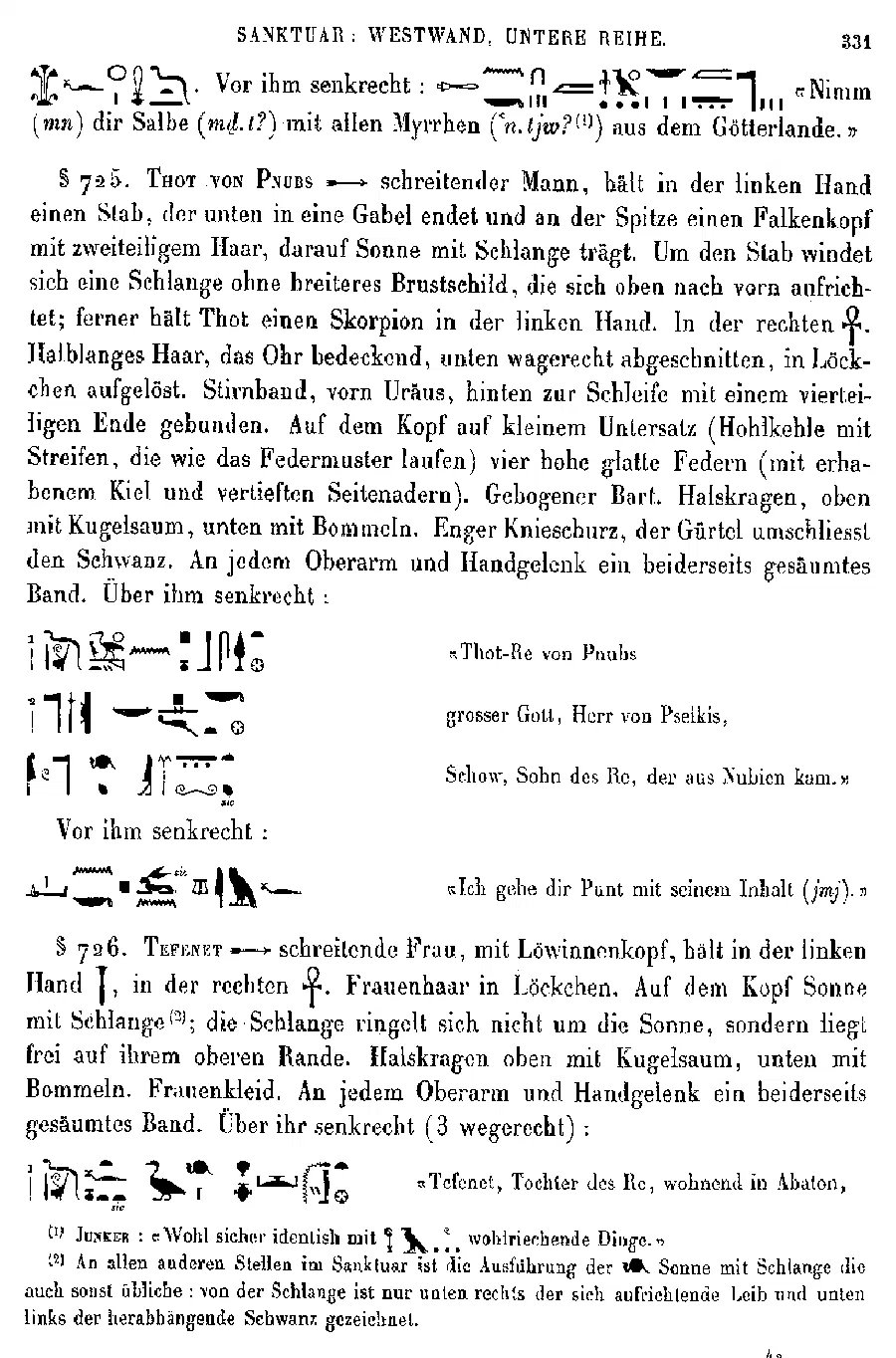
Page 331. Roeder, Der Tempel von Dakke (1930), p. 331 Printed hieroglyphs from G. Roeder, Der Tempel von Dakke (1930) - 666p. 331, § 725
ḏd-mdw jn ḏḥwtj n pnbs nṯr ꜥꜣ nb psrk.t šw sꜣ rꜥ jj m tꜣ-stj
Words spoken by Thoth of Pnubs, the great god, lord of Pselkis, Shu, son of Ra, who came from Nubia.
Note · Line 666
Here Thoth of Pnubs speaks as Shu, the son of the sun god. - 667p. 331, § 725
dj=j n=k pwn.t ẖr jm.(j)=f
I give you Punt with all it holds.
Note · Line 667
In return for the king’s offering, Thoth grants him the land that supplies it. - 668p. 331, § 726
ḏd-mdw jn tfn.t sꜣ.t rꜥ ḥr.j.(t)-jb jꜣ.t-wꜥb.t šps.t wsr.t prj.(t) m kns.t jj.tw=s r snm.t m wps.t
Words spoken by Tefnut, daughter of Ra, who dwells in the Abaton, the noble one, the mighty one, who came forth from Kenset. She has come to Senmet as Wepset.
Note · Line 668
Tefnut returns from Kenset in Nubia as Wepset, a fiery cobra goddess. - 669p. 331, § 726
dj=j n=k tꜣ-nṯr ḫr prj jm=f
I give you the god’s land with all that comes from it.
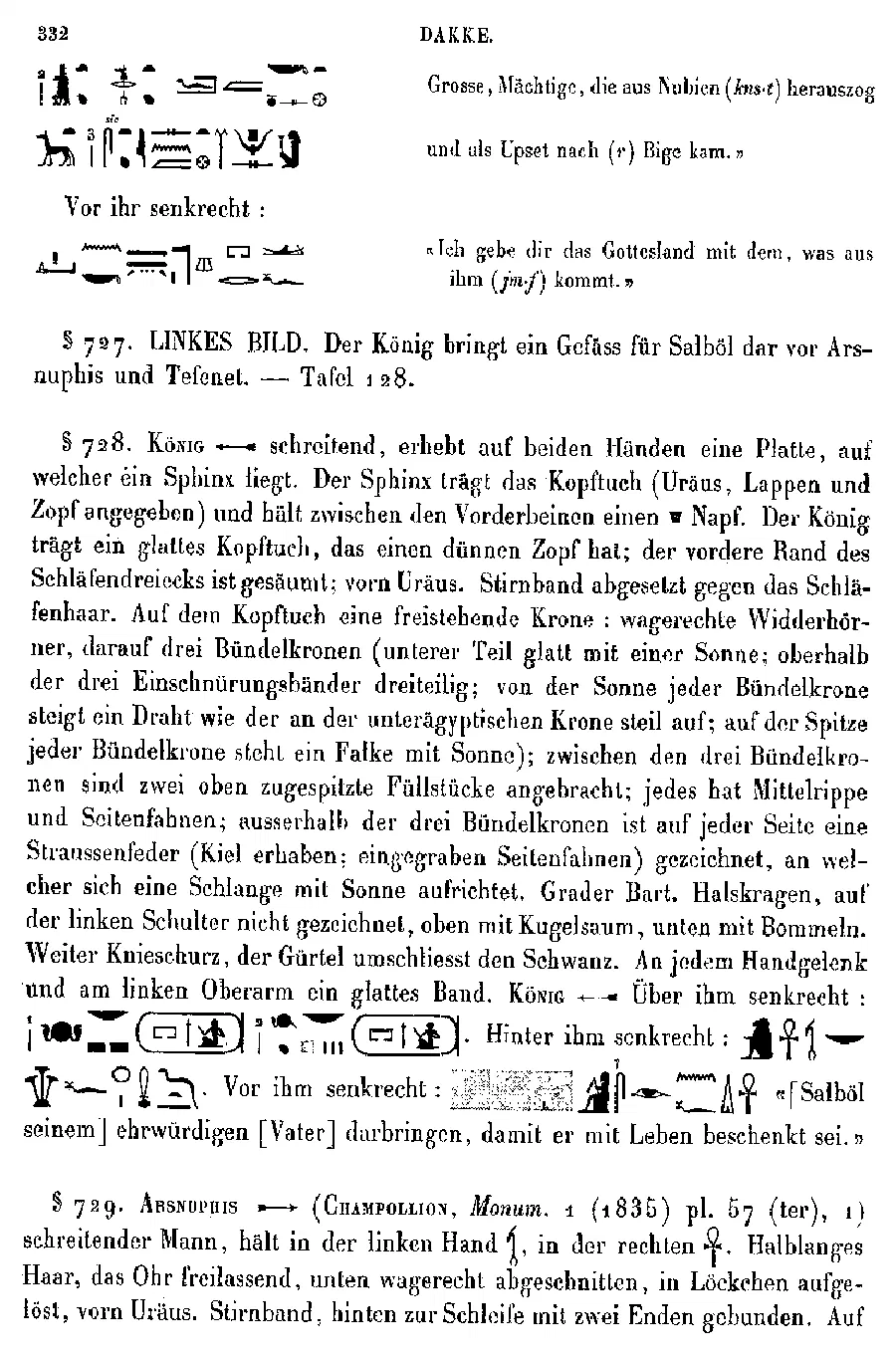
Page 332. Roeder, Der Tempel von Dakke (1930), p. 332 Printed hieroglyphs from G. Roeder, Der Tempel von Dakke (1930) - 670p. 332, § 728
nswt-bj.tj nb-tꜣ.wj pr-ꜥꜣ sꜣ-rꜥ nb-ḫꜥ.w pr-ꜥꜣ
King of Upper and Lower Egypt, lord of the Two Lands, Pharaoh; son of Ra, lord of crowns, Pharaoh.
- 671p. 332, § 728
sꜣ ꜥnḫ wꜣs nb ḥꜣ=f mj rꜥ ḏ.t
All protection, life and dominion stand behind him as they do behind Ra, forever.
- 672p. 332, § 728
--3Q-- šps jrj.n=f dj.(t) ꜥnḫ
… his august father, that his father may grant him life.
Note · Line 672
The king calls the god who receives the offering his father. - 673p. 332, § 729
ḏd-mdw jn jr.j-ḥms-nfr nṯr ꜥꜣ nb jꜣ.t-wꜥb.t šw sꜣ rꜥ jj m tꜣ-stj
Words spoken by Arensnuphis, the great god, lord of the Abaton, Shu, son of Ra, who came from Nubia.
- 674p. 332, § 729
dj=j n=k tꜣ nb.{w} m ḥtp
I give you the whole land at peace.
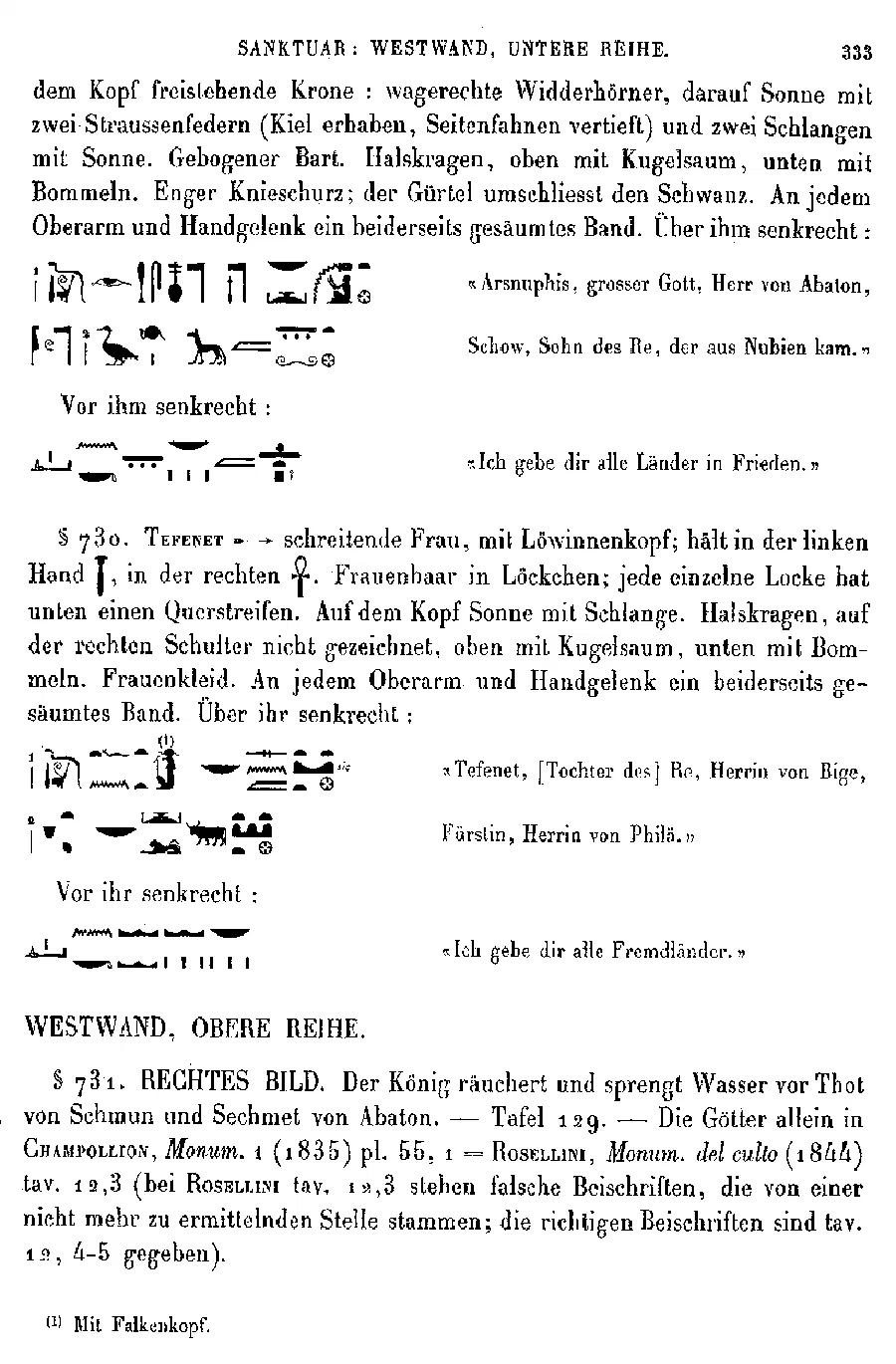
Page 333. Roeder, Der Tempel von Dakke (1930), p. 333 Printed hieroglyphs from G. Roeder, Der Tempel von Dakke (1930) - 675p. 333, § 730
ḏd-mdw jn tfn.t nb.(t) snm.t ḥnw.t nb.(t) jwrḳ
Words spoken by Tefnut, lady of Senmet, mistress, lady of Philae.
- 676p. 333, § 730
dj=j n=k ḫꜣs.wt nb.w(t)
I give you all foreign lands.
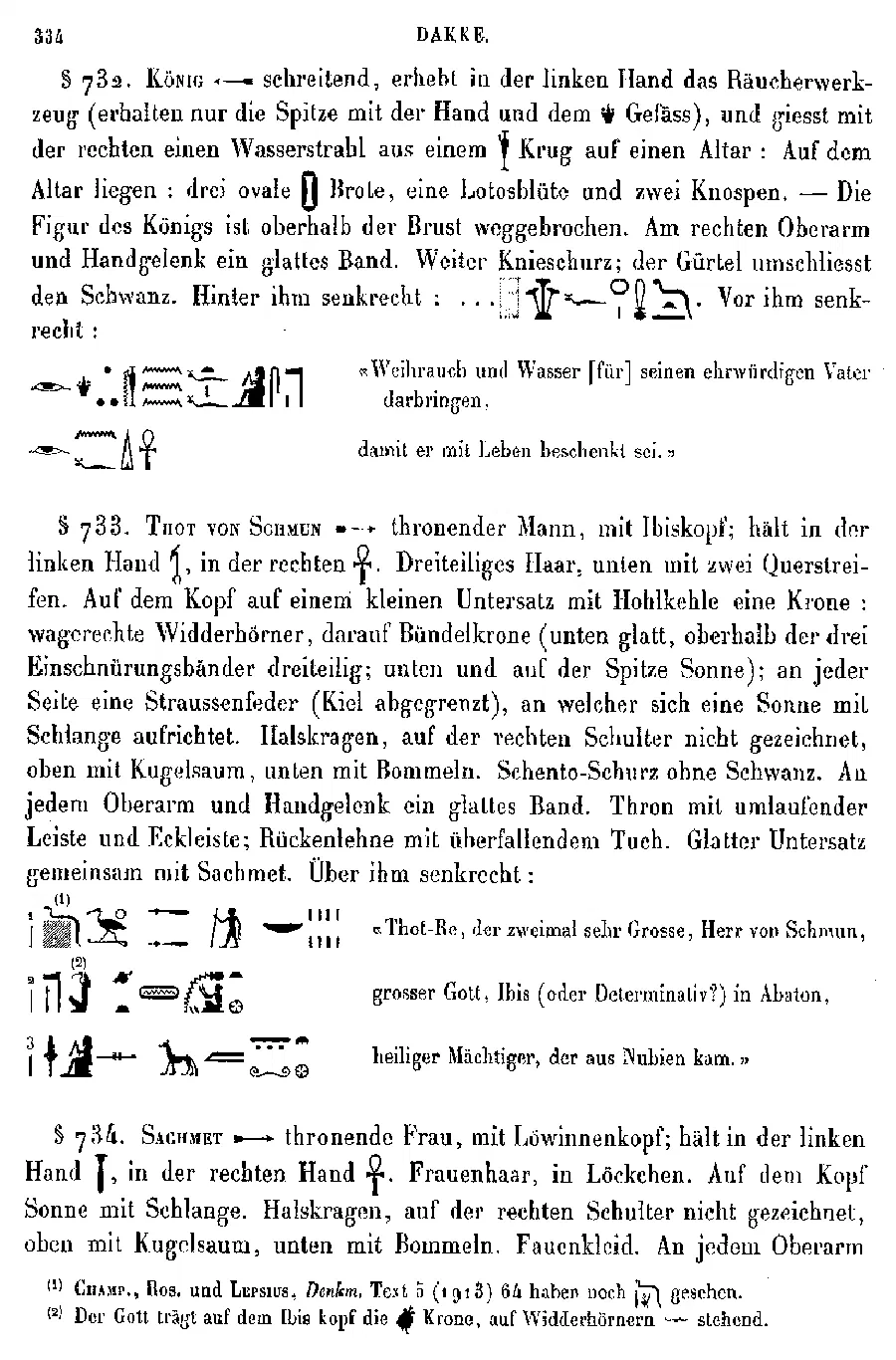
Page 334. Roeder, Der Tempel von Dakke (1930), p. 334 Printed hieroglyphs from G. Roeder, Der Tempel von Dakke (1930) - 677p. 334, § 732
[sꜣ ꜥnḫ wꜣs nb] ḥꜣ=f mj rꜥ ḏ.t
All protection, life and dominion stand behind him as they do behind Ra, forever.
- 678p. 334, § 732
jrj.(t) snṯr ḳbḥ <n> jt=f šps jrj n=f dj.(t) ꜥnḫ
Burning incense and pouring a libation for his august father, that his father may grant him life.
- 679p. 334, § 733
ḏd[-mdw jn] ḏḥwtj ꜥꜣ ꜥꜣ wr nb ḫmnw nṯr ꜥꜣ ḫnt.j jw-wꜥb sḫm šps jj m tꜣ-stj
Words spoken by Thoth the thrice-great, lord of Hermopolis, the great god, foremost in the Abaton, the august power who came from Nubia.
- 680p. 334, § 734
ḏd-mdw jn sḫm.t ꜥꜣ.t nb.(t) jw-wꜥb ḥḳꜣ.t nb.(t) snm.t
Words spoken by Sekhmet the Great, lady of the Abaton, sovereign, lady of Senmet.
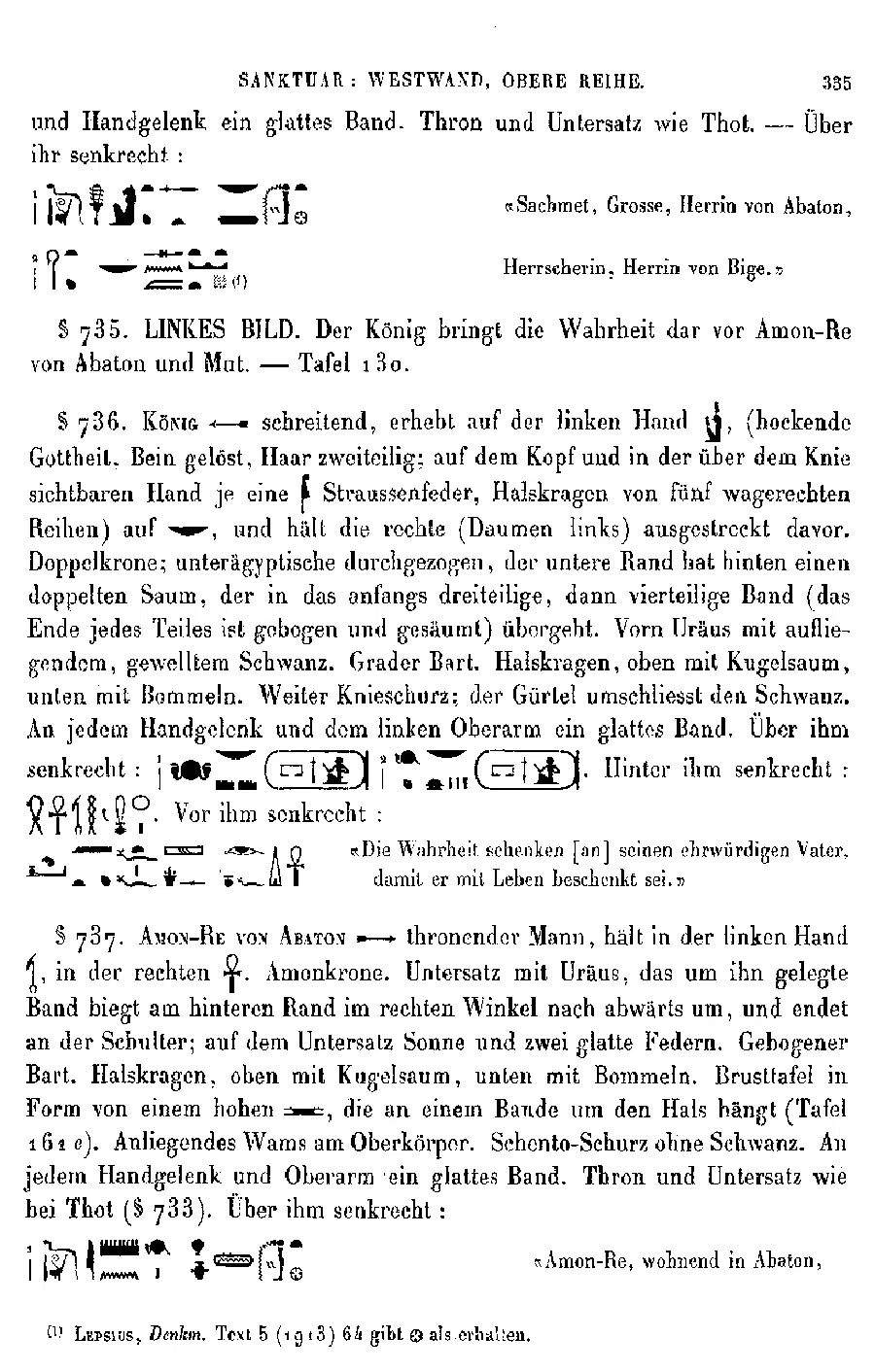
Page 335. Roeder, Der Tempel von Dakke (1930), p. 335 Printed hieroglyphs from G. Roeder, Der Tempel von Dakke (1930) - 681p. 335, § 736
nswt-bj.tj nb-tꜣ.wj pr-ꜥꜣ sꜣ-rꜥ nb-ḫꜥ.w pr-ꜥꜣ
King of Upper and Lower Egypt, lord of the Two Lands, Pharaoh; son of Ra, lord of crowns, Pharaoh.
- 682p. 335, § 736
sꜣ ꜥnḫ wꜣs <nb> ḥꜣ=f mj rꜥ
All protection, life and dominion stand behind him as they do behind Ra.
- 683p. 335, § 736
ḥnk mꜣꜥ.t <n> jt=f šps jrj.n=f dj.(t) ꜥnḫ
Offering Maat to his august father, that his father may grant him life.
Note · Line 683
Maat personifies truth, justice and right order. - 684p. 335, § 737
ḏd-mdw jn jmn-rꜥ ḥr.j-jb jw-wꜥb nswt nṯr.w nb jwrḳ
Words spoken by Amun-Ra, who dwells in the Abaton, king of the gods, lord of Philae.
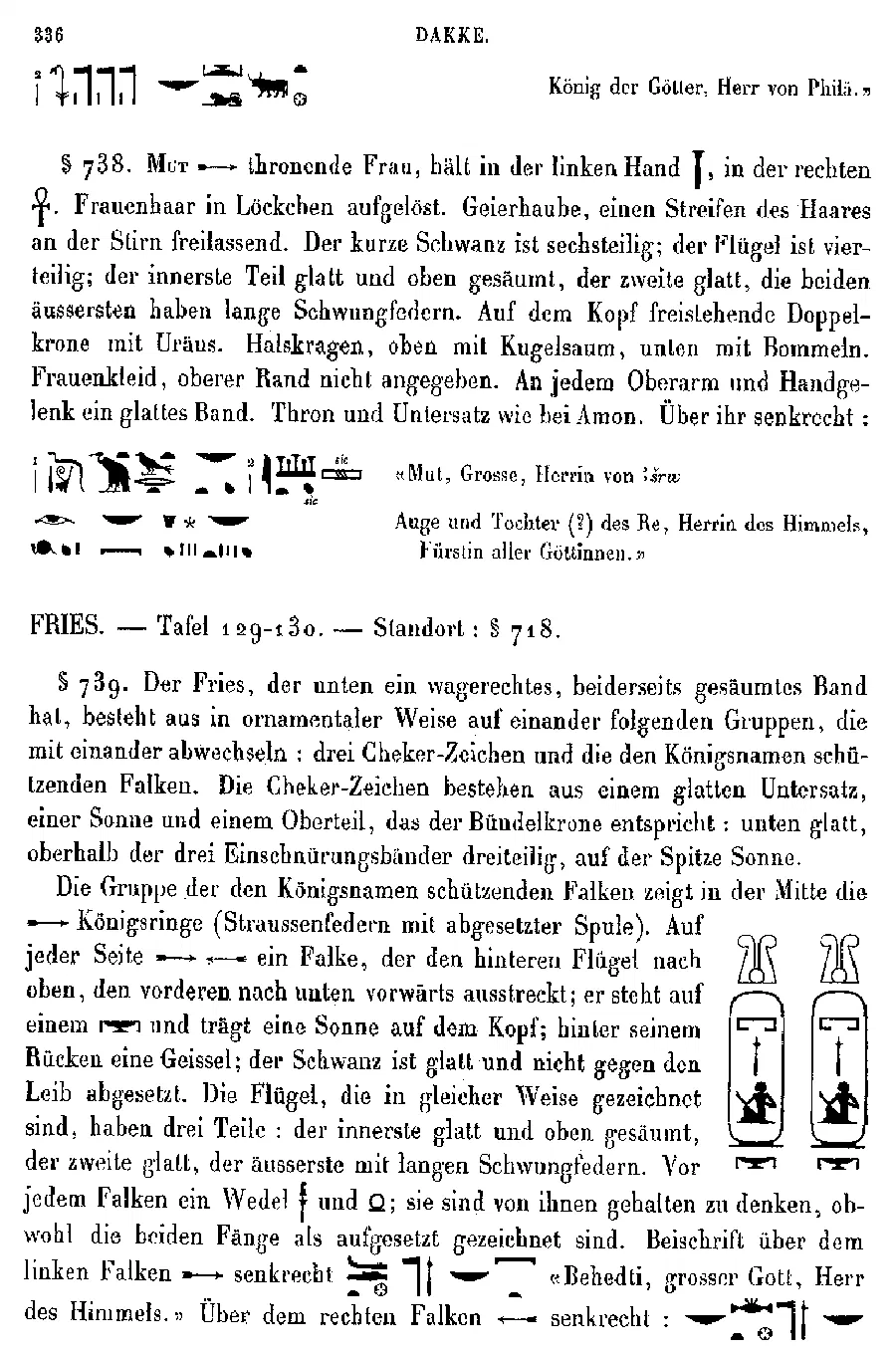
Page 336. Roeder, Der Tempel von Dakke (1930), p. 336 Printed hieroglyphs from G. Roeder, Der Tempel von Dakke (1930) - 685p. 336, § 738
ḏd-mdw jn mw.t wr.t nb.t jšrw jr.t rꜥ nb.(t) p.t ḥnw.t nṯr.w nb.w{t}
Words spoken by Mut the Great, lady of Isheru, Eye of Ra, lady of the sky, mistress of all the gods.
Note · Line 685
As the Eye of Ra, Mut embodies the sun god’s protective power. - 686p. 336, § 739
pr-ꜥꜣ bḥd.tj nṯr ꜥꜣ nb p.t
Pharaoh. He of Behdet, the great god, lord of the sky.
- 687p. 336, § 739
nb msn nṯr ꜥꜣ nb p.t
Lord of Mesen, the great god, lord of the sky.
- 688p. 336, § 739
ḫwj=f sꜣ=f mrj=f
He protects the son he loves.
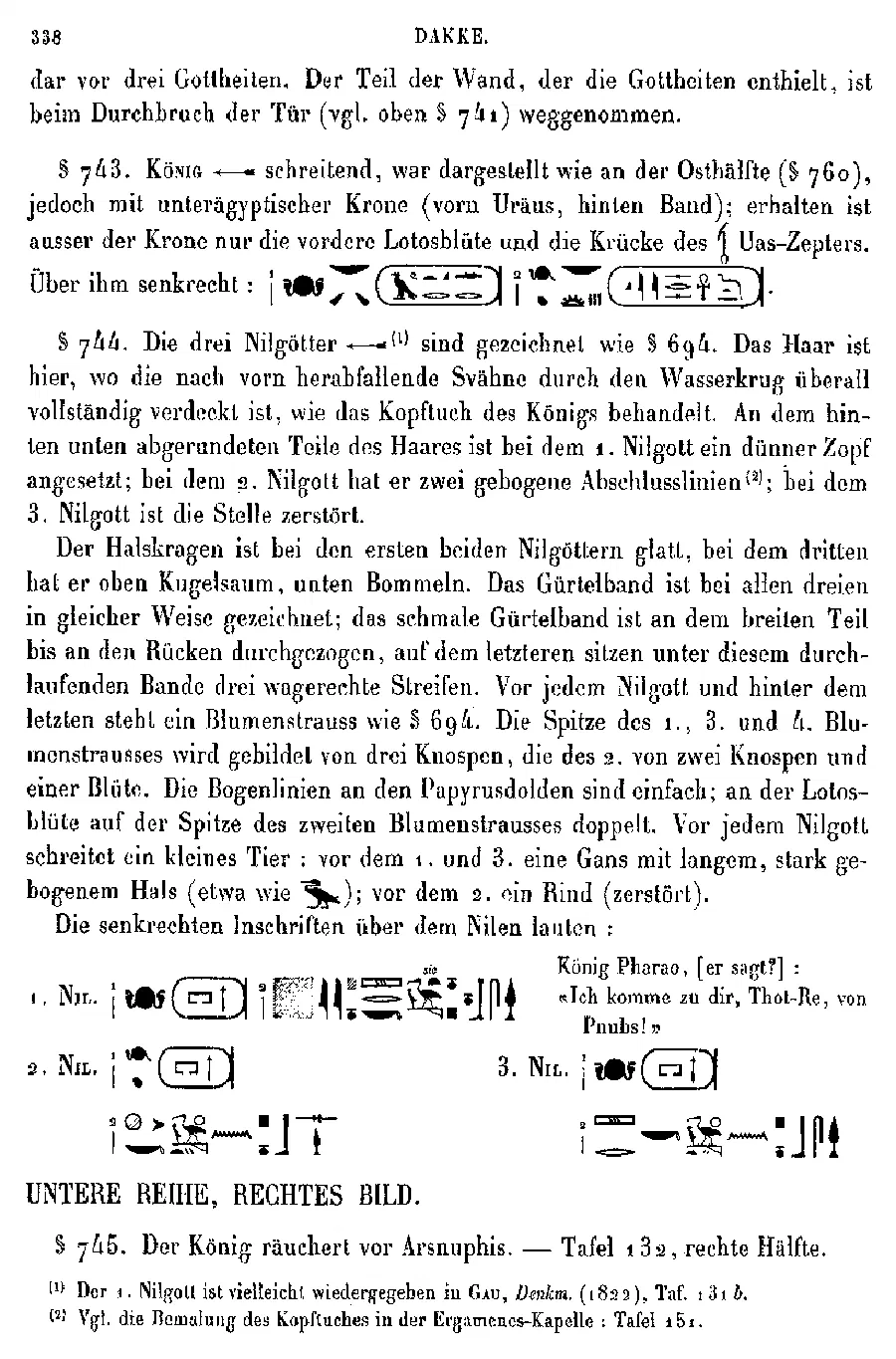
Page 338. Roeder, Der Tempel von Dakke (1930), p. 338 Printed hieroglyphs from G. Roeder, Der Tempel von Dakke (1930) - 689p. 338, § 743
nswt-bj.tj nb-tꜣ.wj ꜣwtḳrdr sꜣ-rꜥ nb-ḫꜥ.w ḳysrs-ꜥnḫ-ḏ.t
King of Upper and Lower Egypt, lord of the Two Lands, Autokrator; son of Ra, lord of crowns, Caesar, living forever.
Note · Line 689
Here it and Caesar occupy the two royal name slots of a pharaoh. - 690p. 338, § 744
nswt-bj.tj pr-ꜥꜣ --2Q-- ḫr=k ḏḥwtj n pnbs
The King of Upper and Lower Egypt, Pharaoh, … is before you, Thoth of Pnubs.
Note · Line 690
Here “Pharaoh” stands where a king’s own name would ordinarily appear. - 691p. 338, § 744
sꜣ-rꜥ pr-ꜥꜣ ḫr=k ḏḥwtj n pnbs
The Son of Ra, Pharaoh, is before you, Thoth of Pnubs.
- 692p. 338, § 744
nswt-bj.tj pr-ꜥꜣ ḫr=k ḏḥwtj n pnbs
The King of Upper and Lower Egypt, Pharaoh, is before you, Thoth of Pnubs.
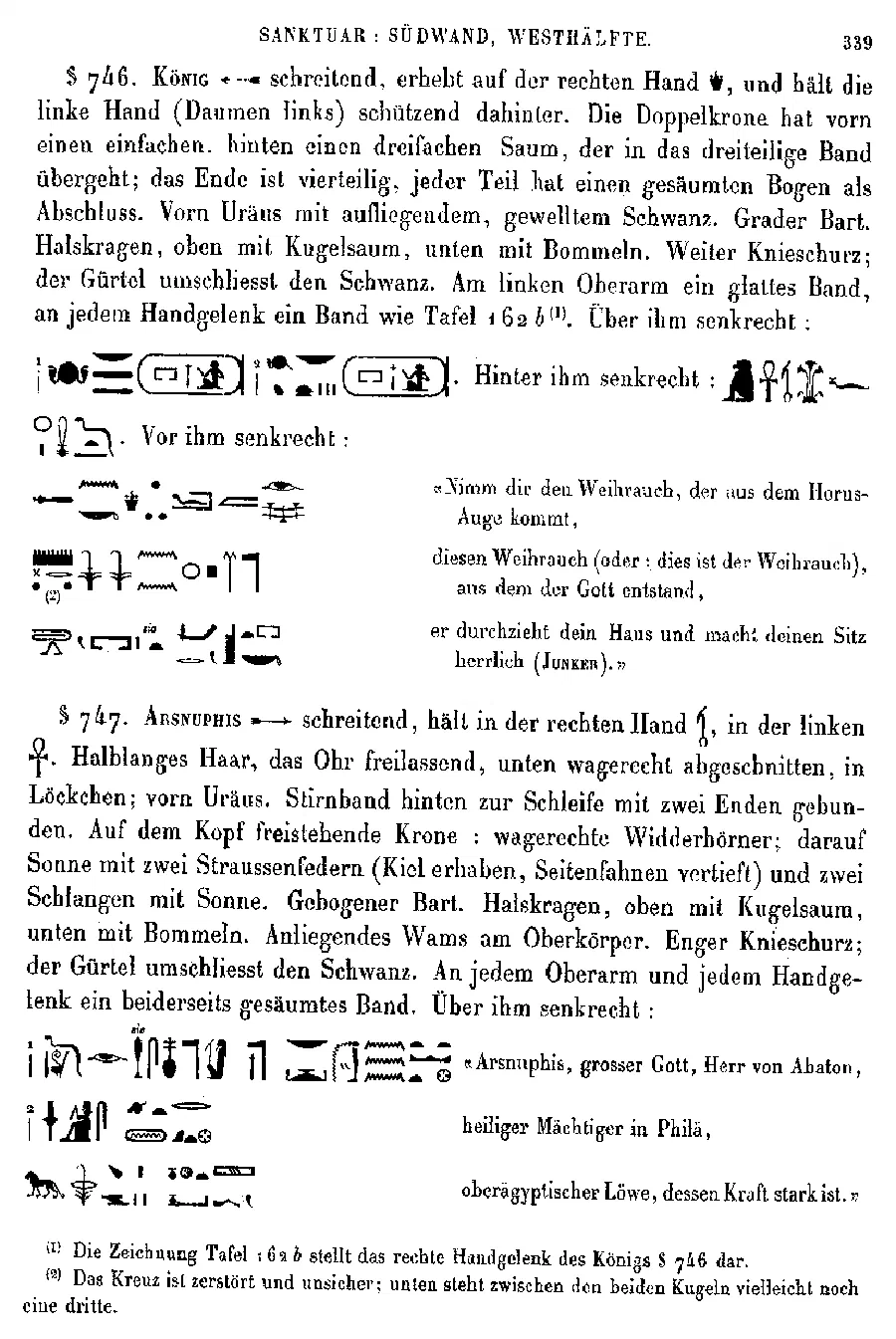
Page 339. Roeder, Der Tempel von Dakke (1930), p. 339 Printed hieroglyphs from G. Roeder, Der Tempel von Dakke (1930) - 693p. 339, § 746
nswt-bj.tj nb-tꜣ.wj pr-ꜥꜣ sꜣ-rꜥ nb-ḫꜥ.w pr-ꜥꜣ
King of Upper and Lower Egypt, Lord of the Two Lands, Pharaoh; Son of Ra, Lord of Crowns, Pharaoh.
- 694p. 339, § 746
sꜣ ꜥnḫ wꜣs nb ḥꜣ=f mj rꜥ ḏ.t
All protection, life, and dominion are behind him as they are behind Ra, forever.
- 695p. 339, § 746
mn n=k snṯr prj m jr.t ḥrw mnwr nn ḫpr m nṯr pẖr=f pr=k ḏsr=f s.t=k
Take for yourself the incense that came forth from the Eye of Horus, this incense born of the god. It circles your house and hallows your seat.
Note · Line 695
The Eye that Horus lost and regained could stand for an offering that restores a god’s wholeness. - 696p. 339, § 747
ḏd-mdw jn jr.j-ḥms-nfr nṯr ꜥꜣ nb jꜣ.t-wꜥb.t sḫm šps ḫnt.j jwrḳ mꜣj rsj nḫt ḫpš=f
Words spoken by Arensnuphis, the great god, lord of the Abaton, the august power foremost in Philae, the southern lion whose arm is mighty:
Note · Line 696
Its Egyptian names here mean “Pure Mound” and “Pure Island.” - 697p. 339, § 747
dj=j n=k pwn.t ẖr jḫ.t=f nb.(t)
I give you Punt laden with all its goods.
Note · Line 697
Arensnuphis gives the king the land that supplies his incense. 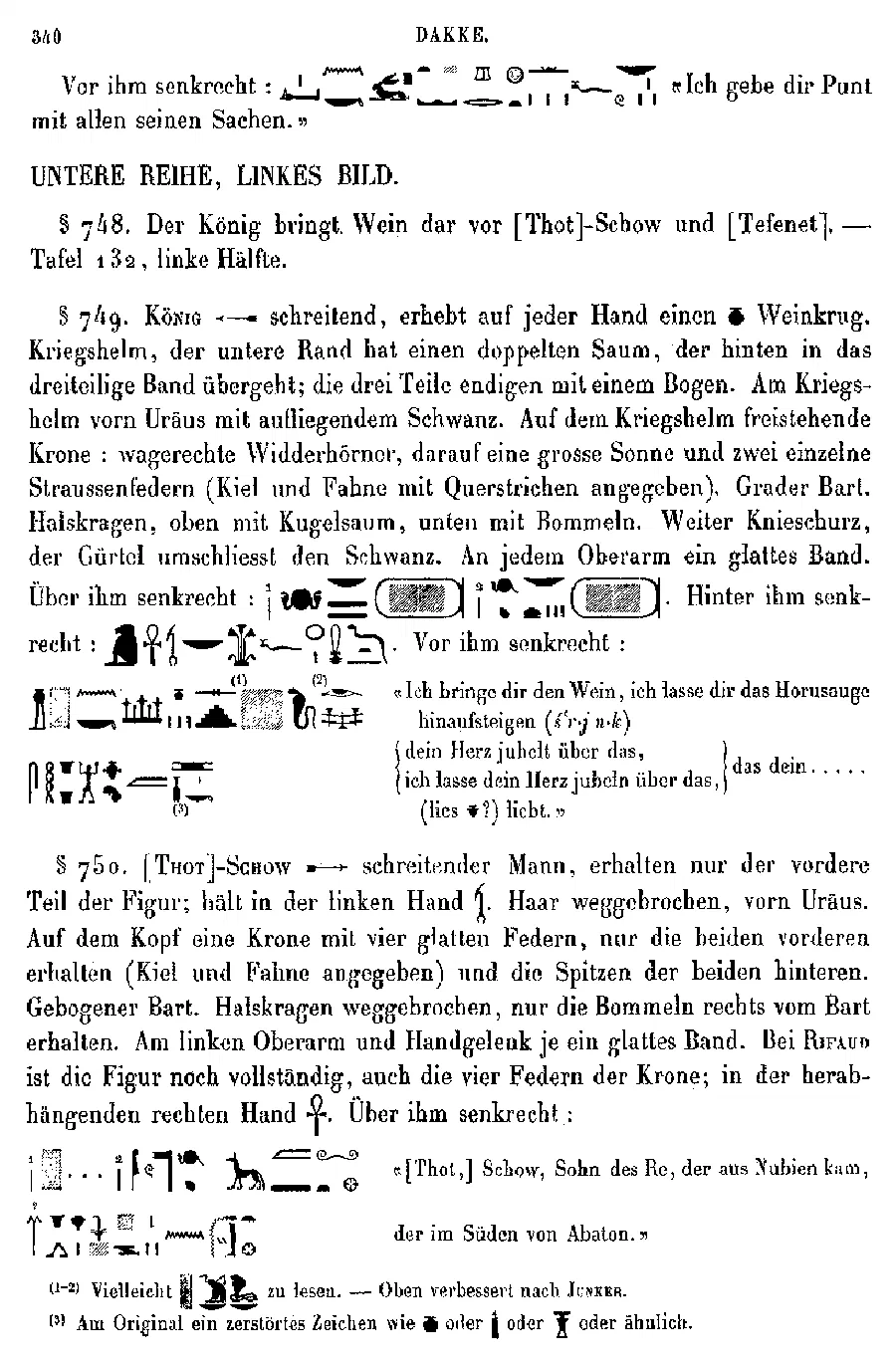
Page 340. Roeder, Der Tempel von Dakke (1930), p. 340 Printed hieroglyphs from G. Roeder, Der Tempel von Dakke (1930) - 698p. 340, § 749
nswt-bj.tj nb-tꜣ.wj [pr-ꜥꜣ] sꜣ-rꜥ nb-ḫꜥ.w [pr-ꜥꜣ]
King of Upper and Lower Egypt, Lord of the Two Lands, Pharaoh; Son of Ra, Lord of Crowns, Pharaoh.
- 699p. 340, § 749
sꜣ ꜥnḫ wꜣs nb ḥꜣ=f mj rꜥ ḏ.t
All protection, life, and dominion are behind him as they are behind Ra, forever.
- 700p. 340, § 749
jnj[=j] n=k šꜣ sꜥr[=j n]=k jr.t ḥrw sḥꜥꜥ jb=k m mrj jb=k (?)
I bring you wine. I raise the Eye of Horus to you to gladden your heart with what your heart loves.
- 701p. 340, § 750
--détruit-- šw sꜣ rꜥ jj m tꜣ-stj … (?) rsj n <jꜣ.t>-wꜥb.t
… Shu, son of Ra, who has come from Nubia, … south of the Abaton.
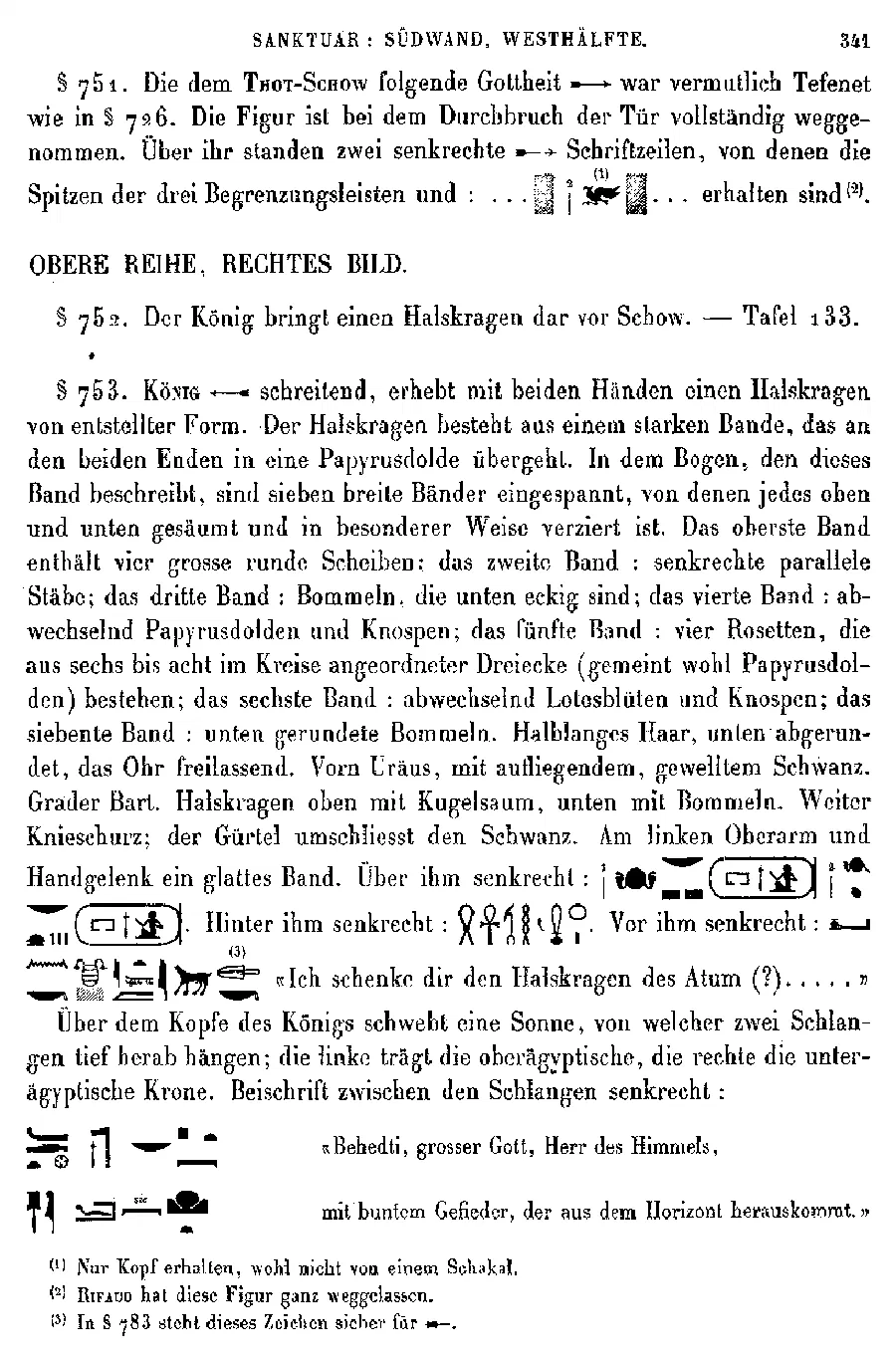
Page 341. Roeder, Der Tempel von Dakke (1930), p. 341 Printed hieroglyphs from G. Roeder, Der Tempel von Dakke (1930) - 702p. 341, § 751
--détruit-- rḫj.t --détruit--
… the common people …
- 703p. 341, § 753
nswt-bj.tj nb-tꜣ.wj pr-ꜥꜣ sꜣ-rꜥ nb-ḫꜥ.w pr-ꜥꜣ
King of Upper and Lower Egypt, Lord of the Two Lands, Pharaoh; Son of Ra, Lord of Crowns, Pharaoh.
- 704p. 341, § 753
sꜣ ꜥnḫ wꜣs <nb> ḥꜣ=f mj rꜥ
All protection, life, and dominion are behind him as they are behind Ra.
- 705p. 341, § 753
ḥnk=j n=k wsḫ jtm … (?) =k
I offer you the broad collar of Atum … you.
Note · Line 705
A broad collar is a necklace that spreads across the shoulders and upper chest. - 706p. 341, § 753
bḥd.tj nṯr ꜥꜣ nb p.t sꜣb šw.t prj m ꜣḫ.t
He of Edfu, the great god, lord of the sky, who rises from the horizon in his many-colored plumage.
Page 342. Roeder, Der Tempel von Dakke (1930), p. 342 Printed hieroglyphs from G. Roeder, Der Tempel von Dakke (1930) - 707p. 342, § 754
ḏd-mdw jn šw sꜣ rꜥ nṯr ꜥꜣ nb jw-wꜥb sḫm šps ḫnt.j snm.t
Words spoken by Shu, son of Ra, the great god, lord of the Abaton, the august power foremost in Senmet.
- 708p. 342, § 755
bḥd.tj nṯr ꜥꜣ nb p.t
He of Edfu, the great god, lord of the sky.
- 709p. 342, § 755
ḏḥwtj ꜥꜣ ꜥꜣ nb ḫmnw
Thoth, twice great, lord of Hermopolis.
- 710p. 342, § 755
bḥd.tj nṯr ꜥꜣ nb p.t
He of Edfu, the great god, lord of the sky.
- 711p. 342, § 757
nswt-bj.tj nb-tꜣ.wj pr-ꜥꜣ sꜣ-rꜥ nb-ḫꜥ.w pr-ꜥꜣ
King of Upper and Lower Egypt, Lord of the Two Lands, Pharaoh; Son of Ra, Lord of Crowns, Pharaoh.
- 712p. 342, § 757
sꜣ ꜥnḫ wꜣs <nb> ḥꜣ=f mj rꜥ
All protection, life, and dominion are behind him as they are behind Ra.
- 713p. 342, § 757
mn n=k mꜣḥ n mꜣꜥ-ḫrw
Take for yourself the diadem of vindication.
Note · Line 713
The diadem marks a favorable verdict, like the one Osiris won against Seth. 
Page 343. Roeder, Der Tempel von Dakke (1930), p. 343 Printed hieroglyphs from G. Roeder, Der Tempel von Dakke (1930) - 714p. 343, § 758
ḏd-mdw jn ḏḥwtj n pnbs nṯr ꜥꜣ nb psrk.t šw sꜣ rꜥ jj m tꜣ-stj
Words spoken by Thoth of Pnubs, the great god, lord of Pselkis, Shu, son of Ra, who has come from Nubia.
Note · Line 714
Here Thoth of Pnubs is identified with Shu. - 715p. 343, § 760
nswt-bj.tj nb-tꜣ.wj ꜣwtḳrdr sꜣ-rꜥ nb-ḫꜥ.w ḳysrs-ꜥnḫ-ḏ.t
King of Upper and Lower Egypt, Lord of the Two Lands, Autokrator; Son of Ra, Lord of Crowns, Caesar, who lives forever.
Note · Line 715
The Greek imperial title Autokrator and the Roman title Caesar occupy the two places reserved for a pharaoh’s names. 
Page 344. Roeder, Der Tempel von Dakke (1930), p. 344 Printed hieroglyphs from G. Roeder, Der Tempel von Dakke (1930) - 716p. 344, § 761
nswt-bj.tj pr-ꜥꜣ jj.n=(j) ḫr=k wsjr nṯr ꜥꜣ nb jw-wꜥb
The King of Upper and Lower Egypt, Pharaoh: I have come to you, Osiris, great god, lord of the Abaton.
- 717p. 344, § 761
sꜣ-rꜥ pr-ꜥꜣ ḫr=k wsjr nṯr ꜥꜣ nb jꜣ.t-wꜥb.t
The Son of Ra, Pharaoh, is before you, Osiris, great god, lord of the Abaton.
- 718p. 344, § 761
nswt-bj.tj pr-ꜥꜣ ḫr=k wsjr nṯr ꜥꜣ nb jꜣ.t-wꜥb.t
The King of Upper and Lower Egypt, Pharaoh, is before you, Osiris, great god, lord of the Abaton.
- 719p. 344, § 762
ḏd-mdw jn wsjr wn-nfr mꜣꜥ-ḫrw nṯr ꜥꜣ nb jꜣ.t-wꜥb.t sḫm šps nb jwrḳ
Words spoken by Osiris Wennefer, the vindicated one, the great god, lord of the Abaton, the august power, lord of Philae.
Note · Line 719
Wennefer, “He who endures in perfection,” is a name of Osiris. 
Page 345. Roeder, Der Tempel von Dakke (1930), p. 345 Printed hieroglyphs from G. Roeder, Der Tempel von Dakke (1930) - 720p. 345, § 763
ḏd-mdw jn ꜣs.t dj.(t) ꜥnḫ nb.(t) jw-wꜥb ḥnw.t nb.(t) jwrḳ nb.(t) ḫꜣs.(w)t rsj.w(t)
Words spoken by Isis, giver of life, lady of the Abaton, sovereign, lady of Philae, lady of the foreign lands to the south.
- 721p. 345, § 763
ḏd-mdw jn ḥrw-nḏ-jt=f --détruit--
Words spoken by Harendotes …
- 722p. 345, § 765
nswt-bj.tj nb-tꜣ.wj pr[-ꜥꜣ] sꜣ-rꜥ nb-ḫꜥ.w pr[-ꜥꜣ]
King of Upper and Lower Egypt, lord of the Two Lands, Pharaoh; son of Ra, lord of crowns, Pharaoh.
Note · Line 722
Where a king’s personal names would usually stand, this inscription says simply “Pharaoh.” - 723p. 345, § 765
sꜣ ꜥnḫ wꜣs nb ḥꜣ=f mj rꜥ ḏ.t
All protection, life and dominion stand behind him as behind Ra, forever.
- 724p. 345, § 765
ḥnk=j n=ṯ sḫ.t nfr.t jtr.w 12 ḥr jꜣb.t ḥr jmnt.t dmḏ jtr.w 24
I offer you the fair field: twelve iteru on the east and twelve on the west, twenty-four iteru in all.
Note · Line 724
The king offers Isis land on both banks of the Nile. 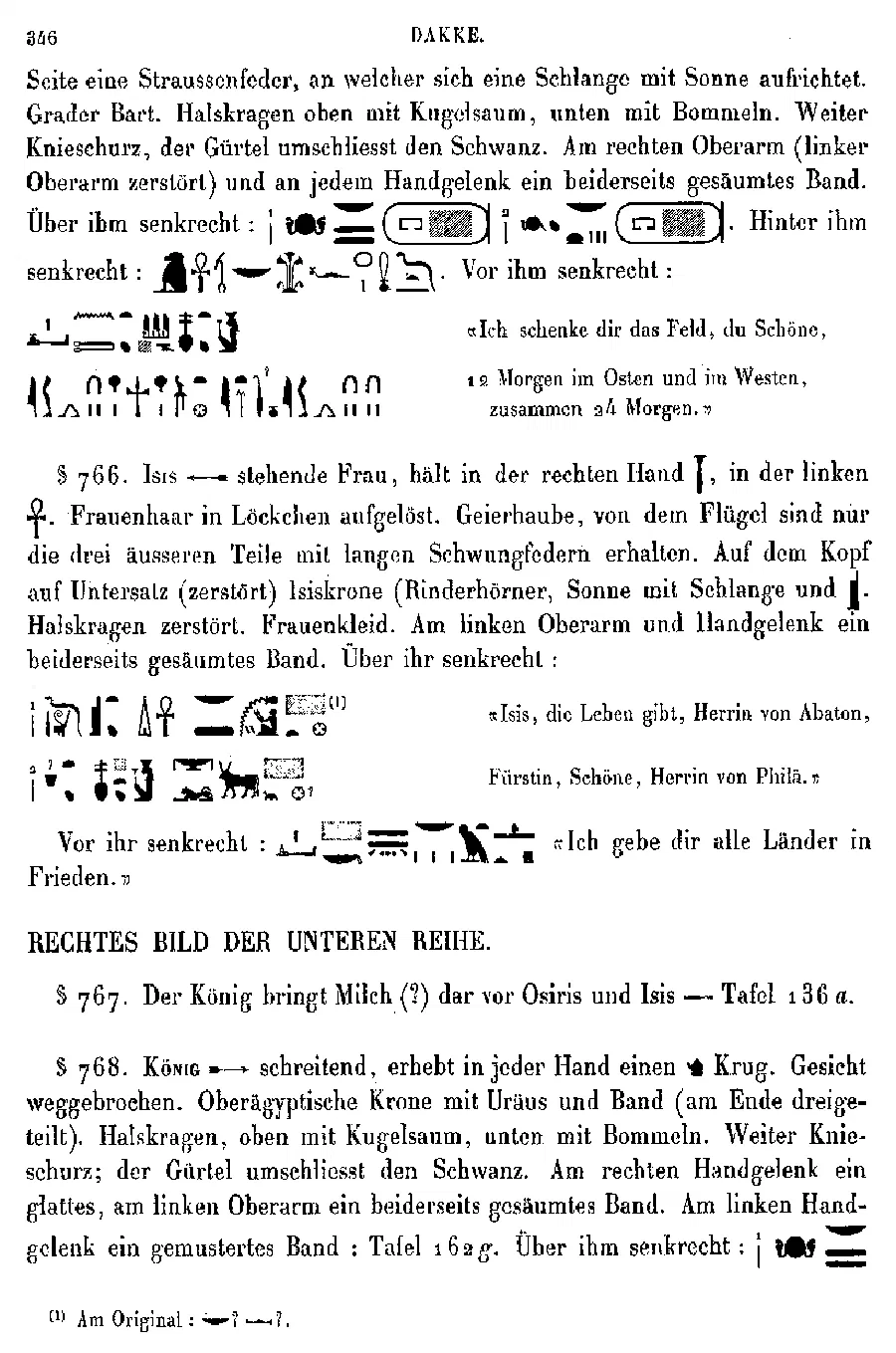
Page 346. Roeder, Der Tempel von Dakke (1930), p. 346 Printed hieroglyphs from G. Roeder, Der Tempel von Dakke (1930) - 725p. 346, § 766
ḏd-mdw jn ꜣs.t dj.(t) ꜥnḫ nb.(t) jw-wꜥb ḥnw.t nfr.t nb.(t) jwrḳ
Words spoken by Isis, giver of life, lady of the Abaton, fair sovereign, lady of Philae.
- 726p. 346, § 766
dj=j [n]=k tꜣ.wj nb.{w} m ḥtp
I give you the whole of the Two Lands, at peace.
- 727p. 346, § 768
nswt-bj.tj nb-tꜣ.wj pr-ꜥꜣ sꜣ-rꜥ nb-ḫꜥ.w pr-ꜥꜣ
King of Upper and Lower Egypt, lord of the Two Lands, Pharaoh; son of Ra, lord of crowns, Pharaoh.
- 728p. 346, § 768
sꜣ ꜥnḫ wꜣs nb ḥꜣ=f mj rꜥ ḏ.t
All protection, life and dominion stand behind him as behind Ra, forever.
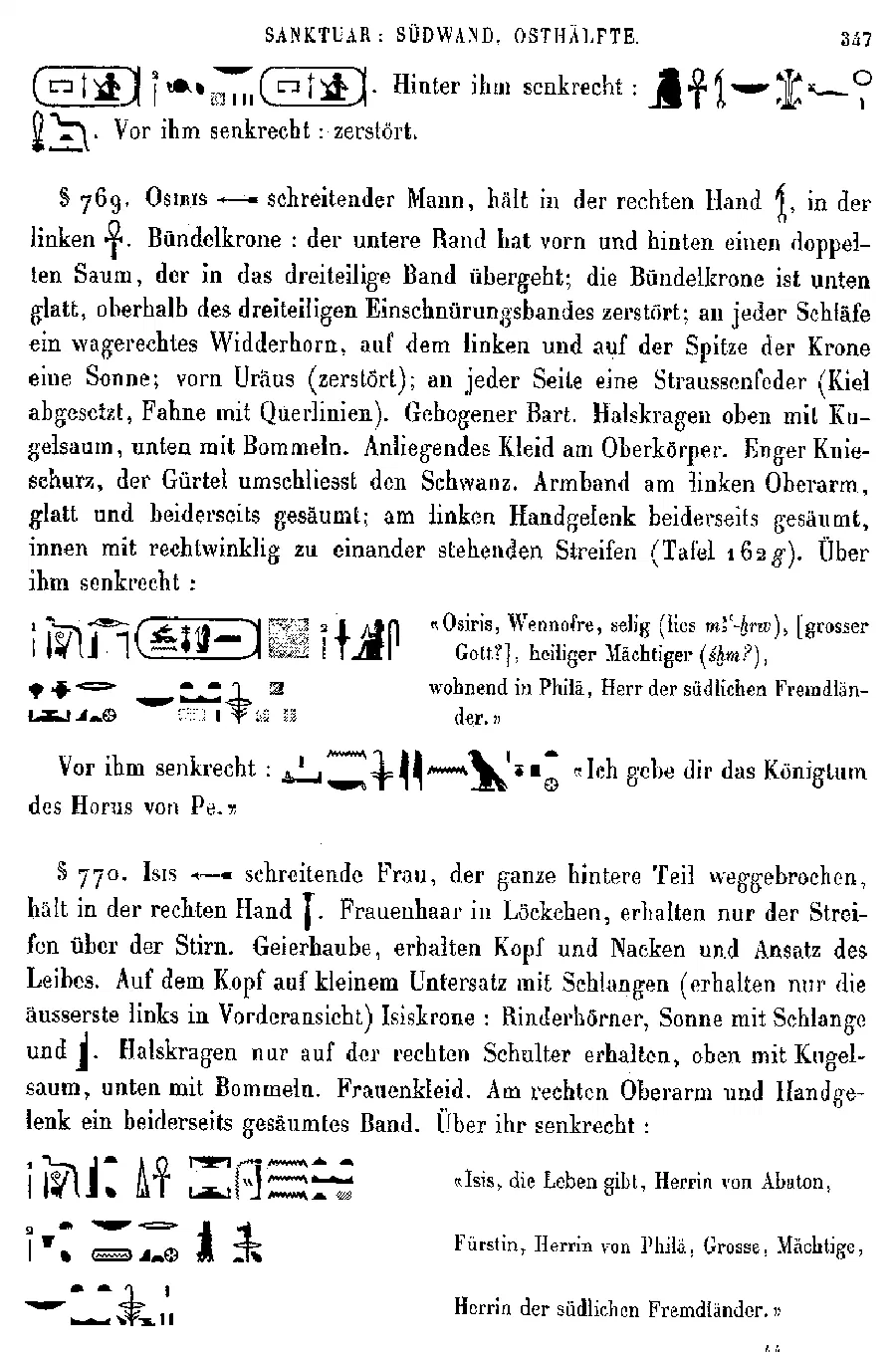
Page 347. Roeder, Der Tempel von Dakke (1930), p. 347 Printed hieroglyphs from G. Roeder, Der Tempel von Dakke (1930) - 729p. 347, § 769
ḏd-mdw jn wsjr wn-nfr mꜣꜥ-<ḫrw> [nṯr ꜥꜣ] sḫm šps ḥr.j-jb jwrḳ nb ḫꜣs.wt rsj.[w](t)
Words spoken by Osiris Wennefer, vindicated, the great god, the august power who dwells in Philae, lord of the foreign lands to the south.
Note · Line 729
“Vindicated” recalls the judgment of the gods in his favor against Seth, who killed him. - 730p. 347, § 769
dj=j n=k nswj.t n ḥrw n p
I give you the kingship of Horus of Pe.
Note · Line 730
Pe was an ancient seat of kingship at Buto in the Nile Delta. - 731p. 347, § 770
ḏd-mdw jn ꜣs.t dj.(t) ꜥnḫ nb.(t) jꜣ.t-wꜥb.t ḥnw.t nb.(t) jwrḳ šps.(t) wsr.(t) nb.(t) ḫꜣs.(w)t rsj.w(t)
Words spoken by Isis, giver of life, lady of the Abaton, sovereign, lady of Philae, the venerable one, the mighty one, lady of the foreign lands to the south.
- 732p. 347, § 770
dj=j n=<k> ꜥḥꜥ n rꜥ n p.t
I give you the lifespan of Ra in the sky.
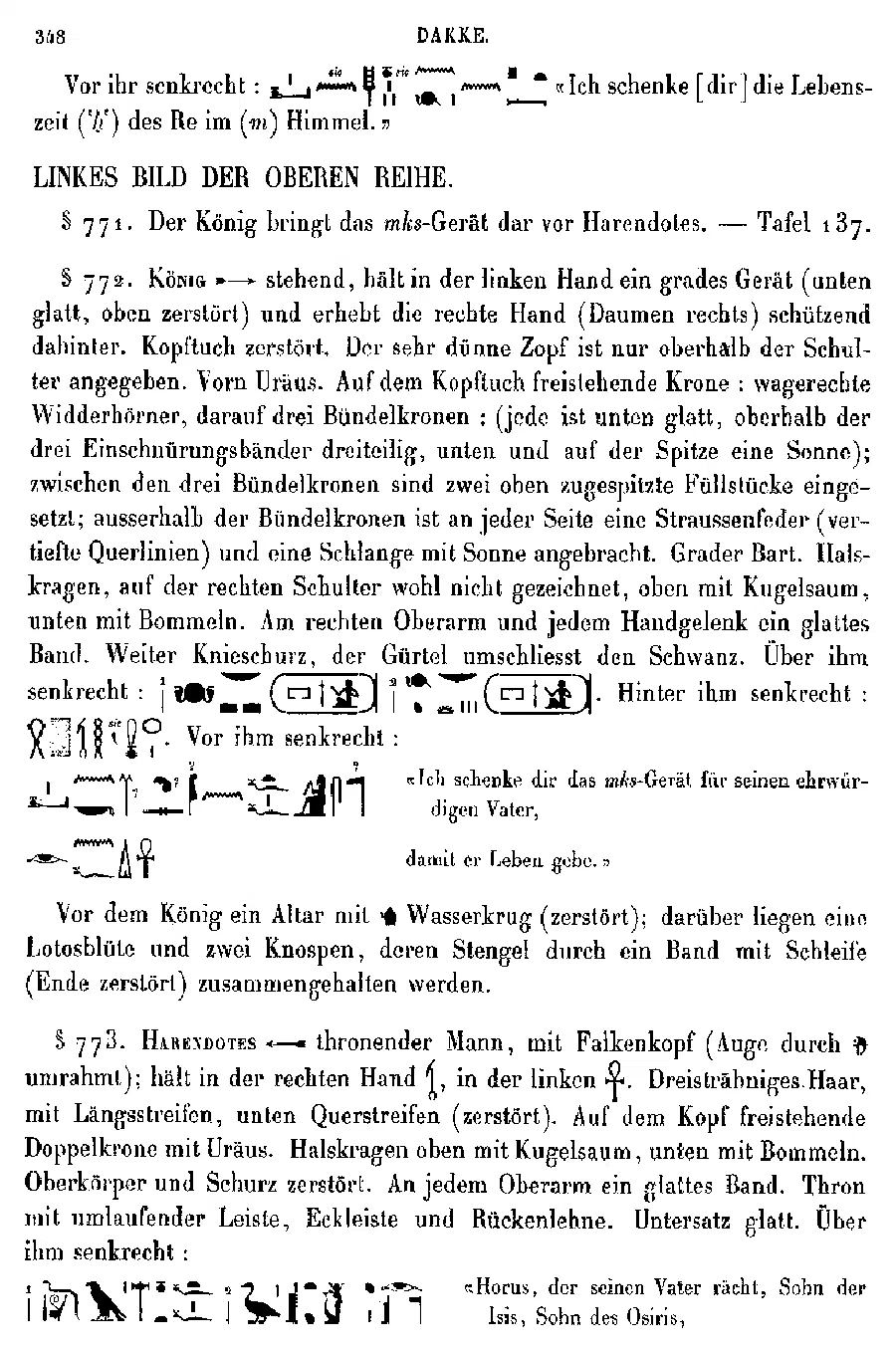
Page 348. Roeder, Der Tempel von Dakke (1930), p. 348 Printed hieroglyphs from G. Roeder, Der Tempel von Dakke (1930) - 733p. 348, § 772
nswt-bj.tj nb-tꜣ.wj pr-ꜥꜣ sꜣ-rꜥ nb-ḫꜥ.w pr-ꜥꜣ
King of Upper and Lower Egypt, lord of the Two Lands, Pharaoh; son of Ra, lord of crowns, Pharaoh.
- 734p. 348, § 772
sꜣ ꜥnḫ wꜣs <nb> ḥꜣ=f mj rꜥ
All protection, life and dominion stand behind him as behind Ra.
- 735p. 348, § 772
ḥnk{=j n=k} mks n jt=f šps jrj.n=f dj.(t) ꜥnḫ
Offering the mekes to his venerable father. He has done this that he may be given life.
Note · Line 735
The mekes was a case for a deed, an emblem of the king’s title to the land. - 736p. 348, § 773
ḏd-mdw jn ḥrw-nḏ-jt=f sꜣ ꜣs.t sꜣ wsjr ds (?) sbj.w r jtr.[wj] m snm.t ḥrw-bḥd.tj --1.5Q--
Words spoken by Harendotes, son of Isis, son of Osiris, who cuts down those who rebel against the Two Rivers at Senmet, Horus of Behdet, …
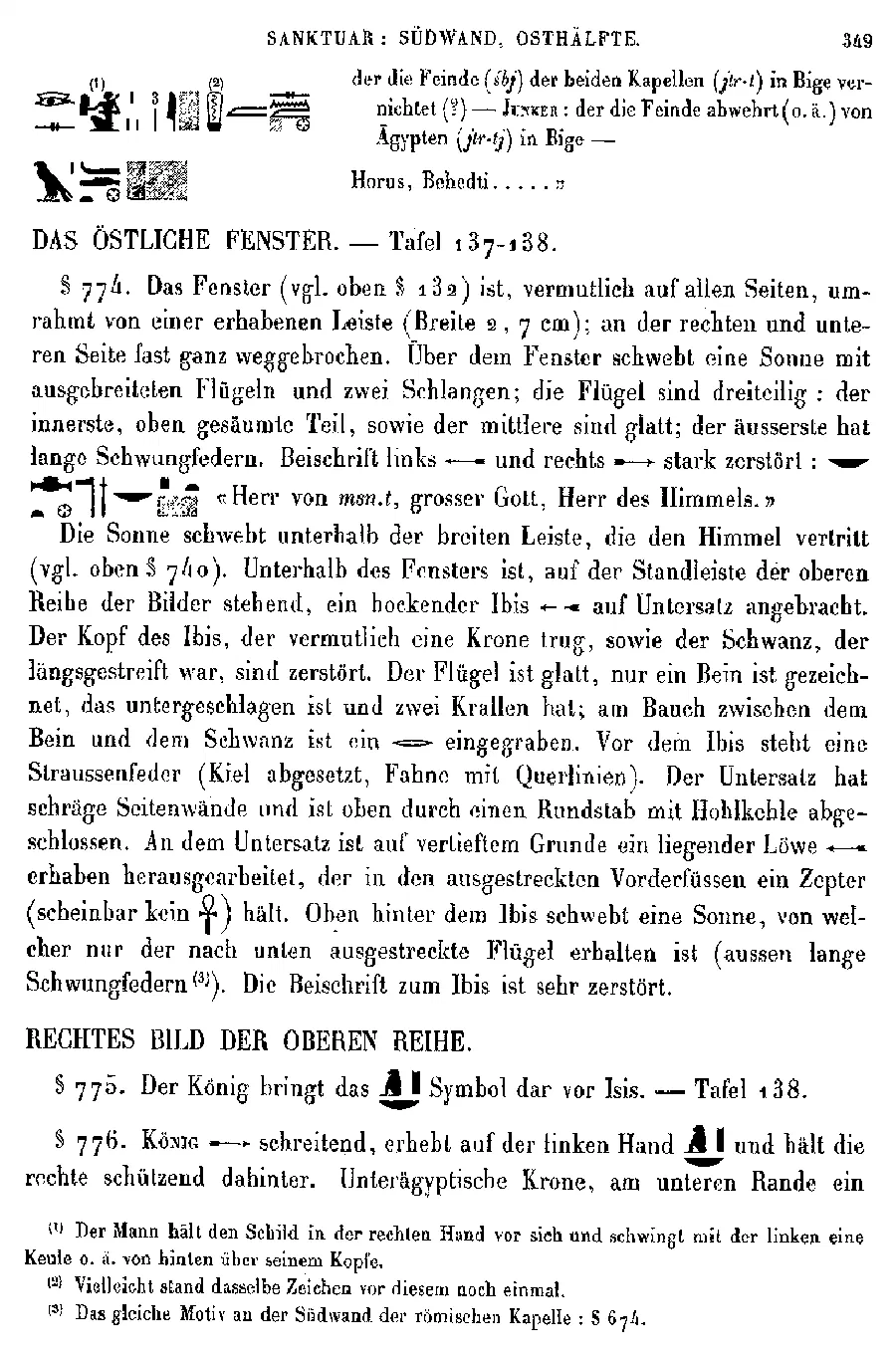
Page 349. Roeder, Der Tempel von Dakke (1930), p. 349 Printed hieroglyphs from G. Roeder, Der Tempel von Dakke (1930) - 737p. 349, § 774
nb msn nṯr ꜥꜣ nb p.t
lord of Mesen, the great god, lord of the sky.
Note · Line 737
Mesen, “the Place of the Harpoon,” was a sacred name of Edfu. - 738p. 349, § 776
nswt-bj.tj nb-tꜣ.wj pr-ꜥꜣ sꜣ-rꜥ nb-ḫꜥ.w pr-ꜥꜣ
King of Upper and Lower Egypt, lord of the Two Lands, Pharaoh; son of Ra, lord of crowns, Pharaoh.
- 739p. 349, § 776
[sꜣ-]ꜥnḫ-wꜣs-[nb]-ḥꜣ=f-mj-rꜥ
All protection, life and dominion stand behind him as behind Ra.
- 740p. 349, § 776
ḥnk=j n=ṯ wnšb r shr ḥm=ṯ
I offer you the wensheb to gladden Your Majesty.
Note · Line 740
The wensheb was a water clock: the changing water level marked the passing hours. 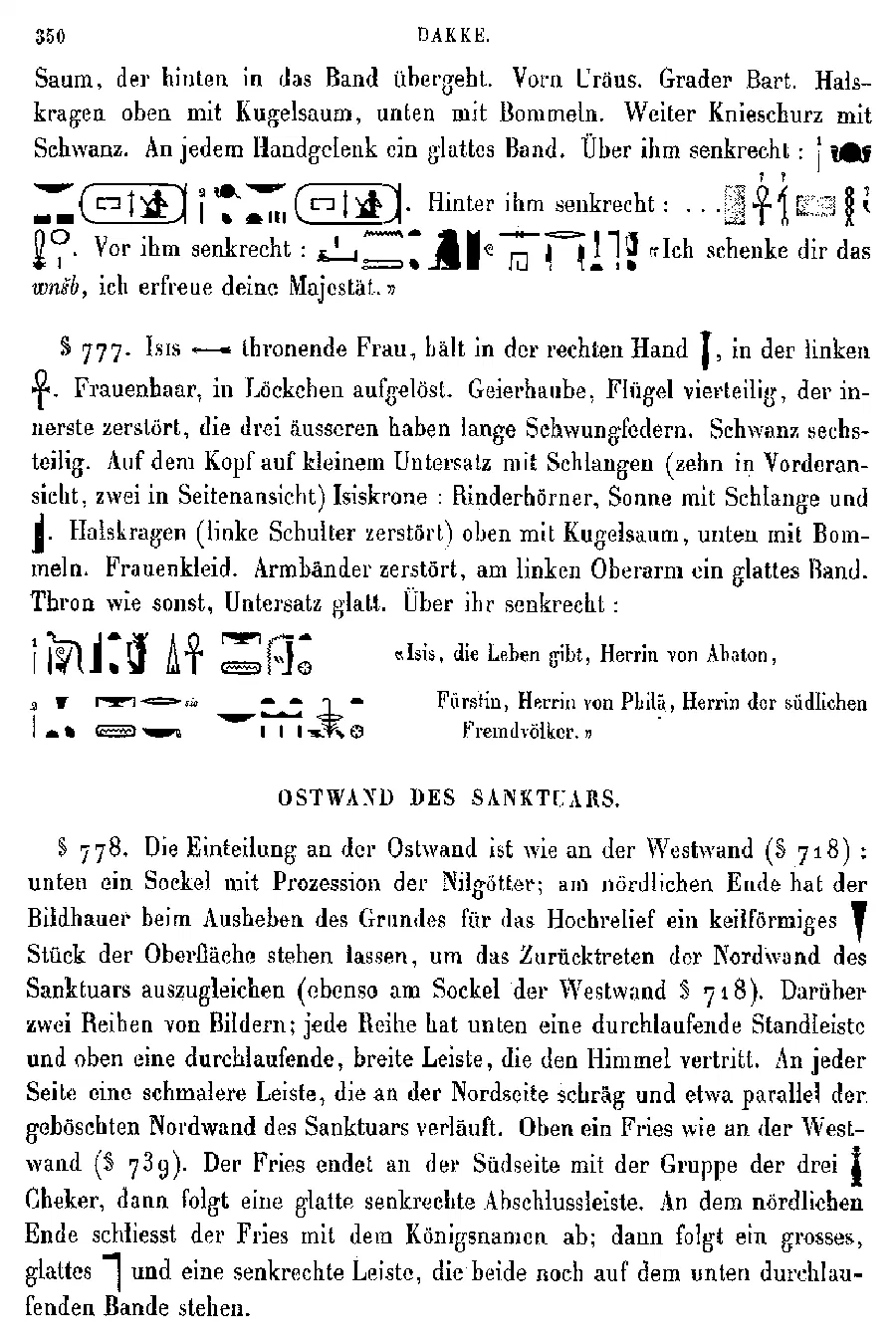
Page 350. Roeder, Der Tempel von Dakke (1930), p. 350 Printed hieroglyphs from G. Roeder, Der Tempel von Dakke (1930) - 741p. 350, § 777
ḏd-mdw jn ꜣs.t dj.(t) ꜥnḫ nb.(t) jw-wꜥb ḥnw.t nb.(t) jwrḳ nb.(t) ḫꜣs.wt rsj.(w)t
Words spoken by Isis, giver of life, lady of the Abaton, sovereign, lady of Philae, lady of the foreign lands to the south.
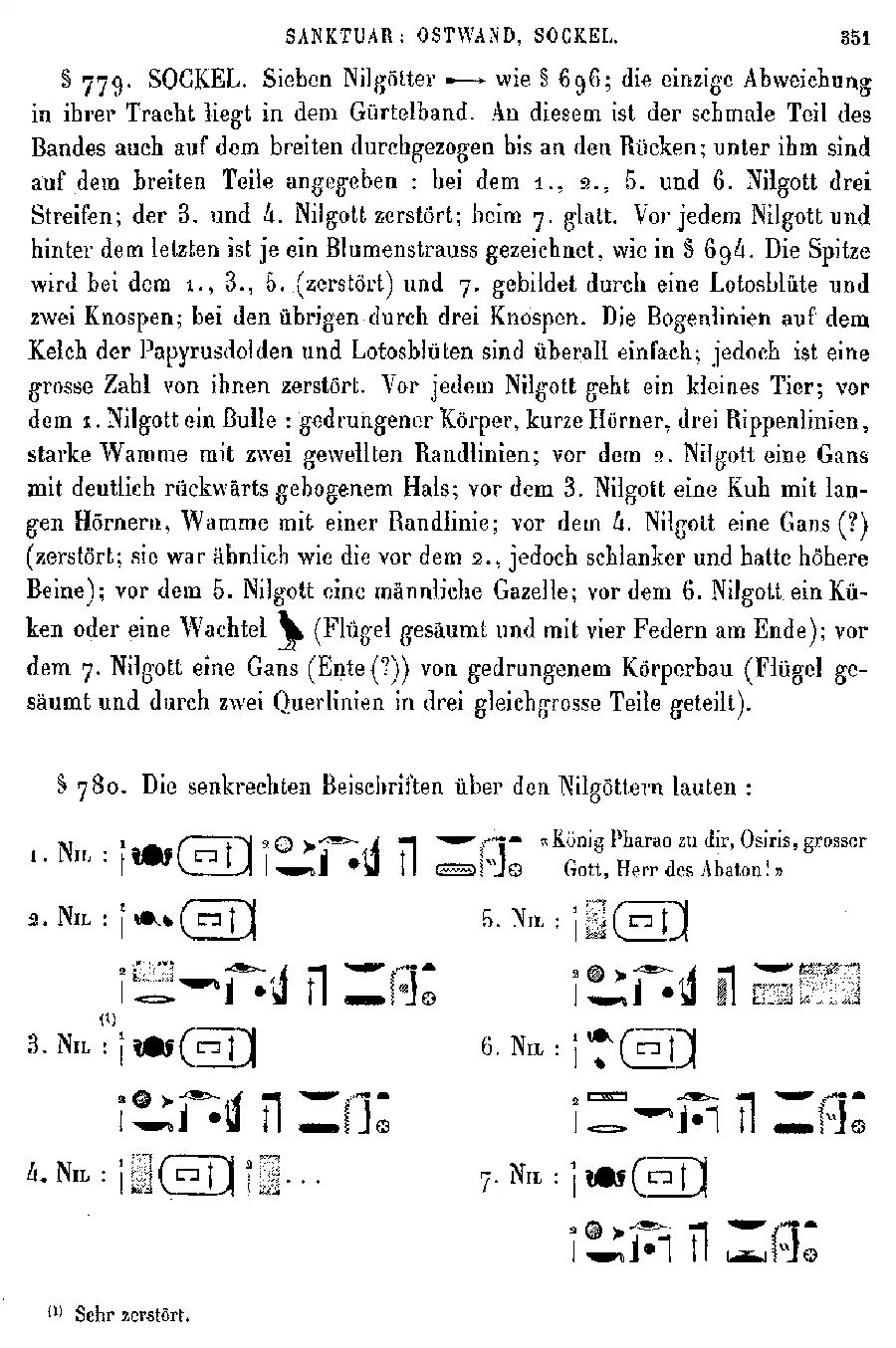
Page 351. Roeder, Der Tempel von Dakke (1930), p. 351 Printed hieroglyphs from G. Roeder, Der Tempel von Dakke (1930) - 742p. 351, § 780
nswt-bj.tj pr-ꜥꜣ ḫr=k wsjr nṯr ꜥꜣ nb jw-wꜥb
The King of Upper and Lower Egypt, Pharaoh, is with you, Osiris, great god, lord of the Abaton.
- 743p. 351, § 780
sꜣ-rꜥ pr-ꜥꜣ [ḫ]r=k wsjr nṯr ꜥꜣ nb jw-wꜥb
The son of Ra, Pharaoh, is with you, Osiris, great god, lord of the Abaton.
- 744p. 351, § 780
nswt-bj.tj pr-ꜥꜣ ḫr=k wsjr nṯr ꜥꜣ nb jw-wꜥb
The King of Upper and Lower Egypt, Pharaoh, is with you, Osiris, great god, lord of the Abaton.
- 745p. 351, § 780
[sꜣ-rꜥ] pr-ꜥꜣ [ḫr=k wsjr nṯr ꜥꜣ nb jw-wꜥb]
The son of Ra, Pharaoh, is with you, Osiris, great god, lord of the Abaton.
- 746p. 351, § 780
[nswt-bj.tj] pr-ꜥꜣ ḫr=k wsjr-nṯr-[ꜥꜣ]-nb-[jw-wꜥb]
The King of Upper and Lower Egypt, Pharaoh, is with you, Osiris, great god, lord of the Abaton.
- 747p. 351, § 780
sꜣ-rꜥ pr-ꜥꜣ ḫr=k wsjr nṯr ꜥꜣ nb jw-wꜥb
The son of Ra, Pharaoh, is with you, Osiris, great god, lord of the Abaton.
- 748p. 351, § 780
nswt-bj.tj pr-ꜥꜣ ḫr=k wsjr nṯr ꜥꜣ nb jw-wꜥb
The King of Upper and Lower Egypt, Pharaoh, is with you, Osiris, great god, lord of the Abaton.
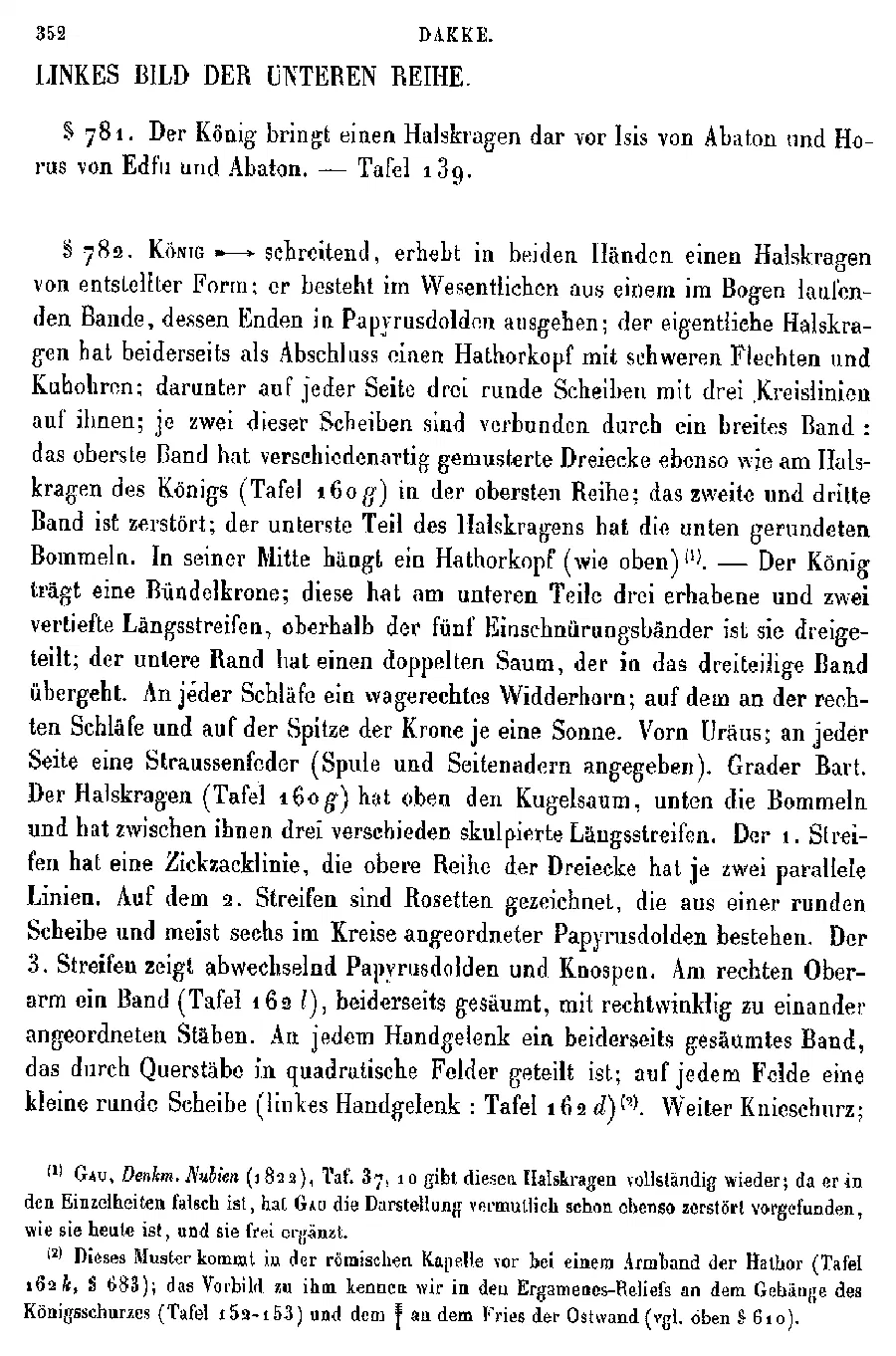
Page 352. Roeder, Der Tempel von Dakke (1930), p. 352 Printed hieroglyphs from G. Roeder, Der Tempel von Dakke (1930) - 749p. 352, § 782
nswt-bj.tj nb-tꜣ.wj pr-ꜥꜣ sꜣ-rꜥ nb-ḫꜥ.w pr-ꜥꜣ
King of Upper and Lower Egypt, lord of the Two Lands, Pharaoh; son of Ra, lord of crowns, Pharaoh.
Note · Line 749
Where two royal names would normally stand, the inscription says simply “Pharaoh” both times. - 750p. 352, § 782
sꜣ ꜥnḫ wꜣs nb ḥꜣ=f mj rꜥ ḏ.t
All protection, life and dominion are behind him as they are behind Ra, forever.
- 751p. 352, § 782
ḥnk=j n=ṯ wsḫ m ḥḏ nbw ꜥpr (?) m jnr nb n mꜣꜥ
I offer you a broad collar of silver and gold, set with every kind of genuine stone.
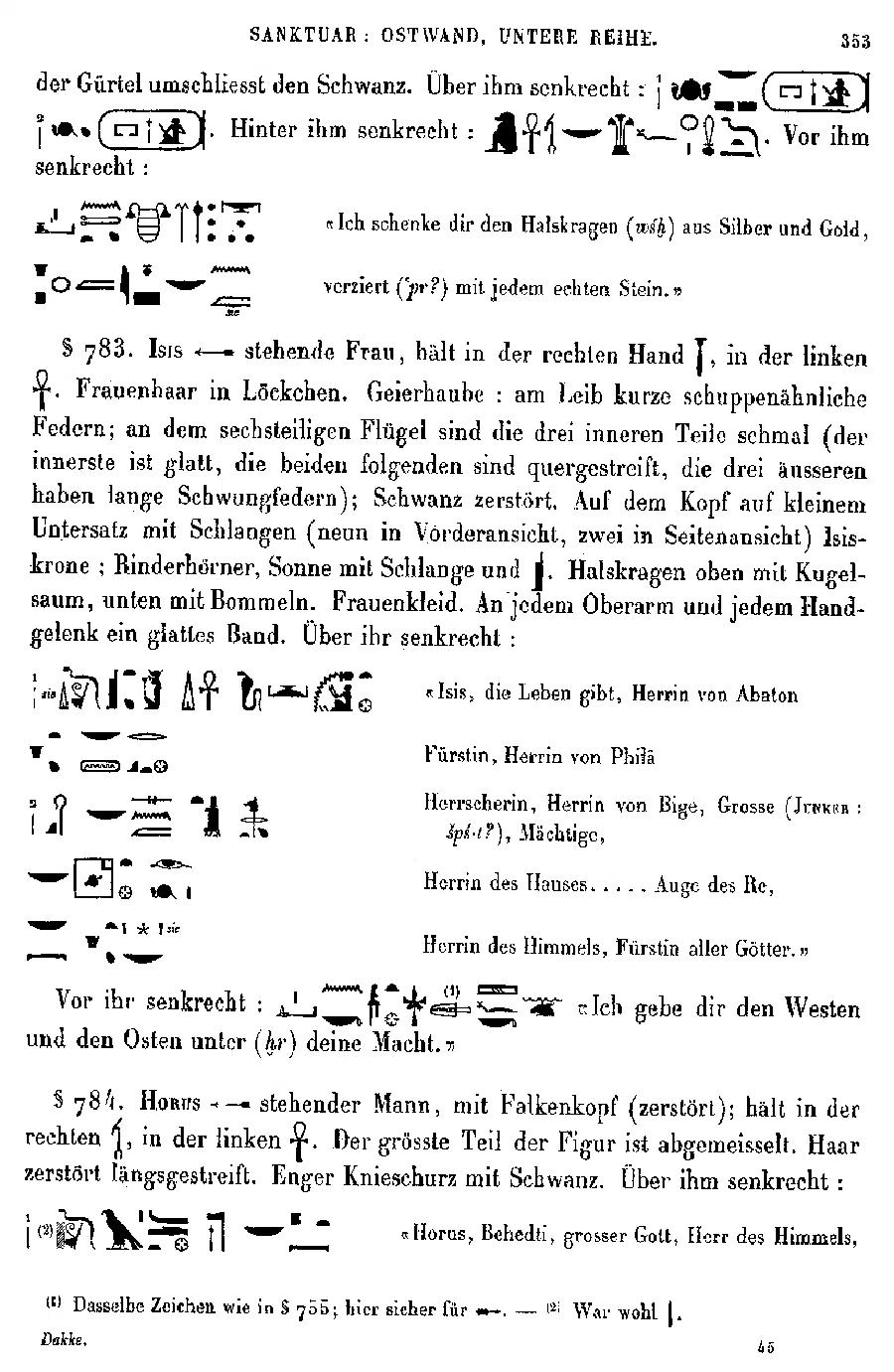
Page 353. Roeder, Der Tempel von Dakke (1930), p. 353 Printed hieroglyphs from G. Roeder, Der Tempel von Dakke (1930) - 752p. 353, § 783
ḏd-mdw jn ꜣs.t dj.(t) ꜥnḫ nb.(t) jꜣ.t-wꜥb.t ḥnw.t nb.(t) jwrḳ ḥḳꜣ.(t) nb.(t) snm.t šps.t wsr.t nb.(t) ḥw.t-ḫnt jr.t rꜥ nb.(t) p.t ḥnw.t nṯr.w nb.(w)
Words spoken by Isis, giver of life, lady of the Abaton, mistress, lady of Philae, sovereign, lady of Senmet, the august one, the mighty one, lady of Hut-khent, Eye of Ra, lady of the sky, mistress of all the gods.
- 753p. 353, § 783
dj=j n=k jmnt.t jꜣb.t ẖr šfj.t=k
I give you the West and the East, both in awe of you.
- 754p. 353, § 784
ḏd-mdw jn ḥrw bḥd.tj nṯr ꜥꜣ nb p.t sꜣb šw.t prj m ꜣḫ.t ḥrw-sꜣ-ꜣs.t sꜣ wsjr nb jw-wꜥb
Words spoken by Horus of Edfu, the great god, lord of the sky, many-colored in plumage, who came forth from the horizon, Horus son of Isis, son of Osiris, lord of the Pure Island.
- 755p. 353, § 784
dj=j n=k rsj jj n=k mḥw ḥr … (?)
I give you the South as it comes to you, the North as it …
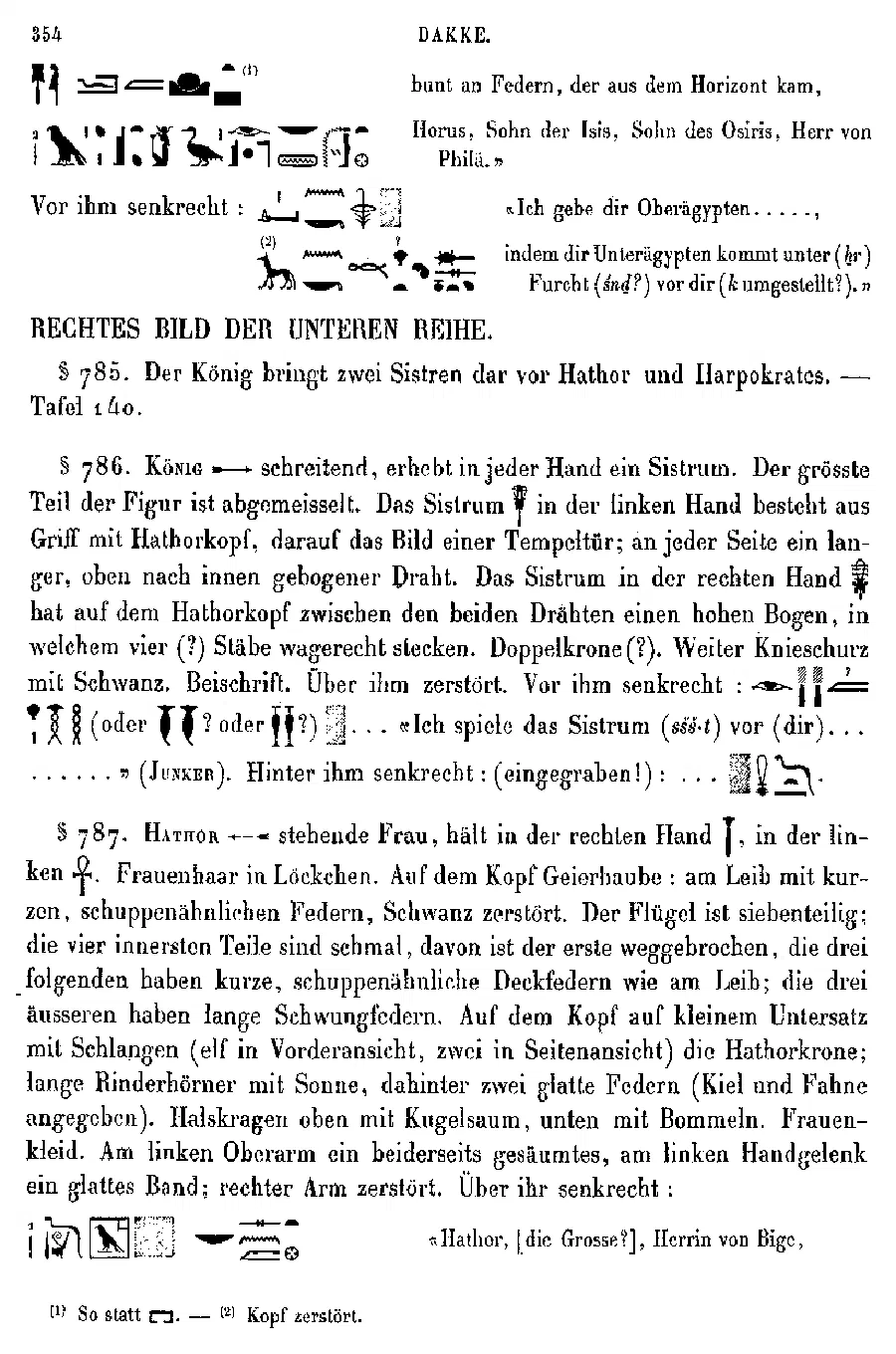
Page 354. Roeder, Der Tempel von Dakke (1930), p. 354 Printed hieroglyphs from G. Roeder, Der Tempel von Dakke (1930) - 756p. 354, § 786
jrj.(t) [sšš.t] m ḥr[=ṯ nfr] --détruit-- [sꜣ ꜥnḫ wꜣs nb ḥꜣ=f] mj[ rꜥ] ḏ.t
Shaking the sistrum before your beautiful face … All protection, life and dominion are behind him as they are behind Ra, forever.
Note · Line 756
Here the king shakes it before Hathor. - 757p. 354, § 787
ḏd-mdw jn ḥw.t-ḥrw --1Q-- nb.(t) snm.t jr.t rꜥ nb.(t) p.t ḥnw.t nṯr.w nb.w{t} ḫnt.j.(t) jwrḳ
Words spoken by Hathor, …, lady of Senmet, Eye of Ra, lady of the sky, mistress of all the gods, who presides over Philae.
- 758p. 354, § 787
dj=j n=k --5Q--
I give you …
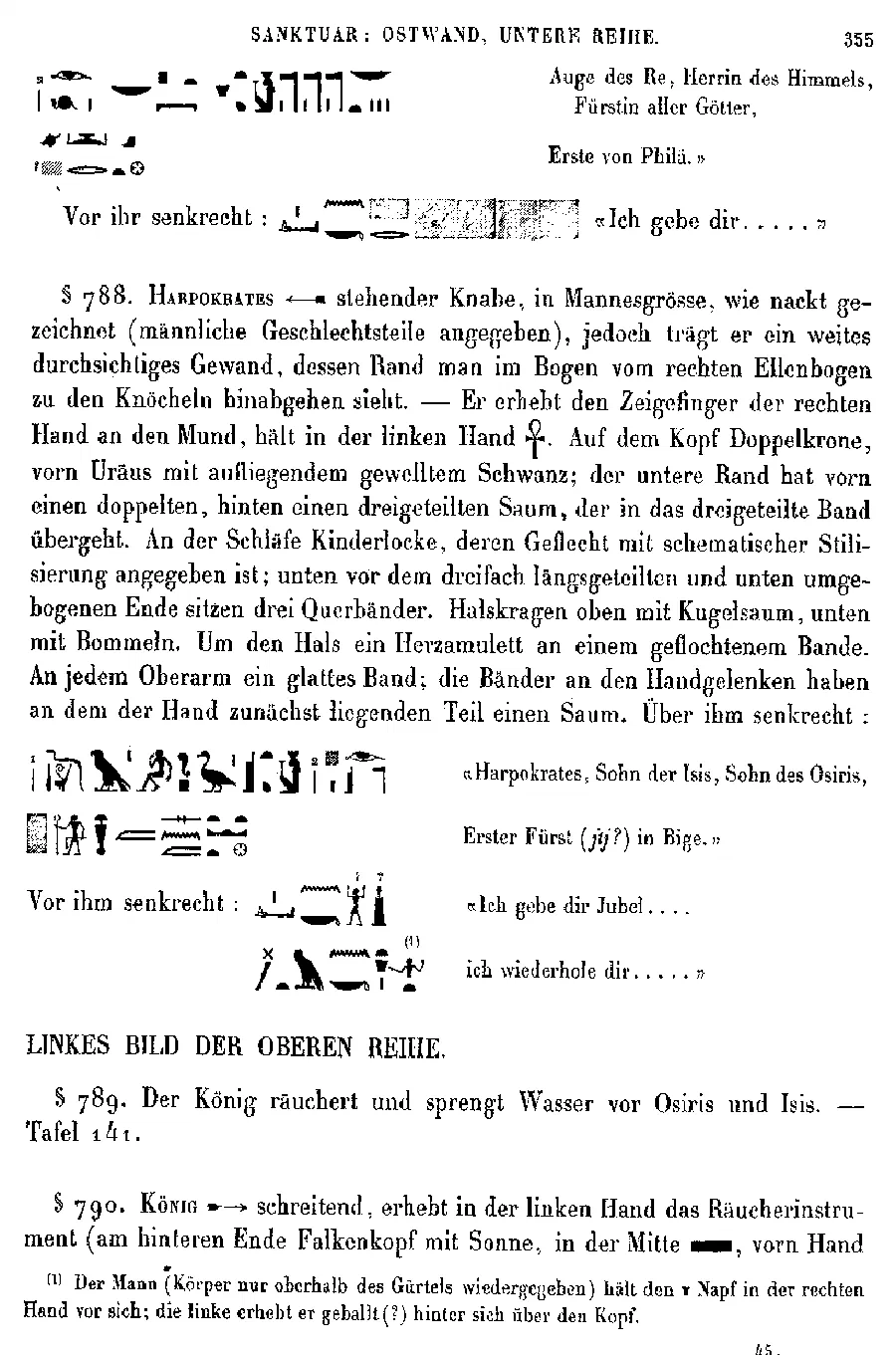
Page 355. Roeder, Der Tempel von Dakke (1930), p. 355 Printed hieroglyphs from G. Roeder, Der Tempel von Dakke (1930) - 759p. 355, § 788
ḏd-mdw jn ḥrw-pꜣ-ẖrd sꜣ ꜣs.t sꜣ wsjr --.5Q-- ḥḳꜣ tp.j m snm.t
Words spoken by Harpocrates, son of Isis, son of Osiris, …, first ruler in Senmet.
- 760p. 355, § 788
dj=j n=k ḥꜥꜥ nfr (?) wḥm.tw n=k ḥꜥꜥ (?)
I give you sweet joy; joy is renewed for you.
- 761p. 355, § 790
nswt-bj.tj nb[-tꜣ.wj] pr-ꜥꜣ sꜣ-rꜥ [nb-ḫꜥ.w] pr-ꜥꜣ
King of Upper and Lower Egypt, lord of the Two Lands, Pharaoh; son of Ra, lord of crowns, Pharaoh.
- 762p. 355, § 790
sꜣ ꜥnḫ wꜣs nb ḥꜣ=f mj rꜥ ḏ.t
All protection, life and dominion are behind him as they are behind Ra, forever.
- 763p. 355, § 790
jrj.(t) snṯr ḳbḥ <n> jt=f šps jrj.n=f dj.(t) ꜥnḫ
Burning incense and pouring cool water for his august father. He has done this so that he may be granted life.
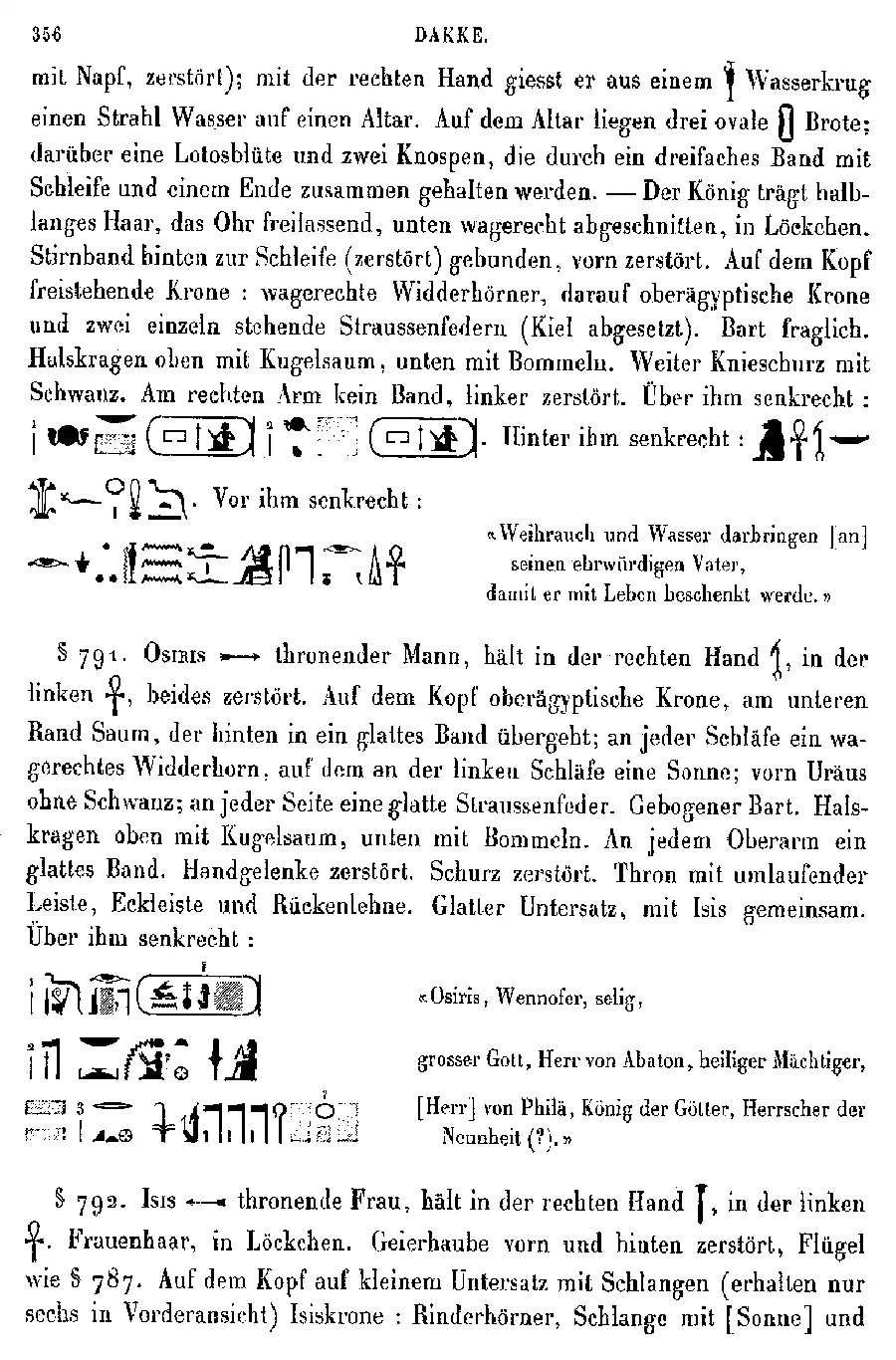
Page 356. Roeder, Der Tempel von Dakke (1930), p. 356 Printed hieroglyphs from G. Roeder, Der Tempel von Dakke (1930) - 764p. 356, § 791
ḏd-mdw jn wsjr wn-nfr [mꜣꜥ-ḫrw] nṯr ꜥꜣ nb jꜣ.t-wꜥb.t sḫm šps [nb] jwrḳ nswt nṯr.w ḥḳꜣ [psḏ.t]
Words spoken by Osiris Wennefer, vindicated, the great god, lord of the Abaton, august power, lord of Philae, king of the gods, ruler of the Ennead.
Note · Line 764
“Vindicated” recalls the gods’ judgment in his favor against Seth. - 765p. 356, § 792
ḏd-mdw jn ꜣs.t dj.(t) ꜥnḫ nb.(t) jꜣ.t-wꜥb.t ḥr.j.(t)-jb jwrḳ --3Q--
Words spoken by Isis, giver of life, lady of the Abaton, who dwells in Philae, …
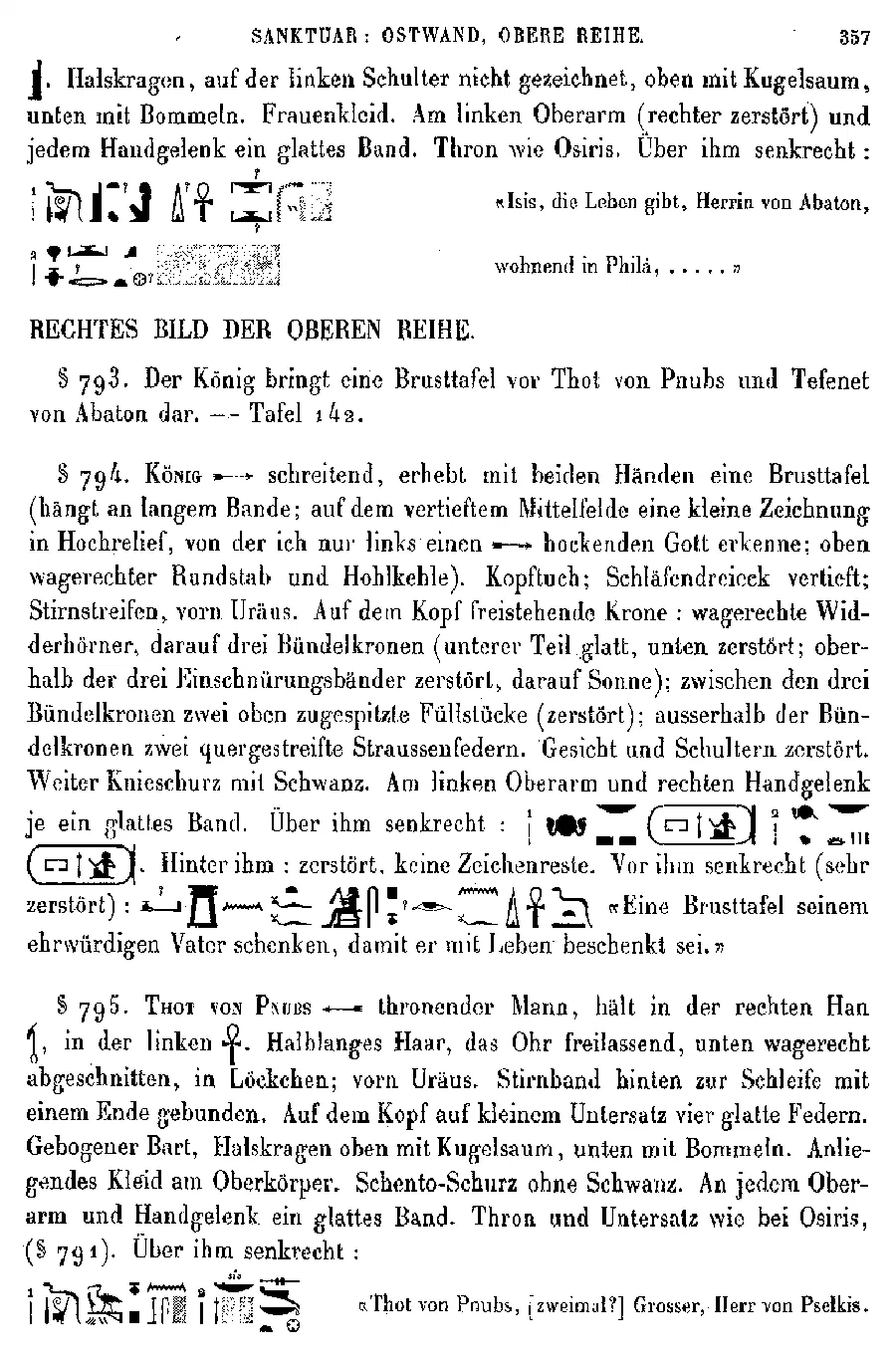
Page 357. Roeder, Der Tempel von Dakke (1930), p. 357 Printed hieroglyphs from G. Roeder, Der Tempel von Dakke (1930) - 766p. 357, § 794
nswt-bj.tj nb-tꜣ.wj pr-ꜥꜣ sꜣ-rꜥ nb-ḫꜥ.w pr-ꜥꜣ
King of Upper and Lower Egypt, lord of the Two Lands, Pharaoh; son of Ra, lord of crowns, Pharaoh.
- 767p. 357, § 794
ḥnk wḏꜣ n jt=f šps jrj.n=f dj.(t) ꜥnḫ
Presenting a pectoral to his august father. He has done this so that he may be granted life.
Note · Line 767
A pectoral is an ornament worn on the chest. - 768p. 357, § 795
ḏd-mdw jn ḏḥwtj n pnbs [nṯr] ꜥꜣ nb [p]srk.t šw sꜣ rꜥ jj m tꜣ-stj
Words spoken by Thoth of Pnubs, the great god, lord of Pselkis, Shu, son of Ra, who came from Nubia.
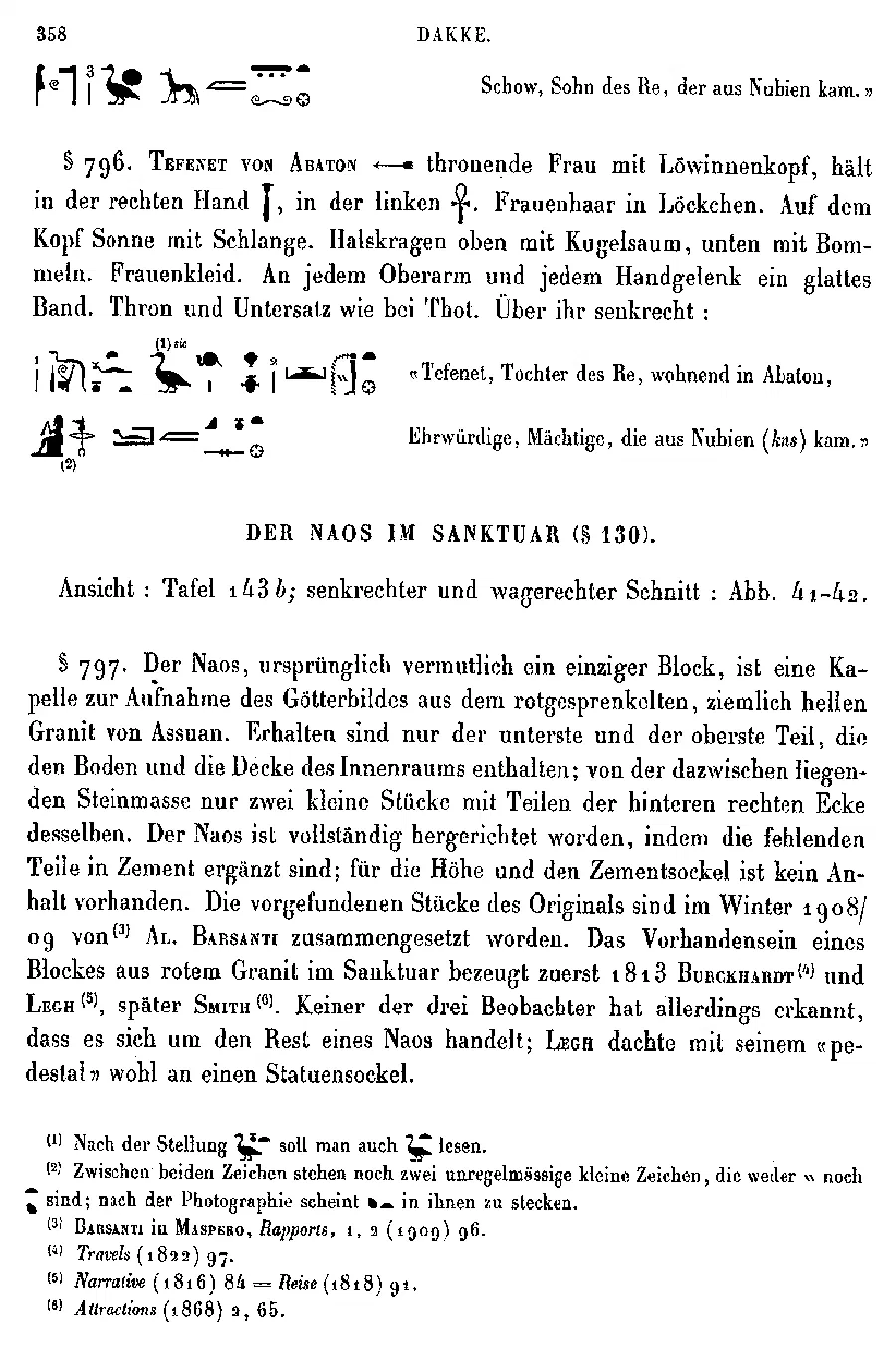
Page 358. Roeder, Der Tempel von Dakke (1930), p. 358 Printed hieroglyphs from G. Roeder, Der Tempel von Dakke (1930) - 769p. 358, § 796
ḏd-mdw jn tfn.t sꜣ.(t) rꜥ ḥr.j.(t)-jb jꜣ.t-wꜥb.t šps.(t) wsr.(t) prj.(t) m kns.t
Words spoken by Tefnut, daughter of Ra, who dwells in the Abaton, the august one, the mighty one, who came forth from Kenset.
Note · Line 769
Kenset is a region of Nubia.