~/sacred-texts/early-dynastic-incantations
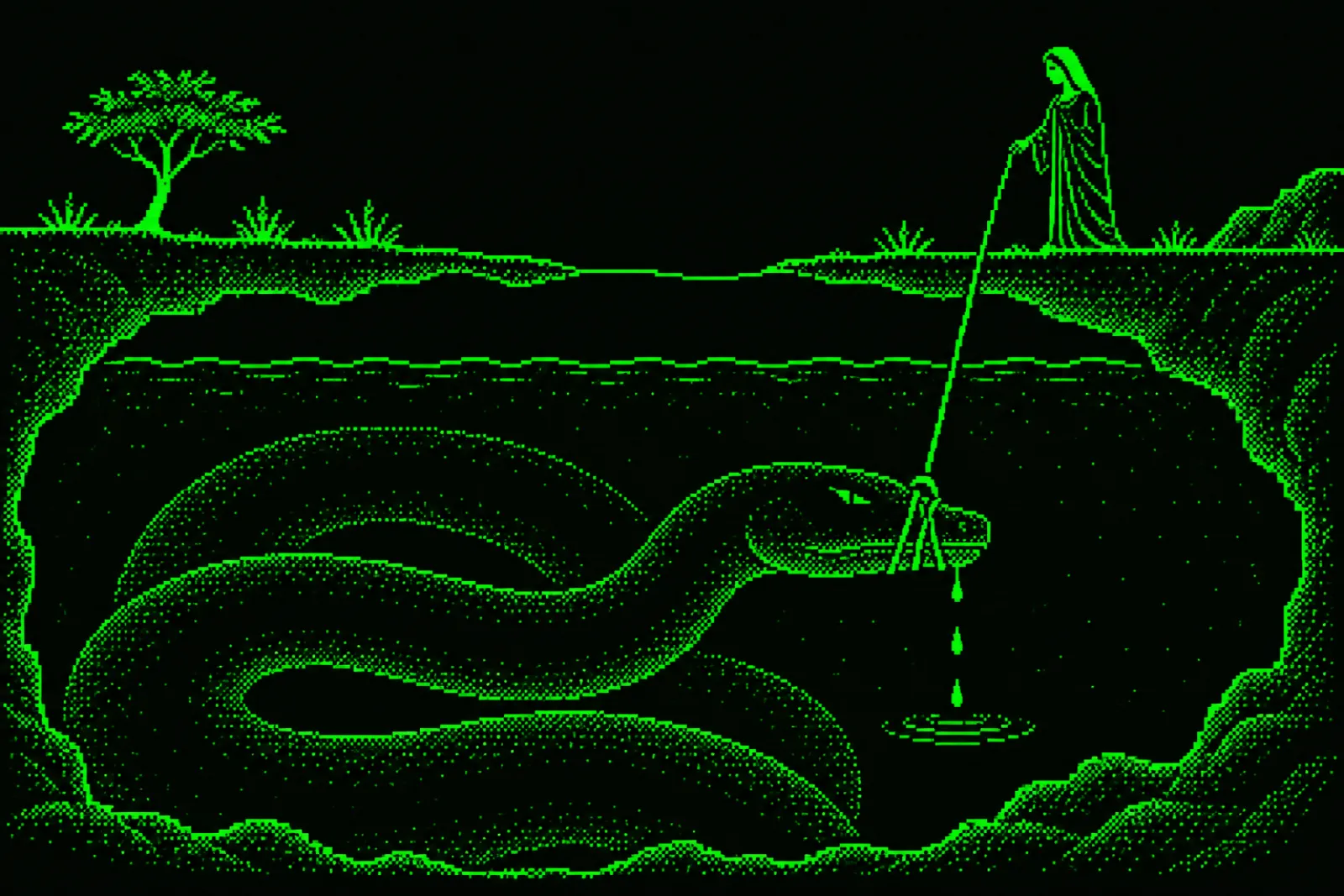
CUSAS 32, 2: The Black Snake of the Abzu
Translated by AI straight from the Sumerian, not from a modern translation, then checked against the editions and studies listed below. How we translate
- Text
- Early Dynastic incantations, CUSAS 32, 2 (complete) and ARET 5, 19 rev. vi 8 – viii 5 (Krebernik BFE 36)
- Date
- c. 2600–2500 BC (CUSAS 32, 2, Early Dynastic IIIa); c. 2350 BC (the Ebla copy)
- Found
- CUSAS 32, 2: provenance unknown, southern Iraq (Schøyen Collection MS 4549/2). ARET 5, 19: the royal archive of Ebla (Tell Mardikh, Syria), TM.75.G.2459
- Language
- Sumerian · Cuneiform
This is one of the oldest snake incantations ever found. It is a small tablet of the Early Dynastic IIIa period (c. 2600–2500 BC), from the same generation as the school tablets of Fara (ancient Šuruppak, southern Iraq). It is now in the Schøyen Collection and was published by Andrew George in 2016. Its eleven lines are broken in places, and the last three are the colophon. The spell names the black snake of the Abzu, bringing out its venom (uš, a sign that can also mean blood), reaching its den, turning back the snake and the great dragon, and binding its mouth and tongue. A temple administrator, Ur-Gibil, signs it as scribe.
The second spell comes from the royal archive of Ebla in northern Syria, about 2350 BC. Ebla’s scribes copied Mesopotamian incantations, sometimes writing the Sumerian by sound alone, beside spells in their own Semitic language. This one, number 36 in Manfred Krebernik’s edition, opens on “the place of the black snake, the heart of the Abzu”; the older tablet is broken at its opening but has “black [snake] … Abzu”. Like the other spells of this tradition from Fara and Ebla, it ends with “the spoken spell of Ningirima”, the goddess of incantation.
Early Dynastic writing leaves out much of the grammar, and several signs here have no agreed reading. Lines marked as gaps could not be construed; where a word could be read more than one way, the note says so. Krebernik’s edition of the Ebla spell (no. 36) was read in the printed book, and where his reading of a line differs from CDLI’s the note gives both. George’s edition of the Schøyen tablet was not available.
Each numbered line gives the Sumerian first: the original script, then the same words in Latin letters. Our English is underneath. Tap a dotted word for its meaning, and Note for our comment on the line; our comments are in the right margin.
- 1CUSAS 32, 2 i 1
𒋙𒀭𒂍𒉡𒊒 □ 𒈲 𒈪 𒍪𒀊 □
enuru en₂-e₂-nu-ru: the opening word of an incantation (ePSD2 enuru, 'incantation') · ePSD2 […] muš muš: snake (ePSD2, 676 attestations) · ePSD2 giggig gi₆: black, dark; night (ePSD2 giggig, ŋi₆) · ePSD2 abzu abzu: the sweet waters under the earth, Enki's home (ePSD2 '(cosmic) underground water') · ePSD2 […]
enuru: opening word of a spell. [The …] giggig: black, dark [muš: snake] of the abzu: the waters under the earth […].
Note on line 1
The tablet writes the opening word with the sign ENURU and the gloss nu-ru. muš is restored by CDLI with a question mark, so ‘snake’ is a restoration. The Ebla spell below has a close opening, ’the place of the black snake, the heart of the Abzu’, but the tablet here is broken before and after gi₆ abzu, so the two openings agree only in ‘black [snake?] … Abzu’. - 2i 2
𒍑 𒌓𒁺 𒃻𒁉 𒅗 𒁀𒁀
uš uš: ePSD2 lists poison (159 attestations), spittle (39), blood, gore (87), membrane, womb, afterbirth (18), and uš, to die, for the same sign. In a snake spell it is venom. · ePSD2 e e₃: to go out, to bring out (ePSD2 e[leave]) · ePSD2 niŋ niĝ₂: thing, possession, stuff · ePSD2 ka ka: mouth. The sign KA can also be zu₂, tooth; Krebernik (BFE p. 23, on the Fara parallel) allows 'mouth or tooth' · ePSD2 ba ba: to allot, divide into shares, hand out (ePSD2) · ePSD2
It e: to go out, bring out uš: poison; spittle; its stuff the ka: mouth ba: to allot, hand out.
Note on line 2
Uš is the venom. The sign UŠ covers poison, spittle, blood or gore, membrane, womb, afterbirth, and ’to die’; in a snake spell, with e₃, ‘bring out’, it is the venom the charmer draws out. Krebernik (BFE p. 9, on Nr. 1) doubts that US means venom in the scorpion line of Fara VAT 12597 and prefers ’to copulate’; that is a different line. ka ba-ba: the mouth allots, dealing out the venom. - 3i 3
𒅗 𒊩𒆪𒁉 𒁲 𒅗𒂵
ka ka: mouth. The sign KA can also be zu₂, tooth; Krebernik (BFE p. 23, on the Fara parallel) allows 'mouth or tooth' · ePSD2 niŋar niĝar: cella, shrine, chamber (ePSD2); here the snake's den · ePSD2 sa sa₂ … dug₄: to reach, equal, overtake (compound verb, ePSD2 sa[equal]) · ePSD2 dug dug₄ (du₁₁): to speak, to do; part of compound verbs · ePSD2
The ka: mouth of its niŋar: chamber, shrine; here the den has been sa: sa₂ dug₄, to reach, overtake.
Note on line 3
The charmer has reached the snake’s hole. niĝar is ‘cella, shrine’ in ePSD2; here it is the snake’s den. sa₂ du₁₁-ga is the compound verb ’to reach, equal’. - 4i 4
𒈲 □ 𒁔𒃲 □
muš muš: snake (ePSD2, 676 attestations) · ePSD2 gur gurₓ (written with the sign LAK051): CDLI's reading of the sign; ePSD2 does not list this sign under any gur entry. Here it is gur 'to turn back' (ePSD2 gur[turn]) · ePSD2 ušumgal ušum-gal: great dragon, snake; lion (ePSD2). The Fara god list has {d}ama-ušumgal, 'Mother Great-Dragon' · ePSD2 gur gurₓ (written with the sign LAK051): CDLI's reading of the sign; ePSD2 does not list this sign under any gur entry. Here it is gur 'to turn back' (ePSD2 gur[turn]) · ePSD2
The muš: snake is gur: read gur, to turn back, the ušumgal: great dragon, snake is turned back.
Note on line 4
The verb is written with the archaic sign LAK051, which CDLI reads gurₓ; ePSD2 does not list that sign, so the meaning is ours: ’turn back’ (gur[turn]) rather than ’to be swollen’ (gur[thick]). The ušumgal is the great dragon-snake; the Fara god list worships {d}ama-ušumgal, ‘Mother Great-Dragon’. - 5i 5
𒃷 𒁯 □ □ […]
GAN₂ gunu gun₃: speckled, dappled, multicoloured · ePSD2 |A×KU₃| |A×LA₂| […]
… gunu: speckled, multicoloured … […]
Note on line 5
Only gun₃ ‘speckled, dappled’ can be read; whether it describes the snake’s skin we do not know. - 6ii 1
𒈲 𒅗 𒈠𒇲
muš muš: snake (ePSD2, 676 attestations) · ePSD2 ka ka: mouth. The sign KA can also be zu₂, tooth; Krebernik (BFE p. 23, on the Fara parallel) allows 'mouth or tooth' · ePSD2 la la₂: to hang, to bind (ePSD2 la[hang]); ka … la₂, to bind the mouth. Krebernik (BFE pp. 23–24): 'bind' in the sense of laming, making the body part harmless · ePSD2
The muš: snake: its ka: mouth is la: to hang, bind for me.
Note on line 6
The same formula is in the Fara tablet SF 54 (iii 8), which Krebernik transcribes muš KA ma-la (BFE Nr. 3, p. 20): ’the snake’s mouth (or tooth) is bound for me’, followed by gir kun ma-tar, ’the scorpion’s tail is cut for me’. Krebernik (pp. 23–24) takes la₂ ‘bind’ as laming or disabling the dangerous part. ma- marks the action as done toward the speaker. - 7ii 2
𒅴𒁀 𒄖 𒌉𒌉 𒈠𒋛
eme eme: tongue · ePSD2 gu gu: cord, net, thread (ePSD2); also voice · ePSD2 didila di₄-di₄: small, little · ePSD2 si si: to fill, to load (ePSD2 si[fill]) · ePSD2
On its eme: tongue didila: small gu: cord, net; also voice are si: to fill, load (for me).
Note on line 7
The tongue is tied with small cords, after the bound mouth of the line before; ma- is ‘for me’, as in line ii 1. Si is ’to fill, load’: the cords are loaded onto the tongue. Gu also means ‘voice’, so the line also says the tongue’s little voice is stopped up. - 8ii 3
𒈲 𒅗 𒇲𒀀 □ 𒉆𒈠□
muš muš: snake (ePSD2, 676 attestations) · ePSD2 ka ka: mouth. The sign KA can also be zu₂, tooth; Krebernik (BFE p. 23, on the Fara parallel) allows 'mouth or tooth' · ePSD2 la la₂: to hang, to bind (ePSD2 la[hang]); ka … la₂, to bind the mouth. Krebernik (BFE pp. 23–24): 'bind' in the sense of laming, making the body part harmless · ePSD2 |U₄.KA| nam nam-: prohibitive or negative prefix, 'may it not' (in nam-ma-) · ePSD2
The muš: snake with the la: to bind ka: mouth: … nam: prohibitive prefix …
Note on line 8
The verb is written with one compound sign twice, and its meaning is lost. nam- is the prohibitive, ‘may it not’. - 9ii 4–6
𒋃 𒌨𒀭𒉈𒄀 𒇽 𒁾𒊬 [𒅔𒊬]
saŋŋa sanga: chief administrator of a temple household, a priestly office · ePSD2 Urgibil Ur-Gibil: personal name, 'man of Gibil' (the fire god) · ePSD2 lu lu₂: man, person · ePSD2 dubsar dub-sar: scribe · ePSD2 sar sar: to write · ePSD2
Urgibil: personal name, 'man of the fire god', the saŋŋa: chief administrator of a temple, the dubsar: scribe, [sar: to write].
Note on line 9
A colophon naming a temple administrator as scribe. CDLI restores ‘wrote it’ (in?-sar?) with question marks, and marks lu₂ and dub-sar as damaged. - e1ARET 5, 19 rev. vi 8–10
𒋙𒀭𒂍𒉡𒊒 𒆠 𒈲 𒈪 𒍪𒀊 𒊮
enuru en₂-e₂-nu-ru: the opening word of an incantation (ePSD2 enuru, 'incantation') · ePSD2 ki ki: place, earth · ePSD2 muš muš: snake (ePSD2, 676 attestations) · ePSD2 giggig gi₆: black, dark; night (ePSD2 giggig, ŋi₆) · ePSD2 abzu abzu: the sweet waters under the earth, Enki's home (ePSD2 '(cosmic) underground water') · ePSD2 šag ša₃ (šag₄): heart, inner body, womb; inside, centre · ePSD2
enuru: opening word of a spell. The ki: place of the giggig: black muš: snake, the šag: heart, inside, womb of the abzu: the waters under the earth.
Note on line e1
The Ebla scribe wrote this Sumerian spell about two centuries after the tablet above, whose opening is broken but reads gi₆ abzu with muš restored. Krebernik (BFE p. 181) reads the same signs as ki muš-gi₆ SU.AB-ša₃, ’earth or simply place, black snake, inside of the Apsu’, and says the theme, as in the spell before it, is the snake. CDLI spells the word absu. Bonechi and Catagnoti (1998, p. 20): ‘It speaks of snakes and Enki.’ - e2vii 1
This line is missing from the open Sumerian text we translate from.
Paraphrase A line written in syllable signs (WA KA nu-ni igi E) with no agreed meaning. Krebernik (BFE p. 181) reads KA-pi, 'its mouth or tooth' (of the black snake), and suspects a negated verb (nu-ni-ba-e?) but finds no meaning for it or for the pa-sal before it.
Taken from the published translations until we can translate the Sumerian ourselves.
- e3vii 2–3
𒌨 𒈪𒂠 𒁮𒈠 𒈿 𒀀
ur ur: dog, lion (ePSD2 ur[dog]); several homophones · ePSD2 giggig gi₆: black, dark; night (ePSD2 giggig, ŋi₆) · ePSD2 ešdam eš-dam: tavern (ePSD2 ešdam[tavern], 53); Krebernik's division of the signs gi₆-še₃ dam-ma (BFE p. 181) · ePSD2 nud nu₂: to lie down, to sleep; to lie with (ePSD2 nud). In this line Krebernik reads nu-a, 'lying' · ePSD2 A
The giggig: black, dark ur: dog, lion that nud: to lie down, sleep in the ešdam: tavern.
Note on line e3
Krebernik (BFE pp. 181–182) divides the signs ur-gi₆ eš-dam-ma nu-a, ‘black dog lying in the tavern’, and cites the same phrase in the Zame hymns from Abu Salabikh (Ninazu hymn, line 136) and, spelled ur-gi₆ eš-TE nu, in Fara SF 36 v 10–11. CDLI divides ur gi₆-še₃ dam-ma NU₂ A, ‘dog, to the black one, spouse, lies down’. Krebernik’s division is right: the phrase has two parallels, and his nu-a takes the final A as the participle ending, not ‘water’. Krebernik cannot say how the black dog relates to the snake (p. 183). - e4vii 4–7
𒈲 □ 𒇯 𒉣𒋫 𒀭𒂗𒆠 𒍣𒁕
muš muš: snake (ePSD2, 676 attestations) · ePSD2 |WA×(PA&GAR)| dud du₆: mound (ePSD2 dud) · ePSD2 nun nun: prince; foremost · ePSD2 Enki Enki: god of the Abzu, of wisdom and of incantations · ePSD2 zid zi-da: true, right; the right hand (ePSD2 zid[right]) · ePSD2
The muš: snake … from the nun: prince; foremost dud: mound; Enki: god of the Abzu, the zid: true, right; right hand.
Note on line e4
CDLI gives muš |WA×(PA&GAR)| du₆ nun-ta {d}en-ki zi-da and gives no reading for the compound sign after muš. Krebernik (p. 182) reads si-pi pa-sal there, ‘its horns’, the thorn-like growths over the eyes of horned vipers such as Cerastes cornutus; his two syllables do not match CDLI’s single compound sign. For du₆ nun-ta Krebernik reads bur-nun-ta, perhaps a syllabic spelling of Buranun, ‘from the Euphrates’ (p. 182, ‘vielleicht’). For zi-da he reads ze-da, ‘with (or to) you’, Enki being the one addressed. The English follows CDLI: du₆ nun-ta, ‘from the princely mound’, and zi-da, ’true’. - e5vii 8
This line is missing from the open Sumerian text we translate from.
Paraphrase A line in syllable signs (GA₂ A UR WA). Krebernik (BFE p. 182) reads ga-a ur-pi, 'I … this dog', taking ga-a as 'I' and ur-pi as the black dog of line vii 2–3; we leave it a gap because the reading is his proposal.
Taken from the published translations until we can translate the Sumerian ourselves.
- e6vii 9–10
𒁔 𒈿 𒅎𒋢
ušum ušum: snake (ePSD2 ušum[snake], 57). ePSD2 does not give 'dragon' for ušum alone; Krebernik (p. 183) thinks 'dragon' belongs only to ušum-gal · ePSD2 nud nu₂: to lie down, to sleep; to lie with (ePSD2 nud). In this line Krebernik reads nu-a, 'lying' · ePSD2 sug im-su: listed by ePSD2 under sug '(to be) empty, naked, stripped'; here 'has sunk' (su 'to sink') · ePSD2
The ušum: snake nud: to lie down, sleep; it has sug: listed under sug, stripped, empty; here 'sunk'.
Note on line e6
CDLI reads ušum NU₂ im-su. Krebernik (p. 183) reads USUM nu, not nu₂, rejects ’lying dragon’ (ušum alone is not ‘dragon’, only ušum-gal is), and calls both USUM nu and IM SU unclear. NU₂ is ’lies down’. im-su is su, ’to sink’: the snake has sunk. - e7viii 1–3
[…] 𒈲 𒂵 𒋻 […]
[…] muš muš: snake (ePSD2, 676 attestations) · ePSD2 ga ga-: 'let me', the cohortative prefix (if GA is the prefix here) · ePSD2 tar tar: to cut, cut off (ePSD2 tar[cut]) · ePSD2 […]
[…] The muš: snake: ga: cohortative 'let me' tar: to cut, cut off. […]
Note on line e7
Krebernik (BFE p. 183) reads muš ga-tar as first person singular, ’the snake I will cut off’, and compares the end of Fara Nr. 3, where a snake’s mouth is bound and a scorpion’s tail cut off (tar). Reading ga- as the cohortative ’let me’ is the same understanding. The lines before and after are broken. - e8viii 4–5
𒌓 𒅗𒂵 𒀭𒊩𒌆𒁺𒈲𒀀𒄩
UD dug dug₄ (du₁₁): to speak, to do; part of compound verbs · ePSD2 Ningirima Ningirima: goddess of incantation; Krebernik (BFE p. 23) cites her epithet '(great) incantation priestess of all the gods' in his Nr. 32 and 39. The Ebla writing is |DU.MUŠ.A.ḪA|, with the signs DU, MUŠ (snake), A (water) and ḪA (fish); Krebernik (BFE p. 250) takes MUŠ and ḪA as meaning-bearing, 'fish-and-snake water' · ePSD2
The dug: to speak spell of Ningirima: goddess of incantation, written with the snake sign.
Note on line e8
Every spell on this Ebla tablet closes with this formula (the ATF shows it after each); Krebernik treats the formula on pp. 208ff., which we have not checked. The study digest records the Ebla Vocabulary equation of UD-dug₄-ga with da-WA-um, ‘word, utterance’, from ḥ-w-y ’to speak’, as Krebernik’s; we have not seen that page. Ningirima’s name is written |DU.MUŠ.A.ḪA|, with the snake, water and fish signs among them; Krebernik (p. 250) reads MUŠ and ḪA as meaning-bearing (‘fish-and-snake water’) and (p. 255) sees a snake aspect in the goddess. The epithet ‘great incantation priestess of all the gods’ is cited by Krebernik (p. 23) from his Nr. 32 and 39, not from this spell. Krebernik leaves open (p. 23, on Nr. 3) whether gudu₄ {d}nin-girima is ‘priest of Ningirima’ or ’the priestess Ningirima’.