~/sacred-texts/coudreau-la-france-%C3%A9quinoxiale
Jurupari Cult: Coudreau on the Uaupés Mask and Trumpets
Translated by AI straight from the French, not from a modern translation, then checked against the editions and studies listed below. How we translate
- Text
- Coudreau, La France équinoxiale, Vol. II (1887), chapter VI, "Le Uaupès et ses missions": the Jurupari passages of pp. 174–177 and the sections "Religion de Jurupari" and "Les Uaupès et la légende des Amazones", pp. 181–210
- Date
- Observed and gathered on the Uaupés missions in the mid-1880s; published Paris, 1887
- Found
- The Uaupés (Vaupés) river and its tributary the Papuri, northwest Amazonia: Amazonas state, Brazil, and Vaupés department, Colombia; the missions of Panoré, Taraquá and Jauarité
- Language
- French · Roman type, with Lingua Geral (Nheengatu) and Tukano words in Coudreau's spelling
Henri Coudreau (1859–1899) was a French geographer who spent the 1880s and 1890s exploring French Guiana and the Brazilian Amazon. The second volume of his La France équinoxiale (1887) records his journey up the Rio Negro to the Uaupés (Vaupés), the river that runs along the border of Brazil and Colombia in northwest Amazonia. There he stayed at the Franciscan missions of Panoré and Taraquá, among the Tukano, Tariana, Arapaso, Desana and Cubeo, and wrote down what the missionaries had pried out of their converts about the men’s secret religion of Jurupari. This page gives his whole account: the Jurupari passages of his chapter on Uaupés customs (pp. 174–177), and the two sections that close the chapter, “Religion de Jurupari” and “Les Uaupès et la légende des Amazones” (pp. 181–210).
The account turns on a scandal. In October 1883 Father José Coppi took a crate of sacred objects from a man accused of poisoning his chief, showed the mask to the catechism children, hung it from a pole, and finally had Father Mathieu Camioni hold it up from the pulpit at Panoré with the doors barred, while the women ran in terror and the pagets breathed death on them. Out of the riot, and out of children’s confessions forced from them afterwards, came the legend of the virgin with no sexual parts, the burning of Jurupari, the palm that grows from his bones, and the rules: a woman who sees the macacaraua mask is poisoned. Coudreau then describes the mask and the paxiuba trumpets, the dabucuri festival with its masked dancers, mutual floggings and orgy, the fasts, the hierarchy of pagets, the children’s initiation, and the afterlife; and he ends with his own theory that the cult remembers a war between the sexes and explains the legend of the Amazons.
Coudreau was hostile to his subject and says so: he calls the Uaupés women brood mares and the festival a cancan of demons, and his racial theorizing is of its time. The English keeps all of it, as his, and keeps the rape, the poisonings and the orgy in his own words. The sacred instruments here are the paxiuba trumpets, whose sound he compares to a bull’s bellow; he describes no whirled bullroarer. The Jurupari legend in its full native form is Ermanno Stradelli’s Jurupary, translated on this site as The Jurupary legend.
Each numbered line gives the French first. Our English is underneath. Tap a dotted word for its meaning, and Note for our comment on the line; our comments are in the right margin.
Jurupari at the wedding
- p174-01p. 174
Malgré le culte de Jurupari, qui semble avoir pour objet l'explication mystique et la justification de la tutelle des femmes, le beau sexe jouit au Uaupès des libertés les plus grandes. Les dames prennent, laissent et reprennent leurs maris; les demoiselles prennent, laissent et reprennent leurs amants. J'ai connu à Taraquá une jeune femme qui mit son mari à la porte et désormais refusa énergiquement de le recevoir parce que le malheureux garçon, trois jours de suite, avait été malheureux à la pêche.
Despite the cult of Jurupari, which seems to have as its object the mystical explanation and justification of women's subjection, the fair sex enjoys the greatest freedoms on the Uaupés. Ladies take, leave and retake their husbands; the young ladies take, leave and retake their lovers. At Taraquá I knew a young woman who put her husband out the door and from then on flatly refused to receive him, because the unfortunate fellow had been unlucky at fishing three days running.
- p174-02p. 174
Quand on veut une femme, on provoque un cachiri, on fait boire le caapim à l'objet de son choix et, quand la belle est ivre morte, on la viole. Quelquefois l'épousée, — surtout si, pendant qu'elle était inerte et inconsciente, elle a réellement eu à subir, chose rare, la transformation de fille en femme, — l'épousée est dégoûtée de son mari dès le réveil de l'ivresse et ne passe pas huit jours avec lui. Il en est qui ont été ainsi mariées dans trois ou quatre cachiris. Elles continuent jusqu'à ce qu'elles trouvent quelqu'un à leur goût.
When one wants a woman, one throws a cachiri: fermented manioc beer, makes the object of one's choice drink the caapim: the drug drink caapi (Banisteriopsis caapi), ayahuasca, and when the beauty is dead drunk, one rapes her. Sometimes the bride, especially if, while she lay inert and unconscious, she really did have to undergo (a rare thing) the transformation from girl to woman, the bride is disgusted with her husband as soon as she wakes from the drunkenness, and does not spend a week with him. There are some who have been married this way at three or four cachiris. They go on until they find someone to their taste.
Note on line p174-02
“The transformation from girl to woman” is Coudreau’s phrase for her defloration: the girl, drugged unconscious, is raped, and he calls it rare that the rape in fact deflowered her. - p174-03p. 174
La demande en règle, de laquelle on se dispense le plus souvent, se fait comme il suit. Le jeune homme fait un présent d'acangataras ou de taïassúranha (dents de sanglier) au père de la jeune fille. Si celui-ci refuse, le jeune homme est éconduit. S'il accepte, la demande est agréée. Le choix de la jeune fille est toujours libre. Les jeunes gens tiennent beaucoup aux taïassúranha. « Cela vaut une femme, » disent-ils. Pourtant le taïassú n'est pas bien difficile à tuer, et il n'est pas indispensable de présenter ces dents, bien qu'il soit de bon goût de faire ce cadeau pour donner une preuve de sa force et de sa vaillance. On attend parfois pour consommer le mariage jusqu'au prochain dabucuri. Le plus souvent, on n'attend pas. Si la chose n'a point élé consommée longtemps déjà avant la formalité du caapim, le jeune homme prend la jeune fille et vit avec elle. C'est le consentement mutuel qui constitue le mariage. Pendant ce stage, le futur s'applique à gagner les bonnes grâces du paget, qui, dans le prochain dabucuri, va remplir les fonctions de prêtre et d'officier de l'état-civil, et ratifier, sanctifier le mariage accompli devant la nature.
The formal proposal, which is most often dispensed with, is made as follows. The young man gives a present of acangataras or taïassúranha ("boar's teeth") to the girl's father. If he refuses, the young man is turned away. If he accepts, the proposal is approved. The girl's choice is always free. Young men set great store by the taïassúranha. "That's worth a wife," they say. Yet the taïassú is not very hard to kill, and it is not essential to present these teeth, although it is good form to make this gift as proof of one's strength and valour. Sometimes they wait to consummate the marriage until the next dabucuri: the Jurupari festival; Coudreau calls it the festival of the whip. Most often they do not wait. If the thing has not been consummated long before the formality of the caapim, the young man takes the girl and lives with her. It is mutual consent that constitutes the marriage. During this probationary period the prospective husband applies himself to win the good graces of the paget: Coudreau's French form of Portuguese pajé, the shaman-priest, who at the next dabucuri will perform the functions of priest and civil registrar, and ratify and sanctify the marriage accomplished before nature.
- p175-01p. 175
C'est une cérémonie grandiose. Le jour solennel arrivé les jeunes gens se présentent devant le paget revêtu de son grand costume, le chef ombragé par la grande acangatara, la tête, les bras et les jambes surchargés d'os, de plumes et de cordelettes. Les mariés n'ont pas non plus négligé leur toilette: Monsieur, peint de frais en rouge et en noir, la pierre cylindrique au cou, des bracelets aux bras, des plumes sur la tête; Madame également repeinte à neuf, couverte de plumes, de colliers, de bracelets, avec des pièces de nickel ou d'argent et des médailles suspendues au cou. Pendant qu'ainsi parés ils se couvent du regard, le paget qui officie prépare la cachaça sainte en invoquant une demi-douzaine de démons et ajoute ensuite du piment pilé à l'affreuse liqueur dont Roméo et Juliette vont ensuite se pourlécher les lèvres. Le paget fait alors un petit discours, souhaite aux amoureux que la cachaça pimentée les préserve du malheur et leur fasse avoir beaucoup d'enfants. Il prêche la fidélité dans le ménage, apprend à la femme qu'elle doit obéissance à son mari et aux deux que, si au bout d'un an ils n'ont pas d'enfants, le mariage est dissoluble et qu'ils pourront se séparer d'un commun accord. Au cas contraire, l'union est en principe réputée indissoluble. Ensuite le saint personnage aborde le grand sujet du salut; il parle de Jurupari, le grand dieu des Uaupès, il prêche l'accomplissement du culte et des jeûnes, l'instruction des fils dans la croyance de leurs aïeux, le respect et l'obéissance aux pagets, puis il dit à la femme de bien prendre garde, sous peine de mort, de jamais regarder Jurupari ou son simulacre. Après cette exhortation, le paget interpelle les mariés par leurs noms respectifs, leur demande s'ils désirent s'unir, et, après leurs réponses affirmatives, après avoir, pour la forme, pris le consentement d'ailleurs bien inutile des parents, il prend l'épouse par la main et la remet à l'époux en disant: « Voici ta femme; allez et vivez heureux en observant ce que je vous ai dit. » Chacun va boire le cachiri à la santé des mariés et, après cet incident, le dabucuri recommence avec une nouvelle fureur.
It is a grandiose ceremony. On the solemn day the young couple present themselves before the paget, who is dressed in his grand costume, his crown shaded by the great acangatara, his head, arms and legs loaded with bones, feathers and little cords. The bride and groom have not neglected their toilette either: Monsieur freshly painted red and black, the cylindrical stone at his neck, bracelets on his arms, feathers on his head; Madame likewise repainted as new, covered in feathers, necklaces and bracelets, with nickel or silver coins and medals hung round her neck. While, so adorned, they gaze at each other with longing, the officiating paget prepares the holy cachaça, calling on half a dozen demons, and then adds crushed pepper to the dreadful liquor over which Romeo and Juliet will next lick their lips. The paget then makes a little speech and wishes the lovers that the peppered cachaça may keep them from misfortune and give them many children. He preaches fidelity in the household, teaches the wife that she owes obedience to her husband, and teaches them both that if they have no children after a year the marriage can be dissolved and they may separate by mutual agreement. Otherwise the union is held in principle to be indissoluble. Then the holy man takes up the great subject of salvation: he speaks of Jurupari, the great god of the Uaupés, he preaches the keeping of the cult and of the fasts, the instruction of sons in the belief of their ancestors, respect and obedience toward the pagets; then he tells the woman to take good care, on pain of death, never to look at Jurupari or at his image. After this exhortation the paget calls the bride and groom by their names, asks them whether they wish to be united, and after their answers in the affirmative, and after taking, for form's sake, the consent of the parents (quite useless in any case), he takes the bride by the hand and gives her to the groom, saying: "Here is your wife; go and live happily, keeping what I have told you." Everyone goes to drink cachiri to the health of the couple, and after this interlude the dabucuri starts again with new fury.
- p176-01p. 176
C'est ainsi que chez les Uaupès se pratique la cérémonie du mariage religieux, après celle du mariage civil qui gît tout entière dans le consentement mutuel ou dans le caapim.
This is how the religious marriage ceremony is performed among the Uaupés, after the civil marriage, which lies entirely in mutual consent or in the caapim.
- p176-02p. 176
L'exogamie est la coutume générale. On prend sa femme dans la tribu voisine, mais sans rapt ni simulacre de rapt. Généralement, l'Indien du Uaupès est monogame. Le travail est équitablement réparti entre l'homme et la femme, celle-ci travaillant moins que celui-là, l'un et l'autre travaillant peu.
Exogamy is the general custom. One takes one's wife from the neighbouring tribe, but without abduction or mock abduction. Generally the Indian of the Uaupés is monogamous. The work is fairly divided between the man and the woman, she working less than he does, and both working little.
- p176-03p. 176
On trouve aux Uaupès nombre de femmes d'une taille audessus de la moyenne, vigoureusement charpentées, plantureuses, respirant la santé. L'exhibition de leurs formes, exhibition qu'elles font avec une impudeur coquette et un visible plaisir, fait naître la pensée que ces superbes animaux ont une fonction prédestinée: la reproduction. Leurs flancs robustes donneraient naissance à une belle race métisse. Ces pauvres filles sont d'ailleurs incapables d'inspirer aucun sentiment délicat; elles sont naïvement obscènes, bestiales. On ne peut voir en elles que de belles juments poulinières.
On the Uaupés one finds many women of above-average height, vigorously built, buxom, radiating health. The display of their forms, which they make with coquettish immodesty and visible pleasure, gives rise to the thought that these splendid animals have a predestined function: reproduction. Their sturdy flanks would give birth to a fine mixed race. These poor girls are moreover incapable of inspiring any delicate feeling; they are naïvely obscene, bestial. One can see in them only fine brood mares.
- p177-01p. 177
Chacune de ces femmes met au monde en moyenne six enfants, et pourtant la population diminue. La mortalité des enfants est énorme. Il est difficile de la déterminer, mais le fait que la population diminue est absolument hors de doute.
Each of these women bears on average six children, and yet the population is declining. Child mortality is enormous. It is difficult to determine, but the fact that the population is declining is beyond all doubt.
- p177-02p. 177
Ce n'est assurément point parce que les pagets négligent de faire pour le baptême des cérémonies assez solennelles. Elles sont analogues à celles du mariage, mais encore amplifiées. Les ministres de Jurupari invoquent pendant des heures entières d'innombrables démons et donnent l'un d'eux pour protecteur à l'enfant qui portera son nom. Si l'enfant baptisé par le paget arrive à l'être aussi par le missionnaire, ce nom ne sera pas abandonné, mais sera transformé en surnom.
It is certainly not because the pagets neglect to perform fairly solemn ceremonies for baptism. They are analogous to those of marriage, but further amplified. The ministers of Jurupari invoke for whole hours innumerable demons and assign one of them as protector to the child who will bear its name. If the child baptised by the paget also comes to be baptised by the missionary, that name will not be abandoned but will be turned into a nickname.
The secret revealed: Panoré, October 1883
- p181-01p. 181
Religion de Jurupari. — Toutes les tribus des Uaupès ont la même religion, religion étrange, peut-être unique chez les nations indiennes des deux Amériques.
Religion of Jurupari. — All the tribes of the Uaupés have the same religion, a strange religion, perhaps unique among the Indian nations of the two Americas.
- p181-02p. 181
Depuis trente-deux ans qu'il y a des missions au Uaupès, aucun missionnaire n'avait pénétré le culte secret des Indiens. Les regatôes n'en connaissaient que les pratiques extérieures mais nullement l'esprit.
For thirty-two years there have been missions on the Uaupés, and not one missionary had penetrated the secret worship of the Indians. The regatôes knew only its outward practices, but nothing of its spirit.
- p181-03p. 181
C'est dans les circonstances suivantes que, tout récemment, s'est révélé le secret du culte de Jurupari.
It was in the following circumstances that, quite recently, the secret of the cult of Jurupari was revealed.
- p181-04p. 181
Au commencement d'octobre 1883, des gens de Jauarité vinrent dire à Coppi qu'un certain Ambrosio avait empoisonné leur tuxau Manoel. Coppi se transporta sur les lieux et fit arrêter Ambrosio; mais les partisans de celui-ci, supposant que le Père dormirait au village, résolurent de l'assassiner pendant son sommeil. Averti par le petit Ypurinan Xico, qui l'accompagnait, Coppi partit à neuf heures du soir, avec quatre enfants comme pagayeurs, et passa, par une nuit noire, la petite cachoeira qui se trouve au bas de Jauarité. Il fit pagayer, sans arrêter, toute la nuit et tout le jour suivant, jusqu'à l'arrivée à Panoré. Il emmenait prisonnier, et aux ceps dans une autre pirogue, Ambrosio qui n'avait pu échapper.
At the beginning of October 1883, people from Jauarité came to tell Coppi that a certain Ambrosio had poisoned their tuxau Manoel. Coppi went to the spot and had Ambrosio arrested; but Ambrosio's partisans, supposing that the Father would sleep in the village, resolved to murder him in his sleep. Warned by the little Ypurinan Xico, who was accompanying him, Coppi set off at nine in the evening with four children as paddlers, and passed, through a black night, the small cachoeira at the foot of Jauarité. He had them paddle without stopping, all night and all the following day, until they arrived at Panoré. He was taking Ambrosio prisoner, in the stocks in another canoe; Ambrosio had not been able to escape.
- p181-05p. 181
Le missionnaire commença ensuite une enquête. Ambrosio, sans doute pour corrompre son juge, lui promit une caisse d'objets indiens, bien précieux à ce qu'il disait. La caisse arriva et Ambrosio fut déclaré innocent. La caisse contenait deux macacarauas et des paxiubas. En la remettant au P. José, Ambrosio pleura: « Ne montrez les macacarauas à personne, dit-il, surtout aux femmes qui ne peuvent voir, sous peine de mort, ces emblèmes de Jurupari. » Puis, effrayé de son acte, Ambrosio retourna à Jauarité. Peu après, il fut assassiné, quelques-uns des siens furent blessés, et neuf de leurs sitios incendiés.
The missionary then began an inquiry. Ambrosio, no doubt to corrupt his judge, promised him a crate of Indian objects, very precious, he said. The crate arrived and Ambrosio was declared innocent. The crate contained two macacaraua: the sacred mask and cloak of Jurupari; Coudreau glosses the word as poil de singe, monkey hair and some paxiuba: the paxiuba palm (Socratea exorrhiza), and the sacred trumpets made from it. On handing them over to Father José, Ambrosio wept: "Do not show the macacarauas to anyone," he said, "above all not to the women, who must not see these emblems of Jurupari on pain of death." Then, frightened at what he had done, Ambrosio returned to Jauarité. Shortly after, he was murdered, some of his people were wounded, and nine of their sitios were burned.
- p182-01p. 182
Qu'était-ce donc que ce macacaraua?
What, then, was this macacaraua?
- p182-02p. 182
Le P. José, qui commençait à pénétrer les mystères du culte secret des Uaupès, voulut essayer l'effet des macacarauas sur ces hypocrites catéchumènes. Au cours de trois manifestations, il apprit des choses absolument inconnues jusqu'alors sur Jurupari et sa religion.
Father José, who was beginning to penetrate the mysteries of the secret cult of the Uaupés, wished to test the effect of the macacarauas on these hypocritical catechumens. In the course of three demonstrations he learned things absolutely unknown until then about Jurupari and his religion.
- p182-03p. 182
Un jour, une soixantaine de garçons et de filles se trouvant rassemblés pour le catéchisme, il ferme la porte à clef pour que personne ne puisse fuir et expose les macacarauas. Les garçons poussent des cris d'admiration; les jeunes filles, épouvantées, se cachent les unes derrière les autres et se voilent le visage avec leurs mains.
One day, some sixty boys and girls being gathered for catechism, he locks the door so that no one can flee, and displays the macacarauas. The boys cry out in admiration; the young girls, terrified, hide behind one another and cover their faces with their hands.
- p182-04p. 182
Le lendemain, le P. José exposa le symbole sur sa maison, au sommet d'un mât. Les Indiens, sous la conduite de leurs pagets, se réunirent autour de la cure, menaçants. Pour les disperser, le P. José tira deux coups de fusil en l'air. Le procédé réussit. Les Indiens rentrèrent chez eux sans décrocher le macacaraua que le P. José descendit bientôt après, et mit en lieu sûr.
The next day Father José put the symbol up on his house, at the top of a pole. The Indians, led by their pagets, gathered round the presbytery, threatening. To disperse them, Father José fired two shots into the air. The method worked. The Indians went home without taking down the macacaraua, which Father José lowered soon after and put in a safe place.
- p182-05p. 182
Le P. José interrogea ensuite les enfants secrètement et obtint des renseignements détaillés sur les jeûnes en l'honneur de Jurupari, les dabucuris, le supplice du poison infligé aux femmes qui avaient vu le macacaraua, le massacre de ceux qui révèlent le secret des mystères.
Father José then questioned the children in secret and obtained detailed information on the fasts in honour of Jurupari, the dabucuris, the torture of poison inflicted on the women who had seen the macacaraua, and the massacre of those who reveal the secret of the mysteries.
- p182-06p. 182
Peu satisfait de ses deux premières tentatives, le P. José résolut de commettre une troisième imprudence. Il manda le P. Mathieu à Panoré, et le 18 octobre 1883, après la messe, celui-ci, en chaire, exposait le macacaraua pendant que le P. José, à la porte, empéchait les Indiens de sortir. Ce fut un tumulte indescriptible. Les femmes voyant la mort devant elles, affolées, ne savaient où se cacher, où fuir. Les pagets soufflaient sur le peuple, et, en ce faisant, suivant la croyance indienne, lui insufflaient la mort. Les Indiens se précipitèrent sur le P. Mathieu pour lui arracher le macacaraua, mais ils ne purent que lacérer l'objet sacré, ainsi que les vétements du missionnaire qui se défendait énergiquement armé d'un crucifix de bronze dont il donnait de grands coups sur la tête des pagets. Mais bientôt la foule trouve une issue; elle s'échappe par l'escalier de la tour de droite et sort par la toiture. Répandus dans les rues, les Indiens, sous la conduite de leurs pagets, s'attroupent et se groupent menaçants. Les menaces et les vociférations commencent, l'heure est critique. Pendant que le P. Mathieu bataillait à l'intérieur, le P. José était poussé hors de la porte. Là, un Indien, armé d'un fusil à deux coups, déchargea à bout portant son arme sur Coppi. Par un bonheur étrange, les deux capsules étaient mauvaises et l'arme ne put faire feu. Alors Coppi, profitant d'un moment de désarroi chez les Indiens, qui avaient vu quelque chose de surnaturel dans la mauvaise qualité des capsules et s'étaient en partie dispersés, se rendit à la cure, qui se trouve à côté de l'église, prit son fusil et revint à la porte du lieu saint, prêt à faire feu pour protéger le P. Mathieu. Celui-ci, dans le moment, malgré la solidité de son crucifix de bronze, regrettait fort de ne s'être pas armé d'un couteau comme il en avait eu d'abord l'idée. Les deux missionnaires purent, sans trop de horions, regagner la cure. Les Indiens, étonnés et comme effrayés du bizarre avortement de leur tentative d'assassinat, ne les inquiétèrent pas. Il était neuf heures du matin. A dix heures, José et Mathieu s'embarquaient, disant aux pagets qui les escortaient encore, menaçants mais sans armes, qu'ils ne reviendraient plus. « On ne peut empoisonner toutes les femmes du village, dit le tuxau, mais toutes iront en enfer. S'il n'y en avait ici que quatre ou cinq qui eussent vu le macacaraua, elles seraient déjà mortes. » Cependant, toute la population féminine de Panoré, attendant la mort, s'était enfuie dans la forêt, et les deux missionnaires peu rassurés descendaient en toute hâte à Taraquá. La nuit, les Indiens forcèrent la cure, où ils volèrent divers objets sans toutefois faire un pillage en règle. Tout finit par un jeûne général, que les pagets ordonnèrent à la population de la part de Jurupari mécontent. Panoré dut jeûner un mois. Taraquá moins souillé, jeûna un jour seulement.
Little satisfied with his first two attempts, Father José resolved to commit a third imprudence. He summoned Father Mathieu to Panoré, and on 18 October 1883, after Mass, Mathieu displayed the macacaraua from the pulpit while Father José, at the door, kept the Indians from leaving. There was an indescribable tumult. The women, seeing death before them, maddened with fear, did not know where to hide or where to run. The pagets blew on the people and, in doing so, by the Indian belief, breathed death into them. The Indians rushed at Father Mathieu to tear the macacaraua from him, but could only rip the sacred object, and the clothes of the missionary, who defended himself vigorously, armed with a bronze crucifix with which he dealt great blows on the heads of the pagets. But soon the crowd found a way out; it escaped by the staircase of the right-hand tower and out through the roof. Spread through the streets, the Indians, led by their pagets, massed and gathered threateningly. The threats and shouting began; the moment was critical. While Father Mathieu was fighting inside, Father José was pushed out of the door. There an Indian armed with a double-barrelled gun fired it at Coppi point-blank. By a strange piece of luck both caps were bad and the gun would not fire. Then Coppi, taking advantage of a moment of confusion among the Indians, who had seen something supernatural in the bad caps and had partly scattered, went to the presbytery, which stands beside the church, took his gun, and came back to the door of the holy place, ready to fire to protect Father Mathieu. Mathieu, at that moment, for all the solidity of his bronze crucifix, was sorely regretting that he had not armed himself with a knife, as he had first thought of doing. The two missionaries got back to the presbytery without too many knocks. The Indians, astonished and as if frightened by the strange failure of their attempt at murder, did not trouble them. It was nine in the morning. At ten José and Mathieu embarked, telling the pagets, who were still escorting them, threatening but unarmed, that they would not come back. "We cannot poison all the women of the village," said the tuxau, "but they will all go to hell. If only four or five of them here had seen the macacaraua, they would be dead already." Meanwhile the whole female population of Panoré, waiting for death, had fled into the forest, and the two missionaries, uneasy, went downriver in all haste to Taraquá. In the night the Indians broke into the presbytery and stole various things, without, however, sacking it outright. It all ended in a general fast, which the pagets ordered the population to keep on behalf of the displeased Jurupari. Panoré had to fast for a month; Taraquá, less defiled, fasted for a single day.
- p184-01p. 184
Depuis cet incident, les missionnaires continuèrent à interroger, à confesser, avec plus d'ardeur que jamais, sur le culte du Jurupari. C'est grâce à ces confessions, arrachées à grand peine à la frayeur des enfants, que nous possédons aujourd'hui des idées à peu près exactes sur ce culte singulier. En interrogeant les femmes, ils furent tenus au courant de l'impression produite par l'incident, et les bavardages des indiscrètes indiennes mirent les Pères sur la voie de plus d'une particularité ignorée du culte des Uaupès. Enfin, l'audace des missionnaires amena les pagets à discuter avec eux et à révéler la plupart de leurs secrets. Tel fut le résultat des imprudences héroïques de José Coppi et de Mathieu Camioni.
Since that incident, the missionaries kept questioning and confessing, with more zeal than ever, about the cult of Jurupari. It is thanks to these confessions, dragged out with great difficulty from the terror of the children, that we now possess roughly accurate ideas about this singular cult. By questioning the women, they were kept informed of the impression the incident had made, and the chatter of the indiscreet Indian women put the Fathers on the track of more than one particular of the Uaupés cult that had been unknown. Finally, the boldness of the missionaries led the pagets to discuss with them and reveal most of their secrets. Such was the result of the heroic imprudences of José Coppi and Mathieu Camioni.
- p184-02p. 184
La religion de Jurupari nous est maintenant connue.
The religion of Jurupari is now known to us.
The legend of Jurupari
- p184-03p. 184
Jurupari (Juru-para-i: issu de la bouche du fleuve), reçut le jour d'une vierge, vierge bien incontestable celle-là, car elle n'avait pas de parties sexuelles. La présence de cette vierge sans parties sexuelles intriguait fort la tribu. Un jour les pagets se réunirent chez elle, fumant le tabac, buvant le cachiri et l'ipadú. Puis les pagets se retirèrent laissant la vierge seule. Ce fut alors qu'eut lieu son Immaculée-Conception. La vierge but tellement du cachiri qui restait qu'elle s'en remplit le ventre, ce dont elle devint enceinte. Le temps venu elle ne pouvait accoucher. Mais un jour qu'elle se baignait dans un igarapé, le poisson appelé tarire lui fit une incision au bas du ventre, « fit le trou, » dit la légende, et l'enfant put naître.
Jurupari (Juru-para-i: issued from the mouth of the river) was born of a virgin, a virgin beyond all dispute, for she had no sexual parts. The presence of this virgin without sexual parts greatly intrigued the tribe. One day the pagets gathered at her place, smoking tobacco, drinking cachiri and ipadú. Then the pagets withdrew, leaving the virgin alone. It was then that her Immaculate Conception took place. The virgin drank so much of the cachiri that remained that she filled her belly with it, and she became pregnant from it. When the time came she could not give birth. But one day, while she was bathing in an igarapé, the fish called tarire made an incision in her lower belly, "made the hole," says the legend, and the child was able to be born.
- p185-01p. 185
Les pagets dérobèrent l'enfant du miracle à sa mère et le mirent dans la forêt où il grandit vite. De son corps sortaient des lumières, en remuant les doigts il produisait des sons, de toute sa personne s'échappait un bruit de tonnerre. Les Indiens en étaient émerveillés. Un jour on fit un grand cachiri. Il y assista mais les femmes ne le reconnurent plus. Les femmes ne jeûnaient pas encore. Il dit aux hommes qu'il fallait que toute la population jeûnât, que sans cela il ferait mourir les hommes et les garçons. Peu de temps après, les enfants ayant fait du feu sous l'arbre appelé Uacú, il en tomba des fruits que les enfants mangèrent, malgré la défense qu'avait récemment faite Jurupari de manger de ces fruits, absolument prohibés pendant le jeûne général qu'on observait alors. Indigné de cet acte de désobéissance, Jurupari tua les enfants et les mangea.
The pagets stole the child of the miracle from his mother and put him in the forest, where he grew quickly. From his body came lights; by moving his fingers he produced sounds; from his whole person escaped a noise like thunder. The Indians were amazed by him. One day a great cachiri was made. He attended it, but the women no longer recognized him. The women did not yet fast. He told the men that the whole population had to fast, and that otherwise he would make the men and the boys die. Shortly afterward, the children made a fire under the tree called Uacú, and fruits fell from it, which the children ate, despite the prohibition Jurupari had recently laid down against eating these fruits, which were absolutely forbidden during the general fast then being observed. Indignant at this act of disobedience, Jurupari killed the children and ate them.
- p185-02p. 185
Alors eut lieu la Passion de Jurupari. Les hommes se réunirent, firent un grand cachiri, enivrèrent Jurupari et le jetèrent dans le feu. Des cendres de Jurupari naquirent les palmiers paxiubas qui sont les os de Jurupari, des reliques. C'est par un paxiuba né aussitôt des cendres du défunt que l'âme de Jurupari put grimper jusqu'au ciel pendant la nuit même du meurtre. Avant le jour, pour que les femmes ne pussent voir la relique vivante de Jurupari, les hommes abattirent le paxiuba de l'Ascension et en firent les premiers instruments sacrés. Le son que les Indiens tirent des paxiubas préparées est la voix même de Jurupari. Et, comme de son vivant le fils de la vierge allait vétu d'une peau de singe, le Macacaraua (poil de singe) est aujourd'hui son symbole.
Then came the Passion of Jurupari. The men gathered, made a great cachiri, made Jurupari drunk, and threw him into the fire. From the ashes of Jurupari sprang the paxiuba palms, which are the bones of Jurupari, relics. It was by a paxiuba born at once from the ashes of the dead that the soul of Jurupari was able to climb up to heaven on the very night of the murder. Before daylight, so that the women could not see the living relic of Jurupari, the men felled the paxiuba of the Ascension and made from it the first sacred instruments. The sound the Indians draw from the prepared paxiubas is the very voice of Jurupari. And, just as during his lifetime the son of the virgin went clad in a monkey skin, the macacaraua (monkey hair) is today his symbol.
- p186-01p. 186
Il y a dans l'histoire de Jurupari autre chose que la légende chrétienne adaptée aux besoins d'une tribu de sauvages, ou autre chose qu'une légende locale habillée d'oripeaux chrétiens. Il suffit de suivre.
There is in the story of Jurupari something other than the Christian legend adapted to the needs of a tribe of savages, or other than a local legend dressed up in Christian tinsel. One need only follow it.
- p186-02p. 186
Au début, après la mort du fils de la vierge, ce furent les femmes (les femmes jouent décidément un grand rôle dans la religion de Jurupari), ce furent les femmes qui sonnèrent de la paxiuba, revétirent le macacaraua, évoquèrent Jurupari. Mais celui-ci avait sans doute des raisons pour ne pas aimer les femmes. Un jour il descendit du ciel et en poursuivit une qui avait le macacaraua et les paxiubas. Elle s'arrêta pour uriner puis pour se laver. Jurupari finit par l'atteindre. Il la coucha sur la pierre, la viola, et lui prit les paxiubas et le macacaraua. Depuis cette époque les femmes ne doivent plus voir le macacaraua sous peine de mort. Pour ce fait elles vont de droit en enfer, mais afin qu'elles y aillent plus vite on les empoisonne. Toute cette histoire est dessinée grossièrement, mais peu décemment, sur les pierres de la cachoeira d'Arapapá, au Papuri.
At the beginning, after the death of the son of the virgin, it was the women (women decidedly play a great part in the religion of Jurupari), it was the women who sounded the paxiuba, put on the macacaraua and called up Jurupari. But he doubtless had his reasons for not liking women. One day he came down from heaven and chased one of them who had the macacaraua and the paxiubas. She stopped to urinate, then to wash. Jurupari at last caught up with her. He laid her down on the rock, raped her, and took the paxiubas and the macacaraua from her. Since that time women must never again see the macacaraua, on pain of death. For this they go to hell by right, but so that they get there faster they are poisoned. This whole story is drawn, crudely and none too decently, on the rocks of the cachoeira of Arapapá, on the Papuri.
- p186-03p. 186
C'est depuis l'incident de la femme violée que Jurupari, du haut du ciel, organisa définitivement les fêtes solennelles de sa religion les Dabucuris ou fêtes du fouet. Les dabucuris sont accomplis en témoignage de l'amour et de la crainte qu'inspirent toujours aux Uaupès les mystères terribles de leur grand dieu Jurupari.
It is since the incident of the raped woman that Jurupari, from the height of heaven, definitively organized the solemn festivals of his religion, the dabucuris or festivals of the whip. The dabucuris are performed as a testimony of the love and fear that the terrible mysteries of their great god Jurupari still inspire among the Uaupés.
The mask and the trumpets
- p187-01p. 187
Jurupari, du haut du ciel, a imposé le macacaraua, son ancien costume, pour son symbole. C'est lui qui a choisi les palmiers paxiubas, ses reliques vivantes, pour en faire l'instrument à évocations et qui a indiqué le caractère des danses.
Jurupari, from the height of heaven, imposed the macacaraua, his former costume, as his symbol. It was he who chose the paxiuba palms, his living relics, to make the instrument of invocations, and who prescribed the character of the dances.
- p187-02p. 187
Le macacaraua est un manteau noir sans manches, descendant jusqu'à la ceinture, fait de poil de singe entremélé de cheveux coupés aux jeunes filles lors de leurs premières menstruations, le tout tissu avec des fils de tucum, ce qui est une opération assez difficile. Il est muni d'une tête en tronc de cône servant de masque avec un trou pour la bouche et deux pour les yeux. Le masque est surmonté de plumes formant couronne; il est diversement orné. Dans les baraques, le macacaraua est soigneusement caché. Il est placé dans un pagara et dissimulé dans un endroit secret. Quand les femmes sont seules elles ne le cherchent pas de peur d'être trahies par leurs compagnes, ou bien si l'une d'elles, poussée par la curiosité, le découvre, c'est quand elle est bien seule, et alors elle se garde de s'en vanter.
The macacaraua is a black sleeveless cloak reaching down to the waist, made of monkey hair mixed with hair cut from girls at their first menstruation, the whole woven together with tucum thread, which is a rather difficult operation. It has a head in the shape of a truncated cone that serves as a mask, with a hole for the mouth and two for the eyes. The mask is topped with feathers forming a crown; it is variously decorated. In the huts the macacaraua is carefully hidden. It is put in a pagara and concealed in a secret place. When the women are alone they do not look for it, for fear of being betrayed by their companions; or if one of them, driven by curiosity, does find it, it is when she is quite alone, and then she takes good care not to boast of it.
- p187-03p. 187
Ceci est pour le macacaraua sacré. Ils sont fort rares. Les Uaupès pour aucun prix n'en vendraient un. Les macacarauas profanes ou Juruparis sont une tunique surmontée d'un casque fantaisiste adhérent au cou. Le tout est fait d'une écorce quelconque diversement coloriée. Les juruparis ont peu de valeur.
This is for the sacred macacaraua. They are very rare. The Uaupés would not sell one at any price. The profane macacaraua, or Juruparis, is a tunic surmounted by a fanciful helmet fitting close at the neck. The whole is made of some bark or other, variously coloured. The juruparis have little value.
- p187-04p. 187
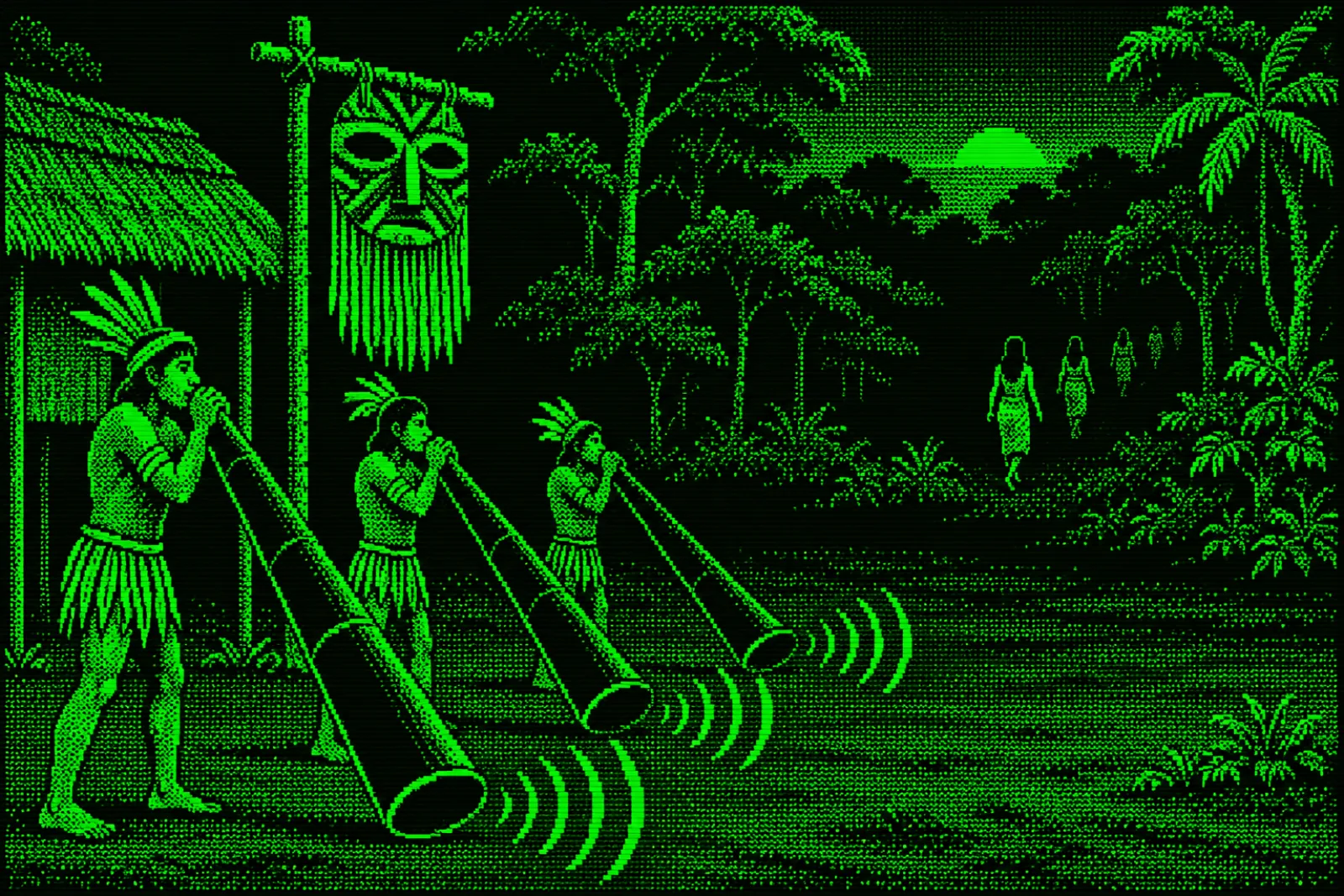
Les paxiubas sont de hauteur d'homme, de dix centimètres de diamètre, creuses, avec un orifice latéral entouré de feuilles que le souffle de l'évocateur fait vibrer. Elles sont peintes en noir. Le son qu'on tire des paxiubas rappelle le mugissement du taureau.
The paxiubas are as tall as a man, ten centimetres across, hollow, with a side opening surrounded by leaves that the breath of the one who calls up the god sets vibrating. They are painted black. The sound drawn from the paxiubas recalls the bellowing of a bull.
Note on line p187-04
These are trumpets, not bullroarers: a hollow length of paxiuba palm with leaves round a side hole that the breath sets vibrating. The bull is only the comparison for the sound. - p187-05p. 187
Les paxiubas sont, dans la pratique, moins sacrées pour les femmes. Après qu'on a fini de s'en servir on les met dans l'eau courante d'un igarapé où il n'est pas rare que les femmes les découvrent, sans en parler à personne. Cependant, les pagets, quand ils arrivent à apprendre le fait, font semblant de l'ignorer.
In practice the paxiubas are less sacred for the women. After they have finished using them, they are put in the running water of an igarapé, where it is not rare for the women to discover them, without speaking of it to anyone. However, the pagets, when they manage to learn of the fact, pretend to ignore it.
- p188-01p. 188
Mais pour le macacaraua, la défense aux femmes de le voir sous peine de mort est formelle. Aussi bien ont-elles moins l'occasion de le voir que les paxiubas. Il n'y en a que deux, à Jauarité, sans compter les deux qu'Ambrosio donna à Coppi qui les a emportés à Rome. Les gens de Taraquá prétendent qu'ils n'en ont pas: ils vont en emprunter à Jauarité quand ils veulent faire un dabucuri.
But as for the macacaraua, the prohibition on women seeing it, on pain of death, is absolute. Indeed they have fewer opportunities to see it than the paxiubas. There are only two, at Jauarité, not counting the two that Ambrosio gave to Coppi, who carried them off to Rome. The people of Taraquá claim they have none: they go to borrow some from Jauarité when they want to hold a dabucuri.
- p188-02p. 188
Les cas de femmes mises à mort pour avoir vu le macacaraua sont fréquents. Les pagets savent leur administrer le taya de façon à les faire mourir en quelques heures, quelques jours, quelques semaines ou même seulement au bout de quelques mois, comme ils veulent, selon la préparation. Elles ne se doutent pas qu'elles ont été empoisonnées par le paget qui pourtant sait, à quelques heures ou à quelques jours près, la date de leur mort. Quand, au bout d'un temps quelconque, les femmes qui ont vu le macacaraua arrivent à mourir, les autres ne savent pas si elles doivent attribuer cette mort à une vengeance, une punition directe et personnelle de Jurupari, à un empoisonnement pur et simple du paget, ou bien à l'effet d'une puissance spéciale qui serait dans le paget ministre de Jurupari, de faire mourir par le seul fait de sa volonté, en soufflant sur la personne, la malheureuse qui a vu le symbole prohibé. Et ceci entretient les femmes dans une certaine frayeur vague, peu raisonnée mais profonde, de Jurupari et du macacaraua.
Cases of women put to death for having seen the macacaraua are frequent. The pagets know how to administer the taya: the poison the pagets give the women so as to bring them to death in a few hours, a few days, a few weeks, or even only after a few months, as they wish, depending on the preparation. They do not suspect that they have been poisoned by the paget, who nonetheless knows, to within a few hours or a few days, the date of their death. When, after some interval, the women who have seen the macacaraua do die, the others do not know whether to attribute this death to a vengeance, a direct and personal punishment by Jurupari; to plain and simple poisoning by the paget; or to the effect of a special power residing in the paget, Jurupari's minister, to kill by the mere exercise of his will, by breathing upon the person, the unfortunate woman who saw the forbidden symbol. And this keeps the women in a certain vague dread of Jurupari and of the macacaraua, little reasoned but deep.
- p188-03p. 188
Cela explique tout ce qu'il y a d'horreur sacrée dans la fête du dabucuri.
This explains all the sacred horror there is in the dabucuri festival.
The dabucuri
- p188-04p. 188
Les Indiens se préparent au dabucuri par un jeûne de trois jours. Il y a six dabucuris dans l'année. C'est la récolte de certains fruits qui détermine leur époque. Le premier dabucuri se fait en janvier avec le fruit de l'assahy, le second en février avec celui de l'ucuqui, le troisième en mars avec le fruit du mirity, le quatrième en mai avec celui du patauá, le cinquième en juillet avec celui de l'umari, le sixième en novembre avec la gousse de l'inga. De tous ces fruits les Indiens tirent des boissons enivrantes.
The Indians prepare for the dabucuri with a three-day fast. There are six dabucuris in the year. The harvest of certain fruits determines their timing. The first dabucuri takes place in January, with the fruit of the assahy; the second in February, with that of the ucuqui; the third in March, with the fruit of the mirity; the fourth in May, with that of the patauá; the fifth in July, with that of the umari; the sixth in November, with the pod of the inga. From all these fruits the Indians draw intoxicating drinks.
- p189-01p. 189
La durée de la fête est de trois jours. Les Indiens y arrivent de cinquante lieues à la ronde. Le jour venu, hommes et femmes, à partir des pubères, se peignent en noir et en rouge. On chante des chansons tristes et monotones, puis les pagets célèbrent les mariages. Ensuite on fait sortir les femmes. Elles sont envoyées dans la forêt sous la conduite d'un homme qui ne doit les laisser revenir qu'au moment convenu. Ensuite trois hommes, en grand costume de fête, se mettent à sonner de la paxiuba. Au bout d'une demiheure ou d'une heure, un ou plusieurs Indiens, généralement deux ou trois, déguisés en Juruparis, revêtus du macacaraua, ne laissant paraître que quatre doigts de chaque main, avec des pieds dont ils ne font voir que trois orteils, avec des griffes aux doigts des mains et des pieds, en tout semblables au Jurupari de la légende, font irruption dans la baraque, sautant à quatre pattes dans tous les sens au milieu des assistants et donnant à tort et à travers de grands coups de bâton qui ne sont pas rendus. Un grand silence est observé pendant cette cérémonie solennelle, puis les Juruparis se retirent. On sonne encore un quart d'heure de la paxiuba puis on fait entrer les femmes.
The festival lasts three days. The Indians come to it from fifty leagues around. When the day comes, men and women, from puberty up, paint themselves black and red. Sad, monotonous songs are sung, then the pagets celebrate the marriages. Then the women are made to go out. They are sent into the forest in the charge of a man who must not let them come back until the agreed moment. Then three men in full festival dress begin to sound the paxiuba. After half an hour or an hour, one or more Indians, usually two or three, disguised as Juruparis, dressed in the macacaraua, showing only four fingers of each hand and only three toes of each foot, with claws on their fingers and toes, in every way like the Jurupari of the legend, burst into the hut, leaping on all fours in every direction among the people present and dealing great blows of a stick right and left, which are not returned. A great silence is kept during this solemn ceremony; then the Juruparis withdraw. The paxiuba is sounded for another quarter of an hour, then the women are let in.
- p189-02p. 189
Les flagellations mutuelles commencent. Armés de verges les uns et les autres, les hommes fouettent les femmes et les femmes les hommes. Si un blanc arrive alors, il peut prendre part à la fête en consentant à recevoir quelques coups qu'il pourra ensuite rendre avec usure. Alors l'orgie, la saturnale commence. On fait une grande ronde, chacun marche à pas cadencés, appuyant la main droite sur l'épaule de celui qui précède. Chaque danseur a une espèce de flûte dont il tire un son aigre en la faisant passer, d'un mouvement rapide, sur les lèvres, de haut en bas, du front à la poitrine. Les femmes forment une ronde concentrique.
Mutual floggings begin. Armed with switches, one and all, the men whip the women and the women the men. If a white man arrives at that moment, he may take part in the festival by consenting to receive a few blows, which he may afterwards return with interest. Then the orgy, the saturnalia, begins. A great round dance is formed; each one walks in measured steps, resting the right hand on the shoulder of the one ahead. Each dancer has a sort of flute, from which he draws a shrill sound by passing it with a rapid movement over the lips, from top to bottom, from the forehead to the chest. The women form a concentric round.
Note on line p189-02
The “sort of flute” drawn across the lips is a separate instrument from the paxiuba trumpets; Coudreau gives no name for it. - p190-01p. 190
On tourne ainsi toute la nuit, d'abord lentement, tant qu'on a la possession de soi-même. Mais bientôt tout le monde est ivre de cachiri, d'ipadú, de cachaça ou de caapim: tous dansent, gesticulent, bondissent, comme des possédés. On n'a pas oublié Jurupari, qu'on invite de temps à autre à venir se divertir un peu. Mais il répond, par la bouche des pagets, qu'il ne le peut, que s'il avait des relations avec une femme (ce qui indique bien le caractère de la fête), il serait changé en serpent, ou, disent d'autres, il en naîtrait un serpent.
So they circle all night, slowly at first, as long as they still have possession of themselves. But soon everyone is drunk on cachiri, ipadú, cachaça or caapim: all dance, gesticulate and leap like the possessed. Jurupari has not been forgotten; from time to time he is invited to come and enjoy himself a little. But he answers, through the mouth of the pagets, that he cannot: if he had relations with a woman (which shows well enough the character of the festival), he would be changed into a serpent, or, others say, a serpent would be born of it.
Note on line p190-01
“Relations with a woman” is Coudreau’s own phrase: sex with a woman. The aside in brackets is his. - p190-02p. 190
D'abord le costume des danseurs et des danseuses est correct: l'acangatara, les colliers, les bracelets, et le reste. Puis, bientôt, hommes et femmes n'ont plus que la tangue ou le calembé. Ceux-là même qui, au commencement de la fête avaient pantalon ou jupe, ne tardent pas à se débarrasser de l'incommode ornement. Puis, quelques nouvelles flagellations aidant, les têtes se perdent, tournent, et les ardents donnent le signal de se fouetter avec les tangues et les calembés qu'on s'arrache et qui bientôt forment litière et sont foulés aux pieds dans la poussière immonde souillée de vomissements. La nuit se passe en danses, beuveries et débauches. Il s'exhale de la baraque une odeur de roucou et de genipa délayés par la sueur, de tabac, d'ivrognerie et de prostitution. Des enfants des deux sexes, chose monstrueuse, sont là, cherchant ou subissant leurs premiers exemples et leurs premières pratiques de luxure et de crapule. Toute la nuit on entend au loin cette rumeur de gens ivres. De temps à autre on souffle de la paxiuba et on se flagelle pour surexciter jusqu'au délire la tête et les sens fatigués. Le lendemain, au petit jour, il fait beau voir ce bal éhonté, des démons à tête hébétée, l'œil en feu ou terne, tombés ivres-morts pêle-mêle ou gambadant encore dans un paroxysme nerveux, des oripeaux de plumes et de perles piétinés, une atmosphère saturée de tabac, de poussière et de saoûlerie, et, à la clarté pâlissante de lumignons tremblotants, une dernière ronde de quelques forcenés, hommes et femmes, jeunes et vieux, tous nus et souillés, dansant et chantant encore, énervés et stupides, d'un pas mal assuré et d'une voix rauque, un cancan obscène et fantastique.
At first the dancers' costume, for men and women, is correct: the acangatara, the necklaces, the bracelets, and the rest. Then, soon, men and women have nothing left but the tangue or the calembé. Those very people who, at the start of the festival, wore trousers or a skirt are quick to rid themselves of that cumbersome ornament. Then, with a few fresh floggings to help, heads go astray and spin, and the most fervent give the signal to whip themselves with the tangues and calembés, which they snatch from one another, and which soon form a litter, trampled underfoot in the dust, filthy and fouled with vomit. The night passes in dancing, drinking-bouts and debauchery. There rises from the hut a smell of roucou and genipa dissolved in sweat, of tobacco, of drunkenness and of prostitution. Children of both sexes, a monstrous thing, are there, seeking or undergoing their first examples and first practices of lust and debauchery. All night one hears, far off, that rumour of drunken people. From time to time they blow the paxiuba and flog themselves to drive the head and the wearied senses into delirium. The next day, at first light, it is a sight to see this shameless ball: demons with dazed heads, eyes on fire or dull, fallen dead drunk in a heap or still gambolling in a nervous paroxysm; tattered finery of feathers and beads trampled underfoot; an atmosphere saturated with tobacco, dust and drunkenness; and, in the fading light of flickering lamps, a last round of a few frenzied people, men and women, young and old, all naked and filthy, still dancing and singing, enervated and stupid, with an unsteady step and a hoarse voice, an obscene and fantastic cancan.
- p191-01p. 191
C'est par le jeûne qu'on se prépare à cette pieuse cérémonie, car les Uaupès sont fort convaincus. La meilleure preuve se trouve dans les jeûnes réellement rigoureux et fréquents qu'ils s'imposent: jeûne de trois jours pour le dabucuri; jeûne pour évoquer Jurupari; jeûne pour demander à Jurupari de n'être pas mangés par le serpent; — pour que les blessures guérissent; — pour aller au ciel; — et, les femmes, pour avoir régulièrement leurs menstrues. Il y a aussi le jeûne d'un mois pour les premières menstruations, le jeûne pendant l'époque des menstrues, le jeûne de quatre jours à chaque nouvelle lune, jeûne avant la semaille du maïs qui sans cela ne donnerait pas de grains, un autre jeûne en novembre pour la cueillette de l'inga. Et tous, enfants et vieillards, sont astreints à la plupart de ces jeûnes, qui sont des cérémonies propitiatoires pour se concilier Jurupari.
It is by fasting that one prepares for this pious ceremony, for the Uaupés are very convinced. The best proof lies in the truly rigorous and frequent fasts they impose on themselves: a three-day fast for the dabucuri; a fast to invoke Jurupari; a fast to ask Jurupari not to let them be eaten by the serpent; a fast so that wounds heal; a fast to go to heaven; and, for the women, a fast to have their menses regularly. There is also the month-long fast for first menstruation, the fast during the time of the menses, the four-day fast at each new moon, a fast before sowing maize, which otherwise would not yield grain, and another fast in November for gathering the inga. And all, children and old men, are bound to most of these fasts, which are propitiatory ceremonies to win over Jurupari.
- p191-02p. 191
En temps de jeûne, les hommes s'abstiennent de tout travail. Les femmes pêchent et vont à la roça pour pourvoir elles-mêmes à la nourriture permise. Le jeûne des hommes, et principalement celui d'avant le dabucuri, est fort pénible. Ils s'abstiennent de chair, de poisson, de piment, des fruits de la terre ou de la forêt. Ils se nourrissent de beijú et de caradá avec lesquels ils mangent les fourmis maniquera et saübas. Le beijú est une cassave épaisse d'un doigt et le caradá est une galette à peu près semblable, mais faite de tapioca presque pur. Le tout est pris en petites quantités, réglées d'après les habitudes de la tribu. Les jeûneurs souffrent principalement de la privation de piment, leur excitant quotidien, qui leur est comme le vin pour les Européens. Malgré le jeûne, ils boivent le cachiri et prennent aussi de la cachaça, quand ils en ont. Pendant les jeûnes on se livre à des exercices religieux. On va se promener dans la forêt avec les paxiubas et on évoque Jurupari. Leur état d'excitation mentale et d'inanition leur procure des visions, et c'est peut-être là le but principal, non raisonné, de ces jeûnes.
In time of fasting the men abstain from all work. The women fish and go to the roça to provide the permitted food themselves. The men's fast, and above all the one before the dabucuri, is very hard. They abstain from meat, fish, pepper, and the fruits of the earth or the forest. They live on beijú and caradá, with which they eat maniquera and saüba ants. Beijú is a cassava bread a finger thick, and caradá is a flat cake much like it but made of almost pure tapioca. All of it is taken in small amounts, set by the custom of the tribe. The fasters suffer most from going without pepper, their daily stimulant, which is to them what wine is to Europeans. Despite the fast they drink cachiri, and also take cachaça when they have any. During the fasts they give themselves to religious exercises. They go walking in the forest with the paxiubas and call up Jurupari. Their state of mental excitement and starvation brings them visions, and that is perhaps the main purpose, unreasoned, of these fasts.
Note on line p191-02
The last clause, on visions as the purpose, is Coudreau’s guess. - p192-01p. 192
Une autre preuve de la sincérité, de la profondeur des convictions des Uaupès, est l'empoisonnement des femmes qui ont vu le macacaraua. Il y a quelques années, pour ce fait, dix femmes furent mises à mort à Panoré, et cinq à Taraquá. Il y a environ cinq ans, un Père Salgado, en tournée apostolique, reçut deux coups de feu à Panoré pour avoir profané un macacaraua. Pour une raison semblable, les Indiens tuèrent, à cette époque, à Jauarité, un soldat de la Commission des limites. Les plus fanatiques, les plus terribles, sur le chapitre du respect dû aux mystères, sont ces mêmes Tarianas si imprudemment provoqués à Panoré par Coppi et Camioni.
Another proof of the sincerity and depth of the convictions of the Uaupés is the poisoning of the women who have seen the macacaraua. A few years ago, for this deed, ten women were put to death at Panoré, and five at Taraquá. About five years ago, a Father Salgado, on an apostolic tour, received two gunshots at Panoré for having profaned a macacaraua. For a similar reason, the Indians killed, at that time, at Jauarité, a soldier of the Boundary Commission. The most fanatical and the most terrible, on the subject of the respect owed to the mysteries, are those same Tarianas so imprudently provoked at Panoré by Coppi and Camioni.
Tupan and Jurupari
- p192-02p. 192
La cosmogonie et la métaphysique de la religion des Uaupès est assez difficile à reconstituer.
The cosmogony and metaphysics of the Uaupés religion are rather difficult to reconstruct.
- p192-03p. 192
Nous avons vu qu'à côté de Jurupari il existait aussi Tupan. Chacune des tribus des Uaupès a un nom spécial pour Jurupari et un autre pour Tupan mais toutes connaissent les deux noms.
We have seen that alongside Jurupari there also existed Tupan. Each of the Uaupés tribes has a special name for Jurupari and another for Tupan, but all of them know both names.
- p193-01p. 193
Le Tupan des Uaupès ne doit pas être indigène. On sait que le Tupan des Tupis primitifs n'était pas du tout le principe bon. C'était l'expression de la notion abstraite de la cause inconnue, terrible et majestueuse, dont le tonnerre (tupã) paraissait la plus admirable manifestation. C'était la cause créatrice et destructrice, une entité ni bonne ni mauvaise. Il existait de bons génies dont Tupan, trop haut placé, ne daignait point avoir la direction, et de mauvais dont Anhanga était le chef. D'ailleurs les Tupis ne rendaient de culte ni à Tupan ni à Anhanga.
The Tupan of the Uaupés is probably not native. We know that the Tupan of the primitive Tupi was not at all the good principle. He was the expression of the abstract notion of the unknown cause, terrible and majestic, whose most admirable manifestation seemed to be thunder (tupã). He was the cause that creates and destroys, an entity neither good nor evil. There were good spirits, whose direction Tupan, placed too high, did not deign to take on, and evil ones, whose chief was Anhanga. Besides, the Tupi paid worship neither to Tupan nor to Anhanga.
- p193-02p. 193
Je ne retrouve rien de cette conception abstraite dans le Tupan des Uaupès. Ce Tupan doit être originaire de quelque antique mission catholique de la contrée. Les missionnaires, comme cela a été fait dans le sud du Brésil, auront assimilé la notion abstraite du Tupan des Tupis, avec la notion concrète du Dieu-le-Père des chrétiens. Les Indiens des Uaupès paraissent se souvenir vaguement de ce Tupan-là par tradition. Ces réminiscences chrétiennes que l'on retrouve dans la notion de Tupan, dans la légende de Jurupari, doivent venir des anciens missionnaires espagnols, avec lesquels, depuis longtemps, les Uaupès, surtout au début de la conquête, ont dû avoir des relations, car ils ont conservé le souvenir de Santa Rosa de Lima, et ils emploient encore aujourd'hui, assez fréquemment, certains vocables espagnols tels que bueno, sombrero, carajo.
I find nothing of this abstract conception in the Tupan of the Uaupés. This Tupan must originate from some ancient Catholic mission of the region. The missionaries, as was done in southern Brazil, will have assimilated the abstract notion of the Tupan of the Tupis to the concrete notion of God the Father of the Christians. The Indians of the Uaupés seem to remember this Tupan vaguely by tradition. These Christian reminiscences, which one finds in the notion of Tupan and in the legend of Jurupari, must come from the old Spanish missionaries, with whom, for a long time, the Uaupés, especially at the beginning of the conquest, must have had dealings, for they have kept the memory of Santa Rosa de Lima, and they still employ today, quite frequently, certain Spanish words such as bueno, sombrero, carajo.
Note on line p193-02
“Avoir des relations” here means contact with the Spanish missionaries. The whole derivation of Tupan, and of the Christian echoes in the Jurupari legend, from old Spanish missions is Coudreau’s own. - p193-03p. 193
S'il en est ainsi, le Tupan des anciens missionnaires est aujourd'hui bien défiguré. Il est devenu un homme grand marcheur, grand voyageur, qui s'amusait, pendant ses pérégrinations à tracer, des dessins sur les granits des cataractes.
If that is so, the Tupan of the old missionaries is today badly disfigured. He has become a man who walks a great deal, a great traveller, who amused himself during his wanderings by tracing drawings on the granite of the cataracts.
- p193-04p. 193
D'ailleurs les pagets ne sont pas d'accord sur le compte de ce Tupan; quelques-uns, en petit nombre, célèbrent des fêtes en son honneur: c'est lui, disent-ils, qui a créé tout ce qui existe. Mais beaucoup d'entre eux n'admettent pas que le Tupan des blancs soit le même que le leur. Le même Tupan, pensent-ils, ne peut pas servir pour les deux races. Quand ils sont ivres ils sont affirmatifs avec arrogance: « Notre dieu, disent-ils, est plus puissant que celui des blancs. » Mais c'est alors Jurupari surtout qu'ils ont en vue. De sang-froid, ceux qui ont la bosse mythologique établissent une espèce de hiérarchie vague: Jurupari, le Terrible; le Tupan des Indiens, le Bon; le Tupan des Blancs, le Puissant. Mais ils ont aussi peu de crainte de ce dernier que d'envie de s'occuper de lui.
Moreover the pagets do not agree about this Tupan. A few of them, a small number, celebrate festivals in his honour: it is he, they say, who created everything that exists. But many of them do not admit that the Tupan of the whites is the same as theirs. The same Tupan, they think, cannot serve for both races. When they are drunk they are arrogantly assertive: "Our god, they say, is more powerful than that of the whites." But it is then chiefly Jurupari whom they have in view. In cold blood, those who have the mythological bump establish a sort of vague hierarchy: Jurupari, the Terrible; the Tupan of the Indians, the Good; the Tupan of the Whites, the Powerful. But they have as little fear of the last as they have desire to concern themselves with him.
Note on line p193-04
“La bosse mythologique”, “the mythological bump”, is phrenology’s idiom: a gift for myth. - p194-01p. 194
Jurupari n'est pas en opposition avec Tupan. Tupan a un caractère universel et vague, Jurupari a un caractère local et précis. Tupan c'est le dieu, Jurupari c'est leur dieu. Ancêtre des Uaupès qui le considèrent comme leur plus ancien aïeul, le père de leur race, comme l'aïeul devenu immortel et dieu après sa mort, il est Uaupès comme Jéhovah est Juif. Aucun Uaupès ne vous racontera l'histoire de ce dieu national, si terrible, sinon sur un ton passionné et convaincu, en y joignant une pantomime expressive. C'est un dieu à eux, bien plus à leur portée que le métaphysique Tupan, auquel ils ne comprennent pas grand'chose, et sur le compte de qui ils sont arrêtés à chaque pas quand on les interroge.
Jurupari is not in opposition to Tupan. Tupan has a universal and vague character; Jurupari has a local and precise character. Tupan is the god; Jurupari is their god. Ancestor of the Uaupés, who regard him as their most ancient forefather, the father of their race, as the grandfather become immortal and a god after his death, he is a Uaupés as Jehovah is a Jew. No Uaupés will recount to you the story of this national god, so terrible, except in a passionate and convinced tone, adding an expressive pantomime. He is a god of their own, far more within their reach than the metaphysical Tupan, of whom they understand very little, and concerning whom they are brought up short at every step when one questions them.
- p194-02p. 194
Jurupari a un caractère terrible et mauvais. Il voit avec plaisir chez son peuple l'ivrognerie, la débauche et le meurtre. Cependant il a été créé par Tupan, dont il est en quelque sorte le ministre du mal.
Jurupari has a terrible and evil character. He takes pleasure in seeing drunkenness, debauchery and murder among his people. Yet he was created by Tupan, of whom he is, in a sense, the minister of evil.
- p194-03p. 194
Il est curieux de remarquer à quel point le dieu-ancêtre Jurupari, et le dieu plus ou moins imposé par l'étranger, Tupan, font aujourd'hui bon ménage. Quand Tupan se promenait sur la terre, dit la légende, alors qu'il visitait les rivières et les igarapés des Uaupès, il était toujours accompagné de Jurupari, son guide.
It is curious to note how well the ancestor-god Jurupari and the god more or less imposed by the foreigner, Tupan, get along together today. When Tupan walked upon the earth, says the legend, while he visited the rivers and igarapés of the Uaupés, he was always accompanied by Jurupari, his guide.
- p195-01p. 195
Jurupari habite avec Tupan, en haut, au ciel, mais il aime beaucoup les forêts des Uaupès, où il se promène souvent et où il se manifeste de temps à autre. Ancêtre terrible, son double immortel n'est pas moins terrible. On le craint comme on le craignait. On l'honore et on lui rend un culte pour apaiser ses fureurs. Mainte rivière, maint igarapé, mainte cachoeira, portent son nom. Les dabucuris sont les fêtes de son culte et les pagets sont ses ministres. Ce devait être quelque paget guerrier, vaillant et cruel.
Jurupari dwells with Tupan, up above, in the sky, but he is very fond of the forests of the Uaupés, where he often walks and where he shows himself from time to time. A terrible ancestor, his immortal double is no less terrible. One fears him as one feared him before. One honours him and pays him worship to appease his furies. Many a river, many an igarapé, many a cachoeira bears his name. The dabucuris are the festivals of his worship and the pagets are his ministers. He must have been some warlike paget, valiant and cruel.
- p195-02p. 195
Après leur mort, les hommes vont avec Jurupari si, de leur vivant, ils ont honoré son culte. Mais s'ils ne l'ont pas honoré, — le chemin est long de la terre au ciel, — ils se perdent en route. Pour les femmes, dans le sentier qui va de la terre au ciel, elles rencontrent à mi-chemin une baraque dont le propriétaire s'appelle Bichiú, esprit inférieur. La baraque est pleine d'objets indiens, tangues, bracelets, etc. Si les femmes ont vu le macacaraua ou Jurupary sur la terre, elles restent dans la baraque de Bichiú, établissement qui constitue une espèce d'enfer supportable. Si elles n'ont pas vu le macacaraua, elles continuent leur route et arrivent au ciel de Jurupari où elles passent le temps à s'ébaudir avec les hommes en buvant le cachiri. D'autres tribus Uaupès disent que si les femmes ont vu le symbole ou le dieu sur la terre, à leur mort elles sont changées en crocodile ou en serpent. Il n'est jamais question d'aller chez Tupan, qui, décidément ne s'occupe de rien, et pour qui le métier d'Être suprême est une simple sinécure honorifique.
After their death, men go to be with Jurupari if in their lifetime they honoured his cult. But if they did not honour it (the road from earth to heaven is long) they get lost on the way. As for the women, on the path that goes from earth to heaven they meet, halfway, a hut whose owner is called Bichiú, a lesser spirit. The hut is full of Indian things, tangues, bracelets and so on. If the women saw the macacaraua, or Jurupary, on earth, they stay in Bichiú's hut, an establishment that amounts to a kind of bearable hell. If they did not see the macacaraua, they go on their way and reach Jurupari's heaven, where they spend their time making merry with the men and drinking cachiri. Other Uaupés tribes say that if the women saw the symbol or the god on earth, at their death they are changed into crocodiles or snakes. There is never any question of going to Tupan, who decidedly concerns himself with nothing, and for whom the job of Supreme Being is a mere honorary sinecure.
- p195-03p. 195
Dans le ciel de Jurupari on chasse, on pêche, on fait des cachiris et des dabucuris, comme dans le Uaupès. On y vit éternellement, bien mangeant, bien buvant, bien portant. La souffrance et la douleur sont inconnues.
In Jurupari's heaven one hunts, one fishes, one makes cachiris and dabucuris, as on the Uaupés. One lives there eternally, eating well, drinking well, in good health. Suffering and pain are unknown.
- p195-04p. 195
À côté du ciel de Jurupari, de la baraque de Bichiú, des forêts de l'égarement, il y aurait aussi quelque part, dans un endroit mal défini, une autre espèce d'enfer où les hommes mauvais, après s'être longtemps perdus en route, finiraient par arriver. Ils y continueraient la vie terrestre, mais malheureux, en souffrant beaucoup. Un Jurupari inférieur aurait le département de cet enfer. D'après des pagets autorisés et compétents, ce lieu de maladie et de misère serait situé tout au fond de la terre.
Beside Jurupari's heaven, Bichiú's hut and the forests of error, there would also be somewhere, in an ill-defined place, another kind of hell, where wicked men, after having long lost their way, would end up arriving. There they would continue earthly life, but unhappy, suffering greatly. A lesser Jurupari would have charge of this hell. According to authoritative and competent pagets, this place of sickness and misery would be situated at the very bottom of the earth.
- p196-01p. 196
Telle est cette religion singulière qui, à première vue semble être du chamanisme, du manichéisme ou du dualisme, ou un mélange de réminiscences chrétiennes défigurées et appropriées, mais qui, en réalité, n'est autre que le culte de l'Ancêtre réputé dieu et éternel, avec la croyance à l'immortalité du double.
Such is this singular religion, which at first sight seems to be shamanism, Manichaeism or dualism, or a mixture of disfigured and appropriated Christian reminiscences, but which in reality is nothing other than the cult of the Ancestor, held to be a god and eternal, with belief in the immortality of the double.
- p196-02p. 196
Certes les réminiscences chrétiennes sont nombreuses. Dans la légende de Jurupari on trouve l'Immaculée Conception (la Vierge-mère); la Passion (Jurupari brûlé); l'Ascension (l'âme de Jurupari grimpe au ciel par un palmier géant); le fruit défendu (les enfants qui mangent les fruits du uacqui); etc. Quelques vieux pagets savent même que la mère de Jurupari n'était pas indienne, et quelques-uns vont jusqu'à nous donner son nom: elle s'appelait Santa Maria. Mais ce que l'on ne trouve nulle part dans les croyances chrétiennes, c'est le macacaraua, les paxiubas, les dabucuris, la condamnation à mort des femmes qui ont vu les symboles secrets, — et, au fond, c'est là toute la religion de Jurupari.
Certainly the Christian reminiscences are numerous. In the legend of Jurupari we find the Immaculate Conception (the Virgin-mother); the Passion (Jurupari burned); the Ascension (the soul of Jurupari climbs to heaven by a giant palm); the forbidden fruit (the children who eat the fruit of the uacqui); and so on. Some old pagets even know that the mother of Jurupari was not Indian, and some go so far as to give us her name: she was called Santa Maria. But what is found nowhere in Christian beliefs is the macacaraua, the paxiubas, the dabucuris, the death sentence on women who have seen the secret symbols, — and, at bottom, that is the whole religion of Jurupari.
Spirits, pagets and the initiation of boys
- p196-03p. 196
Une des curiosités et des particularités de la religion des Uaupès est le nombre incalculable d'esprits malfaisants qu'elle reconnait. Il y a l'homme des bois qui vous égare; le géant de la forêt, le cauchemar; et d'autres qu'on évoque et qui apparaissent aux dabucuris. Le plus terrible est le Jurupari des bois qui est tout noir et gigantesque. Il n'a pas d'orteils aux pieds. Les orteils lui ont peut-être été mangés par les chiques comme cela arrive à certains Indiens malpropres de la tribu des Macús. Pour les Arapassos, le Jurupari des bois est plus puissant que celui des dabucuris à qui on ne rend un culte que pour que l'autre ne le mange pas.
One of the curiosities and peculiarities of the religion of the Uaupés is the incalculable number of malevolent spirits it recognises. There is the man of the woods who leads you astray; the giant of the forest, the nightmare; and others who are invoked and who appear at the dabucuris. The most terrible is the Jurupari of the woods, which is entirely black and gigantic. He has no toes on his feet. The toes have perhaps been eaten by the chiques, as happens to certain filthy Indians of the tribe of the Macús. For the Arapassos, the Jurupari of the woods is more powerful than that of the dabucuris, to whom a cult is rendered only so that the other will not eat him.
Note on line p196-03
Chiques are chigoes, the jigger flea (Tunga penetrans). The guess about the toes is Coudreau’s own. The last clause is as ambiguous in the French as here: the Arapaso worship the dabucuri Jurupari so that the forest one will not eat them, or will not eat him. - p197-01p. 197
Le corps sacerdotal des pagets est fortement organisé. Il en existe toute une hiérarchie: les pagets uarassú ou pagets parfaits, qui ont une très grande influence; les pagets assu ou grands pagets; les pagets mirim, ou apprentis pagets qui sont fort nombreux. L'organisation du pagétisme est peu connue, le secret en est bien gardé. C'est un clergé mystérieux et fermé. Le peuple de la tribu ne pénètre pas les mystères, mystères qui ne se révèlent que par degrés aux pagets, au fur et à mesure qu'ils prennent de nouveaux grades. C'est une espèce de franc-maçonnerie ayant ses dogmes, ses secrets, ses rites, ses initiations, ses degrés.
The priestly body of the pagets is strongly organised. There exists an entire hierarchy: the pagets uarassú, or perfect pagets, who have very great influence; the pagets assu, or great pagets; the pagets mirim, or apprentice pagets, who are very numerous. The organisation of pagetism is little known, its secret is well kept. It is a mysterious and closed clergy. The people of the tribe do not penetrate the mysteries, mysteries which are revealed to the pagets only by degrees, as they take on new grades. It is a kind of freemasonry having its dogmas, its secrets, its rites, its initiations, its degrees.
- p197-02p. 197
Les pagets sont aussi médecins, tirent des pierres et toutes sortes d'objets du corps des malades, font, à leur plaisir, le beau temps, la pluie et l'orage. D'où, par assimilation, les Indiens attribuent le même pouvoir aux missionnaires.
The pagets are also doctors; they draw stones and all sorts of objects out of the bodies of the sick, make, at their pleasure, fair weather, rain and storm. Hence, by assimilation, the Indians attribute the same power to the missionaries.
- p197-03p. 197
Mais ce sont surtout des exorcistes. Ils chassent les démons qui sont très nombreux: ce sont des ancêtres passés mauvais génies. Les pagets exorcisent la nourriture, les vierges qui vont se marier. Il y a, pour ces opérations, des formules magiques qui varient selon les tribus. Comme dans notre moderne sorcellerie, quand un paget a fait du mal, un autre paget peut guérir le mal fait par le premier. Certains pagets, en petit nombre, agissent par l'intermédiaire de démons qu'ils ont à leur service; mais la plupart agissent directement, en vertu du pouvoir que Jurupari leur a conféré. Les pagets sont aussi médiums: ils évoquent les esprits des morts. Les Indiens viennent, des extrémités du pays, prier les pagets de leur faire revoir leurs parents défunts. Les pagets acceptent, ils font venir les morts et vous pouvez alors vous entretenir avec les vôtres depuis longtemps enterrés; mais les médiums des Uaupes se font payer cher pour cette besogne.
But above all they are exorcists. They drive out the demons, who are very numerous: they are ancestors who have turned into evil spirits. The pagets exorcise food, and virgins who are about to marry. For these operations there are magic formulas, which vary from tribe to tribe. As in our modern sorcery, when one paget has done harm, another paget can cure the harm done by the first. Some pagets, a small number, work through demons they have in their service; but most work directly, by virtue of the power that Jurupari has conferred on them. The pagets are also mediums: they call up the spirits of the dead. Indians come from the far ends of the country to beg the pagets to let them see their dead relatives again. The pagets agree, they make the dead come, and you can then talk with your own people, long since buried; but the mediums of the Uaupés charge dearly for this work.
- p198-01p. 198
Chacun peut devenir paget avec le temps, si l'avancement le favorise. Tout est hiérarchie et initiation dans ce pays. Les enfants, interrogés en examen secret par les Pères sur le culte de Jurupari, répondaient invariablement: « Nous ne savons que cela, mais les vieillards et les pagets en savent bien davantage. » Ce qui implique une initiation à plusieurs degrés durant toute la vie. Tous les secrets des Uaupès ne seront pas si aisément pénétrés.
Anyone can become a paget in time, if advancement favours them. Everything is hierarchy and initiation in this country. Children, questioned in a secret examination by the Fathers on the cult of Jurupari, invariably answered: "We know only that, but the old men and the pagets know a great deal more." This implies an initiation in several degrees throughout one's whole life. All the secrets of the Uaupés will not be so easily penetrated.
- p198-02p. 198
Un des principaux objets des grands dabucuris consiste en une initiation pour les enfants. Vers l'âge de dix ou douze ans on leur montre les paxiubas, puis, vers treize ou quatorze, le macacaraua sacré. Le plus souvent, quand on montre pour la première fois aux enfants soit les paxiubas soit le macacaraua on ne se borne pas à une fustigation symbolique mais on accable de coups les pauvres petits. L'initiation est douloureuse, ce qui s'allie fort bien au caractère mystérieux de la fête. Après avoir initié les enfants les pagets leur disent: « Gardez-vous de raconter ces choses aux femmes si vous ne voulez pas que nous vous donnions du poison. » Et la crainte empêche les enfants de raconter ce que les pagets leur ont défendu de dire, et les femmes de questionner les enfants. Un secret qu'on a pu cacher à des femmes pendant des siècles, n'est-ce pas merveilleux?
One of the principal purposes of the great dabucuris consists of an initiation for the children. Around the age of ten or twelve they are shown the paxiubas, then, around thirteen or fourteen, the sacred macacaraua. Most often, when the children are shown the paxiubas or the macacaraua for the first time, one does not confine oneself to a symbolic whipping, but heaps blows on the poor little ones. The initiation is painful, which accords very well with the mysterious character of the festival. After initiating the children, the pagets say to them: "Take care not to tell these things to the women, if you do not want us to give you poison." And fear prevents the children from telling what the pagets have forbidden them to say, and the women from questioning the children. A secret that could be hidden from women for centuries — is it not marvellous?
Note on line p198-02
The closing question is Coudreau’s own. - p198-03p. 198
Ces pagets ne sont point des naïfs et on aurait grand tort de les mépriser. Bien plus élevés, au point de vue de l'évolution philosophique, que nombre de peuplades placées plus haut qu'eux dans l'échelle de la vie économique et politique, les Uaupès ne sont point fétichistes, ils ont la notion exacte du rêve et ne prennent pas pour des réalités les visions du sommeil. Ils distinguent fort bien le symbole de l'être symbolisé. « Ce n'est pas le macacaraua que nous adorons, disent-ils, le macacaraua n'est pas Jurupari, c'est son image, sa figure (rangaua). »
These pagets are by no means naïve, and one would be very wrong to despise them. Far more advanced, from the point of view of philosophical evolution, than many tribes placed higher than they are on the ladder of economic and political life, the Uaupés are not fetishists; they have an exact notion of dreams and do not take the visions of sleep for realities. They distinguish very well the symbol from the thing symbolised. "It is not the macacaraua that we worship," they say, "the macacaraua is not Jurupari, it is his image, his figure (rangaua)."
A heresy, and the god’s complaint
- p199-01p. 199
Malgré son homogénéité, la religion des Uaupès eut cependant son hérésie, il y a de cela quelques années. L'hérésiarque fut un paget d'Umari, Vicente Christo, de nation Arapasso. Vicente Christo parlait avec Tupan, son ami particulier, et, en grand médium qu'il était, il avait trouvé le moyen de faire voir et palper les esprits des morts, au moyen d'un ingénieux mécanisme de son invention. Il se disait le paget des pagets, et le père des missionnaires. C'est à sa prière que Tupan avait envoyé ces derniers aux Uaupès. Il faisait danser les Indiens autour de la croix, affirmait qu'il était leur Messie, leur Christ à eux. Et bientôt il ajouta qu'il fallait chasser tous ces blancs qui trompaient le peuple indien. Il fortifiait ses doctrines et ses assertions par un choix varié de miracles cousus de fil blanc. Il aspirait à être quelque chose comme le pape de la religion de Jurupari.
Despite its uniformity, the religion of the Uaupés nevertheless had its heresy, some years ago. The heresiarch was a paget of Umari, Vicente Christo, of the Arapasso nation. Vicente Christo conversed with Tupan, his particular friend, and, being a great medium, he had found the means of letting the spirits of the dead be seen and touched, by means of an ingenious mechanism of his own invention. He called himself the paget of the pagets, and the father of the missionaries. It was at his prayer that Tupan had sent the latter to the Uaupés. He made the Indians dance around the cross, and asserted that he was their Messiah, their Christ. And soon he added that all these whites who deceive the Indian people had to be driven out. He reinforced his doctrines and his assertions by a varied selection of miracles stitched with white thread. He aspired to be something like the pope of the religion of Jurupari.
Note on line p199-01
“Cousus de fil blanc”, “sewn with white thread”: so crude the seams show. - p199-02p. 199
De São-Joaquim à Jurupari-cachoeira tout le monde accourait chez Vicente Christo. Le rusé Arapasso menait douce vie. Quand les regatôes ou les Pères l'interrogeaient, il niait tout. Avec sa religion réformée, ses talents de médecin, ses danses de la croix, ses conversations avec Tupan, le nouveau prophète commençait à fanatiser en sa faveur et contre les régatôes, tous les Indiens du Uaupès. Le rio Negro, craignant de se faire fermer le Uaupès, fut effrayé. Ceci se passait en 1880, à peu près au moment de l'arrivée du P. Venancio à Taraquá. Il fut un instant question d'arrêter le prophète et de l'envoyer à Manáos pour y être jugé. Mais pour quel crime? Quelques regatôes plus pratiques prirent tout bonnement Vicente Christo avec eux, le mirent aux ceps, puis le firent enfermer quelques jours dans la prison de Barcellos. Sa gloire eut à en souffrir. D'autres Christos, disciples ou rivaux, se manifestèrent. Devenu moins entreprenant, le Messie du Uaupès ne cause plus aujourd'hui avec Tupan qu'en cachette. On peut engager comme pagayeur ce prophète méconnu.
From São Joaquim to Jurupari-cachoeira everyone rushed to Vicente Christo's. The crafty Arapasso led the sweet life. When the regatôes or the Fathers questioned him, he denied everything. With his reformed religion, his talents as a doctor, his dances of the cross, his conversations with Tupan, the new prophet had begun to inflame all the Indians of the Uaupés in his favour and against the regatôes. The rio Negro, fearing that the Uaupés would be closed to it, took fright. This was happening in 1880, at about the time Father Venancio arrived at Taraquá. For a moment there was talk of arresting the prophet and sending him to Manáos to be tried. But for what crime? Some more practical regatôes quite simply took Vicente Christo with them, put him in the stocks, and then had him locked up for some days in the prison of Barcellos. His glory suffered for it. Other Christos, disciples or rivals, made their appearance. Grown less enterprising, the Messiah of the Uaupés now talks with Tupan only in secret. One can hire this unrecognised prophet as a paddler.
- p200-01p. 200
A côté de l'hérésie il y a l'indifférence. Trois jours après la manifestation de Panoré, Jurupari apparut en personne à un vieux paget du village. « Tupan, dit-il, m'a ordonné de vous faire abandonner les dabucuris et mon symbole et de vous soumettre en tout aux Pères. » C'était grave: le dieu abdiquait. Mais le paget fut convaincu de philippiser par un autre paget son voisin à qui Jurupari parla d'une façon authentique: « Persuade bien aux Uaupès, dit le dieu, que je ne suis pas assez bête pour leur conseiller de m'abandonner. »
Beside heresy there is indifference. Three days after the display at Panoré, Jurupari appeared in person to an old paget of the village. "Tupan," he said, "has ordered me to make you give up the dabucuris and my symbol, and to submit to the Fathers in everything." This was serious: the god was abdicating. But the paget was convicted of philippizing by another paget, his neighbour, to whom Jurupari spoke in an authentic manner: "Make the Uaupés understand," said the god, "that I am not stupid enough to advise them to abandon me."
Note on line p200-01
To “philippize” is to speak for whoever pays you, from Demosthenes’ charge that the Delphic oracle “philippized” for Philip of Macedon: the first paget was caught speaking for the missionaries. - p200-02p. 200
Voici, de la même époque, une autre version d'un autre paget. Le père de Thomas, l'un des pagets de Taraquá, pagayant dans le rio Uaupès, est pris par une tempête, accoste et se met au pied d'un arbre. Il vit alors passer pardessus les plus hautes branches de la forêt, le Jurupari inférieur, celui de l'enfer, revêtu du macacaraua sacré. « Tu te promènes? lui demande tranquillement l'intrépide Tucano. — J'en ai la permission de Tupan, répond le Jurupari inférieur. — Où est Tupan? — Là-haut, au ciel. — Et toi, où habites-tu? — Là, au fond, dit le Jurupari inférieur, en montrant la terre, veux-tu venir? — Non, dit l'Indien qui commençait à s'épouvanter. — Pourtant tu y viendras, dit le dieu de l'enfer en continuant sa route, tu y viendras si tu continues à te comporter mal envers le grand Jurupari. Prends garde de ne pas pleurer un jour dans les tourments de ma demeure, répétait, en s'éloignant, le dieu de l'enfer. On profane les mystères, les ennemis de Jurupari triomphent, vous servez nos ennemis ou bien vous êtes indifférents, le grand Jurupari, le puissant, le terrible Jurupari est irrité contre vous. » Le vieux paget, père de Thomas le paget, était sur le point de perdre connaissance, mais la voix se tût, et le dieu de l'enfer s'évanouit dans l'espace.
Here, from the same period, is another version, from another paget. The father of Thomas, one of the pagets of Taraquá, paddling on the Uaupés river, is caught by a storm, puts ashore and takes shelter at the foot of a tree. He then saw, passing over the highest branches of the forest, the lower Jurupari, the one of hell, clad in the sacred macacaraua. "Are you out for a stroll?" the intrepid Tucano asks him calmly. "I have Tupan's permission for it," answers the lower Jurupari. "Where is Tupan?" "Up there, in the sky." "And you, where do you live?" "There, down below," says the lower Jurupari, pointing to the earth, "do you want to come?" "No," says the Indian, who was beginning to be terrified. "You will come there all the same," says the god of hell as he continues on his way, "you will come there if you keep behaving badly toward the great Jurupari. Take care that you do not one day weep in the torments of my dwelling," the god of hell kept repeating as he went off. "The mysteries are profaned, the enemies of Jurupari triumph, you serve our enemies or else you are indifferent; the great Jurupari, the powerful, the terrible Jurupari, is angry with you." The old paget, Thomas the paget's father, was on the point of losing consciousness, but the voice fell silent, and the god of hell vanished into space.
- p201-01p. 201
D'après les pagets les plus orthodoxes voici exactement au point où Jurupari en serait avec son peuple.
According to the most orthodox pagets, here is exactly where Jurupari stands with his people.
- p201-02p. 201
Après la manifestation du 18 octobre 1883, Jurupari dit aux pagets qu'il était fort en colère contre les missionnaires à cause de la profanation qu'ils avaient faite de son symbole en le montrant aux femmes; et contre les femmes qui, malgré sa défense si ancienne et si formelle avaient vu le macacaraua. Pour ce crime les femmes n'iraient pas avec lui mais avec Bixiú. Elles ne mourraient pas de suite parce qu'il n'y avait pas de leur faute. Toutefois il était nécessaire qu'un jeûne général fût observé. Et le Jurupari termina en se plaignant amèrement de son peuple qui le délaissait.
After the display of 18 October 1883, Jurupari told the pagets that he was very angry with the missionaries, because of the profanation they had committed against his symbol by showing it to the women; and against the women who, despite his prohibition, so ancient and so formal, had seen the macacaraua. For this crime the women would not go with him but with Bixiú. They would not die straight away, since it was not their fault. Still, a general fast had to be observed. And Jurupari ended by bitterly complaining of his people, who were abandoning him.
- p201-03p. 201
Et il a raison de se plaindre, Jurupari. Les pagets, ministres de son culte, ont toujours plus d'influence sur les Indiens que les missionnaires, considérés seulement comme des envoyés de Tupan, mais le zèle se refroidit. Ainsi, depuis la manifestation de Panoré, les femmes témoignent-elles une certaine reconnaissance aux missionnaires. Elles voient une espèce de délivrance morale dans cet étalage du macacaraua fait devant elles sans qu'il leur en soit rien arrivé. Les missionnaires commencent par gagner les femmes, c'est un bon moyen de gouvernement. Pour le peuple, le culte de Jurupari n'est qu'une coutume peu raisonnée bien que puissante. Les pratiques chrétiennes auxquelles il s'habitue avec les missionnaires constituent une nouvelle accoutumance moins puissante que l'ancienne, mais qui un jour sans doute arrivera à la supplanter. En attendant il fait de l'éclectisme. Il veut conserver ses missionnaires, mais il veut aussi conserver ses pagets; il veut bien aller à la messe, mais il ne veut pas pour cela renoncer aux dabucuris; il aime bien Jésus-Christ son nouveau dieu, mais il aime surtout Jurupari son vieux dieu. Ce sont deux puissants dieux.
And he is right to complain, Jurupari. The pagets, the ministers of his cult, still have more influence over the Indians than the missionaries, who are regarded only as envoys of Tupan; but zeal is cooling. So, since the display at Panoré, the women show a certain gratitude to the missionaries. They see a kind of moral deliverance in this parading of the macacaraua before them without anything having happened to them. The missionaries begin by winning over the women; it is a good means of government. For the people, the cult of Jurupari is only a custom, little reasoned though powerful. The Christian practices they are getting used to with the missionaries make a new habit, less powerful than the old one, but which will no doubt one day supplant it. In the meantime they are eclectic. They want to keep their missionaries, but they also want to keep their pagets; they are quite willing to go to Mass, but they will not give up the dabucuris for it; they are fond of Jesus Christ, their new god, but above all they love Jurupari, their old god. They are two powerful gods.
The Uaupés and the legend of the Amazons
- p202-01p. 202
Les Uaupès et la légende des Amazones. — Personne au Uaupès, pas même les plus anciens pagets, personne n'a la notion exacte de l'origine des tribus de la rivière. Cette notion, bien que vague, défigurée, méconnaissable, est pourtant la même chez tous les habitants de cette contrée. Mais il faut chercher la ruine sous les monceaux de végétation parasite qui la couvrent. Ce n'est que par induction qu'on peut arriver à tirer la vérité d'un énorme ensemble de faits réunis. Il faut ici la déméler au milieu des croyances vagues, des renseignements confus et contradictoires fournis par les sauvages. D'ailleurs cette notion exacte de l'origine ne peut être connue que par les anciens des tribus. La notion d'un événement historique, chez un peuple sans documents écrits, où tout se transmet par la tradition orale, ne peut arriver après plusieurs siècles qu'étonnamment défigurée.
The Uaupés and the legend of the Amazons. — No one on the Uaupés, not even the oldest pagets, has the exact notion of the origin of the tribes of the river. This notion, though vague, disfigured and unrecognizable, is nonetheless the same among all the inhabitants of this country. But one must search for the ruin beneath the heaps of parasitic vegetation that cover it. Only by induction can one arrive at the truth from an enormous body of gathered facts. Here one must disentangle it from the vague beliefs and the confused and contradictory information furnished by the savages. Moreover, this exact notion of the origin can be known only through the elders of the tribes. The notion of a historical event, among a people without written documents, where everything is transmitted by oral tradition, cannot after several centuries arrive other than astonishingly disfigured.
- p202-02p. 202
Il en est de l'origine des nations du Uaupès comme de l'exode des Amazones, autre événement local dont nous allons rapprocher le premier. Dans l'impossibilité de donner aux faits une reconstitution positive, il faut, quand on veut faire de l'exégèse, se contenter de vraisemblances et de probabilités. Quelques dessins indigènes, des légendes, les mœurs et la religion locales, c'est tout ce que nous aurions pour édifier nos théories si nous voulions en faire. Mais nous ne pensons qu'à des rapprochements.
It is with the origin of the nations of the Uaupés as with the exodus of the Amazons, another local event that we are going to set beside the first. Since it is impossible to give the facts a positive reconstruction, one must, when wishing to practise exegesis, be content with likelihoods and probabilities. A few native drawings, some legends, the customs and local religion: that is all we would have to build our theories, if we wished to make any. But we think only of comparisons.
- p202-03p. 202
Il me semble qu'on trouve dans l'étude des nations du Uaupès l'explication la plus plausible qui ait été fournie jusqu'à ce jour, du légendaire exode des Amazones. Je présenterai successivement mes arguments laissant à d'autres le soin de conclure.
It seems to me that in the study of the nations of the Uaupés one finds the most plausible explanation yet offered of the legendary exodus of the Amazons. I shall present my arguments in turn, leaving to others the task of concluding.
- p202-04p. 202
Remarquons tout de suite que le nom même de Uaupès signifie en tupi dans la fuite ou le chemin de la fuite, ce qui éveille tout d'abord l'idée d'un exode.
Let us note at once that the very name Uaupés means, in Tupi, "in flight" or "the road of flight," which immediately awakens the idea of an exodus.
- p203-01p. 203
Si les nations qui avaient pris part à l'exode avaient présenté primitivement une grande homogénéité, cette homogénéité n'aurait pas été sensiblement altérée jusqu'à nos jours. Or, en niant l'exode, admis par hypothèse, il serait impossible d'expliquer la formation sur place, dans un milieu aussi restreint, n'offrant qu'une seule voie de pénétration, celle de la rivière, d'un nombre aussi considérable de tribus aussi disparates. Car rien n'est plus hétérogène que les tribus du Uaupès. Il n'y a qu'une unité, celle de la religion, religion tellement étrange qu'on n'en trouve son équivalent dans aucune autre nation indienne. La religion est bien une. De la bouche du Uaupès aux Andes, partout on trouve des Juruparis dessinés sur les pierres, des noms de Jurupari donnés aux accidents géographiques, partout on sonne de la paxiuba, on fait des dabucuris et on met à mort les femmes qui ont vu le macacaraua. Cependant on trouve dans cette contrée une douzaine de dialectes étrangers les uns aux autres, et on ne se comprend pas de tribu à tribu. Le type est prodigieusement disparate et comprend toutes les variétés intermédiaires entre le mongoloïde et l'européen. Et pourtant, chez toutes les grandes nations indiennes de l'Amérique du sud, Munducurús, Guayacurús, Cayapôs, on parle une langue unique, les fractions de chacune de ces nations se comprennent fort bien entre elles, et il n'existe pas de différence sensible dans le type, si ce n'est quelquefois, ce qui s'explique aisément, entre les hommes conquérants et les femmes d'une autre race, léguant leur type à leurs filles par l'hérédité sexuelle, ou bien encore chez la famille-chef qui se conserve pure de tout mélange. Mais chez les Uaupès le type présente des variations radicales dans la même tribu, dans la même famille. Comment ces peuples disparates peuvent-ils avoir une même religion, religion elle-même si bizarre? Donc il y a eu exode, car des tribus si différentes les unes des autres ne peuvent se former d'elles-mêmes dans un milieu si restreint et si fermé; donc, de plus, il y a eu exode de nations primitivement différentes les unes des autres.
If the nations that took part in the exodus had originally shown a great homogeneity, that homogeneity would not have been appreciably altered down to our day. Now, by denying the exodus, admitted as a hypothesis, it would be impossible to explain the formation on the spot, in so restricted a setting offering only one route of entry, that of the river, of so considerable a number of such disparate tribes. For nothing is more heterogeneous than the tribes of the Uaupés. There is only one unity, that of religion, a religion so strange that no equivalent of it is found in any other Indian nation. The religion is indeed one. From the mouth of the Uaupés to the Andes, everywhere one finds Juruparis drawn on the rocks and names of Jurupari given to geographic features; everywhere the paxiuba is sounded, dabucuris are held, and the women who have seen the macacaraua are put to death. Yet in this region there are a dozen dialects foreign to one another, and the tribes cannot understand each other. The type is prodigiously disparate and includes every intermediate variety between the Mongoloid and the European. And yet, among the great Indian nations of South America, the Munducurús, the Guayacurús, the Cayapôs, one speaks a single language; the fractions of each of these nations understand one another very well, and there is no appreciable difference in type, except sometimes, which is easily explained, between the conquering men and the women of another race, who transmit their type to their daughters through sexual heredity, or else in the chief family, which keeps itself pure of all mixture. But among the Uaupés the type presents radical variations within the same tribe, within the same family. How can these disparate peoples have one and the same religion, a religion itself so bizarre? So there was an exodus, for tribes so different from one another cannot form themselves on their own in so restricted and closed a setting; and so, moreover, there was an exodus of nations originally different from one another.
- p204-01p. 204
L'exode des Amazones pourrait nous fournir une explication. Les bandes de femmes guerrières ont dû se grossir en route de femmes mécontentes de diverses tribus, lesquelles, entraînées par le mauvais exemple, auraient abandonné leurs maris qui, eux-mêmes, les auraient poursuivies. Ou bien encore les femmes guerrières, pour continuer la lutte, auront pris en route des alliés, ne pouvant d'ailleurs se passer absolument d'hommes pendant des années consécutives. Arrivée au Uaupès où la lutte se termine grâce aux victoires de Jurupari, l'ancienne nation Uaupès, ou de la Fuite (des femmes), se trouve grossie d'une foule d'éléments hétérogènes, hommes et femmes, dont le croisement indéfini a produit, dans la suite des générations, l'étrange complexité de type et de langage que nous constatons aujourd'hui.
The exodus of the Amazons might give us an explanation. The bands of warrior women must have swelled along the way with discontented women of various tribes, who, carried away by the bad example, would have left their husbands, who in turn would have pursued them. Or else the warrior women, to carry on the struggle, took allies along the way, being in any case unable to do entirely without men for years on end. Arriving on the Uaupés, where the struggle ends thanks to the victories of Jurupari, the old Uaupés nation, the nation of the Flight (of the women), finds itself swelled by a crowd of heterogeneous elements, men and women, whose endless crossing has produced, over the generations, the strange complexity of type and language that we see today.
Note on line p204-01
“The Flight”: Coudreau has just glossed the name Uaupés as Tupi for “in flight”. The whole Amazon theory is his. - p204-02p. 204
Comment expliquera-t-on, si l'on n'admet pas notre hypothèse, cette étrange religion de Jurupari qui n'est en somme qu'une maçonnerie contre les femmes? Une maçonnerie contre les femmes ne s'explique pas si les femmes n'ont pas été à une certaine époque les rivales ou les supérieures des hommes. Ce n'est pas contre les faibles qu'on établit une association secrète, mais contre les forts.
How, if one does not admit our hypothesis, will one explain that strange religion of Jurupari, which is in short nothing but a freemasonry against women? A freemasonry against women cannot be explained if women were not, at a certain epoch, the rivals or the superiors of men. It is not against the weak that a secret association is founded, but against the strong.
Note on line p204-02
Maçonnerie, “masonry”, is freemasonry: a secret society, here of men against women. - p204-03p. 204
Comment expliquer ces singulières fêtes du dabucuri? N'y voit-on pas une cérémonie commémorative des triomphes de l'Ancêtre, héros terrible et cruel, vainqueur et législateur des femmes révoltées ?
How explain these singular dabucuri festivals? Does one not see in them a commemorative ceremony of the triumphs of the Ancestor, a terrible and cruel hero, victor and lawgiver over the rebellious women?
- p205-01p. 205
Qu'est-ce que cette défense faite aux femmes de voir le macacaraua sous peine de mort? On peut dire devant les pagets que Jurupari est puchi (méchant, féroce), ils en sont presque fiers. Ils ne veulent qu'une chose, c'est qu'on ne montre pas le macacaraua aux femmes. Pourquoi? qu'est-ce donc que ce macacaraua? Sans doute les macacarauas sont très rares, ils sont longs et difficiles à fabriquer, c'est un objet précieux qui se lègue de père en fils pendant plusieurs générations, mais enfin, sont-ce là des raisons suffisantes pour expliquer qu'on mette à mort les femmes qui voient cet emblème?
What is this ban on women seeing the macacaraua, on pain of death? One may say in front of the pagets that Jurupari is puchi (wicked, ferocious); they are almost proud of it. They want only one thing: that the macacaraua not be shown to the women. Why? What, then, is this macacaraua? No doubt macacarauas are very rare; they take long and are hard to make; it is a precious object handed down from father to son for several generations. But even so, are these reasons enough to explain why women who see this emblem are put to death?
- p205-02p. 205
Mais ce macacaraua est une cuirasse guerrière! Il est aisé de vérifier que les macacarauas actuels sont à l'épreuve de la flèche comme il convient à une cuirasse guerrière, et qu'enfin c'est un vêtement qui ne se trouve actuellement chez aucune des nations de l'Amazone, du Brésil, de la Guyane et des Andes. Cette cuirasse guerrière est l'emblème de l'ancienne suprématie des femmes, de leur ancienne révolte.
But this macacaraua is a war cuirass! It is easy to check that the present-day macacarauas are arrow-proof, as befits a war cuirass, and that it is, in short, a garment found today among none of the nations of the Amazon, Brazil, Guiana or the Andes. This war cuirass is the emblem of the women's former supremacy, of their former revolt.
- p205-03p. 205
Montrer le macacaraua aux femmes c'est les exciter à la révolte, c'est porter atteinte à l'ordre social établi. Ne savons-nous pas que chez un certain nombre de tribus, ou de nations primitives, les femmes ont exercé tout ou partie du pouvoir politique? Il n'y a probablement jamais eu de femmes vivant seules, mais il est possible que dans telle nation de l'Amazone, elles aient exercé à une certaine époque le pouvoir politique et que les hommes se soient révoltés contre elles, ou bien que ce soient les femmes qui se soient révoltées contre la tyrannie des hommes. De là la légende des Amazones. Jurupari est l'Ancêtre, le paget guerrier qui a vaincu les femmes révoltées ou reconquis le pouvoir politique pour le compte des hommes, et cela après une période de luttes, un exode guerroyant. De même que le macacaraua est l'ancienne cuirasse guerrière, les paxiubas seraient simplement les anciennes trompettes de guerre devenues également objets sacrés.
To show the macacaraua to the women is to incite them to revolt, to attack the established social order. Do we not know that among a certain number of tribes, or primitive nations, women have exercised all or part of political power? There probably never were women living alone, but it is possible that in some nation of the Amazon they once exercised political power, and that the men rose up against them, or else that the women rose up against the tyranny of the men. Hence the legend of the Amazons. Jurupari is the Ancestor, the warrior paget who defeated the rebellious women, or won back political power on behalf of the men, after a period of struggle, a warlike exodus. Just as the macacaraua is the old war cuirass, the paxiubas would simply be the old war trumpets, likewise become sacred objects.
Note on line p205-03
Coudreau’s theory, not the informants’: the mask as a war cuirass and the paxiubas as old war trumpets. - p206-01p. 206
Le macacaraua, dit la légende locale, était à l'origine le costume des hommes. Jurupari se manifesta et obligea les femmes à jeûner. Mais les femmes ayant repris le macacaraua et les paxiubas, Jurupari se manifesta de nouveau. La femme qui avait le macacaraua et les paxiubas fut terrassée, violée et tuée par Jurupari qui établit qu'à l'avenir les femmes ne pourraient voir sous peine de mort ces objets sacrés. Puis le vainqueur prit le macacaraua pour en faire son vêtement. — Où l'on voit un vainqueur qui remporte une première victoire incomplète. Il obligea cependant les femmes à jeûner, comme les hommes avaient jeûné jusqu'alors. Mais les femmes se révoltent, leur générale est vaincue et poursuivie par Jurupari qui se fait un trophée de la dépouille des vaincues, réorganise la religion; institue les dabucuris auxquels on se prépare par le jeûne en commémoration des misères éprouvées pendant la lutte, dans lesquels on sonne de la paxiuba en souvenir des combats livrés, où se manifeste Jurupari le Victorieux, où on se flagelle mutuellement entre hommes et femmes en souvenir des combats, où les Juruparis frappent cruellement tout le peuple, hommes et femmes, en souvenir de la dureté de ce législateur trop cruel qui tuait des enfants pour une désobéissance, mais où on ne répond pas à ces châtiments un peu durs pour ne pas imiter l'ingratitude de ceux qui ne surent pas se résigner au joug de fer du Victorieux.
The macacaraua, says the local legend, was originally the men's costume. Jurupari manifested himself and obliged the women to fast. But the women having taken back the macacaraua and the paxiubas, Jurupari manifested himself again. The woman who had the macacaraua and the paxiubas was struck down, raped and killed by Jurupari, who established that in future women could not see these sacred objects on pain of death. Then the victor took the macacaraua to make it his garment. — Here one sees a victor who wins a first, incomplete victory. He nevertheless obliged the women to fast, as the men had fasted until then. But the women revolt; their general is defeated and pursued by Jurupari, who makes a trophy of the spoils of the vanquished women; he reorganises the religion and institutes the dabucuris, for which one prepares by fasting in commemoration of the miseries endured during the struggle; at which one sounds the paxiuba in memory of the battles fought; where Jurupari the Victorious manifests himself; where men and women flog one another in memory of the battles; where the Juruparis beat the whole people, men and women, in memory of the harshness of this lawgiver, too cruel, who killed children for one act of disobedience; but where one does not answer these somewhat harsh punishments, so as not to imitate the ingratitude of those who could not resign themselves to the iron yoke of the Victorious one.
Note on line p206-01
The aside “Here one sees a victor…” is Coudreau’s. - p206-02p. 206
La tradition raconte que c'étaient des cheveux d'homme que les femmes mettaient dans leur macacaraua. Aujourd'hui ce sont des cheveux de femme que les hommes y tissent, ceux que l'on coupe aux jeunes filles quand elles ont leurs premières menstrues. La tradition dit encore qu'autrefois « les Uaupès avaient les cheveux longs et étaient comme des femmes », mais que plus tard ils se coupèrent les cheveux « comme les blancs ». Ce qui porte à croire que c'étaient les femmes qui avaient le pouvoir politique, que ce furent les hommes et non les femmes qui se révoltèrent, et que cette révolte eut lieu peu de temps après la conquête européenne. Les femmes, en signe de supériorité ou par bravade, mettaient des cheveux d'hommes dans leur vêtement guerrier; depuis les victoires de Jurupari les hommes usent de représailles. Cette coutume n'a rien d'étonnant: on connaît l'habitude qu'ont plusieurs tribus sauvages d'orner leur costume de guerre de chevelures prises aux ennemis qu'ils ont tués.
Tradition tells that it was men's hair that the women put into their macacaraua. Today it is women's hair that the men weave into it, the hair cut from young girls when they have their first menstrual periods. Tradition also says that formerly "the Uaupés had long hair and were like women," but that later they cut their hair "like the whites." This leads one to believe that it was the women who held political power, that it was the men and not the women who rose in revolt, and that this revolt took place shortly after the European conquest. The women, as a sign of superiority or out of bravado, put men's hair into their war garment; since the victories of Jurupari the men make use of reprisals. This custom is nothing surprising: one knows the habit several savage tribes have of adorning their war costume with scalps taken from the enemies they have killed.
- p207-01p. 207
Une coïncidence des plus probantes est celle de la tradition de l'exode Uaupès avec la légende de l'exode des Amazones. Les Uaupès, d'après le dire de leurs anciens, viendraient « d'en bas », d'un pays de prairies, et d'un très grand fleuve. Or c'est à l'Amazone, en aval du confluent du rio Negro, près des savanes du Jamundá, qu'ont été rencontrées les premières Amazones. Les diverses légendes ayant cours sur les Amazones s'accordent à dire qu'elles remontèrent vers le nord. Les Uaupès, originaires de la région du bas Amazone, virent naître dans cette région la guerre des femmes. Les deux partis, toujours guerroyant, se pourchassant, prirent par le nord, probablement par le rio Branco et cette grande zone de prairies qui se trouve dans le bassin supérieur de cette rivière, et arrivèrent du Uaupès par le Mocajahi et le Catrimani, puis la rive gauche du rio Negro.
One of the most convincing coincidences is that between the Uaupés tradition of exodus and the legend of the Amazons' exodus. The Uaupés, according to the word of their elders, came "from below," from a country of plains and of a very great river. Now it is on the Amazon, downstream of the confluence of the rio Negro, near the savannas of the Jamundá, that the first Amazons were encountered. The various legends current about the Amazons agree in saying that they went back up north. The Uaupés, originating from the region of the lower Amazon, saw the war of the women arise in that region. The two parties, always at war and chasing one another, took the northern route, probably by the rio Branco and that great zone of plains in the upper basin of that river, and arrived at the Uaupés by the Mocajahi and the Catrimani, then the left bank of the rio Negro.
- p207-02p. 207
On trouve à l'embouchure de l'Amazone une grande île et plusieurs igarapés qui portent le nom de Jurupari, nom dont la présence dans cette contrée s'expliquerait difficilement sans l'hypothèse de l'exode des Uaupès actuels. L'étymologie du nom même de Jurupari (Juru-Pará-i, issu de la bouche du fleuve), confirme cette idée.
At the mouth of the Amazon there is a large island and several igarapés that bear the name Jurupari, a name whose presence in that region would be hard to explain without the hypothesis of the exodus of the present Uaupés. The etymology of the name Jurupari itself (Juru-Pará-i, issued from the mouth of the river) confirms this idea.
Note on line p207-02
Coudreau’s etymology, as on p. 184. Here he makes it evidence for his exodus theory. - p208-01p. 208
On trouve un nouvel argument dans le caractère actuel des Indiennes des Uaupès. Trois siècles de servitude en passant sur l'énergie primitive des guerrières ont dû l'étouffer en partie, mais non la détruire complètement, car, dans la vie que mène l'Indien, pour que la femme arrive à être reléguée au rang d'esclave, il faut qu'elle s'y prête quelque peu. Les femmes Uaupès d'aujourd'hui, habiles à la pêche, à la chasse, à la pagaye, ont encore quelque chose d'héroïque dans leur allure et d'indépendant dans leurs mœurs. En somme elles travaillent moins que les hommes, ce qui est le contraire de ce qui se passe dans la presque totalité des tribus. On ne les bat pas, car elles tireraient, paraît-il, de cet affront, une terrible vengeance, avec l'arme qui a dû leur faciliter autrefois leurs succès et qu'elles manient encore aujourd'hui fort habilement: le poison.
There is a new argument in the present character of the Uaupés Indian women. Three centuries of servitude, passing over the primitive energy of the warrior women, must have stifled it in part, but not destroyed it completely, for in the life the Indian leads, for a woman to be reduced to the rank of slave, she must lend herself to it somewhat. The Uaupés women of today, skilled at fishing, at hunting, at paddling, still have something heroic in their bearing and something independent in their customs. In sum, they work less than the men, which is the opposite of what happens in almost all the tribes. They are not beaten, for they would, it seems, draw from that affront a terrible vengeance, with the weapon that must once have facilitated their successes and that they still handle very skilfully today: poison.
- p208-02p. 208
Le mariage, pour un mariage exogamique, n'est nullement tyrannique pour la femme. Le consentement de l'épousée est nécessaire. Elles affectent le plus souvent le dédain pour le mariage et font soupirer le prétendant. C'est dans un dabucuri, souvenir symbolique, qu'a lieu le rapt simulé, quand la jeune fille a été enivrée avec le caapim. Si le mariage ainsi conclu lui déplaît, elle ne manque pas de retourner chez ses parents. Si, ce qui arrive assez souvent, le mari habite dans son village à elle, elle met, tout bonnement son seigneur et maître à la porte. J'ai vu une jeune fille de dix-huit ans qui avait déjà été épousée dans trois dabucuris, et qui avait successivement donné congé à ses trois maris qui étaient d'une tribu rivale de la sienne. C'est un fait qu'on retrouverait difficilement chez d'autres tribus. Ici la tribu offensée dans la personne des maris renvoyés ne se scandalise pas: elle admet tacitement le droit implicite de la femme. Malgré Jurupari, les dabucuris et la loi du macacaraua, les femmes n'ont pas été complètement domptées.
Marriage, for an exogamous marriage, is in no way tyrannical for the woman. The consent of the bride is necessary. They most often affect disdain for marriage and make the suitor sigh. It is during a dabucuri, a symbolic souvenir, that the simulated abduction takes place, when the young girl has been made drunk with caapim. If the marriage thus concluded displeases her, she does not fail to return to her parents. If, which happens fairly often, the husband lives in her village, she simply shows her lord and master the door. I saw a girl of eighteen who had already been married in three dabucuris, and who had successively dismissed her three husbands, who were of a tribe rival to her own. It is a fact that one would hardly find again among other tribes. Here the tribe offended in the person of the dismissed husbands is not scandalised; it tacitly admits the woman's implicit right. Despite Jurupari, the dabucuris and the law of the macacaraua, the women have not been completely tamed.
Note on line p208-02
Coudreau contradicts himself: on p. 176 he says the Uaupés marry “without abduction or mock abduction”. - p209-01p. 209
Il faut enfin citer parmi les innombrables documents écrits, — je veux parler de ceux écrits sur les pierres des cachoeiras, — le plus remarquable d'entre eux, celui de la cachoeira d'Arapapá, dans le Paporis, à un jour de Jauarité. Le dessin représente un homme qui poursuit une femme, la terrasse et la viole. « Les femmes ayant repris le macacaraua et les paxiubas, dit la légende, — ou, en d'autres termes, s'étant révoltées, — Jurupari les poursuivit. » Puis la légende concentre la lutte entre Jurupari et une femme. La femme fuyait. Jurupari la poursuivait d'igarapé en igarapé. Enfin il arriva à l'atteindre, la terrassa, la viola, lui prit le macacaraua et les paxiubas, puis la tua. — Rien de plus naturel au chef des hommes que de violer la générale des femmes, révoltées mais enfin vaincues. Toute cette histoire est dessinée sur les pierres d'Arapapá. Un peu plus haut, à Jauarité, le même fait est raconté par une autre légende. L'ennemi était en haut de la cachoeira, il fuyait. Les Tarianas, embusqués plus haut le surprirent, le foudroyèrent, et il fut changé en rochers. Des dessins de Jurupari sont encore là comme des signatures des conquérants, des victorieux. C'est aux environs de Jauarité, qui est encore aujourd'hui la cité sainte du macacaraua, que Jurupari a dû terminer la lutte par l'écrasement de l'armée des femmes et de leurs alliés.
Finally, among the innumerable written documents, — I mean those written on the stones of the cachoeiras, — one must cite the most remarkable of them, that of the cachoeira of Arapapá, on the Paporis, one day's journey from Jauarité. The drawing represents a man who pursues a woman, throws her down and rapes her. "The women having taken back the macacaraua and the paxiubas," says the legend, "— or, in other words, having revolted —, Jurupari pursued them." Then the legend concentrates the struggle between Jurupari and one woman. The woman was fleeing. Jurupari pursued her from igarapé to igarapé. At last he managed to reach her, threw her down, raped her, took from her the macacaraua and the paxiubas, then killed her. — Nothing more natural for the chief of the men than to rape the general of the women, revolted but at last defeated. This whole story is drawn on the stones of Arapapá. A little higher up, at Jauarité, the same event is told by another legend. The enemy was at the top of the cachoeira; he was fleeing. The Tarianas, lying in ambush higher up, surprised him, struck him down, and he was changed into rocks. Drawings of Jurupari are still there, like the signatures of the conquerors, of the victors. It is in the vicinity of Jauarité, which is still today the holy city of the macacaraua, that Jurupari must have ended the struggle by the crushing of the army of the women and of their allies.
- p209-02p. 209
Resterait à élucider un point. Au début, les femmes et leurs hommes étaient-ils de la même nation? On trouve aujourd'hui, dans les dialectes du Uaupès, un tel mélange de mots purement caraïbes et de mots purement tupis, qu'on est en droit de supposer que l'un des deux camps était tupi et l'autre caraïbe. C'est sur la frontière qui sépare ces deux grands groupes que se poursuivit l'exode des Amazones. Si l'on en croit le renom de bravoure, d'ardeur impétueuse, des anciens Caraïbes, il serait logique de conjecturer que les anciennes Amazones devaient appartenir à cette dernière nationalité. Ainsi la querelle primitive de préséance domestique ou sociale se serait compliquée par la suite d'une guerre de race, ce qui expliquerait la durée, l'étendue et l'importance de la lutte que termina Jurupari, ainsi que l'impression profonde qu'elle produisit sur les nations qui y prirent part.
One point remains to be clarified. At the beginning, were the women and their men of the same nation? One finds today, in the dialects of the Uaupés, such a mixture of purely Carib words and purely Tupi words that one is entitled to suppose that one of the two camps was Tupi and the other Carib. It is on the frontier separating these two great groups that the exodus of the Amazons was pursued. If one believes the renown for bravery and impetuous ardour of the ancient Caribs, it would be logical to conjecture that the ancient Amazons must have belonged to this latter nationality. Thus the primitive quarrel over domestic or social precedence would have been complicated, in the course of time, by a war of race, which would explain the duration, the extent and the importance of the struggle that Jurupari ended, as well as the profound impression it produced upon the nations that took part in it.
- p210-01p. 210
Les Uaupès nous donnent-ils donc réellement l'explication de la légende des Amazones? Il faudrait être profondément ignorant de la question pour oser se prononcer d'une façon doctorale.
Do the Uaupés, then, really give us the explanation of the legend of the Amazons? One would have to be profoundly ignorant of the question to dare pronounce upon it in a doctoral manner.